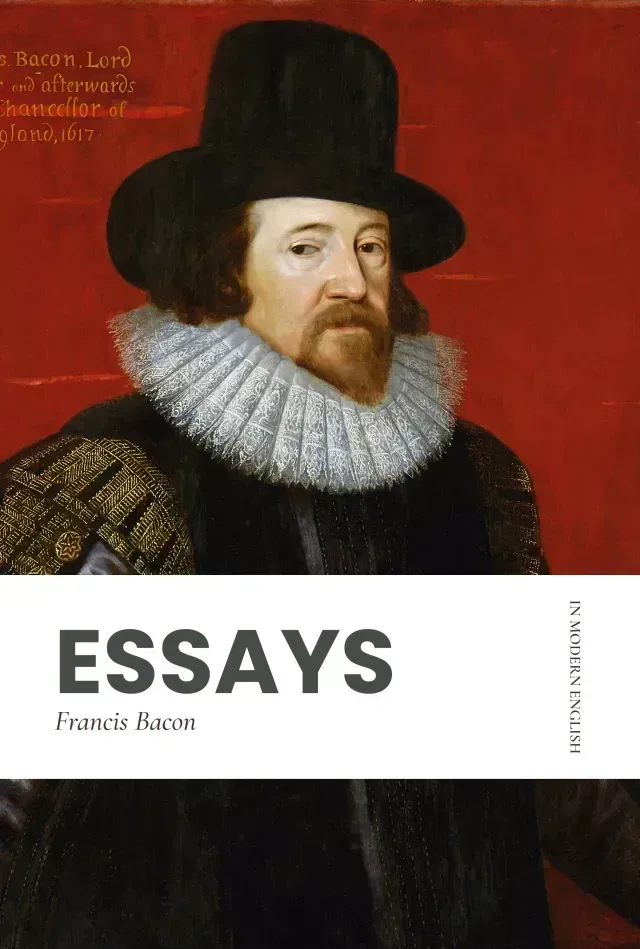
Fifty-eight brilliant meditations on truth, death, ambition, friendship, and the art of living — from the father of the scientific method and one of the sharpest political minds in English history. Bacon's Essays have been quoted for four centuries because every sentence earns its place.
One free account opens 250+ books and saves your place on every device. Google sign-in or an email link. No card.
You’re on the list — we’ll email you if this goes to print.
Included with your free account
This book, and 250+ more, free to read
A free account opens the whole library to read online, on your phone or at your desk. Open a book on one device and it is waiting at the same page on the next. The PDF and EPUB of every book are yours to keep, and audiobooks play in the same app.
250+ modernized editionsNot samples. The whole work, free.
Your place, on every devicePhone, tablet or desktop, same page.
131 audiobooksFrom $4.99 each, or all of them with a $50 gift.
"Essays" is a collection of fifty-eight short prose pieces by Francis Bacon, published in stages from 1597 AD to 1625 AD. Each essay compresses observation, classical quotation, and political experience into a few pages on one subject: truth, death, revenge, marriage, friendship, power, study, gardens.
“Revenge is a kind of wild justice.”
From this edition
What the Essays cover
01
Fifty-eight subjects. Each essay takes one topic and states its findings without preamble, argument, or conclusion. There is no through-line and no order to obey: the book can be opened anywhere.
02
Truth, death, religion. The opening group handles the largest subjects fastest. "People fear death the way children fear the dark," and the cure is not argument but noticing that "the pageantry of death frightens us more than death itself."
03
Injury and misfortune. "Revenge is a kind of wild justice," and the man who nurses it "keeps his own wounds fresh and open." Adversity gets the better press: "Prosperity is best at revealing vice, but adversity is best at revealing virtue."
04
Power and office. The political essays treat high position as a trade rather than a prize. Powerful men are "servants of the sovereign or the state, servants of their reputation, and servants of their responsibilities," and "men endure countless indignities on their way to dignity."
05
Concealment and craft. Bacon rates deception low: "Dissimulation is a rather weak form of political cunning and wisdom. It takes genuine intelligence and genuine courage to know when to tell the truth and then actually do it."
06
Marriage, love, friendship. The private essays are the coldest and the warmest. "A man with a wife and children has given hostages to fortune," love "causes far more harm than good," and yet "nothing opens the heart except a true friend."
07
The mind and study. "Reading makes a full man; conversation makes a ready man; and writing makes a precise man." Bacon prescribes particular studies for particular weaknesses, the way exercises are prescribed for particular ailments.
08
Gardens, building, health. The late essays turn domestic and unhurried. "God Almighty planted the first garden," and Bacon plans one month by month so that something is always in season.
09
An unfinished end. The collection closes on a fragment about the political uses of rumor, breaking off mid-inquiry with a single line: "The rest was not finished."
Key themes
Truth and the love of the lie. Bacon treats falsehood as attractive in itself, not merely useful: "There is also a natural, if corrupt, love of the lie itself." Strip away people's "empty opinions, flattering hopes, distorted valuations, and wishful thinking," he says, and what remains are "poor, shrunken creatures, full of gloom and discontent."
The price of high place. Ambition is examined as a bargain with unfavorable terms. "It is a strange ambition, to chase power while surrendering liberty, or to seek control over others while losing control over oneself."
Human nature as a fixed quantity. Character can be managed but not replaced: "Human nature is often hidden, sometimes overcome, and rarely extinguished entirely. Suppressing it by force only makes it return with greater intensity."
Knowledge for use. Study exists for judgment and action, not display. "To spend too much time in studies is laziness; to use them too much for show is affectation," and books "do not teach their own proper use."
Dedication to the Duke of Buckingham
Solomon says, "A good name is as a precious ointment" (Prov 22:1); and I am confident that such will be your Grace's name with posterity. Your fortune and your merit have both been remarkable, and you have established things that are built to last. I now publish my Essays, which of all my other works have circulated most widely, because they speak, it seems, directly to the concerns and inner lives of men. I have expanded them in both number and substance, so that they are, in truth, an entirely new work. It seemed fitting, therefore, given my affection and obligation to your Grace, to place your name before them, both in English and in Latin. I believe the Latin volume, being written in a universal language, may endure as long as books themselves endure. My Instauration I dedicated to the King; my History of Henry the Seventh (which I have now also translated into Latin) and my Portions of Natural History to the Prince; and these I dedicate to your Grace, as among the finest fruits that God's generous blessing on my pen and labors has allowed me to produce. May God lead your Grace by the hand.
Your Grace's most obliged and faithful servant, FR. ST. ALBAN.
The Epistle Dedicatory
To Mr. Anthony Bacon, his dear brother.
My dear and beloved brother, I find myself in the position of someone with an orchard in a bad neighborhood, forced to pick the fruit before it's ripe just to keep it from being stolen. These fragments of my thinking were already on their way to the printer. Trying to stop them would have been a nuisance and open to misinterpretation, while letting them go unchecked would have risked the damage that bad copies might do, or whatever embellishments some publisher might have seen fit to add. I therefore judged it wisest to publish them myself, exactly as they left my pen some time ago, with no greater fault attached to them than the weakness of their author. I have always believed that there can be as much vanity in withholding one's ideas from the world (unless they are of a particularly sensitive nature) as in forcing them on it. So in this case I have acted as my own judge, and I find nothing in them that strikes me as contrary to, or corrupting of, religion or public morals. If anything, I think they may do some good. My only hesitation about releasing them now is that they will be like the recently minted small coins: the silver may be fine, but the pieces are too small to amount to much. Yet since they refused to stay quietly with their author and insisted on going out into the world, I have directed them first to you, as the person closest to me, dedicating them, such as they are, to the love between us.
In the depth of that love, I confess, I sometimes wish I could take your ailments onto myself, so that Her Majesty might have the full benefit of so active and capable a mind as yours, while I might find myself, with good reason, confined to the contemplations and studies for which I am best suited. With that, I commend you to the keeping of divine Majesty. From my chamber at Gray's Inn, this 30th of January, 1597.
Your wholly loving brother, FRAN. BACON.
Dedication to the Edition of 1612.
The Dedicatory Epistle
To my loving brother, Sir John Constable, Knight.
My last collection of essays I dedicated to my dear brother, Anthony Bacon, who is now with God. Looking through my papers during this break, I found others of the same kind, and if I won't allow them to be lost, it seems the world won't either, given how often the earlier ones have been reprinted. Without my brother, I found you next, bound to me by close family ties, deep friendship, and shared companionship, particularly in our studies together. For that, I owe you a real debt of gratitude. Just as my work found its rest in quiet reflection, my reflections always found their rest in your generous conversation and sound judgment. Wishing you every good thing, I remain your loving brother and friend, Francis Bacon.
Of Truth
"What is truth?" said a jesting Pilate, and would not stay for an answer. There are certainly those who delight in uncertainty and see it as a kind of imprisonment to commit to any fixed belief, preferring freedom of thought just as they prefer freedom of action. And though the philosophical schools of that persuasion have long since disappeared, certain restless, skeptical minds remain who share the same spirit, even if they lack the intellectual force of the ancient thinkers. But it isn't only the difficulty and effort involved in finding truth, nor the way truth, once found, places demands on the mind, that makes lies so appealing. There is also a natural, if corrupt, love of the lie itself. One of the later Greek philosophers examined this question and found himself genuinely puzzled as to why people love lies even when those lies bring no pleasure, as poetry might, and no profit, as deception might serve a merchant. I cannot fully explain it either. What I can say is this: truth is like the plain light of day, which doesn't show off the pageants, masquerades, and spectacles of the world nearly as beautifully as candlelight does. Truth may be worth the price of a pearl, which looks finest in daylight; but it will never fetch the price of a diamond or ruby, which dazzles most in shifting, varied light. A touch of falsehood always adds a certain pleasure. Can anyone seriously doubt that if you stripped away from people's minds all their empty opinions, flattering hopes, distorted valuations, and wishful thinking, you would leave many of them as poor, shrunken creatures, full of gloom and discontent, miserable in their own company? One of the Church Fathers, in a moment of great severity, called poetry "the wine of demons," because it fills the imagination, and yet it does so with nothing more than the shadow of a lie. But it isn't the lie that merely passes through the mind that does the real damage; it's the lie that sinks in and takes root there, the kind we were speaking of before.
Yet however corrupted human judgment and feeling may be in these matters, truth itself, which answers to no authority but its own, teaches us that the pursuit of truth (which is the courtship and wooing of it), the knowledge of truth (which is its living presence), and the belief in truth (which is the full enjoyment of it) together form the highest good available to human nature. The first thing God created, in the work of the days, was the light of the senses; the last was the light of reason; and His Sabbath work, ever since, has been the illumination of His Spirit. First He breathed light upon the face of matter and chaos; then He breathed light into the face of man; and still He breathes and pours light into the faces of His chosen. The poet who gave beauty to a philosophical school otherwise inferior to its rivals put it excellently: "It is a pleasure to stand on the shore and watch ships tossed upon the sea; a pleasure to stand at the window of a castle and watch a battle and all its fortunes below; but no pleasure compares to standing on the high ground of truth" (a hill that cannot be overlooked, where the air is always clear and calm) "and seeing the errors and wanderings and fogs and storms in the valley below," provided always that this view is held with compassion, and not with arrogance or pride. It is, without question, a kind of heaven on earth when a person's mind moves in charity, rests in providence, and turns on the fixed poles of truth.
Moving from theological and philosophical truth to the truth of everyday life and business: even those who don't practice honesty will acknowledge that straightforward, plain dealing is the mark of human dignity. Mixing falsehood into one's conduct is like adding base metal to gold or silver coins; it may make the metal easier to work with, but it degrades the whole. Crooked, winding behavior is the way of the serpent, which crawls on its belly rather than walking upright. No vice covers a person in greater shame than being exposed as false and treacherous. Montaigne puts it well when he asks why being called a liar should be such a devastating insult. His answer: if you think about it carefully, to say that a man lies is to say that he is bold toward God and a coward toward men. A lie faces God directly while shrinking from other people. Surely the wickedness of falsehood and broken faith cannot be expressed more powerfully than in this: that it will be the final bell tolling God's judgment on humanity, as it is foretold that when Christ returns, "He will not find faith on the earth."
Of Death
People fear death the way children fear the dark, and just as children's natural fear grows worse when fed with scary stories, so does ours. Contemplating death as the wages of sin and a passage to another world is genuinely holy and spiritually sound; but fearing it simply as something nature demands of us is a weakness. Even so, religious meditation on the subject sometimes mixes in vanity and superstition. In some of the friars' books on mortification, you'll find the advice that a man should imagine the pain of having just his fingertip pressed or tortured, and from that, picture what the pains of death must be like when the whole body breaks down and dissolves. Yet death often comes with less pain than the torture of a single limb, because the most vital parts of the body are not the most sensitive to pain. Even a man who spoke purely as a philosopher and naturalist put it well: the pageantry of death frightens us more than death itself. The groaning, the convulsions, the discolored face, the weeping friends, the black mourning clothes, the funeral rites and all the rest: these are what make death look so terrible. It's worth noting that there is no passion in the human mind so feeble that it cannot face down and overpower the fear of death. Death, then, is not such a fearsome enemy when a man has so many companions around him capable of winning the fight against it. Revenge triumphs over death; love dismisses it; honor reaches toward it; grief flees to it; fear rushes ahead to meet it. We even read that after the Emperor Otho killed himself, pity, the most tender of all emotions, moved many of his followers to die out of sheer compassion for their sovereign, as the truest expression of loyalty. Seneca goes further still, adding fastidiousness and sheer boredom to the list: "Think how long you have been doing the same things; a man may wish to die not only because he is brave or miserable, but simply because he is tired of it all". A man might choose death when he is neither courageous nor wretched, simply worn out by doing the same things over and over again.
It is equally worth observing how little the approach of death seems to change people of strong character; they appear to be exactly themselves right up to the final moment. Augustus Caesar died with a courtly farewell: "Livia, remember our life together, and farewell." Tiberius died in pretense, as Tacitus records: "By now it was his strength and body, not his capacity for deception, that were failing him." Vespasian died with a joke, saying from his sickbed, "I think I'm becoming a god." Galba died with a maxim, stretching out his neck and saying, "Strike, if it serves the Roman people". Septimius Severus died in a hurry: "Come, if there is anything left for me to do". And so on. The Stoics, it must be said, made far too much of death, and by their elaborate preparations for it, only made it seem more frightening. Better is the poet's line: he who counts the end of life among nature's gifts. Dying is as natural as being born, and for a small infant, the one may well be as painful as the other. A man who dies in the middle of an earnest pursuit is like a soldier wounded in the heat of battle who barely feels the injury at the time. A mind fixed firmly on something worthwhile will push aside the anguish of death. But above all else, believe this: the sweetest song a person can sing is "Lord, now let your servant depart in peace", when a man has achieved the ends he truly sought and the hopes he carried. Death has this in its favor as well: it opens the door to lasting reputation, and it puts envy to rest, for as the poet said, once gone, the same man will be loved.
Of Unity in Religion
Religion is the primary bond of human society, so it is a fortunate thing when religion itself is held together by the true bond of unity. The quarrels and divisions over religion were evils unknown to the pagans, and the reason is straightforward: pagan religion consisted more of rites and ceremonies than of any fixed set of beliefs. You can imagine what kind of faith theirs was when the chief teachers and authorities of their religion were the poets. But the true God has this defining quality, that He is a jealous God, and therefore His worship and religion will tolerate no mixture and no rival. We will therefore say a few words about the unity of the Church: what are its fruits, what are its proper boundaries, and what are the means by which it is achieved?
The fruits of unity, setting aside the most important thing of all, which is pleasing God, fall into two categories: one concerns those outside the Church, and the other concerns those within it. As for the first: it is certain that heresies and schisms are, of all things, the greatest sources of scandal, even more damaging than corruption of morals. Just as in the physical body a wound or a break in continuity is worse than a diseased humor, so it is in the spiritual body. Nothing keeps people out of the Church, or drives people away from it, as much as a breach of unity. So whenever it reaches the point where one person says, "Look, He is in the desert" and another says, "Look, He is in the inner rooms" (Matt 24:26), meaning when some seek Christ in the gatherings of heretics and others in the outward shell of a formal church, that voice needs to ring constantly in people's ears: "Do not go out". The apostle to the Gentiles, whose particular calling gave him a special concern for those outside the Church, put it plainly: "If an unbeliever comes in and hears you all speaking in different tongues, will he not say that you are out of your minds?" (1 Cor 14:23).
Certainly, it is little better when atheists and irreligious people hear so many conflicting and contradictory opinions within religion: it drives them away from the Church and leads them to sit down in the chair of the scorners. It may seem a trivial example to raise in so serious a matter, but it captures the ugliness of the problem well. There is a master of mockery who, in his catalogue of books from an imaginary library, lists the following title: The Morris Dance of Heretics. And indeed, every sect among them has its own peculiar posture or affectation, which can only invite ridicule from worldly people and cynical politicians who are already inclined to hold sacred things in contempt.
As for the fruit that unity bears for those within the Church, it is peace, and peace contains within it countless blessings. It strengthens faith, it kindles charity, and the outward peace of the Church filters down into peace of conscience. It also redirects the labor spent writing and reading polemical controversies toward works of spiritual discipline and devotion.
Where we draw the boundaries of unity matters enormously. Two extremes seem to exist. On one side, certain zealots find any talk of reconciliation offensive: "Is it peace, Jehu? What do you have to do with peace? Turn behind me." For them, peace isn't the point; what matters is loyalty and faction. On the other side, certain lukewarm, Laodicean types think they can split the difference on matters of religion, taking a little from each side and crafting clever compromises, as if they were arbitrating a dispute between God and Man. Both extremes must be avoided, and the way to avoid them is to read carefully the two contrasting clauses of the covenant our Savior himself laid down: "He that is not with us, is against us" (Matt 12:30), and then again, "He that is not against us, is with us" (Mark 9:40). In other words, we need to clearly and honestly distinguish between the points that are truly fundamental to faith and those that are merely matters of opinion, church order, or personal conviction.
Many will say this is a trivial point, already settled long ago. But if it were settled with less bias, it would find far wider acceptance.
On this matter, I can offer only the following counsel, drawn from my limited understanding. People should be careful not to tear God's Church apart through two particular kinds of controversy. The first arises when the point being disputed is too trivial and inconsequential to justify the heat and conflict it generates, a conflict fueled by nothing more than the desire to contradict. As one of the Church Fathers observed, Christ's coat had no seam, yet the Church's garment was woven of many colors. From this he concluded: let there be variety in the garment, but no tearing of it. Unity and uniformity are two very different things.
The second kind of controversy arises when the disputed point is genuinely significant, but the argument is pushed into such excessive subtlety and obscurity that it becomes an exercise in cleverness rather than a pursuit of substance. A person of sound judgment will sometimes listen to two ignorant men argue and recognize clearly, even as they cannot, that they are actually saying the same thing. And if that kind of gap in understanding can exist between one person and another, should we not believe that God, who knows the human heart, can see when frail men, even in their disagreements, are reaching toward the same truth, and accepts them both? St. Paul captured the nature of such controversies perfectly in his warning: "Avoid godless chatter and the opposing ideas of what is falsely called knowledge" (1 Tim 6:20). People manufacture oppositions that don't truly exist, then lock them into rigid terminology, so that instead of the meaning shaping the term, the term ends up controlling the meaning. There are also two false versions of peace and unity. The first is a peace built on shared ignorance, since all colors look the same in the dark. The second is a peace stitched together by openly accepting contradictions on fundamental points. In matters of this kind, truth and falsehood are like the iron and clay in the toes of Nebuchadnezzar's statue: they may press against each other, but they will never truly fuse.
Regarding the means of securing unity, people must be careful that in pursuing or defending religious unity, they don't tear apart the laws of charity and human society. Christians have two swords at their disposal: the spiritual and the temporal. Both have their proper role and place in upholding religion. But we must never take up a third sword, the sword of Mohammed, or anything like it. That means we must not spread religion through wars or bloody persecutions, forcing people's consciences, except in cases of open scandal, blasphemy, or practices that directly threaten the state. Still less should we encourage sedition, authorize conspiracies and rebellions, arm the people against their rulers, or pursue anything else that tends toward the destruction of all government, which is God's own ordinance. To do any of this is simply to pit the first table of the law against the second, treating people as Christians while forgetting that they are human beings first. The poet Lucretius, when he witnessed the act of Agamemnon, who could bring himself to sacrifice his own daughter, cried out: "So much evil could religion persuade men to do".
What would he have said if he had known about the Massacre in France or the Gunpowder Plot in England? He would have been seven times more of an Epicurean and atheist than he already was. For just as the physical sword must be drawn with great caution in matters of religion, it is monstrous to place that sword in the hands of ordinary people. Let that be left to the Anabaptists and other fanatics. It was great blasphemy when the Devil said, "I will ascend and be like the Most High"; but it is even greater blasphemy to put words in God's mouth and have Him say, "I will descend and be like the Prince of Darkness." And how is it any better to drag the cause of religion down to the cruel and unspeakable acts of murdering princes, slaughtering people, and overthrowing states and governments? This is surely to bring down the Holy Spirit, not in the likeness of a dove, but in the shape of a vulture or raven, and to fly from the vessel of the Christian Church not a proper flag, but the banner of pirates and assassins.
It is therefore absolutely necessary that the Church, through its doctrine and decrees; princes, through their authority; and all learning, both Christian and moral, acting as a kind of guiding staff, should condemn and consign to hell forever those acts and opinions that support such violence, as has already been done to a considerable degree. Certainly, in any council concerning religion, the apostle's warning should be posted at the door: "Human anger does not produce the righteousness of God". And there was a notable observation made by a wise church father, which he confessed with admirable honesty: that those who advocated for the suppression of conscience were typically serving their own interests in doing so.
Questions
What is Bacon's "Essays" about?+
Bacon's "Essays" is a book of fifty-eight short pieces on separate subjects, each setting out what Bacon had observed about one part of life. The topics range from truth, death, and religion to ambition, negotiation, marriage, friendship, wealth, study, and garden design. There is no continuous argument; each essay stands alone.
How many essays are in Bacon's "Essays"?+
The final 1625 AD edition contains fifty-eight essays, plus an unfinished fragment on fame. The first edition of 1597 AD had only ten, and Bacon expanded the collection twice, in 1612 AD and again in 1625 AD.
Which of Bacon's essays is the most famous?+
"Of Studies" is the most famous essay, best known for the line "Some books are to be tasted, others swallowed, and a few chewed and digested." "Of Truth" and "Of Revenge" run close behind, opening respectively with jesting Pilate's question and with "Revenge is a kind of wild justice."
Is Bacon's "Essays" hard to read?+
The original is difficult, though not because the thinking is obscure. Bacon writes in dense Jacobean English packed with untranslated Latin tags and unexplained classical allusions, so modern readers stall on the surface rather than the substance. The modern English edition carries the compression across while clearing the vocabulary and identifying the references.
What does Bacon's "Of Studies" say?+
"Of Studies" argues that reading exists for judgment and action, not for show or for argument: "Studies serve three purposes: delight, refinement, and practical ability." Bacon sorts books into those to be tasted, swallowed, or chewed and digested, and then prescribes particular fields as remedies for particular defects of mind, mathematics for a wandering attention, legal cases for a mind that cannot connect one thing to another.
How long does it take to read Bacon's "Essays"?+
The full collection runs about 58,000 words, roughly a four-hour read. Because the essays are independent and most run only two or three pages, the book is more often read a piece at a time than straight through.
Why is Bacon's "Essays" important?+
Bacon's "Essays" established the essay as a form in English and produced more proverbial sentences than almost any book outside the Bible and Shakespeare. It also records how power actually worked, written by a man who became Lord Chancellor of England and then lost the office in disgrace.
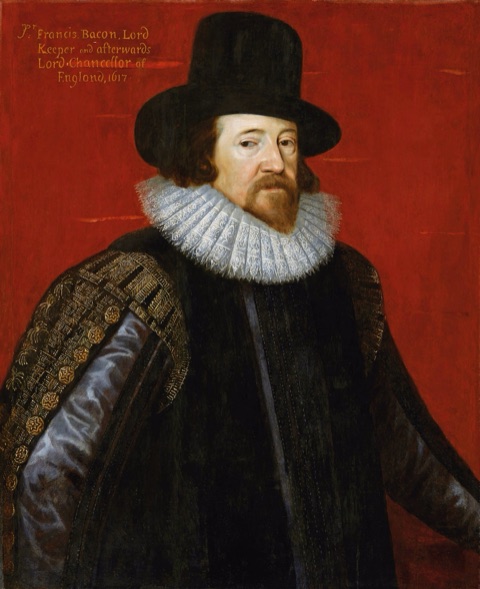
Francis Bacon was an English philosopher, statesman, and author who served as both Attorney General and Lord Chancellor of England. Widely regarded as the father of the scientific method, his intellectual legacy spans philosophy, politics, and literature. His "Essays" — first published in 1597 and expanded through 1625 — distill a lifetime of political wisdom and philosophical reflection into some of the most celebrated prose in the English language. Samuel Johnson called them 'the work of one of the greatest minds in the world.'