Modernized edition · Full text · Free PDF/EPUB
Original Sin in Modern English
Summary
- Published
- 1758 AD; the preface is dated Stockbridge, May 26, 1757
- Opponents answered
- Chiefly Dr. Taylor of Norwich, with Dr. Turnbull
- Length
- 120,000 words · 8 hours
- Collection
- Puritan
What is Original Sin about?
Original Sin is Jonathan Edwards's defense, published in 1758, of the doctrine that every person is born corrupt and shares the guilt of Adam's first sin. Answering Dr. Taylor of Norwich, Edwards argues from the universal facts of sin and death, from Scripture and from the nature of redemption, then meets each objection in turn.
Read the full summary (8 points, quotes, key themes)Show less
How the argument unfolds
- 01
The evidence of facts. Universal and continual sin, idolatry, neglect of eternity and the failure of every means of reform reveal a fixed propensity to sin.
- 02
Evasions answered. Adam's first sin, free will, bad example, early passions and the needs of a state of trial cannot account for so constant a result.
- 03
Universal mortality. Death is a judgment for sin, and its reign over infants shows they are not born innocent.
- 04
Genesis and the Old Testament. Adam was created upright, the death threatened him was the full wages of sin, and his posterity were included in the warning and the sentence.
- 05
The New Testament and Romans 5. Flesh means corrupt nature, the universal terms of Romans 3 mean all, and Romans 5:12 to 21 teaches both inherited corruption and imputed guilt.
- 06
Evidence from redemption. Christ came to save sinners, and every name for the saving change, from new birth to new creation, assumes a sinful first state.
- 07
Objections answered. Edwards meets the claims that sin needs prior choice, that God would author sin and that imputation is unjust, then lesser charges.
- 08
Conclusion. A warning against writers who praise Paul's genius while explaining away the plain sense of his letters.
Notable images & quotes
- The ship that sinks. Calling human nature good because kind acts outnumber crimes is “far more absurd than calling a ship good for crossing the Atlantic Ocean when it cannot hold together for the voyage and will certainly sink”.
- The man with two lame feet. If Paul meant only two collective bodies, his piled up universals would be like a man saying “All my feet are lame!” when he has only two, and being thought lame in his mind as well.
- The shipwrecked sailor. On Taylor's reading, saying sin entered by one man is like hearing of one sailor washed ashore who died at once and declaring, “By that one man mankind came into America.”
- The moon's brightness. The moon's light seems to last unchanged, “Yet in reality it is an effect produced every moment.” So every creature exists by God's renewed power, and its oneness over time rests on his constitution.
Key themes
- Reasoning from constant effects. A result that holds in every age, nation and condition, against every opposing motive, proves a fixed internal cause.
- Two heads of mankind. Adam and Christ stand as heads of two races, so that sin and death flow from the one as righteousness and life flow from the other.
- Grace measured by ruin. The greatness of grace appears only against real guilt; deliverance from an undeserved evil would be justice, not mercy.
- The plain sense of Scripture. Paul wrote to be understood, and a doctrine stated in almost every verse of Romans 5:12 to 21 cannot be argued away by forced readings.
Why read it today
Read it to see a careful mind take an opponent's whole case seriously. Edwards quotes Taylor at length, follows him passage by passage, and shows where his admissions undo his system.
It is also a model of argument from evidence: history, death and the words of Scripture, with Paul defended against critics under whose methods, Edwards says, “Holy Scripture is thinned out into a mere mist”.
Source edition: The 1834 Edward Hickman edition of The Works of Jonathan Edwards, Volume 1
Reader questions (9)Hide the questions
Questions about Original Sin
Is there a modern English version of Original Sin?
Yes. This is Original Sin by Jonathan Edwards in modern English. The language is modernized and the author's order and argument are kept. The full modernized text is free to read on this page.
Can I read Original Sin online for free?
Yes. The complete text of this modern English edition is on this page, with no sign-up or paywall.
Is there a free PDF of Original Sin?
Yes. The PDF and EPUB of this edition are free with an Updated Works account. Sign in with Google or an email link; no card is needed.
What is Original Sin by Jonathan Edwards about?
It defends the teaching that all people are born morally corrupt and share in the guilt of Adam's first sin. Edwards argues from history and experience, from Genesis through Romans, and from Christ's redemption, then answers the objections of Dr. Taylor of Norwich and others.
Who was Dr. Taylor?
Dr. Taylor of Norwich wrote The Scripture-Doctrine of Original Sin and a paraphrase with notes on Romans. He denied both inherited depravity and imputed guilt, and Edwards follows his book closely, often turning Taylor's own admissions against him.
When did Edwards write it?
He dated the preface at Stockbridge on May 26, 1757, and the book appeared in 1758, after his treatise on the freedom of the will.
Does Edwards think God puts evil into newborn children?
No. When God withholds the holy principles that depend on communion with him, the natural principles of self-love and appetite rule alone, and corruption follows without any evil being infused.
How does Edwards defend imputing Adam's sin to his descendants?
He argues that God constituted Adam and his race as one, like a root and its branches, and that their hearts consent to the first apostasy: “Therefore the sin of the apostasy is not theirs merely because God imputes it to them.”
Does the doctrine breed contempt for human nature?
Edwards replies that it honors human faculties while naming a real disease, and that “the one who tries to uncover and expose our disease acts as a true friend”.
Original Sin in Modern English · Full text
Preface
This treatise is intended not merely as an answer to any single book written against the doctrine of original sin, but as a general defense of that great and vital doctrine. Even so, I have addressed the main objections raised against it by the best-known opponents I have had the opportunity to read. In particular, I have examined two recent writers, Dr. Turnbull and Dr. Taylor of Norwich, and especially the latter in two of his published works: The Scripture-Doctrine of Original Sin Proposed to Free and Candid Examination and A Key to the Apostolic Writings, with a Paraphrase and Notes on the Epistle to the Romans. I have followed Dr. Taylor’s book on original sin closely in all its parts. My aim has been to leave nothing of consequence in this controversy unnoticed, and nothing that even looks like an argument against the doctrine unanswered.
I regard this doctrine as immensely important, as everyone must surely acknowledge if it is true. Suppose all humanity really is by nature in a state of total ruin, both in the moral evil that indwells them and in the suffering and judgment to which they are exposed, the one being the consequence and punishment of the other. If that is true, then the great salvation accomplished by Christ stands in direct relation to this ruin, just as a remedy relates to a disease. The whole gospel, the entire doctrine of salvation, presupposes it, and every real belief or true understanding of the gospel must be built upon it.
Because I am convinced that this doctrine is both certainly true and deeply important, I hope my effort to vindicate it will be read with fairness. I ask everyone willing to read the following discourse to weigh my defense impartially. In it, I intend to examine every material point throughout Dr. Taylor’s entire book, many passages in his Key and commentary on Romans, and numerous arguments written against this doctrine by other modern authors. Because this work is meant not only as a reply to Dr. Taylor and other critics, but also as a general defense that presents the positive evidence for original sin alongside answers to objections, I hope it will prove neither unnecessary nor useless, despite other books already published on the subject.
I also hope that the breadth of my plan will excuse the length of this work. Consider how much was strictly necessary to carry out such a design: how much has been written against original sin and how plausibly it has been argued, and how strong the prejudices of many readers are in favor of those objections. Many will not be satisfied with anything less than a full examination of nearly every argument advanced by the leading opponents, especially by so recent and plausible a writer as Dr. Taylor. Add to this how much must be said to handle the positive arguments for the doctrine thoroughly, and how momentous the doctrine must be if it is true. Given all this, I trust the length of this treatise will not be thought greater than the case required. Still, I must leave that to the judgment of the thoughtful and fair-minded reader.
Stockbridge, May 26, 1757.
Part 1: Evidences of Original Sin from Facts and Events
Chapter 1
Evidence from the Sinfulness of Humanity
Section 1: All People Unfailingly Fall into Sin and Ruin
Theologians most commonly use the phrase original sin to mean the innate sinful depravity of the human heart. Yet when people speak of the doctrine of original sin, they ordinarily use it in a broader sense that includes not only the depravity of nature, but also the imputation of Adam’s first sin. In other words, it includes the liability of Adam’s descendants, in God’s judgment, to share in the punishment of that sin. As far as I know, most who have held one of these truths have maintained the other, and most who have opposed one have opposed both. Dr. Taylor, the writer I mainly address in this treatise, opposes both in his book against original sin. As our inquiry proceeds, it may well become clear that these two points are closely linked, that the arguments proving the one also establish the other, and that accepting the one brings no greater difficulty than accepting the other.
I will begin by examining this doctrine primarily with respect to the corruption of human nature. As we work through that subject, the imputation of Adam’s sin will naturally come into view in connection with it. Because all moral qualities, and every principle of virtue or vice, lie in the disposition of the heart, the question before us is whether we have evidence that the human heart is naturally corrupt and evil. Many recent writers who oppose the doctrine of original sin, and Dr. Taylor in particular, strenuously deny this.
How do we form the idea of a disposition or tendency? We do so by observing what happens constantly or generally in actual outcomes, especially across a wide variety of circumstances. Above all, we recognize a tendency when the same outcome persists despite strong and varied opposition, when many forces and measures used to prevent it fail to stop it. I am not aware that anyone denies this principle: a prevailing pattern of effects proves a prevailing tendency in their causes and agents. Nor do opponents of original sin explicitly deny that if humanity universally or generally proves corrupt in actual fact, that would be evidence of a prior corrupt propensity in human nature. Some of their statements, when traced to their plain consequences, may seem to imply a denial of this, and we can consider those later. Many of them, however, deny the fact itself. They deny that corruption and moral evil commonly prevail in the world, insisting instead that good outweighs evil and that virtue holds the upper hand.
To this point, Dr. Turnbull writes in his Moral Philosophy, “With regard to the prevalence of vice in the world, men are apt to let their imagination run out upon all the robberies, piracies, murders, perjuries, frauds, massacres, assassinations they have either heard of, or read in history, thence concluding all mankind to be very wicked. As if a court of justice were a proper place to make an estimate of the morals of mankind, or a hospital of the healthfulness of a climate. But ought they not to consider that the number of honest citizens and farmers far surpasses that of all sorts of criminals in any state, and that the innocent and kind actions of even criminals themselves surpass their crimes in numbers; that it is the rarity of crimes, in comparison of innocent or good actions, which engages our attention to them, and makes them to be recorded in history, while honest, generous domestic actions are overlooked only because they are so common? As one great danger, or one month’s sickness, shall become a frequently repeated story during a long life of health and safety. Let not the vices of mankind be multiplied or magnified. Let us make a fair estimate of human life, and set over against the shocking, the astonishing instances of barbarity and wickedness that have been perpetrated in any age, not only the exceedingly generous and brave actions with which history shines, but the prevailing innocency, good-nature, industry, felicity, and cheerfulness of the greater part of mankind at all times; and we shall not find reason to cry out, as objectors against Providence do on this occasion, that all men are vastly corrupt, and that there is hardly any such thing as virtue in the world. Upon a fair computation, the fact does indeed come out that very great villainies have been very uncommon in all ages, and looked upon as monstrous; so general is the sense and esteem of virtue.”
Dr. Taylor seems to share the same view when he writes in his Supplement, “We must not take the measure of our health and enjoyments from a leper house, nor of our understanding from Bedlam, nor of our morals from a jail.”
Whether such a picture is fair, and whether it proves what these writers intend, we will be better able to judge once we weigh the evidence that follows. For the sake of clarity, however, I must state one foundational principle at the outset. It is of immense importance in this controversy, yet opponents of original sin routinely overlook it in their arguments.
The true tendency of the innate disposition of the human heart is what it tends toward when we consider things as they are in themselves, in their own nature, apart from the intervention of divine grace. A state of human nature or disposition of mind must be judged evil and destructive if, taken in itself, it leads to ruinous consequences and would inevitably end in them unless God’s free mercy and kindness stepped in to prevent that outcome. It would be absurd to argue that no evil tendency exists simply because the pure favor and compassion of the Most High may intervene to oppose it and stop the tragic result. Specifically, if something in human nature gives every person an unfailing universal tendency toward moral evil, and if that evil by its true nature and guilt brings utter ruin, then that tendency must be recognized as an evil propensity. This holds true no matter how sovereignly divine grace may step in to rescue people from deserved ruin and overrule events toward an opposite outcome.
Grace is sovereign, exercised according to God’s good pleasure to bring good out of evil. Its effect does not belong to the nature of things that otherwise tend to harm, any more than a remedy belongs to a disease. Grace is something wholly independent of human nature, introduced to counteract its natural tendency and reverse its course. By contrast, the outcome to which things tend according to their own guilt and according to divine justice is the outcome to which they tend in their own nature. Dr. Taylor’s own words in his Preface to the Paraphrase on Romans imply this clearly: “God alone,” he says, “can declare whether he will pardon or punish the ungodliness and unrighteousness of mankind, which is in its own nature punishable.” Nothing aligns more precisely with the truth of things than divine justice. It weighs everything in an even balance, seeing and judging things strictly as they really are. Therefore, whatever implies a tendency to ruin by the measure of divine justice undeniably implies such a tendency in its own nature.
We must also remember that we are speaking of moral depravity. So when we ask whether such depravity shows itself in a tendency to a bad outcome, it is a moral tendency that counts. A moral tendency operates through what a thing deserves. Human nature or the human condition carries a destructive tendency in a moral sense whenever it leads to what deserves misery and destruction. Consequently, the moral depravity of human nature in our present state is equally clear whether that nature universally leads to destructive wrath actually carried out, or leads to deserving misery and ruin and standing justly exposed to destruction, regardless of whether grace prevents the fatal stroke or what the final outcome turns out to be.
One more point belongs here. The main ground on which opponents of original sin rest their case is the justice of God. They appeal to divine justice both in objecting to the imputation of Adam’s sin and in denying that God could let people enter the world with a corrupt, ruined nature before meriting their Creator’s displeasure by any personal fault. Yet the latter cannot contradict God’s justice if people actually are born with a tendency to sin, and to misery and ruin for their sin, which will inevitably follow unless pure grace steps in to prevent it.
Once that is admitted, the objection from justice collapses. Saying that grace is needed to save people admits that their liability to misery and ruin comes by way of justice. Otherwise, divine grace would not be needed to rescue them. Justice alone, if exercised, would be complete protection without grace. In a debate over what is just and righteous, it makes no difference whether people are born into a miserable state with a tendency to ruin that actually follows and does so justly, or into a state that tends to deserve ruin, which might justly follow and would actually follow without grace. The real question in dispute is not what grace will do, but what justice might do.
I have dwelt on this point carefully because it undermines much of the reasoning by which Dr. Taylor builds his system. Again and again, he argues from the condition humanity enjoys by divine grace, a condition he himself admits comes from divine grace. Yet he makes no allowance for that fact, and from it he draws conclusions against what others maintain about the tragic, ruined state into which humanity fell.
His writings supply abundant examples of this error. He often speaks of death and affliction as coming upon Adam’s descendants because of Adam’s sin, yet claims that they arrive not as a punishment or calamity, but as a benefit. Elsewhere, however, he admits that these very things would be a great calamity and misery were it not for the resurrection, which he repeatedly attributes to Christ and to the grace of God in Christ. Speaking of our subjection to sorrow, labor, and death as a consequence of Adam’s sin, he describes them as evils that are reversed and turned into advantages, and from which we are delivered through grace in Christ. He even presents God’s turning death into an advantage through grace in Christ as what vindicates God’s justice in bringing death through Adam.
The same pattern runs through his replies to orthodox objections. Against the statement of the Assembly of Divines that we are by nature bondslaves to Satan, he answers that God has provided various means and dispensations from the beginning of the world to preserve and rescue humanity from the devil. When answering the objection that his view leaves us in worse circumstances than Adam, he appeals to the happy condition we enjoy through free grace in Christ. When addressing the argument from Romans 7 that a law in our members brings us into captivity to the law of sin and death, he makes a telling concession. He admits that anyone under a law threatening death for every sin would be in an utterly deplorable condition without relief from the Lawgiver’s mercy, even though he says elsewhere that this law displays sin’s natural, proper demerit and perfectly matches everlasting truth and righteousness.
Likewise, in his Supplement, to counter the claim that Adam’s sin brought humanity into a miserable state, he points to the noble designs of love in a new, happy dispensation founded on the obedience and righteousness of the Son of God. He argues that though we are subjected to death through Adam, this dispensation provides a resurrection and places Adam’s descendants under a mild dispensation of grace. He defends God’s placing Adam first under the rigor of the law, “transgress and die,” which he calls putting Adam’s happiness on an extremely dangerous footing. How does he defend it? By saying that God, as he had already purposed in himself, immediately established his covenant on a completely different foundation, namely grace.
Against what the author of The Ruin and Recovery of Mankind says, that God forsook man when he fell and that humanity after Adam’s sin was born outside divine favor, Dr. Taylor appeals to grace again. He cites Christ’s coming as the propitiation for the sins of the whole world, the riches of God’s mercy in promising a Redeemer to destroy the devil’s works, and God’s catching his sinning, falling creature in the arms of his grace.
In his note on Romans 5:20, Dr. Taylor writes, “The law, I conceive, is not a dispensation suitable to the infirmity of the human nature in our present state; or it does not seem congruous to the goodness of God, to afford us no other way of salvation but by a law, which, if we once transgress, we are ruined forever. For who then from the beginning of the world could be saved? And therefore it seems to me, that the law was not absolutely intended to be a rule for obtaining life, even to Adam in paradise: Grace was the dispensation God intended mankind should be under; and therefore Christ was foreordained before the foundation of the world.” Many other passages of the same kind appear throughout his writings.
For arguments and conclusions like these to stand, they must rest on a very strange assumption. They imply that God’s dispensations of grace are corrections or amendments to his earlier legal arrangements. It is as if the grace that follows pure law were an admission that the earlier legal arrangement would have been unjust, or at least overly harsh toward humanity, if left standing, so that grace serves as compensation to creatures for previous injury or severity. Put the injury together with the compensation, combine the harsh legal dispensation with the kind dispensation our author calls grace, and the unfairness or excessive severity of the first is repaired by the goodness of the second so that both together make up one righteous arrangement.
Please keep firmly in mind what I have shown: the intervention of divine grace does not change the nature of things as they are in themselves. Whenever I speak of an evil tendency belonging to humanity’s present nature and state, understand me to mean their tendency as they are in themselves, apart from any consideration of the remedy provided by God’s sovereign, infinite grace. With that principle established, I now state my proposition: all human beings are naturally in a condition that unfailingly produces this outcome, that they universally run themselves into what amounts to their own utter and eternal perdition, becoming finally accursed by God and subjects of his remediless wrath through sin. From this I infer that the natural state of the human mind carries a prevailing, effective propensity of nature toward that outcome. Therefore, human nature is morally corrupt and depraved to a degree that amounts to and entails its utter undoing.
I will first establish the truth of this proposition, and then show the certainty of the consequences I draw from it. If both are clearly and decisively proved, I trust no one will deny that the doctrine of original depravity is established and that Dr. Taylor’s system is proved false. After all, the greater part of his book, The Scripture-Doctrine of Original Sin, is aimed against the doctrine of innate depravity. In his Supplement, he himself describes the transmission of a corrupt and sinful nature to Adam’s descendants as the grand point that defenders of original sin must prove.
To demonstrate my proposition, only two things need to be made clear. The first is the fact that all people enter the world in a state that unfailingly results in the universal commission of sin, meaning that everyone who acts in the world as a moral agent is, to a greater or lesser degree, guilty of sin. The second is that all sin deserves and exposes the sinner to utter, eternal destruction under God’s wrath and curse, and would end in that destruction if divine grace did not intervene to prevent it. Both points can be abundantly proved from the Word of God and from Dr. Taylor’s own teaching.
That every human being capable of acting as a moral agent is guilty of sin, even without yet assuming that people enter the world already guilty, is abundantly clear from the Holy Scriptures. “If any man sin against thee; for there is no man that sinneth not” (1 Kgs 8:46). “There is not a just man upon earth that doeth good, and sinneth not” (Eccl 7:20). Job says, “I know it is so of a truth” (referring to what Bildad had just said, that God would not cast away a perfect man, and so on), “but how should man be just with God? If he will contend with him, he cannot answer him one of a thousand” (Job 9:2-3). To the same effect the psalmist prays, “Enter not into judgment with thy servant; for in thy sight shall no man living be justified” (Ps 143:2).
The apostle Paul echoes those very words of the psalmist: “That every mouth may be stopped, and all the world become guilty before God. Therefore by the deeds of the law there shall no flesh be justified in his sight: for by the law is the knowledge of sin” (Rom 3:19-20). The same truth appears in Galatians 2:16. And John writes, “If we walk in the light, the blood of Christ cleanseth us from all sin. If we say that we have no sin, we deceive ourselves, and the truth is not in us. If we confess our sins, he is faithful and just to forgive us our sins, and to cleanse us from all unrighteousness. If we say that we have not sinned, we make him a liar, and his word is not in us” (1 John 1:7-10).
In these and countless other passages, confession and repentance of sin are presented as duties required of all people. The same is true of praying to God for pardon and of forgiving those who injure us because we hope to be forgiven by God. Universal guilt could also be proved from the institution and stated purpose of the ancient sacrifices, as well as from the ransom money that every person numbered in Israel had to pay to make atonement for his soul (Exod 30:11-16). Scripture portrays all people not merely as sinful, but as burdened with great and manifold iniquity (Job 9:2-3; Jas 3:1-2).
Many passages of Scripture declare both the universal sinfulness of humanity and the truth that all sin deserves and justly exposes sinners to everlasting destruction under God’s wrath and curse. They thus establish both parts of my proposition at once. Galatians 3:10 states this with striking fullness: “For as many as are of the works of the law are under the curse; for it is written, Cursed is every one that continueth not in all things which are written in the book of the law, to do them.” How plainly Paul’s words imply that no person succeeds in doing everything written in the book of the law! Therefore, all who rely on keeping the law stand under the curse pronounced on those who fail to keep it.
From this, the apostle draws his conclusion in the very next verse, “that no man is justified by the law in the sight of God” (Gal 3:11), just as he had already said in the previous chapter, “By the works of the law shall no flesh be justified” (Gal 2:16). Paul shows how he understands that text he quotes from Deuteronomy: “the Scripture hath concluded” (that is, shut up) “all under sin” (Gal 3:22). Here we are taught plainly both that every human being is a sinner and that every sinner stands under the curse of God.
Romans 4:14 teaches the same truth, as does 2 Corinthians 3:6, 7, 9, where the law is called “the letter that kills, the ministration of death, and the ministration of condemnation.” The wrath, condemnation, and death that the law threatens against all its transgressors are final perdition, the second death, eternal ruin. That is entirely plain and is universally acknowledged. Moreover, this punishment that the law threatens for every sin is a just punishment, strictly what every sin truly deserves, because God’s law is a righteous law and its sentence is a righteous sentence.
Dr. Taylor himself confesses and affirms every one of these points. He states that God’s law demands perfect obedience. In his note on Romans 7:6, he writes, “God can never require imperfect obedience, or by his holy law allow us to be guilty of any one sin, however small. And if the law, as a rule of duty, were in any respect abolished, then we might in some respects transgress the law, and yet not be guilty of sin. The moral law, or law of nature, is the truth, everlasting, unchangeable; and therefore, as such, can never be abrogated. On the contrary, our Lord Jesus Christ has promulgated it anew under the gospel, fuller and clearer than it was in the Mosaic constitution, or anywhere else, having added to its precepts the sanction of his own divine authority.”
Many of his statements also imply that all people break this law to some degree. Speaking of what may be learned from Romans 7 and Romans 8, he writes, “We are very apt, in a world full of temptation, to be deceived, and drawn into sin by bodily appetites, etc. And the case of those who are under a law threatening death to every sin must be quite deplorable, if they have no relief from the mercy of the lawgiver.”
He declares this even more fully in his note on Romans 5:20. Speaking of the law, he writes, “Indeed, as a rule of action prescribing our duty, it always was and always must be a rule ordained for obtaining life; but not as a rule of justification, not as it subjects to death for every transgression. For if it could in its utmost rigor have given us life, then, as the apostle argues, it would have been against the promises of God. For if there had been a law, in the strict and rigorous sense of law, which could have made us live, verily justification should have been by the law. But he supposes no such law was ever given, and therefore there is need and room enough for the promises of grace; or as he argues in Galatians 2:21, it would have frustrated, or rendered useless, the grace of God. For if justification came by the law, then truly Christ is dead in vain; then he died to accomplish what was, or might have been, effected by law itself without his death. Certainly the law was not brought in among the Jews to be a rule of justification, or to recover them out of a state of death, and to procure life by their sinless obedience to it. For in this, as well as in another respect, it was weak; not in itself, but through the weakness of our flesh (Rom 8:3). The law, I conceive, is not a dispensation suitable to the infirmity of the human nature in our present state; or it does not seem congruous to the goodness of God to afford us no other way of salvation but by law, which if we once transgress, we are ruined forever. For who then, from the beginning of the world, could be saved?”
How clear and explicit these statements are: no human being from the beginning of the world can ever be justified by the law, because everyone transgresses it! I am well aware that these admissions are completely inconsistent with what Dr. Taylor claims elsewhere in his Supplement, where he argues that all people have sufficient power to continually perform the whole duty God requires of them without any necessity of breaking God’s law in any degree. Still, I hope the reader will not hold me responsible for his inconsistencies.
Notice also how clearly Dr. Taylor states that the law sentences people to everlasting ruin for a single transgression. He says the same thing repeatedly. Elsewhere he writes, “The law requires the most extensive obedience, revealing sin in all its branches. It gives sin a deadly force, subjecting every transgression to the penalty of death, and yet supplies neither help nor hope to the sinner, leaving him under the power of sin and sentence of death.” He describes the law as extending to lust and irregular desires, and to every branch and principle of sin, even to its latent principles and minutest branches, and again in his note on Romans 7:6, to every sin, however small.
When he says the law subjects every transgression to the penalty of death, he means eternal death, as he regularly explains. He speaks of the law in its condemning power as binding us in everlasting chains. In his Supplement, he says that the death which is the wages of sin is the second death, which he explains as final perdition. In his Key, he writes, “The curse of the law subjected men for every transgression to eternal death.” Likewise, in his note on Romans 5:20, he says, “The law of Moses subjected those who were under it to death, meaning by death, eternal death.” Those are his own words.
Dr. Taylor also affirms that this sentence of the law is just and righteous. It subjects people to so dreadful a punishment for every sin, even the least sin and every smallest branch and hidden principle of sin, yet he says it agrees with truth, the nature of things, and the natural and proper demerits of sin. On this point he is very explicit. “It was sin,” he says, “which subjected us to death by the law, justly threatening sin with death. Which law was given us, that sin might appear, might be set forth in its proper colors, when we saw it subjected us to death by a law perfectly holy, just, and good; that sin by the commandment, by the law, might be represented what it really is, an exceedingly great and deadly evil.”
In his note on Romans 5:20, he writes, “The law or ministration of death, as it subjects to death for every transgression, is still of use to show the natural and proper demerit of sin.” In the same note he adds, “The language of the law, dying thou shalt die, is to be understood of the demerit of the transgression, that which it deserves.”
In the same note he writes, “The law was added, says Mr. Locke on the place, because the Israelites, the posterity of Abraham, were transgressors as well as other men, to show them their sins, and the punishment and death which in strict justice they incurred by them. And this appears to be a true comment on Romans 7:13 … Sin, by virtue of the law, subjected you to death for this end, that sin, working death in us by that which is holy, just, and good, perfectly consonant to everlasting truth and righteousness … Consequently every sin is in strict justice deserving of wrath and punishment; and the law in its rigor was given to the Jews to set home this solemn truth upon their consciences, to show them the evil and pernicious nature of sin, and that being conscious they had broken the law of God, this might convince them of the great need they had of the favor of the lawgiver, and oblige them, by faith in his goodness, to fly to his mercy for pardon and salvation.”
If the law is holy, just, and good, an arrangement completely consistent with God’s holiness, justice, and goodness, then God could have carried it out to the letter in full harmony with all those perfections. Our author himself says in his Supplement, “How that constitution, which establishes a law, the making of which is inconsistent with the justice and goodness of God, and the executing of it inconsistent with his holiness, can be a righteous constitution, I confess, is quite beyond my comprehension.”
Now I leave it to the reader to judge whether Dr. Taylor’s own teaching does not fully confirm these facts. No person from the beginning of the world who has acted as a moral agent has ever failed to be a sinner and transgressor of God’s law, nor is there any reason to hope anyone ever will. Consequently, the actual outcome for all humanity in every age is that, by the natural and proper guilt of their own sinfulness, and by the verdict of God’s law, which agrees perfectly with truth and shows things in their true colors, they stand rightly exposed to God’s curse, eternal death, and everlasting ruin. That ruin must inevitably follow unless the Lawgiver’s grace intervenes and mercy prevails for their pardon and salvation.
We have also seen how thoroughly this agrees with the teaching of Holy Scripture. And since the intervention of divine grace does not alter the nature of things as they are in themselves, it has no bearing on the real point in dispute: the true nature and tendency of humanity’s natural state, whether grace prevents the fatal stroke or not. Therefore, I trust no one will deny that my opening proposition has been fully proved from both the Word of God and Dr. Taylor’s own words. All human beings are naturally in a state that unfailingly produces this outcome: they universally incur a guilt and sinfulness that amounts to their utter, eternal ruin, casting them wholly out of God’s favor and subjecting them to his everlasting wrath and curse.
Section 2: Universal Sin Proves an Inherent Propensity to Sin
Having proved my opening proposition, I must now establish the consequence that follows from it: the human mind possesses a natural tendency or propensity toward the outcome that universally and infallibly takes place, and this is a corrupt or depraved propensity. In this section I will examine the first part of that consequence, whether such a universal, constant, unfailing outcome truly proves a tendency or propensity toward it. I will leave the evil and corrupt nature of that propensity for the next section.
Some may object that the universal, unfailing fact of human sin does not prove a prevailing tendency to sin, because people also do good, perhaps even more good than evil. Remember, however, that the question right now is not how much sin there is a tendency toward. The question is whether there is a prevailing propensity toward the outcome everyone admits actually happens: that all people fail to keep the law perfectly. Is there a tendency toward that degree of imperfection and sinfulness into which every person unfailingly falls, and therefore toward the utter ruin that such sinfulness brings? Whether an effective propensity to this outcome deserves to be called depravity, given whatever good might supposedly balance it, we will examine shortly.
Suppose every person in every nation and age were deprived of reason and raving mad for at least one day of life. Or suppose every single individual cut his own throat or put out his own eyes once. That would clearly prove some tendency in human nature, or in the natural state of humanity, toward that outcome, even though people used their reason far more days than they were mad, and treated themselves gently far more often than they cruelly and fatally wounded themselves.
To decide whether the unfailing constancy of human sin proves a tendency, let us ask what tendency can possibly mean. It means a prevailing liability or exposure to a particular outcome. What does that concept consist of except some steady prevalence or weighting in the nature or state of causes and occasions that effectively produces a steady prevalence or regularity in a particular kind of effect? Or something in the permanent state of things that brings a certain sort of event to pass, providing the basis for its constancy or overwhelmingly strong probability? If that is what we mean by tendency (and I do not know what else could be meant by it), then clearly wherever we observe a steady prevalence of an effect, there is a tendency toward that effect in the nature and state of its causes. A regular, steady effect demonstrates a weighting somewhere in the state of things, a prevailing liability toward what so consistently occurs.
The plain dictate of reason tells us that where there is an effect, there is a cause, and a cause sufficient for the effect, because an insufficient cause could not produce it. Therefore, where there is a steady prevalence of an effect, there must be a steady prevalence in the cause. A steady effect proves a steady cause. We gain the idea of tendency in no other way than by observation, and all we can observe are events. In every field, it is the regularity or constancy of events that gives us our idea of tendency. That is how we judge tendencies in the natural world: in minerals, plants, and animals, as well as in rational and irrational creatures. We do not infer a steady tendency or fixed propensity from a single event. A steady weighting in the cause or occasion is proved only by a steady prevalence of the effect.
If a die is thrown once and lands on a particular side, we do not conclude from that single roll that that side is heavier. Yet if it is thrown carelessly many thousands or millions of times and constantly lands on the same side, we have no doubt whatsoever that some propensity is at work, whether from extra weight on that side or some other cause. How ridiculous would someone look if he earnestly argued that there is no tendency in the course of nature toward cold in winter or heat in summer, or insisted that even though water regularly puts out fire, it has no tendency to do so!
In our present inquiry, human nature is like that die cast again and again. It exists across an immense diversity of individuals and circumstances, yet never once fails to reach the same outcome of sinfulness, extreme misery, and eternal ruin. As evidence of tendency, it makes not the slightest difference whether the subject of a constant outcome is one individual or an entire nature and species.
Suppose a succession of trees of the same kind, descending one from another from the beginning of the world and growing in every country, soil, and climate, all bore bad fruit. That would prove the nature and tendency of the kind just as clearly as if one single tree had stood from the beginning of the world, been transplanted repeatedly into every sort of soil, and continued to bear only bad fruit. Similarly, suppose a particular family, generation after generation, moved across countless countries and homes, yet every member died of consumption, went mad, or killed himself. That would prove a tendency in the nature or constitution of that family line. The proof would be just as strong as it would be for a tendency in the nature or state of an individual, if one single person had lived all that time and some remarkable event had repeatedly appeared in him, as either its agent or its subject, year after year and age after age, continually and without fail.
Here we can see how weak a common objection really is. Critics object that proving a fixed propensity to sin from universal, constant sin fails because Adam sinned once without having a fixed propensity. Certainly a single event proves that some cause or occasion produced it. Yet we are discussing a fixed cause, because a propensity is a steady, continuing condition.
We rightly agree that a steady effect requires a steady cause, and that we learn of a tendency, or steady weighting in causes, only from a steady prevalence of an effect. Who ever argues for a fixed propensity from a single event? How strange it is to claim that because a one-time event does not prove a steady tendency, the unfailing constancy of an event cannot prove one either! Because Dr. Taylor leans so heavily on this objection from Adam sinning without a propensity, I will address it more fully at the start of Section 9 of this chapter, along with the parallel objection from the fall of the angels.
Thus, a propensity belonging to humanity’s present nature or natural state to ruin themselves eternally by sin follows with certainty from plain, acknowledged fact. I would observe further that this not only follows from facts Dr. Taylor admits, but the very things he asserts and the expressions he uses plainly imply that all people have such a propensity. Indeed, they imply one of the strongest kind: an invincible propensity, a tendency that amounts to a fixed, constant, unfailing necessity.
He openly confesses a propensity or proneness to sin when he writes, “Man, who drinketh in iniquity like water; who is attended with so many sensual appetites, and so apt to indulge them.” Again he writes, “We are very apt, in a world full of temptation, to be deceived, and drawn into sin by bodily appetites.” If we are very apt or prone to be drawn into sin by bodily appetites and sinfully to indulge them, and very apt or prone to yield to temptation to sin, then we are prone to sin, for yielding to temptation to sin is sinful.
In the same passage, he shows that because of this and its consequences, the case of those who are under a law threatening death for every sin must be quite deplorable, if they have no relief from the mercy of the lawgiver. That implies their case is hopeless when it comes to escaping death, the penalty of sin, by any means other than God’s mercy. That in turn implies an aptness to yield to temptation so strong that it is hopeless to expect anyone to avoid sin completely.
Elsewhere he goes even further, speaking over and over of avoiding sin as truly impossible, as what cannot be. We saw this in the previous section in his note on Romans 5:20, where he repeatedly states that a law subjecting us to death for every transgression cannot give life, and declares that if God offered us no other way of salvation, no man from the beginning of the world could be saved. In the same note, he approves Mr. Locke’s words about the Israelites: “All endeavors after righteousness was lost labor, since any one slip forfeited life, and it was impossible for them to expect anything but death.”
Dr. Taylor explains that it is impossible for a law requiring sinless obedience to give life, not that the law was weak in itself, but through the weakness of our flesh. Therefore, he says, he conceives the law not to be a dispensation suitable to the infirmity of human nature in its present state. All of this amounts to a full confession that human proneness to sin, and to the guilt and just liability of eternal ruin, is universally invincible. In other words, it amounts to invincible necessity, which is surely the strongest conceivable kind of tendency or propensity.
Nor is it any less a propensity because he attributes it to our infirmity or weakness, which suggests a defect rather than a positive principle. Indeed, the best theologians agree that all sin originally arises from a defective or privative cause. Yet sin does not stop being sin, or stop justly exposing us to eternal ruin (as Dr. Taylor’s own words imply), just because it springs from infirmity or defect. Neither does an invincible propensity to sin stop being a propensity to that ruinous guilt just because it arises from such a cause.
It is also clear that this tendency does not stem from any particular external circumstances uniquely affecting certain minds. Rather, it is inherent, seated in the nature common to all humanity, which people carry with them wherever they go and which remains the same no matter how circumstances vary. What we have proved and shown to be admitted implies that the same outcome occurs in all circumstances. In God’s sight no man living can be justified; all are sinners and stand exposed to condemnation. This holds true for people of every temperament, ability, social station, custom, opinion, and education, across every country, climate, nation, and age, and through all the vast changes and upheavals that have occurred across the inhabited earth.
We have the exact same proof that this propensity lies in the nature of the human subject, rather than in particular circumstances, that we have in any other case: the effects remain identical across all changes of time and place and under every variety of circumstance. That is the only way we ever recognize that a propensity observed in human beings belongs to their nature. It is how we know that the mutual attraction between the sexes, or the dispositions behind any of our natural passions and appetites, truly belong to human nature: we observe them in humanity generally, across all countries, nations, ages, and conditions.
Someone might still try to object. Grant that there is clearly a tendency toward this universal outcome, so that all people fail of perfect obedience, sin, and incur the guilt of eternal ruin. Grant also that this tendency does not stem from the special circumstances of any particular person, nation, or age. Even so, might it lie not in human nature, but in the general constitution and frame of this world? On this theory, human nature itself would be good and free of any inherent evil propensity. Instead, the universal state of the world would be so full of powerful temptations acting upon such a creature as man, living in so fragile a body, that the combined result creates a strong, unfailing tendency in such a state of things to the sin and eternal ruin of every human being.
I reply that this evasion will not help my opponents in the least. It changes nothing about the real question: whether humanity in its present state is depraved and ruined by propensities to sin. If any creature has a nature that turns out evil in its proper place, in the setting God assigned it within the universe, then it has an evil nature. A part of a system that fails in its appointed place within the system is not good, and the inherent qualities of that part that prove corrupt in its proper place are rightly judged to be evil inherent qualities. Any propensity that follows necessarily from a being’s nature, considered together with its proper place in the universal system of existence, genuinely belongs to the nature of that being, whether the propensity is good or bad.
Take a stone: it is the nature of a stone to be heavy. Yet if a stone were placed far away from this earth, it would not exhibit weight. Because a stone has a nature that gives it this quality or tendency in its proper place in this world where God made it, we rightly call weight a propensity belonging to its nature. If a propensity is good in its proper place, it is a good natural quality; if the opposite, it is an evil natural quality.
In the same way, if human beings have a nature that gives them a universal, effective tendency to sin and ruin in this world where God made and placed them, that must be recognized as a destructive tendency belonging to their nature. Among dependent, created beings, there is probably no power or tendency at all that does not depend in some way on other beings connected with it in the universal order. Propensities cannot even exist as propensities apart from their objects. That is true of forces observed in physical bodies, such as gravity, magnetism, and electricity. It is true of the instincts of animals, and it is true of most dispositions in created spirits.
Notice another point. The debate often turns to whether it agrees with God’s moral perfections for people to enter the world in a depraved, ruined state with a propensity to sin and ruin. On that issue, it makes no difference at all whether God placed that propensity in human nature considered by itself, or in human nature considered in its place in the universe and its connection with the rest of the system to which the Creator united it. That connection is just as much God’s ordering as human nature taken in isolation.
Dr. Taylor himself confirms this point. Some writers try to solve the difficulty of how God can be the author of our nature while our nature is polluted by claiming that God creates the soul pure and unites it to a polluted body, or a body made in a way that pollutes the soul. Dr. Taylor rejects that solution as weak, inadequate, and too gross to be admitted. Who, he asks, infused the soul into the body? If it is polluted by being infused into the body, who is the author and cause of its pollution? And who created the body?
Yet is the case not identical for those who claim God made the soul pure and placed it in a polluted world, or in a world whose natural constitution tends to pollute the soul so powerfully that it unfailingly falls into sin and eternal ruin? May I not ask on grounds just as strong as Dr. Taylor’s: who placed the soul here in this world? If the world is polluted, or so constituted as naturally and infallibly to pollute the soul with sin, who is the cause of that pollution? And who created the world?
Even more remarkably, Dr. Taylor insists in that passage that God would be responsible for the soul’s pollution if he placed it in a body tending to pollute it. Yet he himself affirms that very fact about God creating the soul in such a body and such a world! He writes, “We are apt, in a world full of temptation, to be drawn into sin by bodily appetites.” By his own logic, God must then be the author and cause of this aptness to be drawn into sin.
Again he writes, “Who drinketh in iniquity like water? Who is attended with so many sensual appetites, and so apt to indulge them?” In those words, our author asserts the exact thing he denounced as so gross: a tendency of the body God made to pollute the soul he infused into it. Those sensual appetites that incline the soul, or make it apt, to sinful indulgence either arise from the body God made, or else a proneness to sinful indulgence is seated directly and originally in the soul itself, which does not help his case at all.
Finally, observe that Dr. Taylor insists in his Supplement that this lower world in its present state “is as it was, when, upon a review, God pronounced it, and all its furniture, very good … and that the present form and furniture of the earth is full of God’s riches, mercy, and goodness, and of the most evident tokens of his love and bounty to the inhabitants.” If that is true, there is no room left to evade the factual proof of the universal, unfailing tendency of human nature to sin and eternal perdition. On his own premise, the tendency toward that outcome cannot lie in the general constitution and frame of this world, which God made to be humanity’s home.
Section 3: This Propensity Is Deeply Corrupt and Destructive
We now turn to the second part of the consequence drawn from the proposition proved in Section 1: the propensity shown to exist in all human nature must be an intensely evil, depraved, and destructive propensity, proving that the human soul by nature is in a corrupt, fallen, and ruined state.
To determine whether human nature is depraved and ruined, the real question is not whether a person is inclined to do as many good deeds as bad ones. The question is which of two states the disposition of his heart and the condition of his nature weigh down toward: a state of innocence, righteousness, and favor with God, or a state of sin, guilt, and abhorrence in the sight of God? Persevering, sinless righteousness versus the guilt of sin is the decisive divide. On that divide, according to the real nature and truth of things in themselves and according to the rule of right and perfect justice, hangs whether a person is approved, accepted by his Maker, and eternally blessed as good, or rejected and cursed as evil.
Therefore, to determine whether human nature is good or evil, pure or corrupt, sound or ruined, we must examine which way the human heart and nature tend with respect to those two states. If human nature and the human heart carry an unfailingly effective propensity toward the second state, then it is completely beside the point to talk about the innocent and kind actions even of criminals outnumbering their crimes, or about the prevailing innocence, good nature, industry, happiness, and cheerfulness of most people. Suppose someone performs thousands or millions of honest and kind acts. Still, by what has been established, there is an unfailing propensity toward a moral evil whose dreadful consequences infinitely outweigh all the results of any supposed good.
Surely a tendency that amounts to an unfailing tendency to eternal destruction is an infinitely dreadful and destructive tendency. And a nature and state of mind that carries such a tendency must be an infinitely dreadful and destructive state of mind. Claiming that such a state of nature is not bad because people do more honest and kind deeds than evil ones is absurd. It is far more absurd than calling a ship good for crossing the Atlantic Ocean when it cannot hold together for the voyage and will certainly sink, simply because it will sail a great part of the way first and stay afloat more hours than it spends sinking. It is even more absurd than calling a road a good route when most of it is smooth and safe, yet certain stretches are fatal to everyone who travels it, or calling an inflexible urge to travel that fatal road a good propensity.
A propensity toward the sin that brings God’s eternal wrath and curse, which we have proved belongs to human nature, is evil not only because it is calamitous and sorrowful, ending in tremendous natural evil, but also because it is odious and detestable. By definition, it tends toward moral evil, the very thing that makes a person hateful in God’s sight and justly subject to his condemnation, utter rejection, and curse. This also proves that the state humanity is in is corrupt in a moral sense: it is incompatible with keeping God’s law, which is the standard of moral uprightness and goodness. Any tendency that opposes what the moral law requires, and leans toward what the moral law utterly forbids and eternally condemns, is undeniably a corrupt tendency in a moral sense.
Thus this depravity is both odious and pernicious, fatal and destructive in the highest degree, because it inevitably leads to what entails eternal ruin. It proves that human beings by nature are in a truly deplorable state. It also proves that people do not enter the world perfectly innocent in God’s sight and free from any just liability to his displeasure, because being by nature in a lost and ruined state in the highest sense cannot coexist with being by nature in a state of favor with God.
Suppose someone still insists that because people’s good deeds outnumber their bad ones, and the good more than offsets the evil, they cannot rightly be called evil, since persons and things are properly named by whatever prevails and holds the upper hand in them. To that I answer further: if human nature carries a tendency toward guilt and blameworthiness that vastly outweighs all virtue and merit, a propensity toward sin whose demerit is so immense that the worth of every virtuous act a person ever performs counts as nothing beside it, then human nature truly is corrupt and evil.
We could demonstrate this directly from the nature of things by showing the infinite heinousness of sin against God. The heinousness of sin rises in proportion to our obligation to honor the Divine Being, and that obligation rises in proportion to his worthiness of honor, which is infinitely greater than the worthiness of any fellow creature. By contrast, the merit of our respect or obedience to God is not infinite. The merit of showing respect to any being does not grow, and actually diminishes, the stricter our obligation is to pay that respect in justice. There is no great merit in paying a debt we owe and are strictly bound by the highest possible obligations to pay, whereas there is great guilt in refusing to pay it.
For reasons like these, I believe it can be fully demonstrated that all sin against God carries infinite demerit, immensely outweighing whatever merit might be claimed for our virtue, and that every objection against this reasoning can be cleanly refuted. However, I will skip a detailed treatment of this argument from the nature of things. I want to be brief, and I do not want anyone to cry out, metaphysics! as some people routinely do whenever an argument against a cherished opinion examines the nature of things closely and precisely. Besides, it is unnecessary here. My claim, that anyone who commits even a single sin incurs guilt so great that all the good he could possibly do in his whole life counts as nothing beside it, does not rest only on metaphysics. It is plainly proved by established fact in God’s own laws and dealings with humanity.
No matter how many acts of virtue and obedience a person performs, if he breaks God’s law in one point and becomes guilty of even the smallest sin, God’s law condemns him. According to that law, and therefore according to the exact truth of things and the real demerit of sin, he stands exposed to being cast completely out of God’s favor, placed under his curse, and utterly and eternally destroyed. We have already proved this and shown that Dr. Taylor himself teaches it abundantly.
Now ask yourself: how could it agree with the nature of things, and harmonize perfectly with everlasting truth and righteousness, to treat a creature that way for the smallest sinful act, even if he performed thousands of honest and virtuous acts to offset the evil of that sin? How could it match exact truth and real moral desert to cast off the offending creature completely, without giving any weight to the merit of all his good deeds, unless the truth really is that the worth of all those good deeds bears no proportion whatsoever to the heinousness of the least sin?
If that were not true, one would expect that even if the offender received some fitting punishment, having so much virtue to place in the scale against his guilt would earn him some favor. He would not be completely rejected, sentenced to total eternal destruction, and treated as if all his virtue counted for nothing at all, not even enough to win him the slightest relief or hope. How could such a law represent sin in its proper colors and according to its true nature and desert (as Dr. Taylor says it does), unless sin’s true nature really is so evil that even a single minor instance swallows up the entire value of all the sinner’s supposed good deeds, no matter how numerous they are? Thus this question is not left to our metaphysics or philosophy. The great Lawgiver and infallible Judge of the universe has settled it clearly in his revealed law, the rule of righteousness, showing what agrees with exact truth, justice, and the nature of things.
Anyone who breaks God’s law in any point or degree is a wicked person, indeed wholly wicked in the eyes of the law. All his goodness is counted as nothing and given no weight alongside his wickedness. Therefore, with no regard to his righteousness, the verdict of the law, speaking with the voice of truth and justice, pronounces him worthy to be rejected, abhorred, and cursed forever. And so he must be, unless grace intervenes to cover his transgression. Yet what people really are in themselves is what they are in the eyes of the law and by the verdict of strict equity and justice, no matter how infinite, undeserved mercy may choose to regard and treat them.
On the whole, then, all human beings clearly possess an unfailingly effective propensity toward a moral evil that infinitely outweighs the value of all the good that can ever be in them. Their hearts have a disposition whose certain outcome is that, in the eyes of perfect truth and righteousness, they stand as wicked people. I leave everyone to judge whether such a disposition is not, in the eyes of truth, a depraved disposition.
In full agreement with this, Scripture portrays all humanity not merely as having guilt, but as carrying immense guilt that no merit or worthiness of ours can ever offset. We see this vivid picture in Matthew 18:21-35. When Peter asks how often his brother should trespass against him and he forgive him, whether until seven times, Christ answers, “I say not unto thee, until seven times, but until seventy times seven.” He clearly means that we should never think any number of offenses too many, or any injury a neighbor can inflict on us too great, to forgive.
In the parable that follows, Christ explains why. If we are ever to receive forgiveness and favor from God, he must pardon guilt and offense against his majesty that is immensely greater than the worst wrongs people ever commit against one another. Indeed, it is greater than the sum of all human wrongs combined, however many and severe they might be. All offenses against us are like a hundred pence compared with ten thousand talents, an overwhelming debt we owe God with nothing to pay. That implies we have no merit to offset even a fraction of our guilt. And that can only be true because whatever we might call virtue in ourselves counts as nothing in God’s sight when weighed against what our sins deserve. Nor does this parable apply only to Peter; it applies to everyone who ever was or ever will be a disciple of Christ, as Christ’s closing warning makes plain: “So likewise shall my heavenly Father do, if ye, from your hearts, forgive not every one his brother their trespasses” (Matt 18:35).
How absurd, then, for Christians to argue against the depravity of human nature by pointing to a larger number of innocent and kind acts than crimes, or by speaking of the prevailing innocence, good nature, industry, and cheerfulness of most people! That is infinitely more absurd than claiming a prince’s servant is not a bad servant because, although he sometimes openly despised and insulted his master, he did not spit in his master’s face as often as he performed acts of service.
It is even more absurd than claiming the prince’s wife is a good wife because, although she sometimes committed adultery with slaves and scoundrels, she did not do so as often as she fulfilled the duties of a wife. Such claims are absurd because those offenses are far too heinous to be wiped out by many dutiful acts from the prince’s servant or spouse. The disproportion between the worth of their services and the guilt of their crimes is enormous, yet still infinitely smaller than the disproportion between the guilt of our offenses against God and the value of our acts of obedience.
This completes my first argument. I have proved the truth of my opening proposition and established the consequences that follow from it. Yet many other facts also reveal a deeply corrupt tendency and disposition in human nature as it now stands, and I will examine them in the sections that follow.
Section 4: Immediate, Continual, and Remaining Sin
The deep depravity of human nature shows itself not only in the fact that everyone who lives any length of time in the world commits sin. It also appears in a natural proneness to sin so strong that no one ever fails to break God’s law immediately, bringing infinite guilt on himself and exposing himself to eternal perdition as soon as he becomes capable of moral action.
Scripture speaks so emphatically that all humanity, all flesh, all the world, every man living, are guilty of sin that it must at least include everyone capable of active duty to God or sin against him. At any moment, multitudes in the world have only just begun to exercise their faculties as moral agents and entered their state of trial, acting for themselves. There are many thousands constantly who have not lived a single month, week, or day past whatever point one assigns for the start of moral agency, from birth up to twenty years of age.
Now think about that. Suppose human nature did not carry a strong propensity to sin that, so to speak, hurries people into swift transgression, and suppose people bore no guilt before their own personal sins. What would stop there from always being a great number who have kept themselves free from sin, obeyed God’s law perfectly, and stood righteous in his sight by the law? If they died without a longer trial, as huge numbers do at every stage of life, they would be justified by the deeds of the law.
How could it then be true that in God’s sight no man living can be justified, that no man can be just with God, and that by the deeds of the law no flesh can be justified, because by the law is the knowledge of sin? What would stop there from always being many in the world, capable of receiving instruction and counsel, and of praying to God, for whom Scripture’s calls to repentance, to seek pardon through the blood of Christ, and to forgive others because they need God’s forgiveness would not fit? Even the Lord’s Prayer would be unsuitable for them, since in it Christ directs all his followers to pray that God would forgive their sins as they forgive those who trespass against them.
If there are any people in the world who have recently become capable of acting for themselves under God’s law and are completely free from sin, where would we most expect to find them? Surely among the children of Christian parents who give them the most godly upbringing and set the best examples before them. And in no time or place would such sinless young people be more likely to appear than in the early Christian church, during the first century of Christianity, the age of the church’s greatest purity, once enough years had passed for large numbers of children to be born and raised by those first Christians.
That was the exact era, and the exact point in that era, when the apostle John wrote his first letter to believers. Yet if a number of young people who had reached the age of understanding were completely free from sin, why would he write as he did? “If we say that we have no sin, we deceive ourselves, and the truth is not in us. If we confess our sins, he is faithful and just to forgive us our sins, and to cleanse us from all unrighteousness. If we say that we have not sinned, we make him a liar, and the truth is not in us” (1 John 1:8-10).
Someone might object that this pushes the wording too far, assuming a stricter exactness than Scripture intends when inferring that everyone sins the very instant he becomes capable of it. I answer that the argument is genuinely solid. It rightly proves either that people are born guilty, and thus chargeable with sin before acting for themselves, or else that they sin immediately, with no time intervening once they can understand their obligations to God and reflect on themselves. Scripture plainly decides that not one such sinless person exists in the world.
Still, even if someone thinks that presses the point too tightly, no one who accepts the plain meaning of these Scriptures, and grants what Dr. Taylor himself admits they contain, can deny a simpler point: no considerable time passes after people become moral agents under God’s law before they become guilty of sin. If that sinless period were considerable, it would require an exception to universal declarations like “in thy sight shall no man living be justified,” and so on. Once it is granted that people are so prone to sin that everyone actually sins practically as soon as he is capable, letting no considerable time pass before transgressing against God, my argument keeps its full force. Any interval of freedom from sin too brief to merit mention in Scripture’s universal statements is equally too brief to weaken this argument.
The reality and depth of human depravity also appear in a prevailing propensity to sin continually against God. What we have just seen proves this directly. The very disposition of nature that acts as an effective propensity to immediate sin also acts as a propensity to continual sin, because proneness to continual sinning is simply proneness to immediate sin continued. Nature’s bent toward sin is so strong that as soon as a person is capable, it drives him to sin immediately, without allowing any considerable time to pass without sin. Therefore, as long as that same propensity continues undiminished, it creates an equal tendency to sin immediately again, letting no considerable time pass. Thus the same disposition keeps producing immediate sin, with no more sinless time afterward than at the start.
The only reason sin must happen immediately at the outset is that the disposition is too strong to allow any considerable time to pass without sin. Consequently, as long as the same disposition remains equally strong, without some new restraint or opposing tendency, it will keep producing the same effect. True, this propensity may be weakened or restrained by the gracious workings of Providence or the merciful influence of God’s Spirit, yet that restraint does not come from human nature. In itself, the strong natural propensity that drives people into immediate sin has no tendency to weaken. On the contrary, it tends to increase, because repeatedly exercising an evil disposition in actual sins strengthens it more and more.
Dr. Taylor himself observes this: “We are apt to be drawn into sin by bodily appetites, and when once we are under the government of these appetites, it is at least exceedingly difficult, if not impracticable, to recover ourselves by the mere force of reason.” The growing strength of an evil disposition works like a falling body, whose downward momentum grows continually as long as its fall continues. Unrestrained by divine grace, the true tendency of fallen human nature is not merely constant sinning, but a constant increase in sinful habits and practices, just as a heavy object with nothing to stop it tends not merely to fall continuously, but to fall faster and faster. And in actual fact, we see growing iniquity as the result of natural depravity in most people despite all the restraints around them. Evil dispositions are ordinarily much stronger in adults than in children who have only begun to act as rational creatures.
If sin truly is what Dr. Taylor himself calls it, “a thing of an odious and destructive nature, the corruption and ruin of our nature, and infinitely hateful to God,” then a propensity toward continual, ever-increasing sin must be an extraordinarily evil disposition. And if we measure how destructive a natural inclination is by the evil effect toward which it naturally moves, human propensity must be dreadfully evil indeed. Because the soul is immortal, as Dr. Taylor admits in his Supplement, it follows that a human being has a natural disposition toward one of two outcomes: either wickedness increasing without end, or wickedness growing until his very capacity can hold no more. Since that is where his wickedness naturally leads unless divine grace intervenes, we can say it is the true goal of natural human corruption just as truly as an acorn in good soil naturally tends to become a mighty tree.
Finally, the sin that remains in the hearts of the best people on earth proves that human nature is corrupt when we enter the world. We can see this remaining heart depravity in the greatest saints from the recorded sins of nearly all those whom Scripture holds up as the highest models of virtue and godliness. It is also clear because Scripture describes all of God’s children as needing discipline: “For whom the Lord loveth, he chasteneth; and scourgeth every son whom he receiveth … What son is he, whom the father chasteneth not? … If ye are without chastisement, then are ye bastards, and not sons” (Heb 12:6-8).
Other passages state this directly and plainly. “There is not a just man upon earth, that doeth good, and sinneth not” (Eccl 7:20). In other words, no one on earth is so righteous that he has reached a level of holiness where he never commits sin. The apostle James even speaks of all Christians as frequently sinning, or committing many sins, and he wrote that during the early age of the Christian church, an era marked above all others by remarkable holiness: “In many things we all offend” (Jas 3:2). And Proverbs 20:9 plainly declares that pollution dwells in every human heart prior to every means of purification: “Who can say, I have made my heart clean, I am pure from my sin?”
According to Dr. Taylor, people enter the world completely free of sinful propensities. If that were true, then as we have already seen, nothing would stop many people, simply as they are by nature, from avoiding sin entirely. Even more easily could people avoid sin after they had developed positive habits of virtue through care, diligence, and right practice, putting them at a far greater distance from sin than they were by nature, which Dr. Taylor assumes happens in many good people. Yet Scripture teaches that even the best people in the world sin often and still carry pollution in their hearts. That proves beyond doubt that people in their natural state, without any of those virtuous attainments, possess a sinful depravity, indeed a deep corruption of nature.
Section 5: Human Nature Produces Far More Sin Than Righteousness
I have already shown that human nature has a propensity toward sin whose heinousness and guilt vastly outweigh the value and merit of any supposed good a person may have or do. I now go a step further. In its present condition, human nature tends to a tragic result: throughout a person’s life, there is always far more sin than righteousness, not only in weight and value, but in matter and measure. There is more disagreement of heart and life with God’s law, and with the law of nature and reason, than agreement and conformity. God’s law is the rule of right, as Dr. Taylor often calls it. It is the standard of virtue and sin. To the exact degree that we match this rule, there is uprightness, righteousness, or true virtue, and no more. To the exact degree that we fall away from this rule, there is sin. With that foundation laid, consider three points.
1. The degree of disagreement with this rule of right is measured not only by going beyond it in excess, but also by falling short of it in defect. In other words, it includes not only active transgression, doing what is forbidden, but also withholding what is required. The divine Lawgiver forbids omission just as strictly as commission, charging the one as a sinful breach of his law that exposes us to his eternal wrath and curse just as much as the other.
On the day of judgment described in Matthew 25, the wicked are condemned as cursed to everlasting fire for sins of omission and shortfall: “I was an hungred, and ye gave me no meat,” and so on. The same holds true not only when the shortfall appears in words or outward behavior, but also in the inward disposition and activity of the mind. “If any man love not the Lord Jesus Christ, let him be Anathema Maranatha” (1 Cor 16:22). Commenting on the condemnation of the wicked (Matt 25:41, 46), Dr. Taylor writes, “It was manifestly for lack of benevolence, love, and compassion to their fellow-creatures, that they were condemned.” Elsewhere, as we noted earlier, he states that God’s law reaches to the latent principles of sin to forbid them and condemn sinners to eternal destruction for them. If so, it surely also reaches to the inward principles of holiness to require them and to condemn the lack of them in the exact same way.
2. The sum of our duty to God required by his law is love, understanding love in its full sense as the true regard of our hearts for God, encompassing esteem, honor, goodwill, gratitude, and loving delight. This is completely clear both from Scripture and from reason itself. Surely the sum of what God’s law requires is obedience to that law, since no law can ask more than to be obeyed. Yet outward obedience is nothing except as an expression of our heart’s regard for God. Without the heart, a person’s external actions are no more than the movements of a wooden statue’s limbs; they carry no quality of either sin or righteousness. Therefore, love to God, the true regard of the heart, must be the sum of the duty required by his law.
3. From these two premises it follows that anyone who withholds from God more of the love and heart-regard his law requires than he actually gives has more sin than righteousness. This applies not only to someone who has less love for God than opposite passions and affections. Even someone who does not love God half as much as he ought and has reason to love him justly has more wrong than right charged to his account by God’s law and by the law of reason. He has more irregularity than uprightness with respect to the law of love; his heart’s sinful disregard of God is greater than his regard for him.
Now ask: what thoughtful person, even among the most virtuous on earth, would not be ashamed to stand before God or men and claim that he loves God half as much as he ought? Who would dare claim he exercises even half the esteem, honor, and gratitude toward God that truly befit him, considering who God is, how gloriously he has revealed his transcendent excellence and goodness, and how many blessings we receive from him? If few or none of the best people on earth could truthfully make even that modest claim, how far from it must humanity in general be!
The first and foundational command of the moral law requires us to love the Lord our God with all our hearts, with all our souls, with all our strength, and with all our mind. That plainly means with everything within us, to the utmost capacity of our nature. In himself, God is worthy of infinitely greater love than any creature can give him, love equal to his infinite perfections. God does not love himself more than he deserves when he loves himself infinitely. Yet we can give God no more than we have. Therefore, if we give him that much, loving him to the utmost extent of our natural faculties, nothing more is required of us.
Once the command asks only that we love him as much as our capacity allows, however, every excuse of limited capacity vanishes and full obligation binds us. We are unquestionably obliged to love God to the very utmost of what is possible for us, given the faculties, opportunities, and advantages we have for knowing him. This great command plainly implies that our love for God should hold absolute possession of our whole soul and exercise complete rule over every motive and spring of action in our nature.
Although we cannot draw exact lines around the limits of human capacity for loving God, we can say broadly that our capacity to love stretches as far as our capacity to know. Exercising the understanding opens the path for the will and affections to follow. Even though we cannot have a direct, positive grasp of God’s infinite excellence, the capacity of the human mind is vast and reaches very far. There is no need to debate how strictly human knowledge can be called comprehensive regarding immense realities like the expanse of the heavens, since the word comprehensive can be used in different senses. What is certain is that we are capable of a genuine, positive grasp of how great those realities are compared with other things we know.
We can clearly grasp that an entire nation, or the whole human race, is vastly greater than a single individual or family. We can positively understand that the whole globe of the earth is vastly larger than a single hill or mountain. We can form a solid positive impression of the starry heavens as towering so far beyond the globe of the earth that the earth seems like nothing beside them. In the same way, our human faculties are capable of a real, clear grasp of God’s greatness, glory, and goodness, and of our total dependence on him, from the revelations he has given of himself to humanity. We can see that he rises beyond all words above the finest human friend or any earthly object. Consequently, we are capable of an esteem and love for God proportionate to that knowledge, far surpassing our love for any creature.
This helps us see how drastically most people fall short of their duty in loving God, indeed how far they are from coming even halfway to the height of love that right reason requires. If our esteem for God, our desire for him, and our delight in him matched what we know of him, they would rise above our regard for everything else as high as the heavens rise above the earth. They would sweep away every rival affection like a flood. Yet how far, how unimaginably far, is the world at large from showing any sign of being moved and governed by such divine love!
Consider just one expression of love for God: gratitude. How terribly humanity in general falls short of right and reason here! Think of how varied, countless, and immense the blessings are that we receive from God. Think of the infinite, breathtaking grace revealed and offered to everyone who lives under the gospel, an eternal salvation purchased by God’s giving his only-begotten Son to die for sinners. Think, too, of how utterly unworthy we all are, deserving (as Dr. Taylor himself confesses) eternal perdition under God’s wrath and curse. How immense should the gratitude be of people who receive blessings so vast and undeserved! What staggering grace toward poor, sinful, lost humanity is held before us so movingly in the extreme sufferings of the Son of God, carried through those agonies by a love stronger than death, a love that conquered those mighty pains, a love whose length, breadth, depth, and height surpass knowledge!
Yet oh, what pitiful returns! How tiny the gratitude! How low, cold, and unsteady the affection even in the best believers compared with what they owe! What then can be said of the gratitude of people in general? Better to ask, who could even describe their ingratitude?
Suppose most people who call themselves Christians were not actually enemies to Christ in heart and life, were not ruled by principles opposed to him and his gospel, and really possessed some genuine love and gratitude. Even then, if their love falls drastically short of what they owe and what has been done for them, they stand guilty of shameful, hateful ingratitude. Imagine a man rescued from the worst conceivable disaster and lifted into wealthy, honorable, joyful circumstances by a benefactor of noble character. If he shows no more gratitude than would fit some tiny, trivial kindness, he is rightly charged with vile unthankfulness and with far more ingratitude than gratitude. That holds true even if he feels no active ill will toward his benefactor and harbors no positive malice against him. What makes him detestable is his shortfall, falling so vastly below his duty.
Dr. Turnbull insists repeatedly that our natural affections are well proportioned, and he often asks: how could human nature have been better designed in this regard? How could the affections of the heart have been better balanced? Let me offer just one example out of many. If the human heart were not depraved, we might have had a disposition to gratitude to God for his goodness in proportion to our disposition to anger against people for their wrongs. By “in proportion,” I mean weighing the size and number of favors against wrongs, how undeserved each is, and the benefit gained from the one against the harm suffered from the other.
Is there not a glaring, massive imbalance between these two dispositions in nearly everyone, old and young, adults and little children alike? How quick resentment flares over wrongs suffered from fellow human beings! How easily it rises in most people to match, at the very least, the offense received! Does gratitude for God’s blessings ever rise in anything remotely comparable? Dr. Turnbull defends our natural inclination to anger at injustice as good and useful. Surely an equal inclination to gratitude toward God would be at least as good and useful as anger!
How far humanity in general falls short of loving God becomes even clearer when we realize that we are bound to love him not only with gratitude for his gifts, but primarily with supreme regard for what he is in himself. True virtue treats every being as it really is, according to its true nature. If we regard the Most High according to the infinite dignity and glory of his being, we will prize and love him with all our heart and soul, to the utmost capacity of our nature, for that reason first, and not primarily because he benefits us.
If God is infinitely excellent in himself, then he is infinitely lovely for that very reason, infinitely worthy to be loved. And if he is worthy to be loved for who he is, then he ought to be loved for who he is. Clearly there is no true love for God unless we love him for what he is in himself. If we love him not for his own sake, but for something else, then our love does not terminate on him, but on that other thing as its real goal.
Valuing infinite worth only because of some outside advantage is not valuing that worth at all. Our esteem for God is fatally defective if it does not center first on the excellence of his nature, which is the foundation of everything valuable in him. If we do not love God because he is who he is, but only because he is profitable to us, then in truth we do not love him at all. Even when we think we love him, our love goes not to him, but to something else.
Now I leave every reader to judge from his own observation and knowledge of humanity how little of this unselfish love for God, this pure divine affection, exists in the world. How tiny it is compared with completely different affections that constantly drive, energize, and rule humanity, keeping the world across every nation and age in nonstop agitation and turmoil! This proves a horrifying contempt for God.
Everyone would rightly judge it an outrageous insult if a subject welcomed a prince into his house and seated him below his lowliest slave. Yet when people place the infinite Jehovah below earthly possessions and pleasures, they degrade him below things separated from him by an infinitely wider gulf than the gap between the greatest earthly monarch and the lowliest mortal. The way most people treat God continually across every age would be considered the vilest, most contemptuous treatment of any distinguished fellow human being. Think especially of how people treat God’s offers of himself as their friend, their father, their God, and their everlasting portion. Think too of how they treat his display of immeasurable love and the boundless riches of his grace in Christ, backed by earnest, repeated calls, counsels, pleadings, and entreaties, as well as the most terrifying warnings of his eternal displeasure and vengeance.
Before closing this section, I should answer an objection someone may be ready to raise against my argument that people do not come halfway to the love for God that befits them and is their duty. The objection runs like this: the argument seems to prove too much, because it proves that even good people have more sin than holiness, which I have myself granted. If that were true, then sin would be the dominant principle even in good people, holding supremacy in the hearts and lives of the truly godly, which plainly contradicts the Word of God.
I answer that even if good people in this world really do have more sin (consisting in shortfall from required holiness) than actual holiness, it still does not follow that sin holds chief rule over their hearts and lives. There are two reasons why.
1. Believers can love God more than anything else, and yet still have less love than the amount of due love they lack. In other words, they can love God more than the world, making love for God predominant, while still not loving God nearly half as much as they ought. That is no paradox. A person can love a father, or a noble friend and benefactor, far more than some other object a thousand times less worthy of his affection, yet still love him ten times less than he owes him, and thus remain guilty of a very unbecoming and hateful shortfall in respect and gratitude.
When love for God prevails over love for other things, virtue prevails over evil affections, the active principles of sin through which sin exercises positive power. Evil affections consist at root in disordered love for things other than God. Therefore, when love for God rises above those rival loves, virtue holds the governing sway.
The predominance of love for God in the hearts of good people comes more from the nature of the Object loved and the nature of true love than from the degree of that love. Its Object possesses supreme loveliness, towering infinitely above every other object in worthiness of regard. That transcendent excellence is what makes him God, worthy to be revered and adored as God, and anyone who truly loves God loves him as God. True love recognizes him as divinely and supremely excellent. It grows out of real knowledge, perception, and conviction of his worthiness of supreme honor. Even when that perception is very imperfect, and the love springing from it equally imperfect, any genuine, realizing sight of such divine excellence necessarily moves the heart to honor God above all.
2. A second reason why holiness keeps dominion in the hearts of good people is the nature of the covenant of grace and its promises. True Christian virtue leans on those promises, which pledge God’s strength and help to its side, upholding it against its enemies so it cannot be defeated. The righteous live by faith. The Christian’s holiness, his spiritual life, is sustained by looking in faith to its author and finisher and drawing power and vitality from that divine fountain, and by this means it conquers.
As the apostle writes, “This is the victory that overcomes the world, even our faith” (1 John 5:4). Our faith rests in him who has promised never to leave or forsake his people, never to abandon the work of his own hands, and never to allow his people to be tempted beyond what they can bear. He has promised that his grace will be sufficient for them, that his strength will be made perfect in weakness, and that where he has begun a good work, he will carry it through to the day of Christ.
Section 6: Human Nature Tends to Extreme Religious Folly
Human depravity also shows itself in a striking proneness to extreme folly and dullness in the very matters that concern our highest duty and deepest interest. I will offer two examples: humanity’s proneness to idolatry, and the widespread, deep disregard of eternal things among those who live under the light of the gospel.
In the first place, human nature in its present condition clearly carries a powerful propensity to abandon the knowledge and worship of the true God and sink into the most senseless idolatry. Known history has proved this beyond dispute through an abundant test. Apart from one small people miraculously delivered and preserved, humanity as a whole, across every nation, region, and age, remained without the knowledge and worship of the true God. They lay overwhelmed in gross idolatry, showing not the slightest sign or prospect of rescuing themselves from such blindness or turning back from their brutish beliefs and practices until delivered by divine grace.
To reason fairly from the facts about the natural tendency of humanity in itself, we must look at what happened where nature followed its own bent with the least supernatural opposition. We should not look first to exempt places where God’s infinite power and grace stepped in with extraordinary means to stem the current and bring people to true religion and virtue. The means by which God’s ancient people in the line of Abraham were rescued and kept from idolatry were miraculous and purely of grace. Even so, they repeatedly relapsed into pagan beliefs and practices, and once they drifted away, they never recovered except through God’s gracious intervention. Likewise, the means by which many Gentile nations have been delivered since the coming of the gospel owe everything to the most astonishing, miraculous, infinite grace. God was under no obligation to grant the pagan world greater advantages than they possessed during those ages of gross darkness, as is proved by the fact that for so long a time he did not grant them.
Dr. Taylor himself notes in his Key that within about four hundred years after the flood, most of humanity had fallen into idolatry. That remained true everywhere on earth, except among the one people rescued and preserved by an ongoing series of miracles. It held across countries, nations, and climates varied enough, and through successive upheavals, revolutions, and ages numerous enough, to provide a decisive test of what humanity is prone to, if any test can ever be decisive.
That human beings should abandon the true God for idols is proof of the most staggering folly and stupidity, by God’s own testimony: “Be astonished, O ye heavens, at this, and be ye horribly afraid, be ye very desolate, saith the Lord: for my people have committed two evils; they have forsaken me, the fountain of living waters, and have hewed out to themselves cisterns, broken cisterns, that can hold no water” (Jer 2:12-13). Humanity fell into this so soon after the flood because of the evil propensity of their hearts and because they did not like to retain God in their knowledge, as Romans 1:28 makes clear. The universality of the outcome proves that the cause was universal. It did not arise from the special circumstances of one or a few nations or eras, but from the common nature shared by all nations and persisting unchanged through every age.
What other cause could possibly produce so massive an effect except a depraved disposition natural to all humanity? It could not stem from a lack of capacity or means of knowledge, as all sides virtually admit.
Dr. Turnbull writes in his Christian Philosophy, “The existence of one infinitely powerful, wise, and good mind, the Author, Creator, Upholder, and Governor of all things, is a truth that lies plain and obvious to all that will but think.” Again he writes, “Moral knowledge, which is the most important of all knowledge, may easily be acquired by all men.” And once more: “Every man by himself, if he would duly employ his mind in the contemplation of the works of God about him, or in the examination of his own frame, might make very great progress in the knowledge of the wisdom and goodness of God. This all men, generally speaking, might do, with very little assistance; for they have all sufficient abilities for thus employing their minds, and have all sufficient time for it.”
Mr. Locke states in his Essay Concerning Human Understanding, “Our own existence, and the sensible parts of the universe, offer the proofs of a Deity so clearly and cogently to our thoughts, that I deem it impossible for a considerate man to withstand them. For I judge it as certain and clear a truth, as can anywhere be delivered, that the invisible things of God are clearly seen from the creation of the world, being understood by the things that are made, even his eternal power and godhead.”
Dr. Taylor himself agrees: “The light given to all ages and nations of the world is sufficient for the knowledge and practice of their duty.” Citing Romans 2:14-15, he adds, “This clearly supposes that the Gentiles, who were then in the world, might have done the things contained in the law by nature, or their natural power.” A few sentences later he writes, “The apostle, in Romans 1:19-21, affirms that the Gentiles had light sufficient to have seen God’s eternal power and godhead in the works of creation; and that the reason why they did not glorify him as God was because they became vain in their imaginations, and had darkened their foolish heart, so that they were without excuse.”
In his paraphrase of those verses in Romans 1, he likewise describes pagans without written revelation as having a clear, obvious display of God’s being and perfections. Because of it, they are inexcusable for not glorifying him as his excellent nature, and their dependence on him as the author of their being and blessings, require. And in his Supplement he declares, “God affords every man sufficient light to know his duty.”
If every age and nation had sufficient light to know God and their duty to him, then even the most ignorant and barbarous nations had enough light, if only they had possessed the disposition to use it well. How much more true was that of the more educated and refined pagan nations, during eras when arts and learning reached their peak! Yet even in those nations and eras, humanity made no progress toward true religion.
Dr. Winder notes this in his History of Knowledge: “The pagan religion degenerated into greater absurdity the further it proceeded, and it prevailed in all its height of absurdity when the pagan nations were polished to the height. Though they set out with the talents of reason, and had solid foundations of information to build upon, it in fact proved that with all their strengthened faculties, and growing powers of reason, the edifice of religion rose in the most absurd deformities and disproportions, and gradually went on in the most irrational, disproportioned, incongruous systems, of which the most easy dictates of reason would have demonstrated the absurdity. They were contrary to all just calculations in moral mathematics.”
He adds, “that their grossest abominations first began in Egypt, where was an ostentation of the greatest progress in learning and science; and they never renounced clearly any of their abominations, or openly returned to the worship of the one true God, the Creator of all things, and to the original, genuine sentiments of the highest and most venerable antiquity. The pagan religion continued in this deep state of corruption to the last. The pagan philosophers, and inquisitive men, made great improvements in many sciences, and even in morality itself; yet the inveterate absurdities of pagan idolatry remained without remedy. Every temple smoked with incense to the sun and moon, and other inanimate material luminaries, and earthly elements, to Jupiter, Juno, Mars, and Venus, etc., the patrons and examples of almost every vice. Hecatombs bled on the altars of a thousand gods, as mad superstition inspired. And this was not the disgrace of our ignorant untaught northern countries only, but even at Athens itself the infamy reigned, and circulated through all Greece, and finally prevailed, amidst all their learning and refinement, under the Ptolemies in Egypt, and the Caesars at Rome. Now if the knowledge of the pagan world in religion proceeded no further than this; if they retained all their deities, even the most absurd of them all, their deified beasts and deified men, even to the last breath of pagan power, we may justly ascribe the great improvements in the world on the subject of religion to divine revelation, either granted in the beginning, when this knowledge was sufficiently clear and copious, or at the death of paganism, when this light shone forth in its consummate luster at the coming of Christ.”
Dr. Taylor often calls pagan idolatry great wickedness for which the nations were completely without excuse. Yet he also repeatedly describes their condition as hopeless, calling them dead in sin and unable to recover themselves. If that is true, and yet by his own doctrine every age, nation, and individual received sufficient light to know God and their whole duty to him, then their inability to rescue themselves must be a moral inability, consisting in desperate depravity and an utterly evil disposition of heart.
And if the long centuries from Abraham to Christ were not test enough of the natural bent of human hearts, the test has continued down to our own day across all the vast regions of the earth untouched by the light of the gospel. Everywhere the tragic result stays the same. Consider the multitude of nations inhabiting South and North America: when Europeans first arrived here, what sign was there that they had recovered, or were recovering in any degree, from the grossest ignorance, delusions, and senseless paganism? And how is it today in those parts of Africa and Asia that the gospel’s light has not yet reached?
This powerful, universal bent of humanity toward idolatry, proved by so massive and undeniable a historical test, is glaring proof of the deep depravity of human nature. It opposes in the highest degree humanity’s chief purpose, main calling, and true happiness, which consist in knowing, serving, and enjoying the living God, the Creator and Governor of the world. It directly opposes the very reason God gave human beings more understanding than the beasts of the earth and made us wiser than the birds of the sky, namely that we might know God. It also directly opposes the first and greatest command of the moral law: that we should have no other gods before Jehovah, and that we should love and adore him with all our heart, soul, mind, and strength. Scripture repeatedly portrays pagan idolatry as extreme wickedness and the most brutish stupidity. Those who worship and trust in idols are said to become just like the lifeless statues they serve, like mere senseless blocks of wood and stone (Ps 115:4-8; Ps 135:15-18).
A second instance of humanity’s natural spiritual dullness is the astonishing disregard of their own eternal interest that shows up so glaringly and widely among people who live under the gospel.
Mr. Locke observes in his Essay Concerning Human Understanding, “Were the will determined by the views of good, as it appears in contemplation, greater or less to the understanding, it could never get loose from the infinite eternal joys of heaven, once proposed and considered as possible, the eternal condition of a future state infinitely outweighing the expectation of riches or honor, or any other worldly pleasure, which we can propose to ourselves, though we should grant these the more probable to be obtained.”
Later in the same work he writes, “He that will not be so far a rational creature as to reflect seriously upon infinite happiness and misery must needs condemn himself as not making that use of his understanding he should. The rewards and punishments of another life, which the Almighty has established as the enforcements of his laws, are of weight enough to determine the choice against whatsoever pleasure or pain this life can show. When the eternal state is considered but in its bare possibility, which nobody can make any doubt of, he that will allow exquisite and endless happiness to be but the possible consequence of a good life here, and the contrary state the possible reward of a bad one, must own himself to judge very much amiss, if he does not conclude that a virtuous life, with the certain expectation of everlasting bliss, which may come, is to be preferred to a vicious one, with the fear of that dreadful state of misery, which it is very possible may overtake the guilty, or at least the terrible uncertain hope of annihilation. This is evidently so, though the virtuous life here had nothing but pain, and the vicious continual pleasure; which yet is for the most part quite otherwise, and wicked men have not much the odds to brag of, even in their present possession: nay, all things rightly considered, have, I think, even the worst part here. But when infinite happiness is put in one scale against infinite misery in the other, if the worst that comes to the pious man, if he mistakes, be the best that the wicked man can attain to, if he be in the right, who can, without madness, run the venture? Who in his wits would choose to come within a possibility of infinite misery, which if he miss, there is yet nothing to be got by that hazard? Whereas, on the other side, the sober man ventures nothing against infinite happiness to be got, if his expectation comes to pass.”
Any disposition of mind that inclines people to act against reason is a depraved disposition. Why do people not treat the greatest worldly prosperity with utter indifference whenever earthly things compete in the slightest with escaping intense, eternal misery and gaining everlasting glory and joy? Certainly not because the reason God gave us is unable to see that forty, sixty, or a hundred years is nothing beside eternity, infinitely less than one second beside a hundred years. Yet can anyone seriously debate whether people in general show a powerful bent to act the very opposite way, from infancy right up until death visibly draws near?
In matters affecting their earthly interests, people easily grasp the difference between what lasts briefly and what endures. It takes no effort to convince someone of the difference between enjoying the comforts of a beautiful, well-furnished house and the produce of a rich estate for a single day or night, versus having the whole property deeded to him permanently for life and to his heirs forever. No one needs to preach sermons and wear out his life trying to convince people of that difference! People know very well how to adjust their bargains and contracts according to how long they will use or enjoy what they buy.
In earthly affairs, people are clearly aware that they must plan for future time as well as the present. Ordinary prudence teaches them to store up in summer for winter, and even to build a fund or estate that will support them for many years ahead. More than that, they eagerly spend and exhaust themselves to provide for their children after they are dead. Yet it is uncertain who will actually enjoy what they leave behind, and even if their children do enjoy it as hoped, they themselves will have no share in that comfort or any portion in anything under the sun.
In earthly business, people are keenly aware of life’s uncertainty, especially in the lives of others. They make careful arrangements to safeguard their financial interests so that no large part of their wealth hangs on anything as fragile as a neighbor’s or friend’s life. Common sense leads them to make sure their outward property rests on a firm, airtight legal title.
In worldly affairs, people spot their opportunities and diligently seize them before they pass. The farmer makes sure to plow his field and sow his seed in the right season, knowing he cannot expect a harvest otherwise. When harvest arrives, he will not sleep away the time, knowing the crop would soon be ruined. How alert and eagle-eyed the merchant is to seize every chance to enrich himself! How quickly people take alarm at any threat to their financial estate or outward comfort, and how urgently they stir themselves to avert the threatened loss! In purely secular matters that do not touch morality or religion, people readily learn from experience when something repeatedly proves unprofitable or harmful, taking warning both from their own trials and from the experience of neighbors and ancestors.
Now look at how people generally behave in the matters on which their true well-being infinitely more depends. What a staggering contrast! Here they are cold, lifeless, and sluggish. How hard it is to rouse even a few out of multitudes to any tolerable care and diligence, despite countless efforts aimed at making them wise for their own good! When some alertness and effort are stirred up, how quickly they fade away, like an artificial force pushing against a natural bent! What constant repetition of warnings and counsels is needed just to keep the heart from falling back asleep! How many objections are raised! How difficulties are blown out of proportion! How quickly the mind loses heart! How many arguments, repeated again and again and pressed from every angle, people need just to convince them of truths that are almost self-evident, such as that eternal things matter infinitely more than temporary ones! And after all that, how very few are genuinely convinced enough to choose eternal things in actual practice!
How blind people are to the urgency of using their time well for their spiritual good and their welfare in the next world, even though it involves an endless future and their own personal, infinitely precious welfare! People who are acutely aware of a neighbor’s uncertain life whenever a chunk of their own property depends on it seem absurdly oblivious to the uncertainty of their own lives when present delay gambles with immense, remediless, endless misery on the bare hope of future opportunity. What horrifying gambles people carelessly take, repeat, and multiply with their eternal salvation, while taking painstaking care to make sure every line of a deed or contract is solid and flawless!
How carelessly they neglect special opportunities for their soul’s good! How hard they are to wake even by obvious, imminent dangers threatening eternal destruction, even when those dangers are plainly pointed out and vividly laid before them to get their attention! How much they resemble a warhorse charging blindly into battle! How slowly they learn from their own constant experience how unsatisfying earthly pleasures are, and how unstable their own hearts are in their good spiritual moods and resolutions! How slowly they learn from their own observation and from every past generation how fragile life and all its enjoyments really are! As Scripture says, “Their inward thought is, that their houses shall continue for ever … Nevertheless, man being in honor, abideth not; he is like the beasts that perish. This their way is their folly; yet their posterity approve their sayings. Like sheep are they laid in the grave” (Ps 49:11-14).
In eternal matters, people who are sharp and prudent in worldly business act as if they had lost their minds: “They have eyes, and see not; ears, and hear not; neither do they understand: they are like the horse and mule, that have no understanding.” As the prophet declares, “The stork in the heaven knoweth her appointed times; and the turtle, and the crane, and the swallow, observe the time of their coming: but my people know not the judgment of the Lord” (Jer 8:7).
Scripture repeatedly points to such behavior as proof of extreme folly and stupidity, in which people act as their own worst enemies, as if they loved their own destruction (Prov 8:36) and lay in wait for their own blood (Prov 1:18). How can this possibly be explained except by deep depravity of nature? Why else would people not be just as wise for themselves in spiritual and eternal concerns as in temporary ones? Every Christian admits that God gave humanity the faculty of reason chiefly to grasp spiritual and eternal realities, where our supreme interest and true happiness lie. Left uncorrupted, reason would undeniably be every bit as capable of grasping eternal realities as earthly ones.
Nor can we blame the difficulty of the subject, as if the truths concerning our spiritual and eternal welfare were somehow obscure and hard to grasp. The difference between long and short, the need to prepare for the future, the importance of seizing the right opportunity, and the wisdom of building on a firm foundation in vital matters are just as clear in religion as in business. Moreover, we have far stronger helps to make us wise for eternity than for this life. We possess the rich instruction of perfect, infinite wisdom itself to guide us in the paths of righteousness so that we will not go astray. The reasons behind eternal truths are laid out clearly, vividly, and abundantly in the Word of God, tailored to human faculties to enlighten and persuade the mind. We have no comparable perfect handbook to direct our worldly affairs.
Someone might still object: “True, if people fully believed what they are told about eternal things, and saw them as real and certain, their practical neglect would prove a kind of madness. Yet there is reason to think that is not the case. Because the realities of the next world are unseen, they strike people as doubtful and very uncertain.”
I offer two answers. First, as Mr. Locke has already shown, even if eternal things were regarded merely in their bare possibility, anyone acting rationally would let them infinitely outweigh all earthly concerns in governing his heart. Second, supposing that people who enjoy the light of the gospel do not fully believe eternal realities does not weaken the argument for human depravity; it actually strengthens it. God had the eternal world chiefly in view when he created humanity. This present world was made completely subordinate to the next, serving only as a place of testing, preparation, and progress toward the future state. Eternal realities are virtually our all, our entire concern, and understanding them is the chief reason God gave us minds at all. Therefore, if people fail to regard them as real and certain, it cannot be for lack of sufficient evidence of their truth. It must come from a dreadful dullness of mind that breeds senseless blindness to their truth and importance, even when backed by the clearest proof.
Section 7: Most People in Every Age Have Been Wicked
The depravity of human nature shows itself in more than a propensity to sin in some degree. As shown earlier, even that propensity makes a person evil or wicked in the eye of the law and strict justice. Yet human nature is so corrupt that its depravity either proves people are wicked, or tends to make them so, according to the terms of the covenant of grace.
This can be argued from several points already noted: our tendency to continual sin, our tendency to far greater degrees of sin than righteousness, and the extreme spiritual dullness common to humanity. Still, the present state of human nature, as implying or producing a wicked character, deserves closer examination and direct proof. In general, this appears from the fact that from age to age, ever since the world began, very few people have possessed any other character.
Scripture makes it abundantly clear, and I assume no one who calls himself a Christian will deny, that the whole world is divided into good and bad. At the day of judgment, every human being will either be approved as righteous or condemned as wicked. Each will either be glorified as children of the kingdom or cast into a furnace of fire as children of the wicked one.
I do not need to stop and list everything that belongs to the character of those whom God’s Word says will be accepted as righteous. For my present purpose, it is enough to note what Dr. Taylor himself says belongs essentially to that character. He writes, “This is infallibly the character of true Christians, and what is essential to such, that they have really put to death the flesh with its lusts; they are dead to sin, and live no longer therein; the old man is crucified, and the body of sin destroyed; they yield themselves to God, as those that are alive from the dead, and their members as instruments of righteousness to God, and as servants of righteousness to holiness.”
He writes more to the same effect immediately afterward. Elsewhere he says, “Whatsoever is evil and corrupt in us, we ought to condemn; not so, as it shall still remain in us, that we may always be condemning it, but that we may speedily reform, and be effectually delivered from it; otherwise certainly we do not come up to the character of the true disciples of Christ.”
In another place he says, “Unless God’s favor be preferred before all other enjoyments whatsoever, unless there be a delight in the worship of God, and in fellowship with him, unless every appetite be brought into subjection to reason and truth, and unless there be a kind and benevolent disposition toward our fellow-creatures, how can the mind be fit to dwell with God, in his house and family, to do him service in his kingdom, and to promote the happiness of any part of his creation?”
In his Key, explaining what it is to be a true Christian, he says, among other things, “That he is one who has such a sense and persuasion of the love of God in Christ, that he devotes his life to the honor and service of God, in hope of eternal glory. And that to the character of a true Christian, it is absolutely necessary, that he diligently study the things that are freely given him of God, namely, his election, regeneration, etc. that he may gain a just knowledge of those inestimable privileges, may taste that the Lord is gracious, and rejoice in the gospel-salvation, as his greatest happiness and glory. … It is necessary, that he work these blessings on his heart, till they become a vital principle, producing in him the love of God, engaging him to all cheerful obedience to his will, giving him a proper dignity and elevation of soul, raising him above the best and worst of this world, carrying his heart into heaven, and fixing his affections and regards upon his everlasting inheritance, and the crown of glory laid up for him there. … Thus he is armed against all the temptations and trials resulting from any pleasure or pain, hopes or fears, gain or loss, in the present world. None of these things move him from a faithful discharge of any part of his duty, or from a firm attachment to truth and righteousness; neither counts he his very life dear to him, that he may do the will of God, and finish his course with joy. In a sense of the love of God in Christ, he maintains daily communion with God, by reading and meditating on his Word. In a sense of his own infirmity, and the readiness of the divine favor to help him, he daily addresses the throne of grace, for the renewal of spiritual strength, in assurance of obtaining it, through the one Mediator Christ Jesus. Enlightened and directed by the heavenly doctrine of the gospel,” and so on.
What Dr. Turnbull says about the character of a good man in his Christian Philosophy (pp. 86, 258, 259, 288, 375, 376, 409, 410) is also worth noting.
Now I leave anyone with even a small degree of impartiality to judge. Do we not have sufficient grounds to conclude that only a tiny fraction of the countless millions across this globe possess a character that in any way matches these descriptions? Yet Dr. Taylor insists that all nations, and every single person on the face of the earth, have sufficient light and means to do the whole will of God, even those living in the deepest darkness of paganism.
In reply to arguments of this kind, Dr. Taylor repeatedly raises a very irrelevant objection. He claims we are no judges of the viciousness of people’s characters and cannot decide to what degree they are virtuous or vicious. He speaks as though we could have no good grounds to judge whether an invisible quality of mind is widespread in a collective body unless we could determine the exact state of each individual. From what I know and have heard of the American Indians, I believe I have sufficient reason to judge that there are not many great philosophers among them. I can judge this even though the thoughts of their hearts and the knowledge in their minds are invisible, even though I have never seen a thousandth part of the Indians, and even though I could not pronounce with certainty on most individuals if every one of them passed singly before me.
Moreover, Dr. Taylor himself seems aware of the falseness of the reasoning he so often urges against others, if we may judge by his own practice and the liberties he takes in judging a multitude. He clearly recognizes that someone may have good grounds to judge that wickedness of character is widespread in a collective body, because he openly does so himself. In his Key, right after listing what belongs to the character of a true Christian, he judges of Christians generally that they have cast off these things, that they are a people who err in their hearts and have not known God’s ways. Elsewhere he judges that the majority of Christians are the most wicked of all mankind, whenever he thinks doing so will cast disgrace on the views of those he opposes. We find similar statements from him in several other places.
Even if human beings were not competent judges of whether all but a few of mankind are wicked, God surely is. His judgment, declared repeatedly in his Word, settles the matter. “Enter ye in at the strait gate: for wide is the gate and broad is the way that leadeth to destruction, and many there be that go in thereat: because strait is the gate and narrow is the way that leadeth to life, and few there be that find it” (Matt 7:13-14). Clearly, Christ is not merely describing conditions in his own day. He does not treat the small number of the saved as a result of the particular perverseness of that people and generation. Rather, he treats it as a result of the general nature of the way to life and the way to destruction: the broadness of the one and the narrowness of the other.
By the narrowness of the gate and the way, no one will deny that Christ refers to the strictness of the rules he had laid down in the preceding sermon, which make the path to life very difficult. Yet those lovely rules would certainly not be difficult if they were not contrary to the natural inclinations of the human heart. And they would not run contrary to those inclinations unless human inclinations were depraved. By the same token, the wideness of the gate and the broadness of the way leading to destruction, through which so many enter, must imply that this path agrees with people’s natural inclinations.
Christ gives the same reason why few are saved in another passage: “Then said one unto him, Lord, are there few saved? And he said unto them, Strive to enter in at the strait gate: for many I say unto you, shall seek to enter in, and shall not be able” (Luke 13:23-24). Even among those who enjoy the highest and most glorious advantages for becoming good, generally very few do, as our Lord’s saying confirms: “Many are called, but few are chosen.” If there are so few even among the privileged, how few, how extraordinarily few, must people of this character be when compared with the entire human race! The extreme smallness of the number of saints compared with the whole world is also evident from how Scripture constantly distinguishes them from the world. They are spoken of as called and chosen out of the world, redeemed from the earth, redeemed from among men, and as being of God while the whole world lies in wickedness.
If we look into the Old Testament, we find the same testimony. “Most men will proclaim every man his own goodness: but a faithful man who can find?” (Prov 20:6). As Scripture uses the phrase, a “faithful man” means much the same thing as a sincere, upright, or truly good person, as we see in Psalm 12:1, Psalm 31:23, Psalm 101:6, and other passages.
Again, Scripture says: “I applied mine heart to know, and to search, and to find out wisdom, and the reason of things, and to know the wickedness of folly, even of foolishness and madness: and I find more bitter than death, the woman whose heart is snares, … Behold, this have I found, saith the preacher, counting one by one, to find out the account, which yet my soul seeketh, but I find not: one man among a thousand have I found: but a woman among all these have I not found. Lo, this only have I found, that God made man upright; but they have sought out many inventions” (Eccl 7:25-29). Solomon means that when he carefully searched to determine the proportion of true wisdom or thorough uprightness among humanity, he found it to be only about one in a thousand.
Commenting on this passage, Dr. Taylor says, “The wise man in the context, is inquiring into the corruption and depravity of mankind, of the men and women, that lived in his time.” He speaks as though Solomon’s words described nothing about the world in general, but only his own time. Yet does Dr. Taylor, or anyone else, suppose that the purpose of Ecclesiastes is merely to portray the vanity and evil of the world during Solomon’s reign, showing that all was vanity and vexation of spirit only in Solomon’s day? In truth, we have every reason to think that Solomon’s day enjoyed the greatest smiles of heaven ever bestowed on any nation since the foundation of the world.
Not only does the whole subject and argument of Ecclesiastes prove otherwise, but so does the book’s stated purpose in its first chapter. There the world is depicted as staying much the same in its vanity and evil from age to age. For all its revolutions, restless motions, labors, and pursuits, it makes little or no real progress. It is like the sea, into which all the rivers constantly empty themselves from age to age, yet it is never fuller.
As for “A faithful man who can find?” (Prov 20:6), there is no more reason to suppose Solomon referred only to his own time in those words than in the verse right before it: “Counsel in the heart of a man is like deep waters; but a man of understanding will draw it out.” Nor is there any more reason than in the verse right after it: “The just man walketh in his integrity: his children are blessed after him,” or in any other proverb in the entire book.
Even if Solomon had meant only to describe his own times, that would not weaken the argument in the least. Looking at Old Testament history, there is every reason to think that from Joshua to the captivity there was never a period when wickedness was more restrained, or virtue and religion more encouraged and promoted, than during the reigns of David and Solomon. If there was so little true piety in that nation, the only people of God under heaven, even in their very best times, what must we suppose about the world at large across all eras?
Despite what some authors claim about the prevalence of virtue, honesty, good neighborliness, cheerfulness, and the like in the world, Solomon judged differently. We may rightly regard him as just as wise and accurate an observer of human nature and human affairs as most writers today, and Christians should also remember that he wrote by divine inspiration. Yet Solomon judged the world to be so full of wickedness that it was better never to be born than to be born merely to live in such a world.
“So I returned and considered all the oppressions that are done under the sun; and behold, the tears of such as were oppressed, and they had no comforter: and on the side of their oppressors there was power; but they had no comforter. Wherefore, I praised the dead, which were already dead, more than the living, which are yet alive. Yea, better is he than both they, which hath not yet been; who hath not seen the evil work that is done under the sun” (Eccl 4:1-3). Surely no one will claim Solomon referred only to his own time here when speaking of the oppressions of those in power. After all, he himself, along with officials appointed by him and wholly under his control, held power in that land and in nearly all the neighboring countries.
The same inspired writer says, “The heart of the sons of men is full of evil; and madness is in their heart while they live; and after that they go to the dead” (Eccl 9:3). If such sweeping statements were meant to apply only to a minority, while truth, honesty, good nature, and the like generally governed the world, why are such broad expressions used repeatedly? Why did this wise and noble prince not speak in a more charitable and benevolent tone and say, “Wisdom is in the hearts of the sons of men while they live, and so on”? Why instead did he leave in his writings so many sly, ill-natured insinuations that pour contempt on human nature and tend to stir up mutual suspicion and ill will, tainting human minds through every generation after him?
If we examine the successive periods of the world’s history, it becomes even clearer, if possible, that by far the greater part of mankind have been wicked in every age. The brief accounts we have of Adam and his family give us reason to think that most of his descendants during his lifetime, even in the earlier part of his life, were wicked. His eldest son, Cain, was clearly a very wicked man who murdered his righteous brother Abel. Adam lived 130 years before Seth was born, and by that time his descendants must have grown quite numerous. When Seth was born, his mother called his name Seth; for God, she said, hath appointed me another seed instead of Abel. This naturally suggests that among all her living offspring, none were notable enough for religion and virtue to give their parents real comfort or hope on that score.
From the brief history we have, it appears that although there may have been intervals of religious revival, humanity on the whole grew more and more corrupt until the flood. Scripture indicates that when men began to multiply on the face of the earth, wickedness spread enormously (Gen 6:1 and following). Before God appeared to Noah to command him to build the ark, 120 years before the flood, the world had long persisted obstinately in great and widespread wickedness, and the disease had become deeply rooted.
The language of Scripture shows as much: “And the Lord said, my spirit shall not always strive with man. … And God saw that the wickedness of man was great on the earth, and that every imagination of the thought of his heart was evil, only evil continually; and it repented the Lord that he had made man on the earth, and it grieved him at his heart” (Gen 6:3, 5-6). By that time, “all flesh had corrupted his way upon the earth” (Gen 6:12). As Dr. Taylor himself observes, “Mankind were universally debauched into lust, sensuality, rapine, and injustice.”
Consider next the period from the flood to the call of Abraham. As noted earlier, Dr. Taylor admits that within about 400 years after the flood, mankind in general had fallen into idolatry, even before all those who came out of the ark had died. We cannot imagine that the world plunged into such widespread and extreme corruption overnight. They must have grown gradually worse and worse, though clearly by very rapid steps, however early they began, to reach such a pass within a single age.
As for the period from the call of Abraham to the coming of Christ, Dr. Taylor rightly observes in his Key, “If we reckon from the call of Abraham to the coming of Christ, the Jewish dispensation continued one thousand nine hundred and twenty-one years; during which period, the other families and nations of the earth, not only lay out of God’s special kingdom, but also lived in idolatry, great ignorance, and wickedness.”
Among the Israelites themselves, it is equally clear that wickedness was the prevailing character from age to age. Consider Jacob’s own family: Reuben’s conduct with his father’s concubine, Judah’s conduct with Tamar, the treachery of Jacob’s sons toward the Shechemites, and the cruelty of Joseph’s ten brothers toward him. Even if they repented afterward, we cannot suppose that true piety, even by Dr. Taylor’s own definition, characterized many of them. While the children of Israel lived in Egypt, Scripture repeatedly describes them as a collective body complying with the abominable idolatries of that land (Lev 17:7; Josh 5:9; Josh 24:14; Ezek 20:7-8; Ezek 23:3). The generation that left Egypt and wandered in the wilderness is abundantly portrayed as extremely and almost universally wicked, perverse, and children of divine wrath.
After Joshua’s death, Scripture states very plainly that wickedness prevailed in the nation from age to age. So it was until Samuel’s time: “They have rejected me, that I should not reign over them; according to all their works which they have done, since the day that I brought them out of Egypt, unto this day” (1 Sam 8:7-8).
So it continued until the days of Jeremiah and Ezekiel: “For the children of Israel, and the children of Judah, have only done evil before me from their youth; for the children of Israel have only provoked me to anger with the work of their hands, saith the Lord: for this city hath been to me a provocation of mine anger, and of my fury, from the day they built it, even unto this day” (Jer 32:30-31; compare Jer 5:21, 23; Jer 7:25-27). Likewise Ezekiel hears, “I send thee to the children of Israel, to a rebellious nation, that hath rebelled against me, they and their fathers have transgressed against me, even unto this very day: for they are impudent children, and stiff-hearted” (Ezek 2:3-4).
Stephen’s speech in Acts 7 shows that this remained generally true of that nation from their very beginning down to the days of the apostles. After summarizing their perverseness from the time they sold Joseph into Egypt, he concludes, “Ye stiff-necked, and uncircumcised in heart and ears, ye do always resist the Holy Ghost. As your fathers did, so do ye. Which of the prophets have not your fathers persecuted? And they have slain them which showed before of the coming of that just One, of whom ye have been now the betrayers and murderers: who have received the law by the disposition of angels, and have not kept it” (Acts 7:51-53).
Thus wickedness was the prevailing character in all nations until Christ came. The same has been true since his coming down to this day. Even in the apostolic age, during its latter part when multitudes had been converted and Christianity still stood in its primitive purity, what does the apostle John say of the church of God compared with the rest of the world? “We know that we are of God, and the whole world lieth in wickedness” (1 John 5:19).
After Christianity spread so far that Christians gained the upper hand in nations and civil governments, the greater part of mankind still remained in their old heathen state, which Dr. Taylor describes as a state of great ignorance and wickedness. Besides, every church history notes that as Christians gained power and worldly advantages, true piety declined and corruption and wickedness spread among them. Since Christianity came to be established by human laws, wickedness has for the most part prevailed widely in the Christian world. This is well known and is implied in Dr. Taylor’s own words. Explaining how the doctrine of original sin came to prevail among Christians, he remarks, “That the Christian religion was very early and grievously corrupted, by dreaming, ignorant, superstitious monks.” Elsewhere he says, “The generality of Christians have embraced this persuasion concerning original sin; and the consequence has been, that the generality of Christians have been the most wicked, lewd, bloody, and treacherous of all mankind.”
A survey of the successive periods of human history from the beginning to the present day thus shows that wickedness has always been overwhelmingly prevalent and has held vast sway in the world. Dr. Taylor himself virtually admits that this has been true ever since Adam first turned into the path of transgression. “It is certain,” he writes, “the moral circumstances of mankind, since the time Adam first turned into the way of transgression, have been very different from a state of innocence. So far as we can judge from history, or what we know at present, the greatest part of mankind have been, and still are, very corrupt; though not equally so in every age and place.” Lower on the same page, he speaks of Adam’s descendants as having sunk themselves into the most lamentable degrees of ignorance, superstition, idolatry, injustice, debauchery, and so on.
These facts settle the question of human nature’s tendency toward wickedness, provided we are allowed to use the rules and methods of reasoning that no one doubts in empirical philosophy. We need only reason from experience and facts as common sense leads everyone to do in other matters. Even Dr. Turnbull, though a fierce opponent of natural depravity, insists in the introduction to his Moral Philosophy that the empirical method of reasoning ought to be adopted in moral subjects and matters concerning human nature. It should be relied on chiefly in moral philosophy just as in natural philosophy. If experience and testing can prove anything at all about the natural disposition of the human heart, surely the experience of so many ages since the world began, tested across hundreds of nations over so long a span, should convince everyone that wickedness agrees with human nature in its present state.
To strengthen the argument, if it needed strengthening, I might point not only to the extent and generality of wickedness in the world, but also to the height it has reached and the degree to which it has reigned. Among countless proofs of this, I will mention only one: the degree to which human beings have been hurtful to one another from age to age. Many kinds of animals are regarded as extremely harmful and destructive. Many are fierce, voracious, or highly venomous, and destroying them has always been considered a public benefit. Yet have not human beings been a thousand times more harmful and destructive than any one of them, indeed more than all the dangerous beasts, birds, fish, and reptiles on earth, in the air, and in the water combined, at least among all visible creatures?
No creature anywhere is so destructive of its own kind as man. Almost all other species are largely harmless and peaceable toward their own kind. For every single wolf killed by another wolf, or one viper by another, probably a thousand human beings are destroyed by their own species. Well might our blessed Lord say, when sending his disciples into the world, “Behold, I send you forth as sheep in the midst of wolves; … but, beware of men” (Matt 10:16-17). Why do I say wolves? I am sending you out into the wide world of men, who are far more harmful and deadly, and of whom you have far greater reason to beware, than wolves.
How strange it would be for this to be the condition of mankind, a race set apart by reason for the very purpose of religion, which consists summarily in love, if people entered the world innocent, harmless, undepraved, and wholly free from every evil propensity!
Section 8: The Failure of Great Means to Promote Virtue
The evidence of humanity’s native corruption appears far more glaring when we consider that the world has been so widely, constantly, and exceedingly corrupt despite the many, great, and continual means used to restrain sin and promote virtue and true religion.
Dr. Taylor supposes that the sorrow and death brought on mankind after Adam’s sin were sent in great favor, like a benevolent father exercising wholesome discipline over his children. According to him, God sent them to restrain people from sin by increasing the vanity of all earthly things so they would lose their power to tempt and deceive. They were meant to persuade people to be moderate in gratifying bodily appetites and to humble pride and ambition. They were also meant to keep constantly before our eyes a striking demonstration that sin is infinitely hateful to God, through a sight better fitted than anything else to give us the deepest abhorrence of iniquity and fix in our minds a sense of the dreadful consequences of sin, and so on. In short, he claims they do not come as punishments, but purely as means to keep people from vice and make them better.
If that is true, they are great means indeed. Look at the massive change that took place. Humanity, once so untroubled and happy, healthy, vigorous, and beautiful, rich in all the pleasant and abundant blessings of paradise, was cast out, destitute, weak, and decaying, into a wide barren world yielding briers and thorns instead of the delightful growth and sweet fruit of Eden. Man was left to wear out his life in sorrow and toil on ground cursed for his sake, and at last, through lingering decay or sharp pain and acute disease, to die and turn into decay and dust. If these are merely medicines to prevent and cure diseases of the mind, they are harsh medicines indeed, especially death, which, to borrow Hezekiah’s image, is like breaking all one’s bones.
One would think such severe means would be highly effective if the patient had no depravity, no evil contrary bias resisting and blocking their proper effect. This should have been especially true in the ancient world, when the original occasion of this terrible change and severity was still fresh in memory. Adam remained alive for nearly two-thirds of the time before the flood. A very large proportion of those living then could see and speak with him directly. They could hear from his own lips not only the account of his fall and its dreadful consequences, but also what it was like to awaken into a newly created world, the creation of Eve, and what passed between him and his Creator in paradise.
Yet what was the outcome of these great means to restrain sin and promote virtue? Did they prove sufficient? Far from it. The world quickly grew exceedingly corrupt, until, in our author’s own words, mankind were universally debauched into lust, sensuality, rapine, and injustice.
God then used further means. He sent Noah, a preacher of righteousness, to warn the world of the universal destruction that would sweep over them in a flood of waters if they persisted in sin. Noah delivered this warning under circumstances well calculated to strike their minds and command their attention. He immediately set about building that massive structure, the ark, which required employing many hands and probably spending all he owned in the world to save himself and his family. Under these extraordinary means, God waited patiently for 120 years. Yet all came to nothing. As far as appears, the whole world remained obstinate and completely incorrigible. Nothing remained but to destroy the earth’s inhabitants completely and start a new world from the one family that had distinguished itself by virtue, so that a new and purer race might spring from them.
Accordingly, God did this. The inhabitants of the new world, Noah’s descendants, now possessed new and extraordinary means to restrain sin and stir up virtue, in addition to the toil, sorrow, and common mortality already imposed after Adam’s sin. God had just displayed his dreadful displeasure against sin by destroying many millions of people in a single stroke, old and young, men, women, and children, showing pity on none despite the dismal shrieks and cries that filled the earth. The surviving family had been wonderfully set apart by God’s preserving goodness to be a holy seed, freed from the corrupting examples of the old world. They were all the offspring of a living father whose godly instructions and counsels reinforced these lessons, warning them away from sin and urging them to duty. For a long time, the inhabitants of the new earth must have seen clear, striking traces of that universal destruction before their eyes as a constant, sobering reminder.
Beyond all this, God now shortened human life to roughly half of what it had been. Explaining this shortening of life, Dr. Taylor says it “was that the wild range of ambition and lust might be brought into narrower bounds, and have less opportunity of doing mischief; and that death, being still nearer to our view, might be a more powerful motive to regard less the things of a transitory world, and to attend more to the rules of truth and wisdom.”
Now observe the outcome. Added to all the earlier means, these new and extraordinary measures were so far from proving sufficient that the new world degenerated and grew corrupt at astonishing speed. As Dr. Taylor himself observes, mankind in general had sunk into idolatry within about 400 years after the flood, and thus within about 50 years after Noah’s death. They became so wicked and brutish that they forsook the true God and turned to worshiping lifeless creatures.
When affairs reached this dreadful pass, God was pleased, as a remedy, to introduce a new and wonderful dispensation. He separated one particular family and nation from the rest of the world through a series of astonishing miracles performed in full view of the nations. He placed their home, as it were, at the center of the earth, between Asia, Europe, and Africa, right among the nations foremost in power, knowledge, and arts, so that he might dwell among that people in an extraordinary way through visible tokens of his presence.
There he revealed himself, and through them to the world, by a series of miraculous works spanning many ages. His purpose was that this people might be holy to God as a kingdom of priests and stand like a city on a hill as a light to the nations. He also gradually shortened human life until it was reduced to about one-twelfth of what it had been before the flood. According to Dr. Taylor, this greatly reduced human temptations to sin and increased incentives to holiness. Now let us see what success these means had, both among the Gentile world and in the nation of Israel.
Dr. Taylor rightly observes in his Key, “The Jewish dispensation had respect to the nations of the world, to spread the knowledge and obedience of God in the earth; and was established for the benefit of all mankind.” Yet how unsuccessful were these means, along with every other means used with the heathen nations, for the entire duration of that dispensation!
Abraham was widely known among the leading nations of that era, including Egypt and the eastern monarchies. God made his name famous through remarkable, distinguishing works of providence on his behalf, especially by miraculously defeating the armies of the four eastern kings before Abraham and his trained servants. This great act of the Most High God, possessor of heaven and earth, made a deep impression on Melchizedek. One would think it should have awakened the attention of all the nations in that region and led them to know and worship the only true God, especially alongside the miraculous and terrifying destruction of Sodom and all the cities of the plain for their wickedness, together with Lot’s miraculous deliverance. No doubt those events were widely reported in their day.
Yet in all the accounts we have, there is not the slightest sign of any substantial good effect. On the contrary, the nations best positioned to observe and feel the force of these events, the nations of Canaan, grew worse and worse until their iniquity reached its full measure in Joshua’s day. The descendants of Lot, that saint so wonderfully singled out, soon became some of the grossest idolaters, as we see in Moses’s time (see Num 25). Even the vast majority of Abraham’s own descendants, the children of Ishmael, Zimran, Jokshan, Medan, Midian, Ishbak, Shuah, and Esau, soon forgot the true God and fell away into heathenism.
Great works were again performed in sight of the nations during the times of Jacob and Joseph, well suited to awaken them and draw them to know and obey the true God. Through Joseph’s hand, God miraculously preserved virtually the entire world from starving in famine (Gen 41:56-57). In keeping with this, the name Pharaoh gave Joseph, Zaphnath-paaneah, is said to mean savior of the world in the Egyptian language. Yet no lasting good came of it, not even among the Egyptians, the leading heathen nation of that day, who saw these great works of Jehovah right before their eyes. Instead, they grew worse and worse. When Moses was sent to Pharaoh, they appear to have been far grosser in their idolatry and ignorance of the true God, more wicked in every way, and riper for ruin than they had been in Joseph’s time.
After this, in the days of Moses and Joshua, the great God revealed himself through a series of astonishing miracles lasting roughly fifty years. They were performed in the most public manner, in Egypt, in the wilderness, and in Canaan, before the eyes of the whole world. These miracles shook the earth and affected the entire framework of visible creation: land, seas, rivers, the atmosphere, clouds, sun, moon, and stars. They were powerfully suited to convince the nations of the emptiness of their false gods, proving Jehovah infinitely above them in the very things where they acted most proudly, and displaying God’s dreadful displeasure at the wickedness of the heathen world. Scripture explicitly names this as one purpose of those mighty miracles (Exod 9:14; Num 14:21; Josh 4:23-24). Yet no reformation followed. According to Scripture, the nations that witnessed them most closely were terribly hardened, senselessly refusing all conviction and reform, and stubbornly pressing on in opposition to the living God to their own destruction.
Afterward, during the time of the Judges, God repeatedly revealed himself publicly to the nations through wonderful works of a similar kind. Notably, he miraculously destroyed by Gideon’s hand almost the entire vast army of the Midianites, Amalekites, and eastern peoples, numbering about 135,000 men (Judg 7:12; Judg 8:10). Yet no reformation followed this, nor the other great works God performed in the days of Deborah and Barak, Jephthah, and Samson.
Later still, in the days of David and Solomon, God used new and in some ways far greater means with the heathen world to bring them to know and serve the true God. He raised up David, a man after his own heart, a fervent worshiper of the true God and a zealous hater of idols. Through him God subdued nearly all the nations between Egypt and the Euphrates, often aiding him miraculously in battle.
God then established his son Solomon in full and peaceful possession of that vast empire for about forty years. He made him the wisest, richest, most magnificent, and in every way greatest monarch who had ever lived, and by far the most famous among the nations, especially for his wisdom and for matters concerning the name of his God. Above all stood the temple he built, exceeding magnificent, that it might be of fame and glory throughout all lands (1 Chr 22:5). We are told that people came from all the kings of the earth to hear Solomon’s wisdom (1 Kgs 4:34; 1 Kgs 10:24). Scripture informs us that these great things were done so that the “nations in far countries might hear of God’s great name, and of his outstretched arm; that all the people of the earth might fear him, as well as his people Israel: and that all the people of the earth might know, that the Lord was God, and that there was none else” (1 Kgs 8:41-43, 60). Yet still there is no evidence of any lasting, substantial effect on a single heathen nation.
Before the Babylonian captivity, many more mighty deeds were done in full view of the Gentile nations, strongly fitted to enlighten, move, and persuade them. God destroyed an Ethiopian army of a million men before Asa. Elijah and Elisha worked remarkable miracles, especially when Elijah miraculously confounded Baal’s prophets and worshipers, when Elisha healed Naaman, the king of Syria’s chief minister, and when miraculous victories were won through Elisha’s prayers over the Syrians, Moabites, and Edomites. At Jehoshaphat’s prayer, God miraculously destroyed the huge combined army of Moab, Ammon, and Edom (2 Chr 20). Jonah preached at Nineveh, accompanied by the well-attested miracle of his deliverance from the whale’s belly as a sign confirming his message. Most striking of all was God’s great act in destroying Sennacherib’s army by an angel because he had despised the God of Israel as though he were no greater than the gods of the nations.
When all these proved ineffective, God adopted a new approach with the heathen world and used, in some respects, even greater means to convince and reclaim them than ever before. First, his people the Jews were carried away to Babylon, the very head and heart of the heathen world, since Chaldea had long been the fountainhead of idolatry. They brought with them the revelations God had given of himself in the sacred Scriptures and bore witness there against idolatry. Some of them, especially Daniel, Shadrach, Meshach, and Abednego, did so very openly before the king and the greatest nobles of the empire, under circumstances that made their testimony famous throughout the world. God confirmed their witness with mighty miracles, which the Babylonian monarch published across the empire as the works of the God of Israel, showing him to be above all gods. At the same time, the great prophet Daniel was exalted as governor of all the wise men of Babylon and one of the chief officers of Nebuchadnezzar’s court.
After this, God raised up Cyrus to destroy Babylon for its stubborn contempt of the true God and its cruelty toward his people, fulfilling Isaiah’s prophecies that named Cyrus in advance and instructed him about the nature and sovereignty of the true God (Isa 45). Those prophecies were probably shown to him, moving him to publish his own testimony that the God of Israel is the God (Ezra 1:2-3). Around the same time, Daniel was elevated to prime minister in the new empire under Darius, where he stood openly as a worshiper of the God of Israel alone. God confirmed his testimony before the king and all the great nobles by preserving him in the den of lions. This led Darius to publish to all peoples, nations, and languages on earth his proclamation that the God of Israel was the living God, and steadfast forever, and so on.
After Babylon fell, some Jews returned to their own land, while multitudes stayed behind and spread across many parts of the vast Persian empire, as the book of Esther shows. Good historical records tell us that many later moved into more western regions, scattering across nearly the entire heathen world. They carried the Holy Scriptures with them and established synagogues everywhere for worshiping the true God. This remained the case down to the days of Christ and his apostles, as the Acts of the Apostles shows. Thus the light God had given them was carried abroad to every region, giving the nations far greater advantages to discover religious truth if they had been inclined to make good use of them.
Beyond all this, from around Cyrus’s time onward, learning and philosophy advanced and rose to great heights. God raised up a number of people of extraordinary genius to instruct others and sharpen human reason and understanding of the nature of things. Philosophical knowledge kept advancing for several centuries and seemed to reach its peak around the time Christ came.
Now consider the result of all these efforts. Rather than producing reformation or even the prospect of it, the heathen world on the whole grew worse. As Dr. Winder observes, “The inveterate absurdities of pagan idolatry continued without remedy, and increased as arts and learning increased; and paganism prevailed in all its height of absurdity, when pagan nations were polished to the height, and in the most polite cities and countries; and thus continued to the last breath of pagan power.”
The same was true of wickedness in general, as well as idolatry, as the apostle Paul shows in Romans 1. Speaking of the era when the gospel was introduced, Dr. Taylor writes in his Key, “The moral and religious state of the heathen was very deplorable, being generally sunk into great ignorance, gross idolatry, and abominable vice.” Abominable vices flourished not only among ordinary people, but even among their philosophers, including some of the greatest geniuses among them. Dr. Taylor himself notes this in his comment on Romans 1:27 regarding the detestable vice of sodomy, which they commonly and openly tolerated and practiced without shame.
Having examined the results of the means used to reform the heathen world during the Jewish dispensation from Abraham onward, let us now look at the people who enjoyed the special privileges of that dispensation themselves. The means used with the Gentile nations were great, yet they were small compared with those used with the Israelites. Scripture describes Israel’s advantages as vastly beyond comparison, in passages Dr. Taylor himself notes in his Key. He counts these privileges among what he calls antecedent blessings, consisting in motives to virtue and obedience.
He says in his Key, “That this was the very end and design of the dispensation of God’s extraordinary favors to the Jews, namely, to engage them to duty and obedience, or that it was a scheme for promoting virtue, is clear beyond dispute, from every part of the Old Testament.” Nevertheless, the majority of that people, through every successive period of that dispensation, were wicked. Just how strong the natural bias toward sin proved to be among them will appear even more clearly if we trace their history period by period.
God had done great things in the days of Abraham, Isaac, and Jacob to separate them and their descendants from the idolatrous world as a holy people to himself. Yet within about 200 years after Jacob’s death, and less than 150 years after Joseph’s death, while some who had seen Joseph were still alive, the people had largely lost the true religion and were rapidly conforming to the heathen world. As a remedy, God appeared to bring them out of Egypt and pull them away from idols, binding them to the God of their fathers. He separated them from the heathen nations and revealed his glory and majesty in a way so moving and astonishing that it was fitted to leave a deep, lasting impression on their minds, so they would never forsake him again.
Yet they were so perverse that they grumbled even in the midst of the miracles God worked for them in Egypt, and grumbled again at the Red Sea just days after God had delivered them with a mighty hand. After he led them through the sea, they sang his praise, but soon forgot his works. Before they even reached Mount Sinai, they openly displayed their perverseness repeatedly, so that God said to them, “How long refuse ye to keep my commandments, and my laws?” (Exod 16:28). Afterward they grumbled again at Rephidim.
About two months after leaving Egypt, they arrived at Mount Sinai. There God entered into a solemn covenant with them that they should be a holy people to him, accompanied by astonishing displays of his power, majesty, and holiness altogether without parallel. God reminds them of this: “For ask now of the days that are past, which were before thee, since the day that God created man upon the earth; and ask from one side of heaven unto the other, whether there has been any such thing as this great thing is, or hath been heard like it. Did ever people hear the voice of God speaking out of the midst of the fire, as thou hast heard, and live? Or hath God assayed to take him a nation from the midst of another nation?” and so on (Deut 4:32-34).
God did these mighty things to stamp their minds with such deep conviction of divine truth and their obligations that they could never forget them. As he said, “Lo, I come unto thee in a thick cloud, that the people may hear when I speak with thee, and believe thee forever” (Exod 19:9).
What was the effect of it all? No more than two or three months passed before those very people, standing at the foot of that very mountain, returned to their old Egyptian idolatry, singing and dancing before a golden calf they had set up to worship. Even after fearful displays of God’s displeasure for that sin, and after so much was done to bring them to repentance and strengthen them in obedience, only a few months passed before they erupted into open rebellion against God. With fierce intensity they declared their resolve to follow God no longer, but to choose a leader and return to Egypt. In this way they continued in stubborn opposition to the Most High, repeatedly breaking into open rebellion amid ongoing astonishing miracles, until that whole generation perished.
The next generation seems to have been the best Israel ever had. Yet despite their good example and all the wonders of God’s power and love in Joshua’s day, how quickly the nation degenerated! They began to forsake God and join the heathen in idolatry, until God reclaimed them through severe judgments and by sending prophets and judges extraordinarily moved from above. Whenever those means brought about some reform, they soon fell back into idolatry again, age after age. Nothing produced a lasting reformation.
After things had continued this way for several hundred years, God used new methods with his people in two respects. First, he raised up a great prophet, under whom young men were trained in schools so that there might be a steady succession of great prophets in Israel chosen by God, an institution that appears to have lasted more than 500 years. Second, God raised up a great king, David, remarkable for wisdom, piety, and courage. Through him God subdued the surrounding heathen nations that had so often been a snare to Israel, confirmed and adorned public worship, and revealed more fully the great salvation and future glorious kingdom of the Messiah.
After him God raised up his son Solomon, the wisest and greatest monarch ever on earth, to establish more fully what his father David had begun in Israel’s public worship, to build a glorious temple for the honor of Jehovah, and to instruct neighboring nations in true wisdom and religion.
What was the success of these new and extraordinary means? If we take Dr. Taylor as our interpreter of Scripture, the nation must have been extremely corrupt in David’s time, for he claims David was referring to his own era when he wrote, “The Lord looked down from heaven, to see if there were any that did understand, and seek God: they are all gone aside: they are together become filthy; there is none that doeth good; no, not one” (Ps 14:2-3). Whether Dr. Taylor is right about that or not, what took place in Israel during the rebellions of Absalom and Sheba gives us no reason to think most of the nation then were people of true wisdom and piety. As for Solomon’s time, Dr. Taylor supposes, as already noted, that Solomon was speaking of his own era when he said he found only one truly upright man in a thousand.
In any event, all the great means used to promote and establish virtue and true religion in the days of Samuel, David, and Solomon were so far from producing any lasting general effect in Israel that Solomon himself, despite all his wisdom and God’s unmatched favors to him, had his mind corrupted. He openly tolerated idolatry in the land and deeply provoked God against him. The moment he died, ten of the twelve tribes abandoned the true worship of God and openly established the same kind of idolatry the people had fallen into at Mount Sinai with the golden calf. They remained completely obstinate in this apostasy for about 250 years, despite every effort of the prophets God sent one after another to rebuke, counsel, and warn them, especially the two great prophets Elijah and Elisha. Among all the kings who reigned over them, not a single one had a righteous character. At last their condition appeared utterly hopeless, leaving nothing to be done but to remove them from God’s sight, as 2 Kings 17 describes.
As for the other two tribes, although their kings always came from David’s line and they enjoyed many favors far beyond their northern brothers, they too were generally exceedingly corrupt. Most of their kings were wicked men, and magistrates, priests, and people alike joined in the corruption, as both the historical books and the prophets testify. Even after watching God cast off the ten tribes, instead of taking warning, they made themselves far more vile than the others had ever been (2 Kgs 17:18-19; Ezek 16:46-47, 51). God waited longer on them for his servant David’s sake and for Jerusalem’s sake, which he had chosen, and used even more extraordinary means with them, especially through the great prophets Isaiah and Jeremiah. Yet all was in vain. At last, as the prophets depict them, they resembled a body thoroughly and hopelessly diseased, beyond any cure, with the whole head sick and the whole heart faint.
When things came to that pass, God took another course. He utterly destroyed their city, their land, and the temple he had placed among them. He thoroughly purged the land of them, as when a man empties a dish, wipes it, and turns it upside down; or when a vessel is cast into a fierce fire until its filthiness is completely burned out (2 Kgs 21:13; Ezek 24). They were carried into captivity and left there until that wicked generation died and those old rebels were cleared away, so the land might afterward be resettled with a purer generation.
After they returned from captivity and God rebuilt the Jewish church in their own land through a series of remarkable providences, they corrupted themselves yet again. They fell so far that the transgressors reached full measure once more in the days of Antiochus Epiphanes, as Daniel’s prophecy portrays (Dan 8:23). God then brought upon them a judgment scarcely less terrible than the one in Nebuchadnezzar’s day. After God delivered them again and restored true religion among them through the Maccabees, they degenerated once more. By the time Christ came, they had reached the extreme depth of corruption recorded by the Gospel writers.
It is worth observing in general that the Jews, though vastly favored with advantages, means, and motives to holiness, are repeatedly described as more wicked in God’s sight than the very worst of the heathen. In ancient times, God swore by his own life that Sodom’s wickedness was small compared with that of the Jews (Ezek 16:47-48 and following; see also Ezek 5:5-10). Likewise, Christ spoke of the Jews of his own day as bearing far greater guilt than the inhabitants of Tyre and Sidon, or even Sodom and Gomorrah.
We now arrive at the grandest scene ever displayed on earth. After every other plan had been tried so long and so thoroughly, and had failed so completely among both Jews and Gentiles, God at last introduced that wonderful dispensation, the greatest plan for suppressing and restraining sin that infinite wisdom and mercy ever devised: the glorious gospel of Jesus Christ. In Dr. Taylor’s own words, “A new dispensation of grace was erected for the more certain and effectual sanctification of mankind, into the image of God; delivering them from the sin and wickedness, into which they might fall, or were already fallen; to redeem them from all iniquity, and bring them to the knowledge and obedience of God.”
No matter how lofty the terms in which Scripture speaks of the means and motives the Jews once enjoyed, those privileges are said to have no glory compared with the advantages of the gospel. Dr. Taylor’s words are worth repeating here: “Even the heathen knew God, and might have glorified him as God; but under the glorious light of the gospel, we have very clear ideas of the divine perfections, and particularly of the love of God as our Father, and as the God and Father of our Lord and Savior Jesus Christ. We see our duty in the utmost extent, and the most cogent reasons to perform it: we have eternity opened to us, even an endless state of honor and felicity, the reward of virtuous actions; and the Spirit of God promised for our direction and assistance. And all this may and ought to be applied to the purifying of our minds, and the perfecting of holiness. And to these happy advantages we are born; for which we are bound forever to praise and magnify the rich grace of God in the Redeemer.”
Elsewhere he writes, “The gospel-constitution is a scheme the most perfect and effectual for restoring true religion, and promoting virtue and happiness, that ever the world has yet seen.” He adds that it is admirably adapted to enlighten our minds and sanctify our hearts, and that never were motives so divine and powerful proposed to induce us to practice all virtue and goodness.
Yet even these means have proved ineffective for the vast majority of those who have received them. Of the many who have been called, few have been chosen.
Consider first the Jews, God’s ancient people, to whom the gospel was brought first and preached at length by Christ and his apostles. Most of them rejected Christ and his gospel with extreme stubbornness. They did not merely continue along the path of corruption that had been growing since the time of the Maccabees. Rather, through their perverse misuse of it, Christ’s coming, his teaching and miracles, the preaching of his followers, and all the glorious events attending them became the occasion of an infinite increase in their wickedness.
They crucified the Lord of glory with extreme malice and cruelty and persecuted his followers. They did not please God and stood opposed to all men. They grew worse and worse until they filled up the full measure of their sin and wrath fell on them to the uttermost. They were destroyed and cast out of God’s sight with unspeakably greater marks of divine abhorrence and indignation than in Nebuchadnezzar’s day. Most of the nation was slaughtered, and the rest were scattered across the earth in abject, desolate misery. In that same spirit of unbelief and malice against Christ and the gospel, and in that same miserable dispersion, they remain to this day.
Consider next the Gentile nations. Although the gospel had glorious success among them in the apostles’ days, probably not one in ten of those who heard it embraced it. The powers of the world set themselves against it and persecuted it with insatiable malice. Even among those who professed Christianity, many immediately showed an inclination to abuse the gospel to serve pride and moral license. The apostles foretold a great apostasy of the Christian world that would last for many ages, noting that the inclination toward it was already at work among professing Christians in their own day (2 Thess 2:7). Most of the centuries since then have been spent in that grand, widespread apostasy. Under it, the so-called Christian world was transformed into something far more dishonorable and hateful to God, and far more hostile to true virtue, than the heathen world had been before, just as the Holy Spirit had foretold in prophecy.
In these more recent ages of the Christian church, God raised up a number of great and good men to bear witness against the corruptions of the Church of Rome. Through them he brought such light into the world that in a short time at least a third of Europe was delivered from the grosser evils of Antichrist, accompanied at first by a great revival of living, practical religion.
Yet how dim the gold has become! To what a state have things fallen in Protestant countries today, and in our own nation in particular! To what an astonishing height has a flood of unbelief, profanity, luxury, debauchery, and every sort of wickedness risen! The poor, uncivilized native peoples of America are mere infants in the practice of wickedness, if I may put it that way, compared with multitudes in the Christian world. Dr. Taylor himself, as noted earlier, states that the majority of Christians have been the most wicked, lewd, bloody, and treacherous of all mankind. In his Key, he adds, “The wickedness of the Christian world renders it so much like the heathen, that the good effects of our change to Christianity are but little seen.”
When weighing the dreadful corruption of the present day, we must also consider that great advances in learning and philosophical knowledge have occurred in this century and the last. These provide tremendous advantages for a fuller, sounder exercise of our rational powers and for seeing bright displays of God’s perfection in his works. Moreover, the means and incentives to virtue enjoyed by this age come in addition to almost all the ancient ones already mentioned, including the shortening of human life from nearly a thousand years to seventy or eighty. On that point, I would note that as things now stand in Christendom, averaging across all who reach the age of maturity, human life lasts no more than forty or forty-five years, roughly one-twentieth of what it once was. In great cities, where profanity, sensuality, and debauchery commonly flourish most, life is shorter still.
Dr. Taylor truly observes in his Key that from the beginning God has exercised wonderful and infinite wisdom in the methods he has used from age to age to oppose vice, cure corruption, and promote virtue, introducing several plans to that end. It is indeed remarkable how many plans and methods were tried in ancient times, both before and after the flood, and throughout the Old Testament era with both Jews and Gentiles. It is just as remarkable how ineffective all those ancient methods proved for 4,000 years straight, until God introduced that grand dispensation to redeem people from all iniquity and purify for himself a people zealous for good works, a plan Scripture describes as the object of angels’ wonder.
Yet even this has now proved so ineffective for the vast majority that Dr. Taylor thinks there is need of a new dispensation, the present light of the gospel being insufficient for the full reformation of the Christian world because of its corruptions (in his note on Romans 1:27). And still, according to him, all of this has happened without any natural bias to the contrary! There is supposedly no current of natural inclination opposing incentives to goodness, no native hostility of heart resisting the gracious means God has used with humanity from the beginning of the world until today, no more than existed in Adam’s heart the moment God created him in perfect innocence.
Surely Dr. Taylor’s system is full of strange paradoxes. To see his puzzling claims in their true light, consider this contrast. On the one hand, he supposes that all these means, even the greatest and best of them, have proved so ineffective that we must despair of any general reformation through them. On the other hand, he insists that all mankind, even the heathen in every corner of the world, indeed every single individual, possess sufficient ability, light, and means to perform their whole duty. That must include every Indian in America before Europeans arrived, and every inhabitant of the unknown regions of Africa and Terra Australis. Many passages in his writings plainly assume they have enough to render perfect obedience to God’s law, without the slightest vice or sin.
I must not fail to note that Dr. Taylor claims the gospel dispensation has proved so ineffective because it has been widely misunderstood and perverted. In his Key he writes, “Wrong representations of the scheme of the gospel have greatly obscured the glory of divine grace, and contributed much to the corruption of those who profess it. … Such doctrines have been almost universally taught and received, as quite subvert it. Mistaken notions about nature, grace, election and reprobation, justification, regeneration, redemption, calling, adoption, etc. have quite taken away the very ground of the Christian life.”
Yet how did the gospel come to be so universally and drastically misunderstood? Is it because the gospel is in itself dark and unintelligible, poorly suited to the human mind? If so, how can possessing something so obscure and unintelligible be such a glorious advantage? Or is it because of humanity’s native blindness, corruption, and superstition? That concedes the very point in dispute and admits a deep depravity of nature.
Dr. Taylor describes the gospel as anything but dark and unintelligible. He portrays it as shining with the clearest, most glorious light, designed to rescue the world from darkness and bring them into marvelous light. He describes the light the Jews had under the Mosaic dispensation as vastly superior to the light of nature enjoyed by the heathen, even though he claims the light of nature alone was clear enough to lead people to know God and fulfill their whole duty to him.
He describes gospel light as vastly surpassing that of the Old Testament, and says of the apostle Paul in particular, “That he wrote with great perspicuity; that he takes great care to explain every part of his subject; that he has left no part of it unexplained and unguarded; and that never was an author more exact and cautious in this.” Is it not strange, then, that the Christian world, without any native depravity, should be so blind amid such blazing light? How could nearly all Christians agree, from age to age, in completely misunderstanding what was made so unmistakably plain?
Dr. Taylor also says, “It is my persuasion, that the Christian religion was very early and grievously corrupted by dreaming, ignorant, superstitious monks, too conceited to be satisfied with the plain gospel; and has long remained in that deplorable state.” Yet how did the whole Christian world, without any blinding depravity, come to listen to these ignorant, foolish people rather than to wiser and better teachers? Especially when the wiser teachers had the plain gospel on their side, while the others’ doctrines were, by our author’s account, blatantly contrary not only to the plain gospel but also to human reason and common sense!
Or were all the teachers of the Christian church nothing more than a collection of ignorant dreamers? If so, that is astonishing indeed, unless humanity naturally loves darkness rather than light. Across every region of the Christian world stood a vast multitude of ministers who held the gospel in their hands, whose entire calling was to study and teach it, and who therefore had infinitely better advantages for becoming truly wise than the heathen philosophers did.
Suppose, however, that by some baffling and inconceivable turn, despite all those glorious advantages and without any native evil tendency, all the teachers of the Christian church worldwide very early became foolish dreamers, and in their dreaming all happened to stumble on the exact same monstrous opinions, blinding the world for a time. Even then, why did people not listen to that wise and great man Pelagius, and others like him, when he held out the truth so plainly to the Christian world? After all, his teaching supposedly harmonized with the plain doctrines and bright, clear light of Christ’s gospel, as well as the plainest dictates of common sense and human understanding. Meanwhile, the opposing doctrines were supposedly so absurd that, according to our author, if they were true, they would prove understanding to be no understanding, the Word of God to be no rule of truth and wholly unreliable, and God to be a being worthy of no regard.
Furthermore, if the gospel’s failure to restrain sin and promote virtue stems from the widespread acceptance of doctrines supposedly so absurd and contrary to the gospel, another fact demands explanation. In this age and the last, religious light has supposedly increased dramatically (as Dr. Taylor’s system must assume), and these “monstrous” doctrines of original sin, election, reprobation, justification, regeneration, and the like have been widely discredited and rejected, especially in our own nation. Why, then, has no reformation accompanied this great advance of light and truth? On the contrary, vice and everything hostile to practical Christianity have surged ahead with such astonishing speed as to form an overflowing flood, threatening to sweep away everything virtuous and praiseworthy unless God mercifully intervenes.
Many other things might be mentioned under this heading of the means humanity has enjoyed to restrain vice and encourage virtue. Wickedness harms our earthly welfare and comfort in countless ways. People constantly see before their eyes numerous examples of those ruined by their vices. Human laws restrain evil, since society cannot survive without them. History abounds with divine judgments inflicted for wickedness and providential rewards bestowed on virtue. God has also employed countless particular measures from age to age to curb human sin, which I have left unmentioned.
Listing such particulars would never end. Anyone unconvinced by the evidence already given would probably remain unconvinced even if the world had lasted a thousand times longer. They would remain unconvinced even with completely reliable records of means used from the beginning in a thousand times greater variety, and new dispensations introduced time after time in vain. Someone who will not be convinced by a thousand sound witnesses is unlikely to be convinced by a million.
The proofs from experience and history of the depravity of human nature are beyond words, virtually infinite, surpassing every comparison. Suppose there were a plot of ground overrun with briers and thorns or some poisonous weed, and all mankind labored for a thousand years straight to wipe out that noxious growth. Imagine them using fertilizer, cultivation, planting, and sowing to make it yield better fruit, all in vain, while it remained choked with the same toxic weeds. Even that would not prove that such growth matched the nature of the soil nearly as powerfully as divine providence proves that wickedness matches the nature of the human field.
For the means used on humanity have been varied, mighty, and wonderful, devised by the unsearchable, boundless wisdom of God. They are medicines obtained at infinite cost and applied through a vast design. They form a marvelous succession of dispensations, introduced one after another, displaying an incomprehensible length, breadth, depth, and height of divine wisdom, love, and power, and every perfection of the Godhead, to the eternal wonder of principalities and powers in heavenly places.
Section 9: Evasions of the Argument from Experience
Evasion 1: Adam and the Angels Sinned Without a Corrupt Nature
Dr. Taylor writes, “Adam’s nature, it is allowed, was very far from being sinful; yet he sinned. And therefore, the common doctrine of Original Sin, is no more necessary to account for the sin that has been or is in the world, than it is to account for Adam’s sin.”
Again he says, “If we allow mankind to be as wicked as R. R. has represented them to be; and suppose that there is not one upon earth that is truly righteous, and without sin, and that some are very enormous sinners, yet it will not thence follow, that they are naturally corrupt. … For, if sinful action infers a nature originally corrupt, then, whereas Adam (according to them that hold the doctrine of Original Sin) committed the most heinous and aggravated sin, that ever was committed in the world; for, according to them, he had greater light than any other man in the world, to know his duty, and greater power than any other man to fulfill it, and was under greater obligations than any other man to obedience; he sinned, when he knew he was the representative of millions, and that the happy or miserable state of all mankind, depended on his conduct; which never was, nor can be, the case of any other man in the world; then, I say, it will follow, that his nature was originally corrupt, etc. … Thus their argument from the wickedness of mankind, to prove a sinful and corrupt nature, must inevitably and irrecoverably fall to the ground. … Which will appear more abundantly, if we take in the case of the angels, who in numbers sinned, and kept not their first estate, though created with a nature superior to Adam’s.”
In another place he says, “When it is inquired, how it comes to pass that our appetites and passions are now so irregular and strong, as that not one person has resisted them, so as to keep himself pure and innocent? If this be the case, if such as make the inquiry will tell the world, how it came to pass that Adam’s appetites and passions were so irregular and strong, that he did not resist them, so as to keep himself pure and innocent, when upon their principles he was far more able to have resisted them; I also will tell them how it comes to pass, that his posterity does not resist them. Sin does not alter its nature, by its being general; and therefore how far soever it spreads, it must come upon all just as it came upon Adam.”
These assertions are delivered with great confidence. Yet is there any reason in such talk? One claim implied here, and the main point if anything here is relevant at all, is this: because an effect being widespread does not change the nature of that effect, we can infer no more about its cause when it happens constantly and steadily than when it happens just once. How contrary to reason this is!
Suppose someone, persuaded by the deceit of a false friend, drinks a poisonous liquor for which he previously had no craving. After that single drink, however, he acts as someone with an insatiable, incurable thirst for more of the same, persisting in it steadily for the rest of his life despite every argument and effort to dissuade him. Suppose we infer a fixed inclination from this and suspect that the poison itself produces such a craving, or that this strong propensity somehow resulted from that first drink. Could anyone reasonably object that a fixed propensity can no more be inferred from his subsequent constant practice than from his first drink?
Or consider a soberly inclined young man who, enticed by bad companions, drinks to excess until he forms a habit of heavy drinking and falls under a greedy appetite for strong liquor, so that drunkenness becomes his constant practice. Suppose an observer argues from this regular conduct, “This young man must have a fixed inclination to that sin; otherwise, how could he make such a habit of it?” Now suppose someone else ridicules his reasoning and replies, “Tell me how he became guilty of that sin the first time without a fixed inclination, and I will tell you how he commits it so regularly without a fixed inclination. Sin does not change its nature by becoming frequent; therefore, however common it grows, it must arise every time in the same way it arose at first.” I leave it to everyone to judge who is guilty of weak reasoning in such a case.
True, no effect occurs without a cause, ground, or reason proportionate to the effect. Yet it certainly does not follow that a transient effect requires a permanent cause or a fixed propensity. An effect that happens once, even a great one, and even if it happens on the same occasion to many subjects at once, proves no fixed propensity or permanent influence. It does prove a great and extensive influence once exerted or once effective, but it proves nothing fixed or constant in the cause.
If a single tree, or a whole grove of trees standing together, bears blighted, ruined fruit during one particular season, clearly something caused that blight at that time. Yet that alone does not prove the nature of the tree is bad. If, however, those trees and every tree of the same kind consistently bear bad fruit year after year in every age, regardless of soil, country, climate, season, or cultivation, that is solid proof of the tree’s bad nature. And if the fruit is very bad in all those times and conditions, it proves the tree’s nature is very bad.
Reasoning in the same way from what we see among humanity settles the question easily. Everyone sins immediately as soon as capable, sins continually, and generally bears a wicked character at all times, in all ages, in all places, and under every possible condition, resisting manifold and mighty motives in every conceivable variety. Plainly, such universal sinfulness springs from a permanent, powerful internal cause.
If people listened to common sense, there would be no need to pile up arguments to prove that one act does not demonstrate a fixed inclination, whereas constant pursuit does. In fact, all mankind naturally infer fixed principles, temperaments, and prevailing inclinations from repeated and continued actions, even though those actions are voluntary and freely chosen. That is how people judge the temperaments and inclinations of individuals, age groups, sexes, tribes, and nations. Does anyone conclude that whatever a person does once, he has a fixed, lasting inclination to do? Indeed, we may see several acts and still not take them as proof of an established propensity, even when that single act or those several acts are followed by constant conduct that later proves a fixed disposition. For example, a man may drink strong liquor several times without those occasions yet proving a fixed craving for it, yet those acts may lead into a settled habit or propensity that becomes unmistakable later through constant practice.
From this it is clear that appealing to the first sin of Adam and the angels, committed without any prior fixed disposition to sin, does not weaken in the slightest the arguments proving a fixed propensity to sin in humanity’s present state. The permanence of the cause has been inferred from the permanence of the effect. That this permanent cause is an internal fixed propensity, rather than any external circumstance, has been inferred from the effect remaining the same across a vast variety of changing circumstances.
The first acts of sin in Adam and the angels, considered in themselves, were not permanent, continued effects. Although a great number of angels sinned, making the effect greater and wider, that extent is quite different from the permanence or settled continuance that proves a permanent cause or fixed propensity. Nor was there any testing across a vast variety of circumstances alongside a lasting effect to show an internal disposition in those cases. However grave the sin of Adam or the angels was, and however strong the means, motives, and obligations against which they sinned, that may show only how remarkably subtle and deceptive the transient temptation was. It proves nothing about any settled disposition or fixed cause, large or small. In both the angels and our first parents, the event itself was transient, happening, so far as appears, under a single set or convergence of influential circumstances.
By contrast, humanity’s widespread, continual wickedness against such powerful means and motives proves three things: the cause is fixed, that fixed cause is internal to human nature, and it is very powerful. It proves the cause is fixed, because the effect endures through so many changes. It proves the fixed cause is internal, because the external circumstances, including means and motives, are so varied and tend directly against the effect, making it impossible for them to cause it. And it proves the greatness of the internal cause, that the propensity is deeply powerful, because the opposing means have been so mighty and yet have been consistently overcome.
I may add a brief observation about the motives and obligations against which our first father sinned. It is unreasonable to claim that Adam sinned knowing his act would bring ruin on all his descendants and in time pave the whole globe with skulls, and so on. Scripture’s plain account of the temptation that overcame our first parents shows otherwise. The tempter’s subtlety was designed first to blind and deceive them on that very point. He led them to believe their disobedience would bring no destruction or calamity at all on themselves (and therefore none on their descendants), but instead a great increase in dignity and happiness.
Evasion 2: Free Will Alone Accounts for Universal Wickedness
Another evasion claims that however widespread and great the world’s wickedness may be, there is no need to posit a depraved nature as its cause. Humanity’s own free will is cause enough. However corrupt people are, they make themselves corrupt by their own free choice. Dr. Taylor insists on this repeatedly throughout his book.
Yet I ask: how does it happen that mankind so universally agree in this evil exercise of their free will? If human wills are initially just as free toward good as toward evil, what explains why the entire human race, consisting of so many millions across so many successive generations, without consulting one another, all agree to use their freedom in favor of evil? If there is no natural tendency or tipping weight in the case, then the will has just as good a chance of choosing good as evil. If the cause is neutral, why is the effect not neutral to some degree? If a balance is no heavier on one end than the other, why does it perpetually tip one way?
How is it that human free will has determined itself toward evil in the exact same way before the flood and after the flood, under the law and under the gospel, and among Jews and Gentiles under the Old Testament? Why has it acted identically ever since among Christians, Jews, and Muslims, and among Roman Catholics and Protestants? Why is it the same in nations where civility, refinement, arts, and learning flourish most, as well as among the Africans and Hottentots, the Tartars in Asia, and the Indians in America? Why does it hold toward both poles and on every side of the globe, in the greatest cities and the most obscure villages, in palaces and in huts, wigwams, and underground dwellings? Is it enough to reply, “It just happens that way,” that people everywhere and in every age choose to bend their own wills toward sin as soon as they are capable, sin continually as long as they live, and universally choose never to come halfway to their duty?
A steady effect requires a steady cause. Free will, apart from any prior propensity influencing its choices, is no permanent cause; nothing could be further from one. The very notion of free will as a self-determining power implies contingency. If the will is completely free from the influence of any prior inclination, its freedom implies the most absolute and perfect contingency, and surely nothing imaginable is more unfixed than that. Liberty of will in that sense means complete freedom from anything that would previously fix, bind, or determine it, leaving it to be fixed and determined solely by itself. Its determinations must therefore be wholly unfixed beforehand. Can something so unfixed and contingent be a sufficient cause to account for an effect so remarkably permanent, fixed, and constant?
When we see a person persisting steadily in a certain course against every effort to dissuade him, do we conclude that this is no evidence of a fixed disposition simply because, being free, he could choose to act that way without any such disposition? Suppose we observe a nation or people differing sharply from other nations in consistent patterns of behavior, as though their temperaments and inclinations were quite distinct. What if someone replied, “We cannot judge their temperament or disposition at all from anything in their constant conduct, because they all have free will and may therefore choose to act this way if they please, without any bias in their temperament or inclination”? Would such an explanation satisfy human reason?
Infinitely further would it fall from satisfying any thoughtful mind to explain humanity’s constant, universal sinfulness by appealing merely to free will. Imagine claiming that their will is free, so all may make themselves wicked if they please. They are free when they first begin acting as moral agents, so all may begin sinning the moment they begin acting. They are free as long as they live, so all may sin continually if they wish. People of all nations are free, so all nations may act alike even without knowing how other nations act. People of high and low rank, learned and ignorant, are free, so they may all agree in acting wickedly without consulting one another. People in every age are free, so one generation may agree in wickedness with every other even without knowing how earlier ages acted. Let everyone judge whether such an explanation can satisfy reason.
Evasion 3: Bad Example Accounts for the World’s Corruption
Many opponents of original sin argue that human corruption stems not from a depraved nature, but from bad example. I think we must take Dr. Taylor to be referring to the powerful influence of bad instruction and example when he writes, “The Gentiles in their heathen state, when incorporated into the body of the Gentile world, were without strength, unable to help or recover themselves.” He speaks similarly in several other places. If there were no depravity of nature, what else besides bad instruction and example could prevent the heathen world, viewed as a collective body (as Dr. Taylor treats them), from rising out of corruption with each new generation? As for bad instruction, our author insists that the heathen, despite all their disadvantages, had sufficient light to know God and do their whole duty. On his view, therefore, it must be chiefly bad example that made their condition helpless.
Regarding this attempt to explain the world’s corruption through bad example, I offer four observations.
1. It explains the thing by the thing itself. It explains the corruption of the world by the corruption of the world. Saying that bad examples abound everywhere for others to imitate, and have abounded from the beginning, is merely an instance, or rather a description, of the very corruption that needs explaining. If human beings are naturally no more inclined to evil than to good, why have there been so many more bad examples than good ones in every age? And if there have not been, why have the bad examples been followed so much more widely than the good? If human nature has no propensity to evil, why does the current of general example flow so powerfully toward evil everywhere and at all times? And whenever good examples have opposed it, why have they accomplished so little in stemming the tide of widespread wicked practice?
From Scripture’s brief account of our first parents’ conduct and their expressions of faith and hope in God’s revealed mercy, we have reason to believe that before they had any children, they repented, were pardoned, and became truly godly. Thus God planted the world at the start with a noble vine, setting the stream of example in the right direction from the beginning of human generations. Children are far more inclined to imitate their parents than anyone else, especially in early youth, their formative years, when the habits that stay with them for life are usually formed. Moreover, Adam’s children had no other examples to follow besides their parents. How, then, did the stream turn around so quickly and rush in the opposite direction with such violent force?
When mankind grew so universally and desperately corrupt as to be unfit to live on earth any longer, and the world was filled with bad examples, God destroyed them all at once, sparing only righteous Noah and his family. He did so to sweep away those bad examples, plant the world again with good example, and turn the stream back in the right direction. Why, then, did Noah’s descendants fail to follow his good example, especially with such extraordinary events reinforcing it, and instead become exceedingly corrupt even during his lifetime?
One would think that at least the first generations, living together as a single family under Noah, their venerable father, would have followed his example. Had they done so, when the earth was divided in Peleg’s day, the heads of the various families would have launched their colonies with good examples, keeping the current flowing the right way across all the divisions, colonies, and nations of the earth. Yet we see that within about fifty years after Noah’s death, the world at large was overrun with dreadful corruption, so that all virtue and goodness seemed ready to vanish from the earth unless God intervened extraordinarily.
As a remedy, God then separated Abraham and his family from the rest of the world to shield them from bad example and raise a holy seed among his descendants. Once again God planted a noble vine, for Abraham, Isaac, and Jacob were eminently godly. Yet how quickly their descendants degenerated until true religion was nearly swallowed up! We see how desperately and almost universally corrupt they were when God led them out of Egypt into the wilderness.
Before settling his people in Canaan, God destroyed that perverse generation in the wilderness so he might plant them there as a noble vine, wholly a right seed, starting them off with good example in their settled homeland (Jer 2:21). Numerous passages show that the generation entering Canaan with Joshua was an outstanding generation (Jer 2:2-3; Ps 68:14; Josh 22:2; Josh 23:8; Deut 4:3-4; Hos 11:1; Hos 9:10; Judg 2:7, 17, 22; among many other passages). Yet how quickly that people became the degenerate plant of a strange vine!
When the nation proved desperately and incurably corrupt for ages, God destroyed them and sent them into captivity until the old rebels died and were cleared away, freeing their children from their evil example. After the next generation was refined as in a furnace, God planted them back in the land of Israel as a noble vine and started them again with good example. Yet their descendants did not follow it.
When corruption again became deeply entrenched, the Christian church was planted. A glorious outpouring of the Spirit of God caused true virtue and piety to shine far beyond anything ever seen on earth before, planting the Christian church as a noble vine. Yet even that early good example did not prevail to maintain virtue widely and steadily in the Christian world. How completely the opposite happened has already been shown.
After many centuries of widespread, dreadful apostasy, God established the Protestant church, separating it from the more corrupt part of Christendom. True piety flourished remarkably at first; God planted it as a noble vine. Yet despite the godly examples of the first Reformers, what a tragic condition the Protestant world has fallen into today!
When England grew deeply corrupt, God brought a number of godly people across the sea and planted them in New England, planting this land as a noble vine. Yet how dim the gold has become! How far we have strayed from the godly examples of our fathers!
Humanity has always proved so prone to degeneracy and backsliding that our natural propensity stands unmistakably revealed. Whenever goodness has revived and spread among people, it has come through divine intervention working against the natural current, the fruit of extraordinary means. Yet the power of those means has soon been overcome by our constant natural bias; the effect of good example has quickly faded, and evil has reclaimed control. It is like a heavy weight driven upward for a moment against its nature by great force, which soon falls back toward the center to which it naturally and constantly tends.
Bad example, therefore, cannot possibly explain human corruption without a natural proneness to sin. The power of example alone cannot explain widespread wickedness following good example. Even if bad example accounts for some wickedness, it alone cannot explain why people become worse than the examples set before them, degenerating further and further and growing steadily worse, which has been humanity’s pattern.
2. The world has been given an example of virtue that, were it not for a dreadful depravity of nature, would exert an influence on everyone under the gospel far surpassing all other examples: the example of Jesus Christ.
Knowing human nature and how readily people are swayed by example, God made matching provision. His infinite wisdom arranged to place before us the most lovely and perfect example, in circumstances uniquely fitted to move every principle of human nature except its corruption. People are readily moved by the example of others like themselves, sharing their own nature; therefore this example was given in human nature. People are eager to follow the example of the great and honorable; though Christ shared our nature, his is the example of one infinitely higher and more honorable than kings or angels. Subjects are inclined to follow the example of their prince; this is the example of that glorious person who stands in a special relation to Christians as their Lord and King, supreme head of the church, and beyond that, King of kings, supreme head of the universe, and head over all things for the church.
Children are inclined to follow the example of their parents; this is the example of the Author of our being and of our holy, happy existence, the Creator of the world and everlasting Father of the universe. People are strongly inclined to follow the example of their friends; Christ’s example is that of infinitely our greatest friend, standing in the most endearing relationships of brother, redeemer, spiritual head, and husband, whose grace and love toward us surpass all other love and friendship as high as heaven rises above the earth.
Moreover, the virtues and deeds of his example were displayed in the most endearing and moving circumstances imaginable. His obedience and submission to God, his humility, meekness, patience, love, and self-denial were exercised in a work of infinite grace, love, condescension, and kindness toward us, reaching their highest expression when he laid down his life and meekly, patiently, and willingly endured indescribable suffering for our eternal salvation. People are especially ready to follow the example of those who confer great benefits on them. Yet it is impossible to conceive of greater benefits from anyone’s virtue than what we receive from Christ’s virtuous deeds, since through them we depend on being saved from eternal destruction and brought to inconceivable, immortal glory at God’s right hand. Surely, apart from an extreme corruption of the human heart, such an example would exert a power strong enough to swallow up all the evil and hateful examples of a generation of vipers.
3. Without a corrupt nature, bad example cannot explain why children universally sin as soon as they are capable of it, a fact already established from Scripture. It cannot explain this in the children of eminently godly parents, where the very first example placed before them is thoroughly good. That was especially true of many children in Christian homes during the apostolic era, when the apostle John assumed that every single person had sin to repent of and confess to God.
4. Even what Dr. Taylor himself claims about much of humanity cannot consistently be explained by bad example. He claims that the heathen world, taken as a collective body, was helpless, dead in sin, and unable to recover itself. Yet neither bad example alone, nor bad example combined with bad instruction, can consistently explain within his system why every new generation could not rise out of its ancestors’ idolatry and wickedness. Their ancestors’ bad example could compel them to sin in no other way than as a strong temptation. Yet Dr. Taylor himself writes, “To suppose men’s temptations to be superior to their powers, will impeach the goodness and justice of God, who appoints every man’s trial.” As for bad instruction, he insists that all of them, every single person, had sufficient light to know God and fulfill his whole duty. If each individual could do that on his own, then surely all of them could agree in doing so through free will just as easily as the whole world could agree in corruption through that same power.
Evasion 4: Animal Passions Develop Before Reason
Some modern opponents of original sin explain the widespread prevalence of wickedness by claiming that in the natural course of development, our senses mature first and our animal passions get a head start on reason. Thus Dr. Turnbull writes, “Sensitive objects first affect us, and inasmuch as reason is a principle, which, in the nature of things, must be advanced to strength and vigor, by gradual cultivation, and these objects are continually assailing and soliciting us; so, unless a very happy education prevents, our sensitive appetites must have become very strong, before reason can have force enough to call them to an account, and assume authority over them.”
From this Dr. Turnbull concludes, “That though some few may, through the influence of virtuous example, be said to be sanctified from the womb, so liberal, so generous, so virtuous, so truly noble is their cast of mind; yet generally speaking, the whole world lies in such wickedness, that, with respect to the far greater part of mankind, the study of virtue is beginning to reform, and is a severe struggle against bad habits, early contracted, and deeply rooted; it is therefore putting off an old inveterate corrupt nature, and putting on new form and temper; it is molding ourselves anew; it is a being born again, and becoming as children. … And how few are there in the world who escape its pollutions, so as not to be early in that class, or to be among the righteous that need no repentance!”
Dr. Taylor, though less explicit, seems to hint at the same explanation: “It is by slow degrees that children come to the use of understanding; the animal passions being for some years the governing part of their constitution. And therefore, though they may be contrary and apt to displease us, yet how far this is sin in them, we are not capable of judging. But it may suffice to say, that it is the will of God that children should have appetites and passions to regulate and restrain, that he has given parents instructions and commands to discipline and inform their minds, that if parents first learned true wisdom for themselves, and then endeavored to bring up their children in the way of virtue, there would be less wickedness in the world.”
In response, I observe that this system faces the very same difficulties its advocates hope to avoid, and is open to the very same objections they raise against God’s ordering human beings to enter life with a prevailing propensity to sin. This view assumes that the Author of nature has so arranged things that people first enter moral agency under a prevailing propensity to sin. By their own supposition, the strength that sensory appetites and animal passions acquire through habitual exercise before rational powers awaken amounts to a strong propensity to sin the moment rational powers begin to operate. That is offered as the very reason why the scale tips toward sin, and why, generally speaking, the whole world lies in wickedness, and the study of virtue is a severe struggle against bad habits, early contracted, and deeply rooted.
Those deeply rooted habits must carry a tendency to sin. Otherwise they could not explain what they are invoked to explain, namely, prevailing wickedness in the world, since a cause with no tendency toward an effect cannot explain that effect. Moreover, this supposed tendency is wholly equivalent to a natural tendency, being just as unavoidable for the person. It develops in the individual while he has no power to resist it, since, as Dr. Turnbull says, the habit grows very strong before reason has enough strength to call the passions to account or take authority over them. And this necessity by which people fall under this propensity to sin comes entirely from the arrangement and ordering of the Author of nature. It is therefore just as much from his hand, and just as much independent of the person’s own doing, as if the person had been created with such a propensity from the first moment.
Furthermore, this view concedes that the result is genuinely wickedness. It is cited to explain why the whole world lies in wickedness, and why all but a very few belong initially to the class of the wicked, rather than the righteous who need no repentance. If they need repentance, then what they are guilty of is genuinely wickedness and moral evil, for certainly no one needs to repent of what is not sin or blamable evil.
If, as a consequence of this propensity, the world lies in wickedness and the vast majority are wicked in character, then without doubt the vast majority go to eternal perdition, since death does not pick and choose only people of righteous character. Certainly any arrangement that naturally leads to virtually the entire world living in wickedness, dying in wickedness, and perishing eternally is an evil, corrupt state of affairs. Yet by this theory, that entire arrangement is ordered by the Author of nature before human beings are capable of playing any part in it. How does this relieve any of the objections these writers urge against natural depravity?
I might also point out that this explanation of the world’s wickedness amounts to the exact same theory mentioned earlier, which Dr. Taylor rejects as too crude to be accepted: that God creates the soul pure and places it in a body that naturally pollutes it. For this theory claims that God creates the soul pure and places it in a body, and in such a condition within that body, that the natural result is a strong propensity to sin the moment the soul becomes capable of sinning.
Dr. Turnbull seems to assume that the matter could not have been arranged otherwise consistently with the nature of things, so that animal passions inevitably outpace reason with the result just described, because reason by its nature can gain strength and vigor only through exercise and cultivation. Yet can there be any force in that argument? Is there anything in the nature of things making it impossible for humanity’s higher faculties to be proportioned to the lower ones so as to prevent such a terrible outcome as the moral and natural ruin and eternal perdition of most of mankind? Could those higher principles not begin with far greater strength while still remaining capable of endless growth? What could prevent the Creator from ordering them to develop far more rapidly than they do?
If we are Christians, we must admit it is possible in the nature of things for the faculties of human nature to be so balanced that no propensity to sin arises at the very start of moral agency. We must confess this because it was actually true in Adam when first created, and also in the man Christ Jesus, even though Christ’s human faculties developed through growth and cultivation so that he increased in wisdom as he grew in stature.
Evasion 5: Temptation Is Necessary for a State of Trial
A fifth evasion argues that since people in this world live in a state of testing, their virtue ought to face trials. Accordingly, it must encounter opposition and temptation not only from outside, but also from within through animal passions and appetites, so that conflict and victory may refine and establish our virtue.
Along these lines Dr. Taylor says, “Without a right use and application of our powers, were they naturally ever so perfect, we could not be judged fit to enter into the kingdom of God. … This gives a good reason why we are now in a state of trial and temptation, namely, to prove and discipline our minds, to season our virtue, and to fit us for the kingdom of God; for which, in the judgment of infinite wisdom, we cannot be qualified, but by overcoming our present temptations.” Elsewhere he writes, “We are upon trial, and it is the will of our Father that our constitution should be attended with various passions and appetites, as well as our outward condition with various temptations.” He repeats this in several other places.
Dr. Turnbull speaks to the same effect very often, especially in his Christian Philosophy: “What merit except from combat? What virtue without the encounter of such enemies, such temptations, as arise both from within and from abroad? To be virtuous, is to prefer the pleasures of virtue to those which come into competition with it, and vice holds forth to tempt us; and to dare to adhere to truth and goodness, whatever pains and hardships it may cost. There must therefore, in order to the formation and trial, in order to the very being of virtue, be pleasures of a certain kind to make temptations to vice.”
In reply, I say this: either the state of temptation supposed to be arranged for human testing amounts on the whole to a prevailing tendency toward the widespread wickedness and ruin already proved, or it does not. If it does not amount to a tendency toward that effect, then how does it explain it? When we ask what cause produces a given effect, is it not absurd to cite a cause that is admitted at the same time to have no tendency toward that effect? That is simply confessing it cannot account for it. I believe it has been demonstrated that this effect must stem from some prevailing tendency.
If, however, our opponents take the other horn of the dilemma and say this state of things does carry a prevailing tendency toward the proven effect, consider what that concedes. That proven effect is that all mankind without exception sin against God to their own deserved eternal ruin. They sin immediately as soon as capable, and continually. They commit more sin than virtue, incurring guilt that infinitely outweighs any good they ever do, while the majority of the world in every age are deeply dull and foolish, wicked in character, and actually perish forever. If this state of temptation carries a natural tendency toward such an outcome, then it is a deeply evil, corrupt, and dreadful state of affairs, as has already been shown at length.
Moreover, such a state tends to defeat its own supposed purpose. That purpose is to refine, mature, and perfect virtue, fitting people for greater eternal happiness and glory. Yet the outcome it tends toward is the exact opposite: widespread eternal disgrace and ruin in every generation. We are told that human virtue must struggle against passions and appetites to win the glory and reward of victory. Yet the actual result is a prevailing, continual, and generally decisive tendency not toward human victory over evil appetites and passions and its glorious reward, but toward the victory of evil appetites and lusts over human beings, utterly and eternally destroying them. Even if testing virtue is necessary, the question remains: why is failure in the test so universal if human nature is not depraved? If conflict and warfare are necessary, why must there be more cowards than good soldiers, and why must virtually the entire world lie in wickedness and die in cowardice?
I might also point out that Dr. Turnbull contradicts himself when he claims that combat with temptation is required for the very being of virtue. By his own definition of virtue, it clearly follows that virtue must exist prior to any virtuous or praiseworthy combat with temptation. According to his principles, all virtue lies in good affection, and no actions can be virtuous unless they spring from good affection. Surely, then, the combat itself can have no virtue in it unless it proceeds from virtuous affection. Virtue must therefore exist before the combat and be its cause.
Chapter 2
Universal Mortality Proves Original Sin
The universal reign of death over people of every age without distinction, together with the dreadful circumstances and agonies surrounding it, proves that human beings enter the world sinful. We do not need to ask here whether God has a sovereign right to set limits to the lives of his creatures, sinful or not, taking away life as he gave it whenever he pleases. Nor do we need to debate how far God has a right to inflict extreme suffering and calamity on an innocent moral agent.
Death, with the pains and agonies that usually bring it on, is far more than a boundary on existence; it is a terrible calamity. To a creature like man, able to conceive of immortality, made with a deep longing for it, able to foresee and reflect on approaching death, and filled with intense dread of it, death is the most terrible calamity of all. Yet we need not elaborately debate whether God could, consistently with his perfections and by absolute sovereignty, bring such a calamity on perfectly innocent beings. It is enough if Scripture gives us clear proof that God does not deal with humanity in that way.
Plainly, mankind were not originally subject to this calamity. God brought it on them afterward, on the occasion of human sin, expressing great displeasure and pronouncing a sentence as a judge, as Dr. Taylor often concedes. As the apostle says, sin entered the world, and death through sin. This clearly shows that death was ordained not merely by the sovereignty of a Creator, but by the righteousness of a Judge.
Throughout Scripture, all great afflictions and calamities that God sends upon humanity in providence are described as testimonies of his displeasure for sin in those who suffer them, with the sole exception of sufferings borne to atone for the sins of others. God always taught his people to view such calamities as his rod, the rod of his anger, his frown, and the hidings of his face in displeasure. That is why Scripture so often calls them judgments, because God brings them as a judge carrying out a righteous sentence for transgression. Indeed, Scripture frequently calls them wrath, especially calamities consisting in or ending in death (Lev 10:6; Num 1:53; Num 18:5; Josh 9:20; 2 Chr 24:18; 2 Chr 19:2, 10; 2 Chr 28:13; 2 Chr 32:25; Ezra 7:23; Neh 13:18; Zech 7:12; and many other passages).
This also explains the feature Dr. Taylor wants us to note so carefully: that Scripture sometimes calls calamity and suffering by names such as sin, iniquity, and being guilty. That is clearly a figure of speech naming the effect after its cause. In the ancient language of God’s people, calamity and suffering would never have been called sin and guilt if suffering were completely disconnected from sin. Still less would they have been called so if even death itself, always treated as the worst of calamities, were no sign of the sufferer’s sinfulness or of God’s displeasure for his guilt, as Dr. Taylor claims.
Scripture speaks of death as the chief of calamities, the most extreme and terrifying of all natural evils in this world. Deadly destruction is described as the worst destruction (1 Sam 5:11), deadly sorrow as the deepest sorrow (Isa 17:11; Matt 26:38), and deadly enemies as the bitterest, most terrible enemies (Ps 17:9). The extremity of Christ’s sufferings is captured by his suffering unto death (Phil 2:8 and other passages).
Accordingly, God’s greatest displays of anger against human sin in this world have come by inflicting death. We see this on the sinners of the ancient world, the inhabitants of Sodom and Gomorrah, Onan, and Pharaoh and the Egyptians. We see it on Nadab and Abihu, Korah and his followers, the rest of the wilderness rebels, the wicked inhabitants of Canaan, Hophni and Phinehas, Ananias and Sapphira, and the unbelieving Jews upon whom wrath fell to the uttermost at the final destruction of Jerusalem.
Scripture often calls death in a special way the fruit of guilt: “That they bear not iniquity and die” (Exod 28:43), and “Lest they bear sin for it and die” (Lev 22:9; see also Num 18:22 compared with Lev 10:1-2). Even the light of nature, or tradition surviving from ancient revelation, led the heathen to see death in a special way as evidence of divine vengeance. Thus Scripture records that “when the barbarians saw the venomous beast hang on Paul’s hand, they said among themselves, no doubt this man is a murderer, whom though he hath escaped the seas, yet vengeance suffereth not to live” (Acts 28:4).
Calamities that are small compared with humanity’s universal destruction by death are described in Scripture as clear signs of God’s intense displeasure at the sinfulness of those who suffer them, such as the devastation of particular cities, nations, or populations by war or plague. “All nations shall say, Wherefore hath the Lord done thus unto this land? what meaneth the heat of this great anger?” (Deut 29:24; compare Deut 32:30; 1 Kgs 9:8; Jer 22:8-9).
Yet those judgments, spoken of so plainly as evidence of God’s fierce anger, consisted merely in hastening a death that by God’s decree would have arrived shortly anyway. Cutting thirty or forty years off a lifespan of seventy or eighty, supposing the average loss in such extraordinary judgments is even that large, is minor compared with what God did to the whole race. First he made man mortal, cutting off his hope of immortality and subjecting him to inevitable death, which his nature dreads so intensely. Then he shortened life further by slicing off more than 800 years, reducing it to less than a twelfth of what it was in the earliest ages. Beyond that, countless multitudes in the ordinary course of events, with no extraordinary judgment at all, die in youth, childhood, and infancy.
How small, then, is the hastened destruction that war occasionally brings on a single city or country compared with the universal havoc death wreaks on the entire human race from generation to generation! Death spares neither sex, age, rank, nor condition, and brings infinitely varied dismal circumstances, torments, and agonies upon old and young, adults and tiny infants alike. If localized, comparatively minor calamities affecting perhaps less than a thousandth of one generation clearly prove God’s great anger, then surely this universal destruction, sweeping away the entire world in every generation like an irresistible flood, is a glaring display of God’s anger at humanity’s sinfulness.
Scripture states this explicitly: “Thou turnest man to destruction, and sayest, Return, ye children of men. … Thou carriest them away as with a flood: they are as a sleep: in the morning they are like grass, which groweth up; in the morning it flourisheth and groweth up; in the evening it is cut down and withereth. For we are consumed by thine anger, and by thy wrath are we troubled. Thou hast set our iniquities before thee, our secret sins in the light of thy countenance. For all our days are passed away in thy wrath: we spend our years as a tale that is told. The days of our years are threescore years and ten: and if by reason of strength they be fourscore years, yet is their strength labor and sorrow; for it is soon cut off, and we fly away. Who knoweth the power of thine anger? According to thy fear, so is thy wrath. So teach us to number our days that we may apply our hearts unto wisdom” (Ps 90:3 and following). How plain and complete is this testimony that humanity’s universal mortality demonstrates God’s anger at the sin of those placed under it!
Abimelech spoke as someone who had good reason to conclude from God’s nature and perfection that he would not slay a righteous nation (Gen 20:4), plainly meaning innocent by righteous. If so, how much less will God slay a righteous world of so many nations, repeating that vast slaughter in every generation, or subject all mankind to death while regarding them as innocent, as Dr. Taylor claims? Scripture repeatedly uses phrases like worthy of death and guilty of death. Surely the righteous Judge of all the earth will not inflict death on thousands of millions who not only are not worthy of death, but deserve no punishment at all!
Dr. Taylor repeatedly speaks of affliction and death as a great benefit, claiming they expose the emptiness of earthly things, prompt sober reflection, persuade us to moderate bodily appetites, and humble pride and ambition. To this I offer three replies.
1. No one denies that God may see it as necessary for humanity in our present state to be mortal and face outward afflictions in order to curb our lusts and humble our pride. Yet is that very necessity not proof of human depravity? Is it not proof of a severe disorder of mind, indeed a deep disease, when a person needs such harsh medicines and such terrifying measures to restrain his lusts, keep down his pride, and make him willing and obedient to God? Only a corrupt, ungrateful heart would fail to be drawn to God, virtue, love, and obedience by the riches of divine bounty in giving life, prosperity, and comforting, pleasant blessings. Instead, man must constantly have the rod held over him, be frequently chastised, and be kept under the dread of death simply to stop him from running wild in pride, contempt, and rebellion, ungratefully using blessings from God’s own hand to sin against him and serve his enemies.
If man had no native ungratefulness of heart, it would be astonishing indeed that the sweet blessings of God’s bounty failed to restrain him from sin as powerfully as dreadful afflictions do. If anything can prove a perverse and vile disposition, surely it is this: that people are most prone to forget and despise God when his providence is kindest, and need God to strike them severely, even to kill them, just to keep them in line. Were our hearts not depraved, we would surely be as ready to feel gratitude to God for his kindness as we are to feel anger at fellow humans for injuries. Then the sweetness of divine bounty and every innocent pleasure would motivate devotion, religion, and virtue just as powerfully as filling the world with calamities. We would not need God, in Hezekiah’s words describing death and its agonies (Isa 38:13), like a lion, breaking all our bones, and from day even to night making an end of us.
Dr. Taylor himself concedes “that our first parents before the fall were placed in a condition proper to engage their gratitude, love, and obedience.” That is simply to say they were placed in a condition well suited to motivate the whole practice of religion. If the state of paradise was well suited to motivate all religion and duty, and people still enter the world with hearts just as good as the first two humans had, why is paradise not just as well suited to motivate them still? Why drastically transform humanity’s condition, strip away all those blessings, and assign him instead a world full of briers, thorns, affliction, calamity, and death to bring him to duty?
Removing life and all the pleasant blessings humanity first enjoyed through a permanent arrangement would be no settled benefit unless people had a settled disposition to abuse those blessings. Taking them away is called a benefit on the assumption that they would lead people into sin; yet blessings would have no consistent tendency to lead people into sin unless people had a fixed tendency to misuse them so unreasonably.
Scripture repeatedly condemns a disposition to misuse blessings in that way as astonishingly vile and perverse. When Israel abused the blessings of Canaan, that land flowing with milk and honey, the prophets spoke of their ingratitude as enough to stun heaven and earth, worse than animal-like dullness and vileness: “I brought them into a plentiful country, to eat the fruit thereof, and the goodness thereof. But when ye entered, ye defiled my land,” and so on (Jer 2:7), followed by, “Be astonished, O ye heavens, at this” (Jer 2:12).
Likewise Isaiah proclaims: “Hear, O heavens, and give ear, O earth; I have nourished and brought up children, and they have rebelled against me. The ox knoweth his owner, and the ass his master’s crib; but my people doth not know, Israel doth not consider. Ah, sinful nation! a people laden with iniquity, a seed of evil-doers, children that are corrupters” (Isa 1:2-4; compare Deut 32:6-19). If being inclined to abuse the blessings of a land as fruitful and pleasant as Canaan revealed such deep depravity, surely an inclination to abuse the blessings of Eden, the garden of God, would reveal corruption no less astonishing.
2. If death were sent upon humanity solely as a benefit in the way Dr. Taylor describes, to subdue or moderate carnal appetites and affections, wean us from the world, stir sober reflection, and lead us to fear and obey God, is it not strange that it falls so heavily on infants? Infants cannot profit from it in any of those ways, yet far more human beings die in infancy than in any other equal span of human life.
Our author occasionally hints that infant death may serve to correct and punish parents. Yet does God need such methods to increase parents’ grief? Are there not countless other ways to add to their troubles without destroying the lives of vast multitudes who are supposedly perfectly innocent and have no sin belonging to them in any respect? Death strikes them at an age when infants are incapable of reflecting on or profiting from either suffering or anticipating death. It also strikes when parents and friends, whom Dr. Taylor thinks are the only ones able to profit or be punished by it, grieve least at being bereaved of them, even though the infants themselves sometimes endure extreme agony!
3. Claiming, as Dr. Taylor does, that death entered mankind after Adam’s sin not as a calamity at all, but purely as a favor and benefit, contradicts the gospel. The gospel teaches that when Christ, as the second Adam, comes to remove and destroy the death brought by the first Adam, he confronts it not as a friend, but as an enemy. “For as in Adam all die, so in Christ shall all be made alive” (1 Cor 15:22), and “For he must reign, till he hath put all enemies under his feet. The last enemy that shall be destroyed, is death” (1 Cor 15:25-26).
Dr. Taylor also argues that human afflictions, and especially our common mortality, are portrayed in Scripture as the chastisements of our heavenly Father, intended for our spiritual good, and therefore not punishments.
Although I think that claim is far from true, namely, that Scripture portrays humanity’s general afflictions and common mortality as a heavenly Father’s chastisement, we do not need to stop and debate the point. Even if it were true, it would still not show that human afflictions and death fail to prove human sinfulness. Those would be strange chastisements from a wise and good father if they were inflicted wholly for nothing. How strange to break a child’s bones while attributing no guilt, fault, or offense of any kind to the child, punishing him in that terrifying way solely out of fear he might misbehave later! They would be strange chastisements indeed, even if the father could make it up to the child afterward.
Dr. Taylor appeals to the whole sweep of Scripture, yet I am certain the sweep of Scripture never depicts God’s fatherly chastisements that way. Scripture does teach that such chastenings flow from God’s goodness, yet at the very same time it consistently presents them as being for the sin of the one chastened and as signs of divine displeasure at that sinfulness. Thus Paul speaks of God chastening his people with mortal sickness for their good, so they might not be condemned with the world (1 Cor 11:30-32). Yet he clearly states it was for their sin: for this cause many are weak and sickly among you, and many sleep, referring to the profanity and sinful disorder he had just rebuked.
Elihu likewise speaks of chastening by sickness as being for a person’s good, to withdraw man from his sinful purpose, hide pride from him, and keep back his soul from the pit (Job 33:16 and following). For that reason, God chastens man with pain on his bed and the multitude of his bones with strong pain. Yet these chastenings are for his sins, as the sequel shows when God delivers him after bringing him to repent and humbly confess his sins (Job 33:28). Again, speaking of God’s unfailing love to the righteous even when he chastens them and they are bound in fetters and held in cords of affliction (Job 36:7 and following), Elihu still attributes these chastenings to their sins: “Then he showeth them their work, and their transgressions, that they have exceeded” (Job 36:9).
David similarly describes God’s chastening through afflictions as working for his good and ending in joy, yet still springing from God’s anger at his sin: God’s anger endures only for a moment (Ps 30:5; compare Ps 119:67, 71, 75). God’s fatherly chastisements are explicitly linked to sin: “I will be his father, and he shall be my son. If he commit iniquity, I will chasten him with the rod of men, and with the stripes of the children of men; but my mercy shall not depart away from him” (2 Sam 7:14-15).
The prophet Jeremiah speaks of the deep affliction God’s people endured in captivity as working for their good (Lam 3:25 and following), yet those chastisements are plainly said to be for their sin (see especially Lam 3:39-40). Christ declares, “As many as I love, I rebuke and chasten,” and the very next words prove these loving chastenings address sin requiring repentance: “Be zealous therefore, and repent” (Rev 3:19).
Even though Christ tells us those persecuted for righteousness’ sake are blessed and have reason to rejoice and be exceedingly glad, the persecutions of God’s people, as ordered by divine providence, are still described in Hebrews 12 as divine chastenings for sin, like a father’s just corrections when children deserve them. Addressing Christians about the persecutions they endured, the apostle calls their sufferings divine rebukes, which implies testifying against a fault. He encourages them not to lose heart by reminding them that whom the Lord loves he chastens, and scourges every son whom he receives. Plainly, as ordered by God’s hand, even the persecutions of God’s people serve as chastisements for sin (see 1 Pet 4:17-18, compared with Prov 11:31; see also Ps 69:4-9).
If divine chastisements in general are sure evidence that those who suffer them are not wholly free from sin belonging to them in some way, then death proves this in a special way, for two reasons.
1. Being slain or handed over to death is repeatedly treated as far more dreadful than the chastisements endured in this life. Thus the psalmist says, “I shall not die, but live, and declare the works of the Lord. The Lord hath chastened me sore; but he hath not given me over unto death” (Ps 118:17-18). To express the extreme severity of his affliction, another psalmist describes it as standing right next to death: “I am afflicted, and ready to die, … while I suffer thy terrors, I am distracted” (Ps 88:15; see 1 Sam 20:3). God’s tenderness toward those under chastisement is often highlighted by the fact that he did not go so far as to end their lives by death (Ps 78:38-39; Ps 103:9 with Ps 103:14-15; Ps 30:2-3, 9; Job 33:22-24). Under heavy affliction, God’s people often plead that he not carry his stroke to this final extreme: “Consider, and hear me, O Lord, my God; lighten mine eyes, lest I sleep the sleep of death” (Ps 13:3; see also Job 10:9; Ps 6:1-5; Ps 88:9-11; Ps 143:7).
Death stands out even more starkly as the utmost of temporal sufferings when providence brings it upon infants with horrific circumstances and excruciating agony, as with children sacrificed to Moloch and other idols, tormented to death in burning bronze. Dr. Taylor replies, “The Lord of all being can never lack time, and place, and power, to compensate abundantly any sufferings infants now undergo in subserviency to his good providence.”
Yet there are no limits to such a license for explaining away evidence from actual events. One might just as easily claim that no event can ever serve as evidence of God’s displeasure, which flatly contradicts the entire sweep of Scripture, as we have already seen. This author might go further still and claim that God could cast completely guiltless people into hellfire to suffer indescribable torments for ages upon ages, which bear no greater proportion to eternity than a quarter of an hour. Even that, by his reasoning, would give no sign of displeasure, since God can never lack time, place, and power to compensate them abundantly afterward. Such arguments miss the point entirely, so long as Scripture abundantly teaches us to recognize great calamities and sufferings sent by God, especially death, as marks of his displeasure for sin belonging to those who suffer.
2. A second reason to view death above all other earthly sufferings as a special testimony of God’s displeasure for sin is its dreadful, gloomy, terrifying aspect, which naturally impresses upon our minds God’s fearful anger. Dr. Taylor himself takes particular notice of this when speaking of death: “Herein have we before our eyes a striking demonstration, that sin is infinitely hateful to God, and the corruption and ruin of our nature. Nothing is more proper than such a sight to give us the utmost abhorrence of all iniquity,” and so on.
Now suppose death is no testimony of God’s displeasure for sin. Suppose it gives no sign that the one inflicting it views the sufferer as anything less than perfectly innocent, free from every imputation of guilt, and treated purely as an object of favor. Is it not bizarre, then, that God attaches to death even more moving signs of his hatred and anger at sin than to other chastisements, which Scripture teaches are always for sin? These gloomy, striking signs of God’s hatred of sin accompanying death are like fearful frowns accompanying the blow of his hand. If we saw a wise and just father beating his child severely while glaring with terrifying frowns, we would rightly conclude he saw something displeasing in the child. We would never suppose he treated a perfectly spotless child that way, free of any fault in action or disposition, merely to humble him, prevent misbehavior later, and make it up to him afterward.
From all this, we may rightly argue that infants are not sinless, but are by nature children of wrath, since this terrible evil falls so heavily on humanity at that earliest stage of life. Beyond infant mortality in general, however, certain specific cases of infant death carry circumstances that prove in a special way their sinfulness and just exposure to divine wrath.
Consider first the destruction of the infants in Sodom and its neighboring cities. Those cities, destroyed in so miraculous and terrifying a manner, are set forth as a striking example of God’s dreadful vengeance for sin (Jude 7). God did not rebuke Abraham, but clearly approved him, when he pleaded concerning Sodom: “Wilt thou destroy the righteous with the wicked? That be far from thee to do after this manner, to slay the righteous with the wicked, and that the righteous should be as the wicked, that be far from thee. Shall not the Judge of all the earth do right?” (Gen 18:23, 25).
Abraham’s words imply that God would not destroy the innocent with the guilty. We may rightly understand innocent as included in the word righteous, matching Scripture’s regular usage in cases of judgment and punishment (Gen 20:4; Exod 23:7; Deut 25:1; 2 Sam 4:11; 2 Chr 6:23; Prov 18:5). Thus Eliphaz asks, “Who ever perished, being innocent? or where were the righteous cut off?” (Job 4:7).
Look at the great care God took to keep Lot from being swept up in that destruction. Angels were sent on purpose to rescue him miraculously; they took him by the hand, brought him outside the city gates, and told him they could do nothing until he was safely out of the way (Gen 19:22). Not only was Lot rescued miraculously, but his two wicked daughters were spared for his sake. The entire event, both destruction and rescue, was miraculous, and God could just as easily have delivered the infants in those cities. Had they been sinless, one would think their perfect innocence would have pleaded far more strongly for them than those immoral women’s relationship to Lot pleaded for them. On that assumption, those infants would have been far further from deserving to perish in that catastrophe than even Lot himself. Answering that God could make it up to those infants in the next world is inadequate. He could just as easily have made it up to Lot, or to ten or fifty righteous people, had they perished in the same fire. Yet Scripture makes clear that doing so would not have accorded with the wise, holy proceedings of the Judge of all the earth.
Since God declared that if even ten righteous people were found in Sodom he would spare the entire city for their sakes, may we not rightly suppose that if infants were perfectly innocent, he would have spared the ancient world? Without doubt it contained hundreds of thousands of infants, roughly one in every family, whose perfect innocence would have pleaded for its preservation. This is all the more striking when we consider the extraordinary care taken to save Noah and his family (at least one of whom appears to have been none of the best) so they would not perish in that flood.
Furthermore, suppose the perfect sinlessness of infants had been a belief held by God’s people in the generations right after the flood, handed down from Noah and his sons, who knew well that vast multitudes of infants had drowned in the flood. Is it likely that Eliphaz, who lived within a few generations of Shem and Noah, would have asked Job, “Who ever perished, being innocent? and when were the righteous cut off?” (Job 4:7)?
Notice that in that same speech he appeals to ancient tradition to confirm this very principle (Job 5:1; see also Job 15:7-10; Job 22:15-16). To convince Job, he specifically cites the flood as an example of the destruction unique to the wicked, in which the wicked were cut down out of time, their foundation being overflowed with a flood. Notice also that he treats such untimely death as evidence of guilt, just as he does elsewhere: “It shall be accomplished before his time; and his branch shall not be green” (Job 15:32-33). Yet those who drowned in the flood as infants were cut down out of time more than anyone else. Instead of living over 900 years, the normal lifespan of that era, many were cut down before they were a single year old.
When God executed vengeance on the ancient inhabitants of Canaan, he refused to spare their cities and families for their infants’ sake and took no measures to shield them from the slaughter. More than that, he repeatedly issued explicit commands that their infants must not be spared, but utterly destroyed without pity. Meanwhile, Rahab the prostitute, far from innocent though she showed faith in sheltering and safely sending away the spies, was preserved along with all her family for her sake. Likewise, when God executed wrath on the Egyptians by slaying their firstborn, the Israelites, most of whom were wicked as shown earlier, were miraculously spared by the destroying angel, while the Egyptian infants were not spared. They were not merely left unrescued with no miracle worked to save them (as with the infants of Sodom); the angel struck them down directly with his own hand, and a miracle was worked specifically to kill them.
I will not dwell in detail on Moses’s command to destroy the infants of the Midianites (Num 31:17), the command given to Saul to destroy all the infants of the Amalekites (1 Sam 15:3), or what is said of Edom: “Happy shall he be, that taketh and dasheth thy little ones against the stones” (Ps 137:9). Instead, let me highlight something remarkable about the destruction of Jerusalem in Ezekiel 9. Command was given to destroy the city’s inhabitants (Ezek 9:1-8), with the explicit reason that their iniquity demanded it as a just repayment for their sin (Ezek 9:9-10).
At the very same time, God took exact, meticulous care that none who had shown by their conduct that they did not share in the city’s abominations should be caught up in the slaughter. An angel was ordered to go through the city and place a mark on their foreheads, and the destroying angel received strict instructions not to come near anyone bearing that mark. Yet the infants were not marked, and not a word was said about sparing them. On the contrary, infants were explicitly named among those to be utterly destroyed without pity: “Go through the city and smite: let not your eye spare, neither have ye pity. Slay utterly old and young, both maids and little children: but come not near any man upon whom is the mark” (Ezek 9:5-6).
In case anyone suspects such judgments belonged only to a harsher dispensation under the Old Testament, consider a remarkable example from the days of the glorious gospel of God’s grace: the final destruction of Jerusalem. That catastrophe was far more terrible, accompanied by far greater marks of God’s wrath and indignation, than the destruction of Sodom, Nebuchadnezzar’s destruction of Jerusalem, or anything that had ever befallen any city or nation since the world began (Matt 24:21; Luke 21:22-23). Special care was taken at that time to distinguish and rescue God’s people, just as foretold (Dan 12:1). The New Testament records in detail Christ’s care to preserve his followers: he gave them a sign showing when the city’s desolation drew near so those in Jerusalem could flee to the mountains and escape. As history relates, the Christians followed those instructions, escaped to a mountain town called Pella, and were saved.
Yet no care was taken to preserve the city’s infants in general. Just as prophecy foretold, they were swept up with the rest in that massive destruction. So heavily did the disaster fall on them that these words came true: “Behold the days are coming, in which they shall say, Blessed are the barren, and the womb that never bare, and the paps which never gave suck” (Luke 23:29). So too was fulfilled that prophecy in Deuteronomy 32:21-25, which undoubtedly refers specially to this very event and is applied to it by the best commentators: “I will provoke them to jealousy with those that are not a people: for a fire is kindled in mine anger, … and it shall burn to the lowest hell. I will heap mischiefs upon them: I will spend mine arrows upon them. They shall be burnt with hunger, and devoured with burning heat, and bitter destruction. The sword without, and terror within, shall destroy both the young man, and the virgin, the suckling also, with the man of gray hairs.”
History also confirms that this destruction saw a striking fulfillment of Deuteronomy 28:53-57, concerning parents eating their children in the siege and the tender and delicate woman eating her newborn child. Remember that these very destructions of that city and land are set forth as unmistakable proofs of God’s wrath to all nations who behold them. If so, they were proofs of God’s wrath toward infants, who shared equally with the rest in the destruction. Suppose a distinct group making up a very large part of the inhabitants repeatedly suffered the overthrow without any distinction made by divine providence, and yet that gave no evidence at all of God’s displeasure against any of them. In that case, suffering such a calamity could never prove God’s wrath against any of the inhabitants to the reason of all nations, or any nation, or even a single person.
Part 2: Proofs of Original Sin from Scripture
Chapter 1
Evidence from the First Three Chapters of Genesis
Section 1: Adam’s Original Righteousness
The doctrine of original righteousness, which teaches that our first parents were created with holy principles and dispositions, has a close connection in several respects with the doctrine of original sin. Dr. Taylor was well aware of this, and accordingly he strenuously opposes original righteousness in his book against original sin. In handling this subject, I will first remove his main objection to the doctrine. I will then show how original righteousness may be inferred from the account Moses gives us in the first three chapters of Genesis.
Dr. Taylor’s grand objection against this doctrine, which he repeatedly insists upon, is that virtue cannot possibly be created along with any person. If it were, he argues, it would have to be produced by an act of God’s absolute power without our knowledge or participation. Moral virtue, by its very nature, implies the choice and consent of the moral agent. Without that choice and consent, he claims, it cannot be virtue or holiness at all: a necessary holiness is no holiness.
Thus he observes, “That Adam must exist, he must be created, indeed he must exercise thought and reflection, before he was righteous.” Elsewhere he says, “To say that God not only endowed Adam with a capacity of being righteous, but moreover that righteousness and true holiness were created with him, or wrought into his nature, at the same time he was made, is to affirm a contradiction, or what is inconsistent with the very nature of righteousness.” In the same way, Dr. Turnbull repeatedly insists that virtue cannot even exist unless it comes from our own choice and diligent cultivation.
In response, I would observe that this objection rests on a notion of virtue that contradicts both the nature of things and the common judgment of mankind. It also contradicts Dr. Taylor’s own stated views of virtue. If calling something virtue or holiness when it is not the fruit of preceding thought, reflection, and choice is a contradiction, I will show plainly that for him to affirm the opposite is a contradiction to himself.
First, I consider his view a contradiction to the nature of things as judged by the common sense of mankind. Across all nations and ages, people agree not only that the fruit or effect of a good choice is virtuous, but that the good choice itself is virtuous. More than that, they judge that the preceding good disposition, temper, or affection of mind from which that good choice springs is also virtuous. The universal conviction is not that principles derive their goodness from actions, but that actions derive their goodness from the principles out of which they flow. Therefore, the act of choosing what is good is virtuous only to the extent that it proceeds from a good principle or virtuous disposition of mind.
This presupposes that a virtuous disposition of mind can exist before a virtuous act of choice. Consequently, thought, reflection, and choice do not have to come before any virtuous disposition can exist. Suppose the choice came first, before any good disposition of heart existed. What would the moral character of that choice be? According to our natural moral judgment, there can be no virtue in a choice that springs from no virtuous principle, but only from mere self-love, ambition, or bodily appetites. A virtuous frame of mind, therefore, may exist before a good act of choice, just as a tree exists before its fruit and a fountain before the stream that flows from it.
The following remarks from Mr. Hutcheson’s Inquiry Concerning Moral Good and Evil clearly agree with the nature of things and the voice of human sense and reason: “Every action which we apprehend as either morally good or evil is always supposed to flow from some affections toward sensitive natures. And whatever we call virtue or vice is either some such affection, or some action consequent upon it. … All the actions counted religious in any country are supposed by those who count them so to flow from some affections toward the Deity; and whatever we call social virtue, we still suppose to flow from affections toward our fellow creatures. … Prudence, if it is only employed in promoting private interest, is never imagined to be a virtue.” In his Moral Philosophy, Dr. Turnbull expressly agrees with Mr. Hutcheson, his admired author, on these very points.
If a virtuous disposition or affection exists before its outward acts, then it exists before the virtuous acts of choice that spring from it. Therefore, not every virtuous disposition or affection has to be the product of choice. Consequently, no such supposed necessity can stand as an objection against a virtuous disposition being natural, or like an instinct implanted in the mind at creation.
In keeping with this, Mr. Hutcheson writes in the same treatise: “I know not for what reason some will not allow that to be virtue which flows from instinct or passions. But how do they help themselves? They say, virtue arises from reason. What is reason, but the sagacity we have in prosecuting any end? The ultimate end proposed by common moralists is the happiness of the agent himself. And this certainly he is determined to pursue from instinct. Now may not another instinct toward the public, or the good of others, be as proper a principle of virtue as the instinct toward private happiness? If it is said that actions from instinct are not the effect of prudence and choice, this objection will hold full as strongly against the actions which flow from self-love.”
Now let us compare Dr. Taylor’s objection with his own stated definition of the essence of virtue. He confidently and repeatedly affirms that virtue must follow choice and proceed from it. Yet we will find that his claim contradicts his own definition of virtue just as sharply as it contradicts the nature of things and the general sense of mankind. Like Mr. Hutcheson, Dr. Taylor holds that the essence of virtue lies in good affection, and especially in benevolence or love. He declares this plainly in his Key: “That the word that signifies goodness and mercy should also signify moral rectitude in general will not seem strange, if we consider that love is the fulfilling of the law. Goodness, according to the sense of Scripture and the nature of things, includes all moral rectitude; which, I reckon, may every part of it, where it is true and genuine, be resolved into this single principle.”
If this is true, then certainly no act whatsoever can possess moral rectitude unless it springs from this principle of love. Consequently, no act of will or choice that takes place before this principle exists can have any moral rectitude. Yet Dr. Taylor confidently insists that thought, reflection, and choice must come before virtue, and that all virtue or righteousness must be the fruit of preceding choice. This lands his system in a plain contradiction. No act of choice can be virtuous unless it proceeds from a principle of benevolence or love, because he insists that every part of genuine moral rectitude resolves into that single principle. At the same time, the principle of benevolence itself cannot be virtuous unless it proceeds from choice, because he insists that nothing has the nature of virtue unless it comes from choice.
So virtuous love, as the source of all virtue, must precede virtuous choice and produce it. Yet virtuous choice must precede virtuous benevolence and produce it. If a virtuous act of choice comes before a principle of benevolence and produces it, then that virtuous choice is distinct from the principle that follows it as its effect. In that case, at least one part of virtue, and indeed the very spring and source of all virtue (a virtuous choice), cannot be resolved into the single principle of love.
We should also notice another principle Dr. Taylor asserts: the cause of every effect is alone responsible for the effect it produces. From this he argues that when an effect is bad, the cause alone is sinful. By the same reasoning, when an effect is good, the cause alone is righteous or virtuous, and all the praise belongs to the cause.
Now apply this reasoning to Dr. Taylor’s view of Adam. He claims that Adam had to choose to be righteous before he was righteous, that righteousness must be the effect of choice, and that benevolence has no moral rectitude unless it springs from choice. If so, then all the virtue in the case belongs solely to the preceding choice (the cause), not to the principle of benevolence (the effect). Instead of every part of moral rectitude resolving into benevolence, not a single part of it would resolve into benevolence. All of it would resolve into the preceding choice that caused it.
Yet from these same inconsistent principles, it follows that there is no moral rectitude or virtue in that first act of choice either, even though it is supposedly the cause of all subsequent virtue. This follows in two ways. First, every part of virtue lies in the benevolent principle, which is the effect, so no part of virtue can lie in the cause. Second, the first choice of virtue can have no virtue or righteousness at all because it does not spring from any prior choice. After all, Dr. Taylor insists that a person must first exercise reflection and choice before having righteousness, and that holiness must proceed from choice to be holiness at all. Since the first choice from which holiness springs is the first choice, it does not proceed from a prior choice, and therefore it has no virtue. Consequently, if holiness must proceed from choice, it must proceed from an unholy choice, unless the first holy choice can somehow exist before itself.
Let us consider how, on Dr. Taylor’s principles, Adam could ever have come to possess righteousness by any means at all. In the state in which God created him, Adam could have had no love to God or benevolence in his heart. If he had possessed such love, he would already have had original righteousness and genuine moral rectitude, lacking nothing, since Dr. Taylor states that every part of true moral rectitude resolves into this single principle. But if Adam was wholly without love to God or any virtuous love, how could he ever gain virtue?
The answer will no doubt be: by an act of choice. He had to choose to be virtuous first. Yet what if he did choose to be virtuous? He could not have chosen it out of love to God or any virtuous principle, because by hypothesis he had no such principle in his heart. And if he chose it without such a principle, then even by Dr. Taylor’s own standard there is no virtue in his choice, since all virtue resolves into the single principle of love. Will Dr. Taylor then say that virtuous benevolence can be produced in the heart by an act or acts of choice that are not virtuous? That directly contradicts his own implied rule that whatever moral quality is in the effect belongs solely to the cause. Thus there is no conceivable way, consistent with Dr. Taylor’s system, by which Adam could ever have possessed righteousness, obtained any principle of virtue, or performed a single virtuous act.
These confused and inconsistent claims about virtue and moral rectitude spring from the absurd notions currently in fashion about freedom of the will, as if freedom consisted in a self-determining power of the will necessary for moral agency, virtue, and vice. I have already examined the absurdities of those views, the roots of these errors, and the truth of the matter with its proofs as thoroughly as I could in my Inquiry on that subject. I must refer any reader who wants further satisfaction, and is willing to take the trouble of reading that work, to that treatise.
Having answered Dr. Taylor’s grand argument and claimed demonstration against original righteousness, I now turn to the positive proofs of the doctrine. First, I will examine whether the first three chapters of Genesis furnish evidence for it, and whether the history recorded there leads us to conclude that our first parents were created in a state of moral rectitude and holiness.
1. The Genesis history leads us to conclude that Adam’s sin regarding the forbidden fruit was the first sin he committed. That could not have been true unless he had always been perfectly righteous until that moment, righteous from the very first moment of his existence, and therefore created or brought into existence righteous. In a moral agent who is under moral obligation, being perfectly innocent is the same thing as being perfectly righteous. It must be the same, because there can no more be a middle ground between sin and righteousness, or between being right and being wrong morally, than there can be a middle ground between straight and crooked physically.
Adam was brought into existence immediately capable of acting as a moral agent, so he was immediately under a rule of right action. As soon as he existed, he was obligated to act rightly. And if he was obligated to act rightly from the moment he existed, he was obligated even then to be inclined to act rightly.
Dr. Taylor himself says, “Adam could not sin without a sinful inclination.” This is certainly true. Although Adam had no natural sinful inclination, an inclination to eat the forbidden fruit was produced in him by the delusion and error into which he was led, and that inclination had to precede his actual eating. For the very same reason, Adam could not act rightly without an inclination to right action. Since he was obligated to act rightly from his first moment and did so until he sinned with the forbidden fruit, he must have possessed a disposition of heart to do right from the very beginning. That is the exact same thing as being created with an inclination to right action, or a virtuous and holy disposition of heart.
It is useless to reply here, “True, it was Adam’s duty to have a good disposition or inclination as soon as it was naturally possible to acquire one. Yet forming such a habit takes time and requires prior thought, reflection, and repeated right action. Therefore, all Adam could be obligated to do at first was to reflect, consider things rightly, and apply himself to right action in order to gain a right disposition.” This reply assumes that the very reflection and consideration required of him were right actions. Surely he was obligated to perform them only because they were right. He therefore had to possess an inclination to those right actions immediately, before he could perform them.
Moreover, just as his inclination toward those first actions had to be right, the principle or disposition from which he performed them had to be good. Otherwise those actions would not have been right in the sight of God, who looks on the heart. Nor would they have fulfilled his duty if he had performed them for some selfish or crooked end rather than out of regard for God and his duty. A regard for God and his duty must therefore have been implanted in him at the very beginning of his existence. Without it, he certainly would have done nothing out of regard for God and his duty, not even so much as reflecting, considering, and trying to acquire a good disposition. The very idea of first gaining a disposition to right action through repeated right actions contradicts itself, because it assumes a course of right action before there is any disposition to perform a single right action.
These are no invented quibbles or word games. If God expected any obedience or duty from Adam at all when he first created him, whether in reflecting, considering, or exercising his faculties in any way, then God expected him immediately to exercise love to God. How could Adam be expected to hold a strict and perfect regard for God’s commands, authority, and duty toward him if he had no love or regard for God in his heart, and could not even be expected to have any? If Adam did his duty to God from the beginning, valuing his Creator’s will above all other things and honoring him as much as he ought, then from the beginning he possessed a supreme and perfect regard and love for God. If so, he was created with that principle.
There is no escaping this conclusion. If any duty at all was required of Adam the moment he existed, then internal duties (summed up in love) had to be required of him immediately alongside external ones. It is blatantly absurd to speak of a spiritual being endowed with understanding and will being required to perform external duties without internal ones. Dr. Taylor himself remarks that love is the fulfilling of the law, and that every part of moral rectitude resolves into that single principle. Therefore, if any morally right act at all (reflection, consideration, or anything else) was required of Adam immediately upon his creation and was performed as required, then his heart must have been possessed from his very first moment by that principle of divine love. By Dr. Taylor’s own teaching, that principle implies the whole of moral rectitude in every part. Thus the whole of moral rectitude had to begin with Adam’s existence, which is precisely what the doctrine of original righteousness teaches.
Consider also how it could possibly be otherwise than that Adam was obligated, at every moment of his existence, to hold a regard of heart toward every object matching that object’s clear worth. For instance, whenever God’s infinite goodness was displayed before Adam, would it not have been fitting for him to respond with corresponding gratitude? Would the opposite not have been unbecoming and odious? Suppose an object supremely lovely in itself, such as the glorious perfection of the divine nature, were set before Adam’s view. Would it not have been fitting for him to love, relish, and delight in it? Would not such an object deserve that response? If the sight of an object so lovely in itself did not stir his mind with glad approval and delight, would not the plain judgment of our understanding condemn that as an unbecoming frame of mind?
Needing time and cultivation to form a good disposition would not have removed the odiousness of such a cold temper of mind. Even if Adam had been given all the time in the world, I do not see how anyone could expect him to use that time rightly to acquire a good disposition unless he already had some good disposition inclining him to do so. Whatever belongs to the will and disposition of the heart that is inherently odious or lovely, unbecoming or fitting, would always have constituted Adam’s sin or virtue at any moment of his existence, if there is any such thing as virtue or vice at all. By those terms nothing else can be meant except what is fitting or unbecoming, lovely or odious, in our moral disposition and conduct.
Human nature must be created with some dispositions: a tendency to relish some things as good and lovely, and to recoil from other things as odious and disagreeable. Otherwise it would have no inclination or will at all, remaining completely neutral without preference, choice, or aversion toward anything. Yet if human nature had any dispositions implanted at creation, they had to be either right or wrong, either in harmony with the nature of things or opposed to it. If man at first had the highest relish for what is excellent and beautiful, with a disposition to take the quickest and highest delight in what is most worthy of it, then his dispositions were morally right and lovely, and could never be excellent in any higher sense. On the other hand, if he was inclined to love inferior and less worthy things most, then his dispositions were morally corrupt. Clearly there is no middle ground between these two.
2. The idea that Adam was created without a principle of holiness in his heart, when combined with the rest of Dr. Taylor’s system, contradicts what the opening chapters of Genesis lead us to believe about the great favors and smiles of heaven Adam enjoyed in his innocence. The Mosaic account shows that until Adam sinned, he lived in happy circumstances, surrounded by proofs and fruits of God’s favor. Dr. Taylor implicitly admits this when he says, “That in the dispensation our first parents were under before the fall, they were placed in a condition proper to engage their gratitude, love, and obedience.”
Yet on Dr. Taylor’s principles, it follows that innocent Adam was placed in far worse circumstances than he was after his disobedience, and infinitely worse than his descendants are today. He would have faced unspeakably greater disadvantages for avoiding sin and doing his duty. According to this doctrine, Adam’s descendants enter the world with hearts just as free from any inclination to sin as his was, while he was created just as devoid of any inclination to righteousness as they are. Yet God, out of favor to Adam’s descendants, takes great measures to restrain them from sin and stir them up to virtue. He never took those measures for innocent Adam, whom he instead placed under the strongest opposite disadvantages!
Consider what Dr. Taylor’s scheme requires us to say. Out of great favor and fatherly love since the fall, God has denied man the ease and pleasures of paradise, which gratified and enticed his senses and bodily appetites, in order to lessen his temptations to sin. As an even stronger restraint against sin and aid to virtue, God subjected him to labor, toil, and sorrow in the world. Beyond that, to advance his spiritual and eternal good still further, God sentenced him to death. When all of this proved insufficient, God, continuing his designs of love, drastically shortened human lives, making them twelve or thirteen times shorter than in the first ages. Yet even this, together with all the countless calamities God has supposedly brought on the world in great favor to mankind to cut their temptations short and pile up incentives to virtue, has failed for thousands of years to restrain widespread wickedness. All the while, innocent human nature supposedly enters the world with the same purity and harmless dispositions our first parents had in paradise!
What enormous disadvantages, then, Adam and Eve must have labored under! They had nothing more in their nature to keep them from sin or incline them to virtue than their descendants have, yet they lacked all these extra, extraordinary helps. Not only did they lack the powerful helps we now have with our very short lives, but they had far fewer advantages than their descendants before the flood. Those early descendants at least had heavy labor and toil, sweat and sorrow, briers and thorns, and a body steadily decaying toward the dust to keep them from wickedness and make them good.
Our first parents suffered the extreme disadvantage of being placed amid many powerful temptations. They had no toil or sorrow, no pain or disease to humble and subdue them, and no sentence of death to wean them from the world. Instead, they were placed amid the most exquisite and alluring sensory delights. That condition was the exact opposite, in every respect and to the highest degree, of the gracious state of necessary helps and great advantages mankind now enjoys! Mankind today, under all these heavy restraints and great advantages, is still not kept from general and almost universal wickedness. How, then, could anyone expect Adam and Eve to escape sin when they had no better hearts than people are born with today, lacked all these advantages, and faced every opposite disadvantage?
None of this agrees with Moses’s account. Moses portrays a happy state of special favors and blessings before the fall, with the curse coming afterward. On Dr. Taylor’s scheme, however, the curse came before the fall, and the great favors and proofs of love followed the apostasy. That curse before the fall must have been a curse in the fullest sense, since it was the exact opposite of the means so vital for an innocent creature, means that even in all their abundance have still proved too weak.
Paradise, therefore, must have been a sheer delusion! Placing man amid such delights looked like a grand display of favor. Yet this delightful garden, with all its beauty and sweetness, was in its real effect worse than the apples of Sodom. It was nothing but a bait (God forbid the blasphemy!), enticing Adam all the more effectively by its beauty and deliciousness to his eternal ruin. And that trap was all the more likely to prove fatal because he was the first man, with no greater mental capacity than his descendants and completely lacking the benefit of their observations, experiences, and hard-won lessons.
I now turn to an additional proof of original righteousness from another part of Holy Scripture. We have a very clear text for original righteousness in Ecclesiastes 7:29: “Lo, this only have I found, that God made man upright; but they have sought out many inventions.”
Dr. Taylor’s remark on this text carries no weight. He notes that the word man commonly signifies mankind in general, or the human race taken collectively. True, the word often denotes the human species. Yet when it does so, it refers to the species in its duration and succession from its beginning, as well as in its broad extent. The English word mankind also denotes the whole species, but what of it? Would it be improper to say that when God first made mankind, he placed them in a pleasant paradise (meaning in their first parents), though now they live among briers and thorns?
Certainly, speaking in this way of God making mankind (giving the species its beginning in our first parents at creation) matches Scripture’s own usage. Look at Deuteronomy 4:32: “Since the day that God created man upon the earth.” Look at Job 20:4: “Knowest thou not this of old, since man was placed upon the earth.” Look at Isaiah 45:12: “I have made the earth, and created man upon it: I, even my hands, have stretched out the heavens.” And look at Jeremiah 27:5: “I have made the earth, the man and the beast that are upon the ground, by my great power.”
All these verses speak of God making man, denoting the human species, yet every one of them plainly refers to God making man at the beginning, when he made the earth and stretched out the heavens. In all these passages the same Hebrew word, Adam, is used as in Ecclesiastes. In Jeremiah it even appears with the Hebrew definite article, just as it does here, though Dr. Taylor leaves that verse out when he claims to give a complete catalog of every place in Scripture where the word appears.
Nor does the plural pronoun they (“they have sought out many inventions”) help Dr. Taylor’s case. The plural properly applies to the species God first made upright, because the species began with more than one person and continued in a multitude. In the same way, Christ speaks of the two sexes in the relationship of husband and wife continuing through successive generations when he refers to Adam and Eve: “He that made them at the beginning, made them male and female” (Matt 19:4).
Just as irrelevant, and also very unfair, is Dr. Taylor’s criticism of the Hebrew word translated upright. Because the word sometimes means straight or right, he tries to conclude that it does not properly signify moral rectitude even when describing moral agents. He might just as well argue that because the English word upright originally means standing straight up in an erect posture, it cannot properly signify moral character when applied to people. In fact, his argument is even less reasonable for Hebrew, because it is well known that in the Hebrew language most words for moral and spiritual realities are drawn from external, physical objects.
If I have not miscounted (using Buxtorf’s Concordance, which by its author’s stated design directs the reader to every place where the word occurs), the Hebrew word translated upright is applied to moral agents, or to their words and actions, about one hundred and ten times in Scripture. In roughly one hundred of those instances, it indisputably signifies virtue or moral rectitude, even though Dr. Taylor chooses to assert that the word does not generally denote moral character. For the most part, it signifies true virtue, distinguishing genuine goodness from every false appearance of virtue or what is virtuous only in some outward respects, not truly so in God’s sight. It carries this sense at least eighty times; scarcely any word in the Hebrew language expresses true moral integrity more clearly.
Solomon uses the word constantly in this exact sense throughout his writings whenever it describes a trait or character of moral agents. Beyond all dispute, he uses it in Ecclesiastes 7 to signify moral rectitude, a character of genuine virtue and integrity. The wise man is examining people’s moral character and investigating human corruption and depravity, as Dr. Taylor concedes. He declares that he had not found more than one in a thousand of the right stamp, truly and thoroughly virtuous and upright, which struck him as a strange thing.
In this verse Solomon clears God and lays the blame on man: man was not created that way at first. Man was made of the right stamp, altogether good in his kind (just as all other creatures were), truly and thoroughly virtuous as he ought to be, “but they have sought out many inventions.” That closing phrase signifies sinful, morally evil things, as Dr. Taylor also concedes. Because Solomon sets those moral evils in direct contrast to the uprightness in which man was created, it is clear that by uprightness he means the truest, most sincere goodness.
The word translated inventions most naturally and aptly refers to the subtle schemes and crooked, deceitful ways of hypocrites, whose character stands in contrast to people of simplicity and godly sincerity who are wise in what is good and innocent concerning evil. Thus the same wise man contrasts a truly good person with a person of wicked devices whom God will condemn (Prov 12:2). Solomon had observed many people who put on a clever disguise and a fair show of goodness, yet on searching thoroughly he found very few who were truly upright. As he writes, “Most men will proclaim every one his own goodness: but a faithful man who can find?” (Prov 20:6). It is therefore abundantly clear that by uprightness in Ecclesiastes 7, Solomon means true moral goodness.
Dr. Taylor also argues about the phrase many inventions, objecting that Adam’s eating the forbidden fruit was only one invention. That argument carries as little weight as the rest of his comments on this text. The many lusts and corruptions of mankind, manifesting themselves in countless ways of sinning, are all consequences of that first sin. The vast corruption into which mankind fell through the original apostasy displays itself in the multitude of wicked ways to which people are inclined. Those many evil ways are therefore fittingly mentioned as the fruits and proofs of how great that apostasy and corruption truly are.
Section 2: The Death Threatened to Our First Parents
In his observations on the first three chapters of Genesis, Dr. Taylor writes: “The threatening to man in case of transgression was, that he should surely die. … Death is the losing of life. Death is opposed to life, and must be understood according to the nature of that life, to which it is opposed. Now the death here threatened can, with any certainty, be opposed only to the life God gave Adam, when he created him (Gen 2:7). Anything besides this must be pure conjecture, without solid foundation.”
In response, I grant that death is opposed to life and must be understood according to the nature of the life it opposes. Yet does it follow that death can mean nothing more than the mere loss of life? Misery is opposed to happiness, and in Scripture sorrow is often opposed to joy. Can we therefore conclude that Scripture means nothing by sorrow except the loss of joy, or that misery is nothing more than the absence of happiness? Even if the death threatened to Adam can with certainty be opposed only to the life God gave Adam at creation, a state of complete, perpetual, and hopeless misery properly opposes that state.
Surely no one will deny that the life Adam possessed was truly a happy life. He was happy in perfect innocence, in the favor of his Maker, and surrounded by the happy fruits and proofs of God’s love. As I have already proved, he was also happy in a state of perfect righteousness. Nothing is clearer than that Scripture very commonly uses the word life to mean a state of excellent and happy existence. What stands most directly opposite that life and state in which Adam was created is a state of total, confirmed wickedness and complete, hopeless misery under God’s displeasure and curse, not excluding physical death, or the destruction of the body, as an entrance into it.
Furthermore, something far clearer than anything Dr. Taylor offers on this point is that the death punishing Adam’s disobedience stood opposite the life that would have rewarded his obedience if he had not sinned. Obedience and disobedience are opposites. The threatenings and promises enforcing a law stand in direct contrast, and promised rewards and threatened punishments are most properly understood as each other’s opposites.
No one will deny that the life which would have rewarded Adam’s persevering obedience was eternal life. Therefore, by Dr. Taylor’s own rule, the death standing opposite that life is plainly eternal death, “a death widely different from the death we now die,” to borrow his own words. For his persevering obedience, Adam would have received everlasting life and happiness in perfect holiness, union with his Maker, and enjoyment of his favor, the very life to be sealed to him by the tree of life. Surely, then, the death threatened for disobedience, standing directly opposite that reward, was exposure to everlasting wickedness and misery in separation from God and under his wrath.
Consider the moment when God first made mankind and revealed the terms of his moral government to the natural head of the whole race. God made known to Adam that obedience was required and enforced that duty with a threatened punishment called death. In such a setting, we have the strongest reason to conclude that by death God meant the true, proper punishment of human sin, the very punishment he calls by that name throughout Scripture as the proper wages of sin, and which God’s church always understood by it from the beginning. It would be strange indeed if it were otherwise. When God’s law was first given and enforced with a threatened punishment, it would have been remarkable if nothing at all had been said about that great punishment always called death across the revelations God gave mankind from age to age. It would be no less strange if the punishment threatened on that occasion bore the exact same name, death, yet meant something infinitely different and infinitely less weighty.
Let us examine, then, what death Scripture consistently speaks of as the proper wages of sin, and what God’s saints in every age have meant by it. I will begin with the New Testament. When the apostle Paul writes, “The wages of sin is death” (Rom 6:23), Dr. Taylor himself tells us that this means eternal death, the second death, a death widely different from the death we now die. Paul likewise speaks of death as the proper punishment due for sin in Romans 7:5, Romans 8:13, 2 Corinthians 3:7, and 1 Corinthians 15:56. In every one of those passages, Dr. Taylor himself takes the apostle to mean eternal death, as he shows in his notes on Romans 7:5-6, 8.
When the apostle James speaks of death as the proper reward, fruit, and outcome of sin, saying, “Sin, when it is finished, bringeth forth death” (Jas 1:15), Dr. Taylor clearly takes this to mean eternal destruction. This is plain when we compare his comments on that verse with his frequent statements that the death and destruction deserved by personal sin is the second death, or eternal destruction. The apostle John, in agreement with Dr. Taylor’s own interpretation, speaks of the second death as what unrepented sin will finally bring upon all people (Rev 2:11; Rev 20:6, 14; Rev 21:8). John uses the word in the same sense in his first letter: “We know that we have passed from death to life, because we love the brethren. He that hateth his brother, abideth in death” (1 John 3:14).
Christ used the word in the exact same way while on earth whenever he spoke about the punishment of sin. He declared, “He that heareth my word, and believeth … hath everlasting life; and shall not come into condemnation; but is passed from death to life” (John 5:24). By Dr. Taylor’s own logic, Christ cannot be speaking here of the physical death we now die, because he sets it in direct opposition to everlasting life; he means eternal death. Christ also says, “This is the bread which cometh down from heaven, that a man may eat thereof, and not die” (John 6:50). Again he says, “Verily, verily, I say unto you, if a man keep my saying, he shall never see death” (John 8:51), and “And whosoever liveth and believeth in me, shall never die” (John 11:26). Clearly Christ does not mean in these verses that believers will never experience physical death (see also Matt 10:28; Luke 10:28).
The Old Testament prophets commonly used the word in the same way when they spoke of death as the proper outcome and recompense of sin. The prophet Ezekiel uses it abundantly. He writes, “When I say unto the wicked man, thou shalt surely die” (Ezek 3:18). In the original Hebrew it reads, Dying thou shalt die, the exact same expression God used in his warning to Adam. We find the same words again in Ezekiel 33:8. Again, Ezekiel says, “The soul that sinneth it shall die” (Ezek 18:4; to similar effect are Ezek 3:19-20; Ezek 18:4, 9, 13, 17-21, 24, 26, 28; Ezek 33:8-9, 12-14, 19). Physical death cannot be what Ezekiel means in these passages, because he promises absolutely that the righteous will not die the death he speaks of: “He shall surely live, he shall not die” (Ezek 18:21; see also Ezek 18:9, 17, 19, 22; Ezek 3:21).
The prophet Jeremiah clearly uses the word in the same sense: “Every one shall die for his own iniquity” (Jer 31:30). The prophet Isaiah speaks of the same death: “With the breath of his lips shall he slay the wicked” (Isa 11:4; see also Isa 66:16 with Isa 66:24).
Solomon, who must have been thoroughly familiar with how the wise and the ancients used the term, continually speaks of death as the proper fruit, outcome, and recompense of sin, using the word only in this sense. He writes, “As righteousness tendeth to life, so he that pursueth evil pursueth it to his own death” (Prov 11:19; see also Prov 5:5-6, 23; Prov 7:27; Prov 8:36; Prov 9:18; Prov 10:21; Prov 14:12; Prov 15:10; Prov 18:21; Prov 19:16, 21; Prov 23:13-14).
Solomon cannot mean physical death, because he often describes it as a punishment of the wicked from which the righteous will certainly be spared: “In the way of righteousness is life, and in the path-way thereof is no death” (Prov 12:28; see also Prov 10:2; Prov 11:4; Prov 13:14; Prov 14:27, and many other passages). Yet this same wise man notes that when it comes to physical death and earthly events in general, there is no distinction, for they happen alike to the good and the bad (Eccl 2:14-16; Eccl 8:14; Eccl 9:2-3). His words in Ecclesiastes 7:15 are striking: “There is a just man that perisheth in his righteousness; and there is a wicked man that prolongeth his life, in his wickedness.”
In the Psalms, David uses death in the very same sense when speaking of the proper wages and outcome of sin: “Evil shall slay the wicked” (Ps 34:21). He speaks of it as something certain: “Surely thou wilt slay the wicked, O God” (Ps 139:19). And he speaks of it as something that sets the wicked apart from the righteous: “Let them be blotted out of the book of the living, and not be written with the righteous” (Ps 69:28).
We find the word death used in this same way in the Pentateuch itself, which contains the account of the warning of death to Adam. Whenever those books speak of death as the proper fruit and appointed punishment of sin, it must be understood as eternal death. Thus Moses declares, “See, I have set before thee this day life, and good, and death and evil” (Deut 30:15), and again, “I call heaven and earth to record this day against you, that I have set before you life and death, blessing and cursing” (Deut 30:19). The life spoken of here is no doubt the same life spoken of in Leviticus 18:5: “Ye shall therefore keep my statutes and my judgments, which if a man do, he shall live in them.” Paul clearly understands this as eternal life (Rom 10:5; Gal 3:12).
Dr. Taylor himself repeatedly declares that the death threatened for sin in the law of Moses meant eternal death. In his note on Romans 5:20, he writes: “Such a constitution the law of Moses was, subjecting those who were under it to death for every transgression: meaning by death eternal death.” He asserts the same thing in many other places.
When Moses says in Deuteronomy 30:19, “I have set before thee life and death, blessing and cursing,” he is surely referring to the very blessing and cursing God had already placed before Israel so solemnly in chapters 27 and 28. Those curses are summed up at the close of chapter 27: “Cursed is every one, which confirmeth not all the words of this law to do them” (Deut 27:26). Paul speaks of that curse as a threat of eternal death, and Dr. Taylor agrees with him in his note on Romans 5:20. Job and his friends also spoke of death in this same sense as the wages and outcome of sin, even though they lived before any written revelation and received their religion and religious language from the ancients.
Suppose someone objects against taking death in the warning to Adam as eternal death on the ground that such usage is figurative. I reply that even if this were granted, it is nowhere near as figurative as many other expressions in the first three chapters of Genesis. We read, “God said, Let there be light,” and “God said, let there be firmament,” and so on, as though God spoke words aloud with a physical voice. We read, “God called the light, day,” and “God called the firmament, heaven,” and so on. We read, “God rested on the seventh day,” as though he had grown weary and needed rest. We read, “They heard the voice of God walking,” as though God had feet and took steps on the ground.
Dr. Taylor himself thinks that when Scripture says of Adam and Eve, “Their eyes were opened, and they saw that they were naked,” the word naked means a state of guilt. That sense of naked is much further from its ordinary meaning than the proposed sense of death is. Likewise, he holds that the promise about the seed of the woman bruising the serpent’s head while the serpent bruises his heel means the Messiah destroying the devil’s power and sovereignty while receiving some slight injury from him. That makes the sentence thoroughly figurative. Why, then, could God not deliver warnings to our first parents in figurative language just as well as promises?
In truth, however, we do not need to regard the word death (or the Hebrew word it translates) as figurative at all when understood in this way. There is no reason to think this word, in its true and proper sense, did not signify complete misery and conscious destruction, even though it was also applied to something outward and visible. Many words in our own language work the same way, such as heart, sense, view, discovery, conception, and light. Each applies to physical things. The muscular organ in the body is called the heart, outward sensations are called sense, bodily eyesight is called view, finding something by uncovering it is called discovery, the first beginning of a fetus in the womb is called conception, and the sun’s rays are called light.
Yet these same words just as truly and properly denote internal, spiritual realities, such as the disposition, affection, perception, and thought of the mind, or light and evidence given to the soul. Common usage, which governs the proper meaning of words, makes the spiritual meaning just as proper as the physical one.
This is especially common in Hebrew and, I suppose, in other Eastern languages, where the same word that denotes something outward just as properly and commonly denotes something spiritual. For example, three Hebrew words used for breath carry this double meaning. The word neshamah means both breath and the soul, the latter as commonly as the former. The word ruach is used for breath or wind, yet more commonly means spirit. And nephesh is used for breath, yet more commonly means soul.
In the same way, the Hebrew word for heart no less properly signifies the soul, especially in its will and affections, than it does the bodily organ. The Hebrew word we translate as peace no less properly signifies prosperity and happiness than mutual agreement. The word translated life denotes both the natural life of the body and the complete, happy state of conscious, active existence, the latter just as properly as the former. So too the word death signifies destruction of outward sensation, activity, and enjoyment, yet it clearly has another meaning no less proper in Hebrew: complete, conscious, hopeless ruin and misery.
There is therefore no sound reason to insist that death properly means only the loss of this present life, and that nothing else was meant by the death threatened for eating the forbidden fruit. Nor is there any indication that Adam failed to understand the threatened death in this deeper sense. After all, as Dr. Taylor himself grants, Adam could tell from what God said about the seed of the woman that relief was being promised from the death that had been threatened. That is all the clearer when we consider that physical death, taken originally and in itself (apart from divine grace transforming it), is always an entrance into that dismal misery foreshadowed by its dreadful circumstances, circumstances that naturally bring to mind the most terrifying state of hopeless, conscious ruin.
As for the objection that the phrase Dying thou shalt die is used several times in the books of Moses for physical death, it has no force. We have already shown that Scripture uses the exact same phrase for eternal death in passages far more closely parallel to Genesis. In fact, nothing definite can be inferred about the kind of punishment merely from its being phrased that way.
In Hebrew, repeating a word serves the same purpose as putting vocal emphasis on a word in modern languages to indicate great degree, importance, or certainty. Where we stress a word to impress its weight on a listener, the Hebrews doubled the word, as anyone even slightly acquainted with the Hebrew Bible knows. The repetition in the warning to Adam simply underscores its solemnity and importance. God may pronounce either eternal or physical death with finality and solemnity; the emphasis alone proves nothing about the kind of death threatened, except that the warning demands utmost attention. Still, one would naturally expect a warning of eternal death to be pronounced with extraordinary emphasis, since such a warning is infinitely important and demands attention above all others.
Section 3: Adam as the Head of Humanity
After rehearsing God’s warning to Adam, “Thou shalt surely die,” and giving his paraphrase of it, Dr. Taylor concludes: “Observe, here is not one word relating to Adam’s posterity.” In reply, I observe that scarcely a single word recorded in Genesis that God spoke to Adam or Eve fails to include their descendants in its meaning and purpose.
Just as much is said about Adam’s posterity in that warning as in God’s words to Adam and Eve, “Be fruitful, and multiply, and replenish the earth, and subdue it” (Gen 1:28), and the actual outcome points just as strongly to their inclusion. Just as much is said about his posterity in that warning as in the words, “Behold, I have given you every herb bearing seed … and every tree in which is the fruit of a tree yielding seed,” and so on (Gen 1:29). Even before God created Adam, what he spoke looked not only to Adam, but to his descendants: “Let us make man in our image, and let them have dominion over the fish of the sea,” and so on (Gen 1:26).
More remarkably still, there is just as much said about Adam’s posterity in the warning of death as in the sentence, “Unto dust shalt thou return” (Gen 3:19). Dr. Taylor himself regards that sentence as pronounced to carry out the very warning, “Thou shalt surely die.” He repeatedly speaks of this sentence as including Adam’s posterity. Even more striking, he repeatedly speaks of it as including Adam’s posterity as a sentence of condemnation, a judicial sentence pronounced by God acting as their judge and condemning them to physical death. Yet in doing so he completely contradicts himself, because at the very same time he strenuously insists that death does not come upon Adam’s posterity as a punishment for his sin at all, but purely through the gracious act of a father bestowing the highest kind of benefit upon mankind.
Let me show that I do not falsely accuse or misrepresent Dr. Taylor on any of these points. Speaking of the sentence in Genesis 3:19 as pronounced in fulfillment of the warning in chapter 2, he writes: “The sentence upon the man, verses 17, 18, 19, first affects the earth, upon which he is to subsist: the ground should be encumbered with many noxious weeds, and the tillage of it more toilsome; which would oblige the man to procure a sustenance by hard labor, till he should die, and drop into the ground, from whence he was taken. Thus death entered by sin into the world, and man became mortal, according to the threatening in the former chapter.” (The closing clause appears in Dr. Taylor’s second edition, though the reader will not find it in his third.)
Now, if mankind became mortal and must die according to the threatening in the former chapter, then surely that threatening, “Thou shalt die,” applied not only to Adam, but to mankind, including Adam’s descendants. Indeed, Dr. Taylor states explicitly and very often that the sentence about returning to the dust included Adam’s posterity. Speaking of that sentence, he writes: “Observe, that we their posterity are in fact subjected to the same affliction and mortality, here by sentence inflicted on our first parents.” Elsewhere he notes: “But yet men through that long tract were all subject to death; therefore they must be included in the sentence.” He affirms the same thing in countless other places, several of which I will quote shortly.
A sentence grounded on a warning and pronounced according to that warning extends to all who were included in the warning, and to no one else. If a sentence falls upon a collective group, the vast majority of whom were never included in the warning and never threatened at all, then that sentence is certainly not according to the warning or built upon it. On the other hand, if the sentence is according to the warning, we may rightly interpret the warning by the sentence. We find the sentence spoken to the very same person who received the warning, phrased in the exact same second person singular, grounded upon the warning, and matching it. Since the sentence includes Adam’s posterity, we may conclude with certainty that the warning included them as well. Both the warning and the sentence, therefore, were delivered to Adam as the public head and representative of his descendants.
We may draw a further conclusion directly contrary to Dr. Taylor’s teaching: the sentence that included Adam’s posterity sentenced them to death as a punishment, just as it did Adam himself. A sentence pronounced to carry out a warning is a sentence of punishment. Warnings threaten punishments; neither God nor man is accustomed to threatening people with favors and benefits.
In case any of Dr. Taylor’s admirers still insist that God could properly be said to threaten mankind with bestowing great kindness upon them, I point out that Dr. Taylor himself repeatedly speaks of this sentence as God condemning all mankind in a judicial proceeding, acting as their judge. He affirms this in many passages. Speaking of the sentence that subjects us, the descendants of Adam and Eve, to affliction and mortality, he calls it a judicial act of condemnation: “The judicial act of condemnation clearly implies a taking him to pieces, and turning him to the ground from whence he was taken.”
Elsewhere he writes: “In all the Scripture from one end to the other, there is recorded but one judgment to condemnation, which came upon all men, and that is Genesis 3:17-19, ‘Dust thou art,’” and so on. Speaking of the same sentence, he says, “All men are brought under condemnation.” Again: “By judgment, judgment to condemnation, it appears evidently to me, he (Paul) means the being adjudged to the forementioned death; he means the sentence of death, of a general mortality, pronounced upon mankind, in consequence of Adam’s first transgression. And the condemnation inflicted by the judgment of God answers to, and is in effect the same thing with, being dead.”
He repeats this point again and again: “The many, that is mankind, were subject to death by the judicial act of God.” And again: “Being made sinners may very well signify being adjudged or condemned to death. … For the Hebrew word, etc., signifies to make one a sinner by a judicial sentence, or to condemn.” In his paraphrase on Romans 5:19, he writes: “Upon the account of one man’s disobedience, mankind were judicially constituted sinners; that is, subjected to death, by the sentence of God the Judge.”
He repeats the same point in many other places. Quite remarkably, he quotes Proverbs 17:15, “He that justifieth the wicked, and he that condemneth the just, are both an abomination to the Lord,” taking care to remind us that it speaks of a judicial act. Yet in the very next words he implies that God himself does this very thing, because he constantly maintains that Adam’s descendants, whom God condemns, are innocent! His words are: “From all this it follows, that as the judgment that passed upon all men to condemnation is death’s coming upon all men, by the judicial act of God, upon the occasion of Adam’s transgression: so,” and so on.
Even more remarkably, Dr. Taylor insists elsewhere: “That in Scripture no action is said to be imputed, reckoned, or accounted to any person for righteousness or condemnation, but the proper act and deed of that person.” Yet he keeps affirming that all mankind are made sinners and judicially condemned by God the Judge on occasion of Adam’s sin, according to the warning “Thou shalt surely die.” He says all of this even while claiming that Adam’s descendants were never included in that warning, are regarded as perfectly innocent, and are treated entirely as such.
I realize that Dr. Taylor does not fall into all this contradiction merely through oversight and blundering. He is driven into it while trying to evade that famous paragraph in Romans 5, especially three statements: “The judgment was by one to condemnation” (Rom 5:16); “By the offense of one, judgment came upon all men to condemnation” (Rom 5:18); and “By one man’s disobedience many were made sinners” (Rom 5:19). I am also aware of what he offers to smooth over this difficulty: “That if the threatening had immediately been executed on Adam, he would have had no posterity; and that so far the possible existence of Adam’s posterity fell under the threatening of the law, and into the hands of the judge, to be disposed of as he should think fit; and that this is the ground of the judgment to condemnation coming upon all men.”
This evasion is utterly trivial, for five reasons.
1. Suffering death and failing of possible existence are completely different things. Even if sin had never been committed, infinite numbers of possible beings would never have existed by God’s appointment. God has appointed (if the expression is permitted) not to bring into existence countless possible worlds, each filled with innumerable possible inhabitants. Is that the same thing as God appointing them all to suffer death?
2. Dr. Taylor claims that through Adam’s sin, the possible existence of his posterity fell into the hands of the Judge, to be disposed of as he should think fit. Yet no sin of Adam, or of anyone else, was needed to place their possible existence in God’s hands. The future possible existence of all created beings rests in God’s hands before any sin exists. Consequently, infinite numbers of possible beings fail to come into existence without any connection to Adam or any other sinning creature. Even if Adam had never sinned, it would be unreasonable to doubt that countless multitudes of his possible descendants would still never have existed by God’s disposal. Would anyone be so unreasonable as to suppose that God was bound to create every possible descendant of Adam if he had not sinned? Or that, had Adam not sinned, no other individuals among his possible descendants could ever have existed except the exact ones who now actually suffer death and return to the dust?
3. Scripture contains many accounts implying that countless multitudes of Adam’s possible descendants never came into existence, indeed far more than ever actually live. Think of the possible descendants of Abel, of all who perished in the flood, and of the vast multitudes recorded in Scripture as destroyed by sword, pestilence, and other calamities. If God’s warning to Adam reached his posterity only by exposing them to the loss of their possible existence, then those instances would far more properly fulfill that warning than the physical death of people who actually live. Those cases, rather than ordinary death, would most properly be the judgment to condemnation carried out by the Judge on the basis of that warning. Yet where does Scripture ever represent matters that way? We read of multitudes cut off for their personal sins who thereby lost their possible descendants, and those events are called God’s judgments upon them and effects of his condemnation of them. When are they ever spoken of as God judicially prosecuting and condemning their possible descendants?
4. Dr. Taylor speaks of the law’s warning given to Adam, under which the possible existence of his posterity fell, as the ground of the judgment to condemnation coming upon all men. Here he grossly contradicts himself. In a passage quoted earlier, he asserts that Scripture never speaks of any sentence of condemnation coming upon all men except the sentence in Genesis 3 about returning to dust.
Yet according to Dr. Taylor himself, the warning given to Adam could not be the ground of that sentence. He strenuously argues at length that the law given to Adam was completely abolished before that sentence was pronounced and no longer existed to produce a sentence of death. Instead, he claims the sentence in Genesis 3 was introduced on an entirely different footing, a new dispensation of grace. On his own principles, then, that sentence could not have the warning of the old law as its ground, because it never stood on that ground. It could not be called a judgment of condemnation from that standpoint, because it never existed under those circumstances.
5. Suppose, as Dr. Taylor claims, that the sentence of death upon all people counts as a judgment to condemnation because the warning to Adam was in some sense its ground. Then it must also count as a punishment. Warnings attached to breaches of law threaten punishments; a judicial sentence to the thing threatened must be a sentence to punishment; and what people are condemned to must have the character of punishment just as much as the sentence has the character of condemnation. Yet Dr. Taylor flatly denies this. He denies that death comes as a punishment at all, insisting instead that it comes solely as a favor, a benefit, and a fruit of fatherly love to Adam’s descendants, regarded not as guilty, but as wholly innocent. His scheme therefore leaves no room for death to be called a sentence to condemnation in any sense whatsoever.
Furthermore, his claim that the possible existence of Adam’s posterity fell under the law’s warning and into the Judge’s hands, forming the ground of universal condemnation to death, implies that death is appointed to mankind as an evil, at least negatively, as a deprivation of good. After all, he plainly treats nonexistence as a negative evil. Yet here again he contradicts himself, because he continually insists that mankind is subjected to death solely as a benefit. According to him, death is not appointed as a negative evil, a cessation of existence, or even a reduction of good, but on the contrary as the means to a happier existence and a great increase of good.
Thus Dr. Taylor’s evasion, far from helping his case, only multiplies his contradictions. Clearly, the law with its threatened penalty of death was given to Adam as the head of mankind, with his posterity included in him. This follows not only from some of Dr. Taylor’s own admissions and from Paul’s clear declarations in Romans 5 (which drove Dr. Taylor into such glaring inconsistencies), but also directly and inevitably from the account in the first three chapters of Genesis.
The sentence in Genesis 3:19, “Unto dust thou shalt return,” is not as extensive as the warning in the previous chapter, nor is it an execution of the law’s main curse, which would have clashed with the promises of mercy God had just given. Still, this sentence clearly flows from that warning and carries out something included within it. Its words were spoken to the very same person who received the warning, in the same manner, in the same singular terms, and just as much without explicitly naming his descendants. Yet the outcome and all the surrounding circumstances clearly show that his posterity were included in the sentence, as everyone admits.
Moreover, those words were plainly delivered as the sentence of a judge condemning someone for what displeased him and deserved condemnation, namely sin. The sentence upon Adam and his descendants was a single sentence, assigning both to the same suffering under the same circumstances, in the same words spoken once and directly to one person. We therefore rightly infer that it meant the same thing for both, and was not, as Dr. Taylor suggests, a proper punishment for Adam yet a mere promise of favor for his descendants.
At times Dr. Taylor even seems to suggest that God intended what was pronounced in this sentence as a favor to both Adam and his descendants. For mankind in general, who are its main subject, he always insists it was intended purely as a favor. Yet if that were true, one would expect the sentence to have been delivered with signs and expressions of favor, not anger. Considering the manner and setting of the pronouncement, how could Adam possibly understand it as a promise of great favor? How could Adam think God would set out to mislead him by clothing himself in garments of vengeance, speaking words of displeasure and rebuke, exposing the heinousness of his crime, and posting cherubim with a flaming sword, when all he meant were higher displays of favor than Adam had known in innocence, and expressions of fatherly love promising great blessings?
If that had been the case, Adam would have had to understand God’s words like this: “Because you have done so wickedly, ‘hast hearkened unto the voice of thy wife, and hast eaten of the tree of which I commanded thee, saying, thou shalt not eat of it,’ therefore I will be kinder to you than I was in your state of innocence, and I now appoint for you these great favors: ‘Cursed be the ground for thy sake,’” and so on.
That is how Adam would have had to take God’s words, unless someone dares to claim (and God forbid such blasphemy!) that God disguised himself with outward signs of anger to deceive Adam. On that notion, God would have made Adam believe the opposite of what he intended, leading him to expect a dismal train of evils upon his descendants, contrary to all reason and justice and implying horribly unrighteous treatment of millions of perfectly innocent creatures. In truth, nothing in what God said or in the way Moses records it gives the slightest hint of anything other than God expressing displeasure and condemning the subject of the sentence as justly exposed to punishment for the very sin he names.
When God pronounced this sentence, Adam no doubt understood that God had his descendants in view as well as himself, even though God spoke entirely in the second person singular: “Because thou hast eaten,” “In sorrow thou shalt eat,” and “Unto the dust shalt thou return.” Adam had just as much reason to understand God as including his descendants when God spoke to him in the exact same way in the warning, “Thou shalt surely die.” The sentence plainly looks back to the warning and flows from it. The warning says, “If thou eat, thou shalt die.” The sentence says, “Because thou hast eaten, thou shalt die.”
Moses, who recorded the history, had no reason to doubt his readers would understand it this way, because that manner of speaking was completely familiar in those days. His account of the origin of things is full of it. Addressing the head of a race while referring to its offspring appears not only in almost everything God said to Adam and Eve, but even in what he said to the birds and fish (Gen 1:22). We see it again in what God said to Noah (Gen 9), and in what was spoken to Shem, Ham, Japheth, and Canaan (Gen 9:25-27).
In God’s promises to Abraham, he likewise spoke repeatedly in the second person singular while meaning chiefly Abraham’s descendants: “To thee will I give this land,” and “In thee shall all the families of the earth be blessed,” and so on. The same holds for what is spoken of Ishmael as an individual while referring chiefly to his descendants (Gen 16:12; Gen 17:20). We see it again in Isaac’s blessing on Esau and Jacob, in most of the promises made to Isaac and Jacob, and in Jacob’s blessing on Ephraim, Manasseh, and his twelve sons.
Let me point out one or two further facts showing that Adam’s posterity were included in God’s arrangement with him and in the warning for his sin, and that the calamities coming upon them because of his sin come as punishments.
First, this is evident from the curse on the ground. If it is a curse at all, it falls equally on Adam’s descendants and on Adam himself. And if it is a curse, then against whomever it is aimed and upon whomever it falls, it comes as a punishment rather than a blessing, insofar as it comes from that sentence.
Dr. Taylor writes, “A curse is pronounced upon the ground, but no curse upon the woman and the man.” Elsewhere he insists that only the ground was cursed, not the man, as though a curse could end on lifeless, unfeeling dirt! Taking this curse as ending anywhere other than on man through the ground is as senseless as reading it to mean, “The ground shall be punished and made miserable for your sake.” Dr. Taylor interprets the curse on the ground as its being overrun with noxious weeds. Yet would those weeds have been any curse on the ground if nobody lived on it, or if people were so constituted that those weeds were useful rather than harmful to them?
Scripture says, “Cursed shall be thy basket, and thy store” (Deut 28:17). Would anyone not sound absurd if he replied, “Here is a curse on the basket, with not a word about any curse on the owner; therefore we have no reason to view it as a punishment on him or a sign of God’s displeasure toward him”? Clearly, when lifeless objects incapable of either benefit or suffering are called cursed or blessed in relation to conscious beings who use, own, or depend on them, it means those conscious beings are cursed or blessed through those things. Likewise, Exodus 23:25 says, “He shall bless thy bread and thy water.” I suppose no one has ever been clever enough to distinguish, “Here is a blessing on the bread and water going into the owner’s mouth, but no blessing on the owner himself.”
Making that kind of distinction about the curse on the ground is even less reasonable, because God expressly explains the matter. He declares the curse is for man’s sake, linking it directly to Adam’s guilt and defining it in terms of the sorrow and hardship Adam will suffer from it: “In sorrow shalt thou eat of it. … Thorns and thistles shall it bring forth to thee.” God’s own words tell us where the curse falls. They match Deuteronomy 28:16, only even more explicitly: “Cursed shalt thou be in the field,” or in the ground.
Suppose this part of the sentence had not been pronounced as any curse or punishment on mankind, but rather as a change for the better. Suppose God meant that instead of the sweet yet tempting and harmful fruit of paradise, the earth would now yield wholesome fruits better for the soul’s health, and bring forth thorns and thistles as excellent medicines to prevent or cure moral sicknesses that would end in eternal death. Then it would have been a blessing on the ground, not a curse! God might more fittingly have said, “Blessed shall the ground be for your sake. I will make a happy change in it, so that it may be a dwelling better suited to a creature as weak and easily overcome by temptation as you are.”
What actually happened makes it plain that in pronouncing this curse, God had Adam’s descendants in view just as much as Adam himself. Adam’s godly descendants before the flood understood it that way, as we see from the words of Lamech, the father of Noah: “And he called his name Noah; saying, This same shall comfort us concerning our work, and the toil of our hands, because of the ground which the Lord hath cursed” (Gen 5:29).
Another powerful indication that Adam’s posterity were included in the warning of death is Adam’s immediately giving his wife a new name, Eve or Life, right after the promise that her seed would defeat and overthrow the tempter. This also shows that our fallen first parents knew the tempter had aimed at and brought about the ruin of both them and their descendants. Adam understood that this overthrow would come through her seed securing life not only for himself and his wife, but for many of their descendants, rescuing them from the death and ruin the serpent had brought upon them. Those who would be delivered and gain life Adam calls the living. Seeing from God’s words that this deliverance and life would come through the seed of the woman, he remarks that she is the mother of all living, and on that account gives her the new name Eve, meaning Life (Gen 3:20).
Strong evidence confirms that this was why Adam gave his wife her new name. It was her new honor, and her greatest honor in her fallen condition, that the Redeemer was to come from her seed. In Scripture, new names were customarily given for a person’s distinctive honor, as with the new names of Abraham, Sarah, and Israel. Dr. Taylor himself observes that those saved by Christ are called “the living,” or those who live (2 Cor 4:11). In the Old Testament as well, the righteous are called the living: “Let them be blotted out of the book of the living, and not be written with the righteous” (Ps 69:28).
Suppose Adam had meant by “the mother of all living” only that she was the mother of all mankind, and named her Life for that reason alone. Then he almost certainly would have given her that name at the beginning, when God first joined them under the blessing “Be fruitful, and multiply,” and Adam looked forward to her being the mother of an immortal race, truly living and never dying. Instead, at that time Adam gave her only the name Woman. Suppose he waited until that tragic turn of events, when they and all their posterity came under the sentence of death, facing the dreadful new prospect of her bearing nothing but a dying race returning to dust generation after generation through her folly. That he should then change her name to Life and call her the mother of all living is utterly inexplicable on Dr. Taylor’s view.
Besides, the name itself, meaning Life, shows that Adam had in mind the quality of those whose mother she would be, not merely her biological role as mother of all mankind. If he had only natural, mortal life in view, that would not even distinguish her offspring from animals, because Scripture repeatedly gives animals the very same label of “living creatures” or “living things” (Gen 1:21, 24, 28; Gen 2:19; Gen 6:19; Gen 7:23; Gen 8:1, and many other passages). Furthermore, if life did not signify a special quality of her descendants, it would not distinguish her from Adam at all. In that sense she was no more the mother of all living than he was the father of all living, and she had no more claim to the name Life than he did. Yet names are given for distinction.
No doubt Adam noticed something distinctive about her that prompted this new name. It is completely natural to conclude that just as Adam gave her first name from the manner of her creation, he gave her new name from redemption and a kind of new creation through a Redeemer born of her seed. It is just as likely that he named her from what comforted him under the curse God had pronounced on him and the earth, just as Lamech named Noah, “Saying, this same shall comfort us concerning our work, and toil of our hands, because of the ground which the Lord hath cursed” (Gen 5:29). Accordingly, Adam gave her this new name not at her creation, but immediately after the promise of a Redeemer (Gen 3:15-20).
Now consider what follows from Adam naming his wife Life upon God’s promise that her seed would overthrow and defeat Satan’s malicious plot in tempting her. It follows that vast numbers of mankind, whom Adam calls the living, would be saved from the ruin the ancient serpent had brought upon them by tempting their first parents to sin, so that Satan’s design would be defeated in them. Yet how could Satan’s malice have brought death, or any calamity at all, upon Adam and Eve’s descendants if all resulting death and sorrow were really the fruit of God’s fatherly love and an instance of his free, sovereign favor? And if multitudes of Eve’s descendants are saved from spiritual or physical death by a Redeemer born of her seed, how does that thwart Satan’s plot? How could Satan have aimed at the death of Adam and Eve’s posterity by tempting them to sin, or expected their death to follow, unless he knew they were included in God’s warning?
Some have objected against including Adam’s posterity in the warning on the ground that the warning itself was incompatible with Adam having any descendants at all, since it declared he would die on the day he sinned. I answer that the warning was entirely compatible with his having descendants, for two reasons.
1. According to Hebrew usage, the words “In the day thou eatest thereof thou shalt surely die” do not mean instant execution within twenty-four hours of committing the act. God did not restrict himself by those words regarding the timing of the full punishment; he left that to his own sovereign pleasure. In Hebrew idiom, that phrase signifies no more than two things:
(1) A real, certain connection between the sin and the punishment. Look at Ezekiel 33:12-13: “The righteousness of the righteous shall not deliver him in the day of his transgression. As for the wickedness of the wicked, he shall not fall thereby in the day that he turneth from his wickedness: neither shall the righteous be able to live in the day that he sinneth: but for his iniquity that he hath committed, he shall die for it.” Here Scripture says that in the day he sinneth, he shall not be able to live, but shall die. That does not pinpoint the exact time of execution, only the fixed link between his sin and death. It works just like our everyday word when, as if someone said, “Under our nation’s laws, so long as a man behaves as a good subject, he may live; but when he turns rebel, he must die.” That specifies the bond between crime and death, not the hour, day, or month of execution.
(2) The expression also signifies that Adam would fall under the sentence of death by a single transgression, without waiting for a second test. If he ate of that tree, he would immediately come under condemnation, no matter how strictly he abstained afterward. In this respect the words carry the same force as Solomon’s warning to Shimei: “For it shall be that on the day that thou goest out, and passest over the brook Kidron, thou shalt know for certain, that thou shalt surely die” (1 Kgs 2:37). Solomon did not mean Shimei had to be executed on that exact calendar day, but that he would certainly forfeit his life on the first offense and receive no second trial to see whether he would cross the brook Kidron again.
2. Even if the words had implied that Adam would die that very day (within twenty-four or twelve hours) or the very moment he sinned, it still would not follow that God bound himself to carry out the penalty to its fullest extent that day. In fact, the sentence was largely carried out immediately. That very day Adam died spiritually. He lost his innocence, his original righteousness, and God’s favor. A dreadful change took place in his soul through the loss of that holy divine principle which, in the highest sense, is the life of the soul. In this way he was truly ruined and undone that very day, becoming corrupt, miserable, and helpless. As I have already shown, spiritual death was a major part of what the warning meant.
The change wrought in Adam’s body and outward condition that day was also the beginning of physical death. Scripture itself calls severe outward calamity by the name of death: “Entreat the Lord that he may take away this death” (Exod 10:17). Not only was Adam’s soul ruined that day, but his body was ruined too; it lost its beauty and vigor, becoming a poor, dull, decaying, dying thing.
Beyond all this, Adam was undone that day in a still more dreadful sense: he immediately fell under the curse of the law and condemnation to eternal ruin. In the language of Scripture, he is dead, meaning in a state of condemnation to death, just as Dr. Taylor himself frequently explains that phrase in his exposition of Romans. In the same scriptural language, whoever believes in Christ immediately receives life. He passes at that moment from death to life, and from then on (to use the apostle John’s phrase) “has eternal life abiding in him.” Yet he does not immediately receive eternal life in its highest completion; he has only its beginning now, receives it in a far greater measure at death, and enters its complete fullness only at the day of judgment. Likewise, when the angels sinned, their punishment began immediately in part, while their full punishment awaits the end of the world.
Nothing in God’s warning to Adam bound him to inflict the full penalty all at once, nor did anything determine that Adam would have no descendants. The constitution God established and announced declared that if Adam sinned and had descendants, both he and they would die. No clause in that constitution decided the actual existence of his posterity, whether he would have any descendants or how many. God reserved all of that in his own sovereign power; the law and its penalty did not settle that question.
This is also a fitting place to consider Dr. Taylor’s objection against viewing Adam as a federal head for his posterity. He claims this view gives Adam greater honor than Christ, because all of Adam’s descendants would have gained eternal life through his obedience if he had stood, so more people would have benefited from Adam’s obedience than are saved by Christ. A moment’s thought shows this objection has no weight. The benefit of Christ’s merit may still vastly outweigh anything Adam’s obedience could have achieved.
Those saved by Christ are not merely elevated to happiness by his merits; they are rescued from the infinitely dreadful consequences of Adam’s sin, and many are saved from immense guilt, defilement, and misery caused by their own personal sins. They are brought into a holy and happy state across infinite obstacles, and exalted to a far higher degree of dignity, happiness, and glory than Adam’s obedience would have earned, for all I know many thousand times greater.
Furthermore, the gospel dispensation clearly displays the sufficiency of Christ’s merits to accomplish this for all mankind. And no one can tell how vast the number actually saved will be, or what proportion of the whole human race they will make up, considering the mighty triumph of the gospel in that future, extraordinary, glorious era so often foretold in Scripture. Finally, the honor of these two federal heads rests less on what was set before each in his trial than on their actual success, the good actually secured, and the way it is secured. Christ obtains his people’s blessings by proper merit of condignity and a true purchase by an equivalent, which would not have been true of Adam even if he had obeyed.
I have now examined in detail the account Moses gives at the beginning of the Bible concerning our first parents, God’s dealings with them, the constitution he established with them, their transgression, and its aftermath. Taking everything together, consider how God speaks to Adam throughout the narrative. Consider how plainly and undeniably his posterity are included in the sentence of death pronounced after his fall, grounded on the preceding warning. Consider the curse pronounced on the ground for his sake, bringing sorrow to him and his descendants alike. Consider the clear occasion and meaning of his giving his wife the new name Eve. And alongside all this, consider the undeniable, constant, universal facts regarding our first parents and their descendants from that day forward across every age of history.
I cannot help thinking that every impartial reader must see that Moses’s account gives ample evidence that God, in his constitution with Adam, dealt with him as a public person, the head of the human race, with his descendants included in him. It must also appear that God directed this history to be placed at the opening of written revelation to set before our eyes the origin of humanity’s present sinful, miserable condition. In this way we see what first gave occasion for all those wonderful dispensations of divine mercy and grace toward mankind that form the grand theme of both the Old and New Testaments. These truths are not hinted at dimly or doubtfully, but set forth in a plain account that naturally and clearly presents them to our understanding.
Chapter 2
Evidence Chiefly from the Old Testament
Original depravity may be strongly argued from the fact that Scripture repeatedly speaks of wickedness as something belonging to the human race, as if it were a defining trait of the species. Look at Psalm 14:2-3: “The Lord looked down from heaven upon the children of men, to see if there were any that did understand, and seek God. They are all gone aside; they are altogether become filthy: there is none that doeth good; no, not one.” We read the exact same words again in Psalm 53:2-3.
Dr. Taylor comments: “The Holy Spirit does not mean this of every individual; because in the very same psalm, he speaks of some that were righteous, verse 5, ‘God is in the generation of the righteous.’” Yet how beside the point this remark is! Who has ever claimed that no unrighteous people were ever changed by divine grace and made righteous afterward? The psalmist is describing what people are as the children of men, born of the corrupt human race, not what they become when born of God, by which they become children of God and belong to the generation of the righteous. The apostle Paul quotes this very passage in Romans 3:10-12 to prove the universal corruption of mankind, yet in the very same chapter he assumes that those same wicked people may become righteous through the righteousness and grace of God.
Other passages in the Psalms likewise speak of wickedness as something that belongs to people as members of the human race, as sons of men. Thus Psalm 4:2 asks, “O ye sons of men, how long will ye turn my glory into shame? How long will ye love vanity?” and so on. In Psalm 57:4 David says, “I lie among them that are set on fire, even the sons of men, whose teeth are spears and arrows, and their tongue a sharp sword.” And in Psalm 58:1-2 we read, “Do ye indeed speak righteousness, O congregation? Do ye judge uprightly, O ye sons of men? Yea, in heart ye work wickedness; ye weigh out the violence of your hands in the earth.”
Commenting on these passages, Dr. Taylor writes: “There was a strong party in Israel disaffected to David’s person and government, and sometimes he chooses to denote them by the sons or children of men.” It would have been well worth his while to ask why the psalmist would choose to label the worst people in Israel by that name. Why would David disgrace humanity like that, as if the title sons of men belonged most fittingly to the vilest characters, and as if every single one of the sons of men were of that character, with none doing good, no, not one?
Is it not strange that the righteous would not be thought worthy to be called sons of men and ranked with that noble race of beings who supposedly enter the world completely upright and innocent? There is a plain, easy, and natural reason why David uses sons of men as a proper name for the wicked: it is precisely by belonging to the sons of men, the corrupt, ruined human race, that they come by their depravity. The psalmist himself leads us straight to this reason in Psalm 58:2-3: “Do ye judge uprightly, O ye sons of men? yea, in heart ye work wickedness, ye weigh out the violence of your hands. The wicked are estranged from the womb,” and so on. I will return to that verse shortly.
In agreement with these passages is Proverbs 21:8: “The way of man is froward and strange; but as for the pure, his work is right.” Here the person who is perverse in his conduct is simply called man, in contrast to the pure. That is completely inexplicable if all mankind are naturally pure and perfectly innocent, and everyone who walks in crooked, perverse ways is departing from humanity’s native purity. The words naturally lead us to conclude the opposite: depravity and perverseness properly belong to mankind in their natural state, whereas being made pure comes through a subsequent work that delivers some from native defilement and sets them apart from mankind in general. This matches Revelation 14:4, which describes a company who were not defiled, who were pure, and who followed the Lamb: “These were redeemed from among men.”
Jeremiah 17:5 and Jeremiah 17:9 teach the same truth. Verse 5 declares, “Cursed is he that trusteth in man.” Verse 9 gives the reason: “The heart is deceitful above all things, and desperately wicked; who can know it?” Whose heart is so wicked and deceitful? Obviously the heart of the one we were just forbidden to trust, namely man. For our argument, it makes no difference whether the heart’s deceitfulness here means deceiving oneself or deceiving others.
In the same vein, Ecclesiastes 9:3 says, “Madness is in the heart of the sons of men, while they live.” Christ says to Peter, “Get thee behind me, Satan … for thou savorest not the things that be of God, but the things that be of men” (Matt 16:23). That plainly indicates that being carnal, empty, and opposed to what is spiritual and divine properly characterizes men in their present state.
Paul assumes the same thing in 1 Corinthians 3:3: “For ye are yet carnal. For whereas there is among you envying and strife, are ye not carnal, and walk as men?” Hosea writes, “But they, like men, have transgressed the covenant” (Hos 6:7). We may add Christ’s words, “If ye being evil, know how to give good gifts” (Matt 7:11). James asks, “Do ye think that the scripture saith in vain, the spirit that dwelleth in us, lusteth to envy?” (Jas 4:5). Peter writes, “That he no longer should live the rest of his time in the lusts of men, but to the will of God” (1 Pet 4:2). Above all, consider Job 15:16: “How much more abominable and filthy is man, who drinketh iniquity like water?” I will examine that verse closely in a moment.
How can Dr. Taylor’s system explain any of this? How strange it is that we encounter such descriptions of man and the sons of men all through the Bible! Why should humanity be continually described as evil, carnal, perverse, deceitful, and desperately wicked if every human being is born just as innocent and free from any bent toward evil as Adam was at the moment of his creation, all made right, as Dr. Taylor interprets Ecclesiastes 7:29? Why, on the contrary, does Scripture not say at least as often, and with equal reason, that the heart of man is right and pure, that the way of man is innocent and holy, and that whoever savors true virtue and wisdom savors the things that belong to men? Indeed, why might Scripture not just as well have said, The Lord looked down from heaven on the sons of men to see if there were any who understood and sought after God; and they were all upright, altogether pure, none inclined to do wickedness, no, not one?
Passages of equal force portray wickedness as belonging properly to the world, while those who are not wicked are saved from the world and called out of it. Consider these texts: “The world cannot hate you; but me it hateth; because I testify of it, that the works thereof are evil” (John 7:7). “Ye are of this world: I am not of this world” (John 8:23). “The spirit of truth, whom the world cannot receive; because it seeth him not, neither knoweth him: but ye know him” (John 14:17). “If the world hate you, ye know that it hated me before it hated you. If ye were of the world, the world would love its own: but because ye are not of the world, but I have chosen you out of the world, therefore the world hateth you” (John 15:18-19).
Look also at these declarations: “These are they which were redeemed from the earth … redeemed from among men” (Rev 14:3-4). “I pray not for the world, but for them which thou hast given me” (John 17:9). “I have given them thy word; and the world hath hated them, because they are not of the world, even as I am not of the world” (John 17:14). “Marvel not, my brethren, if the world hate you” (1 John 3:13). “They are of the world, therefore speak they of the world, and the world heareth them” (1 John 4:5). “We are of God, and the whole world lieth in wickedness” (1 John 5:19). Clearly the world in these passages means the world of mankind, not the dwelling place, but its inhabitants, because this world is spoken of as loving, hating, doing evil works, speaking, hearing, and the like.
The same truth appears whenever Scripture speaks of wickedness as man’s own, in contrast to virtue and holiness. Human lusts are repeatedly called their own hearts’ lusts. Practicing wickedness is called walking in their own ways, walking in their own counsels, following the imagination of their own heart, doing what is right in the sight of their own eyes, and following their own devices. Expressions like these mark wickedness as a trait belonging properly to human character and nature in its present condition. In the exact same way, when Christ wanted to show that lying is the distinctive character and very nature of the devil in his fallen state, he put it this way: “When he speaketh a lie, he speaketh of his own: for he is a liar, and the father of it” (John 8:44).
We can also argue that wickedness belongs to humanity’s very nature in its present state from passages that describe people as wicked in their childhood or from their childhood. Look at Proverbs 22:15: “Foolishness is bound in the heart of a child; but the rod of correction shall drive it far from him.” Nothing is plainer than that Solomon continually uses folly and foolishness in Proverbs to mean wickedness. The verse itself confirms that sense, because the rod of correction is fitted to drive away moral foolishness, not any other kind.
As noted in Poole’s Synopsis, the Hebrew word translated bound denotes a close, firm union. The same word appears in Proverbs 6:21, “Bind them continually upon thine heart,” and in Proverbs 7:3, “Bind them upon thy fingers, write them upon the table of thine heart.” The same word is used to a similar purpose in Proverbs 3:3 and Deuteronomy 11:18. The same verb appears in 1 Samuel 18:1: “The soul of Jonathan was knit, or bound, to the soul of David, and Jonathan loved him as his own soul.” How could wickedness be so firmly bound and tightly fixed in the hearts of children unless it were there naturally? Children have had no time to entrench sinful habits through long years of actual wickedness, as people who have lived many years in the world have done.
The same truth is expressed in that well-known verse, Genesis 8:21: “For the imagination of man’s heart is evil, from his youth.” It makes no difference to the point whether we translate it for or though the imagination of man’s heart is evil from his youth, as Dr. Taylor would prefer. The Hebrew word translated youth covers the entire early period of human life, beginning at birth. In its derivation, the word refers to birth or the beginning of existence. It comes from a Hebrew root meaning to shake off, just as a tree shakes off its ripe fruit or a plant sheds its seed, childbirth being commonly pictured as a tree yielding fruit or a plant yielding seed.
Consequently, the word translated youth encompasses not only what we usually call youth in English, but also childhood and infancy, and it is very frequently used for those earliest stages. A word from the same root signifies a young child or little child in 1 Samuel 1:24-25, 27, 1 Kings 3:7, 1 Kings 11:17, 2 Kings 2:23, Job 33:25, Proverbs 22:6, Proverbs 23:13, Proverbs 29:21, Isaiah 10:19, Isaiah 11:6, Isaiah 65:20, and Hosea 11:1. The very same word signifies an infant in Exodus 2:6, Exodus 10:9, Judges 13:5, 7-8, 24, 1 Samuel 1:22, 1 Samuel 4:21, 2 Kings 5:14, Isaiah 7:16, and Isaiah 8:4.
Dr. Taylor writes that he “conceives ‘from the youth’ is a phrase signifying the greatness or long duration of a thing.” If by long duration he means anything other than what the words literally say, namely from the beginning of life, he has no reason for that notion, nor does he offer even a shadow of a reason for it. Nothing in the two or three verses he cites suggests they mean anything beyond their literal sense. Certainly what he proposes is not the ordinary sense of that phrase among the Hebrews. Instead, it means from the beginning, or the earliest period of life or existence, as we see in the following passages where the exact same Hebrew word occurs as in Genesis 8:21:
“I am old and gray-headed … and I have walked before you from my childhood unto this day” (1 Sam 12:2). “Thou art my trust from my youth: by thee have I been holden up from the womb. Thou art he that took me out of my mother’s bowels” (Ps 71:5-6). “O God, thou hast taught me from my youth; and hitherto have I declared thy wondrous works: now also, when I am old and gray-headed, forsake me not” (Ps 71:17-18). “Many a time have they afflicted me from my youth, may Israel now say: many a time have they afflicted me from my youth; yet have they not prevailed against me” (Ps 129:1-2).
Consider also these witnesses: “Stand now with the multitude of thy sorceries, wherein thou hast labored from thy youth” (Isa 47:12; see also Isa 47:15). “That will be worse unto thee, than all the evil that befell thee from thy youth until now” (2 Sam 19:7). “Shame hath devoured the labor of our fathers, from our youth. … We have sinned against the Lord our God from our youth, even to this day” (Jer 3:24-25; see also Gen 46:34; Job 31:18; Jer 32:30; Jer 48:11; Ezek 4:14; Zech 13:5).
Note also that in Hebrew idiom, saying something has been from youth, or from the earliest stage of existence, includes that first stage itself. Thus Joshua 6:21 says, “They utterly destroyed all, from the young to the old” (literally in the Hebrew), meaning including both (see also Gen 19:4; Esth 3:13).
Just as Scripture portrays people as wicked in heart from their youth, other passages describe them as wicked from the womb. In Psalm 58:3 we read, “The wicked are estranged from the womb: they go astray as soon as they be born, speaking lies.” Notice that the psalmist attributes this to the wicked specifically as sons of men, for the immediately preceding words are, “Do ye judge uprightly, O ye sons of men? Yea, in heart ye work wickedness” (a phrase carrying the same sense as Genesis 8:21, where “the imagination,” or as it might be translated, “the operation,” of man’s heart is evil). Then follow the words, “the wicked are estranged from the womb,” and so on. And the next verse adds, “their poison is like the poison of a serpent.” Serpents are poisonous the moment they enter the world; they inherit a poisonous nature by their very birth.
Dr. Taylor argues: “It is evident that this is a scriptural figurative way of aggravating wickedness on the one hand, and of signifying early and settled habits of virtue on the other, to speak of it as being from the womb.” As a likely example of the latter, he cites Isaiah 49:1: “The Lord hath called me from the womb; from the bowels of my mother hath he made mention of my name.” To find Dr. Taylor’s interpretation either evident or probable, a person must have eyes affected in a very unusual way!
I humbly think that phrases like the one in Isaiah 49, about God calling the prophet from the womb, plainly do not carry the sense he imagines. They mean truly from the beginning of existence, matching what God says to Jeremiah: “Before I formed thee in the belly, I knew thee: before thou camest out of the womb, I sanctified thee, and ordained thee a prophet unto the nations” (Jer 1:5). Surely that means something other than a high degree of virtue; it clearly signifies that Jeremiah was set apart by God to be a prophet from the very start of his existence.
Reading it otherwise is just as unreasonable as denying that the angel meant Samson was set apart as a Nazarite from the start of his life. The angel told Samson’s mother, “Behold, thou shalt conceive and bear a son: and now drink no wine, nor strong drink … For the child shall be a Nazarite to God, from the womb, to the day of his death” (Judg 13:7). These passages make it unmistakable that the phrase from the womb, like from youth, properly means from the beginning of life.
Very striking too is Job 15:14-16: “What is man, that he should be clean? And he that is born of a woman, that he should be righteous? Behold, he putteth no trust in his saints; yea, the heavens are not clean in his sight: how much more abominable and filthy is man, which drinketh iniquity like water!” Equally striking is Dr. Taylor’s way of handling it. Verse 16 expresses an extreme degree of wickedness in terms almost as plain and forceful as language allows, every single word heightening the picture: “How much more abominable and filthy is man, that drinketh iniquity like water!” I cannot recall another sentence in the entire Bible equal to it as a forceful, vivid, and powerful portrayal of deep wickedness of heart.
Any one of those phrases by itself, as Scripture uses such words, would denote great wickedness, even if it had only said, “How much more abominable is man!” or “How much more filthy is man!” or “Man that drinketh iniquity.” Yet all of them are stacked together and crowned with “like water,” to depict humanity’s boldness and greediness in sin. Although iniquity is the deadliest poison, people drink it as boldly as water, are as comfortable with it as with their daily drink, and gulp it down with the same greediness as a thirsty person drinks water. Scripture uses a similar image for the boldness and eagerness of persecutors, revealing the depth of human depravity: “Have the workers of iniquity no knowledge, who eat up my people as they eat bread?” (Ps 14:4). Likewise, the keenest craving is pictured by an animal panting for water (Ps 42:1).
Now look at the soft, casual, breezy way Dr. Taylor handles this passage: “How much more abominable and filthy is man, in comparison of the divine purity, who drinketh iniquity like water! who is attended with so many sensual appetites, and so apt to indulge them. You see the argument: man in his present weak and fleshly state cannot be clean before God. Why so? Because he is conceived and born in sin, by reason of Adam’s sin? No such thing. But because, if the purest creatures are not pure in comparison of God, much less a being subject to so many infirmities as a mortal man. Which is a demonstration to me, not only that Job and his friends did not intend to establish the doctrine we are now examining, but that they were wholly strangers to it.”
In this way he tries to reconcile this verse with his doctrine of humanity’s perfect native innocence. What a remarkable sample of his demonstrations, as well as of that great impartiality and fairness in examining and expounding Scripture of which he so often boasts!
In this passage we are told not only how wicked the human heart is, but also how people come by such wickedness: simply by belonging to the human race through ordinary generation. “What is man, that he should be clean? and he that is born of a woman, that he should be righteous?” Dr. Taylor treats being born of a woman as a mere poetic roundabout way of saying man, with no intention of giving a reason why man is neither clean nor righteous. Yet the exact opposite is plain if we allow the book of Job to interpret itself. In Job 14:4, being born of a woman is explicitly given as the reason man is not clean: “Who can bring a clean thing out of an unclean?” Job is speaking directly there of man being born of a woman, as verse 1 shows (Job 14:1), and he plainly gives that birth as the reason man is unclean.
Dr. Taylor claims this refers not to moral uncleanness, but only to ordinary human frailty. Yet how clearly the text refutes that too! That very uncleanness which a person has by being born of a woman is explicitly explained as unrighteousness in the very next chapter: “What is man that he should be clean? and he that is born of a woman, that he should be righteous?” (Job 15:14). And again in Job 25:4: “How then can man be justified with God? And how can he be clean that is born of a woman?” Bildad is plainly speaking of moral cleanness, the cleanness a person needs in order to be justified before God. His purpose is to convince Job of his moral impurity, and thereby of God’s justice in sending severe judgments upon him, not merely of his physical frailty.
David no doubt has this same inherited wickedness of heart in mind when he prays, “Behold, I was shapen in iniquity, and in sin did my mother conceive me” (Ps 51:5). For our argument, it makes no difference whether the Hebrew word translated “conceive me” means to conceive or to nurse, a point Dr. Taylor labors hard to prove. After all his effort, he himself endorses translating the verse, “I was born in iniquity, and in sin did my mother nurse me.” Once it is admitted that a person is born in sin, it is hardly worth arguing over whether the verse also states explicitly that he is conceived in sin.
Yet Dr. Taylor, in his usual manner, insists that expressions like being born in sin, being transgressors from the womb, and the like are merely figurative ways of intensifying wickedness and stressing its greatness. We have already disproved that from many plain passages of Scripture, and not a single biblical example has been produced showing such a phrase used that way. Some writers have made much of a poetic passage from Virgil’s Aeneid as a supposed parallel, where Dido addresses Aeneas:
No goddess was your mother, faithless one,
Nor Dardanus the founder of your race;
Harsh Caucasus brought you forth on jagged crags,
And fierce Hyrcanian tigers gave you suck.
In these lines she tells Aeneas that neither was a goddess his mother nor Anchises his father, but that a rugged, rocky mountain had brought him forth and tigers had nursed him, in order to express the depth of his cruelty toward her. Yet how completely unlike David’s words this is! Dido is a woman overwhelmed by romantic passion and driven wild by raging jealousy and betrayal, believing herself treated with brutal treachery and cruelty by a lover whose chief claim to fame was being the son of a goddess. Nothing could be more natural for her than to heighten his inhumanity and hard-heartedness by saying his conduct was unworthy of a goddess’s son or an illustrious prince’s child, and that he acted as if hard, unyielding rocks had borne him and tigers had nursed him.
What parallel to that exists in David’s situation, or anything remotely prompting him to speak of himself as born in sin in some figurative sense? Neither David nor anyone addressing him is talking about some noble, divine father and mother from whom he sprang, nor is there any sign that he is sharpening his guilt by saying it disgraced his lofty birth. Nothing in David’s situation leads him to speak of being born in sin except his bitter personal experience of the stubborn persistence and power of indwelling sin after so many years and so many powerful incentives to holiness, which proved to him that sin was inbred and rooted in his very nature.
Dr. Taylor frequently objects to these and other texts cited by theologians to prove original sin on the ground that they never mention Adam or his sin. He exclaims, “Here is not the least mention, or intimation of Adam, or any ill effects of his sin upon us. Here is not one word, nor the least hint of Adam, or any consequences of his sin,” and so on. Again he writes: “If Job and his friends had known and believed the doctrine of a corrupt nature, derived from Adam’s sin only, they ought in reason and truth to have given this as the true and only reason of the human imperfection and uncleanness they mention.”
These objections and exclamations are just as irrelevant as they are frequent. The fact that Adam’s sin is not expressly named every time human corruption is mentioned no more proves that corruption did not come through Adam’s sin than it proves death did not come through Adam’s sin, which Dr. Taylor himself insists it did. Although human death is mentioned constantly throughout the Old Testament and in our Savior’s discourses, Adam’s sin is never once expressly named as its cause anywhere in the entire Old Testament after the first three chapters of Genesis, nor anywhere in the four Gospels.
What Christian who believes in the moral corruption of human nature has ever doubted that it entered the world in the way the apostle Paul states: “By one man sin entered into the world, and death by sin” (Rom 5:12)? Believers have no more reason to doubt this than to doubt the entire history of our first parents merely because Adam’s name is so rarely mentioned anywhere in Scripture after that first account of him, and Eve’s never at all, and because we never again find an express account of the particular manner in which humanity was first brought into being, whether in the creation of Adam or of Eve. It is enough that the lasting, unmistakably visible effects of those events remain before human eyes in every age and are constantly discussed in Scripture, while the exact way they entered the world was set forth once and plainly at the beginning of the Bible, in the history recording the origin of all things.
Surely the great Author of the Bible intended the first three chapters of Genesis to be read as a plain account of how both natural and moral evil entered the world. That history records Adam’s sin with all its circumstances, God’s warning, the sentence pronounced after his transgression, and the immediate consequences: a vast change in Adam’s state and in the state of the world for all his descendants. Together, these lead us directly and clearly to understand the rise of calamity, sin, and death in this sinful, miserable world.
It is fitting for all of us to recognize that it is not our place to tell the Most High how often he must explain a doctrine and state its cause before we will believe what he says. Whenever he has given us evidence that a teaching reflects his mind, we ought to receive it with full trust and submission, rather than sullenly rejecting it because the way or the number of times he explains it does not suit our notions and moods.
Think how often pardon of sin is promised in the Old Testament to repentant, returning sinners! Think how many hundreds of times God’s special favor is promised there to the sincerely righteous, without any explicit mention that these blessings come through Christ! Would it be right for us to argue that because our dependence on Christ for those blessings is so vital, God ought to have expressly named Christ’s merits as their ground if he knew they were the ground? Should we claim he ought to have announced it plainly, sooner, and more often if he ever expected us to believe him when he did reveal it?
Think too how often vengeance and misery are threatened to the wicked in the Old Testament without any clear, explicit mention of that everlasting fire in the world to come, where there is wailing and gnashing of teeth, which Christ so often declares is the punishment appointed for all the wicked! Would it become a Christian to object that if God truly meant any such thing, he ought in reason and truth to have declared it plainly and fully, instead of remaining silent on a matter of such vast importance to all mankind for four thousand years together?
Chapter 3
Observations on Texts Chiefly of the New Testament
Section 1: Observations on John 3:6 and Related Passages
In giving Nicodemus a reason why we must be born again, Christ says, “That which is born of the flesh, is flesh, and that which is born of the Spirit is spirit” (John 3:6). Theologians have had good reason to cite these words as proof of original sin, understanding flesh here to mean human nature in a debased and corrupt state.
Yet Dr. Taylor explains “that which is born of the flesh, is flesh” quite differently. He says it means “that which is born by natural descent and propagation, is a man consisting of body and soul, or the mere constitution and powers of a man in their natural state.”
However, the constant use of flesh and spirit elsewhere in the New Testament fully vindicates the older view. This is especially clear whenever the two terms stand in opposition, whenever the second is said to be produced by the Spirit of God, and whenever they express the same subject Christ is discussing with Nicodemus, namely, the necessary qualifications for salvation.
Consider the seventh and eighth chapters of Romans, where the terms flesh and spirit are repeated abundantly and set in direct opposition, just as they are here. Paul says, “The law is spiritual, but I am carnal, sold under sin” (Rom 7:14). He cannot merely mean, “I am a man consisting of body and soul, possessing the powers of a man.” Again, he says, “I know that in me, that is, in my flesh, dwelleth no good thing” (Rom 7:18). He does not mean to condemn his constitution as a being of body and soul, or to claim that nothing good dwells in the natural powers of a human being.
At the end of that chapter, Paul says, “With the mind, I myself serve the law of God, but with the flesh, the law of sin” (Rom 7:25). He cannot mean, “I myself serve the law of God, yet with my innocent human constitution and natural powers, I serve the law of sin.” In the opening of the next chapter, he writes, “there is no condemnation to them … that walk not after the flesh, but after the spirit” (Rom 8:1), and shortly after, “The righteousness of the law is fulfilled in us, who walk not after the flesh” (Rom 8:4). Surely he does not mean that there is no condemnation for those who do not walk according to the natural powers of a human being.
He continues, “They that are after the flesh, do mind the things of the flesh; and to be carnally minded is death” (Rom 8:5-6). He does not mean that those who live according to the human constitution and its powers set their minds on human powers, and that minding those powers is death. Next he writes, “The carnal” (or fleshly) “mind is enmity against God, and is not subject to the law of God, neither indeed can be: so that they that are in the flesh, cannot please God” (Rom 8:7-8). He cannot mean that setting one’s mind on what agrees with “the powers and constitution of a man,” who according to Dr. Taylor is constituted rightly, is hostility toward God. Nor can he mean that a mind in harmony with the right human constitution God made is not subject to God’s law and cannot be subject to it, or that those who live according to such a constitution cannot please God.
Finally, Paul says, “Ye are not in the flesh, but in the spirit” (Rom 8:9). He obviously does not mean, “You are not in human nature, made of body and soul, with the powers of a man.”
It is unmistakable that by the flesh the apostle means a corrupt nature with an evil bent, directly opposed to the law and holy nature of God. To walk according to it, and to have a mind shaped by it, is to be an utter enemy to God and his law. It places a person in complete opposition to submitting to God or pleasing him, and sets him on a sure and unfailing path to death and utter destruction. Plainly, then, walking after or according to the flesh means walking according to a corrupt and sinful nature, while walking according to the spirit means walking according to a holy and divine nature or principle. Likewise, to be carnally minded is to have a depraved and corrupt mind, and to be spiritually minded is to have a virtuous and holy disposition.
When Christ says, “That which is born of the flesh, is flesh” (John 3:6), he does not treat flesh as a mere quality, since it would be unnatural to speak of a quality as something born. Rather, humanity in its whole corrupt nature is called flesh. This agrees with other passages of Scripture where our corrupt nature is called the old man, the body of sin, and the body of death.
The seventh and eighth chapters of Romans present the same picture. There, flesh is figuratively portrayed as a person, in keeping with Paul’s style. Mr. Locke noted this, and Dr. Taylor followed him in observing that Paul personifies sin in Romans 6 and 7, and figuratively distinguishes two persons within himself, speaking of flesh as his person: “For I know that in me, that is, in my flesh, dwelleth no good thing” (Rom 7:18). Paul carries this personification into chapter 8 as well. In Romans 8:6-7, he speaks of the mind of the flesh and the mind of the spirit as though flesh and spirit were two opposing persons, each with a mind contrary to the other.
Dr. Taylor interprets the mind of the flesh and the mind of the spirit as though flesh and spirit were different objects occupying the mind. That plainly misses the apostle’s meaning. Paul speaks of flesh and spirit as the subjects in which the mind resides, and in a sense as the agents, not as the objects toward which the mind acts. We find the same expression again in Romans 8:27: “He that searcheth the hearts, knoweth what is the mind of the spirit.” The mind of the spiritual nature in believers is one with the mind of the Spirit of God himself, who imparts and directs that spiritual nature. Here too, the spirit is the subject and agent, not the object.
The same apostle uses the word mind in a similar way in Colossians 2:18: “Vainly puffed up by his fleshly mind,” which literally means “by the mind of his flesh.” This agent so often called flesh is portrayed by Paul as altogether evil, with no good thing dwelling in it or belonging to it. It is wholly contrary to God and his law, tends only to death and ruin, and stands directly against the spirit. This is what Christ tells Nicodemus is born in the first birth, and it supplies the exact reason a new birth is needed to bring about a better result.
One detail in Paul’s discourse deserves special notice. In the very passage where he repeatedly contrasts flesh with spirit, he explicitly calls it sinful flesh (Rom 8:3). Clearly, sinful flesh means the same thing as the flesh discussed throughout the context. When Scripture says Christ was made in the likeness of sinful flesh, the phrase is equivalent to those statements saying he was made sin and made a curse for us.
Flesh and spirit are contrasted in Galatians 5 in the very same way as in Romans 8. Here too, flesh certainly cannot mean merely human nature of body and soul, or the simple constitution and powers of an innocent, rightly ordered human being. In Galatians 5:16, Paul writes, “Walk in the spirit, and ye shall not fulfill the lusts of the flesh.” Here the flesh denotes an evil inclination, desire, or lust. The next verse expresses this even more strongly: “For the flesh lusteth against the spirit and the spirit against the flesh; and these are contrary the one to the other” (Gal 5:17). What could more plainly show that Paul means something deeply evil in its nature, an irreconcilable enemy to all goodness?
Notice also that in these words and those that follow, Paul continues to portray the flesh figuratively as a person or agent that desires, acts, harbors lusts, and produces works. By works of the flesh and fruits of the spirit, which stand opposed to one another (Gal 5:19-26), he plainly means the works of a sinful nature and the fruits of a holy, renewed nature. “Now the works of the flesh are manifest, which are these: adultery, fornication, uncleanness, lasciviousness, idolatry, witchcraft, hatred, variance, wrath, strife, seditions, heresies,” and so on. “But the fruit of the spirit is love, joy, peace, long-suffering, gentleness, goodness,” and the rest.
By flesh, Paul does not mean something innocent and good in itself that merely needs to be restrained and kept within proper bounds. He means something wholly evil that must be destroyed: “To deliver such an one to Satan, for the destruction of the flesh” (1 Cor 5:5). We must show it no mercy. We cannot be too harsh toward it, for it must even be crucified. “They that are Christ’s, have crucified the flesh with the affections and lusts” (Gal 5:24).
The apostle John, the very writer who recorded Christ’s words to Nicodemus, uses the spirit in the same sense. For him, it means a new, divine, and holy nature expressing itself in a principle of divine love, which is the sum of all Christian holiness. Thus he writes, “And that we should love one another, as he gave us commandment; and he that keepeth his commandments, dwelleth in him, and he in him: and hereby we know that he abideth in us, by the spirit that he hath given us” (1 John 3:23-24). Again, he says, “If we love one another, God dwelleth in us, and his love is perfected in us: hereby know we, that we dwell in him, because he hath given us of his Spirit” (1 John 4:12-13). The spiritual principle within us is, as it were, a sharing of the Spirit of God himself.
Just as spirit denotes a holy nature, the adjective spiritual means truly virtuous and holy. Paul writes, “Ye that are spiritual, restore such an one in the spirit of meekness” (Gal 6:1). Here he looks back to the close of the previous chapter, where he had named meekness as a fruit of the spirit. In the same way, carnal or fleshly means sinful: “The law is spiritual” (that is, holy), “but I am carnal, sold under sin” (Rom 7:14).
It is also clear that when the New Testament sets flesh against spirit in discussing the qualifications for eternal salvation, flesh does not mean only what people commonly call sins of the flesh, namely, unruly bodily appetites and their indulgence. It means the whole body of sin, including the subtlest lusts farthest removed from the body, such as pride, malice, envy, and the like.
When Paul lists the works of the flesh in Galatians 5:19-21, he mentions chiefly vices of this spiritual kind: “idolatry, witchcraft, hatred, variance, emulations, wrath, strife, seditions, heresies, envyings.” Pride of heart is likewise an operation of the flesh: “Vainly puffed up by his fleshly mind” (Col 2:18), or literally, as noted earlier, by the mind of the flesh. In the same way, pride, envying, strife, and division are called works of the flesh in 1 Corinthians 3:3-4: “For ye are yet carnal” (that is, fleshly). “For whereas there is envying, and strife, and division, are ye not carnal, and walk as men? For while one saith, I am of Paul, and another, I am of Apollos, are ye not carnal?” Lusts like these do not depend on the body or the external senses. The devil himself has them in the highest degree, yet he neither has nor ever had a body or physical senses to gratify.
Someone may ask how moral corruption in general, or human nature as corrupt and sinful, came to be called flesh, rather than only the corruption of unruly bodily appetites. Paul’s question in the passage just cited, “Are ye not carnal, and walk as men?” points us to the true answer. It is because a corrupt and sinful nature properly belongs to mankind, the race of Adam, as they are in themselves and by nature.
Both the Old and New Testaments frequently use the word flesh to signify mankind in their present state. Listing every instance would take too long, so I will mention only a few from the New Testament: “Except those days should be shortened, no flesh should be saved” (Matt 24:22); “All flesh shall see the salvation of God” (Luke 3:6); “Thou hast given him power over all flesh” (John 17:2; see also Acts 2:17; Rom 3:20; 1 Cor 1:29; Gal 2:16).
When humanity fell, human nature was left to itself and forsaken by the Spirit of God, and consequently stripped of divine and holy principles. Of itself, it became exceedingly corrupt, utterly depraved, and ruined. Thus the word flesh, which means man, came to signify man as he is in himself, in his natural state: debased, corrupt, and ruined. On the other hand, the word spirit came to signify a divine and holy principle, or a new nature, because it comes not from man but from God, through the indwelling and life-giving influence of his Spirit. Consequently, to be corrupt, to be carnal or fleshly, and to walk as men all mean the same thing.
In the same way, elsewhere in Scripture, savoring the things that are of man and savoring corrupt things are the same, and sons of men and wicked men are the same, as noted earlier. Conversely, savoring the things that are of God and receiving the things of the Spirit of God mean relishing and embracing true holiness or divine virtue.
All of this confirms our understanding of Christ’s words: “That which is born of the flesh, is flesh; and that which is born of the Spirit, is spirit.” His statement implies that what is born in a person’s first birth is simply man as he is of himself, with nothing divine in him. It is depraved, debased, sinful, ruined humanity, utterly unfit to enter the kingdom of God and incapable of that kingdom’s spiritual, divine happiness. What is born in the new birth by the Spirit of God, however, is a spiritual principle, a holy and divine nature fit for the heavenly kingdom.
It is no small confirmation of this meaning that, understood in this way, Christ’s words provide the true and proper reason why a person must be born again to enter God’s kingdom. It is the very reason given throughout Scripture for the necessity of renewal, a change of mind, a new heart, and the like for salvation. Giving Nicodemus that reason is plainly Christ’s aim in the words we have been examining. Before moving on, I will note one corollary from what has been said.
Corollary: If flesh and spirit in New Testament discussions of the qualifications for salvation mean what we have just established, it follows not merely that people are corrupt by nature, but that they are wholly corrupt, with no good thing in them. If flesh means human nature as received in the first birth, then in it dwelleth no good thing (Rom 7:18). It is wholly opposed to God and to submission to his law (Rom 8:7-8). It is directly contrary to true holiness and wholly resists it (Gal 5:17).
As long as people remain in their natural state, they not only have no good thing, but it is impossible for them to have or do any good thing (Rom 8:8). Nothing exists in their first-birth nature from which true submission to God could arise (Rom 8:7). If there were anything truly good in the moral sense within the flesh, human nature, or natural disposition, it would only need to be improved. Yet Scripture teaches us to be enemies to it and to aim at nothing less than its complete destruction, as we have already seen. Elsewhere Paul instructs us not to patch up the old man, but to put it off and put on the new man. He does not seek to improve the body of death, but to be delivered from it. And he says that “if any man be in Christ, he is a new creature” (which surely means the same as being newly born), “old things are” (not improved, but) “passed away, and all things are become new” (2 Cor 5:17).
This becomes even clearer when we examine Paul’s argument at the end of 1 Corinthians 2 and the start of chapter 3. There he contrasts the natural man and the spiritual man, opposing natural and spiritual in the exact same way he elsewhere opposes carnal and spiritual. In 1 Corinthians 2:14-15, he writes, “the natural man receiveth not the things of the Spirit of God: for they are foolishness unto him; neither can he know them, because they are spiritually discerned. But he that is spiritual, judgeth all things.”
Paul does not merely pair natural and spiritual in the same manner as carnal and spiritual. His next words show he means the exact same distinction between the same two opposite states. Immediately after contrasting the natural and spiritual person, he says, “And I, brethren, could not speak unto you as unto spiritual, but as unto carnal” (1 Cor 3:1). He clearly refers back to what he had just said about spiritual and natural people, using carnal as a synonym for natural.
This puts it beyond reasonable dispute that by natural men Paul means people in the carnal, sinful state of their first birth. That stands firm despite all the glosses and criticisms by which modern writers try to foist a different sense on the phrase and rob us of Paul’s clear teaching in verse 14 about the sinful, miserable state of humanity by nature.
Dr. Taylor argues that the Greek term translated natural man means the animal man, the person who makes sense and appetite the law of his conduct. If he intends to restrict the term to external senses and bodily appetites, his meaning is certainly not Paul’s. Paul includes more spiritual vices such as envy, strife, and the like in the first four verses of chapter 3, where he substitutes carnal for the Greek word translated natural.
The apostle Jude uses the same Greek word in the same way, contrasting it with being spiritual, or having the Spirit: “These are they that separate themselves, sensual, not having the Spirit” (Jude 19). The vices he had just named were chiefly of the more spiritual kind: “These are murmurers, complainers, walking after their own lusts; and their mouth speaketh great swelling words, having men’s persons in admiration, because of advantage” (Jude 16). These are much the same kind of vices for which Paul calls the Corinthians carnal: envy, strife, divisions, saying “I am of Paul” and “I am of Apollos,” and being puffed up for one against another.
We meet the same Greek word again in James 3:14-15: “If ye have bitter envying and strife, glory not, and lie not against the truth: this wisdom descendeth not from above, but is earthly, sensual, and devilish.” Here too, the vices James addresses are of the more spiritual kind.
On the whole, then, there is ample reason to understand the natural man in 1 Corinthians 2:14 as man in his native corrupt state. Paul’s words portray him as totally corrupt, utterly a stranger and enemy to true virtue or holiness and to everything belonging to it. Those are the things commonly meant in the New Testament by things spiritual, and surely meant here by things of the Spirit of God.
These words also show that man cannot be otherwise while he remains in his natural state. The expressions are remarkably strong. The natural man receiveth not the things of the Spirit of God: he is not receptive to things of that kind. Neither can he know them: he can have no true sense, relish, or grasp of their real nature and true excellence. Because they are spiritually discerned: they are not perceived through any principle in nature, but solely through a divine principle introduced by the grace of God’s Holy Spirit, far above everything natural. These words closely parallel those of our Savior: “He shall give you the Spirit of truth, whom the world cannot receive, because it seeth him not, neither knoweth him: but ye know him; for he dwelleth with you, and shall be in you” (John 14:16-17).
Section 2: Observations on Romans 3:9-24
If Scripture portrays all mankind as wicked in their first state, before they share in the benefits of Christ’s redemption, then they are wicked by nature. Surely humanity’s first state is their native state, the condition in which they come into the world. And Scripture does represent all mankind in this very way.
Before citing particular texts, I should point out that it makes no difference to my argument whether these passages speak directly of infants or only of those who understand something of their duty and condition. If all human beings, as soon as they can reflect and recognize their moral condition, find themselves wicked, this proves they are wicked by nature. Either they are born wicked, or they are born with an unfailing disposition to become wicked as soon as possible, if there is any difference between those two. Either way, people are born exceedingly depraved. Earlier I proved that a native bent to sin necessarily follows from many things Scripture says about mankind. Now I aim to prove by direct scriptural testimony that all mankind, in their first state, truly possess a wicked character.
No passage is fuller, clearer, or more abundant for this purpose than Romans 3:9-24, which I will quote in full, italicizing the universal terms Paul repeats so often. In Romans 1:16-17, Paul laid down his main thesis: no one can be saved except through the righteousness of God by faith in Jesus Christ. He then proves this by showing that all are wicked in themselves and have no righteousness of their own. First he presses home the wickedness of the Gentiles in chapter 1, and next the wickedness of the Jews in chapter 2. Then, in this passage, he sums up the case and draws his conclusion:
“What then, are we better than they? No, in no wise; for we have before proved both Jews and Gentiles, that they are all under sin: as it is written, there is none righteous, no, not one; there is none that understandeth; there is none that seeketh after God; they are all gone out of the way; they are together become unprofitable; there is none that doeth good, no, not one. Their throat is an open sepulcher; with their tongues they have used deceit; the poison of asps is under their lips; whose mouth is full of cursing and bitterness; their feet are swift to shed blood; destruction and misery are in their ways, and the way of peace they have not known; there is no fear of God before their eyes. Now we know, that whatsoever things the law saith, it saith to them that are under the law, that every mouth may be stopped, and all the world may become guilty before God. Therefore by the deeds of the law, there shall no flesh be justified in his sight; for by the law is the knowledge of sin. But now the righteousness of God without the law, is manifest, being witnessed by the law and the prophets; even the righteousness of God, which is by faith of Jesus Christ, unto all, and upon all them that believe; for there is no difference. For all have sinned, and come short of the glory of God. Being justified freely by his grace, through the redemption which is in Jesus Christ” (Rom 3:9-24).
Here the very point I aim to prove, that mankind in their first state before sharing in the benefits of Christ’s redemption are universally wicked, is stated with the utmost fullness and precision. If this truth is not declared plainly, expressly, and completely here, then no words can declare it. It would lie beyond the power of language, no matter how carefully terms and phrases are arranged and piled one upon another, to express such a point decisively.
To blunt the force of the entire passage, Dr. Taylor would have us believe that these quotations from the Psalms and other parts of the Old Testament do not speak of all mankind, nor of all the Jews, but only of them of whom they were true. He claims there were many innocent and righteous people, alongside a strong wicked and corrupt party to whom these texts apply. In reply, I note three things.
1. On this reading, the universality of the terms in the Old Testament passages Paul cites to prove that all the world, both Jews and Gentiles, are under sin contributes nothing to his point. Paul uses universal language in his premise and in his conclusion: all are under sin, every mouth is stopped, all the world is guilty, and by deeds of the law no flesh can be justified. To confirm this universality, he selects a series of universal statements from the Old Testament: There is none righteous; no, not one; they are all gone out of the way; there is none that understandeth, and so on.
Yet according to Dr. Taylor, those universal terms express no universality at all, neither collectively nor individually, neither across the nations nor among the people of any single nation, “but only of those of whom they are true!” That reduces Paul’s proof to a truism. None of them are righteous of whom it is true that they are not righteous, no, not one. None understand of whom it is true that they do not understand. All are gone out of the way of whom it is true that they are gone out of the way, and so on.
Or else these sayings apply universally only to that strong faction in Israel during the days of David, Solomon, and the prophets. What has that to do with Paul’s point? How does such a universality of wickedness, meaning simply that everyone in Israel who was wicked was wicked, or that one evil party was wicked through and through, confirm what Paul sets out to prove? He aims to prove that all Jews and Gentiles and the whole world were wicked, every mouth stopped, and no flesh able to be justified by its own righteousness.
Nothing can soften this absurdity except to say that Paul merely wanted to convince the Jews they were capable of wickedness like other nations, and so cited texts showing there had been a wicked faction in Israel a thousand years earlier. On that view, Paul paid no regard to the universal terms in those verses. They merely happened to sit in texts about an evil party in Israel, and Paul quoted them incidentally without relying on their universality.
Let the reader look at Paul’s actual words and see how forced that supposition is. Notice especially verses 9 and 10 and their connection: All are under sin: as it is written, There is none righteous; no, not one. How obviously Paul cites that universal clause from Psalm 14 to confirm the universal terms of his own statement! Yet Dr. Taylor’s view implies that the universal words there is none righteous; no, not one have no connection at all to the universal clause they directly support, all are under sin, and confirm it no more than if they had read, “There are some or many in Israel who are not righteous.”
2. To suppose Paul cited these passages merely to prove to the Jews that long ago a sizable number of their nation were wicked is to make him argue for something no Jew ever denied or doubted. Even the Pharisees, the most self-righteous sect of all, who boasted most in Israel’s separation from other nations as a holy people, knew and admitted it. They openly confessed that their forefathers killed the prophets (Matt 23:29-31).
Moreover, if Paul only meant to refresh their memories about Israel’s ancient sins to bring home their own guilt, as Stephen does (Acts 7), why take such a roundabout path? Why collect scattered sentences showing their Scriptures speak of some wicked people, and then prove those people must be Jews by arguing that what things soever the law saith, it saith to them that are under the law, meaning whatever the Old Testament said must refer to the people who possessed it?
What need did Paul have for such circuitous reasoning to show the Jews that many of their ancestors were wicked, when the Old Testament expressly stated this not merely of one faction, but of the nation as a whole? How much more direct it would have been to remind them of the nation generally worshiping the golden calf, or the unbelief, grumbling, and perversity of the whole congregation in the wilderness for forty years, as Stephen does! He would never have needed an indirect argument like Whatsoever things the law saith, it saith to them that are under the law to show that those accounts applied to Israel.
3. Even on Dr. Taylor’s own understanding of Paul’s goal, convincing the Jews that a strong party of bad men existed in the days of David, Solomon, and the prophets would be wholly beside the point. For Dr. Taylor believes Paul’s aim is to prove the great corruption of both Jews and Gentiles when Christ came into the world.
To escape even more completely the clear and abundant proof of original sin in this passage, Dr. Taylor argues that Paul speaks here of bodies of people, of Jews and Gentiles in a collective sense, as two great bodies into which mankind is divided, rather than of particular individuals. He claims Paul’s aim is to prove that neither collective body can be justified by law because both were corrupt, which implies no more than that the generality of both were wicked. To this I reply with two points.
1. This supposed meaning clashes sharply with the terms and language Paul actually uses. On this view, we must take Paul to mean one of two things.
(1) First, we might suppose Paul means no universality at all, only the far greater part. Yet if the words Paul uses here do not signify absolute universality clearly and decisively, no words anywhere in the Bible can. I challenge anyone to produce a single paragraph in Scripture from beginning to end with such a repetition and piling up of terms, chosen so strongly, emphatically, and carefully to express complete, exceptionless universality. Where in Scripture or any other writing does someone who means only the much greater part write, They are all, They are all, They are all, together, every one, all the world? And he joins these to repeated negatives ruling out any exception: There is no flesh, there is none, there is none, there is none, there is none four times over, with No, not one, no, not one added twice more!
(2) Second, if any universality is allowed at all, it would apply only to the collective bodies in question, and Dr. Taylor counts just two of them, the Jewish nation and the Gentile world. Is this how people use language when speaking of only two things, piling up universal expressions when they mean no more than that a statement applies to both? If a man whose two feet were both lame should say, All my feet are lame! They are all lame! Altogether they have become weak! None of my feet are strong! None of them are sound! No, not one! would he not be thought lame in his mind as well as his feet?
When Paul says, That every mouth may be stopped, must we imagine he speaks only of those two great collective bodies, figuratively giving each one a mouth and declaring those two mouths stopped? Besides, by Dr. Taylor’s own reading, the universal terms quoted from the Old Testament do not refer to those two collective bodies, or even to one of them, but only to a particular disaffected faction in Israel composed of wicked men. His interpretation is therefore absurd and inconsistent from every angle.
2. If Paul speaks only of the wickedness and guilt of great collective bodies, then the justification he discusses here must likewise be nothing more than the justification of collective bodies. He is speaking of the same subjects who are guilty and wicked and who cannot be justified by works of the law precisely because they are wicked. Otherwise his argument falls completely apart. If the guilt belongs only to collective bodies, then all he can infer from it is that collective bodies cannot be justified by works of the law, with no bearing on the justification of individual persons.
Indeed, this is Dr. Taylor’s stated position. He maintains that here and elsewhere in Romans, Paul speaks of justification considered only in a collective capacity. Yet the opposite is unmistakably clear. Verses 26 and 28 of this very chapter cannot, without extreme violence, be read as anything other than the justification of individual persons: “That he might be just, and the justifier of him that believeth in Jesus … Therefore we conclude that a man is justified by faith, without the deeds of the law” (Rom 3:26, 28). The same is clear in Romans 4:5: “But to him that worketh not, but believeth on him that justifieth the ungodly, his faith is counted for righteousness.”
What Paul quotes from the Psalms in verses 6 through 8 proves the same point: “Even as David also describeth the blessedness of the man unto whom God imputeth righteousness without works, saying, Blessed are they whose iniquities are forgiven, and whose sins are covered” (Rom 4:6-8). David spoke those words in Psalm 32 with special reference to his own personal case, expressing his deep distress under personal sin and guilt and his great joy when God forgave him.
Could anything be clearer than that in our very paragraph Paul speaks of the justification of particular persons? “Therefore by the deeds of the law, there shall no flesh be justified in his sight” (Rom 3:20). He is referring to Psalm 143:2: “Enter not into judgment with thy servant; for in thy sight shall no man living be justified.” Here the psalmist is not speaking of a collective nation or one half of the world, but of an individual person.
That Paul means personal justification is further confirmed by the obvious parallel in Galatians 3:10-11: “For as many as are of the works of the law, are under the curse: for it is written, Cursed is every one that continueth not in all things that are written in the book of the law to do them. But that no man is justified by the works of the law, is evident; for, The just shall live by faith.” This passage parallels Romans 3 not only in the truth asserted and the proof given (that all are guilty and exposed to condemnation by the law), but also because the very same Old Testament saying is cited in Galatians 2:16. Many other features prove Paul is treating the same justification in both epistles, which I omit for brevity.
Beyond all this, Dr. Taylor’s interpretation voids Paul’s argument in still another way. Paul speaks of a particular subject that cannot be justified by works of the law, and his reason is that this same subject is guilty and condemned by the law. If he meant that one collective body cannot be justified by the law because a different collective body is condemned by the law, his argument would be hollow and beside the point. Yet that is exactly where Dr. Taylor’s reading leads.
The collective bodies Dr. Taylor thinks are called wicked and condemned by the law are the Jewish nation and the heathen world. The collective body he thinks Paul describes as justified without works of the law is neither of these, but the Christian church, the body of believers. According to Dr. Taylor’s understanding of phrases like a new creature and a new man, this church is a brand-new collective body that never existed before it was justified. Therefore it was never wicked or condemned, except in the individuals who make it up. Yet on Dr. Taylor’s system, there is no evidence that those individuals had generally been wicked before. After all, he holds that many among both Jews and Gentiles were righteous already. How does it appear, then, that the comparatively few Jews and Gentiles forming this newly created collective body were not mostly the best of both groups?
From every standpoint, therefore, Dr. Taylor’s way of explaining this passage proves empty and absurd. Paul has expressed himself so clearly and fully that it is impossible to put any honest sense on his words except one that entails that all mankind, every individual of the human race apart from their Redeemer himself, are corrupt and wicked in their first original state.
Before leaving Romans 3:9-24, I should note that it not only gives a clear and full testimony to humanity’s native depravity, but also plainly declares that depravity to be total and exceedingly great. Paul’s clear aim in these Old Testament citations is to establish three points: first, that all mankind are by nature corrupt; second, that every person is altogether corrupt, depraved as it were in every part; and third, that they are corrupt in every part to an extreme degree.
To show the second point, Paul joins together Old Testament passages naming most of the bodily members that serve as the soul’s chief instruments of outward action. He implies the hands in the words, “They are together become unprofitable, There is none that doth good” (Rom 3:12). He names the throat, tongue, lips, and mouth, the organs of speech, in the words, “Their throat is an open sepulcher; with their tongues they have used deceit; the poison of asps is under their lips; whose mouth is full of cursing and bitterness” (Rom 3:13-14). And he names the feet in verse 15: “Their feet are swift to shed blood” (Rom 3:15). Together these images signify that man is, as it were, corrupt all over in every part.
Paul also signals total corruption by denying every kind of good: any true understanding or spiritual knowledge, any virtuous action, or even a truly virtuous desire or seeking after God. “There is none that understandeth; there is none that seeketh after God; there is none that doth good; the way of peace have they not known” (Rom 3:11-12, 17). Finally, he sums it up by denying all true piety or religion in humanity’s first state: “There is no fear of God before their eyes” (Rom 3:18).
These expressions are also clearly chosen to depict an extreme and desperate wickedness of heart. Extreme depravity is assigned to every part. To the throat is assigned the stench of an open sepulcher, to the tongue and lips deceit and the poison of asps, and to the mouth cursing and bitterness. Of their feet it is said that they are swift to shed blood, and of the whole person that destruction and misery are in their ways. Every one of the three points is powerfully stated: all mankind are corrupt, every individual is wholly and completely corrupt, and all are extremely and desperately corrupt. Clearly it is no accident that such strong language is gathered together here. The apostle chose these words deliberately because they directly and completely serve his purpose, the very purpose that runs through this entire chapter and indeed from the opening of the epistle.
Section 3: Observations on Romans 5:6-10, Ephesians 2:3, and Romans 7
Another passage from Paul showing that all who share in Christ’s redemption are desperately wicked in their first state is Romans 5:6-10: “For when we were yet without strength, in due time Christ died for the ungodly. For scarcely for a righteous man will one die; yet peradventure for a good man some would even dare to die. But God commendeth his love towards us, in that while we were yet sinners, Christ died for us. Much more then, being now justified by his blood, we shall be saved from wrath through him. For if while we were enemies we were reconciled to God through the death of his Son; much more, being reconciled, we shall be saved by his life.” Here everyone for whom Christ died and whom he saves is described in his first state as sinners, ungodly, enemies to God, exposed to divine wrath, and without strength, unable to help himself or rescue his soul from this miserable condition.
Dr. Taylor claims that Paul is speaking here only of the Gentiles in their heathen state, as contrasted with the Jews. He adds that Paul does not mean particular Gentile individuals personally, but only the Gentiles collectively taken, the wretched condition of that great collective body, the heathen world. According to him, labels such as sinners, ungodly, and enemies were terms the apostles routinely used to distinguish the heathen world from the Jews, and we must read them that way across the epistles and here in particular. Notably, this way of interpreting apostolic language has become fashionable among many recent writers. It lets them evade several clear proofs of original sin while emptying much of the New Testament of its force, so it calls for careful examination.
Certainly it had long been customary among the Jews, especially the Pharisees, to pride themselves on their privileges as God’s special people. They exalted themselves far above other nations and looked down on the Gentiles, calling them sinners, enemies, dogs, and the like. They generally considered themselves (aside from tax collectors and the notoriously profligate) as God’s friends, special favorites, and children, because they were descendants of Abraham, were circumcised, and possessed the law of Moses as their special privilege and a dividing wall separating them from the Gentiles.
Yet it is remarkable that a Christian theologian who has studied the New Testament, and the epistle to the Romans in particular, as diligently as Dr. Taylor has, should imagine that the apostles of Jesus Christ endorse and foster these self-exalting, uncharitable Jewish attitudes. To suppose they went along with that custom and adopted its language of pride and contempt, and that the apostle Paul of all people did so, is wholly unreasonable for many reasons.
1. The entire gospel dispensation is designed to overthrow and abolish everything behind this self-exalting Jewish language. It aims to shut out such boasting altogether and destroy the pride and self-righteousness that produced it. It was meant to abolish the hostility, break down the dividing wall between Jews and Gentiles, and “of twain, to make one new man, so making peace.” Its goal is to root out every impulse in nations or individuals to despise others or say, “Stand by thyself, come not near to me; for I am holier than thou,” and to establish in its place humility, mutual esteem, honor, love, and universal unity in the firmest and fullest way.
2. Throughout his earthly ministry, Christ set himself to oppose this Pharisaical spirit, conduct, and language. By it the Jews displayed contempt for Gentiles, tax collectors, and openly immoral people, exalting themselves above them, calling them sinners and enemies while calling themselves holy and God’s children, and refusing to count a Gentile as their neighbor. Christ condemned the Pharisees for failing to see themselves as sinners alongside the tax collectors, trusting in themselves that they were righteous and despising others. He opposed these attitudes directly in how he treated Gentiles, tax collectors, and others whom the Jews called sinners, and in what he said on those occasions (Matt 8:5-13; Matt 9:9-13; Matt 11:19-24; Matt 15:21-28; Luke 7:37-50; Luke 17:12-19; Luke 19:1-10; John 4:9, 39; compare Luke 10:29).
Christ opposed these Jewish views and habits in his parables (Matt 21:28-32; Matt 22:1-10; Luke 14:16-24; compare Luke 13:28-30), in his instructions to his disciples on treating unbelieving Jews (Matt 10:14-15), and in what he told Nicodemus about the need for a new birth even for Jews, not merely for unclean Gentiles converting to Judaism (which some Jews regarded as a new birth). Against their claim to be God’s children because they were children of Abraham, while viewing Gentiles as sinners and children of wrath by nature, he told them that even they were children of the devil (John 8:33-44).
John the Baptist likewise strongly contradicted the Jews’ opinion of themselves as a holy people accepted by God because they were Abraham’s children, and therefore better than the heathen whom they called sinners, enemies, and unclean. He baptized Jews as a polluted people and sinners, just as Jews used to baptize proselytes from among the heathen, calling them to repentance as sinners and saying, “Think not to say within yourselves, We have Abraham to our father; for I say unto you, that God is able, of these stones, to raise up children unto Abraham” (Matt 3:9). He taught the Pharisees that instead of being a holy generation and children of God, as they called themselves, they were a generation of vipers.
3. Even if we supposed the apostles were not completely freed from such Jewish ideas, habits, and expressions until after Christ’s ascension, they were certainly fully instructed after the pouring out of the Spirit at Pentecost, or at least after the calling of the Gentiles began with the conversion of Cornelius. They were decisively taught no longer to call Gentiles unclean to distinguish them from Jews (Acts 10:28), and this happened before any of the apostolic epistles were written.
4. Of all the apostles, none was more thoroughly instructed in this truth than Paul, and none taught it more abundantly than this great apostle of the Gentiles. No apostle had greater reason to contend against those Jewish notions and expressions, as he opposed Jewish teachers and Judaizing Christians who strove to keep up the dividing wall between Jews and Gentiles, exalting the former and treating the latter with contempt.
5. In his epistle to the Romans above all his other writings, Paul works most elaborately and with all his skill and strength to draw Jewish Christians away from everything of this kind. He strives by every means to clear out the remnants of those old ideas in which they had been raised, ideas expressed in the labels they used to divide humanity: Jews as holy children of Abraham, friends and children of God, and Gentiles as sinners, unclean, enemies, and the like.
From the start of the epistle up to Romans 5:6 and following, Paul makes it almost his entire business to convince them there is no ground for any such distinction, proving that Jews and Gentiles alike are desperately wicked, none righteous, no, not one. In Romans 3:9, he tells them that Jews are by no means better than Gentiles, and in the rest of that chapter that there is no difference between them, portraying all as without strength or any sufficiency of their own in justification and redemption. Continuing the same line of thought in Romans 4, he teaches that all whom Christ justifies are ungodly in themselves, and that being Abraham’s children does not belong uniquely to the Jews.
In Romans 5, still continuing the same discourse on justification through Christ by faith, he speaks of Christ dying for the ungodly and sinners, for those without strength or sufficiency for their own salvation, just as he had done all along. Yet now, we are told, Paul must not be understood to use sinners and ungodly as he did before! Instead, he supposedly means only Gentiles as distinct from Jews, adopting the disdainful language of the very self-righteous Judaizing teachers he was opposing with all his might, and encouraging the very attitude he had been laboring from the beginning of the letter to demolish.
One reason the Jews thought themselves better than Gentiles, calling themselves holy and Gentiles sinners, was that they possessed the law of Moses. They made their boast of the law. Paul shows them, however, that far from making them better, the law condemned them and became the occasion of their being sinners to a higher, more aggravated degree, and more dreadfully dead in sin (see Rom 7:4-13, agreeing with Christ’s words in John 5:45).
No one can rightly object that Paul actually called Gentiles sinners in contrast to Jews when speaking to Peter in Galatians 2:15-16: “We who are Jews by nature, and not sinners of the Gentiles, knowing that a man is not justified by the works of the law, but by faith in Jesus Christ.” Certainly Paul refers here to the distinction self-righteous Jews routinely made between themselves and Gentiles. Yet he does not adopt or favor it; on the contrary, he plainly expresses his disapproval of it.
It is as if he were saying, “We were indeed born Jews, and by nature belong to the people accustomed to boast in the law, expect justification through it, trust in themselves that they are righteous, and despise others by calling the Gentiles sinners in contrast to themselves. Yet now that we have been taught the gospel of Christ, we know better. We now know that a person is not justified by works of the law, and that we are all justified only by faith in Christ, in whom there is no difference, no distinction of Greek or Gentile and Jew, for all are one in Christ Jesus.” Indeed, this was the very fault for which Paul rebuked Peter: by withdrawing and separating from the Gentiles and refusing to eat with them, he had encouraged that self-exalting, separating Jewish spirit that treated Gentiles as uniquely sinners and unclean, unfit to come near a supposedly holy people.
6. Paul’s own words in this passage plainly show that he uses sinners not to mean Gentiles in contrast to Jews, but to denote the morally evil in contrast to the righteous or good. This moral distinction between sinners and righteous is stated explicitly: “Scarcely for a righteous man will one die; yet peradventure for a good man some would even dare to die; but God commended his love towards us, in that while we were yet sinners, Christ died for us” (Rom 5:7-8).
By righteous men, Paul surely means the same thing that phrase means throughout his writings, the New Testament, and the whole Bible. Will anyone claim that the righteous man for whom someone would scarcely die, or the good man for whom someone might dare to die, means a Jew? Dr. Taylor himself does not explain it that way in his commentary on this epistle. He is therefore inconsistent with himself when he makes the opposite side of the contrast mean Gentiles as distinct from Jews. Paul himself had already labored hard in the earlier chapters to prove that Jews were sinners as opposed to righteous, that all had sinned and were under sin, and therefore could not be justified or accepted as righteous by their own righteousness.
7. Another clear proof that Paul does not mean only the Gentiles when he speaks of the sinners and enemies for whom Christ died is that he includes himself among them, saying while we were sinners and when we were enemies.
Dr. Taylor repeatedly answers that although Paul speaks only of Gentiles in their heathen state, he puts himself with them because he was the apostle of the Gentiles. That is completely unreasonable. It makes no more sense than a father ranking himself among his children when telling them about the benefits of his having begotten them, saying, We children. Or a physician ranking himself with his patients when discussing their diseases and cure, saying, We sick folks.
Paul’s office as apostle of the Gentiles, sent to rescue them from heathenism, is no reason for him to rank himself among the heathen. On the contrary, it makes doing so uniquely unnatural and absurd. As apostle of the Gentiles, he appears as their healer and deliverer from heathenism, and in that role he stands clearly apart from the heathen and in opposition to heathenism. Only by possessing the opposite qualities is he fitted to be an apostle to the heathen and a deliverer from their state. In the same way, the sun’s clear light is what makes it the remedy for darkness, yet nobody would take that as a good reason to rank the sun among dark things. Besides, in this very epistle Paul explicitly ranks himself with the Jews whenever he contrasts them with Gentiles, as in Romans 3:9: “What then? are we better than they?” That is, are we Jews better than the Gentiles?
Nor can anyone validly cite Peter as putting himself with the heathen in 1 Peter 4:3: “For the time past of our life may suffice us to have wrought the will of the Gentiles; when we walked in lasciviousness, lusts, excess of wine, revelings, banquetings, and abominable idolatries.” Peter (who, by the way, was not an apostle of the Gentiles) does not speak here as one of the heathen, but as a member of the church of Christ as a whole, a single body formed of former Jews, proselytes, and heathens. The pronoun us refers to this body or society, not to the Gentiles. He is speaking of the wickedness its members had lived in before conversion, not meaning that every member had practiced all those vices, but some in one and others in another.
Quite parallel is Paul’s statement to Titus: “For we ourselves also” (that is, we of the Christian church) “were sometimes foolish, disobedient, deceived, serving divers lusts and pleasures” (some one lust and pleasure, others another), “living in malice, envy, hateful, and hating one another,” and so on (Titus 3:3). Nothing could be more natural. An apostle addressing the Christian church and confessing its former sins naturally speaks as a member of that society, even while naming sins like heathen idolatry that he personally had never committed. That is completely different from explicitly distinguishing former heathens from former Jews and then putting himself among the former when he truly belonged to the latter.
Suppose a minister in England, preaching on the sins of the nation as a citizen of that nation, says, “We have greatly corrupted ourselves, and provoked God by our deism, blasphemy, profane swearing, lasciviousness, venality,” and so forth. Even if he himself had never been a deist, and perhaps none of his hearers had been, and even if they were largely free from other sins he named, nothing would be unnatural in his using the first-person plural.
It would be quite a different matter if one part of the British dominions, say our king’s American dominions, had universally apostatized from Christianity to deism and remained in that state for a long time. Suppose someone born and raised in universally Christian England were sent among them to expose the folly and great evil of deism and convert them to Christianity. If that missionary, while drawing a contrast between English Christians and those deists, ranked himself with the latter and said, “We American deists, we foolish blind infidels,” that would indeed be completely unnatural and absurd.
Another passage from Paul to the same effect as Romans 5 is Ephesians 2:3: “And were by nature children of wrath, even as others.” Despite all the effort and ingenuity spent to twist and distort it, this verse remains a plain testimony to original sin as held by those once called orthodox Christians. Indeed, the doctrine is taught here not merely plainly and fully, but abundantly, once we read the words in context. There Christians are repeatedly portrayed in their first state as dead in sin, and as made alive and raised up from that state of death in a marvelous display of free, rich grace and love, and the exceeding greatness of God’s power.
Regarding the phrase “we were by nature children of wrath,” Dr. Taylor says, “The apostle means no more by this, than truly or really children of wrath; using a metaphorical expression, borrowed from the word that is used to signify a true and genuine child of a family, in distinction from one that is a child only by adoption.” Here he admits that the proper sense of the phrase is being a child by nature, meaning by birth or natural generation, yet he supposes the word is used metaphorically.
The parallel he cites to support this metaphorical meaning (truly, really, or properly children of wrath), namely Paul calling Timothy his own son in the faith, works directly against him instead of helping him. Surely Paul uses the Greek word translated own in its original sense, meaning his begotten son. That Greek adjective comes from the noun for offspring, or from the verb meaning to beget, so that Paul is saying, in effect, Timothy, my begotten son in the faith. Because there are two ways of being begotten, one natural and the other spiritual (first generation and regeneration), Paul explicitly states which he means: Timothy, my begotten son IN THE FAITH. He speaks the same way to the Corinthians: “In Christ Jesus I have begotten you through the gospel” (1 Cor 4:15).
Claiming that Paul uses the Greek word rendered by nature in Ephesians 2:3 merely to mean real, true, and proper is wholly arbitrary, with nothing in the entire Bible to warrant it. That Greek word for nature is never used in that sense anywhere in the New Testament. All its other occurrences are Romans 1:26; Romans 2:14, 27; Romans 11:21, 24 (three times in verse 24); 1 Corinthians 11:14; Galatians 2:15; Galatians 4:8; James 3:7 (twice in that verse); and 2 Peter 1:4.
Dr. Taylor also tries to evade this text by claiming that the word translated nature sometimes means a habit formed by custom, or an acquired nature. That is not its proper meaning. In its regular New Testament use, it clearly signifies what we properly call nature in English. Only one verse offers even the slightest pretext for another meaning: “Doth not even nature itself teach you, that if a man have long hair, it is a shame unto him?” (1 Cor 11:14). Even here, I see no reason at all to take nature in any other than its proper sense.
The emphatic wording, nature itself, shows that Paul does not mean custom, but nature properly understood. True, long custom made covering the head a sign of subjection and a feminine appearance, just as custom makes any outward action or word a sign of something. Yet nature itself, in its proper sense, teaches that it is shameful for a man to appear with the established signs of the female sex and marks of inferiority. In the same way, nature itself shows it is shameful for a father to bow down or kneel to his own child or servant, or for anyone to bow to an idol, because custom has made bowing an established sign of subjection and submission. Such a sight would therefore be unnatural, shocking to human nature itself. Likewise, nature teaches that it is shameful for a woman to use indecent words or gestures, even though custom determines the indecent meaning of those gestures and sounds.
Understanding the phrase by nature children in Ephesians 2:3 in any sense other than its proper one is especially unnatural and unreasonable on four grounds.
1. Both Greek words, the word for nature and the word for children, refer in their original meaning to birth or generation. The word for nature derives from a verb meaning to beget or bring forth young, or to bud forth like a plant putting out young buds and branches. Likewise, the word for children comes from a verb meaning to bring forth children.
2. As though taking special care to signify what we are by birth, Paul changes the word he had just used for children. In the previous verse, speaking of the children of disobedience, he used a different Greek term. Here he switches to the word derived from to bring forth a child, which more properly denotes a begotten or born child.
3. It is natural to suppose Paul is speaking here against the pride of some, especially Jews (since the church in Ephesus, like that in Rome, consisted partly of Jews). They boasted in their birth privileges as children of Abraham and Jews by nature, as the phrase stands in Galatians 2:15. Against that proud conceit, he teaches the Jews that despite their heritage, they were by nature children of wrath, even as others, that is, just like the Gentiles, whom the Jews had been taught to regard as sinners, out of favor with God by nature, and born children of wrath.
4. It is even clearer that Paul uses nature in its proper sense because he sets what they were by nature in opposition to what they are by grace. In verse 3 he shows what they are by nature, namely children of wrath, and in the following verses how vastly different their condition is by grace, saying, “By grace ye are saved” (Eph 2:5), and repeating it in verse 8, “By grace ye are saved” (Eph 2:8). If being children of wrath by nature meant no more than being really and truly children of wrath, as Dr. Taylor claims, there would be no contrast between the two phrases at all. In that sense they were just as much by nature in a state of salvation as by nature children of wrath, since they were truly, really, and properly in a state of salvation.
When we read these words in their context, the whole passage abundantly proves that by nature we are totally corrupt, with no good thing in us. If we let the plain drift of the passage stand without doing extreme violence to Paul’s words, his clear purpose is to establish that nothing good in Christians or in their condition belongs naturally to themselves or comes from themselves. Instead, it is wholly from divine grace, all the gift of God, and his workmanship, the result of his power and his free, wonderful love.
None of our good works come primarily from ourselves. For every one of them, we are God’s workmanship, created for good works, as it were out of nothing. Not even faith itself, the first root of good works in Christians, comes from themselves, for it too is the gift of God. Therefore Paul compares God’s work in forming Christians to true virtue and holiness not merely to a new creation, but to a resurrection, a raising from the dead: “You hath he quickened, who were dead in trespasses and sins” (Eph 2:1), and again, “Even when we were dead in sins, hath quickened us together with Christ” (Eph 2:5).
In speaking of Christians being made alive with Christ, Paul refers back to the closing verses of chapter 1, where he wrote of God manifesting the exceeding greatness of his power toward converts in their conversion, according to the working of his mighty power when he raised Christ from the dead. Everything in this discourse clearly teaches that by nature we have no goodness, being as devoid of it as a dead corpse is of life. All goodness, all good works, and faith as the root of all are completely the gift of God’s grace and the work of his great, almighty, and surpassingly excellent power. Simply reading the chapter attentively should convince anyone of ordinary understanding, regardless of what the subtlest critics have done or ever could do to twist, rack, tangle, and distort its words.
Here again, Dr. Taylor insists that Paul is speaking only of Gentiles in their heathen state when he speaks of those who were dead in sin and by nature children of wrath. Even though Paul appears to include himself by saying we were by nature children of wrath and we were dead in sins, Dr. Taylor claims he includes himself only because he was the apostle of the Gentiles. The gross absurdity of that claim is already clear from what was said earlier, yet here it is especially unreasonable.
Certainly the greater part of the Ephesian church had been heathens, so Paul often refers to their heathen past in this letter. Yet Ephesians 2:3 plainly shows that he means himself and other Jews as distinct from the Gentiles, for the distinction is explicitly stated. After telling the largely heathen Ephesians that they had been dead in sin and had walked according to the course of this world (Eph 2:1-2), he makes a clear distinction, saying, “among whom we also had our conversation,” and so on, “and were by nature children of wrath, even as others.”
First, he shifts the grammatical person. Having spoken in the second person (“ye were dead … ye in time past walked”), he changes to the first person in an unmistakable distinction: among whom we also, meaning we Jews as well as you Gentiles. He does not merely shift the person; he adds a word of distinction, also, which would be nonsense if he meant the same group without distinction. Beyond that, to make the distinction unmistakable, he adds a distinguishing phrase: we also, even as others, or we as well as others. He clearly has in mind the widespread Jewish belief that they were far superior to Gentiles as Jews by nature, children of Abraham, and children of God, while Gentiles were utterly cast off as born aliens and by nature children of wrath. Against this, Paul says, “We Jews, for all our boasting in our distinction, were by nature children of wrath, just like the rest of the world.”
Yet another proof that Paul intends to include the Jews, and even himself, is the universal word he uses: Among whom also we all had our conversation, and so on. Even though the Jews viewed wickedness as the course of this world for mankind in general, they considered themselves an exempt people, at least the Pharisees and devout observers of the law of Moses and the traditions of the elders, whatever might be thought of tax collectors and prostitutes. Against that assumption, Paul asserts that they all were no better by nature than anyone else, and belonged among the children of disobedience and children of wrath.
Besides, if Paul chose to lump himself with the Gentiles because he was apostle of the Gentiles, why did he not do so in verse 11 of this same chapter, where he explicitly speaks of the Gentile state? “Remember that ye being in time past Gentiles in the flesh” (Eph 2:11). Why distinguish himself from the Gentiles there? Why did he not say, “Let us remember that we being in time past Gentiles”?
Indeed, why does Paul universally maintain this same distinction, using the second or third person and never the first whenever he explicitly speaks of the Gentile background of those he addresses in contrast to Jews? He does so throughout this very epistle. In Ephesians 1:12-13, he makes the distinction in the exact same way, by changing the person and adding also: “That we should be to the praise of his glory who first trusted in Christ” (the first believers being Jews, before the Gentiles were called), “in whom ye also trusted, after that ye heard the word of truth, the gospel of your salvation.”
The same holds throughout the rest of chapter 2 (Eph 2:11, 17, 19, 22), where the last verse uses the same distinguishing word again: “In whom ye also are builded together for an habitation of God through the Spirit” (see also Eph 3:6; Eph 4:17). He follows this practice consistently in his other epistles as well (Rom 1:12-13; Rom 11:13-14, 17-25, 28, 30-31; Rom 15:15-16; 1 Cor 12:2; Gal 4:8; Col 1:27; Col 2:13; 1 Thess 1:5-6, 9; 1 Thess 2:13-16).
Although I am far from thinking Dr. Taylor’s exposition of Romans 7 agrees in any way with Paul’s true meaning, there is no need to examine it in detail here. Original sin can be argued just as strongly even if we concede his main point of difference from those he opposes, namely, that Paul does not speak in his own name or describe a true Christian, but portrays the state of the Jews under the law. Even on that assumption, the thrust of the chapter proves that everyone under the law, and with equal reason every human being, is carnal, sold under sin in his first state until delivered by Christ.
Clearly Paul’s purpose is to show that the law cannot give life to anyone. This appears when he draws his conclusion in the continuation of the same discourse in Romans 8:3, which Dr. Taylor himself treats as part of the same discourse or paragraph in dividing the epistle in his paraphrase and notes: “For what the law could not do in that it was weak through the flesh, God sending his own Son,” and so on. Dr. Taylor agrees that this statement, that the law cannot give life because it is weak through the flesh, holds true for every human being.
When Paul states this reason, in that it is weak through the flesh, he obviously means by the flesh (contrasted here with the spirit) the same thing he had called flesh (Rom 7:5, 14, 18), the law of the members (Rom 7:23), and the body of death (Rom 7:24) in the preceding chapter. Throughout chapter 7 he stresses this as the great obstacle preventing the law from giving life, just as he does in his conclusion in Romans 8:3, where it stands as the reason the law cannot give life to any human being.
Because it is the same reason for the same truth within the same discourse (the conclusion resting on chapter 7 as its premises), and because the reason given in chapter 7 is being in the flesh and being carnal, sold under sin, the whole discourse shows why the law cannot give life to anyone. Consequently, all mankind are in the flesh, are carnal, sold under sin, and remain so until delivered by Christ. Therefore all mankind in their first original state are deeply sinful, which was the point to be proved.
Chapter 4
Observations on Romans 5:12-21
Section 1: Remarks on Dr. Taylor’s Explanation of This Text
The following points deserve careful notice regarding Dr. Taylor’s exposition of this remarkable passage.
1. He strongly insists that death here means nothing more than the death we all die when this present life ends and the body returns to the dust. That no more is meant in Romans 5:12, 14, 15, 17, he declares to be evidently, clearly, and infallibly so, because the apostle is still discoursing on the same subject. This plainly implies that Paul infallibly means nothing more by death throughout the entire paragraph.
Yet as infallible as this supposedly is, it cannot be true if we believe what Dr. Taylor says elsewhere. Commenting on Romans 6:23, “The wages of sin is death, but the gift of God is eternal life, through Jesus Christ our Lord,” he writes: “Death in this place is widely different from the death we now die; as it stands there opposed to eternal life, which is the gift of God through Jesus Christ, it manifestly signifies eternal death, the second death, or that death which they shall hereafter die, who live after the flesh.”
Look, however, at the closing verse of the very paragraph we are examining (Rom 5:21). There, in the conclusion of this paragraph on the death coming by Adam and the life coming by Christ, death is opposed to eternal life in the exact same way as in the last verse of chapter 6: “That as sin hath reigned unto death, even so might grace reign through righteousness, unto eternal life, by Jesus Christ our Lord.” By Dr. Taylor’s own argument, then, death in this passage also is manifestly widely different from the death we now die, since it stands opposed to eternal life through Jesus Christ, and signifies eternal death, the second death. Yet verse 21 belongs to the same discourse begun in Romans 5:12, as Dr. Taylor himself recognizes in dividing paragraphs in his paraphrase and notes.
If we follow him and accept his reasoning across his book, we end up with manifest proof contradicting infallible evidence! Throughout this entire passage on the same subject, Paul supposedly evidently, clearly, and infallibly means nothing more by death than the death we now die when this life ends, and yet in part of that very passage means something widely different from the death we now die, manifestly eternal death, the second death.
Even if Dr. Taylor had been more consistent with himself in declaring it certain and infallible that because Paul has special regard to temporal death in “Death reigned from Adam to Moses” (Rom 5:14), he therefore means no more in the rest of the passage, he is surely far too confident. That is no more evident, clear, and infallible than claiming Christ meant by perishing in Luke 13:5, “I tell you, Nay, but except ye repent, ye shall all likewise perish,” nothing more than the temporal death suffered by those killed when the tower of Siloam fell, mentioned right before in the same speech. Nor is it more infallible than claiming Christ meant only temporal life by life in both halves of a single sentence, “He that findeth his life shall lose it; and he that loseth his life for my sake, shall find it” (Matt 10:39), simply because in the first part of each clause he refers especially to temporal life.
Many parallel passages show this same pattern. In John 11:25-26, Jesus says, “I am the resurrection and the life: he that believeth in me, though he were dead, yet shall he live: and whosoever liveth, and believeth in me, shall never die.” Here both life and death shift focus within one statement. “I am the resurrection and the life” means spiritual and eternal life. “He that believeth in me, though he were dead” refers to temporal death, while “yet shall he live” refers to spiritual life and the restoration of bodily life. Finally, in “whosoever liveth and believeth in me, shall never die,” die refers to spiritual and eternal death.
Likewise, in John 6:49-50, “Your fathers did eat manna in the wilderness, and are dead” refers chiefly to temporal death, whereas “This is the bread which cometh down from heaven, that a man may eat thereof, and not die” means not dying by the loss of spiritual life and eternal death (see also John 6:58). In the next verse, “If any man eat of this bread, he shall live forever” means having eternal life (John 6:51; see also John 6:54, and another similar example in John 5:24-29).
The truth about what Paul means by death here is this: he means the whole of that death which he and all Scripture call the proper wages and punishment of sin, including temporal, spiritual, and eternal death. In some parts of his discourse he focuses more especially on one part of this whole, and in others on another, as his argument requires, with no more variation than is quite common within a single discourse.
The life Scripture describes as the reward of righteousness is a whole composed of several parts: bodily life, the union of soul and body, and above all the fullest conscious awareness, activity, and happiness of both. In the same way, the death Scripture describes as the punishment of sin is a whole including the death of the body, the death of the soul, and the eternal, conscious, complete destruction and misery of both. It is this whole that Paul speaks of as death in Romans 5, even while giving special attention to one part in some sentences and another part in others, without changing the word’s meaning. Referring to different things included within a word’s comprehensive meaning is not using the word in distinct senses.
For example, the noun man, or the proper name of any individual, designates a whole consisting of soul and body. If someone speaking of James or John says he was a wise man and a beautiful man, the first clause refers especially to his soul and the second to his body, yet the word man does not shift into two different meanings. In John 21:7, we read that Peter was naked, and later in the same narrative that Peter was grieved. The first refers especially to his body and the second to his soul, without any change in the meaning of the name Peter.
Understanding death in this passage to mean the whole death that is the wages of sin makes Paul’s reasoning completely natural. To prove that death, sin’s proper punishment, falls on all mankind through Adam’s sin, he points to the part of that punishment visible in this world, which everyone sees actually comes on all mankind (as in verse 14). And is it not equally natural to infer from this that all mankind are exposed to the whole death that is sin’s proper punishment? Temporal death is a part of that whole, a visible image of it, and (unless transformed by divine grace) the entrance to its principal and infinitely most dreadful part.
2. Dr. Taylor’s explanation empties the opening words, By one man sin entered into the world, of all significance, leaving the statement with no real sense at all. Paul had been showing at length and with great care how the whole world, both Jews and Gentiles, was full of sin and exposed to death and condemnation. Plainly he now wants to tell us how this happened, namely, that this tragic reality came by one man, the first man.
That the world was full of sin and full of death were two massive, undeniable facts deeply affecting human welfare. They were also perplexing facts that drew the attention of thoughtful people everywhere, who often asked, Where does evil come from, both moral and natural evil? Clearly Paul intends here to explain how these evils entered the world and came to prevail in it as they do.
Yet according to Dr. Taylor, all Paul means is, “He began transgression.” That treats Paul as if he only wanted to tell us who happened to sin first, rather than how such a malady came upon the world or how anyone besides Adam himself contracted such a disease. Paul’s words, “By one man sin entered into the world, and death by sin,” show his aim is to explain how these evils came as affecting the condition of the world, not merely reaching one person in it.
If that were not clear enough on its own, the very next clause proves it: “And so death passed upon all men, for that all have sinned.” By sin being in the world, Paul does not mean its existing only in the one instance of Adam’s first transgression. He means its spreading abroad across the world, among the earth’s inhabitants, in a vast extent and unbroken chain of wickedness. The opening of the next verse confirms this: “For until the law, sin was in the world.” Therefore, when he explains how sin came to be in the world, or how it entered into the world, he cannot mean merely occurring in one isolated instance.
If the truth were as Dr. Taylor claims, that Adam’s sin touched no one else in either pollution or punishment any more than any other person’s sin, saying by one man sin entered into the world would be absurd. It would be just as absurd as if someone asked how mankind came into America, and on hearing that long ago a Phoenician ship had been wrecked at sea and one sailor washed ashore on this continent and died the moment he reached land, should declare, By that one man mankind came into America.
Besides, in Dr. Taylor’s sense it is not even true that by one man, or by Adam, sin entered the world, for it was Eve, not Adam, who began transgression. Dr. Taylor understands one man to mean Adam, the type of Christ. Clearly it was for his transgression, and not Eve’s, that the sentence of death was pronounced on mankind after the fall (Gen 3:19). It is unreasonable to suppose Paul includes Eve when speaking of Adam, since he lays heavy emphasis on its being by one, repeating that phrase several times.
3. In the same way, Dr. Taylor reduces to nothing the causal words repeated throughout this passage: “Death by sin” (Rom 5:12), “If through the offense of one, many be dead” (Rom 5:15), “by one that sinned … judgment was by one to condemnation” (Rom 5:16), “By one man’s offense, death reigned by one” (Rom 5:17), “By the offense of one, judgment came upon all,” and so on (Rom 5:18), and “By one man’s disobedience” (Rom 5:19). Unless we turn Paul’s argument into sheer nonsense, these varied causal expressions signify a real connection and dependence, some genuine influence of that one man’s sin or some tendency toward the effect so repeatedly said to come by it.
Yet under Dr. Taylor’s theory, no real dependence or influence of any sort can exist. There is no natural influence of that single act making all mankind mortal. Dr. Taylor does not claim to explain the effect that way, attributing it instead to a completely different cause: a gracious act of God subjecting humanity to affliction, toil, and death out of special favor and kindness. Neither can this effect depend on Adam’s transgression through any moral influence, as deserving such a consequence or exposing humanity to it on any moral ground, for he insists mankind are not exposed to the slightest degree of evil in this way.
Nor does the effect have any legal dependence on that sin, or any connection through a prior constitution God established with Adam. Dr. Taylor insists that in the warning, “In the day thou eatest thou shalt die,” not a word is said about Adam’s posterity. On his view, death cannot come on mankind through that legal arrangement with Adam, because the sentence bringing death was passed only after that arrangement had been nullified and abolished.
Finally, this consequence cannot arise from any tendency of Adam’s sin toward such an effect. On Dr. Taylor’s view, the effect comes purely as a benefit and fruit of sheer favor, and sin has no tendency, natural or moral, to produce benefits and divine favors. Thus Adam’s sin could be neither the efficient cause nor the procuring cause. It was neither the natural, moral, nor legal cause, nor even a prompting or motivating cause, any more than Adam’s eating from any other tree in the garden.
The only real relation the effect can bear to that sin is a bare relation in time, namely, that it occurs after it. Examined closely, Dr. Taylor’s entire view comes down to this: God simply chose, of his mere goodwill and pleasure, to bestow a greater favor on us than he gave Adam in innocence, after Adam’s sin of eating the forbidden fruit. Yet we have no more stake in that sin than in the sin of the king of Pegu or the emperor of China.
4. Supposing that the death coming on mankind by Adam’s sin comes not as a punishment, but only as a favor, contradicts Paul’s whole scope and meaning. It destroys the opposition Paul draws throughout the entire paragraph between the consequences of Adam’s sin and the consequences of Christ’s grace and righteousness. They stand opposed as contrary effects from contrary causes: one the just consequence of an offense, the other a free gift (Rom 5:15-18). On Dr. Taylor’s scheme, no such opposition exists. Both are benefits, and both are free gifts. Wholesome medicine ordered by a kind father to save someone from perishing, or a shield given by a friend to protect against an enemy, is just as much a free gift as pleasant food.
The death coming by Adam is contrasted with the life and happiness coming by Christ as the fruit of sin and judgment for sin, while the latter is the fruit of divine grace (Rom 5:15, 17, 20-21). Yet according to Dr. Taylor, both come by grace. Death comes on mankind by God’s free kindness and love far more truly and properly than by Adam’s sin. Dr. Taylor speaks of death coming by occasion of Adam’s sin, yet as I have shown, it is an occasion with zero influence, whereas the proper cause is God’s grace, making the true cause wholly good.
Incidentally, this directly contradicts Paul’s teaching in Romans 7:13: “Was then that which is good made death unto me? God forbid. But sin, that it might appear sin, working death in me by that which is good.” There Paul utterly rejects any suggestion that what is good could be the proper cause of death. He insists that sin is the proper cause and what is good only the occasion. According to Dr. Taylor, the exact opposite is true: the highest possible good, God’s love and a gracious divine arrangement, is the proper cause of death, and sin is only the occasion.
Returning to our text, it is unmistakable that death by Adam and life and happiness by Christ stand in direct contrast. One is spoken of as good, the other as evil. One comes as the effect of righteousness, the other of an offense. One is the fruit of obedience, the other of disobedience. One is the fruit of God’s favor in response to what pleased and satisfied him, while the other is the fruit of his displeasure in response to what displeased and offended him. Life comes by justification, and death by condemnation of the subject.
Under Dr. Taylor’s scheme, no opposition remains in any of these respects. The death spoken of here comes neither as an evil nor from an evil efficient or procuring cause, nor as any expression of God’s displeasure toward its subjects. Instead, it is just as genuinely the effect of his favor as what comes by Christ, and indeed just as much an act of justification as Dr. Taylor defines that word, since both are grants of favor and expressions of mercy and goodness. He insists repeatedly that “ANY grant of favor, any instance of mercy and goodness, whereby God delivers and exempts from any kind of danger, suffering, or calamity, or confers any favor, blessing, or privilege, is called justification in the scripture-sense and use of the word.” Notice that he himself emphasizes the word ANY in capital letters, asserts the same thing in substance often elsewhere, and makes it the central point of what he calls the true gospel scheme.
Even more, Dr. Taylor nullifies the grand foundational contrast that forms the main scope of the entire passage: the contrast between the first and second Adam, with death coming by one and life and happiness by the other. Under his doctrine, both come by Christ the second Adam, both by his grace, righteousness, and obedience! Even the death to which God sentenced mankind (Gen 3:19) comes far more truly by Christ than by Adam.
For Dr. Taylor insists for many pages together that this sentence was not pronounced under the covenant with Adam, since that covenant had already been abolished and set aside. “This covenant with Adam was disannulled immediately after Adam sinned. Even before God passed sentence upon Adam, grace was introduced.” Again: “The death that mankind are the subjects of now, stands under the covenant of grace. In the counsel and appointment of God, it stood in this very light, even before the sentence of death was pronounced upon Adam: and consequently, death is no proper and legal punishment of sin.” He frequently asserts that death comes solely as a favor and benefit, standing under the covenant of grace through Christ. It is therefore genuinely one of the benefits of the new covenant coming through Christ, the second Adam.
After all, Dr. Taylor himself firmly maintains, in his own words, “That all the grace of the gospel is dispensed to us, in, by, or through the Son of God.” And again: “Nothing is clearer from the whole current of Scripture, than that all the mercy and love of God, and all the blessings of the gospel, from first to last, are in, by, and through Christ, and particularly by his blood, by the redemption that is in him. This can bear no dispute among Christians.”
What, then, becomes of Paul’s entire discourse about the great difference and opposition between Adam and Christ, with death by one and eternal life and happiness by the other? This grand contrast between the two Adams, together with all the other contrasts Paul stresses, between sin and righteousness, obedience and disobedience, offense and free gift, judgment and grace, condemnation and justification, collapses into nothing. This whole passage, in which Paul labors so earnestly to display a monumental contrast in the state of things derived from the two great heads of mankind, turns out to be a heap of empty words, or rather a tangle of inconsistencies.
5. Dr. Taylor’s own doctrine completely voids what he claims is Paul’s argument in Romans 5:13-14: “For until the law, sin was in the world: but sin is not imputed where there is no law. Nevertheless death reigned from Adam to Moses, even over them that had not sinned after the similitude of Adam’s transgression.”
What Dr. Taylor thinks Paul is trying to prove here is that human mortality comes solely from Adam’s sin and not from personal sins, because before the law of Moses there was no law threatening Adam’s descendants with death for personal sins. Since death and mortality prevailed for many ages before the law was given, death could not come from any law threatening death for personal sins, and therefore could come only from Adam’s sin. In reply, I note three things.
(1) The premise Dr. Taylor assumes Paul takes for granted, that no law of God existed exposing people to death for personal sin between Adam and Moses, is neither true nor consistent with Paul’s own teaching.
[1] First, the claim is not true. The law of nature, written on human hearts, existed throughout that period and was a law exposing people to death for personal sin. Many passages in Job make clear that long before Moses gave the law, people knew of a divine ordinance making death and destruction the consequence of personal sin, as plainly as anything in the law of Moses.
Consider Job 24:19: “Drought and heat consume the snow-waters; so doth the grave them that have sinned” (compare Job 24:20, 24). Likewise Job 36:6: “He preserveth not the life of the wicked.” And Job 21:29-32: “Have ye not asked them that go by the way? and do ye not know their tokens? That the wicked is reserved to the day of destruction; they shall be brought forth to the day of wrath.” And verse 32: “He shall be brought to the grave” (Job 21:32; see also Job 4:7-9; Job 15:17-35; Job 18:5-21; Job 19:29; Job 20:4-8, 23-29; Job 21:16-18, 20-26; Job 22:13-20; Job 27:11-23; Job 31:3, 23; Job 33:18, 22-24, 28, 30; Job 34:11, 21-26; Job 36:12, 18-20; Job 38:13).
[2] Second, claiming no law exposes people to death for personal sin when no revealed law exists contradicts Paul’s own doctrine in this very epistle (Rom 2:12, 14-15): “For as many as have sinned without law” (that is, the revealed law) “shall perish without law.” How can people without Moses’s law or any revealed law be exposed to die and perish? Paul explains in verses 14 and 15: they possess the law of nature, by which they come under sentence to that punishment. “For when the Gentiles, which have not the law, do by nature the things contained in the law, these having not the law, are a law to themselves; which show the work of the law written in their hearts; their conscience also bearing witness.” Their conscience bore witness not only to the duty this law prescribed, but also to the punishment mentioned before, that those who sinned without the law were liable to perish.
Paul states this even more explicitly in Romans 1:32, speaking especially of the heathen: “Who knowing the judgment of God, that they which commit such things are worthy of death.” Dr. Taylor often calls the law the rule of right, and according to his own paraphrase of this verse, that rule sentenced sinners outside Moses’s law to death: “The heathen were not ignorant of the rule of right, which God had implanted in the human nature; and which shows that they which commit such crimes, are deserving of death.” He also assumes Abraham, who lived between Adam and Moses, was under law, by which he would have been exposed to punishment without hope apart from the promise of grace (in his paraphrase of Romans 4:15).
Thus, under Dr. Taylor’s way of reading this passage, Paul’s grand argument, which Dr. Taylor considers so clear and strong, collapses into a mere shadow without substance, because its very foundation is false. Saying no such law was expressed in a standing written revelation is empty quibbling. There is no more reason to think God would not bring temporal death for personal sins without a standing revealed law than to think he would not bring eternal death without one. Yet wicked people in Noah’s time were exposed to eternal death (1 Pet 3:19-20), Dr. Taylor himself believes all mankind are exposed to it by personal sins, and he writes, “Sin in its own unalterable nature leads to death.”
Indeed, one might argue with equal force that God could inflict no punishment at all for any sin committed from Adam to Moses, because no standing revealed law existed then threatening any punishment. Notice also that Dr. Taylor believes the shortening of human life and hastening of death entered into the world by the sin of the people before the flood, in the same sense death and mortality entered through Adam’s sin. Yet where was any standing revealed law for that universal event? If God could bring that on all mankind without a revealed law on occasion of other people’s sins, for which they deserved nothing, what could hinder God from bringing death on people without a revealed law for their personal sins, for which their own consciences tell them they deserve death?
(2) Even if no law of any kind, revealed or natural, had existed from Adam to Moses exposing people to temporal death for personal sin, mentioning Moses’s law would still be wholly irrelevant and meaningless on Dr. Taylor’s view. He claims Paul wants to prove that temporal death comes by Adam rather than by any law threatening it for personal sin, because this death prevailed before Moses’s law, supposedly the only law threatening death for personal sin. Yet Dr. Taylor himself maintains that Moses’s law, when it did exist, threatened no such death for personal sin! He repeatedly asserts that the death threatened by Moses’s law for personal sin was eternal death, and he states explicitly that eternal death is widely different in nature from the death we now die.
How absurdly, then, does Dr. Taylor make an inspired writer argue! On his view, Paul tries to prove this kind of death did not come from a law threatening this kind of death because it existed before a law threatening another kind of death of a widely different nature! How would it serve Paul’s purpose to single out the giving of Moses’s law as if people first began to be threatened with this punishment for personal sins at that time, when in fact no such thing occurred? Fixing on the period from Adam to Moses would be no more relevant than from Adam to David or any other period. Dr. Taylor holds that even now, since Moses’s law was given, human mortality, the death we now die, does not come by that law, but always solely by Adam. And if it never comes by that law, we may be sure it was never threatened in that law.
(3) Even if we granted Dr. Taylor’s sense of the argument as proving death does not come from personal sin, it would still carry zero force to prove the main point that death must come from Adam’s sin. It could simply come by God’s sovereign and gracious pleasure, like countless other divine benefits. Suppose death is appointed not as a punishment or calamity, as Dr. Taylor claims, but purely as a favor. Why, then, would God need a settled constitution or revealed sentence to grant such a favor any more than other favors? Why need one here more than for that great benefit he says entered the world through the sin of the people before the flood, namely shortening human lives so dramatically afterward? Thus Dr. Taylor’s explanation turns Paul’s reasoning into empty quibbling, a vain and irrelevant use of words without real force or significance.
6. Paul speaks here of the great benefit we receive through Christ, as the antitype of Adam, under the heading of the fruit of grace. I do not mean only that superabounding of grace in which Christ’s benefit exceeds the damage sustained through Adam, but the very benefit in which Adam was the figure of him that was to come, the counterpart of our suffering through Adam that repairs our loss by him. This is called the fruit of the free grace of God (Rom 5:15-18, 20-21). According to Dr. Taylor, that benefit is restoring mankind to the life they lost in Adam. He himself views this restoration of life through Christ as what grace does for us, calling it the free gift of God and the grace and favor of the lawgiver, and he breaks out in admiration of the unspeakable riches of this grace.
Yet his own doctrine implies that there is no grace at all in this benefit, and that it is nothing more than an act of justice, simply removing what humanity suffers while innocent. Death, as it commonly strikes humanity and even infants (as noted earlier), is an extreme, positive calamity. Inflicting such a calamity on the perfectly innocent, unremedied and without anything to offset it, is clearly inconsistent with the righteousness of the judge of all the earth. What grace worthy of such celebration would there be in offering remedy and relief after bringing on innocent humanity what Dr. Taylor himself calls “the dreadful and universal destruction of their nature,” a striking demonstration of how infinitely hateful sin is to God? What grace is there in rescuing from such shocking ruin those who never deserved the slightest calamity?
Dr. Taylor writes, “We could not justly lose communion with God by Adam’s sin.” If that is true, then neither could we justly lose our lives and be annihilated after a course of extreme bodily and mental agony with no restoration, for that would mean an eternal loss of communion with God and every other good, on top of positive suffering.
Throughout this passage, Paul portrays the death resulting from Adam’s transgression as coming by judgment and condemnation for sin, while deliverance and life through Christ come by grace and the free gift of God. Under Dr. Taylor’s scheme, however, the death coming by Adam comes by grace, great grace, as a major benefit ordered in fatherly love and kindness under a covenant of grace, while deliverance and restoration through Christ contains no grace at all. Thus everything is turned topsy-turvy, completely inverting and confounding the apostle’s scope and argument.
7. Dr. Taylor also explains the terms judgment, condemnation, justification, and righteousness in this passage in a thoroughly unreasonable way.
Let me first examine his reading of the first two, judgment and condemnation. He frequently calls this condemnation a judicial act and sentence of condemnation. Yet on his scheme, it is a judicial sentence of condemnation passed on people who are perfectly innocent, regarded by the judge even in passing sentence as free of any guilt of sin or chargeable fault. It is also an arbitrary judicial proceeding, passing sentence without any prior law or rule of right.
After all, no one has ever claimed there was any prior law threatening death except “In the day that thou eatest thereof, thou shalt surely die,” and Dr. Taylor insists not a word is said in it about Adam’s posterity. Thus his condemnation is a sentence to death for Adam’s sin without any law by which that sin could be imputed to produce such a consequence, directly contrary to Paul’s plain scope. And on top of everything else, it is a judicial sentence of condemnation to something that is no calamity at all, nor regarded as one in the sentence, but a condemnation to a great favor!
Paul uses judgment and condemnation elsewhere, for they are not rare or unusual terms for him. Yet he never uses them in this sense or anything like it, nor are they used this way anywhere else in the New Testament. In Romans itself, Paul speaks often of condemnation using these exact or closely related terms, never in Dr. Taylor’s sense (Rom 2:1-3, six times in those verses; Rom 2:12, 27; Rom 3:7; Rom 8:1, 3; Rom 14:3-4, 10, 13, 22-23). Anyone who glances at those verses will see this immediately. Looking at the earlier part of chapter 5 (Rom 5:6-11) confirms the same point. Paul speaks of a condemnation that is no sign of favor to the innocent, but of God’s displeasure toward those unreconciled to him, whom he views as offenders and enemies and holds as objects of his wrath, from which Christ delivers us.
Even looking solely at the paragraph before us, if language means anything at all, everything shows Paul uses these words properly, presupposing sin chargeable on the subject and exposing him to punishment. He speaks of condemnation as coming by sin, a condemnation to death, which appears as a terrible evil and capital punishment even in its temporal, visible form, executed through judgment and justice in direct contrast to grace or favor and gift. Sin, offense, transgression, and disobedience are cited over and over as the ground of condemnation and capital suffering through ten consecutive verses, every single verse of the paragraph.
Dr. Taylor explains justification and righteousness no less unreasonably. He takes justification in verse 18 and righteousness in verse 19 as belonging to and actually applied to all mankind, good and bad, believers and unbelievers. On his view, they apply to God’s worst enemies remaining such as well as his special favorites, and to many who never had sin imputed to them, meaning nothing more than a universal resurrection from the dead at the last day.
This is a completely arbitrary and forced reading. Although these terms appear throughout the New Testament, not a single instance resembles this usage. Justify, justification, and righteousness, as coming from God to people, always denote a privilege belonging only to some, unique to God’s distinguished favorites. Paul above all other New Testament writers abounds in these terms, giving us every opportunity to learn his usage, yet he never uses them elsewhere in Dr. Taylor’s sense, nor is there any basis to claim he does.
Above all, Paul abounds in these terms in this very epistle. Justification has been his grand theme through all the preceding chapters and the earlier part of chapter 5, where these terms recur continually. Throughout, justification always designates something unique to believers who had been sinners, implying reconciliation, forgiveness of sin, and special nearness to God above the rest of the world. Indeed, Dr. Taylor himself explains the word that way consistently in his own paraphrase and notes on Romans.
There is not the slightest reason to think Paul is no longer speaking of the same justification he has been discussing from the beginning of the letter. He speaks of justification and righteousness here in the exact same way as before. He relates them to sin, disobedience to God, and offense against him, and he attributes them to free grace and righteousness, as in Christ Jesus. Earlier in this very chapter, as Dr. Taylor himself agrees in his exposition, it is still justification by faith, justification of former sinners, attended with reconciliation, unique to those who have the love of God shed abroad in their hearts.
Paul’s preceding discourse on justification by grace through faith, backed by humanity’s universal sinfulness in their original state, directly introduces the second half of chapter 5, where he explains how all mankind became sinful and miserable and thus came to need God’s grace and Christ’s righteousness. Only the most absurd violence could make us think he is talking about a different justification here.
As for the universal wording in verse 18, “by the righteousness of one, the free gift came upon all men to justification of life,” there is no need here to enter the controversy between Remonstrants and Anti-Remonstrants over universal redemption and their differing readings of this verse. Even if we take the words as the Arminians do, on their view the free gift comes upon all men to justification only conditionally, provided they believe, repent, and so on. On Dr. Taylor’s view, however, it actually comes on everyone whether they believe and repent or not, which certainly cannot be deduced from the universal phrase.
Dr. Taylor himself believes Paul’s main aim in using all men is to show that Christ’s benefits extend to Gentiles as well as Jews. He also holds that the Many and the All mean the same group. Yet it is certain that not all the benefits Paul says come to the many actually reach every human being, notably the abounding of grace in verse 15: “The grace of God, and the gift by grace, hath abounded unto the many.”
Dr. Taylor explains this abounding of grace as “a rich overplus of grace, in erecting a new dispensation, furnished with a glorious fund of light, means, and motives.” Will anyone claim that all mankind have actually shared in this new fund of light and means? How did the many millions of Indians on the American side of the globe share in it before Europeans came here? Indeed, Dr. Taylor himself concedes that it is only free for all that are willing to accept of it.
The parallel between Adam as the type or figure of the one to come and Christ as the antitype shines forth clearly once we see how union with each head works. All who are in Christ (to use the common scriptural phrase) receive the benefit of his obedience, just as all who are in Adam bear the tragic fruit of his disobedience. Scripture speaks of believers as the seed or posterity of Christ (Gal 3:29). They are in Christ by grace, just as Adam’s posterity are in him by nature (see also 1 Cor 15:45-49). This spiritual seed is what Paul frequently calls Christ’s body. The many made righteous here by Christ’s obedience are surely the same many he mentions in Romans 12:5, “We, being many, are one body” (literally, “we, the many”), again in 1 Corinthians 10:17 using the same Greek phrase, and in the preceding chapter (Rom 4:18, compared with Gen 15:5).
Dr. Taylor leans heavily on 1 Corinthians 15:21-22: “For since by man came death, by man came also the resurrection of the dead; for as in Adam all die, so in Christ shall all be made alive.” He uses this to support his claims that in Romans 5 the death and condemnation coming by Adam mean only the death we all die when this life ends, and the justification and life coming by Christ mean only the general resurrection at the last day. Yet his entire argument rests on two assumptions. First, he assumes the resurrection in 1 Corinthians 15 is the resurrection of all mankind, both just and unjust. Second, he assumes the opposite consequences of Adam’s sin and Christ’s obedience in Romans 5 are identical to what is discussed there, neither more nor less. Neither assumption has any solid foundation.
(1) There is no evidence that the resurrection spoken of in 1 Corinthians 15 includes both the just and unjust, and abundant evidence proves the opposite. The resurrection of the wicked is seldom mentioned in the New Testament and rarely included in the word, because it is not regarded as worthy of the name of rising to life, serving only to intensify the misery and darkness of eternal death. Thus the resurrection most commonly means rising to life and happiness (Matt 22:30; Luke 20:35-36; John 6:39-40, 54; Phil 3:11; and other places). The saints are called the children of the resurrection, as Dr. Taylor himself notes on Romans 8:11.
It is unmistakably clear that 1 Corinthians 15:21-22 speaks of the resurrection to life and happiness, as each of the three preceding verses shows. Verse 18 says, “Then they which are fallen asleep in Christ” (that is, the saints) “are perished.” Verse 19 says, “If in this life only we” (Christians or apostles) “have hope in Christ” (with no resurrection and eternal life to hope for), “we are of all men most miserable.” Verse 20 says, “But now is Christ risen from the dead, and is become the first-fruits of them that slept.” He is forerunner and firstfruits only for those who belong to him, who will follow him and share the glory and happiness of his resurrection, not for those who will come forth to the resurrection of damnation.
The next verse confirms this: “But every man in his own order; Christ the first-fruits, and afterwards they that are Christ’s, at his coming” (1 Cor 15:23). The same appears in verses 29 through 32, and throughout the twenty-three consecutive verses from verse 35 to the end of the chapter. There Paul expressly describes rising to glory with a glorious body, like a tiny grain sown in the earth that is brought to life and rises as a beautiful, flourishing plant. He discusses the differing degrees of glory among those who rise, comparing them to the differing brightness of the heavenly bodies.
The resurrection he describes is expressly being raised in incorruption, in glory, in power, with a spiritual body, bearing the image of the second man, the spiritual and heavenly Adam. It is a resurrection in which this corruptible shall put on incorruption, and this mortal put on immortality, and death be swallowed up in victory, and the saints triumph gloriously over that last enemy. Dr. Taylor himself virtually concedes that this resurrection belongs solely to the righteous, for it is expressly a resurrection to immortality and in incorruption (1 Cor 15:42, 53), which Dr. Taylor says are never attributed to the wicked in Scripture.
Accordingly, when Paul says, “As in Adam all die, so in Christ shall all be made alive” (1 Cor 15:22), his meaning is clear. As in Adam we all die, and our bodies are sown in corruption, dishonor, and weakness, so in Christ we all (we Christians, whom I have been addressing all along) shall be raised in power, glory, and incorruption, spiritual and heavenly, conformed to the second Adam. As verse 49 states, “For as we have borne the image of the earthy, we shall also bear the image of the heavenly” (1 Cor 15:49). That clearly explains and settles his meaning in verses 21 and 22.
(2) Nor is there any evidence that the benefit from the second Adam in Romans 5 is identical in scope (neither more nor less) to the resurrection in 1 Corinthians 15. Both being contrasted with death from the first Adam does not prove they are identical. Although the resurrection to eternal life is not the whole of the salvation and happiness Christ brings, it is the event in which that salvation is chiefly realized.
The time of the saints’ glorious resurrection is often called the proper time of their salvation, the day of their redemption, the time of their adoption, glory, and recompense (Luke 14:14; Luke 21:28; Rom 8:23; Eph 4:30; Col 3:4; 2 Thess 1:7; 2 Tim 4:8; 1 Pet 1:13; 1 Pet 5:4; 1 John 3:2; and other places). All happiness enjoyed before then is merely a foretaste and pledge of their great reward. Fittingly, then, that consummate salvation is set opposite the death and ruin from the first Adam, just as their whole salvation is contrasted with it in Romans 5. Dr. Taylor himself observes that the revival and resurrection of the body is frequently put for our advancement to eternal life. Being the crowning part, it is often used to stand for the whole.
This idea that justification, righteousness, and life in Romans 5 include the resurrection of damnation is not only without scriptural support, but contrary to reason. Those are described as great benefits coming by God’s grace and free gift, whereas the resurrection of damnation is the exact opposite in the highest degree, the ultimate calamity. To escape this difficulty, Dr. Taylor suggests that the resurrection of all is a great benefit in itself, turned into a calamity only by the sin and folly of obstinate sinners who abuse God’s goodness.
Yet the vast majority of mankind since Adam have never had any opportunity to abuse that goodness, because it was never made known to them. People cannot abuse a kindness they never possessed, were promised, were offered, or heard even hinted at. Resurrection is revealed solely through divine revelation, which comparatively few have enjoyed. Therefore, for wicked people who die in lands of darkness, if their resurrection comes through Christ at all, it comes from him and to them solely as a curse, not a blessing. It never reaches them by any conveyance, grant, promise, or offer by which they could claim it or even know of it, until it arrives as an infinite, irremediable calamity.
8. Dr. Taylor does special violence in his explanation of sinners and sinned in this paragraph. He says, “These words, By one man’s disobedience many were made sinners, mean neither more nor less, than that by one man’s disobedience, the many were made subject to death, by the judicial act of God.” In the same place he adds, “By death, most certainly, is meant no other than the death and mortality common to all mankind.” And he explains verse 12, “For that all have sinned,” like this: “All men became sinners, as all mankind are brought into a state of suffering.” In reply, I observe four things.
(1) His main defense for such readings is that sin is used for suffering in several Old Testament passages. Certainly the Hebrew word means both sin and sin-offering, and this and other Hebrew words for sin, iniquity, and wickedness are sometimes used by metonymy (the cause put for the effect) to mean the effect or punishment of iniquity. Yet these words are never used for suffering that is not a punishment or a fruit of God’s anger for sin. None of the examples Dr. Taylor cites serve his case.
Consider Lot, who is commanded to leave Sodom so he will not be consumed in the iniquity of the city, meaning in the fire that was the effect and punishment of the city’s iniquity. That is utterly different from fire falling on the city not as punishment or from any charge of iniquity, but as a token of God’s favor, which is how Dr. Taylor views human death under a covenant of grace. Still more different would it be if the iniquity had been attributed to Lot himself, so that instead of “Lest thou be consumed in the iniquity of the city,” God had said, “Lest thou be consumed in thine iniquity,” or “Lest thou sin, or be made a sinner.” The actual wording expressly removes the iniquity from Lot and fixes it on the city. The passage Dr. Taylor cites in Jeremiah 51 is exactly parallel.
Look also at Abimelech’s question to Abraham: “What have I offended thee, that thou hast brought on me, and on my kingdom, a great sin?” (Gen 20:9). Abimelech was plainly afraid that God was angry over what he had done to Sarah, or would have been angry if he had gone further, imputing sin to him. That is wholly different from calling a calamity sin with no idea of punishment or divine displeasure. The same holds for every verse Dr. Taylor cites in his margin: each refers to the punishment of sin, not to suffering that is no punishment at all.
In his Supplement, the two examples that look most favorable to his view are Genesis 31:39 and 2 Kings 7:9. In the first, Jacob says of what was torn by beasts, “I bare the loss of it.” Dr. Taylor chooses to translate the Hebrew verb as I was the sinner, yet properly rendered it is I expiated it. The verb in the Piel stem properly means to expiate, and the plain sense is, I bore the blame of it, and was obliged to pay for it, as presumed lost through my fault or neglect. That is quite different from suffering with no supposition of fault.
In the second passage, the lepers say, this day is a day of good tidings, and we hold our peace: if we tarry till morning some mischief will befall us. In the Hebrew it reads, iniquity will find us, meaning some punishment for our fault will overtake us, just as Scripture elsewhere says your iniquity will find you out. Certainly that is not suffering without fault or supposition of fault.
Nor is the Hebrew verb in the Hiphil stem, rendered to condemn, ever used for condemning in any sense other than for sin, guilt, or supposed guilt in the person condemned. Its Hiphil participle appears in Proverbs 17:15: “He that justifieth the wicked, and he that condemneth the just, even both are an abomination to the Lord.” Dr. Taylor cites this as though it supported his claim that in Romans 5 God himself condemns the just, the perfectly innocent, in a parallel sense!
Moreover, not a single example has been produced where the verb sin (used by Paul in all have sinned) ever bears Dr. Taylor’s meaning. Nowhere does it mean being brought into a state of suffering that is no punishment for sin and arises from no divine displeasure, much less receiving what comes solely from divine love as a benefit of the highest order. Nothing remotely like this sense of the verb exists anywhere in the Bible.
(2) Even if the Old Testament contained something like Dr. Taylor’s sense of sin and sinner, such usage is completely foreign to the language of the New Testament. Where can a single instance be found apart from what is alleged here, especially in Paul’s own writings? We have more than enough of his writings to know how he speaks about sin, condemnation, punishment, death, and suffering, since he wrote far more of the New Testament than anyone else.
Paul very often speaks of condemnation, yet where does he express it as being made sinners, especially to mean being condemned without guilt or any imputation or supposition of guilt? Far stranger still to his language would be using the verb sin, saying someone sins or has sinned, to mean nothing more nor less than that by a judicial act he is condemned, under a dispensation of grace, to receive a great favor! His writings are filled with the words sin and sinner, and he speaks often of temporal and eternal death and all kinds of suffering in this world and the next. Yet where does he ever call suffering sin, or call innocent people sinners to mean they are brought into a state of suffering?
If Paul, as a Jew, were so attached to Hebrew idiom as to repeat this particular Hebraism (comparatively rare even in the Old Testament) within a single paragraph, how strange that nothing like it appears anywhere else in his writings! Why would he never slip into such language in Hebrews, written solely to Jews who knew Hebrew idiom best? Why did Christ never use such language in any of his discourses, though born and raised among Jews and speaking almost exclusively to Jews? And why did none of the other New Testament writers ever use it, though all (except perhaps Luke) were born and educated Jews, and some wrote especially for Jews?
Consider what boldness and liberty are taken with this apostle! These very terms are used abundantly by Paul elsewhere in this and other epistles when speaking, as he does here, of Christ’s redemption and atonement, humanity’s general sinfulness, the condemnation of sinners, justification by Christ, death as sin’s consequence, and restoration to life by Christ. Yet nowhere else do any of these words carry a sense remotely like Dr. Taylor’s. Only here, it seems, must they acquire a strange, unique meaning! A new language must be invented for Paul, completely alien to his normal speech, simply to evade his clear, precise, and abundant testimony to original sin.
(3) Imposing this sense on sin here makes Paul contradict himself not only across all his other writings, but within this very passage. Here he repeatedly uses sin alongside terms of clearly identical meaning, such as transgression, disobedience, and offense. Nothing could be clearer than that these are different names for the same thing, used interchangeably one for another. They appear no fewer than seventeen times in this single paragraph. Probably no other passage in the Bible uses sin and its clear synonyms so often in so small a space. And in every single instance they bear their proper sense of moral evil, even by Dr. Taylor’s own exposition, except in verses 12 and 19! There, right in the middle of the argument, to dodge clear proof of original sin, a completely different meaning must be invented that implies no moral evil in the subject at all.
How remarkable it is that the very author who insisted so vehemently that death must keep the same sense throughout this paragraph, calling it evidently, clearly, and infallibly so because Paul is still discussing the same subject, can effortlessly suppose sin shifts meaning within the very same passage! Look at verse 12 alone: “Wherefore as by one man sin entered into the world, and death by sin, and so death passed upon all men, for that all have sinned.” In the verb sinned at the close of the sentence, Dr. Taylor reads a sense utterly different from the word sin used twice earlier in the very same sentence, even though the last clause explains the first. It is also wholly different from sin used twice in the very next sentence on the same subject (which Dr. Taylor grants, as he also does in verse 14). Then in verse 19 Paul uses sinners, to which Dr. Taylor gives yet another shade of meaning.
It is hard to conceive greater violence to language in order to prop up a theory against the plainest evidence: shifting a word’s meaning back and forth inside one paragraph, all on one subject, even across clauses of a single sentence, amid rapid repetitions and synonyms that pin down its meaning. Add to this the consistent proper use of sin throughout every preceding and following part of Romans, where Dr. Taylor never claims otherwise in his paraphrase and notes.
In keeping with this habit, when Dr. Taylor explains Romans 7, he reads the pronoun I or me in that single continuous discourse in no fewer than six different senses. In Romans 7:1, he takes it for Paul himself. In Romans 7:8-11, he takes it for the Jewish people across all ages before and after Moses, especially the carnal, ungodly part of them. In Romans 7:13, it stands for an objecting Jew entering into dialogue with Paul. In Romans 7:15-17, 20 and the latter part of Romans 7:25, he reads it in two different senses for two Is in the same person, one representing a person’s reason and the other his passions and carnal appetites. Finally, in Romans 7:7 and the first part of Romans 7:25, he takes it for Christians in general, or all who enjoy God’s word in law and gospel. Most of these different senses are strangely mixed together and swapped back and forth.
Indeed, we need go no further than verse 12. What Paul means by sin in the second half of the verse is obvious when compared with the first half, which it explains: “Wherefore, as by one man sin entered into the world, and death by sin; and so death passed upon all men, for that” (or to which) “all have sinned” (Rom 5:12). Clearly sin and death mean the same things in both parts. Moreover, reading sinning as suffering death is doubly violent because Paul repeatedly distinguishes sin from death right here, naming one as cause and the other as effect: “that as sin hath reigned unto death” (Rom 5:21), and “sin entered into the world, and death by sin” (Rom 5:12). This clear distinction runs through the whole passage, as between death and the offense (Rom 5:15, 17) and between the offense and condemnation (Rom 5:18).
(4) Even if we ignored how Paul uses sin and sinned elsewhere and in the rest of this passage, Dr. Taylor’s interpretation would still be absurd in itself.
Consider how it works on his exposition. We are said to have sinned by an active verb, as though we had actively sinned. Yet that is not literally true. It supposedly stands figuratively for becoming sinners passively, being made or constituted sinners. Yet we do not truly become sinners passively either, nor are we really made sinners by anything God does. That too is only a figurative or metaphorical expression meaning we are condemned and treated as if we were sinners.
Nor are we properly condemned, since God never truly condemns the innocent. That too is merely figurative, as it were condemning, because it appoints us to death, a terrible evil, as if it were a punishment. Yet in reality there is no appointment to a terrible evil, or any evil at all, but truly to a benefit, a great benefit! So portraying death as a punishment requires yet another bold figure, since as appointed to us it is no evil or punishment, but really a favor of the highest order granted by sheer grace and love, even though it seems to be a calamity.
Thus we have figures of speech piled on figures of speech, all packed into the single word sinned. We have a figurative representation not of a reality, but of a figurative representation. Nor is that a representation of a reality, but of yet another figurative representation. Even that turns out to be only a harsh, far-fetched figure. So we end up with a figure representing a figure, indeed a figure of a figure representing a very remote figure that dimly represents the intended reality, if the most terrible evil can even be said to represent the contrary good of the highest kind!
What could not be forced out of any passage of Scripture by methods like this? What hope remains of settling any dispute by Scripture if we take such license to bend it to our own systems? If Paul truly used language so strangely here, it would be an instance unmatched not only in the rest of the Bible, but perhaps in any writing whatsoever.
Remember too: this does not appear in a parable, vision, or prophecy where obscure imagery is expected, nor in a drama or poem where bold poetic license is common. It stands in a familiar letter delivering gospel instruction as a minister of the New Testament, where Paul professes to deliver divine truth without the veil of ancient figures and similitudes, using great plainness of speech. It is an entirely didactic, narrative, and argumentative discourse in which he deliberately explains his doctrine in its nature and grounds through varied expressions, turning it on every side to make his meaning plain and fix his exact idea in his readers’ minds.
Dr. Taylor himself observes: “This apostle takes great care to guard and explain every part of his subject: and I may venture to say, he has left no part of it unexplained or unguarded. Never was an author more exact and cautious in this than he. Sometimes he writes notes on a sentence liable to objection, and needing explanation.” Nowhere does Paul’s care and exactness appear more clearly than in the passage before us. Indeed, I scarcely know another equal example of his care to be well understood, being so particular, explicit, and precise, setting the truth in every light, and going over his doctrine again and again to display it clearly and settle his exact point.
Section 2: The Scope and Meaning of Romans 5:12-21
The connection of this remarkable paragraph with the preceding chapters of Romans is neither obscure nor remote. A quick glance at what goes before from the opening of the letter makes it plain, and the verses immediately preceding it in this same chapter lead directly into it.
Earlier in this epistle, Paul had treated at length the sinfulness and misery of all mankind, Jews and Gentiles alike. In the first half of chapter 5, he spoke specifically of human depravity and ruin in our natural state, describing us as sinners, ungodly, enemies, exposed to divine wrath, and without strength. That leads him naturally to explain how this great and tragic state of affairs came about, how universal sin and ruin entered the world.
With respect to the Jews in particular, even though they might profess the doctrine of original sin, they were strongly prejudiced against what it implied or clearly entailed for themselves. They resisted the doctrine of universal sinfulness and natural exposure to wrath, viewing themselves as holy by nature and favorites of God because they were children of Abraham. Paul had worked hardest in the earlier chapters to convince them that they were just as sinful by nature, and just as much children of wrath, as the Gentiles.
Nothing could be more fitting, then, or more directly aligned with Paul’s aim, than turning their eyes away from their father Abraham, their ancestor in distinction from other nations, and directing them to their father Adam, the common father of all mankind, Jews and Gentiles alike. Once he entered on this doctrine of how sin and death descend to all humanity from Adam, it is no wonder he explained it in some detail. He was writing to Jews raised in the proud prejudice that they were a holy people by nature, and to Gentiles raised in total ignorance.
Again, from the start of the letter and especially in the opening half of chapter 5, Paul has been laboring to prove humanity’s absolute dependence on the free grace of God for salvation, and the greatness of that grace. He displays the greatness of grace chiefly through two realities: first, the universal corruption and misery of mankind (shown throughout the earlier chapters and in Romans 5:6-10); and second, the greatness of the benefits believers receive and the glory for which they hope (especially in Romans 5:1-5, 11).
From verse 12 to the end of the chapter, he pursues that very same aim of magnifying God’s grace in the favor, life, and happiness believers receive in Christ, speaking of the grace of God, the gift by grace, the abounding of grace, and the reign of grace. He still sets forth the freedom and riches of grace through the exact same two arguments: humanity’s universal sinfulness and ruin (all having sinned, all naturally exposed to death, judgment, and condemnation), and the surpassing greatness of the benefit received, far exceeding and abounding beyond the misery that comes through the first Adam. Nothing could be less consistent with Paul’s scope than to suppose that the main benefit we receive through Christ as Adam’s antitype involves no grace at all, merely restoring life to people who never deserved death.
Another mark of Paul’s grand scope from the start of Romans is his effort to show our total, absolute dependence on the redemption and righteousness of Christ for justification and life, so that he might magnify and exalt the Redeemer. That goal absorbed his whole heart and may be regarded as the central purpose of the entire letter. It was his theme in the opening half of chapter 5, deduced from the same truth of universal human sinfulness and ruin, and he is plainly still on that very theme from verse 12 to the end, speaking of the same justification and righteousness he had dwelt on before, not another utterly different one. Naturally, while treating our restoration, righteousness, and life by Christ so fully, he is led to examine our fall, sin, death, and ruin by Adam, observing where these two opposite heads of mankind agree and where they differ in conveying opposite influences and effects.
When the passage is understood as orthodox theologians have always understood it, the whole stands in a natural, smooth, clear connection with the earlier part of chapter 5 and all the preceding chapters. It fits seamlessly with Paul’s stated aim and flows directly out of the two verses immediately before it, where he speaks of justification, reconciliation, and salvation by Christ, leading straight into how we conversely receive sin and death through Adam. Taken in its true, plain sense, no vast learning or intricate critical skill is needed to see the connection. Taken in Dr. Taylor’s sense, however, the plain scope and connection disappear completely, requiring a special kind of critical artistry, a knack for seeing what other people’s eyes cannot reach, just to invent a connection.
What I have noted so far suffices to show Paul’s general scope here. Yet he also seems to allude to certain other matters in several expressions. In particular, the Jews held a superstitious, exaggerated view of the law given through Moses. They treated it as the primary, grand, and virtually sole rule of God’s dealings with humanity as their judge, both in justification and in condemnation, as though all sin and righteousness were imputed solely from it, giving no thought to the law of nature written in the hearts of Gentiles and all mankind.
In this they attributed far too much to their particular law, well beyond its true design. They made their boast of the law, as though being distinguished from all other nations by that great privilege, the giving of the law, were enough to make them a holy people and God’s children. Paul clearly refers to this attitude in Romans 2:13, 17-19, and indeed throughout chapter 2. They viewed the law of Moses as the sole rule and means of justification, trusting in works of the law, especially circumcision, as chapter 3 shows.
Meanwhile, they viewed the Gentiles as sinners and children of wrath by nature because they were born of uncircumcised parents and were aliens from Moses’s law, neither knowing, professing, nor submitting to it, becoming proselytes, or receiving circumcision. They regarded the sum of Gentile wickedness and condemnation to be that they did not become Jews and live as Jews, a point Dr. Taylor himself acknowledges. Paul directly addresses and works to refute this falsehood in Romans 2:12-16, and he clearly has it in mind again here (Rom 5:12-14). Recognizing this helps us see the true meaning of verses 12 through 14, the heart of the controversy; once their meaning is settled, every other disputed phrase in the passage falls into place.
Dr. Taylor misrepresents Paul’s argument in these verses, turning it into something hollow and beside the point, as I have already proved. He claims Paul’s main objective is to prove that death or mortality does not come on mankind through personal sin, by arguing that death reigned when no law existed threatening personal sin with death. Admittedly, the passage implies that death entered the world through Adam’s sin, yet that is not the main point Paul sets out to prove. His main point is clearly that sin and guilt, along with just exposure to death and ruin, entered the world through Adam’s sin, just as righteousness, justification, and a title to eternal life come through Christ. He confirms this by showing that from the very moment Adam sinned, sin, guilt, and liability to ruin became universal in the world, long before the law given by Moses to the Jewish nation even existed.
Paul’s observation that sin entered the world through one man, the father of the whole human race, offered direct instruction to the Jews. They thought themselves a holy people because they had Moses’s law and were children of Abraham, a holy father, while regarding other nations as unholy sinners by nature because they were not Abraham’s descendants. Paul takes them back to an older ancestor than this patriarch, to Adam, who is equally the father of Jews and Gentiles. Both alike come from a sinful father, from whom guilt and pollution passed equally to all mankind.
Paul proves this by the briefest, most direct argument possible to convince the Jews: death had come equally upon all mankind from Adam’s time, and Abraham’s descendants were just as subject to it as the rest of the world. That was an undeniable fact they all knew. And the Jews had always been taught that death, beginning in the destruction of the body and this present life, was the proper punishment of sin. They had learned this from Moses’s account of Adam, God’s first warning of punishment for sin, and the consistent teaching of the law and the prophets, as noted earlier.
Paul’s remark that sin was in the world long before the law was given, and was as universal from Adam’s time as among the heathen after Moses’s law, also proved plainly that the Jews were quite wrong about their particular law. The law serving as the original, universal rule of righteousness and judgment for all mankind was another law of far earlier date, namely the law of nature. It began as early as human nature itself and was established with humanity’s first father, and in him with the entire race.
The specific command to abstain from the forbidden fruit tested his obedience to this law of nature, whose central principle is supreme regard for God and his will. Paul proves this must be so: if Moses’s law had been the supreme rule of judgment without a higher, earlier divine rule, mankind generally would not have been judged and condemned as sinners before that law was given (for “sin is not imputed, when there is no law”). Yet clearly they were, because death reigned before then, from the time of Adam.
Notice that both in Romans and in Galatians, Paul works to convince the Jews of two truths against their prejudices about their law. First, it was never meant to be the covenant or method by which they would actually be justified. Second, it was not the highest and universal rule or law by which mankind in general, and the heathen world in particular, were condemned. He proves both points by parallel arguments.
He proves that the law of Moses was not the covenant for obtaining justification because that covenant was older, explicitly established in the time of Abraham, and Abraham himself was justified by it. Paul develops this argument especially in Galatians 3:17-19 and Romans 4:13-15. He likewise proves that the law of Moses was not the primary rule of judgment condemning mankind generally and the heathen world, again by showing that this rule is older than Moses’s law, having been established with Adam. Both arguments led the Jews to a true understanding of their law: neither the intended way of justification nor the original universal rule of condemnation, but something added to both. It was added to the latter to clarify and confirm it so that the offense might abound, and added to the former as a schoolmaster to prepare people for its benefits and magnify divine grace, so that grace might much more abound.
The main reason verses 13 and 14 seem somewhat difficult or obscure is that Paul has two closely connected aims in mind at the same time. He wants to illustrate the central point he has argued from the beginning, justification through Christ’s righteousness alone, by showing how we stand originally in a sinful, miserable state, how we derive this sin and misery from Adam, and how we are delivered and justified by Christ as a second Adam. At the same time, he wants to refute those foolish and corrupt Jewish notions about their nation and their law that clashed completely with these doctrines. Accordingly, he establishes two points at once against those Jewish ideas.
1. It is our natural relation to Adam, not to Abraham, that determines our native moral state. Therefore, being natural children of Abraham does not make us naturally holy in God’s sight, because we are the natural offspring of sinful Adam. Nor does the Gentiles’ not descending from Abraham mark them as sinners any more than the Jews, since both alike descend from Adam.
2. The law of Moses is not the primary universal law and rule of judgment for mankind to condemn them and mark them as sinners. Rather, their standing under a higher, older, universal law determines them generally to be sinners in God’s sight and liable to condemnation. This served Paul’s purpose in many ways, especially this one: once the Jews saw that the primary rule of condemnation applied to all mankind, and that all fell under condemnation when the common father of Jews and Gentiles broke it, they would far more easily accept that God’s method of justification also extends equally to all mankind. They would see that the Messiah through whom we have this justification is appointed, like Adam, as a common head for both Jews and Gentiles. Paul’s aim to refute that Jewish notion is the main reason for verse 13: “for until the law, sin was in the world; but sin is not imputed, when there is no law.”
Turning to the phrase “even over them that had not sinned after the similitude of Adam’s transgression,” Dr. Taylor’s sense is not only untrue (and irrelevant even if it were true, as already shown), but also extremely strained and unnatural. According to him, “sinning after the similitude of Adam’s transgression” means no likeness in the act of sinning, nor in the command broken, nor properly in any circumstance of the sin itself, but solely a likeness in one circumstance of the command, namely the penalty attached to it. What a far-fetched thing to call a similitude of sinning!
Besides, in that sense the clause becomes a needless, irrelevant, awkward repetition of what Paul supposedly just said in verse 13, even after moving another step forward in his argument. On Dr. Taylor’s view, Paul plainly stated his argument in verse 13 to prove that death did not come by personal sin, namely, that death reigned before any law threatening death for personal sin existed, so sin committed then was against no law threatening death for personal sin. Having laid that down, Paul moves on a step, nevertheless death reigned from Adam to Moses, and then bizarrely doubles back to repeat the very same assertion more obscurely: even over them that had not sinned after the similitude of Adam’s transgression, meaning those who had not sinned against a law threatening death for personal sin.
That makes Paul say in effect, “Those who sinned before the law did not sin against a law threatening death for personal sin, for there was no such law for anyone to sin against at that time; nevertheless death reigned at that time, even over those who did not sin against a law threatening death for personal sin.” That last clause adds nothing to the premises and clarifies nothing; it only darkens and confuses what was already said. The Greek particle translated even, placed in this way, signals something additional, an advance in sense or argument, implying that the words following express something further, or state the same point more fully, plainly, or forcibly. Linking two clauses with even when there is nothing but a flat repetition with no added sense or force, only greater uncertainty and obscurity, would be wholly unusual and absurd.
I see no reason to reject the explanation most commonly given: those who have not sinned after the similitude of Adam’s transgression are infants, who, though they indeed sinned in Adam, never sinned as Adam did by actually transgressing in their own persons. The only conceivable objection is that this interpretation is too old and too common.
Paul’s readers well knew that vast numbers had died in infancy during the period he names, especially during the flood. It would be strange if Paul had not thought of such infants, even supposing his goal were what Dr. Taylor thinks, merely proving that death did not come on mankind for their personal sin. How directly pointing to so vast a part of humanity who suffer death without ever committing any sin in their own persons would have proved that point!
How much plainer and easier that proof is than going all the way around, as Dr. Taylor supposes! He brings in the dark, uncertain notion that God would never bring death on all mankind for personal sin (even though they had personal sin) without an express revealed constitution. Then he asserts without clear proof that no such revealed constitution existed from Adam to Moses. Finally he infers that death could come only on occasion of Adam’s sin, though not for his sin or as any punishment of it, an equally dark and unintelligible conclusion.
If Paul meant those who never sinned by a personal act, it is not surprising that he expressed this as not sinning after the similitude of Adam’s transgression. Scripture mentions two ways people resemble Adam: being begotten or born in his image or likeness (Gen 5:3), and breaking God’s covenant or law like him (Hos 6:7, “They, like Adam,” as it stands in the Hebrew and Latin Vulgate, “have transgressed the covenant”). Infants possess the first likeness, not the second. When inferring that infants become sinners through that one act and offense of Adam, it was completely natural for Paul to note that they had not repeated the act of sin themselves in a second personal instance. Given the vocabulary current among Jews and Christians at that time, Paul may have had no clearer phrase to express this; using the terms personal and actual in this technical sense probably developed later.
Recognizing that Paul has infants in view also makes his reference to death reigning before Moses’s law even more pointed. The Jews counted all other nations as sinners by virtue of their law, especially through the law of circumcision first given to Abraham and completed by Moses, which made the lack of circumcision a legal pollution barring people from the privileges of the sanctuary. The Jews believed this law rendered even Gentile infants sinners, polluted and hateful to God, because they were uncircumcised and born of uncircumcised parents. Against this view, Paul proves that the nations of the world do not become sinners by nature and from infancy through their law, but through Adam’s sin, because infants were treated as sinners long before the law of circumcision was given, as well as before committing actual sin.
What has been said, as I humbly conceive, leads us to Paul’s true scope and meaning in these three verses, which I will try to express more concisely in the following paraphrase.
“The truths I have been stressing at length, namely the evil in the world, the universal wickedness, guilt, and ruin of mankind, and the opposite good of justification and life solely through Christ, lead me to point out the likeness in how each of them was introduced. It was through one man that the general corruption and guilt I have described entered the world, and condemnation and death through sin. This dreadful punishment and ruin came on all mankind under the great law of works originally established with humanity in their first father, and through his one offense or breach of that law, so that all became sinners in God’s sight and exposed to final destruction.”
“Wherefore, as by one man sin entered into the world, and death by sin; and so death passed upon all men, for that all have sinned” (Rom 5:12).
“Clearly it was in this way that the world became sinful and guilty, and not in the way the Jews imagine, as if their law given through Moses were the grand universal rule of righteousness and judgment for mankind, making the nations constituted sinners and unclean simply by being Gentiles, uncircumcised, and outside that law. For before the law of Moses was given, mankind were all regarded by the great Judge as sinners through corruption and guilt derived from Adam’s violation of the original law of works. This proves that the original universal rule of righteousness is not the law of Moses; if it were, no sin would have been imputed before it was given, because sin is not imputed when there is no law.”
“For until the law sin was in the world; but sin is not imputed, when there is no law” (Rom 5:13).
“Yet we have plain proof that sin was imputed during that time, that people were counted by their judge as sinners through guilt and corruption derived from Adam, and that they were condemned for sin to death, the proper punishment of sin. For in fact, all mankind throughout the entire period before the law of Moses were subjected to temporal death, the visible introduction and image of the utter destruction sin deserves, not even excepting infants. They could be sinners in no other way than through Adam’s transgression, since they had never personally sinned as Adam did, nor could they then be rendered polluted under Moses’s law as uncircumcised or born of uncircumcised parents.”
“Nevertheless death reigned from Adam to Moses, even over them that had not sinned after the similitude of Adam’s transgression” (Rom 5:14).
Reflecting now on the whole passage, I would observe that although two or three expressions in Romans 5:12-21 involve some difficulty and obscurity, especially in verses 13 and 14, the overall scope and sense of the discourse are not obscure at all, but remarkably clear and evident, as is its central doctrine. Paul takes great care to make his meaning plain and settle his point decisively. The passage is structured so that each part clarifies and fixes the meaning of the others, and the whole is anchored by its clear connection with the rest of the epistle and the thrust of everything preceding it.
The doctrine of original sin is not merely taught here; it is taught most plainly, explicitly, and abundantly. It is asserted explicitly or implicitly in almost every verse, and several times in some verses.
It is fully implied in the opening clause of verse 12: “By one man sin entered into the world.” That implies sin became universal in the world, as Paul had previously shown at length, and not the trivial remark that the first man created happened to sin before others did, or that many people did not happen to begin sinning at the exact same instant. The second half of verse 12 says, “and death by sin, and so death passed upon all men, for that” (or, if you will, to which) “all have sinned” (Rom 5:12). This shows that in the sight of the Judge of the world, all sinned in Adam’s first sin, not merely in some loose sense, but so as to become exposed to death and final destruction, the proper wages of sin.
The same doctrine is taught twice over in verse 14. First, it is cited as proof that “death reigned over them which had not sinned after the similitude of Adam’s transgression,” meaning by their personal act, who therefore could be exposed to death only by deriving guilt and pollution from Adam as a consequence of his sin. Second, it is taught in the words who is the figure of him that was to come. The parallel rests largely on this very point: we derive sin, guilt, and punishment from Adam’s sin just as we derive righteousness, justification, and the reward of life from Christ’s obedience, as Paul himself explains.
The same doctrine is taught expressly again in verse 15: “Through the offense of one, many be dead” (Rom 5:15). And twice more in verse 16: “it was by one that sinned” (meaning it was by Adam that the guilt and punishment just spoken of came on mankind) and “judgment was by one to condemnation” (Rom 5:16). It is stated plainly and fully again in verse 17: “By one man’s offense, death reigned by one” (Rom 5:17). Again in verse 18: “By the offense of one, judgment came upon all men to condemnation” (Rom 5:18). And once more very plainly in verse 19: “By one man’s disobedience, many were made sinners” (Rom 5:19).
Everything needed to settle the meaning of all the key terms is right here. We have their abundant use throughout the New Testament, especially in Paul’s writings (which make up so large a portion of the New Testament). We have his repeated use of them in Romans and earlier in chapter 5, and the light each sentence in this paragraph throws on the rest. That fully determines justification, righteousness, and condemnation, and above all the word sin, the most crucial term in our controversy.
Besides its constant use everywhere else in the New Testament, in Paul’s epistles, in Romans, and even earlier in chapter 5, sin is repeated often in this very paragraph in the exact sense denied at the close of verse 12 and in verse 19, though admitted everywhere else. Its meaning is fixed beyond doubt by Paul’s varying the term with a series of clear synonyms, offense, transgression, and disobedience. And to place the matter past all dispute, Paul expressly and repeatedly distinguishes it from what our opponents try to turn it into, namely condemnation and death. Likewise, what sin entering into the world means in verse 12 is settled by the parallel phrase sin being in the world in the next verse.
Furthermore, verse 20 settles beyond all I have already said that the offense of one bringing death and condemnation on all means the sin of one derived in its guilt and pollution to mankind generally: “Moreover, the law entered, that the offense might abound: but where sin abounded, grace did much more abound” (Rom 5:20). These words plainly show that the offense spoken of so often, the offense of one man, became the sin of all. When Paul says, “The law entered, that the offense might abound,” he cannot mean that Adam’s offense simply as his personal act should abound. He means that offense as it exists in its derived guilt, corrupt influence, and evil fruits in the sin of mankind generally, like a tree in its root and branches.
Under Dr. Taylor’s explanation, by contrast, the offense does not really and truly abound through the law in any sense, neither in sin nor in punishment. He writes, “The meaning is not, that men should be made more wicked; but, that men should be liable to death for every transgression.” Yet after all, people are not liable to more deaths or worse deaths unless they are more sinful, because they already faced punishment according to what they deserved before. Those who died and entered the next world before Moses’s law was given were punished according to what they deserved, and when the law arrived, it threatened nothing more.
What confirms the certainty of this proof of original sin even further is that the utmost ingenuity cannot twist it into another meaning. What a variety of clever schemes the enemies of this doctrine have tried to distort and darken this paragraph of Scripture standing in their way, as if to force the Bible to speak a language matching their own views! How expressions have been strained, and words and phrases racked! What bizarre figures of speech have been invented, violently thrust into Paul’s mouth, and then imposed on the world with bold faces and domineering airs as coming from him! Blessed be God, we still possess his words just as he delivered them, along with the rest of this epistle and his other writings to compare with them. Through them his meaning stands in too bright and unmistakable a light to be hidden by any artificial fog they work to cast over it.
Calling this paragraph the most obscure passage in Scripture on the consequences of Adam’s sin, and treating it as though other texts must be considered first as clearer, is nothing less than abusing Scripture and its readers. In fact, it is plainly a passage where these truths are declared most clearly, thoroughly, precisely, and deliberately by the great apostle who most fully explained the doctrines relating to Christ’s redemption and the sin and misery from which we are redeemed. I leave it now to the reader’s judgment whether the Christian church has not acted reasonably in viewing this as a passage of Scripture that treats these truths most clearly and fully, and in using its settled meaning to help clarify many other passages of Scripture.
Just as this passage is remarkably full and clear, it clearly teaches both the corruption of nature derived from Adam and the imputation of his first sin. The imputation of Adam’s one transgression is asserted most directly and frequently. We are assured that by one man’s sin, death passed on all, all being adjudged to this punishment as having sinned (so it is implied) in that one man’s sin. And it is repeated over and over that all are condemned, many are dead, many made sinners, and so on, by one man’s offense, by the disobedience of one, and by one offense. The doctrine of original depravity is taught here as well when Paul says, “By one man sin entered into the world,” clearly referring (as has been shown) to that universal corruption and wickedness, as well as guilt, which he had previously treated at length.
Part 3: Evidence from Redemption by Christ
Chapter 1
Evidence from the Procurement of Redemption
According to Dr. Taylor’s scheme, a very large part of mankind are subjects of Christ’s redemption even though they live and die perfectly innocent. They have never had any sin charged to their account, and they never will. Nor are they ever exposed to any punishment at all. These are all who die in infancy.
On his view, they are subjects of Christ’s redemption because he redeems them from death. By his righteousness they receive justification, and by his obedience they are made righteous in the resurrection of the body, in the sense of Romans 5:18-19. Indeed, all mankind are subjects of Christ’s redemption in this way while perfectly guiltless and exposed to no punishment, since through Christ they are entitled to a resurrection. With respect to those who have sinned, however, Dr. Taylor allows that they are in some sense saved by Christ and his death from sin and its punishment.
Now let us see whether such a scheme agrees with the scriptural account of redemption by Jesus Christ.
1. Everywhere in Scripture, the descriptions of redemption by Christ lead us to understand that all whom he came to redeem are sinners. In every case, the starting point of his salvation (the evil from which people are redeemed) is sin and the deserved punishment of sin. He received the name Jesus, or Savior, by God’s special and direct appointment. Naturally, the salvation signified by that name must be his salvation as a whole, not merely one part of it applying only to some of those he came to save. Yet that name was given him to signify “his saving his people from their sins” (Matt 1:21).
The great doctrine of Christ’s salvation is that “he came into the world to save sinners” (1 Tim 1:15), and that “Christ hath once suffered, the just for the unjust” (1 Pet 3:18). John writes, “In this was manifested the love of God towards us” (meaning all in general who receive the benefit of God’s love in giving Christ), “that God sent his only-begotten Son into the world, that we might live through him. Herein is love, that he sent his Son to be the propitiation for our sins” (1 John 4:9-10).
Many other passages could be cited that plainly assume all who are redeemed by Christ are saved from sin. From Christ’s own words, if any are not sinners, they have no more need of him as a Redeemer than a healthy person has of a physician (Mark 2:17). And Galatians 3:22 implies that to be proper objects of God’s mercy through Christ, we must first be in a state of sin: “But the Scripture hath concluded all under sin, that the promise by faith of Jesus Christ might be given to them that believe.” Romans 11:32 teaches the same truth.
The scriptural doctrine of sacrifices strongly confirms this point. Both the Old and New Testaments make it abundantly clear that sacrifices were types of Christ’s death. They were offered for sin, and they assumed sin in those for whom they were offered.
The apostle assumes that for anyone to receive the eternal inheritance through Christ, there must necessarily be the death of the testator (Heb 9:15-16). He gives this reason for it: “That without shedding of blood there is no remission,” and so on (Heb 9:22). Christ himself, representing the benefit of his blood in instituting the Lord’s Supper under the image of the blood of a testament, calls it “The blood of the New Testament shed for the remission of sins” (Matt 26:28). Yet on Dr. Taylor’s scheme, many receive the eternal inheritance through the death of the testator who never needed remission at all.
2. Scripture represents redemption by Christ as redemption from deserved destruction. It presents this not merely for certain individuals, but as the general fruit of God’s love to mankind. “God so loved the world, that he gave his only-begotten Son, that whosoever believeth in him should not perish, but have everlasting life” (John 3:16). This implies that otherwise they must perish, or be destroyed. Yet why would this be necessary if they did not deserve to be destroyed?
That this destruction is deserved is obvious from the comparison John makes. It is compared to the perishing of those Israelites who died from the bite of fiery serpents, which God in his wrath sent among them for their rebellion. The last verse of the same chapter makes the same point unmistakably clear: “He that believeth on the Son, hath everlasting life; and he that believeth not the Son, shall not see life, but the wrath of God abideth on him” (John 3:36). That is, God’s wrath is left remaining on him. This implies that all mankind are initially found under God’s wrath. Only those with a saving share in Christ have that wrath removed and eternal life bestowed, while the rest remain under it.
John 5:24 clearly illustrates and confirms the same truth: “He that believeth, hath everlasting life, and shall not come into condemnation, but is passed from death to life.” Passing from death to life implies that beforehand they were all in a state of death. They are described as being in that state by a sentence of condemnation. And if it is a just condemnation, it is a deserved condemnation.
3. On Dr. Taylor’s scheme, Christ’s redemption for a great part of its subjects is not only a redemption from no sin, but from no calamity, and thus from no evil of any kind. Infants are redeemed from death, yet on his view they were never subjected to death as a calamity, but purely as a benefit. It came through no threat or curse pronounced on or through Adam. According to Dr. Taylor, the covenant with Adam was utterly abolished in all its force over mankind before the sentence of mortality was pronounced. Therefore, trouble and death could be appointed for innocent mankind only through another covenant, the covenant of grace. Through that channel, they come solely as favors, never as evils.
Consequently, infants could need no remedy, because they had no disease. Even death itself, from which Christ supposedly saves them, is merely a medicine, and one of the greatest of benefits. How absurd it is to speak of people needing a medicine or a physician to save them from an excellent medicine, or needing a remedy to rescue them from a happy remedy!
Someone might reply that death is a benefit only because Christ changes it into one by procuring a resurrection. To this I ask: what can it mean to turn or change death into a benefit when it never was anything else, and never justly could have been? Infants could never have been brought under death as a calamity, because they never deserved it. For any being to inflict a calamity on innocent sufferers without the least deserving on their part, and then offer them a Redeemer from it, would be sheer abuse. Far be it from us to ascribe such conduct to God.
On the contrary, mortality was plainly not first brought on mankind as a blessing by the covenant of grace through Christ. Christ and grace do not bring mankind under death. They find mankind under it. “We thus judge, that if one died for all, then were all dead” (2 Cor 5:14). “The Son of man is come to seek and save that which was lost” (Luke 19:10). The grace shown in providing a deliverer from a condition presupposes that the subject is already in that condition before deliverance.
In Dr. Taylor’s scheme, however, there could never be a sentence of death or condemnation requiring a Savior. On his account, the very sentence itself, rightly understood, already implies and guarantees all the good needed to cancel the seeming evil for the innocent subject. Thus the sentence itself acts as the deliverer, leaving no need for another to deliver us from it.
Dr. Taylor insists that “nothing comes upon us in consequence of Adam’s sin, in any sense, kind, or degree, inconsistent with the original blessing pronounced on Adam at his creation; and nothing but what is perfectly consistent with God’s blessing, love, and goodness, declared to Adam as soon as he came out of his Maker’s hands.” If that is true, there is certainly no evil or calamity at all for Christ to redeem us from. The only alternative would be that things in full harmony with divine goodness, love, and blessing are things from which we need redemption.
4. On Dr. Taylor’s principles, redemption turns out to be needless not only for infants, but even for adults, so that Christ died in vain. Christ’s redemption is not needed to deliver us from any consequences of Adam’s sin. Neither is it needed for complete freedom from personal sin and all its evil consequences. According to Dr. Taylor, God has already made another sufficient provision for that: sufficient power and ability in all mankind to do their whole duty and avoid sin completely.
Indeed, he insists that “when men have not sufficient power to do their duty, they have no duty to do. We may safely and assuredly conclude,” he says, “that mankind in all parts of the world have sufficient power to do the duty which God requires of them; and that he requires of them no more than they have sufficient powers to do.” Elsewhere he states, “God has given powers equal to the duty which he expects.” He also expresses strong displeasure at the author of The Ruin and Recovery of Mankind for supposing that our propensities to evil and our temptations are too strong to be effectively and constantly resisted. He rejects the claim that we are unavoidably sinful to some degree, or that our appetites and passions will break out despite our unceasing watchfulness.
All of this plainly implies that people have within their own natural ability sufficient means to avoid sin, remain completely free from it, and thus escape all its bad consequences. If the means are already sufficient, no further means are needed. Therefore there is no need for Christ to die to accomplish it. What Dr. Taylor writes elsewhere clearly implies that it would be unjust for God to place people in circumstances where they are more likely to sin, and so face final misery, than not to sin. Thus, without Christ, without his redemption, and without any grace at all, mere justice makes sufficient provision for us to remain free from sin and misery by our own power.
If all people everywhere have sufficient power to do their whole duty without sinning in any degree, then they have sufficient power to obtain righteousness by the law. According to Paul, if that were true, Christ died in vain: “If righteousness come by law, Christ is dead in vain” (Gal 2:21). Here the Greek phrase stands without the article, meaning by law, or by the rule of right action, as Dr. Taylor explains it. By his own interpretation of this very text, “it would have frustrated, or rendered useless, the grace of God, if Christ died to accomplish what was or might have been effected by law itself, without his death.” From his own doctrine, then, it follows clearly that Christ died in vain and the grace of God is useless.
The same apostle writes, “if there had been a law which could have given life, verily righteousness should have been by the law” (Gal 3:21). In Dr. Taylor’s own sense, this means: if there had been a law that mankind, in their present state, had sufficient power to fulfill perfectly. For Dr. Taylor maintains that the law could not give life “not because it was weak in itself, but through the weakness of our flesh, and the infirmity of the human nature in the present state.”
Yet he also claims, “We are under a mild dispensation of grace, making allowance for our infirmities.” By “our infirmities,” we have every reason to think he means that very infirmity of human nature which he gives as the reason why the law cannot give life. Yet what grace is there in making an allowance that justice itself absolutely requires? On his own doctrine, divine justice proportions our duty exactly to our ability.
Someone might argue that Christ’s redemption was unnecessary to keep people from beginning to sin and entering a sinful course, since they had sufficient power in themselves to avoid it. Yet it might still be necessary to deliver them after they have foolishly brought themselves under the dominion of evil appetites and passions, as Dr. Taylor suggests when describing the helpless state of the Gentiles.
I reply that even if people need deliverance from habits and passions that have grown too strong for them, such deliverance would not be salvation from sin on Dr. Taylor’s principles. The exercise of passions that are too strong for us and cannot be overcome is necessary. And Dr. Taylor strongly insists that a necessary evil cannot be a moral evil. True, such a state is the effect of evil, resulting from a bad practice chosen while the person still had power to avoid it. Yet according to Dr. Taylor, that evil cause alone is sin.
He states expressly, “The cause of every effect is alone chargeable with the effect it produces, or which proceeds from it.” As for that earlier sin which was the cause, the person needed no Savior from that, since he had sufficient power in himself to avoid it. On Dr. Taylor’s scheme, then, no one among mankind ever stood or ever could stand in any need of a Savior: neither infants nor adults, neither the more vicious nor the less vicious, neither Jews nor Gentiles, neither heathens nor Christians. For all of them, the truth would be that Christ died in vain.
What if someone replies that although all people in every age have sufficient ability to do their whole duty and avoid sin by their own power, God foresaw that they would sin and would afterward need Christ’s death? I answer that Paul’s statements just cited make the matter plain (Gal 2:21; Gal 3:21). God would have considered it needless to give his Son to die for people unless there had been a prior impossibility of attaining righteousness by any law. If a law capable of giving life had existed, this other way through Christ’s death would not have been provided. This agrees with Dr. Taylor’s own words already quoted: “It would have frustrated or rendered useless the grace of God, if Christ died to accomplish what was or might have been effected by law itself, without his death.”
5. On Dr. Taylor’s scheme, Christ’s redemption is not only needless for saving people from sin or its consequences. It also does no good in that direction and has no tendency to reduce sin in the world. Any infusion of virtue or holiness into the heart by divine power through Christ is completely incompatible with Dr. Taylor’s views. For him, inwrought virtue, if such a thing existed, would be no virtue at all. It would not come from our own will, choice, and purpose, but only from a sovereign act of God’s power.
Consequently, all that Christ does to increase virtue is to increase our talents, light, advantages, means, and motives, as Dr. Taylor repeatedly explains. Yet sin is not reduced in the slightest. He insists that our duty must be measured by our talents. A child with fewer talents has less duty and therefore cannot be more exposed to sin than someone with greater talents, because the person with greater talents has more duty required in exact proportion. If so, the person with one talent has just as much advantage for doing his one degree of duty as the person with five talents has for doing his five degrees, and is no more likely to fail. Moreover, the guilt of someone who sins against greater advantages, means, and motives is greater in proportion to his talents.
On Dr. Taylor’s principles, therefore, weigh all factors together in the balances: the number, degrees, and aggravating circumstances of the sins people are exposed to alongside the higher degrees of duty required. Once everything is tallied, people have no better chance, and no more favorable probability, of avoiding sin and punishment, contracting less guilt, or fulfilling required duty with the great advantages of Christ’s redemption than without them. They gain no redemption from sin and no new means of fulfilling duty that have any real value at all. Thus the great redemption by Christ comes to nothing in every respect, for both infants and adults.
Chapter 2
Evidence from the Application of Redemption
The truth of the doctrine of original sin appears very clearly from what Scripture teaches about the change of state required for an actual share in the spiritual and eternal blessings of the Redeemer’s kingdom.
For this, Scripture declares it absolutely necessary that every person be regenerated, or born again: “Verily, verily, I say unto thee, except a man be begotten again, or born again, he cannot see the kingdom of God” (John 3:3). Dr. Taylor refuses to admit that this refers to a change from a state of natural propensity to sin. Yet he acknowledges that the new birth means being brought to a divine life, in a right use and application of our natural powers, in a life of true holiness. He grants that it is the attainment of those habits of virtue and religion that give us the real character of true Christians and children of God, and that it consists in putting on the new nature of right action.
To proceed in the surest and safest way in understanding what Scripture means by being born again, and what conclusions follow from its necessity, let us compare Scripture with Scripture. Let us examine what other terms and phrases are used where the same change is plainly in view. On this subject, I will note six points.
1. Comparing one scripture with another makes it sufficiently clear that regeneration, or being begotten or born again, signifies the same change of mind that Scripture describes as brought about in true repentance and conversion. I group repentance and conversion together because Scripture joins them together (Acts 3:19), and because they plainly mean much the same thing. The Greek word for repentance signifies a change of mind, just as conversion means a change or turning from sin to God. Several considerations show that this is the same change as regeneration, except that regeneration highlights the change especially as the mind is passive in it.
First, in the change the mind undergoes in repentance and conversion, a person attains that character of true Christians necessary for their eternal privileges: “Repent ye therefore, and be converted, that your sins may be blotted out, when the times of refreshing shall come from the presence of the Lord” (Acts 3:19). The same is true of regeneration, as is clear from Christ’s words to Nicodemus and as Dr. Taylor himself concedes.
Second, the change of mind in repentance is the change in which saving faith is attained: “The kingdom of God is at hand, repent ye, and believe the gospel” (Mark 1:15). The same holds true of being born again, or born of God: “But as many as received him, to them he gave power to become the sons of God, even to them that believe on his name, which were born not of blood … but of God” (John 1:12-13). Christ says of conversion, “Verily, verily, I say unto you, except ye be converted, and become as little children, ye shall not enter the kingdom of heaven” (Matt 18:3). He speaks in the very same way about being born again in his conversation with Nicodemus.
Third, through the change people undergo in conversion, they become as little children, as the passage just cited shows. They do the same through regeneration: “Being born again … Wherefore as new-born babes, desire,” and so on (1 Pet 1:23; 1 Pet 2:2). It is no objection that the disciples to whom Christ spoke in Matthew 18:3 were already converted. That made it no less fitting for Christ to declare the necessity of conversion to them, leaving them to examine themselves and make their conversion sure. In the exact same way, he declared to them the necessity of repentance: “Except ye repent, ye shall all likewise perish” (Luke 13:3, 5).
Fourth, the change brought about by repentance is represented and signified by baptism. Hence it is called the baptism of repentance (Matt 3:11; Luke 3:3; Acts 13:24; Acts 19:4). In the same way, regeneration, or being born again, is signified by baptism. This is clear from descriptions such as “Except a man be born of water, and of the Spirit” (John 3:5) and “He saved us by the washing of regeneration” (Titus 3:5). Many other points could be added to show that the change people undergo in repentance and conversion is the very same change they experience in regeneration, yet these observations are enough.
2. The change a person undergoes when born again, and in repentance and conversion, is the same change Scripture calls the circumcision of the heart. This becomes clear when we observe that just as regeneration is the change in which the habits of true virtue and holiness are attained (as has been shown and conceded), so is circumcision of heart. As Moses writes, “And the Lord thy God will circumcise thine heart, and the heart of thy seed, to love the Lord thy God with all thine heart, and with all thy soul” (Deut 30:6).
Regeneration is the change by which people gain the character of true Christians, as is clear and conceded. The same is true of circumcision of heart. Through it, people become Jews inwardly, or Jews in the spiritual and Christian sense (which is the same as being true Christians), just as proselytes of old were made Jews by circumcision of the flesh. Paul declares, “For he is not a Jew which is one outwardly; neither is that circumcision which is outward in the flesh: but he is a Jew, which is one inwardly; and circumcision is that of the heart, in the spirit and not in the letter, whose praise is not of men, but of God” (Rom 2:28-29).
That circumcision of the heart is the same as conversion, or turning from sin to God, appears plainly in Jeremiah 4:1-4: “If thou wilt return, O Israel, return unto me. Circumcise yourselves to the Lord, and put away the foreskins of your heart.” Similarly, Deuteronomy 10:16 says, “Circumcise therefore the foreskin of your heart, and be no more stiff-necked.” Circumcision of the heart is likewise the same change of heart experienced in repentance: “If their uncircumcised hearts be humbled, and they accept the punishment of their iniquity” (Lev 26:41).
Again, as we have already seen, the change brought about in regeneration, repentance, and conversion is signified by baptism. Circumcision of the heart is signified by the very same ordinance. No one will deny that this inward circumcision was what outward circumcision signified of old. Nor will anyone deny that under the New Testament, inward and spiritual baptism, the cleansing of the heart, is signified by outward washing or baptism. Yet spiritual circumcision and spiritual baptism are the same thing. Both consist in putting off the body of the sins of the flesh, as is unmistakable in Colossians 2:11-13: “In whom also ye are circumcised, with the circumcision made without hands, in putting off the body of the sins of the flesh, by the circumcision of Christ, buried with him in baptism, wherein also ye are risen with him,” and so on.
3. This inward change, called regeneration and circumcision of the heart, which is brought about in repentance and conversion, is the same as the spiritual resurrection so often mentioned in Scripture and described as dying to sin and living to righteousness. This appears with great clarity in that same passage in Colossians 2: “In whom also ye are circumcised, with the circumcision made without hands … buried with him in baptism, wherein also ye are risen with him, through the faith of the operation of God … And you, being dead in your sins, and the uncircumcision of your flesh, hath he quickened together with him; having forgiven you all trespasses.”
The same truth appears in Romans 6:3-5: “Know ye not, that so many of us as were baptized into Jesus Christ, were baptized into his death? Therefore we are buried with him by baptism into death; that like as Christ was raised up from the dead, by the glory of the Father, even so we also should walk in newness of life,” and so on. Verse 11 adds, “Likewise reckon ye also yourselves to be dead unto sin, but alive unto God, through Jesus Christ our Lord” (Rom 6:11). This passage and its entire context make it evident that this spiritual resurrection is the change by which people are brought to habits of holiness and to the divine life. Those are the exact terms Dr. Taylor uses to describe what is attained in being born again.
That a spiritual resurrection to a new, divine life should be called being born again agrees fully with the language of Scripture. Thus the words of Psalm 2, “Thou art my Son, this day have I begotten thee,” are applied to Christ’s resurrection (Acts 13:33). In Colossians 1:18, Christ is called the firstborn from the dead, and in Revelation 1:5, the first begotten of the dead. In their conversion or spiritual resurrection, the saints are risen with Christ and are begotten and born with him: “Who hath begotten us again to a lively hope, by the resurrection of Jesus Christ from the dead, to an inheritance incorruptible” (1 Pet 1:3).
This inheritance is the same thing as the kingdom of heaven that people obtain by being born again, according to Christ’s words to Nicodemus. It is also the same inheritance among those who are sanctified, spoken of as what is received in true conversion: “To turn them” (or convert them) “from darkness to light, and from the power of Satan unto God, that they may receive forgiveness of sin, and inheritance among them that are sanctified, through faith that is in me” (Acts 26:18).
Dr. Taylor’s own words in his note on Romans 1:4, commenting on that verse in Psalm 2, are well worth quoting here. After noting how the New Testament applies those words to Christ’s resurrection and exaltation, he remarks, “Note, begetting is conferring a new and happy state; a son is a person put into it. Agreeably to this, good men are said to be the sons of God, as they are the sons of the resurrection to eternal life, which is represented as a being begotten, or born again, regenerated.” It is therefore abundantly clear that the spiritual resurrection spoken of in Scripture, by which the saints are brought to a new divine life, is the same as the being born again that Christ declares necessary for everyone to see the kingdom of God.
4. This change experienced when people are born again, circumcised in heart, repent, are converted, and are spiritually raised from the dead is the same change Scripture means when it speaks of making the heart and spirit new, or giving a new heart and spirit.
It scarcely needs pointing out how plainly this change is declared necessary for salvation. Clearly, too, it is the change in which people attain the habits of true virtue and holiness and the character of a true saint, just as we saw in regeneration and conversion. Nor could anything be plainer than that the change itself is the same. Repentance, which means a change of mind, is the same as being changed to a new mind, or a new heart and spirit. Conversion is the turning of the heart, changing it so that there is another heart, a new heart and a new spirit.
To be born again is to be born anew, which implies becoming new and is pictured as becoming new-born babes. No one supposes that it is the body that immediately and properly becomes new. Rather, it is the mind, heart, or spirit. Likewise, a spiritual resurrection is the resurrection of the spirit, rising to begin a new existence and life in the mind, heart, or spirit. Every one of these expressions, by its plain meaning, implies receiving a new heart and being renewed in the spirit.
When Nicodemus marveled at Christ declaring it necessary to be born again to see the kingdom of God and enjoy the privileges of the Messiah’s kingdom, Christ asked him, “Art thou a master of Israel, and knowest not these things?” (John 3:10). In effect he was asking, “Are you appointed to teach others what is written in the law and the prophets, yet ignorant of a doctrine so plainly taught in your own Scriptures, that such a change is necessary to share in the blessings of the Messiah’s kingdom?”
What could Christ be referring to unless it were prophecies such as Ezekiel 36:25-27? Speaking through the prophet about the days of the Messiah’s kingdom, God declares, “Then will I sprinkle clean water upon you, and ye shall be clean … A new heart also will I give you, and a new spirit will I put within you … and I will put my Spirit within you.” Here God speaks of receiving a new heart and spirit, being washed with water, and receiving the Spirit of God as the qualification for enjoying the privileges of the Messiah’s kingdom.
How closely this matches Christ’s teaching to Nicodemus about being born again of water, and of the Spirit! We find another similar prophecy in Ezekiel 11:19. Furthermore, regeneration, or being born again, and renewing (making new) by the Holy Spirit are spoken of as the very same thing in Titus 3:5: “By the washing of regeneration and renewing of the Holy Ghost.”
5. It is abundantly clear that being born again, spiritually rising from the dead to newness of life, receiving a new heart, and being renewed in the spirit of the mind are all the same as what Scripture calls putting off the old man and putting on the new man.
The expressions are equivalent, and they plainly describe the same reality. When Christ speaks of being born again, two births are in view: a first and a second, an old birth and a new one. The being who is born is called man. What is born in the first birth is the old man, and what is brought forth in the second birth is the new man. What is born in the first birth, Christ says, is flesh. It is the carnal man, in which we have borne the image of the earthly Adam, whom the apostle calls the first man. What is born in the new birth is spirit, the spiritual and heavenly man. In this birth we proceed from Christ the second man, the new man, who is made a life-giving Spirit, the Lord from heaven, and the Head of the new creation. In the new birth, people are described as becoming new-born babes, which means the same thing as becoming new men.
How plainly, too, does what Scripture says about the spiritual resurrection of the Christian convert carry the exact same meaning as putting off the old man and putting on the new man! In Romans 6, the convert is pictured as dying and being buried with Christ. Verse 6 explains this to mean that the old man is crucified, that the body of sin might be destroyed, while verse 4 describes converts in this change as rising to newness of life. Could anything be plainer? The apostle practically tells us that spiritual death and resurrection mean the same thing as crucifying and burying the old man and rising as a new man.
It is equally clear that spiritual circumcision, spiritual baptism, and spiritual resurrection are all the same as putting off the old man and putting on the new man. This appears in Colossians 2:11-12: “In whom also ye are circumcised with the circumcision made without hands, in putting off the body of the sins of the flesh, by the circumcision of Christ, buried with him in baptism; wherein also ye are risen with him.” Here spiritual circumcision, baptism, and resurrection all signify the change in which believers put off the body of the sins of the flesh.
In Paul’s language, that is the exact same thing as putting off the old man: “Our old man is crucified, that the body of sin may be destroyed” (Rom 6:6). Ephesians 4:22-24 and Colossians 3:8-10 further confirm that putting off the old man is the same as putting off the body of sin. Just as Dr. Taylor concedes “that to be born again, is that wherein are obtained the habits of virtue, religion, and true holiness,” the exact same thing is stated of putting off the old man and putting on the new man: “That ye put off the old man, which is corrupt … and put on the new man, which after God is created in righteousness and true holiness” (Eph 4:22-24).
Finally, it is unmistakably plain that putting off the old man and putting on the new is the exact same thing as making the heart and spirit new. That is obvious in itself. In the apostle’s language, the spirit is called the man. It is called the inward man and the hidden man (Rom 7:22; 2 Cor 4:16; 1 Pet 3:4). Putting off the old man is therefore the same as removing the old heart, and putting on the new man is receiving a new heart and a new spirit. Indeed, putting on the new man is explicitly linked with receiving a new spirit, or being renewed in spirit: “That ye put off the old man … and be renewed in the spirit of your mind, and that ye put on the new man” (Eph 4:22-24).
From all of this, we see how unreasonable, and how contrary to the clearest scriptural evidence, Dr. Taylor’s interpretation of the old man and the new man is. He argues as though nothing personal were meant by them. Instead, he claims that the old man refers to the heathen state and the new man to the Christian dispensation, the state of professing Christians, or the whole collective body of professing Christians made up of Jews and Gentiles. Yet his only shred of support for this view is that Paul once calls the Christian church a new man (Eph 2:15).
It is certainly true that throughout the Old and New Testaments, collective bodies, nations, peoples, and cities are figuratively represented as persons. In particular, the church of Christ is pictured as one holy person and given the same titles as an individual saint or believer. Thus the church is called a child and a son of God (Exod 4:22; Gal 4:1-2), a servant of God (Isa 41:8-9; Isa 44:1), the daughter of God, and the spouse of Christ (Ps 45:10, 13-14; Rev 19:7). Yet would it be reasonable to argue that titles like servant of God or child of God are always or usually to be understood only of the church of God in general, or of great collective bodies, rather than in a personal sense?
Surely that would be no more unreasonable than insisting that the old man and the new man, as generally used in Scripture, mean only the vast collective bodies of pagans and Christians, or the heathen and Christian worlds in their outward profession and dispensation. In this case, Dr. Taylor might well have considered the unreasonableness of the very fault he charges against others. He complains “that they content themselves with a few scraps of Scripture, which, though wrongly understood, they make the test of truth, and the ground of their principles, in contradiction to the whole tenor of revelation.”
6. I observe once more that being born again, being spiritually raised from death to new existence and life, having a new heart created in us, being renewed in the spirit of our mind, and putting off the old man to put on the new man are clearly the same as what Scripture calls being created anew, or made new creatures.
Passing over many other proofs that might be mentioned, I simply point out that these images are completely equivalent and naturally signify the exact same work. In our first birth, or generation, we are created, or brought into existence. That is when the whole man first receives being, when the soul is formed, and when our bodies are fearfully and wonderfully made, intricately fashioned by our Creator. A newborn child is thus a new creature. Likewise, when someone is born again, he is created again. In that new birth, there is a new creation, and through it he becomes like a newborn babe, or a new creature.
In a resurrection, there is also a new creation. When a person is dead, what was made in the first creation is destroyed. When what was dead is raised to life, the mighty power of the Author of life is exerted a second time. The subject is restored to a new existence and a new life, as if by a new creation. Similarly, giving a new heart is called creating a clean heart (Ps 51:10), where the word translated create is the very same word used in the first verse of Genesis.
When Scripture speaks of the new creature, the creature called new is man. Therefore new man is plainly equivalent to new creature. Putting off the old man and putting on the new man is explicitly described as a work of creation: “Ye have put off the old man … and have put on the new man, which is renewed in knowledge, after the image of him that created him” (Col 3:9-10). Likewise, Ephesians 4:22-24 reads, “That ye put off the old man, which is corrupt … and be renewed in the spirit of your mind, and that ye put on the new man, which after God is created in righteousness and true holiness.” These passages decisively settle the meaning of 2 Corinthians 5:17: “If any man be in Christ, he is a new creature: old things are passed away; behold, all things are become new.”
On the whole, the following reflections may be drawn:
1. It is an absolute certainty regarding every person born of Adam’s race by ordinary generation that unless he is born again, he cannot see the kingdom of God. This holds true not only of the heathen, but also of those born among the professing people of God, such as Nicodemus and the Jews, and indeed every person born of the flesh. Christ’s discourse in John 3:3-11 makes this unmistakable. 2 Corinthians 5:17 likewise states plainly that every person who is in Christ is a new creature.
2. Combining this with what has been proved above, it is equally certain regarding every member of the human race that no one can ever have any share in Christ, or see the kingdom of God, without a deep change in the character and disposition of his heart. He must undergo repentance and conversion, circumcision of heart, spiritual baptism, dying to sin, and rising to a new and holy life. His old heart must be taken away and a new heart and spirit given, he must put off the old man and put on the new man, and old things must pass away and all things be made new.
3. From what these truths plainly imply, and from what Scripture clearly teaches about their nature, it is certain that every human being is born into the world in a state of moral pollution. Spiritual baptism is a cleansing from moral filthiness (Ezek 36:25; compared with Acts 22:16; John 3:5). The washing of regeneration, or the new birth, is a change from a state of wickedness (Titus 3:3-5). People are described as purified in their regeneration (1 Pet 1:22-23; see also 1 John 2:29; 1 John 3:1, 3).
It also follows that every person in his first or natural state is a sinner. Otherwise he would need no repentance, no conversion, and no turning from sin to God. Every person in his original state has a heart of stone, for that is what Scripture calls the old heart taken away when a new heart and a new spirit are given (Ezek 11:19; Ezek 36:26). Moreover, human nature in its native state is corrupt according to deceitful desires, and of its own motion exerts itself in nothing but wicked deeds. That is how Scripture characterizes the old man put off when people are renewed in the spirit of their minds and put on the new man (Eph 4:22-24; Col 3:8-10).
In short, human nature in its native state is a body of sin that must be destroyed, must die, be buried, and never rise again. That is how Scripture portrays the old man, who is crucified when people experience a spiritual resurrection (Rom 6:4-6). Such a nature, such a body of sin, is put off in spiritual renovation, when we put on the new man and experience spiritual circumcision (Eph 4:22-24).
It must now be left to the reader to judge whether what Scripture teaches about the application of Christ’s redemption, and the change of state and nature required for true and final happiness, does not supply clear and abundant evidence for the truth of the doctrine of original sin.
Part 4: Answers to Objections
Chapter 1
The Objection That Sin Requires Prior Choice
Some of the objections raised against the doctrine of original sin concern particular arguments used to defend it. I have already addressed those while presenting the arguments themselves. I will now consider the remaining objections that I have not yet had occasion to examine.
No argument is pressed harder by Dr. Taylor than the one drawn from the Arminian and Pelagian notion of freedom of will. That view defines freedom as the will’s self-determination and treats it as essential to moral good or evil. Dr. Taylor repeatedly argues that if we enter the world infected with sinful and depraved dispositions, then sin must be natural to us. If it is natural, it must be necessary. And if it is necessary, then it is no sin and nothing we can be blamed for or held at fault for, since we cannot help it. He insists that sin must proceed from our own choice, and so on.
Here I will observe in general that this notion of freedom of will, as essential to moral agency and necessary to the very existence of virtue and sin, seems to be a grand favorite of Pelagians and Arminians, and all theologians of similar views, in their disputes with the orthodox. Nothing is more foundational to their religious systems. The outcome of almost every controversy we have with them turns on settling this single leading point.
Even so, I see no need to examine that subject in detail here. I have already discussed it thoroughly, along with all its main grounds and the arguments used to defend it, in a recent book on that subject, to which I ask permission to refer the reader. It is indeed vital that the prevailing modern doctrine on this point be well understood and thoroughly examined. Without doing so, there is no hope of ending the controversy over original sin, or countless other disputes concerning the main points of religion.
I am ready to admit something to these modern theologians. Suppose they can defend their distinctive notion of freedom, consisting in the self-determining power of the will as necessary to moral agency, and firmly establish it against the arguments opposing it. Then they possess an impregnable fortress to which they can retreat and remain invincible in all their controversies with Reformed theologians. That would cover original sin, the sovereignty of grace, election, redemption, conversion, the efficacious operation of the Holy Spirit, the nature of saving faith, the perseverance of the saints, and other doctrines of the same kind. At the same time, however, I believe it would serve as an equally strong fortress for the Deists, since the great doctrines undermined by this notion of freedom are taught so plainly and abundantly in Scripture.
Yet I feel no anxiety about any danger to Christianity or to the Reformed faith. I see no possibility that this notion will ever be established, or that anyone will ever disprove the solid, complete, and manifold demonstration standing against it. Still, as I said, there is no need for me to launch into a detailed discussion of that question here. Any reader willing to consult what I have already written will readily excuse me from repeating it. As for others, they would scarcely take the trouble to read the present treatise, and certainly would not do so if it were lengthened by a full treatment of that debate.
At this point, therefore, I will simply point out several gross inconsistencies into which Dr. Taylor falls when pressing this objection against original sin. In passages already cited, he maintains that sin must proceed from our own choice. If it does not, then since it is necessary to us, it cannot be sin, cannot be our fault, and cannot be anything we are to blame for. All our sin must therefore be charged to our choice, which is the cause of sin. For he asserts that the cause of every effect is alone chargeable with the effect it produces, and which proceeds from it.
Several glaring contradictions are built right into this reasoning. Dr. Taylor insists vehemently that nothing can be sinful, or have the nature of sin, unless it proceeds from our choice. Yet he also says, “Not the effect, but the cause alone is chargeable with blame.” Therefore the choice, which is the cause, is alone blamable or sinful, and not the effect of that choice. By this reasoning, nothing can be sinful except the effect of choice, and yet the effect of choice can never be sinful, because only the cause bears all the blame.
Furthermore, the choice from which sin proceeds is itself sinful. This is not merely implied by his claim that “The cause alone is chargeable with all the blame.” He expressly calls that choice faulty, and calls the choice from which depravity and corruption proceed wicked. Now, if the choice itself is sin, and nothing is sin unless it proceeds from a sinful choice, then that sinful choice must proceed from another prior choice. It must be chosen by a preceding act of will determining itself to that sinful choice. Only then can it possess what Dr. Taylor declares absolutely essential to the nature of sin: that it proceeds from our choice and does not happen to us necessarily.
Yet if that sinful choice proceeds from a preceding choice, then that preceding choice must also be sinful, because it is the cause of sin and thus alone chargeable with the blame. And if that preceding choice is sinful, then it too cannot happen to us necessarily, but must proceed from still another act of choice before it. Remember Dr. Taylor’s rule: “Nothing is sinful but what proceeds from our choice.” For the exact same reason, that earlier choice must also be sinful, since it bears all the blame for the evil choice that followed as its effect.
In this way we must trace backward until we reach the very first volition, the original act of choice in the entire chain. That first act must certainly be a sinful choice, because it is the origin and primary cause of the whole train of evils that follow. According to Dr. Taylor, it must therefore be “alone chargeable with all the blame.” Yet at the same time, according to his own principle, it “cannot be sinful,” because it does not “proceed from our own choice” or from any prior act of our will. By hypothesis, it is the very first act of will in the sequence. Therefore, so far as we are concerned, it must be necessary, having no choice of ours to cause it.
Elsewhere Dr. Taylor writes, “Adam’s sin was from his own disobedient will; and so must every man’s sin, and all the sin in the world be, as well as his.” By this account, a person must have a “disobedient will” before he sins, because the cause must come before the effect. Yet that disobedient will is itself sinful, or else it could not be called disobedient. The question then arises: how do people come by this disobedient will, the cause of all sin in the world? It cannot come necessarily, without their choice, because then it would not be sin, nor would there be any disobedience in it. Therefore that disobedient will must itself come from another disobedient will, and so on endlessly. Otherwise we must admit that there is some sin in the world that does not come from a disobedient will, directly contradicting Dr. Taylor’s dogmatic assertions.
In another place he says, “Adam could not sin without a sinful inclination.” Here he calls the inclination itself sinful, even though it is the principle from which sinful acts proceed, just as elsewhere he speaks of the disobedient will from which all sin comes. He also acknowledges that “the law reaches to all the latent principles of sin,” plainly meaning that it forbids those latent principles and threatens punishment for them.
Now these latent principles of sin, these sinful inclinations without which no sinful act can occur on Dr. Taylor’s own account, cannot all proceed from a sinful choice. Claiming they do would involve a glaring contradiction. By definition, they are the principles from which a sinful choice arises and from which all sinful acts of will proceed. No sinful act can occur without them. Thus the first latent principles and inclinations from which all sinful acts arise are sinful. Yet they are also not sinful because they do not proceed from a wicked choice, without which, according to Dr. Taylor, “nothing can be sinful.”
Commenting on the proposition of the Assembly of Divines that man is by nature utterly corrupt, and so forth, Dr. Taylor feels fully justified by the supposed clarity of these contradictory notions. He declares, “Therefore sin is not natural to us; and therefore I shall not hesitate to say, this proposition in the Assembly of Divines is false.” Yet one may well wonder whether, before clothing himself in such confidence and so imperiously pronouncing the Assembly’s proposition false on these grounds, it would not have suited him much better to make sure his own opposing propositions were a little more consistent. Then he would not have contradicted himself while contradicting them. Nor would impartial judges, observing his inconsistency, feel equally justified in declaring with the same assurance that “they would not hesitate to say, Dr. Taylor’s doctrine is false.”
Chapter 2
The Objection That God Would Be the Author of Sin
Another argument against native, sinful depravity that Dr. Taylor presses heavily is “that this does in effect charge him, who is the author of our nature, who formed us in the womb, with being the author of a sinful corruption of nature; and that it is highly injurious to the God of our nature, whose hands have formed and fashioned us, to believe our nature to be originally corrupted, and that in the worst sense of corruption.”
First, I observe that in advancing this major objection, Dr. Taylor assumes something to belong to our doctrine, as held by the theologians he opposes, that neither belongs to it nor follows from it. Specifically, he assumes that the doctrine of original sin requires human nature to be corrupted by some positive influence: “something, by some means or other, infused into the human nature; some quality or other, not from the choice of our minds, but like a taint, tincture, or infection, altering the natural constitution, faculties, and dispositions of our souls.” He charges us with teaching “that sin and evil dispositions are implanted in the fetus in the womb.”
In truth, our doctrine neither implies nor entails any such thing. To account for a sinful corruption of nature, indeed a total native depravity of the human heart, there is not the slightest need to suppose any evil quality infused, implanted, or worked into human nature by any positive cause or influence whatever, whether from God or from any creature. Nor need we suppose that a person is conceived and born with a fountain of evil in his heart that is anything properly positive.
A little attention to the nature of things will satisfy any fair and thoughtful inquirer. Consider the mere absence of positive good principles, and thus the withholding of a special divine influence to impart and sustain them. That leaves the common natural principles of self-love, natural appetite, and the like to themselves, without the governance of higher divine principles. That alone will certainly result in the corruption, indeed the total corruption, of the heart, without any need for a positive influence at all. This is in fact how corruption of nature came upon Adam immediately upon his fall, and how it comes upon all his posterity, as sinning in him and falling with him.
The case with man was plainly this. When God first created man, he implanted in him two kinds of principles. There was an inferior kind, which may be called natural, consisting of the principles of mere human nature. These included self-love and the natural appetites and passions belonging to human nature, through which a person exercised love for his own liberty, honor, and pleasure. When these are alone and left to themselves, Scripture sometimes calls them flesh. Besides these, there were superior principles that were spiritual, holy, and divine, summed up in divine love. In these consisted the spiritual image of God and man’s righteousness and true holiness, which Scripture calls the divine nature.
These higher principles may, in a certain sense, be called supernatural. Even though they were created with Adam and present from his beginning, they are above the principles essentially implied in, or inseparably connected with, mere human nature. They depend immediately on man’s union and communion with God, through the divine communications and influences of God’s Spirit. Even if they are withdrawn and human nature is forsaken by these principles, human nature remains human nature still. Human nature, as such, is still complete without these divine principles, which Scripture sometimes calls spirit, in contrast to flesh.
To prevent all quibbles, the reader should carefully note the sense in which I use the words natural and supernatural here. I do not use them to distinguish between what was created with man from the beginning and what was extraordinarily added afterward, apart from the order originally established when human nature began. Rather, I distinguish between what belongs to or flows from the nature a human being has merely as a human being, and those higher qualities by which someone is not merely a human being, but a truly virtuous, holy, and spiritual person.
Although those higher principles began in Adam the very moment humanity began, and are essential to the perfection and well-being of human nature, they are not essential to its constitution or necessary to its bare existence. A person can possess everything that makes him human without them. If I use natural and supernatural in an uncommon sense here, it is not from any desire to sound unusual, but for lack of other terms that express my meaning as accurately.
These superior principles were given to occupy the throne and maintain absolute dominion in the heart, while the inferior principles were meant to be wholly subordinate and subservient. While things remained in that state, all was in excellent order, peace, and beautiful harmony, in a proper and perfect condition. These reigning divine principles were the dignity, life, happiness, and glory of human nature.
When man sinned, broke God’s covenant, and fell under his curse, those superior principles departed from his heart. Indeed, God himself then left him. The communion with God on which those principles depended ceased completely, and the Holy Spirit, that divine inhabitant, forsook the house. It would have been utterly improper in itself, and contrary to the constitution God had established, for him to maintain communion with man once man became a rebel and incurred God’s wrath and curse. God could no longer dwell with him and in him by his friendly, gracious, life-giving influences.
Immediately, therefore, the superior divine principles ceased altogether, just as light ceases in a room when the candle is withdrawn. Man was left in a state of darkness, woeful corruption, and ruin: nothing but flesh without spirit. The inferior principles of self-love and natural appetite, which had been given only to serve, were now left alone to themselves and naturally became the reigning principles. With no superior principles left to regulate or restrain them, they became absolute masters of the heart.
The immediate result was a fatal catastrophe, turning everything upside down and ushering in the most odious and dreadful confusion. Man instantly set up himself, along with the objects of his personal affections and appetites, as supreme, so that they took the place of God. These inferior principles are like fire in a house, which, as we say, is a good servant but a bad master. It is very useful while kept in its place, but if left to take over the whole house, it soon reduces everything to destruction.
Before the fall, man’s love for his own honor, separate interest, and personal pleasure was wholly subordinate to love for God and regard for his authority and glory. Now it drives and impels him to pursue those objects with no regard for God’s honor or law, because no true regard for divine things remains in him. As a result, he pursues them just as eagerly when they oppose God’s honor and law as when they agree with them. Meanwhile, God continues strictly to demand supreme regard for himself. He forbids all undue gratification of these lower passions, allowing them only in complete subordination to the ends, rules, and limits prescribed by his holiness, honor, and law.
From this immediately springs enmity in a heart now wholly ruled by self-love, and nothing but continual war against God follows. It is like a subject who renounces his lawful sovereign and sets up a rival claimant in his place: a state of hostility and war against his rightful king inevitably follows. If there were room here, it would be easy to show how every lust and depraved inclination of the human heart naturally grows out of this single self-centered root.
Thus it is easy to explain how total corruption of heart followed upon man’s eating the forbidden fruit, even though that was a single act of sin. God did not need to put any evil into his heart, implant any bad principle, or infuse any corrupt taint, and thus become the author of depravity. Simply God’s withdrawing from rebel man (as it was altogether right and necessary for him to do), leaving man’s natural principles to themselves, is enough to account for his becoming completely corrupt and bent on sinning against God.
And just as Adam’s nature became corrupt without God implanting or infusing any evil thing into it, so does the nature of his posterity. Dealing with Adam as the head of his posterity (as has already been shown) and treating them as one, God deals with his posterity as having all sinned in him. Therefore, just as God withdrew spiritual communion and his life-giving gracious influence from the common head, he withholds the same from all the members as they come into existence. Because of this, they enter the world as mere flesh, entirely under the rule of natural and inferior principles, and thus become wholly corrupt, just as Adam did.
Now, for God to order this matter so far as to withhold those influences without which nature will be corrupt is not to be the author of sin. On this point I refer the reader to what I have written in my treatise on The Freedom of the Will (Part 4, Section 9).
Beyond what I said there, however, I may add another observation. Suppose that God’s ordering and permitting the existence of sin, by withholding the gracious influences needed to prevent it, makes him the author of sin. Then some of Dr. Taylor’s own statements will carry the exact same consequence. Again and again he speaks of God giving people up to the vilest lusts and passions by permitting or leaving them.
Consider the parallel. The continuance of sin, along with its increase and prevalence, can result from God’s ordering in withholding needed grace without making God the author of that continuance and prevalence of sin. By the exact same line of reasoning, the existence of sin in Adam’s race can result from God’s ordering in withholding the grace needed to prevent it, without making him the author of sin.
Someone may reply that God is not the author of sin when he gives up to sin those who have already made themselves sinful. Once people have made themselves sinful, they argue, their continuing in sin, and sin prevailing in them and growing more habitual, will simply follow in a course of nature. To this I answer: remember what Dr. Taylor himself insists on so strenuously against those who hold that original corruption comes through a course of nature. He declares that the course of nature is nothing without God.
He flatly rejects the idea of the “course of nature’s being a proper active cause, which will work, and go on by itself, without God, if he lets or permits it.” Instead, he affirms “that the course of nature, separate from the agency of God, is no cause or nothing; and that the course of nature should continue itself, or go on to operate by itself, any more than at first produce itself, is absolutely impossible.” Those strong expressions are his own.
To explain the continuance of sinful habits in the same person once they begin, or even to explain the very existence of such habits through repeated acts, Dr. Taylor must therefore appeal to the very principles he dismisses as utterly absurd when used to explain the corruption of nature in Adam’s posterity. For habits, whether good or bad, can continue once established, or take root through repeated acts, only by a course of nature and the laws of nature that God has established.
That Adam’s posterity are born without holiness, and therefore with a depraved nature, happens just as much through the established course of nature as does the continuance of a corrupt disposition in an individual once he has it. It is just like Adam’s continuing unholy and corrupt after he first lost his holiness. Adam’s posterity derive from him, exist as it were in him, and belong to him according to an established course of nature. They stand to him just as the branches of a tree come from the tree, exist in the tree, and belong to the tree according to a course of nature. Or, using the comparison Dr. Taylor repeatedly selects to illustrate the matter, it is just as the acorn is derived from the oak. And I think the acorn is derived from the oak according to the course of nature just as much as the buds and branches are.
It is true that God, by his own almighty power, creates the soul of the infant. It is also true, as Dr. Taylor often insists, that God by his immediate power forms and fashions the infant’s body in the womb. Yet God does both according to the course of nature he has been pleased to establish. Recent advances in philosophy have demonstrated that the course of nature is indeed what Dr. Taylor himself says it is: nothing other than the established order of the agency and operation of the Author of nature. God exercises immediate agency in bringing the soul into existence in generation. Yet he does so according to the method and order established by the Author of nature, just as much as when he produces the bud or the acorn of the oak, or continues an individual in existence once he has being.
God’s immediate agency in bringing a child’s soul into being follows an established order as truly as his immediate agency in any work of nature whatever. It agrees with the established order of nature that good qualities lacking in the tree should also be lacking in the branches and fruit. It agrees with the order of nature that when an individual lacks good moral qualities in his heart, he should remain without them until some new active cause produces them.
It agrees just as much with an established course and order of nature that since Adam, the head of mankind and the root of that great tree with many branches, was deprived of original righteousness, the branches should come forth without it. If anyone dislikes the word nature in this last case and prefers to call it a constitution, or an established order of successive events, changing the name does not alter the argument in the slightest. Even where the word nature is used without dispute, it means nothing more than an established method and order of events, settled and bounded by divine wisdom.
Someone might object that if the lack of original righteousness follows an established course of nature in this way, why are principles of holiness, once restored by divine grace, not likewise passed on to posterity? I answer that the divine laws and arrangements of the Author of nature are precisely settled by him as he pleases and bounded by his wisdom. Grace is introduced into the human race by a new arrangement. It does not stand on the foundation of God’s original order as Head of the natural world and Author of the first creation, but on a constitution of a far higher kind. In this new constitution, Christ is made the root of the tree, whose branches are his spiritual seed, and he is the head of the new creation. I need not pause now to discuss this in detail.
I do want one thing noted clearly here. I do not suppose that the natural depravity of Adam’s posterity is due to the course of nature alone. It is also due to the just judgment of God. Still, I believe it is just as truly, and in the same way, due to the course of nature that Adam’s posterity enter the world without original righteousness as it was that Adam himself remained without it after he first lost it.
That Adam remained destitute of holiness after losing it, and would have remained so forever had a Redeemer not restored it, was not merely a natural consequence according to the course of things established by God as the Author of nature. It was also a penal consequence, a punishment for his sin. In righteous judgment, God continued to absent himself from Adam after he became a rebel, withholding from him the influences of the Holy Spirit he had previously enjoyed. I hold that it is just the same with every natural branch of mankind. All are viewed as sinning in and with their common root, and God righteously withholds special influences and spiritual communications from all for that sin. I will say more about the manner and order of these things in the next chapter.
On the whole, consider this major objection against the doctrine that people are born corrupt: that it makes the one who gave us our being the cause of the being of corruption. It has no more force than a parallel argument about continued sin. Suppose people by a course of nature continue wicked, or remain without goodness after contracting vicious habits by vicious acts and thus making themselves wicked. By that same reasoning, the one who is the cause of their continuance in being, and the cause of the continuance of the course of nature, would be the cause of their continued wickedness.
Dr. Taylor argues, “God would not make anything that is hateful to him; because, by the very terms, he would hate to make such a thing.” If that is sound reasoning where he applies it, may I not just as well say, “God would not continue a thing in being that is hateful to him; because, by the very terms, he would hate to continue such a thing in being”? The terms themselves prove the one proposition just as much, and no more, as they prove the other.
In the same way, everything else Dr. Taylor says on that point can be shown to be unreasonable simply by substituting the word continue for make and propagate. I can fairly imitate his own argument like this: “To say that God continues us according to his own original decree, or law of continuation, which obliges him to continue us in a manner he abhors, is really to make bad worse. For it supposes him to be defective in wisdom, or by his own decree or law to place such a constraint on his own actions that he cannot do what he would. Instead, he is continually doing what he would not, what he hates to do, and what he condemns in us: namely, continuing us sinful when he condemns us for continuing ourselves sinful.” If the reasoning is weak in the one case, it is no less weak in the other.
Perhaps someone will still insist that there is a difference between the two cases. In the one, God orders things so that depravity of heart continues, by the settled course of nature, in the same person who introduced it by his own fault. In the other, God orders things so that people are born with depravity, by a course of nature, because Adam introduced sin by an act in which we had no part and with which we cannot justly be charged.
To this I reply that such a plea completely abandons the objection we have been examining, concerning God’s agency, and shifts to a different one. It no longer claims that merely because our existence and the course of nature derive from God’s agency, his ordering things so that we come into existence in a corrupt state makes him the author of sin. Instead, the claim now advanced is that it is neither proper nor just for such an agent to order things in this case, solely on account of Adam’s sin, because it is unjust to charge Adam’s sin to his posterity. That issue will be examined in detail in answer to the next objection, to which I now proceed.
Chapter 3
The Imputation of Adam’s Sin Stated
To consider the main objections against imputing Adam’s sin to his posterity with greater clarity, I will first set down some observations to state the doctrine rightly. Then I will show its reasonableness against the loud outcry raised against it.
One principle will go far toward giving us a clearer grasp and right statement of this matter. We must keep steadily in mind that in every step of his dealing with Adam under the covenant established with him, God regarded Adam’s posterity as one with him. Although God dealt more directly with Adam, he did so as the head of the whole body and the root of the whole tree. In dealing with Adam, God dealt with all the branches as if they already existed in their root.
From this it follows that both guilt, or liability to punishment, and depravity of heart came upon Adam’s posterity just as they came upon him. It happened as truly as if he and they had all coexisted like a tree with many branches, allowing only for the difference necessarily arising from Adam’s place as head or root of the whole. Otherwise, it is as though at every step, every change in the root were accompanied at the very same instant by the same changes throughout the whole tree, in every single branch. This naturally follows once we suppose a divinely constituted oneness or identity of Adam and his posterity in this matter.
Therefore, I humbly think that if any have supposed Adam’s children enter the world with a double guilt, one being the guilt of Adam’s sin and another arising from having a corrupt heart, they have not conceived of the matter well. The guilt a person carries on his soul at his first existence is one and simple. It is the guilt of the original apostasy, the sin by which the human race first rebelled against God. This guilt and the guilt arising from the depraved disposition of the heart are not two separate things, distinctly imputed and charged against people in the sight of God.
Of course, the guilt that arises from heart corruption as a confirmed principle, showing itself in later actions, is a distinct and additional guilt. Yet the guilt arising from the first existence of a depraved disposition in Adam’s posterity is not, I believe, distinct from their guilt in Adam’s first sin. It was not distinct in Adam himself.
Adam’s first evil disposition or inclination to sin was not properly distinct from his first act of sin, but was included in it. The outward act he committed was his only insofar as his heart was in it, and as that action flowed from the wicked inclination of his heart. Nor did he incur double guilt, as if for two separate sins: one for the wickedness of his will, and another for the wickedness of the outward act it caused. His guilt came wholly from the act of his inner self. Apart from that inward act, the motions of his body were no more than the motions of a lifeless tool. His sin consisted in wickedness of heart, fully sufficient for and wholly amounting to everything that appeared in the act he committed.
The depraved disposition of Adam’s heart must be viewed in two ways. First, it was the initial rising of an evil inclination in his heart, put forth in his first act of sin and forming the ground of the complete transgression. Second, it was an evil disposition of heart continuing afterward as a confirmed principle, brought on by God’s forsaking him as a punishment for his first transgression. This confirmed corruption, by remaining and continuing to operate, brought additional guilt upon his soul.
In the same way, depravity of heart must be viewed in two ways in Adam’s posterity. The first existence of a corrupt disposition is not to be regarded as a sin distinct from their participation in Adam’s first sin. It is, so to speak, the extended pollution of that sin spreading through the whole tree by virtue of the constituted union of the branches with the root. Or we may call it the inherence of the sin of the race’s head in the members, through their consent and concurrence with their head in that first act. By contrast, the depravity of nature remaining as an established principle in a child of Adam, and showing itself in later actions, is a consequence and punishment of that first apostasy thus shared. It brings new guilt.
Consider the first existence of an evil disposition in a child of Adam, by which he is inclined to approve his first father’s sin so fully as to imply complete consent of heart to it. This should not be viewed as a consequence of the imputation of that first sin. It is no more a consequence of imputation than was the full consent of Adam’s own heart in the act of sinning. In Adam’s case, that consent did not follow imputation; rather, it preceded it in the order of nature.
Truly, the passing of the evil disposition to Adam’s posterity, or rather the coexistence of the evil disposition implied in Adam’s first rebellion in both root and branches, results from the union that the wise Author of the world established between Adam and his descendants. It is not properly a consequence of imputing his sin. Instead, it comes before imputation, just as it did in Adam himself. Both the first depravity of heart and the imputation of that sin result from that established union. Yet they stand in such an order that the evil disposition comes first, and the charge of guilt follows, exactly as in Adam’s own case.
My meaning in all that I have said may be illustrated in this way. Suppose that Adam and all his posterity had existed at the same time. Suppose further that through a law of nature established by the Creator, his posterity had been united to him somewhat as the branches of a tree are united to the root, or the members of a body to the head, so as to form one complex person or one moral whole. By that law of union, there would have been a shared life and coexistence in acts and affections. All would have jointly participated and concurred as one whole in the disposition and action of the head. We see something like this in the natural body, where the whole body is affected as the head is affected and concurs when the head acts.
In that case, by the constitution of nature and law of union, all the branches of mankind would have been affected just as Adam, their common root, was affected. When the heart of the root, with a full disposition, committed the first sin, the hearts of all the branches would have concurred. When the root became guilty as a result, so would all the branches. When the root was forsaken by God as a punishment for the sin committed, all the branches would have fared the same. When the root was consequently confirmed in permanent depravity, the same would have happened to all the branches.
As new guilt on Adam’s soul followed from this, so it would have followed for his moral branches. Thus everything relating to evil disposition, guilt, pollution, and depravity would exist in the same order and dependence in each branch as in the root. Now a difference in the time of existence does not prevent things from following in the same order, any more than a difference of place does when they exist at the same time.
Here it is worth noticing several points to the same purpose made by Stapfer, an eminent theologian of Zurich, Switzerland, in his Theologia Polemica, published about fourteen years ago. In English, he writes: “Seeing all Adam’s posterity are derived from their first parent as their root, the whole of humankind, with its root, may be considered as constituting but one whole, or one mass, so as not to be properly distinct from its root, the posterity not differing from it any otherwise than the branches from the tree. From which it easily appears how, when the root sinned, all which is derived from it, and with it constitutes but one whole, may be looked upon as also sinning, seeing it is not distinct from the root, but one with it.”
Stapfer continues in another place: “It is objected against the imputation of Adam’s sin that we never committed the same sin with Adam, neither in number nor in kind. I answer, we should distinguish here between the physical act itself, which Adam committed, and the morality of the action, and consent to it. If we have respect only to the external act, to be sure it must be confessed that Adam’s posterity did not put forth their hands to the forbidden fruit. In this sense, that act of transgression and that fall of Adam cannot be physically one with the sin of his posterity.
“But if we consider the morality of the action, and what consent there is to it, it is altogether to be maintained that his posterity committed the same sin, both in number and in kind, inasmuch as they are to be looked upon as consenting to it. For where there is consent to a sin, there the same sin is committed. Seeing therefore that Adam with all his posterity constitute but one moral person, and are united in the same covenant, and are transgressors of the same law, they are also to be looked upon as having, in a moral estimation, committed the same transgression of the law, both in number and in kind.
“Therefore this reasoning avails nothing against the righteous imputation of the sin of Adam to all mankind, or to the whole moral person that is consenting to it. And for the reason mentioned, we may rather argue thus: the sin of the posterity, on account of their consent and the moral view in which they are to be taken, is the same with the sin of Adam, not only in kind, but in number. Therefore the sin of Adam is rightfully imputed to his posterity.”
Elsewhere in the same work, Stapfer adds: “The imputation of Adam’s first sin consists in nothing else than this, that his posterity are viewed as in the same place with their father, and are like him. But since, in line with what we have already proved, God could give Adam a posterity like himself according to his own righteous judgment founded on his most righteous law (and indeed it could not be otherwise by the very laws of nature), he could also in righteous judgment impute Adam’s sin to them. For to give Adam a posterity like himself, and to impute his sin to them, is one and the same thing. And therefore if the former be not contrary to the divine perfections, so neither is the latter.
“Our adversaries contend with us chiefly on this account, that according to our doctrine of original sin, such an imputation of the first sin is maintained by which God, without any regard to universal native corruption, esteems all Adam’s posterity as guilty, and holds them as liable to condemnation purely on account of that sinful act of their first parent. Thus, without any respect had to their own sin, and so as innocent in themselves, they are destined to eternal punishment. I have therefore ever been careful to show that they do injuriously suppose those things to be separated in our doctrine which are by no means separated.
“The whole of the controversy they have with us about this matter evidently arises from this, that they suppose the mediate and the immediate imputation are distinguished one from the other, not only in the matter of conception, but in reality. And so indeed they consider imputation only as immediate and abstractly from the mediate, when yet our divines suppose that neither ought to be considered separately from the other. Therefore I chose not to use any such distinction, or to suppose any such thing, in what I have said on the subject, but only have endeavored to explain the thing itself and to reconcile it with divine attributes.
“And therefore I have everywhere conjoined both these conceptions concerning the imputation of the first sin as inseparable, and judged that one ought never to be considered without the other. While writing this note, I consulted all the theological systems I have on hand to see the true and genuine opinion of our leading theologians on this matter. I found them of the same mind with me: these two kinds of imputation must never be separated or considered apart from each other; rather, one involves the other.” There Stapfer particularly cites two famous Reformed theologians, Vitringa and Lampe.
Now, the first existence of an evil disposition, amounting to full consent to Adam’s sin, no more implies that God is the author of that evil disposition in the child than in the father. Its first arising in Adam’s heart occurred by God’s permission. God could have prevented it if he had pleased, by giving such influences of his Spirit as would have been completely effectual to stop it. Yet in fact he clearly withheld those influences. Whatever mystery may lie in this, no Christian will presume to say that it conflicted with God’s holiness and righteousness, even though Adam had been guilty of no offense before.
In the same way, because root and branches are one according to God’s wise constitution, corresponding changes or effects in all the branches coexist with the changes in the root. Consequently, an evil disposition exists in the hearts of Adam’s posterity equivalent to what operated in his own heart when he ate the forbidden fruit. God has no hand in this other than not exerting an influence that would effectually prevent it, as was shown in the previous chapter.
The grand objection, however, targets the reasonableness of such a constitution, by which Adam and his posterity are regarded as one and treated accordingly in a matter of infinite consequence. Under it, if Adam sinned, his descendants must necessarily be made sinners by his disobedience, come into existence with the same depravity of disposition, and be viewed and treated as sharing in his act of sin. I have no room here to rehearse all of Dr. Taylor’s vehement exclamations against the reasonableness and justice of this arrangement. The reader may consult his book at leisure to see them. Whatever dark colors and frightening pictures he employs, they all boil down to this: Adam and his posterity are not one, but completely distinct agents. Against this loud outcry over any constitution by which God treats Adam and his posterity as one, I offer the following observations.
1. It accomplishes nothing to exclaim against plain fact. The state of all mankind, without a single exception among all the natural descendants of Adam, is the clearest and most acknowledged fact imaginable. It makes plain that God actually does deal with Adam and his posterity as one regarding his apostasy and its infinitely terrible consequences. It has already been proved, and shown to be in effect plainly admitted, that every human being enters the world in a condition leaving no hope or possibility of anything other than violating God’s holy law, if they live long enough to act as moral agents. Thus they become justly exposed to eternal ruin (see Part 1, Chapter 1, Sections 1-3).
God deals with mankind in this way for one of two reasons. Either he views them as one with their first father and treats them as sinful and guilty through his apostasy, or else (which does not improve matters at all) he views them as entirely uninvolved in that affair and perfectly innocent in every respect, yet subjects them to this infinitely dreadful calamity anyway. By his sin, Adam was exposed to the calamities and sorrows of this life, to temporal death, and to eternal ruin, as all confess. And it is also in effect confessed that all his descendants enter the world in a state whose certain consequence is being justly exposed to the sorrows of this life, to temporal death, and to eternal ruin, unless saved by grace.
We see, then, that God in fact deals with them together, as one. If God orders the consequences of Adam’s sin for his posterity’s welfare, even in the highest matters concerning their eternal good, to be the same as the consequences for Adam himself, then he treats Adam and his posterity as one in that affair. Therefore, however difficult the matter may be, plain fact forces us to come to terms with it. We must either find a solution or close our mouths and admit the weakness and narrowness of our understanding. We have to do the same in countless other cases in God’s works of creation and providence, where undeniable facts involve circumstances whose manner and reason exceed our grasp.
2. Let us now consider the difficulties themselves, as pressed in our opponents’ objections. They reduce to two. First, that such a constitution is harmful to Adam’s posterity. Second, that it is completely improper because it involves falsehood, viewing and treating as one those who are not one, but entirely distinct.
First difficulty: The objection claims that appointing Adam to stand as the moral head of his posterity, and treating them as one with him to stand or fall with him, is harmful to them. I answer that the exact opposite can be demonstrated. Far from being more harmful to Adam’s descendants than if each had been appointed to stand personally for himself, this constitution offered a better probability of a happy outcome. It therefore genuinely expresses the goodness of its Author. Here are three reasons why.
(1) It is reasonable to suppose that, given his capacity and natural abilities, Adam was at least as likely to persevere in obedience as his descendants would have been, taking them as a whole, if each had been put on trial alone. And because there was a constituted union between him and his posterity, with Adam standing as a public person or common head, all would have been just as certain to share the benefit of his obedience as the bad consequence of his disobedience if he fell.
(2) Such an appointment had a stronger tendency toward a happy outcome than individual trials would have had, especially on two counts. [1] Adam had stronger motives for watchfulness than his descendants would have had, because not only his own eternal welfare hung in the balance, but also that of all his posterity. [2] Adam stood in complete manhood when his trial began. Considering that mankind was to multiply by natural generation, appointing their first father to stand for all agreed closely with God’s goodness. His descendants enter the world as infants, grow gradually toward maturity, and remain for a long time in childhood and relative immaturity even after becoming moral agents. They would therefore have been far less fit to stand for themselves than their first father was to stand for them.
Suppose someone still insists that, if the choice had been offered to him, he would have preferred to have his eternal welfare entrusted to his own hands. It is enough to reply that a person’s vain opinion of himself as more trustworthy than others does not alter the real nature and tendency of things as they demonstrably stand. Nor is it a valid objection that this constitution turned out in the outcome to hurt mankind. Just because an arrangement did not make failure utterly impossible does not mean it offered no genuine advantage for a happy outcome.
(3) God’s goodness in this constitution with Adam also appears in another way. Had God made no sovereign, gracious arrangement at all, and proceeded solely on the basis of strict justice, he could have demanded perfect, perpetual obedience from Adam and all his posterity, without ever failing in the smallest point, on pain of eternal death. He could have made that demand without promising any positive reward for their obedience. Perfect obedience is a debt every creature owes its Creator, so the Creator was under no obligation to pay anyone for it. No one is obliged to pay a debtor for discharging a just debt. Yet the constitution with Adam clearly promised that an eternal, happy life would follow his persevering faithfulness for everyone included in that covenant (of which the tree of life was a sign), just as eternal death would follow his disobedience.
Second difficulty: Since it is clear that this constitution treating Adam and his posterity as one is not unreasonable on the ground of harming mankind’s welfare, only one part of the objection remains. That is the claim that it is improper because it implies falsehood and contradicts the true nature of things. It treats as one those who are not one, but completely distinct, and no arbitrary constitution can make something true that is not true in itself.
Plausible as this objection sounds, it actually rests on a false premise and a mistaken idea of what we call sameness or oneness among created things. Its apparent force comes from ignoring or overlooking how far created identity, or oneness with past existence in general, depends on the sovereign constitution and law of the supreme Author and Disposer of the universe.
Some things are completely distinct and very different, yet are so united by the Creator’s established law that by virtue of that arrangement they are in a real sense one. For example, a huge tree a hundred years old is one plant with the tiny sprout that first emerged from the ground and grew in unbroken succession. Now it is vastly different, thousands of times larger, of a very different shape, and perhaps without a single atom remaining the same. Yet by an established law of nature, God has continually imparted to it many of the same qualities and most essential properties as if it were one. It has pleased him to establish a union in these respects and for these purposes, naturally leading us to view the whole as one.
In the same way, a man’s body at forty years of age is one with the infant body that first entered the world. It is now composed of different matter, most of its substance having probably been replaced dozens or even hundreds of times, and it differs vastly in many respects. Yet according to the course of nature he has established, God causes it to share with that infant body the same life, senses, features, and many of the same qualities, in union with the same soul. For those purposes, God treats it as one body.
Again, a person’s body and soul are one in a very different manner and for different purposes. Considered in themselves, they are vastly different beings, as diverse in nature as anything we can imagine. Yet by a distinctive divine constitution or law of nature, God strongly unites them so they become one in the most important respects. He establishes a wonderful mutual connection between them, making them different parts of the same person. Yet the union and mutual influence they have exist solely by, and are completely regulated and limited by, the sovereign pleasure of God and the constitution he has established.
Now let us move even to the personal identity of created intelligent beings. Even if we do not grant that personal identity consists wholly in what Mr. Locke supposes, namely the same consciousness, it cannot be denied that this is one essential element of it. Yet clearly, the continuing or passing on of the same consciousness and memory to any subject across successive moments of time depends entirely on a divine arrangement. There is no inherent necessity that the memory and ideas of the past should keep existing, apart from an arbitrary constitution of the Creator.
Someone might object that we need no such divine constitution to explain continuing consciousness, because the soul’s own nature retains its ideas and consciousness according to the course of nature. If so, let us remember who gives the soul this nature. Let us also recall what Dr. Taylor himself says about the course of nature, as noted earlier. He denies that the course of nature is a real active cause that can work and run on by itself without God if he merely permits it. He says that apart from God’s agency, the course of nature is no cause, or nothing at all. He affirms that it is completely impossible for the course of nature to sustain or operate itself, any more than it could produce itself, and that God, the source of all being, is the only cause of all natural effects.
Here we should also note what Dr. Turnbull writes in his Moral Philosophy about the laws of nature, quoting Sir Isaac Newton: “It is the will of the mind that is the first cause that gives subsistence and efficacy to all those laws, who is the efficient cause that produces the phenomena which appear in analogy, harmony, and agreement according to these laws.” And he adds, “The same principles must take place in things pertaining to moral as well as natural philosophy.”
From this it clearly follows that identity of consciousness depends entirely on a law of nature, and thus on the sovereign will and agency of God. Therefore personal identity, and with it the carrying down of the pollution and guilt of past sins in the same person, depends on an arbitrary divine constitution. This holds even if we allow that same consciousness is not the sole ingredient of personal oneness, and require sameness of substance besides. For if same consciousness is even one necessary element of personal identity, and depends on God’s sovereign constitution, personal identity still depends on God’s sovereign constitution.
What about the identity of created substance itself across different moments of its duration? We will make a great mistake if we imagine it to be like the absolute, independent identity of the First Being, by which he is the same yesterday, today, and forever. On the contrary, we can demonstrate that even the oneness of created substance existing at different times is merely a dependent identity. It depends on the pleasure and sovereign constitution of him who works all in all. This follows from a truth generally conceded and certainly sound: God not only created all things and gave them being at first, but continually preserves and upholds them in being. Since this point carries considerable weight, it deserves careful attention. Let us ask first whether it is evident that God continually upholds every created substance in being by his direct power, and then examine the consequence.
That God continually upholds every created substance in being by his immediate power becomes clear when we reflect that its present existence is a dependent existence. Being dependent, it is an effect and must have a cause. That cause must be one of two things: either the prior existence of the same substance, or the power of the Creator. Yet it cannot be the prior existence of the same substance.
Take, for instance, the body of the moon at this present moment. Its existence now cannot be the effect of its existence at the immediately preceding moment. First, what existed a moment ago was no active cause at all, but something wholly passive. Second, no cause can produce effects at a time and in a place where it does not exist. Obviously nothing can exert power or operate when and where it is not. Yet the moon’s past existence was neither when nor where its present existence is.
As to time, what is past completely ceases when present existence begins, or else it would not be past. The past moment has ceased and is gone when the present moment arrives, and it no more coexists with the present than a moment that passed twenty years ago. Nor could the past existence of the particles of this moving body produce effects in any other place than where it then was. Yet its existence at the present moment, in every single point of it, occupies a different place from where it was the moment before.
From this it surely follows that the present existence of the moon, or of any other created substance, cannot be an effect of its past existence. The existences, so to speak, of a dependent thing in different points of space or time, however close together, do not coexist at all. They are therefore just as truly distinct effects as if those points of space and time lay vast distances apart. Prior existence can no more be the real cause of new existence in the next moment or next point of space than if it had occurred an age earlier or a thousand miles away, with nothing filling the gap of time or space. Therefore the existence of created substances in each successive moment must be the effect of the immediate agency, will, and power of God.
Someone may still insist that present existence results from past existence according to the nature of things, and that the established course of nature suffices to continue existence once given. I grant that. Yet we must remember what nature is in created things, and what the established course of nature is. As already observed, it is nothing apart from God’s agency. As Dr. Taylor puts it, God, the source of all being, is the only cause of all natural effects. According to the course of nature, a father begets a child, and an oak produces an acorn or a bud. In the same way, according to the course of nature, the prior existence of a tree’s trunk is followed by its new or present existence. In both cases, the new effect follows the former solely by the established laws and settled course of nature. That course is acknowledged to be nothing other than the continued immediate agency of God according to a constitution he has chosen to establish.
Therefore, by our author’s own reasoning, just as the child and the acorn coming into being through the course of nature are truly created directly by God, so the existence of every created person and thing at each moment must come from the immediate, continued creation of God. It certainly follows that God’s preserving created things in being is completely equivalent to a continued creation, or to his creating them out of nothing at every moment of their existence. If their continued being depends wholly on God’s preservation, then those things would drop into nothing the instant the present moment ceases, unless a fresh exertion of divine power caused them to exist in the next moment.
If anyone admits that God preserves things in being, yet holds that they would continue to exist without any further help from him once they have being, it is hard to tell what they mean. What sense is there in saying God preserves things in being when they have no need of his preservation? Or in saying they depend on God for continued existence when they would continue on their own without his help, even if he completely withdrew his sustaining power and influence?
It follows from all this that God’s upholding of created substance, or causing its existence at each successive moment, is entirely equivalent to producing it directly out of nothing at each moment. Its existence right now comes not merely in part from God, but wholly from him, and not in any part or degree from its previous existence. Suppose someone argues that prior existence cooperates with God as a partial efficient cause to produce part of the effect. That assumption runs into the exact same absurdities already shown against supposing it produces the whole effect. Prior existence therefore contributes nothing by way of real causal influence or assistance. Consequently, God produces the effect just as much out of nothing as if nothing had existed before. This act differs from the first creation only in its circumstances. At the first creation, no such act and effect of God’s power had occurred before, whereas his giving existence afterward follows earlier acts and effects of the same kind in an established order.
Now let us see how the consequence of these truths bears on my present purpose. If the existence of created substance in each successive moment is wholly the effect of God’s immediate power in that moment, without depending on prior existence any more than the first creation out of nothing did, then what exists now by this power is a new effect. Considered simply and absolutely, it is not the same with any past existence, even though it resembles it and follows it according to a fixed order. There is no identity or oneness in the case except what depends on the arbitrary constitution of the Creator. By his wise, sovereign arrangement, he so unites these successive new effects that he treats them as one. He imparts to them similar properties, relations, and circumstances, thereby leading us to regard and treat them as one.
When I call this an arbitrary constitution, I mean a constitution that depends on nothing but the divine will, which in turn depends on nothing but the divine wisdom. In this sense, the entire course of nature, with everything belonging to it, all its laws and methods, its constancy and regularity, its continuance and operation, is an arbitrary constitution. In this sense, the continuance of the world’s very being and all its parts, as well as the manner of its continued being, depends entirely on an arbitrary constitution. It does not follow by any inherent necessity that because sound, light, color, resistance, gravity, thought, consciousness, or any other dependent thing existed a moment ago, something like it must exist in the next. All dependent existence is in constant flux, forever passing and returning. It is renewed every moment, just as the colors of objects are renewed every moment by the light shining upon them. Everything flows continually from God, as light flows from the sun. “In him we live, and move, and have our being.”
To illustrate what I mean when I say that an effect produced every moment by a new exertion of power must be a new effect at each moment, and not absolutely and numerically the same as what existed before, consider the moon. As we gaze steadily at it, its bright, shining color seems to be a permanent thing, as if the exact same brightness simply continued on. Yet in reality it is an effect produced every moment. It ceases and is renewed at each successive point of time, becoming a completely new effect at every instant. Nothing belonging to it is numerically the same as what existed the moment before.
The sun’s rays striking the moon and reflecting from it are none of them the same. The impression made each moment on our eyes comes from the impact of new rays, and the sensation awakened by that impact is a new effect of a new impulse. Therefore the moon’s shining whiteness is no more numerically identical with what existed a moment ago than the sound of the wind blowing now is individually the same as the sound of the wind that blew just before. Though alike, they are not the same, any more than the moving air producing the sound is the same, or the river water flowing past now is individually the same as the water that flowed past a moment earlier. If this is true of the moon’s brightness or color, it must also be true of its solidity and everything else belonging to its substance, provided all of it is each moment the immediate effect of a new exertion of power.
The point may be illustrated even more clearly by images in a mirror. As we keep our eyes fixed on them, they appear to remain precisely the same with unbroken, perfect identity. Yet we know otherwise. Natural philosophers well know that these images are constantly renewed by the striking and reflection of new rays of light. The image formed by earlier rays constantly vanishes, while new rays form a new image every moment on both the glass and the eye. This continually renewed image is no more numerically the same than if an artist kept painting it fresh with a brush while the colors vanished as fast as he laid them on. The fact that the new images appear instantly, without pause, does not make them identical any more than if an hour or a day separated them.
The image existing this moment is not derived at all from the image of the preceding moment. If something steps between the object and the mirror to block the stream of new rays, the image vanishes instantly. Its past existence has no power to sustain it for even a single moment. This shows that the image is made completely anew every moment and, strictly speaking, is in no part numerically identical with what existed the instant before. The same must truly hold for physical bodies themselves as well as for their images. They too cannot possess absolute identity, but must be wholly renewed every moment, if their present existence is not strictly the effect of their past existence, but wholly at every instant the effect of a new exertion of the powerful cause of their being. In that case, the existence produced is a new effect every instant, whether the cause is light, immediate divine power, or anything else.
Thus it appears that, strictly considered, there is no identity or oneness in created objects existing at different times except what depends on God’s sovereign constitution. And so the objection we are examining collapses. That objection claims that a divine constitution viewing and treating Adam and his posterity as one contradicts truth because no constitution can make those to be one who are not one. Yet that objection rests on a false premise, for a divine constitution is precisely what makes truth in matters of this kind. The objection assumes there is a oneness in created beings, passing qualities and relations down from past existence, that is distinct from and prior to any oneness founded on divine constitution. That assumption is demonstrably false, and clearly refuted by what our opponents themselves concede. The objection therefore falls completely to the ground.
Various kinds of identity and oneness exist among created things, uniting them in different ways, respects, and degrees, and for different purposes. We have noted several of these differences, and every single kind is ordered, regulated, and limited in every respect by divine constitution. Some things existing at different times and places are treated by their Creator as one in one respect, and others in another. Some are united for one kind of transmission and others for another, all according to the sovereign pleasure of the fountain of all being and action.
In particular, it follows from what has been said that all oneness by which pollution and guilt from past wickedness are carried forward depends wholly on a divine arrangement. This, and nothing else, explains how guilt and an evil taint from a crime committed twenty or forty years ago still remain on an individual soul, and can remain to the end of the world and forever. This alone explains the continuance of any such thing as consciousness of past acts, and the continuance of all habits, whether good or bad. On this rests everything that can belong to personal identity. Every imparting, passing down, or continuation of qualities, properties, or relations, natural or moral, from the past, as if the subject were one, rests on no other foundation.
I am persuaded, therefore, that no solid reason can be given why God, who constitutes all other created union or oneness as he pleases and for whatever purposes, transmissions, and effects he chooses, may not establish a constitution uniting Adam with his natural descendants. Proceeding from him much as buds and branches grow from a tree’s stock or root, they may be treated as one with him for the passing down either of righteousness and shared reward, or of the loss of righteousness and consequent corruption and guilt.
I appeal to those who do not settle for judging by superficial appearances, but are accustomed to examine things closely and carefully so they may judge rightly. Suppose all mankind had coexisted in the way described earlier. Could any good reason be given why their Creator might not, if he pleased, have established such a union between Adam and the rest of mankind? Suppose Adam’s posterity had literally grown out of him by a law of nature, remaining continuous and physically united to him like branches to a tree or body members to a head. Suppose they all existed together before the fall, though in different places just as head and members occupy different places.
Who could prove that the Author of nature might not, if he pleased, have established a union between the root and branches of this complex being so that all formed one moral whole? By that law of union, there would be a shared participation in every moral change. The heart of every branch would at the very same instant share with the heart of the root, be conformed to it, concur with it in all its affections and acts, and thus jointly share its state as part of the same whole. Why might God not establish such a union among the parts of a moral whole, just as he has actually established so many other unions according to his sovereign pleasure?
And if by his sovereign constitution he could establish such a union among the branches of mankind existing in different places, I see no reason why he might not do the same though they exist at different times. I cannot see why succession, or difference of time, makes a constituted union any more unreasonable than difference of place. The only reason difference of time might seem to make it unreasonable is that it shows there is no absolute identity between things existing at different times. Yet it shows this no more than difference of place does.
As I said before, all oneness in created things from which qualities and relations are passed down depends on a divine constitution that is arbitrary in every respect except that divine wisdom regulates it. The wisdom exercised in these constitutions appears in two things. First, it appears in a beautiful analogy and harmony with other laws or constitutions, especially those relating to the same subject. Second, it appears in the good ends achieved, or useful results produced by such a constitution. Any objection still left against this constitution with Adam and his posterity must therefore claim that it is not sufficiently wise in these two respects. Yet what extreme arrogance it would be for us to set ourselves up as judges of the beauty and wisdom of the laws established by the supreme Lord and Creator of the universe! Moreover, if we examine this constitution carefully, its wisdom in both respects becomes readily clear.
First, it displays a clear, manifold analogy to other laws and constitutions established throughout the entire system of living nature in this lower world. Every part of living nature, through all generations, derives from the first of its kind as from its root or fountain. Each descendant receives from it all the properties and qualities proper to the nature and capacity of its species, with no derivative possessing any perfection (apart from merely incidental traits) that was not in its original source. That Adam’s posterity should lack the original righteousness Adam lost is also completely analogous to other laws governing human nature. Under those laws, Adam’s descendants possess no natural perfection of any kind superior to what existed in him when the human race began to multiply from him.
Second, this constitution was fitting and wise in its ends as well. God’s arrangement for bringing human beings into the world naturally united them and made them one in so many respects, drawing them into close social union, varied interaction, and mutual dependence. Accordingly, God wisely ordered things so that all would naturally share one and the same moral state, rather than stand in radically opposite states. Imagine if some were perfectly innocent and holy while others were corrupt and wicked, or if some needed a Savior while others needed none. Imagine some confirmed in perfect happiness while others stood under public condemnation to complete and eternal misery, or some justly exposed to great earthly calamities while others, by their innocence, stood above all suffering. Such an immense division of condition would never have fit the natural, necessary structure and unavoidable circumstances of human life, where all are made of one blood to dwell on all the face of the earth, united and blended in society, sharing together in the natural goods and evils of this lower world.
Dr. Taylor argues that sorrow and shame apply only to personal sin, and others have often argued that repentance can be for no other sin. To this I reply that the usage of words is quite flexible. Yet that people’s hearts should be deeply moved with grief and humility before God for the pollution and guilt they bring into the world with them is not in the least unreasonable. Nor is it strange or unheard of for people to feel ashamed of things done by others with whom they are closely connected. It is certainly not unscriptural, especially when God, who sees the disposition of their hearts, justly views them as fully consenting and concurring.
From all that has been said, there is no solid ground to conclude that it is absurd or impossible for the human race truly to share in the sin of the first apostasy, so that it really and properly becomes their sin. This happens by virtue of a real union between the root and branches of mankind, genuinely availing to that effect and established by the Author of the entire universe, to whose arrangements all real union in every part of creation is owed. It happens also by virtue of the full consent of the hearts of Adam’s posterity to that first apostasy. Therefore the sin of the apostasy is not theirs merely because God imputes it to them. Rather, it is truly and properly theirs, and on that ground God imputes it to them.
Because of this established union between Adam and his posterity, the relationship between him and them differs completely from that between distinct individuals within Adam’s race who share no such constituted union, such as children and later ancestors. Clearly it is of these latter relationships that Ezekiel 18:1-20 speaks, a passage Dr. Taylor appeals to. There God rebukes the Jews for using the proverb, “The fathers have eaten sour grapes, and the children’s teeth are set on edge.” He tells them they will no longer have occasion to use this proverb. If a son sees his father’s wickedness, sincerely disapproves and avoids it, and is righteous himself, he will not die for his father’s iniquity. All souls, both the father’s soul and the son’s, belong to God. Therefore the son shall not bear the father’s iniquity, nor the father the son’s. The soul that sins shall die, the righteousness of the righteous shall be upon him, and the wickedness of the wicked shall be upon him.
What this passage denies is sharing in the guilt and punishment of the sins of others who are distinct members of Adam’s race, and explicitly where there is no consent or concurrence, but sincere disapproval of ancestors’ wickedness. It declares that adult children who act for themselves, who are righteous, and who condemn rather than approve their fathers’ wickedness will not be punished for those rejected and avoided sins. The occasion, aim, and plain meaning of this passage show that nothing in it conflicts in the least with Adam’s posterity sinning and falling in his apostasy.
The occasion was the people’s complaining against God’s dealings under the Mosaic dispensation, in line with Leviticus 26:39: “And they that are left of you, shall pine away in their iniquity in their enemies’ land, and also in the iniquities of their fathers shall they pine away with them.” Parallel passages speak of outward judgments, which were the punishments most plainly threatened and emphasized under that dispensation (which was, so to speak, an external and carnal covenant). In particular, the people in Ezekiel’s day suffered terrible judgments for the sins of Manasseh, as God declared through Jeremiah (Jer 15:4), and as echoed in the confession of Lamentations 5:7: “Our fathers have sinned and are not, and we have borne their iniquities.”
What Ezekiel says looks especially toward the gospel dispensation, as becomes very clear when we compare it with Jeremiah 31:29-31. Under that dispensation, the righteousness of God’s dealings with mankind would be manifested more fully through the clear revelation of God’s judgment determining the final state of wicked people. That final judgment does not follow the conduct of particular ancestors. Instead, each person is dealt with according to the sin of his own wicked heart, his sinful nature and practice. The passing down of mankind’s general natural corruption, and their consent to and participation in the original common apostasy, is not touched in the slightest by anything in the true scope and purpose of Ezekiel’s words.
On the whole, some may dislike the philosophy or metaphysics (as they may choose to call it) used in the preceding arguments. Even so, I cannot doubt that a fair look at plain, undeniable fact will suffice for people of ordinary modesty and sobriety. The state and course of everything in the universe depend on the sovereign constitutions of the supreme Author and Lord of all, who gives account to no one of his matters and whose ways are past finding out. That truth alone should stop them from making rash, sweeping verdicts against God’s justice regarding what his holy Word teaches so plainly and fully about the passing down of depravity and guilt from Adam to his posterity.
One would think this is enough to silence forever such bold exclamations as these: “If this is just … if the Scriptures teach such doctrine, and so on, then the Scriptures are of no use … understanding is no understanding … and, what a god he must be who can thus curse innocent creatures! … Is this your god, O Christian!” and so on.
By way of supplement to this chapter, in which we have said so much about the imputation of Adam’s sin, it is fitting to add a brief reflection on the views of two English dissenting theologians of considerable note who held to a partial imputation of Adam’s first sin.
One of them holds that although Adam’s sin is truly imputed to infants so as to expose them to genuine punishment, it is not imputed in such a degree as to make them liable to eternal punishment, as Adam himself was. Instead, it exposes them only to temporal death or annihilation, while Adam, the immediate actor, became infinitely more guilty than his descendants. On this I observe that supposing God imputes not all the guilt of Adam’s sin, but only a small fraction of it, relieves nothing except the imagination. Picturing poor little infants enduring the torments they sometimes suffer in this world for Adam’s sin, ending in death and annihilation, may sit more easily on the imagination than conceiving of them suffering eternal misery for it. Yet it does nothing to satisfy reason.
No principle of reason can count against imputing the whole of a sin committed by one person to another who did not personally commit it without also counting against imputing and punishing it in part. Every objection, if valid at all, bears against imputation itself, not against the amount or degree of what is imputed. If a sound rule of reason forbids any real transfer or communication of guilt from an actor to a non-actor, then it forbids everything of that kind. The force of every argument against imputing Adam’s sin to his posterity, if it has any force, lies in the claim that Adam and his posterity are not one.
Yet that claim applies just as directly against charging part of the guilt as against charging the whole. If Adam’s descendants were not the same with him, they had no more hand in a small part of what he did than in the whole of it. They were just as wholly uninvolved in the act partly as completely. Thus no reason can show why one man’s sin cannot be justly charged in full to someone not yet born without equally showing it cannot be charged to him in any degree so as to bring any condemnation or punishment upon him. If those objections hold, the only difference is that inflicting a heavy punishment on infants for Adam’s sin is a great injustice, while inflicting a smaller punishment is a smaller injustice. The smaller is just as truly and demonstrably an act of injustice as the greater.
A parallel illustration makes this plain. Suppose someone argues that I may not collect from one neighbor a debt owed to me by another, because the two men are not the same person and their affairs, interests, and property are wholly separate. If that argument holds, it forbids my demanding part of the debt from him just as truly as demanding the whole. Taking the entire sum from him is certainly a greater injustice than taking a fraction, yet not more truly or undeniably an injustice.
The other theologian holds that Adam’s sin is truly imputed so that infants cannot be considered innocent creatures, yet he seems to think it inconsistent with God’s perfections to make infants’ condition in the next world worse than non-existence. To me, this clearly surrenders the core point of imputation, both in whole and in part. It assumes it would be wrong for God to bring any evil upon a child of Adam who is free of personal sin without compensating for it or balancing it with good, so that the child’s state remains as good as justice could demand for sheer innocence. That plainly implies the child is not exposed to any genuine punishment at all, and owes nothing to divine justice on account of Adam’s sin.
If the child were truly in debt to justice, then justice could surely take something from him without paying him back, and without bestowing something that leaves his condition as good as sheer innocence could rightfully claim. If he owes the suffering of some punishment, justice has no need to repay the infant for enduring it. Nor must it offset that suffering by granting a good that counterbalances and practically cancels it, leaving good and evil evenly balanced or tipping the scale toward good. If it is unjust for a judge to order any sum of money taken from a man without repaying him and making it fully up to him, that can only be because the man had justly forfeited nothing at all.
It seems quite clear to me that no one can consistently affirm a real imputation of the guilt of Adam’s first sin to his posterity without also affirming that they are justly treated as sinners, truly guilty, and children of wrath on that account. Nor can they affirm it consistently unless they allow a just imputation of the whole evil of that transgression. At least, they must allow all that belongs to the essence of that act as a full, complete violation of God’s covenant, as fully as if every human being had been placed under the same covenant singly and had violated it for himself by the same direct and complete act of rebellion.
Chapter 4
Several Other Objections Answered
Dr. Taylor raises another objection against supposing that Adam’s posterity enter the world having forfeited God’s blessing and standing under his curse through Adam’s sin. He points out that when the world was restored after the flood, God pronounced blessings on Noah and his sons equal to or greater than those he pronounced on Adam at creation, when he said, “Be fruitful, and multiply, and replenish the earth, and have dominion over the fish of the sea,” and so on. To this I answer in three remarks.
1. As already shown, nothing in the threat pronounced for Adam’s sin conflicted with his continuing in this present life for a time, or with multiplying his kind. For the same reason, assuming that threat reached Adam’s posterity, nothing in it conflicted with their enjoying the temporal blessings of this life for as long as life lasts, even the temporal blessings God pronounced on Adam at his creation. We must notice that the blessings God pronounced on Adam when he created him, before the trial of his obedience, were not the blessings that depended on his obedience. The blessings contingent on his obedience were those of eternal life. Had he kept his integrity through his trial, God as his judge would have pronounced those blessings afterward when bestowing his reward.
God could indeed have stripped Adam immediately of life and of every temporal blessing given earlier. Yet those earlier blessings were not the prize for which his trial was appointed. That prize was held in reserve until the outcome of his trial appeared, to be pronounced in the blessed sentence God his judge would have passed in awarding him the reward for approved faithfulness. Pronouncing these latter blessings on a fallen race under the sentence of the threat would indeed have contradicted the established constitution, apart from redemption. Giving them the former kind of blessings for a season, however, blessings not suspended on the trial or dependent on Adam’s faithfulness, did not contradict it at all.
2. The fact that Adam’s posterity still retain the temporal blessings of fruitfulness and dominion over the creatures is no proof that they were excluded from the threat pronounced for eating the forbidden fruit. It is no more proof of that than the fact that Adam himself retained those very blessings, was fruitful, and had dominion over the creatures after his fall proves that he was excluded from the threat.
3. There is solid evidence that the blessings God pronounced on Noah and his posterity rested on a new foundation. They belonged to a dispensation different from any grant, promise, or revelation God gave Adam before his fall, namely the covenant of grace established in Christ Jesus. The very purpose of that dispensation is to deliver people from the curse brought by Adam’s sin and bring them to greater blessings than Adam ever enjoyed. These blessings were pronounced on Noah and his offspring on the very same foundation on which the blessing was later pronounced on Abraham and his offspring, including both spiritual and temporal benefits.
Noah received his name prophetically from his father Lamech because deliverance from the curse of Adam’s fall was to come through him and his line. In Genesis 5:29 we read: “And he called his name Noah” (that is, rest), “saying, This same shall comfort us concerning our work, and toil of our hands, because of the ground which the Lord hath cursed.” The blessings pronounced on Noah after the flood align with the scope and intent of this prophecy, which indeed points to the same deliverance as the prophecy in Genesis 3:15. That these blessings came through the channel of the covenant of grace and redemption in Jesus Christ is shown by the fact that they were obtained through sacrifice. They flowed from God’s favor toward mankind after he smelled a pleasing aroma in the sacrifice Noah offered. And the Epistle to the Hebrews makes it very clear that the ancient sacrifices never secured God’s favor except by virtue of their relation to the sacrifice of Christ.
Now that Noah and his family had been so wonderfully rescued from the wrath of God that destroyed the rest of the world, and the world stood as it were restored from ruin, it was a fitting occasion to point toward the great salvation to come through Christ. God commonly used a great temporal deliverance of his people, or a restoration from a low and miserable state, to renew hints of the great spiritual restoration of the world through Christ’s redemption. It is worth noting that Dr. Taylor himself indicates that these blessings on Noah were granted on account of the covenant of grace. Because of Christ’s redemption, God deals with mankind in general in their present life far differently than he otherwise would. Since they are capable of receiving saving mercy, they enjoy a day of patience and grace and countless temporal blessings. As the apostle explains (Acts 14:17), these are testimonies of God’s readiness to be reconciled to sinful people, meant to move them to seek after God.
Beyond the general sense in which Noah’s descendants share in dominion over the creatures, Noah himself possesses dominion through Christ in a far higher sense than Adam had in innocence. The same is true of all his descendants who share the precious faith he exercised in offering his sacrifice, the faith that made it a pleasing aroma and secured those blessings. Through a covenant of grace, they are made kings and priests to God, they reign with Christ, and all things are theirs. They share with Christ in that dominion over the beasts of the earth, the birds of the air, and the fish of the sea spoken of in Psalm 8, which the apostle interprets of Christ’s dominion over the world (1 Cor 15:27; Heb 2:7).
The time is coming when the greater part of Noah’s descendants, from each of his sons, will share this nobler and higher dominion over creation through him in whom all the families of the earth shall be blessed. Nor need we suppose these blessings reached their fullest fulfillment immediately, any more than the blessing on Japheth expressed in the words, “God shall enlarge Japheth, and he shall dwell in the tents of Shem.”
That Noah’s descendants receive such blessings through the great Redeemer, who suspends and removes the curse brought by Adam’s sin, is certainly no argument that they are not originally under the curse in their natural state. Receiving blessings through grace does not prove that people are not justly exposed to the curse by nature. It proves the exact opposite. If they did not deserve the curse, they would not depend on grace and redemption to remove it and bring them into favor with God.
Another objection our author presses hard against the doctrine of original sin is that it disparages God’s goodness in giving us our being, which we ought to receive gratefully as a great gift of his kindness and regard as the first, original, and fundamental fruit of divine generosity. To this I reply with four observations.
1. This argument assumes the very point in dispute, and so begs the question. It assumes we are not rightly regarded as one with our first father in the state in which God first created him and in his fall from it. If we are one with him, it is fitting for the whole human race to acknowledge God’s great goodness to them in the state in which mankind was originally made, in the happy condition they then enjoyed, and in the fair opportunity they had to obtain confirmed, eternal happiness. It also becomes us to recognize that goodness as aggravating our apostasy, and to humble ourselves for rebelling so ungratefully against our good Creator. Surely we can do this with as much reason as the Israelites in Daniel’s and Nehemiah’s days. They gratefully acknowledged God’s great goodness to their ancestors many ages earlier, and in their confessions mourned and took shame upon themselves for the sins their fathers committed despite such great goodness (see Daniel 9 and Nehemiah 9).
2. Perhaps Dr. Taylor means to imply that it is incompatible with God’s goodness to give human beings existence in a state of misery, no matter what Adam did before, whether he sinned or not. I reply that if it is justly ordered for Adam to have a posterity regarded as one with him, then giving existence to his posterity in a state of punishment does not contradict God’s goodness. It no more contradicts his goodness than continuing the existence of the same wicked, guilty person in a state of punishment after he has made himself guilty. Giving being and continuing being are both alike works of God’s power and will, and both are equally foundational to every blessing of human existence now and hereafter. If someone replies that it cannot be justly ordered for Adam to have a posterity viewed as one with him, that simply begs the question again.
3. Suppose our author wants us to believe that it always contradicts God’s goodness for him, by an immediate act of power, to cause existence and new existence that will be deeply miserable because of liability to eternal ruin. Then his own system must contradict God’s goodness as well. For he holds that at the last day God will raise multitudes from the dead, giving new existence to their bodies and bodily life and sensation, solely so that they may suffer eternal destruction.
4. Even though we are as sinful and miserable by nature as this doctrine states, we still have great reason to bless God for giving us existence under so glorious a dispensation of grace through Jesus Christ. Through it we have a blessed opportunity to be delivered from this sin and misery and to obtain unspeakable eternal happiness. The fact that our own wicked inclinations lead us to neglect and abuse this mercy, and so miss its final benefit, is no reason not to thank God for it, even by our author’s own principles.
What, he asks, if the whole world lies in wickedness, and few are saved? Have people no reason to be thankful simply because they are wicked and ungrateful and abuse their existence and God’s bounty? Suppose our own evil inclinations hold us back from seeking the happiness brought within closer, easier reach under the light of the gospel. As he puts it, “Suppose the whole Christian world should lie in wickedness, and but few Christians should be saved, is it therefore certainly true that we cannot reasonably thank God for the gospel?”
Now even if the evil inclinations keeping us from seeking and gaining happiness through so great an advantage are inclinations we are born with, as long as they are our fault and sin, the case remains unchanged. To assert they are not our sin is again merely begging the question. Indeed, several claims Dr. Taylor makes entail that even when people are born into circumstances where they are highly unlikely ever to become righteous, they still have reason to thank God for their being.
Specifically, Dr. Taylor asserts that all people have reason to be grateful for their being, yet he holds that the heathen world as a collective body was dead in sin, unable to deliver or help itself, and therefore in need of the Christian dispensation. Not only that, he holds that the Christian world has now fallen into the same deplorable, helpless condition and needs a new dispensation for its relief. On his view, then, the world in general, both in the past and today, is dead in sin and helpless for salvation. Most people born into it are far more likely to perish until that new dispensation arrives. Yet he maintains we all have reason to be thankful for our being.
Further still, on our author’s own doctrine, people may have great reason to thank God for bringing them into a state that nevertheless certainly leads to misery. Take God’s raising the wicked to life at the last day. Dr. Taylor regards that resurrection as in itself a great benefit procured by Christ and a fruit of God’s wonderful grace through him. If it is a fruit of God’s wonderful grace, surely people ought to thank and praise God for it. Our doctrine of original sin, therefore, no more disparages God’s goodness in forming people in the womb than his doctrine disparages God’s goodness in raising them from the grave.
Another argument Dr. Taylor uses against original sin comes from Scripture’s portrayal of the day of judgment. Scripture represents the Judge as dealing with people individually and separately, repaying each person according to his deeds and according to the use he made of the specific powers and talents God personally gave him.
This objection disappears once we consider the aim and purpose of that public judgment. Its purpose is not for God to discover what people are, or what punishment or reward fits them, so as to reach a right verdict in his own mind, which is the purpose of human trials. Its purpose is to reveal what people are to their own consciences and to the world. Because the day of judgment is called the day of the revelation of the righteous judgment of God, God will use evidence and proofs. And the proper evidence of the wickedness of people’s hearts (the real seat of all wickedness), covering both corruption of nature and added pollution and guilt, is their works.
The special purpose of God’s public judgment will be to draw a clear, complete, open distinction among people, rightly setting forth how they differ from one another in preparation for the separation and difference in eternal retribution that follows. That difference will be displayed through their personal works.
People will be tried and openly distinguished by God’s perfect judgment on the last day regarding two things, matching the twofold real distinction among mankind. The first is the difference of state, that primary, great division separating all humanity into two groups, the righteous and the wicked. The second is the secondary distinction, by which individuals within each group differ from others in the same general state in their degrees of additional fruits of righteousness or wickedness. To display both of these openly, the Judge will judge people according to their personal works. Inquiring at the day of judgment whether Adam sinned, or whether people are viewed as one with him and sharers in his sin, would do nothing to display either of these distinctions.
1. The first thing to be made manifest is each person’s state with respect to the grand division of humanity into righteous and wicked, or in metaphorical language, wheat and tares, the children of Christ’s kingdom and the children of the wicked one. The wicked one is the head of the apostasy, while Christ is the head of restoration and recovery. To display this, the Judge will test people’s hearts by their works, in all who had opportunity to perform works in the body.
The evil works of the children of the wicked one will serve as proper evidence and proof of everything belonging to their general state. In particular, they will prove that they belong to the kingdom of the great deceiver and head of the apostasy, demonstrating the deep corruption of their nature, their hearts’ full consent to the common apostasy, and their refusal ever to abandon that apostasy through hearty devotion to Christ, the great restorer. Likewise, the Judge will use the good works of the righteous to display their share in Christ’s redemption, showing the sincerity of their hearts in accepting and holding fast to the Redeemer and his righteousness. In testing the state of people’s hearts by their actions, the circumstances of those actions must also come into view to reveal their true quality: each person’s talents, opportunities, advantages, light, motives, and the like.
2. The second thing to be made manifest is the secondary distinction by which particular individuals, both righteous and wicked, differ from one another in their degree of secondary good or evil. For the wicked, this is the degree of evil fruit added to the guilt and corruption of the whole body of apostates and enemies. For the righteous, it is the degree of personal goodness and good fruit, which is a secondary goodness alongside the righteousness and merits of Christ that belong to all through the sincere faith displayed in all. Here too, each person’s works, together with their circumstances, opportunities, and talents, will provide the proper evidence.
As for the nature and aggravations of the general apostasy through Adam’s sin, and the nature and sufficiency of redemption through Jesus Christ the great restorer, both will have immense bearing on the eternal state to which people are sentenced. Yet neither belongs directly to the trial individuals undergo on that day to display what distinguishes one person from another. They enter the proceedings of that day only in the same way as the great truths of religion in general, such as God’s nature and perfections or mankind’s dependence on God as Creator and Preserver. Those truths also weigh heavily on the eternal sentence, since they aggravate human wickedness and must be weighed in properly estimating Christ’s righteousness and human virtue. Yet because they are of universal and equal concern to all, they do not belong to the individual trial of particular persons.
Another point our author presses specifically against the imputation of Adam’s sin is this: “Though, in Scripture, action is frequently said to be imputed, reckoned, accounted to a person, it is no other than his own act and deed.” In the same passage he cites a list of Scripture texts where these words appear, claiming they are all he can find in the Bible.
At present, however, this argument concerns us only insofar as it deals with the imputation of sin, or sinful action. Everything in it relevant to our topic comes down to this claim: Scripture so often uses the word to mean God’s imputing personal sin, yet never once uses it for God’s imputing Adam’s sin. So often? How often? Only twice. Out of all the passages he lists, only two refer to God imputing sin to anyone where there is any evidence that only personal sin is meant (Lev 17:3-4; 2 Tim 4:16). His entire argument therefore reduces to this: the word impute is used twice in Scripture for God imputing sin, neither time for Adam’s sin and both times for personal sin. Therefore, he concludes, Adam’s sin is not imputed to his posterity.
Notice too that one of those two texts, Leviticus 17:3-4, does not even speak of imputing the act actually committed, but another act not committed. The words are: “What man soever there be of the house of Israel, that killeth an ox or lamb or goat in the camp, or that killeth it out of the camp, and bringeth it not unto the door of the tabernacle of the congregation, to offer an offering unto the Lord, before the tabernacle of the Lord, blood shall be imputed unto that man; he hath shed blood; that man shall be cut off from among his people.” Clearly this means murder shall be imputed to him. He shall be put to death for it and punished with the same severity as if he had killed a human being. Indeed, Isaiah 66:3 makes clear that in some cases shedding the blood of animals unlawfully was reckoned to them as if they had slain a man.
Even setting that aside, suppose both places did apply impute to personal sin and to the very act committed, or even suppose all the passages Dr. Taylor lists did so. The fact that the word impute is never explicitly attached to Adam’s sin no more proves it is not imputed to his posterity than it proves that pride, unbelief, lying, theft, oppression, persecution, fornication, adultery, sodomy, perjury, idolatry, and countless other specific moral evils are never imputed to those who commit or harbor them. After all, though the word impute appears often in Scripture, it is never explicitly applied to any of those sins either.
Only two replies seem possible here. First, someone might say that although those sins are not explicitly said to be imputed, other words are used that imply their imputation just as plainly and certainly as if the word itself appeared. Very well. I say the exact same thing about the imputation of Adam’s sin. What the word impute means can be expressed just as plainly and surely by other words as by that word itself, and even more surely, because the other words can serve as an explanation of it.
That is the very case here. Although the word impute is not used of Adam’s sin, Scripture says all have sinned, which regarding infants can be true only through their sinning in his sin. It says that by his disobedience many were made sinners, that judgment and condemnation came upon all by that sin, and that by this means death, the wages of sin, passed upon all men. Those expressions give a full and exact explanation of the word impute, and therefore establish the real point even more conclusively.
Or perhaps someone will reply regarding those personal sins of pride, unbelief, and the rest that the absence of the word impute proves nothing because the word itself is rarely used, appearing not once in a hundred or even five hundred places where the reality is plainly implied or certainly inferred. Very well. The exact same reply holds equally for Adam’s sin.
Dr. Taylor probably intends another argument against original sin when he responds to what the author of Ruin and Recovery suggests about children revealing principles of iniquity and seeds of sin before they are capable of moral action. Dr. Taylor notes that little children are held up as patterns of humility, meekness, and innocence (Matt 18:3; 1 Cor 14:20; Ps 131:2).
When we make the very most of these texts, there is not the slightest reason to understand more by them than that little children are commended as models of a negative virtue. That is, they exhibit innocence regarding the outward practice and fruits of sin, and harmlessness regarding its hurtful effects. From this, combined with natural tenderness of mind, fear, self-distrust, pliancy, and trust in parents and elders, comes an outward likeness of meekness and humility. In that sense they are held up as models of virtue no differently than doves, which are harmless creatures presenting an image of meekness and love.
Even on Dr. Taylor’s own system, nothing more can be made of it. His view does not allow any positive virtue or virtuous disposition in infants, since he insists, as noted earlier, that virtue must be the fruit of thought and reflection. Children not yet capable of moral action, the very children he speaks of, can have no thought and reflection producing positive virtue. And the fact that little children possess a negative virtue or innocence regarding outward wicked acts and their harmful effects does not prove they lack a corrupt nature within. No matter how corrupt their nature is, it is no wonder they are not guilty of actual wicked deeds before they are capable of any moral action at all. A young viper has a venomous nature, even when unable to strike and appearing for the moment to be a harmless creature.
Another objection raised by Dr. Taylor and others is that this doctrine pours contempt on human nature.
Yet their speeches on this theme sound more like appealing to the feelings and vanities of children than reasoning with adults. Apparently this doctrine is not flattering enough. I am well aware that it does not suit the taste of some people so delicate, to say no worse, that they can stomach nothing except compliments and flattery. This doctrine casts no contempt whatsoever on the noble faculties and capacities of human nature, or on the lofty calling and divine, immortal happiness for which humanity was made.
As for speaking ill of humanity’s present moral condition, surely no one will deny that shame belongs to those who are genuinely sinful. Assuming that this is not mankind’s native character merely begs the question weakly once again. If we truly enter the world sinful and therefore miserable, the one who tries to uncover and expose our disease acts as a true friend. By contrast, the one who does his utmost to hide it from us acts as an enemy. He does everything in his power to keep us from seeking a cure for a condition that, left uncured, must bring us at last to shame and everlasting contempt and end in utter, hopeless ruin.
A closely related objection some raise against this doctrine is that it breeds a low opinion of our fellow creatures and thus fosters ill-nature and mutual hatred.
To this I reply: if we truly do enter the world sinful, heartily acknowledging that fact promotes humility. Denying the sin and guilt that genuinely belong to us, and trying to convince ourselves that we are far better than we really are, promotes foolish self-exaltation and pride. Reason, experience, and the Word of God all make clear that pride is the chief source of the strife, mutual hatred, and ill will so widespread in the world, and that nothing fosters the opposite dispositions and conduct so powerfully as humility.
This doctrine teaches us to think no worse of others than of ourselves. It teaches that by nature we are all companions in a miserable, helpless condition, which under the revelation of divine mercy fosters mutual compassion. Nothing does more to cultivate the gracious qualities of mercy, forbearance, patience, gentleness, and forgiveness than a deep sense of our own extreme unworthiness and misery, our infinite need for divine pity, forbearance, and forgiveness, and a hope of obtaining mercy. Besides, if teaching that mankind is corrupt by nature breeds ill will, why would Dr. Taylor’s doctrine not breed it just as much? He teaches that most people are very wicked and made themselves so by their own free choice without any necessity. That way of becoming wicked genuinely invites resentment, whereas natural corruption does not, even on his own principles.
Another outcry against this doctrine is that it dampens comfort and joy and fosters gloom and melancholy.
To this I answer briefly. No doubt, if people have truly become sinful and exposed to God’s displeasure by whatever means, then once their eyes are opened and they are not spiritually numb, reflecting on their condition will make them sorrowful, and rightly so. People in that state have every reason to be filled with sorrow until they are sincerely willing to forsake their sins and turn to God. Yet nothing in this doctrine stands in the slightest way of comfort and overflowing joy for those who find in their hearts a sincere willingness to abandon all sin, give their hearts and whole selves to Christ, and embrace the gospel way of salvation through him.
Another objection claims that convincing people wickedness belongs to their very nature encourages them to sin and leads them into every kind of iniquity, because they are taught that sin is natural and therefore necessary and unavoidable.
Yet if this doctrine teaches that sin is natural to us while simultaneously teaching that it is no better and no less blameworthy for being natural, then it encourages sin no more than Dr. Taylor’s doctrine encourages deeply rooted wickedness. He teaches (as in his exposition, paraphrase, and notes on Romans 7) that those who have developed strong sinful habits through custom are unable to help themselves. Moreover, is it reasonable to claim that telling a sick man about his disease encourages him to stay carelessly and willfully in his illness without seeking a cure, when we show him it is real, fatal, and beyond his own power to heal, while pointing him to a great Physician able to restore him? For a fuller reply to the claim that our natural inability encourages continuing in sin and discourages using the means of grace, I refer the reader for brevity’s sake to what I have written at length on this point in my Freedom of the Will.
Our author also advances another notion as an objection against original sin: if this doctrine were true, it would be unlawful to have children. He writes, “If natural generation be the means of unavoidably conveying all sin and wickedness into the world, it must itself be a sinful and unlawful thing.” If there is any argumentative force here, it rests on this principle: whatever serves as a means or occasion for the certain, infallible existence of sin and wickedness must itself be sinful. Yet I suspect Dr. Taylor did not carefully weigh this principle or consider where it leads.
God’s keeping the devil and others finally given over to wickedness in existence will most certainly and infallibly be accompanied by an endless series of the most hateful, horrific wickedness. Will anyone commit the vile blasphemy of saying that God’s upholding them in existence is therefore sinful? In the same place, our author writes, “So far as we are generated in sin, it must be a sin to generate.” There is no more evidence for that claim than for this one: “So far as anyone is upheld in existence in sin, it is a sin to uphold them in existence.” In fact, if either claim carried any weight, it would be stronger in the second case. As Dr. Taylor himself observes, parents are not the authors of the beginning of existence, whereas God truly is the author of the continuance of existence.
Just as it is God’s known will to keep Satan and millions of others in being, even though the certain consequence is the continuance of a vast infernal realm full of endless hellish wickedness, so it is part of God’s revealed will that humanity should continue and multiply for his own wise and holy purposes. Parents united in lawful marriage comply with that will. Although their children enter the world in sin, they are capable of eternal holiness and happiness. Parents have strong reason to hope for these infinite blessings for their children as they commit them to God in faith through a Redeemer and bring them up in the nurture and admonition of the Lord. That is answer enough to such a quibble.
Another objection claims that if original sin were true and so important, Scripture would speak of it more often and more plainly. Throughout his book, Dr. Taylor suggests to his readers that very few texts in the entire Bible show even the slightest appearance of teaching this doctrine.
I touched on this earlier, but I will add a further word here. Readers who have worked through the preceding defense of this doctrine must now judge for themselves whether there is any truth to such a claim. They can judge whether both the Old Testament and the New do not furnish ample texts displaying undeniable evidence of this great truth of Christian theology, and whether Scripture does not teach it with great clarity. Few doctrines of revelation, if any, are taught more plainly and explicitly. Granted, it is stated more explicitly in the New Testament than in the Old, yet that is hardly surprising, since the same holds true for all the most important doctrines of revealed religion.
Even if this doctrine were taught only rarely in Scripture, once we see that God has genuinely declared it to us and set it before us by any word of his, our duty is to believe his Word and accept what he teaches. It is not our place to dictate how often he must repeat it, to demand his reasons for not mentioning it more frequently before we will believe him, or to insist he explain why he did not state it as plainly and as early as we think he should have.
If that reasoning were valid, the Sadducees of old, who denied the resurrection and the future state, could have held their ground against Christ. He rebuked them for not knowing the Scriptures or the power of God, and for failing to see from Scripture that there would be a resurrection to spiritual joy rather than animal life and bodily pleasure. By Dr. Taylor’s logic, they could have protested that such vital doctrines should have been stated far more often and explicitly, rather than leaving God’s church for ages with only a few faint hints of something infinitely important to them.
They could have scornfully brushed aside Christ’s inference from God calling himself in the books of Moses the God of Abraham, Isaac, and Jacob. They might have replied that Moses was sent specifically to teach the people God’s mind and will. If those doctrines were true, they could have argued, Moses ought in reason and fairness to have taught them plainly and frequently, instead of leaving people to piece together so weighty a truth merely from God’s calling himself the God of Abraham.
One great purpose of Scripture is to teach the world what kind of being God is, a subject on which humanity without revelation has lain woefully in the dark. That God is an infinite being is a doctrine of immense importance, and Scripture teaches it sufficiently. Yet in my judgment, Scripture nowhere teaches God’s infinity with the explicitness and precision with which it teaches original sin. The Socinians who denied God’s omnipresence and omniscience had just as much room for quibbling as the Pelagians who deny original sin.
Dr. Taylor especially insists that Christ says not a single word about this doctrine across all four Gospels. If this doctrine were true, he argues, being so weighty and so closely tied to the great work of redemption Christ came to accomplish, one would expect it to be proclaimed emphatically on every page of the Gospels.
In reply, we should note that according to the four Gospels, Christ was continually saying things that plainly implied all people in their original state are sinful and miserable. He declared that “they that be whole need not a physician, but they that are sick” (Matt 9:12). He said he came “to seek and to save that which was lost” (Matt 18:11; Luke 19:10). He taught that everyone must be born again and converted, or else they cannot enter the kingdom of heaven (Matt 18:3). He declared that all were sinners just like those whose blood Pilate mingled with their sacrifices, and that everyone who does not repent will perish (Luke 13:1-5).
He also directed everyone to pray to God for forgiveness of sins (Matt 6:12; Luke 11:4), and used our need for God’s forgiveness as a reason for all to forgive the wrongs done by their neighbors (Matt 6:14-15). He taught that earthly parents, though kind to their children, are themselves evil (Matt 7:11), and indicated that carnal, corrupt things are characteristically the things of men (Matt 16:23). He warned his disciples to beware of men even more than wild beasts (Matt 10:16-17). He repeatedly portrayed the world as evil, wicked in its works, hostile to truth and holiness, and hating him (John 7:7; John 8:23; John 14:17; John 15:18-19). Indeed, he taught plainly that all people are deeply and immeasurably sinful, owing ten thousand talents to their divine Creditor (Matt 18:21-35).
As for whether Christ plainly taught Nicodemus the doctrine of original total depravity when Nicodemus came to learn his teaching, I leave the reader to judge from what was already shown on John 3:1-11. Besides, throughout his preaching Christ used the best method for convincing people of their corrupt nature and giving them an effective, personal grasp of it. He taught and pressed God’s holy, strict law in its full reach, spirituality, and dreadful threats. Nothing searches the human heart more deeply or reveals our deep inbred depravity more clearly than this, not as mere theory, but through real conviction of conscience. That is the only knowledge of original sin that prepares the soul to receive Christ’s redemption, just as feeling one’s own sickness moves a person to go earnestly to the physician.
Why did Christ not state and explain this point more often in formal doctrinal terms? Probably for the same reason he did not speak more often of God’s creating the world. Vital as creation is, Christ scarcely mentions it in any of his discourses. That is no surprise, because the Jews to whom he confined his earthly ministry had all learned it from their ancestors and never questioned it. Likewise, ancient Jewish writings give us strong reason to think that the doctrine of original sin had always been acknowledged in the public faith of that people.
What appears in the older Jewish rabbis who wrote after Christ’s coming strongly supports this. Stapfer cites many such passages in Latin in his Theologia Polemica, and I will present a number of them faithfully in English for the reader.
Manasseh ben Israel, in his work on Human Frailty, comments on Genesis 8:21: “I will not any more curse the earth for man’s sake; for the appetite of man is evil from his youth; that is, from the time when he comes forth from his mother’s womb. For at the same time that he sucks the breasts, he follows his lust; and while he is yet an infant, he is under the dominion of anger, envy, hatred, and other vices to which that tender age is subject.” On Proverbs 22:15, “Foolishness is bound to the mind of a child,” Rabbi Levi ben Gershom observes, “Foolishness as it were grows to him in his very beginning.”
Concerning this sin common and original to all humanity, David said in Psalm 51:5, “Behold, I was begotten in iniquity, and in sin did my mother warm me.” On that text Ibn Ezra comments: “Behold, because of the evil desire which is innate in the heart of man, it is said, I am begotten in iniquity. And the sense is that there is implanted in the heart of man an evil inclination from his birth.”
Manasseh ben Israel also writes on the same verse: “Behold, I was formed in iniquity, and in sin hath my mother warmed me. But whether this be understood concerning the common mother, which was Eve, or whether David spoke only of his own mother, he would signify that sin is as it were natural and inseparable in this life. For it is to be observed that Eve conceived after the transgression was committed, and as many as were begotten afterward were not brought forth in conformity to the rule of right reason, but in conformity to disorderly and lustful affections.” He adds, “One of the wise men of the Jews, namely Rabbi Aha, rightly observed that David would signify that it is impossible, even for pious men who excel in virtue, never to commit any sin.”
Job asserts the same thing as David in Job 14:4, saying, “Who will give a clean thing for an unclean? Truly not one.” On those words Ibn Ezra remarks, “The sense is the same with that, I was begotten in iniquity, because man is made out of an unclean thing.”
Again, Stapfer cites Rabbi Solomon Jarchi on the Talmud: “And this is not only to be referred to sinners; because all the posterity of the first man are in like manner subjected to all the curses pronounced on him.” Manasseh ben Israel says in his preface to Human Frailty: “I had a mind to show by what means it came to pass that when the first father of all had lost his righteousness, his posterity are begotten liable to the same punishment with him.”
Münster, in his commentary on Matthew, quotes these words from the book called The Bundle of Myrrh: “The blessed Lord said to the first man, when he cursed him, Thorns and thistles shall it bring forth to thee, and thou shalt eat the herb of the field. The thing which he means is that because of his sin all who should descend from him should be wicked and perverse, like thorns and thistles, according to that word of the Lord speaking to the prophet: Thorns and irritators are with thee, and thou dwellest among scorpions. And all this from the serpent, who was the devil, Samael, who emitted a deadly and corrupting poison into Eve, and became the cause of death to Adam himself when he ate the fruit.”
Equally striking is the passage from Master Menachem of Recanati, drawn from Midrash Tehillim, quoted by Joseph de Voisin against Martin Raymond and cited by Hoornbeeck against the Jews: “It is no wonder that the sin of Adam and Eve is written and sealed with the king’s ring, and to be propagated to all following generations; because on the day that Adam was created, all things were finished, so that he stood forth the perfection and completion of the whole workmanship of the world. So when he sinned, the whole world sinned, whose sin we bear and suffer. But the matter is not thus with respect to the sins of his posterity.” Thus far Stapfer.
In addition, Ainsworth notes on Genesis 8:21: “In Bereshith Rabba, a Hebrew commentary on this place, a rabbi is said to be asked, When is the evil imagination put into man? And he answered, From the hour that he is formed.” In Poole’s Synopsis, it is added from Grotius: “So Rabbi Solomon interprets Genesis 8:21, ‘The imagination of man’s heart is evil from his youth,’ of its being evil from the time that he is taken out of his mother’s womb.”
Ibn Ezra interprets Psalm 51:5, “I was shapen in iniquity, and in sin did my mother conceive me,” as meaning that evil desire is implanted in the heart from childhood, as if he were formed in it, and by my mother he understands Eve, who did not bear children until she had sinned. Likewise Kafvenaki says, “How shall I avoid sinning? My original is corrupt, and from there come those sins.” Manasseh ben Israel concludes from Psalm 51:5 that not only David, but all mankind ever since sin entered the world, sin from their very origin. To the same effect is the answer of Rabbi Hakkadosh recorded in the Talmud: “From what time does evil desire rule over man? From the very moment of his first formation, or from his birth? Answer: From his formation.”
On all this I observe that we have the strongest reason to believe these ancient Jewish rabbis, who paid such deference to the tradition of the elders, would never have accepted the doctrine of original sin unless it had been handed down from their forefathers. It clashes deeply with the practical principles that most sharply divide unbelieving Judaism from Christianity, particularly their reliance on justification by their own righteousness and their privileges as Abraham’s children, without needing satisfaction through the Messiah’s sufferings. For that very reason, modern Jews now universally reject original sin and corruption of nature, as Stapfer notes.
It is utterly unlikely that ancient Jews, had they received no such tradition from their fathers, would have borrowed it from Christians, whom they held in deep contempt and hostility. That is all the less likely because this doctrine fits so closely with the Christian teaching of Jesus’s spiritual salvation, contradicts their worldly ideas of the Messiah and his kingdom, wounds their high opinion of themselves, and is a truth against which human hearts are naturally prejudiced. Moreover, these rabbis explicitly appeal to their ancestors’ teaching, as when Rabbi Manasseh says, “According to the opinion of the ancients, none are subject to death but those who have sinned; for where there is no sin, there is no death.”
We also have even more direct proof that original sin was an accepted doctrine among ancient Jews before Christ’s coming. It appears in Jewish writings composed before Christ, such as the Apocrypha. In 2 Esdras 3:21 we read: “For the first Adam, bearing a wicked heart, transgressed, and was overcome; and so be all they that are born of him. Thus infirmity was made permanent; and the law also in the heart of the people, with the malignity of the root; so that the good departed away, and the evil abode still.” Again in 2 Esdras 4:30: “For the grain of evil seed hath been sown in the heart of Adam from the beginning; and how much ungodliness hath it brought up unto this time? And how much shall it yet bring forth, till the time of threshing shall come?”
And in 2 Esdras 7:46 we read: “It had been better not to have given the earth unto Adam; or else, when it was given to him, to have restrained him from sinning; for what profit is it for men now in this present time to live in heaviness, and after death to look for punishment? O thou Adam, what hast thou done? For though it was thou that sinned, thou art not fallen alone, but we all that came of thee.” And we read in Ecclesiasticus 25:24: “Of the woman came the beginning of sin, and through her we all die.”
Because this doctrine of original corruption was constantly maintained in God’s church from the beginning, it was in all likelihood from that source, as well as from universal human experience, that the wiser pagan thinkers held a similar view. This was especially true of Plato, that great philosopher renowned for his reverence for ancient traditions and diligent inquiry into them. Gale, in his Court of the Gentiles, notes: “Plato says, ‘I have heard from the wise men that we are now dead, and that the body is but our sepulcher.’ And in his Timaeus Locrus he says, ‘The cause of viciousness is from our parents and first principles rather than from ourselves, so that we never relinquish those actions which lead us to follow those primitive blemishes of our first parents.’ Plato mentions the corruption of the will and seems to disown free will to true good, although he allows some natural dispositions to civil good in certain great heroes. Socrates asserted the corruption of human nature.”
Grotius affirms that the philosophers acknowledged it was natural to human beings to sin. Seneca says that wickedness does not have its first beginning in wicked practice, though practice first exercises and reveals it. And Plutarch writes that a person does not first become wicked when he first shows himself to be so, but has wickedness from the beginning and displays it as soon as he finds opportunity and power. As people rightly recognize, the sting is not first formed in scorpions when they strike, nor poison in vipers when they bite (as noted in Poole’s Synopsis on Genesis 8:21). To this we may add Juvenal’s line, rendered into English prose by Watts in Ruin and Recovery: “Nature, a thing fixed and not knowing how to change, returns to its wicked ways.”
Thus the Jews of Christ’s day had inherited this doctrine in public profession, even though in that corrupt age they generally stood very far from any practical conviction of it, and many ideas prevalent then, especially among the Pharisees, directly contradicted it. Even though those prejudices meant they needed the doctrine explained and pressed home, every Bible reader knows that while Christ lived on earth in the flesh, he wisely spoke more sparingly and dimly about several of the most vital doctrines of revealed religion. This was true regarding the necessity, grounds, nature, and way of his redemption, and the method of sinners’ justification, all of which he left to be opened and taught more plainly and fully by the Holy Spirit after his ascension.
Still, if Christ did not speak of original sin often enough to satisfy Dr. Taylor, we might well ask why Christ did not teach some of Dr. Taylor’s own favorite doctrines more often and more plainly. Take Dr. Taylor’s claim that temporal death comes upon all mankind through Adam not as a punishment or calamity, but as a great favor, turned into a rich benefit and fruit of God’s abundant grace through Christ’s redemption as a second Adam. Surely, if that were true, it would have been immensely important for God’s church in every age to know it, watching as they did while death reigned over infants as well as adults.
If infants were truly completely innocent, would it not have been vital to reveal the purpose of so sad and dreadful a dispensation falling on millions of innocent creatures? Without that knowledge, the darkest thoughts of God might rise in the minds of those constantly witnessing so gloomy and mysterious a spectacle. Why, then, was there utter silence about it for four thousand years on end? Why is there not a single word of it in the entire Old Testament, nor a single word in all four Gospels, nor indeed a single word in the whole Bible, except what Dr. Taylor’s arts of criticism and deduction force and wring out against the plainest, strongest evidence?
Many recent writers also raise arguments from a supposed universal moral sense, appealing to experience and observation of human nature to claim that we are born with principles of virtue. They contend we enter life with a prevailing natural taste, approval, and love for righteousness, truth, goodness, and the public welfare. They claim we have a prevailing natural dislike and condemnation of whatever is selfish, unjust, and immoral, and a native bent toward mutual benevolence, tender compassion, and the like. To those who have met such objections against original sin and wish to see them examined in detail, I ask leave to refer them to a treatise on The Nature of True Virtue, now lying ready by me for the press, which may before long be published.
Conclusion
Looking back over the whole, I observe that Dr. Taylor’s book contains other elements besides arguments that are well suited to sway the minds and bias the judgment of certain readers. I will not dwell on his frequent professions of sincerity, humility, meekness, modesty, and love in searching for truth and freely sharing his thoughts and reasons with others. Nor will I dwell on the authoritative confidence he often displays, or the lofty contempt he sometimes pours on the opinions and arguments of truly eminent theologians and fathers of God’s church who differed from him, though both of these may well influence some readers.
Instead, I want to point out another trait visible in the writings of Dr. Taylor and many recent opponents of the distinctive doctrines of Christianity. Especially with young and unguarded readers, it does much to blunt the force and block the proper impact of the clearest biblical proofs for those crucial truths. In particular, it tends to empty out the arguments drawn from the writings of the apostle Paul, where those doctrines are revealed more plainly and fully than anywhere else in the Bible.
What I mean is this. These writers express a very high opinion of the apostle Paul, and quite rightly so, praising his remarkable intellect, sharp insight, powerful reasoning, and wide learning. They portray him as an author of masterly skill, sweeping range, and deep design everywhere in his epistles, almost in every word he writes. This looks exceedingly attractive. It carries a convincing air of Christian zeal and devotion to Holy Scripture to pay such warm tribute to that great apostle, who was not only the chief instrument in spreading Christianity, but also wrote so large a part of the New Testament with his own hand. I would certainly not say, at least of some of these writers, that their praise is insincere or merely a calculated trick to pave the way for their own distinctive views.
Yet it serves that purpose just as effectively as if it had been crafted with the utmost subtlety to do so. Unwary readers are quickly conditioned to suspect that they, and others who share their beliefs, have misunderstood many passages in Paul’s writings that once seemed completely clear. Predisposed in favor of these modern writers, readers grow ready to welcome the new interpretations placed on Paul’s words and phrases. They become willing to accept meanings in numerous passages that previously lay completely hidden, utterly foreign to what appears to an ordinary reader as the plain sense, and worlds away from the interpretations agreed upon by those long honored as the greatest theologians and finest commentators.
After all, since Paul was a man of no ordinary mind, it is hardly surprising if his meaning runs very deep. Small wonder, then, if the surface reading of ordinary Christians, or even of the common run of theologians such as the Westminster Assembly, falls far short of Paul’s reach and frequently misses the true spirit and intent of his letters! Readers are led to suppose that the first Reformers, and preachers and expositors in general for fifteen or sixteen hundred years, were too unlearned and shortsighted to penetrate the mind of so great a writer. Or else, they suppose, those earlier interpreters lived trapped in a dark cave of bigotry and superstition, too gloomy to let them use their own minds freely when reading Scripture. Meanwhile, readers are invited to believe that at last, in this bright age of light and liberty, a new class of thinkers has arisen with freer, broader minds, keener curiosity, and sharper discernment.
Through insinuations like these, they gain an advantage for their cause. In this way, the most unreasonable and far-fetched interpretations of Scripture are excused and commended. Unless an ordinary reader stays sharply on guard, sees clearly with his own eyes, and refuses to be deterred by laziness or lack of time from examining things thoroughly for himself, he stands in real danger of being deceived by plausible appearances.
Yet I humbly believe that their interpretations, especially of the apostle Paul’s writings, though clever in places, are in many respects utterly absurd and demonstrably at odds with Paul’s true aim, his habitual language, and the doctrines consistently taught throughout his letters. Under scrutiny, their criticisms prove far more subtle than solid. Indeed, it seems no composition could possibly be strong enough or clear enough to survive the liberties these writers take. The plainest, most vigorous writing is picked apart and criticized until it dissolves into nothing or shrinks into triviality. Holy Scripture is thinned out into a mere mist, or evaporated into a wispy cloud that takes on any shape and drifts in any direction with a puff of wind, just as the handler wishes. Human language has no power to defend itself against such an art when abused like this, as a fair review of what I have shown throughout this work may abundantly convince us.
Yet this, along with everything else I have offered on the subject, must be left to every fair-minded reader’s judgment. The outcome of the whole must now be left with God, who knows what accords with his own mind and is able to make his own truth prevail. Those truths may appear mysterious to the poor, partial, narrow, and deeply flawed sight of mortals peering through a cloudy and deceptive lens, and they may be unwelcome to the countless prejudices of human hearts. Yet God has promised that the gospel of Christ, the gospel that is truly his, will triumph in the end. He has assured us that the word going out from his mouth shall not return to him void, but shall accomplish what he pleases and succeed in the purpose for which he sends it. Let God arise, plead his own cause, and glorify his own great name. Amen.
Finis
Keep this book
Free PDF/EPUB
It stays free to read here. Choose how you would like to take it with you.
One free account opens 550+ books and saves your place on every device. Google sign-in or an email link. No card.
Theme
Typeface
Size
Save your place
A free account remembers where you stopped, on your phone or at your desk, and adds the PDF/EPUB to your library.
Create a free accountAlready have one? Log in
Readers like you keep these books free
Every edition takes real work to modernize and record. One gift funds the next classic, with no subscription.
Supporters receive
All 153 audiobooks, now and future
The whole ebook library as one download
Support the work Copied words
Take the whole book with you
Your passage is on your clipboard. If you want the full text to quote, print or read offline, the PDF/EPUB is free with an account.
Get the free PDF/EPUBGoogle sign-in or an email link. No card.
You are reading Original Sin, free
Readers like you keep these books free
Every edition takes real work to modernize and record. One gift funds the next classic. No subscription.
- All 153 audiobooks, now and future
- The whole ebook library as one download
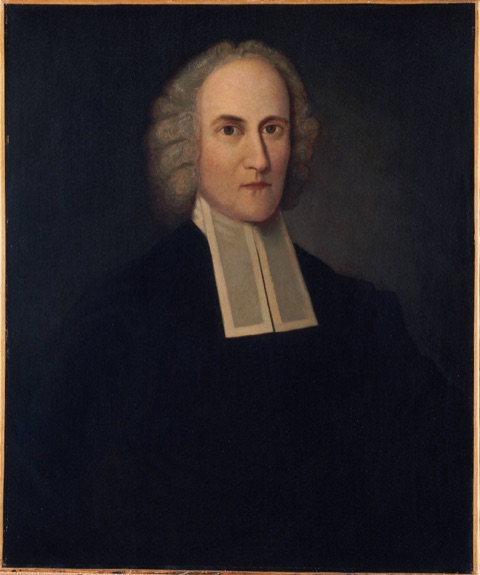
About the author
Jonathan Edwards
Jonathan Edwards (1703 to 1758 AD) was born on October 5, 1703, in East Windsor, Connecticut, the only son of the Congregational minister Timothy Edwards. He entered Yale College at thirteen and graduated in 1720. In 1727 he became assistant to his grandfather Solomon Stoddard at Northampton, Massachusetts, and succeeded him as pastor in 1729. His preaching sparked a revival there in the 1730s, and he took a leading part in the Great Awakening of 1740 to 1742. Dismissed from Northampton in 1750, he moved to the frontier mission at Stockbridge, where he wrote Freedom of the Will (1754) and this book, whose preface is dated there in May 1757. Elected president of the College of New Jersey, he died on March 22, 1758, after a smallpox inoculation.