Modernized edition · Full text · Free PDF/EPUB
A History of the Work of Redemption in Modern English
Want the file? The PDF/EPUB is free with an account.
Summary
- Author
- Jonathan Edwards (1703 to 1758 AD), pastor at Northampton, Massachusetts
- Written
- Preached as a sermon series on Isaiah 51:8 in 1739; published after Edwards's death in 1774
- Source edition
- The complete series in modern English, with all its applications
- Type
- Sermon series on the history of redemption
- Length
- 115,000 words · 8 hours
What is A History of the Work of Redemption about?
A History of the Work of Redemption is Jonathan Edwards's sermon series, published in 1774, that traces all history from the fall to the last judgment as one work of God. Edwards divides it into three periods: the preparation for Christ, the purchase of redemption in Christ's humiliation, and the success of that purchase to the end of the world.
Read the full summary (8 points, key themes)Show less
How the argument unfolds
- 01
General Introduction. The doctrine from Isaiah 51:8, the broad sense of redemption, God's five purposes in it, and the three periods.
- 02
From the fall to Abraham. Christ becomes mediator; the first promise, sacrifices, Enos and Enoch follow, and the church survives the flood and Babel.
- 03
From Abraham to David. The patriarchs are set apart, Israel is redeemed from Egypt and given the law, and Samuel begins a line of prophets.
- 04
From David to Christ. God covenants with David, builds the temple, and readies the world through captivity, dispersion and four empires.
- 05
Christ's humiliation. The incarnation, Christ's obedience and his sufferings make the full purchase, followed by reproof and encouragement.
- 06
From the resurrection to Constantine. The means of grace are set up, the apostles gather Jews and Gentiles, Jerusalem falls, and the church outlasts ten persecutions.
- 07
From Constantine to Edwards's day. Heresies, the papal and Islamic kingdoms, faithful witnesses, the Reformation and recent revivals.
- 08
The future and the judgment. Antichrist falls, the church prospers, a last apostasy arises, and Christ judges and brings his church into heaven.
Key themes
- One design in all history. Redemption is the chief work of providence, so every revolution of nations serves it, and Scripture alone explains its plan.
- Providence guards the line of Christ. Judah's crown stays in one line while “Israel’s crown was tossed endlessly from family to family as if it were the plaything of chance.”
- The church never wholly fails. Before the flood, in Egypt, under Antiochus and under Antichrist the church stands at the brink of ruin and is preserved.
- Outpourings of the Spirit. The work advances chiefly in special seasons: under Enos, in the wilderness, under Ezra, at Pentecost and at the Reformation.
Reader questions (9)Hide the questions
Questions about A History of the Work of Redemption
Is there a modern English version of A History of the Work of Redemption?
Yes. This is A History of the Work of Redemption by Jonathan Edwards in modern English. The language is modernized and the author's order and argument are kept. The full modernized text is free to read on this page.
Can I read A History of the Work of Redemption online for free?
Yes. The complete text of this modern English edition is on this page, with no sign-up or paywall.
Is there a free PDF of A History of the Work of Redemption?
Yes. The PDF and EPUB of this edition are free with an Updated Works account. Sign in with Google or an email link; no card is needed.
What is A History of the Work of Redemption by Jonathan Edwards about?
It traces God's dealings with the world from the fall to the last judgment as one work: the ages before Christ preparing for him, Christ paying the price, and all later history serving the success of that purchase.
When did Edwards preach these sermons?
The series dates from 1739 and was published in 1774, after his death. Near its close Edwards mentions a recent outpouring of the Spirit in New England in which his own town had shared.
What does Edwards mean by the work of redemption?
Strictly, the purchase Christ made in his humiliation. Edwards uses the word broadly for everything the Father, Son and Spirit do to prepare that purchase, apply it and bring it to its triumph.
Why does Edwards spend so long on the Old Testament?
He reads its history as God preparing for Christ, and notes that its narrative grows full or brief according to how much of redemption appears in each age.
What does Edwards say about trusting in one's own righteousness?
That it claims the work for which God spent four thousand years and his Son gave his life: “Taking it upon yourself to earn your own redemption is an even bolder presumption than trying to create a universe.”
How does Edwards expect Antichrist to be overthrown?
By the Spirit working through the preaching of the gospel, not by princes or scholars, swiftly yet by stages, after a fierce last resistance.
A History of the Work of Redemption in Modern English · Full text
General Introduction
“For the moth shall eat them up like a garment, and the worm shall eat them like wool: but my righteousness shall be for ever, and my salvation from generation to generation” (Isaiah 51:8).
The purpose of this chapter is to comfort the church under her sufferings and the persecutions of her enemies. Its chief argument of comfort is the constancy and endurance of God’s mercy and faithfulness toward her. God will show that faithfulness by continuing to work salvation for her and protecting her against every enemy assault. He will carry her safely through all the changes of the world, and finally crown her with victory and deliverance.
In this text, the happiness of God’s church is highlighted by contrasting it with the opposite fate of the enemies who oppress her. Here we may observe two things.
1. How short-lived the power and prosperity of the church’s enemies are: “The moth shall eat them up like a garment, and the worm shall eat them like wool” (Isaiah 51:8). No matter how great their prosperity or present glory may be, a secret curse from God will gradually wear them down until they come to nothing. All their power, glory, and persecutions will end forever, and they will suffer final, irreversible ruin. They are like the finest, most splendid clothing, which wears away in time and is destroyed by moths and decay.
The preceding verse identifies the people who will waste away like this. They are the enemies of God’s people: “Hearken unto me, ye that know righteousness, the people in whose heart is my law, fear ye not the reproach of men, neither be ye afraid of their revilings” (Isaiah 51:7).
2. The opposite happy lot and portion of God’s church, expressed in these words: “My righteousness shall be for ever, and my salvation from generation to generation” (Isaiah 51:8). The preceding verse also tells us who receives this blessing. They are those who know righteousness and the people in whose heart is God’s law, or in a word, the church of God. Concerning their happiness, we may observe what it consists in and how long it continues.
(1) What it consists in: God’s righteousness and salvation toward them. By God’s righteousness here is meant his faithfulness in fulfilling his covenant promises to his church, bestowing the benefits of the covenant of grace upon his people. God bestows these benefits out of free and sovereign grace, since they are wholly undeserved. Yet he has been pleased to bind himself by the promises of the covenant of grace. Because he has bound himself to give them, he bestows them in the exercise of his righteousness or justice.
Therefore the apostle says, “God is not unrighteous, to forget your work and labor of love” (Hebrews 6:10). Likewise John writes, “If we confess our sins, he is faithful and just to forgive us our sins, and to cleanse us from all unrighteousness” (1 John 1:9). Scripture very often uses the word righteousness for God’s covenant faithfulness. For example, we read, “Thou hast performed thy words, for thou art righteous” (Nehemiah 9:8).
We are also often to understand righteousness and covenant mercy as the same thing. The psalmist declares, “He shall receive the blessing from the Lord, and righteousness from the God of his salvation” (Psalm 24:5). Elsewhere he prays, “Continue thy loving-kindness to them that know thee, and thy righteousness to the upright in heart” (Psalm 36:10). Again he pleads, “Deliver me from blood-guiltiness, O God, thou God of my salvation; and my tongue shall sing aloud of thy righteousness” (Psalm 51:14). Daniel likewise prays, “O Lord, according to thy righteousness, I beseech thee, let thine anger and thy fury be turned away” (Daniel 9:16). The same usage appears in countless other passages.
The other word used here is salvation. Between God’s righteousness and his salvation, the first is the cause and the second is the effect. God’s righteousness, or covenant mercy, is the root, and his salvation is the fruit. Both belong to the covenant of grace. The one is God’s covenant mercy and faithfulness. The other refers to the work by which God accomplishes that mercy in its results. Salvation is the sum of all God’s works by which the benefits of the covenant of grace are secured and bestowed.
(2) Its continuance, signified here by two expressions: for ever and from generation to generation. The second phrase explains the first. The expression for ever is used in several ways in Scripture. Sometimes it means as long as a person lives. Thus the servant who had his ear pierced with an awl at his master’s door was to be his for ever. Sometimes it means for the duration of the Jewish state. Many ceremonial and Levitical laws were called statutes for ever.
At other times for ever means as long as the world stands, or until the end of human generations. Thus Solomon says, “One generation passeth away, and another cometh; but the earth abideth for ever” (Ecclesiastes 1:4). Sometimes it means to all eternity. Paul says, “God is blessed for ever” (Romans 1:25). And Jesus says, “If any man eat of this bread, he shall live for ever” (John 6:51).
The next words determine which of these senses applies here: until the end of the world, or until the end of human generations. The text continues, “and my salvation from generation to generation” (Isaiah 51:8). Certainly the fruits of God’s salvation will remain after the end of the world. An earlier verse makes this plain: “Lift up your eyes to the heavens, and look upon the earth beneath: for the heavens shall vanish away like smoke, and the earth shall wax old like a garment, and they that dwell therein shall die in like manner, but my salvation shall be for ever, and my righteousness shall not be abolished” (Isaiah 51:6).
Yet the work of salvation itself toward the church will continue until that final day. Until the end of the world, God will keep working deliverance and salvation for the church from all her enemies. That is what the prophet is speaking of here. God will carry on this work until the end of the world, until her enemies cease to have any power to harm the church.
This phrase from generation to generation also fixes both the beginning and the end of this work. From generation to generation means throughout all generations. It begins with the generations of mankind on earth and ends only when those generations end. From these words, therefore, we draw this doctrine.
Doctrine
The work of redemption is a work that God carries on from the fall of man to the end of the world.
The generations of mankind on earth began after the fall through ordinary generation, and they share in the corruption of nature that followed it. These generations, by which the human race continues, will go on until the end of the world. Thus the two boundaries of human generations on earth are the fall of man and the end of the world, or the day of judgment. Those same two boundaries mark the progressive works by which God accomplishes redemption. They do not limit its fruits, however, for those will last forever.
The work of redemption and the work of salvation are the same thing. What Scripture sometimes calls God’s saving his people, it calls in other places his redeeming them. In the same way, Christ is called both the Savior and the Redeemer of his people.
Before beginning the proposed history of the work of redemption, I will clarify two things. First, I will explain the terms used in this doctrine. Second, I will show what things God intends to accomplish through this great work.
First: Explanation of the Terms
I will first explain the sense in which the terms of the doctrine are used. In particular, I will explain the word redemption and show how God carries on this work from the fall of man to the end of the world.
1. The Use of the Word Redemption
The work of redemption is sometimes understood in a more limited sense, meaning the purchase of salvation, since the word strictly means a purchase of deliverance. Taken in this restricted sense, the work of redemption did not span many ages, but began and ended with Christ’s humiliation. It began with his incarnation, continued through his life, and ended with his time under the power of death, which closed with his resurrection. In that sense we say Christ finished the work of redemption on the day of his resurrection. That is, the purchase was then complete, and the whole work with everything belonging to it was virtually finished, though not yet actually finished.
Sometimes, however, the work of redemption is taken more broadly, to include everything God does toward this goal. It then covers not only the purchase itself, but also all the works of God that prepared the way for that purchase and brought about its success. In this sense, the whole administration, including the preparation, purchase, application, and triumph of Christ’s redemption, is called the work of redemption.
It embraces everything Christ does as Mediator in every one of his offices as prophet, priest, and king. That includes what he did during his earthly life in human nature, as well as what he did before and has done since. It includes not only what Christ the Mediator has done, but also what the Father and the Holy Spirit have done. All three persons stand united in covenant to redeem sinful humanity. In short, it is everything wrought in carrying out the eternal covenant of redemption.
This is what I mean by the work of redemption in the doctrine, for it is all one single work and one single design. The various dispensations and works belonging to it are simply the several parts of one unified plan. All the offices of Christ aim directly at this one design, and all the persons of the Trinity unite in it. Every dispensation belonging to it fits together, like the many wheels of a single machine working toward one end and producing one great result.
2. Carried On from the Fall to the End of the World
When I say this work is carried on from the fall of man to the end of the world, I want my meaning to be unmistakable. Please observe three things.
1. I do not mean that nothing was done toward this work before the fall of man. Some things were done before the world was created, indeed from eternity. The persons of the Trinity were, as it were, united in a design and a covenant of redemption. In that covenant, the Father appointed the Son, the Son undertook the work, and everything to be accomplished in it was agreed upon and settled.
Things were also done at the creation of the world for the sake of this work. Indeed, the world itself seems to have been created with redemption in view. The work of creation served God’s works of providence. If anyone asks which are greater, the works of creation or the works of providence, I answer: the works of providence. Providence is the end of creation, just as a house is built or a machine is made for its use. And God’s chief work of providence is this work of redemption, as will appear more clearly later.
Heaven itself was created for the sake of redemption, as a home for the redeemed. As Scripture says, “Then shall the King say unto them on his right, Come, ye blessed of my Father, inherit the kingdom prepared for you from the foundation of the world” (Matthew 25:34). Even the angels were created to serve in this work. Therefore the apostle calls them “ministering spirits, sent forth to minister for them who shall be heirs of salvation” (Hebrews 1:14).
As for this lower world, it was undoubtedly created to be the stage on which this great and wonderful work of redemption would be enacted. As might be shown in many ways, this earth was wisely shaped from the beginning to suit the condition of fallen humanity under the possibility of redemption. Therefore, saying that this work is carried on from the fall to the end of the world does not mean nothing was done toward it before the fall.
2. Nor do I mean that no fruits of this work will remain after the end of the world. The glory and blessedness that make up the sum of all its fruits will remain for all the saints forever. The work of redemption is not a work always in progress and never finished. Its fruits are eternal, yet the work itself reaches a completion. At that completion its goal will be attained, and that goal will last forever. God’s electing love and the covenant of redemption, which prepared for this work, had no beginning. In the same way, the fruits of this work will have no end.
3. What I mean in the doctrine, then, is that the things belonging to this work itself are being carried on throughout this entire span of time. They form the actual parts of the plan. Certain things were done in preparation before it began, and its fruits will continue after it is finished. Yet the work itself began immediately upon the fall and will continue until the end of the world. All God’s varied dispensations during this span belong to the same work, serve the same design, and move toward the same outcome. They are to be viewed as the successive movements of one machine, bringing about one great event at the end.
Here we must also distinguish between the parts of redemption itself and the parts of the work by which redemption is carried out. There is a difference between the parts of the benefits and the parts of God’s work that procure and bestow those benefits. Consider Israel’s redemption from Egypt. Viewed as the benefit they enjoyed, it had two parts: deliverance from Egyptian bondage and misery, and entrance into a happier state as God’s servants and heirs of Canaan. Yet many more things were parts of the work that brought it about. That work included calling Moses, sending him to Pharaoh, performing all the signs and wonders in Egypt, bringing terrible judgments on the Egyptians, and much else.
Such is the work by which God accomplishes redemption. He carries it on from the fall of man to the end of the world in two respects.
1. With respect to the effect wrought in the souls of the redeemed, which is common to all ages. This effect is the application of redemption to individual souls in converting, justifying, sanctifying, and glorifying them. Through these acts, people are actually redeemed and receive the benefit of the work in its effects. In this sense, the work of redemption goes on in every age from the fall to the end of the world.
God’s work of converting souls, opening blind eyes, unstopping deaf ears, raising dead souls to life, and rescuing miserable captives from Satan’s grip began soon after the fall. It has continued ever since down to our own day, and it will continue until the end of the world. God has always maintained such a church on earth. Though it has often been reduced to small numbers and low circumstances, it has never wholly failed.
As God converts fallen souls through every age, he also justifies them. He blots out all their sins and accepts them as righteous in his sight through the righteousness of Christ. He continues adopting them, transferring them from being children of Satan to being his own children. He advances the work of grace he has begun in them and comforts them with the consolations of his Spirit. When their bodies die, he grants them the eternal glory Christ purchased. Paul’s words apply to every age from the fall to the end of the world: “Whom he did predestinate, them he also called; and whom he called, them he also justified; and whom he justified, them he also glorified” (Romans 8:30).
God carries on this aspect of redemption by continually repeating the same work from age to age, though in different individuals.
2. With respect to the grand design in general, as it concerns the whole church and the final goal. In this sense, redemption is carried on not merely by repeating the same effect in different individuals, but through many successive works and dispensations of God. All of them move toward one great outcome, united as parts of a single plan and forming together one great work.
It is like a temple under construction. First the workers are sent out; then the materials are gathered, the ground is prepared, and the foundation is laid. Next the structure rises, one section after another, until at last the capstone is set in place and the building is complete. The work of redemption, taken in this broad sense, resembles such a building. God began it immediately after the fall and will carry it forward until the end of the world. Then the capstone will be brought out, and the whole structure will stand complete and glorious.
This work goes on in the first way as an effect common to every age. It goes on in the second way, regarding the grand design as a whole, not only through what is common to every age, but also through successive works wrought across different ages. All are parts of one great plan, advancing step by step, one step in one age and another in the next. It is this second aspect that I will chiefly emphasize, without excluding the first, for the one necessarily implies the other.
Second: The Main Purposes of the Work of Redemption
Having explained the terms of the doctrine, I now turn to the design of this great work and what God intends to accomplish through it. To follow how any plan is carried out, we must first know what that plan is. To understand a craftsman’s steps in making something, we must know what he intends to make. Otherwise we may stand by, watching him do one thing after another, and remain completely puzzled because we cannot see his plan.
Suppose an architect and a large crew of workers are building a great palace. If a stranger stands nearby watching some men dig in the ground, others haul timber, and others cut stone, he will see a great deal of activity. Yet without knowing the design, all of it will look like confusion to him. I want to keep God’s great works and dispensations in redemption from looking like confusion to you. I will therefore briefly set before you the main things God intends to accomplish.
1. God’s first purpose is to put all his enemies under his feet, so that his goodness may finally triumph over all evil.
Soon after creation, evil entered the universe through the fall of the angels and of man. Almost as soon as God had made rational creatures, enemies rose up against him from among them. Through the fall of man, evil entered this lower world, and here too enemies rose against God. Satan tried to frustrate God’s purpose in creating this world and to ruin his handiwork. He sought to seize its government from God’s hands, usurp the throne, and set himself up as the god of this world in place of its Creator. To achieve this, he brought sin into the world, turned man into God’s enemy, and introduced guilt, death, and the most dreadful misery.
One great purpose of God in redemption, then, was to subdue those enemies: “He must reign till he hath put all enemies under his feet” (1 Corinthians 15:25). From the beginning, God arranged everything to disappoint, confound, and triumph over Satan, so that Satan would be crushed under Christ’s feet. God gave the promise that the seed of the woman would bruise the serpent’s head (Genesis 3:15). Part of God’s original plan was to destroy the devil’s works and defeat all his schemes: “For this purpose was the Son of God manifested, that he might destroy the works of the devil” (1 John 3:8).
God also designed to triumph over sin and human corruption, uprooting them from his people’s hearts by conforming them to himself. He designed that his grace would triumph over human guilt and sin’s infinite demerit. And he designed to triumph over death itself. Though death is the last enemy to be destroyed, it too will finally be conquered and abolished. Thus, through the work of redemption, God appears glorious above all evil and triumphant over every foe.
2. God’s second purpose was to restore completely all the ruins of the fall for the elect part of the world through his Son. Therefore Scripture speaks of the restitution of all things: “Whom the heaven must receive, until the times of the restitution of all things” (Acts 3:21). It speaks also of the times of refreshing from the presence of the Lord Jesus. Peter urges, “Repent ye therefore and be converted, that your sins may be blotted out, when the times of refreshing shall come from the presence of the Lord” (Acts 3:19).
Man’s soul was ruined by the fall. The image of God was defaced, human nature was corrupted, and man became dead in sin. God’s purpose was to restore the soul to life and the divine image in conversion, carry that renewal forward in sanctification, and perfect it in glory. Man’s body was also ruined, becoming subject to death through the fall. God’s purpose was to restore the body from this ruin. He will deliver it not only from death in the resurrection, but from mortality itself, making it like Christ’s glorious body.
The world itself, as it relates to humanity, was ruined as completely as if it had been reduced to chaos again; heaven and earth were overturned. Yet God’s purpose was to restore everything and, as it were, create a new heaven and a new earth. As Isaiah proclaims, “Behold, I create new heavens, and a new earth; and the former shall not be remembered, nor come into mind” (Isaiah 65:17). Peter echoes this hope: “Nevertheless we, according to his promise, look for new heavens, and a new earth, wherein dwelleth righteousness” (2 Peter 3:13).
The work that brings this about began immediately after the fall and continues until everything is finished, when the whole world, heaven and earth, will be restored. There will be, as it were, new heavens and a new earth in a spiritual sense at the end of the world. John pictures it in this way: “And I saw a new heaven, and a new earth; for the first heaven and the first earth were passed away” (Revelation 21:1).
3. Another great purpose of God in redemption was to gather together in one all things in Christ, both in heaven and on earth. That means all elect creatures. He designed to unite all elect creatures in heaven and on earth into one body under one head. Together, he would unite them all in one body to God the Father. This work began soon after the fall, continues through every age, and will be completed at the end of the world.
4. God designed through this work to perfect and complete the glory of all the elect by Christ. It is a glory “such as eye hath not seen, nor ear heard, nor has ever entered into the heart of man” (1 Corinthians 2:9). He intended to bring them to complete excellence and beauty in his holy image, which is the true beauty of spiritual beings. He intended to advance them to a glorious degree of honor and raise them to an indescribable height of pleasure and joy. In this way he designed to glorify the whole church of elect human beings in both soul and body. Along with them, he designed to raise the elect angels to their highest glory under one head.
5. In all of this, God designed to achieve the glory of the blessed Trinity in an extraordinary degree. From eternity, God purposed to glorify himself, and indeed to glorify each person of the Godhead. In the order of nature, the end comes first and the means second. We must therefore conceive of God as having purposed this end and then, as it were, choosing the means to achieve it. The chief means he chose was this great work of redemption.
In this work, God intended to glorify his only-begotten Son, Jesus Christ, and through the Son to glorify the Father: “Now is the Son of man glorified, and God is glorified in him. If God be glorified in him, God also shall glorify him in himself, and shall straightway glorify him” (John 13:31-32). God designed that the Son would be glorified in this way and would glorify the Father through what the Spirit accomplishes to the glory of the Spirit. Thus the whole Trinity together, and each person individually, would be exceedingly glorified. The work appointed for this purpose began immediately after the fall and continues through all ages. It will finish at the end of the world, when all this intended glory is fully realized in everything.
The Three Periods of the History
Having explained the terms in the doctrine and shown what things God intends to accomplish by this great work, I now turn to the proposed history. I will trace how God’s design in redemption has unfolded through its various steps, from the fall of man to the end of the world.
To do this, I will divide this entire span of time into three periods:
1. From the fall of man to the incarnation of Christ.
2. From Christ’s incarnation until his resurrection, covering the whole time of Christ’s humiliation.
3. From Christ’s resurrection to the end of the world.
Some may think this is a very unequal division, and in some ways it is. The second period is far shorter than either of the others, lasting only between thirty and forty years, while both of the others span thousands of years. Yet in this great undertaking of redemption, the second period outweighs both of the others combined. I will therefore show clearly how redemption advances through each period in turn, under three propositions:
1. From the fall of man to the incarnation of Christ, God was preparing the way for Christ’s coming. His works during this era served as forerunners and pledges of it.
2. The time from Christ’s incarnation to his resurrection was spent in procuring and purchasing redemption.
3. The entire span of time from Christ’s resurrection to the end of the world is devoted to accomplishing the great effect and triumph of that purchase.
As we examine these three propositions in detail, the great truth taught in our doctrine will stand out in a clear light.
Period 1: From the Fall to the Incarnation
The great works of God in the world during this entire span of time were all preparatory. Many major changes and upheavals took place on earth. Yet all of them were simply the turning of the wheels of providence to prepare the way for Christ’s coming and his work. Above all, every great work God performed for his church aimed at this goal. The church passed through many different dispensations of providence and varied circumstances before Christ came, yet every one of them prepared the way for his arrival.
God worked salvation in human souls throughout all that time, though the number saved was very small compared with what came afterward. All of it was done in anticipation of Christ. All the souls saved before Christ came were simply the first pledges of the coming harvest.
God also worked many deliverances for his church and people before Christ came, yet these were only shadows and forerunners of the great salvation. During that period the church enjoyed the light of divine revelation and possessed a measure of gospel light. Still, all those revelations were only foretastes of the great light that he would bring who came to be the light of the world.
That whole span of time was a season of night. God’s church was not wholly without light, yet its light was like the light of the moon and stars. It was dim compared with the sun and mixed with much darkness. It had no glory by reason of the glory that excels (2 Corinthians 3:10). The church did indeed have the light of the sun, but only as reflected from the moon and stars. Throughout all that time, the church was like a minor child. As Paul says, “Now I say, that the heir as long as he is a child, differeth nothing from a servant, though he be lord of all; but is under tutors and governors, until the time appointed of the Father. Even so we, when we were children, were in bondage under the elements of the world” (Galatians 4:1-3).
For greater clarity and precision, I will divide this period into six parts:
1. From the fall to the flood.
2. From the flood to the calling of Abraham.
3. From the calling of Abraham to Moses.
4. From Moses to David.
5. From David to the captivity in Babylon.
6. From the captivity in Babylon to the incarnation of Christ.
Part 1: From the Fall to the Flood
Though this period was the most distant from Christ’s incarnation, even then this glorious building was begun.
1. Christ Immediately Entered His Mediatorial Work
As soon as man fell, Christ entered upon his mediatorial work and began to carry out the office of a mediator. He had undertaken this work before the world was made. From all eternity, he stood pledged to the Father to appear as man’s mediator and assume that office whenever the need should arise. Now the time had come. Christ, the eternal Son of God, clothed himself with the role of mediator and presented himself before the Father. He stepped in at once between a holy, infinite, offended Majesty and offending mankind. The Father accepted his intervention, holding back his wrath from breaking out in the full execution of the dreadful curse man had brought upon himself.
Christ clearly began exercising the office of mediator between God and man the very moment man fell, because mercy began at once. God showed mercy in his forbearance by not destroying man immediately, as he had destroyed the angels when they fell. Yet God never shows mercy to fallen man except through a mediator. If God had not mercifully restrained Satan, Satan would have seized his prey immediately.
Christ began acting as an intercessor for man as soon as man fell, because every mercy shown to mankind is obtained through Christ’s intercession. From that day forward, Christ took charge of the church in the exercise of all his offices. He undertook to teach mankind in his prophetical office and to intercede for fallen man in his priestly office. He also undertook to govern the church and the world as a king. From that moment he took upon himself the defense of his elect church against all her enemies.
When Satan, the great enemy, had conquered and overthrown man, the task of resisting and defeating him was entrusted to Christ. From then on, Christ undertook to deal with that cunning, powerful adversary. He was then appointed Captain of the Lord’s hosts and Captain of his people’s salvation. From that point forward, this lower world with all its affairs was placed in the hands of the Son of God. Once man sinned, God the Father would no longer deal directly with a human race that had turned away and rebelled against him. From then on, he would act only through a mediator, whether in teaching men, governing them, or bestowing any blessing upon them.
Therefore, whenever sacred history tells us what God did for his church and how he revealed himself to his people, we should understand it especially of the second person of the Trinity. Whenever God appeared after the fall in some visible form or outward symbol of his presence, we should ordinarily, if not always, understand it to be the second person of the Trinity. As John writes, “No man hath seen God at any time; the only begotten Son, which is in the bosom of the Father, he hath declared him” (John 1:18). Christ is therefore called “the image of the invisible God” (Colossians 1:15), indicating that though God the Father is invisible, Christ is his image and representation by whom he is seen.
Indeed, this lower world was not all that was entrusted to Christ. He received the care and government of it to order it in harmony with his plan of redemption, and in some sense the whole universe was placed under him as well. From that time on, the angels became subject to him in his mediatorial office. This is evident throughout biblical history, where we read of angels serving as ministering spirits in the affairs of the church.
We may therefore suppose that immediately upon Adam’s fall, God made his plan of redemption known among the angels in heaven. They learned that Christ had now assumed the office and work of mediator between God and man, and that they were to serve under him in it. Just as Christ, in this office, has been solemnly installed as King of heaven and is from that installation onward, as God-man, the Light and Sun of heaven (Revelation 21:23), so this announcement to the angels was like the first dawning of that light there. Later, when Christ ascended to heaven after his suffering and death and was solemnly enthroned, this Sun rose in full glory. He is the Lamb who is the light of the New Jerusalem.
2. The First Revelation of the Gospel on Earth
Immediately after this, the gospel was revealed for the first time on earth. God declared, “And I will put enmity between thee and the woman, and between thy seed and her seed: it shall bruise thy head, and thou shalt bruise his heel” (Genesis 3:15). We may suppose that God’s purpose to redeem fallen man was made known in heaven before it was declared on earth. The angels’ work as ministering spirits of the Mediator required it. The moment Christ took up the work of mediator, the angels needed to be ready at once to serve him in that office. Thus the light dawned first in heaven, and very soon afterward it shone upon the earth. God’s words hinted at another surety to be appointed for humanity after the first surety had failed. This was the first revelation of the covenant of grace and the first dawning of gospel light on earth.
Before the fall, this lower world enjoyed noonday light: the light of the knowledge of God, of his glory, and of his favor. When man fell, all that light went out in an instant, and the world plunged back into total darkness. It was far worse than the original state at creation, when darkness was upon the face of the deep (Genesis 1:2). This darkness was a thousand times more hopeless. Neither men nor angels could find any way to scatter it.
That darkness showed all its blackness when Adam and his wife saw they were naked and sewed fig leaves together. It grew darker still when they heard the voice of the Lord God walking in the garden and hid among the trees. When God first called them to account and said to Adam, “What is this that thou hast done? Hast thou eaten of the tree, whereof I commanded thee, that thou shouldst not eat?” their hearts must have been filled with shame and terror.
In the midst of that dismal darkness, God’s words to the serpent were the first dawn of gospel light (Genesis 3:15). Before this moment, there was not a single glimpse of light, not a beam of comfort, not the slightest hope. It was an obscure yet comprehensive revelation of the gospel, not spoken directly to Adam or Eve, but contained in what God said to the serpent.
Here was a clear hint of a merciful purpose through “the seed of the woman,” like the first glimmer of light in the east at daybreak. Out of tenderness toward Adam and Eve, God gave this promise of mercy before pronouncing sentence on either of them. He did so that they would not be crushed by a sentence of condemnation with nothing to give them hope.
One of the great goals of redemption is intimated more plainly here, namely, that God will subdue his enemies under the feet of his Son. God now declared that purpose for the first time. Satan had likely triumphed greatly in man’s fall, imagining he had defeated God’s purpose in creation. In these words, however, God gave him plain notice that he would not finally triumph. Instead, the seed of the woman would win a complete victory over him.
This revelation of the gospel was the first act Christ performed in his prophetical office. From the fall of man to the incarnation of Christ, God was doing what prepared for Christ’s coming to accomplish redemption, giving forerunners and pledges of it. One of those ways was foretelling and promising Christ from age to age until he came. This was the first promise ever given and the first prediction ever spoken of him.
3. The Institution of Sacrifices
Soon after this, God appointed the practice of sacrifice to serve as a standing type of Christ’s sacrifice until he should come and offer himself to God. Sacrifice did not begin with the Levitical law; it had been part of God’s appointed worship from the very beginning. We read of the patriarchs Abraham, Isaac, and Jacob offering sacrifices, and before them Noah and Abel.
This practice came from divine appointment, for it was part of God’s worship in his church, offered in faith and accepted by him. That fact proves God instituted it, because sacrificing animals is no part of natural worship. The light of nature does not teach people to offer beasts in sacrifice to God. Because the law of nature does not command it, sacrifice could please God only through a positive divine command. After all, God has declared his abhorrence of worship taught merely by human precepts without his appointment (Isaiah 29:13).
Furthermore, worship that lacks a warrant from divine appointment cannot be offered in faith, because faith has no foundation where God has given no command. People have no ground to expect God’s acceptance in something he never appointed and never promised to accept. It follows, then, that the custom of offering sacrifices to God was instituted soon after the fall. Scripture tells us that Abel offered “the firstlings of his flock, and of the fat thereof” (Genesis 4:4), and that God accepted him in this offering (Hebrews 11:4). Nothing in the account suggests that sacrifice was newly instituted when Abel offered his gift; rather, Abel simply followed a practice already established.
It is very likely that God instituted sacrifice immediately after revealing the covenant of grace (Genesis 3:15), since that promise was the foundation on which sacrifice rested. That promise was the first stone laid in this glorious building of redemption. The institution of sacrifice was the second stone, serving as a type of the great sacrifice.
The very next event recorded after God pronounced sentence on the serpent, the woman, and the man is that God made them coats of skins and clothed them. Most theologians believe these were the skins of animals slain in sacrifice. We have no record of any other reason for people to kill animals before the flood except to offer them in sacrifice. People did not ordinarily eat animal flesh as their regular food until after the flood.
Before the fall, man’s food was the fruit of the trees in paradise. After the fall, his food was the produce of the field: “And thou shalt eat the herb of the field” (Genesis 3:18). The first permission to eat flesh as ordinary food came only after the flood: “Every moving thing that liveth shall be meat for you; even as the green herb have I given you all things” (Genesis 9:3). It is therefore likely that the skins used to clothe Adam and Eve came from their sacrifices.
God’s clothing them with these skins was a vivid picture of their being clothed with the righteousness of Christ. It was God himself who gave them this clothing, for Scripture says, God made them coats of skins, and clothed them. Likewise, the righteousness that clothes us is from God; he alone clothes the naked soul.
Our first parents, who were naked, were clothed at the cost of life. Animals were slain to provide their covering. In the same way, Christ was slain to provide clothing for our naked souls. Later, the tabernacle in the wilderness, which symbolized the church, was covered with rams’ skins dyed red, as if dipped in blood. This signified that Christ’s righteousness was wrought out through the pains of death, when he shed his precious blood.
As we noted earlier, the light the church enjoyed from the fall until Christ came was like light at night. It was not the direct light of the sun, but light reflected from the moon and other heavenly bodies. That reflected light prefigured Christ, the Sun of righteousness who was later to rise. The church received this light in two main ways: first through predictions of Christ’s coming, and second through types and shadows prefiguring his coming and redemption.
The first preparatory act of the first kind was the promise we just considered. The first act of the second kind was this institution of sacrifices. That promise in Genesis was the first dawn of gospel light after the fall in prophecy (Genesis 3:15). The institution of sacrifices was the first glimpse of it in types. The first belonged to Christ’s prophetical office; in the second, Christ displayed himself in his priestly office.
The institution of sacrifice played a major role in preparing the way for Christ’s coming and the work of redemption. The Old Testament sacrifices were the chief among all Old Testament types of Christ and his redemption. They fixed in the minds of God’s visible church the necessity of a propitiatory sacrifice to satisfy God’s justice for sin. In this way, they prepared the church to welcome the glorious gospel that reveals the one great sacrifice.
Nor was this preparation limited to the visible church; it reached across the entire human race. From this original institution of sacrifice, all nations inherited the custom of offering sacrifices to their gods to atone for sin. No nation, however uncivilized, was found without it. This provides strong evidence for the truth of the Christian religion. No nation except the Jews could explain how they received this custom or why they offered sacrifices to their deities.
The light of nature never taught them any such practice. It certainly did not teach them that the gods were hungry and fed on burnt flesh. Yet every nation had this custom. No explanation accounts for it except that they inherited it from Noah, who received it from his ancestors, to whom God had commanded it as a type of Christ’s great sacrifice. By this means, every nation on earth held the conviction that an atonement or sacrifice for sin was necessary. That conviction paved the way for them to receive more readily the great gospel doctrine of Christ’s atonement and sacrifice.
4. The First Souls Saved Through Christ’s Redemption
Soon after the fall, God began actually saving human souls through Christ’s redemption. Christ had just assumed the office of mediator between God and man, and here he began acting in his kingly office. He had already acted in his prophetical office in the first prediction of redemption and been represented in his priestly office through sacrifices. In that prediction, the light of Christ’s redemption first dawned in its prophecies. In the institution of sacrifices, it first dawned in its types. Now, as he actually began saving sinners, it first dawned in its fruit.
It is probable, therefore, that Adam and Eve were the firstfruits of Christ’s redemption. This appears likely from the way God dealt with them, comforting them as he did after their convictions and terror. They were awakened and ashamed under a sense of guilt once their eyes were opened and they saw they were naked. They sewed fig leaves together to cover their nakedness. Just so, a newly convicted sinner habitually tries to hide the soul’s nakedness with an imagined righteousness of his own.
Then they were further terrified and awakened when they heard God’s voice approaching to judge them. Their coverings of fig leaves failed them. Despite those coverings, they ran to hide among the trees of the garden because they were naked. They dared not trust their fig leaves to conceal them from God. Then God awakened them still more by calling them to a strict account.
While their terror stood at its peak, and they stood trembling and stunned before their Judge with no ground for hope, God took care to offer them encouragement. To keep them from despair under their convictions, he gave them a glimpse of his merciful design through a Savior even before pronouncing sentence. When he then pronounced sentence, their terror must have risen still higher, yet he soon encouraged them again. He showed them he had not wholly cast them off. Taking fatherly care of them in their fallen, naked, and miserable state, he made them coats of skins and clothed them.
That act also showed his acceptance of the sacrifices they had offered. Those sacrifices were types of what God had promised when he declared, The seed of the woman shall bruise the serpent’s head. We have good reason to believe they believed and embraced that promise. Eve seems clearly to express her hope in that promise and dependence on it at the birth of Cain: “I have gotten a man from the Lord” (Genesis 4:1). God had promised that her seed would bruise the serpent’s head. Now, in a child born to her, she believed he had given her a pledge and token of it.
She plainly acknowledged that this child came from God, and she hoped the promised seed would come through her eldest son. In that hope she was mistaken, just as Abraham was mistaken about Ishmael, Isaac about Esau, and Samuel about Jesse’s firstborn. Eve’s words at the birth of Seth express her hope and trust in God’s promise even more clearly: “For God hath appointed me another seed, instead of Abel, whom Cain slew” (Genesis 4:25).
It is therefore highly probable, if not certain, that Christ immediately began the work of redemption in its effect, just as he had taken up the work of mediator as soon as man fell. He at once confronted his great enemy the devil, whom he had undertaken to defeat, and rescued those first two captives from his grip. In doing so, he thwarted Satan almost immediately after Satan’s triumph in taking them captive. Though Satan felt sure of them and all their descendants, Christ the Redeemer quickly showed him he was mistaken. By delivering those first captives, Christ gave him an early demonstration of the threat, “The seed of the woman shall bruise the serpent’s head.” It was also a pledge that he would subdue all his enemies under his feet.
After this, we have another example of redemption in one of their children, righteous Abel, as Scripture calls him. His soul was perhaps the first to enter heaven through Christ’s redemption. In him we certainly have the first recorded death of a redeemed person. If he was the first, then just as Christ’s redemption had already dawned in human souls through conversion and justification, in Abel it first dawned in glorification.
In Abel, too, the angels first carried out their role as Christ’s ministering spirits by going forth to escort a redeemed soul to glory. Through him, the elect angels in heaven first witnessed something truly astonishing. They saw the soul of a fallen human being, once sunk by the fall into an abyss of sin and misery, brought to heaven to enjoy heavenly glory. That was far greater than if they had seen him restored to the earthly paradise. In this way they saw the glorious effect of Christ’s redemption in the great honor and happiness won for sinful, miserable creatures.
5. The First Outpouring of the Spirit in the Days of Enos
The next remarkable step God took in advancing this great redemption was the first extraordinary outpouring of the Spirit through Christ in the days of Enos. We read, “Then began men to call upon the name of the Lord” (Genesis 4:26). The meaning of these words has been much debated among theologians. We cannot suppose they mean that people only then began to practice prayer. Prayer is a duty of natural religion, and a spirit of piety leads people to it most naturally. Prayer is the very breath of a godly spirit, so we cannot imagine that godly people had lived for more than two hundred years without praying.
Some theologians therefore think the verse means that people then first began to hold public worship, calling upon the name of the Lord in public assemblies. Whatever the exact form, this much must be understood: something new took place in God’s visible church regarding calling upon the name of the Lord. There was a great increase in this duty, carried far beyond anything seen before, and such a change could come only from a remarkable outpouring of God’s Spirit.
Even if this was the first time people gathered in public assemblies to help one another seek God as never before, that points to an extraordinary cause. Nothing less than the uncommon working of God’s Spirit could produce it. Experience shows that a remarkable outpouring of the Spirit always produces this very effect, a great increase in prayer. When God’s Spirit begins a work in human hearts, he immediately moves them to call upon the name of the Lord.
Look at Paul after the Spirit arrested him: “Behold, he prayeth!” So it has been in every remarkable outpouring of the Spirit recorded in Scripture, and so it is foretold for the latter days. Scripture promises that the Holy Spirit will be poured out as a spirit of grace and supplication (Zechariah 12:10). Zephaniah predicts the same: “For then will I turn to the people a pure language, that they may all call upon the name of the Lord, to serve him with one consent” (Zephaniah 3:9).
When Scripture says, “Then began men to call upon the name of the Lord” (Genesis 4:26), it simply means this was the first remarkable season of this kind that had ever occurred. It was the beginning, the first instance, of such a work of God. Scripture commonly uses this kind of phrasing. For instance, we read, “And Saul built an altar unto the Lord; the same was the first altar that he built unto the Lord” (1 Samuel 14:35). In the Hebrew, as the margin shows, it reads, that altar he began to build unto the Lord. Similarly, the book of Hebrews asks, “How shall we escape if we neglect so great salvation, which first began to be spoken by the Lord?” (Hebrews 2:3).
We should note here that from the fall of man to our own day, redemption in its effect has mainly advanced through remarkable outpourings of God’s Spirit. A steadier influence of the Spirit always attends God’s ordinances to some degree. Yet the greatest advances in this work have always come through special seasons of mercy and extraordinary outpourings, as will become fully clear as we continue our subject. This season in the days of Enos was the first remarkable outpouring of God’s Spirit in history. God had worked savingly in some individual hearts before, yet now he was pleased to gather a harvest of souls to Christ. Here we see that great building, whose foundation God laid immediately after the fall, carried further and built higher than ever before.
6. The Eminently Holy Life of Enoch
The next milestone to notice is the eminently holy life of Enoch. We have reason to believe he was a saint of greater eminence than any who had lived before him. In him, therefore, the work of redemption rose to a still greater height. We just saw how its effect in the visible church as a whole rose higher in the days of Enos than ever before. Enoch was likely one of the saints gathered in that harvest, since his entire life on earth fell within the lifetime of Enos. Now, with respect to the degree of holiness wrought in a single soul, the work reached a greater height in Enoch than in anyone before him. Built on Christ, his soul grew in holiness beyond every earlier example. He stood out as a wonderful display of Christ’s redemption and the power of his grace.
7. Enoch’s Prophecy of Christ’s Coming
In Enoch’s time, God revealed the coming of Christ more explicitly than before. Jude records his words: “And Enoch also, the seventh from Adam, prophesied of these, saying, Behold, the Lord cometh with ten thousand of his saints, to execute judgment upon all, and to convince all that are ungodly among them, of their ungodly deeds which they have ungodly committed, and of all their hard speeches which ungodly sinners have spoken against him” (Jude 1:14-15).
Here Enoch prophesies of Christ’s coming. His prophecy does not seem restricted to any one particular coming of Christ. Rather, it looks broadly to Christ’s coming in his kingdom and is fulfilled in measure at both his first and second comings. Indeed, it is fulfilled in every remarkable appearance Christ makes in the world to save his people and destroy his enemies.
In this way it closely parallels many other Old Testament prophecies. It especially resembles Daniel’s great vision of Christ coming in his kingdom, from which the Jews chiefly drew their understanding of the kingdom of heaven: “A fiery stream issued, and came forth from before him: thousand thousands ministered unto him, and ten thousand times ten thousand stood before him: the judgment was set, and the books were opened” (Daniel 7:10). Daniel continues, “I saw in the night visions, and behold, one like the Son of man, came with the clouds of heaven, and came to the Ancient of days, and they brought him near before him. And there was given him dominion, and glory, and a kingdom, that all people, nations, and languages, should serve him: his dominion is an everlasting dominion, which shall not pass away, and his kingdom that which shall not be destroyed” (Daniel 7:13-14).
Enoch may have looked most immediately to the approaching destruction of the ancient world by the flood, which strikingly foreshadowed Christ’s destruction of all his enemies at his second coming. Yet his prophecy surely looked beyond the type to the ultimate fulfillment. Because this prophecy of Christ’s coming is clearer than any before it, it marks a further increase in the gospel light that began dawning right after the fall. It also shows the great building we are tracing rising still higher than before.
Here I would note in passing a striking parallel. The growth of gospel light and the progress of redemption in the church as a whole, from its founding to the end of the world, closely resemble the progress of the same work and light in an individual soul, from conversion until it is perfected and crowned in glory. Sometimes the light shines brighter, and at other times more dimly. Sometimes grace prevails, and at other times it seems to languish for a long season. Now corruption gains ground, and then grace revives again. Yet overall, grace is growing. From its first implantation until it is perfected in glory, Christ’s kingdom is being built up in the soul. So it is with this great work as a whole, from its beginning until it is completed at the end of the world.
8. The Translation of Enoch into Heaven
The next remarkable event advancing this work was the translation of Enoch into heaven: “And Enoch walked with God, and he was not; for God took him” (Genesis 5:24). When Moses traces the genealogy in the line of Noah, he does not say of Enoch that he lived so long and died, as he does of all the rest. Instead he says, he was not, for God took him. That is, God translated him, carrying him body and soul into heaven without dying, as Hebrews explains: “By faith Enoch was translated that he should not see death” (Hebrews 11:5). Through this wonderful act of God, the work of redemption rose higher in several respects than ever before.
Earlier, when showing what God aimed at in redemption, I mentioned the complete restoration of the ruins of the fall for the elect, in both soul and body. This translation of Enoch was the first instance of that restoration with respect to the body. There had already been many instances of Christ’s redemption restoring the human soul, yet until now there had been no instance of actually redeeming and saving the body.
All the bodies of the elect will be saved as well as their souls. At the end of the world, all their bodies will be actually redeemed. Those who have died will be raised in the resurrection, and those still living will undergo a glorious transformation. A number of the saints’ bodies were raised and glorified at the resurrection of Christ, and before that there was an instance of a body glorified in Elijah. Yet the very first instance of all was this one of Enoch.
Through this event, the work of redemption moved forward still further. This wonderful work of God brought a great increase of gospel light to the church. It gave believers a clearer display of a future state and of the glorious reward awaiting the saints in heaven. Scripture tells us that “life and immortality are brought to light by the gospel” (2 Timothy 1:10). What the Old Testament says about a future state is very dim compared with the fuller, plainer, and more abundant revelation given in the New.
Even in those early days, however, God favored the church with a living example set right before their eyes. One of their own brothers was actually taken up to heaven without dying. We have every reason to believe the church knew of it then, just as believers later knew of Elijah’s translation. This gave the church a clearer view of a future state than it had ever enjoyed before. It also served as a pledge and guarantee of that future glorification of all the saints that God intended through the redemption of Jesus Christ.
9. God’s Preservation of the Church Before the Flood
The next thing I will note is God’s upholding of his church in the family from which Christ was to come during the great and general turning away before the flood. In all likelihood, the church of God was small compared with the rest of the world once humanity began to multiply. That was true from the time when “Cain went out from the presence of the Lord, and dwelt in the land of Nod” (Genesis 4:16), a name that means the land of banishment. The church seems to have been maintained chiefly among the descendants of Seth. He was the offspring God appointed in place of Abel, whom Cain murdered. Yet we cannot reasonably suppose that Seth’s descendants made up even a fiftieth part of the world, “For Adam was one hundred and thirty years old when Seth was born.”
Cain, who appears to have led those outside the church, was Adam’s oldest child. He was probably born soon after the fall, which undoubtedly happened soon after Adam’s creation. That left plenty of time for Cain to have many sons before Seth was born. Adam and Eve probably had many other children by then as well, fulfilling God’s blessing, “Be fruitful, and multiply, and replenish the earth.” Many of those children could have had children of their own.
The account of Cain before Seth’s birth implies that large numbers of people already lived on the earth. Scripture records: “Behold, thou hast driven me out this day from the face of the earth: and from thy face shall I be hid, and I shall be a fugitive and a vagabond in the earth; and it shall come to pass, that every one that findeth me shall slay me. And the Lord said unto him, Therefore whosoever slayeth Cain, vengeance shall be taken on him seven-fold. And the Lord set a mark upon Cain, lest any finding him should kill him” (Genesis 4:14-15). Everyone alive when Seth was born had the same capacity to multiply as he did. Seth’s descendants therefore remained only a small fraction of the earth’s inhabitants.
After the days of Enos and Enoch (for Enoch was taken up before Enos died), the church of God shrank greatly. Multitudes from the line of Seth, though born within the church, fell away and joined the wicked world. They did so primarily through intermarriage with outsiders. As Genesis tells us: “And it came to pass, when men began to multiply on the face of the earth, and daughters were born unto them, that the sons of God saw the daughters of men, that they were fair; and they took them wives of all which they chose. … There were giants in the earth in those days; and also after that, when the sons of God came in unto the daughters of men, and they bare children to them, the same became mighty men, which were of old men of renown” (Genesis 6:1-2; Genesis 6:4).
By the sons of God here, Scripture surely means the children of the church, a title often given to them in God’s word. They intermarried with the wicked world, and their hearts were drawn away from God. A vast and steady defection followed. The church, which had once restrained the wicked world, dwindled dramatically, and evil ran on unchecked. Satan, that ancient serpent the devil who tempted our first parents and set himself up as the god of this world, raged fiercely. Every intention of the thoughts of the human heart was only evil continually, and the earth was filled with violence. It seemed flooded with wickedness then, just as it would later be flooded with water. Humanity as a whole was swallowed up in it.
At that crisis, Satan launched a fierce and powerful assault to devour the church of God, and he nearly succeeded. Yet God restored it right in the middle of that flood of wickedness and violence. He kept it alive in the line from which Christ was to come. He would not allow it to be destroyed, because a blessing was in it. There remained a particular family, a root from which the branch of righteousness would later shoot forth. No matter how many branches were lopped off, and even when the tree looked destroyed, God kept this root alive through his wonderful redeeming power and grace. The gates of hell could not prevail against it.
Thus I have shown how God carried on the great work of redemption, and how the building advanced during this first span, from the fall of man until God brought the flood on the earth. Although Moses’s history of that era is very brief, it is extraordinarily rich and instructive. It is also profitable for us to see here the power of Christ’s purchase of redemption. It produced great effects many ages before Christ actually appeared.
Part 2: From the Flood to the Calling of Abraham
I proceed now to show how the same work was carried on from the beginning of the flood until the calling of Abraham. Although that mighty, universal deluge overthrew the world, it did not overthrow this building of God, the work of redemption. That work pressed forward. Instead of being torn down, it continued to rise as a further preparation for the great Savior’s coming into the world to redeem his people.
1. The flood itself was a work of God that belonged to this great enterprise and served to advance it. Every mighty work of God from the fall of man to the end of the world fits within this design. Seen in the right light, each appears as a part of it and a step that carries it forward. Surely a work as vast, remarkable, and universal as the flood cannot be an exception. Through it, God cleared out of the way the enemies and obstacles standing ready to overthrow his plan.
Satan seems to have been in a dreadful fury just before the flood. His rage then, as always, was aimed chiefly at destroying the church of God. He had filled the earth with violence and hostility against it. He won almost the entire world over to his side, and people enlisted under his banner against Christ and his church. We read that the earth was filled with violence. Surely that violence was aimed mainly at the church, fulfilling what had been foretold: “I will put enmity between thy seed and her seed.”
Their hatred and violence grew so intense, and the church’s enemies became so numerous with the whole world arrayed against it, that things reached utter extremity. Noah’s rebukes and his preaching of righteousness were completely ignored. God’s Spirit had striven with them for a hundred and twenty years, all in vain. The church was narrowed down to a single family. Nothing seemed left to expect except that the wicked would swallow up the church completely in a very short time. They would have wiped out that small root with the blessing in it from which the Redeemer was to come.
Therefore, God’s destruction of those enemies by the flood belongs to the work of redemption. It fulfilled the covenant of grace revealed to Adam: “I will put enmity between thee and the woman, and between thy seed and her seed; it shall bruise thy head” (Genesis 3:15). This judgment was simply the destruction of the serpent’s seed at the height of their violent rage against the woman’s seed, when the church stood in the greatest peril from them.
Scarcely any destruction of nations is recorded in Scripture without naming their hostility and cruelty toward God’s church as a primary cause. Surely this was a main reason for destroying all nations by the flood. The giants of those days, in all likelihood, won their fame through bold exploits against heaven. They fought against Christ and his church, the remaining sons of God who had not corrupted themselves.
We read what will happen just before the world is destroyed by fire: “the nations that are in the four quarters of the earth, shall gather together against the church as the sand of the sea, and shall go up on the breadth of the earth, and compass the camp of the saints about, and the beloved city; and then fire shall come down from God out of heaven, and devour them” (Revelation 20:8-9). Something very similar seems to have happened right before the world was destroyed by water. Their destruction therefore belonged to the work of redemption. It did so just as truly as the destruction of the Egyptians belonged to Israel’s redemption out of Egypt, or as the destruction of Sennacherib’s mighty army, which surrounded Jerusalem to wipe it out, belonged to God’s deliverance of that city.
Through this flood, all the enemies of God’s church, against whom that tiny handful had no strength, were swept away at a single stroke. God took his people’s side and intervened for them against their foes. He drowned those whom they feared in the floodwaters, just as he later drowned Israel’s pursuing enemies in the Red Sea.
God certainly could have used other means to deliver his church. He could have converted the whole world instead of drowning it, just as he could have chosen another method besides drowning the Egyptians in the Red Sea. Yet that is no argument against seeing the method he actually chose as an act of redeeming mercy toward his people.
Through the deluge, the enemies of God’s people were stripped of the earth. The entire earth was handed over to Noah and his family to possess in peace, just as God later made room for the Israelites in Canaan by driving out their enemies before them. God took away the possessions of the church’s foes and gave them all to his church. That matched this promise of the covenant of grace: “For evil-doers shall be cut off: but those that wait upon the Lord, they shall inherit the earth. For yet a little while and the wicked shall not be: yea, thou shalt diligently consider his place, and it shall not be. But the meek shall inherit the earth, and shall delight themselves in the abundance of peace” (Psalm 37:9-11).
2. Another event belonging to this same work was God’s wonderful preservation of the family from which the Redeemer was to come while all the rest of the world drowned. Both drowning the world and saving Noah and his family belonged to this great work. Saving Noah and his family served it in two ways: the Redeemer was to descend from that family, and the mystical body of Christ was preserved inside it.
The way God saved these people while the rest of the world perished was deeply remarkable. It stood as a striking type of Christ’s redemption, the redemption sealed by water baptism. The New Testament speaks of it in exactly those terms: “Which sometimes were disobedient, when once the long-suffering of God waited in the days of Noah, while the ark was a preparing, wherein few, that is, eight souls, were saved by water. The like figure whereunto, even baptism, doth also now save us, (not the putting away of the filth of the flesh, but the answer of a good conscience toward God,) by the resurrection of Jesus Christ” (1 Peter 3:20-21).
The water that washed away the world’s filth and cleared the earth of wicked people was a type of Christ’s blood, which takes away the sin of the world. The water that delivered Noah and his sons from their enemies points to the blood that delivers God’s church from their sins, their worst enemies. That water surged so abundantly that it filled the world and rose above the highest mountain peaks. It foreshadows the blood that is sufficient for the entire world, sufficient to bury the highest mountains of sin. And the ark, which sheltered and hid the church during that storm and flood, was a type of Christ, the church’s true hiding place from the storms and floods of God’s wrath.
3. The next thing I would note is the new grant of the earth that God gave Noah and his family immediately after the flood, resting on the covenant of grace. Christ’s sacrifice was pictured when Noah built an altar to the Lord and offered a sacrifice of every clean animal and every clean bird. Scripture records that God accepted this offering. He then blessed Noah and established his covenant with him and his descendants, promising never again to destroy the earth in that way. This signified that through Christ’s sacrifice God’s favor is won, his people are kept safe from destructive judgments, and they receive the Lord’s blessing.
On the occasion of Noah’s sacrifice, God gave him and his descendants a new grant of the earth. He gave them fresh authority over its creatures, resting on that sacrifice and therefore on the covenant of grace. This must be viewed as a different grant from the one given to Adam: “And God blessed them, and God said unto them, Be fruitful, and multiply, and replenish the earth, and subdue it; and have dominion over the fish of the sea, and over the fowl of the air, and over every living thing that moveth upon the earth” (Genesis 1:28).
That earlier grant did not rest on the covenant of grace. It was given to Adam while he stood under the covenant of works, and so it was set aside when that covenant ended. As a result, the earth was taken away from humanity by the flood. The first grant had been forfeited, and God made no other until after the flood. Had the first covenant remained unbroken, God would never have drowned the world or stripped it from humanity, because the original grant would have held good. Once that covenant was broken, however, God in time destroyed the earth when human wickedness grew great.
After the flood, Noah offered a sacrifice picturing the sacrifice of Christ. God smelled a pleasing aroma and accepted it, because it represented the true sacrifice of Christ, which is truly a pleasing savor to God. On that basis, God gave Noah a new grant of the earth, grounded in the covenant of grace secured by Christ’s sacrifice. Attached to it was the promise that the earth would never again be destroyed until the final end of all things (Genesis 8:20-22; Genesis 9:1-3; Genesis 9:7).
Why was this promise never to destroy the earth again added to Noah’s grant and not to Adam’s? Because Noah’s grant rested on the covenant of grace, of which Christ is the guarantor, and therefore it can never be broken. Human wickedness has raged dreadfully since then. Age after age, the earth has been filled with violence and evil. That wickedness is far more aggravated today because it sins against vastly greater light and mercy, especially in these gospel days. Yet God’s patience still holds out. God does not destroy the earth. His mercy and forbearance continue according to his promise, and the grant established with Noah and his sons stands firm and intact because it is anchored in the covenant of grace.
4. On this basis, God renewed the covenant of grace with Noah and his sons: “And I, behold, I establish my covenant with you, and with your seed after you, and with every living creature that is with you,” and so on (Genesis 9:9-10). This was the covenant of grace. Even the animal creation shares this benefit from it: the world will never be destroyed again until the consummation of all things. In Scripture, the phrase my covenant usually refers to the covenant of grace. The wording itself, I will establish my covenant with you, and with your seed after you, shows plainly that this covenant already existed, and that Noah would recognize the covenant of grace by that title.
5. God’s thwarting of the plan to build the city and tower of Babel also belongs to the great work of redemption. That project was launched directly against this great building of God that we are tracing. Humanity’s push to construct such a city and tower sprang from the corruption into which people had already fallen. They raised this city and tower in opposition to the city of God, and the god to whom they dedicated it was their own pride. Having sunk into a readiness to forsake the true God, the very first idol they set up in his place was their own fame. This city and tower rested on human pride, vanity, and arrogance of mind. Its foundation stood directly opposed to the kingdom of Christ and his redeemed city, whose foundation is laid in humility.
God saw that this enterprise worked against the design of the great building grounded in Christ’s humiliation. The project therefore displeased the Lord, and he baffled and shattered their plan. God will frustrate and overthrow every other scheme raised in opposition to the great work of redemption.
The second chapter of Isaiah depicts God establishing Christ’s kingdom in the world (Isaiah 2). It foretells how he will first bring down human arrogance, and how the day of the Lord will fall upon every high tower and every fenced wall, and the like. Christ’s kingdom is built by tearing down every proud barrier in its path. Paul states this plainly: “For the weapons of our warfare are mighty through God, to the pulling down of strong holds, casting down imaginations, and every high thing that exalteth itself against the knowledge of God” (2 Corinthians 10:4-5). What God does in an individual soul to clear the way for Christ’s kingdom is to tear down Babel inside that soul.
Those builders aimed to raise Babel all the way to heaven. Yet the building we are speaking of will truly reach heaven, even the highest heavens, when it stands finished at the end of the world. God therefore refused to let the rival building of his enemies succeed. Had they succeeded in building that city and tower, it might have kept the world of wicked people, the church’s enemies, banded together. That was their exact aim. They could have stayed united in one vast, mighty city and grown too powerful for the city of God.
This Babel is the very same place as Babylon, for in the original language Babylon is Babel. Throughout Scripture, Babylon is consistently portrayed as the chief rival to the city of God, a mighty and terrifying enemy, even after this sharp check on its earliest construction. Had it not been stopped then, it would likely have grown far more formidable, able to harass if not crush the church of God. Thus it was out of kindness to his church, and to advance the great design of redemption, that God brought the building of the city and tower of Babel to a halt.
6. Next came the scattering of the nations and the dividing of the earth among its peoples immediately after God stopped the building of Babel. This too was arranged to serve the great design of redemption. In particular, God had his eye on the future spread of the gospel among the nations. The peoples were positioned, and their boundaries fixed around the land of Canaan, in the way that best suited that purpose. Moses writes: “When the Most High divided to the nations their inheritance, when he separated the sons of Adam, he set the bounds of the people according to the number of the children of Israel” (Deuteronomy 32:8). Paul declares the same truth: “And hath made of one blood all nations of men, for to dwell on all the face of the earth, and hath determined the times before appointed, and the bounds of their habitation; that they should seek the Lord, if haply they might feel after him, and find him” (Acts 17:26-27).
The land of Canaan was situated more advantageously than any other spot on earth for spreading revealed light to the nations at large. In the apostolic era, the Roman Empire, the heart of the civilized world, lay in the lands surrounding Jerusalem. The devil saw how favorable this geographic arrangement was for advancing redemption, and how harmful it was to the interests of his own kingdom. Afterward he led many peoples away into the remotest corners of the earth to move them out of the gospel’s reach. In this way he drew some into America, and others into cold northern regions that are nearly inaccessible.
7. One more work to note in this period is God’s preservation of true religion in the line from which Christ was to come. He kept it alive even when the world at large fell away into idolatry and the church stood in imminent danger of being swallowed up by the general corruption.
God had so recently acted with great power to deliver his church. He had shown it mercy so great that for its sake he destroyed the rest of the world. He had also just renewed and confirmed his covenant of grace with Noah and his sons. Yet the corrupt human heart is deeply prone to wander from God and sink into wickedness, darkness, and delusion. Soon after the flood, the world slid into gross idolatry. Before Abraham’s time, the disease had become nearly universal. The earth was already deeply corrupt by the time of Babel. Even God’s own people, the line from which Christ was to come, were affected: “Your fathers dwelt on the other side of the flood in old time, even Terah the father of Abraham, and the father of Nahor; and they served other gods” (Joshua 24:2). “The other side of the flood” means beyond the Euphrates River, where Abraham’s ancestors lived.
We should not conclude that they were wholly seduced into idolatry so as to abandon the true God completely. The Lord is still called the God of Nahor: “The God of Abraham, and the God of Nahor, the God of their father, judge betwixt us” (Genesis 31:53). Rather, they shared to some degree in the widespread, almost universal corruption of their era. In a similar way, Solomon was partly infected with idolatrous practices. The Israelites in Egypt are also said to have served other gods, even while the true church existed among them. Likewise, household idols remained for a considerable time in Jacob’s family, brought from Padan-Aram where he had taken his wives.
This was the second time the church was nearly wiped out by the world’s corruption and widespread abandonment of true religion. Even so, true religion survived in the family from which Christ was to descend. Here is another striking instance of God preserving his church during a general flood of wickedness. Though the god of this world raged and had nearly swallowed up God’s church, the Lord did not allow the gates of hell to prevail against it.
Part 3: From the Calling of Abraham to Moses
I proceed now to show how the work of redemption was carried on from the calling of Abraham to Moses.
1. It pleased God at this point to separate the man from whom Christ was to come from the rest of the world. In that way his church could be maintained in Abraham’s family and descendants until Christ appeared. God called Abraham out of his homeland and away from his relatives to travel to a distant land that God would show him. He brought him first out of Ur of the Chaldeans to Haran, and then into the land of Canaan.
As noted earlier, idolatrous corruption had now become widespread. Humanity was almost entirely overrun with idolatry. God therefore saw that to preserve true religion on earth, one family had to be set apart from all others. It was high time to take this step, so that Christ’s church would not be completely swept away in the apostasy. Most of Abraham’s own country and relatives had fallen away. Without an extraordinary intervention of providence, in another generation or two true religion in this line would in all likelihood have died out. God therefore called Abraham, the man in whose family he meant to uphold true religion, away from his homeland and his kin into a far-off land. There his descendants could remain a people distinct from every other nation. True religion could be upheld there while the rest of humanity sank into paganism.
The land of the Chaldeans, from which Abraham was called, was the region around Babel. Babel, or Babylon, was the chief city of Chaldea. Based on the oldest historical records, scholars conclude that idolatry first began in this very region. Babel and Chaldea were the original headquarters of idol worship, from which it spread to other nations. That is why Scripture calls the land of the Chaldeans, the country of Babylon, the land of graven images: “A sword is upon the Chaldeans, saith the Lord, and upon the inhabitants of Babylon, and upon her princes, and upon her wise men. … A drought is upon her waters, and they shall be dried up; for it is the land of graven images, and they are mad upon their idols” (Jeremiah 50:35; Jeremiah 50:38).
God called Abraham far away from this idolatrous land. Even when Abraham arrived in Canaan, God gave him no settled inheritance there, not so much as a foot of ground to call his own. Instead, he lived as a stranger and a temporary resident so that he and his family would stay distinct from the surrounding world.
This was something new. God had never taken this approach before. Up to this point, his church had not been separated from the rest of the world in this way. Believers had lived alongside outsiders without any wall or fence keeping them apart. The ruinous results of that arrangement had already appeared more than once. Before the flood, God’s people lived mixed together with the wicked world without a clear boundary. As a result, the sons of the church married outsiders, almost all soon caught the infection, and the church was nearly reduced to nothing. God’s way of fencing his church back then was to drown the wicked world and save the church in the ark. By the time Abraham was called, the world had grown corrupt once more. Now, however, God took a different course. Rather than destroying the wicked world to save Abraham, his wife, and Lot, he called them out to live separate from everyone else.
This was a new and pivotal step in the work of redemption. It took place roughly halfway between the fall of man and the coming of Christ, about two thousand years before the great Redeemer was to appear. Through this calling of Abraham, Christ’s ancestor, a foundation was laid to sustain the church in the world until Christ came. Because the world had turned to idols, the seed of the woman had to be separated from it to keep that line intact.
Furthermore, a distinct nation had to be set apart from the rest of the world to receive the types and prophecies of Christ that would prepare the way for his coming. To this nation the oracles of God would be entrusted. Through them the record of God’s great works of creation and providence would be preserved. From this nation Christ would be born, and from it the light of the gospel would shine out to the rest of the earth. None of these goals could easily have been achieved if God’s people had lived intermingled with the pagan nations throughout those two thousand years.
The calling of Abraham may therefore be seen as a kind of new foundation laid for God’s visible church in a clearer and more settled form. Because this foundation was laid in Abraham, Scripture speaks of him as the father of the whole church, the father of all who believe. He stands as a root from which the visible church grew like a tree distinct from every other plant. From this tree came Christ, the branch of righteousness. After Christ appeared, the natural branches were broken off and the Gentiles were grafted in. Abraham thus remains the father and root of the church. Starting from that tiny seed in Abraham’s day, this very same tree has in gospel times spread its branches across much of the earth. In due time it will fill the entire world, and at the end of the age it will be transplanted from earthly soil into the paradise of God.
2. Alongside Abraham’s call came a fuller, more specific revelation and confirmation of the covenant of grace than ever before. Earlier there had been two distinct and solemn editions or confirmations of this covenant: one to our first parents right after the fall, and another to Noah and his family right after the flood. Now came a third, at and after the calling of Abraham. God revealed to Abraham not only that Christ would come, but that he would come from Abraham’s own offspring. He promised that all the families of the earth would be blessed in him.
God repeated these promises again and again. The first came when he originally called Abraham: “And I will make of thee a great nation, and I will bless thee, and make thy name great; and thou shalt be a blessing” (Genesis 12:2). The same promise was renewed after he entered Canaan (Genesis 13:14-17). It was renewed again after he returned from defeating the kings (Genesis 15:5-6), and a fourth time after he offered up Isaac (Genesis 22:16-18).
In this renewal of the covenant of grace with Abraham, several truths were revealed far more clearly than before. Not only would Christ descend from Abraham, but the Gentiles too would be called. All nations would be brought into the church, and all the families of the earth would be blessed. Moreover, the great condition of the covenant of grace, which is faith, was now made much clearer: “And he said unto him, So shall thy seed be. And Abraham believed God, and it was counted unto him for righteousness” (Genesis 15:5-6). The New Testament emphasizes this strongly as the very reason Abraham is called the father of believers.
Along with a fuller revelation of the covenant of grace came stronger confirmations through seals and pledges. Chief among these was circumcision, a seal of the covenant of grace, as its first institution makes clear (Genesis 17). There it stands as the seal of the covenant by which God promised to make Abraham the father of many nations (Genesis 17:5; Genesis 17:9-10). And the apostle expressly teaches us that it was a seal of the righteousness of faith. Speaking of Abraham, Paul says that “he received the sign of circumcision, a seal of the righteousness of faith” (Romans 4:11).
Abraham’s family and descendants had to stay separate from the rest of the world until Christ arrived, and this sacrament served as the main wall of separation. Beyond this, in Abraham’s victory over Chedorlaomer and his allied kings, God gave him a striking pledge that his promise would be fulfilled. Chedorlaomer appears to have been a mighty emperor ruling over a vast stretch of the world in that era. His capital lay in Elam, nearly a thousand miles from Canaan, yet he extended his reach to dominate large parts of Canaan itself (Genesis 14:4-7). Scholars believe he was a king of the Assyrian empire of that time, originally founded by Nimrod at Babel. Kings of that age took honor in building cities as royal capitals (Genesis 10:10-12). It is therefore thought that he built a city in Elam for his throne, while the other kings marching with him were his local deputies in their various cities and territories.
Yet despite Chedorlaomer’s vast empire and massive army, Abraham conquered and routed this great emperor, his allied kings, and all their forces. He did so using only the trained servants born in his own household. Abraham received this victory from God as a pledge of what God had promised. It pointed to the triumph that Christ, his offspring, would win over the nations of the earth, possessing the gates of his enemies.
The forty-first chapter of Isaiah speaks of it in exactly that light. That chapter foretells the glorious future victory the church will gain over the nations of the world (Isaiah 41:1; Isaiah 41:10; Isaiah 41:15). It cites Abraham’s triumph over this mighty emperor and his armies as a pledge and guarantee of victory for the church: “Who raised up the righteous man from the east, called him to his foot, gave the nations before him, and made him rule over kings? He gave them as the dust to his sword, and as driven stubble to his bow. He pursued them, and passed safely; even by the way that he had not gone with his feet” (Isaiah 41:2-3).
Abraham received another remarkable confirmation of the covenant of grace as he returned from defeating the kings. Melchizedek, king of Salem and priest of the Most High God, that great type of Christ, came out to meet him. He blessed Abraham and brought forth bread and wine. That bread and wine signified the very same blessings of the covenant of grace represented by the bread and wine in the sacrament of the Lord’s Supper. Just as Abraham received a covenant seal in circumcision corresponding to baptism, here he received a seal corresponding to the Lord’s Supper. Melchizedek’s meeting him with such a covenant seal right after this victory proves that the victory itself was a pledge of God’s faithfulness to the same covenant (Genesis 14:19-20).
Still another confirmation of the covenant of grace came in the vision Abraham saw when a deep sleep fell over him. He watched a smoking furnace and a burning lamp pass between the pieces of his sacrifice (Genesis 15). The sacrifice pictured Christ’s sacrifice. The smoking furnace passing first through the divided offering represented Christ’s sufferings. The burning lamp that followed, shining with a clear, bright flame, symbolized the glory that followed his sufferings and was purchased by them.
God gave Abraham yet another extraordinary pledge of the covenant’s fulfillment. In Abraham’s old age, God granted him the very son from whom Christ would descend (Hebrews 11:11-12; Romans 4:18-25). Then God delivered Isaac after he had already been laid upon the sacrificial wood to be slain. This confirmed Abraham’s faith in God’s promise that Christ would come through Isaac’s line, and it pictured Christ’s resurrection (Hebrews 11:17-19). Because this deliverance served as a confirmation of the covenant of grace, God renewed that covenant with Abraham on the very same occasion (Genesis 22:15-18).
You can see how much more fully the covenant of grace was revealed and confirmed in Abraham’s day than ever before. Through all these means, Abraham gained a clear sight of Christ, the great Redeemer, and of the future works he would accomplish. That is why Christ tells us that “Abraham rejoiced to see his day, and he saw it, and was glad” (John 8:56). What a great stride forward God was pleased to make now in this building he had been raising since the beginning of the world!
3. Next is God’s preservation of the patriarchs for so long among the wicked inhabitants of Canaan and against every other enemy. The patriarchs, Abraham, Isaac, and Jacob, were the line from which Christ was to come. God had set them apart from the world so that his church would be preserved in them. Protecting them therefore directly advanced the great plan of redemption. God guarded them and kept the people of the land where they lived as foreigners from wiping them out, a remarkable display of his providence.
The inhabitants of Canaan were already very wicked in those days, even though they grew worse afterward. This is clear from God’s words: “In the fourth generation they shall come hither again; for the iniquity of the Canaanites is not yet full” (Genesis 15:16). That means that although their wickedness was already very great, it had not yet reached its brim. Their deep corruption is also shown by how strongly Abraham and Isaac opposed their sons marrying any local women. In his old age, Abraham could not rest until he made his servant swear not to take a wife for Isaac from the daughters of the land. Isaac and Rebekah were willing to send Jacob all the way to Padan-Aram to find a wife there. And when Esau married local women, Scripture tells us they were a grief of mind to Isaac and Rebekah.
Further proof of their great wickedness appears in Sodom, Gomorrah, Admah, and Zeboim. These were cities of Canaan, though probably the most notoriously wicked of all. People like these were bound to feel bitter hostility toward such holy men, just as God had declared from the start: “I will put enmity between thee and the woman, and between thy seed and her seed” (Genesis 3:15). The patriarchs’ godly lives stood as a constant rebuke to their neighbors’ sin. Besides, they could hardly avoid speaking out against such evil. We see this in Lot in Sodom, where we are told he distressed his righteous soul over their lawless deeds and preached righteousness to them.
They were all the more vulnerable because they were foreigners and temporary residents who owned no land of their own. People are always quicker to find fault with outsiders and flare up at anything that offends them, just as the men of Sodom did with Lot. When he gently rebuked their wickedness, they snapped back, “This fellow came in to sojourn, and he will needs be a ruler and a judge,” and threatened him with harm.
Yet God wonderfully protected Abraham, Lot, Isaac, Jacob, and their households among those peoples. They were few in number, and the Canaanites could have wiped them out in an instant. Scripture celebrates this as a marvelous display of God’s preserving mercy toward his church: “When they were but a few men in number; yea, very few, and strangers in it. When they went from one nation to another, from one kingdom to another people. He suffered no man to do them wrong; yea, he reproved kings for their sakes, saying, Touch not mine anointed, and do my prophets no harm” (Psalm 105:12-15).
In certain crises, this protection was especially dramatic. That was true when the local peoples were deeply angered and provoked, as happened after Simeon and Levi’s violence against the Shechemites (Genesis 34:30-31). God then extraordinarily protected Jacob and his family by holding back the furious inhabitants with an unusual dread in their minds. Genesis records: “And the terror of God was upon the cities that were round about them, and they did not pursue after the sons of Jacob” (Genesis 35:5).
God shielded them not only from the Canaanites, but from everyone else who meant them harm. He protected Jacob and his household when Laban chased after them in a rage, determined to overtake him as an enemy. God confronted Laban, rebuked him, and warned him, “Take heed that thou speak not to Jacob either good or bad.” How wonderfully God also rescued him from his brother Esau, who marched out with an armed force bent on cutting him off! In answer to Jacob’s prayer when he wrestled with Christ at Penuel, God amazingly turned Esau’s heart. Instead of falling on Jacob as an enemy with slaughter and ruin, Esau greeted him as a friend and brother and did him no harm.
In this way, that small handful, that little root carrying the blessing of the Redeemer, was kept safe amid foes and perils, much like the ark preserved in the middle of the raging flood.
4. The next event I will mention is the terrifying destruction of Sodom, Gomorrah, and the neighboring cities. This judgment advanced the great work of redemption in two ways.
First, it powerfully restrained the inhabitants of Canaan from harming those holy outsiders whom God had brought to live among them. Lot was one of those outsiders, having entered the land with Abraham. Sodom was destroyed for its abusive contempt of Lot, that preacher of righteousness. Their ruin fell right after they committed a vicious and abominable outrage against Lot and the guests inside his house. Those guests were angels, though the townsmen probably mistook them for old acquaintances visiting him. In a wild mob, they surrounded Lot’s house, bent on committing monstrous abuse and violence against his guests, and threatened to treat Lot even worse.
Right in the middle of that assault, God struck them with blindness. The next morning, the city and the surrounding valley were overthrown in a terrifying storm of fire and brimstone. Because this dreadful destruction happened in full view of the rest of the land’s inhabitants, it strongly discouraged them from ever harming those holy strangers again. It surely planted dread and fear in their minds, making them afraid to touch them. It likely served as one major means of restraining them and protecting the patriarchs.
When Scripture explains why the surrounding peoples did not chase Jacob after the slaughter of the Shechemites, it gives this reason: that the terror of the Lord was upon them. This very judgment was almost certainly the terror pressed home on their hearts. They remembered the staggering ruin of Sodom and the cities of the plain for their abuse of Lot. Consequently, they dared not touch Jacob and his family despite the extreme provocation.
A second way this fearful destruction advanced the work of redemption was by displaying the terrors of God’s law. That display made people keenly aware of their need for redeeming mercy. The work of redemption has never moved forward without that conviction. From the very beginning, God has used the law as a tutor to drive sinners to Christ.
Under the Old Testament, there was a far greater need for extraordinary, visible, and tangible displays of God’s wrath against sin than in gospel times, because today the future state and the eternal misery of hell are far more clearly revealed. Moreover, God’s solemn justice against human sin has been so wonderfully displayed in the sufferings of Christ. In those earlier ages, God’s self-revelations were therefore accompanied by far more terror than they are under the gospel. When God came down on Mount Sinai to give the law, he appeared with thunder and lightning, a thick cloud, and an overwhelmingly loud trumpet blast.
Visible, terrifying displays of God’s wrath against sin were in some ways especially necessary before the law was given at Sinai. Before the flood, the terrors of the law passed down by word of mouth from Adam served that purpose. Adam himself lived nine hundred and thirty years to proclaim God’s solemn warnings in the covenant made with him and to testify how dreadful the fall’s consequences were. Others who knew Adam personally lived all the way until the flood. Then the destruction of the world by the flood exhibited the terrors of the law and revealed God’s wrath against sin, making humanity see the absolute necessity of redeeming mercy. Some who witnessed the flood were still alive in Abraham’s day.
By then, however, that lesson had been largely forgotten. God was therefore pleased once again to display his wrath against sin in a staggering way through the overthrow of these cities. It was the most vivid picture of hell the world had ever seen. That is why the apostle Jude says, “They suffer the vengeance of eternal fire” (Jude 1:7). God rained down storms of fire and brimstone upon them, likely through dense flashes of lightning. Streams of burning sulfur consumed those cities until they perished in the flames of divine wrath. Anyone who saw it could witness God’s dreadful anger against human ungodliness and unrighteousness. That sight drove home the necessity of redemption and thereby advanced that great work.
5. God renewed and confirmed the covenant of grace once again to Isaac and Jacob. To Isaac he spoke these words: “And I will perform the oath which I sware unto Abraham thy father; and I will make thy seed to multiply as the stars of heaven, and will give unto thy seed all these countries; and in thy seed shall all the nations of the earth be blessed” (Genesis 26:3-4). Afterward God confirmed it to Jacob. He did so first through Isaac’s blessing on him and his descendants, in which Isaac acted and spoke under extraordinary divine guidance. Isaac declared: “Let people serve thee, and nations bow down to thee; be lord over thy brethren, and let thy mother’s sons bow down to thee: Cursed be every one that curseth thee, and blessed be he that blesseth thee” (Genesis 27:29). Because Esau was left out of this blessing, he missed inheriting the blessings of the covenant of grace.
God renewed and confirmed this covenant to Jacob again at Bethel in his vision of the ladder reaching to heaven, a symbol of the way of salvation through Christ. The stone Jacob rested his head upon was a type of Christ, the stone of Israel on whom the spiritual Israel rests. We know this because Jacob anointed it and used it as an altar, and Christ is God’s Anointed One and the only true altar. While Jacob rested on that stone and beheld that ladder, God appeared to him as his covenant God and renewed the covenant of grace with him. God promised: “And thy seed shall be as the dust of the earth; and thou shalt spread abroad to the west, and to the east, and to the north, and to the south; and in thee and in thy seed shall all the families of the earth be blessed” (Genesis 28:14).
Jacob received another remarkable confirmation of this covenant at Penuel, where he wrestled with God and prevailed. There Christ appeared to him in the form of the human nature he would later take into personal union with his divine nature. God renewed his covenant with Jacob yet again after he left Padan-Aram and returned to Bethel, the very place where he had seen the ladder (Genesis 35:10-15).
Notice how much more frequently the covenant of grace was renewed now than in earlier ages. As the time of Christ’s appearing drew closer, the light of the gospel began to shine much brighter.
6. The next work I would note is God’s remarkable preservation of the family from which Christ was to come, rescuing them from dying of famine through Joseph. When a seven-year famine was approaching, God in his wonderful providence sent Joseph ahead into Egypt. There he provided for Jacob’s household and kept the holy seed alive when they would otherwise have perished. Joseph was sent to Egypt for that exact purpose, as he himself testified: “But as for you, ye thought evil against me; but God meant it unto good, to save much people alive” (Genesis 50:20). How many times had this holy root, holding within it the future branch of righteousness, the glorious Redeemer, stood on the brink of destruction! Yet God wonderfully preserved it.
In several ways, this deliverance of Israel’s household by Joseph’s hand closely resembled Christ’s salvation. The children of Israel were saved from starving to death by Joseph, their own kinsman and brother. In the same way, the one who rescues the souls of spiritual Israel from spiritual famine is their near kinsman, one who is not ashamed to call them brothers. Joseph was a brother they had hated, sold, and in effect killed, since they had plotted to murder him. So too, Christ is one whom we naturally hate, whom we have sold by our wicked lives for the empty things of this world, and whom we have slain by our sins.
Joseph first entered a state of humiliation. He became a servant, just as Christ took the form of a servant, and then he was thrown into a dungeon, just as Christ went down into the grave. When Joseph rose from that dungeon, he entered a state of high exaltation at the king’s right hand. He served as the king’s deputy to rule the whole kingdom, supply food, and preserve life. From that exalted position, he handed out bread to his brothers and gave them life. In the very same way, Christ was exalted to God’s right hand as a Prince and Savior to his brothers. He received gifts for humanity, even for the rebellious who had hated and sold him.
7. Following this came a prophecy of Christ that was in some ways more specific than any before it, spoken when Jacob blessed his son Judah. It was more specific first in identifying whose lineage he would come from. When God called Abraham, he revealed that Christ would descend from Abraham. Earlier than that, we have no record of any revelation narrowing Christ’s lineage beyond the descendants of Noah. After Abraham, the line narrowed further. Although Abraham had several sons, God revealed that Christ would come through Isaac. It narrowed still more when Isaac had two sons, and God revealed that Christ would descend from Israel. Now, although Israel had twelve sons, God revealed that Christ would come from Judah’s line.
Christ is the Lion of the tribe of Judah. His mighty deeds are the main focus when Jacob declares: “Judah, thou art he whom thy brethren shall praise; thy hand shall be in the neck of thine enemies; thy father’s children shall bow down before thee. Judah is a lion’s whelp; from the prey, my son, thou art gone up: he stooped down, he couched as a lion, and as an old lion; who shall rouse him up?” (Genesis 49:8-9).
This prophecy is also more specific about the timing of Christ’s arrival: “The scepter shall not depart from Judah, nor a lawgiver from between his feet, until Shiloh come; and unto him shall the gathering of the people be” (Genesis 49:10). Moreover, the promise that the Gentiles would be called in after Christ’s coming shines more plainly here than anywhere before in the words, “to him shall the gathering of the people be” (Genesis 49:10). Thus you see how that gospel light, which first dawned right after the fall of man, grows steadily brighter.
8. The work of redemption also advanced during this period through God’s wonderful preservation of the Israelites in Egypt, when all the might of Egypt was mobilized to destroy them completely. They looked utterly helpless in Egyptian hands. They were slaves subject to Pharaoh’s absolute power, and Pharaoh set out to break them with brutal forced labor. When he saw that failed, he determined to wipe out their race entirely by ordering every newborn Hebrew boy to be drowned. Yet despite everything Pharaoh tried, God wonderfully protected them. Not only did they survive, God multiplied them dramatically. Instead of being wiped out, they grew into a vast multitude.
9. Here we must observe not only the survival of the nation, but God’s wonderful preservation and maintenance of his invisible church within that nation when it risked being engulfed by Egyptian idolatry. Living for so long among the Egyptians as their slaves, the Israelites lacked the freedom to keep God’s ordinances together. They could not maintain public worship and instruction to uphold true religion. With no written Scripture yet in existence, they gradually lost much of the true faith and adopted Egyptian idolatry. The majority of the people fell away to worship Egyptian gods, as we learn from Ezekiel (Ezekiel 20:6-8; Ezekiel 23:8).
This was now the third time God’s church came close to being swallowed up and swept away by the wickedness of the world: first before the flood, second before the calling of Abraham, and now a third time in Egypt. Still, God refused to let his church be completely submerged. He saved it again, like the ark riding out the flood, and like Moses preserved amid the river waters in a basket of reeds when he faced the greatest danger of going under. True religion survived among a faithful remnant, and God still kept a people for himself even in that wretched, corrupt, and dark hour. The parents of Moses were true servants of God. We learn this from Hebrews: “By faith Moses, when he was born, was hid three months of his parents, because they saw that he was a proper child; and they were not afraid of the king’s commandment” (Hebrews 11:23).
I have now shown how the work of redemption was carried on from the calling of Abraham to Moses. Through this span we have seen many mighty works accomplished for this purpose, and a great advance in God’s building beyond everything that came before.
Part 4: From Moses to David
I now move to the period reaching from Moses to David.
1. The first event that comes to view is the redemption of God’s church out of Egypt. This is the most remarkable deliverance in the entire Old Testament. It was the greatest pledge and forerunner of Christ’s future redemption. Scripture emphasizes it far more than any other earthly deliverance. Indeed, among all events of providence, it was the greatest type of Christ’s redemption.
Jesus Christ himself accomplished this deliverance. He was the one who appeared to Moses in the bush and sent him to redeem the people. That person was clearly Christ, for Scripture calls him the angel of the Lord (Exodus 3:2-3). The bush represented the human nature of Christ, who is called the branch. It grew on Mount Sinai, also called Horeb, a name meaning a dry place. In the same way, Christ’s human nature was a root out of dry ground.
The bush burning with fire pictured Christ’s sufferings in the fire of God’s wrath. It burned without being consumed. Likewise, though Christ suffered to the uttermost, he did not perish. Instead, he overcame at last and rose from his sufferings. Because this great mystery of Christ’s incarnation and sufferings stood before him, Moses said, “I will turn aside, and behold this great sight.” He could well call it a great sight. It portrayed God manifest in the flesh, suffering a dreadful death, and rising from the dead.
This glorious Redeemer rescued the church out of Egypt from Pharaoh’s hand. In the same way, Christ by his death and sufferings redeemed his people from Satan, the spiritual Pharaoh. He freed them from hard labor and cruel drudgery. So Christ frees his people from the cruel slavery of sin and Satan. He rescued them, as Scripture says, from the iron furnace. So Christ rescues his church from a furnace of fire and everlasting burnings. He delivered them with a strong hand and an outstretched arm, bringing terrible judgments on their enemies. Likewise, Christ triumphs with mighty power over principalities and powers. He executes terrible judgments on his church’s enemies and bruises the serpent’s head.
Through the sprinkling of the Passover lamb’s blood, he saved Israel when others perished. In the same way, God’s church is saved from death by the sprinkling of Christ’s blood while the rest of the world perishes. God brought Israel out bitterly against the will of the Egyptians, who could not bear to let them go. So Christ rescues his people from the devil’s grip wholly against Satan’s will, when his proud heart cannot bear defeat.
In that deliverance, Christ rescued the people not only from the Egyptians, but also from the devils, the gods of Egypt. Before this, Israel had lived in bondage to Egypt’s gods as well as to Egypt’s rulers. Now Christ, the seed of the woman, remarkably fulfilled the curse on the serpent by bruising his head. “For I will pass through the land of Egypt this night, and will smite all the firstborn in the land of Egypt, both man and beast, and against all the gods of Egypt will I execute judgment” (Exodus 12:12).
Hell was just as engaged in that struggle as Egypt, and even more so. The pride and cruelty of Satan, that ancient serpent, had a greater hand in it than Pharaoh’s. Satan did his utmost against the people and fiercely opposed their deliverance. Yet Scripture says that when God redeemed Israel out of Egypt, he “broke the heads of the dragons in the waters, and broke the head of leviathan in pieces, and gave him to be meat for the people inhabiting the wilderness” (Psalm 74:12-14). God forced their enemies to let them go so they might serve him. Zechariah makes the same point about the church under the gospel (Luke 1:74-75).
Israel marched out in bold triumph, with Christ going before them in a pillar of cloud and fire. That deliverance was a glorious victory over earth and hell. When Pharaoh and his armies, driven by Satan, pursued the people, Christ overthrew them in the Red Sea. The Lord triumphed gloriously. He cast the horse and its rider into the sea, where they slept the sleep of death and never pursued Israel again. The Red Sea represented Christ’s blood, because the apostle compares Israel’s passage through the Red Sea to baptism (1 Corinthians 10:1-2). And we all know that the water of baptism represents Christ’s blood.
Thus Christ, the angel of God’s presence, redeemed his people in his love and pity. In those days of old he carried them as on eagles’ wings. None of their proud and spiteful enemies, neither Egyptians nor devils, could touch them.
This was an entirely new step in God’s great work of redemption. God had never done anything like it before (Deuteronomy 4:32; Deuteronomy 4:34). It marked a major advance in the work begun and carried forward since the fall of man. Divine providence took a decisive stride toward Christ’s coming to accomplish eternal redemption, for Christ was to descend from this very nation. Now we see how the plant God set in Abraham flourished.
Abraham’s family had already been separated to some degree when God called him. Yet that earlier separation proved insufficient. Though they lived as strangers and sojourners, kept from joining other peoples in the same political societies, they still lived mingled among them. Because of this, they risked losing true religion altogether and being overrun by their neighbors’ idolatry. Through the exodus, therefore, God separated them as a distinct nation. They were to live on their own in their own civic and religious community, free from pagan entanglement. In this way Christ’s church would be upheld and keep the oracles of God. Among them God could preserve the types, prophecies, histories, and divine instructions needed to prepare the way for Christ’s coming.
2. Just as Israel was set apart as God’s special people, all other peoples across the earth were wholly rejected and given over to paganism. God ordered this in his providence to prepare for Christ’s coming and his great salvation. His goal was a more glorious, decisive triumph of Christ’s power and grace over a wicked and miserable world. In this way Christ’s salvation of mankind would be all the more clearly felt and seen.
Scripture itself gives us this very explanation (Romans 11:30-32). Speaking to Gentiles who had once been pagans, the apostle says, “As ye in times past have not believed God, yet have now obtained mercy through their unbelief; even so have these also now not believed, that through your mercy they also may obtain mercy. For God hath concluded them all in unbelief, that he might have mercy upon all” (Romans 11:30-32). That is, God willed that the whole world, Jews and Gentiles alike, be shut up in visible, open unbelief. He did this so that his mercy and Christ’s salvation toward them all would stand out unmistakably.
Paul is not speaking merely of the inner unbelief natural to all people, even God’s professing people. He means an outward, visible unbelief, like the unbelief into which the Jews fell when they openly rejected Christ and ceased to be a professing people. First, before Christ came, the Gentile nations were shut up in open unbelief and hostility to true religion. That prepared for the calling of the Gentiles soon after Christ’s coming, making God’s mercy to them unmistakable. Later, the Jews were rejected and fell away from the visible church, preparing for the calling of the Jews in the latter days. Thus it becomes plain across all nations, Jews and Gentiles alike, that Christ redeems them from being visibly aliens from the commonwealth of Israel, without hope and without God in the world.
We cannot pinpoint the exact moment when the Gentile nations’ turn from the true God became universal. As noted earlier, their falling away was gradual. It was widespread in Abraham’s day, yet not universal, for Melchizedek, one of the kings of Canaan, was priest of the Most High God. Even afterward, true religion lasted for a time among some of Abraham’s other descendants besides Jacob’s line, as well as among Nahor’s descendants. We see examples in Job, his three friends, and Elihu. The land of Uz, where Job lived, belonged to the descendants of Uz, or Huz, the son of Abraham’s brother Nahor (Genesis 22:21). Bildad the Shuhite came from Shuah, Abraham’s son by Keturah (Genesis 25:1-2). Elihu the Buzite came from Buz, another son of Nahor.
True religion therefore lasted for a while after Abraham among some peoples outside Israel, though not for long. Their total rejection and being given over to idolatry probably occurred around the time God brought Israel out of Egypt to serve him. On that occasion, Israel was repeatedly reminded that God had separated them as his own special people. They were distinguished from every other nation on earth to be his alone, his portion while others were rejected. This implies that God’s choice of Israel was accompanied by the visible rejection of all other nations. God visibly came and took up residence with Israel, forsaking the rest of the world. Just as the first calling of the Gentiles after Christ came coincided with the rejection of the Jews, so the first calling of the Jews at the exodus coincided with the rejection of the Gentiles.
Thus every nation except Israel and those who joined themselves to Israel was given over to idolatry. They remained in that state until Christ came, roughly fifteen hundred years later. They were shut up in unbelief for so long to prove beyond all doubt humanity’s need for a Savior. After so long a trial, no one could dispute that mankind was utterly powerless to rescue itself from gross darkness, misery, and bondage to the devil. All the wisdom of pagan philosophers could not free them from darkness. That made the glory of Jesus Christ all the greater when he came to enlighten and deliver them by his glorious gospel. Here God’s wonderful wisdom shines in preparing the way for Christ’s redemption. As Scripture teaches, “For after that, in the wisdom of God, the world by wisdom knew not God, it pleased God by the foolishness of preaching to save them that believe” (1 Corinthians 1:21).
3. The next step in the work of redemption was God’s giving of the moral law in so awesome a manner at Mount Sinai. This was another new milestone in this great work. “Did ever people hear the voice of God speaking out of the midst of the fire, as thou hast heard, and live?” (Deuteronomy 4:33). It was a monumental event, whether we view it as a fresh display of the covenant of works or as a rule of life.
Here the covenant of works was displayed as a tutor to lead sinners to Christ. It served not only Israel under the Old Testament, but God’s church in every age. The great Redeemer uses it to convince people of their sin, misery, and helplessness. Through it he reveals God’s terrifying majesty and justice as lawgiver, making people deeply aware of their need for Christ as Savior. Throughout all its saving progress in human souls, the work of redemption never moves forward without this law delivered at Sinai.
God gave it in a terrifying way, with an exceedingly loud and dreadful voice. Everyone in the camp trembled. Even Moses himself, intimate friend of God though he was, declared, “I exceedingly fear and quake” (Hebrews 12:21). Thunder and lightning accompanied that voice. The mountain blazed with fire to the heart of heaven, and the earth itself shook and trembled. God ordered it this way so everyone would grasp the mighty authority, power, and justice pledged to demand and enforce obedience. Here people could see how strictly God requires fulfillment and how fierce his wrath is against every transgressor. Deeply aware of these truths, people could search their own hearts. They could see how impossible it is to win salvation by works of the law and feel their absolute need for a mediator.
Consider also the law at Mount Sinai not as a covenant of works, but as a rule of life. From that day to the end of the world, the Redeemer uses it as a guide for his people. It shows them the path they must walk if they would reach heaven. A life of sincere and universal obedience to this law is the narrow way that leads to life.
4. The next notable step in this period was God’s giving of the typical law. By this I mean the commands that did not strictly belong to the moral law. This included not only the ceremonial laws governing the rites and order of Jewish worship and church life. It also included many civil, or judicial, laws that regulated the Jewish commonwealth, since many of those were typical as well. Giving this typical law was another major step God took to build up the glorious structure of redemption.
Before this, many providential events had prefigured Christ and his redemption, along with a few instituted rites, especially sacrifices and circumcision. Now, instead of picturing the great Redeemer through just a handful of ordinances, God enacted a whole code full of symbolic previews of good things to come. Every year, month, and day, Israel’s worship and civic life pointed them to something of Christ. One observance taught one doctrine or benefit, and another taught another. The whole nation was placed, as it were, in a symbolic state. The gospel was richly set before them. Scarcely a single gospel doctrine went untaught or unpictured by some observance of this law, though still in shadows and under a veil, just as Moses veiled his shining face. To this typical law belonged all the instructions for building the wilderness tabernacle, down to its design, details, and furnishings.
5. Around this time, God gave the church his first written word. This was another great stride in redemption, a new and glorious advance in the building. God provided this written word to govern faith, worship, and practice until the end of the world. From that start, this rule grew across many ages until the apostle John finished it and completed the canon of Scripture. It matters little whether the first written word was the Ten Commandments, inscribed on stone tablets by God’s finger, or the book of Job. Nor does it matter whether Moses wrote Job, as some suppose, or Elihu, as others think. Even if Elihu wrote it, it must have come just before this period. That is clear from whose descendants the men in it were, along with Job’s great age before it was written.
The written word of God is the chief instrument Christ uses to carry on redemption in every age. By this point, committing God’s word to writing had become necessary to give the church a steady rule. Earlier, the church received God’s word by spoken transmission. It came either directly from living inspired men or by tradition handed down from earlier generations. In those earlier ages, oral tradition stayed reasonably reliable because people lived so long. Noah could converse with Adam and receive accounts from him, and Noah lived nearly until Abraham’s day. Later, Jacob’s sons lived long enough to hand down the revelations given to Abraham, Isaac, and Jacob to their descendants in Egypt.
By Moses’s time, however, the distance from the beginning of history had grown vast. Human lifespans had also shortened to their present standard. Moreover, God had now set apart a distinct nation to guard his oracles. God therefore saw it as the fitting time to put his word in writing, giving his church a steady rule for every age to come. Accordingly, besides the book of Job, Christ wrote the Ten Commandments on stone tablets with his own finger. After that, by God’s special command, the whole law containing the substance of the five books of Moses was committed to writing. Called “the book of the law,” it was placed in the tabernacle for the church’s ongoing use (Deuteronomy 31:24-26).
6. God was now pleased to picture wonderfully the journey of his redeemed church through this world to its eternal inheritance. He did so through Israel’s journey through the wilderness from Egypt to Canaan. Every stage of Christ’s redemption of the church was portrayed here, from its start to its completion in glory. Egypt and its bondage pictured the condition from which believers are freed. The Passover lamb, sacrificed the night God struck down Egypt’s firstborn, pictured the purchase of their redemption. Israel’s exit from Egypt and miraculous crossing of the Red Sea pictured the start of applied redemption in conversion.
Israel’s wilderness march pictured the church’s pilgrimage through this evil world and all the changing seasons it endures. Their guidance by the pillar of cloud by day and fire by night showed how Christ leads his people. God’s supply of manna from heaven and water from the rock pictured how he sustains his church with spiritual food and daily grace. The fiery flying serpents in the wilderness pictured the dangers believers face on their journey through the world. Israel’s battles with the Amalekites and other foes pictured the church’s conflicts with its enemies.
Countless other details could be listed, all vivid illustrations of what the church and individual saints encounter in every age. That these events were truly typical is clear from Paul’s words: “Now all these things happened unto them for ensamples, and they were written for our admonition, upon whom the ends of the world are come” (1 Corinthians 10:11). The apostle is speaking of these very events. He states plainly that they happened to Israel as types, which is the word in the original text.
7. Another major and remarkable act of providence toward all mankind during this period must not be omitted: the shortening of human life. Lifespans were now reduced from between nine hundred and a thousand years to roughly seventy or eighty. Human life began to shorten immediately after the flood. It dropped in the first generation to six hundred years, and in the next to between four and five hundred. It grew steadily shorter until the great mortality struck Israel’s camp after they murmured at the spies’ report. When their bodies fell in the wilderness and all the men of war died, human life settled at its present span. Moses notes this in the psalm he wrote on that occasion: “The days of our years are threescore years and ten; and if by reason of strength they be fourscore years, yet is their strength labor and sorrow; for it is soon cut off, and we fly away” (Psalm 90:10).
Cutting life so short helped prepare frail, short-lived people to welcome the good news of everlasting life brought to light by the gospel. It disposed them to embrace more readily a Savior who purchases and offers such a blessing. If people still commonly lived nine hundred years, how much weaker would their incentive be to heed the offer of a future life! How much stronger would be the temptation to rest in earthly things and ignore any life beyond this one! That vast lifespan likely fueled much of the wickedness of the world before the flood. Today, by contrast, people have far stronger motives to seek redemption and a better life through the great Redeemer. Human life is not even one twelfth of what it used to be. Men now universally die at an age when people once were only setting out in the world.
8. The same work advanced as God kept the nation from which Christ would come from perishing in the wilderness, sustaining them by an unbroken forty-year miracle. Earlier I noted how wonderfully God preserved Christ’s ancestors. He saved Noah and his family from the flood. He shielded Abraham, Isaac, and Jacob with their households from Canaan’s wicked inhabitants. He rescued Jacob’s family from famine through Joseph in Egypt. Yet Israel’s preservation in the wilderness was in some ways even more astonishing, for it relied on a continual miracle lasting so many years.
By a fair estimate, that congregation numbered two million souls at first. If miraculous support had been withheld, they would all have died in less than a month, leaving not one survivor. Instead, this vast multitude lived for forty years together in a dry, barren wilderness without sowing, reaping, or farming. Their bread rained down daily from heaven. Water flowed for them out of a rock. Even the clothes they wore out of Egypt lasted the whole forty years. Never has another nation been upheld like this for so long. By this constant miracle, God sustained his church and kept alive the people carrying the promised blessing, the great Redeemer of the world.
9. During this period God also gave clearer revelations of Christ the Redeemer through prophecy. Three prophecies deserve special notice. The first is Balaam’s prophecy: “I shall see him, but not now; I shall behold him, but not nigh: there shall come a Star out of Jacob, and a Scepter shall rise out of Israel, and shall smite the corners of Moab, and destroy all the children of Sheth. And Edom shall be a possession, Seir also shall be a possession for his enemies, and Israel shall do valiantly. Out of Jacob shall come he that shall have dominion, and shall destroy him that remaineth of the city” (Numbers 24:17-19). This prophecy speaks of Christ more plainly than any earlier one, especially concerning his kingly office.
Yet God gave an even plainer prophecy through Moses, highlighting Christ’s prophetic office: “I will raise up a prophet from among their brethren, like unto thee, and will put my words in his mouth, and he shall speak unto them all that I command him” (Deuteronomy 18:18). This is clearer than every prophecy before it. All previous prophecies used figurative, symbolic language. The first promise, that the seed of the woman would bruise the serpent’s head, was symbolic. The promises to Abraham, Isaac, and Jacob, that in their seed all families of the earth would be blessed, were also symbolic and less specific. The phrase “thy seed” is broad and not plainly limited to one individual. Jacob’s blessing on Judah (Genesis 49:8) used symbolic imagery, as did Balaam’s prophecy calling Christ a star. Moses’s prophecy, however, speaks plainly without any veil of symbolic language.
Several rich truths appear in this prophecy of Christ. First, it reveals his mediatorial office in general (Deuteronomy 18:16). It shows that he would stand between the people and God, whose majesty, holiness, and justice are so awesome that sinners could never approach him or enjoy direct fellowship without a mediator. If they came directly to a God who avenges sin, they would die. God would prove a consuming fire to them. Second, it specifically reveals Christ’s prophetic office: “I will raise them up a prophet from among their brethren, like unto thee” (Deuteronomy 18:18).
Third, it reveals what sort of prophet he would be: a prophet like Moses. Moses was the head and leader of all the people. Under God, he had been their redeemer, bringing them out of the house of bondage. He was their shepherd, through whom God led them across the Red Sea and through the wilderness. He interceded for them with God and acted as both prophet and king in the congregation. Moses wielded royal authority among them, for Scripture calls him king in Jeshurun (Deuteronomy 33:5). He was also the prophet through whom God built his church and delivered instructions for worship. Christ was to be a prophet like Moses. This made Moses’s prediction both the plainest and fullest prophecy of Christ given from creation up to that time.
The third prophecy concerns the calling of the Gentiles after Christ’s coming (Deuteronomy 32:21). Here is a very clear prediction of the Jews’ rejection and the Gentiles’ inclusion. Israel provoked God to jealousy by what was not God, casting him off to take false gods in his place. In response, God declares he will provoke Israel to jealousy in the same way, casting them off and taking another people in their place. The apostle Paul cites this very prophecy as foretelling the calling of the Gentiles: “But I say, Did not Israel know? First, Moses saith, I will provoke you to jealousy by them that are no people, and by a foolish nation I will anger you. But Esaias is very bold, and saith, I was found of them that sought me not; I was made manifest to them that asked not after me” (Romans 10:19-20).
Here we see how the light of the gospel, which first began to dawn and glimmer right after the fall, steadily grows brighter as we draw nearer to Christ’s time.
10. Another way God carried on redemption in this period was through a remarkable outpouring of his Spirit on the younger generation in the wilderness. The adult generation that left Egypt, twenty years old and upward, was stubborn and perverse. They were tainted with Egypt’s idolatry and wickedness and never weaned from it (Ezekiel 20:6-8). For that reason they made the golden calf in imitation of Egypt, where people worshiped a bull or an ox. Cattle are therefore called the abomination, or idol, of the Egyptians. God grew exceedingly angry with that generation and swore in his wrath that they would never enter his rest.
The younger generation, those under twenty when they came out of Egypt, proved far different. “But your little ones, whom ye said should be a prey, them will I bring in; and they shall know the land that ye have despised” (Numbers 14:31). With them God renewed the covenant, as recorded in Deuteronomy, and they entered Canaan. God made them a people for his praise, distinguished for godliness. Many passages testify to this, especially Jeremiah: “I remember thee, the kindness of thy youth, the love of thine espousals, when thou wentest after me in the wilderness, in a land that was not sown. Israel was holiness to the Lord, and the first-fruits of his increase” (Jeremiah 2:2-3).
Here Scripture commends the wilderness generation highly as eminent for holiness. Their love for God is likened to a bride’s devotion at her betrothal. They followed him through that dreadful wilderness after turning back from Kadesh-Barnea: “Who led thee through the great and terrible wilderness, wherein were fiery serpents, and scorpions, and drought, where there was no water” (Deuteronomy 8:15). Though this generation faced far heavier trials than their fathers had endured before Kadesh-Barnea, they never murmured against God as their fathers did. Their hardships produced the opposite effect. They awakened, convicted, and humbled them, fitting them for great mercy.
They were awakened by the fearful judgments God sent on their fathers, whose bodies fell in the wilderness. God poured out his Spirit alongside those sobering providences, their wilderness travels, and the word preached by Moses. Through these means they were humbled, and multitudes were savingly converted. “And thou shalt remember the way which the Lord thy God led thee these forty years in the wilderness, to humble thee, and to prove thee, to know what was in thine heart, whether thou wouldst keep his commandments, or no. And he humbled thee” (Deuteronomy 8:2-3). Moses writes again, “Who led thee through that great and terrible wilderness … that he might humble thee, and that he might prove thee, to do thee good at thy latter end” (Deuteronomy 8:15-16). Therefore God says, “I did know thee in the wilderness, in the land of great drought” (Hosea 13:5). God drew them gently into that wilderness and spoke tenderly to them, just as Hosea later foretold he would do again (Hosea 2:14).
The severe judgments executed in the camp after turning back from Kadesh-Barnea, such as the rebellions of Korah and Peor, fell mainly on the older generation whom God consumed in the wilderness. Those rebellions arose chiefly among the elders of the congregation. They were given over to their own hearts’ desires, walked in their own ways, and grieved God with their behavior for forty years in the wilderness.
The entire history of this younger generation confirms their deep godliness. The older generation was wicked and followed by curses. This generation was holy and followed by wonderful blessings. God did great things for them, fought their battles, and gave them Canaan. Whenever God intends to bestow extraordinary mercies on a visible people, his pattern is first to fit them for those mercies and then to confer them. So it happened here. They believed in God, overcame Sihon, Og, and the giants of Canaan by faith, and earned praise for clinging to the Lord. Joshua told them, “Cleave unto the Lord, as ye have done unto this day” (Joshua 23:8). Only after Joshua and that whole generation died did another generation arise that did not know the Lord.
This godly generation showed a commendable, fervent zeal for God on several occasions. We see it in how they dealt with Achan’s sin, and even more when they feared the two and a half tribes had built a rival altar to the altar of burnt offering. Of no other generation in Israel is so much good and so little evil recorded. During their time, too, the second general circumcision took place, completely rolling away Israel’s reproach and making them pure. When Achan later defiled the camp, they purged themselves once more.
Once the men of the older generation were dead and God had set this new generation apart for himself, he solemnly renewed his covenant with them, as detailed in Deuteronomy (Deuteronomy 29). Such solemn covenant renewals regularly went hand in hand with remarkable outpourings of the Spirit that sparked widespread reformation. We see the same pattern later in the days of Hezekiah and Josiah. It is doubtful whether true religion ever flourished more richly in the Israelite church than in that generation. Just as religion flourished brightest in the Christian church during the days of its betrothal in the apostles’ era, so it seems to have flourished in the Jewish church at its first establishment under Moses and Joshua.
In this way God gloriously advanced redemption through both his word and his Spirit. This promoted the work not only as a glorious instance of redemption applied to souls. It also served as God’s means to establish the Israelite church in the regular observance of his ordinances in Canaan. In the very same way, the outpouring of the Spirit at the birth of the Christian church became a great means of establishing it for all coming ages.
11. Next, observe how God brought Israel under Joshua and settled them in the land where Christ would be born. That land was the great type of the heavenly Canaan Christ has purchased. Joshua belonged to Joseph’s descendants and was an eminent type of Christ. For that reason Jacob’s blessing calls him the shepherd, the stone of Israel (Genesis 49:24). Fitting such a type, he even bore Christ’s name. Joshua and Jesus are the same name, one Hebrew and the other Greek. Therefore, in the New Testament, originally written in Greek, Joshua is called Jesus. “Which also our fathers brought in with Jesus” (Acts 7:45), meaning Joshua. And again, “If Jesus had given them rest, he would not have spoken of another day” (Hebrews 4:8), meaning if Joshua had given them rest.
God wonderfully gave his people possession of this land, conquering its former inhabitants and mighty giants just as Christ conquered the devil. First he defeated the great kings east of the Jordan, Sihon king of the Amorites and Og king of Bashan. Next he parted the Jordan River as he had parted the Red Sea. He caused the walls of Jericho to fall down at the blast of the priests’ trumpets. That sound prefigured the gospel preached by Christ’s ministers, while the walls of accursed Jericho pictured the walls of Satan’s kingdom. After that, God miraculously shattered the mighty Amorite army under the five kings. At the prayer of Joshua, the typical Jesus, he made the sun and moon stand still to help Israel against its foes. This plainly signaled that God would make the whole course of nature serve the work of redemption. Everything must give way to the welfare of God’s redeemed people.
In this way Christ displayed his great love for his elect. He made the order of nature yield to their happiness and prosperity. He showed that the sun, the moon, and all things visible and invisible belong to them through his purchase. In that same battle Christ fought as captain of their army, hurling down great hailstones that killed more enemies than Israel’s swords. Later Christ gave Israel a mighty victory over an even larger northern army, gathered at the waters of Merom like sand on the seashore (Joshua 11:4).
Thus God granted the people from whom Christ would come the land where he would be born. There he would live, preach, perform miracles, die, and rise again, and from there he would ascend to heaven. It was a land that stood as a grand type of heaven itself.
12. Another step God took toward advancing redemption was actually setting up his regular worship among the people, just as he had instituted it in the wilderness. Appointed at Mount Sinai, this worship was designed to prepare for Christ’s coming. Its countless ceremonial observances pointed to him and his redemption. Many parts of that instituted worship could not be observed in the wilderness because of Israel’s unsettled state there. Numerous laws concerned the land of Canaan and Israel’s settled homes in it, so they could not be practiced until the people entered the land.
Once they arrived, however, God set up his tabernacle in the midst of his people, fulfilling his earlier promise: “I will set my tabernacle amongst you” (Leviticus 26:11). The tabernacle was erected at Shiloh (Joshua 18:1). The priests and Levites received their appointed offices, and the cities of refuge were set up. Now the people could celebrate the feasts of firstfruits and ingathering and bring all their tithes and appointed offerings to the Lord. Most parts of God’s worship were now put in place, though some elements waited for later times.
13. Next came God’s wonderful preservation of Israel from this time on whenever all the men went up three times a year to the place where the ark stood. Israel was generally surrounded by enemies eager for any chance to destroy them and drive them out. Until David’s reign, large numbers of surviving Canaanites and other former inhabitants remained in the land as bitter enemies of Israel. Three times every year these foes had an open chance to overrun the country and seize its cities. Only the women and those unable to travel were left behind.
Yet Israel was remarkably protected through every generation at those seasons, fulfilling God’s promise: “Neither shall any man desire thy land, when thou shalt go up to appear before the Lord thy God thrice in the year” (Exodus 34:24). So marvelously did God govern events and restrain their enemies’ hearts! Those enemies burned with hostility against Israel and longed to reclaim the land. Again and again the whole country lay exposed and empty of defenders. All their foes had to do was march in and take possession. Yet in all of Israel’s history we never once read of any enemy seizing that chance. This was nothing less than a continual miracle that God kept up across many generations to safeguard his church. Surely it was a remarkable act of divine providence upholding and advancing God’s great plan of redemption.
14. God also preserved his church and true religion from dying out completely during Israel’s frequent apostasies in the era of the judges. How quick that people were to forsake the true God who had done such wonders for them and fall into idolatry! Time after time the land seemed nearly overrun with it. Yet God never permitted his true worship to be totally uprooted. His tabernacle stood, the ark remained safe, the book of the law was kept from destruction, his priesthood continued, and he still had a church among the people. Again and again, when religion seemed almost gone, God sent a revival. He dispatched an angel or raised up an outstanding leader to bring about reformation.
15. God likewise preserved the nation itself from utter ruin, even though they were repeatedly conquered and brought under foreign dominion. It was a wonder not only that true religion escaped total extinction, which would have destroyed the church spiritually. It was also a wonder that the nation housing that church was not wiped out physically despite falling so often into enemy hands. At one time they were subdued by Chushan-rishathaim, king of Mesopotamia, and at another by the Moabites. Then they were sold into the power of Jabin, king of Canaan, followed by the Midianites. Next the Ammonites severely oppressed them, and then the Philistines.
Through every one of these crises, God preserved Israel and kept them from utter overthrow. Whenever affairs reached a breaking point and God saw them on the very brink of ruin, he raised up a deliverer, just as he promised: “For the Lord shall judge his people, and repent himself for his servants; when he seeth their power is gone, and there is none shut up or left” (Deuteronomy 32:36). The psalmist sets forth these remarkable acts of providence very elegantly, beginning at verse 34 (Psalm 106:34). All those deliverers were types of Christ, the great Redeemer and deliverer of his church. Some prefigured him in striking detail, including Barak, Jephthah, Gideon, and above all Samson in his deeds. Much more could be shown about Samson, if time allowed.
16. It is also noteworthy that when Christ appeared to direct his church’s affairs during this period, he often appeared in the form of the human nature he would take in his incarnation. He seems to have appeared repeatedly to Moses in this way. Most notably, God spoke with him face to face as a man speaks with his friend, and Moses beheld the likeness of the Lord (Numbers 12:8) after pleading to see his glory. That was the most remarkable vision of Christ Moses ever received.
Moses received a twofold revelation of Christ on that occasion. One was spiritual, made to his mind through the proclaimed word: “The Lord, the Lord God, merciful and gracious, long-suffering, and abundant in goodness and truth, keeping mercy for thousands, forgiving iniquity and transgression and sin, and that will by no means clear the guilty; visiting the iniquity of the fathers upon the children, and upon the children’s children, unto the third and to the fourth generation” (Exodus 34:6-7). The other was outward, what Moses saw when Christ passed by after placing him in a cleft of the rock. What he beheld was undoubtedly a glorious human form. In all likelihood, it was the form of Christ’s glorified human nature as he would later appear. Moses did not see his face, for no mortal could endure gazing directly upon the glory of Christ’s human nature as it now shines.
Christ likewise appeared in human form to the seventy elders: “Then went up Moses and Aaron, Nadab and Abihu, and seventy of the elders of Israel. And they saw the God of Israel: and there was under his feet, as it were a paved work of sapphire-stone, and as it were the body of heaven in his clearness. And upon the nobles of the children of Israel he laid not his hand: also they saw God, and did eat and drink” (Exodus 24:9-11). Later he appeared in human form to Joshua: “And it came to pass when Joshua was by Jericho, he lift up his eyes, and looked, and behold, there stood a man over against him, with his sword drawn in his hand: and Joshua went unto him, and said unto him, Art thou for us, or for our adversaries? And he said, Nay, but as captain of the host of the Lord am I now come” (Joshua 5:13-14).
He appeared in the same way to Gideon (Judges 6:11) and to Manoah (Judges 13:17-21). To Manoah, Christ portrayed both his incarnation and his death. He pictured his incarnation by appearing in human form. He pictured his sufferings and death through the sacrificed young goat and by ascending in the altar’s flame. By this he signaled that he himself was the great sacrifice to be offered to God as a pleasing aroma in the fire of divine wrath, just as that young goat burned and rose in the flame. Time after time, Christ appeared in the form of the nature he would later assume. He did so because he came even then with the same purpose and to carry on the same saving work.
17. One final development in this period toward the work of redemption was the start of a continuous succession of prophets and the founding of a school of the prophets in Samuel’s time. Some measure of the prophetic spirit existed in Israel between Moses and Samuel. Joshua and several judges possessed a degree of it. Deborah was a prophetess, and certain high priests, especially Eli, were inspired by it. Nor was that era wholly without men specifically set apart by God as prophets. We read of one in Judges: “The Lord sent a prophet unto the children of Israel, which said unto them,” and so on (Judges 6:8). The man of God sent to Eli seems to have been another: “And there came a man of God to Eli” (1 Samuel 2:27).
Yet no steady, ongoing order of prophets existed in Israel before Samuel. Scripture notes this lack: “And the word of the Lord was precious in those days; there was no open vision” (1 Samuel 3:1). With Samuel, however, a succession of prophets began. It continued with scarcely any interruption until prophecy ceased around Malachi’s time. For this reason, the New Testament names Samuel as the starting point of that prophetic line: “And all the prophets from Samuel, and those that follow after, as many as have spoken, have foretold of these days” (Acts 3:24).
After Samuel came Nathan, Gad, Iddo, Heman, Asaph, and others. Near the end of Solomon’s reign we read of Ahijah, and under Jeroboam and Rehoboam we read of more prophets. One succeeded another continuously right up to the captivity. In the canonical prophetic books, prophets appear as a settled, constant order in the land. Even during the exile prophets remained, such as Ezekiel and Daniel, and after the exile came Zechariah, Haggai, and Malachi.
Because God intended to maintain a constant succession of prophets from Samuel’s time onward, a school of the prophets began under Samuel. This was a company of young men trained under an eminent prophet. He served as their master and teacher in studying divine truth and practicing holiness, fitting them for the prophetic office whenever God called them. These young men were called the sons of the prophets, and often simply prophets. At first they studied under Samuel’s instruction, for we read of him presiding over them: “And when they saw the company of the prophets prophesying, and Samuel standing as appointed over them” (1 Samuel 19:20). The company of prophets mentioned earlier in Samuel was the same group (1 Samuel 10:5).
Later we find them under Elijah. Elisha himself was one of these sons, yet he asked for a double portion of Elijah’s spirit as his successor, just as an eldest son customarily received a double share of his father’s estate. Accordingly, when the sons of the prophets saw Elijah’s spirit resting on Elisha, they submitted to him and acknowledged him as their master, just as they had honored Elijah. “And when the sons of the prophets which were to view at Jericho, saw him, they said, The spirit of Elijah doth rest on Elisha. And they bowed themselves to the ground before him” (2 Kings 2:15). As their master and teacher, Elisha cared for their needs: “And Elisha came unto Gilgal, and there was a dearth in the land, and the sons of the prophets were sitting before him: and he said unto his servant, Set on the great pot, and seethe pottage for the sons of the prophets” (2 Kings 4:38).
In Elijah’s and Elisha’s day, groups of these sons of the prophets lived in several places, including Bethel, Jericho, and Gilgal, unless Gilgal and Jericho were the same community. Possibly the “college” in Jerusalem where the prophetess Huldah dwelt was another such school (2 Kings 22:14). They had houses built where they lived together. When the company at Jericho grew too large for their quarters, they asked their master Elisha for permission to cut timber and build a bigger house (2 Kings 6:1-2). At times their numbers in Israel were quite large. When Jezebel cut off the Lord’s prophets, Obadiah took a hundred of them and hid them fifty to a cave (1 Kings 18:4).
Established by Samuel and continued by men like Elijah and Elisha, these schools of the prophets were surely of divine appointment. Indeed, those students were often granted a measure of inspiration even while under training. When God called someone to regular prophetic ministry or to an extraordinary mission, he ordinarily drew him from these schools, though not universally. Thus Amos, explaining his own call, notes that he had not been educated in those schools and was not one of the sons of the prophets (Amos 7:14-15). The very fact that Amos highlights this as remarkable shows that God normally took his prophets from these schools, blessing an institution he himself had founded.
This remarkable act of providence, launching a lasting succession of prophets in Samuel’s time and founding schools to sustain it in Israel, was a major stride in redemption. The chief business of this prophetic line was to point ahead to Christ and his glorious redemption, preparing the way for his coming. We see this in the passage already cited (Acts 3:24), as well as in Peter’s words: “To him give all the prophets witness” (Acts 10:43). And again, “But those things which God before had showed by the mouth of all his prophets, that Christ should suffer, he hath so fulfilled” (Acts 3:18).
The Old Testament church was not left without light, though it did not yet enjoy direct sunlight, only reflected light. These prophets were the luminaries reflecting the sun’s rays, and their written prophecies speak abundantly of Jesus Christ. While studying in their schools and elsewhere, they made it their chief business to search out the work of redemption. Peter testifies to this: “Of which salvation the prophets have inquired, and searched diligently, who prophesied of the grace that should come unto you; searching what, or what manner of time the Spirit of Christ that was in them did signify, when it testified beforehand the sufferings of Christ, and the glory that should follow” (1 Peter 1:10-11). Scripture also tells us that the Redeemer’s church rests on the foundation of the prophets and apostles, with the Redeemer himself as the chief cornerstone (Ephesians 2:20).
Nothing like this had ever existed before in the world, and it greatly advanced the structure of redemption. Occasional prophecies of Christ had appeared earlier, as we have seen. Now, however, as the time for the Redeemer’s coming drew nearer, God appointed a settled order of men in steady succession. Their primary mission was to point to Christ and his redemption and prepare his way as forerunners. To that end, God established schools where large numbers were instructed and trained. As Scripture declares, “I am thy fellow-servant, and of thy brethren that have the testimony of Jesus; for the testimony of Jesus is the spirit of prophecy” (Revelation 19:10).
Part 5: From David to the Babylonian Captivity
I come now to the fifth period of Old Testament times, reaching from David to the Babylonian captivity. Here I will show how the work of redemption was carried forward during it.
1. The first thing to notice is God’s anointing of Christ’s ancestor to be king over his people. Throughout the previous period, providence focused on the nation from which Christ would come. Now Scripture directs us to God’s dealings with the particular individual from whom Christ would descend: David. At this point God singled David out from all the thousands of Israel and placed the highest honor upon him by anointing him king. Only God could have found him out. His father’s household was considered small in Israel. David was the youngest of his father’s sons, the very last man Samuel expected God to choose.
In earlier ages God had likewise marked out particular ancestors of Christ, such as Seth, Noah, Abraham, Isaac, and Jacob. The last notable instance of God singling out the specific person in Christ’s line had been Jacob’s blessing of Judah, unless we also count Nahshon’s elevation in the wilderness as head of the tribe of Judah. Yet the distinction placed on David was extraordinarily honorable, because God anointed him king over his people. Moreover, David’s anointing meant far more than Saul’s had. God anointed Saul only as an individual king. When he sent Samuel to anoint David, God intended to establish Israel’s crown in David and his family as long as Israel remained a kingdom. Infinitely greater still, he meant to establish the crown of his universal church, his spiritual Israel, in David’s offspring to the end of the world and throughout eternity.
This was a grand act of God and a major step forward in redemption as the time for Christ’s arrival drew nearer. Besides being Christ’s ancestor, David was the greatest personal type of Christ in the entire Old Testament. Types of Christ fall into three kinds: instituted, providential, and personal. Sacrifice was the greatest instituted type. The deliverance out of Egypt was the greatest providential type. And David was the greatest personal type. For this reason, biblical prophecy frequently calls Christ by David’s name: “And I will set up one shepherd over them, and he shall feed them, even my servant David … My servant David a prince among them” (Ezekiel 34:23-24). Many other passages do the same, and Scripture continually calls Christ the seed and son of David.
David was both Christ’s ancestor and his greatest personal type. Consequently, his solemn anointing to keep the church’s kingdom in his house forever can in some respects be viewed as an anointing of Christ himself. Christ was, so to speak, anointed in David. Therefore Scripture speaks of Christ’s anointing and David’s anointing in a single verse: “I have found David my servant; with my holy oil have I anointed him” (Psalm 89:20). Likewise, David’s throne and Christ’s throne are treated as one: “And the Lord shall give him the throne of his father David” (Luke 1:32). Peter says of David, “knowing that God had sworn with an oath to him, that of the fruit of his loins, according to the flesh, he would raise up Christ to sit on his throne” (Acts 2:30).
By founding the kingdom of his church in David’s house, God gave Christ’s kingdom a fresh establishment. He launched it into the visible form it maintained from then on. It was planting the root from which the branch of righteousness, the everlasting king of his church, would later spring. Hence this eternal king is called the branch from Jesse’s stem: “And there shall come forth a rod out of the stem of Jesse, and a branch shall grow out of his roots” (Isaiah 11:1). Jeremiah adds, “Behold, the days come, saith the Lord, that I will raise up unto David a righteous branch, and a king shall reign and prosper” (Jeremiah 23:5). Again he declares, “In those days, and at that time, I will cause the branch of righteousness to grow up unto David, and he shall execute judgment and righteousness in the land” (Jeremiah 33:15). In the New Testament, Christ is likewise called the root and offspring of David (Revelation 22:16).
Notice too that God anointed David after Saul to reign in his place. Saul stood taller than anyone in Israel and looked in human eyes best suited to rule. Yet God took the crown from Saul and his house and gave it to David, who was smaller in stature and unimpressive by comparison. In this way God showed how Christ would take the kingdom from the mighty ones of the earth. Christ himself appeared lowly and unimpressive, without beauty or majesty, despised and rejected by men. Notice as well that David was the youngest of Jesse’s sons. In the same way, Jacob the younger brother supplanted Esau and gained the birthright and blessing. Pharez, another of Christ’s ancestors, supplanted Zarah at birth. And Isaac, another ancestor of Christ, displaced his older brother Ishmael. Thus Christ’s frequent saying was fulfilled: “The last shall be first, and the first last.”
2. Next, consider how God preserved David’s life through a remarkable chain of providences until Saul’s death. Earlier I noted God’s wonderful preservation of other ancestors of Christ, including Noah, Abraham, Isaac, and Jacob. Preserving them kept the work of redemption itself from defeat and the whole redeemed church from overthrow. David’s preservation was no less remarkable than theirs. How often was there only a single step between him and death!
We see the first instance when he fought a lion and a bear that had snatched a lamb from his flock. Without miraculous help, those beasts could have torn this young boy to pieces as easily as the lamb he rescued from them. So the root and offspring of David was preserved from the roaring lion who prowls about seeking whom he may devour. Christ conquered that lion and rescued human souls that were like lambs in his jaws. Another striking instance was God’s preserving David from the mighty giant Goliath. Goliath was strong enough to tear him apart and feed his flesh to the wild beasts and birds, as he threatened. Yet God protected David and gave him victory over Goliath. David cut off the giant’s head with his own sword and became Israel’s deliverer. In the same way, Christ slew the spiritual Goliath with his own weapon, the cross, and delivered the people he represented.
How remarkably God also protected David from Saul when the king first sought his life! Saul offered David his daughter as a trap so the Philistines might kill him. He demanded a hundred Philistine foreskins to expose David to mortal danger. The same divine care appeared later when Saul ordered Jonathan and all his servants to kill David. Instead of letting Jonathan obey his father, God inclined him to love David as his own soul. Jonathan became a key instrument of David’s safety, even risking his own life to protect him. One might have expected no one to be more eager for David’s death than Jonathan, since David was his rival for the throne.
Again, Saul hurled a spear to pin David to the wall. He posted guards around David’s house to watch and kill him, when Saul’s daughter Michal lowered him through a window. Afterward Saul sent messengers repeatedly to Naioth in Ramah to seize him. Each time they were miraculously stopped by the Spirit of God. When Saul finally went in person, determined to succeed, he too fell under the Spirit and prophesied.
How wonderfully David’s life was spared at Gath among the Philistines! He went to King Achish and stood entirely in their power. After all his devastating exploits against them, anyone would have expected them to kill him on the spot. He was rescued again at Keilah after entering a walled town where Saul felt certain he had trapped him. How wonderfully God protected him as Saul hunted him through the mountains! And how remarkably he delivered him in the wilderness of Maon just as Saul’s army closed in around him!
Consider his deliverance in the cave of Engedi, where instead of Saul killing David, God put Saul directly into David’s hands. David cut off the corner of Saul’s robe and could just as easily have cut off his head. He was delivered in a similar way in the wilderness of Ziph. Later he was kept safe in Philistine territory, even though since his previous visit he had fought and defeated the Philistines at Keilah. One would think that gave them more than enough warning never to trust him or let him escape a second time if he ever fell into their hands again. Yet when they had that second chance, God wonderfully turned their hearts to befriend and protect him instead of destroying him.
Thus God wonderfully preserved the precious line that held within itself the Redeemer and every blessing of his redemption. He guarded it even when hell and earth conspired to destroy it. How often David himself reflects on this in the book of Psalms with praise and wonder!
3. About this time, Samuel enlarged the written word of God, the canon of Scripture. I noted earlier that the canon began around the time of Moses, when the church received its first written rule of faith and practice. Joshua probably enlarged it by writing the final chapter of Deuteronomy and most of the book of Joshua. Others think that Samuel wrote Joshua, Judges, Ruth, and part of 1 Samuel. Whatever the case with Joshua, we have clear evidence that Samuel added to Scripture. The New Testament plainly names him among the prophets whose writings we possess: “Yea and all the prophets from Samuel, and those that follow after, as many as have spoken, have likewise foretold of these days” (Acts 3:24). Here the phrase “as many as have spoken” means as many as have spoken in writing.
Samuel spoke of Christ and the gospel age by recording the history of events that foreshadowed them, especially his account of David. God’s Spirit moved him to put those events in writing chiefly because they pointed to Christ and the gospel. As I noted earlier, that was the main calling of the entire succession of prophets that began with Samuel. Another text confirms Samuel’s addition to the canon: “Now the acts of David the king, first and last, behold they are written in the book of Samuel the seer” (1 Chronicles 29:29).
Whether or not Samuel wrote Joshua, theologians generally agree that he penned Judges, Ruth, and part of 1 Samuel. Ruth may seem at first to tell a private family story. Yet its main figures belonged to the very family from which David and Christ descended. In this way it pointed directly to what Peter observed about Samuel and the other prophets in Acts 3. The written word is the chief instrument by which God applies redemption. Every addition to the canon therefore marks a further advance in that work and a new layer added to that great building.
4. Next, God advanced this work by inspiring David to set forth Christ and his redemption in sacred songs. These songs were given for the church’s public worship through every age. David himself was endowed with the spirit of prophecy. Scripture explicitly calls him a prophet: “Let me freely speak to you of the patriarch David, that he is both dead and buried, and his sepulcher is with us unto this day; therefore being a prophet, and knowing that God had sworn with an oath,” and so on (Acts 2:29-30). David thus foreshadowed Christ by serving as both prophet and king.
The oil used to anoint David was a type of the Spirit of God, and the type and the antitype arrived together. Scripture tells us, “Then Samuel took the horn of oil, and anointed him in the midst of his brethren; and the Spirit of the Lord came upon David from that day forward” (1 Samuel 16:13). Most likely the Spirit came upon him then with prophetic power. One way the Spirit moved him was to inspire sacred songs celebrating Christ and his redemption. Those songs breathe out a devout soul filled with wonder at the Redeemer, burning with divine love and lifted high in praise. For this reason David is called the sweet psalmist of Israel (2 Samuel 23:1).
The central themes of these songs were the glorious realities of the gospel. We see this clearly from the way the New Testament interprets and uses them. Indeed, no Old Testament book is quoted in the New Testament as often as the Psalms. Joyfully this holy man sang of Christ’s redemption, the hope and expectation of God’s people from the beginning. Others gladly followed his lead, including Asaph, Heman, Ethan, and others. David did not write the entire book of Psalms, though he wrote the greater part of it. Through these songs, the canon of Scripture gained a magnificent new portion of inspired writing.
This was a major advance in the building God was raising. It also dramatically increased the light of the gospel, which had been growing step by step. Earlier, only an occasional prophecy of Christ had appeared across many long ages. Now Christ’s own ancestor David speaks of him abundantly in song after song. The Psalms tell of Christ’s incarnation, life, death, resurrection, and ascension into heaven. They celebrate his atoning satisfaction, his intercession, and his offices as prophet, priest, and king. They set forth his rich benefits in this life and the next, his union with the church, and her blessedness in him. They also foretell the calling of the Gentiles, the church’s future glory near the end of the world, and Christ’s return for the final judgment. All these truths, and many more about Christ and his redemption, fill the book of Psalms.
This gift marked a glorious step forward in redemption for another reason as well. In this way God gave his church a book of sacred songs for singing his praises in public worship until the end of the world. Scripture makes it plain that God intended the Psalms for this purpose. Israel used them in worship by God’s own appointment. Many psalm titles address them to the chief musician, the man appointed to lead sacred song in Israel’s temple. David is called the sweet psalmist of Israel precisely because he wrote psalms for Israel’s worship. Centuries after his death, we still find them used in that very way: “Moreover, Hezekiah the king, and the princes, commanded the Levites to sing praises unto the Lord, with the words of David, and of Asaph the seer” (2 Chronicles 29:30).
The New Testament appoints these same songs for Christian worship. Paul writes, “Speaking to yourselves in psalms, hymns, and spiritual songs” (Ephesians 5:19), and again, “Admonishing one another in psalms, hymns, and spiritual songs” (Colossians 3:16). The church has used them to celebrate God’s praise ever since, and will do so until the end of the world. God’s people had occasionally worshiped him in song before David’s day. They sang at the Red Sea, and they received Moses’s prophetic song in Deuteronomy 32 for that purpose. Deborah, Barak, and Hannah likewise sang praises to God. Now, however, for the first time, God entrusted his church with an entire book of sacred songs for regular worship.
5. Next, I would point out God’s actually raising David to the throne of Israel despite all opposition. God was determined to place him there, and he cleared away everything in his path. He removed Saul and his sons, first setting David over the tribe of Judah. Then, after removing Ishbosheth, he placed David over all Israel. Thus God fulfilled his word to David. He took him from the sheepfold and made him king over his people Israel (Psalm 78:70-71). Israel’s throne was now established in the very family where it would endure forever.
6. Now, for the first time, God chose one particular city out of all Israel’s tribes to place his name there. The law of Moses repeatedly mentions Israel bringing their offerings to the place God would choose (Deuteronomy 12:5-7 and elsewhere). Yet God had never named that place until now. Until David’s reign, the tabernacle and the ark had no permanent home, moving from one site to another. Now God chose Jerusalem.
Before David’s day, Jerusalem had never been fully conquered or taken from the Jebusites. As Scripture records, “As for the Jebusites, the inhabitants of Jerusalem, the children of Judah could not drive them out: but the Jebusites dwell with the children of Judah at Jerusalem unto this day” (Joshua 15:63). David wholly subdued the city (2 Samuel 5). God then chose Jerusalem for his name, as David’s bringing up the ark soon proved. Later Scripture notes this as the very first time God chose a city for that purpose (2 Chronicles 6:5-6; 2 Chronicles 12:13). Afterward God showed David the exact site where his temple was to stand, namely, the threshing floor of Araunah the Jebusite.
For this reason Jerusalem is called the holy city, and it became the greatest Old Testament type of Christ’s church. David, the captain of Israel’s armies, redeemed it from the Jebusites to be God’s city and his holy resting place forever. In the same way Christ, the Captain of his people’s salvation, redeems his church from the power of devils. He makes her his holy and beloved city. How often Scripture uses the names Zion and Jerusalem when speaking of Christ’s redemption of his church!
God also appointed Jerusalem as the place where the Christian church would first be gathered and built after Christ’s resurrection. There the Spirit was poured out in power on the apostles and early believers. From there the gospel sounded forth to the entire world. That first Christian church stood, as it were, as the mother of all churches everywhere. This fulfilled the prophecy: “Out of Zion shall go forth the law, and the word of the Lord from Jerusalem: and he shall judge among the nations, and shall rebuke many people,” and so on (Isaiah 2:3-4). Just as God sounded forth the law from Mount Sinai, he chose Mount Zion as the place from which the gospel would go out.
7. Next, we should note God’s solemn renewal of the covenant of grace with David, promising that the Messiah would come from his line. We read of this in 2 Samuel 7, when David thought of building a house for God. On that occasion God sent the prophet Nathan with the glorious promises of the covenant of grace. Their heart lies in these words: “And thy house and thy kingdom shall be established for ever before thee; thy throne shall be established for ever” (2 Samuel 7:16). That promise looks to Christ, the offspring of David, and is fulfilled in him alone. David’s earthly kingdom ended long ago, except as it endures in Christ.
Plain Scripture testimony proves that this covenant made with David through Nathan was indeed the covenant of grace (Isaiah 55:1-3). There Christ invites sinners to come to the waters and receive his grace. In the third verse he declares, “Incline your ear, and come unto me; hear and your souls shall live; and I will make with you an everlasting covenant, even the sure mercies of David” (Isaiah 55:3). Christ offers poor sinners who come to him a share in the very everlasting covenant he made with David, conveying those same sure mercies. What covenant do sinners enter when they come to Christ, if not the covenant of grace?
This was the fifth solemn establishment of the covenant of grace with the church after the fall. The covenant of grace was revealed and active throughout every age. Yet at special seasons God renewed it in a solemn public act, issuing a fresh edition and unveiling it in a new way. The first was with Adam, and the second with Noah. The third was with the patriarchs Abraham, Isaac, and Jacob, and the fourth in the wilderness through Moses. Now the fifth was made with David.
David always counted this covenant God’s greatest favor and highest honor upon him. He prized it and rejoiced in it above every other blessing of his reign. We see how joyfully and gratefully he welcomed Nathan’s glorious message (2 Samuel 7:18 and the following verses). In his very last words, David declared this covenant to be his whole salvation and desire: “He hath made with me an everlasting covenant, ordered in all things and sure: for this is all my salvation, and all my desire.”
8. Through David, God first gave his people Israel possession of the entire promised land. I have shown earlier that granting the promised land belonged to the covenant of grace. Joshua carried out a large part of this work, yet he did not finish it. He never wholly subdued even that smaller area strictly called the land of Canaan, which was divided by lot among the tribes. Large numbers of the old inhabitants remained unconquered, as Joshua and Judges record. They were left behind to test Israel and act as thorns in their sides. The Jebusites held Jerusalem, many Canaanites remained, and the whole Philistine nation still lived in land allotted mainly to Judah and Ephraim.
These remnants of Canaan’s original inhabitants stayed unsubdued until David’s time, when he brought them all completely under control. This matches Stephen’s statement: “Which also our fathers brought in with Jesus” (that is, Joshua) “into the possession of the Gentiles, whom God drove out before the face of our fathers, unto the days of David” (Acts 7:45). Israel was still driving them out until David’s days before finally subduing them all. David conquered the Jebusites, the entire nation of the Philistines, and every remaining group of the seven Canaanite nations. As Scripture records, “Now after this it came to pass, that David smote the Philistines, and subdued them, and took Gath and her towns out of the hands of the Philistines” (1 Chronicles 18:1).
Afterward, all surviving remnants of Canaan’s former inhabitants were reduced to forced labor for Israel. The Gibeonites’ descendants had earlier become woodcutters and water carriers for the house of God. Solomon, David’s son and successor, placed all the remaining peoples of those seven nations under forced labor, or at least required a tribute of forced service (1 Kings 9:20-22). That is why we read of “the children of Solomon’s servants” even after the return from the Babylonian captivity (Ezra 2:55; Nehemiah 11:3). They were the descendants of those seven Canaanite nations whom Solomon had subjected to forced labor.
Thus David subdued the whole land of Canaan, strictly defined. Yet that territory was not half, nor even a quarter, of the land God had promised their fathers. The land repeatedly promised to them included every country from the river of Egypt to the river Euphrates. Those were the borders promised to Abraham: “In that same day the Lord made a covenant with Abram, saying, Unto thy seed have I given this land, from the river of Egypt, unto the great river, the river Euphrates” (Genesis 15:18). God repeated that promise at Mount Sinai: “And I will set thy bounds from the Red sea even unto the sea of the Philistines, and from the desert unto the river: for I will deliver the inhabitants of the land into your hand; and thou shalt drive them out before thee” (Exodus 23:31).
God declared it again through Moses: “Every place whereon the soles of your feet shall tread, shall be yours: from the wilderness, and Lebanon, from the river, the river Euphrates, even unto the uttermost sea, shall your coast be” (Deuteronomy 11:24). He renewed the same promise to Joshua: “Every place that the sole of your feet shall tread upon, have I given unto you, as I said unto Moses; from the wilderness and this Lebanon, even unto the great river, the river Euphrates, all the land of the Hittites, and unto the great sea, towards the going down of the sun, shall be your coast” (Joshua 1:3-4). Yet Joshua gave Israel only a small portion of this expanse. The people never possessed the whole territory until God gave it to them through David.
This vast region reached far beyond the Canaan divided by lot under Joshua. It included the lands of the Moabites, Ammonites, and Amalekites, the rest of the Edomites, and the country of Zobah. David subdued all these nations, placed garrisons in their territories, and made them his subjects, as 2 Samuel 8 details. He extended Israel’s frontier to the Euphrates, just as God had promised: “And David smote also Hadadezer the son of Rehob, king of Zobah, as he went to recover his border at the river Euphrates” (2 Samuel 8:3). Accordingly, his son Solomon ruled that entire region: “For he had dominion over all the region on this side the river, from Tiphsah even unto Azzah, over all the kings on this side the river” (1 Kings 4:24). Long afterward, King Artaxerxes of Persia took note of this: “There have been mighty kings also over Jerusalem, which have ruled over all countries beyond the river; and toll, tribute, and custom was paid unto them” (Ezra 4:20).
Joshua, though an eminent type of Christ, only began the work of bringing Israel into the promised land. He left it to be finished by that far greater type and ancestor of Christ, David, who subdued much more of that land than Joshua ever did. The sweep of David’s and Solomon’s dominion foreshadowed the vast reach of Christ’s kingdom. Scripture portrays his reign in those very words: “He shall have dominion also from sea to sea, and from the river unto the ends of the earth” (Psalm 72:8; see also 1 Kings 8:56).
9. Through David, God perfected Jewish worship and added several new ordinances to it. Moses delivered the law, yet he did not institute every part of Israel’s worship; some elements were added later by divine direction. David, the greatest personal type of Christ, did not only complete Joshua’s work in securing the promised land. He also finished Moses’s work in perfecting Israel’s appointed worship. It took many typical prophets, priests, and princes together to form one complete shadow of Christ the antitype, who is the substance of every shadow. Christ was counted worthy of far more glory than Moses, Joshua, David, and Solomon. Indeed, he outshines all the prophets, priests, princes, judges, and deliverers of the Old Testament combined.
Scripture treats David’s ordinances as having equal authority with those of Moses: “Also Jehoiada appointed the offices of the house of the Lord by the hand of the priests the Levites, whom David had distributed in the house of the Lord, to offer the burnt-offerings of the Lord, as it is written in the law of Moses, with rejoicing and with singing, as it was ordained by David” (2 Chronicles 23:18). David perfected Israel’s worship through additions to the ceremonial order (1 Chronicles 23 and the following chapters). He organized the Levites into distinct orders and divisions, assigning them work different from what Moses had appointed. He also divided the priests, Aaron’s sons, into twenty-four courses, giving each course its duties and fixed times of attendance in the house of the Lord.
David also created a new Levitical office of singers, carefully ordering and regulating their service (1 Chronicles 25). He assigned other Levites by law to serve as gatekeepers, treasurers, officers, and judges. These ordinances of David remained in force for as long as the Jewish church lasted. After the captivity we still find those orders of priests, Levites, gatekeepers, and singers. Even in the New Testament, the priestly courses David instituted were still in operation. Zechariah, the father of John the Baptist, belonged to the division of Abia, the same course of Abijah appointed by David (1 Chronicles 24:10).
In this respect David, like Moses, resembled Christ the Son of David. Through him God established what amounted to a new church order and new institutions of worship. David did not merely add to Moses’s laws; his additions also abolished some earlier regulations that had stood until his day. In particular, Numbers 3-4 had assigned the Levites the task of carrying the parts and furnishings of the tabernacle. Now those laws were set aside, and David gave the Levites other work instead: “And also unto the Levites, they shall no more carry the tabernacle, nor any vessels of it for the service thereof” (1 Chronicles 23:26). This proves beyond doubt that Moses’s ceremonial law was not meant to be permanent, as the Jews suppose. If David, a mere type of the Messiah, could set aside part of Moses’s law, how much more could the Messiah himself abolish the whole!
By God’s appointment, David also ended the use of the tabernacle Moses had built according to the divine pattern. God now revealed to David that a permanent temple should replace the tabernacle. That change powerfully foreshadowed what Christ, the Son of David, would do at his coming. He would abolish the whole Jewish church order, which was only like a movable tent. In its place he would raise the spiritual gospel temple, far more glorious, far wider in reach, and built to last forever.
Just as God had shown Moses the pattern of the tabernacle, he revealed to David the pattern of everything belonging to the temple. Solomon then built it according to the design his father David received from God. Scripture records: “Then David gave to Solomon his son the pattern of the porch, and of the houses thereof, and of the treasuries thereof, and of the upper chambers thereof, and of the inner parlors thereof, and of the place of the mercy-seat, and the pattern of all that he had by the Spirit, of the courts of the house of the Lord, and of all the chambers round about, of the treasuries of the house of God, and of the treasuries of the dedicated things” (1 Chronicles 28:11-12). And David added, “All this, said David, the Lord made me understand in writing by his hand upon me, even all the works of this pattern” (1 Chronicles 28:19).
10. At or shortly after the close of David’s reign, the prophets Nathan and Gad appear to have added further to the canon of Scripture. Scripture makes it likely that they continued and finished the history in the two books of Samuel from where Samuel left off. These writings seem to be what Scripture calls the book of Samuel the seer, and Nathan the prophet, and Gad the seer: “Now the acts of David the king, first and last, behold, they are written in the book of Samuel the seer, and in the book of Nathan the prophet, and in the book of Gad the seer” (1 Chronicles 29:29).
11. Next, I would note how wonderfully God kept the kingdom of his visible people in the line of Christ’s legal ancestors. That line endured for as long as they remained an independent nation, with scarcely any interruption worth noting. True, the kingdom of all twelve tribes did not stay in that line. Yet the rule of God’s visible people, among whom true worship remained, stayed steadily in David’s family for as long as Israel had an independent king. Thus God kept his promise to David. More remarkably still, the throne stayed not merely in David’s family, but in that exact branch of David’s descendants from whom Christ legally came. An actual legal ancestor of Christ sat on the throne throughout that entire history, except for Jehoahaz, who reigned three months, and Zedekiah, as Matthew’s genealogy shows.
Christ descended from the kings of Judah legally, though not naturally. From David himself, Christ descended both legally and naturally. He was naturally descended from David’s son Nathan through his mother Mary, as Luke’s genealogy records. Joseph, Christ’s recognized legal father, descended naturally from Solomon and the succeeding kings of Judah, as Matthew shows.
Jesus Christ was not Joseph’s biological son, yet under Jewish law and constitution he was Joseph’s legal heir. He was the lawful son of Joseph’s lawful wife, conceived while she was legally betrothed to him. The Holy Spirit raised up an heir for Joseph. Under the law of Moses, a man could have a legal son and heir who was not his biological child. In certain cases, a brother raised up offspring to build up his deceased brother’s house. In the same way, the Holy Spirit built up Joseph’s house. Joseph stood in the direct royal line of David’s house as legal heir to David’s crown. As Joseph’s legal firstborn son, Christ became his heir. By law, therefore, Christ was the rightful heir to David’s crown, which is why Scripture says he sits on the throne of his father David.
Divine providence guarded that crown in the line of Christ’s legal ancestors in striking ways. When David grew old and could no longer manage the kingdom, his son Adonijah claimed the throne and seemed sure to succeed. Everything looked favorable for him, and he felt strong. Yet Adonijah was not the ancestor of Joseph, Christ’s legal father. How astonishingly providence intervened! In a sudden and dramatic reversal, all of Adonijah’s kingdom and glory vanished almost as soon as it began. Solomon, Christ’s legal ancestor, was firmly established on the throne.
After Solomon’s death, Jeroboam conspired against the royal house. Rehoboam acted so foolishly that it was a wonder all Israel did not desert him, as ten tribes actually did to set up Jeroboam against him. Rehoboam was a wicked man who deserved to be rejected from ruling altogether. Yet because he was Christ’s legal ancestor, God preserved for him the kingdom of the two tribes where true religion remained. His son Abijam was another wicked prince, yet God kept the crown in the family and passed it to Abijam’s son Asa.
Later, many other kings of Judah proved terribly wicked and deeply provoked God, especially Jehoram, Ahaziah, Ahaz, Manasseh, and Amon. Even then, God did not strip the crown from their family, but passed it to their sons because they were Christ’s ancestors. Scripture explicitly gives God’s faithfulness to his covenant with David as the reason. Speaking of Abijam’s wickedness, it says, “Nevertheless, for David’s sake did the Lord his God give him a lamp in Jerusalem, to set up his son after him, and to establish Jerusalem” (1 Kings 15:4). Likewise, regarding Jehoram’s great wickedness, it declares, “Howbeit the Lord would not destroy the house of David, because of the covenant he had made with David, and as he promised to give a light unto him, and to his sons for ever” (2 Chronicles 21:7).
By contrast, the crown of the ten northern tribes passed continually from one dynasty to another. Jeroboam seized it, yet it passed only to his son Nadab. Baasha, from another family, took it, and his house held it for just one generation after his death. Next his servant Zimri seized it, and Omri, from yet another family, took it from him. Omri’s family held it for three successions before Jehu, from another family, took the throne. Jehu’s line lasted three or four successions until Shallum, from another family, overthrew it. Shallum left no royal heir. Menahem, from another family, took power, and his house lasted just one generation after him. Then Pekah, from another family, seized the crown, followed by Hoshea, from still another family.
What a vast difference separated the crown of Israel from the crown of Judah! Judah’s crown remained forever in one family and, with minimal interruption, in one direct line. Israel’s crown was tossed endlessly from family to family as if it were the plaything of chance. The reason was not that Judah’s kings, or at least many of them, were better men than Israel’s kings. Rather, Judah’s kings carried the promised blessing in them as the ancestors of Christ, whose rightful throne it was. No such promise rested on Israel’s kings. Divine providence therefore kept constant watch across centuries of upheaval to keep Judah’s crown in one direct line, fulfilling the sure mercies of David’s everlasting covenant. Where no such covenant stood, no such preserving providence intervened.
Here we must not overlook a powerful conspiracy formed during the reign of wicked King Ahaz. The kings of Syria and Israel united to strip Ahaz and his family of Judah’s throne and enthrone a man from another line, the son of Tabeal: “Let us go up against Judah, and vex it, and let us make a breach therein for us, and set a king in the midst of it, even the son of Tabeal” (Isaiah 7:6). Their plot looked so likely to succeed that the people’s hearts sank, and they gave up the cause. Scripture says, “The heart of Ahaz and his people was moved as the trees of the wood are moved with the wind” (Isaiah 7:2).
On that occasion God sent the prophet Isaiah to encourage the people and assure them the plot would fail. Because their cause looked utterly lost, God directed Isaiah to give them a sign: Christ himself would be born of the legal line of Ahaz. “Therefore the Lord himself shall give you a sign: behold, a virgin shall conceive, and bear a son, and shall call his name Immanuel” (Isaiah 7:14). That was a sure sign and a strong confirmation of what God promised through Isaiah. Syria and Israel could never strip Ahaz’s family of Judah’s crown to enthrone the son of Tabeal, because Christ the Immanuel had to come from them.
12. The building of the temple was a great type of three realities: Christ (especially his human nature), the church, and heaven. The movable tabernacle better pictured the church in her shifting, pilgrim state on earth. By contrast, the glorious, costly, permanent temple that replaced it especially pictured the church in her glorified state in heaven. It was built according to the pattern the Holy Spirit showed David, on the threshing floor of Ornan the Jebusite on Mount Moriah (2 Chronicles 3:1). That was the very same mountain, and probably the exact spot, where Abraham offered up his son Isaac. That event took place in the land of Moriah (Genesis 22:2) and was called the mountain of the Lord, just like the temple mount: “And Abraham called the name of that place Jehovah-jireh; as it is said to this day, In the mount of the Lord it shall be seen” (Genesis 22:14).
This temple was the house where Christ dwelt until he came to dwell in human nature. His own words prove that his body was its antitype: “Destroy this temple, and in three days I will raise it up,” spoken of the temple of his body. It remained God’s house and his church’s place of worship until Christ came, the chosen site where all Israel’s sacrifices were offered until the one great Sacrifice arrived.
Into this temple the Lord himself came, the Messenger of the covenant. There he often taught his heavenly doctrine and performed miracles. There too his church was gathered when the Spirit was poured out after his ascension: “And they were continually in the temple, praising and blessing God” (Luke 24:53). Of the multitudes converted in the great outpouring of the Spirit at Pentecost, Scripture records, “And they continued daily with one accord in the temple” (Acts 2:46). And of the apostles, the sacred historian writes, “And daily in the temple, and in every house, they ceased not to teach and preach Jesus Christ!” (Acts 5:42). From that place the gospel sounded forth, and the church spread through all the world.
13. It is also worth noting that in Solomon’s reign, once the temple was finished, the Jewish church rose to its highest outward glory. In its ordinances and constitution, Scripture compares the Jewish church to the moon: “And there appeared a great wonder in heaven, a woman clothed with the sun, and the moon under her feet, and upon her head a crown of twelve stars” (Revelation 12:1). This church resembled the moon in several ways, above all because it waxed and waned like the moon. From its first formation in the covenant with Abraham, when this moon first appeared, its glory steadily increased. The completion and dedication of the temple fell roughly halfway between Abraham’s call and Christ’s coming, and then it stood at full moon. After that, the glory of the Jewish church gradually faded until Christ arrived, as I will soon trace more fully.
Now Israel stood at the summit of its outward splendor. The people had multiplied until they seemed like sand on the seashore (1 Kings 4:20). The kingdom was firmly established in the rightful line, the family from which Christ would come. God had chosen the city for his name and given his people complete possession of the promised land. They ruled the whole territory in peace and quiet, from the river of Egypt to the great river Euphrates. All their former enemies submitted quietly, and none dared to rebel.
Now Jewish worship was fully settled in all its ordinances. Instead of a movable tent, Israel possessed the most magnificent, beautiful, and costly temple ever built before or since. The people enjoyed peace and plenty, every man sitting under his own vine and fig tree, eating, drinking, and rejoicing (1 Kings 4:20). They reached the peak of earthly prosperity. Silver was as common as stones, and the land overflowed with gold, gems, and rare imports brought by Solomon’s ships from Ophir and distant lands. Over them reigned the wisest of men and probably the greatest earthly king who ever lived. Their fame spread across the world, drawing visitors from the ends of the earth to witness their glory and happiness.
Thus God was pleased, through one of the Messiah’s ancestors, to paint a striking shadow of Christ reigning in his glory. David, a man of war who shed much blood and knew constant trials and battles, better pictured Christ in his humiliation, wrestling with his enemies. Solomon, a man of peace, more especially pictured Christ exalted, triumphing and reigning in his kingdom of peace. The blessed, glorious condition of the Jewish church at that time vividly foreshadowed two things:
(1) A glorious state of the church on earth in the latter ages of the world, those days of peace when nation shall no longer lift up sword against nation, nor learn war any more.
(2) The future glorified state of the church in heaven. The earthly Canaan was never so lifelike a picture of the heavenly Canaan as in those days, when the happy people of Israel truly enjoyed it as a land flowing with milk and honey.
14. After Solomon’s reign, the glory of the Jewish church declined more and more until Christ came, yet the work of redemption still went on. Whatever else failed or faded, God kept carrying this work forward from age to age, raising this building higher and higher. Even during the church’s decline, just as during its rise, God continued preparing the world for Christ’s coming. The infinitely wise Governor of the world ordered everything so wonderfully that every event served this single purpose. When the Jews flourished in prosperity, he made that promote his design; when they fell into adversity, he made this promote it too. While the Jewish church was rising, redemption advanced through its rise. When it entered its long decline from Solomon to Christ, God carried redemption forward through its decline. The very decline itself became one means God used to prepare for Christ’s coming.
Once the moon passes its full, it draws steadily closer to its conjunction with the sun while its light grows dimmer, until the sun’s brilliance swallows it up completely. So it was with the Jewish church after its peak under Solomon. Late in Solomon’s reign, shadows began to gather as he corrupted himself with idolatry, dimming the glory of that wise and mighty king, and troubles began to stir in his realm. After his death, the kingdom split apart. Ten tribes rebelled, threw off the rule of David’s house, abandoned true worship at the Jerusalem temple, and set up the golden calves at Bethel and Dan. Soon afterward, the ten tribes suffered a devastating blow in Jeroboam’s battle against Abijah. Five hundred thousand chosen warriors of Israel fell slain, a loss from which the northern kingdom probably never truly recovered.
Under Jeroboam, the ten tribes decisively turned away from the true God. Judah too became deeply corrupted and stayed corrupt far more often than faithful. In Ahab’s time, Israel went beyond worshiping the calves of Bethel and Dan and introduced the worship of Baal. Earlier they had claimed to worship the true God through Jeroboam’s calf images. Now Ahab brought in open idolatry and the direct worship of false gods in place of the true God. Soon Baal worship entered Judah as well, during Jehoram’s reign, through his marriage to Ahab’s daughter Athaliah. Then God began to cut Israel short, destroying and exiling the territory east of the Jordan (2 Kings 10:32 and the following verses). Next Tiglath-Pileser conquered and enslaved all the northern regions (2 Kings 15:29). At last Shalmaneser subdued all ten tribes and carried them away into permanent exile.
Later still, Judah was carried captive to Babylon, and much of the nation never returned. Those who came back were only a small remnant compared with the multitudes exiled. From then on, they mostly lived under foreign powers, subject first to the kings of Persia, then to the Greek empire, and finally to Rome. Before Christ arrived, the Jewish church had grown exceedingly corrupt, overrun with superstition and self-righteousness. How tiny a flock Christ’s true church was in the days of his incarnation!
Through this gradual decline of the Jewish state and church from Solomon’s time onward, God prepared the way for Christ’s coming in several distinct ways.
(1) The fading glory of the legal dispensation cleared the way for the far greater glory of the gospel. The gospel order was so much more glorious that the legal order had no glory beside it. Even at its peak under Solomon, that ancient splendor was an inferior glory compared with the spiritual glory Christ brought. Under the Old Testament, the church was like a child under guardians and managers, and God treated her accordingly. The apostle calls those grand outward ceremonies “weak and beggarly elements.”
It was fitting for those things to fade as Christ drew near, just as John the Baptist, his forerunner, declared: “He must increase, but I must decrease” (John 3:30). It is fitting for twinkling stars to dim their light as the sun approaches the horizon. The outward glory of the Jewish order had to wane so people would more gladly welcome the spiritual glory of the gospel. Had the Jewish church still stood in Solomon’s dazzling splendor when Christ came, men’s eyes would have been so captivated by that outward grandeur that they would scarcely have traded it with joy for the purely spiritual glory of the despised Jesus.
(2) This gradual decline made the glory of God’s power shine far more clearly in the triumphs of Christ’s redemption. Watching God’s people shrink and weaken step by step until Christ’s coming closely resembled the reduction of Gideon’s army. God told Gideon that his forces were too many to conquer the Midianites, so that Israel would not boast and say, “My own hand hath saved me” (Judges 7:2). Every fearful soldier was sent home; twenty-two thousand departed, leaving ten thousand. Still they were too many, and after the test at the water, the army shrank to three hundred men. In the same way, Israel in Solomon’s day was too numerous, mighty, and splendid for Christ’s work. Therefore he pared them down, first by splitting off the ten tribes and then by the Babylonian exile; and they were further reduced by their widespread corruption when Christ came, leaving very few godly souls among them. With a small handful of disciples, Christ conquered the world. High things were brought low so that Christ alone would be exalted.
(3) This decline also made the salvation of the Jews whom Christ rescued far more tangible and unmistakable. Though most of the Jewish nation was rejected and the Gentiles were called in their place, many thousands of Jews were saved by Christ after his resurrection (Acts 21:20). Rescuing them out of such deep outward distress under Roman bondage, and out of such dark superstition and wickedness, made their redemption shine with clearer and more visible glory.
15. I should also note the additions made to the canon of Scripture during or soon after Solomon’s reign. Solomon himself added substantial portions, writing Proverbs and Ecclesiastes, probably near the close of his reign. His Song of Songs, as it is called, is wholly devoted to our very subject, namely, Christ and his redemption. It portrays the lofty, glorious relationship, union, and love between Christ and his redeemed church. In addition, sacred history seems to have been enlarged during Solomon’s reign and several reigns after it by the prophets Nathan, Ahijah, Shemaiah, and Iddo. Part of the history we have in 1 Kings was likely written by them (2 Chronicles 9:29; 2 Chronicles 12:15; 2 Chronicles 13:22).
16. Throughout this entire period, God wonderfully upheld his church and true religion. That preservation was truly astonishing, considering the people’s repeated and severe apostasies into idolatry. When the ten tribes permanently abandoned true worship, God maintained true religion in the kingdom of Judah. Even when Judah corrupted itself deeply, as it so often did, and idolatry threatened to swallow everything whole, God kept the lamp alive. Whenever matters reached an extremity and religion seemed at its last gasp, God often granted gracious revivals through remarkable outpourings of his Spirit, especially in the reigns of Hezekiah and Josiah.
17. God also remarkably kept the book of the law from being lost during long seasons of widespread neglect. The most striking example took place during the great apostasy across most of Manasseh’s fifty-five-year reign and the reign of his son Amon. For decades the law was so neglected, and temple affairs were managed with such carelessness and profanity, that the scroll kept beside the ark in the Holy of Holies disappeared. Nobody knew where it was. Yet God kept it from being lost forever. In Josiah’s reign, while workers repaired the temple, they found it buried in the rubble. It had been missing so long that Josiah himself seemed almost a complete stranger to it (2 Kings 22:8 and the following verses).
18. Through the many grave perils of this era, God remarkably kept the tribe from which Christ would come from being ruined. From Solomon’s reign onward, Christ’s visible church consisted mainly of the tribe of Judah. The tribe of Benjamin, which was joined to them, was very small, while Judah was exceedingly large. Just as the patriarch Judah took Benjamin under his protection when going down to Egypt for grain, so the tribe of Benjamin seemed to remain under Judah’s shelter ever after. When Jeroboam set up the calves at Bethel and Dan, the Levites moved to Judah from every tribe of Israel (2 Chronicles 11:13). Yet the Levites too were few and not counted among the landed tribes.
Many individuals from the ten northern tribes also left their family estates so they could worship God at the temple. They settled in Judah and blended into that people (2 Chronicles 11:16). Still, Judah so predominated that the whole kingdom went by the single name Judah. That is why God told Solomon, “I will not rend away all the kingdom: but will give one tribe to thy son, for David my servant’s sake, and for Jerusalem’s sake, which I have chosen” (1 Kings 11:13). Likewise, when the ten tribes were exiled, Scripture says only Judah remained: “Therefore the Lord was very wroth with Israel, and removed them out of his sight: there was none left but the tribe of Judah only” (2 Kings 17:18). From this they all came to be called Jews, a name derived from Judah.
From this tribe Christ was to come, and in it God’s visible church chiefly resided from Solomon’s time onward. Ruled by David’s house and Christ’s legal ancestors, this people was wonderfully preserved from destruction even when they repeatedly stood on the brink of ruin, ready to be swallowed whole. It happened in Rehoboam’s reign, when King Shishak of Egypt invaded Judah with a vast army (2 Chronicles 12). It happened again under Abijah, when Jeroboam drew up eight hundred thousand chosen warriors against him, a mighty host indeed (2 Chronicles 13:3). God delivered Judah out of regard for his covenant of grace with David (2 Chronicles 13:4-5), and they won because the Lord was on their side (2 Chronicles 13:12).
It happened again under Asa, when Zerah the Ethiopian marched against him with an even larger army of a million men and three hundred chariots (2 Chronicles 14:9). Asa cried out to the Lord and trusted him, keenly aware that nothing can hinder God from helping the powerless: “And Asa cried unto the Lord his God, and said, Lord, it is nothing with thee to help, whether with many, or with those that have no power” (2 Chronicles 14:11). God answered by giving them a glorious victory over that massive host.
It happened once more under Jehoshaphat, when the Moabites, Ammonites, and inhabitants of Mount Seir combined against Judah with an army vastly larger than any force Jehoshaphat could raise. Jehoshaphat and his people were deeply afraid, yet they set themselves to seek God and trust him. Through a prophet, God told them not to fear and assured them they would not need to fight in this battle. They need only stand still and see the salvation of the Lord. Obeying his command, they simply stood still and sang God’s praises. God made their enemies turn on one another and destroy themselves, leaving Judah nothing to do but gather more plunder than they could carry away (2 Chronicles 20).
It happened again under Ahaz, when King Rezin of Syria and King Pekah of Israel, son of Remaliah, conspired against Judah with every appearance of success, as I already noted. And it happened under Hezekiah, when Sennacherib, the great king of Assyria and head of the world’s mightiest empire, marched against all of Judah’s fortified cities after conquering most neighboring nations. He sent his commander Rabshakeh against Jerusalem, who proudly and scornfully mocked Hezekiah and his people as though victory were certain. The people trembled with fear like lambs before a lion. Then God sent the prophet Isaiah to comfort them and promise that their enemies would not prevail. As a pledge, God gave them a sign: for two straight years the earth would produce food on its own from the old stalks without plowing or sowing, and in the third year they would sow, reap, plant vineyards, and live again on the fruit of their labor (2 Kings 19:29).
Scripture gives this sign as a picture of the promise that follows: “And the remnant that is escaped of the house of Judah, shall yet again take root downward, and bear fruit upward. For out of Jerusalem shall go forth a remnant, and they that escape, out of mount Zion: the zeal of the Lord of hosts shall do this” (2 Kings 19:30-31). Grain sprouting again from its roots after being cut down with the sickle pictures the church reviving and flourishing like a plant that seemed cut off beyond recovery.
Even when the church’s enemies do their worst and seem to win, crushing her until she is barely visible like a living root hidden underground, a secret life stays within her. That hidden life makes her flourish again, taking root downward and bearing fruit upward. That promise came true immediately. Assyria had already exiled the ten tribes, Sennacherib had captured all of Judah’s fortified cities and overrun the countryside, and only Jerusalem remained. Both Rabshakeh’s proud imagination and the Jews’ own terror had already swallowed the city up. Yet God brought about a wonderful deliverance, sending an angel who struck down one hundred eighty-five thousand men in the enemy camp in a single night.
19. In Uzziah’s reign and the reigns that followed, God raised up a set of eminent prophets to commit their prophecies to writing for his church in every age. As I noted earlier, God started a constant succession of prophets in Israel back in Samuel’s time. Many of them wrote by divine inspiration and added to Scripture, yet none are thought to have written books of prophecies until now. Instead, several wrote histories of God’s wonderful dealings with his church. We have already observed this of Samuel, who likely wrote Judges, Ruth, part of 1 Samuel, and possibly Joshua. Nathan and Gad seem to have finished the two books of Samuel. Nathan, Ahijah, and Iddo wrote the history of Solomon, probably what we possess in 1 Kings.
Iddo and Shemaiah carried Israel’s history further: “Now the acts of Rehoboam, first and last, are they not written in the book of Shemaiah the prophet, and Iddo the seer, concerning genealogies?” (2 Chronicles 12:15). After them, the prophet Jehu son of Hanani continued the record: “Now the rest of the acts of Jehoshaphat, first and last, behold they are written in the book of Jehu son of Hanani, who is mentioned in the book of the kings of Israel” (2 Chronicles 20:34; see also 1 Kings 16:1, 7). Next, the prophet Isaiah continued it: “Now the rest of the acts of Uzziah, first and last, did Isaiah the prophet the son of Amoz write” (2 Chronicles 26:22). He probably contributed to 2 Kings as well as to his prophetic book, and later prophets carried the history to its completion.
From Samuel’s day onward, then, the prophets had been enlarging Scripture through historical writings. Now, in Uzziah’s days, God first raised up great prophets not merely to write histories, but to compose books of prophecy. The first is thought to be Hosea son of Beeri. That is why God’s word through him is called the beginning of the word of the Lord: “The beginning of the word of the Lord by Hosea” (Hosea 1:2). This means the beginning, or opening portion, of written Scripture of this kind, namely, books of prophecy. Hosea prophesied during the reigns of Uzziah, Jotham, Ahaz, and Hezekiah in Judah, and Jeroboam son of Joash in Israel. Around the same time God raised up many other witnesses to write down their prophecies, including Isaiah, Amos, Jonah, Micah, Nahum, and probably others. From that time forward, God maintained a steady succession of writing prophets.
This was a great work of providence and a major advance in the cause of redemption. That becomes plain when we consider that the prophets’ chief calling was to point to Christ and his redemption. All of them were forerunners of the Great Prophet. The main reason they received the spirit of prophecy was to bear witness to Jesus Christ, the coming Redeemer. That is why Scripture treats the testimony of Jesus and the spirit of prophecy as the same thing: “And I fell at his feet to worship him: and he said unto me, See thou do it not: I am thy fellow servant, and of thy brethren that have the testimony of Jesus: worship God: for the testimony of Jesus is the spirit of prophecy” (Revelation 19:10). Consequently, the grand theme most writing prophets emphasize is Christ, his redemption, and the glorious times of the gospel. Although they speak of many other matters, those topics mostly serve as introductions to these great truths. Whatever else they predict, their prophecies commonly reach their goal here.
Inspired by the Spirit of Christ, these prophets wrote chiefly to prepare the way for his coming and to display the glory that would follow. And in what soaring language they speak of these things! They handle other topics in ordinary human speech. Yet the moment they enter upon Christ and his redemption, their words rise into joyful, heavenly sublimity. Several are remarkably full and detailed in these predictions, above all Isaiah, who has rightly earned the title of the evangelical prophet. He teaches the glorious doctrines of the gospel almost as clearly as the apostles did. Paul therefore notes that Isaiah “is very bold” (Romans 10:20). In New Testament usage, that means he is very plain, speaking out openly and fully. The same word carries that meaning in Paul’s statement, “we use great plainness of speech,” or boldness, as the margin reads (2 Corinthians 3:12).
How plainly and completely Isaiah describes the manner, circumstances, nature, and purpose of Christ’s sufferings and sacrifice in Isaiah 53! Scarcely a chapter even in the New Testament is fuller on the subject. And how often, in what majestic strains, does this same prophet celebrate Christ’s glorious benefits and the unspeakable blessings flowing to his church through his redemption! Jesus Christ, of whom Isaiah spoke so much, even appeared to him once in the form of the human nature he would later take upon himself. We read of that vision at the opening of Isaiah 6: “I saw also the Lord sitting on a throne, high and lifted up, and his train filled the temple,” and so on (Isaiah 6:1). The New Testament explicitly tells us that this was Christ (John 12:39-41).
When we consider the abundant prophecies of Isaiah and his fellow prophets, what a vast surge of gospel light we see! How plentiful the revelations and prophecies of Christ have grown compared with the first Old Testament period from Adam to Noah, the second from Noah to Abraham, the era before Moses, or the days of Moses, Joshua, and the Judges! This dispensation also advanced the work of redemption gloriously through massive additions to the canon of Scripture. A large portion of the Old Testament was written between the days of Uzziah and the Babylonian captivity. How excellent those portions are! What a precious treasure those prophets entrusted to God’s church, powerfully confirming the gospel of Christ! It has brought rich comfort and blessing to God’s people through every age since, and surely will until the end of the world.
Part 6: From the Babylonian Captivity to Christ
I come now to the final subordinate period of the Old Testament. It begins with the Babylonian captivity and extends to the coming of Christ, spanning nearly six hundred years. In this section I will show how God carried on the work of redemption throughout these centuries. Before turning to particular events, however, I want to point out three ways this period stands apart from all the ones before it.
Three Distinguishing Features of This Period
1. Although Scripture gives us no historical record of a large part of this period, its events are more extensively foretold in Scripture prophecy than those of any earlier era. The Bible records the events advancing redemption in two ways: by history and by prophecy. Through one or the other, Scripture gives us a continuous account of redemption from beginning to end. It does not offer a formal history of every single century. Yet the entire chain of great events carrying this work from start to finish appears either in history or in prophecy.
Whenever Scripture leaves off one of these methods, it supplies the lack with the other. Where biblical history ends, prophecy steps in. In this way the narrative never breaks. The chain runs unbroken all the way to its final link in the consummation of all things.
We see this clearly in the period before us. It receives far less coverage in biblical history than most earlier periods, since more than four hundred of its years have no inspired historical narrative at all. Yet its events fill more space in Scripture prophecy than all the preceding periods combined. Most of the remarkable prophecies in Daniel were fulfilled during this time, along with most of the prophecies in Isaiah, Jeremiah, and Ezekiel against Babylon, Tyre, Egypt, and many other nations.
The absence of inspired history for so much of this era does not mean its events were minor or less worthy of notice than earlier ones. On the contrary, they were momentous and extraordinary. Several reasons explain this silence. First, it was God’s will that the spirit of prophecy should cease during this period, for reasons I will note later. That left no inspired prophets to write a history of those times. Because God planned this, he made sure the era’s major events were not left unrecorded in his word. Notice that Israel’s writing prophets were raised up near the close of the previous period and the start of this one. The hour was approaching when prophecy would end and inspired history would stop. Then the only scriptural record of those centuries would be what God had already spoken through the prophets.
A second reason for this pause in inspired history is that God in his providence preserved full, reliable accounts of these centuries in secular history. Remarkably, secular historians give us almost no account of the five earlier periods covered by biblical history. Many legendary and uncertain tales survive from those distant centuries. Yet reliable secular history is generally judged to begin only about a hundred years before Nebuchadnezzar. Learned Greeks and Romans called the earlier centuries the mythical age, and the times after it the historical age. From roughly Nebuchadnezzar’s day until Christ’s coming, we possess trustworthy secular histories of the major events, and they match the biblical prophecies with astonishing precision.
Thus the great God who governs all things provided an inspired historical record from creation through every early age about which secular history is silent. He did not stop that record until history reached the era when secular writers could chronicle events reliably. And for those very centuries he gave us abundant prophecy, so that by comparing secular history with Scripture we might see how closely they agree.
2. This final Old Testament period stands out from every other era because of the massive upheavals among the nations that prepared the way for Christ’s kingdom. The time was drawing near for Christ, the great King and Savior of the world, to appear. Mighty changes therefore took place to ready the stage. God had been preparing the way for his coming ever since the fall of man through every earlier age. Now, with the hour approaching, events ripened rapidly, and divine providence worked on a grand scale.
The greatest political revolutions recorded in any history since the flood took place in this period. Nearly every nation far and near within the knowledge of the Jews was overturned again and again. Every land in turn was conquered, carried captive, emptied out, and turned upside down, most of them repeatedly. All of this fulfilled Isaiah’s prophecy: “Behold, the Lord maketh the earth empty; he maketh it waste, and turneth it upside down, and scattereth abroad the inhabitants thereof” (Isaiah 24:1).
This upheaval began with God’s visible church when the king of Babylon carried Judah into captivity. From there the cup of judgment passed around to all other nations, just as God revealed to Jeremiah (Jeremiah 25:15-27). That passage looks especially to the convulsions of the Babylonian era. After Babylon, however, three more sweeping overturnings shook the world before Christ came, as three great world empires rose in succession. Scripture depicts the king of Babylon as overturning the world. Then Cyrus overthrew Babylon and founded the Persian empire in its place, ruling far more territory than Babylon even at its height. That was the second overturning of the world. Next, Alexander overthrew Persia and set up the Greek empire, which stretched wider still. That was the third general overturning. Finally, the Romans overthrew Greece and established the Roman Empire, surpassing every previous dominion in power and extent. That was the fourth overturning of the world.
Daniel’s prophecies speak repeatedly of these empires and the convulsions they brought. They appear in Nebuchadnezzar’s statue of gold, silver, bronze, and iron, together with Daniel’s interpretation (Daniel 2). They appear again in the vision of the four beasts explained by the angel (Daniel 7). The shift from Persia to Greece is pictured in sharper detail in Daniel’s vision of the ram and the male goat (Daniel 8), and once more in Daniel 11.
Even between these four sweeping revolutions, the world remained in constant turmoil and continual convulsion throughout the entire period. Earlier centuries had been comparatively quiet. Great wars had certainly occurred among the nations, yet we read of no universal, earthshaking overturnings like those of this era. Most nations had long lain settled on their dregs, never poured from vessel to vessel, as Jeremiah says of Moab (Jeremiah 48:11). These massive upheavals occurred because the time of the great Messiah was approaching.
Scripture explicitly links these overturnings to Christ’s arrival. Ezekiel declares, “I will overturn, overturn, overturn it, and it shall be no more, until he come whose right it is, and I will give it him” (Ezekiel 21:27). By repeating the word overturn three times, the prophet points to three distinct overturnings. In the same way, the threefold cry of woe in Revelation (Revelation 8:13) signifies three distinct woes. We see that from what follows: “One woe is past” (Revelation 9:12), and “The second woe is past, and behold the third woe cometh quickly” (Revelation 11:14).
Remember that Ezekiel delivered this prophecy during the Babylonian captivity. Three great world revolutions still lay ahead before Christ would appear: first under the Persians, second under the Greeks, and third under the Romans. Only then would Christ arrive, the one whose rightful claim it was to wear the royal crown and reign. Here those great upheavals clearly serve as preparation for Christ’s coming and kingdom.
To grasp Ezekiel’s words accurately, notice the phrase, “I will overturn, overturn, overturn it.” The “it” refers to the crown and diadem of Israel, meaning supreme earthly rule over God’s visible people. God declared it would be no more, meaning the crown would be lifted off and the diadem removed, as stated in the preceding verse. Supreme political authority over Israel would no longer remain in David’s royal line, where it rightly belonged. Instead, it would be stripped away, handed to foreigners, and overturned from empire to empire. First it passed to the Persians, then to the Greeks, and then to the Romans. It would never return to David’s line until the Son of David himself appeared, the one whose proper right it was, and then God would give it to him.
Haggai makes it equally clear that these shakings of the nations prepared the way for Christ’s coming and kingdom. He writes, “For thus saith the Lord of hosts, Yet once, it is a little while, and I will shake the heavens, and the earth, and the sea and the dry land: and I will shake all nations, and the desire of all nations shall come, and I will fill this house with glory, saith the Lord of hosts” (Haggai 2:6-7). He repeats the same promise later in the chapter (Haggai 2:21-23). Clearly, these vast revolutions, in which royal thrones and armies collapsed and men fell by one another’s swords, cleared the path for the desire of all nations.
Scripture sometimes compares great afflictions in the visible church to a woman in labor bringing forth Christ (Revelation 12:2). In much the same way, these mighty convulsions were the world itself in labor to bring forth the Son of God. In Romans 8, Paul portrays the whole creation groaning and laboring in pain together until now, to bring forth the liberty and revealing of the children of God. For several centuries the world likewise labored in continual convulsions to bring forth the firstborn and only-begotten Son of God. Those sweeping revolutions were the birth pangs leading up to his arrival. Keeping the nations so long immersed in war and bloodshed also readied them for the Prince of Peace. It showed humanity how desperately it needed such a ruler to rescue it from its miseries.
God also ordered in his providence that earthly power should climb to its highest peak across those four successive empires before he set up his Son’s kingdom. Each empire grew greater and more imposing than the last. This contrast proved how far Christ’s spiritual kingdom surpasses the grandest earthly dominion. Because these four empires belonged to the pagan world, their might and splendor displayed Satan’s kingdom at its zenith. God permitted Satan’s realm to rise to such towering grandeur before Christ came so that his Son’s victory would shine all the brighter. Goliath had to stand clad in all his gleaming armor when the boy David stepped out with a sling and a stone, magnifying the glory of David’s triumph.
God allowed one great empire to conquer another and build on its predecessor’s ruins, growing stronger each time until the final empire was mightiest of all. That way, when Christ overthrew the last empire, he effectively overthrew them all at once. In Daniel’s vision, the stone cut out of the mountain without human hands shatters the entire statue. Gold, silver, bronze, iron, and clay all turn to chaff blown off a summer threshing floor.
Although these colossal empires overturned the world and crushed one another, none of their vast strength could keep them standing. One by one they fell and vanished into nothing, even the last and mightiest, which had swallowed up the earth. In them God exposed the fragility and vanity of all earthly greatness. They served as a dark backdrop to set off the splendor of his Son’s indestructible kingdom. Daniel foretold it plainly: “In the days of these kings shall the God of heaven set up a kingdom, which shall never be destroyed; and the kingdom shall not be left to other people, but it shall break in pieces and consume all these kingdoms, and it shall stand for ever” (Daniel 2:44). How sharply Christ’s kingdom differs from every earthly empire! They pass away and fall into other hands, while his will never pass to another and will stand forever.
God let the devil do his utmost before the despised Jesus brought him and his empire down. Satan fortified his cause by raising the largest, strongest, and most glittering kingdoms the earth had ever seen. Yet Christ came to humble all the towering pride of Satan’s realm. As Isaiah declares, the day of the Lord falls on everyone proud and lofty, on every high tower and lofty mountain (Isaiah 2:12 and the verses that follow). God allowed these powers to soar so high so that Christ would appear all the more glorious in rising above them. How wonderfully the great and wise Governor of the world prepared the way for the glorious kingdom of his beloved Son, Jesus!
3. This final period before Christ was also remarkable for the astonishing preservation of the church amid all those upheavals. In several respects, God’s care for his church during these centuries was even more striking than in any earlier era. The church was now tiny, weak, and brought very low, living mostly under pagan rule. Yet God preserved it across five or six hundred years while the world was repeatedly overturned, the earth torn apart and laid waste, and nations brought down by one another’s swords.
It was a marvel that so small a handful of people survived such violent convulsions, especially given where they lived. Judea, the church’s main homeland, lay squarely between rival empires and frequently became their battleground. Armies overran and conquered it again and again. It passed from one foreign power to another while attracting the envy and hatred of every surrounding pagan nation. Time after time enemies nearly ruined the country, slaughtering multitudes and stripping the land of its people. Those who held the Jews in their grasp often plotted the total annihilation of the entire nation. Still God upheld them. He preserved them in Babylon, through every danger under the Persian kings, through far greater perils under the Greeks, and afterward when the Romans trampled the world beneath their feet.
Their preservation shines even more brightly when we consider the fierce persecution they endured under Antiochus Epiphanes, whom I will discuss shortly. In no earlier period do we read of the church suffering persecution on such a scale. Watching God keep his church safe through all these global convulsions confirms the opening words of the forty-sixth Psalm: “God is our refuge and strength, a very present help in trouble. Therefore will not we fear, though the earth be removed, and though the mountains be carried into the midst of the sea; though the waters thereof roar, and be troubled; though the mountains shake with the swelling thereof” (Psalm 46:1-3).
Particular Events Advancing the Work of Redemption
Having noted these general features that distinguish the last period of Old Testament history, I turn now to the particular events through which God carried forward the work of redemption.
1. The first event to consider is the captivity of the Jews in Babylon. This was a momentous act of providence, unlike anything Israel had experienced before. During the days of the judges, the Israelites had often fallen under enemy rule, and at other times smaller groups had been carried away captive. Never before, however, had the entire country, the sanctuary, Jerusalem, and every town and village been laid waste. Never had the whole nation been hauled hundreds of miles away into a foreign land, leaving Canaan empty of God’s visible people. Once the ark had left the tabernacle at Shiloh and been captured by the Philistines. Yet never before had the sanctuary been burned, the ark utterly destroyed, all the sacred vessels carried off, regular worship ended across the land, and the country left desolate for decades. How vividly Jeremiah portrays that ruin in Lamentations! Yet God used this devastating judgment to advance the work of redemption in three major ways.
(1) It finally cured the Jewish nation of idolatry. When Isaiah spoke of establishing Christ’s kingdom, he named the abolition of idolatry as part of that work: “and the idols he shall utterly abolish” (Isaiah 2:18). The time was drawing near for God to sweep away pagan idolatry across most of the known world through the preaching of the gospel. First, he chose to root out paganism among his own people through the Babylonian captivity. That purging foreshadowed the broader overthrow of idols that Christ would soon accomplish throughout the Gentile world.
For centuries Israel had been addicted to idolatry, ignoring every rebuke, warning, correction, and judgment God sent upon them. Now at last they were permanently cured. Although some individuals later fell into idolatry during the persecution under Antiochus, the nation as a whole never again showed an inclination toward that sin. This extraordinary transformation directly served the work of redemption by greatly advancing the cause of true religion.
(2) The captivity prepared the way for Christ and the glorious order of the gospel by stripping away many outward splendors of the old Jewish order. Before the full glory of the gospel era could dawn, the external glory of the Jewish church had to fade. The Babylonian captivity accomplished this in several ways.
First, it ended the earthly rule of the house of David, removing the nation’s independent self-government and taking away its crown and diadem. Because the time was approaching for Christ, the great and everlasting King of the church, to take his throne, the symbolic kings had to step aside. As God declared through Ezekiel, he removed the crown and diadem so that it would be no more until the one came whose right it was (Ezekiel 21:26-27). For nearly six hundred years until Christ arrived, the Jews remained subject to foreign powers. The sole exception was a span of roughly ninety years, when they maintained a fragile independence through constant warfare under the Maccabees and their descendants.
Second, the captivity swept away the splendor and magnificence of Solomon’s temple. The temple built after the return could not compare with the first. It was fitting that as the glorious reality the temple foreshadowed drew near, the symbolic temple should lose its outward grandeur.
Third, the Jews lost the two stone tablets of the testimony delivered to Moses, on which God had written the Ten Commandments with his own finger on Mount Sinai. Those tablets appear to have remained inside the ark until the captivity. They were there when Solomon placed the ark in the temple: “There was nothing in the ark, save the two tables of stone, which Moses put there at Horeb” (1 Kings 8:9). We have no reason to doubt they stayed there as long as Solomon’s temple stood. Jewish tradition records that they were permanently lost when Babylon destroyed the temple, though the same commandments survived in the written book of the law. Thus those stone tablets also stepped aside at the approach of the reality they foreshadowed.
Fourth, Israel lost the Urim and Thummim. We see this in Ezra: “And the Tirshatha said unto them, that they should not eat of the most holy things, till there should stand up a priest with Urim and Thummim” (Ezra 2:63). Scripture gives no hint that they were ever restored, though some ancient Jewish writings claim otherwise. I will not pause to investigate what the Urim and Thummim were. It is enough to note that through them the high priest consulted God and received direct answers and oracles on specific occasions. Now they too were withdrawn, because the time was approaching for Christ to appear, the true reality behind the Urim and Thummim and the supreme Word and oracle of God.
Fifth, ancient Jewish writers tell us that the second temple lacked the Shekinah, the visible cloud of glory resting above the mercy seat. God had promised that presence in the tabernacle: “For I will appear in the cloud upon the mercy-seat” (Leviticus 16:2). We read elsewhere of that cloud of glory descending into the tabernacle (Exodus 40:35), and later into Solomon’s temple as well. Scripture never says this cloud appeared in the second temple, and ancient Jewish records explicitly state it was absent. It was no longer needed there, for God had promised to fill this second house with glory in a far greater way, by Christ’s own arrival in it. Haggai foretold that very fulfillment: “I will shake all nations and the desire of all nations shall come, and I will fill this house with glory, saith the Lord of hosts” (Haggai 2:7).
Sixth, when Moses dedicated the wilderness tabernacle and offered the first sacrifices, fire came down from heaven and consumed the burnt offering (Leviticus 9:24). The same thing happened when Solomon dedicated the temple (2 Chronicles 7:1). God commanded that this sacred fire be guarded carefully: “The fire shall ever be burning upon the altar; it shall never go out” (Leviticus 6:13). We have no reason to think the fire kindled in Solomon’s day ever died out until Babylon destroyed the temple. Then, however, it went out and was never relit from heaven. Scripture records no heavenly fire descending when the second temple was built, unlike the dedications of the tabernacle and the first temple. According to ancient Jewish tradition, the returning exiles had to use ordinary fire instead. In all these ways, the lesser lights of the Old Testament dimmed and went out as the glorious Sun of righteousness drew near.
(3) The Babylonian captivity scattered the Jews across most of the known world before Christ arrived. Deported so far from home and held in exile for decades, the people acquired property, built houses, and settled down in Babylon, following Jeremiah’s instructions (Jeremiah 29). When Cyrus later granted them freedom to return, large numbers never went back. They were reluctant to abandon their homes and livelihoods for a devastated land hundreds of miles away that only the elderly among them had ever seen. Only a small remnant returned, as Ezra and Nehemiah show. Great multitudes stayed behind, yet they kept the same faith as those who returned, as far as it could be practiced in a foreign land. The messengers Sherezer and Regem-melech, who came to inquire of the priests and prophets in Jerusalem (Zechariah 7), are generally thought to have been sent by Jews still living in Babylon.
Through the sweeping political upheavals that followed, the Jews who remained in Babylon soon spread throughout all the surrounding lands. By the time of Esther, after the return from exile, Jews lived across the entire Persian empire, stretching from India to Ethiopia. As Haman told King Ahasuerus, “There is a certain people scattered abroad, and dispersed among the people in all the provinces of thy kingdom” (Esther 3:8). They remained scattered in this way until Christ came and the apostles went out preaching the gospel.
Yet these dispersed Jews held firmly to their religion. Their exile, as I noted earlier, had thoroughly cured them of idolatry. As many as could regularly traveled up to Jerusalem for the great festivals. That is why we read in Acts 2 that at Pentecost, Jews were staying in Jerusalem from every nation under heaven (Acts 2:5), gathered from every land of their dispersion to worship. That is also why, wherever the apostles traveled to preach, they found Jewish communities waiting. Entering city after city, they went straight into the local Jewish synagogue.
About two hundred years before Christ, Antiochus the Great relocated two thousand Jewish families from Babylon into Asia Minor. Over time they and their descendants settled in Pontus, Galatia, Phrygia, Pamphylia, and Ephesus, and from there moved on to Athens, Corinth, and Rome. That migration gave rise to the very synagogues in which the apostle Paul later preached. This worldwide scattering of the Jews before Christ came prepared the way for his arrival and kingdom in four distinct ways.
First, it stirred a widespread expectation of the Messiah across the world around the very time he was born. Wherever the Jews settled, they carried the Holy Scriptures and their messianic prophecies with them. Living and conversing daily with Gentile neighbors, they made those prophecies and Jewish hopes for a glorious Messiah familiar to surrounding peoples. As a result, a general expectation spread across the nations that an extraordinary ruler would soon be born in Judea. Surviving works of learned pagan authors confirm this. In particular, the famous Roman poet Virgil lived in Italy shortly before Christ’s birth. He wrote a poem celebrating the expected birth of a great prince who would usher in a golden age of righteousness and peace, using imagery strikingly close to the language of Isaiah.
Second, this dispersion showed why the old Jewish order had to end and give way to a new administration of the covenant of grace. It proved the need to set aside the ceremonial law and the old form of worship, because living scattered abroad made keeping that law impossible even for the Jews themselves. The ceremonial law was designed for a single people living together in one land, gathered around God’s chosen city and the one temple where sacrifices could lawfully be offered. Only there could priests and Levites serve, only there could the people bring their firstfruits, and only there did the cities of refuge stand.
By the time Christ came, however, vast numbers of Jews lived more than a thousand miles away, making the sacrificial laws completely impracticable. Even if their ancestors had been wrong not to return to Judea when Cyrus opened the door, the situation had now become unworkable for many of their descendants. This demonstrated the clear need for a new covenant order suited not to one small territory, but to the needs and circumstances of every nation on earth.
Third, the universal dispersion of the Jews broadcast the facts about Jesus Christ throughout the world. Because Jews living in distant lands regularly traveled up to Jerusalem year after year for the three major feasts, they could not fail to hear of the wonders Christ worked in Judea. We see that the great miracle of raising Lazarus stirred foreign Jews arriving for Passover to ask to see Jesus (John 12:19-21). Those “Greeks” were foreign Jews and proselytes, as shown by their coming up to worship at Passover. Jews living abroad among the Greeks and speaking Greek were called Greeks, Hellenists, or Grecians (Acts 6:1). They were not Gentile Christians, since this happened before the calling of the Gentiles.
In the same way, visiting Jews from other nations witnessed or learned about Christ’s crucifixion. The two disciples walking to Emmaus asked the unrecognized Jesus, “Art thou only a stranger in Jerusalem, and hast not known the things which have come to pass there in these days?” (Luke 24:18). Their question shows that the events surrounding Jesus were so widely known that it seemed astonishing for anyone to miss them. Soon afterward, these visitors heard the news of his resurrection as well. Traveling home, they carried those reports with them and spread the facts of Christ across the globe, just as earlier they had spread the prophecies about him.
Not long after, foreign Jews gathered in Jerusalem witnessed the outpouring of the Holy Spirit at Pentecost and its astonishing results, and many were converted. Among them were Parthians, Medes, and Elamites; residents of Mesopotamia, Egypt, and the parts of Libya near Cyrene; visitors from Rome, both Jews and proselytes; and Cretans and Arabians. Returning home, they carried not merely reports of these events, but Christianity itself, giving the gospel a rapid head start across the world.
Fourth, the Jewish dispersion opened a ready door for the apostles wherever they went to preach. In nearly every city they entered, they found Jewish synagogues where Scripture was regularly read and the true God was worshiped. That gave the apostles an enormous advantage in spreading the gospel. In city after city, their custom was to enter the synagogue first, as fellow Jews, and proclaim the gospel there. Their message soon caught the attention of neighboring Gentiles, whose curiosity drew them in to listen, giving the apostles a natural opening to preach to them as well.
The book of Acts shows this pattern repeated everywhere. Moreover, many of those Gentiles had already been partially prepared by what they learned from their Jewish neighbors. They had picked up belief in the one true God, familiarity with the Scriptures, and expectation of a Messiah. That prior exposure opened the way for the gospel. It made the apostles’ labor far smoother than if those Gentiles had never heard a word about the one true God or the promised Savior. In all these ways, the Babylonian captivity powerfully prepared the way for Christ’s coming.
2. The next development to observe is the addition made to the canon of Scripture during the exile through two remarkable prophetic books, Ezekiel and Daniel. Christ appeared to both prophets in the likeness of the human nature he would one day assume. Ezekiel records seeing him this way more than once. In his opening vision he writes, “And above the firmament that was over their heads, was the likeness of a throne, as the appearance of a sapphire stone, and upon the likeness of the throne was the likeness as the appearance of a man above upon it” (Ezekiel 1:26), and he records a similar appearance again later (Ezekiel 8:1-2).
Christ likewise appeared to Daniel: “There stood before me as the appearance of a man. And I heard a man’s voice between the banks of Ulai, which called, and said, Gabriel, make this man to understand the vision” (Daniel 8:15-16). Several clear details confirm that this figure was Christ, though I cannot stop to list them here. Later in the book, Christ appeared in human form to Daniel again: “Then I lift up mine eyes and looked, and behold, a certain man clothed in linen, whose loins were girded with fine gold of Uphaz: his body also was like the beryl, and his face as the appearance of lightning, and his eyes as lamps of fire, and his arms and his feet like in color to polished brass, and the voice of his words like the voice of a multitude” (Daniel 10:5-6). Comparing this vision with the apostle John’s vision in Revelation 1 makes it unmistakable that this person was Christ.
In the historical section of his book, Daniel also records Christ’s extraordinary appearance inside Nebuchadnezzar’s fiery furnace beside Shadrach, Meshach, and Abednego: “Lo, I see four men loose, … and the form of the fourth is like the Son of God” (Daniel 3:25). Here Christ not only appeared in human form, but stepped directly into a blazing furnace to rescue those who trusted in him. That scene vividly pictures how Christ enters the furnace of God’s wrath himself to save all who believe in him. Because of him, that fire has no power over them, and divine wrath never touches them even enough to singe a hair of their heads.
In many respects, Ezekiel and Daniel spoke more specifically about Christ’s coming and his glorious gospel kingdom than any earlier prophets. Both foretold the three great global overturnings that would precede his arrival. Ezekiel speaks in detail about Christ’s coming in several passages. Daniel pinpoints the actual timing of Christ’s coming more precisely than any prophet before him (Daniel 9). He foretold that seventy weeks (meaning seventy weeks of years, or seventy times seven, totaling four hundred and ninety years) would pass from the decree to restore and rebuild the Jewish state until the Messiah would be crucified. Reckoned from the commission Artaxerxes granted to Ezra (Ezra 7), this prophecy marked out the exact period of Christ’s crucifixion, something never revealed before.
Toward the close of his book, Ezekiel also gives a richly detailed symbolic portrayal of the gospel church in his vision of the new temple and city. Daniel, meanwhile, traces the sequence of major events awaiting the Christian church after Christ’s coming, including the rise of Antichrist, the duration of his reign, his downfall, and the glory that follows. Thus gospel light grows steadily brighter the closer we draw to the birth of Christ.
3. Next we come to the fall of Babylon and the overthrow of the Chaldean empire by Cyrus. Babylon fell on the very night King Belshazzar and the city at large were immersed in a drunken feast honoring their gods. That was the night Daniel was summoned to interpret the handwriting on the wall (Daniel 5:30). The city’s capture unfolded in a way that displayed the hand of God vividly and fulfilled his prophets’ words to the letter, though I cannot pause to recount the details here. Now that mighty city, long the enemy of the city of God, lay ruined after standing since the first building of Babel, roughly seventeen hundred years earlier. If God’s early check on Babel’s construction, keeping its builders from reaching the scale and grandeur they planned, advanced the work of redemption, how much more did Babylon’s final overthrow!
This downfall stood as a dramatic act of divine justice against the enemies of God’s redeemed church. God brought ruin on Babylon specifically for the wrongs it inflicted on his children, as the prophets repeatedly declare. It also advanced redemption by freeing God’s captive people to return home and rebuild Jerusalem. For that very reason Isaiah calls Cyrus God’s shepherd (Isaiah 44; Isaiah 45:1). All of these benefits came in addition to the broader ways the rise and fall of the four world empires served the work of redemption.
4. Next followed the return of the Jews to their own land and the rebuilding of Jerusalem and the temple. As soon as Cyrus overthrew Babylon and raised the Persian empire on its ruins, he issued a decree permitting the Jews to go home and rebuild their city and sanctuary. Next to the exodus from Egypt, this deliverance from Babylon is the greatest of all Old Testament redemptions. Scripture cites it more often than any other as a foreshadowing of the great redemption accomplished by Jesus Christ. It took place under the leadership of one of Christ’s legal ancestors, Zerubbabel the son of Shealtiel, whose Babylonian name was Sheshbazzar. Serving as governor, he led the first returning company and, alongside Joshua the son of Josedek the high priest, directed the rebuilding of the temple. Just as God brought Israel out of Egypt by Moses and Aaron, he brought them back from Babylon by Zerubbabel and Joshua the priest.
This return was an astonishing work of providence. How remarkable that the heart of a pagan monarch like Cyrus should be moved to champion such a cause! He did not merely grant the Jews freedom to return and rebuild. He also ordered their neighbors to assist them with silver, gold, goods, and livestock (Ezra 1:4). Later, God stirred the heart of King Darius to fund the building of God’s house from his own royal revenues. Darius even commanded the Jews’ bitter enemies, the Samaritans, who had worked hard to stop the project, to supply everything needed without fail day by day. He decreed that if anyone defied this order, a beam should be torn from his house, he should be impaled on it, and his house turned into a refuse heap (Ezra 6).
After Darius, God inclined another Persian king, Artaxerxes, to strengthen and preserve the Jewish community through his sweeping commission to Ezra (Ezra 7). Artaxerxes gave generously in silver and gold from his own treasury and authorized further withdrawals as needed. He ordered his treasurers beyond the Euphrates to supply up to a hundred talents of silver, a hundred measures of wheat, a hundred baths of wine, a hundred baths of oil, and salt without limit. He empowered Ezra to appoint magistrates across the land and exempted the priests from tolls, tribute, and custom duties, along with other privileges. All of these made this decree by far the fullest and most generous grant ever issued for restoring Jerusalem. For that reason Daniel’s prophecy calls it the decree to restore and rebuild Jerusalem, and from it the seventy weeks are counted.
Still later, the Persian king granted another favorable commission to Nehemiah (Nehemiah 2). That pagan monarchs should be moved to such generosity was truly extraordinary. It displayed the power of the God who holds the hearts of kings in his hand and turns them wherever he pleases, and it showed his remarkable favor toward his people.
Equally striking was that this restoration succeeded despite fierce resistance from the Jews’ relentless enemies, the Samaritans, who used every form of malice and intrigue over many years to block the work and destroy the people. First they faced opposition from Bishlam, Mithridath, Tabeel, Rehum, and Shimshai (Ezra 4), then from Tatnai, Shethar-boznai, and their associates (Ezra 5), and later from Sanballat and Tobiah in the book of Nehemiah.
Earlier I explained how settling Israel in Canaan under Joshua advanced the work of redemption, and their resettlement after the exile served the same great purpose. Bringing the Jews back to Canaan was essential for preserving the Jewish church and covenant order until Christ arrived. Without this restoration of the temple, the land, and public worship, the people would have been left with no sanctuary and no homeland to serve as their center of worship, dwelling, and gathering. The entire religious framework God had labored for centuries to establish would have faced total collapse long before the six hundred years from the captivity to Christ had run their course. Had that happened, all the preparation God had made since Abraham’s call would have come to nothing. Instead, the very temple was now built that God would fill with glory when Christ walked into it, the very truth Haggai and Zechariah preached to encourage the builders.
5. Next, shortly after the captivity, God enlarged the canon of Scripture through the prophets Haggai and Zechariah. God sent both men to encourage the returning exiles as they rebuilt the city and temple, and their primary argument was that Christ’s coming was drawing near. Haggai specifically foretold that Christ would descend through the legal line of Zerubbabel. This appears to be the final and most specific revelation of Christ’s lineage until the angel Gabriel was sent to announce his birth to his mother, Mary.
6. The next great event was a remarkable outpouring of the Holy Spirit accompanying the ministry of Ezra the priest after the return from exile. Many details in Ezra and Nehemiah prove that such a spiritual awakening took place. Soon after arriving from Babylon with Artaxerxes’s generous commission (the starting point of Daniel’s seventy weeks), Ezra set about reforming the sins and corruptions he found among the people. Ezra 10 records his extraordinary success. A deep, widespread mourning for sin swept through the congregation of Israel, accompanied by a solemn covenant with God and followed by a sweeping public reformation.
Around the same time, the people gathered with earnest zeal and reverence to hear Ezra read the word of God. They listened with rapt attention as Ezra and the other priests read and explained the law, and the word pierced their hearts. They wept as they heard it, committed themselves to obey it, and celebrated the Feast of Tabernacles in a way Scripture says had not been seen since the days of Joshua the son of Nun (Nehemiah 8). Afterward, separating themselves from all foreigners, they held a solemn fast, listening to Scripture, confessing their sins, and renewing their covenant with God. They proved their sincerity by actually reforming numerous abuses in both worship and daily conduct, as Nehemiah 9 and the following chapters record.
Notice how God has regularly accompanied every major new establishment of his visible church with a special outpouring of his Spirit. He did so when the Jewish church was first settled in Canaan under Joshua. He did so again at this second settlement in the days of Ezra. And he did so once more when the Christian church was established after Christ’s resurrection. In wisdom and grace, God lays the foundation of each new era in a powerful work of the Holy Spirit, securing lasting blessings for his church as it moves forward. This outpouring under Ezra also permanently cured the nation of the specific sin into which they had just fallen, intermarrying with pagan peoples. However prone to it they had been before, from that time onward they showed a settled aversion to it.
7. Ezra also added directly to the canon of Scripture. He wrote the book of Ezra, and he is widely believed to have written, or at least compiled, the two books of Chronicles, even if he drew on earlier records for some of their material. The books themselves clearly show they were written or completed after the Babylonian captivity. Their genealogies extend past the exile, tracing Jehoiachin’s descendants through several later generations (1 Chronicles 3:17 and the verses that follow). They also speak of the Babylonian captivity as a past event and describe what happened when the Jews returned (1 Chronicles 9). Indeed, that entire chapter consists largely of post-exilic events, as anyone can see by comparing it with Ezra and Nehemiah. That Ezra compiled Chronicles is strongly suggested by the way 2 Chronicles ends. Its final two verses are word for word the opening two verses of the book of Ezra.
8. Ezra is also generally credited with gathering all the books that then made up the Holy Scriptures and arranging them in their proper order. Scripture repeatedly calls Ezra a skilled and distinguished scribe of the law of God, and the sacred canon was clearly under his special care. From their earliest records, the Jews have consistently held that Ezra collected, arranged, and settled the entire canon of Scripture extant in his day. They preserved it in that order down to the time of Christ, when the Christian church received it from them and passed it down to our own day. Theologians generally accept this account as well established.
9. During this period God also advanced the work of redemption by greatly multiplying copies of the law and establishing the regular public reading of Scripture in synagogues throughout the cities of Israel. Before the captivity, copies of the law were evidently scarce. The original was kept beside the ark, kings were instructed to write out a personal copy, and the law was to be read aloud to the whole congregation once every seven years. We have no record of any other regular public reading before the exile, and many clues indicate that copies of the law were exceedingly rare.
After the captivity, however, regular reading of the law was instituted in every synagogue across the land. They began with the law and soon added regular readings from the rest of the Old Testament books then available. Wherever Jews lived in any significant numbers, synagogues sprang up in every city, and lessons from both the law and the other sacred writings were read aloud. That was the established practice in the days of Christ and the apostles, as James observes: “Moses of old time hath in every city them that preach him, being read in the synagogues every Sabbath day” (Acts 15:21).
Both Jews and Christians universally attribute the start of this custom to Ezra. Public religious gatherings certainly existed before the captivity. People assembled at the temple for the great feasts, sought instruction in the law from the priests, and visited the homes of the prophets, and Scripture mentions earlier synagogues (Psalm 74:8). Yet before the exile they apparently did not possess copies of the law for regular weekly reading and exposition across the country. Instituting that practice became one of the chief means by which God kept them from falling back into idolatry.
10. Next we should note God’s extraordinary preservation of the Jewish church and nation when Haman plotted their total annihilation, as recorded in the book of Esther. The chain of providential events that prevented that massacre was truly astonishing. Esther was clearly born for that very hour, raised up to be the instrument of her people’s deliverance.
11. After this, the canon of Scripture grew further with the addition of Nehemiah and Esther. Nehemiah himself wrote the book bearing his name. Whether Esther was written by Nehemiah, Mordecai, or Malachi matters little, because the Jews always received it as part of their sacred canon. It stood among the books the Jews called “the Scriptures” in Christ’s day, and Christ himself endorsed that collection. In his conversations with the Jews, Jesus repeatedly affirmed and confirmed the authority of the books they recognized as Scripture, as could easily be shown.
12. Next, the Old Testament canon was completed and sealed by the prophet Malachi. The way Malachi closes his book strongly implies that the people were to expect no further prophecies and no more written revelations from God until Christ appeared. In his final chapter he foretells Christ’s coming: “But unto you that fear my name, shall the Sun of righteousness arise with healing in his wings; and ye shall go forth and grow up as calves of the stall. And ye shall tread down the wicked; for they shall be as ashes under the soles of your feet, in the day that I shall do this, saith the Lord of hosts” (Malachi 4:2-3).
Immediately after, Malachi adds, “Remember ye the law of Moses my servant, which I commanded unto him in Horeb for all Israel, with the statutes and judgments” (Malachi 4:4). In effect, God was telling them to remember and put to good use what they already possessed. They were to hold fast to their written rule without expecting further additions until the long night of the Old Testament ended and the Sun of righteousness rose at last.
13. Shortly after Malachi, the spirit of prophecy ceased among the Jews until New Testament times. Thus the lights of the Old Testament, like stars of a long night, quickly faded from view as the rising of the Sun of righteousness drew near. Earlier we saw how David’s royal line lost its earthly throne before the true King and Head of the church came, and how the cloud of glory departed before Christ, the brightness of the Father’s glory, appeared. Now the spirit of prophecy fell silent as well. With the arrival of God’s great Prophet so close at hand, it was time for the symbolic prophets to lay down their voices.
We have now reached the end of the era covered by Old Testament historical books, concluding with the cessation of prophecy. I will now trace how God carried forward the work of redemption through the remaining centuries before Christ’s birth. Here we no longer have an unbroken thread of biblical history to guide us. Still, we have three reliable sources: Old Testament prophecy, secular histories, and occasional references in the New Testament to events of those intervening times.
14. The next major event in this period is the fall of the Persian empire and the rise of the Greek empire under Alexander the Great. This took place about sixty or seventy years after Malachi’s ministry, roughly three hundred and thirty years before Christ. It was the third great world revolution of this era, surpassing both earlier ones in drama and scale. Alexander’s conquests amazed the world by their lightning speed, and the empire he built dwarfed every dominion before it.
Daniel’s prophecies give extensive attention to this event. In Nebuchadnezzar’s dream, Greece is the third kingdom of bronze (Daniel 2). In Daniel’s vision of the four beasts, it is the third beast, like a leopard with four bird wings on its back, symbolizing the speed of its conquests (Daniel 7). In the eighth chapter it appears even more vividly as the male goat charging from the west across the face of the whole earth without touching the ground, picturing how swiftly Alexander overran the world (Daniel 8). The angel explicitly identifies this goat as the Greek king: “The rough goat is the king of Grecia; and the great horn that is between his eyes is the first king” (Daniel 8:21), meaning Alexander himself.
Soon after conquering the world, Alexander died. His empire did not pass to his children, but was carved up among four of his leading generals. When the great horn broke, four kingdoms rose out of the nation, though without his unified strength, just as Daniel’s eleventh chapter foretold. After predicting the Persian empire, the angel turns to Alexander: “And a mighty king shall stand up, that shall rule with great dominion, and do according to his will” (Daniel 11:3). The next verse foretells the partition among his four generals: “And when he shall stand up, his kingdom shall be broken, and shall be divided toward the four winds of heaven; and not to his posterity, nor according to his dominion which he ruled: for his kingdom shall be plucked up, even for others besides those” (Daniel 11:4). One of those generals ruled Egypt and the lands south of Judea, while another ruled Syria and the regions to the north. Daniel calls these two rulers the kings of the north and of the south (Daniel 11).
The rise of the Greek empire prepared the way for Christ and his kingdom in powerful ways. Beyond the factors shared by all the upheavals of this era, one unique contribution stood out: it made the Greek language common across the known world. Having a single shared language understood throughout most of the civilized world was an immense preparation for Christ’s kingdom. It enabled the gospel to spread far more smoothly than if every people had spoken only its own separate tongue. Although some early preachers received the miraculous gift of tongues, not all possessed it. Even those who did could not exercise it at will, but only at special moments when the Holy Spirit inspired them. Without a shared language, distant churches like those in Jerusalem, Antioch, Galatia, and Corinth could never have maintained the active fellowship we see in Acts. Once the Greek empire spread its tongue, people across all those lands understood Greek, throwing open the doors for constant communication among far-flung congregations.
Making Greek a universal language also prepared the way for Christ’s kingdom because it was the very language in which the New Testament would originally be written. The apostles carried the gospel to scores of nations. If none of those peoples could have read the New Testament until it was translated into dozens of separate tongues, the advance of the gospel would have been vastly slower. Because Greek was already widely understood, the moment the apostles and evangelists set pen to parchment, the New Testament lay immediately open to the world in a common language.
15. Closely connected to this was the translation of the Old Testament into Greek, the language now understood across the Gentile world. Commonly called the Septuagint, or the Translation of the Seventy, it is thought to have been made roughly fifty or sixty years after Alexander’s conquests. It is the earliest translation of Scripture of which we have any credible record. Malachi had completed the Hebrew Old Testament only about a hundred and twenty years earlier. Until now, God’s written word had remained locked inside Hebrew, a language understood by no other nation. Now it stepped out into a tongue spoken across the earth.
This Greek Old Testament still survives today and remains highly valuable. Jewish tradition preserves many legends about how it came to be made, but the plain historical reason appears straightforward. Vast numbers of Jews now lived outside Judea, born and raised in Greek-speaking lands until Greek became their native tongue. Because they could no longer read the original Hebrew, they arranged for the Scriptures to be translated into Greek for their own use. From then on, Jews everywhere outside Judea customarily read this Greek version in their synagogues instead of the Hebrew.
Translating the Old Testament into a world language did immense service in preparing for Christ’s kingdom. When the apostles went out to preach across the nations, they relied heavily on the Old Testament, especially its prophecies of Christ. Thanks to the Septuagint and the widespread presence of Jewish communities, the apostles found the Scriptures already on hand in a language Gentiles could understand. For that reason they used this translation almost everywhere in their preaching and writing. Nearly all the Old Testament quotations in the New Testament follow the wording of the Septuagint. While the phrasing differs slightly from the Hebrew, the meaning remains the same, proving how regularly the apostles leaned on this Greek version. Indeed, Christian churches throughout most of the world continued to use the Septuagint as their primary Old Testament text for centuries after Christ.
16. Next we see God’s remarkable preservation of his church when it faced grave threats and fierce persecution under the Greek empire. The first crisis came from Alexander himself. While besieging Tyre, he demanded troops and supplies from the Jews. Out of conscientious loyalty to their oath to the Persian king, they refused. Furious, and living up to Scripture’s picture of the charging male goat, Alexander marched toward Jerusalem intending to wipe them out. Yet when the Jewish priests came out to meet him in their sacred vestments, God wonderfully turned his heart to spare and favor them, just as he once softened Esau’s heart when he met Jacob.
Later, one of the Greek kings of Egypt, a successor to one of Alexander’s four generals, likewise plotted to destroy the Jewish nation. Once again, a mighty intervention from heaven thwarted his scheme and preserved the people.
The most astonishing preservation of this entire era, however, occurred during the savage persecution launched by Antiochus Epiphanes, king of Syria and successor to another of Alexander’s generals. At that time Judea lay under his rule. Enraged against the Jews, Antiochus bent all his power toward wiping them out completely, or at least annihilating everyone who refused to abandon God’s law and worship his idols. He devastated much of the countryside, left Jerusalem largely depopulated, defiled the temple by setting up pagan idols within its courts, and hunted the faithful with relentless cruelty. No earlier period records a persecution to match it, and its harrowing details would move every heart if time permitted me to recount them. This brutal assault began around a hundred and seventy years before Christ. Daniel foretold it clearly (Daniel 8:9, 25; Daniel 11:31-38), and the New Testament remembers its martyrs in Hebrews (Hebrews 11:36-38).
Antiochus aimed not only to stamp out the Jewish religion, but to erase the nation itself, making a special effort to hunt down and burn every copy of the law. Given how tiny and weak the Jews were compared to a monarch commanding such vast resources, God’s providence in defeating him shines all the more brightly. Again and again the Jews stood on the very edge of extinction, ready to be swallowed whole, while their enemies felt certain of total victory.
On one occasion a massive Syrian army marched against them intending to slaughter all the men and sell the women and children into slavery. So confident were both the invaders and their neighbors that more than a thousand slave merchants tagged along with the army, cash in hand, ready to buy the captives. Yet God raised up and empowered Judas and his successors, known as the Maccabees. With a mere handful of men, they routed vastly larger armies time after time and rescued their nation. Daniel had foretold this deliverance too, writing of Antiochus’s persecution: “And such as do wickedly against the covenant, shall be corrupt by flatteries: but the people that do know their God, shall be strong and do exploits” (Daniel 11:32).
In the end, God struck Antiochus down with a loathsome disease, bringing him to a miserable death amid agonizing bodily pain and mental horror. Daniel had predicted this very end: “Yet he shall come to his end, and none shall help him” (Daniel 11:45). Even after his death, new plots arose to destroy the church, and God defeated them all.
17. Next came the fall of the Greek empire and the rise of the Roman Empire. This was the fourth great revolution of the period. Although Rome expanded more gradually than Alexander’s sudden sweep, its empire far surpassed Greece and became the largest, mightiest earthly monarchy the world had ever known. So vast was Roman rule that people commonly referred to the empire simply as “all the world.” As Luke writes, “And there went out a decree from Caesar Augustus, that all the world should be taxed” (Luke 2:1), meaning the entire Roman Empire.
Daniel describes this fourth kingdom as far stronger and more formidable than the three before it: “And the fourth kingdom shall be strong as iron: forasmuch as iron breaketh in pieces, and subdueth all things: and as iron that breaketh all these, shall it break in pieces, and bruise” (Daniel 2:40; Daniel 7:7, 19, 23). Rome first conquered and subdued Judea between sixty and seventy years before Christ. Shortly afterward, the Roman Empire reached its fullest extent, and the known world remained under its sway until Christ came and for centuries afterward.
Uniting the nations under a single empire just when Christ arrived and the apostles went out to preach powerfully cleared the way for the gospel and Christ’s kingdom. Bringing so many lands under one government opened smooth channels of travel and communication, allowing the gospel to race rapidly from place to place. We see the same advantage today across the British dominions, where communication moves swiftly from one region to another. Crossing borders between rival independent kingdoms brings endless obstacles that vanish when travelers move within the provinces of a single realm. Having the world united under Roman rule greatly eased the apostles’ journeys.
18. Around this same era, human learning and philosophy climbed to their highest peak in the pagan world. Almost all the celebrated pagan philosophers lived after the Babylonian captivity, and virtually all the great thinkers of Greece and Rome flourished during these centuries. As their central task, these philosophers tried to discover where true human happiness lies and how to attain it. They threw themselves earnestly into that quest and filled entire libraries with books on the subject, many of which survive today. Yet they fractured into endless disagreement. Historians have counted several hundred conflicting opinions among them on the nature of happiness. Without the light of the glorious gospel to guide them, they wore themselves out in vain, groping in the dark.
God deliberately allowed humanity to push human wisdom to its absolute limit and test the fullest reach of unaided reason before the true Light entered the world. He gave those brilliant philosophers six hundred years to show what they could accomplish. The long experiment proved their efforts futile. Under their teaching, the world grew neither wiser, better, nor happier, but sank deeper into folly, wickedness, and misery. God permitted this long trial so everyone could see how far reason and philosophy could climb at their peak, making the need for a divine Teacher unmistakably clear. Thus God exposed the foolishness of the world’s highest wisdom through the doctrines of his glorious gospel, truths far beyond the reach of all their philosophy (1 Corinthians 1:19-21).
Once God had exposed the emptiness of human learning whenever it tries to replace the gospel, he turned that same learning into a servant of Christ’s kingdom, using it as a handmaid to divine revelation. First philosophy’s failure proved how desperately the world needed the gospel, and then its tools were pressed into the gospel’s service. We see a vivid example in the apostle Paul, who was renowned for his great learning (Acts 26:24), thoroughly trained not only in Jewish scholarship but also in pagan philosophy. Paul put that education to work for the gospel, as when he reasoned with the philosophers in Athens (Acts 17:22 and the verses that follow). Because he had read their writings and could even quote their own poets, he knew how to engage educated minds on their own ground. Through his preaching, the philosopher Dionysius was converted and became a valuable servant of the gospel. In that age and the centuries that followed, many other learned believers similarly used their education to advance Christ’s kingdom.
19. Just before Christ was born, the Roman Empire reached its greatest splendor and settled into universal peace. About twenty-four years before Christ’s birth, Augustus Caesar became the first Roman emperor, ruling the world as sole monarch. For centuries Rome had been a republic governed by the senate, but now it became an absolute monarchy. As Augustus was the first Roman emperor, so he was the greatest, reigning in unrivaled majesty. Thus the power of the pagan world, Satan’s visible kingdom, reached its absolute pinnacle after steadily building its strength for roughly a thousand years since the days of Solomon. Now the pagan world stood at its zenith in military might, wealth, and learning.
Notice how God took the exact opposite path from human wisdom in preparing for Christ’s arrival. He brought his own visible people very low and left them weak, while raising his pagan enemies to their loftiest height, all to magnify the triumph of Christ’s cross. Using a tiny, weak company, he conquered his foes at the peak of their glory. In this way Christ triumphed openly over principalities and powers through his cross.
Augustus Caesar spent many years subduing rivals and consolidating his rule until the very year Christ was born. That year, with every enemy vanquished, his empire rested in glorious stability and total peace. To mark the occasion, the Romans closed the gates of the temple of Janus, their official symbol that peace prevailed across the entire empire. That universal peace, beginning in the very year of Christ’s birth, lasted twelve years, continuing right up to the year when the twelve-year-old Jesus sat reasoning with the teachers in the temple.
So at last, after centuries of ceaseless convulsion, like the four winds churning a raging ocean from which those four great empires had risen, the world stood at the height of the fourth and final monarchy, hushed in stillness. Everything was now ready for the birth of Christ. This extraordinary universal peace, following ages of tumult and war, formed a fitting prelude to usher the glorious Prince of Peace into the world.
With this I have completed the first grand period of history between the fall of man and the end of the world, stretching from the fall to Christ’s incarnation. We have seen clear proof of our first proposition: from the fall of man to the incarnation of Christ, God was continually doing what prepared the way for Christ’s coming and heralded his arrival.
Part 7: Practical Application of the First Period
Before I move on to the second grand period, I want to draw a few practical lessons from everything we have traced so far.
1. What we have seen gives us a powerful argument that Jesus of Nazareth is truly the Son of God and the Savior of the world, and therefore that the Christian faith is the true religion. Every great act of divine providence from the fall of man onward points unmistakably to Christ. Age after age, prophets clearly foretold him, and an immense variety of types and symbols foreshadowed him. When we examine the whole sweep of history from the beginning and trace the turning of all the great wheels of providence, we see them converging on this single point. They are like countless lines whose paths, carefully followed, all meet at one center.
This convergence is so obvious in so many details that denying it shows sheer blindness. This person, sent from God, entered the world with God’s commission and authority to accomplish God’s work and reveal God’s mind. The Governor of the universe declared it through every great work he performed among both Jews and Gentiles right down to the hour of Christ’s birth. It stands as a plain, undeniable truth that the one born in Bethlehem, who lived in Nazareth and Capernaum and was crucified outside Jerusalem’s gates, must be the promised Messiah. Blessed are all who believe in him and confess him, and miserable are all who reject him. This exposes the utter unreasonableness of deists, who reject revealed religion, and of unbelieving Jews, who deny that this Jesus is the Messiah promised to their ancestors.
Someone might object that clever men simply invented this history and these prophecies afterward to make Jesus look like the Messiah. We can easily answer that charge. How could clever schemers fabricate writings pointing to Jesus Christ centuries before he was even born? How could they know such a person would ever appear? How could human shrewdness foresee and sketch out an event destined to unfold many ages later? No historical fact is better established than that the Jews possessed these Scriptures long before Christ’s birth. They still guard them with deep reverence in every land of their dispersion today. They would never have accepted a Christian forgery crafted to prove that Jesus, whom they consistently rejected, was the Messiah. Still less could anyone have fooled them into believing they had always held those books in their hands if they were a late fabrication.
2. This survey also provides compelling proof of the divine authority of the Old Testament, seen in the remarkable harmony by which all its parts point toward the same goal. Although the Old Testament was written by many different authors across widely separated centuries, every part harmonizes with every other. All agree in one message and converge on one central event, an event none of those writers could possibly have known apart from divine revelation.
If the Old Testament were not inspired by God, how could anyone explain such unity? If those writers worked without divine direction, none of them knew that a person like Jesus Christ would ever enter the world. His coming would have been a mere invention of their own imaginations. If so, how did a baseless fantasy turn out to be fulfilled in exact detail? Even more, how did so many authors living hundreds of years apart all hit upon the exact same prediction and point to the exact same person? This extraordinary harmony in foretelling a future event stands as clear, decisive proof that these writings come from God.
3. From this we can also see how weak and uninformed the objection is that the Old Testament cannot be God’s word because it contains so much military and political history. Critics say these books are full of kings and rulers, wars with neighboring peoples, and shifts in government, just like the public chronicles other nations kept. Why, they ask, should we treat Jewish national records as God’s word any more than the histories of other peoples? Everything we have examined exposes the folly of that complaint, because biblical history stands in a class completely apart from every other chronicle.
This history alone tells us the true origin of all things. It alone traces events downward from that beginning in a unified progression, revealing the grand design of divine providence moving toward its ultimate goal. Together with its doctrines and prophecies, this one book lays open the entire chain of God’s mighty works from creation to the end of the world, displaying the wise and holy purposes of the supreme Governor in everything. Nor has any ordinary history ever had authors like these. Every part was written by men who came with unmistakable proofs and credentials as prophets of the Most High God, directly inspired by him. Even though these books are histories, they record the great providential steps by which God carried forward the glorious work of redemption from age to age. That makes them just as rich in divine instruction, and just as full of Christ and his glorious gospel, as any other part of Holy Scripture.
Dismissing a book as uninspired simply because it is historical is a flimsy notion. It assumes God’s word cannot recount what has happened in the past, or that when God reveals himself to humanity, he would not bother to tell us what his own providence has done. If that were true, it could only be because God’s works are not worth telling, or because his rule over the church and the world he created is not worth recording.
Far from undermining the Old Testament, the fact that nations commonly record their wars and political changes actually strengthens the case for biblical history. The light of nature prompts every civilized nation to preserve records of its government and publish histories for future generations. How much more should we expect God to give the world a record of his own government, which is infinitely more worthy of our study? Wise earthly kings make sure trustworthy histories are written of the realms they rule. Should we think it strange that Jesus Christ made sure his church, his own nation and treasured people, possessed a completely reliable, infallible history of their origin and of his rule over them?
Without the history of the Old Testament, how terribly in the dark we would be about truths the church desperately needs to know! How ignorant we would be of God’s dealings with humanity and his church from the beginning! We would know nothing of creation, the fall of man, or the first dawn and steady advance of grace toward fallen humanity. We would have no idea how God first established a church on earth, how he preserved it, or how he governed it from the start. Nor would we know how gospel light first broke into the darkness, how it grew brighter, and how every age prepared for Christ’s coming.
If we are Christians, we belong to that great spiritual building of God we have been tracing. Yet without Old Testament history, we would never know what first moved God to begin this structure, how its foundation was laid, or how the work progressed across the centuries. Most of the eras covered by Old Testament history lie beyond the reach of any other historical record. If God had not carefully written and preserved that history for us, we would have been left completely without it.
Anyone who objects to the authority of Old Testament history might just as well reject Moses’s account of creation, because Old Testament history records an equally vital work, the work of redemption. Indeed, redemption is a far greater and more glorious work. If you ask which is greater, creation or providence, the answer must be providence. And the work of redemption is the greatest of all the works of providence. Let anyone who raises this objection try to point out a single section of Old Testament history that could be cut out without breaking the chain of events carrying this glorious work forward.
4. This leads me to observe how clearly we see God’s wisdom in the very makeup of the Old Testament, in the specific books and sections of which it consists. Let us take a brief look at its main parts and why each one was needed.
First, we clearly needed an account of the creation of the world, our first parents in their original state, the fall, the corruption of the ancient world, the universal flood, and the origin of the nations after that judgment.
We also needed a record of the unbroken line of God’s church from the beginning. God allowed the rest of the world to fall into corruption and chose one nation to preserve true worship and religion until the Savior came. Through that people he gradually prepared the world for the great light and wonderful works Christ would bring. Israel served as a symbolic nation through whom God foreshadowed and taught, as under a veil, all the coming glories of the gospel. Therefore we needed to know how God launched that plan through the call of Abraham, their bondage in Egypt, and their deliverance to Canaan. We also needed a record of how God revealed himself to Israel in giving the law, establishing their symbolic worship in which the gospel lay veiled, and forming their civil and religious life.
It was equally vital to have an account of their actual entry into Canaan, the promised land where they settled, along with a history of the church’s survival there and the providential events richest in gospel meaning. We needed a record of the promised outward glory of the nation under David and Solomon. Especially important was a detailed account of David, whose life overflows with the gospel and who began the royal line, as well as the building of the temple, which itself was filled with gospel mystery.
It was also deeply important to have an account of Israel’s split from Judah, the captivity and final rejection of the ten northern tribes, and a concise history leading up to that judgment. Likewise we needed the record of Judah’s kings and the church down to the Babylonian captivity, followed by their return, their resettlement in their homeland, and the shaping of the church’s final stage before Christ came.
A moment’s reflection shows that every one of these histories was necessary and none could be spared. In general, we needed an inspired history of God’s church right up to the point where reliable secular histories begin. It was of immense value to have an inspired record of those earlier ages of the Jewish church when God maintained extraordinary, visible communion with his people. In those days he dwelt among them by the Shekinah, guided them through the Urim and Thummim and living prophets, and directed their affairs in a direct, miraculous manner. Once inspired history closed, we needed prophecy to trace God’s great remaining works. For that reason God raised up prophets as heralds to foretell the coming Son of God and the glory of his kingdom, preserving their writings for the church.
It was also immensely important that the church receive an inspired book of sacred songs. The Psalms offer a vivid model of true devotion, expressing faith, hope, love for God, joy, submission, humility, obedience, and repentance. Just as valuable are the books of moral wisdom in Proverbs and Ecclesiastes, addressing human life and daily affairs with rules of true wisdom and discernment for every circumstance. We also needed a song celebrating the profound love between Christ and his bride, the church. The Song of Solomon answers to the holy affections of every true believer’s heart toward Christ and portrays his marvelous grace and delight in his people.
Nor could we spare a book teaching us how to endure affliction. On earth the church is always a struggling, embattled people, and God’s children enter the kingdom of heaven through many tribulations. For long ages the church faces trouble, fiery trials, and intense suffering before entering her promised peace and rest in the latter days. To meet that need, God gave us the book of Job. Although written around the sufferings of one faithful saint, it was likely given first to comfort Israel under Egyptian bondage, and James later uses it to encourage persecuted Christians: “Ye have heard of the patience of Job, and have seen the end of the Lord; that the Lord is very pitiful, and of tender mercy” (James 5:11). In Job, God was also pleased to preserve a window into ancient theology before the giving of the law at Sinai.
From this brief survey, every single part of the Old Testament proves deeply useful and necessary. None could be removed without real loss to the church. God’s wisdom shines unmistakably in ordering that the Old Testament should consist of the exact books we hold today.
Before leaving this point, notice one more striking feature. Old Testament history expands into rich detail precisely where the work of redemption calls for it, where the most was being done to advance this work, foreshadow Christ, and prepare his way. It lingers in great detail over Abraham and the patriarchs, yet passes very briefly over the centuries Israel spent in Egypt. It gives an expansive account of the exodus from Egypt and the initial settlement of the nation under Moses and Joshua, yet summarizes the era of the judges much more concisely. Again, it paints David and Solomon on a broad canvas, then moves rapidly through the reigns that followed. Everywhere, the historical record grows full or brief in exact proportion to how much of the work of redemption appears in those times.
5. From all we have studied, we can see that Christ and his redemption are the great subject of the entire Bible. Everyone recognizes this in the New Testament, and our survey shows it is just as true of the Old. Christ and his redemption form the central theme of Old Testament prophecy, as we have seen. He is equally the great theme of Old Testament songs, and all the moral laws and precepts are given in service to him. Christ and his redemption are likewise the governing subject of Old Testament history from its opening page onward. Even the creation narrative stands there as an introduction to the history of redemption that immediately follows it. The entire Bible, Old Testament and New alike, is filled with the gospel. The only difference is that the Old Testament presents the gospel under a veil, while the New Testament unveils it, so that we behold the glory of the Lord with uncovered faces.
6. This reveals the immense value and beauty of the Old Testament. Some people treat the Old Testament as outdated, imagining that we who live in gospel times have little use for it. That is a grave mistake, born of failing to grasp the Old Testament’s true nature and design. Once we understand its purpose, we see it overflowing with the gospel of Christ, powerfully illustrating and confirming the glorious doctrines and promises of the New Testament. Even the sections people commonly assume hold the least spiritual instruction are rich mines of gospel treasure. People think them barren only because they skim the surface and never look beneath. Glancing across the top of the ground, they hastily conclude nothing lies there. They never dig into the mine. If they did, they would uncover riches far more precious than silver and gold and be richly rewarded for their labor.
All of this also shows what a priceless treasure God has placed in our hands by giving us the Bible. How rarely do people appreciate the privilege of owning this holy book and being free to study it whenever they wish! What an incomparable book it is, towering above every human composition! It reveals God to us and lays open the grand plan of providence from the beginning of time, through history and prophecy alike. It reveals the great Redeemer, his glorious work of salvation, and every step by which God brings it to completion, from the first foundation stone to the capstone! People eagerly prize a well-written biography of some mighty earthly ruler or general, such as an Alexander, a Caesar, or a Marlborough. How much more should we prize the history God himself has written of the glorious kingdom of his Son, Jesus Christ, the Prince and Savior! It recounts the mighty deeds of that King of kings and Lord of armies, the Lord mighty in battle, and all he has done to redeem his chosen people.
7. What we have traced should also convict us of how blameworthy most people are for their careless, inattentive way of reading Scripture. What boundless profit fills the Bible, if only we paid attention! Scripture is the most comprehensive book in the world, yet what good will all its riches do us if we read it without noticing the main purpose of the Holy Spirit running through it? The psalmist pleaded with God to open his eyes so that he might see wondrous things in his law (Psalm 119:18). Scripture truly is full of wonders. Histories too often read as mere personal stories about private individuals, such as Abraham, Isaac, Jacob, and Joseph, or Ruth, Joshua, the judges, David, and Israel’s kings, are actually records of infinitely grander realities. They concern matters of far deeper importance and wider scope than casual readers ever suspect.
Too many people read biblical history as if it were written merely to amuse their imaginations, gliding right past the infinitely great truths woven through it. Whatever treasures Scripture holds, they profit us nothing if we fail to notice them. A person who owns a Bible without observing what is in it resembles someone who keeps a chest packed with silver and gold without realizing it is anything more than a box of ordinary stones. He gains nothing from his wealth and might as well not own it. Someone whose house is stocked with the finest food, yet who never realizes it is there, will never taste a bite and is just as likely to starve as if his pantry were empty.
8. Finally, everything we have seen reveals how great a person Jesus Christ is, and how momentous his mission into the world must be, since God did so much to prepare his way. God spent every age from the dawn of creation readying the world for his arrival. Suppose we heard that a certain visitor was about to enter a nation, and we watched vast preparations underway across the entire country. Suppose we saw sweeping changes in public affairs, countless hands at work, eminent leaders mobilizing, and every national concern arranged to welcome that single guest. We would naturally think, “Surely this is an extraordinary person, and he must be coming on business of the highest importance!”
How great a person, then, must he be for whose coming the great God of heaven and earth, the Sovereign of the universe, spent four thousand years preparing the way! Almost from the day the world was made, age after age, God performed mighty deeds, orchestrated vast historical shifts, worked wonders beyond counting, and overturned kingdoms again and again to prepare for him. From generation to generation, he bent all human affairs and every upheaval across the habitable earth to serve this one grand purpose. Surely this must be a person beyond all comparison, and the mission on which he comes must be glorious beyond words.
We read in Matthew that when Jesus rode into Jerusalem, crowds ran ahead cutting palm branches to scatter on the road while others spread their cloaks before him, shouting, “Hosanna to the Son of David.” At that sight the entire city was stirred, asking, “Who is this?” (Matthew 21:8-10). They marveled at what extraordinary person could draw such royal preparation as he entered the city. When we consider all the stupendous works God performed across four thousand years to prepare the way for Christ’s coming, overturning the world itself to make room for him, how much more should we cry out, “Who is this? What glorious person is this?” With the psalmist we may ask, “Who is this King of glory?” (Psalm 24:8, 10), that God should show him such supreme regard and crown him with such boundless honor! Surely this person is precious beyond measure in God’s eyes, deeply beloved of the Father, and surely the mission on which he is sent is the grandest work ever undertaken.
Period 2: From Christ’s Incarnation to His Resurrection
Having shown how the work of redemption was carried forward through the first period, from the fall of humanity to the incarnation of Christ, I come now to the second period. This is the time of Christ’s humiliation, spanning from his incarnation to his resurrection. It is the most remarkable span of time that ever has been or ever will be. Although it lasted only between thirty and forty years, more was accomplished in it than had been done from the beginning of the world until that day. We have already seen that everything done from the fall to Christ’s incarnation was merely preparation for what happened now. Indeed, everything settled before the beginning of time, in the eternal counsels among the persons of the blessed Trinity, looked chiefly to this period. We therefore turn now to our second major proposition:
During the time of Christ’s humiliation, from his incarnation to his resurrection, the purchase of redemption was made.
Although many great things had already been done in the work of redemption, and millions of sacrifices had been offered, nothing was done to purchase redemption before Christ’s incarnation. No part of the purchase was made, and no part of the price was paid until now. As soon as Christ became incarnate, however, the purchase began. The entire span of Christ’s humiliation, right up to the morning he rose from the dead, was devoted to making this purchase. Then the purchase was wholly and completely finished. Just as nothing was done before his incarnation to purchase redemption for sinners, so nothing was done after his resurrection to add to it. Nor will anything more ever be done throughout all eternity. At the very moment Christ’s human nature ceased to remain under the power of death, the last penny of the price of salvation was paid for every one of the elect.
To consider in an orderly way the great things our Redeemer did to purchase our redemption, I will speak first of his becoming incarnate to put himself in a position to make this purchase, and then of the purchase itself.
Part 1: Christ’s Incarnation
Christ became incarnate, which is to say he became a human being, to put himself in a position to work out our redemption. Although Christ, as God, was infinitely sufficient for the work, he could not carry it out directly unless he was not only God, but also man. Had Christ remained solely in the divine nature, he could not have purchased our salvation. This was not from any imperfection in the divine nature, but because of its absolute and infinite perfection. Simply as God, Christ was incapable of either the obedience or the suffering required. The divine nature cannot suffer, because it is infinitely above all suffering. Neither can it obey the law given to humanity. It is just as impossible for one who is only God to obey humanity’s law as it is for him to suffer humanity’s punishment.
Moreover, it was necessary not only that Christ take on a created nature, but specifically that he take on our nature. It would not have been enough for Christ to become an angel and obey and suffer in an angelic nature. He had to become a human being for three reasons.
1. To satisfy the law, the very nature to which the law was given had to obey it. Humanity’s law could only be answered by human obedience. God insisted that the law he gave to mankind must be honored and fulfilled by human nature; otherwise the law could not be satisfied on our behalf. The words, “Thou shalt not eat thereof,” were spoken to the human race and to human nature, and therefore human nature had to fulfill them.
2. To satisfy the law, the nature that sinned had to die. The words, “Thou shalt surely die” (Genesis 2:17), applied directly to human nature. The very same nature to which the command was given was the nature to which the threat of death was directed.
3. God saw fit that the same world that had been the stage of humanity’s fall and ruin should also become the stage of its redemption. Scripture often speaks of Christ coming into the world to save sinners and of God sending him into the world for this very purpose. He needed to enter this sinful, miserable, ruined world in order to restore and save it. For our recovery, he had to come down to humanity, into our own dwelling place, and live among us: “The Word was made flesh, and dwelt among us” (John 1:14).
Regarding the incarnation of Christ, I will highlight five major points.
1. First, consider the incarnation itself, which involves two distinct aspects: his conception and his birth.
(1) His conception took place in the womb of a member of the human race, making him truly the Son of Man, as he was so often called. He was a descendant of Adam, a child of Abraham, and a son of David, according to God’s promise. Yet his conception did not happen through ordinary human generation, but by the power of the Holy Spirit. Christ was formed in the Virgin’s womb, from the substance of her body, by the power of the Spirit of God. Thus he was the direct son of the woman, yet the direct son of no human father whatsoever. He was truly the seed of the woman and the son of a virgin who had never known a man.
(2) Next is his birth. Although Christ’s conception was supernatural, once he was conceived, his human nature developed gradually in the Virgin’s womb through the natural process of growth. His birth likewise took place in the ordinary way of nature. Because his conception was supernatural by the power of the Holy Spirit, however, he was both conceived and born completely without sin.
2. Second, consider the fullness of time in which Christ’s incarnation was accomplished. It happened after God had been preparing the way since the very first fall of humanity, when everything was finally ready. It took place at the exact moment that infinite wisdom judged most fitting and proper: “But when the fullness of time was come, God sent forth his Son, made of a woman, made under the law” (Galatians 4:4).
On every account, this was the most fitting time. Any time before the flood would not have been as suitable, because the full harm and ruin brought upon humanity by the fall had not yet been fully revealed. The curse did not fall upon the earth as heavily before the flood as it did afterward. Even though the ground was already heavily cursed, God was pleased to execute that curse once in a universal destruction. He shattered the very form of the earth so that the dreadful effects of the fall might be plainly seen before Christ came to restore it. Likewise, although people before the flood were mortal, they lived nearly a thousand years, which felt like a kind of immortality compared with human life today. God saw fit that the sentence, “Dust thou art, and unto dust thou shalt return,” should reach its full weight and sharpest force on humanity before the Redeemer arrived to purchase never-ending life.
Nor would it have been as fitting for Christ to come before Moses. Until that time, humanity had not yet universally apostatized from the true God or fallen completely into pagan darkness. Consequently, the need for Christ as the light of the world was not yet unmistakably clear. The tragic effect of the fall on human mortality was also not fully evident until then, because human lifespans were not shortened to their present length until about the time of Moses.
It was most fitting that the Messiah’s coming should wait until every nation besides Israel had lain long in pagan darkness. In that way, long experience would prove that humanity’s disease had no human cure, demonstrating the absolute necessity of the heavenly Physician.
Another probable reason why Christ did not come soon after the flood was so that the earth might first be filled with people. That gave him a far more extensive kingdom, magnified the display of his light, power, and grace, and crowned his victory over Satan with greater glory through the sheer multitude of his conquests. It was also necessary for Christ’s coming to wait many ages after Moses, so that the church might be thoroughly prepared by having the Messiah prefigured, foretold, and eagerly expected for generations.
Furthermore, it was not fitting for Christ to appear before the Babylonian captivity, because Satan’s kingdom had not yet reached its peak. Before then, the pagan world consisted of smaller kingdoms. God saw fit that the Messiah should come during one of the four great world empires, yet not under the Babylonian, Persian, or Greek empires. God willed that his Son should appear during the Roman Empire, the greatest and strongest of them all, which served as Satan’s visible kingdom on earth. By conquering this empire, Christ would visibly overthrow Satan’s kingdom at the height of its strength and splendor, winning a far more complete triumph over Satan himself.
There were still more reasons why Christ did not come before the Babylonian captivity. Before that era, we have no secular histories showing the condition of the pagan world to illustrate our desperate need for a Savior. In addition, human learning had not yet flourished widely, so there had been no full test proving that human wisdom and philosophy are powerless to reform and save mankind. Finally, the Jews were not yet scattered throughout the nations as they were later, so the world was not prepared in that respect either. Their dispersion made the necessity of ending the old Jewish ceremonial system far more obvious, and at the same time opened pathways across the globe for spreading the gospel. Many other reasons could be added to show that no earlier season would have been as suitable for Christ’s appearing as the very moment he came.
3. Third, consider the sheer greatness of Christ’s incarnation. It was a greater and more astonishing event than anything that had ever happened before. Creating the universe was a mighty work, yet not as great as the incarnation of Christ. It was a marvelous thing for God to make a creature, but not nearly as marvelous as for the Creator himself to become a creature. We have traced many mighty deeds performed between the fall and Christ’s coming, yet God becoming man surpassed them all. In that hour, the greatest person was born who ever has been or ever will be.
4. Fourth, consider the remarkable circumstances of his incarnation. He was born to a poor virgin. She was a devout, holy woman, yet genuinely poor. We see her poverty in the offering she brought for her purification: “And to offer a sacrifice according to that which is said in the law of the Lord, A pair of turtle-doves, or two young pigeons” (Luke 2:24). This refers to the provision in the law: “And if she be not able to bring a lamb, then she shall bring two turtle-doves or two young pigeons” (Leviticus 12:8).
This poor virgin was betrothed to a husband who was likewise poor. Although both belonged to the royal family of David, the most honorable line in Israel, and Joseph was the rightful heir to the throne, the royal house had fallen into deep poverty. Scripture pictures this as the fallen tent of David: “In that day will I raise up the tabernacle of David that is fallen, and close up the breaches thereof, and I will raise up his ruins, and I will build it as in the days of old” (Amos 9:11).
Christ was born in the town of Bethlehem, just as prophecy had foretold (Micah 5:2). A striking act of God’s providence brought about the fulfillment of that prophecy, namely the empire-wide census ordered by Augustus Caesar (Luke 2:1-7). And he was born into the humblest possible surroundings, in a stable, and laid in a manger.
5. Fifth, consider the remarkable events that accompanied Christ’s incarnation. Five in particular deserve our attention.
(1) The first was the return of the Spirit. Although this began slightly earlier, it was granted specifically because of Christ’s birth. I noted earlier that the spirit of prophecy ceased not long after Malachi, and around the same time visions and direct revelations stopped as well. Now, however, they were granted anew, and the Spirit returned in these extraordinary operations. The first recorded instance of this restoration was the vision given to Zechariah, the father of John the Baptist (Luke 1:11-20). Next came the vision given to the Virgin Mary (Luke 1:26-38), followed by the vision given to Joseph (Matthew 1:20-21). Then the Spirit came upon Elizabeth (Luke 1:41), and next upon Mary, as seen in her song of praise (Luke 1:46-55). The Spirit was given to Zechariah again (Luke 1:64, 67), then a heavenly revelation was sent to the shepherds (Luke 2:9), and the Spirit was given to Simeon (Luke 2:25) and Anna (Luke 2:36). After that, divine guidance came to the wise men from the East, and once more to Joseph, directing him first to flee into Egypt and later to return home.
(2) The second accompanying event was the extraordinary notice taken of Christ’s birth in both heaven and earth. We see how the glorious inhabitants of heaven responded in the joyful songs the shepherds heard by night. This was the grandest work of providence the angels had ever witnessed. Scripture tells us that they sang praises when they beheld the creation of this lower world: “When the morning-stars sang together, and all the sons of God shouted for joy” (Job 38:7). They did so again on this far greater occasion, the birth of the Son of God, the Creator of the world.
The glorious angels had looked forward to this event all along. They had paid close attention to every prophecy and promise concerning it, for Scripture tells us that they long to look into the mysteries of redemption (1 Peter 1:12). They had served as Christ’s ministers at every stage of redemption since the fall, in God’s dealings with Abraham, Jacob, and the people of Israel. Surely they had waited long with joyful anticipation for Christ’s coming. Now they saw it accomplished, and they burst into rejoicing and praise.
Great notice was taken of his birth on earth as well. Elizabeth and the Virgin Mary celebrated it even before Christ was born, not to mention John the Baptist before his birth, who leaped in his mother’s womb as if for joy at the sound of Mary’s greeting. Elizabeth and Mary praised God together with overflowing gladness, carrying Christ and his forerunner in their wombs and the Holy Spirit in their hearts. Afterward, what joyful notice the shepherds took of his birth, along with those devout believers Zechariah, Simeon, and Anna! How eagerly they praised God! Thus the inhabitants of heaven and the church on earth united in joy and praise.
Indeed, a vast portion of the universe took joyful notice of Christ’s incarnation. Heaven noticed it and sang for joy. This lower world of humanity, both Jews and Gentiles, took notice of it. God was pleased to honor his Son by miraculously moving some of the wisest men among the Gentiles to make a long journey to see and worship him at his birth. A miraculous star led them, symbolizing the birth of that glorious person who is the bright and morning star, going ahead of them until it stopped over the very place where the young child was. Some suppose they learned of him from the prophecy of Balaam, who lived in the East and foretold Christ’s coming as a star rising out of Jacob. Others think they were guided by the widespread expectation of the Messiah’s arrival around that time, spread by the Jewish Scriptures throughout their dispersions across the world.
(3) The third accompanying event of Christ’s birth was his circumcision. Because this fits more properly under a later heading, I will reserve it for then.
(4) The fourth accompanying event was Christ’s first entrance into the second temple as an infant, at the time of the blessed Virgin’s purification. Scripture declares, “The desire of all nations shall come, and I will fill this house” (meaning the temple) “with glory” (Haggai 2:7). And again, “The Lord, whom ye seek, shall suddenly come to his temple, even the messenger of the covenant” (Malachi 3:1). This infant visit was the first fulfillment of those prophecies.
(5) The fifth and final accompanying event I will mention is the departure of the scepter from Judah upon the death of Herod the Great. Until then, the scepter had never completely departed from Judah. Judah’s authority was greatly reduced when the ten tribes revolted in Jeroboam’s day, and the scepter departed entirely from Israel, or Ephraim, when Shalmaneser carried the ten tribes into captivity. Yet it remained in the tribe of Judah under the kings of David’s house. When Nebuchadnezzar carried Judah and Benjamin into exile, Judah’s scepter paused briefly until the return under Cyrus. Even then, although they no longer had an independent kingdom and owed allegiance to the Persian kings, their governors came from among their own people, held the power of life and death, and ruled by their own laws. Thus Judah still had a lawgiver from between his feet throughout the Persian and Greek empires. Toward the end of the Greek period, the Jews were even ruled by their own kings from the Maccabean line for nearly a century before the Romans subdued them.
Even under Roman dominance, Rome permitted them to live by their own laws under a king of their own, Herod the Great, who reigned for about forty years with genuine royal authority while paying tribute to Rome. Shortly after Christ was born, however, Herod died (Matthew 2:19). His son Archelaus succeeded him, only to be deposed soon after by the Roman emperor. At that point, the scepter truly departed from Judah. There were no more earthly kings of Judah after that, nor did the people have governors drawn from among themselves. Instead, a Roman governor was sent to rule over them, and they lost the authority to carry out capital punishment. That is why the Jews later said to Pilate, “It is not lawful for us to put any man to death” (John 18:31). Just as Jacob had foretold, the scepter departed from Judah when Shiloh came.
Part 2: The Purchase of Redemption
Having considered Christ’s coming into the world and taking on our nature to put himself in a position to purchase redemption, I now move forward in three steps. First, I will explain what is meant by the purchase of redemption. Second, I will offer several general observations about the means by which this purchase was made. Third, I will examine in detail the specific actions and sufferings of Christ that accomplished it.
Section 1: What the Purchase of Redemption Means
When we speak of Christ purchasing redemption, we mean two things: his satisfaction and his merit. Both are accomplished by the price Christ pays, which achieves two ends. It pays our debt, and in doing so it satisfies. It also secures our title to eternal happiness, and in doing so it merits. Christ’s satisfaction frees us from misery, while Christ’s merit purchases happiness for us.
In this theological context, the word purchase can be used either narrowly or broadly. Often it is used narrowly to refer only to Christ’s merit, while at other times it is used broadly to embrace both his satisfaction and his merit. In fact, most terms used in this doctrine carry varied shades of meaning. Theologians sometimes use merit for the entire price Christ offered, covering both what satisfies justice and what positively earns reward. Likewise, satisfaction is sometimes used not only for his atoning sacrifice, but also for his meritorious obedience, because in a real sense obeying the law positively, as well as suffering its penalty, is needed to satisfy the law’s full demand.
The reason these terms overlap is that satisfaction and merit differ less in substance than in relation. Both consist in paying a price of infinite value. Viewed in relation to a debt that must be paid, that price is called satisfaction. Viewed in relation to a positive blessing to be secured, it is called merit. The difference between paying a debt and making a positive purchase is more relative than essential. Someone who pays a price to cancel a debt makes a purchase of sorts, buying freedom from the obligation. Conversely, someone who pays a price to acquire a good makes a satisfaction of sorts, meeting the conditions required by the one who owns it. This is enough to clarify what we mean by Christ’s purchase.
Section 2: General Observations on How Redemption Was Purchased
Before examining the details of Christ’s life and death, three general principles will help us understand how he made this purchase.
1. Everything in Christ’s work that had the nature of satisfaction came through the suffering or humiliation in it, while everything that had the nature of merit came through the obedience or righteousness in it. Christ’s satisfaction answered the demands of God’s law that arose after humanity broke the law, and he met those demands by bearing the law’s penalty. Christ’s merit answered the demands of the law that existed before humanity sinned, fulfilling what the law originally required, which was perfect obedience.
Christ’s satisfaction, or propitiation, consisted not only in enduring pain, but also in submitting to abasement. He made satisfaction not merely through conscious suffering, but through everything that lowered and humbled his state. For example, he made satisfaction by remaining under the power of death while his body lay buried in the tomb, even though neither his body nor his soul felt active pain after he died. Everything Christ underwent that was a judicial consequence of sin belonged to his satisfaction for sin. That includes not only direct suffering, but every kind of humiliation that dragged human nature below its original honor and dignity, such as his body lying under death and his body and soul remaining separated. On the other hand, everything Christ did in his state of humiliation that embodied obedience, moral virtue, and goodness carried the nature of merit, forming part of the price by which he purchased eternal happiness for the elect.
2. Both Christ’s satisfaction for sin and his meriting of happiness through righteousness continued throughout the entire span of his humiliation. His satisfaction for sin was not achieved solely in his final sufferings, though those were its chief part. Every suffering and every humiliation, from the first moment of his incarnation until his resurrection, was atoning and satisfactory. His death stood at the center of his satisfaction because his suffering and humiliation reached their climax there. Yet all his earlier sufferings and lowliness shared that same satisfactory character. Think of his humble birth to a poor virgin in a stable and a manger. Think of his taking on human nature in its weakened state under the infirmities brought by the fall, appearing in the likeness of sinful flesh. Every hardship of his infancy and childhood was propitiatory in nature. So too was every toil, insult, reproach, temptation, and trial he endured throughout his life.
In the very same way, his purchase of eternal happiness through righteousness continued across the entire course of his humiliation until his resurrection. It encompassed both the obedience of his whole life and his supreme act of obedience in laying down his life.
3. Christ satisfied God’s justice and purchased eternal happiness through the very same acts. He did not make satisfaction by one set of actions and work out righteousness by another completely separate set. Rather, the same deeds by which he worked out righteousness also made satisfaction, simply viewed in a different light. One single act of Christ, viewed in terms of the obedience inside it, formed part of his righteousness and purchased heaven. Viewed in terms of the self-denial, hardship, and humiliation involved in performing it, that same act made satisfaction for sin and secured our pardon.
For instance, his going about doing good, preaching the gospel, and teaching his disciples formed part of his righteousness and purchased heaven because he did it in obedience to the Father. At the very same time, it formed part of his satisfaction because he carried it out through heavy labor, weariness, and trouble, enduring severe temptations and exposing himself to scorn and contempt. So too, laying down his life satisfied God’s offended justice as he bore punishment in our place. Yet as an act of obedience to the Father, who commanded him to lay down his life for sinners, it was equally the crowning part of his righteousness, just as it was the crowning part of his satisfaction.
Take his circumcision as another example. The pain he endured in it was satisfactory, and the blood shed there was atoning blood. Yet as an act of conformity to the law of Moses, it belonged to his meritorious righteousness. Even though he was an infant and could not perform it as a conscious act of his human will, his human nature underwent it. Because it was the act of his divine-human person, God accepted it as his obedience as our Mediator. Even his being born in such lowly circumstances carried satisfaction in its humiliation. At the same time, it carried righteousness as an act of his person obeying the Father. His human will fully concurred in it, even though no human act of will preceded his birth. These three principles summarize the general nature of Christ’s purchase of redemption.
Section 3: Christ’s Obedience and Righteousness
I now turn to the specific events of Christ’s humiliation, beginning with his obedience and righteousness. We can divide his obedience in three helpful ways: according to the laws he obeyed, the stages of life in which he performed it, and the virtues he displayed in doing so.
1. The first way to classify the acts of Christ’s righteousness is by the laws he obeyed. In general, every command Christ obeyed can be gathered under one overarching law, which the apostle Paul calls the law of works (Romans 3:27). Every precept Christ kept belonged to that great, everlasting law contained in the covenant of works, the eternal rule of right God established between himself and humanity. Christ came into the world to fulfill and answer that covenant of works, the covenant that stands forever as the standard of judgment. The very covenant we had broken was the covenant that had to be fulfilled.
This law of works actually encompasses every command God has ever issued to humanity. It is a basic principle of the law of works, and indeed of the law of nature, that God must be obeyed and submitted to in whatever specific command he chooses to give. The law of works requires children to obey their earthly parents, and it just as certainly requires us to obey our heavenly Father. Therefore, it demands obedience to all of God’s positive, specific commands. It required Adam to obey the specific command not to eat the forbidden fruit. It required the Jews to obey every specific institution of their law. When God ordered Jonah to get up and go to Nineveh, the law of works bound him to obey. In the same way, it required Christ to obey every specific command the Father gave him.
More specifically, the commands of God that Christ obeyed fell into three categories: those he was subject to simply as a human being, those he was subject to as a Jew, and those he was subject to purely as Mediator.
(1) He obeyed the commands he was subject to simply as a human being. These are the precepts of the moral law, the same law given at Mount Sinai and written on two tablets of stone, which binds people of every age and every nation on earth.
(2) He obeyed every law he was subject to as a Jew. He placed himself under the ceremonial law and conformed to it completely. He kept it by being circumcised on the eighth day. He also obeyed it strictly by going up to the temple in Jerusalem three times a year. He did this at least from the age of twelve, which appears to have been when Jewish boys began attending the feasts. He also regularly attended the worship of both the temple and the synagogues.
Under this same heading falls his submission to John’s baptism. God issued a special command to the Jews to go out to John the Baptist and be baptized by him. Because Christ was a Jew, he was bound by that command. When he came to John for baptism and John protested that he needed to be baptized by Christ instead, Jesus gave this exact reason: it was necessary for him to do so in order to fulfill all righteousness (Matthew 3:13-15).
(3) Christ was subject to the mediatorial law, consisting of the commands that belonged purely to his office as Mediator. These were the commands the Father gave him to teach specific doctrines, preach the gospel, perform miracles, call disciples, establish ordinances, and finally lay down his life. He carried out all of these in direct obedience to commands received from the Father, as he repeatedly tells us (John 10:18; John 14:31). He was not bound by these commands merely as a human being, for they did not apply to other people. Neither was he bound by them as a Jew, for they were no part of the Mosaic law. They were commands given by the Father that applied strictly to his mediatorial office.
The righteousness by which Christ merited heaven for himself and for all who believe in him consists principally in his obedience to this mediatorial law. Fulfilling it was his main work and mission in the world, and the four Gospels are largely devoted to recording his obedience to it. Because this part of his obedience carried the greatest difficulty, it was also the most meritorious. What Christ had to do as Mediator was infinitely harder than what he had to do simply as a man or as a Jew. Above all, his obedience to this mediatorial law included enduring his final sufferings, from his agony in Gethsemane through his resurrection.
Notice the parallel between the two Adams. Had the first Adam stood firm, his righteousness would have rested mainly on obeying the special command given to him as humanity’s representative and surety, namely abstaining from the tree of the knowledge of good and evil. In the same way, the righteousness of the second Adam rests mainly on obeying the special law given to him as the Mediator and surety of his people.
Before moving to the second classification of Christ’s righteousness, let us note three vital qualities of his obedience to these laws.
(1) His obedience was perfect in every single respect. It was perfect in the work performed and in the motive behind it. It was perfect in the goal he aimed at, for he never harbored any ulterior motives but aimed solely at what God’s law required. It was perfect in its manner, with every detail of every act conforming flawlessly to the command. It was perfect in its degree, measuring wholly up to the standard. Finally, it was perfect in its constancy, without a single lapse, and in its perseverance, holding firm to the very end through every change and trial that confronted him.
The entire merit of Christ’s obedience depends on this perfection. Had it failed in even one point, it could have merited nothing. Under the law of works to which Christ submitted, imperfect obedience is not accepted as obedience at all. Nothing counts as obeying a law unless it satisfies that law completely.
(2) Christ’s obedience was carried out through the fiercest trials and temptations any obedience has ever faced. It came with unimaginable hardship and the deepest abasement, which made it all the more meritorious and praiseworthy. Obeying someone when his commands are easy shows little compared with obeying when doing so demands extreme cost and suffering.
(3) He performed this obedience with infinite regard for God and the honor of his law. He obeyed with infinitely greater love for God and reverence for his authority than even the angels possess. Angels obey with a sinless perfection of love, yet Christ obeyed with infinite love. Although Christ’s human nature by itself could not hold a love that is strictly infinite, the obedience he rendered in that nature was the obedience of his person as the God-man, and so infinite love shone through it. That infinite love, joined with the infinite dignity of the person who obeyed, made his obedience infinitely meritorious.
2. The second way to classify the acts of Christ’s obedience is by the stages of his life in which they were performed. Here they divide into the deeds of his private life and the deeds of his public ministry.
First, consider the acts he performed during his private life. Even in childhood, he was perfectly obedient. In this he differed infinitely from all other children, who begin to sin and rebel as soon as they are able to act. Although he was Lord of all, he submitted to his earthly parents (Luke 2:51), and even as a boy he was found dedicated to his Father’s business (Luke 2:42-49). Already he had begun to fulfill the mediatorial law his Father had given him. He remained in private life for about thirty years, living in Nazareth in the home of his supposed father, Joseph, serving God quietly and working a manual trade as a carpenter.
Second, consider the acts he performed during his public ministry, which began when he was about thirty years old and lasted for the final three and a half years of his life. Most of the Gospel narrative records what took place during these years. That includes all of Matthew after the first two chapters, the entire Gospel of Mark, the entire Gospel of John, and all of Luke after the first two chapters, aside from the passages describing John the Baptist’s ministry. Christ’s first appearance in public ministry is often what Scripture calls his coming. That is why John the Baptist spoke of Christ’s coming as still future, even though Jesus had been born decades earlier.
Concerning Christ’s public ministry, four points stand out.
(1) The forerunner of Christ’s public ministry was John the Baptist. He came preaching repentance for the forgiveness of sins to prepare the way for Christ, fulfilling the prophecies spoken about him (Isaiah 40:3-5; Malachi 4:5-6). It is widely held that John began his ministry about three and a half years before Christ did, so that John’s ministry and Christ’s together totaled seven years, forming the last of Daniel’s seventy weeks. This is the period Daniel meant when he wrote, “He will confirm the covenant with many for one week” (Daniel 9:27). Christ appeared right in the middle of that week of years, as Daniel foretold: “And in the midst of the week he shall cause the sacrifice and the oblation to cease” (Daniel 9:27).
John’s ministry centered on preaching the law to awaken people, convict them of sin, and prepare them for Christ’s arrival. In doing so, he readied them for comfort, just as the law always prepares the heart to welcome the gospel. A remarkable outpouring of God’s Spirit accompanied John’s preaching. Jerusalem, all Judea, and the entire region around the Jordan were awakened and convicted. Crowds went out to him, confessing their sins and submitting to his baptism.
John was the greatest of all the prophets who preceded Christ: “Among those that are born of women, there hath not risen a greater than John the Baptist” (Matthew 11:11). In other words, he held the most honorable office. He was like the morning star, the herald of the approaching day and forerunner of the rising sun. The earlier prophets were like stars shining in the night, fading as the gospel day draws near. Now, with Christ right at hand, the morning star appeared before him, brighter than every other star, just as John stood above all earlier prophets. Yet once Christ stepped into his public ministry, the morning star’s light faded too, just as the rising sun dims the morning star. As John himself declared, “He must increase, but I must decrease” (John 3:30). Soon after Christ began his public work, John was put to death, just as the morning star stays visible briefly after sunrise and then disappears.
(2) Christ entered his public ministry through baptism, followed immediately by his temptation in the wilderness. His baptism served as his solemn inauguration into office. There he was publicly and visibly anointed with the Holy Spirit, who descended upon him symbolically in the visible form of a dove, while a voice from heaven declared, “This is my beloved Son, in whom I am well pleased” (Matthew 3:16-17). Immediately afterward, he was led into the wilderness to be tempted by the devil. Satan launched a fierce assault at the very start of his public mission, putting his obedience to a severe test. Yet Christ won the victory. The enemy who succeeded so easily with the first Adam failed utterly with the second.
(3) Next, observe the actual work that occupied Christ throughout his public ministry. Three chief activities stand out: his preaching, his miracles, and his calling and appointing of disciples and ministers for his kingdom.
[1] First was his preaching of the gospel. A huge portion of his public ministry consisted of preaching, and much of the obedience by which he purchased our salvation lay in speaking the exact words the Father commanded him. He revealed the mind and will of God far more clearly and fully than it had ever been revealed before. Having come from the Father’s own heart, he knew the Father’s mind perfectly and was uniquely qualified to declare it. Just as the sun begins to shine the moment it rises, Christ began lighting up the world with his teaching as soon as he entered public ministry. As the law was given at Mount Sinai, so Christ delivered his gospel teaching, filled with blessings rather than curses, to a multitude on a mountain (Matthew 5-7).
When he preached, he did not teach like the scribes, but as one who had authority, so that his listeners “were astonished at his doctrine” (Mark 1:22). He did not deliver God’s will in the manner of the ancient prophets, saying, “Thus saith the Lord.” Instead, he spoke on his own authority, saying, “I say unto you,” and “Verily, verily, I say unto you.” He proclaimed his teaching not merely as the Father’s doctrine, but as his own. He issued commands not as the prophets used to do, merely relaying God’s commands, but as his own commands: “This is my commandment” (John 15:12), and “Ye are my friends, if ye do whatsoever I command you” (John 15:14).
[2] Second was his working of miracles. Notice first their sheer multitude. Beyond the individual miracles recorded in detail, the Gospels repeatedly tell of whole crowds bringing their sick to him at once, and of his healing them all. Notice also that they were works of mercy. They revealed not only his infinite power and majesty, but his boundless compassion and goodness. He went about doing good: healing the sick, giving sight to the blind, restoring hearing to the deaf, making the lame and disabled walk, feeding the hungry, cleansing lepers, and raising the dead.
Notice too that almost every miracle he performed matched works that the Old Testament attributed uniquely to God. Consider his calming the sea: “He maketh the storm a calm, so that the waves thereof are still” (Psalm 107:29). Consider his walking on the waves during a storm: “Which alone … treadeth upon the waves of the sea” (Job 9:8). Consider his casting out demons: “Thou breakest the heads of leviathan in pieces” (Psalm 74:14). Consider his feeding a multitude in the wilderness: “Who fed thee in the wilderness with manna” (Deuteronomy 8:16). Consider his knowing people’s unspoken thoughts: “Lo, he that declareth unto man what is his thought … the Lord, the God of hosts is his name” (Amos 4:13). Consider his raising the dead: “Unto God the Lord belong the issues from death” (Psalm 68:20). The same holds for opening blind eyes, “The Lord openeth the eyes of the blind” (Psalm 146:8); healing the sick, “Who healeth all thy diseases” (Psalm 103:3); and straightening those bent double, “The Lord raiseth them that are bowed down” (Psalm 146:8).
Moreover, his miracles served in general as living pictures of the great spiritual work he came to perform in the human heart. They represented the inward cleansing, healing, renewal, and spiritual resurrection that all his redeemed experience. Finally, he performed these miracles by his own power, unlike the earlier prophets. The prophets worked every miracle in the name of the Lord, whereas Christ worked in his own name. Moses was barred from entering Canaan because his words seemed to claim credit for a single miracle. Nor did Christ work miracles the way his apostles later did, in another’s name. He acted by his own sovereign authority and will: “I will, be thou clean” (Matthew 8:3). In the same sovereign tone he asked, “Believe ye that I am able to do this?” (Matthew 9:28).
[3] Third was his calling of disciples. He called many followers whom he employed as ministers, sending out seventy at one time. Beyond them, he set apart twelve apostles to serve as the chief ministers of his kingdom and the twelve foundations of his church (Revelation 21:14). Because they were his main instruments in establishing his kingdom in the world, they will sit on twelve thrones, judging the twelve tribes of Israel.
(4) Finally, observe how Christ finished his public ministry. He closed it by giving his parting counsels to his disciples and to all who would follow him after them, as recorded in the Gospels. He also instituted a solemn memorial of his death, the sacrament of the Lord’s Supper, which sets before us a visible picture of his broken body and shed blood. Above all, he offered himself up as a sacrifice to God in his final sufferings. He performed this act as God’s minister and anointed High Priest. It was the supreme act of his public ministry and the greatest act of obedience by which he purchased heaven for believers.
The priests of old performed many duties as God’s ministers, yet the highest exercise of their office was offering sacrifice on the altar. In the same way, the greatest act Christ performed in his priestly office, the greatest thing he ever did, and indeed the greatest deed ever done in history, was offering himself as a sacrifice to God. In this he was the true fulfillment of everything all the priests had ever done, in every sacrifice and offering from the beginning of the world.
3. The third way to view the acts by which Christ purchased redemption is through the virtues he exercised and displayed in them. In working out our redemption, Christ practiced every possible virtue and grace. True, there are certain virtues found in sinful humans that were absent in Christ, not from any lack of goodness, but because his goodness was spotless and flawless. Such are repentance, brokenhearted sorrow for sin, putting sin to death, and denying sinful lusts. Christ had no sin of his own to repent of and no corrupt desire to fight. Yet every virtue that does not presuppose personal sin existed in him to a higher degree than in any mere creature. Every virtue in him was flawless, greater in itself than in anyone else, and displayed under conditions that made it shine more brightly than anywhere else. Genuine virtue shines brightest when tested most severely, and no virtue was ever tested like Christ’s.
The virtues Christ displayed in his work fall into three groups: those directed immediately toward God, those directed toward himself, and those directed toward other people.
(1) First are the virtues directed immediately toward God. Christ displayed a deep, holy fear and reverence toward God the Father. In this respect, his virtue faced a fiercer test than anyone else’s because of the supreme dignity of his own person. The temptation that led the fallen angels to cast off their worship and reverence for God’s majesty was the exalted dignity of their own nature. Yet Christ was infinitely more worthy and honorable than they were, for he was the eternal Son of God, equal in person with the Father. Still, having assumed the office of Mediator and the nature of man, he was filled with profound reverence toward God.
He also displayed an astonishing love for God. The angels give grand proofs of their love in their unceasing eagerness to do his will, and many saints have proved their love through heavy labors and sufferings. Yet no one has ever given such proofs of love to God as Christ has. He also displayed the most astonishing submission to God’s will, under trials sharper than any other person ever faced, together with the most extraordinary spirit of obedience ever seen.
(2) Second are the virtues directed immediately toward himself: humility, patience, and contempt for worldly glory. Although Christ was the most excellent and exalted of beings, he was also the most humble, indeed the humblest of all creatures. No angel or human ever equaled him in humility, even though he stood highest in dignity and honor. If anything could have tempted him to pride, he would have faced the strongest temptation imaginable. The fallen angels stumbled over the dignity of their nature and the splendor of their position, yet Christ stood infinitely above them. His human nature enjoyed the supreme honor of being united in one person with the eternal Son of God, who is equal with God. Yet that human nature was never once puffed up with pride. Nor did the man Christ Jesus feel the slightest pride over all the miracles he performed, healing the sick, restoring the blind, lame, and disabled, and raising the dead.
He knew that God had appointed him King over heaven and earth, over angels and men, as he himself declared: “All things are delivered unto me of my Father” (Matthew 11:27). He knew his infinite honor, knew it was no usurpation for him to be equal with God, and knew himself to be the heir of the Father’s kingdom. Yet so deep was his humility that he did not shrink from being brought lower, into more shameful circumstances and sufferings, than any other chosen creature ever endured, becoming the least of all and the lowest of all. The true test and proof of humility is willingness to stoop to lowly tasks and humiliating conditions when called to do so. Measured either by the infinite height he descended from or the fearful depth he descended to, no one has ever stooped as low as Christ.
He knew he deserved ten thousand times more honor than the greatest earthly prince or highest heavenly angel. Yet when called to it, he did not consider it beneath him to be bound like a criminal and mocked as a laughingstock by the vilest men. He let himself be crowned with thorns, draped in a mock robe, and crucified like a slave and outlaw. He was treated like the worst of outcasts and a cursed enemy of God and humanity unfit to live. And he endured all of this not for himself, but for some of the lowest, most undeserving creatures on earth, including some of the very wretches who nailed him to the cross. What an astonishing display of humility, that he submitted to such degradation willingly and freely!
How brightly too did his patience shine under every agonizing blow, when he stayed silent, did not open his mouth, and went like a lamb to the slaughter! And what contempt for this world’s glory he showed when he chose this lowliness and suffering over the outward splendor of an earthly throne, which the crowds repeatedly tried to press upon him!
(3) Third are the virtues directed immediately toward other people, which can be summed up in two words: meekness and love.
Christ’s meekness was his humble, steady calm under every provocation he encountered. The weight of a provocation depends on two things: how severe the hostility is, and how unreasonable and unprovoked it is, especially when the victim deserves the exact opposite. Measured by both standards, no human being ever met with provocations like those Christ endured on earth. Think of how fiercely he was hated, how brutally he was abused by wicked men, and how venomous and contemptuous they were in tormenting him. Think too of how completely baseless and irrational their hatred was, how undeserving he was of mistreatment, and how deeply he deserved their love, honor, and gratitude instead. No one else has ever suffered a thousandth part of the provocation Christ received from human hands.
Yet how meek he remained through it all! How composed and tranquil was his spirit! How completely free from anger or inner turmoil! When reviled, he did not revile in return. Like a sheep silent before its shearers, he did not open his mouth. Not a trace of vengeance appeared in him. On the contrary, what a breathtaking spirit of forgiveness he showed! At the very peak of their cruelty, while they were nailing him to the cross, he prayed fervently and effectively for their pardon: “Father, forgive them; for they know not what they do” (Luke 23:34).
And never has the universe seen such an outpouring of love for humanity. Christ’s love for sinners, shown supremely in enduring his final sufferings and offering up his life and soul under them, stands beyond all comparison. Several saints have shown remarkable love, such as the apostles Paul and John, yet the love Christ showed on earth surpassed the love of all other people as the ocean surpasses a tiny stream.
Finally, note that every virtue in Christ shone most brilliantly at the close of his life, under his final trials. True virtue always gleams brightest in the fire, just as pure gold proves its purity in the furnace. Above all, those closing trials revealed his love for God, his reverence for God’s majesty, his zeal for God’s law, and his spirit of obedience. They likewise displayed his humility, his contempt for the world, his patience, his meekness, and his forgiving heart. Indeed, everything Christ did to work out our redemption comes to its sharpest focus at the end of his life. There chiefly lies his satisfaction for sin; there chiefly lies his merit of eternal life for sinners; and there chiefly shines the radiance of the example he left for us to imitate. This concludes our brief overview of the righteousness by which Christ purchased redemption.
Section 4: Christ’s Sufferings and Humiliation
Among the specific things by which Christ made the purchase of redemption, we must also consider the sufferings and humiliation he endured, which formed his satisfaction for sin.
1. First, he underwent extraordinary humiliation and suffering in his infancy. Not only did his mother endure the pains of childbirth, but when her time came, Scripture tells us “there was no room in the inn” (Luke 2:7). She was forced to take shelter in a stable, where Christ was born. We may safely infer that her surroundings were equally harsh and impoverished in every other way, lacking the basic comforts other families ordinarily provided for a newborn infant. Moreover, he was hunted in his infancy. Enemies sought his life almost as soon as he drew breath. Herod, the ruler of the land, was so determined to destroy him that he slaughtered every child two years old and under in Bethlehem and the surrounding region. As a baby, Christ also suffered exile, driven out of his homeland into Egypt. Surely he endured real hardship being carried on so long a journey into a foreign country while still so young.
2. Second, Christ endured deep humiliation during his private life in Nazareth. There he lived a quiet, subordinate life in a humble, demanding trade. His neighbors called him not only the carpenter’s son, but the carpenter himself: “Is not this the carpenter, the brother of James and Joses, and Juda, and Simon?” (Mark 6:3). He earned his bread by hard physical labor before eating it, bearing the curse God pronounced on Adam: “In the sweat of thy face shalt thou eat bread” (Genesis 3:19).
Pause and reflect on the depth of humiliation accepted by the glorious Son of God, the Creator of heaven and earth! For about thirty years he lived in obscurity among working men, overlooked by the world and attracting no more notice than any other common laborer. In some ways his humiliation was even deeper during his private years than during his public ministry. In his ministry, flashes of his glory broke out in his preaching and miracles. Yet he spent his first thirty years among ordinary people in near silence. Nothing set him apart from any other village craftsman except the spotless purity and deep holiness of his life, and even that stayed largely hidden in obscurity until after his baptism.
3. Third, Christ endured heavy humiliation and suffering throughout his public life, from his baptism until the night he was betrayed. Three forms of suffering marked those years.
(1) He endured severe poverty, having nowhere of his own to lay his head (Matthew 8:20; compare John 18:1-2; Luke 21:37; Luke 22:39). Thus the words spoken of Christ in the Song of Solomon were literally fulfilled: “My head is filled with dew, and my locks with the drops of the night” (Song of Solomon 5:2). Because of his poverty, he was surely often tested by hunger, thirst, and cold (Matthew 4:2; Matthew 21:18).
His mother and relatives were poor and could not support him, so during his ministry he lived on the generosity of certain disciples. Luke tells us of several women who followed him and provided for him out of their own means (Luke 8:1-3). He was so poor that he could not even pay the temple tax without performing a miracle (Matthew 17:27). When he ate his last Passover, it was not at his own expense, but in a room provided by someone else (Luke 22:7-13). His poverty even left him without a grave of his own. Among the Jews, everyone except the poor prepared a burial tomb during his lifetime. Yet Christ, the owner of heaven and earth, did not own a foot of land, and had to be buried through the kindness of Joseph of Arimathea in the tomb Joseph had carved for himself.
(2) He suffered intense hatred and reproach. He was despised and rejected by people, treated as someone of no account, and looked down on for his humble family and his obscure hometown of Nazareth. Critics slandered him as a glutton and a drunkard, a friend of tax collectors and sinners. They called him a deceiver of the people, a madman, a Samaritan, and someone possessed by a demon (John 7:20; John 8:48; John 10:20). They branded him a blasphemer, and many accused him of being a sorcerer who performed miracles by dark magic and in league with Beelzebub. The religious leaders excommunicated him and agreed to expel anyone who confessed faith in him (John 9:22). They wanted him dead and constantly plotted to murder him, sometimes by open violence and sometimes by cunning traps. More than once they picked up stones to stone him, and once a mob drove him to the edge of a cliff to hurl him down and dash him to pieces on the rocks.
All this hatred and abuse came from his own visible covenant people: “He came to his own, and his own received him not” (John 1:11). Worse still, he was despised most fiercely by those who held the highest standing and authority among them. Yet the hostility was widespread everywhere he went: in Capernaum and Jericho; in Jerusalem, the holy city, even when he came to the temple to worship; and in Nazareth, his own hometown, among his relatives and childhood neighbors.
(3) He endured the assaults of Satan in an extraordinary way. In particular, he fought a prolonged battle with the devil during his forty days in the wilderness among wild beasts and demons. He was even exposed to Satan’s power to such an extent that the devil carried him from place to place while he was already weakened and suffering. Such were the humiliations and hardships of Christ’s public life from his baptism to the night of his betrayal.
4. Fourth, I come now to his final humiliation and sufferings, from the evening of the night he was betrayed until his resurrection. Here his humiliation and suffering reached their peak, and through them he chiefly satisfied God’s justice for human sin.
First, his life was sold by one of his own disciples for thirty pieces of silver, the legal price of a slave’s life (Exodus 21:32). Next came his terrifying agony in the garden. Such a dark, crushing weight fell upon his soul that he began to be deeply distressed and troubled, saying that his “soul was exceeding sorrowful, even unto death,” and he “was sore amazed” (Mark 14:33-34). So fierce was the torment in his soul that it forced blood through the pores of his skin, leaving his body clotted with blood while his heart drowned in overwhelming sorrow. At the very hour when his Father’s face was hidden from him, his disciples, who had been like his own family and closest friends, grew strangely cold and unconcerned. Then Judas, whom Christ had treated with such mercy and kept as a close companion, arrived and betrayed him with a deceitful, treacherous kiss.
Officers and soldiers seized and bound him. His disciples abandoned him and ran away, leaving him without a single friend to stand beside him and comfort him in his distress. He was dragged off like a criminal before the chief priests and scribes, his bitter, deadly enemies, who now sat as his judges. Once they had him in their grip, they stayed awake all night for the sheer pleasure of abusing him. Because nothing short of his death would satisfy them, they scrambled to find some pretext to execute him and hunted for witnesses against him. When no honest witnesses came forward, they hired liars to testify falsely. When their fabricated stories contradicted one another, they grilled Jesus himself, hoping to trap him with his own words. They wanted him to claim he was the Son of God, thinking that would give them all they needed.
When he stayed silent, the high priest put him under solemn oath in God’s name to answer whether he was the Christ, the Son of God. As soon as he confessed that he was, they erupted in cruel triumph. They spat in his face, blindfolded him, and struck him across the face with open hands. Then they jeered at him to prophesy who had hit him, mocking his claim to be a prophet. Even the guards joined in the sport: “And the servants did strike him with the palms of their hands” (Mark 14:65).
During that same night of torment, Peter, one of his foremost disciples, instead of standing faithfully by him, was ashamed to admit he knew him, denying and renouncing him with oaths and curses. Once the chief priests and elders finished their night of shameful abuse, morning dawned, the morning of the most momentous day in history. They led him away to Pilate to be sentenced to death, since they lacked the legal authority to execute anyone. Standing before Pilate’s judgment seat, the priests and elders accused him of treason. When Pilate examined him and announced that he found no guilt in him, the crowd only grew fiercer and more violent in demanding his death. Pilate, after declaring him innocent, unjustly put him on trial a second time, found nothing against him, and acquitted him again. Pilate looked down on him as a poor, harmless nobody, yet felt ashamed to condemn him for treason on such flimsy grounds.
Pilate then sent him to be tried by Herod. His enemies followed right behind, hurling venomous accusations before Herod’s court. Like Pilate, Herod did not condemn him as a traitor or a rival king. Instead, he dismissed him as a pathetic, insignificant man not worth taking seriously, laughing at the Jews for portraying him as a threat to Caesar. In mockery, Herod dressed him in a royal robe, made fun of him, and marched him back through the streets of Jerusalem to Pilate wearing the costume of derision.
Next the crowd demanded Barabbas instead of Jesus, shouting furiously and insistently for Pilate to crucify him. So Pilate, after acquitting him twice himself and seeing Herod acquit him once, wickedly put him on trial a third time, hoping to find some excuse to crucify him. Christ was stripped and brutally flogged, giving his back to those who beat him. Even afterward, Pilate again declared he found no fault in him. Yet out of cowardly fear of the crowd, he handed Christ over to be crucified.
Before carrying out the sentence, his cruel, spiteful enemies indulged in another round of mockery. They gathered around him to make a deliberate spectacle of it. They stripped him, draped a scarlet robe over his shoulders, thrust a reed into his hand, and pressed a crown of thorns onto his head. Both Jews and Roman soldiers joined in the cruelty, kneeling before him and jeering, “Hail, king of the Jews” (Matthew 27:29). They spat on him, grabbed the reed from his hand, and beat him over the head with it. Then they led him away to crucifixion, forcing him to carry his own cross until his strength gave out and he collapsed beneath it. After that, they pressed Simon of Cyrene into carrying it.
At last, reaching Mount Calvary, they carried out Pilate’s unjust sentence. They drove nails through his hands and feet to fasten him to the cross, lifted it upright, and dropped the base into the earth, leaving his whole weight hanging from the nails piercing his flesh. Now Christ’s sufferings reached their utmost limit. The cup he had pleaded might pass from him had arrived, and he had to drink it, and drink it he did. In that age, crucifixion was the most agonizing method of execution known. No other death inflicted such sheer, drawn-out physical torture. That is why the Roman word for torment comes directly from this form of death.
Yet beyond everything our Lord suffered in that agonizing bodily death, he suffered infinitely more in his soul. Now came that anguish of soul foretold by the prophet: it pleased the Lord to bruise him and put him to grief, and he poured out his soul to death (Isaiah 53). If the mere anticipation of that cup made him sweat drops of blood, how much more terrible and crushing must drinking it have been!
Many Christian martyrs have endured horrific bodily torture while their souls overflowed with joy and sang praises, strengthening them to triumph over physical pain. Christ had no such inward comfort. While his bodily agony was extreme, his deepest sufferings were inside his soul. He did not sweat blood on the cross as he had in the garden, not because his anguish had lessened, but because his blood now poured out through open wounds. Even so, the torment of his soul was so overwhelming that it likely ruptured his vital organs, for when the soldier pierced his side, blood and water flowed out. In this we see a striking fulfillment of the psalmist’s words: “I am poured out like water; … my heart is like wax, it is melted in the midst of my bowels” (Psalm 22:14).
Even while he hung in this agony, the crowd kept mocking him, shaking their heads and saying, “Thou that destroyest the temple, and buildest it in three days, save thyself: if thou be the Son of God, come down from the cross” (Matthew 27:40). Even the chief priests, scribes, and elders chimed in, sneering, “He saved others, himself he cannot save” (Mark 15:31). At the same time, the devil almost certainly assailed and tormented him to the very limit of his power, which explains Christ’s words: “This is your hour, and the power of darkness” (Luke 22:53).
Beneath the weight of these sufferings, after crying out again and again with a loud voice, Christ finally declared, “It is finished,” and “bowed the head, and gave up the ghost” (John 19:30). With that word, the greatest and most astonishing work ever accomplished was done. The angels gazed upon the most marvelous sight they had ever beheld. At last the central reality had arrived toward which every ceremony of the Mosaic law, every prophetic shadow, and every sacrifice since the dawn of history had pointed.
Brought under the power of death, Christ remained there until the morning of the third day. Then the mighty work of purchasing our redemption, prepared for from the foundation of the world, stood completely finished. Every demand of the law’s curse had been met. Every requirement of divine justice had been satisfied. Everything retributive justice demanded, down to the last fraction of the debt, had been paid. The entire purchase of eternal life was done. Nothing more is needed to purchase salvation for sinners, nothing has been added since, and nothing will ever need to be added forever and ever.
Part 3: Practical Application of the Second Period
In tracing the history of redemption, we have now seen how God carried this work forward through the first two of its three great periods: from the fall to Christ’s incarnation, and from his incarnation to the end of his humiliation. In the first period, we saw how God prepared the world for Christ’s appearing and his purchase of redemption. In the second period, we saw how Christ actually made and finished that purchase. Now I want to draw practical lessons from both periods considered together.
Section 1: A Word of Reproof
I begin with a word of reproof, aimed at three sins: unbelief, self-righteousness, and careless neglect of Christ’s salvation.
1. First, how sharply these truths reprove all who do not believe in the Lord Jesus Christ, but reject him! By this I mean everyone who does not receive him from the heart. People may claim him with outward profession and wish to enjoy some of the benefits he purchased, while their hearts remain closed to him. They have no wholehearted love for Christ, no high regard for him, and no sincere devotion to him. They have never opened the door of their hearts to welcome him in, keeping him shut outside all their days even while his salvation has been freely offered. Their hearts have been flung wide open to other loves, welcoming them freely at every hour, embracing them, and giving them the throne of their affections. Yet Christ has always been left outside, and they have remained deaf to every call. They have never found any willingness of heart to receive him, nor have they ever trusted in him.
Let me urge everyone in that condition to weigh how terrible a sin it is to reject Jesus Christ. You are despising the glorious person for whose arrival God orchestrated four thousand years of astonishing providences from the beginning of the world. You are rejecting the one whom God sent once everything was ready, working a wonder never before imagined by uniting the divine nature with human nature in a single person. You are treating lightly the great Savior who, after all those centuries of preparation, actually bought our redemption. He spent thirty-three or thirty-four years in poverty, toil, and scorn. At last he sealed the purchase through the agonizing sufferings you have just heard described, dying and lying under the power of death to complete the whole work.
This is the Savior you push away and despise! You brush aside the splendor of his person, the glorious love of God the Father in sending him, and the astonishing love shining through every part of his work. That precious cornerstone God laid in Zion through such mighty deeds is a stone you treat as worthless.
Sinners sometimes wonder why unbelief is treated as so grave a sin. Yet once you weigh what you have heard, how could you possibly wonder? When the Savior is so glorious, the work so immense, and the preparation for it so vast, is it any surprise that rejecting him provokes God so deeply? Such unbelief brings heavier guilt than the sins of the worst pagans who never heard these truths and never had this Savior offered to them.
2. Second, what we have seen sharply reproves those who, instead of trusting in Christ, rely on themselves for salvation. How common it is for people to try to take over the very work Christ came into the world to do! They lean on their prayers, their moral conduct, their religious efforts, the reforming of their habits, and their self-denial to win God’s approval and make up for their past sins. If you are doing this, pause and consider three things.
(1) Consider the sheer magnitude of the task you are taking on yourself. You are presuming to do the work of the great Savior of the world! Poor, worthless, sinful, and stained as you are, you arrogantly claim the very work for which the only begotten Son of God had to become man. For this same work, God spent four thousand years guiding every great turn of history just to prepare the way. Yet you foolishly imagine yourself equal to it, as though your prayers and religious routines were good enough to accomplish it.
Think how empty and absurd your self-confidence really is! How must such pride look in the eyes of Christ, who knows what redemption actually cost? Even he, glorious and infinite as he is, could not obtain it for less than wading through a sea of blood and passing through the furnace of God’s wrath. And how must your arrogance look in the eyes of God the Father? He sees you imagining that your stained, feeble efforts can accomplish the work of his own Son, a work for which he shaped the course of empires across so many ages!
(2) If you actually have good reason to trust in your own righteousness, then everything Christ did to purchase salvation, and everything God did from the fall onward to prepare for it, was completely wasted. Your self-righteousness accuses God of utter folly, implying that he went to all that trouble in vain to accomplish something you could easily manage on your own with a few flawed prayers and a little religious effort. If you can calm God’s anger and win his favor by your own deeds, then you have no need of Christ at all. As Scripture says, “If righteousness come by the law, then Christ is dead in vain” (Galatians 2:21).
If your prayers and good works can save you, Christ could have spared himself all his labor. He could have spared his blood. He could have stayed in the joy of his Father’s presence instead of coming down into this dark world to be despised, slandered, and tortured to death. God need not have busied himself for four thousand years, overturning kingdoms and reshaping the world, to accomplish something you can pull off in a few days with a handful of religious exercises. Think about it: what worse charge of folly could you possibly pin on God than to claim all those mighty works were unnecessary? On your view, he could simply have called you up and handed the job over to you, since you think you can handle it so easily. Alas, how blind unregenerate people are! How empty are their high opinions of themselves, how ignorant they are of their own smallness and corruption, and what massive claims they make for themselves!
(3) When you trust in your own righteousness, you claim for yourself the honor of the greatest work God himself ever performed. You do not merely suppose yourself capable of doing divine works; your pride is so vast that you insist on taking over the single greatest deed God has ever done. You have seen how God subordinated every other work to redemption. His works of providence are greater than creation itself, and every act of providence from the dawn of human history aimed at preparing the way to purchase redemption. Taking it upon yourself to earn your own redemption is an even bolder presumption than trying to create a universe.
Imagine how ridiculous you would look if you seriously tried to create a world! Picture yourself dressing in imaginary majesty, pretending to speak a word of power to summon a universe out of nothing, and solemnly commanding, “Let there be light; let there be a firmament.” Yet when you try to earn your own salvation, you are attempting something even greater than creating a universe! Worse still, you are dead serious about it and refuse to be talked out of it. You strain at it, convinced you are up to the task and brimming with hope that you will pull it off.
More than that, you are taking on the hardest and costliest part of the entire work of redemption, namely purchasing it. Christ can carry out other parts of redemption without personal cost, yet this part cost him his life along with countless labors and agonies. Even so, self-righteous people boldly set out to do this very part for themselves. If all the angels in heaven put together had been capable of doing this work, would God have moved heaven and earth as he did to prepare for it? Would he ever have sent his own Son, the Creator of those angels, to endure what he endured?
What self-righteous people claim they can do is the very work Christ was sweating blood over in Gethsemane and dying for on the cross, the grandest sight angels ever witnessed. Mighty as it is, they suppose they can match what Christ achieved. In effect, their self-righteousness brands Christ’s offering of himself in agony not as the supreme display of divine wisdom and grace, but as the greatest act of foolishness men or angels ever saw. Indeed, self-righteousness reduces Christ’s entire earthly life, his teachings, his sufferings, his incarnation, and every sweeping act of God’s providence from the dawn of creation to a scene of wild, extreme, unmatched folly.
Is it any wonder, then, that Scripture paints a self-righteous spirit as one of the deadliest poisons to the human soul? Is it any wonder that Christ spoke with such sharp indignation against the Pharisees and all who trusted in their own goodness, proud of their morality and convinced their deeds could buy God’s favor and love?
Take this warning deeply to heart, then, against every trace of self-righteousness. You who are seeking salvation and putting real effort into religion, guard closely against trusting in anything you do. Never let the thought take root that because you have cleaned up your life or felt deeply moved at times, God will now soften toward you, feel less angry over your past sins, or be won over to show you mercy. Perhaps you secretly feel that God owes it to you, or acts unfairly if he ignores your prayers and efforts. If you start resenting God and complaining because he has not rewarded you, you expose your true view of your own righteousness. You are treating it as a valid payment for salvation that God ought to accept. Complaining against God for overlooking your goodness proves that you are guilty of the sheer arrogance of thinking you can pay the price of your own salvation.
3. Third, what we have heard sharply reproves those who carelessly neglect Christ’s salvation. Such people drift through a thoughtless life, ignoring God and their own souls, taking no steps to gain a share in Christ, in what he did and suffered, or in the glorious salvation he bought. Their minds are completely wrapped up in chasing worldly profit or the fleeting pleasures and vanities of youth. They treat everything they hear about Christ’s salvation so lightly that right now they will not even trouble themselves to seek it. Let me press four earnest questions upon your conscience.
(1) Did so many prophets, kings, and righteous believers fill their minds with longing for a salvation that would not be purchased until centuries after their deaths, and will you ignore it now that it is actually accomplished? You have heard how deeply the church in every age treasured the coming redemption of Christ. They waited for it with joy, spoke of it constantly, searched and studied its prophecies, and sang glad songs about it. They poured their whole hearts into it, even though they knew it would not happen until ages after they died (1 Peter 1:10-12). How much Isaiah, Daniel, and the other prophets wrote about this redemption, fixing their hearts and minds upon it!
How completely David’s soul was absorbed in it! He declared it to be all his salvation and all his desire (2 Samuel 23:5). He lifted his voice and played his harp to celebrate the glory of divine grace shining in it, even though he saw it only from afar, generations before its fulfillment. Earlier still, Abraham and the patriarchs rejoiced to look ahead to Christ’s day and the redemption he would buy. Even the saints before the flood were lifted up with joy at the expectation of this coming triumph, though it lay thousands of years away and was revealed to them only dimly and faintly.
Now all those things are proclaimed to you as finished facts. The church has witnessed the accomplishment of everything those saints joyfully foretold, and the full account has been laid plainly before you. As Christ said, “Verily I say unto you, that many prophets and righteous men have desired to see those things which ye see, and have not seen; and to hear those things which ye hear, and have not heard them” (Matthew 13:17). Yet with all these wonders spread right in front of you as already completed, how lightly you shrug them off! How indifferent you remain, chasing trivial things without feeling the slightest desire for them!
Your guilt is terribly heightened in the sight of God. He has placed you under far richer advantages for eternal salvation than those ancient saints ever enjoyed. He has set you in a far more glorious age and given you a crystal-clear revelation of Christ and his salvation. Yet you squander every advantage and drift carelessly on, as if nothing had ever been done and no offer of mercy had ever been made to you.
(2) Have the holy angels been so intensely devoted to Christ’s salvation ever since the fall, even though they have no personal need of it, while you who desperately need it and have it offered to you stay so indifferent? You have heard how the angels were placed under Christ as Mediator from the start and have served him faithfully throughout this entire history. In every mighty work of God since the dawn of the world, they have burned like a flame of fire, serving eagerly as ministering spirits to Christ in the work of human redemption.
When Christ finally came, how thrilled and active they were! They came to Zechariah to announce the coming of Christ’s forerunner. They came to the Virgin Mary to announce the coming birth of Christ. They came to Joseph to warn him of the danger threatening the newborn Savior and to guide him to safety. At Christ’s birth, a vast multitude of the heavenly host sang praises, crying, “Glory to God in the highest, on earth peace, good will toward men.” Afterward, they ministered to Christ again and again during his earthly life: in his temptation, in his agony in the garden, at his resurrection, and at his ascension.
Everything shows how deeply absorbed the angels are in this work. Scripture tells us that they peer eagerly into these wonders: “Which things the angels desire to look into” (1 Peter 1:12). And the book of Revelation shows them in heaven, endlessly singing praises to him who sits on the throne and to the Lamb! Now think about that. These exalted beings do not need salvation themselves, have no personal stake in it, and never received an offer of it, yet they care so deeply about this redemption and its Redeemer! How then can you, to whom it is freely offered and who stand in desperate need of it, ignore it and brush it aside?
(3) Did Christ labor so tirelessly and suffer so grievously to buy this salvation, and is it not worth some real effort on your part to seek it? Did our rescue weigh so heavily on the heart of Christ that he was willing to become man and endure even death on a cross to secure it? If so, is it not worth every ounce of earnest effort from you, who desperately need it and must perish forever without it, to seek a share in it now that it is already purchased and everything is ready?
(4) Has the great God cared so deeply about this salvation that he repeatedly shook and overturned the entire world to make way for it, and now that it is done, is it still not worth your pursuing? Look at the mighty, awe-inspiring things he did! He deposed and raised up kings, called a long line of prophets, and set apart a distinct nation from the rest of humanity. He toppled empires and kingdoms, reshaping the whole face of the earth through revolution after revolution across forty consecutive centuries, all to prepare for buying this salvation! Then, at the end of those ages, the great Savior himself arrived, walking through years of scorn and hardship before plunging under all the waves and billows of God’s wrath for human sin until they overwhelmed his soul. After all this has been done to win salvation for sinners, is it really worth so little to you that you toss it aside as nothing compared with worldly profit, flashy clothes, youthful amusements, and other empty trifles?
Oh, that you who live careless of this salvation would stop and realize what you are doing! Everything you have heard on this subject shows the full weight of the apostle’s urgent warning: “How shall we escape if we neglect so great salvation?” (Hebrews 2:3). And again: “Behold, ye despisers, and wonder, and perish; for I work a work in your days, a work which you shall in no wise believe, though a man declare it unto you” (Acts 13:41).
God views you as bitter enemies of the cross of Christ, adversaries who trample on the glory of this mighty work. Think carefully: God valued the glory of this salvation so highly that he destroyed whole nations to clear the way for his Son’s honor in it. How lightly, then, will he regard the lives and souls of ten thousand stubborn opposers and despisers like you who stay impenitent when you stand in the way of that glory? Surely you will be shattered like a potter’s clay jar and trampled down like mud in the streets. Out of astonishing patience, God may bear with hardened, careless sinners for a season. Yet he will not bear forever with those who despise his dear Son and the great salvation whose glory lies so close to his heart. Before long, he will sweep them away without remedy and without mercy.
Section 2: A Word of Encouragement
I will close with a second practical application: a word of encouragement for burdened souls to put their trust in Christ for salvation. I address all of you who are not careless or indifferent, who make seeking a saving union with Christ your chief concern, and who feel your need in some measure and fear the wrath to come. Everything we have seen offers you rich encouragement to cast your soul upon the Lord Jesus Christ. To stir you up to do so, let me set two powerful motives before you.
1. First, consider the completeness of the purchase already made. You have heard that the entire work of buying salvation was completely finished during Christ’s humiliation. The moment Christ rose from the dead and was lifted out of the lowliness he accepted for our sake, the purchase of eternal life stood totally complete. Nothing further remained to be done to secure it. Instead, the King’s servants were sent out with this invitation: “Behold, I have prepared my dinner: my oxen and my fatlings are killed, and all things are ready: come unto the marriage” (Matthew 22:4).
Are your sins many and terrible? Christ has already done enough to secure their full pardon. You do not need any righteousness of your own to earn forgiveness and acceptance with God. You may come freely, without money and without price. Since so free and gracious an invitation stands open to you, come! Come just as you are, stripped of all excuses. Come as a poor, condemned criminal. Come and throw yourself down at Christ’s feet, justly condemned and utterly helpless. Here is a complete salvation already worked out by Christ and freely offered to you through him. Come, then, receive it, and be saved!
2. Second, consider that for Christ to turn away anyone who comes to him like this would undo everything God brought to pass from the fall to the incarnation. It would undo everything Christ did and suffered on earth. Yes, it would undo the incarnation itself! Every single one of those mighty deeds was done for this exact purpose: that sinners who come to Christ might be saved.
Therefore you can rest completely assured that Christ will never be reluctant to save those who come to him and trust him, because he has no wish to undo his own work. Nor will God the Father turn you away, because he has no wish to defeat everything he accomplished across hundreds and thousands of years to prepare the way for saving sinners through Christ. Come, then, and listen to the tender, earnest calls of Christ to your soul. Do just as he invites and commands you: “Come unto me, all ye that labor, and are heavy laden, and I will give you rest. Take my yoke upon you, and learn of me; and ye shall find rest unto your souls. For my yoke is easy, and my burden is light” (Matthew 11:28-30).
Period 3: From Christ’s Resurrection to the End of the World
We have already shown how God carried on the work of redemption through the first two periods of history, dividing all of time from the fall to the end of the world into three eras. We now come to the third and final period, beginning with Christ’s resurrection. Here I want to show that the entire span from the end of Christ’s humiliation to the end of the world is devoted to bringing about the great fruit and success of his purchase.
Section 1: Scriptural Representations of This Period
It is true that Christ’s purchase of redemption bore great effects and glorious fruit earlier, even from the beginning of human history. Yet all that earlier success was merely preparatory. It was granted in advance, like a few early fruits gathered before the harvest. Before Christ came, God gave no more success than was needed to prepare the way for his coming.
The proper season for the success of Christ’s redemption comes after the purchase is complete. In the same way, the proper time for the world to enjoy sunlight is daytime, after the sun has risen, even though we catch a faint reflection from the moon and planets beforehand. Even the success of Christ’s redemption during his earthly ministry was very small compared with what followed.
Now, however, Christ has finished that greatest and most difficult of all works. The time has come to obtain its goal and glorious result. Having passed through the entire course of his sufferings and humiliation, Christ will never suffer again. Now is the time for him to receive the joy set before him. Having made his soul an offering for sin, he will now see his offspring, receive a portion with the great, and divide the spoil with the strong.
One purpose of Christ in his humiliation was to lay the foundation for overthrowing Satan’s kingdom. Now the time has come to carry it out. Just before his crucifixion, Christ declared, “Now is the judgment of this world; now shall the prince of this world be cast out” (John 12:31). He added, “And I, if I be lifted up, will draw all men unto me” (John 12:32). This matches Jacob’s prophecy of Christ, that when Shiloh came, the gathering of the people would be to him (Genesis 49:10).
Another purpose was the salvation of the elect. Now that Christ’s sufferings are finished and his humiliation is complete, the time has come for that as well. As Hebrews says, “Though he was a Son, yet learned obedience by the things which he suffered: and being made perfect, he became the author of eternal salvation unto all them that obey him” (Hebrews 5:8-9).
A further purpose was to bring great glory to the persons of the Trinity through these works. Christ prayed, “Father, the hour is come; glorify thy Son, that thy Son also may glorify thee” (John 17:1). Still another purpose was the glory of the saints. He prayed, “As thou hast given him power over all flesh, that he should give eternal life to as many as thou hast given him” (John 17:2). From this point until the final consummation of all things, every act of God’s providence serves to give Christ his reward. Each event fulfills his purpose in what he did and suffered on earth, bringing to pass the joy set before him.
Before examining particular events accomplished in this period, I want to note briefly how Scripture describes these times.
1. In the Old Testament, the times of this period are most often called the latter days. Throughout the prophets, we constantly read of things to come in the latter days, and sometimes in the last days. Both phrases clearly refer to gospel times. They are called the latter days and the last days because this is the final era in the sequence of God’s providences on earth. It is the closing period of the great work of redemption, which is in effect the sum of all God’s works of providence. It is also the final administration of the covenant of grace on earth.
2. Scripture sometimes calls this entire period the end of the world. Paul writes, “Now all these things happened unto them for ensamples; and they are written for our admonition, upon whom the ends of the world are come” (1 Corinthians 10:11). And the apostle, in Hebrews, uses the end of the world to mean the entire gospel era from Christ’s birth to the day of judgment: “But now once in the end of the world, hath he appeared, to put away sin by the sacrifice of himself” (Hebrews 9:26).
This span of time may rightly be called the end of the world. The whole period is devoted to bringing history to its great goal and conclusion. Earlier, things stood in a preparatory state; now they are in a finishing state. An end now comes to the former outward, physical order. Step by step, it fades away while a spiritual order is established more and more.
First, an end comes to the former state of the church. That earlier condition may be called its worldly state, when it was subject to outward ceremonies and the elementary principles of the world. Next, an end comes to the Jewish commonwealth in the destruction of its city and nation. After that, an end comes to the old pagan empire in Constantine’s day. The next step is the end of Satan’s visible kingdom on earth, at the fall of Antichrist and the calling of the Jews. Last of all comes the destruction of the visible framework of the world itself at the close of the day of judgment.
According to Haggai’s prophecy, heaven and earth began to shake toward dissolution before Christ came, so that only things that cannot be shaken might remain. That is, everything meant to pass away must terminate. Only what is meant to endure eternally will remain.
In the first place, the outward ceremonies of Jewish worship ended to make way for spiritual worship that lasts forever. As John records, “Jesus saith unto the woman, Believe me, the hour cometh, when ye shall neither in this mountain, nor yet at Jerusalem, worship the Father” (John 4:21). Jesus continued, “But the hour cometh, and now is, when the true worshipers shall worship the Father in spirit and in truth: for the Father seeketh such to worship him” (John 4:23). Here is one instance of the temporary world ending and the eternal world beginning.
Next, the physical temple and the city of Jerusalem came to an end. They gave way to the spiritual temple and city that will last forever. Another instance of removing what is ready to vanish, so that unshakable things may remain, was the downfall of the old pagan empire. That collapse cleared the way for Christ’s eternal empire.
After that, at the fall of Antichrist, Satan’s visible kingdom on earth will end so Christ’s everlasting kingdom may be established. The prophet Daniel declares, “And the kingdom and dominion, and the greatness of the kingdom under the whole heaven, shall be given to the people of the saints of the Most High, whose kingdom is an everlasting kingdom, and all dominions shall serve and obey him” (Daniel 7:27). This is yet another ending of the temporary world and beginning of the eternal one. Finally, the very structure of this corruptible world will end. That clears the way for the church to enter another dwelling place that will endure for eternity.
Because the world ends in these successive stages, Paul may have deliberately used the plural expression. He says not the end but the ends of the world have come upon us, as though the world had several endings one after another. The gospel era is a finishing era. It is spent wholly in completing what had long been prepared and abolishing what had stood before. It sums up history and brings all things to their proper outcome and fulfillment. Now all the old types are fulfilled, and every prediction of the prophets from the beginning of the world will come to pass in this period.
3. The state of things achieved through the events of this period is called a new heaven and a new earth. Isaiah proclaims, “For behold, I create new heavens, and a new earth: and the former shall not be remembered, nor come into mind. But be you glad and rejoice for ever in that which I create: for behold, I create Jerusalem a rejoicing, and her people a joy” (Isaiah 65:17-18). Again he writes, “For as the new heavens and the new earth which I make, shall remain before me; so shall your seed and your name remain” (Isaiah 66:22; see also Isaiah 51:16).
Just as the old order ends step by step throughout this period, so the new spiritual world begins and takes shape. Every ending of the old order launches a new and eternal state. When literal Jerusalem fell, the spiritual Jerusalem was established. The same holds true for the fall of the old pagan empire and every other closing of the old order. At last, the visible framework of the world itself will pass away, and the church will enter heaven as its new home. Then everything meant by the new heavens and the new earth will reach its fullest fulfillment (Revelation 21:1).
God’s purpose in creating the world was to prepare an eternal kingdom for his Son, who is appointed heir of the world. To the degree that Christ’s kingdom is set up in the world, the old world ends and the eternal order begins. To that degree, all the great changes and upheavals of history reach their everlasting conclusion and final goal. To that degree, the waters of the long channel of divine providence, with all their many branches and windings, empty into their proper ocean. Having sought that ocean from the beginning of their course, they finally come to rest.
To the degree that Christ’s kingdom is established on earth, things are wound up and settled in their everlasting state. An end is put to the shifting course of this changeable world. To that degree, the first heavens and first earth pass away, and the new, everlasting heavens and earth take their place. This leads me to a fourth observation.
4. The state of things achieved by the events of this period is what Scripture so often calls the kingdom of heaven, or the kingdom of God. We read constantly in the New Testament of the kingdom of heaven. John the Baptist preached that the kingdom of heaven was at hand, and Christ and his disciples proclaimed the same message. They referred to something the Jews of that day expected and already called by that name. The Jews seem to have drawn both their expectation and the name chiefly from Daniel’s prophecy in Nebuchadnezzar’s dream. Daniel declared, “And in the days of these kings shall the God of heaven set up a kingdom” (Daniel 2:44; see also Daniel 7:13-14).
This kingdom of heaven is that gospel state of things in the church and the world in which the success of Christ’s redemption consists during this period. Great empires had risen before, such as the Babylonian, Persian, Greek, and Roman monarchies. Yet Christ came to establish the final kingdom, which is not earthly but heavenly. He testified, “My kingdom is not of this world” (John 18:36). This is the kingdom he speaks of when he says, “My Father hath appointed to me a kingdom” (Luke 22:29).
This kingdom began soon after Christ’s resurrection and advances in various stages from that time to the end of the world. Sometimes the kingdom of heaven refers not only to the spiritual state of the church begun right after Christ’s resurrection, but also to that more perfect state that will prevail after Antichrist’s fall. At other times it refers to that glorious and blessed state into which the church will be received on the day of judgment. As Paul says, “This I say, that flesh and blood cannot inherit the kingdom of God” (1 Corinthians 15:50).
Under this fourth point, I will note several particular truths to clarify what Scripture teaches about this period.
(1) Christ’s kingdom is established chiefly through four successive great events. Scripture calls each of them Christ’s coming in his kingdom. The first is Christ’s appearing in those wonderful works of providence in the apostles’ days, setting up his kingdom and destroying its enemies. That era closed with the destruction of Jerusalem. Scripture calls it Christ’s coming in his kingdom: “Verily I say unto you, there be some standing here, which shall not taste of death till they see the Son of man coming in his kingdom” (Matthew 16:28; see also Matthew 24).
The second event occurred in Constantine’s time, in the overthrow of the pagan Roman Empire. Scripture depicts this as Christ’s coming and compares it to his coming to judgment (the latter part of Revelation 6). The third event will be accomplished at the destruction of Antichrist. Daniel 7 and other passages also present it as Christ’s coming in his kingdom. The fourth and last is his coming to the final judgment. This is the primary event Scripture signifies by Christ’s coming in his kingdom.
(2) Each of the first three events is a vivid image, or type, of the fourth and last, Christ’s coming to the final judgment. In the same way, the main providences of the Old Testament were types of his first coming. Just as Christ’s final coming brings the resurrection of the dead, each of the three earlier comings brings a spiritual resurrection.
The coming that ended in Jerusalem’s destruction was preceded by a glorious spiritual resurrection of souls in the calling of the Gentiles through gospel preaching. Christ’s coming in Constantine’s time brought a glorious spiritual resurrection of most of the known world, restoring it from paganism to a visible church state. Christ’s coming at the fall of Antichrist will bring a spiritual resurrection of the church after it had long lain as if dead under Antichrist’s reign. Revelation 20 calls this the first resurrection.
Again, at the last judgment Christ will appear gloriously in the glory of his Father. In the same way, in each of the three earlier events he manifested himself gloriously by sending judgment on his enemies and showing favor to his church. At his final coming, the elect will be literally gathered from the four winds of heaven. Likewise, each earlier coming brought a spiritual ingathering of the elect. God’s angels will gather the elect at the last day with the loud blast of a trumpet (Matthew 24:31). So too, each earlier spiritual ingathering was carried out through the trumpet of the gospel sounded by Christ’s ministers.
Similarly, a time of great moral decay and wickedness will precede Christ’s final appearance. The same has been, or will be, true before each of the other appearances. Before every one of them stands a season of fierce opposition to the church. Before the first came opposition from the Jews; before the second, in Constantine’s day, from the pagans; before the third, from Antichrist; and before the last, from Gog and Magog, as described in Revelation.
In each of these comings of Christ, God brings about a glorious deliverance for his church. The first, ending in Jerusalem’s destruction, brought the church into the glorious gospel state. The second, in Constantine’s time, lifted the church into freedom from persecution, the support of civil authorities, and triumph over pagan persecutors. The third, at Antichrist’s fall, will advance the church into that glorious reign of truth, liberty, peace, and joy so often foretold by the prophets. The last will bring the church into consummate glory in heaven.
Each coming of Christ also brings terrible destruction upon the wicked and the church’s enemies. The first brought the horrifying ruin of the persecuting Jews. The second brought dreadful judgments upon the church’s pagan persecutors. The third will bring the fearful overthrow of Antichrist, the most cruel and bitter enemy the church has ever faced. The fourth will bring divine wrath and vengeance upon all the ungodly. Moreover, every one of these comings involves an ending of the old heavens and earth and a beginning of new ones. Each marks the close of a temporary order and the dawn of an eternal one.
(3) Next, these four great works of providence, represented as Christ’s coming in his kingdom, are simply stages and degrees in accomplishing one single event. They do not establish four separate kingdoms of Christ. Instead, they are successive degrees in fulfilling that one event foretold by Daniel. He writes, “And I saw in the night-visions, and behold, one like the Son of man came with the clouds of heaven, and came to the Ancient of days, and they brought him near before him. And there was given him dominion, and glory, and a kingdom, that all people, nations, and languages, should serve him: his dominion is an everlasting dominion, and his kingdom that which shall not be destroyed” (Daniel 7:13-14).
This is what the Jews looked for and called “the coming of the kingdom of heaven.” It is also what John the Baptist and Christ meant when they announced, “The kingdom of heaven is at hand” (Matthew 3:2). This one great event unfolds through several distinct steps.
(4) When Christ came through the apostles’ preaching to establish his kingdom, an era closing with Jerusalem’s destruction, that event was fulfilled in a glorious degree. When the pagan empire fell in Constantine’s day, it was fulfilled in a further degree. When Antichrist is destroyed, it will be fulfilled in a yet higher degree. When the end of the world arrives, it will be fulfilled in its most perfect degree of all.
These four great events mirror one another. The first three are types of the fourth, and all four are stages in accomplishing the same work. For that reason, Scripture often prophesies of them together under a single vision. We see this in Daniel’s prophecies and in Matthew 24, where some details apply more directly to one stage and others to another.
Thus, in each successive stage of Christ’s kingdom, the work advances further than in the one before it. The advance in Constantine’s time surpassed the one ending in Jerusalem’s destruction. The advance at Antichrist’s fall will surpass Constantine’s era, and so on through the end. In this way, Christ’s kingdom steadily prevails and expands through these great steps of fulfillment from his resurrection to the end of the world.
(5) The great works of God’s providence between these four events prepare the way for Christ’s kingdom and glory in the next great event. All the providences toward the church and world before the fall of the pagan empire under Constantine prepared for Christ’s glory and the church’s joy in that deliverance. Likewise, all the great providences afterward until Antichrist’s fall and the glorious times that follow prepare for the greater glory of Christ and his church in that event. And the events following that until the end of the world serve to display Christ’s glory all the more brightly at the consummation of all things.
I thought it necessary to make these general observations about this last period before tracing the particular providences by which God carries on redemption in order throughout it.
Before moving on, I will briefly answer a natural question. Why should the establishing of Christ’s kingdom after his humiliation be so gradual, when God could easily have completed it all at once? It would be presumptuous for us to claim to know all of God’s reasons. Yet much of his wisdom shines clearly here, especially in two ways.
1. In this way, the glory of God’s wisdom becomes far more visible to created beings. Had the work been completed instantly or in a very short time, creatures would have had little chance to watch and trace each step of divine wisdom. Accomplishing the work gradually holds up one display of his wisdom after another for our observation. God has wisely chosen to carry out his grand design through a long, wondrous sequence of events. That way, his wisdom shines across the whole sweep of history, and his perfection appears in distinct, successive displays. Had all the glory revealed across these events burst forth at once, it would have been too much for us. It would have overwhelmed our sight and finite capacities.
2. Satan is triumphed over far more gloriously. God could easily have crushed Satan at once by a single stroke of almighty power. Instead, God gives Satan time to deploy his utmost cunning against the fruit of Christ’s work and sufferings. Thus Satan is not defeated merely by surprise. He has ample room to exert his full strength and craft again and again, building up his own cause across many ages. Yet God repeatedly destroys and confounds him, establishing Christ’s kingdom time after time despite all his subtle schemes and mighty efforts. With every step, God lifts Christ’s kingdom higher and higher, until at last it stands complete and Satan is utterly and eternally defeated.
I now turn to the particular events by which the success of Christ’s purchase has been, and will be, accomplished from the end of his humiliation to the end of the world.
Section 2: How Christ Was Equipped to Fulfill This Purpose
Just as Christ’s incarnation was necessary to put him in a position to purchase redemption, so his resurrection and ascension were necessary to achieve the success of that purchase.
1. His resurrection. To obtain the goal and fruit of his purchase of redemption, Christ had to rise from the dead. God the Father had entrusted the entire work of redemption to his Son. Christ was not only to purchase it as priest, but also to carry it out as king, and to do both as the God-man. God the Father will deal with fallen humanity in mercy only through a mediator. Therefore, for Christ to bring about the success of his purchase as the God-man, he had to rise from the dead.
Having completed the purchase by his death, Christ rose from the grave to fulfill its aim. God the Father committed this entire work to him so that, as Lord of all, he might direct all things toward his own purposes. As Paul explains, “For to this end Christ both died, and rose, and revived, that he might be Lord both of the dead and of the living” (Romans 14:9).
In fact, Christ’s resurrection, along with his ascension, was itself part of the fruit of what he did and suffered in his humiliation. Christ did not strictly purchase redemption for himself. Yet he did purchase eternal life and glory for himself as the reward of his obedience and suffering. Paul writes, “He humbled himself, and became obedient unto death, even the death of the cross. Wherefore God also hath highly exalted him” (Philippians 2:8-9).
His resurrection also counts as part of the success of his purchase because he did not rise as a private individual. He rose as the head of the elect church, so that all his people rose, as it were, with him. Christ was justified in his resurrection. That is, God thereby acquitted and discharged him as having done and suffered enough for the sins of all the elect: “Who was delivered for our offenses, and raised again for our justification” (Romans 4:25).
In raising him, God placed Christ in possession of eternal life as head of the church, serving as a sure pledge that his people would follow. Christ’s resurrection marked the beginning of eternal life in him. Before his death, his life was mortal and temporary; after his resurrection, it became eternal. Paul affirms, “Knowing that Christ being raised from the dead, dieth no more; death hath no more dominion over him” (Romans 6:9). Christ himself declares, “I am he that liveth, and was dead; and behold, I am alive for evermore. Amen” (Revelation 1:18). Because he received this eternal life as head of the body, the entire church rises in him. He who had so recently suffered so deeply will never suffer again, but has entered eternal glory.
Christ’s resurrection is the most joyful event that has ever happened. In it, Christ rested from the immense, grueling labor of purchasing redemption and received God’s testimony that the work was finished. Christ’s death was the greatest and most wondrous event in history, yet it held deep sorrow. By his resurrection, that sorrow is turned into joy.
In that great event, the head of the church enters into the possession of eternal life. The whole church is, as it were, born again to a living hope (1 Peter 1:3). Weeping had endured for a night, but now joy comes in the morning. This is the day of his reign as head of the church, and the whole church reigns with him. Such a day deserved to be celebrated with the highest joy: “This is the day which the Lord hath made, we will rejoice and be glad in it” (Psalm 118:24).
For this reason, above all other days, this day is appointed until the end of the world to be kept holy every week. It stands as a day of sacred rest and joy, so that the church may rest and rejoice with her head. Just as Genesis 3 is the saddest chapter in the Bible, so the chapters in the Gospels that record Christ’s resurrection are the most joyful. They recount the finished purchase of redemption and the entrance of the church’s head into glory. That glory is the greatest seal and guarantee of eternal glory for all his members.
Notice further that the day of the gospel properly begins with Christ’s resurrection. Until Christ rose from the dead, the Old Testament order remained in force. Now it ends, because everything foreshadowed in its symbolic ceremonies has been fulfilled. Here, properly speaking, the long Old Testament night ends. Christ rising from the grave in joy and glory was like the sun rising after a long dark night, shining in joyful light to illumine the world. Now begins that joyful, glorious era of which the prophets spoke so often. Now the gospel sun has risen in glory, with healing in his wings, so that those who fear God’s name may go forth and grow up like calves from the stall.
2. Christ’s ascension into heaven. Under this heading I include his sitting at the right hand of God. Christ’s ascension was nothing other than ascending to God’s right hand in glory. A king who delivers his people is first installed upon his throne so that he is fully equipped to carry out his rule. Scripture tells us that Christ was exalted for this very purpose, to bring about the success of his redemption. Peter testifies, “Him hath God exalted with his right hand, for to give repentance unto Israel, and the remission of sins” (Acts 5:31).
Christ’s ascension into heaven was, as it were, his solemn coronation. The Father seated him on the throne and invested him with the glory of the kingdom he had purchased for himself. He did so that Christ might achieve the success of his redemption by conquering all his enemies: “Sit thou at my right hand, until I make thine enemies thy footstool” (Psalm 110:1).
Christ entered heaven to secure the fruit of his purchase just as the ancient high priest, after offering sacrifice, entered the Holy of Holies with the blood of the sacrifice to obtain its benefit (Hebrews 9:12). He entered heaven to intercede for his people. There he pleads the sacrifice he offered so that it might bear full fruit (Hebrews 7:25).
As he ascended into heaven, God the Father visibly enthroned him as king of the universe. He placed all the angels under him and subjected heaven and earth to his authority. Christ now governs them for the good of the people for whom he died (Ephesians 1:20-22). Just as Christ rose from the dead as head of the body, he ascended into heaven as head and forerunner of the whole church. His people ascend, as it were, with him. Thus we are both raised up together and seated together with him in heavenly places in Christ (Ephesians 2:6).
The day of Christ’s ascension was surely a joyful, glorious day in heaven. When heaven welcomed Christ, the God-man, as its king, it undoubtedly received a great increase of glory and happiness. Thus both parts of the church, the church in heaven and the church on earth, have entered far more glorious times since Christ’s humiliation than ever before. That concludes our look at how Christ was put into the highest position to obtain the success of redemption.
Section 3: The Established Means of Success
Consider next the acts of providence by which God established the means of this success after Christ’s resurrection.
1. First came the abolition of the Jewish dispensation. Although this happened gradually, it began at Christ’s resurrection, which is the foundation for setting it aside. The Jewish order was never suited to the practice of the whole world or to a church dwelling in every nation. Such a worldwide church could never have observed it. People living in every corner of the earth could not possibly travel to Jerusalem three times a year, as that constitution required.
When God determined to enlarge his church after Christ’s resurrection, that old order had to be abolished. Keeping it would have been a massive barrier and obstacle to the church’s growth. Moreover, the ceremonial law, with its heavy burdens and highly distinctive rituals, stood as a dividing wall between Jews and Gentiles. It would have kept the Gentiles from embracing true religion. That wall was therefore broken down to clear the way for the wider spread of the gospel (Ephesians 2:14-15).
2. The next event in order of time was the appointment of the Christian Sabbath. Though this too was established gradually in the Christian church, God’s revelation of his will concerning it began on the very day of Christ’s resurrection. On that day, Christ appeared to his disciples (John 20:19). Afterward, he repeatedly chose to appear to them on that day rather than any other (John 20:26).
Christ confirmed this appointment by pouring out the Holy Spirit so remarkably on that same day (Acts 2:1). Later, he directed that Christian public worship be held on that day, as Scripture shows (Acts 20:7; 1 Corinthians 16:1-2; Revelation 1:10). Thus the day of the week on which Christ rose from the dead, that joyful day, is set apart until the end of the world. It serves as the church’s day of holy rejoicing and regular public worship. This has proved one of the greatest and chief means of the gospel’s success in the world.
3. Next came Christ’s appointment of the gospel ministry, when he commissioned and sent out his apostles to teach and baptize all nations. Matthew records this commission: “Go ye, therefore, and teach all nations, baptizing them in the name of the Father, and of the Son, and of the Holy Ghost; teaching them to observe all things whatsoever I have commanded you; and lo, I am with you alway, even unto the end of the world” (Matthew 28:19-20). Three distinct things were established by this single commission.
(1) It appointed the office of the gospel ministry. In its most essential parts, this commission belongs to all ministers. By virtue of it, the apostles themselves served as ministers or elders of the church.
(2) It included something unique to the apostles, namely the charge to travel from one nation to another, preaching the gospel throughout the world. The apostles possessed authority beyond their ordinary role as ministers. They held an extraordinary power of teaching and governing that reached all the churches. That authority covered not only the churches then existing, but every church that would arise through their ministry until the end of the world. In subordination to Christ, the apostles were thus made the foundation of the Christian church (Ephesians 2:20; Revelation 21:14).
(3) It established Christian baptism. This ordinance had indeed begun earlier, for both John the Baptist and Christ baptized. Yet here especially, by this formal command, baptism is instituted as a permanent ordinance to be maintained in the Christian church until the end of the world. The ordinance of the Lord’s Supper had already been established just before Christ’s crucifixion.
4. The next step was endowing the apostles and others with extraordinary, miraculous gifts of the Holy Spirit. These included the gift of tongues, healing, prophecy, and the like. God poured out his Spirit in such abundance that not only ministers, but a vast proportion of Christians throughout the world received these gifts. Both old and young received them. They came not just to church officers and people of high standing, but to ordinary, humbler people, servants, and maidservants, fulfilling Joel’s prophecy (Joel 2:28-29). The apostle Peter explicitly notes that Joel’s prophecy was fulfilled in this outpouring (Acts 2:17).
How wonderful an era this was! Under the Old Testament, only a few received such honors from God. Moses had wished that all the Lord’s people were prophets (Numbers 11:29), while Joshua had objected when Eldad and Medad prophesied. Now Moses’s wish was fulfilled. This outpouring continued to a very substantial degree until the end of the apostolic age, roughly the first hundred years after Christ’s birth. That is why this era is called the age of miracles.
These gifts were a mighty instrument for the gospel’s success and for establishing the Christian church, not only in that era, but in every age until the end of the world. Once miracles had firmly planted Christianity across so much of the known world, it was far more easily preserved and passed down through later generations. Through these extraordinary gifts of the Spirit, the apostles and others were also enabled to write the New Testament. It stands as an infallible, permanent rule of faith and life for the church. And the miracles recorded in those writings serve as enduring proof of the truth of Christianity for all ages.
5. Next came the full and plain revelation of glorious doctrines that had been only dimly revealed under the Old Testament. The doctrines of Christ’s atonement and righteousness, his ascension and glory, and the way of salvation had largely been hidden under a veil of types, shadows, and darker revelations. In the same way, Moses had put a veil over his face to conceal its radiance. Now, however, the veil of the temple is torn from top to bottom. Christ, the antitype of Moses, shines with an unveiled face (2 Corinthians 3:12-13; 2 Corinthians 3:18).
Those glorious mysteries, largely kept secret since the foundation of the world, are now made plain (Ephesians 3:3-5). Paul writes, “According to the revelation of the mystery which was kept secret since the world began, but now is made manifest” (Romans 16:25-26). Elsewhere he calls it, “Even the mystery which hath been hid from ages and generations, but now is made manifest to his saints” (Colossians 1:26).
Thus the Sun of Righteousness, having risen, now shines directly and clearly rather than by dim reflection. Before his death, Christ had already revealed many truths far more plainly than the Old Testament had. Yet the great mysteries of his redemption, reconciliation through his death, and justification through his righteousness were not fully unfolded before his resurrection. Christ explained why: he would not pour new wine into old wineskins.
Even after his resurrection, this unveiling happened step by step. In all likelihood, Christ taught the apostles much more clearly in person during the forty days before his ascension. During those days he spoke to them about the kingdom of God (Acts 1:3). Luke adds that “he opened their understandings, that they might understand the scriptures” (Luke 24:45).
Still, the clearest revelation came chiefly after the outpouring of the Spirit at Pentecost. This fulfilled Christ’s promise: “I have yet many things to say unto you, but ye cannot bear them now. Howbeit, when the Spirit of truth is come, he shall guide you into all truth” (John 16:12-13). We possess this clear revelation of gospel mysteries mainly through the writings of the apostle Paul. Through his letters, even a child can learn more of the doctrines of the gospel in many respects than the greatest prophets knew under the shadows of the Old Testament.
So we see how the light of the gospel, which first dawned right after the fall and grew steadily across the Old Testament ages, has now reached full daylight. It shines like the sun in unveiled glory.
6. The next thing to notice is the appointment of the office of deacons in the Christian church, recorded in Acts 6. Deacons were appointed to care for the material needs of the members of Christ’s church and to practice that great Christian virtue of charity.
7. Next came the calling, equipping, and sending of the apostle Paul. Beginning with his conversion on the road to Damascus, this proved one of the greatest instruments in all the subsequent success of Christ’s redemption. More of that success came through Paul’s labors, preaching, and writings than through all the other apostles combined. As he himself says, he labored more abundantly than they all (1 Corinthians 15:10).
As the apostle to the Gentiles, Paul was the chief instrument through whom the Gentiles were called and the gospel spread across the world. Our own nation and the other nations of Europe received the gospel largely through his ministry. Moreover, the Holy Spirit used him more than all the other apostles put together to reveal the glorious doctrines of the gospel in writing for the church of every age.
8. Next, I observe the institution of church councils for resolving controversies and ordering the affairs of Christ’s church, as recorded in Acts 15.
9. The final point under this heading is the writing of the New Testament. All of it was written after Christ’s resurrection by the apostles themselves, except the Gospels of Mark and Luke and the book of Acts. The writer of the Gospel of Mark is thought to be the son of Mary, in whose house believers were praying for Peter when an angel freed him from prison and he knocked at the door. Scripture records that scene: “And when he had considered the thing, he came to the house of Mary the mother of John, whose surname was Mark, where many were gathered together, praying.”
Mark was the companion of Barnabas and Paul: “And Barnabas determined to take with them John, whose surname was Mark” (Acts 15:37). He was Barnabas’s nephew and appears for a time to have traveled with Paul. Paul writes, “Aristarchus, my fellow-prisoner, saluteth you, and Marcus, sister’s son to Barnabas; touching whom ye received commandment: if he come unto you, receive him” (Colossians 4:10).
The apostles held Mark in high regard, as those verses show. Other passages confirm it as well. Luke records, “And Barnabas and Saul returned from Jerusalem, and took with them John, whose surname was Mark” (Acts 12:25). Again, “And when they were at Salamis, they preached the word of God in the synagogues of the Jews; and they had also John to their minister” (Acts 13:5). And Paul tells Timothy, “Only Luke is with me: take Mark and bring him with thee; for he is profitable to me for the ministry” (2 Timothy 4:11).
The author of the Gospel of Luke and the book of Acts was also a close companion of the apostle Paul. Besides the passage just quoted, Luke speaks of himself as traveling with Paul, using the first person plural: “We went to such a place,” “We set sail,” and the like. Paul loved him deeply, calling him the beloved physician (Colossians 4:14). Paul also counts both Mark and Luke among his coworkers: “Marcus, Aristarchus, Demas, Lucas, my fellow-laborers” (Philemon 1:24).
The books of the New Testament are either historical, doctrinal, or prophetical. The historical books are the four Gospels and the Acts of the Apostles. The Gospels record the history of Christ, his purchase of redemption, and his resurrection and ascension. Acts recounts the mighty works by which the Christian church was first planted and spread. The doctrinal books are the Epistles, most of which come from the great apostle Paul. Finally, we have one prophetical book, which looks beyond the close of all biblical history. It reveals the great future events through which the work of redemption will advance until the end of the world.
All these books are thought to have been written before the destruction of Jerusalem, except those written by the apostle John. John outlived all the other apostles and is believed to have written afterward. To this beloved disciple, Christ revealed the wondrous things that would unfold in his church until the end of time. John was the one who set the finishing touch to the canon of Scripture and sealed the whole book.
Thus the canon of Scripture, that great, enduring written standard begun around the time of Moses, is now complete and settled. A solemn curse is pronounced against anyone who adds to it or takes away from it. In this way, all the appointed means of grace were completed within the apostolic age, before the death of the apostle John, and are to remain unchanged until the day of judgment. So much for the events by which God provided and established the means of grace in the Christian church.
Section 4: How the Success of Redemption Was Carried On
From Christ’s resurrection until the fall of Antichrist is the appointed season of Zion’s troubles. Throughout this entire span, some part of the church has always faced persecution. For much of it, the whole church, or at least the majority of God’s people, has suffered persecution. During the first three hundred years after Christ, the church lived mostly in severe affliction. It was scorned and persecuted first by the Jews and then by the pagans.
Afterward, starting in Constantine’s time, the church enjoyed rest and prosperity for a brief season. Revelation 7 pictures this at its opening as angels holding back the four winds for a little while. Yet soon after, the church was persecuted again, this time by the Arians. Then Antichrist arose, driving the church into the wilderness. There it was held down in obscurity, contempt, and suffering for a long stretch before the Reformation under Luther and others.
Since the Reformation, the church’s persecutions have surpassed anything seen before. Some branches of God’s church have enjoyed seasons of peace. Yet to this day, the true church remains largely oppressed by its enemies, with some parts enduring grievous persecution. We may expect this to continue until the fall of Antichrist.
Only then will arrive the appointed day of the church’s earthly prosperity, the set time when God will favor Zion. Then the saints will no longer be held down by wicked people, but will reign (Revelation 5:10). As Daniel declares, “And the kingdom shall be given to the people of the saints of the Most High” (Daniel 7:27).
Scripture pictures this suffering state of the church as a woman in labor pains (John 16:20-21; Revelation 12:1-2). She strains to give birth to the glory and prosperity that will follow Antichrist’s fall, when she will finally bring forth her child. This season of trouble and affliction feels long, though it is only a brief moment compared with the church’s eternal prosperity.
Under the weight of such drawn-out suffering, the church cries out, “How long, O Lord, holy and true, dost thou not judge and avenge our blood on them that dwell on the earth?” (Revelation 6:10). In reply, Scripture tells us that “white robes were given unto every one of them; and it was said unto them, that they should rest yet for a little season, until their fellow-servants also, and their brethren that should be killed as they were, should be fulfilled” (Revelation 6:11). So too we hear the cry, “How long shall it be to the end of these wonders?” (Daniel 12:6).
Notice too that throughout these sufferings of the church, the chief instrument of its affliction has been the Roman power. That is why the New Testament calls Rome Babylon. Ancient Jerusalem’s troubles came mainly from the hostile city of Babylon. In the same way, the troubles of the Christian church, the spiritual Jerusalem, during its long tribulation come mainly from Rome. Before Constantine, the church’s afflictions came from pagan Rome; since his time, they have come mainly from antichristian Rome. And just as Israel’s captivity ended with the fall of Babylon, the Christian church’s season of trouble will end with the fall of the church of Rome, that spiritual Babylon.
Part 1: To the Destruction of Jerusalem
I will now show how the success of Christ’s purchase of redemption was carried forward from Christ’s resurrection to the destruction of Jerusalem. In treating this era, I will examine three things: first, the success itself; second, the opposition raised against it by its enemies; and third, the terrible judgments of God upon those enemies.
1. First, consider the success itself. Soon after Christ entered the heavenly Holy of Holies with his own blood, the glorious fruit of what he had done and suffered began to appear. With its foundation undermined, Satan’s kingdom began to collapse rapidly. It rushed headlong to ruin, rightly compared to Satan falling like lightning from heaven.
Before this, Satan had raised his throne sky-high in the world, even to the very stars of heaven, reigning in great splendor through his pagan Roman Empire. Yet he had never suffered such a downfall as he did right after Christ’s ascension. We may well suppose he had just been gloating over a supposed victory. Having engineered Christ’s death, he no doubt boasted of it as his greatest feat, imagining he had completely ruined God’s plan.
Soon, however, he was forced to realize that he had only destroyed his own kingdom. He watched it crumble swiftly right afterward as the direct result of Christ’s death. For Christ, having ascended and received the Holy Spirit, poured out the Spirit abundantly to convert thousands and millions of souls.
Never before had Christ’s kingdom been established in the world like this. Probably more souls were converted during the apostolic age than in all the centuries from the beginning of the world up to that time. Thus God swiftly began to fulfill his promise to his Son. He had promised that if Christ made his soul an offering for sin, he would see his offspring, and the Lord’s good pleasure would prosper in his hand.
(1) Notice first the success of the gospel among the Jews, for God began with them. Being about to reject the main body of that nation, God first called out his elect from among them. He had acted the same way in earlier dreadful judgments on Israel. In each case, the bulk of the nation was destroyed while a remnant was saved or reformed.
When the ten tribes abandoned true worship under Jeroboam, and later even more completely in Ahab’s day, the bulk of them were cast off, yet a remnant was preserved. Many left their homes in those tribes and settled in Judah and Benjamin. Later, in Ahab’s time, seven thousand still remained who had not bowed the knee to Baal. Similarly, from the Babylonian captivity only a remnant ever returned to their own land.
So now the majority of the nation was rejected entirely, while a smaller number were saved. That is why the Holy Spirit compares this preserved remnant, converted through apostolic preaching, to those earlier remnants. Paul quotes Isaiah: “Esaias also crieth concerning Israel, Though the number of the children of Israel be as the sand of the sea, a remnant shall be saved” (Romans 9:27; see also Isaiah 10:22).
This glorious success among the Jews after Christ’s ascension began with the outpouring of the Spirit on the day of Pentecost (Acts 2). So astonishing was this outpouring, and so swift and striking its impact, that three thousand people were converted to the Christian faith in a single day (Acts 2:41). Likely most of them were genuinely saved. Afterward, God kept adding to the church daily those who were being saved (Acts 2:47). Soon after, the number of believers reached about five thousand. Not only were huge numbers converted, but the church then shone with extraordinary godliness (Acts 2:46-47; Acts 4:32).
Thus the Christian church was first formed out of the nation of Israel. Consequently, when the Gentiles were later called, they were added to the Christian church of Israel, just as ancient proselytes had been joined to the Mosaic church of Israel. They were grafted onto Abraham’s stock, not planted as a separate tree. All alike remained the offspring of Abraham and Israel. In the same way, Ruth the Moabitess, Uriah the Hittite, and other ancient converts became part of the same people and were counted among the seed of Israel.
The Christian church began at Jerusalem and spread from there to every nation. That made the church at Jerusalem the mother of all other churches in the world. This fulfilled Isaiah’s prophecy: “Out of Zion shall go forth the law, and the word of the Lord from Jerusalem: and he shall judge among the nations, and rebuke many people” (Isaiah 2:3-4). Thus the entire church of God remains his spiritual Jerusalem.
Later still, we read of many thousands of Jews in Jerusalem who believed (Acts 21:20). Multitudes of Jews were also converted in other cities of Judea and across other regions of the world. It was the apostles’ regular practice to enter the Jewish synagogues first and preach the gospel there. Many believed in one city after another, including Damascus, Antioch, and numerous other places.
In this outpouring of the Spirit at Pentecost began that first great dispensation called Christ’s coming in his kingdom. Christ’s spiritual coming to establish his kingdom gloriously in the world is described as his coming back down from heaven, where he had ascended. He promised, “I will not leave you comfortless; I will come unto you” (John 14:18). Again he said, “Ye have heard how I said unto you, I go away, and come again unto you” (John 14:28). In this way, the apostles began to see the kingdom of heaven come with power, just as he had promised them (Mark 9:1).
(2) After the gospel’s success had begun so gloriously among the Jews, the Spirit of God was next wonderfully poured out on the Samaritans. They were the descendants of peoples whom the king of Assyria had relocated from various parts of his empire and settled in the land formerly held by the ten captive tribes. They had accepted the five books of Moses and practiced most of the Mosaic rituals, making them a mixed sort of Jews.
The New Testament does not count the Samaritans as Gentiles. The calling of the Gentiles is treated later as something altogether new, beginning with the conversion of Cornelius. Still, this was a striking case of making a people out of those who were no people. The Samaritans had corrupted the religion of Moses and refused to go up to Jerusalem to worship. They had built a rival temple of their own on Mount Gerizim. That was the mountain the Samaritan woman meant when she said, “Our fathers worshiped in this mountain.”
Christ did not approve of their separation from the Jews. Instead, he told them they worshiped what they did not know and declared that salvation is from the Jews. Now, however, salvation was carried from the Jews to them through Philip’s preaching, following some earlier success Christ himself had enjoyed among them. A glorious outpouring of God’s Spirit accompanied Philip’s preaching in the city of Samaria. There, we are told, both men and women believed Philip as he preached the things concerning the kingdom of Christ and were baptized, and there was great joy in that city (Acts 8:8-12).
Thus Christ reaped a glorious harvest in Samaria. This fulfilled what he had told his disciples at Jacob’s well three or four years earlier, when they saw the Samaritans coming across the fields toward him (John 4:35-36). The Samaritans’ eager readiness toward Christ and his gospel had already shown they were ripe for harvest. Now that harvest arrived through Philip’s preaching. Bitter hostility had long divided Jews and Samaritans. Yet through their conversion, Christian Jews and Samaritans were joyfully united. In Christ Jesus there is neither Jew nor Samaritan, for Christ is all and in all. This was a glorious fulfillment of the wolf dwelling with the lamb and the leopard lying down with the young goat.
(3) Next to be noticed is the calling of the Gentiles. This was a mighty and glorious work of God, celebrated throughout the Old Testament and by the apostles as an event of supreme glory. It began with the conversion of Cornelius and his household. This happened to the utter astonishment of Peter, whom God used as his instrument, and of everyone with him (Acts 10; Acts 11).
The next instance was the conversion of large numbers of Gentiles in Cyprus, Cyrene, and Antioch. They heard the word from disciples scattered by the persecution that broke out around Stephen (Acts 11:19-21). Immediately afterward, the disciples were first called Christians at Antioch (Acts 11:26).
Following this, vast multitudes of Gentiles were converted across different parts of the world, chiefly through the ministry of the apostle Paul. Crowds poured into Christ’s church in city after city wherever Paul went. Before long, Gentile members of the Christian church far outnumbered Jewish members. Less than ten years after Paul was sent out from Antioch to preach to the Gentiles, people said of him and his companions that they had turned the world upside down. Their opponents cried, “These that have turned the world upside down are come hither also” (Acts 17:6).
Perhaps the most striking instance occurred in Ephesus, a very great city (Acts 19). There was also a remarkable ingathering of souls at Corinth, one of the greatest cities in all of Greece. After this, many were converted in Rome, the capital city of the whole world, and the gospel spread into every part of the Roman Empire. Thus the gospel sun, which had just risen upon the Jews, now rose over the pagan world. It began to scatter the thick pagan darkness in which they had lain for so many ages.
This was something vast and unprecedented. Ever since around the time of Moses, every nation except the Jews and the few outsiders who occasionally joined them had been passed over. Thick darkness of idolatry had blanketed the Gentile world. Yet now, at the joyful sound of the gospel, people everywhere began abandoning their idols, flinging them to the moles and bats. They learned to worship the true God and trust in his Son, Jesus Christ.
God claimed them as his own people. Those who had long been far off were brought near by the blood of Christ. From being pagan and degraded, people became children of God. They were called out of Satan’s kingdom of darkness and brought into God’s marvelous light. In nearly every country of the known world, Christian congregations gathered and sang joyful praises to the true God and to Jesus Christ, the glorious Redeemer.
Now that great building God had begun soon after humanity’s fall rose gloriously in a brand-new way. Now Daniel’s prophecies of the final kingdom, succeeding the four pagan empires, began to come true. Now the stone cut out of the mountain without human hands began to strike the statue on its feet, shattering it to pieces and advancing powerfully toward filling the entire earth. And now God gathered his elect from the four winds of heaven before Jerusalem fell. He did so through the preaching of the apostles and other ministers, the messengers of the Christian church sent out with the loud sound of the gospel trumpet, just as Christ had foretold (Matthew 24:31).
2. Second, consider the opposition raised against this success of Christ’s purchase by its enemies. Satan had so recently been ready to boast and gloat as if he had won by putting Christ to death. Now he found himself trapped in the very pit he had dug. Watching his kingdom collapse so rapidly and Christ’s kingdom advance so amazingly, he was thrown into utter confusion and shock. All of hell seemed thoroughly alarmed and mobilized to launch the fiercest possible resistance.
First, the devil stirred up the Jews, who had already crucified Christ, to persecute the church. Notably, most of the persecution the church endured during this period came from the Jews. In Acts, as soon as the Holy Spirit was poured out at Pentecost, the Jews mocked and sneered, “These men are full of new wine.” Meanwhile, the scribes, the Pharisees, and the captain of the temple grew alarmed and roused themselves to oppose and persecute the apostles.
At first they arrested and threatened them, then imprisoned and beat them. Breathing out threats and murder against the Lord’s disciples, they stoned Stephen in a furious mob uproar. Not satisfied with persecuting believers inside Judea, they sent emissaries abroad to Damascus and other cities to hunt down every Christian they could find anywhere. Herod, who held chief power among them, stretched out his hand to afflict the church. He executed James with the sword and moved on to arrest Peter and throw him into prison.
In foreign lands as well, nearly everywhere the apostles went, the Jews opposed the gospel with bitter malice, contradicting and blaspheming. How much the blessed apostle Paul suffered at their hands! How violent and bloodthirsty they proved toward him, even when he came bringing charitable gifts for his own nation! All this cruelty and persecution fulfilled Christ’s words: “Behold, I send you prophets, and wise men, and scribes; and some of them ye shall kill and crucify, and some of them shall ye scourge in your synagogues, and persecute them from city to city” (Matthew 23:34).
3. Third, consider the judgments God executed on these enemies of Christ, the persecuting Jews.
(1) The majority of the nation were handed over to judicial blindness of mind and hardness of heart. Christ had pronounced this woe upon them during his earthly ministry (Matthew 13:14-15). The apostle Paul pronounced the same curse upon them later (Acts 28:25-27). Under that curse of judicial blindness and hardness they remain to this very day, having lived beneath it for about seventeen hundred years. They stand as the most fearful example of such a judgment, and monument of God’s terrible vengeance, of any people on earth. Generation after generation they stubbornly continue to reject Christ, so that a conversion among them to the Christian faith is exceedingly rare. Even though their own Old Testament Scriptures, which they accept, overflow with clear testimonies against them, they refuse to believe. This is striking proof that God has terribly abandoned them.
(2) They were rejected from being God’s visible people any longer. Broken off from Abraham’s stock, they have since been counted as his spiritual seed no more than the Ishmaelites or Edomites, who are just as much his physical descendants. The bulk of the two remaining tribes were now cast off, just as the ten tribes had been earlier. Another people were brought in to take their place, fulfilling the predictions of their own prophets.
Moses had written, “They have moved me to jealousy with that which is not God; they have provoked me to anger with their vanities; and I will move them to jealousy with those which are not a people, I will provoke them to anger with a foolish nation” (Deuteronomy 32:21). Isaiah likewise declared, “I am sought of them that asked not for me; I am found of them that sought me not” (Isaiah 65:1).
God visibly rejected them by directing his apostles to turn away from them and leave them alone (Acts 13:46-47). Luke records, “Then Paul and Barnabas waxed bold, and said, It was necessary that the word of God should first have been spoken to you: but seeing ye put it from you, and judge yourselves unworthy of everlasting life, lo, we turn to the Gentiles: for so hath the Lord commanded us.” See also Acts 18:6 and Acts 28:28.
Up to this point, Scripture history has been our guide. From here on, we have only Scripture prophecy and human histories to guide us.
(3) The third and final judgment of God on these enemies of the gospel’s advance was the terrible destruction of their city and country by the Romans. Before this destruction fell, they received great warnings and many opportunities to repent. First, John the Baptist warned them that the axe already lay at the root of the trees, and that every tree failing to bear good fruit would be cut down and thrown into the fire. Next, Christ warned them in striking detail about their approaching ruin, weeping over them at the thought of it. After Christ’s ascension, the apostles warned them repeatedly as well. Yet they remained stubborn, continuing their hostility toward Christ and his church and persisting in bitter persecution. Their fierce persecution of the apostle Paul, recorded near the end of Acts, is thought to have occurred no more than seven or eight years before Jerusalem’s fall.
After this, God gave them one more remarkable warning through the apostle Paul in his Epistle to the Hebrews, probably written about four years before their destruction. In it, Paul sets before them the plainest, clearest arguments from their own law and prophets, which they claimed to revere. He proves that Christ Jesus must be the Son of God, that their entire law foreshadowed him, and that the Jewish order necessarily had to end. Although the letter was addressed most directly to Jewish Christians, its contents plainly show that the apostle also meant it to persuade and convict unbelieving Jews. He specifically mentions the approaching destruction: “So much the more, as ye see the day approaching” (Hebrews 10:25). Two verses later, he warns of the approaching judgment and fiery indignation that would devour the adversaries (Hebrews 10:27).
Because the vast majority refused to be convinced, God soon destroyed them under horrors unmatched by the ruin of any nation or city since the world began. This fulfilled Christ’s words: “For then shall be tribulation, such as was not from the beginning of the world to this time, no, nor ever shall be” (Matthew 24:21). Jerusalem’s first destruction by the Babylonians was dreadful enough, as the prophet Jeremiah so movingly describes in Lamentations. Yet that calamity was nothing beside the agony and wrath they endured in this second ruin. Just as Christ had foretold, God brought upon them all the righteous blood shed since the foundation of the world. After his ascension, Christ’s enemies were made his footstool, in keeping with God’s promise (Psalm 110), and he ruled them with a rod of iron. The briars and thorns marched against him in battle, but he strode right through them and burned them together.
This destruction of Jerusalem matched Christ’s prophecy in every detail (Matthew 24), as appears from the account of Josephus, who was present, shared in the disaster, and wrote its history. Many features resembled the destruction of the wicked on the day of judgment. According to Josephus, fearful signs appeared in the sky, and the righteous were separated from the wicked. Their city and temple were burned and leveled to the ground. Even the soil on which the city stood was plowed over, so that not one stone remained upon another (Matthew 24:2).
For the most part, the Jews had already lost independent self-rule after the Babylonian captivity. The scepter departed completely from Judah upon the death of Archelaus, when Judea became a Roman province. After that, they were cast off as the people of God. Now their very city and homeland were utterly destroyed, and they were carried away into exile. They have remained scattered across the world for more than sixteen hundred years now.
So came the final end of the Old Testament world. Everything closed with a kind of day of judgment, in which God’s people were rescued and his enemies were terribly destroyed. The very one whom these Jews had so recently mocked, despised, and spit upon, and whose followers they had so maliciously persecuted, now appeared gloriously exalted over all his foes.
Part 2: From the Destruction of Jerusalem to Constantine
Jerusalem was destroyed around AD 68, before the generation contemporary with Christ had passed away. The fall of the pagan empire under Constantine took place about two hundred and sixty years later. To trace how the gospel advanced across this period, I will examine four points. First, I will consider the Roman Empire’s opposition to it. Second, I will show how the gospel moved forward despite all that opposition. Third, I will describe the extraordinary tribulation the church suffered right before its deliverance under Constantine. Fourth, I will trace the great revolution in Constantine’s time.
1. Let us look briefly at the opposition the Roman Empire mounted against the gospel and the kingdom of Christ. Though this opposition began earlier, it came mainly after Jerusalem’s fall. Before that, opposition had come chiefly from the Jews. Once Jerusalem was destroyed, the Jews were largely unable to trouble the church any further, so the devil shifted tactics and took up other instruments. The Roman Empire opposed Christ’s kingdom mainly in two ways.
(1) They turned all their learning, philosophy, and wit against it. Christ entered the world at the height of Roman learning and philosophy, and a gospel proclaiming a crucified Savior clashed sharply with philosophical ideas. The Christian call to trust in a crucified Redeemer struck them as absurd and laughable. Greece was the empire’s most celebrated center of learning, yet the apostle notes that Christ crucified seemed foolishness to the Greeks (1 Corinthians 1:23). Wise men and philosophers therefore attacked the gospel with all the cleverness they could muster.
We see a sample of their approach in how they treated the apostle Paul at Athens, which had long been the foremost seat of philosophy in the whole world. Epicurean and Stoic philosophers confronted him, saying, “What will this babbler say? He seemeth to be a setter forth of strange gods” (Acts 17:18). In that same mocking spirit, they ridiculed Christianity. After Jerusalem’s fall, several philosophers published books against it, most notably Celsus and Porphyry, who wrote with intense bitterness and scorn, much like the deists of our own day. Yet hostile and contemptuous as they were toward Christianity, they never denied the New Testament facts about Christ and his apostles, especially their miracles. They conceded them. Living too close to those recent, public events to deny them, neither Jews nor pagans of that era disputed the miracles; instead, they attributed them to magic.
(2) The authorities of the Roman Empire used all their might, wave after wave, to persecute Christianity and uproot it if possible. They did this in ten successive general persecutions. As we noted earlier, Christ came into the world when pagan power and authority stood at their peak under the Roman Empire. All the strength of that monarchy was deployed for generations to crush the Christian church in ten successive campaigns, known as the ten pagan persecutions.
The first of these, under Nero, occurred shortly before Jerusalem’s destruction. In it, the apostle Peter was crucified, and the apostle Paul was beheaded soon after writing his Second Epistle to Timothy. Writing as Nero’s prisoner in Rome, Paul declared, “I am now ready to be offered, and the time of my departure is at hand. I have fought a good fight, I have finished my course, I have kept the faith” (2 Timothy 4:6-7). Many thousands of other Christians were killed in that persecution as well. The remaining nine persecutions all followed Jerusalem’s fall, and several were far more dreadful than Nero’s. One emperor after another set out with utter fury to blot the Christian church off the earth so that not even the name of Christian would survive. Thousands, even millions, were put to cruel deaths, with neither sex nor age spared.
In the second general persecution, under Domitian, the first after Jerusalem’s fall, the apostle John was exiled to the island of Patmos, where he received the visions recorded in Revelation. About forty thousand people are estimated to have suffered martyrdom in that persecution, yet that figure was small beside later ones. Ten thousand suffered crucifixion alone during the third persecution under Emperor Hadrian. In the fourth persecution, beginning around AD 162, many were martyred in England, the land of our forefathers, where Christianity is thought to have been planted in the apostles’ own time. In the later persecutions, Roman emperors grew furious at their predecessors’ failure to wipe out Christianity or halt its advance, and raged even more violently in their own efforts.
Thus a large portion of the first three hundred years after Christ was filled with brutal, relentless persecution by Roman powers. Satan refused to give up his hold on so vast and prominent a part of the world as the Roman Empire, which he had quietly possessed for so many centuries. Seeing it slip rapidly from his grasp, he exerted himself to the limit, and all hell was stirred up to fight back with maximum force. Satan acting through the pagan Roman Empire is called the great red dragon, with seven heads and ten horns, making war against the woman clothed with the sun (Revelation 12). This fierce struggle between Christ’s church and the pagan empire before Constantine is pictured as the war between Michael and his angels and the dragon and his angels: “And there was war in heaven; Michael and his angels fought, and the dragon fought and his angels” (Revelation 12:7).
2. Let us consider how the gospel succeeded before Constantine despite all this opposition. Though the learning and power of the Roman Empire were immense and aimed fully against Christianity, every effort failed. They could neither uproot the church nor slow its advance. In spite of everything, Christ’s kingdom prevailed wonderfully, while Satan’s pagan empire moldered and wasted away before it. This fulfilled our text: “The moth shall eat them up like a garment, and the worm shall eat them like wool” (Isaiah 51:8).
In fact, the more they persecuted the church, the faster it grew, until a common saying arose: “The blood of the martyrs is the seed of the church.” In this way, Christ’s church proved to be like a palm tree, which is said to grow and flourish all the more the heavier the weight hung on its branches. That is probably why the church is compared to a palm tree: “This thy stature is like to a palm-tree” (Song of Solomon 7:7). Justin Martyr, an eminent early church father, testifies to this global spread. In his day, he writes, there was no branch of humanity, whether Greeks or barbarians, under any name, even among the most unpolished tribes, where prayers and thanksgivings were not offered to the great Creator through the name of the crucified Jesus.
Tertullian, another eminent church father who lived early in the next century, testifies that in his time Christianity had reached the farthest borders of the known world, including Britain. From this he demonstrates that Christ’s kingdom was already wider than any of the four great ancient empires. Though Christians were relative newcomers, he writes, they had filled every corner of Roman territory: its cities, islands, fortresses, towns, councils, armies, tribes, the palace, the senate, and the law courts, leaving pagans only their temples. He adds that if Christians agreed to leave the Roman Empire together, the world would be stunned by the emptiness and desolation left behind. Moreover, he notes, Christians were numerous enough to defend themselves easily had they chosen to take up arms against pagan magistrates. Pliny, a pagan writer of that era, likewise reports that crowds of both sexes, every age, and every social rank had become Christians. “This superstition,” he writes, had spread not only through the city, but across towns and countryside, leaving the temples and sacrifices largely deserted and forsaken.
Both pagan and Christian writers of that period also remarked on the silencing of the famous pagan temple oracles. For centuries, princes and ordinary people had consulted those shrines and received audible answers from their gods, which were in truth answers from the devil. Now they were struck dumb and gave no more replies. In particular, the oracle at Delphi, the most renowned in the world and consulted by Greeks and Romans alike, began falling silent from the very birth of Christ. Several contemporary pagan historians report a striking exchange there. When the false god worshiped in that temple was asked why he no longer answered as before, he gave this reply: “There is a Hebrew boy, who is king of the gods, who has commanded me to leave this house and be gone to hell, and therefore you are to expect no more answers.”
Many pagan authors of that era wrote at length about the silenced oracles, marveling at the change without knowing its cause. Plutarch devoted an entire treatise to the subject, which still survives. Even Porphyry, an outspoken enemy of Christianity, admitted, “It is no wonder if the city for these many years has been overrun with sickness; Aesculapius and the rest of the gods have withdrawn their fellowship from men; for since Jesus began to be worshiped, no man has received any public help or benefit from the gods.” So powerfully did Christ’s kingdom triumph over Satan’s kingdom.
3. Let us examine the extraordinary tribulation and distress the church endured just before Constantine the Great took the throne. This suffering came during the tenth pagan persecution, which was both the last and by far the heaviest and fiercest. After the ninth persecution ended, the church had enjoyed roughly forty years of peace. Yet Christians abused their liberty, grew cold and lifeless in religion, and fell into bitter quarrels. By this they provoked God to allow this dreadful trial to fall upon them.
Meanwhile, Satan, having lost so much ground despite all his efforts, roused himself with unusual fury. Those in power set out with extreme violence to erase Christianity by burning all Bibles and killing all Christians. They did not bother with formal trials or convictions, but attacked believers wherever they could find them. Sometimes they torched houses packed with worshipers, burning everyone alive together. At other times they slaughtered such vast numbers that the executioners grew utterly exhausted from killing and torturing them. In densely populated areas, so many were slain at once that blood ran in torrents. Historians report that seventeen thousand martyrs were killed in a single month. In the province of Egypt alone, no fewer than one hundred and forty-four thousand Christians died by violence during this persecution. Another seven hundred thousand perished from the hardships of exile or forced labor in public works.
This persecution raged for ten full years. Just as it surpassed every earlier persecution in its number of martyrs, it also exceeded them in its sheer variety and inventiveness of torture. Contemporary writers declared those cruelties countless and beyond all description. The persecution was especially severe in England, and it was foretold in Revelation: “And when he had opened the fifth seal, I saw under the altar the souls of them that were slain for the word of God, and for the testimony which they held. And they cried with a loud voice, saying, How long, O Lord, holy and true, dost thou not judge and avenge our blood on them that dwell on the earth?” (Revelation 6:9-10). At the end of those ten years, pagan persecutors thought they had finished their work. They boasted that they had wiped out the name and superstition of Christians and fully restored and spread the worship of the gods.
Thus the Christian church passed through its darkest hour just before daybreak. Believers were pressed to the utmost extremity right before God stepped in for their glorious deliverance, just as Israel’s bondage in Egypt grew harshest immediately before Moses led them out. Their enemies thought they had swallowed them whole and sealed their doom, just as Pharaoh and his army believed when they hemmed Israel in against the Red Sea.
4. I come now to the great revolution under Constantine, which in many ways resembled Christ appearing in the clouds of heaven to save his people and judge the world. Weary of the tyrants who had recently ruled them, the people of Rome sent for Constantine, then stationed in York, England, to come and take the throne. He was encouraged, it is said, by a vision of a pillar of light in the sky shaped like a cross, seen by his entire army, bearing the inscription, “In this, overcome.” That night, Christ reportedly appeared to him in a dream holding the same cross. He directed Constantine to fashion a royal standard in that form so his army might fight under its banner, and he promised him victory. Constantine defeated his rivals, took the imperial throne, embraced Christianity, and became the first Christian emperor in history. He came to power around AD 320. Several remarkable developments accompanied or immediately followed his accession.
(1) The Christian church was completely freed from persecution. After a dark night of affliction, the day of deliverance dawned. Weeping had lasted through the night, but deliverance and joy came with the morning. God rose up to vindicate his people and showed compassion on his servants when he saw their strength was gone and no one remained, whether bond or free. Christians no longer had persecution to fear. Their persecutors were overthrown, and their rulers now included fellow Christians.
(2) God executed terrible judgments upon their enemies. History records the dreadful ends of the pagan emperors, princes, generals, officers, and other prominent figures who had driven the persecution of Christians. One after another, they died miserably under agonizing bodily torment and terrors of conscience, with God’s hand unmistakably upon them. What befell them could fittingly be compared to men hiding in the caves and rocks of the mountains.
(3) Paganism was largely abolished throughout the Roman Empire. Idols were destroyed and pagan temples pulled down. Gold and silver statues were melted down and minted into coins. Several of their most famous, intricately crafted idols were brought to Constantinople and dragged through the streets with ropes so the crowds could see and mock them. Pagan priests were scattered and banished.
(4) The Christian church entered a season of great peace and prosperity. Pagan magistrates were removed, and only Christians were promoted to public office across the empire. Christian prefects, governors, judges, and officials replaced the old pagan ones. Constantine made it his priority to honor Christian bishops and ministers and to build and adorn houses of worship. Large, handsome Christian churches now rose everywhere in place of the old pagan temples.
This revolution was the greatest shift in world affairs since the flood. Satan, the prince of darkness and the god of the pagan world, was cast out. The Lamb of God conquered the roaring lion inside the strongest fortress he had ever held. Here was a striking fulfillment of prophecy: “The gods that have not made the heavens and the earth, even they shall perish from the earth, and from under these heavens” (Jeremiah 10:11).
The leading part of the world now utterly renounced its gods and an ancient religion older than any of its own records. People had worshiped those deities so long that they knew no beginning to it. Once it had seemed unheard of for a nation to change its gods (Jeremiah 2:10-11). Yet now most nations of the known world abandoned all their old deities. Thousands of idols were thrown aside for the worship of the true God and Christ the only Savior. Here too was a remarkable fulfillment of Isaiah’s prophecy: “And the loftiness of man shall be bowed down, and the haughtiness of men shall be made low: and the Lord alone shall be exalted in that day. And the idols he shall utterly abolish” (Isaiah 2:17-18). Ever since, once-famous gods like Jupiter, Saturn, Minerva, Juno, and the rest are known only as relics of the past. For many centuries, they have had no temples, no altars, and no worshipers.
Now came the end of the ancient pagan world in its main stronghold, the Roman Empire. This massive upheaval, together with the terrible downfall of prominent persecutors, is compared to the end of the world and Christ’s coming in judgment (Revelation 6). It is most directly signified by the sixth seal, which followed the cry of the souls under the altar: “How long, O Lord, holy and true, dost thou not avenge our blood on them that dwell on the earth?” By the general agreement of biblical interpreters, this sixth-seal vision points directly to the fall of the pagan Roman Empire. At the same time, it points more distantly to the final day of judgment, of which this event was a foreshadowing. The final judgment cannot be its immediate subject, since Revelation describes many further events taking place after the sixth seal.
What happened then is also pictured as the devil being cast from heaven down to earth. In his former might and splendor over the Roman Empire, Satan had exalted his throne up to heaven. Now he fell like lightning from heaven. His realm was pushed back to weaker, less civilized nations and lower corners of the world. This fulfills Revelation’s prophecy: “And the great dragon was cast out, that old serpent, called the devil and Satan, which deceiveth the whole world: he was cast out into the earth, and his angels were cast out with him” (Revelation 12:9).
Satan had once tempted Christ by offering him the glory of the world’s kingdoms. Now he was forced to surrender it against his will. This gloriously fulfilled God’s promise to his Son: “Therefore will I divide him a portion with the great, and he shall divide the spoil with the strong; because he hath poured out his soul unto death: and he was numbered with the transgressors, and he bare the sin of many, and made intercession for the transgressors” (Isaiah 53:12). It was a grand fulfillment of prophecies announcing the gospel’s triumph, especially those of Daniel. The Lord God of heaven established a kingdom on the ruins of Satan’s realm, bestowing immense honor on Christ for the shame he suffered on earth.
From everything we have seen about the gospel’s advance from Christ’s ascension to Constantine, we can draw a powerful argument for the truth of Christianity and for the divine origin of the gospel of Jesus Christ.
1. We can conclude that the gospel, and the gospel alone, has actually brought the world to know the true God. Now that the gospel has taught us, our own reason confirms that pagan deities are no gods and that there is only one God. This truth plainly agrees with the light of nature and can easily be demonstrated by reason. Even deists admit that reason can prove there is one God, and only one, who made and governs the world.
Yet history makes clear that only the gospel actually brought humanity to know this truth. Philosophers’ teachings did not do it; they tried in vain. The world by wisdom knew not God. Until the gospel and Holy Scripture spread abroad, the entire world lay ignorant of the true God and wrapped in deep religious darkness. People clung to absurd beliefs and practices that all civilized nations now recognize as childish folly. The light of nature, human reason, and all the learning of wise men achieved nothing until Scripture arrived. Once Scripture went out, it succeeded in bringing the world to acknowledge, worship, and serve the one true God.
That is why every part of the world that now confesses one true God, whether Christians, Jews, Muslims, or even deists, originally came to know him. That is why they are not still lost in pagan darkness today. They received this knowledge either directly from Scripture or through tradition passed down from ancestors who first learned it from Scripture. Those who now scorn Scripture and boast that reason alone can lead humanity to the one true God would undoubtedly have been dull, brutish idolaters themselves if the gospel had never enlightened their forefathers. Muslims, who confess one true God, first borrowed that truth from Scripture, since the earliest Muslims had been raised in Christianity and apostatized from it.
Clearly, then, God intended Scripture, rather than human reason or anything else, to be the proper means of bringing the world to know him. It is absurd to think that the gospel achieved this goal without God designing it to do so, after human reason, supposedly his intended means, failed for countless ages. If Scripture is not God’s word, then it is nothing but darkness and the greatest delusion in history. Can anyone reasonably suppose that God in his providence would use falsehood and delusion to bring the world to know him, and allow no part of humanity to gain that knowledge in any other way?
2. The gospel’s triumph over such overwhelming opposition unmistakably displays the hand of God. The Roman government, which threw itself so fiercely into blocking the gospel and crushing the church, was the mightiest empire the world had ever seen. Worse still, Rome seemed to hold the church completely at its mercy. Christians living under Roman rule never took up arms to defend themselves. They armed themselves with nothing but patience and spiritual weapons. Yet that colossal power could not defeat them; on the contrary, Christianity conquered Rome. The Roman Empire had crushed mighty, heavily armed kingdoms, including the Greek Empire despite its fiercest resistance. Yet it could not defeat the unarmed church in its own hands, and in the end was conquered and triumphed over by that church.
3. No other adequate cause can be given for the gospel’s spread except God’s own power. There must be a reason, for so great and extraordinary an effect cannot happen without a cause. What other cause can anyone propose besides divine power? It was not the outward strength of its messengers. At first, the gospel was preached only by a handful of fishermen with no power or worldly influence to back them. It was not their cleverness or strategy, for they were poor, uneducated men.
Nor was it the natural appeal of their message to human ideas. This was no pleasing myth; a crucified God and Savior was a stumbling block to Jews and foolishness to Greeks. Nor did its teachings flatter human desires, for nothing collides more sharply with human corruption than the pure teachings of the gospel. This result, therefore, can come from nothing else than the power and action of God. If God exercised his almighty power to make the gospel prevail, then the gospel is his word. Surely God does not deploy almighty power to advance mere fraud and delusion.
4. This success matches exactly what Christ and his apostles foretold. Christ declared, “Upon this rock will I build my church: and the gates of hell shall not prevail against it” (Matthew 16:18). Again he said, “Verily, verily, I say unto you, Except a corn of wheat fall into the ground, and die, it abideth alone: but if it die, it bringeth forth much fruit” (John 12:24). And again, “Now is the judgment of this world: now shall the prince of this world be cast out. And I, if I be lifted up from the earth, will draw all men unto me” (John 12:31-32). He also promised, “When he (the Comforter) is come, he will reprove the world of sin, of righteousness, and of judgment … because the prince of this world is judged” (John 16:8; John 16:11).
In the same way, the apostle Paul declares that since the world in its wisdom did not know God, it pleased God through the foolishness of preaching to save those who believe (1 Corinthians 1:21-28). God chose the foolish things of the world to shame the wise, and the weak things to shame the mighty, and the lowly, despised things, even things that are not, to bring to nothing the things that are. When someone predicts an event that looks quite likely from foreseeable causes, that offers little proof of divine revelation. When someone foretells an outcome that seems completely improbable and contrary to the normal course of history, and it unfolds exactly as predicted, that gives powerful proof that the prediction came from God. Looking at how the gospel spread and triumphed during this era therefore supplies compelling evidence that the Scriptures are truly the word of God.
Part 3: From Constantine to the Rise of Antichrist
I now turn to how Christ’s redemptive work advanced from the overthrow of the pagan Roman Empire under Constantine until the rise of Antichrist. As in earlier periods, to grasp God’s mighty works clearly and see their glory, we need to examine both the opposition raised against the gospel and the success it achieved.
1. The opposition. After nearly three hundred years of fierce battle with Michael and his angels, Satan, the great red dragon, was completely defeated and cast down, as it were, from heaven to earth. Yet he did not abandon his war against the woman, the church of Christ, over whom the entire conflict had been fought. Still boiling with rage, he renewed his assault and turned to fresh tactics. Cast out of heaven to earth, the serpent poured water like a flood from his mouth to sweep the woman away. Before the rise of Antichrist, Satan opposed Christ’s church mainly in two ways: by corrupting it with heresies, and by launching new attempts to restore paganism.
(1) After the pagan Roman Empire fell, Satan infested the church with heresies. Even after God had so gloriously rescued the church from pagan persecutors and toppled the pagan empire, the church’s days of hardship were not yet finished. Her appointed season of lasting prosperity still lay in the future, waiting until after the fall of Antichrist. Constantine’s peace was therefore very brief. It was only a short respite of peace and silence, as it were for half an hour, while the four angels held back the four winds until God’s servants were sealed on their foreheads. Soon the church was overrun by heresies, the two chief and most destructive being the Arian and Pelagian heresies.
The Arians appeared shortly after Constantine came to the throne. They denied the doctrine of the Trinity and the deity of Christ and the Holy Spirit, claiming both were mere creatures. This heresy spread steadily like a flood threatening to overwhelm and sweep away the entire church. Before the fourth century ended, the majority of the Christian church had become Arian. Several emperors who succeeded Constantine were Arians themselves. Holding the upper hand and backed by imperial power, they unleashed severe persecution against Christ’s true church. This heresy truly resembled a flood pouring from the serpent’s mouth, threatening to destroy everything and carry the woman away.
The Pelagian heresy arose early in the following century. It was started by Pelagius, a native of Britain whose British name was Morgan. He denied original sin and the Holy Spirit’s work in conversion, championed the power of unaided free will, and taught many related errors. For a time, this heresy deeply troubled the church. Pelagius’s foremost opponent, who wrote in defense of orthodox faith, was St. Augustine.
(2) Satan’s other line of attack was his effort to restore paganism. His first attempt came through Julian the Apostate, nephew of Constantine the Great. When Constantine died, he left the empire to his three sons, and after their deaths, Julian reigned in their place. Having once professed Christianity, he abandoned it and turned pagan, earning the name the apostate. Once on the throne, he strained every effort to overthrow the Christian church and reestablish paganism throughout the empire. He dismissed Christian magistrates and put pagans in their place. He rebuilt pagan temples, restored pagan worship, and became a notorious persecutor of Christians. Out of contempt, he routinely called Christ the Galilean. Mortally wounded by a lance during his wars against the Persians, he scooped up a handful of his own blood, flung it toward heaven, and cried, “You have overcome, O Galilean.” Theologians have commonly judged him to have committed the unpardonable sin.
Satan also tried to revive paganism in the Roman Empire through the invasions and conquests of pagan nations. During this period, the Goths, Vandals, and other northern barbarian peoples invaded the empire and won sweeping victories. They overran imperial territory, captured Rome in the fifth century, conquered the entire western half of the empire, and divided it among themselves. Out of that division came ten kingdoms, which began the ten horns of the beast. Scripture tells us that the ten horns are ten kings arising in the Roman Empire’s final stage, also represented by the ten toes of Nebuchadnezzar’s statue. The invasions and conquests of these pagan tribes are thought to be foretold under the first four trumpets (Revelation 8). Through them, paganism was briefly restored after it had been uprooted. That summarizes Satan’s opposition to the gospel during the interval before Antichrist’s rise.
2. Next, let us see what success the gospel enjoyed during this period despite all this opposition.
(1) Satan’s schemes were thwarted. Though the dragon poured out a massive flood to sweep the woman away, he failed to accomplish his goal. The earth came to the woman’s aid, opened its mouth, and swallowed the flood the dragon had spewed forth. Those heresies that had dominated for a season eventually faded away, and orthodoxy was restored once again.
(2) During this period the gospel spread further among many barbarian nations along the borders of the Roman Empire. In Constantine’s time, Christianity made significant gains in the East Indies, chiefly through the ministry of a man named Frumentius. Large numbers of Iberians converted to Christianity through a devout Christian woman whom they had captured. Historians also report that among several other barbarian peoples outside the Roman Empire, great multitudes embraced the gospel through the teaching and example of Christian captives taken in war. Around AD 372, the gospel spread among the barbarian tribes of Arabia and several northern nations. In particular, a Gothic prince became a Christian around this time, bringing many of his people with him. Toward the end of the fourth century, the gospel also spread further among the Persians, and among the Scythians, a barbarian people Paul mentions: “Barbarian, Scythian, bond nor free” (Colossians 3:11).
Later, around AD 430, a remarkable conversion of the Burgundians to the Christian faith took place. Around this time, the gospel also began reaching Ireland, and the Irish, pagan until then, began embracing Christianity. Roughly simultaneously, it spread further among barbarian peoples in Scotland and several other regions. In the next century, Zathus, a pagan king ruling the Colchians, renounced paganism and embraced the Christian faith. History records several other barbarian nations abandoning paganism for Christianity around this period that I cannot pause to list. These are the chief providential events marking the gospel’s advance from Constantine to the rise of Antichrist.
Part 4: From the Rise of Antichrist to the Reformation
I now come to the darkest, bleakest era the Christian church has ever seen, and probably the darkest it will ever see: from the rise of Antichrist until the Reformation under Luther and others. For many centuries during this period, the true church lived in deep obscurity. Like the woman in the wilderness, she was nearly hidden from public view. In tracing these events, I will examine two things: first, Satan’s grand schemes and works against Christ’s kingdom; and second, how Christ’s church was sustained through this dark age.
1. Let us consider Satan’s grand schemes and works against Christ’s kingdom during this era. Satan had already done dreadful things against the church, yet had been thwarted again and again. Michael and his angels had won a glorious victory. Fierce as Satan’s opposition had been under the pagan empire, Christ’s triumph over him in Constantine’s day had been even more glorious. Now God prepared the stage for a still greater victory. Satan was allowed to regroup and exert the utmost reach of his power and cunning. He was given a long season to lay his plans, consolidate his dominion, and fortify his strongholds. God permitted him to carry his designs to startling lengths, almost swallowing up the church. Satan was allowed to hold a proud, towering, nearly unchecked sway over the world for centuries before Christ finally overthrows and utterly ruins his visible kingdom. That overthrow will come with Antichrist’s destruction. Then Christ will triumph gloriously over Satan after the adversary has done his absolute worst, exalted himself to the highest peak, and acted with utmost arrogance.
Satan’s two masterworks against Christ’s kingdom during this era were building his antichristian kingdom and his Islamic kingdom. Together, these two covered the entire ancient Roman Empire: Antichrist’s kingdom occupied the West, and the Islamic kingdom occupied the East. As Revelation portrays it, Christ’s great victory ushering in the church’s glorious era consists chiefly in overthrowing these two powers. Let us look briefly at how Satan built and maintained each of them against Christ’s kingdom.
(1) Consider the kingdom of Antichrist. This appears to be the masterpiece of all the devil’s schemes against Christ’s kingdom, and Scripture plainly treats it as such. Antichrist is called that man of sin (2 Thessalonians 2:3) with special emphasis, as though he embodied sin supremely. He is called Antichrist, meaning the opponent or adversary of Christ, not because he is Christ’s only opponent; the apostle John notes that even in his own day there were many Antichrists. Rather, he is called the Antichrist, as if there were no other, because he stands preeminently above all the rest. This satanic scheme is likewise called the mystery of iniquity (2 Thessalonians 2:7). No enemy of Christ receives even half as much space in Revelation’s prophecies, and no enemy’s downfall is celebrated as so glorious and joyful for the church.
This scheme turns the ministry of Christ’s church into a ministry of the devil, and turns the angels of the churches into fallen angels. Through the tyranny, superstition, idolatry, and persecution Satan introduces, he creates a likeness of ancient paganism and more than recovers what he lost when paganism fell under Constantine. In this way, the beast’s head that received a mortal wound under Constantine has its deadly wound healed in Antichrist (Revelation 13:3). Once cast out of the pagan Roman Empire, the dragon gives his power, throne, and great authority to the seven-headed, ten-horned beast rising from the sea, and the whole world marvels after the beast.
I make no claim to settle the exact date when Antichrist’s reign began, a question long debated among theologians and interpreters. One thing is certain: the twelve hundred and sixty days, or years, repeatedly given in Scripture as the length of Antichrist’s reign did not begin before AD 479. Otherwise they would already have ended, and Antichrist would have fallen before now. Antichrist’s rise was gradual. Soon after Constantine’s time, the church began corrupting itself in many ways. It grew steadily more superstitious, piling ceremony upon ceremony into God’s worship, until at last it introduced the worship of saints and set up images in churches.
Clergy in general, and especially the bishop of Rome, kept claiming greater and greater authority. In early times, he was simply the minister of a single congregation. Later he became the permanent moderator of a presbytery, then a diocesan bishop, then a metropolitan (equivalent to an archbishop), and then a patriarch. Next he claimed the title of universal bishop over the whole Christian church. Though resisted for a time, he was confirmed in that title by imperial civil authority in AD 606. After that, he claimed the authority of a temporal prince, symbolically carrying two swords to signify that both the temporal and spiritual swords belonged to him.
His claims kept escalating until at last, styling himself Christ’s vicegerent on earth, he claimed the very authority Christ himself would exercise if personally reigning on an earthly throne. He claimed power belonging to God alone, allowed himself to be called God on earth, and demanded submission from every prince in Christendom. He claimed the right to crown and depose rulers at will, and that right was widely conceded. Kings and emperors kissed his feet and received their crowns from his hands. Princes dreaded the pope’s displeasure as they would dread a thunderbolt from heaven. If a pope excommunicated a ruler, all his subjects were immediately released from allegiance to him. They were forbidden to recognize him any longer under threat of excommunication themselves, and anyone could kill him wherever he was found.
Furthermore, people believed the pope held power to damn souls at will, since anyone dying under his excommunication was viewed as certainly damned. Several emperors were in fact deposed, driven out, and brought to miserable ends through his actions. If the people of any state or kingdom displeased him, he could place that entire territory under an interdict. Under that papal sentence, no sacred ministry within the realm carried any validity: no valid baptisms, sacraments, prayers, preaching, or pardons could occur until the interdict was lifted. Believing themselves left in a wretched, damnable condition, people dreaded an interdict like a storm of fire and brimstone from heaven. Meanwhile, other princes were forced to great trouble and expense to carry out his wrath against any ruler or nation that had crossed him.
Just as the pope and his clergy stripped people of their church and civil liberties, they also plundered their wealth and drained all Christendom of its money. They channeled most of Europe’s riches into their own coffers through massive revenues, along with fees for pardons and indulgences, baptisms, extreme unction, release from purgatory, and a hundred other practices. Notice how closely all this matches biblical prophecy (2 Thessalonians 2:3-4; Daniel 7:20-21; Revelation 13:6-7; Revelation 17:3-4).
Throughout this era, superstition and ignorance deepened steadily. Holy Scripture was gradually removed from the hands of laypeople to better serve the unscriptural, wicked aims of the pope and clergy. Rather than fostering knowledge among the people, they actively cultivated ignorance. An accepted maxim among them held that “ignorance is the mother of devotion.” So thick was the darkness of those centuries that learning nearly vanished from the world. Most priests themselves were shockingly ignorant of any worthwhile scholarship or any knowledge beyond their hellish skill at oppressing and tyrannizing over people’s souls.
The superstition and corruption of the church of Rome grew continually worse right up to the Reformation. The entire Christian world was swept into this vast apostasy, apart from two groups. One was the remnant of Eastern Christianity not yet completely overrun by the Turks, though the Greek church and others had also sunk into deep darkness and gross superstition. The other was the faithful remnant of God’s true people, pictured as the woman in the wilderness and God’s two witnesses, whom we will discuss shortly. This papal empire was the first and greatest of the two kingdoms Satan raised against Christ during this period.
(2) The Islamic kingdom was another empire of immense power and vast reach, raised up by Satan against Christ’s kingdom. Satan established it across the Eastern Empire, just as he established Antichrist’s kingdom across the West.
Muhammad was born in Arabia in AD 570. Around the age of forty, he began claiming to be God’s great prophet and teaching his newly invented religion, in which he was to be worshiped as its head next under God. He published his Quran, claiming he had received it from the angel Gabriel. Shrewd, calculating, and considerably wealthy, he lived among an ignorant people deeply divided over religion. Through cunning and alluring promises of a sensual paradise, he drew a following. He set himself up as their prince, spread his religion by the sword, and taught that fighting for him earned paradise. By these means his movement expanded, fighting until it conquered and converted neighboring lands, steadily growing until it overran a vast portion of the world. First came the Saracens, an Arabian people from Muhammad’s own homeland, who around AD 700 terribly devastated the Roman Empire. They overran numerous imperial provinces and pressed their conquests for a long era. These are thought to be pictured by the locusts in Revelation (Revelation 9).
Later the Turks, originally a distinct people from the Saracens, embraced Muhammad’s faith and conquered the entire Eastern Empire. They founded their empire around AD 1296, began invading Europe in 1300, and captured Constantinople in 1453, becoming masters of the whole Eastern Empire. Every city and region where the famous New Testament churches once stood, including Jerusalem, Antioch, Ephesus, Corinth, and the rest, fell under Turkish control. These conquerors are thought to be foretold by the horsemen starting at Revelation 9:15. The surviving Christians in those lands, mostly belonging to the Greek church, live in wretched bondage under Turkish rule, suffer cruel and brutal treatment, and have largely fallen into deep ignorance and superstition.
That summarizes the mighty works Satan carried out against Christ’s kingdom during this era.
2. I now turn to how Christ’s church was upheld throughout this dark age.
(1) In the earlier part of this period, several nations of Christendom resisted for a long time before giving in to the corruptions and usurpations of the church of Rome. Even though the whole world marveled after the beast, not every nation yielded at once. Many of Rome’s chief corruptions met fierce struggle and pushback. In particular, when the pope first claimed to be universal bishop, many churches strongly opposed him and refused his exorbitant claims for a long time. The same happened when image worship was first introduced into churches: many stood firmly against it and held out for years, just as they did against other Roman abuses. Regions nearer Rome surrendered sooner, while more distant peoples took far longer to place their necks under the yoke. In particular, many churches in England, Scotland, and France kept the ancient purity of doctrine and worship much longer than those closer to Antichrist’s seat.
(2) In every age of this dark period, specific individuals rose up across all parts of Christendom to testify against Rome’s corruptions and tyranny. Not a single century of Antichrist’s reign, even at its darkest, passed without faithful witnesses. Church historians record many people by name who expressed abhorrence of the pope and his idolatrous worship, and who pleaded for the ancient purity of doctrine and worship. God maintained an unbroken line of witnesses throughout the entire era in Germany, France, Britain, and other nations. They included ordinary believers and ministers, as well as magistrates and figures of high rank, and in every age many were persecuted and executed for their testimony.
(3) Besides these scattered individuals, a distinct people known as the Waldenses lived apart from the rest of the world and bore steady witness against the church of Rome throughout this dark age. They lived in the Vaudois, or the five valleys of Piedmont, a rugged mountainous region between Italy and France. Surrounded by the towering Alps, which were nearly impassable, these valleys were almost impossible to reach. There the Waldenses lived for centuries in isolation from the wider world, having very little contact with outsiders. There they worshiped God in the ancient purity of his worship and never submitted to the church of Rome. This was probably the very refuge foretold in Revelation as the place God prepared for the woman, where she would be nourished throughout Antichrist’s reign (Revelation 12:6).
Even some Roman Catholic writers admit that this people never submitted to Rome. Speaking of them, one Catholic author remarked, “The heresy of the Waldenses is the oldest heresy in the world.” They are thought to have first retreated into these mountains to escape the brutal pagan persecutions before Constantine the Great. Thus the woman fled into the wilderness from the serpent’s face (Revelation 12:6; Revelation 12:14): “And to the woman were given two wings of a great eagle, that she might fly into the wilderness, into her place: where she is nourished for a time, and times, and half a time, from the face of the serpent.” Once settled there, their descendants remained from generation to generation. Shielded from the rest of the world by natural mountain walls as well as by God’s grace, they never shared in the surrounding tide of corruption.
These in particular were the undefiled virgins who kept themselves pure for Christ alone while other churches prostituted themselves. They followed the Lamb, their spiritual husband, wherever he went, even into that harsh, forbidding wilderness (Revelation 14:4-5). Their doctrine and worship match Protestant doctrine and worship. Even by the admission of Roman Catholic writers, they stood out for the strictness of their lives, their love, and other Christian virtues. They lived in outward poverty in that rugged land, choosing hardship rather than conforming to the deep corruptions of the rest of the world.
Hidden in so remote a shelter, they went unnoticed for a long time. Once discovered, however, papal forces marched out in mighty armies against them, attacking with insatiable cruelty and brutally massacring men, women, and children with every imaginable torture. Their enemies kept persecuting them with scarcely a pause for several hundred years, driving many out of the valleys of Piedmont. Those exiles scattered across Europe, carrying their faith with them and winning many converts to their teaching. For all their cruelty, persecutors could never wipe out God’s church, fulfilling his word that the gates of hell would not prevail against it (Matthew 16:18).
(4) Toward the close of this dark era, several prominent theologians stepped forward openly to defend the truth and testify against Rome’s corruptions. The first and foremost was an English theologian, John Wycliffe, who appeared roughly one hundred and forty years before the Reformation. He vigorously opposed the papal religion, taught the same doctrines the Reformers later preached, and gained many followers in England. Fiercely persecuted throughout his life, he nevertheless died in peace, though after his burial his enemies dug up his bones and burned them. His followers remained numerous in England until the Reformation, enduring harsh persecution as multitudes were put to death for their faith.
Wycliffe gained many disciples not only in England, but also across Europe wherever his writings traveled. This was especially true in Bohemia, where two eminent theologians emerged: John Hus, and Jerome, a theologian of Prague, Bohemia’s capital. Both vigorously opposed the church of Rome and won large followings. Papal authorities burned both men for their teaching. Their Bohemian followers suffered cruel persecution, yet were never wiped out before the Reformation.
Part 5: From the Reformation to the Present Time
Having traced the dark period of the church, I now come to the era that begins with the Reformation and extends to the present day. Here I will consider four things. First, I will speak of the Reformation itself. Second, I will examine the opposition the devil has raised against the Reformed church. Third, I will note the recent success of the gospel in various places. Fourth, I will survey the present state of Christ’s church and the progress of his redemption in the world.
1. The Reformation Itself
The first thing to notice is the Reformation itself. It began in Germany around the year 1515 through the preaching of Martin Luther. Stirred in his spirit by the terrible practices of the papal clergy, Luther set himself diligently to seek the truth by studying the Holy Scriptures and the writings of the ancient church fathers. In his preaching and writings, he openly and boldly denounced the corruptions and usurpations of the Roman church.
Soon a great number joined him, including the Elector of Saxony, the sovereign prince of Luther’s own territory. This deeply alarmed the church of Rome. It rallied all its strength to oppose Luther and his doctrine, stirring up fierce wars and persecutions against it. Yet the work pressed forward through the labors of Luther and Melanchthon in Germany, Zwingli in Switzerland, and other eminent theologians who lived alongside Luther. Among them was John Calvin, who appeared after the Reformation began and became one of the most eminent reformers.
Many German princes soon embraced the Reformed religion. So did many other states and kingdoms across Europe, including England, Scotland, Sweden, Denmark, Norway, a great part of France, Poland, Lithuania, Switzerland, and the Low Countries. Historians estimate that roughly half of Christendom once belonged to the Protestant religion. Since then, however, Roman Catholics have regained ground, so Protestants no longer hold so large a share.
In this way God began once more to revive his church gloriously and advance the kingdom of his Son after the dismal night of darkness that had lasted from the rise of Antichrist. Earlier witnesses for the truth had made many efforts toward reform. Yet when God’s appointed time arrived, his work advanced with swift and marvelous progress. Antichrist, who had climbed higher and higher from his beginning until that hour, was swiftly and suddenly brought down. He fell halfway toward utter ruin and has never been able to climb back to his former height.
A recent expositor (Mr. Lowman) explains the first five vials in Revelation with greater plausibility perhaps than anyone before him (Revelation 16). He applies the fifth vial, poured out on the seat of the beast, to the Reformation. The four earlier vials, he argues, represent great judgments God brought upon papal dominions beforehand. Scripture declares, “the fifth angel poured out his vial on the seat of the beast” (in the original, it is the throne of the beast), “and his kingdom was full of darkness, and they gnawed their tongues for pain, and blasphemed the God of heaven because of their pains and their sores, and repented not of their deeds” (Revelation 16:10-11).
The angel poured out his vial upon the throne of the beast, that is, upon the authority and dominion of the pope. Scripture often uses the word throne in this sense. So it says, “As the Lord hath been with my lord the king, even so be he with Solomon, and make his throne greater than the throne of my lord King David” (1 Kings 1:37). That means making his dominion and authority greater and his kingdom more glorious.
At the Reformation, the vials of God’s wrath were poured out on the throne of the beast until it was terribly shaken and weakened. The pope’s authority and dominion shrank dramatically in both extent and degree. He lost about half his territories, and even within Roman Catholic nations he lost much of the power he had once held. He is no longer revered, nor is his power dreaded to anything like the degree it used to be. The powers of Europe have learned not to place their necks under the pope’s feet. Compared with what he once was, he is like a lion that has lost its teeth.
Enraged to see their authority so diminished at the Reformation, the pope and his clergy put their heads together and joined forces to destroy the movement. Yet the cunning policy that had served them so well failed them. They found their kingdom full of darkness, leaving them as helpless as the Egyptians who could not rise from their places for three days. God defended the Reformed church just as he defended Lot and the angels in Sodom, striking the Sodomites with blindness so they could not find the door.
In this God fulfilled what is written in Job: “To set up on high those that be low; that those which mourn may be exalted to safety. He disappointeth the devices of the crafty, so that their hands cannot perform their enterprise. He taketh the wise in their own craftiness; and the counsel of the froward is carried headlong. They meet with darkness in the day-time, and grope in the noon-day as in the night. But he saveth the poor from the sword, from their mouth, and from the hand of the mighty” (Job 5:11-15). Thoroughly frustrated and unable to prop up their own dominion and authority, those proud enemies of God’s people were driven, as it were, to gnaw their tongues in pain and bite them in sheer rage.
2. Satan’s Opposition to the Reformation
I turn now to the opposition that Satan and his followers have raised against this advance of Christ’s purchase through the Reformation. As we go along, we will observe both how far they have been baffled and how far they have succeeded. Satan’s opposition to the Reformed religion has taken five main forms: first, a general council of the church of Rome; second, secret plots and schemes; third, open wars and invasions; fourth, cruel oppression and persecution; and fifth, the introduction of corrupt opinions.
1. The first form of opposition came from the clergy of the church of Rome in a general council. This was the famous Council of Trent, summoned by the pope shortly after the Reformation began. Six cardinals, thirty-two archbishops, and two hundred and twenty-eight bishops gathered there, along with countless other Roman clergy. Including its recesses, the council met across twenty-five years. Its chief business throughout that time was to devise measures for securing the church of Rome against the reformers and destroying the Reformation.
Yet they proved unable to carry out their enterprise. Despite their great council, the Reformed church endured and still endures today. Thus the counsel of the perverse was swept away headlong, their kingdom remained full of darkness, and they wore themselves out trying to find the door.
Luther and other servants of God held out clear light to the church of Rome. Yet instead of repenting of their deeds, they formally persisted in their vile corruptions, wickedness, and stubborn opposition to Christ’s kingdom. The council’s decrees confirmed the very doctrines and practices the reformers chiefly condemned. In many respects, those corruptions were pushed higher than ever before. They poured out blasphemous insults and curses against the Reformed faith, excommunicating and anathematizing the entire Reformed church. Just as prophecy foretold, they blasphemed God. Thus God hardened their hearts, intending to destroy them.
2. Roman Catholics have also tried repeatedly to overthrow the Reformation through secret plots and conspiracies. Many plots were laid against Martin Luther’s life. His enemies schemed to remove him from their path, and because he was a bold man, he often placed himself in great danger for the cause of Christ. Yet they were wonderfully kept from harming him, and he died peacefully in his own bed.
Countless other secret schemes have been laid to overthrow the Protestant religion. One of the most formidable, and one that seemed most likely to succeed, occurred during the reign of King James II of England. James II and Louis XIV of France, both Roman Catholics, formed a powerful conspiracy to root out what they called the Northern heresy, not only from England, but from all of Europe. They laid their plans so carefully that they seemed nearly certain of success. They reasoned that if they suppressed the Reformed religion in the British realms and the Netherlands, which formed the strongest pillar and chief defense of the Protestant cause, the rest of Europe would fall easily.
Their plans came to a head, and their enterprise stood ripe for execution. At that very moment, God in his providence suddenly shattered all their schemes through the Revolution that brought King William and Queen Mary to the throne. Their designs collapsed at once. The Protestant cause was then established even more firmly. The English crown passed to the Protestant House of Hanover, and the nation’s constitution permanently barred any Roman Catholic from wearing the crown of England. Once more they groped in darkness at noonday as in the night. Their hands could not accomplish their enterprise, their kingdom filled with darkness, and they gnawed their tongues in pain.
Later, near the close of Queen Anne’s reign, another deep plot was laid to accomplish the same goal by bringing in the Catholic Pretender. Divine providence baffled that scheme just as suddenly and completely, as it has baffled every plot to overthrow the Reformation through the Pretender.
3. The Reformation has also been opposed repeatedly by open wars and invasions. The emperor of Germany declared war against the Duke of Saxony and the leading princes who favored and received Luther’s doctrine. Yet they failed to reach their goal and could not suppress the Reformation.
For the same purpose, the king of Spain later waged a long war against Holland and the Low Countries. Those cruel wars turned sharply against the Roman church, because they resulted in the rise of one of the most powerful Protestant states in Europe. Similarly, the Spanish invasion of England in Queen Elizabeth’s day aimed to crush and wipe out the Reformed religion. The Spaniards even loaded their fleet with every kind of instrument of cruelty to torture Protestants who refused to renounce their faith. Yet their design was completely baffled, and their mighty fleet was largely ruined.
4. Satan has also opposed the Reformation through cruel persecutions. The persecutions inflicted on Protestants by the church of Rome have in many respects gone far beyond every pagan persecution. In this, as in every other respect, Antichrist has proved to be the greatest and cruelest enemy the church of Christ has ever faced in this world. This accords with the description of the church of Rome in Revelation: “And I saw the woman drunken with the blood of the saints, and with the blood of the martyrs of Jesus” (Revelation 17:6). And again, “And in her was found the blood of prophets, and of saints, and of all them that were slain upon the earth” (Revelation 18:24).
The ancient pagan persecutions were dreadful enough. Under the church of Rome, however, persecution was refined, studied, and cultivated like an art or a science. They invented methods of torture beyond the imagination of ordinary people, of anyone unversed in such cruelty, and of every earlier age. To manage persecution even more efficiently, special bodies of men were set up across papal territories. Known as the courts of the Inquisition, their sole occupation was to study, refine, and practice persecution at its peak of cruelty. Detailed histories of Roman persecution and the Inquisition convey a horror that brief words cannot capture.
When the Reformation began, the beast with seven heads and ten horns raged with terrifying fury. The church of Rome renewed its assault on the poor Waldenses, cruelly torturing and putting vast numbers of them to death. Soon after the Reformation, dreadful persecutions swept through parts of Germany, and especially Bohemia, lasting for thirty years without pause. So much blood was shed there for religion that one writer compares it to the brimming waters of Germany’s great rivers. Poland, Lithuania, and Hungary were likewise flooded with Protestant blood.
Through these and other cruel persecutions, the Protestant religion was largely suppressed in Bohemia, the Palatinate, and Hungary, all of which had formerly been Protestant lands. This fulfilled what was foretold of the little horn in Daniel: “and of the ten horns that were in his head, and of the other which came up, and before whom three fell, even of that horn that had eyes, and a mouth that spake very great things, whose look was more stout than his fellows. I beheld, and the same horn made war with the saints, and prevailed against them” (Daniel 7:20-21). It also fulfilled what was foretold of the beast with seven heads and ten horns: “And it was given unto him to make war with the saints, and to overcome them; and power was given him over all kindreds, and tongues, and nations” (Revelation 13:7).
For many years, Holland and the other Low Countries witnessed nothing but the most heartrending and shocking cruelties, flooded with Protestant blood at the merciless hands of the Spaniards who then ruled them. Yet in that persecution the devil largely failed in his aim. It led a large part of the Netherlands to throw off the Spanish yoke and establish a wealthy, powerful Protestant state that has served as a strong defense of the Protestant cause ever since.
France is another nation that since the Reformation has perhaps suffered more dreadful cruelties against Protestants than any other. After many earlier acts of violence against French Protestants, a great persecution broke out in 1571 during the reign of King Charles IX. It opened with a savage massacre in which, as the king himself boasted, seventy thousand Protestants were killed within a few days. Over the course of that persecution, it is estimated that he killed three hundred thousand martyrs. Within roughly thirty years around that period, historians reckon that thirty-nine princes, one hundred and forty-eight counts, two hundred and thirty-four barons, one hundred and forty-seven thousand five hundred and eighteen gentlemen, and seven hundred and sixty thousand common people were martyred in France for the Protestant faith.
Yet in exquisite cruelty, all those persecutions were far surpassed by the ones that followed under King Louis XIV, which are thought to exceed every persecution in history. Sustained across his long reign, they almost completely eradicated the Protestant religion from a kingdom where famous Protestant churches had once flourished everywhere. Thus it was given to the beast to make war with the saints and overcome them.
England also endured a terrible persecution during Queen Mary’s reign, when large numbers across the kingdom were burned alive. Even afterward, though the Protestant religion was mostly established by law in England, severe persecutions were carried out by high-churchmen who shared much in common with Roman Catholics. That very oppression drove our own forefathers to flee their native land and settle in this country, which was then a wild and howling wilderness. Those persecutions continued with little relief until King William came to the throne.
For many years together, Scotland also became a scene of bloodshed and cruelty at the hands of high-churchmen. Their violence fell little short of the papal persecution in Queen Mary’s days, and in many respects exceeded it, continuing until King William delivered them.
Ireland too was overwhelmed with Protestant blood. During the reign of King Charles I of England, more than two hundred thousand Protestants were cruelly murdered in Ireland within a few days. By secret agreement, Roman Catholics rose at an appointed time with the intent of killing every Protestant in the kingdom at once.
Besides all these, very cruel persecutions raged in Italy, Spain, and other regions, which I will not stop to recount. With such violence and cruelty did the devil and his chief minister, Antichrist, rage against the church of Christ! Thus did the whore of Babylon make herself drunk with the blood of the saints and martyrs of Jesus! These persecutions greatly reduced the Protestant church, yet they could not conquer it. The Protestant church still stands, and Christ fulfills his promise that “the gates of hell shall not prevail against it” (Matthew 16:18).
5. The final form of opposition Satan has raised against the Reformation is the spread of corrupt opinions. The first assault of this kind came from the Anabaptists, who emerged about four or five years after the Reformation began. As they first appeared in Germany, they were far more extreme than the Anabaptists living in England today. They held many deeply corrupt doctrines. One of their tenets was that no civil authority ought to exist and that rebelling against it was lawful. Acting on this principle, they refused to submit to magistrates or human laws, gathered in vast armies to fight their civil rulers, and threw all Germany into turmoil for a considerable time.
The next opposition of this kind came from religious fanatics, those who falsely claim to be directly inspired by the Holy Spirit as the prophets were. They arose in Germany about ten years after Luther began the Reformation, splitting into various sects that grew extraordinarily wild and extreme. Their successors are the Quakers in England and other parts of the British dominions.
After them came the Socinians, who arose chiefly in Poland through the teaching of Laelius Socinus and Faustus Socinus. They taught that Christ was merely a man and denied Christ’s atonement along with most of the foundational doctrines of Christianity. Since then, their heresy has spread widely among Protestants in Poland, Germany, Holland, England, and elsewhere.
Next arose the Arminians. They take their name from a Dutchman named Jacobus van Harmin, whose name in Latin is Jacobus Arminius, and from him the entire movement is called Arminian. Arminius served first as a minister in Amsterdam and then as a professor of theology at the University of Leiden, gaining many followers in Holland. In response, a synod of all the Reformed churches gathered at Dort in Holland. Although the Synod of Dort condemned their views, Arminianism continued to spread and gain ground.
Arminianism began to take hold in England during the reign of Charles I, especially within the Church of England. Before that time, Church of England theologians had been almost universally Calvinists. Since then, Arminianism has steadily spread until they have become almost universally Arminian. It has also gained strong ground among dissenters and has spread widely in New England as well as Old England.
Since then, Arianism has also been revived. Shortly after Constantine’s time, Arianism nearly engulfed the Christian world, like a flood poured from the serpent’s mouth to sweep away the woman. In recent years this heresy has revived in England and now prevails widely both in the Church of England and among dissenters. Arians hold that Christ is merely a created being, though they grant that he is the greatest of all creatures.
Another error that has recently spread alarmingly among Protestants, especially in England, is deism. Deists completely reject the Christian religion and openly profess unbelief. They acknowledge the existence of God, yet they deny all revealed religion and reject any word of God altogether. They insist that God has given humanity no light to walk by except human reason. Our own nation, the chief nation of the Reformation, is heavily overrun with these opinions, and they continue to gain strength. So much, then, for the opposition Satan has raised against the Reformation.
3. Recent Success of the Gospel
I turn now to the success the gospel has enjoyed in these more recent times of the Reformed church. This success falls under three headings: first, reform in doctrine and worship within lands already called Christian; second, the spread of the gospel among pagan peoples; and third, revivals of the power and practice of true religion.
1. Regarding the first heading, reform in doctrine, the most notable recent progress has taken place in the empire of Muscovy, a territory of vast extent. Until recent years, those among its people who called themselves Christians belonged to the Greek church, yet they were deeply ignorant and mired in superstition. Their late emperor, Peter the Great, set himself to reform his dominions and worked hard to bring his subjects out of darkness and instruct them in religion.
To that end, he established schools of learning and ordered the Bible printed in the language of the country. He enacted a law requiring every household to keep the Holy Scriptures, every person to learn to read them, and no one to be permitted to marry until able to read the Bible. He also reformed the churches of his empire of many superstitions, bringing the religion professed and practiced in Muscovy much closer to Protestantism than it had been before. In addition, he strongly encouraged the open practice of the Protestant faith in his realm. As a result, Muscovy has become a land of light compared with what it was fifty years ago.
2. Regarding the second kind of recent success, the spread of the gospel among pagan peoples, I would highlight three developments.
(1) First is the spread of the gospel among the pagan peoples here in America. This American continent is a vast part of the world. Together with its surrounding seas, it occupies an entire side of the globe, yet it remained wholly unknown to all Christian nations until modern times. Though densely populated, its very existence was unknown. The devil thus held this part of the world securely to himself, far beyond the reach of gospel light and undisturbed in his dominion over its inhabitants. Here the many Native American nations worshiped him as God from age to age while the gospel remained confined to the opposite side of the globe.
From certain surviving accounts, it seems plausible that America was first populated for this very reason. During the first three centuries after Christ, the gospel spread with marvelous power, and the pagan Roman Empire fell under Constantine. Alarmed and startled by this rapid advance, the devil feared his pagan kingdom would be completely overthrown across the earth. He therefore led a people away from the old continent into America to place them beyond the gospel’s reach. There he could possess them quietly and reign over them as their god. Many writers report that when Europeans first arrived in America, several Native American nations preserved a tradition that their god had first led them into this continent, going before them in an ark.
Whatever the origin, it is certain that the devil quietly enjoyed his dominion over these poor Native Americans for many ages. In recent times, however, God has sent the gospel to these regions. Now the Christian church is established here in New England and across other parts of America where formerly nothing existed but the deepest pagan darkness. A large portion of America is now filled with Bibles and at least the outward worship of the true God and Jesus Christ, in lands where Christ’s name had not been heard for ages, if ever. Though the spread of the gospel among the native peoples here has been small compared with what we long to see, it has not been negligible. Both at the beginning and more recently in New England and other parts of America, there has been a notable willingness among many Native Americans to receive instruction in the Christian faith.
So far, the progress of the gospel among America’s pagan peoples has been modest. Even so, we may rightly view the discovery of this vast continent and the arrival of the gospel here as a work of divine providence preparing for the church’s coming age of glory. In that day, Satan’s kingdom will be overthrown across the entire habitable globe, on every side and on every continent. Then the gospel will surely enjoy glorious triumph. All the inhabitants of this newly discovered world will become subjects of Christ’s kingdom along with the farthest ends of the earth.
In all likelihood, providence also ordered the invention of the mariner’s compass for this purpose. This relatively recent invention enables sailors to cross the widest oceans, whereas earlier they dared not venture far from shore. It prepares the way for what God intends to accomplish in the church’s glorious era. Then he will send the gospel wherever human beings dwell, however distant and however separated by vast oceans from lands already reached by Christianity.
(2) Second, in recent years the gospel has made considerable progress among the pagan peoples within the dominions of Muscovy. I have already noted the recent reform among those who call themselves Christians there; now I speak of the pagans. A large portion of the Muscovite emperor’s vast territories is inhabited by complete pagans. Most of Great Tartary, a pagan region, has in recent times come under Muscovite rule, and great numbers there have lately renounced their paganism and embraced the Christian religion.
(3) Third, the Christian religion has recently made notable progress among pagan peoples in the East Indies. In particular, many in Malabar have been brought into the Protestant Christian faith, chiefly through the labors of missionaries sent there by the king of Denmark. These missionaries have won many pagans to Christ, established schools among them, and set up a printing press to print Bibles and other instructional books in their own language with great success.
3. The final kind of recent success I will note consists of revivals in the power and practice of religion. Here I will mention only two examples.
(1) Not long ago, a remarkable revival of the power and practice of religion took place in Germany through the labors of an eminent theologian, August Hermann Francke, professor of theology at Halle in Saxony. Because he was a man of extraordinary charity, the great work God accomplished through him began with a simple charitable effort. He merely placed an alms box beside his study door, into which a few modest coins were dropped, allowing him to buy books to instruct the poor.
God smiled so wonderfully upon his effort and poured out such a spirit of generosity that Francke was soon able to build public schools for poor children and an orphanage to feed and educate them. Eventually, nearly five hundred children were supported and trained in learning and godliness through the charity of others, and the number kept growing year after year. This charitable work was accompanied by a marvelous reformation, revival of religion, and spirit of godliness throughout the city and university of Halle, where it has continued. It also exerted a powerful influence in many other parts of Germany, where their example remarkably stirred multitudes to follow it.
(2) A second instance, which it would be ungrateful for us to overlook, is the remarkable outpouring of the Spirit of God that has recently occurred in this part of New England, in which our own town has shared so richly. I have no need to describe it in detail, since you have so recently witnessed it with your own eyes, and I trust multitudes among you are deeply conscious of its blessing. These are the most notable examples of the gospel’s recent success in the world.
4. The Present State of the Church
I come now to the final topic concerning the success of Christ’s redemption during this period: the present state of the church of Christ and the progress of his purchase in the world today. I will examine this by comparing our present condition with the early days of the Reformation. First, I will show how things have changed for the worse; second, I will show how they have changed for the better.
1. Compared with the opening era of the Reformation, the state of things has changed for the worse in three main respects.
(1) The Reformed church has shrunk considerably. In earlier times, the Reformation was thought to embrace half of Christendom outside the Greek church, so that Protestants matched Roman Catholics in number. That is no longer the case; the Protestant church is much diminished. France once held multitudes of Protestants, with famous Reformed churches planted across the entire kingdom, meeting in synods and maintaining orderly discipline. The Protestant church of France was a bright jewel in the Reformation’s crown. Today it is utterly different: that church lies broken and scattered, and only very few Protestant assemblies remain in the entire realm.
The Protestant cause has also declined sharply in Germany. Several sovereign Protestant princes have been succeeded by Roman Catholics, notably the Elector Palatine and the Elector of Saxony. The kingdom of Bohemia, once a Protestant kingdom, is now in Roman Catholic hands. Hungary was likewise formerly Protestant, yet persecutions have greatly reduced and largely subdued the Protestants there. Meanwhile, the Protestant cause has not recently gained any notable territory from the church of Rome.
(2) A second change for the worse since the early Reformation is the spread of reckless license in doctrine and belief. The spirit of orthodoxy that prevailed then is no longer present. Little zeal remains for the mysterious and spiritual doctrines of Christianity. Never have those truths been held in such contempt as they are in this present age, and nowhere more than in England, the foremost nation of the Reformation.
In England, the very principles on which the power of godliness depends are largely dismissed, while Arianism, Socinianism, Arminianism, and deism prevail and sweep nearly everything before them. History records no earlier age with so widespread an apostasy into unbelief among people raised under gospel light. Never has there been such an open rejection of all revealed religion, nor such widespread scoffing and ridicule directed against the gospel of Christ by those brought up in its light.
(3) A third change for the worse is that the power of godliness prevails far less now than at the beginning of the Reformation. A glorious outpouring of the Spirit of God accompanied the first Reformation, not merely turning multitudes swiftly from Roman Catholicism to the true faith, but turning many to God and genuine holiness. Today, by contrast, there is an alarming decay of living piety. Worse still, vital godliness is despised and branded as religious frenzy and fanaticism. Those who are truly devout are commonly regarded as out of their minds, while vice and profanity rage like a flood threatening to sweep everything away.
2. Yet in other respects, things have changed for the better since the early days of the Reformation.
(1) The power and influence of the pope have greatly declined. Although he has recovered some territory since the early Reformation, he has steadily lost actual influence. The vial poured out on the throne of the beast at the beginning of the Reformation, which broke his authority in the world, has never stopped running. Soon after the Reformation, European princes began to regard the pope with far less deference than before, and his standing has sunk lower ever since. Even many Roman Catholic monarchs now appear to heed him little further than suits their own political ends, as several striking events in recent years have shown.
(2) There is far less persecution today than in the early days of the Reformation. Some portions of the Protestant church still suffer persecution at this hour, and likely will until the church’s long season of suffering and labor ends at the fall of Antichrist. Yet persecution is nothing like what it once was. The old persecuting spirit no longer dominates; it has fallen out of fashion even among Roman Catholic rulers. The wickedness of Christ’s enemies and their hostility to his cause now flow in a different channel. The prevailing mood is to despise and laugh at all religion, accompanied by a general spirit of indifference toward it. Still, insofar as persecution has greatly subsided, conditions are better than they were before.
(3) There has been a tremendous increase in learning. During the dark ages of papal rule before the Reformation, learning had decayed so deeply that crude ignorance seemed to overrun the world, and many of the priests themselves were grossly ignorant. Learning began to revive alongside the Reformation, greatly aided by the art of printing, which had been invented just before that era. Since then, learning has grown steadily and now stands vastly higher than in any previous age.
Although most learned people put their knowledge to poor use, the growth of learning is in itself a cause for joy. Learning is a genuine good and, when rightly directed, an excellent servant to theology. It is a talent that, whenever God gives people a willing heart, equips them to accomplish great things for advancing Christ’s kingdom and blessing human souls. Daniel appears to foretell this surge in knowledge before the church’s glorious age: “But thou, O Daniel, shut up the words, and seal the book, even to the time of the end: many shall run to and fro, and knowledge shall be increased” (Daniel 12:4). Little as learning serves religion today, we may hope the days are near when God will enlist it powerfully to advance the kingdom of Christ.
In his providence, God seems to be repeating the very pattern he followed just before Christ came. When Christ entered the world, human learning flourished, yet wickedness had never abounded more. God allowed human learning to reach that height before sending out the gospel. He did so that the world might see how powerless human wisdom is to know God without Christ’s gospel and the teaching of his Spirit. When, in the wisdom of God, the world through its wisdom did not know God, it pleased God through the foolishness of preaching to save those who believe. Once the gospel triumphed first without human wisdom, God was pleased to employ learning as its servant.
So it is today. Learning stands far higher now than in the age when Christ appeared, yet with all their learning and wisdom the world still does not know God. Men wander in darkness, fall into miserable delusions, and stumble in matters of religion as though in midnight gloom. Relying on their scholarship, they grope in the daytime as in the night. Learned minds are sharply divided over religion, rushing into every sort of corrupt opinion and destructive, foolish error. They scorn to submit their reason to divine revelation or believe anything beyond their comprehension. Claiming to be wise in their own eyes, they become fools and grow futile in their thinking. They exchange the truth of God for a lie, and their foolish hearts are darkened (Romans 1:21-25).
Yet God will not leave matters there. Once he has fully proved how insufficient human wisdom and learning are for spiritual truth, his appointed hour will arrive. In that glorious outpouring of the Spirit, God himself will directly enlighten human minds. Then we may hope he will harness this vast store of learning as the servant of true religion and a means of advancing his Son’s kingdom. Human scholarship will then serve the clear understanding of Scripture and the lucid explanation and glorious defense of Christian doctrine. There is no doubt that God in his providence gave the world the printing press and this surge of knowledge in recent ages to prepare for his church’s approaching days of prosperity. In this way, the wealth of the wicked is laid up for the righteous (Proverbs 13:22).
Part 6: Practical Application of Past Events
Having shown how the work of redemption has been carried forward from the fall of humanity to the present time, I would pause before going further to make some practical applications.
1. Evidence of the Truth of Christianity and Scripture
From everything we have traced, we gain powerful evidence that the Christian religion is true and that the Scriptures are the word of God. Three distinct arguments flow directly from this history.
1. The first argument rests on the violent, deep-rooted hostility that the wickedness of the world has always directed against this religion. From the very beginning, the church of God has professed the same religion. Although the outward dispensations have changed, the substance of the church’s faith has always remained essentially the same. From the dawn of history, the church of God has been one continuous society. The Christian church is visibly the continuation of the society that existed before Christ came, grafted into the same root and built upon the same foundation.
The divine revelation on which both have rested is essentially one and the same. Just as the Christian church is built on the Holy Scriptures, so was the Jewish church. Although the New Testament has enlarged the Scriptures, it delivers essentially the same revelation given in the Old Testament, only setting forth its truths with far greater clarity. The sum of both Old and New Testaments is Christ and his redemption. The foundation of the church’s religion, both before and after Christ’s coming, is the same grand plan of redemption through the Son of God.
The church that existed before Israel was that same society professing essentially the same faith. So it was from Noah to Abraham, and so it was before the flood, for that earliest church rested on the revelations of Christ given to Adam and Enoch. Thus the church of God has always been built on these essentially unchanging divine revelations, which are summed up in the Holy Scriptures. Ever since Moses’s day, the church has been built directly on the written Scriptures themselves.
Consequently, the opposition mounted against the church of God in every age has always been aimed at the same religion and the same revelation. This violent, unrelenting hostility from human corruption and wickedness provides a strong proof of the truth of this religion and of the Scriptures on which the church stands. Opposites shed clear light on one another. We may safely judge a thing to be good in proportion to how fiercely evil opposes it and treats it as an enemy. From all you have heard concerning Christ’s church and the holy religion it professes, it is unmistakable that the wickedness of the world has harbored an undying hatred toward it and fought it with the utmost violence.
No one can deny that the church of God has always met fierce opposition in the world. Secular history proves this as far back as its records reach, and sacred history reports the same from the very beginning. Opposition to God’s church, religion, and worship began in the days of Cain and Abel and raged when the earth filled with violence in Noah’s time. Afterward, how fiercely was the church opposed in Egypt! How continually was Israel hated by the surrounding nations, just as Jeremiah says: “Mine heritage is unto me as a speckled bird, the birds round about are against her” (Jeremiah 12:9).
After the Babylonian captivity, how cruelly did Antiochus Epiphanes and others persecute the church! How bitterly was Christ persecuted on earth, and how violently did the Jews persecute the apostles and early Christians before Rome destroyed Jerusalem! How dreadful was the pagan world’s assault on the Christian church before Constantine, and how intense their malice toward true religion! Since then, how even more violent, spiteful, and cruel has been Antichrist’s war against the church!
No other example of such opposition exists anywhere. History records no other body of people so universally hated, nor so maliciously and insatiably hunted and persecuted, nor anything remotely comparable. No other religion has been so relentlessly maligned age after age. Nations of other faiths have practiced their religions in peace and quiet, however widely they differed from their neighbors. One nation worshiped one set of gods and another nation another, without harassing or disturbing each other over it.
All the world’s malice and fury have been aimed at this one religion professed by the church of Christ. Every other religion has shown implacable enmity against it. From age to age, people have nursed such hatred toward it that nothing could satisfy their cruelty. They racked their imaginations to invent torments harsh enough, and even then they never seemed satisfied. Their thirst for blood could never be quenched.
There is no doubt, then, that this religion and these Scriptures have always faced malignant opposition in the world. The only remaining question is what has driven that opposition: has it been good or evil, human wickedness and corruption or something noble? There is no more doubt about this than about the first point, once we consider how groundless this cruelty has always been, who the persecutors were, and how they conducted their assault.
The opposition has come chiefly from paganism and papal Rome, both of which spring from human blindness, corruption, and wickedness, as even the deists themselves admit. The light of nature alone shows that pagan religion, with its worship of idols, child sacrifice, and obscene, abominable rites, is wicked. The superstitions, idolatries, and usurpations of the church of Rome are no less contrary to the light of nature. Clearly, then, wicked people have driven the opposition against God’s church.
As for the Jews’ opposition in the days of Christ and the apostles, it arose during that nation’s most corrupt era. The people had sunk into extreme wickedness, as Jewish writers of that time such as Josephus explicitly testify. Furthermore, the sheer manner of the opposition proves it sprang from pure wickedness. The extreme violence, injustice, and cruelty heaped upon God’s church bear the unmistakable mark of malignant, hellish spirits.
Why, then, have human corruption and wickedness set themselves so implacably against the religion of Jesus Christ and the Scriptures? Only because they stand directly opposed to wickedness, and are therefore good and holy. Why would Christ’s enemies display such mortal hatred toward this faith across thousands of years, unless it is indeed the cause of God? Suppose the Scriptures were not God’s word and Christ’s religion were not the true faith. Then it would have to be a wicked religion, nothing more than a pack of lies and abominable delusions invented by God’s enemies. If that were so, God’s enemies and the wickedness of the world would scarcely wage perpetual, implacable war against it.
2. A second powerful argument that the Christian church and its religion come from God is that the church has been preserved until now through every assault and danger. God’s church and the true faith have endured continuous, violent opposition and countless efforts to destroy them. Across nearly six thousand years, the church has repeatedly stood on the very brink of ruin, yet it stands today. This remarkably displays the hand of God in the church’s favor. Rightly considered, it is one of the greatest wonders and miracles ever to occur. Nothing else on the face of the earth compares with it.
No other human society has endured as the church has. The old world before the flood was swept away by waters, yet the church of God was preserved. Satan’s visible kingdom on earth was once completely overthrown, yet Christ’s visible kingdom has never been overthrown. All the ancient human kingdoms and monarchies we read of have long since vanished: the Moabites, the Ammonites, the Edomites, and the rest. Proud Babylon’s mighty empire was overthrown by the Persians; the Persian Empire fell to the Greeks; the Greek Empire fell to the Romans; and finally the Roman Empire collapsed before barbarian nations. Here stands a striking fulfillment of our text: the moth has eaten them up like a garment, and the worm has eaten them like wool, yet God’s church remains (Isaiah 51:8).
Never have so many powerful efforts been aimed at destroying anything else as at destroying the church. Other kingdoms and societies that looked ten times stronger than the church have crumbled under a hundredth part of the opposition God’s church has endured. This proves that God himself has been its protector, for the church plainly has not preserved itself by its own strength.
For most of its history, the church has been a very weak society. The children of Israel were a mere handful compared with the vast nations that often sought to crush them. In Christ’s day and at the start of the Christian church, believers were only a tiny remnant facing the whole multitude of the Jewish nation. When the Gentile church began, Christians were a small minority surrounded by pagans bent on their destruction. During the dark ages of Antichrist before the Reformation, true believers were only a handful, yet their enemies could not wipe them out.
Ordinarily, the church’s enemies have held not only superior numbers, but every other kind of earthly advantage as well. They have usually controlled all civil authority. In Egypt, the Egyptians held full civil power while God’s people were merely slaves in their hands, yet they could not destroy them. Under Antiochus Epiphanes and Julian the Apostate, all political power belonged to the persecutors while the church lived under their rule, yet all their cruelty could not root it out. For many centuries, Antichrist commanded all civil power, and the church seemed entirely at his mercy.
Not only has enemy strength far outweighed the church’s, but the church has ordinarily refrained from using even what earthly strength it possessed in self-defense, committing itself wholly to God. During the Jewish persecutions before Rome destroyed Jerusalem, and throughout the pagan persecutions before Constantine, Christians never attempted forcible resistance against their persecutors. The same has been largely true under papal persecutions. Yet those enemies have never succeeded in overthrowing God’s church; it stands to this very day.
This preservation is even more astonishing when we consider how often the church has been pushed to the brink of ruin, when its survival looked hopeless. In the ancient world, when wickedness grew so dominant that only a single family remained, God intervened miraculously, swept away the wicked world with a flood, and saved his church. At the Red Sea, when Pharaoh and his army felt completely sure of their prey, God appeared, destroyed them, and delivered his people.
During the tenth and final pagan persecution, the persecutors boasted that they had finished off the Christians and overthrown the Christian church. Yet in the very midst of their triumph, the church rose from the dust and prevailed, while the pagan empire collapsed before it. Later, the Arian heresy nearly swallowed the church. Then Antichrist rose to dominance, and the whole world marveled after the beast. For centuries the church was reduced to a small number, while the powers of earth united to destroy those tiny remnants. Yet they could never complete their design. At last God wonderfully revived his church in the Reformation, stood it on its feet before its enemies’ eyes, and lifted it out of their reach. And when papal powers later plotted to destroy the Reformed church and stood moments from success, God intervened again to deliver his people, as in the Revolution under King William. Immediately after her darkest hours, God has made his church flourish most gloriously.
Consider this preservation of God’s church from the beginning of the world until today, under such extraordinary circumstances. If this is not enough to prove a divine hand acting in its favor, what proof could ever be conceived? And if a divine hand preserves it, then God acknowledges the church and endorses the revelation and Scriptures on which it is built. It follows directly that this religion is the true religion, God’s own religion, and that the Scriptures by which the church lives are his word.
3. A third argument for the divine authority of the Scriptures flows from what we have traced: God has actually fulfilled the very things the Scriptures foretold. I have already pointed out the fulfillment of biblical prophecy as we moved through history. Here I will single out just two instances of fulfilled prophecy.
(1) The first instance is God’s preservation of his church from ruin. I have just shown what strong evidence this preservation provides in itself for the divine authority of Scripture; now I consider it specifically as the fulfillment of biblical prophecy. Scripture abundantly foretells and promises this very survival, especially in our opening text. There God predicts that rival kingdoms and monarchies will fail and come to nothing: “For the moth shall eat them up like a garment, and the worm shall eat them like wool” (Isaiah 51:8). Yet God’s covenant mercy to his church will endure forever, and so it has proved through every danger.
The same promise appears in Isaiah: “No weapon that is formed against thee, shall prosper; and every tongue that shall rise against thee in judgment, thou shalt condemn” (Isaiah 54:17). And again: “But Zion said, The Lord hath forsaken me, and my Lord hath forgotten me. Can a woman forget her sucking child, that she should not have compassion on the son of her womb? yea, they may forget, yet will I not forget thee. Behold, I have graven thee upon the palms of my hands, thy walls are continually before me” (Isaiah 49:14-16). The same assurance is repeated elsewhere in the prophets (Isaiah 59:21; Isaiah 43:1-2; Zechariah 12:2-3). Christ himself made the same promise when he declared, “On this rock will I build my church, and the gates of hell shall not prevail against it” (Matthew 16:18).
If this church were not from God, and if the Scriptures on which it stands were not God’s word, how could the writers who foretold this possibly have known it? If the church were not of God, its survival would have been utterly improbable. These writers explicitly predicted fierce opposition and extreme danger, foretelling that mighty empires would come to nothing and the church would often come close to being swallowed up, yet would endure. How could they foresee so unlikely an outcome except by divine inspiration?
(2) The second remarkable instance is the fulfillment of biblical prophecy concerning Antichrist. Scripture foretold how Antichrist would arise, namely through a falling away of the Christian church into corruption: “For that day shall not come, except there come a falling away first, and that man of sin be revealed, the son of perdition” (2 Thessalonians 2:3). It prophesied that this man of sin would enthrone himself inside the temple, or visible church of God, claiming divine power as head of the church (2 Thessalonians 2:4). All of this came to pass precisely in the church of Rome.
Scripture also indicated that Antichrist’s rise would be gradual: “For the mystery of iniquity doth already work: only he who now letteth, will let, until he be taken out of the way” (2 Thessalonians 2:7). This too came to pass. It further prophesied that this mighty enemy of the Christian church would be a great monarch arising from the Roman Empire, portrayed in Daniel as a horn of the fourth beast, or fourth monarchy, as the angel himself explains (Daniel 7). This also came to pass.
Even more specifically, Scripture foretold that the seat of this self-styled vicar of God and head of the church would be the city of Rome itself. It expressly states that the spiritual whore, or false church, sits on seven mountains or hills: “The seven heads are seven mountains, on which the woman sitteth” (Revelation 17:9). It adds, “The woman which thou sawest, is that great city, which reigneth over the kings of the earth” (Revelation 17:18). At the time John wrote, that great city was unquestionably Rome. This prophecy too has been fulfilled.
Scripture further predicted that Antichrist would reign over peoples, multitudes, nations, and languages (Revelation 17:15), and that the whole world would marvel after the beast (Revelation 13:3). Both were verified in the church of Rome. It foretold that Antichrist would be notorious for pride, making grand claims and taking much upon himself, exalting himself “above all that is called God, or that is worshiped” (2 Thessalonians 2:4). Revelation says, “And there was given unto him a mouth speaking great things, and blasphemies” (Revelation 13:5). Daniel likewise describes the little horn as having a mouth speaking very great things and looking more imposing than its fellows (Daniel 7:8; Daniel 7:20). All of this has been verified in the pope and the church of Rome.
Prophecy also foretold that Antichrist would be an exceedingly cruel persecutor. Daniel declares that this horn “made war with the saints, and prevailed against them” (Daniel 7:21). Revelation echoes, “And it was given unto him to make war with the saints, and to overcome them” (Revelation 13:7), and again, “And I saw the woman drunken with the blood of the saints, and with the blood of the martyrs of Jesus” (Revelation 17:6). This too has been fulfilled in the church of Rome.
Scripture foretold that Antichrist would excel in craft and political cunning: “In this horn were eyes like the eyes of a man” (Daniel 7:8), and again, “Even of that horn that had eyes” (Daniel 7:20). This likewise marks the church of Rome. It also foretold that the kings of Christendom would submit to Antichrist: “And the ten horns which thou sawest, are ten kings, which have received no kingdom as yet; but received power as kings one hour with the beast. These have one mind, and shall give their power and strength unto the beast” (Revelation 17:12-13). This too was fulfilled in the Roman church.
It was foretold that he would perform false miracles and lying wonders: “Whose coming is after the working of Satan, with all power, and signs, and lying wonders” (2 Thessalonians 2:9). Revelation adds, “And he doth great wonders, so that he maketh fire come down from heaven on the earth, in the sight of men, and deceiveth them that dwell on the earth, by the means of those miracles which he had power to do in the sight of the beast” (Revelation 13:13-14). This also identifies the church of Rome; calling fire down from heaven appears to refer to their excommunications, which people dreaded like fire from the sky.
Scripture foretold that he would forbid marriage and command abstinence from certain foods: “Forbidding to marry, and commanding to abstain from meats, which God hath created to be received with thanksgiving” (1 Timothy 4:3). This too is precisely fulfilled in the church of Rome. It foretold that this power would become immensely wealthy and attain great earthly splendor and glory: “And the woman was arrayed in purple, and scarlet color, and decked with gold and precious stones, and pearls, having a golden cup in her hand” (Revelation 17:4; see also Revelation 18:7; Revelation 18:12-13; Revelation 18:16). What could describe the church of Rome more vividly?
It was foretold that he would forbid anyone to buy or sell without bearing his mark: “And that no man might buy or sell, save he that had the mark, or the name of the beast, or the number of his name” (Revelation 13:17). This too has been fulfilled in the church of Rome. It was foretold that he would traffic in the souls of men, which Revelation specifically lists among his merchandise (Revelation 18:13). Has not this also been fulfilled to the letter in that same church?
Finally, it was foretold that Antichrist would refuse to allow the bodies of God’s people to be buried: “And their dead bodies shall lie in the street of the great city … and they … shall not suffer their dead bodies to be put in graves” (Revelation 11:8-9). How literally has this come to pass under the church of Rome! I could list many other prophecies about Antichrist and show their exact fulfillment in the pope and the church of Rome. What a powerful proof this gives that the Scriptures are indeed the word of God!
2. The Suffering Spirit of True Christians
From all that has been said, we also learn the true spirit of genuine Christians: it is a spirit of suffering. Since God in his providence ordained that his church should spend so long a time in affliction, often in extreme suffering, we may conclude that the spirit of the true church is a suffering spirit. Otherwise God would never have appointed so much suffering for her, for he surely fits the church’s condition and trials to the spirit he has given her. No wonder Christ so repeatedly taught his disciples that if they would follow him, they must deny themselves and take up their cross.
Look at the spirit the church has actually displayed under her sufferings. Through all those dreadful persecutions, she chose to endure unspeakable torments and sell everything for the pearl of great price. She endured the worst her bitterest enemies could inflict rather than renounce Christ and his gospel. History provides countless shining examples, setting before us a great cloud of witnesses. All this powerfully confirms our need for a spirit willing to give up everything for Christ. We must renounce our own comfort, worldly gain, honor, and our very lives for him and for the gospel.
Let us examine ourselves to see whether we share this spirit. How does it hold up when tested? Do we actually show ourselves willing to deny ourselves, give up worldly advantage, and endure the trials providence sends our way? How light our trials are compared with those of our fellow Christians in earlier ages! I would apply Jeremiah’s challenge to this occasion: “If thou hast run with the footmen, and they have wearied thee, then how canst thou contend with horses?” (Jeremiah 12:5). If you cannot endure the small trials to which you have been called, how could you ever endure the far heavier trials the church faced in former ages? Every true Christian has the spirit of a martyr and would suffer as a martyr if providence called him to it.
3. Assurance of Future Prophetic Fulfillment
Finally, this history gives us strong reason to expect with full confidence the fulfillment of every biblical prophecy that still remains unfulfilled. Scripture foretells many great events yet to take place before the end of the world, even though towering obstacles seem to stand in the way. At present, we appear very far from the glorious state Scripture promises. Still, we have abundant ground to trust that these things, however difficult they seem, will come to pass in their appointed season.
We have seen God’s faithfulness to his promises up to this hour, how true he has been to his church, and how he has remembered his mercy from generation to generation. Looking back on all God has done for his church so far, we may borrow Joshua’s words to Israel: “That not one thing hath failed of all that the Lord our God hath spoken concerning his church” (Joshua 23:14). Everything thus far has unfolded in full harmony with divine prediction. This should strengthen our faith in the promises still ahead, encourage our hearts, and stir us to earnest prayer that God would bring to pass the great and glorious things that remain to be fulfilled.
Part 7: To the Fall of Antichrist
I now come to show how the success of Christ’s redemption will advance from the present time until Antichrist falls and Satan’s visible kingdom on earth is destroyed. For this period, we have nothing to guide us except the prophecies of Scripture. Through most of the span from the fall of humanity to Rome’s destruction of Jerusalem, we had biblical history to guide us. From then until the present day, we had prophecy together with its providential fulfillment recorded in human histories. From this point forward, however, prophecy alone is our guide. I will set aside mere conjectures and speculations drawn from prophecies whose meaning is uncertain, and focus only on what is clearly revealed.
We do not know what specific events may occur before that glorious work of God’s Spirit begins by which Satan’s kingdom will be overthrown. By the agreement of most theologians, few events, if any at all, are foretold to take place before that great work starts. Some think the slaying of the witnesses (Revelation 11:7-8) has not yet been fulfilled. There is also disagreement about the seven vials (Revelation 16), specifically how many have already been poured out and how many remain.
The recent expositor I mentioned earlier appears to demonstrate that all the vials have already been poured out except the last two: the sixth upon the river Euphrates, and the seventh into the air. I will not pause to examine every detail of what is meant by pouring the sixth vial upon the Euphrates to prepare the way for the kings of the east. I will only observe that it points to something immediately preparing for the fall of spiritual Babylon. So it was when drying up the Euphrates, which flowed through ancient Babylon, opened the way for the kings of the Medes and Persians, the kings of the east, to march under the walls and destroy that city.
Whatever that preparatory event may be, nothing indicates it must occur before the work of God’s Spirit begins, by which Satan’s visible kingdom on earth will be utterly overthrown. I will therefore move straight to what Scripture reveals about the work of God itself. That work, by which he will bring about this great event, is the next milestone we can be sure of from biblical prophecy.
1. General Features of the Coming Work
First, I would note two general features of this coming work.
1. We have every reason to conclude from Scripture that just before this work of God begins, it will be a very dark time for the cause of religion in the world. It has always been so before earlier glorious revivals. When Christ came, the Jewish nation was in a deeply degenerate state, and a very dark night preceded the Reformation. Moreover, Scripture itself seems to foretell that true religion will be scarce when Christ comes to establish his kingdom on earth.
Speaking of his coming to encourage his elect who cry out to him day and night, Christ adds, “Nevertheless, when the Son of man cometh, shall he find faith on the earth?” (Luke 18:8). This appears to point to widespread unbelief right before Christ comes to avenge his suffering church. While Christ’s coming at the final judgment is not excluded here, the words seem to have special reference to his coming to rescue his church from its long age of suffering and persecution, which is accomplished only at his coming at the destruction of Antichrist. Then these Scriptures will be fulfilled: “How long, O Lord, holy and true, dost thou not judge and avenge our blood on them that dwell on the earth?” (Revelation 6:10), and “Rejoice over her, thou heaven, and ye holy apostles, and prophets, for God hath avenged you on her” (Revelation 18:20).
Our own day is already a very dark time for religion, marked by little faith and widespread unbelief across the earth. We are witnessing a striking fulfillment of Peter’s warning: “Knowing this, that there shall come in the last days scoffers, walking after their own lusts” (2 Peter 3:3). Jude repeats the same warning: “But, beloved, remember ye the words which were spoken before of the apostles of our Lord Jesus Christ; how that they told you there should be mockers in the last time, who should walk after their own ungodly lusts” (Jude 1:17-18). Whether the times will grow darker still, or how much darker, before this glorious work of God begins, we cannot tell.
2. Scripture gives us every reason to expect that this great work of God will be accomplished very swiftly, yet gradually. The children of Israel came back from Babylonian captivity gradually, one company after another, and rebuilt their city and temple by stages. In the same way, the pagan Roman Empire fell through a gradual yet remarkably swift advance of the gospel. Scripture does indicate that this coming work will move with astonishing speed. Marvelous events will come to pass very suddenly, and major pillars of Satan’s visible kingdom will collapse abruptly. Yet not everything will happen in a single instant like the miracle of the resurrection of the dead.
Instead, God will accomplish this work through ordinary means: the preaching of the gospel and the regular means of grace, advancing step by step. Some will be converted and then become instruments in converting others. God’s Spirit will be poured out first to raise up capable servants, and then those servants will labor with great success. No doubt one nation after another will be enlightened and converted, and one false religion and corrupt form of worship after another will be discredited and abandoned.
In Daniel’s vision, the stone cut from the mountain without hands grows gradually (Daniel 2:34). Christ teaches us the same truth when he compares the kingdom of heaven to a grain of mustard seed (Matthew 13:31-32) and to yeast hidden in three measures of flour (Matthew 13:33). We find the same picture in Mark’s parable of the growing seed (Mark 4:26-28) and in Ezekiel’s vision of the rising waters flowing from the sanctuary (Ezekiel 47).
Scripture also reveals that this glorious work will unfold through several successive mighty events. Speaking to Daniel about those coming times, the angel mentions two distinct periods, each ending in glorious accomplishments: “And from the time that the daily sacrifice shall be taken away, and the abomination that maketh desolate set up, there shall be a thousand two hundred and ninety days” (Daniel 12:11). Then he adds in the next verse, “Blessed is he that waiteth, and cometh to the thousand three hundred and five and thirty days” (Daniel 12:12). This indicates that something very glorious will be achieved at the end of the first period, and something far more glorious still at the end of the second.
2. How This Glorious Work Will Be Accomplished
I now proceed to show how this glorious work will be carried out.
1. The Spirit of God will be gloriously poured out for a marvelous revival and spread of true religion. This mighty work will be accomplished neither by the authority of princes nor by the wisdom of learned scholars, but by God’s Holy Spirit: “Not by might, nor by power, but by my Spirit, saith the Lord of hosts. Who art thou, O great mountain? before Zerubbabel thou shalt become a plain, and he shall bring forth the head-stone thereof with shoutings, crying, Grace, grace unto it” (Zechariah 4:6-7). Speaking of this same great work, Ezekiel declares, “Neither will I hide my face any more from them; for I have poured out my Spirit on the house of Israel, saith the Lord God” (Ezekiel 39:29). We do not know where this outpouring of the Spirit will start, or whether it will break out in many places at once. Neither do we know whether what has already begun may be some forerunner and firstfruit of it.
Once this outpouring of God’s Spirit begins, it will soon lead great multitudes to abandon the vice and wickedness now so widespread. It will revive the living godliness now so despised and mocked in the world. The work of conversion will break forth and advance in a way never seen before (Isaiah 44:3-5). By pouring out his Holy Spirit, God will equip servants to be glorious instruments in advancing this work. He will fill them with knowledge, wisdom, and burning zeal to promote Christ’s kingdom, save souls, and spread the gospel throughout the world.
The gospel will then be preached with vastly greater clarity and power than ever before. Revelation portrays this great work coming through the preaching of the gospel, showing that before Babylon falls, the gospel will be proclaimed and spread powerfully across the earth (Revelation 14:6-8). This was foreshadowed of old by the sounding of the silver trumpets in Israel at the start of the year of jubilee: “Then shalt thou cause the trumpet of the jubilee to sound on the tenth day of the seventh month; on the day of atonement shall ye make the trumpet sound throughout all your land” (Leviticus 25:9). Those approaching glorious days are the church’s jubilee, ushered in by the silver trumpet of the gospel, as Isaiah foretold: “And it shall come to pass in that day, that the great trumpet shall be blown, and they shall come which were ready to perish in the land of Assyria, and the outcasts of the land of Egypt, and shall worship the Lord in the holy mount at Jerusalem” (Isaiah 27:13).
A glorious outpouring of the Spirit will accompany this clear, powerful preaching of the gospel. It will make the message effective for reviving the holy doctrines now most ridiculed in the world, turning many away from heresy, papal error, and other false religions, rescuing multitudes from vice and profanity, and bringing vast throngs savingly home to Christ.
The work of conversion will advance in an astonishing way and spread farther and farther. Multitude after multitude will stream continuously to the goodness of the Lord, as Isaiah describes: “Lift up thine eyes round about, and see; all they gather themselves together, they come to thee; thy sons shall come from far, and thy daughters shall be nursed at thy side. Then thou shalt see and flow together” (Isaiah 60:4-5). And again: “Who are these that fly as a cloud, and as the doves to their windows?” (Isaiah 60:8). Since the gospel will be preached to every language, tribe, nation, and people before Antichrist falls, we may expect it to gather in multitudes from every nation and spread with breathtaking speed (Isaiah 66:7-9).
2. This outpouring of God’s Spirit will not bring about the overthrow of Satan’s visible kingdom until a violent, mighty opposition first rises against it. Scripture makes clear that as Christ rides forth in glory, when Antichrist’s destruction draws near and Satan’s kingdom begins to totter, the powers of darkness will surge upward and exert their utmost force. After the sixth vial dries up the Euphrates to prepare the way for spiritual Babylon’s fall (Revelation 16), the powers of hell will be deeply alarmed and will rouse themselves to fight Christ’s kingdom before the seventh vial brings their final, complete ruin.
The beloved disciple tells us that “three unclean spirits like frogs shall go forth unto the kings of the earth, to gather them together to the battle of the great day of God Almighty” (Revelation 16:13-14). This appears to be Satan’s last and greatest struggle to save his kingdom from overthrow, though he may perhaps mount an equally fierce attempt near the very end of the world to regain it.
When the Spirit begins to pour out so gloriously, all hell will be thrown into alarm. The devil will see vast crowds flocking to Christ in nation after nation, and the pillars of his empire threatening to crash down in sudden ruin. Satan has always dreaded the fall of his kingdom and has labored relentlessly to prevent it, especially since the days of Constantine the Great. For that very reason he raised up the mighty empires of Antichrist and Muhammad and flooded the world with heresies, superstitions, and corrupt doctrines. Watching it all begin to crumble will rouse him to fury. If Satan dreaded being cast out of the Roman Empire long ago, how much more does he dread being cast out of the entire world!
In this final great rally, all the forces of Antichrist, Islam, and paganism appear to unite, combining every arm of Satan’s visible kingdom across all humanity. Thus Scripture states that “spirits of devils shall go forth unto the kings of the earth, and of the whole world, to gather them together to the battle of the great day of God Almighty” (Revelation 16:14). These spirits emerge from the mouth of the dragon, the mouth of the beast, and the mouth of the false prophet. That is, the spirit of papal Rome, the spirit of Islam, and the spirit of paganism will all join forces.
In Revelation, the beast represents Antichrist, and the dragon commonly signifies the devil reigning over his pagan kingdom. While the false prophet sometimes designates the pope and his clergy, here it seems to point specifically to Muhammad, whom his followers call the great prophet of God. This conflict will be, as it were, the dying convulsion of the ancient serpent, a battle in which he fights with the fury of desperation.
We do not know the exact forms this opposition will take. Scripture pictures it as a battle, calling it the battle of the great day of God Almighty. In some form or other, a tremendous struggle will unfold between Satan’s kingdom and the church, probably employing every possible weapon of hostility. No doubt external force will play a large part, for the world’s rulers on the devil’s side will join hands: “The kings of the earth are gathered together to battle” (Revelation 19:19). Likely there will also be fierce opposition through subtle arguers, worldly reasoning, persecution, venomous slander, craft, and deceit. The devil will certainly strain both his cunning and his power to the limit. He will stir up everyone in his kingdom everywhere to mount a united, violent assault against the holy faith they see conquering the world.
3. Yet in this battle, Christ and his church will win a complete and decisive victory over all their enemies. In this final effort, those enemies will be utterly routed and overthrown. The powers of hell and earth assemble against Christ, and his armies ride forth against them by his word and Spirit. How majestic and glorious is the advance of Christ and his church portrayed in Revelation (Revelation 19:11-16)! To capture the scale of their triumph and their enemies’ total ruin, Scripture declares that all the fowls of heaven are called together to eat the great supper given them, of the flesh of kings, and captains, and mighty men (Revelation 19:17-18). The following verses then give a vivid account of the victory and overthrow.
With this victory, the seventh vial is poured out. Speaking of the vast army marshaled against Christ, Scripture says, “And he gathered them together into a place called in the Hebrew tongue, Armageddon” (Revelation 16:16). Then it declares, “And the seventh angel poured out his vial into the air; and there came a great voice out of the temple of heaven, from the throne, saying, It is done” (Revelation 16:17). Now the contest is finished for Satan and his followers.
Once this victory is won, everything is effectively settled. Satan’s last and fiercest stand is broken, all his schemes are defeated, and the pillars of his kingdom are snapped in two so the whole structure must collapse. Utterly baffled and confounded, the devil has no move left. He watches his antichristian, Islamic, and pagan kingdoms crumbling across the entire earth. He and his mightiest agents are taken captive. At last that triumph is effectively achieved for which God’s church had waited and hoped so long, crying out earnestly, “How long, O Lord, holy and true?” (Revelation 6:10).
The angel set his right foot on the sea and his left foot on the earth, lifting his hand to heaven. He swore by him who lives forever and ever that when the seventh angel sounded, there would be delay no longer. Now that hour has arrived. The seventh trumpet sounds and the seventh vial is poured out together, signaling that the overthrow of Satan’s visible kingdom on earth is finished.
This victory will surpass by far every triumph ever won over Satan and his followers. With this blow, the stone cut from the mountain without hands strikes the image of gold, silver, bronze, iron, and clay and smashes it completely. It delivers the finishing stroke to the image, turning it into chaff from the summer threshing floor.
In this victory, divine power will shine forth in supreme glory. Christ will appear in his royal majesty as King of kings and Lord of lords (Revelation 19:16). He will dash his enemies in pieces, even the strongest and proudest among them, shattering them like a potter’s vessel. Strength will be made perfect in weakness, and Christ will make his church thresh the mountains, just as Isaiah promised: “Behold, I will make thee a new sharp threshing-instrument having teeth: thou shalt thresh the mountains, and beat them small, and shalt make the hills as chaff” (Isaiah 41:15). Then too the Lord’s triumphant march as a warrior in Isaiah will be fulfilled (Isaiah 42:13-15).
3. The Destruction of Satan’s Visible Kingdom
Following this victory, Satan’s visible kingdom on earth will be completely destroyed. Once Satan is defeated in that decisive battle, the church of Christ will have an easy task ahead of it, just as Joshua and the Israelites did after their great victory over the five Amorite kings. After God rained huge hailstones on their enemies, Israel easily subdued the cities and territories belonging to them. The same happened after Joshua’s other great battle against a vast host at the waters of Merom. Likewise, after Christ and his church defeat the chief powers of Satan’s kingdom, they will sweep away his dominion from all the cities and nations those powers held.
Afterward, the word of God will advance rapidly across the entire earth. When the seventh vial is poured out, Scripture tells us, “the cities of the nations fell, and every island fled away, and the mountains were not found” (Revelation 16:19-20). Once the stone cut without hands shattered the great statue, sweeping away its remaining dust was effortless; the wind itself carried it away like chaff from a summer threshing floor.
Because Satan’s visible kingdom on earth is destroyed in this stroke, the seventh vial is poured out into the air, which Scripture identifies as the special seat of his dominion, calling him “the prince of the power of the air” (Ephesians 2:2). Now arrives the hour for punishing Leviathan, that piercing serpent foretold in Isaiah: “In that day the Lord with his sore and great and strong sword, shall punish leviathan the piercing serpent, even leviathan, that crooked serpent, and he shall slay the dragon that is in the sea” (Isaiah 27:1).
Concerning this overthrow of Satan’s visible kingdom on earth, I will consider two things: first, what it will chiefly consist in; and second, its universal extent.
1. I will first outline the major elements of this overthrow of Satan’s kingdom. I will mention each of them without presuming to decide the exact order in which they will occur, which will happen first, or whether several will unfold together.
(1) Heresies, unbelief, and superstition among people raised under gospel light will be abolished. In particular, deism, now so bold and brazen in its unbelief, will be driven away and vanish into nothing. Everyone will unite around the same great, foundational doctrines of the gospel: “And the Lord shall be king over all the earth: in that day shall there be one Lord, and his name one” (Zechariah 14:9). Every superstitious mode of worship will be abolished, and all will gladly unite in worshiping God in his own appointed way: “And I will give them one heart, and one way, that they may fear me for ever, for the good of them, and of their children after them” (Jeremiah 32:39).
(2) The kingdom of Antichrist will be utterly overthrown. His power was already greatly reduced by the vial poured out on his throne at the Reformation, yet then it will be destroyed completely. The cry will ring out, “Babylon is fallen, is fallen” (Revelation 14:8). When the seventh angel sounds, the “time, times, and half a time” will have run out, and there will be delay no longer.
Then everything written in Revelation concerning spiritual Babylon will be fulfilled against Antichrist (Revelation 18). This is that idolatrous Roman power which for so many centuries has stood as the church’s great enemy, first under paganism and then under the papacy. That proud city which lifted herself to heaven in arrogance and haughtiness, that cruel, bloodstained city, will be brought down to the dust. Isaiah’s words will be fulfilled: “For he bringeth down them that dwell on high, the lofty city he layeth it low, he layeth it low; even to the ground, he bringeth it even to the dust” (Isaiah 26:5).
She will be hurled down with violence like a huge millstone cast into the sea and will never be found again. She will become a dwelling place for demons, a haunt for every unclean spirit, and a cage for every foul and hateful bird. Stripped of all her glory, riches, and finery, she will be cast out like a loathsome branch and trampled underfoot like mud in the streets. All the cunning and political craft in which she excelled will fail to save her. Every shred of strength and wisdom will desert this great whore, and no one will come to her aid. The very kings of the earth who once surrendered their power and strength to the beast will turn against her in hatred. They will leave her desolate and naked, devour her flesh, and burn her with fire (Revelation 17:16).
(3) Satan’s Islamic kingdom will also be utterly overthrown. The locusts and horsemen pictured in Revelation have their fixed and limited time assigned to them (Revelation 9), and the false prophet will be captured and destroyed. Although Islam has spread vastly across the world and stands backed by a mighty empire, this smoke rising from the bottomless pit will be completely scattered before the bright dawn of that glorious day. At the blast of the great trumpet blown in that hour, the Islamic empire will fall.
(4) Jewish unbelief will then be overthrown. For more than seventeen hundred years they have remained stubborn in rejecting Christ, and individual conversions have been rare ever since Jerusalem’s destruction. Against the clear witness of their own prophets, they have continued to endorse their forefathers’ cruelty in crucifying Christ. Yet when that day arrives, the thick veil blinding their eyes will be lifted (2 Corinthians 3:16). Divine grace will melt and renew their hard hearts, “and they shall look on him whom they have pierced, and they shall mourn for him as one mourneth for his only son, and shall be in bitterness as one that is in bitterness for his first-born” (Zechariah 12:10).
Then the house of Israel will be saved. Throughout all their dispersions, the Jews will cast off their ancient unbelief, experience a wonderful change of heart, and loathe themselves for their past stubbornness and unbelief. They will stream together to the blessed Jesus, penitently, humbly, and joyfully confessing him as their glorious King and only Savior. With one heart and one voice, they will eagerly proclaim his praises to the other nations.
Nothing in Scripture is foretold more clearly than this national conversion of the Jews in Paul’s letter to the Romans (Romans 11). Many Old Testament passages likewise admit of no other meaning, though I cannot pause to list them now. Alongside those prophecies, providence has set a remarkable seal upon this coming event through a kind of ongoing miracle: the preservation of the Jews as a distinct people despite being scattered across the nations for more than sixteen hundred years. Nothing else in human history resembles it; a remarkable hand of providence clearly sustains it.
When they are called home, that ancient nation, which alone stood as God’s people for so many ages, will become his people once more, never to be cast off again. They will be gathered into one flock together with the Gentiles. The remnants of the ten tribes, wherever they are scattered and though they have been cast out even longer than Judah, will also be brought in alongside their brothers. Hosea’s prophecies in particular point to this coming era of glory. Both Judah and Ephraim, or Judah and the ten tribes, will be gathered in together and united as one nation, just as they once were under David and Solomon (Hosea 1:11). We do not know the exact time of Israel’s conversion, yet Scripture reveals at least this much: it will happen before the Gentile church reaches its full glory. For Scripture declares that Israel’s inclusion will be like life from the dead for the Gentiles (Romans 11:12; Romans 11:15).
(5) Satan’s pagan kingdom will also be overthrown. Deep pagan darkness still covers a huge portion of the earth; indeed, pagans are thought to outnumber followers of all other religions combined. Yet in that day the pagan nations will be illuminated by the glorious gospel. God will pour a wonderful spirit of compassion and missionary zeal into multitudes, moving many to go out and carry the gospel to them.
Then the joyful sound will ring out among them, and the Sun of Righteousness will rise with radiant light over vast regions shrouded in pagan darkness for thousands of years. Many of those regions have no doubt lain in that misery since the days of Moses and Abraham, trapped under the devil’s cruel tyranny while he blinded, deluded, dominated, and preyed upon them. Now the glad tidings of the gospel will echo through those lands, bringing them out of darkness into marvelous light.
Scripture promises in many places that paganism will thus be wiped out. God declares that the gods who did not make these heavens and this earth shall perish from the earth and from under these heavens (Jeremiah 10:11), and that he will utterly abolish all idols (Isaiah 2:18). Then the many nations of Africa, who now appear to live scarcely above the beasts and in some respects even lower, will be visited with glorious light, freed from all their darkness, and transformed into a civilized, Christian, discerning, and holy people.
Then the vast continent of America, much of which is now blanketed in crude ignorance and cruelty, will everywhere be bathed in glorious gospel light and Christian love. Instead of worshiping the devil as they do now, its peoples will serve God, and praises will rise everywhere to the Lord Jesus Christ, the blessed Savior of the world. We may expect the same transformation across that vast, densely populated region, the East Indies, whose inhabitants now mostly worship the devil. Christ’s kingdom will also be planted in those more recently discovered lands toward the north and south poles, where people currently differ little from wild beasts except in their ungodliness. The same will hold true for countries not yet discovered. Thus Isaiah’s prophecy will find glorious fulfillment: “The wilderness and the solitary place shall be glad for them: and the desert shall rejoice, and blossom as the rose” (Isaiah 35:1; see also Isaiah 35:6-7).
2. Having shown what this overthrow of Satan’s kingdom will consist in, I turn now to observe its universal extent. Satan’s visible kingdom will be overthrown, and Christ’s kingdom established upon its ruins, everywhere across the entire habitable globe. Then the promise made to Abraham will be fulfilled, that in him and in his offspring all the families of the earth shall be blessed. Christ will truly become the desire of all nations (Haggai 2:7).
Christ’s kingdom will then extend in the strictest, most literal sense to every nation and the whole earth. Numerous Scriptures can mean nothing less. What statement could be more universal than Isaiah’s promise: “For the earth shall be full of the knowledge of the Lord, as the waters cover the sea” (Isaiah 11:9)? That is to say, just as no hollow or channel of the ocean bed lies uncovered by water, so no corner of the human world will remain untouched by the knowledge of God.
Isaiah likewise foretells that all the ends of the earth will turn to Christ and be saved (Isaiah 45:22). To ensure we take these words in their most universal sense, the very next verse declares, “I have sworn by myself, the word is gone out of my mouth in righteousness, and shall not return, that unto me every knee shall bow, every tongue shall swear” (Isaiah 45:23). Daniel uses equally sweeping language: “And the kingdom and dominion, and the greatness of the kingdom under the whole heaven, shall be given to the people of the saints of the most high God” (Daniel 7:27).
When the devil was expelled from the Roman Empire, Scripture depicted him as cast down from heaven to the earth (Revelation 12:9). Rome then stood as the highest, foremost realm of the world, while the remaining nations were humble by comparison. Here, however, Scripture depicts him as cast off the earth altogether and locked away in hell (Revelation 20:1-3). This is by far the greatest upheaval the world has ever known. Accordingly, at the pouring out of the seventh vial, Scripture reports that “there was a great earthquake, such as was not since men were upon earth, so mighty an earthquake and so great” (Revelation 16:17-18).
This is also the third great work of providence that Scripture compares to Christ’s coming to judgment. Right after the sixth vial, when the devil’s armies assemble for their great battle and just before Christ wins his glorious victory over them, Christ declares, “Behold I come quickly; blessed is he that watcheth, and keepeth his garments” (Revelation 16:15). Paul likewise calls this event Christ’s coming when speaking of Antichrist: “And then shall that Wicked be revealed, whom the Lord shall consume with the spirit of his mouth, and shall destroy with the brightness of his coming” (2 Thessalonians 2:8). Daniel similarly describes Christ’s coming to overthrow Antichrist and set up his kingdom on earth as coming with the clouds of heaven (Daniel 7:13-14).
This dispensation resembles Christ’s final coming to judgment far more closely than any of the earlier events called by that name. It is vastly greater and more universal, and therefore much more akin to the final judgment that encompasses the whole world. Likewise, the mighty spiritual resurrection of God’s church accompanying it resembles the general resurrection at the end of time more closely than anything before it (Revelation 20:4).
Terrifying judgments and fearful destruction will also fall upon God’s enemies in that hour. As this new era opens, God’s visible, fearsome hand will no doubt strike blasphemers, deists, stubborn heretics, and other enemies of Christ, destroying them terribly with unmistakable signs of his wrath and vengeance. Above all, terrible judgments will descend upon Antichrist. The cruel persecutors belonging to the church of Rome will be destroyed in a most terrifying manner. Daniel compares it to throwing Antichrist into the burning flames (Daniel 7:11), and Revelation compares it to throwing him alive into the lake that burns with fire and sulfur (Revelation 19:20).
Then that cruel, persecuting church will suffer judgments from God far more dreadful than all her persecutions of the saints (Revelation 18:6-7). So severe are the judgments God will execute on the church’s enemies that Scripture compares them to massive hailstones falling from heaven, each weighing a talent. At the pouring out of the seventh vial, John writes, “And there fell upon men a great hail out of heaven, every stone about the weight of a talent: and men blasphemed God, because of the plague of the hail; for the plague thereof was exceeding great” (Revelation 16:21). Then too will occur the treading of the great winepress of God’s wrath (Revelation 14:19-20).
This deliverance will bring the church’s long state of suffering to an end and usher in glorious, joyful praise. Apart from a few brief pauses, the church’s afflicted condition has lasted continuously from Christ’s resurrection to this time, yet now a final end will be put to her suffering state. Near the very end of the world, the church will indeed face one last great threat, yet Scripture assures us it will last only “a little season” (Revelation 20:3). Just as the church’s periods of rest were brief before her long day of affliction ended, so any distress she faces afterward will be very brief. In every other respect, the age of the church’s affliction and persecution will reach its permanent close.
Scripture repeatedly speaks of this era as the end of the church’s suffering state. Thus Isaiah declares, “Behold, I have taken out of thine hand the cup of trembling, even the dregs of the cup of my fury, thou shalt no more drink it again” (Isaiah 51:22). Then the word of comfort will be proclaimed to the church: “Comfort ye, comfort ye my people, saith your God. Speak ye comfortably to Jerusalem, and cry unto her, that her warfare is accomplished, that her iniquity is pardoned: for she hath received of the Lord’s hand double for all her sins” (Isaiah 40:1-2). Other promises in Isaiah belong to this same era (Isaiah 54:8-9), including this word: “The Lord shall be thine everlasting light, and the days of thy mourning shall be ended” (Isaiah 60:20). So too Zephaniah declares, “The Lord hath taken away thy judgments, he hath cast out thine enemy: the King of Israel, even the Lord, is in the midst of thee: thou shalt not see evil any more” (Zephaniah 3:15).
All the time before this was the church’s sowing season, when she sowed in tears and blood. Now arrives her harvest, when she will return rejoicing, bringing her sheaves with her. Now the labor pains of the woman clothed with the sun are over; she has brought forth her son. For this glorious establishment of Christ’s kingdom across the earth is what the church endured such agonizing birth pangs for across so many centuries: “Like as a woman with child that draweth near the time of her delivery, is in pain, and crieth out in her pangs; so have we been in thy sight, O Lord” (Isaiah 26:17; see also Isaiah 60:20; Isaiah 61:10-11).
Now the church will forget her anguish because a child has been born into the world, and joyful praise and triumph will take its place. Her praises will rise to God from every corner of the earth (Isaiah 42:10-12), filling not only earth, but heaven as well. The church on earth and the church in heaven will both rejoice gloriously and praise God as with one heart on that occasion. Without question it will be a season of extraordinary joy and praise among the holy prophets, apostles, and all the saints in heaven: “Rejoice over her, thou heaven, and ye holy apostles and prophets, for God hath avenged you on her” (Revelation 18:20).
See how universal those praises will be in Isaiah’s summons: “Sing, O ye heavens, for the Lord hath done it: shout, ye lower parts of the earth: break forth into singing, ye mountains, O forest, and every tree therein: for the Lord hath redeemed Jacob, and glorified himself in Israel” (Isaiah 44:23). Read also the joyful anthems sung to God on this occasion by the universal church in heaven and on earth at the opening of Revelation 19.
Above every earlier work of providence, this dispensation resembles Christ’s coming to judgment because it brings the old order of the world to a close and ushers in Christ’s everlasting kingdom. Satan’s visible kingdom, which has stood ever since the building of Babel, will be overthrown. The old heavens and the old earth will pass away in a far greater measure, and the new heavens and new earth will be established in greater glory than ever before. Thus I have traced the success of Christ’s purchase across the afflicted era of the Christian church, from his resurrection until Antichrist falls and Satan’s visible kingdom on earth is overthrown.
Part 8: To the End of Time
This part traces the success of redemption through the long age in which the Christian church will mostly enjoy peace and prosperity. To describe this period, I will speak first of the church’s prosperous state through the greater part of it, and second of the great apostasy that will arise near its close.
1. The Prosperous State of the Church
First, I will speak of the prosperous state of the church through the greater part of this period. In general, I would observe two things.
1. This is most properly the time of the kingdom of heaven upon earth. The kingdom of heaven was set up in some degree soon after Christ’s resurrection, and in a further degree in the time of Constantine. Indeed, the Christian church in every age is called the kingdom of heaven. Yet this is the principal time of the kingdom of heaven on earth. It is the era chiefly meant by the prophecies of Daniel, from which the Jews took the name “kingdom of heaven.”
2. This is the principal fulfillment of all the Old Testament prophecies that speak of the glorious times of the gospel in the latter days. Those prophecies have already had a glorious fulfillment in the days of the apostles and of Constantine. Yet their language is too exalted to fit any other era completely except the one that follows the fall of Antichrist. This is most properly the glorious day of the gospel. Other ages were only forerunners and preparations for it. Those were the seedtime, while this is the harvest.
More particularly, let us trace eight features of this glorious era.
(1) It will be a time of great light and knowledge. Our present days are days of darkness compared with those days. The light of that glorious time will be so bright that Scripture describes it as having no night, but only day, with neither evening nor darkness. As the prophet writes, “And it shall come to pass in that day, that the light shall not be clear, nor dark. But it shall be one day, which shall be known to the Lord, not day, nor night; but it shall come to pass, that at evening-time it shall be light” (Zechariah 14:6-7). Scripture further depicts God giving such light to his church that it outshines the sun and moon and puts them to shame: “Then the moon shall be confounded, and the sun ashamed, when the Lord of hosts shall reign in mount Zion, and in Jerusalem, and before his ancients gloriously” (Isaiah 24:23).
A kind of veil now hangs over the greater part of the world, keeping people in darkness. Then that veil will be destroyed: “And he will destroy in this mountain the face of the covering cast over all people, and the veil that is spread over all nations” (Isaiah 25:7). Every country and nation, even those now most ignorant, will be filled with light and knowledge. Great understanding will spread everywhere. We may hope that many Africans and Native Americans will become learned theologians. Excellent books will be published in Africa, Ethiopia, Tartary, and other lands now considered the most uncivilized.
Not only scholars, but people of ordinary education will grow deeply knowledgeable in true religion. As Isaiah promises, “The eyes of them that see, shall not be dim; and the ears of them that hear, shall hearken. The heart also of the rash shall understand knowledge” (Isaiah 32:3-4). Knowledge will become widespread among every class of people: “And they shall teach no more every man his neighbor, and every man his brother, saying, Know the Lord: for they shall all know me, from the least of them unto the greatest of them” (Jeremiah 31:34).
There will also be a wonderful unraveling of doctrinal difficulties and a clearing up of seeming contradictions. So crooked things will be made straight, rough places will be made plain, and darkness will become light before God’s people (Isaiah 40:4; Isaiah 42:16). Difficult passages of Scripture will be made plain. Wonderful truths will be uncovered in the word of God that were never discovered before.
This great unveiling of hidden religious truths is pictured as removing the veil and revealing the ark of the covenant. Previously that ark stayed hidden inside the secret part of the temple where the people never saw it. When the seventh angel sounds and it is proclaimed “that the kingdoms of this world are become the kingdoms of our Lord and of his Christ” (Revelation 11:15), John adds that “the temple of God was opened in heaven, and there was seen in his temple the ark of his testament” (Revelation 11:19). So great will be the increase of knowledge in that age that heaven itself will seem opened to God’s church on earth.
(2) It will be a time of great holiness. Living religion will prevail and reign everywhere. Faith will no longer be an empty outward claim, as it mostly is today, but holiness of heart and life will flourish abundantly. Those days will be an exception to Christ’s description of the ordinary state of the church, when only a few are saved. Now holiness will become general: “Thy people also shall be all righteous” (Isaiah 60:21). This does not mean that no one will remain without Christ. Rather, open wickedness will be suppressed everywhere, and true holiness will become widespread, even if not universal.
It will be a marvelous era not only for the sheer number of godly people, but for the depth and maturity of their grace. Isaiah declares, “There shall be no more thence an infant of days, nor an old man that hath not filled his days: for the child shall die an hundred years old, but the sinner being an hundred years old, shall be accursed” (Isaiah 65:20). Zechariah adds, “He that is feeble among them at that day shall be as David; and the house of David shall be as God, as the angel of the Lord before them” (Zechariah 12:8). Holiness will be written, as it were, across everything: across daily business, ordinary work, and the common tools of life. Everything will be dedicated to God, put to holy uses, and done for his glory: “And her merchandise and her hire shall be holiness to the Lord” (Isaiah 23:18; see also Zechariah 14:20-21). Just as God’s people will excel in holiness of heart, they will also excel in holiness of life and conduct.
(3) It will be a time when true religion holds the highest place in the world in every respect. Religion will be held in great esteem and honor. Until now, the saints have mostly been kept down while wicked people governed. Then the saints will be uppermost. The kingdom will be given into the hands of the saints of the “most high God” (Daniel 7:27), and “they shall reign on earth” (Revelation 5:10). They will live and “reign with Christ a thousand years” (Revelation 20:4).
In that day, people distinguished for genuine godliness will be the ones chiefly promoted to offices of trust and authority. Living religion will enter royal palaces and thrones, and those in the highest stations will be holy: “And kings shall be thy nursing-fathers, and their queens thy nursing-mothers” (Isaiah 49:23). Rulers will devote all their power, splendor, and wealth to advance the honor of Christ and the good of his church: “Thou shalt also suck the milk of the Gentiles, and shalt suck the breasts of kings” (Isaiah 60:16). Likewise, the prominent figures of the world, wealthy merchants, and others of great fortune and influence will dedicate all they have to Christ and his church: “The daughter of Tyre shall be there with a gift, even the rich among the people shall entreat thy favor” (Psalm 45:12).
(4) Those will be times of great peace and love. Universal peace and mutual goodwill will prevail among the nations, replacing turmoil, wars, and bloodshed. As Isaiah prophesies, “And he shall judge among the nations, and shall rebuke many people: and they shall beat their swords into plowshares, and their spears into pruning-hooks: nation shall not lift up sword against nation, neither shall they learn war any more” (Isaiah 2:4). Scripture pictures every weapon of war as destroyed because it has become useless: “He maketh wars to cease unto the end of the earth: he breaketh the bow, and cutteth the spear in sunder, he burneth the chariot in the fire” (Psalm 46:9; see also Zechariah 9:10). All nations will live quietly and safely, without fear of any enemy: “And my people shall dwell in a peaceable habitation, and in sure dwellings, and in quiet resting-places” (Isaiah 32:18; see also Zechariah 8:10-11).
Malice, envy, wrath, and revenge will be restrained everywhere. Peace and love will govern relationships between one person and another, as Isaiah portrays so vividly (Isaiah 11:6-10). Peace and love will unite rulers and citizens. Rulers will love their people and seek their highest good with all their strength. The people will love their rulers, submit to them joyfully, and give them the honor they deserve. Happy affection will also bind ministers and their congregations: “And he shall turn the heart of the fathers to the children, and the heart of the children to their fathers” (Malachi 4:6). Then those Christian virtues will flourish remarkably: meekness, forgiveness, patience, gentleness, goodness, and brotherly kindness, those rich fruits of the Spirit. In their temper and character, people will resemble the Lamb of God, the lovely Jesus. The body will be conformed to its head.
Then the whole world will be united into one harmonious community. All nations across every corner of the globe will be knit together in sweet agreement. Every branch of God’s church will help and advance the spiritual good of every other branch. Communication will be maintained across the entire world for that purpose. Even the art of seafaring, now so often used to serve human greed and pride by wicked and dissolute people, will then be consecrated to God and devoted to holy ends (Isaiah 60:5-9). People will express their love for one another abundantly, not just in words but in generous deeds of charity. As Isaiah says, “The vile person shall be no more called liberal, nor the churl said to be bountiful” (Isaiah 32:5); instead, “the liberal deviseth liberal things, and by liberal things shall he stand” (Isaiah 32:8).
(5) It will be a time of excellent order in the church of Christ. The true government and discipline of the church will be established and practiced faithfully. The whole world will be like one church, a single well-ordered, harmonious, and beautiful society. Just as the body will be one, its members will fit together in lovely proportion. Then the psalmist’s words will come true: “Jerusalem is builded as a city that is compact together” (Psalm 122:3).
(6) Because of all these things, God’s church will be radiant and glorious. Indeed, it will appear in the perfection of beauty: “Arise, shine, for thy light is come, and the glory of the Lord is risen upon thee” (Isaiah 60:1). And again: “He hath covered me with the robe of righteousness, as a bridegroom decketh himself with ornaments, and as a bride adorneth herself with her jewels” (Isaiah 61:10). In all these respects, the church on earth will be the closest likeness to heaven itself.
(7) That will be a time of the greatest earthly prosperity. The spiritual condition we have just described naturally promotes health and long life. Scripture confirms that this will indeed happen: “Thus saith the Lord of hosts, There shall yet old men and old women dwell in the streets of Jerusalem, and every man with his staff in his hand for very age” (Zechariah 8:4). Such godliness also naturally brings ease, quietness, peace, and cheerfulness of mind, along with wealth and a great increase of children, as Zechariah hints: “And the streets of the city shall be full of boys and girls playing in the streets thereof” (Zechariah 8:5).
Beyond these natural effects, the temporal prosperity of God’s people will be advanced by a remarkable blessing from heaven. Isaiah promises, “They shall build houses, and inhabit them; and they shall plant vineyards, and eat the fruit of them” (Isaiah 65:21). Micah declares, “But they shall sit every man under his vine, and under his fig-tree, and none shall make them afraid” (Micah 4:4). Zechariah adds, “For the seed shall be prosperous, the vine shall give her fruit, and the ground shall give her increase, and the heavens shall give their dew, and I will cause the remnant of this people to possess all these things” (Zechariah 8:12; see also Jeremiah 31:12-13; Amos 9:13).
God’s people will receive every token of his presence, acceptance, and favor: “And it shall be to me a name of joy, a praise and an honor before all the nations of the earth, which shall hear all the good that I do unto them: and they shall fear and tremble for all the goodness and for all the prosperity that I procure unto it” (Jeremiah 33:9). Even the golden days of Solomon were only a faint picture of the earthly prosperity that will be enjoyed then.
(8) It will also be a time of great rejoicing. Isaiah sings of it repeatedly: “And the ransomed of the Lord shall return and come to Zion with songs, and everlasting joy upon their heads: they shall obtain joy and gladness, and sorrow and sighing shall flee away” (Isaiah 35:10). Again: “For ye shall go out with joy, and be led forth with peace: the mountains and the hills shall break forth before you into singing” (Isaiah 55:12). Again: “That ye may suck, and be satisfied with the breasts of her consolations: that ye may milk out, and be delighted with the abundance of her glory” (Isaiah 66:11). And again: “With joy shall ye draw water out of the wells of salvation” (Isaiah 12:3). That era will be the church’s glorious wedding day with Christ upon earth: “Let us be glad and rejoice, and give honor to him; for the marriage of the Lamb is come, and his wife hath made herself ready” (Revelation 19:7), and “Blessed are they which are called to the marriage-supper of the Lamb” (Revelation 19:9).
Everywhere Scripture depicts this prosperity as lasting a long time. As we noted earlier, previous intervals of rest and peace were brief. The descriptions of this era are altogether different: “And I saw the souls of them that were beheaded for the witness of Jesus, … and they lived and reigned with Christ a thousand years” (Revelation 20:4). Likewise, Isaiah declares, “Whereas thou hast been forsaken and hated, so that no man went through thee, I will make thee an eternal excellency, a joy of many generations” (Isaiah 60:15). This suffices to describe the church’s prosperous state through most of the era between the fall of Satan’s visible kingdom and Christ’s return in the clouds for judgment.
2. The Great Apostasy Near the Close of This Period
I now come to speak of the great apostasy that will occur near the close of this period, and how the church will be threatened for a brief time by her enemies. I will treat this under three headings.
1. Shortly before the end of the world, a great part of humanity will fall away from Christ and his church. Scripture says Satan will be cast into the bottomless pit, locked up, and sealed so that he can deceive the nations no more until the thousand years are finished. Afterward, he must be released from his prison for a little while (Revelation 20:3). Accordingly, when the thousand years end, Satan will be released and go out to deceive the nations in the four corners of the earth, Gog and Magog (Revelation 20:7-8).
This shows that the apostasy will be very widespread. Nations from all four corners of the earth will be deceived. The multitude turning against Christ will be immense, like the vast army of Gog and Magog pictured in Ezekiel. John writes that their number is like the sand of the sea (Revelation 20:8). They will march across the breadth of the earth, like an army wide enough to stretch from one end of the globe to the other.
Thus, after a happy and glorious era, after such a long day of light, holiness, love, peace, and joy, darkness will return once more. Satan will begin to set up his dominion again, and the world will again become a scene of darkness and sin. The bottomless pit will be opened, demons will swarm out of it again, and a dreadful smoke will rise to darken the earth. Instead of reaching the farthest ends of the globe as before, Christ’s church will be narrowed to small borders. Having lived so long in great prosperity, humanity will begin to abuse that prosperity to indulge its lusts and corruption. We learn this from Christ’s own teaching (Luke 17:26-30).
2. These apostates will wage fierce opposition against the church of God. They will threaten the church with sudden and total destruction. Scripture tells us that Satan will gather them for battle, countless as the sand on the seashore. They will march across the breadth of the earth and surround the camp of the saints and the beloved city. That beloved city will appear on the very brink of being swallowed up. Her enemies will not merely threaten her. They will actually assemble against her, lay siege to her, and surround her on every side.
Yet nothing in the prophecy indicates that the church will actually fall into their hands. It will not suffer the defeat it once endured under Antichrist, who was allowed to make war on the saints and conquer them. God will never permit that to happen again after the fall of Antichrist, for then the days of the church’s mourning will be over. Even so, she will be alarmingly threatened with sudden and complete destruction.
3. At that moment, the condition of the world will cry out in a remarkable way for Christ’s immediate appearance to judge. First, the earth will be filled with the most aggravated wickedness. Much the greater part of humanity will have turned visibly wicked and openly hostile to Christ. Their apostasy will make their guilt far worse. Before the fall of Antichrist, most of the world was full of visibly wicked people. Yet the majority were poor pagans who had never enjoyed the light of the gospel, while others had been raised in Islamic or papal darkness. These final rebels, however, will have apostatized from the Christian church, the visible kingdom of Christ. They will have enjoyed the extraordinary light and privileges of those glorious times, privileges far greater than anything the church enjoys today.
This apostasy will resemble the fall of the demons more closely than any rebellion before it. The demons apostatized and became enemies of Christ despite enjoying the light of heaven. These rebels will apostatize and turn against him despite enjoying the light and privileges of the church’s golden age. That such people should become open, avowed enemies of Christ and seek the ruin of his church will cry aloud for immediate vengeance, like the judgment executed on the angels when they fell.
Second, the way these rebels express their wickedness will especially call for Christ’s immediate coming in flaming fire to take vengeance. They will mock and blaspheme Christ and his holy religion. Above all, they will ridicule the expectation of Christ’s return in judgment, which the church will be eagerly awaiting. Without doubt, that day will bring the fullest realization of Peter’s prophecy: “Knowing this first, that there shall come in the last days scoffers, walking after their own lusts, and saying, Where is the promise of his coming? For since the fathers fell asleep, all things continue as they were from the beginning of the creation” (2 Peter 3:3-4).
They will expect no coming of Christ to judge them and will laugh at the very idea. Trampling every warning underfoot, they will give themselves over to their lusts. They will eat, drink, and wallow in sensual pleasure as though they would remain here forever. They will scorn the church’s warnings of Christ’s return, just as the ancient world mocked Noah’s warnings of the flood, and as the people of Sodom mocked Lot when he told them, “The Lord will destroy this city.” Their mockery will cry aloud to heaven for Christ to appear in flaming fire and take vengeance on his foes. This is all the more true because they will turn their malice into a violent assault on the holy city of God, where Christ’s true religion had shone for so long.
Third, the sheer number of the wicked will also call for Christ’s coming. The earth will surely be crowded with people after so many generations of deep prosperity, spared from devastating calamities like wars and plagues that reduce populations. The vast majority of that teeming world will be wicked, contemptuous apostates from God. Beyond question, the earth will hold far more wickedness then than at any time since its foundation. If the sin of the ancient world, when humanity first multiplied across the earth, called for destruction by a flood of water, this wickedness will just as urgently call for destruction by a flood of fire.
Finally, the desperate plight of the church in that day will call powerfully for Christ’s immediate return. Surrounded by blasphemous, murderous enemies, the saints will appear ready to be swallowed alive. It will be a time of deep distress for the church, with no comfort left except the hope of deliverance from God, for every other help will seem to fail. Things will have reached their final extremity, demanding Christ’s immediate intervention to rescue his people.
Yet even under this terrifying threat, divine providence will preserve the church until Christ appears in person, coming in the glory of his Father with all his holy angels. Then the moment will arrive when every last one of the elect has been gathered in. The work of conversion, carried on through every age since the church began after the fall, will continue no more. Not one more soul will ever be converted. Every single person among those countless millions whose names were written in the book of life before the foundation of the world will have been brought home; not one soul will be lost. The mystical body of Christ, which has been growing since Adam’s day, will be complete in every part, missing not a single member. In this sense, the work of redemption will now be finished. The purpose for which the means of grace were appointed will be achieved, and every intended effect will be completely fulfilled.
Part 9: The General Judgment
I have now shown how the success of Christ’s redemption is accomplished while the Christian church continues under the means of grace. We have traced the great upheavals that have taken place and are yet to take place throughout that span of history. We have watched the great wheels of providence turn to accomplish that first kind of success from Christ’s purchase, which consists in bestowing grace upon the elect. In following this subject, we have reached the point where all the wheels have completed their course. This present order of things is finished, and everything is ripe for Christ’s coming to judgment.
The success of Christ’s purchase is of two kinds: grace and glory. The success consisting in grace appears in the works God accomplishes during the ages when the church lives under the means of grace. The success consisting in glory will be chiefly accomplished at the day of judgment. Having already traced the first kind of success, I now turn to the second: the bestowment of glory on the church at the day of judgment. Before describing its stages, let me make three general observations about this crowning success of Christ’s purchase.
1. How great the success of Christ’s purchase is appears chiefly in this very event. In summary, the success of Christ’s purchase consists in the salvation of the elect. Yet Scripture supremely calls this bestowment of glory their salvation: “To them that look for him, shall he appear the second time, without sin unto salvation” (Hebrews 9:28). Likewise, it is called redemption, because the redemption of the church reaches its fullest realization here. Paul speaks of being “Sealed unto the day of redemption” (Ephesians 4:30) and of the “Redemption of the purchased possession” (Ephesians 1:14; see also Luke 21:28).
2. Everything that precedes this day, while the church lives under the means of grace, only prepares the way for this bestowment of glory. Both the means of grace and God’s grace itself are given to the elect to make them fit for glory.
3. All the glorious blessings brought to pass for the church under the means of grace are merely pictures and shadows of this day. So it was with the great triumphs won for the church in the days of Constantine the Great. So it is with all the glory that will follow the fall of Antichrist. However magnificent those eras are, they are only shadows of the glory to be bestowed at the day of judgment.
I now hasten to show in particular how this final success will be accomplished.
1. Christ’s Glorious Appearing in the Clouds of Heaven
First, Christ will appear in the glory of his Father, with all his holy angels, coming in the clouds of heaven. While the world revels in its wickedness and surrounds the holy city, poised to destroy it, the glorious Redeemer will suddenly appear. He through whom redemption has been carried on from the beginning will appear in full view of the world. The light of his glory will blaze forth. Every person on earth will know it instantly, and all will lift their eyes to see this astonishing sight. Every eye shall see him (Revelation 1:7). Christ will come in his human nature, in that very body, now glorified, that was born in a stable, laid in a manger, cruelly abused, and nailed to the cross.
People will lift their eyes and see him arriving in a majesty and splendor utterly beyond our present imagination. The bright sun in a cloudless sky will seem like darkness beside it. All the glorious angels and archangels will attend him. Thousands upon thousands will minister to him, and ten thousand times ten thousand will stand around him. How different he will appear from his first coming, when he was like a root out of dry ground, a poor, despised, afflicted man! Now glorious angels, principalities, and powers in heavenly places attend him as his ordinary servants. How different that is from the day he stood ringed by soldiers in a mock robe and crown of thorns, beaten and spit upon, or hung on the cross between two thieves while crowds of enemies triumphed over him!
To the wicked world, this sight will come utterly without warning, like a sudden cry at midnight. Caught in the middle of their sins, they will be struck with sheer terror. His appearing will shatter their revels, their feasting, drinking, and carousing in an instant. It will put a swift end to the plot of the vast army surrounding the camp of the saints, making them drop their weapons from their hands. The earth, crowded then with multitudes of wicked people, will echo with agonizing shrieks and wails, for all the tribes of the earth will mourn because of him (Revelation 1:7). Where will they hide?
How the sight of that terrifying majesty will overwhelm them when they are caught red-handed in their wickedness! Then they will see who he truly is, the very person they mocked and ridiculed, whose church they strove to destroy. That sight will transform every sound they make. Their laughter and songs, as they marry and give in marriage, and all their mocking jeers will turn into hideous, hellish shrieking. Their faces will change from worldly mirth, arrogant pride, and contempt for God’s people into ghastly terror and shock. Trembling and chattering teeth will seize them.
For the saints, however, it will be a joyful and utterly glorious sight. In an instant it will free them from all fear of the enemies encircling them and ready to swallow them up. Rescue will arrive at their moment of deepest need, when the glorious Captain of their salvation appears and no other help could be found. Then they will lift up their heads, because their redemption draws near (Luke 21:28). Christ will appear in infinite majesty, yet they will see infinite love shining in his face. Watching their Redeemer come in the clouds of heaven will flood their hearts with gladness. Their faces will change too, not like the faces of the wicked, but from sorrow into overflowing joy and triumph. Now the work of redemption will be finished in another sense: the entire church will be completely and forever freed from all persecution and harassment by wicked people and demons.
2. The Last Trumpet, the Resurrection, and the Transformation of the Living
Second, the last trumpet will sound, the dead will be raised, and the living will be changed. Before the destruction of Jerusalem, God sent out his angels with a great trumpet blast in a spiritual sense to gather his elect from the four corners of the earth. He did this by sending the apostles and others to preach the gospel across the world. In the same spiritual sense, the great trumpet sounded at the dawn of the church’s glorious era. Now, however, the great trumpet will blow in a more literal sense, with a thunderous blast that shakes the earth. A mighty signal will ring out, called the voice of the archangel, the angel of greatest power: “For the Lord himself shall descend from heaven with a shout, with the voice of the archangel, and with the trump of God” (1 Thessalonians 4:16).
At the sound of that great trumpet, the dead will rise everywhere. Already the number of the dead is vast. Think how many death has cut down since the world began. By that day the number will be far greater, for the world will have lasted longer and will surely hold far more inhabitants through most of its remaining ages. Every one of them will rise from the dead. Graves will open across the entire earth, and the sea will give up the countless dead lying in its depths (Revelation 20:13).
Then every human being who has ever lived on the face of the earth will stand upon it at once. Among them will be Adam and Eve, the first parents of humanity, along with Abel, Seth, Methuselah, and all the saints of their day. There will be Noah, Abraham, Isaac, and Jacob, the prophets of Israel, and faithful confessors of every age. Among them will appear all the holy apostles of Jesus Christ and the saints of their era, together with all the martyrs who fell under savage persecutions. There will also stand every saint from the church’s wilderness years under the dark reign of Antichrist, and all who suffered under his cruel tyranny. With them will stand every saint of past ages, of the present day, and of every generation to the end of time.
At the same time, every enemy of the church from every age will reappear: wicked pagans, unbelieving Jews, Muslims, and Roman Catholics. Sinners of every kind will assemble together: pious-looking hypocrites, profane sensualists, heretics, deists, cruel persecutors, and all who died in their sins.
At the very moment the dead are raised, the living will be transformed. The bodies of wicked people still alive will be changed to fit them for eternal torment. The bodies of all living saints will be transformed to match Christ’s glorious body (1 Corinthians 15:51-53). Their bodies will become forever incapable of pain, sickness, or distress. All their former dullness, heaviness, and defect will be stripped away, and they will put on strength, beauty, vigor, and incorruptible, unfading glory. Every risen saint will appear in that same radiant splendor.
Now the work of redemption will be finished in another respect: all the elect will be actually redeemed in both soul and body. Until this moment, the actual success of redemption remained incomplete, for only the souls of the redeemed were actually saved and glorified, with a few rare exceptions. Now all the bodies of the saints will be saved and glorified together. Every one of the elect will be glorified as a whole person, soul and body reunited.
3. The Gathering of the Saints and the Arraignment of the Wicked
Third, the saints will be caught up in the clouds to meet the Lord in the air, while all wicked people and demons are arraigned before the judgment seat. Once the dead saints are raised, the whole church, comprising all the elect of every age, will stand together on the earth, except for the few whose bodies were already glorified. Then they will all soar upward as on wings to meet Christ. When Christ comes to judge, it appears he will not descend all the way to the ground. Instead, he will set his throne in the open air where the whole vast multitude can see him. The saints will therefore ascend to their Savior. As Paul tells us, once the dead in Christ rise and the living are changed, those who are alive and remain will be caught up together with them to meet the Lord in the air. So we will always be with the Lord (1 Thessalonians 4:16-17). What a breathtaking sight that will be, as countless millions of saints ascend together!
Then the work of redemption will be finished in another respect. The entire church will be completely and forever delivered from this present evil world. They will bid an eternal farewell to this earth where they lived as strangers, a world that was mostly a scene of trouble and sorrow. Here the devil reigned as god and relentlessly harassed them. Here wickedness and abomination abounded, Christ their Lord was cruelly abused, and they themselves were hated, slandered, and persecuted. They will leave it behind and never set foot on it again. An eternal separation will divide them from the wicked. Previously saints and sinners were mingled together, and in many cases it was impossible to tell their true character. Now everything will lie open to view, and both saints and sinners will appear as they truly are. The whole church will be seen rising to Christ’s right hand. What a mighty cloud of believers that will be!
Then, too, the work of redemption will be finished in yet another respect: the whole church will finally be gathered into one place. They already belonged to one spiritual society, yet they were widely separated in where they lived. Some were in heaven while others remained on earth, and those on earth were divided by wide oceans and vast continents. Now they will all be gathered together, never to part again. Not only will every member of the church be united with one another, but all will be gathered to their head, into his immediate glorious presence, never to be separated from him again.
At the same time, all wicked people and demons will be brought before Christ’s judgment seat. Gathered to Christ’s left hand, they will apparently remain on the earth rather than being caught up into the air like the saints. The devil, that ancient serpent, will now be dragged up out of hell. He who first brought about the fall and misery of humanity, set himself furiously against their redemption, and proved himself such a relentless enemy to the Redeemer will never again have any power over God’s church. Never again will he be permitted to afflict or trouble even one of its members.
Instead, he must now be judged and receive the just reward for his deeds. The day he has always dreaded has finally arrived, the hour when he must stand trial and receive his full punishment. He who maliciously brought about Christ’s crucifixion through temptation, and gloated as if he had won the victory, will now face the outcome of the death he engineered. He must stand before that very Jesus to be judged, condemned, and eternally ruined by him. If Satan, the prince of hell, trembled at the thought of this day thousands of years in advance, how much more will he tremble, proud and stubborn as he is, when he actually stands at Christ’s bar!
He will also stand before the bar of the saints, whom he so hated, afflicted, and harassed, for the saints will judge him alongside Christ: “Know ye not that we shall judge angels?” (1 Corinthians 6:3). Now he will be crushed beneath the church’s feet, fulfilling Paul’s promise (Romans 16:20). When Satan first tempted our first parents to sin, he lied to them and promised they would be like gods. Little did he imagine that they really would be elevated like gods, sitting as co-judges with God to condemn him! Still less did he imagine that one sharing the very human nature he tempted, a descendant of those very persons he deceived, would be personally united to God. Never did he dream that this man would judge the world as God and force him to stand trembling and horrified before his throne. Thus all the demons of hell who fought against Christ and his kingdom will at last stand in utter horror and shock before Christ and his church, who appear to condemn them.
All of Christ’s other enemies will also be summoned before him. Proud scribes and Pharisees, who burned with bitter hatred for Christ during his humiliation and hounded him to death, will be forced to appear. Those before whose court Christ once stood like a criminal, and those who mocked him, struck him, and spit in his face, will see him in his terrifying glory, just as he warned them (Matthew 26:64-65). Then Christ stood before their judgment seat. Now it is their turn to stand before his judgment seat in unimaginable dread and shock, with pale faces, shaking limbs, chattering teeth, and knocking knees.
Every cruel enemy and persecutor of the church from every age will appear together before him. Pharaoh and the Egyptians, Antiochus Epiphanes, and the malicious scribes and Pharisees will be there. So will the persecuting pagan emperors, Julian the Apostate, the cruel persecuting popes and Roman Catholics, and Gog and Magog. All will stand at once before the judgment seat of Christ. They and the saints they persecuted in every age will come face to face before the great Judge. Seated on glorious thrones, the saints will become the judges of the unjust kings and rulers who once condemned them and put them to cruel deaths. Those persecutors will behold the exalted glory now attained by the very people they once despised and tortured. How astonishingly the scene will be reversed! At last, everything will be set right.
4. The Vindication of the Church and the Exposure of the Wicked
Fourth, the righteousness of the church will be publicly revealed, and all the wickedness of its enemies will be brought into the light. Those saints who suffered hatred, slander, and contempt in the world, reviled and condemned without cause by their persecutors, will now be completely vindicated. They will appear clothed in the radiant robe of Christ’s righteousness. Every onlooker will see beyond doubt that Christ’s righteousness belongs to them, and they will shine brilliantly in it. Their inward holiness will also be displayed, and all their good works will come to light. Every good deed they performed in secret will be proclaimed openly.
Those holy servants of God were once treated like the scum and refuse of the earth, as if they were unfit to live and worse than beasts or demons. Now they will stand revealed as the noblest people on earth. God will bring forth their righteousness like the dawn and their vindication like the noonday sun. At the same time, everyone will see who truly deserved to be called unfit to live. All the pride, malice, cruelty, and hatred of true religion shown by the enemies of Christ and his church will be exposed in all their ugliness and true colors.
Now the righteous will be heard before this great Judge, though unjust judges refused to hear them on earth. They will state their cause, rise up in judgment against their persecutors, and testify to how they were treated. Every sin of the wicked will be dragged into the open, even their most secret wickedness. Their very hearts will be laid bare and turned inside out beneath the blinding light of that great day. Things whispered behind closed doors and deeds done in the dark will be exposed in broad daylight and proclaimed before angels and humanity.
5. The Sentences Pronounced on the Righteous and the Wicked
Fifth, the final sentence will be pronounced on both the righteous and the wicked. Christ, the glorious Judge, will speak that blessed sentence to the church at his right hand: “Come, ye blessed of my Father, inherit the kingdom prepared for you from the foundation of the world” (Matthew 25:34). He will speak these words with infinite love, and the sound of his voice will make every heart overflow with joy. Thus Christ will pronounce a sentence of justification on millions who once heard sentences of condemnation from persecuting rulers. He will honor those who were despised, claim them openly as his own, and set a crown of glory on their heads before the whole universe. Then they will shine like the sun with Jesus Christ in glory and joy, right before the eyes of all their enemies.
Next, the sentence of condemnation will fall upon the wicked: “Depart, ye cursed, into everlasting fire, prepared for the devil and his angels” (Matthew 25:41). In this condemnation of the church’s enemies, the holy martyrs who suffered at their hands will heartily concur. As those words ring out, they will pierce every heart on the left hand with unimaginable terror and shock. Every syllable will strike more terribly than a bolt of lightning through their chests. What dreadful shrieking, trembling, gnashing of teeth, twisted faces, ghastly looks, frantic gestures, and horrifying cries will erupt across that immense crowd!
6. The Triumphant Ascension of Christ and His Church
Sixth, upon this, Christ, all his saints, and all the holy angels attending them will leave this lower world and ascend to the highest heavens. Christ will ascend in glory as great as his descent, and in some ways even greater, because now he ascends bringing his elect church with him, glorified in both body and soul. Christ’s first ascension to heaven shortly after his resurrection was deeply glorious. Yet this second ascension, with his mystical body, his entire redeemed church, will be far more glorious still. The redeemed will rise with him in overflowing joy and triumph. All their enemies and persecutors, left behind for destruction, will watch the sight and hear their songs. Thus Christ’s church will leave this cursed world behind forever and enter the highest heavens, the paradise of God, the kingdom prepared for them from the foundation of the world.
7. The Destruction of the World by Fire and the Final Punishment of the Wicked
Seventh, once they have departed, this world will be set ablaze and turned into a vast furnace, where all the enemies of Christ and his church will be tormented forever and ever. Peter makes this unmistakable: “But the heavens and the earth which are now, by the same word are kept in store, reserved unto fire against the day of judgment, and perdition of ungodly men” (2 Peter 3:7). When Christ and his church have risen far above this earth, leaving that miserable multitude of the wicked behind to undergo their sentence here, this entire lower world will burst into flames. Whether fire falls from heaven, erupts from the depths of the earth, or both, just as water did in the great flood, the whole world will be set on fire.
How terror will seize the wicked when the flames begin to engulf them and they see no way of escape! What shrieking and wailing will rise from those countless millions as they enter this immense furnace, when the entire globe becomes a furnace of the fiercest, most raging heat! As the apostle Peter writes, “the heavens shall pass away with a great noise, and the elements shall melt with fervent heat, the earth also, and the works that are therein, shall be burnt up; and the heavens being on fire shall be dissolved, and the elements shall melt with fervent heat” (2 Peter 3:10; 2 Peter 3:12). So fierce will the blaze be that it will burn the earth down to its very core, which seems to be the meaning of Moses’s words: “For a fire is kindled in my anger, and shall burn unto the lowest hell, and shall consume the earth with her increase, and set on fire the foundations of the mountains” (Deuteronomy 32:22).
Here all the persecutors of God’s church who once burned the saints at the stake will burn in everlasting fire. They will suffer torments far beyond anything their utmost ingenuity and malice could ever inflict upon the saints. Here the bodies of all the wicked will burn and be tormented for all eternity without ever being consumed, while the wrath of God pours out upon their souls. The souls of the wicked in hell already suffer dreadful torment. Yet their punishment will intensify so greatly at the day of judgment that what they endured before will seem like mere imprisonment compared with the execution that follows.
Now the devil, that ancient serpent, will receive his full punishment. The doom he trembled to think of will finally fall upon him in full measure. This earth, which was once the seat of his kingdom where he set himself up as god, will now become the place of his complete punishment and unending torment. In this, one great purpose of the work of redemption, putting Christ’s enemies under his feet, will be completely fulfilled. His enemies will become his footstool in the fullest sense, bringing about the ultimate fulfillment of God’s first promise: “It shall bruise thy head” (Genesis 3:15).
8. The Church’s Entrance into Eternal Glory and the Completion of Redemption
Eighth, at the very same time, the whole church will enter the highest heavens with Christ, their glorious Lord, to begin their supreme and eternal blessedness and glory. Beneath their feet, the lower world will catch fire with God’s vengeance, and the wicked will sink into everlasting flames. Meanwhile, escorted by their glorious head and all the holy angels, the whole church will enter joyfully into God’s eternal paradise, the palace of the great Jehovah, their heavenly Father. The gates will swing wide to welcome them, and Christ will bring them into his chambers in the highest sense.
There Christ will present them in glory to his Father, saying, “Here am I, and the children which thou hast given me.” It is as if he says: “Here I am with every single one of those whom you gave me from eternity to care for, redeem, and glorify. For their redemption I labored and suffered so deeply, and to prepare the way for it I brought about so many mighty changes across the ages. Here they stand, completely redeemed in body and soul. I have rescued them from every bitter fruit of the fall and freed them from all their enemies. I have gathered them into one glorious society and united them all in myself. I have publicly justified them before every angel and human being, brought them safely out of that cursed world where they suffered so much, and led them before your throne. I have fulfilled everything you appointed me to do for them. I have washed them clean in my blood, and here they stand in spotless holiness, shining with your perfect image.”
Then the Father will receive them, acknowledge every one of them as his children, and welcome them into the eternal, perfect inheritance and splendor of his house. On that occasion he will reveal his love more gloriously than ever before, admitting them into a fuller and more complete enjoyment of himself.
Now will come the marriage of the Lamb in its most complete sense. The beginning of the church’s glorious era on earth after the fall of Antichrist is pictured as the marriage of the Lamb. Yet Scripture speaks of another marriage of the Lamb at the close of the day of judgment. After the beloved disciple describes the final judgment (Revelation 20-21), he records that he saw the holy city, the new Jerusalem, prepared like a bride adorned for her husband. Christ will bring his church into his Father’s house in heaven as his bride, without stain, wrinkle, or any blemish.
Both the bridegroom and the bride will enter heaven wearing their wedding robes, attended by all the glorious angels. There they will enter upon the banquet and joys of their marriage before the Father, beginning a wedding day that never ends. This will be the day of the gladness of Christ’s heart, when he rejoices deeply and all the saints rejoice with him. Christ will delight in his bride, and the bride will delight in her husband, in that state of complete and everlasting happiness described in detail in Revelation 21-22.
Now the entire work of redemption is finished. The capstone of the building has been laid. Throughout this discourse we have followed God’s church through all her great transitions, all her tossings to and fro, and all her storms and tempests across the ages. We have seen her enter the harbor and come safely ashore in the highest heavens, in complete and unending glory. We have traveled across the centuries of history, guided by God’s providence and word. We have seen all the church’s enemies consigned to endless misery, and we have seen the church presented in complete redemption before her Father in heaven, to enjoy unspeakable and inconceivable bliss. There we leave her, to bask in that glory through the never-ending ages of eternity.
Now every enemy of Christ lies completely beneath his feet, and he enjoys his ultimate triumph over sin, Satan, all Satan’s agents, death, and hell. Every promise God the Father made to Christ before the foundation of the world, all the promises of the covenant of redemption, is now fully realized. Christ has completely attained the joy set before him, for which he endured the heavy sufferings of his humiliation. Every hope and longing of the saints is fulfilled. Everything in the church’s earlier history was progressive and preparatory; now she has reached her state of perfected glory. All the glory the church ever knew on earth is only a dim shadow of her perfected glory in heaven.
Now Christ, the great Redeemer, is glorified to the fullest. God the Father is glorified in him, and the Holy Spirit is fully glorified in the completion of his work within the hearts of the entire church. Now that new heaven and new earth, the renewed order of all things, is completely finished, after the physical fabric of the old heavens and old earth has been destroyed: “And I saw a new heaven, and a new earth: for the first heaven and the first earth were passed away” (Revelation 21:1). Now the great Redeemer has perfected everything belonging to the work of redemption, which he began right after the fall of humanity.
Who can imagine the triumph of the praises that will ring through heaven on that grand occasion, far surpassing even the songs over the fall of Antichrist? In Revelation 19, the beloved disciple John seems to run out of words to capture those earlier praises, writing, “It was as the voice of many waters, and as the voice of mighty thunderings, saying, Alleluia: for the Lord God omnipotent reigneth” (Revelation 19:6). How much more beyond words will be the praises sung in heaven after the final consummation of all things! How truly the praises of that vast and radiant multitude will roar like mighty thunder!
How completely all former things have passed away, and into what a glorious state everything is settled to remain forever! When Christ first entered upon the work of redemption, the Father committed the kingdom to him, and he took charge of governing the entire universe so that everything would serve the goals of redemption. Now that the work is finished, he will hand the kingdom back to God the Father: “Then cometh the end, when he shall have delivered up the kingdom to God, even the Father; when he shall have put down all rule, and all authority and power” (1 Corinthians 15:24).
This does not mean that Christ will stop reigning after that day. Scripture explicitly states, “He shall reign over the house of Jacob forever, and of his kingdom there shall be no end” (Luke 1:33), and “His dominion is an everlasting dominion, which shall not pass away, and his kingdom that which shall not be destroyed” (Daniel 7:14). Rather, it means that Christ will surrender that particular delegated rule over the world which the Father entrusted to him as his royal representative, to administer in service of the great plan of redemption. The purpose of that commission from the Father was to carry out this work of redemption. Therefore, once that purpose is fully achieved, the special commission ends, and Christ hands it back to the Father from whom he received it.
Part 10: Practical Application of the Whole
I now proceed to draw practical applications from everything we have seen under this doctrine.
1. The Surpassing Greatness of the Work of Redemption
First, from all this we learn how great a work redemption truly is. We have traced it, though very imperfectly, across its whole sweep from its first beginning after the fall to its final completion. We have watched God raise this great structure through a long succession of mighty deeds, lifting it higher and higher from one age to the next until the capstone is set in place. Pause now and consider how vast a work this is. If people marvel at the grandeur of towering human buildings, how much more should we marvel at the greatness of this building of God, which he erects age after age! Three things we have seen especially display the greatness of the work of redemption.
1. The greatness of the particular events and acts of providence by which it is accomplished shows its scale. How tremendous are the individual works God has performed, each of which is only one part of this larger work! Think of the mighty events brought about in the world to prepare the way for Christ’s coming to purchase redemption, and the mighty things done in the actual purchase itself! What an astonishing act put Christ into direct position to make that purchase: his incarnation, that God himself should become a human being!
What wonders filled that purchase! The eternal Jehovah lived on earth for thirty-four or thirty-five years in a lowly, despised condition, spent his life in deep labors and sufferings, and at last died on a cross. Think too of the mighty works performed to bring about the success of his redemption, and to place him in authority to accomplish it! For this purpose he rose from the dead, ascended into heaven, and received authority over all things. How many miracles have been performed, what sweeping revolutions have already shaken the world, and how much greater ones are still to come for its sake!
2. The number of these mighty events through which God carries on this work also displays its greatness. These vast turning points are so numerous that they span many centuries. The specific wonders by which God carried out the work of creation filled six days. By contrast, the great acts of providence carrying out redemption fill at least six or seven thousand years, as we have good reason to conclude from God’s word.
Great deeds were done in this cause before the flood. In the flood itself, the world was destroyed by water while God’s church was miraculously preserved so this work might continue. After the flood, think of all God did in resettling the earth, confounding the builders of Babel, scattering the nations, and shortening human life. Remember the calling of Abraham, the destruction of Sodom and Gomorrah, and the long chain of remarkable providences guiding Abraham, Isaac, Jacob, and Joseph. Think of the wonders in Egypt, at the Red Sea, in the wilderness, in Canaan under Joshua, and through age after age of astonishing dealings with the Jewish nation.
Think too of how often God overturned empires before Christ came to clear the path for his arrival! Remember what was done in Christ’s own lifetime, and afterward in toppling Satan’s kingdom within the pagan Roman Empire, preserving the church through the dark ages of papal rule, and bringing about the Reformation! Consider how many grand and awesome works will still be performed to usher in the church’s glorious era. Think finally of Christ’s return on the day of judgment, when he will destroy the world and carry the entire church into heaven!
3. The glorious outcome of this whole undertaking, in the total and eternal ruin of the wicked and the perfected glory of the righteous, crowns its greatness. Let us gaze once more at this building now that every piece is finished and the capstone is laid. It rose to an impressive height in the apostles’ time, higher still in the days of Constantine, and will rise far higher after the fall of Antichrist. Yet at the consummation of all things, it towers to an immensely loftier height than ever before. Now it stands in its full magnificence, a completed, soaring edifice whose summit reaches the heaven of heavens, a structure worthy of the great God, the King of kings.
From everything we have seen, we may conclude that the work of redemption is the greatest of all God’s works known to us. Indeed, it is the goal of all his other works. Plainly, this is the chief of all God’s works of providence, and every other work serves this grand design. All the revolutions of human history are arranged to advance it. This shows how much greater redemption is than creation: redemption is the very purpose of creation, just as living in a house is the purpose of building it.
The work of redemption sums up all God’s works of providence, and all are subordinate to it. Thus the new creation is far more excellent than the old. Whenever God removes one order to make room for another, the new always surpasses the old. The temple excelled the tabernacle, and the new covenant excelled the old. The gospel dispensation excelled the dispensation of Moses, and the throne of David excelled the throne of Saul. The priesthood of Christ excelled the priesthood of Aaron, and the new Jerusalem excels the old. In the same way, the new creation far excels the old.
God has used the entire creation for no other purpose than to serve the design of redemption. For this goal he created and governs humanity, the angels, the earth, and the highest heavens. God made the world to provide a bride and a kingdom for his Son. Establishing Christ’s kingdom and uniting his bride to him in spiritual marriage is what the whole creation groans and labors in pain to bring forth. So surpassing is this work of redemption among all God’s works that every other work must be seen as part of it, attached to it, or directed toward it.
In the same way, all of God’s decrees belong in one way or another to that eternal covenant of redemption made between the Father and the Son before the foundation of the world. Every divine decree connects to that covenant. Since redemption is so magnificent a work, we should not wonder that angels long to look into it. Nor should we wonder that Scripture devotes so much space to it, returning to it constantly across its histories, prophecies, and songs. The work of redemption is the grand theme of the entire Bible: its doctrines, its promises, its foreshadowings, its songs, its histories, and its prophecies.
2. God as the Alpha and Omega, Beginning and End of All Things
Second, from this we learn how God is the Alpha and Omega, the beginning and the end of all things. Scripture frequently gives him these titles. Isaiah asks, “Who hath wrought and done it, calling the generations from the beginning? I the Lord, the first, and with the last, I am he” (Isaiah 41:4). Scripture especially applies these titles to God when speaking of providence as it serves and culminates in the great work of redemption (Isaiah 44:6-7; Isaiah 48:9-12). Therefore, when Christ reveals to his disciple John the great future events of providence concerning his church and people, he repeatedly introduces himself in this very way: “I am Alpha and Omega, the beginning and the ending, saith the Lord, which is, and which was, and which is to come, the Almighty” (Revelation 1:8).
Again John writes, “I heard behind me a great voice as of a trumpet, saying, I am Alpha and Omega, the first and the last” (Revelation 1:10-11). Because Alpha and Omega are the first and last letters of the Greek alphabet, the title means the same as being the first and the last, the beginning and the end. We hear it again at the close of Revelation: “And he said unto me, It is done. I am Alpha and Omega, the beginning and the end” (Revelation 21:6). And once more: “And behold, I come quickly; and my reward is with me, to give every man according as his work shall be. I am Alpha and Omega, the beginning and the end, the first and the last” (Revelation 22:12-13).
We have seen the purpose with which God launched the course of providence at the dawn of human history. We have seen how faithfully he has carried everything forward according to that same design without ever failing. And we have seen how the final outcome of all things returns to God himself. Well may we join the apostle Paul and cry out, “O the depth of the riches both of the wisdom and knowledge of God! how unsearchable are his judgments, and his ways past finding out!” (Romans 11:33), and “For of him, and through him, and to him, are all things: to whom be glory for ever. Amen” (Romans 11:36).
We have seen how everything else passes away one after another. States, kingdoms, and empires, even the mightiest and most enduring, fall and come to nothing. We have seen how often the world has been overturned, and how even greater upheavals still lie ahead. We have seen how it was once destroyed by water and will at last be completely destroyed by fire. Yet God remains unchanged through every age. He existed before this whole course of events began, and he will endure long after it ends (Psalm 102:25-26). Truly, God is the one who is, and who was, and who is to come.
We have seen in countless examples how all rival gods perish. The idols of the nations around Canaan and across the Roman Empire have all been swept away, their worship long since overthrown. We have heard how Antichrist, who claimed to be a god on earth, how Muhammad, who claims religious honor, and how all the pagan deities across the globe will come to an end. We have heard how Satan, the great dragon and ancient serpent who set himself up as the god of this world, will be thrown into the lake of fire to suffer his full punishment. Yet Jehovah endures; his kingdom is an everlasting kingdom, and his dominion has no end. We have witnessed massive changes across the earth, yet God never changes. He is the same yesterday, today, and forever.
We started at the headwaters of the stream of divine providence and followed it through all its twists and turns until we reached the place where it empties out. Just as it began in God, so it ends in him. God is the boundless ocean into which it flows. Providence is like a colossal wheel, its rim so high that it inspires awe, with the glory of the God of Israel seated above it, just as Ezekiel saw in his vision. We have watched this great wheel complete its rotation: just as it started from God, it turns back to God again. All the events of divine providence are like the links of a single chain: the first link comes from God, and the last link returns to him.
3. The Preeminence of Christ in All Things
Third, from what has been said we see how Christ holds preeminence in all things. He is the great Redeemer. Because the work of redemption sums up all God’s works of providence, it displays the glory of our Lord Jesus Christ as being above all, through all, and in all. That God intended the world for his Son’s use in the work of redemption is one reason he created the world through him (Ephesians 3:9-12). Everything we have studied shows how all the purposes of God are centered in Christ, and how he is before all things and above all things. All things hold together in him, are governed by him, and exist for him (Colossians 1:15-18). God makes him his firstborn, higher than the kings of the earth, and sets his throne above every earthly throne. God has always upheld Christ’s kingdom even as every other kingdom crumbled. Despite fierce opposition across so many ages, his kingdom emerges supreme over all. Every other empire falls; his kingdom is the final one and never yields to another.
Whatever upheavals occur, and however proudly Christ’s enemies lift themselves up, we see that he reigns with unchecked power and boundless glory. In the end, all his people are completely saved and made eternally happy, while all his enemies become his footstool. In this way, God gives the entire world to his Son as his inheritance.
4. The Consistency, Order, and Beauty of God’s Providence
Fourth, reflecting on everything we have traced reveals the consistency, order, and beauty of God’s works of providence. If we view history from any other vantage point, everything looks like sheer chaos, like the restless tossing of ocean waves. One confusing upheaval seems to follow another by blind chance, heading toward no settled or definite goal. Yet when we view the events of providence in the light Scripture shines upon them, as we have just done, they appear as an orderly sequence of events, wisely directed in remarkable harmony and consistency, all moving toward one single end. The wheels of providence are not spun by blind chance; they are full of eyes all around, as Ezekiel pictured them, and are guided by the Spirit of God. Wherever the Spirit goes, they go. All God’s works of providence across every age converge at last, like many lines meeting in a single center.
God’s work of providence, like his work of creation, is one unified work. The events of history are not a pile of disconnected, independent projects; they are distinct parts of one grand work, one coherent plan. They fit together like the parts of a single building. There are many stones and many beams of timber, yet all are carefully joined and fitted so that they form one single structure. They rest on one foundation and culminate at last in one capstone.
God’s providence may also be fittingly compared to a vast, long river fed by countless tributaries that rise in distant regions, far apart from one another, yet all flow toward one common destination. After winding along very different and seemingly opposite courses, they draw closer together as they near their goal and finally pour through a single mouth into the same ocean. To our limited eyes, the separate streams often look like pure confusion because we cannot see the whole landscape at once. Someone watching only one or two branches cannot guess where their currents are heading. Their paths look crooked, and different streams appear to run in opposite directions. Looking from afar, we see countless obstacles like rocks and mountains that seem certain to keep them from ever uniting and reaching the sea. Yet if we follow them all the way, they join at last, arrive at the same destination, and empty as one into the same great ocean. Not a single stream fails to reach it.
5. Proof That the Scriptures Are the Word of God
Fifth, from all that has been said we can build a powerful argument that the Scriptures are the word of God, because they alone tell us what God is aiming at in his works. Surely God is pursuing a deliberate purpose and carrying out a coherent plan through the countless changes and upheavals that sweep across the world from age to age. It is entirely reasonable to believe that providence subordinates every successive shift in human affairs to some great overarching goal. It makes complete sense that all the revolutions from the beginning of the world to its end belong to one unified design. Together they work toward the ultimate event that the Creator and Governor of the universe has in view. That plan will not be finished until the end of the world and the final great upheaval.
Yet nothing in the world except the Holy Scriptures tells us what this divine plan and purpose are. No other book even claims to lay out the entire sequence of God’s works of providence from start to finish. None else explains how all things came from God at first, why they exist, and how they were arranged from the beginning. None else tells how history will unfold to the end of time, what it will come to at last, and how everything will finally return to God. Nothing besides Scripture makes any credible claim to uncover a unified plan or direction behind the revolutions God orders from age to age. Nothing else claims to explain what God intends to accomplish by what he has done, is doing, and will yet do.
No other source claims to tell us with any clarity or certainty how the world began or where all things truly came from. Only the Scriptures trace how God governed humanity from the first generation onward in an orderly history. Only the Scriptures reveal how he will govern the world to the very end through an orderly prophecy of future events. This answers the very challenge God issued to the idols, prophets, and teachers of the pagan nations: “Let them bring them forth, and show us what shall happen: let them show the former things what they be, that we may consider them, and know the latter end of them; or declare us things for to come. Show the things that are to come hereafter, that we may know that ye are gods” (Isaiah 41:22-23).
Reason itself tells us that it is fitting and necessary for intelligent, rational beings to know something of God’s plan and purpose in his works, because they are the ones chiefly involved. Surely God’s grand design centers on his rational creatures rather than on mindless animals or lifeless matter. The great turning points through which God carries out his purpose take place primarily among human beings and determine their destiny, not the destiny of things lacking life or reason. Therefore, it is surely right that rational creatures should know something of this plan. Reason further teaches that God gave rational beings the capacity to recognize him in his works so that they might see his glory there and give him that glory. Yet how could they behold God’s glory in his works if they had no idea what his purpose was or what he aimed to achieve in the world?
Furthermore, it is fitting that humanity be informed of God’s design in governing the world because we are capable of actively aligning ourselves with that design, advancing it, and serving as his friends and loyal subjects. It is therefore wholly reasonable to conclude that God has given humanity a revelation explaining his plan. Yet nothing anywhere does this except the Bible. In the Bible it is done completely. Here we learn the true origin of all things and receive an orderly account of God’s works from the very beginning, stretching across ages far beyond the reach of any other history. Here we are told what God aims at overall, what the grand goal is, how he devised the master plan, and what great outcomes he will achieve. Here we find a thoroughly rational and noble account of history, worthy of God. It brilliantly displays the glory of his perfections: his majesty, wisdom, holiness, grace, and love, along with his supremacy over all as the First and the Last.
Here we see all the separate parts of providence and how they link together in a well-ordered, beautiful, and glorious structure. In the Bible we possess the whole plan of providence from the beginning of the world to its end, recorded in history and prophecy. We are told how everything will finish: in the subduing of God’s enemies, the salvation and glory of his church, and the establishment of his Son’s everlasting kingdom.
What a rational, worthy, and noble revelation this is! What an extraordinary book the Bible is, towering so far above every other book in the world! What unmistakable proofs it bears of being truly a divine book, given by the great Jehovah for humanity’s instruction, without which we would be abandoned to miserable darkness and confusion!
6. The Glorious Majesty and Power of God in Redemption
Sixth, from all this we behold the glorious majesty and power of God in the work of redemption. His mighty power shines in preserving his church for so long and carrying this work forward. Time and again he kept it alive when it was only a tiny spark or a smoldering wick whose flame had nearly died. The combined forces of earth and hell tried to snuff it out. Yet God never allowed them to quench it, and in the end he will bring justice to victory. God displays his strength through his church’s weakness. He enables his people, weak as little children, to triumph at last over all earth and hell. They will tread on the lion and the cobra and trample the young lion and the serpent underfoot. God’s glorious power appears too in conquering his many mighty enemies through the one who was once a baby in a manger and lived as a poor, weak, despised man. He conquers them and triumphs over them using their very own weapon: the cross.
God’s glorious majesty is displayed in defeating all the church’s powerful enemies age after age. It shines in overcoming Satan, that proud and mighty spirit, along with his whole demonic host. God brings him down beneath Christ’s feet long after he boasted of himself as god of this world and strained every nerve to defend his throne. Christ, our Michael, has defeated him. The devil was cast out, no place was found for him in heaven any longer, and he was thrown down to the earth with all his angels. He is defeated in the very kingdom where his pride, cunning, and cruelty reached their peak: the kingdom of Antichrist.
God’s power shines all the more brightly because he conquers the devil and brings him low after granting him long stretches of time to fortify himself to the utmost. Once Satan was overthrown in the pagan Roman Empire after building up his power in that region ever since Babel. Later his kingdom is overthrown even more fatally and universally across the entire earth. That triumph comes after Satan had another long stretch of centuries to fortify himself through the two vast empires of Antichrist and Muhammad, and to entrench his power throughout the pagan world. We have seen how formidable those kingdoms of God’s enemies appear, looking impossible to topple. Yet the moment God steps forth, they melt like the fat of lambs before fire and scatter like chaff before a whirlwind.
Those towering kingdoms of Antichrist and Muhammad, which have loomed so large for centuries and trampled the world underfoot, will vanish like a shadow when God appears. They will disappear on their own, the way darkness vanishes from a room the instant light enters. What are God’s enemies in his hands? How their proudest strength turns into utter weakness when he rises! And how helpless they will all look together on the day of judgment! Well may we echo the song of Moses: “Thy right hand, O Lord, is become glorious in power: thy right hand, O Lord, hath dashed in pieces the enemy” (Exodus 15:6). And how magnificently God’s majesty shines as he overturns the world from age to age to accomplish his purposes, and at last makes earth and sky flee away to advance the glory of his kingdom!
7. The Glorious Wisdom of God
Seventh, from everything we have seen we behold the glorious wisdom of God. We see God’s wisdom in creation, because he created the universe for so noble a use, as the stage for so magnificent a work. We see the wisdom of divine providence in drawing such immense good out of such terrible evil. God took the fall and ruin of humanity, so tragic and devastating in itself, and made it the occasion for accomplishing the glorious work of redemption. Out of that ruin he raises a splendid building whose summit reaches heaven, bringing his elect into unspeakable happiness.
How radiantly God’s wisdom shines across that long series of sweeping changes in history! He brings harmony out of chaos and frustrates the cleverest plots. He turns Satan’s grandest achievements, the very schemes in which the devil took the greatest pride, into occasions for the even more dazzling triumph of his Son Jesus Christ. How astonishing is God’s wisdom in steering so many varied upheavals and revolutions to so glorious a conclusion! With his skillful hand he guides every wheel of providence so that all of them work together like the countless gears of an intricate machine. Together they produce one magnificent result: the display of divine glory, the eternal happiness of his people, and a glorious, everlasting kingdom for his Son!
8. The Stability of God’s Mercy and Faithfulness to His People
Eighth, from all this we see the unshakable stability of God’s mercy and faithfulness to his people: he never abandons his inheritance and always remembers his covenant across every generation. Now we see the full force of our opening text: “The moth shall eat them up like a garment, and the worm shall eat them like wool; but my righteousness shall endure for ever and ever, and my salvation from generation to generation.” Now we also see abundant reason for the name God revealed to Moses: “And God said unto Moses, I am that I am” (Exodus 3:14). That is, “I am the very same God I was when I made my covenant with Abraham, Isaac, and Jacob, and I will remain the same forever. I will keep my covenant eternally. I am self-sufficient, all-sufficient, and unchanging.”
Now we see the living truth of the psalmist’s praise: “Thy mercy, O Lord, is in the heavens; and thy faithfulness reacheth unto the clouds. Thy righteousness is like the great mountains; thy judgments are a great deep” (Psalm 36:5-6). Considering everything we have traced, we should not be surprised that the writer of Psalm 136 repeats over and over, “For his mercy endureth for ever.” He speaks as if caught up in ecstasy at the thought of the endless endurance of God’s mercy toward his church, so delighted by it that he cannot stop repeating it. Let us celebrate the everlasting mercy and faithfulness of God to his church with that same joy and delight. Let it comfort us in every dark season the church faces, amid all the turmoil and chaos of the world and all the threats of the church’s enemies. And let it encourage us to pray earnestly for all the glorious things God has promised to accomplish for his people.
9. The Supreme Happiness of the Church of Christ
Ninth, from all this we learn how happy and blessed a society the church of Christ truly is. This entire monumental work is for them. Christ undertook it for their sake, and for their sake he carries it forward, because he has loved them with an everlasting love. For their sake he topples nations and kingdoms. For their sake he shakes heaven and earth. He gives whole peoples in exchange for them and nations for their lives. Because they are precious and honored in God’s sight, he first gave the blood of his own Son for them. Then he gives the blood of all their enemies, thousands and millions across every nation that stands in their way, as a sacrifice for their good.
For their sake he created the world, and for their sake he will destroy it. For their sake he built heaven, and for their sake he makes his angels ministering spirits. Therefore the apostle Paul declares, “All things are yours: whether Paul, or Apollos, or Cephas, or the world, or life, or death, or things present, or things to come; all are yours” (1 Corinthians 3:21-22). How blessed are these people, redeemed from among humanity as firstfruits to God and to the Lamb, who have God himself as their protector and helper in every age! As Moses exclaimed, “Happy art thou, O Israel: who is like unto thee, O people saved by the Lord, the shield of thy help, and who is the sword of thy excellency! and thine enemies shall be found liars unto thee, and thou shalt tread upon their high places” (Deuteronomy 33:29).
No matter who seems to prevail today, and no matter how proudly the enemies of the church boast, these are the people who will triumph in the end. The final kingdom will belong to them; dominion will at last be placed in their hands and never surrendered to any other people. We have seen the blessed culmination toward which everything moves, and the glory they will attain and keep forever. They will possess it after every earthly kingdom has ended, when the earth gives way, the mountains tumble into the depths of the sea, or where the sea once was, and this lower world dissolves completely. Oh, happy people and blessed society! Well may they spend eternity singing praises and hallelujahs to the one who has loved them and will love them forever!
10. The Utter Misery of the Wicked and Christless
Tenth and finally, from all this, every wicked person and everyone still without Christ may see their utter misery. Whoever you are, if you are in that state, you have no share or inheritance in any of these blessings. None of these glorious works brings you any good. On the contrary, your guilt grows heavier and the misery hanging over you becomes far more dreadful. You stand among those against whom God displays such unmistakable wrath throughout the unfolding of this work. You are among those enemies in danger of being made Christ’s footstool, to be ruled with an iron rod and shattered to pieces. You belong to the seed of the serpent, whose head this entire work of redemption is designed to crush.
Whatever glorious things God accomplishes for his church, they will bring no glory to you. The church’s brightest hours are always the darkest hours for the wicked and unrepentant (Isaiah 66:14). Everywhere Scripture foretells glorious blessings for the church, it also foretells terrible judgments for the wicked who oppose it. So it has always been in history: whenever God brought about a remarkable deliverance for his church, he also poured out remarkable wrath on its enemies. When God rescued Israel from Egypt, he simultaneously poured out his wrath on Pharaoh and the Egyptians. When he led them into Canaan under Joshua and gave them that good land, he executed sweeping judgment on the Canaanites. When he delivered them from their Babylonian captivity, decisive vengeance fell on the Babylonians. When the Gentiles were called and God’s elect were saved through the preaching of the apostles, Jerusalem and the persecuting Jews suffered a horrifying destruction.
The same pattern holds for the glory brought to the church in the days of Constantine, at the overthrow of Satan’s visible kingdom in the downfall of Antichrist, and at the day of judgment. In every single instance, and above all in the last, God has displayed, or will display, fearful tokens of his wrath against the wicked.
God will indeed make use of you in this grand work, yet it will be to display the glory of his justice, not his mercy. God’s enemies are reserved to showcase the triumph of Christ’s mighty power in subduing and punishing them. You are among those who will be consumed along with this cursed earth after the day of judgment, while Christ and his church ascend in glory and triumph to heaven. Therefore, let everyone who is still without Christ take these truths deeply to heart. Do not imitate the foolish people of the ancient world, who ignored Noah’s warning that the Lord was about to flood the earth with water. Do not be like the people of Sodom, who brushed aside Lot’s warning that God would destroy their city, refused to flee from the coming wrath, and perished in that terrible destruction.
Now, to close my entire discourse on this subject, I leave you with these words: “These sayings are faithful and true, and blessed is he that keepeth these sayings. Behold Christ cometh quickly, and his reward is with him, to render to every man according as his work shall be. And he that is unjust, shall be unjust still; and he that is filthy, shall be filthy still; and he that is holy, shall be holy still. Blessed are they that do his commandments, that they may have right to the tree of life, and may enter in through the gates into the city: for without are dogs, and sorcerers, and whoremongers, and murderers, and idolaters, and whosoever loveth and maketh a lie. He that testifieth these things, saith, Surely I come quickly. Amen; even so come, Lord Jesus.”
Finis
Keep this book
Free PDF/EPUB
It stays free to read here. Choose how you would like to take it with you.
One free account opens 500+ books and saves your place on every device. Google sign-in or an email link. No card.
Theme
Typeface
Size
Save your place
A free account remembers where you stopped, on your phone or at your desk, and adds the PDF/EPUB to your library.
Create a free accountAlready have one? Log in
Readers like you keep these books free
Every edition takes real work to modernize and record. One gift funds the next classic, with no subscription.
Supporters receive
All 153 audiobooks, now and future
The whole ebook library as one download
Support the work Copied words
Take the whole book with you
Your passage is on your clipboard. If you want the full text to quote, print or read offline, the PDF/EPUB is free with an account.
Get the free PDF/EPUBGoogle sign-in or an email link. No card.

You are reading A History of the Work of Redemption, free
Readers like you keep these books free
Every edition takes real work to modernize and record. One gift funds the next classic. No subscription.
- All 153 audiobooks, now and future
- The whole ebook library as one download
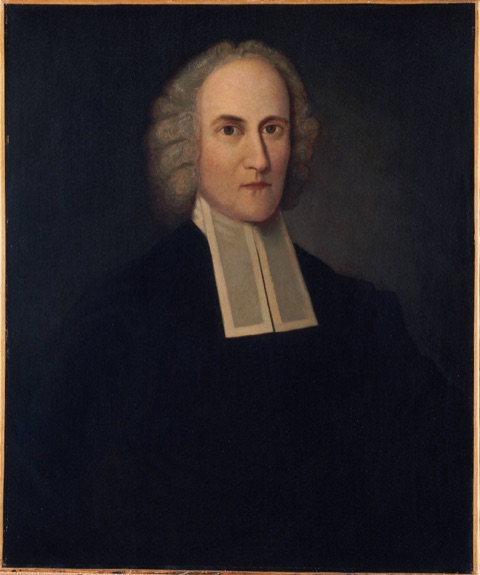
About the author
Jonathan Edwards
Jonathan Edwards (1703 to 1758 AD) was born in East Windsor, Connecticut, the only son among eleven children of the Congregational minister Timothy Edwards. He entered Yale College at thirteen and graduated in 1720. In 1727 he became assistant to his grandfather Solomon Stoddard at Northampton, Massachusetts, and succeeded him as pastor in 1729. A revival under his preaching in the mid-1730s was followed by the Great Awakening of 1740 to 1742, and he set out the marks of genuine religious experience in Religious Affections (1746). Dismissed from Northampton in 1750, he moved to the frontier mission at Stockbridge, where he wrote Freedom of the Will and Original Sin. He was elected president of the College of New Jersey in 1758 and died that year after a smallpox inoculation.