A free account opens the whole library to read online, on your phone or at your desk. Open a book on one device and it is waiting at the same page on the next. The PDF and EPUB of every book are yours to keep, and audiobooks play in the same app.
250+ modernized editionsNot samples. The whole work, free.
Your place, on every devicePhone, tablet or desktop, same page.
131 audiobooksFrom $4.99 each, or all of them with a $50 gift.
The Nicomachean Ethics is Aristotle's treatise on the good human life, written in Athens between 335 and 322 BC. It argues that happiness is the highest human good and consists in a whole lifetime of activity in accordance with virtue, and that virtue is a character formed by habit and guided by practical wisdom.
How the argument unfolds
01
The highest good. Every craft aims at some end, and the end chosen for itself alone is happiness. Tested against the human function, it proves to be an activity, and a lasting one: “One swallow or one fine day does not make a spring.”
02
Virtue as habit. Moral excellence is not inborn but practiced into being, the way a craft is learned. “By doing just acts we become just, and by doing temperate and courageous acts we become temperate and courageous.”
03
The mean. Each virtue sits between a vice of excess and a vice of deficiency, measured by “the mean relative to us,” not by arithmetic. There are many ways to fail, so “it is easy to miss the mark and difficult to hit it.”
04
Choice and the virtues one by one. Book 3 sets out when an act is voluntary, then the virtues follow in turn, from courage and temperance to greatness of soul. Courage is tested by the greatest terror, since “death is our limit.”
05
Justice. In its widest sense justice is “complete virtue exercised toward others.” In its narrower sense it is fairness, worked out through proportion in distributions and exchanges.
06
The intellectual virtues. Book 6 separates scientific knowledge, craft, wisdom, and practical wisdom, which is “a settled capacity that apprehends truth through reasoning or calculation and issues in action in the sphere of human good.”
07
Knowing better and doing worse. Book 7 takes up the person who acts against their own judgment. Socrates denied such a thing could happen, and Aristotle answers that “this theory plainly conflicts with experience.”
08
Friendship. Books 8 and 9 give friendship more space than any single virtue: “No one would choose to live without friends, even if he had every other good thing.” Friendships of use and pleasure fade, while the friendship of good people lasts.
09
Contemplation and legislation. Book 10 ranks the life of reason highest, since reason is the divine element in us. It then turns to law, because argument alone cannot form character: “passion seems to yield only to force, not to reason.”
Key themes
Activity over possession. A good disposition held in reserve earns nothing. As at the Olympic Games, the crown goes not to the strongest but to “those who compete.”
Precision suited to the subject. Ethics cannot be as exact as geometry, and Aristotle warns that “an educated person requires in each kind of inquiry only as much exactness as the subject permits.”
Reason and desire in one soul. Virtue is not suppression of feeling but its training, so that the good person takes pleasure in acting well: “no one is good at all unless that person takes pleasure in noble deeds.”
The paperback
Prefer it in print? The same book, done right
$18.99 · 6 × 9 inches · Cream paper · Matte cover
Built to last, not printed cheap
Printed at 6 × 9 inches on cream paper with a matte cover, made to survive years of rereading and underlining.
Type you can actually read
Typeset at a comfortable reading size with generous margins and line spacing, so a long chapter is a pleasure rather than an eye test.
Online reading included
Every paperback comes with the full text in your free account, plus the PDF and EPUB, so you can start reading tonight while the book ships.
Your purchase funds the work
Reading online is free. Buying the paperback direct is what pays for the next modernized classic.
Every craft and every kind of inquiry, and likewise every action and choice, appears to aim at some good. It has therefore been well said that the good is that at which everything aims.
But these aims, or ends, differ. Sometimes the end is the exercise of a faculty; sometimes it is a result beyond that exercise. Wherever there is an end beyond the action, the result is better than the exercise itself.
Since there are many kinds of action and many crafts and sciences, there are also many ends. Health is the end of medicine, ships of shipbuilding, victory of the art of war, and wealth of household management.
But when several crafts or sciences are subordinate to a single one, as the making of bridles and other equipment is subordinate to horsemanship, while horsemanship and everything else the soldier does are in turn subordinate to the art of war, the end of the governing craft is always more desirable than the ends of the subordinate crafts, since those ends are pursued for its sake.
This remains true whether the end in view is the exercise of a faculty or something beyond it, as in the examples above.
Book 1, Chapter 2
If, then, among the things we do there is some end that we wish for on its own account, choosing all other ends as means to it, and if we do not choose every end without exception as a means to something else, since that would continue to infinity and leave desire empty and without an object, this end will plainly be the good, or the best of all things.
Surely it matters greatly in practice that we know this good. Like archers aiming at a definite mark, we will then be more likely to attain what we seek.
If so, we must try to indicate, at least roughly, what this good is and to which craft or science it belongs. It would seem to belong to the supreme science, the one that most deserves to be called the governing science.
Politics appears to answer this description. It prescribes which sciences a state needs, which each person must study, and how far each should pursue them. We see that even the highest arts, such as household management, rhetoric, and the art of war, are subordinate to it.
Since politics employs the other practical sciences and also determines what people are to do and what they are to refrain from doing, its end must include the ends of the others and must therefore be the proper human good.
For although this good is the same for an individual and for a state, the good of the state appears greater and more complete, both to attain and to preserve. We would be glad to provide this good for a single individual, but to provide it for a people and for several states is nobler and more divine.
This, then, is the aim of the present inquiry, which is a kind of political inquiry.
Book 1, Chapter 3
We must be satisfied if our account achieves as much precision as its subject permits. We should no more expect the same degree of exactness in every kind of reasoning than in every kind of craftsmanship.
What is noble and just, the matters with which politics deals, varies so greatly and is so uncertain that some people think these distinctions exist only by convention and not by nature. There is a similar uncertainty about what is good, because good things often harm people. Some have been ruined by wealth, and others have lost their lives through courage.
Since our subject and our premises are of this kind, we must be satisfied if we indicate the truth roughly and in outline. We are dealing with matters that do not conform to unchanging laws and reasoning from premises that are only probable, so we must be content to reach probable conclusions.
The reader should receive each of my statements in the same spirit. An educated person requires in each kind of inquiry only as much exactness as the subject permits. It is equally absurd to accept probable reasoning from a mathematician and to demand scientific proof from an orator.
Each person can judge well what they know. Someone with special education in a particular subject is a good judge of that subject, while someone with a comprehensive education is a good judge without qualification. A young person is therefore not qualified to study politics, because the young lack experience of the affairs of life, which supply the premises and subject matter of politics.
Moreover, because a young person is apt to be ruled by feeling, that person will gain no benefit from a study whose aim is practical rather than speculative.
In this respect, being young in character is the same as being young in years. The disqualification is not a matter of age, but arises because feeling rules such a person’s life and directs every desire. People of this character make no practical use of the knowledge they acquire, as we see in those who lack self-control. But those who direct their desires and actions by reason will gain great benefit from knowing these matters.
Let this be enough by way of preface concerning the student, the spirit in which our statements should be received, and the object we have set before ourselves.
Book 1, Chapter 4
To resume: since all knowledge and every choice aim at some good, what do we say is the aim of politics? In other words, what is the highest of all goods attainable through action?
As for its name, nearly everyone agrees. Ordinary people and people of culture alike call it happiness, and they hold that to “live well” or to “do well” is the same as to be “happy.”
But they disagree about what happiness is, and ordinary people do not give the same account of it as philosophers do. Ordinary people take it to be something tangible and obvious, such as pleasure, wealth, or fame. One person identifies it with one thing and another with something else, while the same person often changes opinions at different times: after sickness, it is health; in poverty, it is wealth. Conscious of their own ignorance, people are most impressed by those who say grand things beyond their comprehension.
Some philosophers, however, have thought that besides these particular good things there is an “absolute” good that causes them to be good.
It would hardly be worthwhile to review every opinion that has been held. We will confine ourselves to those that are most widely accepted or seem to have some rational foundation.
But we must not overlook the distinction between proceeding from our starting points or principles and working toward them. Plato appropriately used to raise this question and ask whether the right course leads from the starting points or toward them, just as on a racetrack one may run from the judges to the boundary or in the opposite direction.
We must begin with what is known. But “what is known” has two meanings: what is known to us and what is known without qualification. It is safe to say that we must begin with what is known to us.
For this reason, only a good moral education can qualify someone to study what is noble and just, or, in a word, to study political questions. Here the undemonstrated fact is the starting point. If this fact is sufficiently evident to someone, that person will not also require a reason why. Someone who has received good moral training either already possesses the starting points or principles of action or will readily accept them when they are pointed out. But anyone who neither possesses nor accepts them may hear what Hesiod says:
“The best is he who of himself doth know; Good too is he who listens to the wise; But he who neither knows himself nor heeds The words of others, is a useless man.”
Book 1, Chapter 5
Let us now resume the discussion at the point where we digressed.
Judging, as we reasonably may, from people’s lives, the majority, who are the least refined, identify the good, or happiness, with pleasure and therefore accept the life of enjoyment as their ideal.
There are three especially prominent kinds of life: the life of enjoyment, the life of the statesman, and, third, the contemplative life.
Most people show themselves utterly slavish by preferring a life fit for brute animals. Yet their view receives consideration because many people in positions of power share the tastes of Sardanapalus.
Refined people with a practical disposition prefer honor, for we may presumably call honor the aim of the statesman’s life. But honor seems too superficial to be the good we are seeking. It appears to depend more on those who give it than on the person who receives it, while we suspect that the good is something properly one’s own and difficult to take away.
Moreover, such people seem to pursue honor so that they may be assured of their own excellence. At least, they wish to be honored by sensible people who know them and to be honored on account of their virtue or excellence. It is plain, then, that in their view, at any rate, virtue is better than honor. Perhaps we should therefore take virtue, rather than honor, to be the end of the statesman’s life.
But virtue also appears too incomplete to be what we seek. A person might possess virtue and yet remain asleep or inactive throughout life, and might also encounter the greatest disasters and misfortunes. No one would call such a person happy except merely to defend an argument. We will not dwell on these matters now, since they have been sufficiently discussed in the popular treatises.
The third kind of life is the contemplative life, which we will discuss later.
As for the money-making life, it is contrary to nature. Wealth is plainly not the good we are seeking, since it is useful only as a means to something else. Pleasure and virtue might more reasonably be regarded as ends, because they are chosen for their own sake. Yet it seems that not even these are the end, though much breath has been wasted in attempts to prove that they are.
Book 1, Chapter 6
Having dismissed these views, we must now consider the “universal good” and state the difficulties it presents. This inquiry is unpleasant because we are friends with the authors of the doctrine of Ideas. Nevertheless, we believe that this is the right course. In the interests of truth, we ought to sacrifice even what is closest to us, especially since we call ourselves philosophers. Both friendship and truth are dear to us, but it is a sacred duty to give truth preference.
First, the authors of this theory did not themselves assert a common Idea for things of which one is prior to another. For this reason, they did not hold that there was one common Idea of numbers.
Now, the predicate “good” is applied to substances, qualities, and relations. What exists independently, which we call substance, is logically prior to what is relative, since the relative is, as it were, an offshoot or, in logical terms, an accident of a thing or substance. On their own principles, therefore, there cannot be one common Idea of these goods.
Second, “good” is used in as many different ways as “is” or “being.” We apply it to substances or independent existences, such as God and reason; to qualities, such as the virtues; to quantity, such as the moderate or appropriate amount; to relations, such as the useful; to time, such as opportunity; to place, such as habitation; and so on. It is therefore evident that “good” cannot express one and the same notion in all these applications. If it did, the term could not be applied in every category, but only in one.
Third, if the notion were one, there would be only one science of all goods, since there is only one science of all things falling under a single Idea. But in fact there are many sciences even of goods that fall under one category. For example, the science dealing with opportunity in war is strategy, while in disease it is medicine. The science dealing with the appropriate amount of food is medicine, while for exercise it is gymnastics.
Fourth, one might ask what they mean by “absolute.” In “absolute man” and “man,” the word “man” has exactly the same meaning, since there can be no difference between them with respect to humanity. If that is so, there can likewise be no difference in goodness between “absolute good” and “good.”
Fifth, they do not make the good any better by making it eternal. A white thing that lasts a long time is no whiter than one that lasts only a day.
The doctrine of the Pythagoreans seems more plausible. In their table of opposites, they place the one on the same side as good things instead of reducing all goods to unity, and even Speusippus seems to follow them in this.
These points may be reserved for another occasion. But someone may object to what I have said on the ground that the Platonists do not speak in this way about all goods indiscriminately. They hold that things pursued and welcomed for their own sake are called good by reference to one common form or type, while things that tend to produce or preserve these goods, or to prevent their opposites, are called good only as means to them and in a different sense.
There will evidently be two classes of goods: goods in themselves and goods that are means to the former. Let us therefore separate the merely useful things from the things good in themselves and ask whether the latter are called good by reference to one common Idea or type.
What things would we call “good in themselves”?
Surely they include the things we pursue even apart from their consequences, such as wisdom, sight, certain pleasures, and certain honors. Although we sometimes pursue these as means, no one could refuse to rank them among things that are good in themselves.
If these are excluded, nothing remains good in itself except the Idea, in which case the type or form will be meaningless.
If, however, these things are ranked among goods in themselves, it must be shown that the goodness of all of them can be defined in the same terms, just as “white” has the same meaning when applied to snow and to white lead.
But in fact we must give separate and different accounts of the goodness of honor, wisdom, and pleasure. “Good,” then, is not applied to all these things in the same sense or by reference to one common Idea or form.
How, then, do all these things come to be called good? They do not appear to have received the same name merely by chance. Perhaps they are so called because they all proceed from one source or all contribute to one end. Or perhaps the name rests instead on analogy, just as we call reason the eye of the soul because reason bears the same relation to the soul that the eye bears to the body, and so on.
But we may set these questions aside for now, since a detailed discussion of them belongs more properly to another branch of philosophy.
For the same reason, we may dismiss further consideration of the Idea. Even if the word “good,” as applied to all these different things, had one and the same meaning throughout, or even if there were an absolute good apart from particular goods, this absolute good plainly would not be something a human being could realize or attain. Yet an attainable good is what we are now seeking.
Perhaps someone might nevertheless think it useful to become acquainted with this universal good for the sake of the goods that are attainable through action. With it as a pattern, it may be said, we would more readily discern our own good and, having discerned it, achieve it.
This argument has some plausibility, but it appears inconsistent with the existing sciences. Although they all aim at some good and strive to remedy their deficiencies, they neglect to inquire into this universal good. Yet it is hardly likely that practitioners of the various crafts and sciences would neither know nor even seek something that would help them so greatly.
Indeed, I cannot see how a weaver or carpenter would be helped in the practice of a craft by knowing the absolute good, or how someone would become more capable of healing the sick or commanding an army by contemplating the pure form or Idea. The physician does not even seek health in the abstract, but the health of a human being, or rather the health of a particular human being, since physicians heal individuals.
Book 1, Chapter 7
Leaving these matters, let us return once more to the question: what is this good that we are seeking?
It appears to differ among different kinds of action and different crafts. It is one thing in medicine, another in war, and so on. What, then, is the good in each case? Surely it is that for the sake of which everything else is done. In medicine this is health; in war, victory; in building, a house. It is different in each case, but in everything we do and choose it is always the end, since everything else is done for its sake.
If there is one end of everything human beings do, this will be the attainable good. If there is more than one, these ends will be the attainable goods.
Our argument has thus returned by a different path to the same point as before. We must try to explain this point more clearly.
We see that there are many ends, but some of them, such as wealth, flutes, and instruments generally, are chosen only as means. It is therefore plain that not all ends are final. But the best of all things must, we conceive, be something final.
If there is only one final end, it will be what we are seeking. If there is more than one, we seek the most final among them.
What is pursued as an end in itself is more final than what is pursued as a means to something else. What is never chosen as a means is more final than what is chosen both for itself and as a means. An end is final without qualification when it is always chosen for itself and never as a means.
Happiness appears more than anything else to answer this description. We always choose happiness for itself and never for the sake of something else. Honor, pleasure, reason, and every virtue or excellence we choose partly for themselves, since we would choose each even if nothing resulted from it, but we also choose them for the sake of happiness, believing that through them we will become happy. No one, however, chooses happiness for the sake of these things or as a means to anything else whatever.
We seem to reach the same conclusion from the idea of self-sufficiency.
The final good is thought to be self-sufficient. In applying this term, we do not consider a person as an isolated individual living a solitary life. We also take account of parents, children, a wife, friends, and fellow citizens generally, since a human being is naturally social.
Some limit must be set, however. If we extend the account to parents and descendants and to friends of friends, we will continue without end. We will consider this matter later. For the present, we will take “self-sufficient” to mean what by itself makes life desirable and lacking in nothing. Happiness is believed to answer to this description.
Happiness is also believed to be the most desirable thing in the world, not merely one good among others. If it were simply one among other good things, adding even the least good would plainly make it more desirable, since the addition would create a surplus of good, and the greater of two goods is always more desirable.
Happiness thus appears to be something final and self-sufficient, and the end of everything human beings do.
But perhaps, while no one will dispute that happiness is the best thing in the world, a more precise definition of it is still needed.
We may best obtain this definition by asking what the function of a human being is. The goodness and excellence of a flute player, sculptor, or practitioner of any craft, and generally of anyone who has a function or work to perform, lies in performing that function. In the same way, the human good would appear to lie in the human function, if human beings have such a function.
Can we suppose that while a carpenter and a shoemaker each has a function and a work of his own, a human being has no work and no function assigned by nature? Surely, just as the eye, hand, foot, and each of our other parts plainly has its own function, we must suppose that a human being also has a function beyond all these particular functions.
What, then, is it?
Human beings plainly share life even with plants, but we are seeking what is peculiar to humanity. We must therefore exclude the life of nutrition and growth.
Next comes the life of sense perception, but this too is plainly shared with horses, cattle, and every kind of animal.
What remains is the active life of the rational part. This has two aspects: one obeys reason, while the other possesses and exercises reason. Because “life” can be understood in more than one way, we must make clear that we mean life as the exercise of these faculties, since this is more properly called life.
The human function, then, is an activity of the soul that follows or involves reason.
The function of a practitioner and that of a good practitioner belong to the same kind. This is true, for example, of a harpist and a good harpist, and the same holds without exception in every other case. The good practitioner’s superior excellence in performing the work is added to the function itself: the function of a harpist is to play the harp, and that of a good harpist is to play it well.
The human function is, as we have said, a kind of life, namely an exercise of our faculties and actions of various kinds in accordance with reason. The function of a good person is to perform these actions well and nobly.
The function of anything is performed well when it is performed in accordance with the proper excellence of that thing.
Putting all this together, we find that the human good is activity of the soul in accordance with virtue or excellence or, if there is more than one virtue, in accordance with the best and most complete virtue.
But this activity must also extend over a complete life. One swallow or one fine day does not make a spring, nor does one day or any short period make a person blessed and happy.
Let this, then, serve as a rough outline of the good. The proper method, I think, is first to sketch the outline and then fill in the details. Once the outline has been fairly drawn, anyone can carry the work forward and fit in the particular points that time reveals or helps us discover. This is how the crafts and sciences have developed, since filling the gaps requires no extraordinary genius.
We must remember, however, what was said above. We should not demand the same degree of precision in every branch of study, but only as much as the subject matter permits and as is proper to that kind of inquiry.
A carpenter and a geometer both seek a right angle, but in different ways. The carpenter needs only the degree of approximation required for the work, while the geometer wants to know what constitutes a right angle or what its distinctive property is, since the geometer’s aim is to discover the truth. We must follow the same course in other cases so that we do not spend more time on incidental matters than on the real business at hand.
Nor should we demand the reason why in every case. Sometimes it is enough for the undemonstrated fact to be clearly stated, as with the starting points or principles of a science. Undemonstrated facts always form the first step or starting point of a science.
These starting points or principles are reached in different ways: some by induction, others by perception, and still others by some kind of training. In each case, we must try to apprehend them in the appropriate way and do our best to define them clearly, for they greatly influence the subsequent course of an inquiry. A good beginning is more than half the race, I think, and once our starting point or principle has been found, it clears up many of our difficulties.
Book 1, Chapter 8
We must not be satisfied with examining our starting point or principle merely as a conclusion drawn from our premises. We must also consider how it relates to current opinions on the subject, for all experience harmonizes with a true principle, while a false one is soon found incompatible with the facts.
Good things have been divided into three classes: external goods, goods of the soul, and goods of the body. Goods of the soul are commonly said to be goods in the fullest sense and to be better than the others.
Actions and exercises of the vital faculties, or soul, may be said to belong to the soul. Our account is therefore confirmed by this opinion, which is both longstanding and accepted by all who concern themselves with philosophy.
Indeed, our mere statement that certain actions and exercises are the end secures the support of this opinion, since it implies that the end must be ranked among goods of the soul rather than external goods.
Our account also agrees with the common saying that the happy person lives well and does well, for happiness, as we understand it, may be described as living well and doing well.
Indeed, all the characteristics people expect to find in happiness seem to belong to happiness as we define it.
Some hold happiness to be virtue or excellence; some, practical wisdom; and others, a kind of wisdom. Others hold it to be all or some of these together with pleasure, either as an ingredient or as a necessary accompaniment. Some even include external prosperity in their account of it.
Some of these views are supported by many voices and ancient authority. Others have fewer supporters, but supporters of weight. It is likely that neither side is entirely wrong, but that each is right on at least one point, if not on most.
First, the view that happiness is excellence, or a kind of excellence, agrees with our account, since the exercise of our faculties in accordance with excellence belongs to excellence.
But it makes no small difference whether the good is understood as the mere possession of something or as its use, as a mere settled or trained disposition or as the exercise of that disposition. The disposition may be present without producing any good result, as when a person is asleep or otherwise prevented from exercising it. This is impossible when it is exercised, for the exercise must show itself in actions, and in good actions. At the Olympic Games, it is not the fairest and strongest who receive the crown, but those who compete, since the victors come from among them. In life too, the winners are those who not only possess the excellences but manifest them in action.
Moreover, the lives of such people are pleasant in themselves. Pleasure is an affection of the soul, and each person takes pleasure in what that person is said to love: a lover of horses takes pleasure in horses, a lover of sightseeing in sightseeing, and likewise a lover of justice in just actions and, generally, a lover of virtue or excellence in virtuous actions and manifestations of excellence.
For most people, the various things in which they find pleasure are perpetually in conflict because these things are not naturally pleasant. But those who love what is noble take pleasure in what is naturally pleasant. Manifestations of excellence are naturally pleasant, so they are both pleasant to such people and pleasant in themselves.
Their life, then, does not need pleasure added to it as an appendage but contains pleasure within itself.
Indeed, beyond what has already been said, no one is good at all unless that person takes pleasure in noble deeds. No one would call a person just who took no pleasure in doing justice, or generous who took no pleasure in acts of generosity, and the same applies in other cases.
If this is so, manifestations of excellence will be pleasant in themselves. But they are also good and noble, and in the highest degree, at least if the good person judges them rightly, for this is that person’s judgment.
Happiness, then, is at once the best, noblest, and most pleasant thing in the world. These qualities are not separated, as the Delian inscription would have them be:
“What is most just is noblest, health is best, Pleasantest is to get your heart’s desire.”
All these characteristics are united in the best exercises of our faculties, and we identify happiness with these exercises, or with the one among them that is better than all the others.
Nevertheless, happiness plainly requires external goods too, as we have said, for it is impossible, or at least not easy, to act nobly without some resources supplied by fortune. Many things can be done only through instruments, so to speak, such as friends, wealth, and political influence. There are also things whose absence takes the bloom from happiness, such as good birth, the blessing of children, and personal beauty. A person is not very likely to be happy if exceedingly ugly, of low birth, alone in the world, or childless, and perhaps still less so if that person has worthless children or friends, or has lost good ones.
As we have said, then, happiness seems to require prosperity of this kind. This is why some identify it with good fortune, just as others identify it with excellence.
Questions
What is the Nicomachean Ethics about?+
It asks what makes a human life go well and answers through character: how habits form, how choices are made, which traits deserve praise, what friends owe one another, and which life is best.
Why is it called Nicomachean?+
The title refers to Nicomachus, the name of both Aristotle's father and his son. Ancient tradition connects the work with the son, who is thought to have edited or received it.
What is the golden mean in Aristotle?+
It is the right amount of a feeling or action for a particular person and situation. Courage lies between cowardice and foolhardiness, but the mean is fixed by practical wisdom, not by splitting the difference.
What does Aristotle mean by happiness?+
Happiness here is not a mood but a completed life lived well. Aristotle counts it the best, noblest, and most pleasant thing, though it still needs a measure of external good fortune.
How long is the Nicomachean Ethics?+
This edition runs to about 84,500 words, roughly six hours of reading. Friendship alone takes up nearly a fifth of the book.
Is the Nicomachean Ethics hard to read?+
The material survives largely as lecture notes, so older English versions are compressed and technical. This edition keeps every chapter and distinction while writing each sentence in current English.
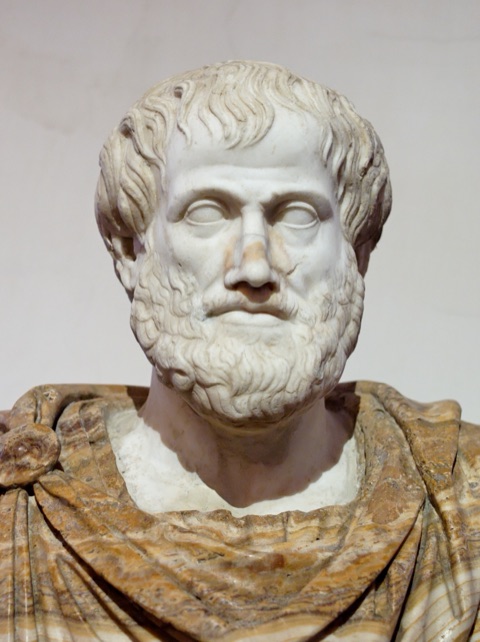
Aristotle was an ancient Greek philosopher and polymath who studied under Plato and later tutored Alexander the Great. His writings cover an enormous range of subjects including physics, biology, zoology, metaphysics, logic, ethics, aesthetics, poetry, theater, music, rhetoric, psychology, linguistics, economics, politics, and government. Aristotle founded the Lyceum in Athens, where he taught and conducted research. His works on ethics, particularly the Nicomachean Ethics, established virtue ethics as a major tradition in Western moral philosophy. His influence on Western thought is immeasurable, with his ideas shaping Christian theology, Islamic philosophy, and the development of modern science.