Full text in modern English · Free PDF/EPUB
Lectures on Moral Philosophy
Want the file? The PDF/EPUB is free with an account.
Summary
- Author
- John Witherspoon (1723 to 1794 AD)
- Published
- 1800 AD, in his collected Works · oldest surviving student copy 1772 AD
- Source edition
- Varnum Lansing Collins's edition, Princeton University Press, 1912, reprinting the 1800 text
- Type
- College lectures on ethics, politics and jurisprudence
- Length
- 34,000 words · 2 hours
What is Lectures on Moral Philosophy about?
Lectures on Moral Philosophy is the course John Witherspoon taught his students at Princeton, printed after his death. In sixteen lectures and a recapitulation it argues that duty rests on conscience and God's will rather than self-interest, that government rests on consent, and that a people may resist tyranny.
How the argument unfolds
- 01
Lecture 1: why study ethics by reason. Scripture has nothing to fear from reason. On laughter as the mark of the human: "we will have to acknowledge kinship with apes."
- 02
Lectures 2 to 5: conscience and virtue. The moral sense is "the law our Maker has written on our hearts." Seven rival theories follow, including Smith's sympathy, "simply new terminology for the moral sense."
- 03
Lectures 6 to 9: duties. God's existence and attributes, then duties to God, others and self. A perfect right may be enforced; an imperfect one, like gratitude, may not.
Read the full summary (7 points, key themes)Show less
- 04
Lecture 10: compact and property. On the state of nature, Hobbes and Hutcheson are reconciled: nature draws us into society and necessity drives us there. More's Utopia is "fanciful and impracticable."
- 05
Lecture 11: the household. Marriage binds one man and one woman for life; male births outnumbering female by 13 to 12 count against polygamy.
- 06
Lectures 12 and 13: government and war. Civil liberty is unnecessary to virtue, yet "Liberty is the nurse of riches, literature, and heroism." Conquest alone "is robbery, not a right."
- 07
Lectures 14 to 16 and Recapitulation: law. Religion and the magistrate, punishment, contracts, oaths, money as "a sign of wealth," and the rights of necessity.
Key themes
- Duty before interest. Choosing a lesser pleasure feels like a mistake; doing wrong brings remorse. "A thing is not my duty because it serves my interest."
- Power needs a counterweight. "Rulers, on the other hand, naturally grasp at power," so each branch must need the others: the British king makes war, Parliament raises the money.
- Truthfulness. Comforting lies to the sick are condemned; a light left on to fool thieves is allowed.
Lectures on Moral Philosophy · Full text
Lecture 1: Moral Philosophy and Human Nature
Moral philosophy is the branch of knowledge that deals with the principles and laws of duty or morality. It is called philosophy because it uses reason, as distinct from revelation, to examine the nature and basis of moral obligation.
This raises a question: is it permissible, and is it safe or useful, to separate moral philosophy from religion? Someone will object that it either agrees with revealed truth or differs from it. If it agrees, it is unnecessary; if it differs, it is false and dangerous.
A New England author says that moral philosophy is just reducing unbelief to a system. But however plausible these objections may seem, they will prove unsound at bottom.
If Scripture is true, the discoveries of reason cannot contradict it, so Scripture has nothing to fear from that direction. Since we are certain that reason can do no harm, there is also a probability that it may do much good. Reason and observation may illustrate and confirm the inspired writings, greatly adding to their beauty and force.
The remarkable advances in natural philosophy since the end of the last century have done far more than leave religion unharmed: they have greatly promoted it. Why should the same not hold for moral philosophy, which is really nothing other than knowledge of human nature? Unbelievers do commonly proceed on supposed principles of reason. But since we cannot prevent them from reasoning about this subject, the best course is to meet them on their own ground and use reason itself to show the fallacy of their principles. I know of nothing that does more to support religion than seeing, from philosophers’ different and opposing systems, that nothing in their schemes is certain except what agrees with the word of God.
Some people, perhaps more in the present age than in any earlier one, deny the law of nature. They say that all the beliefs usually attributed to it come from revelation and tradition.
Here we must distinguish between the light of nature and the law of nature. The first means what we can or do discover through our own powers, without revelation or tradition. The second means what, once discovered, can be shown to agree with reason and nature.
Some very perceptive and able recent writers, namely Dr. Wilson of New Castle and Mr. Riccalton of Scotland, have argued against the light of nature. They show that the first principles of knowledge come from information received from others; that nothing can be imagined more uncultivated and ignorant than a human being without instruction; and that people brought up in this way have scarcely risen above other animals. It is very difficult to speak precisely about this subject and to distinguish reason’s discoveries from its exercise. Yet I think that even if we admit all, or most, of what these writers maintain, we can still consider how far something agrees with reason or can be proved by it, even though reason left to itself might never have discovered it.
Dr. Clarke was one of the greatest champions of the law of nature, but its perceptive opponents have appeared only since his time. The Hutchinsonians, named after Hutchinson of England, insist that all knowledge, both moral and natural, comes from revelation: the true system of the universe, true chronology, all human arts, and so on. Like most other groups, they carry their favorite remedy to extravagant lengths. In my opinion, the whole of Scripture agrees perfectly with sound philosophy. Yet it was certainly never intended to teach us everything. The political law of the Jews contains many noble principles of equity and excellent examples for future lawmakers. Yet it was so local and particular that it certainly was never intended to be unchangeable and universal.
It would be more accurate and useful to say that all simple, original discoveries have been the work of Providence rather than human invention. On the whole, it seems reasonable to make moral philosophy, in the sense explained above, a subject of study. Indeed, whatever people think of it, they ought to become acquainted with it. They must know what it is if they ever intend to show that it is false.
The Division of the Subject
Moral philosophy has two main branches, ethics and politics. Some add jurisprudence, though this may be considered part of politics.
Ethics concerns personal duties; politics concerns the constitution, government, and rights of societies; and jurisprudence concerns the administration of justice in established states.
It seems generally agreed that the principles of duty and obligation must be drawn from human nature. In other words, if we can discover how our Maker formed us, or what he intended us for, that certainly determines what we ought to be.
Knowledge of human nature, however, is either confusing and difficult in itself or has been made so by the way writers in every age have treated it. Perhaps this very circumstance creates a strong presumption in favor of the scriptural doctrine that our nature is depraved and corrupt. If we suppose this depravity, it must be a major cause of difficulty and confusion in describing human nature as God’s work.
I take this to be the case with most of our moral and theological knowledge. Those who deny this depravity will tend to defend everything, or many things, as dictates of nature when they are really tendencies of nature in its present state. At the same time, they are the fruit and evidence of its departure from its original purity. We must use the remaining power of natural conscience to detect and oppose these errors.
We may consider human beings in two ways: (1) generally, as a species distinct from and superior to other creatures, asking what the difference really consists in; and (2) individually, asking what parts constitute human nature.
1. Humans and Other Animals
Philosophers have generally tried to identify the precise distinction between human beings and other animals. But when they have tried to reduce it to a single characteristic unique to humans, they have generally contradicted one another. Sometimes they have argued fiercely and made the matter still more uncertain.
The difficulty of finding a precise criterion only shows that human beings provide an example of something we see everywhere else: a beautiful, imperceptible gradation from one thing to another. The highest members of a lower class are, as it were, connected and blended with the lowest members of a higher class. Some species connect birds and beasts so closely that you will find it hard to say which group they belong to. The same holds throughout the plant kingdom as well as the animal kingdom.
(1) Some say that human beings are distinguished from other animals by reason. Certainly this, whether in kind or degree, is the most honorable of our distinctions.
(2) Others point out that many animals, such as dogs, horses, and elephants, show strong signs of reason. They say instead that humans are distinguished by memory and foresight. But I think these stand on the same footing as reason. If there are glimmerings of reason in other animals, there is also clear evidence of memory and some evidence of foresight.
(3) Some have thought it appropriate to distinguish humans from the lower creatures by speech, since no other creatures have an articulate language. Here again, we must acknowledge that our distinction lies chiefly in the excellence and fullness of articulate discourse. Other animals certainly know how to communicate many things to one another through sound.
(4) Some have said that none of these completely distinguishes humans from other animals, but that a sense of religion does. I think we must admit that there is no trace of piety or awareness of a Supreme Being in the lower creatures. Stories circulated by weak-minded people or repeated by credulous authors about animals’ respect for churches or sacred persons deserve to be dismissed as entirely fabulous and imaginary.
(5) Some have said that humans are distinguished from other animals by a sense of ridicule.
“The whole creation,” says a certain author, “is grave except man; no one laughs but himself.” Choosing this as the criterion is rather whimsical, and it does not seem to present us in a very respectable light. Perhaps we may appropriately smile at the suggestion and say that, if we accept it, we will have to acknowledge kinship with apes. They certainly have a capacity for laughter themselves, as well as an ability to make us laugh. On the whole, there seems to be no need to fix on one criterion to the exclusion of the others.
There is a great and obvious distinction between human beings and the lower animals. It lies not only in the beauty of the human form (as the poet observes, “He gave man an upturned face,” etc.) but also in reason, memory, reflection, and knowledge of God and a future state.
One general distinction deserves particular attention in moral inquiries: humans are evidently made to depend more on reason for guidance, protection from danger, and provision of what is useful, while other animals depend more on instinct.
Instinct is not very easy to explain, and perhaps no explanation is necessary. It is something that precedes reason and choice. When we say that birds build their nests by instinct, while people build their homes through reflection, experience, or instruction, we understand the matter well enough. But if we try to give a logical definition of either, a thousand arguments will immediately be brought against it.
Although humans are evidently governed by something other than instinct, they also have several instinctive tendencies. Some are independent of their moral dispositions, while others are mixed with them. Hunger, thirst, and some other appetites belong to the first kind; parental tenderness toward offspring belongs to the second.
We will say only one thing more about instinct: it points more directly to the Creator’s appointment, and in both humans and other creatures it operates earlier and more uniformly than reason.
Lecture 2: The Powers of the Human Mind
Considering a human being as an individual, we discover the most obvious and remarkable feature of human nature: a person is a compound of body and spirit. I take this for granted here because we are only describing human nature. When we come to human beliefs and principles of action, it will be more appropriate to consider the soul’s spiritual nature and immortality, and how they are proved.
Body and spirit strongly influence one another. The body affects the soul’s temper and disposition, and the soul affects the body’s condition and constitution. The body is properly the soul’s servant, the means of conveying perceptions to it, but nothing without it.
There is no need to discuss the body’s structure at length. Everyone knows enough about it unless we go into anatomical detail. At that level, like every other part of nature, it displays the Creator’s infinite wisdom. As far as morality is concerned, the body’s influence may in one respect be very great, in enslaving people to appetite. Yet its connection with morality does not seem to require a detailed description.
I think there is little reason to doubt that people differ greatly and essentially in spirit and in the powers that properly belong to it. But the laws uniting body and spirit are evidently such that a mere change in the body’s condition weakens many faculties and makes some entirely incapable of functioning. Old age and disease often cause loss of memory and weakened judgment. Sometimes a disturbance of the brain caused by a fall completely disorders judgment.
The instinctive appetites of hunger and thirst seem to reside directly in the body, while the soul does little more than perceive them passively. Some passions, particularly fear and rage, also seem to have their seat in the body, immediately producing a certain change in the blood and spirits.
Perhaps this happens to some degree with all passions. Whenever they are indulged, they produce a change in the blood and spirits that makes them easy to rekindle. But none arise from the body so instantaneously, preceding deliberation, will, and choice, as those just named. Among the evil passions to which we are subject, we may say that fear, anger, and sensual indulgence depend most on the body, while ambition, envy, and covetousness depend least on it.
The faculties of the mind are commonly divided into three kinds: understanding, will, and affections. Perhaps we should observe that these are not three wholly distinct qualities, as if they were three different beings. They are different ways in which the same simple principle acts. It is the soul or mind that understands, wills, or experiences pleasure and pain.
The understanding seems to have truth as its object: discovering things as they really are, both in themselves and in relation to one another. Whether goodness is in any degree an object of the understanding has been disputed. On one side, truth alone seems to belong to the understanding, since we can easily imagine people with equal intellectual powers and opposite moral characters. Indeed, we can imagine malice joined to a high degree of understanding, and virtue or true goodness joined to much less understanding. On the other side, the will’s choices seem to rest on the understanding’s judgment or deliberation. Someone will ask: how can this be if the understanding has nothing to do with good or evil?
This question has produced considerable disagreement among philosophers. Dr. Clarke and some others make understanding or reason the immediate principle of virtue. Shaftesbury, Hutcheson, and others make affection its principle. Perhaps neither side is wholly right. Probably both are necessary.
The connection between truth and goodness, between the understanding and the heart, is a subject of great importance and great difficulty. I think we can say with certainty that infinite intellectual and moral perfection are united and inseparable in the Supreme Being. In lesser natures, however, the two are not exactly proportionate. Yet I believe that truth naturally and necessarily promotes goodness, while falsehood promotes the contrary. Since the influence is reciprocal, a malicious disposition, even when joined to the greatest natural powers, blinds the understanding and prevents the perception of truth itself.
Four acts of the will are usually listed: desire, aversion, joy, and sorrow. Hutcheson says the last two are unnecessary, and he seems right. All acts of the will can be reduced to the two main categories of desire and aversion, or, in other words, choosing and refusing.
The affections are also called passions because external objects often excite them. Insofar as they differ from a calm, deliberate judgment or decision of the will, they may be called strong tendencies implanted in our nature. In themselves, they do much to bias judgment or incline the will.
We can best understand the affections by observing the difference between a calm, deliberate, general inclination, whether selfish or benevolent, and particular, intense inclinations. Everyone deliberately wishes for personal happiness, but this differs considerably from a passionate attachment to particular gratifications, such as riches, honors, or pleasures. A good person will have a settled, deliberate desire for humanity’s welfare. But this differs from love for children, relatives, friends, or country.
The passions are very numerous and can take many forms. Anything that is an object of desire or aversion, in whatever form, may through accident or indulgence grow strong enough to be called a passion, and rightly so. Thus, in English we speak of a passion for horses, dogs, or recreation.
All passions, however, can be grouped under the two main categories of love and hatred. The first includes esteem, admiration, goodwill, and every kind of approval, delight, and desire. The other includes every kind of aversion and its expressions: envy, malice, rage, and revenge, whatever their objects may be.
Hope and fear, joy and sorrow, though often counted among the passions, seem instead to be states or conditions of mind accompanying every passion, according to whether its object is probable or improbable, possessed or lost.
Jealousy seems to be an intermediate kind of passion. It is not easy to say whether it should be classified as love or hatred. Jealousy between the sexes is often said to spring from love. Yet it plainly seems impossible for it to exist without forming a bad opinion, at least to some degree, of the person toward whom it is directed. The same can be said of jealousy and suspicion in friendship.
The passions can also be divided in a different way: into selfish and benevolent, public and private. We will have much occasion to consider this distinction later, when explaining the nature of virtue and the motives that lead to it. For now, the point is only to illustrate our nature as it really is.
There is a great and real distinction between selfish and benevolent passions. The first aim directly and immediately at our own interest in their gratification; the others aim immediately at other people’s happiness. Love of fame, power, property, and pleasure belong to the first kind. Family and domestic affection, friendship, and patriotism belong to the second. It is no answer to say that ultimately we seek to please ourselves, or that we feel satisfaction in seeking others’ good. In many cases, our direct object is certainly to promote others’ happiness. For this, many have been willing to sacrifice everything, even life itself.
After this brief survey of human nature from one point of view, which we may call its capacity, we must return to consider how we become acquainted with the objects we are to deal with, or on which these faculties are to operate.
We should observe in general that there are only two ways in which we come to know things: first, sensation; second, reflection.
Sensation must in turn be divided into external and internal.
External sensation arises from the immediate impression made by objects outside us. There are five external senses: sight, hearing, touch, taste, and smell.
In these we observe both the impression itself, or the sensation we feel, and the inseparable supposition that an external object produces it. It seems to me a first principle that we should trust the information our senses give us, because they are the foundation of all our later reasoning. The few exceptions caused by occasional irregularities in the senses provide no sound objection. There are so many plain and obvious ways to discover and correct these irregularities.
I think the reality of the material world can easily be established, except on principles that overturn all certainty and lead to universal skepticism. People who maintain such principles do not deserve to be reasoned with, since they do not claim to communicate knowledge but to take all knowledge away from us.
The immaterialists say that we are conscious of nothing but the impression or feeling in our own minds. But they overlook the fact that the impression itself implies and presupposes something external that communicates it. It cannot be separated from that supposition. Sometimes these thinkers tell us that we cannot show substance apart from its perceptible qualities. But no one can show me a perceptible quality apart from a particular thing that possesses it. If anyone will show me whiteness without showing me anything white, or roundness without anything round, I will show him substance without either color or shape.
Immaterialism removes the distinction between truth and falsehood. I have an idea of a house or tree in a certain place, and I call this true. That is, I believe there really is a house or tree there. Again, I form an idea of a house or tree as something that might be in that place. I ask what the difference is if, after all, you tell me that neither tree, house, nor place exists anywhere.
An advocate of that system says that truth consists in the liveliness of the idea. Nothing could be more plainly false. I can form as distinct an idea of something that does not exist as of something that does, when it is out of my sight. From Homer and Virgil I have a much livelier idea of Jupiter and Juno and many of their actions, though I do not believe any of them ever existed, than I have of many things I know happened within the past few months.
The truth is that the immaterialist system is a wild and ridiculous attempt to unsettle the principles of common sense through metaphysical reasoning. It can scarcely produce anything but contempt in most people who hear it. I truly believe it has never convinced even those who claim to support it.
Lecture 3: Perception, Moral Sense, and Duty
Internal sensation is what Mr. Hutcheson calls the finer powers of perception. It begins with external objects, but through abstraction considers something beyond their merely perceptible qualities.
1. In many objects, for example, we have a sense of beauty in their appearance, structure, or composition that is entirely distinct from mere color, shape, and extent. How, then, do we perceive this beauty? It enters through the eye, but it is perceived and enjoyed by what we may appropriately call an internal sense, quality, or capacity of the mind.
2. There is a pleasure in imitation. For this reason, painting, sculpture, and poetry are often called the imitative arts. It is easy to see that the imitation itself gives pleasure, since a vivid description of something painful to witness can give us great pleasure.
3. A sense of harmony.
4. A sense of order or proportion.
Perhaps all these senses can, after all, be considered one class. They may be the particular elements that, singly, in various combinations, or all together, produce what are called the pleasures of the imagination. If so, we may extend these senses to everything involved in the principles of beauty and gracefulness: order, proportion, simplicity, intricacy, uniformity, and variety. This is especially true insofar as these principles have something in common that applies equally to all the fine arts: painting, sculpture, architecture, music, poetry, and oratory.
The various theories about the principles of beauty, or what precisely constitutes it, are very important for taste and criticism but matter very little for morality. Whether beauty is a simple perception that cannot be analyzed, or, as the French call it, an indefinable something that cannot be discovered, makes no difference for our present purpose. No one can deny that we perceive beauty, and that this differs greatly from an object’s mere color or dimensions. This beauty extends to the form and shape of visible objects, or the grace and motion of living ones; indeed, to all works of art and productions of genius.
These are sometimes called the reflex senses. It is important to observe both that they really belong to our nature and that they differ greatly from the coarser perceptions of external sense.
We must also observe that several distinguished writers have added morality as an internal sense: a sense and perception of moral excellence and of our obligation to conform our conduct to it.
We need not join Mr. Hutcheson or anyone else in opposing those who make reason the principle of virtuous conduct. Yet I think we must admit that a sense of moral good and evil is as truly a principle of our nature as either the coarse external senses or the reflex senses. It is as truly distinct from both as they are from each other.
This moral sense is precisely what Scripture and ordinary language call conscience. It is the law our Maker has written on our hearts, making duty known and enforcing it before any reasoning. Opponents of innate ideas and the law of nature are unwilling to admit the reality of a moral sense, yet their objections are entirely frivolous. Education and information are every bit as necessary for developing and exercising the reflex senses, or powers of imagination, as for applying the moral sense.
Suppose, then, someone argues, as Mr. Locke often does: if there are innate principles, what are they? List them for me. If they are essential to human beings, they must be present in everyone. Let me question any simple, uneducated countryman and see whether he can tell me what they are. I would answer: if the principles of taste are natural, they too must be universal. Let me test the countryman, then, and see whether he agrees with us in perceiving the beauty of a poem or picture, or can explain the reasons for his approval.
Two senses do not easily fit into either of these kinds of internal sense, yet certainly belong to our nature. They are related to one another: a sense of ridicule and a sense of honor and shame. The sense of the ridiculous is something peculiar. We may admit that everything ridiculous is also unreasonable and absurd. But the reverse does not follow: not everything that is absurd is ridiculous. There are a hundred falsehoods in mathematics and other sciences that tempt no one to laugh.
Throughout his writings, Shaftesbury has tried to establish the principle that ridicule is the test of truth. But the preceding observation shows this opinion to be false, since ridicule involves something really distinct from reasoning. It seems to put imagination in the place of reason. See Brown’s Essays on the Characteristics.
A sense of honor and shame seems, from one point of view, to subject us to other people’s opinions, since it depends on the judgments of our fellow creatures. Yet perhaps we may regard this sentiment as intended to assist or guard virtue by making us fear others’ reproach for what is blameworthy in itself. This sense has very strong and powerful effects, whether guided by true or false principles.
After this survey of human nature, let us consider how we derive either the nature of duty or its binding force from it.
One way is to consider what our nature tells us about the path to the truest happiness. To do this, we must carefully examine the different classes of perceptions and affections to see which are most excellent, delightful, or desirable.
As mentioned above, we will soon find that they fall into three main classes, easily distinguished from one another and rising in successive degrees of excellence.
1. Gratification of the external senses. This gives some pleasure. We are led to desire what pleases them and to avoid what disgusts them.
2. The finer powers of perception give a delight that is evidently more excellent and that we must necessarily judge more noble. Poetry, painting, music, and so on, the use of genius, and the exercise of the mental powers generally give pleasure that, though less turbulent, is much more refined and does not so quickly leave us feeling we have had enough.
3. Above both of these stands a sense of moral excellence and the pleasure of doing what the moral sense dictates.
We must undoubtedly admit that this account agrees with the truth. To anyone who calmly and fairly weighs the delight of moral action, it must appear superior to every other gratification, as the most noble, pure, and lasting. We might therefore conclude that it should be preferred to every other source of pleasure. These others should yield when they conflict with it and should be embraced only in subordination to it.
But although we cannot say that anything in this theory is false, it certainly has very serious defects. For example, it completely confuses acting virtuously with seeking happiness, or leaves the two entirely undistinguished. On this account, promoting our own happiness would become the essence or definition of virtue, and regard for our own interest would be the sole and complete basis of our obligation to virtue.
Now there is good reason to believe that not only reason but also the moral sense teaches us something more on both points. There are affections free of self-interest that aim directly at others’ good. Far from deserving exclusion from the idea of virtue, they seem instead to deserve preference over selfish affections. I know that supporters of the self-interest theory have a way of explaining this away or resolving it. They say that people approve of and delight in benevolent affections only as pleasing and delightful to themselves.
But this is unsatisfactory. To trace all concern for others back to self-interest seems greatly to weaken its force. Nature seems to carry you beyond yourself through strong instinctive tendencies or implanted affections. This theory turns their current and direction back into the stream of self-interest, in which experience tells us we are most likely to run to a vicious excess.
Besides, it is argued, and I think with good reason, that the moral sense contains much more than approval of a certain class of actions as beautiful, praiseworthy, or delightful, and therefore a recognition of our interest in them as the noblest gratification. The moral sense also implies a sense of obligation: certain things are right and others wrong; we are bound by duty to do the former; and if we do the contrary, our conduct is hateful, blameworthy, and deserving of punishment. The moral sense or conscience also includes an expectation or belief that reward and punishment will follow according to which course we take.
It is far from true that virtuous action contains nothing beyond a higher degree of beauty or a nobler pleasure. Indeed, its beauty and sweetness arise from the very fact that it fulfills duty or a supposed obligation. Remove this, and both the beauty and the pleasure vanish. Why is it more pleasant to perform a just or charitable action than to please my palate with delicious food, walk in a beautiful garden, or read an exquisite poem? Only because I feel obliged to do it as something useful and important in itself. It is not a duty because it is pleasing, but pleasing because it is a duty. The same can be said of beauty and approval.
I do not approve of the conduct of a plain, honest, hardworking, pious man because it is more beautiful than that of an idle, immoral man. Rather, I call it more beautiful and lovable because he stays within the bounds of duty. I see a higher kind of beauty in moral action, but it arises from a sense of obligation.
Someone may say that my interest and duty are the same because they are inseparable and one arises from the other. But there is a real distinction and an order of priority. A thing is not my duty because it serves my interest. Rather, it is a wise arrangement of nature that I will forfeit my interest if I neglect my duty.
Several other observations could confirm this. When someone discovers through experience that, in seeking pleasure, he chose a less pleasing enjoyment instead of a more delightful one, he may feel that he made a mistake or suffered a misfortune. But he feels no blame or self-condemnation at all. When he has done something immoral, however, he feels inward remorse. He feels that he has broken a law and ought to have acted otherwise.
Lecture 4: The Nature and Foundations of Virtue
This therefore requires us to look a little further for the principle of moral action. To do this more accurately, and to give you a view of the chief controversies on this subject, notice that there are really three questions to investigate and distinguish. I recognize that they are so closely connected that they must sometimes overlap. At other times, however, failing to distinguish them leads to error.
The questions concern:
1. The nature of virtue.
2. The foundation of virtue.
3. The obligation of virtue.
When we inquire into the nature of virtue, we have done enough once we identify what it is, or show how we can know each particular duty and distinguish it from the opposite vice. When we speak of the foundation of virtue, we ask or answer these questions: Why is it so? Why is this course of action preferable to its opposite? What makes it excellent? When we speak of the obligation of virtue, we ask what law binds us, or what principles should lead us to obey the precepts virtue contains or prescribes.
I will say something about each question, the controversies raised about them, and the appropriateness or importance of pursuing these controversies far or reaching a particular decision on them. I will then discuss the moral laws, or the several branches of duty, in detail, following the division already established.
1. The Nature of Virtue
What is virtue? In other words, what rule must I use to test every disputed practice? To keep this question distinct from the next, notice that every system must appeal to one or more of the following: conscience, reason, and experience. All who base virtue on affection, particularly Hutcheson, Shaftesbury, and their followers, make the moral sense the rule of duty. They very often try to exclude the use of reason on this subject. These authors also seem to make benevolence and public affection the standard of virtue, as distinct from all private and selfish passions.
Dr. Clarke and most English writers of the previous age make reason the standard of virtue, particularly in opposition to inward feeling or affection. They offer this particular argument in support of their opinion: reason often does control and alter feeling, while feeling cannot alter the clear decisions of reason. Suppose my heart tells me that something is my duty, for example, to have compassion on someone caught committing crimes. Yet if calm reflection shows me that letting him go unpunished will harm the community, I act against that feeling because of the conclusions of reason.
Others also draw on experience and chiefly rely on it. In particular, all who follow the system based on self-interest find it necessary to make experience their guide, to show them what really contributes to happiness and what does not.
We will now consider the opinions about the nature of virtue. These are the chief ones:
(1) Some say that virtue consists in acting in accordance with the nature and reason of things. They hold that, in deciding any question about it, we must set aside all affection, public and private. This is Clarke’s view.
(2) Some say that benevolence or public affection is virtue, and that concern for the good of the whole is its standard. The most remarkable feature of this system is that it makes the sense of obligation in particular cases give way to a supposed greater good. This is Hutcheson’s view.
(3) One author, Wollaston in The Religion of Nature Delineated, makes truth the foundation of virtue. He reduces the goodness or evil of any action to the truth or falsehood of a proposition. This opinion differs from Dr. Clarke’s only in words, rather than in substance.
(4) Others place virtue in self-love, making well-regulated self-love its standard and foundation. Dr. Campbell of St. Andrews defends this system best.
(5) Some recent writers have made sympathy the standard of virtue, particularly Smith in his Theory of Moral Sentiments. He says that we have a certain feeling by which we sympathize with, or, as he calls it, “go along with,” what appears to be right. This is simply new terminology for the moral sense.
(6) David Hume has a system of morals peculiar to himself. He makes everything agreeable and useful virtuous, and conversely. In doing so, he entirely abolishes the difference between natural and moral qualities, making health, strength, and cleanliness just as much virtues as integrity and truth.
(7) An opinion published in this country holds that virtue consists in the love of being as such.
Several of these authors readily and naturally incorporate piety into their systems, particularly Clarke, Hutcheson, Campbell, and Edwards.
Some begin by establishing natural religion and then base virtue on piety. In substance, this amounts to the same thing. Those who reason about the nature of virtue mean only to show what the Author of nature has indicated as duty. After natural religion has been established by general proofs, its laws still need to be identified. If we do not include revelation, this must bring us back to considering our own nature and the rational conclusions drawn from it.
2. The Foundation of Virtue
Opinions about the foundation of virtue can be summed up under four heads: (1) the will of God; (2) the reason and nature of things; (3) the public interest; and (4) private interest.
(1) The will of God. This does not mean the position mentioned above, that indications of the divine will show us our duty. It means that the reason for the difference between virtue and vice must be sought nowhere except in God’s good pleasure. On this view, nothing has any intrinsic excellence apart from his commanding or forbidding it. Its advocates maintain that otherwise something would stand above the Supreme Being: something in the nature of things would subject him to the law of necessity or fate.
Although we find it difficult to form clear conceptions on this subject, it seems very harsh and unreasonable to say that the only difference between virtue and vice is the divine will. This would take away even God’s own moral character. It would then mean nothing to say that he is infinitely holy and infinitely perfect. Probably, however, those who have asserted this meant only that the divine will is so perfect and excellent that all virtue consists in conformity to it, and that we should judge good and evil by no other rule. This is as true as saying that divine conduct is the standard of wisdom.
(2) Some base virtue on the reason and nature of things. This may be called true, but it is not precise and explicit enough. Those who adopt this principle reason most successfully when they try to show that virtue and vice are essentially different. But when they try to show what this difference does or can consist in, apart from public or private happiness, their words convey very little meaning.
(3) Public happiness. This opinion holds that the foundation of virtue, or what distinguishes it from vice, is its tendency to promote the general good. Thus utility is ultimately the principle of virtue even for the great advocates of disinterested affection.
(4) Private happiness. Those who choose to place the foundation of virtue here would have us recognize no excellence in it beyond what directly contributes to our own gratification.
I would observe that each of these opinions contains something true, but each can easily be pushed into error by excess.
God’s nature and will are so perfect that they are the true standard of all excellence, natural and moral. If we are certain what he is or what he commands, it would be presumptuous and foolish to argue against it or substitute our ideas of fitness for his pleasure. But to say that God could, by his will, have made the very disposition and conduct we now call vicious virtuous and excellent seems to overturn all our notions of even God’s own supreme excellence.
Again, moral worth seems to possess an intrinsic excellence in the nature of things, with an indelible impression of it on conscience, distinct from producing or receiving happiness. Yet we cannot easily illustrate this excellence except by comparing one kind of happiness with another.
Again, promoting the public or general good seems so closely connected with virtue that we must necessarily suppose universal virtue could bring universal benefit. Yet this has sometimes led to two excesses. One is the fatalist and necessitarian systems, to which there are so many objections. The other is making the general good the ultimate practical rule for every individual, allowing a person to violate particular obligations with a view to a more general benefit.
Once more, virtue is certainly connected with private happiness as truly as with public happiness. Yet making the agent’s interest its only foundation seems to narrow the mind so much, and to be so destructive of public and generous affections, that it produces the most harmful effects.
If I were to set out a few propositions on the foundation of virtue as a philosopher, they would be these:
(1) Reason, contemplation, feeling, and tradition allow us to deduce God’s existence and his infinite perfection and excellence. Therefore, what he is and what he commands constitute virtue and duty. Whatever he has implanted as a principle in uncorrupted nature should be received as his will. Impulses that the inward principle of conscience resists and contradicts should be regarded as inherent or acquired vice.
(2) True virtue certainly promotes the general good. In doubtful cases, this may be used as an argument to decide whether a particular principle is right or wrong. But making the good of the whole our immediate principle of action puts us in God’s place. It actually sets aside the need for and use of the particular principles of duty that he has impressed on conscience. Regarding the whole, I believe the universe is faultless and perfect. But I am unwilling to call it the best possible system, because I cannot understand such an argument, and because it seems absurd to me that infinite perfection should exhaust or limit itself in a created work.
(3) There is a difference between virtue and vice in the nature of things. However closely virtue and happiness are connected by divine law and in the outcome of events, we are made to feel toward them, and conceive of them, as distinct. We have the simple perceptions of duty and interest.
(4) Private and public interest may be promoted by the same means, but they are distinct aims. They should be made to assist rather than destroy each other.
The conclusion is that we should take our rule of duty from conscience enlightened by reason, experience, and every means by which we may be supposed to learn our Maker’s will and his intention in creating us as we are. We should believe that this rule is as deeply founded as God’s own nature, since it reflects his moral excellence, and that it produces the greatest good.
Lecture 5: Why Virtue Obliges Us
3. The Obligation of Virtue
It remains to discuss the obligation of virtue: what law binds us to practice it, and what motives or principles should lead us to follow its dictates.
Opinions on this subject differ because people have different views of the nature and foundation of virtue. Yet these opinions can be reduced to a narrower range.
The obligation of virtue can readily be reduced to two general kinds: duty and interest. The first, if real, implies that we are under some law, or subject to some superior to whom we are accountable. The other implies only that nature points to virtue as our own greatest happiness, and that we have no other reason to obey.
I think it is very clear that the obligation of virtue involves more than our greatest happiness alone. Moral feeling itself implies that virtue is a duty independent of happiness. This produces remorse and self-disapproval for having done something blameworthy and deserving punishment. We have two very distinct ideas when we see someone mistake his own interest and obtain less happiness than he might have, and when we see him break through every moral obligation. In the first case, we regard him as accountable only to himself; in the second, as accountable to some superior and to the public.
This sense of duty is the primary notion of law and rights in their broadest meaning. These cover everything we think we are entitled to expect from others. We regard the neglect or violation of such rights as wrong, unjust, vicious, and therefore blameworthy. Many writers, particularly Butler in his Analogy and his sermons, also affirm with apparently strong reason that we naturally feel vice deserves blame and punishment. Only advocates of ideas based on self-interest confine the obligation of virtue to happiness.
But among those who hold the opposite view, or wish to be thought to hold it, some differ considerably from others. Some profess strong opposition to the system based on self-interest, yet also strongly reject basing the obligation of virtue to any degree on a superior’s will, or looking to any sanction of punishment to reinforce moral laws. They are especially contemptuous of this when the sanction is supposed to come from the deity. Shaftesbury speaks with great bitterness against considering a future state of what he calls “more extended self-interest.” He says people should love virtue for its own sake, without regard to reward or punishment. Many thinkers have followed him in this as far as their regard for religion would allow.
If, however, we attend to conscience, we clearly find a sense of duty, self-approval, and remorse. These plainly show that we are under a law and that this law has a sanction. What else explains the fear, terror, and apprehension of guilty people? The passage cited here as Cicero’s says, “If their minds were laid open,” etc. [Translation uncertain.]
Nor is this all. We all certainly have a natural sense of dependence. Belief in a divine being is certainly either innate and necessary, or has been handed down from the first human being, and it can now be firmly supported by the clearest reason. Our relationship to him not only provides the foundation for many moral feelings and duties, but completes the idea of morality and law. It subjects us to him and teaches us to conceive of him not only as our Maker, preserver, and benefactor, but as our righteous governor and supreme judge. Since God’s existence and perfections are established beyond refutation, the obligation of duty must ultimately rest here.
We should not forget that belief in, or an expectation of, a future state of rewards and punishments has been as universal as belief in a deity. It seems inseparable from that belief and must therefore be regarded as the sanction of the moral law. Shaftesbury attacks this severely as making people virtuous from mercenary motives. But we can consider the matter in two ways, and in either light his objections have little force.
(1) We may regard the primary obligations of virtue as founded on a sense of its own excellence, joined with a sense of duty and dependence on the Supreme Being. Rewards and punishments are then a secondary motive, found in practice to be absolutely necessary to restrain people from vice and impiety or reclaim them from both.
(2) Or we may consider that, by the light of nature as well as by revelation, the future reward of virtue is regarded as a state of perfect virtue. Its happiness is represented as arising from that condition. There is no mercenary principle here at all. There is only the expectation that true goodness, which is imperfect here and subject to much opposition, will then be raised to the highest degree and placed beyond any possibility of change.
We may add to these obligations the evident tendency of virtuous conduct to promote even our present happiness. It does so in ordinary cases. Joined with a steady hope for the future, it produces in every case a happiness superior to anything enjoyed in practicing vice. Yet perhaps the ancient Stoics carried matters to an unrealistic and extravagant extreme when they denied that pain was any evil and placed the wise person above every change of fortune. So do some people today who set aside the consideration of a future state and teach that virtue is its own reward.
There are many situations in which a good person’s condition seems very undesirable if you deprive him of hope for future happiness. On the other hand, the worst people sometimes enjoy great prosperity and success, and they do not seem to experience enough remorse to be an adequate punishment for their crimes. If anyone insists that a good person always has some inward comfort and a bad person self-disapproval and inward distress suited to their respective characters, I would say this arises from their expectation of a future state: hope on one side and fear on the other about their condition there.
Those who speak so emphatically of virtue being its own reward in this life take away one of the most significant arguments used since the dawn of philosophy to prove a future state: the unequal distribution of good and evil in this life. Besides, they do not seem to view the condition of bad people properly. When they speak of remorse of conscience as sufficient punishment, they forget that it seldom reaches a high degree except in cases of gross crimes.
Cruelty and murder, and repeated acts of gross injustice, are sometimes followed by deep horror of conscience. A course of intemperance or lust also often has such dismal effects on the body, reputation, and fortune that those who survive it for a few years become a sad spectacle and a burden to themselves and others. But it would be very lax morality to suppose that no one is bad except those whose consciences habitually condemn them. On the contrary, the far greater part are blinded in their understanding as well as corrupt in their conduct. They deceive themselves and are at peace. Ignorance and inattention keep the multitude at peace. False principles often produce self-justification and an unfounded peace even in atrocious crimes. Even common robbers are sometimes found justifying themselves by saying, “I must live. I have a right to my share of food, just as that proud fellow riding in his chariot does.”
The conclusion is that the obligation to virtue should include all of the following: a sense of its own intrinsic excellence; a sense of its happy consequences in the present life; a sense of duty and subjection to the Supreme Being; and hope for future happiness and fear of future misery from his judgment.
Having considered the arguments about the nature, foundation, and obligation of virtue, I now turn to a more detailed discussion of the moral laws. I will consider them under the three heads mentioned earlier: Ethics, Politics, and Jurisprudence.
Lecture 6: Human Relations and the Nature of God
For the first of these subjects, Ethics, we must begin with what are usually called human conditions: the different aspects or relationships under which people are considered, which provide a foundation for duty. These conditions may be divided into two kinds: (1) natural and (2) those arising through choice and activity.
The natural conditions may be enumerated as follows: [1] a person’s condition with regard to God, or natural relationship to him; [2] the relationship to fellow creatures; [3] solitude or society; and [4] peace or war. Perhaps we may add [5] outward provision, whether plenty or want.
These are called natural conditions because they are necessary and universal. All people at all times are related to God. They were made by him and live by his providence. We must also necessarily know our fellow creatures, and know that their condition is similar to ours in this respect and many others. A person must at all times be independent or connected with society, at peace with others or at war, well provided for or in need.
The other conditions are called acquired because they result from choice and are the fruit of activity. Examples include marriage; family; master and servant; particular voluntary societies; occupations or professions; character or abilities, natural and acquired; offices in an organized society; property; and many particular variations of each of these.
As I pursue the subject and analyze the moral duties founded on these conditions, I will first consider our relationship to God, with the proofs of his existence and perfections. I will then consider the moral laws under three heads: our duty to God, to our neighbor, and to ourselves.
1. Our Duty to God
I have reserved for this point the discussion of the proof of God’s existence, the great foundation of all natural religion, without which the moral sense would be weak and insufficient.
Proofs of God’s existence are generally divided into two kinds: (1) reasoning from first principles and (2) reasoning from the universe. The first, properly speaking, is metaphysical reasoning that proceeds from the first principles of knowledge or truth and infers God’s existence and perfections by valid deductions. Clarke’s Demonstration, etc., is as complete as anything ever published, if there is anything that should be called reasoning from first principles and if this method of reasoning is conclusive. Perhaps he has carried the principle as far as it will go.
This way of arguing begins by establishing our own existence through consciousness. It then argues that we do not exist necessarily and therefore must have a cause; that something must have existed from all eternity, or nothing could ever have existed; that this being must exist through an internal necessity of its nature; and that whatever exists necessarily must exist alike everywhere. It must be perfect, act everywhere, and be independent, omnipotent, omniscient, infinitely good, just, and true. Since all these are evidently perfections or excellences, whatever exists by a necessity of nature must possess every perfection. The opposites of these virtues imply weakness or insufficiency and therefore cannot be found in the infinite being.
The other method of proof, reasoning from the universe, begins by contemplating the universe in all its parts. It observes that the universe contains many irresistible proofs that it could not be eternal or without a cause, and that this cause must be intelligent. From the astonishing greatness, the wonderful arrangement, and the complexity of things, it concludes that we can set no bounds to the Maker’s perfection. We can never exhaust the power, intelligence, and goodness we see in his works. In this way of arguing, we deduce the deity’s moral perfections from the faint resemblances to them that we see in ourselves. Since we necessarily conceive of justice, goodness, truth, and so on as perfections or excellences, the plainest reason warrants us in attributing them to the divine being in an infinite degree.
Perhaps these ways of reasoning ultimately do not differ, because both must rest to some degree on a common principle: everything that exists must have a cause. This is equally necessary to both chains of reasoning. It must itself be accepted either as an original conviction of our nature or as an impression necessarily made on us by everything we see and encounter. Some writers opposed to religion have made a great stir about this and certain other ideas. David Hume in particular seems to have worked deliberately to undermine the certainty of our belief in cause and effect, personal identity, and the idea of power. It is easy to raise metaphysical subtleties and confuse the understanding on such subjects.
In opposition to this, some recent writers have argued, with apparently strong reason, that there are certain first principles, or dictates of common sense, which are either simple perceptions or recognized as intuitively evident. These are the foundation of all reasoning. Without them, reasoning is a word without meaning. They can no more be proved than an axiom in mathematics can be proved. These Scottish authors have recently put forward and defended this opinion to dispose at once of all the subtleties and metaphysical objections of certain writers opposed to religion.
A different kind of argument for God’s existence is often used, or brought in to assist the others: the agreement of all nations and the universal prevalence of that belief. I do not know whether we must say this argument also rests on the principle that nothing can exist without a cause, or on the approach just mentioned. If it is a universal dictate of our nature, we must accept it as true immediately, without further examination.
An author I mentioned earlier, Dr. Wilson of New Castle, has presented this argument in a distinctive light. He says that we receive all our knowledge through sensation and reflection, as philosophers admit. Yet he affirms that nothing we see, and no reflection or abstraction we can perform on it, could ever enable us to form the idea of a spirit or a future state. These ideas, however, appeared early and have been universal. They must therefore have been communicated at first and handed down through information and instruction from age to age. Thus, on his argument, no idea of God could ever have entered the human mind unless God existed and imparted knowledge of himself to humanity. There is something ingenious and a good deal of probability in this reasoning.
As for God’s nature, the first thing to observe is his unity. This is sufficiently established by both reasoning from first principles and reasoning from the universe. If these arguments are sound as proofs of God’s existence, they are strictly conclusive as proofs of his unity. There is a necessity for the existence of one supreme being, the first cause, but no necessity for more. Indeed, one supreme independent being leaves no room for another. When we view the harmony, order, and unity of design in the created system, we must be led to believe in God’s unity.
Perhaps an objection may be raised, especially if we place any weight on humanity’s universal convictions: all nations have been so prone to believe in and worship a plurality of gods. But this argument is more plausible in appearance than solid. However prone people were to worship local, inferior deities, they seem to have regarded them only as intermediate divinities and intercessors between themselves and the Supreme God.
God’s perfections may be divided into two kinds, natural and moral.
(1) God’s Natural Perfections
God’s natural perfections are spirituality, immensity, wisdom, and power.
We call these natural perfections because they can readily be distinguished from goodness of disposition and, at least in thought, separated from it. It is indeed highly probable that supreme excellence, natural and moral, must always reside in the same being and that the two are truly inseparable. Yet we distinguish them not only because the ideas are distinct, but because in inferior natures they are by no means proportionate to one another. Great powers of mind and perfection of body are often joined with a malicious disposition. This is not the case in God. Just as his natural perfections are established by reason, so his moral excellence is evidently established by the moral sense or conscience he has implanted in us.
Spirituality. Spirituality is what we may call God’s very nature. We must admit that at present we cannot form a complete or adequate idea of a spirit. Some, as you heard earlier, insist that without revelation we could never have acquired the idea we have. Yet many have reasoned very strongly and seemingly conclusively to show that mind or intelligence must be a substance entirely distinct from matter. All the known properties of matter, they argue, are incapable of producing thought because they are of a wholly different kind. Matter as such is universally inert and divisible; thought or intelligence is active and uncompounded. For the best reasoning on this subject, see Baxter’s Immateriality of the Soul.
Immensity. Immensity in the Divine Being is the attribute by which he is everywhere and equally present. Metaphysicians, however, differ greatly on this subject. The Cartesians will not admit that place applies to spirits at all. They say the idea arises entirely from extension, one of matter’s distinctive and essential qualities. The Newtonians, however, who make so much use of the idea of infinite space, regard place as essential to all substance, spirit as well as matter.
There are great difficulties on both sides. It is hard to conceive of spirit at all while separating it from the qualities of matter. After we have tried to do so, speaking of place seems to bring those qualities back. Yet it seems not only hard but impossible to conceive of any real being without supposing it to be somewhere. In particular, denying the deity’s immensity seems to put created spirits too nearly on a level with the infinite spirit. I think it is certain that created spirits are either confined to a place or so limited in their operations that nothing expresses it as well as saying we are here and nowhere else. In this sense, both parties must admit divine immensity: God’s agency is equal everywhere, universal, and irresistible.
Wisdom. Wisdom is another natural attribute of God. It implies infinite knowledge: all things in all their relationships, all existing things, and all possible things are objects of divine knowledge. Wisdom is usually understood in relation to some end to be attained. It implies a clear understanding of the best and most effective means of attaining it.
Power. Power is the ability to do all things without limit or restraint. God’s omnipotence is always regarded as an essential perfection and seems to follow immediately from creation and providence. It is common to say that God can do all things except those involving a contradiction, such as making something exist and not exist at the same time. But stating this as an exception is unnecessary and foolish, since such things are not objects of power at all. They are mere absurdities in our conception and, indeed, we may say, of our own creation. All things are possible with God; nothing can withstand his power.
Lecture 7: God’s Moral Perfections and Our Duty to Him
(2) God’s Moral Perfections
God’s moral perfections are holiness, justice, truth, goodness, and mercy.
Holiness sometimes has a broad, comprehensive meaning: the sum of all moral excellence. Yet both Scripture and pagan writers sometimes use it for a distinct attribute. In this narrower sense, it is extremely difficult to define or explain. Holiness is the character in God to which veneration, or our most profound reverence, corresponds. It is also sometimes called purity. When we try to form an idea of it, perhaps we can scarcely say anything better than that God is infinitely removed from the coarseness of material indulgence.
Justice is an unchanging determination to give everyone their due. It seems to rest on our strong and unalterable perception of right and wrong, good and evil, and particularly of the reward deserved by the one and the punishment deserved by the other. Both the inward sanction of natural laws and their outward, providential sanction point us to God’s justice.
The chief question requiring attention here is the controversy over what is called God’s retributive justice. Does God have a disposition to inflict punishment independently of its consequences, namely, reforming the offender or setting an example for others? And do we have a natural sense that such a disposition is fitting? Morally lax writers often denounce this. Yet our sense of good and ill desert seems plainly to make guilt, simply in itself, a proper object of punishment. This may bear some relation to general order and the good of the whole, though that relation is beyond our reach.
God’s truthfulness is one of his perfections, strongly emphasized in Scripture and essential to natural religion. It is inseparable from infinite perfection, since any departure from truth must be understood as arising from weakness or necessity. What purpose could falsehood or deception serve for a being who is sufficient in himself and sufficient for all?
God’s goodness is a disposition to communicate happiness to others. This is easily understood. Creation proves it. Neither natural nor moral evil is a valid objection to it, because happiness predominates.
Mercy, as distinct from goodness or kindness, is God’s readiness to be reconciled: his willingness to forgive the guilty or remit deserved punishment. How far reason can discover this readiness has been disputed. An act is not mercy or forgiveness unless punishment would also have been just.
There are only two ways in which people can infer through reason that mercy belongs to God: [1] we are conscious of this disposition in ourselves and see a special beauty in it; [2] providence shows forbearance, since sinners are not immediately overtaken by punishment but are given time to repent. Yet conclusions drawn from these principles must all be vague and general. The expectations that guilty people base on them must therefore be very uncertain. We must conclude that, however firmly nature and reason establish God’s other attributes, only revelation can teach us how and on what terms he will show mercy.
Having considered God’s existence and perfections, we proceed to our duty to him. We may consider this as general or particular.
(1) Our General Duty to God
By general duty I mean our duty to obey God and submit to him in everything. As you see, this includes every branch of moral duty toward our neighbors and ourselves, as well as toward God. We will therefore consider its particular parts later. Here, however, treating every good action as an act of obedience to God, we will give some attention to divine sovereignty and its foundation.
In discussing the foundation of virtue, I included a sense of dependence on and subjection to God. But people will not be deterred from bold inquiries, and some raise a further question: What is the proper foundation of God’s dominion?
[1] Omnipotence. Some base it directly on his omnipotence. His power cannot be resisted. This seems to place us under necessity rather than convince us of a duty. We ought, however, to think and speak reverently about this subject. Certainly omnipotence seems to compel actual obedience, even if it does not bring us to willing obedience. It is somewhat remarkable that the book of Job, composed expressly to resolve certain difficulties in providence, represents God as speaking out of the whirlwind and using no argument other than his tremendous majesty and irresistible power. Yet resting the matter entirely on this seems much the same as basing virtue on mere will.
[2] Infinite Excellence. Some therefore base God’s dominion on his infinite excellence. They say that reason requires the wisest to rule, and thus infinite perfection is entitled to universal authority. Even this, taken by itself, does not seem entirely to satisfy the mind. If one person is wiser than another, it seems reasonable that the other should learn from and imitate that person. But this scarcely seems a sufficient reason for the wiser person to possess absolute authority. Perhaps, though, the argument’s apparent weakness arises from the small difference between one human being and another compared with the superiority of universal and unchangeable perfection.
[3] Creation. Some base God’s dominion on creation. They say that God has absolute ownership of all his creatures and may therefore do what he wishes with his own. This undoubtedly goes a long way and carries considerable force for the mind. As you will see later, something similar establishes our most perfect rights: the product of our own labor is properly at our own disposal.
Just as I thought it necessary to unite the principles of different writers when discussing the foundation of virtue, I think all three considerations should be admitted as grounds of God’s dominion: omnipotence, infinite excellence, and the original creation and continual preservation of all creatures.
(2) Our Particular Duties to God
We may consider our duty to God more particularly by identifying the duties we owe directly to him. These may be divided into internal and external duties.
[1] Internal Duties. These are all included under three heads: love, fear, and trust.
Love. The love of God, the first and great duty of both natural and revealed religion, may be explained either broadly, in a more familiar way, or more strictly and precisely.
In the broader explanation, love consists of four acts: first, esteem; second, gratitude; third, benevolence; and fourth, desire. These four will be found inseparable from true love, and they follow one another in much the same order. Love rests on esteem for the real or supposed good qualities of its object. You can no more love what you despise than what you hate. Gratitude is also inseparable from love: a lively sense of favors received and an appreciation of them for the sake of the person who gave them. Benevolence means rejoicing in the happiness of the person loved and wishing that person well. Finally comes the desire to have a place in that person’s esteem.
Whatever we love, we desire to possess as far as it is suited to our faculties.
The stricter and more precise way of considering the love of God divides it into two branches: benevolence and desire. Indeed, our affections toward God seem capable of the same division as our affections toward our fellow creatures: those directed toward another’s good and those directed toward our own. I think it undeniable that there is a love of God independent of personal advantage, directed immediately toward God himself without any immediate concern for our own happiness. This exists alongside a recognition of our great interest in his favor.
Fear. The second great duty to God is fear. Here we must carefully distinguish this affection from another that bears the same name but differs from it. Morally considered, at least, the two are completely opposed. Dutiful fear may also be called veneration. Its object is the infinity of God’s perfection in general, and particularly his majesty and greatness. The other is simply fear of evil or punishment from him. These are sometimes called filial and servile fear. Filial fear increases as people advance in moral excellence, while servile fear disappears. “Perfect love casteth out fear.”
Perhaps, however opposed they are, these fears may be called the same natural affection, as their common name suggests, operating in innocent or holy creatures on the one hand and guilty creatures on the other. The same majesty of God that produces veneration in the upright produces horror and dread of punishment in the guilty.
Trust. The third great duty is trust. This is continual dependence on God for everything we need, together with approval of his providence and absolute resignation to it.
[2] External Duties. I will pass briefly over our external duties to God, since they are simply all the proper and natural expressions of our inward sentiments.
It may be useful, however, to observe generally that worship is due to God. Whether we consider the nature of things or the universal practice of humanity in every age, worship is a duty of natural religion. This includes public and communal worship as well as private worship.
Some enemies of revealed religion have attacked this very bitterly as unreasonable and even dishonorable to the Divine Being. The substance of their argument is that an eminent and good person would not be characterized by a desire for others’ praise or pleasure in hearing them recount his good qualities. Therefore, they say, it is absurd to suppose that the Supreme Being takes pleasure in incense, sacrifices, and praises.
But we should observe that God requires these acts and practices for no gratification of his own. He requires them because they are just and necessary in themselves, suited to our relation to him, and useful in shaping our disposition and conduct as a whole. We should also remember that we cannot reason directly and indiscriminately from what deserves praise or blame among human beings to what would be just or unjust in God. The circumstances are very different.
Besides, a person who desires the applause of others or enjoys flattery would show a base and contemptible character, since even the best human beings have such unspeakable imperfections. Yet when one person clearly and unquestionably owes another a duty or sentiment, there is nothing improper or dishonorable in requiring or expecting it. Thus parents require respect and submission from their children, and masters from their servants. Even when the injury is merely personal, they believe themselves entitled to punish every expression of contempt or disregard. Again, anyone who has bestowed notable favors on another expects evidence of a grateful and appreciative mind, and severely condemns every sentiment or action indicating the opposite disposition.
We see, then, that if worship is due from us to God because of our relation to him, it is proper and necessary for him to require it. To honor God is to honor supreme excellence. For him not to expect and demand it would be to deny himself.
I will touch briefly on one other difficulty. It concerns the duty of prayer, and the objections apply equally to prayer under natural and revealed religion. There are two objections.
Objection 1: Why does God, who perfectly knows all our needs, require and expect prayer before he will supply them?
Answer: I would answer that he supplies a great many of our needs without our asking. As for his requiring prayer, I say the same as I said of worship generally. It is reasonable and necessary to express and deepen our sense of dependence. This also places us under an obligation to make proper use of what we receive.
Objection 2: The other objection concerns the power or efficacy of prayer. Why, it is asked, should we pray when the whole system of divine providence is fixed and unalterable? Can we possibly suppose that God will change his purposes out of regard for our cries or tears?
Answer: Some give only the same answer as before: prayer has no effect on the outcome, but acts only on our minds by bringing us into a proper disposition. Dr. Leechman of Glasgow, in his discourse on prayer, gives no other answer to this difficulty. But I think that leaving the matter there, and admitting that prayer has no causal influence on the outcome, would greatly weaken the force and fervor of prayer.
I would therefore add that prayer really does affect the outcome, just as much as any other secondary cause. The objection arises from going beyond our depth and reasoning from God’s unchangeable purpose to human actions, which is always unsound and fallacious. However unable we may be to explain it, secondary causes, both natural and moral, have a real influence despite the fixed plan of providence. I believe the connection between cause and effect is similar in both cases.
If it has been fixed from eternity that a certain field will yield a plentiful crop, I know that nothing whatever can prevent it. If the opposite has been fixed, all the efforts of creation cannot produce that crop. Yet I know just as certainly that, hypothetically, if the field is not plowed and sown, no grain will grow on it, and that if it is properly fertilized and cultivated, it will probably be fruitful. In moral matters, likewise, prayer has as real an influence in obtaining the blessing as plowing and sowing have in obtaining the crop. This is as consistent with the established order of nature and the certainty of events in one case as in the other. For this reason, the ancient Stoic doctrine of fate was called the Stoics’ “lazy argument,” since they sometimes used the fallacious reasoning described above.
Lecture 8: Justice, Mercy, and Our Duty to Others
2. Our Duty to Others
We now come to our duty to others. We can state it briefly by tracing it to its governing principle: sincere and active love for others is the sum of our duty.
As I observed earlier, benevolence should not be treated as the whole of virtue. It certainly is, however, the principle and sum of the branch of duty that concerns others.
We may distinguish between (1) particular kindly affections and (2) a calm, deliberate goodwill toward everyone. Particular affections, such as those for family, friends, and country, seem to be implanted by nature to strengthen the general principle. It is only, or chiefly, by doing good to those with whom we have particular connections that we can promote general happiness.
Particular affections should be restrained and directed by a calm goodwill toward everyone. Whenever our attachments to individuals prevent a greater good, they become disordered and excessive.
Some think that a calm and settled goodwill toward others develops from particular affections, expanding from narrower to broader concerns: from family, friends, and country to all our fellow creatures. But it seems more reasonable to say that this general affection is a higher kind of dictate of conscience. If it were merely an increase and extension of private affection, it would weaken as the distance from ourselves increased. In fact, broader affections are intended to have greater power than narrower ones.
While speaking of kindly affections, we may observe that some unbelievers have objected to the gospel because it does not recommend private friendship and love of country. Fairly considered, however, Scripture recommends every particular affection through both example and precept. It is to Scripture’s credit that it places love for humanity above them all. By insisting so much on forgiveness of injuries and love of enemies, it has brought benevolence to its greatest perfection. The parable of the Samaritan answers the question “Who is my neighbor?” and is one of the most beautiful moral portraits to be found anywhere.
Love of country is certainly a noble and expansive affection. Those who have sacrificed personal ease and family ties to it have become illustrious. Yet love for humanity is still far superior. Attachment to country sometimes shows itself in narrow-mindedness, in thinking all other nations inferior and foolishly believing that knowledge, virtue, and courage are confined to one’s own. Just as the Romans long ago made “Carthaginian faithfulness” mean deceit, some among us think that all the French are self-interested, treacherous, and cowardly.
I will add only this about the great law of love for others: it should aim at their greatest and best interest. It therefore involves wishing and doing them good in both soul and body.
We must now apply this principle to particular duties and examine the rights or claims that one person has on another. Rights and obligations are correlative terms. Whatever others have a just right or title to claim from me is my duty, or what I am obliged to do for them.
The source of right in general can be traced to the supreme law of moral duty. Whatever people are obliged by duty to do, they have a claim to do, and others are considered obliged to permit it. Again, since our own happiness is a lawful object or end, each of us is understood to have a right to pursue it. But our pursuits may interfere with one another, so we limit one another’s rights. A person is therefore said to have a right or power to promote personal happiness by means that are neither criminal in themselves nor injurious to others.
Rights may be divided or classified in several different ways. Attention to all these classifications is useful here.
(1) Natural and Acquired Rights
Rights may be natural or acquired. Natural rights are essential to human beings and universal. Acquired rights are the fruits of labor or the effects of accident or conquest.
A person has a natural right to act for self-preservation and defend against injury, but no natural right to dominate others, to be wealthy in comparison with others, or to hold any particular office in an established state.
(2) Perfect and Imperfect Rights
Rights are also considered perfect or imperfect. Perfect rights are those whose circumstances can be clearly determined and which we may use force to obtain when they are denied us. Imperfect rights are those we may demand and others ought to grant, yet which we have no title to compel them to grant. Self-preservation is a perfect right, but receiving a grateful response to a favor is not.
All duties of justice rest on perfect rights; duties of mercy generally rest on imperfect rights.
Violating an imperfect right is often as immoral as violating a perfect right. Refusing to provide for someone in need, or providing too sparingly, is often as immoral as, or more immoral than, committing a small injury against someone’s person or property. Yet the latter violates a perfect right, and the former an imperfect one.
Human laws ordinarily extend only to perfect rights. Sometimes, however, violations of imperfect rights become so extreme that the rights become perfect. A parent’s duty of humanity and gentleness toward a child, for example, may be violated so grossly as to warrant intervention by human authority.
(3) Alienable and Inalienable Rights
Rights may be alienable or inalienable. We may surrender or give up the former by our own act, consistently with justice and prudence; we may not give up the latter. A person may give away personal goods, land, and money. Some things cannot be given away, such as the right over one’s own knowledge, thoughts, and so on. Other rights ought not to be given away, such as the right to judge for oneself in all matters of religion, and the rights of self-preservation and provision for one’s needs. Some say that liberty is inalienable and that even those who have given it away may lawfully reclaim it.
The distinction between alienable and inalienable rights differs greatly from the distinction between natural and acquired rights. Many strictly natural and universal rights may be surrendered in society for the good of the whole and of individuals. The right of self-defense, for example, is largely surrendered to the public under civil government. The right to secure justice for ourselves or others in matters of property is surrendered entirely.
(4) Rights by Their Objects
Rights may also be distinguished by their objects.
[1] Liberty. We have rights over our own persons and actions. This class is called liberty.
[2] Property. We have rights over things or goods that belong to us. This is called property.
[3] Authority. We have rights over the persons and actions of others. This is called authority.
[4] Rights in Others’ Property. We have rights, of several kinds, in things that belong to others.
When we come to politics, the second great division of moral philosophy, these distinctions will be explained more fully. For now it is enough to indicate them in order to show the broad outlines of duty between one person and another.
Our duty to others, then, can be comprehended in these two particulars: justice and mercy.
Justice consists in giving others, or allowing them to enjoy, whatever they have a perfect right to. It also requires us to use our own rights without encroaching on theirs. One writer, David Hume, has derided the duty of justice, reducing it entirely to power and convenience, and has asserted that property is held in common. Nothing could be more contrary to reason. If anything is a clear dictate of reason, it is that people individually possess many rights that others ought not to violate. I will show you later that the foundation of property in goods is plainly established in the social state.
Another virtue this author ridicules is chastity. Yet chastity will be found to be included in justice, recognized in the sentiments of all nations, and grounded most clearly in both nature and public utility.
Mercy is the other great branch of our duty to others. It exercises both the general principle of benevolence and the several particular kindly affections. Its acts generally belong to the class of imperfect rights. These bind the conscience strongly and are absolutely necessary to the survival of human society, yet human laws cannot enforce them with rigor and precision.
Mercy may be explained generally as a readiness to do others all the good services they need and we have the power to provide, unless these conflict with a perfect right or a more important imperfect right.
Lecture 9: Duty to Ourselves and Moral Action
3. Our Duty to Ourselves
The third class of moral duties contains our duty to ourselves.
This branch of duty is as real and as firmly grounded in the moral principle as either of the others. Conscience testifies just as clearly to the wrong of neglecting it. Vicious conduct in this respect generally leads us directly to shame as well as misery.
I think we may divide our duties to ourselves into two distinct and comprehensive heads: self-government and self-interest.
(1) Self-Government
Self-government means keeping our thoughts, desires, and affections within proper bounds. If asked what constitutes proper moderation, I answer that we can discover it in three ways: whether indulgence interferes with our duty [1] to God, [2] to ourselves, or [3] to our neighbor.
When our thoughts or desires conflict with the love, fear, or trust we owe God, they must be restrained and brought into subjection. In this way the virtues of humility, contentment, patience, and related qualities are formed.
When our thoughts and inward disposition are in any way injurious to others, they must be governed and restrained. From this arises the obligation to guard against all immoral passions. Doing so will produce gentleness and composure of spirit.
With even a little experience, we will soon find that excessive indulgence in any passion, whether love, hatred, anger, or fear, greatly disturbs us and becomes an evil instead of a blessing. We will therefore see the need for continence, self-denial, fortitude, restraint, and moderation in everything, however good it may be.
(2) Self-Interest
The other general branch of duty to ourselves may be called self-interest. Within natural religion, this includes our relation to the Divine Being and particular attention to obtaining his favor. A primary part of our duty to ourselves, therefore, is to guard against anything that may harm our moral character or religious hopes.
[2] We ought to work actively and diligently to acquire everything necessary for life and comfort. Most of our duties to ourselves resemble the duties of justice and mercy toward others. If certain services are due to others, and if they have rights and claims because of their condition and relationships, the same holds for ourselves. We should therefore use every proper means to preserve and acquire the goods of both mind and body: to gain knowledge and preserve health, reputation, and possessions.
All this must remain within certain limits. Above all, we must guard against interfering with others’ rights.
Before concluding this part of the subject, we should consider the opinions of the ancients, particularly their enumeration of what are called the cardinal virtues.
Their cardinal virtues were justice, temperance, prudence, and fortitude. Justice included the whole of our duty to our neighbor. You see that humanity or benevolence, though a virtue of the first rank, is kept out of view. Yet they classified all its acts under justice.
They understood temperance far more broadly than moderation in food and drink, to which the English word is chiefly confined. The Greek term for this virtue meant not only abstaining from food and drink, but also continence or purity, and moderation in every kind of desire, for fame and riches as well as pleasure.
Prudence, even as they generally explain it, seems scarcely to be a moral quality, or even a natural one. Prudence, they say, is taking the wisest course to obtain some good end. Its place among the cardinal virtues shows how matters stood among them. They held great abilities or talents in high esteem and did not distinguish very fully between a good person and a great one. Prudence seems more an adornment of an illustrious character than a moral virtue.
Another reason prudence seems to have held such a place among the ancients was that their chief foundation for virtue was interest, or what produces happiness. Their inquiry on this subject was what the highest good is. Prudence is very necessary for this. In keeping with all this, they commonly called the virtuous person the wise man, and he was always a hero.
Fortitude is easily understood. It may be considered as active or passive, giving us the two great virtues of patience and valor.
One of the most remarkable questions in morals among the ancients was the debate over the Stoic position that pain is no evil and pleasure no good. This arises from comparing external things with the disposition of the mind. The latter is undoubtedly of much greater consequence to happiness than the former. They used to reason in this way: “Outward possessions, when bestowed upon a bad man, make him no better but worse, and finally more miserable. How then can these be goods in themselves, which become good or evil according to the state of him who uses them?” They were therefore called indifferent things. Some of their writings were strained and extravagant, and perhaps ostentatious, yet contained a great deal of true and sound reasoning. The most beautiful moral work of antiquity is the Tablature of Cebes.
Let us now review what we have covered, and then add some observations or corollaries on the morality of actions. We have considered:
1. Human nature.
2. The nature, foundation, and obligation of virtue.
3. A general outline of the moral laws, identifying our duty to God, our neighbor, and ourselves.
We must now consider all morality in general as conformity to a law. We have already seen how this law is discovered and where its authority comes from. People may differ about its foundation and about its meaning in particular cases, but the law’s existence is always assumed.
The morality of actions may be considered from two closely related perspectives: how the law itself classifies actions, and how actions conform to or oppose the law.
1. Actions as Classified by Law
From the first perspective, an action is either commanded, forbidden, or permitted.
Commanded duties bind us absolutely. As writers on cases of conscience used to say, they bind everyone at the proper times, but not everyone at every time. Otherwise there could be only one moral duty. Everyone is obliged to worship God, but only at certain times; other duties also have their proper place and time.
Prohibitions bind everyone at all times. We must not lie. This binds every person at every moment, because no time or circumstances can make lying lawful.
We may make several observations about permission.
(1) There are, as some say, two kinds of permission. One is full and absolute: it not only gives us a right to certain things without penalty but implies the lawgiver’s positive approval. The other means only that the action is left open, neither commanded nor forbidden.
(2) Permission in natural laws always implies the lawgiver’s approval. Whatever is done under that permission is done innocently, since God and conscience do not permit any bad action or let it pass uncondemned.
(3) Human laws are different. If they leave an action open, it may be done without punishment, yet by no means with approval. Human laws may give me a right to say things in a veiled or indirect way that nevertheless conveys the highest degree of malice.
(4) The truth is that, when we consider the morality of actions strictly and properly, the entire class of permitted actions disappears. Their intention and application make them either good or bad.
2. Actions in Relation to Law
Considering actions in their conformity to the laws produces a distinction similar to the previous one: actions are good or just, bad, or indifferent.
A good action must conform entirely to the law in its substance and all its circumstances. It is not enough for what is done to be good in itself. The time must also be proper and the intention praiseworthy.
A bad action is one that conflicts with the law either in its substance or in any circumstance.
Consequently, strictly and properly speaking, all truly good or just actions are equally good or just, since they arise from perfect conformity to the law, just as all straight lines are equally straight. But bad actions are not all equally bad, just as lines may depart from straightness by different degrees.
Indifferent actions, if any are truly such, are those the law permits without either commanding or forbidding them. Yet when we consider the spirit and principles of true morality, we find no actions wholly indifferent. We are obliged to promote our own happiness and that of others, and every action may serve this purpose directly or indirectly. Submission to the divine will may also form part of our intention in doing or refraining from anything whatever.
In assessing the morality of actions, we must consider several circumstances: (1) the good done; (2) the principle from which the action flows, whether self-interest of the narrow kind, benevolence, or hope of reward; and (3) the obstacles or opposition that must be overcome, such as interest, inclination, or difficulty.
This seems to raise an objection that is not easily resolved. If an action is more virtuous the more internal and external opposition it overcomes, then the longer a person has practiced virtue and the more completely the habit is formed, the less merit that person’s actions would have. By the same reasoning, God would seem to have no moral excellence at all, since he cannot be supposed to encounter the least opposition either from within or from without. This objection can scarcely be removed except by saying that opposition is evidence of a good moral disposition only insofar as it shows the strength of the inclination that overcomes it. Therefore, when a moral habit is strong enough to overcome and annihilate all opposition, it is all the more excellent.
An action good in itself may be made criminal by an evil intention.
But no action evil in itself can be made lawful or praiseworthy by a good intention.
A person is obliged to follow conscience’s dictates. Yet a mistaken conscience does not wholly remove guilt, because the person ought to have taken greater pains to become informed.
An action is not virtuous in proportion to the viciousness of its opposite. Loving our children or providing for a family is no high degree of virtue, but neglecting either is exceedingly vicious.
Some writers have given particular attention to one feature of human nature closely connected with moral feelings: most people show a disposition to crowd together to witness distress, such as an extraordinary public execution. What desire prompts this? Is the sight of misery pleasant? Some explain it simply as curiosity, which they consider an original, natural impulse. Yet there seems to be something here different from novelty.
Others say that it arises from benevolence and exercises compassion. They hold that we have a strong natural impulse toward pity and actually take pleasure in indulging it. Yet although every well-disposed mind is highly susceptible to pity, or at least to all the benevolence and help that pity suggests when suffering presents itself, we can scarcely say that the feeling is pleasant. Nor can we say that we desire to encounter such distress in order to gratify it.
Those who reason from the selfish theory explain everything, as usual, by private interest. They say we delight in witnessing distress because reflecting on our own different situation gives us secret satisfaction. I believe narrow and limited minds do experience such satisfaction. But for people with a reasonably good disposition, the effect is the opposite. It makes them think more about the calamities to which they themselves are subject than about those from which they are free.
Perhaps several principles would best explain this effect. Curiosity must play a part, and humanity and compassion probably contribute as well. It seems to be thought that others’ pity gives the sufferer some slight relief. Yet prudent people, knowing how little this pity accomplishes, often choose to stay away.
Sympathy is a particular affection that supports benevolence. Yet, like all other private affections, it defeats its own effect when not moderated. Someone deeply moved by the sight of another’s distress is often thereby made incapable of helping that person.
Another question is sometimes added to this: Why do people take pleasure in watching tragedy, a vivid representation of a sorrowful catastrophe? Insofar as its subject differs from comedy, this may be explained by the same principles as the desire to witness distress. But one powerful principle draws people to both comedy and tragedy: pleasure in the imitative arts. An exact portrait of any object gives the highest pleasure, even if the object itself was originally terrible or disgusting.
We see plainly that indulgence in the pleasure of a fine performance fills the theater. Unfortunately, to give greater pleasure to a corrupt mind, those who create these performances often invent scenes and conduct the action in ways that make the stage the greatest enemy of virtue and good morals.
Lecture 10: Politics, Society, and Property
Politics includes the principles of social union and the rules of duty in a state of society. It is another, more complete view of the same subjects, developed more fully and applied to particular cases.
Political law is the authority a society places behind moral duty.
To understand the principles on which society is formed, we must first consider the condition immediately preceding it. This is called the state of nature. The subject has provoked fierce and unnecessary controversies. Some deny that any such state ever existed, arguing that people have always lived in society. This much is certainly true: in any actual case, a state of nature could never have lasted long. Yet we cannot consider society a voluntary union of individuals without supposing that they were in a somewhat different condition before the union took place. There are therefore rights belonging to a state of nature that differ from those belonging to a state of society.
Moreover, distinct, independent societies or states are at this moment in a state of nature, or natural liberty, in relation to one another.
Another famous question is whether the state of nature is a state of war or peace. Hobbes, a writer of considerable reputation but very illiberal political views, strongly argues that the state of nature is a state of war. Hutcheson and Shaftesbury argue just as strongly that a state of nature is a state of society. However opposed and hostile their opinions may seem, reconciling them does not appear difficult. It is beyond doubt that the principles of our nature lead us toward society, and that only in society can we find happiness and develop our powers. There is also genuine goodwill and benevolence toward others in our nature considered as God’s work. On the other hand, it is equally clear that our nature as it now is, when free and independent, is prone to inflict injury and consequently to war. In a state of natural liberty, force is the only means of preserving security and repelling injury. The disadvantages of the natural state are very numerous.
One group of these writers says that nature prompts us to enter society; the other says that necessity and self-interest compel us to do so. Both are equally true.
Supposing, then, that a state of natural liberty preceding society is a reality, let us consider the perfect and imperfect rights belonging to it. This will help us see more clearly how and why they differ in a state of society.
The perfect rights in a state of natural liberty are these:
1. A right to life.
2. A right to use one’s faculties and labor for one’s own benefit.
3. A right to things that are common and necessary, such as air, water, and earth.
4. A right to personal liberty.
5. Authority over one’s own life, to give it up for a good reason, though not to throw it away unnecessarily.
6. A right to private judgment in matters of opinion.
7. A right to associate, if one wishes, with any person or persons one can persuade, rather than force, to do so. This includes the right to marriage.
8. A right to character, meaning innocence, rather than fame.
It is easy to see that all these rights belong to a state of natural liberty. It would be unjust and inequitable for any individual to obstruct or restrict another’s exercise of any of them without consent, unless in just retaliation for an injury received.
Imperfect natural rights are very numerous, but they are nearly the same in a state of nature as in a state of society. They include gratitude, compassion, and mutual acts of kindness, provided these do not injure the person performing them. Indeed, they must be the same in both states, because an imperfect right is, by definition, one that you cannot use force to obtain. What you ought not to use force to obtain in a state of natural liberty, human laws in a well-constituted state will not grant you.
I would define society as an association or compact among any number of people who surrender or restrict some of their natural rights so that the strength of the united body may protect their remaining rights and grant them others.
Hobbes and some other writers of the preceding age treat this idea, generally called the social compact, with great contempt. He insists that monarchy is the law of nature. Few now share his views, at least in Britain, but it is proper to examine their foundation.
We must admit that society first arose gradually and almost necessarily through families. Parental authority was therefore the first law, and in the early ages it may have extended over two or three generations. Although advocates of monarchy use this as an argument, it does not support their scheme. What they call patriarchal government could not extend far. Even supposing it could, there would be only one rightful king in the whole world: the direct descendant of Adam’s eldest son. This leaves aside the fact that the order of hereditary succession itself has never been uniform and has only recently been settled among European nations.
The truth is that human beings remain dependent on their families longer than other animals, for wise reasons to be discussed later. Yet a person eventually becomes legally independent. As their numbers increase, whether they remain together or move away and form separate societies, it is clear that an express or implied contract must be assumed.
Some say there is no trace or record of such a contract at the beginning of any society. But this proves nothing. Things inseparable from and essential to any condition commonly develop so gradually that their beginnings go unnoticed.
When people believe that, on the whole, a society oppresses rather than protects them, they think themselves free either to rebel against it or to leave it. This plainly implies that their subjection to it arose from tacit consent.
Besides, in migrations and the founding of colonies throughout the ages, we see clear traces of an original contract and consent to the principles of union.
This view of society as a voluntary compact yields the principle that people are originally and by nature equal, and consequently free.
Liberty either cannot or ought not to be surrendered in a state of society. The purpose of the union should be to protect liberty insofar as it is a blessing. We will later explain the meaning of liberty under an established government.
Some observe that few nations or societies in the world have had constitutions formed on the principles of liberty. Perhaps not one in twenty of the states established since the beginning of the world has been founded on principles wholly favorable to liberty. This is no sound argument against natural liberty and the rights of humanity. The public good has certainly always been the actual aim of the people in general when forming and entering any society. It has also always been at least the professed aim of legislators. The principle therefore seems to have been admitted. Through error or deception, people have merely failed or been disappointed in putting it into practice. Perhaps not one in twenty people has any tolerable skill in the fine arts, but it does not follow that such arts do not exist or that their principles have no foundation in nature.
Reason teaches natural liberty, and the common good recommends it. Some nations have seen this more clearly than others or have been more successful in finding the means to establish it.
Here we should perhaps briefly consider whether it is lawful to enslave people or keep them enslaved without their consent. We will consider this more fully later. For now, observe that in every state some must be superior and others subordinate, and it is difficult to determine the degree of subjection that may fall to particular people. People may consent to become slaves or to place their persons and labor wholly in another’s power. In an established state, they may also sometimes be enslaved by force as punishment for crimes. But it is certainly unlawful to invade others without provocation and deprive them of liberty on no better claim than superior power.
Some have doubted whether it is lawful to deprive others of liberty for life, even for crimes they have committed. No strong reason can be given against this except the one supposed to operate in Great Britain against enslaving criminals: that seeing any class of people in chains would be unfavorable to rational liberty. Setting this aside, it seems clear that if people may forfeit their lives to society, they may also forfeit their liberty, which is a less precious blessing.
It also seems more consistent with both equity and public utility to punish certain crimes with hard labor rather than death. All nations have accepted and practiced imprisonment for life. Some have argued for enslaving people from barbarous nations on the ground that they are actually brought into a more desirable condition and enjoy more comforts than they would have had in their own country. This argument may offer some mitigation, but it does not justify the practice. Their condition cannot be called more desirable if they themselves find it less agreeable.
On the whole, there are many unlawful ways of making slaves, but also some lawful ones. The practice seems to be sanctioned in the law of Moses, which lays down rules for their treatment and assesses injuries done to them differently from injuries to free people. I do not think those who find people already enslaved are obliged to free them at the cost of their own ruin. But it is very doubtful whether any original ground for servitude can be defended except lawful punishment for crimes. Humane treatment is plainly a requirement of reason and nature, and I think private and public utility require it just as strongly.
The next step in explaining the principles of society is to consider the foundation, establishment, and extent of property. Some begin by considering humanity’s general ownership of the lower creatures. Do human beings have any right to use the lower, irrational animals for labor, food, or both?
There is no need for excessive subtlety on this subject.
Using them for labor seems clearly lawful. They are inferior beings, with strength suited to that purpose, which they could not use to improve and cultivate the earth without human direction. They seem to stand in somewhat the same relation to human beings as the body does to the mind. They help produce their own food, thereby increasing their numbers and receiving much more bodily pleasure, sharing in every respect with their masters in the fruits of their labor.
The argument that using them for food is lawful runs as follows. If all were allowed to live, they would become too numerous to be sustained. Many would therefore certainly die in a much worse way. Further, nature seems to indicate their use for food in the clearest manner. They serve as food for one another in a regular succession: insects for birds and fish, many of these for beasts, and in every order the smaller for the larger or the tamer for the more predatory.
If we take tradition or revelation as our guide, the matter is clear: God made human beings lords over the works of his hands and placed all other creatures under them. Yet it appears that permission to eat animals was given no earlier than to Noah after the flood.
Let us next consider the establishment of private property. Private property consists in each individual’s having an acknowledged and exclusive right to a certain portion of the goods that sustain life and make it comfortable.
In a very undeveloped state of society, goods may largely be held in common. Indeed, their continuing to be held in common is one of the surest signs of an undeveloped society. Some attempts have been made to introduce this arrangement in civilized states, but without any considerable effect except in Sparta, whose constitution was very unusual. It may be established in small voluntary societies, especially religious ones, and will continue as long as the society’s morals remain pure. But in a fully formed civil society, especially if the state is at all extensive or intended to become so, private property is essential. It rests on rational grounds and public utility. The reasons are these:
1. Without private property, no laws would be sufficient to make everyone work. No large body of people has ever possessed such purity of conduct and zeal for the public good that many would not remain idle and lazy, supporting themselves through others’ labor.
2. In the present state of human nature, there is no reason to expect a just and equitable distribution to everyone according to need, nor would there be any room to distinguish people according to merit.
3. There would be no place to exercise some of the noblest human affections, such as charity, compassion, beneficence, and so on.
4. There would be little or no incentive to practice the active virtues: labor, ingenuity, bravery, patience, and so on.
Some have devised schemes for holding property in common, as Sir Thomas More did in his Utopia. In general, however, these are fanciful and impracticable.
There is no actual example of any state that achieved distinction in social life while holding all its goods in common. Sparta came closest, but it was a very small state with limited aims. Besides, the whole constitution of Spartan government was so unusual that its long survival remains a phenomenon political thinkers and other reasoners have yet to explain.
Supposing private property to be essential, or at least useful, in society, the next question is how it originates or by what means it is acquired.
The original ways of acquiring property can be reduced to two: (1) prior occupation and (2) our own labor.
The first can be analyzed as follows. Of the things held in common for human use, I have a right to take what is useful to me. Once I have taken it, no one can have a better right to it and consequently no one has a claim to take it from me.
But applying this principle raises many difficult questions. How far does this right extend? Must I take only enough for the present moment, or may I provide for future needs and enjoyment? On unoccupied land, must I take only what I and my present followers can adequately occupy? Or may I touch a continent and call it mine, although I will not be able to populate it for many ages? I answer that the common good must be the rule in all these cases. More detailed discussion must wait until we come to the law of nations.
Some say that water in large bays and rivers ought to be common to everyone, because it is inexhaustible and one person’s use cannot waste it or spoil it for others. But the security of societies will indicate the degree of ownership required in all such things.
The extent or scope of property includes three particulars:
1. A right to its fullest use. People have a right to do as they please with their property, with the single exception, if it can be called one, that they may not use it to injure others. Full ownership has no other exception, unless we count the following. If a person were recklessly to destroy the fruits of the earth or his own home, people would stop him, even though these were his own. They would suppose him insane and deprive him not only of that liberty but of all others.
2. Property implies a right of exclusion. We may prevent others from interfering in any way with what belongs to us. This seems essential to the idea. Giving one person a full right implies that others have none.
3. It implies the power to transfer ownership: the right to alter, exchange, or give property away during life and to dispose of it at death. Thus property is said to be perpetual.
Civil-law writers call certain things “things belonging to no one,” such as temples, public buildings, city gates and walls, and so on. Temples used to be described as given to God, and the laws of civilized states take this circumstance into account. But their ownership or use, like that of all the other things mentioned, is quite clear. They are supervised by the magistrate or other representatives of the community, who maintain them for common use.
Lecture 11: Marriage, Family, and Service
In social life generally, we may consider (1) domestic society and (2) civil society.
Domestic society consists of several relationships, chiefly (1) marriage, (2) that of parents and children, and (3) that of master and servant.
Marriage
In considering marriage, we should observe that although all creatures reproduce in broadly similar ways, there is something uniquely distinguished, dignified, and solemn in human marriage. This distinction is necessary and founded in reason and nature.
At birth, human beings are weaker and more helpless than any other animals. They also mature much more slowly and need by far the most assistance and development. A particular union between the parents is therefore absolutely necessary, founded on principles strong enough to secure their shared care. Marriage is a relationship expressly founded on this necessity. It must be conducted in a way that establishes whose children they are and promises the most diligent, prudent, and extensive care.
This is the foundation of marriage drawn from the public good. But we should also observe that human beings are plainly superior in dignity to other animals. All their enjoyments, even the satisfaction of instinctive inclinations, were intended to be more elevated and rational than those of animals. Thus the attraction between the sexes is not only restrained by modesty. It is also ordered so that reason, friendship, and some of the noblest affections should have a place. These certainly have, if not a more intense influence in marriage than sexual desire, at least a more lasting and steady one.
Moral writers further observe that although beauty and personal attraction may be considered the first motives, they are always supposed to indicate some excellence of inward character. Even the human love of beauty is therefore an attachment to moral excellence. Anyone who considers the matter seriously will find that the utmost physical perfection in a person with a severe intellectual disability, or someone thoroughly known to have a very bad character, does not really arouse desire. Yet in people who are little known, beauty is apt to bias the ignorant and unwary toward a favorable opinion of the person.
Reason and nature point to the following provisions in the marriage contract:
1. It should be between one man and one woman. Nature condemns polygamy, for male births are found to outnumber female births by 13 to 12, or, according to some, by 20 to 19. The excess supplies the greater loss of males through war, dangerous occupations, hard labor, and travel by land and sea.
2. Fidelity and chastity are the fundamental and essential part of the contract. Their necessity to the union’s purpose is immediately apparent. Some writers say this obligation falls especially on the woman, to establish whose children they are. But everyone must see the absurdity of such a distinction. Unless the obligation were mutual, the contract would neither be equal nor likely to be consistently observed. Besides, as a recent author has well observed, if chastity is a female virtue, how can men be unchaste without infringing upon it?
3. The contract should last for life. Otherwise it would be brief and uncertain, greatly weakening mutual love and diligence.
4. If superiority and authority are given to the man, he should exercise them with enough gentleness and love to make the relationship as equal as possible. Hutcheson and some other writers say there should be no superiority. They also hold that, since the couple’s property is shared, neither should transfer it without the other’s consent. Others think that perfectly equal power between two people is inconsistent with order and their common interest, and therefore give authority to the man. The laws of most nations give the man control over property, while reserving particular rights to the woman.
Some pagan writers gave the man power of life and death over the woman, which is plainly barbarous and unjust.
5. Marriages are sometimes dissolved by divorce, which our law permits on only three grounds: adultery, willful and persistent desertion, and incapacity. The first two are founded on the New Testament and the last on reason. The last is less a dissolution of a marriage than a declaration that it was void from the beginning and never took place.
Some writers on moral philosophy add incompatibility of temperament, incurable diseases, and diseases that would infect the offspring as grounds for divorce. But none seems sufficiently weighty. The first would plainly tempt people to separate without cause and at whim, and all three may be guarded against by caution beforehand.
Hutcheson observes that all nations have avoided and abhorred marriage between close relatives by blood or marriage. He adds that the natural and general abhorrence of it has been greater than reason seems to dictate. Hence some have conjectured that the prohibition came from early tradition or revelation. People have exercised their ingenuity in seeking its true reason or foundation.
One reason offered is that if marriage between close relatives were lawful, their frequent contact would be a strong temptation to sexual impurity.
Another is that allowing it would often confuse or reverse the duties of family relationships by placing some people above others whom they had previously obeyed.
A third reason, and perhaps the best, is that excluding blood relatives from this voluntary contract extends social ties and creates more family relationships.
Whatever the moral reasons, the prohibition seems to have strong support in nature. It is observed that marriage between close relatives, especially when repeated, greatly weakens the human race.
The extent of the prohibition has varied among nations, but the most common rule has forbidden everyone within three degrees of relationship. Degrees are counted by the steps of descent between the parties and their common parent. Parent and child are related in the first degree; child and child in the second; child and grandchild in the third; and two grandchildren, or first cousins, in the fourth, when marriage becomes lawful.
Parents and Children
The first thing to observe is that this relationship is marked by the strongest instinct of parental affection. This seems necessary, since raising children is a duty requiring so much time, care, and expense that only the most deeply rooted affection would undertake it.
The rights of parents may be summed up in these two:
1. Authority, requiring the children’s obedience.
2. A right to a grateful return from the children in due time.
The first is a perfect right as far as it extends, but it must have limits.
Some nations have given parents power of life and death over their children. Hobbes insists that children are their parents’ goods and absolute property, and that parents may transfer ownership of them and sell them either for a time or for life. Both positions seem ill-founded, because they contradict the purpose of parental rights: instruction and protection. In most cases, parental rights seem to be limited by the children’s benefit.
Children must undoubtedly judge for themselves in matters of religion when they reach maturity, although parents have the strongest obligation to instruct them carefully according to their own best judgment. Those who insist that children should be taught no principles so that their judgment may remain free should consider that their scheme is impracticable and absurd. If their parents do not instruct them, they will absorb prejudices and acquire habits from others, perhaps of the worst kind.
In most nations, children are considered to have a right, exclusive of their parents, to property others give them.
Many nations have given parents the right to arrange their children’s marriages. But making this right absolute seems to carry parental authority too far. It puts in parents’ power the disposal of what is most essential to their children’s happiness throughout their future lives. Yet it seems very contrary to reason and nature for children early in life to marry without consulting their parents.
Since we have denied parents power of life and death, it may be asked: what enforces their authority? I answer: moderate discipline early in life and, as the very highest punishment, expulsion from the family or forfeiture of the privileges the children treat with contempt.
The right to a grateful return is an imperfect right, but one of the strongest kind. Sometimes the civil authority intervenes and requires children to support their aged parents.
To the disgrace of human nature, it is often observed that parental affection is much stronger than children’s sense of duty to their parents. We must indeed acknowledge the wisdom of Providence in making the instinctive impulse stronger in parents toward their children than in children toward their parents, because the former is more necessary to the public good. Yet when we consider both as developed into virtuous dispositions by reason and a sense of duty, ingratitude toward parents seems every bit as base as a lack of natural affection for children.
Master and Servant
This relationship first arises from the differences God has allowed between one person and another.
Some are superior to others in mental powers and intellectual development; others through the great increase of their property by their own or their predecessors’ efforts. Some choose to hire out their labor because they find no better way to make a living.
Let us briefly consider (1) how far this subjection extends and (2) the duties on each side.
As to the first, the master seems to have only a right to the servant’s labor and ingenuity for a limited time, or at most for life. He can have no right either to take the servant’s life or to make it unbearable through excessive labor. The servant therefore retains all other natural rights.
The ancient practice of enslaving prisoners of war was altogether unjust and barbarous. Even if we could suppose that those responsible for an unjust war deserved to be enslaved, this could not be true of everyone who fought on their side. Besides, doing so in one case would authorize it in any other. Those fighting to defend their country against unjust invasion might be captured just as others might. The practice was also unwise as policy, since slaves are never as good or faithful servants as those who consent to serve for a limited time.
Lecture 12: Civil Society and Forms of Government
Civil Society
Civil society differs from domestic society in bringing a number of families together in one state for their mutual benefit.
We have already affirmed that society always presupposes an expressed or implied contract or agreement. Let us now consider what this agreement necessarily includes.
It includes (1) every individual’s consent to live in that society and belong to it; (2) consent to a particular plan of government; and (3) a mutual agreement between subjects and rulers, involving submission on one side and protection on the other. These are all implied in the formation of every society, and together they make up the whole agreement.
Any objections to this account are easily answered. For example, although not every individual has actually given consent, the decision to live with a society implies it. Again, if we ask how children become members of a society, the answer is that they receive its benefits and share its rights throughout their education. As they acquire the use of reason, they both claim the privileges and accept the duties of citizens. If they find anything unbearable in their condition, they may change it as they please.
Do all subjects, then, have a right to leave their society whenever they see fit? I answer that in all ordinary cases they ought to have this right, at least in peacetime. Perhaps it may justly be maintained that people who have enjoyed a society’s privileges in peacetime may be prevented from emigrating when war or public danger arises. They may then be compelled to contribute their share of what is necessary for the common defense.
Whatever a society’s form of government, its members may be divided into two classes: the rulers and the ruled, or the governing authorities and their subjects.
The rights of rulers may be divided into essential and incidental rights. Essential rights are those that must generally be vested in rulers in every society. Incidental rights are those that may be given to rulers in some societies but not in others.
The essential rights of rulers most need to be listed. Some good writers further divide them into greater and lesser essentials.
The greater essentials are (1) legislation; (2) taxation for public expenses; (3) jurisdiction, or the administration of justice; and (4) representation, or appearing and acting in the name of the whole society in all dealings with neighboring independent states, chiefly to make war or peace.
Rulers have many lesser essential rights. These are called less essential because they allow more variation than the others. Examples include coining money, possessing or managing public buildings, and conferring honors on officers, etc.
The rights of subjects in civil society cannot all be listed, but they may be summed up in protection. Those who have surrendered some of their natural rights expect the strength of public authority to defend and improve what remains.
It has often been said that government operates through rewards and punishments. But the only reward a state can be expected to give good subjects generally is protection and defense. A few who have distinguished themselves in public service may receive special rewards. To reward everyone, however, is impossible, because the reward would have to be collected from the very people who were to receive it.
After what has been said about consent as the foundation of society, perhaps two exceptions should be mentioned.
1. Some say, with apparent reason, that a few people who happen to possess power may compel a large, ignorant crowd to submit to laws that will benefit them. I would admit this in some cases: when the multitude is plainly seized by madness and disorder, and when it is morally certain that afterward they will be pleased with the force used against them. In general, however, it is a bad principle that we may force people for their own good. Everyone who loves power will be inclined to think that even its violent use serves the public good.
2. Even when people have actually consented to a form of government, they may certainly dissolve the society, withdraw their obligation, and establish the whole arrangement on a better basis if they have been fundamentally deceived about the nature and operation of its laws, and those laws prove harmful and destructive of the purposes of their union.
Forms of Government
As soon as people began to examine and compare forms of government, they divided them into three general, simple kinds: (1) monarchy, (2) aristocracy, and (3) democracy. These are called simple because their natures and effects are clearly distinguishable. Ancient writers generally divided governments in this way because most ancient governments belonged to one or another of these kinds, with very little mixture.
Monarchy exists when supreme power is vested in one person. Mr. Hutcheson says that monarchy may be either absolute or limited. But this is inaccurate, because limited monarchy belongs among the mixed forms of government.
Monarchy may, however, be either temporary or lifelong. The Roman dictators held absolute power for a time. While they remained in office, government was purely monarchical, with all other powers suspended.
Monarchy may also be either hereditary or elective.
Aristocracy is the form of government in which supreme power rests with a small number of nobles. It permits the same variations as monarchy: it may be temporary or perpetual, hereditary or elective. There is this difference, however: a temporary or elective aristocracy always places some power in the people’s hands. Aristocracy is most complete when the ruling group can choose its own replacements, filling vacancies caused by death or resignation as it pleases.
Democracy exists when supreme power remains with the multitude. In large states, however, the people cannot easily assemble as one body. Even if they did, they could not conveniently conduct business. They may therefore meet through representatives chosen either by the whole people or by particular districts.
These simple forms produce many complex ones. Two may be combined in equal or unequal proportions, or all three may be united, as in the British government.
Having identified the simple forms, we should make some general observations about government and apply them to its various forms. This will show whether one is preferable to another and what advantages and defects each possesses.
1. Four things seem necessary in a system of government. Every form is good in proportion as it possesses or attains them: (1) wisdom to plan suitable measures for the public good; (2) fidelity, keeping only the public interest in view; (3) secrecy, speed, and dispatch in carrying measures out; and (4) unity and agreement, so that one branch of government does not obstruct another.
Monarchy plainly has the advantage in unity, secrecy, and speed. Many people cannot agree on proper measures as easily or quickly as one, nor can they expect to keep their plans secret. Therefore, some say, if a man could be found with enough wisdom and justice for the responsibility, monarchy would be the best form of government.
Accordingly, we find that one person is commonly entrusted with supreme power in commanding a ship, fleet, or army. But this reasoning does not apply to states, for many reasons. No man has sufficient skill for all the departments of a great empire. Even if he did, he could not give his attention to them all. Besides, hereditary monarchies provide no guarantee at all of either wisdom or goodness. An elective monarchy may seem to promise ability, but experience has always found it worse than a hereditary one. There is no reason to expect an elected monarch to have the public good at heart. He will probably attend only to his private or family interest.
Aristocracy has the advantage over all the others in wisdom of deliberation. A number of people of the highest rank must be presumed capable of discovering the public interest through consultation. But it offers little or no prospect of fidelity or unity. The most ambitious projects and the most violent, implacable factions often prevail in such states.
Democracy has the advantage over both the others in fidelity. The multitude collectively always intends to serve the public interest because it is their own. They are the public. Yet democracy has very little advantage in wisdom or unity, and none at all in secrecy and speed. Besides, the multitude is extremely liable to be deceived by demagogues and ambitious people. They readily entrust someone who serves them well with enough power to make them serve him.
If liberty properly means the rule of law and order and the security of individuals, none of the simple forms favors it.
Monarchy, as everyone knows, is only another name for tyranny, in which the arbitrary will of one capricious man disposes of the lives and property of every rank.
Aristocracy always makes vassals of the lower ranks, who have no part in government. The great commonly rule more severely than absolute monarchs. A monarch is so distant from most of his subjects that he does them little harm. But the lord of a petty lordship is a harsh taskmaster to his unhappy dependents. The jealousy with which members of an aristocratic state defend their own privileges provides no guarantee of humanity or gentle treatment toward their inferiors. Examples include the Spartans’ treatment of the Helots and the treatment of vassals by barons throughout the feudal governments.
Pure democracy cannot last long or extend far through the departments of state. It is highly subject to caprice and the madness of popular rage. The people are also very apt to choose a favorite and give him enough power to overthrow their own liberty. Athens and Rome provide examples.
It follows that every good form of government must be complex, so that one principle checks another. It matters that a community’s individual members should possess as much virtue as possible. But it is foolish to expect a state to be sustained by the integrity of everyone involved in managing it. Their powers must be balanced so that, when each pulls toward his own interest or inclination, the whole arrangement can still provide a counterweight.
2. Where different bodies balance one another, as in every mixed form of government, there must always be a bond of interdependence, something that makes one necessary to another. Otherwise they will not only pull in different directions but often separate altogether.
To create this bond of interdependence, some of the greater essential rights of rulers must be divided among the different branches of the legislature. In the British government, for example, the king has the power to make war and peace, but Parliament raises and distributes money. This provides a sufficient restraint.
3. The ruling part of any state must always possess considerable property, chiefly land. Property has such a constant influence that whoever possesses it must have power. Property within a state also provides some guarantee of fidelity, because its owners then have an interest in the public welfare.
For this reason, if people in every state lived entirely by agriculture, an agrarian law would be necessary to liberty. Under that condition, if a vast proportion of property came into a few hands, its owners would soon take all power for themselves. Trade and commerce, however, remove this necessity. The great and sudden fortunes accumulated through trade cause property to circulate.
4. In a well-formed state, the subjects should be neither too numerous nor too few. If they are very numerous, the principles of government cannot exert their force throughout the whole. The Roman Empire fell under its own weight. If the subjects are too few, they cannot suppress internal insurrections or repel attacks from outside.
5. It is often observed that every government lodges a supreme, irresistible power somewhere: in king, senate, or people. Every question ultimately appeals to this power. We cannot go beyond it. How far does its authority extend? We answer: as far as authority in civil society can extend. It is accountable to no other tribunal, and the social compact presupposes that we have agreed to submit to its decisions.
There is, however, an exception. If supreme power, wherever it rests, comes to be exercised in a plainly tyrannical manner, subjects may certainly resist and overthrow it if they can. But this is only when completely unsettling the government becomes plainly more advantageous than submitting to tyranny. Resistance to supreme power overturns society altogether. It must not be attempted until government is so corrupt that anarchy and the uncertainty of a new settlement are preferable to its continuance as it is.
This doctrine of resistance even to supreme power is inseparably connected with what has been said about the social contract and the consent necessary to political union. If we ask who must judge when government may be resisted, I answer: the subjects generally, each for himself. This may seem to make them both judge and interested party, but there is no remedy. Making the oppressive ruler the judge would deny the right altogether.
Plainly, this does not mean that any small mistake by a society’s rulers justifies resistance. We must always obey and submit to them until corruption becomes intolerable. To say that we might resist lawful authority whenever we judged it mistaken would contradict civil society and the very idea of subjection.
The once-famous controversy over passive obedience and nonresistance now seems largely over in our country. Advocates of submission used to argue that teaching the lawfulness of resisting government in any case, and making the rebel the judge, would overthrow all order and expose a state to perpetual rebellion. I answer that denying this inherent right of every person establishes injustice and tyranny. It leaves every good subject helpless, a submissive prey to others’ ambition and greed.
People may certainly abuse the right, but this does not cancel it. Besides, resistance has no effect until a whole people rises. It is difficult to suppose that a whole people would rise against their governors without having received very great provocation. Rulers, on the other hand, naturally grasp at power, and their position enables them to acquire it successfully through slow, barely perceptible encroachments. Experience offers many instances of rulers becoming tyrants, but comparatively few of unprovoked and premature rebellions. Occasional, partial insurrections occur in every government. People pursuing their own interests can easily raise these, but the great majority continues to support order.
6. Everything we have said makes it plain that dominion can be acquired justly in only one way: by consent. Two other ways are commonly mentioned, both defective: inheritance and conquest. Hereditary power that originally arose from consent and is presumed to rest on continuing consent, as in a limited monarchy, is as lawful as any other power. But it is absurd to claim such a right from nature and independently of the people.
The supposed right of conquest should be rejected altogether. We shall soon consider a conqueror’s rights in a just war. Those rights were his already; conquest gives him possession of them. But a claim founded on conquest alone is robbery, not a right.
Taking the whole subject together, I will conclude with a few remarks on the spirit and tendency of different forms of government.
1. Monarchical government tends toward politeness and elegance of manners, and generally toward luxury. The submission and servility practiced at a monarch’s court spread throughout the state.
2. Aristocracy greatly narrows the mind and indeed cannot last long in a large state. A small aristocracy, however, may last as a form of government as long as any other, or longer.
3. Democracy tends toward plainness and freedom of speech, and sometimes toward a savage and indecent ferocity. Democracy is the nurse of eloquence, because when the multitude holds power, persuasion is the only way to govern them.
Let us now ask a short question: what are the value and advantage of civil liberty?
Is it necessary to virtue? We cannot suppose so. A virtuous mind and virtuous conduct are possible, and perhaps equally possible, under every form of government.
Is it necessary to personal, private happiness? It may seem so. Yet we see that subjects of arbitrary governments are not only happy but very often more attached to their form of government than people in free states are to theirs. If contentment is necessary to happiness, there is commonly more impatience and discontent in a free state than in any other. Even an absolute monarch’s tyranny personally injures only a few of his subjects, chiefly those who choose to remain near him. Perhaps the law and the mob do more harm to private property under free governments than occurs under any absolute monarchy.
What, then, is the advantage of civil liberty? I suppose it consists chiefly in its tendency to set all human powers in motion. It therefore promotes industry, and in that respect happiness. It brings out every latent quality and improves the human mind. Liberty is the nurse of riches, literature, and heroism.
Lecture 13: Natural Law, Nations, War, and Peace
The Law of Nature and Nations
Our next subject is what is called the law of nature and nations. We have already observed that separate, independent states stand in a condition of natural liberty toward one another, like individuals before civil society began. Several questions arise: (1) Is there such a law? (2) What is it? (3) What gives it force, or how is it to be enforced?
The reasons that establish one person’s obligations to another plainly establish the existence of such a law. If people have natural rights, nations have natural rights. In this respect, political bodies do not differ at all from individuals. Thus, as before, reason, conscience, and common utility show that a law of nature and nations exists.
We must consider its content in the same way. I cannot recall any perfect or imperfect right belonging to one person in relation to another that does not also belong to nations, except that there is usually less occasion to exercise imperfect rights. If we read through the perfect rights in a condition of natural liberty, we shall see that all apply to nations.
Imperfect rights also apply, but occasions for exercising them are much rarer. For example, a whole nation is less often in such general poverty as to require supplies. Yet this sometimes happens. It happened to Portugal at the time of the great earthquake at Lisbon, when the other European nations gave assistance. The same principle leads ships of different nations to perform acts of humanity for one another when they meet at sea. Sometimes, too, national favors deserve national gratitude. But this is seldom deserved and, I believe, still more seldom paid.
The law of nature and nations is enforced only by a general sense of duty and a sense of common utility. These make people fear that notorious violations will bring reproach and disgrace among all nations, and probably resentment and indignation by common consent.
Violating mankind’s natural rights transgresses the law of nature. Between nations, as in a condition of natural liberty, there is no means of redress except force. The chief or only concern of the law of nature and nations is therefore the manner of making war and peace.
In considering war, we should distinguish (1) the causes for which a just war may be fought; (2) when it may begin; (3) how long it may last; and (4) the means by which it may be fought.
1. According to the principles already established, a war may be begun because any perfect right has been violated. Examples include taking another state’s property or its subjects’ lives, restricting their industry, or preventing their use of things held in common, etc. Only one perfect right seems to be an exception: the right to reputation. Slandering a nation scarcely provides a cause for war, because it cannot happen often or have much effect.
Violations of imperfect rights cannot usually justify war between nations. Yet we may imagine a case in which even these would provide a just cause. Suppose a ship of one nation entered another nation’s port in extreme distress, and not only the people generally but the governing authorities refused all assistance. Such notorious inhumanity would set so evil an example that it might justify national resentment. Even here, however, I think justice should first be demanded against the offending individuals before retaliation is directed against the state.
These are the just and legitimate causes of war. Some add that when a nation’s defensive position or its means of attacking others seem to threaten hostilities, we need not wait until it actually does harm. On that view, we may instead render it incapable of doing so. But whatever truth this contains rests on the principle already stated. Preserving our property implies that, if others take measures explicable only by an intention to wrong us, it is often easier and safer to prevent and disarm the robber than to let him commit violence and then strip him of his prey.
One further point must be added: every nation has a right to join whichever of two contending parties it chooses. This is easily traced to the general principles. The injured party may be presumed to go to war in defense of some perfect right. If the cause is just, the imperfect right of humanity, along with general and common utility, calls for assistance to the oppressed. Thus, if we have a right to associate with any nation, we may be entitled to protect its property and rights.
2. As for when war may begin, it seems entirely consistent with natural law to say that the injured party may begin whenever it pleases after receiving an injury. But chance, utility, or each party’s desire to demonstrate the justice of its cause has universally introduced the custom of declaring war. This began very early. Although it is not an absolute requirement of right, its general adoption obliges nations to continue it.
Often, however, the declaration has more form than substance. Nations frequently begin both attack and defense before declaring war, as well as making all necessary preparations to strike the most effective blow. A declaration of war seems intended to call upon the injuring party to prevent war by making reparation, and also to demonstrate the justice of the cause to all other states.
3. Under natural equity, a war should continue until the injury has been fully redressed and reasonable security given against future attacks. We must therefore condemn the all-too-common practice of continuing war to acquire an empire. When one state has injured another, it seems quite unreasonable for the injured state not only to obtain reparation but to overthrow and ruin the offending state altogether.
Between individuals, it would be unreasonable for someone who had been wronged not only to obtain redress but to take everything else the offender possessed and reduce his family to beggary. It is even more unreasonable between states. The offenders in a state cannot be presumed to be the whole people, but only the rulers, or perhaps only certain individuals.
Perhaps someone will ask what counts as reasonable security against future injury. I answer that solemn treaties between equal, independent nations ought to count as security. If promises have often been broken, however, perhaps something more may be required. Nations’ mutual complaints about breaches of faith often lead conquerors to demand so much security that the conquered fall entirely into their power.
4. The legitimate means of conducting war may be stated briefly: force, or open violence. It is universally admitted that such force may be used against the persons and goods of every member of the hostile state, as well as its rulers. It may seem harsh that innocent subjects should suffer for their rulers’ folly and indiscretion, or for those of other members of the same state. But it is unavoidable. All the individuals composing a state are regarded as one body. An enemy could not distinguish the guilty from the innocent. When people submit to a government, they stake their possessions along with those of the whole in return for the benefits of society.
Open violence might be said to have no bounds. Every method that can be invented and the deadliest weapons of attack might therefore seem permissible. Yet what we have already said, together with the principles of general equity, condemns every act of cruelty and inhumanity. Any severity that does not directly weaken the enemy’s national strength is certainly inhumane. Examples include killing prisoners who can safely be held, killing women and children, and burning and destroying everything useful to life.
The use of poisoned weapons has also been generally condemned, as has the poisoning of springs or provisions.
To the credit of modern times, and very probably, I think, to the credit of Christianity, war is conducted with much greater humanity than formerly.
There seems nothing unjust or improper in specifically targeting the life of a leader or another important person. The more important the life, the more its loss contributes to ending the war. But although many seem to permit bribing his own people to assassinate him secretly, I cannot consider this honorable or fair.
Moral philosophy often raises the question of how far it is lawful to deceive an enemy, especially if we maintain a general and universal obligation to truth. First, we may certainly and justly conceal our plans from an enemy. Indeed, we may generally conceal them even from friends by remaining silent and guarding against anything that might betray them.
Nor do I think an army’s general is at all blameworthy for using ambiguous signals: feigned marches by part or all of the army, displaying lights, and similar measures. After a declaration of war, he does not pretend to inform his enemy of his movements. Both sides expect each other to use their best judgment to outwit the other. Yet I can scarcely consider it right to employ people to go to the enemy, profess sincerity, tell direct falsehoods, and deceive the enemy with that false intelligence.
All sides customarily send spies to discover the enemy’s plans and also bribe some of the enemy’s own people to reveal their leaders’ plans. The latter practice seems to me at least doubtful, or rather unjust. Although sending spies is universally approved, such spies, when discovered, are always punished with immediate death by the other side. This may seem somewhat inexplicable. The reason probably is that their pretense of friendship gives the enemy a right to regard them as traitors. Alternatively, since they are engaged in an act of hostility, the enemy kills them when they are within its power, as it would kill an enemy in battle.
These considerations apply to war generally. Writers on civil law, however, distinguish two kinds of war: solemn and civil. The first includes all wars between formerly independent states. The second consists of internal insurrections by one part of a government against another.
The opposing parties’ conduct has generally differed greatly between these kinds of war. In solemn wars, most people on both sides are presumed sincere: each believes his own cause just. They should therefore be treated with greater humanity. In civil wars, insurgents are regarded as resisting the governing authority unjustly and thus as committing the greatest crimes against society. They are consequently often treated with great severity. When captured in battle, they are held for formal trial and public execution.
There is some reason for this in many cases, when the insurrection really is an unreasonable or unprovoked rising by disorderly citizens. But there are also many cases in which both sides’ claims are so plausible that the conflict should be treated in every respect as a solemn war.
Despite their hostility, enemies are under the strongest obligations to behave sincerely toward one another on certain occasions, both during negotiations for peace and while war continues. These include proposals to settle their differences, suspend fighting, exchange prisoners, or do anything similar.
We should consider whether one party’s greatest honor and candor in war, and strict observance of all the rules stated above, would give a great advantage to an opponent willing to break those rules. Such an opponent might, for example, use poisoned weapons, send people to tell false stories, or bribe subjects to assassinate an enemy prince. I answer that the dishonest party would have no advantage at all, but probably the reverse.
Magnanimity has a power that subdues enemies’ hearts and sometimes even terrifies them. In particular, it inspires a general’s army with invincible courage. Besides, these underhanded arts are less formidable than we might imagine. False intelligence is as easily detected as any other trick.
Prudence and integrity need no assistance from fraud. Even acts of generosity between enemies are often as useful as acts of hostility. There was something very noble in the Roman general’s refusal to exploit a schoolmaster’s treachery, as well as something whimsical in his way of punishing the traitor.
Making Peace
As already suggested, every proposal aimed at peace ought to be made with the utmost sincerity. The most infamous deceit in war is making a treaty or seeking a conference merely to exploit one party’s sense of security and destroy him, either by assassination or by breaking a truce to fight at an advantage.
Terms of peace should correspond to the purpose of making war. Damage should be repaired and security provided against future injury.
We have often said that nations stand toward one another as individuals do in a condition of natural liberty. Peace treaties between nations should therefore generally follow the same principles as private contracts between individuals. There is, however, one exception: contracts between individuals are (“at least by war” [meaning unclear]) always void when one party is forced into them. This cannot apply to treaties between nations, because it would always provide a pretext for breaking them. For the conquered, a treaty is always largely the result of necessity.
Most writers, however, generally state as a principle that the terms imposed and accepted may sometimes be so harsh and oppressive that the injured party is justified in revolting when able. This seems to me morally very lax. It would be better, I think, to say that those who made the treaty should not withdraw from it. Their more distant descendants, however, cannot be presumed bound to unjust servitude by their ancestors’ actions.
Let us conclude this subject with a few remarks on the position of neutral states.
1. Every state has a right to remain neutral when others are fighting, assisting neither party.
2. Neutral states retain all their former privileges with both contending parties. They may trade with both and show both all the usual signs of friendship. The only qualification is the general agreement that they must not trade with either in certain articles considered important for conducting war, particularly provisions and arms.
3. Neutral powers should keep their harbors equally open to both parties for ordinary supplies and as a refuge. The contending powers are held obliged to refrain from continuing their quarrel or committing any hostile acts within a neutral state’s territory.
4. Neutral states may buy movable goods from either contending party that it has taken from the other. This does not apply to lands or forts, because the other party will retake its possessions if able.
5. The acts of someone holding power by force are considered valid in this sense: if a conqueror temporarily prevails and collects tribute from a country, and the rightful possessor later regains control, it would be unjust to demand that tribute again. The true owner could not protect the subjects, and the payment was lost through his weakness. The same applies to a dependent state. If it owes money and service to a superior state and an enemy exacts them by force, the rightful creditor cannot justly demand them again.
Taken together, the principles generally received as the law of nature and nations rest on equity. When faithfully observed, they greatly promote general utility.
Lecture 14: Civil Law, Religion, and Punishment
Jurisprudence
Jurisprudence is the method of enacting and administering civil laws under any constitution.
We cannot attempt to examine a complete system of civil laws. I therefore intend to offer some preliminary remarks, then identify the objects of civil laws and explain how they operate.
1. A constitution is excellent when the spirit of its civil laws tends as much to prevent offenses and make people good as to punish them for doing evil.
This is necessary to some degree. When a people’s general disposition opposes the laws, those laws cannot last long, even if rulers enforce them strictly and rigorously. Some constitutions, however, do more than others to shape conduct. Solon and Xenophon, as well as Lycurgus, seem to have formed their plans largely with this purpose: first to direct the people’s manners, which will always make particular laws easy to observe.
But how should the governing authority accomplish this? What can laws do to make a state’s people virtuous? If, as we have seen, virtue and piety are inseparable, promoting true religion is the best and most effective way to make a people virtuous and orderly. Love for God and love for humanity are the substance of religion. Where these prevail, civil laws will have little to do.
This leads to a very important inquiry: how far should the governing authority intervene in religious matters? Religious opinions vary widely. We have identified everyone’s right to judge religious matters for themselves as one of the perfect rights in natural liberty, a right that should not be surrendered even in society.
What the governing authority may do in this area seems limited to the following three particulars.
(1) The governing authority, or ruling part of any society, ought to encourage piety through its own example and by trying to make it publicly esteemed. Whatever general opinion favors will have many followers. Rulers may promote and encourage people of piety and virtue. They may also show disapproval of those whom it would be improper to punish.
(2) The governing authority ought to defend the rights of conscience and tolerate everyone’s religious opinions insofar as they do not harm their neighbors. Ancient pagan states had less occasion for this. Under polytheism, different gods and rites were considered compatible and coordinate rather than opposed. But when people believe in only one God, opinions about his nature and worship will often be considered fundamentally incompatible.
Unbelievers’ claim that persecution belongs only to Christianity is absurd. Christianity was the first religion to be persecuted, and this necessarily followed from its declaration that the pagans’ gods were no gods.
Under present circumstances, protecting the rights of conscience is one of the most important duties of government.
It is commonly said, however, that a sect should not be tolerated if it holds doctrines that undermine society and conflict with others’ rights. On this basis, Catholicism is not tolerated in Great Britain. Catholics profess complete submission to a foreign power, the see of Rome, and therefore must oppose their own state’s proper interest. Violence or religious persecution is also part of their religion, making their prosperity a threat of ruin to others. A further ground is the principle attributed to them, which they deny, that promises need not be kept with heretics.
However sound this reasoning may be, we should generally guard against religious persecution as much as possible. People holding absurd doctrines are seldom dangerous. Perhaps they are never dangerous except when oppressed. Catholics are tolerated in Holland without danger to liberty. And although not formally tolerated in Britain, they are now tacitly tolerated.
In ancient times, great states found a censorial authority that supervised people’s conduct necessary to their survival. Supporting religious sects in modern times seems likely to serve the same purpose, since each sect’s particular discipline is intended to correct conduct.
(3) The governing authority may enact laws punishing acts of profanity and impiety. Differences in religious opinion should by no means encourage or sanction acts that any of those concerned consider profane.
Many believe that, beyond all this, the governing authority ought to provide publicly for the worship of God in a manner acceptable to the great body of society, while fully tolerating all who dissent. There does indeed seem considerable reason for this. It would provide instruction for the mass of ordinary people, many of whom would neither support nor employ teachers unless obliged. The governing authority’s right here seems somewhat like a parent’s: a right to instruct, but not to compel.
2. Laws should be framed to promote principles favorable to good government generally, and especially any principle that gave rise to the constitution and agrees with its nature.
The sort of principle I mean is generally a country’s point of honor. Lawgivers and administrators should strive to preserve it in full strength, because once it is undermined, the constitution falls into ruin.
The chief principles of this kind are sobriety, industry, and public spirit. Some states are organized to subsist through sobriety and frugality, as the Spartans were. In others, such as Holland, industry predominates. In still others, such as Greece, ancient Rome, and Britain, public spirit predominates. Public spirit itself can take different forms. Sometimes it is a passion for acquiring glory and dominion, as in Rome; sometimes for preserving liberty, as in Greece and Britain.
When I say that governing a state requires the closest attention to preserving its constitutional principle in full strength, I mean this: although all crimes are bad and contribute to a state’s ruin, crimes against that principle do so much more than any others. Every immoral act was bad at Sparta. But making poverty and frugality shameful, and introducing fine houses, furniture, and lavish entertainments, would have brought immediate ruin.
Every immoral act would be harmful in Holland. But making fraudulent bankruptcy less disgraceful than it is would immediately destroy that country.
Sobriety, industry, and public spirit are closely related and influence one another. Yet some may exist to a high degree without the others. Sparta had much sobriety and public spirit but little industry. Athens had industry and public spirit with very little frugality.
In opposition to all this, Mandeville wrote The Fable of the Bees, a book seemingly directed against sobriety, industry, and public spirit all at once. His thesis is that private vices are public benefits, and that one man’s waste and luxury supply another’s needs. But his reasoning is easily overturned. Although sober, industrious people each spend less than a lavish person, sobriety and industry do much more to increase population. In this way, such people serve one another’s needs.
Luxury and vice only waste and destroy. They add nothing to the common stock of property or happiness. Experience fully confirms this. Although one person’s luxury may bring another some gain, a nation’s luxury always tends toward that nation’s ruin.
3. Laws may be of two kinds: written laws and laws entrusted to the judgment of governing authorities. Every notable constitution contains something of both. Whether it is better to have many or few specific laws is uncertain. On one side, the very spirit of a free constitution seems to require defining everything as strictly as possible and leaving little to a judge’s discretion.
On the other side, numerous laws so readily produce litigation and ultimately ambiguity that a more just and equitable way of settling disputes might be to use judges of equity elected for a limited term by the district where they live and serve. But it is difficult to establish a constitution that always ensures the election of impartial judges. This has led modern states that possess liberty to prefer numerous written laws.
4. No human constitution can be so framed that every law is free from exceptions. Every nation may therefore experience oppression under the form of law. As the old maxim says, the strictest law can produce the greatest injustice. This further demonstrates the need to shape a people’s conduct.
With these preliminaries established, we may divide the objects of civil laws into the following three particulars.
1. To reinforce moral laws through society’s enforcement. Violations of these laws are called crimes, such as profanity, adultery, murder, and slander, etc. They are prosecuted and punished by public order according to the spirit of each constitution.
2. To establish a framework for all contracts in trade or dealings between individuals, showing when a contract is valid and how it is to be proved. Violations of these laws are called frauds. These laws chiefly concern the acquisition, transmission, or transfer of property.
3. To limit and direct people in exercising their rights and require them to respect others’ overlapping rights. This encompasses the whole public regulation of a country. Violations of these laws are called trespasses.
In this way, a number of actions may become illegal that were not previously immoral.
1. Enforcing Moral Laws
In all developed nations, violations of moral laws carry punishments, whether the offenses are against God, our neighbor, or ourselves. In establishing these punishments, three things are chiefly necessary.
(1) Defining Crimes
The law must determine which crimes, and which degrees of a given crime, the governing authority is to investigate. A free state must define crimes precisely so that people are not drawn into them through ignorance or rashness. Every kind of crime, including profanity, impurity, violence, and slander, has degrees that are morally blameworthy and may even come under a religious society’s discipline. Yet making these subject to civil investigation would multiply laws and trials beyond measure.
(2) Establishing Proof
The law must establish methods of determining whether crimes have been committed. This is usually done through testimony, which requires us to consider witnesses’ number and character. Throughout Christendom, and indeed most other parts of the world, two witnesses have generally been considered necessary to establish an accused person’s guilt.
This is not because one sensible person of unblemished character cannot give definite evidence sufficient to establish belief in many cases. Such evidence is often stronger than that of two people whose credibility is unknown or doubtful. But some rule was necessary. Requiring two witnesses guards against the danger of paid testimony and provides an opportunity to test how their accounts agree. Requiring more would make proof difficult or impossible in many cases.
It seems to be a legal maxim, founded on reason, that fewer witnesses are sometimes sufficient for secretly committed crimes if supporting circumstances strengthen their testimony. Such crimes include murder, adultery, forgery, and some others whose nature indicates that evidence must be scarce.
A question not easily decided is whether reason and justice require less evidence to convict in cases of very atrocious crimes because of their atrocity, or whether they require more. On one side, the more atrocious the crime, the greater the harm to society and the greater the need for public punishment. On the other, the more atrocious the crime and the heavier the punishment, the more justice seems to require unquestionable evidence for conviction. Lawyers draw on their stock arguments sometimes on one side and sometimes on the other.
It is often thought that, in practice, less evidence suffices to convict someone of murder, forgery, rape, and other deeply serious crimes. But I am persuaded that this appearance comes from the greater and more widespread eagerness to discover their perpetrators. Other offenders escape more easily, because evidence is harder to obtain, not because more is required.
Evidence may be divided into two kinds: direct and circumstantial. Evidence is direct when witnesses swear that they saw or know of the accused committing the crime. It is circumstantial when they swear only to certain facts that cannot be supposed to have existed unless the crime was committed. For example, one man is found dead and another nearby with a bloody weapon or bloody clothes, etc. Some have maintained that circumstantial evidence is stronger than direct evidence. But it must be assessed with very great caution and judgment.
(3) Appointing Punishment
The law must assign punishment to every crime once proved and determine its appropriate degree.
In all orderly states, punishment is taken entirely out of injured people’s hands and entrusted to the governing authority. In many or most cases, however, the injured party may join that authority in prosecution and make a definite claim for reparation as far as practicable.
Punishment in general must therefore consist of two parts: [1] reparation to the sufferer and [2] public punishment. Public punishment sometimes has two purposes: to provide an example to others, and to reclaim and reform offenders, as with bodily punishment short of death. Sometimes it has only one purpose, the benefit to others of the example, as with capital punishment and banishment.
The kind and degree of punishment are left entirely to different lawgivers and the spirit of different constitutions. Public utility is the rule. Punishment is not always proportioned to a crime’s moral atrocity, but rather to its frequency and the danger of its spreading.
Some nations require more severe punishments than others, and some will tolerate more severe punishments than others.
The same or similar conduct often produces opposite effects. Severe laws and punishments sometimes drive out crimes, but very often they do the reverse. When laws frequently prescribe death, subjects often hate the law more than they fear it. The transition from hating the law to hating those entrusted with enforcing it is easy. Such a situation threatens insurrections and upheavals, if not the dissolution of government.
Another usual effect of excessive legal severity is that the laws are not enforced. The public is unwilling to help discover and convict offenders. In time, the law itself therefore becomes an empty threat and loses its authority.
I may add one particular observation. Although modern nations have copied many things from the law of Moses into their laws, none, so far as I know, has introduced the law of retaliation for injuries: “an eye for an eye, and a tooth for a tooth,” etc. Yet perhaps this would be very appropriate in many cases. The fairness of the punishment would be quite evident, and it would probably restrain people from inflicting injury as effectively as any punishment that could be chosen.
My concluding observation is that very severe laws and laws prescribing death seldom serve a state’s good order. But once laws have been established with as much fairness and moderation as possible, they should be enforced strictly and rigorously. Let the laws be just and the governing authority inflexible.
Lecture 15: Contracts and Truthfulness
The second object of civil laws is to regulate the making of contracts and all dealings between people concerning the acquisition, possession, and transfer of property. We must therefore carefully consider the nature of contracts.
2. Contracts
A contract is an agreement between two parties who were previously free of its obligations, either to make some change in property or to bind one or both parties to perform some service.
Contracts are absolutely necessary in social life. Almost every transaction can be regarded as a contract, expressed more or less explicitly.
The principal thing that constitutes a contract is consent. In some kinds of contracts, however, namely those that confer a benefit without requiring anything in return, the recipient’s consent is presumed. This is presumed when estates are transferred by gift or will. People who are too young to give their consent can nevertheless acquire property and rights. When someone comes into a settled country and purchases property, he is understood, in addition to every other part of the bargain, to purchase it on the conditions and subject to the laws in force there.
Contracts are said to have three degrees of completeness and precision.
(1) Declared Intention. This is a simple statement of a future intention, as when I tell someone that I will go to a certain place tomorrow. Strictly speaking, this is not binding. It is understood that many things may happen to change my decision. Yet frequently changing one’s declared purposes gives a person a reputation for inconsistency. A prudent person will therefore be cautious about declaring his purposes until he has firmly decided.
(2) Gratuitous Promise. This is a promise to do me some favor without receiving anything in return. It is not made binding in law and does not usually convey a perfect right. It allows for the possibility that the recipient of the goodwill may forfeit his claim to it by changing his behavior. The person making the promise may also find it much more inconvenient, costly, or harmful to himself than he expected. Finally, something intended as a service may plainly prove harmful if performed.
In the last case, everyone must see that the promise cannot be binding. In the first two, however, I believe that in all ordinary cases a definite promise binds the conscience, even though it may not be necessary to make it legally binding. I say “all ordinary cases” because it is easy to imagine making a promise to someone and later encountering circumstances that I am quite confident would lead him to release me from it if he knew them.
(3) Complete Contract. The third degree is a complete contract, with consent on both sides and an obligation on one or both.
The essentials that make a contract valid, and the absence of any one of which makes it void, are these: it must be (1) free, (2) mutual, (3) possible, (4) lawful, (5) made with a capable person, and (6) formal.
(1) Free. A contract must be freely made. Contracts made under unjust force are always void in law and sometimes in conscience. The force must, however, be unjust. As we have already seen, force does not invalidate peace treaties between nations. Even in private life, people are sometimes forced to enter contracts by a magistrate’s order or by the threat of legal prosecution, without making those contracts void.
(2) Mutual. The consent of both parties must be obtained. In this respect, contracts become void either through fraud on one side or through an essential error. If someone devises a contract to bind the other party while leaving himself free, that fraud certainly nullifies the agreement. So does an essential error about the person or the thing involved, as when someone binds himself to one person under the impression that he is another.
(3) Possible. Contracts should concern things that are clearly possible and probably within our power. Contracts binding people to do impossible things are undoubtedly void from the beginning. If the contracting party knew of the impossibility, however, the undertaking must have been either absurd or fraudulent. When something promised becomes impossible through the action of Providence, without the person’s own fault, the contract is void and he is guiltless. Suppose, for example, that someone agrees to deliver a number of cattle at a certain place and time. When he is almost at his destination, they are killed by lightning or some other accident beyond his control.
(4) Lawful. Contracts must concern lawful things. All agreements to do unlawful things are void from the beginning. Here, however, “unlawful” must mean the violation of perfect rights. If someone undertakes, for a reward, to commit murder or any kind of fraud, the agreement is void. Making it was nevertheless criminal, and the reward should be returned or devoted to public uses.
Many contracts are very blameworthy in the making but must nevertheless be kept and must not be invalidated by law. Rash and foolish bargains are examples, where there was no fraud on the other side. Allowing such bargains to be voided would introduce great confusion. Cases of this kind are numerous and can take many different forms.
(5) With a Capable Person. Contracts must be made with someone who is of age, has understanding, is at liberty, and so on. Every country’s civil law, or rather its domestic law, must fix the age at which people are considered capable of managing their own affairs. Some age must be fixed; otherwise, countless disputes would arise that would be difficult to decide. A male at fourteen and a female at twelve may choose guardians who can transfer their property. At twenty-one, they have complete control of their estates.
(6) Formal. Contracts must meet the required formalities.
Every country’s laws set many conditions concerning the nature, obligation, extent, and duration of contracts.
Having pointed out some essential features of all lawful contracts, I observe that they can be classified in two different ways.
(1) Absolute and Conditional Contracts. Absolute contracts depend on no conditions except those essential to every contract, which I have mentioned above. For example, when someone settles property on another without reservation, the agreement must be fulfilled whether the recipient behaves well or badly and whether fulfillment is convenient or inconvenient. Conditional contracts depend on some uncertain future event or on some performance by the other party. Almost all commercial transactions are of this latter kind. This brings us to the second classification.
(2) Beneficent and Onerous Contracts. A beneficent contract is one in which someone freely undertakes to confer a favor or perform a service without receiving anything in return. Examples include gifts, legacies, and undertaking to serve as guardian of another person’s estate.
An onerous contract involves an exchange in which equal value is presumed to be given on both sides. This is generally the case in transfers of property and in transactions between individuals or between societies.
Here belongs the question of whether lending money at interest is lawful. If we consider money as an instrument of commerce that provides an opportunity for profit, there seems plainly to be nothing unjust in the lender’s sharing in the benefit arising from his own property.
The chief requirement is that the state, or the governing part of society, should fix the interest rate. It should not allow the rate to depend on the needs of the poor or the greed of the rich. Unless the rate is settled by law, excessive interest will certainly follow.
The law of Moses does not seem to have permitted any interest to be taken from an Israelite. It is thought, however, that the main reason must have been some feature of their constitution as a state that made it inappropriate. If taking interest had been immoral in itself, they would not have been permitted to take it from outsiders.
Signs of Consent
All known and intelligible marks of consent are signs and means of completing contracts. The chief ones are speech and writing, which have proved the easiest and most useful. Spoken words are the most natural and suitable means of giving immediate consent, and writing is the best way to preserve the memory of a transaction. Many other signs can also be used. Whenever we really intend to communicate an intention and thereby lead others to rely on it, the commitment is real and binds our conscience, although every country’s law must necessarily have a more limited reach. Ultimately, the whole matter rests on the obligation to sincerity in social life.
This obligation arises both from the testimony of conscience and from the obvious usefulness, and even necessity, of sincerity in our dealings with one another.
Signs are divided into natural, instituted, and customary signs. Natural signs either really resemble what they signify or have such a known and universal relation to it that everyone must naturally be led from one to the other. A picture is a natural sign because it represents the thing painted. A flushed, sullen face and fiery eyes are natural signs of anger because they are universal effects of that passion.
Instituted signs are established by agreement and have no other connection with what they signify. Two people might agree that, if one needs the other’s help at a distance, he will light a fire on a particular hill, hang a flag from a particular high point of his house, or display one on some part of his ship. Words and writing are properly instituted signs. They have no relation to what they signify except the relation given them by original agreement and long custom.
Customary signs are simply instituted signs that have long prevailed and whose establishment was either accidental or has been forgotten. The word “customary” is also commonly applied to signs that depend on a particular country’s fashions and practices. Some signs and postures, although seemingly quite arbitrary, have become very general, perhaps universal. Bowing or prostrating oneself signifies respect and reverence; kneeling and raising the hands signifies submission and supplication. Perhaps both of these are natural signs, since they put a person in the position least capable of resistance.
Natural and instituted signs are sometimes mixed. Someone might send a friend a pair of wings, or a picture of them, to indicate danger and the need to flee.
The great rule of sincerity in using signs is this: whenever we are obliged to communicate our intention, and whenever we profess to do so, we should use signs as unambiguously as possible. When we neither intend nor are obliged to communicate anything to others, appearances matter little. It is their responsibility to avoid unnecessary or uncertain inferences. A light in a house in the middle of the night may very probably suggest to a passing traveler that someone there is sick. Yet perhaps unusual study or business is keeping someone awake.
Indeed, when there is no obligation to provide true information and no reason for the other party to expect it, people generally consider it no crime to use signs that we have reason to think will be misunderstood. Someone who does not wish to be disturbed may keep his room tightly shut so that people will conclude he is absent. An army general may leave a fire burning in camp to conceal a march or retreat. Probably no one would consider it wrong, when thieves are feared, to keep a light burning in a room so that they will think the whole household is not asleep.
Some place evasive expressions in the same category when there is an apparent intention to speak our mind but the other person has no right to obtain the information. Such expressions can be strictly true, although the hearer is very likely to misunderstand them. Suppose someone asks whether a person is in a house and receives the answer, “He went away yesterday morning,” when perhaps he returned that same evening. I regard these evasions as very doubtful, however, and indeed as better avoided, because they seem to profess that we are telling what we really think.
Some mention irony as an exception to the obligation to sincerity. It is really no objection at all, because there is no deception. Truth does not lie in the words themselves but in their use as signs. If someone’s tone and manner immediately show the hearer that his words should be taken in the opposite sense, and the hearer really takes them in the sense intended, there is no falsehood at all.
Mr. Hutcheson and some others permit a deliberate, intentional departure from truth when some great necessity calls for it to achieve a good end. I believe this is wrong. We cannot help regarding deception as base and unworthy in itself, and therefore a good end cannot justify it. Besides, supposing that people could violate truth on a sufficiently pressing occasion would greatly weaken its force in general and its usefulness in social life.
There are two kinds of falsehood that many people permit, though I think without sufficient reason. No doubt they are less aggravated than malicious, self-interested lies.
(1) Jocular Lies. These are joking lies that intend real deception, but concern nothing important and are not intended to deceive for long. However harmless they may seem, I consider them blameworthy because they take too much liberty with something as sacred as truth. Very often, as a righteous punishment under Providence, such people are left to go further. They either carry their folly so far that they become contemptible or pass beyond folly into malice.
(2) Lies Told for Someone’s Good. These are falsehoods told to children or sick people for their benefit. They very seldom achieve their intended purpose. They diminish reverence for truth and are especially harmful to children. The falsehoods must soon be discovered, so they lose their force and teach children to deceive. Truth and authority are infinitely preferable ways of dealing with children, as well as with adults.
Lecture 16: Oaths, Property, and Necessity
Oaths and Vows
Oaths and vows are among the signs and additions that accompany contracts.
An oath appeals to God, the searcher of hearts, for the truth of what we say. It always expresses or implies a call for his judgment upon us if we speak falsely.
An oath therefore implies belief in God and his Providence. Indeed, it is an act of worship and is regarded as such in Scripture, as in the expression, “Thou shalt fear the Lord thy God, and shalt swear by his name.” When used with judgment, it is of great use in human affairs. It can be applied, and indeed has commonly been used, in the following ways.
(1) Oaths are used in contracts between independent states, which have no common earthly superior. In ancient times, national treaties were customarily concluded with mutual oaths. This form is less common in modern times, but its substance remains. An appeal to God against the breach of public faith is always understood.
(2) All nations have adopted oaths in administering justice in order to discover the truth. Their most common and universal application has been to give greater solemnity to witnesses’ testimony. They are also sometimes used with the parties themselves, to establish guilt or clear them of an accusation. Each country’s laws specify the cases in which oaths are required or admitted in public proceedings. It is nevertheless lawful, and commonly practiced, for private people voluntarily to confirm their statements by oath on solemn occasions. People entering public office are also often required to swear that they will faithfully fulfill their trust.
Oaths are commonly divided into two kinds: assertatory, which affirm facts, and promissory, which promise action. Oaths called purgatory, which clear someone of an accusation, belong to the first kind. Perhaps there is little need to classify oaths at all, since they do not properly stand on their own. They confirm and accompany contracts and are intended to provide additional assurance of sincerity in people’s dealings with one another.
Oaths are therefore subject to all the same rules as contracts. More precisely, oaths are lawful only when they support or confirm a lawful contract. Whatever invalidates one will invalidate the other, and nothing else will. An oath cannot make an otherwise unlawful contract binding. Great care must be taken, however, to avoid making any unlawful contract, much less confirming it by an oath.
It is easy to see the extreme absurdity of being obliged to fulfill a criminal undertaking because of an oath. This would imply that reverence for God requires us to break his commands. Yet nothing can be more abominable than the principle of those who think they can safely take an unlawful oath because it is not binding. They add deliberate profanity to gross injustice.
I have said that oaths accompany all lawful contracts. But assertatory oaths merely confirm our general obligation to sincerity. In these, not only must what we say be true, but the occasion must be important enough to require or justify a solemn appeal to God. Swearing on ordinary occasions is unnecessary, rash, and profane. It destroys the solemnity of an oath and its real usefulness.
The general rule that oaths are lawful when applied to lawful contracts would imply that they become unlawful only when fulfilling them would violate a perfect right. Perhaps an additional observation is needed here, however. Contracts must be fulfilled even when they violate an imperfect right, whereas some oaths may be criminal and void even though they conflict only with imperfect rights.
For example, some people rashly bind themselves by oath never to speak to or forgive children who have offended them. This is so plainly criminal that no one will argue that it is binding, yet it violates only an imperfect right. The same people might, however, transfer their property in many ways to their children’s disadvantage through contracts that the law would require them to fulfill.
In a vow, there is no party except God and the person making it. For this reason, Mr. Hutcheson greatly relaxes the obligation of vows. Suppose someone has solemnly vowed to devote a certain part of his property to public or religious uses. Hutcheson says that if the person finds this greatly inconvenient to himself or his family, he is not bound. I believe this is too lax. People should be cautious about making such commitments. Once made, however, I believe they should be kept unless they are directly criminal.
Symbols in Contracts
Besides promises and oaths, contracts sometimes use other visible signs called symbols. The most common among us are signing and sealing a written deed. In some places, earth and stone are delivered when land is transferred, and various other symbols are used.
In ancient times, solemn symbols were customary in all treaties: mutual gifts, sacrifices, feasts, and the setting up of pillars. All such practices, whenever and wherever they have occurred, have the same purpose: to establish and preserve the memory of the transaction. They were more frequent and solemn in ancient times than now because they were more necessary before writing was invented.
The Value of Property
Before we finish the subject of contracts, it may be appropriate to say a little about the nature and value of property, which is their subject. Nothing has any real value unless it has some use in human life. Or perhaps we should say, unless it is thought useful and so becomes an object of human desire. At particular times and places, things of very little real importance acquire a value that is generally temporary and changeable. Shells and baubles have great value in some places. Perhaps other baubles are highly valued everywhere.
Although usefulness in life gives things their value in general, it does not follow that the most useful and necessary things have the greatest value as property or in commerce. Air and water, and perhaps we may add fire, are of the greatest use and necessity. But they are also most abundant and therefore have little value as possessions or property. A commodity’s value varies inversely with its abundance and directly with the demand for it.
It follows that money has no real value. Strictly speaking, it is not wealth but a sign of wealth and, in a settled society, a reliable means of obtaining it. In early times, trade was conducted by exchanging goods. But goods were bulky and not easily divided or transported, which made them very troublesome. It therefore soon became necessary to choose some sign of wealth as a standard by which to value different commodities.
Anything suitable as a common sign of wealth must have the following properties. It must be (1) valuable, that is, have an intrinsic commercial value, and be rare; otherwise, it could have no comparative value at all; (2) durable, so that it can pass from hand to hand; (3) divisible, so that it can be available in the larger or smaller quantities required; and (4) portable, without great bulk, which would make it extremely inconvenient.
Gold and silver were soon found to have all these properties and were therefore chosen as signs of wealth. Besides representing the value of other commodities, however, they are themselves commodities. Their value therefore rises or falls with their abundance or scarcity.
It may seem to be the responsibility of a society’s governing authority to fix the value of gold and silver as signs of the value of commodities. Undoubtedly, governments do assign them nominal values within their territories. In doing so, however, they must pay close attention to these metals’ value as commodities according to their abundance or scarcity. Otherwise, their regulations will have little effect. Other nations will disregard a particular country’s nominal value, and even in domestic trade, subjects would value the signs according to their abundance.
Setting a country’s nominal coin value too low is as harmful to commerce as setting it too high.
We will close this part of the subject by saying a little about rights of necessity and common rights.
Rights of Necessity and Common Rights
These rights are certain powers assumed by both private people and communities, which are thought to be authorized by the necessity of the case and supported by the great law of reason.
Many cases requiring the use of these rights of necessity will remain even in the best-regulated civil society, after the most mature deliberation, foresight about probable events, and provision for them through specific laws.
If someone were starving and a person who could easily afford to give him food refused it, the rights of necessity would justify his taking it by force. If a city were on fire and blowing up one house would save the far greater part of it, people would consider themselves justified in doing so despite the owner’s refusal. Still more readily would people in urgent necessity use someone else’s property without asking permission, while presuming consent.
In our own government, the people’s general love of liberty and the nature of the constitutions have led to as many particular matters being settled by special laws as in any government in the world. Yet examples of the rights of necessity occur every day. If I see someone rob another on the highway, or am informed of it, and have the courage and ability, I pursue the robber. Without a warrant, I apprehend him and take him before a magistrate to obtain a warrant for what I have already done. Nothing is more common in Britain than forcing people to sell their inheritance, or part of it, to make a road or street straight or convenient. In this example, the ground is less necessity than great usefulness.
The most important question here is whether establishing these rights of necessity detracts from the perfection and unchangeability of the moral laws. If we may infringe the laws of justice for the sake of usefulness, does this not admit the discredited maxim that we may do evil so that good may come?
I answer that these rights of necessity generally concern property, or at most the lives of particular people. It seems inseparable from the establishment of property in society that we hold it only in a manner and to a degree consistent with, and serving, the good of others. These extraordinary cases therefore accord with the tacit or implied conditions of the social contract.
In exercising rights of necessity, we must consider good and harm not only in the present but for all time to come, especially the safety or danger of the precedent. If repeating an action in similar circumstances would have a fatal effect, it should not be done. Suppose a city were suffering all the miseries of famine and one or two ships arrived carrying grain whose owner refused to sell except at an exorbitant price. Perhaps equity would permit compelling the owner to sell. Yet doing so would prevent others from approaching that place again.
It would serve no purpose to define these rights of necessity by law. If the law described in detail what might be done, the right would no longer be a right of necessity but a legal right. Forbidding such rights by law would either be ineffective or abolish them altogether, depriving society of their benefit when the cases arose. Actions taken under rights of necessity are, by hypothesis, illegal. If necessity does not excuse them, the person who claims it may be punished. Suppose I help pull down someone’s house on the pretext of stopping a fire. If he later shows that there was not the least need for it, or that I was his enemy and used this pretext as an opportunity to injure him, he will obtain compensation.
Since rights of necessity concern property, or at most life, the moral laws still remain in force. Anything expressing an evil disposition of mind falls outside this rule, because it can never be necessary to accomplish any good. The claim that it is necessary in some cases is generally imaginary. Even if the necessity were real, it could not justify the crime. Suppose, for example, a very profane robber threatened someone with death unless he blasphemed God or cursed his parents, and so on.
There are certain things called common rights that the public is supposed to have over every member. The chief are these.
(1) Diligence. Since a person must eat, the community has a right to compel him to be useful. It also has a right to make laws against suicide.
(2) The public has a right to the disclosure of useful inventions, provided an adequate price is paid to the inventor.
(3) The public has a right to insist on conduct befitting the dignity of human nature. Thus all nations show respect for dead bodies, although the only reason is that we cannot help associating even a dead body with the ideas it evokes, which belonged to the whole person while alive.
3. Limits on the Exercise of Rights
The third and last object of civil laws is to limit citizens in exercising their rights so that they do not injure one another and the public good may be promoted.
This includes directing how trades and commerce may be conducted. In some states, it extends even to the possessions of private people.
It includes the whole public regulation of a community: methods of travel, building, and marketing, and the time and manner of holding all kinds of assemblies. Public regulation shows its power especially in trades and commerce.
Here we need only make a few remarks about the nature and spirit of these laws.
(1) These matters are in themselves arbitrary and changeable. They have no moral character except what arises from their common usefulness. We may sometimes do something in a better way than the law prescribes, yet doing so is not permitted.
(2) People generally have only a very slight sense of the wrong involved in breaking these laws, as in smuggling goods, breaking through a fence, and so on.
(3) The best constitutions prescribe penalties for breaking these laws. Wherever a state rests on the principles of liberty, such laws are made severe and strictly enforced.
Finally, a person of real integrity and virtue adopts these laws as part of his duty to God and society, and submits to them “not only for wrath, but also for conscience sake.”
Recapitulation: Moral Philosophy and Its Chief Writers
Having gone through the three general divisions of this subject, ethics, politics, and jurisprudence, I will conclude with a few remarks on the whole. I will also mention the chief writers who have distinguished themselves in this branch of knowledge.
1. You can plainly see both the breadth and the importance of moral philosophy. As for its breadth, each division we have covered could have been treated at far greater length. A fuller examination of many points would be useful, but this must be left to each student’s inclination and opportunities in later life. Its importance is evident from the fact that it not only identifies personal duty but relates to the entire business of active life. Languages, and even mathematical and natural knowledge, serve this higher science.
2. The evidence used in moral inquiry differs in kind from that used in mathematics and natural philosophy. Whether it is more uncertain, however, remains a question for discussion. At first sight, writers seem to disagree much more, and more fundamentally, about the principles of moral philosophy than those of natural philosophy. Yet perhaps a time will come when people study moral philosophy as Newton and his successors have studied natural philosophy and arrive at greater precision. In reasoning, it is always safer to work upward from facts than downward from metaphysical principles. Beattie has recently attempted, in his Essay on Truth, to establish certain impressions of common sense as axioms and first principles for all our reasoning on moral subjects.
3. Disagreements about the nature of virtue are not actually as great as they appear. In the end, the positions amount to nearly the same thing when the particulars of a virtuous life are listed.
4. Many of the different foundations of virtue, such as benevolence and self-love, are neither opposed nor incompatible. They are parts of one great plan. They all unite to establish real virtue: God’s authority, the dictates of conscience, public happiness, and private interest all coincide.
5. Nothing in moral philosophy is certain or valuable unless it agrees completely with Scripture. There, God’s glory is the first principle of action, arising from the creature’s subjection to him. The good of others is the great object of duty, and our own interest is its necessary consequence.
At the first dawn of philosophy, people began to write and debate about virtue. The great question among the ancients was what constituted the highest good. It seems that in asking this they took for granted that virtue and happiness were the same thing. The chief opponents were the Stoics and Epicureans. The former insisted that virtue was the highest good, that pleasure was no good, and that pain was no evil. The latter said that the highest good consisted in pleasure, or rather that pleasure was virtue. The Academics and Platonists followed a middle course between them.
I am not aware of anything among the ancients that corresponds completely to the modern dispute about the foundation of virtue.
Since these disputes arose in the sixteenth and seventeenth centuries, some of the most prominent authors, chiefly British, and their works have been: Leibniz, his Theodicy and his letters; Clarke’s Demonstration and his letters; Hutcheson’s inquiries into the ideas of beauty and virtue, and his system; Wollaston’s Religion of Nature Delineated; Collins on human liberty; Nettleton on virtue and happiness; David Hume’s essays; Lord Kames’s essays; Smith’s Theory of Moral Sentiments; Reid’s inquiry; Balfour’s delineation of morality; Butler’s analogy and sermons; Balguy’s tracts; Theory of Agreeable Sensations, from the French; Beattie on truth; and Essay on Virtue and Harmony.
To these may be added all the deist writers and the answers written to each of them individually. A brief account of these can be found in Leland’s View of the Deistical Writers.
Some of the chief writers on government and politics are Grotius, Pufendorf, Barbeyrac, Cumberland, Selden, Burlamaqui, Hobbes, Machiavelli, Harrington, Locke, and Sidney. Some recent books are Montesquieu’s Spirit of Laws; Ferguson’s History of Civil Society; Lord Kames’s political essays; Grandeur and Decay of the Roman Empire; Montagu’s Rise and Fall of Ancient Republics; and Goguet’s Rise and Progress of Laws, Arts, and Sciences.
Finis
Keep this book
Free PDF/EPUB
It stays free to read here. Choose how you would like to take it with you.
One free account opens 350+ books and saves your place on every device. Google sign-in or an email link. No card.
Lectures on Moral Philosophy: questions
Can I read Lectures on Moral Philosophy online for free?
Yes. The complete text of this modern English edition is on this page, with no sign-up or paywall.
Is there a free PDF of Lectures on Moral Philosophy?
Yes. The PDF and EPUB of this edition are free with an Updated Works account. Sign in with Google or an email link; no card is needed.
Did James Madison hear these lectures?
Probably some form of them. Madison studied under Witherspoon at Princeton, graduated in 1771 and stayed on to study further with him, and historians generally take it that he went through this course. But the oldest student copy postdates his graduation, and the copies differ.
What does Witherspoon say about slavery?
That it can be lawful and often is not. People may consent to it, and a state may impose it as punishment for crime. Invading others without provocation to enslave them is unlawful, and enslaving prisoners of war is "altogether unjust and barbarous." He finds it sanctioned in the law of Moses and does not think those who find people enslaved must free them "at the cost of their own ruin." Against the claim that the enslaved are better off: "Their condition cannot be called more desirable if they themselves find it less agreeable." Collins's edition notes that in 1790 he chaired a New Jersey legislative committee on abolition that advised no action, since the law already forbade importing slaves and encouraged voluntary manumission.
Does Witherspoon defend revolution?
Yes, with a high bar. When supreme power is "exercised in a plainly tyrannical manner," subjects may overthrow it, but only once anarchy is preferable to the government as it stands. "Experience offers many instances of rulers becoming tyrants, but comparatively few of unprovoked and premature rebellions."
Why did Witherspoon not publish these lectures?
He seems to have meant them to stay unpublished. They were a syllabus he expanded in class. A year or two before his death he destroyed most of his manuscripts; Collins credits the student transcripts with saving the lectures.
What does Witherspoon say about church and state?
Rulers may encourage piety by example, must defend the rights of conscience, and may punish profanity. He reports the case for not tolerating Catholics in Britain, then warns against persecution: "People holding absurd doctrines are seldom dangerous."
Theme
Typeface
Size
Save your place
A free account remembers where you stopped, on your phone or at your desk, and adds the PDF/EPUB to your library.
Create a free accountAlready have one? Log in
Readers like you keep these books free
Every edition takes months to modernize and record. One gift funds the next classic, with no subscription.
Supporters receive
All 153 audiobooks, now and future
The whole ebook library as one download
Support the work Copied words
Take the whole book with you
Your passage is on your clipboard. If you want the full text to quote, print or read offline, the PDF/EPUB is free with an account.
Get the free PDF/EPUBGoogle sign-in or an email link. No card.
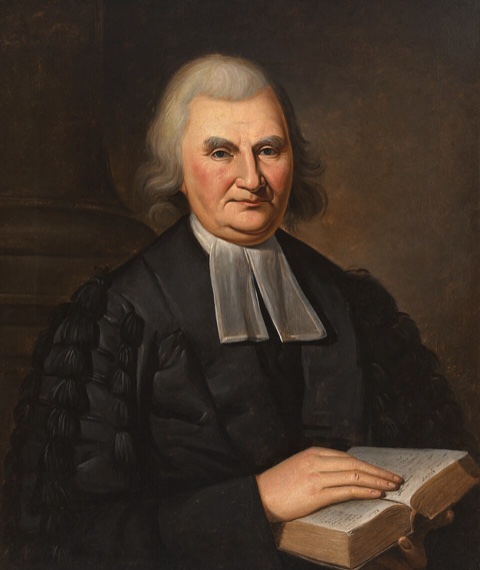
About the author
John Witherspoon
John Witherspoon (1723 to 1794 AD) was a Scottish Presbyterian minister who served at Beith and Paisley and became a leading champion of the Popular party against the Moderates in the Church of Scotland. He reached America in 1768 to become president of the College of New Jersey at Princeton, where he taught moral philosophy, divinity, history and eloquence. He sat in the Continental Congress, signed the Declaration of Independence, and left Congress for good in 1782.