Athanasius of Alexandria
Bishop of Alexandria and the chief defender of the Nicene position that the Son of God shares the same substance as the Father. His treatise On the Incarnation and his biography Life of Anthony are among the most widely read texts of the early church.
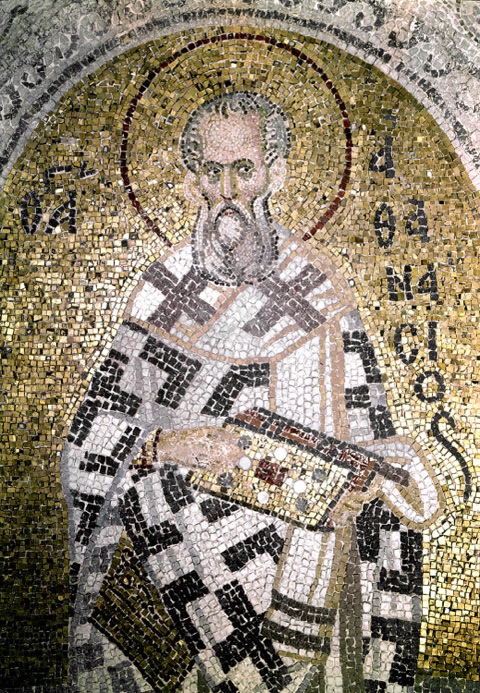
296 to 373 AD
Biography
Athanasius of Alexandria (296 to 373 AD) was the bishop of Alexandria and the leading opponent of Arianism, the teaching that the Son of God was a created being rather than fully divine. He held the see of Alexandria for forty-five years, of which he spent about seventeen in exile, and his defense of the decisions reached at the Council of Nicaea in 325 fixed the terms of the fourth-century debate over the nature of Christ.
He was born in Alexandria, Egypt, and served as deacon and secretary to Bishop Alexander of Alexandria. In that role he attended the Council of Nicaea in 325, the gathering of bishops summoned by the emperor Constantine to settle the dispute begun by the Alexandrian presbyter Arius. Athanasius supported the council's use of the term homoousios, meaning "of the same substance," to describe the Son's relation to the Father. When Alexander died in 328, Athanasius succeeded him as bishop while still in his early thirties.
His episcopate was marked by repeated conflict with emperors and rival bishops who favored a compromise with the Arian party. In 335 a synod at Tyre deposed him on charges brought by his opponents, and in 336 Constantine banished him to Trier in the Rhineland, the first of five exiles. He returned in 337 after Constantine's death, was driven out again in 339 and took refuge in Rome, and came back to Alexandria in 346. A further expulsion in 356 sent him into hiding among the monks of the Egyptian desert, where he continued to write and direct his church in secret. His persistence against successive imperial regimes gave rise to the phrase "Athanasius contra mundum," Athanasius against the world.
His writings served the same cause his career did. The paired treatise Against the Heathen and On the Incarnation, composed early in his life, argued that the Word of God took on human flesh in order to restore humanity and defeat death. The Orations Against the Arians set out his sustained case for the full divinity of the Son, and his letters to Serapion extended the argument to the divinity of the Holy Spirit. His Life of Anthony, a biography of the Egyptian hermit Anthony the Great, spread the ideals of monasticism across the Latin and Greek worlds and became one of the most copied books of late antiquity.
In his 39th Festal Letter of 367, an annual pastoral letter announcing the date of Easter, Athanasius listed the twenty-seven books he regarded as the authoritative New Testament, one of the earliest surviving statements of that canon in its familiar form. He convened a council at Alexandria in 362 that worked to reconcile divided factions within the Nicene camp. He died at Alexandria in 373, having outlasted most of his opponents, and is honored as a saint and a Doctor of the Church in the Eastern and Western traditions.
Life & Career
Why Athanasius Matters
Athanasius gave the Nicene formula its most determined advocate at a time when much of the Eastern church and several emperors were prepared to abandon it. The Council of Nicaea had declared the Son to be homoousios with the Father, but in the decades that followed that language was contested, revised, and often set aside. Athanasius treated the word as the necessary safeguard of a single conviction: that the one who redeems humanity must himself be fully God. His refusal to compromise, sustained through five exiles, kept the Nicene position alive until it was reaffirmed at the Council of Constantinople in 381, eight years after his death.
His account of salvation rested on the incarnation. In On the Incarnation he argued that the Word of God became human so that human beings might be reconciled to God and freed from death, a theme he summarized in the claim that God became man so that man might be made divine. Because only God can restore what God created, the redemptive work of Christ required that Christ be God in the fullest sense. This linkage of salvation to the deity of the Son gave the Arian controversy its urgency for Athanasius and shaped the way later theologians framed the doctrine of the Trinity.
His influence extended through the generation that followed him. The Cappadocian theologians Basil the Great and Gregory of Nyssa built on his defense of the Son's divinity and developed the vocabulary that the Council of Constantinople used to settle the question. His letters to Serapion, arguing for the divinity of the Holy Spirit, prepared the ground for the church's teaching on the third person of the Trinity. The 39th Festal Letter contributed to the fixing of the New Testament canon.
Beyond doctrine, his Life of Anthony carried the monastic movement of the Egyptian desert into the wider Christian world and gave later writers a model for the saint's biography. Augustine of Hippo recorded in his Confessions that reading of Anthony's example helped move him toward conversion, one sign of how far the work reached beyond its original setting.
Complete Works in English
Free to readEvery surviving work, translated in full and free to read, from our Patrologia Latina project.