



131 audiobooks, 1,134 hours of narration. Give $50 and every one is yours.
Early Church books
Cover of On the Incarnation

Modern English edition · 318 AD

On the Incarnation

by Athanasius of Alexandria

Athanasius answers the ultimate question: why did God become man? This foundational work explains how Christ's incarnation, death, and resurrection conquered death and restored humanity to God. C.S. Lewis called it a masterpiece.

Start reading free

One free account opens 250+ books and saves your place on every device. Google sign-in or an email link. No card.

Buy the paperback · $12.49

Printed to order. Shipping is calculated at checkout. Read online tonight while it ships.

Get the audiobook · $5.99

Listen in the Updated Works app on any device, in the same place you read.

Give $50, get every audiobook

One gift, no subscription. It funds the next modernized classic and the next recording, and includes the whole ebook library as one download.

Listen to the first 10 minutes free

Included with your free account

This book, and 250+ more, free to read

A free account opens the whole library to read online, on your phone or at your desk. Open a book on one device and it is waiting at the same page on the next. The PDF and EPUB of every book are yours to keep, and audiobooks play in the same app.

  • 250+ modernized editions Not samples. The whole work, free.
  • Your place, on every device Phone, tablet or desktop, same page.
  • 131 audiobooks From $4.99 each, or all of them with a $50 gift.
  • PDF and EPUB included Download any book to keep.
Create your free account Google sign-in or an email link. No card.
The in-app reader on a phone, mid-chapter of The Mortification of Sin in modern English
My Library on a phone, with a book to continue reading and the cover grid

Summary

Written
About 318 AD
Addressed to
Macarius, an Egyptian monk
Type
Theological treatise
Length
About 24,700 words · a 100-minute read

"On the Incarnation" is a treatise by Athanasius of Alexandria, written about 318 AD, that answers why God the Word took a human body. Athanasius argues that only the Creator could undo death and repair His own image in humanity, then defends the cross and the resurrection against Jewish and Greek objections.

“He took on our humanity so that we might become partakers of God.”
From this edition

How the argument unfolds

  1. 01

    Creation and the fall. Athanasius begins with the Creator, because "the renewal of creation was accomplished by the same Word who first brought it into existence." Humanity, given a share in the Word's own rational nature, threw it away and began sliding back toward the nothing it came from.

  2. 02

    The divine dilemma. God could neither revoke the sentence nor let His work dissolve, since it was "unthinkable that God would go back on His word and allow a transgressor to escape death". Repentance could only halt the sinning, not undo the corruption: "No, repentance simply couldn't meet the need."

  3. 03

    The Word takes a body. The Word takes a mortal body from a spotless virgin and offers it to death on behalf of all, so that death would "vanish from them as completely as fire consumes straw."

  4. 04

    The image repaired. Death was only half the problem; the knowledge of God had also been lost. Only the Image Himself could renew what was made after the Image, so He appeared in the flesh, "meeting their senses, so to speak, halfway."

  5. 05

    The death on the cross. A quiet death in bed would have proved nothing, and a hidden one would have left the resurrection without witnesses: "Death had to come before resurrection; there could be no resurrection without it." He let His enemies fix the manner of it, the way a great wrestler "does not pick his own opponents, lest anyone suspect he is avoiding the ones he fears." The cross was also the death Scripture had called cursed.

  6. 06

    The resurrection. He waited a full day so no one could deny He had truly died, then raised the body on the third day "imperishable and incorruptible, as the pledge and proof of His victory."

  7. 07

    Answering the Jews. He turns to the prophets his opponents already accept, on the virgin birth, the suffering servant, the pierced hands and feet, and Daniel's seventy weeks, and concludes that they are "like someone who sees the earth lit up by the sun and yet denies that the sun is shining."

  8. 08

    Answering the Greeks. To Greeks who found a body beneath God's dignity, he answers from their own physics: "if it were unfitting for Him to inhabit the part, it would be equally unfitting for Him to exist within the whole."

  9. 09

    The closing charge. He sends Macarius back to the Scriptures, warning that reading them well takes more than intellectual effort: "it requires a good life, a pure soul, and the kind of Christian virtue that can orient the mind toward truth about God the Word, insofar as human nature allows."

Key themes

  • What is worthy of God. The recurring test is not what God could do but what would befit Him: "It was therefore impossible for God to leave man to be carried off by corruption, because to do so would be unworthy of who He is."
  • Incorruption restored. Salvation here is not chiefly a change of legal standing but the reversal of decay, ending in a share of God's own life. The Word "endured humiliation at human hands so that we might inherit immortality."
  • The knowledge of the Father. The Incarnation is a teaching method as much as a rescue: "The Lord did not come to put on a spectacle. He came to heal and to teach people who were suffering."
  • Evidence you can see. Athanasius rests his case on things his readers could check for themselves, from silenced oracles to martyrs who walk toward death unafraid: "These are not empty words: they are confirmed by lived experience."
On the Incarnation paperback

The paperback

Prefer it in print? The same book, done right

$12.49 · 80 pages · 6 × 9 inches · Cream paper · Matte cover

Built to last, not printed cheap

Printed at 6 × 9 inches on cream paper with a matte cover, made to survive years of rereading and underlining.

Type you can actually read

Typeset at a comfortable reading size with generous margins and line spacing, so a long chapter is a pleasure rather than an eye test.

Online reading included

Every paperback comes with the full text in your free account, plus the PDF and EPUB, so you can start reading tonight while the book ships.

Your purchase funds the work

Reading online is free. Buying the paperback direct is what pays for the next modernized classic.

Buy the paperback · $12.49 Printed to order. Includes the ebooks.

Free audiobook preview

Listen to the first 10 minutes

On the Incarnation · Audiobook · 2 hr 33 min

0:00 / 9:37

Enjoying it? The full audiobook runs 2 hr 33 min. Listen in the Updated Works app on any device.

Get the audiobook · $5.99

Creation and the Fall

1. The Incarnation and Creation

In the preceding work, we selected a few points from among many and gave a sufficient account of the error of the heathen concerning idols and their worship. We explained how idols were originally invented, and how human beings devised their worship out of wickedness. By God’s grace, we also considered something of the divinity of the Father’s Word, his universal providence and power, and how the good Father orders all things through him, while all things are moved by him and receive life in him.

Come now, Macarius, worthy of that name and a true lover of Christ. Let us continue our account of the faith of our religion and set forth what concerns the Word’s becoming human and his divine appearance among us. The Jews slander this appearance, and the Greeks laugh it to scorn, but we worship it. Then, because of what seems to be the Word’s low estate, your devotion to him may increase and multiply all the more.

For the more unbelievers mock him, the more he bears witness to his own Godhead. He himself demonstrates that what people mistakenly consider impossible is possible. In his own goodness, he clothes with fittingness what they ridicule as unfitting. By his own power, he demonstrates as divine what they, in their conceit of wisdom, laugh at as merely human. Through his supposed humiliation, that is, through the cross, he subdues the pretensions of idols, while invisibly winning those who mock and disbelieve to recognize his divinity and power.

To treat this subject, however, we must recall what has already been said. Otherwise, you might fail to understand the cause of the bodily appearance of the Father’s Word, who is so high and so great. You might also suppose that the Savior wore a body as a consequence of his own nature. But although he is incorporeal by nature and is the Word from the beginning, he was manifested to us in a human body for our salvation because of his own Father’s loving-kindness and goodness.

It is therefore proper for us to begin our treatment of this subject by speaking about the creation of the universe and about God, its maker. In this way, it may be rightly understood that the renewal of creation was the work of the very same Word who made it in the beginning. It will then become clear that it was fitting for the Father to save the world through the same Word through whom he made it.

2. False Accounts of Creation

Many people have held different views about the making of the universe and the creation of all things, and each has laid down the law just as he pleased. Some say that everything came into being by itself and by chance. The Epicureans, for example, tell us in their contempt for themselves that universal providence does not exist, speaking directly against obvious fact and experience.

For if, as they say, everything began by itself and without purpose, it would follow that everything came into mere being in such a way as to be alike and without distinction. Because of the unity of body, everything would have to be either sun or moon. In the case of human beings, the whole body would have to be hand, eye, or foot. But this is not so. Instead, we see that the sun, moon, and earth are distinct. Likewise, in human bodies, we see the distinction of foot, hand, and head. Such an ordered distinction does not tell us that these things came into being by themselves. It shows that a cause preceded them, and from this cause we may also apprehend God as the maker and orderer of all.

Others, including Plato, who is held in such high esteem among the Greeks, argue that God made the world from matter that already existed and had no beginning. On their account, God could have made nothing unless the material already existed, just as wood must be ready at hand before a carpenter can do any work.

In saying this, however, they do not realize that they are attributing weakness to God. If he is not himself the cause of the material but makes things only from material that already exists, he proves to be weak because he is unable to produce anything he makes without that material. In the same way, it is undoubtedly a weakness in a carpenter that he cannot make anything required without timber. On this assumption, if the material had not existed, God would not have made anything. How, then, could he be called maker and artificer if he owes his ability to make things to another source, namely, the material? According to their theory, God would be only a craftsman, not a creator from nothing, since he works with existing material but is not himself the cause of that material. He could not properly be called Creator unless he also created the material from which created things were in turn made.

The sectarians, meanwhile, imagine a different maker of all things, someone other than the Father of our Lord Jesus Christ. In doing so, they show deep blindness even concerning the words they use.

For the Lord says to the Jews, “Have ye not read that from the beginning He which created them made them male and female, and said, For this cause shall a man leave his father and mother, and shall cleave to his wife, and they twain shall become one flesh?” Referring then to the Creator, he says, “What, therefore, God hath joined together let not man put asunder” (Matt 19:4-6). How, then, do these people claim that creation is independent of the Father? Or consider John’s words, which make no exception: “All things were made by Him,” and “without Him was not anything made” (John 1:3). How could the maker be someone else, distinct from the Father of Christ?

3. Creation from Nothing

In this way, they speculate in vain. But godly teaching and the faith according to Christ condemn their foolish language as godlessness. This faith knows that the universe did not arise spontaneously, because forethought is not absent. Nor was it made from existing matter, because God is not weak. Instead, God made the universe exist out of nothing, without its having any previous existence, through his Word.

First, he says through Moses, “In the beginning God created the heaven and the earth” (Gen 1:1). Second, in the most edifying book of The Shepherd, it says, “First of all believe that God is one, which created and framed all things, and made them to exist out of nothing.” Paul also refers to this when he says, “By faith we understand that the worlds have been framed by the Word of God, so that what is seen hath not been made out of things which do appear” (Heb 11:3).

For God is good, or rather, he is essentially the source of goodness, and one who is good cannot be grudging about anything. Therefore, begrudging existence to no one, he made all things out of nothing through his own Word, Jesus Christ our Lord.

Among these earthly creatures, God took special pity above all on the human race. He perceived that, because of the condition of their origin, human beings were unable to continue in one state by their own power. He therefore gave them an additional gift. He did not merely create them as he did all the irrational creatures on earth. Instead, he made them according to his own image, giving them a share even in the power of his own Word. Thus, possessing something like a reflection of the Word and being made rational, they might be able to remain forever in blessedness, living in paradise the true life that belongs to the saints.

But God also knew that the human will could turn in either direction. In anticipation, he secured the grace he had given them by a law and by the place where he set them. He brought them into his own garden and gave them a law. If they preserved the grace and remained good, they would continue to enjoy life in paradise without sorrow, pain, or care, while also possessing the promise of incorruption in heaven. But if they transgressed, turned back, and became evil, they would know that they were incurring the corruption of death that was theirs by nature. They would no longer live in paradise but would be cast out from that time onward, dying and remaining in death and corruption.

Holy Scripture gives warning of this in the person of God: “Of every tree that is in the garden, eating thou shalt eat: but of the tree of the knowledge of good and evil, ye shall not eat of it, but on the day that ye eat, dying ye shall die” (Gen 2:16-17). What else could “dying ye shall die” mean except not merely dying, but also remaining forever in the corruption of death?

4. Humanity’s Fall into Corruption

Perhaps you are wondering why, when we proposed to speak about the incarnation of the Word, we are now discussing the origin of humanity. But this also properly belongs to the purpose of our treatise.

When speaking about the Savior’s appearance among us, we must also speak about the origin of human beings. Then you may understand that his descent was because of us and that our transgression called forth the Word’s loving-kindness, so that the Lord hastened to help us and appeared among humanity. We were the reason for his becoming incarnate. For our salvation, he acted so lovingly as to appear and even be born in a human body.

God, then, made humanity and willed that human beings should remain in incorruption. But they despised and rejected the contemplation of God and devised and contrived evil for themselves, as was said in the preceding work. They therefore received the condemnation of death with which they had been threatened. From then on, they no longer remained as they had been made but were corrupted according to their own devices (Eccl 7:29; Rom 1:21-22), and death ruled over them as king (Rom 5:14).

Transgression of the commandment was turning them back toward their natural state. Just as they had received their being from nothing, so they might also expect, in the course of time, to suffer corruption into nothing. They had formerly been in a natural state of nonexistence and were called into being by the presence and loving-kindness of the Word. It followed naturally that when they were deprived of the knowledge of God and turned back toward what does not exist, they would be deprived forever even of being. For evil does not exist, but good does. Since they derived their being from God, who is, they would be disintegrated and remain in death and corruption.

Humanity is mortal by nature because it was made from what did not exist. Yet because of humanity’s likeness to the One who is, if human beings had preserved that likeness by keeping him in their knowledge, they would have restrained their natural corruption and remained incorrupt. As Wisdom says, “The taking heed to His laws is the assurance of immortality” (Wis 6:18). Being incorrupt, they would thereafter have lived as God. I suppose divine Scripture refers to this when it says, “I have said ye are gods, and ye are all sons of the most Highest; but ye die like men, and fall as one of the princes” (Ps 82:6-7).

5. The Spread of Sin and Death

God not only made us out of nothing, but also freely gave us, through the grace of the Word, a life in harmony with God. Yet human beings rejected eternal things and, by the counsel of the devil, turned toward corruptible things. They therefore became the cause of their own corruption in death. As I said before, they were corruptible by nature, but through the grace that came from participating in the Word, they were destined to escape their natural condition if they remained good.

Because the Word dwelled with them, even their natural corruption did not approach them. As Wisdom also says, “God made man for incorruption, and as an image of His own eternity; but by envy of the devil death came into the world” (Wis 2:23-24). But when this happened, human beings began to die, and from then on corruption prevailed against them. It gained even more than its natural power over the whole human race because the divine threat attached to the transgression of the commandment gave it an additional advantage against them.

Even in their offenses, human beings did not stop at any fixed limit. Instead, they advanced gradually until they had passed beyond all measure. At first they invented wickedness and called down death and corruption upon themselves. Later they turned aside into wrongdoing, exceeded every form of lawlessness, and stopped at no single evil. Continually devising every kind of new evil, they became insatiable in sinning.

Adulteries and thefts were everywhere, and the whole earth was full of murders and plunder. No one paid attention to law in matters of corruption and wrongdoing. Every crime was practiced everywhere, both individually and collectively. Cities were at war with cities, nations rose against nations, and the whole earth was torn by civil conflicts and battles. Each person competed with others in lawless deeds.

Even crimes against nature were not far from them. As the apostle and witness of Christ says, “For their women changed the natural use into that which is against nature: and likewise also the men, leaving the natural use of the women, burned in their lust one toward another, men with men working unseemliness, and receiving in themselves that recompense of their error which was meet” (Rom 1:26-27).

Why the Word Became Human

6. God’s Goodness and Humanity’s Ruin

For this reason, death gained ground among human beings, and corruption remained upon them. The human race was perishing. The rational human being made in God’s image was disappearing, and God’s handiwork was dissolving.

For, as I said above, from that time onward death held a legal claim over us (Gen 2:17). It was impossible to escape the law, since God had laid it down because of the transgression (Gal 3:19). The result was truly both monstrous and unfitting.

First, it would have been monstrous for God, after speaking, to prove false. Once he had ordained that human beings would die if they transgressed the commandment, it could not be that they would transgress and yet not die, making God’s word void. For God would not be true if, after he had said that we would die, humanity did not die.

Again, it would have been unfitting for creatures once made rational, and made participants in the Word, to perish and return through corruption to nonexistence.

It would not have been worthy of God’s goodness for the things he had made to waste away because of the devil’s deceit against humanity.

Above all, it would have been utterly unfitting for God’s handiwork among humanity to be destroyed, whether through human carelessness or through the deceitfulness of evil spirits.

As rational creatures were wasting away and such works were falling into ruin, what was God in his goodness to do? Was he to allow corruption to prevail against them and death to hold them fast? What benefit would there have been in their creation? It would have been better for them not to have been made than, once made, to be abandoned to neglect and ruin.

Such neglect would reveal weakness, not goodness, on God’s part if, after making his own work, he allowed it to be ruined. This would be even more so than if he had never made humanity at all.

If he had not made them, no one could attribute weakness to him. But once he had made them and created them out of nothing, it would have been utterly monstrous for his work to be ruined before the Maker’s own eyes.

It was therefore out of the question for God to abandon humanity to the current of corruption, since this would have been unfitting and unworthy of his goodness.

7. Only the Word Could Restore Humanity

Yet another necessary consideration stood against this: God must remain true to the law he had established concerning death (Rom 3:26). It would have been monstrous for God, the Father of truth, to appear a liar for the sake of our benefit and preservation.

Once again, then, what course could God take? Was he to require human beings to repent of their transgression? Someone might call this worthy of God, supposing that just as transgression had set them on the path toward corruption, repentance might set them once more on the path toward incorruption.

But repentance would first fail to uphold God’s just claim. God would still not be shown true if human beings did not remain in death’s grasp. Second, repentance does not free them from the corruption natural to them. It merely stops them from committing acts of sin.

If the matter involved only a wrongdoing, without the resulting corruption, repentance would be sufficient. But once transgression had begun, human beings became entangled in the corruption natural to them and were deprived of the grace they possessed as those made in God’s image. What further action was needed? What was required to restore them to such grace, except the Word of God, who in the beginning had also made everything out of nothing?

It belonged to him both to bring the corruptible back to incorruption and to uphold the Father’s just claim concerning all. Because he is the Father’s Word and is above all things, he alone was by nature able to recreate everything, worthy to suffer on behalf of all, and able to represent all before the Father.

8. The Word Takes a Human Body

For this purpose, the incorporeal, incorruptible, and immaterial Word of God came into our realm, though even before this he was not far from us (Acts 17:27). No part of creation is empty of him. He has filled all things everywhere while remaining present with his own Father. But he came in condescension to show us his loving-kindness and to visit us.

He saw the race of rational creatures on the path to destruction, with death reigning over them through corruption. He saw that the threat attached to transgression gave the corruption upon us a firm hold, and that it would be monstrous for the law to fail before it was fulfilled. He saw how unfitting the situation had become, since the things he himself had fashioned were passing away. He also saw humanity’s surpassing wickedness and how, little by little, they had increased it against themselves to an intolerable degree. Finally, he saw that all human beings were under the penalty of death. He took pity on our race, had mercy on our weakness, and condescended to our corruption. Because he could not bear to let death have the mastery, lest the creature perish and his Father’s handiwork among humanity come to nothing, he took to himself a body, one no different in kind from ours.

He did not merely will to become embodied or merely will to appear. If he had wished only to appear, he could have made his divine appearance by some other and higher means. Instead, he took a body of our kind, and not merely such a body, but one from a spotless and stainless virgin who had known no man. It was a clean body, truly pure from intercourse with men. Being himself mighty and the Maker of everything, he prepared the body in the Virgin as a temple for himself. He made it his very own as an instrument, revealing himself and dwelling within it.

Thus, he took from our bodies one of the same nature. Because all were under the penalty of death’s corruption, he surrendered it to death in place of all and offered it to the Father. He did this out of loving-kindness so that, first, with all reckoned as having died in him, the law involving humanity’s ruin might be undone. Its power was fully exhausted in the Lord’s body and no longer had any ground against human beings, who shared that body’s nature. Second, since human beings had turned toward corruption, he could turn them back toward incorruption and bring them to life from death through the appropriation of his body and the grace of the Resurrection, driving death away from them like straw from fire.

9. The Mortal Body and the End of Death

The Word perceived that humanity’s corruption could be undone in no other way except through death as a necessary condition. Yet it was impossible for the Word to suffer death, since he is immortal and the Son of the Father. For this purpose, he took to himself a body capable of dying. Because that body participated in the Word, who is above all, it could be worthy to die in place of all. Because the Word had come to dwell in it, it could remain incorruptible, and from that time onward corruption could be stopped in all by the grace of the Resurrection. Therefore, by offering to death the body he had taken, as an offering and sacrifice free from every stain, he immediately put death away from all who shared its nature by offering an equivalent.

For the Word of God, being over all, naturally satisfied the debt by his death when he offered his own temple and bodily instrument for the life of all. Thus the incorruptible Son of God, being united with all through a shared nature, naturally clothed all with incorruption through the promise of the resurrection. The actual corruption of death no longer has any ground against humanity because of the Word, who through his one body has come to dwell among them.

It is like a great king who enters a large city and takes up residence in one of its houses. That city is regarded as worthy of high honor, and no enemy or bandit any longer descends upon it and subdues it. Instead, it is considered deserving of every care because the king has taken up residence in a single house there. So it has also been with the Monarch of all.

Now that he has come into our realm and taken up residence in one body among those who share its nature, the enemy’s whole conspiracy against humanity has been checked, and the corruption of death that formerly prevailed against them has been abolished. The human race would have gone to ruin if the Lord and Savior of all, the Son of God, had not come among us to meet the end of death.

10. The Fitting Work of Redemption

This great work was truly and especially suited to God’s goodness. If a king has founded a house or city and it is beset by bandits because of its inhabitants’ carelessness, he does not neglect it. Instead, he avenges and reclaims it as his own work, considering not the inhabitants’ carelessness but what befits him. How much more, then, did God the Word of the all-good Father refuse to neglect the human race, his own work, as it fell into corruption. By the offering of his own body he blotted out the death that had followed, and by his own teaching he corrected their neglect, restoring by his own power everything that belonged to humanity.

Anyone who encounters the writings of the Savior’s inspired authors may receive assurance of this from them. They say, “For the love of Christ constraineth us; because we thus judge, that if one died for all, then all died, and He died for all that we should no longer live unto ourselves, but unto Him Who for our sakes died and rose again” (2 Cor 5:14), our Lord Jesus Christ. And again, “But we behold Him, Who hath been made a little lower than the angels, even Jesus, because of the suffering of death crowned with glory and honour, that by the grace of God He should taste of death for every man” (Heb 2:9).

Then the same writer points out why it was necessary for none other than God the Word himself to become incarnate: “For it became Him, for Whom are all things, and through Whom are all things, in bringing many sons unto glory, to make the Captain of their salvation perfect through suffering” (Heb 2:10). By these words he means that it belonged to none other than the Word of God, who had made human beings in the beginning, to bring them back from the corruption that had begun.

The writers also explain that the Word himself assumed a body so that it might be sacrificed for bodies like his own: “Forasmuch then as the children are the sharers in blood and flesh, He also Himself in like manner partook of the same, that through death He might bring to naught Him that had the power of death, that is, the devil; and might deliver them who, through fear of death, were all their lifetime subject to bondage” (Heb 2:14-15).

By the sacrifice of his own body, he both brought to an end the law that stood against us and made a new beginning of life for us through the hope of resurrection he has given us. Since it was through a human being that death prevailed over humanity, conversely, through the Word of God becoming human came the destruction of death and the resurrection of life. As the man who bore Christ says (Gal 6:17), “For since by man came death, by man came also the resurrection of the dead. For as in Adam all die, so also in Christ shall all be made alive” (1 Cor 15:21-22), and so forth. We no longer die as those under condemnation. Instead, as people who rise from the dead, we await the general resurrection of all, “which in its own times He shall show” (1 Tim 6:15), even God, who has both accomplished it and bestowed it upon us.

This, then, is the first cause of the Savior’s becoming human. From the reasons that follow, one may also see that it was fitting for his gracious coming among us to take place.

Questions

Who wrote "On the Incarnation"?
Athanasius of Alexandria wrote "On the Incarnation" about 318 AD, as the second half of a two-part work that begins with "Against the Heathen." He later served 45 years as bishop of Alexandria and was exiled five times for defending the full divinity of Christ.
What is "On the Incarnation" about?
"On the Incarnation" is about why the eternal Word of God took a human body, died, and rose again. Athanasius traces the problem back to creation, shows why nothing short of the Creator's own arrival could solve it, and then answers the objections of Jewish and Greek critics in turn.
What is the main argument of "On the Incarnation"?
The main argument is that humanity was decaying back into nothing, and only the Word who made it out of nothing could remake it. Forgiveness alone would have left God untrue to His own warning, and repentance could not undo corruption, so the Word took a body He could offer in death for all.
Why did Christ have to die on a cross, according to Athanasius?
Athanasius gives several reasons the cross specifically was required: it was the cursed death Scripture named, it happened in public before witnesses who could vouch for it, it was chosen by His enemies rather than by Him, and it left His arms outstretched to draw Israel and the nations together. He also notes that His body was kept whole, "so that no one could later use a divided body as a pretext for dividing the Church."
What does "On the Incarnation" say about becoming like God?
It says God became human so that humans could share in God's own life, summed up in the line "He took on our humanity so that we might become partakers of God." Athanasius means the restoration of incorruption and the knowledge of the Father, not that people become gods in their own right.
How long is "On the Incarnation"?
"On the Incarnation" runs about 24,700 words in this edition, roughly a hundred minutes of reading. It is divided into 57 short numbered sections, grouped here into nine chapters.
Why is "On the Incarnation" considered important?
It is the clearest early statement of why Christian faith requires that Christ be fully God, written just as that question was dividing the church, and its logic shaped the Nicene settlement that followed. The best known twentieth-century printing carries an introduction by C. S. Lewis, which is not part of Athanasius's text and is not included here.
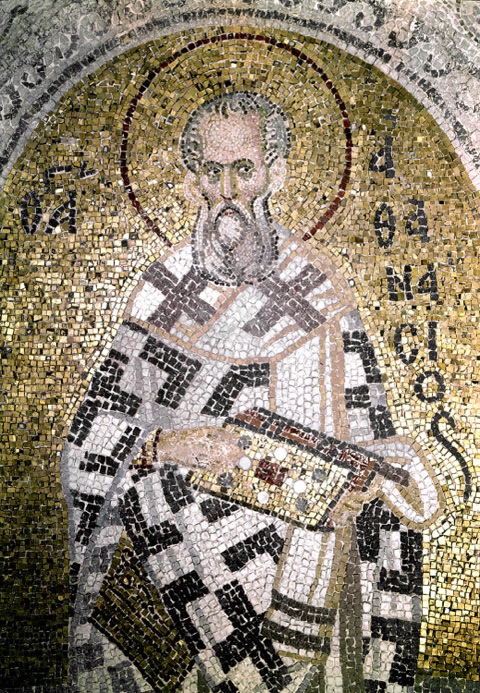
Portrait of Athanasius of Alexandria

About the author

Athanasius of Alexandria

Athanasius of Alexandria was a Christian theologian and Church Father who served as the 20th bishop of Alexandria for 45 years, though he was exiled five times by various emperors. He is renowned as the champion of Trinitarian orthodoxy against Arianism, which denied the full divinity of Christ. His famous phrase "Athanasius contra mundum" (Athanasius against the world) captures his unwavering stand for truth even when most of the church had compromised. His treatise "On the Incarnation" remains a classic exposition of why God became man, explaining how Christ's incarnation, death, and resurrection accomplished human salvation. Athanasius's courage and theological clarity helped preserve orthodox Christianity for future generations.

“Updated Works has been an incredible blessing to my Christian life and ministry… remarkably faithful to the original authors while making these timeless treasures understandable for modern readers.”
— Pastor Mike Cleveland



