One free account opens 250+ books and saves your place on every device. Google sign-in or an email link. No card.
You’re on the list — we’ll email you if this goes to print.
Included with your free account
This book, and 250+ more, free to read
A free account opens the whole library to read online, on your phone or at your desk. Open a book on one device and it is waiting at the same page on the next. The PDF and EPUB of every book are yours to keep, and audiobooks play in the same app.
250+ modernized editionsNot samples. The whole work, free.
Your place, on every devicePhone, tablet or desktop, same page.
131 audiobooksFrom $4.99 each, or all of them with a $50 gift.
Alexander Hamilton’s Report on Manufactures, submitted to Congress in December 1791, is one of the most consequential economic documents in American history. As the first Secretary of the Treasury, Hamilton laid out a comprehensive vision for transforming the United States from a predominantly agricultural nation into an industrial power capable of standing on equal footing with the great economies of Europe.
The report systematically dismantles the argument that agriculture is the only truly productive form of labor and that government should never interfere with the natural flow of industry. Hamilton shows that manufacturing creates genuine wealth, that the division of labor and use of machinery multiply a nation’s productive power, and that strategic government encouragement of industry—through tariffs, subsidies, and infrastructure—is not only legitimate but essential for national security and prosperity.
What makes the report remarkable is not just its economic reasoning but its political vision. Hamilton understood that a nation dependent on foreign manufacturers for essential goods was a nation vulnerable to disruption and coercion. He argued that economic independence was inseparable from political independence, and that a diversified economy would create opportunity for every type of talent and temperament in the American population.
This modern English edition preserves Hamilton’s rigorous argumentation while making the text fully accessible to contemporary readers. For anyone interested in the origins of American economic policy, the debate over industrial strategy, or the intellectual foundations of the American system, this report remains as relevant and provocative as the day it was written.
Introduction
Secretary of the Treasury
In response to the order from the House of Representatives on January 15, 1790, the Secretary has turned his attention, as soon as his other responsibilities allowed, to the subject of manufacturing. He has focused particularly on ways to promote industries that will make the United States independent of foreign nations for military and other essential supplies. He now respectfully submits the following report.
The wisdom of encouraging manufacturing in the United States, which until recently seemed highly questionable, now appears to be widely accepted. The difficulties that have blocked the progress of our foreign trade have forced us to think seriously about expanding our domestic commerce. The restrictive regulations that limit the sale of our growing agricultural surplus in foreign markets have created a strong desire to develop a larger domestic market for that surplus. Meanwhile, the complete success of manufacturing ventures in some valuable industries, combined with the encouraging signs from other less developed efforts, gives us reason to hope that the barriers to growing this type of industry are less intimidating than we once feared. It seems clear that we can find in the further expansion of manufacturing full compensation for any disadvantages we face (or may face) in foreign trade, as well as additional resources that will strengthen our national independence and security.
Despite these realities, some respected thinkers still oppose government support for manufacturing. Here's how they make their case: "In every country," they argue, "agriculture is the most beneficial and productive form of human industry. This principle, which is generally (if not universally) true, applies with special force to the United States, given our vast stretches of fertile land that remain uninhabited and undeveloped. Nothing can provide a better use for capital and labor than converting this enormous wilderness into working farms. Nothing else can contribute as much to the population, strength, and real wealth of the country.
"To try, through extraordinary government support, to speed up the growth of manufacturing is really an attempt to force industry away from its natural course, redirecting it from a more beneficial channel to a less beneficial one. Anything with such a tendency must be unwise. Indeed, it can hardly ever be wise for a government to try directing how its citizens employ their industry. Left alone, under the sharp guidance of private interest, industry will inevitably find its own way to the most profitable employment. And it's through such employment that public prosperity will be most effectively advanced. Therefore, leaving industry to itself is, in almost every case, both the soundest and the simplest policy.
This policy makes sense for the United States not just for the reasons that apply to all nations; our unique circumstances practically force it on us. Our population is tiny compared to our vast territory. People are constantly tempted to leave settled areas for frontier land. An artisan can easily trade his dependent status for the independence of farming. These factors, along with others like them, work together to create (and will continue to create for a long time) a shortage of workers for manufacturing and high labor costs across the board. Add to these obstacles a lack of investment capital, and the idea of competing successfully with European manufacturers looks almost hopeless. Large-scale manufacturing can only emerge from a surplus population, or at least a full one. Until our country reaches that point, hoping for a robust manufacturing sector is pointless.
If we try to force certain industries into premature growth through heavy tariffs, import bans, subsidies, or other artificial measures (going against the natural course of things), we'll only end up sacrificing the community's interests to benefit specific groups. Beyond the waste of misdirected labor, we'll effectively grant a monopoly to whoever works in these protected industries. The resulting price increases (the unavoidable result of any monopoly) will come at everyone else's expense. It's far better for these people to farm the land while we trade our agricultural products for goods that foreigners can make better and sell cheaper than we ever could.
This way of thinking rests on facts and principles that deserve serious consideration. If nations had followed this approach more consistently, we have good reason to believe they might have reached prosperity and greatness faster than they did by pursuing very different policies. However, most general theories allow for many exceptions, and few political theories, if any, don't mix a fair amount of error with the truths they teach.
To judge accurately whether the position just described deserves similar criticism, we need to look carefully at the arguments that favor manufacturing and that seem to recommend special, active government support for it in certain cases and within reasonable limits.
We should readily admit that farming, as the primary and most reliable source of national supply; as the direct and main source of human sustenance; as the principal source of raw materials that feed other types of labor; as representing a condition most favorable to human freedom and independence of mind (and perhaps most conducive to population growth), has an inherently strong claim to superiority over every other kind of industry.
Is Agriculture Really More Productive?
But the idea that agriculture deserves something close to exclusive preference in any country should be accepted only with great caution. The claim that it's more productive than every other type of industry needs stronger evidence than has been provided so far. In fact, I believe we can convincingly show that agriculture's real interests (which are genuinely precious and important, without any exaggeration) will actually benefit rather than suffer from proper encouragement of manufacturing. I also believe we can demonstrate that such encouragement, from a broad perspective, is recommended by the most compelling and persuasive reasons of national policy.
Some have argued that agriculture is not only the most productive but the only productive form of industry. However, this claim, in either version, hasn't been verified by any precise presentation of facts and calculations. The general arguments offered to prove it are more clever and paradoxical than solid or convincing.
The argument for agriculture's exclusive productivity goes like this: labor applied to farming produces enough not only to cover all necessary business expenses and support the workers involved, but also to provide the farmer with a normal profit on his capital while still generating a net surplus (rent) for the landowner. Manufacturing labor, by contrast, does nothing more than replace the capital invested in it (the funds that pay for materials, tools, and wages) and yield a normal profit on that capital. It produces nothing comparable to land rent. Nor does it add anything to the total value of the country's annual output of land and labor combined. The extra value that manufacturers add to raw agricultural products is offset by the value of other agricultural products that the manufacturers themselves consume. Therefore, the manufacturing classes can increase society's wealth only through saving and frugality, not through any genuine productivity of their labor.
I've responded to these arguments as follows:
First, even if we accept that manufacturing labor reproduces a value equal to what gets spent or consumed in the process, and that it maintains the original capital investment, this fact alone should prevent us from dismissing it as completely unproductive. Let's say we grant the claim that manufacturers and craftsmen consume agricultural products equal in value to what their labor adds to the raw materials they work with. Even so, it doesn't follow that they add nothing to society's revenue or to the total value of what the land and labor produce annually. If consumption during a given period amounts to a certain sum, and the increased value of manufactured goods in that same period amounts to an equal sum, then the total of consumption and production during that period would equal both sums combined. This means the value would be double that of the agricultural products consumed. Even if the value added by craftsmen and manufacturers never exceeds the value of the agricultural goods they consume, there would still be, at any given moment, a greater value of goods in the market than would exist without their labor.
Second, the claim that craftsmen can increase society's revenue only through frugality applies equally to farmers and cultivators. We could say the same thing about all these groups: the income they earn from their work and set aside for their own support typically equals no more than what they need. It follows, then, that increases in the community's wealth or capital (except in cases where someone possesses extraordinary skill or talent) can only come from the savings of the more careful and thrifty members of any of these groups.
Third, a country's annual output from its land and labor can only grow in two ways: either by improving the productive power of the useful labor that already exists, or by increasing the amount of such labor. Regarding the first option, the work of craftsmen can be divided into simpler operations more easily than the work of farmers, which means it can be improved to a proportionally greater degree in its productive power, whether through increased skill or through the use of clever machinery. In this respect, agricultural labor has no advantage over manufacturing labor. As for increasing the quantity of useful labor, this depends fundamentally (setting aside special circumstances) on an increase of capital, which in turn depends on the savings made from the revenues of those who provide or manage that capital, whether it's employed in agriculture, manufacturing, or any other sector.
While the exclusive productivity of agricultural labor has been denied and disproven in this way, its superior productivity has been readily conceded. Since this concession involves a point of considerable importance for principles of public policy, the grounds on which it rests deserve separate and careful examination.
One of the arguments used to support this idea can be called both clever and shallow. It comes down to this: in producing crops from the soil, nature works alongside man, and the result of their combined labor must be greater than the result of man's labor alone.
This conclusion, however, doesn't necessarily follow. It's entirely possible that human labor alone, when applied to work requiring great skill and artistry to perfect, may produce more value than the combined labor of nature and humanity directed toward simpler operations and objects. And when we consider how extensively natural forces, through mechanical power, assist in manufacturing, this objection loses even its superficial credibility.
We might also observe, from the opposite perspective, that agricultural labor is largely seasonal and intermittent, dependent on weather patterns and subject to various long interruptions, while labor in many manufacturing operations is constant and regular, continuing throughout the year and, in some cases, running day and night. There are also probably more examples of laziness among farmers than among craftsmen. A farmer, thanks to particularly fertile land or some other favorable circumstance, may often make a living even with considerable carelessness in his cultivation methods. But a craftsman can hardly achieve the same result without working as hard as everyone else in his trade. And if we can also assume that manufacturing offers a wider field for creative problem-solving than agriculture, it wouldn't be unreasonable to conclude that manufacturing labor, being simultaneously more constant, more uniform, and more inventive than agricultural labor, will prove more productive as well.
But these observations shouldn't be given too much weight. They should only serve to balance out similar arguments from the other side. Circumstances this vague, general, and abstract offer little useful guidance on a question like this.
Another argument, which appears to be the main one offered for why agricultural labor is supposedly more productive, rests on the claim that labor employed in manufacturing produces nothing equivalent to land rent: that net surplus, as it's called, which goes to the landowner.
But this distinction, as important as people have considered it, seems more a matter of words than substance.
It's easy to see that what initially gets divided into two parts (the ordinary profit of the farmer's capital and rent to the landlord) becomes, in the second case, a single category called the ordinary profit on the manufacturer's capital. This formal or verbal distinction is the only real difference between the two situations. What seems to have been missed is that the land itself is a form of capital, advanced or lent by its owner to the person who occupies or rents it, and that the rent he collects is simply the ordinary profit on a certain amount of capital invested in land. The difference is that the proprietor doesn't manage it himself: he lends or leases it to someone else, who in turn invests a second amount of capital to stock and improve the land, and who also receives the usual profit on that investment. The landlord's rent and the farmer's profit are therefore nothing more than the ordinary profits of two separate capitals belonging to two different people, combined in the operation of a farm. In the other case, the surplus that remains from any manufacturing operation, after covering the costs of running it, represents the ordinary profits of one or more capitals invested in that manufacturing enterprise. I say one or more capitals because, in fact, the same arrangement we see on a farm sometimes occurs in manufacturing as well. There's one person who supplies part of the capital, or lends part of the money used to run the operation, and another who actually runs it, adding his own capital to the mix. From the surplus that remains after expenses are paid, interest goes to the money-lender for the portion of capital he provided (which corresponds exactly to the rent paid to the landlord), and the rest of that surplus becomes the profit of the manufacturer or undertaker (which corresponds to what we call the ordinary profits on the farmer's capital). Together, these make up the ordinary profits of two capitals employed in a manufacturing operation, just as, in the other case, the landlord's rent and the farmer's revenue together constitute the ordinary profits of two capitals employed in farming.
Land rent, far from proving that agriculture is uniquely productive (as some have claimed), doesn't even prove that agriculture is more productive than other industries. The real question is whether the surplus remaining after expenses from a given amount of capital invested in purchasing and improving land exceeds the surplus from the same amount of capital invested in running a factory. Or to put it differently: does a given amount of capital and labor produce more total value when employed in one sector versus the other? Perhaps the better question is which industry, agriculture or manufacturing, yields the greatest output when we consider both the amount of capital and the amount of labor employed in each.
Neither question is easy to answer. Both involve numerous complex details that depend on accurate knowledge of what we're comparing. As far as I know, no one has ever made this comparison using sufficient data that has been properly verified and analyzed. To make such a comparison now with satisfactory precision would require far more preliminary research and investigation than there has been time or opportunity to complete.
Some efforts have been made to gather the necessary information, but they've raised more doubts than they've settled about this hypothesis. We should acknowledge, though, that these studies have been too limited in scope and too incomplete to support any definitive conclusion either way. They point toward probable guesses rather than certain answers. The evidence suggests that in various manufacturing sectors, a given amount of capital will produce a greater total output and a considerably greater net profit than the same capital invested in buying and improving land. There also appear to be some manufacturing sectors where both the gross and net output exceed what agricultural investment produces, based on a combined calculation of capital and labor. But this last point seems the most uncertain. What's far easier to conclude generally is that the net return from capital invested in manufacturing exceeds that from capital invested in agriculture.
In presenting these findings, I'm only considering the purchase and improvement of land already under cultivation. The comparison favors agriculture more when we look at settling new, undeveloped land. But an argument based on such a temporary situation can't carry much weight in settling the broader question about the long-term relative productivity of these two types of industry. How much this should influence United States policy, given our particular circumstances, I'll address later.
These suggestions aren't meant to argue that manufacturing is more productive than agriculture. Rather, they're intended to show that the opposite claim hasn't been proven; that the standard arguments used to support it aren't convincing; and therefore that any assumption about agriculture's superior productivity shouldn't prevent us from considering legitimate reasons to encourage manufacturing, just because we fear it might shift labor from a more profitable activity to a less profitable one.
In fact, if we fully examined this question using real data and careful calculations, we would probably discover that there's no significant difference between the overall productivity of these two types of industry. Whether we should encourage one or the other ought to be decided based on considerations that have nothing to do with comparing their productivity.
Seven Ways Manufacturing Grows National Wealth
But even without claiming that manufacturing is more productive, we can make better policy decisions about encouraging it by looking at the issue from some additional angles. These perspectives not only reinforce the point that manufacturing has been wrongly portrayed as unproductive, but also demonstrate that establishing and expanding manufacturing actually increases the total amount of useful and productive labor in a society beyond what it would otherwise be. To explore this fully, I need to briefly revisit some points I've already mentioned.
The claim that manufacturing labor is unproductive because manufacturers consume as much of the land's produce as they add value to the raw materials they work with is no more valid than claiming that farming labor is unproductive because farmers consume an equal value of manufactured goods. Each provides a certain portion of what they produce to the other, and each uses up a corresponding portion of what the other produces. Meanwhile, two citizens are being supported instead of one. The state has two productive members instead of one, and together they consume twice the value of what comes from the land.
If there were only a farmer and no craftsman, the farmer would have to spend part of his time making clothing and other items that he would otherwise get from the craftsman. As a result, he would have less time to work his farm and would produce proportionally less from it. The total output in this scenario (provisions, raw materials, and manufactured goods combined) would certainly not exceed the value of what would be produced in provisions and raw materials alone if both a craftsman and a farmer existed.
Once more: if we had both a craftsman and a farmer, the farmer would be free to focus entirely on working his land. This would naturally produce a larger quantity of food and raw materials, at least equal (as I've already noted) to the total amount of provisions, raw materials, and manufactured goods that would exist under the opposite arrangement. Meanwhile, the craftsman would be producing manufactured goods in quantities sufficient not only to compensate the farmer (in the form of those manufactured items) for the provisions and materials he supplied, but also to provide the craftsman himself with similar goods for his own needs. The result would be two quantities or values in existence rather than one, and the revenue and consumption would be double what they would be otherwise.
If we imagine instead that there are two farmers and no craftsman, with each farmer spending part of his time cultivating land and part making manufactured goods, the results would be revealing. The portion of labor both farmers devoted to the land would produce only the same quantity of food and raw materials that one farmer working full-time on the land would produce. Similarly, the portion of labor both spent on manufacturing would produce only the same quantity of manufactured goods that one person working full-time as a craftsman would produce. Therefore, the total output from two farmers splitting their time would be no greater than the output from one dedicated farmer and one dedicated craftsman. This proves that the craftsman's labor is just as genuinely productive as the farmer's labor, and it increases society's wealth just as much. The craftsman's work replaces the portion of the farmer's labor that would otherwise go toward making the goods the farmer needs to trade with the craftsman. Without the craftsman, the farmer would be forced to make these manufactured items himself. Because the craftsman takes over this manufacturing work, the farmer can expand his agricultural production (part of which he buys back for his own use), while the craftsman supplies himself with the manufactured goods he needs. But the craftsman does even more than this. Beyond providing an equivalent return for the agricultural products he consumes, and beyond supplying manufactured goods for his own needs, he also generates a surplus. This surplus compensates whoever provided the capital to run the manufacturing business, whether that's the craftsman himself or someone else. This is the normal profit on the capital invested in manufacturing, and it adds to society's income just as effectively as rent from land does.
The output of a craftsman's labor can be understood as having three parts: one part purchases his food and raw materials from the farmer; another part covers his own manufactured necessities; and a third part represents the profit on the capital invested. The last two portions appear to have been ignored in the theory that claims manufacturing is sterile and produces nothing of value.
In the examples I've given so far, I've treated the products of equal amounts of labor by farmers and craftsmen as if they were equal in value. But I don't mean to claim they're exactly equal. I'm just using this as a simplified way of explaining things more clearly. Whether the farmer's output is worth slightly more or less than the craftsman's doesn't really matter for my main argument, which has simply been to show that both create a real increase in society's total production and wealth.
Now I need to go further and list the main reasons why we can conclude that manufacturing enterprises not only create a real increase in society's production and wealth, but that they contribute fundamentally to making these far greater than they could possibly be without such enterprises. These reasons are:
The division of labor.
An expanded use of machinery.
Additional employment for groups in the community not normally engaged in this kind of work.
The encouragement of immigration from foreign countries.
The provision of greater opportunity for the diversity of talents and temperaments that distinguish people from one another.
The creation of a broader and more varied field for enterprise.
Creating in some cases an entirely new market, and in all cases ensuring a more reliable and consistent demand for excess agricultural production.
Each of these factors significantly influences the total amount of productive work in a society. Together, they add a level of energy and effectiveness that's hard to overstate. A few comments on each one, in the order I've listed them, should help explain why they matter so much.
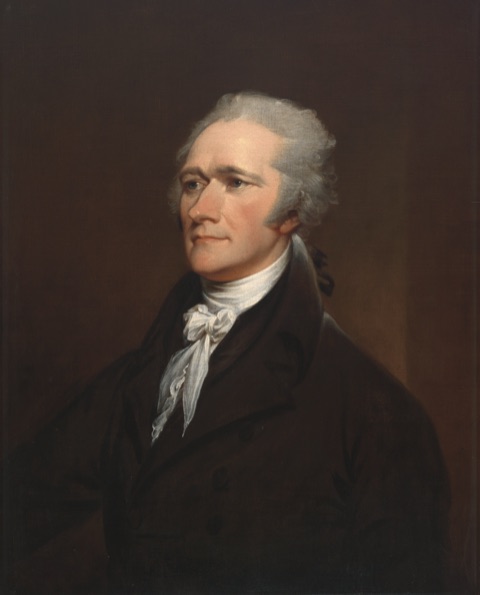
Alexander Hamilton (1755–1804) was a Founding Father of the United States and the first Secretary of the Treasury. Born in the Caribbean, he came to the American colonies as a teenager and quickly distinguished himself as a brilliant writer and thinker. He served as aide-de-camp to George Washington during the Revolutionary War, co-authored The Federalist Papers defending the new Constitution, and as Treasury Secretary designed the financial architecture of the new nation—establishing the national bank, the mint, and the customs system. His economic reports to Congress, including the Report on Manufactures, laid the intellectual groundwork for American industrial policy. Hamilton was killed in a duel with Vice President Aaron Burr in 1804 at the age of forty-nine.