George Washington
George Washington commanded the Continental Army through the American Revolution and served as the first President of the United States from 1789 to 1797. His voluntary surrender of power at the end of the war and again after two terms in office set the template for the American presidency.
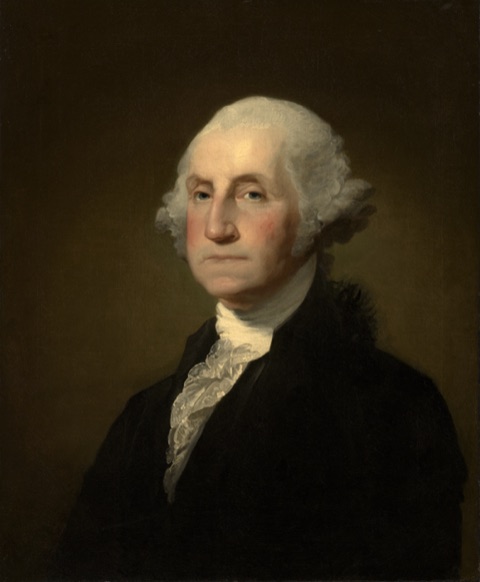
1732–1799
Biography
George Washington (1732 to 1799) was a Virginia planter who commanded the Continental Army in the American Revolution and served as the first President of the United States from 1789 to 1797. He was born on February 22, 1732, at Popes Creek in Westmoreland County, Virginia, into a family of middling tobacco planters. His father Augustine died when Washington was eleven, and much of his early guidance came from his older half-brother Lawrence, who held the estate at Mount Vernon on the Potomac. Washington received little formal schooling and trained instead as a surveyor, taking a commission to survey lands in the Shenandoah Valley in 1749.
His first military service came during the contest between Britain and France for the Ohio Valley. In 1753 the governor of Virginia sent him to warn the French out of the region, and in 1754 a skirmish involving his men helped ignite the French and Indian War. He surrendered Fort Necessity that July, then served as an aide to General Edward Braddock during the disastrous 1755 expedition against Fort Duquesne, where Braddock was killed and Washington had two horses shot from under him. He commanded the Virginia Regiment for the remainder of the war. In January 1759 he married Martha Dandridge Custis, a wealthy widow, and settled at Mount Vernon as a planter while serving in the Virginia House of Burgesses.
As the dispute between the colonies and Britain deepened, Washington was chosen as a Virginia delegate to the First and Second Continental Congresses. In June 1775 Congress appointed him commander-in-chief of the newly formed Continental Army. He took command outside Boston and forced the British to evacuate the city in March 1776. That December, after a string of defeats around New York, he crossed the Delaware River on the night of December 25 and 26 and captured the Hessian garrison at Trenton, following it with a victory at Princeton in early January 1777.
The war ground on through the harsh winter encampment at Valley Forge in 1777 and 1778, where his army suffered severe shortages of food and supplies. With the support of French troops and the French fleet, Washington trapped a British army under Lord Cornwallis at Yorktown, Virginia, which surrendered on October 19, 1781, effectively ending major fighting. In December 1783, with the war concluded, he resigned his commission before Congress at Annapolis and returned to Mount Vernon, a decision that drew wide notice because he relinquished military power rather than keeping it.
Called back to public life, Washington presided over the Constitutional Convention in Philadelphia in 1787. When the new government was formed, the Electoral College chose him unanimously, and he was inaugurated as the first president on April 30, 1789, in New York City. During his two terms he established the executive departments, backed Alexander Hamilton's financial program, kept the country neutral during the war between Britain and France, and personally led troops to suppress the Whiskey Rebellion in Pennsylvania in 1794. He declined a third term and issued his Farewell Address in 1796, warning against permanent foreign alliances and the dangers of party faction. He left office in March 1797 and died at Mount Vernon on December 14, 1799.
Washington held enslaved people at Mount Vernon throughout his adult life; his will directed that those he owned outright be freed after the death of his wife Martha, and she released them in 1801. He was buried at Mount Vernon, which is now a historic site open to the public.
Life & Career
Why Washington Matters
Washington's importance to the American founding rests less on political theory than on the precedents he set by his conduct in power. Twice he held authority that he could have kept and twice he gave it up: at Annapolis in 1783, when he resigned his commission as commander-in-chief, and in 1797, when he retired after two terms as president. The second act established the two-term custom that held for nearly a century and a half until it was written into the Constitution as the Twenty-Second Amendment in 1951.
As the first president, Washington filled an office defined by only a few sentences in the Constitution, and nearly everything he did became a model. He formed a cabinet of department heads, set the tone for relations between the presidency and Congress, and, through the Neutrality Proclamation of 1793, asserted the executive's role in foreign affairs. His willingness to enforce federal law during the Whiskey Rebellion demonstrated that the new national government could act within its own territory.
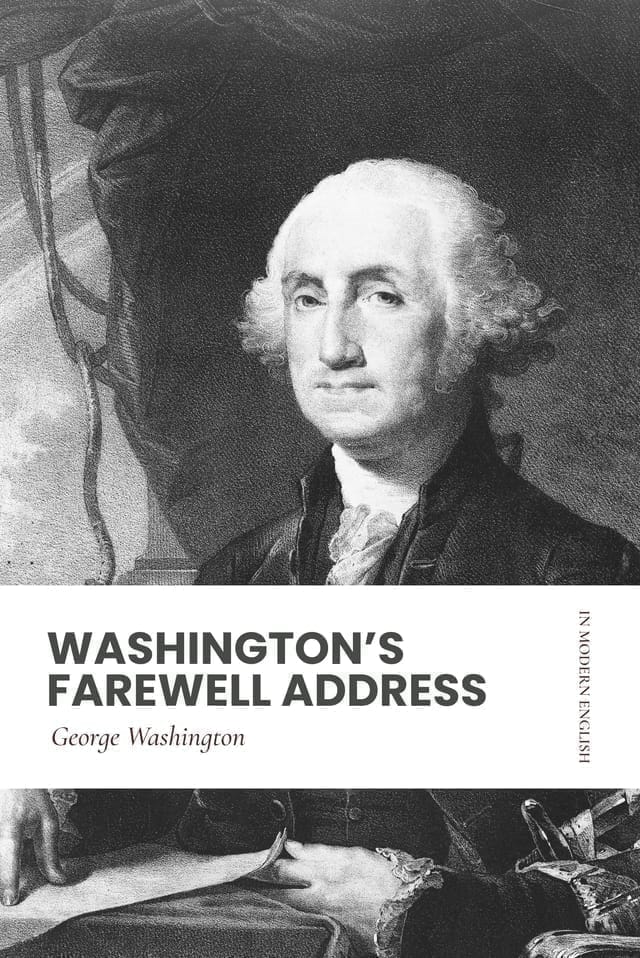
His Farewell Address, drafted with the help of Alexander Hamilton and James Madison and published in September 1796, became one of the most frequently quoted documents in American political life. Its warnings against entangling foreign alliances and against the divisiveness of political parties were cited for generations in debates over neutrality and national unity, and the text is read aloud in the United States Senate each year near his birthday.
Contemporaries treated Washington as the figure who held the fragile union together, and later Americans built much of the country's civic memory around him: the capital city, a state, and countless towns bear his name. His reputation as the man who repeatedly chose to step back from power shaped the expectation that American leaders would do the same.