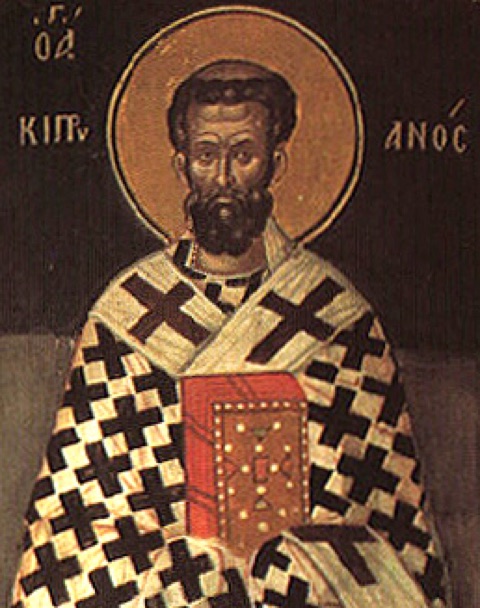
Zeno of Verona
Bishop of Verona in northern Italy in the middle of the fourth century, remembered for the collection of tractates, or short sermons, that survives under his name. The collection is the earliest body of Latin liturgical preaching to come down from north Italy, and many of its pieces were delivered at baptism during the Easter vigil, including brief invitations addressed to the newly baptized. Zeno preached against Arianism at the level of the parish, treated subjects such as faith, the patience of Job, continence, and avarice, and rebuked pagan practices that still persisted among his congregation.
Biography
Very little about the life of Zeno of Verona can be established with confidence. He was bishop of the northern Italian city of Verona around 362 to 371 AD, though these dates are approximate and the traditional span of his episcopate is sometimes given as reaching to 372 AD. The episcopal lists of Verona place him eighth in the sequence of the city's bishops. Beyond his tenure of the see, almost nothing about his career, his birth, or the circumstances of his death is securely recorded, and the surviving evidence for who he was comes largely from his own writings.
Zeno was probably of African origin. The usual grounds for this inference are the character of his Latin style and his marked devotion to Cyprian of Carthage, whose language and manner of argument shaped his preaching. This is an inference rather than a documented fact, and it rests on internal evidence rather than any external testimony to his birthplace, so it is best held as a probability rather than a certainty.
His surviving legacy is a collection of tractates, or sermons, transmitted in two books. The pieces vary in length and kind: some are short liturgical addresses, others longer catechetical instructions. A large number of them were delivered at baptism, during the Easter vigil, when candidates were prepared and then received into the church. The subjects of the collection include faith, the Trinity against Arianism, the patience of Job, continence, and avarice, along with the pagan practices that still lingered among his flock.
A distinctive feature of the collection is a set of short baptismal invitations. These are brief and exuberant addresses to the newly baptized, spoken as the candidates came up from the font, and they stand apart from the longer instructional pieces both in their compression and in their tone. Their survival gives an unusually direct impression of how a fourth-century bishop spoke to his congregation at the moment of baptism.
Zeno is not named by any writer of his own century whose work survives. The first author to mention him by name is Gregory the Great, who refers to him in the Dialogues near the end of the sixth century. This means that for the two centuries after his death Zeno is known chiefly through the transmission of the sermons themselves rather than through any biographical notice.
In later centuries Zeno became the object of veneration at Verona, where the basilica of San Zeno bears his name. A later legend attached to him presents him as a smiling fisherman-bishop, and the famous thirteenth-century statue in the basilica gives that image its best-known form. These belong to the later cult and legend rather than to the fourth-century record, and they should be read as evidence for how Zeno was remembered rather than for the events of his life. Setting the later tradition aside, almost nothing beyond his episcopate and his sermons is securely known.
Why Zeno Matters
Zeno's collection of tractates is the earliest surviving body of Latin liturgical preaching from north Italy, and this is the main reason it is studied. It predates the sermons of Ambrose at Milan, and it is among the earliest Latin liturgical sermon corpora of any size. For the history of Christian preaching in the Latin West, it offers a picture of what a bishop's teaching sounded like in a north Italian city in the decades before the more celebrated preachers of the region.
The baptismal pieces make the collection a window into fourth-century baptismal practice. Because many of the tractates were delivered during the Easter vigil, and because the short invitations were addressed to candidates at the font itself, they preserve the shape of the rite as it was conducted at Verona and the words that accompanied it. Evidence of this kind is scarce for the period, and Zeno's invitations are among the more direct witnesses to how baptism was celebrated in the mid-fourth-century West.
Zeno's preaching also shows anti-Arian teaching carried out at the level of the parish rather than in formal treatises. Where much of the fourth-century defense of Nicene doctrine survives in works of controversy addressed to bishops and councils, Zeno argued the Trinity against Arianism from the pulpit, before an ordinary congregation, as part of regular instruction. His sermons record how that contest reached the level of everyday church life.
Finally, the collection is evidence for the persistence of pagan practice among the baptized. Zeno rebukes members of his own congregation for customs he regards as pagan, which shows that such practices continued among people who had already been received into the church. On this point his sermons are a source for the slow and uneven character of Christianization in fourth-century Italy, seen from the vantage of the bishop who had to contend with it.
Complete Works in English
Free to readEvery surviving work, translated in full and free to read, from our Patrologia Latina project.