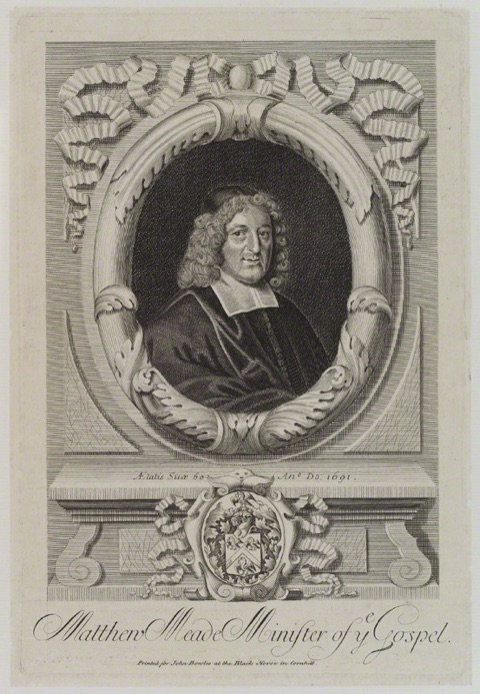
To the Reader
Reader,
I know how customary it is for people to enter the public stage after first apologizing for the weakness and unworthiness of their work. Such apologies show that their desires, whether for the profit of others, their own reputation, or both, extend beyond the limits of their abilities. They want to present themselves for the world’s judgment in finer clothing than ordinary human weakness allows.
For my own part, I may truly say with Gideon, “Behold, my thousand is the meanest,” my gift is the smallest, “and I am the least in my Father’s house” (Judg 6:15). Therefore, this public appearance is not the result of my own choice. I would rather have written on another subject in which I am, in some sense, indebted to the world, or else have offered something more thoroughly developed and perhaps better suited for general acceptance. But that would be merely to consult the interests of one’s own reputation, which in a matter of this importance is no better than “a sowing to the flesh,” whose harvest will be “in corruption” (Gal 6:8).
Here you are presented with one of the saddest considerations imaginable: how far a person may go in professing religion and yet, after all, fall short of salvation; how far he may run and yet “not so run as to obtain” (1 Cor 9:24). This is sad, but it is no less true, for our Lord Christ plainly confirms it: “Strive to enter in at the strait gate; for many, I say unto you, will seek to enter in, and shall not be able” (Luke 13:24).
My purpose is to awaken those who outwardly profess faith but are spiritually asleep and expose the hidden hypocrite. But I fear that weak believers may be discouraged by it. It is difficult to show how low a child of God may fall into sin and yet possess true grace without tempting the sinner to presume. It is equally difficult to show how high a hypocrite may rise in religious profession and yet possess no grace without tempting the believer to despair.
I have carefully tried to prevent this. Although a person may go as far as this book describes and still be only almost a Christian, another may fall short of such attainments and nevertheless be a true Christian. Therefore, do not judge your condition by any single characteristic of someone who falsely professes faith that you find here. Read the whole work, and then form your judgment. I have taken care neither to “give children’s bread to dogs” nor to use the dog’s whip to frighten the children (Matt 15:26).
Yet I could wish that this book would fall only into the hands of those whom it chiefly concerns, those who “have a name to live and yet are dead” (Rev 3:1). They are occupied with the form of godliness but remain strangers to its power (2 Tim 3:5). Such people are the proper subjects of this treatise.
May the Lord accompany it with his blessing wherever it goes, so that it may awaken all such people, especially that generation of morally corrupt people who profess Christianity with which this age abounds. If they attend church, bow the knee, speak a few prayers, and receive the sacrament at the proper time, they think they have done enough for heaven. On this basis, they judge their condition safe and their salvation certain, even though there is a hell of sin in their hearts and “the poison of asps is under their lips” (Rom 3:13). Their minds remain carnal and unconverted, and their lives filthy and unsanctified.
If eternal life is so easily obtained and may be had at so low a price, why did our Lord Christ tell us, “Strait is the gate, and narrow is the way which leadeth unto life, and few there be that find it” (Matt 7:14)? Why should the apostle trouble us with the needless command, “To give diligence to make our calling and election sure” (2 Pet 1:10)? Certainly, then, salvation is not so easy a matter as many imagine, as you will see plainly in the following discourse.
I have been somewhat brief in applying this truth. Therefore, let me remind you here of five important duties.
First, take care that you do not rest in a form of godliness, as though the mere performance of religious duties could confer grace. Lifeless formality is held in very high esteem in the world, just as a measure of dove’s dung was sold at an enormous price during the famine in Samaria (2 Kgs 6:25). Alas, the profession of godliness is only a sandy foundation upon which to build an immortal soul’s hope for eternity.
Remember that the Lord Jesus Christ called the man who “founded his house upon the sand” a foolish builder (Matt 7:26), and the sad result proved him to be one, “for it fell, and great was the fall of it” (Matt 7:27). Therefore, lay your foundation by faith upon the rock, Christ Jesus (1 Cor 3:12). Look to Christ through everything, and rest upon Christ in everything.
Second, labor to see the excellence of the power of godliness and the beauty of the life of Christ. If the means of grace possess loveliness, surely grace itself possesses much more. The goodness of any means lies in how suitably and effectively it serves its end. The form of godliness has no goodness beyond the degree to which it helps the soul attain the power and practice of godliness.
The life of holiness is the only excellent life. It is the life of saints and angels in heaven; indeed, it is the life of God in himself. Just as sinners’ efforts to conceal sin provide strong evidence of its baseness and filthiness, so the fact that so many pretend to godliness provides strong evidence of its excellence. Even the hypocrite’s attractive profession pleads the cause of religion, although the hypocrite is truly at his worst when he appears to be at his best.
Third, regard the things to come as the greatest realities. Things that are not believed affect our affections no more than if they did not exist. This is the chief reason most people allow their affections to pursue the world, setting created things in God’s place within their hearts.
Most people judge the reality of things by whether they are visible and close to their senses. Therefore, they make the same choice as that wretched cardinal who would not exchange his share in Paris for his share in Paradise. Whatever his interest in the former may have been, he surely had little enough in the latter. Covetousness may well be called idolatry when it chooses the world as its god (Col 3:5).
Oh, consider that eternity is no dream. Hell and “the worm that never dies” are no melancholy fantasy (Mark 9:44). Heaven is no invented Elysium. These things possess the greatest reality imaginable. Though they are spiritual and beyond the reach of our senses, they are real and within the sight of faith. Therefore, “Look not therefore at the things which are seen, but look at the things which are not seen; for the things that are seen are temporal, but the things which are not seen are eternal” (2 Cor 4:18).
Fourth, place a high value upon your soul. What we value lightly, we part with easily. Many sell their souls as profane Esau sold his birthright, “for a morsel of bread” (Heb 12:16), or even “for that which,” in the sense intended by the Holy Spirit, “is not bread” (Isa 55:2).
Oh, consider that your soul is the most precious and invaluable jewel in the world. It is the most beautiful piece of God’s workmanship in the whole creation. It bears the image of God and was purchased with the blood of the Son of God. Should we not value it and count it precious (1 Pet 1:18-19)?
The apostle Peter speaks of three very precious things:
1. A precious Christ. 2. Precious promises. 3. Precious faith.
The preciousness of all three lies in their usefulness to the soul (1 Pet 2:7; 2 Pet 1:4; 2 Pet 1:1). Christ is precious because he is the Redeemer of precious souls. The promises are precious because they convey this precious Christ to precious souls. Faith is precious because it brings a precious soul to embrace a precious Christ as he is presented in the precious promises.
Take care that you are not found overvaluing other things while undervaluing your soul. Will you love your flesh, and even your animal, while slighting your soul? Will you clothe and pamper your body but take no care of your soul? This is as though a man fed his dog while starving his child. “Meats for the belly, and the belly for meats; but God shall destroy both it and them” (1 Cor 6:13). Do not give all your time and care to a tottering, perishing body, as though the life and salvation of your soul were not worth the effort.
Finally, meditate often upon the strictness and suddenness of the day of judgment, through which you and I must pass into an everlasting condition. On that day, God, the impartial Judge, will require us to account for all our talents and opportunities. We must account for our time and how we spent it; our property and how we used it; our strength and how we employed it; our afflictions and mercies and how we improved them; the relationships and responsibilities we held here and how we fulfilled them; and the seasons and means of grace and how we managed them. As “we have sowed here, we shall reap hereafter” (Gal 6:7).
Reader, these matters deserve more of our utmost care and call for it more loudly than anything else, yet most people think of them least. Consider what a spirit of atheism fills most human hearts, if we may judge the tree by its fruit and the principle by its practice (Matt 7:19-20). People live as though God need not be served, Christ need not be sought, lust need not be mortified, self need not be denied, Scripture need not be believed, the day of judgment need not be considered, hell need not be feared, heaven need not be desired, and the soul need not be valued.
Instead, they surrender themselves to a sensuality worse than that of animals, “to work all uncleanness with greediness,” living “without God in the world” (Eph 4:19; Eph 2:12). This meditation is enough to break our hearts, if only we possessed holy David’s spirit. He “beheld the transgressors, and was grieved,” and had “rivers of waters running down his eyes, because men kept not God’s laws” (Ps 119:158, 136).
Preventing and correcting this soul-destroying disease is one purpose of the treatise now placed in your hands. Although its principal strength lies in its sovereign use for relieving and curing the swelling disease of hypocrisy, with God’s blessing it may also serve as a dressing for the plague sore of profaneness, if it is promptly applied through serious meditation and carefully kept in place through constant prayer.
Reader, do not expect clever novelties or elaborate language, for then I would disappoint you. But if you want a touchstone by which to test your spiritual condition, this may help you. If you are either a stranger to the profession of faith or a hypocrite beneath such a profession, then read and tremble, for you are the person described here.
As Horace says, “Change the name, and the story is told about you.”
But if the kingdom of God has come with power into your soul (Mark 9:1), if Christ has been formed in you, and if your heart is upright and sincere before God (Luke 17:21), then read and rejoice.
I fear I have exceeded the bounds of an epistle. May the mighty God, whose prerogative it is to teach us to profit (Isa 48:17), whether by the tongue or the pen, by speaking or writing, bless this tract. May it be to you like a rain cloud over dry ground, dropping abundance upon your soul, so that your fleece, watered with the “dew of heaven,” may “grow in grace, and in the knowledge of our Lord and Saviour Jesus Christ” (2 Pet 3:18). In him, I am your
Friend and servant,
Matthew Mead
London, October 22, 1661
Almost a Christian
“Almost thou persuadest me to be a Christian” (Acts 26:28).
In this chapter, the apostle Paul gives his defense against the blind Jews who maliciously prosecuted him before Agrippa, Festus, Bernice, and the council.
In his defense, he chiefly addresses three things:
1. The manner of his life before conversion. 2. The manner of his conversion. 3. The manner of his life after conversion.
He tells how he lived before conversion in verses 4 through 13. He tells how God brought about his conversion in verses 13 through 18. He tells how he lived after conversion in verses 19 through 23.
Before his conversion, he was thoroughly Pharisaical. The manner of his conversion was very wonderful. The fruit of his conversion was very remarkable.
Before his conversion, he persecuted the gospel that others preached. After his conversion, he preached the gospel he himself had persecuted.
While he persecuted the gospel, the Jews loved him. But now that, by the grace of God, he had become a preacher of the gospel, the Jews hated him and sought to kill him (Acts 26:21).
He was once against Christ, and then many were for him. But now that he was for Christ, all were against him. His being an enemy of Jesus made others his friends, but when he came to acknowledge Jesus, they became his enemies (Acts 26:9).
This was their great charge against him: a great opponent had become a great professor of the faith. Because God had changed him, they were enraged. It was as if they would become worse because God had made him better. God had worked upon him by grace, and they seemed to envy him the grace of God.
He preached no treason and stirred up no rebellion. He preached only repentance, faith in Christ, and the resurrection, and for this he was “called in question.”
This is the brief summary of Paul’s defense, which, as the remainder of the chapter shows, had different effects upon his judges.
Festus appears to condemn him (Acts 26:24). Agrippa appears to be convinced by him (Acts 26:28). The whole court appears to acquit him (Acts 26:30). Festus thinks Paul is beside himself. Agrippa is almost persuaded to become such a person as Paul. Festus thinks him mad because he does not understand the doctrine of Christ and the resurrection: “much learning hath made thee mad” (Acts 26:24).
Agrippa is so affected by Paul’s defense that he is almost brought over to Paul’s principle. Paul argues so effectively for his religion that Agrippa seems to be on the verge of professing it.
“Then Agrippa said to Paul, Almost thou persuadest me to be a Christian” (Acts 26:28).
Almost. These words have prompted some debate among learned men. I will not trouble you with the various interpretations offered by Valla, Simplicius, Beza, Erasmus, and others. I take the words as we read them. They show how powerfully Paul’s teaching affected Agrippa’s conscience. Though he would not be converted, he could not help being convinced. His conscience was touched, though his heart was not renewed.
[Observation:] There is something in religion that carries its own evidence even to the consciences of ungodly people.
Thou persuadest me. The word comes from Hebrew and can signify either using arguments to prevail upon someone or actually prevailing through the arguments used.
Here it must be understood in the latter sense, showing the influence of Paul’s argument upon Agrippa. It had almost made him a convert to the profession of Christianity.
“Almost thou persuadest me to be a Christian.”
A Christian. I hope I do not need to tell you what a Christian is, though I am persuaded that many who are called Christians do not know what a Christian is. Or, if they do, they still do not know what it is to be a Christian.
A Christian is a disciple of Jesus Christ, one who believes in and follows Christ. One who embraces the doctrine of Arminius is called an Arminian, and one who accepts the doctrine and way of Luther is called a Lutheran. In the same way, one who embraces, accepts, and follows the doctrine of Jesus Christ is called a Christian.
The word is used both broadly and strictly. Broadly, all who profess that Christ has come in the flesh are called Christians. In this sense they are distinguished from heathens who do not know Christ, from the poor blind Jews who will not acknowledge Christ, and from Muslims who prefer Muhammad to Christ.
But in Scripture the word has a stricter and narrower meaning. It is used only to describe the true disciples and followers of Christ: “the disciples were first called Christians at Antioch” (Acts 11:26), and, “if any man suffer as a Christian, let him not be ashamed” (1 Pet 4:16). That is, let him suffer as a member and disciple of Christ. The word has the same sense in the text: “Almost thou persuadest me to be a Christian.”
As far as I can find, the word is used in only these three places in the whole New Testament, and in each it has the meaning just described.
The Italians make the name a term of reproach among them and commonly misuse the word Christian to mean a fool.
But if, as the apostle says, “the preaching of Christ is to the world foolishness” (1 Cor 1:18), it is no wonder that the world regards Christ’s disciples as fools.
Yet, in a sound sense, it is true that they are fools, for the whole of godliness is a mystery (1 Tim 3:16).
A person must die if he would live. He must be empty if he would be full. He must be lost if he would be found. He must have nothing if he would have all things. He must be blind if he would receive illumination. He must be condemned if he would receive redemption. So he must become a fool if he would become a Christian: “If any man among you seems to be wise, let him become a fool, that he may be wise” (1 Cor 3:18).
The true Christian is the world’s fool, but is wise unto salvation.
You have now heard the sense and meaning of the words briefly explained.
The text needs no division, yet it is a pity that almost should not be divided from Christian.
It does little good to divide the words as they are joined in the text unless I can divide them as they are joined in your hearts. It would be a blessed division if almost could be taken away from Christian, so that you might be not merely almost, but altogether Christians.
It is God’s work to accomplish this, but it is our duty to persuade you toward it. Oh, that God would help me handle this subject in such a way that, at its conclusion, you may say, “You persuade me, not almost, but altogether to be a Christian.”
The doctrine I propose to address is this:
[Doctrine:] There are very many people in the world who are almost, yet only almost, Christians. Many are near heaven and yet no nearer to entering it. Many come within a little of salvation and yet will never enjoy the least part of it. They are within sight of heaven and yet will never have a sight of God.
There are two solemn expressions in Scripture that I must notice here. One concerns the truly righteous, and the other concerns the seemingly righteous.
It is said of the truly righteous that he shall “scarcely be saved” (1 Pet 4:18). It is said of the seemingly righteous that he shall be almost saved: “Thou art not far from the kingdom of God” (Mark 12:34).
The righteous person will be saved with a scarcely. That is, he will pass through much difficulty and go to heaven through many dreadful fears of hell.
The hypocrite will be saved with an almost. That is, he will go to hell through many attractive hopes of heaven.
Two matters arise from this that deserve very serious meditation.
The first is how often a believer may stumble, how low he may fall, and yet possess true grace.
The second is how far a hypocrite may travel on the way to heaven, how high he may rise, and yet possess no grace.
The saint may be cast down very near to hell and yet never come there. The hypocrite may be lifted very near to heaven and yet never come there.
The saint may almost perish and yet be saved eternally. The hypocrite may almost be saved and yet perish finally.
For the saint at his worst is truly a believer, while the hypocrite at his best is truly a sinner.
Before I address the doctrine, I must first state three things. They are very useful for establishing weak believers so that this doctrine does not shake or discourage them.
First, there is nothing in this doctrine that should cause weak Christians to stumble or become discouraged.
The gospel does not say these things to wound believers, but to awaken sinners and merely formal professors of the faith.
Weak believers are more ready than anyone else to apply to themselves the gospel’s promises and comforts, which are properly intended for them. Yet they are also more ready than anyone else to apply to themselves the threats and severest statements of the Word, which were never intended for them. When Christ told the disciples, “One of you shall betray me,” those who were innocent suspected themselves most and cried out, “Master, is it I?” (Matt 26:21-22).
In the same way, when weak Christians hear sinners reproved or hypocrites exposed through the ministry of the Word, they immediately cry, “Is it I?”
It is the hypocrite’s fault to sit under the Word’s tests and discoveries without taking them to heart. It is the weak Christian’s fault to draw sorrowful conclusions about his own condition from premises that do not concern him at all.
Doctrine like this is indeed very useful to all believers:
1. It makes them examine what they stand upon and ensure that the foundation of their hope is well laid, so that they build not upon sand, but upon a rock (Matt 7:24-25).
2. It increases our wonder at God’s distinguishing love. He brings us into the everlasting way when so many perish from the way (Ps 139:24), and he overpowers our souls in true conversion when so many settle for a graceless profession.
3. It urges us toward the excellent duty of searching our hearts, so that we may prove ourselves sincere before God (2 Cor 13:5).
4. It commits the soul to double diligence, so that it may be found not only believing, but persevering in faith to the end.
These and similar duties make this doctrine useful to every believer. Believers, however, must not turn it into a stumbling block in the way of their peace and comfort.
My purpose in preaching on this subject is not to make sad those souls whom Christ would not have made sad. I would bring water, not to “quench the flax that is smoaking” (Matt 12:20), but to extinguish the false fire of the sinner’s own kindling, lest he walk all his days by its light and at last lie down in sorrow (Isa 50:11).
My aim is to level the mountain of the sinner’s confidence, not to weaken the believer’s hand of faith and dependence. I intend to awaken secure, formal sinners and bring them in, not to discourage weak believers.
Second, I would state this beforehand: though many may go far, even very far, on the way to heaven and yet fall short, the soul that possesses the least true grace will never fall short. “The righteous shall hold on his way” (Job 17:9).
Some may perform very many duties, as I will show later, and yet perish. But the soul that performs duty with even the least sincerity will never perish, for God “saveth the upright in heart” (Ps 7:10).
The least measure of true grace saves as surely as the greatest, though not as comfortably. The least grace gives a full interest in the blood of Christ, by which we are thoroughly cleansed. It also gives a full interest in the strength and power of Christ, by which we will certainly be preserved.
Christ keeps faith in the soul, and faith keeps the soul in Christ. Thus, “we are kept by the power of God through faith to salvation” (1 Pet 1:5).
Third, I would state this beforehand: I must question the soundness of those who can hear truths like these without serious reflection and self-examination.
You would suspect that a businessman who never balances his accounts or examines his books is on the verge of bankruptcy. In the same way, I truly believe that the person who never searches or deals honestly with his own heart is a hypocrite.
I question no one’s spiritual condition more than that of the person who proceeds along a path of duties without ever meeting an obstacle or doubting his state.
When we see a sick person who has no awareness of his illness, we conclude that the signs of death are already upon him.
Likewise, when sinners have no awareness of their spiritual condition, it is plain that they are dead in sin. The signs of eternal death are upon them.
Keep these preliminary points in mind as we travel through this subject. I now come to address the proposition more distinctly and closely.
[Doctrine:] There are very many people in the world who are almost, yet only almost, Christians.
I will demonstrate the truth of this proposition and then proceed to examine it more distinctly.
First, I will demonstrate the truth of the proposition by scriptural evidence that speaks plainly and fully to the matter.
The young man in the Gospel is a striking proof of this truth. There we read of someone who came to Christ to learn from him the way to heaven: “Good Master, what good thing shall I do, that I may have eternal life?” Our Lord Christ tells him, “If thou wilt enter into life, keep the commandments.” When Christ tells him which commandments, he answers, “Lord, all this I have kept from my youth up; what lack I yet?” (Matt 19:16-23).
Consider how far this man went.
1. He obeyed. He did not merely hear God’s commands, but kept them. Scripture says, “Blessed is he that hears the word of God, and keeps it” (Luke 11:28).
2. He obeyed universally. He obeyed not merely one command or another, but this command and that one too. He did not divide his obedience with God, choosing whichever commands were easiest to perform and leaving the rest. No, he obeyed them all: “All these things have I kept.”
3. He obeyed constantly. His obedience was not merely a passing fit of zeal, but a continuing course of duty. His goodness was not like Ephraim’s, “like the morning dew that passes away” (Hos 6:4). No, he said, “All these things have I kept from my youth up.”
4. He professed a desire to know and do more. He wanted to complete whatever was lacking in his obedience, so he went to Christ to receive instruction concerning his duty: “Master, what lack I yet?”
Would you not think this was a good man? Alas, how few go this far! Yet, far as he went, he did not go far enough. He was almost, yet only almost, a Christian. He was an unsound hypocrite. In the end, he abandoned Christ and clung to his lust (Matt 19:22).
This, then, is a full proof of the truth of the doctrine.
A second proof comes from the parable of the virgins in Matthew (Matt 25:1). See what progress they made and how far they went in professing Christ (Ps 45:11).
1. They are called virgins. In both the Old and New Testaments, this name is given to Christ’s saints (2 Cor 11:2-3): “the virgins love thee” (Song 1:3). Likewise, in Revelation, the “one hundred forty and four thousand” who stood with the Lamb on Mount Zion are called virgins (Rev 14:4). They are called virgins because they are not defiled with “corruptions that are in the world through lust” (2 Pet 1:4). These women seem to belong to that company, for they too are called virgins (Matt 25:1).
2. They took their lamps. That is, they made a profession of Christ (Matt 25:2).
3. They had some kind of oil in their lamps. This appears from verse 8. They had some convictions and some faith, though not the faith of God’s elect, that kept their profession alive and their lamps burning (Matt 25:8).
4. They went. Their profession was not idle. They performed duties, attended ordinances, and did many things that were commanded. They made progress: they went.
5. They went forth. They went forward and outstripped others, leaving many behind them. This speaks of their separation from the world.
6. They went with the wise virgins. They joined themselves to those who had joined themselves to the Lord, and became companions of those who were companions of Christ.
7. They went forth to meet the bridegroom. This speaks of their acknowledgment of Christ and their seeking after him.
8. When they heard the cry announcing the bridegroom’s coming, “they arose, and trimmed their lamps” (Matt 25:7). They professed Christ more openly, hoping now to enter with the bridegroom.
9. They sought true grace. Do we not say that desires for grace are themselves grace? They are, if they are true and timely, sound and seasonable.
Look, then, at the desire for grace expressed by these virgins: “Give us of your oil” (Matt 25:8).
It was a desire for true grace, but it was not a true desire for grace. It was not true because it was not timely. It was unsound because it was unseasonable. It came too late.