Charles Spurgeon
The most widely heard preacher of Victorian England, pastor of London's Metropolitan Tabernacle for thirty-eight years, whose weekly printed sermons eventually filled sixty-three volumes and remain in print worldwide. He was known in his own lifetime as the "Prince of Preachers."
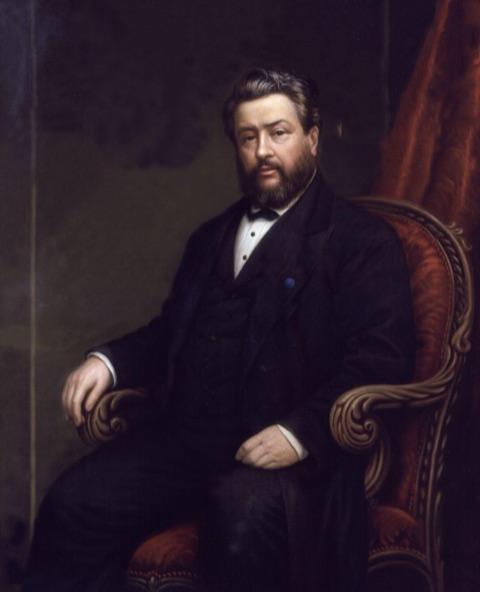
1834–1892
Biography
Charles Haddon Spurgeon (1834 to 1892) was an English Baptist preacher who pastored London's Metropolitan Tabernacle for thirty-eight years and became the most widely heard minister in Victorian Britain. Born on 19 June 1834 in Kelvedon, Essex, he was raised partly in the home of his grandfather, an Independent minister at Stambourne, and grew up among the Puritan divinity books in that manse.
Spurgeon dated his conversion to 6 January 1850, when a snowstorm forced him into a small Primitive Methodist chapel in Colchester and a lay preacher expounded the text "Look unto me, and be ye saved, all the ends of the earth." He was baptized that May and, within a year, was preaching in the villages around Cambridge. In 1851, at sixteen, he became pastor of the Baptist chapel at Waterbeach. Three years later, in April 1854, the New Park Street Chapel in Southwark called the nineteen-year-old to its pulpit; the congregation soon outgrew the building.
The crowds that gathered forced a series of larger venues, including the Surrey Gardens Music Hall, where in October 1856 a false cry of "fire" caused a panic that killed seven people and injured many more. Spurgeon, then twenty-two, was shaken for months. The permanent answer was the Metropolitan Tabernacle in Newington, opened in 1861 with seating for around five thousand and room for a thousand more standing. He preached there for the rest of his life, and his Sunday sermons were transcribed, revised, and sold each week; collected as the New Park Street Pulpit and Metropolitan Tabernacle Pulpit, they run to sixty-three volumes and remain the largest set of books by a single Christian author.
Around the pulpit Spurgeon built a network of institutions. He founded the Pastors' College in 1856 to train working-class men for the ministry, opened the Stockwell Orphanage in 1867, and started the monthly magazine The Sword and the Trowel in 1865. His printed output extended well beyond sermons: the daily devotional Morning and Evening, the seven-volume commentary on the Psalms called The Treasury of David, completed in 1885 after two decades of work, the ministerial Lectures to My Students, and the plain-spoken John Ploughman's Talk. He also compiled a short catechism, drawn from the Westminster Shorter Catechism and the older Baptist catechism of Benjamin Keach, for teaching doctrine to his congregation and its children.
Spurgeon's theology was firmly Calvinist, and he did not soften it to keep his audience. He rejected the growing accommodation of Baptist ministers to biblical criticism and doctrinal looseness, and in 1887 he withdrew the Metropolitan Tabernacle from the Baptist Union in what became known as the Downgrade Controversy. The Union censured him in January 1888; he did not return. The dispute cost him friendships and, by his own account, added to the strain of chronic gout and recurring depression that shadowed his later years.
He wintered increasingly at Menton on the French Riviera for his health, and died there on 31 January 1892 at the age of fifty-seven. His body was returned to London, where tens of thousands filed past the coffin, and he was buried in West Norwood Cemetery. His wife Susannah, who had built a fund to distribute his books to poor ministers, survived him by more than a decade.
Life & Career
Why Spurgeon Matters
Spurgeon's central achievement was to make Reformed doctrine hold a mass audience in an age of expanding cities and cheap print. He preached the Calvinism of the seventeenth-century Puritans—human depravity, unconditional election, particular redemption—without theological jargon, framing it in the vocabulary of a London tradesman or farmhand. The result was that a body of teaching often confined to scholars was heard weekly by thousands in the flesh and by many more through the printed page.
The weekly sermon business was itself a form of influence. Each Monday a stenographer's transcript of Sunday's sermon was corrected by Spurgeon and set in type; the penny pamphlets were sold across the English-speaking world and translated into dozens of languages. This gave him a continuous global readership for decades and fixed his sermons as a lasting resource that later preachers mined for material and models.
His institutional work outlasted him. The Pastors' College, now Spurgeon's College, trained hundreds of ministers who carried his convictions into pulpits across Britain and its colonies; the Stockwell Orphanage cared for children on the model of practical, undenominational charity he favored. Through these he shaped a generation of Nonconformist ministry as much by organization as by preaching.
The Downgrade Controversy of 1887 to 1888 marked him as an early voice against theological liberalism within evangelical Protestantism. By breaking with the Baptist Union rather than tolerate what he judged a drift from biblical authority, he set a precedent that conservative evangelicals in the twentieth century repeatedly invoked, and his stance remains a reference point in debates over the boundaries of evangelical belief.