G.K. Chesterton
English journalist, novelist, and lay theologian who defended Christian orthodoxy through paradox and argument in books like "Orthodoxy" and "The Everlasting Man." He also created the priest-detective Father Brown and, with Hilaire Belloc, promoted the economic program known as distributism.
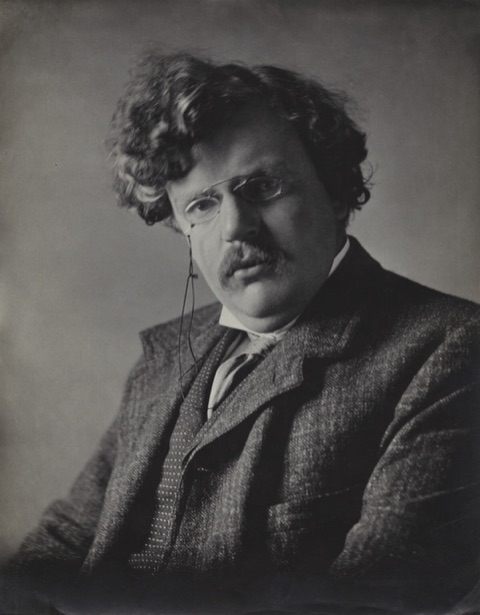
1874–1936
Biography
Gilbert Keith Chesterton (1874 to 1936) was an English journalist, novelist, and lay theologian who argued for Christian belief through paradox and comic reversal in books such as "Orthodoxy" and "The Everlasting Man." He was born on May 29, 1874, in Campden Hill, Kensington, in west London, the son of an estate agent, Edward Chesterton, and his wife Marie Louise. He attended St. Paul's School and then studied at the Slade School of Fine Art and took literature classes at University College London, but he left without completing a degree and drifted into work for London publishers.
He turned to journalism at the start of the century, writing for the Daily News and, from 1905 until his death, contributing a weekly column to the Illustrated London News for some three decades. In 1901 he married Frances Blogg, and the couple later settled in Beaconsfield, Buckinghamshire. His early polemical books "Heretics" (1905) and "Orthodoxy" (1908) set out his method of defending traditional Christianity by turning the arguments of its critics against themselves, and they made him one of the most visible controversialists in Edwardian England.
Chesterton was also a prolific writer of fiction. His novels include "The Napoleon of Notting Hill" (1904) and "The Man Who Was Thursday" (1908), a thriller subtitled "A Nightmare." In 1911 he published "The Innocence of Father Brown," the first collection of stories about a Roman Catholic priest who solves crimes through his understanding of human nature and sin; the Father Brown stories ran across five volumes and became his most widely read work. He wrote biographical and critical studies as well, including books on Charles Dickens (1906), Robert Browning, and later Saint Francis of Assisi (1923) and Saint Thomas Aquinas (1933).
His social and economic views took shape alongside those of his friend Hilaire Belloc, with whom he was so often paired that George Bernard Shaw coined the joint nickname "the Chesterbelloc." In "What's Wrong with the World" (1910) and elsewhere Chesterton attacked both industrial capitalism and socialism, arguing instead for the wide distribution of property among ordinary families, a program that came to be called distributism. He edited "G.K.'s Weekly," and the Distributist League was founded in 1926 to promote these ideas.
Raised in a liberal Unitarian household, Chesterton moved steadily toward Catholic Christianity over his adult life and was received into the Roman Catholic Church in 1922; his book "The Everlasting Man" (1925), a survey of human history centered on the figure of Christ, followed soon after. He was a popular public debater who sparred on platforms and in print with Shaw, H.G. Wells, and Clarence Darrow. In 1934 Pope Pius XI named him a Knight Commander with Star of the Order of St. Gregory the Great. He died in Beaconsfield on June 14, 1936, at the age of sixty-two, having published roughly eighty books along with hundreds of poems and thousands of essays.
Life & Career
Why Chesterton Matters
Chesterton's central importance lies in Christian apologetics. In "Orthodoxy" (1908) he presented belief not as a set of propositions to be proved but as a coherent way of seeing the world that made better sense of experience than its rivals, and he did so in a conversational, paradox-driven style that reached readers outside the churches. "The Everlasting Man" (1925) extended this into an account of history that placed the coming of Christ at the center of the human story. Both books were read by later apologists, and C.S. Lewis repeatedly credited "The Everlasting Man" with shaping his own return to Christianity.
His literary influence runs alongside the theological one. "The Man Who Was Thursday" is still read as an early example of the metaphysical thriller, and the Father Brown stories helped define the detective genre in the years between Conan Doyle and Agatha Christie, offering a sleuth whose method rested on moral and psychological insight rather than forensic deduction. Chesterton served as the first president of the Detection Club, founded in 1930 by British mystery writers.
Through distributism he gave a distinctive economic voice to Catholic social thought in early twentieth-century Britain. Writing with Belloc, he rejected both large-scale capitalism and state socialism in favor of small property, family ownership, and local self-sufficiency, ideas that continued to be discussed by later critics of industrial economies.
As a working journalist, Chesterton was one of the most quoted essayists of his era. His weekly columns, debates, and occasional verse kept religious and political questions in front of a mass readership, and his aphoristic prose has remained in circulation long after many of the controversies that prompted it faded.