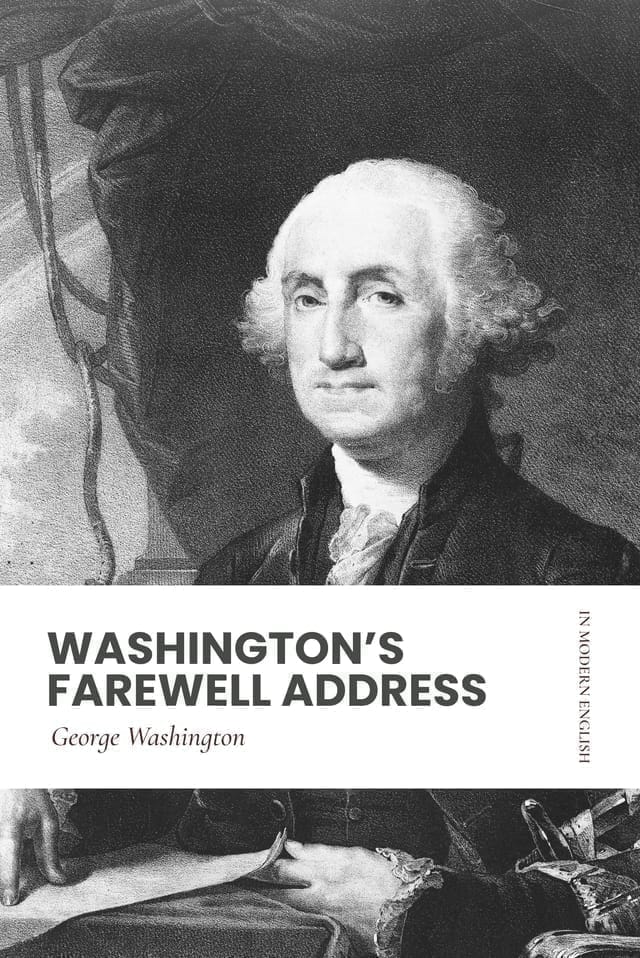



Washington’s Farewell Address
FRIENDS AND FELLOW CITIZENS:
The time for a new election to choose a citizen who will lead the executive branch of the United States is approaching, and the moment has come when you must decide who will be entrusted with that important responsibility. I believe it’s appropriate, especially since it may help clarify the public’s voice, to inform you now of my decision: I will not allow my name to be considered among those from whom you will choose.
At the same time, I ask you to understand that I haven’t made this decision lightly. I’ve carefully considered every obligation that binds a responsible citizen to his country. In withdrawing my availability for service (which my silence might have implied), I’m not motivated by any weakening of my commitment to your future welfare, nor by any lack of grateful appreciation for your past support. Instead, I’m convinced that this decision is fully compatible with both.
My acceptance of the office to which you elected me twice, and my continuation in it until now, has been a constant sacrifice of personal preference to what I saw as my duty and to what seemed to be your wishes. I kept hoping that I would be able, much sooner and without abandoning principles I couldn’t ignore, to return to the private life from which I had been reluctantly called. Before the last election, my desire to do this was so strong that I actually prepared an address to announce it to you. But after careful thought about the complicated and dangerous state of our foreign affairs at that time, and after receiving unanimous advice from people whose judgment I trusted, I decided to set the idea aside.
I’m glad that the state of your affairs, both foreign and domestic, no longer makes it impossible to follow my personal wishes without violating my sense of duty or what’s appropriate. I’m convinced that whatever fondness you may still have for my service, given our country’s current situation, you won’t disapprove of my decision to retire.
I explained my feelings when I first took on this difficult responsibility. As for how I’ve carried out this trust, I’ll only say that I’ve done my best, with good intentions, to help organize and run the government to the fullest extent my very imperfect judgment allowed. I knew from the start that I wasn’t fully qualified for the job, and experience has only reinforced my doubts about myself (probably even more in others’ eyes than in my own). Every day, as I grow older, I feel more strongly that retirement is not just something I need but something I’ll welcome. I’m satisfied that whatever special value my service may have had was only temporary. I take comfort in believing that while both personal preference and good sense tell me to leave political life, patriotism doesn’t forbid it.
Looking ahead to the moment when my public life will end, I cannot help but acknowledge the deep gratitude I owe to my beloved country for the many honors it has given me. Even more, I’m grateful for the unwavering confidence with which you have supported me, and for the opportunities I’ve had to demonstrate my unshakable devotion through faithful and persistent service, even when my usefulness fell short of my dedication. If our country has benefited from these services, let it always be remembered to your credit, and as an instructive lesson in our history, that under circumstances where passions ran high in every direction and could easily mislead, amid situations that were sometimes unclear and fortunes that often seemed discouraging, in moments when failure frequently invited criticism, your constant support was the essential foundation of my efforts and a guarantee that my plans would succeed. This truth has made a profound impression on me, and I will carry it to my grave as a powerful motivation for endless prayers that Heaven may continue to grant you its greatest blessings: that your unity and brotherly love may last forever, that the free constitution you created with your own hands may be held sacred, that its administration in every branch may be marked by wisdom and virtue, and that, finally, the happiness of the people of these states, under the protection of liberty, may be made complete by preserving and using this blessing so carefully and wisely that you earn the glory of recommending it to the admiration, affection, and adoption of every nation that does not yet know it.
Here, perhaps, I should stop. But my concern for your welfare, which will only end with my life, and the fear of danger that naturally comes with that concern, push me on an occasion like this to offer for your serious consideration, and to urge you to review frequently, some thoughts that come from deep reflection and considerable observation, and which seem to me absolutely vital to the lasting happiness of our people. I offer these thoughts more freely because you can only see in them the honest warnings of a departing friend who could have no personal reason to slant his advice. And I can’t forget, as encouragement, how kindly you received my thoughts on a previous and similar occasion.
Since love of liberty is woven into the very fabric of your hearts, no recommendation from me is needed to strengthen or confirm that attachment.
The unity of government that makes you one people is precious to you now, and rightly so. It stands as a main pillar supporting your real independence, your peace at home and abroad, your safety, your prosperity, and that very liberty you prize so highly. But it’s easy to predict that many people, for various reasons and from different directions, will work hard and use every trick they can to weaken your conviction in this truth. This is the point in your political fortress that internal and external enemies will attack most constantly and actively (though often secretly and deceptively). It’s critically important, then, that you properly understand the immense value of your national union to your collective and individual happiness. You should nurture a sincere, habitual, and unshakable attachment to it. Get in the habit of thinking and speaking of it as the guardian of your political safety and prosperity. Watch over its preservation with vigilant concern. Reject anything that even hints it could ever be abandoned, and respond with indignation to the first sign of any attempt to separate any part of our country from the rest or to weaken the sacred ties that now bind the various parts together.
You have every reason to feel this bond of sympathy and shared interest. Whether you were born here or chose to become citizens, this country deserves your wholehearted devotion. The name AMERICAN, which defines you as a nation, should inspire a deeper patriotic pride than any label tied to regional differences. Despite minor variations, you share the same religion, customs, habits, and political principles. You fought and won together in a common cause: the independence and liberty you now enjoy came from shared planning and effort, from facing the same dangers, enduring the same hardships, and celebrating the same victories.
Yet as powerful as these emotional appeals may be, they pale in comparison to considerations that directly affect your practical interests. Every part of our country has compelling reasons to carefully protect and preserve the unity of the whole.
The North, through unrestricted trade with the South and protected by the equal laws of a shared government, finds in Southern products major new opportunities for maritime and commercial ventures, along with valuable raw materials for manufacturing. The South, through this same exchange and benefiting from Northern enterprise, sees its agriculture flourish and its trade expand. By drawing some of the North’s sailors into its own channels, the South strengthens its shipping industry. And while it contributes in various ways to building up the nation’s overall maritime capacity, it looks forward to the protection of naval power that it cannot develop as effectively on its own. The East, through similar trade with the West, already finds (and will increasingly find as inland transportation by land and water improves) a profitable market for goods it imports or manufactures domestically. The West gets from the East the supplies it needs for growth and prosperity. But perhaps even more importantly, the West must necessarily depend on the weight, influence, and future naval strength of the Atlantic states to guarantee secure access to essential outlets for its own products, all united by an unbreakable community of interest as one nation. Any other arrangement by which the West might try to secure this vital advantage, whether through its own independent strength or through some traitorous and unnatural alliance with a foreign power, would be fundamentally unstable.
Since every part of our country feels a direct and specific stake in the Union, all the parts together will inevitably find in this combined mass of resources and efforts greater strength, greater capacity, and proportionally greater security from external threats. They will also experience less frequent disruption of their peace by foreign nations. And what matters most: they will gain from Union an escape from those conflicts and wars among themselves that so often plague neighboring countries not bound together by the same government. These conflicts would arise from their own rivalries alone, but opposing foreign alliances, loyalties, and schemes would fuel and intensify them. For the same reason, they will avoid the need for those bloated military establishments that threaten liberty under any form of government and that pose a particular danger to republican liberty. In this sense, your Union should be seen as a main pillar of your freedom, and your love for one should make you cherish the preservation of the other.
These considerations speak persuasively to every thoughtful and virtuous mind, and they show that maintaining the Union should be a primary goal of patriotic commitment. Is there any doubt whether a single government can cover such a vast territory? Let experience answer that question. To rely on mere theory in such a case would be irresponsible. We have good reason to hope that a proper organization of the whole, supported by state governments for their respective regions, will produce a successful outcome for this experiment.
It deserves a fair and complete trial. With such powerful and clear reasons for Union affecting all parts of our country, as long as experience has not proven it impossible, we will always have reason to question the patriotism of anyone, anywhere, who tries to weaken its bonds.
When I think about the forces that might tear our Union apart, one thing deeply troubles me: we’ve given people grounds to divide us by geography into Northern and Southern, Atlantic and Western camps. Ambitious manipulators can use these labels to convince people that different regions actually have conflicting interests and worldviews. One of the oldest tricks political factions use to gain power in specific areas is to distort what other regions believe and want. You can’t guard yourselves too carefully against the suspicion and resentment that grow from these distortions. They turn people who should be united like family into strangers and enemies. The people living in our western territories recently learned this lesson firsthand. They watched the Executive branch negotiate and the Senate unanimously ratify the treaty with Spain, and they saw the overwhelming approval this received across the entire country. This proved decisively how baseless the rumors were that had spread among them, rumors claiming the federal government and the Atlantic states were working against their interests regarding the Mississippi River. They witnessed the creation of two treaties (one with Great Britain and one with Spain) that gave them everything they could have hoped for in our foreign relations and strengthened their prosperity. Wouldn’t it be wise for them to rely on the Union, which secured these benefits, to preserve them? Won’t they now ignore those troublemakers, if any exist, who would cut them off from their fellow Americans and tie them to foreign powers instead?
Your Union needs a central government to be effective and lasting. No matter how strict the alliances between individual parts might be, they can never be an adequate substitute. Such alliances will inevitably suffer the same violations and disruptions that all alliances throughout history have experienced. Understanding this crucial truth, you improved on your first attempt by adopting a Constitution that works better than your previous system for creating a close union and managing your shared interests effectively. This government, born from your own free choice without outside pressure or intimidation, adopted after thorough investigation and careful thought, completely free in its principles and in how it distributes power, combining security with energy, and containing within itself the means for its own amendment, deserves your confidence and support. Respecting its authority, following its laws, and accepting its decisions are duties required by the fundamental principles of true liberty. Our political system rests on the right of the people to create and change their constitutions of government. But whatever constitution exists at any given time remains binding on everyone until the whole people change it through an explicit and legitimate act. The very concept that the people have the power and right to establish government assumes that every individual has a duty to obey the government once it’s established.
Any obstacles to enforcing the law, any groups or organizations (no matter how reasonable they seem) whose real purpose is to manipulate, control, oppose, or intimidate the normal deliberations and actions of our constitutional authorities, undermine this fundamental principle and lead to disaster. These groups create organized factions and give them artificial, outsized power. They replace the delegated will of the nation with the will of a party, often a small but clever and aggressive minority. As different parties take turns winning, they turn public administration into a reflection of faction’s poorly planned and contradictory schemes, rather than an instrument of consistent and sound policies developed through common deliberation and balanced by mutual interests.
While groups or organizations like these may occasionally serve popular purposes, over time they’re likely to become powerful tools that cunning, ambitious, and unprincipled men will use to undermine the people’s power and seize control of the government for themselves. Once they’ve achieved their unjust dominion, they’ll destroy the very instruments that lifted them to power.