Daniel Defoe
Author of Robinson Crusoe (1719), often called the first English novel, and one of the most prolific journalists and pamphleteers of his age, with more than three hundred works attributed to him.
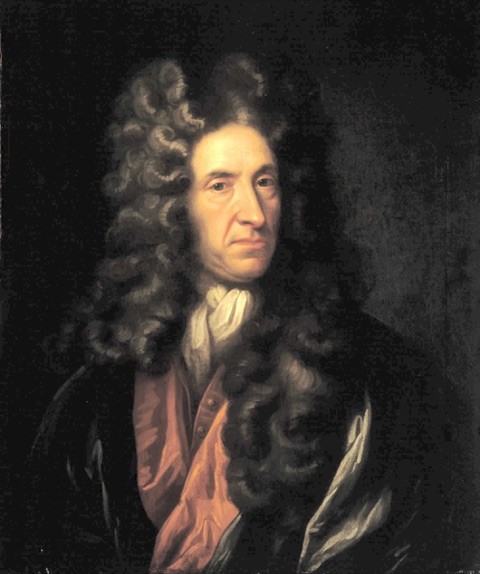
1660–1731
Biography
Daniel Defoe (around 1660 to 1731) was an English merchant, journalist, and novelist whose Robinson Crusoe helped invent the form of the English novel. He was born in London as Daniel Foe, the son of James Foe, a tallow chandler and Presbyterian Dissenter; he added the aristocratic-sounding "De" to his surname around 1695. Because his family refused to conform to the Church of England, Defoe was barred from Oxford and Cambridge and instead attended Charles Morton's dissenting academy at Newington Green, where he was trained in modern languages, geography, history, and the new natural sciences rather than the classical curriculum of the universities.
He entered trade as a hosiery merchant in the 1680s and speculated in marine insurance, brick-making, and shipping. In 1692 he went bankrupt owing about £17,000, and he spent much of the rest of his life dodging creditors and writing for hire to pay them down. His politics matched his religion: he joined the Duke of Monmouth's failed rebellion against James II in 1685 and rode out to greet William of Orange's invading army in 1688.
In 1703 his ironic pamphlet The Shortest Way with the Dissenters, which mimicked High Church calls to exterminate Nonconformists so closely that many readers took it at face value, was prosecuted as seditious libel. He was fined, imprisoned in Newgate, and made to stand three days in the pillory in late July 1703 — an ordeal he answered with his Hymn to the Pillory, sold to the crowd that reportedly came to toss flowers rather than stones.
From 1704 to 1713 Defoe wrote and largely produced single-handedly The Review, a political journal that appeared three times a week in the service of the Tory minister Robert Harley. For years he also worked as a paid government agent and informer, traveling through Scotland in 1706 and 1707 to report on public opinion during the negotiation of the Act of Union. His journalism ran to hundreds of pamphlets across the whole span of Queen Anne's reign and into that of George I.
He was nearly sixty when he turned to extended fiction. Robinson Crusoe appeared in April 1719, its full first edition presenting the castaway's story as a genuine memoir. It was followed in quick succession by Captain Singleton (1720), Memoirs of a Cavalier (1720), Moll Flanders (1722), A Journal of the Plague Year (1722), Colonel Jack (1722), and Roxana (1724). His three-volume Tour Thro' the Whole Island of Great Britain (1724 to 1727) surveyed the towns, roads, and trade of Britain region by region and remains a detailed record of the country's commerce in the 1720s.
Defoe died in lodgings in Ropemaker's Alley, London, on April 24, 1731, again in hiding from a creditor over a long-standing debt connected to the estate of Mary Brooke. He was buried in Bunhill Fields, the Dissenters' burial ground, where a monument was later raised over his grave.
Life & Career
Why Defoe Matters
Defoe's central contribution to English writing is the realist prose narrative. Robinson Crusoe presented an ordinary man's day-to-day survival — building shelter, keeping a journal, counting his stores — in plain, circumstantial detail, and it presented that experience as if it were literally true. This method of accumulating concrete facts until a fictional account reads like testimony became one of the defining techniques of the novel, and Crusoe was translated, imitated, and reprinted across Europe within a few years of its 1719 appearance.
His later fiction extended the same technique to characters at the margins of English life. Moll Flanders narrates the career of a thief and prostitute in her own voice; Roxana follows a kept woman's rise and moral ruin; Colonel Jack traces a pickpocket turned colonial planter. By putting such figures at the center of long first-person narratives and treating their finances, choices, and self-justifications in exact detail, Defoe helped open the novel to the whole social range rather than only to heroes and gentry.
He was equally consequential as a journalist. The Review, which he wrote almost entirely himself from 1704 to 1713, was among the earliest sustained periodicals of political comment and argument in English, and his hundreds of pamphlets made him one of the most productive writers-for-hire of the early eighteenth century. His A Journal of the Plague Year (1722) reconstructed the London epidemic of 1665 with such documentary precision that it has been read both as fiction and as history.
His nonfiction survey work matters to historians in its own right. The Tour Thro' the Whole Island of Great Britain records manufactures, markets, ports, and population as Defoe observed or reported them in the 1720s, and it remains a standard source for the economic geography of Britain on the eve of industrial expansion.