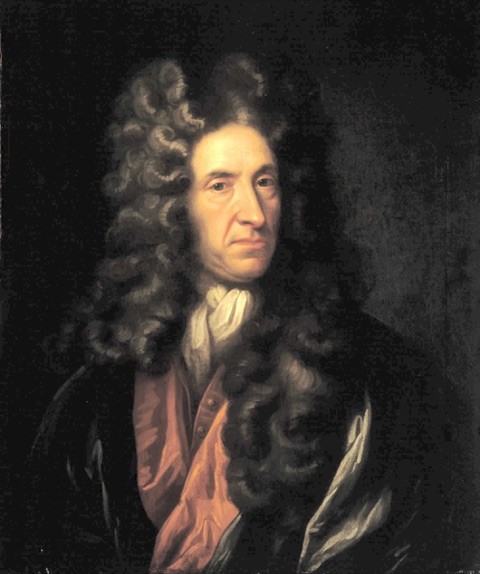
Defoe's 1719 novel — often called the first English novel — narrating Robinson Crusoe's shipwreck near the Orinoco, twenty-eight years of solitude on the island, and his Dissenter's reading of his own survival as the work of providence.
One free account opens 250+ books and saves your place on every device. Google sign-in or an email link. No card.
You’re on the list — we’ll email you if this goes to print.
Included with your free account
This book, and 250+ more, free to read
A free account opens the whole library to read online, on your phone or at your desk. Open a book on one device and it is waiting at the same page on the next. The PDF and EPUB of every book are yours to keep, and audiobooks play in the same app.
250+ modernized editionsNot samples. The whole work, free.
Your place, on every devicePhone, tablet or desktop, same page.
131 audiobooksFrom $4.99 each, or all of them with a $50 gift.
"Robinson Crusoe" is Daniel Defoe's 1719 novel about an English sailor shipwrecked alone on a deserted island, where he survives twenty-eight years by salvaging the wreck, farming barley, and taming goats. He undergoes a religious conversion, rescues a man he names Friday, and reaches England after helping defeat a mutiny.
“there in the sand was the unmistakable print of a human foot, bare and perfectly clear,”
From this edition
How the argument unfolds
01
Against his father. Crusoe rejects the "middle station of life" his father urges on him and sails from Hull "on the 1st of September, 1651," into a storm whose panicked vows he soon forgets.
02
Pirates and Brazil. A Moorish pirate out of Sallee holds him two years as a slave; he escapes by boat with a boy named Xury and prospers as a Brazil planter.
03
The wreck. A later voyage drowns every man but him, and he reaches shore owning "a knife, a tobacco pipe, and a small amount of tobacco in a box."
04
Building a life. He rafts supplies off the wreck, names it "The Island of Despair," fortifies a cave he calls his castle, raises barley from spilled seed, and tames goats.
05
Sickness and the Bible. Fever drives him to a chest holding tobacco and a Bible, where he reads "Call upon me in the day of trouble, and I will deliver thee," and prays for the first time.
06
The footprint. A single bare footprint in the sand ends his security, and the years after it are spent hiding from the cannibal parties who land to feast on prisoners.
07
Friday and the ship home. He saves a prisoner he names Friday, helps an English captain retake a mutinied ship, and sails after "twenty-eight years, two months, and nineteen days."
Key themes
Self-reliance. Much of the book is patient, repeated, often failed work — a raft, a canoe, a pot, a loaf — taught by what Crusoe calls "the hard school of experience."
Providence and repentance. Barley sprouting from a bag he had shaken out "shook me deeply," and the sickness that follows turns a man who "had lived without any religious foundation whatsoever" into a daily reader of Scripture.
Civilization and solitude. Alone, he longs for "one companion, one fellow creature, someone to speak to"; with company, he is called Master by Friday and governor by the sailors he rescues.
Chapter 1: A Restless Start
I was born in 1632, in the city of York, into a good family, though not originally from that region. My father was a foreigner from Bremen who had first settled in Hull, where he built a comfortable fortune through trade. After retiring from business, he moved to York, where he married my mother, whose family bore the name Robinson, a well-respected name in that part of the country. From them I took the name Robinson Kreutznaer, though through the usual mangling of foreign words in England, we came to be called Crusoe instead. We adopted it ourselves, wrote it that way, and my companions never knew me by anything else.
I had two older brothers. The first served as a lieutenant-colonel in an English infantry regiment in Flanders, under the command of the famous Colonel Lockhart, and was killed in the battle near Dunkirk against the Spaniards. What became of my second brother I never learned, just as my father and mother never learned what had become of me.
Being the third son, and not trained for any particular trade, I developed a restless streak early in life. My father, who was quite elderly by then, had given me a decent education, as far as home schooling and a local free school could provide, and had intended me for the law. But nothing would satisfy me except going to sea. This urge drove me so powerfully against my father's wishes, and eventually his direct commands, and against all the pleading of my mother and friends, that there seemed to be something almost fated about it: a pull in my nature pointing straight toward the life of misery that was waiting for me.
My father was a wise and serious man, and he gave me sound, earnest advice against what he could already see I was planning. One morning he called me into his room, where he was laid up with gout, and spoke to me with great feeling on the subject. He asked what reasons I had for leaving my father's house and my native country beyond a restless urge to wander. Back home, he pointed out, I could be well established, with a real prospect of building a fortune through hard work and steady effort, and enjoying a comfortable, pleasant life. He told me it was men of desperate circumstances on one hand, or men of bold and towering ambition on the other, who went abroad seeking adventure, hoping to rise through daring schemes and make names for themselves in pursuits far outside the ordinary course of life. Those things, he said, were either far too grand for me or far too low. My place was in the middle: what he called the upper rank of ordinary life, which long experience had taught him was the best condition in the world, the one most suited to human happiness. It was free from the misery, hardship, toil, and suffering that weighed down the laboring classes, and equally free from the pride, excess, ambition, and envy that corrupted those at the top. He told me I could measure the happiness of this middle condition by one simple fact: it was the life everyone else envied. Kings, he said, had often mourned the burden of being born to greatness and wished they had been placed somewhere between the humble and the mighty. The wise man himself had testified to this when he prayed to be given neither poverty nor riches, naming it the true standard of genuine happiness.
He urged me to take note of this, and said I would always find that life's calamities fell on the upper and lower classes alike, while the middle station suffered the fewest disasters and faced far fewer upheavals than those above or below it. What's more, people in the middle were not nearly as vulnerable to the physical and mental ailments that plagued those who, on one side, brought illness on themselves through corrupt living, luxury, and excess, or on the other, through grinding labor, deprivation, and a poor diet. The middle station of life, he argued, was ideally suited to every kind of virtue and every kind of enjoyment. Peace and plenty were its constant companions. Moderation, calm, good health, good company, pleasant diversions, and genuine pleasures were the natural blessings of a middling fortune. Men who lived this way moved through the world quietly and smoothly, and left it comfortably, unburdened by the toil of hand or mind, not enslaved to daily drudgery just to put bread on the table, and not worn down by the tangled circumstances that steal peace from the soul and rest from the body. They were free from the corrosive sting of envy and from the hidden, burning hunger for greatness and power. Instead, in easy and settled circumstances, they glided gently through life, savoring its sweetness without tasting its bitterness, feeling themselves to be happy and learning, with each passing day, to recognize that happiness more clearly.
After this, he pressed me earnestly and with great affection not to act like a reckless young man, nor to throw myself into miseries that Nature and the circumstances of my birth seemed to have spared me from. He reminded me that I had no need to go seeking my bread in the world, that he would provide well for me and do his best to set me up in the comfortable middle station of life he had just been describing. If I could not find ease and happiness there, he said, it would be nothing but my own fate or fault standing in the way. As for himself, he would have nothing to answer for, having done his duty by warning me against a course he knew would bring me harm. In short, if I would stay and settle at home as he wished, he would do every kind thing in his power for me; but he would not have so much as a hand in my misfortunes by giving me any encouragement to leave. To close everything, he held up my elder brother as an example: he had used the same earnest arguments to keep that brother from going off to the wars in the Low Countries, but could not prevail. The young man's restless desires drove him into the army, and there he was killed. My father said that though he would never stop praying for me, he felt compelled to tell me plainly that if I took this foolish step, God would not bless me, and I would have plenty of time in the future to reflect on having ignored his counsel, when there might be no one left to help me recover.
I noticed in this last part of his speech, which was truly prophetic (though I doubt my father knew it to be so himself), that tears ran freely down his face, especially when he spoke of my brother who had been killed. And when he came to the part about my having time to repent with no one to help me, he was so overcome that he broke off entirely and told me his heart was too full to say another word.
I was genuinely moved by what my father said, as anyone would have been, and I resolved to stop thinking about going abroad and to settle down at home as he wished. But a few days were enough to wear that feeling away, and before long, to avoid any more of my father's pleading, I resolved within a few weeks to run away from home entirely. I didn't act quite as rashly as that first burst of determination urged me to, though. Instead, I waited until I caught my mother in a better mood than usual and told her that my heart was so completely set on seeing the world that I could never settle to anything with enough conviction to see it through. I told her my father would do better to give me his blessing than to force me to leave without it; that I was now eighteen, which was too old to be apprenticed to a trade or taken on as a clerk to a lawyer; that I was certain if I tried either of those things I would never finish my time, but would run away from my master before it was up and go to sea anyway. I told her that if she would persuade my father to let me make one voyage abroad, and I came home and didn't care for it, I would never ask again, and I promised that through twice the effort I would make up for all the time I had lost.
This sent my mother into a fury. She told me it would be pointless to raise any such matter with my father, since he knew my own interests far too well to consent to something so harmful to me. She said she was astonished that I could even think of such a thing after the conversation I had already had with him, and after all the kind and tender words she knew he had spoken to me. She told me that if I was determined to ruin myself, there was nothing anyone could do to stop me, but I could be sure I would never have their blessing for it. As for her own part, she wanted no hand in my destruction, and I would never be able to say that my mother had agreed when my father had not.
Though my mother refused to raise the matter with my father, I heard afterward that she reported the entire conversation to him, and that my father, after showing great concern, said to her with a sigh: "That boy might be happy if he would stay at home, but if he goes abroad, he will be the most miserable wretch that was ever born; I can give no consent to it."
It was nearly a year after this before I finally broke loose, though in the meantime I remained stubbornly deaf to every suggestion that I settle into a trade, and I frequently argued with my father and mother about their firm opposition to what I knew my own nature was driving me toward. Then one day I happened to be in Hull, having gone there by chance and with no intention of running away at that point. But while I was there, one of my companions was sailing to London on his father's ship, and he urged me to come along, dangling the usual temptation that seafaring men offer: it would cost me nothing for the passage. I consulted neither my father nor my mother, nor did I even send them word. I simply left them to hear of it however they might, without asking for God's blessing or my father's, without any thought for circumstances or consequences, and in an unlucky hour (God knows) on the 1st of September, 1651, I went on board a ship bound for London. I believe no young adventurer's misfortunes ever began sooner or lasted longer than mine. The ship had barely cleared the Humber when the wind began to blow and the sea to rise in a most frightful manner, and since I had never been at sea before, I was wretchedly sick in body and terrified in mind. I began now to reflect seriously on what I had done, and on how justly Heaven had brought its judgment down on me for wickedly abandoning my father's house and deserting my duty. All the good counsel my parents had given me, my father's tears and my mother's pleas, came flooding back into my mind, and my conscience, which had not yet grown as hardened as it would later become, reproached me for the contempt I had shown toward their advice and for my failure in duty to God and my father.
All this while the storm kept building, and the sea ran high, though nothing like what I would witness many times afterward, nor even what I saw just a few days later. But it was enough to shake me then, a young sailor who had never experienced anything like it.
I expected every wave to swallow us whole, and every time the ship dropped, as I imagined it did, into the trough of the sea, I was certain we would never rise again. In that agony of mind I made all manner of vows and resolutions: if God would be pleased to spare my life through this one voyage, if I could only set foot on dry land again, I would go straight home to my father and never board a ship again as long as I lived. I would take his advice and never throw myself into such misery again. Now I saw clearly the wisdom of his observations about the middle station of life, how easy and comfortable he had lived all his days, never exposed to storms at sea or troubles on shore. In short, I resolved that I would, like a truly repenting prodigal, go home to my father.
These wise and sober thoughts stayed with me throughout the storm and for some time after. But the next day the wind eased and the sea grew calmer, and I began to grow a little accustomed to it. I remained subdued all that day, still somewhat seasick; but toward evening the weather cleared, the wind died entirely, and a beautiful calm evening followed. The sun went down in a perfectly clear sky and rose the same way the next morning. With little or no wind and a smooth sea shining under the sun, the sight was, I thought, the most beautiful I had ever seen.
I had slept well through the night and was no longer seasick, but cheerful, gazing with wonder at the sea that had been so violent and terrifying the day before, and could turn so calm and pleasant in so short a time. And now, just as my good resolutions were in danger of holding firm, my companion, the one who had lured me away in the first place, came to find me.
"Well, Bob," he said, clapping me on the shoulder, "how are you holding up? I'll bet you were frightened last night, weren't you, when it blew but a capful of wind?"
"A capful, you call it?" I said. "That was a terrible storm."
"A storm, you fool!" he replied. "You call that a storm? Why, it was nothing at all. Give us a good ship and open water, and we think nothing of a squall like that. But you're just a freshwater sailor, Bob. Come on, let's make a bowl of punch and forget the whole thing. Do you see what fine weather it is now?"
To cut short this sad part of my story: we went the way of all sailors. The punch was made, and I was made half drunk on it, and in that one night of foolishness I drowned all my repentance, all my reflection on my past conduct, all my resolutions for the future. In short, just as the sea had returned to its smooth surface and settled calm once the storm died down, so too did the turmoil in my thoughts subside. My fears of being swallowed by the sea faded, my old desires came flooding back, and I forgot entirely the vows and promises I had made in my distress. I did find, now and then, moments of reflection, and serious thoughts would sometimes try to return; but I shook them off and roused myself from them as though recovering from an illness, and by turning to drinking and company I quickly mastered those returning fits, as I called them. Within five or six days I had won as complete a victory over my conscience as any young man determined not to be troubled by it could wish for. But another trial was still coming. Providence, as it generally does in such cases, was resolved to leave me without any excuse: for if I would not accept this first escape as a deliverance, the next would be of a kind that even the most hardened wretch among us would have to acknowledge both the danger and the mercy.
On the sixth day at sea, we reached Yarmouth Roads. The wind had been against us and the weather calm, so we had covered very little ground since the storm. We were forced to drop anchor there, and we stayed put for seven or eight days while the wind continued blowing from the southwest. During that time, a great many ships from Newcastle sheltered in the same Roads, which served as a common harbor where vessels could wait for a favorable wind to carry them up the river.
We might have worked our way upriver on the tides, but the wind was blowing too hard for that. After we had lain there four or five days, it blew harder still. Even so, the Roads were considered as safe as any harbor, the anchorage was solid, and our ground tackle was strong, so the men were relaxed and showed no sign of worry. They passed the time resting and making merry, as sailors do. But on the morning of the eighth day, the wind picked up sharply. We had all hands on deck to strike the topmasts and secure everything as tightly as possible, so the ship could ride out the weather with as little strain as she could manage.
By noon the seas were running very high, and our ship was taking water over the bow. She shipped several heavy waves, and once or twice we feared the anchor had dragged. At that point our master ordered out the sheet anchor, so that we rode with two anchors ahead and the cables paid out to their fullest extent.
By this point, the storm had become truly terrifying, and I could see fear and shock written plainly on the faces of the sailors themselves. The master was doing everything he could to keep the ship together, but as he passed back and forth outside my cabin, I could hear him muttering quietly to himself, over and over: "Lord, be merciful to us! We shall all be lost! We shall all be undone!" and words to that effect. Through those first frantic hours, I lay numb in my cabin in the steerage, too stunned to move, and I can barely describe the state I was in. I couldn't easily return to the remorse I had so thoroughly trampled on and hardened myself against. I had thought the worst of my fear was behind me, and that this storm would pass like the last one. But when the master himself came by and said we would all be lost, genuine terror seized me. I climbed out of my cabin and looked around, and I have never seen anything so grim. The sea was running mountains high, breaking over us every three or four minutes. Wherever I looked, there was nothing but disaster: two ships anchored near us had cut their masts down to the deck because they were riding so low in the water, and our men were crying out that a ship about a mile ahead of us had gone under. Two more ships, torn from their anchors, had been driven out of the Roads and into open sea with nothing to steer by, not a mast left standing. The lighter vessels fared somewhat better, since they weren't laboring as hard in the waves, but two or three of them were still dragged off course and swept close past us, running before the wind with nothing but their spritsails out.
Toward evening, the mate and boatswain pleaded with the master to let them cut away the foremast. He was deeply reluctant to agree, but the boatswain insisted that if they didn't, the ship would sink. The master finally gave his consent. But once the foremast was gone, the mainmast was left so unstable, shaking the whole ship so violently, that they had no choice but to cut that away as well and clear the deck entirely.
And one must imagine what state I was in through all of this: a young sailor who had already been terrified by far less. But if I can convey, at this distance in time, what was passing through my mind, I was in tenfold greater horror on account of my earlier convictions and my wicked decision to abandon them, than I was of death itself. That anguish, layered on top of the terror of the storm, put me in a condition I cannot find words to describe. But the worst had not yet arrived. The storm raged with such fury that the sailors themselves admitted they had never seen anything like it. We had a good ship, but she was heavily loaded and wallowing in the sea, so that the men cried out every now and then that she would founder. In one respect I had a small advantage: I didn't know what "founder" meant until I asked. Even so, the storm was so violent that I witnessed something rarely seen: the master, the boatswain, and several of the more clear-headed men at their prayers, expecting at any moment that the ship would go to the bottom. In the middle of the night, with all our other distresses pressing down on us, one of the men who had gone below came back up crying that we had sprung a leak, and another reported four feet of water in the hold. All hands were called to the pump. At those words, my heart, as I felt it, died inside me, and I fell back from where I sat on the edge of my bunk into the cabin. The men roused me, though, and told me that someone who had been useless before was at least as capable of working a pump as anyone else. At that I pulled myself up, went to the pump, and worked with everything I had. While this was going on, the master spotted some light coal vessels that, unable to ride out the storm, had been forced to cut loose and run before the wind, and were drifting close to us. He ordered a gun fired as a distress signal. I, having no idea what any of this meant, thought the ship had broken apart or that some other catastrophe had struck. In short, I was so overwhelmed that I fainted dead away. As this was a moment when every man had his own life to think about, no one paid any attention to me or cared what had become of me. Another man stepped up to the pump, shoved me aside with his foot, and left me lying there, assuming I was dead. It was a long while before I came back to myself.
We kept working, but the water rising in the hold made it clear the ship was going to founder. The storm had begun to ease slightly, but there was no chance she could stay afloat long enough for us to reach any port, so the captain kept firing signal guns. A light ship that had ridden out the storm just ahead of us risked sending a boat to help. Getting that boat anywhere near us was extraordinarily dangerous, and it was impossible for us to climb aboard or for the boat to hold steady alongside the ship. Finally, the men rowed with everything they had, risking their lives to save ours. Our crew threw them a rope over the stern with a buoy attached, then let it out to a great length. After tremendous effort and danger, the men in the boat grabbed hold of it, and we hauled them in close under our stern and got everyone into their boat. Once we were in it, there was no point in trying to reach their own ship, so we all agreed to let her drift and simply pull her toward shore as best we could. Our captain promised them that if the boat was wrecked on shore, he would make it good to their captain. So, partly rowing and partly drifting, our boat moved northward, angling toward the shore almost as far as Winterton Ness.
We had been out of our ship barely a quarter of an hour when we watched her sink, and it was only then that I truly understood what it meant for a ship to founder at sea. I must admit I could hardly bring myself to look up when the sailors told me she was going down. From the moment they more or less lifted me into the boat rather than let me climb in myself, my heart had been, as it were, dead inside me: partly from fright, and partly from the dread of what still lay ahead.
While we were in this desperate state, the men still straining at the oars to push the boat toward shore, we could see (whenever our boat crested a wave and gave us a clear view) crowds of people running along the beach, ready to help us when we drew close enough. But we made slow progress, and we couldn't reach the shore until we had passed the lighthouse at Winterton, where the coastline bends westward toward Cromer and the land itself broke some of the wind's fury. There we finally came in, and though not without considerable difficulty, we got every man safely ashore and walked on foot to Yarmouth. There, as men who had suffered a disaster, we were treated with remarkable kindness: the town magistrates arranged decent lodgings for us, various merchants and shipowners showed us personal generosity, and we were given enough money to travel either to London or back to Hull, whichever we preferred.
If I had possessed any sense at that moment, I would have gone back to Hull and returned home. I would have been happy, and my father, like the father in our Lord's parable, would have killed the fatted calf for me. He had heard that the ship I sailed on was wrecked at Yarmouth Roads, and for a long time he had no assurance that I hadn't drowned.
But my wretched fate drove me forward with a stubbornness that nothing could overcome. Though reason spoke to me loudly on several occasions, and my calmer judgment urged me to go home, I had no power to obey. I don't know what to call this force. I won't insist that it was some secret, overruling decree pushing us to become the instruments of our own destruction, even when that destruction lies plainly before us and we rush toward it with our eyes wide open. And yet, surely nothing short of some such fated and inescapable misery could have driven me forward against the quiet reasoning of my most private thoughts, and against two such clear warnings as I had already encountered in my very first attempt.
My companion, who had helped encourage my recklessness before and who was the master's son, was now far less bold than I was. The first time he spoke to me after we reached Yarmouth (which wasn't until two or three days later, since we had been scattered to different lodgings around the town), he looked deeply troubled. Shaking his head, he asked how I was doing, and then told his father who I was and explained that I had only joined this voyage as a trial run before going farther abroad. His father turned to me with a grave and concerned expression. "Young man," he said, "you should never go to sea again. Take this as a clear and unmistakable sign that you are not meant to be a seafaring man." "But sir," I replied, "will you go to sea no more yourself?" "That is a different matter entirely," he said. "It is my calling, and therefore my duty. But since you made this voyage merely as a trial, you can see what a taste Heaven has given you of what lies ahead if you persist. Perhaps all of this has fallen on us because of you, like Jonah in the ship of Tarshish. Tell me, who are you, and what brought you to sea in the first place?" I then told him something of my story, and when I finished, he broke into a strange kind of outburst. "What did I ever do," he cried, "to have such an unlucky wretch come aboard my ship? I wouldn't set foot in the same vessel with you again for a thousand pounds." This was, as I said, an eruption of feeling from a man whose spirits were still raw from the weight of his losses, and it went further than he had any real right to go. Even so, he spoke to me very seriously afterward, urging me to go back to my father and not tempt Providence into ruining me, telling me I could see the plain hand of Heaven working against me. "And, young man," he said, "mark my words: if you do not go back, wherever you go, you will find nothing but disaster and disappointment, until your father's words are fulfilled upon you."
We parted soon after, for I gave him little answer, and I never saw him again. Which way he went, I have no idea. As for me, I had some money in my pocket and traveled to London by land, and there, as well as on the road, I wrestled constantly with myself over what course of life to take, and whether I should go home or go to sea.
As for going home, shame blocked every sensible impulse that came to mind. It immediately struck me how I would be laughed at by the neighbors, and how I would be too embarrassed to face not only my father and mother, but everyone else as well. From this I have often since observed how inconsistent and irrational the common temperament of mankind is, especially in youth, when measured against the reason that should guide them in such cases: they are not ashamed to sin, yet they are ashamed to repent. They feel no shame for the very action that marks them as fools, but they are ashamed of the one thing, turning back, that could mark them as wise.
In this unsettled state, however, I remained for some time, uncertain what steps to take or what kind of life to lead. An irresistible reluctance to going home persisted, and as I lingered, the memory of the distress I had suffered gradually faded. As that faded, so too did the faint desire I had felt to return, until at last I abandoned the idea entirely and began looking for a voyage.
That same evil influence which had first drawn me away from my father's house, which had driven me into the wild and half-formed notion of making my fortune, and which had stamped those ideas so forcibly on my mind that I became deaf to all good advice, to the pleas and even the direct commands of my father: that same influence, whatever it was, now set before me the most unfortunate enterprise imaginable. I went on board a vessel bound for the coast of Africa, or as our sailors commonly call it, a voyage to Guinea.
It was my great misfortune that throughout all these adventures I never signed on as a sailor. Had I done so, I might have worked harder than most, but I would also have learned the duties of a foremast man, and in time could have qualified as a mate or lieutenant, if not a master. But as it was always my fate to choose the worse option, I did so here as well. Having money in my pocket and good clothes on my back, I always boarded as a gentleman, which meant I had no real role on the ship and learned nothing of the trade.
I was fortunate, at least, to fall in with reasonably good company when I arrived in London, which doesn't always happen to aimless and misguided young men like I was at the time. The devil generally wastes no time laying traps for such people, but in my case he held off. I first became acquainted with the captain of a ship who had sailed the coast of Guinea and, having done very well there, was eager to go again. This captain took a liking to my conversation, which was not entirely without charm in those days. When he heard me say I had a mind to see the world, he told me that if I joined him on the voyage, it would cost me nothing. I would be his messmate and companion, and if I brought anything to trade, I would enjoy whatever profit the market allowed. There might even be further opportunities along the way.
I accepted the offer at once. I struck up a close friendship with this captain, who was an honest and straightforward man, and sailed with him on the voyage. I brought along a small stake of my own, which, thanks to my friend the captain's scrupulous honesty on my behalf, I grew considerably. I had invested roughly £40 in the kinds of trinkets and small goods the captain advised me to buy, a sum I had scraped together with help from a few relatives I was still in contact with, who had apparently persuaded my father, or at least my mother, to contribute that much toward my first venture.
This was the only voyage I can truly call successful in all my adventures, and I owe that success entirely to the integrity and honesty of my friend the captain. Under his guidance, I also gained a solid grounding in mathematics and navigation: I learned how to track a ship's course, take an observation, and grasp the essential knowledge any sailor needs. He took genuine pleasure in teaching me, and I took genuine pleasure in learning. In short, that voyage made me both a sailor and a merchant. I came home with five pounds nine ounces of gold dust from my investment, which fetched me nearly £300 when I returned to London, and that windfall planted in me the ambitious thoughts that have since brought about my complete ruin.
Even on that voyage, though, I had my share of misfortunes. I was sick almost constantly, struck down by a violent fever brought on by the brutal heat of the climate, since most of our trading took place along the coast, from fifteen degrees north latitude all the way down to the equator itself.
Chapter 2: Captured by Pirates
I was now set up as a Guinea trader, and my friend, to my great misfortune, died soon after arriving back home. I resolved to make the same voyage again, and I embarked on the same vessel under the command of the man who had been his mate on the previous trip. This turned out to be the most disastrous voyage any man ever made. I hadn't brought quite £100 of my newly acquired wealth with me, leaving £200 safely lodged with my friend's widow, who proved entirely trustworthy. Even so, I fell into terrible misfortune on this voyage, and it began like this: our ship was making her course toward the Canary Islands, or rather through the waters between those islands and the African shore, when we were surprised in the gray of early morning by a Moorish pirate vessel out of Sallee, which gave chase with every sail she could carry. We crowded on as much canvas as our yards would spread and our masts could bear, trying to pull away, but when we saw the pirate gaining on us and realized she would certainly catch us within a few hours, we prepared to fight. Our ship carried twelve guns; the rogue carried eighteen. Around three in the afternoon she came up with us and, by a mistake in her approach, pulled alongside our quarter rather than our stern as she had intended. We managed to bring eight of our guns to bear on that side and poured a full broadside into her, which made her sheer off again. She returned our fire and raked us with small shot from the nearly two hundred men she had on board, but we didn't lose a single man, as our crew kept well under cover. She prepared to attack again, and we to defend ourselves. This time, however, she came alongside our other quarter and put sixty men onto our decks, who immediately set about cutting and hacking at the sails and rigging. We fought them off with small shot, half-pikes, powder chests, and whatever else we had, and cleared our decks of them twice over. But to cut short this grim part of my story: our ship was disabled, three of our men were killed, and eight were wounded. We were forced to surrender and were taken as prisoners to Sallee, a port belonging to the Moors.
The treatment I received there was not as terrible as I had first feared. Unlike the rest of our men, I was not taken inland to the emperor's court, but was kept by the captain of the pirate vessel as his personal prize and made his slave, being young, agile, and useful to him. This sudden reversal of my fortunes, from merchant to miserable slave, completely overwhelmed me. I found myself looking back on my father's prophetic words: that I would be wretched and have no one to help me. It seemed to me that this prediction had now been fulfilled so completely that things could not possibly be worse, for the hand of Heaven had caught up with me, and I was ruined beyond all hope of recovery. But, alas, this was only a taste of the misery I was yet to endure, as the rest of this story will show.
My new master had taken me into his household, and I held onto the hope that he would bring me along when he next went to sea. I reasoned that sooner or later his ship would be captured by a Spanish or Portuguese warship, and that I would then be set free. But this hope was quickly extinguished. When he went to sea, he left me on shore to tend his small garden and perform the ordinary drudgery expected of slaves around his house. When he returned from his voyages, he would order me to sleep aboard the ship and keep watch over it.
During all this time, my thoughts were consumed entirely by escape: what it would look like, and how I might actually bring it about. Yet I could find no plan with even the slightest chance of success. Nothing presented itself that made escape seem remotely realistic, for I had no one to confide in who might join me. There was not a single fellow slave, nor any Englishman, Irishman, or Scotsman there besides myself. And so, for two years, though I often comforted myself with the fantasy of escape, I never once had any real prospect of putting it into practice.
After about two years, an odd circumstance arose that brought my old thoughts of escape rushing back. My patron had been staying home longer than usual, unable to fit out his ship for lack of money, and so he had taken to going fishing once or twice a week, sometimes more often when the weather was fair. He would take the ship's pinnace out into the harbor, and he always brought me and a young Moroccan along to row the boat. We kept him cheerful company, and I turned out to be quite skilled at catching fish, so much so that he would sometimes send me out with a Moor, one of his kinsmen, and the young Moroccan they called the Moresco, to catch a meal for him.
On one such trip, we went out fishing on a calm morning when a fog rolled in so thick that, though we were barely half a league from shore, we lost sight of it entirely. We rowed without any sense of direction, laboring through the rest of that day and all through the following night. When morning came, we discovered we had been pulling out to sea rather than back toward land, and we were at least two leagues from the coast. We managed to get back safely, but only with great effort and no small danger, since the wind had picked up considerably by morning. We were also, all of us, desperately hungry.
Shaken by this misadventure, our patron resolved to take better care of himself going forward. He had in his possession the longboat from the English ship he had captured, and he decided he would never go fishing again without a compass and some provisions on board. He ordered the ship's carpenter, who was himself an English slave, to build a small cabin in the middle of the longboat, much like those found on a barge, with space at the stern for a man to stand and steer and haul in the mainsail, and room at the bow for one or two hands to manage the sails.
She sailed with what we called a shoulder-of-mutton sail, and the boom swung over the top of the cabin, which sat low and snug and had just enough room for him to lie down with a slave or two, a table to eat at, and some small lockers to store bottles of whatever liquor he preferred, along with his bread, rice, and coffee.
We went out fishing in this boat quite often, and since I was the most skilled at catching fish for him, he never went without me. It happened that he had arranged to take the boat out, either for pleasure or for fishing, with two or three Moors of some standing in that place. He had made special preparations for them, sending on board the night before a larger store of provisions than usual, and had ordered me to prepare three muskets with powder and shot from his ship, since they planned to do some fowling as well as fishing.
I got everything ready as he had directed, and waited the next morning with the boat washed clean, her flag and pennants flying, and everything arranged to receive his guests. Then, after a while, my patron came on board alone and told me his guests had called off the trip due to some business that had come up. He ordered me, along with the man and the boy as usual, to take the boat out and catch some fish, since his friends were to dine at his house that evening. He also told me that as soon as I had caught enough fish, I should bring it straight to his house, and I prepared to do exactly that.
At that moment, my old thoughts of escape flashed through my mind. I now found that I was likely to have a small vessel at my command, and with my master gone, I began to prepare myself not for fishing, but for a voyage. I had no idea where I would steer, and I didn't even stop to think about it. Getting out of that place was all that mattered to me.
My first plan was to find a pretext for speaking to this Moor, so we could get some provisions for the voyage. I told him we couldn't presume to eat our patron's food.
He agreed, and brought a large basket of rusk or biscuit of their kind, along with three jars of fresh water, down to the boat. I knew where my patron kept his case of bottles, which were clearly taken from some English prize ship by the look of them, and I slipped them into the boat while the Moor was ashore, as if they had already been placed there for our master. I also smuggled a large lump of beeswax into the boat, which weighed about half a hundredweight, along with a bundle of twine, a hatchet, a saw, and a hammer. All of these proved enormously useful to us later, especially the wax for making candles. I tried another trick on him as well, and he fell for it just as innocently. His name was Ismael, though they called him Muley, or Moely, so I called out to him: "Moely," I said, "our patron's guns are all on board the boat. Could you get us a little powder and shot? We might kill some alcamies (a bird much like our curlews) for ourselves, since I know he keeps the gunner's stores on the ship." "Yes," he said, "I'll bring some." And so he did: a great leather pouch holding about a pound and a half of powder, or rather more, and another with five or six pounds of shot, along with some bullets, all of which he put into the boat. Meanwhile, I had found some of my master's powder in the great cabin, and used it to fill one of the nearly empty bottles from the case, pouring what remained in it into another. Furnished with everything we needed, we sailed out of the port to fish. The castle at the harbor entrance knew who we were and paid us no attention, and we had barely gone a mile out before we hauled in our sail and sat down to fish. The wind was blowing from the north-northeast, which was not what I had hoped for. Had it blown from the south, I could have been confident of reaching the coast of Spain, or at least the bay of Cadiz. But my resolve was firm: whatever direction the wind blew, I was leaving that dreadful place, and I would leave the rest to fate.
After fishing for a while without catching anything (I had been careful not to pull up any fish that took my hook, so the Moor wouldn't notice), I said to him, "This isn't working; our master won't be satisfied with this; we need to move farther out." He suspected nothing and agreed. Being up at the bow, he set the sails, and since I had the helm, I steered the boat out nearly a league farther before bringing her around as if I meant to fish. I then handed the boy the helm, stepped forward to where the Moor was standing, and pretended to reach for something behind him. I caught him off guard, got my arm under his waist, and threw him clean overboard into the sea.
He surfaced immediately, for he swam like a cork, and called out to me, begging to be taken back on board and promising he would follow me anywhere in the world. He swam so powerfully after the boat that, with so little wind, he would have caught up with me quickly. I stepped into the cabin, took out one of the fowling pieces, and leveled it at him. I told him I had not hurt him and had no intention of doing so if he stayed calm. "But," I said, "you swim well enough to reach the shore, and the sea is calm. Make your way to land as best you can, and I won't harm you. Come near this boat, though, and I'll shoot you through the head, for I am determined to have my freedom." At that, he turned and swam for shore, and I have no doubt he made it easily, for he was a superb swimmer.
I was tempted to take the Moor with me and drown the boy instead, but I couldn't risk trusting him. Once the Moor was gone, I turned to the boy they called Xury and said, "Xury, if you're loyal to me, I'll make you a great man. But if you won't stroke your face and swear to be true to me" (meaning, swear by Mahomet and his father's beard) "then I'll have to throw you into the sea as well." The boy smiled at me with such open innocence that I couldn't doubt him, and he swore to be faithful and to follow me to the ends of the earth.
While the swimming Moor was still in sight, I headed straight out to sea, angling the boat slightly into the wind so they would think I was making for the Strait's mouth. Any sane person would have assumed that's exactly what I was doing. After all, who would have imagined we were sailing south toward that truly savage coast, where whole nations of Africans would surely surround us with their canoes and kill us, where we couldn't set foot on shore without being torn apart by wild beasts or by human beings even more merciless than the beasts?
But as soon as dusk fell, I changed course and steered directly south-southeast, bending slightly east to keep within sight of the shore. With a steady, fresh wind and a calm, smooth sea, I made such good speed that by three o'clock the following afternoon, when I first spotted land, I reckoned I was no less than a hundred and fifty miles south of Sallee, well beyond the dominions of the Emperor of Morocco or any other ruler in that region. We saw no people at all.
Yet my terror of the Moors ran so deep, and my dread of falling into their hands was so overwhelming, that I refused to stop, go ashore, or drop anchor while the wind held fair. I sailed on like this for five days. Then the wind shifted to the south, and I reasoned that any vessel sent to chase me would have given up by now, so I dared to make for the coast. I came to anchor at the mouth of a small river, though I had no idea where I was: no sense of latitude, no knowledge of the country, the nation, or even the river itself. I neither saw any people nor wanted to. What I needed above all else was fresh water. We entered this creek in the evening, planning to swim ashore once darkness fell and scout the land. But the moment night closed in completely, we heard the most terrifying sounds: the barking, roaring, and howling of wild creatures, whatever they were. The poor boy was nearly paralyzed with fear and begged me not to go ashore until daylight. "Well, Xury," I said, "then I won't. But it may be that we'll see men by day who will be just as dangerous to us as those lions." "Then we give them the shoot gun," said Xury, laughing, "make them run wey." That was the kind of English Xury had picked up from living among us slaves. Still, I was glad to see the boy in such good spirits, and I gave him a dram from our patron's case of bottles to lift his mood. In the end, Xury's advice was sound, and I followed it: we dropped our small anchor and lay still through the night. I say still, though we slept not at all, because within a few hours we watched enormous creatures of all kinds, creatures we couldn't name, come lumbering down to the shore and wade into the water, wallowing and washing themselves in the shallows for the relief of the cool. The howlings and yellings they made were unlike anything I had ever heard.
Xury was terrified, and honestly, so was I; but we were both even more frightened when we heard some enormous creature swimming toward our boat. We couldn't see it, but the sound of its breathing told us it was a massive, furious beast. Xury said it was a lion, and for all I know he was right; but poor Xury begged me to pull up the anchor and row away. "No," I told him, "we can slip our cable, leave the buoy on it, and head out to sea. They can't follow us that far." No sooner had I said this than I spotted the creature, whatever it was, within two oars' length of us, which gave me quite a start. Even so, I stepped straight to the cabin door, grabbed my gun, and fired at it. The shot sent it wheeling around and swimming back toward shore.
It's impossible to describe the horrible noises, the shrieking and howling that erupted along the shoreline and deep into the countryside the moment that gun went off, a sound I have good reason to believe those creatures had never heard before. This made it perfectly clear that going ashore at night along that coast was out of the question. But venturing ashore in daylight was a problem of its own: falling into the hands of the savages would have been no better than falling into the claws of lions and tigers, and we were every bit as afraid of that danger as of the other.
Be that as it may, we had to go ashore somewhere for water, since we didn't have a pint left in the boat. The question was where. Xury said that if I would let him go ashore with one of the jars, he would find out whether there was any water and bring some back. I asked him why he should go, and why I shouldn't go while he stayed in the boat. The boy answered with such warmth and devotion that it made me love him from that moment on. "If wild mans come," he said, "they eat me, you go wey." "Well, Xury," I replied, "we will both go, and if the wild mans come, we will kill them, and they shall eat neither of us." So I gave Xury a piece of rusk bread to eat and a dram from our patron's case of bottles that I mentioned earlier, and we hauled the boat in as close to shore as we thought wise, then waded in carrying nothing but our arms and two jars for water.
I was reluctant to go out of sight of the boat, worried about canoes full of savages coming down the river. But the boy spotted a low-lying area about a mile inland and wandered off toward it. Before long I saw him come running back in my direction. I thought he was being chased by a savage or frightened by some wild animal, and I ran toward him to help. When I got closer, though, I saw something hanging over his shoulders: a creature he had shot, something like a hare but different in color and with longer legs. We were very glad of it, and it turned out to be good meat. But the real joy Xury brought back with him was the news that he had found fresh water and seen no wild men.
As it happened, we later found we needn't have gone to such trouble for water, because a little further up the creek the water ran fresh at low tide, which only reaches so far inland. So we filled our jars, feasted on the hare we had killed, and prepared to move on, having seen no trace of any human creature in that part of the country.
As I had made one previous voyage along this coast, I knew well enough that the Canary Islands and the Cape Verde Islands lay not far offshore. But without instruments to take a proper reading of our latitude, and unable to remember exactly what latitude those islands sat at, I had no way of knowing where to look for them or when to turn out to sea in their direction. Otherwise, I might easily have found one of them by now. My hope instead was that if I followed this coast far enough to reach the stretch where the English traded, I would eventually come across one of their vessels going about its usual business, and that ship would take us in and give us relief.
By my best calculation, the place where I now found myself had to be that stretch of country lying between the Emperor of Morocco's dominions and the lands of the Africans: a region left empty and uninhabited except by wild beasts. The Africans had abandoned it and pushed farther south to escape the Moors, while the Moors themselves considered it not worth settling, given its barrenness. In truth, both peoples had forsaken it largely because of the staggering numbers of tigers, lions, leopards, and other ferocious creatures that made their home there. The Moors used it for hunting alone, venturing in like a small army, two or three thousand men at a time. For close to a hundred miles along that coast, we saw nothing by day but a desolate, empty land, and heard nothing by night but the howling and roaring of wild beasts.
Once or twice during daylight hours, I thought I could make out the peak of Tenerife, that great summit rising above the Canary Islands, and I was strongly tempted to take my chances and sail out toward it. But I tried twice and was driven back both times by contrary winds, with the sea running far too rough for my small vessel. So I resolved to hold to my original plan and keep close along the shore.
Several times I was forced to land for fresh water after we had left this place. Once, early in the morning, we dropped anchor under a small, fairly high point of land, and since the tide was beginning to come in, we stayed put while waiting to move farther inland. Xury, who was keeping a sharper eye on our surroundings than I was, called softly to me and said we had better pull farther from the shore. "Look," he said, "there's a dreadful monster sleeping on the side of that hill." I looked where he was pointing and saw a dreadful monster indeed: a terrifyingly large lion lying on the shoreline in the shade of a rocky outcrop that jutted out slightly above him. "Xury," I said, "you shall go ashore and kill him." Xury looked frightened and said, "Me kill? He eat me at one mouth," meaning one mouthful. I said nothing more to the boy about it, but told him to stay quiet while I took our biggest gun, which was almost musket-bore, loaded it with a good charge of powder and two slugs, and set it down. Then I loaded a second gun with two bullets, and the third (for we had three firearms) with five smaller bullets. I took the best aim I could with the first gun, intending to shoot the lion in the head, but he was lying with one leg raised slightly above his nose, so the slugs struck his leg near the knee and broke the bone. He lurched upright with a growl, but finding his leg broken, fell back down, then hauled himself up on three legs and let out the most hideous roar I had ever heard. I was a little annoyed that I had missed his head, but I picked up the second gun immediately and, though he had begun to move away, fired again and shot him in the head. I had the satisfaction of watching him drop, and with barely a sound he lay there struggling for life. At that, Xury took heart and begged me to let him go ashore. "Go on, then," I said, and the boy jumped into the water, took the small gun in one hand, swam to shore with the other, walked right up to the creature, pressed the muzzle of the gun to its ear, and shot it in the head again, finishing it off completely.
This was quite a spectacle for us, but it was no meal; and I was genuinely sorry to have wasted three charges of powder and shot on a creature that was utterly useless to us. Xury, however, said he wanted a piece of it, so he climbed on board and asked me for the hatchet. "What for, Xury?" I asked. "Me cut off his head," he said. He couldn't manage the head, but he did cut off a foot and brought it back with him, and it was a monstrously large one.
It occurred to me, though, that the animal's skin might prove useful to us in some way, so I resolved to remove it if I could. Xury and I set to work on it together, though Xury was far the better hand at the job, since I had very little idea how it was done. It took the two of us the entire day, but we finally got the hide off. We spread it across the top of our cabin, and the sun dried it thoroughly in two days, after which it served me as a sleeping mat.
After that delay, we pressed on southward for ten or twelve days, living very sparingly on our provisions, which were running low, and going ashore no more often than we absolutely had to for fresh water. My plan was to reach the River Gambia or Senegal, or somewhere near Cape Verde, where I hoped to encounter a European ship. If I didn't find one, I had no clear idea what to do except search for the islands, or die among the people of that coast. I knew that every ship sailing from Europe to the Guinea coast, to Brazil, or to the East Indies passed either that cape or those islands. In short, I had staked everything on this single point: I would either meet a ship, or I would perish.
When I had kept to this plan for about ten more days, as I mentioned, I began to notice that the land was inhabited. In two or three places as we sailed past, we could see people standing on the shore watching us, and we could make out that they were entirely black and completely naked. I was tempted at one point to go ashore and approach them, but Xury proved the wiser of us and said simply, "No go, no go." Even so, I steered closer to shore so I could communicate with them, and I noticed they kept pace with us along the shoreline for quite a distance. I could see they carried no weapons, except for one man who held a long, slender stick that Xury identified as a lance, adding that they could throw such things a great distance with considerable accuracy. I kept my distance because of this, but tried to communicate through gestures as best I could, and in particular made signs that we were looking for food. They motioned for me to stop the boat, indicating they would bring us something to eat. At that, I lowered the sail and held position while two of them ran inland, and in less than half an hour they returned carrying two pieces of dried meat and some grain, the kind that grows in their country. We had no idea what either of these things was, but we were glad enough to accept them. The question was how to collect them, since I wouldn't risk going ashore and they were just as wary of us. They found a sensible solution for everyone: they carried the food down to the water's edge, set it down, and then walked well back from it and waited there until we had taken it on board, after which they came close to us again.
We made signs of gratitude to them, since we had nothing to offer in return. But an opportunity to repay their kindness presented itself almost immediately: while we lay anchored near the shore, two enormous creatures came charging down from the mountains toward the sea, one pursuing the other with tremendous fury. Whether it was a male chasing a female, or whether they were playing or fighting, we couldn't say, any more than we could tell whether such a sight was common or extraordinary. I suspected the latter, for two reasons: first, these savage animals rarely show themselves except at night, and second, the people on shore were visibly terrified, especially the women. The man carrying the lance or dart held his ground while the others fled, though as it happened, the two creatures ran straight into the water without attacking any of the natives. Instead, they plunged into the sea and swam around as if they had come purely for sport. Eventually one of them began drifting closer to our boat than I had expected. I was ready for him, having loaded my gun with all possible speed and ordered Xury to load both of the others. The moment the creature came within clear range, I fired and shot him directly in the head. He sank immediately, but rose again at once, thrashing up and down in the water as he fought for his life. He managed to turn toward shore, but between the wound, which was fatal, and the water flooding into him as he struggled, he died just before he reached the bank.
It's impossible to describe the astonishment of these poor creatures at the noise and flash of my gun. Some were so overcome with fear that they nearly collapsed, falling down as though dead from sheer terror. But when they saw the animal lying still and sinking into the water, and I waved them toward the shore, they took heart and began searching for it. I located it by the trail of blood spreading through the water, and with a rope slung around its body, which I handed to the men to haul, they dragged it onto the bank. It turned out to be a magnificent leopard, spotted and beautiful to a remarkable degree, and the men raised their hands in wonder, marveling at whatever it was I had used to kill it.
The other creature, frightened by the muzzle flash and the crack of the gun, swam to shore and ran straight up into the mountains from where they had come. At that distance, I couldn't make out what it was. I quickly gathered that the Africans wanted to eat the flesh of this animal, so I was happy to let them have it as a gift from me. When I signaled that they could take it, they were very grateful. They set to work on it immediately, and though they had no knife, they used a sharpened piece of wood to strip off the hide just as cleanly as we could have managed with a blade, and perhaps more so. They offered me some of the meat, which I declined, gesturing as though I were giving my share to them. I did ask, by signs, for the skin, which they handed over willingly, and they brought me a good deal more of their food besides. I didn't know what it was, but I accepted it all the same. Then I signaled that I needed water, holding out one of my jars upside down to show it was empty and that I wanted it filled. They called out at once to some of their companions, and two women came forward carrying a large vessel made of clay, fired in the sun as best I could tell. They set it down for me as the others had done before, and I sent Xury ashore with my jars, and all three were filled. The women were as completely naked as the men.
I was now stocked with roots, grain, and water, and after leaving my friendly companions behind, I pressed on for about eleven more days without going near the shore, until I saw the land extend far out into the sea, roughly four or five leagues ahead of me. With the sea perfectly calm, I kept well offshore to round this point. When I finally doubled the point at about two leagues from land, I could clearly see land on the other side, out toward the sea. At that moment I concluded, as was almost certainly true, that this was the Cape de Verde, and that those were the islands named after it: the Cape de Verde Islands. Even so, they were a great distance away, and I couldn't decide what to do. If a strong gust of wind caught me, I might fail to reach either the mainland or the islands.
While I sat with this dilemma weighing on me, I stepped into the cabin and sat down, leaving Xury at the helm. Then, without warning, the boy cried out: "Master, master, a ship with a sail!" The foolish boy was terrified out of his wits, convinced it must be one of his master's ships sent to hunt us down, though I knew perfectly well we were far beyond their reach. I leapt out of the cabin and saw immediately not only the ship, but that it was a Portuguese vessel, bound, I thought, for the coast of Guinea to trade for enslaved people. When I studied the course she was steering, though, I quickly realized they were heading somewhere else entirely and had no intention of coming closer to shore. With that, I stretched out to sea as far as I could, determined to hail them if at all possible.
With all the sail I could manage, I realized I wouldn't be able to cross their path in time, and they would pass by before I could signal them. But after I had pushed as hard as I could and was beginning to lose hope, they spotted me through their telescopes and could see it was a European boat, which they assumed must belong to some wrecked ship. So they shortened sail to let me catch up. This encouraged me greatly, and since I had my patron's flag on board, I waved it at them as a distress signal and fired a gun, both of which they noticed; they told me afterward that they saw the smoke, though they hadn't heard the shot. On these signals they very kindly hove to and waited for me, and in about three hours I came up alongside them.
They called out to me in Portuguese, Spanish, and French, asking who I was, but I understood none of those languages. At last, a Scottish sailor on board hailed me, and I answered him, telling him I was an Englishman who had escaped from slavery under the Moors at Sallee. They then invited me to come aboard, and very kindly took me in along with all my goods.
Anyone who has faced a desperate situation will understand the joy I felt at being rescued from such a miserable and seemingly hopeless condition. I immediately offered the captain everything I had as a gesture of gratitude for saving my life, but he generously refused to take anything, telling me that all my possessions would be returned to me safely when we reached Brazil. "You see," he said, "I saved your life on no other terms than those I would want for myself if I were in the same position, and one day I may well be. Besides," he continued, "when I bring you to Brazil, so far from your own country, if I were to take what little you have, you would starve there, and then I would only be taking back the very life I gave you. No, no," he said, "Seignor Inglese (Mr. Englishman), I will carry you there out of charity, and these things will help you buy what you need to survive and eventually make your way home."
Questions
Is Robinson Crusoe a true story?+
No, Robinson Crusoe is fiction, though Defoe drew on real castaway accounts. The best known is Alexander Selkirk, a Scottish sailor left alone on a Pacific island for more than four years until his rescue in 1709. The island, the dates, and the twenty-eight years are Defoe's invention.
Who wrote Robinson Crusoe?+
Daniel Defoe wrote Robinson Crusoe. He was an English merchant, pamphleteer, and journalist who came to fiction late, and the book is widely regarded as one of the first English novels.
What is Robinson Crusoe about?+
Robinson Crusoe is about a young Englishman who defies his father, goes to sea, and is shipwrecked alone on a deserted island for twenty-eight years. It follows how he survives on what he salvages from the wreck, how isolation turns him to religion, and how Friday and a mutinous crew bring him home.
How long was Robinson Crusoe on the island?+
Crusoe spent "twenty-eight years, two months, and nineteen days" on the island. He came ashore on September 30, 1659, and left on December 19, 1686, reaching England on June 11, 1687, after thirty-five years away.
Who is Friday in Robinson Crusoe?+
Friday is the young prisoner Crusoe rescues from a cannibal party, named for the day of the rescue. Crusoe teaches him English and Christianity and calls him the most faithful servant any man ever had, and Friday leaves the island with him.
When was Robinson Crusoe written?+
Robinson Crusoe was first published in London in 1719, when Defoe was nearly sixty. He wrote it late in a long career of trade, politics, and journalism, and a sequel followed the same year.
Daniel Defoe (c. 1660-1731), the son of a London Presbyterian Dissenter, was educated at Charles Morton's dissenting academy at Newington Green after being barred from Oxford and Cambridge for nonconformity. He worked as a hosiery merchant, went bankrupt in 1692, fought in the Duke of Monmouth's failed 1685 rebellion, and stood three days in the pillory in 1703 for the satirical pamphlet The Shortest Way with the Dissenters. From 1704 to 1713 he wrote and largely produced single-handedly The Review, a thrice-weekly political journal. He was nearly sixty when he turned to extended fiction. Robinson Crusoe (1719) was followed by Captain Singleton (1720), Moll Flanders (1722), A Journal of the Plague Year (1722), and Roxana (1724). He died in lodgings in Ropemaker's Alley, London, on April 24, 1731, hiding from a creditor, and was buried in Bunhill Fields.