


131 audiobooks, 1,134 hours of narration. Give $50 and every one is yours.
Political Philosophy books
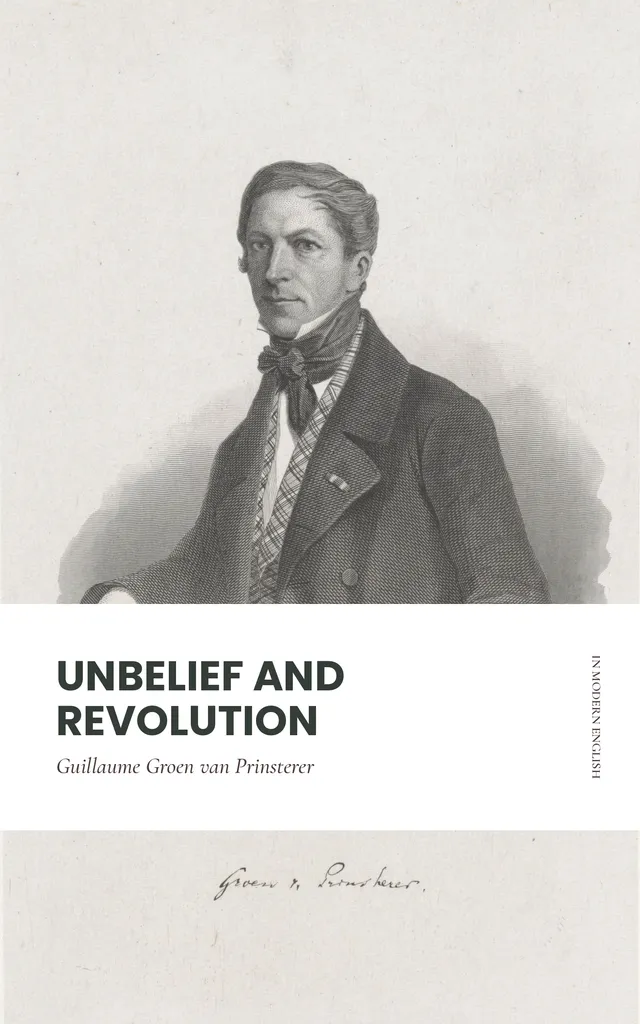
Cover of Unbelief and Revolution

Modern English edition · 1847 AD

Unbelief and Revolution

by Guillaume Groen van Prinsterer

Fifteen lectures arguing that the French Revolution was not a reaction to the abuses of the old European order but the working out of unbelief itself, once reason had been put in the place of God's law as the foundation of right.

Start reading free

One free account opens 250+ books and saves your place on every device. Google sign-in or an email link. No card.

Included with your free account

This book, and 250+ more, free to read

A free account opens the whole library to read online, on your phone or at your desk. Open a book on one device and it is waiting at the same page on the next. The PDF and EPUB of every book are yours to keep, and audiobooks play in the same app.

  • 250+ modernized editions Not samples. The whole work, free.
  • Your place, on every device Phone, tablet or desktop, same page.
  • 131 audiobooks From $4.99 each, or all of them with a $50 gift.
  • PDF and EPUB included Download any book to keep.
Create your free account Google sign-in or an email link. No card.
The in-app reader on a phone, mid-chapter of The Mortification of Sin in modern English
My Library on a phone, with a book to continue reading and the cover grid

Summary

Delivered
Winter of 1845 to 1846 · privately, in the author's study
Published
1847 · second edition 1868
Type
Lecture series in fifteen parts
Length
About 140,000 words · an 11-hour read

Unbelief and Revolution collects fifteen lectures Guillaume Groen van Prinsterer gave in the winter of 1845 to 1846, arguing that the French Revolution grew not from the abuses of the old European order but from unbelief itself. Once human reason replaced God's law as the foundation of right, he holds, radicalism and terror followed by strict logic.

How the argument unfolds

  1. 01

    The question. Groen opens with fifty years of Dutch decline and rules out the ordinary explanations, since the same decay appeared under “democracy, aristocracy, rule by one man, despotism, constitutional government” alike. The cause must lie in the ideas.

  2. 02

    What he means by Revolution. Not the events in France, but “the overturning of thought and disposition manifest throughout all Christendom”: popular sovereignty, the social contract, and the remaking of society by agreement.

  3. 03

    The old order acquitted. Three lectures test the usual indictment against the principles of the older constitutions, the monarchies built on them, and the abuses that crept in. Abuses could have caused a revolution, he grants, “but a revolution is not the Revolution.”

  4. 04

    The Reformation acquitted. Against writers who traced unbelief back to Protestantism, he inverts the comparison: “The Revolution starts from the sovereignty of man, the Reformation from the sovereignty of God.”

  5. 05

    The root. “The revolution-doctrine is unbelief in systematic form.” Once reason is sovereign in religion, sovereignty of the will follows in politics, and the descent into radicalism is a matter of consistency.

  6. 06

    Doctrine meets resistance. The theory never runs free. Conscience, human need, and acquired rights bend its course, so its actual history is a series of collisions rather than a straight application.

  7. 07

    The history and the charge. The last lectures run from 1789 through the Terror, Napoleon, the restoration of 1814, and the parliamentary Europe of the 1840s, treating the Terror as the furthest limit of the experiment rather than a departure from it.

Key themes

  • Ideas as historical causes. Groen treats doctrines as facts of the highest order and reads events as the visible form of what has been taught: “As the fruit is known from the tree, so from the fruit the tree shall be known.”
  • Consistency as the indictment. His sharpest argument is that moderates hold the revolutionaries' premise and only lack their nerve. Each faction after 1789 recoiled at “the conclusion drawn from what they themselves had just been preaching.”
  • Freedom and its counterfeit. He presents himself as defending liberty, not attacking it. Unlimited liberty granted by an unlimited state ends as “full liberty, subject to full slavery,” while true freedom “begins with submission to the laws.”

Lecture 1: Introduction

The subject of these Lectures is the argument that, since the rise of the Revolution-ideas, the cause of events lies in the natural development of these pernicious notions.

You rightly ask me to clarify the choice, nature, utility, and scope of this wide-ranging subject.

1. The choice. Upon completing the Handbook of the History of the Fatherland, I reflected on what has happened in the Netherlands since 1795 down to our own day. With the exception of moments when the hope of a better future presented itself, there was an unmistakable, and sometimes acute, sense of humiliation and decline. When we attend to our material interests, to the insignificance of the State, the narrowness of trade, the burdens on industry, the astonishing number of the destitute, we find everywhere a distressing contrast with former prosperity and splendor.

The decline is not confined to material welfare. In the political forms by which people have aimed at the beneficial union of authority and freedom, we see a long series of experiments: not only have all of them failed, but each has left behind an ever stronger feeling that constitutions show their strength more in disorganizing the State than in governing it.

This disorder extends to the entire fabric of civil society. Consider the dissolution of the diversity of Estates, as it was built upon acquired rights and upon the nature of social development; the disadvantages of unlimited competition; the removal of the bonds of love and submission that once grew out of a spirit of association and a sense of duty; the almost irresistible influence of the great capitalists; and the ever more threatening condition of poor relief. Even this superficial survey points to the existence of a general cause of social decay.

But, you say, experience has perhaps been the best teacher, and has led us, by a hard road, to the soundness of a theory which, drawn from deliberation and experience, becomes the unerring guide for better practice. Is that so? Has so much harm yielded at least this advantage, that the science of constitutional law has gained in development and certainty? The contrary is true.

Never perhaps has every question been so greatly and increasingly prey to uncertainty; never has doubt in science produced such wavering in action. Unable to govern the State by fixed rule or well-considered design, those in power count themselves fortunate if, living from day to day, they can accomplish whatever the course of events leads them to, willingly or unwillingly. Never before has an aversion to all theories arisen so strongly as a consequence of the deceptiveness of so many theories.

The same skepticism is visible in the foundations of Religion, morality, and law. Opinion is most deeply divided: everything has become subjective and individual. Everyone has his own faith, his own opinion, and for many these are so unstable that, with the changing of circumstances and the passing of years and days, they are constantly replaced by some other equally fleeting opinion. We have not one church creed, nor even a few religious denominations, but, under the almost universal name of Christian confession, a countless multitude of conceptions concerning God and His Word. The intensity of the conflict sometimes abates not through increasing agreement, but through diminishing interest.

Do I perhaps exaggerate? Judge for yourselves. When we look back, what do you make of the steps taken on the path of perfectibility, the endless improvement this age has promised itself? Do we rejoice over industry and trade? Are we unconcerned about financial affairs? Does the Netherlands play a brilliant or honorable role on the stage of Europe? Have we, through Constitution and Government, forged a lasting covenant of freedom and order? May we rejoice that Government and subjects are bound together by the bonds of mutual trust and affection?

Is there reason to be proud of the manner in which the organization of the state guarantees and promotes the rights of religion, morality, and science? Do we feel that the forces of the nation are given that unimpeded operation without which the state is a body without a soul? Does the government press forward, with steady progress, toward a well-chosen goal? Does diversity of views resolve into higher agreement? Is the multiplicity of opinion paired with unity of principles?

On a subject so serious, I wish to avoid even a tone that smacks of irony. I would rather ask plainly: where do this decline, this disorder, and this general decay come from? Do you attribute them to forms of government? We have had every kind: democracy, aristocracy, rule by one man, despotism, constitutional government. The entire storehouse of revolutionary governments has been at our disposal. To circumstances? They have not always been unfavorable. To the degeneration of the People? It had not sunk so low that no revival was possible. Was there a lack of men of ability and energy? There have been statesmen to whom I deny neither talent and character, nor good intention, and that compels us all the more to seek the reason why even their wisdom was deceived and their vigor paralyzed.

Everything thus points to a general cause, to whose influence forms of government and circumstances and national character and individual actors have all been subordinate. This cause must be sought in the ideas that have held sway. De la Mennais put it forcefully: “It must be said, for one can never know it too well: everything flows from doctrines, morals, literature, constitutions, laws, the happiness of states and their disasters, civilization, barbarism, and those terrifying crises that either carry peoples away or renew them, according to how much life remains in them.”

Events are the outlines and forms in which the constant workings of the spirit of the age reveal themselves. I wish to make this observable, over the course of the revolutionary era, beyond our own country as well. The history of Europe for more than half a century is the inevitable consequence of the errors that have taken possession of the prevailing mode of thought.

2. To demonstrate the nature of this subject, it is necessary to explain what I mean by Revolution and revolution-ideas. By Revolution I mean not merely one of the many events by which a displacement of public authority is brought about, nor simply the revolutionary storm that raged in France, but the overturning of thought and disposition manifest throughout all Christendom. By revolution-ideas I have in view the principles of liberty and equality, popular sovereignty, the social contract, and conventional regeneration, which are revered as the cornerstones of constitutional law and the structure of the state. The Revolution is, in short, the working out of a complete skepticism, in which God’s word and law have been set aside. I have set this out more fully in Grondwetherziening en Eensgezindheid and in the Narede op Vijfjarigen Strijd.

The conviction that the manifold evils our Fathers experienced, and that we ourselves have experienced, have flowed from this wisdom and from its source, the rejection of the Gospel, has been strengthened in me by fresh observation of the course of events. Once again I have seen how, wherever these theories have taken hold, one is led round in a circle of misery.

By strict application of the Revolution-doctrine one is led, in systematic fidelity, to the most extravagant absurdities and the worst atrocities. When, on the other hand, alarm at revolutionary development, mistaken for mere exaggeration, leads one to desire moderation of practice without abandoning the principle itself, one falls, shrinking from the consequences of one’s own convictions, into a wavering and arbitrariness that has no guide other than the drift and pressure of circumstances. This is what is even now cited as profound political wisdom: the deliberation of the doctrinaires; the system that now holds sway under the name of the juste-milieu, the middle course; the theory of the conservatives; and the system, or, to speak plainly, the routine, the feebleness and drowsiness, the rut, that has also gained the upper hand in our Fatherland.

The consequences of revolutionary ideas can only be effectively combated by taking a stand, outside their influence, on the ground of anti-revolutionary principles. That ground is unreachable so long as one does not acknowledge that the foundation of right lies in the law and ordinance of God. De Bonald expressed this truth with conciseness and deep meaning: “the Revolution began with the declaration of the rights of man; it will end only with the declaration of the rights of God.” Stahl says the same: “Only Christianity and the Christian State and the Christian School bring the Revolution in Europe to a close.”

3. The utility of my subject is evident. It goes to the heart of every dispute in religion and politics. Revolutionary ideas are unbelief applied to constitutional law. Between the Gospel and this practical godlessness there is a struggle of life and death, in which any thought of reconciliation becomes absurd, and which encompasses all that is holy and dear to us, all that is useful and indispensable for Church and State.

In speaking of the importance of the subject, I do not claim that deeper insight into the character of our time will be useful or agreeable to the selfish man or the narrow-minded egotist. On the contrary. The triumph of the principles I advocate is not to be expected any time soon. The errors I combat are strong enough to retain the upper hand in practice for a considerable time, even after they have been defeated in the field of science. Knowledge of truth is a burden for those who are unwilling to make sacrifices for truth. Knowledge that increases responsibility is not desirable for those who are concerned with honor or advantage, with the applause of their contemporaries.

The life circumstances of most of you are settled enough that you need not worry about the possible consequences of a sincere confession. But if a young man, just barely entering his political career, were to come to me for instruction in anti-revolutionary constitutional law, I would hesitate. I would at least endeavor to bring him first to self-examination. I would ask him: have you counted the cost? Are you ready for self-denial? If not, I would have no heart to prepare useless remorse for him. But if I discerned in him a nobler spirit, a more than ordinary measure of happiness and honor, I would call out to him: let nothing hold you back, for you truth has privileges and pleasures by which the loss of every expectation will be abundantly repaid.
Lecture 8: Unbelief

We are now at the beginning of the development of my principal idea: that the cause of the Revolution lies in unbelief.

With all its varieties of theoretical and practical directions and forms, the Revolution is a consequence, an application, and an unfolding of unbelief. Theoretical and practical unbelief together formed both the philosophy and the revolution of the eighteenth century. Once unbelief had gained the upper hand, a whole series of errors and horrors had to follow upon a series of syllogisms.

Do not suppose that I am proclaiming fatalism. Was Newton a fatalist when he asserted that, by the law of gravity, the apple once detached from the stem must fall? There are forces and laws in the realm of morality just as there are in the material world. Ancillon states the law of them: “As often as a strong impulse, given to a whole people, drags it violently out of the ruts of habit and hurls it into the career of movement, one is no longer master either to stop those movements or to direct them. The series of them must run its course, and the remedy for the evil is found only in the working out of the evil, which ceases only when it has passed through all its phases. In this sense one may say with truth that revolutions lead their own leading men and their authors.”

This irresistibility in the course of events does not remove personal responsibility. No one is compelled to bow before the idol of his age. The Christian’s “we cannot” then applies: “I can do no other” was the word of Luther and the martyrs’ watchword. Nowadays men say instead: “it cannot be otherwise.” Not inability to resist, but readiness to cooperate, will be laid to one’s charge. Mme de Staël put it exactly: “There are circumstances in which the most courageous men have no means of showing themselves actively, but there exists none that can oblige a man to do anything contrary to his conscience.”

To persuade ourselves, in that sense, of the unchangeability of the Revolution, a brief glance at the condition of Europe in the previous century is enough. Authority was confused with absolutism, liberty with arbitrariness. Constitutions degenerated, morals were corrupted, religion became hypocrisy or superstition and dead form. What else could one expect but the collapse of an undermined edifice?

But the kernel and purpose of my argument does not lie in that general observation. What I wish to prove is that in atheism, in godlessness, in being without God, lies the formative force of the revolutionary age, to which our own time also belongs. This trait is stamped upon the doctrine and the life of the revolution alike, in its essence and in its working. From the unbelieving nature of the Revolution I prove the necessity of its course, and conversely, in that course I find the persistent hallmark of the unbelieving origin.

I have not yet begun with biography. Biography must be preceded by physiological inquiry. What I understand by physiological inquiry will perhaps become clearer on reading and weighing these remarkable lines of Guizot:

“Facts properly so called, external and visible events, are the body of history; they are the limbs, the bones, the muscles, the organs, the material elements of the past, and their knowledge and description constitute what one might call historical anatomy. But for a society, as for an individual, anatomy is not the whole of the science. Facts not only subsist; they hold to one another, they succeed and beget one another by the action of certain forces, which act under the government of certain laws. There is, in a word, an organization and a life of societies as of the individual. That organization has its science too, the science of the hidden laws that preside over the course of events. That is the physiology of history.”

I wish to trace with you the general laws under whose dominion the eighteenth century formed itself, so that it may afterward appear that its history conforms to those laws. My concern is with the natural history of the mistaken notions that are still dominant even now.

Before I appeal to the testimony of history itself, logic will, I trust, make it plain that atheism in religion and radicalism in politics are not exaggeration, abuse, or deviation, but the consequence and application of the principle which, in the name of the supremacy of reason, sets aside the God of revelation.

The character of the eighteenth century lies before us for judgment. I shall not be bound by strict chronological exactness. I do not begin with 1700 and close with 1800; I mean the period of world-historical metamorphosis which, after long preparation, had its birth year in 1789. What a subject: how important, how difficult, open to how many points of view! I disparage what for many is even now an object of admiration. How easily, therefore, may the suspicion arise that I am guilty of pride, of superficiality, of conceit, of reckless contempt even where esteem is fitting. I have more need than ever, therefore, to remind you of the multitude of our fellow combatants in earlier and later times, of the unshakeableness of our principles, and of the historical character of our view.

It is not my aim to draw up an indictment. I desire a fair verdict. That century too had much good in it. No period, however deeply fallen, was ever devoid of virtues and talents. Even sorrowful times have their own particular luster, for the brilliance of the excellent is heightened by the darkness of its surroundings, as the flickering of the stars is heightened by the darkness of the night.

But I grant even more than this modest praise. The eighteenth century has comparatively much that distinguishes it favorably. It belongs at least not to those times whose sluggishness is contemptible. Its striving was an attempt to raise itself out of the mire. The spirit of the age put an end to the narrow-mindedness, the aridity, and the self-interest by which the preceding years, here in our own country as well, were marked.

It was not wrong to seek improvement. Even when you set aside all that was exaggerated, there remained abundant reason for discontent with the conduct of the authorities and the degeneration of the constitution, and abundant ground to demand weighty reforms in the name of justice and humanity.

In its zeal for improvement the century had uncommon and, at least in the beginning, disinterested vigor. All powers and gifts, awakened and strained beyond the ordinary degree, were devoted with high-wrought enthusiasm to the triumph, not of interests, but of principles. Guizot, after saying that “the eighteenth century preached doubt, egoism, and materialism,” adds, in my opinion very justly: “In spite of its critical and destructive tendency, it was an ardent and sincere century, a century of faith and of disinterestedness. It had faith in truth, in humanity.... It deceived itself, and lost its way in that double confidence” (Mémoires, II. 425).

Fine words and striking ideas were not lacking.

And where the century erred in its choice of principles and strayed from the path of reform onto the road of revolution, it had excuse. For what had become of the warmth and glow of the evangelical spirit that had formerly borne fruit in deeds of faith? Narrow superstition, persecution-prone hypocrisy, and traditional attachment to a doctrine fragmented into dogmas. Is the failure to recognize the truth not also to be laid to the charge of the age that had made the truth unrecognizable?

Further than this I cannot go in my defense. The principle of the sovereignty of man, independence from the sovereignty of God, is radically false. There was a surge of the human spirit. I do not add to that, with Guizot, that “its surge was very fine, very good, very useful” (Cours d’Histoire moderne, L. 14, page 39). A course that tears itself from the firm ground of immutable principles, to float unsupported in the empty space of speculation, an accelerated movement of so reckless a nature, I compare to the presumptuous leap from the uppermost story, ventured in ruinous confidence upon artificial wings.

A golden age was expected; an iron one came. Progress and movement arouse less aversion than dreaming idleness or slovenliness; one prefers flowing water to a swamp.

Nevertheless energy, ill directed, becomes the more disastrous the more powerful it is. The grandeur of a mountain torrent does not lessen the horror of the effect when the destructive flood covers the land.

Questions

What is the main argument of Unbelief and Revolution?
The main argument of Unbelief and Revolution is that the French Revolution was caused by unbelief rather than by the failures of the old European order. Groen states it in one line: “Revolutionary ideas are unbelief applied to constitutional law.”
What does Groen van Prinsterer mean by “the Revolution”?
Groen uses “the Revolution” for a change of mind across Europe, not for the events of 1789. He defines it as “the overturning of thought and disposition manifest throughout all Christendom,” working through liberty and equality, popular sovereignty, and the social contract.
Is Unbelief and Revolution an argument against democracy?
Unbelief and Revolution attacks popular sovereignty as a foundation of right rather than representative government as such. Groen argues that a state answerable only to the general will has no limit on its power, and his closing lecture rejects any sudden overturning of the social order, asking instead for “the overcoming of liberalism by liberty.”
Does Groen blame the Reformation for the French Revolution?
No. Groen gives a full lecture to refuting that charge, which he attributes to De Bonald, De Maistre, and de la Mennais, and answers it by inverting it: “The Revolution came up out of the abyss; the Reformation came down from Heaven.”
How does the book relate to the Anti-Revolutionary Party?
These lectures are the source of the program Groen later organized into a party. In the final lecture he describes working, after entering the national assembly following 1848, at the “bringing to dutiful activity, of an already existing christian-historical and therefore anti-revolutionary party.”
When was Unbelief and Revolution written?
Groen delivered the lectures privately in his study during the winter of 1845 to 1846 and published them in 1847. A second edition followed in 1868, its text nearly unchanged but its notes expanded after the revolutions of 1848.
Portrait of Guillaume Groen van Prinsterer

About the author

Guillaume Groen van Prinsterer

Guillaume Groen van Prinsterer (1801 to 1876) was a Dutch historian and statesman who served as archivist of the House of Orange-Nassau and edited its correspondence in the Archives de la Maison d'Orange-Nassau. He sat in the Second Chamber of the States General and worked to organize a Christian-historical, and therefore anti-revolutionary, party in Dutch politics. His Handbook of the History of the Fatherland and these lectures made him the founding voice of the Anti-Revolutionary movement.