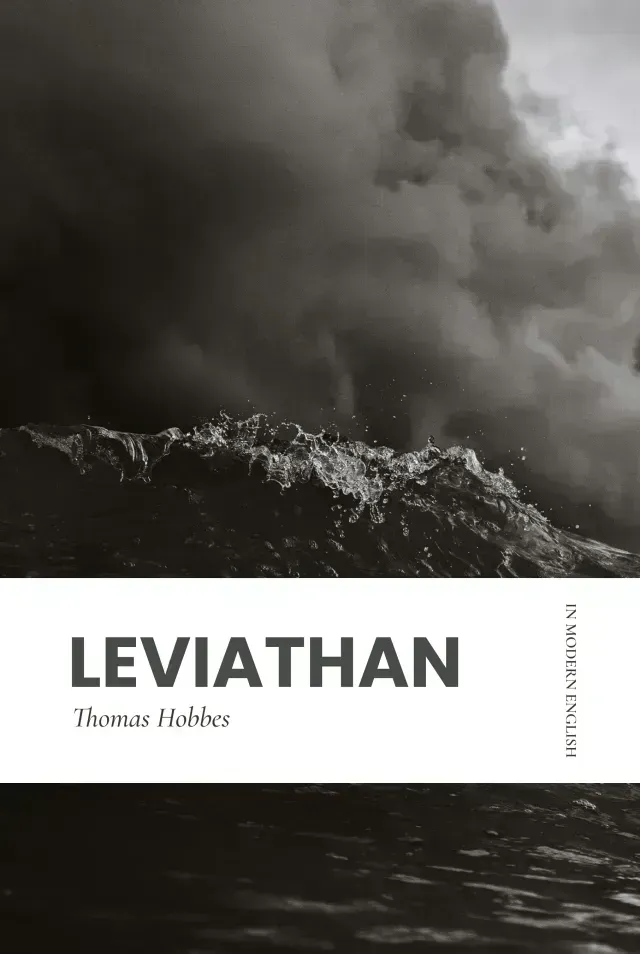
The foundational masterwork of modern political philosophy. Hobbes's rigorous account of human nature, the state of nature, and the social contract remains essential reading for anyone grappling with questions of power, authority, and the origins of civil society.
One free account opens 250+ books and saves your place on every device. Google sign-in or an email link. No card.
You’re on the list — we’ll email you if this goes to print.
Included with your free account
This book, and 250+ more, free to read
A free account opens the whole library to read online, on your phone or at your desk. Open a book on one device and it is waiting at the same page on the next. The PDF and EPUB of every book are yours to keep, and audiobooks play in the same app.
250+ modernized editionsNot samples. The whole work, free.
Your place, on every devicePhone, tablet or desktop, same page.
131 audiobooksFrom $4.99 each, or all of them with a $50 gift.
1651 · London, in the aftermath of the English Civil War
Type
Treatise
Length
About 205,000 words · a 15-hour read
Leviathan is Thomas Hobbes' 1651 treatise arguing that without a common power to keep people in awe, human life collapses into a war of every person against every person. To escape it, people covenant together to surrender their self-governance to one sovereign, whose absolute authority alone secures peace.
“The life of man in such a state is solitary, poor, nasty, brutish, and short.”
From this edition
How the argument unfolds
01
Man and the state of nature. Nature made people roughly equal, so equal hope breeds equal enmity. Competition, distrust, and glory drive them to war: "The life of man in such a state is solitary, poor, nasty, brutish, and short."
02
The laws of nature. Reason supplies terms of peace. The first law is "to seek peace and follow it"; the rest compress into "Do not do to others what you would not want done to yourself."
03
Why the laws are not enough. They bind conscience but cannot bind conduct: "Agreements without force behind them are nothing but words, offering no real security to anyone."
04
The covenant and the sovereign. Each person covenants with every other: "I authorize this person... to govern me, and I surrender my right of self-governance on the condition that you surrender yours to him equally."
05
The parts of the commonwealth. The sovereign judges law, property, doctrine, war, and honor. Subjects authored those acts, so "nothing the sovereign does can constitute an injury to any of his subjects."
06
Religion and the commonwealth. Parts Three and Four turn to Scripture, arguing that the Kingdom of God is not the present Church and that the Kingdom of Darkness is "a confederacy of deceivers."
Key themes
Fear as a political foundation. Fear of violent death drives people into war and then back out of it. The passions inclining men toward peace are "the fear of death, the desire for things necessary to a comfortable life..."
Authority as undivided. The rights of sovereignty are "by their nature, non-transferable and inseparable." Every division of that power, king against parliament or church against state, is a commonwealth already returning to war.
Scripture read politically. Half the book treats the Bible as evidence in a political argument, concluding that Christians "are not presently bound by covenant to any king other than our civil sovereigns."
Dedication
Honored Sir, YOUR most worthy brother, Mr. Sidney Godolphin, a Royalist poet killed in the Civil War, while he lived, was kind enough to regard my work with genuine esteem, and to show me, as you well know, real and generous signs of his good opinion. Those signs were significant in themselves, and made all the more meaningful by the quality of his character. For there was no virtue that inclines a man toward the service of God, the service of his country, civil society, or private friendship that did not shine clearly in his conduct, not as something forced on him by circumstance or performed for effect, but as something native to him, glowing from a generous and noble nature. It is in honor and gratitude to him, therefore, and with sincere devotion to you, that I humbly dedicate this work on the Commonwealth.
I cannot know how the world will receive it, nor how it may reflect on those who appear to support it. For in a path flanked on one side by those who demand too much liberty and on the other by those who demand too much authority, it is difficult to pass between them without being wounded by both. And yet it seems to me that an effort to strengthen civil power should not be condemned by civil power itself, nor should private individuals, by criticizing that effort, declare that they think such power already too great. Beyond that, I speak not of particular men, but of the seat of power in the abstract, much like the sacred geese on the Roman Capitol, whose cries warned defenders of an approaching attack, and who raised their voices to defend those within its walls, not because of who those people were, but simply because of where they were. I believe I offend no one except those outside, or any within (if such there be) who side with them. What may give the greatest offense is my use of certain passages of Holy Scripture, cited for purposes other than those to which they are commonly applied. But I have done so with proper care and submission, and also out of necessity given my subject, for those passages are the outer defenses from which the enemies of civil power launch their attacks. If, despite all this, you find my work widely condemned, you are welcome to excuse yourself by saying that I am a man who loves his own opinions and believes everything he says, that I honored your brother and honor you, and that I presumed on that affection to claim the title, without your prior knowledge, of being, as I am, SIR, your most humble and most obedient servant.
Paris, April 15/25, 1651. THO. HOBBES.
Introduction
NATURE, the art by which God made and governs the world, is imitated by the art of man in this among many other things: that it can make an artificial animal. For since life is nothing but a motion of the limbs, beginning from some principal internal part, why may we not say that all automata (engines that move themselves by springs and wheels, as a watch does) have an artificial life? For what is the heart but a spring, the nerves but so many strings, and the joints but so many wheels, giving motion to the whole body as the maker intended? But art goes further still, imitating that rational and most excellent work of nature: man himself. For by art is created that great LEVIATHAN called a COMMONWEALTH or STATE, which is nothing but an artificial man, though of greater stature and strength than the natural man, for whose protection and defense it was intended. In it, sovereignty is an artificial soul, giving life and motion to the whole body; magistrates and other officers of law and government are artificial joints; reward and punishment, by which each member is fastened to the seat of sovereignty and moved to perform his duty, are the nerves, performing the same function as in the natural body; the wealth and riches of all the individual members are the strength; the people's safety is its business; counselors, by whom all things needful for it to know are suggested to it, are the memory; equity and laws are an artificial reason and will; concord is health; sedition, sickness; and civil war, death. Lastly, the pacts and covenants by which the parts of this body politic were first made, assembled, and united resemble that Fiat, that "Let us make man," pronounced by God in the Creation.
To describe the nature of this artificial man, I will consider, first, its Matter and its Artificer, both of which are Man. Second, how and by what Covenants it is made; what are the Rights and legitimate Power or Authority of a Sovereign; and what preserves or destroys it. Third, what is a Christian Commonwealth. And finally, what is the Kingdom of Darkness.
On the first point: there is a saying that has been much repeated of late, that Wisdom is acquired not by reading Books, but by reading Men. Those who take this to heart, and who can rarely offer any other proof of their wisdom, take great pleasure in showing off what they claim to have read in others, through uncharitable judgments made behind people's backs. But there is another saying, largely forgotten today, by which they could learn to truly read one another, if they were willing to make the effort. That saying is: know yourself. This was never meant, as it tends to be used now, to excuse the brutish behavior of powerful people toward those beneath them, or to encourage those of lower standing to act with insolence toward their betters. It was meant to teach us something far more valuable: that because the thoughts and passions of one person so closely resemble those of another, anyone who looks honestly inward and considers what they are doing when they think, form opinions, reason, hope, fear, and so on, and on what grounds, will thereby come to understand the thoughts and passions of all other people in similar circumstances.
I say the similarity of Passions, which are the same in every person: desire, fear, hope, and the rest. I do not mean the similarity of the objects of those passions, meaning the specific things desired, feared, or hoped for. Those vary so widely depending on individual temperament and upbringing, and are so easily concealed from outside observation, that the inner workings of a person's heart, obscured as they are by pretense, deception, self-presentation, and false beliefs, are legible only to God, who alone searches hearts. And while we can sometimes infer a person's intentions from their actions, to do so without comparing those actions to our own experience, and without carefully accounting for every circumstance that might change the meaning, is to attempt a decipherment without a key. We will, more often than not, be led astray, either by trusting too much or by suspecting too much, depending on whether we ourselves are, at heart, good or bad.
Even when one person reads another with great accuracy through their actions, that knowledge only applies to the few people they actually know. A ruler governing an entire nation can't rely on knowledge of this or that specific individual; he must understand humanity as a whole. That's harder than learning any language or science, but once I've laid out my own observations clearly and in order, all that remains for the reader is to look inward and ask whether he finds the same things in himself. This kind of knowledge admits no other proof.
Part 1: Of Man
Of Sense
Concerning the thoughts of man, I will consider them first individually, and then in sequence, as they depend on one another. Taken individually, each thought is a representation or appearance of some quality or other property of a body outside us, which we commonly call an object. That object acts on the eyes, ears, and other parts of the human body, and through the different ways it acts, it produces different appearances.
The origin of all these thoughts is what we call SENSE. There is no conception in a person's mind that has not first been produced, either wholly or in part, through the organs of sense. Everything else is derived from that origin.
Understanding the natural cause of sense is not strictly necessary for what I'm doing here, and I've written about it at length elsewhere. Still, to give each part of my method its proper treatment, I'll offer a brief account of it now.
Sensation is caused by an external body or object pressing on the sense organ appropriate to it, either directly, as with taste and touch, or indirectly, as with sight, hearing, and smell. This pressure travels inward through the nerves and other tissues of the body to the brain and heart, producing there a kind of resistance or counter-pressure, a straining of the heart to free itself. Because this straining is directed outward, it appears to us as something existing outside ourselves. That appearance, that seeming, is what we call sense; and it takes the form, for the eye, of light or color with shape; for the ear, of sound; for the nose, of smell; for the tongue and palate, of taste; and for the rest of the body, of heat, cold, hardness, softness, and the other qualities we perceive through touch. All these qualities, which we call sensible, do exist in the objects that produce them, but only as various motions of matter pressing on our organs in different ways.
In us, the ones being pressed, they are likewise nothing more than different kinds of motion, since motion produces nothing but further motion. What we actually experience is an appearance, a fancy, and it is the same whether we are awake or dreaming. Just as pressing, rubbing, or striking the eye makes us see a flash of light, and pressing the ear produces a ringing, so too do the objects we see and hear produce those same sensations through their own powerful, if unnoticed, action on us. If colors and sounds actually resided in the objects that cause them, they could not be separated from those objects; yet we know they can be, as when lenses bend light or echoes reflect sound, producing an appearance in one place while the object itself stands in another. And although at certain distances the real object seems to be wrapped in the very image it creates in our minds, the object and the image remain two distinct things. Sensation, in every case, is therefore nothing other than original fancy, produced, as I have said, by the pressure, that is, by the motion, of external things on our eyes, ears, and the other organs made to receive them.
But the philosophy schools, through every university in Christendom, build their teaching on certain texts of Aristotle and arrive at a very different conclusion. For the cause of vision, they claim that the object seen sends out on every side a visible species (that is, a visible show, apparition, or aspect, a kind of "being seen"), and that the eye's reception of this emission constitutes sight. For the cause of hearing, they claim that the object heard sends out an audible species, meaning an audible aspect or audible "being seen," which enters the ear and produces hearing. And for the cause of understanding, they go further still, claiming that the object understood sends out intelligible species, an intelligible "being seen," which enters the understanding and produces thought. I say this not to condemn universities as such; but because I will be discussing their role in a commonwealth later on, I must take every opportunity along the way to point out what needs to be reformed in them, and the habitual use of meaningless language is one such problem.
Of Imagination
Everything at rest will stay at rest forever unless something else moves it. No one disputes that. But the reverse, that everything in motion will stay in motion forever unless something else stops it, is harder for most people to accept, even though the reasoning is exactly the same: nothing can change its own state. The problem is that people measure everything, including other people and all other things, by their own experience. Because we feel pain and exhaustion after physical effort, we assume that everything else must also grow tired of moving and naturally seek rest. We rarely stop to ask whether that very desire for rest we feel in ourselves might itself be a form of motion. This is why the Scholastics claimed that heavy objects fall downward out of an appetite for rest, seeking the place most suited to their nature. In doing so, they attributed appetite and knowledge of self-preservation to inanimate things, which is a greater capacity than humans themselves possess. It is, plainly, an absurd conclusion.
Once a body is set in motion, it will continue moving forever unless something else stops it, and whatever does stop it cannot do so instantly. The motion is extinguished gradually, over time. We can see this clearly in water: even after the wind dies down, the waves keep rolling for a long time afterward. The same principle applies to the motion that occurs within a person during seeing, dreaming, and similar experiences. After an object is removed from view, or after we close our eyes, we still hold an image of what we saw, though it is dimmer than when we were actually looking at it. The Latins called this Imagination, drawing the word from the image formed in the act of seeing, and they applied it, somewhat loosely, to the other senses as well. The Greeks called it Fancy (mental image), meaning appearance, a term that fits every sense equally well. Imagination, then, is nothing more than decaying sense: a fading impression left behind after perception ends. It is found in humans and in many other living creatures, both asleep and awake.
The fading of sensation in waking life isn't the fading of the motion that produced it, but rather its being overshadowed, much as sunlight drowns out the light of the stars. The stars shine just as powerfully during the day as they do at night, but because our eyes, ears, and other senses are constantly bombarded by external stimuli, only the strongest impression registers. Sunlight being the dominant force, we simply don't perceive the action of the stars. Similarly, when an object is removed from our sight, the impression it left behind doesn't vanish immediately; but as new objects press in on us and demand our attention, the memory of the earlier one grows dim and faint, like a single voice swallowed up by the noise of a busy day. It follows from this that the longer the time since we perceived something, the weaker our mental image of it becomes.
The body is in constant flux, and over time it breaks down the very parts that were set in motion by sensation. In this way, distance in time and distance in space produce the same effect on us. Just as something viewed from far away appears blurry and stripped of its finer details, and just as voices grow faint and indistinct with distance, so too does our mental image of the past grow weak with the passage of time. We lose, for instance, the memory of particular streets in cities we once knew well, and the specific details of events we once witnessed. This fading sensation, when we mean to describe the thing itself (that is, the mental image as such), we call Imagination, as I noted earlier. But when we mean to describe the fading, to convey that the sensation is growing old and receding into the past, we call it Memory. So Imagination and Memory are, in fact, one and the same thing, simply given different names depending on how we're thinking about it.
Extensive memory, or the memory of many things, is called Experience. Imagination, meanwhile, can only work with what the senses have previously taken in, whether all at once or piece by piece over time. The first kind, which involves picturing a whole object exactly as the senses originally perceived it, is called Simple Imagination: for instance, when someone pictures a man or a horse they have seen before. The second kind is Compound Imagination, as when a person who has seen a man at one time and a horse at another combines both images in the mind to conceive a Centaur. Similarly, when someone merges the image of himself with the image of another person's deeds, imagining himself to be a Hercules or an Alexander the Great (which happens often to those who are deeply absorbed in reading romances), that too is a compound imagination, and more precisely a fiction of the mind. There are also other kinds of imagination that arise in people even while they are fully awake, produced by a particularly powerful impression on the senses. After staring at the sun, for example, the impression lingers and leaves an image of the sun before the eyes long afterward; and after concentrating long and intensely on geometric figures, a person will see images of lines and angles in the dark even while wide awake. This kind of mental image has no specific name, since it is not something that commonly comes up in ordinary conversation.
The mental images we experience while asleep are what we call Dreams. Like all other mental images, they are drawn from things we have previously encountered through our senses, either in full or in fragments. During sleep, the brain and nerves (the organs essential to sensation) become so numbed that external objects can no longer easily stimulate them. This means that no new sensory impressions can form during sleep, and therefore no dream can arise except from the stirring of the body's internal organs. These organs, through their connection to the brain and other parts of the body, keep the mind in motion when they are disturbed, causing mental images formed earlier to reappear as vividly as if the person were awake. In fact, because the sensory organs are now numbed and no new external impression exists to overpower and crowd out those earlier images, a dream will actually be sharper and clearer in that silence than our ordinary waking thoughts tend to be. This is why it is so difficult, and many have thought impossible, to draw a clear line between sensation and dreaming. For my own part, I notice that in dreams I don't consistently think about the same people, places, objects, and events that occupy my waking mind, nor do I follow as long and coherent a train of thought while dreaming as I do when awake. I also notice that while awake I frequently recognize how absurd my dreams were, yet I never dream about the absurdities of my waking thoughts. These observations satisfy me that when I am awake, I know I am not dreaming, even though when I am dreaming, I believe myself to be awake.
Since dreams are caused by disturbances in the body's internal organs, different disturbances will naturally produce different dreams. Sleeping in the cold, for instance, breeds dreams of fear and conjures the image of something terrifying (since the signals between the brain and the internal organs flow in both directions). Just as anger produces heat in certain parts of the body while we are awake, overheating those same parts during sleep produces anger and raises in the brain the image of an enemy. By the same logic, just as natural affection while we are awake produces desire, and desire generates heat in certain other parts of the body, too much heat in those parts during sleep raises in the brain the image of some kindness being shown to us. In short, our dreams are the mirror image of our waking thoughts: when we are awake, the process begins at one end, and when we dream, it begins at the other.
It's often hardest to distinguish a dream from waking thought when we haven't noticed ourselves falling asleep. This happens easily to someone weighed down by fearful thoughts and a troubled conscience, someone who drifts off without the usual rituals of going to bed or undressing, like a person nodding off in a chair. When a person deliberately and carefully lies down to sleep, any strange or disturbing image that comes to them can be readily recognized as a dream. But that recognition isn't available to someone who never knew they were sleeping.
Consider the case of Marcus Brutus, the man whose life Julius Caesar had spared and who was also Caesar's close favorite, yet who murdered him nonetheless. The night before his battle against Augustus Caesar at Philippi, he reportedly saw a terrifying apparition, which historians have generally recorded as a vision. But when you look closely at the circumstances, it's easy to conclude it was nothing more than a brief dream. He was sitting in his tent, brooding and tormented by the horror of what he had done. Slumbering in the cold, troubled as he was, it would have been entirely natural for him to dream of the very thing that frightened him most. As that fear gradually roused him to wakefulness, the apparition would have faded gradually as well. And since he had no awareness of having fallen asleep, he had no reason to think it was a dream rather than a genuine vision.
This is not a rare occurrence. Even people who are fully awake, if they are fearful and superstitious, filled with frightening stories and left alone in the dark, are prone to the same kind of illusions. They become convinced they see spirits and the ghosts of the dead wandering through churchyards. In reality, what they're experiencing is either their own imagination running wild, or the trickery of people who deliberately exploit such superstitious fear, slipping through the night in disguise to visit places they wouldn't want anyone to know they frequent.
From this inability to distinguish dreams and vivid imaginings from genuine visions and sensory experience arose the greater part of ancient pagan religion, with its worship of satyrs, fauns, nymphs, and similar beings. The same confusion persists today in the beliefs that uneducated people hold about fairies, ghosts, goblins, and the power of witches. As for witches, I don't believe their witchcraft represents any real power; yet I think they are justly punished for the false belief that they can cause harm, combined with their clear intention to do so if they could. Their practice resembles a new religion far more than it resembles a craft or science. As for fairies and wandering ghosts, I think belief in them has been deliberately cultivated, or at least left unchallenged, in order to maintain the credibility of exorcism, crosses, holy water, and other such inventions of the clergy. That said, there is no doubt that God can produce supernatural apparitions. But the idea that He does so frequently enough that people need to fear such things more than they fear the suspension or alteration of the natural order (which He can also suspend and alter) is not a point of Christian faith. Wicked men, hiding behind the claim that God can do anything, are bold enough to say anything that serves their purposes, even when they know it to be false. A wise person will believe them only as far as sound reason makes their claims credible. If this superstitious fear of spirits were removed, along with it the prophecies drawn from dreams, false predictions, and the many other practices that cunning and ambitious people use to manipulate the simple, humanity would be far better prepared for civil obedience than it currently is.
The schools should be correcting this kind of confused thinking, but instead they actively reinforce it. Because they don't understand what imagination or the senses actually are, they simply pass on whatever they've received. Some claim that imaginations arise on their own, with no cause at all. Others say they arise mostly from the will, and that good thoughts are breathed (inspired) into a person by God, while evil thoughts come from the Devil. Or, in another version, that good thoughts are poured (infused) into a person by God, and evil ones by the Devil. Some say the senses receive the forms of things and pass them along to the common sense, which hands them to the fancy, which passes them to the memory, which delivers them to the judgment, like a relay of objects passed from hand to hand, with many words that ultimately explain nothing.
The imagination that is stirred in a person (or in any other creature capable of imagining) by words or other deliberate signs is what we generally call Understanding, and it is something humans share with animals. A dog, through habit, will understand its master's call or scolding, and so will many other animals. What sets human understanding apart is that it grasps not only another's will, but also their thoughts and conceptions, through the sequence and arrangement of words into affirmations, negations, and other forms of speech. I will address this kind of understanding in more detail later.
Of the Consequence or Train of Imaginations
By the consequence, or TRAIN of thoughts, I mean the succession of one thought following another, which is called (to distinguish it from spoken discourse) Mental Discourse.
When a person thinks about something, the thought that follows isn't as random as it might appear. Thoughts don't simply succeed one another at will. Just as we have no mental image of anything we haven't previously perceived through our senses, either as a whole or in parts, we also have no transition from one mental image to another that hasn't been preceded by a similar transition in our sensory experience. The reason for this is straightforward. All mental images are motions within us, the residue of motions originally produced by sensation. The motions that followed one another in sequence during sensation continue to follow one another in the same sequence after sensation has ended. So when an earlier motion returns and becomes dominant, the later one follows through the physical continuity of the matter in motion, much like water on a flat table being drawn in whatever direction a finger guides one part of it. But because in sensation, the same perceived thing can be followed at different times by different things, it follows that when we imagine something, we can't be certain what we'll imagine next. The one thing we can be certain of is this: whatever comes next will be something that, at some point in the past, followed that same thought before.
This train of thought, or mental discourse, comes in two varieties. The first is unguided, without purpose, and inconsistent. In this mode, no governing passion directs each thought toward some desired end or goal, and so the thoughts seem to wander, disconnected from one another, much like the images in a dream. This is how most people think when they are not only alone but also free from any pressing concern. Their minds are just as active as ever, but without coherence, like the sound a lute would produce when badly out of tune, or when played by someone who has no idea how to play. And yet even in this wild ranging of the mind, you can often trace the path it takes and see how one thought leads to the next. Consider a conversation about our present civil war: nothing could seem more out of place than someone suddenly asking what a Roman penny was worth. Yet the connection was perfectly clear to me. The thought of the war brought to mind the image of the King being handed over to his enemies; that thought led naturally to the betrayal of Christ; and that in turn called up the thirty pieces of silver paid for that treason, from which the pointed, malicious question followed easily enough. All of this happened in an instant, because thought moves fast.
The second type of thought is more consistent, because it's guided by some desire or goal. The impression left by things we want or fear is powerful and lasting; even when it fades for a time, it returns quickly. Sometimes it's so strong that it disrupts and breaks our sleep. From desire comes the thought of some means we've seen produce the kind of result we're after, and from that comes the thought of the means to reach that means, and so on continuously, until we arrive at some starting point within our own power to act on. And because the goal, by the sheer force of the impression it makes, keeps coming back to mind, whenever our thoughts begin to wander they are quickly pulled back on course. One of the Seven Sages of Greece noticed this tendency and gave humanity a precept that has since fallen out of use: in everything you do, keep your eye on what you want, since that goal is what directs all your thoughts toward achieving it.
Purposeful thinking comes in two varieties. The first involves imagining an effect and then working backward to find its causes or the means that produced it; this kind is common to both humans and animals. The second involves imagining something and then working forward to consider all the possible effects it might produce, essentially asking what we could do with it once we have it. I have never seen any sign of this second kind in any creature other than humans, because it requires a kind of curiosity that is almost impossible to find in beings driven purely by physical urges such as hunger, thirst, lust, and anger. In short, when the mind's wandering is directed by a purpose, it becomes nothing more than Seeking, or the faculty of invention, a hunting down of the causes behind some present or past effect, or of the effects flowing from some present or past cause. Sometimes a person searches for something they have lost, and from the place and moment where they first noticed it missing, the mind runs backward through places and times, trying to locate where and when they last had it, essentially trying to find a fixed starting point from which to begin a methodical search. Then, from that point, their thoughts retrace the same places and times, looking for whatever action or circumstance might have caused the loss. We call this Remembrance, or calling something to mind: a re-counting of our past actions.
Questions
What is Leviathan by Thomas Hobbes about?+
Leviathan is about why people need government and how much power it must hold. Hobbes argues that without a common authority, life is a war of every person against every person, escaped only by a covenant transferring everyone's self-governance to one sovereign. The second half applies that argument to Scripture and church power.
What was Hobbes' main message in Leviathan?+
Hobbes' main message in Leviathan is that peace requires one undivided sovereign authority. Reason can name the terms of peace but cannot enforce them: "Agreements without force behind them are nothing but words, offering no real security to anyone." Divide that power and the commonwealth slides back toward civil war.
Why did Hobbes write Leviathan?+
Hobbes wrote Leviathan against the background of the English Civil War, which he treats as proof of what follows when sovereign power is divided. He finished it in Paris in 1651, describing his position as a path "flanked on one side by those who demand too much liberty and on the other by those who demand too much authority."
Why is the book called Leviathan?+
The book is named for the sea beast of Job 41, an image of the commonwealth's overwhelming power. Hobbes applies that chapter's closing verses to the sovereign: "There is nothing on earth to be compared with him... He sees every high thing below him, and is king of all the children of pride."
What is the state of nature according to Hobbes?+
The state of nature, according to Hobbes, is the condition people are in when no common power keeps them in awe: a war of every person against every person. Competition, distrust, and glory make attacking others rational, leaving "no arts, no literature, no society" and a life "solitary, poor, nasty, brutish, and short."
What is the social contract in Leviathan?+
The social contract in Leviathan is a covenant each person makes with every other person, not with the ruler. Each says in effect: "I authorize this person... to govern me, and I surrender my right of self-governance on the condition that you surrender yours to him equally." Because the sovereign is never a party to it, he cannot break it.
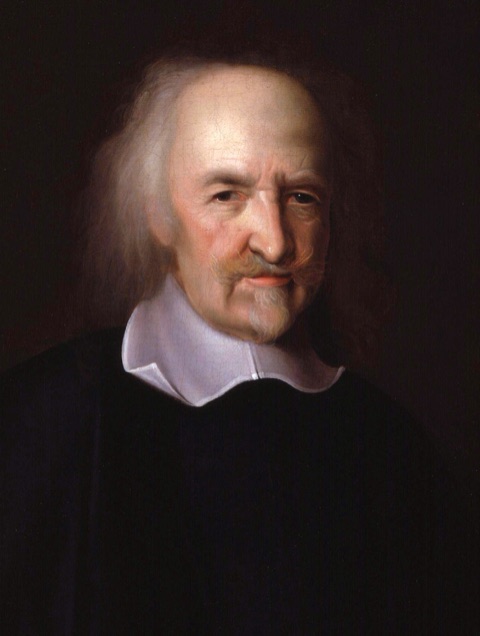
Thomas Hobbes was an English philosopher regarded as one of the founders of modern political philosophy. Born in Westport, Wiltshire, he was educated at Oxford and spent much of his career as a tutor to the Cavendish family. His travels across Europe brought him into contact with leading thinkers including Galileo and Descartes. The English Civil War profoundly shaped his thought, convincing him that only a powerful sovereign authority could prevent society from descending into chaos. His masterwork "Leviathan" (1651), written during his exile in Paris, laid the groundwork for social contract theory and remains one of the most influential works of political philosophy ever written.