Modernized edition · Full text · Free PDF/EPUB
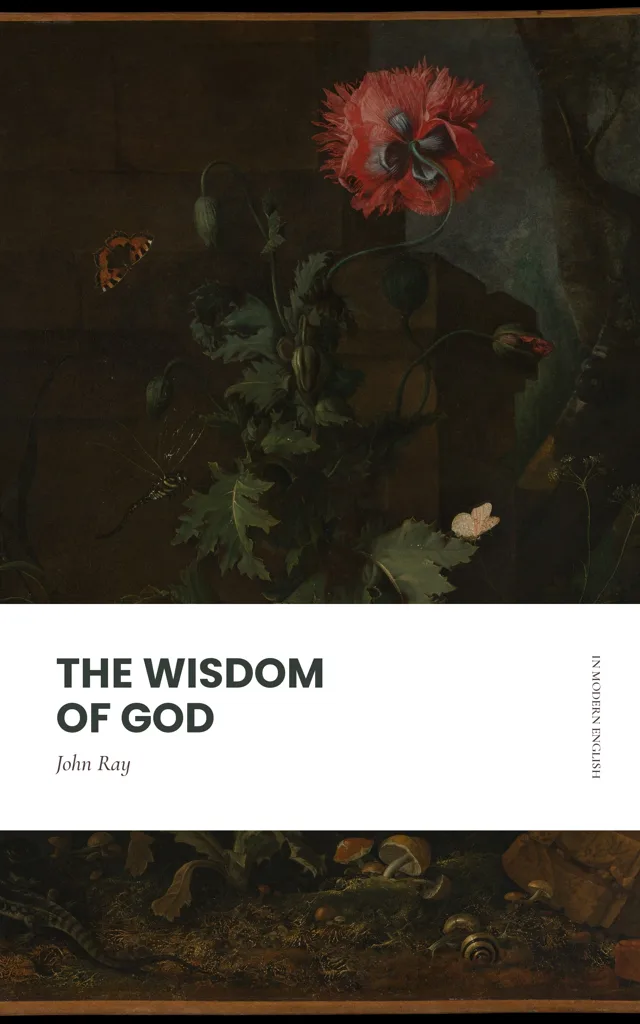
The Wisdom of God Manifested in the Works of the Creation in Modern English
Want the file? The PDF/EPUB is free with an account.
Summary
- Author
- John Ray (1627 to 1705 AD), English naturalist, former fellow of Trinity College, Cambridge, and Fellow of the Royal Society
- First published
- 1691 AD
- Source edition
- The complete fourth edition of 1704, the last Ray revised, with his dedication, preface and advertisement concerning the fourth edition
- Type
- Natural theology and natural history
- Length
- 102,000 words · 7 hours
What is The Wisdom of God Manifested in the Works of the Creation about?
The Wisdom of God is John Ray's The Wisdom of God Manifested in the Works of the Creation, first published in 1691 and given here in the fourth edition of 1704, the last Ray revised. Taking Psalm 104:24 as his text, Ray answers the atheist and mechanical accounts of the world, surveys the heavens, elements, plants and animals, examines the earth and the human body closely, and ends with practical inferences for body and soul.
Read the full summary (20 points, key themes)Show less
How the argument unfolds
- 01
Dedication to Lady Lettice Wendy. Ray offers the book to his patroness and writes to her as one long afflicted with bodily pain, which he calls the sorest evil we feel in this world.
- 02
Preface. He defends writing on a subject others have handled, and argues that the works of creation prove a God to the plainest people, who say “every blade of grass or ear of grain proves it well enough.”
- 03
Advertisement concerning the fourth edition. The book has come unexpectedly to a fourth printing, and Ray apologizes to earlier buyers for inserting the new observations in their proper places.
- 04
The multitude of God's works. On the first clause of Psalm 104:24, Ray counts what can be counted: stars that are likely suns, some 20,000 kinds of insects, and plants far beyond the 6,000 Bauhin listed.
- 05
The atheists' hypotheses answered. Aristotle's eternal world, the Epicurean swerve of atoms and the Cartesian world of matter in motion are rejected, and Ray argues that beasts are not machines.
- 06
The visible works and their division. Bodies are sorted into inanimate and animate, celestial and terrestrial, and the microscope shows nature finer and art coarser the closer each is viewed.
- 07
The heavenly bodies. Gravity holds the turning bodies together, and the sun, moon, planets and fixed stars move with a constancy that shows wisdom.
- 08
Fire, air, water and earth. The uses of fire and glass, air as the fuel of the vital flame, the size of the sea and the work of the winds, and the earth as the base of all living things.
- 09
Meteors, stones and metals. Rain falls in drops, the wind clears the air and fills sails, the lodestone has opened the globe, and the rarity of gold and silver fits them for money.
- 10
Plants. Plants keep their kinds and their size, every part has a use, and seeds are guarded, scattered and kept alive for years in the ground.
- 11
Animals and their instincts. Provision for each species, the care of birds for their young, migration, the hexagons of the bee, and the means given to weak creatures to escape the strong.
- 12
The fitness of animal bodies. The swine's snout, the mole's forefeet, the woodpecker's tongue and the bodies of birds and fishes are fitted to their ways of life, down to the smallest animalcules.
- 13
The use of studying God's works. Ray urges natural history over the study of words, argues that the creatures were not made for man alone, and holds that God rightly seeks his own glory.
- 14
The body of the earth. The first of two pieces examined closely: the round figure of the globe, its motion and the tilt of its axis, the parting of land and sea, and the uses of mountains.
- 15
The human body in general. The erect posture, the lack of anything superfluous, the placing and doubling of the parts, the uses of sleep and pain, and the variety of faces, voices and handwriting.
- 16
The parts of the human body. The head, eye, ear, teeth, tongue, windpipe, heart and hand, then the backbone, joints, bones, organs and fat.
- 17
The generation of animals. Ray leaves the forming of the fetus alone, and denies all spontaneous generation of animals, from insects in rotten flesh to frogs said to rain from the clouds.
- 18
Further observations on animals. Breathing in hot and cold creatures, the seal and beaver, the elephant's windpipe, the nictitating membrane of birds, the camel, and Galen's kid that knew its food untaught.
- 19
Objections answered. The claim that things made uses, not uses things, is met with Bentley's lecture and with apes that have the organs of speech yet never speak; Ray then defends the multitude of insects.
- 20
Practical inferences. Give thanks for a whole and healthy body, do not deface it, govern the eye and the tongue, and care for the soul above the body.
Key themes
- Design implies a designer. The whole book rests on one claim: “There is no greater argument for the existence of a Deity, or at least none more palpable and convincing, than the admirable art and wisdom that shows itself in the build and constitution” of heaven and earth.
- Natural history as worship. Ray rates the study of creation above the study of words: “No knowledge can be more pleasant than this, and none so satisfies and feeds the soul.” When Psalm 148 calls on creeping things to praise God, it calls on men to study them.
- Not everything made for man. Ray sides with More that “creatures are made to enjoy themselves, as well as to serve us”, and finds it absurd that the fixed stars “were made only to twinkle to us.”
- Observation and correction. Ray reports his own dissections and collections and corrects himself in print, on Boyle, on the cossi, and on toads in stones: “Since I wrote this, the truth of these reports of live toads found in the middle of stones has been confirmed to me”.
Reader questions (10)Hide the questions
Questions about The Wisdom of God Manifested in the Works of the Creation
Is there a modern English version of The Wisdom of God Manifested in the Works of the Creation?
Yes. This is The Wisdom of God Manifested in the Works of the Creation by John Ray in modern English. The language is modernized and the author's order and argument are kept. The full modernized text is free to read on this page.
Can I read The Wisdom of God Manifested in the Works of the Creation online for free?
Yes. The complete text of this modern English edition is on this page, with no sign-up or paywall.
Is there a free PDF of The Wisdom of God Manifested in the Works of the Creation?
Yes. The PDF and EPUB of this edition are free with an Updated Works account. Sign in with Google or an email link; no card is needed.
What is The Wisdom of God by John Ray about?
It argues from the visible world that it was made by a wise Creator. Ray answers the atheist and mechanical accounts of the world's origin, surveys the heavens, the elements, stones, plants and animals, examines the earth and the human body closely, denies spontaneous generation, answers objections, and ends with practical inferences for body and soul.
When was it published, and which edition is this?
It was first published in 1691. This is the complete fourth edition of 1704, the last Ray revised, with his dedication to Lady Lettice Wendy, his preface, and his advertisement explaining that the new observations were inserted in their proper places.
How is the book organized?
Ray first runs lightly over the works of creation, then takes a closer survey of two particular pieces, the body of the earth and the body of man. Sections on generation, further observations on animals, objections and practical inferences follow. This edition divides the text into sections by subject.
What is Ray's argument from design?
Counsel and fitness to an end in a building or machine prove an architect or engineer, so the far greater contrivance of the world proves an all-wise Creator. Ray presses it from the eye, the heart, the hand, the bee's cell and the mole's feet, and defends final causes against Descartes.
Does Ray think animals are machines?
No. He rejects the view of Descartes and others, pointing to dogs that wait at a fork in the road or climb a stool to reach a table, to the signs of pain in beaten animals, and to Proverbs 12:10. He holds that animals have “a lower degree of reason” rather than none.
What does Ray say about spontaneous generation?
He denies it outright for animals, citing Redi, Malpighi, Swammerdam and Lister, and argues that it would amount to a fresh creation. Once it is shown that all creatures come from parents of their own kind, he says, “one main prop and support of atheism is taken away”.
Does Ray think the world was made only for man?
No. He grants that all creatures may serve man, at least by exercising his mind and moving him to praise, but holds with More that creatures are made to enjoy themselves as well, and that the stars and many unknown species have ends beyond human use.
The Wisdom of God Manifested in the Works of the Creation in Modern English · Full text
Dedication to Lady Lettice Wendy
To the much honored and truly religious lady, Lady Lettice Wendy, of Wendy in Cambridgeshire.
Madam,
Two or three reasons lead me to present this discourse to your Ladyship, and to choose you as its patroness. First, because I owe it to the generosity of your honored brother that I have the leisure to write anything at all. Secondly, because your many remarkable favors to me, since I am in no position to repay them, seem to demand from me at least a public acknowledgment, and a dedication such as this gives me the opportunity to make one. Thirdly, because for writings of this kind I do not know where I could find a more able judge or a more fair-minded reader.
I am aware that you so much abhor anything that looks like flattery that, out of an excess of modesty, you cannot patiently bear to hear even the praise you justly deserve. If I were to enlarge on that subject, therefore, I know I should get few thanks for my pains.
Indeed, you have much better motives for doing well than the praise of men: the favor of God, peace of conscience, and the hope and expectation of a future reward of eternal happiness. So I would rather write about you to others, to spur them to imitate so excellent an example, than write to you yourself, to encourage you in your Christian course and to strengthen you in your athletic struggles with the greatest of temporal evils, bodily pain and anguish. Yet I do not see why you should reject any consideration that may help to support you under burdens so heavy and so long continued. Among such considerations, for noble natures, true honor (that is, the united testimony and approval of good men) is not the least.
No less a man than St. Augustine was doubtful whether extreme bodily pain might not be the greatest evil that human nature is capable of suffering. “Nay,” he says, “I was sometimes compelled to consent to Cornelius Celsus that it was so; neither did his reason seem to me absurd. We being compounded of two parts, soul and body, of which the first is the better, the latter the worse, the greatest good must be the best thing belonging to the better part, that is, wisdom; and the greatest evil the worst thing incident to the worse part (the body), that is, pain.”
Now, though I do not know whether this reason is firm and conclusive, I agree with him that of all the evils we feel in this world, pain is the sorest. The most resolute patience is baffled and thrown down by a fierce and lasting attack of the gout or the stone, or the colic. It is forced to yield to the pain’s furious assaults and to confess itself vanquished, for the soul is then unable to turn its attention elsewhere, or to do anything else but dwell on the pain. I therefore utterly reject and dismiss, as empty bragging and fantastic fictions, those Stoic boasts that their wise man would be happy even inside Perillus’s bull. There never was such a wise man among them, nor indeed could there be.
Yet I do not say that the patience of a good man can be so far conquered by the sharpest and severest torments that he is compelled to deny or blaspheme God or his religion, or even so much as to complain of God’s injustice. Perhaps he may be brought, with Job, to curse his day, yet not to curse his God, as Job’s wife tempted him to do.
May the great Master and Umpire of the contest, the most just Judge and Rewarder, be pleased so to temper and lighten your sufferings that they do not exceed the measure of your strength and patience, or else arm you with so high a degree of Christian fortitude that you are able to grapple with the most extreme of them; and, when you have finished your course in this world, may he grant you a calm and easy passage out of it, and honor you as one of his victors with a crown of eternal glory and happiness. This is the prayer of,
Madam,
Your Ladyship’s most devoted in all service,
John Ray
Preface
In every age in which learning has flourished, people have complained of the itch for writing and of the multitude of worthless books with which importunate scribblers have pestered the world: “Learned and unlearned, we all write”; and “…an incurable itch for writing holds many in its grip.” I am aware that this treatise is likely to be judged a superfluous piece, and that I may be blamed for giving the reader needless trouble, since so much has been written, and written so well, on this subject by the most learned men of our time: Dr. More; Dr. Cudworth; Dr. Stillingfleet, late Bishop of Worcester; Dr. Parker, late Bishop of Oxford; and, to name no more, the Honorable Robert Boyle. So the book will need some defense.
First, then, in its excuse I plead that it contains some considerations that are new and that others have not touched. If I am mistaken in that, I plead, second, that my way of presenting and expressing things may suit some people’s grasp better and come more easily to their understanding. If that will not hold, I claim, third, that the particulars contained in this book cannot all be found in any one work known to me, but lie scattered and dispersed through many. So this book may serve to relieve those impatient readers who are not willing to take the trouble to search them out. And there may possibly be some who, however diligent they might be, have neither the means to buy those books nor the opportunity to borrow them, and who may yet spare money enough to buy so inconsiderable a trifle as this.
If none of these excuses is enough to acquit me of blame and remove all prejudice, I have two further reasons to offer, which I think will carry real weight and justify this undertaking. The first is that all men who presume to write, or at least those whose writings the printers will venture to publish, are of some note in the world. Where they live, or have lived and mixed with others, they have some circle of friends and acquaintances who know and esteem them. These people are likely to buy any book such a man writes, for the author’s sake, though otherwise they would have read nothing on that subject, not even a book ten times better. And so the book, however inferior to what has already been published, may happen to do much good.
The second is that, by virtue of my calling, I suspect I am obliged to write something in theology, having written so much on other subjects. For since I am not permitted to serve the Church with my tongue in preaching, it may be, for all I know, my duty to serve it with my hand by writing. And I have chosen this subject because I think myself best qualified to treat it. If what I have now written finds so favorable a reception as to encourage me to go on, then, God granting me life and health, the reader may expect more. If not, I must be content to be laid aside as useless, and satisfy myself with having made this trial.
As for this discourse, I have been careful to admit nothing as matter of fact or experiment except what is undoubtedly true. Otherwise I might build on a sandy and crumbling foundation, and by mixing in what is false, make what is true suspect.
I might have added many more particulars. Indeed, my text warrants me to run over all the visible works of God one by one, and to trace the footsteps of his wisdom in the composition, order, harmony and uses of every one of them, as well as of those I have selected. But, first, this would be a task far beyond my skill and abilities; indeed, beyond the joint skill and efforts of all men now living, or that shall live after a thousand ages, should the world last so long. For “no man can find out the work that God maketh from the beginning to the end” (Eccl 3:11). Second, I wanted to make allowance for the weakness of the reader, or indeed of mankind in general. Mankind, after being confined for a short while to one kind of dish, is apt to loathe it, however wholesome it may be, and even though it was most pleasant and acceptable at first. So I chose to keep my discourse within bounds, and to stop writing before I could suppose the reader would be quite tired of reading.
I shall now add a word or two about the usefulness of the subject matter of this discourse, and about the reason I had for choosing it, besides what I have already offered.
First, belief in a Deity is the foundation of all religion (religion being nothing but the devout worship of God, or an inclination of mind to serve and worship him), for “he that cometh to God must believe that he is” (Heb 11:6). It is therefore a matter of the highest importance to be firmly settled and established in a full persuasion of this main point. Now this must be demonstrated by arguments drawn from the light of nature and the works of the creation. For theology, like all other sciences, does not prove its subject but presupposes it, taking it for granted that men are sufficiently convinced of the existence of a Deity by the light of nature.
There are indeed supernatural demonstrations of this fundamental truth, such as inward illuminations of the mind, a spirit of prophecy that foretells future events which might or might not come to pass, illustrious miracles and the like. But these are not common to all persons or all times, and so they are open to quibbles and objections from atheistic people. These other proofs, however, are taken from effects and operations that lie open to every man’s view and cannot be denied or questioned by anyone, and they are the most effective to convince all who deny or doubt the existence of God. Nor do they only convince the greatest and subtlest adversaries; they can also be understood by the humblest minds. For you may hear unlettered people of the lowest rank of the common people affirm that they need no proof of the existence of a God, since every blade of grass or ear of grain proves it well enough. “For,” they say, “all the men in the world cannot make such a thing as one of these; and if they cannot do it, who can, or did, make it but God?” To tell them that it made itself, or sprang up by chance, would be as ridiculous as to tell the greatest philosopher so.
Secondly, the particulars of this discourse serve not only to demonstrate the existence of a Deity but also to illustrate some of his principal attributes, namely his infinite power and wisdom. The vast multitude of creatures, and those not only small but immensely great (the sun and moon and all the heavenly host), are effects and proofs of his almighty power: “The heavens declare the glory of God, and the firmament showeth his handiwork” (Ps 19:1). Then there is the admirable contrivance of each and all of them, the fitting of all the parts of animals to their various uses, and the provision made for their sustenance, which Scripture often notes: “The eyes of all wait upon thee, thou givest them their meat in due season. Thou openest thy hand, and satisfiest the desire of every living thing” (Ps 145:15-16); “Behold the fowls of the air: for they sow not, neither do they reap, nor gather into barns; yet your heavenly Father feedeth them” (Matt 6:26); “He giveth to the beast his food, and to the young ravens when they cry” (Ps 147:9). And finally, there is the way the creatures serve one another, and work together with one accord to promote and carry on the common good. All these are evident demonstrations of his sovereign wisdom.
Lastly, these particulars serve to stir up and increase in us the feelings and settled habits of wonder, humility and gratitude: “When I considered the heavens the work of thy fingers, the moon and the stars which thou hast ordained: what is man that thou art mindful of him, or the son of man that thou visitest him?” (Ps 8:3-4). It is for these purposes that the holy Psalmist so often lists and reflects on these works. His example may warrant my doing the same, and justify calling a discourse such as this theological rather than philosophical.
Note that by “the works of the creation” in my title I mean the works God created at first and has preserved to this day in the same state and condition in which they were first made. For preservation, in the judgment of philosophers and theologians alike, is a continued creation.
Advertisement Concerning the Fourth Edition
This treatise has come suddenly, and to me unexpectedly, to a fourth printing, so I have not had the time or leisure to collect and add as many observations as I might have done on so rich a subject. Yet I could not let it go out without adding something to recommend it to the reader. All I shall say of the additional observations is that, though they are not very many, they will, I hope, be found weighty enough to merit the fair-minded reader’s kind reception.
As for those who have bought the former edition, I do for this once beg their pardon for lowering the value of their copies by inserting the additions in their proper places. Yet the injury is not great, because the additions are so few that, if those readers think them valuable, they may have them copied out by hand for a small sum. And for the future, to prevent all complaint, I do promise this: if the book should come to another printing during my lifetime (which I do not in the least expect), whatever observations occur to me in the meantime shall be added to the end of it by way of an appendix. In that way those who already have the former edition may, if they please, buy the additions by themselves.
The Multitude of God’s Works
How manifold are thy works, O Lord! In wisdom hast thou made them all. (Ps 104:24)
In these words there are two clauses. In the first, the Psalmist wonders at the multitude of God’s works: “How manifold are thy works, O Lord!” In the second, he celebrates God’s wisdom in creating them: “In wisdom hast thou made them all.”
Of the first of these I shall say little. I shall only run briefly over the works of this visible world and give some guess at their number. From this it will appear that on this account they well deserve our wonder, since their number is beyond our power to search out, and so gives us a demonstrative proof of the unlimited extent of the Creator’s skill and of the fruitfulness of his wisdom and power.
That the number of bodily creatures is immeasurably great, and known only to the Creator himself, may with some probability be gathered in this way. First of all, the number of fixed stars is acknowledged on all hands to be next to infinite. Second, in the hypothesis now generally received, every fixed star is a sun or sunlike body, and is in the same way encircled with a company of planets moving about it. For the fixed stars are not all placed in one and the same concave spherical surface, all at the same distance from us, as they seem to be. They are set at various distances and in no order, some nearer, some farther off, just like trees in a wood or forest, as Gassendi illustrates them. And as in a wood, however irregularly the trees grow, the eye of the onlooker, wherever it is placed or wherever it is moved, still sees a circle of trees around it, so in the same way the eye, wherever it might be in the forest of stars, would see a spherical surface about it.
Third, each of these planets is in all likelihood furnished with as great a variety of bodily creatures, animate and inanimate, as the earth is, all of them as different in nature from those on earth, and from each other, as they are in place. From this it will follow that these creatures must be much more infinite than the stars. I do not mean infinite in the strict sense of philosophical exactness, but only infinite or innumerable as far as we are concerned, that is, their number prodigiously great.
That the fixed stars are innumerable may be shown as follows. Those visible to the naked eye are acknowledged, by the lowest count, to be above a thousand, not counting those toward the South Pole, which are not visible above our horizon. Besides these, incomparably more have been detected and brought to light by the telescope. The Milky Way has been found to be (as was formerly conjectured) nothing but great companies or swarms of minute stars. Each of these is invisible by itself, but because they lie so close together, they mingle and blend their lights and appear like shining clouds.
And it is likely that, had we more perfect telescopes, many thousands more might be discovered. Yet even after all that, an incredible multitude would remain, so immensely distant as to lie beyond all sight of the best telescopes that could possibly be invented or polished by the wit and hand of an angel. For if the world is, as Descartes would have it, indefinitely extended (that is, extended so far that no human intellect can imagine any bounds to it), then what we see, or can come to see, must be the least part compared with what we can never discover. The whole universe would then extend a thousand times farther beyond the utmost stars we can possibly make out than those stars are distant from the earth we live on. This hypothesis, that the fixed stars are so many suns, and so on, seems more agreeable to the divine greatness and magnificence.
But what leads me strongly to doubt the size of the universe and the immense distance of the fixed stars is the astonishing behavior of comets: their sudden kindling, or appearance at full size; the length of their tails and the swiftness of their motion; and the gradual lessening of their bulk and motion until at last they disappear.
Descartes asserted that the universe is indefinitely extended, but he did so on a false ground: namely, that the essential nature of a body was nothing but extension in length, breadth and depth, or having parts lying outside one another, and that body and space were terms of the same meaning. The universe may just as well be limited under this new hypothesis as under the old one, which places the fixed stars in one and the same spherical surface. According to that old hypothesis, too, the stars may be proved innumerable by the same arguments, only putting their smallness in place of their distance as the reason why they cannot be seen.
But leaving the heavenly bodies, I come now to the earthly ones, which are either inanimate or animate. The inanimate are the elements, meteors and minerals of all sorts. Of the number of the last of these I cannot give any probable guess. But some thoughtful philosophers lay down a rule: the more imperfect any genus or order of beings is, the more numerous are the species contained under it. For example, since birds are a more perfect kind of animal than fishes, there are more species of fishes than of birds. For the same reason there are more species of birds than of quadrupeds, and more of insects than of any of the rest, and so more of plants than of animals, Nature being more sparing in her more excellent productions. If this rule holds good, I say, then there should be more species of minerals, or of inanimate bodies generally, than of plants. There is some reason to doubt that, unless we are willing to count all the sorts of formed stones as distinct species.
Animate bodies are divided into four great genera or orders: beasts, birds, fishes and insects.
The species of beasts, including serpents as well, are not very numerous. Of those that are certainly known and described, I dare say there are not above 150. And yet I believe that not many beasts of any considerable size in the known regions of the world have escaped the notice of careful observers. (I reckon all dogs to be of one species, since they mingle together in breeding and the offspring of such mixtures are fertile.)
The number of birds known and described may be near 500, and the number of fishes, leaving out shellfish, as many; but if shellfish are taken in, more than six times that number. How many of each genus remain still undiscovered, one cannot conjecture with certainty, or even very nearly. But we may suppose that the whole sum of beasts and birds exceeds those known by a third, and the whole sum of fishes exceeds those known by a half.
The insects, if we take in the bloodless animals both of land and of water, may, as an exception to the rule just stated, rival even plants themselves in number. For judging by what that learned and critical naturalist, my honored friend Dr. Martin Lister, has already observed and drawn, I conjecture that the bloodless animals alone cannot be fewer than 3,000 species, perhaps many more.
The butterflies and beetles are such numerous tribes that I believe, in our own native country alone, the species of each kind may amount to 150 or more. And if we should make the caterpillars, and the six-legged grubs from which these come, distinct species, as most naturalists have done, the number will be doubled, and these two genera will give us 600 species. But if those are admitted as distinct species, I see no reason why their chrysalises may not also lay claim to a difference of species from the caterpillars and butterflies, and so we shall have 300 species more. Therefore we exclude both of these from the rank of species, and make them the same insect under a different mask or dress.
The fly kind, if under that name we include all other flying insects, those with four wings as well as those with only two (and of both these kinds there are many subordinate genera), will be found to equal, if not exceed, both the kinds just mentioned in the multitude of its species.
The creeping insects that never come to have wings, though they may fall short of the flying or winged ones in number, are yet also very numerous, as I could easily demonstrate by running over their several kinds. Suppose, then, that there are a thousand different sorts of insects in this island and the sea near it. If the same proportion holds between the insects native to England and those of the rest of the world as holds between native and foreign plants (that is, as I guess, nearly tenfold), then the species of insects in the whole earth, land and water, will amount to 10,000. And I do believe they rather exceed than fall short of that sum.
Since writing this, I have this summer, in the year 1691, pursued with some diligence the history of our English insects, making collections of the several species of each tribe, but particularly and especially of the butterflies, both those of the night and those of the day. I find that the number of these alone that breed in our neighborhood (about Braintree and Notley in Essex) exceeds the sum I assigned last year to all England. I have myself observed and described about 200 kinds, great and small, and many, as I have good reason to believe, still remain undiscovered by me. I have since found this true by experience, for every year I have observed not a few new kinds. Nor do I think that, if I should live twenty years longer, I should come to an end of them by my utmost diligence and industry in searching them out.
If, then, within the small compass of a mile or two, so many species are to be found, surely the most modest conjecture cannot estimate the number of all the kinds of butterflies native to this island at less than 300, which is twice as many as I guessed them to be last summer. Therefore, using the same reasoning, the number of all British insects will amount to 2,000, and the total sum of those of the whole earth will be 20,000.
The number of plants contained in Caspar Bauhin’s Pinax is about 6,000. These are all that had been described by the authors who wrote before him or observed by himself. In that work, besides the mistakes and repetitions to which the most wary and knowledgeable men are liable in such a work as that, a great many plants, I might say some hundreds, are put down as different species which in my opinion are only accidental varieties. I do not say this to detract from the excellent labor and achievement of that learned, judicious and painstaking herbalist, or to rob him of his deserved honor. I say it only to show that he was too much swayed by the opinions then generally current among herbalists, that a different color, or a greater number of petals in the flower, and other such accidental features were enough to make a difference of species.
But supposing there had been 6,000 then known and described, I cannot but think that there are more than three times that number in the world. For in the vast continent of America there is as great a variety of species as with us, and yet only a few are common to Europe, or perhaps to Africa and Asia. And if on the other side of the equator there is much land still remaining undiscovered, as there probably may be, we must suppose the number of plants to be far greater.
What can we infer from all this? If the number of creatures is so exceedingly great, how great, indeed how immense, must be the power and wisdom of him who formed them all! For, to borrow the words of a noble and excellent author, it argues and shows far more skill in a craftsman to be able to make both clocks and watches, and pumps, and mills, and grenades, and rockets, than he could display in making only one of those sorts of machines. In the same way, the Almighty displays more of his wisdom in forming such a vast multitude of different sorts of creatures, and all with admirable and faultless art, than if he had created only a few; for this declares the greatness and unbounded capacity of his understanding. Again, the same superiority of knowledge would be displayed by contriving machines of the same kind, or for the same purposes, in different fashions, such as moving clocks or other machines by springs instead of weights. So the infinitely wise Creator has shown in many instances that he is not confined to one single instrument for working one effect, but can perform the same thing by various means.
So, though feathers seem necessary for flying, he has yet enabled several creatures to fly without them, such as two sorts of fishes, one sort of lizard, and the bat, not to mention the numerous tribes of flying insects. In the same way, though the air bladder in fishes seems necessary for swimming, yet some are so formed as to swim without it. First, there is the cartilaginous kind; by what device these balance themselves, rise and sink at pleasure, and stay at whatever depth of water they please is as yet unknown to us. Second, there is the cetacean kind, or sea beasts, which differ from quadrupeds in almost nothing but the lack of feet. The air that these take into their lungs in breathing may serve to make their bodies equal in weight to the water. The compressing or expanding of that air, by the help of the diaphragm and the muscles of breathing, may probably help them to rise or sink in the water, with a light stroke of their fins against it.
Again, water is a cold element, and the all-wise God has so tempered the blood and bodies of fishes in general that a small degree of heat is enough to preserve their proper consistency and motion and to maintain life. Yet to show that he can preserve a creature in the sea, and in the coldest part of the sea too, that may have as great a degree of heat as quadrupeds themselves, he has created a variety of these cetacean fishes, which live chiefly in the northern seas. Their whole body is surrounded with a plentiful fat or blubber, which, by reflecting and redoubling the internal heat and keeping out the external cold, does the same for them that clothes do for us; and so each of them is enabled to endure the greatest cold of the seawater.
The reason why these fishes delight to frequent chiefly the northern seas is, I conceive, not only the quiet they enjoy there. It is also because the northern air they breathe is more fully charged with those particles, supposed to be nitrous, which are the food of fire. That air is therefore the fittest to maintain the vital heat at the pitch of activity needed to move such an unwieldy bulk as their bodies with due speed, and to hold out against and repel the surrounding cold. It may likewise enable them to stay longer underwater than a warmer and thinner air could.
Another instance to prove that God can and does produce the same effect by different means is the various ways in which different kinds of creatures extract the nourishing juice from their food.
1. In man and the viviparous quadrupeds, the food, moistened with saliva, is first chewed and prepared in the mouth, then swallowed into the stomach. There it is mingled with certain dissolving juices, and by the heat there it is digested, softened by soaking, and reduced to a chyle or creamy pulp, and so passed into the intestines. There, mixed with the bile and the pancreatic juice, it is further thinned and made so fluid and penetrating that its thinner and finer part easily finds its way in at the narrow openings of the lacteal veins.
2. In birds there is no chewing or grinding of the food in the mouth. In those that are not carnivorous, it is swallowed at once into the crop or craw, or at least into a kind of forestomach (which I have observed in many birds, especially fish-eating ones). There it is moistened and softened by a juice suited to the purpose, which distills into it from the glands. From there it is passed into the gizzard, or muscular stomach, where, by the working of the muscles that make up the sides of that stomach, and with the help of small pebbles (which the creature swallows for that purpose), it is ground small as if by millstones. So it is passed on to the guts, to be further thinned and refined by the bile and pancreatic juice mentioned before.
3. In oviparous quadrupeds, such as chameleons, lizards and frogs, and also in all sorts of serpents, there is no chewing or grinding of the food, either in the mouth or in the stomach. As they swallow insects or other animals whole, so they void their skins unbroken, having a heat, or spirits, powerful enough to extract the juice they need without breaking what contains it. So the Parisian academicians tell us; I myself cannot vouch for the truth of the observation in every case. Here, by the way, we may take notice of the wonderful power of the throats and gullets of serpents to stretch and widen: I myself have taken two whole adult mice out of the stomach of an adder whose neck was no bigger than my little finger. These creatures, I say, draw out the juice of what they swallow without any grinding, or so much as breaking the skin. In the same way, to borrow the Parisian philosophers’ comparison, the juice of grapes is drawn just as well from a râpé, where whole grapes plucked from the cluster have wine poured on them in a vessel and remain whole, as it is from a vat, where they are bruised.
4. Fishes neither chew their food in their mouths nor grind it in their stomachs. Instead, by the help of a dissolving liquor provided there by Nature, they corrode it and reduce it, skin, bones and all, into a chyle or creamy pulp. And yet (which may seem wonderful) this liquor shows no acidity to the taste. But however mild and gentle it seems to be, it corrodes flesh very strangely and gradually, as nitric acid or similar corrosive liquids do metals, as can be seen with the eye. For I have observed fish in the stomachs of other fish partly corroded in this way: first the surface of the flesh, and then deeper and deeper by degrees down to the bones.
The Atheists’ Hypotheses Answered
I come now to the second part of the words, “In wisdom hast thou made them all” (Ps 104:24). In discussing it I shall try to show in particular instances what the Psalmist here asserts in general concerning the works of God: that they are all very wisely contrived and adapted to ends, both particular and general.
But before I enter upon this task, I shall say something, by way of preface or introduction, concerning those systems which undertake to give an account of the formation of the universe by mechanical hypotheses of matter, moved either at random or according to some universal laws, without the intervention and assistance of any superior immaterial agent.
There is no greater argument for the existence of a Deity, or at least none more palpable and convincing, than the admirable art and wisdom that shows itself in the build and constitution, the order and arrangement, the ends and uses of all the parts and members of this stately structure of heaven and earth. In the works of art, for example an intricately made building or machine, counsel, design and direction to an end appear in the whole frame and in all its several pieces, and these necessarily imply the being and operation of some intelligent architect or engineer. Why, then, should not the grandeur and magnificence, the excellent contrivance for beauty, order, use and the rest, that we observe in the works of nature likewise imply the existence and agency of an omnipotent and all-wise Creator? For in these the works of nature surpass the effects of human art as far as infinite power and wisdom exceeds finite.
To evade the force of this argument, and to give some account of the origin of the world, atheists have set up two hypotheses.
The first is that of Aristotle: that the world was from eternity in the same condition that it is now, having run through the successions of infinite generations. To this the atheists add that the world is self-existent and unproduced. For Aristotle himself does not deny that God is the efficient cause of the world; he only asserts that God created it from eternity, which makes God its necessary cause, the world proceeding from him by way of emanation, as light from the sun.
This hypothesis has some show of reason, for something must necessarily exist of itself; and if something, why not all things? This hypothesis, I say, has been so clearly and fully refuted by the reverend and learned Dr. Tillotson, late Lord Archbishop of Canterbury and Primate of all England, in his first printed sermon, and by the Right Reverend Father in God, John, late Lord Bishop of Chester, in Book 1, Chapter 5 of his treatise Of the Principles of Natural Religion, that I can add nothing material to it. To them, therefore, I refer the reader.
The Epicurean Hypothesis Rejected
The second hypothesis is that of the Epicureans. They held that there were two self-existent first principles: first, space or vacuum; second, matter or body; both of infinite duration and extent. In this infinite space or vacuum, which has neither beginning, nor end, nor middle, and no limits or extremities, countless minute bodies into which matter was divided descend perpendicularly. These bodies are called atoms, because by reason of their perfect solidity they were truly indivisible (for the Epicureans hold that no body is capable of division except one that has empty spaces interspersed with its matter). The atoms are of various shapes, though of a fixed number of shapes, and are equally heavy; and by their chance coming together they make compound bodies, and at last the world itself.
But now, suppose all these atoms descended plumb down with equal speed, as by the Epicureans’ own doctrine they ought to do, being, as we said, all perfectly solid and without pores, while the vacuum does not resist their motion. Then no atom would ever overtake another; like the drops of a shower they would always keep the same distances. So there could be no meeting or cohesion among them, and consequently nothing would be created. Partly to avoid this destructive consequence, and partly to give some account of the freedom of the will (which they asserted against the fate of Democritus), the Epicureans absurdly invented a swerving of some of these first particles, without any shadow or pretense of reason. Lucretius sets down the first of these motives in the second book of On the Nature of Things, in these lines, drawn from two passages:
Now seeds in downward motion must decline,
Though very little from the exactest line,
For did they still move straight, they needs must fall
Like drops of rain, dissolved and scattered all,
Forever tumbling through the mighty space,
And never join to make one single mass.
The second motive they had for introducing this groundless swerving of atoms the same poet gives us in these verses, also from his second book:
Besides, did all things move in direct line,
And still one motion to another join
In certain order, and no seeds decline,
And make a motion fit to dissipate
The well-wrought chain of causes and strong fate;
Whence comes that freedom living creatures find?
Whence comes the will so free, so unconfined,
Above the power of the fate?
I cannot better display and rebuke the folly and unreasonableness of this ridiculous and groundless invention than in the words of Cicero, at the beginning of his first book On the Ends of Good and Evil. “This swerve,” he says, “is altogether childishly feigned, and yet it neither solves the difficulty at all nor brings about what they desire. For first, they say the atoms swerve, and yet assign no reason why. Now nothing is more shameful and unworthy of a natural philosopher than to assert that anything is done without a cause, or to give no reason for it. Besides, this is contrary to their own hypothesis, taken from the senses, that all weights naturally move perpendicularly downward. Secondly, supposing this were true, and that there were such a swerving of atoms, yet it will not bring about what they intend. For either the atoms all swerve, and then there will be no more meeting than if they descended perpendicularly; or some swerve and some fall plumb down, which is ridiculously to assign distinct offices and tasks to the atoms, though they are all of the same nature and solidity.”
Again, in his book On Fate, Cicero sharply mocks this foolish notion: “What cause is there in nature which turns the atoms aside? Or do they cast lots among themselves which shall swerve and which not? Or why do they swerve by the least interval possible, and not a greater? Why not by two or three of the least intervals as well as by one? This is wishing, not arguing. For neither is the atom diverted from its natural course by any outside impulse; nor can any cause be imagined in the vacuum through which it is carried why it should not move straight; nor is there any change made in the atom itself, so that it should not keep the motion natural to it by force of its weight or gravity.”
As for the whole atomic hypothesis, whether in the form of Epicurus or of Democritus, I shall not spend time refuting it, nor do I need to. This has already been done solidly and sufficiently by many learned men, but especially by Dr. Cudworth in his Intellectual System of the Universe, and by the present Bishop of Worcester, Dr. Stillingfleet, in his Origines Sacrae. Only I cannot leave out Cicero’s refutation of it, which I find in the place first quoted and in his first and second books On the Nature of the Gods, because it may serve as a general introduction to the particulars that follow. Such a turbulent concourse of atoms, he says, could never “compose so well-ordered and beautiful a structure as the world,” which for this very reason has taken its name, in both Greek and Latin, from its adornment and elegance.
And again, most fully and aptly, in his second book On the Nature of the Gods: “If the works of nature are better, more exact and more perfect than the works of art, and art effects nothing without reason, neither can the works of nature be thought to be effected without reason. For is it not absurd and incongruous that when you behold a statue or a finely made picture, you should acknowledge that art was used in the making of it; or when you see the course of a ship upon the waters, you should not doubt that its motion is regulated and directed by reason and art; or when you consider a sundial or a clock, you should understand at once that the hours are shown by art and not by chance; and yet that you should imagine or believe that the world, which contains all these arts and artificers, was made without counsel or reason? If someone should carry into Scythia or Britain such a sphere as our friend Posidonius lately made, each of whose revolutions did the same thing in the sun and moon and the other five planets that we see brought about every night and day in the heavens, who among those barbarians would doubt that that sphere was made by reason and art?
“A wonder, then, it must surely be that any man should be found so stupid and so forsaken of reason as to persuade himself that this most beautiful and adorned world was or could be produced by the chance concourse of atoms. If a man can prevail on himself to believe this, I do not see why he may not just as well admit the following. Suppose countless copies of the twenty-one letters were made, in gold, say, or any other metal, and these were well shaken and mixed together and thrown down from some high place to the ground: when they landed upon the earth, they would be so arranged and ordered that a man might see and read in them the Annals of Ennius. Yet it would be a great chance if he found one verse of it among them all. For if this concourse of atoms could make a whole world, why may it not sometimes make, and why has it not somewhere or other on the earth made, a temple, or a gallery, or a portico, or a house, or a city?”
Yet the concourse of atoms is so far from doing this, and every man so far from believing it could, that if any one of us should be cast, let us suppose, upon a desolate island, and find there a magnificent palace, skillfully contrived according to the most exact rules of architecture and elaborately adorned and furnished, it would never once enter his head that this was done by an earthquake, or by the chance shuffling together of its component materials, or that it had stood there ever since the construction of the world or the first cohesion of atoms. He would at once conclude that some intelligent architect had been there, and that the palace was the effect of his art and skill. Or should he find there, on one single sheet of parchment or paper, a letter or an oration written out, full of profound sense, expressed in proper and meaningful words, and illustrated and adorned with elegant phrasing, it would be beyond the wit of man to persuade him that this was done by the random strokes of an unguided pen, or by the rough scattering of ink upon the paper, or by the lucky throwing down of so many letters at random. He would be convinced by the evidence of the thing at first sight that there had been not only some man there, but some scholar.
The Cartesian Hypothesis Considered and Criticized
Having rejected this atheistic hypothesis of Epicurus and Democritus, I should now go on to give particular instances of the art and wisdom clearly appearing in the several parts and members of the universe, from which we may justly infer this general conclusion of the Psalmist, “In wisdom hast thou made them all.” I should do so, were it not that there is a sort of professed theists, I mean Monsieur Descartes and his followers, who try to disarm us of this decisive weapon. They try to empty this argument of its force and to banish it, though it has been so successful in all ages in demonstrating the existence of a Deity and enforcing belief in him, and in convincing and silencing all atheist opponents. This they do in two ways.
First, they exclude and banish all consideration of final causes from natural philosophy. Their pretext is that final causes are all, every one of them, undiscoverable by us, and that it is rashness and arrogance in us to think we can find out God’s ends and share in his counsels. So Descartes writes in his Metaphysical Meditations: “And for this only reason, I think all that kind of causes which is usually taken from the end to have no use in physics or natural matters; for I cannot without rashness think myself able to find out the ends of God.” And again, in his Principles of Philosophy: “We can by no means admit any reasons about natural things taken from the end which God or nature proposed to themselves in making them; because we ought not to arrogate so much to ourselves as to think we may be partakers of his counsels.” And more expressly in his fourth answer, namely his answer to Gassendi’s objections: “Neither can nor ought we to feign or imagine that some of God’s ends are more manifest than others; for all lie in like manner, or equally, hidden in the unsearchable abyss of his wisdom.”
This confident assertion of Descartes is fully examined and refuted by that honorable and excellent person Mr. Boyle, in his Disquisition about the Final Causes of Natural Things, Section 1, from page 10 to the end. I shall therefore not need to say much about it, only this in brief: that it seems to me false and of evil consequence, since it detracts from the glory of God and destroys the acknowledgment and belief of a Deity.
1. Take the eye, for instance. Man and all animals employ the eye for seeing, and, as they are made, sight is so necessary for them that they could not live without it; and God Almighty knew that it would be so. The eye is also so admirably fitted and adapted to this use that all the wit and art of men and angels could not have contrived it better, if as well. It must therefore be highly absurd and unreasonable to affirm either that the eye was not designed at all for this use, or that it is impossible for man to know whether it was or not.
2. How can man give thanks and praise to God for the use of his limbs and senses, and for those good creatures of God’s that serve to sustain him, when he cannot be sure that they were made in any respect for him? Indeed, how can he, when it is just as likely that they were not, and that he only misuses them to serve ends for which they were never intended?
3. This opinion, as I hinted before, sets aside and annuls the best means we have of demonstrating the existence of a Deity. It leaves us no other demonstrative proof but the one taken from the innate idea of God. That proof, if it is a demonstration at all, is only an obscure one. It does not satisfy many of the learned themselves, and it is too subtle and metaphysical to be grasped by ordinary minds, so that it has no force to persuade and convince them.
Secondly, they try to empty and annul our great argument by claiming to explain all the phenomena of nature. They claim to give an account of the production and shaping of the universe and of all the bodily beings in it, both celestial and terrestrial, animate as well as inanimate, not excluding animals themselves, by a flimsy hypothesis of matter divided and moved in such and such a way. The hypothesis is found in Descartes’s Principles of Philosophy, Part 2. All the matter of this visible world is supposed by him to have been divided by God at first into parts nearly equal to one another and of a middling size, namely about the size of the parts of which the heavenly bodies are now composed. All of them together had as much motion as is now found in the world. They were all equally moved, each one separately about its own center and among one another, so as to compose a fluid body; and many of them were also moved jointly, or in company, about several other points, set as far apart from one another and arranged in the same way as the centers of the fixed stars are now. So God had nothing more to do than to create the matter, divide it into parts, and put it into motion according to a few laws, and that would of itself produce the world and all the creatures in it.
For a refutation of this hypothesis I might refer the reader to Dr. Cudworth’s System, pages 603 and 604; but for the reader’s ease I will copy out his words: “… God in the meantime standing by as an idle spectator of this sportful dance of atoms, and of the various results thereof. Nay, these mechanical theists have here quite outstripped and outdone the atomic atheists themselves, they being much more extravagant than ever those were. For the professed atheists never dared to affirm that this regular system of things resulted from the fortuitous motions of atoms at the very first, before they had for a long time together produced many other inept combinations, or aggregate forms of particular things, and nonsensical systems of the whole; and they supposed also that the regularity of things here in this world would not always continue so either, but that some time or other confusion and disorder will break in again. Moreover, they supposed that besides this world of ours there are at this very instant innumerable other worlds that are irregular, and that there is but one in a thousand or ten thousand among the infinite worlds that has such regularity in it. The reason of all which is that it was generally taken for granted, and looked upon as a common notion, that, as Aristotle expresses it, none of those things which are from fortune or chance come to pass always alike. But our mechanical theists will have their atoms never so much as once to have fumbled in these their motions, nor to have produced any inept system or incongruous forms at all, but from the very first, all along, to have taken up their places and ranged themselves so orderly, methodically and directly that they could not possibly have done it better had they been directed by the most perfect wisdom. Wherefore these atomic theists utterly nullify that grand argument for a God taken from the phenomenon of the skillfully made frame of things, which has been so much insisted upon in all ages, and which commonly makes the strongest impression of any upon the minds of men … the atheists in the meantime laughing in their sleeves, and not a little triumphing to see the cause of theism thus betrayed by its professed friends and defenders, and the grand argument for it totally disparaged by them, and so their work done for them, as it were.
“Now as this argues the greatest insensibility of mind, or dullness and stupidity, in pretended theists, not to take the least notice of the regular and skillfully made frame of things, or of the signatures of the divine art and wisdom in them, nor to look upon the world and the things of nature with any other eyes than oxen and horses do; so are there many phenomena in nature which, being partly above the force of these mechanical powers and partly contrary to them, can therefore never be explained by them, nor without final causes and some vital principle. For example, there is that of gravity, or the tendency of bodies downward; the motion of the diaphragm in breathing; and the systole and diastole of the heart, which is nothing but a muscular constriction and relaxation, and therefore not mechanical but vital.
“We might also add, among many others, the intersection of the planes of the equator and the ecliptic, or the earth’s daily motion upon an axis neither parallel to that of the ecliptic nor perpendicular to its plane. For though Descartes would insist on imagining this earth of ours to have once been a sun, and so itself the center of a lesser vortex, whose axis was then directed in this manner, and which therefore still kept the same position or posture, because the striate particles found no fit pores or traces for their passage through it except in this direction; yet he himself confesses that because these two motions of the earth, the annual and the daily, would be much more conveniently made upon parallel axes, therefore, according to the laws of mechanism, they should be perpetually brought nearer and nearer together, till at length the equator and ecliptic came to have their axes parallel. But as this has not yet come to pass, so neither has there been, for these last two thousand years (according to the best observations and judgments of astronomers), any nearer approach of them to one another. Wherefore the continuation of these two motions of the earth, the annual and daily, upon axes not parallel, can be resolved into nothing but a final and mental cause, or into what is best: because it was best it should be so, the variety of the seasons of the year depending upon it.
“But the greatest of all the particular phenomena is the formation and organization of the bodies of animals, consisting of such variety and intricacy that these mechanical philosophers, being no way able to give an account of it from the necessary motion of matter unguided by mind for ends, therefore prudently break off their system there, when they should come to animals, and so leave it altogether untouched. We acknowledge indeed that there is a posthumous piece extant, ascribed to Descartes and entitled De la formation du foetus, wherein some pretense is made to account for all this by fortuitous mechanism. But as the theory of it is built wholly upon a false supposition, sufficiently refuted by our Harvey in his book on generation, namely that the seed materially enters into the composition of the egg, so the whole theory is uncertain and open to objection from beginning to end. Nor does it reach at all to the differences found among the several kinds of animals, or offer the least reason why an animal of one species might not be formed from the seed of another.” Thus far the Doctor, with whom I agree in the main.
I shall only add that natural philosophers, when they try to give an account of any of the works of nature from principles they have framed beforehand, are for the most part grossly mistaken and refuted by experience. Descartes is an example. He went wrong in a matter that lay before him, obvious to the senses, whose cause is infinitely easier to find than the formation of the world is to explain: namely, the pulse of the heart. He attributes it to a boiling up and sudden expansion of the blood in its ventricles, in the manner of milk, which, once heated to a certain degree, suddenly and as it were all at once surges up and runs over the pan.
This notion of his is contrary both to reason and to experience, whichever cause is given for the boiling: a nitro-sulfurous ferment lodged especially in the left ventricle of the heart, which, mingling with the blood, stirs up such a boiling as we see produced by mixing certain chemical liquids, namely oil of vitriol and liquefied salt of tartar; or the vital flame warming and boiling the blood. First, it is altogether unreasonable to imagine and affirm that the cool blood of the veins should be heated to so high a degree in so short a time as the interval between two pulses, which is less than a sixth of a minute. Second, in cold animals, eels for example, the heart will beat for many hours after it is taken out of the body, even when the ventricle has been opened and all the blood squeezed out. Third, the fibers that make up the sides of the ventricles run in spiral lines from the tip of the heart to its base, some one way and some the opposite way. This clearly shows that the systole of the heart is nothing but a muscular tightening, just as a purse is shut by drawing its strings in opposite directions. Experience confirms it as well: if the tip of the heart is cut off and a finger thrust up into one of the ventricles, at every systole the finger will be plainly and unmistakably pinched by the sides of the ventricle.
For a full refutation of this fancy, I refer the reader to Dr. Lower’s treatise on the heart, De Corde, Chapter 2. And Descartes’s rules concerning the transfer of motion from one body in motion to another, whether that other is moving or at rest, are most of them found by experience to be false, as those who have tested them affirm.
Dr. Cudworth holds that this pulse of the heart is not a mechanical motion but a vital one. That seems probable to me, because the pulse is not under the command of the will. We are not conscious of any power to cause it or to restrain it; it is carried on and continued without our knowledge or notice. Nor can it be caused by the push of any external mover, unless that mover is heat. But how can the spirits, stirred up by heat and unguided by a vital principle, produce so regular a motion, back and forth? If the position that the heart and its fibers have in the diastole is the most natural to them (as it seems to be), why does the heart contract again, instead of resting in that posture? And if it is once contracted in a systole by the inflow of the spirits, why does it not always remain so, since the spirits keep flowing in without hindrance? (For the systole seems to resemble the forcible bending of a spring, and the diastole its flying back again to its natural position.) What is the mainspring and principal cause of this alternation? What directs and governs the motions of the spirits? Being nothing but dull and senseless matter, they cannot of themselves keep up any regular and constant motion without the guidance and governance of some intelligent being.
You will say: “What agent, then, would you have bring this about? It cannot be the sensitive soul, for that is indivisible. Yet in some animals the heart, when wholly separated from the body, goes on beating for a considerable time. Indeed, when it has quite stopped, it may be brought to beat anew by applying warm spittle, or by pricking it gently with a pin or needle.” I answer that in these instances it may be that the stray spirits remaining in the heart, stirred up by heat, cause these faint beats for a time. Even so, I would rather attribute them to a plastic nature or vital principle, as the growth of plants must be attributed too.
But to proceed: neither can I wholly accept the hypothesis of that honorable and deservedly famous author whom I had occasion to mention earlier. I find it in his Free Inquiry into the Vulgar Notion of Nature, pages 77 and 78, set down in these words: “I think it probable that the great and wise Author of things did, when he first formed the universe and undistinguished matter into the world, put its parts into various motions, whereby they were necessarily divided into numberless portions of differing bulks, figures and situations in respect of each other; and that by his infinite wisdom and power he did so guide and overrule the motions of these parts, at the beginning of things, that (whether in a shorter or a longer time reason cannot determine) they were finally disposed into that beautiful and orderly frame that we call the world; among whose parts some were so skillfully contrived as to be fit to become the seeds or seminal principles of plants and animals. And I further conceive that he settled such laws or rules of local motion among the parts of the universal matter that, by his ordinary and preserving concurrence, the several parts of the universe, thus once completed, should be able to maintain the great construction, or system and order, of the bodies of the world, and propagate the species of living creatures.” He repeats the same hypothesis on pages 124 and 125 of the same treatise.
1. This hypothesis, I say, I cannot fully accept, because an intelligent being seems to me necessary to carry out the laws of motion. For, first, motion is a flowing thing, and one part of its duration is absolutely independent of another. It does not follow, then, that because anything moves this moment it must necessarily go on moving the next, unless it already possessed its future motion, which is a contradiction. Rather, a moving thing stands in as much need of an efficient cause to preserve and continue its motion as it did at first to produce it.
Second, let matter be divided into the finest parts imaginable, and let these be moved as swiftly as you please: it is still nothing but a senseless and dull being, and comes no nearer to sensation, perception or vital energy than it did before. Only stop the internal motion of its parts and bring them to rest, and the finest and most subtle body there is may become as coarse and heavy and stiff as steel or stone. As for any external laws or established rules of motion, dull, unthinking matter is not capable of obeying them or taking any notice of them. It would be as sullen as the mountain that Muhammad commanded to come down to him. Nor can those laws carry themselves out. Therefore, besides matter and law, there must be some efficient cause. That cause must be either a quality or power inherent in the matter itself, which is hard to conceive, or some external intelligent agent: either God himself acting directly, or some plastic nature.
Happening lately to read The Christian Virtuoso, written by the same author as the Inquiry into the Vulgar Notion of Nature, the illustrious Mr. Boyle, I find these words in it: “Nor will the force of all that has been said for God’s special providence be evaded by saying with some deists that after the first formation of the universe all things are brought to pass by the settled laws of nature. For though this be confidently, and not without plausibility, claimed, yet I confess it does not satisfy me. … For I look upon a law as a moral, not a physical cause, as being indeed but a notional thing, according to which an intelligent and free agent is bound to regulate its actions. But inanimate bodies are utterly incapable of understanding what it is, or what it enjoins, or when they act conformably or unconformably to it. Therefore the actions of inanimate bodies, which cannot incite or moderate their own actions, are produced by real power, not by laws.”
All this agrees with what I have written here against what I took to be this honorable person’s hypothesis. To do him justice, then, I must acknowledge that I was mistaken. I now see that his opinion was that God Almighty not only established laws and rules of local motion among the parts of the universal matter, but did and still does himself carry them out, or move the parts of matter according to them. So we agree in the main. We differ chiefly about the agent that carries out those laws: he holds it to be God himself acting directly; we hold it to be a plastic nature. We do so for the reasons Dr. Cudworth gives in his System, page 149, which are these. First, the former view, as ordinary people would understand it, would make divine providence laborious, anxious and distracted, and so make belief in it harder to hold, and give an advantage to atheists. Second, it is not so fitting with regard to God that he should set his own hand, as it were, to every work, and directly do all the lowliest and most trifling things himself like a drudge, without making use of any inferior or subordinate minister.
These two reasons are plausible, but not compelling; the two that follow carry greater force. Third, there is the slow and gradual process seen in the generation of things, which would seem a vain and idle show, or a trifling formality, if the agent were omnipotent. Fourth, there are those “failures,” as Aristotle calls them, those errors and bungles committed when the matter is unfit or stubborn, as in monstrous births and the like. These show that the agent is not irresistible, and that nature, like human art, is not altogether incapable of being sometimes frustrated and disappointed by the unfitness of the matter. An omnipotent agent, by contrast, would always do its work infallibly and irresistibly; no unfitness or stubbornness of the matter could ever hinder such an agent, or make him bungle or fumble in anything. So far Dr. Cudworth.
For my part, I would have no hesitation in attributing the formation of plants, and their growth and nourishment, to the vegetative soul in them, and likewise the formation of animals to the vegetative power of their souls, were it not for one thing. The segments and cuttings of some plants, indeed the very chips and smallest fragments of their body, branches or roots, will grow and become complete plants themselves. In that case the vegetative soul, if it were the architect, would be divisible, and consequently no spiritual or intelligent being, which the plastic principle must be, as we have shown. For that principle must preside over the whole organization of the plant, and be one single agent, which takes care of the bulk and shape of the whole and of the position, shape and texture of all the parts: root, stalk, branches, leaves, flowers, fruit, and all their vessels and juices. I therefore incline to Dr. Cudworth’s opinion that God uses for these effects the subordinate ministry of some inferior plastic nature, as in his works of providence he uses the ministry of angels. For the description of this plastic nature I refer the reader to his System.
2. My second reason for not accepting this hypothesis is a more particular one: I find it hard to believe that the bodies of animals can be formed by matter divided and moved by whatever laws you will or can imagine, without the immediate oversight, direction and governance of some intelligent being. In the generation or first formation of the human body, let us suppose, out of a fluid substance (though not a uniform liquid), the only material agent or mover is a moderate heat. This heat produces an internal motion in the particles of the matter, and those particles can be conceived to differ in nothing but shape, size and weight. How, by virtue of that motion, should it not only separate the unlike parts but gather the like parts into masses or systems? And how should it gather each kind not into one mass, but into many separate ones, like so many troops, with the individual particles in each troop taking their places and casting themselves into a set shape? The bones, for example, are about three hundred. They are formed of various sizes and shapes, and so placed and connected as to serve many hundreds of purposes and uses, while many of them work together in one and the same action. And all this happens contrary to the laws of specific gravity, in whatever posture the body is formed. For the bones, whose component parts are heavier, will lie above some parts of the flesh, which are lighter; and this is all the more contrary to those laws since the body is formed with the head (which for its size is the heaviest of all the parts) uppermost. This, I say, I cannot by any means conceive.
I might point to all the homogeneous parts of the body, with their positions and shapes, and ask by what imaginable laws of motion their bulk, shape, position and connection can be accounted for. What account can be given of the valves of the veins and arteries of the heart, and of the veins elsewhere, and of where they are placed? Or of the shape and consistency of all the humors and membranes of the eye, all working together and exactly fitted for seeing? But I have touched on that already, and shall discuss it at length later.
You will ask me: “Who or what, then, is the worker in the formation of the bodies of man and other animals?” I answer: the sensitive soul itself, if it is a spiritual and immaterial substance, as I am inclined to believe. But if it is material, and consequently the whole animal is nothing but a machine or automaton, which I can hardly admit, then we must have recourse to a plastic nature.
That the soul of brute animals is material, and the whole animal, soul and body, nothing but a machine, is the opinion publicly owned and declared by Descartes, Gassendi, Dr. Willis and others. The same opinion also follows necessarily from the doctrine of the Peripatetics, namely that the sensitive soul is drawn out of the potential of matter. For nothing can be drawn out of matter but what was there before, which must be either matter or some modification of it. Therefore they cannot grant the sensitive soul to be a spiritual substance, unless they will assert that it is drawn out of nothing.
This opinion, I say, I can hardly digest. I would rather think that animals are endowed with a lower degree of reason than that they are mere machines. I could point to many actions of beasts that can hardly be accounted for without reason and reasoning. One is commonly noted of dogs: running ahead of their masters, they will stop where the road forks until they see which way their masters will take. Another is that when they have caught some prey which they fear their masters will take from them, they will run away and hide it, and afterward come back to it. And what account can be given of this? A dog wants to leap onto a table which he sees is too high for him to reach at one bound. If a stool or chair happens to stand near it, he first mounts that, and from there the table. If he were a machine or a piece of clockwork, and this motion were caused by the release of a spring, there is no imaginable reason why the spring, once set going, should not carry the machine in a straight line toward the object that set it in motion, as much when the table is high as when it is low. Yet I have often observed that the creature’s first leap, up onto the stool, is not directly toward the table, but along a slanting line that turns well aside from the object that moved him, or from that part of the table on which it stood.
There are many similar actions, which I shall not spend time relating. If it were true that beasts are automata or machines, they could have no sense or perception of pleasure or pain, and consequently no cruelty could be practiced on them. That is contrary to the mournful signs they give when they are beaten or tormented. It is contrary to the common sense of mankind, since everyone naturally pities them, taking them to have the same sense and feeling of pain and misery as they themselves have; whereas no one is troubled to see a plant torn, or cut, or trampled, or mangled however you please. And it is, at least seemingly, contrary to Scripture too. For it is said, “A righteous man regardeth the life of his beast; but the tender mercies of the wicked are cruel” (Prov 12:10). The former clause is usually put into English as “A good man is merciful to his beast,” which is its true meaning, as appears from the opposite clause, that “the wicked are cruel.” What less, then, can be inferred from this passage than that cruelty may be practiced on beasts, which could not be if they were mere machines? To this I do not see what can be answered, except that Scripture accommodates itself to the common, though false, opinion of mankind, who take these animals to be endowed with a sense of pain and think that cruelty may be practiced on them, though in reality there is no such thing. Besides, since animals have the same members and organs of sense as we have, it is very probable that they have the same sensations and perceptions as we do.
To this Descartes answers, or rather says he has nothing to answer, except that if they think as we do, they have an immortal soul as we do. And that, he says, is not at all likely, because there is no reason to believe it of some animals without believing it of all, and many are too imperfect for us to believe it of them, such as oysters, sponges and the like. To this I answer that there is no necessity that such souls should be immortal, since it is possible for them to be destroyed or annihilated. But I shall not wade further into this controversy, because it lies outside my purpose, and as much has already been written on it as I have to say, by Dr. More, Dr. Cudworth, Descartes, Dr. Willis and others, for and against.
The Visible Works of God and Their Division
I come now to take a view of the works of the creation, and to observe something of the wisdom of God that can be discerned in their formation, in their order and harmony, and in their ends and uses. First, I shall run over them lightly, remarking chiefly what is obvious and open to the eyes and notice of the more careless and incurious observer. Second, I shall select one or two particular pieces and take a more exact survey of them. Even in these, though, more will escape our notice than can be discovered by the most diligent scrutiny. For our eyes and senses, however equipped or assisted, are too coarse to discern the fine detail of nature’s workmanship, or those minute parts by which it acts and of which bodies are composed; and our understanding is too dark and weak to discover and comprehend all the ends and uses for which the infinitely wise Creator designed them.
But before I go on, since the mention of aids to our eyes has put me in mind of it, I cannot omit one general observation about the fine workmanship of the works of nature compared with the works of art. I shall give it in the words of the late Bishop of Chester, in his treatise on natural religion, Book 1, Chapter 6: “The observations which have been made in these latter times by the help of the microscope, since we had the use and improvement of it, reveal a vast difference between natural and artificial things. Whatever is natural, beheld through that, appears exquisitely formed, and adorned with all imaginable elegance and beauty. There are such inimitable gildings in the smallest seeds of plants, but especially in the parts of animals, in the head or eye of a small fly; such accuracy, order and symmetry in the frame of the most minute creatures, a louse, for example, or a mite, as no man would be able to conceive without seeing them. Whereas the most finely wrought works of art, the sharpest and finest needle, appears as a blunt rough bar of iron coming from the furnace or the forge; the most accurate engravings or embossings seem such rude, bungling and deformed work, as if they had been done with a mattock or a trowel; so vast a difference is there between the skill of nature and the rudeness and imperfection of art. I might add that, with the works of nature, the better the lights and glasses you use, the clearer and more exactly formed they appear; whereas the effects of human art, the more closely they are viewed and examined, the more deformity they reveal.”
This being said at the outset, and so that we may proceed more clearly and in better order in our quick view of the creation, I shall rank the parts of this material and visible world under several heads. Bodies are either inanimate or animate. Inanimate bodies are either celestial or terrestrial. The celestial are the sun, moon and stars. The terrestrial are either simple, as the four elements, fire, water, earth and air; or mixed, and that either imperfectly, as the meteors, or more perfectly, as stones, metals, minerals and the like. Animate bodies are those endowed with a vegetative soul, as plants; or with a sensitive soul, as the bodies of animals, that is, birds, beasts, fishes and insects; or with a rational soul, as the body of man and the vehicles of angels, if there are any such.
I use this division to fall in with the common and received opinion, and for easier understanding and memory, though I do not think it agrees with philosophical truth and accuracy; I rather incline to the atomic hypothesis. For the bodies we call elements are not the only ingredients of mixed bodies, nor are they absolutely simple themselves, as they exist in the world. Seawater contains a plentiful salt, plain to the senses; and both sea and fresh water are enough to nourish many species of fish, and consequently contain the various parts of which the bodies of those fish are compounded. And I believe there are many species of bodies which the Peripatetics call mixed that are as simple as the elements themselves, such as metals, salts and some sorts of stones.
I would therefore, with Dr. Grew and others, rather attribute the various species of inanimate bodies to the different shapes of the minute particles of which they are made up. And the reason why there is a set and constant number of these species in the world, none destroyed and no new ones produced, I take to be this: first, that the sum of the shapes of those minute bodies into which matter was first divided is determinate and fixed; second, that those minute parts, though not absolutely indivisible, cannot be divided by any natural force, so that there neither are nor can be more or fewer of them. For if they could be divided into small and variously shaped parts by fire or any other natural agent, the species of nature would be thrown into confusion: some might be lost and destroyed, but new ones would certainly be produced. That is, unless we could suppose that these new diminutive particles should again assemble and marshal themselves into corpuscles of the same shapes as they composed before; and I see no possibility of their doing so without some deus ex machina to direct them. Not that I think these inanimate bodies consist wholly of one sort of atom, but that their bulk consists mainly or chiefly of one sort.
But it may be objected that metals (which of all bodies seem to be the most simple) may be transmuted one into another, and so their species does not depend on their being compounded of atoms of one shape. I answer that I am not fully satisfied of the matter of fact. But if there is any such transmutation, possibly all metals are of one species, and their diversity may come from the admixture of different bodies with the principles of the metal. If it is asked, “Why may not atoms of different species combine in the composition of bodies? And so, though there are only a few sorts of original principles, may not infinite species of compound bodies be produced, just as innumerable words may be made up by the various arrangements and combinations of twenty-four letters?” I answer: because atoms or principles of different kinds are not naturally apt to cohere and stick together when they are mingled in the same liquid, as those of the same kind readily do.
I do not believe that the species of principles, or indivisible particles, are exceedingly numerous; but possibly the immediate component particles of the bodies of plants and animals may themselves be compounded.
The Heavenly Bodies
Before I come to treat of the heavenly bodies in particular, I shall first lay down in general that the whole universe is divided into two sorts of bodies: the one very thin and fluid, the other more dense, solid and firm. The thin and fluid is the ether, which includes the air or atmosphere surrounding the particular stars and planets. Now, for the stability and lasting continuance of the whole universe, divine wisdom and providence has given to the solid and stable parts a twofold power: the one of gravity, and the other of circular motion. By the first they are preserved from the dissolution and dissipation that the second would otherwise bring about. For it is, by the agreement of philosophers, an innate property of every body moved in a circle about any center to recede, or to strive to recede, from that center of its motion, and the more strongly the swifter it is moved. The stars and planets, then, being whirled about with great velocity, would suddenly, or at least in a short time, be shattered in pieces and scattered every way through the ether, if nothing restrained them. But as it is, their gravity unites them and binds them fast, hindering the dispersion of their parts. I will not dispute what gravity is. I will only add that, for all I have heard or read, the mechanical philosophers have not yet given a clear and satisfactory account of it.
The second power is a circular motion of these bodies on their own axes, and in some of them also, it is probable, around other points, if we admit the hypothesis that every fixed star is a sun or sunlike body, having a choir of planets moving around it in the same way. These revolutions, we have reason to believe, are as exactly equal and uniform as the Earth’s are. That could not be if there were any room for chance, and if a providence did not continually oversee them and secure them from all alteration or diminution, which either internal changes in their own parts or external accidents and occurrences would at one time or another necessarily bring about. Without this circular motion of the Earth there could be no life here: one hemisphere would be condemned to perpetual cold and darkness, and the other continually roasted and parched by the sunbeams. And it is reasonable to think that this circular motion is as necessary to most other planetary bodies as it is to the Earth. As for the fixed stars, if they are sunlike bodies, it is probable also that each of them moves circularly on its own axis, as the Sun does. But what need there is of such a motion I must confess I do not yet comprehend, for lack of understanding the nature of those bodies; though I do not doubt that the need is very great, both for the stars themselves and for the bodies around them.
First, as for the celestial or heavenly bodies: the evenness and constancy of their motions, the certainty of their periods and revolutions, and the fitness of their order and situations show that they are ordained and governed by wisdom and understanding; indeed, by so much wisdom that man cannot easily fathom or comprehend it. For we see that the simpler and more agreeable to reason the hypotheses of astronomers are, the better account they give of the heavenly motions. It is reported of Alfonso, King of Aragon (I do not know whether truly), that when he saw and considered the many eccentrics, epicycles, epicycles upon epicycles, librations and contrary motions which the old hypothesis required in order to account for the celestial phenomena, he presumed to say blasphemously that the universe was a bungling piece of work, and that if he had been one of God’s counselors he could have advised him how to make it better. It was a speech as rash and ignorant as it was daring and profane.
For it was nothing but ignorance of the true process of nature that led the inventors of that hypothesis to devise such absurd suppositions, and led the king to accept them as true and to attribute them to the great Author of the heavenly motions. For in the new hypothesis of the modern astronomers we see most of those absurdities and irregularities corrected and removed, and I do not doubt that they would all vanish if we could certainly discover the true method and process of nature in those revolutions. In those works of nature with which we have to do, we constantly find these axioms true: that Nature does not take a roundabout course when it may proceed in a straight line; and that Nature neither abounds in what is superfluous nor is deficient in what is necessary. We may therefore also rationally conclude the same concerning the heavenly bodies. So much exactness is observed in the timing of their motions that they punctually come round in the same periods to the hundredth part of a minute, as may be demonstrated beyond all objection by comparing their revolutions. Surely, then, the simplest, easiest and most convenient way is also used for performing them.
1. The Sun. Among these heavenly bodies is the Sun, a vast globe of fire, reckoned by the older and most modest computation to be more than 160 times bigger than the Earth. It is the very life of this lower world. Without its wholesome and life-giving beams all motion, animal, vital and natural, would speedily cease, and nothing would be left here below but darkness and death. All plants and animals must, in a very short time, not only die but, together with the surface of land and water, be frozen as hard as flint or adamant. So of all the creatures in the world, the Sun is the one the ancient heathen had the most reason to worship as a god, though no true reason, because it was only a creature and not God. And we Christians have the most reason to think that the service of the animals that live on the Earth, and principally of man, was one end of its creation, since without the Sun no such things could have existed.
According to the old hypothesis, this Sun, I say, whirled around the Earth daily with incredible speed. It made night and day by its rising and setting, and winter and summer by its approach to each of the tropics in turn, creating such a pleasant variety of seasons, lighting all parts of the Earth with its beams and cherishing them with its heat. It is so placed and moved with respect to this world below the Moon (and, it is likely, with respect to all the planets around it as well) that art and counsel could not have designed to place it better or to move it more conveniently for this world’s service. I could easily make this plain from the inconveniences that would follow if we supposed any other situation and motion. And so the Sun shows forth the great wisdom of him who so placed and moved it.
2. The Moon. The Moon is a body in all probability somewhat like the Earth we live on. By its constant and regular motion it helps us to divide our time. It reflects the sunbeams to us, and so, by lighting the air, takes away in some measure the cheerless darkness of our winter nights. It causes, or at least regulates, the ebb and flow of the sea, by which the water is kept in constant motion and preserved from putrefaction. The sea is thereby made more wholesome for maintaining the creatures bred in it, and more useful and serviceable for man’s purposes of fishing and navigation. I say nothing of the great influence the Moon is supposed to have on all moist bodies, and on the growth and increase of plants and animals. Men generally observe the age of the Moon in planting all kinds of trees, sowing grain, grafting and budding, pruning fruit trees, gathering fruit, and reaping grain or mowing grass, and from it they also make forecasts of the weather. I pass these over because such observations seem to me uncertain. I am persuaded that the Moon serves many other ends and uses, especially to maintain the creatures that in all likelihood breed and live there; on this I refer you to the ingenious treatises written on that subject by Bishop Wilkins and Monsieur Fontenelle. Yet even if it served no other ends and uses, these would be enough to prove it the effect and product of divine wisdom and power.
3. The other planets. As for the rest of the planets, besides their particular uses, which are unknown to us or merely conjectural, their courses and revolutions, their stationary points and their retrograde motions, observed constantly for so many ages together in most certain and fixed periods of time, sufficiently demonstrate that their motions are instituted and governed by counsel, wisdom and understanding.
4. The fixed stars. The same may be said of the fixed stars, whose motions are regular, equal and constant. So we see nothing in the heavens that points to chance, aimlessness or error, but on the contrary rule, order and constancy, which are the effects and proofs of wisdom. Therefore, as Cicero excellently concludes, “Whoever thinks that the wonderful order and incredible constancy of the heavenly bodies and their motions, on which the preservation and welfare of all things depends, is not governed by mind and understanding, must himself be counted void of them.” And again he says: “Shall we, when we see an artificial machine, such as a sphere or a dial or the like, acknowledge at first sight that it is a work of reason and art? And can we, when we see the force of the heavens moved and whirled about with wonderful speed, most constantly completing its yearly changes to the eminent welfare and preservation of all things, doubt at all that these things are performed not only by reason, but by a certain excellent and divine reason?”
To these things I shall add an observation which I must confess I have borrowed from the honorable person I have mentioned more than once already. It is that even the eclipses of the Sun and Moon, though they are frightful things to the superstitious common people, and of ill influence on mankind if we may believe the no less superstitious astrologers, are yet of great use to knowledgeable men who can skillfully apply them, and of such use as ordinary minds could never have imagined. For not only may they on various occasions help to settle chronology and correct the mistakes of historians who wrote many ages ago; but also, which is a lesser wonder yet of greater usefulness, they are (as things yet stand) necessary for determining with reasonable certainty the longitude of places or points on the globe of land and water. This is a matter of very great importance, not only to geography but to the most useful and important art of navigation. To this may be added, as I shall mention hereafter, that eclipses serve to demonstrate the spherical roundness of the Earth. So I may well conclude with the Psalmist, “The heavens declare the glory of God, and the firmament showeth his handiwork” (Ps 19:1).
Fire, Air, Water and Earth
I come now to consider the terrestrial bodies. I will say nothing of the whole body of the earth in general, because I reserve that as one of the particulars I will examine more carefully and closely.
Terrestrial bodies, according to the method I set out before, are either inanimate or animate, and the inanimate are either simple or mixed. The simple are the four elements: fire, water, earth and air. I call these elements in compliance (as I said before) with the commonly received opinion, not because I think them to be the principles or component ingredients of all other bodies here below the moon. I might call them the four great aggregates of bodies of the same species, or four sorts of bodies of which there are great aggregates. Although these are endowed with contrary qualities and are continually encroaching upon one another, they are yet so balanced, and kept in such an equilibrium, that none prevails over another; what one gains in one place it loses in another.
1. Fire. Fire cherishes and revives by its heat. Without it all things would be torpid and motionless; indeed, without fire there would be no life, since it is the vital flame residing in the blood that keeps the bodily machine in motion and makes it a fit instrument for the soul to work by. The uses of fire are in a manner infinite. (I do not speak here of the elemental fire that the Peripatetic philosophers place in the hollow of the moon’s sphere, which is a mere fiction, but of our ordinary kitchen fire.) It serves for cooking and preparing food, baked, boiled and roasted; for melting and refining metals and minerals; and for melting glass.
Glass is a material whose uses are so many that it is not easy to count them. It serves us to make windows for our houses; drinking vessels; vessels to hold and preserve all sorts of fermented liquors, distilled waters, spirits, oils, extracts and other chemical preparations, as well as vessels to distill and prepare them in; and mirrors, spectacles, microscopes and telescopes, by which our sight is not only relieved but wonderfully assisted to make rare discoveries.
Fire serves, further, for making all sorts of tools for farming, for the mechanical arts and for trade, and all sorts of arms or weapons of war, both defensive and offensive; for explosive engines; for burning lime, and baking bricks, tiles and all sorts of potters’ vessels or earthenware; for casting and forging metal vessels and utensils; for distillations, and all the chemical operations I mentioned before under the use of glass; for giving us light for any work or activity on winter nights; and for digging in mines and dark caverns. And finally, by its comforting warmth it secures us from the injuries of cold, or relieves us when we have been nipped and numbed by it. Who but an infinitely wise and powerful Maker could have invented and formed a thing or instrument of such varied and countless uses?
2. Air. The air serves us and all animals to breathe in, since it contains the fuel of that vital flame I spoke of, without which the flame would speedily languish and go out. So necessary is the air for us and other land animals that without the use of it we could live only a very few minutes. Indeed, fish and other water animals cannot do without the use of it either. If you put fish into a narrow-mouthed vessel full of water, they will live and swim there not only for days and months but even for years. But if with your hand or any other cover you stop the vessel so as wholly to exclude the air, or cut off its communication with the water, they will quickly be suffocated, as Rondelet affirms he often found by experiment. If you do not fill the vessel up to the top, but leave some space empty for the air to occupy, and then clap your hand upon the mouth of the vessel, the fish will at once contend over which of them will get uppermost in the water, so that they may enjoy the open air. I have also observed them do this in a pool of water that had almost dried up in the summer, because the air that had worked its way into the water was not enough for their breathing.
Nor is the air less necessary for insects than it is for other animals, but rather more, since insects have by far more air vessels for their bulk than other animals have. There are many openings on each side of their bodies for letting in air, and if you stop these with oil or honey, the insect dies at once and never revives. This was an observation of the ancients, though they did not understand the reason for it (Pliny says that all insects are killed by being smeared with oil). The reason was nothing but the shutting out of the air. For even if you put oil upon them, they suffer nothing unless you put it upon those openings by which they draw the air, or block them with it. If you block only some and not others, the parts that lie near them and are supplied with air from them are soon convulsed, and shortly afterward relaxed and deprived of motion, while the rest, which were untouched, still keep their motion. Indeed, more than all this, plants themselves have a kind of respiration, being furnished with plenty of vessels for carrying air to all their parts, as has been observed, and in fact first discovered, by that great and meticulous naturalist Malpighi.
Another use of the air is to sustain the flight of birds and insects. Moreover, by its weight it raises the water in pumps, siphons and other machines, and performs all those feats which earlier philosophers, through ignorance of the efficient cause, attributed to a final cause, namely nature’s abhorrence of a vacuum or empty space. The elastic or expansive power of the air, by which it dilates itself when compressed, has been put to use in the common weatherglasses, in air guns and in several ingenious waterworks, and it doubtless has a great part in many natural effects and operations. (Indeed, this lower region of the air is always in a compressed state, because of the weight of the air lying above it.)
Against what we have said of the necessity of the air for maintaining the vital flame, it may be objected that the fetus in the womb lives, its heart beats and its blood circulates, and yet it draws in no air, nor has the air any access to it. To this I answer that it does receive air, as much as is sufficient for it in its present state, from the mother’s blood by way of the placenta, or the cotyledons. This opinion, stated in general terms, namely that the mother’s respiration also served the fetus, or supplied sufficient air to it, I have met with in books. But for the explicit notion of it I am indebted to my learned and worthy friend Dr. Edward Hulse. Comparing it with my own anatomical observations, I found it so agreeable to reason and so highly probable that I could not but give it my firm assent.
I say, then, that the chief use of the circulation of the blood through the cotyledons of a calf in the womb (which I have often dissected), and by analogy through the placenta in a human fetus, seems to be the impregnation of the blood with air, for feeding the vital flame.
(1) For if it were only for nourishment, what need would there be of two such great arteries to convey the blood there? One might reasonably think it more likely that here, as in the abdomen of every animal, some lacteal veins would have been formed, beginning from the placenta or cotyledons, which, joining together in one common duct, would at last empty themselves into the vena cava.
(2) I have observed in a calf that the umbilical vessels end in certain bodies divided into a multitude of fleshy papillae, as I may call them, which are received into as many sockets of the cotyledons growing on the womb. These fleshy papillae may be drawn out of those sockets without force or tearing. Now these papillae closely resemble the bristles or rays of a fish’s gills, and very probably have the same use, to take in the air. So the mother’s blood, which flows to the cotyledons and encircles these papillae, communicates by them to the blood of the fetus the air with which it is itself impregnated, just as the water flowing about the fleshy rays of a fish’s gills communicates to them the air lodged in it.
(3) That the mother’s blood flows most copiously to the placenta in women is evident from the great hemorrhage that follows its separation at birth.
(4) After the stomach and intestines are formed, the fetus seems to take in its whole nourishment by the mouth. In the stomach of a calf there is always found plenty of the liquid contained in the amnion in which it swims, with feces in its intestines and an abundance of urine in the allantois. So the fetus in the womb lives, as it were, the life of a fish.
(5) Why else should there be such an instant necessity of respiration the moment the fetus has dropped from the womb?
I know that if the fetus is taken out of the womb enclosed in the afterbirth, it will continue to live, and its blood to circulate, for a considerable time, as Dr. Harvey observes. The reason for this I take to be that the blood still circulates through the cotyledons or placenta, which are now exposed to the open air, and so receives from there sufficient supplies of air to continue its gentle motion and feed the vital flame. But when, upon the delivery of the young, the umbilical vessels are broken and no more air is received that way, the plastic, or formative, nature, to preserve the animal’s life, speedily raises the lungs and draws air into them in great abundance. This causes a sudden and mighty kindling in the blood, and to maintain that kindling a far greater quantity of air is required than would have served to feed the mild and languid flame before.
In this way we may give an easy and very probable account of why the newborn must breathe at once. Receiving no more supplies of air from its dam or mother, it must have a speedy supply from outside, or else be extinguished and die for lack of it, since it is no more able to live without air at its first birth than it can afterward.
On this occasion, allow me to discuss a little how the air works its way into water. I say, therefore, that the air (at least that part of it which is the food of fire and the fuel of the vital flame in animals) easily penetrates a body of water exposed to it and spreads itself through every part of it. This is why we find fish in underground rivers, and fish dug out of the earth itself, which can no more live without air there than in the open waters. This is also why miners, once they reach water, are out of all danger from damps.
You will ask: how does the air get into the water in underground rivers, and into the earth to the fish living there? I answer: the same way the water does, which I suppose to be through its upper surface. The water descends by pores and passages that it finds there into chinks and veins, and as many of these flow together it swells by degrees into a stream; and the air accompanies and follows it in constant succession. As for the fish that are dug out of the earth, some make their way into the earth up the veins of water that open into the banks of rivers, where they lie until they grow so big that they cannot get back. In these veins they find air enough to serve their turn, needing little because they lie still and move but little. Others, in times of flood, are left in the meadows and sink with the water into the earth through holes and pores that the water finds or makes, by which they are also supplied with air.
The reason why miners are out of danger from damps when they come to water is, I think, that the air that stood stagnant in the shaft then at once sinks into the water, and fresh air descends and takes its place, and so there is a circulation. It is the same as when, by sinking an air shaft, the air is given liberty to circulate and carry out both the vapors of the miners’ breath and the damps, which would otherwise stagnate there. Indeed, even if there were no damps, once the nitrous part of the air had been spent and consumed by the miners’ breathing, the remaining part would be made altogether unfit for respiration, unless new and fresh air could take its place.
And here, I think, appears a necessity of bringing in the agency of some superintending intelligent being, be it a plastic nature or whatever you will. For what else should set the diaphragm and all the muscles serving respiration in motion all of a sudden, as soon as ever the fetus is brought forth? Why could they not have stayed at rest, as they did in the womb? What ails them, that they must bestir themselves to get in air to maintain the creature’s life? Why could they not patiently let it die? That the air could not rush in of itself is clear, for on the contrary some force is required to push back the air pressing down upon the body and make room for the outside air to enter.
You will say that at this time the animal spirits flow to the organs of respiration, the diaphragm and the other muscles that work together in that action, and move them. But what rouses the spirits, which were at rest as long as the fetus remained in the womb? There is no apparent mover here but the external air, since the body undergoes no change except of place, out of its close and warm prison into the open and cool air. But how or why the air should have such an influence upon the spirits as to drive them selectively into those muscles, I am not subtle enough to discern. As for the respiration of the chick in the egg, I suppose the air not only to be enclosed in the white, but also to be supplied through the shell and membranes.
3. Water. Water is one part, and not the least, of our sustenance, and it supplies the greatest share of matter in all productions. For water (as it exists in the world) is not a simple and unmixed body, but contains in it the principles, or minute component particles, of all bodies. To say nothing of those lesser uses of washing and bathing and of cooking food, if we consider the great basins and gatherings of water, and its distribution all over the dry land in springs and rivers, we will meet with abundant arguments of wisdom and understanding.
The sea: what an infinite variety of fish does it nourish! In the verse next to my text the Psalmist says, “The earth is full of thy riches: so is this great and wide sea, wherein are things creeping innumerable, both small and great beasts…” (Ps 104:25). With what exactness does the sea settle itself to a level or equal surface, and with the earth make up one spherical roundness? How constantly does it keep its ebbs and flows, its spring and neap tides, and still retain its saltness, so suited to sustaining its inhabitants, while serving also the uses of man for navigation and the convenience of transport? And consider that it was bounded by shores and strands and limits at the very first, when it was natural for it to overflow and stand above the earth. All these particulars declare an abundance of wisdom in their original constitution.
The Psalmist takes notice of this last point in the same psalm. Speaking of the earth at the first creation, he says, “Thou coveredst it with the deep as with a garment, the waters stood above the mountains. At thy rebuke they fled, at the voice of thy thunder they hasted away (the mountains ascend, the valleys descend) unto the place thou hast prepared for them. Thou hast set a bound that they may not pass over: that they turn not again to cover the earth” (Ps 104:6-9).
But what need was there (some may say) for the sea to be made so large that its surface should equal, if not exceed, that of the dry land? Where is the wisdom of the Creator in making so much useless sea and so little dry land, when the land would have been far more beneficial and serviceable to mankind? Might not at least half the sea have been spared and added to the land, for the support and maintenance of men, who by their continual striving and fighting to enlarge their bounds, and encroaching upon one another, seem to be cramped for lack of room?
To this objection against the wisdom of God in dividing sea and land in this way, Mr. Keill, in his Examination of Dr. Burnet’s Theory of the Earth, answers thus: “This, as most other of the atheist’s arguments, proceeds from a deep ignorance of natural philosophy. For if there were but half the sea that now is, there would be also but half the quantity of vapors, and consequently we could have but half so many rivers as now there are to supply all the dry land we have at present, and half as much more. For the quantity of vapors which are raised bears a proportion to the surface whence they are raised, as well as to the heat which raised them. The wise Creator therefore did so prudently order it, that the sea should be large enough to supply vapors sufficient for all the land, which it would not do if it were less than now it is.”
But against this it may be objected: why should not all the vapors that are raised out of the sea fall down again into it as rain? Is there not as much reason for the vapors exhaled out of the earth to be carried down to the sea as for those raised out of the sea to be brought up over the dry land? If some are driven by winds from the sea up onto the land, others will be blown by the same cause down from the land to the sea. So, balancing one another, they will on the whole fall equally upon sea and land, and consequently the sea will contribute nothing to the watering of the earth or the maintenance of rivers.
To this I answer that, as to the watering of the earth, no supply is needed from the sea, since enough water is exhaled out of the earth itself to do that. No more water comes back to the earth as rain and stays on it than was raised out of it.
But the rivers must be supplied in some other way. Our opinion is that they have their supply from rain and vapors. The question is, where are these vapors brought from? We answer, from the sea. But what brings them up from the sea? I answer, the winds. And so I have arrived at the main difficulty. Why should the winds not carry the vapors exhaled out of the earth down to the sea, as well as bring up over the earth those raised from the sea? Or, what comes to the same thing, why should the winds not blow indifferently from sea and from land? To this I answer that I must acknowledge that I do not comprehend the reason for it. God is truly said “to bring the wind out of his treasuries” (Ps 135:7). But the matter of fact is most certain, namely that the winds bring abundantly more vapors up from the sea than they carry down to it.
(1) Otherwise no account can be given of floods. It is clear that our floods come from rain, and it is often a vast quantity of water that they carry down to the sea. Where do the vapors come from that supply all this water? I trust that those who derive springs and rivers from the great abyss will not also derive from it the vapors that unite into drops and come down as rain. Should the vapors rise from the dry land only, they would soon make it dry indeed, more parched than the deserts of Libya. We should quickly come to an end of floods, and of rain too, if nothing were returned from the sea again; not to mention that in such a case the sea must overflow its shores and enlarge its bounds.
But on our view an easy account can be given. It is clear that the sun exhales vapors from both sea and land, and that the surface of sea and land is sufficient to yield vapors for rain, rivers and floods when heated to the degree that the sun heats it. So all that is lacking is wind to bring up from the sea so great a proportion of vapors as may afford water for the floods, that is, as much as is returned back again to the sea.
Some may perhaps ask: to what purpose do the floods serve? What use is there in them? I answer: to return to the sea the surplus of water after the earth is saturated with rain. It may be further asked: what need is there for more rain to be poured upon the earth than is sufficient to water it? I reply that the rain brings down a great quantity of earth from the mountains and higher grounds, and in times of flood spreads it upon the meadows and levels, making them so fruitful that they stand in need of no tilling or manuring. So we see that the land of Egypt owes its great fertility to the annual overflowing of the river Nile; and it is likely that the countries bordering on the river Ganges may receive the same benefit from its overflowing.
Moreover, all rainwater contains in it a copious sediment of earthy matter, which it deposits when it stands, and it is not a simple elementary water. This earthy matter, and not the water itself, serves to nourish plants; the water is only a vehicle to convey this nourishment to all the parts of the plant. And therefore the more rain, the more of this nutritious matter may be deposited upon the earth, and so the earth made more fruitful. Besides all this, it is not unlikely that rainwater may be endowed with some power of promoting growth and fruitfulness, derived from some salty or oily particles it contains. For we see that water plants, which grow in the very water, do not thrive and flourish in dry summers, when they are not also watered with the dew of heaven.
(2) Another argument to prove that the winds bring up more vapors from the sea than they carry down to it is that the winds blow more often from the sea than toward it. This appears from the trees growing on and near the seashores all along the western coast of England. I have observed their heads and boughs to stretch out far toward the land, but on the side toward the sea to be so cut short by the winds that it looks as if their boughs and leaves had been pared or shaved off on that side.
It is also observed that the west wind, which is the most violent and boisterous of all with us in England, and which comes off the great Atlantic Ocean, is of the longest continuance. Julius Caesar, in the fifth book of his Commentaries on the Gallic War, says of it that “it usually blows in these quarters for a great part of the whole year.” This observation holds true at this day, the wind lying in that quarter for at least three quarters of the year.
Since this motion of the winds is constant, there is doubtless a constant and settled cause of it, which deserves to be inquired into and searched out by the study and endeavors of the most sagacious naturalists. But however the wind is raised, it can blow more easily from sea to land than from land to sea. The surface of the sea is even or level, so there is nothing to stop its course; but on the land there are not only woods but mountains to hinder and divert it.
Having myself seen so much of the bottom of the sea round about the coasts of England, and a great part of the Low Countries, and of Italy and Sicily, I must hold to what I have stated: that where the bottom of the sea is not rocky but earth, ooze or sand (and that is incomparably the greatest part of it), it is brought to a level by the motion of the waters, as far as the to-and-fro motion of the sea reaches the bottom; and if it should now be uneven, it would in time be leveled again. By level I do not mean having no slope at all (for the to-and-fro motion preserves that slope, since the incoming tide keeps the bottom from being constantly carried down), but only having an equal and uniform descent from the shores to the deeps. Now all those reports of divers belong only to the places where they have dived, which are always rocky, for there is no reason why they should dive where the bottom is level and sandy.
That the motion of the water reaches to a good depth I prove from the plants that grow deepest in the sea. They all generally grow flat, like a fan, and not with branches on all sides like trees. This is so contrived by the providence of nature so that in that posture their edges may cut most easily through the water flowing to and fro. Should the flat side be set against the stream, it would soon be turned edgewise by the force of it, because in the edgewise position the plant least resists the motion of the water. If, on the other hand, the branches of these plants grew all round, they would be thrown backward and forward every tide. Indeed, not only the herbaceous and woody plants under the sea but also the stone-plants themselves adopt this manner of growing, as I have observed in various kinds of corals and pori.
Hence I suspect all those reports of trees growing at the bottom of the sea and bearing fruit there. As for the Maldive nut, until I have better information I hold to Garcia de Orta’s opinion, which may be seen in Clusius. Further, I believe that in the great depths of the sea no plants grow at all, the bottom being too remote from the external air. Though that air may pierce the water so far down, I doubt whether it does so in a quantity sufficient for the growth of plants. Indeed, we are told that in those deep and bottomless seas there are no fish at all. Yet this is not because there are no plants or insects there to feed them, for Rondelet’s experiment of keeping them in a glass undeniably proves that they can live upon water alone. It is because their spawn would be lost in those seas, the bottom being too cold for it to come to life there; or rather because, being lighter than the water there, the spawn would not sink to the bottom, but would be buoyed up by the water and carried away to the shallows.
Again, consider the great use and convenience, the beauty and variety, of so many springs and fountains, so many brooks and rivers, so many lakes and standing pools of water, and these so scattered and dispersed all the earth over that no great part of it is without them. Without them the earth must, unless it were supplied some other way, be desolate and empty of inhabitants. All these afford abundant arguments of wisdom and counsel. Consider that springs should break out on the sides of mountains far remote from the sea; that a way should be made for rivers through straits and rocks and underground vaults, so that one would think nature had cut a channel on purpose to carry off the water, which would otherwise overflow and drown whole countries; that the water passing through the veins of the earth should be made fresh and drinkable, which it cannot be by any filtering we can do, for the salt particles will pass even through a tenfold filter; and that in some places metallic and mineral waters and hot baths should spring forth, and these so constant and lasting for many ages, and so convenient for various medicinal purposes and uses.
The causes of these things, or the means and methods by which they are brought about, have not yet been certainly discovered. Only, in general, Pliny’s remark may be true, that waters are of the same nature as the earth through which they flow. Hence they are cold, hot, sweet, stinking, purgative, diuretic or iron-bearing, salty, petrifying, bituminous, poisonous, and of other qualities.
4. Earth. Lastly, there is the earth, which is the base and support of all animals and plants and affords them the hard and solid part of their bodies, yielding us food and sustenance, and partly also clothing. For I do not think that water supplies man and other animals, or even plants themselves, with their nourishment; it serves chiefly as a vehicle for the nourishing particles, to convey and distribute them to the several parts of the body. Water, as it exists in the world, is not a simple unmixed body, but contains the earthy component parts of the bodies of animals and plants. Simple elementary water does not nourish at all.
How variously the surface of this earth is divided into hills and valleys and plains and high mountains, affording pleasant prospects! How exquisitely it is clothed and adorned with the pleasing green of herbs and stately trees, either dispersed and scattered singly, or assembled, as it were, in woods and groves; and all these beautified and set off with elegant flowers and fruits, “of all which there is an incredible multitude, distinguished by a variety we can never tire of,” as Cicero says. This also shows forth to those who consider it both the power and the wisdom of God, so that we may conclude with Solomon: “The Lord by wisdom hath founded the earth, by understanding hath he established the heavens” (Prov 3:19).
Meteors, Stones and Metals
But now, if we pass from simple to mixed bodies, we shall find still more matter for wonder and still more argument of wisdom. Of these we shall first consider the ones they call imperfectly mixed bodies, or meteors, the bodies that form in the air.
Meteors
1. Rain. First of all there is rain. Rain is nothing else but water divided by the heat of the sun into very small, invisible parts, which ascend in the air until, meeting the cold, they are condensed by degrees into clouds and descend in drops. Though this water is drawn up from the salt sea, yet by this natural distillation it is made fresh and drinkable. Our artificial distillations have so far hardly been able to do this, even though it would be of great use to navigators, and rewards have been promised to anyone who could solve the problem of distilling fresh water out of salt.
The clouds are carried about by the winds in such a way that they are almost equally dispersed and distributed, so that no part of the earth lacks timely showers, except when it pleases God to withhold rain from a nation as a punishment, by a special intervention of his providence. Or, if any land lacks rain, it has a supply some other way. The land of Egypt, for example, though rain seldom falls there, has abundant recompense made to it by the annual overflowing of the river.
This distribution of the clouds and rain is, I say, a great argument to me of providence and of divine ordering. Otherwise I do not see why there might not be, in some lands, continual droughts following one another for many years, until those lands were quite emptied of people, and in others rains just as lasting, until they were overflowed and drowned. If the clouds moved by chance, these things would often happen. Yet from the most ancient records of history we do not read or hear of any such droughts or floods, unless perhaps that of Cyprus. There, in the reign of Constantine, no rain fell for thirty-six years, until the island was almost entirely deserted; and this, doubtless, did not come about without the wise ordering of providence, for great and weighty reasons.
Again, consider the manner of the rain’s descent. It comes down gradually and by drops, which is the most suitable way for watering the earth. If it fell in a continuous stream like a river, it would scour the ground, wash plants away by the roots, overthrow houses, and greatly harm animals, if not suffocate them. If, I say, we consider these things, and many more that might be added, we might in this respect also cry out with the Apostle, “O the depth of the riches both of the wisdom and knowledge of God!” (Rom 11:33).
2. Wind. Another meteor is the wind. It is not easy to count how many uses it serves, but it serves many. It ventilates and breaks up the air, and scatters noxious and infectious vapors which, if they stood stagnant, might cause many diseases in animals. That is why there is a saying about our native country: “England is windy; if it were not windy, it would be poisonous.” It carries the clouds from place to place, for the more convenient watering of the earth. It tempers the extremes of heat, as those find who live in Brazil, New Spain, the neighboring islands and other such countries near the equator, and enjoy the benefit of the breezes. It fills the sails of ships and carries them on their voyages to remote countries. How great an advantage this is to mankind is plain to everyone: it obtains and maintains trade and mutual commerce between the most distant nations, brings every corner of the earth to light, and perfects geography and natural history.
That the monsoons and trade winds should be so constant and so regular in their seasons, even to the thirtieth degree of latitude all around the globe, and that they should so seldom pass beyond or fall short of those bounds, is a subject worthy of the thoughts of the greatest philosophers. To this may be added the driving of windmills, for grinding grain, making oil, draining pools, raising water, sawing wood, thickening cloth at the fulling mill, and so on.
Consider, too, that the wind is seldom or never so violent and stormy as to overturn houses, and even whole cities; to tear up trees by the roots and lay whole woods flat; or to drive the sea over the low-lying countries. Yet if it were the effect of chance, or of mere natural causes not restrained by a superior power, it would in all likelihood often do these things. Hurricanes, waterspouts and floods would be more frequent than they are. All these things declare the wisdom and goodness of him “who bringeth the wind out of his treasures” (Ps 135:7).
Inanimate Mixed Bodies
I proceed now to such inanimate bodies as are called perfectly mixed. The name is improper enough, since many of them, for all I know, are as simple as the bodies they call elements. These are stones, metals, minerals and salts.
In stones, which one would think a neglected kind of thing, what variety there is! What beauty and elegance! What constancy in their composition and texture, in their shapes and colors! I shall speak first of some notable qualities with which some of them are endowed, and second of the remarkable uses they serve for us.
1. Their qualities. The qualities I shall give as examples are these.
(1) Color, which in some of them is extremely lively, sparkling and beautiful: the carbuncle or ruby shining with red, the sapphire with blue, the emerald with green, the topaz or chrysolite of the ancients with yellow or gold color, the amethyst as if it were tinted with wine, and the opal varying its colors like changeable taffeta, as it is turned to the light in different ways.
(2) Hardness, in which some stones exceed all other bodies, and among them the diamond exceeds all other stones. It is raised to such a degree of hardness that art tries in vain to counterfeit it: the artificial stones that chemists make in imitation of it are easily detected by an ordinary jeweler.
(3) Shape. Many of them shoot into regular shapes, as crystal and false diamonds do into hexagonal ones. Others shoot into shapes that are more elegant and complex, such as those formed in imitation of the shells of shellfish of all sorts, of sharks’ teeth and vertebrae, and so on; that is, if these are stones in their origin, primary productions of nature made in imitation of shells and fish bones, and not the shells and bones themselves turned to stone, as we have sometimes thought. Some have a kind of growth and a resemblance to plants, such as corals, pori and fungites, which grow upon the rocks like shrubs. To these I might add our ordinary star-stones and trochites, which I regard as a sort of rock plant.
2. Their uses. Some stones serve for building, and for many sorts of vessels and utensils; for pillars and statues, and other works carved in relief, for temples, the ornament of palaces, porticos, piazzas, conduits and so on, as freestone and marble do. Some serve to burn into lime, as chalk and limestone. Some, mixed with barilla or kelp, serve to make glass, such as the stone the Venetians call cuogolo, and common flints, which also serve to strike fire. Some serve to cover houses, as slates do. Some serve for marking, as morochthus does, and the chalk mentioned before, which is a thing of many uses, serving also to manure land and for some medicinal uses. Some serve to make vessels that will endure the fire, like the stone found in the country of Chiavenna near Plurs.
To these useful stones I might add the warming-stone dug in Cornwall. Once it has been well heated at the fire, it keeps its warmth a long while, and it has been found to give ease and relief in several pains and diseases, particularly in internal hemorrhoids. I might also take notice that some stones are endowed with an electrical or attractive power.
My honored friend Dr. Tancred Robinson, in his manuscript Itinerary of Italy, describes the many various figures he observed, naturally outlined and drawn on several sorts of stones dug up in the quarries, caverns and rocks about Florence and other parts of Italy. They represent not only cities, mountains, ruins, clouds, Oriental letters, rivers, woods and animals, but also some plants (such as ivy, mosses, maidenhair, ferns and such other plants as grow in those places), so exactly drawn and impressed upon several kinds of stones that it was as though some skillful painters or sculptors had been working on them. The Doctor also observes the wonderful diversity of shapes and colors into which ores and other things dug from the earth shoot, resembling almost everything in nature, for which it seems very difficult to him to assign any cause or principle. In the pyrites alone he believes he may himself have seen, at home and abroad, more than a hundred varieties, and yet he confesses he has been only a rough observer of them.
In the transparent bodies dug from the earth (such as ambers, crystals, agates and the like) that are preserved in the cabinets of the Grand Duke of Tuscany, of Cardinal Chigi, of Settali and of Moscardi, and in other collections or museums of that inquisitive country, he takes notice of the admirable diversity of bodies enclosed and naturally imprisoned within them: flies, spiders, frogs, locusts, bees, ants, gnats, grasshoppers, drops of liquid, hair, leaves, rushes, moss, seeds and other plant matter. These seem to prove that those transparent bodies were once in a fluid state. The Bologna stone, dug up in the Apennines, is remarkable for its quality of shining; the amianthus for its incombustibility; the stone called the eye of the world for its motion and change of color; and the nephritic stone, calamine, osteocolla, the eagle-stone and others for their medicinal uses.
I might spend much time in discussing the very strange and unaccountable nature and powers of the lodestone, a subject that has exercised the wits and pens of the most acute and ingenious philosophers. And yet the hypotheses they have invented to give an account of its wonderful phenomena seem to me lame and unsatisfactory. What can we say of the subtlety, activity and penetrating power of its emanations? No obstacle can stop or repel them; they will make their way through all sorts of bodies, firm and fluid, dense and rare, heavy and light, transparent and opaque. Indeed, they will pass through a vacuum or empty space, or at least a space empty of air and of any other body perceptible to the senses.
Its power of attracting iron was known to the ancients; its turning toward and pointing to the poles of the earth is a later discovery. How infinite an advantage this has been to the last two or three ages is abundantly shown by the great improvement of navigation and advancement of trade and commerce, by making the remotest countries easily accessible; by the noble discovery of a vast continent or new world, besides a multitude of unknown kingdoms and islands; by the settling, through experience, of those ancient problems of the spherical roundness of the earth, of whether there are antipodes, and of whether the torrid zone is habitable; and by making the whole globe of land and sea navigable all the way around. Before this, sailors used to coast and creep along the shores, scarcely daring to venture out of sight of land, and when they did, they had no other guide than the Pole Star and the stars near it, and in cloudy weather none at all.
As for metals, they are useful to mankind in so many ways, and those uses are so well known to all, that it would be wasted labor to say anything of them. Without the use of metals we could have nothing of cultivation or civilized life: no tillage or agriculture; no reaping or mowing; no plowing or digging; no pruning or lopping; no grafting; no mechanical arts or trades; no vessels or utensils for the household; no convenient houses or buildings; no shipping or navigation. The Indians in the northern part of America are a clear demonstration of what a barbarous and squalid kind of life we would necessarily have lived. Only it is remarkable that the metals of most frequent and necessary use, such as iron, brass and lead, are the most common and plentiful. Others that are rarer can more easily be spared; yet by that very rarity they are fitted to be made the common measure and standard of the value of all other commodities, and so to serve for coin or money. All civilized nations in all ages have employed them for that use.
Now the learned and ingenious Dr. Cockburn shows us, in the second part of his Essays concerning the Nature of Christian Faith, of what mighty importance the use of money is to mankind. “Whenever,” he says, “the use of money began, it was an admirable contrivance for rewarding and encouraging industry, for carrying on trade and commerce certainly, easily and speedily, for obliging all to employ their various talents and several capacities for the common good, and engaging every one to share the benefit of his particular labor, without any prejudice to himself. Covetousness indeed, or an inordinate love of money, is vicious, and the root of much evil, and ought to be remedied; but the use of money is necessary, and attended with manifold advantages.
“Where money has not yet taken place, where the use of it has not yet been introduced, arts and sciences are not cultivated, nor any of those exercises plied which polish men’s spirits, and which abate the uneasiness of life. Men there are brutish and savage; none mind anything but eating and drinking, and the other acts of brutal nature; their thoughts aspire no higher than merely to maintain their life and breath: like the beasts they walk abroad all the day long, and range about from place to place, only to seek their food. Whatever may be supposed to follow if all were moved by great generosity and true charity, yet according to the present temper of mankind it is absolutely necessary that there be some method and means of exchange, such as that of money, for rendering all and every one mutually useful and serviceable.
“Now gold and silver by their rarity are wonderfully fitted and suited for this use of exchange for all sorts of commodities, or for making money of: whereas were they as common and easy to come by as straw or stubble, sand or stones, they would be of no more use for bartering and commerce than they.”
And here he goes on to show the wonderful providence of God in keeping up the value of gold and silver, notwithstanding the vast quantities that have been dug out of the earth in all ages, and so continuing them a fit material to make money of. For this I refer the reader to the book itself.
Of these metals, gold is remarkable for its admirable ductility and weight, in which it excels all other bodies yet known. I shall only add concerning metals that they stubbornly resist all transmutation. Though one would sometimes think they had been turned into a different substance, yet they only lurk, as it were, under a mask or disguise, and may be brought back again into their natural form and constitution, in spite of all the tortures of Vulcan’s fire or of corrosive waters. Note that this was written more than thirty years ago, when I thought I had reason to distrust whatever had then been reported or written to affirm the transmutation of one metal into another.
I shall omit the consideration of other minerals, and of salts and earths, because I have nothing to say of their uses except such as relate to man, and I cannot affirm that these were the sole or primary end of their formation. Indeed, to speak of these terrestrial inanimate bodies in general: they have no organization of parts like that of animal bodies, and no texture so intricately varied; so their production might plausibly be accounted for by a hypothesis of matter divided into minute particles or atoms. These atoms would be naturally indivisible, of various shapes but of a fixed number of them, and perhaps also differing in size; and they would be set in motion, and continually kept in motion, according to certain established laws or rules. So we cannot so clearly discover the uses for which these bodies were created. But we may probably conclude that, among other ends, they were made for the uses they serve for us and for other animals, as I shall more fully show hereafter.
It is to be noted here that, according to our hypothesis, the numbers of atoms of the several kinds (each kind being of the same shape and size) are not nearly equal. There are infinitely more of some species than of others: more abundantly of those that make up the vast masses of air, water and earth than of those that make up metals and minerals. The reason for this may probably be that air, water and earth are necessary to the life and being of man and of all other animals, and therefore must always be at hand, while metals and minerals are useful only to man, and serve his conveniences rather than his necessities.
I affirm that the minute component particles of bodies are naturally indivisible by any agent we can employ, even fire itself. Fire is the only universal solvent; other solvents are instruments rather than true causes in all dissolving. By the shape and smallness of their parts they are fitted to cut and divide other bodies, as wedges cleave wood, when they are set to work by fire or its heat; otherwise they would have no effect at all, just as wedges have none unless they are driven by a mallet. My reason, I say, for affirming that the minute particles of bodies are indivisible I have already given.
I shall now give as an example a body whose minute parts appear to be indissoluble by the force of fire, and that is common water. Distill it, boil it, circulate it, work upon it by fire however you will, you can only dissolve it into vapor, which, when the motion ceases, easily returns into water again; for vapor is nothing else but the minute parts of water agitated by heat and separated from one another. For another example, some of the most learned and experienced chemists affirm that quicksilver cannot be transmuted, and therefore call it the eternal liquid. And I am of the opinion that the same holds of all simple bodies: their component particles are indissoluble by any natural agent.
We may here note the order and method that metals and minerals observe in their growth: how regularly they shoot, ferment, and as it were grow like plants and regenerate; and how salts shoot into their proper and constant shapes, as our ingenious countryman Dr. Jordan observes at length in his Discourse of Baths and Mineral Waters.
Plants
I have now finished with inanimate bodies, both simple and mixed. Of animate bodies, the first are those endowed only with a vegetative soul, and therefore commonly called vegetables or plants. If we consider either their stature and shape or their age and duration, we shall find them wonderful. For why should some plants rise up to a great height while others creep on the ground, though perhaps they have seeds of equal size, and indeed the smaller plant often has the larger seed? Why should each individual plant keep so faithfully to its kind that it constantly produces the same leaf in texture, shape, division and edging, and bears the same kind of flower, fruit and seed, even when you transplant it into a soil that naturally puts forth no such plant? It must be some seminal form or power that brings this about, or rather some intelligent plastic nature, as we have intimated before.
For what account can be given from mechanical principles, that is, from matter moved without the oversight and guidance of some higher agent, of what fixes the growth and size of plants? Why may trees not grow up as high as the clouds or vapors rise? Or if you say that the cold of the upper air checks them, why may they not spread and extend their side branches so far that their distance from the center of gravity bends them down to the earth, however high the tree may be? How does it come about that, although by cultivation and manure they may be greatly improved, and enlarged in all their parts to double or triple their size, and some to a much greater proportion, this advance is still held within certain limits? There is a fixed maximum which they cannot exceed. By no cultivation or skill can you raise a fennel stalk to the stature and bulk of an oak. Then why should some plants be very long-lived and others only annual or biennial?
How can we imagine that any laws of motion can determine the placing of the leaves, so that they come out in pairs, or alternately, or circling the stalk? Or of the flowers, so that they grow singly, or in clusters and tufts, and come out of the axils of the leaves and branches, or at the tops of branches and stalks? Or the shape of the leaves, that they should be divided into so many jags or scallops and finely indented around the edges? And so also with the petals, their number and position; the shape and number of the stamens and their tips; the shape of the style and seed vessel, and the number of cells into which it is divided. For all this to be done, and all these parts to be duly proportioned one to another, there seems to be needed some intelligent plastic nature, which can understand and regulate the whole economy of the plant. This cannot be the vegetative soul, because that soul is material and divisible together with the body. This appears in that a branch cut off a plant will take root, grow and become a perfect plant itself, as we have already observed.
I had almost forgotten the folding of the seed leaves of some plants within the seed, which is so strange that one cannot believe it to be done by matter, however moved by any laws or rules imaginable. Some of them are so closely pleated, and so tightly folded up and thrust together within the membranes of the seed, that it would puzzle a man to imitate it. And yet none of the folds stick or grow together, so that the seed leaves may easily be taken out of their cases and spread out and extended, even with one’s fingers.
Secondly, if we consider each particular part of a plant, we shall find that none is without its end or use. The roots serve for its stability and for drawing nourishment from the earth. The fibers serve to contain and convey the sap. Besides these there is a large sort of vessels to contain the proper and specific juice of the plant, and others to carry air for such a kind of breathing as it needs, of which we have already spoken. The outer and inner bark in trees serve to defend the trunk and boughs from the extremes of heat, cold and drought, and to convey the sap for the yearly growth of the tree. For in truth every tree may in some sense be said to be an annual plant. Leaf, flower and fruit all proceed from the coat that was laid over the wood the year before. That coat also never bears any more, but together with the old wood serves as a frame or block to support the next year’s coat.
The leaves serve, before the bud opens, to embrace and defend the flower and fruit, which are perfectly formed even then. Afterward they serve to preserve the branches, flowers and fruit from the harm of the summer sun, which would parch and dry them too much if they lay open and exposed to its beams without any shelter. The leaves, I say, temper and moderate the heat, and serve also to hinder the too hasty evaporation of the moisture about the root. But the principal use of the leaves (as we learn from Signor Malpighi, Monsieur Perrault and Monsieur Mariotte) is to digest and prepare the sap for the nourishment of the fruit and of the whole plant: not only the sap that rises from the root, but what the leaves take in from outside, from the dew, the moist air and the rain. They prove this because many trees will die if they are stripped of their leaves, as sometimes happens to mulberry trees when their leaves are plucked off to feed silkworms. They prove it also because if in summertime you strip a vine branch of its leaves, the grapes will never come to ripeness; but though you expose the grapes to the sunbeams, they will ripen all the same if you do not pluck off the leaves.
That the sap in plants also travels back from above downward, and that this descending juice is what chiefly nourishes both fruit and plant, is clearly proved by the experiments of Signor Malpighi, and by the rare ones of an ingenious countryman of ours, Thomas Brotherton, Esquire. Of these I shall mention only one: if you cut a ring of bark from the trunk of any tree, the part of the tree above the barked ring will grow and increase in bulk, but not the part beneath. But whether there is such a constant circulation of the sap in plants as there is of the blood in animals, as some would infer from this, there is some reason to doubt.
I might add to all this the pleasant and delightful, cooling and refreshing shade that trees give in summertime. The inhabitants of hot countries valued this shade very highly, for they always took great delight and pleasure in sitting in the open air under shady trees. Hence comes that expression, so often repeated in Scripture, of every man sitting under his own vine and under his own fig tree. There also they used to eat, as appears from Abraham’s entertaining the angels under a tree and standing by them while they ate (Gen 18:8).
Moreover, the leaves of plants are very beautiful and ornamental. That there is great beauty and comeliness of proportion in the leaves, flowers and fruits of plants is attested by the general verdict of mankind, as Dr. More and others have well observed. The adorning and beautifying of temples and buildings in all ages is clear and undeniable evidence of this. For what is more common with architects than taking leaves, flowers and fruit to ornament their work? So the Romans took the leaves of the garden acanthus, and the Jews those of palm trees and pomegranates. And they did this more often than they used any of the five regular solids, since these natural forms are more comely and pleasant to look at.
Someone may object that comeliness of proportion and beauty are merely a fancy, and that all things are equally handsome to some men who have as good eyes as anyone else. He may add that this appears from the changing of fashions, which so alter men’s fancies that what a little while ago seemed very handsome and comely looks quite absurd, uncouth and ridiculous once it has gone out of fashion. To this I answer that custom and habit do a great deal to run down the one thing and recommend the other in matters where little proportion and symmetry show themselves, or where the things are equally comely and beautiful. But there are degrees in things. To use Dr. More’s words in his Antidote against Atheism: “I dare appeal to any man that is not sunk into so forlorn a pitch of degeneracy that he is as stupid to these things as the basest beasts, whether, for example, a rightly cut tetrahedron, cube or icosahedron have no more pulchritude in them than any rude broken stone lying in the field or highways; or, to name other solid figures, which though they be not regular, properly so called, yet have a settled idea and nature, as a cone, sphere or cylinder, whether the sight of these do not more gratify the minds of men, and lay claim to more elegance of shape, than those rude cuttings or chippings of freestone that fall from the mason’s hands, and serve for nothing but to fill up the middle of the wall, as fit to be hid from the eyes of men for their ugliness.”
It is therefore worth observing that if Nature shapes anything even close to this geometrical accuracy, we take notice of it with much satisfaction and pleasure, and eagerly gather and treasure it up. This happens if a stone is only exactly round, like those spherical stones found in Cuba, and some also in our own land; or if it only has its sides parallel, like those rhomboidal selenites found near St. Ives in Huntingdonshire and in many other places in England. Ordinary stones of rough and irregular shapes, on the other hand, we pass by and take no notice of at all. But though the shapes of these bodies are pleasing and agreeable to our minds, yet (as we have already observed) those of the leaves, flowers and fruits of trees please us more.
And it is remarkable that in the outline and folding of many leaves, flowers, fruits and seeds, Nature favors a regular figure. Sir Thomas Browne of Norwich gives several examples of a pentagonal or quincuncial arrangement in his discourse on the quincunx. And no doubt instances might be given in other regular figures, if only men were observant.
The flowers serve to nurture and defend the first tender beginnings of the fruit. I might also mention the male or fertilizing seed contained in the tips of the stamens. Besides the elegance of their shapes, many flowers are endowed with splendid and lovely colors, and also with most pleasing and fragrant scents. Indeed, such is the beauty and luster of some flowers that our Savior says of the lilies of the field (which some, not without reason, suppose to have been tulips) that “Solomon in all his glory was not arrayed like one of these” (Matt 6:29). And Spigelius observes that the art of the most skillful painter cannot so mix and temper his colors as to imitate or reproduce exactly the natural colors of the flowers of plants.
As for the seeds of plants, Dr. More considers it an evident sign of divine providence that every kind has its seed. For it is no necessary result of the motion of matter (as indeed the whole contrivance of the plant is not). And it is of great consequence that plants have seed, both for the continuance and propagation of their own species and for serving the art, industry and needs of man, since much of farming and gardening depends on this. It cannot, then, be anything but an act of deliberate counsel to furnish the various kinds of plants with their seeds.
Now since the seed is so necessary for the maintenance and increase of the various species, it is worth observing what care is taken to secure and preserve it, for in some plants it is doubly and triply defended. For instance, in the walnut, the almond and plums of all sorts, we have first a thick pulpy covering, then a hard shell, within which is the seed, enclosed in a double membrane. In the nutmeg yet another covering is added besides all these, namely the mace, which lies between the green pericarp and the hard shell that directly encloses the kernel.
Nor does the outer pulp of the fruit, or pericarp, serve only for the defense and security of the seed while it hangs on the plant. After the seed is ripe and has fallen to the earth, the pulp also serves to manure the soil and to promote the growth, though not the first germination, of the young plant within the seed. Hence, as Petrus de Crescentiis tells us, farmers manure their vines with vine leaves, or with the husks of pressed grapes, to make them bear; and they observe that the vines manured with their own leaves and husks are the most fruitful. This observation holds true also of all other trees and herbs. But besides this use of the pulp, or pericarp, for the protection and benefit of the seed, in many fruits it also serves, by a secondary intention of Nature, as food and sustenance for man and other animals.
Another thing worth noting in seeds, and a proof of providence and design, is the downy plume that grows on the tops of some of them. By it they can be carried on the wind, and so scattered and spread far and wide.
Furthermore, most seeds have within them a seedling plant perfectly formed, as the young is in the womb of animals, and the elegant folding of this seedling in some species is a very pleasant and wonderful sight. No man who has a soul in him can imagine or believe that it was so formed and folded up without wisdom and providence. But of this I have spoken already.
Lastly, there is the immense smallness of some seeds, which cannot be seen by the naked eye. Because of it, the number of seeds produced at one time by a single plant, as for example by reedmace (Typha palustris), hart’s-tongue and many sorts of ferns, may amount to a million. This is a convincing argument of the infinite understanding and skill of him who formed them.
And it is remarkable that those mosses which grow on walls, the roofs of houses and other high places have seeds so exceedingly small that when shaken out of their capsules they look like vapor or smoke. So they may either rise of themselves, or be carried up by a slight push of the wind to the tops of houses, walls or rocks. We need not wonder, then, how the mosses got there, nor imagine that they sprang up there spontaneously.
I might also take notice of many other particulars concerning plants, such as these:
1. Because plants are designed for the food of animals, Nature has taken more extraordinary care and made more abundant provision for their propagation and increase. So they are multiplied and propagated not only by seed, but many also by the root, producing offsets or creeping underground; many by runners above ground, as the strawberry and the like; some by slips or cuttings; and some by several of these ways. And for the security of such species as are produced only by seed, Nature has endowed all seed with a lasting vitality. So if, because of excessive cold or drought or any other accident, the seed does not happen to germinate the first year, it will keep its fertility, I do not say two or three years, nor six or seven, but even twenty or thirty. And when the obstacle is removed, the earth in fit condition and the season right, it will spring up, bear fruit and continue its species. This is why plants are sometimes lost for a while in places where they formerly abounded, and then after some years appear anew. They are lost either because the springs were not suitable for their germination, or because the land was left fallow, or because an abundance of weeds or other herbs kept them from coming up, and the like; and they appear again when these obstacles are removed.
2. Some sorts of plants, such as vines, all sorts of pulse, hops, bryony, all pomiferous herbs, pumpkins, melons, gourds, cucumbers and various other species, are weak and unable to raise or support themselves. These are either endowed with a power of twining around other plants that are near, or else furnished with claspers and tendrils, by which they catch hold of them as if with hands. And so, climbing up trees, shrubs, hedges or poles, they mount to a great height and secure themselves and their fruit.
3. Others are armed with prickles and thorns, to protect them from the browsing of beasts, and also to shelter other plants that grow under them. Moreover, they are made very useful to man by this, as if Nature had designed them to make both living and dead hedges and fences. The great naturalist Pliny has given an ingenious account of the providence and design of Nature in arming and fencing them in this way. Speaking of Nature, he says: “Hence she devised some plants rough to look at and fierce to touch, so that we almost seem to hear the very voice of Nature as she shapes them and gives her reason: that the greedy four-footed beast may not graze them down, that bold hands may not snatch them, that careless feet may not trample them, that a bird perching on them may not break them. By fencing them with these prickles and arming them with darts, she has given them the means to be safe and secure. So even this, which we hate in them, was devised for the sake of men.”
It is worth noting that wheat, which is the best sort of grain, and from which the purest, most savory and wholesome bread is made, can bear both extremes of heat and cold. It grows and brings its seed to maturity not only in temperate countries, but also, on the one hand, in the cold northern ones, such as Scotland, Denmark and the like, and on the other, in the hottest and most southerly, such as Egypt, Barbary, Mauritania, the East Indies, Guinea, Madagascar and others, scarcely refusing any climate.
It is equally worth observing, and should not be mentioned without acknowledging God’s kindness to us, that (as Pliny rightly notes) nothing is more fruitful than wheat. “Which fertility Nature” (he should have said, the Author of Nature) “has conferred upon it, because it feeds man chiefly with it. One bushel, if sown in a fit and proper soil, such as is Byzacium, a field of Africa, yields 150 of annual increase. Augustus’s procurator sent him from that place nearly 400 blades springing from the same grain; and to Nero were sent from there 360.” If Pliny, a heathen, could make this fertility of wheat an argument for the bounty of God to man, in making such plentiful provision for him of a food of the most pleasant taste and wholesome nourishment, surely we Christians ought not to pass it over without taking notice and giving thanks.
As for the signatures of plants, that is, the marks impressed on them as indications of their medicinal properties, some (Dr. More among them) lay great stress on them. They count them strong arguments to prove that some understanding principle is the highest origin of the works of Nature. And so indeed they would be, if it could be shown for certain that such marks were set on plants by design. But all the signatures I find mentioned and collected by authors seem to me rather to be fancied by men than designed by Nature to signify or point out any such properties or qualities as these authors would have us believe. I have rejected them elsewhere, on good grounds, I think; and since I find no reason as yet to change my opinion, I shall not insist on them further. However, I will not deny that many of the harmful and poisonous plants do reveal something of their nature by the gloomy and somber look of their leaves, flowers and fruit.
And so that I may not leave that subject wholly untouched, I shall add one observation relating to the properties of plants, in which I think there is some truth. It is this: by the wise ordering of providence, such species of plants are produced in every country as are most fit and convenient for the food and medicine of the men and animals that are bred and live there. Solenander even writes that from the abundance of the plants that spring up naturally in any region, he could easily gather what endemic diseases its inhabitants were subject to. So in Denmark, Friesland and Holland, where scurvy usually prevails, its proper remedy, scurvy grass, grows plentifully.
Animals and Their Instincts
I proceed now to consider animate bodies endowed with a sensitive soul, which are called animals. Of these I shall only make some general observations. I shall not examine in detail the parts of each particular species, except so far as they serve as instances or examples.
First of all, because it is the great design of Providence to maintain and continue every species, I shall take notice of the great care and abundant provision that is made to secure this end. As Cicero asks, “How great is the power at work to this end, that each thing may continue in its own kind?” For what other purpose can we imagine that all creatures should be made male and female? Why should there be implanted in each sex so vehement and unconquerable an appetite for copulation? Why, in viviparous animals, should nourishment be carried during pregnancy to the embryo in the womb, when at other times it does not go that way? When the young is born, how is it that all the nourishment is then transferred from the womb to the breasts or teats, leaving its former channel, while the mother at that time is for the most part thin and poor-looking?
To all this I might add, as a great proof and instance of the care that is taken and the provision that is made for the preservation and continuance of the species, the lasting fruitfulness of the animal seed or egg in the females of man, beasts and birds. I say the animal seed because it seems to me highly probable that the females of beasts as well as of birds have in them from their first formation the seeds of all the young they will afterward bring forth. When these are all spent and exhausted, by whatever means, the animal becomes barren and past breeding. In some species of animals these seeds continue fruitful, and ready to take life by mixing with the male seed, for fifty years or more, and in some birds for eighty or a hundred.
Here I cannot leave out one very remarkable observation I find in Cicero. “That we may understand,” he says, “that none of these things” (the things he had been speaking of) “is a matter of chance, but that all are the effects of a provident and sagacious Nature: four-footed beasts that bear many young at a birth, such as dogs and swine, are furnished with a multitude of teats, whereas those beasts which bring forth few have but a few.”
That flying creatures of the larger sort, that is, birds, should all lay eggs, and none bring forth live young, is clear evidence of divine Providence. By this, Providence intended their preservation and security, so that there might be the greater plenty of them, and so that neither the birds of prey, nor the serpent, nor the bird-catcher should reduce their numbers too much. For if they had been viviparous, and had borne any reasonable number at a time, the load in their wombs would have been so great and heavy that their wings would have failed them, and they would have become an easy prey to their enemies. Or if they had borne only one or two at a time, they would have been burdened all the year long with feeding their young or carrying them in their wombs. So writes Dr. More in his Antidote against Atheism, book 2, chapter 9.
This mention of feeding their young puts me in mind of two or three considerable observations relating to it.
1. It would be inconvenient for many reasons for birds to give suck. Yet it would be no less inconvenient, if not fatal, for the chick on hatching to make all at once so great a change in its diet as to pass from liquid to hard food. Its stomach must first be gradually firmed, and by use strengthened and accustomed to grind and digest that food; its tender, soft flesh must be fitted to be nourished by such strong and solid fare; and the bird must little by little grow used to its bill and to picking food up, which at first it does only very slowly and clumsily. Therefore Nature has provided a large yolk in every egg. A great part of this yolk remains after the chick is hatched. It is taken up and enclosed in the chick’s belly, and is received by degrees into the guts through a channel made for the purpose, and it serves instead of milk to nourish the chick for a considerable time. Meanwhile the chick nevertheless feeds itself by the mouth, a little at a time and gradually more and more, as it gains a better ability and habit of picking up its food, as its stomach is strengthened to soften and digest that food, and as its flesh is hardened and fitted to be nourished by it.
2. Birds that feed their young in the nest in all likelihood have no ability to count how many there are. They bring only one morsel of food at a time, and they may have no fewer than seven or eight young in the nest together, all of which, when the parent returns, hold up their heads and gape at once with equal greediness. Yet they do not leave out or forget one of them, but feed them all. This would be impossible unless they carefully observed and kept in memory which they had fed and which they had not. This, I say, seems to me most strange and wonderful, and beyond the power of a mere machine to perform.
I shall add another experiment to prove that, though birds have no exact power of counting, they have a power of distinguishing many from few, and of knowing when they come near a certain number. It is this. When they have laid as many eggs as they can conveniently cover and hatch, they stop laying and begin to sit. They do so not because they are bound by necessity to such a number, for they are not. This is clear, because they are able to go on and lay more at their pleasure. Hens, for example, if you leave their eggs alone, will stop and begin to sit when they have laid fourteen or fifteen; whereas if you take away their eggs daily, they will go on to lay five times that number. Yet some of them are so cunning that if you leave them only one egg, they will lay no more beside it, but will abandon their nest.
This holds not only in domestic and tame birds, where it might be thought the effect of taming or training, but also in wild ones. For my honored friend Dr. Martin Lister told me that, to his own knowledge, one and the same swallow, when her eggs were taken away daily, went on to lay nineteen in succession and then stopped, as I have noted elsewhere, in my preface to Mr. Willughby’s Ornithology.
Now that I am on this subject of the number of eggs, let me add a remarkable observation relating to it. Birds, and such egg-laying creatures as are long-lived, have enough eggs conceived in them at the first to serve them for many years of laying, probably for as many years as they are to live, allowing such a share for every year as will serve for one or two broods. Insects, on the other hand, which are to breed only once, lay all their eggs at once, however many they have. Now if these things had been governed by chance, I see no reason why it should always turn out so.
3. The marvelously speedy growth of birds that are hatched in nests, and fed there by the parents until they are fledged and come almost to their full size, seems to me an argument of Providence. They reach this full growth within the short term of about a fortnight. Providence designed by this their preservation, so that they might not lie long in a condition exposed to the ravages of any vermin that may find them, being utterly unable to escape or fend for themselves.
Another argument, and no less effective, may be taken from the care and forethought used in hatching and rearing their young. First, they search out a secret and quiet place where they may be safe and undisturbed in their sitting. Then they make themselves nests, every one after its kind, so that their eggs and young may lie soft and warm, and the hatching and growth of the young may be promoted. Some of these nests are so elegant and skillfully made that it is hard for man to imitate them and make the like. I have seen nests of an Indian bird so skillfully made of the fibers, I think, of some roots, so intricately interwoven and plaited together, that they are wonderful to behold. These nests the birds hang on the ends of the twigs of trees over the water, to secure their eggs and young from the ravages of apes and monkeys and other beasts that might otherwise prey upon them.
After they have laid their eggs, how diligently and patiently do they sit upon them until they are hatched, scarcely allowing themselves time to go off and get food! In fact, they are inspired with so ardent and impetuous a desire to sit that if you take away all their eggs, they will sit upon an empty nest. And yet one would think that sitting was not among the most pleasant of tasks. After their young are hatched, for some time they brood them almost constantly under their wings, in case the cold, and sometimes perhaps the heat, should harm them. All this while also they labor hard to get them food, sparing it out of their own bellies, and starving themselves almost to death rather than let the young go short.
Moreover, it is wonderful to observe with what courage they are inspired at that time, so that they will even risk their own lives in defense of their young. The most timid, such as hens and geese, then become so courageous as to dare to fly in the face of a man who molests or disturbs their young, though they would never do as much in their own defense. These things run contrary to every impulse of sense and to the instinct of self-preservation. Being such remarkable acts of self-denial, they must be the works of Providence, for the continuance of the species and the upholding of the world. This is especially so if we consider that all these pains are spent upon a thing which takes no notice of it, will give them no thanks for it, and will make them no repayment or amends. We may consider also that after the young bird has grown somewhat and is able to fend for itself, the parent keeps no such natural affection for it, takes no further care of it, but will fall upon it and beat it just as it would any other.
To these I shall add three more observations relating to this head. The first is borrowed from Dr. Cudworth, System, page 69. One thing necessary to the preservation of the species of animals, namely, the constant keeping up in the world of a due proportion in number between the male and female sexes, necessarily implies a superintending Providence. For if this depended only upon mechanism, it is hard to conceive how it could fail to happen, in some age or other, that all were males or all were females, and so the species would fail. Indeed, one can hardly think otherwise than that there is a Providence in this, superior to that of the plastic or spermatic nature. That nature does not have so much knowledge and discretion granted to it as would enable it to govern this matter.
The second is from Mr. Boyle, in his treatise Of the High Veneration Man’s Intellect Owes to God, page 32. It is the fitness of the season, or time of year, at which animals are produced, when there is proper food and provision ready for them. “So we see that, according to the usual course of nature, lambs, kids, and many other living creatures are brought into the world in the spring of the year, when tender grass and other nourishing plants are provided for their food. And the like may be observed in the production of silkworms” (and indeed of all other caterpillars, and many more insects), “whose eggs, according to Nature’s institution, are hatched when mulberry trees begin to bud and put forth those leaves on which those precious insects are to feed: the food being tender while the worms themselves are so, and growing more strong and substantial as the insects increase in vigor and bulk.”
To these I shall add another instance, that of the wasp. Its breeding is put off until after the summer solstice, few wasps appearing before July, whereas one would be apt to think that the vigorous and quickening heat of the sun in the youth of the year should provoke them to breed much sooner. (I say “provoke them” because every wasps’ nest is begun by one great mother wasp, which survives the winter lying hidden in some hollow tree or other hiding place.) Their breeding waits because then, and not until then, pears, plums and other fruit, designed chiefly for their food, begin to ripen.
The third observation is my own. All insects which do not themselves feed their young, nor store up provision for their sustenance, lay their eggs in such places as are most convenient for their hatching, and where their proper food is ready for them when they are hatched. So, for example, we see two sorts of white butterflies fastening their eggs to cabbage leaves, because these are fit food for the caterpillars that come from them. If instead they fixed them to the leaves of a plant unsuitable for their food, those caterpillars would necessarily be lost, since they would rather die than taste such plants. For that kind of insect (I mean caterpillars) has a fussy and delicate palate. Some of them feed on only one particular species of plant. Others feed on various plants indeed, but all of the same nature and quality, utterly refusing those of a contrary kind.
Like instances might be given in the other tribes of insects. It is the constant rule in all of them, unless they are hindered or imprisoned, to lay their eggs by choice in places where the eggs are seldom lost or come to nothing, and where the young have a supply of nourishment as soon as they are hatched and need it. Whereas if they scattered their eggs carelessly and at random in any place, the greater part of the young would in all likelihood perish for lack of food soon after hatching. And so, their numbers continually decreasing, the whole species would be in danger of being lost in a few years. Yet no such thing, I dare say, has happened since the first creation.
It is very remarkable here that those insects whose young Nature has not provided with sufficient sustenance gather it themselves and store it up for them. So, for example, the bee: the proper food of her grubs is honey, or perhaps what we call in English bee-bread. Neither of these foods is anywhere to be found gathered by Nature in quantities sufficient for their maintenance. So the bee herself, with unwearied diligence and industry, flies from flower to flower to collect them and store them up.
To these I shall now add an observation of Mr. Leeuwenhoek concerning the sudden growth of some sorts of insects, and the reason for it.
“It is,” he says, “a wonderful thing, and worthy of observation in flesh flies, that a fly maggot, within the space of five days after it is hatched, arrives at its full growth and perfect size. For if a month’s time or more were required to bring it to perfection (as is needed in some other maggots), it would be impossible for any such flies to be produced about the summer solstice. For the fly maggots have no ability to search out any food other than that in which they are placed by their dams. Now this food, suppose it be flesh, fish, or the entrails of beasts lying in the fields exposed to the hot sunbeams, can last only a few days in a condition fit to be food for these creatures, but will soon be quite parched and dried up. And therefore the most wise Creator has given them such a nature and constitution that within a very few days they reach their proper growth and size. Whereas, on the contrary, other maggots, which are in no such danger of running short of food, continue a whole month or more before they stop eating and cease to grow.”
He goes on to tell us that some of these fly maggots, which he fed daily with fresh meat, he brought to perfection in four days’ time. So he believes that in the heat of summer the eggs of a fly, or the maggots contained in them, may in less than a month’s space run through all their changes and become perfect flies, which may themselves lay eggs again.
Secondly, I shall take notice of the various strange instincts of animals, which will necessarily demonstrate that a wise overseer directs them to ends unknown to them. For example:
1. All creatures know how to defend themselves and attack their enemies: where their natural weapons are placed, and how to use them. A calf will carry and use his head as though he would butt with his horns even before they have sprouted. A boar knows the use of his tusks; a dog, of his teeth; a horse, of his hoofs; a cock, of his spurs; a bee, of her sting. A ram will butt with his head, even though he is brought up tame and has never seen that manner of fighting. Now why an animal which has no horns should not also make a show of butting, or one with no spurs a show of striking with its legs, and the like, I do not know, unless it is that every kind is directed by Providence to the use of its own proper and natural weapons.
2. Those animals that are weak, and have neither weapons nor courage to fight, are for the most part created swift of foot or wing. And so, being naturally timid, they are both willing and able to save themselves by flight.
3. Poultry, partridges and other birds know birds of prey at the first sight, and give warning of them to their young by a special call, upon which the young at once hide themselves. The lamb, too, recognizes the wolf as its enemy though it has never seen one before, as most naturalists take for granted, and as may, for all I know, be true. These things show the providence of Nature, or more truly of the God of Nature, who has put such an instinct into them for their preservation.
4. Young animals, as soon as they are born, know their food. For example, those that are nourished with milk at once find their way to the teats and suck at them, whereas none of those that are not designed for that nourishment ever try to suck or to seek out any such food.
5. Again, such creatures as are web-footed or fin-toed (that is, some birds and four-footed beasts) are naturally directed to go into the water and swim there. So we see that ducklings, though hatched and led by a hen, at once leave her if she brings them to the brink of a river or pond, and in they go, though they never saw any such thing done before, and though the hen clucks and calls and does what she can to keep them out. Pliny takes notice of this in his Natural History, book 10, chapter 55, in these words, speaking of hens: “Above all is the hen’s amazement when ducks’ eggs have been put under her and hatched. At first she does not quite recognize her brood; then she anxiously calls together the doubtful offspring of her sitting; at last she laments around the edge of the pond as the young ones plunge in, with Nature for their guide.”
So we see that every part in animals is fitted to its use, and the knowledge of this use put into them. For no kind of web-footed fowl lives constantly upon the land or is afraid to enter the water, nor does any land fowl so much as attempt to swim there.
6. Birds of the same kind make their nests of the same materials, laid in the same order, and of exactly the same shape, so that by the sight of the nest one may know for certain what bird it belongs to. And they do this though they live in distant countries, and though they never saw, nor could see, any nest being made, that is, though they were taken out of the nest and brought up by hand. Nor was any bird of the same kind ever observed to make a different nest, either in material or in fashion. This, together with the skillful and artful weaving of such nests, and their fitness and convenience for receiving, hatching and nurturing the eggs and young of their respective builders (which we have noted before), is a great argument of a superior Author of their natures and of the natures of others, who has endowed them with these instincts. By these instincts they are, as it were, moved and driven to bring about ends which they themselves do not aim at (so far as we can discern), but to which they are directed. For, as Aristotle observes, “They act not by any art, neither do they inquire, neither do they deliberate about what they do.” And therefore, as Dr. Cudworth well says, they are not masters of the wisdom according to which they act, but only passively receive its instincts and impressions upon them. And indeed, to affirm that brute animals do all these things by a knowledge of their own, which they themselves are masters of, and do it without deliberation and consultation, would be to make them endowed with a most perfect intellect, far surpassing human reason. Whereas it is plain enough that brutes are not above consultation, but below it, and that these instincts of nature in them are nothing but a kind of fate laid upon them.
I do not know how to account for the migration of birds from a hotter to a colder country, or from a colder to a hotter, according to the seasons of the year, as their nature requires; it is so strange and wonderful. What moves them to shift their quarters? You will say: the temperature of the air no longer agreeing with the constitution of their bodies, or a lack of food. But how do they come to be directed to the same place every year, though sometimes it is only a little island, as the gannet is to the Bass Rock in the Firth of Edinburgh? They could not possibly see the island, and so it could have no influence upon them in that way. The cold or the heat might possibly drive them in a straight line away from either one. But that these should impel land birds to venture over a wide ocean, of which they can see no end, is strange and unaccountable. One would think that the sight of so much water, and the immediate fear of drowning, should overcome the feeling of hunger or of the unsuitable temperature of the air. Besides, how do they come to steer their course rightly to their various quarters? Before the compass was invented this was hard for man himself to do, and the birds, as I noted before, are not able to see those places at that distance. Do we think that the quails, for instance, could see right across the Mediterranean Sea? And yet it is clear that they fly out of Italy into Africa, many times landing on ships in the middle of the sea to rest themselves when tired and spent with flying. That they should shift their places in this way is very convenient for them, and accordingly we see that they do it. Yet it seems impossible that they should do it, unless they themselves were endowed with reason, or else directed and moved by a superior intelligent cause.
The same may be said of the migration of various kinds of fish. For example, the salmon ascends a river from the sea every year, sometimes 400 or 500 miles, only to cast its spawn and secure it in banks of sand, to preserve it until the young are hatched and come out; and then the salmon return to the sea again. How these creatures, after wandering a long time in the wide ocean, should again find out and return to the mouths of the same rivers seems to me very strange, and hardly to be accounted for without recourse to instinct and the direction of a superior cause.
Birds have no teeth for chewing and preparing their food. So, for the more convenient grinding of it in their stomachs or gizzards, they swallow down little pebbles or other hard bodies. And because not all of these are fit or proper for that use, they first try them in their bills, to feel whether they are rough or angular enough for their purpose; and if they find them not to be, they reject them. When the working of the stomach has worn these stones smooth, or too small for their use, they pass them out with their droppings and pick up others. There is no doubt that these stones are of great use to them for grinding their food. And I have observed in birds that have been kept indoors, where they could get no pebbles, that the very yolks of their eggs have changed color and become a great deal paler than those of birds that have had their liberty to range outdoors.
Besides, I have observed in many birds that the gullet, before it enters the gizzard, is much widened, and thickly set, or as it were granulated, with a multitude of little glands. Each of these glands was provided with its own excretory duct, out of which, by gentle pressure, you might squeeze a juice or pap. This juice served the same use that saliva does in quadrupeds, that is, for soaking, softening and dissolving the food into a chyle. For the notable power that saliva has, despite its tastelessness, of softening and dissolving bodies appears by the effects it has: in killing quicksilver, in fermenting dough like leaven or yeast, in taking away warts and curing other skin disorders, and sometimes in ulcerating the jaws and rotting the teeth.
Allow me to add one more particular concerning birds, which some may perhaps think too coarse and indecent to be mentioned in such a discourse as this. Yet because it is not beneath the providence of nature, and is designed for cleanliness, and because some great men have thought it worth observing, I need not be ashamed to take notice of it. It is this: in young birds that are fed in the nest, the droppings passed at one time are so sticky that they hang together in a great lump, as if enclosed in a film, so that the old bird may easily pick them up and carry them away in her bill. Besides this, by a strange instinct, the young bird for the most part raises her hind parts so high that she seldom fails to cast what comes from her clear over the side of the nest. So we see that here is a double provision made to keep the nest clean; and if the nest were fouled with dung, the young must necessarily be utterly spoiled and ruined.
7. The bee is a creature of the lowest rank of animals, so that no one could suspect it of having any considerable measure of understanding, or of having knowledge of any end, much less of aiming at one. Yet she makes her combs and cells with such geometrical accuracy that she must be moved by an instinct implanted in her by the wise Author of Nature. For first, she sets the combs upright, and as close together as can conveniently be, beginning at the top and working downward, so that no room may be lost in the hive, and so that she may have easy access to all the combs and cells. Besides, since the combs are built double, that is, with cells on each side of a common bottom or partition wall, they could not in any other position have received or held the honey so conveniently, if at all.
Then she makes the individual cells most geometrically and skillfully, as the famous mathematician Pappus demonstrates in the preface to his third book of Mathematical Collections. First of all, he says (speaking of the cells), it is fitting that they be of such shapes as may fit closely to one another and have common sides; otherwise there would be empty spaces left between them, to no use, but only to the weakening and spoiling of the work if anything should get in there. And therefore, though a round shape would hold the most honey and be the most convenient for the bee to creep into, she did not choose it, because then triangular spaces must have been left empty. Now there are only three straight-sided regular figures which can serve this purpose; irregular or unlike figures would have been not only less elegant and beautiful, but unequal. (Regular figures are those that have all their sides and all their angles equal.) The three regular figures are triangles, squares and hexagons. For the space around any point may be filled up either by six equilateral triangles, or four squares, or three hexagons; whereas three pentagons are too little, and three heptagons too much. Of these three, the bee makes use of the hexagon: first, because it holds more than either of the others, provided they have the same perimeter, and so the same material is spent in building each; secondly, because it is the most convenient shape for the bee to creep into; and lastly, because in the other figures more angles and sides must have met together at the same point, and so the work could not have been so firm and strong.
Moreover, since the combs are double, the cells on each side of the partition are so arranged that the angles on one side rest upon the centers of the bottoms of the cells on the other side, and not angle upon angle or against angle. This also must contribute to the strength and firmness of the work. These cells she fills with honey as her provision for winter, and neatly seals them up with covers of wax, which keep the enclosed liquid from spilling and from harm from outside, as Mr. Boyle truly observes in his treatise Of Final Causes.
Another sort of bee I have observed, which may be called the tree bee, shows a wonderful industry in making provision for her young. First, she digs round tunnels or burrows of great length in a rotten or decayed tree. In them she builds or forms her cylindrical nests or cases, resembling cartridges, or a very narrow thimble, only longer in proportion. She makes them of pieces of rose leaves or other leaves, which she shears off with her mouth, and plaits and joins close together with some sticky substance. These cases she fills with a red pulp, thinner than an apothecary’s paste and of no pleasant taste; where she gathers it, I do not know. And what is most remarkable, she forms these cases and stores them with this provision before she has any young one hatched, or so much as an egg laid. For on top of the pulp she lays one egg, and then closes up the vessel with a cover of leaves. The enclosed egg soon becomes a maggot, which feeds upon the pulp until it comes to its full growth, then changes into a pupa, and afterward comes out a bee.
Another insect noted for her apparent prudence in making provision for the winter, and held up by Solomon to the sluggard for his imitation (Prov 6:6-8), is the ant. As all naturalists agree, the ant hoards up kernels of grain against the winter for her sustenance. And some, Pliny among them, report that she bites off the germ of each grain, lest the grains should sprout from the moisture of the earth. This I look upon as a mere fiction. Nor should I be quick to believe the former report either, were it not for the authority of Scripture, because I could never observe any such storing up of grain by the ants of our own country.
Yet there is a quadruped noted even by ordinary people for laying up provision in store for the winter, that is, the squirrel, whose hoards of nuts they often find and plunder.
The beaver is affirmed by credible persons, eyewitnesses, to build itself houses for shelter and security in wintertime; see Mr. Boyle, Of Final Causes.
Besides the instincts I have mentioned, a hundred others may be found in books relating especially to medicine: for example, that dogs, when they are sick, make themselves vomit by eating grass; that swine refuse food as soon as they feel themselves ill, and so recover by abstinence; that the bird ibis taught men the way of giving enemas, as Pliny reports in his eighth book, chapter 27; that wild goats taught the use of dittany for drawing out darts and healing wounds; that the swallow taught the use of celandine for restoring the sight; and so on, in the same place. Because I am not fully satisfied of the truth of these, I shall draw no inference from them.
Thirdly, I shall point out the care that is taken to preserve the weak and those exposed to injuries, and to prevent the increase of such creatures as are noxious and hurtful. For as it is a demonstration of the divine power and magnificence to create such a variety of animals, not only great but small, not only strong and courageous but also weak and timid, so it is no less an argument of his wisdom to give to the weak the means, and the power and skill of using them, to preserve themselves from the violence and injuries of the strong. So, among the weak, some dig tunnels and holes in the earth, as rabbits do, to secure themselves and their young; others are armed with hard shells; others with prickles; and the rest, which have no such armor, are endowed with great swiftness and speed. And not only so, but some also have their eyes standing out so far, as the hare does, that they can see as well behind them as before them, so that they may always keep their enemy in view. They also have long, hollow, movable ears to receive and convey the least sound, or sound that comes from far off, so that they may not be suddenly surprised or (as they say) caught napping.
Moreover, it is remarkable that in this animal, and in the rabbit, the muscles of the loins and hind legs are extraordinarily large in proportion to the rest of the body, or to those of other animals, as if made on purpose for swiftness, so that they may be able to escape the teeth of the many enemies that continually pursue and chase them. Add to this the length of their hind legs, which is no small advantage to them, as Dame Juliana Berners notes in an ancient dialogue in verse between the huntsman and his man. There the man asks his master why the hare, when she is nearly spent, makes for a hill. The master answers that nature has made the hare’s hind legs longer than her forelegs, by which means she climbs the hill with much more ease than the dogs, whose legs are of equal length; and so she leaves the dogs behind her, and many times escapes clean away and saves her life. This last observation, I must confess, I borrowed from the papers of my honored friend Mr. John Aubrey, which he was kind enough to let me see.
I might add much here concerning the wiles and ruses which these timid creatures use to save themselves and escape their pursuers, but I am somewhat doubtful of the truth of those stories and reports. I shall only state what I myself have sometimes observed of a duck when closely pursued by a water dog. She not only dives to save herself (which she never does except when driven to the last extremity and just about to be caught, because diving is painful and difficult for her), but when she comes up again she does not bring her whole body above water. She brings up only her bill and part of her head, holding the rest underneath, so that the dog, who meanwhile turns around and looks about him, may not spot her until she has recovered her breath.
As for sheep, which have no natural weapons or means to defend or secure themselves, neither heels to run nor claws to dig, they are delivered into the hand of man and committed to his care and protection. Serving him for various uses, they are fed and protected by him; and so, enjoying their existence for a time, they by this means propagate and continue their species. So there are no creatures without some means to preserve themselves and their kind; and these means are so effective that, despite all the efforts and contrivances of man and beast to destroy them, not one species of those mentioned in histories is lost to this day, and consequently and undoubtedly, none of those that were first created.
Then, for birds of prey and rapacious animals, it is remarkable what Aristotle observes: that they are all solitary and do not go in flocks, for “No birds of prey are gregarious”; and again, that such creatures do not greatly multiply. For the most part they breed and bring forth only one or two, or at any rate only a few, young at a time. Whereas those that are feeble and timid generally bear many young at a birth; or if they bring forth only a few at a time, as pigeons do, they make up for it by breeding often, namely every month but two throughout the year, by this means providing for the continuation of their kind. But for the security of these rapacious birds it is worth noting that, because prey is not always ready, and they may perhaps go without it for some days, nature has made them able to endure a long fast. And besides, when they light upon prey, they gorge themselves with it so fully as to suffice for their nourishment for a considerable time.
The Fitness of Animal Bodies
Fourthly, I shall note how exactly the parts of the bodies of animals are fitted to each one’s nature and manner of living. We have a notable instance of this in the swine. It is a creature well known, and so what I shall observe of it is plain to everyone. Since the hog’s proper and natural food is chiefly the roots of plants, he is provided with a long and strong snout. It is long, so that he can thrust it deep enough into the ground without hurting his eyes; it is strong, and conveniently formed for rooting and turning up the ground. Besides this, he is endowed with a remarkably keen sense of smell for finding such roots as are fit for his food.
Hence in Italy the usual method of finding and gathering truffles, or underground mushrooms (called by the Italians tartufali, and in Latin tubera terrae, “tubers of the earth”), is this: they tie a cord to the hind leg of a pig and drive him ahead of them into pastures that usually produce that kind of mushroom. They watch where he stops and begins to root, and when they dig there they are sure to find a truffle. When they have taken it up, they drive the pig away to search for more. In the same way I have observed myself that in pastures where earthnuts are to be found here and there in several patches, the swine will easily find them by their scent and root only in the places where they grow, even though the roots lie deep in the ground and the stalks have long been dead and quite gone.
This rooting of the hog in the earth calls to mind another instance of the same kind, the porpoise. As his English name, porpesse, that is, porc-pesce or “swine-fish,” shows, he resembles the hog both in the strength of his snout and in his manner of getting his food by rooting. For we found the stomach of one that we dissected full of sand eels, or launces, which for the most part lie deep in the sand and cannot be got except by rooting or digging there. We have seen the country people in Cornwall, when the tide was out, fetch them out of the sand with iron hooks made for that purpose and thrust down under them.
Furthermore, the very action for which the swine is loathed and looked upon as an unclean and impure creature, namely wallowing in the mire, is designed by nature for a very good end and use. It is not only to cool his body, for clean water would have done that as well, indeed better, since the mud and mire in summer are commonly warm. It is also to smother and destroy lice, fleas and other noxious and pestering insects that trouble and harm him. For the same reason all the poultry kind, and various other birds, bask in the dust in summer and hot weather, as anyone may readily observe.
A second instance, and no less remarkable, I shall take from Dr. More’s Antidote against Atheism, book 2, chapter 10: the mole, a poor and contemptible quadruped.
“First of all,” he says, “her dwelling being underground, where nothing is to be seen, nature has so obscurely fitted her with eyes that naturalists can scarcely agree whether she has any sight at all or not.” In our own observation, moles have perfect eyes, with holes for them through the skin, so that anyone who searches for them diligently can see them from outside, though indeed they are exceedingly small, not much bigger than the head of a large pin. “But to make amends, what she is capable of for her defense and warning of danger she has very eminently conferred upon her; for she is very quick of hearing.” Doubtless her underground vaults are like speaking tubes that carry any sound a great way. “And then her short tail and short legs, but broad forefeet armed with sharp claws: we see by the result to what purpose they are, she so swiftly working herself underground and making her way so fast in the earth that those who behold it cannot but marvel at it.
“Her legs therefore are short, that she need dig no more than will serve the mere thickness of her body; and her forefeet are broad, that she may scoop away much earth at a time; and she has little or no tail, because she does not run about on the ground like a rat or mouse, but lives under the earth and is obliged to dig herself a dwelling there. And since she makes her way through so thick an element, which will not easily yield as the water and air do, it would have been dangerous to draw so long a tail behind her; for her enemy might fall upon her rear and fetch her out before she had perfected and got full possession of her works. This being so, what more palpable argument of providence is there than she?”
Another instance among quadrupeds might be the tamandua, or anteater, described by Marcgrave and Piso. Piso says of them that they are night walkers and seek their food by night. When they are kept tame they are fed with meat, but it must be minced small, because they have not only a slender, sharp head and snout but also a narrow, toothless mouth. Their tongue is round, like a great lute string (as thick as a goose quill), and in the greater kind (for there are two species) it is more than two feet long, and therefore lies doubled in a channel between the lower parts of the cheeks. When they are hungry they thrust this tongue out, well moistened, and lay it upon the trunks of trees, and when it is covered with ants they suddenly draw it back into their mouths. If the ants lie so deep that they cannot get at them, they dig up the earth with their long, strong claws, with which their forefeet are armed for that purpose. So we see how their parts are fitted for this kind of diet and no other, both for catching it and for eating it, since it requires no grinding by the teeth. The same appears also in the chameleon, another quadruped that imitates the tamandua in this property of darting out the tongue to a great length with wonderful speed, and for the same purpose too, of catching insects.
Besides these quadrupeds, there is a whole genus of birds, the woodpeckers, that likewise have a tongue which they can shoot out to a very great length. It ends in a sharp, stiff, bony tip, notched on each side, and they thrust it at will deep into the holes, clefts and crannies of trees to stab and draw out wood grubs, or any other insects lurking there, and also into anthills to strike and fetch out the ants and their eggs. Moreover, they have short but very strong legs, and their toes stand two forward and two backward. As Aldrovandus well notes, nature, or rather the wisdom of the Creator, has granted this arrangement to woodpeckers because it is very convenient for climbing trees. The stiffness of the feathers of their tails, and their bending downward, also help toward this, for by them the tail is fitted to serve as a prop for the birds to lean upon and to bear up their bodies.
As for the chameleon, he imitates the woodpecker not only in the make, motion and use of his tongue for striking ants, flies and other insects, but also in the placing of his toes, by which he is wonderfully suited to run upon trees. He does this so swiftly that one would think he flew, whereas upon the ground he walks very clumsily and ridiculously. A full description of the outward and inward parts of this animal may be seen at the end of Panarolus’s Observations. It is to be noted that the chameleon, though he has teeth, does not use them for chewing his prey but swallows it immediately.
I shall add two more instances among birds, and they are these.
(1) The swallow, whose proper food is small beetles and other insects flying about in the air, as we have found by dissecting the stomachs both of old birds and of nestlings. She is wonderfully fitted for catching these little animals. For she has long wings, a forked tail and small feet, by which she is, as it were, made for swift flight, and enabled to stay long upon the wing and to turn nimbly in the air. She also has an extraordinarily wide mouth, so that it is very hard for any insect that comes in her way to escape her. It is thought to be a sign of rain when this bird flies low, near the ground. There may be some truth in this, because at such times, when the upper air is charged with vapors, the insects she hunts may sense it and come down near the earth. Hence when there are no more insects in the air, as in wintertime, these birds either hide themselves away or betake themselves to hot countries.
(2) The colymbi, or divers, or loons, whose bodies are admirably fitted and shaped for diving under water. They are covered with a very thick plumage, and the surface of their feathers is so smooth and slippery that the water cannot penetrate or moisten them. By this their bodies are defended from the cold, since the water is kept at a distance; and they are so balanced that by a light push they may easily rise in the water. Then their feet are set in the hindmost part of their body, so that by shooting their feet backward and striking the water upward they are able to plunge down into it with great ease, and likewise to move forward in it.
Then their legs are made flat and broad, and their feet are divided into toes with membranes attached on each side. By this shape they easily cut the water and are drawn forward, and so take their stroke backward. Besides, I think that by means of this shape their feet, when moved to the right and left, serve them as a rudder to enable them to turn under water; for some think that they swim more easily under water than they do above it. How they raise themselves up again I cannot determine: whether their bodies rise of themselves by their lightness, or whether they do it by striking against the bottom in the manner of a leap, or by some special motion of their legs. That they dive to the bottom is clear, for in the stomachs of both the greater and the lesser kinds we found grass and other weeds, and in the lesser kind nothing else, though both prey upon fish. Their bills also are made straight and sharp for cutting the water more easily and striking their prey. Could we see the motions of their legs and feet in the water, we would better understand how they ascend, descend and move to and fro, and would discern how wisely and skillfully their members are formed and adapted to those uses.
2. In birds all the members are most exactly fitted for flying. First, the muscles that serve to move the wings are the greatest and strongest, because much force is required to work them. The underside of the wings is also made concave and the upper side convex, so that they may be easily lifted up and may beat the air more strongly; by this means the air resists the descent of the bird’s body downward all the more. Then the trunk of their body somewhat resembles the hull of a ship. The head is the prow, and it is for the most part small, so that it may cut the air more easily and make way for their bodies. The tail serves to steer, govern and direct their flight. However upright it may be held when they are standing or walking, yet when they fly it is set to lie almost in the same plane as their backs, or rather inclining a little.
That the tail serves to steer and direct their flight, and to turn their bodies like the rudder of a ship, is evident in the kite, which by a slight turning of his tail moves his body whichever way he pleases. As Pliny says in book 10, chapter 10, “They seem to have taught men the art of steering a ship by the flexures of their tails, nature showing in the air what was needful to be done in the deep.” And it is notable that Aristotle truly observes that web-footed birds, and those that have long legs, have short tails for the most part. Therefore, while they fly, they do not draw their legs up to their bellies as other birds do, but stretch them out at length backward, so that the legs may serve to steer and guide them instead of tails. Nor does the tail serve only to direct and govern the flight; it also serves partly to support the body and keep it level. That is why, when it is spread, it lies parallel to the horizon and does not stand perpendicular to it, as the tails of fishes do. Hence birds that have no tails, such as some sorts of colymbi, or divers, fly very awkwardly, with their bodies almost upright.
To this I shall add further that the bodies of birds are small in comparison with those of quadrupeds, so that they may more easily be supported in the air during their flight. This is a great argument of wisdom and design. Otherwise, why should we not see species of pegasi, or flying horses, of griffins, of harpies, and a hundred more, which might manage to live well enough even though they could make no use of their wings? Besides, their bodies are not only small but broad in shape, so that the air may resist their descent the more. They are also hollow and light; indeed, their very bones are light. For though the bones of the legs and wings are solid and firm, yet they have ample cavities, by which they become more rigid and stiff, since it can be demonstrated that a hollow body is stiffer and less flexible than a solid one of equal substance or matter.
Then the feathers too are very light, yet their shafts are hard and stiff, being either empty or filled with a light, spongy substance. And their webs are not made of continuous membranes, for then, if a tear had been made in them by any accident, it could not have been mended. Instead they are made of two rows of numerous plumules, or contiguous filaments, furnished all along with hooks on each side, by which they catch hold of one another and stick fast together. So when they are ruffled or disordered, the bird can easily preen them with her bill and bring them back to their proper position again.
And for their firmer cohesion the wise and bountiful Author of Nature has provided and placed on the rump two glands, having their excretory vessels, around which grow feathers in the form of a small painter’s brush. The bird turns her head to these, catches hold of them with her bill, and by gently pressing the glands squeezes out and brings away with them an oily pap or ointment. It is most fit and proper for anointing the feathers and for making their little filaments cling together more strongly. And is it not strange and wonderful, and a proof of providence, that such an ointment or pap should be prepared, and such an open vessel provided to discharge it into, and to receive and retain it? And that the bird should know where it is located, and how, and for what purposes to use it? And because the bird is to live many years, and the feathers would and must necessarily become worn and shattered in time, nature has made provision for molting and renewing them yearly.
Moreover, those large bladders or membranes extending to the bottom of the bellies of birds, into which the breath is received, contribute much to lightening the body and making flight easier. For the air received into these bladders is expanded by the heat of the body to twice or three times the dimensions of the outside air, and so must necessarily add lightness to the body. And when the bird wants to descend, she may either compress this air by the muscles of the abdomen, or breathe out as much of it as will let her descend faster or slower, as she pleases.
I might add the use of the feathers in sheltering the body and keeping it warm. Since the creature is of small bulk, this must be of great service to it against the rigor of the cold. For this reason we see that waterfowl, which were to swim and sit long upon the cold water, have their feathers set very thick upon their breasts and bellies, and besides this a plentiful down growing there, to fence against the cold of the water and to keep off its immediate contact.
Some natural philosophers of our time have observed, and proved by experiment, that the tails of birds in general do not help them to turn to the right and left, as is commonly thought, but rather serve for their ascent and descent. For if you pluck off a pigeon’s tail, for instance, she will nevertheless turn to and fro with equal ease. On second thought and further consideration, I grant this to be true of birds whose tails are pointed and end in a straight line. But in those that have forked tails, seeing it with our own eyes convinces us that the tail does have this use; and therefore these philosophers pronounce too boldly about all birds in general. For it is plain to sight that the fork-tailed kite, by turning her tail sideways, raising one horn of the fork and lowering the other, turns her whole body. And doubtless the tail has the same use in swallows, which make the most sudden turns in the air of any birds, and which all have forked tails.
3. As for fishes, their bodies are for the most part long and slender, or else thin, so that they may swim and divide the water more easily. The air bladder, with which most of them are furnished, serves to balance their bodies and keep them of equal weight with the water. Otherwise their bodies would sink to the bottom and lie flat there, as has been found by experiment when the bladder was broken. By contracting and expanding this bladder they are able to raise or sink themselves at pleasure, and to stay at whatever depth of water they wish. The fins are made of gristly spokes or rays connected by membranes, so that they may be folded or spread out like women’s fans, and they are furnished with muscles for motion. They serve partly for moving forward, but chiefly to hold the body upright. This appears from the fact that when the fins are cut off the body wavers to and fro, and as soon as the fish dies, the belly turns upward.
The great strength by which fishes dart themselves forward with incredible speed, like an arrow out of a bow, lies in their tails, while their fins are held close to their bodies meanwhile, so as not to slow their motion. And therefore almost all the muscular flesh of the body is bestowed upon the tail and back, and serves to beat the tail to and fro, since the heaviness and density of the water require great force to divide it.
In cetaceous fishes, or, as the Latins call them, sea beasts, the tail has a different position from the one it has in all other fishes. In the others it stands upright, perpendicular to the horizon; in these it lies parallel to it. This is partly to supply the use of the hinder pair of fins, which these creatures lack, and partly to raise and lower the body at pleasure. For since these fishes must frequently rise to the top of the water to breathe, that is, to take in and let out the air, it was fitting and convenient that they should be provided with an organ to make their ascent and descent easier as they had occasion. As for turning their bodies in the water, they must do that as birds do, by the motion of one of their fins while the other is at rest.
It is no less remarkable in them that their whole body is surrounded with a copious fat of great thickness, which our fishermen call the blubber. This serves partly to balance their bodies and make them of equal weight with the water; partly to keep the water at some distance from the blood, which the water’s immediate contact would be apt to chill; and partly also for the same use that clothes serve for us, to keep the fish warm by reflecting the hot steams of the body and so redoubling the heat, as we have noted before. For we see by experience that fat bodies are nowhere near so sensitive to the impressions of cold as lean ones. And I have observed fat hogs lying out in the open air upon the cold ground on winter nights, whereas the lean ones have been glad to creep into their sties and lie in heaps to keep themselves warm.
I might here take notice of those amphibious creatures which we may call aquatic quadrupeds (though there is one of them that has only two feet, namely the manatee, or sea cow): the beaver, the otter, the seal or sea calf, the water rat, and the frog. The toes of their feet are joined by membranes for swimming, as in waterfowl, and they have very small ears and ear holes, as the cetaceous fishes have, for hearing in the water.
To this head belongs the fitting of the organs of generation in the two sexes to one another; and, in creatures that nourish their young with milk, the fitting of the nipples of the breast to the mouth and the organs of sucking. Anyone who either does not discern, or denies, that these were intended and made one for the other must be willfully blind and void of sense. That the nipples should be made spongy, and with such perforations as to let the milk pass when it is drawn but otherwise to retain it; and that the teeth of the young should either not yet have come through, or be so soft and tender as not to hurt the mother’s nipples: these are effects and arguments of providence and design.
I find a fuller description of the breasts and nipples in a book by that ingenious anatomist and physician Antonius Nuck, entitled Adenographia Curiosa, chapter 2. He makes the breasts to be nothing but glands of the sort called conglomerate, made up of an infinite number of little knots or kernels, each of which has its own excretory vessel, or milk duct. Three, four or five of these soon meet and join into one small trunk, and the neighboring glands meet and unite in the same way. Several of these lesser trunks or branches come together and make up an excretory vessel of considerable size, like that of the pancreas, but not so long, yet large enough to receive and retain a good quantity of milk. Before it enters the nipple, this vessel is contracted and narrowed again to such a degree that it will scarcely admit a small bristle. Who now can be so shameless as to deny that all this was contrived and designed on purpose to retain the milk, so that it should not flow out of itself, but should be easily drawn out by pressure and suction? Or who can affirm that this came about by accident, when the wit of man could not have invented a more ingenious contrivance for the use to which it is put?
To this head, the fitness of the parts of the body to the creature’s nature and manner of living, belongs that observation of Aristotle, that birds which have crooked beaks and talons are all carnivorous. And so it is with quadrupeds: all that have serrated teeth are carnivorous. This observation holds true of all European birds, though for all I know parrots may be an exception to it. Yet it is remarkable that birds which are carnivorous have no gizzard, or muscular stomach, but only a membranous stomach. That kind of food needs no such grinding or breaking down as seeds do; torn into strings or small flakes by the beak, it may easily be digested by a membranous stomach.
To the fitness of all the parts and members of animals for their respective uses may also be referred another observation of the same Aristotle: all animals have an even number of feet, not more on one side than on the other. If they had more on one side, the extra feet would either hinder their walking or hang by, not only useless but burdensome as well. For though a creature might manage after a limping fashion to hop, suppose with three feet, it could not walk, or run, or indeed stand, nearly so conveniently or steadily. So we see that Nature has chosen what is most fit, proper and useful. Animals have not only an even number of feet, answering one another in pairs, which is as seemly as it is convenient, but feet of equal length as well (I mean within each pair). Were those on one side longer than those on the other, it would have caused an awkward halting or limping in their gait.
I shall mention only one more observation of Aristotle: there is no creature that only flies. That is, there is no flying animal that does not have feet as well as wings, and so a power of walking or creeping upon the earth. For there is no food, or at least not sufficient food, to be had in the air at all times. Or if we may suppose that in hot countries there is, since the air there is never without a good supply of insects flying about in it, still such birds could take no rest. Having no feet, they could not perch on trees; and if they should alight on the ground, they could by no means raise themselves again, for we see that birds with only short feet, such as the swift and the martin, do so only with difficulty. Besides, they would lack the means of breeding, having nowhere to lay their eggs, or to sit on them, hatch them, or brood their young.
As for the story of the manucodiata, or bird of paradise, which in the age before ours was generally received and accepted as true, even by the learned, it is now discovered to be a fable, and is rejected and exploded by everyone. Those birds are well known to have legs and feet as well as others, and those not short, small or feeble ones, but large and strong enough, and armed with hooked talons, as being the limbs of birds of prey.
It is also very remarkable that all flying insects should be covered with shelly scales, like armor. These serve partly to secure them from violence from without, from injury by blows and pressure; partly to defend their tender muscles from the heat of the sun’s rays, which, as the insects are of small bulk, would be apt to parch and dry them up; and partly also to hold in their spirits and prevent them from evaporating.
I shall now add another instance of the wisdom of Nature, or rather of the God of Nature, in adapting the parts of the same animal to one another: the proportioning of the length of the neck to that of the legs. Land animals, birds as well as quadrupeds, are endowed with legs, on which they stand and with which they move themselves from place to place, to gather their food and for the other conveniences of life. The trunk of their body must therefore be raised above the surface of the earth, so that if they lacked a neck they could not conveniently gather either their food or their drink. Nature has therefore not only furnished them with a neck, but with one commensurate with their legs. The elephant is the exception here. He has indeed a short neck, because the excessive weight of his head and teeth would have been insupportable on a long one; but he is provided with a trunk, with which, as with a hand, he takes up his food and drink and brings them to his mouth.
I say, the necks of birds and quadrupeds are commensurate with their legs, so that those which have long legs have long necks, and those that have short legs have short ones, as is seen in the crocodile and all lizards. And those that have no legs, since they do not need necks, have none: fishes, for example. This equality between the length of the legs and the neck is especially seen in beasts that feed constantly on grass, whose necks and legs are always very nearly equal. Very nearly, I say, because the neck must necessarily have some advantage, since it cannot hang straight down but must slope a little.
Moreover, this sort of creature must hold its head down in a stooping posture for a considerable time together, which would be very laborious and painful for the muscles. Nature has therefore placed on each side of the ridge of the vertebrae of the neck an aponeurosis, or sinewy ligament, of great thickness and strength, apt to stretch and shrink again as need requires, and without feeling. It extends from the head (to which, and to the nearest vertebrae of the neck, it is fastened at that end) to the middle vertebrae of the back (to which it is knit at the other end), and it helps the muscles to support the head in that posture. Ordinary people know this aponeurosis by the name of fixfax, or pack-wax, or whit-leather.
The same proportion is also very noticeable in fowl that wade in the water, which, having long legs, have correspondingly long necks. Yet among these too there is an exception exceedingly worthy of note. Some waterfowl that are palmipeds, or web-footed, have very long necks and yet only short legs, such as swans and geese and some Indian birds. Here we may observe the admirable providence of Nature. For birds that were meant to search for and gather their food, whether herbs or insects, at the bottom of pools and deep waters have long necks for that purpose, though their legs, as is most convenient for swimming, are only short. Whereas there are no land fowl to be seen with short legs and long necks: all have necks commensurate in length with their legs.
This instance is the more worth considering because the atheists’ usual evasion will not help them out here. (At first, they say, in the infancy of the world, many animals with disproportionate parts and absurd and uncouth shapes were produced; but because they could not gather their food or perform the other functions necessary to maintain life, they soon perished and were lost again.) For these birds, as we see, can gather their food on land conveniently enough, notwithstanding the length of their necks: geese, for example, graze on common pasture and can feed themselves fat on land. Yet there is not one land bird whose neck is thus out of proportion to its legs; nor any water bird either, except such as are destined by Nature to search for and gather their food in the manner we have mentioned. For Nature does not make a long neck for no purpose.
Lastly, another argument of providence and design relating to animals is the various kinds of call that the same animal uses on different occasions and for different purposes. Female birds, for example, have a special kind of call when they want to summon the male. This is so marked in quails that men have taken notice of it, and by imitating this call with a quail pipe have easily drawn the cocks into their snares. The common hen, all the while she is broody, sitting, and leading her chicks about, uses a call which we name clucking. She uses another when she calls her chicks to share any food she has found for them; on hearing it, they quickly run to her. She uses yet another when, on sighting a bird of prey or sensing any danger, she means to frighten them, bidding them, as it were, shift for themselves; at this they quickly run away and seek shelter among bushes, or in the thick grass, or elsewhere, scattering far and wide.
These actions do indeed necessarily imply that someone knows and intends the ends and uses they serve, and directs the actions to them: not the birds themselves, but a superior agent, who has put into the hens an instinct to use such a call on such an occasion, and into the young an instinct, on hearing it, to do what Providence intended. The hen has other calls as well, when she is angry, when she has laid an egg, when she is in pain or great fear, and all of them have a meaning. These may more easily be accounted for, as the effects of the several passions of anger, grief, fear and joy; yet they too are all evidence of a Providence that intended their several meanings and uses.
I might also give instances among quadrupeds, some of which have as great a variety of calls as hens themselves, and all of them meaningful: for example, that common household animal the cat. This is obvious to anyone who will observe it, and therefore I shall not spend time listing particulars.
Objection. But against the uses relating to man that I have pointed out in various bodies, it may be objected that these uses were not designed by Nature in the forming of the things, but that the things were fitted to those uses by the wit of man.
To this I answer with Dr. More, in the Appendix to his Antidote against Atheism, that we only find the many useful dependencies of this kind; we do not make them. I mean such things as stones, timber and metals for building houses or ships; the magnet for navigation, and so on; and fire for melting metals and forging instruments for the purposes mentioned. For whether we think of it or not, it is plain, for example, that fuel is good to keep up fire, and fire to melt metals, and metals to make instruments to build ships and houses, and so on. Since it is true, then, that there is such a chain of usefulness, one thing serving another, in the things themselves, which are made ready to our hand, it is only reasonable for us to ascribe it to a cause that was aware of the usefulness and serviceableness of its own works.
To this I shall add the following. We find materials perfectly fit to serve all the necessities and conveniences of an intelligent and active being, and to exercise and employ his wit and industry. There is such a being created, endowed with skill and ability to use them, who by their help is enabled to rule over and subdue all inferior creatures, but who without them would have been left needy, helpless and exposed to injury beyond any other creature. And the all-knowing Creator could not but know all the uses to which man might and would put them. Since all this is so, to those who acknowledge the being of a God it is little less than a demonstration that these materials were created intentionally for those uses (I do not say only for those uses).
It seems to me that by all this provision for the use and service of man, the Almighty in effect speaks to him in this manner:
“I have now placed you in a spacious and well-furnished world. I have endowed you with an ability to understand what is beautiful and well proportioned, and I have made what is so agreeable and delightful to you. I have provided you with materials on which to exercise and employ your art and strength. I have given you an excellent instrument, the hand, fitted to make use of them all. I have divided the earth into hills and valleys, and plains, and meadows, and woods, all these parts capable of cultivation and improvement by your industry. To help you in your labors of plowing, and carrying, and drawing, and traveling, I have committed to you the laboring ox, the patient donkey, and the strong and serviceable horse. I have created a multitude of seeds for you to choose from, picking what is most pleasant to your taste and gives the most wholesome and plentiful nourishment. I have also made a great variety of trees, bearing fruit both for food and for medicine, and these too can be bettered and improved by transplanting, manuring, grafting, pruning, watering and other arts and devices.
“Till and manure your fields, sow them with your seeds, root out harmful and unprofitable weeds, and guard the fields from the invasions and plundering of beasts. Clear and fence in your meadows and pastures. Dress and prune your vines, and rank and arrange them as best suits the climate. Plant yourself orchards with all sorts of fruit trees, in such order as may be most beautiful to the eye and may hold the most plants. Plant gardens for kitchen herbs and all kinds of salad plants; for delightful flowers, to gratify the eye with their pleasing colors and shapes, and your sense of smell with their fragrant odors; for sweet-smelling and evergreen shrubs and undershrubs; and for exotic and medicinal plants of all sorts. Arrange them in such comely order as may be both pleasant to behold and convenient to reach.
“I have furnished you with all materials for building, such as stone, and timber, and slate, and lime, and clay and earth from which to make bricks and tiles. Deck and bespangle the countryside with houses and villages convenient for you to live in, provided with outbuildings and stables for housing and sheltering your livestock, and with barns and granaries for receiving, keeping and storing up your grain and fruits. I have made you a sociable creature, for the improvement of your understanding by conversation and by the sharing of observations and experiments, and for mutual help, assistance and defense. Build yourself large towns and cities with straight and well-paved streets and elegant rows of houses, adorned with magnificent temples for my honor and worship, with beautiful palaces for your princes and nobles, and with stately halls for the public meetings of the citizens and their several companies and for the sessions of the courts of justice, besides public porticoes and aqueducts.
“I have implanted in your nature a desire to see strange and foreign lands and to find out unknown countries, for the improvement and advance of your knowledge. You may advance in geography, by observing the bays, and creeks, and harbors, and headlands, the mouths of rivers, the situation of the seaport towns and cities, the longitude and latitude of those places, and so on. You may advance in politics, by noting their government, their manners, laws and customs, their diet and medicine, their trades and manufactures, their houses and buildings, their exercises and sports, and so on. You may advance in the study of nature, or natural history, by searching out their natural rarities, the productions of both land and water: what species of animals, plants and minerals, of fruits and drugs, are to be found there, and what commodities there are for barter and exchange. By this means you may be enabled to make large additions to natural history, to advance those other sciences, and to benefit and enrich your country by the increase of its trade and commerce.
“I have given you timber and iron to build the hulls of ships, tall trees for masts, flax and hemp for sails, and cables and cordage for rigging. I have armed you with courage and hardiness to venture upon the seas and traverse the spacious plains of that liquid element. I have helped you with a compass to direct your course when you are out of all sight of land and have nothing in view but sky and water. Go there for the purposes I have mentioned, and bring home whatever may be useful and beneficial to your country in general, or to yourself in particular.”
I am persuaded that the bountiful and gracious Author of man’s being and faculties, and of all things else, delights in the beauty of his creation. I believe he is well pleased with the industry of man in adorning the earth with beautiful cities and castles, with pleasant villages and country houses, with regular gardens and orchards, and plantations of all sorts of shrubs, and herbs, and fruits, for food, medicine or moderate delight; with shady woods and groves, and walks set with rows of elegant trees; with pastures clothed with flocks, and valleys covered over with grain (Ps 65:13), and meadows laden with grass; and with whatever else distinguishes a civil and well-cultivated region from a barren and desolate wilderness.
Consider a country thus planted and adorned, thus polished and civilized, thus improved to the utmost by every kind of cultivation, for the support, sustenance and comfortable maintenance of innumerable multitudes of people. Set beside it a barbarous and inhospitable Scythia, without houses, without plantations, without grain fields or vineyards, where the roving hordes of savage and fierce inhabitants move from place to place in wagons as they can find pasture and forage for their cattle, and live on milk and on flesh roasted in the sun at the pommels of their saddles. Or set beside it a rude and unpolished America, peopled with slothful and naked Indians, who instead of well-built houses live in pitiful huts and cabins made of poles set on end. If the first country is not to be preferred to these, then surely the condition and manner of life of the brute beasts, to which the way of living just described comes very near, is to be thought better than man’s, and wit and reason were bestowed on him in vain.
Lastly, I might draw an argument for the admirable art and skill of the Creator and maker of those natural and living machines, the bodies of animals, from the incredible smallness of some of them.
Take any work of art of extraordinary fineness and subtlety, be it only a small machine or clockwork movement, or an intricately carved or turned work of ivory or metal. Such were those cups turned in ivory by Oswald Nerlinger of Swabia, which Johannes Faber mentions in his expositions of Recchi’s Mexican Animals. They all had the perfect form of cups, and were gilded with a golden border about the brim, and they were so wonderfully small that Faber himself put a thousand of them into a hollowed-out peppercorn. When he was weary of the work and had still not filled the vessel, his friend John Carolus Schad, who had shown them to him, put in four hundred more. Any such work, I say, is looked upon with wonder, bought at a great price, and treasured up as a singular rarity in the museums and cabinets of collectors, and as such it is one of the first things shown to travelers and strangers.
But what are these, for their fineness and smallness (for which alone, together with their shape, they are worth notice), compared with those minute machines endowed with life and motion? I mean the bodies of those animalcules not long since discovered in pepper-water by Mr. Leeuwenhoek of Delft in Holland, whose observations were confirmed and improved by our learned and worthy countryman Dr. Robert Hooke. Leeuwenhoek tells us that some of his friends, whose testimonials he asked for, affirmed that they had seen 10,000, others 30,000, others 45,000 little living creatures in a quantity of water no bigger than a grain of millet. And yet he had asked them to vouch for only half the number that each of them believed he saw in the water, so that they might be safely within bounds. From the greatest of these numbers he infers that 8,280,000 of these living creatures will be seen in one drop of water. “Which number,” he says, “I can with truth affirm I have discerned.” “This,” he goes on, “does exceed belief. But I do affirm, if a larger grain of sand were broken into 8,000,000 equal parts, one of these would not exceed the bigness of one of those creatures.”
Dr. Hooke tells us that after he had discovered vast multitudes of those exceedingly small creatures which Mr. Leeuwenhoek had described, he made use of other lights and lenses. With these he not only magnified the creatures he had discovered to a very great size, but discovered many other sorts very much smaller than those he first saw, and some of them so exceedingly small that millions of millions might be contained in one drop of water.
Pliny, considering the insects known to him, which were only those visible to the naked eye, was moved to cry out that the artifice of Nature was nowhere more conspicuous than in these. And again: “In these things so small, so next to nothing, what reason, what power, what perfection beyond all unraveling!” And again: “Nature is nowhere more wholly herself than in the smallest things” (Natural History, book 11, chapter 1). If he said this, what would he have said if he had seen animals of such stupendous smallness as I have mentioned? How he would have been carried away into an ecstasy of astonishment and wonder!
Again, consider the body of a gnat, which by Pliny’s own admission is not one of the least of insects. About it he could raise so many wondering questions: “Where has Nature placed so many senses in a gnat? Where has she set its sight in front? Where has she applied its taste? Where has she inserted its smell? And where has she engendered that fierce voice of it, so very great for its size? With what fineness has she fastened on its wings, drawn out the long shanks of its legs, arranged a hungry cavity to serve as a belly, and kindled its thirst, greedy for blood, and above all for human blood? And with what ingenuity has she sharpened its weapon for piercing the skin? And, as though in a roomy body, though its slenderness cannot be seen, she has made that weapon double with alternating skill, so that it is at once pointed for boring and hollow like a pipe for sucking.” Translated, these words lose something of their emphasis and elegance.
If, I say, Pliny could raise such questions about the members of a gnat, what questions may we raise? And what would he in all likelihood have raised, had he seen these incredibly small living creatures? How he would have admired the “immense subtlety” (as he puts it) of their parts! For, to use Dr. Hooke’s words in his Microscopium, page 103: “If these creatures are so exceedingly small, what must we think of their muscles and other parts? Certain it is that the mechanism by which Nature performs muscular motion is exceedingly small and intricate; and to the performance of every muscular motion, in greater animals at least, there are not fewer distinct parts concerned than many millions of millions, and these visible through a microscope.”
The Use of Studying God’s Works
Use. Let us then consider the works of God and observe the operations of his hands. Let us take notice of his infinite wisdom and goodness in forming them, and wonder at it. No creature in this lower world is capable of doing so except man, and yet we fall short in it. We content ourselves with a knowledge of languages and a little skill in philology, or perhaps in history and antiquity, and we neglect what seems to me more important: I mean natural history and the works of creation. I do not disparage those other studies or detract from them; I would betray my own ignorance and weakness if I did. I only wish that they might not altogether crowd out and exclude this one. I wish that this study might be brought into fashion among us. I wish that men would be fair and civil enough not to disparage, deride and belittle studies in which they themselves have no skill, or with which they are not familiar.
No knowledge can be more pleasant than this, and none so satisfies and feeds the soul. In comparison with it, the study of words and phrases seems to me tasteless and dry. A wise and observant prelate says: “That learning which consists only in the form and teaching of the arts, or in critical notions about words and phrases, has in it this built-in imperfection, that it is to be valued only so far as it leads to the knowledge of things; being in itself but a kind of pedantry, apt to infect a man with such odd humors of pride, affectation and fussiness as will make him unfit for any great employment. Words being but the images of matter, to be wholly given up to the study of these, what is it but Pygmalion’s frenzy, to fall in love with a picture or image? As for oratory, which is the best skill about words, it has by some wise men been esteemed but an art of pleasure, like cookery, which spoils wholesome foods and helps unwholesome ones by the variety of sauces, serving more the pleasure of the taste than the health of the body.”
It may be (for all I know, and as some divines have thought) that part of our business and employment in eternity will be to contemplate the works of God, and to give him the glory of his wisdom, power and goodness shown in creating them. I am sure that this is part of the business of a Sabbath day, and the Sabbath is a type of that eternal rest. For the Sabbath seems to have been first instituted to commemorate the works of creation, from which God is said to have rested on the seventh day.
It is not likely that eternal life will be a torpid and inactive state, or that it will consist only in one uninterrupted and endless act of love. The other faculties will be employed as well as the will, in actions suited to their natures and perfecting them. Above all the understanding, the supreme faculty of the soul, which chiefly distinguishes us from the brute beasts and makes us capable of virtue and vice, of rewards and punishments, will be busied and employed in contemplating the works of God. It will observe the divine art and wisdom shown in their structure and composition, and render back to their great Architect the praise and glory due to him. Then we shall see clearly, to our great satisfaction and wonder, the ends and uses of those things that here were either too subtle for us to penetrate and discover, or too remote and inaccessible for us to get any distinct view of. I mean the planets and the fixed stars: those illustrious bodies whose contents and inhabitants, whose stores and furnishings, we here long so much to know, and also how they serve one another. Now the mind of man cannot attend to more than one thing at once. So a particular view and examination of such an innumerable number of vast bodies, and of the great multitude of species, both of living and of lifeless beings, that each of them contains, will provide matter enough to exercise and employ our minds, I do not say to all eternity, but for many ages, even if we did nothing else.
Let it not be enough for us to be book-learned, to read what others have written, and to take on trust more falsehood than truth. Let us examine things for ourselves as we have opportunity, and converse with nature as well as with books. Let us try to promote and increase this knowledge and to make new discoveries. Let us not so distrust our own talents, or despair of our own abilities, as to think that our industry can add nothing to the inventions of our ancestors, or correct any of their mistakes. Let us not think that the bounds of knowledge are fixed like the Pillars of Hercules and inscribed “No farther.” Let us not think that we have finished when we have learned what our ancestors have handed down to us. The treasures of nature are inexhaustible. Here is work enough for the greatest abilities, the most tireless industry, the most favorable opportunities, and the longest and most undisturbed leisure. As Seneca says in his Natural Questions, book 7, chapter 31: “The people of the next age shall know many things unknown to us. Many are reserved for ages then to come, when we shall be quite forgotten, no memory of us remaining. The world would be a pitiful small thing indeed if it did not contain enough for the inquiries of the whole world.” And again, in his sixty-fourth letter: “Much work still remains, and much will remain; nor will anyone born a thousand ages from now lack matter for new additions to what has already been invented.”
Much might be done if we would only try, and nothing is too hard for pains and patience. I know that a new study seems very vast, intricate and difficult at first. But after a little resolution and progress, once a man becomes a little acquainted with it, so to speak, his understanding is wonderfully cleared and enlarged, the difficulties vanish, and the thing grows easy and familiar. And for our encouragement in this study, observe what the Psalmist says: “The works of the Lord are great, sought out of all them that have pleasure therein” (Ps 111:2). Though this is spoken principally of the works of providence, it may just as truly be said of the works of creation.
I am sorry to see so little account made of real experimental philosophy in this university (Cambridge, where I lived when I first wrote this), and that those ingenious sciences, the mathematics, are so much neglected by us. And therefore I earnestly urge those who are young, especially gentlemen, to set about these studies and take some pains in them. They may possibly invent something of eminent use and advantage to the world, and one such discovery would abundantly repay the cost and labor of one man’s whole life. Even if they discover nothing, it is enough to maintain and carry on what has already been invented. Nor do I see what more ingenious and manly employment they can pursue, or one that tends more to the satisfaction of their own minds and to the setting forth of the glory of God. For he is wonderful in all his works.
But I would not have any man go against his natural bent or inclinations, or take up methods of study for which his talents are not fitted, or which do not serve the purposes for which his friends, after mature deliberation, have intended him. My exhortation is to those who have plenty of leisure, or who have a natural leaning and bent that inclines them to these studies, or who, by the strength and greatness of their talents, are able to master and take in the whole breadth of learning.
Nor need those who are intended for divinity itself be afraid to look into these studies, or think that the studies will take up all their time, and that no considerable progress can be made in them unless men lay aside and neglect their ordinary callings and necessary employments. Not at all. Our life is long enough, and we might find time enough if we managed it well. As Seneca says, “We have not received a short life, but have made it so; neither do we lack time, but are wasteful of it.” If young men would only fill with these studies the time that lies on their hands, the time they are burdened with and puzzled how to pass, much might be done even so. Indeed, I see no reason why the study of true natural philosophy may not justly be counted a proper preparation for divinity.
But to leave that: it is a generally received opinion that all this visible world was created for man, and that man is the end of the creation, as if there were no other end of any creature than to be in some way or other serviceable to man. This opinion is as old as Cicero, who says in the second book of his On the Nature of the Gods: “In the first place, the world itself was made for the sake of gods and men, and the things that are in it were all prepared and devised for the enjoyment of men.” But though this is commonly received, wise men nowadays think otherwise. Dr. More, in his Antidote against Atheism, affirms “that creatures are made to enjoy themselves, as well as to serve us; and that it is a gross piece of ignorance and rusticity to think otherwise.” And in another place he says: “This comes only out of pride and ignorance, or a haughty presumption: because we are encouraged to believe that in some sense all things are made for man, therefore to think that they are not at all made for themselves. But he that pronounces this is ignorant of the nature of man and the knowledge of things. For if a good man be merciful to his beast, then surely a good God is bountiful and benign, and takes pleasure that all his creatures enjoy themselves that have life and sense and are capable of enjoyment.”
Those philosophers, indeed, who hold that man is the only creature in this lower world endowed with sense and perception, and that all other animals are mere machines or puppets, have some reason to think that all things here below were made for man. But this opinion seems to me too low, and unworthy of the majesty, wisdom and power of God. Nor can it well agree with his truthfulness. All mankind until recent years believed in a multitude of noble creatures endowed with life, sense and spontaneous motion, and no one ever doubted it, so that it seems we are made by nature to think so. Yet on this view he would have stocked the earth instead with various sets of automata, wholly without sense and perception and moved entirely from outside by the impulse of external objects.
But even granting this, there are infinite other creatures beyond this earth that no thoughtful man can think were made only for man and have no other use. For my part, I cannot believe that all the things in the world were so made for man that they have no other use.
For it seems to me highly absurd and unreasonable to think that bodies of such vast size as the fixed stars were made only to twinkle to us. Indeed, there are a multitude of them that do not so much as twinkle, being altogether invisible to the naked eye, either because of their distance or because of their smallness, and discoverable only with a telescope. And it is likely that more perfect telescopes than we yet have may bring many more to light; and who knows how many lie beyond the range of the best telescope that can possibly be made? I also believe that there are many species in nature, even in this lower world, that have never yet been noticed by man, and are consequently of no use to him. Yet we are not to think that they were created in vain; they may be found out by those who live after us in future ages, and be of use to them.
But though in this sense it is not true that all things were made for man, it is true thus far: all the creatures in the world may be in some way or other useful to us, at least to exercise our wits and understandings in considering and contemplating them, and so to give us occasion for wondering at and glorifying their Maker and ours. Since, then, we believe and assert that all things were in some sense made for us, we are thereby obliged to make use of them for those purposes for which they serve us; otherwise we frustrate this end of their creation. Now some of them serve only to exercise our minds. There are many others that might probably serve us to good purpose, whose uses have not been discovered, and are never likely to be without pains and industry. It is true that many of the greatest inventions have been stumbled on by accident, but not by idle and careless men: by busy and inquisitive ones. I think it is something of a reproach to learned men that there should still be so many animals in the world whose outward shape has not yet been noticed or described, much less their manner of breeding, their food, their habits and their uses observed.
The Scripture, in Ps 148, calls upon the sun, moon and stars; fire and hail, snow and vapor; stormy winds and tempests, mountains and all hills; fruitful trees and all cedars; beasts and all cattle; creeping things and flying fowl, and the rest, to praise the Lord. How can that be? Can senseless and lifeless things, such as the sun and moon and stars, praise God? And although beasts are raised higher, to some degree of sense and perception, yet being without reason and understanding, they know nothing of the causes of things, or of the Author and Maker of themselves and of other creatures. All that they are capable of doing toward the praising of God is (as I said before) to provide matter or occasion for praising him to rational and intelligent beings. So the Psalmist says, “The heavens declare the glory of God, and the firmament showeth his handiwork” (Ps 19:1). And therefore when the Psalmist calls upon the sun and moon and stars to praise God, he in effect calls upon men and angels and other rational beings to consider those great effects of the divine power and wisdom. He calls them to consider the vast dimensions of these bodies, their regular motions and periods, their admirable arrangement and order, and their eminent ends and uses in lighting and enlivening the planets and other bodies around them, and the inhabitants of those bodies, by their comforting and cherishing light, heat and influences. And he calls them to give God the glory of his power in making such great and illustrious bodies, and of his wisdom and goodness in so placing and arranging them, in moving them so regularly and constantly without clashing or interfering with one another, and in endowing them with such excellent virtues and properties as to make them so serviceable and beneficial to man and to all the other creatures around them.
The same may be said of fire, hail, snow and the other elements and meteors; of trees and other plants; of beasts, birds, insects and all animals. When they are commanded to praise God, which they cannot do by themselves, man is commanded to consider them in particular, to observe and take notice of their intricate structure, ends and uses, and to give God the praise of his wisdom and his other attributes shown in them.
And therefore those who have the leisure, opportunity and abilities to contemplate and consider any of these creatures, and do not do it, as it were rob God of some part of his glory. They neglect or slight so excellent a ground for it, one in which they might have discovered so much art, wisdom and contrivance.
And it is particularly remarkable that the divine author of this psalm calls upon insects also, among other creatures, to praise God. This is as much as to say: “You sons of men, neglect none of his works, not even those that seem most vile and contemptible; praise belongs to him for them too. Do not think that anything he has been pleased to create is unworthy of your notice, or something for you to slight. It is pride and arrogance, or ignorance and folly, in you to think so. There is a greater depth of art and skill in the structure of the lowliest insect than you are able to fathom or comprehend.”
The wisdom, art and power of Almighty God shine forth as visibly in the structure of the body of the tiniest insect as in that of a horse or an elephant. Therefore God is said to be greatest in the least of things. We men consider it a more difficult matter, and one of greater art and refinement, to make a small watch than a large clock. And no one blames the man who spent his whole time in considering the nature and works of a bee, or thinks his subject was too narrow. Let us not, then, consider anything contemptible or insignificant, or beneath our notice. For this is to detract from the wisdom and art of the Creator, and to confess ourselves unworthy of the gifts of knowledge and understanding that he has bestowed on us. Do we praise Daedalus and Archytas and Hero and Callicrates and Albertus Magnus, and many others whom I might mention, for their ingenuity in inventing and their skill in building and putting together a few lifeless machines and mechanisms? And shall we not wonder at and magnify the great Former of the World? He has made so many, indeed I may say innumerable, rare pieces of work; and those not lifeless ones either, such as stop moving the moment the spring has run down, but all living, and themselves performing their own motions. Those motions are so intricate and various, and require such a multitude of parts and subordinate machines, that it is beyond comprehension what art and skill and industry must be employed in making one of them.
I have already noted from Dr. Hooke that every muscular motion, at least in the larger animals, involves no fewer than many millions of millions of distinct parts.
Further, let us consider our own smallness and insignificance in comparison with the greatness and splendor of those glorious heavenly bodies, the sun, moon and stars, to which our bodies bear no proportion at all, either in size or in luster. And from that consideration let us, with the holy Psalmist, lift up our hearts to magnify the goodness of God toward us, in taking such notice of us, making such provision for us, and raising us so high above all his works: “When I consider the heavens, the work of thy fingers, the moon and the stars, which thou hast ordained; what is man, that thou art mindful of him? and the son of man, that thou visitest him? For thou hast made him a little lower than the angels, and hast crowned him with glory and honor” (Ps 8:3-5).
But it may be objected that God Almighty was not so selfish and so desirous of glory as to make the world and all the creatures in it only for his own honor, and to be praised by man. To assert this would be, in Descartes’s opinion, an absurd and childish thing, and a likening of God to a proud man. It is more worthy of the Deity, the objectors say, to attribute the creation of the world to the overflowing abundance of his transcendent and infinite goodness, which by its own nature, and in its very idea, is most free, diffusive and ready to share itself.
To this I shall answer briefly, in two points.
First, the testimony of Scripture makes God, in all his actions, intend and aim chiefly at his own glory: “God made all things for himself” (Prov 16:4). What, for himself? He had no need of them; he has no use for them. No, he made them to display his power, wisdom and goodness, and so that he might receive his tribute of praise from those creatures that were able to take notice of these. “Offer unto God thanksgiving” (Ps 50:14). And in the next verse, “I will deliver thee, and thou shalt glorify me” (Ps 50:15). And again in the last verse, “Whoso offereth praise glorifieth me” (Ps 50:23). So praise is called a sacrifice, and “the calves of the lips” (Hos 14:2). “I am the Lord, that is my name, and my glory will I not give to another” (Isa 42:8). “And I will not give my glory to another” (Isa 48:11). The Scripture calls upon the heavens and earth, the sun and moon and stars, and all other creatures, to praise the Lord: that is, by the mouth of man (as I showed before), who is hereby required to take notice of all these creatures, and to wonder at and praise the power, wisdom and goodness of God displayed in their creation and in the purposes for which they were designed.
Second, it is most reasonable that God Almighty should intend his own glory. For since he is infinite in all excellencies and perfections, and independent of any other being, nothing can be said or thought of him that is too great, or that he may not justly claim as his due. Indeed, he cannot think too highly of himself, since his other attributes are equal to his understanding. So, though his understanding is infinite, he understands nothing more than his power can bring about, because his power is infinite too. And therefore it is fitting and reasonable that he should own and accept his creatures’ acknowledgments and celebrations of those virtues and perfections which he has not received from any other, but possesses eternally and originally of himself. And indeed (be it spoken with reverence), what else can we imagine the ever-blessed Deity to delight and take pleasure in forever, but his own infinite excellencies and perfections, and their manifestations and effects? These are the works of creation, and the sacrifices of praise and thanks offered up by those of his creatures who are capable of considering those works and of discerning the traces and footsteps of his power and wisdom that appear in their formation, and whose bounden duty, moreover, it is to do so.
The reason why man ought not to admire himself or seek his own glory is that he is a dependent creature, and has nothing but what he has received; and he is not only dependent but imperfect, indeed weak and powerless. And yet I do not take humility in man to consist in disowning or denying any gift or ability that is in him. It consists in a just valuation of such gifts and endowments, yet rather thinking too lowly of them than too highly. For human nature is very apt to err by running into the other extreme, flattering itself and accepting praises that are not due to it; and pride is an elation of spirit on false grounds, or a desire for and acceptance of undue honor. Otherwise, I do not see why a man may not admit and accept the testimonies of others concerning any perfection, accomplishment or skill that he really possesses. Yet he cannot think that he deserves any praise or honor for it, because both the capacity and the acquired skill are the gift of God; especially considering that one virtue is counterbalanced by many vices, and one skill or perfection by much ignorance and infirmity.
The Body of the Earth
I proceed now to select some particular pieces of the creation and to consider them more distinctly. They will be only two: the whole body of the earth, and the body of man.
I begin with the body of the earth. In it I shall take notice of three things: its figure, its motion, and the constitution of its parts. By “earth” I do not here mean the dry land, or the earth as distinguished from water, or the earth considered as an element, but the whole terraqueous globe, made up of earth and water together.
1. Its figure. As for the figure of the earth, I could easily demonstrate it to be spherical. One would think that water, because it is fluid, should settle itself to a level. Yet it does not do so, but has a curved, bulging surface, and this may be shown to the eye upon the sea. For when two ships sailing opposite ways lose sight of one another, first the keel and hull disappear, and afterward the sails. And if, when you have entirely lost sight of the other ship from the deck, you climb to the top of the mainmast, you may see it again. Now what should take away the sight of these ships from each other but the bulge of the water that lies between them?
The roundness of the earth from north to south is demonstrated by the stars. To those who travel northward, northern stars appear above the horizon and southern stars are lost; and on the contrary, to those who travel southward, the northern stars are lost and southern ones appear. For if the earth were a plane, we should see exactly the same stars wherever we were placed on that plane.
The roundness from east to west is demonstrated from eclipses of either of the great luminaries. Suppose an eclipse, say of the sun, is seen by those who live farther east when the sun stands six degrees above the horizon. Why should the same eclipse be seen by those who live one degree farther west when the sun is only five degrees above the horizon, and so lower and lower in proportion for those who live farther and farther west, until at last it does not appear at all? No account can be given of this but the roundness of the earth. For if the earth were a perfect plane, the sun would appear eclipsed to all who live upon that plane, if not at exactly the same height, yet pretty near it. But it would certainly never happen that the eclipse appeared to some with the sun high above the horizon, and not at all to others.
It being clear, then, that the figure of the earth is spherical, let us consider the conveniences of this figure.
(1) No figure is so capacious as this one, and consequently no figure has its parts so well compacted and united, lying so near to one another for mutual strength. Now the earth, which is the foundation of all animals, and, as some think, of the whole creation, ought to be firm, stable and solid, and as far as possible secured from all ruin and shaking.
(2) This figure agrees best with the natural tendency of all heavy bodies. Now the earth is such a heavy body, and all its parts have an equal inclination toward the center. They must therefore be most at rest, and most immovable, when they are all at an equal distance from it. If, on the other hand, the earth were an angular body, all its angles would be vast, steep mountains, bearing a considerable proportion to the whole bulk. Those parts, being far more remote from the center than the parts about the middle of the flat faces, would consequently press very strongly toward it; and unless the earth were made of adamant or marble, in time the other parts would give way, until all were leveled.
(3) If the earth were an angular body and not round, the whole earth would be nothing else but vast mountains, and so unfit for animals to live upon. For the middle point of every side would be nearer the center than any other point, and consequently, whichever way one traveled from that point, it would be uphill, since all heavy bodies tend perpendicularly toward the center. Besides, it is easy to see how much this would obstruct commerce. For not only would the slope of every place make it very difficult to travel over, but the middle of every side, being lowest and nearest the center, would inevitably be filled with a lake of water if there were any rain or any rivers, since there would be no way to drain it off. And possibly the water would rise so high as to overflow the whole side. Surely there would be much more danger of the flooding of whole countries than there is now, when all the waters that fall upon the earth easily run down, because of its slope every way, to their common receptacle, the sea. And since these lakes of water would lie far distant from one another, there could be no commerce between far remote countries except by land.
(4) A spherical figure is the most convenient for turning, or revolving upon its own axis. For in that figure the medium cannot resist the motion of the body at all, because the medium does not stand in the body’s way: no part of the body comes into any space except what the part before it has left. Nor does one part of the surface move faster than another. If, on the other hand, the earth were angular, the parts about the angles would meet strong resistance from the air, and they would also move much faster than the parts about the middle of the flat faces, since they are farther from the center. It remains, therefore, that this figure is the most convenient for motion.
Here I cannot help taking notice of the folly and stupidity of the Epicureans. They fancied that the earth was flat and joined to the heavens on all sides, and that it reached a great way downward with long roots; that the sun was made new every morning, was not much bigger than it seems to the eye, and was flat in figure; and many other such gross absurdities as children among us would be ashamed of.
2. Its motion. I come now to speak of the motion of the earth. That the earth (speaking with philosophical exactness) moves both upon its own poles and in the ecliptic is now the received opinion of the most learned and skillful mathematicians. To prove its daily motion upon its poles, I need produce no other arguments than these. First, the vast disproportion in size between the earth and the heavens, and the great unlikelihood that such an infinite number of vast bodies should move about so insignificant a spot as the earth. In comparison with them, by the agreeing votes of mathematicians of both persuasions, the earth is a mere point, that is, next to nothing. Second, the immense and incredible speed of the motion of the heavenly bodies in the ancient hypothesis.
Third, as for its yearly motion in the ecliptic, the way the superior planets seem to stand still and then to move backward is a convincing argument. A clear and easy account of this can be given from the mere motion of the earth in the ecliptic, whereas in the old hypothesis no account can be given of it except by the unreasonable fiction of epicycles and contrary motions. Add to this the great unlikelihood of so enormous an epicycle as Venus must describe about the sun, and not under the sun as the old astronomers fancied. I say about the sun, as appears from Venus’s being hidden or eclipsed by the sun, and from its several phases, like the moon’s. So whoever clearly understands both hypotheses cannot, I am persuaded, cling to the old and reject the new without doing some violence to his own faculties.
Against this opinion two objections are raised. First, that it is contrary to sense and to the common opinion and belief of mankind. Second, that it seems contrary to some expressions in Scripture.
To the first I answer that our senses are sometimes mistaken, and what appears to them is not always so in reality as it appears. For example, the sun or moon appears at most no bigger than a cartwheel, and flat in figure. The earth seems to be a plane, and the heavens seem to cover it like a canopy and to touch it all round. A burning brand whirled quickly round looks like a circle of fire. And to give a parallel instance, a boat lying still at anchor in a river seems to move swiftly to someone who sails or rows past it; and when the clouds pass swiftly under the moon, the moon itself seems to move the opposite way. And whole books have been written to refute popular errors.
Second, as to Scripture: when it speaks of these things, it accommodates itself to common and received opinions, and uses the usual phrases and forms of speech (as all wise men also do, even though strictly they hold a different or contrary opinion), without any intention of teaching anything as doctrine concerning these points, or of refuting the contrary. And yet those who maintain the opinion of the earth’s motion could give a fitting interpretation of such places as seem to contradict it. However, because some devout persons may be offended at such an opinion as smacking of novelty, thinking it inconsistent with divine revelation, I shall not positively assert it, but only propose it as a hypothesis not altogether improbable.
Supposing, then, that the earth does move, both upon its own poles and in the ecliptic about the sun, I shall show how admirably its situation and motion are contrived for the convenience of man and the other animals. I cannot do this more fully and clearly than Dr. More has already done in his Antidote against Atheism, so I shall borrow his words. First, speaking of the parallelism of the axis of the earth, he says:
“I demand whether it is better to have the axis of the earth steady and perpetually parallel to itself, or to have it carelessly tumble this way and that as it happens, or at least very variously and intricately. And you cannot but answer me that it is better to have it steady and parallel. For in this lies the necessary foundation of the art of navigation and of the art of making sundials. For that steady stream of particles which is supposed to keep the axis of the earth parallel to itself affords the mariner both his guiding star and his compass. The lodestone and the lodestar both depend upon this: the lodestone, as I could demonstrate, were it not too great a digression; and the lodestar, because that which keeps the axis parallel to itself makes each of the poles constantly face a particular point in the heavens, as for example, makes the north pole point almost directly to what we call the pole star. And besides, sundials could not be made at all without this steadiness of the axis. But both these arts are pleasant, and one especially is of mighty importance to mankind. For thus there is an orderly measuring of our time for affairs at home, and an opportunity of trade abroad with the most remote nations of the world; and so there is a mutual supply of the various commodities of all countries, besides the enlarging of our understandings by the ample experience we gain both of men and of things. Therefore, if we were to consult rationally whether the axis of the earth were better held steady and parallel to itself or left at random, we would conclude that it ought to be steady; and so we find it in fact, though the earth moves floating in the liquid heavens. So that, appealing to our own faculties, we are to affirm that the constant direction of the axis of the earth was established by a principle of wisdom and counsel.
“Again, there are several postures this steady direction of the axis of the earth might take: either perpendicular to a plane going through the center of the sun, or coincident with it, or inclining to it. I demand which of all these reason and knowledge would choose. Not the perpendicular posture. For in that case both the pleasant variety and the great convenience of summer and winter, spring and autumn, would be lost. And for lack of the sun’s approach, those parts of the earth which now bring forth fruits and are habitable would be incapable of ever bringing forth any, since the heat could never be greater than it now is on our 10th of March or the 11th of September. It would therefore not be sufficient to bring their fruits and grain to ripeness, and consequently those parts could support no inhabitants. And those parts that the full heat of the sun could reach, with the sun plying them always alike, without any yearly withdrawal or interruption, would at last grow tired or exhausted, or be wholly dried up and lack moisture, the sun scattering and driving off the clouds northward and southward. Besides, we observe that an orderly succession of things much more gratifies the contemplative faculty in man.
“And now, in the second place, neither would reason choose a coincident position. For if the axis lay in this way in a plane that goes through the center of the sun, the ecliptic would pass through the poles of the earth, like a colure or one of the meridians. This would put the inhabitants of the world into a pitiful condition. For those who escape best, in the temperate zone, would be burdened with very tedious long nights of no less than forty days. And those who now never have their night longer than twenty-four hours, as in Friesland, Iceland, and the farthest parts of Russia and Norway, would be deprived of the sun for more than a hundred and thirty days together. We ourselves in England, and the rest of the same climate, would be shut up in darkness no less than a hundred or eighty days; and so proportionately for the rest, both within and outside the temperate zones. And as for summer and winter, though those changes would remain, yet it could not but cause raging diseases to have the sun stay so long, describing his little circles so near the poles, and lying so hot on inhabitants who had been in so long an extremity of darkness and cold before.
“It remains, therefore, that the posture of the axis of the earth be inclining: not perpendicular, and not coincident with the plane mentioned before. And truly, it is not only inclining, but inclining in so fit a proportion that no fitter can be imagined to make the earth, to the utmost of its capacity, as pleasant as it is habitable. For though the course of the sun is confined between the tropics, yet those parts directly subject to his perpendicular beams are neither uninhabitable nor extremely hot, as the ancients fancied. By the testimony of travelers, and particularly of Sir Walter Raleigh, the parts under and near the equator are as fruitful and pleasant, and as fit to make a paradise of, as any in the world. And that they are as suitable to the nature of man, and as convenient to live in, appears from the long lives of the natives: for instance the Ethiopians, whom the ancients called the Long-Lived, but especially the Brazilians in America, the ordinary term of whose life is a hundred years, as is recorded by Piso, a learned physician of Holland who traveled there on purpose to increase natural knowledge, but especially what related to medicine. And it is reasonable that this should be so. For neither does the sun lie long upon them, their day being only twelve hours and their night as long, to cool and refresh them; and besides, they have frequent showers and constant breezes, or fresh gales of wind, from the east.”
It was the opinion of Asclepiades, as Plutarch reports, that the inhabitants of cold countries are generally longer-lived than those of hot ones. The reason he gave was that the cold keeps in the natural heat, as it were locking up the pores to prevent its evaporation, whereas in hot regions the heat is easily dissipated, the pores being large and open to give it passage. Because I find some learned men still holding to this opinion, I shall produce some further instances out of Monsieur Rochefort’s History of the Antilles Islands, to confirm the contrary, and to show how often and how easily we may be deceived if we trust our own reasonings, however plausible, and do not consult experience.
“The ordinary life,” he says, “of our Caribs is a hundred and fifty years long, and sometimes more. There were some among them, living not long ago, who remembered having seen the first Spaniards who landed in America; and we may conclude from this that they lived to be at least 160 years old.
“The Dutch who trade in the Molucca Islands assure us that the ordinary term of life of the natives there is a hundred and thirty years.
“Vincent le Blanc tells us that in Sumatra, Java and the neighboring islands the life of the inhabitants is extended to 140 years, and that in the realm of Cassuby it reaches 150. Francis Pirard carries the life of the Brazilians beyond the term we have set for it, for example to 160 years or more, and says that in Florida and Yucatan men are found who pass that age. And it is said that the French, in Laudonnière’s voyage to Florida in 1564, saw a certain old man who affirmed himself to be three hundred years old and the father of five generations; and he might well have been the father of twice that number.
“Lastly, Mapheus reports that a certain man of Bengal boasted that he was 335 years old.”
Thus far Monsieur Rochefort. These last two instances, indeed, being perhaps singular and extraordinary, do not prove the point. For even among us, where the ordinary term of life is about seventy or eighty years, there occur some rare instances of persons who have lived 130, 140, 150 years and more. But the other testimonies, being general, prove it beyond contradiction. Nor is the thing in itself improbable. For since there is not so great an inequality of weather in those hot countries as there is in cold ones, the body is kept in a more even state. Because it does not suffer the frequent shocks that changeable air causes, with its swings from one extreme to another, it holds out much longer. So we see infirm and frail persons, when they become so weak as to be confined to their beds, hold out many years; I have heard of some who have lain bedridden for twenty years. This is because in bed they are always kept in an almost even temperature, whereas had they been exposed to the extremes of heat and cold, they would probably not have survived one year.
Since, then, we see this best posture, which our reason could choose, really established in nature, we cannot but acknowledge it to be the work of wisdom, counsel and providence. Moreover, there is a further argument to prove this. It must be acknowledged that if the axis of the earth were perpendicular to the plane of the ecliptic, the earth’s motion would be easier and more natural; yet notwithstanding, for the conveniences mentioned before, we see it is set in an inclining posture.
Another very considerable convenience of this inclination of the earth’s axis, unobserved before now, is offered us by Mr. Keill in his Examination of Dr. Burnet’s Theory of the Earth:
“There is,” he says, “one more” (besides those he had mentioned before) “considerable advantage which we reap from the present position of the earth, which I will insert here, because I do not know that it has been taken notice of by anyone. It is this: by the present inclination of the earth’s axis to the plane of the ecliptic, we who live beyond 45 degrees of latitude, and stand most in need of it, have more of the sun’s heat throughout the year than if he had always shone in the equator. That is, if we take the sum of the sun’s actions upon us in both summer and winter, they are greater than its heat would be if he always moved in the equator; or, which is the same thing, the total of the sun’s heat upon us while he describes any two opposite parallels is greater than it would be if in those two days he described the equator. In the torrid zone, on the other hand, and even in the temperate zone almost as far as 45 degrees of latitude, the sum of the sun’s heat in summer and winter is less than it would be if the axis of the earth were perpendicular to the plane of the ecliptic.”
For the demonstration of this I refer the reader to the book itself.
“I think,” he continues, “this consideration cannot but lead us into a transcendent wonder at the divine wisdom, which has placed the earth in such a posture as brings with it several conveniences beyond what we can easily discover without study and application. And I make no question but that, if the rest of the works of nature were well observed, we should find several advantages which come to us from their present constitution, far beyond the uses of them that have yet been discovered; by which it will plainly appear that God has chosen better for us than we could have done for ourselves.”
Suppose someone should object and say, “It would be more convenient for the inhabitants of the earth if the tropics stood at a greater distance from each other and the sun moved farther northward and southward. For then the northern and southern parts would be relieved, and not exposed to such extreme cold, and so made uninhabitable, as they now are.”
To this I answer that this would be more inconvenient for the inhabitants of the earth in general, and yet would give the northern and southern parts but little more comfort. For then, as much as the distance between the tropics was enlarged, so much would the arctic and antarctic circles be enlarged too; and so we here in England, and those who live farther north, would not have that pleasing and useful succession of day and night. Instead, as the sun came toward us, our days would grow in proportion to more than twenty-four hours long, and as it withdrew in winter, our nights would grow long in the same proportion. How great an inconvenience that would be is easily seen. As things are now, the whole stretch of the earth that ever has a day of more than twenty-four hours, or a night of more than twenty-four hours, is small and insignificant compared with the whole bulk, since it lies near the poles. And yet even that part is not altogether useless. In its waters live fishes that are not commonly met with elsewhere; so we know that the chief whale fishery is in Greenland. And not only fish, but a great variety of waterfowl, both web-footed and cloven-footed, frequent those waters and feed there, breeding also on the cliffs by the seaside, as they do with us. The figures and descriptions of a great many of these birds are given us by Martin in his voyage to Spitsbergen, or Greenland. And on the land there are bears, foxes and deer, in the most northerly country that anyone has yet reached. Doubtless, if we discover further, to the very North Pole, we shall find that whole tract not to be vain, useless or unoccupied.
3. The last thing I proposed to consider was the constitution and consistency of the parts of the earth. To begin with, it is a wonderful thing that the waters should be gathered together into such great basins, and the dry land appear. Even if we had not been assured of this by divine revelation, reason could not have let us think such a division and separation to be anything other than the work of almighty power and of infinite wisdom and goodness. For in this condition the water nourishes and maintains innumerable multitudes of various kinds of fishes, and the dry land supports and feeds as great a variety of plants and animals, which have firm footing and a dwelling there. Had all been earth, every species of fish would have been lost, along with all the goods that the water affords us. Had all been water, there could have been no life for plants, or for land animals, or for man himself. All the beauty, glory and variety of this lower world would have been gone, and nothing would have been seen but one uniform dark body of water. Or again, all might have been mixed and made up of water and earth into one body of mud or mire, as one would think most natural; for no account can be given of why the separation we now find should have been made, except Providence. Had this whole globe, I say, been mire or mud, there could have been no possibility for any animals at all to live, except a few, and those very dull and inferior ones too.
The earth, then, has been made in this way. And not only so, but it has been made with so great a variety of parts, such as mountains, plains, valleys, sand, gravel, lime, stone, clay, marble, potter’s clay and the rest. These are so delightful and pleasant, and also so useful and convenient for the breeding and living of various plants and animals: some prefer mountains, some plains, some valleys, some watery places, some shade, some sun, some clay, some sand, some gravel, and so on. The earth has been so shaped as to have mountains in its inland parts, abounding with springs of water that pour down streams and rivers for the needs and conveniences of the inhabitants of the lower countries. And the levels and plains have been formed with so gentle a slope as to shed the water, and yet not to make traveling or tilling very difficult or laborious. These things, I say, must be the result of counsel, wisdom and design. This is especially so when, as I said before, the way chosen is not the one that seems easier and readier for chance to fall into, but one that is more difficult and harder to trace, because it is the most suitable and proper for those nobler ends and designs that the earth’s wise Creator and Governor intended.
Add to all this that the whole dry land is, for the most part, covered over with a lovely carpet of green grass and other herbs. Their color is not only most pleasing and agreeable to the eye, but most useful and healthful for it. And this carpet is also decked and adorned with a great variety of flowers of beautiful colors and shapes, and of most pleasant and fragrant scents, for the refreshment of our spirits and our innocent delight. It is adorned also with beautiful shrubs and stately trees, which afford us not only pleasant and nourishing fruits, many liquors, drugs and good medicines, but timber and tools for all sorts of trades, and for the conveniences of man. Of the many thousands of these we will name only a few, so as not to be tedious and too long.
(1) The coco, or coconut tree, which supplies the Indians with almost whatever they need: bread, water, wine, vinegar, brandy, milk, oil, honey, sugar, needles, thread, linen, clothes, cups, spoons, brooms, baskets, paper, masts for ships, sails, cordage, nails, coverings for their houses, and more. All this may be seen in full in the many printed accounts of voyages and travels to the East Indies, but most faithfully in the Hortus Malabaricus, published by that immortal patron of natural learning, Henry van Rheede van Draakenstein, who has held high commands and offices in the Dutch colonies.
(2) The prickly or spiny aloe, which yields the Americans everything their needs require: fences and houses, darts, weapons and other arms, shoes, linen and clothes, needles and thread, wine and honey, besides many utensils. On all of this Hernández, Garcilaso de la Vega and Marcgrave may be consulted.
(3) The bandura of the Sinhalese, called by some the vegetable Priapus. At the end of its leaves hang long sacks or bags containing a pure, clear water, of great use to the natives when they lack rain for eight or ten months together.
My learned and worthy friend Dr. Sloane gives us an instance parallel to this of the bandura, in a plant he observed in the island of Jamaica. He described it under the title “the largest clovelike mistletoe, with a pale yellow three-petaled flower and a threadlike seed,” and in that island it is commonly called the wild pine. I shall not transcribe the whole description, but only the part of it that relates to this particular: “From the root” (which he had described before) “arise leaves on every side, after the manner of leeks or pineapples, whence the name of wild pine or aloes, being folded or enclosed one within another. Each of these is two feet and a half long, and from a three-inch breadth at the beginning or base ends in a point, having a very hollow or concave inward side and a round or convex outward one. So by all their hollow sides there is made within a very large reservoir, cistern or basin, fit to contain a fair quantity of water. This water in the rainy season falls upon the outermost parts of the spreading leaves, which have channels in them, conveying it down to the cistern, where it is kept as in a bottle. The leaves, after they have swelled out like a bulbous root to make the bottle, bend inward or come again close to the stalk, by that means hindering the evaporation of the water by the heat of the sunbeams.
“In the mountainous as well as the dry low woods, when water is scarce, this reservoir is not only necessary and sufficient for the nourishment of the plant itself, but is likewise very useful to men, birds and all sorts of insects, which come to it in troops when water is scarce, and seldom go away without refreshment.
“Captain Dampier, in the second volume of his Voyages, on Campeche, tells us that these basins made of the leaves of the wild pine will hold a pint and a half, or a quart, of water; and that when they find these pines they stick their knives into the leaves just above the roots, and that lets out the water, which they catch in their hats, ‘as,’ says he, ‘I have done many times, to my great relief.’”
(4) The cinnamon tree of Ceylon, in whose parts there is a wonderful diversity. Out of the root they get a sort of camphor, and its oil; out of the bark of the trunk, the true oil of cinnamon; from the leaves, an oil like that of cloves; out of the fruit, a juniper oil mixed with those of cinnamon and cloves. Besides this, they boil the berries into a sort of wax, out of which they make candles, plasters and ointments. Here we may take notice of the candle trees of the West Indies. From their fruit, boiled to a thick, fatty consistency, very good candles are made, many of which have lately been distributed by that most ingenious merchant, Mr. Charles Dubois.
(5) The fountain or dropping trees in the islands of Ferro and St. Thomas, and in Guinea, which serve the inhabitants instead of rain and fresh springs. My honored friend Dr. Tancred Robinson, in a recent letter to me, does not share the opinion of Vossius that these trees are of the giant fennel kind. He observes that, by the descriptions of eyewitnesses and by the dried sample sent by Paludanus to the Duke of Württemberg, the leaves are quite different from those of the giant fennels, and come nearer to the Ethiopian seseli with a willow or honeysuckle leaf. The doctor therefore rather thinks them to be of the laurel kind. Yet he concludes that there may be many different sorts of these dripping, water-yielding trees, because that phenomenon does not depend upon or proceed from any peculiarity of the plant, but rather from its place and situation. He writes of this more at large in a letter printed in another discourse of mine.
(6) Lastly, we will only mention the names of some other plants which, with eighteen or twenty thousand more of that kind, show to mankind the glorious bounty and providence of the almighty and all-knowing Creator toward his undeserving creatures. Such are the cotton trees; the manioc, or cassava; the potato; the Jesuit’s bark tree; the poppy; the rhubarb; the scammony; the jalap; the colocynth; the china root; sarsaparilla; the Virginian snakeroot, or snakeweed; the nisi, or ginseng; and the numerous balsam and gum trees. Many of these have lately been much illustrated by the great industry and skill of that most discerning botanist, Dr. Leonard Plukenet. Few or none can be ignorant of how greatly all these, and innumerable other plants, serve mankind in the various parts of life. Besides their known uses in curing diseases, in feeding and clothing the poor, in building, in dyeing, and in all the mechanical arts, there may be as many more not yet discovered. These may be reserved on purpose to exercise the faculties given to man, so that he may find out what is necessary, convenient, pleasant or profitable to him.
To sum up all in brief: this globe of land and water, as we know, is made up of two parts, (1) a thin and fluid part, and (2) a firm and consistent part. The former is called by the name of water; the latter, of earth or dry land. The land, being the denser and heavier body, would naturally sink beneath the water and occupy the lower place, while the water would rise and float above it. But we see that it is not so. For the land, though the heavier, is forcibly, and contrary to its nature, raised so high as to shed the water and stand above it, being, as the Psalmist puts it, founded upon, or above the seas, and established above the floods (Ps 24:2). And this is done in such a manner that there were probably continents and islands raised not only on one side of the globe but on all sides, so equally as to counterbalance one another, with the water flowing between them and filling the hollow and sunken places. Nor was the dry land merely raised up and made to appear. Some parts of it, which we call mountains, were raised high above others. And these were so placed and situated, as we have shown, in the inland parts, and in continuous chains running east and west, as to make the whole earth habitable. A great part of it would not otherwise have been so; indeed, the torrid zone must then have been such a place as the ancients imagined it, uninhabitable because of the heat.
Let us now consider how much better it is that the dry land should be raised up in this way, and the globe divided almost equally between earth and water, than that its whole surface should be one uniform and dark body of water. I say water, and not earth, because water naturally occupies the upper place. For were the globe all water, the whole beauty of this lower world would be gone. There could be no such pleasant and delightful views as the earth now affords us: no distinction and pleasing variety of mountains and hills, plains and valleys, rivers and pools and fountains; no shady woods stored with lofty, towering trees for timber, and with lowly, more spreading ones for shade and fruit; no lovely green of herbs, spangled with an infinite variety of showy and fragrant flowers. For those plants that grow at the bottom of the sea are for the most part of a dull, sullen and dirty olive color, and bear no flowers at all.
Instead of the elegant shapes and colors of flowers, the shrewdness and teachableness of clever beasts and birds, and the musical voices and notes of the choristers of the air, there would have been nothing but mute, stupid and unteachable fishes. These seem to lack the very capacity to be taught, as may be gathered from the fact that they have no voice, and that no organs of hearing appear in them. It is also doubtful whether the element they live in is capable of transmitting sounds. The best sense they have, even their sight, can be only dull and imperfect, since the element of water is half opaque and reflects a good part of the beams of light. The noblest and cleverest creatures that live there, the whale kind, are near akin to land animals, and breathe in the same element as they do, the open air. Had all been water, I say, there would have been no place for such a creature as man, just as we see there is no such creature in the sea now. There would be no work for him, nothing to employ his art and faculties, and consequently there could be no products of them: no such things as houses and cities and stately buildings, gardens and orchards and walks and labyrinths, fields of grain and vineyards, and the rest of those ornaments with which the wit and industry of man have adorned the world.
These are great things, and worthy of the care and providence of the Creator. Whoever considers them and does not discern and acknowledge this must be as stupid as the earth he walks on.
But mountains have been looked upon by some as warts and superfluous growths, of no use or benefit; or rather, as signs and proofs that the present earth is nothing else but a heap of rubbish and ruins. I shall therefore set out and demonstrate, point by point, their great use, benefit and necessity.
(1) They are of outstanding use for the production and origin of springs and rivers. Without hills and mountains there could be no such things, or at least very few: no more than we now find in plain and level countries, that is, so few that I have never happened to see one. In wintertime, indeed, we might have torrents and land floods, and perhaps sometimes great inundations; but in summer we would have nothing but stagnant water, kept in pools and cisterns or drawn up out of deep wells. And as for a great part of the earth (all that lies within or near the tropics), it would have neither rivers nor any rain at all. We should consequently lose all the conveniences and advantages that rivers afford us, of fishing, navigation, the carriage of goods, the driving of mills and engines, and many others. I find this purpose of mountains assigned by Mr. Edmund Halley, a man of great sagacity and deep insight into the natures and causes of things, in a discourse of his published in the Philosophical Transactions, in these words: “This, if we may allow final causes” (and here I say, boldly! the thing is clear; pronounce it boldly, without any ifs or ands), “this seems to be one design of the hills, that their ridges being placed through the midst of their continents might serve, as it were, as alembics to distill fresh water for the use of man and beast; and their heights to give a descent to those streams, to run gently like so many veins of the macrocosm, to be the more beneficial to the creation.”
(2) They are of great use for the generation and convenient digging up of metals and minerals. I have already shown how necessary these are as instruments of cultivation and civilized life. We see that they are all dug out of mountains, and I doubt whether there is, or can be, any generation of them in perfectly plain and level countries. But even if there were, such mines could not be worked without great labor and expense, if at all. The pits would be so flooded with water (since it would be impossible to cut any adits or drainage tunnels to draw it off) that no pumping engines or machines could suffice to empty them and keep them dry.
(3) They are useful to mankind in affording them convenient places to live, and sites for houses and villages. They serve as screens to keep off the cold and nipping blasts of the northern and easterly winds, and they reflect the kindly and cherishing sunbeams. So they make people’s dwellings both more comfortable and more cheerful in winter, and they promote the growth of herbs and fruit trees, and the ripening of their fruits, in summer. Besides this, by shedding the waters they keep the gardens, yards and approaches to the houses dry and clean, and so make them healthier as well as more elegant. Houses built on plains, by contrast, unless they are shaded with trees, lie bleak and exposed to wind and weather, and all winter long are apt to be sorely troubled with mud and dirt.
(4) They are a great ornament to the earth, affording pleasant and delightful views in two ways. They do so (1) to those who look down from them upon the countryside below. This must be acknowledged by anyone who has been but on the Downs of Sussex and enjoyed that enchanting view of the sea on one hand and the country far and wide on the other. And they do so (2) to those who look up and behold them from the plains and low grounds. How great a refreshment and pleasure this is to the eye is best judged by those who have lived in the Isle of Ely, or in other level countries stretching on all sides farther than the eye can reach, or who have been far out at sea, where they can see nothing but sky and water. That the mountains are pleasant objects to behold appears from this: the very images of them, their drawings and landscape paintings, are so much prized.
(5) They serve for the production of a great variety of herbs and trees. For it is a true observation that mountains especially abound with different species of plants, because of the great diversity of soils found there, almost every peak or height yielding new kinds. Now these plants serve partly for the food and sustenance of the animals that belong to the mountains; partly for medicinal uses, since the chief medicinal herbs and roots, and the best of their kinds, grow there (it is remarkable that the largest and most luxuriant species in most kinds of plants are natives of the mountains); and partly also for the exercise and recreation of such ingenious and industrious persons as delight in searching out these natural rarities, observing the outward form, growth, natures and uses of each species, and giving their Creator the praises and blessings due to him.
(6) They serve for the shelter, lodging and maintenance of various animals, birds, beasts and insects that breed, feed and live there. For the highest tops and peaks of the Alps themselves are not without their inhabitants: among four-footed beasts, the ibex, or steinbock, and the chamois; among birds, the ptarmigan. And I myself have observed beautiful butterflies, and plenty of other insects, upon the tops of some of the Alpine mountains. Indeed, the highest ridges of many of those mountains serve to maintain cattle for the service of the inhabitants of the valleys. The men there leave their wives and younger children below and, not without some difficulty, clamber up the slopes, dragging their cows with them. There they feed them and milk them, make butter and cheese, and do all the dairy work, in such sorry hovels and sheds as they build there to live in during the summer months. This I myself have seen and observed on Mount Jura, not far from Geneva, which is high enough to keep its snow all winter.
They do the same also in the country of the Grisons, which is one of the highest parts of the Alps. Traveling through it at the latter end of March, I did not set foot off snow for four days’ journey.
(7) Those long ridges and chains of lofty, towering mountains which run through whole continents east and west (as I have observed elsewhere) serve to stop the vapors in hot countries from wandering off to the north and south. They condense them into water like the heads of stills, and so, by a kind of external distillation, give rise to springs and rivers. Likewise, by gathering, cooling and compressing the vapors, they turn them into rain. By these means they make the burning regions of the torrid zone habitable.
I have made use of this discourse concerning the use of mountains in another treatise, The Dissolution of the World; but because it belongs properly to this place, I have repeated it here with some alterations and enlargements.
I had almost forgotten the use they are to mankind in serving as boundaries and defenses for the territories of kingdoms and commonwealths.
The Human Body in General
The second particular I have chosen to survey and consider more closely is the body of man. In it I shall try to discover something of the wisdom and goodness of God: first, by making some general observations concerning the body; secondly, by running over and discussing its principal parts and members.
1. In general, then, I say that the wisdom and goodness of God appear in the erect posture of the body of man, which is a privilege and advantage given to man above other animals. But though this is so, I would not have you think that all the particulars I shall mention belong only to the body of man, for several of them apply to many other creatures as well. It is not my business to consider only the prerogatives of man above other animals, but the endowments and perfections which nature has conferred on his body, even though they are common to them and to him.
The ancients took notice of this upright posture of the body of man as a particular gift and favor of God. Ovid writes in the first book of his Metamorphoses:
And while the other creatures, bending down, look on the earth,
To man he gave a lofty face, and bade him view the sky,
And lift his upright countenance toward the stars.
And before him Cicero, in the second book of his On the Nature of the Gods, writes: “To this providence of nature, so diligent and so skillful, many things may be added from which it may be understood how great and how excellent are the gifts bestowed on men by God. First, he raised them up from the ground and made them tall and upright, so that by looking at the heavens they might gain a knowledge of the gods. For men are on the earth not as its inhabitants and dwellers, but as spectators, so to speak, of the things above and in the heavens, a spectacle that belongs to no other kind of living creature.”
Since man is the only creature in this lower world made to contemplate heaven, it was fitting that he should have such a shape and arrangement of the parts of his body that he might conveniently look upward. But to tell the truth, as far as contemplating the heavens or looking upward is concerned, I do not see what advantage a man has by this erect posture above other animals. The faces of most of them are turned more upward than ours. Ours stand merely perpendicular to the horizon, whereas some of theirs lean back. Yet there are two or three other advantages we have from this erect posture, which I shall mention here.
(1) It is more convenient for supporting the head. The head is full of brains and very heavy (the brain in man being far larger in proportion to the bulk of his body than in any other animal), and it would have been very painful and wearisome to carry if the neck had lain parallel to the horizon or inclined toward it.
(2) This shape is most convenient for a wide view and for looking about us. A man can see farther before him, which is no small advantage for avoiding dangers and for discovering whatever he is searching for.
(3) The convenience of this position of our bodies will appear more clearly if we consider what a pitiful condition we would have been in if we had been constantly forced to stand and walk on all fours. For man, by the make of his body, is of all quadrupeds (for now I must compare him with them) the most unfit for that kind of gait, as I shall show shortly. And besides this, we would have lacked, at least in great measure, the use of our hand, that invaluable instrument, without which we would have lacked most of the advantages we enjoy as rational creatures, as I shall show more particularly afterward.
But perhaps some will object that nature did not intend this erection of the body, and that it is something added afterward, a product of art. For children at first creep on all fours, according to that line of the poet Ovid: “Soon on all fours, he carried his limbs in the manner of wild beasts.”
(1) To this I answer that there is so great an inequality in the length of our legs and arms as would make it extremely inconvenient, if not impossible, for us to walk on all fours, and would set us almost on our heads. And therefore we see that children do not creep on their hands and feet, but on their hands and knees. So it is plain that nature intended us to walk as we do, and not on all fours.
(2) I argue from the position of our faces. For had we been meant to walk on all fours, our faces would have been turned toward the ground more than those of any other animal, lying parallel to the horizon and looking directly downward.
(3) The greater size and strength of the muscles of the thighs and legs, compared with those of the arms, is a clear indication that they were intended by nature for a more difficult and laborious action, namely, moving and carrying the whole body, and that this motion was sometimes to be continued for a long while together.
As for the argument taken from the contrary bending of the joints of our arms and legs compared with those of quadrupeds (that our knees bend forward, whereas the same joint of their hind legs bends backward, and that our arms bend backward, whereas the knees of their forelegs bend forward), I shall not insist upon it. The observation is as old as Aristotle, but I think there is a mistake in it, in that it does not compare the same joints. For the first or uppermost joint in a quadruped’s hind legs bends forward just as a man’s knees do, which answer to it, being the uppermost joint of our legs; and the like may be said of the arms, with the necessary changes.
Another particular which may serve to show that this erect posture of the body of man was intended and designed by the wise and good Author of Nature is the fastening of the cone of the pericardium to the diaphragm. I shall give the reader an account of it from the able Dr. Tyson’s Anatomy of the Orang-Outang, or Pygmy:
“Vesalius,” he says, “and others make it a peculiarity of man that the pericardium, or bag that encloses the heart, should be fastened to the diaphragm. Vesalius tells us (On the Fabric of the Human Body, book 6, chapter 8), ‘The point of the pericardium, and a very considerable portion of its right side, is most firmly fastened to the nervous circle of the midriff for a large space, which is peculiar to mankind.’ So Blancardius, Anatomia Reformata, chapter 2: ‘Man has this peculiar to him, and different from other animals: that his pericardium always grows to the middle of the midriff, whereas in the quadruped kind it is free and removed some distance from it.’
“The pericardium in man is therefore fastened in this way so that in expiration it might assist the diastole of the diaphragm. For otherwise, the liver and stomach being so weighty, they would draw the diaphragm down too much toward the abdomen, so that, upon the relaxation of its fibers in its diastole, it would not ascend sufficiently into the thorax to cause a subsidence of the lungs by lessening the cavity there. In quadrupeds there is no need of this adhesion of the pericardium to the diaphragm. For in them, in expiration, when the fibers of the diaphragm are relaxed, the weight of the viscera of the abdomen will easily press the diaphragm up into the cavity of the thorax, and so perform that service. Besides, were the pericardium fastened to the diaphragm in quadrupeds, it would hinder its systole in inspiration, or its descent downward upon the contraction of its muscular fibers. And this all the more because, the diaphragm being thus tied up, it could not then so freely force down the weight of the viscera, which are always pressing upon it, and consequently could not sufficiently dilate the cavity of the thorax, and therefore must hinder their inspiration. Thus we see how necessary it is that in man the pericardium should be fastened to the diaphragm, and how inconvenient it would be in quadrupeds.”
And since we find this difference between the hearts of brutes and of men in this particular, how can we imagine anything but that it must be the effect of wisdom and design, and that man was intended by nature to walk erect, and not on all fours as quadrupeds do?
2. The body of man may also be proved to be the work of wisdom from this: that there is nothing in it lacking, nothing superfluous, nothing that does not have its end and use. So true are those maxims we have already made use of, that nature does nothing in vain, and that nature neither overflows in what is superfluous nor falls short in what is necessary. There is no part that we can well spare. To borrow the apostle’s comparison, “The eye cannot say to the hand, I have no need of thee, nor the head to the feet, I have no need of you” (1 Cor 12:21).
The belly cannot quarrel with the members, nor they with the belly for its seeming idleness. As they provide food for the belly, so the belly digests that food and distributes it to them. The only doubt is what use the breasts serve in men. I answer: partly for ornament, partly for a kind of conformity between the sexes, and partly to defend and warm the heart. In some men they contain milk, as in a Danish family we read of in Bartholin’s anatomical observations. In any case, it does not follow that the breasts or any other parts of the body are useless simply because we do not know their use.
I have lately met with a well-attested story in Signor Paolo Boccone’s Natural Observations, printed at Bologna in Italy in 1684. It concerns a countryman called Billardino di Billo, who lived in a village called Somareggio belonging to the city of Nocera in Umbria. When his wife died leaving a young infant, he nourished it with his own milk. Either because there was no wet nurse to be had in the small village where he lived, or because he could not afford to hire one, this man took the child, held it to his own bosom, and, putting the nipples of his breasts into its mouth, invited it to suck. The infant did so, and after drawing several times it drew out some milk. Encouraged by this, the father continued to put the child to his breast, and after a while its sucking brought down the milk so plentifully that it nourished the child for many months, until it was ready to be weaned. Upon this, my author, having proved by the sufficient authority of able anatomists, such as Franciscus Maria Florentinus and Marcello Malpighi, that the breasts of men have the same structure and the same vessels as those of women, concludes that nature has not given breasts to men either to no purpose or for mere ornament, but so that, if need requires, they may make up for the lack of the female and nurse the young.
Had we been born with a large fleshy growth on our faces, or a Bavarian goiter hanging under our chins, or a great hump on our backs like camels, or any similar superfluous outgrowth, which would be not only useless but troublesome, which would not only do us no service but also be ugly to look at and burdensome to carry about, then we might have had some excuse for doubting whether an intelligent and bountiful Creator had been our architect. For had the body been made by chance, it would in all likelihood have had many of these superfluous and unnecessary parts. But now, seeing that there is none of our members that does not have its place and use, none that we could spare or conveniently live without, not even those we count as mere outgrowths, the hair of our heads or the nails on our fingertips, we must be mad or stupid if we can conceive anything other than that an infinitely good and wise God was our Author and Maker.
3. We may draw an argument for the wisdom and providence of God from the convenient placing and arrangement of the parts and members of our bodies. They are seated most conveniently for use, for ornament, and for mutual assistance.
(1) For use. So we see the senses, which are of such eminent use for our well-being, placed in the head like sentinels in a watchtower, to receive and convey to the soul the impressions of external objects. As Cicero says in On the Nature of the Gods, “The senses, the interpreters and messengers of things, have been wonderfully made and placed in the head, as in a citadel, for the uses that are necessary.” The eye can more easily see things at a distance, and the ear receives sounds from afar. How could the eye have been better placed, either for beauty and ornament or for the guidance and direction of the whole body? As Cicero well goes on to say, “For the eyes, like sentinels, occupy the highest place, from which, seeing many things, they perform their functions. And the ears, which are made for the reception of sounds, which are naturally carried upward, are rightly placed in the uppermost parts of the body. Also the nostrils, because all odors ascend, are fitly situated in the superior parts.”
I might give examples from the other members as well. How could the hands have been more conveniently placed for all sorts of exercises and works, and for the guard and security of the head and principal parts? The heart, which is to dispense life and heat to the whole body, is placed near the center; and yet, because it is harder for the blood to ascend than to descend, it is set somewhat nearer the head. It is also worth observing that the body’s outlets for waste are removed as far from the nose and eyes as possible. Cicero takes notice of this in the place already mentioned: “As architects in buildings turn away from the eyes and noses of the owners those things which, as they flow out, must necessarily have something offensive about them, so nature has banished similar things far from the senses.”
(2) For ornament. What could have been better contrived than that those members which come in pairs should stand beside one another at an equal height and answer one another on each side?
(3) For mutual assistance. We have shown before how the eye stands most conveniently for guiding the hand, and the hand for defending the eye; and the like might be said of the other parts. They are so placed as to afford direction and help to one another. This will appear more clearly if we imagine any of the members placed in contrary places or positions. Had a man’s arms been fitted only to bend backward behind him, or his legs only to move backward, what direction could his eyes then have given him in working or walking? Or how could he then have fed himself? Indeed, had one arm been made to bend forward and the other directly backward, we would then have lost half their use, since they could not have assisted one another in any action. Take the eyes or any other of the organs of sense, and see if you can find a seat for them anywhere in the whole body as convenient as the one they now possess.
4. A further argument comes from the ample provision that is made for the defense and security of the principal parts. These are:
(1) The heart, which is the fountain of life and growth; the workshop of the vital spirits, the source and fountain of the innate heat, the lamp of the radical moisture; and, to speak in the language of the chemists, the very sun of the microcosm, or little world. In it is contained that vital flame or heavenly fire which Prometheus is fabled to have stolen from Jupiter, or, as Aristotle phrases it, something divine, answering to the element of the stars. For greater security the heart is placed in the center of the trunk of the body. It is covered first with its own membrane, called the pericardium, and lodged within the soft bed of the lungs. It is encompassed round with a double fence: one of firm bones or ribs to bear off blows, the other of thick muscles and skins. Besides these, the arms are conveniently placed to fend off any violence at a distance, before it can come near enough to hurt it.
(2) The brain, which is the source of all sensation and motion, the fountain of the animal spirits, and the chief seat and royal palace of the soul. Upon its security depends every privilege that belongs to us as creatures endowed with sense or reason. The brain, I say, is the prime and immediate organ of the soul. From its right constitution proceed quickness of understanding, sharpness of wit, soundness of judgment, method and order in devising, and strength and power of memory. If it is once weakened and disordered, nothing follows but confusion and disturbance in our understanding, thoughts and judgments. This brain is surrounded on every side with so strong a defense that it must be a mighty force indeed that is able to injure it.
[1] A skull so hard, thick and tough that it is almost as easy to split a helmet of iron as to make a fracture in it.
[2] This skull is covered with skin and hair, which serve to keep it warm, since it is naturally a very cold part, and also to deaden and scatter the force of any blow that may be dealt it and to blunt the edge of any weapon.
[3] And beyond all this there is still a thick and tough membrane (which they call the dura mater) that hangs looser about the brain and does not embrace it so closely; in case the skull happens to be broken, it often preserves the brain from injury and loss. And lastly, there is a thin and fine membrane, drawn tight and adhering closely, to keep the brain from being crushed and shaken.
The many pairs of nerves proceeding from the brain, and afterward distributing and branching themselves to all the parts of the body, either for nourishment or for motion, are wonderful to behold in anatomical preparations, and even in the diagrams and engravings of Dr. Willis and Vieussens.
(3) I might also cite the lungs, which are so useful to us for life and sense that the common people think our breath is our very life, and that we breathe out our souls from there. In keeping with this notion, both anima and spiritus in Latin, and pneuma in Greek, are derived from words that signify breath and wind; and the Latin phrases for breathing out or exhaling the soul mean to die. The old Romans used to put mouth to mouth and receive the last gasps of their dying friends, as if their souls had come out that way. From this, perhaps, first sprang the opinion about the vehicles of spirits; for ordinary people, as I hinted before, imagined that the breath was, if not the soul itself, at least the thing in which the soul was wafted and carried away. These lungs, I say, are shut up in the same cavity with the heart for their better security and defense.
5. A further argument comes from the abundant provision that is made against harmful accidents and inconveniences. The liberality of Nature in this particular appears in the following ways.
(1) Nature has given us many members of eminent use in pairs: two eyes, two ears, two nostrils, two hands, two feet, two breasts, two kidneys. So if by some untoward or unhappy accident one of them should be disabled or made useless, the other might serve us tolerably well. If instead a man had only one hand or one eye, and so on, then once that was gone, all would be gone, and we would be left in a bad way. See then, and acknowledge, the kindness of the Deity, who has given us two hands and two eyes and other such parts, not only for our need but for our convenience as long as we enjoy them, and for our security in case some mischance deprives us of one of them.
(2) All the vessels of the body have many branchings. These particular branches, though they mainly serve one member or muscle, still send out some twigs to the neighboring muscles; and in exchange, the branches that serve those muscles send twigs back to them. So if one branch happens to be cut off or obstructed, its loss may in some measure be supplied by the twigs that come from the neighboring vessels.
(3) Nature has provided so many ways to discharge whatever might be hurtful to us or breed diseases in our bodies. If anything oppresses the head, it has the power to free itself by sneezing. If anything falls into the lungs, or if any humor is discharged upon them, they are able to clear themselves and cast it up by coughing. If anything clogs or burdens the stomach, it is able to contract itself and throw it up by vomiting. Besides these ways of evacuation there are the stool, urine, sweating, hemorrhages from the nose and from the hemorrhoidal veins, and discharges of rheum. Now the reason Nature has provided so many ways of evacuation is the variety of humors that are to be voided or cast out. So when any noxious humor is separated out, it is carried off by the excretory outlet whose pores are fitted to receive and pass on its minute parts; at least, that is so if this separation is made by filtering, as we will now suppose but not assert. Yet I do not doubt that the same humor may be cast off through different outlets, as is clear in urine and sweat, which are for the most part the same humor carried off by different ways.
To this head of provision against inconveniences I shall add an observation or two concerning sleep.
(1) Sleep is necessary to man and other animals for their refreshment, and to repair that great expense of spirits which the constant exercise of the senses and the motions of the muscles use up in the daytime. So that sleep might really ease and refresh us, Nature has provided that though we lie long on one side, we should feel no pain or discomfort during our rest, nor even when we wake. Yet by reason one would think that the whole weight of the body pressing on the muscles and bones on which we lie should be very burdensome and uncomfortable and create a grievous sense of pain. Indeed, we find by experience that it does so when we lie long awake in the night. We are not able, especially if we are even slightly unwell, to rest a quarter of an hour in the same posture without shifting sides, or at least edging this way and that, more or less.
How this may be brought about is a great question. To me it seems most probable that it is done by an inflation of the muscles, by which they become both soft and yet resilient, like so many pillows; this spreads out the force of the pressure, and so prevents or takes away the sense of pain. That the muscles are inflated in this way in time of rest appears to the very eye in the faces of children. It may also be proved from this: when we rest in our clothes, we have to loosen our garters, shoestrings and other bands to give the spirits free passage; otherwise we shall feel pain and discomfort in those parts, which we do not feel when we are awake.
Dr. Lister in his Journey to Paris and Dr. Jones in his treatise The Mysteries of Opium Revealed attribute this phenomenon, that is, the absence of pain we experience in sleep during and after lying long on one side, to the relaxation of the nerves and muscles in time of sleep. The sense of pain and discomfort when we lie awake they attribute to the tension of the nerves and muscles during that time. This I do not deny; yet I think the reason I have given has a large share in the rest and ease we enjoy when asleep.
(2) Because sleep is inconsistent with the sense of pain, during rest those nerves are obstructed which carry to the brain the motion that excites a sense of pain in the soul. I have had frequent experience of this myself since I have been troubled with sores on my legs. On suddenly waking, I have found myself perfectly at ease and free of all sense of pain for a minute or more, and then the pain has returned by degrees. I could attribute this to nothing but the dispersing of that vapor, or whatever else it was, which had obstructed the nerves, so that the motion that causes pain had free passage again.
On second thoughts, and after reading what Dr. Lister and Dr. Jones have written on this subject, I am rather inclined to believe that the motion causing a sense of pain is carried to the brain by the nerves themselves when they are under tension, and not by the spirits passing through them. We see the same in strings: when they are stretched, even the slightest touch at one end passes speedily to the other, which it does not do when they are slack. On the other hand, insensibility to pain comes rather from the relaxation of the nerves than from their obstruction. Even so, this tension of the nerves and muscles is owing to the spirits flowing down into them and distending them.
6. Another argument comes from the constancy that is observed in the number, shape, place and make of all the principal parts, and from the variety in the lesser parts. Man is always mending and altering his works; but Nature keeps the same course, because her works are so perfect that there is no room for improvement and nothing that can be faulted. The most discerning men in so many ages have not been able to find any flaw in these divinely contrived and formed machines, “no blot or error in this great volume of the world, as if anything had been an imperfect attempt at the first,” to use the words of the Bishop of Chester. There is nothing that can be altered for the better; there is nothing that would not be spoiled if it were altered.
This could not have been so, had man’s body been the work of chance and not of counsel and providence. Why should there constantly be the same parts? Why should they constantly keep the same places? Why should they be given the same shape and figure? Nothing is so contrary as constancy and chance. If I saw a man throw the same number with only three dice a thousand times in a row, could you persuade me that this was accidental, and that there was no necessary cause of it? How much more incredible, then, is it that constancy in such variety, in such a multitude of parts, should be the result of chance?
Nor again can these works be the effects of necessity or fate. For then the same constancy would be observed in the smaller as well as in the larger parts and vessels; whereas there we see that Nature, as it were, plays and amuses herself. The minute branchings of all the vessels, veins, arteries and nerves vary endlessly in individuals of the same species, so that they are not alike in any two.
7. The great wisdom of the divine Creator appears in this: pleasure is joined to those actions that are necessary for the support and preservation of the individual and for the continuation and propagation of the species; and not only so, but pain is joined to the neglect or omission of them. For the support of the person, pleasure has been joined to eating and drinking, which otherwise a man would be apt to neglect, or sometimes forget, out of laziness or a multitude of business. Indeed, to be obliged to chew and swallow food for two hours every day, and to find no taste for it or pleasure in it, would be one of the most burdensome and thankless tasks of a man’s whole life. But because this action is absolutely necessary, Nature, for abundant security, has planted in us a painful sense of hunger to remind us of it, and has added pleasure to it to reward our performance. And as for the continuation of our kind, I need not tell you that the enjoyments which attend those actions are the highest gratifications of sense.
8. The wonderful art and providence of the Contriver and Former of our bodies appears in the multitude of intentions he must have in forming the various parts, or in the qualifications they require to fit them for their various uses. Galen, in his book On the Formation of the Fetus, takes notice, as the Bishop of Chester reports in his Natural Religion, “that there are in a human body above six hundred distinct muscles, and there are at least ten distinct intentions or due qualifications to be observed in each of these: proper figure, just magnitude, right disposition of its distinct ends, upper and lower, position of the whole, the insertion of its proper nerves, veins and arteries, which are each of them to be duly placed; so that about the muscles alone no less than six thousand distinct ends or aims are to be attended to. The bones are reckoned to be 284. The distinct aims or intentions in each of these are above 40, in all about 100,000. And thus it is in some proportion with all the other parts, the skin, ligaments, vessels, glands, humors; but more especially with the several members of the body, which, in regard of the great variety and multitude of those distinct intentions required to them, very much exceed the homogeneous parts. And the failing in any one of these would cause irregularity in the body, and in many of them such as would be very conspicuous.”
Now to imagine that such a machine, made of so many parts, whose right form, order and motion require such an infinite number of intentions, could be made without the contrivance of some wise agent must be irrational in the highest degree.
Next to viewing it from life, this wonderful mechanism of human bodies may be seen in full in the excellent figures of Spigelius and Bidloo, and the situation, order and connection of its parts, and the way of separating them, may be seen in Lyser’s Culter Anatomicus. The almost infinite branchings and joinings of all the various sorts of vessels, and the structures of the glands and other organs, may easily be detected with magnifying glasses. They may be traced by blowing in air and drying them, or by injecting melted wax or quicksilver through special syringes; the methods for this may be learned from Swammerdam, Caspar Bartholin and Anton Nuck.
9. Another argument of wisdom and design in the contrivance of the body of man and other animals is the fitting of some parts to various offices and uses, by which Nature, as the proverb says, “stops two gaps with one bush.” So, for instance, the tongue serves not only for tasting but also to assist the chewing and swallowing of food, by turning it about and managing it in the mouth. It also serves to gather up food: in man by licking, in the dog and cat kind by lapping, in cattle by plucking up the grass. In man particularly it is of admirable use for forming words and for speaking.
The diaphragm and the muscles of the abdomen, or lower belly, are of use not only for breathing but also for compressing the intestines and forcing the chyle into the lacteal veins, and likewise out of those veins into the thoracic channel. And here, to note it by the way, appears the use of a common receptacle of chyle, so that, when it is pressed upon by the motion of the muscles of breathing, the chyle might more easily be driven into the duct I have just mentioned. Besides this, the action of breathing and the motion of the diaphragm and these muscles may also serve for the grinding and digestion of food in the stomach (as some, not without reason, think) by their constant agitation and motion upward and downward, like the pounding or crushing of materials in a mortar.
And to give no more instances, the muscular contraction and pulse of the heart serves not only for the circulation of the blood, but also for the more perfect mixing of its parts, preserving its proper constitution and fluidity, and incorporating with it the chyle and other juices it receives.
10. The wisdom and goodness, too, of the divine Former of our bodies appears in their nourishment. For food which has a wholesome juice, and is suited to nourish them and preserve them in a healthy state, is both pleasant to the taste and welcome and agreeable to the stomach. It continues to be so until our hunger and thirst are well satisfied, and then begins to be less pleasant, and at last even nauseating and loathsome. “The full stomach loathes the honeycomb.”
On the other side, what is unwholesome and unfit for nourishment, or destructive of health, is also unpleasant to the taste and unwelcome and disagreeable to the stomach, and that more or less according as it is more or less unsuitable or harmful. There are some sorts of food less pleasant to the taste which by use may be made pleasing. Yet for persons who are in health and under no necessity of eating such foods, I think it would be better to abstain from them, and to follow Nature in eating such things as agree with their palate and stomach. For such unpleasant diet must alter the constitution of the body before it can become acceptable, and doubtless for the worse.
I might add to this that even pain, which is the most grievous and distressing thing we feel, is of great use to us. God has joined a sense of pain to all diseases and harms of the body, inward and outward (and there is no pain that does not come from some harm or disease), to be an effective spur to rouse and quicken us to seek speedy help or remedy; and he has so ordered it that as the disease heals, so the pain abates. Nor does pain only provoke us to seek ease and relief while we are suffering under it. It also makes us take care for the future to avoid all such things as produce it, that is, such things as are hurtful to our bodies and destructive of their health and well-being. These things are also for the most part forbidden by God, and so are sinful and injurious to our souls. So we see what care divine providence has taken, and what effective means it has used, for the healing of our diseases and the maintenance and preservation of our health. This is the true reason for pain.
However, I will not deny that God sometimes inflicts diseases directly himself, even upon his own children, for many good reasons which I shall not list here. Nor shall I mention the uses that parents and masters make of pain for correcting their children and servants, or magistrates for punishing criminals, since these are beyond my scope. Only I cannot help noting that pain is a thing of manifold uses, and necessary for the government both of commonwealths and of families.
11. Some draw an argument for providence from the variety of features in the faces of men. That variety is such that there are not two faces in the world absolutely alike, which is somewhat strange, since all the parts are the same in kind. Were Nature a blind architect, I see no reason why the faces of some men might not be as alike as eggs laid by the same hen, or bullets cast in the same mold, or drops of water out of the same bucket. I find this particular noted by Pliny in the first chapter of his seventh book, in these words: “Again, in our face and countenance, though it has ten or only a few more features, among so many thousands of human beings there are no two likenesses that cannot be told apart, something no art could achieve, however it strove, in a small number of cases.” To this, among other things, he prefaces: “Indeed the power and majesty of the nature of things is beyond belief at every moment.”
Though this may at first seem to be a matter of small moment, yet if it is duly considered it will appear to be of great importance in all human affairs. For if there were an indiscernible likeness between different men, what confusion and disturbance would necessarily follow! What uncertainty in all sales and conveyances of property, in all bargains and contracts! What frauds and cheats, and suborning of witnesses! What an overturning of all trade and commerce! What hazard in all judicial proceedings! In all assaults and batteries, in all murders and assassinations, in thefts and robberies, what security there would be for the criminals! Who could swear that such and such were the persons who committed the deeds, though they saw them ever so clearly? Many other inconveniences might be named. So we see that this is no contemptible argument of the wisdom and goodness of God.
Nor is the difference of voices less considerable than that of faces for distinguishing the sexes, particular persons, and individuals of all animals, as Dr. Cockburn shows in the second part of his Essay. Indeed, in some cases it is more so. For by this means persons in the dark, and those who are blind, may know and distinguish one another, which is of great importance to them; otherwise they might be most grossly cheated and imposed upon.
We may add further, from the same author: “And to no other cause [than the wise providence of God] can be referred the no less strange diversity of handwritings. Common experience shows that though hundreds and thousands were taught by one master, and one and the same form of writing, yet they would all write differently. Whether men write court hand or Roman hand, or any other, there is something peculiar in every one’s writing which distinguishes it. Some indeed can counterfeit another’s handwriting and signature, but the instances are rare, nor is it done without pains and trouble. Nay, the most expert and skillful cannot write so exactly alike that it cannot be known whether it is genuine or counterfeit. And if the providence of God did not so order it, what cheats and forgeries too would daily be committed, which would not only jostle private men out of their rights, but also unhinge states and governments, and throw all into confusion? The diversity of handwritings is of mighty great use to the peace of the world. It prevents fraud and secures men’s property; it obliges the living and present to honesty and faithfulness; it conveys the mind of the absent, and shows the will of the dead, which ought to be sacredly observed. And what is so very useful is not the effect of any human agreement. Men did not of themselves agree to it; they are only carried to it by the secret providence of God, who understands and minds what is for the good and interest of mankind in general, and of every particular person.”
Add further to all this that there are several parts peculiar to animals which are lacking in man: for example, the seventh or suspensory muscle of the eye, the nictitating membrane, and the strong aponeuroses on the sides of the neck, called by some packwax. It is very remarkable that these parts are of eminent and constant use to the animals, as I shall particularly show hereafter, but to man would have been altogether useless and superfluous.
The Parts of the Human Body
I have done with my general observations. I now proceed to consider some particular parts or members of the body more accurately and minutely.
First, the head. Because it was to contain a large brain, it is made in the most capacious shape, as near to a sphere as could be. On the head grows the hair, which, though it is counted a mere outgrowth thrown off by the body, is of great use (as I showed before) to cherish the brain and keep it warm, and to deaden the force of any blow that might otherwise endanger the skull. The hair serves also to unburden the brain of a great deal of superfluous moisture, with which it abounds.
I find it remarked by Marchetti, a famous anatomist in Padua, that the cause of baldness in men is the dryness of the brain and its shrinking from the cranium, or skull. He had observed that in bald persons, under the bald part, there was always a vacuum, or empty space, between the skull and the brain. And lastly, to name no more, the hair serves also as a graceful ornament to the face, as our present age is well enough aware, spending so much money on false hair and wigs.
Second, the eye. Another member that I shall treat more particularly is the eye, a part so skillfully put together and so conveniently placed that nothing could be contrived better for use, ornament or security, and nothing could be added to it or altered in it to advantage. Of the beauty of the eye I shall say little, leaving that to poets and orators. That it is a very pleasant and lovely object to behold, if we consider its shape, colors and splendor, is the least that I can say. As the soul is more immediately and strongly moved and affected by this part than by any other, so it shows all its passions and disturbances by it. The eyes are the windows that let the images of all outward objects into the dark cells of the brain, for the information of the soul; and so too they are flaming torches that reveal to those outside how the soul within is moved or affected. These representations, made by the impressions of external objects upon the eye, are the clearest, liveliest and most distinct of any. Now for this use and purpose of informing us what is around us in this visible world, we shall find the structure and mechanism of the eye, and every part of it, so well fitted and adapted that not the least refinement can be added.
1. The humors and coats of the eye are perfectly transparent, to let in the light and colors unsoiled and unadulterated by any inward tint. The Peripatetics usually say that the crystalline humor of the eye (which they foolishly imagined to be the immediate organ of vision, in which all the images of external objects came to an end) is entirely without color, because its office was to discern all colors, or at least to receive the images of various colors and convey them to the common sense. Now if it had itself been colored, it would have passed on all visible objects tinged with that same color. So we see that whatever is viewed through a colored glass appears of the same color as the glass, and to those who have jaundice, or a similar discoloring of the eyes, objects appear of the same color with which their eyes are tinged. What they say here is in great measure true, although they are much mistaken about the organ and manner of vision, and about the uses of the humors and membranes of the eye. Two reasons, then, may be given why all the membranes and humors of the eye are perfectly clear and free of color: the one for the clearness of vision, the other for its distinctness.
(1) For clearness. Had the coats and humors of the eye, all or any of them, been colored, many of the rays coming from the visible object would have been stopped and smothered before they could reach the bottom of the eye, where the proper organ of vision is located. For it is a most certain rule that the more color any body has, the more opaque it is, and the less fit to transmit the images of things.
(2) For distinctness of vision. For, as I said before, and as the Peripatetics rightly observe, if the humors of the eye were tinged with any color, they would cast that color back upon the object, and so the object would not be represented to the soul as it is in itself. So we see that through a colored glass things appear not only dimmer and more obscure but also tinged with the color of the glass.
2. The parts of the eye are made convex, especially the crystalline humor, which has the shape of a lens, convex on both sides. This is so that, by the refractions made there, many rays coming from one point in the object (that is, as many as the pupil can receive) might be directed to one corresponding point in the bottom of the eye. Without this the sense would be very obscure, and also confused. If the outer surface of the cornea were flat and the crystalline humor removed, there would be as much difference in the clearness and distinctness of vision as there is between the picture received on white paper in a dark room through an open, empty hole, and the same picture received through a hole fitted with an exactly polished lens of crystal. How great that difference is, anyone who has only seen this experiment made knows well enough. Indeed this experiment does much to explain the manner of vision: the hole answers to the pupil of the eye, the crystalline humor to the lens, the dark room to the cavity containing the vitreous humor, and the white paper to the retina.
3. The uvea, or iris, of the eye has a muscular power, and can widen and narrow the round hole in it called the pupil, or sight, of the eye. It narrows the pupil to shut out superfluous light and to preserve the eye from being injured by too strong and bright an object, and it widens it again to take in objects more distant or set in a fainter light: a thing done, as Scheiner says, with as wonderful skill as bountiful generosity on nature’s part. Anyone who wants to test these points may follow the directions of Scheiner and Descartes. Take a child, set a candle before him, and tell him to look at it. You will see his pupil contract very much to shut out the light, by whose brightness it would otherwise be dazzled and hurt; just as we are when, after we have been some time in the dark, a bright light is suddenly brought in and set before us, until the pupils of our eyes have gradually contracted. Let the candle be withdrawn or moved aside, and you will see the child’s pupil gradually dilate. Or take a bead or some similar object, hold it near the child’s eye, and tell the child to look at it: the pupil will contract much while the object is near. But let it be drawn away to a greater distance in the same light, and you will see the pupil much enlarged.
4. The uvea, and also the inside of the choroid, are blackened like the walls of a tennis court, so that the rays may be smothered and suppressed there, and not reflected backward to confuse the sight. And if any rays are reflected by the retina, they are soon choked in the black inside of the uvea. If, on the contrary, they were reflected to and fro, there could be no distinct vision; just as we see that light let into the dark room we spoke of just now wipes out the images that were seen before on the white cloth or paper.
5. The rays from a nearer object and from a more distant one do not meet at exactly the same distance behind the crystalline humor. This may easily be observed in lenses, where the point at which the rays from a nearer object come together is at a greater distance behind the glass, and that of the rays from a farther object at a lesser. Therefore the ciliary processes, or rather the ligaments observed on the inside of the sclerotic coat of the eye by a recent ingenious anatomist, serve in place of a muscle. By their contraction they alter the shape of the eye and make it broader, and so draw the retina nearer to the crystalline humor; and by their relaxation they allow the retina to return to its natural distance, as the nearness or distance of the object requires. Besides this, the ciliary processes may possibly, by their tightening or relaxing, make the crystalline humor itself more rounded or flatter, and, with the help of the muscles, alter the shape of the whole eye a little for the same reason. To what I have said it might be added that the retina is whitish, for the better and truer reception of the images of things. Further, a distance is necessarily required for collecting the rays received by the pupil, that is, the rays that proceed from one point of the object to one point again in the bottom of the eye; and so the retina must of necessity be set at a distance from the crystalline humor. Therefore Nature has provided a large chamber and filled it with the clear vitreous humor, which is most fit for that purpose.
I must not omit a notable observation concerning the place where the optic nerve enters the ball of the eye, and the reason for it, which I owe to that learned mathematician Pierre Hérigone. In his Optics he says that the optic nerve is not placed directly behind the eye but on one side, so that the part of the image that falls on the opening of the optic nerve should not lack its picture. I do not take this to be the true reason for its position. For even as it is now placed, that part of the object whose rays fall on the center, or opening, of the optic nerve lacks its picture, as we find by experience: that part is not seen by us, though we do not notice it. The real reason is this. If the optic axis fell on this center (as it would if the nerve were set directly behind the eye), this great inconvenience would follow: the middle point of every object we looked at would be invisible, or a dark spot would appear in the middle of it. Thus we see the admirable wisdom of Nature in placing the optic nerve as it is placed in relation to the eye. Anyone who did not consider or understand the matter would be apt to think it worse placed for vision than if it had been directly behind.
Another thing concerning vision is also most remarkable. Though the rays cross one another in the pupil of the eye, so that the image of the object on the retina, or bottom of the eye, is inverted, yet the object does not appear inverted, but in its right and natural position. The reason is that the visual rays, coming in straight lines, affect the common sense, or soul, through those points of the sensory surface, or retina, which they touch, according to their direction. That is, they signify to the soul that the several parts of the object from which they come lie in straight lines (point for point) drawn through the pupil to the several points of the sensory surface where the rays end and on which they press. Accordingly the soul must perceive the object not in an inverted but in an upright position. That the nerves are naturally made to inform the soul not only of the external objects that press upon them, but also of the situation of those objects, is clear: if the eyes are distorted, the object will appear double whether we will or not. So, too, if the forefinger and middle finger are crossed, and a round body is put between them and moved, it will seem to be two. The reason is that in that position of the fingers the body touches their outer sides. In the fingers’ natural position those sides are distant from each other, and their nerves are made to signify to the soul bodies that are likewise separate and distant, with two fingers lying between them. And though our reason, with the help of our sight, corrects this error, yet we cannot help imagining it to be so.
Nor is the aqueous humor, as some may carelessly imagine, altogether useless or unprofitable for vision. By its help the uvea is held up, which would otherwise fall flat upon the crystalline humor; and the aqueous humor must be fluid, to give way to the contraction and dilation of the uvea. And because the outermost coat of the eye might chance to be wounded or pricked, and this humor, being fluid, be let out, Nature has made provision to repair it again speedily in such a case. This is done by means of certain water pipes, or lymph ducts, inserted into the ball of the eye, which come from small glands designed by Nature to separate this water from the blood for that use. Anton Nuck affirms that if the eye of an animal is pricked and the aqueous humor squeezed out, within the space of ten hours the humor and the sight will be restored to the eye, provided at least that the creature is kept in a dark place. He also says that he publicly demonstrated this in the anatomical theater at Leiden on a dog. The aqueous humor flowed so copiously out of the dog’s wounded eye that the membranes looked flaccid; and yet within the space of six hours the ball of the eye was again filled with its humor, and that without the application of any medicines.
Moreover, it is remarkable that the cornea (the horny or clear coat of the eye) does not lie in the same surface as the white of the eye, but rises up like a hillock above its curve, and is of a hyperbolic or parabolic shape. So, though the eye seems to be perfectly round, in reality it is not; the iris part of it stands out above the white. The reason is that if the cornea, or the crystalline humor, had been concentric with the sclerotic coat, the eye could not have taken in a whole hemisphere at one view; and so, as Scheiner well observes, in many things sufficient caution or care would not have been taken for the animal’s safety.
And now, to borrow the words of an author of our own, the late Dr. More in his Antidote against Atheism, the eye is already so perfect that I believe the reason of a man would easily have rested here, and marveled at his own contrivance. For man, being able to move his whole body upward and downward and on every side, might unawares have thought himself sufficiently well provided for. But Nature has added muscles to the eyes as well, so that no perfection might be lacking. For we often have occasion to move our eyes while our head stays still, as in reading, and in viewing more particularly an object set before us, by moving the axes of our eyes all over it. And so that this may be done with the more ease and accuracy, Nature has furnished this organ with no fewer than six muscles, to move it upward, downward, to the right and left, obliquely and round about.
I shall now consider what provision is made for the defense and security of this most excellent and useful part.
1. The eyes are sunk to good purpose, as Cicero says, in a convenient hollow, and are surrounded with raised parts as with a rampart; and so they are defended from the blows of any flat or broad bodies. Above stand the eyebrows, to keep anything from running down upon the eyes, such as drops of sweat from the forehead, or dust, or the like. Cicero too observes that the parts above, covered by the eyebrows, turn back the sweat that flows down from the head and forehead. Then follow the eyelids, which guard the eyes from any sudden and lesser blows. These also are fortified round the edges with stiff bristles, like palisades, against the attacks of troublesome creatures. The lashes serve partly as a fan to drive away flies or gnats or any other troublesome insect, and partly to keep off superfluous light. The same author says in the same place that the eyelids are fortified as with a palisade of hairs, by which anything that falls toward the eyes, even when they are open, may be driven back. And because it was necessary that man and other animals should sleep, which could not be done so well if the light came in at the windows of the eyes, Nature has provided these curtains to be drawn at such times to keep it out. Again, the outer coat of the eye ought to be clear, to transmit the light; and if the eyes always stood open, that coat would be apt to grow dry and shrink and lose its transparency. Therefore the eyelids are so contrived as to wink often, so that they may, as it were, glaze and varnish the eyes over with the moisture they contain, there being small glands on purpose to separate a humor for that use; and at the same time they wipe off whatever dust or dirt may stick to the eyes. And they do this with the greatest speed, so as not to hinder the sight. Cicero has taken notice that the eyelids are made very soft, lest they should hurt the sight. In his words, they are “most soft to the touch, so as not to injure the sight, and most aptly made both for closing the pupils, lest anything fall in, and for opening them; and nature has provided that this can be done again and again with the greatest speed.”
2. If we consider the ball of the eye, its outer membrane, or coat, is made thick, tough and strong, so that it is a very hard matter to rupture it. Besides, it is so slippery that it slides away from the force of any blow, and in this its round shape also gives it a very great advantage.
3. Lastly, it is necessary for the guidance and direction of the body in walking and in any exercise that the eye should be uncovered and exposed to the air at all times and in all weathers. Therefore the most wise Author of Nature has provided for it a warm bed of fat, which fills up the spaces between the muscles; and he has besides made it more tolerant and less sensitive to cold than our other parts. Though I cannot say with Cicero that it is absolutely free from danger or harm from that enemy, yet of all our parts it is the least exposed to the injuries of cold, and is not harmed at all unless the cold is immoderate and extreme.
To all this I might add the convenience of the eye’s position, in its nearness to the brain, the seat of perception and of the common sense. Had the eye been placed farther away, the optic nerves would have been liable to many more dangers and inconveniences than they are now.
Since, then, the eye is composed of so great a variety of parts, all working together for the purpose of vision; since some of them are absolutely necessary and others very useful and convenient, and none idle or superfluous; and since, which is remarkable, many of them are of a different shape and consistency from any other parts in the body, being transparent, as it was absolutely necessary they should be in order to transmit the rays of light: who can help believing that this organ was designed and made on purpose for the use it serves?
Nor is it to be counted any defect or imperfection in the eyes of man that they lack the seventh muscle, or the nictitating membrane, with which the eyes of many other animals are furnished. For though these are very useful, and in a manner necessary, to those animals, considering their way of living, yet they are not so to man. For beasts that feed on grass and other herbs, and are therefore forced to hold their eyes long in a hanging posture and to look downward in choosing and gathering their food, the seventh, or suspensory, muscle is very useful, enabling them to do so without much pain or weariness. But to man, who does not hold his head down or look downward for long, who has no occasion to and indeed cannot, it would be useless and superfluous. As for the nictitating membrane, or periophthalmium, with which all birds, and I think most quadrupeds, are furnished, I have long been in doubt what its use might be. I have sometimes thought it was for the more abundant defense and security of the eye. But then I was puzzled to give any tolerable account of why Nature should be more concerned for preserving the eyes of beasts than those of men, and in this respect also be a stepmother to the noblest creature.
But the Honorable Mr. Boyle, the author I mentioned before, gives in his treatise Of Final Causes a probable account of why frogs and birds are furnished with such a membrane. Frogs have it because they are amphibious animals, designed to pass their lives in watery places, which for the most part abound with sedges and other plants that have sharp edges or points; and this animal is made to move forward not by walking but by leaping. If its eyes were not provided with such a sheath, it would have either to shut them, and so leap blindly and consequently dangerously, or, by leaving them open, to run the risk of having the cornea cut, pricked or otherwise hurt by the edges or points of the plants, or by whatever may fall from them onto the animal’s eye. This membrane, on the other hand, being somewhat transparent as well as strong, is like a kind of eyeglass that covers the eye without taking away the sight. Birds are likewise furnished with it because they are destined to fly among the branches of trees and bushes, whose prickles, twigs, leaves or other parts would otherwise be apt to wound or hurt their eyes. But still we are at a loss why it is given to other quadrupeds, whose eyes are in no such danger.
Third, the ear. How admirably the ear, another organ of sense, is contrived for receiving and conveying sounds! To begin with, there is the outer ear, or auricle, made hollow and narrowed by degrees to draw the sound inward and to take in as much of it as may be, just as we use a funnel to pour liquid into any vessel. And therefore, if the auricle is cut clean off, the hearing is much impaired and almost quite spoiled, as experience has found. From the auricle a small, long, round passage extends inward into the head, to intensify the motion and so increase the force of the sound, as we see in a blowpipe: the longer it is, up to a certain limit, the swifter and more forcibly the air passes through it and drives the pellet. At the end of this passage is a membrane, fastened to a round bony rim and stretched like the head of a drum, and for that reason anatomists also call it the tympanum, or drum. It receives the impulse of the sound, and vibrates or quavers according to the sound’s back-and-forth motions or vibrations. The small ear-bones are fastened at one end to the tympanum and furnished with a muscle, and they serve to tighten or slacken that membrane as the animal needs. The membrane is stretched to the utmost when the animal wants to listen closely to a lower or more distant sound. Behind the drum are several vaults and winding cavities in the ear-bone, filled only with what naturalists call the implanted air. They serve to strengthen the faintest sound imaginable, so that the sense may be affected by it, just as we see in underground caves and vaults how a sound is redoubled, and what a great report it makes, however moderate it may be. And because it was for the good of the animal that it might be awakened out of its sleep upon any sudden occurrence, no shutters or stoppers were made for the ears. So any loud or sharp noise might awaken it, and a soft and gentle murmuring voice might also lull it to sleep.
Now the ears, for the benefit and convenience of the animal, must always stand open. There was therefore some danger that insects might creep in at them and, eating their way through the tympanum, take up lodging in the cavities behind it. For this reason Nature has armored, or plastered over, the sides of the passage I mentioned with earwax, to stop and entangle any insects that should attempt to creep in there. But I must confess that I do not understand the nature of sounds well enough to give a full and satisfying account of the structure and uses of all the parts of the ear. Those who wish to search into the intricate anatomy and use of this part may consult Monsieur du Verney.
Fourth, the next part I shall take notice of will be the teeth. Concerning them I find seven observations in the Honorable Mr. Boyle’s treatise Of Final Causes, which I shall briefly recapitulate, adding one or two more.
1. The teeth alone among the bones continue to grow in length during a person’s whole life. This appears from the unsightly length of a tooth when the one opposite it happens to fall out or be pulled out. It was most providently designed to repair the loss the teeth suffer daily from frequent wear in chewing. Here, by the way, I might advise people to be careful how they attempt to cure this blemish by filing or cutting off the head of such an overgrown tooth, lest what happened to a certain nun in Padua should happen to them. When she had a tooth cut off in that manner, she was at once seized with convulsions and fell into epilepsy, as Bartholin reports in his Anatomy.
2. The part of the teeth that stands out above the gums is bare. It is not covered with that sensitive membrane called the periosteum, with which the other bones are covered.
3. The teeth are of a closer and harder substance than the rest of the bones, so that they may more easily break and grind down the more solid foods, and so that they may be more durable and not so soon worn down by grinding food.
4. To nourish and sustain these most necessary bones, the all-wise Author of things has admirably contrived a hidden cavity in each side of the jawbone. In this larger channel lie an artery, a vein and a nerve, which send their small branches to each particular tooth through lesser cavities, as if through gutters.
5. Infants were to feed for a considerable time on milk, which needs no chewing, and teeth might hurt the tender nipples of the nurse. For these reasons Nature has delayed the production of teeth for many months in the human young, whereas the young of various other animals, which are obliged to seek food that needs chewing early in life, are born with them.
6. The different form and shape of the teeth is remarkable. The front teeth are formed broad, with a thin, sharp edge like chisels, to cut off and take away a morsel from any solid food; for that reason they are called incisors. The next tooth on each side is stronger, more deeply rooted and more pointed, and is therefore called the canine, in English the eye-tooth; these serve to tear the tougher and more resistant sorts of food. The rest, called jaw-teeth or grinders, in Latin molares, are made flat and broad on top and also somewhat uneven and rugged, so that by their knobs and little hollows they may better hold, grind and mix the food.
7. The work the teeth must do often requires considerable firmness and strength, partly in the teeth themselves and partly in the instruments that move the lower jaw, which alone is movable. Nature has therefore provided the lower jaw with strong muscles to make it strike forcibly against the upper jaw. And so Nature has not only placed each tooth in its own cavity of the jawbone, as in a close, strong and deep socket, but has also furnished the several sorts of teeth with holdfasts suited to the stress their different tasks put them to. Thus the cutters and eye-teeth usually have only one root (which in the eye-teeth is commonly very long), while the grinders, which are used to crack nuts, fruit stones, bones or other hard bodies, are furnished with three roots, and in the upper jaw often with four. This is because the upper teeth hang downward, and the substance of that jaw is somewhat softer.
8. The placing of the teeth is most convenient. The molars or grinders stand behind, nearest the center of motion, because greater strength or force is required to chew food than to bite off a piece. The cutters stand in front, so that they may be ready to cut off a morsel from any solid food, to be passed on to the grinders.
9. It is remarkable that the jaw in humans, and in those animals that have grinders, has an oblique or sideways motion, which is necessary for chewing and grinding the food. The jaw is observed not to have this motion in those animals that lack molars.
Now if, as Galen says, a man who can draw up a company of only thirty-two men in due order is praised as a skillful and industrious person, shall we not marvel at Nature, which has so skillfully ranked and arranged this choir of our teeth?
Fifth, the tongue is no less wonderful for its texture and its many uses. To begin with, it is the organ of taste. Because it is of a spongy substance, the small particles of our food and drink, mingled with the saliva, easily work their way into its pores. There they either affect it pleasantly or grate on it harshly, according to their shapes and motions, and by this we discern what is suitable or unsuitable for our nourishment. It also helps us to chew and swallow our food. And lastly, it is the chief instrument of speech, a power so special to man that no beast could ever attain to it. Birds, it is true, have been taught to form some words, but only a few, and those learned with great difficulty. What matters most is that the birds do not understand the meaning of the words, nor use them as signs of things or of their own ideas of things, though they may use them as expressions of their passions. Parrots, for example, that have been accustomed to being fed when certain words are spoken may afterward pronounce the same words when they are hungry.
Descartes makes this his main argument to prove that beasts have no thought. The highest of them, he says, could never be brought to signify their thoughts or ideas by any artificial signs, whether words or gestures (which, if they had any thoughts, they would in all likelihood be eager enough to do). All people, on the other hand, even the simple-minded and the mute, use words or other signs to express their thoughts about any subjects that present themselves, and these signs have no reference to any of their passions. The signs that brute animals may be taught to use, however, are nothing more than the motions of some of their passions: fear, hope, joy and the like. Hence some of the Jewish rabbis, not so absurdly, defined man as a speaking creature.
Having had occasion just now to mention the saliva, or spittle, I am reminded of the excellent use of this fluid, which is commonly taken for a mere waste product. Because a great part of our food is dry, Nature has provided several glands to separate this juice from the blood, and no fewer than four pairs of channels to convey it into the mouth. These channels were discovered only recently, and anatomists call them the salivary ducts. Through them the saliva continually trickles, and it serves well to soften and moisten our food and make it fit to be chewed and swallowed. If a plentiful moisture did not flow ceaselessly down these conduit pipes into the mouths of horses and cattle, how would it be possible for them to grind and swallow such dry food as hay and straw for long stretches at a time? Moreover, saliva is useful not only in the mouth but in the stomach too, to promote digestion, as we have already noted.
Sixth, after the mouth comes the windpipe, which is no less wonderful in its formation. Because continual breathing is necessary to support our lives, it is made with ring-shaped cartilages to keep it constantly open, so that its sides may not sag and fall together. And so that our food or drink should not fall in there when we swallow and block it, it has a strong lid or valve called the epiglottis, which covers it closely and stops it when we swallow. To allow our necks to bend more easily, it is not made of one entire, continuous cartilage, but of many ring-shaped ones joined together by strong membranes. These membranes are muscular, composed of straight and circular fibers, so that the windpipe may contract more effectively in any strong or violent breathing out or coughing.
The roughness or hardness of these cartilages might hurt the esophagus, or gullet, which is tender and of a membranous substance, or might hinder the swallowing of our food. Therefore these ring-shaped gristles are not made round, or as entire circles. Where the gullet touches the windpipe, only a soft membrane fills up the circle, and it can easily give way when the gullet swells. To demonstrate that this was done by design for this end and use: as soon as the windpipe enters the lungs, its cartilages are no longer incomplete but are perfect circles or rings. There was no need for them to be incomplete there, and it was more convenient for them to be entire. Lastly, to vary the pitch of the voice, the upper end of the windpipe is furnished with several cartilages and muscles to contract or widen it, as we would have our voice flat or sharp. Moreover, the whole windpipe is continually moistened with a sticky fluid issuing from the small glands on its inner coat, to protect it against the sharp air drawn in or the breath forced out. Yet it is quick and tender in feeling, so that it may easily be provoked to cast out by coughing whatever may fall into it from outside or be discharged into it from within.
What Caspar Bartholin has observed in the gullet is also very remarkable. Where the gullet passes through the diaphragm, the fleshy fibers of that muscular part are bent and arched, like a sphincter, embracing it and closing it tight. This is a great providence of Nature, so that in the perpetual motion of the diaphragm the upper opening of the stomach should not gape and cast out the food as fast as it received it.
Seventh, the heart has always been esteemed, and truly is, one of the principal parts of the body: the first part to come alive and the last to die. By its unceasing motion it distributes the blood, the vehicle of life, and with it the vital heat and spirits, throughout the whole body, and so it continually waters, nourishes, warms and keeps supple all the members. Is it not wonderful that from this fountain of life and heat there should be channels and conduit pipes to every part of the body, even the least and most remote? It is just as if from one waterworks there were pipes conveying water to every house in a town, and to every room in each house; or as if from one fountain in a garden there were little channels or ditches cut to every bed and to every plant growing in it, as we have seen done more than once abroad.
I confess that the heart does not seem to be designed for so noble a use as is generally believed, that is, to be the fountain or storehouse of the vital flame and to breathe it into the blood. (The lungs serve rather for kindling or maintaining that flame. There the blood receives from the air those particles that are one part of the fuel of the flame, and so impregnated it runs back to the heart.) Rather, the heart serves as a machine to receive the blood from the veins and to force it out by the arteries through the whole body, as a syringe does any liquid, though not by the same mechanism. And yet this is no ignoble use, since the continued circulation of the blood is indispensably necessary for quickening and enlivening all the members of the body, and for supplying matter to the brain for the preparation of the animal spirits, the instruments of all sense and motion.
Now for this work of receiving and pumping out the blood, the heart is admirably contrived. To begin with, being a muscular part, its sides are composed of two orders of fibers running circularly or spirally from base to tip, contrary to one another. And so, being drawn or contracted in opposite directions, they forcefully squeeze and narrow the ventricles and strongly force out the blood, as I have mentioned before. Then the vessels we call arteries, which carry the blood from the heart to the several parts, have valves that open outward like trapdoors; these give the blood free passage out of the heart but will not allow it to return there. And the veins, which bring the blood back from the several members to the heart, have valves and trapdoors that open inward, so as to let the blood run into the heart but prevent it from running back again that way.
Besides this, the arteries consist of a fourfold coat. The third coat is made up of ring-shaped or circular fleshy fibers to a good thickness, and it is muscular in nature. After every beat of the heart it serves to contract the vessel, section after section, with incredible speed, and so by a kind of peristaltic motion it drives the blood onward to the capillary extremities and through the muscles with great force and swiftness. So the pulse of the arteries is not caused only by the beating of the heart, driving the blood through them like a wave or surge, as Descartes and others would have it, but also by the coats of the arteries themselves. In my opinion the experiments of a certain physician of Louvain, recorded in Descartes’ letters (the first of them is Galen’s), make this good against Descartes. First, says the physician, if you slit the artery and thrust into it a pipe big enough to fill its cavity, and tie a tight ligature around the part of the artery that contains the pipe, so binding it fast to the pipe, then the artery will not beat below the ligature, even though the blood has free passage through the pipe. But only take off the ligature, and it will begin to beat again immediately.
One might be ready to reply to this experiment that the artery did not beat when it was bound for another reason: namely, that the current of the blood, narrowed by the pipe, was not strong enough, when it came to have more room beneath the pipe, to stretch the coat of the artery and so cause a pulse; but when the ligature was taken off, the blood could flow between the enclosed tube and the coat of the artery. Therefore the physician adds another experiment, which clearly proves that this could not be the reason, and that it is something flowing down the coats of the artery that causes the pulse. It is this: if you narrow the artery ever so much, provided its sides do not quite meet and stop all passage of the blood, the vessel will nevertheless continue to beat below or beyond the narrowing. So we see that some physicians, both ancient (as Galen) and modern, were of the opinion that the pulse of the arteries was owing to their coats. Still, the first I know of who observed the third coat of an artery to be a muscular body, composed of ring-shaped fibers, was Dr. Willis.
This mention of peristaltic motion reminds me of a demonstration of it visible to the eye in the gullet of cattle when they chew the cud, which I have often watched with pleasure. After they have swallowed one mouthful, if you look steadily at their throat, you will soon see another rise and run pretty swiftly all along the throat up to the mouth. It could not do this unless it were driven by the successive contraction, or peristaltic motion, of the gullet, continually following it. And it is remarkable that these ruminant creatures have the power, by the command of their wills, of directing this peristaltic motion upward or downward.
I shall add no more concerning the heart, except that it and the brain lend each other their labor, enabling one another to work. On the one hand, the brain cannot itself live unless it receives continual supplies of blood from the heart, much less perform its functions of preparing and distributing the animal spirits. On the other, the heart cannot beat unless it receives spirits, or something else, that descends from the brain by the nerves. For only cut the nerves that go from the brain to the heart, and in the more perfect, warm-blooded creatures the heart’s motion ceases immediately. Which of the two began this round is the question.
In the Philosophical Transactions, number 280, I find some notable observations by the famous anatomist Mr. William Cowper concerning the skill of Nature in regulating the motion of the blood in the veins and arteries, so as to assist and promote it in the one and moderate it in the other. I shall give them to you in his own words.
“As the arteries,” he says, “are known to export the blood, so the veins to carry it back again to the heart. But having already described their extremities, we come now to the large trunks of the veins; and here, as in the arteries, we find the common practice of Nature in disposing the branches of veins to discharge the refluent blood into the next adjacent trunk, and so on to the heart. As the arteries afford abundance of instances of checks given to the velocity of the current of blood through several parts, so the veins supply us with as many artifices to assist its regular return to the heart, as well as favor those contrivances in the arteries.
“The carotid, vertebral and splenic arteries are not only variously contorted, but also here and there dilated to moderate the motion of the blood; so the veins that correspond to those arteries are also variously dilated. The beginnings of the internal jugulars have a bulbous cavity, which are diverticula to the refluent blood in the sinuses of the dura mater, lest it should descend too fast into the jugulars. The like has been taken notice of by Dr. Lower in the vertebral sinuses. The splenic vein has various cells opening into it near its extremities in human bodies, but in quadrupeds the cells open into the trunks of the splenic veins.
“The spermatic veins do more than equal the length of the arteries of the testes in men; their various divisions and several inosculations, and their valves, are admirably contrived to suspend the weight of the blood, in order to discharge it into the larger trunks of the veins. And were it not that the refluent blood from the testes is a counterweight to the influent blood from the arteries, and still lessens its current in the testes, these spermatic veins, like those of other parts, might have discharged the blood into the next adjacent trunk.
“Who can avoid surprise at the art of Nature in contriving the veins that bring part of the refluent blood from the lower parts of the body, when they consider the necessity of placing the human heart, as well as that of most quadrupeds, so far from the center of the body toward its upper part? It is for that end necessary that the large trunks of the veins and arteries should not accompany each other. For if all the blood sent to the lower parts by the descending trunk of the aorta should return to the heart again by one single trunk (as it is sent out from there), the weight of so much blood in the ascending trunk of the vena cava would oppose all the force the heart could give it from the arteries, and hinder its ascent. For this reason the vena azygos, or vein without a fellow, is contrived to convey the blood sent to the muscles of the back and thorax into the descending trunk of the vena cava above the heart. Hence it is evident that more blood comes into the heart by the descending or upper trunk of the vena cava than passes out by the ascending trunk of the aorta. Nor does the quantity of blood conveyed to the heart by the superior trunk of the cava seem without some other design in Nature besides transporting it there, to free the inferior trunk from its weight. But perhaps it was necessary so much blood should be ready there to join with the chyle for its better mixture before it reaches the right auricle of the heart.”
Thus far Mr. Cowper.
Eighth, the next part I shall treat of will be the hand, this “instrument of instruments,” or superlative instrument, which serves us for so many uses that they are not easy to count. And if we consider its make and structure, we shall find it wonderfully adapted to them.
1. The hand is divided into four fingers that bend forward and one opposite them that bends backward, which we call the thumb. The thumb is stronger than any single finger, and it can join with the fingers one at a time or all together, so that the hand is fitted to lay hold of objects of any size or quantity. The smallest things, such as a single small seed, are taken up by the thumb and forefinger; those a little larger, by the thumb and two fingers, which we also chiefly use to manage the needle in sewing and the pen in writing. When we want to take up a larger quantity of anything, we use the thumb and all the fingers. Sometimes we use one finger only, as in pointing at anything, or in picking things out of holes or out of long and narrow vessels; sometimes we use all of them separately at one time, as in pressing down the strings when we play on any musical instrument.
2. The fingers are strengthened with several bones, jointed together for motion, and furnished with several muscles and tendons, which act like so many pulleys to bend them in a curve forward. This is the most convenient arrangement for holding and gripping any object firmly. How great, constant and necessary a use this is in pulling or drawing, and especially in taking up and holding any sort of tool or instrument to work with in farming and in all the manual trades, is so obvious to everyone’s observation that I need not spend time giving particular instances. Moreover, the several fingers are furnished with several muscles to extend and open the hand and to move them to the right and left. So this division and motion of the fingers does not prevent the whole hand from being used as if it were all of one piece. We see the hand used in this way either spread open, as in stroking out, smoothing and folding up cloths and in some mechanical uses, or clenched, as in fighting, kneading dough and the like.
It is also notable, and indeed wonderful, that the tendons that bend the middle joint of the fingers should be perforated to give passage to the tendons of the muscles that draw the outermost joints, and that all of them should be bound down close to the bone with strong bands, so that they do not start up and hinder the hand in its work, standing out like so many bowstrings.
3. The ends of the fingers are strengthened with nails, as we strengthen the ends of our staffs or pitchforks with iron hoops or ferrules. These nails serve not only for defense but for ornament, and for many uses. The skin on our fingertips is thin and of the most exquisite sensitivity, to help us judge anything we handle.
If I should now set about reckoning up the several uses of this instrument, time would fail me sooner than matter. By its help we do all our works. We build ourselves houses to live in; we make ourselves garments to wear; we plow our grounds and sow them with grain; we dress and cultivate our vineyards, gardens and orchards; we gather and store our grain and fruits; we prepare and make ready our food. Spinning, weaving, painting, carving, engraving, and that divinely invented art of writing, by which we pass on our own thoughts to posterity and converse with, and share in, the observations and inventions of those who died long ago: all these are performed by the hand. It is the one instrument for all arts whatever, and no improvement can be made in any experimental knowledge without it.
Hence, as Aristotle well says, they are wrong who complain that man is worse dealt with by nature than the other creatures. Of the others, they say, some have hair, some shells, some wool, some feathers, some scales, to defend themselves from the injuries of the weather; man alone is born naked and without any covering at all. The others have natural weapons to defend themselves and attack their enemies, some horns, some hoofs, some teeth, some talons, some claws, some spurs and beaks; man has none of all these, but is sent into the world weak, feeble and unarmed. But a hand, with reason to use it, supplies the uses of all these. It is a horn, and a hoof, and a talon, and a tusk, and the rest, because it enables us to use weapons of these and other shapes, such as swords, spears and guns.
Besides this, a man has this advantage over the animals. They cannot change their coverings at will, or lay aside their weapons, or use others as occasion requires, but must keep the same clothing on their backs winter and summer, night and day, and sleep with their weapons on them. A man, by contrast, can alter his clothing according to the demands of the weather: he can go warm in winter and cool in summer, cover himself up warmly at night and lay aside his clothes in the day, and put on or take off more or fewer according to his work and exercise. He can also, as occasion requires, use various sorts of weapons, and choose at every turn those that are most proper and convenient. By this means we are enabled to subdue and rule over all the other creatures, and to use for our own benefit those qualities in which they excel, such as the strength of the ox, the courage and swiftness of the horse, and the keen scent and watchfulness of the dog, and so to make them, as it were, our own.
Had we lacked this member in our bodies, we would have had to live the life of brutes. We would have had no house or shelter except what the woods and rocks would have afforded; no clothes or covering; no grain, or wine, or oil, or any drink but water; no warmth and comfort of fire, nor any of its other uses, and so no food baked, boiled or roasted by art. We would have had to scramble with the wild beasts for crab apples, and nuts, and acorns, and such other things as the earth puts forth of her own accord. We would have lain open and exposed to injuries, and been unable to resist or defend ourselves against almost the weakest creature.
The remaining parts I shall only run over briefly.
The backbone is divided into so many vertebrae for convenient bending, and is not one entire rigid bone, which, being of that length, would often have been in danger of snapping apart. It is made tapering, in the form of a pillar, the lower vertebrae being the broadest and largest and those above them smaller and smaller in turn, for the greater firmness and stability of the trunk of the body. The several vertebrae are so elegantly and skillfully fitted and joined together that they are as strong and firm as if they were only one bone. They are all perforated in the middle with a large hole for the spinal marrow, or pith, to pass along, and each in particular has a hole on each side to send out the nerves to the muscles of the body, to convey both sensation and motion. Because of the close connection of the vertebrae mentioned above, the backbone is so formed as not to allow any great bending or departure from a straight line, nor any angular bending, but only a moderate curved bending, so that the spinal pith may not be compressed and the free passage of the spirits to and fro be stopped.
I shall add here one observation relating to the motion of the bones in their joints: the care that is taken and the provision that is made for their easy and ready motion. For this purpose a twofold liquid is prepared for anointing and lubricating their heads or ends: first, an oily one, furnished by the marrow; second, a mucilaginous one, supplied by certain glands seated in the joints. Together these make the most apt and proper mixture for this use and end that could be invented or thought of. For not only are both ingredients of a lubricating nature, but there is also this advantage gained from their combination, that they improve one another. The mucilage adds to the slipperiness of the oil, and the oil keeps the mucilage from thickening and taking on the consistency of a jelly. Now this anointing is useful, indeed necessary, chiefly for three ends.
1. For making motion easy. For although the ends of the bones are very smooth, yet if they were dry they could not yield to and obey the pulls and drawings of the muscles that move them with such readiness and ease; indeed, they could not do so without great difficulty. So we see with clocks, and with the jacks that turn our roasting spits: however smooth and polished the screws and the teeth of the wheels and nuts may be, if they are not oiled they will hardly move, however much weight you load them with; but if you apply only a little oil, they at once whirl about very swiftly with a tenth part of the force.
2. For preserving the ends of the bones from overheating. Being hard and solid bodies, they would necessarily grow hot from swift and long-continued motion, such as running, mowing, threshing, sawing and the like, if they touched and rubbed directly against one another with the force they must use. This is especially so in running, when the whole weight of the body bears upon the joints of the thighs and knees. So we see in the wheels of wagons or coaches that the hollows of the hubs, by their swift turning on the ends of the axles, produce a heat sometimes so intense as to set them on fire. To prevent this they need to be frequently greased or smeared with a mixture of grease and tar, imitating the natural combination of oil and mucilage mentioned above. Indeed, bodies a great deal softer than metals contract great heat by friction. This is evident from those black circular lines we see on boxes, dishes and other turned vessels of wood, which are the effects of burning caused by the pressure of an edged stick on the vessel as it turns nimbly in the lathe. And if there had not been a provision in the joints against such an unnatural heating upon their violent motion, this would have made a slothful world, and confined us to leisurely and deliberate movements when we had the most urgent and pressing occasions to hurry.
3. For preventing the friction and wearing down of the ends of the bones by their motion and rubbing against one another, which is sometimes so violent and lasting that it is a wonder any anointing should be enough to secure their heads from wasting and being consumed. I have often seen the tops of the teeth (which are of a harder substance than the rest of the bones) worn off by chewing, in persons who have lost most of their grinders and been forced to chew constantly with three or four only. They were worn so low that at last the inner marrow and nerve lay bare, and because of the pain these persons could no longer use them. So if this provision had not been made for anointing the bones, the skillful workmanship of nature in fitting them so exactly to one another, as was most fit for the easy performance of all the motions for which they were designed, would not suffice for use. The active part of mankind would soon find themselves fitter for a hospital than for action and the pursuit of business.
These observations I acknowledge I have borrowed from a recent and ingenious writer on osteology, Mr. Clopton Havers, who concludes his discussion of this subject as follows: “And here we cannot avoid the notice of the visible footsteps of an infinite Reason, which as they are deeply impressed upon the universe, so more especially on the sentient parts of it, in those rational contrivances which are found in animals: and we can never sufficiently admire the wisdom and providence of our great Creator, who has given all parts in these animated beings not only such a structure as renders them fit for their necessary motions and designed functions, but also the benefit and advantage of whatever may preserve them, or facilitate their action.”
Moreover, the skill of Nature is wonderful in the construction of the bones that are to support the body and bear great burdens, or to be used in strenuous exercise. They are made hollow, for lightness and stiffness. For, as we have noted before, it can be demonstrated that a hollow body is more rigid and inflexible than a solid one of the same substance and weight. So here provision is made both for the stiffness and for the lightness of the bones. But the ribs, which are not meant to bear any great weight or to be strenuously exercised, but only to fence the chest, have no cavity in them. Toward the front, or breast, they are broad and thin, so that they might bend and give way without danger of breaking, and when bent return to their shape again by their elasticity.
Yet the hollow of the bones is not altogether useless, but serves to contain the marrow. The marrow supplies an oil for maintaining and anointing the bones and ligaments, and so for making their motion easy in the joints. In particular (which we did not mention before) it serves the ligaments: it preserves them from dryness and rigidity, and keeps them supple and flexible and ready to comply with all the motions and postures of the movable part to which they belong. Lastly, it secures them from rupture, which, strong as they are, they would be in some danger of upon a great and sudden stretch or twist if they were dry. More on this may be found in the same treatise.
Whereas the chest is enclosed with ribs, the belly is left free. This is so that it might give way to the motion of the diaphragm in breathing and to the necessary taking in of food and drink, and also for the convenient bending of the body, and in females for the extraordinary expansion that is required in the time of their pregnancy.
The lungs are made up of innumerable air pipes and little sacs, interwoven with blood vessels, in order to purify or ferment the mass of the blood, or to supply it with nitro-aerial particles. These particles rush in by their elastic power when the muscles expand the chest, and so feed the vital flame and spirits. For when this communication is obstructed, all is at once extinguished: no circulation, no motion, no heat, nor any sign of life remains.
The stomach is membranous and capable of stretching and contracting according to the quantity of food it contains. It is situated under the liver, which by its heat might warm it and contribute to digestion. It is endowed with an acid or glandular ferment, or some corrupting quality, for so speedy a dissolving of the food and preparing of chyle. After digestion it has the ability to contract itself and turn the food out.
The guts receive the food directly from the pylorus, and further work it up, prepare it and separate it. By their peristaltic motion they drive the chyle into the lacteals, and the waste parts to the anus, from which there is no return, except when the valve of the colon is torn and slackened. But for the skillful structure of these parts, see more in Kerckring, Glisson, Willis and Peyer.
The bladder is made of a membranous substance, and so is extremely stretchable, for receiving and holding the urine until there is an opportunity to empty it. It has shutters for the ends of the ureters, so skillfully contrived as to give the urine free entrance but to stop all passage backward, so that they will not let air through even when it is strongly blown and forced in.
The liver continually separates the bile from the blood and empties it into the intestines. There it is of good use, not only to stimulate the bowels to empty themselves, but also to thin the chyle and render it so fine and fluid that it can enter at the openings of the lacteal veins.
In the kidneys there are innumerable little siphons or tubes conveying the particles of urine to the pelvis of the kidney and the ureters; these were first discovered by Bellini and explained by Malpighi. Indeed, all the glands of the body are clusters of various sorts of vessels, curled, wound around, and folded together. In this way they give the blood time to pause and separate through the pores of the capillary vessels into the secretory vessels, which afterward all discharge themselves into one common duct, as may be seen in the works of Dr. Wharton, de Graaf, Bartholin, Rudbeck, Bils, Malpighi, Nuck and others. And the glands separate so great a variety of humors, all different in color, taste, smell and other qualities.
Finally, all the bones, and all the muscles, and all the vessels of the body are so admirably contrived, and fitted, and joined together for their several motions and uses, and that most geometrically, according to the strictest rules of mechanics, that if you change the shape, position or connection of only one part in the whole body, if you lessen or increase its bulk and size, in short, if you attempt any innovation or alteration, you mar and spoil instead of mending. How can all these things put together fail to beget wonder and astonishment?
In the muscles alone there seems to be more geometry than in all the machines made by art in the world. Therefore the different motions of animals are a subject fit only for the great mathematicians to handle; among them Steno, Dr. Croone, and above all Alfonso Borelli have made their attempts at it.
Under one skin there is such an infinite variety of parts, variously mingled: hard with soft, fluid with fixed, solid with hollow, those at rest with those in motion, some with cavities like mortises to receive, others with tenons to fit those cavities. All these are so packed and thrust together that there is no unnecessary empty space in the whole body. And yet they are so far from clashing or interfering with one another, or hindering each other’s motions, that they all work together in friendly agreement, all help and assist one another, and all concur in one general end and design, the good and preservation of the whole. All this is certainly an argument and effect of infinite wisdom and counsel. So he must be worse than mad who can bring himself to imagine all these things to be accidental and fortuitous, or not provided and designed by a most wise and intelligent Cause.
Every part is clothed, joined together and strengthened by membranes. On various occasions (such as when humors escape from their vessels, or when vessels are compressed or obstructed) these membranes are capable of a prodigious stretching. We see this in the hydatids of the ovaries, and in the dropsical swellings of the lymph ducts, of the scrotum and of the peritoneum. Out of the peritoneum alone twenty and even forty gallons of water have been drawn by tapping, for which we have the undoubted authority of Tulp, van Meekeren, Pechlin, Blasius and other medical writers. What vast sacks and bags are needed to hold such a collection of water! It seems to issue from the lymph ducts, either torn or obstructed, emptying themselves into the folds of the membranes, or between their doubled layers.
Those parts which one would think were of little use in the body, serving chiefly to fill up empty spaces, such as the fat, will be found, if strictly examined, to be very beneficial and serviceable to it. First, the fat warms the body and keeps it warm by hindering the evaporation of the hot steams of the blood, as clothes keep us warm in winter by reflecting and doubling the heat. Second, it nourishes and maintains the body for some time when food is lacking, serving as fuel to preserve and continue the natural heat of the blood, which requires an oily or sulfurous nourishment, just as fire does. Hence on long abstinence and fasting the body grows lean. Hence also some beasts live on their own fat. One such, as Hildanus tells us, is the marmot, or Alpine mouse, a creature as big as a rabbit or bigger, which hides away all winter. In the autumn, when the marmot shuts itself up in its hole (which it digs with its feet like a rabbit, making a nest of hay or straw to lodge itself warm), it is very fat. (Hildanus took out more than a pound and a half of fat between the skin and the muscles, and a pound out of the abdomen.) But on the contrary, in the springtime when it comes out again it is very lean, as the hunters find in those they take at that time. Third, the internal fat serves for the defense and security of the vessels, so that they may lie soft and be safely conveyed in their passage; for this reason it is gathered especially about them.
By what pores, or passages, or vessels the fat is separated from the blood when there is too much of it, and absorbed into it again when there is too little, is a matter for careful inquiry, and worthy to be diligently sought out by the most shrewd and skillful anatomists. The vessels into which the fat is received, and in which it is held, are found by the microscope to be little bladders, and these, no doubt, are perforated and open one into another. Though they cannot be seen in a lean body because of their extreme fineness and thinness, yet they seem to have been formed and provided by nature from the beginning to receive the fat when occasion arises.
As to why the fat is collected chiefly about some particular parts and vessels, such as the kidneys and the omentum, and not others, I readily agree with Galen and others that the reason is to warm and keep warm the parts over which such vessels are spread. So the omentum serves to warm the lower belly, like an apron or piece of woolen cloth. Hence a certain gladiator, whose omentum Galen cut out, was so liable to suffer from the cold that he was forced to keep his belly constantly covered with wool. For the intestines contain a great deal of food, there to undergo its final digestion, and no blood vessels penetrate that food and flow through it to keep it warm; so the intestines need to be defended by outward coverings from the injuries of the outside air.
Why there should be so much fat gathered about the kidneys to enclose them is not so easy to discern. But surely a great and constant heat is required there for the separation of the urine from the blood, and the constant separation and excretion of urine is necessary for the preservation of life. And we see that if the blood is chilled in any degree, the secretion of urine is in great measure stopped, and the serum is thrown upon the glands of the mouth and throat. And if the blood is extraordinarily heated by exercise or otherwise, it casts off its serum plentifully by sweat. This may be brought about by the swift motion of the blood through the glands of the skin, where its plentiful streams, being compressed and condensed into a liquid, force their way through those outlets which at other times let through only insensible vapors. Some such effect may be wrought upon the blood by the heat of the kidneys. Certain it is that the humors discharged by sweat and by urine are near akin, if not the same; and therefore it is worth considering whether some use might not be made of sweating in a suppression of urine. But I digress too far.
I shall add only this on the subject: since Nature’s purpose in collecting fat in these places is the use already mentioned, Nature has, to accomplish it, fitted the vessels there with pores or passages proper for separating and transmitting the fat.
The Generation of Animals
I should now go on to treat of the generation and formation of the fetus in the womb, but that subject is too difficult for me to handle. The body of man and of other animals is formed in the dark recesses of the womb, or, as the Psalmist phrases it, “made in secret, and curiously wrought in the lowest parts of the earth” (Ps 139:15). This work is so wonderful and so impossible to account for that neither the atheists nor the mechanical philosophers have attempted to declare its manner and process. Instead (as I noted before) they have very cautiously and prudently broken off their systems of natural philosophy here and left this point untouched. And the accounts that some of them have attempted to give of the formation of a few of the parts are so excessively absurd and ridiculous that they need no other refutation than “ha, ha, he.” I have also shown already that it seems to me impossible that matter, divided into parts as minute and subtle as you will or can imagine, and moved according to whatever universal laws can be devised, should, by the mere agitation of a gentle heat and without the presiding direction of some intelligent agent, run itself into so intricate a machine as the body of man is.
Yet it must be confessed that the seed of animals is admirably fitted to be fashioned and formed by the plastic nature into an organized body, since it contains the principles, or component particles, of all the several homogeneous parts of that body. For indeed every part of the body seems to join in and contribute to the seed. Otherwise, why should parents who are born blind or deaf, or who lack a finger or any other part, or have one part too many, sometimes beget children who have the same defects or imperfections? And yet (which is wonderful) nothing of the body or grosser matter of the seed comes near the first beginning of the fetus, or in some kinds even so much as enters the womb, but only some contagious vapor or subtle emanation from it. This vapor seems to animate the germinal spot of the egg contained in the female ovary, before the egg passes through the tubes, or horns, into the uterus. How far the animalcules observed in the seed of males may contribute to generation I leave to more sagacious philosophers to inquire, and here I shall content myself with referring the reader to the several letters published by Mr. Leeuwenhoek.
But to what shall we attribute the likeness of the fetus to its parents, or, passing over them, to earlier ancestors? I have observed, for example, some parents who were both black-haired beget mostly red-haired children, because their ancestors’ hair had been of that color. Or why are twins so often extremely alike? Is this owing to the efficient cause, or to the matter?
Those emanations we spoke of in the male seed, subtle as they are, still have a great, if not the greatest, share in generation. This is clearly demonstrable in the mule, which resembles its male parent, the ass, more than its female parent, the horse. But it is to me a mystery, and beyond accounting for, why such different species should not only mingle together but also generate an animal, and yet why this hybrid offspring should not generate in its turn and so carry on a new race, but Nature should stop here and proceed no further.
One thing relating to generation I cannot omit. The construction of a set of temporary parts (like scaffolds in a building) to serve a present end, which are afterward laid aside, affords a strong argument of counsel and design. Now for the use of the young during its enclosure in the womb several parts are formed: the membranes enveloping it, called the secundines; the umbilical vessels, one vein and two arteries; the urachus, to convey the urine out of the bladder; and the placenta of the womb. Some of these fall away at the birth, as the secundines and the placenta; others degenerate into ligaments, as the urachus and part of the umbilical vein. Besides these, because the fetus during its stay in the womb has no use for breathing by the lungs, the blood does not all flow through them; I may say, not even the greater part of it. Instead, two passages or channels are contrived. One, called the foramen ovale, is that by which part of the blood brought by the vena cava passes immediately into the left ventricle of the heart, without entering the right at all. The other is a large arterial channel passing from the pulmonary artery immediately into the aorta, or great artery, which likewise carries part of the blood there without its running into the lungs at all. These two are closed up soon after the child is born, when it no longer breathes (so to speak) by the placenta, but needs breathing by the lungs. It is to be noted here that though the lungs are formed as soon as the other parts, yet during the stay of the fetus in the womb they lie by as useless. In the same way I have observed that in cud-chewing creatures the three foremost stomachs are unemployed and useless, not only while the young remains in the womb but for as long as it is fed with milk, the milk passing immediately into the fourth.
I shall add another observation concerning generation, which is of some importance because it removes certain concessions of naturalists that lend support to the atheists’ fictitious and ridiculous account of the first production of mankind and other animals: namely, that all sorts of insects, and some quadrupeds too, such as frogs and mice, are produced spontaneously. My observation and affirmation is that there is no such thing in nature as equivocal or spontaneous generation, but that all animals, small as well as great, not excluding the vilest and most contemptible insect, are generated by animal parents of the same species as themselves. That noble Italian experimenter Francesco Redi has found by experiment that no putrefied flesh (which one would think the likeliest thing of all to do it) will of itself produce any insects, if all insects are carefully kept away from it. I remember Dr. Wilkins, the late Bishop of Chester, told me that the same experiment had been made by some members of the Royal Society. No instance against this opinion puzzles me so much as the worms bred in the intestines of man and other animals. But seeing that the roundworms plainly generate, and probably the other kinds too, it is likely that they come originally from seed; and how that seed was brought into the guts may possibly be discovered hereafter. Moreover, I am inclined to believe that all plants which themselves produce seed (and that is all of them except some very imperfect ones, which scarcely deserve the name of plants) come from seeds themselves. For that great naturalist Malpighi, to test whether earth would put forth plants of itself, took some earth dug on purpose out of a deep place and put it into a glass vessel. He covered the top of the vessel with silk, doubled many times and stretched over it, which would let the water and air pass through but keep out the least seed that might be carried by the wind. The result was that no plant at all sprang up in it.
Nor need we wonder how mustard should spring up abundantly in a ditch, bank or grass plot newly dug, or in the fen banks in the Isle of Ely, where in the memory of man none has been known to grow. For it might come from seed which had lain there for more than a man’s lifetime. Some of the ancients mention seeds that keep their fertility for forty years. And I have found, in a paper I received from a friend (though I have forgotten who it was), that melon seeds after thirty years are the best for raising melons. As for the mustard that sprang up in the Isle of Ely, though there had never been any in that district, it might yet have been brought down the channels by the floods, and so, being thrown up on the banks together with the earth, might germinate and grow there.
And indeed, upon due examination, a spontaneous generation of animals and plants will be found to be nothing less than a creation of them. For after the matter was made, and the sea and dry land separated, how is the creation of plants and animals described except by God’s commanding, that is, effectually causing, the waters and the earth to produce their several kinds without any seed? Now since creation is the work of omnipotence, and cannot be communicated to any creature, it must be beyond the power of nature or of natural agents to produce things in that manner. And as for God Almighty, he is said to have rested from his work of creation after the seventh day. But if there is any spontaneous generation, then nothing was done at the creation but what is done daily; for the earth and water produced animals then without seed, and on that view they do so still.
Because some, I understand, have been offended at my confident denial of all spontaneous generation, thinking it too bold and groundless, I shall enlarge on it a little and give my reasons, in order to satisfy them.
1. I say, then, that such a spontaneous generation seems to me to be nothing less than a creation. For creation is not only a production of a thing out of nothing, but also out of unprepared matter, as may be clearly inferred from Scripture and is agreed by all theologians. Since this spontaneous generation is such a production, how does it differ from creation? Or what did God Almighty do at the first creation of animals and plants more than what (if this is true) we see done every day? To me, I must confess, it seems almost demonstrable that whatever agent can introduce a form into unprepared matter, or prepare the matter in an instant, must be superior to any natural agent, not to say omnipotent.
2. Those who have considered and searched into this matter with the greatest diligence and application, such as those eminent investigators Marcello Malpighi, Francesco Redi, Jan Swammerdam, Leeuwenhoek and many others, are unanimously of this opinion, except that Francesco Redi would make an exception of such insects as are bred in galls and some other excrescences of plants. Now their authority weighs more with me than the general fashion of opinion, or the agreeing votes of a thousand others who never examined the thing as carefully and circumspectly as they have done, but run along with the cry of the common herd of philosophers.
(1) Dr. Swammerdam has been busied, to better purpose than any man I know of, in searching out and observing the nature of all insects in general. I say all in general, for as to one particular insect, namely the silkworm, I must except Signor Malpighi, and as to one genus of them, namely spiders, Dr. Lister. In his General History of Insects, written in Dutch and translated into French, Swammerdam has these words on page 47: “We affirm that there is not in all nature any accidental [or spontaneous] generation, but all come by propagation, wherein chance has not the least part or interest.” And on page 159, speaking of the generation of insects out of plants (in contradiction, I suppose, to Signor Redi), he says: “We do absolutely believe that it is not possible to prove by experience that any insects are engendered out of plants. On the contrary, we are very well informed and assured that these little animals are not shut up or enclosed there for any other reason than to draw their nourishment from there. It is true indeed that by a certain, constant and unchangeable order of nature we see many sorts of insects attached to particular species of plants and fruits, to which the respective kinds fasten themselves as it were by instinct. But we are to know that they all come from the seed of animalcules of their own kind, which was laid there before. For these insects thrust their seed or eggs so deep into the plants that afterward they become as it were united with them, and the opening or orifice by which they entered is quite closed up and obliterated, the eggs being hatched and nourished within. We have often found the eggs of insects sunk so deeply into the tender buds of trees that it was impossible to draw them out without hurting the buds.” He gives many instances of several sorts of insects making their way into plants, which, though they are well worth reading, are too long to transcribe.
(2) That great and sagacious naturalist and most accurate examiner of these things, Signor Malpighi, in his Treatise of Galls (under which name he includes all unnatural and diseased tumors and excrescences of plants), demonstrates in particular that all such warts, tumors and excrescences in which any insects are found are excited or raised up in one of three ways. Either they are raised by some poisonous liquor which such insects shed, together with their eggs, upon the leaves, buds or fruits of plants, or instill into the very pulp of such buds or fruits by boring with their piercer; or by the contagious vapor of the eggs themselves, producing a mortification or blight in the parts of the plants on which they are laid; or lastly, by the grubs or maggots hatched from the eggs laid there, making their way with their teeth into the buds, leaves or fruit, or even into the wood itself, of the plants on which their eggs were laid. So at last he concludes: “We conclude therefore that galls and other tumors of plants are nothing else but diseased excrescences, raised up by the force of the egg laid there, disturbing the vegetation and temper of the plants, and perverting the motion of their humors and juices; wherein the enclosed eggs and animalcules are cherished, nourished and enlarged, till, their proper parts being revealed, unfolded, and hardened or strengthened, they are as it were newborn, longing to come forth into the open air.”
In the same treatise he describes the hollow instrument (he calls it terebra, and we may call it in English a piercer) with which many flies are provided. It proceeds from the womb, and with it they pierce the skin of leaves, fruits or buds, and through its hollow inject their eggs into the holes or wounds they have made, where in process of time the eggs are hatched and nourished. Malpighi saw with his own eyes one of these insects doing this in the bud of an oak. He describes the manner of it on page 47, which I shall not transcribe; I shall only note that when he had taken the insect off, he found in the leaf very small, transparent eggs, exactly like those which still remained in the tubes of the fly’s womb. He adds further that it is probable that there may be eggs hidden in various parts of plants of which no trace appears outwardly, but the plant remains as whole and thrives as well as if there were no insect there. Indeed, he adds, some may be hidden and cherished in dry places (needing no moisture to feed them), as in withered wood, and even in earthen vessels and in marble itself.
Indeed it seems unreasonable to me that plants, being of a lower form or order of being, should produce animals. For either they must do it out of unprepared matter, and then such a production would amount to a creation; or else they must prepare a fit matter, which is to act beyond their strength. For the preparation of the sperm of animals there is required a great apparatus of vessels, and many secretions, concoctions, refluxes, digestions and circulations of the matter, before it can be refined and raised into so noble a liquor. Besides this, there must be an egg too, for we know that all things come from an egg; and for perfecting the egg as many vessels and as long a process are required. Now in plants there are no such vessels, and consequently no such preparation of eggs or sperm, which are the necessary beginnings of animals.
(3) That worthy author of our own country, I mean Dr. Lister, in his notes upon Goedaert, on insect number 16, page 47, has these words: “I cannot be persuaded or induced to believe that this or any other animal is (or can be) produced out of a plant in a spontaneous manner, or owes its origin to any other cause whatever than an animal parent of its own kind.” And in his third note upon insect number 49 he has these: “As to the spontaneous generation of this caterpillar and other insects, I have already delivered my opinion for the negative. This is most certain, that these cossi are produced from eggs laid by animal parents. It is also equally clear that these diminutive caterpillars are able by degrees to pierce or bore their way into a tree; and these very small holes, after the caterpillars have fully entered, perhaps grow together and quite disappear, or at least become so small that they are not to be discerned except by the eyes of Lynceus. Add moreover that perhaps they undergo no transformation, but continue in the disguise of caterpillars for many years, which agrees very well with my observations. Moreover, this caterpillar is propagated by animal parents, namely butterflies, after the common origin of all caterpillars.” In all this I fully agree with the Doctor. I only ask leave to differ from him in his giving them the name of cossi, which the ancients counted a delicate morsel and fattened for the table. For I take those to have been the hexapods from which the greater sort of beetles come, because that sort of hexapod is eaten at this day in our American plantations, as I am informed by my good friend Dr. Hans Sloane, who also presented me with a glass of them preserved in spirit of wine.
I have lately had an opportunity to view and examine more carefully the great flesh-colored, thin-haired English caterpillar, which is so like the one Dr. Sloane sent me that it differs little except in size, and that may be owing to the climate. I observed that it had the power of drawing its eight hind legs, or stumps, so far up into its body that they disappeared altogether, so that the creature seemed to lack them, and of thrusting them out again at will. Upon this I conjectured that the insect of Jamaica the Doctor sent me (which I took to be the cossus, or hexapod, that comes before some large beetle) likewise had the same power of drawing up its hind legs. So, though in appearance it lacked them, in reality it did not, but had only drawn them up and hidden them in its body when it was immersed in the spirit of wine. Consequently it was not the hexapod of a beetle but a caterpillar, like, or indeed of the very same species as, the caterpillar of our own country that I observed. And since it is eaten at this day by the inhabitants of Jamaica, it is in all likelihood the same as the cossus of the ancient Romans, which was fattened for the table, as Pliny assures us; especially if we consider that Dr. Lister found this caterpillar in the body of an oak newly cut down and sawn in pieces, and Pliny says that they feed on that tree. I thought fit to add this much, to do justice to Dr. Lister and to the truth, by retracting my former conjecture concerning the cossi.
3. My third argument against spontaneous generation is that there are no arguments or experiments which its advocates do or can produce that clearly prove it. The general and popular opinion is that the heads of children, or the bodies of those who do not change their linen but wear what is sweaty and filthy, breed lice, or that cheese of itself breeds mites or maggots. This I deny and regard as a great error and mistake, and I affirm that all such creatures are bred from eggs laid in such filthy places by some wandering louse, or mite, or maggot. For since such places are the most suitable for the hatching of their eggs and the maintenance of their young, Nature has endowed these creatures with a wonderful keenness of scent and sagacity, by which they can find such places out and make toward them, even from far off. And even lice and mites themselves, slow as they seem to be, can, to my knowledge, march a considerable way in a short time to find a convenient lodging for themselves.
By the way, I cannot help regarding the strange instinct of this loathsome and troublesome creature, the louse, in searching out foul and dirty clothes to lodge and breed in, as an effect of divine providence, designed to deter men and women from slovenliness and filth and to prompt them to cleanliness and neatness. God himself hates uncleanness and turns away from it, as appears from Deut 23:12-14. But if God requires and is pleased with bodily cleanliness, much more is he pleased with purity of mind: “Blessed are the pure in heart, for they shall see God” (Matt 5:8).
As for the generation of insects out of putrid matter, the experiments of Francesco Redi and of some of our own experimenters give me sufficient reason to reject it. I mentioned just now the quick scent that insects have, and their great sagacity in finding out a proper and convenient lodging, or womb, in which to cherish and hatch their eggs and feed their young. They are so moved and directed by Nature as to lay their eggs in the places best suited to the hatching of their young, and where there is food ready for them as soon as they are hatched. Indeed, it is a very hard matter to keep such insects from laying their eggs in such suitable places. As my learned friend Dr. Tancred Robinson argues very well in his letters, “Indeed if an insect may be thus spontaneously generated, why not sometimes a bird? A quadruped, a man, or even a universe? Or why no new species of animal now and then? For there is as much art shown in the formation of those as of these.”
4. A fourth, and most effective, argument against spontaneous generation is that no new species are produced, which would certainly happen now and then, indeed very often, if there were any such thing. For in such supposed generations the generating or active principle is taken to be the sun. The sun, being an inanimate body, cannot act otherwise than by its heat, and that heat can only put the particles of the passive principle into motion. The passive principle is putrid matter, whose particles cannot be conceived to differ in anything but shape, size and weight. Now the heat, by putting these particles in motion, may indeed gather together those that are homogeneous, or of the same nature, and separate those that are heterogeneous, or of a different nature. But that it should so situate, place and connect them as we see in the bodies of animals is altogether inconceivable. And even if it could, no reason can be given or imagined why it should always run them together into such a machine as already exists, and not often into some new-fashioned one, such as was never seen before. The Epicurean poet Lucretius was so aware of this that he saw it was necessary to admit seeds or principles to determine the species. For if all sorts of principles could be joined together, then, he says,
Thence would rise
Vast monsters, Nature’s great absurdities;
Some things half beast, half man, and some would grow
Tall trees above and animals below;
Some joined of fish and beasts, and everywhere
Frightful chimeras breathing flames appear.
But since we see no such, and things arise
From certain seeds of certain shape and size,
And keep their kind as they increase and grow,
There’s some fixed reason why it should be so.
The raining of frogs, and their generation in the clouds, I regard as utterly false and ridiculous, though it is attested by many great authors. It seems to me no more likely that frogs should be engendered in the clouds than that Spanish horses should be begotten by the wind, for that has good authors too. And whoever can swallow the raining of frogs has taken a fair step toward believing that it may rain calves also; for we read that one fell out of the clouds in Avicenna’s time. Nor do those much help the matter who say that the frogs which sometimes appear in great multitudes after a shower are not indeed engendered in the clouds, but are coagulated out of a certain sort of dust mixed and fermented with rainwater. Fromondus holds to this hypothesis.
But let us consider a little the generation of frogs in the natural way.
1. There are two different sexes, which must both concur in their generation.
2. There is in both a great apparatus of seminal vessels, in which the nobler and more spirited part of the blood is raised, by many digestions, concoctions, refluxes and circulations, into that rich liquor we call sperm; and likewise an apparatus for preparing the eggs.
3. There must be a coupling of the sexes. I mention this particularly because in this creature it is more remarkable than anything of the kind I ever observed in any animal. For they remain in their mating embrace for at least a month without a break. All that while the male rests on the back of the female, clasping and embracing her with his legs about the neck and body, and holding her so fast that if you take him out of the water he will bear her whole weight rather than let her go. I observed this in a pair kept on purpose in a vessel of water by my learned and worthy friend Mr. John Nid, Fellow of Trinity College, long since deceased. After this the spawn must be laid in water, where the eggs lie in the midst of a plentiful jelly, which serves them as their first nourishment for a considerable while. And at last the result of all this is not a perfect frog, but a tadpole without any feet and having a long tail to swim with. It continues in this form a long time, until the limbs have grown out and the tail has fallen away, before it arrives at the perfection of a frog.
Now if frogs can be generated spontaneously in the clouds out of vapor, or on the earth out of dust and rainwater, what need is there for all this ado? To what purpose is there such an apparatus of vessels for working up the sperm and eggs, and such a tedious process of generation and nourishment? This is only idle show. The sun (for these philosophers suppose it to be the agent that generates frogs without parents) could have dispatched the business in a trice. Give it only a little vapor, or a little dry dust and rainwater, and it will produce you a living frog, indeed a whole army of them, perfectly formed and fit for all the functions of life, in three minutes, indeed in the hundredth part of one minute. Otherwise some of those frogs that were generated in the clouds would have to fall down half formed and imperfect, which I never heard they did; and the process of generation would have been observed in the production of frogs out of dust and rainwater, which no one ever claimed to have marked or discerned.
But that no frogs can be generated in the clouds may be further shown in two ways.
1. From the extreme cold of the middle region of the air, where the vapors are turned into clouds, which is not at all favorable to generation. Indeed, if men as great as Aristotle and Erasmus did not report it, I could hardly be brought to believe that there could be even one species of insects generated in snow.
2. Because if any animals were engendered in the clouds, they would necessarily be maimed and dashed to pieces by the fall, at least those that fell on the highways and on the roofs of houses; whereas we do not read of any such broken or imperfect frogs found anywhere.
This last argument was enough to drive the learned Fromondus from the belief that frogs are generated in the clouds. But he takes the matter of fact for granted: I mean the spontaneous generation of frogs out of dust and rainwater. He takes it from an observation or experiment of his own at the gates of Tournai in Flanders, which he called on the friends who were with him to witness, so that they might marvel at it with him. “A sudden shower,” he says, “falling upon the very dry dust, there suddenly appeared such an army of little frogs, leaping about everywhere upon the dry land, that there was almost nothing else to be seen. They were also all of one size and color; nor did it appear out of what lurking places so many myriads could creep out and suddenly show themselves upon the dry and dusty soil, which they hate.” But with the respect due to so great a man, I do not doubt that they all crept out of their holes and hiding places, drawn out by the welcome moisture of the rainwater. This, however unlikely it may seem, is a thousand times more probable than their instantaneous and undiscernible generation out of a little dry dust and rainwater, which cannot even have had any time to mix and ferment together; and yet mixing and fermenting is the very hypothesis he holds. Indeed, I affirm that their creeping out of hiding is not at all improbable. For whoever walks out on summer nights, when it begins to grow dark, may observe such a multitude of great toads and frogs crawling about in the roads, paths and approaches to houses, in yards, and in the walks of gardens and orchards, that he will wonder where they came from, or where they lurked all the winter and all the daytime; for at those times it is a rare thing to find one.
Add to this that in such frogs as we are speaking of, Monsieur Perrault has often found on dissection the stomach full of food and the intestines full of excrement. From this he justly concludes that they were not then first formed, but only appeared suddenly. And that is no great wonder, since after a shower following a drought, innumerable earthworms and land snails come out of their lurking places in the same way.
I have written here against the spontaneous generation of frogs, either in the clouds out of vapor or on the earth out of dust and rainwater mixed together, and have tried to prove by force of argument that there is no such thing. In confirmation of this I have lately received from my learned and ingenious friend Mr. William Derham, Rector of Upminster near Romford in Essex, an account parallel to that of Fromondus. It concerns the sudden appearance of a vast number of frogs, after a shower or two of rain, marching across a sandy road that had been very dusty before the rain; and it explains where in all likelihood they were generated by animal parents of their own kind, and where they came from. I shall give the reader the whole narrative in his own words:
“Some years ago, as I was riding out one afternoon in Berkshire, I happened upon a prodigious multitude creeping across the way. It was a sandy soil, and the way had been full of dust by reason of a dry season that then was. But an hour or two before, a refreshing fragrant shower or two of rain had laid the dust. Whereupon what I had heard or read of the raining of frogs immediately came into my thoughts, as it easily might do, there being probably as good reason then for me, as I believe any ever had before, to conclude that these came from the clouds, or were instantaneously generated. But being prepossessed with the contrary opinion, namely, that there was no spontaneous generation, I was very careful in inquiring whence this vast colony might probably come. And upon searching, I found two or three acres of land covered with this black regiment, and that they all marched the same way, toward some woods, ditches and suchlike cool places in their front, and from large ponds in their rear. I traced them backward, even to the very side of one of the ponds. These ponds in spawning time always used to abound much with frogs, whose croaking I have heard at a considerable distance; and a great deal of spawn I have found there.
“From these circumstances I concluded that this vast colony was bred in those ponds from which they had steered their course: that after their incubation (if I may so call it), or hatching by the sun, and their having passed their tadpole state, they had lived (till that time of their migration) in the waters, or rather on the shore, among the flags, rushes and long grass; but now, being invited out by the refreshing showers then newly fallen, which made the earth cool and moist for their march, they left their old lurking places, where perhaps they had devoured all their proper food, and were now in pursuit of food or a more convenient habitation.
“This I think not only reasonable to be concluded, but also so easy to have been discovered by any inquisitive observer who in former times met with the like appearance, that I cannot but wonder that such sagacious philosophers as Aristotle, Pliny and many others since should ever imagine frogs to fall from the clouds, or to be in any way instantaneously or spontaneously generated; especially considering how openly they perform their mating, produce spawn, this spawn tadpoles, and tadpoles frogs.
“Not in frogs only, but also in many other creatures, as lice, flesh flies, silkworms and other butterflies and moths, a uniform regular generation was very obvious; which is an argument to me of a strange prepossession of fancy in the ages since Aristotle, not to say of carelessness and sloth.”
So far Mr. Derham.
In the same way, Fromondus, had he made a diligent search, might doubtless have found the place where those myriads of frogs he observed about the gates of Tournai were generated, and where they came from.
As for the worms and other animals bred in the intestines of man and beast, I have declared that I am not satisfied about the way and means by which their seeds come to be conveyed into those places. But I do not doubt that their generation is analogous to that of other creatures of those kinds. Their constancy to their species; their exact agreement and unvarying likeness in the shape and figure of their bodies and of all their parts; their consistency, constitution, motion and other properties: all these are to me little less than a demonstration that they are not the effects of chance, but the products of a settled principle that works by seed. For the present, until I am better informed, I am of the opinion that their eggs are swallowed with the food we eat. And I am the more inclined to think so because children in their first infancy, as long as they are kept entirely to a milk diet, are seldom troubled with them.
After this was written, I received a letter on this matter from my often-mentioned and ingenious friend Dr. Tancred Robinson. I shall transcribe part of it, as being very pertinent and instructive, and in agreement with my own thoughts: “I think it may be proved that the vast variety of worms found in almost all the parts of different animals, terrestrial as well as aquatic, are taken into their respective bodies by food and drink, and there either lie still for some time, or else grow and alter by change of place and food (not in their species, but only in accidental features such as size, color, the shape of some parts, or the like). We know as yet but little of the numerous insects bred in water, or indeed of those in roots, leaves, buds, flowers, fruits and seeds, which we are continually swallowing; and these too all vary according to climate. (That is, the same species of roots, leaves, and so on, do in different climates produce many different species of insects, though some there be common to all.) The long slender worms, as small as hairs, that breed between the skin and flesh in the Isle of Hormuz and in India, which are generally twisted out upon sticks or rollers and often break in the operation, are without doubt taken in by the water they drink in those regions, as I could prove by many and good experiments, had I time. Those who have leisure may find them in the collections of voyages and travels, especially in Monsieur Thévenot. By this explanation we may give a better account of the vomitings up of tadpoles, snails and other animals recorded in medical histories than by any hypothesis of spontaneous generation. As to insects found in stinking flesh or rotten vegetables, I could never observe or find any of them different from those parent insects which hover about or feed upon such bodies.”
Someone may raise as an objection the infinite multitudes of tiny animals discovered in pepper water, and ask for an account of their generation. To him I shall say that it is probable that some few of these animals may be floating in all waters. Finding the particles of pepper floating in the water very suitable for nourishing and hatching their eggs, by reason of their heat or some other unknown and specific quality, they may fasten their eggs to them; and so there may be a sudden brood of infinite swarms of them. But since these cannot be discerned by the most piercing, lynx-eyed sight without the help of a microscope, I leave the manner of their generation to future discovery.
It is no less difficult to give an account of the origin of such insects as are found, and seem to be bred, in the bodies of other insects of different kinds. Out of the sides and back of the most common caterpillar, which feeds on cabbage, colewort and turnip leaves, and which we have described in the Catalogue of Cambridge Plants, we have seen small maggots creep out, sometimes to the number of sixty or more. As soon as ever they came out, they began to weave themselves silken cases of a shining yellow color, in which they changed; and after some time they came out of them in the form of small flies with four wings. For a full description and history of them I refer the reader to the aforementioned catalogue. I have also observed the same in other caterpillars of a different kind, which have produced no smaller number of maggots, which in the same way immediately wrapped themselves up in cases. Other caterpillars, instead of changing into chrysalises, as they ought to do in the usual process of nature, have turned into one, two, three or more flesh-fly cases, or at least have contained such cases within them, out of which flesh flies hatched after a while. Other caterpillars, such as the one called the solitary maggot, found in the dry heads of teasel, have by a doubtful metamorphosis sometimes changed into the chrysalis of a butterfly, and sometimes into a fly case.
You will say, “How does this come about? Must we not here necessarily resort to spontaneous generation?” I answer no. The most that can be inferred from this is a transmutation of species: that one insect may, instead of generating another of its own kind, beget one or more of a different kind. But I can by no means grant this. I do believe that these flies lay their eggs either on the very bodies of the caterpillars I have mentioned, or on the leaves on which they feed, all in a string. These eggs hatch there, and the young eat their way into the body, where they are nourished until they have come to their full growth. Or it may be that the fly, with the hollow and sharp tube of her womb, pierces and perforates the very skin of the caterpillar and lays her eggs in its body. In this way the ichneumon will convey her eggs into caterpillars.
I earnestly recommend the discovery of the manner of generation of these sorts of insects to all ingenious naturalists as a matter of great importance. For if this point is once cleared, and it is demonstrated that all creatures are generated by parents of their own kind, and that there is no such thing as spontaneous generation in the world, one main prop and support of atheism is taken away and the atheists’ strongest fortress is demolished. They cannot then illustrate their foolish hypothesis of the generation of man and other animals at the beginning by the example of frogs and insects at this present day.
It will be further objected that live toads have been found in the middle of timber trees, and even in the middle of stones when they have been sawn through.
To this I answer that I am not fully satisfied of the matter of fact. I am so well acquainted with the credulity of common people, and the delight that they, and many of the better sort too, take in telling of wonders and strange things, that I must have a thing well attested before I can give it firm assent.
Since I wrote this, the truth of these reports of live toads found in the middle of stones has been confirmed to me by sufficient and credible eyewitnesses who have seen them taken out, so that there is no doubt of the matter of fact.
But granting it true, it may be accounted for. Those animals, when young and little, finding in the stone some small hole reaching to its middle, might, as their nature is, creep into it as a fit hiding place for the winter. There they might grow too big to return by the passage through which they entered, and so continue imprisoned in it for many years. A little air would suffice the toad for breathing, because the creature is cold and lies torpid there; and the moisture of the stone would suffice it for nourishment, because it lay motionless and used up nothing. And I do believe that if those who found such toads had searched diligently, they might have discovered and traced the way by which they entered, or some traces of it. Or else some small toad (or some toad spawn) might fall into the stony matter before it had hardened into stone; and being unable to free itself and get out again, it might remain imprisoned there until the matter around it was condensed and compacted into stone. But however it came there, I dare confidently affirm that it was not spontaneously generated there. For if it were, then either there was such a cavity in the stone before the toad was generated, which is altogether improbable and asserted without any ground; or the toad was generated in the solid stone, which is still more unlikely than the other: that the soft body of so small a creature should extend itself in such a prison, and overcome the strength and resistance of so great and heavy a mass of solid stone.
And whereas the defenders of spontaneous generation used to plead the imperfection of these animals as a ground to make belief in their spontaneous generation easier, I affirm that they are as perfect in their kind, and that as much art is shown in their formation, as in that of the greatest animals. Indeed, more too, in the judgment of that great wit and natural historian Pliny. “In the greater bodies,” he says, “the forging was easy, the material being ductile and pliant, obedient to the hand and stroke of the craftsman, apt to be drawn, formed or molded into such shapes and machines even by clumsy fingers. But in the formation of these, such diminutive things, such nothings, what cunning and what fine workmanship! What force and strength was required, there being in them such intricate perfection!”
As for whatever proofs or examples of spontaneous generation may be brought from insects bred in the fruits or excrescences of plants, I have already answered them in my second particular, which contains the testimonies of our best modern naturalists on these things.
In my denial of the spontaneous generation of plants I am not so confident and peremptory. But the same objections and arguments still hold against it as against that of animals. For it would be a production out of matter not fitted for it, and consequently a creation. Or if it is said that the matter is fitted, being prepared by the earth, or the sun, or heat, or whatever other agent you can name, I reply that this is to make a thing act beyond its strength. It is to make an inferior nature, which has nothing of life in it, prepare matter for a superior one which has some degree of life, though the inferior nature has no suitable vessels or instruments for that preparation. If it could do so, what need would there be of all that apparatus of vessels, the preparation of seed, and (as I also suppose) the distinction of male and female that we see in plants? I ask further whether any of the champions of spontaneous generation in plants ever saw any herbs or trees, except those of the grass-leaved tribe, come up without two seed leaves. If they never did nor could, it is to me a great argument that they all came from seed, since there is no other reason why they should at first produce two seed leaves different from the leaves that follow. And if all these species (which are by far the greatest number) come from seed, there is not the least reason to think that any of the rest come up spontaneously. And this, together with what I have written before, may suffice on this point.
Wherever I have written, as I often have in many places, that such and such plants are spontaneous, or come up spontaneously, I mean no more by that expression than that they were not deliberately planted or sown there by man.
Further Observations on Animals
Having spoken of the body of man and the uses of its several parts and members, I shall add some other observations. They give an account of the particular structure, actions and uses of some parts that are either common to whole kinds of animals or proper to some particular species and different from those of man, and of the reason of some instincts and actions of brute beasts.
First of all, the manner of respiration, and the organs that serve it in various animals, are suited to their constitution of body and to their place and manner of living. Of this I have observed three differences in the more perfect animals.
1. The hotter animals, which require a plentiful supply of spirits for their various motions and exertions, are provided with lungs that ceaselessly draw in and expel the air by turns, without any pause, and they have a heart furnished with two ventricles. The reason is that a great deal of air is necessary to maintain the blood in the degree of heat required for the actions of all the muscles. I shall not now take notice of the difference between the lungs of quadrupeds and those of birds: how the lungs of birds are fixed and immovable and those of quadrupeds loose and movable, and how the birds’ lungs are perforated, passing the air into large bladders, while the quadrupeds’ are enclosed in a membrane.
It is worth noticing here that many animals of this kind, both birds and quadrupeds, will endure and hold out against the most extreme rigor of cold that our country is exposed to. Horses, cattle and sheep, as I have found by experience, will lie out in the open air on the cold ground through our long winter nights, in the sharpest and severest frosts that ever happened with us, without any harm or injury at all. Yet one would think that at least the extremities of their limbs would be nipped, numbed and deadened by it. When I considered by what means they were enabled to do this, and to bear and resist the cold, it occurred to me that the ends of their toes were protected with hoofs, which in good measure secured them. But the main thing was that the cold is, as it were, its own antidote. For the air is then fully charged and saturated with nitrous or some other sort of particles (which are the great efficient causes of cold, and no less the fuel of fire). When this air is breathed in, it causes by means of those particles a great kindling and heat in the blood (as we see fuel burn fiercely in such weather). This enables the blood to resist the impressions of the cold for the short time that its quicker circulation exposes it to them, before it comes round to another heating. From this an account may be given of why the inhabitants of hot countries may endure longer fasting and hunger than those of colder ones; and those stories of the fastings and abstinence of the Egyptian monks, which seem prodigious and scarcely credible to us, may be made probable.
2. Other animals are of a colder constitution, and made to endure a long fast and to lie almost torpid in their holes all winter, as all kinds of serpents and lizards do. These have lungs indeed, but they do not breathe unceasingly, nor are they obliged, once they have drawn in the air, to breathe it out again. They can retain it at their pleasure and live without respiration for whole days together, as was long ago tested by Sir Thomas Browne, M.D., with a frog that he tied by the foot under water for that purpose. This order of creatures has only one ventricle in the heart, and the whole blood does not circulate through the lungs as often as it does through the rest of the body. This manner of breathing is sufficient to maintain in them the degree of heat that suits their nature and manner of living. For to our touch they are always cold, even in summertime, and therefore some people will then put snakes into their bosoms to cool themselves.
3. Fishes were to live and dwell always in a cold element, the water, and therefore were to have a constitution not excessive in heat. Otherwise (unless some extraordinary provision were made) they could not have borne the constant, immediate contact of the water. So that they might not be forced to keep coming up to the top of the water to draw in the air, and for many other reasons that might be alleged, they perform their respiration under water by the gills. By these they can receive no more air than is dispersed in the pores of the water, and this is sufficient to preserve their bodies in the degree of heat that suits their nature and the place where they live. These also have only one ventricle in the heart.
But now, though this is so, the great and most wise God, as if on purpose to demonstrate that he is not necessarily bound by any condition or quality of place to one manner of respiration, or to one constitution of body in fishes, has endowed the bodies of some of that tribe of water creatures with lungs like those of viviparous quadrupeds, and with two ventricles of the heart, and with an ability to breathe as those quadrupeds do, by drawing in and letting out the open air. He has so contrived their bodies as to maintain, in the midst of the cold water, a degree of heat matching that of the quadrupeds just mentioned.
Another remarkable thing relating to respiration is that the hole or passage between the venous artery and the vena cava, called the foramen ovale, is kept open in some amphibious quadrupeds: namely the seal, which is also called in English the sea-calf, and, as is generally held, the beaver too. We have already given the reason for the twofold communication of the great blood vessels in the fetus, or unborn young, as long as it continues in the womb. The one is between the two veins entering the heart, by a hole or window; the other is between the two arteries, by an arterial channel extending from the pulmonary artery to the aorta, or great artery. The purpose of this twofold communication, in brief, was to divert the blood from the lungs. There is the same reason for keeping this foramen ovale open in these amphibious creatures. (1) When they stay long under water, their lungs are probably not extended but emptied of air and slack, so that it is not easy for the whole blood to make its way through them at every circulation. (2) To maintain such a degree of heat and motion in the blood as is sufficient for them while they are under water, not so much air is required as when they are above it, for the blood then moves only gently, as that of the fetus does in the womb.
Further, in reference to respiration, the Parisian academicians observe that some amphibious quadrupeds, particularly the sea-calf or seal, have an epiglottis extraordinarily large in proportion to that of other animals, extending half an inch in length beyond the glottis to cover it. I believe the beaver has a similar epiglottis, closing the larynx or glottis exactly and preventing any inflow of water. My reason is that in one that suffocated itself in the water and was dissected by Wepfer, not a drop of water was found in the lungs. It is probable, the Paris academicians say, that this is done in order to close the entrance of the windpipe more exactly when the animal eats its prey at the bottom of the sea, and to keep the water from running into its lungs.
An elephant (as Dr. Moulins observes, I think, in his anatomy of that creature) has no epiglottis at all, there being no danger of anything falling into the lungs from eating or drinking, since there is no communication between the gullet and the lungs. For he describes the esophagus, or gullet, in this way: “The tongue of this creature,” he says, “had this peculiarity in it, that the passage to the stomach was through it; for there was a hole near the root of it, and exactly in the middle of that part. This hole was the beginning of the esophagus. There was no communication between this and the passage into the lungs, contrary to what we may observe in men, and in all quadrupeds and fowl that I ever had opportunity to dissect. For the anterior pituitary membrane reached to the very root of the tongue below the esophagus, and so quite stopped the passage of the air into the mouth. But though there was no danger of food or drink falling into the lungs, yet they were not sufficiently secured from small animals creeping in there. To make up in some measure for the lack of an epiglottis by narrowing the glottis, there grew on the outside of the cartilages called arytenoid another cartilage, capable of moving up and down by the help of some muscles implanted in it. It was strong on both sides of the windpipe, but on the underside, opposite the side of the esophagus, very limp, falling about two and a half inches short of coming around the aforesaid cartilages on the upper side, the side next to the esophagus. Yet this cartilage did not so shut up the way against them but that even a mouse creeping up his proboscis might get into his lungs and so stifle him. From this we may guess at the reason why the elephant is afraid of a mouse. And therefore, to avoid this danger, this creature [the elephant that this author described] was observed always, when he slept, to keep his trunk so close to the ground that nothing but air could get in between them.” This is a strange sagacity and foresight in this animal, or else an admirable instinct.
Again, the Parisian academicians observe of the sea tortoise that the cleft of the glottis was narrow and tight. I am more inclined to believe that this exact closure is to keep the water from entering the windpipe when the tortoises are under water than, as they would have it, to assist the effect of the compression of the air in the lungs. For they hold that the main reason for respiration, and the main use of the lungs, in this creature is the taking in and retaining of air, by whose compression and expansion, made by the muscles, it can raise or sink itself in the water as need requires. I do not exclude this use. But if this is the main use of the lungs and of respiration in this animal, what is their main use in land animals that have a similar formation of the lungs and manner of respiration, such as the chameleon, serpents and lizards?
But before I leave the tortoise, I shall add two notable observations about him, borrowed from the same French academicians, which seem to show something of reason in him, and more than a bare instinct. The first concerns the land tortoise: it is his manner of turning himself over and getting back on his feet when he is thrown on his back. They describe it in these words: “At the great opening of the shell in front there was at the top a raised border, to give more freedom to the neck and head for lifting themselves upward. And this bending of the neck is of great use to the tortoises, for it serves them to turn over again when they are on their backs. And their industry on this account is very admirable. We have observed in a living tortoise that, being turned on its back and not being able to make use of its paws to turn itself over, because they could only bend toward the belly, it could help itself only by its neck and head. It turned these sometimes to one side, sometimes to the other, pushing against the ground, to rock itself as in a cradle, so as to find out the side toward which the unevenness of the ground might more easily allow it to roll its shell. For when it had found it, it made all its efforts on that side.”
The second concerns the sea tortoise, as follows. Aristotle and Pliny have remarked that when tortoises have been a long time on the surface of the water during a calm, it happens that their shell is dried in the sun, and then they are easily taken by the fishermen, because they cannot plunge into the water nimbly enough, having become too light. This shows how exact a balance there must be in their equilibrium, since so small a change as this, which may happen by the mere drying of the shell, can make that equilibrium useless. These academicians do not attribute the ease with which the tortoise is taken at such a time merely to the lightness of the creature’s body (for he could easily let enough air out of his lungs to make himself heavier than the water, and so enable himself to sink). They attribute it to a wonderful sagacity and caution in this animal. For, they say, it is probable that the tortoise, which is always careful to keep himself in this equilibrium, as other animals are careful to keep themselves on their legs, dares not in this case, by the same instinct, let the air out of his lungs to acquire a weight that might make him sink quickly. He fears that his shell, once wet, would become so heavy that, having sunk to the bottom of the water, he might never afterward have the power to rise again. If this may be the reason why he exposes himself to the danger of being taken at such a time rather than descend suddenly to the bottom, it is clear that he is endowed with an admirable providence and foresight, and a power of reasoning.
That nature really intends the preservation and security of the weaker creatures by the defensive armor it has given to some of them, together with the skill to use it, is, I think, demonstrable in the common hedgehog, and in one species of tatou or armadillo. The hedgehog has his back and flanks thickly set with strong, sharp prickles. Besides this, by the help of a muscle given him for that purpose, he is enabled to contract himself into a round shape, and so to withdraw, enclose and hide his whole underside, head, belly and legs, within his covert or thicket of prickles. (These parts, for the necessities and conveniences of life, must be left without this armor.) So dogs or other predatory creatures cannot lay hold of him or bite him without wounding their own noses and mouths. The muscle by which he is enabled to draw himself together in this way, and gather up his whole body like a ball, is described by the Parisian academicians as a distinct fleshy muscle, extending from the innominate bones to the ear and nose and running along the backbone without being fastened to it. Olaus Borrichius, in the Danish Transactions, makes it an almost circular muscle embracing the fleshy membrane, of a wonderful construction, extending its processes in various ways to the feet, tail and head of the creature.
The other creature that contracts and draws itself up in this way into a round or oval shape for its defense is the second sort of tatou or armadillo, which Marcgrave describes at length in book 6, chapter 9, under the name of tatu apara. It is covered on its back and sides with a strong, scaly crust or shell of a hard or bony substance, jointed like armor, or like the scales of a lobster’s tail, by four transverse joints in the middle of the body, connected by tough membranes. When it sleeps (as it does for the most part in the daytime, going out to feed at night), or when someone tries to lay hold of it, it gathers its fore and hind legs together, as it were, to one point, draws its ears and head inward, and brings its tail to its head. Because of the joints just mentioned, it bends itself back so far that its head comes to touch its hind part, and so with its armor it gathers itself into a round ball. The side edges of the shell then touch one another and enclose the body at the sides, and the fore and hind parts come so near together that nothing can be seen but the armor of the head and tail, which shut up, like doors, the opening that the shells of the body left. It does this by the action of a notable muscle on each side, of great length, having the form of the letter X, made up of many fibers crossing one another lengthwise. By the help of this muscle it can contract its shell and hold it contracted with such mighty force that he must be a strong man indeed who is able to open it.
Had such a muscle as this, and such an ability to contract, been given to any creature covered with soft hair or fur, there might have been some pretext for imagining that this was accidental and not designed. But since there is not one instance of this kind in nature, it must be great stupidity to believe it, and impudence to assert it. Nor will the atheists’ usual refuge help them out here: the claim that such creatures were indeed produced at first but, being exposed to those that were strong and ravenous, were destroyed by degrees and the race lost. For such a muscle, and the faculty of using it for that purpose, might as likely have fallen by lot or chance to a strong and noble creature that others did not dare approach to hurt, which might have contracted himself into a ball in this way for his own amusement. Of that kind we find none.
I have mentioned before the use that the Honorable Mr. Boyle, of famous memory, who died recently, assigned to the nictitating membrane in brute animals. In this I could not fully agree with him as to some quadrupeds that were in no danger of having their eyes harmed by bushes and prickles or the twigs of trees. Since I wrote that, I have met with a different account of the use of that membrane in the Anatomical Descriptions of Several Creatures Dissected by the Royal Academy of Sciences at Paris, translated into English by Mr. Alexander Pitfeild, on page 249, in the description of the cassowary. “Our opinion,” those academicians say, “is that the membrane serves to clean the cornea, and to keep it from growing less transparent by drying. Man and the ape, which are the only animals in which we have not found this eyelid, have not lacked this provision for cleansing their eyes, because they have hands. With these they may, by rubbing their eyelids, press out the moisture that the eyelids contain and that they let out through the tear duct. This is known by experience when the sight is darkened, or when the eyes suffer any pain or itching, for these troubles cease when the eyes are rubbed.
“But dissection has clearly shown us the organs that particularly serve this use, and they are different in birds from what they are in man, in whom the duct goes no farther than the lacrimal gland. In birds it goes beyond it, and, running more than halfway along the internal eyelid, it opens underneath onto the eye. This is evidently done to spread a fluid over the whole cornea when this eyelid passes back and forth, as we observed it to do every moment.”
The artifice and contrivance of nature for extending and withdrawing this curtain, the nictitating membrane, in birds is admirable. But it is difficult to express it in words so as to make it intelligible to the reader. For a multitude of words obscures rather than illustrates, since they are a burden to the memory, and the first are apt to be forgotten before we come to the last. So the person who uses many words to explain any subject, like the cuttlefish, hides himself for the most part in his own ink. And in describing the shape of this membrane and the manner of its extension and contraction, the Parisian academicians are forced to use so many words that I am afraid few readers’ patience and attention will last long enough to grasp it and carry it away. Yet because it is so evident and irrefutable a proof of wisdom and design, I could not omit it. Their words are these: “The particulars of the admirable structure of this eyelid are things that distinctly reveal the wisdom of nature. They are one instance among a thousand; but of the others we do not perceive the contrivance, because we understand them only by their effects, whose causes we do not know. But here we are dealing with a machine all of whose parts are visible, and which needs only to be looked at to discover the reason for its motion and action.
“This internal eyelid in birds is a membranous part. It is extended over the cornea when it is drawn over it like a curtain by a little cord or tendon, and it is drawn back again into the great corner of the eye to uncover the cornea by means of the very strong ligaments that it has, which fold it up as they draw it back toward its origin. It made a triangle when extended, and it had the shape of a crescent when folded up. Its base (which is its origin) was toward the great corner of the eye, at the edge of the great circle that the sclera forms where it is flattened in front, making an angle with its front part, that is, the cornea, which is raised upon it like a hill. The base, which is the immovable part and is fastened to the edge of the sclera, took up more than a third of the circumference of the great circle of the sclera. The side of the triangle that is toward the little corner of the eye, and is movable, was reinforced with a border, which takes the place of the tarsus and which is black in most quadrupeds. This side of the eyelid is the one that is drawn back into the corner of the eye by the action of the fibers of the whole eyelid, which, setting out from its origin, go on to join themselves to its tarsus.
“To extend this eyelid over the cornea, there were two muscles, which were seen when the six that serve for the motion of the whole eye were taken away. We found that the greater of these two muscles has its origin at the very edge of the great circle of the sclera, toward the great corner, from which the eyelid takes its origin. It is very fleshy at its beginning, which is a large base, from which it narrows little by little as it passes under the globe of the eye, just as the eyelid passes over it. It then approaches the optic nerve, where it produces a round and slender tendon. This tendon passes through the tendon of the other muscle, which serves it as a pulley and keeps it from pressing on the optic nerve, over which it is bent and makes an angle in order to pass through to the upper part of the eye. Then, coming out from underneath the eye, it inserts itself at the corner of the membrane that forms the inner eyelid. The second muscle has its origin at the same circle of the sclera, but opposite to the first, toward the small corner of the eye. Passing under the eye like the other, it goes to meet it and embraces its tendon, as has been described.
“The action of these two muscles is as follows. The first, by means of its cord or tendon, draws the corner of the inner eyelid and stretches it over the cornea. The second muscle acts by drawing its tendon back toward its origin, and so keeps the cord of the first muscle, which it embraces, from hurting the optic nerve; but its principal use is to assist the action of the first muscle. And it is in this that the mechanism of this structure is marvelous: it makes these two muscles, joined together, draw much further than if there had been only one. For the bending of the cord of the first muscle, which makes it form an angle on the optic nerve, is made only for this end. A single muscle with a straight tendon would have been enough, if it had the power to draw far enough. But the pull that must stretch the eyelid over the whole cornea is necessarily great, and so it could not be done except by a very long muscle. Since such a muscle could not be lodged in the eye at its full length, there was no better way to supply the action of a long muscle than by that of two middle-sized ones, and by bending one of them to give it the greater length in a little space.” Thus far the academicians. They themselves, reflecting on the length and obscurity of this description, tell us that looking at the figure will greatly help in understanding it, since the novelty of the thing makes it obscure in itself. And so I fear it will be to most readers. Even so, in such a work as this, I ought by no means, as I said before, to leave out so notable an instance, in which contrivance and design so clearly and undeniably appear.
The same academicians, as I remember, tell us that they have found by experience that the aqueous humor of the eye will not freeze. This is very remarkable, seeing it has the clearness and fluidity of common water, and has not been noticed, so far as I have heard, to have any notable quality that can be detected either by taste or by smell. So it must be of some singular and ethereal nature, and it deserves to be examined and analyzed by the inquiring naturalists of our times.
The providence of nature is wonderful in a camel, or dromedary, both in the structure of its body and in the provision that is made for its sustenance. Concerning the first, I shall give only one instance, the construction of its foot. The sole of the foot, as the Paris academicians observe, is flat and broad. It is very fleshy, and covered only with a thick, soft and somewhat callous skin, but it is very fit and proper for traveling in sandy places, such as the deserts of Africa and Asia. “We thought,” they say, “that this skin was like a living sole, which did not wear with the swiftness and the length of the march, for which this animal is almost tireless. And it may be that this softness of the foot, which yields and fits itself to the ruggedness and unevenness of the roads, makes the feet less liable to be worn than if they were more solid.”
As to the second, the provision that is made for their sustenance in their long journeys over sandy deserts, the same academicians observe that at the top of the second stomach (for these are ruminant creatures, and have four stomachs) there were several square holes. These were the openings of about twenty cavities, made like sacks, placed between the two membranes that make up the substance of this stomach. “The sight of these sacks made us think that they might well be the reservoirs where, as Pliny says, camels keep for a long time the water which they drink in great abundance when they meet with it, to supply the lack of it they may have in the dry deserts where they are used to travel; and where it is said that those who guide them are sometimes forced by extremity of thirst to open their bellies, in which they find water.”
Here is an animal so able to endure long thirst, bred in such droughty and parched countries, where it is of such great use for traveling over those dry and sandy deserts, in which sometimes no water is to be had for two or three days’ journey. No fair-minded and thoughtful person can fail to acknowledge that this is an effect of providence and design.
Animals that naturally feed on flesh, both four-footed beasts and birds, temper that food, because such food is strong and rank. The beasts do it by swallowing the hair or fur of the animals they prey on; the birds, by devouring some part of the feathers of the birds they gorge themselves with. They do this not by choice, but because they cannot, or will not, take the trouble to pluck them fully. And therefore the Paris academicians very reasonably attribute the death of one of the lions they dissected to his being fed with too rich and delicate food. “For,” they say, “we know that some time before his death he went several months without coming out of his den, and that it was hard to make him eat. For this reason some remedies were prescribed for him, among others that he should eat only the flesh of young animals, and those alive. And those who looked after the beasts of the park of Vincennes, to make this food more delicate, used a very extraordinary method: they flayed lambs alive, and in this way made him eat several. At first this revived him, creating an appetite in him and making him brisk. But it is probable that this food bred too much blood, and blood too subtle for an animal to which nature had not given the skill of flaying the creatures it ate. For it is credible that the hair, wool, feathers and scales which all animals of prey swallow are a timely and necessary corrective, to keep their greediness from filling them with too rich a food.”
I declared at the beginning of this work that the means by which cartilaginous fishes raise and sink themselves in the water, and rest and stay at whatever depth they please, is not yet certainly known. Yet I shall propose a conjecture about it, which was first suggested to me by Mr. Peter Dent, late physician in Cambridge: that they do it by the help of water which they take in and let out by two holes in the lower part of their abdomen or belly, near the vent or not far from it. The flesh of this sort of fish is loose and spongy, and nothing like so firm, solid and weighty as that of the bony fishes, and there is a good quantity of air contained in the cavity of their abdomen. So they cannot sink in the water without letting some of it into the hollow of their bellies through these holes (the openings of which are opened and shut at will by the help of muscles provided for that purpose). By this means they outweigh the water and descend. When they want to rise, they force the water out again by a compression made by the muscles of the abdomen, or at least so much of it as may suffice to give them the degree of lightness they need or desire. If it is found by experiment that the bodies of these fishes would naturally float in the water without this ballast, and that they really do admit water into their bellies, then this conjecture may have some probability or truth in it; otherwise not.
When I contemplate and consider the various ways and contrivances which nature (I mean the divine wisdom) has used for preparing the chyle, for separating the nourishing juice from the coarser parts of the food, and for separating the several humors and spirits from the blood, I cannot help marveling at her great wisdom, art and ingenuity. For she has employed all the methods and devices which chemists have either learned by imitating her or invented by themselves for analyzing bodies, separating their parts, the pure from the impure, extracting their spirits, and so on. She uses maceration, or steeping, in the first stomach or paunch of ruminating creatures and in the crops of birds; comminution, or breaking small, by grinding in the mouths of viviparous quadrupeds and in the gizzards of poultry; fermentation in the stomachs of most land animals and all water animals; expression and squeezing in the omasum of ruminant quadrupeds, and in the intestines of all creatures, where the motion of the midriff and the other muscles of the belly forces the chyle out of the feces or excrement into the lacteal veins; straining or percolation by all the viscera of the body, which are only so many colanders to separate several juices from the blood; and lastly digestion and circulation in the spermatic parts and vessels, and perhaps also in the brain. Nature, I say, has not only made use of these operations, but has far outdone the chemists, accomplishing by a gentle heat what they cannot perform without great force of fire. For instance, in the stomach of a dog she prepares a liquor that dissolves bones; and in the bodies of some insects a liquor which seems to be as highly acid and corrosive as oil of vitriol or spirit of nitre, namely the liquor that is instilled into the blood when they sting. There is an experiment I have met with in some books, and have made myself: if you put cornflowers or other blue flowers into an anthill, they will quickly be stained red. The reason (which these authors do not give) is that the ants thrust their stings into the flowers, and instill into them or drop on them a tiny bit of their stinging liquor. This has the same effect in changing their color that oil of vitriol would have, which is a sign that both liquors are of the same nature.
Caspar Bartholin has observed that where the gullet passes through the midriff, the fleshy fibers of that muscular part are bent and arched like a sphincter, embracing the gullet and closing it fast. This is a great providence of nature, so that in the perpetual motion of the diaphragm the upper opening of the stomach should not gape and throw out the food as fast as it received it. And Peyer thinks he has observed that in ruminating creatures the connection of the gullet with the diaphragm is far tighter and stronger than in man and other animals, to the end that no more than one mouthful should be forced up at once. For that external sphincter prevents too great a widening of the gullet, and as it were measures out the mouthfuls and fits them to the capacity of the esophagus.
I shall conclude with a notable account given by Galen, in book 6, chapter 6, of his On the Affected Parts, concerning a kid which he took alive out of its mother’s belly, and nourished and brought up. Galen writes:
“Nature, forming, fashioning and perfecting the parts of the body, has so brought it about that they should of themselves, without any teaching, set about and perform their proper actions. And of this I once made a great experiment, bringing up a kid without its ever seeing its mother. For I was dissecting some goats great with young, to resolve some questions raised by anatomists concerning the workings of nature in the formation of the fetus in the womb. Finding a lively embryo, a young one, I freed it from the womb in our usual way, and, snatching it away before it saw its mother, I brought it into a certain room. The room had many vessels full, some of wine, some of oil, some of honey, some of milk or some other liquor, and not a few others filled with all sorts of grain, as well as with several fruits; and there I laid it. We saw this embryo first of all getting up on its feet and walking, as if it had heard that its legs were given it for that purpose; next shaking off the slime it was smeared with from the womb; and moreover, thirdly, scratching its side with one of its feet. Then we saw it smelling every one of the things that were set in the room, and when it had smelled them all, it lapped up the milk. At this we all cried out in wonder, seeing clearly the truth of what Hippocrates says, that the natures and actions of animals are not taught (but come by instinct). After this I nourished and reared this kid, and observed it afterward to take not only milk but some other things that stood near it. The time when this kid was taken out of the womb was about the spring equinox. After some two months the tender sprouts of shrubs and plants were brought in to it, and again, smelling all of them, it at once refused some, but was pleased to taste others; and after it had tasted, it began to eat of such as are the usual food of goats. Perhaps this may seem a small thing, but what I shall now relate is great. For eating the leaves and tender sprouts, it swallowed them down, and then a while after it began to chew the cud. At this all who saw it cried out again in wonder, astonished at the instincts and natural faculties of animals. For it was a great thing that when the creature was hungry it should take in the food by the mouth and chew it with its teeth. But that it should bring up again into the mouth what it had swallowed down into its first stomach, and, chewing it there a long time, should grind and smooth it, and afterward swallow it again, not into the same stomach but into another, seemed to us wonderful indeed. But many neglect such works of nature, admiring only strange and unusual sights.” So far Galen.
If one were to consider all the particulars of this pleasant and admirable story, and try to give an account of them, as well as of all the inferences that might be drawn from it, one might fill a whole volume with comments on it. All that I shall say at present is this: in all this arrangement and in these actions, counsel and design appear so clearly that whoever does not discern them must be very dull, and whoever can deny them must be shameless. I might add that there seems to be something more than mere mechanism can perform in the choice this creature made of its food. For before it would eat any of them, it smelled all the liquors set before it, and when it had done so, it turned to the milk and devoured that. Galen does not say that the milk was the last liquor it smelled, or that when it had once smelled the milk it drank it up at once. He says the same also of all the sprouts and branches of plants that were laid before it. In passing, we may take notice of one very remarkable thing: this kid drank milk of its own accord, in the manner it had done in the womb, whereas if it had once sucked at the nipple, it would hardly have lapped up the milk. And therefore in weaning young creatures the best way is never to let them suck the teats at all, for then they will drink up milk without any difficulty; whereas if they have sucked, some can be brought to drink only with great difficulty, and others not at all. But how do the young come so easily to take the nipple and to suck at it, which they had never done before? Here we must have recourse to natural instinct, and the direction of some superior cause.
Notice has already been taken, in an observation communicated by my learned friend Dr. Tancred Robinson, of the providence of nature in so forming the membranes of the body that they are capable of a prodigious dilation and stretching. This is of great use in some diseases, for example the dropsy, to continue life for some time until a remedy may be had, and if not, to give time to prepare for death. But the wisdom and design of this texture appear in no instance more clearly than in its necessity for the womb in the time of pregnancy. For if the womb in women, which in virginity is no bigger than a small purse, were not almost infinitely expandable, and the peritoneum also, not to mention the skin and its outer layer, how could it possibly contain the child, and sometimes twins, with all that belongs to them: the afterbirth membranes, the placenta, the liquors or waters, and whatever else is necessary for their defense, nourishment, breathing, and soft and fit lodging, until they come to their due perfection and maturity for birth? How could the child have room to grow there to its full size, and stir and turn itself as it must? Add to this another observation of Blasius’s, relating particularly to this subject. He has observed that the vessels of the inner glandular substance of the womb are strangely twisted and turned back on themselves with windings and meanders. This is so that they might not be too much strained, but, as their folds are stretched out and smoothed away, they might accommodate themselves without danger of rupture to the necessary stretching of the substance of the womb at that time.
Another remarkable proof of counsel and design may be drawn from the formation of the veins and arteries near the heart, which I find in Dr. Lower’s treatise on the heart, De Corde. “Just before the entrance of the right auricle of the heart,” he says, “namely, where the ascending trunk of the vena cava, meeting with the descending trunk, is ready to empty itself into the said right auricle, there occurs in it a very remarkable knob or bump (a tubercle), raised up from the fat beneath. By the interposition of this knob, the blood falling down by the descending vein is turned aside into the auricle. Otherwise this blood, meeting and bearing down on the blood of the ascending trunk, would very much hinder and retard its motion upward toward the heart. And because in an upright posture and shape of the body there is a greater and more evident danger of such an accident, the vena cava in mankind has this tubercle far larger and more prominent than it is in beasts, so that if you thrust your finger into either trunk, you can hardly find passage or entrance into the other.
“But in quadrupeds, as in sheep, dogs, horses and cattle, the course of the blood from either end of the body is more equal, and as it were on a flatter level; and because the heart hangs downward by reason of its bulk and weight, both trunks of the vena cava slope a little toward it. In these there is no need of so great a barrier and diversion, yet they are not altogether without it.
“Moreover, so that the blood here in its meeting should not make a kind of flood or whirlpool while the auricle, being contracted, does not give it free entrance, the vena cava at this place is muscular all around in the larger animals, man as well as quadrupeds. This serves as much to restrain it and keep it within its due limits of stretching as to urge and drive the blood more vigorously and strongly into the cavity of the auricle.
“Besides, no less providence and caution is used so that the blood, when it is forcibly thrown out of the left ventricle of the heart, should not be unequally distributed to the upper or the lower parts. For since this gate or opening of the heart opens straight upward, if the channel which receives the first impulse of the blood led in a straight line up to the region of the head, the blood could not help being poured too swiftly upon the brain, and so the lower parts of the body would be robbed of their vital liquor and nourishment. So that the divine Architect of the body might wholly prevent and avoid this harm, in animals whose hearts are more strongly moved he so skillfully contrived the trunk of the aorta next to the heart that the blood does not run directly into the axillary and carotid arteries, but as it were takes a roundabout course. For in the space between the ventricle and those arteries, the aorta is very much bent; and so that crooked angle bears the force and first stroke of the blood thrown out of the heart, and directs the greatest torrent of it toward the descending trunk of the aorta. Otherwise that torrent would rush too forcibly into the upper branches of the aorta, stretching them beyond measure, and would soon oppress and burden the head.” So far Dr. Lower.
Objections Answered
All these instances, and innumerable others besides, might be produced to demonstrate that the bodies of men and of all other animals were the effects of the wisdom and power of an intelligent and almighty agent, and that their several parts and members were designed for the uses they now serve. To elude or evade the force of them all, the atheist has one subterfuge on which he most relies: namely, that all these uses of parts are no more than what is necessary to the very existence of the things to which they belong, and that things made uses, and not uses things.
Nothing was born in the body so that we might use it;
what is born creates its use,
says Lucretius, in his fourth book. And having given examples from several members, he concludes:
All the members, in short,
existed, I think, before there was any use of them.
I shall give you the atheists’ meaning, together with the confutation of it, in Dr. Bentley’s words, borrowed from his fifth lecture, and then add something of my own.
“These things (say the atheists) are mistaken for tokens of skill and contrivance, whereas they are but necessary consequences of the present existence of those creatures to which they belong. For he that supposes any animals to subsist does, by that very supposition, allow them every member and faculty that are necessary to subsistence. And therefore, now that things are once supposed to have existed and propagated, these after-considerations are of very little moment unless we can prove a priori, and independently of this usefulness, that among almost infinite trials and attempts at the beginning of things, among millions of monstrous shapes and imperfect formations, a few such animals as now exist could not possibly be produced. For if such animals could possibly be formed in that way as might live and move and propagate their beings, all this admired and applauded usefulness of their several frames is but a necessary condition and consequence of their existence and propagation.
“This is the last pretense and sophistry of the atheists against the proposition in my text [Acts 17:27], that we received our life and being from a divine wisdom and power. And as they cannot justly accuse me of concealing or dodging their grand objection, so I believe these following considerations will give them no reason to boast that it cannot receive a just and satisfactory answer.
“First, therefore, we affirm that we can prove, and have done it already by arguments a priori (which is the challenge of the atheists), that these animals that now exist could not possibly have been formed at first by millions of trials. For seeing they allow by their very hypothesis (and, without relying on that concession, we have proved it before) that there can be no casual or spontaneous motion of the particles of matter, it will follow that every single monster among so many supposed myriads must have been mechanically and necessarily formed according to the known laws of motion and the temperament and quality of the matter it was made of. Which is enough to show that no such monsters were or could have been formed. For to call them even monsters, they must have had some rude kind of organic bodies, some rudiments of life, however clumsy, some system of parts, compounded of solids and liquids, that carried out (though only bunglingly) their own motions and functions. But we have lately shown it impossible for nature unassisted to put together such bodies, whose structure is against the law of specific gravity. So that she could not make the least endeavor toward the producing of a monster, or of anything that has more vital and organic parts than we find in a rock of marble or a fountain of water. And again, though we should not contend with them about their monsters and abortions, yet seeing that they suppose that even the perfect animals that are still in being were formed mechanically among the rest, and only add some millions of monsters to the reckoning, they are liable to all the difficulties in the former explanation, and are expressly refuted through the whole preceding sermon, where it is abundantly shown that a spontaneous production is against the universal laws of motion, and against matter of fact: a thing without example, not only in man and the nobler animals, but in the smallest of insects and the vilest of weeds; though the fertility of the earth cannot be said to have been impaired since the beginning of the world.
“Secondly, we may observe that this evasion of the atheist is fitted only to elude such arguments of divine wisdom as are taken from things necessary to the preservation of the animal, as the faculties of sight, and motion, and nutrition, and the like. Such usefulness is indeed included in a general supposition of the existence of that animal; but the evasion miserably fails him against other reasons, drawn from such members and powers of the body as are not absolutely necessary to living and propagating, but only contribute much to our better subsistence and happier condition. So the most obvious contemplation of the frame of our bodies, as that we all have double sense organs, two eyes, two ears, two nostrils, is an effectual confutation of this atheistical sophism. For a double organ of these senses is not at all included in the notion of bare existence, one of them being sufficient to have preserved life and continued the species, as common experience witnesses.
“Nay, even the very nails of our fingers are an infallible token of design and contrivance. For they are useful and convenient to give strength and firmness to those parts in the various functions they are put to, and to defend the numerous nerves and tendons that are under them, which have a most exquisite sense of pain, and without that native armor would continually be exposed to it. It is manifest, therefore, that there was a contrivance and foresight of the usefulness of nails before their formation. For the old stale pretense of the atheists, that things were first made by chance and their usefulness was afterward observed or discovered, can have no place here; unless nails were either absolutely required for the existence of mankind, or were found only in some individuals or some nations of men, and so might be ascribed to necessity on the one account, or to fortune on the other.
“But from the atheists’ supposition, that among the infinite diversity of the first earthly productions there were animals of all imaginable shapes and structures of body, and that all those survived and multiplied which by reason of their make and frame could possibly do so, it necessarily follows that we should now have some nations without nails upon their fingers; others with one eye only, as the poets describe the Cyclopes in Sicily and the Arimaspi in Scythia; others with one ear, or with one nostril, or indeed without any organ of smelling, because that sense is not necessary to man’s subsistence; others destitute of the use of language, seeing that mutes also may live. One people would have the feet of goats, like the fabled satyrs and little Pans; another would resemble the head of Jupiter Ammon, or the horned statues of Bacchus. The Sciapodes and Enotocetae, and other monstrous nations, would be no longer fables but real instances in nature. And in a word, all the ridiculous and extravagant shapes that can be imagined, all the fancies and whimsies of poets and painters and Egyptian idolaters, if only they are consistent with life and propagation, would now be actually in being, if our atheists’ notion were true. That notion therefore may deservedly pass for a mere dream and an error, till they please to make new discoveries in unknown lands and bring back with them some savages of all these fabulous and monstrous configurations.”
Thus far Dr. Bentley, who adds four more considerations to confute this fancy, over and above what is needed, granting the atheist all the absurd suppositions he can make. Though these are very well worth the reading, they are too long to transcribe, and for them I refer the reader to the sermon itself.
1. I shall now further prove by a notable instance that uses made things: that is to say, that some things were made designedly and on purpose for the use they serve. That instance is the tendrils or claspers of plants. For they are given only to such species as have weak and feeble stalks and cannot raise or support themselves by their own strength. We do not see so much as one tree, or shrub, or herb that has a firm and strong stem, able to mount up and stand alone without assistance, furnished with them. Had they been scattered among plants without design, and (as I may say) indifferently and carelessly, then among so many thousand species they could not possibly have failed to fall to the lot of some few of the strong, or at least some one of them, and not only of the weak. The same has been proved by the instance of the power given to the hedgehog and the armadillo of contracting their bodies into a globe, and so hiding and securing their tender and unarmed parts.
2. I shall prove by another eminent instance that things did not make uses. For there is a sort of creature which has all the parts and organs that are fitted for a certain action, and that are employed for the exercise of it by another sort, and yet makes no use of them for that purpose: that is, the ape kind. The Parisian academicians, in their anatomy of some animals of this kind, tell us that “the muscles of the hyoid bone, tongue, larynx and pharynx, which most serve to articulate a word, were wholly like those of man, and a great deal more so than those of the hand; which nevertheless the ape, which speaks not, uses with as much perfection as a man. Which demonstrates that speech is an action more special to man, and which more distinguishes him from brutes, than the hand, which Anaxagoras, Aristotle and Galen have thought to be the organ that nature has given to man as to the wisest of all animals, for lack perhaps of this reflection. For the ape is found provided by nature with all those marvelous organs of speech with so much exactness that even the three small muscles which take their rise from the styloid process are not missing, although this process is extremely small. This particular likewise shows that there is no reason to think that agents perform such and such actions because they are found with organs proper to them. For according to these philosophers, apes should speak, seeing that they have all the instruments necessary for speech.”
All this is confirmed and approved by the learned and accurate Dr. Tyson in his anatomy of the Orang-Outang, or Pygmy. In the animal he described (which was of the ape kind) he found the whole structure of the larynx and hyoid bone exactly as it is in man. The reflection which the Parisians make upon their observation of these and the neighboring parts he thinks very just and valuable. And he adds further that this is not the only instance which may justify such an inference, though he thinks it so strong a one that the atheists can never answer it.
It is further worth considering, and it adds to the weight of this instance, that though birds have been taught to imitate the human voice and to pronounce words, yes, sentences, quadrupeds never have. Yet quadrupeds have organs far more fit for that purpose; and some of them, namely dogs and horses, live almost constantly in the company of men, and others, as apes, are naturally given to imitating men’s actions. It is as if Providence had purposely designed to confute this foolish notion of the atheists by denying these animals the power to make use of their organs of speech. Otherwise they might and would have used them in imitation of man, whether they understood what they said or not, and that to greater perfection than birds do or are capable of doing.
To prove further that those nobler faculties of the soul, reason and understanding, cannot be produced by organized matter but must have a higher principle, Dr. Tyson argues thus. It is an observation of Vesalius that the brain of man, in proportion to his body, is much larger than what is to be met with in any other animal, exceeding in size the brains of three oxen. From this Vesalius infers that as animals excel in the size of the brain, so they do likewise in the principal faculties of the soul. This inference the doctor cannot allow.
“It is,” he says, “a generally received opinion that the brain is the immediate seat of the soul itself; from which one would be apt to think that, seeing there is so great a disparity between the soul of a man and that of a brute, the organ in which it is placed should be very different too. Yet by comparing the brain of our Pygmy [the Orang-Outang, or Wild-Man] with that of a man, and observing each part in both with the greatest exactness, it was very surprising to me to find so great a resemblance of the one to the other that nothing could be more alike; and that in proportion to its body, its brain was also as large as a man’s.”
“Since therefore,” he proceeds, “the brain of our Pygmy does in all respects so exactly resemble a man’s, I might here make the same reflection the Parisians did upon the organs of speech: that there is no reason to think that agents perform such and such actions because they are found with organs proper to them; for then our Pygmy might really be a man. The organs in animal bodies are only a regular framework of pipes and vessels for the fluids to pass through, and are passive. What actuates them are the humors and fluids, and animal life consists in their due and regular motion in this organic body. But those nobler faculties in the mind of man must certainly have a higher principle, and organized matter could never produce them. For why else, where the organ is the same, should not the action be the same too?”
Objection. Some may object here and argue: “If the body of man is so perfect, why did God make any other animals? For since the most perfect is the best, an infinitely good agent, who lacks neither wisdom nor power, should (one would think) produce only the most perfect.”
Answer. To this I answer as follows.
1. By this line of argument one might infer that God must produce only one kind of creature, and that the most perfect he is able to make; which is impossible. For since he is infinite in all perfections, he cannot act to the utmost of his power unless he could produce an infinite creature, that is, another God, which is a contradiction. Whatever he makes must fall short of infinite perfection by some degrees, and he could still (if he pleased) add more and more of these degrees to it.
2. The inferior creatures are perfect in their order and degree, lacking no quality or perfection that is necessary or due to their nature and condition, their place and manner of living. Now I see no reason why God might not make several subordinate ranks and degrees of creatures, since they are all good.
3. These several ranks and degrees of creatures serve one another; and most of them are serviceable, and all in some way or other useful, to man, so that he could not well have done without them.
4. God made these several orders and degrees, and in each degree so many varieties of creatures, for the manifestation and display of his infinite power and wisdom. For we have shown before, by a familiar instance, that there is more art and wisdom shown in contriving and forming a multitude of different kinds of machines than in one only.
5. Yet I do not think that he made all these creatures for no other end than to be serviceable to man. He made them also so that they themselves might share in his overflowing goodness and enjoy their own beings. If we hold that all the other creatures in this lower world besides man are mere machines or automata, having no life, no sense or perception of anything, then I confess this reason falls away; for being incapable of pleasure or pain, they can have no enjoyment. On this account, among others, I am less inclined to that opinion.
I should now proceed to answer some objections which might be made against the wisdom and goodness of God in the contrivance and government of the world and all the creatures in it. But that is too great and difficult a task for my weakness. It would take up more time than I have at present to spare, even were I qualified for it, and would besides swell this volume to too great a bulk. I shall only say something to one particular, which was suggested to me by a learned and pious friend, Mr. Robert Burscough of Totnes in Devon.
Objection. “A wise agent acts for ends. Now what end can there be in creating such a vast multitude of insects as the world is filled with, most of which seem to be useless, and some also harmful and destructive to man and other creatures?”
Answer. To this I shall answer, first, as to the multitude of species or kinds; and secondly, as to the number of individuals in each kind.
First, as to the multitude of species, which we must acknowledge to be exceedingly great, since they are not fewer, and perhaps more, than 20,000, I answer that so many were made for these reasons.
(1) To manifest and display the riches of the power and wisdom of God: “The earth is full of thy riches: so is this great and wide sea, wherein are things creeping innumerable …” (Ps 104:24-25). We should be apt to think too poorly of those attributes of our Creator if we were able to come to an end of all his works, even in this lower world. And therefore I believe that no man ever yet did, and no man ever shall, so long as the world endures, attain by his utmost industry to the knowledge of all the species of nature. We are still so far from it that, among plants, the number of those which have been discovered in this present age has far exceeded the number of all those known before. So true is the saying we quoted before from Seneca: “The world would be a paltry thing if it did not hold something in it for the whole world to search into.” The world is so richly furnished and provided that man need not fear a lack of employment, should he live to the age of Methuselah, or ten times as long. But having touched on this already, I shall add no more.
(2) Another reason why so many kinds of creatures were made might be to exercise the contemplative faculty of man, which is pleased by nothing so much as by variety of objects. We soon grow weary of one study; and if all the objects of the world could be comprehended by us, we should, with Alexander, think the world too little for us, and grow weary of going round in a circle, seeing the same things. New objects afford us great delight, especially if they are found out by our own industry. I remember Clusius says of himself that upon the discovery of a new plant he rejoiced no less than if he had found a rich treasure. Thus God is pleased, by reserving things to be found out by our pains and industry, to provide us with employment most delightful and agreeable to our natures and inclinations.
(3) Many of these creatures may have uses for us that are not yet discovered but are reserved for the generations to come; just as the uses of some that we now know are only recent inventions and were unknown to our forefathers. And this must necessarily be so because, as I said before, the world is too great for any man or generation of men, by his or their utmost endeavors, to discover and find out all its store and furnishings, all its riches and treasures.
Secondly, as to the multitude of individuals in each kind of insect, I answer:
(1) It is designed to secure the continuance and perpetuity of the several species. If they did not multiply exceedingly, scarcely any of them could escape the ravages of the many enemies that continually assault and prey upon them; they would be in danger of being quite destroyed and lost out of the world.
(2) This vast multitude of insects is useful to mankind, if not directly, then indirectly. It cannot be denied that birds are of great use to us. Their flesh affords us a good part of our food, and that the most delicate too, and their other parts afford us medicine, not even excepting their droppings. Their feathers serve to stuff our beds and pillows, giving us soft and warm lodging, which is no small convenience and comfort to us, especially in these northern parts of the world. Some of them have also always been used by military men in plumes, to adorn their crests and make them formidable to their enemies. Their wings and quills are made use of for writing pens, and to brush and clean our rooms and their furniture. Besides, they gratify our ears with their melodious notes and delight our eyes with their beautiful shapes and colors. They are a great ornament to the world, and make the country where the hedges and woods are full of them very pleasant and cheerful, which without them would be no less lonely and melancholy. Not to mention the exercise, diversion and recreation which some of them give us.
Now insects supply land birds with the chief part of their sustenance. Some, such as the entire genus of swallows, live wholly upon them, as I could easily show if anyone denied or doubted it. And not swallows alone, but also woodpeckers, if not wholly, yet chiefly; and all other sorts of birds partly, especially in wintertime, when insects are their main support, as appears by dissecting their stomachs.
As for young birds, which are brought up in the nest by the old ones, they are fed chiefly, if not solely, on insects. And therefore the time when birds for the most part breed is the spring, when there are multitudes of caterpillars to be found on all trees and hedges. Moreover, it is very remarkable that of many birds which, when grown up, feed almost wholly upon grain, the young ones are nourished by insects. For example, the young of pheasants and partridges, which are well known to be grain-eating birds, live only or mostly upon ants’ eggs. Now birds, being of a hot nature, are very voracious creatures and eat abundantly; and therefore there needs to be an infinite number of insects produced for their sustenance. Nor is it birds alone: many sorts of fish feed upon insects, as is well known to anglers, who bait their hooks with them. Indeed, what is stranger, various quadrupeds feed upon insects, and some live wholly upon them: as two sorts of tamanduas upon ants, which are therefore called in English ant-bears; the chameleon upon flies; the mole upon earthworms. The badger also lives chiefly upon beetles, worms and other insects.
Here we may take notice by the way that, because so many creatures live upon ants and their eggs, Providence has so ordered it that ants should be the most numerous of any tribe of insects that we know.
In keeping with this particular is the reason which my ingenious and inquisitive friend Mr. Derham, whom I mentioned before, has given for the production of such innumerable multitudes of some aquatic insects.
“I have often thought,” he says, “that there was some more than ordinary use in the creation for such insects as are vastly numerous, such as the water fleas, which are in such swarms as to discolor the waters, and many others. And therefore I have bent my inquiries to find out the uses of such creatures; in which I have so far succeeded as to discover that those vastly small animalcules, not to be seen without a microscope, with which the waters are filled, serve for food to some others of the small insects of the waters, particularly to the gnat nymph (the hairy one, it may be called) figured in Swammerdam. For viewing that nymph one day, to observe the motion of its mouth, and for what purpose it is in such continual motion, whether to get air as fish do, or to suck in food, or both, I could plainly perceive the creature suck in many of these most minute animalcules that were swimming briskly about in the water. Nor yet do these animalcules serve only for food to such nymphs, but also to another insect of the waters, whose name I do not know, of a dark color, cleft as it were in two, and scarcely as big as the smallest pin’s head. These insects hunt these animalcules and other small creatures that occur in the water, and devour them. And I am apt to think, although I have not yet seen it, that the branching water flea lives upon these or more minute and tender animalcules, and that it is to catch them that it leaps so in the water.”
This seems to me a wonderful work of God: to provide for the minutest creatures of the waters food proper for them, that is, minute and tender, and fit for their organs of swallowing.
As for noxious insects, if it is asked why so many of them should be produced, I answer:
(1) Many that are noxious to us are wholesome to other creatures, and some that are poison to us are food to them. So we see the poultry kind feed upon spiders. Indeed, there is scarcely any noxious insect that one bird or another does not eat, either for food or for medicine. For many, indeed most, of those creatures whose bite or sting is poisonous may safely be taken whole into the stomach. And therefore it is no wonder that not only the ibis of Egypt, but even storks and peacocks prey upon and destroy all sorts of serpents, as well as locusts and caterpillars.
(2) Some of the most venomous and pernicious of insects afford us noble medicines, such as scorpions, spiders and Spanish flies.
(3) These insects seldom make use of their offensive weapons unless they are assaulted or provoked, in their own defense, or to revenge an injury. Only let them alone and do not annoy them, nor disturb their young, and except by accident you will seldom suffer by them.
Lastly, God is pleased sometimes to make use of them as scourges, to chastise or punish wicked persons or nations, as he did Herod and the Egyptians. There is no creature so lowly and contemptible but that God can, when he pleases, produce such armies of them as no human force is able to conquer or destroy; and they shall suddenly consume and devour all the fruits of the earth, and whatever might serve for the sustenance of man, as locusts have often been observed to do.
Even if these creatures served no other use (and in fact they serve many), yet those who make them an objection against the wisdom of God might, as Dr. Cockburn well notes, just as well upbraid the prudence and policy of a state for keeping armed forces. These are generally made up of very rough and insolent people, yet they are necessary either to suppress rebellions, or to punish rebels and other disorderly and vicious persons, and to keep the world in quiet.
Practical Inferences
From that part of this discourse which relates to the body of man, I shall draw these practical inferences.
1. Let us give thanks to Almighty God for the perfection and wholeness of our bodies. It would not be amiss to put this into the thanksgiving part of our daily devotions: “We praise you, O God, for the due number, shape and use of our limbs and senses, and in general of all the parts of our bodies; we bless you for their sound and healthy constitution: ‘It is thou that hast made us and not we ourselves’ (Ps 100:3); ‘in thy book were all our members written’ (Ps 139:16).” The forming of the body is the work of God, and the whole process of it is attributed to him (Ps 139:13-15). The mother who carries the child in her womb is not aware of anything that is done there; she understands no more how the infant is formed than the infant itself does. But if God has given us any special gift or endowment in which we excel others, such as strength, or beauty, or agility, we ought to give him special thanks for it. We ought not, however, to think the better of ourselves for it, or to despise those who lack it.
Now because these bodily perfections are common blessings, we are apt not to consider them at all, or not to set a just value on them. And because the worth of things is best discerned by their absence, it would be useful sometimes to imagine or suppose ourselves deprived by some accident of one of our limbs or senses, such as a hand, or a foot, or an eye. For then we cannot help being aware that we would be in a worse condition than we are now. We would soon find a difference between two hands and one hand, between two eyes and one eye, and find that two excel one as much in worth as they do in number. And even if we could do without the use of the lost part, the deformity and unsightliness of such a defect in the body would by itself be very grievous to us.
Again, to take a lesser case, let us only suppose that our bodies fall short of their proper size, or that they or any of our members are crooked or distorted, or out of proportion to the rest, whether by excess or by defect. Indeed, to take the least case of all, suppose only that the due motion of a single part is perverted: of the eyes in squinting, say, or the eyelids in constant blinking, or the tongue in stammering. These things are such blemishes and such distresses to us, making us objects for others to stare at and targets of their scorn and ridicule, that we would be content to part with a good part of our estates to repair such defects or heal such infirmities. These things, considered and duly weighed, would surely be a great and effective motive to stir up in us gratitude for this wholeness of our bodies, and to make us esteem it no small blessing; I say, a blessing and favor of God to us. For there are some who lack it, and why might we not have been of that number? God was in no way obliged to bestow it on us.
And as we are to give thanks for the wholeness of our body, so we are likewise to give thanks for its health, and for the sound temper and constitution of all its parts and humors. For health is the principal blessing of this life, without which we cannot enjoy or take comfort in anything else.
Nor are we to give thanks only for the first bestowing of these benefits, but also for their preservation and continuance. God preserves our souls in life, and defends us from dangers and grievous mishaps. These beset us so on every side that the greatest caution in the world could not keep us safe, if his good providence did not continually watch over us. We may be said to walk and live in the midst of snares. Besides, if we only duly considered the make and frame of our bodies, what a multitude of minute parts and vessels there are in them, and how an obstruction in one of them works to the harm of the whole, we could not help wondering how so delicate a machine as a man’s body could be kept in tune for one hour, as we use it, much less hold out for so many years. We would wonder how it could possibly endure such hardship, such blows, so many shocks and jolts, and indeed such violence and outrage as our frequent excesses do to it, and not be disordered and made useless. And we could not help acknowledging the transcendent art and skill of him who put it together so as to make it thus firm and durable.
2. Take care that you do not deface, mar or destroy the workmanship of God by any vicious practice. Use this body so as to preserve its form and comeliness, its health and vigor.
(1) As for the form and beauty of the body: mankind in general is fond enough of it, and it must be acknowledged to be a natural endowment and blessing of God. It is a desirable thing, in which all men take pleasure, and which makes people pleasing and acceptable in the eyes of others; and yet we do not observe that the brute animals take any notice of it at all. Of this I shall observe that outward beauty is a sign of inward beauty, and that handsome people are naturally well inclined until they either debauch themselves or are corrupted by others; and then, along with their manners, they mar their beauty too. For anyone may observe and easily discern that as people are better or worse inclined, the very air of their face will alter greatly; and that vicious courses, as Dr. More says, “defacing the inward pulchritude of the soul, do change even the outward countenance into an abhorred hue.” This is evident in the vices of intemperance and anger, and perceptive people may observe it in other vices also.
There are no better cosmetics than strict temperance and purity, a real and unaffected modesty and humility, a gracious temper and calmness of spirit, and a sincere love toward all. There is no true beauty without the marks of these graces in the very countenance. Some, then, through the contrary vices, deface and blot out this natural mark and stamp, and do violence to their own inclinations; they sacrifice this jewel to their lusts, reject this gift of God and undervalue the favor of men. These people aggravate their sin and misery, and buy hell at a somewhat dearer price than others do. And those who have only a small share of this gift are all the more obliged, by virtuous practice, not only to preserve it but to improve it. Virtue, as Cicero observes, if it could be seen with bodily eyes, “would excite a wonderful love of itself.” By the marks it impresses on the faces of those who practice it, virtue is in some measure visible there, and so it cannot fail to impart a beauty and loveliness to them.
Diogenes Laertius, in his Life of Socrates, tells us that this philosopher used to advise young men to look at themselves often in their looking glasses or mirrors. “Many thanks, Socrates, that is good advice indeed,” our young gentlemen and ladies will be ready to say. “We like it very well, and we practice it accordingly. And it seems we are unjustly blamed and rebuked by the clergy for spending so much time between a comb and a mirror.” Do not be too hasty; take the rest along with you. Note the end for which the philosopher urges this: “that if they are handsome, they might prove themselves worthy of their form; but if they are otherwise, they may hide their deformity by discipline and education.” And so by their virtuous behavior they may make up for the plainness of their features, and by the beauty of their souls supply what is lacking in the beauty of their bodies. And truly, I believe a virtuous soul has an influence upon the body that carries it, and adds a luster even to the outward man, shining forth in the very face.
(2) Use the body so as to preserve its health and vigor, and consequently to prolong its life. These are things that all men desire, and there is no more effective means of maintaining and preserving them than a regular and virtuous life. Daily experience proves well enough that health is impaired by vice; I need not spend time proving what no one does or can deny. And as for length of days, we find by the same experience that intemperate and disorderly people are, for the most part, short-lived. Moreover, immoderate cares and anxiety are observed to bring gray hairs on men suddenly, and gray hairs are usually the signs and forerunners of death. And therefore the way to live long must be to use our bodies in every point in the manner most agreeable to the rules of temperance and purity and right reason. Every violence done to the body weakens and impairs it, and makes it less durable and lasting.
There is one means, which physicians take notice of as very effective for preserving health, that I cannot omit here: a quiet and cheerful mind, not afflicted with violent passions or distracted with immoderate cares, for these have a great and harmful influence upon the body. Now how a man can have a quiet and cheerful mind under a great burden and load of guilt, I do not know, unless he is very ignorant or has a seared conscience. It concerns us therefore, even on this account, to be watchful over our conduct, and to keep our consciences clear of offense both toward God and toward men.
3. Did God make the body? Then let him have its service. “I beseech you, brethren, by the mercies of God, that you present your bodies a living sacrifice, holy, acceptable unto God, which is your reasonable service” (Rom 12:1). How we should do that, St. Chrysostom tells us in his commentary on this passage: “Let the eye behold no evil thing, and it is made a sacrifice; let the tongue speak no filthy word, and it becomes an offering; let the hand do no unlawful action, and you make it a whole burnt offering. Yet it is not enough to restrain them from evil in this way; they must also be employed and exercised in doing what is good: the hand in giving alms, the tongue in blessing those who curse us and spitefully use us, the ear in listening to sacred readings and discourses.” “Glorify God in your body” (or, with your body) “and in your spirits, which are God’s” (1 Cor 6:20); and they are God’s not by redemption only, of which the apostle speaks there, but by creation also. “Neither yield ye your members as instruments of unrighteousness unto sin, but as instruments of righteousness unto God” (Rom 6:13). And again: “Even so now yield your members servants of righteousness unto holiness” (Rom 6:19). I shall give as examples two members which are especially to be guarded and restrained from evil, and employed in the service of God.
First, the eye. We must “turn away our eyes from beholding vanity,” as David prayed that God would turn away his (Ps 119:37). We must “make a covenant with our eyes,” as Job did (Job 31:1). These are the windows that let in outward objects to the soul; by these the heart is affected. This was the way sin first entered into the world. Our first parent saw that the tree and its fruit “was pleasant to the eyes” (Gen 3:6), and so was drawn to take it and eat. There are four sins especially for which the eye is noted, either because they show themselves in the eyes, or because their temptations enter in by the eyes; and so they give the eye their names.
(1) There is a proud eye: “There is a generation, O how lofty are their eyes, and their eyelids are lifted up” (Prov 30:13). “A proud look” is reckoned the first of those six things that God hates (Prov 6:17). The psalmist says that God “will bring down” proud or “high looks” (Ps 18:27). “Him that hath a high look and a proud heart,” says David, “I will not suffer” (Ps 101:5). And in Psalm 131:1 he says of himself that “his heart is not haughty, nor his eyes lofty.” By these passages it appears that pride shows itself especially in the eyes, and that the eyes are, as it were, its seat or throne.
(2) There is a wanton eye, which the prophet Isaiah speaks of: “Because the daughters of Jerusalem walk with stretched out necks, and wanton eyes” (Isa 3:16). The apostle Peter in his second epistle mentions “eyes full of adultery” (2 Pet 2:14). For through these windows such objects enter in as may provoke and stir up adulterous thoughts in the mind, as they did in David’s mind; and likewise impure thoughts conceived in the heart may reveal themselves by the motions of the eye. And therefore in this respect we would do well, with holy Job, to make a covenant with our eyes, not to gaze upon any object which may tempt us to any disordered appetite or desire. For our Savior tells us that it would be better to pluck out our right eye than to let it cause us to stumble (Matt 5:29). I suppose this refers to this matter, because it immediately follows these words: “He that looketh upon a woman to lust after her, hath already committed adultery with her in his heart” (Matt 5:28).
(3) There is a covetous eye. By covetousness I understand not only desiring what is another man’s, which is forbidden in the tenth commandment, but also a disordered desire for riches, which the apostle John seems to mean in his first epistle by “the lust of the eye” (1 John 2:16). And covetousness may well be called “the lust of the eye,” for two reasons. The first is that the temptation, or tempting object, enters by the eye. So the sight of the wedge of gold and the Babylonian garment stirred up the covetous desire in Achan. The second is that all the fruit a man reaps from riches, beyond what will supply his necessities and comforts, is the feeding of his eye, or the pleasure he takes in looking at them: “When goods increase … what good is there to the owners thereof, saving the beholding them with their eyes?” (Eccl 5:11).
(4) There is an envious eye, which our Savior calls an evil eye: “Is thine eye evil, because I am good?” (Matt 20:15). That is, do you envy your brother because I am kind to him? And one of those evil things which proceed out of the heart and defile a man is “an evil eye” (Mark 7:22). Envy is a fretting at the prosperity or good of another, or anger and displeasure at any good of another’s which we lack, or at any advantage another has over us. So in the parable of the laborers in the vineyard, those who came in first envied the last, not because the last received more than they did, but because they received equal wages for less time. Those who are subject to this vice cannot bear to see another man thrive, and are apt to think his condition better than theirs when in fact it is not.
Let us then govern our eyes so that we reveal none of these vices by them. Let the humility and purity of our minds appear even in our outward looks. Let neither pride nor lust show itself in the posture or motions of our eyes. Let us take care that these members are neither the inlets nor the outlets of any of the vices just mentioned: that they neither give admission to the temptation nor betray the vices once they are conceived. Let us employ our eyes in reading the Word of God and other good books, for the increase of our knowledge and the direction of our practice; and in diligently viewing and contemplating the works of the creation, so that we may discern and wonder at the footsteps of the divine wisdom, which can easily be traced in their formation, arrangement and purposes. Let us take notice of any extraordinary events and effects of God’s providence toward ourselves or others, whether personal or national, so that, as they are the fruits of his mercy or of his justice, they may stir up suitable affections in us, of thankfulness or of fear. Let the sad and miserable sights that present themselves to our view move us to pity and compassion. And let our eyes sometimes be exercised in weeping for the miseries and calamities of others, but especially for our own sins and theirs.
Second, the tongue. Another member I shall mention is the tongue. As it is the chief instrument of speech, so it may be well or badly employed in the exercise of that action, and therefore it stands in need of direction and restraint. I remember that I once heard this observation from a skillful anatomist of Padua: that there are only two members in the body that have a natural bridle, and both of them very much need it: the tongue, and another I shall not name. The meaning of this may be that they are not to be let loose, but diligently curbed and held in. That the tongue needs a bridle you will readily grant, if you read what the apostle James has written of it: “The tongue is a fire, a world of iniquity: so is the tongue among our members, that it defileth the whole body, and setteth on fire the course of nature, and is set on fire of hell. For every kind of beasts, and of birds, and of serpents, and of things in the sea, is tamed, and hath been tamed of mankind; but the tongue can no man tame, it is an unruly evil, full of deadly poison” (Jas 3:6-8). For the better government of the tongue, I shall note some vices of speech which must carefully be avoided.
(1) Loquacity, or talkativeness. The design of our mouths suggests to us that this is to be avoided. Our tongues are fenced and guarded with a double wall or rampart of lips and teeth, so that our words might not slip out rashly and unadvisedly. Then nature has furnished us with two ears and only one tongue, to signify that we must hear twice as much as we speak. Why talkativeness is to be avoided, the wise man gives us a sufficient reason: “In the multitude of words there wanteth not sin” (Prov 10:19); and, “In many words there are divers vanities” (Eccl 5:7). To which we may add another reason, of great force with most men: namely, that talkativeness has always been regarded as an effect and proof of folly. “A fool’s voice is known by multitude of words” (Eccl 5:3). And on the contrary, to be a person of few words is a sign of wisdom; and he who is wise enough to be silent, though he is a fool, may pass undiscovered. Besides all this, a talkative person is bound to say much that is beside the point and to speak many idle words, and so to make himself tiresome and offensive to company. He may also perhaps bring great trouble upon himself by blurting out his own or others’ secrets; for a word once uttered flies off beyond recall, whatever its consequence may be. We therefore have great need “to set a watch over our mouths, and to keep the door of our lips” (Ps 141:3), and not to allow our tongues to “run ahead of our understanding or wits,” as Isocrates puts it.
(2) Lying, or false speaking. There is a difference between the Latin mentiri and mendacium dicere, that is, between lying and speaking an untruth, or a thing that is false. Mentiri, to lie, is contra mentem ire, to go against the mind; and though that is no good etymology of the word, it is a good notion of the thing: that is, to go against one’s mind, or to speak what one does not think. As Homer expresses it, it is “to conceal one thing in the mind, and speak another with the tongue.” Hence a man may speak an untruth and yet not lie, when he thinks he is speaking the truth; and on the other hand he may speak what is materially true and yet lie, when he speaks what he thinks is not true. The tongue was made to be the index of the mind, and speech the interpreter of thought; therefore there ought to be a perfect harmony and agreement between these two. So lying is a great abuse of speech, and a perverting of its very purpose, which was to communicate our thoughts to one another. It also has, for the most part, a bad origin, proceeding either from baseness of spirit or cowardice, as in those who have committed a fault and deny it for fear of punishment or rebuke. For this reason the ancient Persians, as Xenophon tells us in his Cyropaedia, made truthfulness one of the three things they diligently taught their children, which were to ride, to shoot, and to speak the truth. Or lying proceeds from covetousness, as in tradesmen who falsely praise their goods so that they may sell them at a higher price; or from vanity and vainglory, as in those who falsely boast of some quality or action of their own. Lying is hateful both to God and to man. To God: “A lying tongue” (Prov 6:17) is one of those six or seven things that are “an abomination to him.” To men, as Homer testifies in the line just before the one quoted above: “He that tells lies is as hateful to me as the gates of hell or death.” The practice of lying is a devilish exercise, and those who practice it are the devil’s children, as our Savior tells us: “Ye are of your father the devil, … for he is a liar, and the father of it” (John 8:44). And lastly, it is a sin that shuts people out of heaven and sinks the soul into hell: “All liars shall have their part in the lake which burns with fire and brimstone, which is the second death” (Rev 21:8).
(3) Another vice or abuse of speech, or vicious action in which the tongue is the instrument, is slander: that is, raising a false report about anyone that tends to ruin his good name. This might have been included under the previous head, since it is only a kind of lying that proceeds from enmity or ill will. It is a very great injury to our neighbor, for people’s reputations are as dear to them as life itself, so that it has become a proverb among ordinary people, “Take away my good name, and take away my life.” What makes this injury worse is that it cannot be repaired. We cannot, by any declaration to the contrary, so clear our neighbor’s innocence as to root the opinion already formed entirely out of the minds of those whom our confession reaches. And there will remain many whom the slander has reached but whom the clearing of his name will probably never reach, since the depravity of human nature is more apt to spread and broadcast a bad report than to stop and silence it.
I might give flattering others and boasting of ourselves as two more abuses of speech, but both may be classed under lying. The flatterer lies to please others and puff them up with conceit, and with a false opinion that they have some excellent quality or gift which they lack, or do not have to that degree, or that others think better of them and honor them more than is really the case. The boaster lies to gain more honor than is due to himself. Nor is boasting condemned and disallowed by God and men only when we boast of what we do not have; boasting of what we do have is condemned too, as contrary to the humility and modesty that ought to be in us: “Let another man praise thee, and not thine own mouth; a stranger, and not thine own lips” (Prov 27:2). And moralists go so far as to censure all unnecessary talking about oneself.
(4) Obscene and impure words are another vicious effect of the tongue. These are chiefly the rotten speeches the apostle speaks of (Eph 4:29): words that chaste ears abhor, and that tend only to deprave and corrupt the hearers. They are to be studiously and carefully avoided by all who profess Christianity: “But fornication and all uncleanness let it not be once named among you” (Eph 5:3).
(5) Cursing, and railing or reviling words, are also a great abuse of speech, and outrageous effects and expressions of malice and wickedness. The psalmist makes it part of the character of a wicked man that “his mouth is full of cursing” (Ps 10:7), a passage the apostle quotes: “Whose mouth is full of cursing and bitterness” (Rom 3:14).
(6) Swearing, and using the name of God irreverently in ordinary talk and conversation, is another abuse of the tongue; and to it I might add vehement and solemn assurances given on slight and trivial occasions. I do not deny that protestations, solemn assurances and even oaths may lawfully be used in a matter of weight and moment that will justify such an attestation: where belief will not be gained without them, and yet it may matter greatly to the hearer or the speaker that his words be believed; or where the hearer would not otherwise think the matter as momentous or important as it really is. But to call God to witness to an untruth, or perhaps to a lie, or to appeal to him on every trivial occasion in ordinary talk, out of habit, without any thought of what we are saying, is one of the greatest indignities and affronts that can be offered him. And it is a sin to which there is no temptation. For it is so far from gaining belief (which is the only thing that can with any show of reason be pleaded for it) that it rather creates doubt and distrust. Just as “many promises lessen belief,” so do many oaths, and it has become a proverb, “He that will swear will lie.” And there is good reason for it, for the man who has no scruple about breaking one of God’s commandments is not likely to make a matter of conscience of violating another.
(7) Lastly (for I will name no more), scurrilous words, scoffing and jeering, mocking and taunting, are to be condemned as vicious abuses of speech.
This scoffing and derision proceeds from contempt, and contempt is of all injuries the one people bear most impatiently: nothing offends more or wounds deeper. And therefore, what greater violation can there be of that general rule of Christian practice, to do to others as we would have them do to us? The psalmist himself complains of this injury of being derided: “I became a proverb to them. They that sit in the gate speak against me, and I was the song of the drunkards” (Ps 69:11-12). And in Psalm 35:15, according to the Prayer Book translation: “The very abjects came together against me unawares, making mows at me, and ceased not.” And the prophet Jeremiah says, “I am in derision daily, every one mocketh me” (Jer 20:7). And though there may be some wit shown in scoffing and jesting at others, it is a practice inconsistent with true wisdom. The scorner and the wise man are frequently set against each other in Scripture (Prov 9:8; Prov 13:1; and elsewhere). There is a proverbial saying, “The greatest scholars are not always the wisest men.” I think the saying might as often prove true of the greatest wits. In the rising steps of the first psalm, scorning is set down as the highest step of wickedness (Ps 1:1). And Solomon tells us that “judgments are prepared for the scorners” (Prov 19:29).
You may ask me, then, how our tongues should be employed. I answer: first, in praise and thanksgiving to God: “And my tongue shall speak of thy righteousness and of thy praises all the day long” (Ps 35:28). Parallel to this is Psalm 71:24. Indeed, the Book of Psalms is in great measure nothing but an exercise of this duty, or an exhortation to it. Second, we must exercise our tongues in talking of all his wondrous works: “I will speak of the glorious honor of thy majesty, and of thy wondrous works” (Ps 145:5-6). Third, in prayer to God. Fourth, in confessing him and his religion, and acknowledging it publicly before men, whatever the risk may be. Fifth, in teaching, instructing and counseling others. Sixth, in exhorting them. Seventh, in comforting those who need it. Eighth, in reproving others. I might enlarge upon all these particulars, but since they come in here only as they relate to the tongue, it may be enough to have mentioned them briefly.
4. Let us learn from this to prize and value our souls as we ought. If the body is such a rare piece of work, what then is the soul? The body is only the husk or shell; the soul is the kernel. The body is only the cask; the soul is the precious liquor contained in it. The body is only the cabinet; the soul is the jewel. The body is only the ship or vessel; the soul is the pilot. The body is only the tabernacle, and a poor clay tabernacle or cottage at that; the soul is the inhabitant. The body is only the machine or engine; the soul is that something within which moves it and gives it life. The body is only the dark lantern; the soul or spirit is the candle of the Lord that burns in it. And seeing there is such a difference in excellence between the soul and the body, surely our better part claims our greatest care and diligence in providing for it. Bodily provision is only half provision. It serves only one part of a man, and the lower and less noble part at that, if we consider only the time of this life. But if we consider a future state of endless duration after this life, then bodily provision will appear to be, I do not say a quarter of our provision, but no provision at all by comparison; for there is no proportion between so short a period of time and the infinite ages of eternity. Let us not, then, be so foolish as to employ all our thoughts and spend all our time and pains in cherishing, accommodating and gratifying our bodies, in making “provision for the flesh, to fulfill the lusts thereof,” as the apostle phrases it (Rom 13:14), while we leave our souls lying neglected in a miserable, poor, blind and naked condition.
Some philosophers will not allow the body to be an essential part of man at all, but only the vessel or vehicle of the soul: “The soul is the man.” Though I would not be so unfair to the body, I must still acknowledge it to be only an inferior part. It is therefore to be so treated, so fed and provided for, as to make it as calm and compliant with the soul as possible, and as tractable and obedient as possible to the dictates of reason. It is not to be so pampered and indulged as to encourage it to throw its rider, take the reins into its own hand, and usurp dominion over the better part, the ruling faculty; to sink that better part and press it down into a sordid compliance with the body’s own lusts, and “to fasten to the earth that particle of the divine breath.”
This is our duty; but alas, what is our practice? Our great partiality toward our bodies and our neglect of our souls show clearly which part we prefer. We are careful enough not to wound or maim our bodies, but we make bold to lash and wound our souls daily. For every sin we commit, being contrary to the soul’s nature, is a real stripe, indeed a mortal wound, to the soul; and we shall find it so if our consciences are once awakened to feel the sting and smart of it. We are industrious enough to preserve our bodies from slavery and bondage, but we think nothing of letting our souls be slaves and drudges to our lusts, and live in the vilest bondage to the most degenerate of creatures, the devil. We are thrifty and prudent enough not to part with anything that may be of service to our bodies unless we get a good return for it, and we value our bodies so highly that we will part with all we have to save their lives. But we make little account of what is most beneficial to our souls: the means of grace and salvation, the Word of God, and the duties of his worship and service. Indeed, we can be content to sell our souls themselves for a trifle, for a thing of nothing, yes, for what is worse than nothing: the satisfying of an inordinate and unreasonable appetite or passion. We highly prize and make much of our nobility, our birth and breeding, though we derive nothing from our ancestors but our bodies and bodily qualities. It is useful to value and make the most of this advantage, so far as it spurs us to imitate the good examples of our forefathers, not to fall away from their standard, and not to do anything unworthy of our breeding. And yet the divine origin of our souls, which are beams from the Father of lights and the immediate offspring of God himself, has little influence on us to make us walk worthily of our descent, and to do nothing that is base or ignoble and unsuited to the dignity of our birth.
You may ask, how shall we show our care for our souls? What shall we do for them? I answer: the same things we do for our bodies.
(1) We feed our bodies; our souls also are to be fed. The food of the soul is knowledge, especially knowledge of the things of God and of the things that concern its eternal peace and happiness: the doctrine of Christianity, the Word of God read and preached. “As newborn babes desire the sincere milk of the word, that ye may grow thereby” (1 Pet 2:2). In Hebrews 5:12 the apostle speaks both of “milk” and of “strong meat,” and there he calls the principles of the doctrine of Christ milk. And again: “I have fed you with milk, and not with meat, for hitherto ye were not able to bear it” (1 Cor 3:2). So we see that in the apostle’s language, feeding the flock means teaching and instructing them. Knowledge is the foundation of practice. It is impossible to do God’s will before we know it; the Word must be received into an honest and good heart, and understood, before any fruit can be brought forth.
(2) We heal and cure our bodies when they are sick inwardly or hurt outwardly. Sin is the sickness of the soul. “They that be whole need not a physician, but they that be sick,” says our Savior by way of comparison (Matt 9:12), and he explains the comparison in the next verse: “I am not come to call the righteous, but sinners to repentance” (Matt 9:13). For the cure of this disease, humble, serious, heartfelt repentance is the only medicine. It does not atone for the guilt of sin, but it fits us to share in the benefit of the atonement which our Savior Christ has made by the sacrifice of himself, and it restores us to the favor of God, which we had forfeited; for repentance is, as far as it lies in us, an undoing of what we have done.
(3) We clothe and adorn our bodies; indeed, we spend too much time and too many thoughts on that. Our souls also are to be clothed with holy and virtuous habits and adorned with good works: “Be ye clothed with humility” (1 Pet 5:5). And in the same epistle the apostle exhorts women to adorn themselves “not with that outward adorning of plaiting the hair, and of wearing gold, … but with the ornament of a meek and a quiet spirit, which is in the sight of God of great price” (1 Pet 3:3-4). In Revelation 19:8 “the righteousness of the saints” is called “fine linen.” And the saints are said to be clothed “in white raiment.” Works of righteousness, and a way of life becoming the gospel, are called a “wedding garment” (Matt 22:11). “Put on the new man” (Col 3:10). And again: “Put on therefore as the elect of God bowels of mercy, meekness …” (Col 3:12). On the other hand, vicious habits and sinful actions are compared to filthy garments. So in Zechariah 3:3 Joshua the high priest is said to be “clothed with filthy garments,” which in the next verse are interpreted as his iniquities, either his own or those of the people whom he represented: “I have caused thy iniquity to pass from thee, and will clothe thee with change of raiment” (Zech 3:4).
(4) We arm and defend our bodies, and our souls have as much need of armor as our bodies. For the life of a Christian is a continual warfare, and we have powerful and watchful enemies to contend with: the devil, the world, and this corrupt flesh we carry about with us. We need, therefore, to take up the Christian’s full armor, to “put on the whole armor of God, that we may withstand in the evil day, and having done all may stand; having our loins girt with truth, and having the breastplate of righteousness, and our feet shod with the preparation of the gospel of peace. Above all taking the shield of faith, and for an helmet, the hope of salvation, and the sword of the Spirit, which is the word of God” (Eph 6:13-17).
Whoever, with this Christian armor, manfully fights against and repels the temptations and assaults of his spiritual enemies, whoever keeps his garments pure and his conscience void of offense toward God and toward man, shall enjoy perfect peace here and assurance forever. Tacitus says of the Fenni, a northern people, that they were “secure against men, secure against the gods.” They had no need to fear what God or man could do to them, because they were already in as bad a condition as was consistent with living in the world: they could not be banished to a worse country, or put into worse circumstances than they were in already. I might say of the man who keeps a good conscience that he too is secure against God and man; not in the sense in which the Fenni were, but secure against any evil befalling him from either. God can do him no harm, not for lack of power but for lack of will, for God’s will is governed by his truth and justice. Such a man is also secure with respect to men, because he is under the protection of the Almighty. If there are any who would do him harm, they will either be restrained by divine providence or, if they are permitted to injure him, the injury will serve only to exercise and strengthen his faith and patience, and to increase his future reward on that great day when the Almighty will bestow special crowns on those champions who have shown their courage and faithfulness by heroic actions, or by patiently suffering indignities for his sake. And there is a third security: a good conscience secures a man not only from God and men but from himself too. “There is no peace to the wicked, saith my God” (Isa 57:21): no inward peace. Such a man is at odds with himself. For the commandments of God agree with the nature of man and conform perfectly to the dictates of right reason, and so a man’s own judgment passes sentence together with the divine law and condemns him when he breaks any of them. In this way the sinner becomes his own tormentor. This is the first punishment: no guilty person is acquitted at his own tribunal, with himself as judge.
And let no profligate person, who has defied his conscience and is at war with himself, think to take refuge in atheism, and stoutly deny that there is any God because it matters so much to him that there should be none. For, in the first place, supposing that the existence of a Deity were not demonstrably or infallibly proved (as it most certainly is), yet he cannot be sure of the contrary, that there is none. To borrow the words of my Lord Bishop of Chester in his Discourse of Natural Religion: “For no man can be sure of a pure negative, namely, that such a thing is not, unless he will either claim to have a certain knowledge of all things that are or may be, than which nothing can be more monstrously and ridiculously arrogant; or else unless he be sure that the being of what he denies does imply a contradiction, for which there is not the least ground in this case. The true notion of God consists in this, that he is a being of all possible perfection.”
Now if he is not sure there is no Deity, he cannot be without some suspicion and fear that there may be one.
In the second place, in the Bishop’s words again: “If there should be a Deity, so holy, and just, and powerful as is supposed, what vengeance and indignation may such vile miscreants and rebels expect, who have made it their business to banish him out of the world, who is the great Creator and Governor of it; to undermine his being, and eradicate all notions of him out of their own and other men’s minds; to provoke his creatures and vassals to a contempt of him, a slighting of his fear and worship, as being such imaginary chimeras as are fit only to keep fools in awe? Certainly as this is the highest provocation that any man can be guilty of, so shall it be punished with the sorest vengeance.”
Now a slight suspicion that there exists a Being whose denial has such grave consequences must disturb the atheist’s thoughts, fill him with fears, temper and dampen all his pleasures and enjoyments, and make him miserable even in this life.
“But on the other side, he that believes and acknowledges a God, if there should be none, is in no danger of any bad consequence. For all the disadvantage of this belief will be, that he may thereby be led to tie himself up to some needless restraints during this short time of his life, wherein notwithstanding there is, as to the present, much peace, quiet, and safety; and, as to the future, his error shall die with him, there being none to call him to an account for his mistake.”
So far the Bishop. To this I shall add that such a believer not only suffers no damage but reaps a considerable benefit from this mistake. For during this life he enjoys a pleasant dream or fancy of a future blessed state, and with the thoughts and expectation of it he comforts himself and passes his time agreeably; and he is in no danger of ever being awakened out of it and convinced of his error and folly, death making a full end of him.
Finis
Keep this book
Free PDF/EPUB
It stays free to read here. Choose how you would like to take it with you.
One free account opens 400+ books and saves your place on every device. Google sign-in or an email link. No card.
Theme
Typeface
Size
Save your place
A free account remembers where you stopped, on your phone or at your desk, and adds the PDF/EPUB to your library.
Create a free accountAlready have one? Log in
Readers like you keep these books free
Every edition takes real work to modernize and record. One gift funds the next classic, with no subscription.
Supporters receive
All 153 audiobooks, now and future
The whole ebook library as one download
Support the work Copied words
Take the whole book with you
Your passage is on your clipboard. If you want the full text to quote, print or read offline, the PDF/EPUB is free with an account.
Get the free PDF/EPUBGoogle sign-in or an email link. No card.

You are reading The Wisdom of God, free
Readers like you keep these books free
Every edition takes real work to modernize and record. One gift funds the next classic. No subscription.
- All 153 audiobooks, now and future
- The whole ebook library as one download
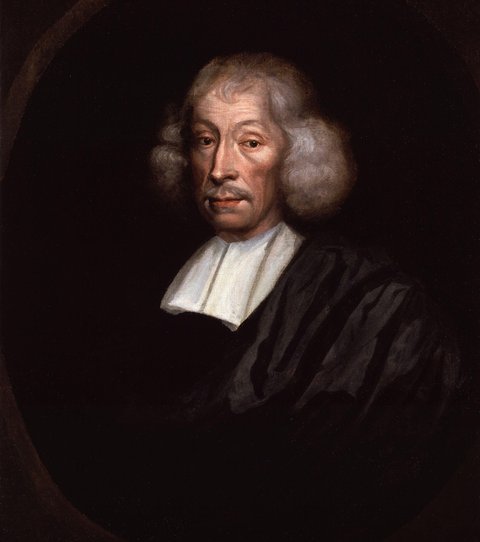
About the author
John Ray
John Ray (1627 to 1705 AD) was a blacksmith's son from Black Notley in Essex who became a fellow of Trinity College, Cambridge. He gave up his fellowship in 1662 rather than subscribe under the Act of Uniformity, and spent the rest of his life studying and classifying plants and animals, much of it alongside his friend Francis Willughby. He was elected a Fellow of the Royal Society in 1667 and published the three volumes of his History of Plants between 1686 and 1704. Barred from the pulpit, he explains in his preface that it may be “my duty to serve it with my hand by writing.”