What does it mean to be truly Catholic? Perkins argues the Reformation did not reject catholicity but restored it—rooting true faith in Scripture rather than institutional authority.
One free account opens 250+ books and saves your place on every device. Google sign-in or an email link. No card.
You’re on the list — we’ll email you if this goes to print.
Included with your free account
This book, and 250+ more, free to read
A free account opens the whole library to read online, on your phone or at your desk. Open a book on one device and it is waiting at the same page on the next. The PDF and EPUB of every book are yours to keep, and audiobooks play in the same app.
250+ modernized editionsNot samples. The whole work, free.
Your place, on every devicePhone, tablet or desktop, same page.
131 audiobooksFrom $4.99 each, or all of them with a $50 gift.
A Reformed Catholic by William Perkins is a short but forceful clarification of what the Protestant Reformers meant when they claimed to be truly Catholic. Perkins argues that the Reformation did not reject catholicity but restored it. He defines "Catholic" not as submission to Rome but as fidelity to the whole truth of Scripture, confessed by the universal church across time.
The heart of the book is Perkins's careful distinction between fundamental doctrines necessary for salvation and secondary errors that, while serious, do not automatically sever someone from the church. The Roman Church, he argues, still retains enough core Christian truth to be considered part of the visible church, yet it is dangerously corrupted by teachings that obscure the gospel.
Throughout the work, Perkins calls readers to examine whether their faith rests on Christ alone or on external membership, rituals, or tradition. True catholicity, he insists, is proved by sound doctrine joined with repentance and obedience, not by institutional allegiance.
Introduction
By a Reformed Catholic, I mean anyone who accepts the same essential principles of religion as the Roman Church, yet strips away and rejects all doctrinal errors that have corrupted that religion.
I have three aims in writing this short work. First, to refute those pragmatists who claim that our religion and that of the Roman Church differ only superficially. Second, to win over those Roman Catholics who think poorly of our religion. Third, to help ordinary Protestants understand the points of difference between us and the Church of Rome.
Chapter 1: Of Free Will
Both they and we understand free will as a combined power of the mind and will in human beings, allowing them to distinguish between good and evil and to choose or reject accordingly.
We must consider humanity in four distinct states: as created, as corrupted, as renewed, and as glorified. In the first state, we attribute to the human will a natural liberty by which one could choose or reject either good or evil.
The fundamental disagreement concerns the nature of human free will in spiritual matters. Catholics claim that human will cooperates with divine grace through its own inherent power. We maintain that cooperation occurs only through grace, since the will is inherently passive rather than active.
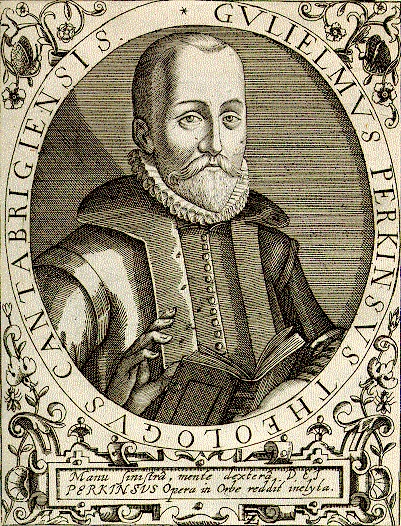
William Perkins was an English clergyman and theologian who became one of the foremost Puritan leaders of the Elizabethan era. As a fellow of Christ's College, Cambridge, he influenced a generation of Puritan leaders through his teaching and writing. Perkins was a pioneer in developing Reformed practical theology, addressing how doctrine applies to everyday Christian experience. His works on conscience, calling, and practical divinity established patterns followed by later Puritans. "A Golden Chain" presents the order of salvation with characteristic clarity, while his treatises on preaching and cases of conscience became standard texts for ministry. Perkins's emphasis on assurance of salvation and the practical outworking of election made Reformed theology accessible and applicable for ordinary believers.
“Updated Works has been an incredible blessing to my Christian life and ministry… remarkably faithful to the original authors while making these timeless treasures understandable for modern readers.”