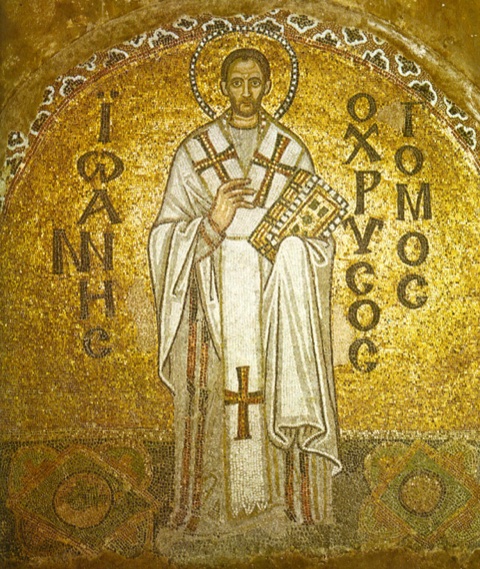
Homily 1: Against Sharing Jewish Festivals
1. The Urgent Need for Correction
Today I wanted to finish the subject I spoke to you about recently, and to show more clearly how God is incomprehensible. For on this subject last Sunday we delivered those many long discourses, when we brought forward Isaiah, David, and Paul as witnesses. The first cried out, “Who will recount his generation?” The second thanked him for his incomprehensibility, saying, “I will give thanks to you, because you have been fearfully magnified; wonderful are your works.” And again, “Your knowledge has become too wonderful for me; it has grown strong, and I cannot attain it.” Paul did not even investigate God’s essence, but only his providence. Or rather, he considered only a small part of that providence, which God displayed in calling the nations. He cried out as though he had seen a vast, incomprehensible sea: “O the depth of God’s riches and wisdom and knowledge! How unsearchable are his judgments, and how untraceable his ways!”
The demonstration through these witnesses was sufficient. Yet I was not content with the prophets; I did not stop at the apostles. I ascended into heaven and showed you the choir of angels saying, “Glory to God in the highest, and on earth peace, goodwill among human beings.” You also heard the seraphim struck with amazement and crying out with trembling, “Holy, holy, holy is the Lord of hosts; the whole earth is full of his glory.” I added the cherubim crying, “Blessed is his glory from his place.” Three witnesses below, three witnesses above, declaring the inaccessibility of God’s glory. The demonstration was now beyond dispute. There was much applause, the audience grew warm, and the assembly was set ablaze. I rejoiced, not because I myself was praised, but because my Master was glorified. That applause and praise showed the love of God in your souls. Just as affectionate servants, when they hear someone praising their own master, burn with affection for the speaker because of their attachment to their master, so you acted then. By your overwhelming applause you showed your great devotion to the Master.
I wanted, then, to continue these contests today as well. For if the enemies of the truth never have enough of blaspheming their benefactor, much more ought we to be insatiable in praising the God of all. But what am I to do? Another very grievous disease calls on our tongue to treat it, a disease implanted in the body of the Church. We must first uproot this, and then attend to those outside; first treat our own people, and then care for strangers.
What is this disease? The festivals of the wretched and miserable Jews are approaching, one after another in close succession: the trumpets, the pitching of tents, the fasts. Many of those enrolled with us, who say that they hold our beliefs, go to watch the festivals; others even celebrate them and share in their fasts. I want now to drive this evil custom out of the Church. Discourses against the Anomoeans can take place at another time, and no harm would come from postponing them. But if we do not treat those sick with Jewish practices now, when the Jewish festivals are near and at the door, I fear that through their ill-timed familiarity and great ignorance some may share in their lawlessness, and our discourses on these matters may then prove useless. For if they hear nothing today and fast with them, we shall apply the medicine in vain once the sin has been committed. That is why I am hurrying to prevent it. Physicians act in this way too: they attend first to the most pressing and acute diseases.
In any case this contest is related to the earlier one. Since the impiety of the Anomoeans and of the Jews is related, our present struggles are related to the earlier ones. For the Anomoeans bring the same charge that the Jews brought. What charge did they bring? That “he called God his own Father, making himself equal to God.” These people bring that charge too; or rather they do not bring a charge, but erase the statement together with its meaning, if not with their hand, then with their judgment.
2. Rejection of Gifts and Misuse of Fasting
Do not be surprised that I called the Jews wretched. They truly are wretched and miserable, having thrust away and eagerly cast off so many good things that came from heaven into their hands. The sun of righteousness rose for them early, but they thrust away its ray and sit in darkness. We, who were brought up in darkness, drew the light to ourselves and were freed from the gloom of error. They were branches of the holy root, but were broken off; we did not share in the root, yet bore the fruit of piety. They read the prophets from their earliest years and crucified the one foretold; we had not heard the divine oracles, yet worshiped the one foretold. That is why they are wretched: while others seized the good things sent to them and drew them to themselves, they themselves rejected them. Though called to adoption as sons, they fell into kinship with dogs. We, though dogs, were able through God’s grace to put away our former irrationality and rise to the honor of sons.
How is this clear? “It is not good,” he says, “to take the children’s bread and throw it to the little dogs.” Christ said this to the Canaanite woman, calling them children and those from the nations dogs. But see how the order was afterward reversed: they became dogs, and we children. “Beware of the dogs,” Paul says of them, “beware of the evil workers, beware of the mutilation; for we are the circumcision.” Do you see how those who were formerly children became dogs? Do you want to learn how we, who were formerly dogs, became children? “As many as received him,” he says, “he gave them authority to become children of God.”
No one is more wretched than those who oppose their own salvation at every turn. When they ought to have kept the law, they trampled it down; now that the law has ceased, they struggle to keep it. What could be more pitiable than people who provoke God not only by breaking the law, but also by keeping the law? That is why he says, “Stiff-necked and uncircumcised in heart, you always resist the Holy Spirit,” not only by transgressing the ordinances, but also by wanting to observe them at the wrong time. “Stiff-necked.” He rightly said “stiff-necked,” for they did not bear Christ’s yoke, although it was kindly and had nothing burdensome or oppressive in it. “Learn from me,” he says, “because I am meek and lowly in heart”; and, “Take my yoke upon you, because my yoke is kindly and my burden is light.” Yet they did not bear it because of the stiffness of their neck. Not only did they not bear it, but they broke and tore it apart. “From of old,” he says, “you broke your yoke; you tore apart your bond.” Paul does not say this; the prophet cries it out. By yoke and bond he means the symbols of rule, because they rejected Christ’s mastery, saying, “We have no king except Caesar.” You broke the yoke, tore apart the bond, cast yourself out of the heavenly kingdom, and subjected yourself to human rulers.
Consider how precisely the prophet hinted at their resistance to the reins. He did not say, “You laid aside the yoke,” but, “You broke the yoke.” This is the wrongdoing of animals that leap about, throw off the reins, and reject control. But where did this stiffness come from? From gluttony and drunkenness. Who says this? Moses himself: “Israel ate, was filled, and grew fat, and the beloved kicked.” Just as animals, when they enjoy an abundant supply of fodder and grow fat, grow more unruly and difficult to restrain, tolerating neither yoke nor rein nor a driver’s hand, so the Jewish people, brought down to the utmost wickedness by drunkenness and fatness, leaped about and did not accept Christ’s yoke or pull the plow of his teaching. Hinting at this, another prophet said, “Like a heifer maddened by the gadfly, Israel was maddened.” Another called him an untrained calf. Such animals, being unfit for work, become fit for slaughter. This is what they too have suffered: having made themselves useless for work, they have become fit for slaughter. That is why Christ said, “My enemies, who did not want me to reign over them, bring them here and slaughter them.”
You ought to have fasted then, Jew, when drunkenness was working these terrible things in you, when gluttony was giving birth to impiety, not now. For now the fast is ill-timed and abominable. Who says this? Isaiah himself, crying with a loud voice: “This is not the fast I chose, says the Lord.” Why? “Because you fast for lawsuits and quarrels, and strike those under your power with your fists.” If your fast was abominable when you struck your fellow servants, does your fast become acceptable when you slaughtered the Master? How could that be reasonable?
The person who fasts ought to be restrained, contrite, humbled, not drunk with anger. But you strike your fellow servants? Then they fasted for lawsuits and quarrels; now for licentiousness and the utmost wantonness, dancing barefoot in the marketplace. They undertake to fast, but look like people who are drunk. Hear how the prophet commands fasting. “Consecrate a fast,” he says. He did not say, “Make a procession of a fast.” “Proclaim a service; gather the elders.” But these people gather choruses of effeminate men and a great crowd of prostituted women, and drag the whole theater and those from the stage into the synagogue. For there is no difference between theater and synagogue. I know that some condemn the boldness of my statement because I said that there is no difference between theater and synagogue. But I condemn their boldness if they do not think so. If I give the judgment on my own authority, condemn me; but if I speak the prophet’s words, accept the judgment.
3. The Synagogue and the Compelled Oath
I know that many people respect the Jews and consider their present way of life venerable. That is why I am eager to uproot this destructive opinion. I said that the synagogue is no better than a theater, and I bring testimony from a prophet. The Jews are not more trustworthy than the prophets. What, then, does the prophet say? “You acquired the appearance of a prostitute; you were shameless toward everyone.” Where a prostitute stands, the place is a brothel. Or rather, the synagogue is not only a brothel and a theater, but also a cave of robbers and a refuge of wild beasts. “Your house,” he says, “became for me a hyena’s cave.” Not simply a wild beast’s, but an unclean wild beast’s. And again, “I left my house; I abandoned my inheritance.” When God leaves, what hope of salvation remains? When God leaves, that place becomes a dwelling of demons.
But surely they will say that they too worship God. Far be it from us to say this! No Jew worships God. Who says this? The Son of God. “If you knew my Father,” he says, “you would know me also; but you know neither me nor my Father.” What testimony more trustworthy than this can I bring forward? If, then, they do not know the Father, crucified the Son, and rejected the help of the Spirit, who would not confidently declare the place to be a lodging of demons? God is not worshiped there, far from it; that place has become a place of idolatry. Yet some attend to those places as though they were venerable.
I say this from actual experience, not conjecture. Three days ago (believe me, I am not lying), I saw a respectable, freeborn woman of orderly conduct, a believer, being compelled by some foul and senseless man who seemed to be a Christian (for I would not call someone who dares such things a genuine Christian) to enter the Hebrews’ premises and swear an oath there about matters in dispute with him. When the woman approached, called on me for help, and asked me to stop the unlawful coercion, because it was not lawful for her, having shared in the divine mysteries, to go to that place, I burned with zeal, became inflamed, and rose up. I did not allow her to be dragged into that lawlessness, but rescued her from this unjust abduction.
When I asked the man dragging her whether he was a Christian and he admitted it, I rebuked him vehemently, charging him with insensibility and the utmost folly. I told him that he was no better than donkeys if, while saying he worshiped Christ, he dragged someone into the caves of the Jews who crucified him. I spoke to him at length, first teaching him from the divine Gospels that it is not lawful to swear at all, or to compel anyone to swear an oath; then, that he ought not to drag anyone into this compulsion, not only a believing woman initiated into the mysteries, but even someone uninitiated. When, by speaking to him at length, I had driven the mistaken notion out of his soul, I asked why he had left the Church and hastened to the Hebrews’ premises to drag her there. He said that many people had told him that the oaths taken there were more fearful.
At this I groaned and burned with anger; then I laughed again. Seeing the devil’s malice, what things he had managed to persuade people of, I groaned. Considering the carelessness of those being deceived, I burned with anger. And considering again how great and extensive the folly of those deceived was, I laughed. I told you these things and recounted them because you are inhuman and unfeeling toward those who both do and suffer such things. Even if you see one of your brothers falling into such lawless acts, you consider the calamity someone else’s concern, not your own. You think you are defending yourselves before those who accuse you when you say, “What concern is it of mine? What have I in common with him?” Your words express the utmost hatred of humanity and satanic cruelty.
What are you saying? You are a human being and share the same nature; or rather, if we must speak of fellowship in nature, you have one head, Christ. Yet do you dare say that you have nothing in common with your own members? How can you declare that Christ is not the head of the Church? For the head naturally joins all the members, turns them carefully toward one another, and binds them together. If you have nothing in common with your member, you have nothing in common with your brother either, and you do not have Christ as your head.
The Jews frighten you as though you were little children, and you do not realize it. Many foul servants show those children frightening and ridiculous masks and provoke much laughter. These things are not frightening by nature, but appear so because of the weakness of the children’s understanding. In the same way the Jews use bogeymen to frighten the less mature Christians. For how can their things be fearful, when they are full of great shame and ridicule, the things of those who have given offense, have been dishonored, and stand condemned?
4. Rescuing and Correcting Fellow Christians
Our things are not like that; they really are fearful and full of trembling. For where God is, with authority over life and death, that place is fearful; where there are countless discourses about undying punishments, about the rivers of fire, the venomous worm, the unbreakable bonds, the outer darkness. But they know none of these things, not even in a dream. They live for their belly, gape at the things of this life, and are no better than pigs and goats in their licentiousness and excessive gluttony. They know only one thing: to stuff their bellies and get drunk, to be cut to pieces for dancers and wounded for charioteers. Tell me, then, are these things venerable and fearful? Who would say so? How, then, did they seem fearful to us, unless someone also says that servants who have been dishonored, deprived of confidence, and cast out of their master’s house are fearful to those who are in good standing and have confidence? But that is not so; it is not so. Inns are not more venerable than royal courts. Rather, the synagogue’s premises are more dishonorable than any inn. They are a lodging not simply of robbers or tavern keepers, but of demons. Or rather, not only the synagogues, but the very souls of the Jews are so; and I shall try to show this at the close of my discourse.
I therefore urge you to remember this discourse especially. For we are not speaking now for display or applause, but for the treatment of your souls. What defense remains to us when, with so many physicians, some people are still sick? There were twelve apostles, and they won over the inhabited world. Most of the city is Christian, and still some people are sick with Judaism. What defense shall we who are healthy have? Those who are sick deserve accusations, but neither are we free from blame when we overlook them in their illness. It would have been impossible for them to remain in that weakness if they received much earnest care from us.
That is why I say these things now in advance: so that each of you may draw his brother back, and, even if he must impose compulsion, use force, insult him, or contend with him, do everything to rescue him from the devil’s snare and free him from fellowship with Christ’s killers. Tell me, if in the marketplace you saw someone being led away, condemned by a just sentence, and you had the power to snatch him from the executioner’s hands, would you not have done everything to free him from that removal? Now you see your brother being dragged, not by an executioner, but by the devil, unjustly and unlawfully toward the pit of destruction. Yet you will not even make a contribution to rescue him from that lawlessness? What forgiveness could you receive?
“But he is stronger and more powerful than you.” Bring him before me. I shall choose to lay down my head rather than let him touch the sacred entrance, if he contends and persists in the same practices. What have you in common with the free woman, with the Jerusalem above? Choose the one below; be enslaved with her. For she too is enslaved with her children, according to the apostle’s words. Do you fast with the Jews? Then take off your shoes with the Jews, walk barefoot in the marketplace, and share their disgrace and ridicule. But you would not choose to do that, for you are ashamed and blush. Then are you ashamed to share their outward appearance, but not ashamed to share their impiety? What forgiveness will you have, being a Christian by halves? Believe me, I shall lay down my head before I overlook any of those sick with such practices, if I see him. But if I do not know, God will certainly give forgiveness.
Let each of you also consider this, and do not regard the matter as incidental. Do you not see what the deacon continually cries during the mysteries? “Recognize one another.” Do you see how he entrusts you with the careful examination of your brothers? Do this with those people too. When you recognize someone practicing Judaism, hold him back and make him known, so that you yourself do not also share in the danger. In the armies outside the Church, if someone among the soldiers is caught siding with the barbarians and favoring the Persians, not only he is in danger, but also everyone who knew and did not disclose him to the general. Since we too are Christ’s army, investigate and examine carefully whether anyone of foreign allegiance has mingled among you, and disclose him. We do this not to kill him as they do, nor to punish or exact vengeance, but to free him from error and impiety and make him fully one of us.
If you are unwilling to do this, but know and conceal him, be certain that you will undergo the same punishment as he. For Paul subjects not only those who do evil, but also those who approve of them, to chastisement and punishment. The prophet too brings not only those who steal, but also those who run with them, under the same judgment, and rightly so. For someone who knows a person doing evil, and shelters and conceals him, gives him more reason to be careless and encourages him to practice wickedness with less fear.
5. Possessing Scripture Does Not Sanctify
But we must return again to those who are sick. Consider, then, with whom those who now fast are sharing: with those who cry, “Crucify, crucify”; with those who say, “His blood be upon us and upon our children.” If some people had been caught attempting tyranny and condemned, would you have dared to approach and converse with them? I do not think so. How, then, is it not absurd to avoid so carefully those who have acted wickedly against a human being, yet make those who have insulted God himself your companions, and for those who worship the crucified one to celebrate with those who crucified him? This is not only folly, but the utmost madness.
Since there are also some who consider the synagogue a venerable place, it is necessary to say a few words to them as well. Why do you respect that place, when you ought to despise it, abhor it, and leap away from it? “The law,” someone says, “and prophetic books are stored in it.” And what of that? Wherever such books are, will the place also be holy? Certainly not. I hate and turn away from the synagogue especially for this reason: though they have the prophets, they disbelieve the prophets; though they read their writings, they do not accept their testimonies. This is the conduct of people who inflict greater insult.
Tell me, if you saw a respectable, distinguished, and renowned man taken into a tavern or a lodging of robbers, then insulted there, beaten, and subjected to the utmost outrage, would you admire the tavern or the cave because that admirable and great man was standing inside being outraged? I do not think so. Rather, you would hate and turn away from it especially for that reason. Think of this in the case of the synagogue too. They brought the prophets and Moses with them in there, not to honor them, but to insult and dishonor them. For when they say that these men did not know Christ and said nothing about his coming, what greater insult to those holy men could there be than this, when they accuse them of not knowing their own Master and say that they share their own impiety? Therefore we ought to hate both them and the synagogue all the more, because they outrage those holy men.
But why speak of books and places? In times of persecution the executioners hold the bodies of the martyrs, tear them, and scourge them. Are their hands therefore holy because they held the bodies of the saints? Far from it! So hands that held saints’ bodies remain profane for this very reason, because they held them wickedly. Yet will those who possess saints’ writings and insult them no less than executioners insult the martyrs’ bodies be respected for that reason? How could this be anything but the utmost irrationality? For if bodies held wickedly not only fail to sanctify their holders, but make them more accursed, still less could writings read with unbelief ever benefit those who read them.
This very thing, possessing the books with such a disposition, shows them to be more impious. They would not deserve so great an accusation if they did not have the prophets. They would not be so unclean and profane if they did not read the books. But now they are deprived of all forgiveness, because they have the heralds of truth, yet stand in hostility both to those very heralds and to the truth. So they would be all the more profane and accursed because, though they have the prophets, they are hostile toward them.
That is why I urge you to flee and leap away from their gatherings. This is no small harm to the weaker brothers, no small pretext for recklessness to those people. For when they see you, who worship Christ whom they crucified, pursuing and honoring their practices, how will they not think that everything they have done is excellent, and that our things are worth nothing, when you who uphold and serve our beliefs run toward those who overthrow them? “If someone sees you,” he says, “who have knowledge reclining in an idol’s temple, will not his conscience, being weak, be built up to eat things sacrificed to idols?” And I say: if someone sees you, who have knowledge, going to a synagogue and watching the trumpets, will not his conscience, being weak, be built up to admire Jewish practices? The person who falls pays the penalty not only for his own fall, but is punished because he also trips others. In the same way, the person who stands is crowned not only for his own virtue, but is admired because he also brings others to the same zeal.
Flee, then, both their gatherings and their places. Let no one respect the synagogue because of the books, but because of them let him hate and turn away from it: because they hold the saints in order to insult them, because they disbelieve their words, because they accuse them of the utmost impiety.
6. Holy Books in Profane Places
So that you may learn that the books do not sanctify the place, but the disposition of those who assemble makes it profane, I shall recount an ancient story to you. Ptolemy Philadelphus gathered books from everywhere. Learning that among the Jews too there were writings discussing God and an excellent way of life philosophically, he sent for men from Judaea, had the writings translated by those men, and deposited them in the temple of Serapis. For the man was a pagan. To this day the translated books of the prophets remain there. What then? Will the temple of Serapis be holy because of the books? Far from it! The books have their own holiness, but do not impart it to the place because of the foulness of those who assemble there.
The same reasoning must therefore be applied to the synagogue. Even if no idol stands there, demons inhabit the place. I say this not only about the synagogue here, but also about the one in Daphne. For the pit there, which they call Matrona’s, is more wicked. I have heard that many of the faithful go up there and sleep beside the place. But far be it from us ever to call these people faithful. To me Matrona’s shrine and Apollo’s temple are equally profane. If someone condemns my boldness, I shall again condemn his utmost madness. Tell me, where demons dwell, is it not a place of impiety, even if no carved image stands there? Where Christ’s killers assemble, where the cross is driven out, where God is blasphemed, where the Father is unknown, where the Son is insulted, where the Spirit’s grace is rejected, or rather where the people themselves are demons, is not the harm from this greater?
For there impiety is naked and obvious; it could not easily attract or deceive someone who has understanding and is sober-minded. But here, saying that they worship God, turn away from idols, and have and honor prophets, they use these words as powerful bait and throw the simpler and more foolish people, unguarded, into their snares. Thus their impiety is equal to that of the pagans, but the deception practiced by these people is more dangerous. For among them too stands an invisible altar of deception, on which they sacrifice not sheep and calves, but human souls.
In any case, if you admire their practices, what have you in common with us? For if the Jews’ things are venerable and great, ours are false; but if ours are true, as indeed they are, theirs are full of deception. I am not speaking of the Scriptures, far from it! For they led me by the hand to Christ. I mean their impiety and their present madness.
But now it is time to show that demons also dwell there, not only in the place itself, but in the very souls of the Jews. “When the unclean spirit goes out,” he says, “it travels through waterless places, seeking rest. If it does not find it, it says, ‘I shall return to my house.’ When it comes, it finds it empty, swept, and adorned. It goes and takes with itself seven other spirits more wicked than itself, and enters it; and the last state of that person will be worse than the first. So it will be with this generation too.” Do you see that demons dwell in their souls, and that the present ones are more grievous than the former? And very reasonably so: then they acted impiously toward the prophets, but now they insult the Master of the prophets himself.
Tell me, then, do you gather together with people possessed by demons, having so many unclean spirits, brought up in slaughter and murder, and do you not shudder? Ought one to share a greeting with them and offer them even a single word, rather than turn away from them as a common pest and disease of the whole inhabited world? Have they not gone through every kind of wickedness? Have not all the prophets spent their many long discourses on accusations against them? What tragedy, what manner of lawlessness have they not eclipsed by their own bloodshed? They sacrificed their sons and daughters to demons. They ignored nature, forgot the pangs of childbirth, trampled down the care of children, overturned the laws of kinship from their very foundations, and became more savage than all wild beasts.
For wild beasts often give up their lives and disregard their own safety to protect their offspring. But these people, under no compulsion, slaughtered those born from them with their own hands to serve the enemies of our life, the avenging demons. What should astonish us first, their impiety or their cruelty and inhumanity? That they sacrificed their sons, or that they sacrificed them to demons? And in licentiousness have they not eclipsed even the most lustful animals? Hear what the prophet says about their wantonness: “They became horses mad for females; each neighed for his neighbor’s wife.” He did not say that each desired his neighbor’s wife. Rather, by giving them the voice of animals, he showed with the greatest vividness the madness that licentiousness produced in them.
7. Festivals, Offerings, and Demonic Healing
What else do you want me to speak of? Their robberies, their greed, their betrayals of the poor, their thefts, their huckstering? But even a whole day will not be enough for us to recount this. “But do their festivals have something venerable and great?” They have shown even these very festivals to be unclean. Hear the prophets, then, or rather hear how intensely God turns away from them: “I have hated, I have rejected your festivals.” God hates them, and you share in them? He did not say this or that festival, but all of them together. Do you want to see that he also hates the worship through drums, lyre, psalteries, and other instruments? “Remove from me the sound of your songs,” he says, “and I will not listen to the music of your instruments.” God says, “Remove it from me”; and you run to hear the trumpets?
But are not the sacrifices and offerings themselves abominable? “If you bring me fine flour, it is vain. Incense is an abomination to me.” Incense is an abomination, and the place is not an abomination? And when was it an abomination? Before they committed the crowning evil, before they killed their own Master, before the cross, before the killing of Christ, it was an abomination. Is it not much more so now? Yet what is sweeter-smelling than incense? But God judges offerings in this way by attending not to the nature of the gifts, but to the disposition of those who bring them. He looked upon Abel, and then upon his gifts. He saw Cain, and then turned away from his sacrifices. “For upon Cain,” he says, “and upon his sacrifices he did not look.”
Noah offered God sacrifices of sheep, calves, and birds, and Scripture says, “The Lord smelled a sweet fragrance”; that is, he accepted what was offered. For God certainly does not have nostrils; the divine is without a body. Yet what rose from there was the smell of roasting fat and smoke from burning bodies, and nothing smells fouler than such a smell. But so that you may learn that God accepts and rejects sacrifices by attending to the disposition of those offering them, he calls the smell of roasting fat and smoke a sweet fragrance, but incense an abomination, because the disposition of those who brought it was full of foulness.
Do you want to learn that, along with sacrifices, instruments, festivals, and incense, he also turns away from the temple because of those who enter it? He showed this especially through deeds, first handing it over to barbarians, and later demolishing it completely. Yet even before its destruction he cries through the prophet and says, “Do not trust in lying words, because they will not benefit you, saying, ‘It is the Lord’s temple, the Lord’s temple.’” It is not the temple that sanctifies those who assemble, he says, but those who assemble make the temple holy. If the temple did not benefit them then, when there were the cherubim and the ark, much less now, when all those things have been taken away, when God’s turning away has become complete, when the grounds for enmity are greater.
What folly and madness, then, would it be to make those who have been dishonored, abandoned by God, and have provoked the Master your companions in festivals? Tell me, if someone killed your son, would you bear to see him? Would you bear to hear his name? Would you not flee from him as from an evil demon, as from the devil himself? They killed your Master’s Son, and you dare to gather together with them? The one who was killed so honored you as to make you his brother and fellow heir; but you so dishonor him as to honor and serve his murderers and crucifiers by sharing in their festivals, to visit their profane places, to step over their unclean entrances, and to share in a table of demons. For this is what I am persuaded to call the Jews’ fast after their killing of God. How do people who act against God not serve demons?
But do you seek healing from demons? When Christ permitted them to enter pigs, they immediately drowned them in the sea. Will they spare human bodies? If only they did not kill, if only they did not plot against us! They cast us out of paradise, deprived us of the honor from above, and will they heal the body? These things are ridiculous tales. Demons know how to plot and inflict harm, not to heal. They do not spare the soul, and will they spare bodies, tell me? They try to cast us out of the kingdom, and will they choose to free us from diseases? Have you not heard the prophet saying, or rather God through the prophet, that they can do neither good nor evil?
Even if they could heal and were willing to, which is impossible, you still must not accept an imperishable and eternal loss in exchange for a small and perishing gain. Will you heal the body so as to destroy the soul? Your bargain is not good. You anger God, the maker of the body, and call upon the one plotting against you for healing? How, then, could a superstitious person fail to draw you easily into worshiping the pagan gods for the sake of medical skill itself? For they too have often driven away many diseases through their art and brought the sick back to health. What then? Must we share in impiety for this reason? Far from it.
Hear what Moses says to the Jews: “If a prophet arises among you, dreaming a dream, and gives a sign or a wonder, and the sign or the wonder of which he spoke comes to pass, and he says to you, ‘Let us go and serve other gods whom our fathers did not know,’ you shall not listen to the voice of the prophet or the one dreaming the dream.” What he means is this: if some prophet arises, he says, and performs a sign, raises a dead person, cleanses a leper, or heals a maimed person, and after performing the sign calls you to impiety, do not be persuaded because of the fulfillment of the sign. Why? “For the Lord your God tests you to see whether you love him with all your heart and with all your soul.”
From this it is clear that demons do not heal. But if at some time, with God’s permission, they should succeed in some healing, like human beings, the permission is granted to test you, not because God does not know, but to teach you not to tolerate demons even when they heal. And why speak of bodily healing? If someone threatens you with Gehenna to make you deny Christ, do not accept it. If someone promises a kingdom to make you depart from the only-begotten Son of God, turn away and hate him. Become Paul’s disciple and follow the example of those words which his blessed and noble soul cried out: “For I am persuaded that neither death nor life, neither angels nor rulers nor powers, neither things present nor things to come, neither height nor depth nor any other creation will be able to separate us from the love of God which is in Christ Jesus our Lord.” Neither angels, nor powers, nor things present, nor things to come, nor any other creation separate him from Christ’s love; and bodily healing makes you depart? What forgiveness could we receive?
For we ought to fear Christ more than Gehenna, and desire him more than a kingdom. Even if we are sick, it is better to remain in our illnesses than to fall into impiety for the sake of release from weakness. For even if a demon heals, he has done more harm than good. He benefited the body, which will certainly die a little later and is destined to rot, but harmed the immortal soul. Just as slave traders often hold out sweets, cakes, knucklebones, and other such things to little children, enticing them and depriving them of their freedom and their very life, so demons, promising healing for a limb, drown the soul’s entire salvation.
But let us not tolerate this, beloved. Let us seek freedom from impiety in every way. Could not Job have obeyed his wife, blasphemed God, and been freed from the calamity pressing upon him? “Say some word to the Lord,” she says, “and die.” But he chose rather to suffer pain, waste away, and bear that unbearable plague than to blaspheme and be freed from the evils pressing upon him. Emulate him yourself. Even if the demon promises ten thousand ways to release you from the evils pressing upon you, do not be persuaded or submit, just as the righteous man was not persuaded by his wife. Choose rather to persevere in the illness than to destroy the faith and salvation of your soul. For God often allows you to fall into illnesses, not because he abandons you, but because he wishes to make you more illustrious. Remain, then, steadfast, so that you too may hear, “Do you think I have dealt with you otherwise than so that you may be shown righteous?”
9. Disclosure for a Brother’s Salvation
We could have said still more than this. But so that you may remember what has been said, I shall end the discourse here, speaking Moses’ words: “I call heaven and earth to witness against you.” If any of you, either those present or those absent, goes to watch the trumpets, attends a synagogue, goes up to Matrona’s, shares in a fast, takes part in Sabbaths, or carries out any other Jewish custom, small or great, “I am clean from the blood of you all.” These words will stand beside both me and you on the day of our Lord Jesus Christ. If you obey, they will give you great confidence. But if you disobey, or conceal any of those who dare such things, they will stand against you like vehement accusers. “For I did not shrink from declaring to you the whole counsel of God.” I have also deposited the money with the bankers. It is now for you to increase what was deposited and to use the benefit of hearing it for your brothers’ salvation.
“But is it burdensome and oppressive to report those who commit such sins?” It is silence, rather, that is burdensome and oppressive. For this silence brings destruction both upon you who conceal them and upon those who escape notice, making God your enemy. How much better it is to incur your fellow servants’ resentment for their salvation than to provoke the Master against yourselves! For even if your fellow servant is angry now, he will be unable to harm you; rather, afterward he will even thank you for the treatment. But if you grant your fellow servant a harmful favor by remaining silent and concealing him, God will exact the utmost penalty from you. Thus by remaining silent you will both make God your enemy and harm your brother. By reporting and disclosing him, you will have God favorable toward you and gain your brother, acquiring a passionately devoted friend who has learned your kindness by experience.
Do not, then, think that you are doing your brothers a favor if you see them pursue something improper and do not rebuke them with all vehemence. If you lose a garment, do you consider not only the thief, but also someone who knows the thief and does not report him, equally an enemy? Our common mother has lost not a garment, but a brother. The devil stole him and now holds him in Judaism. You know the thief; you know the person stolen. You see me lighting the word of teaching like a lamp, searching everywhere and beating my breast, and you stand silent and do not report him? What forgiveness will you have? How will the Church not count you among her worst enemies and regard you as an adversary and a destroyer? But may none of those hearing this counsel ever commit such a sin as to betray a brother for whom Christ died. Christ poured out his blood for him; will you not even utter a word for him?
Do not do this, I urge you. As soon as you leave here, hasten to this hunt, and let each of you bring me one of those sick with such practices. Or rather, may there not be so many sick people! Let two or three of you, or even ten or twenty, bring me one, so that on that day, seeing the catch brought within the nets, I may set a more abundant table before you. For if I see today’s counsel put into practice, I shall undertake their treatment with greater eagerness, and the gain will be greater both for you and for them. Do not be negligent, then. Let women hunt women, men men, slaves slaves, free people free people, children children; in a word, let everyone hunt those sick with such practices with every care. Then come to the next assembly, so that you may receive our praise and, before our praises, draw to yourselves the great and inexpressible reward from God, which far exceeds the labors of those who do right. May we all attain it by the grace and love for humanity of our Lord Jesus Christ, through whom and with whom glory be to the Father, together with the Holy Spirit, now and always and for ages of ages. Amen.