


131 audiobooks, 1,134 hours of narration. Give $50 and every one is yours.
Political Philosophy books
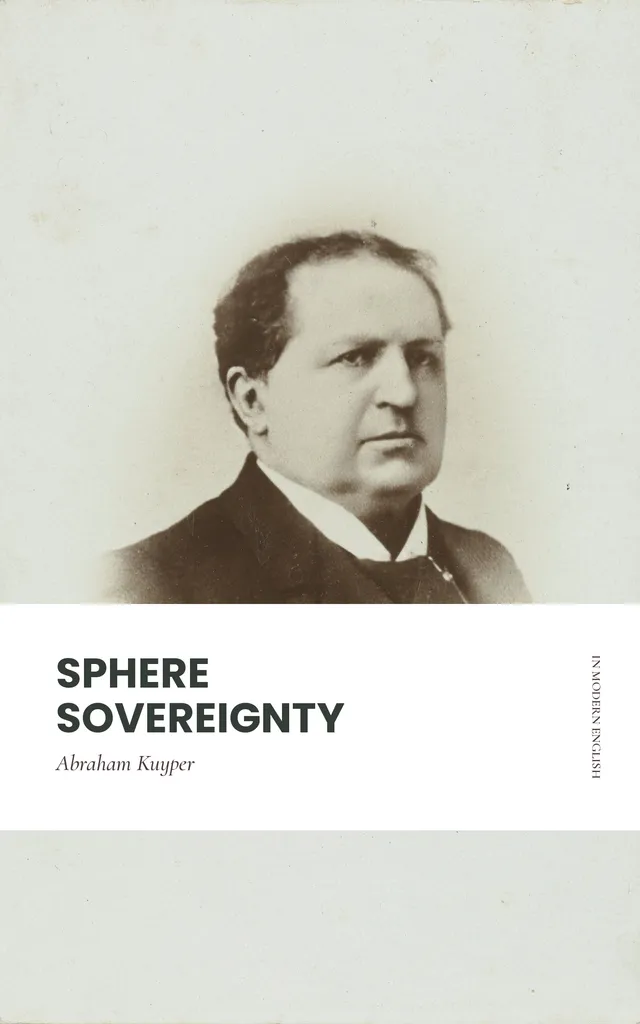
Cover of Sphere Sovereignty

Modern English edition · 1880 AD

Sphere Sovereignty

by Abraham Kuyper

The address Kuyper gave at the opening of the Free University of Amsterdam in 1880, arguing that the family, the church, scholarship, and the state each hold an authority of their own, received from God and exercised within its own sphere.

Start reading free

One free account opens 250+ books and saves your place on every device. Google sign-in or an email link. No card.

Included with your free account

This book, and 250+ more, free to read

A free account opens the whole library to read online, on your phone or at your desk. Open a book on one device and it is waiting at the same page on the next. The PDF and EPUB of every book are yours to keep, and audiobooks play in the same app.

  • 250+ modernized editions Not samples. The whole work, free.
  • Your place, on every device Phone, tablet or desktop, same page.
  • 131 audiobooks From $4.99 each, or all of them with a $50 gift.
  • PDF and EPUB included Download any book to keep.
Create your free account Google sign-in or an email link. No card.
The in-app reader on a phone, mid-chapter of The Mortification of Sin in modern English
My Library on a phone, with a book to continue reading and the cover grid

Summary

Delivered
20 October 1880 · Amsterdam
Occasion
The opening of the Free University
Type
Inaugural address
Length
About 12,000 words · a 1-hour read

Sphere sovereignty is Abraham Kuyper's principle that the family, the church, scholarship, and the state each hold an authority received directly from God within its own domain, so that none of them may rule inside another. He set it out on 20 October 1880 in the address opening the Free University of Amsterdam.

How the argument unfolds

  1. 01

    The occasion. Kuyper opens the new university before Government and People, admitting that "it was not love of abstract learning that drove us as patrons to this work."

  2. 02

    What sovereignty is. He defines it as "the authority that has the right, the duty, and the power to break and to avenge every resistance to its will," and holds that in that form it belongs to God alone, reaching earth only through a human office.

  3. 03

    Two answers. Either that authority passes undivided to the State, ending in Caesar and in Hegel's State as "the present God," or it rests whole upon the Messiah, whose sovereignty leaves no room for an absolute earthly ruler.

  4. 04

    Life divided into spheres. Household, society, scholarship, church, thought, conscience, and faith each run on their own law and mesh "like the teeth of wheels." The State is "the sphere of spheres": it settles their boundaries in law but "does not govern within those spheres."

  5. 05

    The Dutch inheritance. Kuyper reads his country's history as a long defense of that freedom, and credits Groen van Prinsterer with the formula itself.

  6. 06

    Sovereignty for scholarship. Science forms a sphere "in which truth is Sovereign" and must not degenerate "under State guardianship or ecclesiastical curatorship."

  7. 07

    The Reformed claim. The same right is claimed for the school's own principle in every faculty: "There is not an inch in the entire domain of human life over which Christ, who is Sovereign over all, does not call out: 'Mine!'"

Key themes

  • Authority acknowledged, not granted. Inside each sphere the governing authority "descends from God independently of the State and is not granted by the State but acknowledged by it," which makes the limit on state power a matter of right rather than policy.
  • Freedom lost from within. "To tighten an iron hoop around a barrel, one lights a fire inside it." In any successful assault on freedom "the State can never be more than an accomplice"; a sphere's own decay does the rest.
  • No neutral scholarship. "All science begins from faith of one kind or another." Instead of a shared university table, Kuyper proposes building "our own house beside the houses of others."

The Question of Sovereignty

Those in whose hands authority over this Foundation rests have entrusted me with the honorable task of inaugurating their School for higher education by introducing it on the public stage before Government and People. I ask you to grant me, in full measure, the quiet advantage of a benevolent ear and an indulgent judgment. The earnestness of that plea will speak for itself when you consider what awaits me: not an inaugural address upon taking office, nor a rectorial discourse, but something harder. By the very nature of my task, with all the quieter retreats of scholarly inquiry cut off from me, I am thrust onto that slippery ground of public life, where nettles burn at every hedge and thorns wound you at every step.

For it cannot be concealed, and none of us wishes to gloss it over: it was not love of abstract learning that drove us as patrons to this work. What drove us to this bold, if not presumptuous, endeavor was the deeply held sense of duty that what we did had to be done, for Christ’s sake, for the name of the Lord, in the higher and holier interest of our people and our land. Our appearance here is therefore by no means altogether innocent. We are deeply convinced that the public interest which, through good report and ill alike, preceded this Foundation and now attends its opening has nothing to do with us personally. It sprang solely from the impression that the Netherlands was witnessing an event which might well leave its mark on the future of the nation.

For if, measured by a higher standard, we could reconcile ourselves to the existing state of affairs, why would we have undertaken this work? There lies in our undertaking, however softly spoken, a certain protest against what surrounds us, with a claim that something better was to be found. That reflection alone makes one timid and uneasy, if only through the appearance of presumption that glides like a shadow behind it. This could give offense; this could cause pain.

I hasten therefore to assure you that whether we look at the power of learning, influence, and gold arrayed against us, or consider with humility our own smallness and weakness, it is not arrogant self-importance but quiet humility that speaks through the confidence of our words. We would have preferred to remain in obscurity. To see others go before us would have been far more restful. But since that could not be, since we had to act, we stepped into public view, deeply conscious of men’s aversion or favor toward us, yet ordering our conduct exclusively according to what, in our view, was required by the honor of our God.

You expect me to tell you what the School I am introducing has come to do in the garden of the Netherlands; why it raises the cap of liberty on the spear; and what makes it gaze so intently at the book of Reformed religion. Allow me to link the answers to those three questions through the single idea of Sphere Sovereignty, the stamp our Foundation bears in three respects: in its national significance, in its scientific purpose, and in its Reformed character.

First. To present our Foundation in its national significance is the first part of my address. The life of our nation too, Gentlemen, is struggling through a crisis in this momentous century, a crisis shared with all nations that count, a crisis running through the whole world of thoughtful humanity. In every crisis, an endangered life is at stake: the crisis may lead either to renewal or to death. I ask then: what is this “endangered life”? What is the prize at stake in this crisis for our nation?

And who still repeats what was once customarily answered, as though the struggle were about progress or conservation, about the one-sided or the many-sided, about the ideal or reality, or even about poverty or wealth? The inadequacy, the disproportion, the shallowness of each of those diagnoses had by then appeared in too clear a light. “Clerical” and “liberal” then became the watchwords, as though the question concerned the abuse or purification of ecclesiastical influence. But this screen too was contemptuously thrust aside, and awareness spread from the center outward to ever wider circles, grasped at first only by the higher seers of our century, that in the current crisis of the nations it is not a shade of opinion, not an interest, not a right, but a living person who is at stake: he who once swore to be King and, for that sovereign claim to kingship, gave his life upon a cross at Golgotha.

“The Nazarene, our holy inspirer, inspiring ideal, ideal genius of piety!” was long cried out in the most generous tones. But history refuted that praise as contradicting the Nazarene’s own claims. His calm, transparently clear, divinely human consciousness claimed nothing less than that he was Messiah, the Anointed One and Sovereign of all kings, possessing “all power in heaven and on earth.” The charge for which he had to die, written on the placard at the cross, was not that he was a hero of faith or a “martyr of honor,” but that he was King of the Jews, the bearer of Sovereignty.

And over that Sovereignty, over the existence or non-existence of that power in him who was born of Mary, the minds that think, the powers that rule, and the nations that share in life are now as fiercely in turmoil as in the first three centuries. That “King of the Jews” is either the saving truth to which every people says Amen, or the fundamental lie which all people are bound to combat. There lies the question of Sovereignty: first placed on the agenda in the blood of the Nazarene, it has now again drawn a rift through the world of our entire spiritual, human, and national existence.

What is Sovereignty? Will you not go along with me if I describe it as the authority that has the right, the duty, and the power to break and to avenge every resistance to its will? And does not the people’s ineradicable sense also tell you that original, absolute Sovereignty can rest in no creature, but must coincide with the Majesty of God? If you believe in God at all as the Conceiver and Creator, the Ordainer and Determiner of all things, your soul must proclaim God Triune as the sole absolute Sovereign. This confession must include, and here I lay the emphasis, the acknowledgment that this high Sovereign has transferred, and continues to transfer, his authority to human persons. Thus, in practice on earth, in the visible realm, you never encounter God himself directly; sovereign authority always appears before you in a human office.

And here, with that placing of God’s Sovereignty in a human office, arises the extremely important question: how does that transfer proceed? Does the all-encompassing Sovereignty of God pass undivided onto one single man? Or does the one who is called Sovereign on earth possess the power to compel obedience only within a limited sphere, a sphere bounded by other spheres in which someone beside him is Sovereign, and not he?

On that question the answer differs according to whether one stands within the sphere of Revelation or outside it.

Among those whose thought had no place for special revelation, the answer of old was: “Undivided as far as practicable, and therefore penetrating every sphere!”

“As far as practicable,” because God’s sovereignty over what is above lies beyond human reach, his sovereignty over nature beyond human power, and his sovereignty over fate beyond human ordering. But for the rest, yes: without Sphere Sovereignty, State power commands without limit, exercising control over persons, over their lives, over their rights, over their conscience, and even over their faith. There were many gods then, and accordingly, through the principle that united force is stronger, the one unlimited State became more imposing and more majestic than the divided power of the gods. And so the State, embodied in the Caesar, at last became God itself, the god-“State” that could tolerate no other “states” beside it. This explains the passion for world dominion: “The divine Augustus!” was its cry, and Caesarism its cult. This was a deeply sinful notion, not fully dissected for the thinking mind until eighteen centuries later in Hegel’s system, with the State as “the present God.”

By contrast, Jehovah proclaimed among Israel through the interpreters of Messianic prophecy: “Not merely as far as practicable, but absolutely: that Sovereignty has been transferred undivided and unbroken!” And that man-Messiah appeared with power in heaven, power over nature, the claim of power over all peoples, and power, among all peoples, also over the conscience and over faith. Even the bond of mother to child had to yield where he demanded obedience. Here, therefore, absolute Sovereignty over all visible and invisible things, over what is both spiritual and material, was placed in the hands of a man: not one kingdom among others, but the absolute Kingdom.

“To be King, for this I was born and for this I came into the world.” “All power in heaven and on the whole earth is mine.” “One day all my enemies will be subjected to me, and every knee will bow before me!” This is the Sovereignty of the Messiah, which the prophet once announced; upon which the Nazarene laid claim; which he demonstrated in its beginning by performing miracles; which his apostles described; and which the congregation of that Christ, on their authority, confesses as undivided, yet nonetheless transferred, or rather, assumed in order to be given back again. That complete harmony will not break through until Sovereignty passes back from the Messiah to God himself, who shall then be “all in all.”
Life Divided into Spheres

But here is the glorious thought of freedom: the absolute Sovereignty of the sinless Messiah directly denies and challenges every claim to absolute earthly Sovereignty by a sinful man. It does so by dividing life into distinct spheres, each possessing a Sovereignty of its own.

Our human life, with its visible material foreground and its invisible spiritual background, proves to be neither simple nor uniform, but forms an infinitely complex organism, so complex that the individual exists only in groups, and only within those groups can the whole reveal itself.

Call the parts of this one great mechanism wheels, driven by their own springs around their own axle, or call them spheres, each filled with their own animating spirit of life. The name or image does not matter, provided only that you acknowledge that there exist, as countless as the constellations in the firmament, all manner of spheres in life, each defined by its own principle at the center and by a fixed radius drawn around it; “each in its own order,” as the apostle says. As one speaks of a “moral world,” a “scientific world,” a “commercial world,” an “artistic world,” so one speaks more precisely still of a sphere of moral life, a sphere of domestic life, a sphere of social life, each with its own domain, and, because each forms its own domain, with its own Sovereign within that domain.

Thus there is a domain of nature, in which the Sovereign acts upon matter through force according to fixed law. But likewise there are domains of personal, domestic, scientific, social, and ecclesiastical life, each obeying its own law of life and standing under its own supreme authority. There is a domain of thought, over which no other law than that of logic may rule. There is a domain of the conscience, over which no one has sovereign authority to command except the Holy One himself. And there is finally a domain of faith, within whose circumference the person himself is alone Sovereign, consecrating himself in the deepest part of his being through that faith.

All these spheres mesh together like the teeth of wheels, and it is precisely through their action upon and interlocking with one another that the rich, many-sided, manifold life of humanity arises. But there is also a danger that one sphere may deform its neighbor, throwing one wheel out of alignment, breaking tooth after tooth, and disrupting the whole. For this reason, yet another distinct sphere of authority emerges in the authority of the State. This sphere has to enable the various spheres of life to work well together, insofar as they enter the visible realm, and has to keep them within the bounds of right.

It likewise has to protect the individual against the domination of his own sphere, in cases where personal life is oppressed by the group in which one lives. This State authority, which Scripture says “upholds the land through justice,” destroys itself when it abandons justice. State Sovereignty therefore stands high above all these spheres as the power that protects the individual and determines the mutual legal relationship of the visible spheres of life through the right to command and the right to enforce.

But State authority does not govern within those spheres; there another authority holds sway, one that descends from God independently of the State and is not granted by the State but acknowledged by it. Even in determining the mutual relationship of these spheres, the State Sovereign may not choose his own will or preference as his guiding rule. He is bound by the higher will expressed in each sphere’s nature and purpose. As the wheels are destined to run, so must he make them run. Not to constrain life nor to bind freedom, but to make free movement possible for and within each of those spheres, is that not the beckoning ideal for every nobler State Sovereign?

These two creeds, then, stand sharply opposed.

Whoever lives from the sphere of Revelation, and lives consistently within it, naturally confesses that all Sovereignty rests in God and therefore can flow from him alone; that this Sovereignty of God has been placed in an absolute and undivided sense upon the man-Messiah; and that, under this Son of Man anointed as Sovereign, human freedom is secure, because the State and every other domain of life each possesses a supreme authority derived from him, that is, Sovereignty within its own sphere.

Those, on the other hand, who do not discern the existence of such a special sphere of revelation, and therefore deny it, insist that the question of Sovereignty be absolutely separated from the question of faith. They accordingly maintain that no Sovereignty other than that of the State is conceivable and zealously advocate that the lofty idea of Sovereignty should find ever purer embodiment in the supreme State. Such a State can grant the remaining spheres no more freedom than it must leave them because it lacks the power to suppress it, or chooses to confer on them from its own plenary authority.

I called these pronouncements credos concerning Sovereignty, convictions of life, not systems. The gulf that separates them lies not in a different arrangement of thoughts, but in an acknowledgment or denial of facts of life. For us who live from Revelation, that Messiah lives, that Christ is at work, and he sits as Sovereign far more truly upon the throne of the power of God than you sit there upon the stone slabs of this tomb in the choir. Conversely, he who does not confess this must combat it as a troublesome self-deception that stands in the way of the people’s development, a pernicious dogma, a dream-image without meaning.

These confessions stand diametrically opposed. Yet half-hearted thinkers have repeatedly hidden this opposition behind hybrid systems, mixing more of one creed with less of the other, or equal parts of both. Even those pale mixtures, however, draw their underlying color from the two principled creeds. At moments of real crisis, those creeds have always broken through these unprincipled compromises and met again in open combat. They are the only two colossal antitheses that cleave life at the root. When these questions touch the lives of others, they are worth staking one’s own life upon.

The defense of Sphere Sovereignty against State Sovereignty is, in brief, the course of world history, and it predates the proclamation of Messianic Sovereignty. The royal Child of Bethlehem covers Sphere Sovereignty with his shield, but he did not create it. It existed from the beginning. It lay in the ordering of creation, in the design of human life; it existed before State Sovereignty ever arose. But once State Sovereignty arose, it regarded the native sovereignty of the spheres of life as its permanent enemy. And within those spheres themselves, through the violation of their own law of life, that is, through sin, the power of resistance was weakened.

So the history of antiquity presents us, among every people, with the shameful spectacle of how, after persistent and sometimes heroic struggle, freedom within one’s own sphere dies out and State power, passing into Caesarism, gains the upper hand. Three scenes capture the wild, heroic convulsions of a free organic life before it finally collapses under the iron hand of Caesarism: Socrates drinking the cup of poison, Brutus driving the dagger into Caesar’s heart, and the Galileans whose blood Pilate mingled with their sacrifices. As antiquity drew to its close, there was no more freedom. There were no peoples. There were no spheres. Everything had become one sphere, one world-empire under one sovereign State-will. And only in the stupor of an enervating luxury did humanity, sunk in disgrace, drink the bitterness of that disgrace to the dregs.

Questions

What does sphere sovereignty mean?
Sphere sovereignty means that each domain of life, such as the household, scholarship, the church, or the conscience, has its own law and its own supreme authority, received from God rather than delegated by the state. Kuyper pictures these spheres as wheels meshing together, "each in its own order."
Where does the phrase "sphere sovereignty" come from?
Kuyper credits the phrase to Groen van Prinsterer, who "wrote the constitutional credo with his telling formula of 'Sovereignty in one's own sphere.'" The thing itself, he adds, "lay in the ordering of creation" and "existed before State Sovereignty ever arose."
How is sphere sovereignty different from separation of church and state?
As this address frames it, the division runs among many spheres rather than between two institutions. The State settles the legal boundaries between spheres, yet "State authority does not govern within those spheres," and the state is itself under the sovereignty of the Messiah, so the arrangement is not a neutral one.
Where and when did Kuyper give this address?
Kuyper delivered the address in Amsterdam on 20 October 1880, at the ceremony opening the Free University, and closed by declaring the university open. His audience included a Minister of the Crown, the mayor and aldermen, and members of the States-General.
What does Kuyper say about universities and the state?
Kuyper argues that scholarship is a sphere with its own sovereignty, so it "must not degenerate under State guardianship or ecclesiastical curatorship." He grants that the state cannot withdraw its funding at once, but insists such support is justified only "if the State directs its efforts toward liberation."
Is the "not an inch" quotation from this address?
Yes. The sentence appears near the end of the address and reads, in this edition: "There is not an inch in the entire domain of human life over which Christ, who is Sovereign over all, does not call out: 'Mine!'"
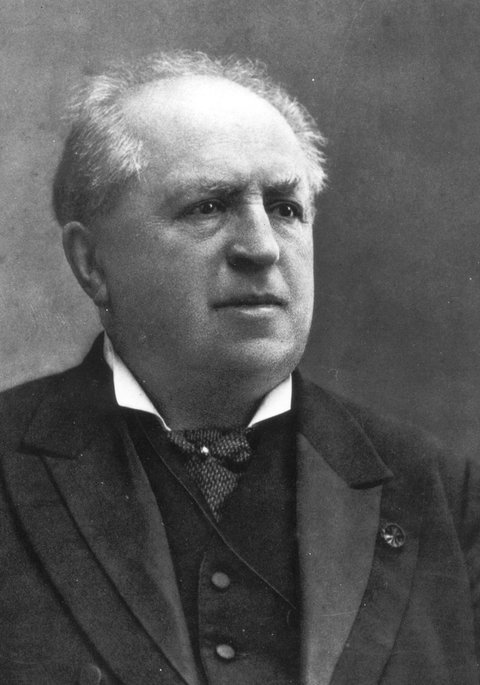
Portrait of Abraham Kuyper

About the author

Abraham Kuyper

Abraham Kuyper (1837 to 1920) was a Dutch Reformed theologian, newspaper editor, and politician. He founded the Free University of Amsterdam in 1880 and served as Prime Minister of the Netherlands from 1901 to 1905.