Modernized edition · Full text · Free PDF/EPUB
On the Apostles’ Creed in Modern English
Want the file? The PDF/EPUB is free with an account.
Summary
- Author
- Rufinus of Aquileia (around 345 to 411 AD), presbyter, monk and translator of Greek theology into Latin
- Written
- Around 404 AD, at Aquileia, at the request of Bishop Laurentius
- Form
- A commentary on the Creed in 48 short sections, from a preface to a closing prayer
- Text explained
- The Creed as recited at baptism in Aquileia, compared with the Roman and Eastern forms
- Length
- 18,000 words · 1 hours
What is On the Apostles’ Creed about?
On the Apostles’ Creed is Rufinus of Aquileia's explanation of the baptismal creed of his church, written for Bishop Laurentius in the early fifth century. Taking the Creed clause by clause, Rufinus sets out its meaning for new believers, defends it from Scripture and natural reason against pagans and heretics, and notes where Aquileia's wording differs from Rome's.
Read the full summary (8 points, key themes)Show less
How the argument unfolds
- 01
Preface and origin. Rufinus answers Laurentius's request and tells how the apostles framed the Creed before they parted, each adding a sentence, and why it is called a Symbol.
- 02
God the Father Almighty. Faith must come before understanding. The name Father implies a Son, whose generation is to be believed, not searched out.
- 03
Christ Jesus, the only Son. Rufinus explains the names Jesus, Christ, only Son and Lord, and shows that illustrations from nature hold only at one point.
- 04
Born of the Virgin. He defends the virgin birth from the prophets and against pagan mockery, and explains how a human soul served as the medium between God and flesh.
- 05
The cross and the descent. The cross is Christ's victory over the powers that held mankind in bondage, and each step of the passion is matched with a prophecy.
- 06
Resurrection, ascension, judgment. Christ rises carrying the spoils of hell, takes human flesh into heaven, and will come to judge souls and bodies, while the Antichrist will counterfeit his coming.
- 07
Spirit, church and forgiveness. The Spirit completes the Trinity. Rufinus lists the books of Scripture, names the heretical assemblies to avoid, and defends the forgiveness of sins.
- 08
The resurrection of the flesh. The very body each believer lives in will rise, in glory for the righteous and in shame for sinners. A summary of the whole Creed and a prayer close the work.
Key themes
- A creed kept by memory. As a soldier's watchword, “the Creed is not written down on paper or parchment, but kept in the hearts of the faithful”, so that it is learned from living tradition.
- Faith before reason. Rufinus answers the charge that Christians rest on bare belief by showing that “nothing in human life can be carried on without an initial willingness to believe.”
- Mystery and restraint. On the Son's birth from the Father he says: “A servant has no right to argue over the birth of his master.”
- Guilt in the will. Pardon reaches the place where sin began: “Forgiveness of sins is applied not to past deeds, which once done cannot be undone, but to the mind, which can certainly be converted from evil to good.”
Reader questions (8)Hide the questions
Questions about On the Apostles’ Creed
Is there a modern English version of On the Apostles’ Creed?
Yes. This is On the Apostles’ Creed by Rufinus of Aquileia in modern English. The language is modernized and the author's order and argument are kept. The full modernized text is free to read on this page.
Can I read On the Apostles’ Creed online for free?
Yes. The complete text of this modern English edition is on this page, with no sign-up or paywall.
Is there a free PDF of On the Apostles’ Creed?
Yes. The PDF and EPUB of this edition are free with an Updated Works account. Sign in with Google or an email link; no card is needed.
What is On the Apostles’ Creed by Rufinus of Aquileia about?
It explains each clause of the Creed recited at baptism in Aquileia, from belief in God the Father to the resurrection of the flesh. Rufinus gives the meaning of each article, proves it from the prophets and apostles, and answers pagan and heretical objections.
Who was it written for?
Rufinus wrote at the request of Bishop Laurentius, and he says the work is meant less for mature minds than for those learning the first elements of the faith.
Does Rufinus think the apostles wrote the Creed?
He reports the tradition handed down by the forefathers that the apostles, filled with the Holy Spirit, composed it together before going out to the nations, so that their preaching would never differ.
How does the creed of Aquileia differ from Rome's?
Rufinus notes that Aquileia adds “invisible and impassible” to the first article, includes the descent into hell, which Rome and the East lack, and says the resurrection of “this” flesh.
Why does Rufinus list the books of the Bible?
Because the Spirit named in the Creed inspired the Scriptures, he sets out the canonical books received from the Fathers, the ecclesiastical books read in church but not used to confirm doctrine, and the apocryphal books not to be read.
On the Apostles’ Creed in Modern English · Full text
Introduction: Origin and Purpose of the Creed
Section 1: Preface to Bishop Laurentius
My mind has as little inclination for writing as it has ability, most faithful Bishop Laurentius. I know very well that submitting slender talent to public criticism carries real risk. Yet in your letter you rashly (forgive my saying so) bind me by Christ’s sacraments, which I hold in the deepest reverence. You ask me to write something for you about the faith in keeping with the traditional and natural meaning of the Creed. In doing so, you lay upon me a burden heavier than my strength can bear. I have not forgotten the saying of the wise, which puts it so justly: “To speak even what is true about God is perilous.” Still, if you will support with your prayers the duty your request has laid on me, I will try to say something. I act more out of reverent respect for your command than out of any presumptuous confidence in my own ability. What I write will scarcely seem worthy of mature minds, but it may suit the capacity of children and beginners in Christ.
I know that several eminent writers have already published brief and devout treatises on these matters. I also know that the heretic Photinus has written on the same subject. His aim, however, was not to explain the text’s meaning to his readers. Instead, he twisted simple, truthful statements into support for his own private doctrine. Yet the Holy Spirit took care that nothing ambiguous, obscure, or inconsistent with other truths would be set down in these words. In this way that prophecy is fulfilled: “Finishing and cutting short the word in equity: because a short word will the Lord make upon the earth” (Isaiah 10:22-23; Romans 9:28). My endeavor, then, will be twofold. First, I will restore and highlight the apostles’ words in their native simplicity. Second, I will supply points that earlier expositors seem to have omitted. To make the scope of this “short word” clearer still, let us trace from the beginning how it came to be handed down to the churches.
Section 2: How the Apostles Composed the Creed
Our forefathers have handed down a tradition to us about the origin of the Creed. After the Lord’s ascension, the Holy Spirit came down and tongues of flame rested on each of the apostles, enabling them to speak in various languages. As a result, no nation was too foreign and no tongue too barbarous to remain beyond their reach. The Lord then commanded them to go out individually to the various nations to preach the word of God. On the eve of their departure from one another, they first agreed together on a standard for their future preaching. They wanted to make sure that once they were separated, they would never differ in what they taught those whom they invited to believe in Christ. So they all gathered together, filled with the Holy Spirit, and composed this brief summary of their coming message. Each contributed his own sentence to one shared statement, and they directed that the rule framed in this way should be delivered to all who believe.
For many compelling reasons, they gave this summary the name of Symbol. In Greek, symbolon corresponds to two Latin terms: indicium, meaning a sign or token, and collatio, meaning a joint contribution made by several people. That is exactly what the apostles did in these words, each contributing his own part. It is called indicium or signum, a sign or token, because in those days many wandering Jews posed as apostles of Christ, as the apostle Paul says and as the Acts of the Apostles relates. They went around preaching for money or for the sake of their own appetites. They invoked the name of Christ, yet they did not pass on his message along the exact lines of apostolic tradition. The apostles therefore prescribed this summary as a token by which anyone preaching Christ truly, according to the apostolic rule, could be recognized.
There is a military parallel as well. In civil wars, both sides wear the same armor, speak the same language, and follow the same customs and methods of warfare. To guard against treachery, each general gives his soldiers a distinct symbol or watchword (in Latin, signum or indicium). If someone encounters a soldier whose allegiance is uncertain, asking for the watchword reveals at once whether he is friend or foe. For this very reason, tradition adds, the Creed is not written down on paper or parchment, but kept in the hearts of the faithful. That way, everyone can be sure that no one learned it merely by reading, as unbelievers sometimes do, but through living tradition handed down from the apostles.
As the apostles prepared to scatter and preach the Gospel, they established this sign and token of their unity in the faith. In doing so, they stood in sharp contrast to the sons of Noah. When those men were about to scatter, they built a tower of baked bricks and tar whose top would reach to heaven. The apostles, by contrast, raised a monument of faith strong enough to withstand the enemy, built of living stones and the Lord’s own pearls. No winds can topple it, no floods can undermine it, and no fury of storms or tempests can shake it. Those earlier builders, who raised a tower of pride on the eve of their separation, were justly condemned to the confusion of tongues so that no one could understand his neighbor’s speech. The apostles, who built a tower of faith, were endowed with the knowledge and understanding of all languages. Thus the one tower became a sign and token of sin, and the other a sign and token of faith.
It is time now to examine these pearls themselves. First among them stands the fountain and source of all the rest, where we say:
I Believe in God the Father Almighty
Section 3: Local Variations and the Necessity of Faith
“I believe in God the Father Almighty.” Before I begin discussing the meaning of these words, I should mention that different churches include certain additions in this article. That is not the case, however, in the church of the city of Rome. I suppose there are two reasons for this. First, no heresy has ever originated there. Second, Rome preserves the ancient custom of having candidates for baptism recite the Creed publicly in the hearing of the congregation. As a result, the ears of existing believers will not allow even a single word to be added. In other places, as I understand it, additions were introduced because of particular heresies, in the hope of shutting out doctrinal novelty. For our part, we follow the exact order we received when we were baptized in the church of Aquileia.
“I believe” stands first at the very threshold. As the apostle Paul says when writing to the Hebrews, “He that cometh to God must first of all believe that he is, and that he is a rewarder of those who believe on him” (Hebrews 11:6). The prophet also says, “Except ye believe, ye shall not understand” (Isaiah 7:9). To open the path to understanding, then, you do right to begin by confessing that you believe. After all, no one sets out to sea and entrusts himself to deep, shifting waters unless he first believes a safe voyage is possible. Nor does a farmer cast his seed into the furrows and scatter grain over the soil without faith. He trusts that rain will come along with the warmth of the sun, and that under their nurturing influence and favorable winds the earth will sprout, multiply, and ripen its harvest.
In short, nothing in human life can be carried on without an initial willingness to believe. Why should it seem strange, then, that when we come to God we begin by professing faith, when not even ordinary daily life can go on without it? I mention this at the outset because pagans constantly object that our religion lacks rational proof and rests on bare belief. We have shown, however, that nothing can be done or endure unless belief comes first. People enter marriage believing that children will be born. Parents entrust children to teachers believing that the teachers’ knowledge will pass to the students. A ruler assumes the insignia of empire believing that nations, cities, and a well-equipped army will obey him. If no one enters any of these endeavors without first believing that the hoped-for result will follow, how much more necessary must belief be for anyone seeking the knowledge of God? Now let us see what this “short word” of the Creed sets before us.
Section 4: The Meaning of God and Father
“I believe in God the Father Almighty.” The Eastern churches almost universally hand down this article as, “I believe in one God the Father Almighty.” Likewise, in the next article, where we say, “And in Christ Jesus, his only Son, our Lord,” they say, “And in one Lord, our Lord Jesus Christ, his only Son.” In this way they confess “one God” and “one Lord,” following the authority of the apostle Paul. We will return to that wording shortly. For now, let us focus on the words, “In God the Father Almighty.”
“God,” as far as the human mind can conceive, is the name of that nature or substance which stands above all things. “Father” is a word that expresses a hidden and unspeakable mystery. When you hear the word “God,” you must understand a substance without beginning and without end. It is simple, uncompounded, invisible, incorporeal, ineffable, and immeasurable, containing nothing added or created. He who is unconditionally the cause of all things has no cause himself. When you hear the word “Father,” you must understand the Father of a Son, and that Son is the image of this very substance. No one is called a “lord” unless he has a possession or servant over whom he is lord. No one is called a “teacher” unless he has a student. In the same way, no one can possibly be called “Father” unless he has a Son. The very name “Father,” therefore, shows plainly that together with the Father there also exists a Son.
Still, I would not have you debate how God the Father begot the Son, or pry too inquisitively into this profound mystery. If you peer too eagerly into the brilliance of unapproachable light, you risk losing even the faint glimpse that God’s grace has granted to mortals. If you think this is a subject to probe with every possible scrutiny, start by posing questions closer to home. Only if you can answer those satisfactorily should you press on from earthly things to heavenly ones, from the visible to the invisible. Determine first, if you can, how the mind within you generates a word, and what the spirit of memory inside it is. Explain how these, though distinct in reality and activity, are still one in substance and nature. Explain how they proceed from the mind without ever separating from it.
Those realities exist within us and belong to our own soul’s substance, yet they still seem hidden because our bodily eyes cannot see them. Let us choose something even more open to view. How does a spring generate a river from itself? By what spirit does it rush onward into a swift stream? The river and the spring are one and inseparable. Yet how is it that the river can never be thought of or called the spring, nor the spring the river, while whoever has seen the river has seen the spring as well? Practice first on explaining these things that lie right under your hands, and only then advance to loftier matters.
Do not think I am asking you to leap all at once from earth above the heavens. First, with your permission, let me direct your gaze to the sky our eyes behold and ask you to explain the nature of this visible sun. How does that heavenly fire generate the brightness of light from itself? How does it also produce heat? And though these three are distinct in reality, how are they still one in substance? Even if you could fathom every one of these, you would still have to admit that the mystery of divine generation far surpasses them all. It is as transcendent as the Creator is mightier than his creatures, as the craftsman excels his work, and as the one who always exists is nobler than what began out of nothing.
That God is the Father of his only Son, our Lord, is therefore to be believed, not debated. A servant has no right to argue over the birth of his master. The Father himself bore witness from heaven, saying, “This is my beloved Son, in whom I am well pleased: hear him” (Matthew 17:5). The Father declares that he is his Son and commands us to hear him. The Son says, “He who seeth me seeth the Father also” (John 14:9), “I and the Father are one” (John 10:30), and “I came forth from God and am come into the world” (John 16:28).
Who dares to force himself as a debater between these words of the Father and the Son? Who can divide the Godhead, split its will, tear apart its substance, cut the spirit into pieces, and deny that what the Truth speaks is true? God is a true Father because he is the Father of the Truth. He does not beget from something outside himself, but generates the Son from what he himself is. As the All-Wise, he generates Wisdom. As the Just, he generates Justice. As the Everlasting, he generates the Everlasting; as the Immortal, Immortality; as the Invisible, the Invisible. Because he is Light, he generates Brightness. Because he is Mind, he generates the Word.
Section 5: One God, Almighty, Invisible, and Impassible
Earlier I noted that the Eastern churches hand down the Creed as “in one God the Father Almighty” and “in one Lord.” Here “one” must be understood not numerically, but uniquely and absolutely. If someone says “one man” or “one horse,” the word “one” is used numerically, because a second and a third man, or a second and a third horse, can follow. Where no second or third can be added, however, “one” is used not numerically, but absolutely. For example, when we speak of “one sun,” we mean that no second or third sun can be added, since there is only one sun. How much more, when God is called “one,” is he called “one” not numerically but absolutely, meaning that there is no other! We should understand the same thing concerning the Lord. There is one Lord, Jesus Christ, by and through whom God the Father exercises dominion over all things. That leads directly to the next title, where God is called “Almighty.”
God is called Almighty because he holds rule and dominion over everything. Yet the Father holds all things through his Son. As the apostle says, “By him were created all things, visible and invisible, whether they be thrones, or dominions, or principalities, or powers” (Colossians 1:16). Again, writing to the Hebrews, he says, “By him also he made the worlds,” and “he appointed him heir of all things” (Hebrews 1:2). By “appointed” we should understand “generated.”
Now if the Father made the worlds through him, if all things were created through him, and if he is heir of all things, then through him the Father holds rule over all things as well. Just as light is born of light and truth of truth, so Almighty is born of Almighty. As it is written of the seraphim in the Revelation of John, “And they have no rest day and night, crying, ‘Holy, Holy, Holy, Lord God of Sabaoth, which was and which is and which is to come, the Almighty’” (Revelation 4:8). Notice that the one who “is to come” is called “the Almighty.” And who else is “to come” except Christ, the Son of God?
To these words our Creed adds “invisible and impassible.” I should point out that these two words are not found in the Creed of the Roman church. In our church, as is well known, they were added because of the Sabellian heresy, which we call “Patripassian.” That heresy claims that the Father himself was born of the Virgin and became visible, or maintains that the Father suffered in the flesh. To shut out such impiety regarding the Father, our forefathers evidently added these words, calling the Father “invisible and impassible.”
It is clear that the Son, not the Father, became incarnate and was born in the flesh. Through his birth in the flesh, the Son became “visible and passible.” Yet as far as the immortal substance of the Godhead is concerned, which the Son shares as one and the same with the Father, our faith is clear. Neither the Father, nor the Son, nor the Holy Spirit is “visible or passible.” Rather, the Son stooped to take on human flesh, and in that flesh he was both seen and suffered. The prophet foretold this when he said, “This is our God: no other shall be accounted of in comparison of him. He hath found out all the way of knowledge, and hath given it unto Jacob his servant and to Israel his beloved. Afterward he showed himself upon the earth, and conversed with men” (Baruch 3:35-37).
And in Christ Jesus, His Only Son, Our Lord
Section 6: The Names Jesus, Christ, Only Son, and Lord
Next comes, “And in Christ Jesus, his only Son, our Lord.” “Jesus” is a Hebrew word meaning “Savior.” “Christ” comes from “chrism,” meaning anointing. In the Books of Moses we read that when Hoshea, the son of Nun, was chosen to lead the people, his name was changed from Hoshea to Jesus. This showed that the name belonged properly to princes and commanders, to those who would “save” the people following them. Both men therefore bore the name “Jesus.” The first led the people out of the land of Egypt, freed them from their wanderings in the wilderness, and brought them into the promised land. The second leads his people out of the darkness of ignorance, calls them back from the errors of the world, and brings them into the kingdom of heaven.
“Christ” is a title belonging to either high priests or kings. In former times, both high priests and kings were consecrated with anointing oil. Because they were mortal and perishable, however, they were anointed with material, perishable oil. Jesus is made Christ by being anointed with the Holy Spirit, as Scripture says of him, “whom the Father hath anointed with the Holy Spirit sent down from heaven” (Acts 10:38). Isaiah had already foreshadowed this, speaking in the person of the Son: “The Spirit of the Lord is upon me, because he hath anointed me; he hath sent me to preach good tidings to the poor” (Isaiah 61:1; Luke 4:18).
We have shown what “Jesus” means, the one who saves his people, and what “Christ” means, the one made a High Priest forever. Let us look now at what follows to see of whom these things are spoken: “his only Son, our Lord.” Here we are taught that this Jesus of whom we have spoken, and this Christ whose name we have explained, is “the only Son of God” and “our Lord.” So that you will not imagine these human titles carry an earthly sense, the Creed adds that he is “the only Son of God, our Lord.” He is born One from One, just as there is one brightness from light and one word from the understanding. An incorporeal generation does not multiply into a plurality or suffer division, since the one who is born is never separated from the one who begets him.
He is “only,” that is, unique, as thought is to the mind, as wisdom is to the wise, as a word is to the understanding, and as courage is to the brave. Just as the apostle calls the Father “alone wise” (1 Timothy 1:17), so the Son alone is called Wisdom. He is therefore the “only Son.” In glory, eternity, power, dominion, and authority, he is everything the Father is. Yet he does not possess these as unoriginated, as the Father does. Rather, he receives them from the Father as the Son, without beginning and equal. And although he is the head of all things, the Father is his head. For it is written, “The head of Christ is God” (1 Corinthians 11:3).
Section 7: How Illustrations Point to Eternal Generation
When you hear the word “Son,” you must not think of a birth according to the flesh. Remember that this is spoken of an incorporeal substance and a simple, uncompounded nature. As we said above, when the understanding generates a word, or the mind produces thought, or light sends forth brightness from itself, no one expects anything fleshly. No one imagines any weakness or imperfection in that kind of generation. How much purer and more sacred, then, ought our conception of the Creator of all these things to be!
Perhaps you will object, “The generation you describe is unsubstantial. Light does not produce a substantial brightness, nor does the understanding generate a substantial word, yet you affirm that the Son of God was generated substantially.” To this I reply, first, that whenever examples or illustrations are drawn from created things, the comparison cannot hold in every single detail. It holds only in the specific point for which it is used. Consider the Gospel saying, “The kingdom of heaven is like leaven, which a woman hid in three measures of meal” (Matthew 13:33). Are we supposed to imagine that the kingdom of heaven is like leaven in every respect, tangible and perishable, able to turn sour and spoil? Clearly the illustration was chosen for one purpose alone: to show how the preaching of God’s word, though it appears so small, can permeate human minds with the leaven of faith.
Similarly, the Gospel says, “The kingdom of heaven is like unto a net cast into the sea, which draws in fishes of every kind” (Matthew 13:47). Are we to think that the substance of the kingdom of heaven resembles the twine of a fishing net or the knots that tie its meshes? Not at all. The sole aim of the comparison is simpler than that. Just as a net draws fish to shore from the depths of the sea, so the preaching of the kingdom of heaven rescues human souls from the depths of worldly error. From this it is obvious that examples and illustrations do not match in every respect the realities they illustrate. If they matched in every respect, they would no longer be examples or illustrations, but the things themselves.
Section 8: The Uniqueness of the Son and Lord
Next, we must keep in mind that no creature can equal its Creator. Just as the divine substance or essence admits of no comparison, neither does the Godhead itself. Every creature, moreover, was made out of nothing. Consider a spark: though it is so unsubstantial, it is still fire. From itself it produces something else that came out of nothing while preserving in it the very nature of its source, the fire of the parent spark. If that is true, why could the substance of that eternal Light, which has always existed because it contains nothing unsubstantial, not produce substantial brightness from itself?
Rightly, therefore, is the Son called “only” and “unique.” He who has been born in this way is truly “only” and “unique,” and what is unique admits of no comparison. Nor can the one who made all things share the same substance as the things he made. This, then, is Christ Jesus, the only Son of God, who is also our Lord. The word “only” applies to both “Son” and “Lord,” for Jesus Christ is “only” both as true Son and as one Lord.
All other sons, though called sons, hold that title by the grace of adoption, not by truth of nature. Likewise, if others are called lords, they bear that title by delegated authority, not by inherent right. Christ alone is the only Son and the only Lord, as the apostle says: “One Lord Jesus Christ, by whom are all things” (1 Corinthians 8:6). After setting forth in proper order the unspeakable mystery of the Son’s birth from the Father, the Creed now descends to the saving dispensation he graciously undertook for humanity’s salvation. Of the one it just called the “only Son of God” and “our Lord,” it now says:
The Incarnation, Cross, and Descent to the Dead
Section 9: Born of the Holy Spirit and the Virgin Mary
“Who was born of the Holy Spirit from the Virgin Mary.” This birth among human beings belongs to the saving dispensation, whereas the former birth belongs to the divine substance. The one springs from his gracious condescension, the other from his essential nature. He is born of the Holy Spirit from the Virgin. Here a chaste ear and a pure mind are required. You must understand that a temple has now been built within the secret recesses of a virgin’s womb for the one whom you just learned was born unspeakably from the Father. Just as no thought of imperfection may enter our view of the Holy Spirit’s sanctifying work, so no thought of defilement may be imagined in the Virgin birth. This birth was a new birth given to the world, and rightly new. He who is the only Son in heaven is correspondingly the only Son on earth, uniquely born as no other ever was or ever can be.
The prophet’s words concerning him, “A virgin shall conceive and bring forth a son” (Isaiah 7:14), are familiar to everyone and are cited repeatedly in the Gospels. The prophet Ezekiel also foretold the miraculous manner of this birth, calling Mary figuratively “the gate of the Lord,” the gate through which the Lord entered the world. He says, “The gate which looks toward the east shall be closed, and shall not be opened, and no one shall pass through it, because the Lord God of Israel shall pass through it, and it shall be closed” (Ezekiel 44:2). What could point more clearly to the unblemished preservation of her virginity? That gate of virginity was shut. Through it the Lord God of Israel entered, and through it he came forth from the Virgin’s womb into this world. With her virginity preserved intact, the gate of the Virgin remained closed forever. That is why the Holy Spirit is spoken of as the creator of the Lord’s flesh and of his temple.
Section 10: The Cooperation of the Trinity in the Incarnation
From this point you can also grasp the majesty of the Holy Spirit. The Gospel testifies of him when the angel says to the Virgin, “Thou shalt bring forth a son and shalt call his name Jesus, for he shall save his people from their sins” (Matthew 1:21; Luke 1:31). She replies, “How shall this be, seeing I know not a man?” The angel answers her, “The Holy Ghost shall come upon thee, and the power of the Highest shall overshadow thee. Wherefore that holy thing which shall be born of thee shall be called the Son of God” (Luke 1:34-35).
Look closely at how the Trinity cooperates here. The Holy Spirit comes upon the Virgin, and the power of the Most High overshadows her. What is the power of the Most High except Christ himself, who is the power of God and the wisdom of God? And whose power is this? The power of the Most High. Here, then, is the Most High; here also is the power of the Most High; and here also is the Holy Spirit. This is the Trinity, everywhere hidden and everywhere revealed, distinct in names and Persons, yet inseparable in the substance of the Godhead. Although the Son alone is born of the Virgin, the Most High is present and the Holy Spirit is present as well, so that both the Virgin’s conception and her giving birth may be sanctified.
Section 11: Answering Pagan Ridicule of the Virgin Birth
Since these truths rest on the authority of the prophetic Scriptures, they may well silence the Jews, unbelieving and skeptical though they are. Pagans, however, love to ridicule us whenever they hear us speak of a virgin birth. We must therefore say a few words in answer to their objections. Every ordinary birth depends on three conditions: there must be a woman of mature age, she must have union with a man, and her womb must not be barren. In the birth we are discussing, one of these three conditions was absent: the man. Because the one whose birth we speak of was not an earthly man but a heavenly man, that role was supplied by the heavenly Spirit, while the mother’s virginity remained intact.
Why, after all, should a virgin conceiving be considered unbelievable, when everyone knows that the Eastern bird called the phoenix is born, or born again, without any mate? It remains continually one, succeeding itself endlessly through being born and reborn. It is equally well known that bees know no marriage and no ordinary bearing of young. Other creatures in nature follow similar laws of generation. Should we then find it incredible that divine power accomplished, for the renewal and restoration of the whole world, something whose counterparts appear even in the birth of animals?
It is stranger still that the Gentiles call this impossible when they believe their own Minerva was born from Jupiter’s brain. Which is harder to believe, and which runs more contrary to nature? In our account there is a woman, the natural process is respected, there is conception, and in due course birth. In theirs, there is no woman at all, only a man, and yet a birth! Why does someone who believes that story marvel at ours? Again, they claim that Father Bacchus was born from Jupiter’s thigh. Here is another portent, yet they believe it. They believe Venus, whom they call Aphrodite, was born from the foam of the sea, as her compound name indicates.
They also assert that Castor and Pollux hatched from an egg, and that the Myrmidons sprang from ants. A thousand other tales contrary to nature win their belief, such as the stones thrown by Deucalion and Pyrrha sprouting into a crop of human beings. When they credit so many myths like these, how can one single claim seem impossible to them, that a woman of mature age, untouched by a man and made fruitful by the Holy Spirit, should conceive a divine offspring? Really, if they are so hard to convince, they should never have believed those degrading portents in such numbers. And if they do believe them, they ought all the more readily to accept our beliefs, which are as honorable and holy as theirs are shameful and vile.
Section 12: Why the Incarnation Brought No Defilement
Perhaps they will say, “Even if God could make a virgin conceive and give birth, it is beneath a being of such majesty to enter the world that way. Even without any defilement from union with a man, there is still the indignity that accompanies childbirth.” Let us answer briefly, meeting them on their own ground. Suppose a great and powerful man sees a small child suffocating in a swamp and steps right to the edge of the mire to pull the dying child out. Would you criticize him as defiled for getting a little mud on himself, or would you praise him as merciful for saving a life that was perishing?
That example, however, involves only an ordinary man. Let us return to the nature of the one who was born. How far inferior is the sun to him? How far inferior, without question, is any creature to its Creator? Now consider a ray of sunlight falling on a swamp: does it contract any pollution from the mud? Is the sun any worse for shedding its light on filthy things? Think of fire as well, though its nature stands infinitely below the subject we are discussing. No foul or vile substance is ever thought to pollute fire when thrown into it. If this is plainly true even of material things, can you imagine any pollution or defilement touching that supreme, incorporeal nature that transcends all fire and all light?
Note one final point as well. We confess that God formed humanity out of the clay of the earth. If God is thought to be defiled when he comes to rescue his own handiwork, he would have been far more defiled when he made it in the first place. It is pointless to ask why he passed through what offends our sense of modesty when you cannot explain why he created what you find offensive. Clearly, it is human convention rather than nature itself that makes us judge these things shameful. After all, every part of the human body was shaped from one and the same clay, differing only in its purpose and natural function.
Section 13: The Human Soul as Medium Between God and Flesh
There is one more consideration we must not omit in answering this question. The substance of God, which is wholly incorporeal, cannot enter directly into physical bodies or be received by them unless there is first a spiritual substance acting as a medium capable of receiving the divine Spirit. For example, light can shine on every part of the body, yet none of them can receive light except the eye. The eye alone is suited to take in light.
In the same way, the Son of God was born of a virgin not by uniting directly with flesh alone, but by being begotten with a human soul serving as the medium between God and flesh. With that soul acting as the medium, receiving the Word of God in the inner citadel of the rational spirit, God was born of the Virgin without any of the degradation you imagine. Nothing can be considered base or unseemly where the Spirit’s sanctification was at work, and where a soul capable of receiving God also became a sharer in human flesh. Count nothing impossible where the power of the Most High was present. Entertain no thought of human weakness where the fullness of divinity dwelt.
Section 14: The Cross as Triumph Over Three Realms
“He was crucified under Pontius Pilate and was buried; he descended into hell.” The apostle Paul teaches that we should have “the eyes of our understanding enlightened” (Ephesians 1:18) “that we may understand what is the height and breadth and depth” (Ephesians 3:18). “Height, breadth, and depth” describe the cross. The part driven into the earth he calls the depth. The upright beam rising from the ground and reaching skyward is the height. The crossbeam stretching out to the right and to the left is the breadth. Since there are so many ways for human beings to die, why does the apostle want our understanding enlightened so that we grasp why the cross above all others was chosen for the Savior’s death?
We must recognize that the cross was a triumph, a glorious trophy. A trophy is a monument of victory over a defeated enemy. When Christ came, he brought three realms at once under his rule. Scripture signifies this when it says, “That in the name of Jesus every knee should bow, of things in heaven, and things on earth, and things under the earth” (Philippians 2:10). Because he conquered all three by his death, a form of death was chosen that matched this mystery. Lifted up into the air and subduing the powers of the air, he displayed his victory over those supernatural, heavenly powers. By stretching out his arms, as the holy prophet says, “all the day long he stretched out his hands” (Isaiah 65:2) to the people on earth, he both warned unbelievers and invited believers. Finally, by the part of the cross sunk beneath the ground, he signified his conquest of the kingdoms of the underworld.
Section 15: Defeating Fallen Powers and Teaching Obedience
Let us touch briefly on some deeper mysteries. When God first made the world, he placed certain heavenly powers over it to govern and guide the human race. Moses points to this in his song in Deuteronomy: “When the Most High divided the nations, he appointed the bounds of the nations according to the number of the angels of God” (Deuteronomy 32:8). Some of these powers, however, such as the one called the prince of this world, did not exercise their God-given authority according to the laws under which they had received it. Instead of teaching humanity to obey God’s commandments, they taught people to follow their own perverse guidance. In this way we fell under the bondage of sin, because, as the prophet says, “We were sold under our sins” (Isaiah 50:1). Whenever anyone gives in to lust, he accepts the purchase price of his own soul.
Every human being was thus held under a written bond by those wicked rulers. When Christ came, he tore up that bond and stripped them of their authority. Paul points to this under a great mystery when he says of Christ, “He destroyed the handwriting which was against us, nailing it to his cross, and led away principalities and powers, triumphing over them in himself” (Colossians 2:14-15). Those rulers whom God had originally set over humanity had grown defiant and tyrannical. They turned to attack the very people placed in their charge and routed them completely in the battles of sin.
The prophet Ezekiel hints at this mystically when he says, “In that day angels shall come forth hastening to exterminate Ethiopia, and there shall be perturbation among them in the day of Egypt; for behold he comes” (Ezekiel 30:9). Having stripped them of their supreme power, Christ is said to have triumphed and to have handed over to human beings the authority taken from them. As he himself tells his disciples in the Gospel, “Behold I have given you power to tread upon serpents and scorpions, and upon all the might of the enemy” (Luke 10:19).
The cross of Christ, then, subjected those who had abused their entrusted authority to the very people who had once been subjected to them. At the same time, it teaches us as human beings, first of all, to resist sin even to the point of death and to die willingly for the sake of true religion. Second, this same cross sets before us an example of obedience, just as it punished the defiance of our former rulers.
Hear how the apostle teaches us obedience through the cross of Christ. He writes, “Let this mind be in you, which was in Christ Jesus, who, being in the form of God, thought it not robbery to be equal with God, but made himself of no reputation, taking upon him the form of a servant, being made in the likeness of men; and, being found in fashion as a man, he became obedient unto death, even the death of the cross” (Philippians 2:5-8). Just as a consummate teacher instructs by both example and word, so Christ taught the obedience that good people must render even at the cost of death by first dying himself to render it.
Section 16: The Hook of Divinity Concealed in Human Flesh
Perhaps someone feels alarmed at hearing us speak of the death of the one whom we just described as everlasting with God the Father, begotten of the Father’s substance, and one with him in dominion, majesty, and eternity. Do not be alarmed, faithful listener. In a moment you will see the one whose death you hear of standing immortal once again, for the death he accepts is about to plunder death itself.
This was the whole purpose of the mystery of the Incarnation we just explained. The divine power of the Son of God was like a hook concealed beneath the appearance of human flesh, since, as Paul says, he was “found in fashion as a man” (Philippians 2:8). In that way he drew the prince of this world into combat. Christ offered his flesh as bait so that his hidden divinity underneath might catch the enemy and hold him fast on its hook through the shedding of his spotless blood. He alone, who knew no stain of sin, destroyed the sins of all, or at least of all who have marked the doorposts of their faith with his blood.
When a fish swallows a baited hook, it does not get the bait off the hook. Instead, it is hauled out of the water to become food for others. In the same way, the one who held the power of death seized the body of Jesus in death, unaware of the hook of divinity enclosed inside it. As soon as he swallowed it, he was caught at once. The bars of hell were shattered, and he was dragged out from the abyss to become food for others.
The prophet Ezekiel long ago foretold this very outcome under the same image. He says, “I will draw thee out with my hook, and stretch thee out upon the earth: the plains shall be filled with thee, and I will set all the fowls of the air over thee, and I will satiate all the beasts of the earth with thee” (Ezekiel 29:4-5). The prophet David also says, “Thou hast broken the heads of the great dragon, thou hast given him to be meat to the people of Ethiopia” (Psalm 74:14). And Job likewise bears witness to the same mystery, speaking in the person of the Lord: “Wilt thou draw forth the dragon with a hook, and wilt thou put thy bit in his nostrils?” (Job 41:1-2).
Section 17: The King Who Entered Prison to Free Captives
Christ therefore suffers in the flesh without any loss or diminishment of his divine nature. Through the flesh his divine nature descended into death so that through the weakness of the flesh he might bring about salvation. He did not enter death to be held captive by the law of mortality. Rather, he entered so that in his resurrection he might throw open the gates of death by his own power. Think of a king who goes to a prison and walks inside. He unlocks the doors, unfastens the fetters, and smashes the chains, bars, and bolts. He leads the prisoners out into freedom and restores those sitting in darkness and the shadow of death to light and life. We can certainly say that the king was in prison, yet not on the same terms as the prisoners locked up there. They were in prison to be punished; he was there to free them from punishment.
Section 18: Under Pontius Pilate and the Descent to the Dead
Those who handed down the Creed to us carefully specified the historical time when these events occurred, “under Pontius Pilate,” so that the tradition would never waver as something vague or uncertain. It should be noted, however, that the clause “he descended into hell” is not found in the Creed of the Roman church, nor in the Creeds of the Eastern churches. Still, its meaning seems to be implied in the words “he was buried.”
Given the love and zeal for the divine Scriptures that fill your heart, I have no doubt you are saying to me right now, “These truths ought to be proved by clearer testimonies from the divine Scriptures. The weightier the truths we are asked to believe, the more they deserve clear and unmistakable witnesses.” You are right. Speaking as I am to those who already know the law, I passed over a whole forest of testimonies for the sake of brevity. Since this too is called for, let us cite a few out of many, knowing that for those who are familiar with the Scriptures, a vast sea of testimonies lies open.
Section 19: The Scandal of the Cross Foretold by the Prophets
First of all, we must recognize that not everyone looks at the doctrine of the cross in the same way. It is one thing to Gentiles, another to Jews, and another to Christians. As the apostle says, “We preach Christ crucified, to the Jews a stumbling block, to the Gentiles foolishness, but to those who are called, both Jews and Greeks, Christ, the power of God and the wisdom of God” (1 Corinthians 1:23-24). In the same passage he writes, “For the preaching of the cross is to those who perish foolishness, but to those who are saved,” that is, to us, it is “the power of God” (1 Corinthians 1:18).
The Jews, who had learned from the Law that the Christ would abide forever, stumbled over his cross because they refused to believe in his resurrection. To the Gentiles, it looked like sheer folly that God should submit to death, because they knew nothing of the mystery of the Incarnation. Christians, however, had accepted his birth, his suffering in the flesh, and his resurrection from the dead. Naturally, they believed that it was the power of God that had conquered death.
Hear first how Isaiah prophetically declared this very outcome: the Jews, to whom the prophets had foretold these things, would refuse to believe, while people who had never heard them from the prophets would believe. “To whom he was not spoken of they shall see, and they that have not heard shall understand” (Isaiah 52:15; Romans 15:21). This same Isaiah also foretells that while those who studied the Law from childhood to old age remained in unbelief, every mystery would pass over to the Gentiles. His words are: “And the Lord of hosts shall make a feast on this mountain unto all nations: they shall drink joy, they shall drink wine, they shall be anointed with ointment on this mountain. Deliver all these things to the nations” (Isaiah 25:6). Such was the Almighty’s plan concerning all the nations.
Perhaps those who pride themselves on their knowledge of the Law will say to us, “You speak blasphemy when you claim that the Lord was subjected to the corruption of death and the suffering of the cross.” Read, then, what stands written in the Lamentations of Jeremiah: “The Spirit of our countenance, Christ the Lord, was taken in our corruptions, of whom we said, ‘We shall live under his shadow among the nations’” (Lamentations 4:20). You hear how the prophet says that Christ the Lord was captured and handed over to corruption for our sake, that is, for our sins. Because the Jewish people continued in unbelief, he says the Gentiles live under his shadow, since we dwell not in Israel, but among the nations.
Section 20: Prophecies of Judas’s Betrayal, the Thirty Pieces of Silver, and Christ’s Arrest
If it does not tire you, let me point out as briefly as possible specific links between prophecy and the Gospels. That way, those who are being instructed in the first elements of the faith may have these testimonies engraved on their hearts, so that no sudden doubt about what they believe will ever catch them off guard. The Gospel tells us that Judas, one of Christ’s own friends and table companions, betrayed him.
Let me show you how this was foretold in the Psalms: “He who hath eaten my bread hath lifted up his heel against me” (Psalm 41:9). In another place it says, “My friends and my neighbors drew near and set themselves against me” (Psalm 38:11). And again, “His words were made softer than oil and yet be they very darts” (Psalm 55:21). What does it mean that his words were made soft? “Judas came to Jesus and said unto him, ‘Hail, Master,’ and kissed him” (Matthew 26:49). Under the smooth flattery of a kiss, he drove home the detestable dart of betrayal. At that the Lord asked him, “Judas, betrayest thou the Son of Man with a kiss?” (Luke 22:48).
Notice also that the traitor’s greed priced him at thirty pieces of silver. The prophet speaks of this too: “And I said unto them, ‘If ye think good, give me my price, or if not, forbear.’” Immediately afterward he says, “I received from them thirty pieces of silver, and I cast them into the house of the Lord, into the foundry” (Zechariah 11:12-13). Is this not the very event recorded in the Gospels, that Judas, “repenting of what he had done, brought back the money, and threw it down in the temple and departed” (Matthew 27:3, 5)? How aptly the Lord called it “my price,” as if reproaching and rebuking them! He had performed so many good works among them: he had given sight to the blind, walking to the lame, strength to the paralyzed, and even life to the dead. For all these acts of mercy, they paid him death as his price, valued at thirty pieces of silver.
The Gospels also relate that he was bound. The word of prophecy had foretold this too through Isaiah, saying, “Woe unto their soul, who have devised a most evil device against themselves, saying, ‘Let us bind the just one, seeing that he is unprofitable to us’” (Isaiah 3:9-10).
Section 21: Prophecies of Christ’s Trial, Scourging, and Sending to Herod
Someone may ask, “Are we really to apply these words to the Lord? Could the Lord be held prisoner by human beings and dragged to trial?” On this point too the same prophet will convince you, for he says, “The Lord himself shall come into judgment with the elders and princes of the people” (Isaiah 3:14). According to the prophet’s witness, then, the Lord is put on trial. Not only is he tried, but he is also scourged, slapped on the face with open palms, spat on, and made to endure every insult and indignity for our sake.
Because everyone who heard the apostles preach such things would be utterly astonished, the prophet speaks in their voice and cries out, “Lord, who hath believed our report?” (Isaiah 53:1). It truly seems unbelievable that God, the Son of God, should be proclaimed as having suffered such things. For that very reason they were foretold by the prophets, so that no doubt would arise in those who were coming to faith. Christ the Lord therefore says in his own person, “I gave my back to the scourges, and my cheeks to the palms; I turned not away my face from shame and spitting” (Isaiah 50:6).
Among his other sufferings, it is also written that they bound him and led him away to Pilate. The prophet foretold this as well, saying, “And they bound him and conducted him as a pledge of friendship (xenium) to King Jarim” (Hosea 10:6). Someone may object, “Wait, Pilate was not a king!” Hear what the Gospel reports next: “Pilate hearing that he was from Galilee, sent him to Herod, who was king in Israel at that time” (Luke 23:6-7). How fittingly the prophet adds the name “Jarim,” which means “a wild vine.” Herod did not belong to the house of Israel or to that Israelite vine which the Lord brought out of Egypt and “planted in a very fruitful hill” (Isaiah 5:1). He was a wild vine, that is, of foreign stock. He was rightly called “a wild vine,” because he did not spring from the shoots of Israel’s vine at all.
As for the prophet’s use of the term xenium, meaning “a pledge of friendship,” that matches as well. As the Gospel testifies, “Herod and Pilate, from being enemies, were made friends” (Luke 23:12). As if to seal their reconciliation, each sent Jesus bound to the other. What does it matter how they meant it, so long as Jesus, as Savior, reconciles those at odds, restores peace, and brings back harmony? Of this too it is written in Job, “May the Lord reconcile the hearts of the princes of the earth” (Job 12:24).
Section 22: Prophecies of the Cry for Crucifixion, Christ’s Silence, the Crown of Thorns, and the Cross
The Gospels relate that when Pilate wanted to release him, all the people shouted, “Crucify him! Crucify him!” (Luke 23:21). The prophet Jeremiah foretells this too, speaking in the person of the Lord himself: “My inheritance is become to me as a lion in the forest. He hath uttered his voice against me, wherefore I have hated it. And therefore,” he says, “I have forsaken and left my house” (Jeremiah 12:7-8). And again in another place, “Against whom have ye opened your mouth, and against whom have ye let loose your tongues?” (Isaiah 57:4).
When he stood before his judge, it is written that “he held his peace” (Matthew 26:63). Many Scriptures bear witness to this. In the Psalms it is written, “I became as a man that heareth not, and in whose mouth are no reproofs.” And again, “I was as a deaf man, and heard not, and as one that is dumb and openeth not his mouth” (Psalm 38:13-14). Another prophet also says, “As a lamb before her shearer, so he opened not his mouth. In his humiliation his judgment was taken away” (Isaiah 53:7-8).
It is written that a crown of thorns was placed on his head. Hear in the Song of Songs the voice of God the Father marveling at Jerusalem’s wickedness in this insult against his Son: “Go forth and see, ye daughters of Jerusalem, the crown wherewith his mother hath crowned him” (Song of Solomon 3:11). Another prophet mentions the thorns as well: “I looked that she should bring forth grapes, and she brought forth thorns, and instead of righteousness a cry” (Isaiah 5:4, 7). To help you grasp the hidden meaning of this mystery, remember that Christ came to take away the sins of the world. He also had to free the earth from the curse it received through the first man’s sin, when the Lord said, “Cursed be the earth in thy labors; thorns and thistles shall it bring forth to thee” (Genesis 3:17-18). That is why Jesus was crowned with thorns: so that the first sentence of condemnation might be lifted.
Next he is led to the cross, and the life of the whole world hangs suspended on the wood from which the cross is made. Let me point out how this too is confirmed by the prophets’ witness. You find Jeremiah speaking of it in these words: “Come and let us cast wood into his bread, and crush him out of the land of the living” (Jeremiah 11:19). And again, Moses mourns over them, saying, “Thy life shall be suspended before thine eyes, and thou shalt fear day and night, and shalt not believe thy life” (Deuteronomy 28:66). But we must pass on, for we are already exceeding our intended brevity. We are stretching our “short word” into a long treatise. Still, we will add a few more words so that we do not seem to have skipped what we undertook.
Section 23: Blood and Water from Jesus’s Pierced Side
Scripture records that when the side of Jesus was pierced, “he shed thereout blood and water” (John 19:34). This carries a deep spiritual meaning. Jesus himself had said, “Out of his belly shall flow rivers of living water” (John 7:38). Yet he poured out blood as well. That was the very blood the Jews called down upon themselves and upon their children. He poured out water, therefore, to wash believers. He poured out blood to condemn unbelievers.
This event may also be understood as prefiguring the twofold grace of baptism. One is given through the baptism of water. The other is sought through martyrdom in the shedding of blood, for both are called baptism. Perhaps you ask why our Lord poured out blood and water from his side rather than from another part of his body. I think the rib in the side signifies the woman. The fountain of sin and death came from the first woman, who was formed from the rib of the first Adam. Therefore, the fountain of redemption and life is drawn from the rib of the second Adam.
Section 24: Darkness at Midday and Light at Evening
Scripture records that during our Lord’s passion, darkness covered the earth from the sixth hour until the ninth. The prophet testifies to this as well: “Thy sun shall go down at midday” (Amos 8:9). The prophet Zechariah also writes, “In that day there shall be no more light. There shall be cold and frost in one day, and that day known to the Lord; and it shall be neither day nor night, but at evening time there shall be light” (Zechariah 14:6-7).
Could the prophet have used any plainer language? His words sound less like a prophecy of the future and more like a record of the past. He foretold both the cold and the frost. Indeed, Peter was warming himself by the fire because it was cold. He was chilled not only by the early hour, but also in his faith.
The prophet adds, “And that day shall be known to the Lord; and it shall be neither day nor night” (Zechariah 14:6-7). What does “neither day nor night” mean? Surely he speaks plainly of the darkness that fell in the middle of the day and the light restored afterward. It was not day, because it did not begin with sunrise. Nor was it complete night, because it did not arrive after the day had ended. It neither received its full measure from the start nor lasted to the end. Instead, the light driven away by the crime of wicked men returned at evening time. After the ninth hour, the darkness fled and the sun returned to the world. Another prophet testifies to the same event: “The light shall be darkened upon the earth in the daytime” (Amos 8:9).
Section 25: The Divided Garments and the Scarlet Robe
The Gospel further reports that the soldiers divided the garments of Jesus among themselves and cast lots for his robe. The Holy Spirit ensured that this too was foretold by the prophets. David says, “They parted my garments among them, and upon my vesture they did cast lots” (Psalm 22:18).
Nor were the prophets silent about the scarlet robe that the soldiers placed on him in mockery. Listen to Isaiah: “Who is this that cometh from Edom, red in his garments from Bozrah? Wherefore are thy garments red, and thy raiment as though thou hadst trodden in the winepress?” To this he himself replies, “I have trodden the winepress alone, O daughter of Sion” (Isaiah 63:1-3). He alone is the one who has never sinned. He alone has taken away the sins of the world. If death could enter the world through one man, how much more could life be restored through one man who was also God!
Section 26: Vinegar, Gall, and Wine Mixed with Myrrh
The Gospel also reports that he was given vinegar to drink, or wine mixed with myrrh, which is more bitter than gall. Hear what the prophet foretold about this: “They gave me gall to eat, and when I was thirsty they gave me vinegar to drink” (Psalm 69:21). Moses spoke to the people in agreement with this even in his own day: “Their vine is of the vineyards of Sodom, and their branch of Gomorrah; their grape is a grape of gall, and their cluster a cluster of bitterness” (Deuteronomy 32:32). Rebuking them again, the prophet asks, “Oh foolish people and unwise, have ye thus requited the Lord?” (Deuteronomy 32:6).
The same events are foretold in the Song of Songs. Even the garden where the Lord was crucified is indicated there: “I have come into my garden, my sister, my spouse, and have gathered in my myrrh” (Song of Solomon 5:1). Here the prophet has plainly set forth the wine mixed with myrrh that was given to the Lord to drink.
Section 27: The Death and Burial of Christ
Next, it is written that “he gave up the ghost” (Mark 15:37). This too had been foretold by the prophet. Addressing the Father in the person of the Son, he says, “Into thy hands I commend my spirit” (Psalm 31:5).
Scripture also records that he was buried, and that a great stone was laid at the entrance of the tomb. Hear what prophecy foretold through Jeremiah on this point as well: “They have cut off my life in the pit, and have laid a stone upon me” (Lamentations 3:53). These prophetic words point most plainly to his burial. Here are still others: “The righteous hath been taken away from beholding iniquity, and his place is in peace” (Isaiah 57:1-2). Elsewhere Scripture says, “I will give the malignant for his burial” (Isaiah 53:9). And once more: “He hath lain down and slept as a lion, and as a lion’s whelp; who shall rouse him up?” (Genesis 49:9).
Section 28: The Descent into Hell
His descent into hell is also clearly foretold in the Psalms. There it is said, “Thou hast brought me also into the dust of the death” (Psalm 22:15). Again, “What profit is there in my blood, when I shall have descended into corruption?” (Psalm 30:9). And again, “I descended into the deep mire, where there is no bottom” (Psalm 69:2). Moreover, John asks, “Art thou he that shall come” (into hell, without doubt), “or do we look for another?” (Luke 7:20).
Peter confirms this as well. He writes that “Christ being put to death in the flesh, but quickened in the Spirit which dwells in him, descended to the spirits who were shut up in prison, who in the days of Noah believed not, to preach unto them” (1 Peter 3:18-20). That passage also reveals what he did in hell. Furthermore, the Lord speaks through the prophet as though looking to the future: “Thou wilt not leave my soul in hell, neither wilt thou suffer thy Holy One to see corruption” (Psalm 16:10). Then, in prophetic language, he speaks of this as already accomplished: “O Lord, thou hast brought my soul out of hell: thou hast saved me from them that go down into the pit” (Psalm 30:3). Next follows:
The Resurrection, Ascension, and Final Judgment
Section 29: The Third Day He Rose Again from the Dead
“The third day he rose again from the dead.” The glory of Christ’s resurrection cast radiance over everything that had earlier seemed weak and fragile. A moment ago, it may have seemed impossible to you that an immortal being could die. Now you see that the one who has conquered death and risen again cannot be mortal.
Understand in this the goodness of the Creator. Just as far as you cast yourself down by sinning, so far did he descend in pursuing you. Do not accuse God, the Creator of all things, of lacking power. Never imagine that his work ended in a fall into an abyss his redemptive purpose could not reach. We speak of what is below and what is above because a body sets limits around us. We are confined within our appointed place. Yet to God, who is present everywhere and absent nowhere, what is below and what is above? Still, because he took on a body, there is room for these terms as well.
The flesh laid in the tomb is raised, fulfilling what the prophet spoke: “Thou wilt not suffer thy Holy One to see corruption” (Psalm 16:10). He returned, therefore, as a victor from the dead, bringing with him the spoils of hell. He led out those held captive by death, just as he himself had foretold: “When I shall be lifted up from the earth I shall draw all unto me” (John 12:32). The Gospel bears witness to this: “The graves were opened, and many bodies of saints which slept arose, and appeared unto many, and entered into the holy city” (Matthew 27:52-53). That city is surely the one of which the apostle writes, “Jerusalem which is above is free, which is the mother of us all” (Galatians 4:26).
The apostle also writes to the Hebrews, “It became him, for whom are all things, and by whom are all things, who had brought many sons into glory, to make the author of their salvation perfect through suffering” (Hebrews 2:10). Sitting at the right hand of God in the highest heavens, Christ placed there that human flesh made perfect through suffering. That flesh had fallen into death through the failure of the first man. Now it was restored by the power of the resurrection. Hence the apostle says, “Who hath raised us up together and made us sit together in the heavenly places” (Ephesians 2:6).
Christ was the potter who, as the prophet Jeremiah teaches, “took up again with his hands, and formed anew, as it seemed good to him, the vessel which had fallen from his hands and was broken in pieces” (Jeremiah 18:4). It seemed good to him to raise from the rocky tomb the mortal and corruptible body he had assumed. Having made it immortal and incorruptible, he placed it not on earth, but in heaven at his Father’s right hand. The Old Testament Scriptures are full of these mysteries. No prophet, no lawgiver, and no psalmist is silent. Almost every sacred page speaks of them. It is unnecessary, therefore, to linger over collecting testimonies. Still, we will cite a few, directing those who wish to drink more deeply to the wellsprings of the divine books themselves.
Section 30: Old Testament Prophecies of the Resurrection
It is said in the Psalms, “I laid me down and slept, and rose up again, because the Lord sustained me” (Psalm 3:5). Again, in another place, “Because of the wretchedness of the needy and the groaning of the poor, now will I arise, saith the Lord” (Psalm 12:5). Elsewhere, as we quoted above, “O Lord, thou hast brought my soul out of hell; thou hast saved me from them that go down into the pit” (Psalm 30:3). And in another place, “Because thou hast turned and quickened me, and brought me out of the deep of the earth again” (Psalm 71:20).
In Psalm 88 he is spoken of most clearly: “He became as a man without help, free among the dead” (Psalm 88:4-5). Scripture does not say “a man,” but “as a man.” In descending into hell, he was “as a man.” Yet he was “free among the dead” because death could not hold him. In the one nature, therefore, the reality of human weakness is displayed. In the other, we see the power of divine majesty.
The prophet Hosea also speaks plainly of the third day: “After two days he will heal us; but on the third day we shall rise and shall live in his presence” (Hosea 6:2). He speaks in the voice of those who rise with Christ on the third day and are called back from death to life. They are the very ones who say, “On the third day we shall rise again, and shall live in his presence.” Isaiah also says plainly, “Who brought forth from the earth the great Shepherd of the sheep” (Isaiah 63:11; Hebrews 13:20).
Furthermore, Isaiah foretold that the women would see his resurrection while the scribes, Pharisees, and people disbelieved. He declared, “Ye women, who come from beholding, come: for it is a people that hath no understanding” (Isaiah 27:11). Consider too the women who went to the tomb after the resurrection and searched for him without finding him. Mary Magdalene came to the tomb before dawn, did not find him, and wept before the angels there. She said, “They have taken away the Lord, and I know not where they have laid him” (John 20:13).
Even this is foretold in the Song of Songs: “On my bed I sought him whom my soul loveth; I sought him in the night, and found him not” (Song of Solomon 3:1). Of those who did find him and held him by the feet, the same book foretells, “I will hold him whom my soul loveth, and will not let him go” (Song of Solomon 3:4). Accept these few passages out of many. Since we aim at brevity, we cannot pile up more.
Section 31: The Ascension into Heaven
“He ascended into heaven, and sits at the right hand of the Father; from there he shall come to judge the living and the dead.” These clauses bring the part of the Creed dealing with the Son to a close with fitting brevity. What they state is plain. The real question is how and in what sense we must understand them. Unless you interpret “ascend,” “sit,” and “come” in a way worthy of the divine nature, those words might seem to suggest human limitation.
Christ completed everything that needed to be done on earth and recalled souls from captivity in hell. Only then is he spoken of as ascending to heaven. As the prophet had foretold, “Ascending up on high he led captivity captive, and gave gifts unto men” (Psalm 68:18). Peter spoke of these very gifts in the Acts of the Apostles concerning the Holy Spirit: “Being therefore by the right hand of God exalted, he hath shed forth this gift which ye do see and hear” (Acts 2:33). Christ gave the gift of the Holy Spirit to humanity, because the captives whom the devil had previously dragged into hell through sin, Christ called back to heaven through his resurrection from the dead.
He ascended into heaven, therefore, not to a place where God the Word had never been before. He was always in heaven and remained in the Father. Rather, he ascended to a place where the Word made flesh had never been seated before. Finally, this entrance through heaven’s gates seemed new to its ministers and princes. Seeing human flesh enter the hidden depths of heaven, they speak to one another. David, filled with the Holy Spirit, declares their words: “Lift up your gates, ye princes, and be ye lift up ye everlasting gates, and the King of glory shall enter in. Who is the King of glory? The Lord strong and mighty, the Lord mighty in battle” (Psalm 24:7-8).
These words are spoken not with reference to the power of the divine nature, but with reference to the novelty of human flesh ascending to the right hand of God. David says elsewhere, “God hath ascended jubilantly, and the Lord with the sound of the trumpet” (Psalm 47:5). Conquerors typically return from battle to the sound of the trumpet. Of him it is also said, “Who buildeth up his ascent in heaven” (Amos 9:6). And again, “Who hath ascended above the cherubims, flying upon the wings of the winds” (Psalm 18:10).
Section 32: Seated at the Right Hand of the Father
To sit at the right hand of the Father is a mystery belonging to the Incarnation. That posture does not fit the incorporeal divine nature without the assumption of flesh. Nor is the honor of a heavenly throne sought for the divine nature, but for the human. For this reason Scripture says of him, “Thy seat, O God, is prepared from thence forward; thou art from everlasting” (Psalm 93:2).
The seat on which the Lord Jesus was to sit was prepared from eternity, “in whose name every knee should bow, of things in heaven and things on earth, and things under the earth; and every tongue shall confess to him that Jesus is Lord in the glory of God the Father” (Philippians 2:10-11). David speaks of him in the same way: “The Lord said unto my Lord, Sit thou on my right hand until I make thine enemies thy footstool” (Psalm 110:1). Referring to these words in the Gospel, the Lord asked the Pharisees, “If therefore David in spirit calleth him Lord, how is he his son?” (Matthew 22:43-45). By this he showed that according to the Spirit he was David’s Lord, while according to the flesh he was David’s son.
Elsewhere the Lord himself declares, “Verily I say unto you, henceforth ye shall see the Son of Man sitting at the right hand of the power of God” (Matthew 26:64; Luke 22:69). The apostle Peter also says of Christ, “Who is on the right hand of God, seated in the heavens” (1 Peter 3:22). And Paul writes to the Ephesians, “According to the working of the might of his power, which he wrought in Christ, when he raised him from the dead, and seated him on his right hand” (Ephesians 1:19-20).
Section 33: Judge of the Living and the Dead
Many testimonies of the divine Scriptures teach us that he will come to judge the living and the dead. Before citing what the prophets say on this point, however, we should recall its practical aim. This article of faith calls us to stay alert every day for the Judge’s coming. We must order our conduct as people who will soon give an account to the Judge who stands at hand. This is what the prophet meant about the blessed man when he wrote, “He ordereth his words in judgment” (Psalm 112:5).
When Christ is said to judge the living and the dead, this does not mean that some who come to judgment will still be alive while others are already dead. Rather, he will judge both souls and bodies. “The living” refers to souls, and “the dead” refers to bodies. As the Lord himself says in the Gospel, “Fear not them who are able to kill the body, but are not able to hurt the soul; but rather fear him who is able to destroy both soul and body in Gehenna” (Matthew 10:28).
Section 34: Prophecies of the Judgment and the Antichrist
Now, if you wish, let us show briefly that the prophets foretold these things. Since you are eager to learn, you can gather further passages yourself from the wide expanse of Scripture. The prophet Malachi says, “Behold the Lord Almighty shall come, and who shall abide the day of his coming, or who shall abide the sight of him? For he doth come as the fire of a furnace and as fuller’s soap: and he shall sit, refining and purifying as it were gold and silver” (Malachi 3:1-3).
To know with greater certainty who this Lord is, hear what the prophet Daniel also foretells: “I saw in the vision of the night, and, behold, one like the Son of Man coming with the clouds of heaven, and he came nigh to the Ancient of days, and was brought near before him; and there was given to him dominion, and honor, and a kingdom. And all peoples, tribes, and languages shall serve him. And his dominion is an eternal dominion which shall not pass away, and his kingdom shall not be destroyed” (Daniel 7:13-14). These words teach us not only about his coming and judgment, but also about his dominion and kingdom. His dominion is eternal. His kingdom is indestructible and without end. As the Creed says, “and of his kingdom there shall be no end.” Anyone who claims that Christ’s kingdom will one day end is very far from the faith.
Yet we must realize that the enemy is accustomed to counterfeit this saving coming of Christ with cunning deceit to mislead the faithful. We await the Son of Man coming in the majesty of his Father. In his place, the enemy prepares the Son of Perdition with wonders and lying signs, aiming to introduce the Antichrist into the world instead of Christ. The Lord himself warned the Jews about him in the Gospels: “Because I am come in my Father’s name, and ye received me not, another will come in his own name, and him ye will receive” (John 5:43). And again, “When ye shall see the abomination of desolation, spoken of by Daniel the Prophet, standing in the holy place, let him that readeth understand” (Matthew 24:15). Daniel speaks very fully about the coming of that delusion in his visions. Since we have already expanded our discussion enough, we need not cite examples here. Anyone who wants to learn more may turn to Daniel’s visions directly.
The apostle Paul also warns us: “Let no man deceive you by any means, for that day shall not come except there come a falling away first, and that man of sin be revealed, the Son of Perdition, who opposeth and exalteth himself above everything that is called God, or that is worshiped, so that he sitteth in the temple of God, showing himself as though himself were God” (2 Thessalonians 2:3-4). Shortly afterward he adds, “Then shall that wicked one be revealed, whom the Lord Jesus shall slay with the breath of his mouth, and shall destroy with the brightness of his coming: whose coming is after the working of Satan with all power and signs and lying wonders” (2 Thessalonians 2:8-9). Just after that he writes, “And therefore the Lord shall send unto them strong delusion, that they may believe a lie, that all may be judged who have not believed the truth” (2 Thessalonians 2:11-12).
Prophets, evangelists, and apostles foretold this “delusion” for a clear purpose. They wanted no one to mistake the coming of the Antichrist for the coming of Christ. As the Lord himself says, “When they shall say unto you, lo, here is Christ, or lo, he is there, believe it not. For many false Christs and false prophets shall come and shall seduce many” (Matthew 24:23-24).
See, then, how he described the judgment of the true Christ: “As the lightning shineth from the east unto the west, so shall the coming of the Son of Man be” (Matthew 24:27). When the true Lord Jesus Christ comes, he will take his seat and establish his throne of judgment. As he says in the Gospel, “He shall separate the sheep from the goats” (Matthew 25:32), that is, the righteous from the unrighteous. The apostle writes, “We must all stand before the judgment-seat of Christ, that every man may receive the awards due to the body, according as he hath done, whether they be good or evil” (2 Corinthians 5:10). Moreover, the judgment will cover not only deeds, but thoughts as well. As the same apostle says, “Their thoughts mutually accusing or else excusing one another, in the day when God shall judge the secrets of men” (Romans 2:15-16). Let this suffice on these points. Next follows in the order of the faith:
The Holy Spirit, the Church, and the Forgiveness of Sins
Section 35: Belief in the Holy Spirit and the Trinity
“And in the Holy Spirit.” Everything we have covered at some length above concerning Christ pertains to the mystery of his Incarnation and Passion. Because these events belong to his person, discussing them has delayed our mention of the Holy Spirit for a while. Look solely at the divine nature, and the sequence is direct. We begin the Creed by saying, “I believe in God the Father Almighty.” Next we confess, “in Jesus Christ, his only Son, our Lord.” In the same way we add, “and in the Holy Spirit.” All the details recounted earlier about Christ belong, as we have said, to the dispensation of his flesh, that is, to his Incarnation.
With the mention of the Holy Spirit, the mystery of the Trinity is complete. One Father is confessed, and there is no other Father. One only-begotten Son is confessed, and there is no other only-begotten Son. So also there is one Holy Spirit, and there cannot be another Holy Spirit. To distinguish the Persons, the terms expressing their relationships and distinct properties vary. The first is understood as the Father, from whom all things come and who himself has no Father. The second is the Son, born of the Father. The third is the Holy Spirit, proceeding from both and sanctifying all things.
Yet to display one and the same Godhead in the Trinity, we place the preposition “in” before each Person. We say we believe “in God the Father.” We also say “in Christ his Son” and “in the Holy Spirit.” Our meaning will become even clearer in what follows, for the Creed continues:
Section 36: Belief in God Versus Belief About Creatures and Mysteries
“The holy church, the forgiveness of sins, the resurrection of this flesh.” Notice the change in wording. The Creed does not say “in the holy church,” nor “in the forgiveness of sins,” nor “in the resurrection of the flesh.” Had the preposition “in” been added, it would have carried the same force as in the preceding articles. Instead, in the clauses that declare our faith in the Godhead, we say “in God the Father,” “in Jesus Christ his Son,” and “in the Holy Spirit.” In the remaining clauses, we speak not of the Godhead, but of created realities and spiritual mysteries. Therefore, the preposition “in” is omitted.
We do not say, “We believe in the holy church.” We say, “We believe the holy church,” not as God, but as the church gathered together to God. We believe that there is “forgiveness of sins”; we do not say, “We believe in the forgiveness of sins.” We believe that there will be a “resurrection of the flesh”; we do not say, “We believe in the resurrection of the flesh.” By this single-syllable preposition, the Creator is distinguished from creatures. Divine realities are set apart from human ones.
This, then, is the Holy Spirit who inspired the Law and the Prophets in the Old Testament, and the Gospels and Epistles in the New. That is why the apostle says, “All Scripture given by inspiration of God is profitable for instruction” (2 Timothy 3:16). It therefore seems fitting here to list the books of the Old and New Testaments just as we received them from the tradition of the Fathers. According to our ancestors’ tradition, these are the books believed to be inspired by the Holy Spirit and handed down to the churches of Christ.
Section 37: The Canonical Books of the Old and New Testaments
Of the Old Testament, first of all, five books of Moses have been handed down: Genesis, Exodus, Leviticus, Numbers, and Deuteronomy. Then come Joshua the son of Nun, and the Book of Judges together with Ruth. Next are four books of Kingdoms (or Kings), which the Hebrews count as two. After these come the Book of Omissions, titled the Book of Days (Chronicles), two books of Ezra (Ezra and Nehemiah), which the Hebrews count as one, and Esther. Of the Prophets, there are Isaiah, Jeremiah, Ezekiel, and Daniel, along with one book of the twelve minor prophets. Job and the Psalms of David each form one book. Solomon gave three books to the churches: Proverbs, Ecclesiastes, and the Song of Songs. These make up the books of the Old Testament.
Of the New Testament, there are four Gospels: Matthew, Mark, Luke, and John. Then comes the Acts of the Apostles, written by Luke. There are fourteen Epistles of the apostle Paul, two of the apostle Peter, and one of James, brother of the Lord and apostle. To these are added one of Jude, three of John, and the Revelation of John. These are the books that the Fathers included within the canon, and from which they would have us draw the proofs of our faith.
Section 38: Ecclesiastical and Apocryphal Books
You should also know that there are other books which our Fathers call not “canonical,” but “ecclesiastical.” These include Wisdom, called the Wisdom of Solomon, and another Wisdom, called the Wisdom of the Son of Sirach. The Latins give this second book the general title Ecclesiasticus. That name indicates not the author of the book, but the character of the writing. To this same class belong the Book of Tobit, the Book of Judith, and the Books of the Maccabees. In the New Testament, there is the little book called the Shepherd of Hermas, and the one called The Two Ways, or The Judgment of Peter. The Fathers wanted all of these read in the churches, though not appealed to for confirming doctrine. The remaining writings they named “apocryphal.” These they would not permit to be read in the churches.
These are the traditions that the Fathers have handed down to us. As I said, I considered it timely to set them out here. They will instruct those learning the first elements of the church and of the faith, so that they know from which springs of the Word of God they must draw their drink.
Section 39: The Holy Church and the Assemblies of Heretics
We come next in the order of belief to the holy church. We have already explained why the Creed does not say “in the holy church” here, as it did in the preceding article. Those taught above to believe in one God, under the mystery of the Trinity, must believe this as well. There is one holy church, in which there is one faith and one baptism. In it are believed one God the Father, one Lord Jesus Christ his Son, and one Holy Spirit.
This is the holy church without spot or wrinkle. Many others have gathered churches of their own, including Marcion, Valentinus, Ebion, Manichaeus, Arius, and all the other heretics. Yet those churches are not free from the spot or wrinkle of unfaithfulness. Of them the prophet said, “I hate the Church of the malignants, and I will not sit with the ungodly” (Psalm 26:5). Of the true church, which keeps the faith of Christ intact, hear what the Holy Spirit says in the Song of Songs: “My dove is one; the perfect one of her mother is one” (Song of Solomon 6:9). Whoever receives this faith in the church must never turn aside into the council of vanity or join those who practice iniquity.
Marcion’s assembly is a council of vanity because he denies that the Father of Christ is God the Creator, who made the world through his Son. Ebion’s is a council of vanity because he teaches that, while believing in Christ, we must also keep circumcision of the flesh, Sabbath observance, the customary sacrifices, and every other ordinance according to the letter of the Law. Manichaeus’s assembly is a council of vanity because of his doctrines. First, he calls himself the Paraclete. Next, he claims the world was made by an evil God, denies God the Creator, and rejects the Old Testament. He asserts two mutually opposing natures, one good and one evil. He also teaches that human souls are coeternal with God and, following the Pythagoreans, cycle through various births into cattle, animals, and beasts. Finally, he denies the resurrection of our flesh and insists that the Lord’s birth and passion took place only in appearance, not in true flesh.
Paul of Samosata, and afterward his successor Photinus, also led a council of vanity. They taught that Christ was not born of the Father before the world, but had his beginning from Mary. They refused to believe that being God he was born man; instead, they claimed that starting as a man he was made God. Arius and Eunomius likewise formed a council of vanity. They taught as their settled doctrine that the Son of God was not born from the Father’s very substance, but was created out of nothing. They claimed he had a beginning and is inferior to the Father. They affirm further that the Holy Spirit is not only inferior to the Son, but is merely a ministering spirit.
Theirs too is a council of vanity who confess that the Son is of the Father’s substance, yet distinguish and separate the Holy Spirit. Even so, the Savior shows in the Gospel that the power and Godhead of the Trinity are one and the same. He commands, “Baptize all nations in the name of the Father, and of the Son, and of the Holy Ghost” (Matthew 28:19). It is plainly impious for humans to pull apart what God has joined together. A stubborn and wicked dispute earlier gathered another council of vanity. It claimed that Christ took human flesh indeed, but not a rational soul as well. In truth, Christ brought one and the same salvation to the flesh, the animal soul, and the human mind and reason.
Donatus assembled yet another council of vanity across Africa by accusing the church of betrayal, that is, of handing over the sacred books. Novatus similarly troubled people’s minds by denying repentance to the lapsed and condemning second marriages, even when entered into out of necessity. Avoid all of these as congregations of the wicked.
Turn a deaf ear as well to any, if such there be, who are said to claim that the Son of God does not see or know the Father just as he himself is known and seen by the Father. Reject those who say that Christ’s kingdom will end, or that the flesh will not be raised in the full restoration of its substance. Reject those who deny a just judgment of God for all and claim that the devil will be freed from the punishment of condemnation he deserves. Hold fast instead to the holy church. It confesses God the Father Almighty, his only Son Jesus Christ our Lord, and the Holy Spirit, of one harmonious and undivided substance. It believes that the Son of God was born of the Virgin, suffered for human salvation, and rose from the dead in the same flesh in which he was born. Finally, it hopes that he will come as the Judge of all, through whom both the forgiveness of sins and the resurrection of the flesh are proclaimed.
Section 40: The Forgiveness of Sins
As for the forgiveness of sins, simply believing it should be enough. Who demands a reason or explanation when a prince grants a pardon? If the generosity of an earthly ruler is no fit subject for debate, should human rashness put God’s generosity on trial?
Pagans often mock us. They claim we deceive ourselves by imagining that crimes committed in deed can be washed away by words. They ask, “Can someone who has committed murder no longer be a murderer? Can someone who has committed adultery be counted no adulterer? How can someone guilty of such crimes suddenly be made holy?”
As I said, we answer this better by faith than by argument. The one who promised it is King of all. The one who guarantees it is Lord of heaven and earth. Would you have me doubt that the one who formed me out of the dust of the earth can make a guilty person innocent? Could the one who gave me sight when I was blind, hearing when I was deaf, and strength to walk when I was lame fail to restore my lost innocence?
Let us also appeal to the testimony of nature. Killing a person is not always a crime. Rather, killing out of malice rather than by law is what makes it criminal. In such matters, the outward act alone does not condemn me, since at times it is done rightly. What condemns me is the wicked intention of the mind. If my mind, which was corrupted and where the sin began, is set right, why should I be unable to become innocent after having been guilty?
As I have shown, crime lies not in the bare deed, but in the will. An evil will, stirred by an evil demon, made me subject to sin and death. In the same way, a will moved by the good God and turned to good restores me to innocence and life. The same holds true for every other crime. Thus there is no conflict between our faith and natural reason. Forgiveness of sins is applied not to past deeds, which once done cannot be undone, but to the mind, which can certainly be converted from evil to good.
The Resurrection of the Flesh
Section 41: Scriptural Witness and the Angelic State
This final article, which affirms the resurrection of the flesh, sums up the whole of our perfection with crisp brevity. On this point too, however, the church’s faith is attacked not only by Gentiles, but by heretics as well. Valentinus rejects the resurrection of the flesh completely. So do the Manicheans, as we noted above.
They refuse to listen to the prophet Isaiah when he says, “The dead shall rise, and they who are in the graves shall be raised” (Isaiah 26:19). They also ignore the wise Daniel when he declares, “Then they who are in the dust of the earth shall arise, these to eternal life, but those to shame and confusion” (Daniel 12:2). Yet even in the Gospels, which they claim to accept, they ought to learn from our Lord and Savior. Instructing the Sadducees, he said, “As touching the resurrection of the dead: have ye not read how he saith to Moses in the bush, I am the God of Abraham, the God of Isaac, the God of Jacob? Now God is not the God of the dead but of the living” (Mark 12:26-27).
Just before those words, he declares what the glory of the resurrection is and how great it will be. He says, “But in the resurrection of the dead they will neither marry or be given in marriage, but will be as the angels of God” (Matthew 22:30). The power of the resurrection grants humanity an angelic state. Those who rise from the earth will not live on earth again alongside brute animals, but with the angels in heaven. Yet this belongs only to those whose purer life has prepared them for it. These are the people who even now keep the flesh of their soul in chastity and submit it to the Holy Spirit. With every stain of sin done away and their flesh transformed into spiritual glory by the power of sanctification, they are counted worthy to have it admitted into the company of the angels.
Section 42: Answering Unbelievers’ Objections to the Resurrection
Unbelievers cry out, “How can flesh that has decayed and dissolved, turned to dust, or even been swallowed by the sea and scattered by the waves be gathered back together? How can it be reunited and formed anew into a human body?” Our first answer comes in Paul’s own words: “Thou fool, that which thou sowest is not quickened, except it die. And that which thou sowest, thou sowest not the body, which shall be, but bare grain of wheat or of some other seed: but God giveth it a body as seemeth good to him” (1 Corinthians 15:36-38).
Every year you watch this happen in the seeds you scatter on the ground. Do you refuse to believe the same will happen to your own flesh, which by God’s law is sown in the earth? Why, tell me, do you hold such a low view of God’s power? Why doubt that he can gather the scattered dust of each person’s body and restore it to its original form?
Can you really deny this when you watch human skill search out veins of metal buried deep underground? An expert eye recognizes gold where an untrained observer sees only dirt. Why deny such ability to humanity’s Creator when the creature he made can accomplish so much? Human ingenuity can tell that gold runs in its own vein, silver in another, and copper in a very different one. Iron and lead lie in their own distinct veins beneath what looks like ordinary soil. Shall we then imagine that divine power cannot locate and distinguish the particles belonging to each person’s flesh, even when they appear scattered?
Section 43: The Resurrection of This Flesh and Paul’s Testimony
Let us try to help faltering souls further with reasons drawn from nature. Suppose someone mixes different kinds of seeds together and scatters them randomly across the earth. Will not each kind of grain, wherever it lands, sprout at its proper season according to its own nature? Each will reproduce its own form and its own body.
In the same way, the substance of each individual body retains an immortal principle within itself, even when its particles are widely scattered. It does so because it is the flesh of an immortal soul. At the time God appoints in his good pleasure, its own particles will be gathered from the earth and drawn back to it. They will be restored to the form that death once dissolved. Each soul will receive back not a mixed or foreign body, but the very body it inhabited in life. Thus the flesh together with its own soul will share the outcome of this life’s struggles, either crowned if kept pure or punished if defiled.
Accordingly, our church teaches the faith with special care. Instead of saying “the resurrection of the flesh” as the Creed is handed down in other churches, it adds the pronoun “this,” saying, “the resurrection of this flesh.” “Of this” clearly refers to the person reciting the Creed, who makes the sign of the cross on his forehead as he speaks the word. Each believer is reminded of a solemn truth. If he keeps his own flesh clean from sin, it will be a vessel of honor, useful to the Lord and prepared for every good work. If he defiles it by sin, it will be a vessel of wrath destined for destruction.
Perhaps someone wishes to learn more fully about the glory of the resurrection and the greatness of God’s binding promise. He will find testimonies in almost every book of Scripture. Simply to refresh your memory, we will cite a few passages here and then finish the work you asked of me. The apostle Paul uses arguments like these to affirm that mortal flesh will rise again: “But if there be no resurrection of the dead, then is not Christ risen. And if Christ be not risen, our preaching is vain and your faith is vain” (1 Corinthians 15:13-14).
Immediately afterward he writes, “But now is Christ risen from the dead, the first-fruits of them that sleep. For since by man came death, by man came also the resurrection of the dead. For as in Adam all die, even so in Christ shall all be made alive. But every man in his own order. Christ the first-fruits, afterwards they that are Christ’s at his coming, then cometh the end” (1 Corinthians 15:20-24). Later he adds, “Behold I show you a mystery: We shall all rise indeed, but we shall not all be changed.” Other manuscripts read, “We shall all sleep, indeed, but we shall not all be changed; in a moment, in the twinkling of an eye, at the last trump; for the trumpet shall sound, and the dead shall rise incorruptible, and we shall be changed” (1 Corinthians 15:51-52).
Whichever reading is original, Paul also writes to the Thessalonians: “I would not have you ignorant, brethren, concerning those who are asleep, that ye sorrow not, as the others who have no hope. For if we believe that Jesus died and rose again, so those also who sleep through Jesus shall God bring with him. For this we say unto you by the word of the Lord, that we who are alive and remain at the coming of the Lord shall not prevent them that sleep. For the Lord himself shall descend from heaven with a shout, with the voice of the archangel, with the trump of God, and the dead who are in Christ shall rise first: then we who are alive and remain shall be caught up together with them in the clouds to meet Christ in the air, and so shall we ever be with the Lord” (1 Thessalonians 4:13-17).
Section 44: Prophecies of the Resurrection in Ezekiel and Job
You must not think this is a new doctrine unique to Paul. I will also bring forward what the prophet Ezekiel foretold by the Holy Spirit: “Behold,” he says, “I will open your graves and bring you forth out of your graves” (Ezekiel 37:12). Let me remind you further how Job, who abounds in mystical language, plainly predicts the resurrection of the dead. He writes, “There is hope for a tree; for if it be cut down it will sprout again, and its shoot shall never fail. But if its root have waxed old in the earth, and the stock thereof be dead in the dust, yet through the scent of water it will flourish again, and put forth shoots as a young plant. But man, if he be dead, is he departed and gone? And mortal man, if he have fallen, shall he be no more?” (Job 14:7-10).
Do you not see that in these words Job is appealing, as it were, to human shame? He is asking, “Is humanity so foolish? People watch the stump of a felled tree sprout again from the ground and dead wood come back to life. Do they really imagine their own fate is inferior to that of wood and trees?” To see that Job’s words must be read as a question when he asks, “But mortal man when he hath fallen shall he not rise again?” consider what follows immediately. He adds, “But if a man be dead, shall he live?” (Job 14:14). Right after that he says, “I will wait till I be made again” (Job 14:14). Later he repeats the same conviction: “Who shall raise again upon the earth my skin, which is now draining this cup of suffering?” (Job 19:26).
Section 45: The Meaning of “This Flesh” in the Creed
This is enough to prove our confession in the Creed when we say, “the resurrection of this flesh.” Notice how completely the addition of “this” agrees with everything we have quoted from the sacred books. What else does Job mean in the passage we just explained? He declares, “He will raise again my skin, which is now draining this cup of suffering,” that is, which is enduring these torments. Does he not plainly affirm a resurrection of this flesh, the very flesh now enduring extreme trials and hardships?
Moreover, listen to the apostle: “This corruptible must put on incorruption, and this mortal must put on immortality” (1 Corinthians 15:53). Are his words not those of someone who, in effect, touches his own body and lays his finger upon it? This body, which is now corruptible, will by the grace of the resurrection become incorruptible. This body, which is now mortal, will be clothed with the power of immortality. Scripture says, “Christ rising from the dead dieth no more, death hath no more dominion over him” (Romans 6:9). In the same way, those who rise in Christ will never again experience decay or death. That will happen not because the nature of flesh is cast aside, but because its condition and quality are transformed.
Therefore, a body will rise from the dead incorruptible and immortal, not only for the righteous, but for sinners as well. For the righteous, it will be so that they may remain with Christ forever. For sinners, it will be so that they may endure without end the punishment due to them.
Section 46: The Glorified Bodies of the Righteous
We already proved above that the righteous will remain with Christ our Lord forever. We cited the apostle’s words: “Then we which are alive and remain shall be caught up together with them in the clouds to meet Christ in the air, and so shall we ever be with the Lord” (1 Thessalonians 4:17). Do not marvel that the flesh of the saints will be transformed into such glory at the resurrection. Do not wonder that it will be caught up to meet God, lifted into the clouds, and carried through the air. Setting forth the great blessings God gives to those who love him, the same apostle says, “Who shall change our vile body that it may be made like unto his glorious body” (Philippians 3:21). It is in no way absurd for the bodies of the saints to be lifted into the air. After all, they are renewed in the likeness of Christ’s own body, which sits at God’s right hand.
The holy apostle adds, speaking either of himself or of others of his standing and merit, “He will raise us up together with Christ and make us sit together in the heavenly places” (Ephesians 2:6). God’s saints possess these promises and countless others like them regarding the resurrection of the righteous. Because of this, it is not hard to believe what the prophets also foretold: “The righteous shall shine as the sun and as the brightness of the firmament in the kingdom of God” (Daniel 12:3; Matthew 13:43).
Who could doubt that they will possess the brightness of the sun and be adorned with the splendor of the stars and the sky? The life and fellowship of God’s angels are being prepared for them in heaven. They are promised conformity to the glory of Christ’s body. Speaking of this very glory, promised by the Savior’s own mouth, the holy apostle says, “It is sown as an animal body; it will rise a spiritual body” (1 Corinthians 15:44). It is surely true that God will graciously bring every righteous person and saint into fellowship with the angels. Therefore, it is equally certain that he will transform their bodies into the glory of a spiritual body.
Section 47: From Dust to Flesh to a Spiritual Body
Do not let this promise seem contrary to the natural structure of the body. We believe, according to Scripture, that God took clay from the earth and formed humanity. Our body began when earth was changed into flesh by God’s will. Why, then, should it seem absurd or unreasonable to you? By the same principle by which earth was elevated into an animal body, an animal body can in turn be elevated into a spiritual body.
You will find these truths and many others like them in the divine Scriptures concerning the resurrection of the righteous. Sinners too, as we said above, will receive a state of incorruption and immortality at the resurrection. God grants that state to the righteous for unending glory. He assigns the same state to sinners for unending disgrace and punishment. The prophet’s words, which we cited earlier, state this clearly: “Many shall rise from the dust of the earth, some to life eternal, and others to confusion and eternal shame” (Daniel 12:2).
Section 48: Summary of the Faith and Closing Prayer
Let us gather together all that we have learned. We have seen the lofty sense in which God Almighty is called Father. We have seen the mysterious sense in which our Lord Jesus Christ is confessed as his only Son, and the full perfection of meaning with which his Spirit is called the Holy Spirit. We have learned how the Holy Trinity is one in substance, yet distinct in relationships and Persons. We have considered the birth from a Virgin, the birth of the Word in the flesh, the mystery of the cross, and the purpose of our Lord’s descent into hell. We have beheld the glory of the resurrection and the rescue of souls from captivity in the realm below. We have also traced his ascension into heaven and the awaited coming of the Judge.
Furthermore, we have learned how to recognize the holy church in contrast to assemblies of vanity. We have listed the books that make up the sacred Scriptures and identified the heretical gatherings we must avoid. We have seen that in the forgiveness of sins there is no conflict between divine freedom and natural reason. Finally, we have seen that the truth of the resurrection of our flesh is firmly confirmed. It rests on the sacred Scriptures, on the example of our Lord and Savior himself, and on the conclusions of natural reason.
If we have thoughtfully followed all these truths in order according to the rule of tradition set out above, we lift up our prayer. We ask the Lord to grant to us, and to all who hear these words, grace to keep the faith we have received. Having finished our course, may we await the crown of righteousness laid up for us. May we be numbered among those who rise again to eternal life and be delivered from disgrace and eternal shame, through Christ our Lord. Through him, to God the Father Almighty, with the Holy Spirit, belong glory and dominion forever and ever. Amen.
Finis
Keep this book
Free PDF/EPUB
It stays free to read here. Choose how you would like to take it with you.
One free account opens 500+ books and saves your place on every device. Google sign-in or an email link. No card.
Theme
Typeface
Size
Save your place
A free account remembers where you stopped, on your phone or at your desk, and adds the PDF/EPUB to your library.
Create a free accountAlready have one? Log in
Readers like you keep these books free
Every edition takes real work to modernize and record. One gift funds the next classic, with no subscription.
Supporters receive
All 153 audiobooks, now and future
The whole ebook library as one download
Support the work Copied words
Take the whole book with you
Your passage is on your clipboard. If you want the full text to quote, print or read offline, the PDF/EPUB is free with an account.
Get the free PDF/EPUBGoogle sign-in or an email link. No card.
You are reading On the Apostles’ Creed, free
Readers like you keep these books free
Every edition takes real work to modernize and record. One gift funds the next classic. No subscription.
- All 153 audiobooks, now and future
- The whole ebook library as one download
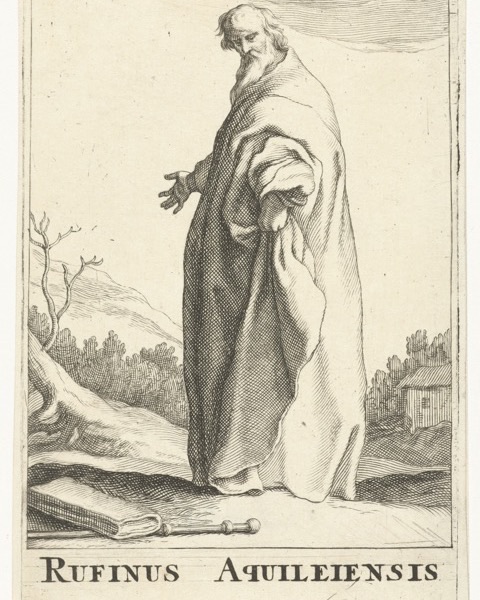
About the author
Rufinus of Aquileia
Tyrannius Rufinus (around 345 to 411 AD) was born at Concordia, near Aquileia in northern Italy, studied at Rome, and was baptized at Aquileia around 370 AD. In 373 AD he went east with Melania the Elder, studied under Didymus the Blind at Alexandria, and later founded a monastery with her on the Mount of Olives, where he was ordained presbyter. Returning to Italy in 397 AD, he translated Origen's On First Principles, which led to his bitter quarrel with Jerome. At Aquileia he translated Eusebius's Church History, Basil, Gregory Nazianzen and others into Latin, and wrote this commentary for Bishop Laurentius. Driven south by Alaric's invasion, he died at Messina in Sicily in 411 AD.