Modernized edition · Full text · Free PDF/EPUB
Against Heresies in Modern English
Want the file? The PDF/EPUB is free with an account.
Summary
- Author
- Irenaeus of Lyon (around 130 to 202 AD), bishop of Lyon in Roman Gaul
- Written
- Around 180 AD, while Eleutherius was bishop of Rome
- Title used by the author
- The Detection and Refutation of False Knowledge
- Type
- Theological treatise against Gnostic teaching, addressed to a friend
- Length
- 184,000 words · 12 hours
What is Against Heresies about?
Against Heresies is Irenaeus of Lyon's five-book treatise of around 180 AD against the Gnostic teachers of his day. He describes the system of the Valentinians and the sects descended from Simon Magus, then refutes them by reason, apostolic tradition, the words of Christ and the letters of Paul.
Read the full summary (8 points, key themes)Show less
How the argument unfolds
- 01
The Valentinian system. Irenaeus sets out Ptolemy's thirty aeons, the fall of Sophia, the ignorant Demiurge and the three classes of humanity.
- 02
Marcus and the line of sects. He exposes Marcus the magician, then traces the sects from Simon Magus through Basilides and Marcion to the Ophites and Cainites.
- 03
Refutation by reason. Anything beyond God would bound him. The aeons fail by defect and excess, and their emissions copy human thought onto God.
- 04
Christ's age and the limits of inquiry. Three Passovers and the words “not yet fifty” show a ministry of years. Some questions, like the origin of matter, belong to God alone.
- 05
Apostolic tradition. The apostles wrote the Gospels and appointed bishops whose succession can be named, from Linus to Eleutherius at Rome.
- 06
The Word made flesh. Jesus and Christ are one. Born of the Virgin, he undoes Eve's disobedience through Mary and saves Adam himself.
- 07
One author of both Testaments. The God of Moses is Christ's Father. The law trained a people, Christ extended its precepts, and the Church offers the Eucharist.
- 08
The resurrection and the kingdom. Paul's letters defend the salvation of the flesh. After Antichrist, the righteous inherit the renewed earth before the new Jerusalem descends.
Key themes
- One Creator. There is no Bythus or ignorant Demiurge. The God who made the world by his Word and Wisdom is the Father of Christ.
- Recapitulation. Christ gathers up the whole human race in himself, reversing Adam's fall from the virgin birth to the cross.
- Humanity's growth. Humanity was made young and grows toward God: “For the glory of God is a living human being, and the life of a human being is to behold God.”
- The salvation of the flesh. The body God formed, healed by Christ and fed by the Eucharist, will rise as the Spirit's inheritance.
Reader questions (9)Hide the questions
Questions about Against Heresies
Is there a modern English version of Against Heresies?
Yes. This is Against Heresies by Irenaeus of Lyon in modern English. The language is modernized and the author's order and argument are kept. The full modernized text is free to read on this page.
Can I read Against Heresies online for free?
Yes. The complete text of this modern English edition is on this page, with no sign-up or paywall.
Is there a free PDF of Against Heresies?
Yes. The PDF and EPUB of this edition are free with an Updated Works account. Sign in with Google or an email link; no card is needed.
What is Against Heresies by Irenaeus of Lyon about?
It exposes the Valentinians and other Gnostic sects, who held that the world was made by a lesser power and that salvation came through secret knowledge, and answers them from reason, Scripture and the tradition of the churches.
Why does Irenaeus describe the heresies before refuting them?
He holds that bringing an error into the open is already a victory over it, and that earlier writers failed because they did not know the system, as a physician must first know the disease.
Did Irenaeus know anyone who had known the apostles?
He saw Polycarp in his early youth and reports Polycarp's answer to Marcion: “I know you, the firstborn of Satan.” He also cites elders in Asia who had known John.
What does Irenaeus say about the law of Moses?
It came from the same God as the Gospel. Its natural precepts, summed up in the Ten Commandments, remain, while its burdens were suited to a people who had turned to the golden calf.
What did Christ's coming add to the prophets?
Himself: “Know that he brought every possible novelty by bringing himself, the very one who had been announced.”
Does Irenaeus name Antichrist?
No. He discusses names that add up to 666, such as Lateinos and Teitan, but holds it safer to wait for the prophecy's fulfillment than to guess.
Against Heresies in Modern English · Full text
Book 1
Exposing the Gnostic Systems
Preface
1. Certain people have set the truth aside and brought in lying tales and empty genealogies. As the apostle says, these “minister questions rather than godly edifying which is in faith.” With craftily built, plausible stories, they draw away inexperienced minds and take them captive. For this reason, my dear friend, I have felt compelled to write this treatise to expose and counter their schemes.
These teachers falsify God’s oracles and prove themselves evil interpreters of the good word of revelation. Under a pretense of superior knowledge, they overturn the faith of many. They draw people away from the one who founded and adorned the universe. They act as if they had something higher and more sublime to reveal than the God who made heaven, earth, and everything in them. With clever, persuasive words, they lure simple people into studying their system. Then they clumsily destroy them, initiating them into blasphemous, impious claims about the Creator. Unsuspecting listeners cannot even tell falsehood from truth in such matters.
2. Error is never displayed in its naked ugliness, or it would be spotted at once. Instead, it dresses itself in attractive clothing. By its outward form, it makes itself look, absurd as this sounds, truer than the truth itself. Someone far wiser than I put this well: “A clever imitation in glass casts contempt, as it were, on that precious jewel the emerald (which is most highly esteemed by some), unless it comes under the eye of one able to test and expose the counterfeit. Or, again, what inexperienced person can easily detect brass when it has been mixed with silver?”
I do not want anyone carried off through my neglect, like sheep seized by wolves. People easily miss these teachers’ true nature because they wear sheep’s clothing on the outside. The Lord himself warned us to stay on guard against them. Their words sound like ours, even though their beliefs are completely different. I have read some of the Commentaries, as they call them, written by the disciples of Valentinus. I have also learned their views through personal conversation with some of them. Therefore, I consider it my duty to lay open for you, my friend, these strange and deep mysteries. Not every mind grasps them, since not everyone has emptied his brain enough to accept them.
Once you know these teachings, you can explain them to everyone connected with you. Urge them to flee such an abyss of madness and blasphemy against Christ. I will set out briefly and clearly, as best I can, the views of those now spreading heresy. I focus especially on the disciples of Ptolemy, whose school is an offshoot of Valentinus’s teaching. According to my modest ability, I will also supply the means to overthrow them by showing how absurd and contrary to truth their claims are. I claim no skill in rhetoric or eloquence. Rather, affection moves me to share with you and your companions doctrines kept hidden until now, yet finally brought to light through God’s goodness. “For there is nothing hidden which shall not be revealed, nor secret that shall not be made known.”
3. Do not expect any display of rhetoric from me. I live among the Celts and spend most of my time speaking a foreign tongue. I have never studied oratory, practiced literary polish, or pretended to write with elegance and charm. Instead, receive kindly what I write to you simply, truthfully, and in my own plain way. You are more capable than I am, so you will expand the seed-thoughts I send you. With your broader understanding, you will develop fully the points I touch on briefly. In that way, you will present with strength to your companions what I have spoken in weakness.
In short, I have spared no effort to satisfy your long-standing wish to know what these people teach. I have both laid out their doctrines and provided the means to expose their falsehood. By the grace the Lord has given you, you will serve others earnestly and effectively. Then people will no longer be led astray by the plausible system of these heretics, which I will now describe.
Chapter 1: The Valentinian Aeons and Their Thirtyfold Pleroma
1. They claim that in the invisible, indescribable heights above, there exists a perfect, pre-existent aeon. They call him Proarche, Propator, and Bythus, describing him as invisible and beyond comprehension. Eternal and unbegotten, he rested through countless ages in deep serenity and stillness. Alongside him existed Ennoea, whom they also call Charis and Sige.
At last, Bythus decided to send forth from himself the beginning of all things. He placed this offspring in his companion Sige, just as seed is placed in a womb. She received the seed, conceived, and gave birth to Nous. Nous was both like and equal to the one who produced him, and he alone could comprehend his father’s greatness. They also call Nous by the names Monogenes, Father, and Beginning of All Things.
Along with him, Aletheia was produced. These four formed the first and firstborn Pythagorean Tetrad, which they also call the root of all things. First come Bythus and Sige, then Nous and Aletheia. Recognizing why he had been produced, Monogenes himself sent forth Logos and Zoe. He became the father of all who followed him, and the beginning and shaping of the entire Pleroma. From the union of Logos and Zoe came Anthropos and Ecclesia. Together, these eight formed the firstborn Ogdoad, the root and substance of all things. They refer to it by four names: Bythus, Nous, Logos, and Anthropos. Each is both male and female in paired union. Propator joined with Ennoea, Monogenes (that is, Nous) with Aletheia, Logos with Zoe, and Anthropos with Ecclesia.
2. Produced for the Father’s glory, these aeons wished to honor him on their own. So they sent forth further emanations in pairs. After producing Anthropos and Ecclesia, Logos and Zoe sent forth ten more aeons: Bythius and Mixis, Ageratos and Henosis, Autophyes and Hedone, Acinetos and Syncrasis, and Monogenes and Macaria. These are the ten aeons they say came from Logos and Zoe.
They add that Anthropos and Ecclesia together produced twelve aeons. To these they give the names Paracletus and Pistis, Patricos and Elpis, Metricos and Agape, Ainos and Synesis, Ecclesiasticus and Macariotes, and Theletos and Sophia.
3. These are the thirty aeons of their erroneous system. They describe them as wrapped in silence and known to no one except these self-styled teachers. They also declare that this invisible, spiritual Pleroma has three parts: an Ogdoad, a Decad, and a Duodecad. For this reason, they claim, the “Savior” (they refuse to call him “Lord”) did no public work for thirty years. In that way, they say, he symbolized the mystery of these thirty aeons.
They also insist that the thirty aeons appear plainly in the parable of the laborers sent into the vineyard. Some are sent around the first hour, others at the third, others at the sixth, others at the ninth, and others at the eleventh. Add those hours together, and the total is thirty: one, three, six, nine, and eleven make thirty. They claim the hours signify the aeons. They boast that these are great, wonderful, and previously unspoken mysteries entrusted especially to them to unfold. In this same way, whenever they spot anything across Scripture they can force into service, they adapt it to their baseless speculations.
Chapter 2: Sophia’s Passion, Horos, and the Production of Christ and Jesus
1. They go on to say that the Propator of their system was known only to Monogenes, who sprang from him, namely Nous. To all the other aeons, Propator remained invisible and incomprehensible. According to them, Nous alone delighted in contemplating the Father and rejoiced in his boundless greatness. Nous also considered how to share the Father’s greatness with the other aeons. He wanted to reveal how vast and mighty the Father was, without beginning, beyond understanding, and completely unseen.
Yet by the Father’s will, Sige held Nous back. The Father intended to lead them all gradually to know Propator and awaken in them a longing to search out his nature. In the same way, the rest of the aeons quietly yearned to behold the Author of their being. They longed to gaze upon that First Cause who had no beginning.
2. One aeon, however, rushed far ahead of the rest. This was Sophia, the very latest of them and the youngest of the Duodecad sprung from Anthropos and Ecclesia. She fell into passion apart from the embrace of her consort Theletos. That passion had first stirred among the aeons close to Nous and Aletheia, then spread like a contagion to this degenerate aeon. She acted under a pretense of love, yet in truth she was driven by recklessness. Unlike Nous, she had never shared communion with the perfect Father.
This passion, they say, was a craving to search into the Father’s nature and comprehend his greatness. Aiming at the impossible, she could not reach her goal and sank into extreme mental agony. Drawn onward both by the Father’s vast, unsearchable depth and by her love for him, she kept straining ever farther forward. She risked being swallowed up by his sweetness and dissolved into his absolute essence. She would have perished had she not met the Power that upholds all things and keeps them outside that unspeakable greatness. They call this power Horos. He restrained and steadied her, and after a hard struggle she came back to herself. Convinced at last that the Father cannot be comprehended, she laid aside her original ambition and the passion born of her overwhelming awe.
3. Others among them tell a different fable about Sophia’s passion and restoration. Attempting the impossible, they say, she brought forth a shapeless substance, the only kind her female nature could produce alone. Looking at it, she first felt grief over its imperfect birth, and then fear that it might end her own existence. Next she lost all control of herself and sank into deep bewilderment. She tried desperately to discover what had caused this and how to hide what had happened.
Tormented by these passions, she finally changed her mind and tried to turn back to the Father. When she made the attempt, her strength gave out, and she pleaded with the Father for help. The other aeons, especially Nous, joined their prayers with hers. From this event, they claim, material substance took its beginning out of ignorance, grief, fear, and bewilderment.
4. Afterward, the Father produced this same Horos in his own image through Monogenes, without a consort, both male and female. They say the Father sometimes acts in union with Sige, and at other times acts apart from male and female alike. They give this Horos several names: Stauros, Lytrotes, Carpistes, Horothetes, and Metagoges.
Through Horos, they say, Sophia was purified, steadied, and restored to her proper consort. Her enthymesis (her inborn desire and thought) was separated from her together with its accompanying passion. Sophia herself remained inside the Pleroma. Meanwhile, Horos cut off her enthymesis and passion, fenced them off, and drove them outside that circle. This enthymesis was indeed a spiritual substance with some of an aeon’s natural impulses. Yet it was shapeless and unformed because it had received nothing from a male consort. For that reason, they call it a weak and feminine offspring.
5. After this substance was placed outside the Pleroma and its mother restored to her consort, Monogenes acted on the Father’s wise forethought. He produced another paired couple, Christ and the Holy Spirit. Their purpose was to fortify and strengthen the Pleroma, prevent any other aeon from suffering a disaster like Sophia’s, and complete the number of the aeons.
Christ then taught the aeons the nature of their paired unions. He taught them that those who possessed a comprehension of the Unbegotten were sufficient for themselves. He also announced what concerned the knowledge of the Father. The Father can never be understood, comprehended, seen, or heard, except insofar as Monogenes alone knows him. The rest of the aeons owe their enduring existence to what is incomprehensible in the Father. They owe their origin and form to what can be comprehended of him, namely the Son. This was the work the newly produced Christ accomplished among them.
6. The Holy Spirit, in turn, taught them to give thanks now that they had all been made equal, and led them into true rest. Thus, they say, the aeons were made equal in form and mind. Every male aeon became like Nous, Logos, Anthropos, and Christ. Every female aeon became like Aletheia, Zoe, Spirit, and Ecclesia.
With everything firmly established and brought to perfect rest, these beings sang praises with great joy to Propator, who shared in their overflowing exultation. Then, grateful for the great blessing given to them, the entire Pleroma acted with one mind and desire. Christ and the Holy Spirit joined them, and the Father sealed their plan with his approval. Each aeon brought whatever was most beautiful and precious in itself. Blending all these gifts with great skill, they produced, to the honor and glory of Bythus, a being of flawless beauty: the very star of the Pleroma and its perfect fruit, Jesus. They also call him Savior, Christ, patronymically Logos, and Everything, because he came from the gifts of all. Finally, they say, angels of the same nature were produced at the same time to honor him and serve as his bodyguard.
Chapter 3: How the Valentinians Misuse Scripture for the Pleroma
1. That is their story of what happened inside the Pleroma. They recount the disasters flowing from Sophia’s passion, when her restless search for the Father nearly dissolved her into the universal substance. They describe how Horos, Stauros, Lytrotes, Carpistes, Horothetes, and Metagoges steadied her out of agony. They tell of the later aeons: the first Christ and the Holy Spirit, produced by the Father after Sophia’s repentance, and the second Christ, also called Savior, formed from the joint gifts of all the aeons.
They claim, however, that this knowledge was never taught openly because not everyone can receive it. Instead, the Savior revealed it mystically through parables to those qualified to understand it. Here is how they argue it. As we already noted, they say the thirty aeons are signified by the thirty years when the Savior did no public work, and by the parable of the laborers in the vineyard. They even insist that Paul clearly and repeatedly names these aeons. He supposedly preserves their very order when he writes, “To all the generations of the aeons of the aeon.” Even we ourselves, they claim, point to these aeons when we say in thanksgiving, “To aeons of aeons” (forever and ever). In short, whenever the word aeon or aeons appears, they immediately apply it to these beings.
2. Again, they claim the production of the Duodecad of aeons is revealed by two facts. The Lord was twelve years old when he debated the teachers of the law, and he chose twelve apostles. The other eighteen aeons, they say, are revealed because the Lord supposedly spoke with his disciples for eighteen months after rising from the dead.
They also insist that these eighteen aeons appear unmistakably in the first two letters of his Greek name Iesous, namely iota and eta. Likewise, they argue that the ten aeons are represented by iota, the first letter of his name. That, they tell us, is why the Savior said, “One Iota, or one tittle, shall by no means pass away until all be fulfilled.”
3. They further claim that the passion of the twelfth aeon is shown by the betrayal of Judas, the twelfth apostle. They say it also appears in Christ suffering in the twelfth month, since they claim he preached for only one year after his baptism. They argue the same mystery appears even more plainly in the woman who suffered from a flow of blood. After twelve years of affliction, she was healed when the Savior came and she touched the hem of his garment. For that reason, they say, the Savior asked, “Who touched me?” By that question, he taught his disciples the mystery among the aeons and the healing of the suffering aeon.
That woman afflicted for twelve years represented the power whose essence, in their tale, was stretching out and flowing into vastness. If she had not touched the garment of the Son, she would have dissolved into the universal essence. That hem, they say, symbolized Aletheia of the first Tetrad. Instead, she stopped short and suffered no more. The power that went out from the Son, whom they call Horos, healed her and separated the passion from her.
4. They also claim that the Savior comes from all the aeons and contains everything in himself, citing the verse, “Every male that openeth the womb.” Being everything, he opened the womb of the suffering aeon’s enthymesis after it was expelled from the Pleroma. They also call this expelled being the second Ogdoad, which we will discuss shortly.
For the same reason, they assert, Paul wrote, “And He Himself is all things,” and again, “All things are to Him, and of Him are all things.” They add, “In Him dwelleth all the fullness of the Godhead.” They cite one more verse: “All things are gathered together by God in Christ.” This is how they twist these and any similar passages in Scripture.
5. They go on to claim that their Horos, whom they call by so many names, has two powers: one of sustaining and one of separating. Insofar as he sustains and upholds, he is Stauros (the Cross). Insofar as he divides and separates, he is Horos (the Boundary). They say the Savior revealed this double function. He pointed to the sustaining power when he said, “Whosoever doth not bear his cross (Stauros), and follow after me, cannot be my disciple,” and again, “Taking up the cross, follow me.” He pointed to the separating power when he said, “I came not to send peace, but a sword.”
They also claim John pointed to this same power: “The fan is in His hand, and He will thoroughly purge the floor, and will gather the wheat into His garner; but the chaff He will burn with fire unquenchable.” In that statement, they argue, John described the work of Horos. They explain the winnowing fan as the cross (Stauros), which burns up all material things like chaff, yet purifies all who are saved as a fan cleanses wheat. They even claim the Apostle Paul referred to this cross when he wrote, “The doctrine of the cross is to them that perish foolishness, but to us who are saved it is the power of God.” They add his other words: “God forbid that I should glory in anything save in the cross of Christ, by whom the world is crucified to me, and I unto the world.”
6. Such is the account they all give of their Pleroma and the origin of the universe. They strive to force the good words of revelation to serve their own wicked inventions. Nor do they limit their perverse readings and deceitful explanations to the evangelists and apostles. They treat the law and the prophets the same way. Those books contain many parables and allegories that can easily be bent into different meanings depending on the interpreter’s method. With great cunning, some of them adapt those Scriptures to their own fictions. In doing so, they lead away captive from the truth anyone who fails to hold a steadfast faith in one God, the Father Almighty, and in one Lord Jesus Christ, the Son of God.
Chapter 4: Achamoth’s Exile and the Origin of the Visible World
1. Here is what they say took place outside the Pleroma. Once the enthymesis of the upper Sophia, whom they also call Achamoth, was cast out along with her passion, she grew violently agitated in the dark, empty regions of her exile. Shut out from the light and the Pleroma, she was shapeless and unformed, like a premature birth, because she had received nothing from a male parent.
Then the Christ dwelling above took pity on her. Reaching out through and beyond Stauros, he gave her form in substance alone, without yet granting her understanding. Having done this, he withdrew his power and returned, leaving Achamoth alone. He did so that she might feel the pain of exile from the Pleroma and long for better things. Meanwhile, she kept a faint fragrance of immortality left behind by Christ and the Holy Spirit. For this reason she bears two names: Sophia, after her parent (for they speak of Sophia as her father), and Holy Spirit, after the Spirit who accompanies Christ.
Once she had received form and awareness, the Logos who had been invisibly with her, namely Christ, immediately left her. She strained to find the light that had forsaken her, yet failed because Horos blocked her way. As Horos stopped her advance, he cried out “Iao,” which they say is how the name Iao originated. Unable to pass Horos because of her entangling passion and her lonely exile, she surrendered to every kind of restless emotion. She felt grief because she had failed to gain her desire, fear that life itself might fail her as light had done, and deep perplexity besides. All of these feelings were bound up with ignorance. Unlike the ignorance of her mother, the first Sophia, which came from an aeon’s fall through passion, hers sprang from an inborn resistance to knowledge. Still another passion came over Achamoth: a longing to turn back to the one who had given her life.
2. This bundle of passions, they claim, formed the raw matter out of which our world was made. Every soul in this world, including the Demiurge’s own soul, sprang from her longing to return to the one who gave her life. Everything else came from her terror and sorrow. All liquids came from her tears, and all bright, luminous things came from her smile. All solid physical elements of the world came from her grief and bewilderment. At one moment, they say, she wept and lamented because she had been left alone in darkness and emptiness. At another, remembering the light that had left her, she grew joyful and laughed. Then again, she was seized with terror, or sank into dismay and confusion.
3. What comes out of all this? Quite a solemn tragedy! Each of their teachers pompously explains in his own way from what kind of passion and from what element being derived its origin. It makes good sense, it seems to me, that they refuse to teach these doctrines openly to everyone. They reserve them for people able to pay a high price for such deep mysteries. These teachings are nothing like what our Lord spoke of when he said, “Freely ye have received, freely give.” Instead, they are obscure, portentous, and profound secrets, won only with heavy labor by those who love falsehood. After all, who would not spend everything he owned to learn these marvels? He would discover that seas, springs, rivers, and every liquid came from the tears of a suffering aeon’s enthymesis, that light burst from her smile, and that the solid elements of the world took shape from her perplexity and dismay!
4. I almost feel tempted to offer a few suggestions to help develop their system. Some waters are fresh, like springs, rivers, and rain, while others are salty, like the sea. I reflect that not all waters can come from her tears, because tears are only salty. Clearly, then, only salt water came from her tears. Yet in her intense agony and confusion, she probably broke out in a sweat! Following their logic, we may suppose that springs, rivers, and all fresh water came from her perspiration. Since we know all tears taste the same, it is hard to believe both salt and fresh water flowed from them. A far more plausible guess is that some came from her tears and some from her sweat. As for the hot and bitter waters found in the world, I leave you to guess how and where they came from! Such are the fruits of their theory.
5. They go on to say that after mother Achamoth endured every kind of passion and barely escaped them, she turned in prayer to the light that had left her, namely Christ. Having returned to the Pleroma, he was apparently unwilling to descend again. So he sent her the Paraclete, that is, the Savior. The Father granted this being all power and placed everything under his authority, and the aeons did the same. Thus, “by him were all things, visible and invisible, created, thrones, divinities, dominions.”
He was sent to her with his companion angels. At first, they say, Achamoth was filled with awe and veiled herself out of modesty. Soon, however, gazing on him in all his splendor and drawing strength from the sight, she ran forward to meet him. He then gave her form in understanding and healed her passions. He separated them from her, though without erasing them altogether. Unlike the earlier case, they could not be annihilated because they had already taken root and grown strong enough to persist.
All he could do was separate them, set them aside, and then blend and condense them, turning bodiless passions into unorganized matter. Through this process he gave them the capacity to harden into solid structures and physical bodies. Two substances were thus produced. One was evil, arising from her passions; the other, still subject to suffering, arose from her turning back. Because he turned mental passions into concrete matter in this way, they say the Savior virtually created the world. Freed at last from her passion, Achamoth gazed in rapture at the dazzling vision of the angels with him. Conceiving in her ecstasy from looking at them, she brought forth new offspring. Part of this progeny was in her own image, and part was a spiritual offspring modeled on the Savior’s attendants.
Chapter 5: The Demiurge and the Creation of the World and Humanity
1. Three kinds of existence were now in place, according to them. The first, from passion, is material. The second, from her turning back, is soulish (or animal). The third, which Achamoth herself brought forth, is spiritual. She next set out to give them form. She could not shape the spiritual element because it shared her own nature. So she turned to shaping the soulish substance that came from her conversion, bringing into the open the instructions of the Savior.
First, they say, she fashioned out of soulish substance the one who is Father and King of all things. He rules both the things sharing his soulish nature, which they call “on the right hand,” and the material things born from passion, which they call “on the left hand.” They claim he made everything that came after him while secretly prompted by his mother. Because of this, they call him Metropator, Apator, Demiurge, and Father. He is Father of the soulish beings on the right, Demiurge (Craftsman) of the material things on the left, and king over all. Desiring to make everything to honor the aeons, this Enthymesis created images of them, or rather the Savior did so through her. Like the invisible Father, she kept herself hidden from the Demiurge. He himself was made in the image of the only-begotten Son, while the angels and archangels he created were images of the rest of the aeons.
2. Thus, they claim, he became Father and God of everything outside the Pleroma, creator of all soulish and material beings. He separated those two kinds of existence that had previously been mixed, and made bodily things out of bodiless ones. He shaped heaven and earth, becoming the Framer (Demiurge) of material and soulish things, right and left, light and heavy, upward-tending and downward-tending.
He also created seven heavens, above which they say the Demiurge dwells. For this reason they call him Hebdomad, and his mother Achamoth they call Ogdoad, echoing the number of the firstborn, primary Ogdoad of the Pleroma. They also claim these seven heavens are intelligent beings and call them angels, while describing the Demiurge himself as an angel resembling God. In the same vein, they say Paradise, located above the third heaven, is a fourth angel endowed with power, from whom Adam drew certain qualities while conversing with him.
3. They continue by saying that the Demiurge imagined he made all these things on his own, when in truth he created them through Achamoth’s productive power. He formed the heavens without knowing the heavens. He shaped humanity without knowing humanity. He brought forth the earth without knowing the earth. In the same way, they say, he remained ignorant of the true patterns of everything he made. He did not even know his own mother existed, imagining that he alone was everything.
They add that his mother planted this opinion in his mind because she desired to bring him forth with such a character that he would be the head and source of his own essence and the absolute ruler over every work that followed. They also call this mother Ogdoad, Sophia, Earth, Jerusalem, Holy Spirit, and, using a masculine title, Lord. Her dwelling place lies in the middle realm, above the Demiurge yet below and outside the Pleroma, until the end of the age.
4. Since they trace all material substance to three passions, namely fear, grief, and perplexity, here is how they distribute them. Soulish substances came from fear and from conversion. The Demiurge himself came from conversion, while all other soulish beings, such as the souls of irrational beasts, wild animals, and human beings, came from fear. Unable to recognize any spiritual reality, the Demiurge thought himself the only God and declared through the prophets, “I am God, and besides me there is none else.”
They teach further that the spirits of wickedness sprang from grief. From grief came the devil, whom they also call Cosmocrator (ruler of this world), along with the demons, wicked angels, and every evil spirit. They portray the Demiurge as the son of their mother Achamoth, and Cosmocrator as the creature of the Demiurge. Yet Cosmocrator knows the realities above him because he is a spirit of wickedness, whereas the Demiurge knows nothing of them because he is merely soulish. Their mother dwells above the heavens in the intermediate realm. The Demiurge dwells in the heavenly realm, the Hebdomad, and Cosmocrator dwells here in our world.
As for the physical elements of the world, they arose, as we noted earlier, from bewilderment and perplexity, a still lower source. Earth came from her stupor, water from the tremor of her fear, and air from the thickening of her grief. Fire, bringing death and decay, lurked inside all three elements, just as they teach that ignorance lay hidden inside those three passions.
5. After making the world, the Demiurge also formed the earthly part of man. He did not take it from this dry soil, they say, but from an invisible substance made of molten, fluid matter. Then, as they explain it, he breathed into him the soulish part of his nature, which was what bore his image and likeness. The material part came close to God in terms of the image, though it did not share his substance. The soulish part resembled him in likeness. Its substance was therefore called the spirit of life, because it came from a spiritual outflowing. Finally, they say, man was wrapped all around in a covering of skin, by which they mean our visible, physical flesh.
6. Yet they add that the Demiurge knew nothing about the spiritual offspring his mother Achamoth had conceived by gazing at the Savior’s angels. Taking advantage of his ignorance, she secretly planted this offspring inside him without his knowing. Through his agency, it was infused into the soulish life he breathed into man. Carried as in a womb inside this material body, it could grow steadily in strength until it became ready to receive perfect reason.
Thus, without the Demiurge’s knowledge, the man shaped by his breath became a spiritual being at the same time through Sophia’s simultaneous inspiration and an unspeakable providence. Just as the Demiurge did not know his mother, he did not recognize her offspring either. They also call this offspring the Ecclesia, an earthly counterpart of the Ecclesia above. Such is the human being they imagine. His lower soul comes from the Demiurge, his body from the earth, his fleshly covering from matter, and his spiritual self from mother Achamoth.
Chapter 6: Three Classes of Humanity and Valentinian Immorality
1. Given these three kinds of substance, they declare that everything material (which they call “on the left hand”) must inevitably perish, because it cannot receive any breath of incorruption. Every soulish being (which they call “on the right hand”) stands midway between the spiritual and the material. It passes over to whichever side its choices incline it toward.
Spiritual substance, on the other hand, was sent forth to unite here with the soulish nature and take shape while both undergo the same training. This spiritual element, they claim, is “the salt” and “the light of the world.” Because the soulish nature needed training through the physical senses, they say the world was created. For the same reason, the Savior came to the soulish nature, which possessed free will, to bring it salvation.
They claim he received the firstfruits of those he came to save in a threefold way. From Achamoth he received the spiritual element, and from the Demiurge he was clothed with the soulish Christ. By a special arrangement, he was also fitted with a body of soulish nature, crafted with unspeakable skill so it could be seen, touched, and able to suffer. At the same time, they deny that he took on anything material, since matter cannot be saved. They teach that the end of all things will arrive once everything spiritual has been formed and perfected by Gnosis (knowledge). By this they mean spiritual people who have attained perfect knowledge of God and been initiated into Achamoth’s mysteries. They claim to be those very people.
2. Soulish people, by contrast, are instructed in soulish things. They are strengthened by good works and simple faith, without possessing perfect knowledge. They say that we of the Church are these people. That is why they insist good works are necessary for us, claiming we cannot possibly be saved without them.
As for themselves, however, they claim they will be completely and inevitably saved, not by how they live, but simply because they are spiritual by nature. Material substance can never share in salvation, since they say it cannot receive it. In the exact same way, spiritual substance, meaning themselves, can never fall under corruption, no matter what actions they commit. Gold dropped into filth loses none of its beauty and keeps its native quality, because filth cannot harm gold. Just so, they boast that they can suffer no injury and lose none of their spiritual nature, no matter what material sins they indulge in.
3. As a result, the “most perfect” among them plunge fearlessly into every kind of forbidden act. These are the very sins of which Scripture warns that “they who do such things shall not inherit the kingdom of God.” For example, they have no scruples about eating meat sacrificed to idols, imagining it cannot defile them. At every pagan festival honoring idols, they are the first to gather. Some even attend those bloody shows hateful to both God and humanity, where gladiators fight wild beasts or duel each other to the death.
Others surrender greedily to every lust of the flesh, arguing that fleshly things belong to the flesh and spiritual things to the spirit. Some routinely corrupt the very women to whom they teach this doctrine. Women led astray by them have often confessed this upon returning to the Church of God, acknowledging it alongside their other errors. Others openly and shamelessly fall in love with women, lure them away from their husbands, and marry them themselves. Still others pretend at first to live modestly with women as with sisters. Time soon exposes their true colors, when the “sister” turns out to be pregnant by her pretended brother.
4. While committing many other abominations and impieties, they look down on us as contemptible and ignorant because, out of the fear of God, we guard against sinning even in thought or word. Meanwhile, they exalt themselves and claim to be perfect and the elect seed. They tell us we merely receive grace on loan, so it will be taken away again. They, however, possess grace as their own permanent property, sent down from above through an unspeakable union, so even more will be given to them.
Therefore, they insist they must always practice the mystery of union in every way. To persuade thoughtless people, they use these very words: “Whoever, being in this world, does not so love a woman as to obtain possession of her is not of the truth and will not attain to the truth. But whoever, being of this world, has intercourse with a woman will not attain to the truth, because he has acted under the power of lust.” Accordingly, they tell us whom they call soulish and “of the world” that we must practice self-control and good works to reach the intermediate realm. For those called “the spiritual and perfect,” however, such conduct is utterly unnecessary. In their view, no conduct leads into the Pleroma. Only the seed sent down in a weak, immature state and brought to perfection here enters it.
Chapter 7: The Final Consummation, Christ’s Nature, and the Demiurge’s Ignorance
1. Once all the seed has reached perfection, they say, their mother Achamoth will leave the intermediate realm and enter the Pleroma. There she will receive as her bridegroom the Savior who sprang from all the aeons. Thus a union will be formed between the Savior and Sophia, that is, Achamoth. These two are the bridegroom and bride, and the entire Pleroma is the bridal chamber.
The spiritual seed, stripped of their soulish natures and transformed into pure, intelligent spirits, will invisibly and irresistibly enter the Pleroma. They will be given as brides to the angels attending the Savior. The Demiurge himself will move up into his mother Sophia’s place, the intermediate realm. There the souls of the righteous will also rest, since nothing soulish can enter the Pleroma. Once all this has happened, the fire hidden inside the world will burst out and burn up all matter. Then the fire will go out along with it and cease to exist forever. They claim the Demiurge knew none of these things before the Savior came.
2. Some of them also claim the Demiurge produced Christ as his own son, of a soulish nature, and that the prophets spoke about him. This Christ passed through Mary like water flowing through a pipe. At his baptism, the Savior from the Pleroma, formed by the combined gifts of all its inhabitants, descended on him in the form of a dove. Within him also dwelt the spiritual seed from Achamoth.
Accordingly, they hold that our Lord mirrored the firstborn primary Tetrad by combining four components. He had the spiritual element from Achamoth and the soulish element from the Demiurge. He also had a body shaped by a special arrangement with unspeakable skill, plus the Savior who descended on him as a dove. That Savior remained untouched by suffering, since one who is incomprehensible and invisible cannot suffer. For that reason, the Spirit of Christ placed within him was taken away when he was brought before Pilate. They claim the seed from mother Achamoth could not suffer either, because it too was spiritual, impassible, and invisible even to the Demiurge.
In their view, then, only the soulish Christ and the body crafted by a special arrangement actually suffered. Mother Achamoth arranged this to display through him a symbol of the Christ above, who extended himself through Stauros to give her form in substance. Every event below, they insist, mirrored what happened above.
3. They further claim that souls carrying Achamoth’s seed are superior to all others and more deeply loved by the Demiurge. Ignorant of the true reason, he assumes they are superior simply because he favors them. Therefore, they say, he appointed them as prophets, priests, and kings. Because of its transcendent nature, that seed spoke many lofty truths through the prophets.
Mother Achamoth also spoke often about heavenly realities, both through the Demiurge and through the souls he formed. Consequently, they split the Old Testament prophecies into three classes: one part spoken by the mother, a second by her seed, and a third by the Demiurge. In the same way, they claim Jesus spoke some words under the Savior’s influence, others under the mother’s, and still others under the Demiurge’s. We will show this later in our work.
4. While ignorant of anything higher than himself, the Demiurge was stirred by the messages spoken through the prophets, yet he brushed them aside. He attributed them sometimes to the prophetic spirit (which can stir itself up on its own), sometimes to mere human effort, and sometimes to a clever trick of a lower, baser sort. He stayed in this ignorance until the Lord appeared.
When the Savior came, however, they say the Demiurge learned everything from him and gladly joined himself to him with all his power. They claim he is the centurion in the Gospel who told the Savior, “For I also am one having soldiers and servants under my authority; and whatsoever I command they do.” They add that he will keep governing the world as long as necessary, especially caring for the Church. He is motivated by the reward promised to him: moving up at last to his mother’s dwelling place.
5. Thus they picture three kinds of people, spiritual, material, and soulish, represented by Cain, Abel, and Seth. These three natures no longer exist together in one person, but define three separate classes of humanity. The material class inevitably goes to destruction. The soulish class, if it chooses the better path, finds rest in the intermediate realm. If it chooses the worse, it too ends in destruction.
Meanwhile, the spiritual seeds sown by Achamoth, which were weak when she first released them, are trained and nourished here in righteous souls until they reach maturity. At last they will be given as brides to the Savior’s angels, while their soulish parts remain forever with the Demiurge in the intermediate realm. Dividing soulish people even further, they say some are good by nature and others evil by nature. The good are capable of receiving the spiritual seed, while the naturally evil can never receive it.
Chapter 8: How the Valentinians Twist Scripture to Fit Their System
1. That, then, is their system. No prophet announced it, the Lord never taught it, and the apostles never handed it down. Yet they boast of knowing it better than everyone else. Drawing their ideas from sources outside Scripture, they try, as the proverb says, to weave ropes of sand. To keep their scheme from looking completely unsupported, they bend the Lord’s parables, the prophets’ sayings, and the apostles’ words into a plausible fit with their claims. In doing so, they ignore the order and context of Scripture and, as far as they can, tear the truth to pieces. By shifting passages around, dressing them in new outfits, and turning one thing into another, they deceive many through their wicked skill at forcing the Lord’s oracles to fit their notions.
Imagine a magnificent mosaic portrait of a king, crafted from precious jewels by a master artist. Suppose someone pulls the whole portrait apart and rearranges the gems into the clumsy image of a dog or a fox. Then he insists that this is the very portrait of the king made by the master artist. He points to the genuine jewels that the first craftsman had skillfully arranged into a king, though he has ruined them by resetting them as a dog. By displaying those gems, he tricks ignorant onlookers who have no idea what a king looks like. He convinces them that this wretched fox is really the noble likeness of the king. In just the same way, these heretics stitch together old wives’ tales. Wherever they find them, they violently wrench words, phrases, and parables out of their proper context to make God’s oracles support their baseless fictions. We have already seen how they do this for the inside of the Pleroma.
2. Here are some examples of how they twist Scripture to describe events outside the Pleroma. They claim the Lord came in the last days to suffer merely to symbolize the passion of the last aeon, and by his death to announce the end of the turmoil among the aeons. They say the twelve-year-old daughter of the synagogue ruler, whom the Lord approached and raised from the dead, symbolized Achamoth. Just so, their Christ stretched out to form Achamoth and led her back to perceive the light that had left her.
They claim Paul showed that the Savior appeared to her while she lay outside the Pleroma like an untimely birth. In his letter to the Corinthians, Paul wrote, “And last of all, He appeared to me also, as to one born out of due time.” Likewise, they claim Paul described the Savior coming to Achamoth with his angels in the same letter: “A woman ought to have a veil upon her head, because of the angels.” That Achamoth veiled herself in modesty when the Savior arrived was supposedly shown earlier by Moses putting a veil over his face.
They even claim the Lord on the cross symbolized her passions. When he cried, “My God, my God, why hast Thou forsaken Me?” he merely meant that Sophia was abandoned by the light and held back by Horos from advancing further. His words, “My soul is exceeding sorrowful, even unto death,” pointed to her anguish. “Father, if it be possible, let this cup pass from Me,” signified her fear. And “And what I shall say, I know not,” represented her perplexity.
3. They teach that Jesus also pointed out the three classes of humanity. He indicated the material class when a man asked, “Shall I follow Thee?” and Jesus replied, “The Son of man hath not where to lay His head.” He indicated the soulish class when another said, “I will follow Thee, but suffer me first to bid them farewell that are in my house.” Jesus answered, “No man, putting his hand to the plow, and looking back, is fit for the kingdom of heaven.” They place this man in the intermediate class. They put the rich man there too, who claimed to have practiced much righteousness yet refused to follow Jesus, so overcome by love of wealth that he never reached perfection.
The spiritual class, they claim, was shown when Jesus said, “Let the dead bury their dead, but go thou and preach the kingdom of God.” They say the same of his words to Zacchaeus the tax collector: “Make haste, and come down, for today I must abide in thine house.” They place both men in the spiritual class. They also say the parable of the woman hiding leaven in three measures of meal reveals the three classes. The woman is Sophia, the three measures of meal are the three kinds of people (spiritual, soulish, and material), and the leaven is the Savior himself.
Paul too, they insist, clearly distinguished the material, soulish, and spiritual classes. In one place he wrote, “As is the earthy, such are they also that are earthy.” In another he said, “But the animal man receiveth not the things of the Spirit,” and again, “He that is spiritual judgeth all things.” That verse, “The animal man receiveth not the things of the Spirit,” supposedly refers to the Demiurge. Being soulish, he knew neither his spiritual mother, nor her seed, nor the aeons in the Pleroma. And Paul supposedly showed that the Savior received the firstfruits of those he would save when he wrote, “And if the first-fruits be holy, the lump is also holy.” In their view, “firstfruits” means the spiritual class, while “the lump” means us, the soulish Church, which they say he took up and blended with himself as “the leaven.”
4. They go on to claim that Jesus spoke of Achamoth when he said he came looking for the lost sheep. In their view, this symbolized her wandering beyond the Pleroma, receiving form from Christ, and being sought by the Savior. The straying sheep is their mother, who sowed the Church. Its wandering represents her time outside the Pleroma in varied passions, from which matter originated. The woman who sweeps her house and finds the lost coin supposedly represents the upper Sophia. She lost her enthymesis and later recovered it once all things were purified by the Savior’s coming, restoring it to the Pleroma.
They also claim that Simeon, “who took Christ into his arms, and gave thanks to God, and said, ‘Lord, now lettest Thou Thy servant depart in peace, according to Thy word,’” was a symbol of the Demiurge. Just so, they say, the Demiurge learned of his own transfer when the Savior arrived and gave thanks to Bythus. Similarly, they point to the prophetess Anna in the Gospel. After living seven years with her husband, she spent the rest of her life as a widow until she saw the Savior, recognized him, and spoke of him to everyone. This, they claim, points plainly to Achamoth, who gazed briefly on the Savior and his companions, then lived in the intermediate realm waiting for him to return and restore her to her true consort.
Even her name, they claim, was hinted at when the Savior said, “Yet wisdom is justified by her children,” and when Paul wrote, “But we speak wisdom among them that are perfect.” Paul also supposedly alluded to the paired unions inside the Pleroma through a single human image. Writing about marriage in this life, he said, “This is a great mystery, but I speak concerning Christ and the Church.”
5. Further, they claim that John, the disciple of the Lord, laid out the first Ogdoad. Here are their own words:
John, the disciple of the Lord, wished to describe the origin of all things and explain how the Father produced everything. So he sets down a certain beginning, the firstborn of God, whom he calls both the only-begotten Son and God. In him the Father brought forth all things in seed form. Through him the Word was produced, and in him the entire substance of the aeons, which the Word himself later shaped. Because John speaks of the first origin of all things, he rightly starts with the Beginning, that is, with God and the Word. He writes: “In the beginning was the Word, and the Word was with God, and the Word was God; the same was in the beginning with God.”
First John distinguishes these three: God, the Beginning, and the Word. Then he unites them again to show how the Son and the Word were each produced, and to display their union with each other and with the Father. For “the beginning” is in the Father and from the Father, while “the Word” is in the beginning and from the beginning. Rightly, then, did he say, “In the beginning was the Word,” because he was in the Son. He said, “and the Word was with God,” because he was the Beginning. He added, “and the Word was God,” naturally, because whatever is begotten of God is God. “The same was in the beginning with God” reveals the order of their production. “All things were made by Him, and without Him was nothing made,” because the Word gave form and beginning to all the aeons that came after him.
“What was made in Him,” says John, “is life.” Here again he points to a paired union, since all things were made through him, yet in him was life. What is in him is more closely joined to him than what was merely made by him, because it coexists with him and unfolds through him. Next he adds, “And the life was the light of men.” By naming Anthropos (Man), he indicates Ecclesia too by that single word, revealing their fellowship through union, since Anthropos and Ecclesia spring from Logos and Zoe. He calls Life (Zoe) the light of men because she enlightens them, meaning she forms and manifests them. Paul confirms this: “For whatsoever doth make manifest is light.” Because Zoe manifested and produced both Anthropos and Ecclesia, she is called their light.
Thus, in these words, John revealed the second Tetrad: Logos and Zoe, Anthropos and Ecclesia. Even more, he indicated the first Tetrad as well. Speaking of the Savior and declaring that everything outside the Pleroma received form from him, John calls him the fruit of the whole Pleroma. He names him a “light which shineth in darkness, and which was not comprehended” by it. When he gave form to everything born of passion, it failed to know him.
He also calls him Son, Aletheia, Zoe, and the “Word made flesh, whose glory,” he says, “we beheld; and His glory was as that of the Only-begotten (given to Him by the Father), full of grace and truth.” (What John actually wrote, however, is this: “And the Word was made flesh, and dwelt among us; and we beheld His glory, the glory as of the only-begotten of the Father, full of grace and truth.”) In this way, according to them, John clearly names the first Tetrad: Father, Charis, Monogenes, and Aletheia. Thus he sets forth the first Ogdoad, the mother of all the aeons, naming Father, Charis, Monogenes, Aletheia, Logos, Zoe, Anthropos, and Ecclesia.
Such are the views of Ptolemy.
Chapter 9: Refuting the Valentinian Reading of John’s Gospel
1. You see, my friend, how these men deceive themselves while abusing Scripture to prop up their system. I have quoted their own phrasing so you can see the deceitfulness of their method and the wickedness of their error.
First, if John had really meant to present that Ogdoad above, he would surely have kept the order of its production. He would have placed the primary Tetrad first, since they regard it as the most venerable, and then added the second. That sequence of names would have displayed the Ogdoad’s true order. He would never have waited through such a long gap and then, as if suddenly remembering it, mentioned the primary Tetrad last of all. Second, if he had meant to signify their paired unions, he would never have left out the name of Ecclesia. Either he would have named only the male aeons throughout for consistency, leaving their female partners implied. Or, if he named the partners of the others, he would have named Anthropos’s consort too, instead of leaving us to guess her name by divination.
2. The absurdity of this reading is obvious. John proclaims one God Almighty and one Jesus Christ, the Only-Begotten, through whom all things were made. He declares that this very one is the Son of God, the Only-Begotten, and the Maker of all things. He is the true Light who enlightens every person, the Creator of the world, the one who came to his own, and the one who became flesh and dwelt among us.
Yet by a plausible-sounding twist, these heretics pervert John’s statements. They invent another Monogenes by emanation, whom they also call Beginning. They invent another Savior, another Logos as the son of Monogenes, and another Christ produced to stabilize the Pleroma. Wrenching every one of these titles away from the truth and abusing the names, they transfer them to their own scheme. On their theory, John never even mentions the Lord Jesus Christ in any of these expressions! If John was naming Father, Charis, Monogenes, Aletheia, Logos, Zoe, Anthropos, and Ecclesia as their primary Ogdoad, then there was as yet no Jesus and no Christ, John’s own teacher, anywhere in it.
Yet the apostle himself makes it unmistakable that he is not talking about their paired aeons, but about our Lord Jesus Christ, whom he recognizes as the Word of God. Summing up everything he has just said about that Word, he declares, “And the Word was made flesh, and dwelt among us.” According to their theory, however, the Word never became flesh at all, because he never left the Pleroma. Instead, it was that later Savior, assembled out of all the aeons by a special arrangement, who supposedly appeared below.
3. Learn, then, you foolish people, that the Jesus who suffered for us and lived among us is himself the Word of God. If some other aeon had become flesh for our salvation, it might be plausible that the apostle meant someone else. Yet the Father’s Word who came down is the very same one who ascended. He is the only-begotten Son of the one God, who by the Father’s good pleasure became flesh for humanity. The apostle is certainly not speaking of anyone else or of any Ogdoad, but of our Lord Jesus Christ.
On their theory, the Word never truly became flesh at all. They claim the Savior merely put on a soulish body, fashioned by a special arrangement and unspeakable providence so he could be seen and touched. Yet real flesh is what God formed long ago for Adam from the dust. John declares that the Word of God became that very flesh. This shatters their primary, firstborn Ogdoad to pieces. Once Word, Only-Begotten, Life, Light, Savior, Christ, Son of God, and the one who became incarnate for us are proved to be one and the same person, their Ogdoad collapses at once. When it falls, their entire system crashes into ruin. It is a system dreamed up out of nothing, wounding Scripture to construct their own invention.
4. Again, by collecting scattered phrases and names from across Scripture, they twist them, as we have already said, from their natural sense into an unnatural one. They act just like people who invent any story they please and then try to build it out of lines from Homer. Uninformed listeners imagine Homer actually wrote verses about that brand-new plot. Many others are so impressed by the smooth flow of the lines that they wonder whether Homer really composed them.
Here is an example, in which someone tells how Eurystheus sent Hercules to fetch the hound from the underworld, stitching the tale entirely out of Homeric verses. There is no harm in quoting it as an illustration, since both methods do the exact same thing:
“So saying, he sent him forth from his house, deeply groaning,” (Odyssey 10.76)
“The hero Hercules, familiar with mighty deeds,” (Odyssey 21.26)
“Eurystheus, son of Sthenelus, descended from Perseus,” (Iliad 19.123)
“That he might bring from Erebus the hound of gloomy Pluto.” (Iliad 8.368)
“And he strode on like a mountain-bred lion, trusting in his strength,” (Odyssey 6.130)
“Swiftly through the city, while all his friends followed,” (Iliad 24.327)
“Maidens, youths, and much-enduring old men,” (Odyssey 11.38)
“Mourning him bitterly as one marching off to death.” (Iliad 24.328)
“Yet Mercury and blue-eyed Minerva guided him,” (Odyssey 11.626)
“For she knew her brother’s heart, how it labored with grief.” (Iliad 2.409)
Now what simple listener would not be fooled by verses like these into thinking Homer actually composed them about that event? Anyone who knows Homer’s poems, however, will recognize the individual lines while rejecting the fake storyline. He knows some lines were spoken of Ulysses, others of Hercules himself, others of Priam, and still others of Menelaus and Agamemnon. Once he puts each line back in its rightful place, the fabricated story vanishes instantly.
In the same way, anyone who keeps unchanged in his heart the rule of truth received at baptism will recognize the names, sayings, and parables taken from Scripture. Yet he will reject the blasphemous use these heretics make of them. He will recognize the genuine jewels, yet never mistake a fox for the portrait of the king. Once he restores every quoted passage to its proper place and fits it back into the body of truth, he will expose the heretics’ fantasy and prove it completely groundless.
5. We still want to give this exposure a decisive finishing stroke. Then anyone who follows their farce to the end can immediately bring forward an argument that overturns it. For that reason, we have decided first to show how the very founders of this fable contradict one another, as though inspired by different spirits of error. That fact alone proves from the outset that the truth proclaimed by the Church stands immovable, while their theories are nothing but a web of falsehoods.
Chapter 10: The Unity of the Church’s Faith Worldwide
1. Although scattered throughout the whole world, even to the ends of the earth, the Church has received this faith from the apostles and their disciples. She believes in one God, the Father Almighty, Maker of heaven, earth, the sea, and everything in them. She believes in one Christ Jesus, the Son of God, who became incarnate for our salvation. She believes also in the Holy Spirit, who proclaimed through the prophets God’s saving plan and the comings of Christ. Through them, the Spirit foretold his birth from a virgin, his suffering, his resurrection from the dead, and the bodily ascension into heaven of our beloved Lord Christ Jesus.
The Spirit also proclaimed Christ’s future appearing from heaven in the glory of the Father “to gather all things in one” and to raise up anew all flesh of the entire human race. He will do this so that, according to the invisible Father’s will, “every knee should bow, of things in heaven, and things in earth, and things under the earth, and that every tongue should confess” to Christ Jesus, our Lord, God, Savior, and King. He will execute just judgment over all. Into everlasting fire he will send “spiritual wickednesses,” the angels who transgressed and became apostates, and the ungodly, unrighteous, wicked, and profane among humanity. By his grace, however, he will grant immortality and everlasting glory to the righteous and the holy. This promise belongs to those who have kept his commandments and persevered in his love, some from the beginning of their walk and others from the day of their repentance.
2. Having received this message and this faith, the Church, though scattered throughout the whole world, guards it carefully as if living in a single house. She believes these truths as if she had one soul and one heart. She proclaims, teaches, and hands them down in complete harmony, as if speaking with one mouth. Though the languages of the world differ, the force of the tradition is one and the same. The churches planted in Germany neither believe nor pass on anything different. Neither do those in Spain, Gaul, the East, Egypt, Libya, or the central regions of the world.
Just as the sun, God’s creature, is one and the same across the entire earth, so the preaching of the truth shines everywhere. It enlightens everyone willing to come to the knowledge of the truth. No church leader, however gifted in eloquence, will teach doctrines different from these, for no one is greater than the Master. Nor will a leader who lacks skill in speech weaken the tradition. Because the faith is always one and the same, the person able to speak about it at great length adds nothing to it, and the one who can say only a little takes nothing away from it.
3. The fact that people differ in intelligence does not mean they may alter the core content of the faith itself. It gives no one license to invent another God besides the Framer, Maker, and Preserver of this universe, as if he were not enough for them, or another Christ, or another Only-Begotten.
Rather, greater understanding simply means one teacher can unfold parables more clearly and align them with the overall pattern of the faith. He can explain more vividly God’s work and saving plan for human redemption. He can show why God displayed patience toward the rebellion of the fallen angels and the disobedience of humanity. He can explain why the same God made some things temporary and others eternal, some heavenly and others earthly. He can understand why the invisible God appeared to the prophets not in one single form, but differently to different people. He can show why more than one covenant was given to humanity and teach the distinct character of each covenant.
Such a teacher may also search out why “God hath concluded every man in unbelief, that He may have mercy upon all.” He may gratefully recount why the Word of God became flesh and suffered. He may explain why the Son of God came in these last days, near the end rather than at the beginning of the world, and unfold what Scripture says about the end and the things to come. He will not stay silent about how God made the Gentiles, once thought beyond hope, fellow heirs, members of the same body, and sharers with the saints. He may explain how “this mortal body shall put on immortality, and this corruptible shall put on incorruption.” He may proclaim what God means when he says, “That is a people who was not a people; and she is beloved who was not beloved,” and “more are the children of her that was desolate, than of her who possessed a husband.”
Thinking on these truths and others like them, the apostle cries out, “Oh! the depth of the riches both of the wisdom and knowledge of God; how unsearchable are His judgments, and His ways past finding out!” True insight is never found in imagining, beyond the Creator and Framer of the world, the Enthymesis of a straying aeon as both their mother and his. Such thinking reaches the height of blasphemy. Nor does insight consist in fabricating above her a Pleroma filled at one moment with thirty aeons and at another with a countless crowd of them, as these teachers empty of truly divine wisdom maintain. Meanwhile, the universal Church holds one and the same faith throughout the whole world, just as we have said.
Chapter 11: The Conflicting Teachings of Valentinus, Secundus, and Others
1. Let us now examine the inconsistent opinions of these heretics, for there are two or three groups of them. They do not even agree when treating the same points, but put forward conflicting claims about both realities and names.
The first of them, Valentinus, adapted the principles of the heresy called “Gnostic” to the distinct character of his own school. He taught as follows. He claimed there is a certain Dyad (a twofold being) that cannot be expressed by any name, one part of which should be called Arrhetos (unspeakable) and the other Sige (silence). From this Dyad a second was produced, one part of which he names Pater (Father) and the other Aletheia. From this Tetrad arose Logos and Zoe, Anthropos and Ecclesia. These make up the primary Ogdoad. Next he says ten powers were produced from Logos and Zoe, as we mentioned earlier. From Anthropos and Ecclesia came twelve, one of which broke away from the rest, fell from its original condition, and produced the rest of the universe.
He also supposed two beings named Horos. One stands between Bythus and the rest of the Pleroma, dividing the created aeons from the uncreated Father, while the other separates their mother from the Pleroma. Christ too, he says, was not produced from the aeons inside the Pleroma. Instead, he was brought forth by the excluded mother out of her memory of better things, yet not without a kind of shadow. Because he was masculine, Christ cut the shadow off from himself and returned to the Pleroma. Left behind with the shadow and stripped of her spiritual substance, his mother brought forth another son, the Demiurge, whom Valentinus also calls the supreme ruler over everything subject to him. He further claims that alongside the Demiurge a left-hand power was produced, agreeing on this point with those falsely called Gnostics, of whom we have yet to speak.
At times he claims Jesus was produced from the one separated from their mother and united to the rest, namely Theletos. At other times he says Jesus sprang from the one who returned to the Pleroma, namely Christ. Still other times he says Jesus came from Anthropos and Ecclesia. He also declares that Aletheia produced the Holy Spirit to inspect the aeons and make them fruitful by entering invisibly into them, so that in this way they brought forth the plants of truth.
2. Secundus, on the other hand, claims the primary Ogdoad consists of a right-hand Tetrad and a left-hand Tetrad, teaching that one is called light and the other darkness. He maintains that the power which broke away from the rest and fell did not come directly from the thirty aeons, but from their fruits.
3. Another renowned teacher among them, straining after something more sublime and a higher kind of knowledge, explained the primary Tetrad as follows. “There is,” he says, “a certain Proarche who existed before all things, surpassing all thought, speech, and naming, whom I call Monotes (unity). Alongside this Monotes exists a power that I call Henotes (oneness). Being one, this Henotes and Monotes produced, yet not so as to send forth an emanation apart from themselves, the beginning of all things: an intelligent, unbegotten, and invisible being, which language calls ‘Monad.’ Coexisting with this Monad is a power of the same essence, which I call Hen (One).” These powers, namely Monotes, Henotes, Monad, and Hen, then produced the remaining company of the aeons.
4. Alas, alas! Woe, woe! We may well utter these tragic exclamations at the shameless audacity he displays in coining names to construct a vocabulary for his system of falsehood. When he declares, “There is a certain Proarche before all things, surpassing all thought, whom I call Monotes,” and again, “Alongside this Monotes coexists a power that I also call Henotes,” he plainly confesses that these ideas are his own invention and that he himself gave his scheme names never suggested by anyone before him. Clearly he alone had the audacity to invent them, so that if he had never appeared in the world, truth would still have had no name.
If that is allowed, nothing stops anyone else dealing with the same subject from assigning names in this fashion: “There is a certain royal Proarche, surpassing all thought, a power existing before every other substance and extending into space in every direction. Alongside it exists a power that I call a Gourd, and alongside this Gourd exists a power that I call Utter-Emptiness. Since this Gourd and Emptiness are one, they produced (yet did not simply produce apart from themselves) a fruit everywhere visible, edible, and delicious, which fruit language calls a Cucumber. Alongside this Cucumber exists a power of the same essence, which I call a Melon.” These powers, the Gourd, Utter-Emptiness, the Cucumber, and the Melon, brought forth the remaining crowd of the delirious melons of Valentinus. If it is proper to transfer language used about the universe to the primary Tetrad, and if anyone may assign names at his pleasure, who can stop us from adopting these names, which are far more credible, in common use, and understood by everyone?
5. Still others have named their primary, firstborn Ogdoad as follows: first Proarche, then Anennoetos, third Arrhetos, and fourth Aoratos. Then from the first, Proarche, Arche was produced in the first and fifth place, and from Anennoetos came Acataleptos in the second and sixth place. From Arrhetos came Anonomastos in the third and seventh place, and from Aoratos came Agennetos in the fourth and eighth place. This is the Pleroma of the first Ogdoad. They claim these powers existed before Bythus and Sige, trying to seem more perfect than the perfect and more knowing than the Gnostics themselves. To such people one may justly cry out, “O you trifling sophists!” Even regarding Bythus himself, they hold many conflicting opinions.
Chapter 12: The Doctrines of Ptolemy and Colorbasus
1. The followers of Ptolemy say that Bythus has two consorts. They also call them dispositions or affections, namely Ennoea, meaning Thought, and Thelesis, meaning Will. According to them, he first conceived the thought of producing something, and then he willed to do so. Because of this, these two affections or powers, Ennoea and Thelesis, united with one another. From their union, Monogenes and Aletheia were produced as a pair.
These two came forth as types and images of the Father’s two affections, visible representations of what was invisible. Nous, who is also called Monogenes, represented Thelesis, and Aletheia represented Ennoea. Accordingly, the image resulting from Thelesis was masculine, while the one from Ennoea was feminine. In this way, Thelesis became a kind of faculty of Ennoea. Ennoea continually yearned for offspring, yet she could not bring forth what she desired on her own. Only when the power of Thelesis came upon her did she bring forth what she had brooded over.
2. These imaginary beings resemble Homer’s Jove. Homer depicts him spending an anxious, sleepless night plotting how to honor Achilles and destroy large numbers of the Greeks. To you, my dear friend, such beings will surely not appear wiser than the God of the universe. As soon as he thinks, he also performs what he has willed. As soon as he wills, he also thinks what he has willed. He thinks when he wills, and he wills when he thinks, since he is all thought, all will, all mind, all light, all eye, and all ear. He is the one complete fountain of all good things.
3. However, those among them who are considered more skillful than the ones just mentioned reject this gradual sequence. They claim that the first Ogdoad was not produced one aeon after another. Instead, they say all the aeons were brought into existence at once by the Propator and his Ennoea. Colorbasus asserts this as confidently as if he had assisted at their birth.
Accordingly, he and his followers reverse the usual order. They maintain that Anthropos and Ecclesia were not produced from Logos and Zoe, as others hold, but rather that Logos and Zoe came from Anthropos and Ecclesia. They also express this in another form. When the Propator conceived the thought of producing something, he received the name Father. Because what he produced was true, it was named Aletheia. When he wished to reveal himself, that was called Anthropos. Finally, when he produced those whom he had previously conceived in thought, they were named Ecclesia. Anthropos, by speaking, formed Logos, who is the firstborn son. Zoe then followed Logos, and thus the first Ogdoad was completed.
4. They also argue fiercely among themselves about the Savior. Some maintain that he was formed out of all the aeons. Therefore, they call him Eudocetos, meaning Well-Pleased, because the whole Pleroma was well pleased to glorify the Father through him. Others assert that he was produced only from the ten aeons who sprang from Logos and Zoe. For that reason, they say, he was called Logos and Zoe, preserving his ancestral names.
Still others claim that he derived his being from the twelve aeons who were the offspring of Anthropos and Ecclesia. On this account, they say, he acknowledges himself as the Son of Man, as a descendant of Anthropos. Yet others assert that he was produced by Christ and the Holy Spirit, who were brought forth for the stability of the Pleroma. Therefore, they claim, he was called Christ, preserving the name of the father who produced him. Finally, some declare that the Propator of the whole, Proarche, and Proanennoetos is called Anthropos. They claim this is the great and hidden mystery: the Power who is above all others and embraces all things is called Anthropos. For this reason, they say, the Savior calls himself the “Son of man.”
Chapter 13: The Deceitful Arts and Practices of Marcus
1. There is another man among these heretics, named Marcus, who boasts that he has improved upon his master. He is a complete master of magical tricks. By these means, he has drawn away a great number of men and not a few women. He persuades them to join him as someone possessing the highest knowledge and perfection. He claims to have received the supreme power from the invisible and unutterable realms above.
In this way, he looks very much like the forerunner of Antichrist. He combines the sleight-of-hand tricks of Anaxilaus with the craftiness of the so-called magi. Through these devices, he convinces his senseless and deranged followers that he is working miracles.
2. Pretending to consecrate cups mixed with wine, he drags out his prayer of invocation to great length. Meanwhile, he contrives to turn the liquid a purple and reddish color. His goal is to make people think that Charis, meaning Grace, one of the powers superior to all things, drops her own blood into that cup through his invocation. Those present then eagerly desire to taste the cup. They hope that by doing so, the Charis proclaimed by this magician may flow into them as well.
At other times, he hands mixed cups to women and tells them to consecrate them in his presence. Once a woman has done this, he brings out a much larger cup than the one the deluded woman consecrated. He pours the liquid from her smaller cup into his larger one. As he pours, he recites these words: “May that Charis who is before all things, and who transcends all knowledge and speech, fill your inner self, and multiply her own knowledge in you, by sowing the grain of mustard seed in you as in good soil.” He repeats other phrases like this and works the wretched woman into a frenzy. When the large cup appears to fill up and even overflow from the small one, he looks like a miracle worker. By performing several other tricks of this sort, he has thoroughly deceived many people and drawn them after him.
3. It seems very likely that this man possesses a demon as a familiar spirit. Through it, he appears able to prophesy. He also enables anyone he deems worthy of sharing his Charis to prophesy as well. He targets women in particular, especially those who are well-born, elegantly dressed, and very wealthy. He often tries to win them over with seductive words like these: “I am eager to make you a partaker of my Charis, since the Father of all continually beholds your angel before his face. Now the place of your angel is among us, and it is fitting for us to become one. Receive first from me and through me the gift of Charis. Adorn yourself as a bride expecting her bridegroom, so that you may be what I am, and I what you are. Establish the seed of light in your bridal chamber. Receive a bridegroom from me, and receive him into yourself while you are received by him. Look, Charis has descended upon you. Open your mouth and prophesy.”
The woman replies, “I have never prophesied at any time, nor do I know how to prophesy.” He then performs a second set of invocations to astound his deluded victim. Next he tells her, “Open your mouth, speak whatever comes to you, and you will prophesy.” She is puffed up with vanity and elated by his words. Her soul grows excited at the thought that she is about to prophesy, and her heart pounds with emotion. Reaching the necessary pitch of boldness, she recklessly and shamelessly blurts out whatever nonsense crosses her mind. That is just what one would expect from someone heated by an empty spirit. As someone far wiser than I has remarked on this point, the soul becomes both reckless and shameless when heated with empty air.
From that moment on, she considers herself a prophetess and thanks Marcus for imparting his Charis to her. She then tries to reward him. She gives him her possessions, by which means he has amassed a very large fortune. Worse still, she surrenders her own body to him, longing in every way to be united with him so that she may become completely one with him.
4. Already, however, some of the most faithful women, who fear God and refuse to be deceived, have rejected him. He did his best to seduce them like the rest by telling them to prophesy. Yet horrified and disgusted by him, they withdrew from such a vile company of revelers. They know very well that the gift of prophecy is not granted to people by Marcus the magician. Only those to whom God sends his grace from above possess the divinely given power to prophesy. Even then, they speak where and when God pleases, not when Marcus orders them to do so.
Whoever gives a command is greater and holds higher authority than the one commanded. The first rules, while the second is subject. Yet these people continually play at drawing lots at their feasts. According to the lot, they order one another to prophesy, uttering oracles that simply match their own desires. If Marcus or anyone else gives such commands, then the one who commands would be greater and hold higher authority than the prophetic spirit, even though he is only a man. That is impossible. Any spirits that take orders from these men and speak whenever those men wish are earthly and weak, reckless and shameless. Satan sends them out to seduce and destroy those who do not hold fast to the solid, well-ordered faith they first received through the Church.
5. Moreover, this Marcus mixes magic philters and love potions to violate the bodies of some of these women, if not all of them. Women who have returned to the Church of God, which happens frequently, have admitted this themselves. They have confessed both that he defiled them and that they were filled with a burning passion for him.
A tragic example of this happened to a certain man from Asia, one of our own deacons, who welcomed Marcus into his home. His wife, a woman of remarkable beauty, fell victim to this magician in both mind and body. She traveled about with him for a long time. At last, after great difficulty, the brothers brought her back to repentance. From then on, she spent all her time in public confession, weeping and lamenting the defilement she had suffered from this magician.
6. Some of his disciples have devoted themselves to the same practices, deceiving and defiling many gullible women. They boast that they are “perfect.” They claim that no one can compare with them in the vastness of their knowledge, not even if you mention Paul, Peter, or any other apostle. They insist that they know more than anyone else. They alone, they say, have drunk in the greatness of the knowledge of the unspeakable power.
They also claim that they have risen above every power. Therefore, they consider themselves completely free to act as they please, with no one to fear in anything. Because of their “Redemption,” they say, the judge can neither arrest them nor even see them. Even if he should somehow lay hold of them, they need only stand before him with their “Redemption” and repeat these words:
“O you who sit beside God and the mystical, eternal Sige, you are the one through whom the angels, who continually behold the face of the Father, draw their forms from above, with you as their guide and introducer. In the greatness of her daring, inspiring those forms with mind on account of the goodness of the Propator, she produced us as their images while her mind was fixed upon the things above as in a dream. Look, the judge is at hand, and the herald orders me to make my defense. Since you know the affairs of both of us, present the case for both of us to the judge, because in reality it is only one case.”
According to them, as soon as the Mother hears these words, she places the Homeric helmet of Pluto upon them so that they may slip away invisibly from the judge. She then immediately catches them up, leads them into the bridal chamber, and hands them over to their consorts.
7. Through words and deeds like these, they have deluded many women in our own region of the Rhone, women whose consciences have been seared as with a hot iron. Some of them make a public confession of their sins. Others are too ashamed to do so and silently despair of attaining the life of God. Some of these have abandoned the faith altogether, while others waver between the two paths. They fall under the truth of the proverb, “neither outside nor inside.” This is the fruit they reap from the seed of the children of knowledge.
Chapter 14: Marcus’s Theories of Letters and Syllables
1. This Marcus claims that he alone is the womb and receptacle of the Sige of Colorbasus, since he is only-begotten. Accordingly, he has given birth to what was entrusted to him from the defective Enthymesis in the following manner. He claims that the infinitely exalted Tetrad descended upon him from the invisible and indescribable realms in the form of a woman, because the world could not have endured its coming in male form. It then explained to him alone its own nature and the origin of all things, which it had never before revealed to anyone among gods or men.
This revelation was given in the following terms. First, the unoriginated, inconceivable Father, who has no material substance and is neither male nor female, willed to bring forth what was unutterable in himself and to give form to what was invisible. He opened his mouth and sent forth the Word, like himself. The Word stood beside him and showed him what he himself was, having been manifested as the form of the invisible.
The pronunciation of his name unfolded in four stages. He spoke the first word of it, which was the beginning of all the rest, and that utterance consisted of four letters. He added the second, and it also consisted of four letters. Next he uttered the third, which contained ten letters. Finally he pronounced the fourth, which was made up of twelve letters. Thus the whole name was pronounced, consisting of thirty letters and four distinct utterances.
Each of these elements has its own distinct letters, character, pronunciation, forms, and images. None of them perceives the shape of the utterance of which it is an element. No element knows itself, nor is it acquainted with the pronunciation of its neighbor. Instead, each one imagines that by its own sound it names the whole. Though every single one is only a part of the whole, it believes its own sound to be the entire name. It does not stop sounding until its utterance reaches the very last letter of each element.
This teacher claims that the restoration of all things will happen when all of these blend into one letter and utter one and the same sound. He imagines that the symbol of this utterance is the word “Amen,” which we pronounce together in unison. He adds that these diverse sounds give form to the aeon who is without material substance and unbegotten. These, he says, are the forms which the Lord called angels, who continually behold the face of the Father.
2. The speakable and common names of these elements he calls aeons, words, roots, seeds, fullnesses, and fruits. He asserts that each of these, along with everything distinctive to it, is contained within the name Ecclesia. Of these elements, the last letter of the last one uttered its voice. Going forth, that sound generated its own elements in the likeness of the other elements. Through these, he claims, the things here below were arranged into their present order, and the things that preceded them were brought into existence.
He also claims that the letter itself, whose sound followed that lower sound, was taken back up by the syllable to which it belonged in order to complete the whole. Meanwhile, the sound remained below as if cast outside. The element from which that letter descended with its special pronunciation consists, he says, of thirty letters. Each of those letters in turn contains other letters within itself, by which the name of the letter is spelled out. Those letters are likewise named by still other letters, and those by others again, so that the multitude of letters expands into infinity.
You can grasp what I mean more clearly by this example. The word “Delta” contains five letters: D, E, L, T, A. Each of those letters is written out with other letters, and those with still others. Analyze the single word “Delta” this way, and its full spelling stretches out into infinity, with letters endlessly generating more letters in constant succession. How much vaster than that single word is the whole ocean of letters! If even one letter is infinite in this way, consider the immensity of the letters in the entire name, out of which Marcus’s Sige teaches us the Propator is composed. Knowing the incomprehensibility of his own nature, the Father granted to each of the elements, which he also calls aeons, the ability to utter its own pronunciation. None of them could utter the whole by itself.
3. Explaining these things to him even more fully, the Tetrad spoke further: “I wish to show you Aletheia, or Truth, herself. I have brought her down from the dwellings above so that you may see her unveiled and understand her beauty. You will also hear her speak and admire her wisdom. Look, then, at her head on high: Alpha and Omega. Her neck is Beta and Psi. Her shoulders and hands are Gamma and Chi. Her chest is Delta and Phi, and her diaphragm is Epsilon and Upsilon. Her back is Zeta and Tau, and her belly is Eta and Sigma. Her thighs are Theta and Rho, and her knees are Iota and Pi. Her legs are Kappa and Omicron, her ankles are Lambda and Xi, and her feet are Mu and Nu.”
Such is the body of Truth according to this magician. Such is the shape of the element, and such is the character of the letter. He calls this element Anthropos, or Man. He says it is the fountain of all speech, the beginning of all sound, the expression of everything unspeakable, and the mouth of silent Sige. “This indeed is the body of Truth,” the Tetrad continued. “Now lift the thoughts of your mind on high, and listen from the mouth of Truth to the self-begotten Word, who is also the dispenser of the Father’s bounty.”
4. When the Tetrad had finished speaking, Aletheia looked at Marcus, opened her mouth, and uttered a word. That word was a name, the very name we know and speak: Christ Jesus. As soon as she uttered this name, she fell silent again. Marcus waited, expecting her to say more. Then the Tetrad stepped forward once more and spoke:
“You have regarded as trivial the word you heard from the mouth of Aletheia. This name that you know and seem to possess is not an ancient name. You possess only the sound of it, while you are ignorant of its power. For Jesus, spelled Iesous in Greek, is a symbolically numbered name consisting of six letters, known to all who belong to the called. But the name that exists among the aeons of the Pleroma consists of many parts and has another form and shape. It is known by those angels who are closely joined to him and whose mighty forms are always present with him.”
5. “Know, then,” the Tetrad continued, “that the twenty-four letters you possess are symbolic emanations of the three powers that contain the entire number of the elements above. You must reckon them this way. The nine mute consonants are images of Pater and Aletheia, because they have no voice of their own and cannot be sounded by themselves. The eight semi-vowels represent Logos and Zoe, because they stand midway between consonants and vowels, sharing the nature of both. The seven vowels represent Anthropos and Ecclesia, because a voice proceeding from Anthropos gave them being, and the sound of the voice gave them form. Thus Logos and Zoe hold eight of these letters, Anthropos and Ecclesia hold seven, and Pater and Aletheia hold nine.
“Because the number assigned to each pair was unequal, the one who existed in the Father came down. He was specially sent by him from whom he was separated to set right what had happened. In this way, the unity of the Pleromas, made equal, could develop in all of them that single power which flows from all. Thus the division that had only seven letters received the power of eight. All three sets became equal in number, each becoming an Ogdoad. When these three are brought together, they make the number twenty-four.”
Furthermore, Marcus claims that the three elements exist alongside three powers, thus forming the six from which the twenty-four letters flowed. When quadrupled by the word of the unutterable Tetrad, they yield the same number as those letters. These elements, he maintains, belong to the one who cannot be named, and the three powers gave them a likeness to the invisible one. He also says that the letters we call double consonants are images of the images of these elements. When these are added to the twenty-four letters, by the force of analogy they make up the number thirty.
6. He claims that the fruit of this arrangement and analogy was revealed in the likeness of an image. He points to the one who after six days went up the mountain with three others and became the sixth. In this character he descended and was contained in the Hebdomad, since he was the illustrious Ogdoad and held within himself the entire number of the elements. According to Marcus, the descent of the dove, which is Alpha and Omega, made this clearly manifest when he came to be baptized. The numerical value of the Greek word for dove is 801.
For this same reason, he says, Moses declared that man was formed on the sixth day. Then again, according to this same plan, it was on the sixth day, the day of preparation, that the last man appeared for the regeneration of the first. Both the beginning and the end of this plan were fixed at the sixth hour, when he was nailed to the tree. Knowing that the number six held the power both of formation and of regeneration, that perfect being Nous revealed this regeneration to the children of light. It was brought about by the one who appeared as the Episemon in connection with that number. From this, Marcus also claims that the double letters contain the Episemon number. When this Episemon is added to the twenty-four elements, it completes the name of thirty letters.
7. As the Sige of Marcus explains it, he used the power of seven letters as his instrument so that the fruit of Achamoth’s independent will might be revealed. “Consider this present Episemon,” she says, “the one who was formed after the original Episemon, as though divided or cut in two and remaining outside. By his own power and wisdom, through what he himself had produced, he gave life to this world. It consists of seven powers patterned after the power of the Hebdomad, and he shaped it to be the soul of everything visible. He uses this work himself as if it had been formed by his own free will. The rest, being images of what cannot be fully imitated, serve the Enthymesis of the mother.
“The first heaven pronounces Alpha, the next Epsilon, and the third Eta. The fourth, which stands in the middle of the seven, utters the sound of Iota. The fifth utters Omicron, and the sixth Upsilon. The seventh, which is also the fourth from the middle, utters the elegant Omega.” So Marcus’s Sige confidently asserts, babbling a great deal of nonsense without a single word of truth. “All these powers,” she adds, “clasped simultaneously in one another’s embrace, sound out the glory of the one who produced them, and the glory of that sound is carried upward to the Propator.” She claims further that “the sound of this utterance of praise, wafted down to the earth, has become the Framer and Parent of the things on earth.”
8. As proof of this, Marcus points to newborn infants. Their crying as soon as they leave the womb supposedly matches the sound of every one of these elements. Just as the seven powers glorify the Word, he says, so does the wailing soul of infants. That, he claims, is why David said, “Out of the mouth of babes and sucklings Thou hast perfected praise,” and again, “The heavens declare the glory of God.” For this reason too, when the soul falls into hardship and distress, it cries out “O” for relief. It does so to honor that letter, so that its kindred soul above may recognize its distress and send down help.
9. Such are the absurd ideas Marcus has spun out. He applies them to the whole name of thirty letters, to Bythus growing through the letters of this name, and to the body of Aletheia composed of twelve members of two letters each. He applies them as well to the voice she uttered without speaking at all, to the breakdown of the unutterable name, and to the soul of the world and of humanity patterned after things above. It remains for me to recount how the Tetrad showed him from these names a power equal in number. I will do this so that nothing I have heard of his teaching may remain hidden from you, my friend, and so that the request you have often made of me may be fulfilled.
Chapter 15: The Twenty-Four Elements and the Origin of Jesus
1. The all-wise Sige then announced the production of the twenty-four elements to Marcus in this way. Along with Monotes coexisted Henotes. From them sprang two productions, as we noted earlier, Monad and Hen. Added to the first two, these make four, since two plus two equals four. Again, two and four added together produce six. When those six are multiplied by four, they yield the twenty-four forms.
The names of the first Tetrad are held to be most holy and impossible to express in words. They are known by the Son alone, though the Father also knows what they are. The other names, which are to be spoken with respect, faith, and reverence, are, according to Marcus, Arrhetos and Sige, Pater and Aletheia. The entire number of letters in this Tetrad totals twenty-four. In Greek, Arrhetos has seven letters, Seige five, Pater five, and Aletheia seven. Added together, two fives and two sevens complete the number twenty-four.
In the same way, the second Tetrad, Logos and Zoe, Anthropos and Ecclesia, reveals the same twenty-four elements. Moreover, the pronounceable name of the Savior, Jesus, spelled Iesous in Greek, consists of six letters, while his unutterable name contains twenty-four letters. The title Christ the Son, Huios Chreistos in Greek, contains twelve letters, while what is unpronounceable in Christ contains thirty letters. For this reason, Marcus says, he is called Alpha and Omega to point to the dove, since that bird’s Greek name carries the same numerical value.
2. As for Jesus, Marcus claims he has the following unspeakable origin. From the mother of all things, the first Tetrad, came forth the second Tetrad like a daughter, forming an Ogdoad. From that Ogdoad proceeded a Decad, producing a Decad and an Ogdoad together. When the Decad joined with the Ogdoad and multiplied it ten times, it produced eighty. Multiplying eighty ten times produced eight hundred. Thus the total number produced by multiplying the Ogdoad into the Decad is 888.
This is the name of Jesus, because if you add up the numerical values of the Greek letters in his name, they total 888. There you have a clear account of their opinion regarding the origin of the heavenly Jesus. For this reason, they say, the Greek alphabet contains eight units, eight tens, and eight hundreds. Together they present the number 888, which is Jesus, formed from all numbers. That is also why he is called Alpha and Omega, indicating his origin from all.
They also put the matter another way. If you add up the numbers of the first Tetrad in sequence, you get ten, because one plus two plus three plus four equals ten. This, as they have it, is Jesus. Moreover, Marcus says, the Greek spelling Chreistos has eight letters, indicating the first Ogdoad. When multiplied by ten, it gives birth to Jesus, or 888. He also speaks of Christ the Son as representing the Duodecad. In Greek, the word for Son, Huios, has four letters, and Chreistos has eight. Combined, they point to the greatness of the Duodecad.
Before the Episemon of this name appeared, namely Jesus the Son, Marcus claims that humanity was trapped in deep ignorance and error. When this six-letter name was revealed, however, its bearer clothed himself in flesh so that human senses could apprehend him. Yet he still held within himself both the six and the twenty-four letters. Once people came to know him, they left their ignorance behind and passed from death to life, with this name serving as their guide to the Father of truth. The Father of all had resolved to end ignorance and destroy death, and the abolition of ignorance was simply the knowledge of him. Therefore that man, Anthropos, was chosen according to his will, having been formed in the image of the corresponding power above.
3. As for the aeons, they proceeded from the Tetrad, which contained Anthropos and Ecclesia, Logos and Zoe. Marcus declares that the powers emanating from these four generated the Jesus who appeared on earth. The angel Gabriel took the place of Logos. The Holy Spirit took the place of Zoe. The Power of the Highest took the place of Anthropos, and the Virgin represented the place of Ecclesia. Thus, by a special arrangement, that man was generated by him through Mary. As he passed through the womb, the Father of all chose him to receive the knowledge of himself through the Word.
When he came to the water of baptism, there descended upon him in the form of a dove that Being who had earlier ascended on high and completed the twelfth number. Within that Being existed the seed of those produced alongside him, who descended and ascended with him. Marcus further claims that this descending power was the seed of the Father. It contained within itself the Father, the Son, that power of Sige which is known through them yet cannot be put into words, and all the aeons.
This was the Spirit who spoke through the mouth of Jesus. He confessed that he was the Son of Man, revealed the Father, and became one with Jesus upon descending into him. Marcus says that the Savior formed by this special arrangement did indeed destroy death, while Christ made the Father known. He maintains, therefore, that Jesus is the name of the man formed by this arrangement. He was shaped in the likeness and form of the heavenly Anthropos who was about to descend upon him. Once he received that aeon, he possessed Anthropos himself, Logos himself, Pater, Arrhetos, Sige, Aletheia, Ecclesia, and Zoe.
4. Such ravings, we may well say, go beyond every tragic cry of “Alas!” and “Woe!” and every utterance of misery. Who would not detest the wretched inventor of such shameless falsehoods? Look at how Marcus turns truth into a mere statue punctured all over with the letters of the alphabet.
The Greeks themselves admit that they first received sixteen letters from Cadmus. That happened fairly recently compared with the beginning of the world, whose vast antiquity is reflected in the common proverb, “Yesterday and before.” Later, over time, they invented the aspirated letters in one era and the double consonants in another. Last of all, they say, Palamedes added the long vowels. Did truth have no existence, then, until these developments took place among the Greeks? According to you, Marcus, the body of truth is younger than Cadmus and those who came before him. It is younger than those who added the remaining letters, and younger even than yourself! You alone have shaped what you call truth into a visible, outward image.
5. Who can put up with your nonsensical Sige? She names the one who cannot be named, explains the nature of the one who is unspeakable, and searches out the one who is unsearchable. You maintain that the Father is bodiless and formless, yet she claims he opened his mouth and sent forth the Word as if he had physical organs. She claims his Word, while resembling his Author and bearing the image of the invisible, nevertheless consisted of thirty letters and four syllables! By your own theory, then, the Father of all, matching the likeness of the Word, must also consist of thirty letters and four syllables.
Or who can endure your juggling with shapes and numbers, thirty at one moment, twenty-four at another, and only six at another? You box the Word of God, the Founder, Framer, and Maker of all things, inside these numbers. You chop him up piecemeal into four syllables and thirty elements. You reduce the Lord of all, who founded the heavens, to the number 888 so that he matches the alphabet. You slice up the Father, who cannot be contained yet contains all things, into a Tetrad, an Ogdoad, a Decad, and a Duodecad. Through such multiplications, you pretend to explain the unspeakable and inconceivable nature you yourself say he possesses.
You show yourself a true Daedalus of evil invention and a wicked architect of the supreme power. Out of an endless chain of letters, you build a nature and substance for the one you call bodiless and immaterial. You split the power you declare indivisible into consonants, vowels, and semi-vowels. By falsely assigning the mute letters to the Father of all and to his Ennoea, you have driven everyone who trusts you to the height of blasphemy and the grossest impiety.
6. With good reason, therefore, and quite fittingly, that godly elder and preacher of the truth burst out in verse against your reckless attempt:
“Marcus, you maker of idols, inspector of portents,
Skilled in consulting the stars, and deep in the black arts of magic,
Ever by tricks such as these confirming the doctrines of error,
Furnishing signs to all those involved by you in deception,
Wonders of power that is utterly severed from God and apostate,
Which Satan, your true father, enables you still to accomplish,
By means of Azazel, that fallen and yet mighty angel,
Thus making you the precursor of his own impious actions.”
Such are the words of the saintly elder. I will now try to summarize the rest of their mystical system, which stretches out to great length, in brief compass. By bringing into the light what has long been concealed, I will make it easy for everyone to see through it.
Chapter 16: The Numerical Speculations of the Marcosians
1. These people blend the generation of their aeons with the Gospel parable of the straying and recovery of the lost sheep. Trying to present their ideas in a more mystical style, they reduce everything to numbers. They maintain that the universe was formed out of a Monad and a Dyad. Counting from one up to four, they generate the Decad. One, two, three, and four added together make ten, the number of the ten aeons. Next, advancing by twos from the Dyad up to six, two plus four plus six gives twelve, the Duodecad. Counting in the same way up to ten yields thirty, within which are found eight, ten, and twelve.
Because the Duodecad contains the Episemon, and because the Episemon waits upon it, so to speak, they call the Duodecad the passion. They claim that an error occurred in connection with the twelfth number, and that this is why the sheep wandered off and went astray. In their view, a defection happened from the Duodecad. In the same way, they solemnly declare that one power departed from the Duodecad and was lost. This, they say, was represented by the woman who lost a drachma, lit a lamp, and found it again. The remaining numbers, nine for the coins and eleven for the sheep, multiply together to make ninety-nine, since nine times eleven is ninety-nine. For this reason, they also claim that the word “Amen” contains this number.
2. I will not tire you with all their other interpretations, though I want you to see the same pattern everywhere. For example, they maintain that the letter Eta together with the Episemon forms an Ogdoad, since it holds the eighth place from the first letter. Then, omitting the Episemon and adding up the numerical values of the letters up to Eta, they produce the Triacontad. Starting from Alpha and ending at Eta without the Episemon, the successive values add up to thirty. The letters up to Epsilon total fifteen. Adding seven brings the sum to twenty-two. Adding Eta, whose value is eight, completes the wonderful Triacontad. From this they announce that the Ogdoad is the mother of the thirty aeons.
Since thirty is made up of three powers, namely the Ogdoad, Decad, and Duodecad, multiplying thirty by three produces ninety. Likewise, multiplying that Triad by itself produces nine. In this way, the Ogdoad generates ninety-nine.
Because the twelfth aeon defected and left eleven above, they claim that the order of the alphabet mirrors their calculation and represents the heavenly arrangement. Lambda is the eleventh letter and has the numerical value thirty. Adding the values of the letters from Alpha to Lambda, omitting the Episemon and including Lambda itself, yields ninety-nine. They further argue that Lambda, being eleventh, came down searching for a companion equal to itself to complete the number twelve. The very shape of the letter proves this, they say. Seeking a partner like itself, finding one, and clasping it close, Lambda filled the twelfth place, since the letter Mu is formed from two Lambdas joined together. Therefore, through their “knowledge,” they avoid the place of ninety-nine, which is the defection and a symbol of the left hand. Instead, they strive to gain one more, which, added to ninety-nine, shifts their count over to the right hand.
3. I know very well, my dear friend, that once you read through all this, you will have a hearty laugh over their pompous, learned folly. Yet these men truly deserve to be mourned over. They promote a religion like this. Coldly and perversely, they tear apart the greatness of the truly unspeakable power and the marvelous works of God using Alpha, Beta, and arithmetic.
All who separate from the Church and listen to foolish fables like these are self-condemned. Paul commands us, “after a first and second admonition, to avoid” such people. John, the disciple of the Lord, made their condemnation even stronger. He urged us not even to offer them the greeting of “good-speed,” saying, “He that bids them be of good-speed is a partaker with their evil deeds.” That is with good reason, “for there is no good-speed to the ungodly,” says the Lord.
Impious beyond all impiety are these men. They claim that the Maker of heaven and earth, the only God Almighty, besides whom there is no God, was produced by a defect. That defect itself sprang from another defect, making him the product of a third defect. We should detest and abhor such a teaching and stay far away from everyone who holds it. The more vehemently they insist on and rejoice in their invented doctrines, the more convinced we should be that they are under the influence of the wicked spirits of the Ogdoad.
They are just like people seized by a fit of madness. The more they laugh, imagine themselves healthy, and act as if they were sound in body and mind, even doing some things better than healthy people, the more severely ill they prove to be. In the same way, the more these men seem to outshine others in cleverness, exhausting their strength by drawing the bow too tightly, the greater fools they show themselves. When the unclean spirit of folly has gone out and later finds them not waiting on God, but busy with mere worldly questions, he acts just as Scripture says. “Taking seven other spirits more wicked than himself,” he puffs up their minds with the notion that they can conceive of something beyond God. Having thoroughly prepared them to accept deceit, he plants within them the Ogdoad of foolish, wicked spirits.
Chapter 17: Creation as an Image of Invisible Things
1. I also want to explain to you their theory of how creation itself was formed. They say it was shaped through the mother by the Demiurge, as if without his knowledge, after the image of invisible things. First, they claim that the four elements, fire, water, earth, and air, were produced in the image of the primary Tetrad above. When we add their four operations, heat, cold, dryness, and humidity, an exact likeness of the Ogdoad appears.
Next, they count up ten powers in this way. There are seven spherical bodies, which they also call heavens. Next is the sphere that encloses them, which they call the eighth heaven. In addition to these are the sun and the moon. Being ten in number, these are declared to be types of the invisible Decad that proceeded from Logos and Zoe. As for the Duodecad, it is represented by the zodiac circle. Its twelve signs clearly foreshadow the Duodecad, the daughter of Anthropos and Ecclesia.
Furthermore, the highest heaven presses upon the sphere of the seventh heaven. Linked to the swift movement of the whole system as a check, it balances that system with its own gravity so that it completes its circuit from sign to sign in thirty years. They claim this is an image of Horos encircling their thirty-named mother. Again, the moon travels across her allotted course in heaven in thirty days. By those days, they hold, she expresses the number of the thirty aeons.
The sun, too, completes his orbit in twelve months and returns to the same point in the circle, manifesting the Duodecad through those twelve months. Days, measured in twelve hours, are also a type of the invisible Duodecad. Moreover, they claim that each hour, the twelfth part of a day, is divided into thirty parts to display the image of the Triacontad. The circumference of the zodiac itself contains 360 degrees, thirty for each sign. In this circle, they affirm, an image is preserved of the connection between twelve and thirty. Finally, they assert that the earth is divided into twelve zones. Each zone receives heavenly power according to the sun’s vertical position above it and brings forth produce matching that power. This, they maintain, is a clear type of the Duodecad and its offspring.
2. Beyond this, they declare that the Demiurge wanted to imitate the infinitude, eternity, immensity, and timelessness of the Ogdoad above. Being the fruit of a defect, however, he could not express its permanence and eternity. Instead, he resorted to stretching out its eternity into times, seasons, and vast spans of years. He imagined that a multitude of eras could imitate its immensity. They declare further that truth escaped him, so he followed what was false. For this reason, they say, his work will perish when the times are fulfilled.
Chapter 18: Passages from Moses Misused by the Heretics
1. While asserting such things about creation, every one of them invents something new each day according to his own cleverness. No one among them is considered “perfect” unless he produces some grand fiction. We must first show what passages they twist from the prophetic writings for their own purposes, and then refute them.
They claim that Moses pointed to the mother of all things right at the start of his creation account. He wrote, “In the beginning God created the heaven and the earth.” By naming these four, God, beginning, heaven, and earth, he supposedly set forth their Tetrad. Pointing to its invisible and hidden nature, he added, “Now the earth was invisible and unformed.” They also claim he spoke of the second Tetrad, the offspring of the first, by naming the abyss, darkness, water, and the Spirit moving upon the water.
Next, moving on to the Decad, Moses names light, day, night, the firmament, evening, morning, dry land, sea, plants, and, in tenth place, trees. Through these ten names, they say, he indicated the ten aeons. The power of the Duodecad was foreshadowed when he named the sun, moon, stars, seasons, years, whales, fishes, reptiles, birds, quadrupeds, wild beasts, and finally, in twelfth place, man. Thus they teach that the Spirit spoke of the Triacontad through Moses.
Moreover, humanity itself, formed in the image of the power above, carries within it the ability that flows from that single source. Seated in the region of the brain, this ability sends out four faculties matching the Tetrad above: first sight, second hearing, third smell, and fourth taste. They say humanity also points to the Ogdoad by having two ears, two eyes, two nostrils, and a twofold sense of taste, bitter and sweet. The whole human body, they teach, contains the complete image of the Triacontad. The hands carry the Decad in the ten fingers. The body carries the Duodecad in its twelve parts, divided just like their body of Truth that we already discussed. Meanwhile, the Ogdoad, being unspeakable and invisible, lies hidden in the internal organs.
2. Again, they claim that the sun, the great light-giver, was made on the fourth day with reference to the Tetrad. Likewise, the curtains of the tabernacle built by Moses, woven of fine linen, blue, purple, and scarlet, pointed to the same image. They also maintain that the priest’s long robe reaching to his feet, adorned with four rows of precious stones, signifies the Tetrad. Indeed, if there is anything else in Scripture that can possibly be forced into the number four, they insist it exists for the sake of the Tetrad.
The Ogdoad, they say, was indicated as follows. They assert that man was formed on the eighth day, for sometimes they claim he was made on the sixth day and sometimes on the eighth. Perhaps they mean that his earthly part was formed on the sixth day and his fleshly part on the eighth, since they distinguish between the two. Some of them also hold that one man, both male and female, was formed in the image and likeness of God. This, they say, was the spiritual man, while another man was formed out of the earth.
3. They further declare that the arrangement of the ark in the Flood, in which eight people were saved, clearly points to the Ogdoad that brings salvation. David illustrates the same thing, since he was the eighth in age among his brothers. Moreover, circumcision on the eighth day represented the circumcision of the Ogdoad above. In short, whatever they find in Scripture that can be tied to the number eight, they claim fulfills the mystery of the Ogdoad.
As for the Decad, they maintain it is indicated by the ten nations God promised Abraham as a possession. Sarah’s action in giving her maidservant Hagar to Abraham after ten years, so that he might have a son through her, supposedly showed the same thing. So too did Abraham’s servant, who was sent to Rebekah and gave her ten gold bracelets at the well, along with her brothers who kept her for ten days. They also point to Jeroboam receiving the ten tribes, the ten courts of the tabernacle, and the pillars ten cubits high. They add the ten sons of Jacob first sent into Egypt to buy grain, and the ten apostles to whom the Lord appeared after his resurrection when Thomas was absent. All of these, according to them, represented the invisible Decad.
4. As for the Duodecad, where the mystery of the passion of the defect occurred, they claim all visible things were framed from that passion. They insist this Duodecad appears strikingly and unmistakably everywhere in Scripture. They cite the twelve sons of Jacob, from whom sprang the twelve tribes, and the high priest’s breastplate with its twelve precious stones and twelve little bells. They add the twelve stones Moses set up at the foot of the mountain, and the twelve stones Joshua placed in the river and twelve more on the far bank, along with the bearers of the ark of the covenant. They point to the twelve stones Elijah set up when the heifer was offered as a burnt offering, and to the number of the apostles. In short, every event involving the number twelve sets forth their Duodecad.
Then they work hard to demonstrate the union of all these, the Triacontad, from other passages. They point to Noah’s ark, which stood thirty cubits high, and to Samuel giving Saul the place of honor among thirty guests. They cite David hiding in the field for thirty days, the thirty men who entered the cave with him, and the length of the holy tabernacle, which was thirty cubits. Whenever they stumble across any similar numbers, they apply them to their Triacontad as well.
Chapter 19: Scripture Passages Used to Claim an Unknown Father
1. I think it is necessary to add how they garble passages of Scripture to persuade us about their Propator, who was supposedly unknown to everyone before Christ came. Their goal is to show that our Lord proclaimed a different Father from the Maker of this universe. As we noted earlier, they impiously call the Creator the fruit of a defect.
For example, the prophet Isaiah says, “But Israel hath not known Me, and My people have not understood Me.” They twist his words to mean ignorance of their invisible Bythus. They try to force the same meaning onto Hosea’s words, “There is no truth in them, nor the knowledge of God.” Likewise, they claim that the statement, “There is none that understandeth, or that seeketh after God: they have all gone out of the way, they are together become unprofitable,” refers to ignorance of Bythus. They would also persuade us that Moses’s words, “No man shall see God and live,” point to the very same thing.
2. They falsely maintain that the prophets actually saw the Creator. Therefore, they interpret the passage, “No man shall see God and live,” as speaking of a greatness unseen and unknown by anyone. It is obvious to all of us that the words, “No man shall see God,” refer to the invisible Father, the Maker of the universe. As we will prove later, however, they do not refer to the Bythus these heretics have conjured up. They refer to the Creator himself, who is the invisible God.
They claim that Daniel taught the same thing when he begged the angels to explain the parables, being ignorant of them himself. Hiding the great mystery of Bythus from him, they say, the angel told him, “Go thy way quickly, Daniel, for these sayings are closed up until those who have understanding do understand them, and those who are white be made white.” Needless to say, these heretics boast that they themselves are the white ones and the people of true understanding.
Chapter 20: Apocryphal Writings and Distorted Gospel Passages
1. Besides these misrepresentations, they produce an untold number of apocryphal and forged writings of their own making. They use them to bewilder foolish people and those who do not know the Scriptures of truth. Among other things, they bring forward that false and wicked story about our Lord as a boy learning his letters. According to this tale, his teacher said to him as usual, “Pronounce Alpha,” and he replied, “Alpha.” When the teacher then told him to say “Beta,” the Lord answered, “First tell me what Alpha is, and then I will tell you what Beta is.” They interpret this to mean that he alone knew the Unknown, which he revealed under the symbol of Alpha.
2. They give the same kind of twist to several passages in the Gospels. One is the reply Jesus gave his mother when he was twelve years old: “Wist ye not that I must be about My Father’s business?” In this way, they say, he announced to them the Father whom they did not know. For this same reason, they claim, he sent his disciples to the twelve tribes to proclaim the unknown God.
When someone addressed him as “Good Master,” he acknowledged the God who is truly good, saying, “Why callest thou Me good: there is One who is good, the Father in the heavens.” Here they assert that the aeons are given the name “heavens.” When others asked him, “By what power doest Thou this?” he did not answer them. Instead, he threw them into utter confusion with a question of his own. By refusing to answer, according to their interpretation, he revealed the unutterable nature of the Father.
Moreover, he said, “I have often desired to hear one of these words, and I had no one who could utter it.” By the word “one,” they claim, he pointed to the one true God whom they did not know. Again, as he drew near Jerusalem, he wept over it and said, “If thou hadst known, even thou, in this thy day, the things that belong unto thy peace, but they are hidden from thee.” By the word “hidden,” they argue, he indicated the obscure nature of Bythus. Finally, he said, “Come unto Me all ye that labor and are heavy laden, and I will give you rest, and learn of Me.” Here, they claim, he announced the Father of truth, promising to teach them what they did not know.
3. Yet they bring forward the following passage as their highest testimony and the very crown of their system. “I thank Thee, O Father, Lord of heaven and earth, because Thou hast hid these things from the wise and prudent, and hast revealed them to babes. Even so, my Father; for so it seemed good in Thy sight. All things have been delivered to Me by My Father; and no one knoweth the Father but the Son, or the Son but the Father, and he to whom the Son will reveal Him.”
In these words, they insist, Jesus clearly proved that the Father of truth whom they have invented was unknown to everyone before his coming. They try to twist the passage into teaching that the Maker and Framer of the world was always known to everyone. Meanwhile, they claim, the Lord spoke these words about the Father unknown to all whom they now proclaim.
Chapter 21: Heretical Views and Rituals of Redemption
1. As it happens, their tradition regarding redemption is itself invisible and incomprehensible, since it is the mother of incomprehensible and invisible things. Because it constantly shifts, it is impossible to describe its nature in a single, simple account. Each of them hands it down however his own whim directs. As a result, there are as many schemes of “redemption” as there are teachers of these mystical ideas. When we come to refute them, we will show in the proper place that Satan has instigated this class of people. His aim is to make them deny the baptism that brings regeneration to God, and thereby renounce the entire Christian faith.
2. They maintain that those who have reached perfect knowledge must necessarily be regenerated into the power that is above all. Otherwise, they say, it is impossible to gain admittance into the Pleroma, since this regeneration is what leads them down into the depths of Bythus. The baptism instituted by the visible Jesus, they claim, was for the forgiveness of sins. By contrast, the redemption brought by the Christ who descended upon him was for perfection. They allege that the first is soulish, while the second is spiritual.
In the same way, they say John’s baptism was proclaimed for repentance, while the redemption brought by Jesus was for perfection. They claim he referred to this when he said, “And I have another baptism to be baptized with, and I hasten eagerly towards it.” Moreover, they assert that the Lord added this redemption for the sons of Zebedee. When their mother asked that one might sit at his right hand and the other at his left in his kingdom, he replied, “Can ye be baptized with the baptism which I shall be baptized with?” Paul, too, they claim, often spoke explicitly of the redemption that is in Christ Jesus. They pretend it is the same one they hand down in such varied and conflicting forms.
3. Some of them prepare a bridal chamber and perform a kind of mystic rite over the initiates while pronouncing certain formulas. They call this a spiritual marriage modeled after the unions above. Others lead initiates to water and baptize them with these words: “Into the name of the unknown Father of the universe, into truth, the mother of all things, into him who descended on Jesus, into union, and redemption, and communion with the powers.”
Still others recite certain Hebrew words to bewilder the initiates even more thoroughly: “Basema, Chamosse, Baoenaora, Mistadia, Ruada, Kousta, Babaphor, Kalachthei.” The interpretation of these words runs: “I invoke that which is above every power of the Father, which is called light, and good Spirit, and life, because you have reigned in the body.”
Others express their redemption like this: “The name which is hidden from every deity, and dominion, and truth, which Jesus of Nazareth was clothed with in the lives of the light of Christ, of Christ who lives by the Holy Spirit, for the angelic redemption.” The name of restitution runs: “Messia, Uphareg, Namempsoeman, Chaldoeaur, Mosomedoea, Acphranoe, Psaua, Jesus Nazaria.” The interpretation of these words is: “I do not divide the Spirit of Christ, neither the heart nor the heavenly power which is merciful. May I enjoy your name, O Savior of truth!”
Those are the words of the initiators. The person being initiated replies, “I am established, and I am redeemed. I redeem my soul from this age, and from all things connected with it, in the name of Iao, who redeemed his own soul into redemption in Christ who lives.” Then the bystanders add, “Peace be to all on whom this name rests.” Afterward, they anoint the initiate with balsam, claiming that this ointment symbolizes the sweet fragrance that is above all things.
4. Some of them, however, claim it is unnecessary to bring people to water. Instead, they mix oil and water together and pour the mixture on the heads of the initiates while repeating formulas like those just mentioned. They declare this to be the redemption, and they also anoint them with balsam.
Others reject all these outward rites altogether. They argue that the mystery of the unspeakable and invisible power should not be enacted through visible, perishable materials. Nor should the mystery of beings who are inconceivable, bodiless, and beyond sensory perception be performed through physical objects perceived by the senses. These people hold that knowledge of the unspeakable Greatness is itself perfect redemption. Since both defect and passion arose from ignorance, the entire substance formed from them is dissolved by knowledge. Knowledge, therefore, is the redemption of the inner person. This redemption is not bodily, since the body perishes, nor is it soulish, since the soulish nature is the fruit of a defect and merely serves as a dwelling for the spirit. The redemption must therefore be spiritual. They assert that the inner, spiritual person is redeemed through knowledge, and that once they have gained knowledge of all things, they need nothing else. This, they claim, is the true redemption.
5. Still others continue performing redemption rites right up to the moment of death. They place oil and water, or the balsam ointment mixed with water, on the dying person’s head while reciting the invocations mentioned above. Their aim is to make the person impossible for the principalities and powers to seize or see. In this way, they claim, the inner self ascends invisibly on high. The body is left behind among created things in this world, while the soul is sent forward to the Demiurge.
They instruct the dying person, upon reaching the principalities and powers, to say these words: “I am a son from the Father, the Father who existed beforehand, and a son in him who existed beforehand. I have come to behold all things, both those that belong to myself and others. Strictly speaking, however, they do not belong to others, but to Achamoth, who is female by nature and made these things for herself. For I derive my being from him who existed beforehand, and I return to my own place from which I came forth.”
By speaking these words, they claim, he slips past the powers. He then advances to the companions of the Demiurge and addresses them: “I am a vessel more precious than the female who formed you. If your mother does not know her own descent, I know myself, and I know where I come from. I call upon the incorruptible Sophia, who is in the Father and is the mother of your mother, for your mother has no father and no male consort. Instead, a female springing from a female formed you while ignorant of her own mother and imagining that she alone existed. Yet I call upon her mother.”
According to them, when the companions of the Demiurge hear these words, they are deeply shaken and curse their origin and the lineage of their mother. Meanwhile, the initiate enters his own place, having thrown off his chain, namely his soulish nature. These are the details that have reached us concerning their “redemption.” Because they disagree so widely among themselves in both doctrine and tradition, it is difficult to describe all of their opinions. Worse still, those considered the most modern among them strive every day to invent some new theory nobody has ever thought of before.
Chapter 22: How Heretics Depart from the Rule of Truth
1. The rule of truth we hold is this: there is one God Almighty, who made all things by his Word. Out of nothing, he fashioned and formed everything that exists. As Scripture says, “By the Word of the Lord were the heavens established, and all the might of them, by the spirit of His mouth.” And again, “All things were made by Him, and without Him was nothing made.” No exception or subtraction is made. The Father made all things through him, whether visible or invisible, perceptible to the senses or to the mind. He made both the temporary things, shaped for a set purpose, and the eternal ones. Nor did he make these eternal things through angels or through any powers separated from his own thought.
God needs none of those helpers. By his Word and Spirit, he makes, arranges, governs, and commands all things into existence. He formed the world, for the world belongs to the whole of creation. He fashioned humanity. He is the God of Abraham, the God of Isaac, and the God of Jacob. Above him there is no other God, no other beginning, no other power, and no Pleroma. He is the Father of our Lord Jesus Christ, as we will prove.
Holding to this rule, we can easily show that these people have strayed from the truth, despite the vast variety and sheer number of their opinions. Nearly all the heretical sects admit that there is one God. Yet they twist that truth into error through destructive teachings, just as the Gentiles do through idolatry. In doing so, they prove ungrateful to the one who created them. Worse still, they despise God’s handiwork and speak against their own salvation. They become their own harshest accusers and bear false witness against themselves. Reluctant though they may be, they will one day rise again in the flesh to confess the power of him who raises them from the dead. Yet they will not be counted among the righteous because of their unbelief.
2. Exposing and refuting all the heretics is a complex, many-sided task. Our goal is to answer each group according to its own particular character. For that reason, we have decided first to trace their source and root. Once you understand their most exalted Bythus, you will see the nature of the tree that produced such fruit.
Chapter 23: Simon Magus and Menander
1. Simon the Samaritan was the magician of whom Luke, the disciple and follower of the apostles, writes: “But there was a certain man, Simon by name, who beforetime used magical arts in that city, and led astray the people of Samaria, declaring that he himself was some great one, to whom they all gave heed, from the least to the greatest, saying, This is the power of God, which is called great. And to him they had regard, because that of long time he had driven them mad by his sorceries.”
This Simon only pretended to believe. He assumed the apostles healed people through magic rather than by the power of God. Through the laying on of hands, they also filled with the Holy Spirit those who believed in God through Jesus Christ, whom they preached. Simon suspected they did even this through some superior magical art. He offered the apostles money, hoping to buy the power to bestow the Holy Spirit on whomever he chose. Peter answered him with these words: “Thy money perish with thee, because thou hast thought that the gift of God can be purchased with money: thou hast neither part nor lot in this matter, for thy heart is not right in the sight of God; for I perceive that thou art in the gall of bitterness, and in the bond of iniquity.”
Even then, Simon did not put a shred of faith in God. Instead, he set himself eagerly against the apostles so that he might appear to be some marvelous being. He threw himself with even greater zeal into studying the whole art of magic, hoping to dazzle and overpower crowds of people. He carried on like this during the reign of Claudius Caesar, who is even said to have honored him with a statue for his magical powers. Many glorified him as a god. He taught that he had appeared among the Jews as the Son, descended in Samaria as the Father, and come to the other nations in the character of the Holy Spirit. In short, he claimed to be the highest of all powers, the Father over all. He let people address him by whatever title they pleased.
2. This Simon of Samaria, from whom every kind of heresy springs, built his sect from the following material. In Tyre, a city of Phoenicia, he bought a woman named Helena out of slavery and traveled about with her. He declared that she was the first conception of his mind and the mother of all. Through her, he said, he first conceived the plan of creating angels and archangels. This Thought leaped forth from him, grasped her father’s will, and descended to the lower regions of space. There she produced the angels and powers who, Simon claimed, formed this world.
After she had produced them, however, those angels and powers detained her out of jealousy. They refused to be regarded as anyone else’s offspring. They knew nothing at all of Simon himself, yet they held his Thought captive. They subjected her to every sort of abuse so she could not return upward to her father. She was even trapped inside a human body. For ages she passed from one female body to another, as if poured from vessel to vessel. For instance, she lived in that Helen over whom the Trojan War was fought. For her sake, the poet Stesichorus was struck blind after cursing her in his verses. Later, he repented and wrote retraction poems, called palinodes, praising her, and his sight was restored. Passing from body to body and suffering insults in every one of them, she finally became a common prostitute. She, Simon claimed, was the lost sheep.
3. For this reason, Simon said, he had come first to win her back and free her from slavery. At the same time, he brought salvation to humanity by making himself known. The angels governed the world badly, because each coveted supreme power for himself, so Simon came to set things right. He descended disguised and adapted to match the powers, principalities, and angels. That way, he appeared among humans to be a man without really being one. In the same way, he only seemed to suffer in Judea without actually suffering.
Moreover, he claimed the prophets spoke under the inspiration of the angels who made the world. Those who trust in him and Helena therefore ignore the prophets and live freely as they please. People are saved by his grace, he taught, rather than by righteous deeds. According to Simon, no deed is righteous by nature. Deeds are called righteous only by convention, just as the world-making angels chose to define them. They used such rules to keep humanity in bondage. On this basis, Simon promised that the world would be dissolved and that his followers would be freed from the rule of its makers.
4. Accordingly, the mystic priests of this sect lead dissolute lives and practice magic to the best of their ability. They use exorcisms, incantations, love potions, and charms. They also summon familiar spirits, dream-senders, and whatever other occult arts they can press into service. They keep an image of Simon shaped like Jupiter and another of Helena shaped like Minerva, and they worship both. Finally, they take their name from Simon, the author of these deeply impious doctrines, and are called Simonians. From them “knowledge, falsely so called,” first took its rise, as anyone can learn from their own claims.
5. Simon’s successor was Menander, also a Samaritan by birth and likewise a master of magic. He asserts that the primary Power remains unknown to everyone. He himself, however, has been sent from the presence of the invisible beings as a savior to deliver humanity. Like Simon, he teaches that the world was made by angels produced by Thought. Through the magic he teaches, he claims to impart knowledge that lets a person overcome the very angels who made the world. His disciples, he says, receive resurrection by being baptized into him. They can never die again, and they remain forever in immortal youth.
Chapter 24: Saturninus and Basilides
1. Arising from these men, Saturninus, who came from Antioch near Daphne, and Basilides seized favorable opportunities. They spread distinct systems of doctrine, one in Syria and the other in Alexandria. Like Menander, Saturninus taught one Father unknown to all, who made angels, archangels, powers, and authorities. The world and everything in it were made by a group of seven angels.
Humanity too was the handiwork of angels. A shining image flashed down from the supreme power, yet the angels could not hold onto it because it immediately darted back upward. So they urged one another, “Let us make man after our image and likeness.” Man was formed accordingly, yet he could not stand upright because the angels lacked the power to give him that ability. Instead, he wriggled on the ground like a worm. Then the power above took pity on him, since he had been made in his likeness, and sent forth a spark of life. That spark set man upright, joined his limbs together, and gave him life. Saturninus therefore teaches that after death this spark returns to what shares its own nature. The rest of the body breaks down into its original elements.
2. He also insists that the Savior was unborn, bodiless, and formless, only appearing to be a visible man. He maintained that the God of the Jews was merely one of the angels. Because all the powers wanted to destroy his father, Christ came to destroy the God of the Jews. At the same time, he came to save those who believe in him, namely those who carry the spark of his life.
Saturninus was the first heretic to claim that the angels formed two kinds of humans, one wicked and the other good. Since demons assist the worst people, the Savior came to destroy evil people and demons, while saving the good. His followers also declare that marriage and procreation come from Satan. Many in his school abstain from eating meat, drawing crowds away through this show of pretended self-restraint. They further hold that some prophecies were spoken by the angels who made the world and others by Satan. Saturninus portrays Satan as an angel hostile to the world’s creators, and especially to the God of the Jews.
3. Basilides, aiming to look as though he had uncovered something loftier and more convincing, spins out an enormous system of doctrine. He teaches that Mind was first born of the unborn Father. From Mind was born Word, from Word came Prudence, and from Prudence came Sophia and Power. From Power and Sophia came the powers, principalities, and angels whom he calls the first. They created the first heaven.
Next, other powers emanated from those first ones and created a second heaven just like the first. In the same way, still other powers emanated from them, matching those above, and framed a third heaven. From that third came a fourth downward succession. On it went in the same pattern, generating more principalities and angels until there were three hundred and sixty-five heavens. That, they claim, is why the year contains the same number of days, matching the number of the heavens.
4. The angels who occupy the lowest heaven, the one visible to us, formed everything in the world. They divided the earth and its nations among themselves. Their chief is the one thought to be the God of the Jews. He wanted to make the other nations subject to his own people, the Jews. All the other rulers resisted and opposed him, which is why every other nation became hostile to his nation. Seeing that they would be destroyed, the unborn, nameless Father sent his firstborn Mind, who is called Christ. He came to free those who believe in him from the power of the world’s makers.
He appeared on earth as a man to the nations of these powers and worked miracles. Yet he did not suffer death himself. Instead, Simon of Cyrene was forced to carry the cross in his place. Transformed by him to look like Jesus, Simon was crucified through ignorance and error. Meanwhile, Jesus took on Simon’s appearance and stood nearby laughing at them. Because he was an incorporeal power and the Mind of the unborn Father, he could change his appearance at will. Thus he ascended back to the one who sent him, mocking them, since he could not be seized and remained invisible to all.
Those who know these things, Basilides says, have been freed from the rulers who made the world. Therefore, he claims, we must not confess the one who was crucified, but rather the one who came in human form, was thought to be crucified, and was called Jesus, sent by the Father to destroy the works of the world’s makers through this plan. Whoever confesses the crucified one, he declares, remains a slave under the power of those who formed our bodies. Whoever denies him, however, has been freed from those beings and understands the plan of the unborn Father.
5. Salvation belongs to the soul alone, he teaches, because the body is naturally subject to decay. He also claims that the prophecies came from the world-making powers. The law, however, was given specifically by their chief, who led the people out of Egypt. He treats meat sacrificed to idols as trivial and eats it without hesitation. Likewise, he regards other practices and every sort of lust as matters of complete indifference.
These people also practice magic, using images, incantations, invocations, and every other kind of occult art. Inventing names as though they belonged to angels, they assign some to the first heaven and others to the second. They strive to list the names, principles, angels, and powers of all three hundred and sixty-five imaginary heavens. They also claim that the foreign name in which the Savior ascended and descended is Caulacau.
6. Whoever learns these things and knows all the angels and their origins becomes invisible and incomprehensible to the angels and every power, just as Caulacau was. Just as the son was unknown to all, they too must be known by no one. While they know everything and pass through everything, they themselves remain unseen and unknown. “Know all,” they say, “but let nobody know you.”
For this reason, people of this persuasion are quite ready to recant their beliefs. Indeed, they could never suffer for a mere name, since they look and act like everyone else. The crowd, they say, cannot grasp these matters. Only one out of a thousand, or two out of ten thousand, can understand them. They declare that they are no longer Jews and not yet Christians. It is wrong, they insist, to speak openly of their mysteries, which should instead be kept hidden in silence.
7. They map out the positions of their three hundred and sixty-five heavens just as astrologers and mathematicians do. They take over those thinkers’ theorems and apply them to their own system. Their chief, they say, is Abraxas, because the letters of that word add up to three hundred and sixty-five.
Chapter 25: Carpocrates and His Followers
1. Carpocrates and his followers maintain that the world and everything in it were created by angels far inferior to the unbegotten Father. They hold that Jesus was the son of Joseph and just like other men, with one exception. Because his soul was steadfast and pure, he perfectly remembered what he had seen in the sphere of the unbegotten God. For this reason, a power descended on him from the Father so that he could escape the world’s creators. After passing through them all and remaining completely free, they say, that power ascended again to the Father and to the powers that shared its own nature. They also claim that although the soul of Jesus was trained in Jewish practices, he looked on them with contempt. Because of that, he received abilities by which he destroyed the passions living in humanity as a punishment for sin.
2. Any soul like Christ’s, they argue, can despise the rulers who created the world and likewise receive power to achieve the same results. This idea has lifted them to such a pitch of pride that some declare themselves equal to Jesus. Others, bolder still, claim to be superior to his disciples, such as Peter, Paul, and the rest of the apostles, whom they consider in no way inferior to Jesus. Their souls descend from the same sphere as his and despise the world’s creators just as he did. Therefore they are deemed worthy of the same power and return to the same place. Indeed, anyone who despises the things of this world more than Jesus did proves superior to him.
3. They too practice magic and incantations, love charms and potions. They call upon familiar spirits, dream-sending demons, and other abominations. Even now, they claim to hold power to rule over the princes and makers of this world, and over everything in it. Like the Gentiles, these men have been sent forth by Satan to bring disgrace upon the Church so that, one way or another, either people who hear their words will think we are all like them and turn away from the preaching of the truth, or people who see their behavior will speak evil of us all. Yet we have no fellowship with them in doctrine, morals, or daily conduct. They lead licentious lives and abuse the name of Christ to conceal their impious teachings and cover up their wickedness. Therefore “their condemnation is just,” when God repays them according to their works.
4. Their madness is so unrestrained that they claim full authority and freedom to commit every irreligious and impious act. Things are good or evil, they maintain, solely because of human opinion. Consequently, souls must migrate from body to body to experience every kind of life and every kind of deed. There is only one way to avoid further incarnations. A person must commit in a single lifetime, once for all and just as thoroughly, all those acts we dare not speak or hear of, nor even imagine or believe could be discussed among our fellow citizens. As their writings put it, their souls must try every kind of life so they lack nothing when they depart. They insist on this so that no single undone act can hold back their deliverance and force them back into a body.
They claim Jesus spoke this parable for that very reason: “Whilst thou art with thine adversary in the way, give all diligence, that thou mayest be delivered from him, lest he give thee up to the judge, and the judge surrender thee to the officer, and he cast thee into prison. Verily, I say unto thee, thou shalt not go out thence until thou pay the very last farthing.” According to them, the “adversary” is one of the angels in the world, whom they call the Devil. He was created, they say, to bring souls that have perished from the world to the Supreme Ruler. They also describe him as chief among the world’s makers. He hands those souls to a subordinate angel to shut them up in other bodies, for they call the body “the prison.”
Likewise, they interpret the words, “Thou shalt not go out thence until thou pay the very last farthing,” in their own way. No one can escape the world-making angels, they say, without passing from body to body until experiencing every possible deed in this world. Only when nothing remains undone can the freed soul soar upward to the God above those angels. In this way, all souls are saved. Their own souls waste no time and plunge into every sort of deed during a single lifetime. Others pass from body to body until they complete everything required in every life they enter, and are finally free of the body.
5. Even so, I can hardly bring myself to believe that such ungodly, unlawful, and forbidden acts actually occur among them. Yet in their writings we read their own explanation of their views. They claim Jesus spoke privately in a mystery to his disciples and apostles. Those disciples asked and received permission to hand those teachings down to others who were worthy and believing. We are saved by faith and love, they say. All other things are morally neutral by nature and judged good or evil merely by human opinion, since nothing is truly evil by nature.
6. Others among them use outward marks, branding their disciples inside the lobe of the right ear. From this group arose Marcellina, who came to Rome during the episcopate of Anicetus and led many astray with these teachings. They call themselves Gnostics. They also keep images, some painted and others made of various materials, claiming Pilate had a likeness of Christ made while Jesus lived among them. They crown these images and place them beside images of worldly philosophers, such as Pythagoras, Plato, Aristotle, and the rest. They also honor these images in other ways, following the customs of the Gentiles.
Chapter 26: Cerinthus, the Ebionites, and the Nicolaitanes
1. Cerinthus, a man trained in the wisdom of the Egyptians, taught that the world was not made by the primary God. Instead, it was made by a Power far separated and distant from the supreme Principality over the universe, ignorant of the God above all. He claimed Jesus was not born of a virgin, but was the son of Joseph and Mary through ordinary human birth. Even so, Jesus was more righteous, prudent, and wise than other men. After his baptism, Christ descended upon him in the form of a dove from the Supreme Ruler. Only then did he proclaim the unknown Father and perform miracles. In the end, however, Christ departed from Jesus. Jesus then suffered and rose again, while Christ remained incapable of suffering because he was a spiritual being.
2. Those called Ebionites agree that God made the world, yet their opinions about the Lord match those of Cerinthus and Carpocrates. They use only the Gospel of Matthew and reject the Apostle Paul, calling him an apostate from the law. They try to interpret the prophetic writings in a rather distinctive way. They practice circumcision and persist in keeping the customs required by the law. Indeed, they live in so thoroughly Jewish a manner that they even revere Jerusalem as if it were the house of God.
3. The Nicolaitanes are the followers of that Nicolas who was one of the seven first ordained to the diaconate by the apostles. They lead lives of unrestrained indulgence. Their character is clearly exposed in the Revelation of John, where they are shown teaching that committing adultery and eating food sacrificed to idols are matters of indifference. Therefore the Word has spoken of them like this: “But this thou hast, that thou hatest the deeds of the Nicolaitanes, which I also hate.”
Chapter 27: Cerdo and Marcion
1. Cerdo took his system from the followers of Simon. He came to live in Rome during the time of Hyginus, who held the ninth place in the episcopal succession from the apostles. He taught that the God proclaimed by the law and the prophets was not the Father of our Lord Jesus Christ. The former, he said, was known, while the latter was unknown. The one was righteous, while the other was benevolent.
2. Marcion of Pontus succeeded him and expanded his teaching. In doing so, he uttered the boldest blasphemy against the God proclaimed by the law and the prophets. He called him the author of evil, fond of war, inconsistent in purpose, and even self-contradictory. Jesus, he claimed, came from the Father above the God who made the world. Arriving in Judea in the days of Pontius Pilate, procurator under Tiberius Caesar, he appeared in human form to the people there. He came to abolish the prophets, the law, and all the works of the God who made the world, whom Marcion also calls the World-Ruler.
In addition, he mutilates the Gospel of Luke. He cuts out everything written about the Lord’s birth and strips away much of the Lord’s teaching where the Lord most clearly confesses that the Maker of this universe is his Father. He also convinced his disciples that he was more trustworthy than the apostles who handed down the Gospel to us. Thus he gave them not the Gospel, but a mere fragment of it. In the same way, he tore apart the letters of Paul. He removed everything the apostle says about the Creator God being the Father of our Lord Jesus Christ. He also cut out the prophetic passages Paul quotes to show that the prophets foretold the Lord’s coming.
3. Salvation, Marcion says, will belong only to those souls that have learned his doctrine. The body, taken from the earth, cannot share in salvation. On top of his blasphemy against God himself, he added another claim, truly speaking as if with the devil’s own mouth and contradicting the truth at every turn. He declared that Cain and those like him, the Sodomites, the Egyptians, and all the nations that lived in every kind of abomination were saved by the Lord. When Christ descended into Hades, Marcion says, they ran to him and welcomed him into their kingdom.
Meanwhile, the serpent inside Marcion claimed that Abel, Enoch, Noah, and the other righteous men who sprang from the patriarch Abraham did not share in salvation. Neither did any of the prophets or anyone who pleased God. Because these people knew their God was constantly testing them, Marcion says, they suspected he was testing them again. They refused to run to Jesus or believe his announcement, and therefore their souls remained in Hades.
4. Marcion is the only one who has dared openly to mutilate the Scriptures and attack God more shamelessly than all the rest. For that reason, I intend to refute him separately, convicting him from his own writings. With God’s help, I will overthrow him using the very sayings of the Lord and the apostles that he accepts as authoritative.
For now, I mention him simply so that you may know one crucial fact. Everyone who corrupts the truth in any way and harms the Church’s preaching is a disciple and successor of Simon Magus of Samaria. Even though they hide their master’s name to seduce others more easily, they still teach his doctrines. They hold out the name of Christ Jesus as bait, while smuggling in Simon’s impieties in various ways. Thus they destroy crowds of people, wickedly spreading their own teachings under a good name. Using its sweetness and beauty, they serve their hearers the bitter, deadly poison of the serpent, the great author of apostasy.
Chapter 28: Tatian, the Encratites, and Other Offshoots
1. Many offshoots of numerous heresies have already branched out from the heretics we have described. This happens because many of them, indeed almost all of them, want to be teachers themselves and break away from whatever heresy they have joined. They patch one set of doctrines from a completely different system of opinions, and then still more from others. They insist on teaching something new, claiming to invent whatever opinion they can conjure up.
Take one example. Springing from Saturninus and Marcion, those called the Encratites, meaning the self-controlled, preached against marriage. In doing so, they rejected God’s original creation and indirectly blamed the one who made male and female to propagate the human race. Some among them also introduced abstinence from meat, proving ungrateful to the God who made all things. They also deny the salvation of the first-created man, though that view was invented among them only recently.
A man named Tatian first introduced this blasphemy. He had been a hearer of Justin, and while he stayed with him he voiced no such views. After Justin’s martyrdom, however, he broke away from the Church. Excited and puffed up by the ambition to be a teacher superior to others, he fabricated his own distinctive brand of doctrine. Like the Valentinians, he invented a system of invisible aeons. Like Marcion and Saturninus, he declared marriage to be nothing but corruption and fornication. His denial of Adam’s salvation, however, was an opinion entirely of his own making.
2. Others, following Basilides and Carpocrates, have introduced promiscuous intercourse and multiple wives. They treat eating meat sacrificed to idols as a matter of indifference, claiming God pays little attention to such things. Yet why go on? It is impossible to list every person who has fallen away from the truth in one way or another.
Chapter 29: The Barbeliotes and Other Gnostic Sects
1. Besides these Simonian heretics we have already discussed, a crowd of Gnostics has sprung up like mushrooms out of the ground. I will now describe their main teachings. Some of them propose an ageless aeon living in a virgin spirit, whom they call Barbelos. Somewhere, they say, there exists an unnamable Father who wished to reveal himself to Barbelos. Then Thought stepped forward, stood before his face, and asked him for Foreknowledge. Once Foreknowledge came forth, those two asked for Incorruption, which also came forth, followed by Eternal Life.
Barbelos gloried in these and gazed on their greatness. Conceiving in joy over that greatness, Barbelos gave birth to a light like that greatness. They claim this was the beginning both of light and of the generation of all things. Seeing this light, the Father anointed it with his own goodness to make it perfect. Moreover, they claim this light was Christ. Christ then asked for Mind to be given him as a helper, and Mind came forth. Besides these, the Father sent forth Word. Thus Thought and Word were paired, along with Incorruption and Christ, Eternal Life and Will, and Mind and Foreknowledge. All of these then praised the great light and Barbelos.
2. They also claim that Self-Begotten was afterward sent forth from Thought and Word to represent the great light. He was greatly honored, with all things placed under him. Truth was sent forth alongside him, forming a pair between Self-Begotten and Truth. From the Light, which is Christ, and Incorruption, four luminaries were sent forth to surround Self-Begotten. From Will and Eternal Life came four more emissions to serve those four luminaries: Grace, Volition, Understanding, and Prudence. Grace is joined to the first and great luminary, whom they portray as Savior and call Armogenes. Volition is joined to the second luminary, named Raguel. Understanding is joined to the third, named David, and Prudence to the fourth, named Eleleth.
3. Once all these were set in place, Self-Begotten produced a perfect and true man. They also call him Adamas, because neither he nor those from whom he sprang has ever been conquered. Along with the first light, he too was set apart from Armogenes. Perfect knowledge was sent forth by Self-Begotten together with this man and united to him, so that he came to know the one who is above all. The virgin spirit also gave him invincible power, and all things rested in him to sing praises to the great Aeon. From this, they say, the mother, the father, and the son were revealed. From Man and Knowledge came that Tree which they also call Knowledge itself.
4. Next they claim that from the first angel standing beside Only-Begotten, the Holy Spirit was sent forth, whom they also call Sophia and Prunicus. Seeing that all the others had partners while she had none, she searched for someone to unite with. Finding no one, she strained and stretched herself to the utmost and peered down into the lower regions, hoping to find a partner there. Still finding none, she leaped forward from her place in great impatience, because she had acted without the father’s goodwill.
Afterward, out of simplicity and kindness, she produced an offspring filled with ignorance and audacity. This offspring they call the First Ruler, the maker of this lower creation. They say a mighty power carried him away from his mother. He settled far below her in the lower regions and formed the firmament of heaven, where they say he lives. In his ignorance, he created powers inferior to himself: angels, firmaments, and all earthly things. United with Audacity, he produced Wickedness, Rivalry, Envy, Fury, and Lust. When these were born, Mother Sophia grieved deeply. She fled back into the upper regions and became the last of the Ogdoad, counting downward. Once she departed, he imagined he was the only being in existence, and therefore declared, “I am a jealous God, and besides me there is no one.” Such are the falsehoods these people invent.
Chapter 30: The Ophites and Sethians
1. Others declare with solemn pretension that within the power of Bythus there exists a primary light, blessed, incorruptible, and infinite. This is the Father of all, called the first man. They also claim that his Thought went forth from him and produced a son, who is the son of man, the second man. Below these is the Holy Spirit. Beneath this higher spirit, the elements were separated from one another: water, darkness, the abyss, and chaos. Above these, they say, the Spirit hovered, whom they call the first woman. Afterward, the first man and his son delighted in the beauty of the Spirit, that is, the woman. Shining light upon her, they fathered through her an incorruptible light, the third male, whom they call Christ. He is the son of the first and second man, and of the Holy Spirit, the first woman.
2. Thus both father and son had union with the woman, whom they also call the mother of the living. She could not bear or hold the greatness of the lights, however, so she filled to overflowing and spilled over on the left side. Meanwhile, their only son Christ belonged to the right side and always rose toward what was higher. He was immediately caught up with his mother to form an incorruptible aeon. This forms the true and holy Church. It is the name, gathering, and union of the Father of all, the first man, the son, the second man, Christ their son, and the woman just mentioned.
3. The power that overflowed from the woman, sprinkled with light, fell downward from its parents’ place. Still, it kept that sprinkling of light by its own will. They call it Left, Prunicus, and Sophia, and describe it as both male and female. In its simplicity, it descended into the still waters, set them in motion, and stirred them recklessly to their lowest depths. From them, it took on a body. Everything rushed toward and clung to that sprinkling of light and encircled it completely. Without that sprinkling, it might have been wholly absorbed and swallowed by matter.
Bound down and heavily burdened by a body made of matter, this power regretted what it had done. It tried to escape the waters and climb back to its mother, yet it could not because of the heavy body wrapped all around it. Deeply distressed, it tried at least to hide the light from above. It feared that light too might be harmed by the lower elements, just as it had been. Gaining strength from the sprinkling of light it carried, it sprang back and rose aloft. Once on high, it stretched itself out, covered a stretch of space, and formed this visible heaven out of its body. Yet it remained beneath the heaven it had made, still keeping the shape of a watery body. Longing for the light above and empowered by everything, it finally cast off that body and broke free. That discarded body they call a female from a female.
4. They also say her son kept a certain breath of incorruption left to him by his mother, by which he worked. Growing strong, he too produced from the waters a son without a mother, for they do not allow him either to have known a mother. Following his father’s example, his son produced another son. This third generated a fourth, and the fourth generated a fifth. The fifth generated a sixth, and the sixth generated a seventh. Thus the Hebdomad was completed, with the mother holding the eighth place. In dignity and power, just as in the order of their birth, each precedes the next.
5. They have also assigned names to the figures in their system of falsehood. The mother’s first descendant is Ialdabaoth. His descendant is Iao, and the next is Sabaoth. The fourth is Adoneus, the fifth is Eloeus, the sixth is Oreus, and the seventh and last is Astanphaeus. They picture these heavens, authorities, powers, angels, and creators sitting in heaven in the order of their birth, invisibly ruling heavenly and earthly things.
The first of them, Ialdabaoth, held his mother in contempt because he had produced sons and grandsons without anyone’s permission. Indeed, he had produced angels, archangels, powers, authorities, and dominions. Afterward, his sons turned to argue and fight with him over supreme power. This deeply grieved Ialdabaoth and drove him to despair. In that state, he looked down upon the dregs of matter below and fixed his desire on them, and from this his son was born. This son is Mind itself, twisted into the shape of a serpent. From him came spirit, soul, and all earthly things, as well as all forgetfulness, wickedness, rivalry, envy, and death. They say the father made this serpent-like, twisted Mind even more crooked when he was with their father in heaven and Paradise.
6. Inflated in spirit because of all this, Ialdabaoth boasted over everything beneath him. He cried, “I am father, and God, and above me there is no one.” Hearing him, his mother cried out against him, “Do not lie, Ialdabaoth, for the father of all, the first Man, is above you, and so is Man, the son of Man.”
All the powers were shaken by this strange voice and unexpected announcement, and they began asking where the sound came from. To distract them and draw them back to himself, Ialdabaoth cried, “Come, let us make man after our image.” Hearing this, the six powers joined together to form a man of immense breadth and length. Their mother supplied them with the pattern of a man so that through him she might drain them of their original power. Because the man could only wriggle along the ground, they carried him to their father. Sophia worked behind the scenes to drain Ialdabaoth of the light sprinkled upon him. That way, though still strong, he could no longer exalt himself against the powers above. By breathing the spirit of life into the man, they say, Ialdabaoth was secretly emptied of his power. Humanity thus received intelligence and thought, the faculties that share in salvation. At once, the man gave thanks to the first Man, forsaking those who had created him.
7. Envious of this, Ialdabaoth decided to drain the man in turn through a woman. He produced a woman from his own thought, yet Prunicus seized her and quietly emptied her of power. When the other powers came and admired her beauty, they named her Eve. They fell in love with her and fathered sons by her, whom they also call angels.
Their mother Sophia then devised a clever plot to use the serpent to lure Eve and Adam into breaking Ialdabaoth’s command. Eve listened as though the words came from a son of God and readily believed. She also persuaded Adam to eat from the tree God had forbidden them to eat. Once they ate, they say, they gained knowledge of the power above all and turned away from those who had made them. Seeing the powers outwitted by their own creature, Prunicus rejoiced and cried out again. Since the Father was incorruptible, she declared, Ialdabaoth, who had called himself father, was a liar. Furthermore, while the first Man and the first woman, the Spirit, existed before, this Eve had sinned by committing adultery.
8. Caught in his own forgetfulness and paying no heed to these things, Ialdabaoth drove Adam and Eve out of Paradise for breaking his command. He had wanted to father sons by Eve, yet he failed because his mother thwarted him at every turn. She secretly drained Adam and Eve of the light sprinkled on them. She did this so that the spirit from the supreme power would share neither in the curse nor in the disgrace of transgression. Emptied in this way of the divine substance, they were cursed by him and cast down from heaven to this world.
The serpent too, who had worked against the father, was cast down into this lower world. Yet he brought the angels here under his control and fathered six sons. He made himself the seventh, modeled on the Hebdomad that surrounds the father. These, they claim, are the seven earthly demons who always oppose and resist the human race. They do so because it was on humanity’s account that their father was cast down to this lower world.
9. Earlier, Adam and Eve had light, clear, almost spiritual bodies, just as they were created. When they came down to this world, however, their bodies grew dark, heavy, and sluggish. Their soul was weak and lifeless as well, because they had received only an earthly breath from their creator. This lasted until Prunicus pitied them and restored the sweet fragrance of the sprinkling of light. Through it, they remembered themselves and realized they were naked. They saw that the body was material and recognized that they carried death about with them. They then grew patient, knowing they would be wrapped in the body only for a time.
Guided by Sophia, they also discovered food. Once satisfied, they had sexual relations and had Cain. The fallen serpent and his sons immediately seized and ruined Cain. They filled him with earthly forgetfulness and pushed him into folly and recklessness, so that by murdering his brother Abel he first brought envy and death into the open. Afterward, through the foresight of Prunicus, Seth was born and then Norea, from whom they trace the rest of humanity. People were pushed into every kind of wickedness by the lower Hebdomad, and into apostasy, idolatry, and contempt for everything by the higher holy Hebdomad. Meanwhile, the mother always secretly opposed them and carefully guarded what belonged uniquely to her, the sprinkling of light. They also claim that the holy Hebdomad consists of the seven stars called planets, and that the fallen serpent has two names, Michael and Samael.
10. Angered with humanity because people neither worshiped nor honored him as father and God, Ialdabaoth sent a flood to wipe them all out at once. Sophia opposed him here as well. Noah and his family were saved in the ark through her sprinkling of light, and through it the world was filled with people once again. From among them, Ialdabaoth chose a man named Abraham and made a covenant with him. If Abraham’s descendants continued to serve him, he promised, he would give them the earth as an inheritance. Later, through Moses, he brought Abraham’s descendants out of Egypt, gave them the law, and made them the Jews. Among that people he chose seven days, which they also call the holy Hebdomad. Each of these receives its own herald to glorify and proclaim God. That way, when others hear these praises, they too will serve those announced as gods by the prophets.
11. They divide the prophets as follows. Moses, Joshua son of Nun, Amos, and Habakkuk belonged to Ialdabaoth. Samuel, Nathan, Jonah, and Micah belonged to Iao. Elijah, Joel, and Zechariah belonged to Sabaoth, and Isaiah, Ezekiel, Jeremiah, and Daniel to Adonai. Tobias and Haggai belonged to Eloi, Michaiah and Nahum to Oreus, and Esdras and Zephaniah to Astanphaeus.
Each prophet glorifies his own father and God. Yet they claim Sophia herself also spoke many things through them about the first Man and the Christ above. In doing so, she warned and reminded people of the incorruptible light, the first Man, and Christ’s descent. Terrified by this and amazed at the strange things the prophets announced, the other powers were outmaneuvered. Prunicus used Ialdabaoth, who had no idea what he was doing, to bring about the birth of two men, one from barren Elizabeth and the other from the Virgin Mary.
12. Because Sophia herself found no rest either in heaven or on earth, she called on her mother for help in her distress. Moved with pity for her repentant daughter, her mother, the first woman, begged the first Man to send Christ to her aid. Sent forth, Christ descended to his sister and to the sprinkling of light. Recognizing the lower Sophia, her brother came down to her. He announced his coming through John, prepared the baptism of repentance, and chose Jesus beforehand. He did this so that when Christ descended he would find a pure vessel, and so that through the son of Ialdabaoth the woman might be proclaimed by Christ.
They say he passed down through the seven heavens, taking on the likeness of their sons and gradually draining them of power. The entire sprinkling of light rushed to him. Coming down to this world, Christ first clothed his sister Sophia with it. Both exulted in the refreshing joy of each other’s company, a scene they describe like bridegroom and bride. Because Jesus was conceived of the Virgin through God’s agency, he was wiser, purer, and more righteous than all other men. Christ, united with Sophia, descended into him, and thus Jesus Christ was produced.
13. They assert that many of his disciples did not know Christ had descended into him. Once Christ did descend on Jesus, however, he began to work miracles, heal, proclaim the unknown Father, and openly confess himself the son of the first Man. Furious at this, the powers and Jesus’s father worked to destroy him. As he was being led away to die, they say, Christ and Sophia left him and withdrew into the state of an incorruptible aeon, while Jesus was crucified.
Yet Christ did not forget his Jesus. He sent down an energy from above that raised him again in a body they call both soulish and spiritual, for he returned the earthly parts back to the world. When his disciples saw he had risen, they did not recognize him; indeed, not even Jesus himself recognized by whom he had risen from the dead. They claim the disciples fell into the huge mistake of thinking he had risen in an earthly body. They failed to realize that “flesh and blood do not attain to the kingdom of God.”
14. They try to prove Christ’s descent and ascent by pointing out that the disciples record no mighty works either before his baptism or after his resurrection. The disciples, they say, were unaware that Jesus was united to Christ and the incorruptible aeon to the Hebdomad. They also declare that his earthly body was of the same nature as that of animals. After his resurrection, however, he stayed on earth eighteen months. As knowledge descended into him from above, he taught clearly.
He instructed a few disciples whom he knew were capable of grasping such great mysteries, and was then taken up into heaven. There Christ sits at the right hand of his father Ialdabaoth. He receives to himself the souls of those who have known them once they shed their earthly flesh. Thus he enriches himself without his father’s knowledge or notice. As Jesus gathers more holy souls, his father suffers loss and shrinks, drained of his own power by those souls. He will no longer have holy souls to send back down into the world, only those of his own substance into which he breathed. The end of all things will come when the entire sprinkling of the spirit of light is gathered together and carried off to form an incorruptible aeon.
15. Such are the opinions held by these people, through whom a many-headed beast like the Lernaean hydra has sprung from the school of Valentinus. Some of them even assert that Sophia herself became the serpent. That made her hostile to Adam’s creator and led her to plant knowledge in humanity, which is why the serpent was called wiser than all other creatures. They even claim that the layout and shape of our intestines, through which our food travels, imitate the form of a serpent and thus reveal our hidden mother.
Chapter 31: The Cainites and the Close of Book 1
1. Still others declare that Cain drew his being from the Power above. They acknowledge Esau, Korah, the Sodomites, and all such figures as their own kin. Because of this, they add, the Creator attacked them, yet none of them was harmed, for Sophia always carried away to herself whatever belonged to her in them. They claim that Judas the traitor knew all these things thoroughly. He alone, knowing the truth as no one else did, accomplished the mystery of the betrayal, throwing everything on earth and in heaven into confusion. They even produce a fabricated account of this sort, which they call the Gospel of Judas.
2. I have also gathered some of their writings in which they call for destroying the works of the Womb. Moreover, they call this Womb the creator of heaven and earth. Like Carpocrates, they hold that no one can be saved without passing through every kind of experience. An angel, they say, attends them in every sinful and abominable deed, urging them toward recklessness and defilement. Whatever the act may be, they claim to perform it in the angel’s name, saying, “O angel, I use your work; O power, I accomplish your operation!” They call this “perfect knowledge,” rushing without hesitation into acts it is not even lawful to name.
3. It was necessary to prove clearly, from their own opinions and rules, that the followers of Valentinus trace their lineage back to such mothers, fathers, and ancestors. I also laid out their teachings with two hopes in mind. First, perhaps some of them may repent, return to the one Creator and God who fashioned the universe, and obtain salvation. Second, others will no longer be drawn away by their wicked yet persuasive arguments, imagining they will gain some deeper, loftier mysteries from them. Instead, once they learn from us how wicked these tenets truly are, let them hold such doctrines in contempt. At the same time, let them pity those who still cling to miserable, baseless fables and grow so arrogant that they consider themselves superior to everyone else because of such knowledge, or rather ignorance. They are now fully exposed, and simply bringing their views into the open is already a victory over them.
4. That is why I have worked hard to drag out into plain sight the wretched, sickly carcass of this miserable little fox. Once their system is laid bare to everyone, it will not take many words to overturn it. It is like a wild beast hiding in a forest and rushing out to destroy crowds of people. Whoever beats around the woods and searches them thoroughly to force the animal from cover does not try to wrestle it down, since it is truly ferocious. Instead, those standing by can now spot it and dodge its attacks. They can hurl spears at it from every side, wound it, and finally kill the destructive brute.
In the same way, now that we have dragged their hidden, whispered mysteries into the light, not many words will be needed to demolish their system. You and all your companions now have everything you need to study what has been said. You can overthrow their wicked, half-baked doctrines and set forth teaching agreeable to the truth. Accordingly, as I promised and as my ability allows, I will work to overthrow them by refuting every one of their systems in the next book. Even describing them is tedious work, as you can see. Yet I will supply the means to demolish them, meeting all their opinions in the exact order I have laid them out. In this way, I will not merely expose the wild beast to view, but inflict wounds upon it from every side.
Book 2
Refuting Gnostic Philosophy by Reason
Preface
1. In the first book, which immediately precedes this one, I exposed “knowledge falsely so called.” I showed you, my dear friend, that the entire system devised in so many contradictory ways by the school of Valentinus is false and baseless. I also set out the beliefs of their predecessors, proving that they not only disagreed among themselves but had long before strayed from the truth.
I further explained with full care both the teaching and the practices of Marcus the magician, since he also belongs to this group. I closely examined the Scripture passages they twist to fit their own inventions. I described in detail how they try to establish their supposed truth using numbers and the twenty-four letters of the alphabet.
I also recounted how they claim all creation was patterned after their invisible Pleroma, and what they teach about the Demiurge. At the same time, I laid out the teaching of Simon Magus of Samaria, their founder, and of all his successors. I cataloged the many Gnostics who sprang from him, noting their differences, their distinct teachings, their line of succession, and all the heresies they originated.
I showed that all these heretics, tracing their roots to Simon, have brought impious and irreligious teachings into human life. I explained their supposed “redemption,” their initiation rites for those declared “perfect,” and their invocations and mysteries. Finally, I proved that there is one God, the Creator, who is not the product of any defect, and that nothing exists either above him or after him.
2. In this second book, I will establish the points that serve my purpose, as time allows, and dismantle their entire system through thorough arguments organized under clear headings. Because this work exposes and overturns their opinions, I have titled it accordingly. It is right to uncover and dismantle their paired unions, putting an end to these secret alliances and to Bythus himself. In doing so, we will prove that he never existed before and does not exist now.
Chapter 1: There Is Only One God
1. It is right to begin with the first and most important topic: God the Creator, who made heaven, earth, and everything in them. These men blasphemously call him the product of a defect. I will demonstrate that nothing exists either above him or after him. No one influenced him; by his own free will he created all things. He is the only God, the only Lord, the only Creator, and the only Father. He alone contains all things, and he himself commands all things into existence.
2. How could there be any other fullness, principle, power, or god above him? By necessity, God, the Pleroma and fullness of all these, contains everything in his immensity and is contained by no one. If anything exists beyond him, then he is neither the fullness of all nor the one who contains all. Whatever they place beyond him will be missing from the Pleroma, and therefore missing from the God they place above all things. Anything that lacks something or falls short in any way is not the fullness of all things.
In that case, he would have a beginning, a middle, and an end in relation to what lies beyond him. If he ends where lower things begin, he also begins where higher things end. By absolute necessity, the same limit would bind him on every side, so that he would be held in, bounded, and enclosed by whatever exists outside him. Whatever marks his lower boundary necessarily surrounds and hems him in.
On their view, then, the Father of all, whom they call the Pre-existent One and the First Beginning, along with their Pleroma and Marcion’s good god, is fixed and enclosed inside something else. Another mighty being must surround him from outside. That outer being must necessarily be greater, because what contains is greater than what is contained. What is greater is also stronger and holds higher lordship. And whatever is greater, stronger, and holds higher lordship must be God.
3. According to them, something else also exists outside the Pleroma, into which the straying higher power descended. If so, one of two things must follow. Either the Pleroma contains what lies beyond it while still being contained by it. Otherwise that outer region would not really be beyond the Pleroma. If anything lies outside the Pleroma, then the Pleroma sits inside that outer realm, and the first God is understood to be enclosed right along with it.
Or else the Pleroma and what lies beyond it are separated by an infinite distance. If they claim that, then a third kind of existence must stretch across the vast expanse between them. That third existence would then bound and contain both the Pleroma and what lies beyond it, making it greater than both since it holds both in its embrace.
In this way, talk about containers and things contained would go on forever. If this third existence begins above and ends below, it must also be bounded on every side, starting and stopping where still other existences begin. Those in turn, along with others above and below them, would have boundaries elsewhere, continuing without end. Their thoughts would never rest in one God. By hunting for more than exists, they would drift into nonexistence and abandon the true God.
4. The exact same argument destroys the followers of Marcion. His two gods would also be contained and hemmed in by the vast interval separating them. That forces us to imagine countless gods separated by immense distances on every side, each beginning and ending in another.
They use a specific logic to claim a Pleroma or a god exists above the Creator of heaven and earth. By that exact same logic, anyone could claim another Pleroma exists above theirs, another above that, and another ocean of deity above Bythus, with similar chains stretching out on every side. As their doctrine spills out into infinity, we must keep inventing more Pleromas and more Bythuses without ever stopping, forever searching for more beyond those already named.
Worse still, no one could tell whether the beings we imagine are below or are actually the ones above. Likewise, we could never be sure whether the realms they call higher are truly above or below. Our thinking would have no fixed boundary or certainty, wandering endlessly after limitless worlds and gods beyond number.
5. Under such a scheme, each deity would stay content with his own domain and feel no curiosity about another’s affairs. Otherwise he would be unjust and greedy, ceasing to be truly God. Each creation would likewise glorify its own maker and remain satisfied with him, knowing no other. Otherwise all the other gods would rightly condemn it as an apostate and give it a well-deserved punishment.
Only two options remain. Either one Being contains all things and created everything within his own domain according to his own will. Or else countless creators and gods exist, unlimited in number, beginning and ending in one another on every side. If the second is true, then all of them must be enclosed from outside by someone greater, each shut up inside his own territory and stuck there.
Not one of them, then, is truly God. Each would lack a great deal, owning only a tiny fraction compared to all the rest. The very name of the Almighty would vanish, and such a doctrine inevitably collapses into impiety.
Chapter 2: God Made the World Through His Word, Not Through Angels
1. Those who claim that angels, or some other maker, formed the world against the will of the Supreme Father make a glaring error right at the start. They assert that angels produced this vast and mighty creation against the will of the Most High God. That would mean angels are more powerful than God.
If not, then God must be careless, inferior, or indifferent to what happens within his own possessions. He would neither notice when things turn out badly so he could stop and drive them out, nor notice when they turn out well so he could praise and rejoice in them. We would not attribute such negligence even to a capable human being. How much less can we attribute it to God?
2. Next, let them answer this: were these things created inside the boundaries contained by God, within his own domain, or in foreign territory lying beyond him? If they say beyond him, every absurdity already exposed confronts them again. The Supreme God would be enclosed by what lies outside him, finding his limit there.
If, on the other hand, the world was made within his own domain, it is absurd to claim that angels under his authority, or any other being, built it there against his will. That would imply either that he cannot see what happens on his own property or that he had no idea what the angels were about to do.
3. Perhaps they will say, as some of them do, that the world was made not against his will, but with his approval and knowledge. In that case, neither the angels nor any supposed world-maker are the true cause of creation. God’s will is the cause. For if he is the world’s Maker, he also made the angels, or at least caused their creation. Whoever prepared the causes of creation must be recognized as the world’s Maker.
They may argue that the angels arose through a long downward chain, or that the world’s maker descended from the Supreme Father as Basilides claims. Even so, the real cause of what was made still traces back to the author of that chain. Think of a military victory: credit goes to the king who prepared everything needed to win. In the same way, the founding of a city or the completion of any great work is credited to the one who supplied the means to achieve it.
We do not say that an axe chopped the wood or a saw split it. Rather, we rightly say the craftsman chopped and split the wood, because he forged the axe and saw for that purpose and long beforehand made the tools used to shape them. By the exact same reasoning, the Father of all must rightly be called the Maker of this world. Neither angels nor any other supposed maker deserves that title, but only the one who authored it and prepared the causes for its creation.
4. Their way of speaking may sound plausible to people who do not know God. Such people picture him like needy humans who cannot build anything directly without help and must rely on many tools to accomplish their plans. It will never persuade those who know that God needs nothing and created all things by his Word.
He needed no angels to help him produce created things. He needed no inferior power ignorant of the Father. He needed no defect or ignorance so that someone capable of knowing him might become human. Instead, in a way we can neither describe nor fathom, he himself predestined all things within himself and formed them as he pleased. He gave harmony to everything, assigning each creature its proper place and its beginning.
Thus he gave spiritual beings a spiritual and invisible nature, super-celestial beings a heavenly nature, angels an angelic nature, and animals an animal nature. He fitted swimming creatures for the water and land creatures for the dry ground. In short, he gave every being a nature matched to its appointed way of life, forming all created things through his Word, who never grows weary.
5. This is the distinct mark of God’s supremacy: he needs no outside instruments to summon things into existence. His own Word is completely suited and sufficient to form all things. As John, the disciple of the Lord, declares about him: “All things were made by Him, and without Him was nothing made.” Our world is clearly included among “all things.” It too, then, was made by his Word, just as Scripture tells us in Genesis that he made everything in our world by his Word.
David expresses the same truth: “For He spake, and they were made; He commanded, and they were created.” Whom should we trust about the creation of the world? Should we trust these heretics who babble so foolishly and contradict themselves, or the Lord’s disciples and Moses, that faithful servant and prophet of God? Moses opened his account of creation with these words: “In the beginning God created the heaven and the earth,” and everything else in order. Neither other gods nor angels had any hand in it.
The apostle Paul also declares that this very God is the Father of our Lord Jesus Christ: “There is one God, the Father, who is above all, and through all things, and in us all.” I have already proved there is only one God, and I will prove it even more fully from the apostles and the Lord’s own teachings. What kind of folly would it be to abandon the words of the prophets, the Lord, and the apostles in order to listen to men who speak no sense at all?
Chapter 3: The Absurdity of the Valentinian Bythus and Marcion’s God
1. The Bythus whom they imagine with his Pleroma, along with Marcion’s god, cannot withstand scrutiny. If, as they claim, something lies beneath and beyond him that they call emptiness and shadow, then that void turns out to be greater than their Pleroma. Yet it is equally contradictory to say that he contains all things within himself while someone else formed creation.
On their theory, they are forced to admit a void, chaotic region below the spiritual Pleroma in which this universe was built. They must also admit that their Forefather purposely left this chaos as it was, either knowing beforehand what would happen there or remaining ignorant of it. If he was ignorant, then God does not know all things in advance. Even then, they cannot explain why he left that space empty for so long. If, on the other hand, he did know in advance, he conceived in his mind the creation about to exist in that place. Then he himself created it, because he first formed it within his own mind.
2. Let them stop claiming that someone else made the world. The moment God forms a plan in his mind, what he has conceived comes to be. It is impossible for one being to conceive the world in thought while another actually brings his mental design into existence.
According to these heretics, God must have conceived either an eternal world or a temporary one, since both cannot be true at once. If he had conceived it as eternal, spiritual, and visible, it would have been made that way. If it was made just as it actually is, then the one who conceived it that way made it. Either he made it directly, or he willed it in his fatherly plan to be just what it is now: compound, changeable, and temporary.
Since the world matches what the Father formed in his own counsel, it must be worthy of the Father. To claim that what the Father of all conceived and planned beforehand is the product of defect and ignorance is severe blasphemy. By their logic, the Father of all would be generating defective offspring and fruits of ignorance inside his own mind, since the very things he conceived have now come into being.
Chapter 4: Refuting the Gnostic Void and Defect
1. We should inquire into God’s purpose for arranging the world as he did, rather than assigning its creation to someone else. We should say that God prepared everything beforehand so it would be made just as it is, instead of inventing shadow and emptiness. After all, where did this void they talk about come from?
Suppose it was produced by the one they call the Father and Author of all things. Then the void shares equal honor and kinship with the rest of the Aeons, and may even be older than they are. Because it came from the same source, it must share the nature of the one who produced it and of those produced alongside it. That forces a devastating conclusion. Their Bythus and Sige must share the nature of a void and actually be empty. Likewise, the remaining Aeons, as brothers of emptiness, must also lack all real substance.
Suppose instead that the void was not produced by anyone, but sprang into being on its own. Then it is as old as Bythus, whom they call the Father of all, sharing the same nature and equal honor with their universal Father. After all, it must have been either produced by someone or self-generated. If it was produced, then its producer, Valentinus, is also an empty void, as are his followers. If it was self-generated, then this literal void is the equal, brother, and peer in honor of the Father Valentinus proclaims. Even more, it is far older and higher in honor than all the remaining Aeons taught by Ptolemy, Heracleon, and everyone who shares their views.
2. Cornered by these objections, they may confess that the Father of all contains everything and that nothing exists outside the Pleroma, since anything outside it would have to be enclosed by something greater. They may claim that “outside” and “inside” refer to ignorance and knowledge rather than physical distance. On this revised view, the entire creation made by the Demiurge or the angels sits inside the Pleroma, contained by his unspeakable greatness like a center inside a circle or a stain on a garment.
First of all, what kind of being is a Bythus who allows a stain inside his own bosom and lets another being create within his territory against his will? That makes the entire Pleroma guilty of corruption. He could have cut off that defect and its offspring from the start, instead of permitting creation to be formed in ignorance, passion, and defect. Someone who can fix a defect later and wash away a stain could far more easily have prevented any stain from ever appearing among his possessions.
Or suppose he allowed things to be made this way at first because they could not be formed any other way. Then they must stay in that condition forever. How could things incapable of being set right at the beginning suddenly become fixable later? And how can humans claim they are called to perfection when the very beings who caused their existence, the Demiurge or the angels, supposedly exist in defect?
If their Supreme Being is truly kind and finally took pity on humanity to grant them perfection, he should first have pitied humanity’s creators and made them perfect. Then humans too would have shared in his mercy, shaped as perfect creatures by perfect makers. If he pitied what these beings made, he should long before have pitied the makers themselves instead of letting them fall into such terrible blindness.
3. Their talk of shadow and emptiness as the place where our world was formed also collapses if creation occurred inside the Father’s own domain. They claim their Father’s light fills and illuminates everything within him. How, then, could any void or shadow exist inside the space filled by the Pleroma and the Father’s light?
They would have to point to some spot inside the Forefather or the Pleroma that stays unlit and unoccupied, where the angels or the Demiurge built whatever they pleased. Nor could that dark gap be small, given the vast size of creation. They are forced to imagine an empty, formless, pitch-dark pocket inside the Pleroma and inside their Father where our world took shape.
Yet that insults their Father’s light, implying he cannot illuminate and fill what is inside himself. By calling created things the fruit of defect and error, they end up planting defect and error right inside the Pleroma and into the very bosom of the Father.
Chapter 5: No Other Being Created the World Inside the Father
1. My earlier arguments answer those who claim this world was built outside the Pleroma or beneath a “good god.” Such teachers, along with the Father they invent, are completely cut off from what lies outside the Pleroma, yet are forced to find their boundary in it. On the other hand, every absurdity just exposed confronts those who say other beings built this world inside the Father’s domain.
They must either admit that everything inside the Father is bright, full, and active, or else accuse the Father’s light of being unable to illuminate everything. Worse, if part of their Pleroma is dark and empty, the whole Pleroma must be declared void, chaotic, and plunged in darkness. They criticize all other created things as merely temporary, or at best eternal yet material. Either the Aeons stand above such charges because they are inside the Pleroma, or those same charges hit the entire Pleroma.
In fact, their own Christ turns out to be the author of ignorance. According to their story, after giving substantial form to their Mother, he cast her outside the Pleroma, which means he cut her off from knowledge. Whoever cut her off from knowledge actually caused her ignorance. How could the same being grant the gift of knowledge to the earlier Aeons while inflicting ignorance on his own Mother? By throwing her outside the Pleroma, he placed her beyond the reach of knowledge.
2. Furthermore, some of them explain being inside or outside the Pleroma as meaning knowledge and ignorance, since whoever has knowledge is inside what knows. If so, they must admit that the Savior himself, whom they call All Things, fell into ignorance. They claim he left the Pleroma to give form to their Mother, Achamoth. If everything outside the Pleroma is ignorant of all things, and the Savior went outside to form their Mother, then he stood outside the knowledge of all things. In other words, he was ignorant.
How could he give her knowledge while standing outside knowledge himself? After all, they say we are outside the Pleroma simply because we lack the knowledge they claim to possess. Look at it another way: if the Savior truly left the Pleroma to search for the lost sheep, and the Pleroma equals knowledge, then he placed himself outside knowledge, in ignorance.
They are trapped. Either “outside the Pleroma” refers to physical location, bringing all my earlier refutations crashing down on them. Or “inside” means knowledge and “outside” means ignorance. In that case, their Savior, and their Christ long before him, fell into ignorance when they stepped outside the Pleroma to give form to their Mother.
3. These same arguments refute anyone who claims that angels or any being other than the true God made the world. Suppose those things were formed inside the Pleroma with the Father’s permission and approval, and eventually began to dissolve. Then every charge they level against the Demiurge and against material, temporary creatures bounces straight back onto the Father. The immediate Creator is not the real culprit, since he thought he had made his work very good. The real culprit is the one who permits and approves defective, error-ridden works inside his own territory. He is the one allowing the temporary to mix with the eternal, the corruptible with the incorruptible, and error with truth.
Suppose instead that these things were built without the Father’s permission or approval. Then whoever built them inside the Father’s own territory without his leave must be stronger, more powerful, and more sovereign than the Father.
What if, as some claim, their Father permitted it without approving? Then some necessity must have forced his permission, and he was either able to stop it or unable. If he could not stop it, he is weak and powerless. If he could stop it yet did not, he is a deceiver, a hypocrite, and a slave to necessity, because he does not approve of it and yet allows it as if he did. He lets error start and grow, and only later tries to destroy it after countless souls have miserably perished because of the original defect.
4. It is utterly unfitting to say of God over all, who is free and sovereign, that he is a slave to necessity or that anything happens with his permission yet against his will. That would make necessity greater and more sovereign than God, since whatever holds the highest power rules over all else.
He should have cut off the root of this supposed necessity at the very beginning, instead of boxing himself into yielding to it and allowing what was beneath him. It would have been far better, more consistent, and more worthy of God to stop such necessity at the start than to try later, as if regretting it, to uproot its full-grown consequences. If the Father of all serves necessity and bows to fate, unwillingly tolerating events he is powerless to oppose, he resembles Homer’s Jupiter, who says out of necessity, “I have willingly given you, yet with unwilling mind.” By their own logic, then, their Bythus turns out to be the slave of necessity and fate.
Chapter 6: Neither Angels Nor the Creator Could Be Ignorant of God
1. How could either the angels or the Creator of the world have been ignorant of the Supreme God, when they were his own property, his creatures, and contained within him? He may have been invisible to them because of his surpassing greatness, yet he could never have been unknown to them because of his providence.
Even if, as they claim, these beings stood far below him because of their inferior nature, his rule still stretched over every one of them. They had to know their Ruler and recognize above all that the one who created them is Lord of all. Because his invisible essence is mighty, it impresses on every being a deep mental awareness and perception of his supreme, almighty greatness. Scripture says, “no one knows the Father, except the Son, nor the Son except the Father, and those to whom the Son will reveal Him.” Even so, all beings know at least this one truth: the reason implanted in their minds moves them and reveals to them that there is one God, the Lord of all.
2. That is why all things have been placed under the authority of him who is called the Most High and the Almighty. Even before our Lord came, people called upon his name and were rescued from wicked spirits, all kinds of demons, and every rebellious power. That did not happen because earthly spirits or demons had seen him. It happened because they knew the God over all exists, and they trembled at his name, just as every creature, principality, power, and active force under his government trembles before him.
Consider an everyday parallel. People living under the Roman Empire may never have seen the emperor and may live far away across land and sea. Yet because they experience his rule, they know very well who holds supreme power in the empire. How then could angels superior to us in nature, or the one these heretics call the Creator of the world, fail to know the Almighty, when even speechless animals tremble and yield at the mention of his name?
Just as all things submit to our Lord’s name without having seen him, so they must submit to the name of him who made and established everything by his word, since no one else formed the world. For this very reason, the Jews even today drive out demons by invoking this name, because all creatures fear the invocation of the one who made them.
3. Unless they dare claim that angels have less sense than speechless animals, they must admit that angels knew the power and sovereignty of the God over all without seeing him. Think how ridiculous their claim is. They insist that they themselves, living down on earth, know the unseen God over all. Yet they refuse to let the one who supposedly created them and the whole universe, living in the heights above the heavens, know what they themselves know down below.
Perhaps they imagine Bythus lives in Tartarus beneath the earth, which would explain how they found out about him before the angels living on high! They plunge into such an abyss of madness that they declare the Creator of the world senseless. They truly deserve pity. With complete folly they assert that the Creator knew neither his Mother, nor her seed, nor the Pleroma of the Aeons, nor the Forefather, nor even what he himself was making. Instead, they claim his works are images of the Pleroma above, secretly arranged by the Savior through an unwitting Demiurge to honor what is above.
Chapter 7: Creation Is Not an Image of the Thirty Aeons
1. While the Demiurge knew nothing, they tell us the Savior honored the Pleroma through his Mother by creating likenesses and images of the things above. I have already proved that nothing can exist outside the Pleroma, where they locate these images, and that no one other than the Supreme God formed this world. Still, it is a pleasure to refute them from every angle and expose them as peddlers of falsehood.
If the Savior made these things in the likeness of the realms above to honor them, then these things ought to last forever, so that what was honored would stay in honor perpetually. If they instead pass away, what good is such a brief display of honor that once did not exist and will soon come to nothing? That makes the Savior look like a seeker of empty glory rather than one who truly honors the things above.
What honor can temporary things give to what is eternal and everlasting? What honor can passing things give to what endures, or corruptible things to what is incorruptible? Even among mortal humans, nobody prizes an honor that quickly fades; people value honor that lasts as long as possible. Things that fall apart almost as soon as they are made really show contempt for those they supposedly honor. An eternal reality is insulted when its image rots and dissolves. Besides, what if their Mother had never wept, laughed, or despaired? The Savior would have had no way to honor the Fullness at all, since her final state of confusion would have lacked any material to honor the Forefather.
2. What a pathetic honor of empty glory that vanishes in a flash! Eventually some Aeon will arrive for whom this honor never seemed to exist at all, leaving the realms above unhonored. Otherwise, they will have to produce another weeping, despairing Mother just to honor the Pleroma again!
What an unlike and blasphemous image this is! You tell me that an image of the Only-Begotten was produced as the world’s Maker, whom you also claim represents Nous, the mind of the Father of all. Yet you assert that this image was ignorant of himself, ignorant of creation, ignorant of his Mother, ignorant of everything that exists, and ignorant of his own works. Are you not ashamed that, by your own words, you ascribe ignorance to the Only-Begotten himself?
Suppose the Savior made these lower things in the likeness of those above, and the Demiurge made in that likeness fell into such deep ignorance. Then that same ignorance must spiritually exist in the original after whom he was modeled. Both were produced spiritually rather than sculpted or assembled. Therefore, it is impossible for the likeness to hold in some respects while breaking down in the very image produced to mirror the higher reality.
If the image is unlike the original, then the Savior who crafted a defective copy stands exposed as an incompetent workman. They cannot claim the Savior lacked creative skill, since they call him All Things. If the image is dissimilar, the Savior is a poor craftsman and bears the blame. If the image is similar, then the exact same ignorance must reside in Nous, the mind of their Forefather, namely the Only-Begotten. The Father’s Mind would then be ignorant of himself, ignorant of the Father, and ignorant of the very things he made. Conversely, if he has knowledge, then the one shaped in his likeness by the Savior must also know the realities he resembles. By their own principles, their monstrous blasphemy collapses.
3. Beyond this, how can the vast, varied, and countless works of creation be images of just thirty Aeons inside the Pleroma, whose names I listed in the previous book? They cannot match the sweeping variety of creation as a whole to their small Pleroma. They cannot even match a single division of creation to it, whether heavenly beings, land creatures, or creatures of the sea.
By their own testimony, their Pleroma holds thirty Aeons. Yet anyone can point out that even a single branch of created life contains not thirty, but thousands of species. How can a multifaceted creation full of creatures with opposite natures, clashing with one another and destroying one another, be the image and likeness of thirty Pleroma Aeons? According to them, those Aeons share a single nature, possess equal and identical qualities, and show no differences among themselves.
They claim some humans are wicked by nature and others naturally good. If earthly things mirror the Aeons, they ought to show those same differences among the Aeons, declaring some naturally good and others naturally evil so the likeness actually fits. Likewise, our world contains gentle creatures and fierce ones, harmless animals and deadly predators, creatures living on land, in water, in the air, and in the sky. They must show matching traits in the Aeons if the lower truly mirrors the higher. And what about “the eternal fire which the Father has prepared for the devil and his angels”? Let them tell us which heavenly Aeon that fire mirrors, since it too is part of creation.
4. Perhaps they will say created things mirror the Enthymesis of the Aeon who fell into passion. First, that treats their Mother with impiety by making her the direct source of evil, corruptible images. Second, how can manifold, dissimilar, and mutually opposing things all be images of one single being?
What if they say the Pleroma holds many angels, and our many creatures mirror those angels? That fails too. First, they would still have to show mutually opposing differences among the Pleroma’s angels to match the conflicting creatures below. Second, countless angels surround the Creator, as all the prophets testify: “Ten thousand times ten thousand stood beside Him, and many thousands of thousands ministered unto Him.” On their view, the Pleroma’s angels would be mirrored by the Creator’s angels, leaving all the rest of creation still supposed to mirror the Pleroma, while the thirty Aeons still fail to match creation’s vast variety.
5. Even further, if the things below were copied from those above, what were those above copied from? Suppose the Creator of the world could not form things from his own mind, working instead like a talentless architect or a boy copying his first lesson from models someone else provided. Where, then, did their Bythus get the patterns for the creation he first produced? Clearly he would have had to receive his model from someone above him, and that one from another still higher.
Just like their talk of gods, their talk of images will stretch on to infinity unless we stop immediately at one Craftsman and one God, who formed all created things from himself. Really, will they admit that mere humans can invent useful things on their own for daily life? Yet they refuse to grant the God who made the world the ability to create the forms of things himself and arrange them in order!
6. Again, how can earthly things be images of heavenly ones when they are directly opposite to them and share no harmony with them? Opposites can destroy one another, but they can never serve as images of one another. Water and fire, or light and darkness, can never be images of each other.
In the same way, things that are corruptible, earthly, compound, and temporary cannot be images of beings these men call spiritual. The only way they could be images is if those spiritual beings were themselves compound, confined in space, and fixed in definite shape. Then they would no longer be spiritual, unbounded, vast, and incomprehensible. True images require a definite shape and clear boundaries, which rules out their being spiritual. Conversely, if they remain spiritual, diffused, and incomprehensible, how can shaped and bounded creatures be images of beings that are shapeless and beyond comprehension?
7. Suppose they answer that these lower things mirror the higher not in shape or form, but only in number and order of production. First, in that case they should stop calling them images and likenesses of the Aeons above. How can something with neither the shape nor the form of another be its image?
Second, they would have to make the numbers and emissions of the higher Aeons match those of the creation below. Instead, they point to a mere thirty Aeons and claim that the staggering multitude of created things are images of those thirty. We can rightly judge them completely devoid of sense.
Chapter 8: Creation Is Not a Shadow of the Pleroma
1. Some of them are bold enough to claim that things below are a shadow of things above, making them images in that sense. If so, they must admit that the beings above have physical bodies. Physical bodies cast shadows; spiritual substances do not, because they can never block light or darken anything else.
Even if we grant them this impossible point and pretend that bright spiritual beings cast a shadow into which their Mother fell, another problem strikes immediately. Because the beings above are eternal, any shadow they cast must last forever. That would mean the things below are not temporary at all, but endure right alongside the beings casting the shadow. On the other hand, if the things below pass away, then the beings above whose shadow they are must pass away too. If the originals endure, their shadow endures with them.
2. What if they say this shadow is not cast directly by the beings above, but simply results from how far below them our world sits? Then they accuse their Father’s light of weakness and inadequacy. They imply his light cannot reach this far, failing to fill what is empty and dispel the shadow even when nothing stands in its way.
On their theory, their Father’s light turns into darkness, gets swallowed by gloom, and peters out in empty space because it cannot penetrate and fill everything. Let them make up their minds. Either stop calling Bythus the fullness of all things if he has neither filled nor lit up this void and shadow. Or else stop talking about void and shadow if the Father’s light truly fills all things.
3. Beyond the first Father, the God who is over all, there can be no Pleroma into which the Enthymesis of a suffering Aeon descended. Otherwise the Pleroma and the first God would be hemmed in and contained by whatever lies beyond them. Nor can any void or shadow exist, because the Father exists beforehand, so his light can never fail or hit a dead end in emptiness.
It is both irrational and impious to imagine a boundary where their Forefather, the First Beginning and Father of all and of this Pleroma, stops and runs out. For the reasons already given, no one may claim that some other being built so vast a creation inside the Father’s bosom, either with or without his consent. It is equally impious and foolish to say that angels, or some offspring ignorant of the true God, formed such a huge creation inside God’s own territory.
Nor could earthly, material things have been built inside their Pleroma, since it is completely spiritual. Nor could a diverse creation full of opposite qualities be modeled after the Aeons above, who are supposedly few, identical in form, and uniform in nature. Their talk about the shadow of the void has turned out false at every turn. Looked at from any angle, their invention is groundless and their teachings untenable. Empty too are those who listen to them, descending straight into the abyss of ruin.
Chapter 9: Universal Witness to One Creator
1. That God is the Creator of the world is admitted even by the very people who speak against him in so many ways. They still acknowledge him, calling him the Creator and an angel. Moreover, all the Scriptures proclaim this truth, and the Lord teaches us about this Father in heaven and no other, as I will demonstrate later in this work.
For now, even the testimony of those who teach opposite doctrines is enough, because all humanity agrees on this truth. The ancients carefully preserved this conviction from the tradition of the first-formed man, singing the praises of one God, the Maker of heaven and earth. Later generations were reminded of it by God’s prophets, and even pagans learned it from creation itself. Creation reveals the one who formed it; the work made points to its Maker; the ordered world makes known the one who arranged it. Above all, the universal Church throughout the whole world has received this tradition from the apostles.
2. Since this God is universally acknowledged and confirmed by all witnesses, the Father these heretics invent is utterly untenable and has no witnesses at all. Simon Magus was the first to claim that he himself was God over all and that his angels made the world. As I showed in the first book, his successors twisted this further with their varied, impious, and irreligious doctrines against the Creator.
These heretics are their disciples, and they make anyone who agrees with them worse than pagans. Pagans “serve the creature rather than the Creator” and “those which are not gods,” yet they still grant first place among deities to the God who made the universe. These heretics, by contrast, call the Creator of this world the product of a defect. They claim he has a merely soulish nature and does not know the power above him, even while he declares, “I am God, and besides Me there is no other God.”
By calling him a liar, they prove themselves liars, blaming him for every sort of evil. They invent a nonexistent god above the one who truly exists. Thus their own beliefs convict them of blaspheming the real God while conjuring up an imaginary one to their own condemnation. Those who boast of being “perfect” and knowing everything turn out to be worse than pagans, holding far more blasphemous views against their own Creator.
Chapter 10: Twisted Scripture and Creation Out of Nothing
1. It is completely irrational to ignore the true God, whom all bear witness to, while asking whether some nonexistent being whom no one ever proclaimed sits above him. They themselves prove nothing was ever clearly spoken about this phantom god. By miserably forcing Scripture’s parables, however they were spoken, to point to the god they imagined, they show they are fabricating a brand-new god whom nobody ever sought before.
They try to explain obscure passages of Scripture, passages that are difficult not because they hint at another god, but because they concern the ways of the true God. Out of these they construct another god, weaving ropes of sand, as I said before, and tying a much bigger question onto a smaller one. No question can be solved by raising another unsolved question. Sensible people do not explain one ambiguity with another ambiguity, or one riddle with a bigger riddle. Difficult passages are solved by what is clear, consistent, and plain.
2. Yet while claiming to interpret Scripture passages and parables, these heretics drag in a far graver and impious question: “Is there really another god above the God who created the world?” They make no progress toward solving the questions they raise, for how could they? Instead, they attach a massive question to a minor one and introduce a problem that admits of no solution.
Chasing after “knowledge” itself, while failing to grasp even the plain fact that the Lord came to the baptism of truth at thirty years old, they impiously despise the Creator God who sent him for human salvation. Wanting to look clever enough to tell us where matter came from, they refuse to believe that God, by his own will, pleasure, and power, brought all existing things into being out of nothing. Instead, they pile up empty talk. That exposes their unbelief: they reject what truly exists and fall into believing what does not exist at all.
3. They tell us that all watery substance flowed from Achamoth’s tears, all bright substance from her smile, all solid substance from her sadness, and all moving substance from her terror. On the strength of this, they boast of lofty knowledge that makes them superior to everyone else. Who could fail to see how laughable and contemptible this is?
They refuse to believe that God, mighty and rich in every resource, created matter himself, because they have no idea what a spiritual and divine nature can accomplish. Yet they eagerly believe that their Mother, whom they call “a female from a female,” produced the entire vast mass of material creation out of her emotional fits! They demand to know where the Creator got the raw material for creation. Yet they never ask where their Mother, the Enthymesis and impulse of a straying Aeon, got such a huge supply of tears, sweat, sadness, and whatever produced the rest of matter.
4. Attributing the substance of created things to the power and will of the God of all is both credible and worthy of acceptance. It also agrees with reason, and we may rightly apply these words to it: “the things which are impossible with men are possible with God.” Humans cannot make anything out of nothing; we can work only with material that already exists. God surpasses humans precisely in this: he himself called the substance of his creation into being when nothing existed before.
By contrast, consider their claim that matter arose from the Enthymesis of a straying Aeon, separated far from her. To say her passion and emotion broke away from her to become physical matter is unbelievable, foolish, impossible, and untenable.
Chapter 11: Why Irenaeus Examines Gnostic Systems First
1. They refuse to believe that the God over all formed our rich and varied creation by his Word within his own domain as he pleased, acting like a wise architect and a mighty king. Instead, they believe angels, or some power cut off from God and ignorant of him, built the universe. By rejecting the truth and wallowing in falsehood, they have lost the bread of true life and fallen into emptiness and an abyss of shadow.
They are just like Aesop’s dog, who dropped his piece of bread to snap at its shadow and lost his real food. It is easy to prove from the Lord’s own words that he acknowledges one Father, Creator of the world, and Maker of humanity, the very one proclaimed by the law and the prophets. He knows no other, affirms that this one is truly God over all, and teaches that adoption as the Father’s children, which is eternal life, comes through himself and is granted to all the righteous.
2. These men love to attack us. Acting like petty quibblers, they assault us with objections that carry no weight against our faith, throwing crowds of parables and trick questions in our path. For that reason, I thought it best to turn the tables first and press them with the following questions about their own doctrines, exposing how implausible they are and curbing their arrogance.
Once that is done, I will bring forward the teachings of the Lord. That way they will lose their ammunition against us and, unable to give any reasonable answer to these questions, see their whole line of argument shattered. Then one of two good things will happen. Either they will return to the truth, humble themselves, abandon their tangled fantasies, seek God’s forgiveness for their blasphemies against him, and find salvation. Or, if they still cling to the empty pride that grips their minds, they will at least be forced to change how they argue against us.
Chapter 12: The Thirty Aeons Collapse by Defect and Excess
1. Let us examine their Triacontad, their group of thirty Aeons. Remarkably, the whole scheme falls apart on both sides, both by coming up short and by spilling over. They claim the Lord was baptized at age thirty to symbolize this group, yet that claim ends up wrecking their entire argument.
First, look at how they come up short. They count the Forefather himself among the other Aeons. The Father of all ought never to be lumped in with produced beings. You cannot count the unproduced with the produced, the unbegotten with the born, the one whom no one comprehends with those comprehended by him, or the formless with those who have definite shape. Because he stands above all the rest, he cannot be numbered among them, placing the God who is free from passion and error in the same list as an Aeon who suffers passion and falls into error.
As I showed in the previous book, they start with Bythus and count all the way down to Sophia, their erring Aeon, whose names I already recorded. Once you remove the Forefather from the list, they no longer have thirty Aeons by their own count, only twenty-nine.
2. Next, look at their first emission, Ennoea, whom they also call Sige, from whom they say Nous and Aletheia were sent forth. Here they fall into a double error. No one’s thought, Ennoea, or silence, Sige, can be conceived apart from the person himself, sent outside him with its own separate shape. If they say Ennoea was never sent outside him, but remained one with the Forefather, why count her alongside the other Aeons who are not one with the Father and therefore remain ignorant of his greatness?
Suppose she really was united with him; let us follow where that leads. From an inseparable union that forms a single being, any offspring must likewise be unseparated and united, so it is not unlike its source. If so, then just as Bythus and Sige are one, Nous and Aletheia must also form one single being, forever joined together.
One cannot be imagined without the other, just as water cannot exist without wetness, fire without heat, or stone without hardness. Those qualities are inseparably bound and always coexist. Bythus must stay united with Ennoea in the same way, and Nous with Aletheia. Logos and Zoe, sent forth by those united beings, must themselves stay united as one being. By the exact same logic, Anthropos and Ecclesia, along with every remaining pair of Aeons, must remain inseparably joined. After all, in their own theory a female Aeon must stand beside each male Aeon as the expression of his affection.
3. After proclaiming all this, they turn around without blushing and teach that Sophia, the youngest Aeon of the Duodecad, suffered passion apart from her consort Theletos. Without any help from him, she supposedly gave birth on her own to an offspring they call “a female from a female.” They rush into such utter frenzy that they hold two blatantly opposite opinions on the very same point.
If Bythus is always united with Sige, Nous with Aletheia, Logos with Zoe, and so on down the line, how could Sophia suffer or give birth without her consort? Conversely, if she truly suffered passion apart from him, then all the other pairs can also be split apart and separated, which I have already shown is impossible. It is equally impossible, then, for Sophia to have suffered passion apart from Theletos. Once again, their whole argument collapses. Yet from that very solitary passion they spun the rest of material creation like the plot of a tragedy.
4. To save their hollow fantasies from ruin, they might brazenly claim that the other pairs also broke apart because of this last pair. First, they are relying on an impossibility. How can you split the Forefather from his own Thought, Mind from Truth, or Word from Life, and so on with the rest?
Second, how can they keep claiming that all the Aeons strive for unity and are completely at one, if the very pairs inside the Pleroma fail to stay united? They split apart so completely that they suffer passion and produce offspring without union with their partners, just like hens laying eggs without roosters.
5. Next, their first and foremost Ogdoad collapses just as easily. They must admit that Bythus and Sige, Nous and Aletheia, Logos and Zoe, and Anthropos and Ecclesia all dwell inside the same Pleroma. Yet Sige, who is Silence, cannot exist in the presence of Logos, who is Speech, nor can Speech appear in the presence of Silence.
They cancel each other out, just as light and darkness can never share the same space. Where light prevails, darkness cannot exist; where darkness holds sway, light is absent, because the moment light appears, darkness flees. In the same way, where Silence exists, Speech cannot exist, and where Speech exists, Silence is certainly gone. If they argue that Logos stays unexpressed inside the mind, then Silence also stays inside and is destroyed just the same by that inner Word. Besides, the very order in which their Aeons are emitted proves their Logos is not merely an unspoken thought.
6. Let them stop claiming that their first and chief Ogdoad contains both Logos and Sige. They are forced to drop either Silence or Speech, and either way their foremost Ogdoad is finished. If they describe the Aeon pairs as inseparably united, their whole system falls apart, because Sophia could never have produced a defect apart from her consort. If they instead give each emitted Aeon its own separate substance, how can Silence and Speech appear in the same place? So much for how their thirty Aeons come up short.
7. Now look at how their Triacontad collapses by spilling over into excess. They say Horos, whom they call by the various names I listed in the previous book, was emitted by the Only-Begotten just like the other Aeons. Some say the Only-Begotten produced Horos, while others say the Forefather himself sent him forth in his own image. They also teach that the Only-Begotten produced another pair, Christ and the Holy Spirit. Yet they leave these out of the Pleroma’s count, along with the Savior himself, whom they also call All Things.
Even a blind person can see that not merely thirty emissions were sent forth, as they claim, but four more alongside those thirty. They include the Forefather himself in the Pleroma along with all the beings produced in sequence from one another. Why, then, do they leave these other four out of the same Pleroma, when they were produced in the exact same way?
What fair reason can they offer for excluding Christ, whom the Only-Begotten supposedly produced by the Father’s will, or the Holy Spirit? Why exclude Horos, whom they also call Savior, or even the Savior himself who came to rescue and give form to their Mother? Are these four too weak to deserve the name of Aeons or a place in their number? Impossible, since they were sent forth specifically to stabilize and restore the others! Are they instead superior and more exalted? Equally impossible, since they were produced by the first and foremost Tetrad, which is counted in the thirty. Either these four must also be counted inside the Pleroma of Aeons, or the Tetrad itself must be stripped of the title of Aeons.
8. Even a slight shortfall or surplus destroys a fixed number, let alone discrepancies this large. Because their Triacontad is ruined both by defect and by excess, their claims about the Ogdoad and Duodecad turn out to be groundless fables. Their entire system comes crashing down once its foundation dissolves into Bythus, that is, into nothingness. From now on, let them hunt for some other explanation of why the Lord was baptized at age thirty, why there were twelve apostles, and why the woman suffered from a flow of blood. Let them likewise find new answers for all the other passages over which they labor so madly in vain.
Chapter 13: The First Emissions Project Human Thought onto God
1. I will now show why their first sequence of emissions must be completely rejected. They claim that Nous and Aletheia were produced from Bythus and his Ennoea. That is an outright contradiction. Nous, or Mind, is itself primary and supreme, the very source and starting point of all understanding. Ennoea, or Thought, arises from Mind as a movement directed toward some object.
Nous, therefore, could never be produced by Bythus and Ennoea. It would be far closer to the truth to say Ennoea was born as the daughter of the Forefather and Nous. Ennoea is not the parent of Nous, as they reverse it; Nous is the father of Ennoea. How could Nous be produced later by the Forefather when Mind holds the first and highest place in that hidden, invisible capacity within him?
From that inner capacity arise perception, Ennoea, Enthymesis, and other faculties that are simply different names for Mind itself. As I have said, they are merely specific mental acts of that one power focused on a particular subject. These terms differ in their scope and intensity, not by any basic change in nature. All these mental acts stay within the same realm of understanding and share one underlying source: the same mind remaining within, creating, directing, and freely governing them by its own power as it wills.
2. Look at how human thought actually works. The mind’s first movement toward any subject is called Ennoea, initial thought. When it continues, grows stronger, and takes hold of the whole soul, it is called Enthymesis, sustained intention. When that intention works on the same matter for a long time and is thoroughly tested, it is called Sensation, or settled perception. When perception develops further, it becomes Counsel. As Counsel grows and works more deeply, it becomes Examination, or Judgment. When that abides in the mind, it is most properly called internal Logos, reason, from which the spoken Logos, the word, proceeds.
Yet all these mental acts are fundamentally one and the same reality. They all originate in Nous and simply receive different names as they develop. Think of the human body: at one stage it is young, then in the prime of life, then old. It takes different names as it grows and ages, without any change of substance or loss of being a body.
The same holds true for these mental activities. When a person considers something, he thinks about it. Thinking about it, he gains knowledge of it. Knowing it, he reflects on it. Reflecting on it, he weighs it in his mind. Weighing it, he speaks about it. As I already said, Nous invisibly governs all these processes and utters speech through them as if by rays shining out from himself, while Nous himself is never emitted by another.
3. This description fits human beings accurately, because we are compound creatures made of body and soul. Those who claim that Ennoea was emitted from God, Nous from Ennoea, and Logos in turn from them deserve blame on two counts. First, they get the order of those mental acts backward. Second, they project human feelings, passions, and thought processes onto God, proving they do not know him at all.
With this way of talking, they transfer human traits to the Father of all, the very God they claim no one knows. They deny he made the world out of fear of attributing weakness to him, yet at the same time they saddle him with human emotions and passions. Had they known the Scriptures and been taught by the truth, they would certainly know that God is not like human beings, and his thoughts are not like human thoughts.
The Father of all stands at an infinite distance from human passions and emotions. He is a simple, uncompounded Being with no separate parts, completely alike and equal to himself. He is wholly understanding, wholly spirit, wholly thought, wholly intelligence, wholly reason, wholly hearing, wholly seeing, wholly light, and the complete source of everything good, just as devout and reverent people speak of God.
4. Yet he rises far above even all these descriptions and remains beyond words. We may rightly call him Understanding that comprehends all things, yet he is nothing like human understanding. We may rightly call him Light, yet he is nothing like the light we know. In every other respect too, the Father of all shares nothing with human weakness. We use these terms out of love for him, while in light of his greatness our thoughts about him rise above these expressions.
Even in a human being, understanding does not happen through physical emission. The mind that produces thoughts does not detach itself from the living person when its movements and feelings find expression. How much less can the mind of God, who is wholly understanding, ever be separated from himself or emitted as a distinct being!
5. If God emitted intelligence, then on their view the God who emitted it would have to be a compound, bodily being, separated from the intelligence he sent out. On the other hand, if they say intelligence came out of intelligence, they slice God’s intelligence apart and divide it into pieces.
Where did that emitted intelligence go? Where was it sent? Whatever is sent out from one place must move into another. What reality existed before God’s intelligence to receive it when it was sent out? How vast a space that container must have been to hold the intelligence of God!
Perhaps they say this emission happened like a ray streaming from the sun. Even that backfires. The air that receives a sunbeam had to exist before the ray arrived. Their analogy implies something already existed, older than God’s intelligence and large enough to contain it. Moreover, we see the sun, which is smaller than the whole universe, shooting rays far away from itself. Following their comparison, the Forefather would have shot a ray outside and far away from himself. Yet what can anyone imagine existing outside or far away from God to receive that ray?
6. Suppose they try another escape and claim that intelligence was not sent outside the Father, but stayed inside the Father himself. First, it becomes pointless to call it an emission at all. How was it sent forth if it never left the Father? An emission means manifesting something outside the one who emits it.
Second, if intelligence stayed inside the Father, then the Logos springing from it would also stay inside the Father, along with every later emission coming from Logos. In that case, none of them could be ignorant of the Father, since they all live inside him. Equally surrounded by the Father, no Aeon could know him any less than another simply by coming later in the chain. All of them would remain equally free from passion, resting safely in the Father’s bosom, and none could ever sink into corruption or fall.
With the Father there is no corruption, unless they imagine nested circles, one smaller circle inside a larger one. Or perhaps they picture the Father as a sphere or a square containing smaller spheres or squares of Aeons inside himself, each surrounded by a larger one above and surrounding a smaller one below. On that picture, the smallest and last Aeon, tucked in the very center far from the outer Father, ended up ignorant of the Forefather.
Yet any such theory traps their Bythus inside a fixed shape and space, both surrounding others and surrounded himself, because something outside him would have to bound his outer edge. Once again, the endless chain of containers and things contained runs on to infinity, and every Aeon clearly turns out to be a physical body packed inside another.
7. Furthermore, they must admit either that Bythus is an empty void or that the entire universe lies within him. If everything lies within him, every being shares equally in the Father. Think of circles, spheres, or squares drawn in water: every one of them shares equally in the water. Shapes formed in air all share in air, and those in light all share in light. Just so, all beings inside the Father must share equally in him, leaving no room anywhere for ignorance.
If the Father truly fills all things, how could any being inside him fail to share in him? There would be no ignorance among them at all. On that basis, their whole tale of corruption vanishes, along with their story of matter and the world being born from passion and ignorance. If instead they confess that he is a void, they plunge into the worst blasphemy and deny his spiritual nature. How could anyone be a spiritual being if he cannot even fill what lies inside himself?
8. Everything I have said about the emission of intelligence refutes the school of Basilides and the other Gnostics just as thoroughly. After all, the Valentinians borrowed their ideas of emissions from them, and I already refuted those schools in the first book. Having clearly proved that their first emission of Nous is impossible and untenable, let us look at the rest of their Aeons.
They claim Nous sent forth Logos and Zoe to shape this Pleroma. Yet they imagine the emission of Logos, the Word, by copying human experience. They recklessly speculate about God as if they had discovered some great secret by saying Mind produced Word. Everyone readily sees how that works in human beings.
In the God over all, however, there is no room for such a step-by-step emission. As I said earlier, he is wholly Mind and wholly Word. Nothing in him is older or younger than anything else, and nothing is at odds with anything else. He remains completely equal, uniform, and consistent. No one errs by saying God is wholly sight and wholly hearing, seeing in the very same way he hears and hearing in the very same way he sees. In the same way, someone may say God is wholly Mind and wholly Word, that in whatever respect he is Mind he is also Word, and that his Mind is his Word. Such a person still falls short of the Father of all, yet thinks far more worthily of him.
How different are those who project the production of human speech onto the eternal Word of God, giving him a starting point and a process of emission just like their own spoken words! If the Word of God, indeed God himself since he is the Word, follows the same order and mechanism of production, how does he differ from human speech?
9. They stumble just as badly over Zoe, or Life, by placing her emission sixth, when Life should come first of all. God himself is life, incorruption, and truth. Attributes like these are not emitted step by step down a descending ladder. They are names for the perfections that always exist in God, insofar as humans can properly hear and speak about him.
Every one of these words belongs equally to the name of God: mind, word, life, incorruption, truth, wisdom, goodness, and all similar perfections. No one can argue that mind is older than life, because mind itself is life. Nor can life come later than mind, as if the Mind of all, God himself, was once lifeless!
Suppose they claim life already existed in the Father, but was emitted sixth so that the Word might live. By that logic, life should have been emitted fourth so that Nous could live, and even earlier paired with Bythus so that their Bythus could live. To pair Silence with their Forefather as his consort while leaving Life out of the count surely surpasses all other madness!
10. As for the next emission coming from these Aeons, namely Anthropos and Ecclesia, their own founders, the falsely named Gnostics, fight among themselves, each trying to defend his own version, and thus convict themselves of being wicked thieves. They claim it is more fitting to the theory of emission, and indeed closer to the truth, for the Word to be produced by Man rather than Man by the Word, arguing that Man existed before the Word and is truly the God over all.
As I pointed out earlier, by bundling together plausible human feelings, mental steps, intentions, and spoken words, they craft completely implausible lies about God. Because they ascribe human experiences and what they feel inside themselves to the divine reason, they sound convincing enough to people who do not know God.
Guided astray by these human passions, they place the origin and emission of God’s Word in fifth place and boast that they are teaching wonderful, unspeakable, sublime mysteries known to no one else. They even claim the Lord spoke of these speculations when he said, “Seek, and ye shall find.” They twist his words as if he meant they should investigate how Nous and Aletheia came from Bythus and Sige, whether Logos and Zoe came from them, and whether Anthropos and Ecclesia proceeded from Logos and Zoe.
Chapter 14: Valentinian Teachings Borrowed from Pagan Poets and Philosophers
1. Much more plausible and pleasing is the account that Antiphanes, one of the ancient comic poets, gives in his Theogony regarding the origin of all things. He describes Chaos as produced from Night and Silence, then Love springing from Chaos and Night, then Light coming from Love, and from Light all the rest of the first generation of the gods. After these he introduces a second generation of gods and the creation of the world, followed by the formation of humanity by the second order of the gods. Adopting this fable as their own, the heretics have arranged their opinions around it as if by a natural progression, changing only the names while presenting the exact same beginning and generation of all things. In place of Night and Silence they substitute Bythus and Sige, and instead of Chaos they put Nous. For Love (by whom, says the comic poet, everything else was set in order) they bring forward the Word. For the primary and greatest gods they fashion the Aeons, and in place of the secondary gods they tell of that creation by their Mother outside the Pleroma, calling it the second Ogdoad. Like that comic writer, they proclaim that the creation of the world and the formation of humanity came from this Ogdoad, boasting that they alone know these ineffable and hidden mysteries. The very things comedians perform aloud in theaters everywhere, these people transfer into their own system, teaching them through the same arguments and merely changing the names.
2. Not only are they caught presenting as their own original ideas material found among the comic poets, they also gather together the sayings of all those ignorant of God who are called philosophers. Sewing together a motley garment out of a heap of miserable rags, they use subtle language to outfit themselves in a cloak that does not really belong to them. They introduce what looks like a new doctrine because a new sort of craft has dressed it up, yet in reality it is both old and useless, stitched together from ancient dogmas steeped in ignorance and irreligion. For example, Thales of Miletus claimed that water was the generative first principle of all things, and it makes no difference whether one says water or Bythus. The poet Homer held that Oceanus and Mother Tethys were the origin of the gods, and these heretics have transferred that idea to Bythus and Sige. Anaximander declared that the Infinite is the first principle of all things, containing within itself the seed of all generation from which countless worlds were formed; this too they have dressed up anew and applied to Bythus and their Aeons. Anaxagoras, who was also called “the Atheist,” taught that living creatures arose from seeds falling down from heaven upon earth. That notion too these people have transferred to “the seed” of their Mother, which they claim to be themselves, openly admitting in the judgment of every sensible person that they are the intellectual offspring of the irreligious Anaxagoras.
3. Again, borrowing the concepts of shadow and void from Democritus and Epicurus, they have adapted them to their own views, following teachers who had already spoken at length about a void and atoms, calling one “what exists” and the other “what does not exist.” In the same way, these heretics call everything within the Pleroma real existences, just as those philosophers called the atoms, while insisting that everything outside the Pleroma has no true existence, just as those philosophers spoke of the void. They have thus banished themselves in this world (since they are here outside the Pleroma) into a place that has no existence. Again, when they claim that things below are images of things that truly exist above, they once more plainly rehearse the teaching of Democritus and Plato. Democritus was the first to claim that many diverse figures were stamped, as it were, with forms from above and descended from universal space into this world. Plato, for his part, speaks of matter, exemplar, and God. Following those distinctions, these heretics have named what Plato calls ideas and exemplar “the images” of things above, boasting through a mere change of names that they are the discoverers and inventors of this imaginary fiction.
4. Their further claim that the Creator formed the world out of preexisting matter was already stated before them by Anaxagoras, Empedocles, and Plato, just as, we are told, they also say under the inspiration of their Mother. Consider also their claim that everything must return to the elements from which it was formed. They say God himself is enslaved to this necessity, unable to give immortality to what is mortal or incorruption to what is corruptible, because each substance passes back into its own kind. The Stoics, named after the Greek word stoa for a portico, say the exact same thing, as do all poets and historians who do not know God. Sharing this same unbelief, these heretics assign spiritual beings to their own region within the Pleroma, soulish beings to the intermediate space, and bodily beings to the material realm. They insist that even God cannot act otherwise, because each kind of substance must return to what shares its nature.
5. They also say the Savior was formed from all the Aeons, with each one depositing its finest flower in him. Yet they offer nothing new that cannot already be found in Hesiod’s Pandora. What Hesiod says of her, these people imply about the Savior, presenting him as Pandoros, meaning “All-gifted,” as though each Aeon had bestowed on him its highest perfection. Likewise, their claim that foods and other actions are morally neutral comes straight from the Cynics. They imagine that their noble nature keeps them completely untouched by pollution, no matter what they eat or do, and they truly belong to the same fellowship as those philosophers. They also try to drag into matters of faith that hairsplitting, overly subtle style of debate that merely imitates Aristotle.
6. Their eagerness to reduce the entire universe to numbers comes from the Pythagoreans. The Pythagoreans were the first to propose numbers as the first principle of all things. They described that principle as both equal and unequal, claiming that both physical and immaterial things sprang from those two properties. They held that one set of first principles produced matter and another produced form, saying everything was made from these just as a statue is made from its metal and its shape. The heretics simply adapted this idea to everything outside the Pleroma.
The Pythagoreans also taught that intellect matches the energy with which the mind pursues what can be known, until at last, exhausted, it resolves into the Indivisible and One. They further taught that Hen, meaning One, is the first principle of all things and the substance of everything formed. From it came the Dyad, the Tetrad, the Pentad, and the vast generation of all the rest. The heretics repeat this word for word when speaking of their Pleroma and Bythus. From the same source they try to popularize those pairings that proceed from unity. Marcus boasts of these ideas as if they were his own brilliant discovery, when he is merely presenting the Tetrad of Pythagoras as the originating principle and mother of all things.
7. In answer to these people, I will simply ask one question. Did all the thinkers I just named, whose words match yours so closely, know the truth or not? If they knew it, then the Savior’s descent into this world was completely unnecessary. Why would he come down just to teach a truth that those people already knew? On the other hand, if they did not know the truth, why do you boast that you alone possess supreme knowledge while speaking the very same language as people ignorant of God? By twisting words upside down, they call ignorance of the truth knowledge. Paul rightly says they deal in “novelties of words of false knowledge.” Their knowledge turns out to be genuinely false.
Suppose they take a shameless way out. Suppose they claim those thinkers did not know the truth, but that their Mother, the seed of the Father, spoke mysteries through them and through the prophets without the Demiurge knowing. I have two answers. First, what those writers declared was not unintelligible to everyone; the writers themselves understood what they were saying, and so did their disciples and successors. Second, if either the Mother or her seed knew and proclaimed the truth, and the Father is truth, then on their theory the Savior lied when he said, “No one knoweth the Father but the Son.” The only escape would be to claim that their seed or their Mother is “No-one.”
8. Up to this point, they have plausibly drawn some people away from the truth by giving human feelings to their Aeons and borrowing familiar phrases from those ignorant of God. Using terms their listeners already recognize, they ease them into grand talk about the whole universe, describing the production of God’s Word, Zoe, and Nous as successive emanations of God. Everything they teach beyond that, stripped of plausibility and show, is pure fiction from start to finish.
Think of hunters trying to lure and trap wild animals. They set out familiar food to draw the creatures closer step by step until they finally seize them. Once the animals are caught, the hunters put them in bitter captivity and drag them violently wherever they please. In the exact same way, these heretics use smooth, plausible talk to win people over to those first emanations. Then they trot out completely inconsistent tales and absurd further emanations. They assert that ten Aeons came from Logos and Zoe, and twelve from Anthropos and Ecclesia, without a shred of proof, testimony, or probability. With equal folly and nerve, they expect us to believe that Logos and Zoe produced Bythius and Mixis, Ageratos and Henosis, Autophyes and Hedone, Acinetos and Syncrasis, and Monogenes and Macaria. In the same way, they say Anthropos and Ecclesia produced Paracletus and Pistis, Patricos and Elpis, Metricos and Agape, Ainos and Synesis, Ecclesiasticus and Macariotes, and Theletos and Sophia.
9. In the previous book, I carefully laid out all their opinions. I described the passions and wandering of this Sophia, how she nearly perished while investigating the Father, what happened outside the Pleroma, and what sort of defect supposedly produced the Maker of the world. I also detailed their claims about Christ, whom they say was produced after all these, and about Soter, who supposedly came from the Aeons inside the Pleroma. I had to list their names again here to expose the absurdity of their lies and the clumsy vocabulary they invented. They actually cheapen their own Aeons with such a pile of names. They pick names that sound plausible to pagans because they resemble the twelve pagan gods, which they claim are images of their twelve Aeons. Yet those supposed pagan images actually have far more dignified names whose meanings express divinity much more powerfully.
Chapter 15: No Reason Can Be Given for the Aeons’ Numbers and Order
1. Let us return to the question of how the Aeons were produced. First, let them explain why the Aeons were arranged as they are, completely apart from anything in creation. After all, they insist those higher beings were not made for creation’s sake, but creation for theirs, so that creation is the image of what is above rather than the reverse. They are quick to explain the earthly images. They say a month has thirty days because of the thirty Aeons, and a day has twelve hours and a year twelve months because of the twelve Aeons in the Pleroma, along with other nonsense of the same sort. Very well, then let them explain the Aeons themselves. Why was the first-begotten Ogdoad produced rather than a Pentad, a Triad, a Septenad, or some other number? And how did Logos and Zoe come to produce exactly ten Aeons, neither more nor fewer, while Anthropos and Ecclesia produced twelve, when either group could just as easily have been larger or smaller?
2. Consider the entire Pleroma as well. What reason is there for dividing it into an Ogdoad, a Decad, and a Duodecad rather than some different set of numbers? And why divide it into three parts instead of four, five, six, or some number having nothing to do with created patterns? Because they claim these higher Aeons are older than created things below, their principle of existence must lie within themselves before creation, not patterned after creation. On that point everyone agrees.
3. Our account of creation harmonizes with the actual order prevailing in the world, because it fits the things God has genuinely made. They, however, fall into total perplexity, because they cannot give any intrinsic reason for beings that supposedly existed and were perfected before creation. They quiz us as though we knew nothing about creation. Yet when we question them about the Pleroma, they either appeal to mere human feelings or fall back on the harmony visible in creation. That improperly answers questions about primary realities by pointing to secondary ones.
We are not asking them about created harmony or human emotions. They must face a plain dilemma regarding their eightfold, tenfold, and twelvefold Pleroma, whose image they claim creation is. Either their Father shaped it that way pointlessly and thoughtlessly, which attributes a defect to him for acting without reason. Or else he symmetrically arranged the Pleroma’s very essence in advance for the sake of creation. In that case, the Pleroma was not made for its own sake, but for the sake of the creation that would copy it. A clay model is molded not for itself, but for the bronze, gold, or silver statue to be cast from it. If those higher beings were produced for creation’s sake, then creation has greater honor than the Pleroma.
Chapter 16: The Infinite Regress Behind the Pleroma
1. Suppose they refuse to accept either conclusion, because doing so would expose their inability to explain the Pleroma’s design. Then they are forced into a corner: they must admit that an even more spiritual and powerful system existed above their Pleroma, serving as its pattern. Follow their own logic. If the Demiurge could not devise creation’s design on his own and had to copy things above, then where did Bythus get the design he gave the Pleroma?
One of two things must be true. Either the God who made the world held the intention and pattern of creation within himself, forming it by his own power. Or else, once you step above him, you must endlessly ask where the next higher being got its design, its number of productions, and the substance of its model. If Bythus had the power to shape the Pleroma from himself, why could the Demiurge not shape this world from himself? And if creation is an image of things above, why not call those images of higher things still, piling up endless images of images?
2. Basilides ran straight into this problem after losing sight of the truth. He thought he could escape the trap through an endless chain of beings formed one from another. As I mentioned earlier, he proclaimed that three hundred and sixty-five heavens were created in succession, each in the likeness of the one above, claiming the days of the year clearly proved it. Above all of them, he placed a power called the Unnamable, along with its dispensation. Yet even this did not save him from perplexity. Ask him where the highest heaven got the pattern for its design, and he will answer: from the dispensation of the Unnamable. Then he must either admit that this Unspeakable One formed the pattern from himself, or confess yet another power above him from whom he borrowed so many designs.
3. How much safer and more accurate it is to confess the truth right away! This God, the Creator who formed the world, is the only God, and there is no other God beside him. He himself drew from himself the model and form of everything that has been made. That is far better than exhausting ourselves in an impious, roundabout detour, only to be forced at some point anyway to stop at some One and admit that creation’s design came from him.
4. The followers of Valentinus accuse us of remaining stuck in the lower Hebdomad. Because we reject their outlandish stories, they claim we cannot lift our minds high enough to understand heavenly realities. Yet the followers of Basilides throw that exact same charge right back at them! They say the Valentinians keep circling around lower things, going no further than the first and second Ogdoad. They foolishly imagine they have found the supreme Father right after thirty Aeons, instead of pushing their thoughts to the Pleroma above three hundred and sixty-five heavens, beyond forty-five Ogdoads.
By the same logic, anyone else could turn the tables on Basilides by inventing four thousand three hundred and eighty heavens or Aeons, matching the daytime hours in a year. Someone else could add the night hours to double that total, boasting that he has discovered an even vaster host of Ogdoads and countless Aeons. Setting himself against the Father who is above all things and imagining himself more perfect than everyone else, he could level the exact same accusation against them all, claiming they cannot rise to his grand multitude of heavens or Aeons and remain trapped below or in the middle space.
Chapter 17: Contradictions in How the Aeons Were Produced
1. Since their account of the Pleroma, and especially of its primary Ogdoad, is tangled in such massive contradictions and perplexities, let me now examine the rest of their scheme. Because of their madness, I have to investigate things that do not actually exist. Still, this work is necessary. This task has been entrusted to me, I want everyone to come to the knowledge of the truth, and you yourself asked me for thorough, complete arguments to overturn their claims.
2. I ask, then: how were the rest of the Aeons produced? Were they united with their producer, as sunbeams remain united with the sun? Or were they produced separately as distinct individuals with their own special form, like one person from another or one herd of cattle from another? Or did they sprout like branches from a tree? Did they share the same substance as their producers, or come from a different substance? Were they produced all at once as contemporaries, or in sequence so that some are older and others younger? Finally, are they simple, uniform, and altogether equal and alike, as spirit and light are, or are they compound and varied in their parts?
3. Suppose each Aeon was produced separately like a human being, through its own individual generation. Then either those generated by the Father share his substance and likeness, or else they appear unlike him and must be made of a different substance. If they resemble their Author, then every one of them must remain forever incapable of passion, just as he is. If they are made of a different substance capable of passion, how did an alien substance ever find a place inside the incorruptible Pleroma?
On this view, moreover, every Aeon must be completely separate from every other. Just like human beings, they would not blend or unite, but each would have its own distinct shape, a limited sphere of action, and a definite size. Those are traits of a physical body, not a spirit. So let them stop calling their Pleroma spiritual, and stop calling themselves “spiritual,” if their Aeons sit feasting with the Father like human beings and show him to have a bodily form like those he produced.
4. Suppose instead that the Aeons came from Logos, Logos from Nous, and Nous from Bythus like lights kindled from a light, such as torches lit from a torch. They might differ in order of origin and size, yet since all share the same substance as their source, either all must remain forever immune to passion or their Father himself must share in passion. A torch lit later cannot have a different kind of light from the torch before it. That is why, when their flames blend together, they return to one identical light, the same single light that existed from the start. We cannot speak of light itself as partly newer and partly older, since the whole is one light. Nor can we say that of the torches’ material, since all torches share the same substance; they differ only in the moment each was lit, one a little earlier and another just now.
5. Consequently, the defect of ignorance and passion either infects their entire Pleroma because all its members share one substance, meaning Propator himself shares in ignorance and does not know himself. Or else all the lights inside the Pleroma remain forever free from passion. Where, then, did the youngest Aeon’s passion come from, if all other lights came from the Father’s light, which is naturally immune to passion? And how can one Aeon be called younger or older when the entire Pleroma has only one light? Even if someone calls them stars, they still share one nature. For “one star differs from another star in glory,” not in quality, substance, or capacity to suffer. Because all come alike from the Father’s light, either all are naturally immune to passion and unchanging, or all share in passion and corruption right along with the Father’s light.
6. The exact same conclusion follows if they say the Aeons sprang from Logos like branches from a tree, since Logos comes from their Father. All the Aeons share the Father’s substance, differing only in size rather than nature, filling out the Father’s greatness as fingers complete a hand. If he exists in passion and ignorance, then so do the Aeons he generated. Yet if it is impious to attribute ignorance and passion to the Father of all, how can they call an Aeon produced by him subject to passion? And while attaching that same impiety to the very wisdom of God, Sophia, how can they still call themselves religious people?
7. Suppose they say their Aeons were sent forth like rays from the sun. Once again, since all share one substance and one source, either all can suffer passion alongside their producer, or all remain forever immune. They cannot claim that some are immune while others suffer. If they say all are immune, they refute their own story, for how could the youngest Aeon suffer passion?
If they say all shared in the passion, as some of them actually dare to claim, look where that leads. Because the passion began with Logos and flowed down to Sophia, they trace it directly back to Logos, who is Propator’s Nous. That forces them to admit that both Propator’s Nous and the Father himself suffered passion. As I have already shown, the Father of all is not a compound being who can be separated from his Mind. Nous is the Father, and the Father is Nous. Therefore Logos, or rather Nous himself as Logos, must be perfect and free from passion. Every production sharing his substance must remain perfect, free from passion, and forever like its source.
8. Therefore, it is impossible to hold, as they teach, that Logos stood third in order of generation and was ignorant of the Father. That might happen among human beings, who often do not know their own parents, but it is utterly impossible for the Father’s Logos. Existing in the Father, he knows the one in whom he exists, meaning he is not ignorant of himself. Likewise, the productions issuing from him are his own faculties, always present with him, and can no more be ignorant of him than rays can be ignorant of the sun. God’s true wisdom, Sophia within the Pleroma, could never fall into passion or conceive such ignorance. Valentinus’s Sophia, however, being a fabrication of the devil, can easily fall into every passion and display the deepest ignorance. Since they themselves testify that their mother was the offspring of an erring Aeon, we hardly need to wonder why the sons of such a mother are forever swimming in the depths of ignorance.
9. I do not know of any other way they describe these productions. Even though I have debated these questions with them many times, I have never heard them propose another kind of generation. They only insist that each Aeon knew its immediate producer while remaining ignorant of the one before that. Yet they offer no proof at all of how they were produced or how such ignorance could occur among spiritual beings. Whichever path they choose, abandoning right reason, they are trapped into claiming that the Word springing from Propator’s Nous was produced in degeneracy. They hold that perfect Nous, begotten by perfect Bythus, could not produce a perfect offspring, but brought him forth utterly blind to the Father’s knowledge and greatness.
They even claim the Savior hinted at this mystery through the man born blind, saying Monogenes produced the Aeon blind, that is, in ignorance. Thus they falsely ascribe blindness and ignorance to God’s Word, who in their own scheme holds the second rank of production from Propator. What admirable sophists! What bold explorers of the unknown Father’s heights, rehearsing those heavenly mysteries “which the angels desire to look into!” All so they can teach us that from the Mind of the Father above all, the Word came forth blind and ignorant of the Father who produced him!
10. Miserable sophists! How could the Father’s Mind, or rather the Father himself, since he is Mind and completely perfect, produce his own Logos as an imperfect, blind Aeon when he could just as easily have produced him knowing the Father? You say Christ was generated later and yet was produced perfect. How much more should Logos, who is older than Christ, have been produced completely perfect by the same Mind rather than blind? Nor could he have gone on producing ever blinder Aeons until your utterly blinded Sophia gave birth to such a mountain of evils.
Worse still, your Father turns out to be the cause of all this mischief. You equate the unnamable Father with Bythus and blame his greatness and power for causing ignorance. If ignorance is an evil and the source of all evils, and the Father’s greatness caused that ignorance, then you make him the author of all evil, claiming no one could contemplate his greatness. If it was truly impossible for the Father to make himself known at first, he would at least be blameless, unable to remove the ignorance of those after him. Yet if he could later remove that ignorance whenever he chose, after it had grown and settled deeply into the Aeons, then far more easily could he have prevented it from ever arising in the first place.
11. On your own view, as soon as he pleased, he became known both to the Aeons and to these people in recent times, whereas he remained unknown at first only because he did not please to be known. That makes the Father’s will the cause of ignorance. If he foreknew how things would unfold, why did he not guard against their ignorance before it took root, instead of seeming to repent afterward and fixing it by producing Christ? The knowledge he later gave through Christ he could have imparted long before through Logos, the first-begotten of Monogenes.
Alternatively, if he foreknew these things and actively willed them to happen, then the works of ignorance must endure forever and never pass away. Whatever is made according to your Propator’s will must last as long as his will lasts; if those works perish, his decree perishes with them. Finally, why did the Aeons find rest and perfect knowledge simply by learning that the Father is completely incomprehensible? They surely could have known that before falling into passion, because the Father’s greatness did not shrink from the beginning. If his infinite greatness kept him unknown, his infinite love should have kept his offspring free from passion. Nothing stood in his way, and every good reason urged that they know from the very start that the Father is altogether incomprehensible.
Chapter 18: Why Sophia’s Passion and Thought Are Impossible
1. How could anything be more absurd than claiming that Sophia, whose very name means wisdom, fell into ignorance, degeneracy, and passion? Those traits are completely foreign and opposite to wisdom; they can never belong to it. Wherever there is lack of foresight and ignorance of what is beneficial, wisdom does not exist. Let them stop calling this suffering Aeon Sophia; they must give up either her name or her sufferings. Let them also stop calling their whole Pleroma spiritual if this Aeon stayed inside it while caught in such a storm of passion. Not even a strong human soul, much less a spiritual substance, would go through such a breakdown.
2. Next, how could her Enthymesis, or thought, leave her along with her passion and become a separate being? Thought exists only in connection with a thinker and can never exist off by itself. A bad thought is simply overcome and replaced by a good one, just as sickness gives way to health. What was the thought that preceded her passion? It was to investigate the Father and consider his greatness. And what convinced her afterward and restored her to health? Learning that the Father is incomprehensible and past finding out. On their view, wanting to know the Father was an improper desire that made her suffer passion, while accepting that he is unsearchable healed her. They even say Nous himself stopped inquiring into the Father once he learned he is incomprehensible.
3. How, then, could her Enthymesis separately conceive passions, which were her own feelings? A feeling belongs to an individual and cannot arise or exist on its own. Their claim is not only impossible, it also flatly contradicts our Lord’s words: “Seek, and ye shall find.” Our Lord makes his disciples perfect by having them seek and find the Father. Their Christ above, however, made the Aeons perfect by commanding them not to seek the Father, convincing them that no amount of hard labor would ever find him. And they boast that they themselves are perfect because they have found their Bythus, while the Aeons were perfected by learning that the one they sought is unsearchable!
4. Since Enthymesis herself could never exist apart from the Aeon, they tell an even bigger lie when they split her passion away from her and make it the substance of matter. They talk as though God were not light, and as though no Word existed to expose and overthrow their wickedness. Whatever the Aeon thought, she suffered, and whatever she suffered, she thought. By their own account, her Enthymesis was simply the passion of trying to comprehend the incomprehensible. The thought itself was the passion, because she was contemplating the impossible. How could feeling and passion be separated from Enthymesis to form the vast material world when Enthymesis was the passion and the passion was Enthymesis? Neither Enthymesis apart from the Aeon nor feelings apart from Enthymesis can have independent substance. Once again, their system collapses.
5. How could the Aeon ever suffer dissolution and passion in the first place? She shared the substance of the Pleroma, and the entire Pleroma came from the Father. When a substance meets what shares its own nature, it does not dissolve into nothing or face destruction; instead, it persists and grows, like fire in fire, spirit in spirit, and water in water. Only opposite substances suffer, change, and destroy each other when they clash. Likewise, a being produced from light would not suffer passion or incur danger inside light like itself, but would shine brighter and grow, as day brightens with the sun. After all, they claim Bythus himself was the image of their father, Sophia.
Look at animals as well. Creatures that are alien and hostile to one another face peril and destruction when they meet. Those that are familiar and harmonious suffer no danger by living together, but gain both safety and life. If this Aeon was produced by the Pleroma out of its own substance, she could never have changed while dwelling among kindred spiritual beings. Fear, terror, passion, and dissolution may arise from clashing opposites in embodied creatures like us, but never among spiritual beings bathed in light. In truth, these writers have given their Aeon the passion of a character in the comic poet Menander, a man desperately in love yet hated by his beloved. The inventors of these tales were picturing a lovesick human being, not a spiritual and divine substance.
6. Moreover, pondering how to know the perfect Father, longing to dwell in him, and desiring to comprehend his greatness could never stain a spiritual Aeon with ignorance or passion. It would bring perfection, stability, and truth. They do not claim that they themselves, though mere human beings, fall into perplexed passion by meditating on him; instead, by supposedly grasping the perfect One and entering into knowledge of him, they claim to reach truth. They say the Savior spoke the words “Seek, and ye shall find” to his disciples so they would search for the imaginary ineffable Bythus above the Maker of all. They even call themselves “the perfect” because they sought and found him while still on earth. Yet they claim a wholly spiritual Aeon inside the Pleroma fell into violent passion by seeking Propator and longing to grasp the Father’s truth. Had she not met the Power who upholds all things, she would have dissolved into the general substance and ceased to exist.
7. What absurd arrogance, and what a view for people completely devoid of truth! By their own system, they admit this Aeon is superior to and older than themselves. They claim to be the fruit of the Enthymesis of that suffering Aeon, making this Aeon the father of their mother, that is, their own grandfather. Yet for them, the later grandchildren, seeking the Father supposedly brings truth, perfection, stability, deliverance from unstable matter, and reconciliation to the Father. For their grandfather, the exact same search brought ignorance, passion, terror, and perplexity, out of which matter was formed! To say that seeking communion and union with the perfect Father blessed them while bringing dissolution and ruin to the very Aeon from whom they sprang is completely inconsistent, foolish, and irrational. Those who listen to such teachers, blind themselves and following blind guides, rightly fall with them into the pit of ignorance lying below.
Chapter 19: Absurdities in the Valentinian Account of Their Spiritual Seed
1. What nonsense is this story about their spiritual seed as well? They claim their mother conceived it according to the form of the angels who attend the Savior, yet it was shapeless, formless, and imperfect. They say it was planted in the Demiurge without his knowledge so that, through him, it might gain form and perfection inside a soul he had filled with seed. First of all, that implies the angels attending their Savior are imperfect, shapeless, and formless, if what was conceived in their likeness came out that way.
2. Next, their claim that the Creator knew nothing of this seed planted in him, or of his passing it on to humanity, is empty talk with zero proof. How could he miss it if that seed had any real substance and distinct qualities? If it lacked substance and quality and was really nothing at all, then naturally he knew nothing of it. Things with their own motion or qualities like heat, speed, sweetness, or brilliance do not escape even human notice when they enter our experience, let alone God, the Maker of the universe. Rightly, then, was their seed unknown to him, because it lacks any useful quality or active substance and is pure nothingness.
It really seems to me that the Lord had opinions like these in mind when he said, “For every idle word that men speak, they shall give account on the day of judgment.” All teachers like this, who fill people’s ears with idle chatter, will stand at the judgment throne and answer for what they have vainly imagined and falsely spoken against the Lord. They go so far in their nerve as to boast that their seed’s substance lets them know the spiritual Pleroma, because their inner person reveals the true Father, while the soulish nature needed training through the senses. Yet they claim the Demiurge received this entire seed into himself from the Mother and still remained utterly ignorant of everything connected with the Pleroma!
3. Does this not crown every possible absurdity? They claim to be the truly “spiritual” ones because a tiny particle of the Father of the universe was placed in their souls, even though they say their souls share the exact same substance as the Demiurge. Yet he received the entire divine seed from the Mother all at once and held it within himself, and still remained merely soulish, without the slightest grasp of heavenly things that they boast of understanding while still on earth. Imagining that the very same seed brought knowledge and perfection to their souls while causing only ignorance in the God who made them is a notion fit only for people completely out of their minds and devoid of common sense.
4. It is equally absurd and baseless to claim that by being planted here, the seed took shape, grew, and became fit to receive perfect reason. That would make an admixture of matter, which they trace to ignorance and defect, more capable and useful than their Father’s light! After all, when born from contemplating that light, the seed had no form or shape, yet from matter it gained form, appearance, growth, and perfection. If the Pleroma’s light left a spiritual being without form, appearance, or proper size, look what follows. If descending into this world, which they call darkness, supplied all those things and perfected it, then living here is far more effective than their Father’s light.
And how ridiculous to say their mother was nearly extinguished and destroyed in matter, barely stretching out and leaping free with the Father’s help! Yet her seed supposedly grew in that very same matter, took shape, and became ready for perfect reason. Even more bizarre, it supposedly did this while “bubbling up” amid alien, unfamiliar substances, despite their own teaching that the earthly opposes the spiritual and the spiritual opposes the earthly. How could “a little particle,” as they call it, grow, take shape, and reach perfection amid substances hostile and foreign to its nature?
5. Another question follows right behind this. When their mother looked at the angels, did she bring forth the seed all at once, or one by one in succession? If she brought forth all of it simultaneously, what was born back then can no longer be infantile today, so its descent into people living now is completely superfluous. If she brought it forth one by one, then she did not conceive according to the likeness of the angels she saw. Because she beheld them all together at once to conceive by them, she should have brought forth all at once the offspring of those whose forms caused her conception.
6. Also, when she saw the angels alongside the Savior, why did she conceive the angels’ images and not the Savior’s, who is far more beautiful than they? Did he fail to please her, so she chose not to conceive in his likeness? And why was the Demiurge, whom they call a soulish being with his own distinct size and shape, produced complete in substance? Meanwhile the spiritual seed, which ought to be far more effective than what is soulish, came forth imperfect and had to descend into a soul to gain shape and become fit for perfect reason.
If it takes shape inside earthly, soulish people, it can no longer resemble the angels whom they call lights; it will resemble human beings here below. It will take the likeness of the souls in which it is molded, just as water poured into a vessel takes the vessel’s shape and freezes in that exact form. Souls themselves take the shape of the body they inhabit, as I noted earlier. If that seed solidifies into a definite shape here, it will have a human form, not an angelic one. How, then, can it match the angels’ image once it has taken human likeness? And why did a spiritual thing need to descend into flesh at all? What is fleshly needs the spiritual to be saved, sanctified, cleansed of impurity, and have mortality swallowed up by immortality. What is spiritual has no need of anything down here. We do not benefit it; it improves us.
7. Even more obvious proof exposes their seed theory as false, in a way anyone can see. They claim that souls holding the Mother’s seed are superior to all others, and were therefore honored by the Demiurge and made princes, kings, and priests. If that were true, High Priest Caiaphas, Annas, the other chief priests, the teachers of the law, and the rulers of the people would have been the first to believe in the Lord out of shared kinship, and King Herod even before them. Yet neither Herod nor the chief priests, rulers, or prominent people turned to him in faith. Instead, roadside beggars, the deaf, and the blind believed, while the rest despised and rejected him. As Paul writes: “For ye see your calling, brethren, that there are not many wise men among you, not many noble, not many mighty; but those things of the world which were despised hath God chosen.” Clearly those souls were neither superior nor honored by the Demiurge because of any seed planted in them.
8. Enough has been said to show that their system is weak, untenable, and wholly imaginary. As the common proverb goes, you do not need to drink up the entire ocean to find out its water is salty. Think of a clay statue gilded on the outside to look like gold. Anyone who chips off a tiny piece exposes the clay inside and frees truth-seekers from deception. In the same way, I have laid open not just a tiny piece, but the major pillars of their system. Everyone who does not want to be willingly misled can now see how wicked, deceitful, seductive, and destructive the Valentinian school is. The same holds for all other heretics who slander the Demiurge, the Fashioner and Maker of this universe, who is in fact the only true God. I have also shown how easily their theories collapse.
9. Who with any intelligence and even a small share of truth can tolerate them? They invent another god above the Creator, another Monogenes, and another Word of God produced in degeneracy. They invent another Christ formed with the Holy Spirit after all the other Aeons. They even invent another Savior who did not come from the Father of all, but was a joint product of degenerate Aeons, forced into existence by that very degeneracy.
On their view, without the Aeons’ ignorance and degeneracy, neither Christ, the Holy Spirit, Horos, the Savior, the angels, their Mother, her seed, nor the rest of the world would ever have existed. The universe would have been a barren desert devoid of all its good things. So they commit impiety not only against the Creator by calling him the fruit of a defect, but also against Christ, the Holy Spirit, and the Savior by making them products of that defect. And who can stomach the rest of their empty chatter, which they cleverly twist onto the parables, plunging both themselves and their followers into the deepest impiety?
Chapter 20: Why Judas and Christ’s Passion Do Not Symbolize the Twelfth Aeon
1. I will now prove how improperly and illogically they force the Lord’s parables and actions into their fabricated system. For example, they try to prove the twelfth Aeon’s passion from the Savior’s Passion. They point out that it was brought about by the twelfth apostle and occurred in the twelfth month, claiming he preached for only one year after his baptism. They say the same mystery was revealed in the woman who suffered from a hemorrhage. She suffered for twelve years, touched the hem of the Savior’s garment, and was healed by a power going out from him that they claim already existed beforehand. In their story, the suffering Power was stretching outward into immensity, about to dissolve into the general substance of the Aeons, until she touched the primary Tetrad, symbolized by the garment’s hem, which stopped her and ended her passion.
2. Look first at their claim that Judas’s behavior proves the passion of the twelfth Aeon. How can Judas symbolize her when he was expelled from the twelve and never restored to his place? That Aeon, after separating from her Enthymesis, was recalled and restored to her former position. Judas, however, was stripped of his office and cast out, and Matthias was appointed in his place, just as Scripture says: “And his bishopric let another take.” If Judas really pointed to the twelfth Aeon, they would have to say she was thrown out of the Pleroma and another Aeon was produced to replace her. Besides, they tell us the Aeon herself suffered, whereas Judas was the betrayer, not the sufferer. Even they admit it was Christ, not Judas, who endured passion. How could Judas, who betrayed the one destined to suffer for our salvation, be the symbol and image of the Aeon who suffered?
3. Nor was Christ’s Passion in any way like the Aeon’s passion, either in nature or in circumstances. The Aeon suffered a passion of dissolution and ruin, placing her in danger of destruction. Our Lord Christ underwent a strong, purposeful Passion rather than a helpless accident. Far from risking destruction, he strengthened fallen humanity by his own power and called us back to incorruption. The Aeon suffered while searching for the Father and failing to find him; the Lord suffered to bring wanderers back to knowledge and fellowship with the Father. Investigating the Father’s greatness led her toward destruction; the Lord’s suffering gave us knowledge of the Father and salvation.
Her passion, they claim, produced a weak, frail, unformed, and useless female offspring. His Passion produced strength and power. Through suffering, the Lord, “ascending into the lofty place, led captivity captive, gave gifts to men,” and granted believers power “to tread upon serpents and scorpions, and on all the power of the enemy,” that is, the leader of apostasy. By his Passion our Lord destroyed death, scattered error, ended corruption, and abolished ignorance, while manifesting life, revealing truth, and bestowing the gift of incorruption. Their Aeon’s suffering established ignorance and brought forth a shapeless substance that produced every material evil: death, corruption, error, and the like.
4. Therefore, neither Judas, the twelfth disciple, nor the Lord’s Passion was a symbol of the suffering Aeon. The two have been proved completely unlike and incompatible in every respect, including the very number itself. Everyone agrees Judas is twelfth in order among the twelve apostles named in the Gospel. Yet this Aeon is not twelfth, but thirtieth! Under their own theory, the Father did not produce only twelve Aeons, nor was she sent forth twelfth in order; they explicitly count her as the thirtieth. How can Judas, who stands twelfth, be the symbol and image of an Aeon standing thirtieth?
5. Suppose they claim that Judas in perishing symbolized her Enthymesis. Even then, the image fails completely to match their story. After separating from the Aeon, Enthymesis received form from Christ and gained intelligence from the Savior. She shaped everything outside the Pleroma after the pattern within it, and was finally welcomed into the Pleroma and joined in union with the Savior formed from all. Judas, by contrast, was cast away once and for all and never returned to the disciples; otherwise no one would have been chosen to fill his place. The Lord also said of him, “Woe to the man by whom the Son of man shall be betrayed,” and “It were better for him if he had never been born.” He also called him the “son of perdition.”
What if they say Judas symbolized not the separated Enthymesis, but the passion entwined with her? Even then, the number twelve cannot symbolize three. Among the disciples, Judas was cast out and Matthias was appointed in his place, making only two. In their story, they clearly distinguish three separate things: the Aeon who is restored, her Enthymesis who receives form, and her passion which splits off to become matter. Because there are three items here, the Aeon, her Enthymesis, and her passion, Judas and Matthias, being only two, cannot symbolize them.
Chapter 21: Why the Twelve Apostles Are Not a Symbol of the Aeons
1. Suppose they retreat and say the twelve apostles symbolized only the group of twelve Aeons produced by Anthropos and Ecclesia. Then let them produce ten other apostles to symbolize the ten Aeons produced by Logos and Zoe! It makes no sense that the Savior would represent the younger, inferior Aeons by choosing apostles while leaving their older, superior parents unrepresented. If the Savior really chose apostles to display the Aeons of the Pleroma, he could just as well have chosen ten others, and eight before them to represent the original primary Ogdoad. He could not represent the rest through a group of twelve already assigned to the Duodecad.
In reality, he chose no such numbers. After the twelve apostles, our Lord sent seventy other disciples ahead of him. Seventy cannot possibly symbolize an Ogdoad, a Decad, or a Triacontad. Why would the lower Aeons be symbolized by apostles while the higher ones from whom they came are not represented at all? If the twelve apostles were chosen to mark twelve Aeons, then the seventy disciples should mark seventy Aeons, forcing them to admit eighty-two Aeons rather than thirty. Anyone choosing apostles to mirror the Pleroma would never represent only part of it; he would have kept the image whole and displayed all the Aeons in the Pleroma.
2. We must not pass over Paul either. Let us ask them which Aeon Paul represents! Perhaps they will claim he stands for their composite Savior formed from everyone’s collected gifts, whom they call All Things because he was assembled out of them all. Hesiod described such a figure memorably when he named her Pandora, meaning “The gift of all,” because every god’s finest gift was centered in her. Describing those gifts, Hesiod says that Hermes “implanted words of fraud and deceit in their minds, and thievish habits,” to lead foolish people astray into believing lies.
Their Mother, Leto, whose Greek name points to acting in secret, secretly stirred them up without the Demiurge’s knowledge to spout deep, unspeakable mysteries to itching ears. She did not arrange for this mystery to be voiced only through Hesiod. She also hinted at it cleverly through the lyric poet Pindar, who told the Demiurge the tale of Pelops, whose body was cut to pieces by his father and then gathered and pieced back together by all the gods, thereby pointing to Pandora. With their consciences seared by her, these heretics repeat the exact same tales and prove themselves of the same family and spirit.
Chapter 22: Christ’s True Age and the Length of His Ministry
1. I have shown that the number thirty fails them at every turn, leaving them with too few Aeons at one moment and too many at the next. There are not thirty Aeons, nor did the Savior come to be baptized at age thirty to represent thirty silent Aeons; otherwise they would first have to expel the Savior himself from the entire Pleroma. They also claim he suffered in the twelfth month, preaching for only one year after his baptism, and they try to prove this from the prophet’s words: “To proclaim the acceptable year of the Lord, and the day of retribution.” How blind they are! Boasting that they have uncovered the mysteries of Bythus, they do not even understand what Isaiah means by the acceptable year of the Lord and the day of retribution. The prophet is not talking about a twelve-hour day or a twelve-month year. Even they admit that the prophets often spoke in parables and allegories rather than mere literal sound.
2. The day of retribution is the judgment, when the Lord will repay everyone according to their deeds. The acceptable year of the Lord is this present time, when those who believe in him are called by him and become acceptable to God. It spans the entire period from his coming until the end, during which he gathers those who are saved as the harvest of his mercy. Notice the prophet’s order: the day of retribution follows the acceptable year. If the Lord had preached for only one year and Isaiah were speaking of that single year, the prophet would be proved wrong. Where is the day of retribution? That year passed long ago, yet the day of retribution has not yet arrived. God still “makes His sun to rise upon the good and upon the evil, and sends rain upon the just and unjust.” The righteous suffer persecution, affliction, and death, while sinners enjoy plenty and “drink with the sound of the harp and psaltery, but do not regard the works of the Lord.”
According to the prophet’s own wording, those two belong together, with the day of retribution following the acceptable year: “to proclaim the acceptable year of the Lord, and the day of retribution.” Therefore, this present era in which people are called and saved by the Lord is properly called “the acceptable year of the Lord,” followed by “the day of retribution,” which is the judgment. Both the prophet and Paul also call this same span “a day.” Recalling Scripture, Paul writes in his letter to the Romans: “As it is written, for thy sake we are killed all the day long, we are counted as sheep for the slaughter.” Here “all the day long” means the entire period in which we suffer persecution and are killed like sheep. Just as that day does not mean twelve hours, but the whole time believers suffer and die for Christ’s sake, so that year does not mean twelve months. It means the whole era of faith in which people hear and believe the preaching of the Gospel, and those who unite themselves to him become acceptable to God.
3. It is astonishing that people who boast of discovering God’s mysteries never bothered to check the Gospels to see how often the Lord went up to Jerusalem for Passover after his baptism. Every year, Jews from every land gathered in Jerusalem to celebrate Passover. First, after turning water into wine at Cana in Galilee, Jesus went up to the Passover feast, where it is written: “For many believed in Him, when they saw the signs which He did,” as John, the Lord’s disciple, records. Withdrawing from Judea, he went to Samaria, spoke with the Samaritan woman, and healed the centurion’s son from a distance with a word, saying, “Go thy way, thy son liveth.”
Next, he went up a second time to keep the Passover feast in Jerusalem. There he healed the paralyzed man who had lain beside the pool for thirty-eight years, telling him to get up, pick up his mat, and walk away. Withdrawing from there across the Sea of Tiberias, he saw a large crowd following him and fed the entire multitude with five loaves of bread, with twelve baskets of leftovers remaining. Later, after he raised Lazarus from the dead and the Pharisees plotted against him, he withdrew to a town called Ephraim. From there, as it is written, “He came to Bethany six days before the passover.” Going up from Bethany to Jerusalem, he ate the Passover and suffered the next day.
Everyone must admit that these three Passovers cannot fit inside one year. Moreover, the month in which Passover was celebrated and the Lord suffered was not the twelfth month, but the first! If these people who claim to know everything do not know that, they can learn it from Moses. Both their one-year ministry and their twelfth month have been disproved. They must reject either their theory or the Gospel, because otherwise they face an unanswerable question: how could the Lord have preached for only one year?
4. When he came to be baptized at thirty years old, possessing the full age of a Master, he went to Jerusalem so that everyone would properly recognize him as a Master. He did not appear to be one thing while actually being another, as those claim who say he was human only in appearance. What he was, he truly appeared to be. Because he was a Master, he also possessed a Master’s age. He neither despised nor skipped any stage of human life, nor did he set aside in himself the law he had appointed for humanity. Instead, he sanctified every stage of life through the corresponding stage he himself lived through.
He came to save everyone through himself, everyone who through him is born again to God: infants, children, boys, youths, and older men. Therefore he passed through every age. He became an infant for infants, sanctifying infants. He became a child for children, sanctifying those of that age and giving them an example of piety, righteousness, and obedience. He became a youth for youths, setting an example for them and sanctifying them for the Lord. Likewise, he became an older man for older men, so that he might be a perfect Master for all, not only in teaching the truth but in age as well, sanctifying the aged and serving as their example too. At last he came to death itself, so that he might be “the first-born from the dead, that in all things He might have the pre-eminence,” the Prince of life, existing before all and going before all.
5. Yet to prop up their false reading of “to proclaim the acceptable year of the Lord,” they insist he preached for only one year and suffered in the twelfth month. In speaking this way, they overlook the truth to their own ruin, undermining his entire work and robbing him of the most necessary and honorable stage of life, that mature age in which he excelled all others as a teacher. How could he have had disciples without teaching? And how could he have taught unless he had reached a Master’s age? When he came for baptism, he had not yet completed his thirtieth year, as Luke notes when mentioning his age: “Now Jesus was, as it were, beginning to be thirty years old.”
If he preached for only one year after his baptism, he would have suffered right as he finished his thirtieth year, still a young man nowhere near older age. Everyone admits that early adulthood includes age thirty and extends to forty, while from forty to fifty a man begins turning toward older age. Our Lord possessed that very age while still serving as a Teacher. Both the Gospel and all the elders who knew John, the Lord’s disciple, in Asia testify that John passed this down to them, for John remained among them until the reign of Trajan. Some of them saw not only John but other apostles as well, heard the very same account from them, and bear witness to its truth. Whom should we trust: men like these, or Ptolemy, who never saw an apostle and never caught even the faintest trace of an apostle in his dreams?
6. Even the Jews who disputed with the Lord Jesus Christ clearly confirm the same thing. When the Lord told them, “Your father Abraham rejoiced to see My day; and he saw it, and was glad,” they answered him, “Thou art not yet fifty years old, and hast Thou seen Abraham?” People speak that way to someone past forty who has not yet reached fifty, yet is not far from it. To a thirty-year-old, they would certainly have said, “You are not yet forty years old.” Opponents trying to catch him in a falsehood would never add twenty years to the age they could see with their own eyes. Whether they had checked the entry in the public register or simply judged from his appearance, they named an age close to his real one, knowing he was well past forty and certainly not just thirty.
It is completely unreasonable to think they misjudged his age by twenty years when trying to prove him younger than Abraham. They spoke based on what they saw, for the one standing before them was no mere phantom, but a real being of flesh and blood. Because he was not far from fifty, they said to him, “Thou art not yet fifty years old, and hast Thou seen Abraham?” Therefore he neither preached for only one year nor died in the twelfth month. The span between thirty and fifty can never be called one year, unless the Aeons sitting in rows with Bythus in their Pleroma have years that long! Homer the poet spoke of those very beings, no doubt inspired by their Mother of error:
“The gods sat round, while Jove presided o’er,
And converse held upon the golden floor.”
Chapter 23: Why the Bleeding Woman Does Not Symbolize the Suffering Aeon
1. Their ignorance stands out just as clearly in the story of the woman who suffered from a hemorrhage, touched the hem of the Lord’s garment, and was healed. They claim she symbolized that twelfth power, the twelfth Aeon, who suffered passion and flowed out toward immensity. First, as I have already proved, according to their own system she was not the twelfth Aeon. Even if we grant them that point for the sake of argument, their comparison still fails. Out of twelve Aeons, they say eleven remained free from passion while the twelfth suffered. The woman, however, was healed in the twelfth year, meaning she suffered for eleven years and found healing in the twelfth!
If they said eleven Aeons suffered passion and the twelfth was healed, it might sound plausible to call the woman a symbol of them. Since she suffered for eleven years without a cure and was healed in the twelfth year, how can she symbolize the twelfth Aeon, when eleven never suffered at all and only the twelfth did? A symbol or emblem may certainly differ from the reality it signifies in substance and material, yet it must match in general shape and pattern to foreshadow what is to come.
2. Nor is this woman the only person whose years of illness are recorded in the Gospels. Look at another woman who was healed after suffering for eighteen years, about whom the Lord said: “And ought not this daughter of Abraham, whom Satan has bound during eighteen years, to be set free on the Sabbath-day?” If the first woman symbolized a suffering twelfth Aeon, then this woman must symbolize a suffering eighteenth Aeon. They cannot accept that, or else their primary Ogdoad gets swept into the group of suffering Aeons.
Look also at another man healed by the Lord after suffering for thirty-eight years. By their rule, they would have to claim that the thirty-eighth Aeon suffered! If the Lord’s actions were symbols of events in the Pleroma, the symbolism ought to hold consistently throughout. Yet they cannot fit either the woman healed after eighteen years or the man healed after thirty-eight years into their imaginary system. Claiming that the Savior preserved the symbol in one case while abandoning it in others is thoroughly inconsistent and absurd. Clearly, the woman with the hemorrhage has no correspondence with their system of Aeons.
Chapter 24: The Folly of Gnostic Arguments from Letters and Numbers
1. Their theories are exposed as even more false and untenable by the way they try to prove them. Sometimes they argue from numbers and syllables of names, sometimes from individual letters in syllables, and sometimes from the numerical values that Greeks assign to letters. All of this clearly demonstrates their confusion and the perverse character of their claimed knowledge. They take the name Jesus, which belongs to another language, and plug it into Greek numeration. Sometimes they call it Episemon because it has six letters, and other times “the Fullness of the Ogdoads” because its Greek letters total eight hundred and eighty-eight.
Yet they pass over his actual Greek name, Soter, meaning Savior, in total silence, simply because neither its letters nor its numerical value fits their scheme. Surely, if the Father deliberately designed the Lord’s names so their letters and numerical values would reveal the numbers of the Pleroma, then Soter, being genuinely Greek, ought to reveal that mystery through Greek letters and numbers. It does not: Soter has five letters, and its numerical value is one thousand four hundred and eight. Neither figure matches anything in their Pleroma, so their account of the Pleroma cannot be true.
2. Furthermore, in its proper Hebrew language, Jesus has two and a half letters, as Hebrew scholars tell us, and signifies the Lord who contains heaven and earth. In ancient Hebrew, Jesus means “heaven,” while “earth” is expressed by sura usser. The name that contains heaven and earth is therefore Jesus. This completely overthrows both their Episemon theory and their numerical calculation. In Greek, Soter has five letters, while in Hebrew, Jesus has only two and a half letters. Their prized total of eight hundred and eighty-eight collapses to the ground.
Throughout, Hebrew letters do not match Greek letters in number, even though Hebrew, being older and unchanging, ought to anchor any reckoning of names. Those ancient, original sacred letters of the Hebrews are ten in number, though written by means of fifteen, with the last letter joined to the first. Some are written forward in our natural direction, while others run backward from right to left. Likewise, the name Christ should add up in harmony with the Aeons of the Pleroma, since they say he was produced to stabilize and restore it. So should Father, Bythus, and Monogenes, and above all the supreme name of God in Hebrew, Baruch, which also has two and a half letters. Because the most important names in both Hebrew and Greek fail to fit their scheme in letter count or numerical value, their calculations on the rest are plainly forced.
3. In the same way, they cherry-pick whatever numbers in the Law match their system and violently twist them into proofs. If their Mother or the Savior really intended to use the Demiurge to place symbols of the Pleroma in the Law, they should have put them in the most exact and sacred objects. Above all, they should appear in the Ark of the Covenant, for which the entire tabernacle of witness was built. Its dimensions were two and a half cubits long, one and a half cubits wide, and one and a half cubits high. Those numbers match nothing in their system, even though the symbol should have shone clearest right there. The mercy seat fails to match their theories as well. The table of showbread was two cubits long and a cubit and a half high. These stood before the Holy of Holies, yet not one of their measurements points to the Tetrad, the Ogdoad, or the rest of the Pleroma.
What about the lampstand, which had seven branches and seven lamps? Had it followed their pattern, it should have had eight branches and eight lamps to symbolize the primary Ogdoad that shines brightest among the Aeons and lights up the entire Pleroma. They carefully count the ten curtains as a symbol of the ten Aeons, while forgetting to count the eleven coverings of skin and ignoring each curtain’s length of twenty-eight cubits. They cite the pillars’ height of ten cubits as a reference to the Decad. “But the breadth of each pillar was a cubit and a half,” yet they do not explain this, nor the total count of pillars and bars, because those do not fit their argument.
And what of the anointing oil that sanctified the whole tabernacle? Perhaps it slipped the Savior’s mind, or perhaps the Demiurge wrote its recipe on his own while their Mother was asleep! It clashes completely with their Pleroma, consisting of five hundred shekels of myrrh, five hundred of cassia, two hundred and fifty of cinnamon, two hundred and fifty of calamus, plus olive oil, making five ingredients in all. The incense likewise combined stacte, onycha, galbanum, mint, and frankincense, matching nothing in their theory either by mixture or by weight. It is absurd to claim that the loftiest ordinances of the Law lacked symbols while any coincidental number elsewhere proved their Pleroma. In truth, every number appears richly throughout Scripture. Anyone who wants to can assemble not only an Ogdoad, a Decad, and a Duodecad, but any number at all from Scripture and declare it a symbol of his own invented heresy.
4. Let me prove that from Scripture using the number five, which matches nothing in their system and cannot symbolize their Pleroma, yet appears everywhere. Soter has five letters. Pater, meaning Father, has five letters. Agape, meaning love, has five letters. Our Lord blessed five loaves and fed five thousand men. He called five virgins wise and five foolish. Five men were with the Lord when he received testimony from the Father: Peter, James, John, Moses, and Elijah. The Lord also entered the dead girl’s room as the fifth person to raise her, for Scripture says, “He suffered no man to go in, save Peter and James, and the father and mother of the maiden.” The rich man in hell said he had five brothers and wanted someone raised from the dead to warn them. The pool where the Lord told the paralyzed man to go home had five porches. Even the cross has five extremities: two in length, two in width, and one in the middle where the person fixed by the nails rests.
Look at human nature and the Law as well. Each hand has five fingers, we have five senses, and we have five internal organs: the heart, liver, lungs, spleen, and kidneys. The body itself divides into five parts: head, chest, belly, thighs, and feet. Humanity passes through five ages: infancy, boyhood, youth, maturity, and old age. Moses delivered the Law in five books, and each tablet he received from God held five commandments. The veil covering the Holy of Holies had five pillars, and the altar of burnt offering was five cubits wide. Five priests were chosen in the wilderness: Aaron, Nadab, Abihu, Eleazar, and Ithamar. The ephod, breastplate, and other priestly garments were made from five materials: gold, blue, purple, scarlet, and fine linen. And Joshua son of Nun shut five Amorite kings in a cave and told the people to trample on their heads.
Anyone could gather thousands more examples of five, or of any other number he chose, from Scripture or from the natural world around him. Yet we do not conclude that five Aeons exist above the Demiurge, nor do we treat a Pentad as divine. We do not waste empty effort propping up impossible ravings, nor do we twist God’s well-ordered creation into symbols of beings that do not exist. We do not invent impious, abominable doctrines that anyone with sound judgment can easily expose and overthrow.
5. Who can concede their claim that the year has three hundred and sixty-five days just so it can hold twelve months of thirty days symbolizing the twelve Aeons? Their comparison is completely upside down! Each Aeon is one-thirtieth of the whole Pleroma, whereas a month is one-twelfth of the year. If the year were divided into thirty parts and the month into twelve, they might have a plausible match for their fiction. As it stands, their Pleroma is divided into thirty parts with a subset of twelve, while the year is divided into twelve parts with a subset of thirty. The Savior would have acted quite clumsily in making the month symbolize the whole Pleroma and the year symbolize only its Duodecad. It would have made far more sense to divide the year into thirty parts like the whole Pleroma, and the month into twelve like the twelve Aeons.
Moreover, they divide the Pleroma into three portions: an Ogdoad, a Decad, and a Duodecad. Our year, however, is divided into four seasons: spring, summer, autumn, and winter. Not even the months, which they call symbols of the Triacontad, contain exactly thirty days; some have more and some have fewer, since five extra days remain. Nor does the day always have exactly twelve hours of daylight, but rises from nine to fifteen hours and falls back from fifteen to nine. Clearly months were not made to symbolize thirty Aeons, or every month would have exactly thirty days. Nor were days made to symbolize twelve Aeons, or daylight would always last exactly twelve hours.
6. Consider one final contradiction. They call material things “on the left hand,” insisting that everything on the left inevitably falls into corruption. Yet they also say the Savior came for the lost sheep to move it to the right hand, that is, to join the ninety-nine sheep that were safe and did not perish inside the fold, yet still belonged to the left hand. By their own counting, then, enjoying rest does not guarantee salvation, and anything short of one hundred must belong to the left hand and therefore to corruption. By Greek letter-reckoning, the word Agape, meaning love, has a numerical value of ninety-three, assigning it to the place of rest on the left hand. Likewise, Aletheia, meaning truth, has a numerical value of sixty-four, placing it among material substances! In the end, they are forced to admit that every sacred name whose value falls below one hundred, counted on the left hand, is corruptible and material.
Chapter 25: Seeking God with Humility, Not Numbers
1. Someone may reply to all this and ask, “What then? Are the positions of names, the choosing of the apostles, the work of the Lord, and the order of created things merely meaningless and accidental?” We answer: certainly not. With great wisdom and care, God has clearly made, fitted, and prepared all things for their proper purposes. His Word formed both ancient things and those belonging to the latest times. People should not force these things to match the number thirty. Rather, they should harmonize them with what actually exists and with sound reason.
Nor should they investigate God through numbers, syllables, and letters. That method is unreliable because their systems are so varied and conflicting. Anyone today can invent any theory in the same way. They can even draw arguments against the truth from these very methods, because such schemes bend in any direction. Instead, they should adapt numbers and created things to the true system before them. A system does not spring from numbers; numbers arise from a system. God does not derive his being from created things; created things derive their being from God. All things originate from one and the same God.
2. Created things are numerous and varied. They are well fitted to the whole creation, yet when viewed one by one they seem opposite and disharmonious. Consider the sound of a lyre. Many contrasting notes produce one unbroken melody through the intervals separating them. The lover of truth must not be misled by the interval between notes. He must not imagine one note came from one artist and another from a second. Nor should he think one person tuned the treble, another the bass, and a third the tenor strings. Rather, he should hold that one and the same artist formed the whole. Doing so proves the judgment, goodness, skill, and wisdom displayed across the entire work.
Those who listen to the melody should praise and honor the artist. They should admire the tension of some notes and attend to the softness of others. They should catch the middle tones between both extremes and examine the special character of each. Let them ask what each note aims at and what causes their variety, never abandoning our rule. They must never give up the one artist, cast off faith in the one God who made all things, or blaspheme our Creator.
3. Suppose someone fails to discover the cause of everything he investigates. Let him remember that humanity is infinitely inferior to God. A human being has received grace only in part and is not yet equal or similar to his Maker. He cannot experience or grasp all things as God does. Think of someone formed today, who received a beginning in creation. To the exact degree that he is inferior to the uncreated, unchanging God, he is also inferior to his Maker in knowledge and in investigating the causes of all things.
You, mortal human, are not uncreated. Nor did you always coexist with God as his own Word did. Instead, through his surpassing goodness, you have now received the beginning of your creation. Gradually, you learn from the Word the plans and ways of the God who made you.
4. Preserve, therefore, the proper order of your knowledge. Out of ignorance of what is truly good, do not try to rise above God himself, for he cannot be surpassed. Do not search for anyone above the Creator, for you will never find such a being. Your Maker cannot be contained within limits. Suppose you could measure this whole universe, travel through all his creation, and examine all its depth, height, and length. Even then, you could never conceive of anyone above the Father himself. You cannot think him out completely. By chasing lines of thought contrary to your nature, you will prove yourself foolish. If you persist, you will fall into utter madness. You will think yourself loftier and greater than your Creator and imagine you can push beyond his dominions.
Chapter 26: Knowledge Puffs Up, but Love Builds Up
1. It is far better and more profitable to belong to the simple and unlearned, drawing near to God through love. That is better than imagining ourselves learned and clever only to blaspheme our own God by inventing another God as Father. For this reason Paul exclaimed, “Knowledge puffeth up, but love edifieth.” He did not mean to attack true knowledge of God, for then he would have accused himself. Rather, he knew that some people, puffed up by a pretense of knowledge, fall away from the love of God. They imagine themselves perfect simply because they invent an imperfect Creator. To end their pride over such knowledge, he says, “Knowledge puffeth up, but love edifieth.”
No conceit can be greater than imagining oneself better and more perfect than one’s Maker. After all, God fashioned us, gave us the breath of life, and commanded our very existence. It is better, as I have said, not to know a single reason why any single thing in creation was made, yet believe in God and remain in his love. That is far better than being puffed up by such knowledge and falling away from the love that is human life. It is better to seek no other knowledge except Jesus Christ, the Son of God, who was crucified for us, than to fall into impiety through subtle questions and hair-splitting talk.
2. What would happen if someone, gradually puffed up by such attempts, seized on the Lord’s words that “even the hairs of your head are all numbered”? Imagine him starting to count the hairs on everyone’s head. Picture him trying to explain why one person has so many and another so many. Not everyone has an equal number. Thousands upon thousands vary: some have larger heads and others smaller; some have thick hair, others thin, and others scarcely any at all. Suppose those who imagine they discovered the hair count then used it to promote the sect they invented!
Or take another example from the Gospel: “Are not two sparrows sold for a farthing? and not one of them falls to the ground without the will of your Father.” Imagine someone tallying how many sparrows are caught daily across the world or in one district. Picture him investigating why so many were caught yesterday, so many the day before, and so many today, and then tying that sparrow count to his theory. Would he not completely deceive himself? Would he not drive his followers into sheer insanity? In such pursuits, people are always eager to outdo their masters with some grander discovery.
3. Now suppose someone asks us whether God knows the exact number of all things past and present, and whether each received its exact measure by his providence. We agree. Not a single thing past, present, or future escapes God’s knowledge. Through his providence, each thing has received its nature, rank, number, and quantity. Nothing whatever is produced in vain or by accident. Everything is made with complete suitability to its purpose and with transcendent knowledge. An admirable and truly divine intellect both distinguished and brought forth the proper causes of this order.
Suppose, once we agree to that, someone sets out to count the sand and pebbles of the earth, the waves of the sea, and the stars of heaven. Suppose he tries to work out the causes of the number he imagines he found. Would his labor not be useless? Every sensible person would rightly call him mad and devoid of reason. Yet the deeper he sinks into such questions, the more he imagines he has outstripped everyone else. He brands others unskillful, ignorant, and merely soulish because they refuse to join his pointless toil. In reality, he is all the more insane, foolish, and struck as if by a thunderbolt. In not a single point does he admit he is inferior to God. By his imagined knowledge, he alters God himself and exalts his own opinion above the Creator’s greatness.
Chapter 27: How to Interpret Parables and Obscure Scriptures
1. A sound mind avoids danger and stays devoted to piety and the love of truth. It eagerly meditates on what God has placed within human power and opened to our knowledge. Through daily study, it grows familiar with these truths until understanding them comes easily. These are the things lying plainly before our eyes. They are stated clearly, unambiguously, and in express terms in the Sacred Scriptures.
For this reason, parables must not be adapted to ambiguous expressions. When we avoid that error, the interpreter explains them without danger. Parables then receive a consistent interpretation from all. The body of truth remains intact, its parts fitting together harmoniously without conflict. Applying unclear, obscure expressions to parables, however each person’s fancy leads him, is absurd. That way no one possesses the rule of truth. Instead, there are as many rival systems of truth as there are interpreters. They oppose one another with conflicting doctrines, just like the endless debates among pagan philosophers.
2. By following that method, a person is always searching and never finding, because he has rejected the very way of discovery. When the Bridegroom comes, his lamp is untrimmed and fails to burn with steady brightness. He is grouped with those who obscure the parables. He forsakes the one who freely gives gifts to all who come to him through his plain teachings, and he is shut out of the wedding hall.
All the Scriptures, both the prophets and the Gospels, can be understood clearly, unambiguously, and harmoniously by all, even though not all believe them. They proclaim that one God alone, excluding all others, formed everything by his Word. He made everything visible and invisible, heavenly and earthly, in the water or under the earth, as I have shown from Scripture’s own words. The very order of creation to which we belong testifies, by everything we observe, that one Being made and governs it. Those people are truly foolish who blind their eyes to such clear proof and refuse the light of this message. They put chains on themselves. Through obscure interpretations of parables, each imagines he has found a God of his own.
They themselves admit that nothing in Scripture speaks openly, expressly, and indisputably of their invented Father. They testify to this when they claim the Savior taught these things privately, not to everyone. According to them, he spoke only to select disciples who could grasp his meaning through arguments, riddles, and parables. In short, they claim one being is proclaimed as God and another as Father, the latter revealed only through parables and riddles.
3. Parables allow many interpretations. What lover of truth will not admit how reckless it is to search for God through them while deserting what is certain, indisputable, and true? Such people throw themselves eagerly into danger and act without reason. They refuse to build their house on a firm, strong, open rock, building instead on shifting sand. Naturally, such a house is easily overthrown.
Chapter 28: Leaving Unanswered Mysteries in God’s Hands
1. We hold truth itself as our rule, with clear testimony about God set right before us. We must not chase diverse answers to endless questions and throw away the firm, true knowledge of God. It is far more fitting to direct our inquiries along this path. Let us train ourselves in studying the mystery and administration of the living God. Let us grow in love for him who has done and still does such great things for us.
We must never fall away from the belief most clearly proclaimed: this Being alone is truly God and Father. He formed this world, fashioned humanity, and granted the power of growth to his creation. He calls humanity upward from lesser things to the greater things in his presence. He acts just as he brings an infant conceived in the womb into the light of the sun. He stores wheat in the barn after giving it full strength on the stalk. One and the same Creator fashioned the womb and created the sun. One and the same Lord raised the stalk of grain, increased and multiplied the wheat, and prepared the barn.
2. We may not find explanations for everything in Scripture that people investigate. Yet we must never on that account search for another God besides the one who truly exists. That is the greatest impiety. We should leave such matters to God who created us. We can be fully assured that the Scriptures are perfect, since they were spoken by the Word of God and his Spirit. We, however, are inferior to and younger in existence than the Word of God and his Spirit. For that very reason, we lack knowledge of his mysteries.
Nor is it surprising that spiritual and heavenly truths requiring revelation surpass us. Even many things lying right at our feet go beyond our knowledge. I mean earthly things we handle, see, and touch every day. Even these we must leave to God, for it is fitting that he excel all in knowledge. What happens if we try to explain why the Nile rises? We can say plenty, plausible or not, but the true, sure, undeniable reason belongs to God alone. Again, where is the dwelling-place of those birds that visit us in spring and fly away as autumn approaches? Even though they belong to this world, that escapes our knowledge.
What explanation can we give for the ebb and flow of the ocean, though everyone agrees there must be a cause? What lies beyond the ocean? How are rain, lightning, thunder, gathering clouds, vapors, and sudden bursts of wind formed? What about the storehouses of snow, hail, and similar things? What do we know of the conditions that form clouds, or the true nature of vapors in the sky? Why does the moon wax and wane? What causes the different natures of waters, metals, stones, and the like? On all these points we can talk at length as we search for their causes. Yet only God, who made them, can declare the truth about them.
3. Even in creation, some knowledge belongs only to God while other things fall within our grasp. What ground is there, then, for complaint about Scripture, which is wholly spiritual? By God’s grace we can explain some passages, while we must leave others in God’s hands. That holds not only in this present age, but also in the age to come. Thus God will forever teach, and humanity will forever learn from God. As the apostle said, when other things pass away, these three, “faith, hope, and charity, shall endure.” Faith toward our Master endures unchanged, assuring us there is one true God. We truly love him forever because he alone is our Father. And we hope always to receive more and learn more from God. For he is good and possesses boundless riches, an endless kingdom, and inexhaustible instruction.
Following this rule and leaving some questions in God’s hands keeps our faith unharmed and out of danger. All Scripture given by God will then prove completely consistent. Parables will harmonize with plain passages, and clear statements will explain the parables. Through Scripture’s many varied voices, one harmonious melody will sound in us, praising in hymns the God who created all things.
Suppose someone asks, “What was God doing before he made the world?” We reply that the answer rests with God himself. Scripture teaches that God formed this world complete, with a beginning in time. No Scripture tells us what God was occupied with beforehand. That answer stays with God. We must not put forward foolish, rash, and blasphemous guesses. Otherwise, imagining we have discovered the origin of matter, we end up setting aside the very God who made all things.
4. Consider this, all of you who invent such opinions. The Father himself is alone called God, the one who truly exists, whom you call the Demiurge. Scripture acknowledges him alone as God. The Lord confesses him alone as his own Father and knows no other, as I will show from his very words. Yet you call this very Being the fruit of defect and the offspring of ignorance. You claim he is ignorant of what lies above him, along with your other charges. Consider the terrible blasphemy you commit against the one who truly is God! You solemnly profess to believe in God. Yet because you cannot produce any other God, you brand the very Being you claim to believe in as the fruit of defect and the offspring of ignorance.
This blindness and foolish talk come from leaving nothing to God. You want to proclaim the birth and production of God himself, his Thought, his Word, Life, and Christ. Yet you model them on nothing higher than human experience. As I said before, a human being is composite, so we can speak of human mind and thought. We say thought springs from mind, intention from thought, and word (logos) from intention. (And which logos? Among the Greeks, logos means both the inward principle that thinks and the spoken instrument expressing thought.) We also say a person is sometimes silent and at rest, and at other times speaks and acts.
God, however, is wholly mind, wholly reason, wholly active spirit, wholly light, and always one and the same. It is both beneficial for us to think of him this way, and it is what we learn about him from Scripture. Such human feelings and divisions of operation cannot fittingly be ascribed to him. Our fleshly tongue cannot keep pace with the speed of the human mind, which is spiritual. Therefore our word is held back inside us. It cannot be spoken all at once as the mind conceives it, but comes out in successive efforts, only as fast as the tongue can serve it.
5. God, by contrast, is wholly Mind and wholly Word. He speaks exactly what he thinks and thinks exactly what he speaks. His thought is Word, Word is Mind, and Mind encompassing all things is the Father himself. Anyone who speaks of God’s mind and gives it a separate origin makes God a composite being. It is as if God were one thing and the original Mind another.
The same happens with the Word when someone assigns him the third place of production from the Father. On that view, he is ignorant of the Father’s greatness, and the Word is separated far from God. The prophet declares of him, “Who shall describe His generation?” Yet you pretend to lay out his generation from the Father. You transfer human speech, produced by a tongue, onto the Word of God. You justly expose yourselves as knowing neither human things nor divine.
6. Inflated beyond reason with your own wisdom, you presumptuously claim to know God’s unspeakable mysteries. Yet even the Lord, the very Son of God, acknowledged that the Father alone knows the day and hour of judgment. He plainly declared, “But of that day and that hour knoweth no man, neither the Son, but the Father only.” The Son was not ashamed to assign knowledge of that day to the Father alone, speaking the truth about it. Neither should we be ashamed to reserve greater questions for God. No one is superior to his master.
Suppose someone asks us, “How, then, was the Son produced by the Father?” We answer that no one understands that production, generation, calling, revelation, or whatever name one gives to his generation. It is utterly indescribable. Neither Valentinus, nor Marcion, nor Saturninus, nor Basilides knows it. Neither angels, nor archangels, nor principalities, nor powers possess this knowledge. Only the Father who begot and the Son who was begotten know it.
Because his generation is unspeakable, those who strive to lay out generations and productions cannot be in their right minds. They try to describe what is indescribable. Everyone already knows that a human word is spoken at the prompting of thought and mind. Those who devised theories of emissions discovered nothing great and revealed no deep mystery. They simply transferred what everyone understands onto the only-begotten Word of God. While calling him unspeakable and unnamable, they describe the production and shaping of his first generation as if they had assisted at his birth. In doing so, they reduce him to a human word formed by emissions.
7. We are right to say the same about the substance of matter: God produced it. Scripture teaches that God holds supremacy over all things. Yet Scripture nowhere declares where matter came from or how he produced it. Nor should we spin endless conjectures about God from our own opinions. We should leave that knowledge in God’s hands.
In the same way, we must leave another mystery to God and his Word. All things were made by God, yet certain creatures sinned and rebelled from submission to him, while the great majority persevered and still persevere in willing subjection to their Maker. Why this happened, and what nature belongs to those who sinned and those who persevere, belongs to God and his Word. To his Word alone God said, “Sit at my right hand, until I make Thine enemies Thy footstool.” We still dwell on earth and have not yet sat on his throne. Although the Spirit of the Savior in him “searcheth all things, even the deep things of God,” for us “there are diversities of gifts, differences of administrations, and diversities of operations.” While on earth, as Paul declares, we “know in part, and prophesy in part.” Because we know only in part, we should leave all difficult questions to him who grants us grace only in measure.
Both the Lord and the rest of Scripture clearly prove that eternal fire is prepared for sinners. Scripture likewise proves that God foreknew this, preparing eternal fire from the beginning for those who would later break his commandments. Yet neither Scripture, nor an apostle, nor the Lord has told us the underlying cause of the nature of such transgressors. We ought therefore to leave this knowledge to God, just as the Lord leaves the day and hour of judgment. Let us not rush into extreme danger by refusing to leave anything in God’s hands when we have received only a measure of grace here. When we investigate matters beyond us that we cannot settle, it is absurd to show such extreme presumption as to lay open God and unrevealed mysteries, as if we had already uncovered God the Creator through empty talk of emissions. Equally absurd is claiming his substance came from apostasy and ignorance and crafting an impious hypothesis against God.
8. Moreover, they have no proof for their recently invented system. Sometimes it rests on numbers, sometimes on syllables, and sometimes on names. At other times it leans on letters hidden inside letters, misread parables, or baseless guesses to prop up the fable they devised.
Suppose someone asks why the Lord declared that the Father alone knows the day and hour of judgment, even though the Father shares fellowship with the Son in all things. Since the Lord is the only true Master, we will find no better, more fitting, or safer answer at present than this: we learn through him that the Father is above all things. For “the Father,” he says, “is greater than I.” Our Lord therefore declared the Father to excel in knowledge for a clear reason. As long as we belong to this world’s order, we must leave perfect knowledge and such questions to God. That way we will not, while probing the Father’s sublime nature, fall into the danger of asking whether there is another God above God.
9. Suppose some quarrelsome person contradicts what I have said and what the apostle affirms, that “we know in part, and prophesy in part.” Imagine he thinks he has gained not partial, but universal knowledge of all that exists. Take Valentinus, Ptolemy, Basilides, or any other who claims to have searched out the deep things of God. Let him not deck himself in vainglory and boast of superior knowledge about invisible things beyond observation. Instead, let him inquire diligently, get the answer from the Father, and tell us the reasons we do not know for things right here in this world. Let him explain the number of hairs on his own head, the sparrows caught day by day, and other matters unfamiliar to us. Then we might trust him on weightier points.
If these “perfect” people do not yet understand what is in their hands, at their feet, before their eyes, and on the earth, especially the rule governing the hairs of their own heads, how can we believe them about spiritual and super-celestial things? How can we trust what they arrogantly claim lies above God? That is enough on numbers, names, syllables, questions beyond our grasp, and their twisted expositions of parables. I add no more here, since you yourself can expand on these points.
Chapter 29: Refuting Heretical Views on the Soul and Body
1. Let us return to the remaining points of their system. They declare that at the end of all things, their Mother will re-enter the Pleroma and receive the Savior as her consort. They themselves, being spiritual, will shed their souls, become intellectual spirits, and become consorts of the spiritual angels. The Demiurge, whom they call soulish, will pass into the Mother’s place. Meanwhile, the souls of the righteous will rest in a soulish state in the intermediate place.
They claim that like will be gathered to like: spiritual to spiritual, while material stays with material. Yet in saying this, they contradict themselves. They no longer hold that souls enter the intermediate place because of their nature, joining substances like themselves. Instead, they hold that souls enter because of deeds done in the body, since they affirm that righteous souls enter that abode while wicked souls remain in the fire. If all souls reached the place of enjoyment by nature, simply because they are souls sharing its nature, then faith would be completely superfluous. So would the Savior’s descent to this world.
On the other hand, if they reach that rest because of righteousness, then it is no longer because they are souls, but because they are righteous. And if souls would have perished without righteousness, then righteousness must have power to save the bodies those souls inhabited too. Why would it not save bodies, since they also shared in righteousness? If nature and substance save, then all souls will be saved. If righteousness and faith save, why should they not save the bodies that will enter immortality alongside the souls? Otherwise, righteousness appears either powerless or unjust, saving some substances that shared in it while failing to save others.
2. Clearly, righteous acts are performed in bodies. That leaves two possibilities. Either all souls necessarily enter the intermediate place and there is never a judgment, or bodies that shared in righteousness also reach the place of joy along with those souls. That follows if righteousness truly has power to bring substances that shared in it there. Thus the doctrine of the resurrection of the body that we believe emerges as true and certain even from their own system. As we hold, when God raises our mortal bodies that kept righteousness, he will make them incorruptible and immortal. God is greater than nature. He has the willingness to show kindness because he is good, the power to do so because he is mighty, and the capacity to carry out his purpose fully because he is rich and perfect.
3. These people contradict themselves at every point when they decide that only righteous souls, not all souls, enter the intermediate place. They claim that by nature and substance, the Mother produced three kinds of being. First came material substance, from perplexity, weariness, and fear. Second came soulish substance, from impulse. Third came spiritual substance, which she brought forth after seeing the angels who attend Christ. If, on their view, the spiritual substance must necessarily enter the Pleroma because it is spiritual, while material substance stays below because it is material and is completely consumed by the fire burning inside it, why should not the entire soulish substance enter the intermediate place where they also send the Demiurge?
Moreover, what will enter their Pleroma? They say souls stay in the intermediate place. Meanwhile bodies, being material, dissolve into matter and are consumed by its fire. Once their body is destroyed and their soul remains in the intermediate place, no part of a human being is left to enter the Pleroma. Human intellect, including mind, thought, mental intention, and the like, is nothing other than the soul. The soul’s emotions and operations have no substance apart from the soul. What part of them, then, remains to enter the Pleroma? Insofar as they are soul, they stay in the intermediate place. Insofar as they are body, they are consumed with the rest of matter.
Chapter 30: The Absurdity of Claiming Superiority Over the Creator
1. Such being the case, these deluded people claim to rise above the Creator, the Demiurge. They proclaim themselves superior to the God who made and adorned the heavens, the earth, and everything in them. They insist they are spiritual while actually being shamefully fleshly because of their vast impiety. Look at the God they call merely soulish in nature. He made his angels spirits and clothes himself with light as with a garment. He holds the circle of the earth as it were in his hand, counts its inhabitants as grasshoppers, and is Creator and Lord of all spiritual substance. By calling him soulish, they unmistakably betray their own madness. Like people truly struck by a thunderbolt, even worse than the giants of pagan myth, they exalt their opinions against God. Puffed up with empty presumption and unstable glory, they could not be purged of such extreme folly by all the hellebore on earth.
2. A superior person is proved by his deeds. How, then, can they show themselves superior to the Creator? Out of necessity for this argument, I stoop to the level of their impiety, comparing God with foolish mortals so I may often refute them by their own teachings. May God be merciful to me for doing so. I venture these words not to compare him with them, but to expose and overthrow their insane opinions.
Yet many foolish people admire them greatly, imagining they can learn from them something more precious than truth itself. They twist the Scripture, “Seek, and ye shall find,” to mean discovering themselves to be above the Creator. They call themselves greater and better than God, spiritual while the Creator is merely soulish. They claim they ascend above God into the Pleroma while he stays in the intermediate place. Let them prove themselves superior to the Creator by their deeds. Superiority must be proved not by words, but by real existence and action.
3. What work will they point to, accomplished through them by the Savior or their Mother, that is greater, more glorious, or richer in wisdom than the works of him who ordered all around us? What heavens have they established? What earth have they founded? What stars have they called into being? What heavenly lights have they made shine, and within what orbits have they set them? What rains, frosts, or snows, fitted to each season and climate, have they brought on the earth? What heat or dryness have they set opposite them?
What rivers have they made flow? What springs have they brought forth? With what flowers and trees have they adorned this earthly world? What multitude of animals, some rational and others irrational, all adorned with beauty, have they formed? Who can list one by one all the remaining things established by God’s power and governed by his wisdom? Who can fathom the greatness of the God who made them? And what can be told of the imperishable beings above heaven: Angels, Archangels, Thrones, Dominions, and countless Powers?
Which of these works do they challenge? What comparable work can they show as made through them or by them, when even they are the workmanship and creatures of this Creator? Even using their own terms to prove them false, consider their own claim. Whether the Savior or their Mother used this Being to make an image of the Pleroma and of all the beings she saw attending the Savior, she used the Demiurge as superior to herself and better fitted for her purpose. She would never form images of such exalted beings through an inferior agent rather than a superior one.
4. Notice what their own statements imply. They themselves already existed then as a spiritual conception, produced when she gazed on the beings arrayed as attendants around Pandora. Yet they remained useless, and the Mother accomplished nothing through them. They were an idle conception owing their being to the Savior and fit for nothing. Not a single thing appears to have been done by them.
Meanwhile, consider the God produced according to their tale. Though they argue he is inferior to themselves and merely soulish, he was the active, efficient agent in all things, fitted for the work. Through him the images of all things were made. He formed not only visible things, but also all invisible things: Angels, Archangels, Dominions, Powers, and Virtues. He did so precisely because he was superior and able to serve her desire. The Mother made nothing at all through them, as they themselves admit. One may rightly reckon them an abortion produced by their Mother’s painful labor. No midwives attended her, so they were cast out as an abortion, useful for nothing and formed for no work of the Mother. Yet they call themselves superior to him who accomplished and ordered such vast, admirable works, even though their own reasoning proves them wretchedly inferior!
5. Imagine two iron tools. One stays constantly in the craftsman’s hands, always in use. With it he makes whatever he pleases and displays his art and skill. The other sits idle and useless, never put to work. The craftsman never makes anything with it in any of his labors. Now imagine someone claiming that this useless, idle, unemployed tool is superior in nature and value to the one the artisan uses and through which he won his reputation. Anyone who said that would rightly be considered foolish and out of his mind.
We should judge the same about those who call themselves spiritual and superior while calling the Creator merely soulish. They claim they will ascend on high and enter the Pleroma to their husbands, since by their own account they are feminine. Meanwhile, they say God the Creator is of an inferior nature and stays in the intermediate place. Yet they bring forward not a single proof. The better person is shown by works, and all works have been accomplished by the Creator. Having nothing sensible to show as their own work, they suffer from the greatest and most incurable madness.
6. Suppose they try another argument. They may say the Demiurge formed material things like heaven and the whole world below it, while all more spiritual beings above the heavens (Principalities, Powers, Angels, Archangels, Dominions, and Virtues) came from a spiritual birth, which they claim to be themselves. First, we prove from the authoritative Scriptures that one God made all these things, visible and invisible. These people are not more trustworthy than Scripture. We must not abandon the declarations of the Lord, Moses, and the other prophets who proclaimed the truth in order to trust people who speak nothing sensible and rave about untenable opinions.
Second, if those beings above heaven were really made through them, let them prove it. Let them tell us the nature of invisible things, count the number of Angels and ranks of Archangels, reveal the mysteries of the Thrones, and explain the differences among Dominions, Principalities, Powers, and Virtues. They can say nothing about them; therefore those beings were not made by them. If instead the Creator made them, as is truly the case, and they are spiritual and holy, then he who produced spiritual beings is not himself merely soulish. Their dreadful blasphemy collapses.
7. All the Scriptures loudly proclaim that spiritual creatures exist in heaven. Paul expressly testifies to spiritual realities when he says he was caught up to the third heaven, and again carried away to paradise. There he heard unspeakable words it is not lawful for a mortal to utter. Yet what good did entering paradise or rising to the third heaven do him, since all these still lie under the Demiurge’s power? That is the problem if, as some dare to claim, he had already begun seeing and hearing mysteries supposed to be above the Demiurge.
Had he truly been learning about an order above the Demiurge, he would never have stopped inside the Demiurge’s regions without even exploring them thoroughly. On their scheme, four more heavens still lay before him to reach the Demiurge and behold all seven below him. Instead, he would have been admitted to the intermediate place, into the Mother’s presence, to learn from her about the Pleroma. After all, that inner person within him who spoke in him, as they say, was invisible. It could have reached not only the third heaven, but even their Mother’s presence. If they claim their own inner person immediately ascends above the Demiurge to the Mother, much more must this have happened to the apostle’s inner person. The Demiurge would not have hindered him, since they claim he is already subject to the Savior. Even if he had tried, the effort would have failed. He could not overpower the Father’s providence, especially when the inner person is supposedly invisible even to the Demiurge.
Paul described his ascent to the third heaven as something great and extraordinary. Therefore these people cannot possibly ascend above the seventh heaven, for they are certainly not superior to the apostle. If they claim to surpass him, let them prove it by their works; they have never even claimed anything like his experience. That is why Paul added, “Whether in the body, or whether out of the body, God knoweth.” He said this so no one would think the body shared in that vision, as if it could participate in what was seen and heard. Nor could anyone claim the body’s weight kept him from rising higher. Even without the body, one is permitted to rise that far to behold spiritual mysteries. Those mysteries are the works of the God who made heaven and earth, formed humanity, and placed man in paradise. Those who, like the apostle, reach a high perfection in the love of God may behold them.
8. This Being, therefore, also made spiritual things. The apostle beheld them as far as the third heaven, hearing unspeakable words no mortal can utter because they are spiritual. God himself bestows gifts on the worthy as he pleases, for paradise is his. He is truly the Spirit of God, not a merely soulish Demiurge, or he would never have created spiritual things.
If he truly is of a soulish nature, let them tell us who made spiritual things. They have no proof it happened through their Mother’s labor, which they claim to be themselves. Leaving spiritual things aside, these people cannot create even a fly, a gnat, or any tiny, insignificant creature. They cannot produce a single animal outside the natural law established by God from the beginning, through the depositing of seed within the same species. Nor did the Mother form anything alone, for they say she produced this Demiurge and he was Lord and author of all creation. Yet they call the Creator and Lord of all that exists merely soulish while calling themselves spiritual. In truth, they are authors and lords of not a single work, neither of things outside them nor even of their own bodies! Moreover, these self-styled spiritual people who claim superiority over the Creator often suffer severe bodily pain, sorely against their will.
9. Justly, then, we convict them of straying far from the truth. If the Savior formed created things through the Demiurge, then the Demiurge is proved superior, not inferior, to them. After all, he formed them too, since they belong among created things. How can they be spiritual while he who created them is merely soulish?
Now take the only true position, which I have shown by many clear arguments. The Creator made all things freely by his own power, arranged and completed them, and his will is the substance of all things. He is therefore revealed as the one and only God who created all things. He alone is Almighty, the only Father, founding and forming all things visible and invisible, perceptible to our senses and imperceptible, heavenly and earthly, “by the word of His power.” He has fitted and arranged all things by his wisdom. He contains all things, while no one can contain him. He is the Former, Builder, Deviser, Creator, and Lord of all.
There is no one beside him or above him. He has no mother, as they falsely ascribe to him. There is no second God, as Marcion imagined, and no Pleroma of thirty Aeons, already shown to be an empty fiction. There is no Bythus or Proarche, no chain of heavens, no virginal light, and no unnamable Aeon. None of the fantasies madly dreamed up by them and all the other heretics exist. There is one God alone, the Creator, above every Principality, Power, Dominion, and Virtue. He is Father, God, Founder, Maker, and Creator. He made all things by himself, through his Word and his Wisdom: heaven, earth, the seas, and all things in them.
He is just and good. He formed humanity, planted paradise, made the world, brought the flood, and saved Noah. He is the God of Abraham, the God of Isaac, and the God of Jacob, the God of the living. The law proclaims him, the prophets preach him, Christ reveals him, the apostles make him known to us, and the Church believes in him. He is the Father of our Lord Jesus Christ. Through his Word, who is his Son, he is revealed and manifested to all to whom he is revealed. Only those know him to whom the Son has revealed him. And the Son, eternally coexisting with the Father from of old, from the very beginning, always reveals the Father to Angels, Archangels, Powers, Virtues, and all to whom he wills to reveal God.
Chapter 31: Applying These Arguments to All Heretics
1. Now that the school of Valentinus has been overthrown, the whole multitude of heretics is overturned with them. All my arguments against their Pleroma and what lies beyond it apply equally against the followers of Marcion, Simon, Menander, and any others who sever our creation from the Father. I showed how their system hems in and limits the Father of all by whatever lies beyond him, if anything could. I showed how their theory forces us to imagine many Fathers, many Pleromas, and many worlds on every side, starting with one and ending with another. Each must stay in its own domain without meddling in others, since they share no common interest or fellowship. And I showed that no other is God of all; that name belongs solely to the Almighty.
Other heretics say the Father of all contains everything, yet claim our creation was formed by another power or by angels ignorant of the Forefather. In their scheme, the Forefather sits surrounded at the center of the vast universe like a stain on a cloak. My arguments against that view, showing how implausible it is that anyone other than the Father of all formed our creation, apply equally against the followers of Saturninus, Basilides, Carpocrates, and the rest of the Gnostics who hold similar opinions.
Everything said about emanations, Aeons, supposed degeneracy, and their Mother’s unstable character equally overthrows Basilides and all who are falsely called Gnostics. They merely repeat the same views under different names, going even further in importing things outside the truth into their doctrine. My remarks on numbers apply against everyone who misuses things belonging to truth to prop up such systems. Everything said about the Creator, the Demiurge, to prove he alone is God and Father of all, along with what I will add in the following books, applies against heretics at large. The more moderate and reasonable among them you will win over and convince. You will lead them to stop blaspheming their Creator, Maker, Sustainer, and Lord, and stop attributing his origin to defect and ignorance. As for the fierce, dangerous, and irrational ones, drive them far away so you no longer have to endure their empty chatter.
2. This also refutes the followers of Simon, Carpocrates, and any others reputed to work miracles. What they do is not done through God’s power, nor in connection with truth, nor for human welfare. Rather, they act to destroy and mislead people through magical tricks and thorough deceit. They bring far greater harm than good upon those who believe them on the very point where they lead them astray.
They cannot give sight to the blind or hearing to the deaf. They cannot chase away all kinds of demons, except perhaps those they themselves sent into others, if they can even do that. They cannot cure the weak, the lame, the paralyzed, or those afflicted in any other part of the body, as has often been done for bodily illness. Nor can they provide effective remedies for external accidents. And they are so far from raising the dead that they do not even believe it can be done. Instead, they claim resurrection from the dead is merely knowing the truth they proclaim. Yet the Lord raised the dead, and the apostles did so through prayer. Indeed, it has often happened in the brotherhood when necessity called for it. The whole local church entreated with much fasting and prayer, the dead person’s spirit returned, and he was restored in answer to the prayers of the saints.
3. Among these heretics exist error, misleading influences, and magical illusions impiously staged before people. In the Church, however, sympathy, compassion, steadfastness, and truth are shown for human help and encouragement. Not only do we show them without fee or reward, we also spend our own resources for others’ benefit. Since those who are healed often lack what they need, they receive it from us. This undeniably proves these heretics completely alien to the divine nature, God’s goodness, and all spiritual excellence.
Instead, they are full of every kind of deceit, apostate inspiration, demonic working, and the phantoms of idolatry. They are truly forerunners of that dragon who, through similar deceit, will sweep down a third of the stars with his tail and cast them to the earth. We must flee from them as we would from him. The more dazzling the wonders they are said to perform, the more carefully we must watch out for them as endowed with a greater spirit of wickedness. Anyone who compares that prophecy with their daily practices will find their way of acting identical to that of demons.
Chapter 32: Exposing Heretical Morality and Counterfeit Miracles
1. Their impious opinion about conduct, namely that they must experience every kind of deed, even the most abominable, is refuted by the Lord’s teaching. With him, not only the adulterer is rejected, but also the one who desires adultery. Not only is the actual murderer held guilty of killing to his own condemnation, but also the one angry with his brother without cause. He commanded his disciples not only not to hate people, but to love their enemies. They must not only avoid swearing falsely, but not swear at all. They must not only avoid slandering neighbors, but not even call anyone “Raca” or “fool,” for he warned they would otherwise be in danger of hellfire.
He commanded them not only not to strike, but when struck to offer the other cheek. They must not only avoid withholding others’ property, but if their own is taken, not demand it back. They must not only refrain from harming or wronging neighbors, but when wickedly treated, be patient, show kindness to those who wrong them, and pray for them so they might repent and be saved. In no respect should we imitate the arrogance, lust, and pride of others.
Think about the one they boast of as their Master, claiming his soul was far better and stronger than others. He earnestly commanded certain deeds as good and excellent. He forbade other deeds as wicked, destructive, and abominable, not only in act but even in the thoughts leading to them. How can these people escape disgrace when they praise such a Master yet blatantly teach the exact opposite? Again, suppose good and evil did not really exist, and things were righteous or unrighteous only in human opinion. Then he would never have taught, “The righteous shall shine forth as the sun in the kingdom of their Father.” Nor would he send the unrighteous and those who fail to do righteous works “into everlasting fire, where their worm shall not die, and the fire shall not be quenched.”
2. They further claim they must experience every kind of work and conduct. Their goal is to finish everything in one lifetime, if possible, and pass straight to perfection. Yet they are never caught striving for works that belong to virtue, works that are demanding, honorable, skillful, and universally recognized as good. If it were really necessary to go through every work and activity, they should first learn all the arts, theoretical and practical. That includes every art won by self-denial or mastered through labor, practice, and perseverance.
They would have to learn every branch of music, arithmetic, geometry, astronomy, and all intellectual disciplines. They would need the whole study of medicine and knowledge of plants prepared for human health. They would need painting, sculpture, bronze and marble work, and kindred arts. Add every kind of farm labor, veterinary medicine, herding, and the many skilled crafts spanning the whole circle of human exertion. Add seafaring, athletics, hunting, military and royal pursuits, and all other arts that exist. Even with the utmost effort, they could not learn a tenth or even a thousandth part of these in a whole lifetime.
In fact, they try to learn none of them, even though they claim they must experience every kind of work. Instead, turning to self-indulgence, lust, and abominable acts, they stand self-condemned by their own doctrine. Destitute of all those virtues, they will necessarily pass into fiery destruction. While boasting of Jesus as their Master, they actually imitate the philosophy of Epicurus and the moral indifference of the Cynics. They call Jesus their Master, even though he turned his disciples away not only from evil deeds, but even from wicked words and thoughts, as I have already shown.
3. Again, they claim their souls come from the same sphere as Jesus, that they are like him or sometimes even superior. They also claim they were sent like him to perform works that benefit and build up humanity. Yet they are found doing nothing like his actions or remotely comparable to them. If they have accomplished anything striking by magic, they use it deceitfully to lead foolish people astray. They bring no real benefit or blessing to those over whom they claim supernatural power. Instead, they bring forward mere boys as subjects to practice on, trick their sight, and display illusions that vanish instantly, not lasting a single moment. Thus they prove themselves like Simon the magician, not Jesus our Lord.
The Lord’s resurrection also proves their souls are in no way like his. He rose from the dead on the third day, appeared to his disciples, and was taken up into heaven before their eyes. These people die and neither rise again nor appear to anyone. They are therefore proved to have souls in no respect similar to that of Jesus.
4. Suppose they claim the Lord also performed such works only in appearance. We will direct them to the prophetic writings and prove from them that all these things were foretold about him, truly took place, and show him to be the only Son of God. For this reason, his true disciples, receiving grace from him, perform miracles in his name for the welfare of others, according to the gift each has received.
Some certainly and truly drive out demons, so that those cleansed from evil spirits often believe in Christ and join the Church. Others have foreknowledge of things to come, see visions, and utter prophecies. Still others heal the sick by laying hands on them, and they are made whole. Indeed, as I have said, even the dead have been raised and remained among us for many years. What more can I say? It is impossible to count the gifts the Church, scattered throughout the whole world, has received from God in the name of Jesus Christ, crucified under Pontius Pilate. She exercises them day by day for the benefit of the nations, deceiving no one and taking no payment. Just as she received freely from God, she ministers freely to others.
5. Nor does the Church perform anything by invoking angels, using incantations, or practicing any other wicked occult art. Instead, she directs her prayers in a pure, sincere, and straightforward spirit to the Lord who made all things. Calling upon the name of our Lord Jesus Christ, she works miracles for human benefit, not to lead people into error.
The name of our Lord Jesus Christ even now brings blessings and thoroughly, effectively heals all who believe in him everywhere. The names of Simon, Menander, Carpocrates, or any other mortal do not. One truth therefore stands clear. When Christ became human, he shared fellowship with his own creation and did all things truly by the power of God, according to the will of the Father of all, as the prophets foretold. What those things were I will describe when dealing with the proofs found in the prophetic writings.
Chapter 33: Refuting the Transmigration of Souls
1. We can overturn their doctrine of the transmigration of souls from body to body by one simple fact: souls remember nothing at all of events from previous lives. If souls were sent out to experience every kind of action, they would have to remember what they had already done. Otherwise they could not supply what was still missing, and would endlessly circle the same pursuits, wasting their labor in vain. Merely uniting with a body could not wipe out all memory and reflection on past experiences, especially if they came into the world for that very purpose.
Consider what happens when the body sleeps and rests. Whatever the soul sees on her own and does in a vision, she remembers much of it and shares it with the body. Upon waking, sometimes long afterward, a person recounts what he saw in a dream. In the same way, he would surely remember what he did before entering this body. Something seen for only a brief moment, or merely conceived in a dream by the soul alone, is remembered after she mingles again with the body and spreads through all its members. How much more would she remember things she lived with for so long, across the entire span of a past life!
2. Faced with these objections, Plato, that ancient Athenian who first introduced this opinion, could not refute them. Hoping to escape the difficulty, he invented the cup of oblivion. He offered no proof, simply asserting dogmatically that when souls enter this life, the guardian spirit watching their entrance makes them drink oblivion before entering their assigned bodies.
He missed that this landed him in an even greater bind. Suppose drinking the cup of oblivion wipes out all memory of past deeds. How, then, Plato, do you know, now that your soul is in a body, that before entering the body it was made by that spirit to drink a drug causing oblivion? If you remember the spirit, the cup, and the entrance into life, you ought to know other things as well. If you know nothing of them, then there is no truth in the story of the spirit or the cleverly prepared cup of oblivion.
3. Against those who claim the body itself is the drug of oblivion, we make this reply. How is it that whatever the soul sees on her own in dreams, reflection, or earnest thought while the body is passive, she remembers and reports to her neighbors? Again, if the body itself caused oblivion, the soul inside the body could not remember even things perceived long ago through the eyes or ears. The moment the eye turned away, the memory of them would vanish. Living inside the very cause of oblivion, the soul could know nothing except what it saw at that exact instant.
How, too, could it learn divine truths and keep them in memory while in the body, if the body itself causes oblivion? Yet the prophets on earth, returning to their ordinary state of mind, remembered whatever they spiritually saw or heard in visions of heavenly things and related it to others. The body, therefore, does not make the soul forget what was spiritually witnessed. Instead, the soul teaches the body and shares with it the spiritual vision it enjoyed.
4. The body does not have greater power than the soul. Rather, the soul animates, gives life to, grows, and holds together the body. The soul possesses and rules the body. Certainly it is slowed in its speed in exact proportion to how the body shares in its motion, yet it never loses its own proper knowledge.
The body may be compared to an instrument, while the soul possesses the reason of an artist. An artist conceives the idea of a work rapidly in his mind, yet can carry it out only slowly with his tool because the material lacks perfect pliability. Thus the speed of his mind blends with the slowness of the tool to produce a measured pace toward his goal. So too the soul, united with its body, is somewhat slowed as its speed blends with the body’s slowness. Yet it does not lose its own distinct powers. Sharing life with the body, it does not cease to live. Imparting other things to the body, it loses neither knowledge of them nor memory of what it witnessed.
5. The soul remembers nothing from any earlier existence, yet perceives what happens here. It follows that she never lived in other bodies, never did things she knows nothing about, and never once knew things she cannot now call to mind. Just as each of us receives his body through God’s skillful working, so he also possesses his own soul. God is not so poor or short of resources that he cannot give each individual body its own proper soul, just as he gives it its distinct character.
Therefore, when the number God predetermined in his counsel is complete, all those enrolled for eternal life will rise again. They will have their own bodies, their own souls, and their own spirits, in which they pleased God. Those worthy of punishment will go away into it, likewise with their own souls and bodies, in which they stood apart from God’s grace. Both groups will then cease begetting and being begotten, marrying and being given in marriage. Thus the number of humanity, matching God’s foreordination, will be complete and fully realize the plan formed by the Father.
Chapter 34: The Recognition and Immortality of the Soul
1. The Lord taught with great fullness that souls continue to exist without passing from body to body. In their separate state, they retain the same form as the body to which they were fitted. They also remember the deeds they did in this life and have now ceased doing. He showed this in the account of the rich man and Lazarus, who found rest in Abraham’s bosom.
In that account, the rich man recognized Lazarus after death, and Abraham as well. Each remained in his proper place. The rich man asked for Lazarus to be sent to relieve him, the very Lazarus to whom he had not even given the crumbs falling from his table. The Lord also tells us Abraham’s reply. Abraham knew not only what concerned himself, but the rich man too. He urged those who did not wish to enter that place of torment to believe Moses and the prophets, and to receive the preaching of him who was to rise from the dead. All this plainly declares that souls continue to exist, do not pass from body to body, retain human form so they can be recognized, and keep the memory of earthly things. It shows further that Abraham possessed the gift of prophecy, and that each class of souls receives the dwelling it has deserved even before the judgment.
2. Now suppose some people argue that souls, having begun to exist only recently, cannot endure for long. They claim souls must either be unborn in order to be immortal, or else, having had a beginning through generation, must die with the body itself. Let them learn that God alone, the Lord of all, is without beginning and without end. He is truly and forever the same, always remaining the one unchanging Being.
All things that proceed from him, whatever has been made and is made, do indeed receive a beginning of their creation. For that reason they are inferior to their Maker, since they are not unbegotten. Nevertheless, they endure and extend their existence through a long series of ages according to the will of God their Creator. He grants them both to be formed at the beginning and to continue existing afterward.
3. Look at the heaven above us, the firmament, the sun, the moon, the rest of the stars, and all their grandeur. Though they had no previous existence, they were called into being and continue through a long course of time according to God’s will. Anyone who thinks the same about souls, spirits, and all created things will not go far wrong. Everything made had a beginning when it was formed, yet endures as long as God wills it to exist and continue. The prophetic Spirit confirms this when he declares, “For He spake, and they were made; He commanded, and they were created: He hath established them for ever, yea, forever and ever.”
Again, speaking of human salvation, he says, “He asked life of Thee, and Thou gavest him length of days for ever and ever.” This shows that the Father of all grants continuance forever and ever to those who are saved. Life does not arise from us or from our own nature; it is bestowed by God’s grace. Therefore, whoever preserves the life bestowed on him and thanks the one who gave it will also receive length of days forever and ever. Whoever rejects it and proves ungrateful to his Maker, having been created yet failing to recognize the giver, deprives himself of continuance forever and ever. For this reason the Lord told those who proved ungrateful toward him, “If ye have not been faithful in that which is little, who will give you that which is great?” He was showing that those who prove ungrateful in this brief temporal life to the one who gave it will justly not receive from him length of days forever and ever.
4. Just as the physical body is certainly not the soul itself, yet shares fellowship with the soul as long as God pleases, so the soul itself is not life. Rather, it partakes of the life God bestows on it. For this reason the prophetic word declares of the first-formed human, “He became a living soul.” This teaches us that by sharing in life the soul became alive, so that the soul and the life it possesses must be understood as distinct existences.
When God therefore bestows life and endless duration, even souls that did not previously exist endure forever. That happens because God has willed both that they exist and that they continue in existence. God’s will must govern and rule in all things, while everything else gives way to him, stands in subjection, and is devoted to his service. That is enough for now on the creation and continued duration of the soul.
Chapter 35: Refuting Basilides and the Claim of Multiple Gods
1. In addition to what has been said, consider what Basilides himself is forced to maintain on his own principles. He cannot stop at 365 heavens made in succession by one another. Instead, an immense, countless multitude of heavens must always have been forming, must be forming now, and must keep forming so that the making of such heavens can never cease. Suppose the second heaven was made from the outflow of the first in its likeness, the third in the likeness of the second, and so on with all the rest. Then by necessity another heaven like ours must be formed from the outflow of our heaven, which he calls the last, and a third from that one. Thus neither the outflow from existing heavens nor the making of new heavens can ever stop. The process must continue endlessly, producing an altogether infinite number of heavens.
2. The rest of those falsely called Gnostics claim the prophets uttered their prophecies under the inspiration of different gods. One fact easily overthrows them: all the prophets proclaimed one God and Lord, the very Maker of heaven and earth and everything in them. Moreover, they announced the coming of his Son, as I will demonstrate from the Scriptures themselves in the books that follow.
3. Some may object that in Hebrew, Scripture uses different expressions for God, such as Sabaoth, Eloe, Adonai, and other such terms. From these they try to prove there are different powers and gods. Let them learn that all expressions of this kind are simply proclamations and titles of one and the same Being. In the Jewish language, Eloe denotes God, while Eloeim and Eleouth in Hebrew mean “that which contains all.” The name Adonai sometimes means what is namable and admirable. At other times, when the letter Daleth is doubled and the word receives an initial guttural sound as Addonai, it means “one who bounds and separates the land from the water,” so the water will not later submerge the land.
Likewise, Sabaoth, when spelled with a long o (the Greek omega) in the last syllable, means “a voluntary agent.” When spelled with a short o (the Greek omicron), it means “the first heaven.” In the same way, Jaoth, when the last syllable is long and aspirated, means “a predetermined measure.” Written short with the Greek omicron, it means “one who puts evils to flight.” All the other expressions likewise declare titles of one and the same Being, such as Lord of Powers, Father of All, God Almighty, Most High, Creator, Maker, and the like. These are not names and titles of a series of different beings. They belong to one and the same Being, revealing the one God and Father who contains all things and grants existence to all.
4. Consider everything I have brought forward: the preaching of the apostles, the authoritative teaching of the Lord, the proclamations of the prophets, the dictated writings of the apostles, and the ministry of the law. I think I have sufficiently proved that all of them harmonize with our statements. All of them praise one and the same Being, the God and Father of all, not many diverse beings nor one drawing his substance from different gods or powers. They declare that all things, visible and invisible, everything made, were formed neither by angels nor by any other power, but by God the Father alone. Yet he adapts his works to the natures and tendencies of the materials he deals with. By these weighty arguments, it has been shown that there is only one God, the Maker of all things.
Still, no one should think I am avoiding the series of proofs drawn from the Scriptures of the Lord, since those Scriptures proclaim this very point even more clearly and plainly. For the benefit of all who do not bring a corrupt mind to them, I will devote a special book to those Scriptures. There I will follow them out fairly and clearly present proofs from the divine Scriptures to satisfy all lovers of truth.
Book 3
Apostolic Tradition and the Four Gospels
Preface
You asked me, my very dear friend, to bring the teachings of the Valentinians into the light. Their followers imagine those doctrines to be hidden. You also asked me to expose their diversity and write a treatise refuting them. I have therefore undertaken to trace their origins back to Simon, the father of all heretics. I have set out their doctrines, their lines of succession, and arguments against all of them. Because exposing these people and refuting them are closely tied, I have sent you these books.
The first book lays out the opinions of all these groups, along with their customs and way of life. In the second book, their twisted teachings are torn down, overthrown, and exposed for what they really are. Now, in this third book, I will bring proofs from the Scriptures. I want to fall short in nothing you asked of me. Even more, I want you to receive from me, beyond what you expected, the means to confront and defeat all who spread falsehood in any way. God’s love is rich and ungrudging. It gives the one who asks more than he can request.
Keep in mind, then, what I wrote in the first two books. Combine this volume with them, and you will have a thorough refutation of all the heretics. You will be able to resist them faithfully and vigorously in defense of the one true, life-giving faith. That is the faith the Church received from the apostles and passed on to her children. For the Lord of all gave his apostles the power of the Gospel. Through them we have come to know the truth, which is the teaching of the Son of God. To them the Lord also declared, “He that heareth you, heareth Me; and he that despiseth you, despiseth Me, and Him that sent Me.”
Chapter 1: The Apostles’ Preaching and the Writing of the Four Gospels
1. We have learned the plan of our salvation from no one else except those through whom the Gospel has come down to us. At first they proclaimed it in public. Later, by the will of God, they handed it down to us in the Scriptures to be the foundation and pillar of our faith. It is wrong to claim that they preached before they had “perfect knowledge.” Yet some dare to say so, boasting that they can improve upon the apostles.
After our Lord rose from the dead, the Holy Spirit came down upon the apostles. They were clothed with power from on high, filled with all his gifts, and given perfect knowledge. Then they went out to the ends of the earth. They preached the good news of the blessings God had sent us and proclaimed heavenly peace to humanity. Every single one of them possessed the Gospel of God equally.
Matthew also published a written Gospel among the Hebrews in their own language. He did this while Peter and Paul were preaching in Rome and laying the foundations of the Church. After their departure, Mark, the disciple and interpreter of Peter, also handed down to us in writing what Peter had preached. Luke, the companion of Paul, likewise recorded in a book the Gospel that Paul preached. Afterward, John, the disciple of the Lord who had leaned on his chest, published his own Gospel while living in Ephesus in Asia.
2. Every one of them has declared to us that there is one God, the Creator of heaven and earth, proclaimed by the law and the prophets. They also declared one Christ, the Son of God. Anyone who refuses to agree with these truths despises the companions of the Lord. Even more, he despises Christ the Lord himself, and he despises the Father as well. Such a person stands self-condemned. Like all heretics, he fights against his own salvation.
Chapter 2: Heretics Reject Both Scripture and Apostolic Tradition
1. When these people are refuted from the Scriptures, they turn around and attack the Scriptures themselves. They claim the Scriptures are inaccurate and lack authority. They call them ambiguous, arguing that no one ignorant of tradition can draw the truth from them. Truth, they allege, was not handed down in written documents, but orally. That is why, they say, Paul declared, “But we speak wisdom among those that are perfect, but not the wisdom of this world.”
Each of them claims that this wisdom is whatever fiction he happens to have invented. By their reasoning, truth properly lives one moment in Valentinus and the next in Marcion. Then it moves to Cerinthus, afterward to Basilides, or just as easily to any other opponent who can say nothing that leads to salvation. Every one of them has a thoroughly twisted mind. Corrupting the whole pattern of truth, each one is shameless enough to preach himself.
2. On the other hand, we point them to the tradition that comes from the apostles. That tradition is preserved in the churches through the succession of elders. Yet they reject tradition too. They claim to be wiser not only than the elders, but even than the apostles, because they have supposedly found the pure, unmixed truth.
They maintain that the apostles mixed things from the law with the words of the Savior. Worse still, they claim that not only the apostles, but even the Lord himself, spoke from mixed sources. At one time he supposedly spoke from the Demiurge, at another from the intermediate realm, and at another from the Pleroma. Meanwhile, they boast that they alone know the hidden mystery cleanly, purely, and without doubt. What brazen blasphemy against their Creator! In the end, these people submit neither to Scripture nor to tradition.
3. Such are the adversaries we face, my very dear friend. Like slippery serpents, they try to slither away at every turn. We must therefore oppose them from every angle. By cutting off their escape, we may hope to turn them back to the truth. It is never easy for a soul gripped by error to repent. Still, escaping error is not impossible once the truth is set right beside it.
Chapter 3: The Succession of Bishops Preserves Apostolic Truth
1. Everyone in every church who wishes to see the truth can clearly observe the apostolic tradition. It stands in plain view throughout the entire world. We can list those whom the apostles appointed as bishops in the churches, and we can trace their succession right down to our own day. None of these men ever taught or knew anything like the ravings of these heretics.
Suppose the apostles had known hidden mysteries that they imparted privately and secretly to “the perfect” apart from everyone else. They would have entrusted those mysteries above all to the men to whom they committed the churches themselves. They wanted their successors to be thoroughly mature and blameless in everything, since they were handing over their own office of leadership to them. If such leaders discharged their duties faithfully, it would be a great blessing to the Church. If they fell away, it would be the worst disaster.
2. It would take too long in a volume like this to list the successions of every church. Instead, we put to shame all who gather in unauthorized meetings, whether out of wicked self-indulgence, empty pride, or blindness and twisted judgment. We do this by pointing to the greatest, most ancient, and universally known church, founded and established at Rome by the two most glorious apostles, Peter and Paul. We point to its apostolic tradition and to the faith proclaimed to humanity, which has come down to our time through the succession of its bishops. Every church must agree with this church because of its preeminent authority. That means the faithful everywhere must agree with it, since the apostolic tradition has been continuously preserved by the faithful who exist everywhere.
3. After the blessed apostles founded and built up the church in Rome, they entrusted the office of bishop to Linus. Paul mentions this Linus in his letters to Timothy. Anacletus succeeded him. After Anacletus, in the third place from the apostles, Clement received the office of bishop. Clement had seen the blessed apostles and spoken with them. Their preaching was still ringing in his ears, and their tradition stood right before his eyes. Nor was he alone in this, for many were still alive who had been taught by the apostles.
During Clement’s time, a serious division broke out among the brothers and sisters in Corinth. The church in Rome sent a very powerful letter to the Corinthians. It urged them to peace, renewed their faith, and proclaimed the tradition it had recently received from the apostles. That letter announces the one almighty God, Maker of heaven and earth and Creator of humanity. He is the God who brought on the flood and called Abraham. He led the people out of Egypt, spoke with Moses, gave the law, sent the prophets, and prepared fire for the devil and his angels.
Anyone who wishes can read that document and learn that this God, the Father of our Lord Jesus Christ, was preached by the churches. From it they can also understand the apostolic tradition of the Church. After all, that letter is older than the people who now spread falsehood and invent another god beyond the Creator and Maker of all that exists.
Evaristus succeeded Clement, and Alexander followed Evaristus. Then, sixth from the apostles, Sixtus was appointed. After him came Telesphorus, who suffered a glorious martyrdom. Then came Hyginus, followed by Pius, and after him Anicetus. Soter succeeded Anicetus, and now Eleutherius holds the office of bishop in the twelfth place from the apostles. In this exact order and through this succession, the Church’s apostolic tradition and the preaching of the truth have come down to us. This is overwhelming proof that one and the same life-giving faith has been preserved in the Church from the apostles until now and handed down in truth.
4. Polycarp was also taught by apostles and knew many people who had seen Christ. Apostles in Asia appointed him bishop of the church in Smyrna. I myself saw him in my early youth, for he lived a very long time. As a very old man, he departed this life through a glorious and noble martyrdom. He always taught the very things he had learned from the apostles, which the Church hands down and which alone are true.
All the churches in Asia testify to this, as do the men who have succeeded Polycarp down to the present day. Polycarp was a witness to the truth of far greater weight and reliability than Valentinus, Marcion, and the rest of the heretics. When he visited Rome during the time of Anicetus, he turned many people away from those heretics back to the Church of God. He declared that he had received this one and only truth from the apostles, the very truth handed down by the Church.
Some people also heard him tell a story about John, the disciple of the Lord. Once John went to bathe in Ephesus and saw Cerinthus inside. He rushed out of the bathhouse without bathing, shouting, “Let us flee, before even the bathhouse falls down, because Cerinthus, the enemy of the truth, is inside.” Polycarp himself once met Marcion, who asked him, “Do you know me?” Polycarp replied, “I know you, the firstborn of Satan.”
That shows the horror the apostles and their disciples felt at having even verbal contact with anyone who corrupted the truth. As Paul also says, “A man that is an heretic, after the first and second admonition, reject; knowing that he that is such is subverted, and sinneth, being condemned of himself.” There is also a very powerful letter of Polycarp written to the Philippians. Anyone who cares about salvation can learn from it the character of his faith and the preaching of the truth. In addition, the church in Ephesus stands as a true witness to the apostolic tradition. Paul founded it, and John remained there with them until the reign of Trajan.
Chapter 4: The Church Alone Holds the Ancient Faith, While Heresies Are Recent
1. Since we have such clear proofs, we have no need to search elsewhere for the truth. We can easily obtain it from the Church. Like a rich person depositing wealth in a bank, the apostles placed into her hands in full measure everything that belongs to the truth. Anyone who desires may draw from her the water of life. She is the entrance to life. All others are thieves and robbers.
For that reason we must avoid them. We must choose with the utmost care what belongs to the Church and hold fast to the tradition of truth. Consider the matter: suppose a dispute arises among us over some important question. Should we not turn to the most ancient churches, where the apostles had constant fellowship, and learn from them what is clear and certain on the issue? Even if the apostles had not left us any writings at all, would we not still have to follow the order of tradition they handed down to those entrusted with the churches?
2. Many nations of barbarians who believe in Christ follow this very path. They have salvation written on their hearts by the Spirit, without paper or ink, and they carefully guard the ancient tradition. They believe in one God, the Creator of heaven and earth and everything in them, through Christ Jesus the Son of God. Out of his surpassing love for his creation, he humbled himself to be born of the Virgin, uniting humanity to God through himself. He suffered under Pontius Pilate, rose again, and was taken up in splendor. He will come again in glory as the Savior of those who are saved and the Judge of those who are judged. And he will send into eternal fire those who distort the truth and despise his Father and his coming.
Those who have believed this faith without written documents are barbarians as far as our language goes. Yet in doctrine, conduct, and way of life, they are truly wise because of their faith. They please God, ordering their lives in complete righteousness, purity, and wisdom. Suppose someone preached the inventions of the heretics to them in their own language. They would immediately plug their ears and run as far away as possible, refusing even to listen to such blasphemy. Guarded by that ancient apostolic tradition, they never let their minds entertain the grandiose talk of these teachers. Among those teachers, neither church nor settled doctrine has ever existed.
3. Before Valentinus, no followers of Valentinus existed. Before Marcion, no followers of Marcion existed. In fact, none of the malicious groups I listed earlier existed before the founders who invented their error. Valentinus came to Rome during the time of Hyginus, flourished under Pius, and stayed until Anicetus. Cerdon, Marcion’s predecessor, also arrived under Hyginus, the ninth bishop. He would often come into the Church and make public confession. He kept alternating between teaching in secret and confessing publicly again. At last he was exposed for corrupt teaching and expelled from the assembly of believers.
Marcion succeeded him and flourished under Anicetus, who held the tenth place in the succession of bishops. As for the rest of those called Gnostics, they trace their origin to Menander, Simon’s disciple, as I have already shown. Each of them set himself up as both father and high priest of the doctrine into which he had been initiated. All of these broke out into apostasy much later, well into the middle period of the Church’s history.
Chapter 5: Christ and the Apostles Preached Truth Without Deception
1. This apostolic tradition remains firmly established in the Church among us. Let us now turn to the scriptural proofs provided by the apostles who also wrote the Gospels. In those Gospels they recorded the teaching about God. They showed that our Lord Jesus Christ is the truth and that there is no lie in him. As David also says, prophesying his virgin birth and resurrection from the dead, “Truth has sprung out of the earth.”
Likewise, the apostles are disciples of the truth and stand above all falsehood. A lie has no fellowship with truth, just as darkness has none with light. The presence of one drives out the other. Because our Lord is the truth, he did not tell lies. If he had known that someone originated from a defect, he would never have called him God, much less the God of all, the Supreme King, and his own Father. He would never have called an imperfect being perfect, a merely natural being spiritual, or a being outside the Pleroma one inside it.
Nor did his disciples ever mention another God or call anyone else Lord except the one who is truly God and Lord of all. Yet these empty sophists claim that the apostles hypocritically tailored their message to the level of their hearers and answered people according to their own prejudices. They allege that the apostles fed blind tales to the blind according to their blindness, dull ideas to the dull according to their dullness, and error to those in error according to their error.
According to this claim, they preached the Demiurge as God to those who thought only the Demiurge was God. Meanwhile, to those capable of grasping the unnameable Father, they declared the unspeakable mystery in parables and riddles. If that were true, both the Lord and the apostles exercised their teaching office not to advance the truth, but in sheer hypocrisy, telling each person only what he was ready to hear!
2. That is not how healers and givers of life behave. That is how people spread disease and deepen ignorance. The law itself proves far truer than these heretics, for it pronounces a curse on anyone who leads a blind person off the road. The apostles were sent to find the lost, to give sight to the blind, and to bring medicine to the weak. They certainly did not speak to people according to their existing opinions, but according to revealed truth.
No sensible person would advise blind people at the edge of a cliff to keep walking along that deadly path as though it were safe and right. What doctor who truly wants to heal a patient prescribes whatever the patient craves instead of the needed medicine? The Lord himself declared that he came as the physician of the sick: “They that are whole need not a physician, but they that are sick; I came not to call the righteous, but sinners to repentance.”
How, then, will the sick grow strong, and how will sinners come to repentance? By continuing in their old habits? No. Only by undergoing a profound change and turning away from the former way of life that brought so much sickness and sin upon them. Ignorance is the mother of all these evils, and knowledge drives it out. That is why the Lord gave true knowledge to his disciples. By it he healed the suffering and turned sinners away from sin. He never spoke to flatter their former notions or answered questioners according to their prejudices. He spoke the teaching that leads to salvation, without hypocrisy or partiality.
3. This is also plain from the Lord’s own words. To the Jews he truly revealed the Son of God, the one foretold as Christ by the prophets. That is, he presented himself as the one who restored freedom to humanity and granted them the inheritance of immortality.
In the same way, the apostles taught the Gentiles to abandon lifeless wood and stone, which they imagined to be gods. They urged them to worship the true God who created and formed the entire human race. Through his creation, this God feeds, multiplies, strengthens, and sustains humanity in existence. The apostles also taught them to wait for his Son Jesus Christ, who redeemed us from apostasy with his own blood to make us a holy people. He will descend from heaven in his Father’s power to judge everyone and freely bestow God’s good gifts on those who have kept his commandments. Appearing in these last times as the chief cornerstone, he has gathered into one those who were far off and those who were near. He has united Jews and Gentiles, enlarging Japheth and bringing him to dwell in the tents of Shem.
Chapter 6: Scripture Names Only the Father and the Son as Truly God and Lord
1. Neither the Lord, nor the Holy Spirit, nor the apostles would ever have named someone who was not truly God as “God” in an absolute, unqualified sense. Nor would they have called anyone “Lord” in his own right except God the Father, who rules over all, and his Son, who has received dominion from his Father over all creation. As Scripture says, “The Lord said unto my Lord, Sit Thou at my right hand, until I make Thine enemies Thy footstool.” Here Scripture shows the Father addressing the Son. The Father gave him the nations as his inheritance and placed all his enemies under him. Because the Father is truly Lord and the Son is truly Lord, the Holy Spirit rightly calls them both by the title of Lord.
Again, speaking of the destruction of Sodom, Scripture says, “Then the Lord rained upon Sodom and upon Gomorrah fire and brimstone from the Lord out of heaven.” This shows that the Son, who had also been speaking with Abraham, had received authority to judge the people of Sodom for their wickedness. The following passage declares the same truth: “Thy throne, O God, is for ever and ever; the scepter of Thy kingdom is a right scepter. Thou hast loved righteousness, and hated iniquity: therefore God, Thy God, hath anointed Thee.” Here the Spirit calls both of them by the name of God. He calls the one who is anointed as Son “God,” and he calls the one who anoints him, namely the Father, “God.”
And again, Scripture says, “God stood in the congregation of the gods, He judges among the gods.” This refers to the Father, the Son, and those who have received adoption, namely the Church. For the Church is the congregation of God, which God, that is, the Son himself, has gathered by himself. Of him Scripture speaks again: “The God of gods, the Lord hath spoken, and hath called the earth.” Which God is meant? The one of whom it says, “God shall come openly, our God, and shall not keep silence.” That is the Son, who came openly to humanity and said, “I have openly appeared to those who seek Me not.” And which “gods” does he mean? Those to whom he says, “I have said, Ye are gods, and all sons of the Most High.” Without doubt, these are the ones who have received the grace of the “adoption, by which we cry, Abba Father.”
2. Therefore, as I have already said, no one else is named God or called Lord except the one who is God and Lord of all. He is the one who said to Moses, “I am that I am. And thus shalt thou say to the children of Israel: He who is, hath sent me unto you.” Alongside him stands his Son, Jesus Christ our Lord, who makes those who believe in his name children of God.
Again, when the Son speaks to Moses, he says, “I am come down to deliver this people.” For he is the one who descended and ascended for human salvation. Thus God, the one who is, has been made known through the Son, who is in the Father and has the Father in himself. The Father bears witness to the Son, and the Son proclaims the Father. As Isaiah also says, “I too am witness,” he declares, “saith the Lord God, and the Son whom I have chosen, that ye may know, and believe, and understand that I am.”
3. Whenever Scripture does call things “gods” that are not really gods, it never does so without qualification. As I have already noted, it always adds some phrase or mark showing that they are not gods at all. Take David: “The gods of the heathen are idols of demons”; and, “Ye shall not follow other gods.” He calls them “the gods of the heathen,” since the nations do not know the true God, and he calls them “other gods.” In doing so, he disqualifies them from being regarded as gods at all. As for what they really are, he states it plainly: “for they are,” he says, “the idols of demons.”
Isaiah says the same: “Let them be confounded, all who blaspheme God, and carve useless things; even I am witness, saith God.” He strips them of any place among the gods and uses the word only so that we know what he is talking about. Jeremiah agrees: “The gods that have not made the heavens and earth, let them perish from the earth which is under the heaven.” By adding that they will perish, he proves they are not gods at all.
Elijah, too, sought to turn Israel away from idolatry when the whole nation gathered at Mount Carmel. He asked them, “How long halt ye between two opinions? If the Lord be God, follow Him.” Again, at the burnt offering, he challenged the idolatrous priests: “Ye shall call upon the name of your gods, and I will call on the name of the Lord my God; and the Lord that will hearken by fire, He is God.” By those very words, the prophet proved that what those people considered gods were no gods at all. He pointed them to the God in whom he believed, who is truly God, and called upon him aloud: “Lord God of Abraham, God of Isaac, and God of Jacob, hear me today, and let all this people know that Thou art the God of Israel.”
4. Therefore I also call upon you, Lord God of Abraham, God of Isaac, and God of Jacob and Israel, the Father of our Lord Jesus Christ. In the abundance of your mercy, you have looked favorably upon us so that we might know you. You made heaven and earth and rule over all. You are the only true God, and above you there is no other God. Through our Lord Jesus Christ, grant the guiding power of the Holy Spirit. Give every reader of this book the grace to know you as God alone, to be strengthened in you, and to turn away from every heretical, godless, and impious teaching.
5. The apostle Paul makes the same distinction when he writes, “For though ye have served them which are no gods; ye now know God, or rather, are known of God.” He clearly separates those that are not gods from the one who is God. Again, speaking of the Antichrist, he says, “who opposeth and exalteth himself above all that is called God, or that is worshiped.” Here he refers to idols, which are called gods by people who do not know God. The Father of all is both called God and truly is God. The Antichrist will lift himself up not above the Father, but above those things that are merely called gods without being gods.
Paul himself confirms this: “We know that an idol is nothing, and that there is none other God but one. For though there be that are called gods, whether in heaven or in earth; yet to us there is but one God, the Father, of whom are all things, and we through Him; and one Lord Jesus Christ, by whom are all things, and we by Him.” Paul draws a sharp line here. He separates what is merely called a god from the one God the Father, from whom all things come. And in his own voice he decisively confesses the one Lord Jesus Christ.
When Paul says “whether in heaven or in earth,” he is not talking about creators of the world, as these heretics claim. His meaning matches that of Moses: “Thou shalt not make to thyself any image for God, of whatsoever things are in heaven above, whatsoever in the earth beneath, and whatsoever in the waters under the earth.” Moses himself explains what is meant by the things in heaven: “Lest when,” he says, “looking toward heaven, and observing the sun, and the moon, and the stars, and all the ornament of heaven, falling into error, thou shouldest adore and serve them.” Even Moses, a man of God, was appointed as a god before Pharaoh. Yet the prophets never properly call him Lord or God. Instead, the Spirit speaks of him as “Moses, the faithful minister and servant of God,” which is exactly what he was.
Chapter 7: Answering the Misreading of 2 Corinthians 4:4 Through Paul’s Word Order
1. The heretics claim that Paul spoke plainly in Second Corinthians when he wrote, “In whom the god of this world hath blinded the minds of them that believe not.” From this they argue that there is one god of this world, and another god beyond all rule, origin, and power. It is not our fault if people who boast of knowing mysteries beyond God do not even know how to read Paul.
Paul often transposes the order of his words, as I will show from many examples. Read the sentence according to his habit. Say “In whom God,” then punctuate it with a brief pause, and read the rest together as a single clause: “hath blinded the minds of them of this world that believe not.” Then you will find the true meaning: “God hath blinded the minds of the unbelievers of this world.”
That brief pause makes the sense plain. Paul is not saying “the God of this world,” as though acknowledging some other god above him. He confesses God as truly God. And he calls them “the unbelievers of this world” because they will not inherit the coming age of immortality. Later in this work I will show from Paul himself how it is that God blinds the minds of unbelievers. For now, I do not want to wander off from our present topic.
2. Many other passages show that the apostle often uses transposed word order. This comes from the rapid pace of his speech and the driving energy of the Spirit within him. One example appears in Galatians, where he writes: “Wherefore then the law of works? It was added, until the seed should come to whom the promise was made; and it was ordained by angels in the hand of a Mediator.” The natural order of the words is this: “Wherefore then the law of works? Ordained by angels in the hand of a Mediator, it was added until the seed should come to whom the promise was made.” Here a human being asks the question, and the Spirit gives the answer.
Another example occurs in Second Thessalonians, where Paul speaks of the Antichrist: “And then shall that wicked be revealed, whom the Lord Jesus Christ shall slay with the Spirit of His mouth, and shall destroy him with the presence of his coming; even him whose coming is after the working of Satan, with all power, and signs, and lying wonders.” The natural order of those words is: “And then shall be revealed that wicked, whose coming is after the working of Satan, with all power, and signs, and lying wonders, whom the Lord Jesus shall slay with the Spirit of His mouth, and shall destroy with the presence of His coming.”
Paul obviously does not mean that the Lord’s coming takes place by the working of Satan. He means the coming of the wicked one, whom we also call the Antichrist. If a reader ignores the proper phrasing and skips the natural breathing pauses, the result is not merely confusion. It becomes outright blasphemy, as if the Lord’s coming could happen through Satan’s work. In passages like these, we must recognize the transposed word order as we read and preserve the apostle’s real meaning. Accordingly, we do not read “the god of this world” in Second Corinthians, but “God,” whom we truly call God. And we hear it declared of the blinded unbelievers of this world that they will not inherit the coming world of life.
Chapter 8: Answering the Objection from Matthew 6:24 on God and Mammon
1. With that slander refuted, our point is clearly established. Neither the prophets nor the apostles ever named another God or called anyone else Lord except the one true God. Even more does this hold for the Lord himself. He instructed us to “render unto Caesar the things that are Caesar’s, and to God the things that are God’s.” He named Caesar as Caesar, while confessing God as God.
In the same way, he himself explains the saying, “Ye cannot serve two masters,” by adding, “Ye cannot serve God and mammon.” Here he acknowledges God as God, while referring to mammon as something real in human life. He does not call mammon “Lord” when he says, “Ye cannot serve two masters.” Rather, he teaches his disciples who serve God not to fall under mammon’s control or let it rule over them.
Elsewhere he says, “He that committeth sin is the slave of sin.” He calls those who serve sin “the slaves of sin,” yet he certainly does not call sin itself God. In the same way, he calls those who serve mammon “the slaves of mammon” without calling mammon God. In the Jewish language, which the Samaritans also use, mammon denotes a greedy person who always wants more than he ought to have. In Hebrew, with an added syllable, it is called Mamuel, and means a glutton, one with an insatiable appetite. Taken in either sense, we cannot serve both God and mammon.
2. Likewise, when the Lord spoke of the devil as strong, he did not mean strong in an absolute sense, but only in comparison with us. The Lord showed himself in every way to be truly the stronger one. He said that no one can “spoil the goods of a strong man, if he do not first bind the strong man himself, and then he will spoil his house.” We ourselves were the vessels and house of this strong man while we lived in apostasy. He used us however he pleased, and the unclean spirit lived inside us.
He was not strong against the one who bound him and plundered his house. He was strong only against the people he used as his tools, whose minds he led astray from God. These are the very ones the Lord snatched from his grip. As Jeremiah declares, “The Lord hath redeemed Jacob, and has snatched him from the hand of him that was stronger than he.”
Suppose Jesus had merely called the devil strong without pointing out the one who binds him and plunders his goods. Then the strong man would have remained unconquered. Instead, he immediately introduced the one who takes and holds possession. The one who binds is the master, and the one who is bound is held captive. He stated this without drawing any comparison between them, so that an apostate slave could never be compared to the Lord. Neither the devil nor any other created, subject being can ever be compared to the Word of God. Through that Word all things were made, and he is our Lord Jesus Christ.
3. John shows clearly that everything was established and created by the God who is over all, through his Word. That includes angels, archangels, thrones, and dominions. After stating that the Word of God was in the Father, John adds, “All things were made by Him, and without Him was not anything made.” David also names all the things I just mentioned, both the heavens and all their hosts, when recounting God’s praises: “For He commanded, and they were created; He spake, and they were made.” Whom, then, did he command? The Word, of course, “by whom,” he says, “the heavens were established, and all their power by the breath of His mouth.”
To show that God made all things freely and as he pleased, David adds, “But our God is in the heavens above, and in the earth; He hath made all things whatsoever He pleased.” Yet the things established are distinct from the one who established them, and the things made are distinct from their Maker. He himself is uncreated, without beginning or end, and in need of nothing. He is completely self-sufficient. Beyond that, he grants to everything else the very gift of existence.
Everything made by him, on the other hand, had a beginning. Whatever had a beginning is subject to decay and depends on the one who made it. Even someone of modest discernment can see that such creatures must receive a different title. Only the one who made all things, together with his Word, can properly be called God and Lord. Created things cannot bear that name, nor can they rightly claim the title that belongs to the Creator alone.
Chapter 9: Matthew’s Gospel Confirms the One Creator God
1. We have already clearly shown, and will show even more clearly, that neither the prophets, nor the apostles, nor the Lord Christ himself acknowledged any other God or Lord besides the supreme God and Lord. The prophets and apostles confess the Father and the Son. They name no other God and confess no other Lord. The Lord himself handed down to his disciples that the Father is the only God and Lord, who alone is God and ruler of all. If we are truly their disciples, we must follow their testimony.
The apostle Matthew knew that the God who promised Abraham descendants as numerous as the stars of heaven is the very same God who has called us out of worshiping stones. Through his Son Christ Jesus, he has brought us into the knowledge of himself. He has made those who were not a people into a people, and called her beloved who was not beloved. Matthew tells us how John prepared the way for Christ. John preached repentance to people who boasted of their physical descent from Abraham even though their minds were stained and filled with every kind of evil. Calling them back from their wicked deeds, he said, “O generation of vipers, who hath shown you to flee from the wrath to come? Bring forth therefore fruit meet for repentance. And think not to say within yourselves, We have Abraham to our father: for I say unto you, that God is able of these stones to raise up children unto Abraham.”
John preached repentance from wickedness. He did not proclaim a different God from the one who made the promise to Abraham. Of this forerunner of Christ, both Matthew and Luke say, “For this is he that was spoken of from the Lord by the prophet, The voice of one crying in the wilderness, Prepare ye the way of the Lord, make straight the paths of our God. Every valley shall be filled, and every mountain and hill brought low; and the crooked shall be made straight, and the rough into smooth ways; and all flesh shall see the salvation of God.”
There is therefore one and the same God, the Father of our Lord, who promised through the prophets to send his forerunner. He also made his salvation, that is, his Word, visible to all flesh by having the Word become incarnate, so that their King might be made plain in everything. Those who are judged must see their judge and know the one who passes judgment on them. Equally fitting, those who advance toward glory should know the one who gives them the gift of glory.
2. Again, speaking of the angel, Matthew writes, “The angel of the Lord appeared to Joseph in sleep.” Which Lord does he mean? Matthew explains it himself: “That it may be fulfilled which was spoken of the Lord by the prophet, Out of Egypt have I called my son.” And again: “Behold, a virgin shall conceive, and shall bring forth a son, and they shall call his name Emmanuel; which is, being interpreted, God with us.”
David also speaks of this same Emmanuel born of the Virgin: “Turn not away the face of Thine anointed. The Lord hath sworn a truth to David, and will not turn from him. Of the fruit of thy body will I set upon thy seat.” And again: “In Judea is God known; His place has been made in peace, and His dwelling in Zion.”
Therefore, the God proclaimed by the prophets and announced by the Gospel is one and the same. So is his Son, who came from the fruit of David’s body, that is, from the Virgin of David’s house, and is Emmanuel. Balaam prophesied his star as well: “There shall come a star out of Jacob, and a leader shall rise in Israel.”
Matthew records that the Magi arrived from the east exclaiming, “For we have seen His star in the east, and are come to worship Him.” Guided by the star into the house of Jacob to Emmanuel, they revealed by their gifts who it was they worshiped. They brought myrrh because he would die and be buried for the mortal human race. They brought gold because he was a King, “of whose kingdom is no end.” And they brought frankincense because he was God, who “was made known in Judea” and was “declared to those who sought Him not.”
3. Next, speaking of his baptism, Matthew says, “The heavens were opened, and He saw the Spirit of God, as a dove, coming upon Him: and lo a voice from heaven, saying, This is my beloved Son, in whom I am well pleased.” Christ did not descend upon Jesus for the first time at that moment, nor was Christ one being and Jesus another. Rather, the Word of God, who is the Savior of all and the ruler of heaven and earth, is Jesus, as I have already shown. Having taken flesh upon himself and been anointed by the Spirit from the Father, he became Jesus Christ.
Isaiah foretold this: “There shall come forth a rod from the root of Jesse, and a flower shall rise from his root; and the Spirit of God shall rest upon Him: the spirit of wisdom and understanding, the spirit of counsel and might, the spirit of knowledge and piety, and the spirit of the fear of God, shall fill Him. He shall not judge according to glory, nor reprove after the manner of speech; but He shall dispense judgment to the humble man, and reprove the haughty ones of the earth.”
Isaiah also predicted his anointing and the reason for it: “The Spirit of God is upon Me, because He hath anointed Me: He hath sent Me to preach the Gospel to the lowly, to heal the broken up in heart, to proclaim liberty to the captives, and sight to the blind; to announce the acceptable year of the Lord, and the day of vengeance; to comfort all that mourn.” Because the Word of God was a human being from the root of Jesse and a son of Abraham, the Spirit of God rested upon him and anointed him to preach the Gospel to the lowly. Yet because he was God, he did not judge by outward splendor or condemn by hearsay. For “He needed not that any should testify to Him of man, for He Himself knew what was in man.”
He called all who mourn, forgave those held captive by their sins, and freed them from the chains Solomon spoke of: “Every one shall be holden with the cords of his own sins.” Thus the Spirit of God descended upon him. It was the Spirit of the very God who had promised through the prophets to anoint him, so that we might receive from the abundance of his anointing and be saved. Such is the testimony of Matthew.
Chapter 10: Luke and Mark Confirm the One Creator God
1. Luke, the follower and disciple of the apostles, writes of Zechariah and Elizabeth, from whom John was born according to God’s promise: “And they were both righteous before God, walking in all the commandments and ordinances of the Lord blameless.” Speaking of Zechariah, he adds: “And it came to pass, that while he executed the priest’s office before God in the order of his course, according to the custom of the priest’s office, his lot was to burn incense.” He went to offer sacrifice, “entering into the temple of the Lord.”
His angel Gabriel, who stands in the very presence of the Lord, confessed this God plainly, absolutely, and decisively. In his own voice, he called the one who chose Jerusalem and established the priesthood “God” and “Lord.” Gabriel knew no other god above him. As I have already argued, if he had known some more perfect God and Lord beyond him, he would never have confessed a being born of a defect as unconditionally and completely God and Lord.
Speaking of John, Gabriel says: “For he shall be great in the sight of the Lord, and many of the children of Israel shall he turn to the Lord their God. And he shall go before Him in the spirit and power of Elias, to make ready a people prepared for the Lord.” For whom did John prepare the people, and in whose sight was he great? Surely the one who said John was “more than a prophet,” and that “among those born of women none is greater than John the Baptist.” John prepared the people for the Lord’s coming. He warned his fellow servants and preached repentance so that they might receive forgiveness when the Lord arrived, turning back to the one from whom their sins had alienated them. As David says, “The alienated are sinners from the womb: they go astray as soon as they are born.” For this reason John turned them back to their Lord and, in the spirit and power of Elijah, made ready a prepared people for the Lord.
2. Speaking again of the angel, Luke writes: “But at that time the angel Gabriel was sent from God, who did also say to the virgin, Fear not, Mary; for thou hast found favor with God.” And of the Lord he says: “He shall be great, and shall be called the Son of the Highest: and the Lord God shall give unto Him the throne of His father David: and He shall reign over the house of Jacob for ever; and of His kingdom there shall be no end.”
Who else can reign forever over the house of Jacob without interruption except Jesus Christ our Lord, the Son of the Most High God? He promised through the law and the prophets to make his salvation visible to all flesh. For this purpose he became the Son of man, so that human beings might become children of God. Rejoicing over this, Mary cried out and prophesied on behalf of the Church: “My soul doth magnify the Lord, and my spirit hath rejoiced in God my Savior. For He hath taken up His child Israel, in remembrance of His mercy, as He spake to our fathers, Abraham, and his seed for ever.”
Through passages like these, the Gospel makes clear that it was God who spoke to the ancestors. He instituted the covenant of the law through Moses, and by that giving of the law we know he spoke to them. Out of his great goodness, this same God poured his compassion upon us. Through that compassion, “the Day-spring from on high hath looked upon us, and appeared to those who sat in darkness and the shadow of death, and has guided our feet into the way of peace.”
So too Zechariah recovered from the silence he had suffered for his unbelief. Filled with a new spirit, he blessed God in a new way. Everything had entered a new stage. The Word was ordering his coming in the flesh in a new way to win back to God the humanity that had strayed from him. People were therefore taught to worship God in a new way, not to worship another god. In truth, there is only “one God, who justifieth the circumcision by faith, and the uncircumcision through faith.”
Prophesying, Zechariah exclaimed: “Blessed be the Lord God of Israel; for He hath visited and redeemed His people, and hath raised up an horn of salvation for us in the house of His servant David; as He spake by the mouth of His holy prophets, which have been since the world begun; salvation from our enemies, and from the hand of all that hate us; to perform the mercy promised to our fathers, and to remember His holy covenant, the oath which He swore to our father Abraham, that He would grant unto us, that we, being delivered out of the hand of our enemies, might serve Him without fear, in holiness and righteousness before Him, all our days.”
Then he addressed John: “And thou, child, shalt be called the prophet of the Highest: for thou shalt go before the face of the Lord to prepare His ways; to give knowledge of salvation to His people, for the remission of their sins.” That knowledge of salvation, which they had lacked, was the knowledge of the Son of God. John made him known, saying, “Behold the Lamb of God, who taketh away the sin of the world. This is He of whom I said, After me cometh a man who was made before me; because He was prior to me: and of His fullness have all we received.”
This was the true knowledge of salvation. It did not mean another God, another Father, Bythus, a Pleroma of thirty Aeons, or the Mother of the lower Ogdoad. The knowledge of salvation was the knowledge of the Son of God, who is both called and truly is salvation, Savior, and saving power. Salvation, as Scripture says: “I have waited for Thy salvation, O Lord.” Savior, again: “Behold my God, my Savior, I will put my trust in Him.” And saving power, as in this verse: “God hath made known His salvation in the sight of the heathen.”
He is truly Savior because he is the Son and Word of God. He is saving power because he is Spirit, for Scripture says, “The Spirit of our countenance, Christ the Lord.” And he is salvation because he is flesh, for “the Word was made flesh, and dwelt among us.” This is the knowledge of salvation that John imparted to those who repented and believed in the Lamb of God who takes away the sin of the world.
3. Luke also tells us that the angel of the Lord appeared to the shepherds, bringing them news of great joy: “For there is born in the house of David, a Savior, which is Christ the Lord. Then appeared a multitude of the heavenly host, praising God, and saying, Glory in the highest to God, and on earth peace, to men of good will.”
The falsely called Gnostics claim that these angels came from the Ogdoad to announce the descent of the higher Christ. Yet they contradict themselves again. They claim the Christ and Savior from above was never born, but instead descended like a dove upon the dispensational Jesus after his baptism. On their view, the angels of the Ogdoad lied when they declared, “For unto you is born this day a Savior, who is Christ the Lord, in the city of David.” By their account, neither Christ nor the Savior was born on that day. Only the dispensational Jesus from the Maker of the world, the Demiurge, was born then. They claim the Savior from above descended upon him thirty years later after his baptism.
Besides, why did the angels add “in the city of David”? They did so to proclaim the good news that God had fulfilled his promise to David, namely that an eternal King would come from his own line. The Maker of the whole universe made that promise to David, as David himself declares: “My help is from God, who made heaven and earth”; and again: “In His hand are the ends of the earth, and the heights of the mountains are His. For the sea is His, and He did Himself make it; and His hands founded the dry land. Come ye, let us worship and fall down before Him, and weep in the presence of the Lord who made us; for He is the Lord our God.”
Through David, the Holy Spirit clearly warned his hearers that some would despise the one who formed us and who alone is God. That is why he spoke those words, as if to say: Watch out that you do not stray. There is no other God beside or above him to whom you should lift your hands. Thus he teaches us to be reverent and grateful to the one who made, established, and still sustains us. What, then, will become of those who have poured out such blasphemy against their Creator?
The angels proclaimed this very same truth. When they cried out, “Glory to God in the highest, and in earth peace,” they glorified the Creator of the highest, heavenly realms and the Founder of everything on earth. He is the one who sent the blessing of his salvation from heaven to his own handiwork, humanity. Luke therefore adds: “The shepherds returned, glorifying God for all which they had heard and seen, as it was told unto them.” Those Israelite shepherds did not glorify some other god. They glorified the Maker of all things, announced by the law and the prophets, whom the angels also glorified. If angels from the Ogdoad had been glorifying a different god from the one the shepherds worshiped, then those angels brought them error, not truth.
4. Luke writes further concerning the Lord: “When the days of purification were accomplished, they brought Him up to Jerusalem, to present Him before the Lord, as it is written in the law of the Lord, That every male opening the womb shall be called holy to the Lord; and that they should offer a sacrifice, as it is said in the law of the Lord, a pair of turtle-doves, or two young pigeons.” In his own voice, Luke unmistakably calls the one who gave the law “Lord.”
“Simeon,” Luke also says, “blessed God, and said, Lord, now lettest Thou Thy servant depart in peace; for mine eyes have seen Thy salvation, which Thou hast prepared before the face of all people; a light for the revelation of the Gentiles, and the glory of Thy people Israel.” Likewise, Anna the prophetess glorified God when she saw Christ, “and spake of Him to all them who were looking for the redemption of Jerusalem.” Through all of these witnesses, one single God is revealed. He is disclosing to humanity the new covenant of liberty through the new coming of his Son.
5. For the same reason, Mark, the interpreter and follower of Peter, opens his Gospel like this: “The beginning of the Gospel of Jesus Christ, the Son of God; as it is written in the prophets, Behold, I send My messenger before Thy face, which shall prepare Thy way. The voice of one crying in the wilderness, Prepare ye the way of the Lord, make the paths straight before our God.”
Right at the start, the Gospel quotes the holy prophets and immediately points to the one they confessed as God and Lord. He is the Father of our Lord Jesus Christ, who promised to send his messenger ahead of him. That messenger was John, crying out in the wilderness in “the spirit and power of Elias,” “Prepare ye the way of the Lord, make straight paths before our God.”
The prophets did not announce one god here and another god there, but one and the same God under many aspects and titles. The Father is rich and varied in his attributes, as I showed in the previous book. I will demonstrate the same truth from the prophets themselves later in this work.
Near the end of his Gospel, Mark also writes: “So then, after the Lord Jesus had spoken to them, He was received up into heaven, and sitteth on the right hand of God.” This confirms the prophet’s words: “The Lord said to my Lord, Sit Thou on My right hand, until I make Thy foes Thy footstool.” Thus God and the Father are truly one and the same, announced by the prophets and handed down by the true Gospel. Him we Christians worship and love with all our hearts as the Maker of heaven and earth and everything in them.
Chapter 11: John’s Gospel and Why There Are Exactly Four Gospels
1. John, the disciple of the Lord, preaches this same faith. Through the proclamation of his Gospel, he sought to uproot the error spread by Cerinthus and, much earlier, by the Nicolaitans, an offshoot of that falsely named “knowledge.” John aimed to refute them and convince people that there is one God, who made everything through his Word.
They, by contrast, claim that the Creator was one being and the Father of the Lord another. They also divide the Son of the Creator from the Christ from above. According to them, that higher Christ remained incapable of suffering, descended upon Jesus the Son of the Creator, and then flew back up to his Pleroma. They further claim that the Only-Begotten was the beginning, while the Word was the true son of the Only-Begotten. Our creation, they say, was not made by the supreme God, but by some inferior power far below him, cut off from fellowship with the invisible and unspeakable realm.
The disciple of the Lord wanted to put an end to all such doctrines and establish the rule of truth in the Church. He taught that one almighty God made all things, visible and invisible, through his Word. Through that very same Word, God also bestowed salvation on the human beings within creation. Thus John began his Gospel: “In the beginning was the Word, and the Word was with God, and the Word was God. The same was in the beginning with God. All things were made by Him, and without Him was nothing made. What was made was life in Him, and the life was the light of men. And the light shineth in darkness, and the darkness comprehended it not.”
“All things,” he says, “were made by Him.” Our creation is therefore included in “all things.” We cannot grant these heretics that “all things” refers only to what lies inside their Pleroma. If their Pleroma does contain all things, then our creation is not outside it, as I proved in the previous book. If our creation lies outside the Pleroma, which we already saw is impossible, then their Pleroma cannot be “all things.” Therefore, this vast creation is not outside it.
2. John himself settles the question beyond all dispute when he writes: “He was in this world, and the world was made by Him, and the world knew Him not. He came unto His own things, and His own people received Him not.” According to Marcion and those like him, however, the world was not made by him. Nor did he come to what was his own, but to what belonged to someone else.
Certain Gnostics claim that angels made this world, not the Word of God. The Valentinians likewise deny that the Word made the world, crediting it to the Demiurge instead. They say the Savior caused likenesses to be modeled after the pattern of things above, while the Demiurge carried out the work of creation. In their view, the Lord and Creator who shaped the plan of this world came from the Mother. Yet the Gospel states plainly that all things were made by the Word who was in the beginning with God. And that very Word, John says, “was made flesh, and dwelt among us.”
3. According to these heretics, however, neither the Word, nor Christ, nor the Savior produced from the combined contributions of all the Aeons ever became flesh. They insist that the Word and Christ never entered this world. The Savior, they say, never became incarnate or suffered. He merely descended like a dove upon the dispensational Jesus and ascended back into the Pleroma once he had revealed the unknown Father.
Some of them do claim that this dispensational Jesus became incarnate and suffered, though they say he passed through Mary like water through a pipe. Others call him the Son of the Demiurge, upon whom the dispensational Jesus descended. Still others say Jesus was born of Joseph and Mary, and that the Christ from above descended upon him, fleshless and incapable of suffering.
Yet not a single heretic holds that the Word of God became flesh. Examine all of their systems carefully. You will find that every one of them presents the Word of God as non-incarnate and incapable of suffering, just like their Christ from above. Some say he appeared as a transformed human being without ever being born or taking flesh. Others claim he never took human form at all, but descended as a dove upon the Jesus born of Mary. Exposing all of them as false witnesses, the Lord’s disciple declares, “And the Word was made flesh, and dwelt among us.”
4. So that we will not have to wonder which God’s Word became flesh, John already told us earlier: “There was a man sent from God, whose name was John. The same came as a witness, that he might bear witness of that Light. He was not that Light, but came that he might testify of the Light.”
Which God sent John the forerunner to bear witness to the Light? Surely the God whose angel Gabriel announced the joyful news of John’s birth. He is the very God who promised through the prophets to send his messenger ahead of his Son to prepare his way. That meant testifying to that Light in the spirit and power of Elijah. And which God did Elijah serve as prophet? The one who made heaven and earth, as Elijah himself confessed.
If John was sent by the Founder and Maker of this world, how could he testify to a Light coming down from an unspeakable and invisible realm? Every heretic insists that the Demiurge was completely ignorant of the Power above him. Yet John is found acting as that Light’s witness and herald! That is why the Lord called John “more than a prophet.” All the other prophets foretold the coming of the Father’s Light and longed to see the one they proclaimed. John announced his coming beforehand just as they did, but he also saw him in person, pointed him out, and persuaded many to believe in him. He thus held the role of both prophet and apostle. That is what it means to be more than a prophet, since Scripture says, “first apostles, secondarily prophets.” And all of it comes from one and the same God.
5. The wine that God produced in a vineyard and that was served first at the wedding was good. No one who drank it found fault with it, and the Lord drank it too. Yet the wine the Word made instantly from water for the wedding guests was even better.
The Lord had the power to supply wine to the guests and food to the hungry without using any created substance at all. Yet he chose not to do so. Instead, he took loaves the earth had produced, gave thanks, and satisfied those seated on the ground. On that other occasion he turned water into wine to give drink to the wedding guests. By doing this, he revealed who God is. The God who made the earth and commanded it to bear fruit, who established the waters and brought forth the springs, is the very same God who in these last times gave humanity the blessing of food and the gift of drink through his Son. Thus the incomprehensible God acted through what can be grasped, and the invisible through the visible. There is no one beyond him, and the Son dwells in the bosom of the Father.
6. As John says, “no man hath seen God at any time,” except “the only-begotten Son of God, which is in the bosom of the Father, He hath declared Him.” The Son who is in the Father’s bosom makes the invisible Father known to all. Consequently, those to whom the Son reveals him know the Father. In turn, the Father, through the Son, gives knowledge of his Son to those who love him.
Taught by the Father, Nathanael, to whom the Lord bore witness as “an Israelite indeed, in whom was no guile,” recognized the Son. This Israelite recognized his King and cried out, “Rabbi, Thou art the Son of God, Thou art the King of Israel.” Taught by the same Father, Peter recognized Christ as the Son of the living God, of whom God declared, “Behold My dearly beloved Son, in whom I am well pleased: I will put my Spirit upon Him, and He shall show judgment to the Gentiles. He shall not strive, nor cry; neither shall any man hear His voice in the streets. A bruised reed shall He not break, and smoking flax shall He not quench, until He send forth judgment into contention; and in His name shall the Gentiles trust.”
7. These, then, are the foundational truths of the Gospel. There is one God, the Maker of this universe, who was proclaimed by the prophets and who gave the covenant of the law through Moses. These truths proclaim the Father of our Lord Jesus Christ and recognize no other God or Father besides him.
So solid is the foundation on which these Gospels rest that even the heretics themselves bear witness to them. Each group tries to build its own private doctrine from these very documents. The Ebionites use only Matthew’s Gospel, yet that very Gospel refutes their false notions about the Lord. Marcion mutilates Luke’s Gospel, yet even the passages he keeps prove him to be a blasphemer against the one true God. Those who separate Jesus from Christ, claiming that Christ remained incapable of suffering while Jesus suffered, prefer Mark’s Gospel. If they read it with a love of truth, their error can be corrected. And the followers of Valentinus rely heavily on John’s Gospel to illustrate their pairings of Aeons, yet that very Gospel exposes their total error, as I showed in the first book. Because even our opponents bear witness to these writings and use them, our proof drawn from them is solid and true.
8. There cannot be either more or fewer Gospels than the four we have. There are four regions of the world in which we live and four principal winds, while the Church is scattered across the entire earth. Since the Gospel and the spirit of life are the “pillar and ground” of the Church, it is fitting that she should have four pillars, breathing immortality on every side and bringing human beings to new life.
From this it is clear that the Word, the Architect of all things, who sits upon the cherubim, holds all things together, and was manifested to humanity, has given us the Gospel in fourfold form, bound together by one Spirit. As David says when praying for his appearing, “Thou that sittest between the cherubim, shine forth.” The cherubim themselves had four faces, and their faces were images of the work of the Son of God. As Scripture says, “The first living creature was like a lion,” symbolizing his active power, leadership, and royal authority. The second living creature was like a calf, signifying his sacrificial and priestly office. “The third had, as it were, the face as of a man,” clearly depicting his coming as a human being. And “the fourth was like a flying eagle,” pointing to the gift of the Spirit hovering with wings over the Church.
The Gospels match these four forms, among which Christ Jesus is enthroned. John’s Gospel recounts his original, sovereign, and glorious generation from the Father, declaring, “In the beginning was the Word, and the Word was with God, and the Word was God,” and “all things were made by Him, and without Him was nothing made.” That is why this Gospel is filled with complete confidence, for such is his person.
Luke’s Gospel takes up his priestly character, opening with Zechariah the priest offering sacrifice to God. Already the fatted calf was being prepared to be sacrificed for the recovery of the younger son. Matthew recounts his human birth, saying, “The book of the generation of Jesus Christ, the son of David, the son of Abraham”; and again, “The birth of Jesus Christ was on this wise.” This is the Gospel of his humanity. For that reason, the portrait of a humble and gentle man runs all through it. Mark begins with the prophetic spirit coming down from on high, writing, “The beginning of the Gospel of Jesus Christ, as it is written in Esaias the prophet.” This highlights the winged aspect of the Gospel. On that account, Mark wrote a concise, swift-moving narrative, as fits the prophetic character.
The Word of God himself used to converse with the patriarchs before Moses in his divinity and glory. For those under the law, he instituted a priestly and liturgical service. Afterward, having become human for us, he sent the gift of the heavenly Spirit over the whole earth, sheltering us beneath his wings. The course followed by the Son of God matches the form of the living creatures, and the form of the living creatures matches the character of the Gospel. The living creatures are fourfold, the Gospel is fourfold, and the Lord’s work is fourfold.
For the same reason, four universal covenants were given to the human race. The first was before the flood, under Adam. The second was after the flood, under Noah. The third was the giving of the law under Moses. And the fourth is the covenant that renews humanity and sums up all things in itself through the Gospel, lifting people up and bearing them on its wings into the heavenly kingdom.
9. This being so, all who destroy the form of the Gospel are empty, ignorant, and reckless, whether they claim the Gospels are more than four or fewer. The first group acts this way to boast of having discovered more than the truth. The second does so to set aside God’s dispensations. Marcion rejects the entire Gospel, or rather cuts himself off from it, while still boasting that he shares in its blessings.
Others hope to nullify the gift of the Spirit poured out upon humanity in these last times by the Father’s good pleasure. They therefore refuse to accept the aspect presented by John’s Gospel, in which the Lord promised to send the Paraclete. Thus they reject both the Gospel and the prophetic Spirit at once. What miserable people! They want to act as false prophets, yet they banish the gift of prophecy from the Church. They behave like those who withdraw from the fellowship of believers because some people enter in hypocrisy. We must conclude that they cannot accept the apostle Paul either. In his letter to the Corinthians, Paul speaks explicitly of prophetic gifts and recognizes both men and women prophesying in the Church. Sinning against the Spirit of God in all these ways, they fall into the unforgivable sin.
The followers of Valentinus, on the other hand, are altogether reckless. Putting forward their own compositions, they boast of having more Gospels than actually exist. They have even gone so far in their audacity as to title their recent invention “the Gospel of Truth,” though it agrees in nothing with the Gospels of the apostles. In fact, they have no Gospel that is not full of blasphemy. Suppose what they published really were the Gospel of truth, even though it is completely unlike what the apostles handed down to us. Then anyone could see from the Scriptures themselves that what the apostles handed down could no longer be counted as the Gospel of truth.
I have shown by all these arguments that these four Gospels alone are true and trustworthy, allowing neither addition nor subtraction. Since God made everything in harmony and due proportion, it was fitting that the outward form of the Gospel should be well ordered and unified as well. Having now examined the testimony of the men who handed down the Gospel from its very fountainheads, let us move on to the remaining apostles and examine their teaching about God. Then, in due course, we will listen to the very words of the Lord himself.
Chapter 12: The Preaching of the Rest of the Apostles
1. After the resurrection of the Lord and his ascension into heaven, the apostle Peter wanted to fill up the number of the twelve apostles and elect into Judas’s place whichever substitute God chose. He therefore addressed those who were gathered: “Men and brethren, this Scripture must needs have been fulfilled, which the Holy Ghost, by the mouth of David, spake before concerning Judas, which was made guide to them that took Jesus. For he was numbered with us … Let his habitation be desolate, and let no man dwell therein; and, His bishoprick let another take.” In this way he brought the number of the apostles to completion according to the words spoken by David. Again, when the Holy Spirit descended upon the disciples, they all prophesied and spoke in tongues, and some mocked them as if drunk with new wine. Peter declared that they were not drunk, since it was only the third hour of the day, but that this was what had been spoken by the prophet: “It shall come to pass in the last days, saith God, I will pour out of my Spirit upon all flesh, and they shall prophesy.” The God who promised through the prophet to send his Spirit upon the whole human race was therefore the very one who sent him, and Peter proclaims God himself as fulfilling his own promise.
2. Peter went on to say: “Ye men of Israel, hear my words; Jesus of Nazareth, a man approved by God among you by powers, and wonders, and signs, which God did by Him in the midst of you, as ye yourselves also know: Him, being delivered by the determined counsel and foreknowledge of God, by the hands of wicked men ye have slain, affixing Him to the cross: whom God hath raised up, having loosed the pains of death; because it was not possible that he should be holden of them. For David speaketh concerning Him, I foresaw the Lord always before my face; for He is on my right hand, lest I should be moved: therefore did my heart rejoice, and my tongue was glad; moreover also, my flesh shall rest in hope: because Thou wilt not leave my soul in hell, neither wilt Thou give Thy Holy One to see corruption.” Then he spoke boldly to them about the patriarch David, noting that David had died and been buried and that his tomb remained with them to that day. “But since he was a prophet,” Peter said, “and knew that God had sworn with an oath to him, that of the fruit of his body one should sit in his throne; foreseeing this, he spake of the resurrection of Christ, that He was not left in hell, neither did His flesh see corruption. This Jesus,” he declared, “hath God raised up, of which we all are witnesses: who, being exalted by the right hand of God, receiving from the Father the promise of the Holy Ghost, hath shed forth this gift which ye now see and hear. For David has not ascended into the heavens; but he saith himself, The Lord said unto my Lord, Sit Thou on My right hand, until I make Thy foes Thy footstool. Therefore let all the house of Israel know assuredly, that God hath made that same Jesus, whom ye have crucified, both Lord and Christ.” When the crowd cried out, “What shall we do then?” Peter answered them: “Repent, and be baptized every one of you in the name of Jesus for the remission of sins, and ye shall receive the gift of the Holy Ghost.”
Thus the apostles did not preach another God or another Fullness, nor did they claim that the Christ who suffered and rose again was one person while another flew off on high and remained untouched by suffering. Rather, they preached one and the same God the Father and Christ Jesus who rose from the dead. They proclaimed faith in him to those who did not yet believe in the Son of God, and they urged them from the prophets that the Christ whom God promised to send was sent in Jesus, whom they crucified and God raised up.
3. Again, when Peter, accompanied by John, looked at the man lame from birth sitting and begging for alms before the temple gate called Beautiful, he said to him: “Silver and gold I have none; but such as I have give I thee: In the name of Jesus Christ of Nazareth, rise up and walk.” Immediately the man’s legs and feet received strength, and he walked and entered the temple with them, walking, leaping, and praising God. When a crowd gathered around them from every side because of this unexpected miracle, Peter addressed them: “Ye men of Israel, why marvel ye at this; or why look ye so earnestly on us, as though by our own power we had made this man to walk? The God of Abraham, the God of Isaac, and the God of Jacob, the God of our fathers, hath glorified His Son, whom ye delivered up for judgment, and denied in the presence of Pilate, when he wished to let Him go. But ye were bitterly set against the Holy One and the Just, and desired a murderer to be granted unto you; but ye killed the Prince of life, whom God hath raised from the dead, whereof we are witnesses. And in the faith of His name, him, whom ye see and know, hath His name made strong; yea, the faith which is by Him, hath given him this perfect soundness in the presence of you all. And now, brethren, I know that through ignorance ye did this wickedness. … But those things which God before had showed by the mouth of all the prophets, that His Christ should suffer, He hath so fulfilled. Repent ye therefore, and be converted, that your sins may be blotted out, and that the times of refreshing may come to you from the presence of the Lord; and He shall send Jesus Christ, prepared for you beforehand, whom the heaven must indeed receive until the times of the arrangement of all things, of which God hath spoken by His holy prophets. For Moses truly said unto our fathers, Your Lord God shall raise up to you a Prophet from your brethren, like unto me; Him shall ye hear in all things whatsoever He shall say unto you. And it shall come to pass, that every soul, whosoever will not hear that Prophet, shall be destroyed from among the people. And all the prophets from Samuel, and henceforth, as many as have spoken, have likewise foretold of these days. Ye are the children of the prophets, and of the covenant which God made with our fathers, saying unto Abraham, And in thy seed shall all the kindreds of the earth be blessed. Unto you first, God, having raised up His Son, sent Him blessing you, that each may turn himself from his iniquities.”
Peter, together with John, preached this plain message of good news to the people. He declared that God had fulfilled through Jesus the promise made to the fathers. He was certainly not proclaiming another god. Instead, he preached the Son of God, who also became man and suffered. In this way he led Israel into knowledge and preached the resurrection of the dead through Jesus. He showed that God had fulfilled everything the prophets foretold about Christ’s suffering.
4. For this same reason, when the chief priests assembled, Peter spoke to them with great boldness: “Ye rulers of the people, and elders of Israel, if we this day be examined by you of the good deed done to the impotent man, by what means he has been made whole; be it known to you all, and to all the people of Israel, that by the name of Jesus Christ of Nazareth, whom ye crucified, whom God raised from the dead, even by Him doth this man stand here before you whole. This is the stone which was set at nought of you builders, which is become the head-stone of the corner. Neither is there salvation in any other: for there is none other name under heaven, which is given to men, whereby we must be saved.”
In this way the apostles did not introduce a different God. They preached to the people that the Christ was Jesus, the crucified one. The very same God who had sent the prophets, being God himself, raised him up. In him, God gave humanity salvation.
5. The chief priests were thoroughly confounded when they dismissed Peter and John. They were stunned by the healing itself (“for the man was above forty years old on whom this miracle of healing took place”). They were equally stunned by the apostles’ teaching and by their exposition of the prophets. Peter and John then returned to their fellow apostles and the Lord’s disciples, that is, to the Church. There they reported everything that had happened and how courageously they had acted in the name of Jesus.
Scripture then tells us that the whole Church, “when they had heard that, lifted up the voice to God with one accord, and said, Lord, Thou art God, which hast made heaven, and earth, and the sea, and all that in them is; who, through the Holy Ghost, by the mouth of our father David, Thy servant, hast said, Why did the heathen rage, and the people imagine vain things? The kings of the earth stood up, and the rulers were gathered together against the Lord, and against His Christ. For of a truth, in this city, against Thy holy Son Jesus, whom Thou hast anointed, both Herod and Pontius Pilate, with the Gentiles, and the people of Israel, were gathered together, to do whatsoever Thy hand and Thy counsel determined before to be done.”
These are the voices of the Church from which every church drew its origin. These are the voices of the mother city of the citizens of the new covenant. They are the voices of the apostles and of the Lord’s disciples. These were the truly mature believers, perfected by the Spirit after the Lord’s ascension. They called upon the God who made heaven, earth, and the sea, the God announced by the prophets. They also called upon Jesus Christ his Son, whom God anointed. They knew no other God. At that time and in that place there was no Valentinus, no Marcion, and none of the other subverters of the truth or their followers.
Therefore God, the Maker of all things, heard them. As Scripture says, “The place was shaken where they were assembled together; and they were all filled with the Holy Ghost, and they spake the word of God with boldness” to everyone willing to believe. “And with great power,” it adds, “gave the apostles witness of the resurrection of the Lord Jesus.” They told the people, “The God of our fathers raised up Jesus, whom ye seized and slew, hanging Him upon a beam of wood: Him hath God raised up by His right hand to be a Prince and Savior, to give repentance to Israel, and forgiveness of sins. And we are in this witnesses of these words; as also is the Holy Ghost, whom God hath given to them that believe in Him.”
“And daily,” Scripture says, “in the temple, and from house to house, they ceased not to teach and preach Christ Jesus,” the Son of God. This was the true knowledge of salvation. It makes those who acknowledge his Son’s coming complete toward God.
6. Some of these heretics shamelessly make an excuse for the apostles. They claim that when the apostles preached among the Jews, they could not proclaim another god besides the one their hearers already believed in. To them we answer: if the apostles spoke only according to opinions already ingrained in people, then no one ever learned the truth from them. Nor did anyone learn it earlier from the Lord, for these heretics claim that he spoke in the same way. By that logic, even these heretics do not know the truth. They merely received teaching tailored to their own prior notions of God, as much as they were able to bear.
On that theory, the rule of truth belongs to no one. Every student will assume that every teacher spoke only according to each listener’s existing assumptions and capacity. Worse still, the Lord’s coming would seem pointless and superfluous. Why come at all, if he came merely to tolerate and preserve each person’s inherited notion of God?
Besides, the apostles actually took on a far harder task. They proclaimed that the very man the Jews had seen and nailed to the cross was Christ, the Son of God and their eternal King. Because they did that, they clearly were not pandering to their hearers’ old beliefs. They told the Jews to their faces that they had murdered the Lord. Men that bold would have preached a Father above the Demiurge even more freely, rather than telling each person what he already wished to believe about God. Indeed, the Jews’ sin would have been far smaller if they had not crucified the superior Savior to whom they were supposed to ascend, since he is supposedly incapable of suffering.
Look at how the apostles spoke to the Gentiles. They did not cater to Gentile notions. Instead, they boldly told them that their gods were no gods at all, but idols of demons. They would have spoken to the Jews in the exact same way if they had known another greater or more perfect Father. They would never have fed and reinforced a false belief about God. Furthermore, when they destroyed the error of the Gentiles and drew them away from their idols, they certainly did not replace it with another error. Rather, after sweeping away those false gods, they pointed to the one who alone is God and the true Father.
7. We can also see what the apostles preached from Peter’s words at Caesarea. He spoke there to Cornelius the centurion and the Gentiles with him, the first Gentiles to hear the word of God. His speech reveals both the nature of the apostles’ preaching and their belief about God. Cornelius, Scripture says, was “a devout man, and one who feared God with all his house, giving much alms to the people, and praying to God always. He saw therefore, about the ninth hour of the day, an angel of God coming in to him, and saying, Thine alms are come up for a memorial before God. Wherefore send to Simon, who is called Peter.”
Peter then saw his vision, and the voice from heaven told him, “What God hath cleansed, that call not thou common.” That vision taught him a clear truth. The very God who had distinguished between clean and unclean through the law was the one who had now purified the Gentiles through the blood of his Son. He was also the God whom Cornelius already worshiped. When Peter entered his house, he said, “Of a truth I perceive that God is no respecter of persons: but in every nation, he that feareth Him, and worketh righteousness, is acceptable to Him.”
Peter thus clearly shows that the God whom Cornelius already feared is truly God. Cornelius had learned of him through the law and the prophets and gave alms for his sake. What Cornelius lacked was knowledge of the Son. So Peter added:
“The word, ye know, which was published throughout all Judea, beginning from Galilee, after the baptism which John preached, Jesus of Nazareth, how God anointed Him with the Holy Ghost, and with power; who went about doing good, and healing all that were oppressed of the devil; for God was with Him. And we are witnesses of all those things which He did both in the land of the Jews and in Jerusalem; whom they slew, hanging Him on a beam of wood: Him God raised up the third day, and showed Him openly; not to all the people, but unto us, witnesses chosen before of God, who did eat and drink with Him after the resurrection from the dead. And He commanded us to preach unto the people, and to testify that it is He which was ordained of God to be the Judge of quick and dead. To Him give all the prophets witness, that, through His name, every one that believeth in Him does receive remission of sins.”
Clearly, then, the apostles preached the Son of God, whom people did not yet know. They announced his coming to those who had already been taught about God, without ever introducing another god. If Peter had known of any such deity, he would have told the Gentiles freely that the God of the Jews was one being and the God of the Christians another. Overawed by the vision of the angel, all of them would undoubtedly have believed whatever he said.
Instead, Peter’s words prove that he held fast to the God they already knew. At the same time, he bore witness that Jesus Christ is the Son of God and the judge of the living and the dead. He commanded them to be baptized in his name for the forgiveness of sins. More than that, he testified that Jesus himself is the Son of God, anointed with the Holy Spirit and called Jesus Christ. As Peter’s testimony implies, he is the very same one who was born of Mary.
Can anyone seriously claim that Peter did not yet possess the perfect knowledge these heretics later discovered? By their logic, Peter and all the other apostles were imperfect. They would need to come back to life and become disciples of these heretics in order to be perfected! That idea is genuinely absurd. In truth, these men prove themselves disciples not of the apostles, but of their own wicked inventions. That is also why so many conflicting opinions exist among them: each one adopted whatever error suited his own fancy. Meanwhile, the Church throughout the entire world remains firmly rooted in the apostles. It holds fast to one and the same conviction about God and his Son.
8. Consider another example. Whom did Philip preach to the eunuch of the Ethiopian queen? They were alone together on the road from Jerusalem, and the eunuch was reading the prophet Isaiah. Was it not the one of whom the prophet spoke: “He was led as a sheep to the slaughter, and as a lamb dumb before the shearer, so He opened not the mouth”? And again: “But who shall declare His nativity? for His life shall be taken away from the earth.”
Philip declared that this passage spoke of Jesus and had been fulfilled in him. The believing eunuch agreed, asked immediately to be baptized, and confessed, “I believe Jesus Christ to be the Son of God.” This man was then sent back into the regions of Ethiopia to preach what he himself had believed. He proclaimed that there is one God announced by the prophets. He also proclaimed that this God’s Son had already appeared in human nature, had been led like a sheep to the slaughter, and had fulfilled everything else the prophets foretold about him.
9. Paul did the very same thing. First, the Lord spoke to him from heaven and showed him that by persecuting the disciples, he was persecuting his own Lord. Next, the Lord sent Ananias so that Paul might recover his sight and be baptized. Immediately afterward, Scripture says, Paul “preached Jesus in the synagogues at Damascus, with all freedom of speech, that this is the Son of God, the Christ.” This is the mystery Paul says was made known to him by revelation. The one who suffered under Pontius Pilate is himself Lord of all, King, God, and Judge. He received authority from the God of all because he became “obedient unto death, even the death of the cross.”
Because this is true, look at what Paul said when he preached to the Athenians on the Areopagus. No Jews were present there, so he had complete freedom to speak openly about God. He addressed them with these words:
“God, who made the world, and all things therein, He, being Lord of heaven and earth, dwelleth not in temples made with hands; neither is He touched by men’s hands, as though He needed anything, seeing He giveth to all life, and breath, and all things; who hath made from one blood the whole race of men to dwell upon the face of the whole earth, predetermining the times according to the boundary of their habitation, to seek the Deity, if by any means they might be able to track Him out, or find Him, although He be not far from each of us. For in Him we live, and move, and have our being, as certain men of your own have said, For we are also His offspring. Inasmuch, then, as we are the offspring of God, we ought not to think that the Deity is like unto gold or silver, or stone graven by art or man’s device. Therefore God, winking at the times of ignorance, does now command all men everywhere to turn to Him with repentance; because He hath appointed a day, on which the world shall be judged in righteousness by the man Jesus; whereof He hath given assurance by raising Him from the dead.”
Here, with no Jews present, Paul proclaimed God as the Creator of the world. He also declared that God made one human race to dwell across the entire earth. Moses had said the same thing: “When the Most High divided the nations, as He scattered the sons of Adam, He set the bounds of the nations after the number of the angels of God.” Yet the people who believe in God are no longer under the authority of angels, but under the Lord’s rule. As Moses adds, “For His people Jacob was made the portion of the Lord, Israel the cord of His inheritance.”
Look again at what happened at Lystra in Lycaonia. Paul was there with Barnabas, and in the name of our Lord Jesus Christ he made a man walk who had been lame from birth. Because of this astonishing miracle, the crowd wanted to honor them as gods. Paul cried out: “We are men like unto you, preaching to you God, that ye may be turned away from these vain idols to serve the living God, who made heaven, and earth, and the sea, and all things that are therein; who in times past suffered all nations to walk in their own ways, although He left not Himself without witness, performing acts of goodness, giving you rain from heaven, and fruitful seasons, filling your hearts with food and gladness.”
In due course, when I expound the apostle’s writings, I will show from his Epistles themselves that every one of them agrees with these declarations. Meanwhile, I am gathering these scriptural proofs and presenting concisely truths expressed in many places. Please read patiently and do not find them long-winded. Keep in mind that truths contained in the Scriptures can be proved only from the Scriptures themselves.
10. Consider Stephen as well. The apostles chose him as the first deacon. Of all people, he was the very first to follow the footsteps of the Lord’s martyrdom, the first to be killed for confessing Christ. Speaking boldly among the people and teaching them, he said:
“The God of glory appeared to our father Abraham, … and said to him, Get thee out of thy country, and from thy kindred, and come into the land which I shall show thee; … and He removed him into this land, wherein ye now dwell. And He gave him none inheritance in it, no, not so much as to set his foot on; yet He promised that He would give it to him for a possession, and to his seed after him. … And God spake on this wise, That his seed should sojourn in a strange land, and should be brought into bondage, and should be evil-entreated four hundred years; and the nation whom they shall serve will I judge, says the Lord. And after that shall they come forth, and serve me in this place. And He gave him the covenant of circumcision: and so Abraham begat Isaac.”
The rest of Stephen’s speech proclaims the very same God. He is the God who stood by Joseph and the patriarchs and who spoke with Moses.
11. Anyone who wishes may examine the actual words and deeds of the apostles. There he will see that their entire teaching proclaimed one and the same God. He is the God who brought Abraham out, promised him an inheritance, and gave him the covenant of circumcision at the proper time. He called Abraham’s descendants out of Egypt, preserving them outwardly by circumcision, which he gave as a sign so that they would not become like the Egyptians. He is the Maker of all things, the Father of our Lord Jesus Christ, and the God of glory. Above him there is no other.
Even if there were another god above him, a simple comparison of their works would show that our God is superior. As I have already noted, a better person is revealed by deeds. Because these heretics cannot produce a single work done by their supposed father, our God is shown to be God alone.
Suppose someone, “doting about questions,” imagines that the apostles’ statements about God should be allegorized away. Let him review my earlier arguments. There I established one God as the Founder and Maker of all things and dismantled their claims. He will see that my arguments match the apostles’ teaching and confirm what they always taught and believed: there is one God, the Maker of all things. Once he clears his mind of this error and the blasphemy against God it entails, he will see the truth for himself. Both the Mosaic law and the grace of the new covenant were suited to their own times. One and the same God bestowed them both for the benefit of the human race.
12. All those with perverse minds have set themselves against the Mosaic law. They judge it unlike and opposed to the Gospel because they never bothered to investigate why the two covenants differ. Deserted by the Father’s love, puffed up by Satan, and won over to the teaching of Simon Magus, they have fallen away from the true God. They imagine they have discovered more than the apostles by inventing another god. They claim that the apostles still preached the Gospel under the influence of Jewish ideas, while they themselves are purer in doctrine and more intelligent than the apostles.
That is why Marcion and his followers have taken to mutilating the Scriptures. They reject some books altogether and hack apart the Gospel of Luke and the Epistles of Paul. Then they claim that only their shortened versions are authentic. In another work, if God grants me strength, I will refute them using the very texts they still keep. All the other heretics, puffed up by the false name of “knowledge,” do acknowledge the Scriptures, yet they twist their interpretation, as I showed in the first book.
Marcion’s followers blaspheme the Creator directly, calling him the author of evils. Yet their theory about his origin is actually less outrageous. They simply posit two beings who are gods by nature and differ from each other, one good and the other evil. The Valentinians, by contrast, use more honorable titles and call the Creator Father, Lord, and God. Even so, they make their system far more blasphemous. They claim he did not come from any of the Aeons within the Pleroma, but from a defect expelled outside the Pleroma. Ignorance of the Scriptures and of God’s saving plan has brought all these errors upon them. Later in this work I will examine both why the covenants differ and how they stand in unity and harmony.
13. Both the apostles and their disciples taught exactly what the Church preaches. By teaching this they were perfected and called home to perfection. While still on earth teaching these very truths, Stephen saw the glory of God and Jesus at his right hand. He cried out, “Behold, I see the heavens opened, and the Son of man standing on the right hand of God.” He spoke these words and was stoned. In this way he fulfilled the perfect teaching. He imitated the Leader of martyrdom in every detail and prayed for his killers: “Lord, lay not this sin to their charge.”
Those who were perfected knew one and the same God. From beginning to end he stayed close to humanity across the various stages of his plan, as the prophet Hosea declares: “I have filled up visions, and used similitudes by the hands of the prophets.”
Ask yourself this question. How could men who surrendered their very lives to death for Christ’s Gospel have been pandering to old-established opinions? If they had done that, they would never have suffered. They suffered precisely because they preached truths that contradicted people who refused to accept the truth. Clearly, then, they never compromised the truth, but preached with total boldness to Jews and Greeks alike. To the Jews they proclaimed that the Jesus they crucified is the Son of God and the judge of the living and the dead. They declared that he has received an eternal kingdom in Israel from his Father, as I have shown. To the Greeks they preached one God who made all things, and Jesus Christ his Son.
14. This comes into even sharper focus in the letter the apostles sent to Gentile believers. They wrote it neither to Jews nor to unconverted Greeks, but to those from among the Gentiles who had believed in Christ, to strengthen their faith. Certain men had come down from Judea to Antioch, the very city where the Lord’s disciples were first called Christians because of their faith in Christ. These men tried to persuade the believers to be circumcised and to observe the rest of the law. Paul and Barnabas went up to Jerusalem to consult the apostles about this dispute. When the whole Church gathered together, Peter addressed them:
“Men, brethren, ye know how that from the days of old God made choice among you, that the Gentiles by my mouth should hear the word of the Gospel, and believe. And God, the Searcher of the heart, bare them witness, giving them the Holy Ghost, even as to us; and put no difference between us and them, purifying their hearts by faith. Now therefore why tempt ye God, to impose a yoke upon the neck of the disciples, which neither our fathers nor we were able to bear? But we believe that, through the grace of our Lord Jesus Christ, we are to be saved, even as they.”
After him, James spoke as follows:
“Men, brethren, Simon hath declared how God did purpose to take from among the Gentiles a people for His name. And thus do the words of the prophets agree, as it is written, After this I will return, and will build again the tabernacle of David, which is fallen down; and I will build the ruins thereof, and I will set it up: that the residue of men may seek after the Lord, and all the Gentiles, among whom my name has been invoked, saith the Lord, doing these things. Known from eternity is His work to God. Wherefore I for my part give judgment, that we trouble not them who from among the Gentiles are turned to God: but that it be enjoined them, that they do abstain from the vanities of idols, and from fornication, and from blood; and whatsoever they wish not to be done to themselves, let them not do to others.”
Once these words were spoken and everyone consented, they wrote to the Gentile believers in this way:
“The apostles, and the presbyters, and the brethren, unto those brethren from among the Gentiles who are in Antioch, and Syria, and Cilicia, greeting: Forasmuch as we have heard that certain persons going out from us have troubled you with words, subverting your souls, saying, Ye must be circumcised, and keep the law; to whom we gave no such commandment: it seemed good unto us, being assembled with one accord, to send chosen men unto you with our beloved Barnabas and Paul; men who have delivered up their soul for the name of our Lord Jesus Christ. We have sent therefore Judas and Silas, that they may declare our opinion by word of mouth. For it seemed good to the Holy Ghost, and to us, to lay upon you no greater burden than these necessary things; that ye abstain from meats offered to idols, and from blood, and from fornication; and whatsoever ye do not wish to be done to you, do not ye to others: from which preserving yourselves, ye shall do well, walking in the Holy Spirit.”
All these passages make it plain that the apostles did not teach another Father. Instead, they delivered the new covenant of liberty to those who had recently come to believe in God through the Holy Spirit. Look at the very question they debated: whether it was still necessary to circumcise the disciples. That debate alone proves they had no thought of any other god.
15. If they had known another god, they would never have held the first covenant in such deep awe that they were unwilling even to eat with Gentiles. Even Peter, though sent to instruct them and pressed by a heavenly vision to go, spoke with unmistakable hesitation: “Ye know how it is an unlawful thing for a man that is a Jew to keep company with, or to come unto, one of another nation; but God hath shown me that I should not call any man common or unclean. Therefore came I without gainsaying.” Those words show he would never have gone to them unless God had commanded him.
For the same reason, he would not have baptized them so readily if he had not heard them prophesying when the Holy Spirit rested on them. That is why he exclaimed, “Can any man forbid water, that these should not be baptized, who have received the Holy Ghost as well as we?” At the same time he persuaded his companions. He showed them that if the Holy Spirit had not fallen on those Gentiles, someone might well have objected to their baptism.
The apostles who were with James left the Gentiles free to live in liberty, entrusting us to the Spirit of God. Yet they themselves, while knowing the same God, continued in the ancient observances. Even Peter still feared their rebuke, though he had eaten with the Gentiles because of the vision and the Spirit resting on them. When certain men came from James, he drew back and stopped eating with the Gentiles, and Paul says Barnabas did the same.
Thus the apostles scrupulously observed the provisions of the Mosaic law. Remember, the Lord had made them witnesses of every action and every teaching, for we find Peter, James, and John with him on every occasion. By keeping those observances, they showed that the law came from one and the same God. As I have said already, they would never have acted that way if they had learned from the Lord about another Father besides the one who established the law.
Chapter 13: Refuting the Claim That Paul Alone Knew the Truth
1. Some people, namely the Marcionites, claim that Paul alone knew the truth and that the mystery was disclosed to him alone by revelation. Let Paul himself refute them. He writes that one and the same God worked in Peter for the apostleship to the circumcised and in himself for the Gentiles. Peter, then, was an apostle of the very same God whose apostle Paul was. The God and the Son of God whom Peter preached among the Jews were the very same whom Paul proclaimed among the Gentiles.
Our Lord certainly did not come to save Paul alone. Nor is God so short of resources that he could find only one apostle who understood his Son’s saving plan. Again, when Paul writes, “How beautiful are the feet of those bringing glad tidings of good things, and preaching the Gospel of peace,” he makes it clear that many people, not just one, preached the truth. And in his Epistle to the Corinthians, after listing everyone who had seen God after the resurrection, he adds, “But whether it were I or they, so we preach, and so ye believed.” In saying this, he acknowledges that all who saw God after the resurrection preached one and the same message.
2. Moreover, when Philip asked to see the Father, the Lord replied, “Have I been so long a time with you, and yet thou hast not known Me, Philip? He that sees Me, sees also the Father; and how sayest thou then, Show us the Father? For I am in the Father, and the Father in Me; and henceforth ye know Him, and have seen Him.” Here the Lord himself bore witness to these men that in him they had both known and seen the Father, and the Father is truth.
To claim that these apostles did not know the truth is to act as a false witness cut off from Christ’s teaching. Why would the Lord send the twelve apostles to the lost sheep of the house of Israel if they did not know the truth? How could the seventy have preached if they did not already know the truth of what they proclaimed? And how could Peter have been ignorant when the Lord testified that flesh and blood had not revealed this to him, but the Father in heaven? Just as “Paul was an apostle, not of men, neither by man, but by Jesus Christ, and God the Father,” so it was with the rest. The Son led them to the Father, and the Father revealed the Son to them.
3. Furthermore, Paul agreed to the request of those who sent him to the apostles over the dispute in Antioch, and he went up to Jerusalem with Barnabas. He did not go without a reason. He went so that the apostles would confirm the liberty of the Gentiles. He tells us this himself in the Epistle to the Galatians: “Then, fourteen years after, I went up again to Jerusalem with Barnabas, taking also Titus. But I went up by revelation, and communicated to them that Gospel which I preached among the Gentiles.” And again he writes, “For an hour we did give place to subjection, that the truth of the gospel might continue with you.”
If anyone checks the Acts of the Apostles carefully for the time when Paul went up to Jerusalem about this dispute, he will find that the years Paul mentions match it exactly. Thus Paul’s own account harmonizes with, and is virtually identical to, Luke’s testimony concerning the apostles.
Chapter 14: Luke’s Witness as Paul’s Companion and Gospel Writer
1. Luke himself clearly shows that he was inseparable from Paul and his fellow laborer in the Gospel. He does this not out of vanity, but because the truth itself required it. He writes that after Barnabas and John, who was called Mark, parted company with Paul and sailed to Cyprus, “we came to Troas.” When Paul saw in a dream a man of Macedonia saying, “Come into Macedonia, Paul, and help us,” Luke writes, “immediately we endeavored to go into Macedonia, understanding that the Lord had called us to preach the Gospel unto them. Therefore, sailing from Troas, we directed our ship’s course towards Samothracia.”
He then carefully traces the rest of their journey all the way to Philippi and describes their first address there. “For, sitting down,” he says, “we spake unto the women who had assembled,” and a great many believed. Later he says again, “But we sailed from Philippi after the days of unleavened bread, and came to Troas, where we abode seven days.”
He goes on to recount every remaining stage of his travels with Paul. With great diligence he records places, cities, and counts of days right up to their arrival in Jerusalem. He tells what happened to Paul there and how he was sent to Rome in chains. He gives the name of the centurion who guarded him, the figureheads of the ships, the story of their shipwreck, and the island where they escaped. He records the kindness shown to them there and how Paul healed the chief man of the island. Finally, he describes how they sailed on to Puteoli, reached Rome, and stayed there for a set time.
Because Luke was present for all these events, he wrote them down with care. Nobody can accuse him of falsehood or boasting. All these details prove both that he came long before everyone who now teaches otherwise and that he was no stranger to the truth. Paul himself also confirms in his Epistles that Luke was not merely an attendant, but a fellow worker with the apostles and especially with Paul. He writes, “Demas hath forsaken me, … and is departed unto Thessalonica; Crescens to Galatia, Titus to Dalmatia. Only Luke is with me.” This proves that Luke was constantly attached to him and inseparable from him. And in the Epistle to the Colossians he adds, “Luke, the beloved physician, greets you.”
Think about what this means. Luke always preached alongside Paul and is called “the beloved” by him. He shared the work of an evangelist with Paul and was entrusted with handing down a Gospel to us. Yet, as his own writings prove, Luke never learned anything different from Paul. How, then, can these heretics, who were never attached to Paul at all, boast that they have learned hidden and unspeakable mysteries from him?
2. Paul himself also makes it plain that he taught everything he knew openly and simply. He held nothing back, whether speaking to his close companions or to everyone who heard him. While hurrying to Jerusalem for Pentecost, he met the bishops and presbyters from Ephesus and the neighboring cities at Miletus. After testifying to many things and foretelling what waited for him in Jerusalem, he added:
“I know that ye shall see my face no more. Therefore I take you to record this day, that I am pure from the blood of all. For I have not shunned to declare unto you all the counsel of God. Take heed, therefore, both to yourselves, and to all the flock over which the Holy Ghost has placed you as bishops, to rule the Church of the Lord, which He has acquired for Himself through His own blood.”
Then, referring to the evil teachers who would arise, he said, “I know that after my departure shall grievous wolves come to you, not sparing the flock. Also of your own selves shall men arise, speaking perverse things, to draw away disciples after them.”
Notice his words: “I have not shunned to declare unto you all the counsel of God.” In this way the apostles passed on to everyone, simply and without favoritism, everything they themselves had learned from the Lord. In the same way Luke, without favoritism, passed on to us what he had learned from them. As he himself testified, “Even as they delivered them unto us, who from the beginning were eye-witnesses and ministers of the Word.”
3. Now, if anyone brushes Luke aside as someone who did not know the truth, he visibly rejects the very Gospel he claims to follow. Through Luke alone we have come to know many vital parts of the Gospel story. From him we learn about the birth of John, the account of Zechariah, the angel’s visit to Mary, and Elizabeth’s exclamation. He tells us of the angels appearing to the shepherds and the words they spoke, the testimony of Anna and Simeon about Christ, and the twelve-year-old Jesus staying behind in Jerusalem. From Luke we also learn about John’s baptism, the Lord’s age when he was baptized, and that this happened in the fifteenth year of Tiberius Caesar.
And in his role as teacher, the Lord said to the rich: “Woe unto you that are rich, for ye have received your consolation.” And again: “Woe unto you that are full, for ye shall hunger; and ye who laugh now, for ye shall weep.” And again: “Woe unto you when all men shall speak well of you: for so did your fathers to the false prophets.”
Luke also records many actions of the Lord mentioned by all the Evangelists, along with numerous events known through Luke alone. Only Luke tells of the huge catch of fish Peter’s companions enclosed when they cast their nets at the Lord’s command. Only he tells of the woman crippled for eighteen years who was healed on the Sabbath. He alone describes the man with dropsy healed on the Sabbath and the Lord’s defense for healing on that day. From Luke we learn his instruction not to seek the seats of honor, and his command to invite the poor and disabled, who cannot repay us. He alone tells of the friend knocking at night for loaves and getting them through stubborn persistence. He also recounts the sinful woman who kissed and anointed the Lord’s feet while he dined at a Pharisee’s house, along with what the Lord told Simon about the two debtors.
Luke alone gives us the parable of the rich man who hoarded his surplus harvest and was told, “In this night they shall demand thy soul from thee; whose then shall those things be which thou hast prepared?” Alongside it stands the story of the rich man dressed in purple who feasted sumptuously and the destitute Lazarus. Only Luke gives the Lord’s answer when his disciples said, “Increase our faith,” and his conversation with Zacchaeus the tax collector. From him alone we learn of the Pharisee and the tax collector praying together in the temple, and the ten lepers cleansed along the road. He alone records the command to gather the lame and the blind from the lanes and streets to the wedding banquet, the parable of the godless judge swayed by the widow’s persistence, and the barren fig tree in the vineyard.
There are many other details found only in Luke that both Marcion and Valentinus make use of. On top of all this, Luke records what Christ said to his disciples on the road after the resurrection, and how they recognized him in the breaking of bread.
4. It follows naturally that these heretics must either accept the rest of Luke’s account or reject these passages too. No person with common sense will let them cherry-pick some of Luke’s accounts as true and discard the rest as if he did not know the truth.
If Marcion’s followers reject these passages, they will have no Gospel left at all. As I have already noted, they boast of possessing the Gospel only in their mutilated version of Luke. The Valentinians, meanwhile, must give up their empty chatter. They have used Luke’s Gospel as a launching pad for many of their speculations, twisting what he wrote well into wicked meanings. On the other hand, suppose they realize they must accept the rest of Luke’s writings too. Then, by studying the complete Gospel and the apostles’ teaching, they will see their need to repent so that they may be saved from the danger hanging over them.
Chapter 15: Refuting the Ebionites and Exposing Gnostic Deceit
1. We press the exact same argument against those who refuse to recognize Paul as an apostle. They must either reject all the Gospel passages we know only through Luke and stop using them, or else accept Luke’s testimony about Paul as well. Luke tells us that the Lord first spoke to Paul from heaven: “Saul, Saul, why persecutest thou Me? I am Jesus Christ, whom thou persecutest.” Then the Lord spoke to Ananias about him: “Go thy way; for he is a chosen vessel unto Me, to bear My name among the Gentiles, and kings, and the children of Israel. For I will show him, from this time, how great things he must suffer for My name’s sake.”
God chose Paul specifically to bear his name boldly to those very nations. Anyone who refuses to accept him as a teacher despises God’s choice and cuts himself off from the company of the apostles. They cannot deny that Paul was an apostle when he was chosen for this mission. Nor can they prove Luke a liar when he sets forth the truth with such care.
Indeed, God may well have arranged for so many essential Gospel truths to come to us through Luke for this very purpose. Because everyone finds his Gospel indispensable, all people are led to follow his continuing witness on the acts and teaching of the apostles, hold fast to the pure rule of truth, and be saved. His testimony is true, and the teaching of the apostles is open and steadfast. They held nothing back in reserve, nor did they teach one doctrine in private and another in public.
2. That sort of trickery belongs to deceivers, wicked seducers, and hypocrites like the followers of Valentinus. They speak to the crowd about members of the Church, whom they sneeringly call “vulgar” and “ecclesiastic.” To trap and entice simple people into listening more often, they deliberately imitate our own language. Then they ask these listeners about us: “Since we hold beliefs so similar to theirs, why do they keep away from us without reason? When we say the same things and hold the same teaching, why do they call us heretics?”
Once they have shaken someone’s faith with such questions and turned him into an uncritical listener, they privately unfold the unspeakable mystery of their Pleroma. Yet anyone who thinks he can discover from the heretics’ Scripture quotations what their smooth words really teach is completely deceived. Error sounds plausible and mimics the truth, yet it needs a disguise. Truth needs no disguise, and for that reason it has been entrusted to children.
Suppose one of their listeners actually presses for explanations or raises objections. They claim he is incapable of receiving the truth and lacks the seed from above that comes from their Mother. In other words, they give him no real answer at all. They simply dismiss him as belonging to the intermediate realm, that is, as having a merely soulish nature.
On the other hand, suppose someone surrenders to them like a little sheep and follows their practices and their “redemption.” He grows so puffed up that he thinks he is neither in heaven nor on earth, but has already entered the Pleroma. Imagining he has already embraced his angel, he struts about with a haughty face and all the pompous air of a rooster. Some among them insist that a person from above ought to live a moral life, so they put on an air of solemn dignity mixed with condescension. Most of them, however, turn into scoffers who act as though they are already perfected. Living recklessly and despising what is good, they call themselves “the spiritual” and boast that they already know the place of refreshment inside their Pleroma.
3. Let us now return to our main line of argument. We have demonstrated beyond question that the preachers of the truth and apostles of liberty called no one else God and named no one else Lord. They confessed only the one true God the Father and his Word, who holds preeminence in all things. It follows clearly that the apostles confessed as the Lord God the Creator of heaven and earth. He is the one who spoke with Moses, gave him the law, and called the patriarchs, and they knew no other. Thus the belief of the apostles about God, and of Mark and Luke who learned from their words, has been made completely plain.
Chapter 16: Apostolic Proofs That Jesus and Christ Are One
1. Yet some people claim that Jesus was merely a vessel for Christ. They say Christ descended upon him from above like a dove and revealed the unnameable Father. Then, they claim, Christ slipped back into the Pleroma invisibly and incomprehensibly, grasped neither by human beings nor even by the powers and authorities in heaven. On this view, Jesus was the Son, Christ was the Father, and God was the Father of Christ. Others claim that he suffered only in outward appearance, being naturally incapable of suffering.
The Valentinians, in turn, claim that the dispensational Jesus was the one who passed through Mary, and that the Savior from the higher realm descended upon him. They also call that Savior Pan, because he possessed the names of all those who produced him. They say this higher Savior shared his power and name with the dispensational Jesus. According to them, death was abolished through the lower one, while the Father was revealed by the Savior from above, whom they also call the vessel of Christ and of the entire Pleroma.
With their lips they confess one Christ Jesus, yet in their actual belief they tear him apart. As I have already noted, they routinely speak of three different figures. First is one Christ produced by the Only-Begotten to stabilize the Pleroma. Second is another called the Savior, sent forth to glorify the Father. Third is the dispensational Jesus, who supposedly suffered while bearing within himself Christ, that Savior who returned to the Pleroma.
I therefore think it essential to examine the complete mind of the apostles concerning our Lord Jesus Christ. I will show that they never held any such opinions about him. Even more, I will show that they foretold through the Holy Spirit that anyone teaching such doctrines is an agent of Satan, sent out to overturn the faith of some and drag them away from life.
2. I have already proved thoroughly from John’s own words that John knew one and the same Word of God. He is the only-begotten, who became incarnate for our salvation as Jesus Christ our Lord. Matthew likewise recognizes one and the same Jesus Christ. He sets out Christ’s human descent from the Virgin, fulfilling God’s promise to David to raise up an eternal King from the fruit of his body, a promise God had made to Abraham long before. Matthew writes: “The book of the generation of Jesus Christ, the son of David, the son of Abraham.”
Then, to clear our minds of any suspicion about Joseph, he writes, “But the birth of Christ was on this wise. When His mother was espoused to Joseph, before they came together, she was found with child of the Holy Ghost.” When Joseph considered sending Mary away quietly because she was pregnant, Matthew tells us that the angel of God stood by him and said: “Fear not to take unto thee Mary thy wife: for that which is conceived in her is of the Holy Ghost. And she shall bring forth a son, and thou shalt call His name Jesus; for He shall save His people from their sins. Now this was done, that it might be fulfilled which was spoken of the Lord by the prophet: Behold, a virgin shall conceive, and bring forth a son, and they shall call His name Emmanuel, which is, God with us.”
This clearly signifies that the promise made to the fathers was fulfilled. The Son of God was born of a virgin, and he himself is Christ the Savior foretold by the prophets. That leaves no room for the heretics’ claim that Jesus was born of Mary while Christ was another being who descended from above. Matthew could easily have written, “Now the birth of Jesus was on this wise.” Instead, the Holy Spirit foresaw the corrupters of the truth and guarded against their deceit in advance, declaring through Matthew, “But the birth of Christ was on this wise.” The Spirit also declared that he is Emmanuel, so that we would never think him a mere man. For “not by the will of the flesh nor by the will of man, but by the will of God was the Word made flesh.” Thus we must never imagine that Jesus was one being and Christ another, but know them to be one and the same.
3. Paul explains this very point when writing to the Romans: “Paul, an apostle of Jesus Christ, predestinated unto the Gospel of God, which He had promised by His prophets in the holy Scriptures, concerning His Son, who was made to Him of the seed of David according to the flesh, who was predestinated the Son of God with power through the Spirit of holiness, by the resurrection from the dead of our Lord Jesus Christ.” Writing again to the Romans about Israel, he says, “Whose are the fathers, and from whom is Christ according to the flesh, who is God over all, blessed for ever.” And in his Epistle to the Galatians he writes, “But when the fullness of time had come, God sent forth His Son, made of a woman, made under the law, to redeem them that were under the law, that we might receive the adoption.”
Paul plainly points to one God, who promised his Son through the prophets, and one Jesus Christ our Lord, who came from David’s line by his birth from Mary. This Jesus Christ was appointed Son of God with power according to the Spirit of holiness by his resurrection from the dead, as the firstborn in all creation. The Son of God became the Son of man so that through him we might receive adoption, as humanity sustained, received, and embraced the Son of God.
For this same reason Mark writes, “The beginning of the Gospel of Jesus Christ, the Son of God; as it is written in the prophets.” Mark knew one and the same Son of God, Jesus Christ, announced by the prophets. Coming from the fruit of David’s body, he is Emmanuel, “the messenger of great counsel of the Father.” Through him God caused the dawn and the Righteous One to arise for the house of David, raised up a horn of salvation for him, “and established a testimony in Jacob.”
David speaks of the purpose of his birth: “And He appointed a law in Israel, that another generation might know Him, the children which should be born from these, and they arising shall themselves declare to their children, so that they might set their hope in God, and seek after His commandments.” And when the angel brought good news to Mary, he said, “He shall be great, and shall be called the Son of the Highest; and the Lord shall give unto Him the throne of His father David.” The angel thus confirmed that the Son of the Highest is himself the Son of David. And David, knowing by the Spirit the plan of his coming by which he reigns supreme over all the living and the dead, confessed him as Lord seated at the right hand of the Most High Father.
4. Consider Simeon too. He had received a promise from the Holy Spirit that he would not see death until he had first seen Christ Jesus. Taking the Virgin’s firstborn into his arms, he blessed God and said: “Lord, now lettest Thou Thy servant depart in peace, according to Thy word: because mine eyes have seen Thy salvation, which Thou hast prepared before the face of all people; a light to lighten the Gentiles, and the glory of Thy people Israel.”
In saying this, Simeon confessed that the infant in his arms, Jesus born of Mary, was Christ himself. He is the Son of God, the light of all people, the glory of Israel, and the peace and refreshment of those who have fallen asleep. Even as an infant he was already plundering humanity by stripping away their ignorance, bestowing his own knowledge on them, and scattering abroad those who recognized him. As Isaiah says, “Call His name, Quickly spoil, Rapidly divide.” These are the works of Christ.
He himself, then, was Christ. He was the infant Simeon held while blessing the Most High, and the child at whose sight the shepherds glorified God. He was the Lord whom John recognized and greeted with a leap while still in his mother’s womb, as Christ lay in Mary’s womb. He was the eternal King whom the Magi saw, worshiped, offered gifts to (as I have already noted), and bowed down before. Afterward they left by another route instead of returning by the way of the Assyrians.
As Isaiah declared, “For before the child shall have knowledge to cry, Father or mother, He shall receive the power of Damascus, and the spoils of Samaria, against the king of the Assyrians.” This announced mysteriously, yet forcefully, that the Lord fought with a hidden hand against Amalek. For this same reason he suddenly gathered up those children of David’s house whose blessed lot it was to be born at that time, sending them ahead into his kingdom. Because he himself was an infant, he arranged that human infants would be martyrs. They were slain according to the Scriptures for the sake of Christ, who was born in Bethlehem of Judah, in the city of David.
5. That is why the Lord also said to his disciples after the resurrection, “O thoughtless ones, and slow of heart to believe all that the prophets have spoken! Ought not Christ to have suffered these things, and to enter into His glory?” And again he told them: “These are the words which I spoke unto you while I was yet with you, that all things must be fulfilled which were written in the law of Moses, and in the prophets, and in the Psalms, concerning Me. Then opened He their understanding, that they should understand the Scriptures, and said unto them, Thus it is written, and thus it behooved Christ to suffer, and to rise again from the dead, and that repentance for the remission of sins be preached in His name among all nations.”
This is the very one who was born of Mary, for he says, “The Son of man must suffer many things, and be rejected, and crucified, and on the third day rise again.” The Gospel knows no other Son of man except the one born of Mary who also suffered, and no Christ who flew away from Jesus before his suffering. The Gospel knew the one who was born as Jesus Christ, the Son of God, and knew that this very same one suffered and rose again.
John, the Lord’s disciple, confirms this when he writes, “But these are written, that ye might believe that Jesus is the Christ, the Son of God, and that believing ye might have eternal life in His name.” He foresaw these blasphemous systems that try to split the Lord in two and claim he was made of two different substances.
For the same reason John testified to us in his Epistle: “Little children, it is the last time; and as ye have heard that Antichrist doth come, now have many antichrists appeared; whereby we know that it is the last time. They went out from us, but they were not of us; for if they had been of us, they would have continued with us: but they departed, that they might be made manifest that they are not of us. Know ye therefore, that every lie is from without, and is not of the truth. Who is a liar, but he that denieth that Jesus is the Christ? This is Antichrist.”
6. All the heretics mentioned above may confess one Jesus Christ with their lips, yet they make fools of themselves by thinking one thing and saying another. Their theories vary, as I have already shown. They claim that one being, Jesus, was born and suffered, while another being, Christ, descended upon him and later ascended again. They argue that the one who suffered came from the Demiurge, or was dispensational, or sprang from Joseph. Meanwhile, they say, the one who descended upon him from invisible and unutterable realms was incomprehensible, invisible, and incapable of suffering.
In this way they stray from the truth because their teaching departs from the one who is truly God. They fail to see that his only-begotten Word is always present with the human race. According to the Father’s good pleasure, the Word united and mingled with his own creation and became flesh. He himself is Jesus Christ our Lord, who suffered for us and rose again on our behalf. He will come again in his Father’s glory to raise all flesh, reveal salvation, and apply the standard of righteous judgment to everyone he has made.
As I have shown, then, there is one God the Father and one Christ Jesus. He came through the entire saving plan arranged for him and gathered all things together in himself. In every respect he is also truly man, God’s own creation. He took humanity up into himself. The invisible became visible, the incomprehensible became comprehensible, the one incapable of suffering became able to suffer, and the Word became man. Thus he summed up all things in himself. Just as the Word of God holds supremacy over heavenly, spiritual, and invisible realities, so he holds supremacy over visible and bodily realities. Taking preeminence to himself and becoming Head of the Church, he draws all things to himself at the appointed time.
7. With him nothing is incomplete or out of season, just as with the Father nothing is out of place. The Father foreknew all these events, and the Son carries them out at the proper time in perfect order and sequence. That is why the Lord checked Mary’s untimely haste when she urged him to perform the miracle of the wine and wanted to share in the symbolic cup before the appointed time. He told her, “Woman, what have I to do with thee? mine hour is not yet come.” He was waiting for the hour foreknown by the Father.
For the same reason, when people repeatedly tried to arrest him, Scripture says, “No man laid hands upon Him, for the hour of His being taken was not yet come.” Nor had the time of his suffering arrived, which the Father had foreknown. As the prophet Habakkuk says, “By this Thou shalt be known when the years have drawn nigh; Thou shalt be set forth when the time comes; because my soul is disturbed by anger, Thou shalt remember Thy mercy.” Paul likewise says, “But when the fullness of time came, God sent forth His Son.”
All this makes clear that our Lord carried out everything foreknown by the Father in its exact order, season, and fitting hour. He is one and the same Lord, yet rich and great. He fulfills the generous, all-embracing will of his Father. He is himself the Savior of those who are saved, the Lord of those under authority, and the God of all created things. He is the only-begotten of the Father, the promised Christ, and the Word of God. When the fullness of time arrived, he became incarnate, at the very hour when the Son of God was to become the Son of man.
8. Under the pretense of knowledge, these disciples of error divide our Lord into pieces. They imagine that Jesus is one being, Christ another, the Only-Begotten another (from whom the Word supposedly proceeds), and the Savior still another, allegedly produced by Aeons in a state of decay. Everyone who holds such views stands completely outside the Christian faith. Outwardly they look like sheep, because they sound like us in public and repeat the same words we use. Inwardly they are wolves. Their teaching is murderous: it conjures up multiple gods, invents many Fathers, and demeans and splits the Son of God in many ways.
These are the very people the Lord warned us against beforehand. His disciple John, in the Epistle already cited, commands us to shun them: “For many deceivers are entered into the world, who confess not that Jesus Christ is come in the flesh. This is a deceiver and an antichrist. Take heed to them, that ye lose not what ye have wrought.” And again he writes in his Epistle: “Many false prophets are gone out into the world. Hereby know ye the Spirit of God: Every spirit that confesseth that Jesus Christ is come in the flesh is of God; and every spirit which separates Jesus Christ is not of God, but is of antichrist.”
These words match what he wrote in the Gospel, that “the Word was made flesh, and dwelt among us.” That is why he cries out again in his Epistle, “Every one that believeth that Jesus is the Christ, has been born of God.” John knew Jesus Christ to be one and the same person. Because he took on flesh, the gates of heaven were opened to him. He will also return in the very same flesh in which he suffered, revealing the Father’s glory.
9. Paul agrees completely when writing to the Romans: “Much more they who receive abundance of grace and righteousness for eternal life, shall reign by one, Christ Jesus.” Clearly Paul knew nothing of a Christ who flew away from Jesus, nor of a Savior above who remained incapable of suffering. Suppose one being suffered while another could not suffer, and one was born while another descended upon him and later abandoned him. Then we are dealing not with one Christ, but two.
Yet Paul knew Christ Jesus as one single person who was both born and suffered. In the same Epistle he says, “Know ye not, that so many of us as were baptized in Christ Jesus were baptized in His death? that like as Christ rose from the dead, so should we also walk in newness of life.” Again, he proves that Christ himself suffered and was the Son of God who died for us and redeemed us with his blood at the appointed time. He writes: “For how is it, that Christ, when we were yet without strength, in due time died for the ungodly? But God commendeth His love towards us, in that, while we were yet sinners, Christ died for us. Much more, then, being now justified by His blood, we shall be saved from wrath through Him. For if, when we were enemies, we were reconciled to God by the death of His Son; much more, being reconciled, we shall be saved by His life.”
Paul states in the plainest terms that the very same being who was seized, suffered, and shed his blood for us was both Christ and the Son of God. He also rose again and ascended into heaven, as Paul writes: “But at the same time, it is Christ that died, yea rather, that is risen again, who is even at the right hand of God.” And again: “Knowing that Christ, rising from the dead, dieth no more.”
Through the Spirit, Paul foresaw how wicked teachers would carve up the Lord’s person. Wanting to cut off every excuse for quibbling, he says all this and adds: “But if the Spirit of Him that raised up Jesus from the dead dwell in you, He that raised up Christ from the dead shall also quicken your mortal bodies.” He does not say this only for those eager to listen; he warns everyone: Do not be deceived. Jesus Christ, the Son of God, is one and the same. By suffering he reconciled us to God, rose from the dead, sits at the Father’s right hand, and is perfect in every way. He is the one “who, when He was buffeted, struck not in return; who, when He suffered, threatened not.” Even under cruel injustice, he prayed that his Father would forgive those who crucified him. He himself truly brought salvation, for he is the Word of God, the only-begotten of the Father, Christ Jesus our Lord.
Chapter 17: The Holy Spirit’s Descent Upon Jesus
1. The apostles could certainly have declared that Christ descended upon Jesus. They could have said a superior Savior came down upon the dispensational one, or that a being from the invisible realms descended upon the one from the Demiurge. Yet they neither knew nor said anything of the sort. Had they known it, they would surely have reported it.
Instead, they recorded what actually happened: the Spirit of God descended upon him like a dove. This is the Spirit of whom Isaiah spoke, as I have already noted: “And the Spirit of God shall rest upon Him.” And again: “The Spirit of the Lord is upon Me, because He hath anointed Me.” This is the Spirit of whom the Lord said, “For it is not ye that speak, but the Spirit of your Father which speaketh in you.” And when he gave the disciples the power of new birth into God, he told them, “Go and teach all nations, baptizing them in the name of the Father, and of the Son, and of the Holy Ghost.”
God had promised that in the last days he would pour out the Spirit upon his male and female servants so that they would prophesy. That is why the Spirit descended upon the Son of God who had become the Son of man. In fellowship with him, the Spirit grew accustomed to dwelling in the human race, resting with human beings, and living in God’s handiwork. In them the Spirit works the Father’s will and renews them from their old ways into the newness of Christ.
2. David prayed for this Spirit on behalf of humanity when he said, “And stablish me with Thine all-governing Spirit.” As Luke records, this same Spirit descended upon the disciples at Pentecost after the Lord’s ascension. The Spirit came with power to open the door of life and the new covenant to all nations. Because of that, the disciples praised God with one accord in every language. Thus the Spirit brought distant peoples into unity and offered the firstfruits of all nations to the Father.
For this reason the Lord also promised to send the Comforter, who would unite us to God. Dry wheat cannot be kneaded into a single lump of dough or formed into one loaf without water. In the same way, we who are many could never be made one in Christ Jesus without the water from heaven. Dry earth produces nothing unless it receives moisture. Likewise, we who were originally a dry tree could never have borne fruit for life without the gracious rain from above. Our bodies have received unity through the baptismal washing that leads to incorruption, while our souls receive unity through the Spirit.
Both are therefore necessary, since both lead us into the life of God. That is why our Lord showed compassion to the straying Samaritan woman, who had not remained with one husband but lived immorally through many marriages. He pointed out and promised her living water so that she would never thirst again. She would no longer have to toil to draw water for refreshment, because she would have within herself water springing up to eternal life. Having received this gift from his Father, the Lord bestows it on all who share in him, sending the Holy Spirit across the whole earth.
3. Gideon, the Israelite whom God chose to rescue Israel from foreign domination, foresaw this gracious gift. Changing his request, he prophesied that dryness would fall on the woolen fleece (a symbol of Israel), where alone the dew had fallen at first. This signified that Israel would no longer have the Holy Spirit from God, as Isaiah declares: “I will also command the clouds, that they rain no rain upon it.” Instead, the dew, which is the Spirit of God who descended upon the Lord, would spread over the whole earth: “the spirit of wisdom and understanding, the spirit of counsel and might, the spirit of knowledge and piety, the spirit of the fear of God.”
Christ bestowed this Spirit upon the Church, sending the Comforter throughout the whole world from heaven. It is the very heaven from which, as the Lord tells us, the devil fell like lightning. We therefore need the dew of God so that we are neither burned up by fire nor left unfruitful. We also need an Advocate wherever we face an accuser. For the Lord entrusted to the Holy Spirit his own wounded traveler who had fallen among robbers. On this man he had compassion, bound up his wounds, and paid two royal denarii. In this way, we receive through the Spirit the image and inscription of the Father and the Son. Then we can make the denarius entrusted to us bear fruit and return the increase to the Lord.
4. The Spirit descended according to God’s appointed plan. Likewise, the only-begotten Son of God, who is also the Word of the Father, came in the fullness of time. He became incarnate as a human being for humanity’s sake and fulfilled every condition of human nature. Our Lord Jesus Christ is therefore one and the same. The Lord himself testifies to this, the apostles confess it, and the prophets announce it. Every doctrine of those who invent imaginary Ogdoads and Tetrads and split apart the Lord’s person has thus been proved false.
In fact, these heretics shove the Spirit aside altogether. They treat Christ as one being and Jesus as another, teaching not one Christ, but many. Even when they speak of them as united, they promptly tear them apart again. They claim that one truly suffered while the other could not suffer. One, they say, ascended to the Pleroma while the other stayed behind in the intermediate realm. One feasts and revels in invisible places above every name, while the other sits beside the Demiurge, stripping him of power.
It is therefore vital for you, and for everyone who studies this writing and cares about his own salvation, not to agree too quickly when you hear these men speaking in public. As I have already pointed out, their words sound much like the language of believers. Yet their beliefs are not merely different; they are completely opposed to ours and packed with blasphemies. Because their words sound familiar, they destroy people who drink down a deadly poison. It is just like someone mixing lime with water and passing it off as milk, deceiving people by the matching color. As a man far greater than I said about everyone who corrupts the things of God and adulterates the truth, “Lime is wickedly mixed with the milk of God.”
Chapter 18: Christ’s True Incarnation and Suffering
1. We have now clearly demonstrated that the Word existed in the beginning with God, made all things, and was always present with humanity. In these last days, at the time appointed by the Father, he united himself to his own handiwork by becoming a man capable of suffering. That sweeps away every objection from those who say, “If our Lord was born at that time, then Christ did not exist before.”
As I have shown, the Son of God did not begin to exist at his birth, for he was with the Father from the beginning. Rather, when he became incarnate and was made man, he began anew the long line of human beings. In himself he summed up salvation concisely and completely. In this way, we recover in Christ Jesus what we had lost in Adam, namely to be in the image and likeness of God.
2. Humanity, once conquered and ruined through disobedience, could never reform itself or win back the prize of victory. Nor could anyone who had fallen under the power of sin achieve salvation on his own. The Son accomplished both. Being the Word of God, he came down from the Father, became incarnate, and stooped even to death. Thus he brought the ordered plan of our salvation to completion.
Urging us to believe in him without hesitation, Paul writes, “Who shall ascend into heaven? that is, to bring down Christ; or who shall descend into the deep? that is, to liberate Christ again from the dead.” He then continues, “If thou shalt confess with thy mouth the Lord Jesus, and shalt believe in thine heart that God hath raised Him from the dead, thou shalt be saved.” He also states why the Son of God did all this: “For to this end Christ both lived, and died, and revived, that He might rule over the living and the dead.” And writing to the Corinthians, he declares, “But we preach Christ Jesus crucified,” and adds, “The cup of blessing which we bless, is it not the communion of the blood of Christ?”
3. Ask yourself: who actually shared food and fellowship with us? Was it the Christ above whom the heretics imagine, who stretched himself across Horos to give form to their Mother? Or was it Emmanuel born of the Virgin, who ate butter and honey, the one of whom the prophet declared, “He is also a man, and who shall know him?”
Paul preached this very same one: “For I delivered,” he says, “unto you first of all, that Christ died for our sins, according to the Scriptures; and that He was buried, and rose again the third day, according to the Scriptures.” Clearly Paul knew no other Christ besides the one who suffered, was buried, rose again, was born, and is called a man. After asking, “But if Christ be preached, that He rose from the dead,” he explains the reason for the incarnation: “For since by man came death, by man came also the resurrection of the dead.”
Everywhere, whenever Paul refers to our Lord’s suffering, his human nature, and his death, he uses the name “Christ.” Listen to his words: “Destroy not him with thy meat for whom Christ died.” And again: “But now, in Christ, ye who sometimes were far off are made nigh by the blood of Christ.” And again: “Christ has redeemed us from the curse of the law, being made a curse for us: for it is written, Cursed is every one that hangeth upon a tree.” And again: “And through thy knowledge shall the weak brother perish, for whom Christ died.”
All this proves that a Christ incapable of suffering did not descend upon Jesus. Rather, because he was Jesus Christ, he himself suffered for us. He lay in the tomb, rose again, descended, and ascended. The Son of God became the Son of man, as the very name “Christ” declares. For the name “Christ” implies the one who anoints, the one who is anointed, and the anointing itself. The Father anoints, the Son is anointed, and the Spirit is the anointing. As the Word declares through Isaiah, “The Spirit of the Lord is upon me, because He hath anointed me.” That verse points directly to the anointing Father, the anointed Son, and the anointing itself, which is the Spirit.
4. The Lord himself also makes it unmistakable who it was that suffered. He asked his disciples, “Who do men say that I, the Son of man, am?” Peter answered, “Thou art the Christ, the Son of the living God.” The Lord praised him, saying that flesh and blood had not revealed this to him, but the Father in heaven. In doing so, Jesus made clear that he, the Son of man, is Christ the Son of the living God.
Scripture adds, “For from that time forth, He began to show to His disciples, how that He must go unto Jerusalem, and suffer many things of the priests, and be rejected, and crucified, and rise again the third day.” Notice this closely. The very one whom Peter acknowledged as Christ, and who called Peter blessed because the Father had revealed the Son of the living God to him, declared that he himself must suffer many things and be crucified. Then he rebuked Peter, who still imagined the Christ in the ordinary human way and recoiled from the thought of his suffering.
Turning to the disciples, he said, “If any man will come after Me, let him deny himself, and take up his cross, and follow Me. For whosoever will save his life, shall lose it; and whosoever will lose it for My sake shall save it.” Christ spoke these words plainly, because he himself is the Savior of those who are handed over to death and lose their lives for confessing him.
5. Think about this. If Christ himself was not going to suffer, but would instead fly away from Jesus, why would he urge his disciples to take up the cross and follow him? These heretics claim he never took up that cross, but abandoned the whole plan of suffering. Nor was he speaking about acknowledging Stauros, the heavenly cross above, as some of them dare to interpret it. He was speaking about the real suffering he himself was about to endure and that his disciples would face after him. His next words make that plain: “For whosoever will save his life, shall lose it; and whosoever will lose, shall find it.”
He made it equally plain that his disciples would suffer for his sake when he told the Jews, “Behold, I send you prophets, and wise men, and scribes: and some of them ye shall kill and crucify.” To his disciples he often said, “And ye shall stand before governors and kings for My sake; and they shall scourge some of you, and slay you, and persecute you from city to city.” He knew beforehand who would suffer persecution and who would be flogged and killed for his sake. He was not talking about some imaginary cross, but about the real suffering he would undergo first and his disciples after him.
For that very reason he urged them, “Fear not them which kill the body, but are not able to kill the soul; but rather fear Him who is able to send both soul and body into hell.” In saying this, he encouraged them to hold fast to their confession of faith in him. He promised to acknowledge before his Father everyone who confessed his name before people. At the same time, he warned that he would deny those who denied him and be ashamed of those who were ashamed to confess him.
Despite all this, some of these heretics have grown so reckless that they pour contempt on the martyrs and slander those killed for confessing the Lord. These believers endure everything the Lord foretold. Striving to walk in the footprints of his suffering, they become martyrs of the suffering one, and we enroll them with the martyrs themselves. When God calls people to account for their blood and the martyrs enter glory, Christ will put to shame everyone who mocked their martyrdom.
Consider also what Christ cried out on the cross: “Father, forgive them, for they know not what they do.” That prayer reveals Christ’s long-suffering, patience, compassion, and goodness, since he truly suffered and still pardoned those who abused him. The Word of God who commanded us, “Love your enemies, and pray for those that hate you,” practiced that very command on the cross. He loved humanity so deeply that he prayed even for those putting him to death. Now suppose someone accepts the heretics’ claim that there were two Christs and compares them. The one who showed kindness amid wounds, lashes, and every cruelty, overlooking the wrongs done to him, proves far better, more patient, and truly good than the one who flew away without suffering a single blow or insult.
6. This same argument also refutes those who claim he suffered only in appearance. If he did not truly suffer, he deserves no gratitude, since he bore no suffering at all. Worse, when we actually begin to suffer, he will look like a deceiver for urging us to endure beatings and turn the other cheek if he never genuinely endured the same before us. Just as he would have deceived his contemporaries by seeming to be what he was not, he would deceive us by telling us to endure what he never endured himself. In that case we would even surpass our Master, because we suffer and bear what our Master never bore or endured.
In reality, our Lord alone is truly Master, and the Son of God is truly good and patient, for the Word of God the Father became the Son of man. He fought and conquered. As man he contended on behalf of our fathers, and through obedience he completely undid disobedience. He bound the strong man, set the weak free, and gave salvation to his own handiwork by destroying sin. For he is a most holy and merciful Lord, and he loves the human race.
7. Therefore, as I have already said, he united human nature to God, causing it to cling to him and become one with him. Unless a human being had overcome humanity’s enemy, the enemy would not have been justly defeated. On the other hand, unless God had freely given salvation, we could never have held it securely. And unless humanity had been joined to God, it could never have become a partaker of incorruptibility. It was fitting for the Mediator between God and humanity, by his kinship with both, to bring both into friendship and harmony, presenting humanity to God while revealing God to humanity. How else could we share in adoption as sons unless we received from him, through the Son, the fellowship that belongs to him, unless his Word became flesh and entered into communion with us? For that reason he also passed through every stage of human life, restoring communion with God to all.
Those, therefore, who claim that he only appeared in semblance, neither born in the flesh nor truly made man, remain under the old condemnation and act as defenders of sin. On their view, death has never been defeated, though death “reigned from Adam to Moses, even over them that had not sinned after the similitude of Adam’s transgression.” When the law given through Moses arrived and testified that sin is truly sinful, it stripped death of its royal claim, exposing death as no lawful king but a robber and a murderer. Yet it laid a heavy burden upon humanity, who carried sin within, proving that humanity was subject to death. Because the law was spiritual, it simply made sin stand out in sharp relief without destroying it, for sin ruled not over the spirit, but over human nature. Therefore the one who came to destroy sin and redeem humanity from the power of death had to become that very same thing humanity was, namely a true human being. Humanity had been dragged into bondage by sin and held under death, and he became human so that sin might be destroyed by a human being and humanity might walk free from death. Just as through the disobedience of the one man originally molded from virgin soil the many were made sinners and forfeited life, so it was necessary that through the obedience of the one man born from a virgin the many should be justified and receive salvation. Thus the Word of God became man, as Moses also says: “God, true are His works.” If he had merely appeared to be flesh without truly becoming flesh, his work would not have been true. Instead, what he appeared to be, he truly was: God recapitulated in himself the ancient formation of humanity in order to kill sin, strip death of its power, and give life to humanity. Therefore his works are true.
Chapter 19: Christ Is Truly God and Truly Man, Born of the Virgin
1. Those who claim Christ was merely a man, fathered by Joseph, remain bound under the old disobedience. They stay in a state of death. They have not yet been united to the Word of God the Father, nor have they received freedom through the Son. As he himself declares, “If the Son shall make you free, ye shall be free indeed.”
Because they do not know Emmanuel, who was born of the Virgin, they forfeit his gift of eternal life. They refuse the incorruptible Word. As a result, they remain in mortal flesh, debtors to death who never receive the antidote of life. To them the Word speaks, pointing to his own gift of grace: “I said, Ye are all the sons of the Highest, and gods; but ye shall die like men.”
He addresses these words to those who reject the gift of adoption. They despise the incarnation of the Word’s pure birth. They rob human nature of its elevation into God, and they prove ungrateful to the Word who became flesh for their sake. This was the very reason the Word of God became man, and the Son of God became the Son of man. He did so that humanity, taken up into the Word and receiving adoption, might become the child of God.
We could never attain incorruptibility and immortality without being united to them. Yet how could we be joined to incorruptibility and immortality unless they first became what we are? Only then could what is corruptible be swallowed up by incorruptibility, and what is mortal by immortality. In this way we receive the adoption of sons.
2. For this reason Scripture asks, “Who shall declare His generation?” After all, “He is a man, and who shall recognize Him?” Yet the one to whom the Father in heaven reveals him knows him. Such a person understands that he who “was not born either by the will of the flesh, or by the will of man,” is the Son of man. He is Christ, the Son of the living God.
I have already shown from Scripture that no descendant of Adam is called God or named Lord in an absolute, universal sense. Christ alone stands in his own right above everyone who has ever lived. He is God, Lord, Eternal King, and the Incarnate Word. All the prophets, the apostles, and the Spirit himself proclaim this. Anyone who has grasped even a small portion of the truth can see it.
The Scriptures would never testify these things about a mere man. Instead, they bear witness to both aspects of his origin: his supreme birth from the Most High Father and his supreme birth from the Virgin. They testify that he was a man without outward beauty and subject to suffering. He rode on a donkey’s colt, drank vinegar and gall, was despised by the people, and humbled himself even to death. Yet they also proclaim him as the holy Lord, the Wonderful, the Counselor, the One beautiful in appearance, and the Mighty God. He comes on the clouds as the Judge of all. Every one of these things the Scriptures foretold of him.
3. He became man in order to undergo temptation, and he was the Word in order to be glorified. The Word remained inactive so that he could be tempted, dishonored, crucified, and put to death. Yet his human nature was absorbed into the divine Word when he conquered, endured without yielding, did deeds of kindness, rose again, and ascended into heaven.
Thus the Son of God, our Lord, is both the Word of the Father and the Son of man. He received his human birth from Mary, who descended from humanity and was herself a human being. Through her he truly became the Son of man.
For this reason the Lord himself gave us a sign in the depths below and in the heights above. No human being ever asked for this sign. No one imagined that a virgin could conceive, or that one remaining a virgin could bear a son who would be “God with us.” Nor did anyone expect him to descend to the lower parts of the earth, seeking the lost sheep that was his own handiwork. From there he ascended to the heights above, offering and commending to his Father the humanity he had found.
In his own person he became the firstfruits of humanity’s resurrection. Just as the Head rose from the dead, the rest of the body will rise too. Every person found in life will arise once the sentence of condemnation for disobedience has run its course. Joined together and strengthened through joints and ligaments by the growth God gives, each member will take its proper place in the body. There are many dwelling places in the Father’s house, just as there are many members in the body.
Chapter 20: God’s Patience and Mercy Revealed Through Humanity’s Fall
1. God was patient when humanity fell, because he foresaw the victory he would grant us through the Word. When strength was made perfect in weakness, it revealed both the kindness and the surpassing power of God.
Consider how God patiently allowed Jonah to be swallowed by the whale. He did not mean for Jonah to be consumed and perish forever. Instead, once cast back onto shore, Jonah would obey God more fully and glorify him for such an unexpected rescue. He would also lead the Ninevites to lasting repentance. Filled with awe by the wonder worked in Jonah, they turned to the Lord who could deliver them from death. As Scripture says of them, “And they returned each from his evil way, and the unrighteousness which was in their hands, saying, Who knoweth if God will repent, and turn away His anger from us, and we shall not perish?”
In the same way, from the beginning God allowed humanity to be swallowed by that great whale, the author of sin. He did not allow humanity to perish altogether in that abyss. Instead, he planned and prepared our salvation, carried out by the Word through the sign of Jonah. That salvation belongs to all who share Jonah’s confession of the Lord and say, “I am a servant of the Lord, and I worship the Lord God of heaven, who hath made the sea and the dry land.”
God acted this way so that humanity might receive an unexpected salvation, rise from the dead, and glorify him. Then humanity would echo Jonah’s prophetic cry: “I cried by reason of mine affliction to the Lord my God, and He heard me out of the belly of hell.” We would glorify God forever and give unceasing thanks for his deliverance, “that no flesh should glory in the Lord’s presence.”
Otherwise, humanity might have fallen into the opposite error. People might have supposed that incorruptibility belonged to them by nature. Failing to hold the truth, they would have boasted with empty arrogance as if they were naturally equal to God. That is how Satan made humanity ungrateful toward its Creator and hid God’s love from sight. He blinded human minds so they could not see what is worthy of God, tempting them to compare themselves with God and think themselves his equal.
2. This, then, was the purpose of God’s patience. By passing through all these trials, humanity would learn moral discipline, attain the resurrection from the dead, and discover firsthand where deliverance comes from. We would then live in lasting gratitude to the Lord. Having received incorruptibility from him, we would love him all the more, for “he to whom more is forgiven, loveth more.”
Through this experience we also come to know ourselves, seeing how mortal and weak we are. At the same time, we come to know God as immortal and mighty. He is powerful enough to grant immortality to what is mortal and eternity to what is temporary. Instructed by all the attributes God displays toward us, we learn to think of him in a way worthy of his greatness. The glory of humanity is God, while God’s works are his glory. Humanity is the vessel of all his wisdom and power. Just as a physician’s skill is proven through his patients, God is revealed through human beings.
That is why Paul declares, “For God hath concluded all in unbelief, that He may have mercy upon all.” Paul was not speaking of spiritual Aeons. He spoke of human beings who disobeyed God, lost immortality, and then obtained mercy, receiving adoption through the Son of God himself.
Consider the person who holds, without pride or boasting, the true understanding of created things and of the Creator, the Almighty God who gave existence to all. If that person remains in God’s love, in obedience, and in thanksgiving, God will grant a greater glory of advancement. Such a person looks forward to becoming like the one who died for us. Christ himself “was made in the likeness of sinful flesh” to condemn sin and cast it out beyond the flesh as a condemned thing.
At the same time, he called humanity into his own likeness and appointed us as imitators of God. He gave us his Father’s law so that we might see God, and he granted us power to receive the Father. He is the Word of God who dwelt in humanity and became the Son of man. He did this to accustom humanity to receive God, and to accustom God to dwell in humanity, according to the Father’s good pleasure.
3. For this reason, the Lord himself, Emmanuel born of the Virgin, is the sign of our salvation. The Lord himself saved humanity, because we could never save ourselves by our own strength. When Paul describes human weakness, he writes, “For I know that there dwelleth in my flesh no good thing.” He shows that the good gift of our salvation comes from God, not from us.
Paul asks again, “Wretched man that I am, who shall deliver me from the body of this death?” Then he names the Deliverer: “The grace of Jesus Christ our Lord.” Isaiah proclaims the same truth: “Be ye strengthened, ye hands that hang down, and ye feeble knees; be ye encouraged, ye feeble-minded; be comforted, fear not: behold, our God has given judgment with retribution, and shall recompense: He will come Himself, and will save us.” Clearly, we cannot save ourselves; we must be saved by God’s help.
4. The same prophet also announced that our Savior would be neither a mere man nor a being without flesh, since angels have no flesh. He declared, “Neither an elder, nor angel, but the Lord Himself will save them because He loves them, and will spare them: He will Himself set them free.” To show that the Word who brings salvation would become truly human and visible, Isaiah says again, “Behold, city of Zion: thine eyes shall see our salvation.”
To prove that no mere man died for us, Isaiah also says, “And the holy Lord remembered His dead Israel, who had slept in the land of sepulture; and He came down to preach His salvation to them, that He might save them.” The prophet Amos declares the same: “He will turn again, and will have compassion upon us: He will destroy our iniquities, and will cast our sins into the depths of the sea.” Pointing to the place of his coming, he adds, “The Lord hath spoken from Zion, and He has uttered His voice from Jerusalem.”
The prophet Habakkuk likewise foretells that the Son of God, who is God, will come from the region south of Judah’s inheritance. Born in Bethlehem, he will send his praise throughout the earth. Habakkuk writes, “God shall come from the south, and the Holy One from Mount Effrem. His power covered the heavens over, and the earth is full of His praise. Before His face shall go forth the Word, and His feet shall advance in the plains.” In clear terms he shows that Christ is God, that his coming would take place in Bethlehem and from Mount Effrem to the south of the inheritance, and that he is truly human. After all, he says, “His feet shall advance in the plains,” which is a mark proper to a human being.
Chapter 21: Isaiah’s Virgin-Birth Prophecy and the Authority of the Septuagint
1. God, then, became man, and the Lord himself saved us, giving us the sign of the Virgin. It did not happen as some now dare to translate Scripture: “Behold, a young woman shall conceive, and bring forth a son.” That is how Theodotion of Ephesus and Aquila of Pontus, both Jewish converts, translated the verse. Following them, the Ebionites claim Jesus was fathered by Joseph. As far as they can, they destroy this marvelous plan of God and reject the prophetic witness that came from God himself.
In fact, this prophecy was spoken before the exile to Babylon, even before the Medes and Persians rose to power. Moreover, the Jews themselves translated it into Greek long before our Lord’s coming. No one can suspect that the Jews tailored this translation to please us. Indeed, had they known beforehand that we would exist and use these proofs, they would not have hesitated to burn their own Scriptures. Those very Scriptures declare that all other nations share in eternal life. They also show that those who boast of being the house of Jacob and the people of Israel are disinherited from the grace of God.
2. Before the Romans gained their empire, while the Macedonians still ruled Asia, Ptolemy the son of Lagus founded a library in Alexandria. Eager to fill it with worthy writings from all peoples, he asked the people of Jerusalem to translate their Scriptures into Greek. Since they were still subject to the Macedonians, they sent Ptolemy seventy elders. These men were thoroughly skilled in the Scriptures and in both languages, and they came to carry out his request.
Ptolemy wanted to test them individually. He feared they might confer together and conceal the truth of the Scriptures in their translation. So he separated them and ordered each one to produce a translation of all the books on his own. When they assembled before Ptolemy and compared their translations side by side, God was glorified and the Scriptures were recognized as truly divine. Every single elder read out the exact same translation, using the very same words and the very same names from start to finish. Even the Gentiles present saw that the Scriptures had been translated by God’s inspiration.
Nothing about this miracle should surprise us. God had done something similar before. During the people’s captivity under Nebuchadnezzar, the Scriptures had been corrupted. After seventy years, when the Jews returned to their homeland during the reign of Artaxerxes, king of the Persians, God inspired Ezra the priest, of the tribe of Levi. Through him, God restored all the words of the earlier prophets and reestablished the law of Moses among the people.
3. Thus the Scriptures were translated with complete fidelity and by the grace of God. Through them God prepared and shaped our faith in his Son. He preserved the uncorrupted Scriptures for us in Egypt, the very land where Jacob’s house flourished when fleeing the famine in Canaan. It was also the land where our Lord was kept safe when fleeing Herod’s persecution.
Furthermore, this translation was completed long before our Lord came to earth and before Christians even existed. Our Lord was born around the forty-first year of the reign of Augustus, while Ptolemy lived much earlier. In light of these facts, those who now attempt to produce rival translations are proven shameless and presumptuous. They make these changes only when we refute them from these Scriptures and press them to believe in the coming of the Son of God.
Our faith, by contrast, is steadfast, sincere, and the only true faith. It rests on clear proof from these Scriptures, translated in the way I have described. The preaching of the Church contains no alterations. The apostles, who are far older than all these heretics, agree with this translation, and the translation harmonizes with apostolic tradition. Peter, John, Matthew, Paul, the rest in turn, and all their followers proclaimed every prophecy just as the elders’ translation preserves it.
4. The one and the same Spirit of God who spoke through the prophets about the Lord’s coming also gave, through these elders, a faithful translation of what was prophesied. Later, through the apostles, the Spirit announced that the fullness of the time of adoption had arrived. He declared that the kingdom of heaven had drawn near and that he dwelt in all who believe in Emmanuel, born of the Virgin.
The apostles bear clear witness to this. They tell us that before Joseph and Mary came together, while she remained a virgin, “she was found with child of the Holy Ghost.” They report that the angel Gabriel told her, “The Holy Ghost shall come upon thee, and the power of the Highest shall overshadow thee; therefore also that holy thing which shall be born of thee shall be called the Son of God.” They add that the angel told Joseph in a dream, “Now this was done, that it might be fulfilled which was spoken by Isaiah the prophet, Behold, a virgin shall be with child.”
Here is how the elders translated Isaiah’s prophecy: “And the Lord, moreover, said unto Ahaz, Ask for thyself a sign from the Lord thy God out of the depth below, or from the height above. And Ahaz said, I will not ask, and I will not tempt the Lord. And he said, It is not a small thing for you to weary men; and how does the Lord weary them? Therefore the Lord himself shall give you a sign; Behold, a virgin shall conceive, and bear a son; and ye shall call His name Emmanuel. Butter and honey shall He eat: before He knows or chooses out things that are evil, He shall exchange them for what is good; for before the child knows good or evil, He shall not consent to evil, that He may choose that which is good.”
With great care, the Holy Spirit has revealed both Christ’s birth from a virgin and his divine nature, which the name Emmanuel signifies. At the same time, the Spirit shows he is truly human by saying, “Butter and honey shall He eat,” and by calling him a child: “before He knows good and evil.” All of these are marks of a human infant. Yet the words that he “will not consent to evil, that He may choose that which is good,” belong uniquely to God. This is stated so that, from his eating butter and honey, we will not think him a mere man only, nor, from the name Emmanuel, suspect him to be God without flesh.
5. When Isaiah says, “Hear, O house of David,” he identifies the eternal King whom God promised to raise up for David from the fruit of his belly. That King is the very one born of the Virgin, who was herself of David’s lineage. That is why God promised the King would come “of the fruit of his belly,” an expression fitting a virgin who conceives. God did not say “of the fruit of his loins” or “of the fruit of his reins.” Those phrases belong to a man who fathers a child and a woman who conceives by a man.
In this promise, Scripture ruled out all male agency. Even though it does not explicitly state that the child would not come from the will of man, it fixed and established “the fruit of the belly” to announce his birth from the Virgin. Elizabeth bore witness to this when, filled with the Holy Spirit, she said to Mary, “Blessed art thou among women, and blessed is the fruit of thy belly.” In doing so, the Holy Spirit showed all willing hearers that God’s promise to raise up a King from the fruit of David’s belly was fulfilled in the birth from the Virgin Mary.
Some people alter Isaiah’s words to read “Behold, a young woman shall conceive,” and insist that Christ was Joseph’s son. Let them go ahead and alter God’s promise to David too, where God swore to raise up the horn of Christ the King from the fruit of his belly. They failed to understand that passage; otherwise, they would have dared to alter it as well.
6. When Isaiah said, “From the height above, or from the depth beneath,” he meant that “He who descended was the same also who ascended.” And when he said, “The Lord Himself shall give you a sign,” he announced an unexpected event in Christ’s birth. No one could accomplish it except God, the Lord of all, giving a sign himself in the house of David.
What would be remarkable, or serve as a sign, if a young woman conceived by a man and gave birth? That happens to every woman who bears children. Because God was about to provide an unexpected salvation by his own help, he also brought about an unexpected birth from a virgin. God gave this sign; no man produced it.
7. For the same reason Daniel, foreseeing Christ’s coming, said that a stone cut out “without hands” came into this world. The phrase “without hands” means his entrance into the world did not occur through human hands, like men who quarry stone. In other words, Joseph played no part in it, while Mary alone cooperated with God’s prearranged plan.
This stone from the earth owes its existence to both the power and the wisdom of God. That is why Isaiah says, “Thus saith the Lord, Behold, I deposit in the foundations of Zion a stone, precious, elect, the chief, the corner-one, to be had in honor.” We therefore understand that Christ came in human nature not by the will of a man, but by the will of God.
8. Moses likewise gave a foreshadowing when he cast his rod to the ground. By becoming flesh, it exposed and swallowed up all the opposition of the Egyptians who resisted God’s plan. Even the Egyptians had to admit that the finger of God, not a son of Joseph, works salvation for his people.
If Christ were Joseph’s son, how could he be greater than Solomon, greater than Jonah, or greater than David? He would have sprung from the same seed and descended from those very men. And why would he have called Peter blessed for confessing him as the Son of the living God?
9. Moreover, if Christ had been Joseph’s son, Jeremiah shows he could have been neither king nor heir. Matthew’s genealogy traces Joseph as a descendant of Joachim and Jechoniah. Yet Jechoniah and all his descendants were disinherited from the kingdom. Jeremiah declares, “As I live, saith the Lord, if Jechoniah the son of Joachim king of Judah had been made the signet of my right hand, I would pluck him thence, and deliver him into the hand of those seeking thy life.”
He says again, “Jechoniah is dishonored as a useless vessel, for he has been cast into a land which he knew not. Earth, hear the word of the Lord: Write this man a disinherited person; for none of his seed, sitting on the throne of David, shall prosper, or be a prince in Judah.” God speaks similarly of Joachim his father: “Therefore thus saith the Lord concerning Joachim his father, king of Judea, There shall be from him none sitting upon the throne of David: and his dead body shall be cast out in the heat of day, and in the frost of night. And I will look upon him, and upon his sons, and will bring upon them, and upon the inhabitants of Jerusalem, upon the land of Judah, all the evils that I have pronounced against them.”
Those who claim Christ was fathered by Joseph, yet place their hope in him, disinherit themselves from the kingdom. They fall under the curse and rebuke pronounced against Jechoniah and his offspring. The Holy Spirit spoke these words about Jechoniah because he foreknew the teachings of these false instructors. He wanted them to learn that Christ would not be born from Jechoniah’s seed, that is, from Joseph. Instead, according to God’s promise, the eternal King was raised up from David’s belly. He sums up all things in himself and gathers into himself God’s ancient creation of humanity.
10. Through one man’s disobedience sin entered the world, and death gained entry through sin. In the same way, through one man’s obedience righteousness enters and causes life to bear fruit in those who were once dead. Adam, the first-formed man, drew his substance from untilled and still virgin soil, “for God had not yet sent rain, and man had not tilled the ground.” He was shaped by the hand of God, that is, by the Word of God, since “all things were made by Him,” and the Lord took dust from the earth and formed man. In the same way, the Word sums up Adam in himself and rightly received his birth from Mary, who was still a virgin, so that he might gather Adam into himself.
If the first Adam had had a human father and been born of human seed, it would be reasonable to say the second Adam was fathered by Joseph. Yet the first man was taken from the dust with God as his Maker. It was therefore fitting that the second, who sums up humanity in himself, should also be formed as man by God, preserving the parallel in his origin.
Why, then, did God not take dust a second time instead of forming him from Mary? He did so to avoid creating a different kind of humanity that would require a separate salvation. Instead, the very same human nature formed in Adam was summed up in Christ, keeping the parallel intact.
Chapter 22: Christ Took Real Flesh from Mary to Undo Eve’s Disobedience
1. Those who claim Christ took nothing from the Virgin are deeply mistaken. By trying to discard the inheritance of the flesh, they destroy the parallel between Christ and Adam. The first man, taken from the earth, received both his form and his substance from God’s hand and workmanship. If the second did not, then he who was made in the image and likeness of the first would break the human parallel. He would seem an inconsistent work, unable to display his wisdom.
Such a claim implies that he only appeared to be human when he was not, becoming man while taking nothing from humanity. If he did not receive the substance of flesh from a human being, he became neither man nor the Son of man. And if he did not become what we are, there was nothing great in what he suffered and endured.
Everyone agrees that we consist of a body taken from the earth and a soul receiving spirit from God. This is what the Word of God became, summing up his own handiwork in himself. For that reason he calls himself the Son of man and blesses “the meek, because they shall inherit the earth.” The apostle Paul states plainly in Galatians, “God sent His Son, made of a woman.” Again, in Romans, he writes, “Concerning His Son, who was made of the seed of David according to the flesh, who was predestinated as the Son of God with power, according to the spirit of holiness, by the resurrection from the dead, Jesus Christ our Lord.”
2. Moreover, if he took nothing from Mary, his descent into her was pointless. Why enter her if he took nothing from her? Had he taken nothing from Mary, he would never have eaten foods produced by the earth, which nourish a body formed from the earth. Nor would he have grown hungry during his forty-day fast, like Moses and Elijah, unless his body craved its proper nourishment.
Again, his disciple John would never have written, “But Jesus, being wearied with the journey, was sitting.” David would not have foretold of him, “They have added to the grief of my wounds.” He would not have wept over Lazarus, sweated great drops of blood, or declared, “My soul is exceeding sorrowful.” Nor would blood and water have flowed from his pierced side. All of these are proofs of real flesh drawn from the earth. He summed up that flesh in himself to bring salvation to his own handiwork.
3. This is why Luke shows that the genealogy tracing our Lord’s birth back to Adam spans seventy-two generations. It links the end with the beginning. It shows that Christ has summed up in himself every nation scattered since Adam, along with every language, every human generation, and Adam himself.
For the same reason Paul called Adam “the figure of Him that was to come.” The Word, the Maker of all things, had designed the future plan of the human race around the Son of God from the start. God predestined that the first man should belong to the natural order so that he might be saved by the spiritual One. Since the Savior existed beforehand, the one to be saved also had to be brought into existence, so that the Savior would not exist in vain.
4. In harmony with this design, the Virgin Mary was found obedient. She said, “Behold the handmaid of the Lord; be it unto me according to thy word.” Eve, by contrast, was disobedient while she was still a virgin. Although Eve had Adam as her husband, she was nevertheless still a virgin. In Paradise “they were both naked, and were not ashamed,” because they had been created only recently and had no understanding of bearing children. They needed to reach maturity first and multiply afterward. By disobeying, Eve became the cause of death for both herself and the entire human race. In the same way Mary, though engaged to a man and still a virgin, obeyed and became the cause of salvation for both herself and the entire human race.
That is why the law calls an engaged woman the wife of the man engaged to her, even while she remains a virgin. This points to the parallel running back from Mary to Eve. What has been tied together can be untied only by reversing the loops that formed the knot. The later ties undo the earlier ones and set what was bound free again. In fact, the first bond is loosed by the second, and the second takes the place of the first that has been undone.
For this reason the Lord declared that the first would truly be last, and the last first. The prophet points to the same truth when he says, “instead of fathers, children have been born unto thee.” Born as “the First-begotten of the dead,” the Lord welcomed the ancient fathers into his embrace and regenerated them into the life of God. He became the beginning of those who live, just as Adam became the beginning of those who die.
That is also why Luke began the genealogy with the Lord and traced it backward to Adam. It shows that Christ regenerated them into the Gospel of life, not they him. Thus the knot of Eve’s disobedience was untied by Mary’s obedience. What the virgin Eve bound fast through unbelief, the virgin Mary set free through faith.
Chapter 23: Why Adam Himself Must Be Saved in Christ
1. The Lord came to seek the lost sheep, sum up a vast plan of redemption, and recover his own handiwork. Therefore he had to save that very man who had been created in his image and likeness, namely Adam. In doing so, he brought to completion the period of Adam’s condemnation for disobedience, a time “which the Father had placed in His own power.”
This was necessary because the entire plan of salvation unfolded according to the Father’s good pleasure. God could not be defeated, nor could his wisdom be diminished. Suppose humanity, created by God to live, lost life through the serpent’s injury and never returned to life, remaining abandoned to death forever. Then God would have been defeated, and the serpent’s wickedness would have triumphed over God’s will.
Instead, God is invincible and patient. He showed patience in correcting humanity and testing all people, as I have already noted. Through the second man he bound the strong man, plundered his goods, abolished death, and restored life to the man held in death. The first Adam had become a captive vessel under Satan’s power. Satan had unjustly led him into sin and inflicted death under the false promise of immortality. Promising they would become like gods, something he himself could never be, Satan worked death in them. Therefore, the one who took humanity captive was justly captured in turn by God, while captive humanity was freed from the chains of condemnation.
2. That man, to speak plainly, is Adam, the first-formed human being. Of him Scripture records the Lord saying, “Let Us make man after Our own image and likeness.” We all descend from him, and because we come from him, we have all inherited his name. Since humanity is saved, it is only right that the original human being should be saved.
It is absurd to claim that the conqueror rescued only Adam’s children, born in captivity, while leaving unrescued the very man who suffered the deepest injury and was captured first. Nor would the enemy appear truly defeated if he still kept his original prize.
Consider an illustration. Suppose a hostile army defeated certain people, bound them, and led them away as captives. They kept them enslaved for a long time until they had children in captivity. Now suppose someone took pity on those slaves and defeated that hostile army. Would he act justly if he freed the children from their masters while leaving their fathers enslaved? Those fathers were the very ones first captured, and it was on their account that he fought back. The children gain freedom through the vindication of their fathers’ cause, not by leaving the fathers behind in bondage. God lacks neither power nor justice. He came to humanity’s aid and restored us to his own freedom.
3. For this reason as well, immediately after Adam sinned, Scripture tells us God pronounced no curse on Adam personally. Instead, he cursed the ground in relation to Adam’s labor. As one of the ancients observed, “God did indeed transfer the curse to the earth, that it might not remain in man.” As the penalty for disobedience, Adam received hard toil in farming the earth, eating bread by the sweat of his brow, and returning to the dust from which he was taken. Similarly, the woman received toil, labor, groaning, the pains of childbirth, and subjection to her husband. Thus they would neither perish completely under God’s curse nor, by going undisciplined, learn to despise God.
The full weight of the curse fell instead upon the serpent who had deceived them. “And God,” Scripture declares, “said to the serpent: Because thou hast done this, cursed art thou above all cattle, and above all the beasts of the earth.” The Lord says the very same thing in the Gospel to those on his left hand: “Depart from me, ye cursed, into everlasting fire, which my Father hath prepared for the devil and his angels.” This shows that eternal fire was not originally prepared for humanity. It was prepared for the one who deceived humanity and led us into sin, the chief of the rebellion, along with the angels who rebelled with him. Yet those who imitate him by persisting in wickedness without repentance and without turning back will justly share that fire.
4. Cain acted in that very way. God counseled him to remain calm after he failed to divide his brother’s rightful share fairly. Harboring envy and malice, Cain thought he could dominate his brother. He refused to listen and piled sin upon sin, revealing his heart through his deed. He carried out his plot, overpowering his brother and murdering him. God allowed the righteous man to suffer under the unrighteous so that the righteous one might be proved just by what he endured, and the unrighteous one exposed by what he committed.
Cain did not soften even then, nor did he stop at murder. When asked where his brother was, he replied, “I know not; am I my brother’s keeper?” That answer only deepened his wickedness. Killing a brother is wicked enough. Answering the all-knowing God so insolently and irreverently, as if he could outwit him, is far worse. Because of this, Cain carried a curse upon himself. He willfully offered sin, showed no reverence for God, and felt no shame for murdering his brother.
5. Adam’s case bears no resemblance to Cain’s; it was altogether different. Deceived by another under the false promise of immortality, Adam was seized with fear and hid himself. He did not think he could escape God. Rather, ashamed of breaking God’s command, he felt unworthy to stand before him or speak with him. Now “the fear of the Lord is the beginning of wisdom.” Awareness of sin leads to repentance, and God shows compassion to the repentant.
Adam proved his repentance through his actions by wearing a covering of fig leaves. Many other leaves would have irritated his skin far less. Moved by the fear of God, he chose clothing that fit his disobedience. He had lost his original innocence and childlike mind and had come to know evil. Resisting the wayward, lustful impulse of his flesh, he bound a bridle of self-control upon himself and his wife. Fearing God and waiting for his coming, he expressed by his action what he felt in his heart. “Since I have lost by disobedience the robe of holiness I received from the Spirit,” he seemed to say, “I acknowledge that I deserve a garment like this, one that gives no pleasure but scratches and chafes the body.”
He would surely have kept that rough clothing forever to humble himself, had not the merciful God clothed them instead with tunics of skin. For this same merciful purpose God questioned Adam so the blame would shift to the woman, and questioned her so she would pass the blame to the serpent. She told the truth: “The serpent,” she said, “beguiled me, and I did eat.” God asked the serpent no question, knowing he was the prime instigator of the crime. Instead, he cursed the serpent first so that the rebuke falling on humanity would be softened. God detested the one who led humanity astray, while step by step he showed compassion to the one who had been deceived.
6. For the same reason God drove Adam out of Paradise and kept him far from the tree of life. He did not grudge Adam the tree of life, as some dare to claim. Rather, he pitied him. God did not want Adam to remain a sinner forever, nor did he want sin to become immortal in him and his evil to become endless and incurable. Instead, God set a limit to his sin by introducing death. By dissolving the flesh in the earth, he brought sin to an end. In that way humanity, ceasing to live for sin and dying to it, might begin to live for God.
7. To this same end God placed enmity between the serpent and the woman and her offspring, a conflict maintained on both sides. The one whose heel would be bitten also held the power to crush the enemy’s head. Meanwhile the serpent bit, killed, and hindered human steps until the appointed offspring arrived to trample his head. That offspring was born of Mary, and of him the prophet speaks: “Thou shalt tread upon the asp and the basilisk; thou shalt trample down the lion and the dragon.”
This prophecy shows that sin, which had risen up against humanity and subjected us to death, would be stripped of its power along with death itself, which reigned over us. It also shows that he will trample down the lion, meaning the Antichrist who rages against humanity in the last days. He will bind “the dragon, that old serpent,” subjecting him to the power of the humanity that had been conquered, so that all the serpent’s strength is crushed underfoot.
Adam had been conquered and stripped of all life. Therefore, when the enemy was conquered in turn, Adam received new life. The last enemy, death, which had first seized humanity, is destroyed. When humanity is set free, “what is written shall come to pass, Death is swallowed up in victory. O death, where is thy sting?” Those words could never be spoken truthfully if the very man over whom death first gained dominion were not set free. His salvation is death’s destruction. When the Lord restores life to man, that is, to Adam, death is destroyed at the very same moment.
8. Therefore, all who deny Adam’s salvation speak falsely and shut themselves out of life forever. They refuse to believe that the lost sheep has been found. If that sheep has not been found, then the entire human race still lies in ruin.
False, then, is the man who first invented this ignorant, blind notion, namely Tatian. As I have already pointed out, he entangled himself with every heresy. Yet he invented this particular doctrine on his own. By introducing something novel and speaking empty words, he hoped to attract faithless followers and pose as a teacher. To support it, he occasionally cites Paul’s frequent saying, “In Adam we all die.” Yet he ignores the truth that “where sin abounded, grace did much more abound.”
Since this has now been clearly proved, let all his disciples be put to shame. Let them keep arguing about Adam as if they stood to gain something great if he were not saved. In reality they gain no more than the serpent gained by tempting man to sin. All the serpent achieved was to make man a transgressor and claim him as the firstfruits of his own rebellion, ignorant of God’s power. In the same way, those who deny Adam’s salvation gain nothing. They only prove themselves heretics and deserters from the truth, showing themselves to be defenders of the serpent and of death.
Chapter 24: The Consistent Faith of the Church Against Shifting Heresies
1. We have now exposed all those who bring in impious teachings about our Maker and Creator, who formed this world and above whom there is no other God. We have also overturned by their own arguments those who teach falsehoods about the nature of our Lord and the plan of salvation he fulfilled for his creature, humanity.
By contrast, the preaching of the Church is consistent everywhere and holds a steady course. As I have proved, it receives witness from the prophets, the apostles, and all the disciples across the beginning, the middle, and the end, and throughout the entire plan of God. This well-grounded path leads to human salvation. It is our faith, received from the Church and carefully guarded by us. Through the Spirit of God, this faith continually renews its youth like a precious treasure in a fine vessel, and causes the vessel holding it to renew its youth as well.
God entrusted this gift to the Church just as he gave breath to the first-formed man, so that all its members who receive it may be brought to life. Throughout the Church he distributed the means of communion with Christ, namely the Holy Spirit. The Spirit is the pledge of incorruption, the confirmation of our faith, and the ladder of ascent to God. “For in the Church,” Scripture says, “God hath set apostles, prophets, teachers,” along with every other means through which the Spirit works.
None of those who refuse to join themselves to the Church share in this Spirit. Instead, they rob themselves of life through their perverse opinions and shameful conduct. Where the Church is, there is the Spirit of God; and where the Spirit of God is, there is the Church and every grace, and the Spirit is truth. Those who do not share in him are neither nourished into life at their mother’s breasts nor refreshed by the crystal-clear spring flowing from the body of Christ. Instead, they dig broken cisterns for themselves in earthly trenches and drink foul water from the mud. They flee from the faith of the Church to avoid being exposed, and they reject the Spirit to avoid being corrected.
2. Cut off from the truth, they deserve to wallow in every kind of error, tossed back and forth by it. They hold different opinions about the same questions at different times and never reach solid knowledge. They care far more about being clever word-jugglers than disciples of the truth. They have not built on the one rock, but on sand, which is made up of countless separate grains. That is why they invent many gods. Blind as they are, they always hide behind the excuse that they are still searching, yet they never find the truth.
They blaspheme the Creator, who is truly God and who alone gives the power to find the truth. Meanwhile they imagine they have discovered another god above God, another Pleroma, or another plan of salvation. Because they have dishonored and despised God, the light that comes from God does not enlighten them. They think little of him precisely because, in his love and boundless kindness, he has come within reach of human knowledge.
That knowledge does not mean measuring or grasping his greatness or his essence, which no one has ever measured or handled. Rather, it means knowing that the one who made us, formed us, breathed into us the breath of life, and nourishes us through creation is the only true God. He establishes all things by his Word and binds them together by his Wisdom. Yet these men dream up a nonexistent being above him. They want to be praised for discovering a supreme god whom no one can know as speaking with humanity or governing earthly affairs. In short, they end up with the god of Epicurus, who does nothing for himself or anyone else, exercising no providence at all.
Chapter 25: One Providential God Who Is Both Just and Good
1. God, however, does exercise providence over all things. Because he cares for all things, he also gives counsel, and in giving counsel he stands present with those who pursue moral discipline. Naturally, then, the creatures who are watched over and governed ought to know their ruler. They are not mindless or empty beings; they possess understanding granted by God’s providence.
For this reason even some of the Gentiles were moved, however slightly, by his providence. These were people less enslaved to sensual pleasures and indulgence, and less swept away by idolatrous superstition. They became convinced that they should call the Maker of this universe the Father who watches over all things and governs the affairs of our world.
2. On the other hand, these heretics wanted to strip the Father of his power to rebuke and judge, thinking such power unworthy of God. Imagining they had discovered a god free from anger and merely good, they claimed that one god judges while another saves. Without realizing it, they destroy both the intelligence and the justice of both deities.
If the judging god is not also good, able to reward the deserving and correct those who need correction, he will appear neither just nor wise as a judge. Conversely, if the good god is merely good and never tests those on whom he bestows his goodness, he stands outside both justice and true goodness. His goodness will even appear defective because he does not save everyone, as he would have to do if his goodness acted without judgment.
3. Marcion himself splits God into two, claiming one is good and the other judicial. In doing so, he abolishes deity on both sides. If the judging god is not good, he is not God, because a being without goodness is no God at all. Equally, if the good god lacks the power to judge, he suffers the same loss and is stripped of the character of deity.
How can they call the Father of all wise if they deny him the power to judge? If he is wise, he also tests others. Judicial authority belongs to the one who tests, and justice accompanies that authority to reach a right verdict. Justice calls forth judgment, and judgment executed with justice leads on to wisdom.
Therefore the Father surpasses all human and angelic wisdom. He is Lord, Judge, the Just One, and Ruler over all. He is good, merciful, and patient, and he saves those whom he ought to save. Goodness never abandons him when he exercises justice, nor is his wisdom diminished. He saves those who should be saved and judges those who deserve judgment. Nor is he ever unmercifully just, for his goodness always goes first and takes the lead.
4. Therefore, the God who kindly makes his sun rise on all and sends rain on the just and the unjust will judge those who abuse his impartiality. Having enjoyed his equally distributed kindness, they lived in a way unworthy of his generosity. They spent their days in self-indulgence and luxury against his benevolence, and even blasphemed the very one who showered such great benefits upon them.
5. Even Plato proves more devout than these men. He acknowledged that the same God is both just and good, ruling over all things and executing judgment himself. Plato puts it this way: “And God indeed, as he is also the ancient Word, possessing the beginning, the end, and the middle of all existing things, does everything rightly, moving around them according to their nature; and retributive justice always follows him against those who depart from the divine law.”
Plato also affirms that the Maker and Creator of the universe is good. “And to the good,” he says, “no envy ever springs up with regard to anything.” In this way he establishes God’s goodness as the beginning and cause of creation. Creation did not come from ignorance, a straying Aeon, the fallout of a defect, a weeping and lamenting Mother, or some other god and father.
6. Their Mother has good reason to weep over them for inventing such fables. Fittingly, they have turned this falsehood against themselves. They claim their Mother lies outside the Pleroma, outside the knowledge of God, and that their entire crowd became a shapeless, raw miscarriage. Indeed, their system grasps nothing of the truth and sinks into emptiness and darkness. Their Sophia was empty and wrapped in darkness. Horos would not let her enter the Pleroma, nor did the Spirit welcome them into the place of rest. Their father, by giving birth to ignorance, brought the sufferings of death upon them.
We are not misrepresenting their views on these points. They confirm these claims themselves, teach them, and boast about them. They imagine a grand mystery surrounding their Mother. They describe her as born without a father, that is, without God, a female born from a female, meaning corruption born from error.
7. We truly pray that these people will not remain in the pit they have dug for themselves. May they separate themselves from such a Mother, leave Bythus behind, turn away from the void, and abandon the shadow. May they return to the Church of God, be legitimately born again, and have Christ formed in them. May they come to know the Creator and Maker of this universe, the only true God and Lord of all.
We pray these things for them because we love them more than they seem to love themselves. Because our love is genuine, it will heal them if only they will receive it. It resembles a sharp surgical remedy that cuts away the overgrown, decaying flesh of a wound, for it puts an end to their pride and arrogance. Therefore we will never grow tired of striving with all our strength to reach out a hand to them.
Beyond what has already been set forth, I have saved the words of the Lord himself for the next book. Perhaps by convincing some of them through Christ’s own teaching, I may persuade them to abandon this error. Then they will cease blaspheming their Creator, who alone is God and the Father of our Lord Jesus Christ. Amen.
Book 4
The Unity of the Old and New Testaments
Preface
1. My very dear friend, I am sending you this fourth book of The Detection and Refutation of False Knowledge. As I promised, I will strengthen what I have already argued by adding the words of the Lord himself. You will then have what you asked for: the means to refute all heretics everywhere. After beating them back on every side, do not let them push farther into the depths of error or drown in the sea of ignorance. Instead, turn them toward the harbor of truth and help them attain salvation.
2. Anyone who tries to convert them, however, must accurately know their doctrinal systems. No one can heal the sick without knowing the patient’s disease. That is why my predecessors, though far superior to me, could not satisfactorily refute the Valentinians. They simply did not know the Valentinian system. I laid out that system carefully for you in the first book, where I also showed that their doctrine sums up every heresy. For that reason, in the second book, we saw their complete defeat as clearly as in a mirror. Whoever opposes the Valentinians by the right method opposes everyone with corrupt views. Whoever overthrows them overthrows every kind of heresy.
3. Their system is more blasphemous than any other. They claim that the Maker and Framer, who is the one God as I have shown, came from a defect or apostasy. They also blaspheme our Lord. They split Jesus from Christ, Christ from the Savior, the Savior from the Word, and the Word from the Only-Begotten. Because they allege that the Creator arose from a defect or apostasy, they likewise teach that Christ and the Holy Spirit were emitted because of that defect. They add that the Savior came from Aeons produced by a defect. Nothing but blasphemy can be found among them.
In the previous book, therefore, I set forth the apostles’ teaching on all these points. Those “who from the beginning were eye-witnesses and ministers of the word” of truth held no such opinions. Even more, foreseeing through the Spirit that weak-minded people would be led astray, they warned us to avoid these doctrines.
4. Just as the serpent deceived Eve by promising what he did not possess himself, these heretics claim superior knowledge and inexpressible mysteries. They promise admittance into what they call the Pleroma. Yet by doing so, they plunge their followers into death and turn them into apostates from their Maker. At the beginning, the apostate angel brought about human disobedience through the serpent and imagined he had escaped the Lord’s notice. For that reason God gave him the form and name of a serpent.
Now, because the last times have come upon us, evil has spread widely across humanity. Through many schemes, the devil does not merely make people apostates. He also raises up blasphemers against the Creator through all the heretics already mentioned. Though they come from different regions and promote different views, they all share the same blasphemous goal. They wound people to death by teaching blasphemy against God our Maker and Sustainer, and by undermining human salvation.
Yet a human being is a union of soul and flesh, formed in God’s likeness and molded by his hands. Those hands are the Son and the Holy Spirit, to whom God said, “Let Us make man.” The enemy who envies our life has one aim: to make people disbelieve in their own salvation and blaspheme God the Creator. Whatever solemn claims the heretics advance, they always reach the same end. They blaspheme the Creator and deny the salvation of God’s handiwork, which is truly the flesh. Yet I have already proved in many ways that the Son of God carried out the entire saving plan of mercy for that flesh. I have also shown that Scripture calls no one else God except the Father of all, the Son, and those who receive adoption.
Chapter 1: The Lord Acknowledged Only One God and Father
1. One truth therefore stands firm and unshakable. The Spirit announced no other God or Lord except the one who rules over all as God, together with his Word and those who receive the Spirit of adoption, namely those who believe in the one true God and in Jesus Christ, the Son of God. In the same way, the apostles never called anyone else God or named anyone else Lord. Even more important, our Lord himself acted in the exact same way. He commanded us to confess no one as Father except the one who is in heaven, who is the one God and the one Father.
This clearly exposes the falsehood of these deceivers and perverse sophists. They claim that the being they have invented is by nature both God and Father. Meanwhile, they say the Demiurge is naturally neither God nor Father, receiving those titles only in name because he rules creation. Such are the claims of these perverse mythmakers, who set their thoughts against God. They cast aside the teaching of Christ, invent falsehoods on their own, and argue against God’s entire saving plan. They even claim that their Aeons, gods, fathers, and lords are called “heavens,” along with their Mother, whom they also call “the Earth,” “Jerusalem,” and many other names.
2. Surely everyone can see the point. If the Lord had known many fathers and gods, he would not have taught his disciples to know only one God and to call him alone Father. Instead, he separated those called gods in name only from the one who is truly God. He did so that his disciples would not stray from his teaching or mistake one for another.
Suppose he had told us to call one Being Father and God, yet occasionally confessed other fathers and gods in the same sense himself. Then he would impose one rule on his disciples while following another himself. That is not the mark of a good teacher, but of a misleading and malicious one. On these heretics’ own showing, the apostles too would stand convicted as lawbreakers, because they confess the Creator as God, Lord, and Father, as I have proved. If the Creator is not alone God and Father, then Jesus himself becomes the author and teacher of their sin. After all, he commanded them to call one Being Father, thereby binding them to confess the Creator as their Father.
Chapter 2: Moses and the Prophets Speak the Words of Christ
1. Summing up the whole law he had received from the Creator, Moses speaks thus in Deuteronomy: “Give ear, O ye heavens, and I will speak; and hear, O earth, the words of my mouth.” Likewise, when David declares that his help comes from the Lord, he says, “My help is from the Lord, who made heaven and earth.” Isaiah also confesses that these words came from the God who made heaven and earth and governs them. He says, “Hear, O heavens; and give ear, O earth: for the Lord hath spoken.” Again he declares, “Thus saith the Lord God, who made the heaven, and stretched it out; who established the earth, and the things in it; and who giveth breath to the people upon it, and spirit to them who walk therein.”
2. Our Lord Jesus Christ confesses this very same Being as his Father when he says, “I confess to thee, O Father, Lord of heaven and earth.” Which Father would these perverse sophists of Pandora have us understand here? Is it Bythus, whom they invented out of thin air, or their Mother, or the Only-Begotten? Is it the imaginary god devised by the Marcionites and others, whom I have already proved to be no god at all? Or is it, as is truly the case, the Maker of heaven and earth? He is the one the prophets proclaimed and Christ confesses as his Father. He is the one the law announces: “Hear, O Israel; The Lord thy God is one God.”
3. The writings of Moses are the words of Christ. Christ himself says to the Jews, as John recorded in his Gospel: “If ye had believed Moses, ye would have believed Me: for he wrote of Me. But if ye believe not his writings, neither will ye believe My words.” In the clearest possible terms, he shows that Moses’ writings are his own words. If that is true of Moses, then beyond any doubt the words of the other prophets are his words too, as I have shown. Again, the Lord portrays Abraham telling the rich man about everyone still alive: “If they do not obey Moses and the prophets, neither, if any one were to rise from the dead and go to them, will they believe him.”
4. Here Christ did not merely tell a story about a poor man and a rich man. First of all, he warned against living in luxury. No one should indulge in worldly pleasures and constant banquets, become a slave to lust, and forget God. “For there was,” he says, “a rich man, who was clothed in purple and fine linen, and delighted himself with splendid feasts.”
5. The Spirit spoke of such people through Isaiah as well. He says, “They drink wine with the accompaniment of harps, and tablets, and psalteries, and flutes; but they regard not the works of God, neither do they consider the work of His hands.” To spare us the same punishment, the Lord reveals their end. At the same time, he shows that if they had obeyed Moses and the prophets, they would have believed in the one those witnesses preached. That one is the Son of God, who rose from the dead and gives us life.
Christ also shows that all of them belong to one essence: Abraham, Moses, the prophets, and the Lord himself, who rose from the dead. Many among the circumcised believe in him because they hear Moses and the prophets announcing the Son of God’s coming. Those who scoff at the truth, however, claim that those men belonged to another essence. They do not know the firstborn from the dead. They imagine Christ as a separate being immune to suffering, while Jesus, who suffered, was altogether distinct from him.
6. They fail to receive knowledge of the Son from the Father. They also fail to learn who the Father is from the Son, who teaches plainly and without parables who the true God is. Christ says, “Swear not at all; neither by heaven, for it is God’s throne; nor by the earth, for it is His footstool; neither by Jerusalem, for it is the city of the great King.” These words plainly refer to the Creator, just as Isaiah says: “Heaven is my throne, the earth is my footstool.”
Besides this Being, there is no other God. Otherwise the Lord would not have called him either “God” or “the great King.” A Being described that way admits no equal beside him and no superior above him. Anyone who has a superior over him and lies under another’s power can never be called either “God” or “the great King.”
7. Nor can these heretics claim that Jesus spoke those words ironically. The words themselves prove he was completely in earnest. The speaker was Truth itself, and he truly defended his own house by driving out the moneychangers who bought and sold there. He said to them, “It is written, My house shall be called the house of prayer; but ye have made it a den of thieves.”
Why would he act and speak like that, and defend his house, if he were preaching another God? He did it to expose those who broke his Father’s law. He neither accused the house nor blamed the law, which he had come to fulfill. Instead, he rebuked those who misused his house and violated the law. That is why the scribes and Pharisees, who had begun to despise God even in the days of the law, rejected his Word and refused to believe in Christ. Isaiah speaks of them: “Thy princes are rebellious, companions of thieves, loving gifts, following after rewards, not judging the fatherless, and negligent of the cause of the widows.” Jeremiah says the same thing: “They who rule my people did not know me; they are senseless and imprudent children; they are wise to do evil, but to do well they have no knowledge.”
8. By contrast, all who feared God and cared deeply for his law ran to Christ and were saved. He told his disciples, “Go ye to the sheep of the house of Israel, which have perished.” We also read that after the Lord stayed among the Samaritans for two days, many more “believed because of His words, and said to the woman, Now we believe, not because of thy saying, for we ourselves have heard Him, and know that this man is truly the Savior of the world.” Paul likewise declares, “And so all Israel shall be saved.” He also states that the law was our guardian to bring us to Christ Jesus.
Let no one, then, blame the law for the unbelief of some people. The law never kept them from believing in the Son of God. On the contrary, it actively urged them to believe. It declared that humanity can be healed of the serpent’s ancient wound in only one way: by believing in the one who is lifted up from the earth on the tree of martyrdom in the likeness of sinful flesh, drawing all things to himself and giving life to the dead.
Chapter 3: The Passing Away of Heaven and Earth Does Not End God
1. The heretics also raise a malicious objection. If heaven is God’s throne and earth is his footstool, they say, and if heaven and earth will pass away, then the God seated above them must pass away too. Therefore, they conclude, he cannot be the God over all.
First, they misunderstand what it means to call heaven his throne and earth his footstool. They do not know what God is. Instead, they imagine he sits like a human being, contained within boundaries rather than containing all things himself. They also fail to understand what the passing away of heaven and earth means. Paul understood it well when he declared, “For the figure of this world passeth away.”
Second, David answers their objection directly. He teaches that when the form of this world passes away, both God and his servants will remain. He writes in the 101st Psalm: “In the beginning, Thou, O Lord, hast founded the earth, and the heavens are the works of Thy hands. They shall perish, but Thou shalt endure, and all shall wax old as a garment; and as a vesture Thou shalt change them, and they shall be changed: but Thou art the same, and Thy years shall not fail. The children of Thy servants shall continue, and their seed shall be established for ever.”
David shows plainly what passes away and who endures forever: God, together with his servants. Isaiah speaks in the exact same way: “Lift up your eyes to the heavens, and look upon the earth beneath; for the heaven has been set together as smoke, and the earth shall wax old like a garment, and they who dwell therein shall die in like manner. But my salvation shall be for ever, and my righteousness shall not pass away.”
Chapter 4: Why God Permitted the Destruction of Jerusalem
1. Turning next to Jerusalem and the Lord, the heretics dare to argue that if Jerusalem were “the city of the great King,” it would never have been abandoned. That is like saying that if God created straw, it would never be separated from the wheat. Or it is like saying that if God made vine branches, they would never be pruned away once stripped of their grapes. Yet vine branches are not made for their own sake, but for the fruit growing on them. Once the fruit matures and is harvested, the branches are left behind, and whatever no longer helps produce fruit is cut off completely.
So it was with Jerusalem. She had carried within herself the yoke of bondage. Under that yoke, humanity was humbled after refusing to obey God while death reigned, and thus became ready for freedom. Once the fruit of freedom arrived, matured, and was harvested and stored in the barn, those able to bear fruit were carried out of Jerusalem and scattered throughout the world. As Isaiah says, “The children of Jacob shall strike root, and Israel shall flourish, and the whole world shall be filled with his fruit.” Once that fruit was sown across the earth, Jerusalem was rightly forsaken. The institutions that had once borne abundant fruit were taken away. Through them, according to the flesh, Christ and the apostles brought forth fruit, yet now they are no longer needed for bearing fruit. Everything with a beginning in time must also have an end in time.
2. Because the law began with Moses, it necessarily ended with John. Christ had come to fulfill it, which is why “the law and the prophets were” with them “until John.” In the same way, Jerusalem began under David, completed its appointed season, and reached the end of its legal order when the new covenant appeared. God does everything by measure and in order. Nothing with him is unmeasured, because nothing with him is disorderly.
Someone spoke well who said that the unmeasurable Father submitted himself to measure in the Son. Indeed, the Son is the measure of the Father, because he also comprehends him. Isaiah confirms that the Jewish administration was temporary when he says, “And the daughter of Zion shall be left as a cottage in a vineyard, and as a lodge in a garden of cucumbers.” When are such shelters left behind? Surely when the fruit has been harvested and only the leaves remain, which can no longer produce fruit.
3. Why speak only of Jerusalem, when the form of the whole world must also pass away once its time is up? Then the fruit will be gathered into the barn, and the leftover chaff will be burned with fire. “For the day of the Lord cometh as a burning furnace, and all sinners shall be stubble, they who do evil things, and the day shall burn them up.” John the Baptist identifies the Lord who brings this day. Speaking of Christ, he says, “He shall baptize you with the Holy Ghost and with fire, having His fan in His hand to cleanse His floor; and He will gather His fruit into the garner, but the chaff He will burn up with unquenchable fire.”
The one who makes the chaff and the one who makes the wheat are not two different gods. They are one and the same God who judges them, that is, separates them. Wheat and chaff are lifeless and irrational, so nature makes them what they are. Human beings, however, possess reason and in that respect resemble God. Created with free will and mastery over himself, a person causes his own outcome, becoming wheat at one time and chaff at another. He is therefore justly condemned if, though created rational, he abandons true reason, lives irrationally, opposes God’s righteousness, and surrenders to every earthly spirit and every lust. As the prophet says, “Man, being in honor, did not understand: he was assimilated to senseless beasts, and made like to them.”
Chapter 5: The One Living God Revealed in Both Covenants
1. God, therefore, is one and the same. He rolls up the sky like a scroll and renews the face of the earth. He created temporal things for humanity so that, maturing through them, we might bear the fruit of immortality. In his kindness he also grants eternal blessings, “that in the ages to come He may show the exceeding riches of His grace.” He is the God announced by the law and the prophets and confessed by Christ as his Father.
He is the Creator and the God over all, as Isaiah declares: “I am witness, saith the Lord God, and my servant whom I have chosen, that ye may know, and believe, and understand that I am. Before me there was no other God, neither shall be after me. I am God, and besides me there is no Savior. I have proclaimed, and I have saved.” Again Isaiah says, “I myself am the first God, and I am above things to come.” God does not speak ambiguously, arrogantly, or boastfully. Rather, because no one can know God without God, he teaches humanity through his Word to know him. To those who miss this and imagine they have found another Father, we may rightly say, “Ye do err, not knowing the Scriptures, nor the power of God.”
2. Our Lord and Master used those exact words when answering the Sadducees. By denying the resurrection, they dishonored God and undercut the authority of the law. In his answer Jesus both proved the resurrection and revealed God. He told them, “Ye do err, not knowing the Scriptures, nor the power of God.” Then he continued, “For, touching the resurrection of the dead, have ye not read that which was spoken by God, saying, I am the God of Abraham, the God of Isaac, and the God of Jacob?” He added, “He is not the God of the dead, but of the living; for all live to Him.”
By this argument Jesus proved beyond doubt that the one who spoke to Moses from the bush as the God of the fathers is the God of the living. Who can be the God of the living except the one who truly is God, above whom there is no other God? When Cyrus, king of the Persians, asked the prophet Daniel, “Why dost thou not worship Bel?” Daniel proclaimed this same God. He answered, “Because I do not worship idols made with hands, but the living God, who established the heaven and the earth and has dominion over all flesh.” Again Daniel declared, “I will adore the Lord my God, because He is the living God.”
Therefore, the one worshiped by the prophets as the living God is the God of the living. His Word is the one who spoke to Moses, silenced the Sadducees, and granted the gift of resurrection. In doing so he revealed two truths to the blind: the resurrection and God’s true identity. If he is the God of the living rather than the dead, yet was called the God of the fathers who were asleep in death, then those fathers undoubtedly live to God. They have not vanished out of existence, because they are children of the resurrection. Our Lord himself is the resurrection, as he declares: “I am the resurrection and the life.” And the fathers are his children, as the prophet says: “Instead of thy fathers, thy children have been made to thee.” Christ himself, together with the Father, is therefore the God of the living, who spoke to Moses and appeared to the patriarchs.
3. Teaching this very truth, Jesus told the Jews, “Your father Abraham rejoiced that he should see my day; and he saw it, and was glad.” What does this mean? “Abraham believed God, and it was imputed unto him for righteousness.” First, Abraham believed that God is the Maker of heaven and earth and the only God. Next, he believed that God would make his descendants like the stars of heaven. That is what Paul means when he describes believers “as lights in the world.” Rightly, then, Abraham left his earthly relatives and followed the Word of God. He walked as a pilgrim with the Word so that afterward he might dwell with the Word.
4. Rightly too, the apostles, who were descendants of Abraham, left their boat and their father to follow the Word. And rightly do we follow him as well, sharing Abraham’s faith and taking up the cross just as Isaac carried the wood. In Abraham humanity had already learned and grown used to following the Word of God. Acting in faith, Abraham obeyed the Word’s command and willingly offered up his only-begotten, beloved son as a sacrifice to God. In that way God in turn was pleased to offer up his own beloved, only-begotten Son as a sacrifice for the redemption of all Abraham’s offspring.
5. Abraham was a prophet who saw in the Spirit the day of the Lord’s coming and the saving plan of his suffering. He saw that through the Lord both he and everyone who trusts God with his kind of faith would be saved, and he rejoiced greatly. Neither the Lord whose day he longed to see nor the Lord’s Father was unknown to Abraham. He had learned from the Word of the Lord and believed him, so the Lord credited it to him as righteousness. Faith in God justifies a person, which is why Abraham declared, “I will stretch forth my hand to the most high God, who made the heaven and the earth.” Yet people with perverse views try to overturn all these truths on the basis of a single passage they completely misunderstand.
Chapter 6: How the Father and the Son Reveal Each Other
1. The Lord wanted to show his disciples that he himself is the Word who grants knowledge of the Father. At the same time, he rebuked the Jews, who imagined they knew God while rejecting the very Word through whom God is known. He therefore declared: “No man knoweth the Son, but the Father; neither knoweth any man the Father, save the Son, and he to whom the Son has willed to reveal Him.” Matthew recorded it this way, Luke in the same manner, and Mark identically, while John omits the passage.
Those who fancy themselves wiser than the apostles, however, alter the verse to read: “No man knew the Father, but the Son; nor the Son, but the Father, and he to whom the Son has willed to reveal Him.” They explain this as if no one knew the true God before our Lord’s coming. On that basis, they claim that the God proclaimed by the prophets is not the Father of Christ.
2. Suppose Christ only began to exist when he came into the world as a human being. Suppose too that the Father only remembered to care for humanity in the days of Tiberius Caesar, and his Word had not always coexisted with his creatures. Even then, there would be no reason to proclaim a different God. Instead, one would have to ask why God had shown such gross carelessness and neglect. Surely no such question should be allowed to arise and gain ground. It would distort who God is and destroy our faith in the Creator who sustains us through his creation.
Just as we place our faith in the Son, we must hold a firm and immovable love toward the Father. In his book against Marcion, Justin puts this well: “I would not have believed the Lord himself, if he had announced any other than he who is our framer, maker, and nourisher. But because the only-begotten Son came to us from the one God, who both made this world and formed us, and contains and administers all things, summing up his own handiwork in himself, my faith toward him is steadfast, and my love to the Father immovable, God bestowing both upon us.”
3. No one can know the Father except through the Word of God, that is, through the Son revealing him. Neither can anyone know the Son except through the good pleasure of the Father. The Son carries out the Father’s good pleasure, for the Father sends, and the Son is sent and comes. His Word knows that, from our perspective, the Father is invisible and infinite. Because no one else can declare him, the Word himself declares him to us. Conversely, only the Father knows his own Word.
Our Lord declared both of these truths. The Son therefore reveals knowledge of the Father through his own manifestation. Indeed, the manifestation of the Son is the knowledge of the Father, because everything is made manifest through the Word. Jesus wanted us to recognize that the Son who came is the one who gives believers knowledge of the Father. So he told his disciples: “No man knoweth the Son but the Father, nor the Father but the Son, and those to whomsoever the Son shall reveal Him.” In this way he set forth both himself and the Father as he truly is, so that we would accept no other Father besides the one revealed by the Son.
4. As his own words show, this Father is the Maker of heaven and earth. He is not the false father invented by Marcion, Valentinus, Basilides, Carpocrates, Simon, or the rest of those falsely called “Gnostics.” None of them was the Son of God. Christ Jesus our Lord was the Son of God, yet they oppose their teaching to him and dare to preach an unknown God.
Let them hear this question turned back on themselves: how can he be unknown if they know him? Whatever is known even by a few is not unknown. Moreover, the Lord did not say that the Father and the Son could never be known at all. If that were true, his coming would have been pointless. Why did he come here? Was it to tell us, “Never mind seeking after God, for he is unknown, and you will not find him,” as Valentinus’s followers falsely claim Christ told their Aeons? That idea is completely empty. What the Lord actually taught is that no one can know God without being taught by God. God cannot be known without God, and it is the Father’s explicit will that God should be known. Those to whom the Son reveals him will know him.
5. The Father revealed the Son for this exact purpose: that through him the Father might become known to all. In this way he welcomes the righteous who believe in him into incorruption and everlasting joy. To believe in him is to do his will. At the same time, he will justly shut out into the darkness they chose those who refuse to believe and therefore avoid his light. The Father has revealed himself to all by making his Word visible to all. In turn, the Word has declared both the Father and the Son to all by becoming visible to all. Consequently, God’s righteous judgment will fall on everyone who saw just as others did, yet failed to believe as others did.
6. Through creation itself, the Word reveals God the Creator. Through the world, he declares the Lord who made the world. Through the shaping of humanity, he makes known the Craftsman who formed us, and through the Son, the Father who begot the Son. These witnesses address everyone in the same way, though not everyone believes them in the same way. Through the law and the prophets as well, the Word preached both himself and the Father equally to all. All the people heard him alike, yet not all believed alike.
Finally, through the Word himself made visible and tangible, the Father was displayed to all. Not all believed in him equally, yet all saw the Father in the Son. For the Father is the invisible reality of the Son, and the Son is the visible reality of the Father. For this reason everyone spoke with Christ when he was present on earth and called him God. Even the demons cried out when they saw the Son, “We know Thee who Thou art, the Holy One of God.” And the devil, looking at him and tempting him, said, “If Thou art the Son of God.” All saw and spoke of the Son and the Father, though not all believed in them.
7. It was fitting that the truth should receive testimony from everyone. Then it serves as a standard of judgment, bringing salvation to those who believe and condemnation to those who do not. Everyone can thus be judged fairly. Faith in the Father and the Son is confirmed by all as the sole path to salvation, receiving witness both from its friends who belong to it and from its enemies who have no share in it. Evidence that draws striking confessions even from its adversaries is true and undeniable. Convinced by what stands plainly before their eyes, they acknowledge and declare it. Only later do they turn hostile, attack what they once affirmed, and wish their own testimony were not true.
The one who was already known was therefore not different from the one who said, “No man knoweth the Father.” They are one and the same, with the Father placing all things under him. He received witness from every quarter that he was truly human and truly God. That witness came from the Father, the Spirit, angels, creation itself, human beings, apostate spirits and demons, the enemy, and last of all from death itself.
Administering all things for the Father, the Son works from the beginning to the very end, and without him no one can know God. The Son is the knowledge of the Father, while knowledge of the Son rests in the Father and is revealed through the Son. That is why the Lord said, “No man knoweth the Son, but the Father; nor the Father, save the Son, and those to whomsoever the Son shall reveal Him.” The phrase “shall reveal” does not refer only to the future, as if the Word first began to reveal the Father only when he was born of Mary. Rather, it applies across all time. Present with his own handiwork from the beginning, the Son reveals the Father to all, to whom he wills, when he wills, and as the Father wills. Therefore, in all things and through all things, there is one God the Father, one Word, one Son, one Spirit, and one salvation for all who believe in him.
Chapter 7: Abraham Rejoiced to See the Day of Christ
1. Abraham too knew the Father through the Word who made heaven and earth, and confessed him as God. He learned by divine announcement that the Son of God would become a man among men, and that through his coming Abraham’s offspring would be like the stars of heaven. Abraham longed to see that day so that he himself might also embrace Christ. Seeing it through the spirit of prophecy, he rejoiced.
Simeon, one of his descendants, brought the patriarch’s joy to completion when he said: “Lord, now lettest Thou Thy servant depart in peace. For mine eyes have seen Thy salvation, which Thou hast prepared before the face of all people: a light for the revelation of the Gentiles, and the glory of the people Israel.” In the same way, the angels announced tidings of great joy to the shepherds keeping watch by night. Mary also sang, “My soul doth magnify the Lord, and my spirit hath rejoiced in God my salvation.” Abraham’s joy flowed down to his descendants who watched, beheld Christ, and believed in him. At the same time, a mutual joy flowed backward from those children to Abraham, who had likewise longed to see the day of Christ’s coming. Rightly, then, our Lord bore witness to him: “Your father Abraham rejoiced to see my day; and he saw it, and was glad.”
2. Jesus did not say this for Abraham’s sake alone. He also showed that everyone who knew God from the beginning and foretold Christ’s coming received that revelation from the Son himself. In the last times that same Son became visible and capable of suffering, and walked and spoke with humanity. He came to raise up children for Abraham from stones, fulfill God’s promise to him, and make his descendants like the stars of heaven. As John the Baptist says, “For God is able from these stones to raise up children unto Abraham.” Jesus accomplished this by drawing us away from the worship of stone idols, turning us from hard and fruitless thoughts, and planting in us a faith like Abraham’s. Paul testifies to the same truth, saying that we are children of Abraham because we share his faith and the promise of his inheritance.
3. The God who called Abraham and gave him the promise is therefore one and the same God. He is the Creator, who also prepares lights in the world through Christ, namely those who believe from among the Gentiles. He tells them, “Ye are the light of the world,” meaning they are like the stars of heaven.
I have rightly shown that no one knows him except the Son and those to whom the Son reveals him. The Son reveals the Father to everyone he wishes to know him. Without both the Father’s goodwill and the Son’s agency, no one can know God. For that reason the Lord told his disciples, “I am the way, the truth, and the life, and no man cometh unto the Father but by Me. If ye had known Me, ye would have known My Father also: and from henceforth ye have both known Him, and have seen Him.” These words make it plain that the Father is known through the Son, that is, through the Word.
4. That is why the Jews have strayed from God. They refused to receive his Word and imagined they could know the Father by himself, apart from the Word, that is, apart from the Son. They failed to recognize the God who spoke in human form to Abraham and again to Moses, saying, “I have surely seen the affliction of My people in Egypt, and I have come down to deliver them.”
The Son, who is the Word of God, arranged all these things beforehand from the beginning. The Father needed no angels to call creation into being or to form humanity, for whom creation was made. Nor did he need any outside tools to frame created things or to order what concerned humanity, even though he has a vast, countless host of servants. His own offspring and likeness minister to him in everything: the Son and the Holy Spirit, the Word and Wisdom, whom all the angels serve and obey. Those who use the saying “No man knoweth the Father, but the Son” to introduce another, unknown Father are therefore chasing emptiness.
Chapter 8: Christ Saved Abraham’s Children by Fulfilling the Law
1. Equally futile is the effort of Marcion and his followers to exclude Abraham from the inheritance. The Spirit bore witness to him through many people, and now through Paul, saying that “he believed God, and it was imputed unto him for righteousness.” The Lord himself also bears witness to him. First, he raises up children for him from stones and makes his descendants like the stars of heaven. He declares, “They shall come from the east and from the west, from the north and from the south, and shall recline with Abraham, and Isaac, and Jacob in the kingdom of heaven.” Again he warns the Jews, “When ye shall see Abraham, and Isaac, and Jacob, and all the prophets in the kingdom of heaven, but you yourselves cast out.”
One point is therefore unmistakable. Those who deny Abraham’s salvation and invent another God besides the one who made the promise to Abraham stand outside God’s kingdom and lose their share in incorruption. They despise and blaspheme the God who brings Abraham into the kingdom of heaven through Jesus Christ. With him God also brings Abraham’s offspring, the church, which receives the adoption and the inheritance promised to Abraham.
2. The Lord defended Abraham’s descendants by freeing them from bondage and calling them to salvation. He did this when he healed the bent woman, speaking openly to those who lacked Abraham’s faith: “Ye hypocrites, doth not each one of you on the Sabbath-days loose his ox or his ass, and lead him away to watering? And ought not this woman, being a daughter of Abraham, whom Satan hath bound these eighteen years, be loosed from this bond on the Sabbath-days?” Clearly, then, he freed and gave life to those who believe in him as Abraham did. He did nothing against the law when he healed on the Sabbath.
The law never forbade healing people on the Sabbaths. On the contrary, it even circumcised them on that day, commanded the priests to perform their duties for the people, and allowed tending even to mute animals. Both at Siloam and on many later occasions, Jesus performed healings on the Sabbath, so many people came to him on Sabbath days. The law commanded them to refrain from every servile work, meaning all greedy pursuit of wealth through trade and worldly business. At the same time, it urged them to practice exercises of the soul, consisting of reflection and helpful words for their neighbors’ good.
Therefore the Lord rebuked those who unfairly blamed him for healing on the Sabbath. He did not abolish the law, but fulfilled it by carrying out the office of the high priest. He made atonement to God for humanity, cleansed lepers, healed the sick, and suffered death himself. He did all this so that exiled humanity might leave condemnation behind and return without fear to its own inheritance.
3. Furthermore, the law did not forbid hungry people on the Sabbath from eating food lying ready at hand. It only forbade reaping and gathering crops into the barn. Critics blamed his disciples for plucking heads of grain, rubbing them in their hands, and eating them. In response, the Lord asked: “Have ye not read this, what David did, when himself was an hungered; how he went into the house of God, and ate the showbread, and gave to those who were with him; which it is not lawful to eat, but for the priests alone?” In this way he justified his disciples by the words of the law and showed that priests were permitted to act freely.
God had appointed David as a priest even while Saul persecuted him, because all the righteous hold a priestly rank. All the Lord’s apostles are priests too, inheriting neither lands nor houses here, yet serving God and the altar continually. Moses describes such people in Deuteronomy when blessing Levi: “Who said unto his father and to his mother, I have not known thee; neither did he acknowledge his brethren, and he disinherited his own sons: he kept Thy commandments, and observed Thy covenant.” Who left father and mother and said farewell to all their neighbors for the sake of God’s word and covenant, if not the disciples of the Lord? Moses says of them again, “They shall have no inheritance, for the Lord Himself is their inheritance.” And again: “The priests the Levites shall have no part in the whole tribe of Levi, nor substance with Israel; their substance is the offerings of the Lord: these shall they eat.”
Paul echoes this when he says, “I do not seek after a gift, but I seek after fruit.” To his disciples, who held a priesthood of the Lord and were allowed to eat heads of grain when hungry, Jesus said, “For the workman is worthy of his meat.” The priests in the temple also broke the Sabbath rest and were blameless. Why were they blameless? Because in the temple they were not pursuing secular business, but serving the Lord and fulfilling the law rather than stepping outside it. By contrast, the man who on his own impulse brought dry wood into the camp of God stepped outside the law and was justly stoned to death. “For every tree that bringeth not forth good fruit shall be hewn down, and cast into the fire,” and “whosoever shall defile the temple of God, him shall God defile.”
Chapter 9: One Author and One Purpose in Both Covenants
1. All things therefore share one and the same substance, because they come from one and the same God. As the Lord tells his disciples: “Therefore every scribe, which is instructed unto the kingdom of heaven, is like unto a man that is an householder, which bringeth forth out of his treasure things new and old.” He did not teach that one person brought out the old and another brought out the new. Rather, one and the same person brought out both. The Lord is the master of the house who governs his Father’s entire household. He gives a law suited to slaves and those still undisciplined, gives fitting precepts to those who are free and justified by faith, and opens his own inheritance to those who are sons.
He called his disciples “scribes” and “teachers of the kingdom of heaven.” Elsewhere he told the Jews, “Behold, I send unto you wise men, and scribes, and teachers; and some of them ye shall kill, and persecute from city to city.” Beyond question, the new and old things brought from the storeroom mean the two covenants. The old is the earlier giving of the law, while the new is the way of life required by the Gospel. David speaks of it: “Sing unto the Lord a new song.” Isaiah says, “Sing unto the Lord a new hymn. His beginning, His name is glorified from the height of the earth: they declare His powers in the isles.” Jeremiah likewise declares, “Behold, I will make a new covenant, not as I made with your fathers” at Mount Horeb. One and the same master of the house produced both covenants: the Word of God, our Lord Jesus Christ, who spoke with Abraham and Moses, restored us to freedom, and multiplied his own grace.
2. Jesus also declares, “For in this place is One greater than the temple.” The terms “greater” and “less” are never used of things that have nothing in common, possess opposite natures, and contradict each other. They apply to things of the same substance that share common traits and differ only in number or size, like water with water, light with light, and grace with grace. Accordingly, the law given for freedom is greater than the law given for bondage. That is why it has spread not merely through one nation, but across the whole world.
One and the same Lord, who is greater than the temple, greater than Solomon, and greater than Jonah, bestows his gifts on humanity: his own presence and the resurrection from the dead. He does not change God or proclaim a different Father. He reveals the very same Father, who always has more to measure out to his household. As their love for God grows, he grants more and greater gifts, just as the Lord told his disciples: “Ye shall see greater things than these.” Paul likewise declares, “Not that I have already attained, or that I am justified, or already have been made perfect. For we know in part, and we prophesy in part; but when that which is perfect has come, the things which are in part shall be done away.”
When that perfection arrives, we will not see a different Father, but the one we already long to see, for “blessed are the pure in heart: for they shall see God.” Nor will we look for another Christ and Son of God, but the one born of the Virgin Mary, who suffered, in whom we trust, and whom we love. As Isaiah says, “And they shall say in that day, Behold our Lord God, in whom we have trusted, and we have rejoiced in our salvation.” Peter says in his letter, “Whom, not seeing, ye love; in whom, though now ye see Him not, ye have believed, ye shall rejoice with joy unspeakable.”
Neither will we receive another Holy Spirit besides the one already with us who cries, “Abba, Father.” Instead, we will grow and advance in these very same realities. No longer through a mirror or dimly, but face to face, we will enjoy the gifts of God. The same principle holds right now. Receiving what is greater than the temple and greater than Solomon, namely the coming of the Son of God, we have not been taught another God besides the Framer and Maker of all revealed from the beginning. Nor have we been taught another Christ, the Son of God, besides the one foretold by the prophets.
3. Just as the prophets knew and preached the new covenant, they also preached the one who would carry it out according to the Father’s good pleasure. He was revealed to humanity as God saw fit. In that way people could continually advance through faith in him and gradually reach complete salvation through the successive covenants. There is one salvation and one God, yet the precepts that shape a human being are many, and the steps leading us to God are numerous.
Even an earthly, mortal king, though only human, is free to grant greater privileges to his subjects from time to time. Is it not far more fitting for God to do so? He remains forever the same, always willing to bestow greater grace on humanity and continually honoring with many gifts those who please him.
Suppose, however, someone claimed that making progress meant discovering a second Father besides the one preached from the beginning, and then a third besides the second. That person’s “progress” would carry him from a third to a fourth, and from that one to another and another without end. Thinking he is always advancing, he will never rest in one God. Driven away from the true God and turned backward, he will search forever without ever finding God. He will swim endlessly in a bottomless abyss unless repentance converts him and brings him back to the place from which he was cast out.
There he will confess one God, the Father and Creator, and believe in the one declared by the law and the prophets and confirmed by Christ. Jesus bore that witness when critics accused his disciples of neglecting the tradition of the elders: “Why do ye make void the law of God by reason of your tradition? For God said, Honor thy father and mother; and, Whosoever curseth father or mother, let him die the death.” A second time he told them, “And ye have made void the word of God by reason of your tradition.” In the plainest way, Christ confessed as Father and God the one who said in the law, “Honor thy father and mother; that it may be well with thee.” The true God acknowledged the commandment of the law as the word of God, and called no one else God besides his own Father.
Chapter 10: Moses Everywhere Foretold the Son of God
1. John therefore rightly records that the Lord told the Jews: “Ye search the Scriptures, in which ye think ye have eternal life; these are they which testify of me. And ye are not willing to come unto Me, that ye may have life.” How could the Scriptures testify of him unless they came from one and the same Father? That Father instructed humanity in advance about his Son’s coming and foretold the salvation he brings. “For if ye had believed Moses, ye would also have believed Me; for he wrote of Me.”
Jesus said this because the Son of God is woven throughout Moses’ writings. At one time he speaks with Abraham before eating with him. At another time he speaks with Noah, giving him the measurements of the ark. At another time he searches for Adam, and at another he brings down judgment on the people of Sodom. Again, he appears visibly to guide Jacob on his journey, and speaks with Moses from the burning bush. It would take forever to list every passage in which Moses reveals the Son of God.
Moses was not ignorant of the day of Christ’s suffering either. He foretold him symbolically through the name given to the Passover. Our Lord suffered during that very festival, proclaimed so long beforehand by Moses, and thereby fulfilled the Passover. Moses described not only the day, but also the place, the hour when his sufferings ended, and the sign of the setting sun. He writes: “Thou mayest not sacrifice the passover within any other of thy cities which the Lord God gives thee; but in the place which the Lord thy God shall choose that His name be called on there, thou shalt sacrifice the passover at even, towards the setting of the sun.”
2. Moses had already foretold his coming as well. He said: “There shall not fail a chief in Judah, nor a leader from his loins, until He come for whom it is laid up, and He is the hope of the nations; binding His foal to the vine, and His ass’s colt to the creeping ivy. He shall wash His stole in wine, and His upper garment in the blood of the grape; His eyes shall be more joyous than wine, and His teeth whiter than milk.”
Let those who pride themselves on investigating everything look into these questions. When did a prince and leader cease in Judah? Who is the hope of the nations, and who is the vine? What were his donkey’s colt, the garment, the eyes, the teeth, and the wine? If they examine every single detail, they will find that no one else was announced except our Lord, Christ Jesus.
For that reason, when Moses rebuked the people’s ingratitude, he said, “Ye infatuated people, and unwise, do ye thus requite the Lord?” He also indicates that the very Word who founded and created them from the beginning, and who redeems and gives us life in the last times, would hang on the tree while they refuse to believe in him. Moses writes, “And thy life shall be hanging before thine eyes, and thou wilt not believe thy life.” And again: “Has not this same one thy Father owned thee, and made thee, and created thee?”
Chapter 11: The Prophets Foresaw Christ and His Greater Grace
1. Not only the prophets, but many righteous people foresaw Christ’s coming through the Holy Spirit. They prayed to reach the time when they would see their Lord face to face and hear his words. The Lord made this plain when he told his disciples, “Many prophets and righteous men have desired to see those things which ye see, and have not seen them; and to hear those things which ye hear, and have not heard them.” How could they have longed to see and hear unless they knew in advance of his coming? And how could they have known it in advance unless they had received that foreknowledge from him?
Indeed, how could the Scriptures testify of him unless everything had always been revealed to believers by one and the same God through the Word? At one time he speaks with his creature, and at another he sets forth his law. At one time he rebukes, and at another he encourages. Then he frees his servant, adopts him as a son, and at the right time grants him an incorruptible inheritance to bring humanity to perfection. For God shaped humanity for growth and increase, as Scripture says: “Increase and multiply.”
2. In this respect God differs from humanity: God makes, while humanity is made. The one who makes is always the same, whereas what is made must have a beginning, a middle, addition, and growth. God creates skillfully, while a human being is created skillfully. God is truly perfect in every way, always equal and identical to himself. He is all light, all mind, all substance, and the source of all good. Humanity, by contrast, advances and grows toward God. Just as God is always the same, so a human being, once found in God, will always keep advancing toward God.
God never stops showering benefits on humanity and enriching us. Humanity never stops receiving those benefits and being enriched by God. The grateful person, who gives thanks to his Maker, becomes a vessel of God’s goodness and an instrument of his glory. The ungrateful person, who despises his Maker and refuses to submit to his Word, becomes a vessel of God’s just judgment. Yet the Lord promised to give abundantly to those who continually bear fruit, and even more to those who hold their Master’s money. He says, “Well done, good and faithful servant: because thou hast been faithful in little, I will appoint thee over many things; enter thou into the joy of thy Lord.” Thus the Lord himself promises great abundance.
3. He promised to give abundantly to those who bear fruit today according to the gift of his grace, not because of any shifting “knowledge.” The Lord remains the same, and the same Father is revealed. Through his coming, therefore, one and the same Lord granted a greater gift of grace to later generations than he had granted under the Old Testament. People back then heard through his servants that the King would come, and they rejoiced to a degree as they hoped for his arrival. Those who have seen him actually present, gained freedom, and shared in his gifts enjoy a fuller measure of grace and deeper joy because the King has arrived. As David says, “My soul shall rejoice in the Lord; it shall be glad in His salvation.”
For this reason, when Jesus entered Jerusalem, everyone along the road recognized David their king in his sorrow of soul. They spread their garments before him and lined the road with green branches. With great joy and gladness they shouted, “Hosanna to the Son of David; blessed is He that cometh in the name of the Lord: hosanna in the highest.”
Yet the envious, wicked stewards cheated those under them, ruled over people of little understanding, and therefore did not want the King to come. They asked him, “Hearest thou what these say?” The Lord answered, “Have ye never read, Out of the mouths of babes and sucklings hast Thou perfected praise?” By that reply he showed that David’s words about the Son of God were fulfilled in his own person. He exposed their ignorance of Scripture and of God’s saving plan. He declared that he himself was the Christ announced by the prophets, whose name is praised across the earth and who perfects praise to his Father from the mouths of infants and nursing babies, so that his glory is lifted above the heavens.
4. The very person announced by the prophets is now present: our Lord Jesus Christ. His coming has brought fuller grace and greater gifts to those who receive him. Clearly, then, the Father is also the very same God proclaimed by the prophets. When the Son came, he did not spread knowledge of another Father, but of the same Father preached from the beginning. From him he brought freedom to all who serve him lawfully, willingly, and with their whole heart.
On the other hand, he assigned everlasting destruction, cutting them off from life, to scoffers and rebels who pursue outward washings for human praise. Inside, they are full of hypocrisy, greed, and every kind of wickedness. Those outward observances had been given only as shadows pointing to future realities, with the law sketching eternal things through temporal ones and heavenly things through earthly ones. Yet these people pretended to observe more than had been commanded, setting their own zeal above God himself.
Chapter 12: Christ Condemned Human Traditions While Confirming the Law
1. The tradition of the elders, which they pretended to derive from the law, was actually contrary to the law given by Moses. Isaiah therefore declares, “Thy dealers mix the wine with water.” He meant that the elders routinely diluted God’s plain command with a watered-down tradition, erecting a counterfeit law opposed to the true one. The Lord exposed this clearly when he asked them, “Why do ye transgress the commandment of God, for the sake of your tradition?”
They did not merely break God’s law and water down the wine. They constructed a rival law of their own, called to this very day the Pharisaic law. In it they omit some things, add others, and interpret others however they please, each teacher following his own practice. Determined to uphold these traditions, they refused to submit to God’s law, which prepares people for the coming of Christ. They even blamed the Lord for healing on the Sabbath, although, as I have already noted, the law never forbade it. In a sense they themselves performed an act of healing on the Sabbath whenever they circumcised someone on that day. Yet they never blamed themselves for violating God’s command through their tradition and Pharisaic law, or for failing to keep the central commandment of the law, which is the love of God.
2. The Lord taught that loving God is the first and greatest commandment, and that the second is loving one’s neighbor. He declared that the entire law and the prophets hang on these two commandments. Moreover, he did not bring down from heaven some other commandment greater than this one. Instead, he renewed this exact commandment for his disciples, ordering them to love God with all their heart and others as themselves.
Had he come from a different Father, he would never have used the first and greatest commandment of the law. He would surely have striven by every means to bring down a greater commandment from his supposedly perfect Father, rather than relying on the one given by the God of the law. Paul speaks in the same way, declaring that “Love is the fulfilling of the law.” When everything else passes away, he says, there will remain “faith, hope, and love; but the greatest of all is love.” Apart from the love of God, neither knowledge, nor understanding mysteries, nor faith, nor prophecy amounts to anything. Without love, all of them are hollow and empty. Love makes a person perfect, and whoever loves God is perfect both in this world and in the world to come. We never stop loving God. The more we gaze on him, the more deeply we love him.
3. In both the law and the Gospel, the first and greatest commandment is to love the Lord God with all one’s heart. Immediately after it comes a second like it: to love one’s neighbor as oneself. The author of the law and the Gospel is therefore clearly one and the same. Because the rules of a truly perfect life are identical in both Testaments, they point to the same God. He certainly issued specific statutes suited to each covenant. Yet he urged the same supreme and essential commandments in both, without which no one can attain salvation.
4. The Lord does not set aside this God either. On the contrary, he shows that the law came from no other God when he tells the crowds and his disciples, “The scribes and Pharisees sit in Moses’ seat. All, therefore, whatsoever they bid you observe, that observe and do; but do not ye after their works: for they say, and do not. For they bind heavy burdens, and lay them upon men’s shoulders; but they themselves will not so much as move them with a finger.”
While Jerusalem still stood safely, Jesus cast no blame on Moses’ law when he urged people to keep it. He blamed those leaders because they repeated the words of the law without love, making them unrighteous toward both God and their neighbors. As Isaiah says, “This people honoreth Me with their lips, but their heart is far from Me: howbeit in vain do they worship Me, teaching the doctrines and the commandments of men.” He does not call Moses’ law “commandments of men.” He refers to the traditions invented by the elders themselves, which made God’s law void and left them disobedient to his Word.
Paul says the same thing about them: “For they, being ignorant of God’s righteousness, and going about to establish their own righteousness, have not submitted themselves to the righteousness of God. For Christ is the end of the law for righteousness to every one that believeth.” How could Christ be the end of the law unless he were also its final cause? The one who brought in the end is the very one who established the beginning. He himself said to Moses, “I have surely seen the affliction of my people which is in Egypt, and I have come down to deliver them.” From the beginning, it has been the custom of the Word of God to ascend and descend to rescue those in distress.
5. Jesus himself makes it clear that the law taught people beforehand to follow Christ. When a man asked what he must do to inherit eternal life, Jesus answered, “If thou wilt enter into life, keep the commandments.” When the man asked, “Which?” the Lord replied, “Do not commit adultery, do not kill, do not steal, do not bear false witness, honor father and mother, and thou shalt love thy neighbor as thyself.” He placed the precepts of the law like ascending steps before everyone who wished to follow him as the doorway into life. What he told that one man, he told everyone.
The man claimed, “All these have I done.” Most likely he had not kept them, or the Lord would not have told him, “Keep the commandments.” Exposing his greed, Jesus told him, “If thou wilt be perfect, go, sell all that thou hast, and distribute to the poor; and come, follow me.” To those who act this way, he promised the portion belonging to the apostles.
He did not preach to his followers another God the Father besides the one proclaimed by the law from the beginning. Nor did he preach another Son, or the Mother who was the passionate conception of the Aeon caught in suffering and apostasy. He never preached the Pleroma of thirty Aeons, which we have already proved to be empty and unbelievable, nor any fable invented by other heretics. Instead, he taught them to obey the commandments God gave from the beginning, undo their former greed through good works, and follow Christ. Zacchaeus proved that giving possessions to the poor undoes past greed when he said, “Behold, the half of my goods I give to the poor; and if I have defrauded any one, I restore fourfold.”
Chapter 13: Christ Fulfilled and Extended the Natural Precepts of the Law
1. The Lord’s own words prove that he did not abolish the natural precepts of the law. People are justified by these precepts, and those justified by faith who pleased God observed them even before the written law was given. Instead of abolishing them, Jesus fulfilled and extended them. “For,” he says, “it has been said to them of old time, Do not commit adultery. But I say unto you, That every one who hath looked upon a woman to lust after her, hath committed adultery with her already in his heart.” Again: “It has been said, Thou shalt not kill. But I say unto you, Every one who is angry with his brother without a cause, shall be in danger of the judgment.” And again: “It hath been said, Thou shalt not forswear thyself. But I say unto you, Swear not at all; but let your conversation be, Yea, yea, and Nay, nay.”
There are many other statements like these. None of them opposes or overturns the commands of the past, as Marcion’s followers insist. Rather, they fulfill and expand them, just as Jesus declares: “Unless your righteousness shall exceed that of the scribes and Pharisees, ye shall not enter into the kingdom of heaven.” What did he mean by exceeding them? First, we must believe not only in the Father, but also in his Son now revealed, for he brings humanity into fellowship and unity with God. Second, we must not merely speak, but act, for they spoke without acting. Third, we must abstain not only from evil deeds, but even from desiring them.
Jesus did not teach these things in opposition to the law, but to fulfill the law and plant its full righteousness within us. He would have contradicted the law only if he had ordered his disciples to do something the law forbade. Commanding us to abstain not only from forbidden acts, but even from craving them, does not oppose or destroy the law. As I have said, it fulfills, expands, and widens the law’s reach.
2. Because the law was laid down for people in bondage, it trained the soul through external, physical rules. It drew the soul like a leash to obey its commands so that humanity might learn to serve God. The Word, however, set the soul free and taught that through a freed soul the body should be purified willingly. Once that took place, the chains of slavery to which humanity had grown accustomed naturally fell away, allowing people to follow God unfettered.
At the same time, the laws of freedom were broadened and allegiance to the King deepened, so that no converted person would prove unworthy of the one who set him free. The reverence and obedience owed to the Master of the house belong equally to servants and to children. Yet children act with greater confidence, because the obedience of freedom is greater and more glorious than the obedience of slavery.
3. For this reason, instead of “Thou shalt not commit adultery,” the Lord forbade even lustful desire. Instead of “Thou shalt not kill,” he forbade anger. Instead of the law requiring tithes, he told us to share all our possessions with the poor. He commanded us to love not only our neighbors, but even our enemies. He told us not merely to give generously, but to offer a free gift even to those who seize our goods. For “to him that taketh away thy coat,” he says, “give to him thy cloak also; and from him that taketh away thy goods, ask them not again; and as ye would that men should do unto you, do ye unto them.” In this way we will not grieve like people unwillingly robbed. Instead, we rejoice as willing givers who confer a favor on our neighbors rather than bowing to force.
“And if any one,” he says, “shall compel thee to go a mile, go with him twain.” Then you will not trail behind him like a slave, but walk ahead of him as a free person, showing kindness and helpfulness in everything. Disregarding others’ hostile motives, you will perform good deeds and become like the Father, “who maketh His sun to rise upon the evil and the good, and sendeth rain upon the just and unjust.”
As I have already noted, none of these commands comes from someone abolishing the law. They come from the one who fulfills, extends, and deepens it among us. The wider scope of freedom simply means that a fuller devotion and love toward our Liberator have been planted in our hearts. He did not set us free so that we would wander away from him, for no one cut off from the Lord’s gifts can secure salvation on his own. He freed us so that the more we receive his grace, the more deeply we will love him. And the more we have loved him, the more glory we will receive from him when we stand continually in the presence of the Father.
4. All these natural precepts are shared by us and by the Jews. In them they had their beginning and origin, while in us they have reached growth and completion. Consenting to God, following his Word, loving him above all else, loving one’s neighbor as oneself (for every human being is neighbor to every other), and abstaining from every evil deed are common to both covenants. All such commands reveal one and the same God.
This God is our Lord, the Word of God, who at first drew slaves to God and later set free those who submitted to him. He tells his disciples, “I will not now call you servants, for the servant knoweth not what his lord doeth; but I have called you friends, for all things which I have heard from My Father I have made known.” By saying, “I will not now call you servants,” he clearly signals that he himself originally established human bondage to God under the law and later granted freedom. By adding, “For the servant knoweth not what his lord doeth,” he contrasts the ignorance of a people living in servitude with the revelation brought by his own coming.
When he calls his disciples “the friends of God,” he plainly declares himself to be the Word of God. Abraham also followed him freely and without chains because of the nobility of his faith, and thus became “the friend of God.” The Word of God did not accept Abraham’s friendship because he needed it, for he was perfect from the beginning (“Before Abraham was,” he says, “I am”). Rather, in his goodness he accepted it to grant eternal life to Abraham himself, because friendship with God bestows immortality on everyone who embraces it.
Chapter 14: God Commands Obedience for Humanity’s Benefit, Not His Own Need
1. In the beginning, therefore, God formed Adam not because he needed humanity, but so that he might have someone on whom to shower his blessings. Even before Adam and before all creation, the Word glorified his Father while abiding in him, and was glorified by the Father. As he himself declared, “Father, glorify Thou Me with the glory which I had with Thee before the world was.” Nor did he need our service when he told us to follow him. Instead, he was conferring salvation on us. Following the Savior means sharing in salvation, just as following light means receiving light. Those who stand in the light do not illuminate the light. Rather, they are illuminated and revealed by it. They contribute nothing to the light, yet they receive its benefit and shine in it.
In the same way, serving God adds nothing to God, nor does God need human obedience. Rather, he grants life, incorruption, and eternal glory to those who follow and serve him. He benefits those who serve him precisely because they serve him, and those who follow him because they follow him. He receives no advantage in return, for he is rich, perfect, and in need of nothing. God asks for human service solely so that, out of his goodness and mercy, he may bless those who remain in his service. Just as completely as God lacks nothing, humanity needs fellowship with God. For our true glory is to remain steadfastly in God’s service.
That is why the Lord told his disciples, “Ye have not chosen Me, but I have chosen you.” They did not glorify him by following him. Instead, by following the Son of God, they were glorified by him. Again he prayed, “I will, that where I am, there they also may be, that they may behold My glory.” He did not say this out of empty boasting, but out of desire that his disciples should share in his glory.
Isaiah speaks of them as well: “I will bring thy seed from the east, and will gather thee from the west; and I will say to the north, Give up; and to the south, Keep not back: bring My sons from far, and My daughters from the ends of the earth; all, as many as have been called in My name: for in My glory I have prepared, and formed, and made him.” Because “wheresoever the carcass is, there shall also the eagles be gathered together,” we share in the glory of the Lord. He both formed us and prepared us so that, when we are with him, we may partake of his glory.
2. Thus God formed humanity at the start out of pure generosity. He chose the patriarchs for their own salvation, prepared a people in advance by teaching the stubborn to follow him, and raised up prophets on earth to accustom humanity to bear his Spirit within and live in communion with God. Needing nothing himself, he offered communion with himself to those who desperately needed it. Like an architect, he sketched out the plan of salvation for those who pleased him.
He guided those who could not see him in Egypt, and to those who grew unruly in the desert he gave a law ideally suited to their condition. On the people who entered the good land he bestowed a noble inheritance. For those who return to the Father, he kills the fattened calf and clothes them in the finest robe. In all these diverse ways, he tuned the human race into harmony with salvation. That is why John says in Revelation, “And His voice as the sound of many waters.” The Spirit of God is truly like many waters, because the Father is both rich and great. Passing through all those generations, the Word poured out blessings generously on his subjects by putting into writing a law tailored and suited to every condition among them.
3. For the same reason, he prescribed for the Jewish people the building of the tabernacle and the temple, the choosing of the Levites, sacrifices and offerings, legal warnings, and all the other worship of the law. He truly needed none of these things himself. He is always full of all good and possessed within himself every fragrance of kindness and every sweet-smelling aroma long before Moses was born.
Instead, he was training a people prone to turn to idols. Through repeated appeals he taught them to persevere in serving God, calling them to primary realities through secondary ones. He led them to what is real through symbols, to the eternal through the temporal, to the spiritual through the physical, and to the heavenly through the earthly. As Moses was told, “Thou shalt make all things after the pattern of those things which thou sawest in the mount.” For forty days Moses learned to hold in his memory the words of God, the heavenly patterns, the spiritual images, and the foreshadowings of things to come. Paul confirms this: “For they drank of the rock which followed them: and the rock was Christ.” After listing what the law contained, Paul adds, “Now all these things happened to them in a figure; but they were written for our admonition, upon whom the end of the ages is come.” Through those foreshadowing patterns, the people learned to fear God and remain devoted to his service.
Chapter 15: Why God Added the Mosaic Law to the Ten Commandments
1. The Jews therefore received a law, a course of discipline, and a prophecy of things to come. At first God guided them by natural precepts that he had implanted in humanity from the beginning. These were summed up in the Ten Commandments, and anyone who fails to keep them has no salvation. At that stage God asked nothing more of them. As Moses says in Deuteronomy, “These are all the words which the Lord spake to the whole assembly of the sons of Israel on the mount, and He added no more; and He wrote them on two tables of stone, and gave them to me.” God did this so that those willing to follow him might keep these commandments.
Yet the people turned aside to make a golden calf. In their hearts they went back to Egypt, choosing slavery over freedom. As a result, they were placed under a yoke of servitude suited to their own desire. This bondage did not cut them off from God, but it placed them under strict restraint. The prophet Ezekiel explains the reason for this law when he declares, “And their eyes were after the desire of their heart; and I gave them statutes that were not good, and judgments in which they shall not live.”
Luke also records how Stephen spoke about Moses. Stephen was the first man chosen by the apostles to serve as a deacon, and the first killed for bearing witness to Christ.
Stephen declared, “This man did indeed receive the commandments of the living God to give to us, whom your fathers would not obey, but thrust Him from them, and in their hearts turned back again into Egypt, saying unto Aaron, Make us gods to go before us; for we do not know what has happened to this Moses, who led us from the land of Egypt. And they made a calf in those days, and offered sacrifices to the idol, and were rejoicing in the works of their own hands. But God turned, and gave them up to worship the hosts of heaven; as it is written in the book of the prophets: O ye house of Israel, have ye offered to Me sacrifices and oblations for forty years in the wilderness? And ye took up the tabernacle of Moloch, and the star of the god Remphan, figures which ye made to worship them.”
Stephen makes it completely plain that this law did not come from another God. It came from the very same God we worship, adapted to Israel’s condition of bondage. That is why God says to Moses in Exodus, “I will send forth My angel before thee; for I will not go up with thee, because thou art a stiff-necked people.”
2. More than that, the Lord himself showed that Moses enacted certain rules because of the people’s stubbornness and refusal to obey. When they asked him, “Why then did Moses command to give a writing of divorcement, and to send away a wife?” Jesus replied, “Because of the hardness of your hearts he permitted these things to you; but from the beginning it was not so.” In saying this, he cleared Moses as a faithful servant and acknowledged the one God who made male and female from the beginning. At the same time, he rebuked the people for being hard-hearted and disobedient. That is why they received the law of divorce from Moses, tailored to their stubborn nature.
Why speak only of the Old Testament? Even in the New Testament, the apostles act in the exact same way for the very same reason. Paul plainly declares, “But these things I say, not the Lord.” Elsewhere he writes, “But this I speak by permission, not by commandment.” Again he says, “Now, as concerning virgins, I have no commandment from the Lord; yet I give my judgment, as one that hath obtained mercy of the Lord to be faithful.” In another place he adds, “That Satan tempt you not for your incontinence.”
Even in the New Testament, then, the apostles granted certain concessions because of human weakness and the lack of self-control in some believers. They did this so that such people would not grow hardened, despair of salvation altogether, and abandon God. We should not be surprised, therefore, that in the Old Testament the same God allowed similar concessions for his people’s good. He drew them along through those ordinances so they might receive salvation while keeping the Ten Commandments. Restrained by him, they would not fall back into idolatry or desert God, but would learn to love him with their whole heart.
Some critics point to the disobedient and ruined Israelites and claim that the giver of the law was limited in power. Yet they will find in our own covenant order that “many are called, but few chosen,” and that some people who are wolves inside wear sheep’s clothing before the world. God has always preserved human freedom and self-governance while issuing his own warnings and appeals. He does this so that those who refuse to obey him are justly judged for their disobedience, while those who obey and believe in him are honored with immortality.
Chapter 16: Circumcision, the Sabbath, and the Permanence of the Ten Commandments
1. Scripture itself teaches us that God did not give circumcision to make righteousness complete. He gave it as a sign so that Abraham’s descendants would remain recognizable. As Scripture states, “God said unto Abraham, Every male among you shall be circumcised; and ye shall circumcise the flesh of your foreskins, as a token of the covenant between Me and you.” The prophet Ezekiel says the same about the Sabbaths: “Also I gave them My Sabbaths, to be a sign between Me and them, that they might know that I am the Lord, that sanctify them.” In Exodus, God tells Moses, “And ye shall observe My Sabbaths; for it shall be a sign between Me and you for your generations.”
These practices were given as signs, yet they were never empty or pointless symbols, because a wise Craftsman designed them. Circumcision of the flesh foreshadowed circumcision of the Spirit. As the apostle says, “we have been circumcised with the circumcision made without hands.” The prophet likewise declares, “Circumcise the hardness of your heart.”
In the same way, the Sabbaths taught us to continue in God’s service day after day. The apostle Paul writes, “For we have been counted all the day long as sheep for the slaughter.” That means being consecrated to God, serving our faith continually, persevering in it, abstaining from all greed, and refusing to hoard earthly treasures. Even more, the Sabbath rest of God, which is his kingdom, was hinted at by the order of creation itself. In that kingdom, everyone who has persevered in serving God will enter into rest and share in God’s table.
2. History itself proves that people were not justified by these practices, which were given merely as signs. Abraham himself, without circumcision and without observing Sabbaths, “believed God, and it was imputed unto him for righteousness; and he was called the friend of God.” Lot too was uncircumcised when he was rescued from Sodom and received salvation from God. Noah pleased God while uncircumcised and received the measurements for the ark, which preserved the seed of the second human race.
Enoch also pleased God without circumcision. Though a mortal man, he served as God’s messenger to the angels. He was taken up from the earth and remains preserved to this day as a witness to God’s righteous judgment. The angels who sinned fell to the earth for judgment, whereas the man who pleased God was taken up for salvation. In fact, the entire multitude of righteous people who lived before Abraham, along with the patriarchs who came before Moses, were justified apart from these ceremonies and without the law of Moses. As Moses himself told the people in Deuteronomy, “The Lord thy God formed a covenant in Horeb. The Lord formed not this covenant with your fathers, but for you.”
3. Why did the Lord not make that covenant with the earlier fathers? Because “the law was not established for righteous men.” The righteous fathers already carried the meaning of the Ten Commandments written on their hearts and souls. They loved the God who made them and did no wrong to their neighbors. They had no need of written prohibitions to warn them, because they possessed the righteousness of the law within themselves.
In Egypt, however, that righteousness and love for God faded into oblivion and died out. Out of his great goodwill toward humanity, God therefore revealed himself by a voice and led the people out of Egypt with power, so that humanity might once again become his disciple and follower. He disciplined the disobedient so they would not despise their Creator. He fed them with manna so they might receive nourishment for their souls. As Moses says in Deuteronomy, “And fed thee with manna, which thy fathers did not know, that thou mightest know that man doth not live by bread alone; but by every word of God proceeding out of His mouth doth man live.”
The Ten Commandments commanded love for God and taught fair dealing toward one’s neighbor. They ensured that we would neither act unjustly nor live unworthily of God, who prepares us through these commandments for friendship with himself and harmony with our neighbors. All of this benefited humanity deeply, though God stood in need of nothing from anyone.
4. That is why Scripture says, “These words the Lord spake to all the assembly of the children of Israel in the mount, and He added no more.” As I have already noted, God needed nothing from them. Again Moses asks, “And now Israel, what doth the Lord thy God require of thee, but to fear the Lord thy God, to walk in all His ways, and to love Him, and to serve the Lord thy God with all thy heart, and with all thy soul?”
These commandments brought glory to humanity by supplying what we lacked, namely friendship with God. They added nothing to God, who had no need of human love. Humanity lacked the glory of God and could obtain it in no other way than by serving him. That is why Moses tells them again, “Choose life, that thou mayest live, and thy seed, to love the Lord thy God, to hear His voice, to cleave unto Him; for this is thy life, and the length of thy days.” Preparing humanity for this life, the Lord spoke the words of the Ten Commandments in his own person to all alike. Because of this, they remain permanently binding on us. Through his coming in the flesh, they received expansion and fulfillment, not cancellation.
5. The laws of bondage, on the other hand, were issued to the people one by one through Moses, tailored to their instruction or correction. As Moses himself testified, “And the Lord commanded me at that time to teach you statutes and judgments.” Those regulations given for bondage and as a sign to Israel, Christ canceled through the new covenant of liberty.
At the same time, he expanded and deepened the natural, noble laws common to all people. Through adoption, he generously and ungrudgingly granted us to know God the Father, to love him with our whole heart, and to follow his word without swerving. We now abstain not only from wicked deeds, but even from the desire for them. He also deepened our reverence, since sons and daughters owe greater honor and deeper love to their father than slaves do.
For this reason the Lord warns, “As to every idle word that men have spoken, they shall render an account for it in the day of judgment.” He adds, “he who has looked upon a woman to lust after her, hath committed adultery with her already in his heart,” and “he that is angry with his brother without a cause, shall be in danger of the judgment.” All of this teaches us that we will answer to God not merely for actions, like slaves, but for words and thoughts as well. Having truly received the power of liberty, we face a higher test of whether we will revere, fear, and love the Lord. That is why Peter says “that we have not liberty as a cloak of maliciousness,” but as a means of testing and proving our faith.
Chapter 17: God Needs No Sacrifices, and Christ Institutes the New Offering
1. The prophets show in the fullest way that God never needed Israel’s slavish observances. He instituted certain legal practices solely for the people’s own sake. As I have already pointed out, the Lord made it equally clear that God does not need human offerings, but asks for them for the benefit of the person who offers them. When the people neglected righteousness, stopped loving God, and imagined they could win his favor through animal sacrifices and symbolic rituals, Samuel confronted them: “God does not desire whole burnt-offerings and sacrifices, but He will have His voice to be hearkened to. Behold, a ready obedience is better than sacrifice, and to hearken than the fat of rams.”
David echoes this message: “Sacrifice and oblation Thou didst not desire, but mine ears hast Thou perfected; burnt-offerings also for sin Thou hast not required.” He teaches that God wants obedience, which keeps people safe, rather than sacrifices and whole burnt offerings, which contribute nothing to righteousness. In the very same breath, he prophesies the new covenant.
He speaks even more clearly in Psalm 50: “For if Thou hadst desired sacrifice, then would I have given it: Thou wilt not delight in burnt-offerings. The sacrifice of God is a broken spirit; a broken and contrite heart the Lord will not despise.” Because God needs nothing, he also declares in the preceding Psalm, “I will take no calves out of thine house, nor he-goats out of thy fold. For Mine are all the beasts of the earth, the herds and the oxen on the mountains: I know all the fowls of heaven, and the various tribes of the field are Mine. If I were hungry, I would not tell thee: for the world is Mine, and the fullness thereof. Shall I eat the flesh of bulls, or drink the blood of goats?”
So that no one might suppose he rejected these things in anger, God goes on to offer wise counsel: “Offer unto God the sacrifice of praise, and pay thy vows to the Most High; and call upon Me in the day of thy trouble, and I will deliver thee, and thou shalt glorify Me.” Here he rejects the rituals by which sinners thought they could appease God, proving that he needs nothing. Instead, he urges them toward the actions that truly justify people and draw them close to God.
Isaiah delivers the same verdict: “To what purpose is the multitude of your sacrifices unto Me? saith the Lord. I am full.” After dismissing whole burnt offerings, sacrifices, ritual gifts, new moons, Sabbaths, festivals, and all the accompanying rituals, God urges them toward what truly brings salvation: “Wash you, make you clean, take away wickedness from your hearts from before mine eyes: cease from your evil ways, learn to do well, seek judgment, relieve the oppressed, judge the fatherless, plead for the widow; and come, let us reason together, saith the Lord.”
2. God did not reject their sacrifices out of human-like anger, as many rashly claim. He acted out of compassion for their blindness, wanting to point them toward the true sacrifice that pleases God and brings life. As he declares elsewhere, “The sacrifice to God is an afflicted heart: a sweet savor to God is a heart glorifying Him who formed it.”
If he had rejected their sacrifices in wrath, treating them as unworthy of his mercy, he would never have urged them toward the very things that could save them. Because God is merciful, he did not cut them off from sound guidance. After saying through Jeremiah, “To what purpose bring ye Me incense from Saba, and cinnamon from a far country? Your whole burnt-offerings and sacrifices are not acceptable to Me,” he immediately adds, “Hear the word of the Lord, all Judah. These things saith the Lord, the God of Israel, Make straight your ways and your doings, and I will establish you in this place. Put not your trust in lying words, for they will not at all profit you, saying, The temple of the Lord, The temple of the Lord, it is here.”
3. God also made clear that he did not bring Israel out of Egypt simply to collect sacrifices. He rescued them so that, leaving Egyptian idolatry behind, they might hear the voice of the Lord, which was their salvation and glory. Through this same Jeremiah he declares, “Thus saith the Lord; Collect together your burnt-offerings with your sacrifices and eat flesh. For I spake not unto your fathers nor commanded them in the day that I brought them out of Egypt, concerning burnt-offerings or sacrifices: but this word I commanded them, saying, Hear My voice, and I will be your God, and ye shall be My people; and walk in all My ways whatsoever I have commanded you, that it may be well with you. But they obeyed not, nor hearkened; but walked in the imaginations of their own evil heart, and went backwards, and not forwards.”
Through the same prophet he says, “But let him that glorieth, glory in this, to understand and know that I am the Lord, who doth exercise loving-kindness, and righteousness, and judgment in the earth.” He then adds, “For in these things I delight, says the Lord.” He does not delight in sacrifices, whole burnt offerings, or ritual gifts. The people did not receive those ceremonial commands as matters of primary importance, but as secondary measures for the reason I have already explained.
Isaiah confirms this: “Thou hast not brought to Me the sheep of thy holocaust, nor in thy sacrifices hast thou glorified Me: thou hast not served Me in sacrifices, nor in the matter of frankincense hast thou done anything laboriously; neither hast thou bought for Me incense with money, nor have I desired the fat of thy sacrifices; but thou hast stood before Me in thy sins and in thine iniquities.” Therefore God says, “Upon this man will I look, even upon him that is humble, and meek, and who trembles at My words.” And again, “For the fat and the fat flesh shall not take away from thee thine unrighteousness.”
He goes on to define true devotion: “This is the fast which I have chosen, saith the Lord. Loose every band of wickedness, dissolve the connections of violent agreements, give rest to those that are shaken, and cancel every unjust document. Deal thy bread to the hungry willingly, and lead into thy house the roofless stranger. If thou hast seen the naked, cover him, and thou shalt not despise those of thine own flesh and blood. Then shall thy morning light break forth, and thy health shall spring forth more speedily; and righteousness shall go before thee, and the glory of the Lord shall surround thee: and whilst thou art yet speaking, I will say, Behold, here I am.”
Zechariah, one of the twelve prophets, shows the people God’s will in the same spirit: “These things does the Lord Omnipotent declare: Execute true judgment, and show mercy and compassion each one to his brother. And oppress not the widow, and the orphan, and the proselyte, and the poor; and let none imagine evil against your brother in his heart.” Again he declares, “These are the words which ye shall utter. Speak ye the truth every man to his neighbor, and execute peaceful judgment in your gates, and let none of you imagine evil in his heart against his brother, and ye shall not love false swearing: for all these things I hate, saith the Lord Almighty.” David says the very same thing: “What man is there who desireth life, and would fain see good days? Keep thy tongue from evil, and thy lips that they speak no guile. Shun evil, and do good: seek peace, and pursue it.”
4. All of these passages prove that God did not look for animal sacrifices and burnt offerings from Israel. He sought faith, obedience, and righteousness for the sake of their salvation. As God taught them through the prophet Hosea, “I desire mercy rather than sacrifice, and the knowledge of God more than burnt-offerings.” Our Lord appealed to the very same truth when he said, “But if ye had known what this meaneth, I will have mercy, and not sacrifice, ye would not have condemned the guiltless.” In doing so, he confirmed that the prophets preached the truth, while exposing his listeners as foolish by their own fault.
5. Likewise, when Christ instructed his disciples to offer God the firstfruits of his own creation, it was not because God needed them, but so that the disciples themselves would not be unfruitful or ungrateful. He took bread, a created thing, gave thanks, and said, “This is My body.” In the same way, he declared the cup, which belongs to our own created world, to be his blood. Thus he taught the new offering of the new covenant.
The church received this offering from the apostles and presents it to God throughout the entire world, offering to him who sustains us the firstfruits of his own gifts in the New Testament. Malachi, one of the twelve prophets, spoke of this beforehand: “I have no pleasure in you, saith the Lord Omnipotent, and I will not accept sacrifice at your hands. For from the rising of the sun, unto the going down of the same, My name is glorified among the Gentiles, and in every place incense is offered to My name, and a pure sacrifice; for great is My name among the Gentiles, saith the Lord Omnipotent.” These words declare as plainly as possible that the former people would stop bringing offerings to God, while a pure sacrifice would be offered to him in every place, and his name would be glorified among the Gentiles.
6. What other name is glorified among the Gentiles besides that of our Lord, through whom both the Father and humanity are glorified? Because it is the name of his own Son, who was made a human being by him, the Father calls it his own. Imagine a king who paints a portrait of his son with his own hands. He rightly calls that portrait his own for two reasons: it depicts his son, and he himself made it. In the exact same way, the Father claims the name of Jesus Christ, glorified in the church throughout the whole world, as his own name. It belongs to his Son, and the Father himself gave him for human salvation. Since the Son’s name belongs to the Father, and since the church offers to Almighty God through Jesus Christ, God speaks truly on both counts when he says, “And in every place incense is offered to My name, and a pure sacrifice.” As John explains in Revelation, the “incense” is “the prayers of the saints.”
Chapter 18: Pure Offerings, True Conscience, and the Eucharist
1. The church’s offering, which the Lord commanded to be presented throughout the whole world, is counted by God as a pure sacrifice and accepted by him. Again, this is not because he needs a sacrifice from us, but because the one who offers is honored through the gift when God accepts it. A gift expresses honor and affection toward the King. Wanting us to offer it in complete simplicity and innocence, the Lord instructed us, “Therefore, when thou offerest thy gift upon the altar, and shalt remember that thy brother hath ought against thee, leave thy gift before the altar, and go thy way; first be reconciled to thy brother, and then return and offer thy gift.” We ought therefore to offer God the firstfruits of his creation, just as Moses said, “Thou shalt not appear in the presence of the Lord thy God empty.” When a person proves grateful through these gifts, God rewards that gratitude with honor from himself.
2. Offerings as a whole have not been abolished. There were offerings among the Jews, and there are offerings in the church. There were sacrifices among the ancient people, and there are sacrifices in the church as well. Only the form has changed, because now the offering is made by free people rather than by slaves. The Lord remains one and the same, yet a slave’s offering has its own distinct character, and a free person’s offering has its own, so that our very offerings display the mark of our liberty. With God, nothing is pointless, meaningless, or unplanned. That is why the Jews dedicated a tenth of their goods to him, whereas those who have received liberty set aside all they possess for the Lord’s work. They give freely and joyfully, not merely the less valuable portions of their property, because they hope for greater things to come, just like the poor widow who put everything she had to live on into God’s treasury.
3. From the beginning, God looked favorably on Abel’s gifts because he offered them with a sincere and righteous heart. He had no regard for Cain’s offering because Cain’s heart was divided by envy and malice toward his brother. Rebuking Cain’s hidden thoughts, God asked, “Though thou offerest rightly, yet, if thou dost not divide rightly, hast thou not sinned? Be at rest.” Clearly, God is not bought off by ritual sacrifice. Suppose someone presents an offering that looks flawless on the outside, strictly following every rule and procedure, while refusing to treat his neighbor with proper fellowship and lacking the fear of God. A person harboring secret sin does not fool God with an outwardly correct sacrifice. Such an offering does him no good. Only abandoning the evil conceived within him can help, so that hypocrisy does not turn his sin into his own destruction.
For the same reason, the Lord declared, “Woe unto you, scribes and Pharisees, hypocrites, for ye are like whited sepulchers. For the sepulcher appears beautiful outside, but within it is full of dead men’s bones, and all uncleanness; even so ye also outwardly appear righteous unto men, but within ye are full of wickedness and hypocrisy.” Though people thought they offered sacrifices properly on the outside, they carried Cain’s jealousy inside them. That is why they killed the Just One, ignoring the counsel of the Word just as Cain had done. God told Cain, “Be at rest,” yet Cain refused to obey. What else does “be at rest” mean than to give up planned violence?
Speaking in the same vein to the Pharisees, Christ said, “Thou blind Pharisee, cleanse that which is within the cup, that the outside may be clean also.” They refused to listen to him. Jeremiah describes this very state: “Behold, neither thine eyes nor thy heart are good; but they are turned to thy covetousness, and to shed innocent blood, and for injustice, and for man-slaying, that thou mayest do it.” Isaiah adds, “Ye have taken counsel, but not of Me; and made covenants, but not by My Spirit.”
God exposes what is hidden in the heart without ever causing evil himself, so that when people’s inner desires and plots come to light, everyone can see that God is blameless and does no wrong. For this reason, when Cain refused to be at rest, God told him, “To thee shall be his desire, and thou shalt rule over him.” Christ spoke in the same way to Pilate: “Thou shouldest have no power at all against Me, unless it were given thee from above.” God consistently allows the righteous to undergo suffering in this life so that, tested by endurance, they may be approved at last, while evildoers are judged and rejected on the basis of their own actions. Sacrifices, therefore, do not make a person holy, since God needs no sacrifice. Rather, the pure conscience of the one who offers sanctifies the sacrifice and moves God to accept it as a gift from a friend. As he says, “But the sinner who kills a calf in sacrifice to Me, is as if he slew a dog.”
4. Because the church offers with a sincere heart, her gift is rightly regarded as a pure sacrifice before God. As Paul writes to the Philippians, “I am full, having received from Epaphroditus the things that were sent from you, the odor of a sweet smell, a sacrifice acceptable, pleasing to God.” We must bring our offering to God and show gratitude to our Maker in everything. We offer the firstfruits of his own creation with a pure mind, sincere faith, firm hope, and ardent love.
Only the church presents this pure offering to the Creator, giving him thanks with the gifts of his own creation. The Jews do not offer in this way, for their hands are stained with blood, and they have rejected the Word through whom the offering is made to God. Neither do any of the assemblies of the heretics offer this pure sacrifice. Some claim that the Father is different from the Creator. When they offer him elements from this created world, they make him look greedy for someone else’s property and eager for what does not belong to him. Others claim that the world around us sprang from rebellion, ignorance, and passion. By offering him the fruits of ignorance, passion, and rebellion, they sin against their Father, insulting him rather than giving him thanks.
How can heretics even remain consistent with themselves? They call the bread over which thanks have been given the body of their Lord, and the cup his blood, yet they refuse to confess him as the Son of the world’s Creator. He is the Creator’s Word, through whom trees bear fruit, springs gush forth, and the earth yields “first the blade, then the ear, then the full corn in the ear.”
5. Furthermore, how can they claim that our flesh, which is nourished by the body and blood of the Lord, goes to decay and cannot share in eternal life? They must either change their doctrine or stop making those offerings. Our doctrine agrees completely with the Eucharist, and the Eucharist in turn confirms our doctrine. We offer to God what is already his own, consistently proclaiming the fellowship and union of flesh and Spirit. Bread produced from the earth, once it receives the invocation of God, is no longer ordinary bread but the Eucharist, which consists of two realities, one earthly and one heavenly. In the same way, our bodies, when they receive the Eucharist, are no longer perishable, because they carry the hope of resurrection to eternal life.
6. We make our offering to God not because he needs it, but to give thanks for his gift and thereby sanctify creation. Just as God has no need of our possessions, we have a deep need to offer something to God. As Solomon says, “He that hath pity upon the poor, lendeth unto the Lord.” God, who needs nothing, receives our good works as done to himself so that he may reward us with his own blessings. Our Lord says, “Come, ye blessed of My Father, receive the kingdom prepared for you. For I was an hungered, and ye gave Me to eat: I was thirsty, and ye gave Me drink: I was a stranger, and ye took Me in: naked, and ye clothed Me; sick, and ye visited Me; in prison, and ye came to Me.”
He does not need these services, yet he wants us to perform them for our own good so we will not remain unfruitful. In the same way, the Word commanded Israel to make offerings, not because he needed them, but so the people might learn to serve God. It is likewise his will that we bring our gift to the altar frequently and without ceasing. That altar is in heaven, where our prayers and offerings are directed. The temple is there too, as John says in Revelation, “And the temple of God was opened.” The tabernacle is there as well: “For, behold,” he says, “the tabernacle of God, in which He will dwell with men.”
Chapter 19: Earthly Symbols Point to Heaven, Not to an Unknown Superior God
1. Israel received its gifts, offerings, and sacrifices as foreshadowings, modeled on the pattern shown to Moses on the mountain, from one and the same God, whose name is now glorified in the church among all nations. It makes complete sense that the earthly realities around us serve as symbols of heavenly ones, since both were created by the same God. In no other way could he shape an image of spiritual realities suited to our understanding.
Some heretics go further and claim that super-celestial, spiritual realities, invisible and beyond human speech, are themselves only symbols of still higher realms and another Pleroma. They even insist that God is merely the image of another Father. To say such things is to stray from the truth into utter folly and stupidity. As I have shown repeatedly, such thinkers must keep inventing symbols of symbols and images of images endlessly. They can never fix their minds on the one true God. Their imaginations try to climb above God himself. In their own hearts they think they have outgrown the Master, puffed up and soaring above him in fantasy, while in reality turning away from the true God.
2. One might justly challenge them, as Scripture itself prompts us: how high above God do you lift your imaginations, you rash and arrogant thinkers? You have heard “that the heavens are meted out in the palm of His hand.” Tell me that measure, then. Count out the endless number of cubits. Explain to me the fullness, width, length, height, beginning, and end of that span, things no human heart can grasp or comprehend.
The heavenly treasuries are vast beyond reckoning. God cannot be measured by the human heart or encompassed by the human mind, for he holds the earth in the hollow of his hand. Who can measure his right hand? Who knows the span of his finger? Who can comprehend the hand that measures immensity? That hand spans the heavens by its own measure and holds the earth and its depths in its palm. It encloses the breadth, length, deep abysses, and loftiest heights of all creation, everything seen, heard, understood, and unseen.
That is why God is “above all principality, and power, and dominion, and every name that is named,” above everything created and established. He fills the heavens, surveys the depths, and is present with every single one of us. As he declares, “Am I a God at hand, and not a God afar off? If any man is hid in secret places, shall I not see him?” His hand encompasses all things. It lights up the heavens and illuminates everything beneath them. It searches minds and hearts, stands present in hidden places and secret thoughts, and openly nourishes and sustains us.
3. If human beings cannot even comprehend the vastness and majesty of God’s hand, how could anyone fathom or grasp so great a God in his own heart? Yet these heretics act as if they had already measured, examined, and mapped him from every side. They invent another Pleroma of Aeons and another Father beyond him. Far from lifting their gaze to heavenly things, they plunge headlong into a true Bythus, a bottomless abyss of madness.
They claim their superior Father extends only to the boundary of what lies outside the Pleroma, while the Demiurge never reaches inside the Pleroma. By dividing space this way, they make neither deity perfect or all-encompassing. Their superior Father falls short with respect to the entire world formed outside the Pleroma, and the Demiurge falls short with respect to the ideal realm inside it. Neither one, then, can be the God of all. Yet everyone can see that no one can fully recount God’s goodness from the works he has made. Everyone who thinks worthily of God will confess that his greatness has no defect: it encompasses all things, reaches all the way to us, and abides with us.
Chapter 20: One Creator Revealed Through His Word, Spirit, and Prophets
1. Measured by his greatness, God cannot be known, because the Father cannot be measured. Yet measured by his love, which leads us to God through his Word, we continually learn through obedience that so great a God exists. We learn that he alone established, chose, adorned, and encompasses all things, including ourselves and this world of ours. We too were made alongside everything he holds together. He is the one of whom Scripture says, “And God formed man, taking clay of the earth, and breathed into his face the breath of life.”
It was not angels who made or formed us. Angels had no power to fashion an image of God, nor did anyone else besides the Word of the Lord, nor any distant power far removed from the Father of all. God needed no outside helpers to accomplish what he had already decided within himself to do, as if he lacked hands of his own. For always present with him were the Word and Wisdom, the Son and the Spirit. Through them and in them, freely and of his own accord, he made all things. To them he spoke when he said, “Let Us make man after Our image and likeness.” He drew from himself the substance of created things, the pattern of what was made, and the design of all the world’s beauty.
2. Scripture speaks truly when it says, “First of all believe that there is one God, who has established all things, and completed them, and having caused that from what had no being, all things should come into existence.” He contains all things and is contained by none. Malachi likewise asks among the prophets, “Is it not one God who hath established us? Have we not all one Father?” In complete agreement, the apostle writes, “There is one God, the Father, who is above all, and in us all.”
The Lord himself declares, “All things are delivered to Me by My Father.” Clearly they were handed over by the one who made all things, for he did not hand over someone else’s property, but his own. Nothing is held back from “all things.” That is why the very same Christ is Judge of the living and the dead, “having the key of David: He shall open, and no man shall shut: He shall shut, and no man shall open.”
No one in heaven, on earth, or under the earth was able to open the Father’s scroll or look upon him except the Lamb who was slain and redeemed us with his own blood. He received authority over all things from the same God who made all things by the Word and adorned them by Wisdom, when “the Word was made flesh.” Just as the Word of God held sovereignty in heaven, he now holds sovereignty on earth as a righteous human being, “who did no sin, neither was there found guile in His mouth.” He also holds preeminence over everything beneath the earth, having become “the first-begotten of the dead.” In this way, all creation beholds its King, and the Father’s light rests upon our Lord’s flesh and streams to us from his radiant humanity, clothing us with the Father’s light so that we may attain immortality.
3. I have already shown at length that the Word, the Son, was always with the Father. That Wisdom also, who is the Spirit, was with him before all creation, he declares through Solomon: “God by Wisdom founded the earth, and by understanding hath He established the heaven. By His knowledge the depths burst forth, and the clouds dropped down the dew.” Again he says, “The Lord created me the beginning of His ways in His work: He set me up from everlasting, in the beginning, before He made the earth, before He established the depths, and before the fountains of waters gushed forth; before the mountains were made strong, and before all the hills, He brought me forth.”
And again: “When He prepared the heaven, I was with Him, and when He established the fountains of the deep; when He made the foundations of the earth strong, I was with Him preparing them. I was He in whom He rejoiced, and throughout all time I was daily glad before His face, when He rejoiced at the completion of the world, and was delighted in the sons of men.”
4. There is therefore one God, who created and ordered all things through the Word and Wisdom. This is the Creator, the Demiurge, who gave this world to the human race. In his greatness he remains unknown to every creature he made, for no one has ever searched out his height, neither among the ancients who have gone to rest nor among anyone alive today. Yet in his love he is always known through the very one by whom he ordered all things.
This is his Word, our Lord Jesus Christ, who in the last times became a man among humanity so that he might join the end to the beginning, uniting humanity to God. Receiving the prophetic gift from this same Word, the prophets announced his coming in the flesh. Through that coming, the union and fellowship of God and humanity took place according to the Father’s good pleasure. From the beginning, the Word of God foretold that God would be seen by human beings, live and converse with them on earth, remain present with his own creation to save it, and make himself perceptible to it. He would rescue us from the hands of all who hate us, that is, from every spirit of wickedness. He would also enable us to serve him in holiness and righteousness all our days, so that humanity, embracing the Spirit of God, might pass into the glory of the Father.
5. The prophets announced these things in a prophetic way. They did not claim, as some allege, that the God seen by the prophets was a different deity while the Father of all remained invisible. Only heretics who know nothing about the nature of prophecy make such a claim. Prophecy is a prediction of future realities, setting forth ahead of time what will take place later. The prophets therefore announced beforehand that God would be seen by human beings, just as the Lord also says, “Blessed are the pure in heart, for they shall see God.”
By his greatness and awesome glory, “no man shall see God and live,” because the Father is beyond comprehension. Yet by his love, kindness, and infinite power, he grants even this to those who love him: the vision of God, which the prophets foretold. “For those things that are impossible with men, are possible with God.” Humanity cannot see God by its own strength. Rather, when God pleases, he lets himself be seen by whom he wills, when he wills, and how he wills.
God has power over all things. In earlier times he was seen prophetically through the Spirit, then through adoption in the Son, and he will be seen as Father in the kingdom of heaven. The Spirit prepares humanity in the Son of God, the Son leads humanity to the Father, and the Father bestows incorruption for eternal life, which comes to everyone from seeing God. Just as people who see the light stand within the light and share in its brilliance, those who see God are in God and receive his splendor. His splendor gives them life; therefore, those who see God receive life.
For this reason, he who is incomprehensible, boundless, and invisible made himself visible, comprehensible, and within reach of believers, so that he might give life to those who receive and behold him through faith. Just as his greatness is beyond discovery, his goodness is beyond words, and by being seen through that goodness he bestows life on those who behold him. No one can live apart from life, and life is found only in fellowship with God. Fellowship with God means knowing God and enjoying his goodness.
6. Human beings will therefore see God so that they may live, becoming immortal through that vision and attaining even to God. As I have already said, the prophets announced this symbolically: God would be seen by people who bear his Spirit and wait patiently for his coming. Moses says in Deuteronomy, “We shall see in that day that God will talk to man, and he shall live.”
Some of the prophets saw the prophetic Spirit and his active power poured out in every kind of gift. Others beheld the coming of the Lord and the saving plan set in motion from the beginning, through which he fulfilled the Father’s will in heaven and on earth. Still others saw displays of the Father’s glory adapted to their times, suited both to those who saw and heard them then and to everyone who would hear of them later. In all these ways God revealed himself. God the Father was made known through all these works, with the Spirit acting, the Son ministering, the Father approving, and human salvation being carried out.
As God declares through the prophet Hosea, “I have multiplied visions, and have used similitudes by the ministry of the prophets.” The apostle explains this very passage when he writes, “Now there are diversities of gifts, but the same Spirit; and there are differences of ministrations, but the same Lord; and there are diversities of operations, but it is the same God which worketh all in all. But the manifestation of the Spirit is given to every man to profit withal.” The one who works all things in all is God. In his essence and greatness, God remains invisible and indescribable to every creature he made, yet he is by no means unknown. Everything learns through his Word that there is one God the Father, who encompasses all things and grants existence to all. As the Gospel writes, “No man hath seen God at any time, except the only-begotten Son, who is in the bosom of the Father; He has declared Him.”
7. From the beginning, then, the Son of the Father reveals him, since he was with the Father from the beginning. He showed the human race prophetic visions, diverse gifts, his own ministries, and the Father’s glory in an orderly sequence, at the right time for human benefit. Where there is an orderly sequence, there is stability; where there is stability, there is fitness for the age; and where there is fitness, there is true benefit.
For this reason, the Word became the steward of the Father’s grace for human good, carrying out these mighty plans. He reveals God to humanity while presenting humanity to God. At the same time, he preserves the Father’s invisibility so that people will never treat God with contempt and will always have something higher toward which to grow. Yet he also reveals God through many stages of his plan, so that people will not fall away from God completely and cease to exist. For the glory of God is a living human being, and the life of a human being is to behold God. If the disclosure of God through creation gives life to every living creature on earth, how much more does the revelation of the Father through the Word give life to those who see God!
8. Through the prophets, the Spirit of God pointed out what was coming, shaping and preparing us beforehand to become obedient to God. Seeing God through the good pleasure of the Holy Spirit was still in the future. Yet it was fitting that the very messengers who announced those future events should themselves see the God whom they promised humanity would see. In this way, God, the Son of God, the Son, and the Father were not merely foretold in prophecy, but were also to be seen by all his sanctified members instructed in the things of God. Humanity was thus trained and disciplined in advance to receive the glory that would later be revealed in those who love God.
The prophets did not prophesy by words alone. They prophesied through visions, through their way of life, and through the actions they performed at the Spirit’s prompting. In this hidden manner they saw God, as Isaiah says: “I have seen with mine eyes the King, the Lord of hosts.” This pointed forward to the day when people would see God with their own eyes and hear his voice. In the same way, they saw the Son of God living as a man among people. While foretelling what was still to come, they spoke of him who had not yet arrived as already present. They proclaimed the one who cannot suffer as subject to suffering, and declared that he who was then in heaven had descended into the dust of death.
The same held true for the rest of the saving plan through which he would sum up all things. Some parts the prophets beheld in visions, others they announced in words, and still others they enacted symbolically through outward deeds. What was meant to be seen they saw visibly; what was meant to be heard they proclaimed aloud; what was meant to happen in action they performed in deeds, announcing it all prophetically. Thus Moses declared that God was a consuming fire to those who broke the law, warning that God would bring a day of fire upon them. Yet to those who feared God he declared, “The Lord God is merciful and gracious, and long-suffering, and of great commiseration, and true, and keeps justice and mercy for thousands, forgiving unrighteousness, and transgressions, and sins.”
9. The Word spoke to Moses, appearing before him “just as any one might speak to his friend.” Yet Moses longed to see openly the one who was speaking with him, and received this reply: “Stand in the deep place of the rock, and with My hand I will cover thee. But when My splendor shall pass by, then thou shalt see My back parts, but My face thou shalt not see: for no man sees My face, and shall live.”
Two truths are signified here. First, human beings cannot see God as he is. Second, through God’s wisdom, humanity will see him in the last times in the shelter of a rock, that is, in his coming as a man. That is why the Lord spoke with Moses face to face on the mountaintop, with Elijah also present, as the Gospel records, fulfilling the ancient promise at last.
10. The prophets, then, did not openly see the very face of God, but beheld the plans and mysteries through which humanity would later see God. Consider what was said to Elijah: “Thou shalt go forth tomorrow, and stand in the presence of the Lord; and, behold, a wind great and strong, which shall rend the mountains, and break the rocks in pieces before the Lord. And the Lord was not in the wind; and after the wind an earthquake, but the Lord was not in the earthquake; and after the earthquake a fire, but the Lord was not in the fire; and after the fire a scarcely audible voice.”
Elijah was fiercely indignant over the people’s sin and the murder of the prophets. This vision taught him to act with greater gentleness. It also pointed to the Lord’s coming as a human being after the law of Moses, a mild and peaceful coming in which he would neither break a bruised reed nor quench a smoldering wick. It likewise foreshadowed the gentle, peaceful rest of his kingdom. After the mountain-splitting wind, the earthquake, and the fire come the calm and peaceful times of his kingdom, in which the Spirit of God gently gives life and growth to humanity.
Ezekiel makes it even clearer that the prophets saw God’s saving plans in part rather than God himself. After seeing the vision of God, the cherubim, and their wheels, and describing the whole mystery of their movement, he saw the likeness of a throne above them. Upon the throne was a form like a human figure, glowing like amber above the waist and like fire below. After recounting the entire vision of the thrones, he added a careful qualifier so no one would think he had literally seen God himself: “This was the appearance of the likeness of the glory of God.”
11. Neither Moses, nor Elijah, nor Ezekiel saw God himself, even though all three received many heavenly visions. What they saw were likenesses of the Lord’s splendor and prophecies of things to come. Clearly, then, the Father is invisible, as the Lord himself said: “No man hath seen God at any time.” Yet his Word, as he willed and for the benefit of those who looked on, displayed the Father’s brightness and explained his purposes. As the Lord also said, “The only-begotten God, which is in the bosom of the Father, He hath declared Him,” and he himself also interprets the Word of the Father as rich and great.
He did not appear to observers in a single form or role, but according to the aims and effects of each stage in his plan, just as Daniel records. At one time he was seen with Hananiah, Azariah, and Mishael in the fiery furnace, standing beside them in the flames and keeping them unharmed: “And the appearance of the fourth,” Scripture says, “was like to the Son of God.” At another time he appears as “a stone cut out of the mountain without hands,” smashing all earthly kingdoms, scattering them like chaff on the wind, and filling the whole earth. Again, this very same one is seen as the Son of Man coming on the clouds of heaven, approaching the Ancient of Days, and receiving all power, glory, and a kingdom: “His dominion,” it says, “is an everlasting dominion, and His kingdom shall not perish.”
John, the Lord’s disciple, also beheld the priestly and glorious coming of his kingdom in Revelation: “I turned to see the voice that spake with me. And, being turned, I saw seven golden candlesticks; and in the midst of the candlesticks One like unto the Son of man, clothed with a garment reaching to the feet, and girt about the paps with a golden girdle; and His head and His hairs were white, as white as wool, and as snow; and His eyes were as a flame of fire; and His feet like unto fine brass, as if He burned in a furnace. And His voice was as the voice of waters; and He had in His right hand seven stars; and out of His mouth went a sharp two-edged sword; and His countenance was as the sun shining in his strength.”
In these details John portrays part of the glory Christ received from his Father, as seen in his head. He also indicates his priestly office through the long robe reaching to his feet, which is why Moses clothed the high priest in that very fashion. Other details point to the end of all things, such as the fine bronze glowing in a furnace. That image symbolizes the power of faith and steadfast perseverance in prayer in view of the consuming fire coming at the end of the age.
John could not bear the sight, saying, “I fell at his feet as dead,” fulfilling the word, “No man sees God, and shall live.” Then the Word revived him, reminding John that he was the very one on whose chest John had leaned at supper when asking who would betray him. He declared, “I am the first and the last, and He who liveth, and was dead, and behold I am alive for evermore, and have the keys of death and of hell.”
Later, seeing the same Lord in a second vision, John writes, “For I saw in the midst of the throne, and of the four living creatures, and in the midst of the elders, a Lamb standing as it had been slain, having seven horns, and seven eyes, which are the seven spirits of God, sent forth into all the earth.”
Speaking again of this exact same Lamb, he says, “And behold a white horse; and He that sat upon him was called Faithful and True; and in righteousness doth He judge and make war. And His eyes were as a flame of fire, and on His head were many crowns; having a name written, that no man knoweth but Himself: and He was girded around with a vesture sprinkled with blood: and His name is called The Word of God. And the armies of heaven followed Him upon white horses, clothed in pure white linen. And out of His mouth goeth a sharp sword, that with it He may smite the nations; and He shall rule them with a rod of iron: and He treadeth the wine-press of the fierceness of the wrath of God Almighty. And He hath upon His vesture and upon His thigh a name written, King of Kings and Lord of Lords.”
In this way the Word of God continually sketches the outlines of what is to come, displaying to humanity the various forms of the Father’s saving plans and teaching us the things of God.
12. The prophets did not behold him only through visions and spoken words, but through actual deeds as well, so that he might foreshadow and portray future events in advance. That is why the prophet Hosea took “a wife of whoredoms.” By that act he prophesied “that in committing fornication the earth should fornicate from the Lord,” meaning the people living on the earth. Out of just such people, God chose to gather a church made holy through fellowship with his Son, just as that woman was made holy through union with the prophet. That is why Paul writes that the “unbelieving wife is sanctified by the believing husband.”
Next, the prophet named his children “Not having obtained mercy” and “Not a people.” As the apostle explains, this was so that “what was not a people may become a people; and she who did not obtain mercy may obtain mercy. And it shall come to pass, that in the place where it was said, This is not a people, there shall they be called the children of the living God.” What the prophet enacted symbolically in his life, the apostle shows was fulfilled truly by Christ in the church.
In the same way, Moses married an Ethiopian woman and made her an Israelite, showing ahead of time that the wild olive tree would be grafted into the cultivated olive and share in its richness. Christ, born according to the flesh, was hunted by his own people to be killed, yet found safety in Egypt, among the Gentiles. There he sanctified those who were in a state of infancy and formed his church from them, for Egypt was Gentile from the beginning, just like Ethiopia. Moses’ marriage therefore portrayed the marriage of the Word, and his Ethiopian bride represented the church gathered from the Gentiles. Anyone who slanders, accuses, or mocks this church will not remain clean, but will be struck with leprosy and driven outside the camp of the righteous.
Rahab the prostitute provides another example. Though she condemned herself as a Gentile guilty of every sin, she welcomed the three spies scouting the land and hid them in her home. Those three surely foreshadowed the Father, the Son, and the Holy Spirit. When her entire city collapsed at the blast of the seven trumpets, Rahab and her whole household were saved at the very end through faith in the scarlet sign. The Lord pointed to this when addressing those who rejected his coming, the Pharisees, who set aside the sign of the scarlet thread that signified the Passover, redemption, and the exodus from Egypt. To them he said, “The publicans and the harlots go into the kingdom of heaven before you.”
Chapter 21: How Abraham, Isaac, and Jacob Prefigured Christian Faith
1. Our faith was also prefigured in Abraham, who was both the patriarch and, in a sense, the prophet of our faith. The apostle teaches this fully in his Letter to the Galatians: “He therefore that ministereth to you the Spirit, and worketh miracles among you, doeth he it by the works of the law, or by the hearing of faith? Even as Abraham believed God, and it was accounted unto him for righteousness. Know ye therefore, that they which are of faith, the same are the children of Abraham. But the Scripture, foreseeing that God would justify the heathen through faith, announced beforehand unto Abraham, that in him all nations should be blessed. So then they which be of faith shall be blessed with faithful Abraham.”
For these reasons the apostle calls Abraham not only the prophet of faith, but also the father of all Gentiles who believe in Jesus Christ. His faith and ours are one and the same. Because of God’s promise, he believed in future realities as if they were already accomplished. In the exact same way, trusting God’s promise, we look through faith upon the inheritance awaiting us in the coming kingdom.
2. Isaac’s story also carries symbolic meaning. In the Letter to the Romans, the apostle writes, “Moreover, when Rebecca had conceived by one, even by our father Isaac,” she received an answer from the Word: “that the purpose of God according to election might stand, not of works, but of Him that calleth, it was said unto her, Two nations are in thy womb, and two manner of people are in thy body; and the one people shall overcome the other, and the elder shall serve the younger.”
This makes it clear that the patriarchs did not merely utter prophecies. The very children born to Rebecca foretold two peoples: one greater and one lesser, one in bondage and one free, yet both from one and the same father. Our God, one and the same, is their God too. He knows all hidden things and knows everything before it happens. That is why he declared, “Jacob have I loved, but Esau have I hated.”
3. Look closely at Jacob’s life as well, and you will find it anything but meaningless; it is packed with significance for God’s saving plan. First, because he grabbed his brother’s heel at birth, he was named Jacob, meaning “the supplanter.” He holds without being held, binds another’s feet without being bound, strives and conquers, grasping his rival’s heel in victory. The Lord was born for this very triumph, which Jacob’s birth foreshadowed. As John says of him in Revelation, “He went forth conquering, that He should conquer.”
Next, Jacob received the birthright when his brother treated it with contempt, just as the younger people received Christ, the firstborn, when the older nation rejected him and cried, “We have no king but Caesar.” Every blessing is summed up in Christ, so the later people took the blessings of the earlier people from the Father, just as Jacob received Esau’s blessing. For this reason Jacob endured the plots and persecution of his own brother, just as the church endures the very same treatment from the Jews.
Israel’s twelve tribes were born in a foreign land, because Christ too would raise up the twelve-pillared foundation of the church in a strange land. Multicolored sheep were given to Jacob as his wages; Christ’s wages are human beings gathered from varied and diverse nations into one company of faith. As the Father promised him, “Ask of Me, and I will give Thee the heathen for Thine inheritance, the uttermost parts of the earth for Thy possession.”
From Jacob’s many sons arose the Lord’s prophets. It was fitting, therefore, that Jacob fathered sons through the two sisters, just as Christ brought forth children through the two covenants of one and the same Father. Jacob also fathered sons through the servant women, showing that Christ would raise up children of God from both free people and slaves in the flesh, bestowing on all alike the gift of the life-giving Spirit. Yet Jacob did everything for the sake of the younger sister with the lovely eyes, Rachel, who foreshadowed the church for which Christ endured patiently. Through his patriarchs and prophets in those days, Christ was already foreshadowing and announcing future realities, playing his part ahead of time in God’s saving plans. He was training his inheritance to obey God, to walk through this world as pilgrims, to follow his word, and to point ahead to what was coming. With God, nothing is ever without purpose or meaning.
Chapter 22: Christ Came for the Righteous of Every Age
1. In the last days, when the full time of liberty arrived, the Word himself came to “wash away the filth of the daughters of Zion” when he washed his disciples’ feet with his own hands. This is the goal of the human race inheriting God. In the beginning, through our first parents, we were all brought into bondage by becoming subject to death. At the end, through the New Man, all who were his disciples from the beginning are washed clean from everything linked to death and brought into the life of God. By washing his disciples’ feet, he sanctified the entire body and made it clean.
For the same reason, he gave them food while they were reclining, signifying that he came to give life to those lying in the earth. As Jeremiah declares, “The holy Lord remembered His dead Israel, who slept in the land of sepulture; and He descended to them to make known to them His salvation, that they might be saved.” For this reason too, the disciples’ eyes grew heavy as Christ’s passion drew near. When the Lord first found them asleep, he let it pass, pointing to God’s patience with humanity’s slumber. Coming a second time, he woke them and raised them to their feet, showing that his passion awakens his sleeping disciples. For their sake “He also descended into the lower parts of the earth” to see with his own eyes those resting from their labors. Speaking of them, he told his disciples, “Many prophets and righteous men have desired to see and hear what ye do see and hear.”
2. Christ did not come only for those who believed in him during the reign of Tiberius Caesar, nor did the Father exercise his providence solely for people living today. Rather, both Christ’s coming and the Father’s providence were for everyone from the beginning who, according to their ability in their own generation, feared and loved God, practiced justice and devotion toward their neighbors, and longed to see Christ and hear his voice. At his second coming, therefore, he will first wake all such people from their sleep, raise them up along with the rest who will be judged, and give them a place in his kingdom.
Truly it is “one God who” guided the patriarchs through his saving plans and “has justified the circumcision by faith, and the uncircumcision through faith.” Just as we were foreshadowed in those earlier believers, they are represented in us, the church, and receive the reward for all they accomplished.
Chapter 23: The Patriarchs and Prophets Prepared the Harvest for the Apostles
1. That is why the Lord told his disciples, “Behold, I say unto you, Lift up your eyes, and look upon the districts, for they are white already to harvest. For the harvest-man receiveth wages, and gathereth fruit unto life eternal, that both he that soweth and he that reapeth may rejoice together. For in this is the saying true, that one soweth and another reapeth. For I have sent you forward to reap that whereon ye bestowed no labor; other men have labored, and ye have entered into their labors.”
Who are these others who labored and advanced God’s saving plans? Clearly they are the patriarchs and prophets. They foreshadowed our faith and spread word across the earth of the Son of God’s coming, revealing who and what he would be. As a result, later generations who feared God could readily welcome Christ’s arrival, having been instructed by the prophets.
Consider what happened when Joseph discovered that Mary was pregnant and planned to divorce her quietly. The angel appeared to him in a dream and said, “Fear not to take to thee Mary thy wife; for that which is conceived in her is of the Holy Ghost. For she shall bring forth a son, and thou shalt call His name Jesus; for He shall save His people from their sins.” To reassure him further, the angel added, “Now all this has been done, that it might be fulfilled which was spoken from the Lord by the prophet, saying, Behold, a virgin shall be with child, and shall bring forth a son, and His name shall be called Emmanuel.”
By citing the prophet’s words, the angel persuaded Joseph and cleared Mary of any blame, proving that she was the very virgin Isaiah had foretold would give birth to Emmanuel. Convinced beyond all doubt, Joseph took Mary as his wife and gladly obeyed in everything regarding Christ’s upbringing, traveling to Egypt, returning home, and moving to Nazareth. People who knew nothing of the Scriptures, God’s promise, or Christ’s saving plan eventually called him the child’s father. For the same reason, the Lord himself read Isaiah’s prophecy at Capernaum: “The Spirit of the Lord is upon Me, because He hath anointed Me; to preach the Gospel to the poor hath He sent Me, to heal the broken-hearted, to preach deliverance to the captives, and sight to the blind.” Showing that he was the very one foretold by the prophet Isaiah, he told them, “This day is this Scripture fulfilled in your ears.”
2. For the same reason, when Philip encountered the eunuch of the Ethiopian queen, the man was already reading this passage: “He was led as a sheep to the slaughter; and as a lamb is dumb before the shearer, so He opened not His mouth: in His humiliation His judgment was taken away,” along with everything else the prophet wrote about his suffering, his coming in the flesh, and his mistreatment by those who refused to believe him. Philip easily convinced him to believe that this was Christ Jesus, crucified under Pontius Pilate, who suffered everything the prophet foretold and is the Son of God who grants eternal life.
As soon as Philip baptized him, he left him. The man lacked nothing except baptism, because the prophets had already instructed him. He was not ignorant of God the Father or of how to live rightly. He simply did not yet know about the coming of the Son of God. Once he learned this in a brief time, he went on his way rejoicing to herald Christ’s coming in Ethiopia. Philip had little labor to expend on this man, because the prophets had already prepared him in the fear of God.
In the exact same way, the apostles gathered the lost sheep of the house of Israel and reasoned with them from the Scriptures. They proved that this crucified Jesus was the Christ, the Son of the living God, and persuaded a huge crowd who already feared God. In a single day, three, four, and five thousand people were baptized.
Chapter 24: Why Preaching to the Gentiles Required Greater Labor
1. That is why Paul, as the apostle to the Gentiles, says, “I labored more than they all.” Instructing the Jews was comparatively straightforward, because the apostles could draw proofs directly from the Scriptures. Accustomed to hearing Moses and the prophets, the Jews readily welcomed the Firstborn from the dead and the Prince of God’s life. They recognized him as the one who defeated Amalek through outstretched hands and healed humanity from the serpent’s bite through faith in him.
As I explained in the preceding book, the apostle first had to teach the Gentiles to abandon idolatrous superstition and worship the one God, Creator of heaven and earth and Maker of all creation. He had to teach them that God’s Son is his Word, through whom God founded everything, and that in the last times the Word became a man among humanity, restored the human race, defeated and overthrew humanity’s enemy, and gave his own handiwork victory over the adversary. The circumcised often disobeyed God’s words out of contempt, yet they had still been previously taught not to commit adultery, sexual immorality, theft, or fraud. They also knew that anything harming a neighbor was wicked and hated by God. Because of that prior training, they readily agreed to abstain from these sins.
2. The apostles, however, had to teach the Gentiles from the ground up that such practices were evil, harmful, worthless, and destructive to those who engaged in them. That is why the apostle sent to the Gentiles worked harder than those who preached the Son of God to the circumcised. Those preaching to Israel had the help of the Scriptures, which the Lord confirmed and fulfilled by coming exactly as foretold.
Among the Gentiles, by contrast, everything was an unfamiliar education and a brand-new teaching. They had to learn that the nations’ gods were not gods at all, but idols of demons, and that there is one God who is “above all principality, and dominion, and power, and every name which is named.” They had to learn that his Word, invisible by nature, became tangible and visible among humanity and humbled himself “to death, even the death of the cross.” They also had to learn that those who believe in him will become incorruptible, free from suffering, and heirs of the kingdom of heaven.
All of this was preached to the Gentiles by spoken word alone, without the help of Scripture, which is why those who preached among them endured greater labor. Yet for that very reason, the Gentiles’ faith proves even more noble, because they followed God’s word without prior instruction from the sacred writings.
Chapter 25: Both Covenants Prefigured in Abraham and Tamar
1. This is how Abraham’s sons had to be formed, those whom God raised up for him from the stones. God placed them beside Abraham, the chief and forerunner of our faith. Abraham received the covenant of circumcision only after he was justified by faith while still uncircumcised. Both covenants were prefigured in him. He became the father of all who follow the Word of God and live as pilgrims in this world. That includes believers from the circumcision and believers from the uncircumcision alike. Just as “Christ is the chief corner-stone” who holds all things together, God gathered into Abraham’s one faith everyone from either covenant fit for his building.
This faith in uncircumcision joins the end to the beginning, making it both first and last. As I have shown, it existed in Abraham before circumcision, just as it did in the other righteous people who pleased God. In these last times, it sprang up again among humanity through the coming of the Lord. Circumcision and the law of works filled the period in between.
2. Many events illustrate this truth, especially the story of Tamar, Judah’s daughter-in-law. When she was pregnant with twins, one child put out his hand first. Assuming he was the firstborn, the midwife tied a scarlet thread around his wrist. Yet he drew his hand back, and his brother Perez came out first. Then Zerah, wearing the scarlet thread, was born second.
Scripture points here to the people holding the scarlet sign, that is, faith in circumcision. That people appeared first in the patriarchs, then withdrew so the other brother could be born. In the same way, Scripture points to the elder brother being born second, marked by the scarlet sign fastened to him. That sign represents the suffering of the Just One. It was prefigured from the beginning in Abel, described by the prophets, and perfected in the last times in the Son of God.
3. Some truths had to be announced beforehand by the patriarchs in a fatherly way. Others were prefigured by the prophets through the law. Still others were described in the pattern of Christ by those who received adoption. Yet all of these are revealed in one God. Though Abraham was one man, he prefigured both covenants, where some sowed and others reaped. As Scripture says, “In this is the saying true, that it is one people who sows, but another who shall reap.” One God gives what fits both: seed to the sower, and bread for the reaper to eat. Likewise, one plants and another waters, while one God gives the growth.
The patriarchs and prophets sowed the word about Christ. The church reaped it and received the fruit. That is why the prophets themselves pray for a dwelling place in the church. As Jeremiah says, “Who will give me in the desert the last dwelling-place?” They pray for this so that both sower and reaper may rejoice together in Christ’s kingdom. Christ is present with all whom God approved from the beginning, for God granted his Word to be present with them.
Chapter 26: Christ the Treasure Hidden in Scripture and Preserved in the Church
1. Anyone who reads the Scriptures carefully will find Christ there, along with a foreshadowing of the new calling. Christ is the treasure hidden in the field, meaning this world, for “the field is the world.” He is the treasure hidden in the Scriptures, pointed out through types and parables. Because of this, his human nature could not be understood until what had been predicted was fulfilled in his coming.
That is why Daniel the prophet was told, “Shut up the words, and seal the book even to the time of consummation, until many learn, and knowledge be completed. For at that time, when the dispersion shall be accomplished, they shall know all these things.” Jeremiah also says, “In the last days they shall understand these things.” Before fulfillment, every prophecy sounds like riddles and ambiguities to human ears. Once the time arrives and the prediction comes to pass, the prophecies gain a clear and certain explanation.
That is why the law sounds like a fable when read to the Jews today. They lack the explanation of everything concerning the Son of God’s coming in human nature. When Christians read it, however, it is a treasure hidden in a field, brought to light and explained by the cross of Christ. It enriches human understanding, displays God’s wisdom, and declares his plans for humanity. It outlines Christ’s kingdom in advance and proclaims the inheritance of the holy Jerusalem. It even announces that those who love God will grow so great that they will see God and hear his word. From hearing him, they will be so glorified that others cannot gaze on the radiance of their faces. As Daniel said, “Those who do understand, shall shine as the brightness of the firmament, and many of the righteous as the stars for ever and ever.”
This is what anyone discovers in the Scriptures. After his resurrection, the Lord spoke with his disciples in this very way. He proved to them from the Scriptures themselves “that Christ must suffer, and enter into His glory, and that remission of sins should be preached in His name throughout all the world.” Thus the disciple reaches maturity and becomes like the householder “who bringeth forth from his treasure things new and old.”
2. We must therefore obey the presbyters who serve in the church. As I have shown, they hold the succession from the apostles. Along with the succession of the episcopate, they have received the sure gift of truth according to the Father’s good pleasure. By contrast, we must view with suspicion anyone who leaves the original succession and gathers elsewhere. Regard them as heretics with twisted minds, proud and self-pleasing schismatics, or hypocrites chasing profit and empty praise. Every one of them has fallen from the truth.
Heretics bring strange fire to God’s altar, meaning strange doctrines. Like Nadab and Abihu, they will be consumed by fire from heaven. Those who oppose the truth and incite others against God’s church will remain among the dead in hell. Like Korah, Dathan, and Abiram, they will be swallowed by an earthquake. And those who tear apart the unity of the church will suffer the same punishment God gave Jeroboam.
3. Still others are taken for presbyters by many, yet they serve only their own desires. They do not put the fear of God first in their hearts. Instead, they treat others with contempt, swell with pride over holding the chief seat, and do evil in secret, saying, “No man sees us.” They will be convicted by the Word, who does not judge by outward appearance or look at the face, but at the heart. They will hear the words found in Daniel the prophet: “O thou seed of Canaan, and not of Judah, beauty hath deceived thee, and lust perverted thy heart. Thou that art waxen old in wicked days, now thy sins which thou hast committed aforetime are come to light; for thou hast pronounced false judgments, and hast been accustomed to condemn the innocent, and to let the guilty go free, albeit the Lord saith, ‘The innocent and the righteous shalt thou not slay.’”
The Lord also spoke of such people: “But if the evil servant shall say in his heart, ‘My lord delayeth his coming,’ and shall begin to smite the man-servants and maidens, and to eat and drink and be drunken; the lord of that servant shall come in a day that he looketh not for him, and in an hour that he is not aware of, and shall cut him asunder, and appoint him his portion with the unbelievers.”
4. We must keep away from all such people. Instead, we must cling to those who guard the apostles’ teaching. Along with the order of the presbyterate, they show sound speech and blameless conduct to strengthen and correct others. Moses, entrusted with great leadership, relied on a clear conscience and vindicated himself before God. He said, “I have not in covetousness taken anything belonging to one of these men, nor have I done evil to one of them.”
Samuel judged Israel for many years and governed without pride. At the end, he vindicated himself in the same way: “I have walked before you from my childhood even unto this day: answer me in the sight of God, and before His anointed; whose ox or whose ass of yours have I taken, or over whom have I tyrannized, or whom have I oppressed? or if I have received from the hand of any a bribe or so much as a shoe, speak out against me, and I will restore it to you.” The people answered, “Thou hast not tyrannized, neither hast thou oppressed us, neither hast thou taken ought of any man’s hand.” Then Samuel called the Lord to witness: “The Lord is witness, and His Anointed is witness this day, that ye have not found ought in my hand. And they said to him, ‘He is witness.’”
In the same spirit, the apostle Paul spoke to the Corinthians from a clear conscience: “For we are not as many, who corrupt the Word of God: but as of sincerity, but as of God, in the sight of God speak we in Christ.” And again, “We have injured no man, corrupted no man, circumvented no man.”
5. The church nurtures presbyters like these. Of them the prophet says, “I will give thy rulers in peace, and thy bishops in righteousness.” The Lord also declared, “Who then shall be a faithful steward, good and wise, whom the Lord sets over His household, to give them their meat in due season? Blessed is that servant whom his Lord, when He cometh, shall find so doing.” Paul tells us where to find them: “God hath placed in the Church, first, apostles; secondly, prophets; thirdly, teachers.”
Where the Lord’s gifts have been placed, there we should learn the truth. We learn it from those who possess the church’s apostolic succession. Among them we find sound, blameless conduct and pure, uncorrupted speech. They guard our faith in one God who created all things. They deepen our love for the Son of God, who carried out such marvelous plans for our sake. And they explain the Scriptures to us safely, never blaspheming God, dishonoring the patriarchs, or despising the prophets.
Chapter 27: Why Scripture Records the Sins of Ancient Believers
1. I learned this from a certain presbyter, who heard it from those who had seen the apostles and from those who had been their disciples. The punishment recorded in Scripture was enough for the ancients for what they did without the Spirit’s guidance. Because God shows no partiality, he gave fitting punishment for deeds that displeased him.
Consider David. When Saul persecuted him for righteousness’ sake, David fled and refused to take revenge on his enemy. He sang of Christ’s coming, taught wisdom to the nations, followed the Spirit in everything, and pleased God. Yet when lust drove him to take Bathsheba, the wife of Uriah, Scripture says, “Now, the thing which David had done appeared wicked in the eyes of the Lord.” God sent Nathan the prophet to expose his crime. That way David would condemn himself and receive mercy and forgiveness from Christ.
Scripture records Nathan’s parable: “And Nathan said to him, ‘There were two men in one city; the one rich, and the other poor. The rich man had exceeding many flocks and herds; but the poor man had nothing, save one little ewe-lamb, which he possessed, and nourished up; and it had been with him and with his children together: it did eat of his own bread, and drank of his cup, and was to him as a daughter. And there came a guest unto the rich man; and he spared to take of the flock of his own ewe-lambs, and from the herds of his own oxen, to entertain the guest; but he took the ewe-lamb of the poor man, and set it before the man that had come unto him.’”
Scripture continues: “And David’s anger was greatly kindled against the man; and he said to Nathan, ‘As the Lord liveth, the man that hath done this thing shall surely die: and he shall restore the lamb fourfold, because he hath done this thing, and because he had no pity for the poor man.’ And Nathan said unto him, ‘Thou art the man who hast done this.’”
Nathan then went on to rebuke David. He recalled God’s benefits toward him and showed how deeply his deeds had displeased the Lord. Such acts were not pleasing to God, Nathan declared, and heavy wrath hung over David’s house. Hearing this, David felt deep remorse and cried out, “I have sinned against the Lord.” He sang a psalm of repentance and waited for the coming of the Lord, who washes and cleanses those bound in the chains of sin.
It was the same with Solomon. While he judged uprightly and declared God’s wisdom, he built the temple as a type of the truth. He displayed God’s glory, announced peace for the nations, and prefigured Christ’s kingdom. He spoke three thousand parables about the Lord’s coming and five thousand songs praising God. He expounded God’s wisdom in creation, teaching the nature of every tree and herb, and of all birds, four-footed animals, and fish. He asked, “Will God whom the heavens cannot contain, really dwell with men upon the earth?” He pleased God and won universal admiration. Kings from across the earth sought an audience with him to hear his God-given wisdom.
The queen of the south also came from the ends of the earth to test his wisdom. The Lord later pointed to her as one who will rise in judgment against the peoples who hear his words and refuse to believe. She will condemn them, because she submitted to wisdom spoken by God’s servant, while they despised wisdom coming directly from the Son of God. Solomon was a servant. Christ is the Son of God and Solomon’s Lord.
While Solomon served God blamelessly and carried out his plans, he was glorified. Later, however, he took wives from all nations and let them set up idols in Israel. Then Scripture spoke of him clearly: “And King Solomon was a lover of women, and he took to himself foreign women; and it came to pass, when Solomon was old, his heart was not perfect with the Lord his God. And the foreign women turned away his heart after strange gods. And Solomon did evil in the sight of the Lord: he did not walk after the Lord, as did David his father. And the Lord was angry with Solomon; for his heart was not perfect with the Lord, as was the heart of David his father.” As the presbyter observed, Scripture has already reproved him thoroughly, so that no human being may boast before the Lord.
2. For this reason too, the Lord descended into the regions beneath the earth. There as well he preached his coming and proclaimed forgiveness of sins to those who believe in him. All who had hoped in him believed: the righteous, the prophets, and the patriarchs who had announced his coming and submitted to his plans. He forgave their sins just as he forgave ours. We must not hold those sins against them, or we will despise God’s grace. They did not hold against us Gentiles the sins we committed before Christ was revealed to us. It is equally wrong for us to blame those who sinned before Christ came.
For “all men come short of the glory of God.” No one is justified on his own, but only by the Lord’s coming, as he fixes his eyes earnestly on Christ’s light. Their deeds were written down for our instruction. First, they show that our God and theirs are one, and that sin never pleases him even in famous people. Second, they warn us to stay away from wickedness.
Think about it. These ancients received God’s gifts before we did, and the Son of God had not yet suffered for them. Yet whenever they sinned and served fleshly desires, they fell into deep disgrace. What, then, will people today suffer if they despise the Lord’s coming and enslave themselves to their desires? The Lord’s death brought healing and forgiveness of sins to those ancients. Yet Christ will not die again for those who sin today, for death no longer holds mastery over him. Instead, the Son will come in the Father’s glory, requiring from his stewards and managers the money he entrusted to them, along with interest. From those given the most, he will demand the most.
As that presbyter says, we must not become arrogant or judge the ancients harshly. Rather, we ourselves should fear. If we displease God after coming to know Christ, we may obtain no further forgiveness and be shut out of his kingdom. That is why Paul said, “For if God spared not the natural branches, take heed lest He also spare not thee, who, when thou wert a wild olive tree, wert grafted into the fatness of the olive tree, and wert made a partaker of its fatness.”
3. Notice too that the sins of the common people were recorded for the same reason. They were written not for those who sinned then, but to instruct us. They teach us that the God against whom they sinned is the same God against whom some professing believers sin today.
As the presbyter states, Paul made this completely plain in his letter to the Corinthians: “Brethren, I would not that ye should be ignorant, how that all our fathers were under the cloud, and were all baptized unto Moses in the sea, and did all eat the same spiritual meat, and did all drink the same spiritual drink: for they drank of that spiritual rock that followed them; and the rock was Christ. But with many of them God was not well pleased, for they were overthrown in the wilderness.”
Paul continues: “These things were for our example, to the intent that we should not lust after evil things, as they also lusted; neither be ye idolaters, as were some of them, as it is written: ‘The people sat down to eat and drink, and rose up to play.’ Neither let us commit fornication, as some of them also did, and fell in one day three and twenty thousand. Neither let us tempt Christ, as some of them also tempted, and were destroyed of serpents. Neither murmur ye, as some of them murmured, and were destroyed of the destroyer. But all these things happened to them in a figure, and were written for our admonition, upon whom the end of the world is come. Wherefore let him that thinketh he standeth, take heed lest he fall.”
4. The apostle proves beyond all doubt that one and the same God judged those earlier deeds and examines ours today. He also explains why those events were written down. This exposes the ignorance, arrogance, and sheer lack of common sense in people who exploit the ancients’ sins and widespread disobedience to invent two gods. They claim the ancients belonged to a degenerate Creator, while Christ proclaimed another Father whom each of them has imagined in his own mind.
They fail to see that just as God was displeased with many sinners back then, so today “many are called, but few are chosen.” Just as the unrighteous, idolaters, and the sexually immoral perished then, so they do now. The Lord declares that such people are sent into eternal fire. And the apostle writes, “Know ye not that the unrighteous shall not inherit the kingdom of God? Be not deceived: neither fornicators, nor idolaters, nor adulterers, nor effeminate, nor abusers of themselves with mankind, nor thieves, nor covetous, nor drunkards, nor revilers, nor extortioners, shall inherit the kingdom of God.” He spoke not to outsiders, but to us, so we would not be cast out of God’s kingdom by doing such things. That is why he adds, “And such indeed were ye; but ye are washed, but ye are sanctified in the name of the Lord Jesus Christ, and by the Spirit of our God.”
Just as immoral people who led others astray were condemned and cast out then, so even now the offending eye, foot, or hand is cut off so the rest of the body does not perish. We have this command: “If any man that is called a brother be a fornicator, or covetous, or an idolater, or a railer, or a drunkard, or an extortioner, with such an one go not to eat.” Again the apostle warns, “Let no man deceive you with vain words; for because of these things cometh the wrath of God upon the sons of mistrust. Be not ye therefore partakers with them.”
Back then, the condemnation of sinners spread to those who approved of them and kept their company. Today as well, “a little leaven leaveneth the whole lump.” Just as God’s wrath fell on the unrighteous then, Paul says the same now: “For the wrath of God shall be revealed from heaven against all ungodliness and unrighteousness of those men who hold back the truth in unrighteousness.” And just as vengeance fell on the Egyptians who oppressed Israel unjustly, so it is today. The Lord truly declares, “And shall not God avenge His own elect, which cry day and night unto Him? I tell you, that He will avenge them speedily.”
Paul writes in the same vein to the Thessalonians: “Seeing it is a righteous thing with God to recompense tribulation to them that trouble you; and to you who are troubled rest with us, at the revealing of our Lord Jesus Christ from heaven with His mighty angels, and in a flame of fire, to take vengeance upon those who know not God, and upon those that obey not the Gospel of our Lord Jesus Christ: who shall also be punished with everlasting destruction from the presence of the Lord, and from the glory of His power; when He shall come to be glorified in His saints, and to be admired in all them who have believed in Him.”
Chapter 28: The Same Righteous God Shows Both Mercy and Judgment
1. Both Testaments display the exact same righteousness of God when he executes vengeance. In the Old Testament, that judgment was symbolic, temporary, and more moderate. In the New Testament, it is real, enduring, and stricter. For the fire is eternal, and God’s wrath revealed from heaven before the face of our Lord brings a heavier punishment on those who incur it. David himself says, “But the face of the Lord is against them that do evil, to cut off the remembrance of them from the earth.”
That is why the elders called certain heretics senseless. Pointing to past punishments of the disobedient, these heretics try to introduce another Father. They set Christ’s great compassion and saving works at his coming over against those punishments, while staying silent about his judgment. They ignore everything that will fall on those who hear his words and fail to obey them. They forget that it would be better for such people if they had never been born. And they forget that judgment will be more bearable for Sodom and Gomorrah than for any city that rejects the message of his disciples.
2. In the New Testament, human faith in God has grown by receiving the Son of God as well, so that humanity too may share in God. Accordingly, our way of life must be more watchful. We are told to abstain not only from evil actions, but from evil thoughts, idle words, empty talk, and coarse speech. In the same way, the punishment of those who disbelieve God’s Word, despise his coming, and turn backward has grown. It is no longer merely temporary, but eternal.
Those to whom the Lord says, “Depart from me, ye cursed, into everlasting fire,” will be condemned forever. Those to whom he says, “Come, ye blessed of my Father, inherit the kingdom prepared for you for eternity,” receive the kingdom forever and advance continually within it. There is one and the same God the Father, together with his Word, who has always been present with humanity through varied plans. He has accomplished many works, and from the beginning he has saved those who are saved, meaning those who love God and follow his Word according to their station. And he judges those who are judged, meaning those who forget God, blaspheme, and break his word.
3. These same heretics undercut themselves by accusing the very Lord they claim to trust. The acts they fault in the God who handed out temporary punishments to unbelievers, struck the Egyptians, and saved the obedient will be repeated by the Lord himself. He judges eternally those whom he judges, and sets free eternally those whom he frees. By the heretics’ own logic, Christ would stand accused of causing the worst sin of those who seized and pierced him. After all, if he had not come, they could never have killed their Lord. If he had not sent prophets, they could never have killed the prophets or the apostles either.
Some opponents attack us by claiming God could not have saved Israel unless the Egyptians were plagued and drowned in the sea while pursuing them. Here is the answer. By that same reasoning, we could not have been saved unless the Jews had killed the Lord, forfeiting eternal life, and fallen into an abyss of wrath by killing the apostles and persecuting the church. Just as Israel was saved through the blindness of the Egyptians, we are saved through the blindness of the Jews. The Lord’s death condemns those who nailed him to the cross and rejected his coming, yet saves those who believe in him.
As the apostle says in Second Corinthians, “For we are unto God a sweet savor of Christ, in them which are saved, and in them which perish: to the one indeed the savor of death unto death, but to the other the savor of life unto life.” To whom is it “the savor of death unto death,” except those who refuse to believe or submit to God’s Word? Who gave themselves over to death back then? Clearly those who did not believe or submit to God. Who were saved and received the inheritance? Clearly those who believed God and stayed in his love, like Caleb son of Jephunneh, Joshua son of Nun, and innocent children who had no sense of evil. And who are saved today and receive eternal life? Those who love God, believe his promises, and “in malice have become as little children.”
Chapter 29: Why God Hardened Pharaoh’s Heart
1. “But,” they object, “God hardened the heart of Pharaoh and of his servants.” People who raise this difficulty have not read the Gospel passage where the disciples asked the Lord, “Why speakest Thou unto them in parables?” He answered, “Because it is given unto you to know the mystery of the kingdom of heaven; but to them I speak in parables, that seeing they may not see, and hearing they may not hear, understanding they may not understand; in order that the prophecy of Isaiah regarding them may be fulfilled, saying, ‘Make the heart of this people gross and make their ears dull, and blind their eyes.’ But blessed are your eyes, which see the things that ye see; and your ears, which hear what ye do hear.”
One and the same God who blesses others also brings blindness on those who refuse to believe and treat him with contempt. He acts like the sun, his own creature, which blinds those whose weak eyes cannot bear its light. Yet to those who believe in him and follow him, God grants a fuller and brighter illumination of mind.
In harmony with this, the apostle writes in Second Corinthians, “In whom the God of this world hath blinded the minds of them that believe not, lest the light of the glorious Gospel of Christ should shine unto them.” In Romans he writes, “And as they did not think fit to have God in their knowledge, God gave them up to a reprobate mind, to do those things that are not convenient.” And speaking of the Antichrist in Second Thessalonians, he says plainly, “And for this cause God shall send them the working of error, that they should believe a lie; that they all might be judged who believed not the truth, but consented to iniquity.”
2. Even today, God foreknows all things and knows the number of those who will refuse to believe. He hands them over to unbelief and turns his face away from them, leaving them in the darkness they chose for themselves. Why, then, should anyone be surprised that back then he handed Pharaoh and his followers over to their unbelief, since Pharaoh never would have believed? As the Word spoke to Moses from the bush, “And I am sure that the king of Egypt will not let you go, unless by a mighty hand.”
For the same reason the Lord spoke in parables and brought blindness on Israel so that seeing they might not see, knowing the unbelief within them, he also hardened Pharaoh’s heart. He did this so that, even while seeing that the finger of God was leading the people out, Pharaoh would not believe, but would be cast into a sea of unbelief. He convinced himself that Israel’s departure happened by magic, and that the Red Sea opened through purely natural causes rather than the power of God.
Chapter 30: Why God Commanded Israel to Take Wealth from Egypt
1. Others find fault because Israel, by God’s command, took vessels of all kinds and clothing from the Egyptians on the eve of their departure. From those spoils the tabernacle was later built in the wilderness. Such critics only expose their ignorance of God’s righteous dealings and plans. As the presbyter observed, if God had not granted this in the symbolic exodus, no one could be saved in our true exodus. That true exodus is the faith in which we stand, through which we have been brought out from among the Gentiles.
Some of us bring along a small amount of property and others a large amount, all acquired from the wealth of unrighteousness. Where do we get the houses we live in, the clothes we wear, the dishes we use, and everything else needed for daily life? We either gained them through greed when we were Gentiles, or received them from pagan parents, relatives, or friends who acquired them unrighteously. Even now, while living in the faith, we keep acquiring such things. What seller does not want to make a profit from the buyer? What buyer does not want good value from the seller? Who practices any trade except to earn a living by it?
Look even at the believers who serve in the royal palace. Do they not draw the goods they use from Caesar’s own property, while each gives to those in need according to his ability? The Egyptians actually stood in debt to the Jewish people, not only for property, but for their very lives, because of Joseph’s kindness in earlier times. How, by contrast, are pagans in debt to us, when we draw both gain and profit from them? Whatever they amass with hard labor, we use without labor, even as believers.
2. Until their departure, Israel served the Egyptians in brutal slavery. As Scripture says, “And the Egyptians exercised their power rigorously upon the children of Israel; and they made life bitter to them by severe labors, in mortar and in brick, and in all manner of service in the field which they did, by all the works in which they oppressed them with rigor.” With immense toil they built fortified cities for the Egyptians, multiplying their masters’ wealth over many years through every form of bondage. Those masters were not merely ungrateful; they plotted Israel’s complete destruction.
How, then, did the Israelites act unjustly by taking a few things out of many? Had they not been enslaved, they might have owned vast property and left wealthy. Instead, receiving only a tiny wage for harsh servitude, they left poor. Imagine a free man kidnapped and forced to serve another for many years, steadily enriching his captor. If he finally receives some small support and leaves with a tiny fraction of the vast wealth his own labor produced, would anyone accuse him of wrongdoing? Anyone bringing that charge would look like an unjust judge siding against a kidnapped slave.
These critics act the exact same way. They blame Israel for taking a few items out of many, yet never blame the Egyptians who withheld the repayment owed for Israel’s ancestors, enslaved them harshly, and reaped enormous profit. They claim the Israelites acted dishonestly by taking a few vessels of unstamped gold and silver as wages for their labor. Yet, to tell the truth even if it sounds ridiculous, these same critics claim they act honestly while carrying coined gold, silver, and bronze stamped with Caesar’s image and inscription in their money belts, all earned from the labor of others.
3. Compare us with Israel. Which group received its worldly goods more fairly? The Jewish people, who took from Egyptians deeply in their debt, or we, who receive property from Romans and other nations under no such obligation to us? Through Roman rule, in fact, the world enjoys peace, so we travel highways without fear and sail wherever we wish.
Against critics like these heretics, the Lord’s word applies: “Thou hypocrite, first cast the beam out of thine eye, and then shalt thou see clearly to pull out the mote out of thy brother’s eye.” Suppose a man who blames you and boasts of his own wisdom has cut himself off from Gentile society. Suppose he owns nothing from anyone else, going literally naked, barefoot, and homeless in the mountains like wild grass-eating animals. Then he might be excused for not understanding life’s necessities. But if he shares in what belongs to others while attacking Israel’s foreshadowing, he proves himself completely unjust and turns his own accusation back on himself. He is caught carrying property not his own and coveting goods that belong to others.
That is why the Lord said, “Judge not, that ye be not judged: for with what judgment ye shall judge, ye shall be judged.” He certainly does not mean we should never reprove sinners or should approve of evil. Rather, he means we must not pass unfair judgment on God’s plans, since God has arranged for all things to turn out for good in harmony with justice. Knowing we would put property received from others to good use, he says, “He that hath two coats, let him impart to him that hath none; and he that hath meat, let him do likewise.” Again he says, “For I was an hungered, and ye gave Me meat; I was thirsty, and ye gave Me drink; I was naked and ye clothed Me.” And again, “When thou doest thine alms, let not thy left hand know what thy right hand doeth.”
We prove ourselves righteous by every good deed we do, redeeming our property, so to speak, from foreign hands. I say “from foreign hands” not as if the world did not belong to God, but because we receive these goods from others just as Israel received them from Egyptians who did not know God. With these very things we build God’s tabernacle within ourselves. God dwells in those who live uprightly, as the Lord says: “Make to yourselves friends of the mammon of unrighteousness, that they, when ye shall be put to flight, may receive you into eternal tabernacles.” Once we become believers, we are proved righteous by turning whatever we acquired through unrighteousness as pagans to the Lord’s service.
4. Naturally, then, those events happened beforehand as a type, and from those spoils God’s tabernacle was built. Israel received them justly, as I have shown, while we were foreshadowed in them, we who would later serve God using goods from others. Israel’s entire exodus from Egypt under divine guidance was a type and image of the church’s exodus from among the Gentiles.
For that reason, God leads the church out of this world at last into his own inheritance. That inheritance was not bestowed by Moses, the servant of God, but is given by Jesus, the Son of God. Pay close attention to what the prophets say about the end times, and to what John the Lord’s disciple saw in Revelation. You will see that the nations are to receive across the whole world the very same plagues that Egypt once received in one place.
Chapter 31: Seeking Prophetic Types Rather Than Condemning the Ancients
1. When discussing matters like these concerning people of old, the presbyter I mentioned earlier used to teach us this rule. “When Scripture itself blames the patriarchs and prophets for a misdeed,” he said, “we should not rail against them or imitate Ham, who mocked his father’s shame and fell under a curse. Instead, we should thank God for them, because their sins were forgiven through our Lord’s coming. The Lord said that they gave thanks for us and rejoiced in our salvation. And when Scripture records an action without passing judgment on it, we must not turn into accusers. We are not stricter than God or superior to our Master. Rather, we should search for a prophetic type in it, because nothing recorded in Scripture without condemnation is meaningless.”
Lot provides an example. He led his daughters out of Sodom, they later conceived by their own father, and he left his wife behind within the border as a pillar of salt enduring to this day. Lot did not act by his own will, nor from fleshly lust, nor with any awareness or thought of what was happening. Rather, he enacted a type of future events. As Scripture says, “And that night the elder went in and lay with her father; and Lot knew not when she lay down, nor when she arose.” The same happened with the younger daughter: “And he knew not,” Scripture says, “when she slept with him, nor when she arose.”
Because Lot had no awareness of what he did and was no slave to lust, God’s intended arrangement went forward. Through it, the two daughters, symbolizing the two churches, bore children from one and the same father apart from fleshly lust. They thought no other man remained to give them life-giving seed and children. As it is written: “And the elder said unto the younger, ‘And there is not a man on the earth to enter in unto us after the manner of all the earth: come, let us make our father drunk with wine, and let us lie with him, and raise up seed from our father.’”
2. Lot’s daughters spoke in simplicity and innocence. They believed all humanity had perished like Sodom and that God’s anger had swept the whole earth. They are therefore excusable, since they assumed only they and their father remained to preserve the human race. That is why they deceived him.
Their words also pointed to a deeper truth: no one besides our Father can give the elder and younger church the power to bear children. The father of humanity is the Word of God, as Moses says: “Is not He thy father who hath obtained thee by generation, and formed thee, and created thee?” When did he pour out on humanity the life-giving seed, that is, the Spirit of the forgiveness of sins, by whom we are brought to life? Was it not when he ate with people and drank wine on earth? For it is said, “The Son of man came eating and drinking.” And when he lay down, he fell asleep and rested. As he himself says through David, “I slept, and took repose.” Because he lived and acted this way among us, he says again, “And my sleep became sweet unto me.”
All of this was signified through Lot. The seed of the Father of all, namely the Spirit of God by whom all things were made, was united with flesh, his own handiwork. Through that union, the two synagogues, that is, the two churches, bore living children from their own father to the living God.
3. Meanwhile, Lot’s wife remained in the territory of Sodom, no longer perishable flesh, but a pillar of salt enduring forever. Through the natural processes belonging to human life, she signified that the church, the salt of the earth, has also been left within the borders of the earth and exposed to human suffering. Even though whole members are often torn away from it, the pillar of salt still endures. It prefigures the foundation of faith that strengthens children and sends them forward to their Father.
Chapter 32: An Apostolic Elder’s Proof That One God Authored Both Testaments
1. In the same way, a presbyter who was a disciple of the apostles reasoned about the two testaments, proving both truly came from the same God. He maintained that no other God exists besides the one who made and formed us. Those who claim our world was made by angels, another power, or another God speak without any foundation. Once someone turns away from the Creator of all things and concedes that our creation was formed by or through anyone else, he inevitably falls into endless inconsistency and contradictions. He can offer no explanation that is even probable, much less true.
That is why teachers of alien doctrines hide their real beliefs about God from us. They know their teaching is indefensible and absurd. They fear that if they are defeated, they will have no way to escape. Consider, by contrast, someone who believes in one God who made all things through the Word. Moses says, “God said, ‘Let there be light’: and there was light.” We read in the Gospel, “All things were made by Him; and without Him was nothing made.” And the apostle Paul says likewise, “There is one Lord, one faith, one baptism, one God and Father, who is above all, and through all, and in us all.”
Such a believer will first of all “hold the head, from which the whole body is compacted and bound together, and, through means of every joint according to the measure of the ministration of each several part, maketh increase of the body to the edification of itself in love.” Then every word of Scripture will make consistent sense to him, provided he reads the Scriptures diligently alongside the presbyters of the church, who guard the apostolic doctrine.
2. All the apostles taught that there were two testaments for the two peoples, yet one and the same God appointed both for the benefit of those who would believe in him. I proved this in Book 3 from the apostles’ own teaching. The first testament was not given without reason, aimlessly, or by accident. First, it trained its recipients in God’s service for their own benefit, since God needs no service from humans. Second, it presented a pattern of heavenly realities because humanity could not yet gaze on divine things directly. Third, it foreshadowed images of what now exists in the church so our faith would stand firm. Finally, it contained prophecies of things to come so humanity would learn that God foreknows all things.
Chapter 33: How the Spiritual Disciple Judges Every Error and Reads the Prophets
1. A spiritual disciple of this kind truly receives the Spirit of God. That Spirit has been present with humanity from the beginning through all of God’s plans, announcing future things, revealing present things, and recounting past things. Such a person truly does “judge all men, but is himself judged by no man.”
He judges the Gentiles, “who serve the creature more than the Creator,” spending all their effort on emptiness with a corrupted mind. He also judges the Jews, who reject the word of liberty and refuse to go free even though their Deliverer stands among them. At an unsuitable time they pretend to serve a God who needs nothing through observances beyond the law. They fail to recognize Christ’s coming for human salvation. They also refuse to understand that all the prophets announced his two comings.
In his first coming, he became a man who endured beatings and knew how to bear weakness. He rode a donkey’s colt, became the stone rejected by the builders, was led like a sheep to slaughter, and destroyed Amalek by stretching out his hands. He gathered scattered children from the ends of the earth into his Father’s fold. He remembered his own dead who had fallen asleep and descended to deliver them. In his second coming, he will come on the clouds, bringing the day that burns like a furnace. He will strike the earth with the word of his mouth and slay the wicked with the breath of his lips. With a winnowing fork in his hand, he will clear his threshing floor, gathering the wheat into his barn and burning the chaff with unquenchable fire.
2. He will also examine Marcion’s teaching, asking how Marcion can claim two gods separated by an infinite distance. How can a god be good who lures people who do not belong to him away from their Maker and calls them into his own kingdom? Why is his goodness defective, since it does not save everyone? Why does he appear good toward humans yet completely unjust toward their Maker, robbing him of his own possessions?
Moreover, suppose the Lord belonged to another father. How could he justly declare bread to be his body when he took it from our creation, and affirm the mixed cup to be his blood? Why did he call himself the Son of Man if he had not undergone genuine human birth? How could he forgive us the sins for which we answer to our Maker and God? If he were not real flesh, but human only in appearance, how could he have been crucified? How could blood and water have flowed from his pierced side? What body did those who buried him lay in the tomb, and what body rose again from the dead?
3. This spiritual person will also judge all followers of Valentinus. With their tongues they confess one God the Father from whom all things come, yet they claim the Creator of all things sprang from rebellion or defect. Likewise, with their tongues they confess one Lord Jesus Christ, the Son of God, yet in their system they assign separate productions to the Only-Begotten, the Word, Christ, and the Savior. According to them, Scripture calls all these beings one, yet each must be understood as existing separately with his own origin and pairing.
Their tongues alone, then, concede God’s unity. Caught up in chasing supposed depths, their actual opinion and mind have abandoned unity for many gods. That will become clear when Christ examines the doctrines they invented. They even claim Christ was born later than the Pleroma of the Aeons, produced after a fall or rebellion. And they claim they themselves were brought to birth through Sophia’s suffering. Their own special prophet Homer, whose inspiration guided their inventions, will rebuke them himself in these lines:
“Hateful to me that man as Hades’ gates,
Who one thing thinks, while he another states.”
This spiritual person will also judge the empty talk of the perverse Gnostics by showing they are disciples of Simon Magus.
4. He will judge the Ebionites as well. How can they be saved unless God himself accomplished their salvation on earth? How can humanity pass into God unless God first passed into humanity? How can anyone escape the birth bound to death except through a new birth given wonderfully and unexpectedly by God as a sign of salvation? That new birth is the rebirth flowing from the Virgin through faith. How can they receive adoption from God if they remain in ordinary human generation in this world?
How could Christ be greater than Solomon, greater than Jonah, or the Lord of David if he were of the same substance as they were? An enemy stronger than humans conquered humanity and held us captive. How could Christ defeat that conqueror and free conquered humanity unless he were greater than the humanity that had been defeated? Who is superior to the human being formed in God’s likeness, except the Son of God after whose image humanity was created? For that reason, in these last days he revealed the likeness. The Son of God became human, taking his ancient handiwork into his own nature, as I showed in the previous book.
5. He will also judge those who claim Christ became human only in human opinion. How can they imagine they are holding a real discussion when their Master was merely an imaginary being? How can they receive anything steadfast from him if he was only imagined rather than real? And how can they truly share in salvation if the one they claim to believe in appeared merely as a phantom? Everything about these people is unreal and empty of truth. Under the circumstances, one might even ask whether they are not real humans themselves, but mere dumb animals displaying only a shadow of humanity.
6. He will also judge false prophets. They never received the gift of prophecy from God and have no fear of God. Yet they pretend to utter prophecies for empty praise, personal gain, or under an evil spirit’s influence, lying against God all the while.
7. He will also judge those who cause schisms. They lack the love of God and pursue their own advantage over the unity of the church. For trivial reasons, or any pretext that strikes them, they cut apart and divide the great and glorious body of Christ, destroying it as far as they can. They chatter about peace while stirring up war, truly straining out a gnat and swallowing a camel. No reform they could ever achieve would outweigh the harm of their schism.
He will also judge everyone outside the truth, that is, outside the church, while he himself is judged by no one. For everything fits together consistently for him. He holds full faith in one God Almighty, from whom all things come. He trusts in the Son of God, Jesus Christ our Lord, through whom all things come, and in his saving plans by which the Son of God became human. He also holds firm belief in the Spirit of God, who gives us knowledge of the truth. That Spirit reveals the plans of the Father and the Son, through which he dwells with every generation according to the Father’s will.
8. True knowledge consists in the doctrine of the apostles and the ancient constitution of the church throughout the whole world. It consists in the distinctive character of Christ’s body handed down through the successions of the bishops. Through these successions, they have preserved the church that exists everywhere and has come down to us. She has been guarded without forging any Scriptures, through a complete system of doctrine that neither adds to nor subtracts from her truths. True knowledge also consists in reading God’s word without falsification, and in lawful, careful exposition faithful to Scripture, safe and free from blasphemy. Above all, it consists in the supreme gift of love. Love is more precious than knowledge, more glorious than prophecy, and surpasses every other gift of God.
9. That is why the church everywhere, out of her love for God, sends a multitude of martyrs to the Father in every age. All other groups have nothing like this to show. Worse, they claim such witness is unnecessary because their doctrinal system is the true witness. At most, once or twice since the Lord appeared on earth, one of them has shared the reproach of Christ’s name alongside our martyrs. As if granted mercy, such a person was led out to death with them, like an escort granted to them.
The church alone faithfully bears the reproach of persecution for righteousness’ sake. She endures every kind of punishment and faces death out of love for God and confession of his Son. Often weakened, she immediately grows her members again and becomes whole, just like her type, Lot’s wife, who became a pillar of salt. She thus shares the experience of the ancient prophets, as the Lord declares: “For so persecuted they the prophets who were before you.” In a new way she suffers persecution from those who reject God’s word, while the very same Spirit rests upon her as upon those ancient prophets.
10. Among their other predictions, the prophets foretold that everyone on whom God’s Spirit rests would suffer persecution, stoning, and death for obeying and serving the Father as they can. The prophets prefigured all this in themselves out of love for God and for his word.
Because they themselves were members of Christ, each prophet in his place delivered the prophecy assigned to him. Though many, all of them prefigured one person and proclaimed what belongs to that one. Think of the human body. Its work is displayed through its various limbs, and the form of a complete person is shown not by one limb alone, but by all together. In the same way, all the prophets prefigured the one Christ. Each prophet in his specific place fulfilled the appointed plan and foreshadowed the particular work of Christ connected with that member.
11. Some prophets beheld him in glory and saw his glorious life at the Father’s right hand. Others saw him coming on the clouds as the Son of Man. Those who declared, “They shall look on Him whom they have pierced,” pointed to his second coming. Of that coming he himself asks, “Thinkest thou that when the Son of man cometh, He shall find faith on the earth?” Paul refers to the same event when he writes, “If, however, it is a righteous thing with God to recompense tribulation to them that trouble you, and to you that are troubled rest with us, at the revelation of the Lord Jesus from heaven, with His mighty angels, and in a flame of fire.”
Others spoke of him as a judge and called the day of the Lord a burning furnace, when he “gathers the wheat into His barn, but will burn up the chaff with unquenchable fire.” With these words they warned unbelievers. Of them the Lord declares, “Depart from me, ye cursed, into everlasting fire, which my Father has prepared for the devil and his angels.” The apostle says the same: “Who shall be punished with everlasting death from the face of the Lord, and from the glory of His power, when He shall come to be glorified in His saints, and to be admired in those who believe in Him.”
Some prophets also declare, “Thou art fairer than the children of men,” and “God, Thy God, hath anointed Thee with the oil of gladness above Thy fellows,” and again, “Gird Thy sword upon Thy thigh, O Most Mighty, with Thy beauty and Thy fairness, and go forward and proceed prosperously; and rule Thou because of truth, and meekness, and righteousness.” These sayings pointed to the beauty and splendor of his kingdom, and to the supreme exaltation of all under his rule. They were written so hearers might long to be found there doing what pleases God.
Still others say, “He is a man, and who shall know him?” and “I came unto the prophetess, and she bare a son, and His name is called Wonderful, Counselor, the Mighty God.” Those who proclaimed him as Emmanuel, born of the Virgin, revealed the union of God’s Word with his own handiwork. They declared that the Word would become flesh and the Son of God would become the Son of Man. The pure One purely opened that pure womb which regenerates people to God and which he himself made pure. Having become what we are, he remains the Mighty God, with an origin that cannot be declared.
Others say, “The Lord hath spoken in Zion, and uttered His voice from Jerusalem,” and “In Judah is God known,” pointing to his coming in Judea. Those who declare that “God comes from the south, and from a mountain thick with foliage” announced his coming at Bethlehem, as I showed in the previous book. From that place came the one who rules and shepherds his Father’s people. Still others proclaimed the healings he performed. They declared that at his coming “the lame man shall leap as an hart, and the tongue of the dumb shall speak plainly, and the eyes of the blind shall be opened, and the ears of the deaf shall hear.” They added that “the hands which hang down, and the feeble knees, shall be strengthened,” that “the dead which are in the grave shall arise,” and that he himself “shall take upon Him our weaknesses, and bear our sorrows.”
12. Other prophets predicted that he would enter Jerusalem as a weak and inglorious man acquainted with infirmity, riding on a donkey’s colt. They foretold that he would give his back to whips and his cheeks to blows. He would be led like a sheep to slaughter, given vinegar and gall to drink, and abandoned by his friends and those closest to him. He would stretch out his hands all day long and be mocked and insulted by onlookers. His garments would be divided, lots would be cast for his clothing, and he would be brought down to the dust of death, along with all similar sufferings. In this way they prophesied his human entry into Jerusalem, where he endured all these things in his passion and crucifixion.
Still others explained why he suffered all this: “The holy Lord remembered His own dead ones who slept in the dust, and came down to them to raise them up, that He might save them.” Others said, “In that day, saith the Lord, the sun shall go down at noon, and there shall be darkness over the earth in the clear day; and I will turn your feast days into mourning, and all your songs into lamentation.” That plainly announced the darkening of the sun at his crucifixion from the sixth hour onward. It also announced that afterward their festivals under the law and their songs would turn into grief and mourning when they were handed over to the Gentiles. Jeremiah makes this even clearer when speaking of Jerusalem: “She that hath borne seven languisheth; her soul hath become weary; her sun hath gone down while it was yet noon; she hath been confounded, and suffered reproach: the remainder of them will I give to the sword in the sight of their enemies.”
13. Some spoke of his sleeping and rising again because the Lord sustained him, and called on heaven’s rulers to open the everlasting doors so the King of glory might enter. They foretold his resurrection from the dead through the Father’s power and his reception into heaven. Others said, “His going forth is from the height of heaven, and His returning even to the highest heaven; and there is no one who can hide himself from His heat.” They announced his ascent back to the place from which he came down, and that no one can escape his righteous judgment.
Those who said, “The Lord hath reigned; let the people be enraged: even He who sitteth upon the cherubim; let the earth be moved,” predicted two things. Partly they foretold the rage of all nations that fell on believers after his ascension, as the whole earth stirred against the church. Partly they foretold that when he comes from heaven with his mighty angels, the whole earth will shake. As he himself declares, “There shall be a great earthquake, such as has not been from the beginning.”
Again, one prophet says, “Whosoever is judged, let him stand opposite; and whosoever is justified, let him draw near to the servant of God,” and, “Woe unto you, for ye shall wax old as doth a garment, and the moth shall eat you up,” and “All flesh shall be humbled, and the Lord alone shall be exalted in the highest.” These words show that after his suffering and ascension, God will cast down all opponents under his feet. He will be exalted above all, and no one can justify himself or compare with him.
14. Finally, some prophets declared that God would make a new covenant with humanity, unlike the one made with the fathers at Mount Horeb. He would give people a new heart and a new spirit. Again Scripture says, “And remember ye not the things of old: behold, I make new things which shall now arise, and ye shall know it; and I will make a way in the desert, and rivers in a dry land, to give drink to my chosen people, my people whom I have acquired, that they may show forth my praise.”
These prophets plainly announced the liberty of the new covenant and the new wine poured into new wineskins, namely faith in Christ. Through this faith he proclaimed the way of righteousness springing up in the desert and streams of the Holy Spirit in a dry land. He gives water to God’s chosen people, whom he acquired to declare his praise, not to blaspheme the God who made these things.
15. The truly spiritual person interprets every other prophecy I have shown across this long chain of Scripture. He points out which specific part of the Lord’s plan each saying refers to, laying out the complete work of the Son of God. He always knows the same God and always acknowledges the same Word of God, though newly manifested to us. He also always acknowledges the same Spirit of God, though poured out on us in a new way in these last times. That Spirit descends on humanity as a whole from the creation of the world to its end. From among humanity, those who believe God and follow his word receive the salvation that flows from him.
Those who turn away from God, on the other hand, despise his commands. They dishonor their Maker by their deeds and blaspheme the one who sustains them by their opinions, piling up righteous judgment against themselves. The spiritual person therefore examines and tests them all, yet is tested by no one. He never blasphemes his Father, sets aside his plans, rails against the patriarchs, or dishonors the prophets by claiming they came from another God or drew their prophecies from different sources.
Chapter 34: How the Prophets Foretold Christ Alone
1. I offer a simple challenge to all the heretics, and especially to the followers of Marcion and others like them. They claim that the prophets came from a different God than the one announced in the Gospel. Read the Gospel handed down by the apostles with careful attention. Then read the prophets with the same care. You will discover that our Lord’s entire life, all his teaching, and all his sufferings were foretold through them.
Perhaps a question then occurs to you: “What new thing did the Lord bring us by his coming?” Know that he brought every possible novelty by bringing himself, the very one who had been announced. That was precisely what had been proclaimed beforehand. A new reality was coming to renew and give life to humanity.
Servants sent ahead announce a king’s arrival so that those who will welcome their lord can prepare and make ready. Once the king actually arrives, his subjects are filled with the joy foretold to them. They attain the freedom he grants, share in the sight of him, listen to his words, and enjoy his gifts. No person of sound mind would then ask what new thing the king brought beyond what his heralds announced. He brought himself. He bestowed on humanity the good things foretold beforehand, the very things angels longed to look into.
2. Indeed, those servants would have been exposed as liars, not sent by the Lord at all, if Christ had failed to fulfill their words. Instead, on his arrival he proved to be exactly what they had foretold. That is why he said, “Think not that I have come to destroy the law or the prophets; I came not to destroy, but to fulfill. For verily I say unto you, Until heaven and earth pass away, one jot or one tittle shall not pass from the law and the prophets till all come to pass.” By his coming, he fulfilled all things himself. He still fulfills in the church the new covenant foretold by the law, onward to the consummation of all things.
His apostle Paul makes the same point in his Letter to the Romans: “But now, without the law, has the righteousness of God been manifested, being witnessed by the law and the prophets; for the just shall live by faith.” Yet this very truth, that the righteous will live by faith, had already been announced by the prophets.
3. How could the prophets have predicted the King’s coming and proclaimed in advance the freedom he would grant? How could they have foretold everything Christ did, including his words, his works, his sufferings, and the new covenant, if a different God had inspired them? On your view, they were ignorant of the ineffable Father, his kingdom, and his saving plans. Yet the Son of God fulfilled all of these when he came to earth in these last times. Nor can you blame this on chance, as though the prophets spoke about someone else while similar events happened to the Lord.
All the prophets foretold these same events, yet they never came true for any figure of ancient times. If they had happened to someone long ago, later prophets would never have predicted them for the last times. In fact, not one of the patriarchs, prophets, or ancient kings personally and specifically experienced these things. All of them prophesied about the sufferings of Christ, yet none of them endured sufferings like those they predicted. None of the foretold details of the Lord’s passion came true in anyone else’s case.
At the death of no ancient figure did the sun set at midday. The temple curtain was not torn, the earth did not quake, the rocks did not split, and the dead did not rise. Not one of those ancient figures rose on the third day or was taken up into heaven, nor did the heavens open at his ascension, nor did the nations come to believe in any other name. None of them died, rose again, and opened the new covenant of liberty. Therefore, the prophets spoke of no one else but the Lord, in whom every one of these signs came together.
4. Someone defending the Jewish view might claim that this new covenant consisted in rebuilding the temple under Zerubbabel after the Babylonian exile and returning home after seventy years. Let that person understand what really happened then. A temple of stone was indeed rebuilt, because the law written on tablets of stone was still observed. Yet no new covenant was given at that time. Instead, the people remained under the Mosaic law until the coming of the Lord.
From the Lord’s coming onward, however, the new covenant that restores peace and the law that gives life have gone out over the whole earth. The prophets foretold this very thing: “For out of Zion shall go forth the law, and the word of the Lord from Jerusalem; and He shall rebuke many people; and they shall break down their swords into plowshares, and their spears into pruning-hooks, and they shall no longer learn to fight.” Suppose some other law and word going out from Jerusalem had brought such peace among the Gentiles who received it, and through them convinced many nations of their folly. Only then could one argue that the prophets spoke of someone else.
Instead, the law of liberty, which is the word of God preached throughout the whole earth by the apostles from Jerusalem, produced this change. It led the nations to hammer their swords and war lances into plowshares. It turned them into pruning hooks for harvesting grain, tools built for peaceful work. They are now unaccustomed to fighting. When struck on one cheek, they offer the other as well. Therefore, the prophets did not speak of anyone else, but of the one who accomplished these things.
That person is our Lord, and in him that prophecy stands fulfilled. He himself made the plow and introduced the pruning hook. By this I mean both the first sowing of humanity, shown in the creation of Adam, and the final harvest in the last times through the Word. He joined the beginning to the end and is Lord of both. For this reason he finally revealed the plow, where wood is joined to iron, and so cleared his land. In the same way, the Word was firmly united to flesh and fastened in its frame with pins, reclaiming the wild earth.
In the beginning, he also foreshadowed the pruning hook through Abel, showing beforehand that a righteous race would be harvested. Scripture says, “For behold how the just man perishes, and no man considers it; and righteous men are taken away, and no man layeth it to heart.” These realities were acted out beforehand in Abel and foretold by the prophets. They were accomplished in the person of the Lord. The same pattern holds true for us as well, as the body follows the example of its Head.
5. Such are the proper arguments to use against those who claim that the prophets were inspired by a different God and that our Lord came from another Father. Perhaps these heretics will finally abandon such extreme folly. My earnest aim in presenting these scriptural proofs is to refute them by these very passages as far as I am able. In doing so, I hope to restrain them from such great blasphemy and from insanely inventing a multitude of gods.
Chapter 35: Refuting Valentinian Claims About Divided Prophetic Inspiration
1. Next we turn to the Valentinians and the other Gnostics, falsely so called. They divide Scripture among multiple sources. Some parts, they claim, came from the Pleroma above through the seed derived from that realm. Other parts came from the intermediate region through the audacious mother Prunica. Many parts, they say, came from the Creator of the world, who also sent the prophets.
We reply that it is utterly irrational to reduce the Father of the universe to such straits. Why would he lack his own proper instruments to proclaim the realities of the Pleroma fully? Of whom was he afraid? Why could he not reveal his will on his own terms, freely and independently, without entangling himself with a spirit born in degeneracy and ignorance? Did he fear that too many people would be saved if more heard the unadulterated truth? Or was he simply unable to prepare his own messengers to announce the Savior’s coming?
2. Consider what happened when the Savior actually came to earth. He sent his apostles into the world to proclaim his coming accurately and teach the Father’s will. Their message shared nothing with the doctrines of the Gentiles or the Jews. How much more, then, while still in the Pleroma, would he have appointed his own heralds to announce his future coming into the world? They would have shared nothing with prophecies originating from the Demiurge.
Conversely, suppose that while in the Pleroma he used the prophets under the law to declare his own message. Upon arriving on earth, he would have had even more reason to use those same teachers and preach the Gospel through them. Let these heretics stop saying, then, that Peter, Paul, and the other apostles proclaimed the truth. Let them claim instead that the scribes, Pharisees, and other teachers of the law did so.
On the other hand, if at his coming he sent out his own apostles in the spirit of truth rather than error, he did the very same with the prophets. The Word of God has always been the same. In the Valentinian system, the Spirit from the Pleroma is the Spirit of light, truth, perfection, and knowledge. The spirit from the Demiurge, by contrast, is a spirit of ignorance, degeneracy, error, and darkness. How could perfection and defect coexist in one and the same being? How could knowledge and ignorance, error and truth, light and darkness dwell together?
Such a contradiction was impossible even in the prophets, who preached the word of the Lord from one God and announced the coming of his Son. Even less would the Lord himself speak at one time from above and at another from degeneracy below, becoming a teacher of both knowledge and ignorance. He would never glorify the Maker of the world as Father at one moment and a higher deity at another. As he himself declares, “No man putteth a piece of a new garment upon an old one, nor do they put new wine into old bottles.” These heretics must choose. Either let them break completely with the prophets as belonging to the old order and stop claiming that agents of the Demiurge spoke under a new influence from the Pleroma. Or let them be convinced by our Lord when he declares that new wine cannot be put into old wineskins.
3. Furthermore, where could the offspring of their mother have obtained knowledge of the mysteries inside the Pleroma? How could he have gained the power to speak about them? Suppose the mother brought forth this offspring outside the Pleroma. By their own teaching, everything outside the Pleroma lies beyond the pale of knowledge, in ignorance. How could a seed conceived in ignorance have power to declare knowledge?
And how did the mother herself gain knowledge of the mysteries inside the Pleroma? They describe her as a shapeless, undefined being, cast outside like an untimely birth. She was formed and organized outside the Pleroma and barred by Horos from entering within. There she remains outside the Pleroma until the end of all things, that is, outside the realm of knowledge.
Again, they claim that the Lord’s passion is a symbol of the Christ above stretching himself out through Horos to give form to their mother. Yet every other detail of the Lord’s passion refutes them. They have not even a shadow of a symbol to show for those events. When was the Christ above given vinegar and gall to drink? When were his garments divided? When was he pierced so that blood and water flowed out? When did he sweat great drops of blood? The same question applies to all the other events that happened to the Lord and were foretold by the prophets. Where, then, did the mother or her offspring divine events that had not yet happened, but were still to come?
4. They still insist that other passages besides these were spoken from the Pleroma, though the Scriptures referring to Christ’s coming refute them. Even on this point they cannot agree among themselves. They give conflicting answers about which passages came from the Pleroma. Put their leading teachers to the test by questioning them one by one about any single passage.
One will trace the passage to the Propator, that is, Bythus. Another will assign it to Arche, that is, the Only-Begotten. A third will credit it to the Father of all, that is, the Word. A fourth will say it speaks of that single Aeon formed from the joint contributions of all the Aeons in the Pleroma. Others will refer it to Christ, and another to the Savior. Then a more practiced teacher, after a long, dramatic silence, will declare that it speaks of Horos. Another will say it signifies the Sophia inside the Pleroma. Another will claim it announces the mother outside the Pleroma. Still another will name the God who made the world, the Demiurge.
Such are the divisions among them over a single passage. They hold clashing opinions about the very same Scriptures. When that identical text is read aloud, they all knit their brows and shake their heads. They claim they could deliver a discourse of transcendent loftiness, except that not everyone can grasp the greatness of the thought implied in it. Therefore, they say, the highest virtue among the wise is silence. The Silence above, their Aeon Sige, must be represented by the silence they keep.
In this way, every single one of them parts company with the rest. They hold countless opinions about one text while carrying their clever notions around in secret. Once they agree among themselves on what the Scriptures foretell, we can refute them further. In the meantime, despite their false opinions, they convict themselves by failing to agree on the same words.
We, however, follow the one and only true God as our teacher and hold his words as the rule of truth. Therefore, we all speak alike on the same matters. We know only one God, the Creator of this universe. He sent the prophets and led the people out of Egypt. In these last times he revealed his own Son to put unbelievers to shame and seek the fruit of righteousness.
Chapter 36: One Father Sent Both the Prophets and the Son
1. The Lord does not reject this God. He never says that the prophets spoke from any god other than his Father, or from any other substance. Instead, he teaches that they came from one and the same Father, and that no other being made the things in this world except his own Father. Listen to his words.
“There was a certain householder, and he planted a vineyard, and hedged it round about, and digged in it a winepress, and built a tower, and let it out to husbandmen, and went into a far country: And when the time of the fruit drew near, he sent his servants unto the husbandmen, that they might receive the fruits of it. And the husbandmen took his servants: they cut one to pieces, stoned another, and killed another. Again he sent other servants more than the first: and they did unto them likewise. But last of all he sent unto them his only son, saying, Perchance they will reverence my son. But when the husbandmen saw the son, they said among themselves, This is the heir; come, let us kill him, and we shall possess his inheritance. And they caught him, and cast him out of the vineyard, and slew him. When, therefore, the lord of the vineyard shall come, what will he do unto these husbandmen? They say unto him, He will miserably destroy these wicked men, and will let out his vineyard to other husbandmen, who shall render him the fruits in their season.”
Again the Lord says, “Have ye never read, The stone which the builders rejected, the same is become the head of the corner: this is the Lord’s doing, and it is marvelous in our eyes? Therefore I say unto you, that the kingdom of God shall be taken from you, and given to a nation bringing forth the fruits thereof.”
By these words he clearly reveals to his disciples one and the same Householder. That Householder is one God the Father, who made all things by himself. At the same time, he shows that there are different kinds of tenant farmers. Some are stubborn, proud, worthless, and killers of the Lord. Others faithfully render him the fruits in their seasons. It is the very same Householder who sends his servants at one time and his Son at another. Therefore, the same Father who sent the Son to the tenants who killed him also sent the servants. Coming from the Father with supreme authority, the Son used to say, “But I say unto you.” The servants, coming from their Lord to deliver his message, spoke as servants and therefore said, “Thus saith the Lord.”
2. The very God whom the prophets preached as Lord to unbelievers is the one Christ taught to those who obey him. The God who called the people of the former covenant is the same God who has received those of the latter. In other words, he who first governed through the law of bondage is the same one who later called his people into adoption.
God planted the vineyard of the human race when he first formed Adam and chose the patriarchs. He leased it to tenant farmers when he established the Mosaic covenant. He hedged it around by giving specific instructions for their worship. He built a tower by choosing Jerusalem. He dug a winepress by preparing a vessel for the prophetic Spirit.
In this way he sent prophets before the exile to Babylon, and afterward sent even more prophets to seek the harvest. He spoke to the Jewish people in these words: “Thus saith the Lord, Cleanse your ways and your doings, execute just judgment, and look each one with pity and compassion on his brother: oppress not the widow nor the orphan, the proselyte nor the poor, and let none of you treasure up evil against his brother in your hearts, and love not false swearing. Wash you, make you clean, put away evil from your hearts, learn to do well, seek judgment, protect the oppressed, judge the fatherless, plead for the widow; and come, let us reason together, saith the Lord.” And again: “Keep thy tongue from evil, and thy lips that they speak no guile; depart from evil, and do good; seek peace, and pursue it.”
By preaching these words, the prophets sought the fruits of righteousness. Last of all, he sent his own Son, our Lord Jesus Christ, to those unbelievers. The wicked tenants killed him and threw him out of the vineyard. Therefore, the Lord God handed the vineyard over to other tenants who yield its fruits in their seasons. No longer hedged in, it is now thrown open across the whole world, and the glorious chosen tower stands raised everywhere. The illustrious church is everywhere, and everywhere the winepress is dug, because those who receive the Spirit are found everywhere.
Since the former tenants rejected the Son of God, killed him, and cast him out of the vineyard, God justly rejected them. He gave the fruits of its cultivation to the Gentiles outside the vineyard. This fulfills Jeremiah’s words: “The Lord hath rejected and cast off the nation which does these things; for the children of Judah have done evil in my sight, saith the Lord.” Jeremiah speaks in the same way again: “I set watchmen over you; hearken to the sound of the trumpet; and they said, We will not hearken. Therefore have the Gentiles heard, and they who feed the flocks in them.” It is therefore one and the same Father who planted the vineyard, led the people out, sent the prophets, sent his own Son, and gave the vineyard to other tenants who render its fruits in season.
3. To make us good workers, the Lord told his disciples: “Take heed to yourselves, and watch continually upon every occasion, lest at any time your hearts be overcharged with surfeiting and drunkenness, and cares of this life, and that day shall come upon you unawares; for as a snare shall it come upon all dwelling upon the face of the earth.” He also said, “Let your loins, therefore, be girded about, and your lights burning, and ye like to men who wait for their lord, when he shall return from the wedding.”
He continued: “For as it was in the days of Noe, they did eat and drink, they bought and sold, they married and were given in marriage, and they knew not, until Noe entered into the ark, and the flood came and destroyed them all; as also it was in the days of Lot, they did eat and drink, they bought and sold, they planted and builded, until the time that Lot went out of Sodom; it rained fire from heaven, and destroyed them all: so shall it also be at the coming of the Son of man.” And again: “Watch ye therefore, for ye know not in what day your Lord shall come.”
In these passages he reveals one and the same Lord. In Noah’s time he brought the flood because of human disobedience. In Lot’s days he rained fire from heaven because of the many sinners in Sodom. For that same disobedience and similar sins, he will bring the day of judgment at the end of time. On that day, he declares, it will be more bearable for Sodom and Gomorrah than for any city or house that refuses to receive his apostles’ message. As he said, “And thou, Capernaum, is it that thou shalt be exalted to heaven? Thou shalt go down to hell. For if the mighty works which have been done in thee had been done in Sodom, it would have remained unto this day. Verily I say unto you, that it shall be more tolerable for Sodom in the day of judgment than for you.”
4. Because the Son of God is always one and the same, he gives believers a well of water springing up to eternal life. Yet he causes the barren fig tree to wither immediately. In Noah’s days he justly sent the flood to wipe out that infamous generation. Those people could not bear fruit to God because the angels who sinned had mingled with them. He acted both to put a check on their sins and to preserve the original pattern, the formation of Adam.
He is the same one who rained fire and sulfur from heaven upon Sodom and Gomorrah in Lot’s days, “an example of the righteous judgment of God.” Thus everyone may know “that every tree that bringeth not forth good fruit shall be cut down, and cast into the fire.” He is also the one who declares that Sodom will fare better in the general judgment than those who witnessed his miracles yet refused to believe in him or receive his teaching.
By his coming, he gave a greater privilege to those who believed in him and did his will. In the same way, he warned that unbelievers would face a stricter punishment in the judgment. He extends equal justice to all and requires more from those to whom he gives more. He requires more, however, not because he reveals another Father, as I have proved thoroughly and repeatedly. Rather, it is because through his coming he has poured out on humanity the greater gift of paternal grace.
5. Suppose what I have stated still fails to convince someone that the prophets were sent by the same Father who sent our Lord. Let that person open the mouth of his heart, call upon the Master, Christ Jesus the Lord, and listen to his words.
“The kingdom of heaven is like unto a king who made a marriage for his son, and he sent forth his servants to call them who were bidden to the marriage.”
When they refused to obey, he continues: “Again he sent other servants, saying, Tell them that are bidden, Come ye, I have prepared my dinner; my oxen and all the fatlings are killed, and everything is ready; come unto the wedding. But they made light of it, and went their way, some to their farm, and others to their merchandise; but the remnant took his servants, and some they treated despitefully, while others they slew. But when the king heard this, he was wroth, and sent his armies and destroyed these murderers, and burned up their city, and said to his servants, The wedding is indeed ready, but they which were bidden were not worthy. Go out therefore into the highways, and as many as ye shall find, gather in to the marriage. So the servants went out, and collected together as many as they found, bad and good, and the wedding was furnished with guests. But when the king came in to see the guests, he saw there a man not having on a wedding garment; and he said unto him, Friend, how camest thou hither, not having on a wedding garment? But he was speechless. Then said the king to his servants, Take him away, hand and foot, and cast him into outer darkness: there shall be weeping and gnashing of teeth. For many are called, but few are chosen.”
By these words the Lord makes every point unmistakable. There is one King and Lord, the Father of all, of whom he had said earlier, “Neither shalt thou swear by Jerusalem, for it is the city of the great King.” From the beginning, this King prepared the wedding for his Son. With utmost kindness he invited the people of the former covenant through his servants. When they refused to obey, he sent other servants to invite them again. Even then they did not obey, and instead stoned and killed the messengers who brought the invitation.
Accordingly, he sent his armies, destroyed them, and burned down their city. Then he gathered guests from all the highways, that is, from all nations, to his Son’s wedding banquet. He speaks of this same history through Jeremiah: “I have sent also unto you my servants the prophets to say, Return ye now, every man, from his very evil way, and amend your doings.” Through the same prophet he says again, “I have also sent unto you my servants the prophets throughout the day and before the light; yet they did not obey me, nor incline their ears unto me. And thou shall speak this word to them: This is a people that obeyeth not the voice of the Lord, nor receiveth correction; faith has perished from their mouth.”
As the Lord’s own words show, the Lord who calls us everywhere through the apostles is the very one who called the people of old through the prophets. Although they preached to different nations, the prophets did not come from one God and the apostles from another. Proceeding from one and the same God, some announced the Lord and others preached the Father. Others foretold the coming of the Son of God, while still others proclaimed him as already present to those who had once been far off.
6. The Lord also made clear that after we are called, we must be adorned with works of righteousness so that the Spirit of God may rest upon us. That is the wedding garment of which the apostle writes, “Not for that we would be unclothed, but clothed upon, that mortality might be swallowed up by immortality.” Those who have been called to God’s banquet yet have not received the Holy Spirit because of their wicked behavior “shall be,” he declares, “cast into outer darkness.”
Here he shows a clear truth. The very same King who gathers believers from every quarter to his Son’s wedding and grants them the incorruptible banquet also commands that the guest without a wedding garment, the one who despises it, be thrown into outer darkness. Just as under the former covenant “with many of them was He not well pleased,” so here too “many are called, but few chosen.” It is not one God who judges and another Father who calls us to salvation. Nor is it one who grants eternal light and another who sends those without a wedding garment into outer darkness.
Instead, it is one and the same God, the Father of our Lord, who also sent the prophets. In his boundless kindness he invites the unworthy. Yet he examines those who are called to see whether they wear the garment fitting for his Son’s wedding, because nothing shameful or evil pleases him. That agrees with what the Lord told the healed man: “Behold, thou art made whole; sin no more, lest a worse thing come unto thee.” The one who is good, righteous, pure, and spotless will tolerate nothing evil, unjust, or detestable in his wedding chamber.
This is the Father of our Lord. By his providence all things hold together, and by his command all things are governed. He bestows free gifts on those who should receive them. Yet as the most righteous Judge he repays the ungrateful and those blind to his kindness exactly as they deserve. That is why the Lord says, “He sent His armies, and destroyed those murderers, and burned up their city.” He calls them “His armies” because all people belong to God. For “the earth is the Lord’s, and the fullness thereof; the world, and all that dwell therein.”
The apostle Paul confirms this in his Letter to the Romans: “For there is no power but of God; the powers that be are ordained of God. Whosoever resisteth the power, resisteth the ordinance of God; and they that resist shall receive unto themselves condemnation. For rulers are not for a terror to a good work, but to an evil. Wilt thou then not be afraid of the power? Do that which is good, and thou shalt have praise of the same; for he is the minister of God to thee for good. But if thou do that which is evil, be afraid; for he beareth not the sword in vain: for he is the minister of God, the avenger for wrath upon him that doeth evil. Wherefore ye must needs be subject, not only for wrath, but also for conscience sake. For this cause pay ye tribute also; for they are God’s ministers, attending continually upon this very thing.”
Both the Lord and the apostles proclaim one and only one God the Father. He is the one who gave the law, sent the prophets, and made all things. Christ says, “He sent His armies,” because every human being is God’s workmanship, even while ignorant of God. He gives existence to all, he “who maketh His sun to rise upon the evil and the good, and sendeth rain upon the just and unjust.”
7. The Lord taught one and the same Father through other parables as well. Consider the parable of the two sons, where the younger squandered his wealth living recklessly with prostitutes. The father did not even allow a young goat to his older son. Yet for the younger son who had been lost, he ordered the fattened calf killed and gave him the finest robe.
The parable of the workers sent into the vineyard at different hours of the day reveals the same single God. He called some at the beginning when the world was first created, others afterward, others in the middle period, others after a long span of time, and still others at the end of time. Across the generations there are many workers, yet only one householder who summons them all. There is only one vineyard, because there is only one righteousness. There is only one steward, because there is one Spirit of God who orders all things. In the same way, there is one wage: each worker received a denarius stamped with the royal image and inscription, namely the knowledge of the Son of God, which is immortality. He began paying the wage to those hired last because in the last times, when the Lord was revealed, he presented himself to all as their reward.
8. Next consider the tax collector who surpassed the Pharisee in prayer. The Lord testified that he was justified rather than the Pharisee. That was not because he worshiped a different Father. Rather, he confessed to the very same God in deep humility, free from all boasting and pride.
The parable of the two sons sent into the vineyard points to the same single Father. One son opposed his father at first, then repented when repentance profited him nothing. The other immediately promised his father he would go, yet never went. As Scripture says, “every man is a liar,” and “to will is present with him, but he finds not means to perform.”
This truth also shines clearly in the parable of the fig tree, where the Lord says, “Behold, now these three years I come seeking fruit on this fig-tree, but I find none.” Here he points through the prophets to his own coming. Time and again he came to them through the prophets seeking the fruit of righteousness and found none. For that very reason the fig tree was to be cut down. Speaking plainly without a parable, the Lord told Jerusalem: “O Jerusalem, Jerusalem, thou that killest the prophets, and stonest those that are sent unto thee; how often would I have gathered thy children together, as a hen gathereth her chickens under her wings, and ye would not! Behold, your house shall be left unto you desolate.”
Look at both statements together: the parable’s words, “Behold, for three years I come seeking fruit,” and the plain declaration, “How often would I have gathered thy children together.” Both would be false if we did not recognize his earlier visits through the prophets, and if he had come to them only once for the very first time. Instead, the one who chose the patriarchs and those under the first covenant is the very same Word of God. He visited them through the prophetic Spirit, and by his coming he has also visited us, gathered together from every quarter.
He therefore truly declared, “Many shall come from the east and from the west, and shall recline with Abraham, and Isaac, and Jacob, in the kingdom of heaven. But the children of the kingdom shall go into outer darkness; there shall be weeping and gnashing of teeth.” Those from east and west who believe in him through the apostles’ preaching will recline with Abraham, Isaac, and Jacob in the kingdom of heaven and share their heavenly banquet. Thus one and the same God is revealed as the one who chose the patriarchs, visited his people, and called the Gentiles.
Chapter 37: Human Free Will and Moral Responsibility
1. Our Lord’s words, “How often would I have gathered thy children together, and thou wouldest not,” express the ancient law of human freedom. From the beginning, God created human beings as free agents. Each person possesses his own power of choice, just as he possesses his own soul, to follow God’s counsel voluntarily rather than by divine compulsion. There is no coercion with God. Instead, a good will toward us is always present with him, and therefore he gives good counsel to all.
He placed the power of choice in both humans and angels, since angels too are rational beings. Thus those who choose obedience justly possess what is good, a good given by God and preserved by themselves. Those who refuse to obey, on the other hand, are justly found without that good and receive fitting punishment. God generously gave them what was good. Yet they did not guard it carefully or treat it as precious, and instead poured contempt on his surpassing goodness.
By rejecting the good and spitting it out, as it were, they deservedly incur God’s righteous judgment. The apostle Paul confirms this in his Letter to the Romans: “But dost thou despise the riches of His goodness, and patience, and long-suffering, being ignorant that the goodness of God leadeth thee to repentance? But according to thy hardness and impenitent heart, thou treasurest to thyself wrath against the day of wrath, and the revelation of the righteous judgment of God.” “But glory and honor,” he says, “to every one that doeth good.” As the apostle tells us in this letter, God has granted what is good. Those who practice it receive glory and honor because they did good when they had the power not to. Those who fail to practice it receive God’s righteous judgment because they did not do good when it was within their power to do so.
2. Suppose some people had been created bad by nature and others good by nature. Then the good would deserve no praise, because they were simply created that way. Nor would the bad deserve any blame, because they too were originally made that way. Yet all human beings share the same nature. Everyone has the capacity to hold fast to the good and practice it, and equally the power to cast it aside and refuse it.
Therefore, even among people governed by good laws, and far more before God, some justly win praise. They earn well-deserved testimony for choosing what is good and persevering in it. Others incur blame and righteous condemnation for rejecting what is noble and good. That is why the prophets urged people to pursue goodness, act justly, and practice righteousness, as I have amply shown. Doing so lies within our power. Yet through excessive neglect we can grow forgetful, and thus we need the good counsel our good God has made known through the prophets.
3. For the same reason, the Lord said, “Let your light so shine before men, that they may see your good deeds, and glorify your Father who is in heaven.” He also warned, “Take heed to yourselves, lest perchance your hearts be overcharged with surfeiting, and drunkenness, and worldly cares.” And again: “Let your loins be girded about, and your lamps burning, and ye like unto men that wait for their Lord, when He returns from the wedding, that when He cometh and knocketh, they may open to Him. Blessed is that servant whom his Lord, when He cometh, shall find so doing.”
He added, “The servant who knows his Lord’s will, and does it not, shall be beaten with many stripes.” And, “Why call ye me, Lord, Lord, and do not the things which I say?” And again: “But if the servant say in his heart, The Lord delayeth, and begin to beat his fellow-servants, and to eat, and drink, and to be drunken, his Lord will come in a day on which he does not expect Him, and shall cut him in sunder, and appoint his portion with the hypocrites.” Every one of these passages proves human free will while also revealing God’s counsel. Through that counsel he urges us to submit to him and seeks to turn us away from unbelief, without ever coercing us.
4. Of course, if someone refuses to follow the Gospel, rejecting it is within his power, though it is not beneficial. Human beings have the power to disobey God and forfeit what is good, yet such conduct brings immense harm and ruin. That is why Paul says, “All things are lawful to me, but all things are not expedient.” Here “all things are lawful” points to human freedom, since God exercises no compulsion. Meanwhile, “not expedient” warns that we “should not use our liberty as a cloak of maliciousness,” because doing so brings no good.
Paul therefore exhorts us further: “Speak ye every man truth with his neighbor.” And: “Let no corrupt communication proceed out of your mouth, neither filthiness, nor foolish talking, nor scurrility, which are not convenient, but rather giving of thanks.” And again: “For ye were sometimes darkness, but now are ye light in the Lord; walk honestly as children of the light, not in rioting and drunkenness, not in chambering and wantonness, not in anger and jealousy. And such were some of you; but ye have been washed, but ye have been sanctified in the name of our Lord.”
If doing or refusing these things were not in our power, why would the apostle, and still more the Lord himself, counsel us to do some things and avoid others? Humanity has possessed free will from the beginning because God, in whose likeness humanity was created, possesses free will. Therefore, advice is always given to us to hold fast to the good, which we accomplish through obedience to God.
5. God has preserved human freedom and self-determination not only in actions, but in faith as well. The Lord says, “According to thy faith be it unto thee.” This shows that each person has a faith truly his own, because he holds a conviction truly his own. He says again, “All things are possible to him that believeth,” and, “Go thy way; and as thou hast believed, so be it done unto thee.”
All such statements prove that human beings have control over their own faith. That is why “he that believeth in Him has eternal life while he who believeth not the Son hath not eternal life, but the wrath of God shall remain upon him.” In the very same way, the Lord revealed both his own goodness and human freedom when he told Jerusalem: “How often have I wished to gather thy children together, as a hen gathereth her chickens under her wings, and ye would not! Wherefore your house shall be left unto you desolate.”
6. Those who claim the opposite actually portray the Lord as powerless, as though he could not accomplish what he wanted. Alternatively, they make him out to be ignorant that certain people were “material” by nature, as they put it, and incapable of receiving immortality.
“Yet he should not,” they object, “have created angels capable of sinning, or human beings who immediately proved ungrateful to him, because they were made rational beings, endowed with the power to examine and judge, rather than irrational or merely animal creatures that can do nothing by their own will, but are pulled by necessity and compulsion toward what is good. Such creatures follow a single impulse and pattern, inflexible and without judgment, unable to become anything other than what they were made to be.”
On that assumption, however, what is good would not even be pleasing to them, nor would communion with God feel precious. Goodness itself would scarcely be worth seeking if it arrived without their own effort, care, or attention, implanted automatically without their concern. Their goodness would carry no weight, because they would possess it by nature rather than by will, automatically rather than by choice. For that reason they would neither recognize that goodness is beautiful nor take pleasure in it. How can people who do not understand goodness enjoy it? What credit belongs to those who never aimed at it? And what crown belongs to those who never pursued it like victors in a contest?
7. That is why the Lord declared that the kingdom of heaven belongs to “the violent,” saying, “The violent take it by force.” He means those who strive with vigor and alertness to seize it when the moment comes. For the same reason the apostle Paul writes to the Corinthians: “Know ye not, that they who run in a racecourse, do all indeed run, but one receiveth the prize? So run, that ye may obtain. Every one also who engages in the contest is temperate in all things: now these men do it that they may obtain a corruptible crown, but we an incorruptible. But I so run, not as uncertainty; I fight, not as one beating the air; but I make my body livid, and bring it into subjection, lest by any means, when preaching to others, I may myself be rendered a castaway.”
This skilled wrestler urges us to struggle for immortality so that we may win the crown and treasure it. He speaks of a crown earned through effort, not one that grows around our heads on its own. The harder we strive for it, the more valuable it becomes. And the more valuable it is, the more deeply we should prize it. We never value what comes automatically as highly as what we reach through anxious care. Because this capacity has been entrusted to us, both the Lord and the apostle teach us to love God all the more, striving to win this prize for ourselves. Otherwise our goodness would be virtually mindless, untested by trial.
Think of ordinary experience. Sight would not seem so desirable if we did not know what a loss it is to be without sight. Health feels all the more precious when we know illness, light when contrasted with darkness, and life when contrasted with death. In the exact same way, the heavenly kingdom shines with greater honor to those who have known the earthly realm. The more honorable it appears, the more deeply we prize it. And if we prize it more, we will be all the more glorious in God’s presence.
The Lord has therefore endured all these things on our behalf. Educated through them all, we can be watchful for the time to come and remain in his perfect love, having learned rationally to love God. God showed patient forbearance amid human rebellion, while humanity was instructed through that very experience. As the prophet says, “Thine own apostasy shall heal thee.” God planned everything beforehand to bring humanity to perfection, to build us up, and to reveal his saving work. In this way goodness becomes visible, righteousness is perfected, and the church is shaped into the image of his Son. At length humanity reaches maturity, ripened through these gifts to see and comprehend God.
Chapter 38: Why Humanity Was Not Created Perfect from the Beginning
1. Someone may ask, “What then? Could God not have made humanity perfect from the beginning?” Let that person understand that because God is always the same and uncreated in himself, all things are possible to him. Created beings, however, are necessarily inferior to their Creator by the very fact of having a later origin. What has just been created cannot be uncreated. Precisely because creatures are not uncreated, they fall short of perfection. Being newly made, they are infantile, unaccustomed to and untrained in mature discipline.
A mother certainly has the power to give solid food to her newborn. Yet she does not do so, because the baby cannot yet digest stronger nourishment. In the same way, God had the power to grant perfection to humanity from the start. Humanity, however, still an infant, could not receive it.
For this reason our Lord came to us in these last times, after summing up all things in himself. He came not as he might have come, but as we were able to behold him. He could easily have appeared in his immortal glory, yet we could never have endured its overwhelming splendor. Therefore he, the perfect bread of the Father, offered himself to us as milk because we were infants. He did this by appearing as a human being, nourishing us as it were from the breast of his flesh. Growing accustomed through this milk diet to eat and drink the Word of God, we become able to hold within ourselves the Bread of immortality, which is the Spirit of the Father.
2. That is why Paul tells the Corinthians, “I have fed you with milk, not with meat, for hitherto ye were not able to bear it.” He means that they had indeed learned of our Lord’s coming as a human being. Yet because of their weakness, the Spirit of the Father had not yet come to rest upon them. “For when envying and strife,” he writes, “and dissensions are among you, are ye not carnal, and walk as men?” The Spirit of the Father was not yet dwelling in them because of their immaturity and the flaws in their way of life.
The apostle had full power to give them solid food, since those on whom the apostles laid hands received the Holy Spirit, the food of eternal life. Yet the Corinthians could not receive it, because the senses of their souls were still weak and untrained in the things of God. In the same way, God had the power at the beginning to grant perfection to humanity. Because humanity was newly created, however, it could not have received perfection. Even if it had received it, it could not have contained it, and even if it had contained it, it could not have kept it.
For that very reason the Son of God, though already perfect, passed through infancy just like the rest of humanity. He shared in it not for his own sake, but for the sake of humanity’s infant stage, so that human beings could receive him. The fact that humanity was not uncreated implies no weakness or limitation in God. It simply reflects the nature of humanity as a newly created being.
3. In God, power, wisdom, and goodness appear all at once. His power and goodness shine in calling into existence by his own will and shaping things that had never existed before. His wisdom shines in arranging created things into one harmonious, coherent whole. Through his surpassing kindness, those creatures that receive growth and long continuance reflect the glory of the Uncreated, the God who gives what is good without grudging.
By the very fact of being created, creatures are not uncreated. Yet by enduring through a long stretch of ages, they receive a share in the Uncreated through God’s free gift of eternal existence. Thus God holds preeminence in all things. He alone is uncreated, first of all things, and primary cause of every being’s existence, while all other things remain subject to him. Subjection to God means continuing in immortality, and immortality is the glory of the Uncreated.
Through this order, this harmony, and this unfolding sequence, the human being, created and formed, is brought into the image and likeness of the uncreated God. The Father plans everything well and gives his commands. The Son carries them out and performs the work of creation. The Spirit nourishes and increases what is made. Meanwhile, humanity progresses day by day, ascending toward perfection and drawing closer to the Uncreated. For the Uncreated alone is perfect, and that is God.
First, then, humanity had to be created. Once created, it had to grow; once grown, to be strengthened; once strengthened, to flourish; once flourishing, to recover from the disease of sin; once recovered, to be glorified; and once glorified, to see its Lord. For God is the one who is yet to be seen. Beholding God produces immortality, and immortality brings us near to God.
4. Utterly irrational, therefore, are those who refuse to wait for the time of growth and blame God for the weakness of their own nature. Such people know neither God nor themselves. Insatiable and ungrateful, they refuse to be at the outset what they were created to be: human beings subject to passions. They overstep the law of the human race. Before they have even become fully human, they demand to be like God their Creator.
More senseless than speechless animals, they insist there should be no difference between the uncreated God and humanity, a creature of today. The animals bring no complaint against God for not making them human. Each one, just as it was made, gives thanks for its creation. We, however, blame him for not making us gods from the start, rather than first human beings and at length gods. Yet God chose this path out of pure benevolence, so that no one could accuse him of envy or stinginess.
He declares, “I have said, Ye are gods; and ye are all sons of the Highest.” Yet because we could not bear the power of divinity on our own, he adds, “But ye shall die like men.” Here he reveals both truths together: the kindness of his free gift and our own weakness, along with the fact that we had power over ourselves. Out of great kindness he graciously bestowed goodness on us and made us like himself in possessing self-determination. At the same time, by his foreknowledge he knew human frailty and the consequences that would flow from it. Yet through his love and power, he will overcome the limits of created nature. First our created nature had to be shown for what it is. Afterward, what is mortal had to be conquered and swallowed up by immortality, and what is corruptible by incorruptibility. In this way humanity is made in the image and likeness of God after gaining the knowledge of good and evil.
Chapter 39: Learning Good and Evil Through Free Obedience
1. Humanity has received the knowledge of good and evil. Obeying God, believing in him, and keeping his commandment is good, and that is human life. Disobeying God is evil, and that is human death. Because God endowed humanity with such greatness of mind, human beings came to know both the good of obedience and the evil of disobedience. Thus the eye of the mind, experiencing both, can choose the better path with clear judgment and never grow lazy or neglectful of God’s command.
In this way, learning by experience that disobedience to God is an evil that robs him of life, a person may never even attempt it, and knowing that obedience to God is the good that preserves life, he may guard it with all earnestness. That is why humanity has passed through this twofold experience, gaining knowledge of both sides so that it may choose the better path with discipline. Without knowing the opposite, how could humanity have been thoroughly schooled in the good? Direct experience gives a far surer, more unmistakable grasp of reality than mere guesswork based on opinion.
The tongue learns sweet and bitter by tasting. The eye distinguishes black and white by seeing, and the ear recognizes differences of sound by hearing. In the same way, the mind learns what is good through experiencing both, and then clings more firmly to that good by obeying God. First, through repentance, it casts away disobedience as something foul and sickening. Afterward, understanding clearly that disobedience is the exact opposite of goodness and sweetness, the mind may never even attempt to taste disobedience to God. Anyone who shuns this twofold knowledge and perception unwittingly strips himself of his own humanity.
2. How can anyone become a god who has not yet become a human being? How can someone be perfect who was only newly created? How can anyone become immortal who refused to obey his Maker in his mortal life? First you must hold the rank of a human being, and only afterward share in the glory of God. You do not make God; God makes you.
If you are God’s handiwork, wait patiently for the hand of your Maker, who shapes everything at the right time. That includes the right time for you, whose creation is still underway. Offer him a soft and yielding heart, and preserve the shape in which the Creator formed you. Keep moisture within yourself so that you do not grow hard and lose the impressions of his fingers. By preserving that shape, you will ascend toward perfection, for the moist clay within you is kept hidden by the artistry of God.
His hand fashioned your substance. He will overlay you inside and out with pure gold and silver, adorning you so richly that even “the King Himself shall have pleasure in thy beauty.” Suppose instead that you stubbornly harden yourself and reject the work of his skill. If you turn ungrateful because you were created merely human, your ingratitude toward God destroys both his workmanship and your own life at once. Creating belongs to God’s goodness; being created belongs to human nature. If you hand over to him what is yours, namely faith in him and submission, you will receive his craftsmanship and become a perfected work of God.
3. If instead you refuse to believe in him and flee from his hands, the cause of your imperfection lies in you who disobeyed, not in him who called you. He sent messengers to invite guests to the wedding, and those who refused to obey deprived themselves of the royal banquet. God’s skill lacks nothing, for he has power to raise up children for Abraham even from stones. The person who fails to receive his workmanship is the cause of his own imperfection.
In the same way, light does not fail because some people blind themselves. While the light remains unchanged, those who blind themselves are plunged into darkness through their own fault. Light never forces anyone into slavery, and God never compels anyone who refuses to accept his craftsmanship. Therefore, those who have deserted the light given by the Father and violated the law of liberty have done so through their own fault. They were created as free agents with power over themselves.
4. Yet God, foreknowing all things, has prepared fitting dwellings for both groups. On those who seek the light of incorruption and turn toward it, he kindly bestows the light they long for. Others are scoffers and mockers who avoid this light, turn away from it, and blind themselves. For them he has prepared a darkness suited to those who oppose the light, and he inflicts a fitting punishment on those who refuse to submit to him.
Submission to God is eternal rest. Those who shun the light receive a place matching their flight, and those who flee from eternal rest receive a dwelling suited to their flight. Since all good things dwell with God, those who deliberately flee from God rob themselves of every good thing. Having deprived themselves of all that is good in God, they inevitably fall under God’s righteous judgment.
Those who shun rest justly incur punishment, and those who avoid light justly live in darkness. Look at how physical light works. People who shun it hand themselves over to darkness, becoming the sole cause of their lack of light and their dark surroundings. As I noted earlier, the light itself does not cause their miserable state. In the exact same way, those who flee from the eternal light of God, which contains every good thing, become the sole cause of their dwelling in eternal darkness. Stripped of all good, they have brought upon themselves a home of that very kind.
Chapter 40: One God Grants Eternal Rewards and Just Judgment
1. It is therefore one and the same God the Father who has prepared good things with himself for those who long for his fellowship and remain subject to him. He is also the one who prepared the eternal fire for the ringleader of the apostasy, the devil, and those who rebelled with him. Into that very fire, the Lord declared, will be sent those placed apart on his left hand.
That is what the prophet meant when he spoke for God: “I am a jealous God, making peace, and creating evil things.” He makes peace and friendship with those who repent and turn to him, bringing them into unity. Yet for the unrepentant who shun the light, he prepares eternal fire and outer darkness, which are indeed evils to those who fall into them.
2. If one Father truly granted rest while another God prepared the fire, their sons would likewise be different. One would send people into the Father’s kingdom, and the other into eternal fire. Instead, one and the same Lord revealed that the entire human race will be separated at the judgment, “as a shepherd divideth the sheep from the goats.” To some he will say, “Come, ye blessed of My Father, receive the kingdom which has been prepared for you.” To others he will say, “Depart from me, ye cursed, into everlasting fire, which My Father has prepared for the devil and his angels.”
This passage unmistakably reveals one and the same Father, “making peace and creating evil things,” preparing what fits each group. Likewise, there is one Judge who assigns both groups to their proper places. The Lord explains this in the parable of the wheat and the weeds: “As therefore the tares are gathered together, and burned in the fire, so shall it be at the end of the world. The Son of man shall send His angels, and they shall gather from His kingdom everything that offendeth, and those who work iniquity, and shall send them into a furnace of fire: there shall be weeping and gnashing of teeth. Then shall the just shine forth as the sun in the kingdom of their Father.” Therefore, the Father who prepared the kingdom for the righteous, into which the Son welcomes those who are worthy, is the very same Father who prepared the fiery furnace. Into that furnace the angels sent by the Son of Man will cast those who deserve it at God’s command.
3. The Lord sowed good seed in his own field, and as he says, “The field is the world.” While people slept, however, the enemy came and “sowed tares in the midst of the wheat, and went his way.” From this we learn that the enemy was the apostate angel. Envious of God’s handiwork, he set out to turn it into an enemy of God.
For that reason God banished from his presence the one who deliberately and stealthily sowed the weeds, the instigator of the transgression. Yet he had compassion on humanity, which fell into disobedience carelessly, to be sure, yet through another’s malice. God turned back against its author the very enmity by which the devil had tried to make humanity God’s enemy. He lifted his anger from humanity, redirected it, and hurled it onto the serpent instead. As Scripture records, God told the serpent: “And I will place enmity between thee and the woman, and between thy seed and her seed. He shall bruise thy head, and thou shall bruise his heel.” And the Lord summed up this enmity in himself when he became a human being born of a woman and crushed the serpent’s head, as I demonstrated in the preceding book.
Chapter 41: Children of God or of the Devil by Choice, Not by Nature
1. The Lord spoke of certain angels belonging to the devil, for whom eternal fire has been prepared. He also said of the weeds, “The tares are the children of the wicked one.” By this he assigns everyone who joins the rebellion to the ringleader of that transgression. Yet God created neither angels nor human beings like that by nature.
Nowhere do we find that the devil created anything at all, for he himself is a creature of God, just like the other angels. God made everything, as David testifies regarding all such beings: “For He spake the word, and they were made; He commanded, and they were created.”
2. Since God made all things, and since the devil became the author of rebellion for himself and others, Scripture rightly calls those who persist in rebellion “sons of the devil” and “angels of the wicked one.” As one before me observed, the word “son” has two meanings. One is a son by nature, because he was born a son. The other is counted a son because he was made one, though being born a son differs from being made one. The first is literally begotten by the parent. The second is made a son either through creation or through instruction in teaching. Whenever a person learns from someone’s mouth, he is called the son of his teacher, and the teacher is called his father.
By nature, then, meaning by creation, we are all sons of God, because God created us all. With respect to obedience and teaching, however, we are not all sons of God. Only those who believe in him and do his will hold that title. Those who refuse to believe and disobey his will are sons and angels of the devil, because they carry out the devil’s works.
God himself declares this in Isaiah: “I have begotten and brought up children, but they have rebelled against Me.” Elsewhere he calls such children foreigners: “Strange children have lied unto Me.” By nature they are his children, because he created them. By their deeds, they are not his children.
3. Look at how human families work. Sons who disobey their fathers and are disinherited remain sons by birth. Yet by law they are cut off and do not inherit from their natural parents. It is the same with God: those who disobey him are disinherited and cease to be his sons. Consequently, they cannot receive his inheritance, as David says: “Sinners are alienated from the womb; their anger is after the likeness of a serpent.”
For the same reason, although the Lord knew they were human offspring, he called them “a generation of vipers.” Like snakes, they move about in cunning and harm others. He warned, “Beware of the leaven of the Pharisees and of the Sadducees.” Speaking of Herod, he said, “Go ye and tell that fox,” pointing to Herod’s wicked craftiness and deceit. So too the prophet David says, “Man, being placed in honor, is made like unto cattle.” Jeremiah likewise writes, “They are become like horses, furious about females; each one neighed after his neighbor’s wife.”
When Isaiah preached in Judea and reasoned with Israel, he addressed them as “rulers of Sodom” and “people of Gomorrah.” He meant that they matched the Sodomites in wickedness and practiced the same kinds of sins, so he gave them the same name because of their matching conduct. Yet God had not created them that way by nature, and they still had power to act rightly. Therefore the same prophet offered them good counsel: “Wash ye, make you clean; take away iniquity from your souls before mine eyes; cease from your iniquities.”
Because they had sinned and rebelled just like the Sodomites, they received the same rebuke. Yet if they turned back in repentance and stopped doing evil, they would gain power to become sons of God and receive the inheritance of immortality he bestows. That is why Scripture calls those who listen to the devil and do his works “angels of the devil” and “children of the wicked one.” Still, all of them were created by one and the same God. When they believe, submit to God, and persevere in keeping his teaching, they are sons of God. When they rebel and fall into sin, they are assigned to their leader, the devil, who first brought rebellion upon himself and then upon others.
4. The Lord’s sayings are numerous, and every one of them proclaims one and the same Father, the Creator of this world. For the heretics’ own sake, I was bound to answer their many errors with many arguments. My hope is that, refuted by abundant proofs, they may turn to the truth and be saved.
To what I have written here, however, I must next add the teaching of Paul after the words of the Lord. I need to examine Paul’s thought, expound the apostle, and clarify the passages twisted by heretics who have utterly misunderstood what he wrote. I will expose the folly of their wild theories. I will prove from Paul himself, the very writer whose words they use to press objections against us, that they are speakers of falsehood while the apostle was a preacher of the truth. Everything he taught agrees with the proclamation of the truth. One God the Father spoke with Abraham, gave the law, sent the prophets beforehand, sent his Son in the last times, and bestowed salvation on his own handiwork, the substance of human flesh.
In the next book, therefore, I will gather the rest of the Lord’s sayings about the Father, those he taught not in parables but plainly and directly in his own words. Alongside them I will present an exposition of the blessed apostle’s letters. With God’s help, I will then complete for you this exposure and refutation of falsely named knowledge, training both myself and you across these five books to stand firm against all heretics.
Book 5
The Resurrection of the Flesh and Christ’s Kingdom
Preface
In the four preceding books that I have sent you, my very dear friend, I have exposed all the heretics and brought their teachings into the light. I have refuted those who invented irreligious opinions. To accomplish this, I cited doctrines specific to each of them from their own writings, and I also used broader arguments that apply to them all.
I have likewise pointed out the truth and set forth the preaching of the Church. As I have already demonstrated, the prophets proclaimed this message, Christ brought it to perfection, and the apostles handed it down. Having received these truths from the apostles, the Church alone throughout the whole world preserves them in their integrity and passes them on to her children.
I have already answered every question the heretics raise against us. I have explained the teaching of the apostles and clearly laid out many of the things the Lord said and did in parables. Now, in this fifth book exposing and refuting falsely named knowledge, I will present proofs from the rest of the Lord’s teaching and from the apostolic letters. In doing so, I am fulfilling your request, since I have been entrusted with a place in the ministry of the word.
I am striving by every means in my power to give you strong support against the contradictions of the heretics. My aim is also to win back those who have wandered and return them to the Church of God. At the same time, I want to strengthen the minds of new believers. Then they will hold firmly to the faith they have received, guarded intact by the Church, and never be led astray by those who teach false doctrines to draw them from the truth.
It is essential, however, that you and everyone else who reads this work carefully study what I have already written. Only then will you understand the positions I am opposing. In that way, you will be able to refute them properly and will be ready to receive the proofs presented against them. Through the heavenly faith, you will cast their teachings aside like filth. Instead, you will follow the only true and steadfast Teacher, the Word of God, our Lord Jesus Christ. Through his transcendent love, he became what we are so that he might bring us to become even what he himself is.
Chapter 1: Christ’s True Incarnation and Redemption Against Valentinus and the Ebionites
1. We could have learned the things of God in no other way unless our Master, who exists as the Word, had become a human being. No other being had the power to reveal the things of the Father to us except his own Word. Who else “knew the mind of the Lord,” or who else “has become His counselor?” Again, we could have learned only by seeing our Teacher and hearing his voice with our own ears. By imitating his works and doing his words, we enter into communion with him. In this way we receive growth from the perfect One who exists before all creation.
We were newly created by the only supreme and good Being, the One who possesses the gift of immortality. Formed in his likeness, we were predestined according to the Father’s foreknowledge. Though we did not yet exist, he purposed that we should come into being and become the firstfruits of creation. At the time known beforehand, we received the blessings of salvation through the ministry of the Word. He is perfect in all things, both mighty Word and true human being. Redeeming us by his own blood in a way consistent with reason, he gave himself as a ransom for those led into captivity.
The apostasy had tyrannized over us unjustly. Although we belonged by nature to almighty God, it alienated us contrary to nature and made us its own disciples. Therefore the Word of God, mighty in all things and never lacking in justice, righteously turned against that apostasy and redeemed his own property from it. He did not act by violence, as the apostasy had done when it seized control over us in the beginning and greedily snatched away what was not its own. Instead, he acted through persuasion, as befitted a God of counsel who does not use force to achieve his purpose. Thus justice was not violated, and God’s ancient handiwork did not perish.
So the Lord has redeemed us through his own blood, giving his soul for our souls and his flesh for our flesh. He has also poured out the Spirit of the Father to bring about the union and communion of God and humanity. Through the Spirit he imparts God to human beings, and through his incarnation he unites humanity to God. By his coming, he truly and lastingly bestows immortality upon us through communion with God. In the face of this truth, all the doctrines of the heretics collapse.
2. Empty indeed are those who claim that he appeared only in outward semblance. These things did not happen merely in appearance, but in actual reality. If he had appeared as a man without truly being a man, the Holy Spirit, being invisible, could never have rested upon him, yet that event actually took place. Moreover, in that case there would have been no truth in him, for he would not have been what he seemed to be.
As I have already noted, Abraham and the other prophets saw him in a prophetic manner, foretelling in visions what would come to pass. If such a being has now appeared in an outward form different from his reality, then humanity has received only another prophetic vision. We would still have to wait for another coming in which he would actually be what he has now appeared to be prophetically. I have already proved, too, that claiming he appeared only in outward semblance is the same as claiming he received nothing from Mary. He could not truly have possessed the flesh and blood by which he redeemed us unless he had summed up in himself the ancient formation of Adam. Empty, therefore, are the disciples of Valentinus. They advance this view so that they may exclude the flesh from salvation and cast aside what God has fashioned.
3. Empty also are the Ebionites, who refuse to receive by faith into their souls the union of God and humanity. They remain in the old leaven of natural birth. They refuse to understand that the Holy Spirit came upon Mary and the power of the Most High overshadowed her. Because of this, the one begotten is holy and is the Son of the Most High God, the Father of all. The Father brought about his incarnation and revealed a new kind of birth. Just as we inherited death through the first birth, so through this new birth we inherit life.
These people therefore reject the mingling of the heavenly wine and want only the water of this world. Refusing to receive God into union with themselves, they remain in that Adam who was defeated and driven out of paradise. They fail to consider how God formed us at the beginning in Adam. Then, the breath of life from God united with the molded clay, animated the man, and revealed him as a rational being. In the same way, in the final times, the Word of the Father and the Spirit of God united with the ancient substance of Adam’s formation. They made humanity living, complete, and able to receive the perfect Father. Just as in the natural Adam we all died, so in the spiritual Adam we may all be made alive.
Adam never once escaped the hands of God. It was to those hands that the Father spoke when he said, “Let Us make man in Our image, after Our likeness.” For this reason, in the last times, his hands formed a living man, not by the will of the flesh or by human will, but by the Father’s good pleasure. In this way, Adam is created anew in the image and likeness of God.
Chapter 2: Christ’s Own Creation, His True Blood, and the Eucharist
1. Equally empty are those who claim that God came to things that did not belong to him, as if he coveted another’s property. On their view, he came to hand over a humanity created by someone else to a God who had neither made nor formed anything. That God, they say, lacked any human handiwork of his own from the beginning. If the one they describe came to another’s property, his coming was not righteous. Nor did he truly redeem us by his own blood unless he genuinely became a human being. Only thus could he restore to his own handiwork what was spoken of it in the beginning, that humanity was made in the image and likeness of God.
He did not snatch away another’s property by trickery. Instead, he took possession of his own righteously and graciously. Toward the apostasy, he redeemed us righteously by his own blood. Toward us who were redeemed, he acted graciously. We gave nothing to him beforehand, nor does he want anything from us as though he needed it. Rather, we are the ones who need fellowship with him. For this very reason, he graciously poured himself out so that he might gather us into the Father’s embrace.
2. Altogether empty are those who despise God’s entire saving plan, deny the salvation of the flesh, and scorn its renewal. They claim the flesh cannot receive incorruption. Yet if the flesh does not attain salvation, then the Lord did not redeem us with his blood. Neither is the cup of the Eucharist the communion of his blood, nor is the bread we break the communion of his body. Blood can come only from veins, flesh, and everything else that makes up human substance, which the Word of God actually became. By his own blood he redeemed us, as his apostle also declares: “In whom we have redemption through His blood, even the remission of sins.”
Because we are his members, we are also nourished by means of creation. He himself grants creation to us, for he makes his sun rise and sends rain whenever he wills. He has acknowledged the cup, which belongs to creation, as his own blood, from which he refreshes our blood. He has also established the bread, which likewise belongs to creation, as his own body, from which he gives growth to our bodies.
3. Therefore, the mingled cup and the baked bread receive the Word of God and become the Eucharist of Christ’s body and blood. From these elements the substance of our flesh is nourished and sustained. How, then, can our opponents claim that the flesh cannot receive God’s gift of eternal life? That very flesh is nourished by the Lord’s body and blood and is a member of him. As the blessed Paul declares in his Letter to the Ephesians, “we are members of His body, of His flesh, and of His bones.” He is not speaking of some purely spiritual, invisible person, for a spirit does not have bones or flesh. He is referring to the saving reality of an actual human being made of flesh, sinews, and bones. That is the flesh nourished by the cup of his blood and strengthened by the bread of his body.
Consider how a vine cutting planted in the ground bears fruit in its season. Consider too how a grain of wheat falls into the earth, decays, and rises with abundant increase through the Spirit of God, who holds all things together. Through God’s wisdom, these crops then serve human use. Upon receiving the Word of God, they become the Eucharist, the body and blood of Christ. In the same way, our bodies are nourished by the Eucharist, laid in the earth, and undergo decay there, yet they will rise at their appointed time. The Word of God will grant them resurrection to the glory of God the Father. He freely gives immortality to what is mortal and incorruption to what is perishable.
God does this because his strength is made perfect in weakness. He keeps us from ever growing arrogant, as though we possessed life from ourselves, and from exalting ourselves against him with ungrateful minds. Instead, we learn by experience that our eternal endurance comes from his surpassing power, not from our own nature. Thus we neither undervalue God’s true glory nor remain ignorant of our own nature. We learn what God can accomplish and what blessings humanity receives. As a result, we never stray from a true understanding of things as they are, both concerning God and concerning ourselves. Indeed, as I have already suggested, perhaps God permitted our dissolution into the common dust of mortality for this very purpose. Instructed in every way, we gain sound judgment for the future, ignorant neither of God nor of ourselves.
Chapter 3: God’s Power Made Perfect in the Weakness of Mortal Flesh
1. The apostle Paul has also pointed out with complete clarity that human beings are left in their own weakness so they will not grow proud and fall from the truth. He writes in his Second Letter to the Corinthians: “And lest I should be lifted up by the sublimity of the revelations, there was given unto me a thorn in the flesh, the messenger of Satan to buffet me. And upon this I besought the Lord three times, that it might depart from me. But he said unto me, My grace is sufficient for thee; for strength is made perfect in weakness. Gladly therefore shall I rather glory in infirmities, that the power of Christ may dwell in me.”
Some may exclaim, “What, then? Did the Lord really wish his apostle to be beaten like this and to endure such weakness?” Indeed he did, for Scripture says so. Strength is made perfect in weakness, making a better person of the one who comes to know God’s power through frailty. How could anyone ever learn that he is weak and mortal by nature, while God is immortal and powerful, without experiencing both?
There is nothing evil in learning one’s weakness through endurance. On the contrary, it brings the real benefit of keeping a person from forming an inflated view of human nature. What has brought great evil upon humanity is lifting oneself up against God, claiming his glory for oneself, and becoming ungrateful. Therefore, human beings must learn both truths through experience. Otherwise, they would lack truth and love toward both themselves and their Creator. Experiencing both grants true knowledge of God and humanity and increases love toward God. Where love increases, God’s power works out greater glory for those who love him.
2. Those people therefore ignore God’s power and disregard Scripture when they fixate on the weakness of the flesh. They overlook the power of the One who raises it from the dead. If God does not bring what is mortal to life and restore what is perishable to incorruption, he is not a God of power. Yet we should recognize his power in all these matters from our very origin, since God took dust from the earth and formed a human being.
Think about what is harder to believe. Bringing bones, sinews, veins, and the rest of the human frame into existence out of nothing, and making a living, rational creature, is far more astonishing than restoring what already existed. For the reasons already mentioned, the body simply dissolves back into the elements from which humanity, having no prior existence, was first formed. The One who in the beginning called into being someone who did not yet exist, simply when he pleased, will much more restore those who already existed. He will do so whenever he wills that they inherit the life he grants.
Moreover, the very flesh that received God’s skillful touch at the beginning will prove fit and capable of receiving God’s power. Out of that same flesh, one part became the eye for seeing, another the ear for hearing, and another the hand for feeling and working. Another became the sinews stretched everywhere to hold the limbs together. Another became the arteries and veins, serving as channels for blood and air. Still others became the various internal organs and the blood itself, which forms the bond uniting soul and body. Why keep listing them? Numbers could never count all the parts of the human body, which could have been crafted only by God’s great wisdom. Whatever shares in God’s skill and wisdom also shares in his power.
3. The flesh is therefore not shut out from God’s creative wisdom and power. The power of the Giver of life is made perfect in weakness, that is, in the flesh. So let our opponents answer a simple question. When they claim the flesh cannot receive the life God gives, do they say this as living people who currently share in life? Or do they admit they have no share in life at all and are already dead? If they are really dead, how do they walk around, talk, and carry out activities that belong to the living, not the dead? Yet if they are alive right now and their whole body shares in life, how can they dare to claim the flesh cannot share in life? Their own confession proves they possess life at this very moment.
Their argument is like picking up a water-soaked sponge or a burning torch and insisting that a sponge cannot hold water or a torch cannot hold fire. In the exact same way, these people claim to be alive and carry life in their limbs, yet immediately contradict themselves by denying those limbs can receive life. This present temporal life is far inferior to eternal life, yet it is strong enough to animate our mortal limbs. Why, then, could eternal life, which is far more powerful, not bring to life the flesh that has already lived alongside life and grown used to sustaining it?
The mere fact that the flesh is alive proves it can truly share in life. It goes on living as long as God purposes that it should. It is equally clear that God has the power to bestow life upon it, since he grants life to us right now. Since the Lord has the power to pour life into what he has fashioned, and the flesh is capable of being made alive, what can stop it from sharing in incorruption? Incorruption is simply that joyful, unending life granted by God.
Chapter 4: The False Father of the Heretics Exposed as Weak or Envious
1. Those who invent another Father beyond the Creator and call him the good God deceive themselves. By claiming he does not bring our bodies to life, they portray him as weak, useless, and negligent. Even worse, they make him out to be spiteful and full of envy. They say their Father gives life to things everyone can see are already immortal, such as the spirit and the soul. Meanwhile, he abandons the body, which can live only if God grants it life. That forces them to admit their Father is either weak and powerless or else envious and spiteful.
Even in this present life, the Creator gives life to our mortal bodies and promises their resurrection through the prophets, as I have already shown. Who, then, proves to be more powerful, stronger, and truly good? Is it the Creator, who brings the whole human person to life, or their falsely named Father? Their Father pretends to give life to things that are immortal by nature and already possess life on their own. Yet he does not show kindness by giving life to the very thing that needs his assistance to live, carelessly leaving it to fall under the power of death.
So let them tell us: does their Father withhold life from bodies even though he has the power to give it, or does he lack that power? If he simply cannot do it, then he is neither powerful nor more perfect than the Creator. After all, we plainly see the Creator granting what their Father cannot provide. On the other hand, if he has the power to grant life and refuses, then he stands exposed not as a good Father, but as an envious and spiteful one.
2. Suppose they appeal instead to some external cause explaining why their Father does not impart life to bodies. Then that cause must necessarily be superior to their Father, since it prevents him from exercising his kindness. His goodness thus proves weak in the face of whatever cause they invoke. Everyone can see that bodies are capable of receiving life, for they live as long as God pleases. Because of that, the heretics cannot maintain that bodies are utterly incapable of receiving life. Therefore, if necessity or some other cause prevents life-capable bodies from being made alive, their Father is a slave to necessity and to that cause. He is not a free agent with control over his own will.
Chapter 5: Biblical Proofs That God Preserves and Raises Human Bodies
1. To learn that human bodies endured for vast spans of time whenever God was pleased to let them flourish, let these heretics read the Scriptures. There they will find that our ancestors lived beyond seven hundred, eight hundred, and nine hundred years. Their bodies kept pace with the great length of their days and shared in life for as long as God willed.
Why stop with them? When Enoch pleased God, he was taken up in the very same body in which he had pleased him, foreshadowing the taking up of the righteous. Elijah, too, was caught up while still in his natural bodily frame. That event prophetically displayed the assumption of spiritual people and proved that nothing prevented their bodies from being taken up and carried away. They received this translation and assumption by the very same hands that had molded them in the beginning. In Adam, God’s hands had already grown accustomed to ordering, governing, and sustaining his own handiwork, placing it wherever they pleased.
Where, then, was the first man placed? In paradise, certainly, as Scripture declares: “And God planted a garden eastward in Eden, and there He placed the man whom He had formed.” Later, when he proved disobedient, he was cast out from there into this world. For this reason, the elders who were disciples of the apostles tell us that those who were taken up were transferred to that very place. Paradise has been prepared for righteous people who possess the Spirit. It is also the place to which the apostle Paul was caught up, where he heard words that cannot be spoken in our present condition. There, those who have been taken up will remain until the consummation of all things, as a prelude to immortality.
2. Someone might still imagine it impossible for human beings to live so long. Or someone might suppose that Elijah was not caught up in the flesh, claiming his flesh burned up in the fiery chariot. Let such a person consider Jonah. Cast into the sea and swallowed into the whale’s belly, he was thrown back onto dry land unharmed at God’s command. Consider also Hananiah, Azariah, and Mishael. When thrown into a furnace heated seven times hotter than usual, they suffered no harm at all. Not even the smell of fire lingered on them.
The hand of God was present with them, performing marvels impossible for human nature. Why, then, should it seem surprising that the same hand worked a wonder for those who were taken up, acting in obedience to the will of God the Father? That hand is the Son of God, as Scripture shows King Nebuchadnezzar saying: “Did not we cast three men bound into the furnace? and, lo, I do see four walking in the midst of the fire, and the fourth is like the Son of God.” Neither the nature of any created thing nor the weakness of the flesh can prevail against God’s will. God is not subject to created things; created things are subject to God, and all things obey his will. That is why the Lord declares, “The things which are impossible with men, are possible with God.”
People today who do not know God’s plan might think it unbelievable for anyone to live so many centuries. Yet those before us did live to such ages, and those who were taken up live on as a pledge of the endless length of days to come. Likewise, it might seem impossible for people to emerge unhurt from a whale’s belly or a blazing furnace. Yet they did so, led out as though by God’s hand to display his power. So too today, some people who do not know God’s power and promise resist their own salvation. They think it impossible for the God who raises the dead to bestow eternal life upon them. Yet their skepticism will never nullify the faithfulness of God.
Chapter 6: Body, Soul, and Spirit Saved Together as God’s Temple
1. God will be glorified in his handiwork by shaping it to match and follow the pattern of his own Son. By the hands of the Father, that is, by the Son and the Holy Spirit, the whole human person was made in the likeness of God, not merely a part. The soul and the spirit are certainly part of a human being, but they are not the whole human being. A complete human person consists in the union and blending of a soul receiving the Father’s Spirit together with the fleshly nature molded in God’s image.
For this reason, the apostle declares, “We speak wisdom among them that are perfect.” He uses “perfect” for those who have received the Spirit of God and speak in all languages through the Spirit, just as Paul himself spoke. In the same way, we also hear many brothers and sisters in the Church who possess prophetic gifts. Through the Spirit they speak all kinds of languages, bring hidden human thoughts into the light for the common good, and declare the mysteries of God. The apostle calls these people “spiritual” because they share in the Spirit, not because their flesh has been stripped away to leave them disembodied spirits. If anyone removes the substance of the flesh, which is God’s handiwork, and thinks only of what is purely spiritual, the result is no longer a spiritual human being. It is either a human spirit or the Spirit of God.
When the spirit, blended with the soul, is united to God’s handiwork, the outpouring of the Spirit makes the person spiritual and complete. This is the human being made in the image and likeness of God. If the Spirit is absent from the soul, however, such a person remains merely natural and carnal. That person is an imperfect being, bearing God’s image in bodily form yet lacking his likeness through the Spirit. Conversely, if anyone strips away the image and sets aside God’s handiwork, what remains is not a human being. As I have said, it is only a part of one, or something other than human. Molded flesh alone is not a complete human being, but the body of one, a part of the whole. Neither is the soul by itself the person, but only a part. Nor is the spirit the person, for it is called the spirit, not a human being. Only the blending and union of all three makes a complete human person.
For this reason, the apostle clarifies his own meaning and shows that the saved person is both complete and spiritual. In his First Letter to the Thessalonians, he writes: “Now the God of peace sanctify you perfect; and may your spirit, and soul, and body be preserved whole without complaint to the coming of the Lord Jesus Christ.” Why would he pray that all three, spirit, soul, and body, be preserved until the Lord’s coming? He did so because he knew all three would be reunited as heirs of one and the same salvation. That is why he calls those people “the perfect” who present all three parts blameless to the Lord. The perfect, then, are those in whom God’s Spirit abides, who keep their souls and bodies blameless, holding fast to faith in God and dealing righteously with their neighbors.
2. Accordingly, Paul also calls this handiwork “the temple of God,” declaring: “Know ye not that ye are the temple of God, and that the Spirit of God dwelleth in you? If any man, therefore, will defile the temple of God, him will God destroy: for the temple of God is holy, which temple ye are.” Here he states plainly that the body is the temple in which the Spirit dwells. In the same way, the Lord spoke of himself: “Destroy this temple, and in three days I will raise it up. He spake this, however,” Scripture adds, “of the temple of His body.”
The apostle not only acknowledges our bodies as a temple, but even as the temple and members of Christ. He writes to the Corinthians: “Know ye not that your bodies are members of Christ? Shall I then take the members of Christ, and make them the members of an harlot?” He is not referring to some other purely spiritual being, for such a being could have nothing to do with a prostitute. Rather, he calls “our body,” meaning the flesh that remains holy and pure, “the members of Christ.” When it unites with a prostitute, he warns, it becomes the members of a prostitute. For that reason he said, “If any man defile the temple of God, him will God destroy.”
How, then, is it not the height of blasphemy to claim that God’s temple, in which the Father’s Spirit dwells, and the very members of Christ have no share in salvation and are doomed to ruin? Moreover, to show that our bodies are raised by God’s power rather than by their own nature, he tells the Corinthians: “Now the body is not for fornication, but for the Lord, and the Lord for the body. But God hath both raised up the Lord, and shall raise us up by His own power.”
Chapter 7: Christ’s Bodily Resurrection and the Meaning of Mortal Bodies
1. Christ rose in the substance of flesh and showed his disciples the nail marks and the wound in his side. Those are the unmistakable tokens of flesh risen from the dead. In the same manner, “shall He also,” Scripture says, “raise us up by His own power.” Again, Paul writes to the Romans: “But if the Spirit of Him that raised up Jesus from the dead dwell in you, He that raised up Christ from the dead shall also quicken your mortal bodies.”
What, then, are “mortal bodies”? Could they be souls? No, for souls are incorporeal compared with mortal bodies. God “breathed into the face of man the breath of life, and man became a living soul,” and the breath of life is incorporeal. Our opponents certainly cannot claim that the breath of life itself is mortal. That is why David says, “My soul also shall live to Him,” speaking of it as immortal in substance. Nor can they claim that the spirit is the mortal body. What else remains to which we can apply the phrase “mortal body,” except the molded clay, the flesh, which Scripture says God will bring to life?
It is the flesh that dies and decays, not the soul or the spirit. To die means to lose vital power and become breathless, lifeless, and motionless, dissolving back into the elements from which the body took its substance. That does not happen to the soul, because the soul is the breath of life. Neither does it happen to the spirit, because the spirit is simple and uncompounded. It cannot decompose and is itself the life of those who receive it. We must conclude, therefore, that death refers to the flesh. Once the soul departs, the flesh becomes breathless and lifeless and gradually decomposes into the earth from which it was taken. This is what is mortal, and of this Paul says, “He shall also quicken your mortal bodies.” Referring to this same flesh, he writes in his First Letter to the Corinthians: “So also is the resurrection of the dead: it is sown in corruption, it rises in incorruption.” As he explains, “That which thou sowest cannot be quickened, unless first it die.”
2. What is it that, like a grain of wheat, is sown into the earth and decays? Surely it is the bodies laid in the same earth where seeds are planted. For this reason Paul says, “It is sown in dishonor, it rises in glory.” What could be more lowly than dead flesh? Yet what could be more glorious than that very flesh when it rises and shares in incorruption? “It is sown in weakness, it is raised in power”: sown in its own weakness, because being earth it returns to earth, yet brought to life by the power of God, who raises it from the dead.
“It is sown an animal body, it rises a spiritual body.” Here Paul teaches beyond all doubt that he is not speaking of the soul or the spirit, but of bodies that have become corpses. These are “animal,” or soulish, bodies, meaning bodies that share in natural life. Once they lose that life, they succumb to death. Then, rising through the working of the Spirit, they become spiritual bodies, possessing everlasting life through the Spirit. “For now,” he says, “we know in part, and we prophesy in part, but then face to face.” Peter says the same thing: “Whom having not seen, ye love; in whom now also, not seeing, ye believe; and believing, ye shall rejoice with joy unspeakable.” Our face will see the face of the Lord and rejoice with joy beyond words when it beholds its own Delight.
Chapter 8: The Pledge of the Spirit, Spiritual and Carnal People, and Clean Animals
1. Even now we receive a portion of his Spirit, leading us toward perfection and preparing us for incorruption. Little by little we grow accustomed to receive and bear God. The apostle calls this portion an “earnest,” meaning a partial pledge of the honor God has promised us. As he writes in his Letter to the Ephesians: “In which ye also, having heard the word of truth, the Gospel of your salvation, believing in which we have been sealed with the Holy Spirit of promise, which is the earnest of our inheritance.”
Dwelling within us, this pledge already makes us spiritual, and what is mortal is swallowed up by immortality. “For ye,” Paul declares, “are not in the flesh, but in the Spirit, if so be that the Spirit of God dwell in you.” This does not happen by discarding the flesh, but by receiving the gift of the Spirit. The people to whom he wrote were not without flesh. Rather, they had received the Spirit of God, “by which we cry, Abba, Father.”
If even now, possessing only the pledge, we cry, “Abba, Father,” what will it be when we rise again and see him face to face? Then every limb will burst forth in an unbroken song of triumph, glorifying the One who raised them from the dead and gave them eternal life. Even the partial pledge, drawing a person into itself, already moves us to cry, “Abba, Father.” What, then, will the full grace of the Spirit accomplish when God bestows it upon humanity? It will make us like him and fulfill the Father’s will, fashioning humanity fully in the image and likeness of God.
2. The apostle rightly calls those people “spiritual” who possess the pledge of the Spirit. They refuse to be enslaved by fleshly desires, submit to the Spirit, and walk in all things by the light of reason, because God’s Spirit dwells in them. Spiritual people will not be disembodied spirits. Rather, our human substance, the union of flesh and spirit receiving the Spirit of God, constitutes the spiritual person.
By contrast, others reject the Spirit’s counsel and live as slaves to fleshly desires. Acting against reason, they plunge recklessly into their own passions without longing for the divine Spirit, living like pigs and dogs. The apostle rightly calls them “carnal,” because they give no thought to anything other than carnal things.
3. For the same reason, the prophets compare such people to unreasoning animals because of the irrationality of their behavior. Scripture says, “They have become as horses raging for the females; each one of them neighing after his neighbor’s wife.” Again it says, “Man, when he was in honor, was made like unto cattle.” This shows that through his own fault, a person becomes like cattle by imitating their unreasoning life. In ordinary speech too, we commonly call people of this sort cattle and unreasoning beasts.
4. The law also foreshadowed all these groups figuratively, depicting different kinds of people through various animals. Whatever animals have a split hoof and chew the cud, Scripture declares clean. Whatever animals lack either of those traits, it sets apart as unclean. Who, then, are the clean? They are those who walk steadily by faith toward the Father and the Son, symbolized by the steady footing of split-hoofed animals. They also meditate day and night on God’s words so that they are adorned with good works, symbolized by animals that chew the cud.
The unclean, by contrast, neither have split hooves nor chew the cud. They represent people who neither have faith in God nor meditate on his words, which is the abomination of the Gentiles. Animals that chew the cud but lack a split hoof are likewise unclean. In them we see a figurative picture of the Jews, who certainly have God’s words in their mouths yet do not plant their steadfast faith in both the Father and the Son. Because of this, they are an unstable generation. Animals with a solid, undivided hoof slip easily. Those with split hooves are far more sure-footed, since the two parts of the hoof follow and support each other as they advance.
In the same way, animals that have a split hoof but do not chew the cud are also unclean. These clearly represent all heretics and all who neither meditate on God’s words nor adorn their lives with righteous deeds. To them the Lord says, “Why call ye Me Lord, Lord, and do not the things which I say to you?” People of this sort claim to believe in the Father and the Son, yet they never meditate properly on the things of God or practice works of righteousness. Instead, as I have noted, they adopt the life of pigs and dogs, abandoning themselves to filth, gluttony, and every kind of recklessness.
Rightly, then, did the apostle call all such people “carnal” and “animal.” Through unbelief and self-indulgence they refuse the divine Spirit, cast the life-giving Word out of themselves in various ways, and blindly follow their own desires. In the same way, the prophets spoke of them as beasts of burden and wild animals. Common speech treats them as cattle and unreasoning creatures, and the law declared them unclean.
Chapter 9: What Paul Means by “Flesh and Blood Cannot Inherit the Kingdom of God”
1. Among the other truths the apostle proclaimed is this statement: “That flesh and blood cannot inherit the kingdom of God.” Every heretic cites this verse to support their folly, trying to unsettle us and argue that God’s handiwork is not saved. They overlook the fact that, as I have shown, a complete human being consists of three elements: flesh, soul, and spirit.
One of these preserves and shapes the person, and that is the spirit. Another is united to it and formed, and that is the flesh. Between the two stands the soul. Sometimes the soul follows the spirit and is lifted up by it; at other times it sides with the flesh and falls into fleshly desires. Therefore, all those who lack what saves and shapes us for eternal life remain mere flesh and blood, and are rightly called so, because they do not have God’s Spirit within them. For this reason the Lord calls such people “dead,” saying, “Let the dead bury their dead,” since they lack the Spirit that brings humanity to life.
2. On the other hand, all those who fear God, trust in the coming of his Son, and through faith establish God’s Spirit in their hearts are rightly called “pure,” “spiritual,” and “those living to God.” They possess the Spirit of the Father, who purifies human beings and raises them up to the life of God. Just as the Lord testified that “the flesh is weak,” he also said that “the spirit is willing.” The Spirit has the power to carry out what it prompts.
If someone joins the Spirit’s ready willingness to the weakness of the flesh as an invigorating force, what is strong inevitably overcomes what is weak. The weakness of the flesh is absorbed by the strength of the Spirit. A person in whom this occurs is no longer carnal, but spiritual, because of fellowship with the Spirit. That is how the martyrs bear their witness and scorn death, not by the weakness of the flesh, but by the readiness of the Spirit. When the flesh’s weakness is absorbed, it reveals the Spirit’s power. Conversely, when the Spirit absorbs the weakness of the flesh, it takes possession of the flesh as its own inheritance. Out of both together is formed a living human being: living because of sharing in the Spirit, and human because of the substance of flesh.
3. Without the Spirit of God, therefore, the flesh is dead, devoid of life, and unable to possess the kingdom of God. It is like unreasoning blood, like water poured out upon the ground. That is why Paul says, “As is the earthy, such are they that are earthy.” Where the Spirit of the Father dwells, however, there stands a living human being. There is rational blood preserved by God for vengeance upon those who shed it. There is flesh possessed by the Spirit, forgetting its own former tendencies, taking on the quality of the Spirit, and being conformed to the Word of God.
On this account, the apostle declares: “As we have borne the image of him who is of the earth, we shall also bear the image of Him who is from heaven.” What is the earthly? That which was molded. What is the heavenly? The Spirit. As Paul explains, when we lacked the heavenly Spirit, we once walked in the oldness of the flesh, disobeying God. Now, having received the Spirit, let us walk in newness of life, obeying God. Because we cannot be saved without God’s Spirit, the apostle urges us through faith and pure conduct to guard the Spirit of God. Otherwise, by losing our share in the divine Spirit, we would forfeit the kingdom of heaven. That is why he declares that flesh by itself, and blood, cannot possess the kingdom of God.
4. Speaking strictly, however, the flesh does not do the inheriting; rather, it is inherited. As the Lord declares, “Blessed are the meek, for they shall possess the earth by inheritance.” In the coming kingdom, the earth, from which the substance of our flesh comes, is to be possessed as an inheritance. That is why God wants the temple, meaning the flesh, to be clean, so that the Spirit of God may delight in it like a bridegroom with a bride. A bride does not marry someone on her own initiative, but is taken in marriage when the bridegroom comes for her. In the same way, the flesh cannot inherit God’s kingdom by itself, yet it can be received as an inheritance into the kingdom of God.
A living heir inherits the possessions of the deceased. To inherit is one thing, and to be inherited is another. The heir rules over, governs, and arranges the inherited possessions at will. The possessions themselves, by contrast, are subject to the heir and placed under his authority. What, then, is it that lives? Undoubtedly the Spirit of God. And what are the possessions of the deceased? Surely the limbs and parts of the human body that decay in the earth. These are inherited by the Spirit when they are carried into the kingdom of heaven.
For this reason Christ died, so that the gospel covenant might be proclaimed and made known throughout the whole world. First it sets his servants free; then, as I have shown, it makes them heirs of his property when the Spirit takes possession of them as an inheritance. The one who lives inherits, and the flesh is inherited. So that we do not lose life by losing the Spirit who possesses us, the apostle urges us to remain in communion with the Spirit. With complete soundness of reason he says, “That flesh and blood cannot inherit the kingdom of God.” It is as if he were telling us, “Do not be deceived. Unless the Word of God dwells with you and the Spirit of the Father is in you, you cannot inherit the kingdom of God. If you live frivolously and carelessly, as though you were mere flesh and blood and nothing more, you have no share in it.”
Chapter 10: The Wild Olive Tree and the Spirit’s Grafting of Human Nature
1. Paul states this truth so that we do not pamper the flesh and reject the grafting in of the Spirit. “But thou, being a wild olive-tree,” he says, “hast been grafted into the good olive-tree, and been made a partaker of the fatness of the olive-tree.” When a wild olive has been grafted, if it stays in its former wild state, it is “cut off, and cast into the fire.” If it accepts the graft and changes into a cultivated olive tree, however, it becomes a fruit-bearing tree, planted as though in a king’s park.
In the same way, if human beings truly advance by faith toward better things, receive the Spirit of God, and bear the Spirit’s fruit, they become spiritual, as though planted in the paradise of God. If they cast out the Spirit and remain in their former condition, preferring to belong to the flesh rather than to the Spirit, then it is rightly said of them, “That flesh and blood shall not inherit the kingdom of God.” That is just like saying a wild olive tree is not welcomed into God’s paradise.
The apostle admirably displays both human nature and God’s universal plan in his teaching about flesh and blood and the wild olive tree. If a cultivated olive tree is neglected for a long time and left to grow wild and run to wood, it turns back into a wild olive. Conversely, if a wild olive is carefully tended and grafted, it recovers its fruit-bearing character. So too, when people grow careless and yield only fleshly desires like barren woody shoots, they become unfruitful in righteousness through their own fault. While people sleep, the enemy sows weeds, which is why the Lord commanded his disciples to stay watchful. On the other hand, consider those who bear no fruit of righteousness and seem overgrown and lost among thorns. If they apply diligence and receive the word of God like a graft, they return to humanity’s original nature, created in the image and likeness of God.
2. Notice that a grafted wild olive tree does not lose the substance of its wood. Instead, it changes the quality of its fruit and receives a new name, no longer called a wild olive, but a fruit-bearing olive. In the same way, when a person is grafted in by faith and receives God’s Spirit, that person does not lose the substance of flesh. Rather, the quality of the fruit, meaning one’s deeds, changes. The person also receives a new name signifying a change for the better: no longer mere flesh and blood, but a spiritual person.
Conversely, if a wild olive tree is not grafted, its woody nature leaves it useless to its owner. It is cut down as a barren tree and thrown into the fire. Likewise, if a human being does not receive the grafting of the Spirit through faith, that person stays in the old condition. Remaining mere flesh and blood, such a person cannot inherit the kingdom of God. Rightly, then, does the apostle declare, “Flesh and blood cannot inherit the kingdom of God”; and, “Those who are in the flesh cannot please God.” He is not rejecting the substance of the flesh, but showing that the Spirit must be poured into it.
For this reason Paul says, “This mortal must put on immortality, and this corruptible must put on incorruption.” Again he declares, “But ye are not in the flesh, but in the Spirit, if so be that the Spirit of God dwell in you.” He explains this even more plainly when he writes: “The body indeed is dead, because of sin; but the Spirit is life, because of righteousness. But if the Spirit of Him who raised up Jesus from the dead dwell in you, He that raised up Christ from the dead shall also quicken your mortal bodies, because of His Spirit dwelling in you.”
Again he writes in his Letter to the Romans, “For if ye live after the flesh, ye shall die.” By these words he is not forbidding them to live their earthly lives in physical bodies, for he himself was in the flesh when he wrote to them. He is cutting away the desires of the flesh that bring death upon a person. That is why he continues immediately: “But if ye through the Spirit do mortify the works of the flesh, ye shall live. For whosoever are led by the Spirit of God, these are the sons of God.”
Chapter 11: Works of the Flesh, Fruit of the Spirit, and Spiritual Cleansing
1. Foreseeing the wicked arguments of unbelievers, the apostle itemized the exact actions he calls carnal. He explained himself clearly so that those who dishonestly twist his meaning would have no room for doubt. In his Letter to the Galatians he writes: “Now the works of the flesh are manifest, which are adulteries, fornications, uncleanness, luxuriousness, idolatries, witchcrafts, hatreds, contentions, jealousies, wraths, emulations, animosities, irritable speeches, dissensions, heresies, envyings, drunkenness, carousings, and such like; of which I warn you, as also I have warned you, that they who do such things shall not inherit the kingdom of God.”
In this way he shows his readers even more clearly what he means when he declares, “Flesh and blood shall not inherit the kingdom of God.” Those who practice such things walk according to the flesh and cannot live to God. Next, he lists the spiritual actions that give life to a person, which result from the grafting of the Spirit: “But the fruit of the Spirit is love, joy, peace, long-suffering, goodness, benignity, faith, meekness, continence, chastity: against these there is no law.” The person who presses on to better things and bears the fruit of the Spirit is completely saved through communion with the Spirit. By contrast, the one who persists in those works of the flesh is rightly judged carnal for failing to receive God’s Spirit and has no power to inherit the kingdom of heaven.
The same apostle bears witness to this again when writing to the Corinthians: “Know ye not that the unrighteous shall not inherit the kingdom of God? Do not err,” he says: “neither fornicators, nor idolaters, nor adulterers, nor effeminate, nor abusers of themselves with mankind, nor thieves, nor covetous, nor revilers, nor rapacious persons, shall inherit the kingdom of God. And these ye indeed have been; but ye have been washed, but ye have been sanctified, but ye have been justified in the name of the Lord Jesus Christ, and in the Spirit of our God.” Here he shows with complete clarity what leads a person to ruin, namely continuing to live according to the flesh, and what saves a person. What saves, he declares, is the name of our Lord Jesus Christ and the Spirit of our God.
2. Because he had already listed those Spiritless works of the flesh that bring death on their doers, he cried out near the end of the same letter, in harmony with what he had earlier written: “And as we have borne the image of him who is of the earth, we shall also bear the image of Him who is from heaven. For this I say, brethren, that flesh and blood cannot inherit the kingdom of God.”
Notice how his statement “as we have borne the image of him who is of the earth” corresponds directly to his earlier words: “And such indeed ye were; but ye have been washed, but ye have been sanctified, but ye have been justified in the name of our Lord Jesus Christ, and in the Spirit of our God.” When, then, did we bear the image of the one who is of the earth? Surely when those actions called “works of the flesh” were being carried out in us. And when do we bear the image of the heavenly One? Surely when, as he says, “Ye have been washed,” believing in the name of the Lord and receiving his Spirit. What we have washed away is neither the substance of our body nor the image of our original formation, but our former empty way of life. In these very same limbs where we were heading toward ruin by doing the works of corruption, we are now made alive by doing the works of the Spirit.
Chapter 12: The Breath of Life, the Life-Giving Spirit, and Christ’s Healings
1. Just as the flesh is capable of corruption, it is also capable of incorruption. Just as it is capable of death, it is also capable of life. These two realities give way to one another, for both cannot occupy the same place at once. One drives out the other, and the presence of one destroys the presence of the other. When death takes hold of a person, it drives out life and proves that person dead. How much more, then, will life drive out death when it gains mastery over a person, restoring that person alive to God! If death brings mortality, why would life not bring humanity alive when it arrives? As the prophet Isaiah says, “Death devoured when it had prevailed.” And again, “God has wiped away every tear from every face.” That earlier life is driven out because it was given not by the Spirit, but by the breath.
2. The breath of life, which made humanity a living, animated creature, is one thing. The life-giving Spirit, which makes humanity spiritual, is another. For this reason Isaiah said: “Thus saith the Lord, who made heaven and established it, who founded the earth and the things therein, and gave breath to the people upon it, and Spirit to those walking upon it.” Thus he tells us that breath is given in common to everyone on earth, whereas the Spirit belongs exclusively to those who trample down earthly desires. Distinguishing these two realities even further, Isaiah exclaims again: “For the Spirit shall go forth from Me, and I have made every breath.”
Here Isaiah identifies the Spirit as belonging uniquely to God, who pours it out upon humanity in the last times through the adoption of children. Breath, by contrast, he presents as common throughout creation and itself a created thing. What is made is different from the One who makes it. Breath is temporary, whereas the Spirit is eternal. Breath grows strong for a brief season and lasts for a limited time, after which it departs, leaving its former dwelling breathless. When the Spirit fills a person inside and out, however, it abides there and never departs.
“But that is not first which is spiritual,” says the apostle, speaking with reference to us human beings, “but that is first which is animal, afterwards that which is spiritual,” which agrees completely with reason. First a human being had to be molded, then that molded body had to receive a soul, and only afterward could it receive communion with the Spirit. That is why “the first Adam was made” by the Lord “a living soul, the second Adam a quickening spirit.” Just as the one made a living soul forfeited life when he turned aside to evil, so that very same person will find life when he turns back to what is good and receives the life-giving Spirit.
3. It is not one thing that dies and another thing that is brought to life, any more than one sheep is lost and a different sheep is found. Rather, the Lord came searching for the very sheep that had been lost. What, then, was it that died? Beyond question it was the substance of the flesh, which lost the breath of life and became breathless and dead. That is the very thing the Lord came to make alive. Just as in Adam we all die in our natural state, so in Christ we all live as spiritual beings. We do this not by discarding God’s handiwork, but by putting away fleshly desires and receiving the Holy Spirit.
As the apostle writes in his Letter to the Colossians: “Mortify, therefore, your members which are upon the earth.” He himself explains what these are: “Fornication, uncleanness, inordinate affection, evil concupiscence; and covetousness, which is idolatry.” Putting these aside is what the apostle preaches. He declares that those who practice them remain mere flesh and blood and cannot inherit the kingdom of heaven. Because their soul leans toward what is worse and sinks into earthly desires, it takes on the very name belonging to those desires, namely “earthly.” When the apostle commands us to lay these aside, he writes in the same letter, “Cast ye off the old man with his deeds.” In saying this, he is not removing our ancient bodily frame. If he were, we would be obliged to rid ourselves of its company by committing suicide.
4. Moreover, the apostle himself had been formed in a womb and born from it. Yet in his Letter to the Philippians he acknowledged that “to live in the flesh was the fruit of his work.” The ultimate outcome of the Spirit’s work is the salvation of the flesh. What other visible fruit can the invisible Spirit produce than making the flesh mature and ready for incorruption?
Paul says, “To live in the flesh, this is the result of labor to me.” He certainly was not despising the substance of flesh when he wrote, “Put ye off the old man with his works.” Instead, he means we should discard our former way of life, which grows old and decays. For that reason he adds, “And put ye on the new man, that which is renewed in knowledge, after the image of Him who created him.” By saying “which is renewed in knowledge,” he proves that the very same person who once lived in ignorance of God is now renewed through knowing God, for the knowledge of God renews a human being. And when he says “after the image of the Creator,” he sets forth the restoration of the very same human being originally made in God’s likeness.
5. Paul himself confirms that he was the exact same person born from the womb, made of the ancient substance of flesh. In his Letter to the Galatians he writes: “But when it pleased God, who separated me from my mother’s womb, and called me by His grace, to reveal His Son in me, that I might preach Him among the Gentiles.” As I have already pointed out, it was not one person who came forth from the womb and another who preached the gospel of the Son of God. Rather, it was the very same man who had formerly lived in ignorance and persecuted the Church. When the revelation came to him from heaven and the Lord spoke with him, as I showed in the third book, his former ignorance was driven away by new knowledge. He then preached the gospel of Jesus Christ, the Son of God, who was crucified under Pontius Pilate.
Consider the blind people whom the Lord healed. They certainly lost their blindness, yet they kept the substance of their eyes intact and gained sight in the very same eyes that previously could not see. Darkness was simply driven out by the power of sight while the substance of their eyes remained. Seeing again through the very eyes that had been blind, they could give thanks to the One who restored their sight. In the same way, the man with the withered hand, and everyone else whom the Lord healed, did not exchange the body parts they had carried from the womb. They simply received those same parts back in health.
6. The Maker of all things is the Word of God, who formed humanity from the beginning. When he found his handiwork damaged by wickedness, he performed every kind of healing upon it. At times he healed individual limbs within his handiwork. At other times he restored a person completely whole and sound in every part, preparing that person in perfection for himself for the resurrection.
What would have been his purpose in healing parts of the flesh and restoring them to their original soundness if those healed parts could never attain salvation? If he gave only a temporary benefit, he conferred nothing of lasting value on those he healed. How can our opponents claim that the flesh is incapable of receiving life from him, when it already received healing from him? Healing leads to life, and life leads to incorruption. Therefore, the very one who gives healing also gives life, and the one who gives life also clothes his own handiwork with incorruption.
Chapter 13: Christ’s Raisings of the Dead and Paul’s Testimony to Bodily Resurrection
1. Let our opponents, who speak against their own salvation, answer us on this point. Consider the deceased daughter of the high priest, the widow’s dead son who was being carried out for burial near the city gate, and Lazarus, who had lain four days in the tomb. In what bodies did they rise again? In those very same bodies, without a doubt, in which they had died. If it had not been in the very same bodies, then those same individuals who had died certainly did not rise again. Scripture says: “The Lord took the hand of the dead man, and said to him, Young man, I say unto thee, Arise. And the dead man sat up, and He commanded that something should be given him to eat; and He delivered him to his mother.”
Again, he called Lazarus “with a loud voice, saying, Lazarus, come forth; and he that was dead came forth bound with bandages, feet and hands.” This symbolized the person bound in sins, which is why the Lord said, “Loose him, and let him depart.” Those who were healed were made whole in the very limbs that had previously been afflicted, and the dead rose in their identical bodies. Their limbs and bodies received health and the life granted by the Lord. In this way he foreshadows eternal realities through temporal ones, showing that he himself can grant both healing and life to his handiwork so that his words about its future resurrection may be believed. In the same way, at the end, when the Lord sounds his voice “by the last trumpet,” the dead will be raised, just as he himself declares: “The hour shall come, in which all the dead which are in the tombs shall hear the voice of the Son of man, and shall come forth; those that have done good to the resurrection of life, and those that have done evil to the resurrection of judgment.”
2. Empty, therefore, and truly miserable are those who refuse to see what is so plain and clear. They shun the light of truth and blind themselves like the tragic Oedipus. Unskilled wrestlers often lock a determined grip onto some part of their opponent’s body and get thrown precisely because of what they hold onto. Even as they hit the ground, they imagine they are winning because they stubbornly kept their grip on the part they seized at the start, so besides falling they make themselves ridiculous. It is the exact same way with the heretics’ favorite saying, “Flesh and blood cannot inherit the kingdom of God.” Seizing on two expressions of Paul without understanding the apostle’s meaning or examining the force of the terms carefully, they cling tightly to the bare words alone. As a result they perish over them, overturning God’s entire saving plan as far as it lies in their power.
3. Thus they claim this statement refers to physical flesh strictly speaking, rather than to fleshly works as I have shown. In doing so, they portray the apostle as contradicting himself. Right afterward in the very same letter, speaking conclusively about the flesh, he writes: “For this corruptible must put on incorruption, and this mortal must put on immortality. So, when this mortal shall have put on immortality, then shall be brought to pass the saying which is written, Death is swallowed up in victory. O death, where is thy sting? O death, where is thy victory?” Those words will be spoken fittingly when this mortal, perishable flesh, now subject to death and weighed down under death’s dominion, rises into life and puts on incorruption and immortality. Then death will truly be defeated, when the flesh it held captive escapes from under its rule.
Again, Paul writes to the Philippians: “But our conversation is in heaven, from whence also we look for the Savior, the Lord Jesus, who shall transfigure the body of our humiliation conformable to the body of His glory, even as He is able according to the working of His own power.” What, then, is this “body of humiliation” that the Lord will transform to match “the body of His glory”? Plainly it is this body made of flesh, which is humbled when it falls into the earth. Its transformation happens in this way: while mortal and perishable, it becomes immortal and imperishable, not by its own substance, but by the mighty working of the Lord, who can clothe what is mortal with immortality and what is perishable with incorruption.
That is why Paul writes, “that mortality may be swallowed up of life. He who has perfected us for this very thing is God, who also has given unto us the earnest of the Spirit.” He clearly uses these words about the flesh, for neither the soul nor the spirit is mortal. What is mortal will be swallowed up by life when the flesh is dead no longer, but remains alive and imperishable, singing hymns of praise to God, who has prepared us for this very end. So that we may be prepared for it, Paul fittingly tells the Corinthians, “Glorify God in your body.” For God is the One who gives immortality.
4. Paul declares to the Corinthians clearly, unmistakably, and beyond all ambiguity that he is speaking of the body of flesh and nothing else: “Always bearing about in our body the dying of Jesus, that also the life of Jesus Christ might be manifested in our body. For if we who live are delivered unto death for Jesus’ sake, it is that the life of Jesus may also be manifested in our mortal flesh.” And to show that the Spirit takes hold of the flesh, he writes in the same letter, “That ye are the epistle of Christ, ministered by us, inscribed not with ink, but with the Spirit of the living God, not in tables of stone, but in the fleshly tables of the heart.” If fleshly hearts already share in the Spirit right now, why should it be surprising if in the resurrection they receive the life granted by the Spirit?
Paul speaks of this resurrection in his Letter to the Philippians: “Having been made conformable to His death, if by any means I might attain to the resurrection which is from the dead.” In what other mortal flesh could life possibly be shown except in the very substance that is put to death for confessing God? As Paul himself declared: “If, as a man, I have fought with beasts at Ephesus, what advantageth it me if the dead rise not? For if the dead rise not, neither has Christ risen. Now, if Christ has not risen, our preaching is vain, and your faith is vain. In that case, too, we are found false witnesses for God, since we have testified that He raised up Christ, whom upon that supposition He did not raise up. For if the dead rise not, neither has Christ risen. But if Christ be not risen, your faith is vain, since ye are yet in your sins. Therefore those who have fallen asleep in Christ have perished. If in this life only we have hope in Christ, we are more miserable than all men. But now Christ has risen from the dead, the first-fruits of those that sleep; for as by man came death, by man also came the resurrection of the dead.”
5. In all these passages, therefore, as I have already said, these people must either claim that the apostle contradicts himself regarding the statement, “Flesh and blood cannot inherit the kingdom of God”; or else they are forced into twisted, crooked interpretations of every passage to overturn and alter the plain sense of his words. What sensible answer can they give if they try to put a different interpretation on what he writes: “For this corruptible must put on incorruption, and this mortal put on immortality,” and “That the life of Jesus may be made manifest in our mortal flesh”? And what can they say about all the other passages in which the apostle openly and clearly declares the resurrection and incorruption of the flesh? Those who refuse to understand a single passage rightly are thus forced to twist many other passages into false interpretations.
Chapter 14: Christ Took Real Flesh to Save Our Flesh
1. The apostle did not condemn the substance of flesh and blood itself as unable to inherit the kingdom of God. In fact, he consistently uses the phrase “flesh and blood” for the Lord Jesus Christ. He does this partly to establish Christ’s human nature, since Jesus called himself the Son of Man, and partly to confirm the salvation of our flesh. If flesh could not be saved, the Word of God would never have become flesh. And if the blood of the righteous were not to be accounted for, the Lord would never have had blood of his own.
Blood cries out from the very beginning of the world. After Cain murdered his brother, God said to him, “The voice of thy brother’s blood crieth to Me.” And because their blood will be accounted for, God told Noah and his family, “For your blood of your souls will I require, even from the hand of all beasts.” He added, “Whosoever will shed man’s blood, it shall be shed for his blood.”
In the same way, the Lord spoke to those who would later shed his blood: “All righteous blood shall be required which is shed upon the earth, from the blood of righteous Abel to the blood of Zacharias the son of Barachias, whom ye slew between the temple and the altar. Verily I say unto you, All these things shall come upon this generation.” By this he pointed to the summing up in his own person of the blood of all the righteous people and prophets shed since the beginning. Through himself, their blood would be accounted for. That blood could not be accounted for unless it could also be saved. Nor would the Lord have summed these things up in himself unless he had become flesh and blood according to humanity’s original formation. In his own person at the end, he saved what had perished in Adam at the beginning.
2. Suppose the Lord had become incarnate for some other order of things and had taken flesh from a different substance. Then he would not have summed up human nature in his own person, nor could he truly be called flesh. For flesh truly consists of what was passed down from the body originally molded from dust. If he had needed to draw the material of his body from some other substance, the Father would have molded human flesh from that different substance at the beginning.
Instead, the truth is that the Word has saved what was truly created: humanity, which had perished. Through himself he established fellowship with humanity and sought out its salvation. What had perished possessed flesh and blood. The Lord took dust from the earth and molded man, and the entire saving plan of the Lord’s coming took place for his sake. The Lord himself therefore had flesh and blood, summing up in himself not something foreign, but the Father’s original handiwork, seeking out what had been lost.
For this reason the apostle writes in his Letter to the Colossians: “And though ye were formerly alienated, and enemies to His knowledge by evil works, yet now ye have been reconciled in the body of His flesh, through His death, to present yourselves holy and chaste, and without fault in His sight.” He says, “Ye have been reconciled in the body of His flesh,” because righteous flesh reconciled the flesh that was held in bondage to sin and brought it back into friendship with God.
3. Someone might argue that the Lord’s flesh differed from ours in this respect: he committed no sin, and no deceit was found in his soul, whereas we are sinners. Whoever says that speaks the truth. But if someone claims that the Lord possessed a different substance of flesh, the Scriptures about reconciliation will not fit his teaching. Only what was previously estranged can be reconciled. If the Lord had taken flesh from a different substance, he could never have reconciled to God the humanity that had become hostile through transgression.
Instead, through fellowship with himself, the Lord has reconciled humanity to God the Father. He reconciled us to himself through the body of his own flesh and redeemed us through his own blood. As the apostle writes to the Ephesians, “In whom we have redemption through His blood, the remission of sins.” Again he writes to them, “Ye who formerly were far off have been brought near in the blood of Christ.” And again, “Abolishing in His flesh the enmities, even the law of commandments contained in ordinances.” In every letter, the apostle clearly testifies that we have been saved through the flesh of our Lord and through his blood.
4. Flesh and blood are the very means that secure life for us. Therefore, when Paul said they cannot inherit the kingdom of God, he did not mean flesh and blood in their literal sense. Rather, he meant the sinful deeds of the flesh already mentioned, which twist humanity toward sin and rob us of life. That is why he writes in his Letter to the Romans: “Let not sin, therefore, reign in your mortal body, to be under its control: neither yield ye your members instruments of unrighteousness unto sin; but yield yourselves to God, as being alive from the dead, and your members as instruments of righteousness unto God.”
We once used these bodily members to serve sin and bear fruit for death. Now God wants us to yield those very same members to righteousness, so that we may bear fruit for life. Remember, therefore, my dear friend, that you have been redeemed by the flesh of our Lord and restored by his blood. Keep “holding the Head, from which the whole body of the Church, having been fitted together, takes increase.” That means acknowledging the coming of the Son of God in the flesh, confessing his divinity, and looking forward steadfastly to his human nature. By doing so, and by using these proofs from Scripture as well, you will easily overthrow, as I have shown, all those heretical theories invented later.
Chapter 15: Isaiah, Ezekiel, and the Healing of the Blind Man Prove the Resurrection
1. The God who created humanity at the beginning also promised a second birth after our bodies dissolve into the earth. Isaiah declares this clearly: “The dead shall rise again, and they who are in the tombs shall arise, and they who are in the earth shall rejoice. For the dew which is from Thee is health to them.” He writes again: “I will comfort you, and ye shall be comforted in Jerusalem: and ye shall see, and your heart shall rejoice, and your bones shall flourish as the grass; and the hand of the Lord shall be known to those who worship Him.”
Ezekiel speaks in the same way: “And the hand of the Lord came upon me, and the Lord led me forth in the Spirit, and set me down in the midst of the plain, and this place was full of bones. And He caused me to pass by them round about: and, behold, there were many upon the surface of the plain very dry. And He said unto me, Son of man, can these bones live? And I said, Lord, Thou who hast made them dost know. And He said unto me, Prophesy upon these bones, and thou shalt say to them, Ye dry bones, hear the word of the Lord. Thus saith the Lord to these bones, Behold, I will cause the spirit of life to come upon you, and I will lay sinews upon you, and bring up flesh again upon you, and I will stretch skin upon you, and will put my Spirit into you, and ye shall live; and ye shall know that I am the Lord.
“And I prophesied as the Lord had commanded me. And it came to pass, when I was prophesying, that, behold, an earthquake, and the bones were drawn together, each one to its own articulation: and I beheld, and, lo, the sinews and flesh were produced upon them, and the skins rose upon them round about, but there was no breath in them. And He said unto me, Prophesy to the breath, son of man, and say to the breath, These things saith the Lord, Come from the four winds, and breathe upon these dead, that they may live. So I prophesied as the Lord had commanded me, and the breath entered into them; and they did live, and stood upon their feet, an exceeding great gathering.”
Ezekiel also says, “Thus saith the Lord, Behold, I will set your graves open, and cause you to come out of your graves, and bring you into the land of Israel; and ye shall know that I am the Lord, when I shall open your sepulchers, that I may bring my people again out of the sepulchers: and I will put my Spirit into you, and ye shall live; and I will place you in your land, and ye shall know that I am the Lord. I have said, and I will do, saith the Lord.”
Here we see immediately that the Creator brings our dead bodies back to life. He promises them resurrection, raises them from their tombs and graves, and grants them immortality as well, for he says, “For as the tree of life, so shall their days be.” He is therefore shown to be the only God who accomplishes these works, the good Father who generously bestows life on those who have no life of their own.
2. For this reason the Lord revealed himself and the Father so plainly to his disciples. He did not want them searching for another God besides the one who formed humanity and gave it the breath of life. Nor did he want anyone falling into the madness of inventing another Father above the Creator. He healed by a spoken word all the others who were weakened by sin, telling one of them, “Behold, thou art made whole, sin no more, lest a worse thing come upon thee.” By this he showed that physical infirmities have come upon humanity because of the sin of disobedience.
Yet when he healed the man born blind, he did not give him sight by a word alone, but by an outward action. He did not do this aimlessly or by chance. He did it to reveal the hand of God, the very hand that had molded humanity at the beginning. When his disciples asked why the man had been born blind, whether for his own fault or his parents’ fault, Jesus answered, “Neither hath this man sinned, nor his parents, but that the works of God should be made manifest in him.”
Now the work of God is the fashioning of humanity. As Scripture tells us, God made man through a deliberate crafting: “And the Lord took clay from the earth, and formed man.” That is why the Lord spat on the ground, made clay, and spread it on the man’s eyes. In doing so, he pointed back to humanity’s original creation and how it was accomplished. He displayed the hand of God to anyone able to recognize what hand formed humanity from the dust.
What the craftsman, the Word, had left unformed in the womb, he now supplied openly so that the works of God might be revealed in that man. We should therefore never look for another hand that formed us or another Father. This very hand of God formed us at the beginning and still forms us in the womb. In the last times, he has sought us out when we were lost. He has won back his own, lifted the lost sheep onto his shoulders, and joyfully carried it home to the fold of life.
3. Scripture confirms that the Word of God forms us in the womb. He says to Jeremiah, “Before I formed thee in the womb, I knew thee; and before thou wentest forth from the belly, I sanctified thee, and appointed thee a prophet among the nations.” Paul speaks in the same way: “But when it pleased God, who separated me from my mother’s womb, that I might declare Him among the nations.” Just as the Word forms us in the womb, that very same Word formed the power of sight in the man born blind. Because the Word himself had now appeared openly to humanity, he revealed who fashions us in secret. He also unveiled Adam’s original creation, the way Adam was made, and the hand that shaped him, revealing the whole through a single part.
The Lord who formed the power of sight is the one who made the whole human being, carrying out the Father’s will. And because humanity, formed after Adam’s pattern, had fallen into transgression and needed the washing of rebirth, the Lord spread clay on the blind man’s eyes and told him, “Go to Siloam, and wash.” In doing so, he restored to him both his complete bodily formation and the rebirth that comes through that washing. That is why the man washed and returned seeing. He was to recognize the one who had fashioned him, and humanity was to come to know the one who gives it life.
4. All the followers of Valentinus therefore lose their case when they claim that humanity was not fashioned from this earth, but from a fluid and scattered substance. The very earth from which the Lord formed eyes for that blind man is clearly the same earth from which humanity was fashioned at the beginning. It makes no sense for the eyes to come from one substance and the rest of the body from another. Likewise, it makes no sense for one being to fashion the body and another to fashion the eyes.
Instead, the very same one who formed Adam at the beginning revealed himself to humanity in these last times and formed eyes for a man who had been blind in the body he inherited from Adam. He is the one to whom the Father spoke when he said, “Let Us make man after Our image and likeness.” Scripture also foreshadowed what was to come when Adam hid himself after his disobedience. The Lord came to him in the evening, called him out, and asked, “Where art thou?” This means that in the last times the very same Word of God came to call humanity, reminding us of the deeds in which we had hidden ourselves from the Lord. Just as God spoke to Adam in the evening to search him out, so in the last times he has visited Adam’s descendants, searching them out with that very same voice.
Chapter 16: Our Bodies Come from Earth, and the Word Reveals God’s Image
1. Because Adam was molded from this very earth to which we belong, Scripture tells us that God said to him, “In the sweat of thy face shalt thou eat thy bread, until thou turnest again to the dust from whence thou wert taken.” If our bodies returned to some other substance after death, then they would have come from that substance. But because they return to this earth, it is plain that the human frame was created from this earth as well. The Lord showed this clearly when he formed eyes for the blind man from this same material.
Thus the hand of God was plainly revealed, the hand by which Adam was fashioned and we too have been formed. There is one and the same Father, whose voice stays with his handiwork from the beginning to the end, and the Gospel openly displays the substance from which we were made. We should therefore never look for another Father besides him, nor for another substance behind our creation besides the one foretold in Scripture and demonstrated by the Lord. Nor should we seek another hand of God besides this one. From beginning to end, it forms us, prepares us for life, remains with its handiwork, and brings it to perfection after the image and likeness of God.
2. This Word was also revealed when the Word of God became human. He made himself like humanity, and humanity like himself, so that through our resemblance to the Son we might become precious to the Father. In ages past, Scripture said humanity was created in the image of God, yet that image had not actually been seen. The Word in whose image humanity was made was still invisible. For that reason, humanity easily lost the likeness as well. When the Word of God became flesh, however, he confirmed both. He truly revealed the image by becoming himself what his image was, and he securely restored the likeness by making humanity like the invisible Father through the visible Word.
3. The Lord revealed himself not only through these deeds, but also through his suffering. To undo the human disobedience that happened at the beginning by means of a tree, “He became obedient unto death, even the death of the cross.” He healed the disobedience that occurred through a tree by the obedience worked out upon the tree of the cross.
He would never have come to undo our disobedience against our Maker by that same sign if he were proclaiming a different Father. Because we disobeyed God and refused to trust his word in those matters, Christ brought back obedience and agreement with God’s word through the same means. By doing so he clearly revealed God himself, the very God we had offended in the first Adam when Adam broke God’s commandment. In the second Adam, however, we are reconciled by becoming obedient even to death. For we owed a debt to no one else except the one whose commandment we had broken at the beginning.
Chapter 17: One Creator Forgives Sins Through His Son
1. This God is the Creator. In his love, he is our Father; in his power, he is Lord; and in his wisdom, he is our Maker and Fashioner. By breaking his commandment, we became his enemies. Therefore, in the last times, the Lord restored us to friendship through his incarnation. Having become “the Mediator between God and men,” he appeased the Father against whom we had sinned, canceled our disobedience by his own obedience, and granted us the gift of fellowship with and submission to our Maker.
That is why the Lord taught us to pray, “And forgive us our debts,” for God is our Father, to whom we stood in debt after breaking his commandments. Who is this God? Is he some unknown being, a Father who never gave anyone a commandment? Or is he the God proclaimed in the Scriptures, to whom we owed a debt because we broke his commandment? The commandment was given to humanity by the Word, for we are told that Adam “heard the voice of the Lord God.”
Rightly, then, does his Word say to humanity, “Thy sins are forgiven thee.” The very same one against whom we sinned at the beginning grants forgiveness of sins at the end. Suppose we had disobeyed one God’s command while a different being said, “Thy sins are forgiven thee.” Such a being would be neither good, nor true, nor just. How could someone be good if he does not give from what belongs to him? How could he be just if he seizes what belongs to another? How can sins truly be forgiven unless the very God against whom we sinned grants forgiveness himself, “through the bowels of mercy of our God,” in which “He has visited us” through his Son?
2. Therefore, when Jesus healed the paralyzed man, the evangelist writes, “The people upon seeing it glorified God, who gave such power unto men.” Which God did the onlookers glorify? Was it that unknown Father invented by the heretics? How could they glorify someone completely unknown to them? Clearly, the Israelites glorified the God proclaimed by the law and the prophets, who is also the Father of our Lord. Through the concrete evidence of his miracles, Jesus taught the people to give glory to God.
If Jesus had come from a different Father, and the crowds glorified another Father when they saw his miracles, he would have caused them to be ungrateful. They would have failed to thank the Father who actually sent the gift of healing. Instead, because the only-begotten Son came for human salvation from the true God, he used the miracles he regularly performed to move unbelievers to glorify the Father. And to the Pharisees, who rejected the coming of the Son and refused to believe in the forgiveness he granted, he said, “That ye may know that the Son of man hath power to forgive sins.” With those words he ordered the paralyzed man to pick up his mat and walk home. By this deed he silenced the unbelievers and proved that he himself is the voice of God, the voice through which humanity received commandments, broke them, and fell into sin. For the man’s paralysis had come as a consequence of sin.
3. By forgiving sins, then, Jesus both healed the man and revealed who he himself was. No one can forgive sins except God alone. Because the Lord forgave sins and healed people, he was plainly the Word of God made Son of Man, receiving from the Father the authority to forgive sins. He was both human and divine. Just as he suffered for us as a man, he could have compassion on us as God and forgive the debts we owed to God our Creator.
David spoke of this beforehand: “Blessed are they whose iniquities are forgiven, and whose sins are covered. Blessed is the man to whom the Lord has not imputed sin.” David was pointing to the forgiveness of sins that follows Christ’s coming, by which “He has destroyed the handwriting” of our debt and “fastened it to the cross.” Just as we became debtors to God by means of a tree, so by means of a tree we receive the cancellation of our debt.
4. Many other passages illustrate this truth vividly, especially the story of the prophet Elisha. While his fellow prophets were cutting wood to build a dwelling, an iron ax head flew off its handle, sank into the Jordan, and could not be found. When Elisha arrived and learned what had happened, he threw a piece of wood into the water. Immediately the iron ax head floated up, and they recovered from the surface what they had lost.
By this sign, the prophet pointed to the sure word of God. We had carelessly lost it through a tree and could not find it on our own. Yet we would receive it again through the saving plan of a tree, namely the cross of Christ. John the Baptist confirms that the word of God is compared to an ax when he says of it, “But now also is the ax laid to the root of the trees.” Jeremiah says much the same thing: “The word of God cleaveth the rock as an ax.”
This word, once hidden from us, was revealed by the saving plan of the tree, as I have already noted. Just as we lost it through a tree, through a tree it was revealed to all, displaying in itself height, length, breadth, and depth. As one of our predecessors observed, “Through the extension of the hands of a divine person, gathering together the two peoples to one God.” There were two hands because two peoples were scattered to the ends of the earth. There was one head in the middle, just as there is one God who is above all, through all, and in us all.
Chapter 18: The Word Made All Things and His Creation Bore Him on the Cross
1. Christ did not carry out this vast saving plan through another being’s creation, but through his own. Nor did he use things made from ignorance and defect, but things that drew their existence from the wisdom and power of his Father. He was not unjust, coveting another’s property. Nor was he helpless, unable to give life to his own people by his own means or use his own creation for human salvation.
In fact, creation could never have supported him on the cross if it had been the mere product of ignorance and defect. We have shown repeatedly that the incarnate Word of God hung upon a tree, and even the heretics admit that he was crucified. How could the product of ignorance and defect sustain the one who holds all knowledge and is true and perfect? How could a creation hidden from the Father and far removed from him have supported his Word?
Suppose this world had been made by angels, whether we imagine them as ignorant of the Supreme God or aware of him. When the Lord declared, “For I am in the Father, and the Father in Me,” how could the handiwork of angels have endured carrying both the Father and the Son at once? Again, how could a creation outside the Pleroma have contained the one who contains the entire Pleroma? Because all such notions are impossible and unprovable, the Church’s preaching alone is true: Christ’s own creation bore him, a creation that exists by the power, skill, and wisdom of God. Invisibly, the Father sustains it; visibly, it bore his Word, who is the true Word.
2. The Father sustains both creation and his own Word at the same time, and the Word, borne by the Father, bestows the Spirit on all as the Father wills. To some he gives what belongs to created existence; to others he gives adoption, which comes from God as a new birth. Thus one God the Father is proclaimed, who is above all, through all, and in all. The Father is above all, and he is the Head of Christ. The Word is through all things, and he is the Head of the Church. The Spirit is in us all, and he is the living water that the Lord grants to those who rightly believe in him, love him, and know that “there is one Father, who is above all, and through all, and in us all.”
John, the Lord’s disciple, bears witness to these truths in his Gospel: “In the beginning was the Word, and the Word was with God, and the Word was God. This was in the beginning with God. All things were made by Him, and without Him was nothing made.” Next he speaks of the Word himself: “He was in the world, and the world was made by Him, and the world knew Him not. To His own things He came, and His own people received Him not. However, as many as did receive Him, to these gave He power to become the sons of God, to those that believe in His name.”
Then, showing the saving plan of Christ’s human nature, John says, “And the Word was made flesh, and dwelt among us.” He immediately continues, “And we beheld His glory, the glory as of the Only-begotten by the Father, full of grace and truth.” In this way John makes the truth unmistakable to anyone with ears to hear. There is one God, the Father over all, and one Word of God, who is through all and made all things. This world belongs to him and was made by him according to the Father’s will. It was not made by angels, nor by rebellion, defect, and ignorance, nor by any power of Prunicus, whom some heretics call “the Mother,” nor by any other world-maker ignorant of the Father.
3. The Creator of the world is truly the Word of God. He is our Lord, who in the last times became human and lived in this world. Invisibly he contains all created things and permeates the entire creation, since the Word of God governs and orders everything. Therefore he came visibly to his own, became flesh, and hung upon the tree to sum up all things in himself.
“And His own peculiar people did not receive Him,” just as Moses foretold among the people: “And thy life shall be hanging before thine eyes, and thou wilt not believe thy life.” Those who refused to receive him did not receive life. “But to as many as received Him, to them gave He power to become the sons of God.”
He holds authority from the Father over everything, for he is both the Word of God and truly human. He communicates with invisible beings through the intellect and establishes a law discernible to our outward senses, so that all things remain in their proper order. He reigns openly over visible realities and human affairs, and he brings a just and fitting judgment upon all. David points directly to this when he says, “Our God shall openly come, and will not keep silence.” He then describes the judgment Christ brings: “A fire shall burn in His sight, and a strong tempest shall rage round about Him. He shall call upon the heaven from above, and the earth, to judge His people.”
Chapter 19: Mary’s Obedience Undoes Eve’s Disobedience
1. The Lord was coming openly to his own creation, sustaining it through the very world he upholds, and summing up upon a tree the disobedience once committed at a tree. At the same time, the deception that tragically misled the virgin Eve, who was already betrothed to a man, was being undone. All of this was joyfully announced through the truth an angel spoke to the Virgin Mary, who was likewise betrothed to a man.
Eve was led astray by the speech of an angel, so that she disobeyed God’s word and fled from him. Mary, by contrast, received good news through an angel’s message that she would bear God, and she obeyed his word. Though Eve disobeyed God, Mary was persuaded to obey God, so that the Virgin Mary became the advocate of the virgin Eve. Just as the human race was bound to death through a virgin, so it is rescued through a virgin, with virginal disobedience balanced in the opposite scale by virginal obedience. In the same way, the sin of the first-formed man is amended by the correction of the First-begotten. The cunning of the serpent is defeated by the harmlessness of the dove. Thus the chains that held us fast to death have been untied.
2. All the heretics, however, are ignorant and unlearned regarding God’s arrangements. Because they know nothing of the saving plan by which he took on human nature, they blind themselves to the truth and speak against their own salvation. Some introduce another Father besides the Creator. Others claim that the world and its material were made by certain angels. Still others argue that the world was widely separated by Horos from the one they call the Father, claiming it sprang up on its own and gave birth to itself.
Others again assert that the world came into being from defect and ignorance within what the Father contains. Still others reject the visible coming of the Lord, denying his incarnation, while others ignore his virgin birth and insist he was fathered by Joseph. Furthermore, some claim that neither their soul nor their body can receive eternal life, but only the inner person. They define this inner person as the understanding within them, declaring that it alone ascends to “the perfect.” Others, as I noted in the first book, claim that while their soul is saved, their body has no share in God’s salvation. In that first book I laid out the theories of all these groups, and in the second I exposed their weakness and inconsistency.
Chapter 20: Hold Fast to the Church’s Apostolic Teaching and Avoid Heresy
1. All these heretics came much later than the bishops to whom the apostles entrusted the churches, a fact I took great care to prove in the third book. Naturally, because these heretics are blind to the truth and stray from the right path, they wander down many different roads. The footprints of their teaching are scattered everywhere without unity or coherence.
By contrast, the path of those who belong to the Church circles the entire world, for she holds the sure tradition handed down from the apostles. She lets us see that the faith of all believers is one and the same. All receive the same God the Father and believe in the same saving plan of the Son of God’s incarnation. All recognize the same gift of the Spirit, practice the same commandments, and preserve the same form of church order. All expect the same coming of the Lord and await the same salvation of the whole person, both soul and body.
Undoubtedly, the preaching of the Church is true and steadfast, showing one and the same way of salvation throughout the whole world. The light of God has been entrusted to her. Therefore the “wisdom” of God, through which she saves everyone, “is declared in its going forth; it uttereth its voice faithfully in the streets, is preached on the tops of the walls, and speaks continually in the gates of the city.” For the Church preaches the truth everywhere, and she is the seven-branched lampstand bearing the light of Christ.
2. Those who abandon the preaching of the Church therefore call into question the knowledge of the holy presbyters. They fail to realize how much better a devout person in ordinary life is than a blasphemous, arrogant sophist. That is what all the heretics are, along with anyone who imagines he has discovered something higher than the truth. Following the errors already described, they wander in conflicting, chaotic, and foolish directions, never holding the same views about the same matters. Like the blind leading the blind, they will rightly fall into the ditch of ignorance lying across their path, forever searching and never finding the truth.
We must therefore shun their teachings and guard carefully against being harmed by them. Instead, we should flee to the Church, grow up in her embrace, and be nourished by the Lord’s Scriptures. For the Church has been planted as a paradise in this world. That is why the Spirit of God says, “Thou mayest freely eat from every tree of the garden,” meaning: eat from every Scripture of the Lord. Yet you must not eat with an arrogant mind, nor touch any heretical discord.
These people boast that they possess the knowledge of good and evil, and they exalt their own impious minds above the God who made them. As a result, they speculate on matters beyond the limits of human understanding. For this reason the apostle warns, “Be not wise beyond what it is fitting to be wise, but be wise prudently.” We must heed this so that we are not driven out of the paradise of life by eating of their “knowledge,” a knowledge that claims to know more than it should.
Into this paradise the Lord has brought those who obey his call, “summing up in Himself all things which are in heaven, and which are on earth.” The things in heaven are spiritual, while the things on earth belong to the saving plan in human nature. Christ recapitulated these in himself by uniting humanity to the Spirit and making the Spirit dwell in us. Thus he became the head of the Spirit and gave the Spirit to be the head of humanity. For through the Spirit we see, hear, and speak.
Chapter 21: Christ Recapitulates Humanity and Defeats Satan Through Scripture
1. In his work of recapitulation, therefore, Christ summed up all things. He waged war against our enemy, crushed the one who had taken us captive in Adam at the beginning, and trampled on his head. As you can read in Genesis, God told the serpent, “And I will put enmity between thee and the woman, and between thy seed and her seed; He shall be on the watch for thy head, and thou on the watch for His heel.” From that moment on, the one who would be born of a woman, namely of the Virgin, in Adam’s likeness, was foretold as watching for the serpent’s head.
This is the seed Paul speaks of in his Letter to the Galatians, saying “that the law of works was established until the seed should come to whom the promise was made.” He makes the point even clearer in the same letter: “But when the fullness of time was come, God sent forth His Son, made of a woman.”
Indeed, the enemy would not have been fairly defeated unless a human being born of a woman conquered him. It was through a woman that he first gained the upper hand over humanity, setting himself up as our adversary. That is why the Lord declares himself the Son of Man, summing up in himself that original man from whom the woman was formed. Just as our race went down to death through a defeated man, so we may rise again to life through a victorious one. And just as death won the prize of victory over us through a man, so through a man we may win the prize over death.
2. Suppose the Lord had come from a different Father. He would never have summed up in himself that ancient, original enmity against the serpent, fulfilling the Creator’s promise and carrying out his command. Instead, the God who formed us at the beginning and sent his Son at the end is one and the same. The Lord therefore fulfilled his command by being born of a woman. In doing so, he destroyed our adversary and perfected humanity in God’s image and likeness. For the same reason, he drew his weapon to refute Satan from nowhere else than the words of the law, using his Father’s commandment to defeat and silence the rebellious angel.
After fasting forty days, like Moses and Elijah, Jesus grew hungry. This happened for two reasons. First, it showed us that he was a real, substantial human being, since it is human to feel hunger when fasting. Second, it gave his adversary an opening to attack him. At the beginning, the enemy used food to persuade humanity, though not even hungry, to break God’s command. At the end, however, he could not persuade the hungry Christ to take that food which came from God.
Tempting him, the devil said, “If thou be the Son of God, command that these stones be made bread.” The Lord drove him back with the commandment of the law: “It is written, Man doth not live by bread alone.” To the devil’s taunt, “If thou be the Son of God,” the Lord made no reply. By simply affirming his human nature, he baffled his opponent and blunted his first assault with his Father’s word. Thus human corruption, which began in paradise when both our first parents ate, was undone by the Lord’s abstaining from food in this world.
Defeated by the law, the devil tried another attack by quoting a passage of the law himself. Taking Jesus to the highest pinnacle of the temple, he said, “If thou art the Son of God, cast thyself down. For it is written, That God shall give His angels charge concerning thee, and in their hands they shall bear thee up, lest perchance thou dash thy foot against a stone.” In this way he disguised a lie behind Scripture, just as all the heretics do. Scripture did indeed say, “That He hath given His angels charge concerning Him,” but no Scripture ever told him, “cast thyself down from hence.” The devil invented that suggestion himself.
The Lord therefore refuted him from the law, replying, “It is written again, Thou shalt not tempt the Lord thy God.” Through the law’s command, he taught humanity’s duty not to test God. Speaking as one who appeared in human form, he also declared that he would not test the Lord his God. Thus the arrogant reasoning of the serpent was brought to nothing by the humility of the man Christ. A second time the devil was defeated through Scripture, exposed as advising what contradicts God’s command and revealed as God’s enemy by his own words.
Decisively beaten, the devil gathered all his strength and marshaled his full power of falsehood for a third attempt. He “showed Him all the kingdoms of the world, and the glory of them,” saying, as Luke records, “All these will I give thee, for they are delivered to me, and to whom I will, I give them, if thou wilt fall down and worship me.” The Lord then unmasked him in his true character: “Depart, Satan; for it is written, Thou shalt worship the Lord thy God, and Him only shalt thou serve.” By calling him by that name, Jesus exposed the devil and revealed who he himself was, for the Hebrew word “Satan” means an apostate. Defeating him a third time from the law, Jesus drove him away for good. Thus Adam’s violation of God’s commandment was undone by the precept of the law kept by the Son of Man, who never broke God’s command.
3. Who, then, is this Lord God to whom Christ bears witness, whom no one may test, and whom all must worship and serve alone? Beyond any shadow of doubt, he is the very God who gave the law. These words were written beforehand in the law. By using the words of the law, the Lord proved that the law truly proclaims the Word of God from the Father. Its voice destroys the rebellious angel, exposing his true colors and defeating him through the Son of Man’s obedience to God’s command.
At the beginning, Satan enticed humanity to break its Maker’s law and thereby brought it under his sway. His power consists entirely of transgression and apostasy, and with those chains he bound humanity to himself. It was therefore necessary that through a human being he should be conquered and bound with the very chains he had used to bind humanity. In that way humanity could be freed and return to its Lord, leaving Satan tangled in the very bonds with which he had shackled us, namely sin. When Satan is bound, humanity goes free, because “none can enter a strong man’s house and spoil his goods, unless he first bind the strong man himself.”
The Lord therefore exposed him as speaking against the word of the God who made all things, and subdued him through the commandment, which is the law of God. The Man proved Satan to be a fugitive, a lawbreaker, and an apostate from God. Then the Word bound him securely as a runaway from himself and plundered his goods, namely the human beings he held captive and unjustly exploited for his own ends. Justly, then, was the captor led captive who had unjustly enslaved humanity. Meanwhile, humanity, held prisoner for ages past, was rescued from its captor’s grip by the tender mercy of God the Father. He had compassion on his own handiwork, granted it salvation, and restored it through the Word, that is, through Christ. In this way humanity learns by direct proof that it receives incorruptibility not from itself, but as the free gift of God.
Chapter 22: Worship the One True Creator, Not the Lying Adversary
1. In this way the Lord shows plainly that the true Lord and one God is the one proclaimed by the law. The God whom the law declared is the very Father to whom Christ pointed, and Christ’s disciples must serve him alone. Using the words of the law, Jesus utterly routed our adversary, and that law commands us to praise God the Creator and serve only him. We must therefore never look for another Father besides him or above him, since there is one God who justifies the circumcised by faith and the uncircumcised through faith.
If there were some other perfect Father above him, Christ would never have overthrown Satan using the Creator’s words and commandments. One ignorance cannot defeat another ignorance, nor can one defect cure another defect. If the law came from ignorance and defect, how could its words bring the devil’s ignorance to nothing and conquer the strong man? A strong man cannot be defeated by someone weaker or even equal, only by someone greater in power.
The Word of God stands supreme above all, and it is he who is loudly proclaimed in the law: “Hear, O Israel, the Lord thy God is one God”; and “Thou shalt love the Lord thy God with all thy heart”; and “Him shalt thou adore, and Him alone shalt thou serve.” Then in the Gospel, tearing down rebellion with these very words, he defeated the strong man with his Father’s voice and embraced the law’s command as his own when he said, “Thou shalt not tempt the Lord thy God.” He did not refute the adversary with a stranger’s words, but with his own Father’s words, and thus conquered the strong man.
2. By his commandment, Jesus taught us who have been set free how to live. When hungry, we should take the food that God provides. When raised to a high place of every grace, we must never grow proud because of righteous works or extraordinary gifts of ministry, nor should we test God. Instead, we should walk humbly in all things and keep this word ready at hand: “Thou shalt not tempt the Lord thy God.” As the apostle also taught, “Minding not high things, but consenting to things of low estate.”
We must not be trapped by wealth, worldly glory, or passing illusions. Rather, we must remember to “worship the Lord thy God, and serve Him alone,” paying no attention to the one who falsely offered what was never his when he said, “All these will I give thee, if, falling down, thou wilt worship me.” Notice that the devil himself admits that worshiping him and doing his will means falling from the glory of God. What good or pleasant thing can someone who has fallen enjoy? What else can such a person expect except death? For death is the closest neighbor to the one who has fallen.
From this it also follows that the devil will never deliver what he promises, for how can he bestow gifts on someone who has fallen? Moreover, God rules over both humanity and Satan, and without our heavenly Father’s will not even a sparrow falls to the ground. Satan’s boast, “All these things are delivered unto me, and to whomsoever I will I give them,” comes purely from swollen pride. Creation is not under his power, since he himself is merely a created being. He cannot hand out rule over people to anyone; rather, all things and all human affairs are arranged under God the Father’s control. Besides, the Lord tells us that “the devil is a liar from the beginning, and the truth is not in him.” If he is a liar with no truth in him, he was certainly telling a lie, not the truth, when he claimed, “For all these things are delivered to me, and to whomsoever I will I give them.”
Chapter 23: The Devil’s First Lie and Adam’s Death on the Sixth Day
1. The devil was already well practiced in lying against God to lead humanity astray. At the beginning, God provided humanity with an abundance of food and forbade eating from only one tree. As Scripture records, God told Adam, “From every tree which is in the garden thou shalt eat food; but from the tree of knowledge of good and evil, from this ye shall not eat: for in the day that ye shall eat of it, ye shall die by death.”
Lying against the Lord, the devil tempted humanity. Scripture tells us the serpent asked the woman, “Has God indeed said this, Ye shall not eat from every tree of the garden?” She exposed his falsehood and simply repeated the command as God had given it: “From every tree of the garden we shall eat; but of the fruit of the tree which is in the midst of the garden, God hath said, Ye shall not eat of it, neither shall ye touch it, lest ye die.”
Once he learned God’s exact command from the woman, he brought his full cunning into play and finally deceived her with a barefaced lie: “Ye shall not die by death; for God knew that in the day ye shall eat of it your eyes shall be opened, and ye shall be as gods, knowing good and evil.” First, right inside God’s garden, he argued against God as though God were not even present, for he did not know God’s greatness. Next, after hearing from the woman that God had warned they would die if they tasted that tree, he opened his mouth and spoke a third lie: “Ye shall not die by death.”
The outcome proved that God was truthful and the serpent was a liar, for death came upon those who ate. Along with the fruit, they fell under the power of death because they ate in disobedience, and disobedience to God brings death. Having forfeited their lives to death, they were handed over to it from that very moment.
2. Thus, on the very day they ate, they died and became debtors to death, because it was one day of creation. As Scripture says, “There was made in the evening, and there was made in the morning, one day.” On that same day when they ate, they also died.
Yet consider the weekly cycle of days, where one is called the first, another the second, and another the third. Anyone who wants to know on which of the seven days Adam died can discover it by examining the Lord’s saving plan. By summing up the entire human race in himself from beginning to end, Christ also summed up its death. Clearly, then, the Lord suffered death in obedience to his Father on the very day of the week on which Adam died by disobeying God. Adam died on the same day he ate, for God had said, “In that day on which ye shall eat of it, ye shall die by death.”
Summing up that day in himself, the Lord underwent his suffering on the day before the Sabbath, the sixth day of creation, the very day humanity was created. In doing so, he granted humanity a second creation through his suffering, a creation brought forth out of death. Some interpreters also connect Adam’s death to the thousandth year. Because “a day of the Lord is as a thousand years,” Adam did not live past a thousand years, but died within that span, fulfilling the sentence of his sin.
Look at this from any angle you choose. Disobedience itself is death, and through disobedience they were handed over to death and became its debtors. They ate and died on one and the same day of creation. Within the seven-day cycle, they died on the day they ate, the day of preparation called “the pure supper,” the sixth day of the week, which the Lord also marked by suffering on that very day. Or consider that Adam did not pass a thousand years, but died within that limit. Under every single one of these meanings, God is proven true. Those who tasted the tree died, and the serpent is exposed as a liar and a murderer, just as the Lord said of him: “For he is a murderer from the beginning, and the truth is not in him.”
Chapter 24: Earthly Governments Are Ordained by God, Not the Devil
1. Just as the devil lied at the beginning, so he lied at the end when he boasted, “All these are delivered unto me, and to whomsoever I will I give them.” He is not the one who established the kingdoms of this world; God did. As Scripture says, “the heart of the king is in the hand of God.” The Word also speaks through Solomon: “By me kings do reign, and princes administer justice. By me chiefs are raised up, and by me kings rule the earth.”
The apostle Paul teaches the same truth: “Be ye subject to all the higher powers; for there is no power but of God: now those which are have been ordained of God.” Speaking of these rulers again, he writes, “For he beareth not the sword in vain; for he is the minister of God, the avenger for wrath to him who does evil.”
Paul was not speaking here about angelic powers or invisible rulers, as some boldly try to interpret the passage, but about actual human authorities. He makes this clear when he adds, “For this cause pay ye tribute also: for they are God’s ministers, doing service for this very thing.” The Lord himself confirmed this. He refused what the devil tempted him to do, yet he instructed that the tax be paid to the collectors for himself and Peter, because “they are the ministers of God, serving for this very thing.”
2. By turning away from God, humanity sank into such rage that people began to view their own brothers as enemies. They plunged fearlessly into every kind of disorder, murder, and greed. Because they would not accept the fear of God, God placed the fear of human authority over them. Subjected to human rulers and restrained by their laws, people could achieve some measure of justice. Dread of the sword hanging openly before their eyes would keep them from harming one another. As the apostle says, “For he beareth not the sword in vain; for he is the minister of God, the avenger for wrath upon him who does evil.”
For the same reason, magistrates wear the laws as a garment of righteousness whenever they act justly and lawfully. They will not be called to account or punished for doing so. Yet whenever they subvert justice and act wickedly, impiously, illegally, and tyrannically, they too will perish in those deeds, for God’s just judgment falls equally on all and never fails. Earthly government was therefore established by God for the good of the nations, not by the devil. The devil is never at peace and hates to see nations living quietly. God appointed human rule so that, restrained by fear of authority, people would not devour one another like fish, but would curb rampant wickedness among the nations through established laws. Looked at in this light, even those who collect taxes from us are “God’s ministers, serving for this very purpose.”
3. Because “the powers that be are ordained of God,” the devil was plainly lying when he said, “These are delivered unto me; and to whomsoever I will, I give them.” By the decree of the very God who brings people into existence, kings are also appointed, suited to the people placed under their rule at any given time. Some rulers are given to correct and benefit their subjects and to preserve justice. Others are given to bring fear, punishment, and rebuke. Still others, as their subjects deserve, bring deception, disgrace, and arrogance. Meanwhile, as I have already noted, God’s just judgment falls equally upon all.
The devil, by contrast, is the rebellious angel. Just as at the beginning, all he can ever do is deceive and mislead human minds into disobeying God’s commandments. He gradually darkens the hearts of those who try to serve him until they forget the true God and worship him as God instead.
4. Imagine a rebel who violently seizes another ruler’s territory and harasses its inhabitants so he can claim royal glory among people who do not know of his rebellion and theft. The devil acts in the same way. He is one of the angels placed over the spirit of the air, as the apostle Paul states in his Letter to the Ephesians. Growing envious of humanity, he rebelled against divine law, for envy is completely foreign to God.
Because humanity exposed his apostasy and became the test that laid bare his intentions, Satan set himself with growing fury against us. He envies human life and longs to drag us into his own rebellious power. Yet the Word of God, the Maker of all things, conquered him through human nature, exposed him as an apostate, and placed him under humanity’s feet. As the Lord declares, “Behold, I confer upon you the power of treading upon serpents and scorpions, and upon all the power of the enemy.” Just as Satan gained mastery over humanity through apostasy, his apostasy is stripped of its power as humanity turns back to God.
Chapter 25: The Pride, Deceit, and Reign of Antichrist
1. Not only the facts already mentioned, but also the events of Antichrist’s time prove what Satan truly is. He is an apostate and a robber who craves worship as God. Though merely a slave, he wants to be proclaimed king. Empowered with all the devil’s might, Antichrist will come not as a righteous or lawful king under God, but as an impious, unjust, and lawless tyrant. He will arrive as a wicked, murderous apostate and robber, concentrating all satanic rebellion in himself. He will sweep away other idols to convince people that he himself is God. Setting himself up as the one sole idol, he will gather into himself the varied errors of every other idol.
He will do this so that those who now worship the devil through many abominations will serve him through this single idol. The apostle Paul speaks of him in his Second Letter to the Thessalonians: “Unless there shall come a falling away first, and the man of sin shall be revealed, the son of perdition, who opposeth and exalteth himself above all that is called God, or that is worshiped; so that he sitteth in the temple of God, showing himself as if he were God.” The apostle clearly highlights his apostasy and notes that he exalts himself above everything called God or worshiped. That means above every idol, since people call them gods though they are not truly gods. In tyrannical pride, he will attempt to present himself as God.
2. Here the apostle also confirms a point I have already demonstrated in many ways: the temple in Jerusalem was built by the true God’s command. Speaking in his own voice, Paul plainly calls it the temple of God. As I proved in the third book, the apostles never use the name “God” in their own voice for anyone except the one who truly is God, the Father of our Lord. By his direction the temple in Jerusalem was built for the purposes I have already explained.
In that temple the enemy will take his seat, trying to pass himself off as Christ. The Lord himself foretells this: “But when ye shall see the abomination of desolation, which has been spoken of by Daniel the prophet, standing in the holy place (let him that readeth understand), then let those who are in Judea flee into the mountains; and he who is upon the house-top, let him not come down to take anything out of his house: for there shall then be great hardship, such as has not been from the beginning of the world until now, nor ever shall be.”
3. Daniel also looked ahead to the end of the final empire. He foresaw the ten last kings among whom that kingdom will be divided and upon whom the son of perdition will come. He says that ten horns will sprout from the beast, that another little horn will rise among them, and that three of the earlier horns will be uprooted before him. Daniel writes: “And, behold, eyes were in this horn as the eyes of a man, and a mouth speaking great things, and his look was more stout than his fellows. I was looking, and this horn made war against the saints, and prevailed against them, until the Ancient of days came and gave judgment to the saints of the most high God, and the time came, and the saints obtained the kingdom.”
Further on, in the interpretation of the vision, he is told: “The fourth beast shall be the fourth kingdom upon earth, which shall excel all other kingdoms, and devour the whole earth, and tread it down, and cut it in pieces. And its ten horns are ten kings which shall arise; and after them shall arise another, who shall surpass in evil deeds all that were before him, and shall overthrow three kings; and he shall speak words against the most high God, and wear out the saints of the most high God, and shall purpose to change times and laws; and everything shall be given into his hand until a time of times and a half time.” That period is three years and six months, the span during which he will reign over the earth when he comes.
The apostle Paul speaks of him again in his Second Letter to the Thessalonians, explaining at the same time why his coming happens: “And then shall the wicked one be revealed, whom the Lord Jesus shall slay with the spirit of His mouth, and destroy by the presence of His coming; whose coming is after the working of Satan, in all power, and signs, and portents of lies, and with all deceivableness of wickedness for those who perish; because they did not receive the love of the truth, that they might be saved. And therefore God will send them the working of error, that they may believe a lie; that they all may be judged who did not believe the truth, but gave consent to iniquity.”
4. The Lord spoke in the same vein to those who refused to believe in him: “I have come in my Father’s name, and ye have not received Me: when another shall come in his own name, him ye will receive.” He calls Antichrist “the other” because he is alienated from the Lord. He is also the unjust judge the Lord described as one “who feared not God, neither regarded man.” To him the widow, that is, the earthly Jerusalem in her forgetfulness of God, fled to be avenged against her adversary. Antichrist will indeed act out this role during his reign. He will move his kingdom into that city and sit in the temple of God, deceiving his worshipers as if he were Christ.
To the same effect, Daniel says again, “And he shall desolate the holy place; and sin has been given for a sacrifice, and righteousness been cast away in the earth, and he has been active, and gone on prosperously.” Explaining this vision, the angel Gabriel says of him: “And towards the end of their kingdom a king of a most fierce countenance shall arise, one understanding dark questions, and exceedingly powerful, full of wonders; and he shall corrupt, direct, influence, and put strong men down, the holy people likewise; and his yoke shall be directed as a wreath round their neck; deceit shall be in his hand, and he shall be lifted up in his heart: he shall also ruin many by deceit, and lead many to perdition, bruising them in his hand like eggs.”
Gabriel then specifies how long his tyranny will last, while the saints who offer a pure sacrifice to God are put to flight. “And in the midst of the week,” he says, “the sacrifice and the libation shall be taken away, and the abomination of desolation shall be brought into the temple: even unto the consummation of the time shall the desolation be complete.” Now three years and six months make up half of that week.
5. All these passages reveal to us more than just the details of the apostasy and the deeds of the one who gathers every satanic error into himself. They also prove that there is one and the same God the Father, proclaimed by the prophets and revealed by Christ. Consider this: the Lord confirmed what Daniel prophesied about the end when he said, “When ye shall see the abomination of desolation, which has been spoken of by Daniel the prophet.” Moreover, it was the angel Gabriel who interpreted those visions to Daniel. Gabriel is the archangel of the Creator, the very same angel who announced to Mary the visible coming and incarnation of Christ. This demonstrates beyond question that one and the same God sent the prophets, promised the Son, and called us into the knowledge of himself.
Chapter 26: The Fall of the Roman Empire, Christ’s Eternal Kingdom, and Gnostic Blasphemy
1. John, in the Apocalypse, shows the Lord’s disciples even more clearly what will happen in the last times. He speaks of the ten kings who will arise and divide the empire that now rules the earth. He explains what Daniel’s ten horns mean, telling us what was said to him: “And the ten horns which thou sawest are ten kings, who have received no kingdom as yet, but shall receive power as if kings one hour with the beast. These have one mind, and give their strength and power to the beast. These shall make war with the Lamb, and the Lamb shall overcome them, because He is the Lord of lords and the King of kings.”
Clearly, the coming ruler will kill three of these kings and bring the rest under his control. He himself will be the eighth among them. Together they will lay Babylon waste, burn her with fire, hand their kingdom over to the beast, and drive the Church into flight. After that, the coming of our Lord will destroy them. That the kingdom must be divided and fall to ruin, the Lord declares when he says: “Every kingdom divided against itself is brought to desolation, and every city or house divided against itself shall not stand.” The kingdom, the city, and the house must therefore be divided into ten. For this reason, he has already foreshadowed the partition and division to come.
Daniel also notes specifically that the end of the fourth kingdom lies in the toes of Nebuchadnezzar’s statue, struck by the stone cut out without hands. As he says: “The feet were indeed the one part iron, the other part clay, until the stone was cut out without hands, and struck the image upon the iron and clay feet, and dashed them into pieces, even to the end.” Afterward, interpreting the vision, he adds: “And as thou sawest the feet and the toes, partly indeed of clay, and partly of iron, the kingdom shall be divided, and there shall be in it a root of iron, as thou sawest iron mixed with baked clay. And the toes were indeed the one part iron, but the other part clay.”
The ten toes are therefore these ten kings who will partition the kingdom. Some will be strong, active, and energetic. Others will be sluggish and useless, and they will not agree. As Daniel also says: “Some part of the kingdom shall be strong, and part shall be broken from it. As thou sawest the iron mixed with the baked clay, there shall be minglings among the human race, but no cohesion one with the other, just as iron cannot be welded on to pottery ware.”
And because an end will come, Daniel declares: “And in the days of these kings shall the God of heaven raise up a kingdom which shall never decay, and His kingdom shall not be left to another people. It shall break in pieces and shatter all kingdoms, and shall itself be exalted for ever. As thou sawest that the stone was cut without hands from the mountain, and brake in pieces the baked clay, the iron, the brass, the silver, and the gold, God has pointed out to the king what shall come to pass after these things; and the dream is true, and the interpretation trustworthy.”
2. The great God revealed future events through Daniel and confirmed them through his Son. Christ is the stone cut without hands who will destroy temporal kingdoms and bring in an eternal one, namely, the resurrection of the just. As Daniel declares, “The God of heaven shall raise up a kingdom which shall never be destroyed.” Those thus refuted should come to their senses. They reject the Creator and deny that the prophets came from the same Father who sent the Lord. Instead, they claim the prophecies came from diverse powers. Yet Christ fulfilled at the end everything the Creator predicted through all the prophets. In doing so, he served his Father’s will and completed his plans for the human race.
Everyone who worships God should therefore recognize those who blaspheme the Creator as agents of Satan. Some blaspheme him openly in plain words, like the disciples of Marcion. Others do so by twisting the sense of Scripture, like the followers of Valentinus and all the falsely named Gnostics. Through their agency, Satan now, and not before, is seen speaking against God, the very one who prepared eternal fire for every kind of apostasy. He did not dare blaspheme his Lord openly on his own. Just as at the beginning, he led humanity astray through the serpent while hiding himself from God.
Justin made a true observation about this. Before the Lord’s appearance, Satan never dared blaspheme God. He did not yet know his own sentence, which was veiled in parables and allegories. After the Lord appeared, Satan learned plainly from Christ and his apostles that eternal fire is prepared for him. He had turned away from God of his own free will, and the same fire awaits all who remain unrepentant in that apostasy. Knowing himself already condemned, he now blasphemes the judging Lord through these people. He blames his Maker for his apostasy rather than his own willful choice.
Lawbreakers act the same way when punishment catches up with them: they blame the lawmakers instead of themselves. In the same way, these people, filled with a satanic spirit, bring endless accusations against our Creator. He gave us the spirit of life and set a law suited for all, yet they refuse to admit his judgment is just. So they invent another Father who neither cares for nor governs our affairs, and even approves of every sin.
Chapter 27: Christ’s Future Judgment, Communion with God, and Eternal Separation
1. If the Father does not judge, then judgment does not belong to him, or else he consents to everything people do. If he does not judge, everyone stands equal and in the same condition. Christ’s coming would then have no purpose. Indeed, it would be absurd if he exercised no judicial authority. Yet “He came to divide a man against his father, and the daughter against the mother, and the daughter-in-law against the mother-in-law”; when two share one bed, he takes one and leaves the other. Of two women grinding at the mill, he takes one and leaves the other. At the end, he will command the reapers to gather the weeds first, tie them in bundles, and burn them in unquenchable fire. Meanwhile, they will gather the wheat into the barn. He will call the lambs into the kingdom prepared for them. The goats he will send into everlasting fire, prepared by his Father for the devil and his angels.
Why is this so? Has the Word come for the ruin and the resurrection of many? Surely he came for the ruin of unbelievers, to whom he threatened a harsher condemnation on judgment day than Sodom and Gomorrah will face. Yet he also came for the resurrection of believers and of all who do his Father’s will in heaven. The Son’s coming reaches everyone alike, yet its purpose is to judge and separate believers from unbelievers. Believers do his will by their own choice, and the disobedient reject his teaching by their own choice. Clearly his Father made everyone in the same condition, giving each person free choice and an independent mind. He watches over all things and provides for all, “making His sun to rise upon the evil and on the good, and sending rain upon the just and unjust.”
2. To all who remain in their love for God, he grants communion with himself. Communion with God is life, light, and the enjoyment of all the good things he holds in store. On all who depart from God by their own choice, he inflicts the separation they chose for themselves. Separation from God is death, and separation from light is darkness. Separation from God means losing every good thing he holds in store. Those who throw these blessings away through apostasy are stripped of all good and experience every kind of punishment.
Yet God does not punish them directly on his own initiative. Rather, punishment falls on them because they have made themselves destitute of all good. Since good things with God are eternal and unending, the loss of them is also eternal and never-ending. Consider a flood of light. People who blind themselves, or are blinded by others, are forever deprived of enjoying light. The light did not inflict blindness as a penalty; blindness itself brought calamity upon them.
That is why the Lord declared, “He that believeth in Me is not condemned,” meaning he is not separated from God, because faith unites him to God. On the other hand, he says, “He that believeth not is condemned already, because he has not believed in the name of the only-begotten Son of God”; that is, he separated himself from God of his own accord. “For this is the condemnation, that light is come into this world, and men have loved darkness rather than light. For every one who doeth evil hateth the light, and cometh not to the light, lest his deeds should be reproved. But he that doeth truth cometh to the light, that his deeds may be made manifest, that he has wrought them in God.”
Chapter 28: The Righteous and the Wicked, the Coming Antichrist, and the Six Thousand Years
1. In this world, some turn to the light and unite with God by faith. Others shun the light and separate themselves from God. The Word of God therefore comes to prepare a fitting home for both. For those in the light, he prepares a place where they may enjoy the light and all its blessings. For those in darkness, he prepares a place where they share its calamities. For this reason, he says those on his right are called into the kingdom of heaven. Those on his left he will send into eternal fire, because they have deprived themselves of all good.
2. For this reason, the apostle says: “Because they received not the love of God, that they might be saved, therefore God shall also send them the operation of error, that they may believe a lie, that they all may be judged who have not believed the truth, but consented to unrighteousness.” When the Antichrist arrives, he will voluntarily gather the whole apostasy into himself and do whatever he does by his own will and choice. He will even sit in God’s temple so that those he has deceived worship him as the Christ. For this he will deservedly “be cast into the lake of fire.” All of this will happen by divine appointment. God foresees it in his foreknowledge and sends such a man at the right time, “that they may believe a lie, that they all may be judged who did not believe the truth, but consented to unrighteousness.”
John describes his coming in the Apocalypse: “And the beast which I had seen was like unto a leopard, and his feet as of a bear, and his mouth as the mouth of a lion; and the dragon conferred his own power upon him, and his throne, and great might. And one of his heads was as it were slain unto death; and his deadly wound was healed, and all the world wondered after the beast. And they worshiped the dragon because he gave power to the beast; and they worshiped the beast, saying, Who is like unto this beast, and who is able to make war with him? And there was given unto him a mouth speaking great things, and blasphemy and power was given to him during forty and two months.
“And he opened his mouth for blasphemy against God, to blaspheme His name and His tabernacle, and those who dwell in heaven. And power was given him over every tribe, and people, and tongue, and nation. And all who dwell upon the earth worshiped him, every one whose name was not written in the book of the Lamb slain from the foundation of the world. If any one have ears, let him hear. If any one shall lead into captivity, he shall go into captivity. If any shall slay with the sword, he must be slain with the sword. Here is the endurance and the faith of the saints.”
Next, John describes his armor-bearer, whom he also calls a false prophet: “He spake as a dragon, and exercised all the power of the first beast in his sight, and caused the earth, and those that dwell therein, to adore the first beast, whose deadly wound was healed. And he shall perform great wonders, so that he can even cause fire to descend from heaven upon the earth in the sight of men, and he shall lead the inhabitants of the earth astray.” Nobody should imagine he works these wonders by divine power; he performs them through magic. Since demons and apostate spirits serve him, we should not be surprised that he works wonders through them to lead earth’s inhabitants astray.
John adds: “And he shall order an image of the beast to be made, and he shall give breath to the image, so that the image shall speak; and he shall cause those to be slain who will not adore it.” He says further: “And he will cause a mark to be put in the forehead and in the right hand, that no one may be able to buy or sell, unless he who has the mark of the name of the beast or the number of his name; and the number is six hundred and sixty-six,” meaning six hundreds, six tens, and six units. John gives this number as a summary of the whole apostasy that has unfolded across six thousand years.
3. This world will conclude in as many thousand years as the days in which it was made. For this reason, Scripture says: “Thus the heaven and the earth were finished, and all their adornment. And God brought to a conclusion upon the sixth day the works that He had made; and God rested upon the seventh day from all His works.” This passage recounts what was created in the past and also prophesies what lies ahead. The day of the Lord is like a thousand years, and created things were finished in six days. Clearly, then, they will come to an end at the six-thousandth year.
4. Throughout all time, humanity is shaped into the image and likeness of God. We were molded at the beginning by God’s hands, the Son and the Spirit. The chaff, which is apostasy, is thrown away. The wheat, those who bear fruit to God in faith, is gathered into the barn. Tribulation is therefore necessary for the saved. They must be broken up, ground fine, and sprinkled with the patience of God’s Word. Then they are set on fire for purification, so they are made ready for the royal banquet. As one of our own believers said when condemned to wild beasts for his witness to God: “I am the wheat of Christ, and am ground by the teeth of the wild beasts, that I may be found the pure bread of God.”
Chapter 29: Creation’s Service to Humanity and the Prefiguring of the Antichrist
1. In the previous books, I explained why God allowed these things to be made. Everything was created for the benefit of saved human nature. It ripens for immortality the being who possesses free will and self-determination, preparing and fitting humanity for eternal subjection to God. Creation is therefore adapted to human needs. Humanity was not made for creation; creation was made for humanity.
Yet those nations that refused to lift their eyes to heaven, thank their Maker, or look upon the light of truth acted like blind mice hidden in the depths of ignorance. The Word rightly reckons them “as waste water from a sink, and as the turning-weight of a balance, in fact, as nothing”; they serve the righteous only as stubble helps wheat grow, or as straw feeds the fire used to refine gold. Therefore, when the Church is suddenly caught up from this world at the end, it is said, “There shall be tribulation such as has not been since the beginning, neither shall be.” This is the final contest of the righteous, and when they overcome, they are crowned with incorruption.
2. When this beast arrives, he sums up every kind of iniquity and deceit. All apostate power flows into him and is shut up within him, so that it may be cast into the fiery furnace. Fittingly, his name carries the number six hundred and sixty-six. He gathers into his own person the whole mass of wickedness before the flood, caused by the apostasy of the angels. For Noah was six hundred years old when the flood came upon the earth, sweeping away the rebellious world because of that infamous generation.
The Antichrist also sums up every idolatrous error since the flood, along with the murder of the prophets and the slaughter of the righteous. Nebuchadnezzar’s statue stood sixty cubits high and six cubits wide. When Hananiah, Azariah, and Mishael refused to worship it, they were thrown into a fiery furnace. What happened to them prophetically pointed out the wrath against the righteous that will break out near the end. Taken as a whole, that statue prefigured this man’s coming, decreeing that he alone must be worshiped by all people. Noah’s six hundred years, when the flood struck because of apostasy, point to the number of that man’s name. So do the cubit measurements of the statue that sent those righteous men into the fiery furnace. In him are concentrated six thousand years of apostasy, unrighteousness, wickedness, false prophecy, and deception. Because of these things, a cataclysm of fire will come upon the earth.
Chapter 30: The Number of the Beast, Restraint in Naming Him, and His Reign and Fall
1. Such is the state of the matter. This number appears in all the most trusted and ancient copies of the Apocalypse. Those who saw John face to face also bear witness to it. Reason confirms that the number of the beast’s name, reckoned by the Greek method of letter values, equals six hundred and sixty-six. The tens match the hundreds, and the hundreds match the units. Keeping the digit six throughout points to the full recapitulation of apostasy at the beginning, through the middle periods, and at the end.
I do not know how some fell into error by following ordinary speech and corrupting the middle digit. They subtracted fifty from it, leaving one ten instead of six tens. I suspect this happened through a copyist’s mistake, which easily occurs when numbers are written as letters. The Greek letter for sixty was readily stretched into the Greek letter Iota. Others then adopted this reading without checking it. Some, in their simplicity, used the single ten on their own authority. Others, lacking experience, tried to find a name matching the faulty, spurious number.
For those who did this in simplicity and without malice, we may reasonably hope God will grant pardon. Yet others act out of vanity. They insist on names containing the false number and claim the name they hit upon belongs to the coming one. Such people will not escape without loss, because they have misled both themselves and those who trusted them. First, it is a real loss to wander from truth and imagine something false to be true. Second, no light punishment awaits anyone who adds to or subtracts from Scripture, and such a person must fall under that penalty. Third, no small danger awaits those who falsely presume they know the Antichrist’s name. Expecting one number, they will easily be deceived when he arrives bearing another. They will fail to recognize him as the expected one whom they must guard against.
2. Such people should learn the truth and return to the real number of the name, so they are not counted among false prophets. Knowing the sure number declared by Scripture, six hundred and sixty-six, they should first watch for the division of the kingdom into ten. Next, while those kings reign, organize their affairs, and expand their power, another will arrive claiming the kingdom for himself. He will terrify those kings and bear a name with that number. Believers should recognize that he is truly the abomination of desolation.
The apostle confirms this: “When they shall say, Peace and safety, then sudden destruction shall come upon them.” Jeremiah points not only to his sudden arrival but even to the tribe from which he will come: “We shall hear the voice of his swift horses from Dan; the whole earth shall be moved by the voice of the neighing of his galloping horses: he shall also come and devour the earth, and the fullness thereof, the city also, and they that dwell therein.” That is also why the tribe of Dan is omitted from those counted among the saved in the Apocalypse.
3. It is therefore safer and more certain to await the prophecy’s fulfillment than to guess and hunt for plausible names. Many names add up to this number, leaving the same question unanswered: if many names hold this number, which one will the coming man actually bear? I do not say this from a lack of names totaling that number, but out of fear of God and zeal for truth. The name Evanthas contains the required number, though I make no claim about it. Lateinos also totals six hundred and sixty-six. That is a very plausible option, since it is the name of the last of Daniel’s four kingdoms; the Latins are the ones who currently hold power. Even so, I will not boast over this coincidence.
Among the names known to us, Teitan, spelled with the two Greek vowels e and i in its first syllable, is even more noteworthy. It contains the predicted number and has six letters, three in each syllable. The word is ancient and removed from everyday use. None of our kings bears the name Titan, nor do any of the idols worshiped publicly by Greeks or non-Greeks. Yet many people regard the name as divine, so that those now in power even call the sun “Titan.” The word also carries an outward air of vengeance and deserved retribution, matching how the Antichrist pretends to vindicate the oppressed. Moreover, it is an ancient, notable, royal name, and also the name of a tyrant.
Because the name “Titan” has so much to commend it, there is a strong likelihood that among the many suggestions, the coming ruler might perhaps be called “Titan.” Still, we will not take the risk of declaring the Antichrist’s name with certainty. If his name needed to be plainly disclosed in our present time, the man who saw the apocalyptic vision would have announced it. That vision was seen not very long ago, almost in our own day, near the end of Domitian’s reign.
4. John reveals the number of the name now so that when this man comes, we may know who he is and avoid him. Yet the name itself is withheld because it does not deserve to be proclaimed by the Holy Spirit. Had the Spirit declared it, the Antichrist might have lasted for a long time. Instead, as “he was, and is not, and shall ascend out of the abyss, and goes into perdition,” like something without true existence, his name is left unspoken; the name of what does not exist is not proclaimed.
When this Antichrist has devastated everything in this world, he will reign for three years and six months and sit in the temple at Jerusalem. Then the Lord will come from heaven in the clouds, in the Father’s glory. He will cast this man and his followers into the lake of fire. For the righteous, he will bring in the times of the kingdom, the rest, the hallowed seventh day, restoring to Abraham the promised inheritance. In that kingdom, as the Lord declared, “many coming from the east and from the west should sit down with Abraham, Isaac, and Jacob.”
Chapter 31: Christ’s Resurrection and the Waiting Place of Departed Souls
1. Some people counted among the orthodox bypass the prearranged plan for exalting the righteous and are ignorant of how believers are trained beforehand for incorruption. In doing so, they adopt heretical opinions. Heretics despise God’s handiwork, deny the salvation of the flesh, treat God’s promise with contempt, and leap past God altogether in their thinking. They claim that immediately at death they rise above the heavens and the Demiurge to reach the Mother, Achamoth, or the Father they have invented.
Small wonder that people who reject a resurrection of the whole person and try to remove it from Christian teaching know nothing about the resurrection’s plan. They refuse to see what their view implies: the Lord himself, in whom they claim to believe, would not have risen on the third day. Instead, the moment he died on the cross, he would have departed straight upward, leaving his body on earth. In reality, he spent three days in the place of the dead, as the prophet says of him: “And the Lord remembered His dead saints who slept formerly in the land of sepulture; and He descended to them, to rescue and save them.”
The Lord himself says, “As Jonas remained three days and three nights in the whale’s belly, so shall the Son of man be in the heart of the earth.” The apostle also says, “But when He ascended, what is it but that He also descended into the lower parts of the earth?” David likewise prophesies of him, “And thou hast delivered my soul from the nethermost hell.” Upon rising on the third day, he told Mary, who was first to see and worship him, “Touch Me not, for I have not yet ascended to the Father; but go to the disciples, and say unto them, I ascend unto My Father, and unto your Father.”
2. The Lord obeyed the law of the dead to become the firstborn from the dead. He waited until the third day “in the lower parts of the earth,” then rose in the flesh, even showing the nail prints to his disciples, and thus ascended to the Father. Given all this, how thoroughly refuted are those who claim “the lower parts” mean this world of ours, while their inner self leaves the body behind and ascends to a super-celestial realm!
The Lord “went away in the midst of the shadow of death,” where the souls of the dead were, yet afterward rose bodily and was taken up to heaven. Clearly, then, the souls of his disciples, for whose sake he endured all this, will also go to the invisible place God allotted them and wait there until the resurrection. Then, receiving their bodies and rising whole, that is, bodily, just as the Lord rose, they will enter God’s presence. “For no disciple is above the Master, but every one that is perfect shall be as his Master.” Our Master did not fly straight to heaven at once. He waited for the resurrection time appointed by the Father and foreshadowed through Jonah, rising after three days and ascending to heaven. We too must await the resurrection time appointed by God and foretold by the prophets, and thus rise and be taken up, as many as the Lord counts worthy.
Chapter 32: The Earthly Kingdom of the Righteous and God’s Promise to Abraham
1. Some orthodox believers draw their views from heretical talk. As a result, they remain ignorant of God’s plans, the mystery of the resurrection of the just, and the earthly kingdom that begins incorruption. Through that kingdom, the worthy gradually grow accustomed to receiving God. They need to be told that the righteous must first receive the inheritance God promised to the fathers and reign in it. They will rise to behold God in this renewed creation, and the judgment will come afterward.
It is only just that in the very creation where they labored, suffered, and were tested in every way, they should receive the reward of their suffering. In the creation where they were killed for their love of God, they should be brought back to life. In the creation where they endured servitude, they should reign. God is rich in all things, and all things belong to him. Fittingly, then, creation itself, restored to its primeval state, should serve the righteous without hindrance. The apostle makes this plain in the Letter to the Romans: “For the expectation of the creature waiteth for the manifestation of the sons of God. For the creature has been subjected to vanity, not willingly, but by reason of him who hath subjected the same in hope; since the creature itself shall also be delivered from the bondage of corruption into the glorious liberty of the sons of God.”
2. God’s promise to Abraham therefore stands steadfast. He said: “Lift up thine eyes, and look from this place where now thou art, towards the north and south, and east and west. For all the earth which thou seest, I will give to thee and to thy seed, even for ever.” Again he told him: “Arise, and go through the length and breadth of the land, since I will give it unto thee”; yet Abraham received no inheritance in it, not even a footstep, remaining always a stranger and pilgrim there. When his wife Sarah died and the Hittites offered to give him a burial spot, he refused it as a gift. Instead, he bought the burial place for four hundred talents of silver from Ephron son of Zohar the Hittite. Patiently awaiting God’s promise, he refused to appear to receive from humans what God had promised to give, when God told him again: “I will give this land to thy seed, from the river of Egypt even unto the great river Euphrates.”
If God promised Abraham the land’s inheritance and he never received it during his stay there, he must receive it at the resurrection of the just. He will inherit it together with his seed, that is, those who fear and believe God. His seed is the Church, adopted by God through the Lord, as John the Baptist declared: “For God is able from the stones to raise up children to Abraham.” The apostle says the same in the Letter to the Galatians: “But ye, brethren, as Isaac was, are the children of the promise.” Again, in that same letter, he states plainly that believers in Christ receive Christ, citing the promise to Abraham: “The promises were spoken to Abraham, and to his seed. Now He does not say, And of seeds, as if He spake of many, but as of one, And to thy seed, which is Christ.”
Confirming his words, Paul adds: “Even as Abraham believed God, and it was accounted to him for righteousness. Know ye therefore, that they which are of faith are the children of Abraham. But the Scripture, foreseeing that God would justify the heathen through faith, declared to Abraham beforehand, That in thee shall all nations be blessed. So then they which are of faith shall be blessed with faithful Abraham.” Thus those who live by faith are Abraham’s children and will be blessed with faithful Abraham. God promised the earth to Abraham and his seed, yet neither Abraham nor his seed, those justified by faith, receive any inheritance in it now. They will receive it at the resurrection of the just. God is true and faithful, and for this reason he said, “Blessed are the meek, for they shall inherit the earth.”
Chapter 33: Christ’s Promise of the New Wine and the Abundance of the Coming Kingdom
1. For this reason, when Christ was about to suffer, he announced to Abraham and those with him the good news that the inheritance was being opened. Holding the cup, he gave thanks, drank from it, gave it to his disciples, and said: “Drink ye all of it: this is My blood of the new covenant, which shall be shed for many for the remission of sins. But I say unto you, I will not drink henceforth of the fruit of this vine, until that day when I will drink it new with you in my Father’s kingdom.”
In this way, he himself will renew the inheritance of the earth and restore the mystery of his sons’ glory, as David says: “He who hath renewed the face of the earth.” Promising to drink the fruit of the vine with his disciples points to two realities: the inheritance of the earth where the new fruit of the vine is drunk, and the bodily resurrection of his disciples. The new flesh that rises again is the same flesh that received the new cup. We cannot possibly take this to mean he drinks the fruit of the vine while settled with his disciples above in some super-celestial place. Nor are those who drink it without flesh, for drinking what flows from the vine belongs to flesh, not to spirit.
2. For the same reason, the Lord declared, “When thou makest a dinner or a supper, do not call thy friends, nor thy neighbors, nor thy kinsfolk, lest they ask thee in return, and so repay thee. But call the lame, the blind, and the poor, and thou shall be blessed, since they cannot recompense thee, but a recompense shall be made thee at the resurrection of the just.” Again he says, “Whosoever shall have left lands, or houses, or parents, or brethren, or children because of Me, he shall receive in this world an hundred-fold, and in that to come he shall inherit eternal life.”
What are these hundredfold rewards in this world, the hospitality given to the poor, and the suppers that are repaid? They take place in the times of the kingdom, on the sanctified seventh day when God rested from all the works he created. That is the true Sabbath of the righteous. In it, they will not be occupied with earthly labor. Instead, they will have a table set before them by God, supplying them with every kind of dish.
3. Isaac’s blessing on his younger son Jacob carries the same meaning: “Behold, the smell of my son is as the smell of a full field which the Lord has blessed.” Now “the field is the world.” Therefore Isaac added, “God give to thee of the dew of heaven, and of the fatness of the earth, plenty of corn and wine. And let the nations serve thee, and kings bow down to thee; and be thou lord over thy brother, and thy father’s sons shall bow down to thee: cursed shall be he who shall curse thee, and blessed shall be he who shall bless thee.”
Anyone who refuses to apply this blessing to the appointed kingdom falls into deep contradiction, like the Jews, who are left completely baffled. In this life, the nations never served Jacob; right after receiving the blessing, he left home and served his uncle Laban the Syrian for twenty years. Far from ruling over his brother, Jacob bowed down before Esau upon returning from Mesopotamia and offered him many gifts. And how did he inherit abundant grain and wine here, when famine drove him to Egypt, where he lived under Pharaoh’s rule?
The promised blessing therefore clearly belongs to the times of the kingdom. Then the resurrected righteous will rule, and creation, renewed and set free, will yield abundant food from heaven’s dew and earth’s fertility. The elders who saw John, the Lord’s disciple, recounted hearing from him how the Lord taught about those days.
The days will come, he said, when vines will grow with ten thousand branches each. Every branch will have ten thousand twigs, every true twig ten thousand shoots, every shoot ten thousand clusters, and every cluster ten thousand grapes. Every pressed grape will yield twenty-five measures of wine. When any saint reaches for a cluster, another will cry out, “I am a better cluster, take me; bless the Lord through me.” In the same way, the Lord taught that a grain of wheat will produce ten thousand ears. Every ear will have ten thousand grains, and every grain will yield ten pounds of clear, pure, fine flour. All other fruit-bearing trees, seeds, and grasses will produce in corresponding proportions. All animals will feed solely on what the earth produces. They will live in peace and harmony with one another and in complete subjection to humanity.
4. Papias, a hearer of John and companion of Polycarp, confirms these things in writing in his fourth book, having compiled five books in all. He adds, “Now these things are credible to believers.” He also tells us that “when the traitor Judas did not give credit to them and asked, ‘How then can things producing so abundantly be brought about by the Lord?’ the Lord declared, ‘They who shall come to these times shall see.’”
Prophesying of those times, Isaiah says: “The wolf also shall feed with the lamb, and the leopard shall take his rest with the kid; the calf also, and the bull, and the lion shall eat together; and a little boy shall lead them. The ox and the bear shall feed together, and their young ones shall agree together; and the lion shall eat straw as well as the ox. And the infant boy shall thrust his hand into the asp’s den, into the nest also of the adder’s brood; and they shall do no harm, nor have power to hurt anything in my holy mountain.” Summarizing the same vision, he says again: “Wolves and lambs shall then browse together, and the lion shall eat straw like the ox, and the serpent earth as if it were bread; and they shall neither hurt nor annoy anything in my holy mountain, saith the Lord.”
I am well aware that some try to apply these words to fierce people from different nations and customs who come to faith and live in harmony with the righteous. That is indeed true today of people from various nations entering the harmony of faith. Yet in the resurrection of the just, the prophecy will also apply literally to the animals named. God is rich in all things. When creation is restored, all animals should rightly obey humanity and return to the food God first gave them, the produce of the earth, just as they originally obeyed Adam. Showing that the lion will eat straw belongs to another occasion. Even so, it reveals the immense size and richness of the harvest. If a lion feeds on straw then, what quality must the wheat itself have when its straw makes fit food for lions?
Chapter 34: Prophetic Witnesses to the Resurrection and the Earthly Kingdom
1. Isaiah himself plainly foretells this joy at the resurrection of the just: “The dead shall rise again; those, too, who are in the tombs shall arise, and those who are in the earth shall rejoice. For the dew from Thee is health to them.” Ezekiel says the same: “Behold, I will open your tombs, and will bring you forth out of your graves; when I will draw my people from the sepulchers, and I will put breath in you, and ye shall live; and I will place you on your own land, and ye shall know that I am the Lord.”
Ezekiel adds: “These things saith the Lord, I will gather Israel from all nations whither they have been driven, and I shall be sanctified in them in the sight of the sons of the nations: and they shall dwell in their own land, which I gave to my servant Jacob. And they shall dwell in it in peace; and they shall build houses, and plant vineyards, and dwell in hope, when I shall cause judgment to fall among all who have dishonored them, among those who encircle them round about; and they shall know that I am the Lord their God, and the God of their fathers.”
Earlier I showed that the Church is Abraham’s seed. We must recognize that the one who in the New Testament “raises up from the stones children unto Abraham” is the same God who, according to the Old Testament, will gather those who are to be saved from all nations. For this reason, Jeremiah says: “Behold, the days come, saith the Lord, that they shall no more say, The Lord liveth, who led the children of Israel from the north, and from every region whither they had been driven; He will restore them to their own land which He gave to their fathers.”
2. Isaiah declares that by God’s will, all creation will gain vast fertility to bear and sustain such fruits: “And there shall be upon every high mountain, and upon every prominent hill, water running everywhere in that day, when many shall perish, when walls shall fall. And the light of the moon shall be as the light of the sun, seven times that of the day, when He shall heal the anguish of His people, and do away with the pain of His stroke.” Here “the pain of the stroke” means death, inflicted at the beginning on disobedient humanity in Adam. The Lord will heal that stroke when he raises us from the dead and restores the fathers’ inheritance, as Isaiah says again: “And thou shall be confident in the Lord, and He will cause thee to pass over the whole earth, and feed thee with the inheritance of Jacob thy father.”
The Lord declared the same truth: “Happy are those servants whom the Lord when He cometh shall find watching. Verily I say unto you, that He shall gird Himself, and make them to sit down to meat, and will come forth and serve them. And if He shall come in the evening watch, and find them so, blessed are they, because He shall make them sit down, and minister to them; or if this be in the second, or it be in the third, blessed are they.” John says the very same thing in the Apocalypse: “Blessed and holy is he who has part in the first resurrection.”
Isaiah also tells us when these events will take place: “And I said, Lord, how long? Until the cities be wasted without inhabitant, and the houses be without men, and the earth be left a desert. And after these things the Lord shall remove us men far away, and those who shall remain shall multiply upon the earth.” Daniel confirms this: “And the kingdom and dominion, and the greatness of those under the heaven, is given to the saints of the Most High God, whose kingdom is everlasting, and all dominions shall serve and obey Him.” And so that no one mistakes this promise as belonging to the present age, the prophet was told: “And come thou, and stand in thy lot at the consummation of the days.”
3. These promises were announced not only to the prophets and the fathers, but also to the churches gathered to them from the nations. The Spirit calls these churches “the islands.” They stand amid turbulence, endure the storm of blasphemies, serve as a harbor of safety for those in peril, and offer refuge to those who love the height of heaven and strive to flee Bythus, the depth of error.
Jeremiah proclaims this: “Hear the word of the Lord, ye nations, and declare it to the isles afar off; say ye, that the Lord will scatter Israel, He will gather him, and keep him, as one feeding his flock of sheep. For the Lord hath redeemed Jacob, and rescued him from the hand of one stronger than he. And they shall come and rejoice in Mount Zion, and shall come to what is good, and into a land of wheat, and wine, and fruits, of animals and of sheep; and their soul shall be as a tree bearing fruit, and they shall hunger no more. At that time also shall the virgins rejoice in the company of the young men: the old men, too, shall be glad, and I will turn their sorrow into joy; and I will make them exult, and will magnify them, and satiate the souls of the priests the sons of Levi; and my people shall be satiated with my goodness.”
In the preceding book, I showed that all the Lord’s disciples are Levites and priests who profaned the Sabbath in the temple yet remain blameless. Promises like these clearly point to the feasting of creation in the kingdom of the righteous, which God himself promises to serve.
4. Speaking again of Jerusalem and of the one reigning there, Isaiah declares: “Thus saith the Lord, Happy is he who hath seed in Zion, and servants in Jerusalem. Behold, a righteous king shall reign, and princes shall rule with judgment.” Concerning the foundation on which Jerusalem will be rebuilt, he says: “Behold, I will lay in order for thee a carbuncle stone, and sapphire for thy foundations; and I will lay thy ramparts with jasper, and thy gates with crystal, and thy wall with choice stones: and all thy children shall be taught of God, and great shall be the peace of thy children; and in righteousness shalt thou be built up.”
He repeats the same promise once more: “Behold, I make Jerusalem a rejoicing, and my people a joy; for the voice of weeping shall be no more heard in her, nor the voice of crying. Also there shall not be there any immature one, nor an old man who does not fulfill his time: for the youth shall be of a hundred years; and the sinner shall die a hundred years old, yet shall be accursed. And they shall build houses, and inhabit them themselves; and shall plant vineyards, and eat the fruit of them themselves, and shall drink wine. And they shall not build, and others inhabit; neither shall they prepare the vineyard, and others eat. For as the days of the tree of life shall be the days of the people in thee; for the works of their hands shall endure.”
Chapter 35: Why the Kingdom Prophecies Are Literal, Not Allegorical, and the New Jerusalem
1. Anyone who tries to allegorize prophecies like these will contradict themselves and be refuted by the very words of the passages. Consider: “When the cities” of the Gentiles “shall be desolate, so that they be not inhabited, and the houses so that there shall be no men in them and the land shall be left desolate.” Again, Isaiah says: “For, behold, the day of the Lord cometh past remedy, full of fury and wrath, to lay waste the city of the earth, and to root sinners out of it.” He adds, “Let him be taken away, that he behold not the glory of God.” When these things happen, he says, “God will remove men far away, and those that are left shall multiply in the earth.” And again, “And they shall build houses, and shall inhabit them themselves: and plant vineyards, and eat of them themselves.”
All these statements clearly refer to the resurrection of the just, which follows the coming of the Antichrist and the destruction of all nations under his rule. During that time, the righteous will reign on earth, growing stronger through the sight of the Lord. Through him they will become accustomed to sharing the glory of God the Father. In that kingdom, they will enjoy fellowship and communion with the holy angels and union with spiritual beings. The same applies to those whom the Lord finds alive in the flesh awaiting him from heaven, who endured tribulation and escaped the Wicked One. Of them the prophet says: “And those that are left shall multiply upon the earth.”
The prophet Jeremiah shows that all the believers whom God has prepared in order to multiply those left on earth will serve this Jerusalem under the rule of the saints, and that God’s kingdom will be established there: “Look around Jerusalem towards the east, and behold the joy which comes to thee from God Himself. Behold, thy sons shall come whom thou hast sent forth: they shall come in a band from the east even unto the west, by the word of that Holy One, rejoicing in that splendor which is from thy God. O Jerusalem, put off thy robe of mourning and of affliction, and put on that beauty of eternal splendor from thy God. Gird thyself with the double garment of that righteousness proceeding from thy God; place the miter of eternal glory upon thine head. For God will show thy glory to the whole earth under heaven. For thy name shall for ever be called by God Himself, the peace of righteousness and glory to him that worships God.
“Arise, Jerusalem, stand on high, and look towards the east, and behold thy sons from the rising of the sun, even to the west, by the Word of that Holy One, rejoicing in the very remembrance of God. For the footmen have gone forth from thee, while they were drawn away by the enemy. God shall bring them in to thee, being borne with glory as the throne of a kingdom. For God has decreed that every high mountain shall be brought low, and the eternal hills, and that the valleys be filled, so that the surface of the earth be rendered smooth, that Israel, the glory of God, may walk in safety. The woods, too, shall make shady places, and every sweet-smelling tree shall be for Israel itself by the command of God. For God shall go before with joy in the light of His splendor, with the pity and righteousness which proceeds from Him.”
2. Given what these passages actually say, they cannot refer to super-celestial matters. As Scripture states, “For God will show to the whole earth that is under heaven thy glory.” In the times of the kingdom, Christ restores the earth to its pristine condition, and Jerusalem is rebuilt after the pattern of the Jerusalem above. Of that heavenly city Isaiah says, “Behold, I have depicted thy walls upon my hands, and thou art always in my sight.” Likewise the apostle writes to the Galatians, “But the Jerusalem which is above is free, which is the mother of us all.” He is not thinking of some wandering Aeon, any power fallen from the Pleroma, or Prunicus, but of the Jerusalem traced on God’s hands.
In the Apocalypse, John saw this new Jerusalem coming down onto the new earth after the times of the kingdom. He says, “I saw a great white throne, and Him who sat upon it, from whose face the earth fled away, and the heavens; and there was no more place for them.” He also describes the general resurrection and judgment, naming “the dead, great and small.” “The sea,” he says, “gave up the dead which it had in it, and death and hell delivered up the dead that they contained; and the books were opened. Moreover,” he says, “the book of life was opened, and the dead were judged out of those things that were written in the books, according to their works; and death and hell were sent into the lake of fire, the second death.” This is what is called Gehenna, which the Lord named eternal fire. “And if any one,” it is said, “was not found written in the book of life, he was sent into the lake of fire.”
Afterward, John says, “I saw a new heaven and a new earth, for the first heaven and earth have passed away; also there was no more sea. And I saw the holy city, new Jerusalem, coming down from heaven, as a bride adorned for her husband.” “And I heard,” it is said, “a great voice from the throne, saying, Behold, the tabernacle of God is with men, and He will dwell with them; and they shall be His people, and God Himself shall be with them as their God. And He will wipe away every tear from their eyes; and death shall be no more, neither sorrow, nor crying, neither shall there be any more pain, because the former things have passed away.” Isaiah declares the exact same thing: “For there shall be a new heaven and a new earth; and there shall be no remembrance of the former, neither shall the heart think about them, but they shall find in it joy and exultation.”
This matches the apostle’s words: “For the fashion of this world passeth away.” The Lord declared the same: “Heaven and earth shall pass away.” When these things pass away above the earth, John, the Lord’s disciple, says that the new Jerusalem above will descend like a bride adorned for her husband. That city is God’s tabernacle, where God will dwell with humanity. The earlier Jerusalem is its image: the Jerusalem of the former earth, where the righteous are trained beforehand for incorruption and prepared for salvation. Moses received the pattern of this tabernacle on the mountain.
Nothing here can be turned into mere allegory. All these realities are steadfast, true, and substantial, made by God for righteous people to enjoy. Just as God truly raises humanity, so humanity truly rises from the dead, not allegorically, as I have repeatedly proved. And just as humanity actually rises, so it will actually be trained beforehand for incorruption, advancing and flourishing in the times of the kingdom to become capable of receiving the Father’s glory. Then, when everything is made new, humanity will truly dwell in the city of God. For it is written: “He that sitteth on the throne said, Behold, I make all things new. And the Lord says, Write all this; for these words are faithful and true. And He said to me, They are done.” And this is the truth of the matter.
Chapter 36: The Renewal of Creation, the Many Mansions, and God All in All
1. Since human beings are real, there must also be a real establishment for them. They will not vanish into nonexistence, but advance among things that genuinely exist. Neither the substance nor the essence of creation is annihilated, for the one who established it is faithful and true. Rather, “the fashion of the world passeth away,” meaning the conditions in which transgression took place and humanity grew old. God formed this present order to be temporary, foreseeing all things. In the previous book, I pointed this out and explained, as far as possible, why this temporal world was created.
When this present order passes away and humanity is renewed, flourishing in an incorruptible state that can never grow old, then the new heaven and new earth will appear. There renewed humanity will remain continually, always enjoying fresh communion with God. Isaiah confirms that these things endure forever: “For as the new heavens and the new earth which I do make, continue in my sight, saith the Lord, so shall your seed and your name remain.” As the presbyters say, those judged worthy of heaven will go there, others will enjoy the delights of paradise, and still others will possess the splendor of the city. Everywhere the Savior will be seen, according to each person’s worthiness to see him.
2. The presbyters also explain this distinction among the dwellings of those who yield a hundredfold, sixtyfold, and thirtyfold. The first will be taken up into the heavens, the second will dwell in paradise, and the last will inhabit the city. That is why the Lord declared, “In My Father’s house are many mansions.” Everything belongs to God, who provides everyone with a fitting home. Just as his Word says, the Father allots a share to all according to how worthy each person is or will become. This is the wedding couch on which the invited guests will recline.
The presbyters, the disciples of the apostles, affirm that this is the gradation and arrangement of the saved. They advance through such steps, ascending through the Spirit to the Son, and through the Son to the Father. In due time, the Son will yield his work to the Father, as the apostle says: “For He must reign till He hath put all enemies under His feet. The last enemy that shall be destroyed is death.” During the times of the kingdom, the righteous person on earth will forget how to die. Paul continues: “But when He saith, All things shall be subdued unto Him, it is manifest that He is excepted who did put all things under Him. And when all things shall be subdued unto Him, then shall the Son also Himself be subject unto Him who put all things under Him, that God may be all in all.”
3. John clearly foresaw the first “resurrection of the just” and the inheritance of the earthly kingdom, in full harmony with the prophets. The Lord taught the same when he promised to share the mixed cup new with his disciples in the kingdom. The apostle likewise confessed that creation will be freed from the bondage of corruption into the liberty of the sons of God.
In and through all these things, the same God the Father is revealed. He fashioned humanity, promised the earthly inheritance to the fathers, frees creation from bondage at the resurrection of the just, and fulfills the promises for his Son’s kingdom. Afterward, like a father, he bestows what no eye has seen, no ear has heard, and no human heart has conceived. For there is one Son, who accomplished his Father’s will, and one human race in which God’s mysteries are worked out, “which the angels desire to look into”; yet they cannot fathom the wisdom of God by which his handiwork, confirmed and united with his Son, is brought to perfection. Thus his offspring, the Firstborn Word, descends to the creature, to what had been molded, so that it is contained by him. In turn, the creature contains the Word, ascends to him, passes beyond the angels, and is made into the image and likeness of God.
Finis
Keep this book
Free PDF/EPUB
It stays free to read here. Choose how you would like to take it with you.
One free account opens 450+ books and saves your place on every device. Google sign-in or an email link. No card.
Theme
Typeface
Size
Save your place
A free account remembers where you stopped, on your phone or at your desk, and adds the PDF/EPUB to your library.
Create a free accountAlready have one? Log in
Readers like you keep these books free
Every edition takes real work to modernize and record. One gift funds the next classic, with no subscription.
Supporters receive
All 153 audiobooks, now and future
The whole ebook library as one download
Support the work Copied words
Take the whole book with you
Your passage is on your clipboard. If you want the full text to quote, print or read offline, the PDF/EPUB is free with an account.
Get the free PDF/EPUBGoogle sign-in or an email link. No card.
You are reading Against Heresies, free
Readers like you keep these books free
Every edition takes real work to modernize and record. One gift funds the next classic. No subscription.
- All 153 audiobooks, now and future
- The whole ebook library as one download
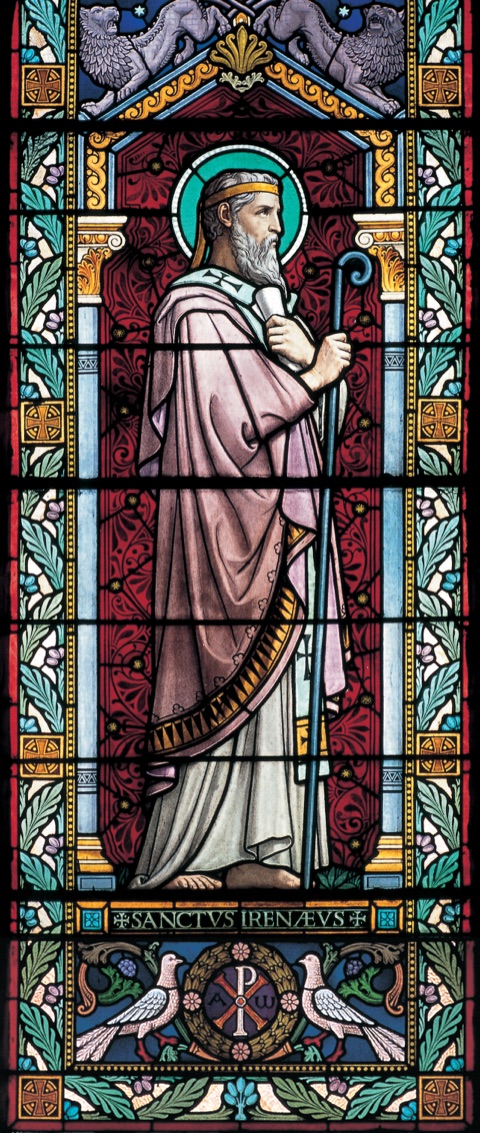
About the author
Irenaeus of Lyon
Irenaeus of Lyon (around 130 to 202 AD) was born in Smyrna, in the Roman province of Asia, and as a young man heard Polycarp, who had known the apostle John. He served as a presbyter of the Greek-speaking church at Lyon in Roman Gaul. During the persecution of 177 AD, in which Bishop Pothinus died, he was sent to Rome with a letter from the confessors of Lyon, and on his return he succeeded Pothinus as bishop. He wrote Against Heresies around 180 AD, and also the Demonstration of the Apostolic Preaching. Around 190 AD he urged Bishop Victor of Rome not to break communion with the churches of Asia over the date of Easter. He died around 202 AD.