Preached at the Temple Church in London in 1586 AD and published in 1612 AD, A Learned Discourse of Justification is Richard Hooker's defense of justification by faith in Christ's imputed righteousness against the Church of Rome's doctrine of inherent grace and merit. It also answers the charge, raised in his controversy with Walter Travers, that he had been too hopeful about the salvation of those who lived and died under Rome. The complete discourse, all forty sections, in modern English.
The first 3 chapters are on this page, no sign-up. The full text and PDF/EPUB come with a free account, no card.
You’re on the list — we’ll email you if this goes to print.
Included with your free account
This book, and 300+ more, free to read
A free account opens the whole library to read online, on your phone or at your desk. Open a book on one device and it is waiting at the same page on the next. The PDF and EPUB of every book are yours to keep, and audiobooks play in the same app.
300+ modernized editionsNot samples. The whole work, free.
Your place, on every devicePhone, tablet or desktop, same page.
132 audiobooksOne at a time, or all of them with a supporter gift.
1586 AD · at the Temple Church, London, during the controversy with Walter Travers
Published
1612 AD, at Oxford
Source edition
The Oxford printing of 1612
Type
Sermon on Habakkuk 1:4
Structure
Forty sections, in their original order
Length
About 20,000 words
A Learned Discourse of Justification is Richard Hooker's sermon on how sinners are made righteous before God, preached at the Temple Church in London in 1586 AD and published in 1612 AD. It defends justification by Christ's imputed righteousness against Rome's doctrine of inherent grace and merit, then argues that Rome's error overthrows the foundation of faith only by consequence, so that thousands who lived under it in ignorance may have been saved.
“that a person can put three mighty oaks wherever three acorns will fit.”
From this edition
How the argument unfolds
01
No one righteous in himself. Starting from Habakkuk 1:4, Hooker denies that any merely human person, not even the Virgin Mary, is righteous in himself. "If Christ has paid a ransom for all, even for her, it follows that all without exception were captives." We are righteous only in Christ.
02
Three kinds of righteousness. Glorifying righteousness in heaven is perfect and inherent. Here, "The righteousness by which we are justified here is perfect, but not inherent. The righteousness by which we are sanctified is inherent, but not perfect."
03
Rome's maze of justification. Rome makes justifying righteousness an infused quality, increased by works, diminished by venial sin, lost by mortal sin and repaired by penance, masses and pardons. Hooker calls it "the maze through which the Church of Rome makes her followers walk when they ask her the way to justification."
04
Righteousness imputed through faith. The righteousness in which we must be found is not our own. God accepts the believer in Christ "as perfectly righteous, as if he had fulfilled everything commanded him in the law." Sanctification is real and inherent, but it is a different righteousness, and even the best works need pardon.
05
Could our fathers be saved?. Hooker defends his earlier sentence that God saved thousands of their fathers who lived in papal superstitions because they sinned in ignorance. He separates error from heresy, the teachers of heresy from the simple people they misled, and those who held one error from those who held many.
06
The foundation, held or overthrown. The foundation of faith is salvation through Jesus Christ alone, acknowledged in express terms. Unbelievers deny it directly; erring churches overthrow it by consequence. A justified person may fall into error or even heresy, but God preserves him from unbelief.
07
Works, merit and Rome. Rome's fault is not requiring works but making them satisfy God and merit grace and glory. "I readily grant that this overthrows the foundation of faith. I utterly deny that it directly denies that foundation." Rome therefore remains a church, though a corrupt one.
08
Mercy without license. Hooker holds out hope even for a penitent pope or cardinal who dies in the error of merit, but warns those who would stay in Rome now that the truth is plain, and closes by forgiving his critics.
Key themes
Imputed righteousness. "In the sight of God the Father, we are what the very Son of God himself is. Let this be called folly, frenzy, fury, or whatever anyone pleases. It is our comfort and our wisdom."
Grace against merit. "God justifies the believer, yet not because of the worthiness of his belief, but because of the worthiness of the one in whom he believes." To claim life by right of deserving is to deny the grace of Christ.
Charity in judging the erring. "Let us take care that, by making too many ways of denying Christ, we scarcely leave ourselves any way to confess him truly and soundly."
Chapter 1: The Wicked Within and Outside the Church
“The wicked doth compass about the righteous; therefore perverse judgment doth proceed” (Hab 1:4).
To make the prophet’s meaning here clearer, we must first consider the wicked, of whom he says, “That they compass about the righteous”; second, the righteous whom they surround; and third, the conclusion drawn from this: “Therefore perverse judgment proceedeth.”
Concerning the first, there are two kinds of wicked people. The blessed apostle speaks of them in these words: “Do ye not judge them that are within? But God judgeth them that are without” (1 Cor 5:12-13). There are therefore wicked people whom the church may judge, and wicked people whom God alone judges: the wicked within and the wicked outside the church’s walls.
If particular people within the church are plainly such that they cannot be reformed by any other means, the apostolic rule of judgment is this: “Separate them from among you.” If whole congregations are in that condition, the rule is this: “Separate yourselves from among them: for what society hath light with darkness” (2 Cor 6:14, 17). But the wicked whom the prophet means were Babylonians and therefore outside the church. For that reason, we have already heard at length how he urges God to judge them.
Chapter 2: Righteousness in Christ Alone
Now concerning the righteous, no merely human person is or ever has been absolutely righteous in himself, that is, free from all unrighteousness and all sin. We dare not make an exception, even for the blessed Virgin herself. For the sake of the honor we owe our Lord and Savior Christ, we say with Augustine that we are unwilling to raise any question about his mother in this matter. Yet since the schools of Rome have made it a question, we may answer with Eusebius Emissenus, or whoever wrote the homilies circulated under his name. He speaks of her and to her to this effect:
“You did, by special prerogative, nine months together receive within the chamber of your flesh the hope of all the ends of the earth, the honor of the world, the common joy of men. He from whom all things had their beginning had his beginning from you. Of your body he took the blood which was to be shed for the life of the world; of you he took that which even for you he paid.”
The Redeemer’s mother herself is not freed from the bond of ancient sin in any other way than by redemption. Knowing the schoolmen’s position on this question, some critical readers may perhaps half suspect that the phrase meaning “in herself” is an insertion. But if those words belong in the passage, they can have no other meaning than the one I have given them in this paraphrastic interpretation.
If Christ has paid a ransom for all, even for her, it follows that all without exception were captives. If one has died for all, then all were dead in sin. All, therefore, were sinful; none were absolutely righteous in themselves. But we are absolutely righteous in Christ. The world, then, must show a righteous man; otherwise it cannot show a man who is perfectly righteous.
“Christ is made to us wisdom, justice, sanctification, and redemption”: wisdom, because he has revealed his Father’s will; justice, because he has offered himself as a sacrifice for sin; sanctification, because he has given us his Spirit; redemption, because he has appointed a day to deliver his children from the hands of corruption into glorious liberty. How Christ is made wisdom, and how redemption, may be explained when the occasion arises. But we must now explain how Christ is made the righteousness of human beings.
Chapter 3: Three Kinds of Righteousness
There is a glorifying righteousness for human beings in the world to come, just as there is a justifying and a sanctifying righteousness here. The righteousness with which we will be clothed in the world to come is both perfect and inherent. The righteousness by which we are justified here is perfect, but not inherent. The righteousness by which we are sanctified is inherent, but not perfect. This distinction opens the way to understanding the great question still disputed between us and the Church of Rome: the nature of justifying righteousness.
Questions
What is A Learned Discourse of Justification about?+
It explains how sinners are justified before God, distinguishing the imputed righteousness of justification from the inherent righteousness of sanctification, and then asks whether those who lived and died within the Church of Rome could be saved.
When and where was it preached?+
Hooker preached it at the Temple Church in London in 1586 AD, while he was Master of the Temple. It was first printed at Oxford in 1612 AD, after his death.
What was the controversy with Walter Travers?+
Travers, the Presbyterian afternoon lecturer at the Temple, objected to Hooker's teaching that thousands of their fathers who lived in papal superstitions might have been saved. The second half of the Discourse defends that statement.
Did Hooker think the Church of Rome taught justification by works?+
Yes. He argues that Rome perverts Christ's truth by teaching justification through inherent grace and by making works satisfy God and merit heaven. He holds that this overthrows the foundation of faith by consequence, but not by direct denial.
Is there a free PDF or full text in English?+
Yes. The complete Discourse in modern English, all forty sections, is free on this page as a PDF and EPUB.
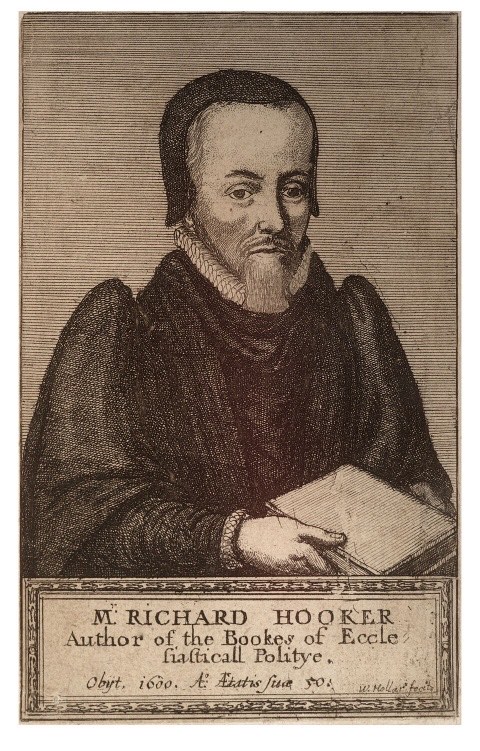
Richard Hooker (1554 to 1600 AD) was an English priest and theologian of the Elizabethan Church of England. Born near Exeter, he was sent to Corpus Christi College, Oxford, under the patronage of John Jewel, Bishop of Salisbury, and became a fellow of the college. In 1585 he was appointed Master of the Temple in London, where the afternoon lecturer was the Presbyterian Walter Travers. Their public disagreement, which turned in part on the sermons gathered in this Discourse, ended in 1586 when Archbishop Whitgift silenced Travers. Hooker later served country parishes in Wiltshire and Kent and wrote Of the Laws of Ecclesiastical Polity, the first books of which appeared in 1593. He died at Bishopsbourne in Kent in 1600.
“Updated Works has been an incredible blessing to my Christian life and ministry… remarkably faithful to the original authors while making these timeless treasures understandable for modern readers.”