Modernized edition · Full text · Free PDF/EPUB
Christ Set Forth in Modern English
Summary
- Published
- 1642 AD
- Type
- Doctrinal and practical treatise on justifying faith
- Length
- 54,000 words · 4 hours
- Collection
- Puritan
What is Christ Set Forth about?
Christ Set Forth is Thomas Goodwin's 1642 treatise on Romans 8:34. Writing for believers who look more at their own graces than at Christ, Goodwin sets Christ forth as the object of justifying faith and shows how his death, resurrection, ascension, session at God's right hand and intercession each secure the believer against condemnation.
Read the full summary (8 points, quotes, key themes)Show less
How the argument unfolds
- 01
To the Reader. Goodwin writes for believers absorbed in examining their own graces, and sets faith and signs in their right order.
- 02
Example and Object of Faith. Christ trusted God for justification while bearing the sins of the elect. Faith rests on Christ himself, not on humbling, graces or bare promises.
- 03
Christ's Death. Faith looks to the purpose of Christ's sufferings and sets the worth of his death against every aggravation of guilt.
- 04
Christ's Resurrection. The risen surety proves the debt paid, and the risen common person carried the elect's justification with him. Baptism seals this.
- 05
Ascension and Reign. His triumph, welcome and seat at God's right hand show God satisfied, while as head he takes possession of heaven for his people.
- 06
The Work of Intercession. Intercession completes Christ's priesthood, honoring God's justice and grace, making salvation certain, and keeping Christ in office.
- 07
The Power of Christ's Pleading. Christ prevails as Son, as obedient servant, by the cry of his blood and by royal power, before a Father who already loves his people.
- 08
Encouragements for Weak Believers. Faith at its lowest is coming to God by Christ to be saved, and Christ's ongoing intercession meets that faith.
Notable images & quotes
- The sails and the side wind. The truths about Christ fill the sails of full assurance like a following gale; a weaker faith must learn to angle its sails to a half side wind.
- Noah's dove on the ark. Resting on promises without Christ: “It is just as if Noah’s dove had settled on the outside of the ark instead of flying in to Noah inside the ark.”
- The harbinger's lodgings. Christ entered heaven like a harbinger sent ahead of a royal company, writing the names of his people over the doors so no one else can take their rooms.
- The bags of payment. Justice would not take its price on earth alone: “Christ must come and carry his bags of payment all the way up to heaven, for justice will be paid right upon the mercy seat.”
- The prince under his fortress. Christ pleads like a prince negotiating a town's surrender beneath his own fortress, parleying while his artillery stands ready.
Key themes
- Christ before our graces. Signs of grace have their use only after faith has gone to Christ: “let us first look wholly outside ourselves to Christ as our justification.”
- Justification in every act of Christ. Each act of Christ adds its own security: “Everything in Christ, whatever he was and whatever he did, speaks justification to us with one united voice.”
- Surety and common person. Christ paid our debt as surety and acted in our name as a common person, so what was done to him is reckoned to us, by the rule under which all died in Adam.
- The willing Father. Christ's pleading does not overcome a reluctant God. He prays for his people while telling them the Father loves them of himself.
Why read it today
Goodwin keeps strictly to one question, how a sinner is justified, and walks through each article of the creed about Christ's work to answer it.
Sureties, attorneys, bonds, court rolls and proxy marriages make the logic of imputation concrete, and each comparison is pressed until it answers a troubled conscience.
The treatise ends not with the confident but with the believer who comes trembling, and gives that person reasons drawn from Christ's present work in heaven.
Source edition: The complete treatise in modern English, from The Works of Thomas Goodwin, volume 4 (Edinburgh, 1861)
Reader questions (10)Hide the questions
Questions about Christ Set Forth
Is there a modern English version of Christ Set Forth?
Yes. This is Christ Set Forth by Thomas Goodwin in modern English. The language is modernized and the author's order and argument are kept. The full modernized text is free to read on this page.
Can I read Christ Set Forth online for free?
Yes. The complete text of this modern English edition is on this page, with no sign-up or paywall.
Is there a free PDF of Christ Set Forth?
Yes. The PDF and EPUB of this edition are free with an Updated Works account. Sign in with Google or an email link; no card is needed.
What is Christ Set Forth by Thomas Goodwin about?
It expounds Romans 8:34 to present Christ as the object of justifying faith. Goodwin directs faith away from the believer's own graces to Christ, then shows that each of Christ's acts gives grounds to say no one can condemn the believer.
When was Christ Set Forth written?
It was published in 1642. Goodwin calls it a foundation for a planned work on The Acts of Justifying Faith, and says he attached a companion treatise on how Christ's heart in heaven stands toward sinners.
Why does Goodwin warn against looking too much at one's own graces?
Many believers live on the sight of grace in their hearts and store justification away for emergencies. He allows graces as signs, but only as handmaids attending a fresh act of faith toward Christ.
What does Goodwin mean by calling Christ a common person?
One who legally stands in the place of others, as an attorney or ambassador does, so that his acts count as theirs. Adam was such a person for mankind; Christ is the second man, representing the elect.
Why does Goodwin say the resurrection was Christ's justification?
A formal discharge had to follow full payment. Reading justified in the Spirit (1 Timothy 3:16) beside quickened in the Spirit (1 Peter 3:18), he dates it from the moment Christ began to rise.
Why is intercession the highest part of Christ's priesthood?
The high priest's distinctive work was entering the holy of holies, and Melchizedek typified a priesthood for ever. Christ's death obtained redemption; his intercession applies it.
Does the book help someone who lacks assurance?
Yes. The last chapter is written for the weakest believer, and argues that intercession, a work Christ is still doing, gives such a faith something to cast itself on before it knows Christ died for it.
Christ Set Forth in Modern English · Full text
To the Reader
The title page and the table that follows will tell you enough about the scope of this treatise. Here I will only share my own aim in a few words.
Over many years of experience, I have observed many holy and precious souls who have clearly and wholly surrendered themselves to Christ, wanting to be saved by him in his own way. At their first conversion, and again in times of spiritual desertion, they made a full, direct commitment to Christ alone for their justification. Yet in the ordinary course of their spiritual lives, they have been too much carried away with the beginnings of Christ’s work in their own hearts rather than with Christ himself.
The stream of their steadiest thoughts and deepest intentions runs in the channel of examining and searching into the gracious dispositions of their own hearts. By these they try to bring Christ down or raise him up, to borrow the apostle’s words (Rom 10:8), hoping to catch a sight of him that way. Yet Christ himself is “nigh them,” as the apostle says there. They need only look directly to him through thoughts of pure, single-minded faith.
Now, God allows us to use our own graces as signs and evidences of Christ in us. Doing so does not detract from Christ at all, provided we keep those signs subordinate to faith. We must not grow immoderate, poring over our graces too long or too often to draw comfort from them while neglecting Christ.
Consider lawful pleasures. Even they are used unlawfully when our thoughts and desires dwell on them too long, too often, or too intensely. They then deaden the heart to present delight in God and to pursuing him with the united strength of our souls as our one chief good. In the same way, an immoderate recourse to signs, even when treated merely as signs, is just as unwarranted. It diverts us from the steadier, active exercise of daily thoughts of faith directed immediately toward Christ. For he is set forth to be our righteousness, whether through assurance, which is a kind of enjoyment of him, or through leaning reliance and renewed adherence in pursuit of him.
Still, the minds of many are so absorbed with their own hearts that, as the Psalmist says of God, Christ “is scarce in all their thoughts.” Let such believers consider what a dishonor this must be to Christ! Should his attendants and favorites, our graces, hold a fuller court and receive more frequent attention from our hearts than he himself, who is the “King of Glory”? And what a shame it is for believers, who are his bride, to look upon their husband only by reflection and at second hand, using their own graces as mediators between him and them!
To correct this error, the answer is not to reject all use of such evidences. Instead, we must put them in their proper order, both in their timing and in their end.
First, consider their timing. Using evidences must never go before faith. It should always follow a renewed approach of faith and fresh acts of faith directed toward Christ himself. Whenever we are about to look down into our own hearts and examine our graces, let us first look wholly outside ourselves to Christ as our justification. Let us embrace him immediately, just as if we had no present or past grace to prove our union with him.
Then, while faith is directly clasping Christ as he sits on his throne of grace, present or past graces may step in like handmaids to attend and confirm the genuineness of that adherence to Christ. After such simple, direct acts of faith, this often happens. The Holy Spirit, without whose light our graces never shine, is then “bearing witness with our spirits,” that is, our graces, as well as to our spirits.
Second, consider their end. At the close of it all, we must again let go of gazing at our graces and taking comfort in them or in their testimony. Encouraged by the Spirit, we must begin afresh to exercise faith directly upon Christ with redoubled strength. If we keep such evidences strictly subservient to faith in this way, faith will keep Christ as its Alpha and Omega, the beginning and the end of everything. Then signs will do no harm to Christ’s glory or to the workings of faith itself.
By this course, the life of faith is continually maintained and kept on the wing in its full use and exercise toward Christ alone for justification. Many Christians, by contrast, treat justification in Christ as a mere assumed principle that they take for granted and seldom use, storing it away for an emergency. In practice, they live far more in the sight and comfort of their own graces and the gracious workings of those graces in their duties toward Christ.
Among many other causes, I trace this weakness partly to a “barrenness,” as Peter calls it, “in the knowledge of the Lord Jesus Christ.” Believers lack knowledge of the truths revealed about him that could give faith food and material to work upon. I also trace it to a lack of skill, while believers still lack full assurance. They do not know how to bend, shape, and apply to a faith of simple adherence all that they know and hear of Christ as made justification to us.
Experience proves this to be a matter of the greatest difficulty, yet it is certainly practical and attainable. A faith that can so far only lean and cast itself upon Christ for justification must learn to take in all that is or may be said of Christ’s being made righteousness to us in his death, resurrection, and the rest. It must use those truths to enliven and strengthen itself in acts of simple adherence until assurance itself arrives.
For assurance, all truths lie open and directly ready to be received. They serve as a fair wind straight astern to the assurance of faith, filling its sails and carrying it forward with a full and steady gale, as the word the apostle uses for assurance implies. To the faith of a poor soul who can only lean on Christ, however, they serve as a half side-wind. Yet with skill, the sails of even such a faith may be turned and angled toward that wind. That carries the soul along with much ease and quietness toward Christ, its desired haven, while it waits all along for a fairer and fuller gale of assurance in the end.
Instructing believers in that second point, the exercise of that skill, is not directly the aim of this treatise. If God assists me, grants me leisure, and gives this book a good reception, I have reserved that subject for another work on The Acts of Justifying Faith, where that very art will be my main theme. Here I have endeavored to set Christ forth to all kinds of believers, whether they have assurance or not, as the object of our justifying faith and the cause of our justification. I send this work forth as a foundation and preparation for that other treatise.
For that purpose, I have walked through a few articles of our faith or creed just as the great apostle gathered them into one bundle: Christ in his death, resurrection, ascension, sitting at God’s right hand, and intercession. I have handled them no further than as Christ is made justification to us in each one, keeping strictly to the apostle’s scope. From all this you may see, in the meantime, what abundant provision God has stored up in Christ for every kind of believer to live upon in the matter of justification. Everything in Christ, whatever he was and whatever he did, speaks justification to us with one united voice.
You may also see that God has justified us in Christ over and over again. That will show you how little reason you have to allow your hearts to be drawn aside to other comforters. Why be robbed and deprived of these richer comforts, prepared directly and laid up for us in Christ himself?
To have covered in this short treatise every point that his obedience to death supplies for a believer’s justification and comfort would have thrown that section out of proportion to the rest. That theme alone deserves and requires a separate work, which I have therefore arranged on a different plan. Here I have touched only on what is enough for now to furnish that part so it may keep company with its fellows.
Having presented Christ all the way from his death, resurrection, and ascension to his sitting in heaven and performing that great part of his priesthood, the work of intercession, I took one further step. I judged it both closely akin to these truths and helpful for encouraging believers in the exercise of their faith to attach another treatise: How Christ’s Heart, Now He Is in Heaven, Stands Affected to Us Sinners Here Below. Taking the subject itself, if only I could have fully represented it, I know no better token to present to his bride than a true portrait of her husband’s heart now that he is in glory.
Indeed, were it not for the sake of order, I would have placed that treatise first, since it is better suited to ordinary readers, whose benefit I seek. I confess that in that second discourse I have not kept as strictly to justification alone as I have done here. Instead, I have treated the subject more broadly, showing how his heart stands toward us under every kind of weakness, whether of sin or of misery, yet in a way that still serves the matter of justification as well.
May the Father of our Lord Jesus Christ grant us, according to the riches of his glory, that Christ may dwell in our hearts by faith, and that we may know the love of Christ, which surpasses knowledge! Amen.
Thomas Goodwin
Section 1: Christ as the Example and Object of Justifying Faith
“Who is he that condemneth? It is Christ that died, yea rather, that is risen again, who is even at the right hand of God, who also maketh intercession for us” (Rom 8:34).
Chapter 1: Christ as the Supreme Example of Faith
These words are a triumphant challenge uttered by the apostle in the name of all the elect. He begins it in the preceding verse: “Who shall lay anything to the charge of God’s elect? It is God that justifies” (Rom 8:33). Then these words follow: “Who shall condemn?” That is, who shall condemn God’s elect? “It is Christ that died,” and so on.
We find this challenge first issued by Jesus Christ himself, our one champion, in Isaiah 50:8 (a chapter written of and for Christ): “He is near that justifies me; who will contend with me?” Those were Christ’s words there, spoken of God’s justifying him. These are every believer’s words here, meant of God’s justifying them. In Isaiah, Christ is pictured uttering them while standing at the high priest’s tribunal, when they spat upon him and struck him (Isa 50:6). When Pilate condemned him, he exercised this very faith in God his Father: “He is near that justifies me.”
As he stood in our place in that condemnation, so in this hope of his justification he also speaks in our place, representing us in both. On that ground, the apostle proclaims in similar words concerning all the elect: “It is God that justifies; who shall accuse?” Christ was condemned, yes, “hath died; who therefore shall condemn?” Look at the communion we have with Christ in his death and condemnation, and even in his very faith! If he trusted in God, so may we, and we shall just as surely be delivered. Let us note this first, by way of premise to everything that follows:
Observation: Christ lived by faith just as we do.
In John 1:16, we are said to “receive of his fullness grace for grace.” That means grace corresponding to and resembling his, and therefore faith among the rest. Let us explain this in two parts.
1. In a certain sense, Christ had a faith for justification like ours, though not a justification through faith as we have. He did not, of course, go outside himself to rely on another for righteousness. He had enough of his own, since he is “the Lord our righteousness.” Yet he believed in God to justify him and looked to God for justification: “He is near,” he says, “that justifies me.” Had he stood merely in his own person and solely on his own account, there would have been no occasion for such words. Considered as standing in our place, however, there was. What need would he have had for such justification if he had not in some way stood near condemnation?
We must therefore picture him in Isaiah as standing at God’s tribunal as well as Pilate’s, bearing all our sins. As the same prophet tells us in Isaiah 53:6, “God made the iniquities of us to meet on him.” He was now made sin and a curse. He stood in danger not only of Pilate’s condemnation, but of God’s too, unless he satisfied God for all those sins. When the wrath of God for sin came upon him in this way, his faith was put to the test. He had to trust and wait on God for his justification, trusting God to remove all those sins along with his wrath from him, and to declare himself satisfied and Christ acquitted.
Accordingly, in Psalm 22, Christ is shown putting forth this very kind of faith. That psalm was written for him while hanging on the cross, and it reveals how his heart was engaged during those hours. He called God his God, “My God! my God!” at the very moment when, to his own feeling, God had forsaken him: “Why hast thou forsaken me?” He even strengthened his faith with the faith of the forefathers, whom God had delivered when they trusted in him. “Our fathers,” he says, “trusted in thee; they trusted, and thou didst deliver them.” Indeed, in Psalm 22:6, we find him laying himself at God’s feet lower than any man ever did. “I am a worm,” he says (a creature everyone treads on and thinks nothing of killing), “and no man,” as it follows. All this he endured because he bore our sins.
His deliverance and justification from all those sins, to be granted him at his resurrection, was the very matter he trusted God for: that he would rise again and be acquitted of them. We see the same thing in Psalm 16:8-10, another psalm written for Christ when he was about to suffer and lie in the grave. There he says, “The Lord is at my right hand, I shall not be moved: Therefore my heart is glad, my flesh also resteth in hope,” or, as the original puts it, “dwells in confident sureness.” He adds, “Thou wilt not leave my soul in hell,” meaning under the load of these sins and your wrath laid on me for them. He continues, “neither wilt suffer thy Holy One” (that is, in my body) “to see corruption.” In substance, this is identical to what is expressed here in one sentence: “He is near that justifies me.” For Christ’s resurrection was his justification, as I will show later.
2. Nor did Christ exercise faith for himself alone. He exercised it for us as well, and to a greater degree than any of us is ever called to exercise for himself. In dying and emptying himself, he entrusted God beforehand with the merit of all his sufferings, since many thousands of souls were to be saved by them long afterward, even to the end of the world. He died and placed that entire store into his Father’s hands to dispense in grace and glory as those for whom he died would need it. Considering the vast number of his elect who were still to come, this was a far greater trust than any person ever has occasion to put forth for himself alone.
Before Christ came into the world, God trusted Christ and saved many millions of the Jews upon his bare word. Then at his death, Christ trusted God just as much in return, for the salvation of both Jews and Gentiles who would believe after his death. In Hebrews 2:12-15, the fact that Christ had to live by faith as we do (which the angels do not) is used to prove that he was a man like us. To prove this, the apostle quotes words prophesied of Christ as spoken by him of himself: “I will put my trust in him.” What did he trust God for? The context shows it was this: that he would be the salvation of his “brethren” and “children,” that he would have “a seed and a generation to serve him,” and that he would raise up a church to praise God in. That is presented as his confidence and the outcome of his sufferings in Psalm 22, from verse 22 to the end.
Application: How strongly should reflecting on these things draw us to faith, encourage us in it, and lift our hearts above every doubt and shrinking back in believing! In this example of Christ, we have the highest instance of believing that ever existed. As we have seen, he trusted God for himself and for many thousands besides, even for all his elect. Have you not the heart to trust him for one poor soul?
Moreover, Christ trusted God upon God’s single bond. We, for our assurance, have both Christ and God bound to us: God together with his surety, Christ (for Christ is God’s surety as well as ours). Who would not feel secure with a double bond from two such persons? If God the Father and God the Son thus mutually trusted each other for our salvation, who would not be moved to trust them both for his own salvation, especially when those who refuse must be damned?
1. This example of Christ should teach and move us to believe. Did Christ lay down all his glory, empty himself, leave himself worth nothing, and sign over everything he had into his Father’s hands? Did he do all this in pure trust that God would “justify many by him” (Isa 53)? Should we not then lay down all we have and part beforehand with whatever is dear to us, with the same submission, in dependence and hope of being justified by him ourselves?
2. Moreover, it should encourage us to believe, especially against the greatness of our sins. Does the guilt of countless transgressions press in and discourage you from trusting him? Consider what Christ carried, though none of it was his own. As Luther boldly puts it, in the very sense we are speaking of, Christ was made the greatest sinner that ever lived, namely, by imputation, for the sins of all God’s chosen met upon him. Yet he trusted God to be justified from them all and to be raised up from under the wrath due to them.
Alas, you are only one poor sinner, and your faith carries only a small, light load: your own sins. Compared with the vast sum he undertook to bear, yours are like a single unit beside an infinite number. “God laid upon him the iniquities of us all.” Christ trusted God for his own acquittal from the sins of all the world. Once that acquittal was granted, he trusted God still further to acquit the world for the sake of his satisfaction.
You may object, “Christ was Christ, personally united to God, and so he knew he could satisfy him; I am a sinful person.” True. Yet if you believe, you belong to those who are one with Christ. Because Christ spoke these words in the name of both himself and his elect, as we have shown, you have the very same ground to utter them that he had. Everything that emboldened him may embolden you, for he stood in your place. It was only your sins and the sins of others that placed him in any danger of condemnation, and you see how confident he was beforehand that God would justify him from them all. Had he left a single one of them unsatisfied, he could not have been justified. Furthermore, in fulfilling his own part that he undertook, he fulfilled yours as well. Thus, in his being justified, you were justified too.
His confidence, therefore, may now be yours. The only difference is that his confidence rested in and came from himself, while yours must rest on him. Yet because of your communion with him in both his condemnation and his justification, you may take everything that emboldened him in his trust and turn it to embolden yourself in yours, just as truly as he did for himself.
Indeed, you now have an even stronger support and encouragement for your faith than he had. Now, when you are called to believe, Christ has fully completed the satisfaction he undertook. We now see Jesus crucified, acquitted, and even crowned with glory and honor, as the apostle says. When Christ took up this note of triumph, however, as Isaiah foretold and prophesied of him, he was only just entering upon that work. Foreseeing the day of his trial and agony, the prophet utters these words as Christ’s own, showing what thoughts would fill his heart when Pilate and the Jews condemned him and our sins pressed in upon him: “God is near that justifies me; who therefore shall contend with me?” Now, however, this further truth is added to our challenge: “Christ hath died, and is also risen again.” He was condemned, and he has been justified. Who therefore shall condemn? We may say this with far greater boldness still.
Yet you may still object, “He knew himself to be the Son of God, but I do not know that of myself.” Then simply cast yourself upon him to be adopted and justified by him, yielding your soul to be saved by him in his own way. Even though you do not yet know it, the matter is done.
As for that great and common discouragement that keeps poor souls from doing this, namely, the greatness and multitude of their sins, reflecting on this single example of Christ’s faith can remove it more effectively than any other truth I have ever met with. In bearing the sins of his elect, he bore sins as great as yours and infinitely more numerous, indeed every kind of sin there is, for one or another of his elect. That is why he declared that all (meaning all kinds of) sins shall be forgiven to men, which means they were first borne by him for them. Yet you see how confident he was beforehand, and how clearly he is now justified from them all. By the power of his being justified from all kinds of sins, all kinds of sinners shall be justified in and through him as well. Why, then, may you not hope to be justified from yours? For this very reason, our sins, considered simply by themselves, can never be a barrier.
Thus, at the very doorway of our text, we have met one great, overarching encouragement that comes out to welcome us before we even step inside. It will walk with us through everything that follows, shaping and directing our faith at every turn.
Chapter 2: Directing and Encouraging Justifying Faith
The main subject of these words is faith and its supports, or rather Christ himself, who by his death, resurrection, and subsequent work is the foundation of faith and the cause of our justification. Opening this subject more fully is the purpose of this treatise. Having looked at Christ’s faith for us, let us now consider what our faith toward him should be.
Take one boundary along with you to frame everything that follows: the faith whose object and support I will discuss is strictly faith as justifying. Justification was specifically the focus of Christ’s faith for us, and Paul correspondingly holds it forth here as the faith believers must place in him. Faith is called justifying strictly insofar as it takes justification for its object and goes out to Christ for justification. Everything I say, therefore, must stay within this boundary, since it is the clear intent of the text. Regarding justifying faith, our text does two things:
1. It holds Christ forth as the object of faith: “Who shall condemn? Christ hath died,” and so on. Since he alone is the subject of the four realities that follow as encouragements to faith, he must be the object set before our faith here.
2. In Christ, it turns all four of those realities into grounds of triumph for believers. It assures them that they will not be condemned, but justified, because Christ (1) died, (2) rose again, (3) is at God’s right hand, and (4) intercedes.
In general, then, I have two tasks to perform, and in doing them I will fulfill the scope of this text:
1. To direct your faith to Christ as its proper object.
2. To encourage your faith from these several actions of Christ for us, showing how every one of them contains grounds for faith to triumph, and teaching your faith how to triumph in each.
Throughout, I will keep closely to the specific theme before us: faith as justifying. My goal is to show how faith, seeking justification in Christ, may be greatly lifted up by each of these four realities and supported by them as by so many pillars. Of course, Christ’s death, resurrection, and the rest certainly encourage faith in many other ways, such as seeking sanctification from Christ, which his death and resurrection directly supply. Here, however, we restrict ourselves solely to justification: “It is God that justifies; who shall condemn, seeing Christ hath died?” My aim is to show how his death, resurrection, ascension, and intercession all yield rich comfort and triumph specifically in the matter of justification.
There, in brief, is the sum of these words and the scope of the treatise that follows.
Chapter 3: Christ as the Proper Object of Faith
Before I draw encouragements for your faith from these four realities, let me first direct and point your faith straight to its true and proper object, Christ. I will do this briefly, only so far as it serves to introduce the encouragements from those four particulars, which are my main concern.
1. Christ is the object of our faith in joint commission with God the Father.
2. Christ is the object of faith in contrast to our own humbling for sin, our graces, or our duties.
3. Christ is the object of faith in distinction from the promises themselves.
Let us take each of these in order.
1. First, Christ is the object of faith in joint commission with God the Father. So we read here: “it is God that justifies,” and “Christ that died.” Both are set forth as the foundation of a believer’s confidence. Elsewhere, faith is called “believing on him” (namely, God) “that justifies the ungodly” (Rom 4:5), and also “believing on Christ” (Acts 16:31). Faith must therefore keep its eye on both, for both contribute equally to a sinner’s justification. Christ paid the price and performed the righteousness by which we are justified, while God accepts that righteousness and imputes it to us. Justification is therefore ascribed to both.
We see this in Romans 3:24, where justification is attributed to both together: “Being justified freely by his grace, through the redemption that is in Jesus Christ.” Here God’s free grace and Christ’s righteousness concur in our justification. Christ paid as full a price as if no grace were shown in justifying us, for mercy spared Christ nothing. Yet God’s accepting that payment on our behalf is as free and great a grace as if Christ had not paid a penny. Because both meet to justify us, faith in seeking justification must look to both. So the very next verse adds: “Whom God hath set forth to be a propitiation, through faith in his blood” (Rom 3:25).
It is true that God justifying is the ultimate object of our faith. Christ “leads us by the hand” (as the original word means in Ephesians 2:18) “unto God.” And in 1 Peter 1:21, we are said “by Christ to believe on God who raised him, that so our faith and hope might be on God.” Yet under the New Testament, Christ is made the more immediate object of faith. God dwelling in our own nature is brought closer and made more accessible to our faith than the person of the Father, who is purely God.
Under the Old Testament, Christ existed only in the promise and had not yet come in the flesh. Believers’ faith therefore turned more habitually to God, who had promised the Messiah. Of the Messiah himself they then had only dim, indistinct thoughts, though they knew God accepted and saved them through him. Under the New Testament, however, Christ as mediator exists not merely in a promise from God. He has actually come and been manifested in the flesh. He is “set forth by God,” as the apostle puts it, to transact all our business between God and us. Consequently, the more regular and immediate approach of our faith must be made to Christ. Just as he is clearly set forth in the New Testament, so believers must clearly lay hold of him by faith.
“Ye believe in God,” Christ said to his disciples, “believe also in me” (John 14:1). Until his resurrection, their faith and understanding of the Messiah stood at the same level as Old Testament believers, so he told them: make me the object of your trust for salvation, just as you do the Father. For this reason, when faith and repentance are closely distinguished by their more immediate objects, Scripture speaks of “repentance toward God” and “faith toward our Lord Jesus Christ” (Acts 20:21). Not that God and Christ are not the objects of both. Rather, Christ is more immediately the object of faith, and God of repentance. We believe in God by believing in Christ first, and we turn to Christ by turning to God first. That distinction is drawn in the very passage where faith and repentance are presented as the sum of Christian doctrine and apostolic preaching.
Some believers find their faith greatly drawn out toward the mercies of God and his free grace, while thinking of Christ only by way of assumption. They take for granted that all mercies are imparted in and through him, without their thoughts dwelling much upon Christ himself. That can still be genuine faith under the New Testament, because God and his free grace are the joint object of faith alongside Christ and his righteousness, and the one cannot exist without the other. Moreover, God often directs the stream of a person’s thoughts more prominently in one channel than another, leading them toward his free grace while less of the stream flows toward Christ.
Yet such a faith does not fit the days of the gospel. It has an Old Testament cast and spirit. Today, our faith should in its direct and immediate exercises be fixed upon Jesus Christ, so that “through him,” first laid hold of, “our faith might be in God” as its ultimate object (1 Pet 1:21). So much for the first point.
2. Second, Christ must be the object of our faith in contrast to our own humbling for sin, our graces, or our duties.
(1) We must not trust or rest in our humbling for sin, as many do who quiet their consciences simply because they have felt troubled. That promise, “Come to me, you that are weary and heavy laden, and you shall find rest,” has been widely misunderstood. Many have taken it as though Christ spoke peace and rest directly to that burdened state itself, without anything further, and have applied it to themselves as proof that they have a share in Christ. In reality, it is simply an invitation to burdened souls, because they are the most prone to discouragement, to come to Christ, in whom alone rest is to be found.
If people settle down and take their rest in being “weary and heavy laden” instead of coming to Christ for rest, they settle down short of Christ; they settle down in sorrow. That is to make John the Baptist, who only prepared the way for Christ, into the Messiah himself, as many of the Jews did. It mistakes the main work of John’s ministry, which was to humble people and prepare them for Christ, for actually attaining Christ himself. If you are weary, you may indeed have rest, but you must come to Christ first. If Christ had only died and not risen, we would have “been still in our sins” (1 Cor 15:17). In the same way, even if we die through sin, slain by it as Paul was in his humbling (Rom 7:11-13), we still remain in our sins unless we reach the resurrection of faith (as the work of faith is described in Philippians 3:12-13).
(2) We must not rest in our graces or duties. None of them can satisfy our own consciences, much less God’s justice. If “righteousness could have come” through them, then “Christ had died in vain” (Gal 2:21). What a dishonor to Christ if our graces or duties were to share any of the glory of his righteousness! Were any of your duties crucified for you? Graces and duties are the daughters of faith and the offspring of Christ. In a time of need they may indeed nourish their mother, but they could never give birth to her in the first place.
3. Third, Christ’s person, and not merely the promises of forgiveness, must be the object of faith. Many poor souls, humbled for sin and shaken off their own foundation, fly like Noah’s dove over the entire word of God searching for some place to set their foot. Spotting many free and gracious promises that hold out forgiveness of sins and justification, they latch onto those promises at once and rest on them alone, without looking for or embracing Christ inside those promises.
This is a common mistake among people. It is just as if Noah’s dove had settled on the outside of the ark instead of flying in to Noah inside the ark. She might have rested there for a little while, yet she could never have ridden out all the storms and would certainly have perished there in the end.
Notice that the very first promise God gave was not a bare declaration simply promising forgiveness or other benefits he would bestow. It was a promise of Christ’s person overcoming Satan and purchasing those benefits: “The seed of the woman shall break the serpent’s head.” In the same way, when the promise was renewed to Abraham, it was not a bare promise of blessing and forgiveness. It was a promise of that seed, who is Christ (Gal 3:16), in whom that blessing was conveyed: “In thy seed shall all the nations of the earth be blessed.”
Abraham’s faith first took hold of Christ in the promise. That is why he is said to have seen Christ’s day and rejoiced to embrace him. All the believing fathers who followed did the same, to a greater or lesser degree, in their types and sacraments (1 Cor 10:1-2). If they did so, how much more should we look to Christ! To us he is no longer present only in promises, but has truly become incarnate, even though he is now in heaven.
For the same reason, our sacraments, which are seals added to the word of faith, primarily hold forth Christ to the believer. In him all the other promises, such as forgiveness and the rest, are ratified and confirmed. The same principle governs both the sacraments and the promises of the gospel, for the sacraments preach the gospel to the eye just as the promise preaches it to the ear. In the sacraments, the soul must first look to Christ and embrace him as he is offered there, and only then embrace the promises offered with him. We must not treat the sacraments as bare seals of pardon and forgiveness. Likewise, whenever we receive or turn to a promise, which is the word of faith, we must first look for Christ in it as its foundation, and so take hold of the promise in him. That is why faith is constantly named after this, its object, Christ, and called “faith on Christ.” So Philip directs the eunuch in Acts 8:35: “Believe on the Lord Jesus.”
The promise is only the jewel box, and Christ is the jewel inside it. The promise is only the field, and Christ is the pearl hidden in it, the one we must chiefly seek. The promises are the means by which you believe, not the things on which you are to rest. Therefore, although you are to look at forgiveness as held out in the promise, you must believe on Christ in that promise to obtain that forgiveness. So Christ himself says of believers in Acts 26:18, “that they may obtain forgiveness of sins, by faith which is on me.”
To make this still clearer, consider the difference between God’s promises of forgiveness and the pardon of an earthly king. A king’s pardon simply expresses his royal word of mercy, so that in seeking it we rest solely on his word and seal and deal only with the document we have to show for it. God’s promises of pardon, however, are made in his Son. It is as if a king offered to pardon a traitor on the condition of marriage to his child, offering his child in that relationship along with the pardon. Anyone who wants the pardon must seek out the child. That is how it stands in believing. The reason is that Christ is the grand promise, in whom “all the promises are yea and amen” (2 Cor 1:20), which is why he is called the Covenant (Isa 49:8).
Think how foolish it would be for a man to imagine he had a claim to an heiress’s lands merely because he got the deeds of her estate into his hands. The right to the lands goes with her person and with marriage to her; without a title to herself, all the deeds will be taken back out of his hands. It is the same with all the promises: they all hang upon Christ, and without him we have no claim to them. “He that hath the Son hath life” (1 John 5:12), because life is by God’s appointment in him alone, as 1 John 5:11 declares.
All the promises are like copyhold land. When you wish to gain a claim to such land, you inquire under which lord it is held. You receive it from him, in addition to taking the deeds and documents into your hands, for the lord of the land must be acknowledged as such in transferring his right to you. That is the tenure of every promise: they all depend on Christ, in whom they are yes and amen, and you must receive them from him. That is how the apostles preached forgiveness to people in Acts 13:38: “Be it known that through this man is preached to you the forgiveness of sins.” And as they preached, so we are to believe (1 Cor 15:11).
Without this, resting on a bare promise or looking only to the promised benefit without eyeing Christ is not an evangelical faith, but a Jewish one. It resembles the faith of the formalists among the Jews, who latched onto promises without the Messiah. They relied on types to cleanse them without looking to Christ, who was their end and the one set before their faith in them. That is going to God without a mediator. It turns gospel promises into promises of the law, into Nehushtan (as Hezekiah called the bronze serpent), a mere piece of brass, empty and powerless. Like the waters of Bethesda, they neither heal nor cleanse until this “angel of the covenant” comes down to meet your faith in them. Therefore, at a sacrament or whenever you meet with any promise, first bring Christ down by faith. Then let your faith ask for what it desires, and you may have whatever you wish from him.
There are three kinds of promises, and in applying every one of them, it is Christ whom your faith must meet.
1. There are absolute promises, made without conditions, as when Christ is said to “come to save sinners,” and so on. Here it is obvious that Christ is the sole, direct object. If you do not apply him to yourself, you apply nothing, for the only thing held forth in them is Christ.
2. There are inviting promises, such as the one mentioned earlier: “Come to me, you that are weary.” The promise is not made to weariness itself, but to coming to Christ. The weary are told, “Come to him,” if they would have rest.
3. There are assuring promises, such as those made to particular marks of sanctification and the like. Yet even here, what is promised in them to which alone the heart should look? It is Christ. The soul rests and takes comfort in him, not in its own grace. The sight of our grace is only a back door to let faith in to commune with Christ, whom the soul loves.
Think of the sacrament: the elements of bread and wine are only outward signs to bring Christ and the heart together. Then faith lets the outward elements go, embraces Christ, and deals directly with him, to whom those signs gave the soul entrance. In the same way, grace is an inward sign. As long as believers use it only as a simple sign to admit them to Christ, rejoicing not in their grace but in Christ, and fixing their confidence on him rather than on their grace, there is no danger, and never will be, in making such use of signs.
I see no reason why God may not appoint his own work of the new creation within us to serve as a sign and aid to communion with Christ by faith, just as he appointed those outward elements, the works of his first creation. After all, in nature an effect is always a sign of its cause. Nor does it detract any more from free grace or from Christ’s honor for God to make such inward effects signs of our union with him than it did for him to make outward signs of his presence.
Section 2: Christ’s Death as the Object and Support of Faith
“Who shall condemn? Christ hath died” (Rom 8:34).
Chapter 1: Christ as Dying, the Object of Justifying Faith
We come now to all four particulars concerning Christ as the object of faith mentioned here. We will see how Christ in each of them is the object of justifying faith, and what support or encouragement a believer’s faith may draw from each of them regarding justification. This is the main subject of this treatise.
First, Christ as dying is the object of justifying faith: “Who shall condemn? Christ hath died.” To explain this, I will do two things:
1. Give a direction or two.
2. Show what encouragement or ground for triumph faith may draw from his death.
(1) The first direction is this: in seeking forgiveness or justification in the promises, Christ must be the main focus of your faith. Specifically, it must be Christ as crucified and Christ as dying, just as he is set before us here. It was the serpent lifted up, and looked upon in that posture, that healed the people.
I give this direction to prevent a mistake that souls beginning to believe often fall into. When they hear that the person of Christ is the main object of faith, they misunderstand it. They suppose that a new believer should look only at the personal excellencies of grace and glory in Jesus Christ, which flow from the hypostatic union. They think the heart must be drawn to Christ by those excellencies alone and embrace him under those perceptions only.
It is true that every believer’s faith has a deep-seated disposition that would embrace Christ for his personal excellencies alone, if drawn out to view them by themselves, seeing such beauty and fittingness in them. Yet the first view a humbled soul always takes, and ought to take, of Christ is as a Savior made sin and a curse, obeying to the point of death for sinners. At its first sight of him, the soul takes hold of Christ in the “likeness of sinful flesh” (Rom 8:3). That is how the gospel first presents him, though it holds out his personal excellencies as well.
In that presentation, he becomes a fitting object for a sinner’s faith to trust and rest upon for salvation. In part, this distinguishes a sinner’s faith toward Christ here on earth from the sight that angels and glorified souls have of him in heaven. Faith here views him not only as glorious at God’s right hand (though it does see him so), but also as crucified, made sin, and made a curse, and thus rests upon him for pardon. In heaven, however, we shall “see him as he is” and be made like him.
Consider Christ simply in his personal excellencies, held out with them as a head to us. Even angels and sinless human beings might have found him a fitting object to embrace. What an addition to their happiness they would have counted it to have him as their husband! Yet considered in that way alone, he would have been, and really is, the object of love rather than of faith or trusting reliance.
It is therefore Christ, so excellent in his person, yet further viewed as clothed in his garments of blood and bearing the qualifications of a mediator and reconciler, who is so desirable to sinners. This is what makes him a fitting object for their faith, as it looks out for justification, to fasten on and seize eagerly. At the same time, they take in all his other excellencies to win their hearts to him and confirm their choice of him.
I will go even further. Consider faith as justifying, that is, in the specific act by which it justifies a sinner. Taken only or mainly in his personal excellencies, Christ cannot properly be called the object of that act. The defining ground, the proper respect or consideration that makes Christ the object of justifying faith, must necessarily be what in Christ actually justifies a sinner. That is his obedience to death.
The act and the object of every habit or faculty always correspond and match each other. Therefore, Christ as justifying must be the object of faith as justifying. Truly, there is nothing in Christ that some corresponding act of faith in us does not embrace. From the different aspects under which faith views Christ, those distinct acts of faith receive different names.
Faith going out to Christ and his personal excellencies may be called uniting faith. Faith going out to Christ for strength of grace to subdue sin may, corresponding to its object, be called sanctifying faith. And faith going out to Christ as dying and the like for justification may be called justifying faith. In that act, faith looks at what in Christ actually justifies a sinner. Therefore, Christ considered as dying, rising, and so forth becomes the most pleasing and welcome object to a humbled soul, because this makes Christ suited to him as a sinner, which is how he views himself when he is first humbled.
Presenting Christ in this way to believers under the law was therefore the main purpose of all the Old Testament sacrifices and types, “all things being purged with blood, and without blood there being no remission” (Heb 9:22). The apostles did the same in their sermons. By the substance of his preaching, Paul seemed to have “known nothing but Christ, and him as crucified” (1 Cor 2:2). Just as he valued Christ above all else, so he held out Christ as crucified above everything else in Christ, since that best suited the condition of those he sought to draw to faith in him.
Likewise, in his Epistle to the Galatians, he calls his preaching among them “the preaching of faith” (Gal 3:2). And what was its main thrust? It was picturing out (as the Greek word means) “Christ crucified before their eyes” (Gal 3:1). That is how he preached him, how they received him, and how they “began in the spirit” (Gal 3:3).
The seals of the promises, the sacraments, present Christ to a believer’s eye in the same way. Just as they hold out Christ (as noted in the earlier direction), so they hold out Christ as crucified. Their purpose is to “show forth his death till he come” (1 Cor 11:26). The bread signifies Christ’s body broken in its sufferings, and the cup signifies the sufferings of his soul and the pouring of it out to death.
For this reason also, just as faith itself is called “faith on Christ” (as observed earlier), so it is called “faith on his blood” (Rom 3:25), because Christ shedding his blood for the remission of sins is its object. The words there are, “whom God hath ordained to be a propitiation through faith in his blood, to declare his righteousness for the remission of sins.” Just as God has ordained and set Christ forth in the promise, under that very picture faith first embraces him.
Another reason like the first can be grounded on Romans 3:24: “Being justified freely by his grace, through the redemption that is in Christ.” As I showed before in giving the reason for the earlier direction, all the promises depend on his person, since he is the heir of all the promises. In the same way, the special legal tenure by which forgiveness of sins depends on him is purchase, through the redemption that is in him. Thus, while the promise of forgiveness points to his person, it points also to this redemption that is in him.
So we read in both Ephesians 1:7 and Colossians 1:14, “In whom we have redemption through his blood, even the forgiveness of sins.” His person gives us title to all the promises, and his blood shows the tenure by which they hold: a purchase, a full price, an equivalent ransom, an adequate price (1 Tim 2:6). Just as sin is the strength of the law and its threatenings, so Christ’s satisfaction is the strength of all the promises in the gospel.
In a word, a humbled soul must go to the Christ who is now alive and glorified in heaven, yet go to him as once crucified and made sin. The sinner must go to Christ now glorified as the person from whom he is to receive forgiveness and every blessing. At the same time, he must go to him as crucified, as the one through whom, in the condition he then stood in, he is to receive everything.
Chapter 2: Looking to the Purpose of Christ’s Death
(2) A second direction for faith toward Christ as dying is this: faith must look mainly to the purpose, meaning, and intent of God and Christ in his sufferings, and not merely to the tragic story of his death and sufferings. It is the heart, mind, and intent of Christ in suffering that faith chiefly fixes on, and that draws the heart to rest on Christ crucified.
When a believer sees that Christ’s aim in suffering for poor sinners agrees with and answers the aim and desires of his own heart, he is drawn in. He sees that the whole purpose of those sufferings was that sinners might have forgiveness. He sees that Christ’s heart was as full of desire to secure it as the sinner’s heart can be to want it. This draws him to Christ to rest upon him. Without this, meditating on the story of his sufferings and how great they were will be completely unprofitable.
Yet the chief use, or the only use, that papists and many carnal Protestants make of Christ’s sufferings is to meditate on their severity and picture them vividly to themselves. They do this to stir their hearts to softness and pity toward him, indignation against the Jews for crucifying him, and wonder at his noble and heroic love. If they can get their hearts moved like this, they count it as grace.
In reality, this is no more than what any similar tragic story produces. A tale of some great and noble person, full of heroic virtues and sincerity of character, yet treated cruelly and ungratefully, ordinarily stirs the same feelings in sensitive, noble spirits who read or hear of it. It often does so even if it is only fiction.
When devotion reaches no higher than this, it is so far from being faith that it is merely a carnal and fleshly devotion. It springs from an imagination pleased with a moving story, and from natural sympathies stirred toward someone of noble spirit who was wronged. Such stories naturally awaken a basic human pity and compassionate love. Christ himself faulted this reaction during his suffering, judging it neither spiritual nor elevated enough, in the women who wept to see the Messiah treated so badly. “Weep not for me,” he said, meaning: do not weep merely for this, to see me treated so unworthily by those for whom I die.
Because these stirrings are merely fruits of the flesh, human inventions such as crucifixes and vivid depictions of Christ’s passion aimed at the imagination strongly provoke such devotional meditations and feelings. Yet they produce only a bare historical faith, a historical remembrance, and a historical love, if I may call them that. And reading the story of his passion in Scripture produces nothing better in many people who oppose crucifixes.
Saving, justifying faith, however, focuses chiefly on the main scope and direction of all Christ’s sufferings. That is what answers its own aim and purpose, which is to obtain forgiveness of sins in Christ crucified. Just as God looks primarily at the meaning of the Spirit in prayer (Rom 8:27), so faith looks primarily at the meaning of Christ in his sufferings. And as a believer is said “to have the mind of Christ” (1 Cor 2:16) in all other truths, so especially he pays attention to the mind and heart of Christ in all his sufferings.
You can observe, therefore, that the whole thrust of the apostles’ epistles is to show the intent of Christ’s sufferings. They show how he was set forth in them to be “a propitiation for sin,” to “bear our sins upon the tree,” to “make our peace,” and so on, and that “he was made sin, that we might be made righteousness of God in him.” In the same way, the scope of the evangelists is to set forth the story of his sufferings, for that must be known as well.
Thus the evangelical prophet Isaiah chiefly set forth the purpose of Christ’s sufferings for justification throughout his chapter (Isa 53), just as David earlier had set forth the story of his passion (Ps 22). Showing the use and purpose of his sufferings was also the aim of all the apostles’ sermons, holding out the justification and salvation of sinners as the intent of Christ’s passion. “This is a faithful saying, and worthy of all acceptation, that Christ came into the world to save sinners” (1 Tim 1:15).
The apostles constantly declared the plan that God, by an ancient design, aimed at in Christ’s sufferings, a purpose far higher than men or angels thought of when he was put to death. That is how faith takes hold of his death and looks at it.
Peter anchored his hearers’ faith on this very point in his sermon (Acts 2). After exposing the heinousness of their sin in murdering “the Lord of life,” he raised their hearts again so that, seeing God’s purpose in it, they might be drawn to believe. He told them that “all this was done by the determinate counsel of God” (Acts 2:23), and for a far greater end than they imagined, namely, the remission of sins through his name, as he shows at the close of that sermon.
It was not the malice of the Jews, the treachery of Judas, the cowardice of Pilate, or the wickedness of the times he fell into that mainly brought about his death. Rather, it was God his Father planning together with Christ himself and aiming at a higher end than they did. There was something far deeper in it. It was the carrying out of an ancient design and agreement by which God made Christ “sin” and laid our sins upon him. God “was in Christ, not imputing our sins to us, but making him sin” (2 Cor 5:19, 21).
At his appointed time, Christ came into the world to fulfill that covenant. “Sacrifice and burnt offering thou wouldst not have” (Heb 10:5). “Lo, I come to do thy will,” and that will was “to take away sins” (Heb 10:4, 10, 12, 14, 15, 16). Christ spoke these words when he took our nature and came into the world clothed with weaknesses like us sinners.
“God sent his Son in the likeness of sinful flesh, and for sin condemned sin in the flesh” (Rom 8:3). Notice that phrase “for sin.” The Greek preposition translated “for” here means “because of,” just as in John 10:33, “not for a good work” means “not because of a good work, or for a good work’s sake.” So here, “for sin” means “because of sin.”
Sin was the occasion of his taking the likeness of sinful flesh. Was it to increase sin? No, it was to condemn it, as the text continues. That means to overthrow and defeat sin in its power and its case against us, so that instead of sin condemning us, he might condemn sin, and we might have “the righteousness of the law” (Rom 8:4).
This phrase “for sin” matches Romans 6:10: “he died unto sin,” that is, on account of sin. The contrast that follows proves this: “In that he liveth, he liveth unto God,” that is, for God and his glory. In the same way, he died purely because of sin, so that sin might run its course in justice, and for sin’s sake he suffered death, silencing its clamor.
The death of Christ was the greatest and most extraordinary design that God ever undertook and carried out, and therefore it surely had a purpose worthy of it. God, who “willeth not the death of a sinner,” would not will the death of his own Son, whom he loved more than all creatures combined, for any lesser end. It had to be some great matter for God to arrange the death of his Son, who was so holy, innocent, and separate from sinners. Indeed, it could be for nothing less than to destroy what he hated most, which was sin, and to display what he delighted in most, which was mercy (Rom 3:25-26).
Christ conducted himself accordingly in his suffering. He did not look at the Jews or their malice at all, but at his Father’s command and purpose in it. Therefore, when it was time to rise and go to the place where he would be arrested and led to the slaughter, he said, “As the Father gave me commandment, so do I; arise, let us go hence” (John 14:31).
When Judas went out at Christ’s own prompting, Jesus said, “What thou doest, do quickly,” and “the Son of man goeth as it was determined.” He kept his eye on his Father’s purpose in it. When he stepped out to be arrested, Scripture says, “Jesus knowing all things that should befall him, went forth” (John 18:4).
And in his agony in the garden, whom did he deal with except his Father? “Father,” he says, “if it be possible, let this cup pass.” Yet God had made his passion so necessary that it was impossible for that cup to pass. Had Christ stood on his own behalf, it would have been an easy request, and even a matter of justice to grant it. That is why he told Peter he could command millions of angels to rescue him. Instead, he simply submitted to his Father: “Not my will, but thy will be done.” For God had laid on him the iniquities of us all (Isa 53).
Let our faith therefore look mainly to this design and plan of God and Christ in his suffering, to make satisfaction for our sins and justify us sinners. When we think of him born in flesh and blood and laid in a manger, let us remember at the same time that his purpose was to “condemn sin in our flesh” (Rom 8:3).
When we read of him fulfilling all or any part of righteousness, let us also take in his intention: that the “law might be fulfilled in us,” as the next verse says. We were represented in him then, and so his fulfillment of it is counted as ours. Let us behold him during his lifetime just as John the Baptist did, as “the Lamb of God, bearing and taking away the sins of the world.”
And when he is upon the cross, let our faith behold the iniquities of us all meeting in him: “Surely he hath borne our sorrows, bearing our sins in his body on the tree, and thereby once offered to bear the sins of many” (Heb 9, and so on). This intent of Christ in all that he did and suffered is the welcome news, the very spirit of the gospel, which faith eagerly fastens on and seizes.
Chapter 3: Faith’s Support and Triumph in Christ’s Death
2. Having directed your faith to the right object, Christ, and Christ as dying, let us now see what support and encouragement faith can draw from Christ’s death for justification. Surely what satisfied God himself long ago for the sins of many thousands of souls now in heaven can well satisfy the heart and conscience of any sinner now on earth, in any doubts that may arise over the guilt of any sin.
Look at how the apostle acts here. In the earlier part of the Epistle to the Romans, he gave a long argument on justification by Christ’s righteousness and showed how it abounds in every way (Rom 5). Now, in this eighth chapter, he sits down like a man overwhelmed with proof: “What then shall we say to these things?” (Rom 8:31).
He speaks as one completely satisfied, even astonished by the abundance of evidence, having nothing left to do except marvel at God and Christ in this work. At once he throws down the gauntlet and challenges all comers to a debate on this point. Let conscience and carnal reason, law and sin, hell and devils bring all their strength.
“Who is he shall lay anything to the charge of God’s elect?” “Who shall condemn?” Paul dares to answer them all and carry the day with these few words: “It is God that justifies, it is Christ that died.” And as he says in Romans 8:37, “we are more than conquerors in all these.”
It was the thought that in his “father’s house there was bread enough” that brought the prodigal home. In the same way, the author of the 130th Psalm (whoever he was), though his soul was in deep distress because of his sins (Ps 130:1-2), found his heart steadied to wait on God because there was “plenteous redemption with him.”
Christ’s redemption is not merely an equivalent price or ransom that makes due satisfaction according to what sin justly deserves. It is “plenteous redemption.” There is an abundance of “the gift of righteousness” (Rom 5:17) and “unsearchable riches of Christ” (Eph 3:8).
In 1 Timothy 1:14, Paul says that “the grace of our Lord,” meaning of Christ (1 Tim 1:12), “was abundant.” That is how we translate the Greek word, yet the word reaches further: it was overfull, overflowing, more than enough. And yet, as Paul implies, he had sins enough needing pardon, as anyone would think, to exhaust it: “I was a blasphemer,” and so on (1 Tim 1:13). Yet he found so much grace in Christ, even more than he knew what to do with.
I will not dwell at such length on this first topic of Christ’s death as on the three that follow, because it is the main subject of another treatise that, by God’s grace, I intend to publish in a different format. Yet for a taste, let me give a few specific examples showing how Christ’s satisfaction can be set against the guilt of a poor sinner’s offenses.
What can be said to aggravate sin in general, or any person’s particular sins, that cannot be answered out of this truth, “Christ hath died”? What aggravation cannot be met by something in his death that conscience can set against it?
Think of it this way. By the rules of spiritual reason, which the righteous law follows as the basis of its righteousness in condemning or aggravating sin, a person’s conscience may point out any evil in sin. In direct answer to it, by those same rules of true spiritual reason, a person’s faith can show a far greater, transcendent goodness in Christ’s death, as revealed by the gospel. Thus faith can set the one against the other, and have as sound a reason from Christ’s death why sin should not condemn as conscience can ever have for the law to condemn.
(1) First, is sin the transgression of the law? In dying, Christ the Lawmaker submitted himself to the law; will not that make amends? Is sin the debasement of God’s glory as revealed in his word and works? Christ’s death was the debasement and emptying of the brightness of his glory to the highest degree, for he was God personally manifested in the flesh. The first is only like darkening the shine or luster of the sun upon a wall, while the second is like eclipsing the sun itself.
Sin’s greatest evil lies in offending God, whereas Christ’s righteousness is, on the other side, the righteousness of God himself, or Jehovah made our righteousness. In our sin, God is considered only as the object against whom the act is committed. In this righteousness of ours, however, God is the subject from whom and in whom the righteousness comes and resides. Accordingly, his deity gives a proportionately higher worth to it, just as the connection a subject has to an action proceeding from itself is closer than the connection an object has to an action committed against it.
(2) Second, what particular aggravations or circumstances are in your sins to weigh you down that cannot be matched by some circumstance in Christ’s obedience and death to lift you up again?
First, is it the greatness of your sin in the substance of the deed committed? Has there been lewdness in your wickedness, as the prophet says? Consider what guilt, and what heinous crimes, God allowed profane men to lay to Christ’s charge when he was made an offering for sin.
He died as a traitor to his sovereign and a blasphemer of God in the highest kind of blasphemy, for making himself equal with God. He was called an impostor, a seducer, even a devil, even a prince of devils, and a murderer was judged more worthy to live than he was. Though men charged these things on him unjustly, God ordered them as just in view of his bearing our sins. For the one who was holiness itself to be made the greatest of sinners, even to be “made sin” and the worst of sins, and to suffer accordingly from God and men, what greater satisfaction for taking away sins could ever be desired or imagined?
Second, do you see your sins aggravated by the wickedness of your heart in sinning, saying that your inward conduct was much worse than your outward actions? Look into the heart of Jesus Christ as he died, and watch him struggling under his Father’s wrath. You will find that the sufferings of his soul were greater than those of his body, and that in them lay the very soul of his sufferings.
Third, is your sin aggravated because you committed it with such great delight and greediness, pouring out your heart into it? Consider that Christ offered himself more willingly than you ever sinned. “Lo, I come,” he says (Ps 40), “I delight to do thy will,” and “how am I straitened till it be accomplished!” (Luke 12:50). To show how great an evil and misery that suffering was in itself, he did show a natural shrinking from it. Yet because it was his Father’s will for our salvation, he heartily embraced that cup and drank it down to the bottom.
Fourth, did you sin with full deliberation, when you could have avoided it? Christ’s sufferings had a matching circumstance to answer that: he knew everything he was going to suffer, and yet he yielded himself up (John 18:4).
Fifth, have you sinned presumptuously and made a covenant with death and hell? Christ likewise offered himself up by a covenant and joint plan with his Father to do so.
Sixth, are there special circumstances of time, place, and the like that aggravate your sins?
First, perhaps it grieves you that someone of standing in the church should bring scandal on the name of God by sinning. Well, how great a person was Christ? He was equal with God the Father, and yet he was humbled so low, even to death, with his offices of King, Priest, and Prophet debased along with him. How great a name he had, as Hebrews 1:4 declares! Yet it was dishonored more than any human name ever was.
Or second, perhaps you sinned at a particular time or in particular company, which can make a sin all the more heinous. Consider how God arranged for the shame and affliction of his Son’s death to be aggravated by all these circumstances. It was the most accursed of deaths, at a time most solemn, in a place most infamous, with company most wretched.
In this way we could find something in Christ’s suffering and satisfaction that fittingly answers anything in our sins, bringing us far greater relief. Although the whole body of his sufferings stands and answers for the whole mass of our sins, reflecting on these specifics will greatly help satisfy a humbled and cast-down soul regarding the specifics of its sins.
To conclude, therefore, labor to get your hearts and consciences distinctly and specifically satisfied in the all-sufficient worth and merit of Christ’s satisfaction. It is a fault and defect in humiliation when people rest content with a vague, general notion that they are sinners and so never become thoroughly humbled. In the same way, it is a defect in their faith when they rest content with a superficial, general idea that Christ died for sinners, without their hearts being specifically satisfied in the transcendent all-sufficiency of his death.
That is why, in a time of temptation, when their abounding sinfulness is clearly uncovered and charged against them, they are stunned and their faith is brought to a standstill. They do not see what in Christ can answer all that sinfulness. Just as God saw in Christ’s death what satisfied him, so you should endeavor by faith to see the worth in it that satisfies God. Then your faith will rest satisfied as well.
Suppose a man had to argue for his life in some hard and difficult dispute, where many strong objections had to be answered. He would surely examine, study, and weigh everything that could be said for his side in reply to them. He would seek such a clear and convincing light as would make the truth of his case shine clearly through the clouds of objections standing in the way.
Sooner or later, every one of you will be called to argue for your soul in just this way. Endeavor, therefore, to gain such skill in Christ’s righteousness, seeing how in its fullness and perfection it answers all your sinfulness. Then your hearts will be able to set it against whatever can be said about any particular detail of your sins. In all the conflicts of your spirit, you will see in it what clears your whole debt. And if God is pleased to impute it to you, you will be able to say, “I would dare to come to an immediate reckoning with him and settle the whole account with his law and justice.”
So much, then, for the first thing made the object of faith, namely, Christ as dying.
Section 3: Faith Supported by Christ’s Resurrection
“… Yea rather, that is risen again” (Rom 8:34).
Chapter 1: Two Ways Christ’s Resurrection Supports Faith
The next truth to look at in Christ, as the object of justifying faith, is his resurrection. From this, too, our faith draws support and comfort in justification. Notice how the apostle puts a rather upon it: “Yea rather, that is risen again.”
Christ’s resurrection must therefore contribute something special to our faith and justification to merit a rather in comparison to his death. To see where this lies, consider that Christ’s resurrection serves a double use and purpose in justification.
First, it serves as an evidence to our faith that God is fully satisfied by Christ’s death. His resurrection can give us full assurance of this.
Secondly, it had, and still has, an influence upon our justification itself, and indeed as great an influence as his death had. In both respects it deserves a rather, and Paul had both in view when he wrote these words.
First, if you ask for an account of his faith and a reason for his triumphant assurance, he cites Christ’s resurrection to confirm it: “Christ is risen.” Or, secondly, if you want a reason for the reality itself, how it is that we who believe cannot be condemned, “Christ is risen,” he says. He cites it as a cause with such an influence upon justification itself that it makes everything secure.
1. By way of evidence. Christ’s obedience in his life and his past death alone supply the whole matter of our justification. Together they make up the full sum of the price paid for us, as has been shown. Faith can see a fullness of worth and merit in them to discharge the debt. Yet faith also receives a comforting sign and evidence from Christ’s resurrection after his death to confirm itself in believing this.
His resurrection can fully satisfy our faith that God himself is satisfied and reckons the debt paid. Our faith may therefore come boldly to God and call in the bond, pointing to Christ’s resurrection as proof that the debt is discharged. For this reason the apostle cries victory over sin, hell, and death as the crowning stroke and conclusion of his extended discourse on Christ’s resurrection (1 Cor 15:55-57). “O death, where is thy sting?” he asks. That sting is sin and its power, for he adds, “the sting of death is sin.” Then he cries, “O grave, where is thy victory? Thanks be to God who hath given us victory, through Jesus Christ our Lord.” He means through Christ as risen again, since throughout that chapter he had spoken chiefly of his resurrection.
2. Yet surely this is not all. Christ’s resurrection does not argue our justification merely by way of evidence. That alone would not have deserved such a rather. His resurrection also exercised a further real, causal influence upon justification itself, beyond being simply an evidence to our perception.
Therefore, secondly, consider the two sides of justification. The material basis of justification is wholly the obedience and death of Christ. Yet the act of pronouncing us righteous through his obedience, which is the formal essence of justification, depends on Christ’s resurrection. Ordinarily, nothing more has been said about this dependence than that Christ’s resurrection justifies by working actual faith to lay hold of what Christ did in his life and death. That is called applying it, and I will say more about it later.
Yet Paul’s words in 1 Corinthians 15:17 seem to carry more weight: “If Christ be not risen again, ye are yet in your sins, and your faith is in vain.” Even if you could suppose faith to be worked in you on the merit of Christ’s dying, it would still be in vain if Christ were not risen again. Your very title to justification would be void; “you were yet in your sins.” He says this because Christ’s resurrection was the means by which sins, though satisfied for in his death, were taken off and believers were acquitted from them.
I take this to be the meaning of Romans 4:25 as well: “He was delivered for our sins, and rose again for our justification.” When the apostle says, “for our sins he was delivered,” he means that Christ laid down the price and satisfaction for them in his death. In that sense, “he died for our sins.” His death stands in place of our death and so satisfies for sin.
Yet God’s act of justifying us, discharging us from our sins, and reckoning us justified depends on Christ’s resurrection: “He rose again for our justification.” Notice that justification there refers to the act of imputation and reckoning us righteous. Paul had just been speaking of that very act in the immediately preceding verses (Rom 4:22-24).
In a word, two things are required for the full discharge of a debt and the freeing of a debtor. The first is the payment of the debt. The second is the tearing up or canceling of the bond, or receiving a formal release that sets the debtor free. The payment was accomplished by Christ’s death, and the formal release freeing us from death came at and through his resurrection.
Chapter 2: Christ as Surety and Common Person
To explain both of these more clearly, consider the double relation Christ stood in to God on our behalf. In almost everything he did for us (as the phrase runs here, and must be attached to each particular), he acted in two capacities:
1. Of a surety, bound to pay the debt for us and to save our souls.
2. Of a common person, or an attorney-at-law in our place.
Because these two relations involve distinct considerations in themselves, examining each will help us understand the two points just mentioned. They show how Christ’s resurrection supports our faith both by way of evidence that the debt is paid and by way of influence that we are thereby acquitted and cannot be condemned. The truth that our surety is risen clarifies the first. The truth that he rose as a common person illustrates the second.
I will dwell a little more fully on explaining these two relations here. They will serve throughout the rest of this discourse to illustrate the influence that his ascension, his sitting at God’s right hand, and the rest have upon our justification. I will carry both along throughout what follows.
1. A surety is someone who undertakes and binds himself to do something for another. He may bind himself to pay a debt for him, bring him safely to a certain place, or the like. Once he has discharged what he undertook and was bound for, the party for whom he stood bound is discharged as well.
2. A common person acting with or for another is someone who represents, legally stands in the person of, and acts the part of another by the allowance and warrant of the law. Whatever he does in that capacity and in the other’s name, the law reckons the other as doing. Likewise, whatever is done to him as standing in the other’s place is reckoned as done to the other.
Thus, under our law, an attorney appears for another, and money received by him is reckoned as received by the person to whom it is due. The same holds when possession of an estate is given, a re-entry is made, or possession of land is taken, and the like. When done by and to a man’s lawful attorney, it stands as valid in law for him as if it had been done in his own person.
Ambassadors for princes represent their masters in the same way. What is done to them is reckoned as done to the prince. What they do under their commission counts just as if the prince whom they represent had done it himself. In like manner, the marriages of princes are transacted and solemnized by proxy. A common person representing his lord marries a princess in her father’s court in his lord’s name. Human laws authorize this, and the marriage is as valid as if both princes themselves had been present and performed all its rites.
Being a common person is therefore more than simply being a surety for another. It goes further, so these two relations must be considered distinctly even though they appear somewhat similar. An attorney is different from a surety. A surety undertakes to pay a debt for another or perform some similar obligation. A common person, however, performs a representative act that the law reckons and effectively imputes to the other. It stands as the other’s own act and carries the same validity as if he had done it. Consequently, the good and benefit that follow from such an act accrue to the one whom he represented and for whom he stood as a common person.
Adam was not a surety for all mankind, for he did not undertake for them in the sense just described. Instead, he was a common person representing all mankind. Whatever he did was therefore counted as if they had done it.
Now God wanted to express and secure our justification in and through Christ according to every kind of law. (God usually draws the equity of all human laws up into his dispensations.) For that reason, he ordained Christ to be both a surety for us and a common person representing us in our place.
Christ took on all other relations for us, such as husband, head, father, brother, king, priest, captain, and the like. He did so that the fullness of his love might be displayed to us, with whatever is lacking in one relation supplied and expressed by another. In the very same way, God ordained Christ to take and sustain both relations, surety and common person, in all he did for us. By this means God made our justification through him all the more full and legal. He justified, if I may put it that way, our justification itself, or his justifying of us, by every legal standard commonly recognized among men in similar cases. Whatever one relation or consideration might not reach to make good, the other could supply; whatever fell short in the one, the other could make up. Thus we are most legally and formally justified, and made certain never to be condemned.
Chapter 3: The Resurrection of Christ Our Surety
1. I now turn to the first of the two main heads proposed at the outset: the evidence Christ’s resurrection gives our faith regarding non-condemnation. I have two things to handle in this chapter to establish it. First, I will show how Christ was made a surety for us and what kind of surety he became. Secondly, I will show what this contributes to the evidence faith draws from Christ’s resurrection.
(1) For the first, Christ was appointed by God, and himself undertook, to be our surety. You have this in Hebrews 7:22: “He was made Surety of a better testament,” or covenant, namely the new covenant. The Septuagint consistently translated the Hebrew word for covenant by the Greek word for testament. Because the Hebrew word has a broad meaning that embraces both a covenant and a testament, the New Testament uses the word interchangeably for either. Indeed, this new covenant of grace is both.
Of this covenant Christ is the surety, the one who pledges his word for it, the guarantor, the promiser, the one who undertakes it. The Greek verb behind this word means to promise. It derives from an expression meaning in the hands, referring to striking hands or giving one’s hand as a sign of a covenant, and thus sealing a bargain or making a covenant. As Proverbs 22:26 says, “Be not thou one of them that strike hands, or of them that are sureties for debts.” The Septuagint renders that whole verse, Do not give yourself to suretyship, using the very same word the apostle uses here.
Both the Jews and the Romans had the custom of making covenants by striking hands. In testaments as well, the heir and the executor shook hands, or the executor gave his hand to fulfill the will. Moreover, this Greek verb is used not only for promising to pay a debt for another, but also for becoming a pledge to undergo death or capital punishment in another’s place. So it appears in that famous story of two friends, Evephenus and Eucritus. When Evephenus was condemned to die by Dionysius the tyrant, Eucritus willingly stood as surety for him. Polyaenus, the historian who recorded that event, uses this very word.
Now Christ became such a surety in every way to God for us. He undertook to pay the debt by undergoing death in our place and thus satisfying God, and then as the heir to execute his will and testament. He became the surety of the whole covenant and of every condition in it, taken in the widest sense, both on God’s part and on ours.
For us he undertook to God to perform all our works and undergo all our punishments. He undertook to pay our debts for us, and to work in us everything God required of us in the covenant of grace. Thus being a surety is much more than simply being an intercessor or mediator, as Pareus well observes. God said to Christ, as it were, “What they owe me, I require it all at your hands.” Christ consented, and from eternity struck hands with God to do everything for us that God could require. He undertook it under the very penalty that lay upon us to undergo.
Indeed, Christ became a kind of surety for us not to be found among men. On earth, sureties normally enter into one and the same bond with the debtors. The creditor may then seize whichever of the two he chooses, either the debtor or the surety. Usually he seizes the debtor first, since we call him the principal.
In this covenant, however, God wanted Christ’s single bond alone. Hence Christ is called not only the Surety of the covenant for us, but “The Covenant” (Isa 49:8), and elsewhere as well. Because God made the covenant of grace primarily with Christ, and with him on our behalf, his single bond alone was accepted for all so that God might be sure of satisfaction. Therefore he laid everything on Christ, declaring that he would not deal with us or even expect any payment from us, such was his grace.
Look at Psalm 89:19, where the mercies of the covenant made between Christ and God are set forth under the type of God’s covenant with David: “Thou spakest in vision to thy Holy One, and saidst, I have laid help on one who is mighty.” It is as if God had said, “I know these people will fail me, go bankrupt, and never be able to satisfy me. You, however, are a mighty and substantial person, able to pay me, and I will look to you for my debt.”
Nothing can give stronger consolation or exalt God’s free grace more than this truth. To confirm it, consider how Scripture describes God’s dealing with Christ when reconciling the world in and through him. God took our sins off us and discharged us, as it were, meaning never to call us to account for them unless Christ failed to satisfy him. He laid them all on Christ, requiring an account of all of them from him first and leaving him to answer for them. He did this to make the covenant sure.
Thus 2 Corinthians 5:19 speaks of God’s transaction of this business with Christ. It says that “God was in Christ,” namely from eternity, “reconciling the world” of elect believers “to himself, not imputing their trespasses to them; and made him sin who knew no sin.” Notice that as God laid our sins on Christ, he discharged us at the same time in the compact between Christ and himself, “not imputing their trespasses to them.”
Everything was laid on Christ, and he had to see to it, or else his own soul would have been forfeit for it. Other creditors do not act this way; they normally charge the debt on both the surety and the debtor. In this covenant of grace, however, Christ’s single bond is entered. He alone is “The Covenant,” so that God will have nothing to say to us unless Christ fails him. He has bound himself first to require satisfaction at Christ’s hands, who is our surety.
(2) Now let us apply this truth to clarify the point before us. It could afford us unspeakable comfort merely to hear that Christ was arrested by God for our debt and cast into prison. His bond was sued, and execution or judgment was served on him, as the expressions run in Isaiah 53:8. From that alone we would have seen that God had begun with our surety, intending to leave us alone, and that discharging the debt rested on one so fully able to pay it. We would also see how he was “made sin for us.” We could well have quieted our hearts against fearing any arrest or God’s coming upon us, until we heard that our surety was not able enough to pay the debt, which you have already heard he is.
Even so, our hearts would still be eager to hear whether he had in fact perfectly satisfied God or not. We would be deeply anxious to know whether he had satisfactorily performed what he undertook, and how he got clear of that obligation and of being “made sin for us.” Therefore the apostle comforts believers with the assurance that Christ will “the next time appear without sin.” As he writes, “Unto them that look for him he shall appear the second time, without sin, unto salvation” (Heb 9:28).
One might think it no great comfort to hear that Christ will appear without sin. Who could imagine it to be otherwise with “The Holy One,” “The Lord of Glory”? There seems nothing surprising in that. Ah, says the apostle, your very salvation is bound up with this as closely as possible. It is well for you that Christ is now without sin.
As your surety, he undertook to satisfy for sin. Accordingly, he was once made sin on earth and arrested for it by God at his death. Now he is clear of that obligation, which could happen in no way except by the satisfaction he undertook. This plainly proves and assures you that you will never be condemned for it. By law, once the surety has discharged the debt, the debtor is free. Therefore no news could be more welcome to sinners than certain, infallible evidence that their surety has come off well and settled everything to full satisfaction.
Now Christ’s resurrection serves as the evidence of this: “Christ is risen.” Nothing is more certain. Therefore the debt is surely discharged. He has paid it in full, and he is now without our sin, completely clear of it. Once God had arrested Christ, cast him into prison, opened a trial against him, and brought him to judgment, he could not come out until he had paid the very last penny.
There is the strongest possible reason for this to assure us. He was held under bonds and bolts that, if it had “been possible,” would have “detained” him in the grave (Acts 2:24). The strength of sin, the wrath of God, and the curse against sin (“Thou shalt die the death”) held him like cords, to use the psalmist’s phrase. Other debtors might possibly break out of their prisons, but Christ could never have broken through this one. The wrath of the all-powerful God was this prison, from which there was no escape and no bail. Nothing would be accepted to let him go out except full satisfaction.
Therefore, to hear that Christ is risen and has come out of prison is evidence that God is satisfied. Christ is discharged by God himself, and he is now “without sin,” walking about again at liberty. For this reason the apostle proclaims a mighty victory won by Christ’s resurrection over death, the grave, the strength of sin, and the law (1 Cor 15:55-56). Then he cries out, “Thanks be to God, who giveth us the victory, through Jesus Christ our Lord” (1 Cor 15:57). You may now rest secure indeed: “Christ is risen; who therefore shall condemn?”
Chapter 4: Christ Rising as a Common Person
2. Now, secondly, we come to the other main head proposed: the influence Christ’s resurrection has upon our justification. Demonstrating this depends on two things put together. The first is how Christ was appointed by God and himself acted as a common person representing us in what he did, and more particularly in his resurrection. I will handle this in the present chapter.
The second is how from that truth arises not only an evidence to our faith, but a real influence upon our justification and non-condemnation. Thus, “Who shall condemn?” because “Christ is risen again” as a common person representing us in it.
(1) To illustrate and prove the first point in general, the example of Adam serves most fittingly, and Scripture itself uses it to that end. Adam, as you all know, was reckoned as a common public person. He did not stand singly or alone for himself, but represented all mankind to come from him. By a just law, therefore, what he did was reckoned to the posterity whom he represented. What that law threatened or inflicted on him for what he did is threatened against his posterity as well. In this, Adam was a vivid type of our Lord Christ: “who was the type of him who was to come” (Rom 5:14).
For this purpose, the titles the apostle gives these two, Christ and Adam, in 1 Corinthians 15:47 are strikingly noteworthy. He calls Adam “the first man” and Christ our Lord “the second man,” both with this very truth in view. First, he speaks of them as if there had never been any other people in the world, nor ever would be in time to come, besides these two. Why? Because these two between them had all the rest of the sons of men hanging at their belt. Both were common persons who had the rest included and wrapped up in them in parallel, though opposite, respects.
Adam had all the sons of men born into this world included in himself. They are therefore called “earthly men” (1 Cor 15:48), matching him as “the earthly man” (1 Cor 15:47). Christ the second man had all his elect included in him, those who are “the first born” and whose “names are written in heaven.” By contrast, they are called “heavenly men” in the same verse. You see how Paul sums up the whole number of mankind in two and counts only two men in all. In God’s reckoning, these two stand for all the rest. Observe further that Adam, in being a common person for us, was the shadow and vivid type of Christ who was to come after him. Therefore Adam is called “the first man” of these two, and Christ is called “the second man” as typified by him.
Now suppose you ask in what respects Christ was a common person representing us and standing in our place. I answer: if in anything, then in all the conditions and states he occupied, and in all he did or that befell him, especially while he was here on earth. He had no other reason to come down into this world than to bear our persons, act our part, and have what should have been done to us carried out upon him.
[1] First, in their two distinct conditions, qualifications, and states, both Adam and Christ were common persons. Whatever state or condition either one was made in is by a just law put upon those whom he represented. Thus the apostle reasons in 1 Corinthians 15:48: “as is the earthly man” (namely, the first man, Adam), “such are the earthly.” They must be earthly men just as he was, because he who represents them as a common person was in his condition only an earthly man.
By the same law, on the opposite side, it follows that “as is the heavenly man” (namely, the second man, Christ), “such are and must be the heavenly” who belong to him. He too is a common person ordained to represent them, and Adam, who came after him, was in this only his type.
[2] In that passage to the Corinthians, the apostle argues from his type Adam that Christ is a common person in his condition and state. Secondly, in Romans 5, he argues that Christ was a common person in the actions he performed on earth. Here too he draws on the parallel with Adam, whom he declares to have been Christ’s type (Rom 5:14). He speaks of Adam there as a common person in both respects: in what he did, namely his sin, and in what befell him for his sin, namely death and condemnation. In all this, Adam was not to be viewed as a single man, but as one who was all men by representation. Therefore, what he did they are said to do in him, and whatever condemnation or death his sin deserved fell on them all under this law of his being a public person for them.
First, as for what he did: he sinned, as you know, and in Romans 5:12 all are said to have sinned, namely in his sin. Indeed, according to the Greek phrase added there, you may render that clause, “in whom all have sinned,” namely in Adam as a public person. The original supports that reading, and it is also noted in the margin. Their act was included in his because their persons were included in his.
Secondly, what befell him for sin befell them as well by the same law of his representing them. Therefore death is said to “pass upon all men” (Rom 5:12), precisely because Adam’s sin was counted as theirs, as the verse goes on to say. It is said to pass just as a sentence of death passes on a condemned criminal. And in Romans 5:18, judgment is said to “come by that one man’s offense, upon all men, to condemnation.”
In Genesis 2:17, the threat was spoken only to Adam as one man: “In the day that thou eatest thereof, thou shalt surely die.” In Genesis 3:19, that sentence appears to pass on him alone: “Unto dust thou shalt return.” Yet in threatening Adam, God threatened us all, and in sentencing Adam to death, he sentenced us as well. The curse reaches us too. “Death passed upon all men” then, and therefore by a just law “death reigns over all” (Rom 5:14, 17). Why? Because in all this Adam was a common person representing us and standing in our place. All of it concerns us as truly and closely as it did him.
I say by a just law, because Scripture, resting on the equity of this rule, pronounces a statute against all people that they must die (Heb 9:27). It is appointed by statute law that all must die. If you search for when and where this statute was enacted, you will find the original record and roll in Genesis 3:19. Though spoken only of Adam, it holds true of us: “to dust thou shalt return.”
[3] In the very same way the matter stands regarding our justification and salvation between Christ and elect believers, for Adam was his type in this. God viewed and appointed Christ as a common person both in what he did and in what was done to him. By the same law, what he did for us is reckoned or imputed to us as if we ourselves had done it. Likewise, what was done to him for our justification and salvation is reckoned as done to us.
When Christ died, he died as a common person, and God reckons that we died too. When Christ rose, he rose as our head and as a common person, so God counts us as having risen with him. Through that communion we had with him in all those actions of his, we all rise from both the guilt of sin and its power when we are born again. It works just like the parallel communion we had with Adam, our being one in him, through which we come to be made sinful when we first begin to exist as human beings and are first born.
Thus in his death Christ was regarded as a common person. God reckoned us as dying then, and he wants us to reckon so too. Speaking of Christ in Romans 6:10, the apostle says, “In that he died, he died unto sin once; but in that he liveth, he liveth unto God.” Then, speaking of us in Romans 6:11, he says, “Likewise reckon you yourselves to be dead unto sin, but alive unto God through Jesus Christ our Lord.”
The meaning is plain. Considered in themselves and in the work actually accomplished in them, regenerate people are for the present only imperfectly subdued and dead to sin. Yet considered in Christ as their head and a common person representing them, they may truly, by way of faith, reason or “reckon” themselves wholly dead in and through Jesus Christ our Lord. They may do so because he once died perfectly to sin as a common person representing them. Whatever is still lacking in the work of putting sin to death in their own feeling and experience, they may supply by faith from considering Christ their head. They may count themselves to have died when he died.
The apostle, I say, wants them to conclude or infer by reasoning from Christ’s death that they are dead. That is what the Greek word for reckon signifies, the same word he uses in Romans 3:28: “Therefore we conclude,” and so on. That conclusion cannot be drawn unless one proposition in the argument is that we died in Christ when he died. Even though in ourselves we are not yet wholly “dead to sin” or perfectly “alive to God,” Paul still says, “through Jesus Christ your Lord and Head,” “reckon yourselves so.” Do so because “he died and now lives” (Rom 6:10), and you were included in him.
Indeed, the apostle holds this truth before our faith for a double purpose. First, it gives the greatest encouragement when our putting sin to death has only imperfectly begun. We may still comfort ourselves by faith, reckoning ourselves wholly dead in Christ’s death. By its power we may also assure ourselves that we will one day be perfectly dead to sin in ourselves.
At the same time, it provides the strongest argument and motive for putting sin to death, urging us to strive for the highest degree of it. That is why Paul carries this argument throughout the entire chapter. He wants believers, through faith or spiritual reasoning, to take in and grasp that they died long ago to sin in Christ when he died. They should therefore think it the greatest absurdity in the world to commit even the smallest sin, since we died wholly and long ago when Christ our head died: “and how shall we, that are dead to sin, live any longer therein?” (Rom 6:2). And again, “he that is dead is free from sin” (Rom 6:7). How then can we render even the slightest service to it?
All of this Paul grounds on Christ’s dying and our dying with him then: “Knowing this, that our old man is crucified with him” (Rom 6:6), at the very time he was crucified, “that it might be destroyed” one day in us, fully and perfectly. In that crucifixion, Christ’s body represented as a public person the elect and their body of sin joined with them. Thus by faith believers are to reason themselves wholly dead to sin in Christ, and use that truth as a reason and motive to stir themselves up not to yield to the smallest sin.
I use the phrase wholly dead for a reason. If Paul had spoken merely of that imperfect putting to death of sin begun in us, his argument would not have been a complete motive against the smallest sins: “We who are dead, how shall we live in sin,” or yield to the least sin? Someone might say, “Alas, we are only imperfectly dead!” And from an imperfect death, only an imperfect argument could have been drawn. Scripture tells us elsewhere, however, that “Christ by his death hath perfected for ever all that are sanctified” (Heb 10:14). In his death, therefore, believers may reckon themselves by faith perfectly dead and perfectly sanctified, even though the work is not yet actually and fully perfected in them.
Paul also teaches there that all this communion with Christ as a common person representing them in his death is pictured and sealed to them by their baptism (Rom 6:3-4). How that works, I will show later.
[4] Just as that passage holds forth Christ as a common person representing us in his death, other passages hold forth the same truth about his resurrection. In 1 Corinthians 15:20, the apostle argues that elect believers must and will rise because “now Christ is risen from the dead, and is become the first-fruits of them that sleep.”
See the force of this argument. It is founded on the truth that Christ was a common person representing all the rest. Paul expresses this powerfully by calling him “the first-fruits,” in allusion to the rite in the Levitical law. Because all the sheaves in a field were unholy of themselves, one sheaf was lifted up and waved before the Lord in the name and place of all the rest. That sheaf was called the first-fruit. By that act done to this one sheaf, all the sheaves out in the field were consecrated to God under that law (Lev 23:10 and following). Explaining the meaning of this rite, the apostle cites it in Romans 11:16: “If the first-fruits be holy, all the lump is holy also.” Thus, when we were all dead, Christ rose as the first-fruits in our name and place, and so we all rise with him and in him.
Departed saints have not yet risen in their own persons, just as all of us who are now alive have not yet died in our own persons. In the meantime, however, they have risen in Christ as their first-fruits. For that reason, Paul says in the very next words that they are only asleep: “He is become the first-fruits of them that sleep.” They remain alive in Christ their head and will rise one day, because in him they have already risen in effect.
In God’s reckoning this is just as true and rightful as our being counted dead in Adam even while personally alive. Adam as a common person had the sentence of death pronounced on him, by which we must die. Both rest on the force of the same law we have pressed home, that of being a common person representing us. Indeed, what follows confirms that this is the apostle’s meaning: “For as in Adam all die, even so in Christ shall all be made alive” (1 Cor 15:22). His argument runs like this: Adam was the first-fruits of those who die, and Christ is the first-fruits of those who rise.
Therefore we are elsewhere said (though with respect to another life) to be “risen with Christ,” and, what is even more, “to sit together with him in heaven” (Eph 2:5-6). Because Christ represents us as a common person, he sits there in our name and place, as you will hear when I come to that part of the text in the next section.
Chapter 5: Justified in Christ at His Resurrection
Now, then, let us come to the second branch of the demonstration. Here I will show how Christ’s relation to us as a common person representing us in his resurrection has a real influence upon our justification. This is the very point I am aiming at. The long, general discussion by way of digression in the previous chapter was only meant to prepare the way for it.
I will complete and settle this branch by showing two things:
(1) That Christ himself was justified, and that this happened at his resurrection.
(2) That he was justified then as a common person representing us, just as he rose as a common person. Consequently, we were justified in him and with him at that time. By that act done to him, our justification is made irrevocable forever.
(1) To explain the first point: In his death, Christ was made sin for us. He bore our persons as he made satisfaction for sin by dying, which is the very substance of our righteousness. In the same way, in and upon his resurrection, God justified and acquitted him from our sins, because he had now made full satisfaction for them in his death. I will establish this by putting three considerations together.
[1] First, reason itself requires it. If Christ was made sin for us and satisfied for it, some formal act had to pass declaring him acquitted and completely clear of our sins. In that way, he himself had to be formally justified with respect to the sins for which he undertook to make satisfaction. In all legal proceedings, whenever a charge of guilt is formally laid, there must be an equally formal act of acquittal and a formal certificate of discharge. Every person desires this for his own release and safety. No wise person who pays a debt after being legally sued will settle for anything less than an equally legal receipt of discharge upon payment.
When Paul was thrown into prison by a public act of authority, he insisted on a public act of release from the same magistrates. He refused to leave prison secretly, even though they themselves sent word telling him to slip out (Acts 16:37). Now God himself did “lay the iniquities of us all” upon Christ (Isa 53:6), and “had him to prison and judgment” for them (Isa 53:8). Therefore, some legal act had to come from God to lift those sins off him, declare him discharged, and deliver him from prison and judgment.
In actual fact, it is clear that such an act did come from God. We read that while Christ lived, and especially in his death, he “was made sin,” and “did bear the sin of many,” as the Scripture puts it (Heb 9:28). Yet in the very next words we read that “he shall appear the second time without sin.” That statement stands in direct contrast to his earlier bearing of our sins, when he appeared with all our sins charged to his account. He appeared charged with them then, but now he will appear just as visibly and unmistakably without those sins. It must mean our sins, of course. It shows that he is now discharged from them as completely as he once appeared charged with them.
Scripture says, “he shall appear without sin.” Therefore, it will be made evident to everyone’s judgment that the God who once charged him with our sins has now completely discharged him from them. The apostle speaks of this as a great change in Christ’s standing between his time on earth and his second appearing, as well as his present state in heaven. And this change or discharge had to come from God himself. He is the creditor who pressed the lawsuit, and therefore he alone can issue the acquittal.
[2] Second, it follows that there had to be a specific time when this change first took place and this discharge was granted. There had to be a moment when Christ, from being made sin, became without sin through God’s acquittal of him. I maintain that this happened at his resurrection. It is not put off until his second coming to be done for the first time. At his return it will indeed appear openly, yet it is actually accomplished beforehand, because he comes then to judge others for sin.
By all reason, when should this acquittal or justification from our sins first be granted to Christ and legally pronounced upon him? Surely at the very moment he had paid the last penny of the debt and completed his satisfaction. That was finished when he began to rise. As orthodox theologians generally agree, his lying in the grave was part of his humiliation, and therefore part of his satisfaction. When he began to rise, his humiliation ended, and that was the very first moment of his exaltation. His acquittal, therefore, is dated from that very hour.
[3] Third, for this reason Scripture tells us that just as Christ was “condemned,” so he was “justified.” In 1 Timothy 3:16, God is said to be “manifest in the flesh,” and then this God-man was “justified in the Spirit.” That is, just as God appeared in the flesh to condemn sin in the flesh (Rom 8), that same God-man was also justified in the Spirit from all those sins. And so he was “received up to glory,” as the verse goes on to say. Even closer at hand, the very words of my text, “it is God that justifies,” are drawn from Isaiah 50:8-9. There they are spoken first by Christ about himself. When he “gave his back to the smiters” in his death, as described in the preceding verses, and was put to death as a “condemned” man, he comforted himself with these words: “He is near that justifies me; who shall condemn?”
When was that justification to take place, if not at his resurrection? That is what the phrase in Timothy conveys when you compare it with a parallel phrase in Peter: “Being put to death in the flesh, and quickened in (or by) the Spirit” (1 Pet 3:18). Paul says, “justified in the Spirit,” while Peter says, “quickened in the Spirit.” Both mean the exact same thing. By Spirit they mean the power of his Godhead and divine nature, by which he was raised at the same instant both from the grave and from under the guilt of sin. He was at once both made alive, or raised, and justified. The contrast in both passages clearly proves that by Spirit they mean his divine nature, since it is set in opposition to his flesh, or human nature.
He was raised by the power of his Godhead. In that very raising, he was justified by God and declared justified through his resurrection, just as he had been declared condemned through his death. For that reason, to be justified stands for his resurrection. His resurrection was his justification. It declared to the whole world that he was cleared of all the sins laid to his charge.
The passage I cited from Isaiah carries the very same meaning. Christ comforts himself there against the Jews condemning him and putting him to death, looking forward to God justifying him once he had finished his work. Christ’s meaning there is this: “God will raise me up and acquit me,” even though you condemn and kill me. Throughout the other prophets, you will find Christ continually comforting himself against his condemnation in death with the prospect of his resurrection, which he foresaw would follow shortly afterward. Here in Isaiah, he comforts himself with the hope of being justified after they condemned him.
In the same way, he says in Psalm 16:9, “My flesh shall rest in hope: thou wilt not leave my soul in hell, nor suffer thy Holy One to see corruption.” As you know, Peter in the book of Acts twice interprets those words as referring to Christ’s resurrection. Just so, here in Isaiah, against his death and condemnation, he comforts himself with the hope of God’s justifying him at his resurrection: “He is near who justifies me (and he shall help me); who shall condemn?”
To confirm and strengthen this truth further, notice what God calls Christ’s resurrection. Because it was the first moment of his justification from our sins, God calls it his first begetting of Christ: “This day have I begotten thee,” speaking unmistakably of his resurrection (Acts 13:33). God calls it that because throughout his earthly life before then, Christ was covered with sin and “the likeness of sinful flesh.” Now, having thrown it off, he appears truly as God’s Son, as if newly begotten.
In this way there comes to be an even fuller parallel between Christ’s justification and ours. Just as our justification takes place when we are first born again, so Christ’s took place at this first glorious begetting. Before this, he stood under a legal sentence of attainder; here the act of restitution was first passed. At our conversion, which is a resurrection to us, we “pass from death to life,” moving from a state of death and condemnation into justification of life. In the same way, Christ’s resurrection was a kind of re-begetting for him. At that moment he passed from a state of death and imputed guilt into a state of life, glory, and justification from guilt. Thus he will “appear,” as the word says, “without sin” (Heb 9:28), just as he now appears in heaven, because he became free from sin from that very moment. That shows how Christ was justified at his resurrection.
(2) Second, I must now show that this justification and declaration that he was without sin at his resurrection was granted to him as the “first-fruits.” It was done to him as a common person bearing our persons, and therefore in our names. From this the grand conclusion necessarily follows: the persons of all elect believers were justified before God in Christ as their head at and from the time of his resurrection. Consequently, that act of justification was passed so firmly that it can never be revoked forever. This is proved on two grounds.
First, it follows for the very same reason that Christ is called the “first-fruits of them that sleep” as our representative in his resurrection, which I demonstrated at length in the previous chapter. On the exact same ground, he must be viewed in his justification at the resurrection as the first-fruits of all who are justified. Therefore, in the same sense and for the same reason that we are said to be “risen with Christ” in his resurrection, we must also be said to be “justified with him” in his justification at his resurrection.
To expand on this a little, the reason and foundation are identical in both cases, because Christ is a public person in both. In fact, this same rule holds true for everything God ever does for us or in us that we share in common with Christ and that was done to him. In every one of those things, Christ was the first-fruits. Therefore, they may rightly be said to have been done in us, to us, and even by us, in him and with him.
Whatever God intended to do for us and in us, and whatever privilege or benefit he planned to bestow upon us, he did that thing first to Christ and, in some way, bestowed the like upon him as a common person. He did this so that it would be ratified by a solemn, formal act and guaranteed to be carried out in our own persons in due time, having first been done to the one who represented us. By this arrangement, when it is carried out in us, it takes effect by virtue of what was first done to him.
Thus, intending to sanctify us, God sanctifies Christ first, sanctifying us all in him as a common person: “For their sakes I sanctify myself, that they also may be sanctified through thy truth” (John 17:19). He sanctifies Christ’s personal human nature (that is, his body), and sanctifies him first as a common person representing us. That way, having been virtually and representatively sanctified in him, we can be sure of being sanctified afterward in our own persons through his sanctification. In the exact same way, he was “justified in the Spirit” for our sakes, because we were to be justified, and therefore justified first in him and with him as a common person.
This rule holds for every other blessing bestowed on us. Paul declares of them all that “God hath blessed us with all spiritual blessings in Christ Jesus” (Eph 1:3). God ordered it this way for the same reason Paul gives for God’s ordaining salvation by faith: so that all those “blessings might be sure to all the seed” (Rom 4:16). This formal investiture settles us into legal possession of all these blessings through solemn acts done to Christ as our head and representative. It guarantees beforehand what God intends to give us. It secures them by an irrevocable act and sentence, a principle recognized in all human law, as I have shown and will soon press again.
Second, we were all justified in Christ when he was justified by the equity of the very same law by which we were all condemned in Adam. Adam was a type of Christ in this respect, and otherwise the type would not be fulfilled in this point. The sentence of condemnation was first pronounced upon Adam alone, yet he was regarded as a common person acting for us. Therefore, this acquittal and justification was also pronounced upon Christ alone as a public person acting for us.
Indeed, in his justification, Christ must be viewed as a common person representing us far more purely than Adam was in his condemnation. Christ had no sin in his own person. He had no need of justification from sin and would never have been condemned. His condemnation and justification, therefore, could only be in relation to our sins imputed to him, and thus entirely in our place. In this respect, he stood more purely as a common person for us than Adam ever did when condemned. Adam, besides standing as a common person for us, was also condemned in his own right; Christ, in being justified from sin, could only be viewed as standing for others.
Paul expresses this in Romans 5:18: “Therefore as by the offense of one, judgment came upon all men to condemnation; even so (or in like manner) by the righteousness of that one man Christ, the free gift came upon all men (namely, in Christ) unto justification of life.” Paul sets both side by side with an even so. There is only one difference between Adam’s standing as a common person for us (the ground of our condemnation in him) and Christ’s standing as a common person for us (the ground of our acquittal in him). The “condemnation came upon all” through a necessary, natural covenant, since Adam was appointed our common person by that covenant. Christ’s appointment as our common person, by contrast, came by a “free gift” of grace. In the same way, it is by a free gift of grace that what he did, and what was done to him, is credited to us.
Therefore, just as “in Adam all died” when he sinned, as the apostle says, so in Christ “were all justified” when he was justified. Christ was a public person for us in his death and in everything that happened to him there. Likewise, he was a public person in his resurrection and in everything done to him then, including his justification. Just as when he died, “the just was put to death for the unjust” (as Peter says), so when he rose and was justified, the righteous one who needed no justification was justified for the unrighteous, who otherwise would have been condemned. Thus we were justified with him then.
Chapter 6: Faith’s Triumph and Personal Justification
Upon this foundation rests the triumph of faith drawn from Christ’s resurrection: “Who shall condemn? It is Christ that is risen.” The meaning is that Christ was justified at his resurrection (justified in the Spirit and quickened in the Spirit being the same thing), and “we in him.” Indeed, a rather is placed upon his resurrection rather than upon his death. This act was a solemn discharge from all sin and condemnation. It was a legal acquittal given to Christ for all our sins, and therefore given to us also as considered in him. His death was the satisfaction and payment, but his resurrection is the first act of absolution. More than that, it is the original legal act entered upon the record between God and Christ. Our personal justification and atonement, when we are justified by faith in Christ, is simply a certified copy drawn from that court roll and sentence pronounced then.
Ratifying acts and making them legally valid by having another person represent you is an ordinary practice among men, as the examples I gave earlier demonstrate. An attorney-at-law receives a debt, or accepts a receipt of discharge for a debt paid or given on another person’s behalf. That act is just as legally binding as if the creditor had received it personally and the debtor had taken the receipt with his own hand. In fact, transactions of the greatest and highest importance are often conducted in no other way. The marriages of princes are solemnized by proxy, with ambassadors representing their persons and contracting and marrying their wives in their place. Those acts are just as binding and irrevocable as if the princes had performed them in person. In the same way, if we were justified when Christ rose and was justified, our justification can never be reversed. It stands as legally valid and binding as any act that God or man ever ratified or confirmed. And “who shall condemn?”
Only, for the sake of fuller explanation, to prevent any misunderstanding, let me add this qualification. Despite this earlier act already legally passed, it is still necessary that we be justified in our own persons by faith. By faith we lay hold of what God did beforehand for us in Christ. This is necessary so that when we believe, God may justify his justifying of us before the whole world according to his own revealed rules, which he could not do until we believe. According to the revealed rules of his word, by which he declares he will judge on the last day, a curse and sentence of condemnation stands against us. We remain under that sentence until he removes it by giving us faith. In that same word, he has attached the promise of justifying us in our own persons to faith, just as he had already justified us in Christ.
Yet even so, although justification is actually and personally applied to us only when we first believe, this act and sentence was virtually pronounced upon us at Christ’s resurrection, when he himself was justified. Because of that, it necessarily requires and claims from God the bestowing of faith upon us. By virtue of that earlier act, we come to be actually justified in our own consciences and before the entire world. Thus our justification, though secretly accomplished and passed upon us in Christ, is never annulled. It stands irrevocable, and it is so firmly ratified that our personal justification by faith always infallibly follows and confirms it.
To illustrate this a little, our condemnation in Adam and our justification in Christ run strictly parallel in this respect. In Adam we were all virtually condemned: “in Adam all die.” That sentence was legal enough, for upon it came out the statute law, “It is appointed” that all should die. Yet we are not actually condemned in our own persons until we are born of him, nor do we die personally until we lay down our bodies. It works the exact same way in our justification. It was accomplished virtually in Christ, and afterward, when we believe, it is actually passed in and upon ourselves.
I call the earlier act a virtual justification, just as when a sentence of death is passed upon a criminal, he is already called a dead man. That is, he is dead virtually and in the eyes of the law, as we say, even though physically he may not die for many days and remains alive in that sense. In the same way, through Christ’s being justified, we are all virtually and legally justified. This rests on a secret yet irrevocable covenant between God and Christ, who alone then did “know who were his.”
To confirm even further that God accounts all the elect justified in his justifying of Christ, we need look no further than the words of our text. We only have to compare carefully how they stand here with how they stand in the passage where they were first spoken and recorded, namely, in Isaiah 50:8-9: “He is near that justifies me; who is he that shall condemn?” Interpreters agree, and the context clearly shows, that Christ himself speaks those words there.
In Isaiah 50:5, he speaks of God’s “boring his ear” to do his will, the very same expression used of Christ in Psalm 40:6. He goes on to say, “I gave my back to the smiters, and my cheeks to them that pulled off the hair, and I hid not my face from shame and spitting.” You may read all of this fulfilled in Christ’s sufferings (Matt 26:67; Matt 27:26). Earlier, in Isaiah 50:4, he spoke of God having “given him the tongue of the learned, to speak a word in season to him that is weary,” which you may read Christ doing in Matthew 11:28. Christ spoke those words to comfort himself against the Jews who were condemning him. He rested in the certainty that God would justify him, as you have heard God did at his resurrection.
Notice this closely. The very words that Isaiah presents Christ speaking as if of himself alone, Paul boldly applies here in the same triumph to all of Christ’s elect: “Who shall condemn? It is God that justifies.” He does so because Christ died, rose again, and was acquitted by God. Christ spoke those words as a public person in the name of all his elect, whom he represented both in his death and in his justification. For that very reason, Paul repeats the same words over again concerning all elect believers. He shows that when Christ spoke them, they were intended just as truly and really of them as of himself and his own person.
“He is near that justifies me,” says Christ, “who shall condemn?” That means, who shall condemn me or my elect, whose persons I bear? And Paul echoes, “Who shall lay anything to the charge of God’s elect? It is God that justifies; who shall condemn?” For Christ died and was condemned for them, and Christ was justified from that condemnation, and they were justified in him. Because the justification Christ looked for from God was to happen at his resurrection, as has been shown, Paul places a rather upon his resurrection here.
To establish this still further, recall what you heard earlier from Romans 6:11: with respect to sanctification, we died with Christ at the very time he died. In the same way, in Colossians 2:13, we are said to be “risen with him” with respect to our justification, which is our present subject. The words are these: “And you being dead in your sins,” meaning the guilt of your sins, “and the uncircumcision of your flesh,” that is, regarding the power of corrupt nature, “hath he quickened together with him, having forgiven you all your trespasses.” Look closely here. The forgiveness of our sins, or our justification, is called a “quickening” or “a raising up of us” (as Colossians 2:12 puts it) “together with him.” That directly corresponds to the justification from our sins that he received in our names at his resurrection. Paul’s meaning is that Christ was justified then in our names, and therefore we are justified now by virtue of our communion with him in that act.
Notice how these words connect with what follows in Colossians 2:14. You will see that this forgiving of their trespasses (Col 2:13) through being made alive together with him did not happen only when they first believed and had justification personally applied to them. It is true that Colossians 2:12 speaks of that personal application. Yet it also happened back then, when he had “blotted out the handwriting of ordinances which was against us, nailing it to his cross,” as Colossians 2:14 continues. Then, “having spoiled principalities and powers” and won the victory in his rising again, he “had made a show of them openly” in his ascending to heaven, “triumphing over them in himself” (as the margin has it). I will speak further of those words under the next main point. Thus, at the very moment Christ accomplished this in himself, our sins were forgiven, we were acquitted with him, and we triumphed with him. He did all of this in our place as our representative.
Chapter 7: Sealed in Baptism and Pleaded by Faith
All of this communion with Christ in his resurrection, both in sanctification (which Romans 6 sets forth) and in justification (which this passage in Colossians sets forth), is vividly displayed and sealed to us in the sacrament of baptism, as both passages declare. In Romans 6:3-4, we are told that we are “buried with him in baptism,” and so on, and in Colossians 2:12, “buried with him in baptism, wherein also you are risen with him.”
The primary thing signified and represented in baptism is not simply the blood of Christ washing us from sin. Beyond that, baptism represents Christ’s death, burial, and resurrection, as the baptized person is first buried under the water and then rises out of it. Nor is this a mere likeness to Christ; it represents actual communion with Christ in his death and resurrection. That is why Scripture says, “we are buried with him in baptism,” and “wherein you are risen with him.” It does not simply say like as he was buried and rose, but with him. Thus baptism displays our communion and oneness with him in his resurrection, not merely our conformity or likeness to him.
Baptism therefore sets this truth before us: Christ once bore the persons of all the elect in himself in his burial and resurrection. Now, the exact same drama is personally, specifically, and visibly reenacted upon the baptized believer himself in baptism. It visibly declares what his communion with Christ already was in what happened to Christ back then, showing that he was then buried with Christ and rose with him. On that very foundation, in this outward sign of baptism, as in a visible display or representation, he is now both buried and raised again.
For this same reason, the “answer of a good conscience,” which is named as the inward effect of the ordinance of baptism in 1 Peter 3:21, is also attributed there to Christ’s resurrection. His resurrection is presented both as the reality signified in baptism and as the cause of that good conscience’s answer. “Even baptism,” Peter says, “doth now also save us,” as the ordinance that seals salvation, “not the putting away of the filth of the flesh,” or washing the outward body, “but the answer of a good conscience toward God, by the resurrection of Jesus Christ.”
Let us unpack these words. Our conscience is the faculty within us that serves as the seat of guilt for all the sins of the whole person. To its courtroom all our sins come to accuse us, as before God’s deputy. Conscience is called good or evil according to the person’s spiritual state. If his sin remains unpardoned, then just as his condition is condemned, his conscience is evil. If his sins are forgiven and his person is justified, his conscience is called good. Conscience takes its name from the person’s condition, just as urine is called good or bad according to whether the body it comes from is healthy or diseased.
Now, in baptism, forgiveness of sins and justification are sealed to a believer’s faith and conscience under that vivid representation of his communion with Christ in his resurrection. Consequently, this becomes the fruit of baptism: the believer’s good conscience, sealed in baptism, has the means to answer every accusation of sin that can ever come against him. All of this comes, as Peter adds, “by virtue of the resurrection of Jesus Christ.” Specifically, his communion with Christ in his resurrection has been represented in his baptism as the ground of his faith and of that “answer” to every accusation.
Thus, the very thing Paul shouts in triumph and defiance against all accusations, “Who shall condemn? Christ is risen,” is the exact same truth Peter mentions here. Peter frames it not as defiance, but as a believer’s formal answer and defense. Whenever sins come to accuse or condemn, a good conscience stands ready to reply, “Christ is risen,” and I was then “justified in him.” There is my answer, which nothing in heaven or hell can refute. “This is the answer of a good conscience, by the resurrection of Jesus Christ.”
Let us now place a crowning conclusion upon this second pillar of faith, by giving direction to a believer’s faith on how to use Christ’s resurrection regarding freedom from condemnation. You heard earlier from Romans 6 how the apostle reasons regarding putting sin to death. We may truly be said to have been “perfectly dead to all sin” in Christ’s “dying unto sin once,” because he represented us as dying to sin in and with him.
Therefore, although for the present we are only imperfectly dead to sin in ourselves, whenever corrupt desires rise up, the apostle tells us to strengthen ourselves against them by faith. He calls us to act by “reasoning” ourselves to have stood wholly dead to sin when Christ died. From that we conclude that we will one day be completely dead to sin, because we perfectly died to it in Christ then. God would also have us use this line of reasoning as a motive against any corruption whenever it rises, and of all motives in the gospel it is the strongest: “Shall I that am dead to sin” in Christ, and thus freed from it, “shall I live any longer therein?” (Rom 6:2).
Now, God would have our faith make this use of our communion with Christ in his death for sanctification. Do the exact same thing when the guilt of sin rises in your conscience to accuse you or threaten condemnation. Reason yourself (to use the apostle’s word from that other case), or “reckon thyself” (as our translation renders it), justified in Christ in the justification he received at his resurrection. God calls you to use your communion with Christ in his death as an argument to move yourself to put sin to death, commanding you to reckon yourself dead to sin in Christ. In the same way, ask him to reckon you as justified at Christ’s resurrection, because the ground for both is identical. Turn that back to him as an argument to move him to justify you. This is the answer of a good conscience that Peter speaks of. This is the meaning of Paul’s challenge: “Who shall condemn? Christ is risen.”
If your heart should object and say, “But I do not know whether I was one of those whom God reckoned justified with Christ when he rose,” then go directly to God. Ask him boldly whether he did not do this for you, and whether you were not one of those he intended. Press God on this. By virtue of Christ’s resurrection for you, God himself will answer your faith’s question before you even realize it. He will not deny it. And to assure you even more, know that in any case Christ will be sure to see to that for you. Having been intended then, as you certainly were if your heart is drawn to give itself up to Christ, you will never be condemned.
Section 4: Faith Supported by Christ’s Ascension and Reign
“Who is he that condemneth? It is Christ, … who is even at the right hand of God” (Rom 8:34).
Chapter 1: Christ’s Ascension and Power in Heaven
I come next to this third great pillar and support of faith: Christ’s being at God’s right hand. I intend to show how viewing and considering this truth strengthens a faith that seeks justification and the pardon of sin. “Who is he that condemneth? Christ is even at God’s right hand” (Rom 8:34).
In opening this truth, I will follow the same method I have already begun. I will show both how justification itself depends on this fact and what evidence it gives to us. The apostle had both in view here, and from both our faith can draw comfort and assurance. I also intend to keep strictly to the matter of justification alone, just as in the earlier sections.
The two remaining points in the text, Christ’s sitting at God’s right hand and his interceding for us, are brought in by the apostle as carrying an overflowing power and prevalence for the non-condemnation of the elect. Even though the first two points were already abundant to secure it, adding these two makes the triumph of faith more complete and full. They make us “more than conquerors,” as Paul says shortly afterward (Rom 8:37).
Nor is this the only passage that mentions Christ’s “sitting at God’s right hand” in its connection and influence upon our justification and the assurance of faith. That other great apostle cites it for the very same end, purpose, and use in 1 Peter 3:18-22. If you compare the aims of both apostles in these two passages, they are the same.
Here, Christ’s resurrection and his sitting at God’s right hand are brought forward as the ground of faith’s bold challenge and triumph. There, in Peter, we find “the answer of a good conscience” in a justified believer (1 Pet 3:21). That answer is the plea the conscience enters into court to oppose every condemning guilt. Peter cites the resurrection of Jesus Christ as one ground of it: “the answer of a good conscience, by the resurrection of Jesus Christ” (1 Pet 3:21).
Then, to back and strengthen this plea of a good conscience still further, Peter adds Christ’s ascension and sitting at God’s right hand to the brief as confirming grounds. So he continues: “who is gone to heaven, and is at the right hand of God, angels, and authorities, and powers, being made subject to him” (1 Pet 3:22). Paul sums up all of this here in one brief phrase, as enough to carry the whole cause, saying that Christ is “even at God’s right hand.”
The soul already has a sufficient answer against condemnation in Christ’s death and resurrection. That alone is full enough, even if faith were to stop there. Faith can triumph there even if it goes no further, because it can point to a full satisfaction made in his death, accepted by God for us, with Christ acquitted and us acquitted in him. That is why faith rises to a rather at his resurrection.
Yet let faith move onward to consider Jesus sitting at God’s right hand and making intercession for us. Then faith will triumph and exult over all accusers and become more than a conqueror. It rises not merely to a rather, as here, but to “much more shall we be saved by his life” (Rom 5:10). The meaning is that if his death had power to pay all our debts and justify us at first, then his life has much greater power to do so. His death is the foundation of our faith in this matter and the lowest step of this ladder, while these further acts are the summit and full triumph of faith.
Our spirits ought to rise as the apostle rises here. On these wings, faith can fly not only beyond the gunshot of all accusations and condemners, but clean out of their sight. It can soar so far above all such fears and thoughts that it reaches a settled assurance that its sins are forgotten and will be remembered no more.
What joy filled the disciples when they saw Christ risen (John 20)! In the early church, this became a shout of joy, and to this day Greek Christians greet one another at that season of the year with the words, “The Lord is risen.” Your surety is out of prison. Do not be afraid.
Yet, as Christ said in another case, so I say to you: what will you say when you see your surety ascended into heaven, exalted as far “above angels and principalities” (Eph 1) as the heavens are above the earth? Will not your faith and hope rise in proportion? Will you not climb up with him and form thoughts of pardon that tower as far above your ordinary thoughts as the heavens tower above the earth?
First, then, view him ascending into heaven before he even takes his seat at God’s right hand, and see what cause for triumph that gives you. You must presuppose his ascension before you can see him at God’s right hand, so it is necessarily included here even though Paul does not state it explicitly. That passage in 1 Peter 3 expressly gives us both particulars involved in it. First comes his ascension (“who is gone into heaven”), and second comes his power and authority there, sitting at God’s right hand with all power and authority made subject to him.
Peter sets both of these forward as fitting pleas for a good conscience to use in its defense against condemnation. Therefore both belong equally in faith’s triumph here, as intended by Paul and wrapped up in this single expression. Paul speaks with understatement to show how much reason faith has to triumph even from the briefest hint of it. His purpose is to give faith a condensed statement that contains many rich truths, which he wants us to examine one by one for our comfort.
Chapter 2: Evidence of Justification in Christ’s Ascension
1. First, let us see what fresh triumph Christ’s ascension into heaven adds to our faith regarding our freedom from condemnation.
(1) To begin with, it is no small thing to consider what Christ did as his very last act when he was about to rise into heaven. He “blessed his disciples,” and by doing so he left a blessing on earth with them for all his elect until the end of the world.
The true reason and meaning of his blessing them was this: he was now going to execute the eternal office of his priesthood in heaven. Of that priesthood God had sworn, “Thou art a priest for ever after the order of Melchisedec.” In the Old Testament type, Melchizedek blessed Abraham, and in Abraham he blessed all the faithful as in his loins. That is why the apostle says that “Levi paid tithes unto Melchisedec in Abraham’s loins,” which implies he was also blessed in Abraham’s loins. In the same way, Christ began this new and second part of his priesthood by blessing the apostles, and in them all the elect to the end of the world.
This was the very last thing Christ did on earth. Indeed, he did it in the act of ascending: “he was taken up while he did it” (Luke 24:50-51). He performed this act with such solemnity to show that the curse was gone and sin was gone. That action spoke as clearly as if Christ himself had said, “My brothers” (for so he called his disciples after his resurrection), “I have been dead, and in dying I was made a curse for you. Now I have completely removed that curse, and my Father has acquitted both me and you from it. Now I can boldly bless you, pronounce all your sins forgiven, and declare your persons justified.”
That is the real purpose and foundation of blessing. “Blessed is the man whose sins are forgiven him.” That was the true meaning of Christ’s blessing them. He saved it for his final act to show that by his death he had redeemed them from the curse of the law. Now, as he went to heaven, he was able to bless them with every spiritual blessing stored there, the blessings heaven itself supplies, which is why they are called heavenly blessings (Eph 1:3).
Just as all the faithful were blessed in Abraham when Melchizedek blessed him, so all the elect yet to come were blessed in these apostles. When God blessed Adam and Eve individually at the first creation, he blessed in them everyone who would ever descend from them. In the same way, by blessing the apostles, Christ blessed us and all “that shall believe through their word” to the end of the world.
We know the apostles stood there as public representatives receiving this blessing for us all because of the words Christ spoke at that very time: “I am with you to the end of the world” (Matt 28:20). That promise reached them and all their successors, both ministers and other believers. In this, Christ did just as God had done before him. When God finished his work of creation, he “looked upon all he had done, and saw that it was good, and he blessed it.” So did Jesus Christ. By that “one offering” he had “perfected for ever all the elect.” Now he looked on his work with deep satisfaction, pronounced it perfect and his people blessed, and went up to heaven to keep and enjoy the eternal Sabbath of it all.
(2) Second, watch him actually ascending, and see what comfort that brings to our faith in persuading us of our justification. The apostles stood gazing up at him. In the same way, lift up your hearts to gaze on him by faith. Watch him as he passes up into heaven, leading sin, hell, death, and the devil in triumph behind his chariot wheels. Let your faith triumph along with him in this further proof of justification.
Quoting Psalm 68:18, Paul says in Ephesians 4:8, “When he ascended up on high, he led captivity captive.” This Hebrew idiom corresponds to the Latin expression “to win a victory.” At that moment he led captive all our spiritual enemies who would have held us captive, for now they were captives themselves.
Leading captives in procession always comes after a complete victory. At his death Christ conquered our enemies, at his resurrection he scattered them, and now at his ascension he leads them captive. That is how the psalm begins in the type: “Let God arise, and let his enemies be scattered: let them flee before him” (Ps 68:1). That happened at his resurrection. Then he ascends in triumph as the token of victory: “he is ascended up on high” (Ps 68:18). He goes up as David went up to Mount Zion after his victory. David seems to have written that psalm to celebrate that event, which was the intended type of Christ’s ascension.
Two triumphal acts are mentioned here.
[1] The first is leading the captives bound to his chariot wheels. This was the custom in a Roman triumph when the conqueror rode up to the Capitol, and among other ancient nations in David’s day as well. So Achilles led Hector captive, tying his feet to his chariot wheels and dragging him dead around the walls of Troy. That is how Christ dealt with our sins and every other enemy.
[2] The second act is scattering gifts abroad: “He gave gifts to men.” At Roman triumphs it was customary to scatter newly minted coins among the crowd. In the same way, Christ scatters the greatest gifts ever given for the good of men. Therefore, “who shall condemn?” Sins and devils are not merely dead; they have been publicly triumphed over.
Compare this with another passage, Colossians 2:15: “Having spoiled principalities and powers, he made a show of them openly, triumphing over them in himself.” That is how I read it, as the Greek allows and as the margin renders it. It is an unmistakable allusion to the Roman custom of triumphs after victory, and specifically to two of its most striking parts.
The first part was stripping the enemy of their armor and spoils right on the battlefield before leaving the field. Christ did this on the cross: “Having spoiled them” first, as Colossians 2:14 sets the scene. Paul is speaking of the devils, our enemies and accusers. They held all of God’s threatenings in his law, together with the ceremonial law (which served as the signed bond for our debt to the moral law), to present against us. The devil’s power over us lay in those documents, because through them he could come boldly to God to accuse us and sue our bond. That is why Hebrews 2:14 says he had “the power of death.”
Christ first stripped him of all his power and plundered him of all his standards, weapons, and banners. He did this right on the battlefield where the fight took place, namely, on the cross. There he “nailed our bond” to the tree, paid the debt in full, and left the bond canceled before he ever stirred from the cross.
Then, having stripped these enemies on the cross, he performed a second act: he made a public triumphal display of them in his own person. Roman emperors, in their grand triumphs, rode through the city in the highest state, with all the captured spoils carried before them and the conquered kings and nobles chained to their chariots as captives. Christ did this at his ascension. I take this triumph in Colossians to refer to his triumph at his ascension, explained by Ephesians 4, which we just quoted. By this open public display of his foes at his ascension, he made it unmistakably plain that he had completely stripped and subdued them on the cross.
What has led some interpreters away from seeing Colossians 2 as the triumph of his ascension is a single Greek phrase. They translate it “in it,” taking it to refer to the cross (mentioned in Colossians 2:14) as the place of the triumph. Yet that phrase may just as well be translated “in himself,” meaning “in his own power and strength.” That highlights how Christ accomplished this completely alone, unlike other conquerors. Other victors do not conquer in themselves and by themselves, whereas Christ did. Even among the Romans, the law gave an emperor or general a special honor to dedicate in triumph whatever he had captured personally in battle. Christ conquered in himself, and therefore he triumphed in himself, and by himself alone.
So it was fitting for our Redeemer, like a greater Samson, not only to snap sin’s iron bars, rip off the gates of hell, and walk out of that prison. He also hoisted them onto his own back as a trophy and carried them up the hill. Just as Samson, his type, lifted the city gates and carried them triumphantly on his own shoulders to the top of a high hill, so did Christ.
Did Christ, your surety, triumph like this? Then let your faith triumph with him! He did not do this merely as your surety, but in your place, since the words for us in our text apply to every single act Paul lists. That is what the apostle calls us to here: “We are more than conquerors” (Rom 8:37).
(3) Third, watch him entering into heaven. When he first arrives at the royal court after this great enterprise, how does God look upon him? Is God satisfied with what he has done?
You know how eagerly everyone watches when a general returns home from war, waiting to see how the king receives his service and whether he fulfilled his commission. Christ, as our surety, undertook to conquer all our enemies completely for sinners. God charged him to make sure he did it perfectly or never see his face again (Heb 5:8-9). He had to be made “perfect through sufferings,” and those sufferings had to be enough “to perfect” us as well (Heb 10:14).
Now behold: your surety has entered heaven like a conqueror! Let that convince you that he has paid the debt and fulfilled his commission to the smallest detail. God would never have allowed him to enter otherwise. The instant his head had appeared at heaven’s gate, God would have sent him back down to finish the rest. Instead, God lets him enter, he comes in boldly and confidently, and God lets him stay there. Be convinced, therefore, that he has given God full satisfaction.
Christ himself uses this very argument as the strongest proof that could ever be brought to “convince the world.” It proves that the righteousness he taught in his doctrine is the only righteousness by which people can be saved, the true righteousness of God indeed. In John 16:9-10, he says that the Spirit “shall convince the world of righteousness.” That means he will work faith in human hearts to believe and take hold of Christ’s righteousness as the true righteousness God has ordained. And how? “Because,” Christ says, “I go to my Father, and you shall see me no more” (John 16:10).
That is to say: “By this argument and proof it is and will be demonstrated that I, who undertook to make satisfaction for sin and secure a perfect righteousness, have performed it perfectly. It also proves that God’s justice accepts this righteousness to save sinners. The proof is that after my death and the finishing of this work, I will ascend to my Father in heaven, keep my standing there, and you will see me no more. If I had not fulfilled all righteousness and satisfied God completely, you may be sure there would be no going to heaven for me and no remaining there. God would send me back down to do the rest, and you would surely see me sent back in shame. Instead, ‘I go to heaven, and you shall see me no more.’”
Chapter 3: Evidence of Justification at God’s Right Hand
2. Now let us consider the second particular: Christ’s being, or sitting, at God’s right hand.
As soon as Christ was carried up into heaven, just as all the angels fell down and worshiped him, so his Father welcomed him with the highest honor ever shown. We have the very words the Father spoke to him recorded in Psalm 110: “Sit thou at my right hand, till I make thine enemies thy footstool.”
Notice in passing, to illustrate this, how at every distinct stage of Christ’s office either God is presented speaking to Christ or Christ to his Father. When God first appointed him to be our Mediator, he swore an oath: “Thou art a Priest for ever, after the order of Melchisedec.” When Christ came to take our human nature, his recorded words are, “Lo, I come to do thy will, a body hast thou fitted me” (Heb 10:5, quoting Psalm 40). When he hung on the cross, his cry to God is recorded: “My God, my God, why hast thou forsaken me?” (Ps 22:1).
In the same way, when he rose again, God’s words to him are recorded in Psalm 2 (which Acts 13:33 explains as referring to the resurrection): “Thou art my Son, this day have I begotten thee.” It is as if the Father had said, “You never looked like my Son until now. I chose a Son to be glorified with power and majesty, yet until this moment you appeared only as ‘a son of man’ (a frail, lowly mortal). Until now you were made sin and a curse. You did not appear like my Son, but came ‘in the likeness of sinful flesh’ and of ‘a servant,’ covered in blood. Therefore this is the first day on which I reckon that ‘I have begotten thee,’ the moment you first begin to emerge from that sinful appearance and likeness of sinful flesh. Now I own you as my Son indeed.” And in him, the Father owned us all in the very same way at his resurrection.
Then, last of all, when Christ enters heaven, the very first words God speaks to him are, “Son, ‘sit thou at my right hand.’ You have finished all my work, and now I will do yours.” Giving him a full discharge of his commission, the Father says, “Rest here. ‘Sit here, till I make all thy enemies thy footstool.’”
Now what do you say? Are you satisfied yet that God is satisfied for your sins? What overwhelming proof Christ’s sitting at God’s right hand gives to a doubting heart! It proves, first, that Christ on his part has completely finished his work, leaving nothing more for him to do by way of satisfaction. That is what the word sitting implies. Secondly, it proves that God is just as fully satisfied on his part. That is what his sitting at God’s right hand implies.
(1) First, the word sitting signifies rest after a task is finished and accomplished. Christ was not to return to heaven until his work was done. Comparing the power and excellence of Christ’s sacrifice with those of the Old Testament priests, the apostle says that “those priests stood daily offering of sacrifices, which can never take sins away” (Heb 10:11). Their standing showed that they could never make full satisfaction or say, “We have finished it.”
“But Christ,” he adds, “after he had offered up one sacrifice for ever, sat down,” and so on (Heb 10:12). Notice how he contrasts their standing with his sitting down. He sat down as one whose work was done. In the same way, Hebrews 4:10 says, “he that is entered into his rest” (speaking of Christ, as I have shown elsewhere), “hath ceased from his work, as God from his.”
(2) Second, his being at God’s right hand proves just as strongly that God is satisfied. If God had not been infinitely well pleased with him, he would never have allowed him to come so near, much less raised him to the place of honor at his right hand.
That is why Hebrews 10:10-12, compared with the preceding verses, cites this fact as proof that Christ had “for ever taken sins away.” The priests of the law could never do that, which is why they “often offered the same sacrifice” (Heb 10:11). That “this man, after he had offered one sacrifice for sins for ever, sat down on the right hand of God” demonstrated most clearly that by that single offering he had presented a sacrifice that satisfied God forever. On that basis he took his seat at God’s right hand as the evidence of it, occupying the highest place in the heavenly court.
Setting him at God’s right hand is a token of the highest and most special favor. Kings placed those with whom they were most pleased at their right hand, as Solomon did for his mother (1 Kgs 2:19), and as Christ does for the church, his queen (Ps 45:9). It was a favor God never granted to anyone else: “To which of all the angels did he say, Sit thou at my right hand?” (Heb 1:13).
That is why Philippians 2:9 says not merely that God “exalted him,” but that “he highly exalted him,” raising him higher than anyone was ever exalted. By that exaltation he was “made thereby higher than the heavens.” So much for the first main point.
Chapter 4: Christ’s Ascension as Our Representative
We have now seen what triumphant proof both Christ’s ascension and his sitting at God’s right hand give us when we view Christ as our surety: he has undeniably subdued our enemies and sins and satisfied God. Now let us consider a second main point. When we view Christ as our head and public representative, what power, efficacy, and influence do his ascension and his sitting at God’s right hand have toward securing and completing the salvation of his elect? From this consideration our faith may be strengthened and confirmed even further in its confidence: “Who shall condemn? It is Christ that is at God’s right hand.” Just as before, I will examine both his ascension and his sitting at God’s right hand.
1. First, consider his ascending. Two truths in it uphold our confidence.
(1) The great purpose and goal of his ascension, the very errand and business on which he went, was “to prepare and provide a place for us” and to open the way for our arrival there. He assures his disciples of this in John 14:2: “In my Father’s house are many mansions: I go to prepare a place for you.”
Joseph was sent ahead secretly by God’s design to prepare a place in Egypt for his brothers, whom God’s providence intended to bring after him. In a far more open way, Christ ascends to heaven and publicly declares that to be his business. “I go to prepare a place for you,” he says, and it is my Father’s house, where I can provide for you and make you welcome.
You heard earlier what a welcome God gave Christ when he first arrived there, and what the Father said to him. And Christ replied, as it were, to God: “I do not come alone. I have a great company, many brothers and followers coming behind me” (for preparing a place for them was his openly declared purpose in coming). “When I was on earth I prayed ‘that where I am they might be also’” (John 17:24). “Now that I have arrived here, my retinue must come in too. I am not complete without them. If you receive me, you must receive them as well, and I have come to secure lodgings for them.”
Look at the Captain of our salvation, “made perfect through sufferings” and then “crowned with glory and honor” in “bringing of many sons to glory” (Heb 2:10). When he is brought to glory, he is presented as saying to God, “Behold I and the children which God hath given me” (Heb 2:13). It is as if he says, “I am their Captain, and they must follow me. Where I am, they must be. Look, I am here, and I am not to come alone, but to bring to glory all the children you have given me.”
“They will all be welcome,” says God. “There is room enough for them, ‘many mansions.’” Therefore we need never be afraid, nor ask in our hearts with doubt and despair, “Who shall ascend up to heaven for us” to bring us there (Rom 10:6)? Christ has already done it. That is the first truth, yet it is not all.
(2) Christ entered heaven in our very names. In that act, just as in his death and resurrection, he must be viewed as our public representative. He represented us and took possession in our right, and we in him, just as a guardian takes possession of an estate on behalf of heirs who are still underage.
In Hebrews 6:20 we read, “The forerunner is for us entered” into heaven. “The forerunner for us” means our forerunner. A forerunner implies followers who will not be left far behind. He goes ahead like a harbinger to arrange and claim lodgings for those who are coming, writing their names over the doors of their rooms so that no one else can occupy them.
Accordingly, Hebrews 12:23 tells us that the names of “the first-born” are “written in heaven,” or enrolled there, and 1 Peter 1:4 says their places or mansions in heaven are “reserved for them.” They stand empty for now, yet they are already claimed so that no one can take them away, because the believers’ names and titles are entered and inscribed on them.
Christ truly entered for us, that is, in our place and in our names, as our public representative. In the Old Testament type, the high priest entered the Most Holy Place wearing the names of all the tribes on his breastplate. In the very same way, Christ enters with our names, acting as our representative, showing that we are to follow him there. This is more than merely preparing a place; it is taking actual possession of a place and securing our legal right to it.
Through this truth, your faith can view you as good as in heaven already, because Christ has entered as your public representative. Justification has two parts: first, acquittal from sin and freedom from condemnation, as here, “Who shall condemn?” and second, “justification of life” (Rom 5:18), which grants a title to eternal life. Christ’s dying and rising as our representative secures the first part and establishes us completely in freedom from condemnation. Yet Christ’s entering heaven as our representative lifts us far beyond mere non-condemnation: it places us in heaven with him.
You would surely consider yourself safe enough if you had already ascended into heaven. When Heman described his desperate condition, he said he was “free among the dead” (Ps 88:5). In his despair he counted himself a full member of the company in hell, just as if he were already there, imagining his name enrolled among them and his place already claimed.
In the same way, you may “reckon yourselves” (Rom 6) full citizens of the company of heaven, with your places already claimed there. When you come to die, you will go to heaven as to your own place, by as genuine a title (though not earned by you) as Judas went to hell, which the apostle calls “his own place” (Acts 1).
What a head start this is! How far beneath you have you left the bare pardon of sins and non-condemnation! You have risen above it all. How confidently you may ask, “Who shall condemn?” Christ has ascended and entered into heaven. That completes the first branch of our second main point: the influence Christ’s ascension has upon our justification and salvation.
Chapter 5: Christ’s Reign as Our Head and Representative
Considering Christ’s sitting at God’s right hand, and the influence it must have on our salvation, adds still greater assurance to our faith. We can look at this from two angles. First, consider the power and authority of the position itself and what it means to sit at God’s right hand. Second, consider the office and role Christ bears while sitting there as a public representative acting in our right.
Putting both together strengthens each truth and builds up our faith. First, think how great a prerogative it is to sit at God’s right hand and what someone seated there has power to do. Then consider that Christ, who is invested with this power and raised to this throne, holds all of it as our head and in our right, as our public representative.
(1) Consider first the prerogatives of the position itself. They are two:
[1] Sovereignty of power, might, and majesty.
[2] Sovereignty of authority and judgment. Either of these is enough to secure us against condemnation.
[1] First, sitting at God’s right hand implies sovereignty of power and might. Christ himself explained its meaning in Matthew 26:64: “Hereafter you shall see the Son of man sitting on the right hand of power.” Likewise, Ephesians 1:20, 22 shows that the privilege of God’s “setting him at his right hand” is that “he hath put all things under his feet.”
That phrase signifies supreme sovereignty and power. It is never used of any mere creature, whether angel or human, for none of them has other things under their feet in such lowly subjection as to be their vassals, and certainly not all things. By that very phrase, “the putting all things under his feet,” the apostle argues in Hebrews 2 that the man of whom David spoke in Psalm 8 could be no one else but Christ. It was neither Adam nor the angels, because God has not subjected all things to either of them (Heb 2:5), but to Christ alone (Heb 2:8), who sits on the highest throne of majesty. To make his seat all the easier, he has a whole world of enemies made his footstool, even all his enemies (Ps 110), which is the greatest triumph in the world.
Why did God entrust this power to him? So that Christ himself might be his own executor and administrator, carrying out every legacy he left in his will to those for whom he died (Heb 9:15-17), ensuring that none of his heirs could ever be wronged. There could never be fairer dealing than this, nor greater assurance given to us.
Christ himself declares that this was God’s very aim in investing him with sovereign power: “Thou hast given him power over all flesh, that he should give eternal life to as many as thou hast given him” (John 17:2). Accordingly, at his ascension he comforted his disciples regarding the fruit of their ministry by saying, “All power is given to me in heaven and in earth” (Matt 28:18).
What holy confidence this ought to produce in us! He is at God’s right hand, we are in his hands (John 10:28), and all his enemies are under his feet. Who, then, can pluck us out? In Revelation 1:18, Christ declares, “I have the keys of hell and death.” In Scripture, a key is always the emblem of power and authority. Christ holds both the keys of death, the back gate out of this world, and the keys of hell, the broad gates of that eternal prison. None of his people can be summoned out of this world by death until Christ first unlocks the door, much less can any go to hell without his warrant.
More than that, he also holds “the keys of the kingdom of heaven,” to open it to whomever he wills (Matt 16:19). By his resurrection we may see and rest assured that he holds the keys of death and hell, because he unlocked those doors and walked out from them. By his ascension and sitting at God’s right hand, we know he holds the keys of heaven, whose door he has unlocked and now thrown wide open. Why, then, should we fear hell when Christ our Redeemer holds the keys to it?
[2] Second, sitting at God’s right hand means that all judgment has been committed to him. Sitting was the posture of judges, and Scripture uses the phrase to mark their authority. Thus Proverbs 20:8 says, “A king that sitteth on the throne of judgment, scattereth the wicked with his eye,” and so Christ scatters his enemies and ours.
Listen to what Christ says in John 5:21-22: “The Son of man raiseth up whom he will; for the Father judgeth no man, but hath committed all judgment to the Son.” Now, if the very one who loved us so much and died for us is the Judge himself, then “Who shall condemn?” Christ sits at God’s right hand.
That is the very conclusion Christ draws immediately afterward in John 5:24: “He that believes shall not come into condemnation.” Christ speaks those words right after declaring in John 5:22 that all judgment had been committed to him, on purpose to assure believers from that very fact that they will not be condemned. Why should we fear any under-officers when the Judge himself is for us?
(2) Finally, add to all of this the second truth I mentioned: Christ sits there as our head and as a public representative for us.
Consider him first as our head. In Ephesians 1:21, the apostle exalts Christ’s power at God’s right hand in soaring terms, placing him “far above all principalities and powers, and above every name that is named, not only in this world, but that which is to come.” After declaring that God “hath put all things under his feet,” he adds, “and hath given him to be head over all things to the church” (Eph 1:22).
Notice that he is said to sit over all things not merely in his own personal right as his inheritance as the Son of God (as Hebrews 1:3-5 affirms of him), but as a head to the church. The phrase over all things is placed right between his being a head and to the church on purpose to show that he is set over everything in relation to his church. We see, then, that our bond with him is built into his exaltation, and our right is included in his commission, because this prerogative is said to be given to him.
He does not sit there simply as a Son, but as a head, and he does not sit as a head without a body. Therefore he must bring all his members up to himself. That is why the next verse adds, “which is his body, yea, his fullness.” Christ is not complete without every single one of his members, and he would leave heaven if even one were missing. His body would be lame and maimed if it lacked even a toe. Christ is our element, and because he has ascended, we are sparks that fly upward to him. He took our flesh and carried it into heaven, and he left us his Spirit on earth, both serving as pledges and guarantees that we will follow him there.
Even more than that, he is not only said to sit as our head, but we are also said “to sit together with him.” That is the climax of it all in the next chapter (Eph 2:6). Just as we rose with him when he acted as our public representative and ascended with him, so still further we “sit together with him in the highest heavens,” meaning “in his exalted state above the heavens.”
This does not mean that Christ’s sitting at God’s right hand, taken for that supreme height of power, is transferable to us. That is Christ’s prerogative alone: “To which of all the angels did he ever say, Sit thou at my right hand?” (Heb 1:13). Yet his sitting in heaven, expressed in general terms, is understood as done in our right and place as our public representative, assuring us that we will sit there with him in our own proper measure.
That is how Revelation 3:21 expressly states the intent of it: “Him that overcometh, I will grant to sit with me in my throne, even as I also am set down with my Father in his throne.” There is a real proportion here, though with an inequality: we sit on Christ’s throne, whereas he alone sits on his Father’s throne. Christ alone sits at God’s right hand, while we sit at Christ’s right hand, which is why the church is said to stand at Christ’s “right hand” (Ps 45:9).
Even further, and this brings us fresh comfort on our present subject, this represents that on the last day we will sit as associate judges on his judgment seat to judge the world with him. As Matthew 19:28 and Luke 22:30 declare, “When the Son of man shall sit in his glory, ye shall sit upon twelve thrones, judging the tribes of Israel.” Our sitting with him is spoken of in connection with judgment and passing sentence: not a single sentence will pass without your vote.
By faith, then, you may view yourselves not only as already in heaven, sitting with Christ as your public representative in your right, but as judges as well. If any sin rises up to accuse or condemn you, it can only pass with your own vote. What greater assurance could you possibly have than that? You would have to condemn yourself in order to be condemned. You may very well ask, “Who shall accuse? Who shall condemn?” for you will never pronounce a fatal sentence upon yourself.
Just as Paul triumphed here, so may we. Even now we sit in heaven with Christ and have all our enemies beneath our feet. Just as Joshua had his officers put their feet on the necks of those five kings, so God wants us by faith to do the same to all our enemies, for one day we truly will.
If you object, “We do not see it yet,” I answer as the apostle does of Christ himself in Hebrews 2:8: “Now we see not yet all things put under him.” They are not yet visibly under him, for he now sits in heaven and waits expectantly by faith until his enemies are made his footstool (Heb 10:12-13). “But we see” for the present “Jesus crowned with glory and honor” (Heb 2:9), and so we may be sure the matter is as good as done. Seeing him crowned like this, we can see ourselves sitting with him, and quietly wait in expectation, just as Christ himself does, until everything is accomplished and our salvation is finished and fully perfected.
Only his intercession now remains to be considered, and it will provide still further grounds to strengthen our faith. His sitting at God’s right hand displays all his power over everything from God. His intercession displays all his power and favor with God for us, so as to accomplish our salvation with God’s highest delight and goodwill, securing us even more completely. “Who shall condemn?” and so on.
Section 5: The Triumph of Faith from Christ’s Intercession
“Who also maketh intercession for us” (Rom 8:34).
Chapter 1: The Further Support of Christ’s Intercession
We have seen Christ sitting at God’s right hand as a judge and king. He holds all authority to save or condemn in his own hands. He holds all power in heaven and earth to give eternal life to those who believe. We have also seen the confidence this gives us.
Now let us turn to his intercession and its influence on our justification and salvation. It strikes the final blow to make everything certain, and that blow is as mighty as any of the others. You have already heard of the all-sufficiency in his death: “Who shall condemn? It is Christ that died.” You heard of the rather in his resurrection: “yea rather, is risen again.” And you heard of the much rather in the fact that he lives and sits at God’s right hand (Rom 5:10).
Now the apostle rises even higher. He places a “saving to the utmost” upon Christ’s intercession: “Wherefore he is able to save to the utmost, seeing he ever lives to make intercession” (Heb 7:25). Even if you could suppose there were something none of the first three acts could accomplish for us, his intercession could still do it to the utmost. Intercession itself is the uttermost and the highest.
If money could purchase our salvation, his death has done it. He laid it down as a price and an equivalent ransom (1 Tim 2:6). If power and authority could accomplish it, his sitting at God’s right hand will put forth all power in heaven and earth to the utmost to accomplish it. And if favor and entreaties added to all these were needed (which often achieve as much as any of the rest), he will use the utmost of these as well. He will make intercession forever.
So if love, money, or power (any one of them, or all of them together) will save us, we are sure to be saved. We are “saved to the utmost,” completely, in every way and by every means, saved over and over again.
To make clear this final main heading, the intercession of Christ and the influence and assurance it brings to our faith and justification, I will handle two points. Both come directly from our text.
1. First, I will show how Christ must add this work of intercession to all his previously mentioned acts for us. It is needed to accomplish our salvation and settle our hearts in it. The word also in our text calls for this: “Who also maketh intercession for us.”
2. Second, I will show the assurance that faith may draw and gather from Christ’s intercession, that is, from his praying for us in heaven: “Who shall condemn? It is Christ that maketh intercession for us.”
Chapter 2: The Highest Part of Christ’s Priesthood
1. To explain the first main point, two things must be done.
(1) First, I will show how great, necessary, and excellent a part of Christ’s priesthood his intercession and praying for us in heaven truly is.
(2) Second, I will show the special influence intercession has in our salvation. With it, I will show the reasons why God ordained this heavenly work of intercession to be added to all the rest.
(1) For the first point, I will proceed step by step.
[1] Intercession is one part of Christ’s priesthood. You must understand that Christ did not enter heaven merely as a “forerunner” (which has already been explained) to secure places for you. He entered as a priest as well, “made a priest, after the order of Melchisedec.” That is far more than simply being a forerunner.
In fact, he sits at God’s right hand not only as a king armed with power and authority to save us, but as a priest too. As Scripture declares, “We have such an High Priest, who is set down at the right hand of the Majesty on high” (Heb 8:1).
In the old Levitical priesthood, the high priest’s office had two parts. Both joined together to make him a high priest.
First, there was oblation, or offering the sacrifice.
Second, there was the presentation of that sacrifice in the holy of holies. It was accompanied by prayer and intercession to God to accept the offering for the sins of the people. The first part was performed outside, and the second within the holy of holies.
You can see this in many places, especially in Leviticus 16:11, 15-16, which gives the law for the high priest’s entrance into the holy of holies. He was not allowed to enter the holy place until he had first offered a sacrifice for himself and for the people, and he did this outside (Lev 16:11, 15). Then, second, once he had killed the sacrifice, he had to enter the holy of holies with its blood and sprinkle the mercy seat (Lev 16:14, 17). He also had to go in with incense and raise a cloud over the mercy seat.
We find the same thing in Hebrews 13:11. There it is said that “the blood of those beasts that were burnt without the camp was brought into the sanctuary by the high priest.” Likewise, in Leviticus 16, you will find that atonement was made just as much by bringing the blood into the holy place (Lev 16:16) as by killing the animal (Lev 16:11). Both were acts of the high priesthood for making atonement.
All of this served as a type of Christ’s priestly office and its two parts. Thus the apostle calls all those transactions under the ceremonial law “the patterns of things heavenly” (Heb 9:23). He then points directly to this part of Christ’s office in the next verse. “For Christ,” he says, “is not entered into the holy places made with hands,” as that earthly sanctuary was, “which are the figures of the true, but into heaven itself, to appear in the presence of God for us” (Heb 9:24).
Corresponding to this type, then, Christ’s priesthood has two distinct parts.
First, there is “offering himself a sacrifice” to death (Heb 9:26). This answers to killing the sacrifice outside the holy of holies. Accordingly, Christ was crucified outside the city (Heb 13:12).
Second, he carried this blood of his into the true holy of holies, namely, the heavens (Heb 9:12). There he appears (Heb 9:24), and there he also prays in the power of that blood. The type of those prayers was the cloud of incense raised by the high priest. Revelation 8:3 and the verses following expressly interpret it that way. There the angel Christ is said to have “much incense to offer with the prayers of all the saints.” That incense is his own prayers in heaven. He continually offers them up when the saints pray on earth, perfuming all their prayers and obtaining every blessing for them.
The apostle John mentions both parts of Christ’s priesthood in 1 John 2:1-2. Just as he calls Jesus Christ a “propitiation for our sins” (that is, an oblation or sacrifice offered up for us), he also calls him our advocate. Both together make up his priestly office.
Indeed, this second act of intercession and bringing his blood into the holy of holies (that is, heaven) is simply the same action continued. On the cross he offered that blood with tears and strong cries, and he interceded there as well. That very same blood he continues in effect to offer up with prayers in heaven. He makes atonement by both, with only this difference: on earth, though he interceded, he more prominently offered up himself; in heaven, he more prominently intercedes and simply presents that offering.
[2] Second, this was such a necessary part of his priesthood that without it he would not have been a complete priest. As Hebrews 8:4 puts it, “If he were on earth he should not be a priest.” That means if he had remained on earth, he would not have been a complete priest.
Paul does not say that offering his sacrifice on earth failed to make him a priest, for that offering was necessary. Rather, he says that if Christ had stayed on earth after offering it, he would not have been a complete, perfected priest. He would have left his office unfinished and done it only by halves. The other part of his office, the work of intercession, still rested upon him to perform in heaven.
The same was true of the high priest who was his type. If he had only offered the sacrifice outside the holy of holies, he would not have been a complete high priest. Entering the holy of holies and acting as a priest there was the proper, distinctive work of the high priest as such. This shows that Christ would not have been a high priest at all if he had not gone to heaven and “priested it” there too, if I may speak that way, just as he had done on earth.
Indeed, if Christ had not gone to heaven and become a priest there now, the Levitical priesthood would still be in force and would share the honor with him. The earthly high priest would still have to keep entering the holy of holies. Along these lines, notice that as long as Christ remained on earth, even after his resurrection, the types of the law stayed in force. They were not to give way until all the truth signified by their ministry was fully accomplished. That did not happen until Christ entered heaven as a priest and began to perform everything the high priest had done in the holy of holies and foreshadowed as his type.
This is plainly the meaning of what follows in Hebrews 8:4. It proves why Christ would not have been a priest had he not entered heaven both as king and as priest, as the apostle affirmed in Hebrews 8:1. “Seeing,” he says, “that there are priests upon earth that do offer gifts according to the law.”
The force of the argument works like this. Before Christ ever came into the world, there were already priests on earth offering gifts, and from a tribe to which he did not belong. Therefore, if his whole priesthood had consisted merely in being a priest on earth, those priests could claim prior possession. They had held the office before him.
The apostle reinforces this argument by adding that “those priests served unto the example and shadow of heavenly things” (Heb 8:5). Consequently, only a true priesthood in heaven could put them out of office. Until such a priesthood arrived, they had to keep serving, because the reality they foreshadowed was not yet fulfilled.
You find the same truth in Hebrews 9:8. The “first tabernacle” had to remain standing until a priest went into heaven and carried out that office there. Therefore, if Christ is to be priest alone, he must become a priest who intercedes in heaven. Otherwise, the earthly high priests would have to rise again and share that office with him. In that case, he would practically fall from his office and lose all he had accomplished.
[3] Third, of the two parts of his priesthood, this part is the more eminent. Indeed, it is the summit and height of his priesthood. This is held out to us in the types of both orders of priesthood that came before him and foreshadowed him, namely, the order of Aaron and the order of Melchizedek.
First, this was foreshadowed in the Levitical priesthood of Aaron and his fellow priests. The highest service of that office was entering the holy of holies and making atonement there. In fact, the height of the high priest’s honor lay in doing this alone. This very duty set him apart as high priest from all other priests. Ordinary priests killed and offered sacrifices outside just as he did, for every common priest performed that work. Yet no one except the high priest could approach the holy of holies with blood, and even he could do so only once a year.
Thus Hebrews 9:6-7 tells us that “the priests,” meaning those lower priests, “went always” (that is, daily, morning and evening) “into the first tabernacle,” the court of the priests outside the holy of holies. There they were “accomplishing the service of God,” namely, offering the daily sacrifice. “But into the second,” namely, the holy of holies, “went the high priest alone every year.”
This, then, was the high and surpassing prerogative of the earthly high priest. It was the very thing that made him high priest. Correspondingly, Christ alone could offer a satisfactory sacrifice, as the apostle demonstrates (Heb 9-10). Yet comparatively, the height of our High Priest’s office lay in this: he entered the heavens by his own blood, sat down by the Majesty on high, and intercedes there by the efficacy of his sacrifice.
I know of only one passage that calls him the “Great High Priest” (higher than Aaron), and that is Hebrews 4:14, 16. And it gives him that title specifically because he is “passed into the heavens,” as the text immediately adds.
Second, the excellence of this part of his priesthood was also foreshadowed by the priesthood of Melchizedek. The apostle argues that Melchizedek’s priesthood was far superior to Aaron’s, because Levi, Aaron’s ancestor, paid tithes to Melchizedek while still in Abraham’s loins. Now Melchizedek was Christ’s type not primarily in his oblation or offering of sacrifice, which Christ performed on earth. Rather, he was his type in the work Christ performs forever in heaven.
That is why the phrase forever keeps returning whenever Melchizedek’s priesthood is quoted or mentioned in Hebrews. Melchizedek was properly Christ’s type with respect to his continual intercession in heaven. Notice accordingly when those words appear in Psalm 110: “Thou art a priest for ever after the order of Melchisedec.” They appear right after God has seated him at his right hand (Ps 110:1). Just as the surpassing excellence of Christ’s priesthood was foreshadowed by Melchizedek’s rather than Aaron’s (as the better priesthood of the two), so its most excellent part was foreshadowed there as well, namely, what Christ performs forever in heaven.
Third, to confirm this, you will find that this is the crowning theme of the Epistle to the Hebrews. Its chief aim is to explain Christ’s eternal priesthood in heaven and to show how Melchizedek was a type of him in it. This appears in Hebrews 7:21, 25, where that same phrase forever is applied to his intercession.
It appears even more directly in Hebrews 8:1, where the apostle places the emphasis squarely on this part of his priesthood. He says that “of the things which we have spoken” (or which are to be spoken, for the Greek phrase can bear either sense) “this is the sum or argument” of all. The Greek word translated sum means the head, the chief, the top of all, and what is above all, just as much as it means the sum of all.
And what does the apostle declare to be both the main subject of his letter and the crowning excellence in Christ that he intends to explain? It immediately follows: “we have such an high priest as is set down at the right hand of the throne of the Majesty in the heavens” (Heb 8:1).
He discusses this priestly office alone both before and after this verse. In the verses that follow, on account of this heavenly work, he calls Christ’s ministry “a more excellent ministry” (Heb 8:6). He says this of him as “such a priest as was higher than the heavens,” as he had described him near the end of the previous chapter. Notice also the very opening of Hebrews. There he holds this up before our eyes as the thesis of the whole letter: “When he had by himself purged our sins, he sat down on the right hand of the Majesty on high” (Heb 1:3).
To conclude this point, his entire priesthood would have been ineffectual if he had not carried out the role of a priest in heaven through intercession there. By his death he only began the execution of his office, and in heaven he completes it. If he had not fulfilled his office in both places, the work of our salvation would not have been fully perfected. Intercession was therefore just as necessary as the offering itself.
This does not mean his death was an imperfect offering. As an oblation, it was completely perfect, and nothing can be added to it as a sacrifice. No further payment or other price was needed for us. As Scripture says, “by that one offering, he perfects us for ever” (Heb 10:14), and he himself became perfect through it (Heb 5:9). Again, Hebrews 9:12 says, “By his own blood he entered into the holy place, having obtained eternal redemption for us.”
Notice that before he ever entered heaven by his blood, he had already fully obtained redemption. It is an eternal redemption, sufficient forever. Once that was done, through his intercession in heaven he became the applying cause of eternal salvation (Heb 5:9-10).
In his death he paid the full sum of all he owed. Nothing can be added to that payment, not even by Christ himself if he were to come and die again. As an offering, it was made once and for all as perfect as even he could make it.
Yet by God’s appointment, another distinct act of a different kind still had to be added to that offering, namely, intercession, or praying for us in heaven. Otherwise our salvation by his death would remain incomplete. If his priesthood is incomplete, our salvation must be incomplete as well. Presenting his sacrifice in heaven was the consummation of his priesthood, and carrying out that heavenly work is its perfection.
Chapter 3: Why God Ordained Christ’s Intercession
2. Now I come more specifically to show the proper and special influence that intercession has in our salvation. I will show what it adds to the offering of Christ’s death (though that offering is perfect in its own kind) to bring our salvation to completion. I will also explain the deeper reasons why God ordained that this heavenly work of intercession be joined with Christ’s death, for this rests solely on his ordination. I will handle both of these side by side. As I lay out the reasons why God ordered our salvation to be brought about through intercession, the influence intercession has in our salvation will appear right alongside them.
These reasons fall into three groups. First, some concern God himself, who will have us saved in the way that glorifies him most. Second, some concern us and our salvation. God ordered every link in this golden chain of the causes of our salvation so as to make it utterly sure and steadfast, as David speaks in his last song (2 Sam 23:5). Third, some concern Christ himself, whose glory must be upheld and continually maintained as the author and finisher of our salvation, the beginner and completer of our faith and justification.
(1) The first class of reasons concerns God himself.
[1] In general, God intends to be dealt with as God throughout the entire course of our salvation, from first to last. He acts throughout as a wronged superior and maintains a proper distance between himself and sinners. Sinners must always approach him through a priest and mediator. Upon that mediator’s intercession “for ever” (at least until the day of judgment) their salvation depends (Heb 7:25).
Therefore, even though Christ acts as a king in his downward administration toward us, holding all power to justify and condemn (as has been shown), upward toward God he acts as a priest. He must still intercede to carry out everything he has power to do as a king. That is why in Psalm 2, after God has installed him as “King upon his holy hill” (Ps 2:6), that is, in heaven, and committed all power in heaven and earth to him, he must still “ask” for everything he wants done. “Ask of me, and I will give thee,” etc., God tells him (Ps 2:8). Though he is a king, he is still God’s king: “I have set my king,” etc. By Christ’s asking of him, God is acknowledged to be above him. More will be said on this later.
[2] More specifically, God has two attributes that he wants to shine in their highest glory through Christ’s saving work: his justice and his free grace. He has therefore ordered the accomplishment of our salvation so that Christ must address each attribute in a special way. He deals with justice by satisfaction, and with free grace by entreaty. Justice will be known as justice and dealt with on its own terms. Grace will be acknowledged as free grace throughout the entire working out of our salvation.
You find both of these joined together in Romans 3:24, 26: “Being justified freely through his grace, by the redemption that is in Christ Jesus; that he might be just, and the justifier of him that believes.” Here the highest justice and the freest grace meet together to save us. God ordained both to be “declared” and “set forth” (Rom 3:25-26).
I said earlier that God justifies and saves us through free grace, doing so as completely freely as if his justice had never received any satisfaction. Our salvation depends on, and is carried forward even in its application by, a continuous flow of free grace despite the satisfaction paid to justice. Therefore, that free grace must be sought, treated according to its own nature, and appealed to in everything. Its sovereignty and freeness must be acknowledged in all things, just as God’s justice received the honor of being satisfied by a price paid to it, so that its severity might clearly appear in our salvation.
God thus has two attributes that must be prominently dealt with: his justice and his free grace. It was fitting, therefore, that Christ’s priesthood should have two prominent acts. In each act he applies himself to each attribute according to its kind, as the nature and glory of each require. Accordingly, in his death he deals with justice by laying down a sufficient price, and in his intercession he entreats free grace. In this way both receive equal acknowledgment.
In Hebrews 4:16, we are encouraged to “come boldly to the throne of grace,” because “we have an high priest entered into the heavens.” Notice that the throne where our High Priest now officiates in heaven is called a throne of grace. It bears that name because his priesthood there deals chiefly with free grace. Because it is a throne of grace, it must be petitioned. Therefore he deals with God by way of intercession.
The mercy seat in the holy of holies was the type of this throne of grace in heaven. Just as the high priest had to bring the blood and the mercy seat together by sprinkling the blood upon it, so does Christ. Furthermore, the high priest had to enter the holy of holies not only with blood, but also with incense (that is, prayer). This showed that heaven is not opened merely by justice or by bringing a price in hand, but by grace as well, and grace must be entreated. For that reason, once inside the holy place, the priest had to raise a cloud over the mercy seat. That cloud of incense represents prayer (Rev 8:3).
As a result, Christ still has just as much work to do in heaven as ever, though of another kind. Here below he dealt with justice to satisfy it, gathering money enough to pay the debt. In heaven he deals with mercy. That is why he is said first to receive all the grace he bestows on us, even now that he is in heaven. After he ascended and was exalted, Scripture says he “received the promise of the Spirit” (Acts 2:33), the very gift he had told his disciples he would “pray for” (John 14:16).
This is also part of the meaning of Psalm 68:18: “He ascended up on high, and received gifts for men,” says the psalmist. The apostle renders it “gave” in Ephesians 4. Yet you see that he gave them by “receiving” them first as the fruits of his intercession and asking after his ascension. He is said to give because everything is his own purchase, and he holds royal power both to act and to bestow all that he gives. Yet at the same time he is said to receive everything he gives, because as a priest he intercedes and asks for it. Free grace requires this. That is the first point.
Second, justice itself also had reason to insist a little upon this. There was enough in Christ’s death to satisfy justice, yet justice had been wronged. So it stood on its rights, just as creditors commonly do when a debt is owed: it required the money to be brought home to God’s own dwelling house and laid down there.
God is resolved not to stoop in the slightest to man, nor even to Christ as man’s surety. Justice will not merely be satisfied and see a sufficient ransom collected and paid at Christ’s death. Christ must come and carry his bags of payment all the way up to heaven, for justice will be paid right upon the mercy seat. In the Old Testament type, the blood had to be carried into the holy of holies and sprinkled upon the mercy seat.
Therefore Christ’s resurrection, ascension, and all that followed were like breaking through and subduing every enemy in order to bring this price and satisfaction to the mercy seat. Thus God, having his money right beside him, would never lack the means to pardon sinners. Christ’s blood is valid currency not only on earth, but in heaven as well, where all of it has been brought. What a comfort this is for us: all the treasure that satisfies God has been safely delivered there, and our surety along with it!
(2) The second class of reasons why God ordained Christ’s intercession to be joined to his death comes from what was the best way to accomplish our salvation, make it certain, and settle our hearts in it. Here, as in the first class, these reasons will reveal the special influence intercession has in our salvation.
[1] First, in general, God wanted our salvation made completely certain, saving us in every possible way, over and over again. First, he saves us by ransom and price (as captives are redeemed), which was done through Christ’s death. That death was sufficient by itself, for Scripture says it serves to “perfect us for ever” (Heb 10). Second, he saves us by power and rescue, through Christ’s resurrection, ascension, and sitting at God’s right hand, which was also sufficient. Third, he saves us again by intercession, a way of favor and entreaty, which likewise would have been enough.
Yet God chose to have all three ways work together, even though not one of them could fail. It is a threefold cord where each single strand is strong enough on its own, yet all three twisted together must of necessity hold.
[2] Second, the entire application of Christ’s remedy, in both justifying and saving us from first to last, depends in a special way on his intercession. All theologians on every side attribute this to it when they distinguish between the influence of his death and that of his intercession in our salvation. They call his death the means of procuring or obtaining salvation for us, and his intercession the means of applying everything to us. Christ purchases salvation by the one, and he puts us in possession of it by the other.
Some have attributed the application of justification to his resurrection, yet it is far more proper to ascribe it to his intercession. (I have already explained in Section 3 what causal influence his resurrection has in our justification.) That his eternal priesthood in heaven, with its work of intercession, is the applying cause of our eternal salvation in all its parts, from first to last, seems to me to follow directly from the connection of Hebrews 5:8-10.
First the apostle speaks of Christ’s obedience and sufferings to death (Heb 5:8), and of how he was thereby made perfect (Heb 5:9). Then he declares, “and being” thus first “made perfect, he became the author,” or applying cause, “of eternal salvation, unto all them that obey him.” How did he become that applying cause? By becoming an eternal priest in heaven after he was perfected through sufferings, as the next verse adds: “called of God an high priest, after the order of Melchisedec” (Heb 5:10). And as I showed earlier, Melchizedek’s priesthood was primarily the type of Christ’s priesthood in heaven.
Christ himself gave one leading example while still on earth to show that his intercession would be the applying cause of salvation. In doing so, he revealed how much more he would accomplish through his intercession in heaven. While hanging on the cross and offering that great sacrifice for sin, he joined prayers to it for the justification of the very people crucifying him: “Father, forgive them, for they know not what they do.” In doing so he fulfilled Isaiah 53:12: “He bare the sins of many, and made intercession for the transgressors.”
The efficacy of that prayer was the cause of the conversion of those three thousand in Acts 2. The apostle had explicitly charged them with crucifying Christ: “whom ye by wicked hands have taken, crucified, and slain” (Acts 2:23). Those three thousand were the firstfruits of his intercession. His prayers still reap and gather in the rest of the harvest that is to grow up to God on earth in every age.
[3] More specifically, just as the whole application of salvation in general depends on Christ’s intercession, so does our justification throughout its entire progress.
First, our initial or actual justification, given to us at our first conversion, depends on Christ’s intercession. That is why in the prayer on the cross just mentioned, the very thing he prayed for was forgiveness: “Father, forgive them.”
You heard earlier that Christ’s death supplies the substance of our justification. It is what is imputed to us: the ransom, the price, the very thing that makes satisfaction. You also heard that his resurrection was God’s original act of justifying us in Christ. We were justified in effect then in Christ’s own justification as our public representative.
Yet besides all this, there must be a personal, actual justification bestowed upon us, credited and granted to us in our own persons. That happens when we believe. Scripture calls it being “justified by faith” (Rom 5:1) and having “received the atonement” (Rom 5:11).
This personal justification depends on Christ’s intercession. It was foreshadowed by Moses’s sprinkling of the people with blood (Heb 9:19), which Jesus Christ now carries out from heaven as Mediator and Priest. As Hebrews 12:24 says, “You are come to heaven, and to Jesus the Mediator of the new covenant, and,” as it immediately adds, “to the blood of sprinkling.” He shed his blood on the cross on earth, yet he sprinkles it now as a priest from heaven. Notice that in an earlier verse the apostle says you have come to Mount Zion, and thus to Christ as Mediator standing on that mount and sprinkling his blood from there. In this there is a clear allusion to Moses, Christ’s type, who sprinkled the people with the blood of the ceremonial covenant, the type of the covenant of grace.
Now in 1 Peter 1:2, “The sprinkling of his blood” is set forth as the distinctive work of Christ himself in contrast to the other persons of the Trinity. That is why it was performed by Moses, his type. It stands there for our initial justification, and that sprinkling flows from the efficacy of his intercession. That is why the passage in Hebrews cited above attributes an intercession to this blood, as the following words imply: “which speaks better things,” etc. About this I will say more later.
Yet let me add one caution regarding this first point, which I will soon have occasion to note again. Even though our initial justification is rightly ascribed to Christ’s intercession, intercession is ordained more prominently for completing and carrying on our salvation. Initial justification is more rarely attributed to it in Scripture.
Second, the continuation of our justification depends on Christ’s intercession. Just as his intercession is the continuing presentation in effect of his sacrifice, so it is the continuing cause of our justification. Although justification is an act done once, as completely as it will ever be, it is still performed anew every moment. It is sustained by acts of free grace and thus actually renewed every moment.
Scripture speaks of a “standing in grace” by Christ as well as a first “access by Christ” (Rom 5:2). Later in the same chapter, that standing and continuing in grace is attributed to his life (Rom 5:10), which Hebrews 7:25 interprets as his living forever to intercede. We owe our standing in grace every moment to his sitting in heaven and interceding every moment. No fresh act of justification goes out from God without a fresh act of intercession from Christ.
God created the world once for all, yet he is said to create every moment, since every new act of providence is a new creation. In the same way, God justifies continually by continuously extending free grace to justify us just as at first. Christ secures this by continuing his intercession: he continues “a priest for ever,” and so we continue to be justified forever.
Third, Christ’s intercession gives us full assurance that our justification will continue forever. Any danger to it would have to come either from old sins coming back into remembrance or from new sins committed later.
First, through Christ’s intercession, God ensures that no old sins will ever come back into remembrance to trouble his thoughts. Under the old law, people’s sins still came back to mind even after the priest entered the holy of holies (Heb 10:3). To prevent this, God placed Christ right beside him as our constant reminder. Christ so fills God’s thoughts with his obedience that our sins might never enter his mind.
Not that God needed this aid to jog his memory. Rather, he ordained it for the sake of a clear, established order. By having things genuinely transacted between God and Christ for us in a manner suited to our understanding, our faith is strengthened against every doubt and fear that our past guilt could revive later.
Look at how God set the rainbow in the sky so that when he looked on it, he would remember his covenant never to destroy the world again by water. In the same way, he has set Christ as the rainbow around his throne. And look at how the bread and wine in the Lord’s Supper are appointed on earth to “show forth Christ’s death” as a reminder to us. In the same way, Christ himself is appointed in heaven to show forth his death in reality as a reminder of it to his Father. Indeed, the one corresponds directly to the other.
Only Roman Catholics have perverted the use of the Lord’s Supper by turning it on earth into a commemorative sacrifice to God, when it is meant only as a reminder of it to people. Worse still, their priests take upon themselves this very office of presenting that sacrifice to God, which belongs to Christ alone in heaven.
When God determined to make sure he would never be provoked to remember our sins again or trouble himself with them, he placed his Christ beside him to keep that supremely pleasing offering continually before him. In the same way, the high priest’s entrance into the holy of holies served as a memorial, making him a type of Christ.
This is explicitly stated as the purpose of Christ’s heavenly priestly office in Hebrews 8. First the apostle speaks of this part of Christ’s office as the chief point he aimed at in the letter (Heb 8:1). Next he explains its necessity (Heb 8:3-5) and highlights its excellence in this respect (Heb 8:6). Then he shows how this makes the new covenant of pardon sure and steadfast: God “will remember our sins no more” (Heb 8:12). He introduces this promise as the proper result of this doctrine and of this part of Christ’s priesthood.
Second, just as intercession keeps God from remembering old sins, so it keeps him from being provoked by new ones. Even if God, when he justifies us, forgave all past sins forever so as never to remember them again, new sins would still break out. He could not help taking notice of them. As long as sin continues, therefore, there is need of a continuing intercession.
To reassure us on this point, Romans 5:10 declares that “if, when we were enemies, we were reconciled to God by the death of his Son, much more, being reconciled, we shall be saved by his life.” Here we see that Christ’s death is spoken of in a special way as procuring our first reconciliation for the sins of our unregenerate state and bringing us to Christ. His life and intercession, his living to intercede, is then spoken of as keeping God and us as friends, so that we may never fall out again.
What Christ did on earth especially procures reconciliation for the sins we commit in the state of nature. Despite those sins, God resolves to turn us out of that state and draw us to Christ. Sins we commit after conversion are also pardoned by his death. Yet their pardon is more especially attributed to his life and intercession, as a daily preservative and a continual healing plaster (as some call it) to heal such sins.
It appears, then, that God out of his eternal love draws us to Christ by looking upon the reconciliation accomplished by his death. In this way he gives us to Christ at our first conversion. Once we are brought to him, Christ sprinkles us with his blood. Then God says to him, “Now look after them, so that they and I never fall out again.” To that end Christ takes our case in hand through his eternal priesthood, and from that moment begins in a special way to intercede for us.
Thus sins committed after entering the state of grace may be said more prominently to be taken away by that part of his priesthood which he now performs in heaven. 1 John 2:1-2 also seems to make this the great aim of intercession: “If any man sin” (meaning any member of the company of believers, to whom alone John wrote), “we have an advocate with the Father.” Intercession thus serves primarily for sins yet to come, or sins committed after receiving grace.
Likewise, in his prayer in John 17, which was left as a pattern of his intercession in heaven, Christ prays for his elect as believers: “I pray for them that shall believe through their word.” This does not mean that sins after conversion are not taken away by his death, or that sins before conversion are not also covered by his intercession. After all, Christ interceded for those who crucified him, and by the efficacy of that intercession those three thousand were converted, as I noted earlier.
The meaning is simply that reconciliation for sins before conversion is more prominently attributed to his death, and reconciliation for sins after conversion to his intercession. It is just as with the persons of the Trinity. Although all three have an equal hand in the entire work of our salvation, one part is attributed more prominently to one person, and another part to another.
(3) A third class of reasons why God ordained this work of intercession to accomplish our salvation concerns Christ himself. In ordering all the workings of our salvation, God had Christ’s honor and glory just as much in view as his own, along with the lasting preservation of that glory in our hearts. As Christ himself says, it is “that all might honor the Son as well as the Father.” Therefore, to uphold Christ’s glory and the continual returns of honor due to it, God ordained that this heavenly work of intercession should be added to all Christ had done here below, for the perfecting of our salvation.
First, it was fitting for Christ, and served his honor, that none of his offices should stand vacant or lie idle, leaving him without active work in them. Every office has work attached to it, and every work yields honor as its reward. Once Christ had finished everything to be done on earth to merit our salvation, God appointed this full and perpetual work in heaven. There he acts as a priest, praying and interceding on the merit of that one offering of himself to apply salvation and put us in possession of it.
God would have Christ never be out of office and never out of work. This very reason is more than hinted at in Hebrews 7:24: “This man, because he continueth ever, hath an unchangeable priesthood,” or, as Hebrews 7:21 explains it, a priesthood forever. And the work of his priesthood is defined in Hebrews 7:25 as being “ever to make intercession.”
The meaning is that God would not have him remain a priest in title only, or merely on account of a past service. God would not have the honor of priesthood perpetuated to him only from the memory of what he once did, just as great generals even in peacetime retain the glory of some great battle fought, continued to them in their titles or rewards forever. Yet God wanted him to have not only the renown of his past work, but also a perpetual spring of honor through new work and active service in an office he continually carries out. That keeps the freshness of his glory ever green, and so God appointed a continual work for him. The sum of the apostle’s reasoning is this: since Christ himself was to live forever, his work and priesthood must also continue forever, so that his honor might endure forever. As Hebrews 7:28 concludes, he is “consecrated or perfected for evermore.”
Second, for the same reason, the entire work of our salvation had to be ordered in a way fitting to him. From first to last, in every part, step, and degree of its accomplishment, Christ must continue to have as great and constant a hand as he had at the start. He is as active in laying the capstone as he was in laying the first foundation and cornerstone. You see this expressed in Hebrews 12:2: “Looking to Jesus the beginner and perfecter of our faith.” Two things have been said of him as two causes producing two effects, and we must look to him in both.
[1] He is to be looked to as dying, “enduring the cross,” as he is set forth there.
[2] He is to be looked to as “sitting at God’s right hand and interceding,” as that entire Epistle represents him.
We must look at these two as causes of a double effect. We look to his dying as the “beginning of our faith” (as the Greek and the margin of our translation render it), and we look to his sitting at God’s right hand as an intercessor for the “finishing of our faith,” and therefore of our final salvation. Christ’s work began in his life and death, which stands for all his obedience here below. Correspondingly, as was said, our first believing begins by the power of his death. Likewise, because his work ends in his intercession and sitting at God’s right hand, our faith and salvation are perfected through it. In this way he is left out of nothing, so that he is “the Alpha and Omega, the beginning and the ending, to whom be glory for ever.”
Therefore, we must view our Mediator Christ as doing as much work for us in heaven at this very instant as he ever did on earth. Here he suffered, but there he prays and presents his sufferings. All his work was not finished when he finished his work here. His work on earth was indeed the harder part of the two, yet it was soon accomplished. His work in heaven, though far sweeter, remains in his hands forever. Let us therefore leave out none of these acts when we believe in him.
Chapter 4: The Evidence of Salvation in Christ’s Intercession
I now come, as I have done with the previous points, to show what strong grounds of assurance and triumph our faith may draw from this final act, namely, Christ’s intercession for us in the matter of justification: “Who shall condemn? It is Christ that intercedes.” This was the second main heading proposed, and I will follow the same method I used earlier.
1. First, what assurance by way of evidence does Christ’s intercession give to faith that we will not be condemned?
2. Second, what powerful efficacy and influence must flow from the fact that Christ intercedes?
1. First, let us consider this by way of evidence. That Christ intercedes provides strong evidence to our faith through two proofs.
(1) The very intent and aim of the work of intercession itself, and what God ordained it to accomplish.
(2) The purpose of Jesus Christ himself, who lives in heaven specifically to intercede for us. Our salvation is both the goal of the work itself and, in a sense, the goal of Christ himself as our intercessor. Both of these place the greatest possible obligation upon Christ to accomplish our salvation through his intercession.
(1) Consider first the work itself. Intercession, as you have seen, is a part of Christ’s priestly office just as much as his dying and offering himself. Now all of Christ’s works are, and must be, perfect in their kind, just as God’s works are, of which Moses says, “His work is perfect” (Deut 32:4). Otherwise Christ would not be a perfect priest. Every work’s perfection depends on the goal for which it was ordained. A work is perfect when it attains its appointed goal, and imperfect when it does not.
Now the immediate, direct goal of Christ’s intercession is the actual salvation of elect believers, the very people for whom he died. The goal of his death is to purchase a right to salvation, but the goal of his intercession is actually saving us and bringing us into possession of heaven. Notice how Scripture speaks about Christ’s death in Hebrews 9:12: “He entered into heaven, having obtained redemption,” or found redemption, meaning by way of right, by securing a full title to it. Yet of his intercession it says that through it “Christ is able to save to the utmost them that come unto God by him” (Heb 7:25). That means actually to save them and bring them into the possession of blessedness.
That is set forth there as the aim and goal of intercession. The Greek phrase rendered “to the utmost” indicates a true saving, not doing it by halves, but wholly, thoroughly, and completely. Its real force is to save altogether, to give our salvation its final act and completion, and to carry out everything that must be done for it to the very end. In the same way, Paul writes, “We are justified by his death, but saved” (that is, completely) “by his life” (Rom 5:9-10), meaning his living to intercede. Thus the actual salvation of believers is the proper work of Christ’s intercession.
Now what assurance does this afford? To be saved is more than to be justified, because it is the actual possession of heaven. Simply grant that Christ’s intercession is as perfect a work in its kind as his death is in its kind, and you must certainly be saved. In what did the perfection of Christ’s death lie, as the work he had to perform? It lay in this: he had to lay down a ransom sufficient to purchase salvation for all the persons God intended to save. Its perfection therefore consists in its worth and sufficiency for that appointed end. It was a perfect sacrifice in itself, able to purchase eternal redemption for us, to make our salvation possible against all our sins and their guilt, and to give us a right to heaven. Had it lacked a single grain of this, it would have been imperfect.
Correspondingly, the comfort of our souls regarding his intercession is that the proper work laid upon Christ in it is the complete saving of those very persons and bringing them into possession of heaven. Outweighing the demerits of our sins was the perfection of his death, while saving our souls is the goal and perfection of his intercession. Our sins are the object of the one, and our souls are the object of the other. Intercession was added to his death for this very purpose, so that we would not hold a right to heaven in vain and then be dispossessed of it. On this ground, therefore, if Christ should fail to save our souls, or even fail to secure any single degree of glory purchased by his death for any soul, so that the soul lacked it, his work would fall short of its perfection by that much. That passage in Hebrews 7 says not merely that Christ will do his utmost to save, but that he will save to the utmost.
Objection: You may say, “My unbelief and obstinacy may hinder it, even though Christ does everything in his power.”
Answer: Intercession undertakes the work absolutely. Christ does not pray conditionally in heaven, saying, “If people will believe,” and so on, as we do here on earth. He does not pray for mere propositions, but for persons, and therefore he prays to cure that very unbelief. Think of a physician who knows what he is doing and undertakes to cure a madman. He takes into account the patient’s madness, knowing he will tear off whatever is applied and refuse all medicine. The physician therefore resolves to deal with him accordingly and manage him so that he cannot hinder the help being given, and on those terms he undertakes the cure.
Christ acts in the very same way when he undertakes through intercession to save us sinners. He takes into account what we are, our condition, and what unbelief is in us, yet he undertakes the task. Saving us is therefore the aim and goal of this work. If he did not accomplish it, he would not be a perfect priest after all. The very fault God found with the old priesthood was that it “made nothing perfect” (Heb 7:19). Because of that, the “law was changed” and the “priesthood was changed” along with it (Heb 7:12).
In the same way, Christ’s priesthood would be imperfect if it did not make the elect perfect. God would then have to seek another covenant and a more perfect priest, because this one would be found faulty like the former. Our comfort, then, is that if Christ proves himself to be a perfect priest, we who come to God through him must be perfectly saved. It is the same in his priestly office, and every part of it, as in his kingly office. The work of his kingly office is to subdue all enemies to the very last one, actually completing the task, not merely possessing the power or attempting to do it. If even one enemy were left unsubdued, Christ would not be a perfect king.
The same holds true in his priestly office. He would not be a perfect priest if even one soul among the elect, or among those for whom he intercedes, were left unsaved. This is indeed the highest ground of comfort in this argument: intercession never leaves us until it has actually and completely saved us. That is why the apostle places something even greater upon intercession here in our text than upon Christ’s “sitting at God’s right hand.” In this respect, we are as sure of reaching the utmost glory of our salvation as Christ is sure of receiving the full honor of his priesthood. A person saved is more than a person justified, and Christ cannot reckon his work complete, or himself a perfect priest, until we are saved. “Who shall condemn? It is Christ that intercedes.”
(2) Besides the nature and aim of this work itself, which Christ has undertaken with his honor resting on acquitting himself as a perfect priest, there is a second consideration that binds him under an even stronger obligation. He would face the loss of his own honor, his office, and everything if he failed to accomplish salvation for those who come to God through him. So deeply does it concern him to bring it about. Of all the works he ever did, he is most bound to this one. It would not merely mean the loss of a task that concerns him, and of so much labor, but he himself would be lost in it as well.
The reason is that he intercedes as a surety. He was not only a “surety on earth” in dying, where he had to perform that work thoroughly and be certain to lay down a sufficient price or else forfeit himself. In that work he pledged not only his honor, but even his life and soul to accomplish it or lose himself in it. Now he is also a surety in heaven by interceding. You can see this to be the point of Hebrews 7:22 by observing how closely that verse, where he is called a “surety,” connects with Hebrews 7:23-25. That title and designation are given to him there especially in relation to this part of his office.
Although it holds true of every part of his office, the flow of the passage shows that calling him a surety refers in a special way to his intercession. Both the preceding and following words make this clear. In the preceding verse, the apostle speaks of his “priesthood, which is for ever” (Heb 7:21), and immediately adds, “By so much was Jesus made a surety of a better testament” (Heb 7:22). Then right afterward he discusses and illustrates his intercession and his continuing as a priest forever in that work: “Wherefore he is able to save to the utmost, seeing he ever lives to make intercession” (Heb 7:23-25). Indeed, he is bound to save to the utmost precisely because even in interceding, which is the very purpose for which he is said to live, he acts as a surety.
He was a surety on earth, and he remains a surety in heaven, with a twofold difference. First, they differ in the distinct things he undertook on earth and now undertakes in heaven. On earth he was a surety to pay a price sufficient to satisfy God’s justice. Having paid it, he was to that extent discharged from that obligation, and his bond for it was canceled. Yet he still remains a surety, bound under another obligation just as great, namely, to bring to salvation those for whom he died. Their persons still remained unsaved even after the debt was paid, and until they are saved, he is not released from this suretyship and obligation.
Second, these two suretyships also differ in the distinct pledges he was bound to forfeit if he failed in either work. For the payment of our debt, his very soul was at stake, which he offered up for sin. For the saving of our persons, all his honor in heaven is at stake. He lives to intercede. He holds heaven on these terms, and it is one purpose of his life there. Just as he would have sunk under God’s wrath had he not paid the debt, since his soul stood in the place of our souls, so he would have to leave heaven and give up living there if he did not bring us there.
It is true that he does not intercede as a public representative. He bore that role in all the other acts mentioned earlier. In his death he was both a public representative and a surety acting for us, so that we died in him. Likewise, in his resurrection we rose with him, and in his ascension we ascended with him, and so on. Yet he does not intercede in that relationship, as a public representative, because we cannot be said to intercede in him. This final work was never ours to perform. He does it wholly for us, indeed, and on our behalf, yet not in our stead as something we ourselves were supposed to do. Since it is the last act, the crown of all his works of mediation, it belongs exclusively to him as Mediator and is his sole work as such.
In the same way, in neither the first work of the incarnation nor the final work of intercession was Christ a public representative acting for others, though he was the shared Savior of others in both. The one was the foundation of all, and the other is the completion of all, so both belong strictly to him alone as Mediator. Yet even though he does not intercede as a public representative acting for us in what we had to do for ourselves, that other relationship of a surety still continues in this work. He stands bound in it as a guarantor for us, and so he intercedes as a surety, just as Judah did for Benjamin: “I will be surety for him; of my hand shalt thou require him: if I bring him not unto thee, and set him before thee, then let me bear the blame for ever” (Gen 43:9). So Christ says for us.
For this reason, theologians make this solemn pledge, or undertaking for us, a major part of this branch of his office. Reflecting on this should reassure us all the more. The more uniquely and solely this is his own work, the more his honor is at stake, and the more he will set himself to accomplish it. Moreover, since it rests upon his suretyship, it touches him even more closely, because he has pledged himself and, if he were to fail, would even lose the honor he now possesses in heaven.
Chapter 5: Christ’s Greatness and Favor as Intercessor
2. We have now seen what support our faith necessarily receives by way of evidence from the fact that Christ intercedes. Let us next consider what further assurance arises for our faith from the powerful influence his intercession must have in carrying our salvation to a certain outcome. The work of intercession is to procure our salvation effectively, maintain the pardon of our sins, and keep us in favor with God. Its active power must therefore lie in the potency and prevailing force of Christ’s intercession with God, enabling him to obtain anything from his hands for us and preserve his favor toward us.
To lift up our understanding of how potent and prevailing Christ’s intercession must be, let us consider both the person interceding, namely, Christ, and the person with whom he intercedes for this favor, who is God. One is the Son, and the other is the Father. We must therefore consider Christ’s greatness with God and God’s graciousness toward Christ, together with the oneness of their wills and the unity of their affections. As a result, Christ will certainly ask for nothing his Father will deny, and his Father will deny nothing that he asks.
(1) First, consider the greatness of Christ the Intercessor, that is, his greatness with God the Father. The Epistle to the Hebrews repeatedly urges this to build confidence in us on this very point: “Seeing we have a great high priest, let us come boldly” (Heb 4:14, 16). Because great and priest are joined together here, the greater he is, the more comfort and boldness we may have. He is a priest in his dealings with God for our pardon. As a priest, he deals in nothing else, and the greater the person who uses his influence in this matter, the better and more quickly he will prevail.
He is called great there because he is great with God in prevailing with him, indeed so great that it is impossible for him not to prevail. It was the greatness of his person that gave such power to his death that, as you heard, it was a price more than enough to satisfy justice, even to overflowing. Therefore, “Who shall condemn? It is Christ that died.” The greatness of his person must have just as much influence to make his intercession prevail. In any matter of intercession, the person who intercedes carries more weight than any other factor. We often see what powerful friends can obtain with a single spoken word, achieving what neither money nor anything else could secure. Now Christ must be great with God in many respects.
[1] First, he is great because of the closeness of his relationship to him. He is the natural Son of God, God of God, and is therefore certain to prevail with him. This point is carefully included in almost every place where this part of his priesthood, his intercession, is mentioned in the Epistle to the Hebrews. Thus Hebrews 4:14 states, “We have a great high priest entered into the heavens, Jesus the Son of God.” Compare also Hebrews 7:25 with Hebrews 7:28. After saying that “he is able to save to the utmost, seeing he ever lives to make intercession” (Heb 7:25), the apostle ultimately rests this ability to save upon his being the Son.
At the close of that argument, this is laid down as the foundation of everything: “The law,” he says, “makes men high priests which have infirmity” (Heb 7:28). Their infirmity, or inability, is contrasted directly with what he had just said about our high priest’s great ability in interceding: “He is able to save to the utmost” (Heb 7:25). The priests appointed by the ceremonial law, Aaron and his sons, cannot save because they have infirmity. What makes the difference in Christ, making him so able beyond what they were? “The word of the oath makes the Son,” he says, “who is perfected” (as the Greek and the margin read) “for evermore” (Heb 7:28). The apostle mentions his sonship primarily in relation to his intercession, which he had just been discussing. Intercession carries forward our salvation by way of grace and favor, just as his death did by way of satisfaction.
Correspondingly, you can observe in Scripture how the two foundations match each other. Whenever Scripture speaks of the all-sufficient satisfaction of Christ’s death, it rests it upon his being God, upon the greatness of his person in his nature and essence, namely, his deity. In the same way, it grounds the prevailing power of his intercession upon the closeness of his relationship to God, his kinship with him, and his being the Son. Consider the first point. When redemption is mentioned, the sufficiency of the price is strikingly grounded in his deity: “the blood of God.” So too in Hebrews 9:12, after showing that Christ purchased and obtained a “perfect redemption,” the apostle argues its sufficiency from his deity: “For if the blood of bulls and of goats, and the ashes of an heifer sprinkling the unclean, sanctifieth to the purifying of the flesh; how much more shall the blood of Christ, who through the eternal Spirit offered himself?” etc. (Heb 9:13-14). The eternal Spirit is his deity.
Correspondingly, when the apostle speaks of the prevailing power of Christ’s intercession in heaven, he grounds it upon his sonship: “Jesus the Son.” He highlights the closeness of his personal relationship to God, because that draws with it great regard, favor, and grace. Through this relationship he is as great with God as he is great in himself. All intercession, as we know, proceeds by way of favor. Therefore, just as his being God makes his death infinitely prevailing in its own sphere of merit, so his being the Son of God makes his intercession no less prevailing in its sphere of obtaining grace and mercy. Indeed, it is so powerful in itself that we could build upon it alone just as firmly as upon his death.
Christ intercedes not only in the power and strength of his satisfaction and obedience to his Father, though he certainly does so, but also in the strength of his relationship as a Son who pleads his own favor and standing with God. This consideration always exists in present reality and abides forever. His obedience, though perfect, was offered up once, so it now exists only virtually in its ongoing efficacy. By contrast, he continues as a Son forever, not merely virtually, but actually.
For this reason Hebrews 7:28 adds that the “gospel ordained the Son, perfected for ever.” The meaning is not only that he was perfected as a priest in the past through that one perfect offering. Rather, because he is the Son, he remains a perfect priest forever for all time to come. Therefore no imperfection in his office, and no failure or denial of his petitions, can ever happen to him. Even if we could imagine that his obedience might be forgotten because it happened so long ago, his being a Son can never be forgotten. That endures forever and would by itself be enough to prevail.
How effective, then, must the intercession of such a Son be, who is so great a Son of so great a Father, equal with him, and the express image of his person? Never was any son so like his father, or a son in so uniquely transcendent a way; human sonship is only a shadow of it! Christ is one with his Father, as he himself often declares. Therefore, if his Father denied him anything, he would cease to be one with him and would have to “deny himself,” which God can never do. In this respect Christ is called “the Beloved” (Eph 1:6), the one on whom all the beams of God’s love originally and primarily fall.
Solomon, the type of Christ, was “the beloved of God” and received his name Jedidiah, meaning “beloved of the Lord,” from that love (2 Sam 12:24-25). To show how deeply he was loved, when Solomon first entered his kingdom, God told him to “ask what he should give him” (1 Kgs 3:5). God says the very same thing to Christ when he first enters his kingdom: “Ask of me, and I will give thee” (Ps 2:8), namely, after “he had set him as King on his holy hill” (Ps 2:6).
Of Christ, God also declares, “This is my well-beloved Son, in whom I am well pleased, hear him.” God commands us to hear him on that basis, and that declaration is simply the echo of his own heart. He himself is so well pleased with Christ as his Son that he will hear him in everything. Indeed, he is so pleased with him that even if Christ had never died or obeyed the law, simply because he is his Son, God could deny him nothing. He has such a complete resting of all his desires in him, and such deep delight and satisfaction in him. How prevailing, then, must Christ’s intercession be, even if there were nothing else to consider!
The words of Hebrews 5:5-6 testify that God had this very consideration chiefly in view when he appointed Christ as a priest to intercede: “He that said unto him, Thou art my Son, this day have I begotten thee. As he saith also in another place, Thou art a priest for ever, after the order of Melchisedec.” These words are not merely a roundabout way, as some suppose, of saying that the same God who said “Christ was his Son” also said “he was a priest.” Rather, they show the foundation of his call to that office. The chief thing that fitted him for it was that he was God’s Son. Above all, it fitted him for that part of his priesthood that was to endure “for ever,” which is the particular subject of Psalm 110 and the Epistle to the Hebrews.
Nor does that passage mean only that being God’s Son gave him the birthright to be a priest. On that view alone, if God wanted any priest at all it had to be him, and therefore the one who said “Thou art my Son” also said “Thou art a priest.” By the law of nature, the eldest in the family was to be the priest. So Christ, even as God-man, being the “first-born of every creature” and the natural first-begotten Son of God, indeed had the right to be the chief leader of that great chorus in the eternal worship of heaven. Yet that is not the whole meaning of those words, nor all that God had in mind when he ordained him to be a priest.
God had a further and more particular regard for this special branch of his priesthood, his intercession, as the phrase “for ever” signifies. Because Christ is his natural Son, so closely united to him, that relationship would surpassingly qualify him and give such omnipotent, prevailing effectiveness to his requests that he would be the most completely perfect priest forever in this respect. Just as God himself is perfect and his power irresistible, so through this relationship Christ’s priesthood is perfect and his requests undeniable. God arranged it this way to strengthen our faith.
That God had this very relationship in view for this exact purpose is clear from Psalm 2:7-8, from which the saying “Thou art my Son” is quoted: “Thou art my Son, this day have I begotten thee.” And what follows immediately? “Ask of me, and I will give thee,” etc. God joins both together: intercession, that priestly work of asking, is linked directly to his sonship, because that is what moves God to grant everything he asks. God loves Christ as he loves himself, and therefore he can deny him nothing, just as he cannot deny himself.
Incidentally, this clarifies why the apostle quotes those words from Psalm 2 in Hebrews 5 as proof of Christ’s call to the priesthood, a connection that has puzzled many interpreters. As you have seen, the declaration “Thou art my Son, ask,” etc., amounts to the very same thing as saying, “Thou art a priest.” In the Holy Spirit’s intent, it was just as fitting and complete a proof of his priesthood as the companion passage quoted from Psalm 110, even though that psalm states it more explicitly: “Thou art a priest for ever.”
Both sayings come to the same thing in both places. In both, the Holy Spirit aims especially at that part of Christ’s priesthood carried out in heaven, his intercession. The one speaks of him after he is set as king upon God’s holy hill (Ps 2:6), and the other after he is seated at God’s right hand (Ps 110:1-2). Indeed, this favor with his Father and his intercession alone could have procured pardon for us sinners, had it not been God’s will that justice be satisfied.
[2] Second, Christ intercedes not only as a Son, which by itself makes him a priest perfect enough forever, but also as a Son who has obeyed his Father and performed at his request, and for his sake, the greatest service ever rendered, and that most willingly. You all know how much past services advance present petitions. In Hebrews 5:8-10 we read that “though he were a Son, yet learned he obedience,” and thereby “became perfect.” In the preceding verses the apostle had stated that because Christ was his Son, God called him to this office as someone already qualified to be a prevailing priest. Yet in these verses he adds that although Christ was a Son and already a priest perfect enough in that respect, he was also to obey and thereby become a perfect high priest in a further respect, through service rendered and obedience performed.
Thus the apostle shows that Christ gained an added perfection and prevailing power in his priestly office alongside the relationship of sonship mentioned in Hebrews 5:5. It therefore follows that having been made perfect through his obedience, “he became author of eternal salvation unto all them that obey him, called of God an high priest for ever,” etc. (Heb 5:9-10). What makes him even more powerful, ensuring that he must prevail, is the obedience and service he has performed, and this alone would also be enough to carry any request.
You find both of these considerations, his sonship and his obedience, joined together as giving efficacy to his intercession in Hebrews 7:26-28. Just before, in Hebrews 7:24-25, the apostle spoke of the power of intercession, showing how Christ is “able to save to the utmost.” Then in the verses that follow, he shows the ground of that power, beginning with Christ’s past “obedience.” First, his active obedience: “for such a high priest became us, who was holy, harmless, undefiled” (Heb 7:26). Such a priest he was, and therefore able to save through his intercession. Whatever requests come from the lips of one so holy and harmless, with no guile found in his mouth, must certainly be accepted.
Then, second, the apostle mentions his passive obedience: “He offered up himself once” (Heb 7:27), making so complete a satisfaction that he never needed to repeat it. Christ intercedes in the strength of both these kinds of obedience, which is why both are introduced right there. Immediately afterward, the apostle adds the other point we already emphasized, that he is the Son (Heb 7:28). Accordingly, you find Christ himself urging this obedience as the foundation of all his petitions and requests for us that follow. In his final prayer in John 17, which serves as a pattern and specimen of his intercession for us in heaven, he says, “I have glorified thee on earth, I have finished the work thou gavest me” (John 17:4).
We may distinguish two things in that obedience of his. First, there is its worth as a price measured by strict justice. Second, there is the merit of favor and grace with God that such obedience and service, done for his sake, may rightly expect from his hands by way of kindness. For your comfort, consider that its worth as a price could demand everything from strict justice, even between two strangers, as we say (a point I will press in the next chapter), because he has fully paid for all he asks. Beyond that, he has also deserved abundant grace and favor with his Father. Since this obedience was performed for his Father’s sake and at his request, it calls for a return of kindness by way of reward and repayment.
Therefore his Father must hear him in every request he ever makes. Indeed, so transcendent was the obedience Christ rendered to his Father in giving himself to death at his request, and at God’s sole entreaty (“Lo! I come to do thy will”), that he can never ask beyond the merit of his service. What should encourage us even further is that he has nothing left to ask simply for himself, because he needs nothing. All his favor therefore remains untouched, ready to be poured out and employed for sinners.
Add to this that everything he can possibly ask for sinners is less, indeed far less, than the value of the service he has done for God. Our lives, our pardon, and our salvation are not enough; they are too small a repayment. Thus, besides the natural favor and standing he has with his Father as his Son, which can never be diminished, this favor acquired through his obedience must certainly make him prevail, since it can never be repaid in full. Some theologians ascribe so much efficacy to this that they say Christ’s mere presence in heaven, as the one who once performed this service and continually brings it to God’s mind simply by being there, is the whole of the intercession Scripture speaks of. So completely sufficient do they judge this alone to be.
Chapter 6: The Righteous Cause and Cry of Christ’s Blood
Besides favor and grace in all these respects, Christ can and does plead justice and righteousness, and he is able to win his case on that ground. As 1 John 2:1-2 puts it, “We have an advocate with the Father, Jesus Christ the righteous.” An advocate has a place only in a cause of justice, and Christ carries out his role as advocate by pleading his own satisfaction. So the text continues, “who is a propitiation for our sins.” He can plead his own righteousness so forcefully that justice itself will gladly save the worst of sinners.
He can turn justice itself to their side and handle their case so that justice becomes as eager to save them as any other attribute of God. God is said to be “righteous in forgiving us our sins, if we do but confess them” (1 John 1:9). How much more, then, if God is to remain just, must he forgive when “Jesus Christ the righteous” intercedes for their pardon, as John adds at the start of the next chapter (1 John 2:1-2)! Christ will make even the worst case a good one. He does not do this by glossing it over or making excuses, as clever lawyers do, but by pleading a righteousness that, when placed in the opposite pan of the scales, tips the balance in your favor no matter how many sins are weighed against it. Moreover, he remains completely just in doing so, winning everything by pure righteousness and equity.
In explaining this point, my purpose is not to prove the all-sufficient fullness of Christ’s satisfaction, showing how it procures our pardon and salvation in strict justice, because that belongs more fittingly to another treatise. Instead, I will complete this point by examining two things that properly belong to this subject of intercession.
[1] First, I will show that even with respect to God’s justice, a powerful voice of intercession is ascribed to Christ’s blood, and how prevailing that voice must be in the ears of the righteous God.
[2] Second, I will show how much more powerful this is when Christ himself joins with the cry and intercession of his blood, appearing in heaven in person and interceding in its strength.
[1] First, in Hebrews 12:24, the apostle ascribes a voice, an appeal, and an intercession to the blood of Christ in heaven: “The blood of sprinkling,” he says, “speaks better things than the blood of Abel.” He makes Christ’s very blood an advocate speaking for us, even if Christ himself were silent, just as he says in another context, “Abel, though dead, yet speaketh” (Heb 11:4). Many other things are said to cry out in Scripture, and I could show how the cries of all those other things converge here, yet blood has the loudest cry of all in the ears of the Lord of Hosts, the Judge of all the world, as he is called in Hebrews 12:23. No cry reaches the ear of God’s justice more forcefully than the cry of blood.
“The voice of thy brother’s blood,” God says to Cain, “cries unto me from the ground” (Gen 4:10). In the apostle’s words cited above, he alludes directly to Abel’s blood and its cry. He illustrates the cry of Christ’s blood for us by comparing it with the cry of Abel’s blood against Cain: it “speaks better things than the blood of Abel.” His aim is to use an antithesis, or direct contrast, to show that Christ’s blood calls for greater good things to be bestowed upon us for whom it was shed than Abel’s blood did for evil things and vengeance against Cain, by whom it was shed.
Just as loudly as an innocent person’s blood cries for justice against his murderer, so loudly does a righteous person’s blood cry when he is condemned for another by the supreme judge’s appointment and permission. It cries for the release and acquittal of the one for whom he died. The more righteous the one who laid down his life for another, the louder that cry is, because it rises in the strength of all the worth belonging to the one whose blood was shed. To display the power of this cry of Christ’s blood before justice, let us compare it with the cry of Abel’s blood in two respects, in which it infinitely surpasses Abel’s blood in force and loudness.
First, even the blood of the wickedest person on earth, if shed innocently, cries out and carries force with justice against the murderer. Had Abel murdered Cain, Cain’s blood would have cried out and called upon God’s justice against Abel. Yet this was Abel’s blood, and there is special emphasis in that: Abel was a saint and the first martyr in God’s calendar, so his blood cried out according to his worth. Now “precious in the sight of the Lord is the death of his saints,” and the blood of one saint cries louder than the blood of all the rest of mankind.
From this I argue: if the blood of one saint cries so loudly, what must the blood of the King of saints, as Christ is called (Rev 15:3), do? If the blood of a single member of Christ’s body cries so loudly, what about the blood of the head, who is worth far more than the entire body? How it fills heaven and earth with outcries until the promised purpose of its shedding is accomplished! Following the contrast, just as Abel’s blood cried for the ruin and condemnation of his brother Cain, so Christ’s blood cries on the opposite side for our pardon and acquittal. And it cries so much the louder as his blood is of infinitely greater worth than Abel’s. This was the “blood of God” (Acts 20:28). “Who therefore shall condemn?”
Second, Christ’s blood has another advantage over Abel’s blood ascribed to its cry here. Abel’s blood cried only from the earth, “from the ground” where it had been shed, and it called only for a corresponding earthly punishment upon Cain as a man living on the earth. Christ’s blood, by contrast, is carried up into heaven. Just as the high priest carried the blood of the sacrifices into the holy of holies, so Christ has carried his blood into heaven in its power and efficacy (Heb 9:12).
The flow of this passage implies the same thing. All the other realities listed here, to which the apostle says the saints have come, are in heaven: “You are come,” he says, “to the city of the living God, the heavenly Jerusalem, and to an innumerable company of angels, to the church of the first-born who are written in heaven, and to God the judge of all, and to the spirits of just men made perfect” (Heb 12:22-23). All these realities are in heaven, and he names none that are not. Then he immediately adds, “and to the blood of sprinkling, which speaks,” etc., as something both speaking in heaven and sprinkled from heaven. Indeed, all heaven is sprinkled with it, just as the mercy seat in the holy of holies was, because sinners are to come there.
This blood therefore cries from heaven itself. It is right next to God, who sits as judge there, crying in his very ears. The cry of blood from the ground is farther away; though its cry rises up to heaven, the blood itself does not enter heaven as Christ’s already has. Abel’s blood cried for vengeance to come down from heaven, but Christ’s blood cries us up into heaven, echoing that voice, “Come up hither” (Rev 11:12). So John 17:24 puts it: “Where I am, let them be,” meaning those for whom this blood was shed.
Yet even though this speaking, voice, and intercession are ascribed to his blood, this is spoken in a metaphorical and figurative (though real) sense, just as saying his blood is in heaven is spoken in a real, though not literal, sense. Some theologians on all sides, both Roman Catholic and Protestant, would make the entire work of intercession merely metaphorical. I grant that the voice and intercession of his blood, considered by itself, is metaphorical, though real, like the groans ascribed to the whole creation (Rom 8:22). Yet intercession as the act of Christ himself, joined with this voice of his blood, is intercession in the strictest and most literal sense.
[2] Second, therefore, add to this Christ’s own personal intercession, which was the second point proposed. Christ seconds the cry of his blood with his own prayers. Not only does the blood of Christ cry out, but Christ himself, being alive, joins his voice with it. How forceful and prevailing must all this be! The blood of a slain man cries out even though the man remains dead, just as it is said of Abel (though for another purpose) that “being dead he yet speaketh” (Heb 11). Yet Christ lives and appears; he lives and has entered into the heaven of heavens. He presses the suit himself and personally pursues the hue and cry of his own blood. His being alive puts life into his death.
It is not here as it was in that other case, the first Adam’s sin and disobedience. Even if Adam himself had been annihilated when he died, because he had already set the stock of our human nature in motion through the propagation of children, his sin would still have defiled and condemned them to the end of the world. Its power to condemn is neither increased nor diminished by his continued existence or nonexistence; it receives no help from his personal life one way or the other. The reason is that his sin condemns us in a natural and necessary way.
Christ’s death and shed blood, however, save us by way of grace and favor shown to Christ himself and for his sake. Because of this, the fact that the very Christ who shed this blood is alive adds infinite acceptance to it with God, moving him all the more to hear and regard its cry. In any favor to be done for someone’s sake, or in any legal case or matter of justice involving someone with a direct stake in it, that person’s being alive puts life into the cause. If David showed kindness to Jonathan’s children even when Jonathan was dead, how much more would he have done so if Jonathan himself had been alive!
God made a covenant with Abraham, Isaac, and Jacob to remember their descendants after them. And why? Because they are alive, destined to live forever, and though dead they will rise again. Christ reasons from this very truth: “I am the God of Abraham, Isaac, and Jacob. God is the God of the living,” he says, “and not of the dead” (Matt 22:32). Therefore, “though Abraham be ignorant of his children,” as the prophet says, and does not intercede for them, yet because Abraham’s soul lives and is not extinct as the Sadducees thought, and will live again at the resurrection, God remembers and honors his covenant with them. He is the God of the living, and so his covenant stands with them while they live.
The old covenant of the first Testament ran in the names of Abraham, Isaac, and Jacob (“the God of Abraham, Isaac, and Jacob”), but this new covenant runs in the name of Christ: “The God and Father of our Lord Jesus Christ” (Eph 1:3). In him he becomes our God and our Father. Thus God is our Father because he is Christ’s Father, and Christ, in whose name the covenant runs, is alive. Because God is by covenant the God of a living Christ and not a dead one, this works powerfully with him to regard his blood and hear its cry.
And this would be true even if Christ were absent. How much more, then, when he is also present and deliberately “appeareth in the presence of God for us” (Heb 9:24). He is alive, so he is able to follow through on his own plea. He will be sure to attend to it and to second the cry of his blood if it should ever go unheard.
Let us illustrate this with the comparison we began earlier. Suppose that just as Abel’s blood cries out, Abel’s soul also lives to cry out. Both his cause cries out and he himself lives to pursue it, so that the cry of Abel’s blood is backed by the cry of Abel’s living soul. How doubly powerful that must be! In fact, you see this very thing in Revelation 6:9-10, where it says that “the souls of them which were slain for the testimony which they held, cried with a loud voice, saying, How long, O Lord, holy and true, dost thou not avenge our blood?” Notice that not only does their blood cry out, but their souls live, and live to cry out. This is not spoken merely as a metaphor for their souls, but describes what they truly do now in heaven. It is recorded to show how and why God was moved to bring vengeance on the pagan Roman Empire that had shed their blood.
Now not only does Christ’s soul live to cry out, as theirs do, but his whole person lives. He has risen again and lives to intercede forever. When Christ appeared to John in Revelation 1:18 and wanted to utter one single statement that would move everything within John, he simply said, “I am he that liveth, and was dead,” and died for you. Whose heart is not moved when reading that with faith? And do you not think it moves his Father, who was the chief author and initiator of his death, to think, “My Son, who was dead and died at my request for sinners, is now alive again, lives to intercede, and lives to ‘see the travail of his soul’ fulfilled and satisfied”? God pronounces this very outcome upon it in Isaiah 53:11: “By his knowledge” (that is, faith in him) “shall he justify many,” indeed as many as he died for. “Who then shall condemn? Christ that was dead is alive, and liveth to intercede.”
Chapter 7: Christ’s Absolute Power to Fulfill His Requests
3. A third demonstration of both Christ’s greatness with God and his power to prevail for us comes from this truth: God has put all power into his hand to do whatever he wills. God has made him his King to do whatever pleases him in heaven, on earth, or in hell. Indeed, he has empowered him to do everything that God himself ever intends or desires to do. Surely, if his Father has been so gracious to him as to bestow such high and absolute sovereignty upon him, enabling him to accomplish everything he means to do, then his purpose was never to deny Christ any request he would afterward make. Otherwise, he would never have exalted Christ’s human nature to such absoluteness.
Those two great monarchs made vast grants and generous offers, one to Esther and the other to the daughter of Herodias (Esth 5:6; Mark 6:22-23). Yet even those promises were limited to half of their kingdoms, for they intended to retain and reserve full royal power to themselves. By contrast, God has placed Christ on his throne and invites him to ask even for the whole of his kingdom. God has made him a King who sits on his throne with him, not to split halves, but to possess all power in heaven and on earth. “He hath committed all judgment to the Son,” to save and condemn whomever he wills. As far as the kingdom of God extends, he may do anything.
Thus we read in John 5:21, “As the Father raiseth up the dead, so the Son quickeneth whom he will.” And “for as the Father hath life in himself, so hath he given to the Son to have life in himself” (John 5:26). In the same way, he has “given authority to execute judgment also, as the Son of man,” namely, of himself (John 5:27). Just as he said that “he had given him to have life in himself” (John 5:26), not dependently as we have life, but independently, so also he gave him authority to execute judgment independently (John 5:27). Therefore, Christ’s will is as free, and he himself is as absolute a monarch and king in his own right, as God himself is. Indeed, he does not have this power from himself, but in himself. He does not have it from himself originally, since he received it from his Father, yet he has it in himself independently.
Consider, then, what follows. He who is King can and does command on his own all that is done, as absolutely as God himself does (I am speaking of the outward execution of things downward through secondary causes). If, over and above this, to honor his Father, he chooses to ask for everything he already has power to do, what will not be done? He who asks is also able to command. If the one who can and does command whatever he wants done, and it is done immediately, chooses to ask and entreat, what could possibly be left undone? Just as a king who negotiates for peace while backed by a mighty army able to win what he requests will surely negotiate far more effectively, so Christ pleads for everything with the power to bring it about.
Remember that our text first says Christ is at God’s right hand, and there intercedes. He negotiates the salvation of sinners like a mighty prince negotiating the surrender of a town that lies directly beneath a fortress of his own commanding that town. He stands parleying with the governor while his artillery is ready for the assault, able to bring everything into subjection (2 Cor 10:4). This is the very consideration God himself had in mind in Psalm 2 when he made Christ that promise, “Ask, and I will give thee,” explaining why he made so vast a grant. He had already declared, “I have set my King upon my holy hill of Sion” (Ps 2:6), which one might think placed him past asking and above the position of an intercessor.
Now God says of him, “He is my King,” not in the sense of commanding God (it would be blasphemy to think that), but in the sense of commanding everything below him. Having set Christ on his throne to do as much as God himself wills or intends to have done, God says, “He is my King, to rule over all, not so much under me as for me and in my place, yet absolutely and in himself.” For “the Father judgeth no man.” Only after the Father first made and appointed him so great a King did he invite him to ask, giving him first this absolute power to command. We may say without blasphemy of this God-man that God not only lacks the heart, as his Father, to cross anything he does, but even lacks the power to do so. That is how firmly Christ holds God bound to himself.
Only this remains: though in regard to his power Christ is to be honored just as the Father is honored (John 5:23), yet to honor his Father, who originally gave him this power as Mediator, he is to ask for what he can already do of himself. Therefore God says to him, “You are a King (Ps 2:6), and all my kingdom, even ‘the utmost ends of the earth,’ are ‘thine inheritance’ by natural right now that you are my Son (Ps 2:8). Yet because you are my King by my appointment, and ‘I have set thee’ on the throne (Ps 2:6), and ‘thou art my Son, and I have begotten thee,’ acknowledge my grant in everything: ‘ask of me, and I will give thee the utmost ends of the earth for thy inheritance.’ I cannot deny you, yet I want you to ask.”
And so Christ asks. Still, always remember that the one who asks is the one who can command the thing to be done. And yet, just as he must ask before the thing is done, so whenever he asks, it must certainly be granted. These are the terms between this Father and this Son. In a word, God would not have been so great a Father if he had not had a Son so great that he himself could not deny what this Son wanted done. It is for his own honor to have such a Son. As John 5:23 says, “That they might honor the Son as they honor the Father,” and therefore “all judgment is committed to him.”
Now then, if the one who possesses such power joins the force of entreaty with a Father who loves him so deeply, how powerful must his words be! He is the Word of his Father, who commands, creates, and upholds all things (Heb 1), of whom it is true that “he spake, and it was done.” If he will become a word to his Father and speak a word for us, asking all that he intends to do, how unstoppable will such words be!
Observe, therefore, Christ’s manner of praying in John 17, a prayer that serves as a pattern of his intercession in heaven: “Father, I will that they whom thou hast given me be where I am” (John 17:24). He prays like a king who holds a joint commission with God. Consider the honor God places even upon our prayers. We are said “to have power with God,” like Jacob (Hos 12:3). Even when God is deeply angry, by “taking hold of his strength” we hold his hands (Isa 27:5), so that God cries out to Moses like a man whose hands are held, “Let me alone” (Exod 32:10). Indeed, God treats prayer like a command and a binding order, styling it that way himself: “command ye me” (Isa 45:11), so unable is he to go against it. How much more, then, does the intercession of Jesus Christ bind God’s hands and command all in heaven and on earth!
For this reason, in Zechariah 1:12, Christ, “the Angel of the covenant,” is shown interceding with the Father for his church. He speaks abruptly, like one full of complaint, pleading with earnest protest: “O Lord of Hosts, how long wilt thou not be merciful to Jerusalem and the cities of Judah?” Then Zechariah notes that he observed how “the Lord answered the Angel with good words and comfortable” (Zech 1:13). God had to give him “good words,” as we say, that is, words to pacify him, being words of comfort to us and soothing words in response to the Angel’s complaint.
Notice also how, in the answer God returns (which he instructed Zechariah to write down), God almost excuses himself to Christ for his church having been dealt with so long and so harshly. As if it had gone beyond his intention, he lays the blame on the instruments he used: “I was but a little displeased, but they helped forward the affliction” (Zech 1:15). This is spoken and presented in human terms to show how careful God is not to displease Christ our intercessor. When Christ has, as it were, stayed silent for a long while and left God to act, and his people have been mistreated, he suddenly steps in at last to intercede and complain of it. Not only is the wrong instantly redressed, but past times are excused with “good words, and comfortable words.” Christ’s Father will neither displease him nor go against him in anything.
Now let us see the reason behind all this, remove every objection and quibble, and understand why it is impossible for things to be otherwise. Know this truth: this Father and this Son, though two persons, share only one will and one power between them, even though the Son outwardly executes everything. As Christ says, “My Father and I are one” (John 10:30). That is, they have one and the same power to save you, and one mind and will. Likewise, he says, “The Son can do nothing of himself, but what he sees the Father do; and whatever he doth, the same the Father doth also” (John 5:19). They work together as one, sharing one power and one will.
Therefore it makes no contradiction that God commits all power to the Son, and that the Son, though holding all power, must ask everything of the Father. For whatever he asks, the Father certainly has no power to deny, since they share a single will and power. They are one. If God denied him, he would have to deny himself, which the apostle tells us he cannot do (2 Tim 2:13). In the very same sense that God is said not to have the power to deny himself, it may be said that he does not have the power to deny Christ what he asks.
God could well make him an absolute King and entrust him with all power, and Christ could well bind himself, even with that power, to ask for everything he intends to do, because they have only one will and one power. By this, our salvation is made secure on every side. “I come not to do my will, but the will of him who sent me; and his will is, that I shall lose none of all those whom he hath given me” (John 6:38-39). Therefore, “who shall condemn? It is Christ that intercedes.” Just as the apostle asks, “Who shall resist God’s will?” so who shall resist or oppose Christ’s intercession? God himself cannot, any more than he can contradict or deny himself.
Chapter 8: Interceding with His Own Gracious Father
(2) We have seen the greatness of the person who intercedes and the many reasons drawn from it to persuade us that he will prevail for us. Next, let us consider the graciousness of the person with whom he intercedes. Scripture sets this distinctly before us for our comfort, so that in this great matter our joy and assurance may be full in every way.
Consider 1 John 2:1. To comfort and uphold believers against the evil of the greatest sins that can overtake them after conversion, the apostle reminds them of Christ’s intercession in these words: “If any man sin, we have an advocate, Jesus Christ the righteous.” There he points to the power and effectiveness of such an advocate through his own righteousness. Yet over and above all this, to assure us even more fully of his success on our behalf, he also adds, “An advocate with the Father.” He gently highlights the relationship and gracious disposition of the one on whose supreme will our case ultimately depends, “the Father.” This brings a fresh comfort and encouragement just as great as the righteousness and power of the person interceding.
Notice that he does not merely say “with God,” as elsewhere, but “with the Father.” And to make his words give even fuller confidence, encompassing everything, he does not limit God’s fatherhood either to Christ alone or to us alone. He does not say only “an advocate with his Father,” though that would give great assurance, nor only “with your Father,” though that would inspire great boldness. Instead, he speaks broadly, “with the Father,” intending to take in both, so that we may be certain of the prevailing power of Christ’s intercession from both relationships.
You find both of these mentioned more distinctly, deliberately, and together in John 20:17, where Christ says, “I go to my Father, and your Father.” He spoke these words right after all his disciples had forsaken him and Peter had denied him. At that moment, Christ wanted to send them the strongest restorative his heart could utter, concentrating the richest distillation of comfort into a single pill. And what was it? “Go, tell them,” he says, not so much that I have paid for sin, overcome death, or risen, but that “I ascend.” For in what Christ does for us once he has ascended lies the height and summit of our comfort.
He could have said, “I ascend to heaven, and so where I am you shall be also,” and that would have been a source of unspeakable comfort. Yet he chose rather to say, “I ascend to the Father.” That relationship, God’s fatherhood, with which Christ was going to deal on their behalf after his ascension, contained the true foundation, fountain, and cause of their comfort. Before his death, when he had spoken of going to his Father, their hearts had been troubled (John 14:28), because they thought it was only for his own exaltation, as Christ’s words there imply. Therefore, he now distinctly adds, “I ascend to my Father and your Father, to my God and your God.”
He had already said as much implicitly in the preceding words, “Go, tell my brethren.” Now, for their fuller comfort, he states it plainly and explicitly: “I go to my Father and your Father.” Consider the scene. Christ had just risen and had not yet seen his disciples. He was about to send his very first message, a gospel of good news to them, delivered in one brief sentence by a woman. As his first word spoken after returning from the other world, at the very first report of his return, he pours out at once the very depth of all comfort and the sum of all joy. The gospel knows nothing greater and can rise no higher.
If Christ intended today to send good news from heaven to any one of you, it would be simply this: “I am here as an advocate, interceding with my Father and your Father.” Everything is spoken in that. Even he who is the God of comfort could not speak greater comfort. Let us, then, consider these two relationships separately, since each brings its own assurance: Christ has ascended and intercedes both with his own Father and with our Father. How prevailing, then, must this intercession be!
First, Christ intercedes with his Father, who neither will nor can deny him anything. To confirm this, you have a twofold testimony from two of the greatest witnesses in heaven: Christ’s own testimony while he was on earth, and God’s own word declared since Christ entered heaven.
The first testimony appears in John 11, while Christ was still on earth and had not yet completed the great service he came to finish. Since he has now finished it, that work must endear him all the more to God his Father. When Lazarus had been dead for four days, Martha sought to move Christ to pity. First she told him that if he had been there before her brother died, he would not have died. Then, as if she had said too little, she added that he could still remedy it if he pleased: “But I know,” she says, “that even now” (though he has been dead so long) “whatever thou wilt ask of God, God will give it thee” (John 11:22).
What confidence she had in Christ’s intercession, even though this was a greater work than any Christ had yet done! Seeing her faith in this, Christ confirmed her words when he came to raise Lazarus. He took that solemn occasion to declare that God had never denied any request he had ever brought to him. First, he thanked God specifically for hearing him in this matter: “Father, I thank thee that thou hast heard me” (John 11:41). It seems he had prayed for this at her entreaty, and now, even before the miracle was done, he gave thanks because he was certain his prayer was heard.
Second, he revealed the ground of his confidence at that moment: his constant experience that God had never denied him a single request. For he continues, “And I know that thou hearest me always” (John 11:42). That is why he was bold enough to voice his confidence before the thing was done. He adds, “but because of them who stood by, I said it” (John 11:42). It was as if he said, “Although I have offered this public thanksgiving for being heard only in this one miracle, and never so publicly before, this is nothing new. It has always been this way in every miracle I have worked and every request I have made, which is why I gave thanks beforehand. This is not the first time God has heard me like this, and I say it aloud so that they may believe.” Thus he was never denied on earth from first to last, for this was one of his greatest miracles, reserved until the very end, just a few days before his crucifixion.
Now that he has completed the service appointed for him and has entered heaven, let us, secondly, hear God himself declare what he intends to do for him. You heard earlier what God said when Christ first arrived in heaven, welcoming him with the words, “Sit thou on my right hand till I make thine enemies thy footstool.” Before Christ even opened his mouth to voice a single request to God, which was the office he was now to carry out, God himself spoke first and anticipated him: “Thou art my Son; this day have I begotten thee. Ask of me, and I will give thee” (Ps 2:7-8).
God speaks this at Christ’s first entrance into heaven, when he had set his “King on his holy hill” (Ps 2:6). Christ was newly glorified, which was like a new begetting for him: “Today have I begotten thee.” It is as if God said, “I know you are about to ask me now for everything you died to win. So I promise you beforehand, before you speak a word or make a single request to me, that you will ask nothing that will not be granted. I speak this once for all as a royal favor and gift granted to you on your birthday, as its most solemn celebration.” Such indeed were his resurrection, his ascension, and his sitting at God’s right hand: “This day have I begotten thee. Ask of me, and I will give thee.”
So overflowing with joy was his Father’s heart to have his Son back in heaven with him! He was the Son whom God had begotten from everlasting and ordained to this glory, who had lately been dead and in a sense lost, and was therefore now, as it were, newly begotten. God’s heart was so full that he could not refrain from expressing it in the grandest favors and grants. Earthly kings used to grant such favors to their favorites on their own birthdays, just as Herod on his birthday promised with an oath to give the daughter of Herodias whatever she asked (Matt 14:7). God himself has no birthday, being incapable of one, yet having a Son who had one, he honors him with that royal favor on that day.
Think of Queen Esther. Originally a subject, indeed a captive slave, she yet prevailed for the Jews, her people and nation, when their case was desperate and an irrevocable decree that could not be altered had already been passed for their ruin and destruction. What, then, will not Christ, so great a Son, equal with his Father, prevail to obtain from his Father for his brothers and sisters? However desperate their past case may be, however many threats have gone out against them, however many precedents and examples exist of others condemned before for the same sins and in the same condition, Christ can prevail against them all.
Chapter 9: Interceding with Our Own Loving Father
Secondly, Christ is an advocate for us with our Father. You might think there is little in that, yet Christ places tremendous weight upon it. In fact, he places so much weight on it that it is as if God would all the same grant everything Christ intends to ask, whether Christ asked it or not. You have this stated explicitly in John 16:26-27: “At that day,” says Christ, “you shall ask in my name: and I say not to you, that I will pray the Father for you: for the Father himself loveth you.”
Let us unpack this passage, beginning with the words “at that day.” Throughout this whole chapter, the day he means is the time when the Holy Spirit would be poured out upon them. Throughout his entire discourse, he speaks continually of the fruits of his ascension and the giving of the Comforter, which happened upon his ascension and was the firstfruits of his priestly office in heaven. Peter explains this in Acts 2:33: “He being,” says Peter, “exalted by the right hand of God, and having received” (namely, by asking, “Ask, and I will give thee”) “of the Father the promise of the Holy Ghost, he hath shed forth this, which you now see and hear.”
Now, speaking of that time when he will be in heaven, Christ says, “I say not that I will pray for you.” This does not mean that Christ does not pray for us in heaven. Rather, those very words are the strongest possible assurance that he would and does pray for us. When people want to express most strongly their intention to do someone a kindness, they often say, “I will not even say that I love you, or that I will do this or that for you,” which really means, “I will surely do it, and do it thoroughly.”
Christ’s aim here is both to promise them in the highest terms that he will pray for them and, for their even more abundant assurance and peace, to tell them something further. Beyond having the benefit of his prayers, God himself loves them so deeply of his own accord that his love alone would be enough to obtain from his hands anything they ask in Christ’s name. In that sense, Christ would not even need to pray for them, and yet he will pray for them too. Now consider what happens when Christ himself prays for them, and they themselves pray in his name, and both pray to a Father who of himself loves them and purposed to grant everything before either he or they ever asked. What sure hope of success there must be!
This is both the true meaning of the passage and a great truth for us to ponder in our present subject. Christ’s very manner of speaking confirms this meaning: “I say not that I will pray the Father for you, for the Father himself loveth you.” It is the same kind of expression Christ used on an entirely opposite occasion in John 5:45: “Do not think,” says he, “that I will accuse you to the Father: there is one who accuseth you, even Moses,” etc. There he threatens the stubborn and accursed Pharisees with condemnation.
“Never stand thinking,” he says, “that I am your only enemy and accuser, procuring your condemnation and prosecuting the case against you merely for my own interest. No, I will not even need to do it. Even if I did not accuse you, your own ‘Moses in whom you trust’ is enough to condemn you. He will settle your case thoroughly, and his words and writings will be sure to damn you. I will not need to trouble myself to step in and file my suit against you as well, for Moses and his law would pursue the case and be enough to condemn you to hell.”
That statement does not mean Christ will not accuse them at all. No, he intends to bring his own charge against them too, for he says afterward that if he had not spoken to them, they would have had no sin, showing he meant to bring the greatest accusation of all. In an opposite yet parallel expression here, to comfort his disciples, he says, “I say not that I will pray for you,” so that God may save you. “I, whom you yourselves will soon see die for you, I do not even say that I will pray for you, not I.”
He means, in effect, “I speak this way to indicate in the strongest manner that I certainly will, for if I spend my blood for you, will I not spend my breath for you? Yet the truth is that, were it not for God’s own appointment, I would not even need to do it, ‘for the Father himself loves you.’ That is, the Father loves you of his own accord and spontaneous goodwill, arising from himself toward you and not first produced in him by me. He bears so much love toward you that he can deny you nothing, because he is ‘your Father’ as well as mine. How much more, then, will you be saved when I step in as well and use all my standing with him on your behalf!”
Christ deliberately speaks this way to drive out of their hearts a mistaken notion that still lodges in many of ours. Many look upon God in the matter of salvation as someone hard to persuade, reluctant to yield and save sinners, with whom Christ has a long struggle because of the Father’s unwillingness. We are prone to imagine that when God does consent to pardon, he does so solely at Christ’s entreaty and for his sake, having no natural inclination in himself strong enough to move his heart to it. We picture Christ’s dealings with him like a royal favorite obtaining a pardon for a traitor whom the king does not care for at all; the king grants it only at the favorite’s request, when he otherwise never would have done so.
“You are mistaken,” says Christ. “It is not like that at all. My Father’s heart is as much toward you and for your salvation as mine is. He himself, of himself, loves you.” The truth is that God took up as vast a love for us of his own accord at the very beginning as he has ever borne us since. Everything Christ does for us is simply the expression of that love which originally arose in God’s own heart. Thus we read that out of that very love he gave Christ for us: “God so loved the world” (that is, the elect) “that he gave his only begotten Son to die,” etc. (John 3:16). Indeed, Christ’s death was only a means to display and commend that love of his to us (Rom 5:8).
It was God himself who gave his people to Christ and quietly set him to work to mediate for them. “God was in Christ reconciling the world to himself.” He used Christ as his chosen means to bring it about honorably. All the blessings he intends to give us he first purposed and planned within himself, as Ephesians 1:3, 5, 9, 11 together show, “out of the good pleasure of his will,” yet in Christ, as is added there, as the channel through which he would convey them.
In truth, Christ does not add a single drop of love to God’s heart. He only draws it out, tapping the fountain and making it flow forth when its current would otherwise have been blocked. In reality, God privately commissioned Christ to plead for these blessings on our behalf, both to accomplish it in an honorable way and to make us treasure this favor all the more. Thus the Father’s heart is just as ready to give us everything as Christ’s is to ask, and this out of his pure love for us.
Christ’s intercession, therefore, cannot fail to succeed when God’s own heart is already so inclined toward us. In Isaiah 53:10 it is written, “The pleasure of the Lord shall prosper in his hand.” If our salvation is in Christ’s hand, it is in a good hand; and if it is the Lord’s own pleasure as well, it is bound to prosper. It is said of our hearts and prayers that “he prepareth the heart, and heareth the prayer.” How much more readily will he hear the plea when his own heart is already prepared to grant it! When someone already wants to do a thing, the slightest hint moves him to do it. A father who wants to spare his child will welcome any excuse, any mediation at all, even from a servant, a stranger, or an enemy, rather than have none. When Christ himself speaks for us, and speaks God’s very own heart, how irresistible must those words be!
Think of David, whose soul was “longing to go forth unto Absalom” (2 Sam 13:39), even though for the honor of a father, for royal policy, and to satisfy the public, he had banished Absalom from court for his treason. When Joab noticed that “the king’s heart was toward Absalom” (2 Sam 14:1), and saw that the king only needed someone to speak a good word for him, he privately instructed a woman, a complete stranger (anyone would have succeeded just as well), to go to the king with an invented story. You know how easily it worked and prevailed with him, and how glad the king’s heart was to have that opening. It was so welcome to him that Joab could not have done him a greater kindness, and Joab knew it well enough.
That is how God’s heart stands toward us. Christ assures us of it, and you may trust him in this matter. Christ could have taken all the honor to himself and made us indebted to him alone for all of God’s kindness to us. Instead, he deals plainly with us and tells us that his Father is just as ready as he is, doing this both for his Father’s honor and for our comfort. That is why in John 17, in that prayer so often cited in this treatise, he pleads our election: “Thine they were, and thou gavest them me” (John 17:6). “You entrusted them to me and told me to pray for them, and I am only entrusting the very same ones back to you.”
On the high priest’s breastplate, when he entered the holy of holies, were set twelve stones engraved with the names of the twelve tribes. The spiritual meaning of this is that Christ carries us and our names on his heart whenever he goes before God. Moreover, we are God’s jewels, precious in his own esteem and choice. So God calls them (Mal 3:17). They are “made precious to him out of his love” (Isa 43:4). God loves us as jewels chosen by himself, and how much more when he sees us set and presented before him on the breastplate of Christ’s heart and prayer!
To conclude, then, we have now brought both ends of our text together: God’s love and Christ’s intercession. The apostle began with this: “Who shall accuse? It is God that justifies,” and since he is for us, “who can be against us?” The Father himself loves us because he is our Father. Then Paul ends with this: “Christ intercedes,” namely, with our Father and his Father, “who then shall condemn?” Who or what can possibly condemn us when all these things are for us, the least of which would alone be enough to save us?
Let us now look around and take in one full view all that Christ has done and still does for us, along with the distinct and combined impact each part has on our salvation.
1. Christ’s death assures us that a perfect price has been paid and that a right to eternal life has been won for us.
2. His resurrection as our public representative assures us even further that a formal, legal, and irrevocable act of justification has been passed and recorded in the court of heaven between Christ and God. When he was justified then, we too were justified in him, placing our justification beyond recall.
3. Christ’s ascension into heaven is a further act by which he took possession of heaven for us, formally entering upon our right in our place and giving us a further confirmation of our salvation. Yet in our own persons we are not saved yet, since this was done for us representatively in Christ as our head.
4. Therefore, he sits at God’s right hand, which signifies that he is armed and invested with “all power in heaven and earth, to give and apply eternal life to us.”
5. Finally, intercession remains to finish and complete our salvation, to carry the work through and actually save us. Just as Christ’s death and resurrection procured our justification, so his sitting at God’s right hand and his intercession procure our salvation. By faith we can see it already done. We can behold our souls not only seated in heaven in Christ, our public representative sitting there in our right as proof that we will arrive there, but also, through Christ’s intercession already begun, actually taking hold of heaven. There I will leave all of you who are believers, possessing heaven by faith and delighting your souls in it. Fear condemnation now if you can!
Chapter 10: Encouragements for Weak Believers
To conclude this treatise, I will add a brief practical application of encouragement. It is suited to the lowest faith of the weakest believer, the one who cannot exercise any act of assurance and feels discouraged even from coming to Christ. I will confine myself strictly to what is held out in some of the most comforting words in the whole Book of God, spoken by the apostle concerning our present subject, Christ’s intercession: “Wherefore he is able to save to the utmost those that come to God by him, seeing he ever liveth to make intercession for them” (Heb 7:25). I have turned to these words more often than any others in the doctrinal part of this work because they clarify so much about intercession. I want to commend them and leave them with struggling believers to turn to for comfort, as an abundant storehouse of consolation for their souls and a universal remedy against every fainting and misgiving of spirit.
In these words, observe two things:
1. A definition of faith described by its lowest acts, for the comfort of weak Christians.
2. Encouragements for such a faith, answering every possible misgiving and discouragement.
1. First, here is a definition of faith suited to the weakest believer: it is coming to God through Christ for salvation.
(1) It is a coming to be saved. Do not let the lack of assurance that God will save you, or that Christ is yours, discourage you, if you only have a heart to come to God through Christ to be saved, even if you do not yet know whether he will save you or not. Remember that New Testament believers are described here as those who come to God through Christ. They step outside themselves, rest in nothing within themselves, and come to God through Christ for salvation, even though they come trembling.
(2) It is a coming to God. He is the ultimate object of our faith, the one with whom we have to deal in believing, and the one from whom we must receive salvation if we ever obtain it.
(3) It is a coming to God by Christ. This phrase in the Epistle to the Hebrews alludes to Old Testament worshipers who, when they sinned, were instructed to go to God through a priest, who offered a sacrifice to make atonement for them. Now Christ is the great and true High Priest, “by whom we have access to the Father” (Eph 2:18). The original Greek word for access means a leading by the hand. Do you not know how to appear before God or how to approach him? Come first to Christ, and he will take you by the hand, walk alongside you, and lead you to his Father.
(4) It is a coming to God through Christ for salvation. Many a struggling soul thinks that in coming to God by faith it must not seek its own good or its own salvation. Yes, it may! That is the very errand and business faith has with God in coming to him, the very thing it comes for. This is quietly built into the text itself, for as the apostle speaks of the heart’s aim in coming, he deliberately highlights Christ’s power to save: “he is able to save.”
2. Secondly, here are many encouragements for a faith that has not yet grown up to full assurance of salvation.
(1) Here the most suitable object is set before such a faith, namely, Christ interceding. Because this work of intercession still remains for Christ to do for a soul that is to be saved, and because he is doing it every day for us, it is uniquely suited to a relying faith. When such a soul comes and casts itself upon Christ, what fits that act best is something Christ has yet to do for that soul. For a soul to come to Christ asking him to die for it and offer himself as a sacrifice (the way sinners once came to the high priest to sacrifice for them) would be pointless, because he has at “once done that” already (Heb 7:27).
A weak believer’s faith is often deeply perplexed about how to relate to things that are already past and done. For example, when the soul is about to come to God and hears of God’s election of some to salvation from all eternity, it knows that since this act is already past, it is pointless to cast itself on God for election or come to him asking to be chosen. In the same way, Christ’s death is already finished and past. Therefore, when the soul looks at his death without assurance that Christ died for it, the soul does not know how to take hold of that death in believing. Yet it still wants to come to Christ to be saved by the power of his death.
Yet there is this one work that still remains for him to do for us, and that he carries on daily: interceding. He lives forever to intercede and pray for us in the strength and merit of that sacrifice he offered once for all. This, therefore, is directly and uniquely suited to a faith of reliance, a faith that simply comes to Christ. The proper act of such a faith (as distinct from a faith of assurance) is casting oneself upon Christ for something we need him to do and accomplish for us.
Hence intercession becomes a fitting object for the aim and errand of such a faith in coming to Christ, just as “to be saved” is. Because it is something yet to be worked out and completed for me by Christ, it is a fitting target for such a faith to aim at in coming to him. Past acts of God and Christ are more easily laid hold of by a faith of assurance. Such a faith takes in with comfort that Christ died for me, rose again, and now intercedes for me, so that I will certainly be saved. A weak faith cannot do that yet.
Come, then, to Christ, both to save you through his past death and its merit, and for the present and future to take up your case and intercede for you. It is an immense relief to a faith that cannot yet exercise assurance (knowing that what Christ has already done was done for it) that God has left Christ this work still to do for us. In this way, Christ’s intercession gives such a faith a solid ground to throw itself upon him to perform it, setting him to work on its behalf.
(2) Now suppose such a soul asks, “When I come to Christ for salvation, will he really go to work to intercede for me and take up my case?” I answer from these very words: “He lives to intercede for them who come to God by him.” He lives specifically to do this work. It is the purpose of his living, the business of his life. Just as he received a command to die, which was the purpose of his life on earth, so he has received a command to intercede and serve as the public High Priest for all who come to God through him.
God appointed him to this work with an oath: “He sware, and would not repent, Thou shalt be a priest for ever, after the order of Melchisedec.” This is the very purpose of his life in heaven. Under the old law, the high priest (Christ’s type in this) “ought to offer up the sacrifice” of everyone who came to God through him (Heb 5:1, 3). So it is with Christ, because this is his calling (Heb 5:6). You know what that woman said to King Philip when she came to him for justice and he put her off: “Then cease to be a king.” In the same way, if Christ were ever to refuse to take up the case of any soul that comes to him, he would have to cease to be a priest. He lives to intercede. He is a priest called by God, just as Aaron was (Heb 5:4). Therefore, he is bound to do it, because it is his office.
(3) Perhaps your soul still fears the difficulty of its own particular case, given the greatness of your sins, their circumstances, or some other factor that makes your salvation look like a hard suit to win. That is why the apostle adds, “He is able to save to the utmost,” whatever your case may be, and he does this through his intercession. That phrase, “to the utmost,” is a wonderful expression, put there specifically for our comfort. Think closely about it, for it is a far-reaching phrase that stretches farther than your eyes can see.
Imagine your soul placed on the highest mountain any creature has ever stood on, with its vision widened to take in the vastest vista of sin, misery, and obstacles to salvation that any poor, humbled soul has ever imagined within itself. Add to that every objection and hindrance to your salvation that the human heart can suppose or invent against itself. Lift up your eyes and look as far as you can possibly see: Christ by his intercession is able to save you beyond the horizon and farthest reach of your thoughts, even “to the utmost” and worst case the human heart can conceive. Having lain long in sin, having lived long under terrors and despair, or having sinned repeatedly after many spiritual enlightenings cannot keep Christ from saving you. Simply remember that phrase, “to the utmost.” Then raise whatever objections you can and lay every imaginable barrier in your way, yet know that “the gates of hell shall not prevail against thee.”
(4) Consider once more what Christ, who has already done enough by his death to save you, still does for you in heaven. Suppose you knew that all the saints in heaven and on earth were joining together to advance your salvation, acting as united petitioners before God in urgent, unceasing prayers and pleas to save you. How encouraged would you be! Shall I tell you the truth? One word from the mouth of Christ, who is the King of saints, will accomplish more than all in heaven and on earth could ever do. What is there, then, that we may not hope to obtain through his intercession?
Do you want to know whether he has already taken up your case and begun to intercede for you? In a word, has he put his Spirit into your heart and set your own heart to work making unceasing intercessions for yourself “with groans unutterable,” as the apostle writes in Romans 8? That is the echo of Christ’s intercession for you in heaven.
(5) Finally, suppose such a soul raises one last objection: “Will he not stop pleading for me? Could I not be dropped from his prayers because of my unbelief?” Consider that he lives “ever” to intercede. Therefore, once he takes up your case and brings you into his prayers, he will never leave you out, night or day. He intercedes continually until he has carried out and finished your salvation. People have been dropped from the prayers of good and holy men, as Saul was from Samuel’s prayers and the people of Israel from Jeremiah’s, but never from Christ’s prayers. The “smoke of his incense ascends for ever,” and he will intercede to the utmost until he has saved you to the utmost. He will never give up. He will either lie in the dust for you, or he will secure and complete your salvation.
Now, while I am lifting your faith to him through this work of his intercession for us, let me speak one word to you on his behalf to stir up your love for him from this very same truth. You see that you have the whole life of Christ, from first to last, both here on earth and in heaven, spent entirely for you. He would not have come to earth except for you; he had no other business here. “Unto us a Son is born.” Certainly he would not have died except for you: “For us a Son was given.” When he rose, it was “for your justification.” And now that he has gone to heaven, he lives only to intercede for you. He makes your salvation his constant calling.
Oh, then, let us live wholly for him, since he has lived and still lives wholly for us! You have all of his time devoted to you. Even if he were your servant, you could not ask for more. Much of your time was lost before you began to live for him, yet there has never been a single moment of his time that he has not lived for you and put to good use for your sake. Moreover, you can live for him in this way only in this present life, for hereafter you will live with him and be glorified by him. I conclude everything with the words of the apostle: “The love of Christ it should constrain us,” because we cannot help but “judge” this to be completely just, that “they which live should not henceforth live unto themselves, but unto him who died for them, and rose again,” and (I add from our text as well) “sits at God’s right hand,” and indeed there “lives for ever to make intercession for us.”
Finis
Keep this book
Free PDF/EPUB
It stays free to read here. Choose how you would like to take it with you.
One free account opens 550+ books and saves your place on every device. Google sign-in or an email link. No card.
Theme
Typeface
Size
Save your place
A free account remembers where you stopped, on your phone or at your desk, and adds the PDF/EPUB to your library.
Create a free accountAlready have one? Log in
Readers like you keep these books free
Every edition takes real work to modernize and record. One gift funds the next classic, with no subscription.
Supporters receive
All 153 audiobooks, now and future
The whole ebook library as one download
Support the work Copied words
Take the whole book with you
Your passage is on your clipboard. If you want the full text to quote, print or read offline, the PDF/EPUB is free with an account.
Get the free PDF/EPUBGoogle sign-in or an email link. No card.
You are reading Christ Set Forth, free
Readers like you keep these books free
Every edition takes real work to modernize and record. One gift funds the next classic. No subscription.
- All 153 audiobooks, now and future
- The whole ebook library as one download
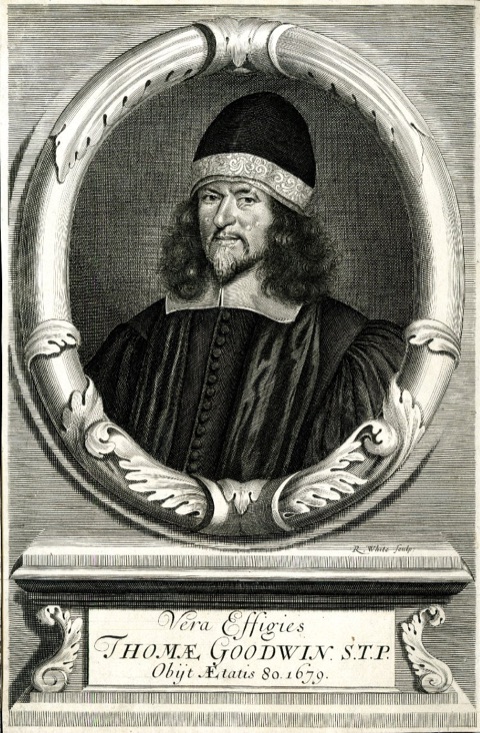
About the author
Thomas Goodwin
Thomas Goodwin (1600 to 1680 AD) was born in Rollesby, Norfolk, and entered Christ's College, Cambridge, at thirteen. Converted around 1620, he became a fellow of Catharine Hall and a university preacher, but resigned his fellowship in 1634 rather than conform to the ceremonies required by Archbishop Laud. He pastored an Independent congregation at Arnhem in the Netherlands from 1639 to 1641, and Christ Set Forth appeared in 1642, soon after his return to England. He sat in the Westminster Assembly as one of the Five Dissenting Brethren, served as a chaplain to Oliver Cromwell, and was president of Magdalen College, Oxford, from 1650 until the Restoration. Ejected in 1660, he spent his last years as a Nonconformist pastor in London, where he died in 1680.