The foundational history of Christianity in Britain. Bede's masterpiece traces the conversion of the Anglo-Saxons and the establishment of the English church, earning him the title "Father of English History."
One free account opens 250+ books and saves your place on every device. Google sign-in or an email link. No card.
You’re on the list — we’ll email you if this goes to print.
Included with your free account
This book, and 250+ more, free to read
A free account opens the whole library to read online, on your phone or at your desk. Open a book on one device and it is waiting at the same page on the next. The PDF and EPUB of every book are yours to keep, and audiobooks play in the same app.
250+ modernized editionsNot samples. The whole work, free.
Your place, on every devicePhone, tablet or desktop, same page.
131 audiobooksFrom $4.99 each, or all of them with a $50 gift.
The Ecclesiastical History of the English People, completed in 731 AD, stands as one of the most important historical works of the medieval period. Written by the Venerable Bede, a monk at the monastery of Jarrow in Northumbria, it traces the history of Christianity in Britain from the Roman period through Bede's own time. This work earned Bede the title "Father of English History" and remains an invaluable source for understanding early medieval Britain.
Bede begins his narrative with the Roman occupation of Britain and the earliest traditions of British Christianity, including legends of King Lucius and the stories of martyrs like Saint Alban. He then traces the Anglo-Saxon invasions that pushed British Christianity to the western margins and the subsequent missions that re-Christianized the island. The famous account of Pope Gregory seeing English slave boys and declaring they should be "not Angles but angels" introduces the Roman mission to England.
Central to the narrative is the mission of Augustine of Canterbury, sent by Pope Gregory the Great in 597 AD to convert the Anglo-Saxons. Bede chronicles the establishment of the English church, the founding of monasteries, and the gradual conversion of the various Anglo-Saxon kingdoms. He pays careful attention to the personalities involved—kings, queens, bishops, and abbots—bringing the period vividly to life.
The Synod of Whitby in 664 AD receives detailed treatment as a pivotal moment when the English church chose to follow Roman rather than Celtic practices, particularly regarding the calculation of Easter. Bede, who strongly favored the Roman position, presents this as a crucial victory for church unity and proper order. This episode illustrates how ecclesiastical and political concerns intertwined in early medieval England.
Bede's work is remarkable for its historical methodology. He carefully cites his sources, distinguishes between reliable and uncertain traditions, and seeks documentary evidence when possible. While writing from a distinctly Christian perspective—interpreting history as the working out of divine providence—he maintains standards of accuracy unusual for his era. Modern historians continue to rely on his work.
Beyond its historical value, the Ecclesiastical History offers spiritual insights through its many accounts of saints, miracles, and conversions. Bede presents these stories not merely as entertainment but as demonstrations of God's work in human history. For modern readers, the work provides both essential historical knowledge and a window into how medieval Christians understood their faith's development in their land.
Life of Bede
Few lives give a biographer less material to work with than Bede's. Few seem to have a stronger appeal. The simple story has been told many times, yet people still want to tell it again. And yet it may be as completely lacking in events as any life could be. The short autobiography at the end of the "Ecclesiastical History" tells us practically everything: that he was born in the area of the twin monastery of Wearmouth and Jarrow; that at age seven he was sent by his relatives to be raised, first under Abbot Benedict, then under Ceolfrid; that in his nineteenth year (the official age was twenty-five) he became a deacon, and was ordained as a priest in his thirtieth year, both times by John, Bishop of Hexham, and by order of Abbot Ceolfrid; that he spent his entire life in the monastery learning, teaching, and writing, and following the monastic rule and attending the daily church services.
We know nothing about his family. The name Beda appears to have been fairly common. The fact that he was handed over by relatives to Abbot Benedict seems to suggest that he was an orphan when he entered the monastery at age seven, but it was not unusual for parents to dedicate their young children to religious life, in many cases even earlier than Bede's age. We can compare the story of the little boy, Aesica, at Barking, told by Bede, and of Elfled, the daughter of Oswy, dedicated by her father before she was a year old.
The title "Venerable," commonly attached to his name, has given rise to more than one legend. It was apparently first applied to him in the ninth century, and is said to have been a title given to priests. The best known of these legends is Fuller's story of a certain "dunce monk" who set about writing Bede's epitaph, and being unable to complete the verse, "Hic sunt in fossa Bedae ... ossa," went to bed with his task unfinished. Returning to it in the morning, he found that an angel had filled the gap with the word "venerabilis." Another account tells how Bede, in his old age, when his eyes were dim, was tricked by certain "mockers" to preach, under the mistaken belief that the people were assembled to hear him. As he ended his sermon with a solemn invocation of the Trinity, the angels (in one version it is the stones of a rocky valley) responded "Amen, very venerable Bede."
The land where Bede was born was given by Egfrid to Benedict Biscop for the founding of the monasteries shortly after Bede's birth. Wearmouth was founded in 674, Jarrow in 681 or 682. Bede was among the community members who were transferred to Jarrow under Abbot Ceolfrid, and he spent his life under his rule and that of his successor, Huaetbert. Regarding the main dates, historians disagree. Simeon of Durham and others place his birth as late as 677. Bede himself tells us that he was in his fifty-ninth year when he wrote the short autobiography at the end of the History. That work was finished in 731, and there seems to be no good reason to think that the autobiographical sketch was written later. We can assume then that he was born in 673, that he was ordained deacon in 691 and priest in 702. For his death, 735, the date given in the "Continuation," seems to be supported by the evidence of the letter of Cuthbert to Cuthwin. From this it appears that he died on a Wednesday, which is also called Ascension Day, probably meaning that his death occurred on the eve, after the festival had begun, according to church reckoning. It is further explained that Ascension Day was on May 26, which was actually the case in the year 735.
Beyond the testimony given to his exceptional hard work as a student in a letter from Alcuin to the monks of Wearmouth and Jarrow, we hear nothing of his childhood and early youth. One story in the Anonymous History of the Abbots may perhaps refer to him, though no name is given. It tells how, when the plague of 686 devastated the monastery, the Abbot Ceolfrid, for lack of suitable people to assist at the daily services, decided to recite the psalms without antiphons, except at vespers and matins. But after a week's trial, unable to bear it any longer, he restored the antiphons to their proper place, and with the help of one little boy carried on the services in the usual manner. This little boy is described as being, at the time the History was written, a priest of that monastery who "properly, both by his words and writings, praises the Abbot's admirable deeds to all who seek to know them," and he has generally been thought to be Bede.
In the "Ecclesiastical History" (4, 3) there is a reference to Bede's teachers. One of them, Trumbert, who was educated at Lastingham under Ceadda, is mentioned by name. The monastery of Wearmouth and Jarrow must have offered exceptional opportunities for study. Benedict had filled it with many treasures that he brought back from his travels. The most important of these was the famous library that he founded and that was later expanded by Abbot Ceolfrid. Here Bede gained the wide and varied knowledge shown in his historical, scientific, and theological works. He studied the writings of the early church fathers with special care and respect. His theological writings were, as he says, "compiled out of the works of the venerable Fathers." He must have known quite a bit of Greek, and probably knew some Hebrew. Though he is not completely free from the medieval churchman's distrust of non-Christian authors, he constantly shows his familiarity with them. The sense of style that naturally influences anyone who studies classical literature has passed into his own writings and saved him from the barbarism of crude monastic Latin. His style is remarkably clear, simple, and smooth, as free from confusion as from pretentiousness and excessive grandeur.
This was the foundation of solid learning on which his widespread influence, both as a teacher and writer, was built. "I always took delight," he tells us, "in learning, or teaching, or writing." His writing was probably, as is so often the case, the result of his teaching. His goal in both was to meet "the needs of the brethren." One of his students was Archbishop Egbert, the founder of the school of York, which gave a fresh boost to learning, not only in England, but through Alcuin in France, at a time when a revival was most needed.
It was to Egbert that he paid one of the only two visits which he records. In the "Letter to Ecgbert" he mentions a short stay he had made with him the year before, and turns down an invitation to visit him again because of the illness that would prove to be his last. He visited Lindisfarne in connection with his task of writing the life of Cuthbert. Otherwise we have no reliable record of any absence from the monastery. The story that he went to Rome at the request of Pope Sergius, based on a statement by William of Malmesbury, is now regarded as highly unlikely. The oldest manuscript of the letter of Sergius, requesting Ceolfrid to send one of his monks to Rome, has no mention of Bede's name. If such an event had ever interrupted his usual way of life, it is hard to believe that he would never mention it anywhere. Even less credible is the claim that he lived and taught at Cambridge, which doesn't need to be seriously debated by the present generation.
We can reasonably assume that, except for a few short trips like his visits to York and Lindisfarne, he spent his entire life in the monastery. It must have been a life of constant hard work. His writings, numerous as they are, covering a wide range of subjects and requiring the most serious study, can only have been part of his work. Besides that, he had his duties as priest, teacher, and member of a religious community to fulfill. Even the physical labor of his literary work must have been considerable. He did not use a secretary, and he did not have the advantages regarding copyists that a member of one of the larger monasteries might have had. "I am at once my own composer, shorthand writer, and copyist," he writes. Yet he never gets tired. Through all the outward monotony of his days, his own interest remains fresh. He "takes delight" in it all. It is a life full of eager activity in intellectual matters, of a keen and patriotic interest in the wider life beyond the monastery walls, which shows itself sadly enough in his reflections on the evils of the times, of the passionate charity which spends itself in labor for the brothers, and, running through it all, that spirit of quiet obedience and devotion which his own simple words describe as "the observance of monastic rule and the daily responsibility of singing in the Church." We can picture him, at the appointed hours, breaking off his absorbing work to take his place at the daily services, lest, as he believed, he should fail to meet the angels there. Alcuin records a saying of his, "I know that angels visit the canonical hours and the gatherings of the brothers. What if they do not find me among the brothers? Might they not say, 'Where is Bede?'"
It is probably here, in this harmony of work and devotion, that we may find the secret of the fascination in the record of his uneventful days. It reconciles the sharp contrast between the active and the contemplative life. It seems to achieve that ideal of work combined with peace that haunts us all, but which we have almost stopped associating with human life under present conditions. Balance, moderation, or rather, that rare quality which has been well called "the sanity of saintliness," these give unity to the life of Bede and keep him from the exaggerations of the monastery ideal. With all his admiration for the ascetic life, he recognizes human limitations. It is encouraging to find that even he felt the need of a holiday. "Having completed," he writes, "the third book of the Commentary on Samuel, I thought I would rest awhile, and, after recovering in that way my delight in study and writing, proceed to take in hand the fourth." Intellectual power commands his respect, but his mind is open to appreciating all forms of excellence.
Letter of Cuthbert to Cuthwin
To his fellow-lector, Cuthwin, beloved in Christ, Cuthbert, his fellow-student, greeting and salvation for ever in the Lord.
I have very gladly received the gift you sent to me, and with much joy have read your devout and learned letter. In it I found what I greatly desired to hear, that masses and holy prayers are being diligently offered by you for our father and master Bede, beloved of God. Therefore I rejoice, more out of love for him than from confidence in my own abilities, to briefly describe how he departed from this world, understanding also that you have desired and asked this of me.
He was troubled with weakness and mostly with difficulty breathing, yet almost without pain, for about two weeks before Easter. He passed his time afterward cheerful and rejoicing, giving thanks to Almighty God every day and night, indeed every hour, until Ascension Day, which was May 26. Daily he gave lessons to us, his disciples. Whatever remained of the day he spent singing psalms, as much as he was able. He also tried to pass all the night joyfully in prayer and thanksgiving to God, except only when a short sleep prevented it. And then as soon as he awoke, he immediately began again to repeat the well-known sacred songs, and did not stop giving thanks to God with uplifted hands.
I declare truthfully that I have never seen with my eyes, or heard with my ears, any man so earnest in giving thanks to the living God. O truly blessed man! He repeated the words of St. Paul the Apostle, "It is a fearful thing to fall into the hands of the living God," and much more from Holy Scripture. In doing so he also warned us to think of our last hour, and to arise out of the sleep of the soul. And being learned in our native poetry, he also said in our tongue, concerning the dread parting of souls from the body:
Before the inevitable journey from here, no one is wiser than is necessary that he may consider, before the soul departs, what good or evil it has done and how it shall be judged after its departure.
He also sang antiphons for our comfort and his own. One of these is, "O King of Glory, Lord of all power, Who, triumphing this day, didst ascend above all the heavens, leave us not comfortless, but send to us the promise of the Father, even the Spirit of Truth, Hallelujah." And when he came to the words, "leave us not comfortless," he burst into tears and wept much. And an hour after, he fell to repeating what he had begun. And this he did the whole day, and we, hearing it, mourned with him and wept. Now we read and now we lamented, no, we wept even as we read. In such rapture we passed the fifty days' festival till the day mentioned above, and he rejoiced greatly and gave God thanks, because he had been counted worthy to suffer such weakness.
When the Tuesday before the Ascension of our Lord came, he began to suffer even more difficulty with his breathing, and his feet started to swell. But he continued teaching all that day and dictating cheerfully, and now and then said among other things, "Learn quickly. I don't know how long I will last, and whether my Maker will soon take me away." But to us it seemed that he probably knew the time of his death, and so he spent the night awake, giving thanks. And when morning came, that is, on Wednesday, he told us to write as fast as we could what we had begun. And we did this until nine o'clock in the morning. And from nine o'clock we walked in procession with the relics of the saints, according to the custom of that day.
And there was one of us with him who said to him, "There is still one chapter left of the book you have been dictating, but I think it's too much to ask you any more questions." He answered, "No, it's easy. Take your pen and get ready, and write quickly." And this was done. But at three o'clock in the afternoon he said to me, "I have certain treasures in my chest, some spices, napkins, and incense. Run quickly and bring the priests of our monastery to me, so I can distribute among them the gifts which God has given me." And I did this trembling, and when they came, he spoke to every one of them, advising and asking them to diligently offer masses and prayers for him, and they readily promised. But they all mourned and wept, sorrowing most of all for the words he spoke, because they thought they would not see his face much longer in this world. But they rejoiced because he said, "It is time for me, if it is my Maker's will, to be set free from the flesh and come to Him who, when I did not yet exist, formed me out of nothing. I have lived long, and my merciful judge has arranged my life well for me. The time of my release is at hand, for my soul longs to see Christ my King in His beauty."
Having said this and much more for our benefit and instruction, he spent his last day in happiness until the evening. And the boy mentioned earlier, whose name was Wilbert, still said, "Dear master, there is yet one sentence not written." He answered, "Good, write it." Soon after, the boy said, "Now it is written." And he said, "Good. You have spoken truly. It is finished. Take my head in your hands, for I greatly rejoice to sit facing my holy place where I used to pray, so that I too, sitting there, may call upon my Father." And so on the floor of his little cell, chanting "Glory be to the Father, and to the Son, and to the Holy Ghost," and the rest, he breathed his last.
There's no doubt that we must believe that since he had always been devoted and earnest on earth in praising God, angels carried his soul to the joys of Heaven that he longed for. Everyone who heard him or witnessed the death of our father Bede said they had never seen anyone else end their life with such great devotion and peace. As you've heard, for as long as his soul remained in his body, he chanted the 'Gloria Patri' and other words glorifying God, and with his hands stretched out, he never stopped giving thanks to God.
But you should know that much more could be told and written about him, but my lack of learning cuts my words short. Nevertheless, with God's help, I plan to write more fully about him later, telling of the things I saw with my own eyes and heard with my own ears.
Preface
To the most glorious king Ceolwulf. Bede, the servant of Christ and Priest.
I previously sent you the Ecclesiastical History of the English Nation at your request, which I had recently published, for you to read and give your opinion on. Now I'm sending it again so it can be copied and studied more carefully when you have time. I'm very happy about the sincerity and enthusiasm with which you not only listen carefully to the words of Holy Scripture, but also work hard to learn about the actions and words of famous people from the past, especially from our own nation. When history tells good things about good people, the attentive listener is inspired to imitate what is good. Or if it tells bad things about wicked people, the conscientious and devout listener or reader, avoiding what is harmful and wrong, is even more strongly motivated to do those things he knows to be good and worthy of serving God. Since you have carefully noticed this, you want this history to be more fully known to yourself and to those whom God has appointed you to govern, because of your great concern for the common good. But so that I can remove any reason for doubting what I have written, both from you and from other readers or listeners of this history, I will make sure to briefly show you what sources I mainly learned this from.
My main source and helper for this work was the very learned and respected Abbot Albinus. He was educated in the Church of Canterbury by those honorable and learned men, Archbishop Theodore of blessed memory, and the Abbot Hadrian. He sent to me through Nothelm, the devout priest of the Church of London, either in writing or by word of mouth through this same Nothelm, everything he thought worth remembering that had happened in the province of Kent or the surrounding areas through the disciples of the blessed Pope Gregory. He had learned these things either from written records or from the traditions passed down by his predecessors. This same Nothelm later went to Rome, and with permission from the current Pope Gregory, he searched through the archives of the Holy Roman Church. There he found some letters from the blessed Pope Gregory and other popes. When he returned home, following the advice of the respected father Albinus mentioned above, he brought them to me to include in my history.
Here it should be noted that what I have written about our most holy father, Bishop Cuthbert, either in this book or in my account of his life and deeds, I partly took from what I found written about him by the brothers of the Church of Lindisfarne, accepting those accounts without question. But at the same time I took care to add things that I could learn about myself from the reliable testimony of trustworthy sources. And I humbly ask the reader that if he finds anything in these writings that is not delivered according to the truth, he will not blame me for it. Following the true rule of history, holding nothing back, I have worked to write down such things as I could gather from common knowledge for the instruction of future generations.
Moreover, I ask all who will hear or read this history of our nation to pray frequently to God for me, considering my weaknesses of both mind and body. And I also pray that in return for the work I have done in recording the events from various regions and important places, those events which I thought were worth noting and interesting to the people who live there, I may be rewarded by their devout prayers.
The Island: A Portrait of Britain and Ireland
Britain, an island in the Atlantic, formerly called Albion, lies to the northwest, facing, though at a considerable distance, the coasts of Germany, France, and Spain, which form the greatest part of Europe. It extends 800 miles in length towards the north, and is 200 miles in breadth, except where several promontories extend further in breadth, by which its compass is made to be 4,875 miles. To the south lies Belgic Gaul. To its nearest shore there is an easy passage from the city of Rutubi Portus, by the English now corrupted into Reptacaestir. The distance from here across the sea to Gessoriacum, the nearest shore in the territory of the Morini, is fifty miles, or as some writers say, 450 furlongs. On the other side of the island, where it opens upon the boundless ocean, it has the islands called Orcades.
Britain is rich in grain and trees, and is well suited for feeding cattle and beasts of burden. It also produces vines in some places, and has plenty of land and water birds of various sorts. It is also known for rivers full of fish, and abundant springs. It has lots of salmon and eels. Seals are also frequently caught, and dolphins, as well as whales. Besides many sorts of shellfish, such as mussels, in which are often found excellent pearls of all colors: red, purple, violet and green, but mostly white. There is also a great abundance of snails, from which scarlet dye is made, a most beautiful red, which never fades with the heat of the sun or exposure to rain. In fact, the older it is, the more beautiful it becomes. It has both salt and hot springs, and from them flow rivers which provide hot baths, suitable for all ages and both sexes, in separate places, according to their needs. For water, as St. Basil says, takes on the quality of heat when it runs along certain metals, and becomes not only hot but scalding.
Britain is also rich in veins of metals, like copper, iron, lead, and silver. It produces a great deal of excellent jet, which is black and sparkling, and burns when put to the fire. When set on fire, it drives away serpents. Being warmed with rubbing, it attracts whatever is applied to it, like amber. The island was formerly distinguished by twenty-eight famous cities, besides countless forts, which were all strongly secured with walls, towers, gates, and bars.
And, because it lies almost under the North Pole, the nights are light in summer, so that at midnight observers are often unsure whether the evening twilight still continues, or that of the morning has come, since the sun at night returns to the east in the northern regions without passing far beneath the earth. For this reason the days are very long in summer, and on the other hand, the nights in winter are eighteen hours long, for the sun then withdraws into southern parts. In the same way the nights are very short in summer, and the days in winter, that is, only six equinoctial hours. Whereas, in Armenia, Macedonia, Italy, and other countries of the same latitude, the longest day or night extends only to fifteen hours, and the shortest to nine.
There are currently five languages on the island, matching the number of books in which God's Law was written. These different nations use these languages to study and profess the same knowledge of the highest and truest wisdom: English, British, Scottish, Pictish, and Latin. Latin has become common to everyone through the study of Scripture. But at first this island had no other people living there except the Britons, who gave it their name. According to reports, they came over to Britain from Armorica and took over the southern parts. Starting from the south, they had occupied most of the island when the Picts arrived.
Ireland is the largest island after Britain and lies to the west of it. Although it doesn't extend as far north as Britain, it stretches much farther to the south, opposite the northern part of Spain, though a wide sea lies between them. When the Picts arrived at Ireland by sea, as I mentioned, they asked for land where they could settle. The Scots answered that the island couldn't hold them both, but added, "We can give you good advice about what to do. We know there's another island, not far from ours, to the east, which we often see in the distance on clear days. If you go there, you can find places to settle, or if anyone opposes you, we will help you."
So the Picts sailed over to Britain and began living in the northern parts, since the Britons had already taken the southern areas. The Picts had no wives and asked the Scots for women. The Scots would only agree on one condition: whenever a dispute arose, the Picts should choose a king from the female royal line rather than the male line. As is well known, this custom has been followed among the Picts to this day.
Over time, Britain received a third nation besides the Britons and the Picts: the Scots. They migrated from Ireland under their leader Reuda and secured settlements among the Picts, either through peaceful means or by force of arms, which they still hold today. They are still called Dalreudini after their commander's name, because in their language, Dal means a part.
Ireland is wider than Britain and has a much healthier and milder climate. Snow hardly ever stays there for more than three days. No one makes hay in the summer to store for winter, or builds stables for their animals. No reptiles are found there, and no snake can live there. Even though snakes are often brought there from Britain, as soon as the ship gets near the shore and they smell the air, they die. On the other hand, almost everything in Ireland works against poison. In fact, we have seen that when people have been bitten by snakes, scrapings from the pages of books brought from Ireland, mixed into water and given to them to drink, have immediately stopped the poison from spreading and reduced the swelling.
The island has plenty of milk and honey, and there is no shortage of vines, fish, or birds. It is well known for hunting stags and roe-deer. It is properly the country of the Scots, who migrated from there, as mentioned before, and formed the third nation in Britain alongside the Britons and the Picts.
There is a very large inlet of the sea that used to separate the nation of the Britons from the Picts. It runs from the west deep into the land, where to this day stands a strong city of the Britons called Alcluith. The Scots arrived on the north side of this bay and settled there.
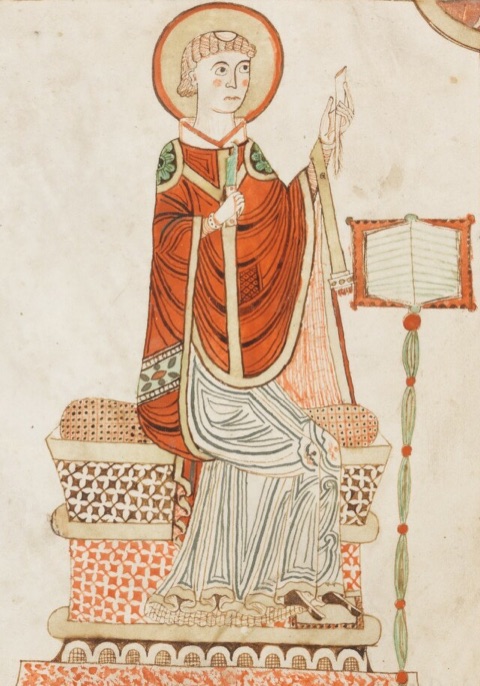
The Venerable Bede (673-735 AD) was an English Benedictine monk, scholar, and author widely regarded as the greatest historian of the early Middle Ages. Entering the monastery of Wearmouth-Jarrow at age seven, he spent his entire life there in prayer, study, and writing. His scholarly output was remarkable, including biblical commentaries, scientific works on time and astronomy, hagiographies, and poetry. His Ecclesiastical History of the English People remains his masterpiece and the essential source for early English history. Bede's careful scholarship and emphasis on citing sources established standards that influenced historical writing for centuries. He was declared a Doctor of the Church in 1899, the only Englishman to hold that honor. His method of dating events from the birth of Christ (AD) helped establish the system used throughout the Western world today.
“Updated Works has been an incredible blessing to my Christian life and ministry… remarkably faithful to the original authors while making these timeless treasures understandable for modern readers.”