Arnobius of Sicca
A teacher of rhetoric in Roman North Africa who, after converting to Christianity, wrote the seven-book apology Against the Nations in the years leading into the persecution under Diocletian. He was the teacher of Lactantius, and his work is a major source of information about Roman pagan religion.
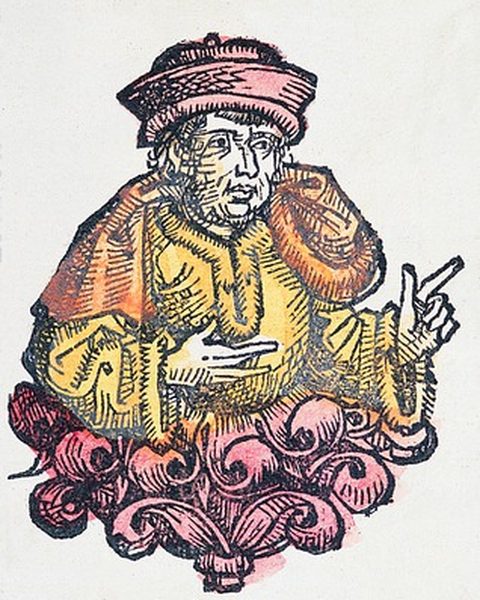
died around 330 AD
Biography
Arnobius of Sicca (died around 330 AD) was a teacher of rhetoric at Sicca Veneria in Roman North Africa who, after converting to Christianity, wrote the seven-book apology Against the Nations. He taught during the reign of Diocletian, and among his pupils was Lactantius, who became one of the leading Latin prose writers of the early fourth century.
Almost everything known about his life comes from Jerome, who mentions him in On Illustrious Men and in his Chronicle. According to Jerome, Arnobius had been a vigorous opponent of Christianity before a dream turned him toward the faith. When he sought baptism, the local bishop, distrusting a man who had lately attacked the Christians, is said to have required proof of his sincerity; Arnobius answered by composing his defense of the religion he had once opposed.
That defense, Against the Nations (Adversus Nationes, also printed as Adversus Gentes), runs to seven books and was written around 297 to 303 AD, in the period leading into the persecution launched by Diocletian. Its first books answer the charge that Christians, by abandoning the old gods, had brought war, plague, drought, and other disasters upon the Roman world. The remaining books turn the attack outward, dissecting pagan mythology and cult with a detailed knowledge of Roman rites, minor deities, and religious antiquities.
Arnobius argues largely as a trained rhetorician rather than as a scripturally formed theologian. He makes no evident use of the New Testament, and his account of Christian doctrine differs at points from what became standard teaching: he held that human souls are not naturally immortal but of a "middle nature," perishing unless God grants them continuance. He wrote as a recent convert, defending the church with the tools of pagan learning he already possessed.
His book was received with reservation in later centuries. The Decretum Gelasianum, a list distinguishing accepted from rejected writings, placed the work among the apocrypha. The text survives principally in a single early manuscript, and later scholars valued it less for its theology than for the antiquarian detail it preserves about Roman religion, much of which is recorded nowhere else.
Why Arnobius Matters
Arnobius wrote one of the last major Latin apologies before the conversion of Constantine changed the position of Christianity in the empire. Composed in the period of the Diocletianic persecution, Against the Nations answers a specific and recurring accusation: that the calamities striking the Roman world were punishment for the neglect of the ancestral gods. The same charge would be taken up on a far larger scale a century later by Augustine in the City of God, and Arnobius represents an earlier, North African answer to it.
His most lasting usefulness has been to historians of Roman religion rather than to theologians. To ridicule pagan worship, Arnobius catalogued its gods, rites, and myths in unusual detail, drawing on antiquarian sources that have since been lost. Scholars of ancient cult have mined his seven books for information about obscure deities, ritual practices, and the organization of pagan worship that survives in no other text, which has kept the work in use long after its polemical purpose faded.
His theology sets him apart from most early Christian writers. He argues from philosophy and rhetoric rather than from Scripture, cites the New Testament nowhere in the work, and teaches that the soul is not immortal by nature but depends on God for its survival. These positions, together with his thin engagement with Christian doctrine, explain why the Decretum Gelasianum later listed the work among rejected books, and why his standing in the church remained uncertain.
Arnobius also occupies a place in the transmission of Latin Christian learning through his pupil Lactantius, whose polished style and defense of Christianity carried forward into the Constantinian age. That the master's own book survives at all is owed largely to a single early manuscript, without which one of the fullest surviving attacks on Roman paganism would have been lost.
Complete Works in English
Free to readEvery surviving work, translated in full and free to read, from our Patrologia Latina project.