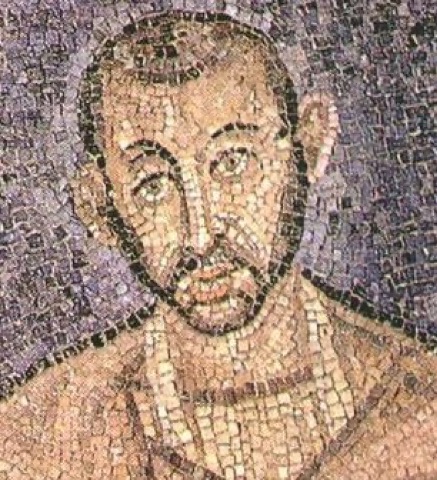
Ambrosiaster
The modern name for the anonymous author of the earliest complete Latin commentary on the thirteen letters of Paul, from Romans through Philemon. He wrote at Rome while Damasus was bishop, and his identity has never been established. The commentaries were transmitted for centuries under the name of Ambrose, which is how the label "Ambrosiaster" came to be attached to them, and the same author is generally credited with a large set of exegetical Questions on the Old and New Testaments handed down under the name of Augustine.
Biography
"Ambrosiaster" is a modern label, not a name the author ever used. The Latin form carries the sense of a would-be or lesser Ambrose, and it was fastened on the writer once scholars concluded that the commentaries transmitted under Ambrose's name were not in fact by him. The person behind the label wrote at Rome the earliest complete Latin commentary on the thirteen letters of Paul, running from Romans through Philemon. He did not treat Hebrews, which fits a Roman writer of his period, since the Roman church was slow to receive that letter as Pauline.
The date and place can be fixed from the commentary itself rather than from any outside record. The author writes of Damasus as the bishop then presiding at Rome, which places the work within the episcopate of Damasus, from 366 to 384 AD. Other remarks about the city, its offices, and its customs point the same way, to a writer at home in Rome during those years. Beyond this internal evidence there is almost nothing external to go on.
The commentaries were copied through the Middle Ages as the work of Ambrose of Milan, and it was under that name that they were read and quoted for a thousand years. The tangle is older still: when Augustine drew on the commentary on Romans, he cited it under the name of "Sanctus Hilarius," a holy Hilary, so that the same text traveled under at least two borrowed names before the modern period. In 1527 Erasmus argued that Ambrose could not be the author, and later scholarship agreed. The name Ambrosiaster came into use in the wake of that judgment, and since the sixteenth century it has served as a convenient tag for an author who cannot otherwise be named.
The author of the Pauline commentaries is generally credited, on the evidence of style and method, with a second and larger work, a set of Questions on the Old and New Testaments (Quaestiones Veteris et Novi Testamenti) that was handed down under the name of Augustine. This attribution is a matter of scholarly consensus built on internal resemblance rather than a signed claim, but it is widely held, and it makes Ambrosiaster the author of two substantial bodies of work, each of which reached the Middle Ages under the name of a more famous man.
Who he actually was has been guessed at for centuries without result. Proposed identifications have ranged from a converted Jew named Isaac to the Roman official Decimius Hilarianus Hilarius, among others, but none has won general acceptance, and each remains conjecture. What the writings themselves show is more secure than any of these names: the author was a Roman, or at least long settled at Rome; he wrote practical, historically minded exegesis with little taste for allegory; he was attached to the older Roman social and political order; and he took a close interest in law, office, and custom, in a way that has suggested to many readers a man with legal training or experience.
Everything past this is unknown. His given name, his rank, his office if he held one, the course of his life, the year of his death, none of it survives. The honest account of Ambrosiaster is short, because the certain facts are few, and the interest of the case lies precisely in how much influence a writer could exert while leaving so little trace of himself.
Why Ambrosiaster Matters
Ambrosiaster produced the earliest complete Latin commentary on the letters of Paul, covering all thirteen from Romans to Philemon. Marius Victorinus had commented on a few of the letters a little earlier, but Ambrosiaster's is the first Latin commentary to run through the whole Pauline corpus, and it stands at the head of the Latin tradition of Pauline interpretation that later commentators would extend.
His method sets him apart from much of the exegesis of his century. Where many contemporaries reached for allegory, Ambrosiaster kept close to the plain, historical sense of the text. He explained Paul's arguments in terms of the situations that produced them, attended to Roman law and custom where they illuminated a passage, and wrote in a sober, businesslike style. This literal and historical cast of mind is part of what makes the commentary useful to historians as well as to theologians, and it marks a strand of Latin exegesis distinct from the allegorical tradition.
His influence traveled largely under other men's names, and the clearest instance concerns Augustine and the doctrine of original sin. The Old Latin text of Romans 5:12 that Ambrosiaster read rendered Paul's clause as "in whom all sinned" (in quo omnes peccaverunt), taking the "whom" to refer to Adam, so that all human beings are understood to have sinned in Adam. Ambrosiaster's commentary developed this reading, and Augustine, who knew the commentary and cited it as the work of "Hilary," appealed to the same interpretation in his own account of how sin passed from Adam to his descendants. Augustine's use of Romans 5:12 became a foundation of Western teaching on original sin, and Ambrosiaster's earlier handling of the verse is one of the roads by which that reading reached him.
The commentaries are also a prime witness to the Old Latin biblical text as it stood before Jerome's Vulgate, since Ambrosiaster quotes and comments on a pre-Vulgate version of Paul, and to the practice and self-understanding of the Roman church under Damasus, on which he offers incidental but valuable detail. His modern history adds a further interest. The unmasking of the false attribution to Ambrose, and the reassignment of the Questions from Augustine to the same hand, make Ambrosiaster a case study in how texts survive under borrowed names and how later scholarship works back toward the anonymous author behind them.
Complete Works in English
Free to readEvery surviving work, translated in full and free to read, from our Patrologia Latina project.