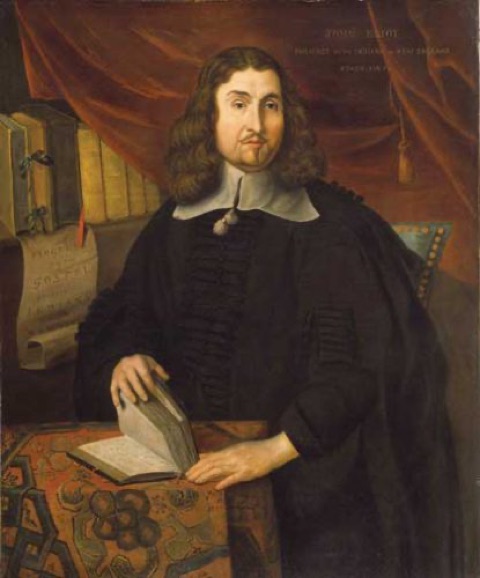
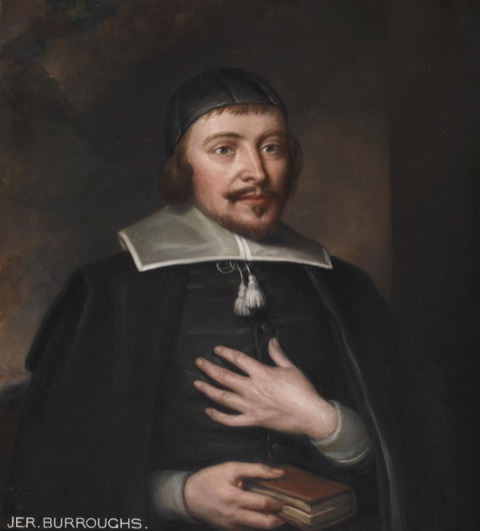
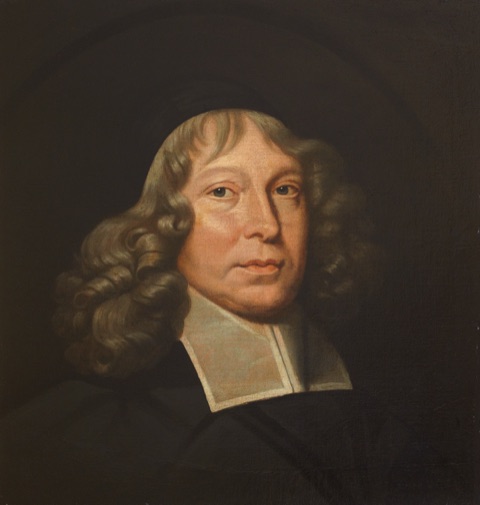
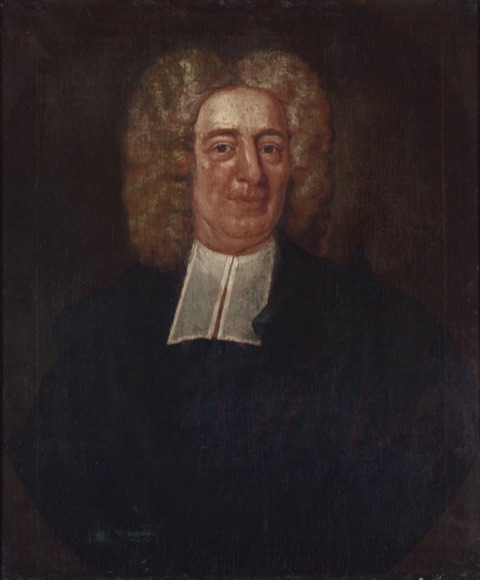
Thomas Hooker
Puritan preacher and founder of Hartford, Connecticut. Known for his searching sermons on the soul's preparation for Christ and for his pastoral counsel to troubled consciences in The Poor Doubting Christian Drawn to Christ.
Biography
Thomas Hooker was born in 1586 at Marefield in Leicestershire. He studied at Cambridge and became a fellow of Emmanuel College, the Puritan-leaning college where he passed through a long season of spiritual distress before coming to settled faith. That experience shaped his later preaching, which dwelt on how God humbles a sinner and prepares the heart for Christ.
After a period as rector at Esher in Surrey, Hooker became lecturer at St. Mary's Church in Chelmsford, Essex, around 1626, and his preaching drew large crowds. His nonconformity brought him under the scrutiny of William Laud, then Bishop of London, and he was silenced in 1629. He kept a school at Little Baddow, where the young John Eliot served as his assistant, and in 1631, summoned before the Court of High Commission, he fled to the Netherlands. There he ministered among the English exiles and spent time with William Ames at Rotterdam.
In 1633 Hooker sailed to New England with John Cotton and Samuel Stone and became pastor of the church at Newtown, now Cambridge, Massachusetts. In 1636 he led most of his congregation overland to the Connecticut River, where they founded Hartford. In 1637 he helped moderate the synod at Newtown that answered the antinomian controversy, and in 1638 he preached a sermon on Deuteronomy 1:13 teaching that the foundation of civil authority lies in the free consent of the people. The Fundamental Orders of Connecticut were adopted the following year.
Hooker died at Hartford in July 1647 during an epidemic. Many of his sermons reached print in England, among them The Soul's Preparation for Christ (1632) and The Poor Doubting Christian Drawn to Christ. His defense of Congregational church government, A Survey of the Sum of Church Discipline, was published in 1648 as a reply to the Scottish Presbyterian Samuel Rutherford.
Life & Career
Why Hooker Matters
Hooker was the leading preacher of "preparation," the Puritan teaching that God ordinarily humbles and breaks a sinner before bringing him to faith. He described the stages of contrition and humiliation in close detail, and he did so as a pastor rather than a system builder: his aim was to help hearers recognize God's work in their own hearts. The same concern produced his counsel for the opposite case, the humbled believer who cannot believe mercy is meant for him, which is the burden of The Poor Doubting Christian Drawn to Christ.
Hooker also shaped church and civil life in New England. He argued for Congregational church government in his Survey of the Sum of Church Discipline, written in reply to Presbyterian critics, and his teaching that authority rests on the consent of the governed informed the political order of early Connecticut. His son-in-law Thomas Shepard carried his experimental preaching into the next generation, and Cotton Mather later wrote his life in Magnalia Christi Americana.