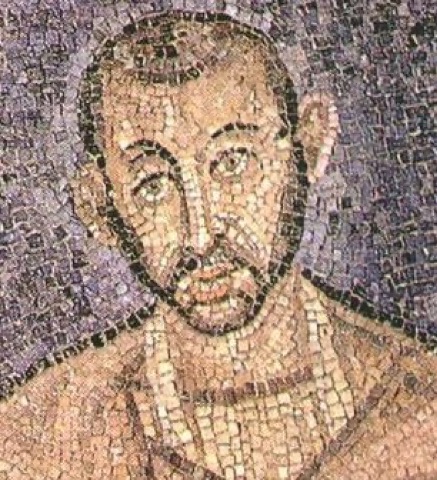
Quintus Aurelius Symmachus
Roman senator and orator, held by his contemporaries to be the finest Latin speaker of his generation and the leading voice of the pagan senatorial aristocracy. His Third Relatio of 384 AD pleaded for the restoration of the Altar of Victory to the Senate house and drew a reply from Ambrose of Milan. His ten books of letters are the largest surviving window into the world of the late Roman Senate.
Biography
Quintus Aurelius Symmachus (around 345 to 402 AD) was a Roman senator, orator, and letter-writer, and the most prominent lay spokesman for the traditional religion of Rome in the final decades of its public life. He belonged to the Symmachi, one of the great senatorial houses of the fourth century. His father, Lucius Aurelius Avianius Symmachus, had held the prefecture of Rome and a long series of honors, and the son was raised to the offices and the culture that such a family expected of its heir. He was trained in rhetoric under a Gallic master and emerged, by the common report of those who heard him, as the finest Latin orator of his generation.
His public career followed the ordinary course of senatorial advancement, marked at each stage by the great offices of state. He was proconsul of Africa in 373 AD, prefect of the city of Rome in 384 to 385 AD, and consul in 391 AD, the summit of Roman honors. Alongside these magistracies he held the priesthoods of the old religion and, over decades, acted as the recognized leader of the pagan party in the Senate, the man to whom its members looked when the interests of the traditional cults came before the emperors.
That role reached its height in the affair of the Altar of Victory. The altar had stood in the Senate house since the age of Augustus, and senators had long offered incense upon it before their deliberations. The emperor Gratian ordered its removal and withdrew the public funds that supported the priesthoods and the Vestal Virgins. In 382 AD Symmachus led a delegation to petition for its restoration, but the embassy was refused a hearing. Two years later, as prefect of Rome, he addressed to the young emperor Valentinian II the state paper known as the Third Relatio, an appeal for the restoration of the altar and the ancient rites. In it he wrote that Rome asked peace for the gods of her fathers, and put into the mouth of the city herself the plea that so great a mystery could not be reached by one path alone. The Relatio was answered by Ambrose, bishop of Milan, in two letters, and the petition failed; the exchange between Symmachus and his opponent, whose letters are gathered on this site, became the classic statement of the two sides.
His career survived a serious misstep. When the usurper Magnus Maximus held Italy, Symmachus delivered a panegyric in his honor. After Maximus fell to Theodosius, Symmachus was exposed to the charge of having supported a usurper, but he received a pardon and, in a mark of how far his standing outlasted the episode, went on to hold the consulship of 391 AD and to serve again on senatorial embassies to the court.
What has preserved his name above all is his correspondence. After his death his son, Quintus Fabius Memmius Symmachus, gathered and published his letters in ten books, arranged on the model of the younger Pliny: nine books of private letters to friends, kinsmen, and men of affairs, and a tenth book of the official relationes he had sent to the emperors as prefect. The collection is the largest single window we possess into the daily world of the late Roman senatorial aristocracy. Its letters carry recommendations for clients seeking office, the management of far-flung estates, the anxious arrangements for the games that his son's praetorship required, and the constant working of amicitia, the network of obligation and favor that bound the governing class together. His correspondents span the divisions of the age: the poet and consul Ausonius, his fellow pagan Nicomachus Flavianus, and Christian magnates as readily as men who shared his own rites.
Symmachus died around 402 AD. His memory was kept by the family of his grandson, and within a generation Macrobius made him a leading speaker in the Saturnalia, casting him as the model of learned Roman courtesy presiding over a dialogue on the antiquities of Rome. Through the letters and through that portrait he remained, for later readers, the representative figure of the senatorial world at its close.
Life & Career
Why Symmachus Matters
Symmachus is the last great voice of Roman religious tradition speaking in its own defense. By his lifetime the old cults had lost the emperor's patronage and were losing their place in law, and no one of comparable authority and eloquence rose after him to argue their cause in the Senate. His Third Relatio is the fullest surviving expression of what the traditional religion meant to the men who still held it: not a body of doctrine to be proved, but the inherited practice of the city, the rites under which Rome had grown great and repelled her enemies. To read him is to hear the case for the old order stated at its most reasonable and most moving, by the man best able to state it.
The exchange over the Altar of Victory is antiquity's classic debate on religious toleration. Symmachus argued that the divine is too great to be approached by a single road, that custom and antiquity carry their own authority, and that the empire owed its fortunes to the rites it was now abandoning. Ambrose answered that truth is not established by age and that the God of the Christians is known by revelation rather than ancestral usage. The two positions, set down within months of each other and preserved together, became the reference point to which later ages returned whenever they weighed the claims of tradition against those of a single revealed truth. Few disputes of the ancient world are so evenly matched or so cleanly drawn.
His letters are the best surviving picture of the senatorial aristocracy at the moment the classical world was ending. Where the church fathers show us the assemblies, controversies, and disciplines of the Christian community, Symmachus shows us the other half of that society from within: the great families, their estates and clients, their offices and games, the codes of friendship and favor by which they governed. The collection preserves the texture of a governing class that had ruled for centuries and was passing out of its inherited world without knowing it.
A collection of the church fathers is incomplete without the man they answered. The Christian writers of the late fourth century defined their case in part against the tradition Symmachus spoke for, and his opponents' replies cannot be fully understood apart from the appeal that provoked them. Presented here in his own right and with the same respect given the Christian authors, he supplies the voice from the other side of the fourth century's central argument, without which that argument is heard only in half.
Complete Works in English
Free to readEvery surviving work, translated in full and free to read, from our Patrologia Latina project.