Phoebadius of Agen
Bishop of Agen in Gaul who wrote Against the Arians in 357 or 358 AD, the earliest surviving theological treatise composed by a Gallic bishop. He attacked the Second Creed of Sirmium and later resisted, then signed, the compromise formula at the Council of Ariminum.
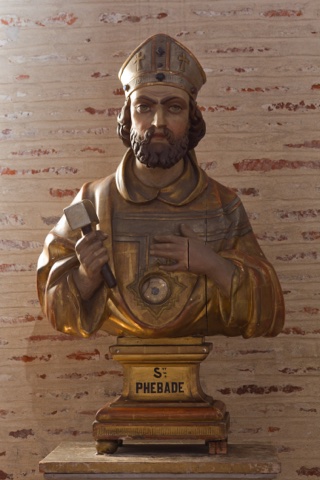
died after 392 AD
Biography
Phoebadius of Agen (died after 392 AD) was the bishop of Agen (ancient Aginnum) in southwestern Gaul and the author of the earliest surviving theological treatise written by a Gallic bishop. His one securely attributed work, the Liber Contra Arianos, or Book Against the Arians, was composed in 357 or 358 AD and defends the full divinity of the Son against the doctrinal formulas being pressed on the Western church during the reign of the emperor Constantius II.
The immediate target of the treatise was the creed issued at Sirmium in 357 AD, the document later called the "blasphemy of Sirmium," which forbade the use of the terms substance (ousia), of one substance (homoousios), and of like substance (homoiousios) on the grounds that Scripture did not contain them. Phoebadius answered that this silence surrendered the church's confession of the Son as truly God. He built his argument largely from earlier Latin writers, drawing on Tertullian's Against Praxeas and on Novatian's treatise on the Trinity, and he handled the technical vocabulary of substance and person that Western theology would continue to use.
Phoebadius took part in the Council of Ariminum (modern Rimini) in 359 AD, where the assembled Western bishops were pressed to accept a formula describing the Son as "like the Father" while dropping the language of substance. Together with Servatius of Tongres he at first refused, but the two were eventually maneuvered into subscribing a revised version of the creed. Writing decades later in his catalogue of church writers, Jerome recorded that Phoebadius was still alive in extreme old age in 392 AD, and it is Jerome's remark about the Ariminum settlement, that the world groaned to find itself Arian, that fixes the memory of that council.
Two further works have long been printed under Phoebadius's name but their attribution is uncertain. The treatise On the Orthodox Faith (De Fide Orthodoxa), together with an appended piece on the divinity of the Son, is frequently assigned instead to Gregory of Elvira, and the short Little Book of Faith (Libellus Fidei) is likewise disputed. Only Against the Arians can be confidently traced to him.
Why Phoebadius Matters
Phoebadius matters because Against the Arians is the first sustained Latin defense of Nicene theology to survive from Gaul, written at the moment when imperial pressure under Constantius II was pushing the Western churches toward formulas that avoided the language of substance. His treatise shows how a provincial bishop in Aquitaine received and answered the creed of Sirmium of 357 AD within a year of its appearance.
His method is significant for the history of Latin theology. Rather than importing Greek arguments, Phoebadius reached back to Tertullian and Novatian, adapting their vocabulary of one substance and three persons to the controversy of his own day. The treatise is therefore evidence of how the Western church built its trinitarian language from its own earlier sources before the fuller synthesis worked out by Hilary of Poitiers and Ambrose of Milan.
His conduct at Ariminum in 359 AD illustrates the pressures placed on Western bishops during the Homoian ascendancy. His initial refusal and eventual subscription, recorded by Sulpicius Severus and echoed by Jerome, became a standard example of how bishops who held the Nicene faith were drawn into signing a formula they had opposed, and of the reaction that followed once the maneuvering was understood.
Complete Works in English
Free to readEvery surviving work, translated in full and free to read, from our Patrologia Latina project.