



131 audiobooks, 1,134 hours of narration. Give $50 and every one is yours.
Early Church books
Cover of On the Soul and the Resurrection

Modern English edition · 380 AD

On the Soul and the Resurrection

by Gregory of Nyssa

A profound dialogue between Gregory and his dying sister Macrina on the nature of the soul and the hope of resurrection.

Start reading free

One free account opens 250+ books and saves your place on every device. Google sign-in or an email link. No card.

Included with your free account

This book, and 250+ more, free to read

A free account opens the whole library to read online, on your phone or at your desk. Open a book on one device and it is waiting at the same page on the next. The PDF and EPUB of every book are yours to keep, and audiobooks play in the same app.

  • 250+ modernized editions Not samples. The whole work, free.
  • Your place, on every device Phone, tablet or desktop, same page.
  • 131 audiobooks From $4.99 each, or all of them with a $50 gift.
  • PDF and EPUB included Download any book to keep.
Create your free account Google sign-in or an email link. No card.
The in-app reader on a phone, mid-chapter of The Mortification of Sin in modern English
My Library on a phone, with a book to continue reading and the cover grid

About this book

On the Soul and the Resurrection is one of the most moving theological works of the early church. Written shortly after the death of Gregory's beloved sister Macrina in 379 AD, it takes the form of a dialogue between the two siblings as Macrina lies on her deathbed. Like Plato's Phaedo, which records Socrates' final conversations about the soul's immortality, Gregory's work addresses the deepest questions about death, the soul, and the hope of resurrection.

The dialogue opens with Gregory overwhelmed by grief. He has already lost his brother Basil the Great, and now Macrina herself is dying. In his sorrow, Gregory questions whether there is any rational basis for hope beyond death. Macrina, though physically weakening, remains spiritually strong and takes on the role of teacher, guiding her brother through the arguments for the soul's immortality and the resurrection of the body.

Macrina first establishes that the soul is a real, immaterial substance distinct from the body. Against those who would reduce the soul to mere physical processes, she argues that the mind's capacity for abstract thought, moral reasoning, and knowledge of God points to a reality that transcends matter. The soul is not simply the body's harmony or function but an independent substance that can exist apart from the body.

The dialogue then turns to what happens to the soul after death. Macrina explains that while the body dissolves into its constituent elements, the soul remains connected to those elements through a mysterious bond. This connection provides the basis for the resurrection: at the end of time, the soul will draw its scattered elements back together, reconstituting the body in glorified form.

Gregory raises objections along the way, playing the role of philosophical skeptic. How can scattered particles be reassembled? What about bodies consumed by fire or eaten by wild animals? Macrina responds that God, who created matter from nothing, can certainly reorganize existing matter. The resurrection is not more miraculous than creation itself.

The work concludes with a vision of universal restoration. Drawing on passages like 1 Corinthians 15, Macrina describes the final state when death itself is destroyed and God becomes "all in all." While this passage has generated theological debate about Gregory's views on universal salvation, the dialogue as a whole offers powerful comfort to those facing death and grief, grounding Christian hope in reasoned argument and scriptural testimony.

A Grief Too Hard to Bear

Basil, one of the greatest saints, had left this life to be with God. All the churches shared in mourning for him. But his sister, the Teacher, was still alive, so I traveled to see her, longing to share our grief over losing her brother. My soul was crushed by this terrible blow, and I needed someone who felt it just as deeply, someone to cry with.

But when we finally met, seeing the Teacher only intensified my pain. She too was lying prostrate, close to death herself. Still, she indulged me for a little while, like a skilled charioteer, letting my uncontrollable grief run its course. Then she tried to rein me in with her words, using the bridle of her reasoning to bring order to my disordered soul. She quoted the Apostle's words about not "grieving for those who sleep," since only "people without hope" feel that way. My heart still churning with pain, I asked:

How could anyone actually live this way? Everyone has such a deep, instinctive horror of death! Those who watch someone dying can barely stand to look, and those facing death themselves fight it with everything they have. Even our legal system places death at the top of both crime categories and punishment scales. So how could we possibly train ourselves to feel nothing when someone dies, even a stranger, let alone a family member? We can see that the entire course of human life aims at one thing: staying alive. That's why we invented houses, so our bodies won't be destroyed by extreme cold or heat. What is agriculture but a way to keep ourselves fed? All our planning about how to keep living comes from our fear of dying. Why do we honor medicine so much? Because we think it can fight death to some degree through its techniques. Why do we have breastplates, shields, leg armor, helmets, and all our defensive gear, along with fortified walls and iron-barred gates? Because we're afraid to die. If death is naturally so terrifying to us, how can it be easy for survivors to obey this command and remain unmoved when friends die?

"But what exactly hurts you about the simple fact that death must happen? This kind of thoughtless common talk isn't a real argument."

What! Is there no reason to grieve, I replied to her, when we see someone who was just recently alive and speaking suddenly become lifeless and motionless, with every bodily sense extinguished, with no sight or hearing working, or any other faculty of perception that the senses possess? And if you apply fire or steel to him, even if you were to drive a sword into the body, or throw it to wild beasts, or bury it under a mound, that dead man remains equally unmoved by any treatment. Seeing, then, that this change happens in all these ways, and that principle of life, whatever it might be, disappears all at once from sight, like the flame of an extinguished lamp which burned on it just a moment before, neither remaining on the wick nor passing to some other place, but completely disappearing, how can such a change be endured without emotion by someone who has no clear ground to stand on? We hear about the departure of the spirit, we see the shell that is left behind, but of the part that has been separated we are ignorant, both as to its nature and as to the place where it has gone. For neither earth, nor air, nor water, nor any other element can show this force that has left the body residing within itself, at whose withdrawal only a corpse remains, ready for dissolution.

While I was going on like this about the subject, the Teacher gestured to me with her hand, and said: Surely what alarms and disturbs your mind isn't the thought that the soul, instead of lasting forever, ceases with the body's dissolution!

I answered rather recklessly, without really thinking through what I was saying. My overwhelming grief hadn't yet allowed me to think clearly. What I said was that the divine words seemed to me like mere commands forcing us to believe the soul lives forever, but they didn't actually lead us to this belief through any reasoning. Our minds seem to accept this imposed opinion like slaves, not embracing it with any genuine conviction. That's why our grief over the dead is so much more painful. We don't really know whether this life-giving principle is anything in itself, where it is, or how it exists, or whether it exists anywhere at all. This uncertainty about what's actually true leaves the question balanced between opposing views. Many people adopt one position, many the other. In fact, certain Greek philosophers of considerable reputation have held and defended exactly what I just said.

"Enough of that pagan nonsense!" she exclaimed. "The father of lies invents false theories only to undermine the truth. Understand this and nothing else: such a view of the soul amounts to nothing less than abandoning virtue and seeking only momentary pleasure. Anyone who holds this view must give up hope in eternal life, which is the only thing that gives virtue its advantage."

"But how," I asked, "are we supposed to gain a firm and unshakable belief in the soul's survival? I'm well aware that human life will lose its most beautiful quality, virtue itself, unless we establish an unwavering confidence about this within ourselves. What foundation does virtue have for people who think this present life is the limit of their existence and hope for nothing beyond?"

"Well," the Teacher replied, "we need to find a starting point for our discussion on this issue. If you're willing, why don't you take on the role of defending the opposing views? I can see your mind is somewhat drawn to that position. Once we've heard the conflicting belief stated, we'll be better able to search for the truth."

When she made this request, I quickly clarified that I wasn't raising these objections because I actually believed them. I simply wanted to establish a firm foundation for our belief about the soul by first examining the arguments against this view. Then I began:

Would the defenders of the opposite view say this: that the body, being composite, must necessarily break down into its constituent parts? And when the combination of elements in the body ceases, each of those elements naturally gravitates toward its kindred element with the irresistible pull of like to like. The heat in us will thus unite with heat, the earthy with the solid, and each of the other elements will also pass toward its like. Where, then, will the soul be after that? If someone claims that it is in those elements, they will be forced to admit that it is identical with them, for this fusion could not possibly take place between two things of different natures. But if we grant this, the soul must necessarily be viewed as a complex thing, fused as it is with qualities so opposite. But the complex is not simple; it must be classed with the composite, and the composite is necessarily dissoluble. And dissolution means the destruction of the compound, and the destructible is not immortal. Otherwise the flesh itself, resolvable as it is into its constituent elements, might be called immortal. If, on the other hand, the soul is something other than these elements, where can our reason suggest a place for it to be? When it is, by virtue of its alien nature, not to be discovered in those elements, and there is no other place in the world, either, where it may continue to exist in harmony with its own peculiar character. But if a thing can be found nowhere, plainly it has no existence.

The Soul Beyond the Senses

The Teacher sighed softly at my words and replied: Perhaps these were the same objections, or something like them, that the Stoics and Epicureans gathered in Athens raised against the Apostle. I understand that Epicurus pushed his theories in exactly this direction. To his mind, the structure of reality was a random, mechanical affair, without any Providence guiding its workings. Consistent with this, he believed human life was like a bubble, existing only as long as the breath inside was held in by the surrounding membrane, since our body was merely a thin skin, so to speak, enclosing a breath. When the inflation collapsed, the trapped essence was snuffed out. For him, the visible world was the limit of existence. He made our senses the only way we could grasp anything. He completely shut the eyes of his soul and couldn't see anything in the realm of the intelligible and immaterial, just like a man imprisoned in a cabin whose walls and roof block the view outside remains without any glimpse of the wonders of the sky.

Truly, everything in the universe that we perceive through our senses is like an earthen wall, forming a barrier between narrower souls and that intelligible world which is ready for them to contemplate. Such people see only earth, water, and fire. They can't detect where each of these elements comes from, what encompasses them, or how they're held together, because their souls are too narrow. While the sight of a garment suggests the weaver to anyone, and the thought of the shipwright comes at the sight of a ship, and the hand of the builder comes to mind when someone sees a building, these small souls gaze at the world but their eyes are blind to the One whom all this around us makes manifest. And so they propose their clever and sharp doctrines about the soul's disappearance: body from elements, and elements from body, and besides, the impossibility of the soul existing on its own (if it isn't one of these elements or lodged in one).

If these opponents suppose that because the soul isn't related to the elements it exists nowhere after death, they must first propose that the soul is absent from fleshly life as well, seeing that the body itself is nothing but a gathering of those elements. And so they must not tell us that the soul is found there either, independently giving life to their compound. If it's not possible for the soul to exist after death, though the elements do, then according to this teaching our life as well is proved to be nothing else but death. But if on the other hand they don't question the soul's existence now in the body, how can they maintain its disappearance when the body breaks down into its elements?

Then, second, they must use equal boldness against the God in this Nature too. For how can they claim that the intelligible and immaterial Unseen can be dissolved and diffused into the wet and the soft, as well as into the hot and the dry, and so hold the universe together in existence through being, though not of the same nature as the things it penetrates, yet not thereby incapable of penetrating them? Let them, therefore, remove from their system the very Deity who upholds the world.

That's exactly the point, I said, where our opponents are bound to have doubts: whether all things really depend on God and are encompassed by Him, or whether there is any divinity at all that transcends the physical world.

It would be better, she exclaimed, to stay silent about such doubts and not bother answering such foolish and wicked claims. After all, there's a divine command forbidding us to answer a fool according to his folly, and anyone who says there is no God must be a fool, as the Prophet declares. But since I must speak, I'll offer you an argument that isn't mine or any human being's (for then it would be of little value, whoever spoke it), but an argument that the whole Creation itself proclaims through its wonders to anyone with eyes to see, with a skillful and artistic voice that reaches the heart. Creation openly declares its Creator. As the Prophet says, the very heavens declare the glory of God with their wordless speech. We see the universal harmony in the marvelous sky and on the marvelous earth: how elements that are essentially opposed to each other are all woven together in an indescribable union to serve one common purpose, each contributing its particular force to sustain the whole.

I asked, "But how does believing in God's existence prove that the human soul exists too? God and the soul aren't the same thing, so why would believing in one necessarily mean believing in the other?"

She answered: "Wise thinkers have said that humanity is a microcosm, a little world containing all the elements that make up the universe. If that's true (and it seems to be), we may not need any other argument to establish the truth about the soul. Here's what we believe about it: the soul exists with its own rare and distinctive nature, separate from the body with its dense physical makeup. We gain precise knowledge of the outer world through our senses, and these sensory experiences lead us to understand the realm beyond the senses, the world of ideas and reality. Our eyes become interpreters of the divine wisdom visible throughout the universe, pointing to the Being who encompasses everything. In the same way, when we look inward at our inner world, we find solid grounds for inferring the unknown from what we know. And what's unknown there is what belongs to thought rather than sight, what escapes the grasp of our senses."

I responded, "Sure, we can infer a wisdom that transcends the universe from the skillful, artistic design we observe in the harmonious structure of physical nature. But when it comes to the soul, how can anyone trace the unknown through the known based on what the body reveals?"

Most certainly, the Virgin replied. For those who want to follow the wise proverb and know themselves, the soul herself is a competent teacher. She teaches us that she is an immaterial and spiritual thing, working and moving in a way that corresponds to her unique nature, and showing these distinctive emotions through the organs of the body. This bodily organization exists just the same even in those who have just been reduced by death to the state of corpses, but it remains without motion or action because the force of the soul is no longer in it. It moves only when there is sensation in the organs, and not only that, but the mental force by means of that sensation penetrates with its own impulses and moves all those organs of sensation wherever it wants.

What then, I asked, is the soul? Perhaps there may be some possible way of outlining its nature, so that we can have some understanding of this subject, in the way of a sketch.

Its definition, the Teacher replied, has been attempted in different ways by different writers, each according to his own inclination. But here is our opinion about it. The soul is an essence created, living, and intellectual, transmitting from itself to an organized and sentient body the power of living and of grasping objects of sense, as long as a natural constitution capable of this holds together.

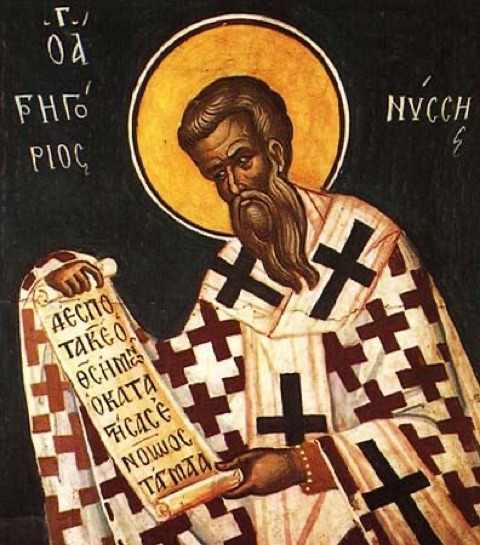
Portrait of Gregory of Nyssa

About the author

Gregory of Nyssa

Gregory of Nyssa (c. 335-395 AD) was one of the Cappadocian Fathers, alongside his elder brother Basil the Great and their friend Gregory of Nazianzus. Unlike Basil, who excelled in church administration, Gregory was primarily a contemplative thinker and mystical theologian. He served as bishop of Nyssa in Cappadocia and played an important role at the Council of Constantinople in 381. Gregory's theological writings explore the nature of God, the Trinity, the soul, and the spiritual life with unusual philosophical depth. His works include the Life of Moses, a masterpiece of allegorical interpretation, and the Great Catechism, a systematic presentation of Christian doctrine. His sister Macrina, who features prominently in this dialogue, was herself a renowned ascetic and spiritual teacher whom Gregory deeply admired.

“Updated Works has been an incredible blessing to my Christian life and ministry… remarkably faithful to the original authors while making these timeless treasures understandable for modern readers.”
— Pastor Mike Cleveland



