Basil's landmark defense of the Holy Spirit's full divinity against those who denied His equality with the Father and Son. A foundational work in Trinitarian theology.
A free account opens the whole library to read online, on your phone or at your desk. Open a book on one device and it is waiting at the same page on the next. The PDF and EPUB of every book are yours to keep, and audiobooks play in the same app.
250+ modernized editionsNot samples. The whole work, free.
Your place, on every devicePhone, tablet or desktop, same page.
131 audiobooksFrom $4.99 each, or all of them with a $50 gift.
On the Holy Spirit stands as one of the most important theological treatises of the early church. Written around 375 AD at the request of Basil's friend Amphilochius, it addresses the pressing controversy over the Holy Spirit's divine nature and proper place in Christian worship. While the Council of Nicaea in 325 had affirmed the Son's equality with the Father, the Spirit's status remained less clearly defined, opening the door to those who would deny His full deity.
The occasion for the work was a controversy over liturgical language. Basil had been accused of innovation for using two forms of the doxology in public worship: praising God "with the Son together with the Holy Spirit" and "through the Son in the Holy Spirit." His opponents claimed that different prepositions implied different natures, using this linguistic argument to subordinate both the Son and the Spirit to the Father.
Basil systematically dismantles this argument by demonstrating that Scripture uses these prepositions interchangeably for all three Persons of the Trinity. The phrases "of whom," "through whom," and "in whom" cannot be restricted to particular Persons as his opponents claimed. Rather, Scripture's varied usage shows that all three share the same divine nature and deserve equal honor.
Beyond the linguistic argument, Basil marshals extensive biblical evidence for the Spirit's deity. He traces the Spirit's work in creation, in the inspiration of prophets, in the incarnation and ministry of Christ, and in the sanctification of believers. The Spirit is not a creature but the Lord and Giver of life, worthy of the same worship and glory given to the Father and the Son.
Basil also appeals to the church's liturgical tradition, particularly the baptismal formula in which believers are baptized in the name of the Father, Son, and Holy Spirit. This equal naming, commanded by Christ Himself, demonstrates the Spirit's equal dignity with the other Persons. The consistent practice of the church in worship confirms what Scripture teaches about the Spirit's divine nature.
The theological influence of this work is immense. It helped shape the expanded pneumatology of the Nicene-Constantinopolitan Creed adopted at the Council of Constantinople in 381, which affirms the Spirit as "the Lord, the Giver of Life, who proceeds from the Father, who with the Father and the Son together is worshiped and glorified." Basil's careful biblical and theological reasoning established the orthodox understanding of the Trinity that the church has confessed ever since.
Free audiobook preview
Listen to the first 10 minutes
On the Holy Spirit · Audiobook · 3 hr 33 min
0:00 / 9:56
Enjoying it? The full audiobook runs 3 hr 33 min. Listen in the Updated Works app on any device.
1. My dearly beloved and deeply respected brother Amphilochius, I warmly commend your desire for knowledge, and your hard work no less. I have been greatly delighted by the care and watchfulness you showed in expressing your view about the terms used of God. Of all those terms, in every kind of speech, you hold that not one should be left without exact investigation.
You have put your reading of the Lord’s exhortation to good use: “Every one that asketh receiveth, and he that seeketh findeth” (Luke 11:10). By your diligence in asking, I think, you could stir even the most reluctant to share with you what they possess.
One thing in you moves my admiration still more. Most people nowadays put their questions merely to test others, but you ask with an honest desire to arrive at the actual truth. These days there is no lack of fault-finding listeners and questioners. But it is very difficult to find someone who wants to learn and who seeks the truth as a remedy for ignorance.
Just as the trick in a hunter’s snare or a soldier’s ambush is usually cleverly hidden, so it is with the inquiries of most questioners. They put forward arguments not so much to gain any good from them as for another reason: if they fail to draw out answers that match their own wishes, they can then seem to have fair grounds for controversy.
2. If “To the fool on his asking for wisdom, wisdom shall be reckoned” (Prov 17:28), how highly shall we value “the wise hearer,” whom the Prophet names in the same verse with “the admirable counsellor” (Isa 3:3)? It is right, I think, to count such a person worthy of all approval and to urge them on to further progress. We should share their enthusiasm and toil at their side in everything as they press on toward perfection.
To treat theological terms as of the first importance, and to try to trace the hidden meaning in every phrase and every syllable, is a trait missing in those who are lazy in pursuing true religion. But it marks all who have come to know “the mark” “of our calling” (Phil 3:14). For what is set before us is to become like God, so far as human nature allows. Without knowledge there can be no becoming like Him, and knowledge does not come without lessons.
Teaching begins with speech, and syllables and words are parts of speech. It follows that to investigate syllables is not to shoot wide of the mark. Nor should the questions raised be judged unworthy of attention just because some may think them trivial. Truth is always a quarry hard to hunt, so we must look everywhere for its tracks.
Gaining true religion is just like learning a craft: both grow bit by bit, and apprentices must despise nothing. Anyone who despises the first elements as small and trivial will never reach the perfection of wisdom.
Yes and No are only two syllables. Yet these little words often hold at once the best of all good things, the truth, and the limit beyond which wickedness cannot go, a lie. But why mention Yes and No? Before now a martyr bearing witness for Christ has been judged to have fully paid what true religion demands merely by nodding his head. If this is so, what theological term is so small that its weight in the scales, depending on whether it is used rightly or wrongly, does not have great effect?
We are told of the law that “not one jot nor one tittle shall pass away” (Matt 5:18). How, then, could it be safe for us to leave even the least of these terms unnoticed?
The very points you have asked us to sift thoroughly are at once small and great. Using them takes only a moment, and perhaps that is why they are thought of little account. But when we weigh the force of their meaning, they are great. They may be compared to the mustard plant. Its seed is the smallest of all shrub seeds, yet when it is properly cultivated and the powers hidden in it unfold, it rises to its own full height.
If anyone laughs to see our subtlety about syllables, to use the Psalmist’s words (Ps 119:85), let them know that they reap the fruitless fruit of laughter. As for us, let us continue our investigation, neither giving in to people’s reproaches nor defeated by their contempt.
Indeed, I am so far from being ashamed of these things because they are small that, if I could attain even the tiniest fraction of their dignity, I would congratulate myself on winning high honor. And I would tell my brother and fellow investigator that he had gained no small benefit from it.
I know, then, that the controversy contained in these little words is a very great one. Yet in hope of the prize I do not shrink from the toil, convinced that the discussion will profit me and that my hearers will gain no small benefit. So now, with the help, if I may say so, of the Holy Spirit Himself, I will begin my explanation of the subject. If you agree, I will first go back for a moment to the origin of the question before us, so that the discussion may be set on its way.
3. Recently, when I was praying with the people, I used the full doxology to God the Father in both forms. Sometimes I said “with the Son together with the Holy Spirit,” and at other times “through the Son in the Holy Spirit.” Some of those present attacked me for this, claiming that I was introducing terms that were both new and mutually contradictory.
You, however, have expressed the view that some clear teaching should be published on the force underlying the syllables in question. Your chief aim is to benefit these people or, if they are wholly incurable, to protect those who may come across them. I will therefore write as concisely as I can, trying to lay down some agreed principle for the discussion.
Chapter 2: The Rule of Syllables
4. These men’s petty precision about syllables and words is not simple and straightforward, as one might suppose. Nor is the harm it leads to a small one. A deep and hidden plot against true religion lies behind it. Their persistent aim is to show that the language used of the Father, the Son, and the Holy Spirit is unlike. They think they will then find it easy to prove that there is a difference in nature.
They have an old sophism invented by Aetius, the champion of this heresy. In one of his letters he argues, in effect, that things unlike in nature are expressed in unlike terms and, conversely, that things expressed in unlike terms are unlike in nature. To prove this claim he drags in the words of the apostle: “One God and Father of whom are all things, … and one Lord Jesus Christ by whom are all things” (1 Cor 8:6). Here “by whom” renders the Greek phrase meaning “through whom.”
“Whatever, then,” he goes on, “is the relation of these terms to one another, such will be the relation of the natures indicated by them; and as the term ‘of whom’ is unlike the term ‘by whom,’ so is the Father unlike the Son.”
The idle subtlety of these men about the phrases in question depends on this heresy. Accordingly they assign the phrase “of whom” to God the Father, as if it were His own distinctive portion and lot. To God the Son they confine the phrase “through whom,” and to the Holy Spirit the phrase “in whom.” They say that these syllables are never used interchangeably. As I have already said, their purpose is to make the difference in language indicate a difference in nature. It is plain enough that in quibbling about the words they are trying to preserve the force of their impious argument.
By the term “of whom” they mean to indicate the Creator. By “through whom” they mean the subordinate agent or instrument, and by “in whom” or “in which” they mean to show the time or place. The aim of all this is to make the Creator of the universe seem of no higher dignity than an instrument. It also aims to make the Holy Spirit appear to add nothing more to existing things than what place or time contributes.
Chapter 3: The Pagan Source of the Error
5. They have been led into this error, however, by their close study of pagan writers. These writers applied the terms “of whom” and “through whom” to things that are by nature distinct. These writers suppose that “of whom” or “of which” indicates the material, while “through whom” or “through which” represents the instrument or, more generally, subordinate agency.
Or rather, let us take up their whole argument, since there seems no reason not to, and briefly expose both its conflict with the truth and its inconsistency with their own teaching. The students of empty philosophy explain the many kinds of cause and distinguish their particular meanings. They define some causes as principal and some as cooperating or contributory. Still others are indispensable conditions, without which a thing cannot come about.
For each of these they have a distinct and proper expression, so that the maker is indicated differently from the instrument. For the maker they think the proper expression is “by whom,” holding that the bench is produced “by” the carpenter. For the instrument they use “through which,” since the bench is produced “through,” or by means of, adze and drill and the rest.
In the same way they assign “of which” to the material, since the thing made is “of” wood. “According to which” shows the design or pattern put before the craftsman. For he either first makes a mental sketch and so brings his imagination to bear on his work, or else he looks at a pattern already set before him and arranges his work accordingly.
They want the phrase “on account of which” confined to the end or purpose. The bench, they say, is produced for, or on account of, human use. “In which” is supposed to indicate time and place. When was it produced? At this time. And where? In this place. Place and time contribute nothing to what is being produced. Yet without them nothing could be produced at all, for whatever produces anything must have both place and time.
These meticulous distinctions come from useless philosophy and empty delusion. Our opponents first studied and admired them, and then transferred them to the simple and unsophisticated doctrine of the Spirit. The result is to belittle God the Word and to make nothing of the Divine Spirit.
Non-Christian writers reserved the expression “through or by means of which” for lifeless instruments or for manual service of the lowest kind. Yet our opponents do not shrink from transferring even this expression to the Lord of all. Christians though they are, they feel no shame in applying to the Creator of the universe language that belongs to a hammer or a saw.
Chapter 4: Scripture’s Free Use of These Words
6. We grant that the word of truth has used these expressions in many places. Yet we absolutely deny that the freedom of the Spirit is enslaved to the pettiness of paganism. On the contrary, we hold that Scripture varies its expressions as each occasion requires, according to the circumstances.
For instance, the phrase “of which” does not always and absolutely indicate the material, as they suppose. It fits Scripture’s usage better to apply this term to the Supreme Cause, as in the words, “One God, of whom are all things” (1 Cor 8:6), and again, “All things of God” (1 Cor 11:12).
Still, the word of truth has often used this term of the material too. It says, “Thou shalt make an ark of incorruptible wood” (Exod 25:10); “Thou shalt make the candlestick of pure gold” (Exod 25:31); “The first man is of the earth, earthy” (1 Cor 15:47); and “Thou art formed out of clay as I am” (Job 33:6).
But these men, as we have already remarked, want to establish a difference of nature. So they have laid down a rule that this phrase befits the Father alone. They took this distinction from pagan authorities in the first place, yet here they have not imitated them faithfully.
Following the teaching of their masters, they have given the Son the title of instrument and the Spirit that of place, for they say in the Spirit and through the Son. But when they apply “of whom” to God, they no longer follow the pagan example. Instead they go over, as they put it, to apostolic usage, as it is said, “But of him are ye in Christ Jesus” (1 Cor 1:30), and “All things of God” (1 Cor 11:12).
What, then, is the result of this systematic discussion? By their reckoning, there is one nature of Cause, another of Instrument, and another of Place. So the Son would be by nature distinct from the Father, as the tool is from the craftsman. And the Spirit would be distinct in the way that place or time is distinguished from the nature of tools or of those who handle them.
Chapter 5: The Same Prepositions for All Three
7. Having described where our opponents’ arguments lead, we shall now go on to show, as we proposed, that the Father does not first take “of whom” and then abandon “through whom” to the Son. We shall also show that there is no truth in these men’s ruling that the Son refuses the Holy Spirit a share in “of whom” or in “through whom,” as their newfangled allotment of phrases would have it.
“There is one God and Father of whom are all things, and one Lord Jesus Christ through whom are all things” (1 Cor 8:6). Yes, but these are the words of a writer who is not laying down a rule but carefully distinguishing the hypostases, the distinct Persons.
In writing this, the apostle’s aim was not to introduce a diversity of nature, but to present the notions of Father and of Son without confusing them. The phrases are not opposed to one another. Nor do they, like squadrons drawn up for battle against each other, set the natures to which they are applied in conflict. The passage in question makes this perfectly plain.
The blessed Paul applies both phrases to one and the same subject in the words, “of him and through him and to him are all things” (Rom 11:36). Even a reader paying little attention to the meaning will admit that this plainly refers to the Lord. The apostle has just quoted from Isaiah’s prophecy, “Who hath known the mind of the Lord, or who hath been his counsellor” (Rom 11:34; Isa 40:13). Then he goes on, “For of him and from him and to him are all things” (Rom 11:36).
What immediately precedes in Isaiah shows that the prophet is speaking about God the Word, the Maker of all creation: “Who hath measured the waters in the hollow of his hand, and meted out heaven with the span, and comprehended the dust of the earth in a measure, and weighed the mountains in scales, and the hills in a balance? Who hath directed the Spirit of the Lord, or being his counsellor hath taught him?” (Isa 40:12-13).
The word “who” in this passage does not mean absolute impossibility, but rarity. So it is in the passages, “Who will rise up for me against the evil doers?” (Ps 94:16); “What man is he that desireth life?” (Ps 34:12); and “Who shall ascend into the hill of the Lord?” (Ps 24:3). So it is, too, in the passage in question: “Who hath directed the Spirit of the Lord, or being his counsellor hath known him?” (Isa 40:13). “For the Father loveth the Son and sheweth him all things” (John 5:20).
The Son is the one who holds the earth and has grasped it with His hand. He brought all things into order and beauty. He set the hills in their places, measured the waters, and gave everything in the universe its proper rank. He encloses the whole of heaven with only a small portion of His power, which the prophet figuratively calls a span.
The apostle was right, then, to add, “Of him and through him and to him are all things” (Rom 11:36). For it is of Him that all things that exist receive the cause of their being, according to the will of God the Father. Through Him all things have their continuance and their constitution. For He created all things, and He gives each one what it needs for its health and preservation.
Therefore all things turn to Him, looking with irresistible longing and inexpressible love to “the author” and sustainer “of” their “life” (Acts 3:15). As it is written, “The eyes of all wait upon thee” (Ps 145:15); and again, “These wait all upon thee” (Ps 104:27); and “Thou openest thine hand, and satisfiest the desire of every living thing” (Ps 145:16).
8. But if our opponents reject this interpretation of ours, what argument will save them from being caught in their own trap?
If they will not grant that the three expressions “of him,” “through him,” and “to him” are spoken of the Lord, these expressions must apply to God the Father. Then their rule will undoubtedly collapse, for we find not only “of whom” but also “through whom” applied to the Father. And if this latter phrase implies nothing belittling, why in the world should it be confined to the Son, as though it conveyed inferiority? If it always and everywhere implies subordinate service, let them tell us to what superior the God of glory (Ps 29:3; Acts 7:2) and Father of the Christ is subordinate.
So they are overthrown by their own arguments, while our position is made secure either way. Suppose it is proved that the passage refers to the Son; then “of whom” will be found to apply to the Son. Suppose, on the other hand, they insist that the prophet’s words relate to God; then they must grant that “through whom” is properly used of God.
In that case both phrases have equal value, since both are used with equal force of God. Under either alternative, both terms are used of one and the same Person, and so they will be shown to be equivalent. But let us return to our subject.
9. In his Epistle to the Ephesians the apostle says, “But speaking the truth in love, may grow up into him in all things, which is the head, even Christ; from whom the whole body fitly joined together and compacted by that which every joint supplieth, according to the effectual working in the measure of every part, maketh increase of the body” (Eph 4:15-16).
Again, in the Epistle to the Colossians, writing to those who lack knowledge of the Only Begotten, he speaks of the one who holds “the head,” that is, Christ, “from which all the body by joints and bands having nourishment ministered increaseth with the increase of God” (Col 2:19).
That Christ is the head of the Church we have learned from another passage, where the apostle says, “gave him to be the head over all things to the Church” (Eph 1:22), and “of his fulness have all we received” (John 1:16). The Lord Himself says, “He shall take of mine, and shall shew it unto you” (John 16:15).
In short, the diligent reader will see that “of whom” is used in various ways. For instance, the Lord says, “I perceive that virtue is gone out of me” (Luke 8:46). Likewise we have often seen “of whom” used of the Spirit. “He that soweth to the spirit,” it is said, “shall of the spirit reap life everlasting” (Gal 6:8).
John too writes, “Hereby we know that he abideth in us by the spirit which he hath given us” (1 John 3:24). Here the word rendered “by” is the Greek word meaning “from” or “of.” “That which is conceived in her,” says the angel, “is of the Holy Ghost” (Matt 1:20). And the Lord says, “that which is born of the spirit is spirit” (John 3:6). So much, then, for this point.
10. We must now point out that Scripture allows the phrase “through whom” to be used of the Father, the Son, and the Holy Spirit alike. It would be tedious to bring forward evidence of this for the Son. Not only is it perfectly well known, but our opponents themselves make this very point. We now show that “through whom” is also used of the Father.
“God is faithful,” it is said, “by whom ye were called unto the fellowship of his Son” (1 Cor 1:9). Again, “Paul an apostle of Jesus Christ by the will of God”; and, “Wherefore thou art no more a servant, but a son; and if a son, then an heir through God” (Gal 4:7). And, “like as Christ was raised up from the dead by the glory of God the Father” (Rom 6:4). In these verses “by” translates the Greek word for “through.”
Isaiah, moreover, says, “Woe unto them that make deep counsel and not through the Lord” (Isa 29:15). And many proofs could be given of this phrase being used of the Spirit. “God hath revealed him to us,” it is said, “by the spirit” (1 Cor 2:10). Elsewhere we read, “That good thing which was committed unto thee keep by the Holy Ghost” (2 Tim 1:14); and again, “To one is given by the spirit the word of wisdom” (1 Cor 12:8). Here too “by” translates the Greek word for “through.”
11. In the same way, Scripture also allows the word “in” to be used of God the Father. In the Old Testament it is said, “through God we shall do valiantly” (Ps 108:13), and, “My praise shall be continually of thee” (Ps 71:6); and again, “In thy name will I rejoice” (Ps 89:16).
In Paul we read, “In God who created all things” (Eph 3:9), and, “Paul and Silvanus and Timotheus unto the church of the Thessalonians in God our Father” (2 Thess 1:1). We also read, “if now at length I might have a prosperous journey by the will of God to come to you” (Rom 1:10), and, “Thou makest thy boast of God” (Rom 2:17). In several of the verses quoted above, from the Old Testament and from Paul, the English “through,” “of,” and “by” translate the Greek word for “in.”
The examples are indeed too many to count. But what we want is not so much to display an abundance of evidence as to prove that our opponents’ conclusions are unsound. I will therefore omit any proof of this usage for our Lord and for the Holy Spirit, since it is well known.
Still, I cannot help remarking that “the wise hearer” will find enough proof of the point at hand by reasoning from opposites. For if a difference of language indicates, as we are told, that the nature differs, then let identity of language force our opponents to confess, to their shame, that the essence does not differ.
12. Nor is it only in speaking of God that the use of these terms varies. Wherever one term takes on the meaning of the other, we often find them transferred from one subject to the other. For instance, Adam says, “I have gotten a man through God” (Gen 4:1), meaning the same as from God.
In another passage we read, “Moses commanded … Israel through the word of the Lord” (Num 36:5); and again, “Is not the interpretation through God?” (Gen 40:8). In this last passage Joseph, speaking with the prisoners about their dreams, plainly says “through God” instead of “from God.”
Conversely, Paul uses “from whom” instead of “through whom” when he says “made from a woman” (Gal 4:4), rather than “through a woman.” Yet he has clearly drawn this distinction in another passage. There he says that it is proper for a woman to be made of the man, and for a man to be made through the woman: “For as the woman is from the man, even so is the man also through the woman” (1 Cor 11:12).
Nevertheless, in the passage in question the apostle illustrates the variety of usage. At the same time he corrects in passing the error of those who supposed that the Lord’s body was a spiritual body. To show that the God-bearing flesh was formed from the common lump of human nature, he gave preference to the more emphatic preposition.
The phrase “through a woman” would be likely to suggest that the birth was a mere passage through her. The phrase “of the woman,” by contrast, would clearly show that mother and child shared the same nature. The apostle was in no way contradicting himself; he was showing that the words can easily be interchanged.
Since the term “from whom,” then, is transferred to the very subjects for which “through whom” is judged the proper term, how can these phrases consistently be kept forever distinct, merely so that fault may be falsely found with true religion?
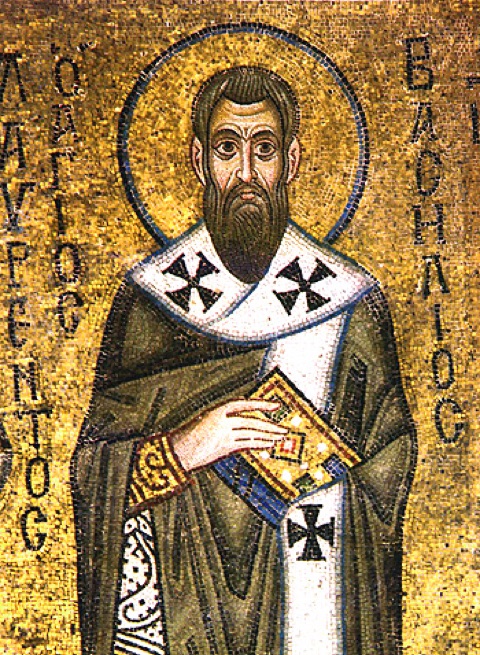
Basil the Great (329-379 AD) was Archbishop of Caesarea in Cappadocia and one of the most influential theologians of the early church. Along with his brother Gregory of Nyssa and friend Gregory of Nazianzus, he is known as one of the Cappadocian Fathers who shaped orthodox Trinitarian theology. Basil combined brilliant theological insight with practical wisdom in church administration and care for the poor. He established one of the first Christian hospitals, organized monastic communities whose rule influenced both Eastern and Western monasticism, and defended Nicene orthodoxy against Arian emperors at great personal cost. His liturgy remains in use in Eastern churches today, and his theological writings on the Trinity, particularly this treatise on the Holy Spirit, helped establish the doctrinal foundations affirmed at the Council of Constantinople in 381.
I love the readability of this edition but faithfulness to the original!