One of the earliest explanations of Christianity for new believers. Irenaeus shows how Christ fulfills the Old Testament and traces the faith back to the apostles themselves.
A free account opens the whole library to read online, on your phone or at your desk. Open a book on one device and it is waiting at the same page on the next. The PDF and EPUB of every book are yours to keep, and audiobooks play in the same app.
250+ modernized editionsNot samples. The whole work, free.
Your place, on every devicePhone, tablet or desktop, same page.
131 audiobooksFrom $4.99 each, or all of them with a $50 gift.
Irenaeus's "On Apostolic Preaching" (Demonstration of the Apostolic Preaching), written around 180 AD, presents one of the earliest systematic expositions of Christian doctrine and biblical interpretation. Written primarily for new converts, this work provides a comprehensive overview of Christian faith as understood and taught in the early church.
The treatise begins by establishing the unity of God's plan throughout history, demonstrating how the Old Testament prefigures and points to Christ. Irenaeus carefully traces what he sees as God's consistent work from creation through the patriarchs, prophets, and finally to Jesus, arguing for the coherence of divine revelation across both testaments.
A significant portion of the work focuses on explaining how Christ fulfills Old Testament prophecies. Irenaeus provides detailed interpretations of various biblical passages, showing how they anticipate Christ's coming, death, and resurrection. This interpretative approach became influential in Christian biblical interpretation, establishing patterns of typological reading of Scripture.
The work stands out for its positive presentation of Christian doctrine rather than primarily opposing heresies (as in Irenaeus's other major work, "Against Heresies"). He presents Christianity as the fulfillment of Judaism, explaining how Christian beliefs develop from and complete Jewish traditions rather than replacing them entirely.
Irenaeus grounds everything in the rule of faith handed down from the apostles, “just as the elders, the disciples of the apostles, have handed it down to us.” That rule begins with baptism, received “for the forgiveness of sins, in the name of God the Father,” and of the Son and the Holy Spirit. He closes by summing up the whole: “The prophets proclaimed it, Christ established it, the apostles handed it down, and the Church in all the world hands it on to her children.”
The text provides valuable insights into early Christian catechesis (religious instruction). It shows how new converts were taught to understand Scripture, basic doctrine, and the relationship between the Old and New Testaments. This educational aspect makes it particularly valuable for understanding how Christianity was taught and transmitted in its early periods.
Throughout the work, Irenaeus maintains a pastoral tone, showing concern not just for correct doctrine but for the spiritual growth of his readers. He presents complex theological ideas in accessible ways, always connecting them to practical Christian living.
Free audiobook preview
Listen to the first 10 minutes
On Apostolic Preaching · Audiobook · 2 hr
0:00 / 9:36
Enjoying it? The full audiobook runs 2 hr. Listen in the Updated Works app on any device.
1. My beloved Marcianus, I know your desire to walk in godliness, which alone leads man to eternal life. I rejoice with you, and I pray that you may keep your faith whole and so be pleasing to God who made you. I wish it were possible for us to be always together, to help each other and to lighten the toil of our earthly life by constant conversation about the things that profit us.
But since at this present time we are parted from one another in body, we will not fail, as far as we are able, to speak with you a little in writing. We will set out in brief the preaching of the truth, to confirm your faith. We send you, as it were, a manual of essentials, so that through a little you may reach much. In a short space you will learn all the members of the body of the truth and receive in brief the demonstration of the things of God. In this way it will bear fruit for your own salvation. You will put to shame all who teach falsehood, and you will bring our sound and pure teaching with full confidence to everyone who wants to understand it.
For there is one way leading upward for all who see, lit by heavenly light, but the ways of those who do not see are many, dark and contrary. This way leads to the kingdom of heaven, uniting man to God, but those ways bring men down to death, separating man from God.
Therefore you, and all who care for their own salvation, need to make your course unswerving, firm and sure by means of faith. Then you will not falter, nor be held back and detained by material desires, nor turn aside and wander from what is right.
2. Man is a living being made up of soul and flesh, and so he must exist by means of both. Since offenses come from both of them, purity of the flesh is the restraint of abstaining from all shameful things and all unrighteous deeds, and purity of the soul is keeping faith toward God whole, neither adding to it nor taking anything from it.
For godliness is obscured and dulled when the flesh is soiled and stained. It is broken and polluted, and no longer whole, if falsehood enters the soul. But it will keep its beauty and its measure when truth stays steadfast in the soul and purity in the flesh.
For what profit is there in knowing the truth in words, while polluting the flesh and doing the works of evil? Or what profit can purity of the flesh bring, if truth is not in the soul? For these two rejoice together, and they are united and allied to bring man face to face with God.
Therefore the Holy Spirit says through David: “Blessed is the man who hath not walked in the counsel of the ungodly” (Ps 1:1). That means the counsel of the nations that do not know God, for those who do not worship the God who truly is are ungodly. And therefore the Word says to Moses: “I am He that is” (Exod 3:14). But those who do not worship the God who is, these are the ungodly. “And hath not stood in the way of sinners.” Sinners are those who have the knowledge of God but do not keep His commandments; that is, they are disdainful scorners. “And hath not sat in the seat of the pestilential.” The pestilential are those who, by wicked and perverse doctrines, corrupt not only themselves but others too. For the seat is a symbol of teaching. All heretics are like this: they sit in the seats of the pestilential, and those who receive the venom of their doctrine are corrupted.
3. So that we may not suffer anything of this kind, we must hold the rule of the faith without deviation and do the commandments of God, believing in God, fearing Him as Lord and loving Him as Father. This doing is produced by faith, for Isaiah says: “If ye believe not, neither shall ye understand” (Isa 7:9). And faith is produced by the truth, for faith rests on things that truly are.
For we believe in things that are, as they are; and believing in things that are, as they always are, we keep our confidence in them firm. Since faith, then, is what perpetuates our salvation, we must take great pains to maintain it, so that we may have a true understanding of the things that are.
Faith brings this about for us, just as the elders, the disciples of the apostles, have handed it down to us. First of all, it tells us to keep in mind that we have received baptism for the forgiveness of sins, in the name of God the Father, and in the name of Jesus Christ, the Son of God, who became incarnate and died and rose again, and in the Holy Spirit of God.
It reminds us, too, that this baptism is the seal of eternal life and the new birth to God, so that we should no longer be the sons of mortal men, but of the eternal and perpetual God. It reminds us that what is everlasting and continuing is made God, and is over all things that are made; that all things are put under Him, and all the things put under Him are made His own.
For God is not ruler and Lord over what belongs to another, but over His own, and all things are God’s. Therefore God is Almighty, and all things are of God.
One God: Father, Word and Spirit
4. Things that are made must have the beginning of their making from some great cause, and the beginning of all things is God. For He Himself was not made by anyone, and by Him all things were made. Therefore it is right, first of all, to believe that there is One God, the Father, who made and fashioned all things, who made what was not, so that it should be, and who, containing all things, alone is uncontained. Now among all things is this world of ours, and in the world is man; so this world too was formed by God.
5. In this way, then, One God is shown forth: the Father, not made, invisible, creator of all things, above whom there is no other God and after whom there is no other God (cf. Isa 43:10). Since God is rational (in Greek logikos, a word built on Logos, “Word”), by the Word He created the things that were made. And God is Spirit, and by the Spirit He adorned all things, as the prophet also says: “By the word of the Lord were the heavens established, and by his spirit all their power” (Ps 33:6).
The Word establishes (that is, gives body and grants the reality of being), and the Spirit gives order and form to the diversity of the powers. Since this is so, the Word is rightly and fittingly called the Son, and the Spirit the Wisdom of God.
Paul, His apostle, also speaks well when he says: “One God, the Father, who is over all and through all and in us all” (Eph 4:6). For “over all” is the Father; “through all” is the Son, since through Him all things were made by the Father; and “in us all” is the Spirit, who cries “Abba Father” (cf. Gal 4:6) and fashions man into the likeness of God.
The Spirit shows forth the Word, and therefore the prophets announced the Son of God. The Word utters the Spirit, and therefore the Word is Himself the announcer of the prophets, and He leads and draws man to the Father.
6. This, then, is the order of the rule of our faith, the foundation of the building and the stability of our way of life.
God, the Father, not made, not material, invisible; one God, the creator of all things: this is the first point of our faith.
The second point is this: the Word of God, Son of God, Christ Jesus our Lord. He was manifested to the prophets according to the form of their prophesying and according to the manner of the Father’s dispensation. Through Him all things were made. At the end of the times, to complete and gather up all things, He was made man among men, visible and tangible, in order to abolish death, show forth life and bring about a fellowship of union between God and man.
The third point is this: the Holy Spirit, through whom the prophets prophesied, the fathers learned the things of God, and the righteous were led forth into the way of righteousness. At the end of the times He was poured out in a new way upon mankind in all the earth, renewing man to God.
7. For this reason the baptism of our regeneration proceeds through these three points: God the Father bestows regeneration on us through His Son by the Holy Spirit. For all who carry the Spirit of God in them are led to the Word, that is, to the Son; the Son brings them to the Father; and the Father causes them to possess incorruption.
Without the Spirit it is not possible to see the Word of God, and without the Son no one can draw near to the Father. For the knowledge of the Father is the Son, and the knowledge of the Son of God comes through the Holy Spirit. And according to the good pleasure of the Father, the Son ministers and dispenses the Spirit to whomever the Father wills, and as He wills.
8. By the Spirit the Father is called Most High, Almighty and Lord of hosts, so that we may learn concerning God that He is the creator of heaven and earth and all the world, maker of angels and men, and Lord of all, through whom all things exist and by whom all things are sustained. He is merciful, compassionate and very tender, good and just, the God of all, of Jews and of Gentiles, and of those who believe.
To those who believe He is as Father, for at the end of the times He opened up the covenant of adoption. To the Jews He is as Lord and Lawgiver. For in the times between, when man forgot God and departed and rebelled against Him, God brought them into subjection by the Law. He did this so that they might learn that they had as Lord their maker and creator, who also gives the breath of life, and whom we ought to worship day and night.
To the Gentiles He is as maker and creator and almighty; and to all alike He is sustainer and nourisher and king and judge. For no one shall escape and be delivered from His judgment, neither Jew nor Gentile, nor a believer who has sinned, nor an angel.
Those who now reject His goodness shall know His power in judgment, as the blessed apostle says: “Not knowing that the goodness of God leadeth thee to repentance; but according to thy hardness and impenitent heart thou treasurest up for thyself wrath in the day of wrath and of the revelation of the righteous judgment of God, who shall render to every man according to his works” (Rom 2:4-6). This is He who is called in the Law the God of Abraham and the God of Isaac and the God of Jacob, the God of the living, although the sublimity and greatness of this God is inexpressible.
9. This world is encompassed by seven heavens. In them dwell powers and angels and archangels, doing service to God, the Almighty and Maker of all things. This is not as though He were in need, but so that they may not be idle and unprofitable and ineffectual.
For this reason the Spirit of God is also manifold in His indwelling. The prophet Isaiah counts Him in seven forms of service, as resting on the Son of God, that is, the Word, in His coming as man. “The Spirit of God,” he says, “shall rest upon him, the Spirit of wisdom and of understanding, the Spirit of counsel and of might, the Spirit of knowledge and of godliness; the Spirit of the fear of God shall fill him” (Isa 11:2-3).
The heaven that is first from above, which encompasses the rest, is the heaven of wisdom; the second from it, of understanding; the third, of counsel; the fourth, counting from above, of might; the fifth, of knowledge; and the sixth, of godliness. The seventh, this firmament of ours, is full of the fear of that Spirit which gives light to the heavens.
For, as the pattern of this, Moses received the seven-branched lampstand that shone continually in the holy place. For he received this service as a pattern of the heavens, according to what the Word spoke to him: “Thou shalt make it according to all the pattern of the things which thou hast seen in the mount” (Exod 25:40).
10. This God is glorified by His Word who is His Son continually, and by the Holy Spirit, who is the Wisdom of the Father of all. The powers of these, namely of the Word and Wisdom, which are called Cherubim and Seraphim, glorify God with unceasing voices; and every created thing in the heavens offers glory to God the Father of all (cf. Rev 5:13).
By His Word He has created the whole world, and in the world are the angels. To all the world He has given laws in which each individual thing should abide, so that, according to what God has determined, it should not pass its bounds, each fulfilling its appointed task.
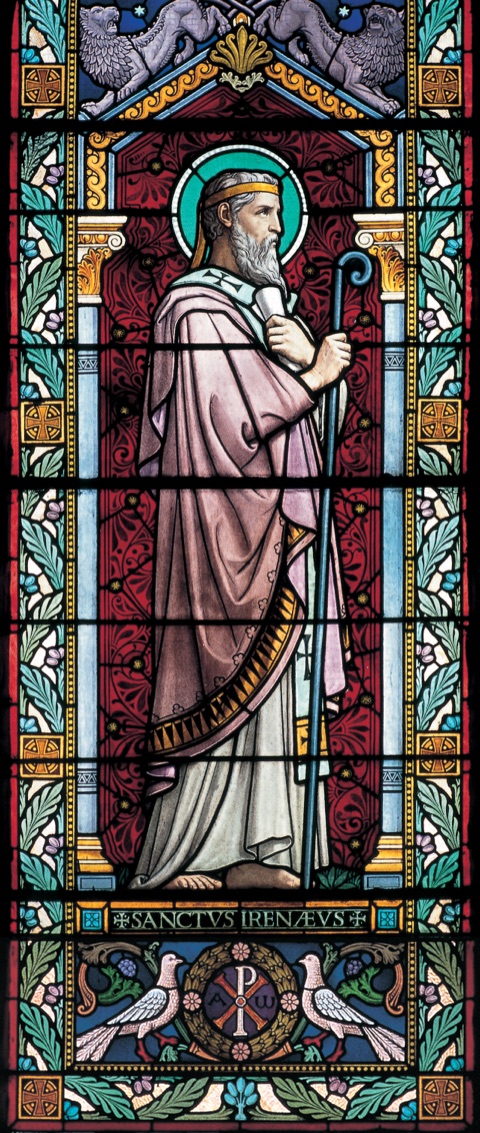
Irenaeus of Lyon was an early Church Father and bishop who became one of the most important theologians of the second century. Born in Smyrna, he heard Polycarp preach and thus provides a link to the apostolic age. As bishop of Lyon in Gaul (modern France), Irenaeus combated Gnosticism through his major work "Against Heresies." His "Demonstration of the Apostolic Preaching" presents a concise summary of Christian faith. Irenaeus emphasized the unity of Old and New Testaments, the reality of Christ's incarnation, and the importance of apostolic tradition. His concept of "recapitulation" - that Christ reversed Adam's fall by passing through every stage of human life - became influential in Eastern theology. His irenic approach to theological differences gave him his name, which means "peaceful."
“Updated Works has been an incredible blessing to my Christian life and ministry… remarkably faithful to the original authors while making these timeless treasures understandable for modern readers.”