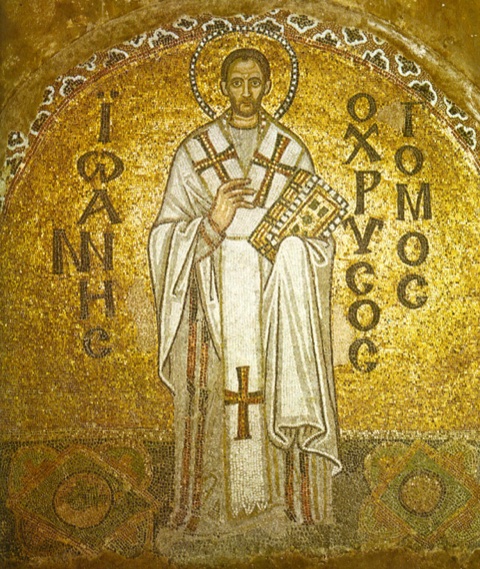



Homily 1: Preparing to Hear the Gospel
We should not need the help of the written Word at all. Our lives should be so pure that the Spirit’s grace takes the place of books in our souls. Just as books are inscribed with ink, our hearts should be inscribed with the Spirit. But since we have completely rejected this grace, come, let us at least embrace the second-best course.
God has shown by both His words and His actions that the first course was better. He spoke to Noah, Abraham and his descendants, Job, and Moses, not through writings but directly, because He found their minds pure. Only after the whole Hebrew people had fallen into the depths of wickedness did the written word appear, with tablets and the admonition they conveyed.
We can see that this was true not only of the saints in the Old Testament but also of those in the New. God gave the apostles nothing in writing either. Instead of written words, He promised them the Spirit’s grace. “He,” our Lord says, “shall bring all things to your remembrance” (John 14:26). To learn how much better this was, hear what He says through the prophet: “I will make a new covenant with you, putting my laws into their mind, and in their heart I will write them” (Jer 31:31-33; Heb 8:8-11), and “they shall be all taught of God” (Isa 54:13; John 6:45). Paul, too, points to the same superiority when he says that they received a law “not in tables of stone, but in fleshy tables of the heart” (2 Cor 3:3).
But as time passed, some suffered shipwreck in their doctrines, others in their lives and conduct. Once again, they needed the written word to remind them.
2. Taking the Written Word Seriously
Consider, then, how great an evil this is. We ought to live so purely that we do not even need written words, but offer our hearts to the Spirit as books. Now that we have lost that honor and need these writings, we fail to make proper use even of this second remedy. If it is blameworthy to need written words because we have not received the Spirit’s grace, consider how much heavier the charge is when we refuse to benefit even from this help. Instead, we neglect what is written, as though it had been thrown down without purpose or at random, and so bring greater punishment upon ourselves.
To prevent this, let us pay close attention to what is written. Let us learn how the old Law was given and how the new covenant was given.
3. The Spirit Makes Living Books
How was that Law given long ago? When and where? After the destruction of the Egyptians, in the wilderness, on Mount Sinai. Smoke and fire rose from the mountain, a trumpet sounded, thunder and lightning broke out, and Moses entered the very depths of the cloud.
The new covenant was different. It came neither in a wilderness nor on a mountain, neither with smoke and darkness nor with cloud and storm. Everything happened at the beginning of the day, in a house, while they were all sitting together in great quietness. Those earlier people were less reasonable and harder to guide, so they needed an outward display: a wilderness, a mountain, smoke, a trumpet’s sound, and the like. But those whose character was higher, who were obedient and had risen above purely bodily conceptions, needed none of these things. Even the sound that occurred in their case was for the Jews who were present, rather than for the apostles. The tongues of fire also appeared for their sake. If some said even after this, “they are filled with new wine” (Acts 2:13), how much more would they have said so if they had seen none of these things!
In the Old Testament, God came down when Moses went up. Here, when our nature has been carried up into heaven, or rather to the royal throne itself, the Spirit descends. If the Spirit were an inferior being, the results would not have been greater and more wonderful. Yet these tablets are far better, and the achievements more glorious. The apostles did not come down from a mountain as Moses did, carrying stone records in their hands. They carried the Spirit in their minds and poured out a treasure and fountain of doctrines, gifts, and everything good. They traveled everywhere and, through that grace, became living books and laws. This is how they won over “the three thousand” and “the five thousand” (Acts 2:41; Acts 4:4), and then the nations of the world. Through their tongues, God spoke to everyone who approached them.
4. What Makes the Gospel Good News
Filled with that same Spirit, Matthew wrote what he wrote. Matthew the tax collector: I am not ashamed to identify him by his trade, or the others by theirs. This shows in a particularly striking way both the Spirit’s grace and their virtue.
He rightly gave his work a name that means good news. He came proclaiming to everyone the removal of punishment, forgiveness of sins, “righteousness, and sanctification, and redemption” (1 Cor 1:30), adoption, an inheritance in heaven, and a relationship with the Son of God. He proclaimed these things to enemies, to the perverse, and to those sitting in darkness. What could ever equal this good news?
God was on earth, and man in heaven. All were brought together: angels joined human choirs, and human beings had fellowship with angels and the other powers above. The long war could be seen coming to an end, with reconciliation between God and our nature. The devil was put to shame, demons fled, death was destroyed, paradise opened, the curse was blotted out, sin was removed, error was driven away, and truth returned. The message of godliness was sown everywhere and flourished. The order of heaven was planted on earth; those heavenly powers enjoyed secure fellowship with us; angels continually visited the earth; and there was abundant hope for what was to come.
He therefore called this history good news. Everything else is merely words without substance: abundant wealth, great power, kingdoms, glory, honors, and whatever else people consider good. But what the fishermen proclaimed can rightly and properly be called good news. These blessings are certain and unshakable, beyond anything we deserve, and also given to us with complete ease.
We received what we received neither by labor and sweat nor by exhaustion and suffering, but simply because God loved us.
5. Why Four Evangelists Wrote
Why, when there were so many disciples, did only two of the apostles and two of their followers write? A disciple of Paul and a disciple of Peter wrote the Gospels together with Matthew and John. It was because they did nothing for empty glory, but everything for its usefulness.
“What, then? Wasn’t one evangelist enough to tell everything?” One certainly was enough. But four writers, writing at different times and in different places, without meeting and consulting together, speak as though with one mouth. This becomes a very powerful demonstration of the truth.
6. Agreement and Differences
“But the opposite has happened,” someone may say. “In many places they have been shown to disagree.” No, this very thing is powerful evidence of their truthfulness. If they had agreed exactly in everything, even in times, places, and their very words, none of our enemies would have believed anything except that they had met and written by human agreement. Such complete agreement does not arise from straightforwardness. As it is, even the apparent differences in small matters free them from all suspicion and speak clearly for the writers’ character.
If they have given different accounts of times or places, this does no harm to the truth of what they have said. As we proceed, we will try to explain these matters too, as far as God enables us. Along with what we have already said, I ask you to notice that on the chief points, which shape our lives and establish our doctrine, none of them is ever found to disagree in the slightest.
What are these points? That God became man; that He worked miracles; that He was crucified, buried, raised again, and ascended; that He will judge; that He has given commandments leading to salvation; that He has introduced a law consistent with the Old Testament; that He is a Son, the only-begotten, a true Son, of the same substance as the Father; and all similar matters. On these we will find complete agreement among them.
Do not be troubled because they have not all mentioned every miracle, but one has mentioned some and another others. If one had described everything, the others would have been unnecessary. If all had written entirely new things, different from one another, the evidence of their agreement would not have been clear. That is why they have treated many things in common, while each has also received and declared something of his own. Each thus avoids appearing unnecessary, added to the others without purpose, while making our test of the truth of their statements complete.
7. The Evangelists’ Purposes
Luke also tells us why he begins to write: “that thou mayest hold,” he says, “the certainty of the words wherein thou hast been instructed” (Luke 1:4). In other words, continual reminders enable you to hold firmly to that certainty and remain certain.
John himself says nothing about his reason. Yet according to a tradition handed down to us from the beginning, from the Fathers, he too wrote with a purpose. The other three had concentrated on the account of God’s saving work, while the doctrines concerning the Godhead were close to being left unspoken. Moved by Christ, John then, and only then, began to compose his Gospel. This is clear both from the narrative itself and from its opening. Unlike the others, he does not begin below, but above, at the very point toward which he was directing his attention. He composed the whole book with this in view. His account is more exalted than the others, not only at the beginning but throughout the Gospel.
It is said that Jewish believers came to Matthew and asked him to leave them a written account of the things he had told them orally. He therefore composed his Gospel in the Hebrew language. Mark, too, is said to have done the same in Egypt at the disciples’ request.
Because Matthew was writing to Hebrews, his foremost aim was to show that Christ descended from Abraham and David. Luke, addressing everyone generally, traces the account further back, even to Adam. The one begins with Christ’s ancestry because nothing was so reassuring to a Jew as hearing that Christ was descended from Abraham and David. The other does not begin this way, but mentions many other things before proceeding to the genealogy.
8. Each Part Reveals the Whole
We will establish the harmony between them both through the whole world, which has accepted their statements, and through the very enemies of the truth. Many sects have arisen since their time, holding opinions opposed to their words. Some have accepted everything they said; others have cut certain portions away from the rest and retained those for themselves. If their statements contradicted one another, the sects that hold opposing views would not have accepted them all, but only what seemed to agree with their own views. Nor would those that separated off a portion be completely refuted by that very portion. Yet the fragments cannot conceal their nature: they loudly declare their connection with the whole body.
Take a piece from an animal’s side, and even in that piece you will find everything of which the whole is composed: nerves, veins, bones, arteries, and blood, a sample, so to speak, of the entire body. So it is with the Scriptures. In each portion of what is said, its connection with the whole can be clearly seen. If they were in conflict, this could not have been shown, and the doctrine itself would long ago have come to nothing. “For every kingdom,” He says, “divided against itself shall not stand” (Matt 12:25; Mark 3:24; Luke 11:17). Here too the Spirit’s power shines out: He enabled these men, occupied with more necessary and urgent matters, to suffer no harm from these minor ones.
We should not make very confident assertions about where each writer was living when he wrote. But we will try throughout the whole work to prove that they do not contradict one another. When you accuse them of disagreement, you are doing just what you would do if you insisted that they use the same words and forms of expression.
9. The Gospel’s Public Witness
I have not yet said that those who take great pride in rhetoric and philosophy have written many books on the same subjects, and have expressed themselves not merely differently but even in opposition to one another. Speaking differently is one thing; contradicting one another is another. I make no appeal to these facts. Far be it from me to build our defense on those men’s madness. I am unwilling to use falsehood to commend the truth.
But I would gladly ask this: how were these supposedly conflicting accounts believed? How did they prevail? How, if they said opposite things, were they admired, believed, and celebrated everywhere in the world?
There were many witnesses to what they said, and many adversaries and enemies too. They did not write these things in a corner and bury them. Everywhere, by sea and land, they proclaimed them for everyone to hear. These writings were read in the presence of enemies, just as they are now, and nothing they said gave anyone grounds for objection. This is entirely natural, for divine power pervaded everything and made it prosper among all people.
10. A New Way of Life
If this were not so, how could a tax collector, a fisherman, and uneducated men have attained such wisdom? They confidently proclaim and convincingly establish things that outsiders have never been able to imagine, even in a dream. They do so not only during their lives, but even after death; not to two people, or twenty, or a hundred, or a thousand, or ten thousand, but to cities, nations, and peoples, on land and sea, in Greek and foreign lands, in inhabited regions and deserts. Everything they discuss is far beyond our nature. Leaving earthly things behind, their entire discourse concerns heavenly things. They introduce another principle of life, another way of living. Wealth and poverty, freedom and slavery, life and death, our world and our civic order are all changed.
They are unlike Plato, who composed that ridiculous Republic, or Zeno, or anyone else who has written about a state or framed laws. Their own writings have made clear that an evil spirit, a cruel demon at war with our race, has made his voice heard in their souls: an adversary of modesty, an enemy of good order, overturning everything. When they make their women common to all, strip virgins naked in the wrestling school and expose them to men’s gaze, and establish secret marriages, mixing and confusing everything and overturning nature’s boundaries, what else can be said? Nature herself would testify that all these sayings are the inventions of devils and contrary to nature, for she does not tolerate the things we have mentioned.
Yet they write in complete safety and freedom, without persecution, danger, or conflict, adorning their words with many embellishments drawn from many sources. By contrast, the fishermen were hunted, scourged, and endangered. Even so, their doctrines have been warmly accepted by the learned and unlearned, enslaved and free, kings and ordinary soldiers, foreigners and Greeks alike.
11. Higher Teaching for Everyone
You cannot say that everyone readily accepted these things because they were trivial and low. These doctrines are far higher than the others. Those men never imagined even the name of virginity, not so much as in a dream, nor voluntary poverty, fasting, or any of the other exalted things.
Those on our side do more than root out lust. They discipline not only the act, but even an unchaste look, insulting language, disorderly laughter, dress, gait, and noisy behavior. Their strict attention reaches even the smallest things, and they have filled the whole earth with the flourishing growth of virginity. Concerning God and heavenly things, too, they lead people to wisdom and knowledge that none of those others has ever been able even to conceive. How could they, when they made images of beasts, creatures crawling on the earth, and still more vile things into gods?
Yet these exalted doctrines have been accepted and believed, and they flourish and increase every day. The others have passed away and perished, disappearing more easily than spiders’ webs.
This is entirely natural, for demons proclaimed those teachings. Besides their impurity, they are very obscure and require still greater labor. What could be more ridiculous than that Republic? Besides the things I have mentioned, the philosopher spends countless lines trying to explain what justice is. On top of this wordiness, he fills his discourse with great obscurity. Even if it contained anything beneficial, it would necessarily be quite useless for human life. If the farmer, smith, builder, pilot, and everyone who lives by manual labor must leave their trades and honest work, and spend so many years learning what justice is, they will often be completely destroyed by hunger before they learn. They will perish because of this justice, without having learned anything else useful, and end their lives in a cruel death.
12. Plain Words and Heavenly Citizenship
Our lessons are different. Christ has taught us what is just, fitting, and beneficial, and virtue as a whole, in a few plain words. At one time He says, “on two commandments hang the Law and the Prophets” (Matt 22:40), that is, on love of God and love of our neighbor. At another, “Whatsoever ye would that men should do to you, do ye also to them; for this is the Law and the Prophets” (Matt 7:12).
These things are plain to understand and easy to learn, even for a laborer, a servant, a widow, a child, or someone who seems very slow to understand. Such are the lessons of truth, and the actual result bears witness to this. Everyone has learned what to do, and has not merely learned but eagerly sought to practice it. This is true not only in cities and marketplaces, but even on the mountaintops.
There you will see true wisdom abounding, choirs of angels shining in human bodies, and the commonwealth of heaven revealed here on earth. These fishermen, too, wrote an account of a commonwealth for us. Unlike those others, they did not command that it be embraced from childhood or make a law that a virtuous person must be a certain age. They addressed every age alike. Those other lessons are children’s toys; these express the truth of things.
They have assigned heaven as the place for their commonwealth and presented God as its founder and the lawgiver of its statutes, as indeed they should. Its rewards are not laurel or olive leaves, a meat allowance in the public hall, or bronze statues, these cold and ordinary things. They are endless life, becoming God’s children, joining the angels’ choir, standing beside the royal throne, and being always with Christ. The people’s guides in this commonwealth are tax collectors, fishermen, and tentmakers, people who have not merely lived a short time but now live forever. Thus even after their death they may do the greatest good for those they govern.
This commonwealth wages war against devils and incorporeal powers, rather than against human beings. Its commander is therefore neither a man nor an angel, but God Himself. Its warriors’ armor also suits the nature of their warfare. It is made of truth, righteousness, faith, and every true love of wisdom, rather than leather and steel.
13. Listening to Matthew
This commonwealth is the subject of the book, and we now intend to speak about it. Let us therefore listen carefully as Matthew explains it plainly. What he says is entirely Christ’s, rather than his own, for Christ made the laws of this city. Let us listen, I say, so that we may be enrolled in it and shine among those who have already become its citizens and are waiting for their imperishable crowns.
Many, however, think this discourse is easy, while the prophetic writings are difficult. This, too, is the view of people who do not know the depth of the thoughts stored within it. I therefore beg you to follow us very attentively, so that we may enter the very ocean of these writings, with Christ guiding our entrance.
To make the message easier to learn, we ask and urge you, as we have with the other Scriptures, to read beforehand the passage we are going to explain. Your reading will prepare the way for understanding, as it did for the eunuch (Acts 8:28), and greatly ease our task.
14. Questions in the Genealogy
We ask this because the questions are many and frequent. Look at how many difficulties arise one after another at the very beginning of his Gospel. First, why is Joseph’s genealogy traced, when he was not Christ’s father? Second, how can it be shown that Christ descended from David when the ancestors of Mary, who bore Him, are unknown, since the Virgin’s genealogy is not traced? Third, why is Joseph’s genealogy traced when he had no part in the birth, while we are not shown the fathers, grandfathers, or ancestors from whom the Virgin, His actual mother, descended?
Along with these matters, we should also ask why he mentions women when tracing the genealogy through men. Having decided to do this, why does he not mention them all? Why does he pass over the more eminent women, such as Sarah, Rebekah, and others like them, and introduce only those known for something bad: a prostitute, an adulteress, a mother through an unlawful union, a foreigner or a woman of another people? He mentions Uriah’s wife, Tamar, Rahab, and Ruth. One was of a foreign race, another a prostitute, another was defiled by her close relative, with whom she had secret intercourse rather than marriage, after disguising herself as a prostitute. As for Uriah’s wife, everyone knows about her because the crime is so notorious.
Yet the evangelist passes over all the others and includes only these in the genealogy. If women were to be mentioned, they should all have been mentioned. If only some were to be included, they should have been those known for virtue rather than evil deeds.
Do you see how much care is needed at the very beginning? Yet the beginning seems clearer than the rest, and perhaps even unnecessary to many, since it is only a list of names.
After this, another point needs investigation: why has he omitted three kings? If he left their names unmentioned because they were extremely ungodly, he should not have mentioned the others who were like them.
Here is another question: why, after speaking of fourteen generations, has he failed to maintain that number in the third division?
And why does Luke mention other names, not merely names that are not all the same, but also many more of them? Matthew has fewer and different names, although he too ends with Joseph, where Luke also concludes.
You see how much alert attention we need, not only to explain these things, but even to discover what needs explaining. Identifying the difficulties is itself no small matter. There is also this other hard question: how was Elizabeth, who belonged to the tribe of Levi, a relative of Mary?
15. Valuing What We Hear
To avoid overloading your memory by stringing too many things together, let us pause our discourse here for a time. Learning the questions alone is enough to awaken you fully. If you also long for their answers, that again depends on you, even before we speak. If I see you fully awake and eager to learn, I will try to add the answers too. But if you are yawning and inattentive, I will conceal both the difficulties and their answers, in obedience to a divine law. For He says, “Give not the holy things to the dogs, neither cast ye your pearls before swine, lest they trample them under their feet” (Matt 7:6).
Who tramples them underfoot? Someone who does not consider these things precious and worthy of reverence. “Who,” you may ask, “is so wretched that he does not consider these things worthy of reverence and more precious than anything else?” Someone who does not devote as much time to them as to the prostitutes in Satan’s theaters. There the crowds spend the whole day, setting aside many domestic concerns for this ill-timed occupation. They remember exactly whatever they have heard, even though retaining it harms their souls. But here, where God is speaking, they cannot bear to stay even a little while.
Let me warn you, then: we have nothing in common with heaven, and our citizenship amounts to words alone. For this very reason God has threatened us with hell, to persuade us to escape this grievous tyranny, rather than to cast us into it. But we do the opposite and run each day along the road that leads there. God commands us not only to hear but also to do what He says, yet we will not even submit to listening.
Tell me, then, when will we do what is commanded and set our hands to the work, if we cannot bear even to hear the words about it? We are impatient and restless about the time we spend here, although it is extremely short.
16. The Distance to the Heavenly City
Even when we are discussing ordinary matters, if we see our companions paying no attention, we call their conduct an insult. Do we consider that we are provoking God when He speaks about such matters as these and we despise what He says and look elsewhere?
An older person who has traveled through many countries can tell us exactly how many stadia lie between places, where cities are situated, their layouts, harbors, and markets. Yet we do not even know how far we are from the city in heaven. Surely we would have tried to shorten the distance if we had known it. If we are negligent, that city is not merely as far from us as heaven is from earth, but much farther. If, on the other hand, we do our best, we can reach its gates in a single instant. These distances are determined by moral disposition rather than physical space.
You know the world’s affairs exactly, both new and old, even those of ancient times. You can list the rulers under whom you have served, the organizer of the games, the prizewinners, and the leaders of armies, matters that are no concern of yours. But who became a ruler in this city, first, second, or third, how long each ruled, and what each accomplished and brought about, you have never imagined, even in a dream. You cannot bear to hear the laws established in this city or pay attention to them even when others tell you about them. How, then, do you expect to obtain the promised blessings when you do not even listen to what is said?
17. Entering with Reverence
Even if we have never done so before, let us at least do this now. God permitting, we are about to enter a city of gold, more precious than any gold. Let us examine its foundations and its gates of sapphires and pearls. In Matthew we have an excellent guide. We will now enter through his gate, and great care is required of us. If He sees anyone who is inattentive, He casts that person out of the city.
This city is supremely royal and glorious. Unlike our cities, it is not divided into a marketplace and royal courts. Everything there is the King’s court. Let us therefore open the gates of our minds and open our ears. As we are about to set foot on the threshold, let us worship the King within with great trembling. The first approach alone can immediately overwhelm the beholder.
For now we find the gates closed. When we see them thrown open, which is what happens when the difficulties are answered, we will perceive the greatness of the splendor within. There, too, this tax collector leads you with the eyes of the Spirit and offers to show you everything: where the King sits and which of His host stand beside Him; where the angels and archangels are; what place is set apart for the city’s new citizens; what kind of road leads there; and what portion was received by its first citizens, those who came next, and those who followed them. He will show how many orders there are among these tribes, how many in the senate, and how many distinctions of rank.
Let us therefore enter with a sacred silence, free from noise and commotion. Even in a theater, the king’s letters are read only after everyone has fallen completely silent. Much more must everyone in this city be composed, with soul and ear alert. The letters about to be read belong to the Lord of angels, rather than to any earthly master.
If we conduct ourselves in this way, the Spirit’s grace itself will lead us to great perfection. We will reach the very royal throne and obtain every blessing, through the grace and love for humanity of our Lord Jesus Christ. To Him be glory and might, together with the Father and the Holy Spirit, now and always, forever and ever. Amen.