Modernized edition · Full text · Free PDF/EPUB
The Economy of the Covenants: Volume 3 in Modern English
Want the file? The PDF/EPUB is free with an account.
Summary
- Author
- Herman Witsius (1636 to 1708 AD), Dutch Reformed professor of theology
- Published
- 1677 AD, in The Economy of the Covenants Between God and Man
- This volume
- All of Book 4, the last of the work's four books
- Type
- Covenant theology and biblical exposition
- Length
- 155,000 words · 10 hours
What is The Economy of the Covenants: Volume 3 about?
The Economy of the Covenants: Volume 3 contains Book 4 of Herman Witsius's covenant theology, first published in 1677. It follows the one covenant of grace through its Old Testament administration in promises, types and sacraments, and then through the New, ending with baptism and the Lord's Supper.
Read the full summary (8 points, key themes)Show less
How the argument unfolds
- 01
The first ages. Genesis 3:15 holds the chief articles of the gospel, kept alive through Eve, Seth, Enoch and Noah.
- 02
Abraham to Moses. The covenant with Abraham, justification by faith, the choice of Jacob, and prophecies of Christ from Jacob to Balaam.
- 03
The Decalogue. The law given at Sinai, its lasting authority over Christians, its uses, and the covenant made upon it.
- 04
The types. Rules for reading types, then natural, historical and legal examples, ending with the ark and the goats of atonement.
- 05
Old Testament sacraments. Coats of skins, sacrifices, the rainbow, circumcision, the Passover and the four wilderness signs.
- 06
Blessings and defects. What was peculiar to the Old Testament, which defects were wrongly charged to it, and which were real.
- 07
Abrogation. Why the ceremonies had to give way once the Messiah came, and the stages of their passing.
- 08
The New Testament. Its benefits, including the restoration of Israel, and its sacraments of baptism and the Lord's Supper.
Key themes
- One covenant, two administrations. “The Old Testament is simply the covenant of grace as it was administered before Christ came in the flesh.”
- Guarding the portion of the ancients. Against Cocceius and his followers Witsius sets a rule: “We must not undervalue the condition of the ancient believers in order to magnify our own.”
- The ceremonies as tutor and yoke. The rites pictured Christ and sealed grace, yet carried bondage, enmity and a record of unpaid debt, so they had to end when he came.
- Sacraments as seals. From the rainbow to the Supper, God's signs both confirm his promises and bind the receiver to duty.
Reader questions (9)Hide the questions
Questions about The Economy of the Covenants: Volume 3
Is there a modern English version of The Economy of the Covenants: Volume 3?
Yes. This is The Economy of the Covenants: Volume 3 by Herman Witsius in modern English. The language is modernized and the author's order and argument are kept. The full modernized text is free to read on this page.
Can I read The Economy of the Covenants: Volume 3 online for free?
Yes. The complete text of this modern English edition is on this page, with no sign-up or paywall.
Is there a free PDF of The Economy of the Covenants: Volume 3?
Yes. The PDF and EPUB of this edition are free with an Updated Works account. Sign in with Google or an email link; no card is needed.
What is The Economy of the Covenants: Volume 3 by Herman Witsius about?
It follows the covenant of grace through history: the gospel from Adam to Moses, the Sinai law, the types and sacraments, the strengths and limits of the Old Testament, its end, and what the New brings.
How does this volume relate to the rest of the work?
The work has four books. The earlier volumes cover the covenant of works and the covenant of grace with its benefits. This volume holds all of Book 4, on the two economies of that covenant, and completes the work.
Was the covenant at Sinai a covenant of works?
Not formally. Witsius calls it a national covenant: Israel promised sincere obedience and God promised to accept and reward it. It repeated the doctrine of works to drive sinners to Christ and rested on the covenant of grace.
Who are the brethren Witsius argues against?
Chiefly Johannes Cocceius and his followers, whom he names and treats as orthodox. He rejects their claim that Israel had no true and permanent blessings or proper forgiveness, while granting that adoption and liberty are fuller since Christ.
Must baptism be by immersion?
No. Immersion was the ordinary ancient practice, but washing is the essential thing, so pouring and sprinkling are valid: “A very small amount of water seals the abundance of divine grace in baptism no less than a small piece of bread and a modest sip of wine do in the Lord’s Supper.”
Does Witsius expect the conversion of the Jews?
Yes. From Romans 11 and the prophets he expects the Jewish nation as a body to turn to Christ after the fullness of the Gentiles, followed by a revival of the whole church, without fixing its time or manner.
The Economy of the Covenants: Volume 3 in Modern English · Full text
Book 4: The Covenant Across the Ages
Chapter 1
First Age of the World
1. We have now explained the benefits essential to the covenant of grace. Next we must examine the two economies, or dispensations, under which that covenant was administered. Following the plan laid out in Book 3, Chapter 3, we will carefully study the Old Testament first and then the New.
In treating the Old Testament, we will consider four main points:
(1) The doctrine of the common salvation as set forth there.
(2) The benefits and privileges of that testament.
(3) Its defects, or what Paul calls “the weakness and unprofitableness thereof” (Hebrews 7:18). Because of these defects, that covenant was not “faultless” (Hebrews 8:7).
(4) Its abrogation.
We may consider this doctrine in three ways: as expressed in words, as figured by types, and as ratified by sacraments.
The First Gospel Promise
2. Immediately after the fall, divine compassion published the first doctrine of grace to wretched humanity. Though brief and almost enigmatic, these words summarize the entire gospel. We find that first promise in Genesis 3:14–15: “And the Lord God said unto the serpent, Because thou hast done this, thou art cursed above all cattle, and above every beast of the field: upon thy belly shalt thou go, and dust shalt thou eat all the days of thy life. And I will put enmity between thee and the woman, and between thy seed and her seed: it shall bruise thy head, and thou shalt bruise his heel.”
Luther complained long ago that none of the ancient fathers and bishops, despite their learning and piety, had explained this text as it deserved. Later interpreters should therefore expound it with even greater diligence. Several learned scholars have already done so well. Following in their footsteps, we will show that this passage sums up the chief articles of the gospel.
3. This sentence plainly condemns the devil. The Lord addresses him as the serpent because he used that creature to deceive humanity. Restricting this solemn speech of God to the animal alone is dull and trivial. It seems beneath the Supreme Being to address an irrational beast in such majestic language. Moreover, much of what is said here is simply natural to the serpent if taken literally, such as crawling on its belly and eating dust.
We must not assert without Scripture, as some Jewish writers idly imagine, that the serpent once walked upright on feet. Nor should we claim it once ate a different diet from what it eats today. Serpents do not even feed on dust alone. Aristotle classifies them among omnivorous creatures that eat all sorts of food. He notes that they eat both flesh and herbs, and that among all animals they are fond of the finest delicacies. Dust is called the serpent’s food simply because, creeping on the ground, it cannot help taking dust into its mouth along with its food. In the same way, David laments in his grief that he ate ashes like bread (Psalm 102:9). Lying face down in the ashes, he ate the bread thrown to him on the ground.
Furthermore, crawling on the belly and eating dust are traits shared by many kinds of worms, as the learned Bochart has shown. How could that be a curse on the serpent when it is natural to other creatures Satan never used? The serpent is loathsome to humans because of its deadly venom, a trait it shares with other beasts that became objects of dread after sin entered the world. Yet some serpents have been praised for their friendliness toward humans, as Vossius notes. Others are fit to eat and prized as a royal delicacy. In short, it matters little to humanity whether an animal walks on feet or crawls on its belly, or whether it eats herbs, flesh, or dust. One thing is certain: God spoke this condemnation of the serpent to comfort our first parents in their ruin. Why interpret his words so as to give little or no comfort to humanity in its deep misery?
4. The decisive proof is that Scripture expressly calls the devil “the serpent” (2 Corinthians 11:3) and “the old serpent” (Revelation 12:9). It also describes his defeat as bruising him under our feet (Romans 16:20). Even if these words were spoken first and literally to the animal that served as Satan’s instrument, the nature of the case shows they apply far more directly to the chief seducer. As Chrysostom argues well, “If the instrument experienced such a degree of indignation, what punishment can we probably imagine the devil incurred?”
5. No one can object that the phrase “all the days of thy life” cannot apply to Satan because he is an immortal, never-ending spirit. Even Satan has a death of his own reserved for him. That death is the judgment of the last day, when he and death will be cast into the lake of fire and brimstone (Revelation 20:10). The devil lives while he works powerfully in the children of disobedience and shows himself to be the prince of this world. He will die when he can no longer use any instrument within or against the kingdom of God.
In this way the Lord Jesus stills “the enemy and the avenger” (Psalm 8:2) and destroys “him that had the power of death” (Hebrews 2:14). The days of the devil’s life are therefore the days leading up to the final judgment. As we will soon see, this truth yields a deeply instructive doctrine.
6. God chose to pronounce these words, the source of all comfort to fallen humanity, against the devil in the hearing of our first parents. He did so for three reasons:
(1) To humble that wicked and arrogant spirit. Satan was forced to hear his own condemnation in front of the weak, fragile creatures he had so easily enslaved and over whom he expected to rule forever.
(2) To revive and cheer our first parents with the sweetest consolation. God’s promise of righteous vengeance against their enemy was most welcome to them. Even better, in the devil’s condemnation they heard their own acquittal.
(3) To show that this sentence carried the force of a final, unchangeable testament. God condemned the devil by a decisive and irrevocable decree without further inquiry, having caught him in the very act he could neither deny nor shift onto another. In the same way, the blessings granted to the elect in this sentence are secured by God’s final, unchanging will. They depend on no uncertain condition.
7. Let us now take a closer look at what this sentence contains. It lays out six distinct points:
(1) The blessings or benefits promised to humanity.
(2) The author of those good things.
(3) Their meritorious cause.
(4) The manner of their acquisition.
(5) The heirs.
(6) The means of receiving them.
8. The evils God pronounces against the serpent are just as many blessings to humanity, and there are four of them. The first is the curse on the serpent: “Because thou hast done this, thou art cursed above all cattle, and above every beast of the field” (Genesis 3:14).
All beasts are subject to destruction, being “natural brute beasts, made to be taken and destroyed” (2 Peter 2:12). Because of human sin, animals, as human property, became even more miserable. They belong to a world subjected to vanity not willingly (Romans 8:20), and some among them are called evil beasts. Yet the curse pronounced on the serpent lowers him beneath every beast, making him viler and more wretched than them all. It signifies three things:
(1) An incurable folly and malice. Satan can never be wise or good, becoming worse than “a horse or mule, which have no understanding” (Psalm 32:9).
(2) The deepest degradation. He who impiously sought to equal God, and seemed to have conquered humanity, the noblest of God’s creatures, is thrust down beneath the beasts of burden.
(3) Never-ending misery. Animals die, perish, and never face judgment. The serpent, cursed above all beasts, cannot escape judgment: “Everlasting fire is prepared for the devil and his angels” (Matthew 25:41). How welcome it must have been for humanity to hear that the enemy who had exposed them to ruin was himself doomed to be accursed.
9. The second benefit is the destruction of the devil’s power. Three distinct phrases express this defeat. The first is, “Upon thy belly shalt thou go” (Genesis 3:14). That means Satan will be forced to creep along the ground. He will no longer be allowed to leap at humanity, coil around them, and kill them in his venomous embrace.
Pareus remarks judiciously: “He himself is also forced to creep on his breast; because, having once been thrown headlong down from heaven, he is now condemned to creep forever on the ground amid earthly filth, unable any longer to raise his head to heaven. Thus in Revelation 12:9, the judgment of the old serpent, the devil, by which he is now bound fast, is called his casting out into the earth, where in a hostile manner he persecutes, but cannot overpower, the woman.”
10. The second expression, “Dust shalt thou eat” (Genesis 3:14), clearly signifies extreme humiliation. In Scripture, the phrase to lick the dust describes conquered enemies lying prostrate at a victor’s feet: “His enemies shall lick the dust” (Psalm 72:9); “They shall lick the dust like a serpent” (Micah 7:17); “They shall bow down to thee with their face toward the earth, and lick up the dust of thy feet” (Isaiah 49:23).
Yet an even deeper emphasis appears when the serpent is commanded to eat dust, and when Isaiah says, “And dust shall be the serpent’s meat” (Isaiah 65:25). If I am not mistaken, this points to three truths:
(1) It confines the devil’s power to earthly-minded people who cling to the earth and seek their happiness in earthly things. Those alone he may devour, having no right over others. This greatly benefits the church. When the devil devours the wicked, offenses are cleared from the path of righteousness, the church is delivered from their harassment, and Satan’s kingdom in this world shrinks.
(2) As for the elect, it restricts the devil’s power to their bodies. Because of sin, our bodies are called dust and return to dust. That dusty body the devil will devour, bringing it down to death and holding it under death’s power until the resurrection. Yet he will have no power over the souls of the elect. Even the destruction of the mortal body serves believers’ good, because at the same time the old man who lodged in their members is destroyed.
(3) It depicts the wicked pleasure the devil takes in dragging the reprobate into sin and eternal ruin, and in tormenting the godly as far as he can. It was the meat, that is, the delight, of the Lord Jesus “to do the will of him that sent him” (John 4:34) and to turn people to God. By contrast, Satan delights in driving the wicked into evil and vexing God’s beloved children. This is at once the height of wickedness and the depth of misery.
11. To keep anyone from hissing this exposition off the stage as novel and unheard of, I will add the comments of Fagius and Pareus. Fagius writes: “If we now, as we certainly ought, refer these things to that spiritual serpent, I mean Satan, whom the Hebrews call the old serpent, who acted in the serpent, a brute animal, as in an instrument, they signify that this our old crafty enemy, who before walked as it were in state, is now thrown down and confounded. To eat dust signifies to consume earthly-minded men who are enslaved to their affections. Satan is a spirit, and such therefore must be his food; here are sins to satisfy his hunger. For as the serpent creeps on the earth, lives on the earth, and broods on the earth, so the disposition of Satan is to entice men to the earth, to hurry them to earthly things, and to draw them aside from those that are heavenly.”
Pareus does not differ greatly from Fagius. His words are: “He is also condemned to eat earth, that is, to feed on the earthly nastiness of vice and wickedness, as filthy swine feed on excrement. This that impure spirit does when he not only pollutes and delights himself with the defilements of the world, as swine with wallowing in the mire, but also plunges the reprobate into the same and destroys them with himself. This is Satan’s sweetest food. For whatever delights anyone, he accounts his meat and his pleasure, according to that saying, Envy is the best food, and again, Envy feeds on the living, and the like. Augustine advances a fitting doctrine when he says, The sinner is earth; the sinner therefore is given up to the devil for food. Let us not be earth, if we would not be devoured by the serpent.”
Ambrose, as quoted by Rivet, likewise explains dust as human flesh. He maintains that God permits the devil to feed on this flesh, tormenting and tearing the bodies of believers, without having any power over the soul.
12. The third expression of the devil’s downfall is the bruising of his head (Genesis 3:15). A serpent’s venom, cunning, strength, and life all reside in its head. The serpent’s head therefore signifies the devil’s crafty subtlety, his venomous power, and all the tyrannical dominion he won over humanity through sin. Bruising his head means abolishing all his power. As the apostle explains, “And the God of peace shall bruise Satan under your feet shortly” (Romans 16:20).
A symbol of this defeat was the extraordinary authority Christ granted his disciples in Luke 10:19: “Behold, I give unto you power to tread on serpents and scorpions, and over all the power of the enemy; and nothing shall by any means hurt you.” Likewise Mark 16:18 promises, “they shall take up serpents,” meaning without suffering harm, as we see in Paul’s experience (Acts 28:5). Tertullian, as quoted by Grotius on Luke 10:19, testifies that this power to strip serpents of their venom and crush their heads unharmed had not wholly vanished among Christians in his time.
The devil imitated this miracle in the temple of Isis in Egypt, as Bochart remarks from Aelian. Yet our Lord explicitly shows that the destruction of Satan’s kingdom was signified by this sign. Right after naming serpents and scorpions, he adds, “all the power of the enemy.” Thus the devil was forced, even through his own deceptive tricks and delusions, to stage a preview of his own ruin.
13. The third benefit God promises here is putting enmity between the serpent and the woman and her seed (Genesis 3:15). These words include our sanctification. Once a person becomes the devil’s enemy, he abhors and avoids all fellowship with him. He hates and detests Satan’s works, strives to destroy Satan’s kingdom in himself and others, and gladly does whatever will vex the devil. Though Satan wages war against him precisely because he pursues godliness, he refuses to turn away from what is good. Instead, he presses on with even greater zeal to oppose him.
While a person remains unsanctified, he keeps peace with the devil and calmly submits to his rule. Enmity and hostility against Satan can spring only from an infused principle of holiness. That is what God promises when he says, “I will put enmity.” He does not merely command the woman to break off intimacy and dealings with a sworn enemy. Nor did he merely open a door of repentance for our first parents by this decree, as Pareus observes. Rather, he promises that by his invincible power he will actually accomplish it. He himself will implant that enmity against the devil, which cannot exist apart from the love of God.
Rivet puts it well: “When a state of enmity is foretold, in the same breath it is also foretold that men will return to such soundness of mind that, displeased with that grievous yoke of Satan’s tyranny, they will seek to shake it off. Once they have happily succeeded, they will afterward watch by a continual struggle against being entangled in it again.”
Most fully of all, Cloppenburg writes: “There could have been no enmity between the woman and the devil without removing, by justification, the enmity with God to which the devil by his seduction had brought the woman and her posterity, and without conquering and subduing, by sanctification, the dominion of sin in the woman. By putting that enmity against the devil, therefore, he establishes a covenant of peace and friendship, promising to the woman the grace of justification and sanctification.”
14. The fourth benefit is the resurrection of the body, which was brought down to dust by the one who holds the power of death. This hope is intimated more subtly when God says that the serpent shall eat dust all the days of his life (Genesis 3:14). As we showed in section 5, those days are the era preceding the last judgment.
It follows that the devil’s reign and his prowling to devour are limited and will reach a final end. Once that time expires, the bodies of the righteous will be raised from the dust. Every effect and trace of the devil’s power, and of the sin through which he gained it, will be wholly abolished. He will no longer hold under his sway the dust of our bodies, which are meant to be temples of God and of his Holy Spirit in glorious holiness. Fagius also noticed this truth, writing: “The days of Satan’s life are the whole time until the consummation of the world and the coming of Christ. For then he and all his servants shall be thrown headlong into everlasting fire (Matthew 25:41).”
15. Jehovah God, who addresses the serpent and declares that he will put this enmity between them, claims the honor of being the Author of all these benefits. We do not deny that bestowing so great a blessing belongs to the whole undivided Trinity. Yet in the economy of our salvation, the Father, being first in order, holds the principal place.
Once sin entered, the eternal suretyship of the Son immediately began to take effect according to the covenant between the Father and the Son. These words are therefore rightly referred primarily and immediately to the Father. On account of the Son’s suretyship, the Father appoints his grace to the sinner and distinguishes himself clearly from the Mediator, the seed of the woman. Indeed, “God was in Christ reconciling the world to himself” (2 Corinthians 5:19), that is, the Father acting in the Son, the Mediator.
16. The meritorious cause of these benefits is the seed of the woman, preeminently so called. I gladly grant that when the seed of the woman is set against the seed of the serpent, both seeds are understood collectively. The seed of the serpent denotes all the wicked, whom Scripture calls a “generation of vipers” (Matthew 3:7). The seed of the woman denotes elect believers together with Christ their head.
Yet within this seed there is undeniably one preeminent Person to whom the name chiefly belongs. By his power the rest of the seed accomplish what is foretold here. The phrase seed of Abraham functions in the same way, taken sometimes broadly and sometimes strictly. At times it means his descendants through Isaac and Jacob, as in Genesis 17:8: “I will give unto thy seed the land wherein thou art a stranger.” At other times it singles out believers among his descendants, who walk in the steps of their father Abraham’s faith and receive the promise of inheriting the world through the righteousness of faith (Romans 4:12–13). And at still other times it points specifically to that preeminent One in Abraham’s seed who brings every blessing, as in Genesis 22:18: “In thy seed shall all the nations of the earth be blessed,” “which is Christ” (Galatians 3:16).
In the same way, what is spoken here belongs in due measure to all believers. Yet certain works are primarily and principally ascribed to the preeminent One in this seed, namely Christ. The apostle draws the same distinction between the seed that sanctifies and the seed that is sanctified, noting that both are of one (Hebrews 2:11).
17. Christ is called the seed of the woman for two main reasons: one common to him with other human beings, and the other unique to himself. The common reason is that he shares our flesh and blood, so that we know him to be our brother and nearest kinsman. In Scripture, human beings are called “born of a woman” (Job 14:1; Job 15:14; Job 25:4) and “born of women” (Matthew 11:11).
To this we must add the reason unique to Christ. He had a woman for his mother, being “made of a woman” (Galatians 4:4), yet he had no human father, being “without father” (Hebrews 7:3). Compare Jeremiah 31:22: “A woman shall compass a man.” This second reason does not hold for believers, who are called the seed of the woman for another reason we will soon explain. Because Christ holds the chief place in this seed, he is called the seed of the woman in a far higher sense than believers are, just as he crushes the serpent’s head in one sense and they in another. The same words apply to both, yet because Christ infinitely surpasses them, the words carry a far more glorious meaning in him.
18. Christ is certainly also the seed of Adam, whose son he is called (Luke 3:38), as well as the seed of Abraham and the son of David, since he was born of a virgin descended from them. Still, there was a weighty reason to call him the seed of the woman here rather than the seed of Adam. In Scripture, Adam stands as the origin of sin and death. Eve was indeed first in the transgression, yet Adam, not Eve, was expressly constituted the covenant head of all mankind. Thus sin and death entered the world through Adam (Romans 5:12, 14).
Accordingly, the One who delivers us from sin and death must not be viewed as subordinate to Adam and merely his son. He is the second Adam and the head of a new family set in contrast to Adam. Yet because he had to be our kinsman and brother, he needed to be born of a woman. Adam, in turn, becoming his son through the Spirit and by faith, was to be subordinate to him.
Notice the wording closely. God promises enmity between the woman and her seed and the serpent and his seed, without mentioning Adam at all. Therefore, one of three things must be true: either Adam is excluded from this promise, or he is included under the woman, or he is counted among the seed of the woman. The respect we owe our first father, who taught true religion to his descendants, forbids the first option. Nor should we choose the second, since right order reckons the woman under the man rather than the man under the woman.
This leaves the third option. Considered as the origin of sin and death, Adam stands in contrast to Christ; considered as one who was saved, he is counted among the seed of the woman, whose head is Christ, and is thus subordinate to Christ. Christ is therefore called the seed of the woman because, as the founder of a better race, he stands in contrast to Adam, the root of a corrupt race. At the same time, it is gently intimated that Adam himself owes his salvation to the woman on account of her seed.
19. If I am not mistaken, Paul points us to this very truth in 1 Corinthians 11:11–12: “Neither is the man without the woman, neither the woman without the man in the Lord. For as the woman is of the man, even so is the man also by the woman: but all things of God.” I do not recall a fuller explanation of this passage than the one I now draw from the Theses of a very learned writer.
For the man and the woman to be “in the Lord,” sharing in the grace and redemption Christ purchased, they are mutually indebted to each other. Each receives a common blessing that neither possessed nor could obtain without the other. The woman is of the man, formed from his rib. She could not be in the Lord apart from the man, without whom she would not even have existed. In turn, the man is in the Lord by the woman. She was appointed the first enemy of the serpent, and the Messiah is called the seed of the woman. Thus the man obtains that same blessedness by the woman when by faith he lays hold of the Messiah promised to descend from her.
The woman is of the man materially and naturally. The man is not of the woman in that sense, though the phrase could describe ordinary birth, just as children are said to be born of a woman (Matthew 1:3, 5, 6) and Christ himself was made of a woman (Galatians 4:4). Rather, the man is by the woman, not materially, but spiritually and supernaturally, through grace and faith. The man is thus the source of being for the woman, and the woman is the source of well-being for the man.
To prevent pride on either side and stop either from claiming credit, Paul adds, “But all things are of God.” By his wisdom and completely free counsel, God ordained that the woman would draw her natural origin from the man and the man his supernatural life from the woman. They become mutual debtors to one another, while the glory of both privileges remains entirely with God, the supreme cause.
20. Clearly, then, the promised Savior had to be a man and the son of man. Yet he is also portrayed as stronger than the devil, who had gained a claim over humanity through sin. It follows that he is true God as well. Crushing the serpent’s head is ascribed to him, and he accomplishes it in two ways:
(1) By the merit of his satisfaction. He therefore had to possess such dignity that he could pay a sufficient ransom for all the elect.
(2) By the power of his Spirit. His Spirit steadily abolishes every work of the devil, proving Christ to be stronger than the strong man.
21. God reveals the manner in which this Savior would purchase salvation when he says to the serpent, “Thou shalt bruise his heel” (Genesis 3:15). Two truths are expressed in these words:
(1) A foretelling of sufferings to be inflicted on Christ by the devil and his instruments, bringing him down for a time. While Christ crushes the serpent’s head beneath his foot and strips him of all power, the serpent strikes his heel with its venomous fang, making him stagger and fall. Some have observed that bruising Christ’s heel was no obscure image of his death on the cross, to which his feet were nailed. Because a person stands upright on his heels, a severe wound there brings him to the ground.
(2) A prophecy of his resurrection. Neither his head will be crushed, nor his heart pierced, nor any vital part fatally destroyed. Only his heel will be wounded, and not even both heels, but one. Though struck down in this way, he would soon rise again in renewed strength and display himself to the whole world as conqueror.
22. The sufferings foretold here are not merely martial, as one writer calls them, inflicted by the serpent and his seed out of hatred for holiness and righteousness. They are also judicial. They are laid upon the Son as Surety by God’s righteous sentence, displaying the justice that could not pardon sin without full satisfaction. Here God acts in the character of a judge. He pronounces sentence against the devil and decrees his destruction at the appointed time. Yet the same sentence appoints humanity’s Surety to endure the torments that the devil, as conqueror, could have inflicted on sinful men.
The devil had gained his dominion over humanity by wicked deceit. Yet once humanity forsook God, their rightful Lord, and enslaved themselves to Satan, divine justice required handing them over to the devil as God’s jailer and executioner for torment, punishment, and condemnation. In this sense the devil is said to “have the power of death” (Hebrews 2:14), and that by virtue of God’s law and sentence. For “the sting of death is sin” (1 Corinthians 15:56): sin introduced death and its weapons, sharpening them to wound humanity mortally. And “the strength (or power) of sin is the law” (1 Corinthians 15:56): sin’s power to put humanity to death rests on the divine law that threatened sinners with death.
To that extent, then, the devil’s power over sinful humanity is lawful. He holds the power of death under a most righteous law, and life cannot be granted to the sinner in violation of that law. Satisfaction must therefore be made to the law from another quarter. The devil had to exercise his power of death either on the sinner himself or on the sinner’s Surety.
Yet in putting the Surety to death, the devil strikes a fatal blow against himself and loses all dominion over the elect. Through the Surety’s death, full satisfaction is paid to the very divine justice by which Satan held power over sinners. These words thus reveal how the devil is stripped, in full harmony with divine justice, of all power over the elect: he had to exercise that power against humanity’s Surety by biting his heel, that is, by putting him to death. The sufferings foretold for Christ here are therefore judicial and satisfactory in the highest degree. Compare what we said in Book 2, Chapter 6, Sections 23–24.
23. The heirs of these benefits are, first, the woman herself. The Hebrew text reads haishah, using the demonstrative particle he to single out that very woman whom the serpent had first attacked and conquered. She is named here not to exclude her husband, but because Satan’s flattery had drawn her into a closer entanglement with him. Her enmity against the devil would therefore stand as a remarkable trophy of divine power and goodness.
It also heaped striking disgrace upon the proudest of spirits. He would be defeated not by the man, but by the woman, that very woman he had so easily subdued by his lies. Finally, this proves beyond doubt that the entire work of salvation comes from divine grace. Had Adam been named as the serpent’s opponent, people might gradually have credited him with success because he was stronger and wiser by nature and was the last to fall. They might have thought he drew on some remaining shred of virtue and wisdom to renew the fight. Because the enmity begins with Eve, who was weaker by nature and first overcome, it is clearer than noonday that God’s grace alone is all in all.
24. Second, the heirs are the seed of the woman. This phrase does not mean all humanity, but elect believers. The contrast with the seed of the serpent makes that clear. Obviously the wicked, who are “of their father the devil” (John 8:44; 1 John 3:8) and “the children of the wicked one” (Matthew 13:38), form the seed of the serpent. The seed of the woman is therefore Eve’s godly posterity, the children of the promise, who “are counted for the seed” (Romans 9:8).
Perhaps this also explains why the godly are called the seed of the woman rather than the seed of the man. The woman owed it solely to a gracious promise that she was appointed to fight the serpent with success. In the same way, the children counted as her seed are not all those born to her through natural marriage, but only those whose mother she became through that same gracious promise. As Adam’s wife, Eve is the natural mother of all humanity, including the seed of the serpent. Yet set by this divine promise against the serpent who defeated her, she is the mother only of the blessed seed. That seed comes from her not by the law of nature, but by the promise of grace. They are therefore called the seed of the woman, precisely as she stands arrayed against the serpent.
25. The means by which the appointed heirs actually share in these promised blessings is faith in the Surety. A twofold enigma points to this truth:
(1) All the heirs share the common name seed. This signifies the mystical union and communion between the seed that is sanctified and the Seed that sanctifies. Whatever the latter has done or suffered is credited to the former as done or suffered in him. The bond of that union is faith, through which we receive Christ, cling to him, and become one spirit with him (1 Corinthians 6:17).
(2) Bruising the serpent’s head is ascribed to the seed. Christ alone achieves this by the merit of his obedience and the infinite power of his Spirit. Yet the elect also conquer Satan in Christ and by Christ’s power through faith. Christ is the commander in this battle, the seed of the woman by way of preeminence, who overthrows and triumphs over the enemy. Under Christ and beside him, believers also fight and overcome by his strength: “And they overcame him by the blood of the Lamb” (Revelation 12:11). They conquer precisely because the Lamb’s blood was shed for them. The victory of the rest of the seed follows inevitably from the shedding of the blood of the Lamb, Eve’s Seed. And that victory is won only by faith: “Whatsoever is born of God overcometh the world” (and consequently the devil, who is called the ruler and god of this world, Ephesians 6:12; 2 Corinthians 4:4), “and this is the victory that overcometh the world, even our faith” (1 John 5:4).
26. We should not think it unlikely that so many great mysteries of faith are packed into so few words. The words themselves fit these truths well and carry these very meanings elsewhere in Scripture. It also befitted God’s wisdom to give the earliest church a brief summary whose skillful conciseness held together the core of belief. Furthermore, it is our duty to form high and honorable thoughts of everything God speaks.
Nor is it surprising that these truths appeared in veiled and enigmatic language. The bright noon sun did not suit the first dawn of the day of grace. Besides, God had not yet stopped appearing to our first parents. Through repeated instruction and gracious inward illumination, he unfolded to them what belonged to faith and godliness. Surely it was fitting that they should guard this promise of salvation as their greatest treasure, meditate on it carefully, and discuss it with one another and their children. Several other details briefly recorded by Moses belong to this same subject, and we will examine them next.
The Naming of Eve
27. After relating what God said to the serpent, to the woman, and to Adam, Moses adds in Genesis 3:20: “And Adam called his wife’s name Eve, because she was (or was constituted) the mother of all living.” We need not suppose, as some do, an inversion of chronological order here, as though Adam had named her before the fall when he called his newly given helper ishah, “woman.” There is no reason to claim events happened together when Moses places them on different occasions with other narratives between them.
Sometimes, it is true, an earlier event is narrated later, but only when a close thematic tie with the surrounding text demands it. No such tie exists here, unless the naming looks back directly to God’s words just recorded, in the very sense we are about to show. Nor can anyone prove that the verb “and he called” must be read in the pluperfect tense, “and he had called.” On that view, Moses would mean that Adam had been bitterly deceived, hoping for life from a wife who instead brought death.
Two considerations rule out that reading:
(1) The explanatory clause giving the reason for the name is not the voice of a disappointed Adam. It is the statement of Moses declaring the truth of the matter.
(2) To make those words Adam’s own thoughts, we would have to change “she was” into “she will be” and supply an unstated verb like he imagined. The text would then mean: “Adam had called her name Eve because he imagined she would be the mother of all living, though events taught him the reverse.” We dare not take such liberties with the sacred text. Let us therefore reject this groundless inversion of order.
28. Why, then, was she called Chavah, or Eve? Some rabbis absurdly derive the name from chivah, which in the Piel stem means to declare or disclose, “because she was a great talker,” according to the Baal Hatturim. Fagius notes that Jewish writers put it this way: “Because she was a great talker and uttered many empty words to the serpent, until, ensnared in her talk, she sinned; and as soon as she led her husband to sin, he called her Chavah,” or Eve, as we render it.
Such fancies contradict the express declaration of the Holy Spirit, who assigns a totally different reason for the name. He shows that the name comes from chayah, “to live,” not from chivah. As Ibn Ezra rightly observed, the letter yod is changed into vav to distinguish the woman’s name from the Hebrew word for a beast, chevah.
29. No less absurd is Nicholas of Lyra, who claims that Eve in Hebrew means “life, yet subject to penalties.” Most absurd of all is Peter Comestor, author of the Scholastic History, who writes “that Adam, deploring the misery of his posterity, called his wife Eve, alluding to the cries of infants: the newly born male crying A, and the female E, as if to say that all born of Eve will cry A or E.” That might perhaps be excused in poor Comestor and his dark age. Yet it is truly ridiculous that, amid so much greater light of learning, Cornelius a Lapide does not blush in his commentaries to call such nonsense pious contemplations. Nothing in the word Chavah suggests anguish or penalty. Let us turn to what is serious.
30. Moses explains the name in these words: “because she was (or was constituted) the mother of all living” (Genesis 3:20). The phrase all living sometimes refers to all human beings in general, as in Psalm 143:2. And it is certainly true that, apart from Adam, everyone who has ever lived, now lives, or will live descends from our mother Eve. Yet if nothing beyond physical descent were meant, three questions would immediately arise:
(1) Why did Adam call his wife the mother, rather than himself the father, of all living, when physical descent belongs equally to both?
(2) Why, as the sequence of Moses’s history proves, did he wait until after the fall to give her this name, when by natural birth alone she had become the parent of the dead rather than the living?
(3) Would so obvious a fact even merit recording, since everyone yet to be born clearly had to descend from the only woman in the world?
31. It is far more advisable, then, to understand all living as referring to both the Lord Christ, the fountain of life, and the elect, who are united to him and made alive by his Spirit. This view best honors both Adam’s faith and piety and the wisdom of the Holy Spirit who records these facts so carefully. The woman was made the mother of these living ones by the word of promise, which expressly appointed her to bear the seed who would bruise the serpent’s head.
Therefore Adam, who through sin had become the father of all who die (1 Corinthians 15:22), named his wife Eve out of faith in God’s promise. Relying on God’s word, he believed that no one would possess true life except through her. Yet the source of that life did not lie in the woman herself, but in the principal Seed who would descend from her. This name thus forms Adam’s confession of faith. It shows what he taught his children and what hope he instilled in them from God’s word. Every time he spoke his wife’s name, he kept before him a lasting monument to God’s promise and his own hope.
32. Peter Martyr, that outstanding interpreter of Scripture, saw and taught this long ago. He comments on the text: “Adam, knowing that her seed would bruise the devil and death, justly and fittingly chose to call her by a name through which this saving promise of God might always come to his mind. For Adam had conceived hopes of life through Christ; and when he saw that his wife was to be the mother of him and of all those to be made alive by him, he called her name Eve, because she was the mother of the living.”
Fagius writes to the same effect: “We do not doubt that Adam, in giving that name to his wife, had in view the promise concerning the seed who was to bruise the serpent’s head, by which he hoped that his wife was to be that mother. Therefore he named her Chavah, which we call Eve, as if to say an enlivener, because dead mankind was to be made alive by her offspring.” Pareus and others agree in the very same judgment.
The Man-Jehovah
33. Eve revealed this same hope when, at the birth of her firstborn, she exclaimed, kanithi ish eth Jehovah (Genesis 4:1). Interpreters translate these words in various ways. Along with Reuchlin, Pellicanus, Fagius, Forster, Luther, Clarius, Schindler, and many others, we judge it best to take eth in its usual sense as the direct-object marker. That yields the meaning: “I have gotten a man, Jehovah.” The Chaldee paraphrase of Jonathan is also striking: “And Adam knew Eve his wife, who was seized with a longing for that angel, and conceived and bore Cain, and said, I have gotten the man, that angel of the Lord.”
Continually pondering that promise of God which anchored all her comfort, our pious mother saw in this boy’s birth a token that the promise would be kept. She joyfully exclaimed that she had now obtained the promised seed. She did not imagine that Cain himself was that Seed. Rather, his birth showed her the first increase of mankind, and that increase served as a pledge supporting her hope for the preeminent Seed who would arise in due time. Embracing that Seed with firm faith and holding him present before her mind, she spoke as if in Cain’s birth she already possessed the Seed whom that birth assured her would come.
Had she thought Cain himself was the promised Messiah and Jehovah in person, she would have offered religious worship to her own son. She would have fallen into dreadful idolatry until his wicked temper or some other sign exposed her error. Our pious respect for our common mother forbids us to believe any such thing.
Moreover, Eve here utters a remarkable confession regarding the person of the Messiah, acknowledging him as the God-man. She confesses his true humanity by calling him man, while also marking his preeminence above all other men. In Hebrew, Adam and ish are normally distinguished: ish implies dignity and excellence, whereas Adam implies lowliness. In his humiliation, Christ was indeed “a worm, and not man” (Psalm 22:6). Yet in himself he is “the man of the right hand of the Lord” (Psalm 80:17) and “the man his fellow” (Zechariah 13:7). Eve also confesses the Messiah’s deity by calling him Jehovah. By joining the two together, ish eth Jehovah, she signifies that both natures would unite in one person. Paul calls him “God manifest in the flesh” (1 Timothy 3:16).
34. Three main objections are brought against this interpretation:
(1) Had Eve meant this, she would have said eth ish eth Jehovah, repeating the direct-object marker. That is how Moses writes in the very next verse: eth achiv eth Habel, “his brother Abel” (Genesis 4:2).
(2) The particle eth often means the same as im, “with.” Thus eth Jehovah would mean “with Jehovah,” like the Greek expression “with God.” In that sense, Jonathan is said to have worked im Elohim, “with God” (1 Samuel 14:45), meaning under God’s guidance and direction, or with God’s help.
(3) Filial respect urges us to think well of our mother Eve’s faith. She knew and believed, it is argued, that the Messiah would be not only the God-man, but also the seed of the woman, that is, born of a virgin. Without that knowledge, her faith would have been mistaken rather than true and could have given her no comfort. She therefore could not have thought she received the Messiah in Cain, since she knew perfectly well that Cain was not born of a virgin.
35. To the first objection, we reply that repeating the particle eth is common, yet not universal. Clear exceptions appear in 1 Kings 11:23, Isaiah 8:2, Ezekiel 4:1, and 1 Samuel 15:4. In each case the direct-object marker stands between two nouns without being repeated.
To the second objection, we freely grant that eth is often equivalent to im. Yet no example proves that the Hebrews express the Greek idiom “with God” by saying eth Jehovah or eth Elohim. Everyone knows they normally express that thought with be-Jehovah or be-Elohim. The appeal to 1 Samuel 14:45 misses the mark, because that verse uses im, not eth. Even when two particles sometimes overlap, we must not confuse them. Besides, “with God” there means not so much “with God’s help” as “without God disapproving”; compare Isaiah 36:10.
A stronger appeal might cite Micah 3:8, “I am full of power by the Spirit of the Lord” (that is, by the Spirit’s help), and Habakkuk 3:13, “Thou wentest forth for the salvation of thy people, even for salvation with thy Messiah” (that is, salvation won by his means). Yet the first text is very properly rendered, “I am full of power with the Spirit of Jehovah.” It means full of power no less than full of the Spirit. And the second appears to be punctuated so that God goes forth together with Christ for salvation.
To the third objection, one might answer that there is nothing absurd in supposing Eve did not yet know every detail of the Messiah’s condition. Who can prove she knew he would be born of a virgin? Even the blessed Virgin herself did not know this when she heard it from an angel, asking, “How shall this be, seeing I know not a man?” (Luke 1:34). We do not deny that the Messiah is preeminently called the seed of the woman because he was to be born of a virgin, a truth the Holy Spirit revealed more clearly later. Yet it is no fault to doubt whether Eve could have deduced this from those first words, since Scripture calls even children conceived in marriage “born of a woman,” as we showed in section 17.
One may hold this without disrespecting our first mother, because God led his people into the knowledge of the Messiah by degrees. Nor would such imperfection, ignorance, or error destroy Eve’s faith, which could still be genuine and saving. Peter likewise had true, saving, unfeigned faith in Christ even when he mistakenly imagined Christ could save his people without suffering (Matthew 16:22).
Still, we do not even need to rely on those answers. We never claim that Eve took Cain for the Messiah himself. We hold only that in Cain’s birth she saw a sign and pledge of God’s faithfulness to his promise, a support to her faith whose memory she wished to declare and preserve in naming him. That third objection therefore does not affect our view.
The Naming of Seth
36. Nor should we pass over in silence what happened when Eve later bore another son. She named him Seth, “because God (shath) hath appointed me another seed instead of Abel, whom Cain slew” (Genesis 4:25). This statement is full of spiritual assurance and prophecy. She calls him seed, keeping her eyes fixed on the promise. She foretells both that he would carry on the enmity against the serpent and that from him would arise the preeminent Seed who would crush the serpent’s head.
She proclaims that this seed was given by God, a son not of nature alone, but of grace and promise, counted by God himself as the seed. Not only was he given, he was also appointed by God. That is, he was established and secured by divine counsel so that he would not be slain, but would form the foundation of the future church, preserved in an unbroken line down to Christ. The verb to appoint denotes firm purpose and stability, as in John 15:16: “I have chosen you, and ordained (appointed) you, that ye should go and bring forth fruit.” Eve thus recognizes Seth as the chosen seed and the ancestor of him in whom all the elect are chosen.
Enoch’s Prophecy
37. This doctrine of salvation flourished on the lips and in the hearts of believers. They began, as Aquila translates Genesis 4:26, “to be called by the name of the Lord.” They were called the sons of God, distinguished from the sons of men.
Above all, the prophecy of Enoch stands out as deeply remarkable. The apostle Jude records it in Jude 1:14–15. He did not draw it from an apocryphal book, nor rely on mere unwritten tradition, nor deduce it by clever guesswork from Moses’s history. Rather, he wrote by the inspiration of the same Spirit who moved Enoch to prophesy: “And Enoch also, the seventh from Adam, prophesied of these things, saying, Behold, the Lord cometh with ten thousand of his saints, to execute judgment upon all, and to convince all that are ungodly among them …”
The Lord of whom Enoch speaks is the Messiah, the same Jehovah in unity of essence with the Father and the Holy Spirit. To him all authority in heaven and on earth is given, and the elect belong to him as a special possession. Enoch foretells his coming with a verb in the past tense, expressing the absolute certainty of the event and the full assurance of his own faith. He prophesies that at this coming the Messiah will be accompanied by myriads of angels. This occurred when he came down upon Mount Sinai to give the law (Deuteronomy 33:2). It occurred again when he came in the flesh to visit his people, for a multitude of the heavenly host was seen and heard around Bethlehem announcing his birth (Luke 2:13). Yet it will happen most gloriously when “he shall come in the clouds of heaven, and all the holy angels with him” (Matthew 25:31).
The purpose of this coming will be “to execute judgment upon all” (Jude 1:15), “for the Father hath committed all judgment to the Son” (John 5:22). He will come “to convince all that are ungodly” (Jude 1:15) by inflicting the punishment their impiety deserves. Enoch preached these truths to the people of his own day, who gave free rein to their lusts and impiously denied the Lord’s future coming. Because that prophecy declares a universal truth, it applies to all who walk according to their lusts.
These, then, are the truths that Scripture testifies were delivered concerning the doctrine of salvation in the first age of the world.
Chapter 2
Grace under Noah
1. Noah was the patriarch of the new world. We must now explain what was handed down in his time concerning the doctrine of salvation. As soon as he was born, his father Lamech named him Noach (Noah). Lamech said, “This same shall comfort us concerning our work and toil of our hands, because of the ground which the Lord hath cursed” (Genesis 5:29).
2. First, we should examine the name given to the child. We must consider both its etymology and the reason his godly father assigned for it. By grammatical rules, the name Noach comes from the root nuach, meaning to rest or to be quiet. Close to it in both letters and meaning is nacham (he comforted), which Lamech used to explain the name.
Strict grammarians try to alter the text so that it reads yenachnu instead of yenachamenu, following the Septuagint, which, to come closer to the word’s etymology and to the name Noach, rendered it, “This same shall refresh us.” Yet the Hebrew manuscripts, the Chaldee paraphrase, Jerome, and other witnesses consistently read yenachamenu. We must not rely on our own judgment alone or consent to altering the text. In proper names derived from verbs, a letter is often added, dropped, or transposed. Strict grammatical etymology is not always observed, as the celebrated Buxtorf has shown with several examples.
For this reason, Jewish scholars generally derive Noach from nacham by dropping the final letter. Mercer’s view appears more probable. He argues that Lamech points to a resemblance of words rather than a strict etymology. The verb nacham comes close in both sound and sense to the noun Noach, which signifies rest and comfort. As Ibn Ezra learnedly says, “Comfort also is rest from grief of heart.” Moreover, the Hebrews usually pay greater attention to the sense of words than to their sound.
Saying yenachamenu (“he shall comfort us”) therefore amounts to saying yenachnu (“he shall make us to rest”). Whoever comforts also brings rest from trouble. These are technical details, yet they should not be overlooked if we wish to preserve the integrity of the Hebrew manuscripts intact. One thing is clear. In his son’s name, Lamech intended a lasting monument of his own desires and hopes.
3. Let us therefore see what Lamech meant by this name. “This same,” he says, “shall comfort us concerning our work and toil of our hands, because of the ground which the Lord hath cursed.” Three things are contained in this sentence:
(1) The evil under which he groaned together with other godly people.
(2) The good opposed to that evil, which he looked forward to with hope.
(3) The author of that good.
4. Lamech locates the evil he laments in our work, in the toil of our hands, and in the ground which God has cursed. Carnal Jewish interpreters generally restrict this to bodily fatigue in cultivating the earth under God’s curse. They treat Lamech’s words merely as a prophecy that Noah would discover an easier method of agriculture. Yet Noah’s godly parents were neither so soft nor so absorbed in earthly comforts. They did not place the chief part of their misery in physical labor. These words aim far higher.
By our work we should principally understand those sinful works that bring grief and sorrow to the soul. These are our works, as opposed to the work of God in us. They inflict unspeakable trouble and weariness on the godly. “As an heavy burden, they are too heavy for them” (Psalm 38:4). At that time such works were visible everywhere, for humanity had reached the very height of wickedness. That is why Peter calls the people of that generation “the world of the ungodly” (2 Peter 2:5).
Added to those sinful works was the toil of their hands. Under this I include all the labor, misery, and calamity of this life, endured in the sweat of our brow. Alongside this goes dwelling on the earth which is cursed. While man lives here, he cannot enjoy full holiness and peace of soul, or behold the light of God’s face in glory. For “whilst we are at home in the body, we are absent from the Lord” (2 Corinthians 5:6).
5. The good opposed to this evil, which Lamech longed for and expected, he calls consolation or comfort. It consists in applying an effective remedy against those evils and removing them altogether. Comfort against our sinful works consists first in their atonement and forgiveness. It includes the declaration of that gracious sentence by which they are pardoned for the Messiah’s sake, and finally their cleansing away by the Spirit of sanctification.
Comfort from the miseries of this life, or from the toil of our hands, is twofold. Partly, it lessens that affliction by granting a more prosperous and happy condition. Partly, it delights the soul with an inward taste of divine goodness. Through a sense of God’s love, the soul bears willingly and cheerfully all the toils with which God is pleased to train his people.
Comfort regarding the ground which God has cursed consists in the beginnings and foretastes of heavenly glory that the elect enjoy even here. Chiefly, however, it consists in deliverance from this body of death and the translation of the soul into a better state and home. Lamech longed for these blessings. He desired and hoped for them, and he wished to leave a monument of that desire and hope in his son’s name.
6. To whom did Lamech point as the author of this great blessing when he said of his newborn son, “This same shall comfort us”? Some think he mistook the person and flattered himself that Noah was the Messiah. Believers of that age did indeed press earnestly, with the strongest and most assured hope, toward the fulfillment of the promise made in paradise. They anticipated it in their longings. Because they had no certainty about when it would be fulfilled, it is not wholly improbable that, in the warmth of desire, they hoped to see the promised seed in the sons born to them.
Yet the objections we recently noted regarding our mother Eve’s expectation apply here as well. It seems safer to believe that at this son’s birth, Lamech comforted himself with the hope of the Messiah’s speedy coming. He viewed Noah as a forerunner, type, and extraordinary herald of the Messiah. Peter Martyr speaks well to this point: “I would rather imagine they acknowledged their sons to be shadows or types of Christ, and therefore distinguished them by such names. But Noah was not only a shadow of Christ,” and so on.
Although genuine, real consolation flows from the Messiah and his Spirit alone, Lamech truly prophesied that Noah himself would also comfort wretched mortals. He did so in three ways:
(1) By preaching the righteousness of faith with extraordinary zeal, which we will consider next.
(2) By securing, through his prayers and exemplary holiness of life, a reprieve from imminent destruction until the ark was completed. Ezekiel ranks him with Daniel and Job as one whose intercessions carried great weight (Ezekiel 14:14, 20).
(3) By preserving the remnant of the perishing world in the ark he built at God’s command. He also did many things in which he appears as a type of the Messiah and of the spiritual, heavenly benefits the Messiah secures. We will treat these more fully later.
7. We have just said that Noah was a preacher of righteousness. We learn this from Peter, who calls him “a preacher of righteousness” (2 Peter 2:5). Righteousness signifies not only human virtue, which consists in uprightness and conformity to God’s rule. It also signifies that obedience of the Messiah by which the ungodly are justified. This is “the righteousness which is of God,” opposed to “our own righteousness” (Romans 10:3).
Noah preached both. He earnestly exhorted the people of his day to a holy life and the practice of true religion, so they might escape God’s looming wrath. He also preached the righteousness of the Messiah. Its efficacy is the same yesterday, today, and forever, and it is “witnessed by the law and the prophets” (Romans 3:21). Noah himself was its heir, as Paul affirms (Hebrews 11:7). He was neither ignorant of so great a benefit nor a stranger to enjoying it. It would be wholly inconsistent with his piety, his zeal for God’s glory, and his love for the salvation of his neighbors to suppose that he kept it hidden from them.
8. Here we must explain another passage in Peter. Speaking of Christ as made alive by the Spirit, Peter says, “by which” (that is, the Spirit) “also he went and preached unto the spirits in prison; which sometime were disobedient, when once the long-suffering of God waited in the days of Noah, while the ark was a preparing” (1 Peter 3:19–20). There is no need to recount the many ways interpreters have handled this text. When carefully considered, its meaning is easy and plain.
Peter says that the Lord Christ, raised from the dead by the infinite power of his Spirit, formerly went forth from heaven. He did not go then in assumed flesh personally united to himself. Rather, he went in the demonstration of his Spirit, by whom he equipped the prophets, including Noah. Through the ministry of those prophets, stirred up by his Spirit, Christ himself preached. For it was not so much the prophets who spoke as “the Spirit of Christ, which was in them” (1 Peter 1:11).
By that preaching, Christ invited those spirits to faith and repentance. They are human souls now separated from the body, which Scripture ordinarily calls “spirits” (Hebrews 12:23). They are now in prison, in Sheol (according to the Syriac interpreter, in hell; compare Revelation 20:7). They are there because they were disobedient and rejected Christ’s preaching through Noah when God’s goodness and patience called them to repentance.
Peter therefore declares that Christ formerly preached by his Spirit through the prophets, especially in Noah’s days. What else did he preach but himself, along with faith and repentance as the way to come to him? In the same sense Peter writes later that “the gospel was preached to them that are dead” (1 Peter 4:6), meaning when they were still alive. Naomi spoke in the same way to her daughters-in-law: “As ye have dealt with the dead and with me” (Ruth 1:8).
9. Peter is neither improper nor without warrant in attributing the preaching of the prophets, and especially of Noah, to Christ. Christ, who calls himself Jehovah the Redeemer, explicitly declares, “I have not spoken in secret from the beginning” (Isaiah 48:16–17). What else can that mean except that he has publicly preached from the very beginning?
Nor is it altogether improbable that Peter had Genesis 6:3 in view: “And the Lord said, My Spirit shall not always strive with man.” The sense is this: “I will not always contend against their wickedness with fruitless exhortations and rebukes spoken by my prophets under my Spirit’s impulse. Instead, for the fixed space of one hundred and twenty years, I will invite them to repentance through my patience and restraint of wrath. Once that term expires, I will destroy them all with a flood.”
This shows that in Noah’s time Jehovah contended with humanity through the preaching of his Spirit. Peter rightly calls the Spirit who inspired the word of life the Spirit of Christ. He is the Spirit of the Son no less than of the Father. Moreover, it is owing to Christ’s suretyship that the word of grace is offered to sinful humanity. The Spirit who preaches that word may therefore, by a special designation, be called the Spirit of Christ the Surety. All of this teaches us that the same doctrine of salvation concerning the same Christ, and coming through him, was preached by the prophets from the remotest antiquity.
10. I cannot help noting here how strangely Grotius distorts and corrupts this eminent testimony of Peter. He seems to begrudge our finding Christ and his works in the ancient ages of the world. Accordingly, he applies what Christ did in Noah’s time to the apostles’ work and to the preaching of the gospel to the Gentiles. By the spirits in prison, he understands human souls enclosed in the body as in a sheath.
How do you suppose he proves this? Peter, he says, borrows a comparison from the days of Noah. Then God said, lo yadon ruchi baadam. According to Grotius’s view of the words, this means, “My Spirit shall not be so detained in man as in a sheath.” That is, the soul God gave man (Wisdom 12:1) shall not sit useless like a sword in its scabbard, failing to serve the purpose for which it was made.
Let us follow him further. A prison is usually called phulake, and a sheath is, so to speak, the prison of a sword. The Chaldeans call a sheath narthek, and they apply that same word to the human body, as in Daniel 7:15 and often in the Talmud. On the phrase “which were disobedient,” Grotius remarks that these were souls like those who refused to obey in Noah’s days, and that Peter speaks as if they were the same souls. Grotius claims they were the same not numerically, as Aristotle puts it, but generically. That is, they were souls equally useless to God, just like those who disobeyed Noah’s preaching: people completely alienated from God, who did not believe Noah and did not believe Christ.
If I rightly grasp the tangled argument of this otherwise illustrious scholar, his view comes to this: Christ, through the Spirit given to the apostles, preached the gospel to the Gentiles, whose souls were shut up in their bodies as in a prison and sheath. These Gentiles are then counted the same as the disobedient people of Noah’s day, not numerically, but by imitating their wickedness. I shudder to read such things. In them I seem to see a spirit that refuses to let the Holy Spirit have said what he actually said, and that shamefully misuses its own learning. Let us now prove this.
11. (1) Grotius’s interpretation of God’s words in Genesis 6:3, though favored by some Jewish and Christian scholars, is absurd. Nowhere in Scripture is the human soul called the Spirit of God. God indeed forms it within man (Zechariah 12:1). Yet Scripture never calls it the Spirit of God, but “the spirit of man” (Ecclesiastes 3:21) and “the spirit of man which is in him” (1 Corinthians 2:11). Ezekiel 37:14 and Psalm 104:30 are cited in vain to the contrary. There the Spirit of God does not denote the soul or life of creatures, but the author of that life.
Nor does Hebrew grammar allow deriving yadon from nidneh (sheath). If that were its origin, the vowel points would have to be changed. The letter daleth would require a dagesh forte because nun is dropped, and yod would need a chirek. Furthermore, neither the Talmud, nor Chaldee writings, nor the Old Testament contains any word derived from nidneh meaning to be detained in a sheath. This explanation is therefore urged recklessly, without reason or authority.
(2) Applying those words to Peter’s text, as though they explained the spirits in prison, is still more absurd. Certainly the Spirit of God is one thing, and the spirits of disobedient people are another. Suppose we even granted, which we do not, that Hebrew had a verb derived from nidneh (a sheath). Even then, nidneh is one thing, which the Septuagint renders kouleon (1 Chronicles 21:27), and phulake is another. As the venerable Beza observed, whenever phulake does not signify the fourth part of the night, it always denotes a prison.
What kind of commentary is this? Peter’s words, the spirits in prison, must be explained from yadon ruchi in Genesis 6:3. Then yadon is explained from nidneh. Next, nidneh supposedly means a prison because a sheath is the prison of a sword. Then the body becomes the prison of the soul. Therefore the spirits in prison in Peter must mean souls enclosed in the body as in a sheath! How far-fetched, uncertain, and trifling is all of this?
(3) Most absurd of all is making the Gentiles to whom the apostles preached identical with the disobedient people of Noah’s day. They belonged not merely to another age, but across many centuries to another world altogether. Grotius indeed refers us to his book On the Law of War and Peace. There he argues that a people is counted the same today as a hundred years ago, so long as the community that binds them by mutual ties continues. True as that may be, it is completely beside the point. The Gentiles to whom the apostles preached were linked by no tie of shared society to Noah’s contemporaries. Everyone who disobeyed while the ark was being built perished utterly in the flood. No Gentiles descended from any of them, so it is inconceivable how they could merge into one people with the Gentiles.
Peter himself is far from treating the unbelievers of his day as one body with Noah’s contemporaries. On the contrary, he calls the old world “the world of the ungodly” (2 Peter 2:5), and contrasts “the world that then was” with “the world which is now” (2 Peter 3:6–7). Similarity of conduct is not enough to make two groups the same people. Who that trembles at God’s word can attribute such weak and foolish speech to the inspired apostle? Could he really say that when the apostles preached to their own contemporaries, they preached to those who disobeyed in Noah’s day? Far be it from us to trifle with Sacred Scripture like this. Readers may consult Placaeus’s disputations for a very solid defense of this passage.
12. Memorable also is the blessing Noah pronounced on his godly sons, which contains many doctrines of true religion: “Blessed be Jehovah the God of Shem, and Canaan shall be his servant. God shall enlarge (or allure) Japheth, and he shall dwell in the tents of Shem” (Genesis 9:26–27). By calling Jehovah the God of Shem, Noah points to the covenant that would exist between the Supreme Being and Shem’s descendants above other peoples. Abraham and all Israel descended from Shem, and God chose them as his own special people. That is why Shem receives the remarkable title “the father of all the children of Heber” (Genesis 10:21), that is, of the Hebrews. Noah also proclaims Shem’s piety. Shem would steadfastly hold to the worship of the true God and oppose the spread of idolatry to the utmost. By both teaching and example, he showed that he acknowledged no God besides Jehovah. Interpreters also generally observe that these words intimate that the Messiah would descend from Shem’s line.
Notice that Noah does not so much praise Shem himself for his piety. Rather, he transfers all the praise to God, saying, “Blessed be Jehovah.” In this way he shows that God is the author of every good inclination of the soul and every godly act of life. All the glory therefore belongs to God. Noah had pronounced a curse directly on the guilty offender for his crime, because the fuel and source of evil lie in man himself. Yet when pleased with Shem’s piety, he chose instead to bless God. He did not want to credit too much to his son, or sacrifice to his own net by attributing anything to his good upbringing. Instead, he thanks God, who had heard his prayers and richly blessed his efforts in shaping his son’s character.
It is also deeply significant that although Japheth was the firstborn of Noah’s three sons, Noah by the Spirit of prophecy preferred Shem before him. This teaches us that in election God has no regard for age, and the order of grace does not follow the order of nature. Shem was therefore rightly named Shem, meaning famous and of a great name. He excelled his brothers in so many great privileges, and especially because with him and his descendants Jehovah put his name (sham Jehovah eth shemo), as Deuteronomy 12:5 declares.
Noah adds, “And Canaan shall be his servant.” Having provided Shem with a Lord, he now provides him with a servant. This prophecy was not fulfilled until eight hundred years later. Then the Israelites, descended from Shem, entered the land of Canaan, defeated more than thirty Canaanite kings, utterly destroyed most of the inhabitants, and subjected the rest to servitude and heavy tribute. They set the Gibeonites to cutting wood and drawing water for the service of the tabernacle down to David’s day. David changed their name to Nethinim, meaning persons surrendered, given, or offered (Ezra 8:20), because they had willingly yielded themselves.
13. What Noah says to Japheth has been explained in two ways. The verb pathah, from which Japheth is derived, together with the form yapht that Noah uses here in an elegant wordplay (paronomasia), means to enlarge in Chaldee. Thus in the Chaldee paraphrase of Psalm 104:25, yam petha is “the wide sea.” In 1 Kings 4:29, pethaieh leb is “largeness of heart.”
In Hebrew, however, the same verb means to be allured in the Qal stem and to allure in the Piel stem. It is usually taken in a bad sense for seducing into error. Sometimes, however, it is used in a good sense. Thus Jeremiah 20:7 says, “Thou hast persuaded me, and I was persuaded.” Likewise Hosea 2:14 (verse 16 in another division) says, “Behold, I will allure her” (or “persuade her”). Eminent scholars have applied both meanings to this passage.
14. Those who contend that the meaning is to enlarge rely on the following arguments:
(1) Noah uses the Hiphil conjugation, which never signifies alluring. In fact, this verb occurs in Hiphil nowhere else except in Chaldee, where yaphti means to enlarge.
(2) Although pathah can carry either a good or a bad sense, it is almost always used in a bad sense except in one or two places. The Greeks generally translate it apatan (to deceive), an obvious echo in sound that rightly captures the word’s force.
(3) When pathah means to allure, it always governs an accusative object. Here, however, it is joined to the dative, since the Hebrew prefix lamed attached to Japheth marks the dative. Because we cannot say “God shall allure to Japheth,” we must render it “God shall enlarge to Japheth,” with place or habitation understood. That matches Hebrew idiom, as in Genesis 26:22, “The Lord hath made room for us,” and similar expressions elsewhere.
Moreover, this explanation fits the historical outcome closely. In the division of the earth, the largest territory fell to Japheth. Beyond all of Europe, Asia Minor belongs to Japheth’s portion, along with Media, part of Armenia, Iberia, and Albania. To these we add those vast northern regions once occupied by the Scythians and now held by the Tartars. That is to say nothing of the New World, to which the Scythians may very well have crossed by way of the Strait of Anian, as Fuller has argued at length.
15. Others, who contend for the meaning to allure, can appeal to five reasons:
(1) Noah did not speak in Chaldee, but in Hebrew. In Hebrew, pathah rarely, if ever, has any meaning other than to allure.
(2) He had good reason for using the Hiphil conjugation, even though it occurs nowhere else in Scripture. It makes the wordplay (paronomasia) with the name Japheth more elegant, since the Piel form does not sound as close to Japheth. Besides, a change of conjugation does not necessarily entail a change of meaning.
(3) From the passages cited above, pathah is clearly used in a good sense as well. Whether it occurs rarely or frequently that way is beside the point. Indeed, the Greek word peitho (to persuade), which the apostle uses in 2 Corinthians 5:11 when speaking of gospel doctrine, has a greater affinity with pathah than the verb apatao (to deceive).
(4) Buxtorf shows with many examples that substituting the dative for the accusative with active verbs is common in Hebrew. Specifically, verbs of commanding more often take the accusative, yet sometimes take the dative, as in Numbers 9:8 and Isaiah 38:1. Likewise nasha (“to seduce”) takes the accusative in Jeremiah 49:16 and the dative in Jeremiah 4:10. Why might the same not hold true for pathah?
(5) Nor did history disagree with this explanation. Upon the rejection of the Jews, the gospel was revealed above all others to the descendants of Japheth, and in their own language. By that gospel, sinners are allured into fellowship with God in Christ. Since this was a far greater blessing than possessing the whole earth, why not suppose that Noah’s words predict the highest good they can fittingly express?
16. What follows, “And let him dwell” (or “he shall dwell”) “in the tents of Shem,” may be applied either to God or to Japheth. Those who apply it to God include Theodoret among the ancients and Fuller, Musculus, and others among the moderns. They point to the Hebrew verb shachan (“to dwell”). From it come Shekinah and the kindred Greek term skenosis, words that generally signify the indwelling presence of the divine Majesty. The Shekinah dwelt in Israel’s tabernacle, on Mount Zion, and in the temple built there. Of it God said “that he would dwell in the thick darkness” (1 Kings 8:11–12), meaning the awe-inspiring cloud that signaled the divine glory filling the house. The city where either the tabernacle or the temple stood was called “the place, which the Lord chose to place his name there” (Deuteronomy 14:23).
Above all, however, the Shekinah is in Christ, in whom “dwelleth all the fullness of the Godhead bodily” (Colossians 2:9). By manifesting himself through Christ to the Israelites and traveling across their land, God dwelt in the tents of Shem. John seems to allude to this when he writes, “The Word was made flesh, and dwelt among us,” using the verb eskenose (“tabernacled”) (John 1:14). Again he writes, “Behold, the tabernacle of God is with men, and he will dwell with them,” using skene (“tabernacle”) and skenosei (“he will dwell”) (Revelation 21:3).
Onkelos, the Chaldee paraphrast, led the way for our writers in this interpretation. He renders it: “May God enlarge to Japheth, and may his Shekinah, majesty, dwell in the tents of Shem.” Similarly, Erpenius’s Arabic translator renders it: “And may his light” (that is, the glory of God) “dwell in the tents of Shem.” This is certainly a beautiful explanation. It contains a prophecy of Christ’s walking and dwelling in the land given to Shem’s descendants.
17. Those who explain this prophecy not of God, but of Japheth dwelling in the tents of Shem, affirm that it was fulfilled partly literally and partly spiritually. Literally, the Greeks and Romans, who descended from Japheth, invaded a great part of Asia, which was Shem’s inheritance. Balaam also prophesied that the Chittim (the descendants of Japheth) would afflict Ashur and afflict Eber, that is, the Assyrians and the Hebrews, the descendants of Shem (Numbers 24:24). Spiritually, the preaching of the gospel brought Japheth’s descendants to dwell in the same church with believing Jews, or to take the place of unbelieving Jews who were cast off.
The church is compared to tabernacles or tents. Not only did the patriarchs live in tents as strangers (Hebrews 11:9), but this is also the condition of all believers in this life (2 Peter 1:13; 2 Corinthians 5:1). Moreover, these tents are called Shem’s because until Christ came, the church was confined to Shem’s family. Gentile believers are united to them by him who made “both one” (Ephesians 2:14).
Finally, the descendants of Japheth form the principal part of the Gentile church. God excludes neither Shem’s nor Ham’s descendants from the church, where “there is neither Greek nor Jew, Barbarian, Scythian, but Christ is all and in all” (Colossians 3:11). Yet it is certain that from the days of the apostles, the faith of Christ has flourished chiefly in Europe and in those parts of Asia that fell to Japheth’s lot.
18. In fact, both events belong together: God’s dwelling through Christ in the tents of Shem, and Japheth’s dwelling in those same tents. They are joined not only in time, but as cause and effect, since the second is the consequence and fruit of the first. There is therefore no reason why we may not affirm that both are included within the full scope of Noah’s words. A time would come when God would visibly dwell through Christ in the church descended from Shem. Then this extraordinary grace would be preached across the whole habitable world with such powerful persuasion that many nations, chiefly Japheth’s descendants, would be united by true faith to the church of the Israelites.
19. Lastly, Noah adds that Canaan would also be the servant of Japheth. History testifies that the regions of Asia long possessed by the Canaanites were conquered by the Greeks and Romans. Any remnants of the Canaanites that survived, such as Tyre (built by the Sidonians), Thebes (founded by Cadmus), and Carthage (founded by Dido), were all destroyed by either the Greeks or the Romans. Here I recommend Bochart’s Phaleg to the reader.
20. Let us now take a summary view of the doctrines set forth in this prophecy of Noah:
(1) The praise of every virtue and every good deed must be ascribed to God as its supreme author. For this reason Noah blesses God on account of his son’s piety.
(2) By a special covenant, God claimed Shem and his descendants as his own special people, so as to be called their God.
(3) In election to grace and glory, and in the bestowal of spiritual benefits, outward privileges count for nothing. Shem, though younger than Japheth, is preferred before the elder.
(4) The heinous crimes of parents are sometimes visited upon their descendants for several generations. On account of Ham’s sin, Canaan and his descendants are condemned to serve the descendants of Shem and Japheth.
(5) Godliness has promises even for this life, as well as for the life to come, and obtains blessings for both body and soul. A vast portion of the earth is promised to Japheth (if we derive his name from enlarging), and wide dominion over the Canaanites is promised to Shem and Japheth.
(6) The word of grace proclaimed in the gospel possesses great power to allure and persuade.
(7) The church’s condition on earth resembles living in tents while looking forward to a permanent dwelling in heaven made without hands.
(8) The divine Majesty, shining forth in the Messiah who would arise from Shem’s line, would afterward dwell in his tents.
(9) The Gentiles, especially the descendants of Japheth, who had once been strangers to the covenants of promise, would be allured by the preaching of the gospel into the fellowship of the church of Israel.
21. We should also take note here of the longevity of the patriarchs in this period, which enabled them to hand down the doctrine of grace conveniently and reliably. Passing over the others for now, our father Noah lived to see all who lived before the flood except the first three. His son Shem, who had also seen the first world, lived until the fifty-first year of Jacob. Because the testimonies concerning the doctrine of the ancient church in this period were both sparser and less clear, we have treated them more fully. We will therefore aim for greater conciseness in the following periods, where the luster of divine grace shines forth in greater abundance and clarity.
Chapter 3
Abraham to Moses
1. We have now reached the days of Abraham. God revealed himself to him “at sundry times and in divers manners.” To keep our work within proper bounds, we will briefly examine only the main headings. First, we will consider the appearances made to Abraham. Then we will examine the covenant solemnly established and repeatedly renewed between God and him. Both subjects help set the doctrine of the church during that period in a clearer light.
Appearances to Abraham
2. Scripture testifies that God appeared eight times to Abraham.
(1) At Ur of the Chaldeans, when he commanded him to leave his country and kindred and go elsewhere (Genesis 12:1, compared with Acts 7:2).
(2) Near Shechem, at the oak of Mamre (Genesis 12:6–7).
(3) At Bethel (Genesis 13:3–4).
(4) When he promised him a son and heir (Genesis 15:1).
(5) When he gave him circumcision (Genesis 17:1).
(6) When Abraham entertained him as his guest (Genesis 18:1).
(7) When he approved Sarah’s proposal to cast out Hagar and Ishmael (Genesis 21:12).
(8) When he commanded him to offer up Isaac in sacrifice (Genesis 22:1).
3. These appearances carried a clear display of divine majesty to the conviction of conscience. Because of this, the godly could distinguish them from the delusions of evil spirits as easily as a sober person distinguishes sleeping from waking. Scripture does not always specify the form in which God appeared to Abraham. It is clear, however, that he sometimes appeared in human form, as a prelude, it seems, and symbol of the future incarnation.
Those are not mistaken who think it was generally the Son of God who appeared to Abraham, just as he later appeared to the other patriarchs and to Moses. To this we may refer John 8:56: “Your father Abraham rejoiced to see my day; and he saw it, and was glad.” Abraham saw that day in the promise of the seed, in glorious appearances, and in Isaac, the type and pledge of the coming Messiah. Finally, he saw it by faith, which presents future things as though they were already present. In all these ways, he looked ahead to the incarnation of the Son of God.
4. Among all these appearances, the one recorded in Genesis 18:1 stands out with special splendor. There we read that “Jehovah appeared unto Abraham,” and in Genesis 18:2 it is immediately added that he saw three men. From this the pious ancients concluded that the adorable Trinity appeared to Abraham in visible form. Ambrose, in the preface to the second book of On the Holy Spirit, writes: “But Abraham was not ignorant of the Holy Spirit. He really saw three, and adored one; because one Lord, one God, and one Spirit. And therefore there was a unity of honor, because a unity of power.”
Augustine treats this subject even more fully in On the Trinity (Book 2, chapters 11–12) and Against Maximinus (Book 3, chapter 26). Paschasius, the Roman deacon, agrees in On the Holy Spirit (Book 1, chapter 5), along with others cited by Forbes in his Historical-Theological Instructions (Book 1, chapter 14). See also Christian Schotanus’s Bibliotheca, on the history of Abraham (p. 155 and following).
Although Musculus holds a different view, he writes in his commentaries: “This passage was usually quoted in the church, when the mystery of the sacred Trinity and Unity was treated of.” Sebastian Münster, after quoting Ibn Ezra, who attacks the Christian doctrine in vain, adds: “This is certain, that Abraham saw three, and addressed himself to one, ‘O my Lord, if I have found favor in thine eyes’; whatever the Jews may idly talk to the contrary. Had not Abraham acknowledged that mystery, he would have said, ‘My Lords, if I have found favor in your eyes,’ and so on. The prophets represent a plurality of persons in God,” and so on.
Paul Fagius likewise shows that this is a common argument among our theologians when he says, “Our authors infer the mystery of the Trinity from the appearance of angels.” Even Peter Martyr, though sharing Musculus’s opinion, thinks he ought not to conceal that both the ancient Latin and Greek fathers commonly cited this passage in proof of the Trinity. He adds that emphasizing these things is not altogether unwelcome to godly people.
5. We readily acknowledge that the church possesses stronger arguments to establish this foundational article of our faith. Yet we think the pious zeal of the fathers on this point should never be dismissed. The text itself gives them ground to defend their view. Why should we indulge our adversaries by tearing down solid reasons for the truth?
First, observe that after Moses says in Genesis 18:1, “And Jehovah appeared to him,” he immediately adds in Genesis 18:2, “And he lift up his eyes, and looked, and lo, three men stood by him.” These words genuinely appear to explain how God appeared to Abraham. Nor should it seem unfitting that even the Father and the Holy Spirit appeared in human form. Isaiah saw the entire Trinity like a king seated on a throne. Scripture explicitly explains that vision of the Son (John 12:41) and also of the Holy Spirit (Acts 28:25), and I suppose no one would exclude the Father. Daniel likewise saw the Ancient of Days seated on a throne, and another like the Son of man coming to him (Daniel 7:9, 13). Interpreters commonly apply this vision to the Father and the Son, and in my judgment not improperly.
6. Furthermore, Abraham addresses these three men as though they were one. Speaking in the singular, he says, “O my Lord, if I have found favor in thy sight, pass not away from thy servant.” Perhaps he was accustomed to seeing God in a similar form, or he was instructed on this point by the Holy Spirit. In the Trinity he immediately recognized a Unity. Some object that Abraham addressed one of the three because a more majestic bearing revealed him as the Lord of the others. That claim goes beyond the text and lacks all proof.
In fact, the patriarch’s words are framed to express not merely ordinary courtesy, but religious homage. He uses the title Adonai with kametz under the letter nun. Pointed in that way, unless the accent happens to change patach into kametz, it belongs among the names of the Supreme Being, as orthodox interpreters agree. Nor does his entertaining them as men weaken this point. Because they conducted themselves as men, he was unwilling to withhold the offices of hospitality suited to the role they assumed. Yet something more than ordinary politeness appears when he stood beside them as a servant under the tree while they ate (Genesis 18:8).
7. In addition, when the three men appeared to Abraham, one of them is consistently called Jehovah (Genesis 18:13, 17, 20, and following). The other two are called angels (Genesis 19:1), sent by Jehovah to destroy Sodom (Genesis 19:13). The name angel cannot apply to the Father, who is never sent. It can, however, apply to the Son and the Holy Spirit, who are sent by the Father.
Augustine puts this well in On the Trinity (Book 2, chapter 13): “Though I do not recollect, that the Holy Spirit is anywhere called an angel; yet it may be gathered from his office. For of him it is said, ‘He will announce or declare to you things to come,’ and certainly angel is interpreted messenger. But we very evidently read concerning our Lord Jesus Christ in the prophet that he is called the angel of the covenant, though both the Holy Spirit and the Son of God are God and Lord of angels.” Epiphanius agrees in his Ancoratus (section 70): “For as the Son is the angel of the covenant, so also the Holy Spirit.”
The angels Lot saw were not mere ministering spirits. This may be gathered from the religious honor he paid them (Genesis 19:18–19, and following). It also appears from the reply they gave, which was filled with divine authority and majesty (Genesis 19:21). Some claim that in the meantime a third person, the one who had stayed behind with Abraham, intervened and is the one to whom these words apply. That is not in the text, nor do I see how it can be proved.
8. This interpretation is not overturned by the fact that these angels are explicitly distinguished from Jehovah (Genesis 19:13). They are indeed distinguished from Jehovah the Father, not in essence, as we have shown, but hypostatically, or in person. Nor is it beneath the dignity of an uncreated angel to say, “I shall not be able to do any thing, till thou be come thither” (Genesis 19:22). That statement rested on a gracious decree and a promise already made to Lot. Compare this expression with John 5:19–20.
Finally, Hebrews 13:2 is foolishly raised as an objection. There the apostle commends hospitality because “some have entertained angels unawares.” Objectors argue that if God himself had been entertained, the apostle would rather have urged that stronger point. Yet it is not our place to dictate to the Holy Spirit which arguments or expressions he must use. Had the apostle chosen to say that Jehovah himself was entertained, he certainly could have done so, since Moses expressly states it. Instead, when he speaks of angels, he follows Moses, who declares that angels turned in to Lot. The word angel carries different senses and can refer either to an uncreated or to a created angel. The bare title angel, therefore, cannot prove that the text speaks only of created spirits.
Moreover, when the apostle says that some entertained angels unawares, he again has Lot in view. When Lot invited them under his roof, he took them for honorable human guests. Only later, through their speech or the Spirit’s inward teaching, did he understand who they truly were. Nor does the plural phrase “some entertained angels” create any difficulty. A shift in grammatical number is common in such expressions. What happened to Lot also very likely happened to others.
Let this suffice in defense of the interpretation held by the ancients and by many eminent theologians of the Reformed church. Fair-minded judges will not fault me for showing that those pious and learned men spoke thoughtfully and did not harm the good cause they maintained. If anyone thinks differently, I have no desire to quarrel with him. With such a person we will gladly use much stronger proofs than these.
The Covenant with Abraham
9. Let us now consider the covenant God made with Abraham. Paul states that it began four hundred and thirty years before the giving of the law (Galatians 3:17). Because chronologers differ in their reckonings, they dispute where to begin counting those years. Finding the exact truth proved so difficult that Scaliger declared it insurmountable. The solution that comes closest to the mark has been explained with his usual skill by Friedrich Spanheim in his Chronological Introduction to Old Testament History.
His calculation runs as follows. From Abraham’s 75th year, when he left Haran (Genesis 12:4), to Isaac’s birth in his father’s 100th year, there are 25 years. From Isaac’s birth to Jacob’s birth there are 60 years. Jacob was born in Isaac’s 60th year (Genesis 25:26) and 15 years before Abraham’s death (Genesis 25:7–8). From Jacob’s birth to his descent into Egypt there are 130 years (Genesis 47:9). That descent took place in Joseph’s 39th year, about nine years after Joseph’s exaltation in Egypt (Genesis 41:46). Thus the years from Abraham’s entry into Canaan to Jacob’s descent into Egypt total 215.
The years of Israel’s sojourning and bondage in Egypt equal the same number, 215 years. They are calculated in this way. Joseph died at age 110 (Genesis 50:26). Subtracting 39, his age when Jacob went down to Egypt, leaves 70 years. From Joseph’s death to the birth of Moses are reckoned about 65 years. Moses was the grandson of Kohath, who went down very young into Egypt with his father Levi (Genesis 46:11). Kohath fathered Amram, the father of Moses, when over 60 years old. Amram fathered Moses at age 70, and Moses was younger than Aaron (Exodus 6:18, 20). From Moses’s birth to the exodus from Egypt are 80 years. Together, the years in Egypt amount to 215. Added to the 215 years from Abraham’s departure from Haran to the descent into Egypt, they make 430 years. By that many years, the covenant promise made to Abraham preceded the giving of the law.
10. In this covenant we will examine two parts:
(1) The stipulations.
(2) The promises.
Both were repeated on several occasions and expressed under different headings, which we will summarize briefly and in order to aid the memory.
11. The stipulation consists mainly of three precepts.
(1) Leaving his country, his kindred, and his father’s house, even though he did not know where God was leading him (Genesis 12:1). This signifies self-denial, parting with what is normally dearest and most desirable, and an unreserved surrender of himself to God. Compare Psalm 45:10, Luke 9:59–62, and Matthew 10:37.
(2) Not fearing (Genesis 15:1). By this command, faith that rests securely in God was enjoined on him, for fear stands opposite to faith (Mark 5:36; Mark 4:40).
(3) Walking before God and being upright (Genesis 17:1). This is the precept of holiness. It reaches not only outward actions, but also the inward movements of the soul. Everything must be done in the conviction that we stand in the presence and under the all-seeing eye of God. In those few words, the infinitely wise God has summed up every duty a devout person owes to him.
12. The promises attached to the stipulation are of different kinds. Some are spiritual, and others are corporal. The spiritual promises are either general and common to all believers, or special and particular to Abraham.
13. The general promises are stated in Genesis 15:1, “I am thy shield and thy exceeding great reward,” and in Genesis 17:1, 7, “I, who am El-Shaddai, God all-sufficient, will be a God unto thee, and to thy seed after thee.” In these words God promises four things.
(1) Protection against every evil, when he calls himself a shield.
(2) A surpassing reward of infinite value. God conveys to Abraham not merely his benefits, in which he is infinitely rich, but himself, the fountain of every blessing. In the same way Eliphaz says to Job, “The Almighty will be thy most choice gold, vecheseph tongaphoth lach, and silver of strength will be to thee.” The word tongaphoth comes from tangaph, “he was weary.” It therefore signifies in the highest degree “an exceeding and eternal weight of glory” (2 Corinthians 4:17), which we could never bear unless endowed with new strength.
(3) Communion with and enjoyment of this all-sufficient God, in grace and glory, in soul and body. See what we said earlier about the name Shaddai (Book 3, Chapter 1, Section 2) and about the phrase “to be the God of anyone” (Book 3, Chapter 2, Section 5).
(4) The continuance of that favor in the elect seed.
14. More especially, God promised, first, that Abraham would be the head and honorary father of all believers. In him, as the type of the blessing, they were to obtain the blessing. The words run as follows in Genesis 12:2–3: “I will make of thee a great nation, and I will bless thee, and make thy name great, and thou shalt be a blessing … and in thee shall all families of the earth be blessed.”
God here makes the fullest promises of every kind, earthly as well as heavenly. He also promises Abraham a new and great name: he would be the father of all believers (Romans 4:11). Scarcely any greater honor can be granted to a mere human being. Indeed, God declares that he will not only be blessed, but blessing itself. All the blessing of God was to appear gathered upon him and residing in him as a secondary, subordinate fountain. He would thus be the type and pattern of every blessing.
For God adds, “And in thee shall all the families of the earth be blessed.” “In thee” may simply be explained as “with thee,” just as Galatians 3:9 says, “They which be of faith, are blessed with faithful Abraham.” The Hebrew preposition beth sometimes means “with,” as in Exodus 8:5, “Stretch forth thine hand bemattecha, with thy rod,” and Exodus 15:19, “the horse of Pharaoh went in berichbo ubepharashav, with his chariots and his horsemen into the sea.” Yet becha, “in thee,” seems to signify something deeper. All the nations of the earth are blessed in Abraham for two reasons.
(1) Because the Messiah was in his loins, and in the Messiah every blessing is contained.
(2) Because Abraham was the head and prince of God’s covenant, and the pattern of faith and blessing for all who would come after him.
15. Paul provides a remarkable commentary on this passage in Galatians 3:6–8: “Even as Abraham believed God, and it was accounted to him for righteousness. Know ye therefore, that they which are of faith, the same are the children of Abraham. And the scripture foreseeing, that God would justify the heathen through faith, preached before the gospel unto Abraham, saying, In thee shall all nations be blessed.”
Here the apostle assumes, as a truth well known among Christians, that Abraham was the honorary father of all the blessed seed. Consequently, there is no other means of obtaining the blessing, namely justification and the favor of God, than the way Abraham obtained it. And he obtained it by faith.
Moreover, because Scripture foretold that all the families of the earth would be blessed in him, they must be united to him and counted as his spiritual children. For that union, mere association with his physical descendants through shared ceremonies or civil laws is not enough. Communion in the same faith is required. Because this promise extended to all the families of the earth, it reached the Gentiles as well. The apostle therefore rightly concluded that the Gentiles are joined to Abraham by imitating his faith. By that same faith, they share in the same blessing with him.
16. Second, God especially promised Abraham a seed. That word does not refer indiscriminately to everyone descending from Abraham according to the flesh. Even Ishmael was “his seed” (Genesis 21:13), and great though earthly promises were made to him as well (Genesis 16:10; Genesis 17:20). Rather, by seed we must understand three things.
(1) Isaac, born of a father as good as dead and a mother barren and past childbearing, for “in Isaac shall thy seed be called” (Genesis 21:12). Isaac was not only the ancestral stock, but also the type of the Messiah. The Messiah would later be born of a virgin, a mother no more capable, and indeed even less capable, than Sarah of bearing a child.
(2) Christ, that seed earlier promised in paradise: “He saith not, And to seeds, as of many; but, To thy seed, which is Christ” (Galatians 3:16). Furthermore, Isaac was born not by the power of the flesh, but by the promise. He is therefore also a type of all believers, who owe their spiritual birth to the word of the gospel promise.
(3) Believers are likewise denoted by the seed: “They which are the children of the flesh, these are not the children of God; but the children of the promise are accounted for the seed” (Romans 9:8).
17. Here a difficulty arises that we cannot well pass over. The word seed often, and indeed chiefly, signifies a multitude of people. God specifically promised Abraham that his seed would be as the dust of the earth. We have also just shown that Abraham’s promised seed includes both Isaac and all believers. How then could the apostle press the singular number to prove that the seed means Christ? The point seems even weaker because the Old Testament writers, when speaking of human offspring, never use the Hebrew word dserang in the plural.
This difficulty looked so formidable to Jerome that, unable to untie the knot, he ventured to cut it, though without due reverence. He claimed that Paul used this argument only with the dull and slow-witted Galatians, knowing it would not satisfy prudent and learned readers. According to Jerome, Paul warned discerning readers in advance by saying, “Brethren, I speak after the manner of men.” Jerome’s words are these: “From this it is evident that the apostle performed what he had promised, and did not make use of abstruse meanings, but such as daily occur and are common, and which (had he not prefaced them with ‘after the manner of men’) might displease the prudent.”
That concession hands the field to those who despise and mock Scripture. By that phrase, the apostle was far from suggesting that he would exploit the dullness of the Galatians to argue carelessly or weakly. Such a notion is completely unworthy of an apostle’s gravity and of the unsearchable wisdom of God’s Spirit, by whose inspiration he wrote. Nor was this epistle written only for the dull Galatians, if we may call them that, but for the entire church as a guiding star and rule of faith. Paul meant simply that he was drawing an illustration from human affairs to clarify divine things, comparing great matters with small.
18. In truth, Paul’s observation here, like everything else he wrote, was made with the highest wisdom. Certainly the term seed often refers to a multitude, yet it is a multitude viewed collectively and united into one, at least in its primary stock and origin. When Paul speaks of Abraham’s seed as the seed of the promise, “which he had promised,” to whom the same blessings flow from the same fountain, it must be viewed as one body.
If I am not mistaken, when the apostle says that the promises were made to Abraham and to his seed, he points directly to the covenant formula in Genesis 17:7: “I will be a God unto thee, and to thy seed after thee.” From this the apostle argues that all the families of the earth were in due time to share in this blessing. To do so, they had to be counted as Abraham’s seed, united to him in one body, and, as he writes in Ephesians 1:10, “gathered together in one in Christ.”
That union cannot be accomplished by circumcision or the other Jewish ceremonies. First, the promise was given to Abraham while he was still uncircumcised, four hundred and thirty years before the giving of the law. Second, those ceremonies formed the dividing wall separating Israelites from Gentiles and therefore could not serve as the bond of unity. Rather, this incorporation is effected by the Spirit of faith. The Spirit indissolubly unites believers to Christ the Head, the principal seed, and to one another. Together they form one spiritual seed of Abraham, a whole Christ with his mystical body. Here we use the name Christ in the same sense as in 1 Corinthians 12:12.
The promises were evidently made to Abraham’s spiritual seed alone, excluding all others. That spiritual seed must also share one spiritual stock and origin. It must therefore form one mystical body whose head is undeniably Christ, from whom all the other members have the honor of taking their name. With full justice, then, the apostle urged that the singular word seed pointed to unity. That unity is not merely of one isolated person, but of a mystical body united by faith under Christ the Head. See Drusius, Cameron, Gomarus, Diodati, and others on this passage, who explain it of Christ and his mystical body.
19. We should not overlook a striking shift in expression that occurs here. Several times God says to Abraham, “in thee nibrechu, shall be blessed all families of the earth” (Genesis 12:3; Genesis 18:18). Yet of Abraham’s seed it is said, “And in him shall all nations of the earth bless themselves” (Genesis 22:18), a promise repeated concerning the seed of Isaac (Genesis 26:4).
We are indeed blessed in one way in Abraham, and in another way in his seed, Christ. We are blessed in Abraham as the type and pattern, but in Christ as the meritorious cause and actual bestower of the blessing (Ephesians 1:3). In Christ we are not only blessed; we also bless ourselves, acknowledging and praising him as the fountain and source of every blessing flowing down to us: “that he who blesseth himself in the earth, shall bless himself in the God of truth” (Isaiah 65:16).
20. The corporal or outward promises made to Abraham are chiefly three.
(1) The multiplication of his seed through Isaac (Genesis 13:16; Genesis 15:5; Genesis 17:2; Genesis 22:16).
(2) The inheritance of the land of Canaan (Genesis 12:7; Genesis 13:15, 17; Genesis 17:7). This was fulfilled in the twelve tribes of Israel, especially under David and Solomon. It was fulfilled again during the Second Temple period, when all Palestine and Idumea were conquered and subdued by the Jews.
(3) Deliverance from Egyptian bondage (Genesis 15:13–14).
Notice, however, that these outward promises served as types of spiritual and heavenly realities. The multiplication of the physical seed foreshadowed the vast multitude of spiritual children from both Jews and Gentiles who would be brought to faith (Revelation 7:9). Canaan was a pledge of heaven. And the deliverance from Egypt signified the church’s deliverance from sin, the world, the devil, and Babylon.
Justification by Faith in Abraham
21. We must not omit the foundational doctrine of justification by faith alone, which in that era was vividly illustrated by Abraham’s example and God’s declaration concerning him. Scripture says, “Abraham believed in Jehovah, and he counted it to him for righteousness” (Genesis 15:6). This testimony deserves special attention because the apostle repeatedly cites it to establish the righteousness of faith (Romans 4:3; Galatians 3:6).
22. Abraham’s faith had as its general object all the promises given to him. “He gave glory to God, and was fully persuaded, that what he had promised he was able also to perform” (Romans 4:20–21). By faith he embraced the promises of heavenly and eternal blessing, the birth of a son from his barren wife, the multiplication of his spiritual and physical seed, the calling of the Gentiles, and all the rest.
More particularly, he believed the promise in which God pledged to be “his shield and exceeding great reward” (Genesis 15:1). That is, he relied on God as the averter of every evil and the giver of every good. Most especially, he believed the promise of that seed who would be the storehouse and cause of all blessing. He looked for the Son of God to appear in the flesh that he would assume from his posterity. Thus his faith rested on Christ, for “he rejoiced to see Christ’s day, and he saw it, and was glad” (John 8:56).
23. This faith, this act of believing, was imputed to him for righteousness. That does not mean God graciously accepted Abraham’s faith in place of the perfect obedience required by the covenant of works. Rather, by faith Abraham laid hold of the promised seed and spiritually united himself to him. Through that union, all the righteousness of that seed was credited as his own righteousness.
Consider the ledger of God’s accounts. On one page stand God’s great blessings, recorded as so many talents entrusted to human beings. There too stand human sins, failing to render God the gratitude owed for such immense benefits, entered as so many debts. Finally stands the sentence of condemnation declaring sinners guilty of eternal death.
Because human righteousness could never appear on the opposite page, Christ’s satisfaction and merits for the elect are inscribed there instead. With them stands their faith as God’s free gift, by which the elect are united to Christ and share in all his righteousness. When the account is balanced, their faith proves that every debt is canceled. They possess enough to establish a title to eternal life. In this way faith is imputed for righteousness. See our fuller treatment in Book 3, Chapter 8, Section 42.
Promises to Isaac and Election
24. The promises given to the father, especially the promise of the seed in whom all nations of the earth would bless themselves, were confirmed to Abraham’s son Isaac (Genesis 26:4). At the same time, the doctrine of sovereign reprobation and wholly free election was clearly proclaimed in the oracle concerning Isaac’s twin sons, Jacob and Esau. Jehovah said to Rebekah while she carried twins, “Two nations are in thy womb, and two manner of people shall be separated from thy bowels; and the one people shall be stronger than the other people, and the elder shall serve the younger” (Genesis 25:23).
25. Scripture shows that this prophecy was fulfilled in two ways, one historical and the other mystical, touching both the individual patriarchs and the nations springing from them. As for the patriarchs themselves, the heads of those nations, the elder served the younger in that Jacob proved superior to Esau in three respects.
(1) In the birthright, which Esau sold.
(2) In the inheritance of the land of Canaan, from which Esau was excluded, just as Ishmael and Abraham’s other sons had been earlier.
(3) In communion with the covenant of God, which Esau forfeited by his profaneness.
As for the nations, they were often at war. For a time the Edomites seemed to prevail over Israel: “Edom pursued his brother with the sword, and cast off all pity” (Amos 1:11; see Numbers 20:18–19). At last, however, Israel triumphed when David stationed garrisons throughout Edom and the Edomites became David’s servants (2 Samuel 8:14). They remained subject until the reign of Joram, under whom they threw off the yoke (2 Kings 8:20), fulfilling Isaac’s prophecy (Genesis 27:40). Later still, during the Second Temple period, they were conquered again and completely subjected to the Israelites. See Josephus’s Antiquities (Book 13, chapter 17).
26. Yet these events pointed still higher. The inheritance of Canaan was a type of the heavenly inheritance, and the national covenant contained within it the spiritual covenant of grace. Consequently, exclusion from the national covenant and its typical inheritance signified exclusion from the covenant of grace and the heavenly inheritance. Esau and Jacob thus stand as examples of God’s wholly free reprobation and gracious election. The apostle confirms that this was the mystical sense of the prophecy in Romans 9:10 and the verses that follow.
Jacob’s Prophecies of Christ
27. God renewed to Jacob the same promises he had given to his father and grandfather (Genesis 28:13–15). Jacob declared all twelve of his sons, the patriarchs, to be heirs of those promises. Yet by the inspiration of God’s Spirit, he granted the tribe of Judah a preeminence above the rest. Not only kings, but the Prince of kings, the Messiah himself, would descend from Judah (Genesis 49:10): “The scepter shall not depart from Judah, nor a lawgiver from between his feet, until Shiloh come, and unto him shall the gathering of the people be.”
Distinguished scholars have written brilliant commentaries on this verse, which lie outside our purpose to recount here. To us, the plain meaning is this. Jacob foretells that Judah will surpass every other tribe in the splendor of the scepter and supreme government. It would also be the seat of religion, the temple, and the schools where the mechokikim, the most renowned teachers of the law, would reside. He also foretells that from this tribe will spring Shiloh, which I translate as “the quieter,” “peacemaker,” or “savior,” from the root shalah, meaning “to be quiet and safe.” Both the Hebrew shalev and the Latin salvus match it in sound and meaning. This is unquestionably the Messiah. To him is promised the gathering, or obedience of the people, who would believe in him and submit to his commands.
History confirmed this interpretation. In many ways the tribe of Judah held preeminence over the others. From Judah came the royal house. There, for ages, stood the seat of both empire and religion. Finally, from the name Judah the whole nation of Israel took its name. It is also clear and well known that “our Lord sprang out of Judah” (Hebrews 7:14). Around the time of his birth, in keeping with the oracle, the scepter gradually departed in four stages.
(1) When Judea was subdued by the victorious arms of Pompey and Jerusalem was taken.
(2) When Herod the Idumean was raised to the throne.
(3) When Judea was reduced to a Roman province and annexed to Syria.
(4) Finally, when the city, the temple, and the entire Jewish state were overthrown and destroyed by Vespasian.
Meanwhile, many nations eagerly flocked from every corner of the world to the banner of salvation that had been raised, enrolling their names under Christ.
28. It will not be out of place to examine the blessing of the tribe of Naphtali as well, to see whether we may find something there too concerning Christ (Genesis 49:21): “Naphtali aialah sheluchah hannothen imrei shapher, Naphtali is a hind let loose, he giveth goodly words,” as the verse is commonly rendered. What Jewish and Christian interpreters have made of these words I leave others to investigate. In sayings so obscure, the one who conjectures best is the best interpreter. After some introductory remarks, Jerome says it is better that “we refer the whole to the doctrine, which our Savior taught, for the most part, in the lot of Naphtali.” Yet Jerome does not clearly explain how the words fit that meaning.
Let us make the attempt. Part of Galilee fell to the lot of Naphtali. To that region belonged the Lake of Gennesaret, and in the neighboring territory stood Capernaum, as Lightfoot proves in his Chorographical Century Prefixed to Matthew (chapters 71 and 80). This also appears from Matthew 4:13, which describes it as “a town on the sea-coast, in the borders of Zabulon and Naphtali,” that is, in the part of Naphtali bordering on Zebulun. In that town Christ dwelt and first preached the gospel, as he also did in the surrounding region, fulfilling Isaiah’s prophecy quoted there by Matthew. Vast crowds left their homes, laid aside their occupations, and flocked with the keenest ardor to hear Christ preach.
Now let us see whether Jacob’s prophecy does not aptly depict this very event. Of what could “a hind let loose” be a more fitting emblem than a crowd rushing with intense eagerness toward a place where they find springs of living water to quench their parching thirst? The Holy Spirit often compares believers to hinds (see Song of Solomon 2:7; Habakkuk 3:19; Isaiah 35:6). The Naphtalites may rightly be called a hind let loose, because they had previously been caught in other pursuits that could never quench their thirst. Aroused by the gospel, the proclamation of liberty, they broke free from the entanglements of worldly business and hurried to the Lord Jesus.
And who can be more fittingly meant by the one “who giveth goodly words” than Christ, into whose “lips grace is poured” (Psalm 45:2), “whose mouth is most sweet” (Song of Solomon 5:16), and whose “gracious words,” almost literally imrei shapher, astonished his hearers (Luke 4:22)? In Hebrew, the absolute state often stands for the construct state, as Buxtorf proves with several examples in his Grammar (Book 2, chapter 4). Nothing therefore prevents us from construing the clause as “Naphtali is aialah hannothen, a hind of him that giveth goodly words,” that is, devoted to the most lovely Jesus and hanging on his gracious lips.
A strong point favors this reading. Otherwise the two half-lines do not cohere well, since it is not the nature of a hind to speak goodly words. Construed as I have proposed, nothing is forced into the text. Nothing trivial or unworthy is attributed to the prophecy, and nothing clashes with the genius of Hebrew. Every word carries a proper and deeply emphatic sense. These words plainly announce Naphtali’s blessing. Why, then, should we not look for a spiritual privilege received through the Messiah? That fits far better than some outward, passing victory under Barak and Deborah, in which Naphtali held no advantage over Zebulun.
Nor is it at all certain, as some infer from this verse, that the Naphtalites excelled the other Israelites in eloquence. Quite the opposite is true. The Galileans, whose region this tribe partly occupied, were so rough in speech and manners that the residents of Jerusalem mocked them. Buxtorf thoroughly proves this, especially regarding the part of Galilee inhabited by Naphtali (Talmudic Lexicon, under galil). Objectors note that Barak was a Naphtalite who, after Sisera’s defeat, sang with Deborah that noble song of triumph preserved in the fifth chapter of Judges. Yet one cannot infer that the Naphtalites cultivated eloquence from a single poem. It was composed not by Barak, but by Deborah the prophetess, who belonged not to Naphtali, but to Ephraim, as Bochart learnedly observes in his Hierozoicon (Book 3, chapter 18). Masius likewise proves by several arguments in his commentary on Joshua (chapter 19, no. 35) that this blessing cannot apply to Barak and Deborah, and Rivet agrees.
Nor should anyone dismiss this application to Christ’s teaching as a modern novelty. Besides Jerome, both Ambrose and Procopius make the same application, as quoted by Cornelius a Lapide, along with Eucherius, Bishop of Lyons, and Peter Martyr. If Isaiah prophesied of Christ’s preaching in the land of Naphtali, why may we not grant that Jacob prophesied of the same event when foretelling the destiny of his sons?
Job’s Preserver of Men
29. These articles of saving doctrine were carefully handed down by the fathers. Without doubt, the pious patriarchs preserved them in Egypt and taught them to their children. Bright remnants of the same truth also shone among the descendants of Lot, Ishmael, Esau, and others, as long as the Gentiles had not yet been wholly cast off. We see clear evidence of this in Job, his friends, and Balaam.
30. When Job professed his trust in God, he addressed him as notzer haadam, the notzer of Adam, the keeper or preserver of men (Job 7:20). Christ uses the very same word to express his watchful care for his church in Isaiah 27:3: “ani Jehovah notzrah, I Jehovah do keep it.” Likewise the elect, whom Christ holds as it were in his eyes and hands, are called natzrei Israel, “the preserved and the saved of Israel” (Isaiah 49:6).
The title Nazarene corresponds most closely to this Hebrew term, netzrei. Although it was given to Christ because he lived at Nazareth, Matthew teaches that it carried a mystical significance and fulfilled prophecy (Matthew 2:23). Interpreters look for that prophecy in more than one place. Some point to the Old Testament Nazarites. Yet these are not called notzerim with a tzade, the way Jews consistently spell Nazarene, but nedsirim with a zain. Others observe that the Messiah is called “the branch” in Isaiah 11:1 and Isaiah 60:21, the word from which the town of Nazareth also takes its name.
Amid such varied opinions, it is surprising how few have recalled this passage in Job, where the Messiah is explicitly named under the title notzer. Read alongside the passages in Isaiah we have compared with it, this verse in Job fits Matthew’s fulfillment with as much probability as any view I have met among interpreters. Job also makes noble confessions regarding the person, offices, and benefits of Christ in Job 19:25 and the verses that follow. We have already examined that passage in Book 3, Chapter 2, Section 19.
Elihu’s Commendation of Christ
31. Let us add Elihu’s commendation of the Messiah in Job 33:23–24: “If there be, malach (an angel) a messenger with him, melitz, an interpreter, one among a thousand, to show unto man his uprightness: then he is gracious unto him, and saith, Deliver (redeem) him from going down to the pit, I have found a ransom.”
Elihu speaks of a person brought by affliction and disease to the very gates of death, and shows how he may be saved from death of both soul and body. If Elihu possessed any knowledge of the Messiah, surely this was the place to speak of him. Since every single word fits no one more properly than the Messiah, to whom else can they be better applied? Elihu briefly sets forth three heads:
(1) The excellence of the Messiah.
(2) His offices.
(3) His benefits.
32. Elihu proclaims the Messiah’s excellence by calling him echad minni aleph, “one of a thousand.” Here a definite number stands for an indefinite one, as if to say, one who surpasses all others, however numerous they may be. Many indeed may be called angels and interpreters, and those titles may belong to thousands. Yet this one is not simply numbered among a thousand peers. He excels them all in nature, dignity, and efficacy, standing as echad, the unique one among so many others.
33. Next, Elihu presents the Messiah’s offices, first under a general title and then in closer detail. In general he calls him malach, an angel, because Christ was sent by the Father and spoke and acted among humanity in the Father’s name. In Malachi 3:1 he is called “the angel of the covenant.” Yet he is the Angel of Jehovah in such a way that he is himself Jehovah (Zechariah 3:1–2), “in whom is the name of Jehovah” (Exodus 23:21), and who is “by so much more excellent than all other angels, as he hath obtained a more excellent name than they” (Hebrews 1:4). Christ was called an angel before his incarnation because he often appeared as angels do, and because he already carried out works resting on his future mission in the flesh.
34. More specifically, Elihu sets forth two offices.
(1) His prophetic office is indicated by the title melitz, interpreter or teacher (compare Isaiah 43:27). Christ is “he that doth speak” (Isaiah 52:6), the Word of God, whose office is to declare the Father (John 1:18). Even more, he speaks plainly and explains dark sayings, for melitzah means “a clear saying,” contrasted with chidah, “a dark saying,” in Proverbs 1:6.
As prophet, it belongs to Christ to declare to a person his righteousness, outwardly through his word and inwardly through his Spirit. By this we may understand God’s righteousness, which demands satisfaction for sin and even chastises the elect on that account. We may also understand Christ’s own satisfactory righteousness, the sole meritorious cause of our salvation. Finally, we may understand human righteousness, the practice of faith and repentance. Christ teaches his people every one of these truths.
35. (2) His office of Redeemer appears because pedangah or peduth (both signifying the same thing) and caphro are ascribed to him. The first term denotes redemption from guilt, from obligation to another, and from another’s power. Strictly, it refers to deliverance achieved by paying a price, as in Psalm 49:7, where pidon and caphro, the price of redemption, are joined together. In a broader sense, it refers to rescue accomplished by superior strength against an unjust captor, as in Deuteronomy 9:26, “Thou hast redeemed through thy greatness,” which Nehemiah 1:10 explains as “by thy great power and by thy strong hand.”
Both forms of redemption belong to the Messiah. By paying the price he purchases his people’s freedom, and by a mighty hand he applies it to them. The term caphro generally denotes a price by which someone is appeased and punishment is bought off. Christ paid that price when he “gave his life a ransom for many” (Matthew 20:28).
36. Interpreters differ over whether the words “Deliver” (or “redeem”) “him” are spoken by Christ interceding with the Father, or by the Father addressing Christ. Those who take the first view paraphrase them this way: “Redeem him; that is, by your infinite power deliver him from the calamity weighing him down and otherwise hanging over him. For I myself have undertaken to satisfy your justice. In that satisfaction lies the ransom I have found, which I know to be full and complete, or which I have revealed to the one for whom I intercede so that he may embrace it by faith.” Compare Hebrews 9:12, “having obtained eternal redemption.”
Those who choose the second view understand the words like this: “O Christ, redeem this wretched man and apply to him the power of your merits. I raise no further bar to his happiness, for I have found a ransom. I have examined and weighed the satisfaction you have made for humanity, and found it fully sufficient for all that my justice required.” Whichever way we take the words, they yield a deeply fitting sense.
37. Two benefits are mentioned here. The first is the mercy of God. “If there be a messenger (an angel) with him, an interpreter” forms the conditional clause, or first proposition; “and,” or “then he is gracious unto him,” forms the concluding clause, or second proposition. Elihu shows that a sinner cannot obtain God’s mercy unless an angel-intercessor restores him to God’s favor through atonement and intercession.
Even more, that angel must be with him, alav, by his gracious presence, help, and support. The preposition al often means “with,” as in Genesis 18:8, Judges 3:19, and elsewhere. Here it applies most naturally to the afflicted person. Many may stand around a sickbed offering only useless remedies or empty talk. Yet if this one of a thousand is present with his counsel, help, and intercession, the sufferer will be richly refreshed with the fruits of divine mercy. That mercy brings the second benefit: deliverance from the pit, or corruption, meaning both temporal and eternal death.
38. No one has reason to scorn these insights as modern inventions. Gregory certainly applies them at length to Christ. “For who,” he asks, “is that angel, but he who, by the prophet, is called the angel of the covenant? For, since to evangelize in Greek signifies to declare as a messenger, our Lord, who delivers his message to us, is called the angel.” He also observes even more clearly: “There are some who, by angel, understand Christ, the angel of the great counsel, by whom we are justified.” Above all, consult the commentary of Sebastian Schmidt, the theologian of Strasbourg.
Balaam’s Prophecy
39. Let us add Balaam’s prophecy concerning the Messiah, delivered in magnificent language in Numbers 24:15–19: “Balaam the son of Beor hath said, and the man whose eyes are open hath said: he hath said, which heard the words of God, and knew the knowledge of the most high, which saw the vision of the Almighty, falling into a trance, but having his eyes open: I shall see him (it) but not now: I shall behold him (it) but not nigh: there shall come a star out of Jacob, and a scepter shall rise out of Israel, and shall smite the corners of Moab, and destroy all the children of Sheth. And Edom shall be a possession, Seir also shall be a possession for his enemies, and Israel shall do valiantly. Out of Jacob shall come he that shall have dominion, and shall destroy him that remaineth of the city.”
40. The speaker of this prophecy is Balaam. Following an ancient Jewish tradition, Jerome and Eucherius identified him with Elihu, whose testimony to Christ we have just explained. Friedrich Spanheim the younger, however, has learnedly exposed the folly of that tradition in his History of Job (chapter 15, sections 18–19). He shows that there is no resemblance between Elihu and Balaam.
Here Balaam boldly magnifies himself to win greater credit and authority for his oracle. Although he uttered these lofty self-praises with affectation and vainglory, God was pleased through them to confirm what he intended to teach us by this prophet’s mouth. Balaam calls himself “the man whose eyes were open,” meaning endowed with prophetic light to perceive what lay hidden from others. He claims to be “hearing the words of God,” as one to whom God directly disclosed his secrets.
He describes himself as “knowing the knowledge of the Most High,” learning by divine revelation truths that otherwise God alone knows. He speaks of “seeing the vision of the Almighty,” like a prophet of the true God, according to Numbers 12:6: “I will make myself known unto him in a vision.” And he describes himself as “falling into a trance, but having his eyes open,” falling into sleep or ecstasy while the eyes of his mind remain wide awake. Whatever may be thought of his other oracles, there is no doubt that he uttered this prophecy under a divine impulse.
41. Balaam notes at the outset that what he sees in spirit is not close at hand: “I see it, but not now; I behold it, but not nigh.” He gives this advance notice partly to heighten the grandeur of a prophecy reaching so far into the future, and partly to avoid resentment and soothe Balak, whom he was trying to please as much as he could. At the same time, he matches the manner of the holy prophets, who commonly assign what they prophesy concerning the Messiah to the latter days.
42. What, then, is the subject of this prophecy? “A star,” he says, “shall come out of Jacob, and a scepter shall rise out of Israel.” In a literal and lesser sense, this could refer to David, who shone like a light in darkness and gained Israel’s scepter through a remarkable chain of providences. David also struck the Moabites and made them tributary (2 Samuel 8:2), which is why he declares, “Moab is my wash-pot” (Psalm 108:9), meaning it performs the humblest drudgery for him, placed at his feet like a basin in which he washes them.
Yet these words look far higher, and David can here be viewed only as a type of a far greater person. The star and the scepter therefore signify Christ the Lord. He is both the light of his people, manifesting truth and bringing rich consolation through his word and Spirit as “the bright and morning Star” (Revelation 22:16), and the sceptered King, “King of kings, and Lord of lords” (Revelation 19:16).
He came out of Jacob and rose out of Israel. The Lord raised up “that prophet from the midst of his brethren” (Deuteronomy 18:15). “And the glorious One of Israel shall be of him, and the governor shall proceed from the midst of him” (Jeremiah 30:21), “who is over all, God blessed for ever; but from the fathers as concerning the flesh” (Romans 9:5).
43. Two works are ascribed to him.
(1) The smiting (breaking) of the sides or corners of Moab. This signifies subduing those who were once sworn enemies to him and his church, and that in two ways. He subdues them by grace, when by his word and Spirit he brings them to the obedience of faith so that they willingly submit to his scepter, “casting down every high thing that exalteth itself against the knowledge of God, and bringing into captivity every thought to the obedience of Christ” (2 Corinthians 10:5). Or he subdues them in justice and vengeance, breaking the obstinate and forcing them, however unwillingly, to acknowledge his power and supreme majesty, “breaking them with a rod of iron, dashing them in pieces like a potter’s vessel” (Psalm 2:9). The Moabites are named here as a concrete instance because Balaam was chiefly dealing with them at that moment.
(2) The destruction of all the children of Seth. This signifies his triumph over all humanity, whom he will subdue to himself either by his grace or by his righteous vengeance. All people on earth descend from Seth, since the descendants of Cain and Adam’s other sons perished in the flood. Noah descended from Seth, and all humanity from Noah, so that we are all children of Seth. All of us will be made subject to Christ, “who shall deliver up the kingdom to God, even the Father; when he shall have put down all rule, and authority, and power” (1 Corinthians 15:24).
44. Finally, Balaam points to the time and nature of Christ’s kingdom. It arrives “when Israel shall do valiantly” against its enemies, throwing off the tyrannical yoke of Antiochus and others. At that time Edom, together with Seir, a prominent mountain of Idumea, becomes Israel’s possession. This took place during the Second Temple period, when the Idumeans were conquered. Submitting to circumcision and the other Jewish rites, they were incorporated into the commonwealth of Israel. Both Josephus and Strabo (Geography, Book 16) record this: “They joined themselves to the Jews, and had laws in common with them.”
When all these events come to pass, “out of Jacob shall come he that shall have dominion,” that great Ruler, that “mighty One of Jacob” (Isaiah 60:16), “whose right it is, and I will give it him” (Ezekiel 21:27). “He will destroy him that remaineth of the city.” He will utterly overthrow the city and every human power that rises against him: “For he bringeth down them that dwell on high, the lofty city he layeth it low, he layeth it low, even to the ground, he bringeth it even to the dust. The foot shall tread it down, even the feet of the poor, and the steps of the needy” (Isaiah 26:5–6).
Thus we have traced the doctrine of salvation in one continuous course down to the times of Moses.
Chapter 4
The Decalogue
1. Matters took on a very different appearance under Moses. What had been spoken here and there, and handed down only by word of mouth, was now greatly enlarged. It was arranged into a single system and, at God’s command, committed to imperishable records. Neither the rage of enemies, nor fire, nor sword, nor all-consuming time will ever abolish them. Yet neither our design nor our intended brevity allows us to treat everything under this head at length. In this chapter we will consider the giving of the law and the covenant God made with Israel on the basis of that law.
2. Israel enjoyed a unique privilege above every other nation. To them belonged “the covenants, and the giving of the law” (Romans 9:4). The laws they received were of several kinds, though theologians ordinarily distinguish three: the moral law, or the Decalogue; the ceremonial law; and the political, or civil, law. Indeed, Israel may be considered in three ways.
(1) They may be viewed as rational creatures, depending upon God as the supreme reason and cause, both morally and naturally. In this capacity they received the law of the Decalogue. In substance it is one and the same with the law of nature, binding all human beings as such.
(2) They may be viewed as the church of the Old Testament, expecting the promised Messiah and happier times when he would bring everything to perfection. In that respect they received the ceremonial law. That law showed in deed that the Messiah had not yet come and had not yet perfected all things by his satisfaction. Yet it also testified that he would come and make all things new.
(3) They may be viewed as a distinct nation with a form of government suited to their character and temperament in the land of Canaan. Their commonwealth did not follow the political forms philosophers have outlined. Instead, it was in a unique sense a theocracy, as Josephus aptly calls it, with God himself holding the reins of government (Judges 8:23). Under this aspect, God prescribed their political laws.
3. We must speak first of the Decalogue and its promulgation. Moses has described it accurately in Exodus 19–20. The Lawgiver, or Legislator, is God himself: “The one lawgiver, who is able to save and to destroy” (James 4:12). He holds the right of dominion over human consciences. As the supreme reason and cause, he is the rule of all rational creatures. As the supreme Lord, he is the Ruler of all. By taking Israel to himself as a people, he also showed himself in a special way to be their God. In the opening words of the law he asserts his own deity, proclaiming, “I am Jehovah thy God.”
4. It would be a grave sin for anyone to doubt that this refers to the whole undivided Trinity. We are all bound to acknowledge and worship their equal majesty in one Deity. Nevertheless, the Son of God was then, in a particular respect, the King of Israel and of the church of that age. For that reason, the giving of the law is also ascribed to him in a singular way. Stephen expressly declares in Acts 7:38, compared with Acts 7:35, that an angel spoke with Moses and the fathers on Mount Sinai. That very angel had appeared to Moses in the bush and called himself the “God of Abraham, Isaac, and Jacob.” No Christian will deny that this was Christ.
Christ is certainly the one “who ascended on high” (Psalm 68:18; compare Ephesians 4:8). Yet he himself “went forth before his people in the wilderness, when the earth shook, the heavens also dropped at the presence of God; even Sinai itself was moved at the presence of God, the God of Israel,” that is, at the giving of the law (Psalm 68:7–8). The apostle in Hebrews 12:26 likewise declares that the one “who spoke from heaven, and whose voice then” (namely, at the giving of the law) “shook the earth,” was our Lord Jesus Christ. To him we must now listen as well. Zanchius has learnedly observed this, and he expressly proves at length that the one who promulgated the law was the Son of God.
5. What the celebrated Jacob Alting noted on Deuteronomy 5:6, from an ancient Jewish catechism, deserves our close attention. The Jews say, “Three spirits are united in one; the lowest spirit, which is called the holy spirit; the middle spirit, which is the intermediate, and called wisdom and intelligence, and this is the spirit which proceeds from the midst of the most consummate beauty, with fire and water; the supreme spirit, which is absolutely in silence, in whom all the holy spirits, and all the bright persons consist.” They also hold that I, you, and he are names of God denoting three persons. At the Feast of Tabernacles they all profess this in their prayers: “I and he, save, I pray.”
Moreover, they say that two persons were present when the law was promulgated. Through the end of the second commandment, the speech runs in the first person: “I the Lord thy God,” “For I the Lord God,” “of those that hate me,” and “of those that love me.” Beginning with the third commandment, God is spoken of in the third person: “Thou shalt not take the name of the Lord thy God,” and “The sabbath of the Lord thy God.”
Having noted this shift, they proceed: “The first two words or commandments were spoken by the supreme spirit, but the other words by his glory, called El Shaddai, known to the fathers, by whom the prophets prophesied. He is called Jah, in whom is the name of God, the beloved of God who dwelt in the temple, and the mouth of God, and the face of God, and the rock, and that goodness which Moses saw when he could not see God.” Elsewhere they call him the Shekinah, “by whom there is access to God, by whom prayers are poured out to God; who is that angel who has the name of God in him, who also himself is called God and Jehovah.” I will not inquire here how solid these Jewish reasonings are. It is enough to note these remarkable testimonies from an ancient catechism concerning the plurality of the divine persons. Indications of this truth appear in the Decalogue itself.
6. Angels were present as ministers when the Lord Christ gave the law. Hence Stephen says in Acts 7:53 that the Israelites “received the law by the disposition of angels,” eis diatagas angelōn. Grotius observes that eis here means “amid” and that diatagas denotes troops arrayed in military order. On this reading, the law was given magnificently amid vast ranks of angels, echoing Deuteronomy 33:2. Those observations are not improper. Others, however, prefer to take diatagē as a command, ordinance, or sanction, as in Romans 13:2: “Whosoever therefore resisteth the power, resisteth the ordinance of God,” where the word for ordinance is tē diatagē. They render eis as at, in the sense in which the Son is said to act at the pleasure of the Father.
Ludovicus de Dieu has expressed that meaning with great learning. Because his words shed light on several passages, I quote them here: “Stephen had said, in Acts 7:38, that the angel spoke with Moses in Mount Sinai, even the same who had appeared to him in the bush (Acts 7:35), who, though he was in himself God, yet is here economically considered as the angel of God, and the Captain of the other angels. He gave the law to Moses from the midst of the angels, who surrounded him on all hands. Of this there was a figurative representation in the sanctuary, where God, sitting between the cherubim, delivered his oracles.”
De Dieu continues: “Hence in Psalm 68:17, when he had said, ‘The chariots of God are twenty thousand, even thousands of angels, the Lord is among them,’ he adds, ‘Sinai is in the sanctuary,’ to teach us that as God, when formerly surrounded on Sinai with myriads of angels and riding on them as on chariots, gave forth the law, so the sanctuary resembles Mount Sinai, where God rides on a chariot of cherubim. Since, therefore, the law came forth from an assembly of angels whose president was the supreme angel Jehovah, the apostle justly said that it was pronounced and ordained by angels, and Stephen that it was received by the people by the disposition of angels. Diatagē angelōn is here the same thing as ‘the decree of the watchers’ and ‘the word of the holy ones’ (Daniel 4:17). The decree and mandate of the angelic senate is understood, over whom the Son of God presided as supreme; with respect to him the same decree is called, in Daniel 4:24, ‘the decree of the Most High.’”
7. What kind of ministry did the angels perform for God at the giving of the law?
(1) Certainly their heavenly choirs surrounded the mountain. They heightened the majestic splendor of the Lawgiver and witnessed everything that took place. The thought of this was able not only to strike terror into the Israelites, but should also have filled their minds with reverence, so that the angels in whose assembly the law was given might not become witnesses of their treachery. To this point belongs Deuteronomy 33:2: “Jehovah came from Sinai, he came with ten thousands of saints; from his right hand went a fiery law for them.”
(2) It is quite probable that the sound of the words framing the law was formed in the air through angels. Strictly speaking, God does not use a voice, for a physical voice implies creaturely limitation. Still, it is called the voice of God because it was formed in the air in an extraordinary way to express God’s mind. For this purpose he uses the ministry of angels. The law was given amid thunder and lightning. The thunder supplied the raw sound of the voice proclaiming the law, and an intelligible articulation must have been added to it by angelic agency.
Philo, in his exposition of the Decalogue, says God did not speak by himself, but “filling a reasonable mind with a distinct knowledge, which molding and attenuating the air, and changing it to a flaming fire, he gave forth an articulate sound, as breath does through a trumpet.” I do not know whether Philo meant the same thing we do. We mean simply what the apostle says when he calls the law “the word spoken by angels” (Hebrews 2:2). No created angel said, “I am Jehovah thy God.” Those are the words of God himself.
Rather, the thunder in which God spoke was produced through angels and shaped into words intelligible to human ears. Some understand “by angels” to mean merely their presence and attendance, as in “among many witnesses” (2 Timothy 2:2). That view weakens the force of the apostle’s comparison. He sets the gospel above the law on this very ground: the law was promulgated by the ministry of angels, whereas the gospel was published by the ministry of the Son of God manifested in the flesh. Cameron and Mestresat also treat this point.
(3) It is probable that the stone tablets of testimony, written by the finger of God, were delivered to Moses through the intervention of angels. To this I refer Galatians 3:19: “The law was ordained by angels in the hand of a mediator.”
8. Moses was God’s other minister at the giving of the law. “Moses commanded us a law, even the inheritance of the congregation of Jacob” (Deuteronomy 33:4). “The law was given by Moses” (John 1:17). Moses is that mediator in whose hands, as Paul just taught us, the law was ordained by angels. We can by no means agree with a certain learned author who denies that Moses was the mediator of the moral law. He insists that “the law” here means only the ceremonial law. In his view, the account of the Ten Commandments removes Moses so far from the office of mediator that it places him in the same rank as the people (Exodus 19:25, “So Moses went down unto the people”; Exodus 20:1, “And God spake”).
Unless I am mistaken, that very learned scholar misreads the passage. Moses did go down from the mountain to warn the people not to cross the boundary to come up to Jehovah. Once he had carried out that commission, however, he and his brother Aaron went back up at God’s command, at least part of the way (Exodus 19:24). They stood nearer while God promulgated the laws. When that was finished, Moses spoke with the Israelites again.
Several considerations persuade us to arrange the events in this way. First, consider Exodus 19:9: “And Jehovah said unto Moses, Lo, I come unto thee in a thick cloud, that the people may hear when I speak with thee, and believe thee for ever.” Clearly God singled out Moses by name before the whole assembly. He commended him to the people as God’s messenger at the very promulgation of this law. Moses himself confirms this in Deuteronomy 5:4–6: “Jehovah talked with you face to face in the mount, out of the midst of the fire (I stood between Jehovah and you at that time, to show you the word of Jehovah: for ye were afraid by reason of the fire, and went not up into the mount) saying, I am Jehovah thy God.”
What could be clearer than Stephen’s words in Acts 7:38? He says that Moses was in the wilderness “with the angel, which spake to him in the mount Sinai, and with our fathers, who received” logia zōnta, “the lively oracles, to give unto us.” Beza remarks on this verse: “It is not to be doubted that Luke calls logia, oracles, what the Hebrew calls the words, and has an eye to God himself, who is said to have pronounced and delivered them to Moses, written with his own finger.” What plausibility is there in claiming that logia zōnta, “lively oracles,” means only the ceremonial laws? Surely it includes the precepts of the moral law, which whoever does shall live in them.
Moreover, this very learned author has himself observed elsewhere that law, statutes, and judgments are often synonymous. Yet whenever they appear together, they carry distinct meanings: torah denotes the moral law, chukkim the ceremonial, and mishphatim the civil law. Notice that all three are joined together and ascribed equally to Moses in Malachi 4:4: “Remember ye the law of Moses my servant, which I commanded unto him in Horeb for all Israel, with the statutes and judgments.” Here the law, no less than the statutes and judgments, is ascribed to Moses. The same holds in Leviticus 26:46: “These are the statutes, and judgments, and laws, which Jehovah made between him and the children of Israel, in mount Sinai, by the hand of Moses.” Moses was therefore indeed the mediator of the moral law as well. His institutions are wrongly restricted to the ceremonies.
9. The time of the law’s publication is commonly held to be the fiftieth day after Israel left Egypt and celebrated the Passover. Rivet explains how this count of days is established in his commentary on Exodus 19:1. By this timing, the Israelites learned a vital lesson. Once delivered from Egyptian bondage by a generous hand, they were not left to themselves to live as they pleased. Instead, they were to enter God’s service. The more fully they were freed from bondage to others, the more earnestly they were to devote themselves to him. Zechariah prophesies to the same effect in Luke 1:74–75: “That being delivered out of the hands of our enemies, we might serve him without fear, in holiness and righteousness before him, all the days of our life.” God also commanded three days to be set apart for preparation. No one has access to intimate fellowship with God without first consecrating himself properly to him.
10. The place was Mount Sinai, sometimes called Horeb (Deuteronomy 5:2; Exodus 3:1) and sometimes the mount of God (1 Kings 19:8). The law was given on the mountain. Beza, on Exodus 24, remarks “that from the height of the place we may gather how sublime, or how different from human institutions, the law was which Moses received.” Sinai stood in the deserts of Arabia, an uncultivated and barren spot far from Canaan. It stands in contrast to Mount Zion, which was richly cultivated and pleasant (Psalm 48:2), set in the heart of the promised land. From Zion went forth the law of faith (Isaiah 2:2–3). The law cannot give life to sinful humanity, make a sinner fruitful in true holiness, or bring him into the heavenly country. That belongs to the gospel, “which is the power of God unto salvation” (Romans 1:16).
We should not dismiss Louis Cappel’s observation on Galatians 4:25. He notes that Mount Sinai takes its name from seneh, which in Hebrew and Arabic means a thorn, bush, and briers. Here God spoke to Moses from the bush. Mount Horeb likewise denotes dryness and desolation. God deliberately chose such places and names in giving the law so that the names would match the realities, and the realities typified would match their types. Taken by itself, the law is drier and more barren to a sinner than any rock or sandy desert. Not a drop of true piety can pass from it into the human heart. It also works a dreadful waste and desolation through its threats and curses, which prick and wound the sinner’s conscience like so many thorns.
The eminent Lightfoot adds a further valuable insight. The ceremonial law, which concerned only the Jews, was given largely in private to Moses inside the tabernacle (Leviticus 1:1). It was dismantled along with the tabernacle when the veil was torn. The moral law concerns the whole world. It was published in the sight of all from a mountaintop, and it is meant to endure as long as any mountain stands. The judicial law, which is more variable and may stand or fall as proves best for the commonwealth, was given neither as publicly as the first nor as privately as the second.
11. Even though the people had been outwardly consecrated after their fashion, they still had no free access to the mountain. God ordered bounds set around the mountain and the people. He threatened with death anyone who dared to climb the mountain or even touch its edge (Exodus 19:13). This command seemed so severe that Paul declares “they could not endure” it (Hebrews 12:20). Just as it is truly delightful and “good to draw near to God” (Psalm 73:28), so it is painful and bleak to be barred from his presence. That command proved that the Israelites were impure and unworthy to stand before God. Even the animals appointed for their service were reckoned impure. Therefore proclamation was made that if even a beast touched the mountain, it must be stoned or thrust through with a dart. To such a degree was all creation subjected to the bondage of corruption through and because of sinful humanity (Romans 8:21).
12. There were also terrifying signs: loud claps of thunder, and quivering flashes of lightning shining along the thick cloud of darkness shrouding the mountaintop. Black billows of smoke rose to heaven, and an earthquake shook the mountain itself as if it sensed God’s approach. These and other details are recorded in Exodus 19:16, Exodus 19:18, Deuteronomy 4:11, and Hebrews 12:18. What was the purpose of all this solemn display?
(1) It proclaimed the tremendous majesty of the Lawgiver and awakened in human souls a deep reverence for his law: “God himself is come … that his fear may be before your faces, that ye sin not” (Exodus 20:20).
(2) It displayed the true character of the law. By demanding perfect obedience and adding dreadful threatenings, the law strikes sinners to the heart. Without any mixture of gospel grace, it drives them to despair and becomes to them “the ministry of death and condemnation” (2 Corinthians 3:7, 9). It is far otherwise with the gospel, which in this respect stands opposed to the law (Hebrews 12:18, Hebrews 12:22).
(3) It put the faith and steadfastness of the Israelites to the test. It revealed whether this terror of God would bring them to humility and obedience, or whether through presumption they would despise him or out of despair rebel against him: “That he might prove you” (Exodus 20:20).
13. Yet despite this display of majesty, the Israelites saw no form or likeness of God (Deuteronomy 4:12, Deuteronomy 4:15). This was purposely arranged to keep them from forming crude ideas about the God of heaven. It guarded them from “corrupting themselves, and making to themselves a graven image, the similitude of any figure, the likeness of male or female” (Deuteronomy 4:16). After all, to what could they compare him when they had seen no likeness of him? As Isaiah 40:25 asks: “To whom then will ye liken me, or shall I be equal? saith the Holy One.”
14. The law God published in this way consists of ten words or commandments (Exodus 34:28; Deuteronomy 4:13). Hence the Greeks called it dekalogos, the Decalogue. The contents of these ten words fall into three parts.
(1) There is the prescription of specific duties. In this the nature of a law as such properly consists.
(2) There is the threatening of divine vengeance against transgressors, as in the second and third commandments. This is the sanction of the covenant of works, from which all threatenings derive, as we explained at length in Book 3, Chapter 1, Section 22.
(3) There is the offer of divine grace and favor. Because this offer is made to sinners on the condition not of perfect but of sincere obedience, to that extent it flows from the covenant of grace.
15. All the duties required by the law are summed up in one: love. Love is therefore called the “fulfilling of the law” (Romans 13:10) and the “bond of perfectness” (Colossians 3:14). Love moves in two directions. It ascends to God, who as the highest good must be loved above all and with all our strength. It also reaches out to our neighbor, whom we must love as ourselves because he belongs to God equally with us. For this reason Christ divides the entire law into those two chief precepts (Matthew 22:37–39).
16. The Most High God did not stop at proclaiming his laws with a loud voice before the august assembly of the whole nation. He also engraved them with his own finger on stone tablets polished by himself for that purpose (Exodus 24:12; Exodus 31:18; Deuteronomy 9:10). He chose to write his law so it would not be forgotten and to keep alive the memory of its giving and reception in Israel. Hence these tablets are called “the tables of testimony” (Exodus 31:18; Exodus 34:29). They carry that name both because they contained the declaration and testimony of God’s will, and because Israel’s preservation of them testified to the law given and received at Sinai. This writing also signified God’s purpose to write his law on the hearts of his elect, according to the promise of the covenant of grace (Jeremiah 31:33).
17. Nor was it without significance that God himself chose to be the direct author of this writing, using neither human being nor angel. That is the Holy Spirit’s meaning when he says the tablets were written “with the finger of God” (Exodus 31:18) and that the writing was “the writing of God” (Exodus 32:16). Two reasons explain this.
(1) It highlighted the preeminence of this law. It stands not only above all human laws, but also above the other divine laws that God permitted Moses to write.
(2) It showed that writing the law on the heart is the work of God alone. Neither a person himself nor God’s ministers can accomplish it; only the Spirit of God can. Thus believers are “the epistle of Christ, written not with ink, but with the Spirit of the living God” (2 Corinthians 3:3).
18. It also merits our attention that God’s writing was not a mere tracing of letters on a flat surface. It was an engraved writing, cut and hollowed into the stone (Exodus 32:16). The Hebrew term charuth, which appears nowhere else in Scripture, seems by an interchange of letters formed by the same vocal organ (teth and tau) to come from charat, an engraving tool. Thus charath means to cut with an engraving tool or stylus, as Rabbi Solomon has noted.
This engraving signified first the enduring obligation of the law. Letters carved into stone are far harder to erase than letters written on a flat surface. It also signified the deep engraving of the law in the inward parts of the elect, which Satan himself with all his power and schemes cannot erase. Considered in our natural corruption, “our sin is written with a pen of iron, and with the point of a diamond, it is graven upon the table of our heart” (Jeremiah 17:1). Yet God’s grace will cancel that writing of sin. In its place, with the graving tool of his most holy Spirit, he will carve the characters of his law upon that very same tablet of our heart.
19. Nor should we overlook that God chose not to write his law on paper or parchment, nor even on wood, but engraved it on tablets of stone. As Abravanel well remarks, this was done “that the foundations of the law might always remain uncorrupted, and this be a monument of the perpetuity of the law.” The other laws were meant to last only until the time of reformation, and their abrogation was approaching “for the weakness and unprofitableness thereof” (Hebrews 7:18). Moses therefore wrote them on less durable material. This law, however, is of eternal obligation, so God himself engraved it on stone.
And why may we not also reflect here on the stony hardness of our own hearts? Even upon such hearts, the Spirit of sanctification imprints the characters of God’s law. As Musculus says, “It was not enough to have heard the voice of God, unless there was also a written monument, written by the finger of God, for the benefit of posterity, and for the conviction of the rocky conscience of a hardened people; and therefore tablets of stone, and not paper, were used.”
20. These tablets were two in number. They enjoined the sanctification of both soul and body, and the love of both God and our neighbor. They were also “written on both their sides; on the one side and on the other were they written” (Exodus 32:15). This may mean that the tablets closed against each other like folding writing tablets and were inscribed on their two facing surfaces. More simply, it may mean that each tablet was filled with writing on both front and back, in the style the Greeks call opisthographa, writing on both sides. In this way, practical safeguard was provided against removing anything from or adding anything to this law. God also expressly forbade either action (Deuteronomy 4:2; Deuteronomy 12:32). Nor is it far-fetched to see here a foreshadowing of the sanctification of the whole person. Just as God left no part of those tablets unwritten, so there is no part of the believer that the Spirit does not pervade with his sanctifying work (1 Thessalonians 5:23).
21. We cannot determine with certainty how many commandments God inscribed on each tablet. We ordinarily assign the first four precepts, which govern love to God, to the first tablet, and the remaining six, which govern love to our neighbor, to the second tablet. In doing so, however, we consider the nature of the duties rather than the physical layout of God’s writing, just as Christ did in Matthew 22. We have already noted that the tablets were written on both sides, and they were very probably equal in size. Since the first four commandments are much longer than the last six, it is scarcely likely that all four stood on a single tablet.
22. Moses came down from the mountain carrying the tablets written by God. As he approached the Israelite camp, he saw the golden calf that Aaron had cast at the people’s demand. Moved with holy indignation, he threw the tablets from his hands and shattered them (Exodus 32:19; Deuteronomy 9:16–17). We must certainly conclude that Moses, fired with zeal for God, broke these tablets in keeping with his duty. His action served two purposes.
(1) It struck the Israelites with shame and terror. By this startling act he convicted them of their covenant-breaking far more powerfully than any heated words could have done. He deprived them of that priceless treasure by which they would otherwise have surpassed every other nation on earth.
(2) It demonstrated that by breaking the most solemn covenant they had made themselves unworthy of the symbol of God’s presence. The words of the covenant had been written on the tablets so they could be placed in the ark, where God would dwell above the ark in the tabernacle. Through Moses’s indignation, overruled by God’s providence, nothing remained to be placed in the ark. Consequently, neither could the tabernacle be erected nor could the mercy seat stand in the midst of Israel.
23. Nevertheless, moved by Moses’s intercession, God renewed the broken covenant. He commanded Moses to cut two new tablets like the first, on which God himself would write the same words (Exodus 34:1). God chose to display his grace while leaving a token of his displeasure, so that easy forgiveness would not breed carelessness and sloth. No human skill had touched the first tablets; both the stones and the writing were God’s. Now part of that great dignity was diminished. Moses had to bring stones shaped and polished by human hands so that God might write the ten words upon them. Even so, we are taught here that even the holiest people can offer nothing to God (if indeed they can even do that) except blank, smooth tablets without a single letter. The entire writing belongs solely to God, the author of holiness.
24. While this was taking place, God again forbade the Israelites to approach the mountain. He did not even allow sheep or oxen to graze in sight of it (Exodus 34:3), because their idolatry had made them detestable in his sight. Humanly speaking, we might think the miracle would have appeared more impressive if the writing had flashed instantly onto the bare tablets before everyone’s eyes. Instead, the writing took place in secret, before Moses alone. This left room for faith to embrace even what it does not see. Yet God completely cut off the quibbling of unbelieving reason. It was plain that Moses neither brought an engraving tool with him nor could find one on the mountain. As Calvin has perceptively observed, God orders the dispensation of his heavenly doctrine so as to test the obedience and teachableness of believers while still leaving no room for doubt.
25. God confirmed the authority of his law in yet another way. Extraordinary radiance shone on Moses’s face when he came down from the mountain holding the tablets of testimony. The Israelites could not bear to look at him, so he had to put a veil over his face whenever he spoke with them (Exodus 34:30 and following). This too belonged to the adornment and glory of the law, as the apostle notes in 2 Corinthians 3:7. If Moses himself, who was only a minister, shone with such surpassing glory, the ministry itself could be no less glorious.
Yet the Israelites’ inability to endure that brightness showed how far they had drifted from God through ingratitude, trembling even at the sight of his servant. This contrast should have deeply humbled them. Moses was granted a closer vision of God’s own glory and bore its radiance on his face, while they recoiled in terror from a mortal man. Moreover, Moses’s veiling his face when speaking to Israel proved that the great mysteries and true goal of the law, which is “Christ for righteousness to every one that believeth” (Romans 10:4), remained hidden from them (2 Corinthians 3:13). Finally, the apostle observes that the glory on Moses’s face was to fade away as transitory (2 Corinthians 3:7). That shining radiance may not have lasted long, and certainly vanished at his death. It gave visible proof that the glory of the Mosaic ministry would eventually close, giving way to the far greater glory of the ministry of Christ.
26. These tablets were placed in the ark of the covenant beneath the mercy seat (Exodus 25:16; Deuteronomy 10:5; 1 Kings 8:9). They were not stored there merely as a priceless treasure and a symbol of God’s covenant. Above all, this signified that Christ, whom the ark typified, would hold God’s law within his innermost being, or “within his heart” (Psalm 40:8), and fulfill it perfectly for his people. It also signified that Christ provides not only the mercy seat by which our sins are covered, but also the law. That law serves as the rule of life and guide of gratitude for those reconciled to God.
27. A question was disputed in the church in former times and remains disputed today: whether the laws of the two tablets, as given to Israel through Moses, are of perpetual obligation and extend even to us Christians. Hieronymus Zanchius argues at length against that claim. He maintains that Christians have nothing to do with the moral precepts as delivered to the Israelites by Moses. In his view, they bind us only insofar as they agree with the law of nature common to all nations and were confirmed by Christ, whom we acknowledge as our King. Musculus writes to the same effect.
David Pareus weighs the opposing views of Domingo de Soto and Bellarmine. Soto denied that we are subject to the Decalogue as delivered by Moses. Bellarmine maintained that the law as given by Moses is binding on us as well. Pareus begins by noting that it matters little to argue over Moses’s ministry through which the law was formerly published, provided the law and obedience to it remain in force in the church. Even so, he concludes that Bellarmine’s view should be retained as safer and preferable.
Rivet thinks the disagreement lies not in substance but in phrasing. All agree that every moral duty in the law is perpetually binding on Christians insofar as those duties are natural precepts imprinted on every mind by God, the author of nature. All also agree that, as written laws for instruction, they offer a great and indeed necessary help for our weakness and ignorance. Still, Rivet leans toward the view of Zanchius and Musculus. I will state my own judgment in the following six propositions.
28. First, the Decalogue contains the sum of the law of nature and is identical to it in substance. To that extent it carries perpetual and universal obligation. On this point all theologians agree, not even excepting the Socinians.
29. Second, we must not perform the duties it requires merely because they agree with reason, nor avoid the opposite vices merely because reason judges them base and vile. We must also act under this formal motive: because God has commanded those duties and forbidden those vices. In this way we acknowledge his authority as Lawgiver. Our goodness then takes on the true character of obedience, which as such rests solely on the authority of the one who commands. Who can doubt that a rational creature must acknowledge God as supreme Lord and Governor? We ought to submit to his will without further questioning and say, “Lord, what wouldst thou have me to do?”
30. Third, the Gentiles who had never heard of the law’s promulgation in the wilderness were not bound to obey it as published to Israel. They were bound to it only as inscribed on their own consciences. Hence the apostle says “that as many as have sinned without law,” meaning the written law, “shall also perish without law” (Romans 2:12). They will not be condemned on the basis of the written law delivered to Israel, but for violating the natural law. Yet if any Gentiles did come to learn of the giving of this law, they were bound to recognize that its precepts were spoken to them no less than to Israel. They could not neglect them without despising God and forfeiting salvation.
31. Fourth, precepts of universal morality may first be delivered in a special manner and under particular circumstances to a single nation. Even so, they bind by divine authority everyone who learns that God once commanded them to his neighbors. For instance, what Paul wrote to the Romans binds us no less than it bound them, because the obligation rests on the disclosure of God’s will and pleasure. Whenever God tells any individual that a duty belongs to him as a rational creature called to reflect the divine image, everyone else who hears of it is just as bound to that duty. They are bound not only because they see the duty agrees with reason, but because God commanded it, no matter who first received it.
32. Fifth, universal precepts bind all who hear of them by the Lawgiver’s authority, yet they may be urged upon particular groups with specific motives. For example, the command to stand firm in the gospel faith could be pressed on Jews and Gentiles with different motives while remaining the same shared duty for both. Likewise, when God published the Decalogue to the Israelites, he attached certain reasons that according to the letter applied specifically to them. He chose to commend a universal duty to them in a special way. Yet in his wisdom he phrased those reasons so that they also speak to others by analogy and in their spiritual meaning.
33. Sixth, Israel constituted the church at that time, and Jesus Christ, the Son of God and King of the church, prescribed the Decalogue to them. Therefore that same law retains its force in the church until the King of the church abrogates it. We must not imagine that the Old Testament church, consisting of Israelites, and the New Testament church, composed largely of Gentiles, are two entirely different peoples. They are one kingdom of Christ, who made “both one” (Ephesians 2:14) and grafted us, though wild olives, into that rich olive tree (Romans 11:17). Consequently, the laws once given to the church by Christ the King remain perpetually binding on the whole church unless Christ declares that he has repealed them by some new institution.
It is absurd to imagine that Christ abrogated the moral law insofar as he gave it to Israel’s church through Moses, only to confirm the exact same law immediately to the Christian church. It is the same law of the same King in one and the same kingdom, even though that kingdom is now enriched with new additions and privileges. Why suppose it was repealed and re-enacted almost in the same breath? On the contrary, the very manner in which the Decalogue was given persuades us that it was bestowed on the church as a perpetual rule.
34. These commandments were proclaimed before the assembly of the whole church in the hearing of all, whereas the other precepts were given privately to Moses in his sacred retirement. They were engraved on stone tablets by the finger of God so that, as Calvin remarks, this teaching might remain in perpetual force. And they, and they alone, were placed inside the ark of the covenant under the wings and guardianship of God himself. By so many distinctions, God clearly showed that the standing of these precepts differed radically from that of the others, which were imposed on the church only for a time.
35. From this we see the rashness of a recent catechist. He claims the Ten Commandments were written on stone tablets to show they would remain in force only while those tablets lasted, and that once the tablets were lost, the law written on them was abrogated. He further claims they were laid up in the ark of the covenant to signify that they shared the fading, perishable nature of that ark and covenant.
If that were true, then from the destruction of the first temple, when the ark and the tablets were lost, the Israelites would have been freed from the binding authority of the Decalogue. There would have been no difference between the Decalogue and the other ceremonies, since the ark stood at the very center of the ceremonies. Worse still, the Decalogue would have been inferior to the ceremonies themselves. The ceremonies lasted until Christ came, whereas the Decalogue would have ended with the Babylonian captivity. All such notions are so false and so alien to sound theology that they border on impiety.
36. Moreover, Christ declared that he had not come “to destroy, but to fulfill the law” (Matthew 5:17). Here to destroy means to abrogate and free people from its obligation, as Matthew 5:19 shows. That Christ is speaking of the Decalogue is evident from what follows, where he expounds its precepts and commends them to his disciples.
Paul (Romans 13:9) and James (James 2:8, James 2:11) likewise press the law’s precepts upon Christians in the exact terms Moses delivered to Israel. They do not appeal merely to right reason or to a fresh ratification by Christ, but to the fact that God originally published and wrote them in this way. Indeed, in Ephesians 6:2, the apostle appeals not only to the promise attached to the fifth commandment, but also to the very order of the commandments. He urges honor for parents on the ground that this is “the first commandment with promise.” If the Decalogue as originally given to Israel’s church did not concern Christians, then the apostle’s argument (far be it from us to say so) would carry no force with Christians.
37. Finally, if the Decalogue as originally given to the church were no longer binding on it, God would necessarily have revoked it and Christ would have abrogated it. Both claims are absurd. Who would dare imagine God speaking like this: “It is indeed my will that you observe those natural precepts which I formerly commanded the Israelites in the law published with such solemnity; yet for the future, I will not have you bound to them because of my command, but because nature requires it”? Why would Christ repeal the precepts given to the church of Israel only to issue the exact same precepts all over again to the Christian church? Not to mention that Scripture gives not the slightest hint of any such abrogation.
38. Still, we do not deny that Christ abolished the law of the covenant of works in its covenantal aspect.
(1) He abolished it in its rigor, which demanded of man himself an obedience perfect in every part and degree as the condition of justification, without any promise of the Spirit or sanctifying grace.
(2) He abolished it in its curse, which it threatens against all who deviate from it in the slightest degree.
In this sense Paul declares “that we are not under the law, but under grace” (Romans 6:14). Yet in its normative relation, as the rule of life and conduct, Christ did not abrogate or abolish it for a single moment: “Do we then make void the law through faith? God forbid: yea, we establish the law” (Romans 3:31). In that respect Christians are no less under the Decalogue than the Jews once were. They are bound to it not only because its precepts are just and holy, but also because they are commandments once proclaimed with such majesty and solemnity. To put it almost the same way, they bind us not only for the teaching they contain, but also for the authority of the supreme Governor.
39. Let us now consider the use of this law across every age of the world. It may be viewed either absolutely and in itself, or relatively, with respect to a particular condition or state of humanity. In itself, the law serves three purposes.
(1) It is a portrait of true virtue, an outline of inward and outward goodness, and a copy of the holiness worthy of God.
(2) It is a demonstration of the way by which a rational creature can attain glorious communion with God: “which if a man do, he shall live in them” (Leviticus 18:5), and “The commandment, which was ordained to life” (Romans 7:10). No one attains life except through this law, which must be fulfilled either by the person himself or by a surety on his behalf.
(3) It is a command of the supreme Ruler, binding everyone to obedience under the threat of eternal death (Leviticus 18:2–4; Deuteronomy 27:26).
40. The human condition to which the law stands in special relation is threefold: humanity’s first, fallen, and restored state. In his first state, the law was three things to man.
(1) It was the rule of his nature and of all his actions. To it he conformed willingly and with the deepest delight of soul.
(2) It was his noblest and most beautiful adornment, stamped and imprinted on his mind by God’s creating hand.
(3) It was the condition of the covenant of works, which man himself was to fulfill in order to attain complete bliss and happiness.
41. In his fallen state, the law serves four ends.
(1) It exposes sin and convicts a person of it (Romans 3:20: “By the law is the knowledge of sin”). The law’s precepts do this in two ways. First, like a mirror, they reveal the ugliness of both his life and his actions (James 1:23). Second, by their provoking power, they stir up sin that otherwise lay dormant because of human depravity. Like an animal chafed by a bridle, the more strictly sin is forbidden and checked, the more fiercely it resists and fights back. Everything that tries to keep it under control offends it. The apostle illustrates this masterfully in Romans 7:7, Romans 7:13.
(2) It pronounces the curse against humanity through its threats: “Now we know, that what things soever the law saith, it saith to them who are under the law; that every mouth may be stopped, and all the world may become guilty before God” (Romans 3:19).
(3) It acts as a restraint upon people, bringing them to some measure of outward moral order. In this way it preserves civil government and keeps humanity from being destroyed by adulteries, robberies, oppressions, and similar heinous crimes. The apostle seems especially to highlight this function in 1 Timothy 1:9 when he says “that the law is not made for a righteous man, but for the lawless and disobedient, for the ungodly and for sinners.” He shows that it curbs those dominant lusts of the flesh that would otherwise run completely wild.
(4) It leads sinners to Christ: “For Christ is the end of the law for righteousness to every one that believeth” (Romans 10:4), and “The law was our schoolmaster to bring us to Christ” (Galatians 3:24). This holds true not only of the ceremonial law, but also of the Decalogue.
The Decalogue brings people to Christ in two ways. First, while an elect person is still unconverted, it keeps him to some extent in the path of duty so he does not stubbornly cast off all concern for righteousness and his soul. Where God’s Spirit does not yet reign, sinful desires break out violently. A soul exposed to them is in danger of sinking into forgetfulness and contempt of God, and would certainly do so if the Lord did not set up a barrier through the remedy of his law. Chiefly, however, the law leads a person to Christ by stripping him of all confidence in his own goodness and righteousness. By forcing him to recognize his misery, it humbles him deeply and prepares him to seek earnestly what he once thought he did not need.
42. In the state of restoration, the law teaches believers four things.
(1) It shows how perfect was the obedience Christ rendered for them and how deeply indebted they are to him. Though he was Lord of the law, he placed himself under it for their sake. He not only obeyed its precepts, but endured its curse to redeem them from the law (Galatians 4:4–5).
(2) It shows how far they still fall short of the perfection of holiness the law requires. This humbles them further, leads them to renounce all self-righteousness (Philippians 3:8–9), and awakens a longing for blessed perfection (Romans 7:24).
(3) It sets before them the rule of their gratitude and the goal at which they must aim (Philippians 3:12; 1 Timothy 1:5).
(4) Finally, it bears witness to, approves, and commends the beginnings of sanctification. It comforts as true Israelites those who “delight in the law of God after the inward man.” The law does this not on its own authority, which can accept nothing short of spotless holiness and condemns whatever bears the slightest stain. It does so by the authority of Christ’s grace, to whom it is now subservient. At his command it commends even the imperfect works of believers, declares them sincere, and approves them so far as they conform to itself. In this sense the righteousness of the law is fulfilled in those “who walk not after the flesh, but after the Spirit” (Romans 8:4).
43. Upon these ten words or commandments God entered into a covenant with Israel: “The Lord our God made a covenant with us in Horeb” (Deuteronomy 5:2). Thus the ten words are called “the words of the covenant” (Exodus 34:28) and the covenant itself (Deuteronomy 4:13). Even the tablets on which they were written are called “the tables of the covenant” (Deuteronomy 9:9). The outline of this covenant is the compact God made with Israel shortly before the law was given (Exodus 19:5–6, Exodus 19:8). Its solemn ratification took place through the rites recorded in Exodus 24:3 and following.
44. The stipulation on God’s part was announced in Exodus 19:5–6: “Now therefore, if ye will obey my voice indeed, and keep my covenant, then ye shall be a peculiar treasure unto me above all people: for all the earth is mine. And ye shall be unto me a kingdom of priests, and an holy nation.” We must not think that by these words God required Israel to render obedience perfect in every part and degree as the condition of the covenant. In that case, the entire proposal would have been nothing more than the announcement of an unavoidable curse. It is utterly impossible for sinful human beings to render such perfect observance, even when regenerated and sanctified. A conditional offer built on an impossible condition is equivalent to an outright refusal.
Admittedly, the law considered as a rule can command nothing less than holiness completely perfect in every respect, as we have expressly proved elsewhere. Yet the case is different when something is required as the condition of a covenant. A person remains bound to perfect holiness, so that the slightest deviation is sin. Nevertheless, presupposing a covenant of grace, whose benefits include the forgiveness of sins, God stipulates with his people in this way: “If, with sincerity of heart, you keep my precepts, and recover from your falls by renewed repentance, I will upon that give you an evidence that I am your God.” Here, therefore, he requires a sincere observance of his commands, though not one perfect in every respect.
45. On that condition he promises them not only temporal blessings, such as possession of the land of Canaan and a peaceful life there abounding in every desirable good (Exodus 20:12). He also promises spiritual and eternal blessings. He says he will be their God and they will be his people in the same sense in which he promised the land to the godly fathers: “That he may establish thee to-day for a people unto himself, and that he may be unto thee a God, as he hath said unto thee, and as he hath sworn unto thy fathers, to Abraham, to Isaac, and to Jacob” (Deuteronomy 29:13; compare Jeremiah 7:22–23). And we learn from our Lord in Matthew 22:32 that these words include eternal life and the resurrection of the body.
46. The Israelites agreed to this stipulation of God in Exodus 19:8: “And all the people answered together, and said, All that the Lord hath spoken, we will do.” They repeated this pledge when the law was published in Exodus 24:3: “And all the people answered with one voice, and said, All the words that the Lord hath said will we do.” The godly among the Israelites knew their own inability and many weaknesses. Relying humbly by faith on the gracious help of divine strength, they promised an obedience that was not perfect (for claiming that would have been a lie) yet was sincere and wholly unfeigned. The rest paid little heed either to the spiritual perfection of the law or to their own natural inability, rashly and confusedly binding themselves to observe all the precepts. Yet even so, their words were good and acceptable to God insofar as they expressed some measure of readiness of heart (Deuteronomy 5:28–29).
47. Now, concerning this covenant made upon the Ten Commandments, the question arises: was it a covenant of works or a covenant of grace? Before resolving this question, we should lay down four preliminary observations.
First, in Moses’s ministry there was a repetition of the doctrine of the law of the covenant of works. The exact same precepts are enforced that formed the foundation and condition of the covenant of works. The same pronouncement is repeated: “which if a man do, he shall live in them” (Leviticus 18:5; Ezekiel 20:11, Ezekiel 20:13). By this very formula, the righteousness of the law is described in Romans 10:5.
The terror of the covenant of works is also heightened by repeated warnings, and this sentence rings out: “Cursed be he that confirmeth not all the words of this law to do them” (Deuteronomy 27:26). The apostle declares that this is the curse of the law as the law stands opposed to faith, or to the covenant of grace (Galatians 3:10, Galatians 3:12). Under Moses’s ministry, the demand for obedience was rigid, while the promises of spiritual and saving grace were rarer and more obscure. The measure of the Spirit granted to Israel was scanty and limited (Deuteronomy 29:4), and the proclamation of the curse was frequent and explicit. For that reason Moses’s ministry is called “the ministration of death and condemnation” (2 Corinthians 3:7, 2 Corinthians 3:9), clearly because it pronounced the sinner’s condemnation and obliged the Israelites to acknowledge it.
48. Second, we observe more specifically that when the law was given from Mount Sinai or Horeb, there was a repetition of the covenant of works. The terrifying signs of thunder and lightning, earthquake, thick smoke, and black darkness were suited to strike Israel with intense dread. Setting limits and boundaries around the mountain to hold the Israelites back from God’s presence confronted them with the separation sin had made between God and them.
In short, as Calvin says on Hebrews 12:19: “Whatever we read in Exodus 19 is intended to inform the people that God then ascended his tribunal, and manifested himself as an impartial Judge. If an innocent animal happened to approach, he commanded it to be thrust through with a dart; how much sorer punishment were sinners liable to, who were conscious of their sins, indeed, and knew themselves indicted by the law as guilty of eternal death?” On this point the apostle in Hebrews 12:18–22 sets Mount Sinai in opposition to Mount Zion, contrasting the terrors of the law with the sweetness of the gospel.
49. Third, we must not imagine that the doctrine of the covenant of works was repeated in order to re-establish such a covenant with Israel as a way to seek righteousness and salvation. We have already proved (Book 1, Chapter 9, Section 20) that it could not possibly be renewed in that manner with a sinner. God’s justice and truth forbid it, and so does the very nature of the covenant of works, which allows no pardon for sin.
Besides, if the Israelites had been taught to seek salvation by works of the law, the law would have contradicted the promise made to the fathers centuries earlier. Yet the apostle says in Galatians 3:17: “The covenant that was confirmed before of God in Christ, the law, which was four hundred and thirty years after, cannot disannul, that it should make the promise of none effect.” Therefore the Israelites were reminded of the covenant of works to convict them of their sin and misery, drive them out of themselves, show them the necessity of a satisfaction, and compel them to Christ. Thus being reminded of the covenant of works served to promote the covenant of grace.
50. Fourth, the giving of the law was also accompanied by the repetition of things belonging to the covenant of grace. God proposed a covenant of friendship to sinful humanity and called himself their God, at least in the sense spoken to the elect in Israel. He took a people separated from all others as his special treasure and assigned them the land of Canaan as a pledge of heaven. He promised his grace to those who love him and keep his commandments, and he set definite limits on the vengeance threatened against those who despise him. All of these plainly reveal a covenant of grace. Without presupposing the suretyship of the Messiah, none of them could have been proposed to a sinner consistently with divine justice and truth.
As Calvin wisely says on Exodus 19:17: “By these words we are taught that these wonders or signs were not given to drive the people from the presence of God; nor were they struck with any terror to exasperate their minds with a hatred of instruction; but that the covenant of God was no less lovely than awe-inspiring. For they are commanded to go and meet God, to present themselves with a ready affection of soul to obey him. Which could not be, unless they had heard something in the law besides precepts and threatenings.”
51. Having laid down these observations, I now answer the question: the covenant made with Israel at Mount Sinai was not formally the covenant of works. Three reasons demonstrate this.
(1) The covenant of works cannot be renewed with a sinner in such a way as to say, “If from now on you perfectly perform every act of obedience, you will be justified by that according to the covenant of works.” To say that would presuppose the pardon of past sins, which the covenant of works excludes.
(2) God did not require perfect obedience from Israel as the condition of this covenant or as the ground for claiming the reward. Rather, he required sincere obedience as an evidence of reverence and gratitude.
(3) It did not place Israel under the curse in the sense peculiar to the covenant of works, where every hope of pardon is cut off if one sins in the slightest instance.
52. Nevertheless, the unspiritual Israelites failed to attend to God’s purpose as they ought. They mistook the true meaning of that covenant, embraced it as a covenant of works, and sought righteousness through it. Paul states this in Romans 9:31–32: “But Israel which followed after the law of righteousness, hath not attained to the law of righteousness; wherefore? Because they sought it not by faith, but as it were by the works of the law: for they stumbled at that stumbling-stone.” To the same purpose, in Galatians 4:24–25, he compares the Israelites during their stay in the deserts of Arabia, the homeland of the Ishmaelites, to the Ishmaelites themselves. Like them, these Israelites are born to bondage from their mother Hagar, representing the covenant of Mount Sinai. Lacking true righteousness, they will eventually be cast out with Ishmael from the house of their heavenly Father.
In that passage Paul is not considering the Sinaitic covenant in itself, or according to God’s intention as offered to the elect. He considers it as abused by worldly and hypocritical people. Let Calvin speak again: “The apostle declares that by the children of Sinai he meant hypocrites, persons who are at length cast out of the church of God and disinherited. What therefore is that generation to bondage which he there speaks of? It is doubtless those who basely abuse the law and conceive nothing concerning it but what is servile. The pious fathers who lived under the Old Testament did not do so. For the servile generation of the law did not hinder them from having the spiritual Jerusalem for their mother. But they who stick to the bare law and acknowledge not its pedagogy, by which they are brought to Christ, but rather make it an obstacle to their coming to him, these are Ishmaelites” (for so Marlorat reads, and I think rightly) “born unto bondage.”
The apostle’s aim in that passage, therefore, is not to teach that the covenant of Mount Sinai was nothing but a covenant of works wholly opposed to the gospel covenant. He means only that the unspiritual Israelites misunderstood God’s mind and basely abused his covenant, as do all who seek righteousness by the law.
53. Nor was it formally a covenant of grace. The covenant of grace not only requires obedience, but also promises and bestows the strength to obey. That is how the covenant of grace is made known in Jeremiah 32:39: “And I will give them one heart, and one way, that they may fear me for ever.” No such promise appears in the covenant made at Mount Sinai. On the contrary, God distinguishes the new covenant of grace from the Sinaitic covenant on this very ground (Jeremiah 31:31–33). Moses loudly proclaims in Deuteronomy 29:4: “Yet the Lord hath not given you a heart to perceive, and eyes to see, and ears to hear, unto this day.” Certainly the chosen among Israel obtained this grace. Yet they received it not by virtue of this Sinaitic covenant, which stipulated obedience without giving power for it, but by virtue of the covenant of grace, which also belonged to them.
54. What was it, then? It was a national covenant between God and Israel. By it, Israel promised God sincere obedience to all his precepts, especially the ten words. God, in turn, promised Israel that such observance would be acceptable to him and would not lack its reward, both in this life and in the life to come, in both soul and body. This mutual pledge presupposed a covenant of grace. Without the assistance of the covenant of grace, no one can sincerely promise such observance. Moreover, that an imperfect observance should be acceptable to God is owed entirely to the covenant of grace. It also presupposed the doctrine of the covenant of works, whose terror, heightened by the terrifying signs that attended it, ought to have stirred them to embrace this covenant of God.
This agreement, therefore, is a consequence of both the covenant of grace and the covenant of works, yet was formally neither the one nor the other. Similar agreements and covenant renewals between God and the godly occur frequently, both nationally and individually. For national examples, see Joshua 24:22, 2 Chronicles 15:12, 2 Kings 23:3, and Nehemiah 10:29. For an individual example, see Psalm 119:106. Certainly these passages speak of a covenant between God and his people. If anyone asks me of what kind, whether of works or of grace, I answer: it is formally neither, but a covenant of sincere piety that presupposes both.
55. From this we can resolve a question much debated today: Whether the ten words are nothing other than the form of the covenant of grace. In my judgment, that is by no means an accurate way of speaking. Since a covenant strictly speaking consists in a mutual agreement, what properly constitutes the form of a covenant must contain that mutual agreement. The ten words, however, contain only a prescription of duty. They are fenced on the one hand by threatenings drawn from the covenant of works, and on the other by promises belonging to the covenant of grace. Hence Scripture, when speaking precisely, says that a covenant was made upon these ten words, or “after the tenor of those words” (Exodus 34:27). It distinguishes the covenant itself, which consists in a mutual agreement, from the ten words, which contain its conditions. The form of the covenant appears in the words we already quoted from Exodus 19:5–6, Exodus 19:8.
I do not deny that the Ten Commandments are often called the covenant of God in Scripture. Yet everyone knows that the Hebrew word for covenant has several meanings and often signifies simply a precept, as in Jeremiah 34:13–14. Moses himself explains this in Deuteronomy 4:13: “And he declared unto you his covenant, which he commanded you to perform, even ten commandments.” They are therefore called a covenant by synecdoche. They contain the precepts that God, when setting his covenant before Israel, required them to observe and to which Israel bound itself by covenant.
56. The ten words or commandments, therefore, are not the form of a covenant properly so called, but the rule of duty. Much less are they the form of the covenant of grace. In its strict sense, that covenant consists solely of promises. As it relates to the elect, it has the character of a testament, or last will, rather than of a covenant strictly speaking. It depends on no condition, as we explained and proved at length in Book 3, Chapter 1, Section 8 and following. Jeremiah shows us that the form of the covenant of grace consists in absolute promises (Jeremiah 31:33–34; Jeremiah 32:38–40), as does Isaiah (Isaiah 54:10).
57. Least of all can it be said that the ten words are nothing but the form of the covenant of grace, since we may view them in relation to any covenant whatsoever. They may be considered in two ways.
(1) Precisely, as a law.
(2) As an instrument of the covenant.
As a law, they are the rule of our nature and actions prescribed by him who has the right to command. They were this from the beginning, they remain this today, and they will continue to be this under whatever covenant and in whatever state humanity may exist. As an instrument of the covenant, they point out the way to eternal salvation, or set forth the condition for enjoying that salvation. They do so under both the covenant of grace and the covenant of works, yet with this difference. Under the covenant of works, that condition must be performed by man himself. Under the covenant of grace, it is presented as already performed, or to be performed, by a Mediator. Even the very scholars with whom we are now debating will not venture to deny these truths.
Chapter 5
Doctrine of the Prophets
The plan we laid out earlier would now call for a brief account of what Moses and the prophets after him taught about the Messiah’s person, natures, states, offices, and blessings. It would be easy to show that nothing remarkable happened to our Jesus, and nothing great was said or done by him, that the prophets did not foretell. I mean the prophets who “prophesied of the grace that should come unto us; searching what, or what manner of time the Spirit of Christ which was in them did signify, when it testified beforehand the sufferings of Christ, and the glory that should follow” (1 Peter 1:10–11). With one consent, they all “give witness to Jesus, that through his name, whosoever believeth in him shall receive remission of sins” (Acts 10:43).
The apostle Paul, who protested that he had not “shunned to declare all the counsel of God” (Acts 20:27), also protested that he said “none other things than those which the prophets and Moses did say should come” (Acts 26:22). Surely the reality itself had to match the portrait set before the ancient church long beforehand. It befitted God’s wisdom and goodness to give an exact description of the Messiah with all his identifying marks. That way, any thoughtful and attentive mind could recognize him and distinguish him from every impostor who might impiously claim or counterfeit his name.
Yet scholars both past and present have examined this subject with such precision that I have nothing to add. Anyone who wants a concise overview may consult the preface to the New Testament, drawn up with great judgment by our theologians.
Chapter 6
The Types
1. The holy Scriptures are inexhaustibly rich. Not only do their words signify things, but the very things signified by those words also represent other realities they were appointed to prefigure long beforehand. Christ chiefly, along with Paul, has taught us this by applying most of what took place under the old dispensation to the Messiah and the administration of a better testament. Indeed, if God’s ancient institutions had no mystical meaning, they might rightly be judged childish, absurd, and unworthy of God. Christians are not alone in maintaining this. The ancient Jews also acknowledged it, seeking a mystical sense in Scripture alongside its literal or plain meaning. It was a settled, widely received conviction among them that everything in the law of Moses was mystical and therefore could be mystically explained.
2. This mystical meaning points to Christ in his person, states, offices, and works, as well as in his spiritual body, the church. For “Christ is the end of the law” (Romans 10:4), “the body” or substance of the ceremonial shadows (Colossians 2:17), and the center of the prophecies (Acts 10:43). The doctrine of Christ is “the key of knowledge” (Luke 11:52), without which nothing in Moses and the prophets can be savingly understood. This is evident in the Pharisees of old and the Socinians of our own day. Tainted with false notions about the Messiah, they largely corrupt all the testimonies of the common salvation with their impure interpretations. As the gifted Bisterfeld wisely said, “The Lord Jesus Christ was the spirit and soul of the whole, both of the Old and New Testament.”
3. Old Testament believers, especially those favored with a fuller measure of the Spirit, unquestionably applied themselves with special diligence to uncover the mystical meaning of the types. In this study, the prophets and divinely inspired priests gave them substantial help. Thus David declared that he had seen God in the sanctuary (Psalm 63:2). Through holy meditation on the figures of the Levitical service, he searched into the true reality of those things. This made believers joyful in external acts of worship. They were not merely fascinated by intricate outward rituals; rather, in them they beheld “the beauty of Jehovah, and inquired in his temple” (Psalm 27:4). They were not left with mere shadows, but were “satisfied with the goodness of God’s house, even of his holy temple.” Though it was still obscure, they heard him speaking “terrible things in righteousness” (Psalm 65:4–5).
4. Christ and the apostles reasoned from the types under divine inspiration and the infallible guidance of the Holy Spirit to illustrate and prove the truth of the gospel. Yet they did not rest the weight of those arguments on their bare inspired authority. That authority was sometimes questioned, and if it were simply assumed, all reasoning would seem nearly superfluous. Instead, they rested their case on the clear demonstration of truth to the conscience. That demonstration plainly showed an attentive mind how fitting it was for God to represent such truths through such types.
5. The force of those arguments rests on a single foundational truth. God was pleased to give the ancient church a beautiful portrait worthy of so great an artist. Through memorable Old Testament figures who experienced extraordinary events, and through the entire system of his instituted worship, he delineated Christ and his mystical body. When the apostle argued with the Jews in his letters to the Galatians and Hebrews, he laid this down as a fundamental principle. On that foundation, he proceeded with a kind of divine skill to apply the types. Whenever something in the antitype resembles the type, we may rightly affirm that God, who knows all things from the beginning, arranged the type so that it would prefigure the truth found in the antitype. To deny this would be like claiming that the likeness of a masterful painting to its subject happened by chance rather than by the artist’s design, which contradicts all reason.
6. It is not only lawful, but the clear duty of teachers, even though uninspired, to walk in this same path and explain the Old Testament types by the same method. We must not imagine either that infallible authority is needed to interpret types, or that every Old Testament type is already explained in the New. Neither claim holds. Why would infallible authority be required to interpret types any more than to interpret prophecies and other difficult passages of Scripture? God clearly intended to instruct the church through types. In fact, because we now know the antitype so clearly, explaining the types is often far easier than interpreting many prophecies whose reference is much harder to determine.
Nor should we assume that every type of Christ was explained in the New Testament, any more than every prophecy concerning him was. Indeed, the apostle explicitly states that he has not spoken of them all in detail (Hebrews 9:5). We must therefore hold that the inspired teachers have marked out the path and method for explaining the types, giving us a key to unlock the mysteries contained within them.
7. We will walk safely in this path by proceeding as follows. First, we must carefully fix our eyes on the original, the Lord Jesus, who is now set before us without a veil, and from him turn our mind’s eye back to the type. The greater, fuller, and more specific the agreement we discover between them, the greater glory we will ascribe to God’s wisdom and truth in making the type correspond so closely to the one it prefigured. Whenever we read Scripture, we should judge beforehand that we truly understand it only when we discover in it an unsearchable wisdom worthy of God.
8. Second, we must proceed in everything with caution, “fear and trembling,” so that we do not invent mysteries out of our own imagination or stubbornly twist to one purpose what belongs to another. We wrong God and his Word whenever we make it appear that God spoke or acted wisely only through our own fanciful inventions. Yet, while moderation is needed in all things, one error is more tolerable than the other. I would rather see someone imagine Christ where Christ perhaps does not reveal himself than refuse to see him where he presents himself with ample evidence. The first reveals a soul that loves Christ and is deeply absorbed in thoughts of him even on the slightest occasion, or on no occasion at all. The second exposes a sluggish soul, slow to believe. Such an attitude appears in the Socinians, and in Grotius, otherwise a great man, who routinely twist numerous passages so that they seem to have no reference to Christ at all.
9. Third, whenever it is clear that a person or thing is a type of Christ, we must not imagine that every detail in that person or thing is typical. In the very same passage, some statements belong only to the type, others only to the antitype, and others to both. Take 2 Samuel 7, where Solomon is set forth as a type of Christ. What applies to Solomon, and not to Christ, is the warning: “If he commit iniquity, I will chasten him with the rod of men, and with the stripes of the children of men” (2 Samuel 7:14). What applies to Christ, and not to Solomon in its full meaning, is the promise: “I will stablish the throne of his kingdom for ever” (2 Samuel 7:13). For Israel’s kingdom died out in Solomon’s line during the Babylonian captivity. What applies to both is the declaration: “He shall build an house for my name” (2 Samuel 7:13). We should evaluate other examples in the same way.
10. Fourth, sometimes a very faint resemblance in the type suffices to shadow forth something supremely excellent in the antitype. Indeed, the nobler and more divine the reality signified, the fainter its resemblance must necessarily be, given the immense distance between Christ and the poor creature. For instance, Scripture’s silence concerning both the beginning of Melchizedek’s days and the end of his life was enough to prefigure Christ’s eternity (Hebrews 7:3).
Let this stand once for all as a settled principle in our minds. Whenever the same things are affirmed of both the type and the antitype, they hold true in a far higher way in the antitype. The full truth of the matter is found in him alone. This explains the apostle’s question: “To which of the angels said he at any time, Thou art my Son … I will be to him a Father, and he shall be to me a Son?” (Hebrews 1:5). Clearly the same words were spoken of Solomon. Yet in Solomon’s case they held in so diminished a sense that, compared with Christ, his entire dignity, honor, and grandeur count for nothing. In Christ, however, they hold in so vast and transcendent a sense that his dignity and honor surpass all the angels and cannot be shared by any creature.
11. Finally, scholars have also observed that a type’s meaning sometimes shifts, so that in one aspect it applies to Christ and in another to the church, his mystical body. Abraham’s offering of his son illustrates this well. When Isaac carried the wood, allowed his father to bind him, and stood ready to suffer death in obedience to his father and to God, he prefigured Christ. He pictured Christ carrying his cross, being bound, and obeying his Father even to death. Yet when the ram was offered in place of Isaac, the figure reversed: the ram represented Christ, while Isaac represented the church, delivered from death by the death of Christ. I thought it helpful to set down these general principles first, because they shed light on the whole of typological theology and will serve us well in what follows.
12. Types are not all of one kind. They may rightly be divided into three classes: natural, historical, and legal. Out of a vast number, we will examine a few examples of each class across the three historical periods already noted.
Natural Types: Creation
13. By a natural type, I mean the creation of this visible world as Moses records it. That creation served as a type of the new creation of believers and the forming of the church. Thus the “new man” is said to be “after God created” (Ephesians 4:24). Believers are called God’s “workmanship, created in Christ Jesus unto good works” (Ephesians 2:10), and the whole mystical body of Christ is called a “new creature,” or creation (2 Corinthians 5:17). In fact, the entire process of our restoration is largely described in terms and comparisons drawn from the first creation. Adam in his state of innocence could not have thought of this, since nothing had yet been revealed to him about his fall or recovery. Yet God wisely arranged his works in the first creation to serve as a pattern of the second. Anyone who looks closely can see this clearly by comparing the two side by side.
14. The first creation of the world was made out of nothing. Likewise, nothing lay prepared for the second: no goodness, no virtue, and no prior readiness in the recipient. In fact, something did exist here that had no place in the old creation, namely rebellion and hostility fiercely opposing God’s almighty grace. The first creation took place by God’s will and command, and so does the second: “Of his own will begat he us with the word of truth, that we should be a kind of first-fruits of his creatures” (James 1:18).
The first creation began as an unformed mass: “The earth was without form and void, and darkness was upon the face of the deep” (Genesis 1:2). In the same way, everything lies in shameful confusion within the soul before the new creation adorns it. Depraved desires churn violently everywhere without order. What ought to hold the highest place is dragged down to the lowest. There is an astonishing emptiness of everything good (Romans 7:18). Not only is everything wrapped in the thick darkness of ignorance, but the entire soul is darkness itself (Ephesians 5:8). When God chose to adorn the world he had made, he began by creating light. He follows the same method in this second creation: “God, who commanded the light to shine out of darkness, hath shined in our hearts, to give the light of the knowledge of the glory of God in the face of Jesus Christ” (2 Corinthians 4:6).
After light, God made the expanse, or firmament, to separate the waters below it from the waters above it, and he separated the waters from the dry land. So too he gradually brings everything into order within our souls. He sets reason, formerly suppressed by the passions, upon its rightful throne and commands the affections to stand at reason’s footstool. Yet he does this in such a way that the same Spirit who once moved over the face of the waters directs everything here as well. As soon as the dry land emerged from the waters, flowers, herbs, and fruit-bearing trees immediately sprang up. In the same way, once everything is rightly ordered in the new man, fruits worthy of faith and repentance appear, and God’s church becomes “a paradise of pomegranates” (Song of Solomon 4:13). When “the rain is over and gone, the flowers appear on the earth, the fig-tree putteth forth her green figs, and the vines with the tender grape give a good smell” (Song of Solomon 2:11–13).
God also chose to divide the vast body of light into unequal portions to mark off years, days, and seasons, and to nourish all things fittingly with measured light and heat. Likewise, he distributes his light in the church in varying degrees. She has the stars of prophecy twinkling amid the darkness, as well as the brighter day-star of the gospel, the joyful herald of the perfect day (2 Peter 1:19). She stands like the moon in the heavens of this universe, shining brighter the more abundant rays she receives from Jesus, her sun (Song of Solomon 6:10). According to the nearness or withdrawal of her sun, she experiences the spiritual cycles of day and night, summer and winter (Song of Solomon 4:6; Song of Solomon 2:11).
While the heavens sparkle with countless stars, the lower parts of creation teem with living creatures: the air with birds, the waters with fish, and the earth with creeping things and four-footed beasts. In the same way, the grace of God’s Spirit enlivens the soul with his holy stirrings. Some souls seem to live, as it were, in the waters of devout tears. Others, contenting themselves with humbler attainments, creep along the ground. Others, like lions, hold a steady stride. Still others, like eagles, soar aloft on swift wings above all the heavens.
15. The creation of man, which followed all this, reveals fresh mysteries. The whole Trinity entered into mutual counsel for this work, and all three persons reveal themselves uniquely in the new creation. From eternity the Father planned this work in his Son. The Son, in our nature, purchased our renewal into the likeness of God. The Holy Spirit carries out the Father’s counsel and applies the Son’s merits to his chosen people in that new creation. “We are God’s workmanship, created in Christ Jesus” (Ephesians 2:10), and “born of the Spirit” (John 3:5).
In the first creation, man was adorned with the beautiful image of God. That same image is restored to him in the second. At first, it is still marred by lingering stains, yet it can never be lost and will gradually be perfected into the full likeness of God. While Adam slept, Eve was formed from one of his ribs, and he recognized her as flesh of his flesh and bone of his bone. In the same way, the death-sleep of Christ gives life to his beloved bride. “This mystery” of Adam and Eve “is great, regarding Christ and the church” (Ephesians 5:32). Finally, the first man received dominion over all things, which grace restores to him far more gloriously (1 Corinthians 3:22). And if this present world, subjected to futility, might seem unworthy of his rule, God has framed another for his sake, “in which dwelleth righteousness” (2 Peter 3:13).
16. Once God had created all things for man, created man for himself, and formed Eve for Adam while he slept, he rested from all his work. He took delight in it as good and well suited to display the glory of his perfections. God works in the same way in his work of grace. He continues until his Eve, the church, is completely adorned for our heavenly Adam and the entire body of the elect is gathered into one. Then, having finished all his work, he will enter his most blessed rest and delight himself sweetly in the new world of glory. On the day God rested, man also entered into God’s rest. So too, in this final rest of God, the church, having come safely through all her labors, will forever enjoy a most holy and joyful rest. This is that Sabbath “rest which remaineth for the people of God,” so that they may “enter into God’s rest, and cease from their works, as God did from his” (Hebrews 4:9–10). This will suffice for the natural types.
Historical Types: Abel and Enoch
17. Let us now examine two historical types from the first age of the world. Among the very first stands Abel, who was murdered by his envious brother Cain (Genesis 4).
(1) In Hebrew, Abel means vanity and emptiness. He bore that name even though he was a son dear to his parents, a servant dear to God, and the very first human being on record to be honored with the glory of heaven. Likewise Jesus, though he thought it no robbery to be equal with God, emptied himself by taking on human nature, which is “like unto vanity” (Psalm 62:9). He even submitted to be treated like a “worm” (Psalm 22:6), lower than a man.
(2) Abel was a shepherd. So the Messiah is preeminently that Good Shepherd (John 10:14).
(3) Abel’s worship was acceptable to God. Likewise Christ “does always those things that please him” (John 8:29).
(4) Abel offered God the very best he possessed, from the firstborn of his flock and their fat portions. Having nothing better to give, Christ “through the eternal Spirit offered himself without spot to God” (Hebrews 9:14).
(5) God looked with favor on Abel’s offering. Christ’s offering was a sweet-smelling savor to God (Ephesians 5:2).
(6) Though Cain was Abel’s own full brother, he burned with ungovernable envy against him. With the same fury the Jews were stirred up against Christ, even though they were his brothers in many ways.
(7) Cain spoke with Abel, scheming to trap him in his words. How often did the Pharisees set snares and traps for Christ through their deceitful conversations?
(8) At last Abel was murdered by his brother, cut down by a bloody death in the very flower of his youth. Nor did the Jews rest until they cut off Christ by an accursed death, nailing him to the cross.
(9) The fratricide Cain was cursed and banished from the Lord’s presence. The Christ-murdering Jews remain under the same curse, banished from both heaven and their native land. The blood of Christ that they shed cries aloud for the vengeance they madly called down on themselves and their descendants, though in other respects the blood of Christ speaks better things than that of Abel (Hebrews 12:24).
18. Just as Abel prefigured Christ in his state of humiliation, Enoch was a type of his glorification.
(1) The name Enoch means instructed or devoted, pointing to one consecrated to God and trained from childhood in the doctrine of godliness. Compare Proverbs 22:6: “Train up” (that is, initiate or instruct) “a child in the way he should go,” instilling in him the first principles of heavenly wisdom. If anyone was ever consecrated and devoted to God, surely it was Christ. When he was barely twelve years old, he appeared as a teacher among the greatest teachers in Israel.
(2) Enoch walked with God, which according to the apostle means he “pleased God” (Hebrews 11:5). Christ did this perfectly, for in him “the Father was well pleased.”
(3) Enoch prophesied of the Lord’s glorious coming with ten thousands of his saints (Jude 1:14). Christ foretold this often and explicitly, even when charged with blasphemy before the high priest’s tribunal (Matthew 26:64).
(4) After walking with God and proclaiming God’s counsel to his generation, Enoch was taken up alive to heaven in soul and body without seeing death (Hebrews 11:5). It was not his role to conquer death for the salvation of others. Christ, however, after suffering death for the elect and purging away our sins by himself, was exalted higher than the heavens and sat down at the right hand of the Majesty on high.
(5) Enoch was the seventh from Adam; Christ was the seventieth from Enoch, as Luke’s genealogy shows.
(6) Enoch was the third person on record to leave this world; Christ was the third to ascend to heaven.
(7) In Abel we see an example of violent death, and in Adam an example of natural death. In Enoch we see a pattern of that supernatural transformation which the elect who remain alive at the last day will undergo.
(8) Finally, God was pleased to give the world an example of an ascension to heaven in every era: before the law in Enoch, under the law in Elijah, and under the gospel in Christ. In this way he showed that believers in every age share in the very same salvation.
Noah and the Ark
19. Next, under the second period, let us explain two more historical types: first Noah, and then Isaac. Peter declares that Noah, the patriarch of the new world, the ark he built, and the floodwaters all carried mystical meaning (1 Peter 3:20–21). There he teaches that baptism is the antitype of what happened under Noah’s direction. In that passage, antitype means a type corresponding in the same meaning to another type. For clarity, we will consider three things distinctly: first, Noah himself; second, the ark; and third, the flood.
20. First, let us consider Noah.
(1) His name means rest. Although that hope was not altogether disappointed, Noah could not bestow rest in the full sense his name implied. Christ, however, freely grants this rest to all who come to him burdened with the weight of sin (Matthew 11:29). Having stilled the storm of divine wrath hanging over our guilty heads, he guides his church through the storms and tempests of affliction into the longed-for harbor of rest.
(2) Noah was “a just man in his generation.” Christ was “holy, harmless, undefiled,” separate from sinners; he knew no sin, nor was any deceit found in his mouth. Indeed, he is Jehovah our righteousness.
(3) Noah was a “preacher of righteousness.” Christ preached righteousness far more clearly, both the righteousness by which we are justified before God and the righteousness we must pursue as a testimony of our gratitude.
(4) By building the ark, Noah prepared a safe refuge for his family against the coming floodwaters. Of Christ it is written, “And a man shall be as an hiding-place from the wind, and a covert from the tempest” (Isaiah 32:2).
(5) Noah saved his household, consisting of only eight souls. Christ preserves the children whom God has given him, who are only a little flock compared with the vast multitude who perish.
(6) Noah was the prince of the second world. Likewise Christ is the Head of that new world established through the ruin and destruction of the old. Just as everything belonging to the former world perished in Noah’s day, so everything arising from the first Adam must be done away to make room for the new creation in Christ.
(7) Noah offered God a sacrifice of a sweet savor. Christ offers that sacrifice of a sweet-smelling savor by which God is reconciled to the world.
(8) After smelling a pleasing aroma from Noah’s sacrifice, God promised never again to destroy the world by a flood. Instead, he gathers only enough moisture in the sky to be beautifully painted by the sun’s rays into the many-colored rainbow. Through the power of Christ’s sacrifice, God is reconciled to his elect and promises never to punish them in wrath. He chastises them only with gentle fatherly discipline, amid which the rays of his grace shine through.
21. The ark Noah built represented both Christ and the church of Christ. First, it was a type of Christ.
(1) The ark sheltered everyone who entered it from the falling rain and from the waters of the great deep bursting up from below. Likewise Christ provides a secure refuge for all who flee to him, both from God’s wrath revealed from heaven and from the fury of their infernal enemies.
(2) To an ungodly world hardened toward its own ruin, it seemed absurd that the seed of a new world should be preserved in such an ark. Likewise the good news of salvation, to be sought in Christ alone, is a stumbling block to the Jews and foolishness to the Greeks.
(3) The ark had exact dimensions of length, breadth, and depth, large enough to hold so many creatures along with all their food. In the same way, Jesus Christ possesses a length, breadth, depth, and height of delightful love more than sufficient to save all the elect forever.
(4) By God’s command, the joints of the ark were coated inside and out with pitch to keep every drop of water from entering. In Hebrew, that pitch is called cophir, a word that also means expiation and a price of redemption. What an apt and striking picture of Christ’s expiation and redemption, to which alone we owe our safety from the flood of divine vengeance!
22. That same ark was also a figure of the church.
(1) The ark held the entire hope of the second world. Likewise the church contains the assembly of the firstborn who will inherit the new world.
(2) Profane Ham entered the ark alongside the godly, and many unclean animals entered alongside the clean. So too many impure hypocrites slip into the visible fellowship of the church.
(3) The ark remained whole and unbroken amid raging storms, submerged rooftops, and jagged mountain crags. In the same way, the gates of hell will never prevail against the church.
(4) The ark floated safely on the waters without sails, oars, or rudder, kept solely by God’s providence even while Noah slept. Likewise the church, stripped of all human help and often tended by sleeping watchmen, is guided by Christ’s watchful eye and brought safely at last into the harbor of salvation.
(5) When the waters receded back into the deep, the ark came to rest on the mountains of Ararat, where Noah stepped onto dry ground and offered sacrifices of thanksgiving to God. In the same way, once the church has passed through the trials, perils, and conflicts of this present world, she will rest in the heavenly Zion, singing uninterrupted praises and thanksgivings to her great God and Savior.
23. The floodwaters themselves also pointed to both Christ and the church.
(1) The waters pouring from heaven and surging up from below covered the ark and surrounded it on every side. Likewise Christ had to wrestle with his heavenly Father’s wrath, the unleashed hosts of hell, and the relentless cruelty of wicked men. In short, “the sorrows of death compassed him, and the floods of” (Belial) “ungodly men made him afraid” (Psalm 18:4).
(2) Those waters covered the ark without sinking it; indeed, the deeper they rose, the higher they lifted it toward heaven. So too Christ “was put to death in the flesh, but quickened by the Spirit” (1 Peter 3:18). The heavier his sufferings grew, the higher the glory to which God exalted him (Philippians 2:9).
(3) The floodwaters destroyed the ungodly world while preserving the ark (1 Peter 3:20). Lifted high above rooftops and towers against which it might have been dashed, the ark sailed safely while every work of human skill was swept away. In the same way, God’s afflictions consume the ungodly and drive them headlong into hell, yet they purge and prepare the godly for salvation so that they will not perish with the world (1 Corinthians 11:32).
(4) By drowning sinners, the floodwaters washed away the crimes of the old world so that the church, freed from those notorious evils, might serve God with greater purity. That is the very reality signified by the water of baptism (1 Peter 3:21). Likewise, through the blood and Spirit of Christ, our sins are washed away and the old man is put to death, so that the new man may serve God with greater eagerness.
24. Finally, it is no accident that Scripture mentions the dove Noah sent out, which returned in the evening carrying a freshly plucked olive leaf.
(1) As Noah was a type of Christ, that dove was a type of the Holy Spirit who descended upon Christ at his baptism in the Jordan.
(2) The dove brought the olive branch to those inside the ark, letting them know that the waters had dried up. Likewise the Holy Spirit assures those in the church of the peace of God, of which the olive branch was the symbol.
(3) The dove carried that olive leaf in her mouth. Likewise the Holy Spirit proclaims that spiritual peace through the mouths of the prophets, apostles, and evangelists.
(4) The dove returned to the ark in the evening. So too, in the evening of the world, the gifts of the Holy Spirit are poured out more richly and abundantly.
Isaac
25. Passing over for now the remarkable type of Melchizedek, which Paul has carefully explained (Hebrews 7), let us take a brief look at the history of Isaac. He was a type of Christ in three respects: first, in his person; second, in his offering; and third, in his deliverance and its glorious outcome.
26. First, consider his person.
(1) He is named Isaac, meaning laughter, because he was a son of joy and delight to his parents (Genesis 21:6). Christ is the joy of the whole world. At his birth the angels announced to the shepherds good tidings of great joy for all people (Luke 2:10).
(2) Isaac was the son of the promise, born miraculously to aged Abraham and to Sarah, who was barren and past childbearing years. His birth came solely by the power of God’s word, by which “he calls things that are not, as if they were” (Romans 4:17). Likewise Christ was born of a virgin mother by an astonishing miracle, not through the ordinary course of nature or the general blessing, “Increase and multiply,” but through the power of a gracious promise.
(3) Isaac was the “only son of Abraham” (Genesis 22:2) by his lawful and free wife, the son in whom “his seed was to be called” (Genesis 21:12), even though Abraham also had Ishmael and later fathered sons by Keturah. Likewise Christ is the only-begotten Son of the Father (John 3:16), though he also has brothers of a far lower rank and nature (Romans 8:29).
(4) Isaac was the head of Abraham’s household and, in a typical sense, the source of the blessing. Christ is the head of God’s household, “of whom the whole family in heaven and earth is named” (Ephesians 3:15). And “in him we are blessed with all spiritual blessings” (Ephesians 1:3).
27. Second, in the offering of Isaac, the parallel appears in seven particulars.
(1) Abraham could not have given a greater proof of his love for God than by offering up to death his son, his only son Isaac whom he loved, in whom all his hopes rested. Nor could God display his love for humanity more gloriously than by giving up his beloved and only-begotten Son to endure the dreadful agony of many deaths in one (John 3:16).
(2) Isaac displayed extraordinary obedience in submitting to his father in so terrifying a moment without a single complaint. Yet who can worthily describe the readiness with which Christ obeyed his Father “unto death, even the death of the cross” (Philippians 2:8)?
(3) Isaac left his father’s house for the place God had appointed. Likewise Christ went outside Jerusalem to suffer outside the gate (Hebrews 13:12).
(4) Isaac carried the wood; Christ carried his cross.
(5) Isaac’s hands were bound; so were Christ’s.
(6) Isaac was laid upon the wood; Christ was nailed to the cross.
(7) Isaac was offered on Mount Moriah, which was either the very same site as Calvary, where our Lord was crucified, or close beside it.
28. Third, we observe clear parallels in Isaac’s deliverance.
(1) Isaac was already as good as dead in his father’s reckoning, and Abraham received him back from the dead in a figure (Hebrews 11:19). Christ, having truly died, was restored to life.
(2) Isaac was dead in his father’s settled purpose from the moment Abraham received the command to sacrifice him until the third day, when he was forbidden to lay a hand on the boy. On the third day Christ also rose.
(3) Restored to Abraham, Isaac lived with his father and became the ancestor of a vast offspring. Likewise, when Christ rose from the dead, he entered his Father’s house and saw his offspring (Isaiah 53:10).
29. When a ram was substituted for Isaac, who otherwise would have been sacrificed, the figure inverted: Isaac now represented the church, and the ram prefigured Christ.
(1) By God’s command, Isaac was brought to be sacrificed, and Abraham nearly carried it out. This foreshadowed the severity of divine judgment against sin, under which all humanity would have perished had Christ’s satisfaction not intervened.
(2) That ram did not come from Abraham’s flock; it suddenly appeared on the spot, provided by a remarkable act of divine providence. Likewise Christ was given to us as a singular gift from God, for we could never have found among anything of our own a sacrifice fit to make atonement.
(3) The ram caught by its horns in the thicket pictures all the hardships that entangled Christ throughout his life. Why might we not also recall here the crown of thorns pressed around his head?
(4) Abraham did not see the ram until God called to him. No one sees Christ by faith except through the power of the gospel call.
(5) Once the ram was offered, Isaac was set free. Because Christ has died for the elect, they too will live forever.
Moses
30. Under the Mosaic period, no figures shone brighter than Moses himself and his brother Aaron. Yet Moses held a twofold role.
(1) He served as a lawgiver whose office was to press home the law with all its accompanying demands.
(2) He served as an interpreter and teacher of the promises made to the fathers concerning a Savior and salvation.
In the first role, Moses stands in contrast to Christ and serves as a type of the law. In the second, he strikingly represents Christ.
31. Six particulars belong to his first role, as a type of the law.
(1) His slow speech and hesitant tongue (Exodus 4:10) signified that the teaching of the law is harsh and unwelcome to sinful humanity. This is the exact opposite of the doctrine of grace proclaimed by Christ, whose mouth is therefore said to be “most sweet” (Song of Solomon 5:16). The law can never justify a sinner; instead it condemns him, “that every mouth may be stopped” (Romans 3:19).
(2) The people were forbidden to approach the holy mountain on pain of death and were barred from close fellowship with God, while Moses alone was permitted to draw near. This showed that his legal ministry could never unite sinners to God, but rather exposed the separation between God and man.
(3) Moved by holy zeal, Moses shattered the tablets of the covenant and roused the unfaithful Israelites to mutual slaughter. By this act he demonstrated that his ministry was the “ministration of death and condemnation” (2 Corinthians 3:7, 9).
(4) When he covered his face with a veil to speak to the Israelites, he pictured how the glorious doctrine of grace was considerably obscured among a fleshly people by the covering of his ceremonies. Fixing their gaze solely on the veil, they failed to see through to the glory hidden behind it.
(5) Although Moses worked many miracles, inflicting varied judgments that destroyed his enemies, he never raised a single person from the dead. Does this not confirm what we just observed, that the law is a “killing letter” (2 Corinthians 3:6), in contrast to the “law of the spirit of life, which is in Jesus Christ” (Romans 8:2)?
(6) Finally, Moses himself died in the wilderness, unable to bring the people into the promised land, and had to leave that work to Joshua (whose name is the same as Jesus), the son of Nun. Is this not plain proof that salvation does not come by the law? Salvation must be sought solely from our Jesus, who is the goal of the law Moses published, and whom Moses urged the people to hear even above Joshua.
32. While Moses stood in contrast to Christ in that respect, in another he clearly prefigured Christ in both his person and his offices. Consider first his person.
(1) Both Moses’s birth and Christ’s birth were marked by the tyrannical slaughter of infants.
(2) Both faced cruel persecution from enemies immediately after birth and escaped only through a miracle of God’s extraordinary providence.
(3) Though Moses could have enjoyed the pleasures of Pharaoh’s court, he refused to be called the son of Pharaoh’s daughter, choosing instead to share the reproach of his people. Likewise Christ, though he thought it no robbery to be equal with God, veiled his majesty and chose contempt and poverty to honor and enrich his people.
(4) Moses had no equal among men for meekness (Numbers 12:3). Christ left his people an example of the most perfect meekness (Matthew 11:29).
(5) When Moses returned from speaking with God on the holy mountain, his face shone with a radiance that dazzled all who looked on him. Christ is the “brightness of the Father’s glory” (Hebrews 1:3). “And we beheld his glory, the glory as of the only-begotten of the Father” (John 1:14). When he was transfigured before his disciples, “his face did shine as the sun” (Matthew 17:2).
33. Moses also held a threefold office: deliverer, mediator, and prophet. In each one he was a type of Christ.
First, he is called lutrotes, a deliverer or redeemer (Acts 7:35). By God’s power he rescued Israel from Egyptian bondage by destroying Egypt’s firstborn, shielding the Israelites with the blood of the Passover lamb, enriching them with the plunder of their enemies, and finally drowning Pharaoh and his entire army. In the same way, Christ redeems his elect from the devil’s tyranny and overthrows every power opposing his brothers’ freedom, executing a vengeance on his enemies that openly marks their guilt. With his own blood he sprinkles the hearts of the elect and shields them from the destroying angel. He brings the glory and honor of the nations into the church (Revelation 21:26). In short, disarming principalities and powers, he makes a public spectacle of them, triumphing over them (Colossians 2:15).
34. Second, Moses himself states that he served as a mediator: “I stood between Jehovah and you at that time” (Deuteronomy 5:5). He acted as a mediator in two ways.
(1) He served as the messenger of the covenant, presenting God’s commands and promises to the people, carrying the people’s words back to God (Exodus 19:7–8), and solemnly ratifying the covenant in the name of both parties (Exodus 24:8).
(2) He interceded with God for the people, praying that if divine justice could not be satisfied otherwise, he himself might be blotted out of God’s book and the people spared (Exodus 32:32).
In all this, Moses represents Christ, who is the Mediator between God and humanity in a far more excellent way. He is not only the Angel of the covenant and the Messenger of the everlasting testament, but also the Sponsor and Surety of a better covenant than that of Moses (Hebrews 7:22). In God’s name, he guarantees to us our salvation and everything belonging to it. In our name, he pledges to God to cancel every last penny of our debt by his death. Admitted by God to fulfill that office, he secured an everlasting peace through his death and intercession.
35. Third, Moses was the greatest prophet of God’s people, unmatched in any age (Deuteronomy 34:10). Christ resembled Moses in this office too (Deuteronomy 18:18). Indeed, he is as much greater than Moses as a son is greater than a servant, and as “he who hath builded the house” is greater “than the house” (Hebrews 3:3, 5–6). Four parallels stand out.
(1) Whereas God revealed himself to other prophets “in a vision or a dream,” with Moses “he spoke mouth to mouth” and let him behold “the similitude of the Lord” (Numbers 12:6–8). Yet who ever beheld God more clearly than his only-begotten Son, who is in the bosom of the Father and is therefore alone qualified to make the Father known to us (John 1:18)?
(2) No other prophet rivaled Moses in signs and wonders. Yet Christ astonished everyone by his miracles, forcing even the most stubborn Jews to confess that nothing like them had ever been seen in Israel (Matthew 9:33).
(3) At God’s command, Moses introduced major changes and many additions to the outward order of worship. By that same divine will, Christ set aside the earlier ordinances, gave the church a far more excellent form, and delivered the words God had reserved for the last days.
(4) “Moses was faithful in all the house of God, for a testimony of those things which were to be spoken after” (Hebrews 3:5). He set forth briefly and dimly the truths that would be proclaimed and taught throughout God’s house in every age. Christ and his apostles then spoke plainly the very things to which Moses bore witness beforehand (John 5:46; Acts 26:22).
Aaron
36. Alongside Moses let us place Aaron, though we cannot explain his typical role without touching on some of the legal types.
(1) Born before Moses, Aaron was set apart by God’s command to serve as high priest for the people in matters pertaining to God (Exodus 28:1; Exodus 29:1; Hebrews 5:1). Likewise Christ, the firstborn among many brothers and the only-begotten Son of God, is the “High Priest of our profession” (Hebrews 3:1), “who glorified not himself to be made an high priest: but he that said unto him, Thou art my Son, to-day have I begotten thee” (Hebrews 5:5).
(2) At his installation, Aaron was anointed with the most fragrant oil, reserved strictly for the most sacred uses (Exodus 29:7; Exodus 30:31–32). It was poured so generously on his head that it ran down over his beard and onto the edges of his garments (Psalm 133:2). In the same way, “God anointed” Christ “with the Holy Ghost and with power” (Acts 10:38), “not by measure” (John 3:34), and his gifts flow abundantly down upon all his chosen people (1 John 2:20). Hence “his name is as ointment poured forth” (Song of Solomon 1:3). Yet only the elect share in it, for the profane “world receiveth not this Spirit” (John 14:17).
37. Third, Aaron was also clothed with holy garments.
(1) On his head he wore a miter of the finest linen, to which a plate of pure gold was fastened with a blue cord, engraved with the words HOLINESS TO JEHOVAH (Exodus 28:36–37). This signified Christ’s spotless holiness in both his divine and human natures (Hebrews 7:26). It also signified that Christ is the one who “bears the iniquity of the holy things” (Exodus 28:38), atoning for the sins that otherwise stain even our holiest actions.
(2) He also wore a blue robe, whose hem was ringed all around with alternating pomegranates and golden bells (Exodus 28:31, 33). This represented the “robe of righteousness” that Christ himself wears and places upon his people (Isaiah 61:10). It also pictured the sweet sound of the gospel he would preach wherever he went, together with its rich and fragrant fruits.
(3) Over this he wore the ephod, a short cloak of intricate workmanship, with two onyx stones mounted on its shoulders bearing the names of the sons of Israel (Exodus 28:6, 9). This signified how deeply Christ our High Priest treasures his chosen people, carrying them as it were on his shoulders into the heavenly sanctuary (Isaiah 40:11). He carries them with tender care as a precious jewel, his treasured possession and own inheritance.
(4) He also wore the holy breastplate of judgment, set with twelve precious stones, each engraved with the name of a tribe of Israel (Exodus 28:15, 17). Many identify this with the Urim and Thummim (Leviticus 8:8). It signified that Christ is the one “whose is the judgment” (Ezekiel 21:27), to whom “the Father hath given authority to execute judgment” (John 5:27). In him dwell the light of perfect wisdom and the fullness of consummate holiness. He bears his chosen people on his heart and presents them by name in his intercession before his Father. Scholars have also noted with good reason that when the New Testament likewise lists twelve precious stones, the jasper, which came last in the Old, stands first in the New (Revelation 21:19). It acts like a clasp uniting both Testaments, reminding us that both share the same goal, namely Christ, whose nourishing and never-failing grace is beautifully pictured by the greenness of the jasper.
(5) Finally, to pass over other details, Aaron’s ephod, which otherwise hung loose, was drawn snugly around him with a sash of gold, blue, and other colors intricately woven with fine linen (Exodus 28:8). This signified the eagerness, readiness, and thoughtful prudence with which Jesus undertook his office.
38. Fourth, the authority of Aaron’s priesthood was confirmed when his almond rod miraculously sprouted buds, blossoms, and fruit, the only one among all the rods to bud so suddenly (Numbers 17). That rod signifies Christ, who not only “came forth out of the cut stem of Jesse” (Isaiah 11:1) but was also “cut off out of the land of the living” (Isaiah 53:8). Yet right after his death he budded again and became a tree of life, bearing buds, blossoms, and fruit all at once and yielding fresh fruit every month (Revelation 22:2). It also pictures the ever-fresh, flourishing efficacy of Christ’s priesthood, for he is a priest “after the power of an endless life” (Hebrews 7:16).
39. Fifth, Aaron atoned for the people’s sins through the legal sacrifices and interceded for them in prayer (Numbers 16:43). He did this especially on the solemn Day of Atonement, when he entered the Holy of Holies carrying the blood of the slain sacrifice. In the same way, Christ “through the eternal Spirit offered himself without spot to God, and entered not into the holy places made with hands, which are the figures of the true; but into heaven itself, now to appear in the presence of God for us; nor with the blood of others, but with his own, he obtained eternal redemption” (Hebrews 9:14, 24–25).
Legal Types: The Ark of the Covenant
40. These are only a few examples from among many historical types. To them we will add two legal types out of a great multitude. First, let us consider the mystery of the ark of the covenant, which served as the center and summary of all the ceremonies. Its construction is described in Exodus 25:10. It was built of shittim wood, generally thought to be the finest cedar, and once shaped into an ark it was overlaid inside and out with the purest gold. A molding or crown of gold encircled it. Four gold rings were attached to its sides, holding two cedar poles overlaid with gold for carrying the ark; these poles were never to be removed from the rings, even when the ark stood still. Inside the ark were placed the tablets of the testimony, and above it rested the covering mercy seat of pure gold. Two gold cherubim, hammered of one piece with the mercy seat, overshadowed it with their wings, facing one another while looking down toward the mercy seat.
Writers have long debated the exact shape of these cherubim. Josephus gives a reasonable description when he calls them “winged animals, resembling nothing that was ever seen by men.” Comparing Ezekiel 1:10 with Ezekiel 10:14 suggests they most closely resembled an ox, since what the second passage calls the “face of a cherub” the first calls the “face of an ox.” Moreover, the root charab, from which cherubim is derived, means to plow in Chaldean, Syriac, and Arabic, work for which oxen were commonly used in ancient times.
On the mercy seat, between the two cherubim, stood the throne of the divine majesty, from which answers were given to those who inquired of God. The ark’s regular place was behind the veil in the Holy of Holies (Exodus 26:33), positioned so that the ends of the poles could be seen from the holy place just in front of the inner sanctuary (1 Kings 8:8). While the tabernacle stood, the ark was carried out whenever the Israelites marched, searching out a resting place for them (Numbers 10:33). It served as the visible token of God’s presence, bringing comfort to Israel and terror to their enemies (Numbers 10:34–35). Once brought into the temple, however, it was never removed again until the temple was destroyed (Psalm 132:13–14; 2 Chronicles 5:9). Let us now inquire into the meaning of all this.
41. This ark principally signified and prefigured Christ.
(1) Its materials, part wood and part gold, fittingly represented Christ’s two natures. The wood denoted his human nature, in which he is “the fruit of the earth” (Isaiah 4:2). It also pointed to the incorruptibility of that nature, untouched by decay even when dead and laid in the grave (Psalm 16:10), just as Pliny ascribes eternity to cedar. Gold stood as a symbol of deity for its solidity, purity, brilliance, and worth, representing Christ’s eternity, holiness, and glory. At the same time it taught us how precious he ought to be in our eyes, so precious that we “count all things else but loss and dung” compared with him (Philippians 3:8).
Yet only the gold was visible, not the wood, since the wood was overlaid with gold inside and out. Did this not signify that Christ had not yet appeared in the flesh, and that his manifestation, wrapped until then in God’s most precious promises, was reserved for a happier age?
(2) The shape of the ark, built to hold a great treasure, signified that Christ is the one in “whom are hid all the treasures of wisdom and knowledge,” along with every true happiness. From his “fullness” the elect “receive grace for grace.”
(3) The molding or crown of gold encircling the ark seems to prefigure the crown and kingdom of Christ.
(4) The tablets of the covenant placed inside the ark signified that Christ would keep God’s law deep within his innermost being, in his heart, and fulfill all its righteousness on behalf of his chosen people.
42. Fifth, the propitiatory covering, or mercy seat, especially signified Christ as the one who removes the guilt of our sins. For “God is in Christ, reconciling the world to himself” (2 Corinthians 5:19). Formerly that mercy seat stood hidden behind the veil in the Holy of Holies of the tabernacle or temple, out of everyone’s sight, because the atonement had not yet been accomplished. Now, however, God has “set forth” Christ, displaying him openly before the eyes of all believers as “a propitiation in his blood” (Romans 3:25). Because the mercy seat of pure gold rested upon the wooden ark, it teaches us what gave infinite worth to the obedience and sufferings of the man Christ: namely, the infinite dignity of his Godhead.
The mercy seat covered the tablets of the law. When the men of Beth-shemesh dared to peer inside after lifting the lid even slightly, they brought terrible destruction upon themselves (1 Samuel 6:19). Through Christ’s propitiation all our sins are covered (Psalm 32:1). Yet if we dared to look at the law apart from that covering, we would find nothing there but the sentence of eternal condemnation.
Upon the mercy seat God displayed the presence of his majesty and gave gracious answers to his people. In Christ a throne of grace stands open, and every believer may draw near to it with boldness. When he prays according to God’s will, he can be assured he will not pray in vain, but will “find grace to help in time of need” (Hebrews 4:16). There God dwelt “in the cloud” (Leviticus 16:2), and through its darkness shone the rays of divine splendor. The Hebrew scholars called that indwelling by the famous name Shekinah. What else does this signify but the fullness of the Godhead that was to dwell bodily in the man Christ, and through Christ graciously in us?
43. Sixth, the cherubim above the mercy seat represented the holy angels. They descended upon Christ to minister to him while he walked in this world (John 1:51). Now myriads of them surround him as he sits upon his throne of glory (Daniel 7:10; Isaiah 6:2; Psalm 68:17). They were of the same single piece as the mercy seat, because by his propitiation Christ has united the elect from among humanity into one heavenly society with the angels. Through him “we are come unto the heavenly Jerusalem, and to an innumerable company of angels” (myriads of them) (Hebrews 12:22).
The cherubim looked downward toward the ark, “desiring to look into” the mysteries of our redemption (1 Peter 1:12). There were two of them, facing one another, yet positioned so that each also looked toward the ark. Their posture pictured the duty of believers under both the Old and New Testaments. With eyes of like precious faith and mutual love, believers look upon one another, while fixing their eyes together upon Christ. Scripture often sets the angels before us as examples.
44. I dare not claim, as some do, that the cherubim were directly an emblem of believers. In Scripture, cherubim certainly represent angels. God entrusted the guarding of paradise to the cherubim (Genesis 3:24), and he rides upon a cherub as he flies (Psalm 18:10). I have not yet seen any biblical evidence proving that believers are called cherubim. The only passage offered with any appearance of probability is Revelation 5:8–10. Some think the same song is attributed there to both the four living creatures (the cherubim) and the twenty-four elders, proclaiming that they have been redeemed by the blood of the Lamb out of every kindred. That claim cannot be true of angels, only of believers.
To this I give two answers.
(1) If the four living creatures represent believers, I would like to know why they are generally placed before the twenty-four elders, who are the patriarchs and leaders of the universal church. Indeed, the living creatures lead and go before the elders in their sacred songs (Revelation 4:9–10). Every sound reason would lead us to expect that the patriarchs of the universal church should take precedence over the general assembly in celebrating God’s praises. I would also ask how the church of believers could introduce John to the vision and knowledge of future events (Revelation 6:1, 3, 5, 7), when the church itself knew nothing of those events except through John. Angels, not human beings, normally perform that service for the prophets.
(2) The opening clause of verse 8, “The four living creatures, and the four and twenty elders fell down before the Lamb,” is stated of both groups together. Yet we do not need to apply what follows, “having every one of them harps,” and verse 9, “And they sung a new song,” to anyone besides the twenty-four elders (Revelation 5:8–9). I will not argue here, as one very learned scholar does, that the Greek grammar proves this because echontes hekastos (“having every one”) is masculine and therefore cannot refer to zoa (“living creatures”), which is neuter. I know that grammatical point carries little weight. Instead, I confirm this interpretation by closely parallel passages of Scripture.
In Nehemiah 13:1–2 we read, “Therein was found written, that the Ammonite and the Moabite should not come into the congregation of God for ever; because they met not the children of Israel with bread and with water, but hired Balaam against them.” The first statement, that they did not meet Israel, applies to both the Moabites and the Ammonites. The second, about hiring Balaam, applies only to the Moabites, as Numbers 22:3 shows.
Likewise, in Jeremiah 21:7 God says, “I will deliver Zedekiah king of Judah, and his servants, and the people … into the hand of Nebuchadnezzar king of Babylon … who shall smite them with the edge of the sword.” Delivering them into Nebuchadnezzar’s hand held true for all of them. Being struck with the edge of the sword, however, applies only to Zedekiah’s servants and people, not to Zedekiah himself. He died a natural death (Jeremiah 52:11). In the same way here, both the living creatures and the elders fell down before Christ, whom angels and humans alike adore. The harps, the vials full of odors, and the song belong to the elders, not to the living creatures. At the very least, the opposing view cannot be proved from this passage. Now let us return to the ark.
45. The poles passed through four rings of gold for carrying the ark signified that Christ, with all his grace and glory, would be carried by the preaching of the gospel to the four corners of the earth. Faithful preachers of the gospel may rightly be called bearers of Christ. Those poles were never to be removed from the rings, even when the ark rested after being set in its place. The sound of the gospel has never been completely silenced, and no nation can be sure that Christ with his gospel will never depart from it.
The ark’s resting place was the Holy of Holies within the veil. Christ’s resting place is in the sanctuary not made with hands (Hebrews 9:24), which he has entered within the veil (Hebrews 6:19–20). Yet the ends of the poles remained visible from the holy place. That signified that although Christ is now in heaven beyond the reach of our bodily eyes, he still reveals himself to the eyes of faith through the display of his abundant grace.
While the tabernacle stood, the ark was carried from one place to another. Once placed in the temple, however, it was never removed until the temple’s destruction. Might this not have signaled to believers that Christ would come forth from the sanctuary of the divine decrees and promises, and indeed from heaven itself? While he walked through the land of Israel, he appeared first in one place and then in another. After being received back into heaven, he would remain there until the day “in the which the heavens shall pass away with a great noise, and the elements shall melt with fervent heat” (2 Peter 3:10). For he is the one “whom the heaven must receive, until the times of the restitution of all things” (Acts 3:21).
46. It was a deliberate display of divine wisdom that a time came when the ark was absent from the house of God, namely under the second temple. Jeremiah foretold this very event: “They shall say no more, The ark of the covenant of Jehovah: neither shall it come to mind” (Jeremiah 3:16). Through its absence, Israel was taught to expect a far nobler dwelling place for God and a far more excellent mercy seat, to which the old one had to give way as a shadow gives way to the body.
Yet it is also full of mystery that John later saw “the temple of God opened in heaven,” and saw “in his temple the ark of his testament” (Revelation 11:19). He saw this at the very moment when “the kingdoms of the world were become the kingdoms of our Lord, and of his Christ” (Revelation 11:15). John beheld these things in heaven because heaven was the vantage point where he received these visions (Revelation 4:1). Not everything he saw was meant to take place in heaven. The war he describes in Revelation 12:7–8, for example, was not to be fought in heaven, but in the church on earth.
What, then, did John see? “The temple opened.” If I am not mistaken, this signifies a free, open, and unobstructed entrance for all into the church of Christ. Into that church the nations of the world, or as Paul says, “the fullness of the Gentiles,” had entered (Romans 11:25). Its doors now stood open even for the Jews, against whom they had long been shut. Inside that temple John once again saw the ark, the symbol of the covenant formerly made with the Jews. That signifies a renewed dwelling of Christ among the Jewish people, not through an outward symbol, but through inward, spiritual grace. Enjoying that reality, they will gladly do without the outward emblem. Readers may consult what Jonas le Buy (whom Bochart calls “an excellent person, and highly skilled in those matters”) has written on this passage.
47. Beside the ark were stored the pot of manna and Aaron’s rod that budded (Numbers 17:10). The pot of manna represented the wonderful, lasting sweetness of the spiritual food Christ gives his people. Christ himself set this food far above the manna given through Moses (John 6:48), and by a clear allusion to what lay inside this pot, it is called “the hidden manna” (Revelation 2:17). Aaron’s budding rod displayed the perpetual freshness and eternal power of Christ’s priesthood. By that same power, our own buds may blossom, and humble shrubs may yield sweet balsam. This much is enough concerning the ark of the covenant.
The Goats of Expiation
48. Let us now consider what the high priest had to perform on the solemn Day of Atonement, as another example of a legal type. Its ceremonies are recorded in Leviticus 16. Aaron was to put on the linen garments appointed for that day, wearing them only during the services performed within the second veil (Leviticus 16:4). First, he had to make atonement for himself and his household by offering a young bull. Then he was commanded to take from the congregation of Israel two male goats for a sin offering and a ram for a burnt offering (Leviticus 16:5). These goats were bought at the common expense of all, out of the treasury designated for sacrifices and public worship. Both goats belonged together to a single sin offering, acting as one expiatory sacrifice in the place of sinful Israel and bearing their sin.
Both goats were presented before the Lord at the entrance of the tent of meeting, consecrated to God and devoted to his worship (Leviticus 16:7). Lots were then cast over them: one lot for the Lord, and the other for Azazel (Leviticus 16:8). According to Jewish accounts, the ceremony proceeded as follows. The high priest stood before the goats, flanked by the deputy high priest and the head of the principal priestly family. From a box he drew two lots, originally made of wood and later of gold under the second temple. One was inscribed “for the Lord,” and the other “for Azazel.” He placed the lot drawn with his right hand on the head of the goat opposite his right hand. Likewise, he placed the lot drawn with his left hand on the goat opposite his left (see Ainsworth and Alting).
The goat that fell to the Lord was designated as a sin offering. This was done immediately, not by slaughtering it at once, but by formal declaration. Once the lot rested on it, the high priest declared it a sin offering for the Lord and brought it to the place of slaughter on the north side of the altar. Meanwhile, the goat that fell to Azazel was presented alive again before the Lord, so that atonement might be made over it through the confession and laying on of sins (Leviticus 16:9–10).
Next, the Lord’s goat was slain for the sins of the people. The high priest carried its blood inside the veil and sprinkled it upon and in front of the mercy seat. In this way he made atonement for the holy place and for the tent of meeting because of the uncleanness of the Israelites (Leviticus 16:15–16).
Then the live goat that had fallen by lot to Azazel was brought forward. The high priest laid both hands on its head and confessed over it all the iniquities of the children of Israel. According to Jewish tradition (in the Mishnah tractate Yoma), he generally prayed in these words: “Lord, I plead with you, your people, the house of Israel, have transgressed, been rebellious, and sinned before you. Lord, I plead with you, forgive now the trespasses, rebellions, and sins that your people, the house of Israel, have committed, in which they have been rebellious. As it is written in the law of Moses your servant, on this day he will make atonement for you, to cleanse you from all your sins.”
When the priests and people standing in the court heard the high priest pronounce the name Jehovah, they knelt with their faces to the ground, worshiped, and replied, “Blessed be the Lord, and let the glory of his kingdom be forever.” In this way all the iniquities of the Israelites, and every kind of trespass, great and small, whether committed knowingly or in ignorance, were laid upon the goat. It was then sent away “by the hand of a fit man” into the wilderness, carrying Israel’s iniquities “into a land not inhabited” (Leviticus 16:21–22). Finally, the bull that Aaron offered for himself and the goat he offered for the people were carried outside the camp so that their hides, flesh, and dung could be burned (Leviticus 16:27). Before we explore the spiritual meaning of these rites, we must first clear up several difficulties.
49. First, it is genuinely difficult to determine what we should understand by Azazel. Among scholars, I have mainly encountered four opinions about this word.
The first view holds that Azazel refers to the goat itself that was sent out into the wilderness. Defenders of this view appeal to the word’s etymology, claiming it combines the words for “goat” and “went away.” On their reading, Moses’s words mean: one lot for the Lord (that is, for the goat to be offered to the Lord), and the other for Azazel (that is, for the goat destined to go into the wilderness).
Even if the Hebrew word can mean “a goat going away,” it does not follow that the name designates the goat itself. It is equally possible that the place to which the goat was led received that name from the goat’s departure. Kimchi argues for this in his lexicon: “That place was so called,” he says, “because the goat went there.” More importantly, this first explanation makes the casting of lots convoluted. Moses’s words are straightforward: lots were cast over the goats to determine which one would belong to the Lord and which one to Azazel. We cannot call one goat Azazel unless we also suppose the other goat was called the Lord, which is absurd.
50. Those who hold the second opinion claim that Azazel was a steep, rugged mountain in the wilderness. This is the view of Jonathan, Saadia Gaon, Jarchi, Kimchi, and most Jewish writers. Yet others have rightly raised two objections.
(1) Moses nowhere mentions a Mount Azazel, even though he regularly names mountains such as Ararat, Abarim, Ebal, and Gerizim.
(2) It seems highly improbable that in a land so frequently traveled and so carefully mapped, no one ever identified Mount Azazel or pointed out its location. One anonymous author cited by Ibn Ezra suggests it was Mount Sinai. That claim carries no weight with anyone who knows what vast deserts lie between Jerusalem and Sinai, whereas the goat had to be led from Jerusalem to Azazel every single year.
51. The third opinion belongs to those who argue that Azazel is the devil. They hold that one goat fell to the devil, not as an offering to him (since it was consecrated to God and presented before him at the tabernacle), but as a victim exposed by God’s will to be tormented by the devil. Several arguments support this position.
First, it is a received Jewish tradition that Azazel is one of the names of the devil, alongside Samael, Azael, and Machazael. In the same vein, an early Christian poet writes against Marcus, the disciple of Valentinus, who was thought to deceive onlookers with his magic tricks: “Which your father Satan always enables you to perform by the angelic power of Azazel.” Epiphanius cites these lines in his work against heresies.
The etymology also favors this view. The name Azazel means “the goat that went away,” pointing to the creature that did not keep its original station but rebelled and departed from God. Elsewhere in Scripture, demons are called goats (Leviticus 17:7; 2 Chronicles 11:15). Kimchi explains the reason in his lexicon: “They are called goats,” he says, “because they appear in the shape of goats to their devotees.” Maimonides says much the same thing in his Guide for the Perplexed. To this we may compare the ancient mythology of Pan, Faunus, and the satyrs, who were likewise pictured as goats. Since demons are unquestionably called goats elsewhere in Scripture, why may the devil not also be symbolized here by Azazel, “the goat that went away,” or, as Ben Nachman calls him, “the prince who rules in desert places”?
52. The fourth opinion is Bochart’s. Although he admits he can establish nothing certain on the matter, he proposes a conjecture based on Arabic. The Arabic verb azala means “to remove” or “to separate,” which he demonstrates with numerous examples. He thinks Azazel comes from this root and means “separation” or “withdrawal.” On this view, the goat whose lot fell to Azazel, or separation, was the one assigned to retreat into a cut-off place in the wilderness, which Leviticus 16:22 calls “a land cut off,” or separated.
53. Leaving every reader free to judge, I must admit that the third opinion appeals strongly to me. It rests on the firmest grounds and opens up a great spiritual mystery. Scarcely anything can be urged against it except one objection raised by Bochart: that the Hebrew words ez (“goat”) and azal (“went away”) do not match in grammatical gender, since ez is feminine and azal is masculine. From this he argues that the compound name could not be formed from both. That objection, however, carries little weight, for three reasons.
(1) In Hebrew compound names, strict grammatical rules are not always observed. Take the name Samuel, which in full would be Shaul me-El (“asked of God”). The letters aleph, vav, and lamed are dropped, and mem is joined to -el by the vowel shurek, even though strict analogy would call for a tsere. Many similar examples exist.
(2) Shifts in grammatical gender are common in Hebrew. We see an example in Genesis 30:38, where the verb joined with “the flock” is feminine, followed immediately in Genesis 30:39 by a masculine verb with the very same noun. Buxtorf has gathered many such instances in his Hebrew syntax.
(3) Although ez is feminine in meaning, it is masculine in form, as is its plural izzim. It is therefore no surprise to see it paired with a word of masculine form. The very same construction occurs in Leviticus 22:27, where two masculine verbs are joined with ez.
Nor should we overlook Spencer’s observation that Azazel may be explained as “the strong one going away,” since the Hebrew root az means “strong.” Just as the true God is called “strong and mighty” in Psalm 24:8, the Phoenicians called the devil Azizos, and the Gospel calls him “the strong man” (Luke 11:21).
54. Second, we should inquire into the meaning of Aaron’s laying his hands on the head of the goat. This rite was practiced not only here, but on other sacrificial occasions as well (Leviticus 1:4; Leviticus 3:2; Leviticus 4:4). Herodotus reports that the Egyptians used a similar ceremony, as Outram also discusses in his treatise on sacrifices. If I am not mistaken, Bochart gives the best explanation of its two purposes.
(1) By this gesture, the offerer handed the animal over to God and, as it were, released it from his own control. He declared that he surrendered all personal claim to the animal, removed it from his own dominion, and devoted it to God’s service. In a similar way, the ancient Romans laid a hand on a slave they were about to set free and pronounced the words, “I will that this man be free.”
(2) By the same act, the sinner pleaded for the wrath of God to be turned aside from himself, praying that it would fall instead upon the head of the substitute victim. Through this ceremony, then, the sins of all Israel were laid upon the goat so that it might symbolically bear them and carry them far away from Israel.
55. Third, let us ask what is meant by “the land of excision,” or separation, into which the goat was led. I do not believe any single, fixed location was intended. Once the temple services were established in Jerusalem, it is hardly credible that the goat was taken to the exact spot where Aaron first performed the rite in the desert. Broadly speaking, the phrase denotes a place far from human habitation. Jonathan renders it “a desolate place,” and Onkelos “an uninhabited land.” The Greek translators call it “wayless” or “inaccessible.” Abravanel explains it as “a land of the decree,” meaning the foreign country to which captive Israel was decreed to be exiled.
56. Fourth, who was the “fit man” assigned to lead the goat away? The Hebrew adjective itti appears nowhere else in Scripture. The Greek translators render it “ready.” The noun et certainly means “time,” matching the Aramaic zeman. From this they deduced that Hebrew itti corresponds to Aramaic zemin, meaning “ready” or “prepared.” It could also well be translated “seasonable” or “opportune.” Abravanel takes the phrase to mean “a man of great dignity in his age and time,” at least in the typological fulfillment. Whatever the exact nuance, God clearly appointed no particular order of men to this task. The rabbis tell us that anyone designated by the high priest was eligible, and that in earlier times scarcely anyone other than a foreigner performed this duty.
57. Finally, we may ask what became of the goat in the end. Jewish scholars preserve a steady tradition that the priest tied a tongue-shaped strip of scarlet cloth, weighing two shekels, to the scapegoat’s head. Upon reaching the appointed cliff, the handler tore the strip in half. He tied one piece to the rock and the other to the goat’s horns. Then he shoved the goat backward over the precipice, so that it was dashed to pieces before falling halfway down. Jonathan even insists that a divine power hurled it down. Moreover, they claim that the scarlet cloth usually turned white. Whenever it did, the people regarded it as a joyful sign that their sins were forgiven, citing Isaiah 1:18: “Though your sins be as scarlet, they shall be as white as snow.”
These tales, however, are either outright false or so uncertain that they border on falsehood. Other interpreters therefore conclude that the goat was simply released in the wilderness to graze wherever it pleased. Bochart shows that both the ancient Greeks and the Romans had animals consecrated to the gods and set free to roam, known as “animals let loose.” The biblical text itself supports this view: “And he shall let go the goat in the wilderness” (Leviticus 16:22).
58. Now let us search into the spiritual meaning of all these ceremonies. That solemn day sets before us Christ’s death, resurrection, and ascension into heaven, and above all our reconciliation with God through his satisfaction and intercession. Aaron carried out these sacred duties in linen garments, less costly than his usual vestments, yet bright white and completely pure. This pictured Christ’s humiliation, which never sank lower than when he was making atonement for our sins, while also displaying his spotless holiness, untainted by the slightest stain of sin.
In this regard, our Lord is infinitely greater than Aaron and every other high priest. Christ needed no sacrifice for his own sins, for he had no sins requiring an offering (Hebrews 7:26–27). When the Israelites watched Aaron first offer a sacrifice for himself, they could easily perceive the weakness and unprofitableness of that earthly priesthood. What lasting help could a priest bring the people when, by a public sin offering, he openly confessed that he belonged among the guilty alongside them? Our Lord Jesus, needing no offering for himself, clearly gave himself out of pure love for his people.
59. Christ, who is often called the Lamb elsewhere, is pictured here by the emblem of a goat. By his meekness, patience, and holiness, he deserves to be called the Lamb. Yet because of our sins, which he took upon himself as our Surety, and because he came “in the likeness of sinful flesh” (Romans 8:3), he is typified by a lowly, unruly goat.
The people gave that goat to Aaron. God gave Christ to humanity, yet what Christ offered, namely his human nature, he took from among us, being raised up by God “from the midst of his brethren” (Deuteronomy 18:15). Christ was even bought with thirty pieces of silver taken from the temple treasury, as though to serve as an expiation for the entire nation.
Both goats were presented to the Lord at the door of the tent of meeting. Christ willingly presented himself to God, saying, “Lo! I come: I delight to do thy will, O my God” (Psalm 40:7–8). His offering took place in full view of the whole congregation and at the instigation of the chief leaders of the sanctuary.
The goat that fell by lot to the Lord was slain. Divine providence alone governs the casting of every lot (Proverbs 16:33). So too Christ was delivered up to death by “the determinate counsel of God” (Acts 2:23; Acts 4:28). The slain goat was burned in sacred fire. In the same way, Christ was scorched and consumed by the fire of divine wrath kindled against the sins he bore. He burned as well with the flames of his own love for us and his zeal for God’s glory. Finally, the goat’s flesh and hide were burned outside the camp. Christ likewise suffered outside the gate, and we too must go out to him outside the camp, bearing his reproach (Hebrews 13:11–13). We must bear that reproach courageously whenever loyalty to Christ exposes us to the loss of earthly advantages. Thus this goat typified Christ’s humiliation.
60. Let us also consider how the ritual typified Christ’s exaltation. Aaron entered the sanctuary carrying the blood of the goat given by and for the people. Having made an offering for our sins, Christ entered heaven and “sat down on the right hand of the Majesty on high” (Hebrews 1:3). Aaron passed within the veil carrying a censer and incense. Christ ascended into heaven to appear and intercede “in the presence of God for us” (Hebrews 9:24).
Aaron could never enter without the blood of the expiatory sacrifice. Neither did Christ enter the heavenly holy place without blood, not the blood of goats and bulls, but his own blood, by which he obtained eternal redemption for us (Hebrews 9:12). Nor is there any other way for us to enter the sanctuary except through Christ’s blood, by which he has opened for us a new and living way (Hebrews 10:19–20).
The veil that parted to admit Aaron fell back into place when he came out, because his offering only pictured atonement without truly achieving it (Hebrews 10:4). When Christ entered the heavenly sanctuary, however, the veil did not merely yield for a moment; the hand of God tore it in two (Matthew 27:50–51), because Christ had secured a redemption of eternal power and worth.
The goat’s blood was sprinkled on and before the mercy seat, remaining there in the Holy of Holies. Christ continually appears in heaven with his blood, “the blood of sprinkling, speaking better things than that of Abel” (Hebrews 12:24). For this reason John saw before the throne “a Lamb standing, as if it had been slain” (Revelation 5:6). Though Christ was once dead and now lives forevermore (Revelation 1:18), he appears in heaven as slain because the saving power and efficacy of his death remain forever fresh. Christ’s intercession is nothing other than the continual presentation of his merits and death before his Father.
Finally, the holy place and the tent of meeting themselves had to be cleansed with blood. That signifies that God cannot dwell in a holy manner in sinful people without the sacrifice and blood of Christ. Heaven itself would be defiled if sinners could ever enter it unatoned, which is impossible. Thus Paul declares that “the heavenly things” themselves are “purified with better sacrifices” (Hebrews 9:23). Not that heaven contains any stain, but God’s holiness forbids him either to admit unexpiated sinners into fellowship with his glory or to make his dwelling in them. So much is abundantly clear concerning the first goat.
61. Greater difficulty surrounds the spiritual meaning of the scapegoat. Here we may modestly propose what appears closest to the truth, without unfairness to anyone. I need not waste effort refuting those who take the scapegoat to represent Barabbas or Antichrist, even though Cornelius a Lapide absurdly claims that such writers speak “more distinctly and pertinently than others” about this “figurative representation.” Among serious theologians, however, two views deserve careful consideration. Some learned men believe the scapegoat prefigured the rebellious Jews; others maintain that it was a type of Christ.
62. Defenders of the first view argue along these lines. The scapegoat was sent into the wilderness after the purification of the tabernacle, and it did not fall by lot to the Lord. Therefore, they say, the banished goat represents the disobedient nation rather than the Mediator of the covenant. After all, the wicked are called goats (Matthew 25:33). The unbelieving Jews disputed Christ’s right of access to God, and a divine lot decided between them. Christ entered the heavenly sanctuary by his own blood, while over the others hung the curse of Deuteronomy 29:21: “And Jehovah shall separate him unto evil out of all the tribes of Israel.”
Have the Jews not likewise been banished and scattered among the nations? They have been handed over to Azazel, or as the ancient rabbis put it, they have fallen as a portion to Samael (since the serpent is permitted to eat the dust, Genesis 3:14). In short, they are delivered over to the devil’s power. These writers add that it is plain how justly vessels of wrath may be said to bear the sins of the faithful. Although they cannot procure justification, God’s severity is displayed in them, so that all the blood shed from the beginning of the world, and every sin ever committed, is avenged upon them. Those who refuse to confess their own sins and submit to God’s justice make everyone else’s sins their own.
As for the command that the live goat be presented before the Lord to make atonement, these writers interpret it in a similar way. Because Israel is sanctified in its root, they say, it is still presented to God by Christ the Priest. Thus a “holy seed” (Isaiah 6:13) and children of promise may arise from them. In a word, the day will come when all Israel shall be saved and finally cleansed by Christ the Priest (Romans 11:26–27).
63. Even after the closest and most careful reflection, it has always seemed strange to me, and still does, that learned scholars could embrace such fanciful ideas. In my judgment, nothing could be more foreign to the mystery of this ceremony, because it flatly contradicts the purpose and sacred intent of the Day of Atonement.
Who could find it plausible that on the solemn Day of Atonement, set apart for making expiation for all the sins of the entire people, the rejection of that very people should be ritually proclaimed every year? The whole nation fasts, humbles its soul, confesses its sins, and prays for pardon. The high priest is completely devoted to securing expiation. God promises the entire congregation of Israel, “Ye shall be cleansed from all your sins before Jehovah” (Leviticus 16:30). Can we really believe that at that very moment, through those very rites, the high priest and the faithful were told to lay their sins with dreadful ceremonies upon a goat symbolizing most of their own countrymen? Could they really be calling for those sins to be punished in their brothers by the harshest divine curse ever witnessed on earth?
I freely grant that fearful prophecies foretold the punishment of rebellious Israel. I do not deny that certain Mosaic ordinances prefigured that judgment. Yet this was the very hour when typical atonement for all Israel’s sins was being secured. It seems to me the height of improbability that those same ceremonies would portray God’s terrible curse for everyone’s sins (a curse inseparable from the laying on of sin) as falling on most of Israel. Stranger still, that curse would be invoked by the very priest making atonement and by believers praying for mercy.
I know it is argued that “the godly, who were mixed with the ungodly among this people, might have the consolation of beholding, on this day, a sign or token of their happier lot beyond the disobedient.” Yet no one, I think, will deny that such a thought would have caused the deepest sorrow, casting a heavy damper over the joy of forgiveness. Pious believers would far rather intercede for the perishing than call down a curse upon them by laying their own sins on their heads. Jesus himself wept bitter tears over the coming ruin of that most rebellious city. And Paul calls his conscience, Christ, and the Holy Spirit to witness that he felt great sorrow and unceasing anguish whenever he thought of his kinsmen according to the flesh. Far from wishing to make them a curse for himself by transferring his sins to them, he would rather have been cut off from Christ himself to become a curse for their sake (Romans 9:1–3).
64. Not only does this interpretation clash with the purpose of the Day of Atonement, but nearly every individual ceremony argues strongly against it.
First, Aaron was commanded to receive both goats from the congregation of Israel “for sin,” that is, to expiate and remove sin (Leviticus 16:5). As these learned scholars themselves rightly observe, “The goat that was given by the people shows that what was from them is offered for them.” If that holds true of one goat, why not of the other? Up to this point both goats stand on completely equal footing: both come from the people, both are purchased at common expense, and both are designated for sin. Since the types show no distinction here, what could compel us to invent so vast a contrast in their meaning? Does it make sense that a symbol of the people’s eternal curse should be purchased at their own expense, with their consent and approval? Or could the rebellious Jewish nation be given to the rest “for sin,” joining them in this role alongside the Lord Christ?
“Far be it,” replies our learned opponent, that they should be joined with Christ, “for whose honor we are too much concerned to speak so improperly.” We thank God for such pious concern. To avoid that consequence, however, he denies that both goats were taken for sin. He argues: “That is asserted of both which is true only of one. Before the lot distinguished them, that could be affirmed collectively of both which, after the lot, was to be the case only of one.”
Yet we have no right to depart from the plain sense of the words or restrict to one goat what Scripture states of both. The subsequent instructions clarify the exact distinction. Both goats were indeed “for sin,” just as the law explicitly states, yet in different respects. One was a sin offering because it was slain for sin. The other was a sin offering because it bore the people’s sins and carried them away. In a word, this sacred expiation had two parts. First, one goat was slain and its blood was shed to expiate the people’s sins. Second, the other goat was sent away, removing the sins laid upon it by virtue of the sacrifice just offered. Both goats therefore worked together, each in its proper place and order, to accomplish the solemn atonement.
65. Second, Aaron was commanded to present both goats before the Lord at the entrance of the tent of meeting (Leviticus 16:7), declaring both equally consecrated to God. Without dispute, Aaron here figures Christ as Priest, and the goat to be slain signifies Christ as the sacrifice. Christ presented himself to God when he went up to Jerusalem so that everything written by the prophets concerning the Son of man might be accomplished (Luke 18:31). How, then, could our High Priest, in the very act of making atonement, present before God the rebellious Jews who were destined to be handed over to the devil?
Answering that they were presented before God insofar as they were sanctified in their root and would become the ancestors of the children of promise misses the mark completely. Rebellious Jews handed over to Satan must be sharply distinguished both from the holy root from which those degenerate branches sprang and from the children of promise who would later descend from them at God’s appointed time. Those true heirs the high priest already presented daily to God on the breastplate bearing the names of the twelve tribes, and he presented them again on this day without that symbol. No one can explain how the high priest, while making atonement, could present the rebellious Jews to God under the very emblem that supposedly marked them as the serpent’s portion.
66. Third, both goats had been bought at the people’s common expense and consecrated before the Lord at the tent of meeting. Aaron then had to discover by lot which belonged to the Lord and which to Azazel, because neither priest nor people knew until the lot decided. That procedure can scarcely bear a fitting meaning if Azazel’s goat represented the rebellious Jews.
The casting of lots must point either to the symbol itself or to the reality symbolized. Clearly it cannot point to the reality symbolized. The Israelites neither could nor should have wondered whether Christ or the rebellious Jews would fall to the devil. No lot was needed to settle that question. What devout ear would not recoil at the claim that, by God’s command, the high priest cast lots between Christ and the rebellious Jews to see whether he or they would be offered to the Lord? No one, I imagine, will argue with me on that point. Although the unbelieving Jews disputed Christ’s priesthood, that dispute was not to be settled by lot. It was meant to be settled instead by proof from the sacred Scriptures, as indeed it was.
It follows that the casting of lots pertained to the two goats themselves, since it was unknown which goat would prefigure which aspect of the mystery. Moreover, both goats were bought at public expense for Israel’s benefit and consecrated to God’s service. Neither was suited to represent people consigned to the devil. Even after the lot assigned the second goat to Azazel, it did not cease to belong to the Lord.
The learned Frischmuth speaks directly to this point in his dissertation on the scapegoat: “We must not think that the former goat alone was consecrated to God. Since both were regularly presented before him, it is clear that the goat on which the lot fell for Azazel also belonged to the Lord, as even Rabbi Nachman admits. The reason the goat whose lot fell to the Lord became his by a special right was that it was slain upon the altar. A sacrifice offered in honor of God is called in Hebrew phraseology ‘the bread of God’ (Leviticus 21:6). That title could not be given to the other goat sent to Azazel. It was appointed to be separated from the flock and led to remote places, perhaps to be exposed to the teeth of wild beasts.” A goat that remained consecrated to God throughout the entire rite could hardly serve as an emblem of those who were wholly slaves of the devil.
67. Fourth, a powerful argument comes from the laying on of the priest’s hands and the confession of Israel’s sins, accompanied by the high priest’s prayers and the people’s acclaim that we noted in section 48. All of this applies effortlessly to Christ, who bore the sins of the whole spiritual Israel according to his own will, his Father’s will, and the longing of every believer. If anything needed to be set before Israel on the Day of Atonement, surely it was this truth, which is the sole foundation of genuine expiation.
Yet only with extreme strain, indeed, in my judgment, on no account whatsoever, can the laying on of hands and sins be applied to the rebellious Jews. Believing Israelites never appointed them to stand as their substitutes. Do the most wicked of men, “who please not God, and are contrary to all men” (1 Thessalonians 2:15), carry away the iniquities of all Israel into an uninhabited land, removing them far from Israel? Why should we hand such an advantage to that destructive sect, the Socinians, by using an extravagant fiction to dismantle an argument for Christ’s satisfaction that has long been ably defended from this very ceremony?
68. Finally, who can stomach so harsh a statement as “It appears how justly the vessels of wrath may be said to bear the sins of the faithful”? Which prophet or apostle ever spoke like that? Is that the language of Scripture? Who has ever heard until today that those who refuse to confess their own sins make all the sins of all people their own, or that every sin ever committed is avenged on the rebellious Jews? That is a doctrine of imputed sin wholly new and unheard of in the schools of theology.
Modesty certainly forbids us to question God’s right to punish parents’ sins in their children and descendants, a judgment his clemency ordinarily limits to the third and fourth generation of those who hate him. Nor may we deny that God’s fierce anger can at times burn even further when sins are extraordinarily heinous and successive generations match or surpass their ancestors’ wickedness. God gave a solemn example of this in the unbelieving Jews, fulfilling Christ’s warning prophecy (Matthew 23:35; Luke 11:50). As our learned opponent himself well writes elsewhere, this happened “so that from this instance his wrath might be seen burning from the beginning of the world against hypocrites, enemies of righteousness, and murderers.”
Yet I do not recall ever having read or heard until now that “all the sins of all men are punished in some one person or people,” or that “the wicked bear the sins of the faithful.” I know that in Isaiah 43:3–4, God uses deeply moving language to commend his love for Israel. He declares that he gave Egypt, Ethiopia, and Seba for their ransom, and “other men and people for their life.”
As our Calvin wisely explains, however, the prophet borrows that expression from ordinary human affairs. It is as if God were saying, “The Egyptians, Ethiopians, and Sabeans have been substituted for you. By way of exchange, they have been forced to undergo the destruction that hung over you. To save you, I have destroyed them and turned against them the power of the enemy that was ready to fall upon you.” Or, to use our learned opponent’s own words: “The meaning of that passage is this. Such is my esteem for you that I will bring to nothing the greatest and most flourishing empires of the world in order to relieve and comfort you.” That is completely different from bearing the sins of the faithful as the scapegoat symbolically did.
69. We learn with joy from Paul that the time will come when all Israel shall be saved, after the fullness of the Gentiles has come in (Romans 11:25–26). Yet we cannot deduce that promise from the words, “The scapegoat shall be presented alive before Jehovah to make an atonement with it” (Leviticus 16:10). These very scholars teach us that the Hebrew preposition al sometimes denotes an instrument, as in Genesis 27:40 and Deuteronomy 8:3. Why not here as well, so that the phrase means “to make an atonement with or by it”? We will soon show how atonement is effected through the live goat.
70. Other interpreters, and in my judgment with much better reason, maintain that the scapegoat, no less than the slain goat, was a type of Christ. Even among these, however, opinions diverge.
Some hold that the two goats pictured the two natures of Christ: the human nature exposed to misery and torment, and the divine nature, incapable of suffering, remaining free and living forever. Cornelius a Lapide reports that this was the view of Theodoret, Hesychius, and Cyril.
Others hold that the goats represented the twofold state of Christ, before and after his resurrection. The slain goat typified Christ lifted up on the cross; the live goat sent away typified the same Christ raised from the dead and living forevermore. Following Augustine and Procopius, Bochart and other renowned theologians adopted this opinion. Yet two serious difficulties tell against it.
(1) The sins of Israel were laid upon the live goat, whereas Christ rose from the dead and entered glory “without sin” (Hebrews 9:28).
(2) Carrying that load of sin, the live goat was counted unclean, so that the man who led it into the wilderness had to wash himself (Leviticus 16:26). Yet no trace of uncleanness can even be imagined in Christ after his resurrection.
71. Still others, with whom I readily agree, hold that the two goats signify a twofold relation of Christ the Mediator. First, he stands in relation to God the Judge, to whom he had to render satisfaction by the merit of his death. Second, he stands in relation to the devil his enemy, whom he had to confront by the power of his life. In the first respect, the slain goat fell to God. In the second, the live goat fell to Azazel.
Let us add a further insight. The slain goat represented the true expiation of sin accomplished through shedding blood and enduring punishment. The live goat represented the effect of that expiation: removing sin and carrying it so far away that it can never again appear before God against us. This also explains the sequence of the rites. Only after slaying the first goat were Israel’s sins laid on the second to be carried far off, because there could be no removal of sin “without shedding of blood” (Hebrews 9:22). Both realities were present in ordinary sacrifices. Because the complete removal of sin was less visible in them, however, God chose to depict it by a distinct emblem on this solemn festival for the deeper comfort of his people. Thus the riches of divine goodness and wisdom shine brightly. Through varied types, God sets before his people every aspect of Christ the Redeemer that could not be shown clearly in a single picture.
72. Let us trace the parallel in greater detail.
(1) Israel’s sins were laid upon this goat so that it might bear them away. Christ truly bears, and by bearing takes away, the sins of the whole world. Just as Aaron laid both hands on the goat’s head, the hand of God pressed down heavily and grievously upon our Surety.
(2) This goat was assigned by lot to Azazel. That does not mean an animal consecrated to God was offered to the evil spirit. Rather, it was exposed to be tormented by the devil, who frequents solitary places (Matthew 12:43). The very first gospel promise shows that Christ too, by God’s will, was to be handed over to the serpent who deceived Eve: “Thou shalt bruise his heel” (Genesis 3:15).
Christ himself confirms this in John 14:30–31: “The prince of this world cometh, and hath nothing in me: but that the world may know that I love the Father; and as the Father gave me commandment, even so I do.” That is as if he said, “The devil has no rightful claim on me, since I am perfectly holy. Nor can he ever prevail against me. Yet he has come out to battle me, to afflict me, and even to kill me, because I have stepped into the place of those who deserve death. Still, I go out cheerfully to meet him, so that my obedience and love for my Father may be displayed to the entire world.”
(3) The goat was driven into a wilderness, an uninhabited land. Such was the whole world, and above all Judea, when Christ came to suffer there. Scarcely any harvest of faith, truth, or godliness remained; nothing grew there but barrenness, thistles, and prickly thorns. And why may we not also apply to this Matthew’s account of Christ being led by the Spirit into the wilderness to be tempted by the devil (Matthew 4:1)? The wilderness into which the goat was driven could typify the wilderness of Christ’s temptation just as truly as the pole on which the bronze serpent was lifted up typified the wooden cross on which Christ was raised.
(4) The hand of a fit man who led the goat away (who by constant Jewish tradition could be a foreigner as easily as an Israelite) points to the power of those who rose up against Christ, namely “the Gentiles, and people of Israel” (Acts 4:27). Above all, it points to Pilate, who had Christ led outside the gate burdened with the cross, the emblem of a curse, to face his final conflict with the devil.
73. I gladly acknowledge that I learned these insights partly from Turretin and partly from Cocceius himself. Turretin develops this interpretation at length in his treatise on the truth of Christ’s satisfaction, vigorously and successfully defending the argument it provides for Christ’s satisfaction against the Socinians. Cocceius’s own words in his commentary on Hebrews 9, insofar as they bear on our subject, well deserve to be quoted here.
He writes: “It is evident from Ezekiel 20:35 that Christ was to come to Israel when Israel was, as it were, in the wilderness. That occurred when Judea was a Roman province under a Roman governor, for then it formed part of the wilderness of the nations. Plainly enough, the dragon in Revelation 12 represents the Roman people, who stood ready to devour Christ the moment he was born. Moreover, the first promise declares (Genesis 3:15) that Christ was to be given up into the hands of the devil. This is the one who deceived Eve in the guise of a serpent, whom the Jews call Samael.
“Therefore, just as slaying the first goat represents Christ’s death and the shedding of his blood, sending the other goat away into an uncultivated desert denotes delivering Christ into the hands of the devil. Satan, who holds the power of death, was permitted to afflict and torment him. This happened through the hands of sinners and of the rulers to whom the land was subject, just like the rest of the wilderness of the nations, of which Judea was a part. Christ himself declares in John 14:30–31 that this took place by God’s appointment and will. It is as if he said: ‘The prince of this world, who has nothing in me, has come to exercise his cruelty upon me. This will happen so that my obedience may be revealed to the world.’ We thus have a figure of a twofold delivering up of Christ. First, he delivered up himself as Priest. Second, he was delivered into the hands of sinners, or the Gentiles.”
Thus far Cocceius. The learned Momma speaks to the same effect in his Oeconomia Temporum (Economy of the Times). After setting forth this very view with clarity and elegance and proving it from Scripture, he adds, “We might rest content with these things and proceed to others.” Let no one take offense, then, if I am satisfied with these truths, which yield sound and certain doctrine, and pass over other speculations in which I find neither that soundness nor that certainty.
74. Very recently, the celebrated John Vander Waeyen published his Varia Sacra, containing two dissertations on the goat Azazel. The first is aimed chiefly at me. I want neither my reader nor that distinguished author to doubt how much I gained by reading his dissertation. It compelled me to examine the entire subject far more carefully. I have tried to do so with a mind as free from prejudice as if I had never written a word on the topic before. Nor do I hide the fact that it gave me a welcome opportunity. I was able to explain some points more clearly, state others more precisely, and sharpen my arguments beyond earlier editions of this book. For that benefit, if he will accept it, I offer him my sincere thanks.
Yet he must allow me to say that I found no reasons in his dissertation strong enough to make his opinion more plausible or mine less so. While opposing my view and charging it with many difficulties, he is in fact opposing Dr. Cocceius himself. Cocceius skillfully explained this very view, supported it with Scripture, and never (so far as I know) retracted or condemned it, even when he added another opinion. For my part, I still cannot think it likely that one single ceremony was meant to signify two realities so utterly far apart. I gladly leave the final verdict in this controversy to the fair-minded reader, who, if not already wiser than both of us, may profit from our writings.
Concerning the manner in which this distinguished scholar conducts the debate, however, I believe I have very serious grounds for complaint. Anyone who enters the arena with him fights on unequal terms. While he feels free to say whatever he likes against others, he shows no mercy to any phrase of an opponent that carries even the slightest hint of sharpness. Worse still, claiming for himself a prerogative belonging to God alone, he probes the heart and hidden motives of his opponents and boldly pronounces whatever verdict he pleases upon them.
I would look foolish if I took the trouble to defend myself against the charge that a grudge against Cocceius provoked this disagreement. Every page of my book proves my high esteem for that famous theologian. Even though I cannot agree with him in every detail by blind assent, I never once dreamed of accusing him of heresy. Least of all would I do so here, where the question is not a point of fundamental doctrine, but the typological meaning of certain Mosaic ceremonies, leaving our common faith entirely untouched. If John Vander Waeyen will not grant me the freedom to differ on matters like these, on what subject, then, will he allow it? I will let no mortal ever rob me of that liberty.
Still, good sir, whenever I must engage in controversy, I want my way of writing to be as different from yours as possible. While your language breathes nothing but harshness, mine shall be all mildness. In this dispute, I have struck out every word that had even the slightest tendency toward harshness and replaced it with gentler language. And let this suffice, as a specimen, concerning the types.
Chapter 7
Sacraments to Abraham
1. We have already explained with what wisdom and condescension God saw fit to confirm and seal his covenant promises with sacred symbols. He did this under the covenant of works, and he was especially pleased to do the same when he introduced the covenant of grace. Under every administration of that covenant, he attached to it, as it were, distinctive signs and seals. For many ages, the church has been accustomed to call these sacraments. Some of the types we have already explained, along with others like them, also had a sacramental quality. They prefigured the Messiah and the spiritual benefits he would obtain for his people. Yet we reserve the name of sacraments more specifically for the ordinances God gave to humanity as seals of his covenant, or as guarantees and pledges of his favor.
2. These sacraments were quite varied in kind. Some consisted of natural things on which God stamped that character so they might serve as witnesses and seals of his covenants. Calvin places Noah’s ark in this class. Others consisted of miraculous things, such as the manna rained down from heaven and the water flowing from the rock. These provided the miraculous food and drink of the Israelites in the wilderness. Still others consisted of ceremonies and sacred rites instituted by God to represent spiritual realities. Some were extraordinary, granted to particular individuals for only a brief time. Others were ordinary, given for the use of the whole church and meant to endure until that administration of the covenant ended.
Because of this variety, theologians do not agree when counting the sacraments of the Old Testament. Some use the term in a broader sense, while others take it more narrowly. We have no wish to confine ourselves within overly rigid bounds. Instead, we will freely and calmly examine, as far as our ability allows, everything related to a sacrament in each period of history.
3. Some scholars hold that the first sacrament of the covenant of grace was the expulsion of man from paradise and the blocking of access to the tree of life. In this view, God barred the way so that man would not reach out, eat of it, and imagine he could gain eternal life by that means. Being stripped of this sacrament of works supposedly taught man at the same time that righteousness must be sought from another covenant. In this way, they argue, he was led by the hand from the covenant of works to the covenant of grace. We cannot agree with this opinion, for three reasons.
(1) Man’s expulsion from paradise and exclusion from the tree of life were effects of divine wrath and vengeance against his sin. This is clear from that truly holy yet stinging irony: “Behold the man is become as one of us.” The institution of a sacrament, however, is an act of supreme goodness and mercy. We do not deny that man had already been received into favor and possessed the hope of eternal life. Nevertheless, God inflicted certain penalties upon him for his transgression. Through his loss, Adam was meant to feel the dreadful nature of sin and God’s hatred of it. Among these penalties was his shameful banishment from paradise. Placing him in paradise at creation was an act of grace and favor. Driving him out after he sinned was an act of wrath.
(2) This expulsion certainly declared that man could no longer obtain salvation through the covenant of works. Having lost the reality signified, he was no longer worthy to use and enjoy the sign. It was pointless for him to flatter himself with thoughts of it. Yet the expulsion by no means revealed that another covenant existed by which righteousness could be sought or obtained. Adam had to learn that truth elsewhere, and he did.
(3) Even after the promise of the covenant of grace is assumed, not everything that convinces a person of his helplessness and drives him to that covenant counts as one of its sacraments. Otherwise, every display of God’s wrath from heaven against sinners, every sign pointing to the curse of the covenant of works, and indeed every chastisement would be a sacrament of grace, since all these are appointed to bring the elect to Christ.
The Coats of Skins
4. In my judgment, learned scholars have ordered the matter much more plausibly in this way. The aprons of fig leaves that man sewed together proved utterly unable to cover the shame of his nakedness. God therefore first dealt with fallen Adam through sacraments when he clothed Adam and his wife with coats of skins (Genesis 3:21). Most likely, these were the skins of animals slain for sacrifice. Some raise a pointless dispute over the material of those garments. Yet the Hebrew word ‘or is never used in Scripture for anything except the outer skin of animals. As this is the simplest and plainest kind of clothing, it is also the most ancient (Job 31:20; Proverbs 27:26).
Thus the ancient Greek heroes wore the skins of wild boars, tigers, lions, or Libyan bears. Likewise, the female priests of Bacchus wore the skin of a fox. Everyone also knows that the earliest ancestors of the Romans wore animal skins and were rough in temperament. Cloppenburg makes an insightful observation here. In this act, he notes, we may trace the origin of the law in Leviticus 7:8, which assigns the skin of a person’s burnt offering to the priest who offers it. Who could deny that God’s clothing of our first parents was a symbolic act? Christ’s own words clearly allude to it in Revelation 3:18: “I counsel thee to buy of me white raiment, that thou mayst be clothed, and that the shame of thy nakedness do not appear.”
5. The spiritual analogy in these garments has four aspects.
(1) The clothing man devised for himself could not cover him so that he might stand before the eyes of God. In the same way, nothing a sinner produces by his own labor, or by wisdom falsely so called, can give him a well-founded confidence before God’s judgment seat. “Their webs, which are spiders’ webs, shall not become garments, neither shall they cover themselves with their works” (Isaiah 59:5–6).
(2) Suitable garments for humanity were a gift of God’s mercy. In like manner, the righteousness that covers our sins “is of God” (Philippians 3:9). It was planned by God, accomplished by Christ who is God, and applied to us by the Spirit of God through faith.
(3) The bodies of our first parents were clothed with the spoils of mortality and the skins of slain animals. So too, the garment of grace that covers the body of sin comes from the death of Christ himself. Without his death, the righteousness that makes us acceptable to God could never have been accomplished.
(4) That simple clothing of the first man was destined, in due time, to be exchanged for something finer and more fitting. Likewise, the garment we receive from God while we bear the cross and share in Christ’s death looks lowly and despised in outward appearance. Yet it will one day be changed. We will share in Christ’s resurrection, no longer in hope alone, but in reality. Then the garment that now seems lowly and contemptible will become splendid and beautiful, worthy to be called the wedding robe.
Sacrifices
6. The other sacrament of that first period consisted of the sacrifices slain at God’s command immediately after the first proclamation of the covenant of grace. This is evident for three reasons.
(1) Abel “offered by faith” (Hebrews 11:4). That is, he knew that both he and his offering were acceptable to God. In his sacrifice, he looked by faith to the future offering of the Messiah. Such faith clearly presupposes that God instituted sacrifices and revealed their meaning.
(2) God testified to the sacrifices of the ancient patriarchs, declaring that they pleased him (Hebrews 11:4). Yet in matters of religion, nothing pleases God except what he himself has commanded. All self-devised worship is condemned (Colossians 2:23).
(3) Even before the flood, a distinction existed between clean and unclean animals. This distinction did not arise from nature, but from the sovereign good pleasure of God, and it pertained specifically to sacrifices.
Most likely, this divine institution extended to every kind of sacrifice, including propitiatory offerings. By those offerings, the promises of the covenant of grace were confirmed more clearly and distinctly than by any other. Moses shows that the patriarchs offered the same kinds of sacrifices he himself offered, designed to signify the same truths. We therefore have no right to restrict a general statement to only a few kinds while excluding the rest. Certainly Job offered burnt offerings for the sins of his children and his friends (Job 1:5; Job 42:8). These were unmistakably propitiatory.
7. Furthermore, these sacrifices served as seals of God’s covenant. Formally considered, sacrifices and sacraments differ. Sacraments are given by God to men, whereas sacrifices are offered by men to God. Nevertheless, nothing prevents the character of a sacrament and that of a sacrifice from meeting in the same ordinance under different aspects. Even sacrifices are given by God to men, since they are instituted by divine authority. God appointed these ceremonies to signify and seal the coming of his Son in the flesh, his bloody death, and the forgiveness of sins through him. At the same time, by using them, believers professed the worship and reverence due to God.
Augustine writes in The City of God, “The visible sacrifice is a sacrament, that is, a sacred sign of an invisible sacrifice.” To make this even clearer, let us examine six distinct elements: (1) the priest offering, (2) the animal offered, (3) the ceremony of offering, (4) the burning of the sacrifice by fire from heaven, (5) the expiation resulting from the sacrifice, and (6) the sacred feast attached to sacrifices.
8. The priests were, in a sense, typical sureties insofar as they drew near to God on behalf of the people, being “ordained for men in things pertaining to God” (Hebrews 5:1). They acted as sureties whenever they undertook to offer sacrifices for sin. By presenting that offering, they fulfilled what God required at that time for the expiation of sins (Leviticus 1:4; Leviticus 4:26; Leviticus 16:34). In this way, believers were assured that Christ is the Surety of an eternal covenant. Immediately upon humanity’s first sin, he undertook to fulfill the entire will of God at the appointed time. He pledged to offer a sacrifice that would bring about not merely a typical expiation, as before, but a true and saving one. By this will of God and of Christ “we are sanctified” (Hebrews 10:10).
9. Regarding the animal offered in sacrifice, we should notice five things.
(1) It had to be clean, without spot or blemish. This signified the spotless purity of Christ, “as of a lamb without blemish and without spot” (1 Peter 1:19).
(2) It had to be an animal given to man for food, by which human life is sustained. Such a creature could therefore stand as a substitute for man himself. In its typical meaning, it served as a representative sharing the same flesh and blood with us.
(3) It had to be an animal that people prized highly: “The goats are the price of the field” (Proverbs 27:26). In ancient times, flocks and herds were the sole or chief form of wealth. Accordingly, Columella conjectures that the Latin words pecunia (money) and peculium (private property) come from pecus (a herd animal). Such animals not only formed the wealth of the ancients, but are still considered the only kind of riches among some nations today. This symbolized that Christ was to be offered for humanity. He is the chosen and beloved of his Father, and his blood is infinitely more precious than gold and silver. Therefore he must also be most precious to us who believe (1 Peter 2:4, 6–7).
(4) It had to be an animal silent before its shearer and its slayer. This served as a vivid emblem of the unspeakable patience that shone in Christ.
(5) Firstborn animals were especially acceptable to God. Abel offered these, and God later required them under the law (Exodus 13:12). In this emblem we see the preeminence of Christ, by which he is the firstborn among many brothers in both inheritance and dignity. No one enters the inheritance except through Christ, and no one receives any inheritance other than what was first his.
10. Four details belong to the ceremony of offering.
(1) The priest laid upon the propitiatory sacrifices the sins of those for whom they were offered. This is clear from the very names sin and guilt commonly given to the sacrifices themselves. The act itself proves it as well. Just as in reality only the guilty are punished, so in the type the creature appointed to die for sin stood typically under the guilt of sin. To that extent, the priests represented God laying sin upon Christ, while the sacrifices pictured Christ suffering for sin.
(2) The blood of the sacrifices was shed when they were killed. This symbolized Christ pouring out his blood when he was put to death.
(3) The slain sacrifices were burned upon the altar. This pictured Christ being consumed by the flames of his love for his Father and his elect. At the same time, it pictured the flames of divine wrath against the sin he had undertaken to bear.
(4) Along with the flames and smoke, a sweet-smelling savor rose to heaven. For this reason, sacrifices are called acceptable to God, and even the food of God. This foreshadowed the most pleasing fragrance of Christ’s sacrifice. Through its power, all the severity of divine vengeance is transformed into the tenderest love for the elect.
11. The miraculous consuming of sacrifices by fire seems to be as old as sacrifices themselves. Some fine theologians hold a very plausible view on Abel’s offering. They believe God showed his regard for Abel’s gift by igniting it in this way, while leaving Cain’s untouched. Throughout the era of sacrifices, God commonly testified by fire from heaven that offerings presented in faith pleased him: “A burning lamp passed between the pieces” (Genesis 15:17; see also Leviticus 9:24; Judges 6:21; 2 Chronicles 7:1). Because this heavenly fire was the surest token of divine acceptance, the psalmist prayed for it in Psalm 20:3: “Remember all thy offerings, and accept” (that is, reduce to ashes) “thy burnt-sacrifice.”
This fire from heaven signified the Holy Spirit. Whatever is not kindled by his flames cannot be an acceptable sacrifice to God. By the Spirit, Christ offered himself without spot to God. By the same Spirit, he baptizes his people so that both they and their works may please God. Notice what John the Baptist says: “He shall baptize you with the Holy Ghost and with fire” (Matthew 3:11). This heavenly burning of the sacrifices was in every respect a typical baptism of fire descending suddenly from heaven. It followed the earlier typical baptism of water, in which those approaching the altar washed their hands and feet (Exodus 40:30–32), as Cloppenburg has aptly observed.
12. Once the sacrifice was properly offered, expiation followed. God was satisfied with the sacrifice and graciously accepted it. The guilt of sin laid upon the victim was typically removed along with the sacrifice. God’s wrath was then appeased, the raging plague was halted, and God gave tokens of his favor to the sinner. For this reason, Scripture attributes atonement for the soul to the sacrifices (Leviticus 17:11). This was a typical and sacramental atonement, as we noted in section 8.
I call it sacramental because that typical expiation was a sacrament and sign of the true expiation that all believers obtain in Christ. Those types prefigured that from the very first announcement of the gospel, God rested satisfied in Christ’s pledge to make satisfaction for sins in the fullness of time, by which they would be truly expiated. In this sense, Paul declares that the blood of Christ purges the conscience from dead works, just as the blood of bulls and goats formerly sanctified to the purifying of the flesh (Hebrews 9:13–14). The latter prefigured and sealed the former, assuming the faith of those who brought the offering.
13. Last of all, a sacred feast was held before Jehovah upon the gifts and sacrifices that were not wholly consumed by fire. Under the Mosaic law, this applied especially to the peace offerings (Leviticus 7:15). Greek and Latin translators rendered the Hebrew term as “peace offerings,” while others prefer “thank offerings.” Yet confession, or thanksgiving, is only one type of this sacrifice (Leviticus 7:12). These offerings were also propitiatory, as shown by the laying on of hands, which signified the transfer of sins (Leviticus 3:2, 8, 13). A learned scholar has therefore rightly observed that the true force of the name lies in the idea of perfection or consummation. Burnt offerings were wholly consumed, and no one ate of them. Of other offerings, only the priest ate. Of peace offerings, however, even the private worshiper whose sacrifice it was partook (Deuteronomy 12:6–7).
Paul points to this practice in 1 Corinthians 10:18: “Are not they which eat of the sacrifices, partakers of the altar?” This feast was a sacrament of the communion that those who draw near to God enjoy with the altar and the true Priest. It was also a symbol of the communion all believers share with one another in Christ. Through that union, Christ and all his benefits belong to every believer, and each believer’s gifts belong to all as members of the same body. Paul indicates that the Lord’s Supper answers to this feast as its antitype (1 Corinthians 10:16–18). In all these ways, the grace of God and the benefits of Christ were signified and sealed to believers through the sacrifices.
14. Yet sacrifices no less powerfully reminded believers of the duty they owe to God, to which they bound themselves by participating in them. First, sacrifices included a confession of sin and guilt. There were no sacrifices before the fall. The very animals the offerers substituted for themselves, such as oxen, sheep, goats, and the like, pointed to some fault. The ox is an emblem of dull ignorance (Isaiah 1:3), the sheep of straying (Isaiah 53:6), and the goat of unruliness and malice (Matthew 25:33). Moreover, the slaying and burning of the sacrifices drew from man the confession that he deserved eternal death and to be scorched in the flames of divine justice.
15. Second, sacrifices stirred believers to the practice of holiness and genuine goodness.
(1) Nothing could lawfully be offered to God except clean animals designated as food for humanity. Thus “pure religion and undefiled before God and the Father, is this, to keep himself unspotted from the world” (James 1:27).
(2) Nothing was to be offered except what was sound and free from every blemish or defect. The blind, the deaf, the maimed, the lame, the weak, and the sick were excluded (Malachi 1:13). Likewise, to please God, we must serve him with all our faculties, full attention, and earnest purpose. We must bring him right judgment, a sound heart, and a cheerful will. We must consecrate every part of our being to him, because God requires perfection (Matthew 5:48).
(3) The animals chosen for sacrifice were especially suited to represent the virtues required in those who approach God. Oxen are patient in labor and stubbornly resist whatever harms them. Sheep and goats know their shepherd and heed his voice without following a stranger (John 10:4–5). The historian Polybius even recounts a remarkable story about goats on this very point. Furthermore, they go to the slaughter without murmur or outcry (Isaiah 53:7). All these qualities should exist in a spiritual sense in those who are devoted to God.
16. Third, the act of offering the sacrifice signified five duties.
(1) Our old self, with all its sinful desires, must be put to death for the honor of God.
(2) It is right and just that the whole person who seeks to please God should present himself before him in faith and love. His heart should be inflamed with zeal, or at least long to be inflamed, as “a living sacrifice, holy and acceptable to God” (Romans 12:1).
(3) Just as sacrifices burned with unauthorized fire displeased God, so does every act of worship that does not come from the Spirit of God or flow from heavenly love. Those who “kindle a fire, and compass themselves about with sparks, shall go into the fire, and the sparks they have kindled” (Isaiah 50:11). And “Though one should give his body to be burned, and has not charity, it profiteth nothing” (1 Corinthians 13:3).
(4) We must consecrate to God not only ourselves, but also all our possessions. As we noted earlier, wealth in ancient times consisted mainly of herds and flocks. Paul likewise teaches us that “doing good and communicating are sacrifices, with which God is well pleased” (Hebrews 13:16).
(5) Even our very lives must not be too dear to us. Whenever God calls us to it, we must willingly lay them down for his glory. As Paul says in Philippians 2:17, “Yea, and if I be offered upon the sacrifice and service of your faith, I joy and rejoice with you all.”
The Rainbow
17. We turn next to the rainbow, which God gave as a sign of the covenant he made with Noah (Genesis 9:12–16). Here we must examine two questions. First, what kind of covenant was this? Second, in what way did the rainbow serve as its sign?
18. Regarding the covenant itself, we make three observations. First, it was not formally and strictly the covenant of grace. It mentions no spiritual or saving blessing. Its promises extend not only to Noah and his elect descendants, but to all humanity. Indeed, they embrace every living creature without exception: birds, livestock, and every wild animal on earth. Such universality is never found in the covenant of grace.
It is true that when God speaks of the covenant of grace made with the church, he says, “For this is as the waters of Noah unto me…” (Isaiah 54:9). Yet God does not declare by these words that his covenant with the church is identical in every respect to the universal covenant protecting the earth from another flood. He draws the parallel solely with respect to permanence and stability. In the very same way, he compares his covenant with Israel to his covenant with day and night (Jeremiah 33:25).
19. Second, making such a covenant with every living creature would not agree with God’s perfections except on the basis of the covenant of grace and with reference to it. God’s patience in preserving a world stained with countless crimes, and sparing people who more than deserved an avenging flood, was ordained for the elect. God purposed their salvation, and for their sake all other things are preserved to serve the unfolding of that salvation (2 Peter 3:9).
“It is a question,” says Pareus, “whether it is a different covenant from the former in Genesis 6:18, and from the covenant of grace.” He answers: “Certainly it is another with respect to the earthly promise, which is common to men, beasts, and the earth, and as to its distinctive sign. Yet it is the same as to origin and grace; for God would not have adopted the sons of Noah into that covenant, unless he had first received them into the covenant of grace. It is therefore an appendage of the covenant of grace with regard to an earthly promise.”
20. Third, this covenant also contains a confirmation and typical representation of the covenant of grace. I will quote the words of Peter Martyr: “This we are carefully to note: though in this covenant God promised to deliver men, as to their bodily life, so that they should not perish in the waters, yet in this there was a shadow or type of deliverance from eternal death, namely, that they should not be overwhelmed with eternal damnation. And besides, since this is held forth by a shadow, believers may also form an argument to this purpose: If God so provides for those who trust in him as to give them assurance, without doubting, of their deliverance from the waters, how much more will he deliver their souls, their better part, not from a temporary, but from an eternal death? If he is so careful in these things of lesser importance, how much more about what concerns the sum of our happiness?”
Earlier still, there had been a symbol of the covenant of grace whose antitype is baptism (1 Peter 3:21). This was the flood and Noah’s ark, which carried, as it were, the seeds of the entire world. Why then should we not also recognize a confirmation of the covenant of grace in the promise that no flood would ever again destroy the earth?
21. Regarding the rainbow itself, we note three points. First, the covenant of which the rainbow was a sign was not strictly and formally the covenant of grace. Therefore, the rainbow should not be counted as a sacrament in the strict and proper sense. It is also completely out of place to call it a third sacrament of the New Testament. Nevertheless, the signs of the covenant of grace stand in the same proportionate relationship to that covenant as the rainbow stood in sealing and confirming this one. Our theologians therefore argue effectively from this example against Bellarmine, who stubbornly denies that sacraments seal or ratify the promises of the covenant.
22. Second, this covenant presupposed the covenant of grace and in its universal scope implied it. We should therefore not deny that the promises of grace were also sealed to believers by the rainbow. Accordingly, John mentions a rainbow that he saw around the throne and over the head of Christ (Revelation 4:3; Revelation 10:1).
As Rivet writes, this is “that we may acknowledge that Christ’s throne is encompassed with mercy, and that he shows it on his countenance whenever he manifests himself. Above all, in his face we have that rainbow by which we are assured not only that the waters will no more overflow the whole earth, but especially that we need not fear the deluge of divine wrath, since Christ has reconciled the Father. Thus, while God beholds him, he remembers his mercy and his promises, which in him are Yea and Amen. Christ therefore appears crowned with a rainbow, as the messenger of grace and peace; for he is the Prince of peace, and our peace (Isaiah 9:6; Ephesians 2:14).”
23. Third, every sign ought to have some analogy to the reality it signifies. In sacred signs instituted by God to represent particular truths, this meaning certainly depends primarily on the good pleasure of the one who institutes them. Yet some natural correspondence or likeness to the spiritual reality is ordinarily present as well, as an examination of all the ordinary sacraments confirms. Whatever belongs to the rainbow by nature existed before the flood as well. Its power to signify and seal God’s promises, however, was added to it by divine institution. We should therefore observe those features of the rainbow that fittingly represent God’s patience and grace. These are either general or more specific.
24. Musculus has wisely pointed out the general analogies.
(1) God intended this to be an everlasting covenant, enduring to the end of the world. He therefore appointed a sign visible not only to Noah and his family at that moment. All his descendants would have it before their eyes as long as the covenant lasted.
(2) This covenant has the character of a last will and testament. It is absolute, not resting on any condition of our righteousness or piety. Accordingly, God joined to it a sign that we can neither produce nor repeat. It arises solely through the appointed course of the seasons, formed by God himself. He has set it solely before our eyes to behold and before our minds for meditation.
(3) We should also consider where God placed the bow as the sign of his covenant, and when he causes it to appear. He set it where everyone can see it, namely, in the heavens. Yet he did not place it just anywhere in the sky, but in the clouds. He brings it forth only during rain, when heavy clouds hang over the earth and either threaten or pour down their showers. Here we must recognize God’s remarkable providence. Out of those very rain clouds, his goodness calls aloud to everyone: “From now on, do not be afraid of them. Behold in those very clouds the rainbow, the symbol of my favor and the sign of the covenant between me and all flesh. What was formerly the instrument of my vengeance shall now present you with a token of my perpetual grace.”
25. Peter Martyr draws a more specific analogy from the Jewish teachers, based on both the shape and the colors of the bow. The bow, he notes, is a weapon of war. When nations make treaties and conclude peace, neither arrows nor a strung bow are seen. Soldiers carry the bow with its tips pointing down toward the ground. In battle, however, it is the opposite. They draw the tips back toward their face so that, taking aim with the eye, they may shoot their arrows at the enemy. In the same way, God, now reconciled, has removed the string and laid aside the arrows. He has turned the ends of his bow down toward the earth, assuring us that his anger is appeased.
26. Turning to the colors, Peter Martyr continues as follows. Both the material of the rainbow, which is water, and the nature of its colors, which reflect both light and darkness in water, make it an apt symbol. By this sign God promised that from then on he would govern the waters so that they would never again destroy everything. And what restrains waters more effectively than heat, which is both contained in and signified by light? Thus this watery sign carries within itself the very force that checks it, namely, the light of heaven, by which God curbs the violence of the waters.
Grotius observes that the three colors of the rainbow represent the severity, mercy, and goodness of God. Another learned writer suggests that the rainbow’s red, fiery, and green hues signify a blending of holiness and mercy through blood. Displayed through the shedding of blood, both perfections make God both awesome and lovely in our eyes. Elsewhere the same author invites us to see in the rainbow the colors of fire, blood, and green grass. These prompt us to reflect on the zeal of God, the blood of Christ, and mercy and life. God’s zeal leads to life through the blood of Christ.
Another scholar notes that the rainbow John saw encircling God’s throne was of a single color, “in sight like unto an emerald” (Revelation 4:3). This shows that God’s gracious covenant with the church differs from the general covenant made with all humanity after the flood. Under that general covenant, God promised never again to cover the whole earth with water. Yet at times he has reduced whole regions to ashes by avenging fire. Its symbol therefore displays varied colors, with red or fiery hues flashing out between the bright and the green. By contrast, the sign of the covenant of grace made with the church is of one color alone, green like an emerald. This signifies that the covenant of grace is forever one and forever brings joy to all who truly share in it. For in the kingdom of God there is nothing but peace and joy in the Holy Spirit (Romans 14:17).
These observations of learned scholars are ingenious and thoughtful, and they may provide material for devout meditation. Still, I doubt they will win the agreement of readers with strict and exacting judgment. It is enough that we have reported them. Let the wise and devout reader judge for himself.
Chapter 8
Circumcision
1. Let us now speak of circumcision. Concerning it, we will examine eight points: (1) the outward ceremony, (2) its divine institution, (3) its subjects, (4) its necessity, (5) its minister, (6) its time, (7) its spiritual meaning, and (8) its abrogation.
2. According to God’s appointment, the rite of circumcision was performed as follows. The extreme thin skin of the glans was cut off with a sharp knife. From its natural function, the Hebrews called this skin orlah (Genesis 34:14), from the verb aral, meaning to close or stop up. The Greek translators of the Old Testament and the writers of the New express it by the fitting term akrobystia, because it covers the tip of the glans. Gomarus, in his commentary on Luke 2:21, has made many learned remarks on this word. The Romans called it praeputium, a word of uncertain derivation.
Because of circumcision, the Jews were mocked and derided as apellae and recutiti, since they lacked that skin. Yet it pleased God to confound all the wisdom of the flesh and to test the faith and obedience of his people. He therefore gave them as the sign of his covenant a rite that provoked blushes and almost shame. In the same way, he laid the foundation of all our salvation in what seems no less shameful to the flesh, namely, the cross of Christ.
3. The instrument of circumcision was any knife they could obtain, made of any material capable of taking an edge, such as stone, glass, or wood. Buxtorf, however, notes in his Jewish Synagogue that it was generally made of iron and kept very sharp, like a surgeon’s instrument. Some believe stone knives were used in earlier times, because the instrument of circumcision in Exodus 4:25 is called tzor, which denotes a stone in Ezekiel 3:9. Likewise, the knives of circumcision in Joshua 5:2 are called swords of stone. Yet that conclusion is not certain. The word tzor signifies not only a stone, but also a sharp edge, as Psalm 89:43 makes clear: “Thou hast turned the edge of his sword.” Nor did men in ancient times fight with swords of stone. Accordingly, the Aramaic paraphrase translates Joshua 5:2 as “sharp knives.”
4. The first institution of circumcision (Genesis 17:11) took place in the house and family of Abraham. This occurred around the year of the world 2000 (or, by Archbishop Ussher’s chronology, the year of the world 2107, 1897 BC). Circumcision was not immediately given as a public and universal sacrament for the whole church of that era. Instead, it was confined to Abraham’s family. The remnant of the ancient fathers remained content with their sacrificial sacraments. They could exercise their faith and please God while uncircumcised, without any obligation to submit to this rite.
About four centuries later, however, the visible churches outside Abraham’s family gradually fell away into paganism. The godly remnant was gathered into the heavenly assembly. Meanwhile, the commonwealth of Israel grew remarkably, and the measure of iniquity among the nations became full. The church was then confined to Israel, and the rest of the world was rejected. All who feared God were required to join in communion with Israel by sharing in the same rites.
Maimonides puts this well in Issurei Biah, chapter 13: “Whenever any Gentile would enter the Israelite covenant, place himself under the wings of the Divine Majesty, and take upon himself the yoke of the law, circumcision, baptism, and a voluntary offering were required.” From that time forward, circumcision became a universal sacrament of the church. Thus the Lord Jesus distinguishes it in John 7:22. As it was “of the fathers,” it was a family institution for them. As “given” by Moses, it became a universal sacrament of the church about to be established.
5. Moreover, circumcision was commanded not only for Abraham and Isaac, but for all of Abraham’s descendants, whether through Sarah, Hagar, or Keturah. It extended even to all household servants bought with his money and to foreigners in his home (Genesis 17:25–27). Even then, God had determined to form a treasured people for himself from the descendants of Isaac alone, and indeed not from all of them. Still, the time had not yet arrived to confine his church to one single nation. We should not doubt that God had his chosen people among the other sons and descendants of Abraham. During those four centuries, circumcision certainly spread along with the visible church among all those eastern peoples who traced their origin to Ishmael, to Keturah’s sons, to Esau, and to the proselytes circumcised in Abraham’s household.
I might note in passing that most Jewish rabbis claim Keturah was Hagar herself. Others among them sometimes deny this and sometimes question it, as Selden documents in On the Sanhedrin, book 2, chapter 3. Three groups made up the universal church of those times. There were the circumcised churches among Abraham’s descendants, the uncircumcised churches from the pious remnant of the other fathers, and the Israelites, whom God was beginning to claim in a closer relation. Meanwhile, those outside Israel were not to be viewed as strangers to God’s covenant confirmed with Abraham in Christ. Rather, they were brothers and fellow confessors of the same religion. To this we may apply Deuteronomy 23:7: “Thou shalt not abhor an Edomite, for he is thy brother.” Moreover, because circumcision was first commanded even for foreigners in Abraham’s household, it should afterward have reminded the Israelites of the future calling of the Gentiles.
6. Meanwhile, among the nations descended from Abraham, the practice of circumcision lasted far longer than true religion. As they turned away by degrees from the God of their fathers, they defiled themselves with horrible idolatries. God rejected them and banished them from his covenant, yet they still retained circumcision. Writers of every kind therefore speak of many circumcised nations besides the Israelites. Grotius has compiled a catalog of them in his notes on book 1 of On the Truth of the Christian Religion. Selden has also collected much to the same effect in the work already cited.
7. It is certain, then, that nations other than Abraham’s descendants practiced circumcision. Herodotus, in Euterpe, testifies this of the Egyptians, the Ethiopians, and the inhabitants of Colchis. Grotius claims that the Ethiopians descended from Keturah’s posterity. He also claims that the Colchians and neighboring peoples descended from the ten tribes carried away by Shalmaneser. Bochart, however, refutes this in Sacred Geography, book 4, chapters 26 and 31. By compelling arguments, he proves that both the Ethiopians and the Colchians trace their origin to the Egyptians. Diodorus Siculus, whose credibility on this point Grotius tries in vain to undermine, reports that circumcision passed from the Egyptians to their colonies. Ammianus (book 2) likewise calls the Colchians their “ancient offspring.” We should believe the same about the Colchians.
What Ambrose relates about the Egyptians in On the Patriarch Abraham, book 2, chapter 11, is both remarkable and surprising. “The Egyptians,” he says, “circumcise their males at fourteen years, and their females at the same age, because at those years the passions of the male begin to rage, and the monthly courses of the females begin.” Yet Gomarus, on Luke 2:21, rightly notes that we may well doubt this report. Unless Ambrose meant his own era, it disagrees with ancient history. Besides, we can hardly doubt that the Egyptians learned circumcision from the Israelites, who dwelt among them and were at first welcomed as acceptable guests.
8. Here it seems fitting to say something about Ethiopian circumcision, which the Ethiopians still keep despite having embraced Christianity. Zaga Zabo, an Ethiopian bishop and ambassador from his ruler to the court of Portugal, traces its origin to Queen Maqueda. He claims she is the very queen who, as Scripture tells us, visited Solomon because of the fame of his wisdom. According to his account, she conceived a son by Solomon and named him Meilech. When the boy grew up, she sent him to Jerusalem to be instructed by his father in the law of God. After Solomon carefully taught him, he solemnly anointed his son before the ark as king of Ethiopia and changed his name to David.
On his return home, he brought a large retinue that included Azarias, the son of Zadok. While preparing for the journey, Azarias secretly stole the two tablets of the law from the ark for the new king’s sake. He then treacherously placed counterfeits in their place. After their return, female rule was completely abolished. It was decreed that male descendants alone, in a direct line from this David, should hold the scepter. Circumcision was also introduced, with Queen Maqueda adding the circumcision of women. Yet the Ethiopians insist they keep the practice not on religious grounds, but as an inherited political emblem of their nobility.
9. Who does not see that these are foolish and trivial fables? Even setting aside other details whose absurdity and blatant falsehood are obvious to everyone, they boastfully claim that it was their queen who visited Solomon. Yet it can easily be proved that she was the queen of Arabia Felix.
(1) Scripture calls her the queen of Sheba (1 Kings 10:1). Philostorgius explains that this “was the name which the Greeks gave to Arabia the Great and Happy.” It is also called Homeritis, from an Arabic word. The Nubian geographer relates that this queen reigned there, calling her Belkis and the wife of Solomon.
(2) Christ calls her “the queen of the south” (Matthew 12:42). Sheba, or Arabia Felix, not only lies south of the land of Israel, but is also called Aljeman in Arabic, meaning “the southward.” Drusius noted this on Matthew 12:42, citing the Jew of Salamanca and Ibn Ezra. Benjamin likewise says in his Itinerary (p. 73) that Sheba is Aljeman. When Christ called her queen of the south (in Syriac, queen of Timena), he spoke in the common idiom so that anyone could easily understand him.
(3) Christ adds that this queen “came from the uttermost parts of the earth” (Matthew 12:42). This fits the Sabeans far better than the Ethiopians. Vast territories stretch beyond Meroe, the capital of Ethiopia. The Sabeans, by contrast, dwell along the ocean on the farthest coast of Arabia, and thus at the ends of the earth.
(4) Gold and spices, with which this queen loaded her camels (1 Kings 10:2), are far more abundant in Arabia than in Ethiopia. For that reason, the Greeks called Arabia “spice-yielding.”
(5) Josephus (Antiquities, book 8, chapter 2) writes of a queen of Ethiopia and her royal city, formerly named Saba and later Meroe. That account is not only uncertain, but betrays a serious ignorance of history. Bochart has conclusively proved this in Sacred Geography, book 2, chapter 24, which may be consulted on this point.
Since the queen of the south was not the queen of Ethiopia, modern Ethiopians boast in vain that they received circumcision and Judaism through her. It is far more probable that they received it much earlier from the Egyptians, from whom they descend. Conversely, the Sabeans, who according to Philostorgius were circumcised on the eighth day, more likely learned the rite from their queen who visited Solomon.
10. Whoever introduced it, it is intolerable that some have tried by human invention to impose a kind of circumcision, or something similar, on women. We just heard of this in the case of the Egyptians and of Maqueda, that fictitious Ethiopian queen. God commanded circumcision explicitly for males alone. Women are included in the men, and in and with them are reckoned to be in the covenant. Nor was this without spiritual significance.
(1) In this way, God’s people were taught that salvation does not depend on circumcision.
(2) It pointed to the imperfection of that economy, which was later to give way to a more perfect one. In that new economy, believers would be initiated by an easier and more universal sacrament, in which women themselves would also share.
11. Among all other nations that were strangers to the true worship of God, circumcision was mere superstition. It was a wretched imitation of a sacrament God gave to his covenant people. Yet God intended those in covenant with him to be strictly bound by this obligation (Genesis 17:14): “And the uncircumcised man-child, whose flesh of his foreskin is not circumcised, that soul shall be cut off from his people, he hath broken my covenant.”
I do not care to reproduce here everything learned scholars have long ago written on cutting off a soul from his people. Among many others, one may consult Fagius on Exodus 12:15, and Amama in Antibarbarus (book 3, near the end). See also Selden in On the Sanhedrin (book 1, chapter 4) and On Natural Law (book 8, chapter 9), as well as L’Empereur in his notes on Bertram’s Republic of the Hebrews (book 1, chapter 2). One may further check Henry Ainsworth on Numbers 15:30–31, Hottinger on precept 227 of Hebrew Law, Owen in his Prolegomena to Hebrews (p. 289), and most recently Johannes à Marck in Youthful Disputations (disputation 1, section 2).
I think it very likely that cutting off a soul from his people meant exclusion and separation from the church. It cut a person off from the sacred assemblies and privileges of God’s people. Its opposite is “to enter into the congregation,” or church, “of Jehovah” (Deuteronomy 23:2). To the same effect is Exodus 12:19: “Even that soul shall be cut off from the congregation of Israel,” meaning removed from the fellowship of the saints. Likewise Ezekiel 13:9 says, “They shall not be in the council,” or spiritual assembly, “of my people, neither shall they be written in the writing of the house of Israel.” In other words, the one who has broken the covenant God made with him shall be cut off from this covenant people and have no share in their privileges.
Beyond this ecclesiastical death, further penalties were sometimes added. Sometimes it meant capital punishment by a judge’s sentence (Leviticus 20:6; compare Leviticus 20:27). Sometimes it meant death by God’s direct hand or other severe calamities he inflicted (see Exodus 4:24–25). At times it included dying childless (Leviticus 18:29; compare Leviticus 20:20–21). Finally, unless the sinner repented, it meant the eternal destruction of the soul. Abarbanel puts it well, as quoted by L’Empereur: “The soul shall be cut off from that supreme bundle of life and shall not obtain the splendor of the divinity, that is, the pleasure and reward of a soul.” Why may we not include all of these in that broad phrase?
By this solemn threat, God guarded the command of circumcision. He did so in order that a sacrament otherwise full of shame and pain would not be slighted or neglected. He willed that his covenant be held in such high esteem that his yoke, though hard, would be cheerfully accepted. Ibn Ezra observed that across all of Scripture he found twenty-three places where God threatens extermination for breaking negative commands. Yet among positive commands, he found that term used only for circumcision and the proper observance of the Passover. Clearly, God meant to bind his people to these sacraments by the strictest bond.
12. We must on no account understand these words to mean that every infant who dies uncircumcised after the eighth day is consigned to condemnation. I am surprised that Chamier adopted this view from certain Roman Catholic writers (On the Sacraments, book 3, chapter 2). “Rather, the meaning is,” as Perkins has well observed in his Treatise on the Sacrament of Baptism, “whoever has not been circumcised in his infancy, and having come to years of discretion and knowledge, shall then refuse circumcision, his soul shall be cut off from his people.” This warning is therefore addressed to adults, not to infants, who cannot break the covenant. Several reasons confirm this interpretation.
(1) The wording of the original Hebrew text is active: “he who shall not have circumcised the flesh of his foreskin.” The accusative marker eth shows that the verb imol here is not the passive Niphal form from mul, but the active Qal form from namal. I conclude that these words are not aimed at someone who passively undergoes a rite without knowing it. Rather, they address one who can arrange his own circumcision and deliberately neglects it.
(2) Scripture adds, “he hath broken my covenant” (Genesis 17:14). Here a person is charged with a guilty act, whereas before he could only have been charged with a guilty omission. An infant who lacks circumcision through no fault of his own does not thereby make God’s covenant void.
(3) The occasion and purpose of this penalty point to the same conclusion. Circumcision was commanded for Abraham at ninety-nine years of age, for his adult servants and household members, and for Ishmael, a boy of thirteen. It would have been hard to persuade grown men to submit to a cutting that brought so much shame and pain. God therefore added this threat so that, fearing a greater evil, they would obediently submit to his command. Since only grown persons could weigh this warning seriously, it applies to them alone.
(4) We may add an untenable consequence. Suppose infants who die uncircumcised after the eighth day are condemned on that account as covenant-breakers. Then there is no reason why the same would not follow for Christian infants who die before baptism. Baptism, after all, is no less a sign of the covenant than circumcision. As Selden shows in On the Sanhedrin, book 1, chapter 6, this was also the steady opinion of the Jews.
13. The minister of circumcision was every head of a household (Genesis 17:23), or any other qualified person appointed to act in his place. Nor is there any evidence that Zechariah, though he was a priest, circumcised his son John with his own hands (Luke 1:59). At any rate, God did not restrict the administration of this ordinance to any particular order of men. Still, we can gather from the example of Zipporah (Exodus 4:24–25) that women were not called to perform it. Amid the panic of immediate danger, neither she nor Moses seems to have paid due attention to who ought to administer circumcision, so long as it was done. Clearly God approved the circumcision itself, yet nothing indicates that he approved the manner in which it was carried out.
14. The day appointed for circumcision was the eighth day after birth. Although the chief reason for this is simply the will of the one who commands, other plausible reasons are often added.
(1) It showed regard for the fragile state of newborns. Before the eighth day, they are scarcely able to endure the pain of circumcision, a pain under which even grown men nearly collapse (Genesis 34:25).
(2) Newborn infants, together with their mothers, were counted ceremonially unclean until the eighth day. Rabbi Simeon ben Yochai gives this reason in Pesikta (folio 16, column 3), as cited by Lightfoot on Luke 2:21: “Why has the law appointed circumcision on the eighth day? Circumcision is put off until the woman in childbed is cleansed from her uncleanness.” This reason appears to rest on Leviticus 12:2–3. Indeed, the infant was initiated by circumcision and offered up, as it were, to God through the shedding of his blood. In the same way, God did not accept animal sacrifices until after the seventh day (Exodus 22:30; Leviticus 22:27).
(3) This delay kept people from imagining that salvation depended on an outward sign. Otherwise, a good and gracious God would not have postponed the rite until the eighth day, before which many infants inevitably died. For this same reason, Abraham himself was justified while still uncircumcised (Romans 4:10).
15. Some claim that this ordinance prefigured the day of Christ’s resurrection, calling it the eighth day in sequence. On that day, they say, true circumcision and our salvation were completely perfected. I grant that those who hold this view can appeal to Cyprian and the sixty-six bishops assembled with him in council (see Cyprian’s Epistles, book 3, letter 8, which is letter 59 in Pamelius’s edition). Yet I cannot agree, for three reasons.
(1) Scripture nowhere says that Christ rose on the eighth day. It says he rose on the third day after his death, or on the first day of the week. With respect to circumcision, that day is no more the eighth than any other day. Nor is it ordinarily called the eighth day from the first day of the previous week. The week closes with the seventh day, after which the first day of the new week begins.
(2) Circumcision was a type not so much of Christ’s resurrection as of his sufferings and death, as we will soon show.
(3) It is inaccurate to say that true circumcision and our salvation were completely perfected on the day of Christ’s resurrection. The purchase of our salvation was indeed completed by Christ’s death. Yet the full application of that purchased salvation requires more than his resurrection from the dead. It also requires his ascension into heaven, and it awaits his return for the final judgment. There is therefore no reason why those days should not have been prefigured just as much as the day of his resurrection. We must watch carefully not to run to extremes in allegorizing.
16. The spiritual meaning of circumcision is as exalted as the sign itself seems lowly and almost shameful. In general, it was a sign of God’s covenant with Abraham (Genesis 17:11). By sacramental language, it is therefore called the covenant itself (Genesis 17:10, 13). Even more, it was not only a sign, but also a seal. Not only Paul declared this (Romans 4:11), but also the Jewish teachers, as cited by Lightfoot on Matthew 28:19. Their words from the Jerusalem Talmud (Berakhot) run as follows: “Blessed be he who sanctified the beloved from the womb, put a sign in his flesh, and sealed his sons with the sign of the holy covenant.”
God promised to give the Messiah to Abraham and his offspring. With him, God promised every kind of earthly, spiritual, and heavenly blessing, all coming from Abraham’s offspring. By covenant, God also required Abraham to walk before him. Circumcision was the sign and seal of this covenant. All who duly submitted to it according to God’s command were solemnly declared by God himself to share in Abraham’s promises. At the same time, they openly confessed that by a living faith they received the promised Messiah and looked to him for every blessing. Thus circumcision became for them a seal of the righteousness of faith (Romans 4:11). The circumcised person was said to enter and hold a safe place under the wings of the Divine Majesty.
By the very same act, they bound themselves to sincere obedience to all true religion and to every command of God. Such obedience was fitting for those in covenant with the Supreme Being. Without doubt, the prayer the Jews still use today at the circumcision of their young infants preserves traces of ancient piety. Buxtorf records it in Jewish Synagogue, chapter 2: “As you have brought this young child into, or received him into, the covenant of Abraham our father, so bring him into the law of Moses, into the state of matrimony” (which Selden, in On Natural Law, book 2, chapter 2, translates “into protection or safeguard”), “and into good works.”
17. More specifically, the figure of circumcision sets before us the three main parts of our entire religion: our misery, our redemption, and our gratitude.
18. Human misery consists partly in sin and partly in the punishment of sin. Circumcision signified both. The foreskin is the extreme thin skin of the generative organ that was cut away in circumcision. It represents the depravity and corruption of the whole person, inherent from our very origin. Scripture frequently calls this the foreskin of the heart, or an uncircumcised heart (Deuteronomy 10:16; Jeremiah 4:4; Leviticus 26:41; Jeremiah 9:26). The painful cutting away of that fleshy part signified what the whole person deserved. It showed we deserved to be cut off forever from the communion of God and all his saints, under excruciating and unbearable torments of both soul and body.
19. The Redeemer and the redemption of humanity are no less clearly revealed here. This sacrament signified and sealed four great truths.
(1) From Abraham, now circumcised, Isaac would come (Genesis 17:16). He was the father of that blessed offspring, the Messiah, who would take upon himself and atone for all our sin and guilt.
(2) This Messiah would shed his blood for us, without which the covenant of grace could never be sealed. He would begin his sufferings from the very start of his life.
(3) He would share our flesh and blood (Hebrews 2:14) and be cut off from the land of the living (Isaiah 53:8) to preserve his body, the church (Ephesians 5:23). In physical circumcision, a single part of the body was cut away so that the whole person would not be cut off from his people.
(4) He would freely enable us to cut away and put off the sins of the flesh through regeneration and sanctification, which reach perfection in glory (Colossians 2:11).
This, I suppose, is what the ancient Jewish teachers meant when they said, “Whenever one becomes a proselyte, he is like a newborn child.” Because this saying was so common among their teachers, Christ justly replied to Nicodemus when he asked so uncomprehendingly about being born again: “Art thou a master of Israel, and knowest not these things?” (John 3:10). They also taught that a new soul dropped down from some heavenly palace upon the one who was circumcised. That soul came under the wings of the Divine Majesty and was welcomed into the embrace of the Supreme Being. Through such obscure and figurative language, the ancient Jewish teachers probably described spiritual regeneration. Later teachers failed to understand it and turned it into mere empty words (see Selden, On Natural Law, book 2, chapter 11).
20. Finally, the use of this sacrament reminded God’s people of the duties of fitting gratitude.
(1) They were to devote themselves to inward, hidden, and spiritual piety, just as circumcision was performed on a private part of the body that is kept veiled (Romans 2:28–29).
(2) They were to put to death their earthly members (Colossians 3:5), that is, to renounce their lusts, even those that had once been dearest and most beloved to them.
(3) They were to break off all intimate friendship with the world, which lies in wickedness. By circumcision, Abraham’s descendants were separated from other nations and renounced friendship with them, as is clear from the open declaration of Jacob’s sons (Genesis 34:14–15). Though they spoke with evil intent, what they stated was true (compare Acts 10:28). A circumcised person, the Jews say, “has withdrawn himself from the whole body of the nations.” Indeed, circumcision was a major part, and in a sense the very foundation, of the dividing wall of partition.
(4) At God’s command and for his glory, they were cheerfully and willingly to submit to everything. They were to obey however hard, painful, or grievous it might be, and however improper, foolish, or ridiculous it might look to the world. In comparison with obedience to God, they were not to hold their reputation, or even their life, dear.
21. God fixed the duration of circumcision in Genesis 17:13: “And my covenant shall be in your flesh for an everlasting covenant.” This does not mean perpetual duration until the end of the world. Everyone knows the ancient distinction between this age and the age to come. The former embraced the entire economy of the Old Testament. The latter, which the apostle calls “the world to come” (Hebrews 2:5), comprises the days of the Messiah. The prophecies consistently teach that what was instituted for the covenant of the former age must not be carried over into the latter age, whose outward form, condition, and economy were to be altogether different.
22. That circumcision was to be abrogated in the days of the more joyful dispensation of the covenant can be proved by three arguments.
(1) It belonged to those shadows that prefigured the coming reality and therefore had to give way once the reality came (Colossians 2:17).
(2) It formed a great part of that dividing wall of partition separating Jews from Gentiles. Christ’s death was to tear that enclosure down, “having abolished in his flesh the enmity, even the law of commandments contained in ordinances; for to make in himself of twain one new man, so making peace” (Ephesians 2:15). From ancient times it was foretold that the Gentiles would be fellow heirs, members of the same body with Israel, and sharers in the same promise (Ephesians 3:6; see Deuteronomy 32:43; Isaiah 19:24–25; Isaiah 60:3 and following). Yet this union into one body was not to happen by enclosing the Gentiles with Israel inside the old fence of rites and ceremonies. That fence had been built to establish separation and enmity. Union happened instead by tearing that fence down: “for in Jesus Christ neither circumcision availeth any thing, nor uncircumcision, but faith which worketh by love” (Galatians 5:6). “They which are of faith,” whether circumcised or not, “the same are the children of Abraham” (Galatians 3:7).
(3) Circumcision plainly testified that the blood of the New Testament had not yet been shed. It testified that the Messiah had not yet been born from Abraham’s line, or at least had not yet been cut off for the salvation of his spiritual body. Once the preaching of the gospel made known to the world that all this had been accomplished, that sign had to end. Whatever testified that Christ’s work was not yet done had to be abrogated, so that no institution of God would bear witness against the truth.
To this point Paul speaks in Galatians 5:2–4: “Behold, I Paul say unto you, that if ye be circumcised, Christ shall profit you nothing; for I testify again to every man that is circumcised, that he is a debtor to do the whole law.” The meaning is clear. Whoever submits to circumcision as a necessary part of God’s instituted worship, or as a means of justification, thereby renounces Christ.
[1] He insists on the continuing necessity of a sign that testifies Christ has not yet accomplished everything.
[2] Circumcision cannot be separated from the rest of the ceremonial law, to which it served as the doorway. Anyone who submits to circumcision therefore binds himself to observe the entire ceremonial law. In effect, that denies the coming of Christ and the time of reformation and liberty.
[3] Righteousness before God must rest either wholly on a person’s own works or wholly on Christ; the two cannot be combined (Galatians 2:21; Galatians 3:12, 18). Whoever seeks righteousness in circumcision as his own work has fallen from the righteousness of Christ. If he wishes to be saved, he must then keep the whole law. Since that is impossible for him, he finds himself cut off from every hope of salvation.
23. The abrogation of circumcision advanced by stages. First it languished, then it died, and finally it became destructive.
(1) It began to languish at the circumcision of Christ. He submitted to the law on behalf of the elect and solemnly testified to that subjection by receiving the sign of circumcision. In doing so, he proved himself to be that unique offspring of Abraham whose future birth circumcision had originally been appointed to prefigure. From the moment he appeared, circumcision, which pointed to his coming, lost a great part of its meaning.
(2) It was weakened still further when Christ, at thirty years of age, revealed himself to Israel. John pointed him out as the Lamb of God who takes away the sin of the world. The Father publicly acknowledged him as his beloved Son, whom all were to hear and obey. Then the gospel of liberty and of the kingdom began to be preached. Baptism, a sign contrasting with circumcision, became the sacrament of initiation into a better covenant, and circumcision lost much of its standing.
(3) It began to die at the death of Christ. He was cut off from among his people for the salvation of his whole spiritual body and sealed the New Testament with his blood. Everything concerning the coming Messiah that circumcision prefigured, and to which Christ had bound himself by his own circumcision, was now fulfilled. Thus the written bond standing against Christ the Surety and against believers was torn apart on his cross (Colossians 2:14).
(4) It became completely dead at Christ’s resurrection from the dead. By rising again, he received from the Father a formal discharge proving that full payment had been made, and he displayed it before the whole world. Even then, believers understood so little of the liberty purchased and offered to them that Peter himself needed to be taught it by a heavenly vision (Acts 10:28, 34–35, 47).
(5) It was not yet destructive. As long as the church was not yet fully instructed in her liberty, circumcision could occasionally be used in freedom and prudence to avoid offending the weak. This was done not out of conscience, but from love and wisdom. Its purpose was to keep Jews who clung too tightly to their ancestral rites from being alienated from the Christian faith. On that basis Timothy, the son of a Jewish woman, was circumcised (Acts 16:1, 3).
(6) Finally, the Jewish nation rejected the gospel and was cast off by God. They stubbornly kept insisting on circumcision as an essential part of religion and even of righteousness, while the church became fully instructed in her liberty. At that point, circumcision became destructive. It became a mark of superstition, a badge of Jewish unbelief, and a renunciation of Christian liberty, as we have shown from Galatians 5:2–3.
24. It is now easy to settle the question of whether the Jewish nation, when fully converted to Christ in the last times, will religiously retain the circumcision of infants. Without hesitation, I believe we must answer no, for the reasons just given. Those reasons prove that under New Testament liberty, both Jews and Gentiles were freed from circumcision, which is the bond of the entire yoke. In every respect, the standing of both must be completely the same.
Although the preeminence of the Jew was once great, he now has none at all. Under Christ, no one has any ground for boasting; Paul counted all such privileges as loss and rubbish (Philippians 3:7–8). In Christ there is no distinction between Jew and Greek, circumcised and uncircumcised. Christ himself is all and in all (Colossians 3:11), and every national preeminence has been completely abolished. “Henceforth,” says the apostle (2 Corinthians 5:16), “know we no man after the flesh.” That is, we hold no one in higher esteem because of his descent from the holy fathers. “Yea, though we have known Christ after the flesh,” meaning even if we once treated our physical kinship with Christ as a special privilege, “yet now henceforth know we him no more.” We now place all our happiness not in that, but in our spiritual union with him by faith.
Since God is now in no sense “a respecter of persons” (Acts 10:34), we may never “have the faith of our Lord Jesus Christ, the Lord of glory, with respect of persons” (James 2:1). Nor may we, in Christ’s kingdom, value Abraham’s physical descendants more highly than barbarians or Scythians “who have obtained like precious faith with us” (2 Peter 1:1). In short, circumcision among believing Israelites in the last times would be either a privilege or a burdensome yoke. It can be neither. It cannot be a yoke, because that would contradict the liberty Christ purchased, which will fittingly be exceedingly glorious in that happy era. It cannot be a privilege, because the gospel of the kingdom has removed all preeminence of one group over another and “hath made both one” (Ephesians 2:14).
25. I have heard, however, of two objections to this view that appear strong, though they only appear so. One is drawn from the New Testament, and the other from the Old. From the New Testament, a learned man called my attention to the speech of James and the elders to Paul in Acts 21:21: “And they are informed of thee, that thou teachest all the Jews, which are among the Gentiles, saying, that they ought not to circumcise their children, neither to walk after the customs.”
This report caused a great uproar among those who believed in Christ yet remained zealous for the law. James therefore advised Paul to act so that all might know “that those things, whereof they were informed concerning him, were nothing, but that Paul himself also walked orderly, and kept the law” (Acts 21:24). Paul complied with this advice. Some might infer from this that Paul’s real teaching left Gentiles free from circumcision and the other ceremonies, while still requiring Jewish believers to circumcise their children and keep the ancestral customs. Otherwise, why would Paul, at James’s urging, remove suspicion that he taught the opposite?
26. Here we must distinguish three things: (1) Paul’s true teaching, (2) the slander maliciously pinned on him, and (3) the prudent counsel offered by James and the elders.
First, Paul was an outstanding herald of Christian liberty. He declared both Jews and Gentiles who submitted to the gospel free from any obligation to observe circumcision and the other ceremonies. He proclaimed to everyone that “circumcision is nothing, and uncircumcision is nothing, but the keeping of the commandments of God” (1 Corinthians 7:19). He compares the law to a tutor under whose guardianship the Old Testament church was placed in bondage. Now that the kingdom of heaven has been established in the world, he declares that this same church has come of age. No longer needing a tutor, it must not be handed back into bondage under the elementary principles of the world (Galatians 4:1). That surely includes both Jews and Gentiles. Paul preached this New Testament privilege freely and openly everywhere. Even so, he willingly made allowances for the weakness of Jewish believers in how that liberty was exercised. He did so whenever there was no quarrelsome spirit and no claim that the ceremonies were necessary or brought righteousness.
Second, slander twisted this conduct into something completely different. Rumors claimed he acted to dishonor the law, taught apostasy from Moses, and disagreed on this point with the other defenders of the Christian faith. The exact opposite was true. Teaching that Christ satisfied the law casts no dishonor on it, any more than canceling a debt certificate once payment is made dishonors the document. Preaching Christ as the giver of liberty is no apostasy from Moses, since Moses himself commanded the people to listen to him. Nor did Paul disagree with the other apostles. Under the decree of the Jerusalem council, they too taught freedom from that yoke, and Paul never denied that love and prudence should guide the use of Christian liberty.
Third, the slander still spread, and many believers who were poorly informed about Paul’s teaching harbored groundless suspicions against him. That prompted the advice that Paul should openly take part in certain ceremonies. This was not meant to undermine the Christian right and liberty he had preached. Rather, it showed publicly that he had done nothing reckless to provoke just anger. It exposed the vile slander accusing him of disrespecting Moses and teaching Jews to despise the law. Paul followed this counsel not because he approved the zealots’ hostility, but to clear away the slander and to accommodate himself gently and wisely to the weak. Thus “unto the Jews he became as a Jew, that he might gain the Jews; to them that are under the law, as under the law, that he might gain them that are under the law” (1 Corinthians 9:20). When all this is weighed carefully, nothing in this passage proves that circumcision must continue among converted Israelites.
27. From the Old Testament, Ezekiel 44:9 is raised as an objection. There the Lord, describing the church’s condition after the conversion of Israel, says: “No stranger, uncircumcised in heart, nor uncircumcised in flesh, shall enter into my sanctuary.” These words require everyone with a right to enter the sanctuary to have circumcision of both flesh and heart. If the text spoke only of uncircumcision in general, we could easily interpret it as the corrupt state of an unregenerate heart. Even if it explicitly mentioned uncircumcision of the flesh alone, nothing would keep us from taking a prophetic phrase borrowed from Old Testament rites in a spiritual sense. Yet when uncircumcision of both flesh and heart is explicitly distinguished, it seems necessary to take one spiritually and the other literally.
28. In answer to this argument, I offer the following points.
(1) The entire passage in Ezekiel about building a new temple is spiritual and allegorical. It is clothed in imagery borrowed from the Old Testament, all of which must be interpreted spiritually in keeping with the New Testament era.
(2) Although uncircumcision of the flesh and uncircumcision of the heart are distinct, both are figurative. In Scripture, uncircumcision figuratively denotes any corrupt human condition. Thus we read of “uncircumcised lips” (Exodus 6:12) and uncircumcised ears (Jeremiah 6:10; Acts 7:51). Even the impurity of fruits God forbade Israel to eat is called uncircumcision (Leviticus 19:23): “And when ye shall come into the land, and shall have planted all manner of trees for food, then ye shall count the fruit thereof as uncircumcised: three years, it shall be as uncircumcised unto you, it shall not be eaten of.” The general meaning is that such fruit was to be unclean, not eaten, but cast away and counted abominable, just as foreskins were.
In Ezekiel’s figurative language, then, uncircumcision of the heart means the impurity of the heart and inward desires. Uncircumcision of the flesh means the impurity of outward bodily actions, matching Paul’s distinction in 2 Corinthians 7:1. Both kinds of impurity must be put away by anyone who would belong to the communion of God’s people: “Who shall ascend into the hill of Jehovah? and who shall stand in his holy place? He that hath clean hands and a pure heart” (Psalm 24:3–4).
Above all, we should take special notice that this passage does not speak of the Israelites, but of foreigners who were to be admitted into the sanctuary. They will surely have their rightful place in this new temple (Isaiah 56:6–7) and will have no reason to complain, “Jehovah hath utterly separated me from his people” (Isaiah 56:3). Yet to impose on them in the latter days the obligation of circumcision directly contradicts the teaching of the apostles, as we have already shown, since they were free from it throughout all the intervening ages.
Chapter 9
The Passover
1. The whole doctrine of the Passover has been unfolded with extraordinary learning and fullness by the diligent scholar Samuel Bochart in his Hierozoicon. That excellent and invaluable work is rarely in the hands of the students under our care. We have therefore thought it right in this chapter to present his extensive treatment in a concise form. At the same time, we will occasionally follow our own judgment and weave in observations gathered from other authors. We will briefly cover these seven topics:
(1) The name of the Passover.
(2) Its time.
(3) Its place.
(4) Its ministers.
(5) Its guests.
(6) Its rites.
(7) Its mystery.
2. The name Pascha is Aramaic, as Philo rightly observes. In Hebrew it is called Pesach, and by the ancients Phase and Phasec. The root pasach means “to pass over.” Josephus translates it huperbasia, and Philo diabateria. In much the same way, the Spartans offered sacrifices called diabateria (“for passage”) to seek the prosperous progress of an expedition. The feast is called Pascha because God, while slaying the firstborn of the Egyptians, passed over the doors of the Israelites when he saw their posts sprinkled with the lamb’s blood (Exodus 12:13). In the same way, God delivers Jerusalem by passing over it while taking due vengeance on other peoples (Isaiah 31:5).
The term Pascha is used in four distinct senses:
(1) The passing over of the angel who struck the firstborn of the Egyptians while sparing the houses of the Israelites.
(2) The lamb slain in memory of this deliverance: “Kill the passover” (Exodus 12:21); “Then came the day of unleavened bread, when the passover must be killed” (Luke 22:7).
(3) The sacrifices ordinarily offered to God along with the lamb: “Thou shalt sacrifice the passover unto the Lord thy God, of the flock and the herd” (Deuteronomy 16:2).
(4) The festival days on which these rites were observed: “Now the feast of unleavened bread drew nigh, which is called the passover” (Luke 22:1).
Because Christ our Lord suffered at that season, some of the ancients who knew no Hebrew derived the name Pascha from the Greek pascho, meaning “I suffer.”
3. The time is expressly specified in Scripture: “In the fourteenth day of the first month, at even” (between the two evenings) “is the Lord’s passover” (Leviticus 23:5). Here we must observe three things:
(1) The month.
(2) The day.
(3) The hour or time of day.
The month Abib is named in Exodus 13:4, and elsewhere it is called Nisan (Nehemiah 2:1; Esther 3:7). In Hebrew, Abib means a fresh or green ear of grain. That season corresponds partly to our March and partly to our April. In those warmer lands, especially in Judea, the standing grain needed to sustain life begins to ripen then, as Philo notes. At that time the Israelites began to put the sickle to the standing grain (Deuteronomy 16:9). On the second day of the Passover festival they also offered a sheaf of the firstfruits to God.
Why the same month is called Nisan in Aramaic is less obvious. A great scholar conjectures that it should be written Nissan, as Josephus writes it, or that the dagesh was dropped from the letter samech and compensated by a long vowel, just as Nessin is often written for Nisin, meaning “standards.” On that view, the name Nisan comes from the military banners or standards with which armies first took the field in that month. The Jews understand this very season to be meant in 2 Samuel 11:1: “And it came to pass, that after the year was expired, at the time when kings go forth to battle.” For a similar reason, the Bithynians called the first two spring months Strateios and Areios, just as the Romans called March Martius, after Mars.
This month is called the first month of the sacred or ecclesiastical year, reckoned from the exodus out of Egypt. Otherwise it was the seventh month of the civil year, which began in autumn with the month Tishri. God himself gave an express command for this change: “This month” (namely, Abib; compare Exodus 13:4) “shall be unto you the beginning of months, it shall be the first month of the year to you” (Exodus 12:2).
4. The day of this first month appointed for the Passover was the fourteenth. The hours, or time of day, were “between the two evenings.” The first evening fell a little past noon, when the sun began to decline. The second fell shortly before sunset. Not only did the Hebrews distinguish their evenings in this way, as may be seen in Buxtorf’s lexicon under the word alal, but some of the Greeks did so as well. Eustathius testifies in his commentary on book 17 of the Odyssey, “According to the ancients, the evening is twofold; for the late evening, according to them, is the latter part of the evening toward sunset, and the other is the early evening, the first part of the evening, following immediately upon noon.” See also Hesychius under the word deile.
Within that span, between the time the sun begins to decline and the time it sets, the Passover lamb was to be killed and roasted. It could then be eaten at the start of the fifteenth day, which began at sunset. Josephus reports in his Jewish War that the paschal lambs were killed “from the ninth hour till the eleventh,” that is, from three in the afternoon until five.
5. As for the place, the Passover was first celebrated in Egypt (Exodus 12:21) and then in the wilderness of Sinai (Numbers 9:5). In Egypt each household killed the lamb in its own house, because there was no altar and no place set apart for God there. After the exodus, however, no one was allowed to kill the Passover anywhere except in the place God had chosen (Deuteronomy 16:5–6).
Once Solomon built the temple, that place was not merely the city of Jerusalem, but the very court of the temple where other sacrifices were customarily slain. God placed his name and caused it to dwell not so much in the city at large as in the temple. The Jews all agree on this point. As Maimonides states, “They kill the passover as they do other sacrifices, only in the court of the temple.” A very learned English author has shown that the Karaites, the Scripture-focused scholars of the Jews, openly hold the same view.
6. The reason is obvious. Everyone knows it was unlawful to kill sacrifices anywhere except in the court of the temple. That the Passover was a true sacrifice is clear from four arguments:
(1) Scripture expressly calls it a sacrifice: “It is the sacrifice of Jehovah’s passover” (Exodus 12:27). Elsewhere this Hebrew word can denote any feast made of slain animals (Proverbs 17:1). Here, however, we know it must be taken in its most common and sacred sense because the paschal sacrifice was a type of the true sacrifice of Christ. Concerning him Paul writes, “Christ our passover” (ethuthe) “is sacrificed for us” (1 Corinthians 5:7). Josephus and Philo likewise everywhere call the paschal lambs thusiai or thumata, which Rufinus translates as “sacrifices.”
(2) Those who celebrate the Passover are said to offer the offering to Jehovah (Numbers 9:7, 13).
(3) The blood of the paschal lamb was offered to the Lord as the blood of a true sacrifice. This appears from the words of Moses: “Thou shalt not offer the blood of my sacrifice with leavened bread, neither shall the fat of my sacrifice remain until the morning” (Exodus 23:18). Here “of my sacrifice” means “of my passover.” Even Onkelos renders it “the blood of my sacrifice,” and Jonathan writes “the blood of the libation of my passover.” A parallel passage confirms this: “Thou shalt not offer the blood of my sacrifice with leaven, neither shall the sacrifice of the feast of passover be left unto the morning” (Exodus 34:25).
(4) The blood of the paschal lamb was sprinkled just like the blood of other sacrifices. Speaking of the Passover, Scripture notes that the priests sprinkled the blood they received from the hands of the Levites (2 Chronicles 30:16). Again we read, “And they killed the passover, and the priests sprinkled the blood from their hands” (2 Chronicles 35:11). No one is unaware that sprinkling belongs to a sacrifice. Maimonides rightly observes on this point that the sprinkling is of great importance, as it forms the very foundation of the offering. Alluding to this, Peter says that we are chosen “unto sprinkling of the blood of Jesus Christ” (1 Peter 1:2).
Since we have so clear a representation of Christ’s sacrifice in the Passover alongside all these proofs, we must certainly maintain that the Passover was a true sacrifice. And if so, it could properly be killed nowhere except in the court of the temple.
7. People object in vain that time and space were too narrow to present and offer so many thousands of lambs at one altar between the two evenings. (For an extraordinary account, or fable, of their immense number, see Lightfoot on John 12:12.) That the temple court was vast is evident from Solomon’s dedication of the temple. There he offered twenty-two thousand oxen and one hundred twenty thousand sheep (1 Kings 8:63), in addition to the countless sacrifices brought by the rest of the people (2 Chronicles 5:6). Moreover, many swift priests were available for four full hours, if circumstances required, to offer those lambs. And the very writers who report such an immense number of paschal lambs also admit that the total could only be known from the count kept by the priests officiating in the court.
8. The ministers of the Passover were three:
(1) The common people.
(2) The Levites.
(3) The priests.
It belonged to the common people not only to bring the paschal sacrifices to the priests, but also, if they wished, to kill them. Philo exaggerates this after the manner of orators when he writes in On the Decalogue, “At the feast of the passover every one indiscriminately sacrificed, the law granting, on one extraordinary day once a year, the office of priest to the whole people, to offer sacrifices for themselves.” God himself seems to have granted that privilege to all the people: “And the whole assembly of the congregation of Israel shall kill it” (Exodus 12:6). Yet this was not unique to the Passover, as Philo claims. Common Israelites were allowed to slay any other sacrifice as well, even the most holy, whether for themselves, for private individuals, or for the whole congregation. Maimonides observed this more accurately than Philo. The fact is also plain from Scripture regarding the burnt offering (Leviticus 1:3–5), the peace offering (Leviticus 3:2), and the sin offering (Leviticus 4:24).
9. When private persons chose not to kill the Passover, or were barred by ceremonial uncleanness, the Levites stepped into their place because they were more skilled and swift. We have an example in 2 Chronicles 30:17: “For there were many in the congregation that were not sanctified; therefore the Levites had the charge of the killing of the passovers, for every one that was not clean, to sanctify them unto the Lord.” A similar instance appears in Ezra 6:20.
10. The work of the priests was to sprinkle at the altar the blood received from the common people or the Levites, as we have already shown (2 Chronicles 30:16; 2 Chronicles 35:11). They alone also burned the fat on the altar, as Jewish writers uniformly affirm. Instead of citing every witness, let us hear Maimonides alone. First he describes a large circle of priests standing around the altar with gold and silver basins. Then he adds that when anyone killed a Passover lamb, the nearest priest caught the blood in a basin and passed it to a second, and so down the line to the priest beside the altar. That priest poured it out at once at the base of the altar and passed back the empty basin he had received full.
After the blood was poured out, as Maimonides writes elsewhere, they skinned the paschal lamb, opened its belly, removed the fat from the inward parts, and burned it unhurriedly, as in every sacrifice. They were permitted to do this throughout the whole night until morning dawn. This gives yet another confirmation that the Passover was a true sacrifice.
11. As for the guests, they were first of all every native-born Israelite not excluded by legal uncleanness. All the congregation of Israel is commanded to keep the Passover (Exodus 12:6, 47). Next were the proselytes, who “were circumcised and became Jews” (Esther 8:17). These included servants born in the house or bought with money, hired laborers, and free resident foreigners in the land of Canaan. In short, they included all those called proselytes of righteousness. Once circumcised, they too had the right to eat the Passover: “And when a stranger shall sojourn with thee, and will keep the passover to Jehovah, let all his males be circumcised, and then let him come near and keep it; and he shall be as one that is born in the land: for no uncircumcised person shall eat thereof” (Exodus 12:48).
12. It is asked whether women were excluded by the same law as the uncircumcised. The question arises because the law required males alone to appear at the three annual festivals (Exodus 23:17; Exodus 34:23; Deuteronomy 16:16). It appears that women were not excluded, for five reasons:
(1) Women cannot be counted among the uncircumcised or treated as such. Circumcision did not apply to them; instead, they were reckoned together with their circumcised fathers or husbands.
(2) As we have just shown, the whole congregation of Israel was commanded to celebrate the Passover. Women form part of that congregation (Deuteronomy 29:11).
(3) That women celebrated these solemn feasts alongside the men appears from the example of Elkanah. Every year he brought his two wives along with his sons and daughters to Shiloh for the festivals (1 Samuel 1:3–4). Joseph and the holy virgin also traveled yearly to Jerusalem for the feast of the Passover (Luke 2:41). From these examples we may draw the same conclusion about all devout women of those times.
(4) By the same reasoning, women received their portion in other thanksgiving sacrifices, or peace offerings. Elkanah gave portions of the sacrifice to his wife Peninnah and to all her sons and daughters, and to Hannah, whom he loved, a worthy, double portion (1 Samuel 1:4–5). When David offered thanksgiving sacrifices, he distributed a share to all Israel, to women as well as men (2 Samuel 6:18–19). The daughters of the priests likewise ate of the sacred food (Numbers 18:11, 19). Why then should we not conclude that women also partook of the Passover, which was a kind of thanksgiving sacrifice or peace offering?
(5) We add the testimony of Maimonides, who states that women were not only admitted to the paschal feasts, but sometimes formed a Passover company consisting exclusively of women.
13. Still, we should not omit the observation of the rabbis, who distinguish between the command concerning the Passover and the command not to eat leavened bread. Everyone, they say, was strictly bound by the latter, females as well as males. This law against eating leavened bread (Exodus 13:3) is, in their words, “at every time and in every place equally binding on males and females,” as Hottinger notes. Yet no express command requires women to appear in Jerusalem to keep the Passover. Hence the Jerusalem Talmud says, “The passover of women is a discretionary thing.” Nevertheless, women moved by religious zeal customarily presented themselves before God to partake of this sacrifice, as Lightfoot observes on Luke 2:43.
14. The guests who ate the paschal lamb were commanded to gather by households or families: “They shall take to them every man a lamb, according to the house of their fathers, a lamb for an house” (Exodus 12:3). If a household was too small to consume a whole lamb, neighbors were to be invited until a sufficient number was made up (Exodus 12:4). The Jewish teachers saw to it that the company numbered never fewer than ten nor more than twenty. Both Jonathan’s Targum on Exodus 12:4 and Josephus in his Jewish War note this rule. In these companies or societies, men and women sat down together, old and young, healthy and sick, masters and servants. In short, every Jew who could eat even a small morsel of meat took part, not excluding young children.
15. Those who were ceremonially unclean were barred from the Passover (Numbers 9:6). This included anyone defiled by touching a dead body, by leprosy, by a bodily emission, or by any other defiling event, as well as women during their monthly period. Until their time of purification had passed, such defiled persons were forbidden to taste the flesh of either the paschal lamb or any peace offering, on penalty of being cut off (Leviticus 22:3). For this reason the Jews, about to eat the Passover, would not enter the judgment hall for fear of becoming defiled (John 18:28). Under King Hezekiah, however, many tribes of Israel broke this law because a great number of them had not purified themselves as required. Yet God, moved by the prayer of the pious king, forgave those whose hearts were truly turned to him (2 Chronicles 30:17–20).
16. So that those who were unclean at the first Passover would not be deprived of so great a sacrament for a whole year, God appointed a second Passover for them in the second month. Anyone away on a distant journey who could not reach Jerusalem at the regular time was also bound to observe it (Numbers 9:10–11). The Jewish masters defined “a journey afar off” as fifteen miles outside the walls of Jerusalem. Anyone at that distance from the city on the fourteenth day of the month could lawfully keep the second Passover.
Yet why would such a person not simply set out the day before to reach the feast and avoid running short of time? Suppose a traveler set out, but was delayed by the stubborn slowness of his animals, an injury to his feet, or some similar mishap. Such a person was not counted as being on a distant journey, but as anos, detained by force. Philo, in his Life of Moses, seems to have understood the law’s intent much better. He applies it to those “who, on account of a journey afar off, are hindered from sacrificing with the rest of the nation. For,” he says, “they who travel and live in other parts of the world are not guilty of any sin for which they should be deprived of the common honor with the rest, especially as one country cannot contain so populous a nation, but is obliged to send out colonies into many places.” John Selden offers many valuable observations on this second Passover of the unclean in his treatise On the Sanhedrin.
Ainsworth adds a noteworthy remark on the phrase “afar off.” In the Hebrew text, that word carries unusual dots above it to call for special attention. By this the Lord may signify that we Gentiles, who were unclean, “dead in trespasses and sins” and “afar off” (Ephesians 2:1, 13), would be brought near by the blood of Christ. So we become partakers of him, the second Passover, who now “is sacrificed for us” (1 Corinthians 5:7).
17. In the rites prescribed by Moses, five things are to be observed:
(1) The selection of the paschal lamb.
(2) Its preparation.
(3) Its slaying.
(4) Its roasting.
(5) Its eating.
18. The paschal animal was to be a seh, a small flock animal, either a lamb or a kid (Exodus 12:3). That Hebrew word covers both: “Ye shall eat a small beast, of sheep, and of goats” (Deuteronomy 14:4). So too in Exodus 12:5 it is explicitly added, “Ye shall take it out from the sheep, or from the goats.” Still, devout Israelites probably used this liberty to offer a lamb more often as a more fitting sacrifice to God. Sheep show greater meekness, gentleness, and innocence. Accordingly, although Christ is set before us in many passages under the figure of a lamb, we never once see him represented as a kid. Theodoret therefore appears to explain the lawgiver’s intent well: “He who has a sheep should offer it, and he who has none should offer a kid.”
19. We must not suppose that oxen were used in the paschal sacrifice strictly so called, even though Scripture occasionally includes them under the name of the Passover. Thus we read, “Thou shalt therefore sacrifice the passover unto the Lord thy God, of the flock and the herd” (Deuteronomy 16:2). Likewise, “They gave unto the priests for the passover-offerings two thousand and six hundred small cattle, and three hundred oxen.” And again, “They gave unto the Levites, for passover-offerings, five thousand small cattle, and five hundred oxen” (2 Chronicles 35:8–9).
When the name Passover includes oxen, it is taken in a broader sense. It then designates the peace offerings slain during the Passover festival so the people might feast on them with joy before Jehovah. Thus, in the solemn Passover under King Hezekiah, “they did eat throughout the feast, seven days, offering peace-offerings” (2 Chronicles 30:22). We should apparently apply this same sense to John’s report that the Jews would not enter the judgment hall so they would not be defiled, “but that they might eat the passover” (John 18:28). They certainly did not mean the paschal lamb, which they had already eaten the day before at the same time Christ did. Rather, they meant the sacrifices offered throughout the seven days of the festival, which were therefore also called passovers. We conclude, then, that the sacrifice proper to the Passover consisted of a lamb or a kid alone.
20. The Lawgiver requires three qualities in the lamb or kid to be offered: it must be sound, a male, and of the first year (Exodus 12:5). To be sound means to be free of any defect or blemish (Leviticus 22:19–21). The disqualifying blemishes are listed in detail in Leviticus 22:22. God required a male because the finest things are to be offered to him, and a male is more excellent than a female (Malachi 1:14).
Finally, it had to be “the son of a year,” or of the first year. This phrase does not mean a lamb that has already completed its first year, but one within its first year. Under the general law, every animal was clean and fit for sacrifice from its eighth day onward (Exodus 22:30; Leviticus 22:27). A lamb could therefore be offered from the eighth day until it finished its first year, after which Jewish teachers excluded it from sacrifice. Yet it seems more natural to understand “a lamb of the first year” as one nearly a year old, when it has reached its proper size and most pleasing flavor. Nor can I imagine that ancient believers were so overly scrupulous in calculating time. They hardly counted a lamb profane the very instant its second year began, or kept birth journals for their livestock for fear of being off by a single minute.
21. The preparation of the paschal lamb consisted in keeping it apart from the tenth day until the fourteenth, when it was to be killed (Exodus 12:3). Jewish writers offer four reasons for this command:
(1) So that the Israelites would not forget it by putting it off until the very moment of departure, when many pressing tasks would rush them.
(2) So that they could examine it more closely to ensure the lamb had no blemish.
(3) So that the sight of the lamb might give them occasion to converse together about their redemption from Egypt.
(4) So that they might have time to prepare themselves to keep the coming solemnity.
22. The killing of the lamb followed its separation: “And the whole congregation of the children of Israel shall kill it” (Exodus 12:6). Its blood was caught in a basin, and a bunch of hyssop was dipped into it to strike or sprinkle the lintel and the two side posts of the house (Exodus 12:22). Notice that it was the lintel, not the threshold, so that passersby would not trample underfoot the sacred blood that served as both a sacrifice and a sacrament. Why should true religion not inspire as much reverence in them as superstition did in the people of Ashdod? For a long time they refused to step on the threshold of their temple after Dagon fell face down upon it (1 Samuel 5:5).
God himself explains the purpose of this sprinkling: “And the blood shall be to you for a token upon the houses where you are: and when I see the blood, I will pass over you, and the plague shall not be upon you to destroy you, when I smite the land of Egypt” (Exodus 12:13). Not that the lamb’s blood had any natural power, or that God needed a sign to recognize his own people (2 Timothy 2:19). Rather, this sign was given to the Hebrews to confirm and assure them of their deliverance: “Through faith Moses kept the passover, and the sprinkling of blood, lest he that destroyed the first-born, should touch them” (Hebrews 11:28).
23. God also gave a command about roasting the lamb: “Eat not of it raw, nor sodden at all with water, but roast with fire” (Exodus 12:9). First, God forbids eating it raw. This does not refer to meat completely uncooked, for the Israelites knew that on their own and were not so ravenous as to eat raw flesh. It refers instead to meat not cooked or roasted thoroughly enough, as the Jewish masters rightly explain. In the great haste of that first Passover, amid such a vast number of lambs, some might easily have been left half-done or merely scorched without an express command from the Lawgiver. As we shall soon see, this rule also held a spiritual mystery.
Nor was it enough for the lamb to be thoroughly cooked. It had to be prepared in the exact way God prescribed, namely roasted, not boiled. This stood in contrast to the other peace offerings, whose flesh was customarily boiled for both the people and the priests, even during the Passover festival. Therefore 2 Chronicles 35:13 carefully distinguishes the two: “And they roasted the passover with fire, according to the ordinance, but the other holy offerings sod they in pots, and in caldrons, and in pans.” Notice that in the Hebrew text the verb bashal is used for both, showing that it can mean either boiling or roasting according to the context.
24. After roasting came the eating. First, we must observe the dress of those who ate it: they were to eat with their loins girded, their shoes on their feet, and their staff in their hand (Exodus 12:11). This is the attire of travelers and of people setting out on strenuous work. Because the garments of people in the East were long, flowing, and usually worn loose, they had to be tucked up before a journey or hard labor so they would not get in the way (2 Kings 4:29). Thus a girded person often denotes an active, industrious worker, whom the Greeks called euzonos aner (“a well-girded man”) and the Hebrews chalutz. Everyone knows how fitting a staff is for a journey. It supports travelers in treacherous places and defends them against attackers and wild beasts (Genesis 32:10; Mark 6:8). Even the celebrated rod of Moses was simply a traveler’s staff (Exodus 4:2).
25. The command to eat the Passover with shoes on their feet served the same purpose. While in Egypt, the Israelites probably went barefoot most of the time, or at least did not wear shoes daily during their harsh bondage. Even during the Jews’ prosperous era in Judea, we find examples of people going barefoot. Going unshod had been less hazardous in Egypt, so God was pleased to provide them with shoes now that a long, hard, and rugged journey lay ahead. In other contexts, going barefoot was a sign of humility and devotion (Exodus 3:5). Hence the saying of the Pythagorean school: “Do your religious worship and adoration barefoot.” Likewise Berenice, the sister of King Agrippa, appeared barefoot before the tribunal to present her appeal to Florus when he inflicted great cruelties on the Jews, as Josephus relates in his Jewish War. Putting on shoes, then, was not an act of religious worship, but a symbol of their imminent journey.
26. Because of the closeness of this topic, we will gladly add what Zaga Zabo relates, as recorded by Damianus a Goes, about the customs of the Ethiopians. He says they may never enter their churches except barefoot. “Because,” he explains, “the Ethiopian churches are not like that land where the people of Israel ate the paschal lamb on their departure out of Egypt, where God commanded them to eat it with shoes on their feet and their loins girded because of the defilement of the country. Rather, they are like Mount Sinai, where God spoke to Moses, saying, ‘Moses, Moses, put off thy shoes from off thy feet, for the place whereon thou standest is holy ground’” (Exodus 3:5). He adds that Mount Sinai is the parent from which their churches derive their origin, just as the apostles derive from the prophets and the New Testament from the Old. So says Zaga Zabo. Yet to me the remark seems idle and foolish, like the kind of fancies to which Eastern writers are too much given.
27. To return from that digression: God further commanded the Israelites to eat the Passover with unleavened bread and bitter herbs (Exodus 12:8). Plutarch reports in his Roman Questions that among the Romans the Flamen Dialis, the priest of Jupiter, was forbidden to touch leaven. Leaven arises from corruption and, once mixed in, corrupts the whole lump. Not only was the paschal lamb to be eaten with unleavened bread, but God commanded Israel to abstain from leaven for seven full days (Exodus 12:15).
While the five middle days were working days, God appointed the first and last as festival days. On the first day Israel was freed from harsh and grievous bondage, and on the seventh the Red Sea swallowed Pharaoh and all his army. This divine ordinance perpetuated the memory of both deliverances among his people. As for which exact species of plants made up the bitter herbs, we have little desire to inquire, nor is it of great importance. Anyone who wishes to know the views of the Jewish teachers on that point may consult our great authority, Bochart. We hasten on to other matters.
28. God also forbade them to break even a single bone of the paschal lamb (Exodus 12:46; Numbers 9:12). This rule likewise seems connected to the command to eat in haste. People in a hurry do not pause to crack bones and extract the marrow. Yet a deeper mystery also lay hidden in this command, of which we will speak shortly.
29. Another law forbade leaving any of the lamb’s flesh until morning, requiring that whatever remained be burned with fire (Exodus 12:10). Similar rules governed all the sacred feasts (Exodus 16:19; Leviticus 7:15; Leviticus 22:30), with the sole exception of a vow offering or a freewill offering (Leviticus 7:16–17). The purpose of these laws was to protect sacred food from spoilage and profane use. In the case of the Passover lamb, special care was needed so its leftovers would not weigh down or delay the departing Israelites. They also had to keep it from giving the Egyptians occasion for mockery or becoming food for dogs. Perhaps it was also meant to prevent the remains from becoming an object of idolatry, as the serpent of brass later became.
30. God also commanded that no one leave the door of his house until morning (Exodus 12:22), for fear of meeting the destroying angel. To be sure, the angel could have distinguished Israelites even outside their houses. Yet they had to learn that their safety rested in keeping themselves, as it were, beneath the shelter of the lamb’s blood sprinkled on their doorposts. Had they scorned this sacrament of their security, they would have rendered themselves unworthy of the grace signified by it.
31. Finally, the lamb was to be eaten inside a single house, and none of its flesh was to be carried outside (Exodus 12:46). This rule works together with Exodus 12:4, where families too small to eat a whole lamb are directed to join with neighboring households. Without it, someone might imagine that a lamb could be cut in half and one portion carried to an absent family. The law therefore commands the two united families to eat the lamb together in one house and carry none of its flesh out. So saving a sacrifice could not be divided. Nothing less than an entire lamb in each house could rescue that house from imminent destruction.
32. We must observe, however, that while some of these ceremonies were perpetual, others were observed only once, in Egypt and nowhere else. Perpetual rites included killing, roasting, and eating the lamb with unleavened bread and bitter herbs without breaking a bone. Among the temporary rites we may count four:
(1) Keeping the lamb set apart for four days before killing it. God required this in Egypt so the Israelites, living among enraged enemies, would not be left without lambs if they waited until the last moment. In Judea they faced no such danger. Moreover, pilgrims traveling from afar could hardly have arranged this so early. Most did not arrive until the preparation day, or at most the day before, and then bought lambs from those who regularly sold them in the temple (John 2:13–14). The account of Christ’s last Passover confirms this. Only on the first day of unleavened bread did the disciples ask their Master, “Where wilt thou that we go and prepare, that thou mayst eat the passover?” (Mark 14:12). Clearly they had not kept a lamb set apart four days earlier.
(2) Striking the lintel and doorposts with the lamb’s blood. The reason God gave for this command applied specifically to Egypt (Exodus 12:12–13). From 2 Chronicles 30:15–16 and 2 Chronicles 35:5–6, 10–11 we learn that in Judea the paschal lambs were killed in the temple court and their blood was poured out there. There is no indication that any of it was carried to private homes to sprinkle on doorposts.
(3) Eating the Passover with loins girded, shoes on the feet, staff in hand, and in haste. These gestures pointed directly to the long, arduous journey they were about to begin within hours. Once that journey was over, they ate the Passover calmly and ungirded, not standing but reclining, not in haste but at leisure. This is plain from the example of Christ, who reclined on a couch in an upper room with his disciples.
(4) Remaining indoors all night for fear of meeting the destroying angel. This too ceased after Egypt, as shown by Christ and his disciples, who went out to the Mount of Olives on the very night they kept the Passover (Matthew 26:30).
33. It now remains to explain and briefly unfold the mystery of the Passover, showing what all this solemn array of ceremonies pointed toward. In general, it is certain that two benefits were foreshadowed by it. One was temporary and peculiar to the people of Israel; the other is eternal and common to all true believers in Christ. On the first we will touch briefly; on the second we will speak more clearly and fully.
34. First, with respect to Israel’s temporal deliverance:
(1) The very name Pascha, which as we noted means “passing over,” reminded the Israelites of the angel who passed over their houses untouched. On that same night he struck the Egyptians so severely that not a single house escaped the slaughter (Exodus 12:30).
(2) The bitter herbs eaten with the lamb signified the bitter life they had endured in Egypt, “under hard bondage, in mortar, and in brick” (Exodus 1:14). They might rightly cry out, as they later did in the Babylonian captivity, that they were “filled with bitterness, and made drunken with wormwood” (Lamentations 3:15). They bore witness to this at the Passover, saying to one another, as Maimonides relates, “We have eaten that bitter thing, because the Egyptians embittered the life of our fathers in Egypt,” as is written in Exodus 1:14.
(3) The unleavened bread, which held little pleasure for the palate, served the same purpose. When the head of the household handed out pieces of it to his family and servants, he addressed them in the words of Moses: “This is the bread of affliction, which our fathers did eat in the land of Egypt” (Deuteronomy 16:3). They set out the unleavened bread only in broken pieces, because pieces of bread, not whole loaves, are what are given to the poor.
(4) Most of the other rites signified to the Israelites that, now summoned to liberty by God, they must leave their bondage as swiftly as possible. They were therefore commanded to eat standing, with loins girded, shoes on their feet, leaning on their staffs, and in haste, because they were about to depart that very hour. They were to roast the lamb rather than boil it because roasting was quicker. And they ate unleavened bread so they would not miss their moment of departure waiting for dough to rise.
(5) Silent signs must be explained by words. When their children asked what this ceremony meant, they were therefore commanded to reply: “This is the sacrifice of the Lord’s passover, who passed over the houses of the children of Israel in Egypt, when he smote the Egyptians, and delivered our houses” (Exodus 12:27).
35. A deeper mystery, however, lay veiled beneath these rites, and to this we now turn. To treat it with greater clarity, we will show that four things are represented by this sacrament:
(1) The very person of Christ.
(2) The sufferings he bore for us.
(3) The fruits of his sufferings.
(4) The way we are made partakers of them.
36. Scripture frequently portrays the person of Christ under the type of the Lamb (John 1:29, 36). It does so because of his meekness and humility (Matthew 11:29), the pure simplicity of his life (1 Peter 1:19), and his extraordinary patience (Isaiah 53:7). That patience was all the more astonishing because he had power to take vengeance and rescue himself, yet he willingly submitted. By a wondrous transformation, the Lion of the tribe of Judah became a Lamb. Thus Samson’s riddle was fulfilled in Christ: “Out of the eater came forth meat, and out of the strong came forth sweetness” (Judges 14:14). This same Lamb feeds us with his flesh, gives us his blood to drink, and finally clothes us with his wool (Romans 13:14; Galatians 3:27). Yet particular details in the paschal lamb also deserve our attention.
37. Consider five such particulars:
(1) As the lamb was taken out of the flock, so Christ was raised up from among his brethren (Deuteronomy 18:15). He became a “partaker of flesh and blood, and in all things like unto his brethren” (Hebrews 2:14, 17).
(2) The lamb had to be perfect. In the same way, Christ is “a lamb without blemish, and without spot” (1 Peter 1:19), “who, through the eternal Spirit, offered himself without spot to God” (Hebrews 9:14).
(3) The lamb had to be a male, a symbol of vigor, strength, and excellence. So Christ is that man (Jeremiah 31:22) and the man-child (Revelation 12:5).
(4) It had to be of the first year, that is, young, of the finest flavor, and in peak vigor. This signified three truths:
[1] Christ would not remain long among men, but would be cut off in the prime of his life.
[2] He is the sweetest nourishment of the soul, far surpassing all the delicacies of this world (Song of Solomon 5:16).
[3] His sacrifice possesses perpetual and supreme efficacy.
(5) Nor was it without meaning that the lamb was separated from the fold for four days. The same held true of Christ if we reckon prophetic days for years (Ezekiel 4:6). In his thirtieth year he left his mother’s house, as a fold where he had been born and raised, and was crucified in the fourth year after. Notice also the day Christ came to Jerusalem for the feast and his last Passover. It was the tenth of Nisan, the very day God had commanded the lamb to be set apart in Egypt. Six days before the Passover he arrived in Bethany (John 12:1), which was the ninth of Nisan. The next day he entered Jerusalem (John 12:12) to present himself to be offered to God.
38. Let us now consider the sufferings of Christ: their manner, place, and time, all of which were signified by the Passover.
39. As for the manner of his sufferings, four details stand out:
(1) The lamb was to be killed by the whole multitude of the congregation of Israel. So the priests, scribes, and Pharisees, together with the whole body of the people, conspired to put Christ to death. Not satisfied with mockings, beatings, and scourgings, they did not rest until he was handed over to die: “and they cried out, all at once, saying, Away with this man” (Luke 23:18).
(2) There is also a parallel in the kind of death. As the blood of the lamb was shed, so Christ’s blood was shed, and both were shed for the people. Nor was the lamb’s blood poured out on the ground; instead, as something precious, it was caught in a basin. This represented “the precious blood of Christ, as of a lamb without spot” (1 Peter 1:19). That blood is the perpetual treasure of the church, which Christ even today presents to the Father and will present forever.
(3) The lamb was not to be eaten raw or undercooked. Christ likewise had to suffer in full reality, not superficially. His cup could not pass until he had drunk it down to the very bottom.
(4) Roasting the lamb over fire expresses the scorching heat of divine wrath, justly kindled against sinners. Christ, who stood forward as Surety for sinners, had to be seared by that flame. Hence his cries in Psalm 22:14–15: “My heart is like wax, it is melted in the midst of my bowels: my strength is dried up like a potsherd, and my tongue cleaveth to my jaws.” See also what we have observed concerning the distinctive manner of roasting the lamb in Book 2, Chapter 10, Section 26.
40. The place where both the Passover and Christ were slain is exactly the same. From the days of David onward, the paschal lamb had to be killed at Jerusalem, the place God had chosen to cause his name to dwell. And it was there that Christ suffered, just as he himself foretold: “It cannot be, that a prophet perish out of Jerusalem” (Luke 13:33). Again he said, “Behold we go up to Jerusalem, and all things that are written by the prophets concerning the Son of man, shall be accomplished” (Luke 18:31).
41. There is also a striking likeness with respect to the time. The Passover was killed in the middle of the month Nisan, at the full moon, between the two evenings. According to Josephus, that was from the ninth hour to the eleventh. In that very month, on that very day, and at that very hour, Christ was cut off, as Matthew notes with good reason (Matthew 27:46, 50).
Some observe that in the month Nisan, after the spring equinox, the days grow longer than the nights. They take this to signify that a new light dawned upon the world when Christ scattered the darkness of error and ignorance. Others see in the full moon the fullness of time, and in the two evenings the evening of the world and the last days, when Christ offered himself as a sacrifice. As the apostle writes, “Once in the end of the world hath he appeared, to put away sin by the sacrifice of himself” (Hebrews 9:26). These reflections are at least ingenious, if not entirely solid.
42. Next we must consider the consequences and fruits of this sacrifice, which are truly glorious and abundant.
First, the doorposts and lintels of the Israelites were sprinkled with the lamb’s blood so that they might escape the common calamity and be preserved from the destroying angel. This teaches us that God’s justice spares all whose consciences are sprinkled with the blood of Christ: “He shall sprinkle many nations” (Isaiah 52:15). This is the “sprinkling of the blood of Christ,” the “blood of sprinkling” spoken of by Peter and Paul (1 Peter 1:2; Hebrews 12:24). We therefore no longer need to dread the sword of the avenging angel. If it is an angel of darkness, God “hath delivered us from the power of darkness” through the blood of his Son (Colossians 1:13–14). If it is an angel of heaven, “having made peace through his blood, he hath reconciled all things unto himself, whether they be things in earth or things in heaven” (Colossians 1:20).
43. Second, on the night the lamb was slain, the Israelites received full power to break free from Egyptian bondage. This teaches us that Christ has redeemed us by his blood from the bondage of the devil, the world, and sin. He has done so to call us into the glorious liberty of the children of God (Hebrews 2:14–15; John 8:36).
44. Third, on that very night the God of Israel executed his judgments upon the gods of the Egyptians (Exodus 12:12; Numbers 33:4). According to Jonathan’s Targum, there were four judgments: “Their molten images were melted down, their idols of stone cut down, those made of earth ground to powder, and those of wood reduced to ashes.” Since Scripture is silent, we cannot vouch for this as certain fact. Yet God’s warnings were unquestionably not without effect. Whatever those judgments signified finds a glorious fulfillment in the death of Christ. Through his cross the dividing wall was broken down. Many nations once estranged from the Jews were called to the knowledge of the true God and “cast their idols to the moles, and to the bats” (Isaiah 2:20).
45. Fourth, before the Passover was instituted, the month Abib was the seventh month of the Jewish year. When God established the Passover, however, he commanded that from then on it should be counted the first month, beginning their sacred or ecclesiastical year. This month opened with spring, the season when God sends forth his Spirit, all things are created, and the face of the earth is renewed (Psalm 104:30).
This too applies to Christ, who inaugurated a new age and did away with old things to replace them with better: “Behold,” he says, “I make all things new” (Revelation 21:5). Accordingly, we now rightly reckon time not from the first creation of the world, which seems to have occurred in Tishri, the first month of the civil year. Instead we reckon from the rising of a more auspicious star at the glorious appearing of our Savior. Such new wonders of divine goodness cause former things, in comparison with these, “not to be remembered, nor come into mind” (Isaiah 65:17).
46. Finally, we must show how the Israelites were made partakers of the benefits gained through the lamb. Two things were required of them:
(1) To sprinkle the lintel and doorposts of their houses with the blood of the lamb.
(2) To eat its flesh.
If any Israelite neglected either command, he rejected the grace attached to it.
47. The doorposts of the houses signify our hearts, for God sprinkles our hearts with the blood of his Son: “our hearts sprinkled from an evil conscience” (Hebrews 10:22). Human hearts lie as open before God as the doorposts of our houses lie before us (1 Samuel 16:7). And the doors of our hearts must be thrown open so that the King of glory may enter (Psalm 24:7; Revelation 3:20). We sprinkle our hearts with Christ’s blood when, by steadfast faith, we embrace the doctrine of the cross and apply the merits of his sufferings to ourselves.
Yet we must take great care not to sprinkle on the threshold what we are commanded to apply to the lintel and doorposts, so that it is never trampled underfoot. Otherwise we will bring upon ourselves the apostle’s terrifying warning. He pronounced it against those who “tread under foot the Son of God, and account the blood of the covenant, wherewith they were sanctified, an unholy thing” (Hebrews 10:29).
48. By that same faith the flesh of the lamb must be eaten. Why do you have teeth and a stomach? Is it not to eat? Believe, and you have eaten. This eating is absolutely necessary for salvation: “Verily, verily I say unto you, Except ye eat the flesh of the Son of man, ye have no life in you” (John 6:53).
49. The lamb’s flesh was to be eaten neither raw nor half-cooked. Those who fail to digest these mysteries through careful, diligent meditation are guilty of that very fault. Meditation is to the soul what digestion is to the stomach. As Petronius remarks, to put forth undigested thoughts to the public is to publish ideas not yet thoroughly worked through and digested by attentive reflection.
50. The whole lamb also had to be eaten so that nothing remained. In the same way, it is not enough to receive Christ in part. We cannot wish to enjoy his glory while refusing to share in his sufferings. Nor can we take him as our Redeemer while rejecting him as our Lawgiver and Lord. Neither may anyone, thinking Christ’s merits insufficient, rest his hope of salvation partly on his own works or on the intercession and mediation of others.
51. Whatever remained uneaten because the company was small was not allowed to be kept until the next day, but had to be burned with fire. This applies partly to the type and partly to the reality signified. The type was not to be preserved for another age. From the day the light of the gospel dawned, everything belonging to the shadows had to cease and be abolished.
As for the reality signified, whoever feeds on Christ by true faith will not be found empty or hungry tomorrow. Nor does he need a new Christ or a new offering of him. For “by one offering he hath perfected for ever them that are sanctified” (Hebrews 10:14). So too, “he that cometh to him, shall never hunger, and he that believeth on him shall never thirst” (John 6:35). Once you have laid hold of Christ by faith, you have no need to hold back anything of your own to supply some imagined lack in him.
52. At the same time, they were to eat the lamb’s flesh without breaking a single bone. To break the lamb’s bones is to pry and search into matters beyond our capacity. It is to act as though faith could not be nourished by plain truths unless we also probed into forbidden and perilous secrets. Anyone who pries into such mysteries comes away harmed for his trouble. This recalls the words of Moses: “The secret things belong unto the Lord our God; but those things which are revealed, belong unto us and to our children for ever” (Deuteronomy 29:29). It also recalls Jerome’s fine rendering of Proverbs 25:27, even though it does not closely match the Hebrew: “The prying searcher into his majesty shall be overwhelmed with his glory.”
53. The bitter herbs eaten with the lamb signify the necessity of fellowship with Christ in his sufferings (Philippians 3:10) if we hope to share in his glory. We must wear a crown of thorns with Christ so that a crown of glory may follow: “If we suffer, we shall also reign with him” (2 Timothy 2:12). This applies not only to outward bodily afflictions, but also to the inward distresses of a troubled soul grieving over sin in a godly way and fearing God’s wrath. Without such sorrow, the sweet consolations of the Lord Jesus are ordinarily neither tasted nor felt. For he bestows them only upon the mourners in Zion (Isaiah 61:3).
54. Nor was leaven forbidden so repeatedly and expressly to those invited to the lamb without good reason. In Scripture, leaven symbolizes corruption, and above all hypocrisy (Luke 12:1). Paul applies this directly: “Christ our passover is sacrificed for us: therefore let us keep the feast, not with old leaven, neither with the leaven of malice, and wickedness, but with the unleavened bread of sincerity and truth” (1 Corinthians 5:7–8). Leaven may also represent pride, since leavened dough quickly swells and puffs up, or hatred and hostility, which sour the soul.
Whoever enjoys fellowship with Christ must certainly be purged of all these vices. He in whose mouth no guile was found cannot tolerate hypocrites (1 Peter 2:22). He who became obedient even to death on a cross cannot endure the proud (Philippians 2:8). And he who is our peace cannot abide the quarrelsome (Ephesians 2:14). Indeed, he offered himself for this very end, to reconcile us both to God and to one another.
55. Strangers, the defiled, and the uncircumcised were excluded from the paschal lamb. Righteousness has no fellowship with unrighteousness, light has no communion with darkness, and Christ has no harmony with Belial (2 Corinthians 6:14–15). Yet anyone who feels his own uncleanness and humbly flees to the grace of God in Christ ought not to despair. For “the good Jehovah pardoneth every one, that prepareth his heart to seek God, Jehovah the God of his fathers, though he be not cleansed according to the purification of the sanctuary” (2 Chronicles 30:18–19).
56. Again, the Israelites in Egypt were commanded to eat the lamb girded, shod, and leaning on their staves. Scripture frequently alludes to these rites. Christ (Luke 12:35), Paul (Ephesians 6:14), and Peter (1 Peter 1:13) all command us to have our loins girded. This signifies that believers’ souls must be braced with truth and sobriety, ready for the heavenly journey, for the work of the Lord, and for conflict against spiritual wickedness in heavenly places. Loose, trailing garments only hinder such undertakings.
Paul also speaks of feet shod with the readiness of the gospel of peace (Ephesians 6:15). The gospel must be proclaimed cheerfully, confessed boldly, and walked in without stumbling. God himself is the believer’s staff, on whom he leans and to whom he entrusts his soul. Faith too serves as a staff, for by faith we are said to stand (Romans 11:20; 1 Corinthians 16:13). Above all, notice that this is the dress of travelers, which describes the state of everyone who partakes of Christ. In this life they are strangers on their way to a better country (Psalm 39:12; 1 Peter 2:11).
57. The Israelites were also commanded to eat the Passover in haste, because delay brought danger from the Egyptians, who would soon urge them to depart. This applies to us as well. Many enemies plot against us, the journey is long, the time is short, and we are weak and easily prone to grow weary. Therefore, just as Lot had to flee Sodom and the Israelites had to leave Egypt, we must hurry and strain every nerve to escape the jaws of the devil. Let us imitate those earnest souls who take the kingdom of heaven by force (Matthew 11:12), and remember Lot’s wife, who perished because she lingered (Luke 17:32).
58. Finally, we must observe that the lamb had to be eaten in one house, out of which no one might go for fear of meeting the angel of death. That house is the church, outside of which there is no salvation and no communion with Christ. Let false Nicodemites take note of this, who imagine they can hide safely among Egyptians. They think it enough to believe in their hearts without confessing the Lord Jesus with their mouths, tearing apart what the apostle has joined together (Romans 10:9). If they are wise, let them not forsake assembling together with us (Hebrews 10:25). And once they have entered this house, let them never leave it, so that they will not be condemned as apostates, of whom Paul speaks (Hebrews 6:4–6; Hebrews 10:38–39), along with Peter (2 Peter 2:20–21).
Chapter 10
Wilderness Sacraments
1. Besides the ordinary and universal sacraments of circumcision and the Passover, God granted the Israelites several extraordinary symbols of divine grace in the wilderness. The New Testament applies these symbols to Christ and his benefits, assigning them the same meaning as our sacraments. In order, they are:
(1) The passage in the cloud through the Red Sea.
(2) The manna rained down from heaven.
(3) The water flowing from the rock.
(4) The serpent of brass lifted up by Moses to heal the Israelites.
The Passage Through the Red Sea
2. The sacred history in Exodus 14 relates this event in rich detail. Pharaoh, driven by mad rage at the head of a vast army, pursued the Israelites just after they had left Egypt. He imagined they had lost their way and were trapped on every side in impassable deserts. First, a miraculous cloud moved between them and the Egyptians, shielding the Israelites as they trembled in fear and cried out to heaven for help. Next, the bed of the weedy or Red Sea opened into dry ground as the waters parted on both sides through Moses’s rod and a strong east wind. Finally, the Egyptian king pressed straight after them into the sea’s open channel, only to perish with his entire army when the waters rushed back upon them.
To understand this history clearly, we will briefly examine five questions:
(1) Why is the sea that Moses calls Yam Suph, or the weedy sea (Exodus 13:18; Exodus 15:4), called he eruthra thalassa, the Red Sea, by Paul (Hebrews 11:29) and by most other writers?
(2) Was that drying up of the waters natural, or altogether miraculous?
(3) Did the Israelites cross the entire width of the sea to land on the Arabian shore opposite Egypt? Or did they march only far enough into it to overwhelm the Egyptians, then return on foot in a semicircular curve to the same shore?
(4) In what sense could the apostle say that the Israelites were baptized unto Moses in the cloud and in the sea?
(5) What is the spiritual meaning of these events?
3. The reason this sea is called the weedy sea is obvious. It abounds in seaweeds, which pile up like mountains along the shore. Baked tightly together by the sun’s continual heat, these heaps serve as dwellings for the local inhabitants, who are called Ichthyophagi because they live on fish. Agatharchides reports that some of them live under the ribs of fish, covered over with seaweed. Bochart may be consulted on this subject in his Phaleg, book 4, chapter 22.
4. Why it is called the Red or Erythraean Sea was less understood in earlier times. Ancient writers generally traced the name to the color of the water. Some attributed it to the reflection of the sun’s rays. Others pointed to surrounding mountains reddened by scorching heat, from which rushing waters flowed into the sea and tinted it the same color. Still others blamed red sand along its shore or seabed. We need not even dwell on the fable of Perseus, who supposedly washed off the blood staining him there after slaying the sea monster to which Cepheus’s daughter had been exposed.
The sure testimony of sailors disproves all these theories. Ludovicus Vartomanus, who sailed nearly its entire length to the mouth of the straits, writes: “It is a thing sufficiently confessed by all, that the said sea is not red, but like other seas” (Travels, book 1, chapter 21). Pietro della Valle, a noble Roman eyewitness, confirms this. He reports that the waters are clear, transparent, and blue, while the sand is an ordinary color, and in fact whiter than ours (Travels, part 1, chapter 30). Diodorus Siculus writes that “in color it is altogether green.” That appearance does not belong to the water itself, however, but comes from the mass of moss and seaweed floating on its surface. Everything said about the water’s red color is mere fable, born from a mistaken interpretation of the name.
5. Those come closer to the truth who derive the name from King Erythras, or Erythrus, whose empire encompassed this sea. Yet secular writers have no idea who this Erythras was. Scripture alone tells us. From Scripture, Nicholas Fuller (Miscellanies, book 4, chapter 20) boasts that he made the first discovery. Erythras was Esau, surnamed Edom, or Red. He received that name both from his reddish hair at birth (Genesis 25:25) and from the red stew for which he sold his birthright (Genesis 25:30).
Following the custom of those ages, Edom held full sway in that region and gave his name to the territory under his rule. It came to be called the land of Edom, and even simply Edom, used in the feminine gender (Jeremiah 49:17). Proud of their nation’s great founder, his descendants settled along the borders of the sea we are discussing, and gave it its name. Thus the Hebrew Edomi or Idumean Sea, the Greek Eruthraion, and the Latin Mare Rubrum differ only in language. See, among others, Vossius, On Idolatry, book 1, chapter 34.
6. We must never imagine that what happened to the waters of the Red Sea was wholly or mostly natural. Some suppose that Moses, skilled in natural science, seized an ordinary ebb tide made stronger and longer by an east wind. They claim he risked the crossing in desperate danger and urged Israel to follow him, while Pharaoh, ignorant of these tides, delayed too long and drowned when the tide returned. That view cannot stand. The whole narrative overflows with miracles, which only those whom Scaliger (On Subtlety, exercise 52) justly calls “enemies of the Scripture” can doubt.
(1) It was a miracle that the extraordinary cloud, which normally went ahead to guide the Hebrews, now moved into the middle between them and the Egyptians (Exodus 14:19).
(2) It was a miracle that when Moses lifted his rod and stretched out his hand, the sea did not merely recede, but split apart. Giving way on both sides, it opened a safe path for Israel through the waters (Exodus 14:16; Exodus 14:21). No natural ebb tide ever did or ever could accomplish that.
(3) It was a miracle that waters fluid by nature gathered into towering heaps and stood like a wall on Israel’s right and left (Exodus 14:22).
(4) It was a miracle of miracles when Moses again stretched out his hand and rod toward the part of the sea where the Egyptians were pursuing them. At once, the waters resumed their natural force and drowned every Egyptian. Meanwhile, the Israelites had either just finished or were still continuing their march on dry ground through the midst of the sea (Exodus 14:26–27; Exodus 14:29).
Could any mortal be shameless enough to compare such events with the daily ebb and flow of the sea? God did indeed employ the wind. Yet it is equally clear that God exerted extraordinary power, both by raising the wind at the exact moment needed and by accomplishing through it what no natural cause could achieve by its own power. Rightly, then, did the Israelites stand in awe of “that great hand” of their God in this work (Exodus 14:31).
7. The peoples living along the Arabian Gulf coast, though thoroughly barbarous, preserved the memory of this marvel for many centuries. Diodorus Siculus attests to this in book 3 of his history: “The neighboring Ichthyophagi have an ancient tradition, handed down to them by their ancestors, that, upon a certain great recess of the sea, all the parts of this bay being dried up, and the sea falling back to opposite parts, the channel appeared of a green color, and that again the sea, returning with a strong tide, was restored to its former place.” Who can fail to recognize Moses’s miracle in these words, whose memory these barbarians passed down, however dimly, to later generations?
8. A more difficult question is still debated among scholars today. Did the Hebrews cross straight over from the Egyptian shore to the opposite coast of Arabia? Or did they curve in a semicircle through the sea and return to the same shore they had left? The first view is far more widely held and rests on four arguments gathered by Rivet on Exodus 14:21:
(1) The wording of the history appears to favor this view and highlights the greatness of the miracle. Scripture says the Israelites passed through the Red Sea, whereas the other opinion describes not a crossing or passage, but a circuit.
(2) The geography of the region seems to require it. Because the Red Sea lies between Egypt and Mount Sinai, traveling from Egypt to Sinai would require crossing it. Even though an overland path from Rameses to Sinai runs directly without crossing the sea, it is supposedly so obstructed and jagged with rocks that so vast a people could not march over it.
(3) The same conclusion is drawn from Numbers 33:8: “And they departed from before Pi-hahiroth, and passed through the midst of the sea into the wilderness.” This language seems very different from circling back into the same wilderness.
(4) To this is added the authority of Josephus, who states that the Israelites crossed over to the opposite shore (Antiquities, book 2, final chapter).
9. Yet the opposite opinion also boasts great names and weighty arguments:
(1) Its defenders point to the purpose of the passage through the sea, which was to drown the Egyptians and display God’s glory to all surrounding peoples. It is likely, then, that the Egyptians washed up on the shore nearest Egypt, making God’s judgment unmistakable to that kingdom.
(2) They note that where Israel entered the Red Sea, the opposite shore lies at least six leagues away, and some say fifteen. It seems impossible for so immense a host, encumbered with women, children, and baggage, to cover that distance within a single short night, as occurred here (Exodus 14:21; Exodus 14:23).
(3) According to Exodus 13:20, before entering the sea the Israelites camped in Etham, on the edge of the wilderness. Yet after emerging from the sea, they marched again into the wilderness of Etham (Numbers 33:8). They must therefore have returned to the same shore, only farther along from where they started. The only way to answer this is to claim one of two things. Either two wildernesses bore the same name on opposite sides of the Red Sea, as Lyranus suggests, or the entire territory stretching to Mount Sinai shared that name, as Rivet argues. Whether either claim can be proved remains open to question.
(4) They add that the Red Sea does not actually lie between Egypt and Mount Sinai, and that travelers make the journey directly by land with camels and other livestock. On this point one may consult Pietro della Valle’s Travels, part 1, chapters 27 and 28.
(5) The argument drawn from Israel having passed through the Red Sea carries little weight. The sacred history uses very general expressions: “And they went into the midst of the sea” (Exodus 14:22), and “They walked upon dry land in the midst of the sea” (Exodus 14:29). True, Numbers 33:8 says, “And they passed through.” Yet the Hebrew verb abar sometimes simply means to go on before, as in Genesis 33:3, “And he passed over before.” Even apart from that, the Israelites could quite properly be said to pass through the sea’s waters even if they followed a semicircular route back to the same shore. Every journey involves an intermediate passage from its starting point to its destination, and no passage has to run in a straight line.
(6) Nor is it any stronger to argue that they walked in the midst of the sea, though some press that very phrasing. Anyone with the sea standing on both right and left certainly walked in the midst of the sea, regardless of which course or direction they took.
Nothing decisive, then, can be drawn from Scripture for the first opinion. Settling the question depends mainly on an accurate map of the country. Readers seeking more on this point may consult Fagius on Exodus 14, and Christian Schotanus, my honored predecessor in the chair at Franeker (Sacred Library, volume 2, page 142). One may also check Genebrardus (Chronicle, page 66), Gregory of Tours (History, book 1, chapter 10), and Abulensis and Grotius on this passage. Ludovicus de Tena treats it most fully (on Hebrews 11, difficulty 19), and finally Ussher discusses it in letter 105.
10. Alluding to this history in 1 Corinthians 10:1–2, the apostle says that all the fathers “were under the cloud, and all passed through the sea; and were all baptized unto Moses in the cloud and in the sea.” Three difficulties need clearing up here.
First, how could Paul write that they were under the cloud, when the sacred narrative says the cloud moved behind them (Exodus 14:19)? This objection carries little weight. The cloud stood behind them while also overhanging them far above. Spreading to a vast breadth and height, it covered them beneath its shelter. Isaiah 4:5 alludes to this: “And Jehovah will create upon every dwelling-place of mount Zion, and upon her assemblies, a cloud by day.”
11. The second difficulty is more substantial: how could the Israelites be baptized in the cloud and in the sea, when they were neither dipped into the sea’s water nor wetted by the cloud? Three observations answer this:
(1) The apostle uses the term baptism figuratively. Because the Corinthians boasted in their baptism, Paul applies that name to the gifts in which the Israelites could boast just as rightly, and which served them in place of baptism.
(2) There is also a real likeness in the outward sign. A cloud differs very little from water, and the sea is already water. The cloud hung over their heads, just as water hangs over those being baptized; compare this with what we will shortly quote from Gregory of Nyssa on the cloud. The sea enclosed them on every side, just as water surrounds the baptized.
(3) This sign points to the same reality that baptism signifies. Thus baptism is its antitype, just as Peter states in a parallel case (1 Peter 3:21). See Cameron on 1 Corinthians 10.
Ancient Jewish writers also noted that Israel’s baptism had a special link to the pillar of cloud. In Pirke Rabbi Eliezer, chapter 44, Rabbi Zacharias says: “The pillar of cloud surrounded the camp of the Israelites, as a wall surrounds a town; nor could an enemy or foe approach them.” He adds that “the cloud preserved those who lacked true baptism, even outside the camp, which was holy.” William Vorstius has ingeniously compared that saying with Paul’s statement here.
Still, our explanation of Israel’s passage and baptism in the sea is far more convincing than the view of Selden, otherwise a learned scholar. In On the Sanhedrin, book 1, chapter 3, he takes “the sea” here to mean any basin of water and treats passing through the sea as simply being dipped in water. That contrived way of speaking does not match the apostle’s simplicity.
12. Third, we must ask in what sense they were baptized unto Moses, since that sounds like too lofty an honor for a servant or any mere human being (1 Corinthians 1:13). I answer that being baptized unto a person is one thing, and being baptized in the name of a person is quite another. Whoever’s name we are baptized into, we receive baptism by his authority and command. We acknowledge him as our King, who alone can institute public seals. We pledge our obedience and worship to him so that from then on we bear his name, and from him by faith we expect the spiritual grace that baptism seals. Paul carefully disclaimed that honor because it was far too great for any human being.
Being baptized unto someone belongs to a much lower level. It means either simply being baptized through that person’s ministry, or acknowledging by our baptism that he is a faithful servant of God. Both senses fit together naturally here. They were baptized unto Moses means, as the Syriac renders it, by the hand of Moses, or, as Augustine reads on Psalm 77, by Moses. By his prayers, Moses obtained for them the cloud’s shelter and the passage through the sea. By stretching out his rod, Moses parted the waters. Moses stepped into the seabed first, leading and encouraging the rest to venture in with him. In this way they were baptized through Moses’s instrumentality.
Yet this phrase implies even more. While these miracles served as sacraments of divine grace to the true, spiritual Israel, they also functioned as signs by which God vindicated Moses’s ministry and proved him a typical deliverer and mediator. That is why the very account of their crossing says the people “believed Jehovah and his servant Moses” (Exodus 14:31). In doing so, they did right. When God himself established the authority he had conferred on Moses, he declared: “Lo, I come unto thee in a thick cloud, that the people may hear when I speak with thee, and believe thee for ever” (Exodus 19:9). They were baptized unto Moses, then, because through this sign God taught them to recognize Moses as a faithful prophet and an eminent type of the Messiah. Through Moses’s mediation they received benefits both great in themselves and pledges of the far greater blessings the Messiah would bestow. In this respect Moses held a unique distinction above all other ministers.
13. Paul’s words invite us to reflect on the spiritual meaning of this sign, since they teach that its significance corresponds to our baptism. Tertullian writes in On Baptism: “First, when the people went out of Egypt and, by passing through the water, escaped the tyranny of the king of Egypt, the water overwhelmed him with all his hosts. This figure is more evident in the sacrament of baptism. The nations are delivered from the world, namely by the water, and leave the devil, their old tyrant, sunk in the water.” Let us examine the particulars.
14. This miraculous cloud signified four things:
(1) It was a symbol of God’s gracious presence. For God was in the cloud (Exodus 13:21), and the angel of God (Exodus 14:19). This was the angel of the covenant, the angel of his presence, who had appeared to Moses in the bush and led Israel through the wilderness (Isaiah 63:9).
(2) It foreshadowed the future incarnation of the Son of God. In this cloud, the Son of God veiled the infinite glory of his majesty while speaking from it, performing miracles, and guarding his people. In due time, he would likewise hide his majesty beneath the assumed form of a servant (Philippians 2:7). Yet rays of his glory still broke forth in his divine teachings and miracles, whose like or equal no age has ever seen (John 1:14).
(3) It signified God’s protection over the elect and his guidance through the wilderness of this world to the heavenly Canaan. As Gregory of Nyssa finely says of this cloud in his Life of Moses: “It was such a miracle that, while the shining rays of the sun were hot and scorching, it defended the people like an interposing screen and tempered the heat of the air with its shade and the gentle drops of dew that were diffused. But in the night it became a fire, and by its own light afforded the Israelites, as it were, a torch from evening until the rising of the sun.” Such is the protection and guidance we enjoy in Christ. By his shadow he shields us from the scorching heat of divine wrath (Isaiah 4:5–6). By his word and Spirit he enlightens us as “the light of the world,” whom “whoever followeth shall not walk in darkness” (John 8:12). In a word, he is “the author and finisher of our faith” (Hebrews 12:2).
(4) Just as this cloud moved between Israel and the Egyptians, so Christ takes upon himself the evils threatening his people, and “the glory of the Lord is their rear-ward” (Isaiah 58:8).
15. In the passage through the Red Sea, we notice further lessons. Pharaoh and the Egyptians represent the devil and sin. They exert every effort to hold the elect under their yoke of bondage, and whenever believers aspire with a noble spirit toward freedom, they try to drag them back. Yet their labor will fail, and in the end they will pay dearly for their wickedness in exact proportion to their crimes. Because Pharaoh ordered Israel’s infant boys drowned in the river (Exodus 1:22), he and all his armies were drowned in the sea by the law of just retaliation. The angel of the waters announces a similar sentence of divine justice in Revelation 16:6: “Because they have shed the blood of saints and prophets, thou hast given them blood to drink: for they are worthy.”
16. Moses was a type of Christ our Deliverer and Savior in four ways:
(1) By his prayers, Moses interceded for the people and won this great deliverance for them. Christ is our Advocate with the Father, and every blessing we receive comes through his intercession.
(2) Moses parted the waters with his rod as a moral instrument. Christ, by the wood of his cross, has opened a new and living way to heaven.
(3) Moses led the people and walked ahead of them down a path no one had ever traveled. Christ likewise went ahead of us on the road of suffering, “leaving us an example, that we should follow his steps” (1 Peter 2:21).
(4) With the very rod that divided the waters so Israel could pass safely, Moses brought the waters back to drown the Egyptians. The cross of Christ works in the same way. “Unto them which are called” it is “the power of God,” yet it is “unto the Jews a stumbling block, and to the Greeks foolishness” (1 Corinthians 1:23–24). It is “to these the savor of death unto death; but to those the savor of life unto life” (2 Corinthians 2:16).
17. The waters of the Red Sea signify afflictions and even death itself, just as the waters of baptism signify fellowship in Christ’s sufferings, death, and burial (Romans 6:3–4). Israel marched to deliverance right through the waters, as though through the midst of death. Likewise, the sufferings we bear for Christ work for us “a far more exceeding weight of glory” (2 Corinthians 4:17), and death itself becomes the gateway to eternal life (John 5:24). The same waters that saved Israel destroyed the Egyptians. So too the death of our body presents our souls pure before God, like a flock of newly shorn sheep coming up from the washing (Song of Solomon 4:2). It wipes out every last remnant of Satan and sin within us, so that our eyes will never again see those enemies whose bitter, relentless assaults troubled us to the very end.
18. That strong east wind, which drove the waters forcefully back for Israel’s benefit, was an emblem of the Spirit of Christ (John 3:8). It points to Christ himself, who is the dawning, “day-spring from on high” (Luke 1:78). Through the power of his Spirit, he applies the efficacy of his merits to us. He clears away every obstacle and even turns hindrances toward his people’s salvation. As Scripture declares: “Not by might, nor by power, but by my Spirit, saith Jehovah of hosts” (Zechariah 4:6). By that same Spirit of his mouth, he will finally destroy the wicked one who opposes his kingdom (2 Thessalonians 2:8).
19. The Israelites, newly freed from Egypt, picture believers who have just renounced the devil and regained their liberty through Christ’s power. Immediately they face persecution from Satan and the world, who strive to force them back into bondage. Even after escaping the first danger, believers still have a wide sea to cross, steep mountains to climb, and a trackless wilderness to traverse before reaching the full salvation they long for and pursue.
When all seemed lost and no escape remained, God stepped in to help Israel and cut a road through the heart of the sea. In the same way, God comes by his grace to rescue his church whenever human help fails and certain ruin hangs over her (Isaiah 43:2): “When thou passest through the waters, I will be with thee; and through the rivers, they shall not overflow thee.” Israel received this deliverance while contributing nothing at all toward it (Exodus 14:14): “Jehovah shall fight for you, and ye shall hold your peace.” They simply believed and watched God’s mighty hand (Hebrews 11:29): “By faith they passed through the Red sea.” In the very same way, God accomplishes eternal salvation for us, not working, “but believing in him that justifieth the ungodly” (Romans 4:5).
Once they crossed the sea and saw their enemies destroyed, the Israelites sang a joyful song of triumph praising God their Deliverer. So too John saw the saints who had crossed over the sea of glass mingled with fire singing the song of Moses, the servant of God, and the song of the Lamb (Revelation 15:2–3). Thus far on the passage through the Red Sea.
The Manna
20. Next we examine the manna. We will consider seven points: (1) its name, (2) the substance itself, (3) its origin, (4) its properties, (5) the duties of the Israelites regarding it, (6) their sin, and (7) its spiritual meaning.
21. Israel’s surprise gave rise to the name. When they first saw it, they said to one another (Exodus 16:15), man hu, “it is manna: for they wist not,” mah hu, “what it was.” And verse 31 adds: “And the house of Israel called the name thereof manna” (Exodus 16:31).
We cannot agree with those who translate man hu as “what is this?” In Hebrew, man never means what, and here it is explicitly distinguished from mah. Even in Aramaic that sense is rare, because man normally refers to a person rather than a thing. To be fair, those who flatly deny that Aramaic man ever refers to a thing go too far; Drusius on John 6:31 provides examples to the contrary. Yet the Israelites were speaking Hebrew at that time, not Aramaic.
I cannot say whether those are correct who claim man is an Egyptian interrogative word. Even if they are, it seems highly unlikely that Israel would name something so sacred using a term borrowed from so detested a nation, not only in their first astonishment but forever afterward. Above all, it is absurdly trivial to claim that the food God gave Israel was always called what simply because, not recognizing it at first, they asked, what is this?
22. It is far better to derive the word from minnah, meaning he prepared, appointed, determined. From this root comes manah, a portion, including an allotted share of food (1 Samuel 1:4–5, Nehemiah 8:10, Nehemiah 8:12, and many other places). Dropping the final syllable easily shortens manah to man, especially in a startled exclamation when the next word begins with the letter he. This becomes all the more likely because the same shortening occurs elsewhere with this verb. We find it in the imperative in Psalm 61:7, chesed ve-emeth man, “Prepare (or appoint) mercy and truth.” We find it again in the past tense in Jonah 1:17, vaman, “And Jehovah prepared a great fish.” Closest of all to our subject is Daniel 1:5, where a food allowance is described: vaman, “And the king appointed them a daily provision.”
Since both the word’s form and its sense fit so well, we should agree with the most learned Jewish scholars that man signifies the food appointed, prepared for, and given to Israel as their portion. Such a name truly befitted this miraculous provision. Nor does the text’s remark that they did not know what it was contradict this. From Moses’s promise (Exodus 16:12), they knew in general that they were about to be filled with bread. Seeing this substance, they concluded it was the portion heaven intended for them, and called it man. Yet they did not know specifically what kind of food it was, nor did they have any special name for it.
The author of the Book of Wisdom seems to allude to this very derivation when he calls manna “bread prepared from heaven” (Wisdom 16:20). The name took hold so firmly that it has remained unchanged across every language, and has even been applied to other substances resembling Israel’s food.
23. Turning to the substance itself, naturalists recognize three watery atmospheric phenomena: dew, honey, and manna. Yet scholars disagree over how manna originates. Christoph Vega (quoted in Jonston, On the Wonders of Atmospheric Phenomena, chapter 10) thinks apothecary manna is produced by small bees resembling thick-bodied gnats. As they cluster on trees, he says, a substance drips from them like sweat. Vossius (Christian Physiology, book 5, chapter 21) calls it the sap of the larch or ash tree, noting that Matthias Lobelius was the first to hold that view.
The more common opinion is that manna is an aerial honey mixed with dew. During the scorching heat of summer days, the moisture rises. In the chill of night, the descending dew and humid air condense into clusters and round into grains. These settle mainly on trees, plants, and stones, as Lemnius describes in On Biblical Plants, chapter 3. Ordinary manna, however, possesses a medicinal property that loosens and gently purges the body.
24. The question now is whether Israel’s manna was of the same kind and nature as ordinary manna. Everyone agrees that miraculous circumstances surrounded the Hebrews’ manna. Yet that alone does not prove the substance itself was wholly new and never produced by natural causes at any other time or place. God could easily multiply dew gathered abundantly from elsewhere to supply material for manna in quantities sufficient to feed that vast multitude daily, while endowing it with the remarkable properties we will soon examine.
Josephus certainly regarded it as natural manna, reporting that in his own day it still rained down plentifully around Mount Sinai (Antiquities, book 3, chapter 1). Francisco Valles (Sacred Philosophy, chapter 57) argues at length that Israel’s manna was identical to ordinary manna. Cardano (On Subtlety, book 21) likewise reports that in the Libyan desert of Traga, especially near the town of Agadez, so much is gathered in a single day that a twenty-eight-ounce pound sells for two pence. He adds that the locals eat it and remain sound and healthy despite the unhealthy air. Advocates of this view emphasize that searching into natural causes does not belittle God’s extraordinary favor to Israel. Rather, as Valles observes in the passage just cited, it magnifies God’s infinite wisdom in ordering things so that even the most extraordinary works appear largely to follow the ordinary course of nature.
Others maintain that Israel’s manna was wholly unique, never seen before and never found again after it stopped. Because Scripture calls it angels’ food and everywhere attributes it to God’s special hand, they believe any natural cause should piously and reverently be ruled out. This is Rivet’s view on Exodus 16:13.
25. In our judgment, there is no reason to deny that God used natural causes in producing this manna, just as he earlier used the wind to dry up the Red Sea. It is very likely that this manna arose from the same or similar causes that produce ordinary manna, and in that respect it may be called natural. Yet the continual, daily convergence of those natural causes to produce it in such enormous quantities was miraculous and wholly extraordinary. In that respect, therefore, I call it miraculous.
We add that no manna known today matches Israel’s manna in every detail. Setting other differences aside, Israel’s manna had a solid consistency, took the place of grain, and served as staple food for a whole nation. Ordinary manna is a medicine, not a food, and could never serve as any people’s daily nourishment without a miracle.
26. The closest parallel to Israel’s manna is Polish manna, which not long ago was found scattered across fields. It was small like sugar, and when boiled with butter and a little sugar it could rival the finest Italian jellies or delicacies, as Keckermann describes it (Physics, book 6, chapter 10). Cornelius a Lapide (on Exodus 16:21) writes more fully on it. Reporting steady testimony from the Poles, he says it falls during June and July nights and settles on the grass like dew. Before sunrise, people collect it in sieves, sift and pound it, mix it with water, and boil it into a kind of porridge. Once the sun grows hot, however, its husk dissolves and the grain of manna inside is lost. He adds that he saw the grains himself: they resembled millet, though longer and reddish in color, and tasted like panic, a millet-like grain.
Even this Polish manna, however, differs from the manna of the Israelites in four ways:
(1) In shape: it is oblong, whereas Israel’s was round like coriander seed.
(2) In color: it is reddish, whereas Israel’s was white.
(3) Polish manna is enclosed in a husk, whereas Israel’s had none.
(4) The Hebrews’ manna melted in the sun and vanished completely; with Polish manna, only the husk dissolves, while the hard grain drops to the ground.
27. Whatever natural elements were involved, many converging facts force us to acknowledge a true miracle:
(1) Ordinary manna can be gathered only at certain seasons of the year, whereas this fell every day.
(2) Over so many years, none ever fell on the Sabbath, while a double portion fell on the day before.
(3) It appeared daily in quantities large enough to feed so many thousands.
(4) Left until the next day, it spoiled, except for the portion kept for the Sabbath.
(5) Yet the sample God commanded to be stored remained completely unspoiled for ages afterward.
(6) It fell wherever Israel pitched camp, yet remained unknown to neighboring peoples, or at least was never used by them for food, much less as their daily staple.
(7) It stopped as soon as they crossed the Jordan and gained a full supply of ordinary bread. Still other details confirm the same conclusion.
28. The origin of the manna was from God as its principal cause. Everywhere Scripture attributes it to him as a special privilege bestowed on his people Israel (Exodus 16:4; Exodus 16:8; Exodus 16:16; Deuteronomy 8:3; Deuteronomy 8:16; Nehemiah 9:15; Nehemiah 9:20–21). Yet God formed this bread in the air from vapors or exhalations suitably prepared by the sun and by the other stars, if they played any part in it. That is why Scripture says he “commanded the clouds from above, and opened the doors of heaven,” and “gave them of the corn of heaven” (Psalm 78:23–24). The air, where atmospheric phenomena arise, is called heaven, just as Scripture speaks of “the fowls of heaven” and Lucretius writes of “the air which is called heaven.”
Moreover, angels are “ministering spirits” (Hebrews 1:14), whose service God constantly used throughout the Old Testament economy, and who on other occasions brought food to God’s servants (1 Kings 19:5–7). I therefore fail to see why a famous expositor of our day, who in other matters places the Old Testament church under angels, denies that angels prepared this food. Suidas states that “manna is a food supplied from above” and “is called the bread of angels, because they supplied them with it.”
29. Still, I doubt that Psalm 78:25 proves angelic ministry in this specific event. The Hebrew text reads lechem abirim, which the Septuagint translates as “the bread of angels,” just as the Book of Wisdom calls it “angels’ food” (Wisdom 16:20), and Rabbi Solomon similarly renders it lechem malachim.
First, we are not compelled to take abirim, which means the strong, as a reference to angels. It is a general term applied to valiant warriors or human heroes (Jeremiah 46:15; Lamentations 1:15). It may therefore be called the bread of the strong because it made the Israelites hardy and strong. It took the place of ordinary bread that sustains the heart, even though at first sight and taste it might seem light. Or, as I prefer, it means the bread of heroes, food so fine that even the greatest nobles would consider it delicious.
God himself is also called abir, the Hero or Mighty One of Jacob and Israel (Genesis 49:24; Isaiah 49:26). Anyone with even a modest share of learning knows that Scripture often uses the plural when speaking of God. Why, then, may we not understand this as the bread of God, which the Mighty One of Jacob gave them, and which spiritually represented himself? Drusius makes this same observation on John 6:31.
Even if we granted that angels are intended here (though I do not recall Scripture ever calling them abirim, whereas I well remember it calling them gibborei choach, “excelling in strength,” Psalm 103:20), the question would still remain unsettled. Manna might be called the bread of angels because of its excellence and spiritual meaning. It signified that God, who is the life and joy of angels, would come down from heaven. He would become in the same way the food, that is, the joy and life, of humanity.
30. Moses also played his part here. He very likely interceded with God in prayer to supply food for the starving people. Josephus says Moses poured out these prayers on a high rock, adding from his own imagination that the manna first fell and thickened on Moses’s upturned palms as he gave thanks to God. According to Josephus, Moses suspected what it was, tasted it, and joyfully showed the people God’s gift. Seeing their food rain down from heaven, the people supposedly thought it was snowing, since the time of year fit that idea. None of this agrees with reason, for snow in that scorching climate during the month of May, when these events happened, is utterly improbable. Nor does it agree with Scripture, which clearly speaks of people going out from the camp at daybreak and first discovering the manna (Exodus 16:15).
31. The Gemarists go too far in Taanith (folio 9, column 1) when they claim that “the Israelites had three good shepherds, Moses, Aaron, and Miriam, and three benefits given them by their hands: the fountain, the cloud, and the manna. The fountain was given for the merits of Miriam, the pillar of cloud for the merits of Aaron, and the manna for the merits of Moses.” Christ’s own words refute this claim (John 6:32): “Verily, verily, I say unto you, Moses gave you not that bread from heaven: but my Father giveth you the true bread from heaven.” Not even the typical bread came from Moses; it came from God. Moses was merely the messenger, not the meritorious cause of that divine gift. Much less did the antitype, Christ and his grace, the bread come down from the third heaven, originate with Moses.
This much, however, Moses did accomplish: having won God’s favor by his prayers, he announced to the people in God’s name what would happen regarding their food and explained the whole purpose of the manna. Philo wisely noted that God comforted his people, yet revealed that comfort first to Moses: “the one, indeed, on account of his natural benignity and affection toward men, but the other because he would put honor on the leader, whom he himself had appointed.”
32. The properties of the manna are either internal or external. To its internal properties belong its shape, color, and taste. Regarding its shape, Scripture tells us three things:
(1) It was “a small thing, as hoar frost on the ground” (Exodus 16:14). Small indeed at first glance, it was nonetheless precious in itself and powerfully nourishing, for God routinely displays his wonderful power in the smallest things.
(2) It was mechuspas, a word found nowhere else in Scripture and therefore variously explained. The Vulgate translates it “as if pounded by a pestle,” meaning so fine that it looked reduced to that tiny size by skill, as in a mortar. Others render it “peeled.” Junius translates it “round,” as does Erpenius, the Arabic translator, and Kimchi says it means the same as agol, round. Other Jewish interpreters translate it “disclosed.” They imagine the manna lay shut inside layers of dew above and below it, as in a chest. As the sun rose higher and drew up the upper dew, the manna came into view. All of this, to put it gently, remains uncertain.
(3) “It was like coriander-seed” (Exodus 16:31): not in color, since coriander seed is black, but because it was small and round. As the Talmudists aptly say in Yoma (chapter 8, folio 73, column a): “round as coriander, and white as pearl.”
33. Regarding the color of the manna, Scripture says it was white (Exodus 16:31), and adds, “the color thereof as the color of bedola” (Numbers 11:7). Interpreters disagree, however, on what bedola was. Jewish writers insist it was a kind of precious stone, though Junius and Marcus Marinus of Brescia oppose them. They point to Genesis 2:12, which says, “there is bedola and the onyx-stone,” and argue that because the word stone is added specifically to onyx, bedola cannot be a stone. Others imagine it was crystal, making the manna bright and transparent.
Most modern writers follow Josephus and, from the similarity of the word, argue that it was bdellium. Quoting Serapion, Drusius reports, “The Jewish bdellium is the gum of a tree that grows in Arabia; and the better sort is that of a good flavor, tough within, and soon dissolving, inclining to white, not having any bits of wood or other impurities in it.” Pliny adds that it is transparent and resembles wax, as Salmasius also notes. From this they conclude that the grains of manna were translucent and whitish, signaling great purity and thorough refinement.
Still, I must admit that Bochart has convinced me that bedola is a pearl. People still dive regularly for pearls in the very region Moses describes (Genesis 2:12), as both the eyewitness Pedro Teixeira and Benjamin of Tudela testify. Moreover, manna and pearls share the same white color, and both are round. The objection of Junius and Marinus carries no real weight. It does not follow that because onyx is called a stone, bedola cannot also be one. Even the Roman jurist excludes pearls from the ordinary class of stones and gems in the law governing bequests of gold and silver. Although the Hebrews commonly call pearls stones, they differ completely from stones formed in the earth, such as true gems. Those who argue for bdellium rely almost entirely on the resemblance of the two names, which is often misleading. In other respects, bdellium and manna have little in common.
34. Scripture also warmly commends the flavor of the manna. In Exodus 16:31, Junius translates the Hebrew phrase as “like a wafer made of honey,” while the Vulgate renders it “like fine flour in honey.” Elsewhere Scripture describes it “as the taste of fresh oil” (Numbers 11:8). Because Scripture defines its taste so plainly, the Jewish legends on this point are trivial, though papal writers seize on them eagerly to dress up their monstrous doctrine of transubstantiation. They claim the manna had every kind of flavor, so that each Israelite tasted whatever he desired: young men tasted bread, old men honey, and young children oil. So the rabbinic teachers fancy in Shemot Rabbah, and the author of the Book of Wisdom (16:20) seems to agree.
It is astonishing with what hair-splitting subtlety Roman Catholic theologians debate this question. They argue over whether this privilege belonged only to the pious or also to the wicked. Tirinus, following Augustine, Abulensis, and Cardinal Hugh, defends the former view, while Cornelius a Lapide opposes him. From there they raise further questions. Did the manna change not only its taste but its actual substance at the eater’s desire? Some ask whether it turned into an egg, a young chicken, or a lamb whenever someone craved it, or whether only its qualities changed.
Either way, they look for support in the manna for transubstantiation. If its substance changed, as respected doctors have claimed, they gain an obvious precedent for transubstantiation. If only its qualities changed, as the Jesuit a Lapide holds, they conclude at least that accidents can exist without their corresponding substance. Normally, a different taste accompanies a different substance. Yet here, they argue, the manna’s substance remained while its taste changed at will and still nourished. From this they infer that the accidents of bread can likewise remain and nourish in the transubstantiated wafer.
All of this is the foolish fancy and idle game of men who shamefully misuse their intellect. Three scriptural arguments completely overturn it:
(1) Scripture precisely specifies the distinct taste of the manna.
(2) Scripture records the Israelites’ effort in preparing it in various ways to make it more suitable for eating.
(3) Scripture reports that they eventually loathed it (Numbers 11:6), which could never have happened if the manna had yielded whatever flavor each palate wanted.
35. Even so, one difficulty remains. Since honey and oil taste different, how can manna be compared to both? This can be resolved in three ways. First, manna may have tasted somewhat different when eaten plain than when prepared and cooked by the Israelites. One description would then refer to raw manna, and the other to manna that was boiled.
Second, and this I prefer, manna may be compared to both honey and oil in different respects. Its taste did not match either one completely, yet it shared qualities of both: the sweetness of honey and the richness of oil, blending the two together.
One might also add that because honey is, as the author of Ecclesiasticus says of the bee’s fruit, “the chief of sweet things,” anything very sweet can be compared to honey. Saying manna tasted like honey may therefore simply mean it was remarkably sweet. Thus the author of the Book of Wisdom (19:21) calls it a kind of ambrosial food that easily melted.
36. The external circumstances of the manna concern place and time. The place where God fed the Israelites with manna was the wilderness. Heaven’s favor supplied what the barren soil withheld. Lacking ordinary bread grown from the earth, they were satisfied with bread sent down from heaven. Josephus puts it well: “So divine and admirable was this food that it supplied the lack of all others to those who partook of it.” Indeed, believers may walk safely anywhere when God leads the way, even through the wilderness and a land not sown (Jeremiah 2:2). “The young lions do lack and suffer hunger; but they that seek Jehovah, shall not want any good thing” (Psalm 34:10).
37. Four points deserve attention regarding the time when God gave the manna:
(1) The Israelites received none before leaving Egypt. Only then did they gladly trade their cucumbers, melons, garlic, and every kind of slave food for the bread of heaven and the delicacies of angels.
(2) This bread first rained down from heaven when the land offered nothing to satisfy their hunger. God usually provides for his people right on time, turning to extraordinary means when ordinary ones fail. When famine gripped every region, greedy ravens carried a daily portion to Elijah (1 Kings 17:6).
(3) Manna fell every day except the Sabbath, when none appeared on the ground. Instead, the people gathered a double portion the day before to provide for the Sabbath. God’s goodness is new every day, and keeping his commands, especially the Sabbath, never brings loss to anyone.
(4) The manna continued for forty years until Israel entered Canaan and could eat the produce of the land (Joshua 5:12). Where ordinary means lie within our reach, we must neither desire nor expect extraordinary ones.
38. God also assigned the Israelites specific duties concerning the manna. First, they had to gather it very early, because it melted once the sun rose higher. Sloth is so hateful to God that even while raining down bread from heaven without human labor, he commanded his people to rise with the sun to gather it. Humanity was not permitted to be idle even in paradise.
39. Second, they had to gather it by a fixed measure, one omer per person. This amount was probably large enough to satisfy even the strongest worker with the heartiest appetite. An omer was a generous measure. Caspar Waser, in his treatise on ancient measures, shows that an omer holds as much as forty-three and a half eggshells. Tirinus calculates each person’s daily allowance at about fifty of our ounces. God restricted them to a set measure to curb excessive appetite, yet chose a portion large enough to display the riches of his generosity.
40. Moses’s account here deserves closer notice. Some Israelites gathered more and others less, yet when it was measured by the omer, whoever had gathered more had nothing left over, and whoever had gathered less had no lack (Exodus 16:17). Some writers imagine a double miracle here, one in gathering the manna and another in eating it. They suppose that if someone gathered less than the appointed amount, an angel miraculously supplied what was missing before it was measured. Conversely, if someone gathered more, an angel invisibly took the surplus and added it to another person’s portion. They also assume that every individual ate a whole omer of manna every day. Across every age and state of health, that would be impossible without a miracle. So they boldly claim that God adjusted the manna’s nourishing power unequally in equal measures to match each person’s strength and appetite. They even say he packed the omer tighter for the hearty eater and looser for the weak and young.
41. All of these theories are pure invention, and we must not multiply miracles without need. The gathering itself seems to have worked quite simply. Everyone went out and gathered as much as possible. As naturally happens, some collected more and others less, depending on their energy and diligence. Everything gathered by those living in the same tent was likely pooled into one heap. From that common pile, the head of the household measured out each person’s portion according to God’s appointment rather than individual effort, so that everyone received an equal share. Together they could easily gather enough for each member to have an equal allowance.
The excellent André Rivet has, in my judgment, offered this very sensible explanation, and 2 Corinthians 8:14–15 confirms it. There Paul urges wealthy believers to supply the needs of the poor from their abundance by citing this very text: because “it is written, He that had gathered much had nothing over; and he that had gathered little, had no lack.” It is as if Paul were saying, “Just as God once willed among the Israelites that those who gathered much manna should supply the needs of those who gathered less, so that there might be equality, so among Christians it is entirely just that those who possess an abundance of good things by God’s bounty should supply the needs of those with a smaller provision.”
42. I also agree with Rivet regarding how they ate the manna. Each person was indeed allotted a portion large enough for the biggest appetite, yet remained free to eat only as much as desired. Most people therefore had more food than necessity required or than they could comfortably finish. Because they were forbidden to save any leftovers until the next day, they could discard the remainder toward evening. In doing so, they professed their faith and confidence in God, trusting that he would provide a fresh supply the following morning. Throwing away leftover manna showed no contempt, any more than burning what remained of the Passover lamb did. Rather, it gave clear proof of sincere trust in God.
43. The third duty was to save none of the manna until the next morning (Exodus 16:19). This did not mean every person had to consume the entire omer daily, forcing food down a reluctant stomach beyond appetite. As I just noted, such a demand would clash with God’s holiness, wisdom, and goodness. It was enough to reserve nothing for the next day’s use. Whatever remained could be burned, buried in the ground, fed to livestock, or disposed of in some other way. Through this rule, God chose to test their obedience (Exodus 16:4), train their daily diligence, and teach them contentment. Above all, he cultivated faith and trust so that, relying solely on his providence, they would commit tomorrow’s care entirely to him (Matthew 6:25, 31).
44. Fourth, on the day before the Sabbath, they had to gather a double portion (Exodus 16:22) and were allowed to keep whatever remained until the next day (Exodus 16:23). Unlike leftovers kept on other days, this portion neither stank nor bred worms (Exodus 16:24). God intended that on the Sabbath they should stop every task tied to maintaining this physical life and devote themselves to him alone. By the miracle itself he showed that he adds all needed things to those who seek his kingdom and righteousness. No one suffers loss by setting aside bodily cares at appointed times to devote themselves wholeheartedly to God. It also teaches that during the six days of this life we must gather what will serve us on the Sabbath. On the seventh day, after this life ends, the time for working is over: “Whatsoever thy hand findeth to do, do it with thy might; for there is no work, nor device, nor knowledge, nor wisdom in the grave whither thou goest” (Ecclesiastes 9:10).
We are far from thinking that this event marked the first institution of the Sabbath. Rather, it was a solemn renewal of the Sabbath instituted from the beginning of the world, which Egyptian bondage had interrupted, now confirmed anew by the miracle of the manna. Moses speaks of the Sabbath as something already familiar to Israel: “This is that which Jehovah hath said, To-morrow is the rest of the holy Sabbath unto Jehovah” (Exodus 16:23). We are well aware of the extensive and learned arguments the great John Selden advanced against this view, yet they do not carry enough weight to persuade us.
45. Fifth and finally, God commanded an omer of manna to be stored in a golden jar or pot as a perpetual memorial, placed before his face throughout all the generations of Israel. Aaron carried this out at the proper time, once the tabernacle and ark were built. Moses records it here (Exodus 16:33) by an obvious anticipation, prompted by the story of the manna, even though it clearly happened later. God would not let the memory of so great a miracle fade among the Israelites. He saw to it not only that these wonders were written down, but also that physical remains of the miracle, undeniable and awe-inspiring, survived. Yet to prevent them from sparking superstition or idolatry, he wisely ordered the pot to be placed in the Most Holy Place, out of ordinary public reach.
46. Here we should briefly clear up an apparent contradiction. Moses states that Aaron laid up the pot of manna, as God commanded, “before the testimony to be kept” (Exodus 16:34). The testimony refers either to the ark itself, so named because the covenant tablets of testimony lay inside it, or to the tablets themselves within the ark. Yet Paul writes of the ark, “In which was the golden pot, that had manna, and Aaron’s rod that budded, and the tables of the covenant” (Hebrews 9:4), placing both the pot of manna and the tablets in the ark. The difficulty sharpens when we compare 1 Kings 8:9 and 2 Chronicles 5:10, which explicitly state that nothing was inside the ark except the two tablets of the law.
Scholars have offered many clever solutions to remove this apparent contradiction. I admit I am best satisfied with Drusius’s observation on Exodus 16:34, that among the Hebrews and those who adopt their idiom, the preposition in sometimes means at, near, or by. To prove this, he cites Joshua 10:11 and Judges 18:12, and another learned writer rightly adds Joshua 5:13, 1 Kings 17:3, Jeremiah 13:5, and Colossians 3:1. Accordingly, in which here means at or near the ark.
Drusius himself raises an objection that he admits he cannot solve. “Everything would answer well,” he says, “unless there followed, the tables of the covenant, for these were within the ark. But that the preposition in should signify two different things in the same place is not very probable. Take care, therefore, how you believe this.” Yet we need not lose heart so quickly. We have already established that in can express a broader spatial scope that includes what stands near and beside. Furthermore, the ark was constructed so that items could be placed along its outer sides, as with Moses’s book of the law, which was placed “in the side of the ark of the covenant of the Lord” (Deuteronomy 31:26). Everything Paul mentions was therefore in the ark, meaning within the compass of the ark, though some objects lay more strictly inside it than others. Paul speaks no less accurately than we do when we say that in the human body are skin, flesh, bones, and internal organs, using in with one unified sense yet natural breadth.
47. Scripture records three sins of the Israelites concerning the manna:
(1) Several people defied God’s explicit command and kept some manna until the next morning (Exodus 16:20). With such insolence does fleshly wisdom oppose God, even when his astonishing goodness makes him worthy of both love and reverence. No miracle can subdue the stubbornness of corrupt nature. What they hoarded swarmed with worms and rotted. This teaches us that whatever is greedily and unjustly hoarded against God’s command stinks before God and humanity, breeding worms of every kind of evil, especially the worm of a guilty conscience. By contrast, what was kept for the coming Sabbath remained lasting and incorruptible (Matthew 6:20; 1 Timothy 6:19).
(2) Some went out on the Sabbath itself to search for manna, yet found nothing (Exodus 16:27). God justly frustrates the desires and brings to nothing the efforts of anyone who acts against his command. Those who spend the Lord’s day of rest pursuing their own livelihood while neglecting God’s worship have no reason to expect his blessing on their labor (Isaiah 58:13–14).
(3) At last they loathed and despised the manna, even though it was the sweetest and most wholesome of all food, especially compared to cucumbers, melons, leeks, onions, and garlic (Numbers 11:5–6). People routinely prefer the worldly scraps of this life to heaven’s treasures, and earthly husks to the delicacies of angels. Nothing on earth is so pleasant that it does not eventually breed distaste. Because of our perverse hearts, familiarity diminishes even God’s finest natural and spiritual gifts in our eyes.
The Spiritual Meaning of the Manna
48. Let us now consider the spiritual mystery of the manna. Paul teaches that this food was sacramental, calling it “spiritual meat” (1 Corinthians 10:3). It was not spiritual in its physical nature, since God gave it to sustain physical life, but in its meaning, corresponding to our Lord’s Supper. As Augustine says, “It was spiritual; that is, it signified something spiritual.” Christ himself declares that he is the true bread from heaven foreshadowed by the manna (John 6:32).
Blind as they are, the Jews still look for a new manna from the Messiah. Midrash Kohelet states, “The first redeemer caused the manna to descend, so also the latter redeemer will make the manna to descend: as it is written, And there shall be an handful of corn in the earth” (Psalm 72:16). Although their expectations grew fleshly and distorted, they preserve traces of ancient spiritual teaching. Similarly, Midrash Shir HaShirim says, “The last redeemer shall be revealed to them. And where will he lead them? Some say, to the wilderness of Judah, others to the wilderness of Sihon and Og; and he will cause the manna to descend to them.”
Notice that Christ often fed the crowds in the deserts of Judea and in the wilderness of Og with the nourishment of his word, far surpassing any manna. When necessary, he also satisfied their bodily hunger with bread multiplied just as miraculously as the manna had been. Viegas gathers further Jewish testimonies on this point in his commentary on Revelation 2:17. Following our plan, let us now examine the details.
49. Manna signifies food appointed and prepared by God and given to Israel as their portion to sustain life. In the same way, Christ is “the gift of God” (John 4:10), that supreme gift foreordained by God (1 Peter 1:20) and bestowed in unspeakable goodness upon the true Israel as their portion (Jeremiah 10:16), by which they live. Jesus himself declares, “I am the living bread, which came down from heaven: if any man eat of this bread, he shall live for ever” (John 6:51).
God gave manna when Israel cared least for his blessings, prized Egypt’s comforts more, and had again tested him. Likewise, Christ entered the world at its most corrupt, offering spiritual blessings when even the best people could scarcely rise above earthly, fleshly concerns.
Israel did not recognize the manna when it first appeared, even though Moses had promised it. Though Moses and all the holy prophets promised Christ repeatedly and portrayed him vividly, when he came into the world, the world did not know him (John 1:10).
50. Although manna came from heaven, the vapors from which it condensed rose from the earth through the sun’s power. Christ repeatedly states that he came down from heaven to give life to the world (John 6). He who is the “day-spring from on high” (Luke 1:78) is also “the fruit of the earth” (Isaiah 4:2).
As we observed earlier, angels served in bringing down the manna. When Christ first entered the world, a great multitude of the heavenly host sang his birth song (Luke 2:13).
Moses could not give the manna, yet he promised it and explained its nature. So too Moses was not the author of true salvation, yet he testified of Christ and taught that the soul’s life consists in fellowship with him (John 5:46).
51. In size and shape, manna was tiny and humble, promising nothing impressive at first glance. So too Christ, when seen only with physical eyes, had neither form nor beauty that we should desire him (Isaiah 53:2). Yet the white color of manna, like that of pearls, pictured the supreme purity of the Lord Jesus and the glory of his divine majesty shining through the assumed form of a servant.
The sweet taste of manna, like honey and the finest oil, signifies the indescribable delights of the grace we receive through Christ, whose sweetness no one understands except those who taste it (Psalm 34:8). To become suitable food for Israel, manna was ground in mills, pounded with pestles, or baked in pans (Numbers 11:8). Christ likewise was prepared through varied sufferings to become the sweetest and most nourishing food for our souls.
52. Manna rained down in the wilderness. Christ entered the world and came to Israel when, like a wasteland, it was choked with thorns and thistles and utterly barren of good fruit. By his coming, he “comforted all the waste places of Zion, and made her wilderness like Eden, and her desert like the garden of Jehovah” (Isaiah 51:3).
Israel received manna only after everything they brought from Egypt was spent and they faced certain starvation unless heaven’s unexpected favor intervened. Christ grants his grace only to those who feel their need, renounce every worldly comfort, and choose to owe their salvation to him alone: “He filled the hungry with good things, and sent the rich empty away” (Luke 1:53). Nor can anyone hope for the comforts of divine grace without first leaving the Egypt of this world and the prison of sin. We must pass through the Red Sea of sorrowful repentance and yield to the Holy Spirit’s guidance along the way to the heavenly Canaan (Isaiah 32:16–17).
53. Manna fell every day, greeting Israel fresh at each dawn. So too the Lord’s grace and tender mercies are new every morning (Lamentations 3:23). Yet this bread was given for six days so that none appeared on the seventh. This seems to signify that Christ would appear among Israel at his appointed time and live daily among them. Afterward, however, he would neither be seen nor sought anywhere on earth, nor be imagined to be located here or there. Because that was the seventh day of the week, it also pictured that he would cease to be seen by people on the seventh day. Then on the first day of the week, rising from the grave, he would show himself to his people almost as early as the sun.
When Israel entered Canaan, the manna ceased. In the same way, everything belonging to the church’s pilgrimage through this world’s wilderness will cease after the last day. Every healing grace, and everything flowing to us from Christ as Mediator that presupposes any imperfection, will end when God himself becomes all in all to his church brought home to the heavenly country (1 Corinthians 15:28).
54. Israel did not receive manna as the reward of sowing, farming, or human effort, but solely as the free gift of God’s goodness and bounty. All that was required of them was to receive, gather, and use God’s gift. Similarly, the life and salvation we have in Christ the Lord “is not of him that willeth, nor of him that runneth, but of God that showeth mercy” (Romans 9:16). His grace is “as a dew from Jehovah, as the showers upon the grass, that tarrieth not for man, nor waiteth for the sons of men” (Micah 5:7). Yet it remains our duty to receive and apply offered grace by faith. That is what our Savior meant when he said, “Labor not for the meat which perisheth, but for that meat which endureth unto everlasting life, which the Son of man shall give unto you” (John 6:27).
This gathering had to happen early in the morning, without letting the opportunity slip away: “Seek ye the Lord, while he is near” (Isaiah 55:6); “O God, thou art my God, early will I seek thee” (Psalm 63:1). Moreover, the Israelites had to go outside the camp to gather manna. Whoever strives to find Christ must not indulge the ease of the flesh too much. When the bride sought her beloved in her bed, she did not find him (Song of Solomon 3:1), yet when she went a little farther, she found him (Song of Solomon 3:4).
55. Although God gave manna in a set measure, the portion sufficed even for the largest appetite. Christ apportions his grace to each believer so that nothing needed for salvation is lacking (2 Corinthians 12:9). Yet his grace is equally set before all the elect, so that every one may partake to full satisfaction (Song of Solomon 5:1). When they open their mouths wide, they will be filled with the Lord’s goodness (Psalm 81:10; Psalm 36:8–9).
Our esteem and longing for divine grace can never be excessive, nor are we forbidden to seek more. Let each of us hear Paul’s charge as spoken personally: “Covet earnestly the best gifts” (1 Corinthians 12:31). Even so, everyone should rest content with our Father’s free and wise distribution, humbly confessing ourselves unworthy of even the least blessing. And if anyone, by God’s blessing, has gathered more than others, his duty is to use that abundance for the common good and supply others’ needs from the richness of his gifts.
56. Manna kept until the next day spoiled and ceased to be ordinary bread, much less sacramental bread. Likewise, the eucharistic bread, the antitype of the manna, loses its sacramental character once the time of distribution and eating ends. If it is kept contrary to God’s command, instead of serving as spiritual food, it will be found breeding the maggots of base superstition.
A double portion was gathered the day before the Sabbath for that day of rest. On that very day of the week, the labor of Christ’s soul was redoubled. Through it he purchased such an abundance of grace for the elect as suffices to satisfy and bless them throughout an eternal Sabbath. Nor need we fear that the spiritual gifts stored up on that day can ever be touched by corruption.
Finally, preserving manna in a golden pot and placing it in the tabernacle before Jehovah and the testimony had a rich meaning. It prefigured that he who came down from heaven to be the bread of life for sinful humanity would ascend again to heaven. There he remains in the sanctuary not made with hands, in uninterrupted life before God. For that reason, fellowship with Christ in glory is called “the hidden manna” (Revelation 2:17). Above all, we must stay on guard so that we do not, like the ungrateful Israelites, loathe the matchless delights of heavenly grace. Otherwise, preferring the husks of this world to them, we will bring upon ourselves the fully deserved wrath of a despised God.
The Water from the Rock
57. As Josephus has Moses say to God, “The favor of food is nothing if there is no drink.” Because God chose to foreshadow the overflowing fullness in Christ for his ancient people as well as for us, his goodness also granted the grumbling Israelites drink just as miraculous as their food. When the people were parched with thirst in the dry wilderness and found no water for themselves, their children, or their livestock, Moses acted at God’s command. Striking with his rod the rock in Horeb, on whose summit the glorious majesty of God’s presence appeared, he opened broad veins of water (Exodus 17:1–6).
Many passages of Scripture celebrate this miracle, such as Psalm 78:15–16: “He clave the rocks in the wilderness, and gave them drink, as out of the great depths: he brought streams also out of the rock, and caused waters to run down like rivers.” Some imagine that the rock itself turned into streams of water, citing Psalm 114:8: “which turned the rock into a standing water, the flint into a fountain of waters,” where both the Vulgate and the Septuagint use verbs of turning. Yet that is poetic hyperbole, just as we say heaven itself dissolved into showers. Nothing is more absurd than citing this verse to support the monstrous doctrine of transubstantiation.
Whether God created the water miraculously on the spot, or suddenly opened preexisting underground veins when Moses struck the rock, we cannot determine because Scripture is silent. As for the Jewish fable that Moses’s rod was made of diamond and penetrated the rock, supposedly explaining why Exodus 17:6 says he struck in the rock rather than upon it, that is utterly trivial.
58. Since the historical account raises little difficulty, we turn straight to the spiritual mystery set forth in 1 Corinthians 10:4: “And did all drink the same spiritual drink.” It was spiritual not in its physical nature, but in its meaning, just as we noted concerning the food. “For they drank of the spiritual rock that followed them,” that is, the water from the rock that followed them in a plentiful stream through the wilderness. “And that rock was Christ.” As Tertullian puts it well, it “signified Christ.” Augustine agrees: “The rock was Christ, not in substance, but in signification.” Let us survey the parallel.
59. Christ is often called a rock in Scripture because of his eternal endurance (Isaiah 26:4), his unshakable strength (Psalm 31:2), and, as a result, his being a completely safe refuge (Psalm 71:3). Yet those truths are not our focus here. In this passage, the rock represents Christ specifically as the source that gave water to quench Israel’s thirst.
60. The true parallel consists of six points:
(1) This rock takes its name from a parched, dry waste, which is what Horeb means in Hebrew. Nothing seemed less likely to yield streams abundant enough to water so vast a people and their cattle. Is not Christ also “as a root out of a dry ground” (Isaiah 53:2)? And is it not beyond all wonder that he who cried out in thirst on the cross should call to others, “If any man thirst, let him come unto me and drink. He that believeth on me, as the scripture hath said, out of his belly shall flow rivers of living water” (John 7:37–38)?
(2) The rock yielded no water until it was struck. Likewise, “it became” God “to make the Captain of our salvation perfect through sufferings” (Hebrews 2:10). When the spear pierced his side, blood and water immediately poured out (John 19:34). In this way he became “a fountain opened to the house of David, and to the inhabitants of Jerusalem for sin, and for uncleanness” (Zechariah 13:1).
(3) No instrument was permitted to strike the rock except the Lawgiver’s rod. This signaled that Christ had to bear the very sufferings and curse threatened by the law against sinful humanity (Galatians 3:13).
(4) The rock was struck in full sight of the elders of the grumbling people. Amid the loud outcry of an enraged crowd and at the demand of the elders, with many of them standing by, Christ was nailed to the cross (Matthew 27:41).
(5) The majesty of the Supreme Being revealed itself on top of the rock. When Christ suffered, did he not even then veil himself as though devoid of divine glory? Yet those least willing to acknowledge it were compelled to confess it (Matthew 27:54).
(6) So much water poured from the rock that it not only quenched Israel’s thirst, but followed them in streams wherever they traveled in the wilderness (Psalm 78:15, 20; Psalm 105:41). Likewise, the abundance of grace in Christ makes our cup overflow, and causes goodness and mercy to follow us all the days of our life (Psalm 23:5–6).
61. The event recorded in Numbers 20:8 is a different episode, yet it also carries a spiritual meaning. There God commands Moses not to strike the rock with his rod, but simply to speak to the rock before Israel’s eyes so it would yield water. This seems to signify that Christ was to suffer only once, and that his single offering sufficed to perfect believers (Hebrews 9:27–28; Hebrews 10:14). Its saving power was then to be distributed to the elect through the preaching of the gospel.
Yet Moses acted against God’s preceptive will, though in accordance with God’s decretive will, by striking the rock twice. In doing so, he prefigured those who wickedly, yet by God’s determinate counsel, persecute and mistreat Christ all over again in his mystical body after he has already suffered once on the cross (Acts 9:4; Colossians 1:24).
Just as abundant water gushed from the rock struck twice and the congregation drank (Numbers 20:11), so even believers’ afflictions have turned out for the church’s benefit (Philippians 1:12). The blood of the martyrs, like life-giving rain, has watered the paradise of God. Sparks flying in every direction from their pyres have kindled far and wide a new light of faith and fresh flames of love. The church has never known a richer abundance of divine comfort than when forced to endure the heaviest blows of persecution. Yet just as Moses himself, so faithful and dear to God, was barred from Canaan for this very act (Numbers 20:12), so none of these persecutors will escape punishment for their rash presumption (Psalm 105:14; 2 Thessalonians 1:6).
The Serpent of Brass
62. One wilderness sacrament remains: the serpent of brass, whose history in Numbers 21:6 Bochart has clearly explained. The essence of the account is this. Because the Israelites grumbled against God and Moses and spoke contemptuously of the heavenly manna, they provoked God’s heavy displeasure. Serpents were sent among them to bite the people, quickly cutting down many in a deadly plague. Scripture calls these serpents seraphim, a name they share with the highest angels, derived from burning, because they send flame from their mouths and scorch with venomous breath. The Greeks similarly name certain serpents after their burning heat, calling them presteres and kausones. Whether seraph here means a water-serpent or amphibious serpent, as Bochart thinks, or some other species is neither very certain nor much our concern.
It is far more profitable to notice how divine mercy, moved by the people’s cries, their confession of sin, and Moses’s prayers, provided an immediate remedy for so terrible a calamity. At God’s direction, Moses fashioned a serpent of brass and set it on a pole, so that whoever looked at it when raised up would receive an infallible cure for the fatal serpent bites. The outcome plainly confirmed this promise. Three points stand out distinctly:
(1) The misery of the people.
(2) God’s favor and goodness.
(3) The duty required of humanity to share in that goodness.
63. In the people’s misery, we must examine both their sin and its punishment. Their sin was despising the manna and grumbling against God and Moses. Human nature’s depraved corruption rarely shows itself more starkly than in Israel. Loaded with so many blessings from God and corrected so often with fatherly discipline, they constantly slipped back into their native bent. They rose up not only against Moses, through whom they had escaped so many dangers, but against God himself, who dwelt among them with extraordinary signs of his majesty. With frantic recklessness they loathed the manna, even the heavenly manna they had so eagerly welcomed not long before. Does this not plainly demonstrate the unconquerable depravity of our nature and our incredible abuse of divine kindness when left to ourselves? Since we all share the same fallen nature, we see a mirror of our own perverseness in the Israelites.
64. The punishment that followed their sin was the bite of fiery serpents. These fittingly foreshadow the devil’s suggestions when he tempts us to despair, which Paul calls the fiery darts of Satan (Ephesians 6:16), spreading venom through every part of the soul. Devils are truly seraphim. In their original creation they shone brightly with the flames of divine love, yet after their sin they became hideous, scorching serpents. Scorched themselves by the fire of divine wrath, they burn with rage against God and his people. Indeed, those who scornfully reject the gospel word and God’s grace in Christ, which is sweeter than any manna, or who blaspheme God himself like Hymenaeus and Alexander (1 Timothy 1:20), are justly handed over to Satan’s torment.
65. Those Israelites who suffered fatal serpent bites yet took no care to seek healing represent the impenitent, who despise God’s grace and die in their sins. Conversely, those who turned to Moses, confessing their sins and pleading for God’s grace, clearly picture those whom a sense of sin and dread of divine judgment rouse to wiser action. Such were the hearers cut to the heart who asked Peter and the other apostles, “Men and brethren, what shall we do?” (Acts 2:37), along with the Philippian jailer (Acts 16:29–30).
For their sake, God commanded Moses to raise a serpent of brass on a pole and promised that everyone who was bitten would be healed by looking at it. I have not the slightest doubt that this serpent represented Christ. He himself declares, “As Moses lifted up the serpent in the wilderness, even so must the Son of man be lifted up” (John 3:14). This type represents its antitype in four ways.
66. First, in its form. One learned author claims, without any solid reason, that the serpent was a type of the devil rather than of Christ. Although the live serpents that killed Israel with venomous bites pictured the devil, every circumstance loudly testifies that the serpent of brass, made at God’s command and appointed to heal those bites, was a sacrament of Christ. Representing Christ by a serpent is no more unfitting than representing him by a lustful goat, an image that same learned author frequently stresses. The parallel consists of three points:
(1) Although Christ himself was completely free from sin, he came “in the likeness of sinful flesh” (Romans 8:3).
(2) Through a voluntary covenant engagement, he put himself in the place of those who by nature, like everyone else, are a “generation of vipers” (Matthew 3:7).
(3) By virtue of that engagement, bearing their sins, he was made sin (2 Corinthians 5:21) and a curse (Galatians 3:13). Thus he truly bore the likeness of a serpent without its poison.
67. Second, in its material. As scholars have observed, the metal pictured in different respects the lowliness of Christ’s human nature, the excellence of his divine nature, and the power of the gospel:
(1) The serpent was made not of gold, but of brass, a humbler metal. This sets Christ before us as one in whom there is no form nor comeliness, and no beauty that we should desire him (Isaiah 53:2).
(2) The firmness and durability of brass signify Christ’s divine power. Thus Job asks, “Is my strength the strength of stones? or is my flesh of brass?” (Job 6:12). The Latin poet likewise speaks of a monument more lasting than brass.
(3) Among metals, brass is the most resonant. Thus Paul writes, “I am become as a sounding brass” (1 Corinthians 13:1). In this way, brass fittingly represents Christ crucified along with the preaching of the cross, whose sound went out into all the earth (Romans 10:18).
68. Third, in its lifting up. Raising the serpent on a pole prefigured not Christ’s glorious exaltation to heaven, but his shameful lifting up on the cross (John 3:14), as John himself explains that expression (John 12:32–33). In Syriac and in the language of the Targums, to lift up means to hang on a tree, with one term expressing both actions. As Bochart has learnedly observed, this usage appears to have arisen from King Darius’s decree, or at least is confirmed by it: “Whosoever shall alter this word, let timber be pulled down from his house, and being set up, let him be hanged thereon” (meaning put to death; Ezra 6:11), where “set up” means hanged up. Furthermore, whole burnt offerings, called elevations in Hebrew because their smoke ascended upward, signified that Christ would be lifted up on the cross when offering himself for sin. Nor is it without significance that God had the serpent lifted up by Moses. Christ was nailed to the cross as a consequence of the curse thundered forth by the law given through Moses.
69. Fourth, in its benefit. Just as the Israelites obtained healing from their mortal bites through the serpent, so in Christ’s wings there is healing (Malachi 4:2), and “He healeth all our diseases” (Psalm 103:3). Therefore, just as the Israelites, relying on such an immediate remedy, felt little dread of the bites and stings of the other serpents, so the believer who trusts in Christ makes light of demonic assaults and cries out with full assurance, “O death, where is thy sting?” (1 Corinthians 15:55).
70. To share in so great a benefit, God required nothing of the Israelites except to look at the serpent of brass. In the exact same way, a simple look to Christ lifted up on the cross completely heals the wounds inflicted by the devil. This is the look of faith, by which Moses saw him who is invisible (Hebrews 11:27). Christ himself explains it clearly: “As Moses lifted up the serpent in the wilderness, even so must the Son of man be lifted up; that whosoever believeth in him should not perish, but have eternal life” (John 3:14–15).
If any Israelites were blind or deliberately turned their eyes away, no hope of deliverance remained for them. So it is today for unbelievers, for “those that rebel against the light” (Job 24:13), and for those “whose minds the god of this world hath blinded, lest the light of the glorious gospel of Christ should shine unto them” (2 Corinthians 4:4). Yet just as even weak eyesight could save an Israelite, so a faith that is still weak, if genuine and sincere, rescues us from death. And just as someone once bitten and healed by looking at the serpent had to turn to the same remedy if bitten again, so when we fall back into sin after our restoration, the very same faith comes to our aid as before.
Chapter 11
Old Testament Blessings
1. The Old Testament is simply the covenant of grace as it was administered before Christ came in the flesh. Therefore, all the blessings promised by the covenant of grace as such necessarily belong to the Old Testament as well. The benefits of that covenant are eternal salvation and everything necessarily connected with it. These include regeneration, calling by the word and Spirit of grace, faith, justification, spiritual peace, and adoption. In a word, they include all the blessings explained in the preceding book. Most of these are displayed far more prominently under the New Testament. Yet all of them, in their substance, were conferred even under the Old. This is clear both from the nature of the covenant and from what we have already proved. Here we will consider only the blessings distinctive to the Old Testament, especially under the Mosaic administration.
2. These distinctive blessings are five in number:
(1) The election of the Israelites as God’s own special people.
(2) The inheritance of the land of Canaan.
(3) The intimate display and indwelling of the divine majesty.
(4) The foreshadowing of divine mysteries, sealed daily by a ceremonial religion.
(5) An almost uninterrupted succession of inspired prophets.
3. It was certainly a great blessing that God chose Israel above all other nations to have communion with himself in a steadfast covenant. God himself declares this (Deuteronomy 7:6): “For thou art a holy people unto Jehovah thy God. Jehovah thy God hath chosen thee to be a special people unto himself, above all people that are upon the face of the earth.” Four privileges flowed from this election:
(1) Israel was called “the first-born son of God” (Exodus 4:22). The same God made the souls of all peoples and gives them life, breath, and all things. Yet above them all, Israel was a unique people and his only beloved. They stood as lord over all the rest, holding a double portion of the blessing. Their inheritance was not only earthly, but also spiritual.
(2) They were to be God’s own treasured property, his prized possession, and, so to speak, his royal riches. He boasts of them before the world and delights in them as his segullah. For the full force of that Hebrew word, see Book 3, Chapter 12, Section 7, and Chapter 13, Section 19.
(3) They, in return, could boast in God as their portion. When God took them as his own people, he gave them the right to call him their God. At the same time, he gave them the right to claim him as their portion. Scripture joins both truths together (Deuteronomy 26:17–18): “Thou hast avouched Jehovah this day to be thy God; and Jehovah hath avouched thee this day to be his peculiar people.” So also Jeremiah says (Jeremiah 10:16): “The portion of Jacob is the Former of all things; and Israel is the rod of his inheritance.”
(4) They had the right to look for the Messiah to rise from their own midst as one of their brothers (Deuteronomy 18:15, 18).
4. In these respects, the “advantage of the Jew” was certainly great, and the “profit of circumcision” was great, indeed “much every way” (Romans 3:1–2). That is why the apostle amplifies this privilege of the Jews in such strong terms (Romans 9:4–5): “who are Israelites, to whom pertaineth the adoption, and the glory, and the covenants, and the giving of the law, and the service of God, and the promises: whose are the fathers, and of whom as concerning the flesh Christ came.”
Yet none of these privileges, nor even all of them together, sufficed for salvation if we consider only the external covenant. “For they are not all Israel, which are of Israel: neither because they are the seed of Abraham, are they all children” (Romans 9:6–7). Very many of them were cast out, even though they were children of the kingdom (Matthew 8:12). Still, this election of the whole nation into a very close yet external covenant was a type of those truly chosen to grace and glory. Moreover, the godly among the Israelites enjoyed more than these outward prerogatives. In and through them, they also enjoyed God’s saving favor and the privileges of the spiritual covenant.
5. The second blessing or privilege of the Old Testament was the land of Canaan. God promised this land to Abraham and his offspring (Genesis 12:7; Genesis 13:15; Genesis 15:7). He even assigned it to them by an oath (Genesis 26:3–4; Exodus 33:1; Ezekiel 20:6). God calls this oath-bound promise a covenant, or testament, meaning the final and irrevocable disposition of his will (Genesis 15:18): “In that same day Jehovah made a covenant with Abraham, saying, Unto thy seed have I given this land.” Because Abraham’s descendants were to possess that land through this testament, Scripture calls it their inheritance (Lamentations 5:2; Hebrews 11:8).
6. We must by no means suppose, however, that this typical inheritance made up the whole inheritance of the Old Testament. Nor should we define the Old Testament so narrowly as to reduce it to a mere will bestowing the land of Canaan. Still less should we claim that anyone who rejects that narrow view either denies the Old Testament or confuses it with the New. As I have repeatedly stated, the Old Testament is simply the testament of grace itself. It was presented under the veil of types that were afterward to be set aside.
By the testament or covenant of grace, heaven, salvation, and God himself are the inheritance of God’s children. Because that testament never changes, the substance of the inheritance cannot differ between its old and new economies. The difference between the two economies lies in how the same inheritance is held forth. In the New Testament it appears clearly and without any veil. In the Old it was wrapped in types and earthly pledges. After the covenant with Abraham, the typical inheritance of Canaan stood foremost among those pledges. Under the Old Testament the inheritance itself was joined with bondage. Under the New it is joined with liberty, and the inheritance of the Gentiles is also added to it.
7. Both reason and Scripture confirm that this inheritance was typical. The entire habitable world cannot satisfy the soul, and it lies under vanity because of sin. Therefore, no earthly country, considered in itself, deserves to be called the inheritance of God’s people. Surely God’s covenant people may expect something greater from him than what even the wicked can enjoy. Consider Syria, Egypt, and Canaan merely in terms of fertility and beauty. The difference among them is not so vast that Israel’s possession should be praised as the envy of every nation unless something far higher was meant by it.
Finally, suppose all their happiness consisted in the fields they owned. What then became of those godly believers who risked both this life and this earthly inheritance, willingly laying down their lives for love of their God? And why did Moses, standing at the very threshold of death, long so deeply at least to see that land with his own eyes (Deuteronomy 3:25)? He eagerly wished, in whatever measure he could, to taste that pledge of heaven which he was barred from entering.
8. Scripture itself states the same truth very plainly. When the ungrateful Israelites provoked God by their grumbling, he swore in his wrath (Numbers 14:21, 23): “As truly as I live, they shall not see the land which I sware unto their fathers.” The psalmist expresses the same oath in these words (Psalm 95:11): “Unto whom I sware in my wrath, that they should not enter into my rest.” Paul applies this passage to the kingdom of the Messiah and to the spiritual, heavenly rest purchased by Christ (Hebrews 4:1–11). Jesus, or Joshua the son of Nun, led the children of those rebels into the peaceful possession of Canaan. Paul thereby shows that this peaceful possession was a type of the spiritual rest purchased for the elect by Jesus, the Son of God and of Mary.
9. This analogy appears in four specific points. First, the land of Canaan excelled very many other countries in its location, beauty, fertility, and choice produce. For this reason Scripture often calls it “a goodly land” and “a land flowing with milk and honey,” a phrase used even by Greek and Latin poets. It is also called “the pleasant land” (Psalm 106:24; Zechariah 7:14) and, in a word, “the glory of all lands” (Ezekiel 20:15). There the inhabitants “were made to suck honey out of the rock, and oil out of the flinty rock, and butter of kine, and the pure blood of the grape” (Deuteronomy 32:13–14).
Canaan therefore represented the delightful beauty and abundant plenty of the spiritual blessings in Christ’s kingdom, both of grace and of glory. Jeremiah prophesied of these blessings (Jeremiah 31:12): “Therefore they shall come and sing in the height of Zion, and shall flow together to the goodness of Jehovah, for wheat, and for wine, and for oil, and for the young of the flock, and of the herd: and their soul shall be as a watered garden, and they shall not sorrow any more at all.” Compare Joel 3:18.
10. Second, the land of Canaan was in a special way “Jehovah’s land” (Hosea 9:3), the place where he intended to dwell (Psalm 83:12). Hence Scripture calls it “the place which Jehovah had made for himself to dwell in” (Exodus 15:17) and “his holy habitation” (Exodus 15:13). It bore this name not only because God would establish a temple there and display special symbols of his presence, but also because he would send his Son into that land and anoint him in their midst as both King and Lord by pouring out his Holy Spirit.
In their land, which belonged to God in a unique sense, the Israelites therefore had a pledge that the Messiah would be revealed among them. That dwelling presence, that tabernacling of God in Canaan, symbolized what John describes (Revelation 21:3): “Behold, the tabernacle of God is with men, and he will dwell” (that is, tabernacle) “with them.” Finally, Jerusalem was “the throne of glory” in Canaan (Jeremiah 3:17). It was a pledge of heaven, which is “the habitation of the holiness and glory of God” (Isaiah 63:15).
11. Third, Canaan was given to Israel by virtue of the testament of grace. It came not for any merit or worth of their own, but by the pure favor of God (Deuteronomy 7:7–8): “Not because ye were more in number than any people … but because Jehovah loved you, and because he would keep the oath which he had swore unto your fathers, hath Jehovah brought you out with a mighty hand.” Compare Deuteronomy 4:37–38, Ezekiel 16:60, and Ezekiel 36:32.
In the same way, the inheritance of heaven comes to believers solely from God’s free grace and the free testament of God the Father and of Christ (Luke 12:32; Ephesians 2:8). Yet Israel had to march through a vast wilderness and fight many fierce battles against the Canaanites before possessing the promised land. Likewise, those who freely receive a full right to heaven through Christ’s grace must walk the narrow way lined with briars and thorns. They too must fight valiantly against the enemies of their salvation and take the kingdom of heaven by force.
12. Finally, although Moses led Israel out of Egypt, he could not bring them into the promised land. That work was reserved for Joshua. When the law serves the covenant of grace, it drives the elect out of themselves by forcing them to recognize their vileness and misery. Yet it is through Jesus alone that we are brought into a state of grace. Moses begins the work, prepares the soul, and leads the people through the wilderness. It belongs to Jesus to put the finishing hand to the work, to declare, “It is finished,” and to secure true rest for the souls of his people (Matthew 11:28).
13. The third blessing of the Old Testament was the intimate and clear display of the divine majesty. This happened through the appearances of angels declaring God’s will. It also happened when God himself appeared visibly to the patriarchs and prophets. Most remarkable of all was that glorious manifestation of God before the whole assembled nation when he came to give his law and establish his covenant. This privilege of Israel was so extraordinary that no other people on earth ever experienced anything like it (Deuteronomy 4:32–33): “For ask now of the days that are past, which were before thee, since the day that God created man upon the earth, and ask from the one side of heaven unto the other, whether there hath been any such thing as this great thing is, or hath been heard like it? Did ever people hear the voice of God speaking out of the midst of the fire, as thou hast heard and live?”
There were also visible symbols of the divine presence. These included the pillar of cloud and fire, the sacred fire from heaven, the cloud of the sanctuary, and many similar signs. For this reason God is said to have “his fire in Zion, and his furnace in Jerusalem” (Isaiah 31:9). These visible tokens of divine intimacy gradually passed away once Christ was manifested in the flesh. They had been appointed precisely as types and figures of his coming.
14. The fourth blessing of the Old Testament consisted in its ceremonies and their daily observance. I readily acknowledge that, in one respect, the ceremonies were a heavy yoke and belonged to the imperfections of that testament. Yet they also offered a remarkable portrait of Christ and of the grace to be obtained through him. In those ages, God chose to set his mysteries before his people in riddles, parables, and figures. It was therefore Israel’s extraordinary happiness to have these pictures of divine goodness and of a coming Savior continually before their eyes while other nations were left to themselves.
This blessing was all the greater because the elect learned the spiritual meaning of these rites. They were taught by the patriarchs, the prophets, and those instructed by them, according to the measure of light given in those times. In the ceremonies they possessed not only a foreshadowing of the Messiah’s coming, but also a confirming seal of it. Every ceremony led them by the hand to Christ. Without him, those rites would have been a ludicrous farce, wholly unworthy of God (1 Peter 1:10–12).
15. For this reason Scripture often celebrates these ordinances as a great blessing granted to Israel (Psalm 147:19–20): “He showed his word unto Jacob, his statutes and his judgments unto Israel: he hath not dealt so with any nation.” Isaiah likewise says (Isaiah 42:21): “Jehovah is well pleased for his righteousness sake” (that is, for his truth and goodness): “he will magnify” (him by) “the law, and make it” (him) “honorable.” And Hosea declares (Hosea 8:12): “I have written to him the great things of my law.”
These passages should not be limited to the moral law, or even to the civil and judicial law. In fact, I venture to say they do not refer to those laws primarily, but chiefly to the doctrine of grace foreshadowed by the ceremonial law. The principles of the moral law, implanted in humanity at creation, remain in the human conscience even without added revelation. Wise thinkers have also skillfully devised many laws for the security of civil communities. The mysteries of the ceremonial law, however, were the exclusive privilege of God’s people. Because of them, Israel rightly saw itself as preeminent above every other nation.
16. For the same reason, the godly attended those ceremonies with deep delight and gladness of soul. Conversely, they counted it their greatest sorrow whenever they were exiled from their land and forced to live far from these holy ordinances. Their constant prayer was that they might dwell in the house of God forever (Psalm 23:6; Psalm 27:4; Psalm 42:2, 5; Psalm 84:2–3; Psalm 89:15). Beyond any doubt, those ceremonies taught them their uncleanness and guilt, leading to the saving humbling of their souls. Yet in those very same rites they also beheld the expiation of guilt, sanctification from sin, and the absolution and cleansing of the conscience. Through the ceremonies themselves, this happened only in a typical way. Through him whom they foreshadowed, it was true and spiritual.
17. Since these things are true, some people seriously undervalue these wholesome institutions of God. They view them almost solely as an unbearable burden, a written record standing against their observers, and a penalty for breaking the covenant. They insist that God’s words in Ezekiel 20:25 apply to the ceremonies, namely, that he gave Israel “statutes that were not good, and judgments whereby they should not live.” The renowned Dr. Johannes à Marck, formerly my close colleague, has already vindicated that passage so thoroughly that any defense from me is completely unnecessary. We freely admit that the ceremonies contained a burdensome element. It testified to their imperfection and showed that the expiation of sin was not yet complete. We will address those aspects in their proper place.
At the same time, we maintain that the ceremonies pointed to the gospel. They served as pictures of Christ and his benefits and as seals of grace. We must never imagine that they were mere expressions of God’s wrath against Israel, rather than tokens of singular favor to that people. The Jews themselves recognized this, and they remain aware of it even today. They admit they cannot discover the reason for these ceremonies, yet they still affirm that a deeper wisdom lies hidden within them than they can grasp. To this effect Abarbanel, in his commentary on the Law, writes about them: “Behold, the principal intention in them is to be like a book of sublime wisdom and divine doctrine, which students of the law may contemplate until they perfect their souls by those understandings and conceptions.”
18. The fifth and final blessing of the Old Testament was an almost uninterrupted succession of inspired men. Through them the church of those days received guidance in all its doubts and ran no risk of being deceived. In the earliest ages, believers could consult the patriarchs, to whom God revealed himself directly. Because of their great longevity, several patriarchs usually lived at the same time, or at least were nearly contemporaries. Moses came after them. He was followed by a long line of prophets reaching all the way to the Babylonian captivity. Only a few very brief intervals broke that line, such as those noted in 1 Samuel 3:1 and 2 Chronicles 15:3.
During the Babylonian captivity, Ezekiel and Daniel flourished. After Daniel came Haggai, Zechariah, and Malachi, to say nothing here of Nehemiah and Ezra. Later, the Holy Spirit stopped dictating writings for the canon of Israel’s church. Even then, right up to the coming of Christ, he continued to move the minds of certain individuals in an extraordinary way by divine inspiration. We see this clearly in Simeon, in Zechariah, the father of John the Baptist, and in Anna the prophetess. Under the New Testament, however, once the apostolic writings completed the canon of Scripture, those prophetic inspirations and impulses gradually ceased.
Chapter 12
Alleged Old Testament Defects
1. That the Old Testament had deficiencies needing to be supplied is clear from one fact alone. Otherwise, no place would have been sought for a second, as the apostle proves conclusively in Hebrews 8:7. Having treated the blessings and privileges of that testament, we should now examine its imperfections and defects. We do not wish to detract from divine grace as it was displayed in ancient times. The ancient fathers both acknowledged and truly experienced that it was sufficient for their salvation. Rather, we examine these defects so that we may prize more highly the infinite riches of divine bounty reserved for the more favored age of the New Testament.
2. In handling this subject, we must set down two wise precautions at the outset.
(1) We must not undervalue the condition of the ancient believers in order to magnify our own.
(2) We must not fail to recognize our own privileges as they deserve. Otherwise we may be found unthankfully undervaluing the grace of God.
Because some have erred toward both extremes, we will handle this subject in a clear order. In this chapter we will refute what some otherwise learned and orthodox men have advanced with too little caution against the Old Testament. Then we will show from Scripture in what respects it was truly defective.
3. We pass over here the heresy of the Socinians. With brazen boldness, they assert that the Old Testament held no promise of eternal life, and that Jesus Christ was the first and only preacher of that vital truth. We have already refuted that blasphemy. Our present concern is with brethren whom we esteem in the Lord. Yet we must always give preference to sacred truth. It does not become us, or any Christian, to multiply disputes without cause. Still less should we twist words that were well or tolerably said into a worse sense than they will bear, and then maliciously expose them. Such behavior is unworthy even toward enemies, and far more so toward brethren.
At the same time, everyone ought to strive for the greatest caution and clarity of speech. No one should take offense when improper, harsh, or inaccurate expressions are pointed out and corrected modestly, calmly, and without party spirit. Such correction is all the more needed when those statements have slipped from respected leaders in the church. Some followers urge them with an uncommendable heat. They act as though these views surpassed the common doctrine of the Reformed churches by some purer and loftier knowledge. Anyone who withholds full agreement is scarcely regarded as a learned and unprejudiced theologian.
True and Permanent Blessings
4. In the first place, I believe that certain words of a celebrated interpreter, Johannes Cocceius in his Last Words of Moses, have rightly offended learned men. He writes: “The scope of these words is to show that though very great temporal benefits were bestowed on the Israelites, yet, before the last times, none that were true and permanent; nor was salvation itself actually revealed to them.”
5. Who can read or hear these words without being led by their very sound to draw a troubling conclusion? They suggest that while the Israelites truly enjoyed temporal privileges, such as the land of Canaan, a peaceable government, a flourishing kingdom, national prosperity, and long life, they had no true and permanent benefits. One can scarcely help concluding that they had no communion with the Messiah and no share in his distinctive blessings. Those blessings include reconciliation with God, peace of conscience, renewal after the image of divine purity, foretastes of heaven’s joys, and a blessed passage of the soul to immortality.
If anything deserves to be called true and permanent benefits, and salvation itself, surely these do. Whoever affirms that great temporal privileges were granted to Israel, yet denies in the same breath that true and permanent blessings were bestowed on them and salvation disclosed to them, leaves one clear impression. He suggests to the reader that spiritual blessings of the soul and eternal life were neither given nor revealed to them.
6. A reader is only confirmed in that suspicion when he reads elsewhere that the Israelites’ sole delight was meditating on the happiness of the latter times, which they were not to see with their own eyes. Yet the same author’s preface to the Psalms teaches this in a deliberate, structured discourse near the beginning.
“This, indeed, was their only solace: for while they were singing most of the psalms, they were, in the type of David, either singing beforehand the afflictions and exaltation of Christ, or reaching forward to the latter times. Deploring their present forlorn condition, they were endeavoring to change it into the joy of the future time, even assuming the disposition, the joy, and the zeal, and sharing in the combats and victories, of those who were to see what they themselves did not see, and to hear what they themselves did not hear. This, I say, was their only comfort. For what they saw could yield them no delight, because those things were shadows; nor could what they heard, because it was only partly a promise and partly an accusation of sin and guilt, with which man is born, and which was not then abolished and blotted out; nor could what they possessed, because they were to leave them, or because the wicked enjoyed them as well as they. In short, they were no real blessings capable of satisfying the soul.”
Who would not gather from this that the present blessings of saving grace were neither declared, commended, nor celebrated in David’s psalms, and therefore that the Israelites did not possess them? Yet not only the hope of these blessings, but also their actual possession, has in every age been the source of unspeakable joy. David in his psalms celebrates spiritual blessings joined to eternal salvation that he and other believers enjoyed even then. With what purpose, then, can anyone claim that their sole comfort lay in contemplating future joy, and that their blessings were neither real nor able to satisfy the soul? Who, reading such lines, could imagine he was reading a Reformed theologian?
7. Yet I would not have you suppose that this very learned author has gone over to the Socinians. In nearly all his writings he has vigorously opposed and effectively refuted them. A thousand times over, he proves with compelling arguments against those destructive heretics that the spiritual and heavenly inheritance was promised to the Old Testament fathers. He insists that possession of it was granted to them by the testament of grace.
In fact, right before the words we first quoted, he writes: “Jehovah was the Father of that people, for he purchased and made them and bestowed all good things upon them. This is to be understood not only in a figurative sense or with respect to any external favor, but with respect to the benefit of redemption, the new creation, and the gift of all things necessary for life and godliness. By these he is in truth manifested to be the Father of that people with respect to his elect children, who were at all times contained in that people as in a seedbed, but less frequently in the great multitude of the Israelites of that age.” So far, well said. I could wish he had stopped there.
8. These two assertions, however, are so different that they appear flatly contradictory. Redemption, the new creation, every gift necessary for life and godliness, and having God as Father not merely in figure but in truth are indisputably true and permanent blessings. Indeed, they are salvation itself. Whoever asserts that these things were given and revealed to the Israelites, yet denies that true and permanent blessings were conferred and revealed to them, seems to entangle himself in a plain contradiction.
9. What then? Did memory, judgment, or soundness of mind fail this learned author when he made such contradictory claims? His recognized scholarship forbids us to suspect anything of the kind. Let us state the matter as it actually stands. By “true and permanent benefits” withheld from the Old Testament fathers, he means the blessings peculiar to the New Testament. He contrasts reality with type, and what endures with the shadow destined to pass away. By “salvation,” he means complete salvation.
He has found an interpreter and defender in a theologian of great reputation. This apologist confidently tells us that the statement is largely phrased in Scripture’s own terms. Theologians would have understood it better, he claims, if they had devoted as much care to God’s writings as to human ones. He tries to show that certain blessings peculiar to the New Testament are sometimes called salvation and true and permanent benefits. For this purpose he cites Hebrews 2:3, where salvation is said at the first to have begun to be spoken by the Lord. That refers to the work of salvation Christ then began to accomplish, or to the clear and effectual gospel call to salvation.
He further observes that benefits are sometimes called true in contrast to typical ones, as in John 1:17: “The law was given by Moses, but grace and truth came by Jesus Christ.” Thus, the blotting out of the handwriting against us and that glorious degree of adoption in Galatians 4:5 are called true benefits. He asserts they are rightly called permanent, in contrast to the covenant of grace as administered to Israel, which was neither faultless nor permanent (Hebrews 8:7, 9). From all this he concludes that saying true and permanent benefits and salvation itself were not bestowed on or revealed to Israel agrees with Scripture.
10. These claims deserve careful examination. It is my settled conviction that these learned men would have acted far more wisely and generously if, for truth’s sake, they had occasionally parted ways with the leaders of their party. They should have admitted that their leaders were human and sometimes thought or spoke less than accurately. Instead, they first excuse every unguarded expression with great confidence. Then they defend it as completely sound and strictly scriptural, though with poor success and at the expense of their brethren’s reputation.
11. Let us consider the constant tenor of the sacred writings. Scripture calls the spiritual blessings of the soul “the true” (Luke 16:11), contrasting them with unrighteous wealth or the false riches of this world. It calls the grace granted to the elect “the true grace of God,” in which they stand (1 Peter 5:12). This may mean either the doctrine of grace or the saving grace itself offered and given through that doctrine, which 1 Peter 5:10 calls “the eternal glory of God.” Either way, true grace plainly stands in contrast to every false confidence regarding salvation.
Scripture also expressly calls these blessings permanent in Hebrews 10:34: “Knowing in yourselves that ye have in heaven a better and an enduring substance.” That substance is not contrasted with types and shadows, but with worldly goods that fade and can be plundered. The Greek phrase hyparxis menousa (“enduring substance”) corresponds to the Hebrew words tushiyah and yesh, meaning a true, solid, and permanent substance. Supreme wisdom has promised and given this from the beginning to those who keep her ways: “He layeth up sound wisdom” (that is, substance) “for the righteous” (Proverbs 2:7), and “to cause those that love me to inherit substance” (Proverbs 8:21). Our Lord calls these very benefits “treasures in heaven, where neither moth nor rust doth corrupt, and where thieves do not break through and steal” (Matthew 6:20).
Believing Israelites were undoubtedly admitted to the possession of these treasures. The learned author himself writes in his Inquiry into the Nature of the Sabbath that “holy persons, who believed the promise, and expected salvation, had the ornament of a meek and quiet spirit.” No one doubts that those graces are permanent. What, then, does salvation itself most commonly signify? It means the soul’s blessedness begun on earth and perfected in heaven, which is the goal of faith. As 1 Peter 1:9 puts it, “Receiving the end of your faith, even the salvation of your souls.”
The salvation of the soul is its deliverance from the condemning and dominating power of sin, and its delight in God as the fountain of happiness. That was the goal of faith under the Old Testament no less than under the New. It was indeed revealed to Jacob, and through him to his children, when he said, “I have waited for thy salvation, O Jehovah” (Genesis 49:18). Scripture calls spiritual blessings true, permanent, and salvation itself, and our brethren dare not deny that these were given and revealed to ancient Israel. Must we not agree, then, that anyone who denies true and permanent benefits and salvation itself to Israel does not speak according to Scripture?
12. Suppose we grant that some benefits peculiar to the New Testament may be called in an eminent sense true, permanent, and salvation itself. Even then, a man does not speak truthfully or wisely by the rules of logic and theology when he denies without qualification that true and permanent blessings were granted to Israel. Besides the benefits peculiar to the New Testament, other blessings are also true, permanent, and saving. A universal negative proposition excludes not merely one kind, but every kind without exception. It is one thing to say that Israel lacked a certain degree or measure of true and permanent benefits. It is quite another to say they lacked the blessings themselves. Anyone who means the first, which is true, must not use words that affirm the second, which is altogether false.
13. Let us look more closely at how well the brethren defend their position from Scripture. First, we grant that in Hebrews 2:3 the apostle uses “salvation” for that great blessedness whose cause was then present. He also refers to the gospel in its mature state, proclaiming salvation now begun to be accomplished and soon to be fully completed. Certainly salvation in that sense did not exist before Christ’s coming, nor did the Israelites enjoy it.
Yet anyone wishing to explain this clearly should distinguish between salvation already accomplished and salvation yet to be accomplished, or between salvation and the promise of salvation. He should not contrast salvation with temporal benefits, as our author does. Eternal salvation was certainly given and revealed to Israel. True, the cause of salvation as it now appears and the work of salvation as already begun could not yet be preached to them. Still, what Christ had promised and undertaken was already sufficient to procure salvation, so that it could be revealed and bestowed.
14. Second, no one denies that true benefits are sometimes contrasted with typical ones. Yet that point is irrelevant here, unless the brethren mean that Israel enjoyed only typical goods and lacked the true spiritual blessings those types signified. The passage just quoted from the preface to the Psalms, which I confess I do not fully understand, seems to lean that way. Let us set that aside and keep to what is clear. Moses, as a servant, could not bestow those true blessings. Yet Christ, who is the same yesterday and today, bestowed true benefits on believers even under the Mosaic economy, in and with the typical ones. When our brethren deny true benefits to Israel, I cannot believe they classify forgiveness of sins, redemption, and the new creation as mere types. They admit these were given to Israel. Why, then, press a distinction between true and typical benefits here?
They reply that blotting out the handwriting and that glorious degree of adoption are true benefits. Are they indeed? Must we not also count forgiveness itself, before the handwriting was blotted out, and adoption itself, though not in that higher degree, among true benefits? Did Israel’s types foreshadow only the measure of grace peculiar to the New Testament, and not saving grace itself, which is common to both dispensations? Were their sacraments signs only of the grace freely given to us, and not also of the grace they themselves shared?
Let these learned authors answer one plain question. Do the new creation, redemption, forgiveness of sins, adoption, friendship with God, the soul’s salvation on earth and in heaven, and similar spiritual blessings that the Israelites enjoyed belong to the law given by Moses, or to the grace and truth that came by Christ? If they answer the latter, as I suppose they will, I ask them again what their quotation from John proves. That verse shows that true benefits, in contrast to typical ones, were bestowed even on Israel. Yet the very statement we are examining denies it.
15. Third, the main point is that the Old Testament economy was not permanent and stable like the New. Under the former comes “the removing of those things that are shaken,” so that under the latter “those things which cannot be shaken may remain” (Hebrews 12:27). Yet it is wrong to infer that no permanent blessings were given or revealed under a temporary economy destined to change. Permanent benefits do not flow from changeable outward circumstances. They flow from the covenant of grace itself, which is God’s eternal testament. Even granting that some permanent benefit belongs to the New Testament and not to the Old, I still cannot sweepingly deny that permanent blessings were given to Israel.
Let me give a clear example. Even to New Testament believers on their earthly pilgrimage, the apostle says, “Here have we no continuing city” (Hebrews 13:14). Our celebrated interpreter comments well on this text: “It is distinctive of Christians, and of those who join themselves to Christ, that they have no city here. They are without a city in the world. Some may say the apostle does not deny that they have a city, only that they have an abiding one; rather, he denies that we have a city here, because no city is abiding.” May I therefore claim that no permanent benefits are bestowed on New Testament believers? I think not. It would have been far better for the brethren to admit frankly that the learned author showed human frailty here and spoke incautiously. Far better that than inventing far-fetched excuses to cover statements the Reformed churches will never accept as their doctrine.
Circumcision of the Heart
16. Secondly, the excellence of the Old Testament is unduly diminished when men claim that the circumcision of the heart in Deuteronomy 30:6 was a blessing peculiar to the New Testament. It is worth hearing how the learned author explains himself. First, in his Doctrine of the Covenant, he asks us to note that this verse speaks of the time of the Messiah, whose preceding signs appear in the earlier verses. Accordingly, he counts the circumcision of the heart mentioned here among the blessings of the New Testament. In his Summary of Theology, he therefore states “that God hence promised a kind of circumcision of the heart, which he would not give till that time.”
What, then, is the circumcision of the heart promised here? Let us hear the learned author himself when commenting directly on this passage in his Last Words of Moses: “By circumcision of the heart we are here to understand whatever answers to circumcision, as a figure, and is contained in God’s covenant, except those things that do not belong to this life.” He adds even more clearly: “To sum up the whole briefly, the circumcision of the heart here promised, verse 6, is regeneration by the Spirit of adoption. Above all it signifies regeneration, or sanctification by the Spirit of faith and the love of God. Secondly, it denotes consolation in hope of eternal life, by the expiation of Christ.”
When these statements are properly joined, a clear syllogism follows. The circumcision of the heart promised in Deuteronomy 30:6 is a New Testament benefit that God did not bestow until that time. Regeneration by the Spirit of adoption, or sanctification by the Spirit of faith and the love of God, along with consolation in the hope of eternal life through Christ’s expiation, is the circumcision of the heart promised there. Therefore, such regeneration, sanctification, and consolation in the hope of eternal life is a New Testament benefit God did not bestow before that time. That conclusion follows necessarily from the premises when set in order. And the premises are the learned author’s own words.
17. Yet he refuses that conclusion and protests against it: “And the fathers had both: for they could not, without the Spirit of God (1 Corinthians 12:3), and the creation of a clean heart (Psalm 51:10), and the circumcision of the heart, call Christ Lord, as David does (Psalm 110:1). And they had the hope and joy of salvation (Genesis 49:18; Psalm 51:12; Psalm 17:15; Psalm 49:15).” If anyone can reconcile these statements, I confess I cannot.
There is only one way out of the contradiction. One would have to split regeneration, sanctification, and consolation in the hope of eternal life into two distinct kinds. There would be one regeneration by the Spirit of adoption, and another from something else; one sanctification by the Spirit of faith and love of God, and another not; one consolation in the hope of eternal life through Christ’s expiation, and another by some other way. The first kind would belong exclusively to the New Testament, and the second to the Old. These learned men must excuse me, however, if I speak with full confidence. I have never learned from Scripture of any regeneration except by the Spirit of adoption, any sanctification except by the Spirit of faith and love, or any hope of eternal life except through the expiation of Christ, whether yet to be accomplished or already accomplished.
18. What, then, does he intend when he denies that the fathers had circumcision of heart? I do not know whether my explanation captures his entire meaning. Still, I would rather fall short by saying too little than charge the author with anything he did not say or that I have not fully understood. “It appears,” he writes, “that here a spiritual grace is signified, in some measure common to those under both testaments, but in its fullness peculiar to those under the new: and that thus something is promised to be superadded to what they had received, peculiar to the New Testament.”
On this view, they possessed regeneration, sanctification, and consolation, though only in some measure. What, then, is added beyond what they had received? It must be some third element signified by circumcision of the heart, namely, “The removal of the veil from the eyes and of the yoke from the conscience, in order to serve God without the fear of death in liberty and joy. For in circumcision, taking away the fleshy substance undoubtedly signifies freedom from the yoke of such a law.”
19. Against such convoluted notions we offer four clear considerations. First, circumcision of the heart is a blessing of the covenant of grace as such, belonging equally to believers of both testaments. We prove this easily. In Scripture, the foreskin of the heart always signifies the impurity and corruption naturally inherent in the soul and deepened by repeated sinful acts. Circumcision of the heart is simply removing that foreskin, that is, removing that corruption through regeneration and sanctification. Moses declares this in Deuteronomy 10:16: “Circumcise therefore the foreskin of your heart, and be no more stiff-necked.” Paul likewise describes the circumcision of the heart, done without hands, as “the putting off the body of the sins of the flesh” (Colossians 2:11).
That this was the privilege of believers in every age is plain. Without it no one can be “a Jew, whose praise is of God” (Romans 2:28–29). No one denies that, through the covenant of grace, there were always such believers. Since circumcision of the heart is that very regeneration and sanctification without which no one can see God, it must belong to all who were saved in any age. A greater or smaller degree of sanctification does not change its essential nature. Nor do I think any believer today will claim, even in degree of sanctification, to surpass David, Moses, or Abraham. Who, then, would claim circumcision of the heart for himself while denying it to those spiritual heroes, when we share in the same grace with them, though not in an equal degree?
20. Second, to interpret circumcision of the heart as removing the veil and yoke, that is, abrogating the ceremonies, contradicts all sound theology and reason.
(1) Let a single text of Scripture be produced where the Holy Spirit explains it that way.
(2) On the contrary, we are taught that circumcision was the doorway into observing that law in which it served as a yoke (Galatians 5:3). How could receiving circumcision signify to Israel the abolishing of that yoke?
(3) Circumcision itself formed a major part of the yoke (Acts 15:5, compared with Acts 15:10). What could be more absurd than taking on a yoke to signify removing it? What sacramental analogy could exist there?
(4) Circumcision and uncircumcision are correlative terms. If circumcision meant abolishing the ceremonies, it would necessarily follow that the ceremonies themselves were the foreskin or uncircumcision of the heart. What could be more foreign to the language of Scripture?
(5) Someone may object that because the ceremonial law is called “a carnal commandment” (Hebrews 7:16), its abrogation was aptly pictured by cutting away a small piece of flesh. I invert that argument and draw the opposite conclusion. The ceremonial law received its confirmation in an act that belonged preeminently among carnal ordinances, since it was performed in the flesh. That is why it is called God’s covenant in the flesh of Abraham’s descendants (Genesis 17:13). The apostle calls that commandment carnal because its outward rites were performed in the body’s members rather than in the spirit or mind. Otherwise one might just as well argue that killing and burning sacrifices foreshadowed abolishing carnal ceremonies, a claim unworthy of theologians. True, circumcision and the other ceremonies revealed imperfection, awakened hope for a more joyful era, and foreshadowed that the ceremonies would one day end. Yet the thing signified by circumcision was not the abrogation of those ceremonies.
21. Third, even if circumcision of the heart sometimes meant removing the veil and yoke, it is not promised in that sense in Deuteronomy 30:6. God himself explains it otherwise in the very words of the promise: “And Jehovah thy God will circumcise thine heart, and the heart of thy seed, to love Jehovah thy God with all thine heart, and with all thy soul, that thou mayst live.” The circumcision intended here has the sincere love of God as its immediate effect, and life or salvation as its further outcome. What is this except regeneration and sanctification? Without them there can be neither love of God nor life. Yet both can exist where the veil and yoke of ceremonies have not yet been removed.
Jewish scholars also agree that sanctification is meant here, though they press it too far and suppose that sinless perfection is promised. We gladly quote a few lines from Moses Gerundensis: “Their heart will desire nothing, but what, in every respect, is virtuous. And this is the circumcision mentioned here. For concupiscence and appetite are the foreskin of the heart: but to circumcise the heart is to set it free from that appetite and concupiscence.”
22. Fourth, even if we grant that something is promised here to be fulfilled for elect Israelites in the time of the Messiah, that in no way proves it was exclusive to that era and withheld from their ancestors. We need not look far to see how weak that inference is. In Deuteronomy 30:8, God promises conversion to the Israelites of that future time, so that they will heed the voice of Jehovah and keep all his commandments. Yet such conversion is no exclusive privilege of the New Testament. In almost the same words, the Lord attributes it to the Jews in the Babylonian captivity in Deuteronomy 30:2. We therefore conclude that those who deny that circumcision of the heart, however understood, existed under the Old Testament do not speak according to Scripture.
Writing the Law on the Heart
23. Thirdly, in the same loose manner, they make writing the law on the heart a blessing peculiar to the New Testament. They rely on Hebrews 8:10, quoted from Jeremiah 31:33: “For this is the covenant that I will make with the house of Israel after those days, saith the Lord; I will put my laws into their mind, and write them in their hearts.” That means, says our author in his commentary on Jeremiah 31, “I will cause them to receive my law, delight therein, and not forget it.”
If we take these words at face value, it follows that ancient believers before New Testament times did not receive God’s law, did not delight in it, and forgot it. Yet the example of David alone exposes how glaringly false that is. He declares that he received the law when he says, “Thy word have I hid in my heart” (Psalm 119:11). He then adds, “I will delight myself in thy statutes, I will not forget thy word” (Psalm 119:16). How can this be a blessing exclusive to the New Testament, when David claims a share in it in those very words?
24. Yet something else, we are told, is implied. Here, says the celebrated interpreter, the law of the love of God is meant. Under the Old Testament, the commandment “Thou shalt love the Lord thy God” (Deuteronomy 6:5) could not exert its full power on believers’ hearts, because “where there is fear (which they who differed nothing from servants could not be without, Galatians 4:1) there is no perfect love (1 John 4:18).” When “the love of God is shed abroad in the heart by the Holy Ghost” (Romans 5:5), and is given not with sadness as before, but with the exceeding joy of sons, then it is excellently and in a special sense said that the law of God is written in the heart. All of this appears in his Doctrine of the Covenant.
25. I find none of this in the sacred writings. Scripture declares that ancient believers loved God (Psalm 18:1; Psalm 116:1), and loved him as their Father (Isaiah 63:16). They served him with the exceeding joy of sons (Psalm 43:4), and without any fear unbecoming the children of God (Psalm 46:2; Psalm 23:4). Indeed, they had a joyful awareness of God’s love shed abroad in their hearts (Psalm 4:7), and heard God saying to their souls, “I am thy salvation” (Psalm 35:3). In short, they delighted themselves in God’s commandments, which they loved (Psalm 119:47). What more could possibly be required for writing the law on the heart?
26. You may still object: surely something is promised here through the new covenant that the old could not provide, which is why the new replaced it because of its imperfections. I answer that the apostle is not contrasting the covenant of grace after Christ’s coming with the same covenant of grace before his coming. Rather, he contrasts the covenant of grace in its full power under the New Testament with the national covenant made with Israel at Mount Sinai. He sets a spiritual covenant against a typical one. In the Sinai covenant, the people promised obedience to God, and God promised to accept and reward that obedience if they rendered it. He did not promise to give them a heart to obey. We see this both in their first covenant engagement (Exodus 19:5–6, 8) and in its solemn ratification (Exodus 24:7–8), where no promise of a new heart appears.
Consequently, by virtue of the Sinai covenant, the law was not written on Israel’s heart. That is why they broke it through apostasy and rendered it void. God then refused to be called their God or acknowledge them as his people, contemptuously calling them the people of Moses rather than his own (Exodus 32:7). Here a better covenant is set over against that Israelite covenant, considered not formally as the covenant of grace, but solely in its typical and shadowy outward form. The effect of this better covenant is writing the law on the heart and communion with God as the fountain of salvation. It is assigned to the days of the Messiah, not because its effects began only then, but because in that age it would become exceedingly glorious and produce striking, unmistakable results.
Even in ancient times, however, the elect within Israel were joined to God not only by the Sinaitic covenant, but also by the covenant of grace solemnly renewed with Abraham. From that Abrahamic covenant they received everything included in writing the law on the heart, along with God himself as their God, the fountain of salvation. Just as the covenant of grace under which the ancients lived must not be confused with the Sinaitic covenant, neither must it be separated from it. We must never suppose that believers lacked everything the Sinaitic covenant failed to promise, or that the typical covenant, because of its weakness and unprofitableness, could not bestow. They were also partakers of the Abrahamic covenant, a pure covenant of grace. From it flowed all the spiritual and saving benefits of the Israelites.
Justification Under the Old Testament
27. Fourthly, godly men who are zealous for the truth are rightly offended when they read these explicit claims: that “justification is promised in scripture, as a blessing not of the ancient, but of the latter times”; that “remission is promised, as a gift of the New Testament”; that “before Christ came, there was no remission”; and, in short, that “no sin was properly forgiven under the Old Testament.”
28. Now, the author who writes this means more by remission of sins and justification than God’s will to remit the punishment of sin and bestow eternal life for the sake of the Mediator received by faith. As he explains in his Remarks on Eighty-Three Questions, he means by these terms “that then the will to punish sin is excluded, by appointing a sacrifice for sin; and the declaration and testimony included, that sin is blotted out and expiated.” He puts this even more clearly in his Summary of Theology: “As to that justification, which is the discharge and perfecting of the conscience, or the consolation arising on account of the cause of righteousness being now manifested, they had not that formerly.”
He sums up his whole view concisely in his commentary on Colossians 2: “In sum, the difference of remission, according to the times, is thus:”
(1) “There was a remission of sins, and indeed a confession of sin not as yet expiated, and of righteousness not as yet brought in, but without bondage and a yoke; even before the law, previous to which sin was not imputed.”
(2) “There was a remission of sins with bondage, a yoke, and ordinances, which exacted a handwriting contrary to them, both evident and plain; and that under the law.”
(3) “There is a remission of sins, with a declaration of righteousness being brought in, and of the death of Christ, for the doing away of sin, even on account of the blotting out of the handwriting, and that under the New Testament.”
29. Against all this I offer the following considerations. Since Scripture explicitly affirms that the ancient fathers had remission of sins and justification, it is neither commendable nor wise to deny it. No matter what sense you attach to the denial, it looks at least like an attempt to contradict God and correct his language. That ought to be far from everyone who loves and reveres God. Scripture is completely plain on both points. Concerning remission of sins, it says, “But there is forgiveness with thee” (Psalm 130:4), and “forgiving iniquity, and transgression, and sin” (Exodus 34:7). Concerning justification, it states, “Abraham our father was justified” (James 2:21), along with Romans 4:2–3. Since God has declared that they had remission and justification, why deny it? You will allege that you did so in a different sense. Let us examine whether that sense is sound and proper.
30. By remission of sins and justification, you mean absolution grounded on payment already made, together with a complete discharge from the handwriting. That certainly did not exist under the Old Testament. Yet I do not recall anyone proving that Scripture ever uses the term justification in that narrow sense to distinguish it from the absolution the ancients enjoyed. Acts 13:39 proves nothing to the point: “By him all that believe are justified from all things, from which ye could not be justified by the law of Moses.” That verse shows we have the reality in Christ’s saving grace, of which they had only the shadow in the external ceremonies of Moses’s law. The text draws no contrast between the Old and New Testaments, only between inward communion with Christ and outward ceremonies. Beyond dispute, believers even under the Old Testament shared in that communion.
We do find the Greek word aphesis (“remission”) used once in that restricted sense, in Hebrews 10:18, though only once so far as I know. Elsewhere aphesis is frequently affirmed of the ancient fathers, as we will soon show. Scripture frequently declares that the ancient fathers enjoyed remission of sins. Only once, or very rarely, does it apply remission in a restricted sense to the New Testament in contrast to the Old. It hardly accords with Christian prudence, then, to deny remission under the Old Testament so often.
To avoid giving offense, it would have been better to speak plainly and clearly. One should simply say that this specific manner of remission did not exist under the Old Testament as it now does under the New. Nor can anyone hide behind rare scriptural expressions that speak as if the Old Testament lacked benefits it did not possess in full abundance, such as John 7:39. Anyone who seeks to make Scripture clearer to less experienced readers should not model his language on rare and obscure phrases. He should follow the ordinary tenor of Scripture, using what is plain to shed light on what is harder.
31. Finally, we cannot approve his claim that the handwriting was not exacted from the fathers before the law of Moses. Sacrifices and circumcision, which is “not of Moses, but of the fathers” (John 7:22), belonged to the ordinances. They served as types of Christ to come and implied a confession of guilt not yet expiated. All of these are abolished by the cross of Christ. If they formed no part of the handwriting, is there any reason they could not still be observed under the New Testament, at least as practiced before Moses? The brethren portray the state of the Israelite church as overly servile compared to both the preceding and the following eras. That issue, however, does not directly belong to our present controversy.
32. Many have also been troubled by the claim that Psalm 32, Psalm 51, Psalm 103, and similar psalms contain prophecies of New Testament times. These psalms vividly depict the forgiveness of sins and the justification of a sinner. Yet on this view, the psalmist “delighted himself in the anticipation of the joys of the New Testament times,” as our author writes in his Summary of Theology and often in his commentaries on these psalms. Such statements feel deeply jarring. Readers naturally suspect they can come only from someone who denies that the fathers had forgiveness of sins and that holy peace of soul that delights in God.
Admittedly, the brethren emphatically insist elsewhere that they ascribe to the ancient fathers a forgiveness of sins producing full assurance of hope for eternal happiness, along with comfort and triumph even in death. Love, which thinks no evil, obliges us to believe they speak from the heart. Even so, I consider it a very improper method of interpretation to turn doctrinal truths unrelated to different covenant eras into prophecies of the New Testament. I find nothing in those psalms, at least where they celebrate God’s grace in forgiving sins, that does not apply directly to David and the believers of his own day. Nor does anything in the New Testament entitle believers of the last times to claim these blessings beyond others. Let us examine each psalm in turn.
33. Nothing in Psalm 32 has any trace of prophecy. Its title shows it is a doctrinal ode (“A Psalm of David, Maschil,” meaning a psalm of instruction). It sets forth the doctrine of a sinner’s true happiness as common to every age, declaring that it consists in the forgiveness of sins. By his own example, David shows who possesses this happiness and how it is obtained. He sets this forth in Psalm 32:5 for others to imitate, and urges it forcefully from Psalm 32:8 onward. Who, unless blinded by prejudice, can find a prophecy in all this?
When David pronounces that person blessed “unto whom Jehovah imputeth not iniquity,” I would like to know whether he includes himself in that blessedness. If he does, then it is no prophecy of New Testament times, which is exactly what I maintain. If he excludes himself from that happiness, he also excludes himself from justification by faith, which Paul proves from this very blessedness of David in Romans 4:6, showing that Abraham also shared in it. Yet none of the brethren, I suppose, will say that David was excluded from justification.
I would also like to know who is speaking in Psalm 32:3–4. Is there some dramatic impersonation here, putting a New Testament believer on stage? What proof exists for such an invention? What evidence supports it? Or is David simply speaking of himself? The title of the psalm certainly points us to David. Nothing in those words fails to fit David, and he says the very same things about himself elsewhere, as in Psalm 6:2–3. If the prophet speaks of himself when describing the grief and anguish of a soul not yet aware of God’s reconciliation, he must also speak of himself in Psalm 32:5: “And thou forgavest the iniquity of my sin.” Those words cannot be separated from what precedes them. I urge every devout reader to compare this commentary, which turns so plain a psalm into a strange drama where entirely different actors hide behind David’s mask, with Calvin’s clear and richly nourishing commentary. Unless I am mistaken, the reader will immediately see the mask fall away.
34. Psalm 51 is of the exact same character. Its inscription and the historical occasion named there prove so plainly that it applies to David that another word is scarcely needed. The learned author himself applies many parts of it to David in his commentaries. On the title of the psalm he expressly says, “It is a prayer of David to God after his conversation with the prophet Nathan.” On Psalm 51:1 he adds, “All are bound to have recourse to grace, and lay hold on that, and consequently, with David, to apply to themselves the grace of God.” Why, then, does he elsewhere twist these verses into New Testament times?
Is it because in Psalm 51:7 David prays, “Sprinkle me with hyssop,” a ceremony picturing Christ’s atoning sacrifice? Surely that very expression fits an Old Testament believer far better than a New Testament one. How could David more vividly express ancient faith, looking ahead from afar to a coming Savior through a dense cloud of ceremonies? “The man of God knew,” says Musculus, “that the expiation of sin consists not in ceremonial actions, but is rather by the grace and Spirit of God in Christ to come.”
Or is it because in Psalm 51:18 he speaks of sacrifices of righteousness to be offered after Jerusalem’s rebuilding, or of Christ’s sacrifice making full satisfaction to God’s justice? What can be proved from that? Could Old Testament believers not sing praises for blessings already given while also speaking of Christ’s future satisfaction, by virtue of which they received them? Why may we not also, with Bucer and Musculus, understand these as the spiritual sacrifices Peter mentions in 1 Peter 2:5? Those sacrifices are abundantly offered to God whenever he does good to Zion, that is, enriches his church with his spiritual grace, under the Old Testament as well as the New. Or else, with Calvin, Mollerus, Piscator, the Dutch commentators, and others, we may explain them as the actual Levitical sacrifices offered rightly, according to God’s command and in faith. That interpretation stands even farther from the view of Cocceius.
35. Psalm 103 likewise contains nothing restricted to New Testament times. Psalm 103:19, 22 are cited to no purpose, as though they dealt only with the kingdom of liberty and grace extending across the whole world. It is by no means certain that these verses refer to the New Testament kingdom of heaven. Everything in them applies naturally to the kingdom of God’s power and providence. “It is plain,” says Musculus, “these things are not spoken concerning the kingdom of grace, but of the kingdom of God’s power, authority, and dominion.”
Was it not equally true under the Old Testament that “Jehovah had prepared his throne in the heavens; and that his kingdom ruleth over all”? Did Micaiah receive a vision of New Testament times when he saw Jehovah sitting on his throne with all the host of heaven standing beside him (1 Kings 22:19)? Did Nebuchadnezzar prophesy of New Testament times when he called God King of heaven and ascribed to him an everlasting kingdom over all the inhabitants of the earth (Daniel 4:34–35, 37)? Can “Bless the Lord all his works” be spoken only under the New Testament? In Psalm 148, even under the Old Testament, the psalmist summoned everything in heaven and on earth to that very praise. I pass over other passages so that, in so plain a matter, I will not be accused of overly fussy precision.
I will not deny that what is said of the kingdom of God’s power over the whole earth, and of his supreme majesty over all creatures, shines with special brilliance in the kingdom of liberty and grace, as Mollerus has also observed. Even so, there is no reason to turn all of this into a mere prophecy of a future age. Amyraldus says well in his preface to this psalm, “There is nothing here which can be properly typical, or which, by any mystical interpretation, can be referred to the fullness of time.” Indeed, even if we granted that the prophet, overflowing with divine grace, was moved near the psalm’s close to sing of the kingdom of liberty and grace, what would follow? Would it follow that what he had already sung of God’s goodness toward himself and the pardon of all his sins did not apply to him, but only to believers under the New Testament?
36. Another source of confusion for some has been the labored and frequently repeated distinction between paresis (passing by) and aphesis (pardon). Many claim this distinction is of extraordinary use in theology.
They generally explain it in this way. Paresis denotes a passing over, a passing by, or a concealing. Because of it, God does not punish sins or intend to exact them from the sinner. Nevertheless, he does not declare that satisfaction has been made. Instead, he reserves the power to summon the sinner before him, that is, to remind him that the debt is not yet canceled and to demand from him the handwriting. By this, as by the signature of his own hand, the sinner acknowledges that guilt has not yet been abolished and expiated.
They say Scripture calls this parienai (to pass by), corresponding to the Hebrew hecherosh (to be silent) in Psalm 50:21 and Esther 7:4. They distinguish this passing by in two ways.
(1) Before the law of Moses, when God remained altogether silent, and sin was not imputed by demanding the handwriting.
(2) After the law, when God summoned the sinner before him and demanded the handwriting.
By aphesis, properly so called, they mean that pardon of sin in which God declares that Christ has made satisfaction to his justice. In it, God pronounces that the meritorious cause of the right to life now actually exists. He affirms that sin is blotted out, tears up the handwriting, and finally grants a discharge, as if saying, “I have received payment; I will not require a pledge.”
37. On this I observe that there can be no real controversy over the main point, provided it is granted that, given Christ’s suretyship, the guilt of sin did not rest upon believers in such a way that they would be forced to bear its punishment in their own persons. So far, indeed, they were bound to remember two things.
(1) According to the law, they are debtors.
(2) Although they are absolved from the penalty on account of the Messiah’s covenant engagement, that engagement was not yet actually fulfilled. To that extent, their guilt was not yet expiated. It continued to rest upon him who was still their Surety, from whom it would demand suffering and death. Moreover, by the decree of election they form one mystical body with the Surety. To that extent, it rests upon them to render satisfaction, not in their own persons, but through the Surety. As the Heidelberg Catechism says, “We are to make payment by another.”
If, as I gather, this is what our brethren meant, no one will dissent from them. Yet their boasting about the extraordinary usefulness of this distinction then proves groundless. They are saying nothing beyond what all orthodox theologians either have said or would readily say.
38. Moreover, this distinction cannot be proved from the terms paresis and aphesis. It is certain that aphesis is ascribed to believers before the actual expiation of sin. In Leviticus 5:10, the Septuagint uses the verb aphethesetai in the promise, “and it shall be forgiven him,” and similarly in other places.
Some might quibble that this refers only to a typical forgiveness. Yet that typical forgiveness was the symbol of the true. In fact, the august term aphesis seems even less fitting for a mere type than for the real forgiveness the ancient saints enjoyed. Even so, I add Psalm 85:2, where the Septuagint uses aphekas: “Thou hast forgiven the iniquity of thy people.”
I do not deny that this psalm was to be sung by the Israelites upon their conversion to Christ the Lord. Still, it cannot be proved that believers did not also sing it upon returning from the Babylonian captivity, applying it to their own condition at that time. To leave aside other considerations, it is beyond all dispute that Christ bestowed his aphesis (forgiveness) on some people before he made satisfaction. In Matthew 9:2, using apheontai, he says, “Thy sins be forgiven thee.” He speaks in the same manner in Luke 7:47.
39. Nor have we yet seen any proof that paresis signifies passing by, concealing, or silence. Budaeus indeed shows that parienai sometimes means to pass over, but in an altogether different sense. He quotes a passage from Xenophon’s Hellenica, book 4, “commanding him not to pass or send over any into the citadel.” Budaeus further states that parienai means to indulge, to promise, and to forgive.
Hesychius speaks to the same effect. He defines pariemi as synchoro (yield) and aphiemi (remit), and he explains paresis by aphesis (remission) and synchoresis (concession, pardon). Far from being sharply distinguished, these words may be explained by one another.
I am aware that a certain author says that “the authority of Hesychius does not move him, because he had before his eyes this passage of Paul, and explained it from the subject-matter itself, on which Paul is speaking.” Yet neither do I suppose that this celebrated writer would expect us to be moved merely by his own authority. Hesychius is no contemptible witness.
Let us hear the judgment of Daniel Heinsius on Hesychius: “In Hesychius is contained not only the learning of all Greece, but also of the East.” Elsewhere he calls him “a grammarian of surprising and profound learning,” and “a grammarian, who is an abyss of ancient erudition.” Again he writes, “Hesychius is no minor author, whose glosses are, certainly for the most part, adapted to explain the Greek authors, and especially the Septuagint.” Suppose Hesychius did have Paul’s passage before his eyes. If he explained it from the subject matter and from his command of his native tongue, he certainly did not explain it amiss.
40. The learned author also asserts that parienai corresponds to the Hebrew hecherosh (to be silent), yet he offers no proof. He cites Esther 7:4, but parienai does not appear there in the copies I possess. Both Walton’s Polyglot and the London octavo edition of 1653 read parekousa. To conceal nothing, however, I have been informed that parienai does appear in another copy.
Even suppose it stood in every copy; what would that prove? In that verse, I had been silent does not mean “I would have passed over that injury unpunished.” Rather, it means “I would have submitted in silence to that indignity and not troubled the king with any petition.” Our proposed paresis gains nothing from this.
Likewise, when God says to the wicked in Psalm 50:21, “These things hast thou done, and I kept silence,” the Septuagint translates the verb simply as esigesa (“I kept silence”). Nothing like the paresis (remission) that Paul describes and our brethren insist upon is intended here. That remission is the absolution of believers from penalty on account of Christ’s suretyship. This silence, by contrast, is the deferring of punishment for the wicked so that its slowness may be compensated by its severity. These are widely different things. I cannot imagine with what judgment the celebrated author cites such passages here. Even if the word paresis appeared in them, the thing he wants that term to signify certainly does not.
41. The learned author should also have explained more clearly in what manner God kept silence in former times. God did not keep silence with respect to sin when he demanded the sinner’s handwriting and charged him with guilt not yet expiated. According to this famous author, that took place through the law of Moses. In my judgment, however, it began with the very first institution of sacrifices. Since those sacrifices were undoubtedly types of Christ’s sacrifice, they testified at the same time that the true expiatory sacrifice had not yet been offered.
Neither did God keep silence regarding pardon. Rather, he proclaimed the testament of grace. In it, he assured believers that on account of the Messiah’s covenant engagement he would never require them to pay a ransom for their own sins. What, then, is this momentous silence on account of which God’s dealing with the ancient saints should be called paresis?
42. We conclude that this much-praised distinction between paresis and aphesis does not merit such heat. It is not important enough to have set the university chair, the pulpit, and the press on fire for so many years, tearing the fickle crowd into factions. It cannot be denied that the remission the fathers enjoyed may, according to Greek usage, be called aphesis, and was in fact so called by Greek writers. Nor can a single passage be produced where it is called paresis in the sense now forced upon us.
43. Yet the illustration offered by the excellent James Alting deserves our careful attention. He speaks roughly to the following effect. Three things are required for a full and perfect aphesis (forgiveness): the taking away, the transferring, and the expiating of sin.
The taking away of sin is the act by which guilt is removed from the offender. Though he has sinned, he is no longer under obligation to punishment. This is indicated by the Hebrew term nose, when it signifies to remove and take away (Exodus 34:7; Psalm 99:8; Psalm 32:5; Psalm 85:2; Psalm 25:18).
The transferring of sin is the act by which the guilt removed from the offender is transferred to the Surety, so that he becomes obliged to answer for it. This was pictured in a sacrifice through the laying on of hands, after which the victim bore and carried the guilt. Alting thinks this is signified by the Hebrew word heebir (he caused to pass, he transferred). In 2 Samuel 12:13, when David says, “I have sinned” (that is, I am guilty) “against the Lord,” Nathan answers, “Jehovah also” (heebir) “hath put away” (caused to pass) “thy sin” (guilt); “thou shalt not die.” Similarly, the angel, the Lord, says in Zechariah 3:4, “Behold, I have caused thine iniquity to pass from thee.” These words ascribe this transfer to God as the Creditor and to Christ as the Surety.
Yet it is also something the debtor may plead for. Thus David prays in 2 Samuel 24:10, “And now, I beseech thee, O Lord, take away” (cause to pass) “the iniquity of thy servant.” Likewise, because we must give an account of all our actions to God at the last judgment, Solomon instructs us in Ecclesiastes 11:10 to “put away” (cause to pass) “evil from thy flesh.” Since evil once done can by no means be undone, this can happen only by transferring or transporting sin. Alting supposes that this transfer is what the apostle calls paresis (remission).
The expiation of sin is the act by which guilt, removed from the offender and transferred to the Surety, is expiated by him. He bears the entire punishment to which the sinner was bound. Divine justice then has nothing more to demand, much less to inflict. This is expressed by the Hebrew word caphar (to expiate, to cover with the blood of payment). By it, the written record of sin is canceled and appears no more.
This final act is followed by a complete aphesis (remission), which grants an absolute discharge from every demand, whether upon the debtor or upon the Surety. After this, there is no further need for a sacrifice for sin (Hebrews 10:18), and every remembrance of it is completely effaced (Hebrews 10:3, compared with Hebrews 10:17).
Having explained these points, the learned author continues. Under the Old Testament, believers did not yet have this final degree of expiation, because the appointed time had not yet come. Consequently, they lacked the aphesis (forgiveness) that follows it. Their sins were not yet expiated, the handwriting remained uncanceled in its full force, and the remembrance of transgression was continually repeated. All of this was finally abolished by the death, the cross, and the blood of Christ’s cross.
Yet those believers were not without the first two degrees of taking away and transferring. Job joins both elegantly together in Job 7:20–21: “I have sinned, what shall I do unto thee, O thou preserver of men? Why hast thou set me as a mark against thee, so that I am a burden to myself? and why dost thou not pardon” (take away) “my transgression, and take away” (cause to pass) “mine iniquity?” Remove from me the guilt under whose weight I will otherwise faint and sink. Transfer it to another who is able to bear it, namely, the Surety, since satisfaction must by all means be made.
The learned author develops this subject at greater length, and no reader will regret studying it. Indeed, I have always regarded the doctrine thus explained as true and sound, as I have also publicly testified. My only hesitation was whether this clear, explicit doctrine of transferring sin to the Messiah’s account agreed with the simplicity of the Old Testament and was generally understood that way by ancient believers. I also questioned whether it could be solidly proved from the word heebir.
If anyone thinks me overly cautious for hesitating on these points, I have no wish to contradict him stubbornly. Yet did I really deserve such unkind treatment from the learned author on that account, as may be seen in his later dissertations? I am truly sorry that such resentment dwells in heavenly minds. Still, I must take care that neither the passions of others nor my own ever cloud my discernment of the truth. Sacred candor, descend and gently glide into our souls! Then we will gladly receive what is well spoken, even from those displeased with us, and just as readily retract whatever we ourselves have stated less accurately.
The Spirit of Adoption
44. Fifthly, we dare not deny that adoption, in a certain respect and in a higher degree, may be counted a blessing of the New Testament. We do not mean the condition by which believers are distinguished from children of the devil and of wrath and made heirs of divine grace and glory. That dignity belongs to all believers in every age. Rather, we mean the condition in which New Testament believers are raised above the status of minor children who differ little from servants.
In this sense, the apostle ascribes adoption in an eminent way to the fullness of time (Galatians 4:4–7). On verse 5, Calvin comments: “For even the fathers under the Old Testament were assured of their adoption, but did not then so fully enjoy their privilege. Here therefore adoption is taken, just as redemption (Romans 8:23), for possession itself. For as, at the last day, we shall enjoy the fruit of our redemption, so now we enjoy the fruit of adoption, of which the holy fathers, before the coming of Christ, were not partakers.”
And on verse 7, Calvin writes: “Wherefore thou art no more a servant, but a son: that is, in the Christian church there is no longer any state of servitude, but the condition of sons.” He therefore speaks again of the difference between the Old and New Testaments: “Even the ancients were the sons of God, and heirs through Christ, but we in a quite different manner, because we have Christ present, and therefore enjoy his benefits.” Compare what we have explained more fully in Book 3, Chapter 10.
If I am not mistaken, this is also what our brethren mean when commenting on Galatians 4: “Let it only be observed, that adoption is not said to be so peculiar to the New Testament, as if the Old were entirely destitute of it. For the apostle presupposes, that even those who were in bondage under the elements of the world were heirs.”
45. Yet what is asserted elsewhere is very harsh: “Though the saints under the Old Testament received the sanctifying Spirit, yet he did not work in them that affection which was either worthy of God as a Father, or of them as children; rather, there was in them a Spirit of bondage to fear. On the contrary, they who are under the New Testament do, immediately upon believing, receive the promise of the Holy Spirit (Galatians 3:14), that is, the Spirit of sons, which was promised, and whose work it is to cry, Abba, Father (Romans 8:15).”
46. On this I offer four observations.
(1) It is assumed without proof that the Spirit of bondage belonged exclusively to the Old Testament. Even under the New Testament, we observe effects of the Spirit that belong to fear and bondage. Even today, the Spirit arouses terror in the elect when they see how miserable their condition is while living in sin. Nor can they be otherwise until reconciled to God by true faith (Luke 15:17).
By this same terror, he drives them to lay hold of the fortress of salvation in Christ (2 Corinthians 5:11). By it he also restrains them from sin and extinguishes the desire to sin within them. Finally, he very often intensifies this terror. He racks their conscience with anguish and pain and leads them along the very brink of hell. On that path, seldom with joy and exultation, and more often with the anxiety of a trembling heart, they still serve God in sincerity. Those whose pastoral duty it is to inquire closely into believers’ spiritual state find them in this condition very often even today.
It cannot be denied that fear is present in all of this. Indeed, something of bondage is present. It differs in some degree from that free and willing obedience that springs purely from a cheerful heart moved by love. Why, then, may not the Spirit who produces these effects even under the New Testament be called the Spirit of bondage to fear?
47. (2) Another false claim is that the affections worked by the Spirit of bondage in the ancient saints were unworthy of God as a Father and of the saints as children. Those affections were holy. They were the work of the sanctifying Spirit, whom God gives to none except his own children. More than that, they were most certain signs of their adoption and their right to the inheritance. To pronounce them unworthy of God and his children is to entertain unworthy thoughts of both.
It is true that in those affections of the saints there was a kind of relation resembling that of servants to a master. Yet that by no means destroyed the relation of sons to a Father; it only modified it to some degree. Even today, God presents himself to us under both relations.
48. (3) The sanctifying Spirit, considered simply as sanctifying in ancient believers, must be distinguished from the Spirit of bondage precisely insofar as it produces fear. Even grant that the affections produced by the Spirit of bondage, taken strictly as such, did not match the fullest liberty of God’s sons. Still, the fruits of the sanctifying Spirit in all the elect are sincere love for God, obedience flowing from that love, and heartfelt pleasure and delight in his commandments. What reason could there be for refusing to call these highly worthy of the saints as sons of God?
49. (4) It is contrary to all reason to claim that the ancients lacked the Spirit of sons, by which they cried, “Abba, Father.” This Spirit is not so opposed to the Spirit of bondage that both cannot dwell together in the same believer. We have already proved the contrary in Book 3, Chapter 11, Section 9. Since this Spirit always acts in keeping with its nature, it worked affections worthy of God as a Father even in Old Testament believers. It likewise taught them to cry, My Father (Job 34:36; Isaiah 63:16).
Peace of Conscience
50. Sixthly, it is inconsistent with the divine grace bestowed even on the ancients to deny that they had peace of conscience. On this point, we find the following written in a commentary on Hebrews 10: “Conscience cannot be easy before a man is expiated by a sacrifice (with and by which we ought to approach God) and knows that in confidence of that sacrifice he approaches God. For it is by this that the conscience is at last calmed and perfected. And till then a man must of necessity have a conscience both accusing him before God and separating from all communion with him.”
51. Yet the very same writer openly insists that he does not deprive ancient believers of their assurance of hope. Nor does he take away the joy of a conscience that glories in God. Commenting elsewhere on Psalm 51, he says: “This is the wisdom of God, that he does not allow sinful man to perish. For that purpose he gives the sinner a testimony of his righteousness and the assurance of the hope of eternal happiness, so that with uninterrupted joy he may bear all crosses and afflictions, glorify God, and give him thanks in life and in death. Just as Nathan announced this wisdom of God to David by the word, so God sealed it to him in his very inmost soul.”
52. These two statements are very difficult, if not impossible, to reconcile. Where a conscience of sin accuses a man before God and separates him from all communion with him, how can God give that sinner a testimony of righteousness? Again, where a believer possesses the assurance of hope concerning eternal happiness and uninterrupted joy, what could possibly be lacking for a calmed and perfected conscience? Let us examine, however, how we should judge the former assertion.
53. (1) Scripture nowhere says that ancient believers lacked peace of conscience. On the contrary, it testifies that, assured of God’s favor toward them, they slept in security (Psalm 3:5). With full assurance of faith they gloried in their present grace (Psalm 4:3), and with the same assurance of hope they looked forward to future glory (Psalm 17:15).
(2) Nor does Scripture anywhere say that believers under the Old Testament had a conscience of sin accusing them before God and separating them from all communion with him. On the contrary, their conscience bore witness that sin was forgiven (Psalm 32:5; Psalm 103:3, 10, 12). How could sin accuse them before God and separate them from his fellowship when it had been charged to the Surety and was to be exacted from him?
(3) Scripture likewise testifies that believers under the Old Testament acted as the redeemed act, glorying and rejoicing in God (Psalm 116:7–8): “Return unto thy rest, O my soul, for Jehovah hath dealt bountifully with thee. Thou hast delivered my soul from death, mine eyes from tears, and my feet from falling.”
54. (4) Hebrews 10:1 is misapplied here. The apostle does not deny that ancient believers had a perfected conscience. He denies only that perfection came from the law, which possessed merely the shadow of good things to come. He denies that the sacrifices offered year by year continually could make those who drew near perfect, that is, as Pareus well explains, “sanctify and save them.” What the law could not do, however, the grace of the Surety, of which they were partakers, both could accomplish and actually did accomplish.
(5) The conscience of sin mentioned in Hebrews 10:2 is not a conscience of sin accusing them before God and excluding them from all communion with him. Christ’s suretyship, laid hold of by faith, prevented sin from doing that. Rather, it is a conscience of sin as not yet actually expiated, and as something the sacrifices of animals could never expiate. Those sacrifices were therefore repeated so that believers might testify that they used them only as divinely appointed symbols. They expected remission solely from the suretyship and future sacrifice of the Messiah.
55. (6) Believers under the Old Testament certainly did not enjoy the peace of conscience that flows from a ransom already paid in full by the Surety. Nor did they have the kind of discharge proclaimed by Christ’s resurrection from the dead. Yet in Christ’s suretyship engagement they truly and fully possessed everything needed to calm the conscience.
By that engagement they could be assured that all their sins were blotted out of their own account and laid to the charge of Christ. He had taken them upon himself and made himself a debtor to undergo their punishment. He did so in such a way that those sins would never again be charged to believers, nor would God ever “have any will to punish their sins in their own persons,” as the learned author himself writes. Why would this not produce a comparable composure of mind, indeed a tranquility nearly equal to that which flows from the ransom already paid? Believers are equally exempt from every obligation to make personal satisfaction, whether the ransom was yet to be paid or has already been paid by the Surety.
Subjection to Angels
56. Seventhly, it also seems to undervalue the Old Testament church to claim that it was uniquely subject to the dominion of angels. On this subject, the author writes in his commentary on Hebrews 2: “The former world, that is, the people of the land of Canaan, was subject to angels, being subject to the word spoken by angels and to the dispositions and appointments of angels, both the heavenly ones and those who sat in Moses’s seat and are likewise called gods. For the heavenly angels, who assisted at the promulgation of the law, were its avengers or defenders, just as they were the guardians of the authority of the elders.”
Here, then, they present us with two kinds of angels: heavenly angels, who are spirits, and earthly angels, who are men sitting in the seat of Moses. The people of Canaan are said to be subject to both. To the heavenly angels, they were subject in three respects.
(1) The law was published by them.
(2) They were appointed as avengers or defenders of the law.
(3) They served as guardians of the authority of the elders.
To the earthly angels they were subject because the people had to turn to them to seek the testimony and the law. They were bound to obey them as if God himself in person had spoken his commands with an audible voice. Because of this dominion, both the earthly and the heavenly angels were called gods.
57. I answer with the following points.
(1) The root of this error is a misinterpretation of what the apostle says in Hebrews 2:5. There he denies that this habitable world to come is put in subjection to angels, yet he by no means asserts that the former world was. From the denial of the one, we cannot deduce the affirmation of the other.
The apostle’s entire discourse aims to secure the highest authority for the doctrine of Christ. To that end, in the preceding chapter he celebrated the excellence of Christ’s person with magnificent praise, and then established the great preeminence of the gospel over the law. Now he urges that Christ must be obeyed because the Father has given him the government of the whole world, an honor never conferred on angels.
He speaks of the world to come not in contrast to the past, as though angels exercised dominion then as Christ does now. Rather, it is part of Christ’s exaltation to be appointed by God as Lord of that world, a world far more excellent than the former one. The apostle’s reasoning is simple. We must attend to the word of Christ with the deepest reverence because he is appointed Lord of the whole world. This holds especially in the present age, when the state of all things, and above all of the church, reaches its highest perfection. No angel was ever granted such an honor. What violence it does to the text to wring from it the subjection of the ancient church to angels!
58. (2) The law published through angels was the Ten Commandments, which we are bound to acknowledge as the rule of our obedience just as much as the Israelites were. Are we therefore also subject to angels on that account?
(3) The part the angels played in promulgating the law was purely ministerial and therefore implies no dominion. John was not made subject to an angel simply because the Revelation was sent and signified to him by an angel (Revelation 1:1).
(4) It cannot be proved that avenging the law was assigned to angels under the Old Testament by some special command now revoked under the New. Our brethren themselves will not deny that Psalm 35:5–6 applies even to New Testament times and to the enemies of Christ. The punishment of rebels, the chastening of the failings of the righteous, and the defense of those suffering unjust oppression demonstrate the ministry of angels, not their sovereign rule.
What unique feature does the Old Testament have in this regard that the New cannot match? Here too the apostle urges proper order in the church because of the presence of the angels (1 Corinthians 11:10; 1 Timothy 5:21). It is well worth hearing Cocceius himself comment to this effect on John 1:51: “Moreover, that angels were present with the Christian church appears from the preservation, enlargement, and purging of the Christian church, and from the astonishing protection of those that came out of Babylon.”
A little later he adds: “As he subjects our members to our will, and inspires us with a good will, so he also makes his will known to his angels, and sanctifies their will; and if there be anything that regards the good of man, he inclines them to it. Thus, while he reigns in the church, he reigns in the angels; and the same Spirit is in the angels, which is in the church, as in the vision of Ezekiel, the same Spirit was in the wheels, which was in the living creatures (Ezekiel 1:20).” Let us also add what he writes on Matthew 24: “The angels assist the preaching of the gospel, no less than they were solicitous that the law should be observed for the determined time.”
(5) I do not know on what grounds it is so confidently asserted that angels were formerly guardians of the elders’ authority in some unique way. At most, it rests on the general principle that God ordinarily uses angels to uphold the order he has established on earth. Yet they have not ceased doing that under the New Testament.
(6) Angels are called gods because of the excellence of their nature and office and the image of God they reflect in that capacity. They are not called gods because of some empire over God’s people of which they have now been stripped. Paul in his own day still called them thrones, dominions, principalities, and powers (Colossians 1:16).
59. (7) It is hardly necessary to say much about the men sitting in Moses’s seat, who are called earthly angels. No one denies that in the commonwealth of Israel, a royal priesthood, God appointed both a civil and an ecclesiastical magistracy. He gave them proper authority to oversee the observance of his law. I readily grant that this magistracy could deal somewhat more sternly with the church while she was an infant heir under tutors and guardians. Such severity would not fit a mature age and days of greater liberty.
Yet I do not see how anyone can prove that the apostle in Hebrews refers to these rulers under the name of angels. Throughout the entire discourse he consistently uses the word angels for those ministering spirits whom God sends out to serve his beloved people (Hebrews 1:14). Moreover, the New Testament church also has its own “angels,” as seen in Revelation. Shall we conclude from this that the New Testament church is subject to angels?
(8) Finally, the name gods applies to any civil magistrate who administers justice in God’s name, even in financial disputes, as appears from Exodus 21:6, Exodus 22:28, and Deuteronomy 19:17. That notion, therefore, that the Old Testament church was uniquely subject to angels falls to the ground.
The Fear of Temporal Death
60. Eighthly, we must examine another alleged defect of the Old Testament. Were believers of that era really subject all their lives to a continual fear of temporal death? On this fear, our brethren argue as follows.
They distinguish between a good and an evil fear of death. The evil fear is accompanied by horror and hatred of God’s holiness, springing from an evil conscience in every unregenerate sinner who knows and reflects that God is Judge. The good fear, in turn, is twofold: either common to all or peculiar to the saints under the Old Testament. The common fear belongs to all who value this life and freedom from misery as an extraordinary gift of God that can benefit both themselves and others. This fear is neither unbecoming to the godly nor a source of misery.
The fear that belonged uniquely to the Israelites, the inhabitants of Canaan, sprang from three causes peculiar to them.
(1) An affection for the land of Canaan, which was given to them with the promise of long life there as a pledge of the heavenly inheritance. Believers therefore necessarily desired to enjoy that pledge.
(2) A desire and hope of seeing the Savior in that land in due time.
(3) Bondage to the elements of the world, to which the law bound them. If they deliberately neglected it, they became liable as transgressors to temporal and eternal punishment. Even if they violated its ordinances through weakness or oversight, they had reason to fear sudden death from the hand of God. Dreadful examples of this were sometimes set before their eyes.
This fear, they say, was good, springing from the love of a good conscience and of God’s grace. It moved them to perform the ceremonial service with diligence and care. The godly lived with this fear all their lives, until they were delivered from it by the death of Christ. Paul is supposed to declare this in Hebrews 2:15. Such is the substance of what our brethren repeat almost everywhere and summarize in their writings on the Old and New Testaments.
61. For my part, I will not deny that there was something in the rigor of the Mosaic polity that tended to make people afraid of a dreadful death. As Hebrews 10:28 states, “He that despised Moses’ law, died without mercy, under two or three witnesses.” God himself commanded that such offenders be put to death (Leviticus 24:16; Numbers 15:34). Sometimes he also made examples of those who had been careless about certain details by inflicting an altogether extraordinary death (Leviticus 10:2; 1 Samuel 6:20; 2 Samuel 6:7–9).
When such an event stood right before their eyes or had recently occurred, it could not fail to strike terror. It urged the righteous to take diligent care not to run aground on that rock. Yet it is unlikely that those who walked in a good conscience before God were tormented all their lives by a continual dread of death. They knew they were dealing with a most merciful Father. Examples of such severity were rare, while instances of fatherly forbearance were common and plain before their eyes.
62. It is true that long life in the land of Canaan was a pledge of eternal life in heaven. Believers rightly valued that pledge as long as God was pleased to grant it. Yet I cannot imagine why losing an external, perishing pledge should have been so greatly dreaded. In its place they were about to receive the eternal good of which the pledge was merely a foretaste. The godly were assured of entering the heavenly inheritance immediately upon death, and indeed through death. Exchanging the typical inheritance for the true and heavenly one is not something to be dreaded, but rather desired and longed for.
63. Godly people under the Old Testament sometimes prayed to be spared an untimely death, yet never out of fond attachment to the earthly pledge. They prayed out of a desire to glorify God among the living (Psalm 6:4–5; Isaiah 38:18–19). It was this exercise of piety that made the psalmist’s life sweet and truly worthy of the name of life (Psalm 118:17).
Moreover, they were public figures who desired a longer span of life not chiefly for themselves, but for the kingdom and the church whose welfare they guarded. Yet we need not doubt what they felt whenever they considered themselves personally. Comparing the imperfections of this life with the perfections of the life to come, they longed to depart and be with God in glory. That was far better for them then, just as it is for us now.
64. The people of Israel as a whole hoped to see Christ in their own land, yet this was not true of every individual. Those who lived in Canaan many centuries before the Messiah’s coming had no right to expect a lifespan long enough to see Christ’s day. Still less could they be gripped by horror at the thought that death might cut off such hopes.
Those who were moved by a higher Spirit and possessed loftier insight than the common people did indeed long to see the things the disciples saw (Matthew 13:17). They searched diligently what time or what manner of time the prophetic Spirit was indicating when he foretold those things (1 Peter 1:11). Yet where did our brethren learn that every individual under this fear of death, or believers generally without distinction, expected Christ in their own lifetime and therefore lived in horror of death?
Peter says the very opposite in 1 Peter 1:12: “that it was revealed unto them, that not unto themselves, but unto us they did minister those things.” Can our brethren name even a single person who is said to have feared death on that account?
65. All these hypotheses are built without foundation on Paul’s words in Hebrews 2:15, where the fruit of Christ’s death is described as “delivering them, who through fear of death were all their lifetime subject to bondage.” I raise five objections.
(1) Why should the fruit of the death for which Christ became man be restricted to the Jews alone, the inhabitants of Canaan? No reason can persuade us of that, or even allow us to think it. The benefit of Christ’s death belongs to all the elect from the beginning to the end of the world. Here the apostle is speaking of all those sanctified by Christ, whom Christ calls his brethren and the children given him by the Father.
66. (2) It is assumed without proof that the people described here are already regarded as believers. It is far more fitting to see here a portrait of the utterly miserable condition of the elect while they were still outside of Christ. Throughout all that time, they are inevitably tormented by a terrifying dread of death whenever they think of God as Judge. Unless the death of Christ had intervened, that dread would have hung over them all their life long.
67. (3) We are under no necessity to interpret bondage here as bondage to the elements of the world. Just before this, the apostle stated that the devil is destroyed by the death of Christ. What is more natural than to understand this bondage as the wretched condition of people held under the tyranny of the devil?
Surely deliverance from the bondage of the devil is a far greater blessing than deliverance from the elements of the world. Since both are fruits of Christ’s death, why restrict the apostle’s meaning to the lesser benefit and exclude the greater? Besides, the fear of death and bondage to the devil are closely joined, so it is entirely natural to link them in the same sentence. Each feeds the other. Bondage to the devil breeds the fear of death, and the fear of death in an unsanctified conscience intensifies hatred of God and deepens bondage to sin and the devil.
68. (4) The word death is quite unreasonably restricted to temporal death. The apostle’s argument runs like this: Christ had to become man because he had to die. He had to die, first, that by his death he might destroy the devil, who had the power of death. Second, he had to die to deliver his people from death itself and from the fear of it.
What could be plainer than that the apostle means the whole of that death over which the devil holds power, both temporal and eternal, and especially eternal death? As our brethren describe it, the fear of temporal death was good and holy in itself, merely somewhat troublesome and uneasy. Look at how magnificently the apostle celebrates the effects of Christ’s death. Is it really plausible that he would highlight deliverance from something good and holy simply because it caused some uneasiness, while omitting deliverance from the death that sums up every evil and misery? Even stranger, would he frame his language so that he appears to speak of the greatest evil when he supposedly meant only the least?
69. (5) Finally, I wish our brethren would explain what universality of saints is denoted by the Greek word hosoi (“as many as”), whom Christ delivered from the fear of losing the earthly pledge by death. Were the saints who died before Christ included in this number? Apparently not. They are said to have been troubled by the fear of death all their lifetime, and unless I am mistaken, they were already released from it the moment they died. What, then, did Christ’s death profit them in this respect?
Should we understand this, then, of the saints alive at the time of Christ’s death? Our brethren seem to intend this when they say, “As many as bore bondage with that disposition were delivered by Christ when he died.” Yet who were they? Not Gentile believers, who had never been given a country as a pledge. They must then be the Jews. Even then, it could not be all of them, for many Jews lived outside the land in voluntary exile without enjoying that pledge. How narrowly this shrinks the fruit of Christ’s death!
Suppose, then, that this universality consisted of those who received Christ by faith in the land of Canaan after his death. How were they delivered from the fear of losing the pledge? Was it because, after Christ’s death, the land ceased to be a pledge and was soon to be handed over to the Gentiles for total destruction? Is that what our brethren mean? How flat and trivial!
The celebrated interpreter writes well on Zechariah 9: “They voluntarily renounced the inheritance of the land of Canaan, and exchanged it in order to partake of the heavenly Jerusalem and the inheritance of the world.” Yet even this does not remove the difficulty. Paul speaks of those who all their lifetime were subject to the fear of death, a point our brethren themselves press on other occasions. Those supposedly delivered by Christ, however, do not stop living once they are freed from the fear of death. I urge these learned men to consider again and again what a tangle of perplexity they weave for themselves. All of it comes from abandoning the plain and well-trodden road without good reason.
Old Testament Believers and the Curse
70. Ninthly, one claim is most distressing of all, liable to provoke indignation even in the meekest spirit. It is the frequent and lengthy assertion that believers under the Old Testament were under wrath and the curse. This statement is shocking to tender ears and alien to the Reformed churches.
Our brethren took their cue for speaking this way from Galatians 3:10: “As many as are of the works of the law are under the curse.” They think this means that whoever is subject to the ceremonial law testifies that Christ has not yet removed the curse, nor actually obtained the blessing. Such believers are indeed free from the curse belonging to the wicked and share in the blessing of God’s sons. Yet by observing the ceremonies, they supposedly openly acknowledge that the meritorious cause of the blessing had not yet arrived.
Let us hear their own words from a commentary on Galatians 3: “The ancient interpreters have here departed a little from the meaning of the apostle, not observing how believers and the saints of the Old Testament could be said to be under the curse; for they think it necessarily follows that it is not possible for him who is under the curse to be saved. In this they are mistaken. For, according to the apostle, to be under the curse signifies here not to be without the covenant of grace, but to undergo something on account of the curse, which was not yet blotted out by the payment of the price: either for the sake of the handwriting against themselves on account of sin, and of the curse attached to it, and so for the sake of God, who neither did nor was to punish their sins, as if he was to pardon them; and who had promised life to believers; that he might be sanctified by declaring his righteousness, which he was to manifest in Christ.”
71. Although this explanation safeguards the salvation of the fathers, I still consider it harsh and far removed from the scope of the apostle and the language of Scripture. The scope of the apostle is to refute the false teachers who were disturbing the peace of the Galatian churches. They claimed that faith in Christ alone was not sufficient for justification, and that Gentiles had to observe the Mosaic ceremonies as part of the righteousness and holiness commanded by the law. Indeed, the Jews were then, and still are today, infected with the heresy that ceremonies contribute to justification.
The apostle states the truth concisely in opposition to this error in Galatians 2:16, and supports it with several arguments. After many others, he brings forward this one. The sanction threatening a curse against transgressors is attached to all of God’s laws. No one can avoid confessing that he has broken some law of God at one time or another. Far from anyone being able to hope for life by observing any law, on the contrary, “as many as are of the works of the law,” that is, those who side with people seeking justification by works, “are under the curse” (Galatians 3:10). This inference is solid, clear, and characteristic of Paul. We see him arguing in the same way in Romans 3:19–20.
72. Many proofs show that the curse here means nothing other than the curse of the covenant of works. That curse cuts a person off from communion with God and stands in direct opposition to the blessing of the covenant of grace.
(1) Paul is not speaking of a curse resting on the godly insofar as they sign a handwriting against themselves by observing the ceremonial law. He is speaking of the curse that hangs over proud transgressors of the law. The apostle does not say that the godly of old confessed they were under the curse because they observed the ceremonial law. Rather, those who are of works, self-justifying and self-righteous workers striving to establish their own righteousness, are under the curse because they have not kept the law as prescribed.
73. (2) Paul means the same curse that Moses meant, since he quotes Deuteronomy 27:26 to establish his point. That Mosaic sentence indisputably expresses the sanction of the covenant of works. It speaks of the curse under which all sinners naturally lie for failing to continue in everything commanded by the law. That curse stands directly opposed to God’s favor and saving grace. Had the apostle meant some other curse, he would have been trifling rather than arguing, which is utterly foreign to his character.
74. (3) Paul is speaking here of the curse from which Christ has delivered his people. Christ delivered them not merely from a handwriting declaring the ransom unpaid, but from all guilt and condemnation, from the entire curse we deserved because of sin.
The celebrated Cocceius everywhere justly condemns the Socinians for the bad practice of twisting the divine words of Scripture to force a low and meager sense upon them. Yet is not the same thing done when that glorious declaration, “Christ hath redeemed us from the curse of the law,” is reduced to mean that he freed us from the yoke of the ceremonies? That is surely among the very least of the blessings believers gain from Christ’s redemption.
75. (4) Moreover, the curse from which we are delivered is of the very same kind as the curse Christ endured for us. He endured it for us as an expiatory sacrifice in our place precisely because it lay upon us on account of sin.
Christ was made a curse for us not by observing the ceremonial law, but by bearing the wrath, fury, and indignation of God against our sins. He cried out that he was forsaken by his Father, wrestled hand to hand with dreadful horrors and anguish of soul, and confronted the powers of hell themselves. In short, he endured the entire curse the law threatened against sinners. He was not merely accursed, but became a curse, as his crucifixion symbolically displayed.
76. Finally, I do not believe either of two claims can be proved from any passage of Scripture. Neither can those who are of the works of the law be called true and spiritual sons of Abraham. Nor can those who observe the precepts of the ceremonial law in faith and a good conscience be said, on that account, to be under the curse.
I see Romans 4:16 cited to prove the first point: “To the end the promise might be sure to all the seed, not to that only which is of the law, but to that also which is of the faith of Abraham, who is the father of us all.” Yet the case is very different.
To begin with, the expression to be of the law and the expression to be of the works of the law are not identical in every respect. Those may simply be called of the law “to whom pertained the giving of the law” (Romans 9:4). That is the Jewish nation, to whom God delivered his law and who, through that law and the covenant founded on it, became his special people. In the matter of justification, however, which was the exact point at issue in Galatia, works are always set in direct opposition to faith. Therefore, those who are of the works of the law cannot be of justifying faith.
Someone may object that the law is likewise opposed to faith. I answer that the law stands in a twofold relation. Strictly speaking, it has a legal relation, insofar as it states the condition of justification through personal and proper obedience. It also has an evangelical relation, insofar as it leads to Christ through its types and shadows. Whoever is of the law in the former sense is no heir (Romans 4:14). Whoever was of the law so as to discern in it the gracious promises of the gospel belonged to that seed of Abraham to whom the promise was declared.
According to this twofold relation of the law, the apostle speaks of being “of the law” in two different senses. Some who choose to be of the law are not heirs. These are people who rely on their works as a condition of righteousness before God, whether for purification or for satisfaction. Others are of the law and yet are heirs, namely, those who allow themselves to be led by the law, as a schoolmaster, to Christ. Works contrasted with faith, however, can have no other relation than opposition to faith in the matter of justification.
77. I formerly wrote to this effect along with most interpreters, including Cocceius himself. In explaining Paul’s words, he divides all the seed to whom the promise is made sure into two classes. One class is said to be of the law, and the other of the faith of Abraham. The first consists of the Israelites, to whom pertained the giving of the law. The second consists of Gentile believers who, without circumcision and solely by imitating Abraham’s faith, become his seed.
Afterward, however, I came across the discourses of James Alting. He observes that Paul’s Greek, panti to spermati, ou to ek tou nomou monon, alla kai to ek pisteos Abraam, need not be translated “to all the seed, not to that only which is of the law, but to that also which is of the faith of Abraham,” attaching the restrictive word only to the seed. It is more properly translated “to all the seed, not to that which is of the law only,” and so on, joining the restrictive word to the law rather than to the seed.
Alting suggests comparing this verse with Romans 4:12: “the father of circumcision to them, who are not of the circumcision only, but also walk in the steps…” The meaning is that the seed of Abraham to whom the promise belongs are not those who merely resemble Abraham through circumcision or some other external precept in which they vainly boast. They are those who resemble him in faith.
Thus both clauses refer to the Jews. Those who are merely of the law are excluded from sharing in the blessing (Romans 4:14), while only those who are of the faith of Abraham are admitted. Those descendants of Abraham who received the covenant God proposed to them as a covenant of works, along with circumcision as its sacrament, are of the law, and indeed only of the law. The learned author argues these points thoroughly and accurately. If this interpretation stands, our brethren are so far from finding any support in this passage that everything in it actually tells against them.
78. To prove the second claim, it is alleged that the period of the Old Testament is called the time of zaam, wrath and severity (Isaiah 10:25; Daniel 8:19). They also cite that Moses, the minister who gave the law, is called the minister of death and condemnation (2 Corinthians 3:7, 9), and that “the law worketh wrath” (Romans 4:15), meaning that it imposes something arising from sin and guilt, and thus from wrath. None of these arguments proves the point.
(1) None of these passages says anything about a curse or solemn denunciation. In Scripture, a curse consistently denotes the wretched condition of the wicked, especially when someone is said to be under it.
(2) Isaiah and Daniel are not speaking of the Old Testament period in contrast to the New. They describe a specific season in which God punished the sins of his people more severely, something he sometimes does under the New Testament as well.
(3) Moses is called the minister of death and condemnation because his ministry largely served to terrify sinners and convict them of their sin and curse.
(4) In the same sense, the law is said to work wrath. This applies not to the ceremonial law alone, but also, and indeed chiefly, to the moral law. Through its exacting precepts, the moral law exposes sin, and through its dreadful threats of divine wrath against sinners, it awakens a sense of wrath in the soul. Yet none of these things proves that believers of the Old Testament were under the curse.
Chapter 13
Real Defects of the Old Testament
1. However, the Old Testament truly had some distinctive defects. On account of these it is found fault with (Hebrews 8:7–8), and because of them it had to make room for the New. In saying this, we do no injury to divine wisdom. It was not inconsistent with that wisdom to make a first covenant with his people that would afterward need correction. In the first creation of the world, God began with rougher materials. By degrees he first rough-hewed them, then polished and squared them with precision. At last they reached that beauty in which he rested with satisfaction. In the same way, when forming his church, he willed its beginnings to be less polished. In the regular course of things, they were to rise over time to a fairer symmetry and proportion, until he sets his final hand to them at the consummation of the world.
It was not unworthy of God to leave something imperfect in the kingdom of grace that will reach absolute perfection in the kingdom of glory. Neither is it unworthy of him to grant more sparingly under the Old Testament what he most generously bestows under the New. Indeed, by this very arrangement he displayed his manifold wisdom. He distinguished the diversity of times with fitting signs. Paul pictured the Jews as children and Christians as grown adults. What irregularity is there in God’s ordering matters this way? He confined the former to elementary lessons suited to their age, while training the latter in a hardier, more mature discipline.
2. Let us now review in order the specific ways in which the Old Testament was defective. The first defect is that the Old Testament fathers did not have the cause of salvation present, much less completed. They had figures of Christ in various appearances that served as preludes to his future incarnation. They saw him in the pillar of cloud and fire, in the tabernacle, and in the temple. They saw him in the pictures of the ceremonies and the riddles of the prophecies. Yet they did not have the privilege of beholding him present among them. The prophets of those times “prophesied of the grace that should come unto us.” And “unto them was revealed, that not unto themselves, but unto us they did minister the things which are now reported unto us concerning the sufferings of Christ, and the glory that should follow” (1 Peter 1:10–12).
3. Just as the cause of salvation, namely God manifested in the flesh, did not yet appear, neither did righteousness, or the ground on which we are justified. Because “the Captain of their salvation” was not yet made “perfect through sufferings” (Hebrews 2:10), that in which the expiation of our sins consists did not yet exist. Consequently, “everlasting righteousness” was not yet brought in (Daniel 9:24). Since the ransom was not yet paid, the debts were not actually canceled. That day had not yet dawned on which God “removed the iniquity of the earth” (Zechariah 3:9). The fathers indeed possessed a true and sufficient remission of sins. Yet they did not have the actual ground on which sins are justly remitted in a manner worthy of God, namely the satisfaction and expiation of Christ. As Pareus says well, “The expiatory offering was not yet made, in which the remission of sins, with which they were favored, was founded.”
4. In this respect, it is no absurdity to say that the sins of believers remained and still existed until Christ’s satisfaction canceled them. They remained on the account of the Surety, who was to answer for them. They were not blotted out until the payment was made. We must not imagine that those sins lay upon believers so that they went to heaven loaded with guilt. Nothing could be more absurd. Neither should we claim that those sins were already completely wiped from God’s ledger. If they had been, Christ’s satisfaction for them would have been superfluous. Rather, they remained as debts upon the Surety, which he had to pay. Therefore God, who had already remitted so many sins beforehand, exacted them from Christ at the appointed time (Isaiah 53:7), “to declare his righteousness for the remission of sins that are past” (Romans 3:25).
Pareus speaks again to the same effect: “In the meantime, therefore, sins, even remitted without true expiation, remained until they were at length expiated by the death of the Mediator. When that expiation was made, both their sins and ours were at last truly abolished in the judgment of God.” Calvin uses the same language in his Institutes (2.7.17): “For this reason the apostle writes that the remission of the sins which remained under the Old Testament was at length accomplished by the intervention of Christ’s death.” This, then, was the first defect of the Old Testament. It did not yet have the completed cause of salvation, and consequently it had no true expiation of sins.
5. The second defect was the obscurity of the old economy, which follows naturally from the first. Before the rising of the sun, what can there be at most but twilight? The Lord therefore dispensed the light of his word to them in such a way that they could view it only from a distance and dimly. Peter depicts this vividly by comparing the prophetic word “unto a lamp that shineth in a dark place” (2 Peter 1:19). By calling it a lamp, he signals the absence of the sun. By speaking of a dark place, he portrays the condition of the ancients. Amid the darkness they had only the small, glimmering flame of a burning candle, used in the night and never in full day.
To the same purpose is Christ’s saying that “the law and the prophets were until John. From that time the kingdom of God was preached” (Luke 16:16). What did the law and the prophets reveal to those who lived in their days? Certainly nothing more than a foretaste of that wisdom afterward to be displayed clearly. They foretold it as shining from afar. Whenever Christ can be pointed out with a finger, the kingdom of God is laid open.
6. The ceremonies certainly contained instruction concerning Christ’s person, offices, and benefits. It was therefore a distinguishing favor that God honored Israel alone, above all other nations, with that kind of teaching, as we have already noted. Yet the ceremonial rites multiplied greatly, while the promises of grace were repeated more sparingly and rarely. That vast number of rites acted like a veil, heavily clouding the plain simplicity of the ancient promise. The outcome proved that most Israelites clung to the ceremonies themselves. They sought justification and the expiation of sin in those rites. They failed to look past the veil with the eyes of understanding and faith into the spiritual mysteries hidden beneath. That was indeed their own fault, yet that method of teaching was not as well suited or effective for correcting it.
This is also represented by the type of Moses, who “put a veil over his face, that the children of Israel could not steadfastly look to the end of that which is now abolished, as useless” (2 Corinthians 3:13). Here the apostle uses the person of Moses by way of allegory to represent the Old Testament economy. It indeed possessed the light of the promises of grace, just as Moses’s face shone with extraordinary glory (2 Corinthians 3:7). Yet while Moses spoke with the Israelites, he covered that glory with the veil of the ceremonies he had introduced. Their true goal was indeed Christ and his grace. Israel, however, became absorbed in contemplating the ceremonies themselves and rested content in them. They forgot to look toward the reality to which those very ceremonies would have led them, had they turned their minds to it as they ought. And this is “that veil, which, in the reading of the Old Testament, not being taken away, still remaineth on Israel” (2 Corinthians 3:14).
7. The veil of the tabernacle and temple served the same purpose, keeping the Israelites from entering and beholding the sacred things. We may compare these two veils with each other. The temple veil reminded them of something they were not yet permitted to see because an obstacle stood in the way. That obstacle was guilt, which was removed in the flesh of Christ (Hebrews 10:19). It also signified that the way into the heavenly sanctuary was not yet opened to them (Hebrews 9:8). The veil over Moses’s face reminded them that the eyes of their understanding were still too weak to bear the plain declaration of the truth. If this was still true of Christ’s own apostles during his earthly ministry (John 16:12), how much more was it true of ancient Israel?
8. It is remarkable that the Lord Jesus himself, in the days of his flesh, adapted his teaching to that more obscure dispensation. He placed the mysteries of the kingdom of heaven before the mixed crowd almost exclusively under the veil of parables. Their meaning had to be guessed at rather than thoroughly grasped. He himself gives the reason for this (Matthew 13:10–11). His disciples asked him, “Why speakest thou unto them in parables?” He answered, “Because it is given unto you to know the mysteries of the kingdom of heaven, but to them it is not given.” And he added, “Therefore speak I to them in parables, because they seeing, see not; and hearing, they hear not, neither do they understand” (Matthew 13:13). Yet as the time of his consummation drew nearer, he set forth the truths of salvation more plainly and without further indirectness (John 16:25). The disciples themselves noticed this change (John 16:29).
9. The third defect was the great rigor and unrelenting severity of that economy. This arose from the frequent threats of the law and the rarer, dimmer repetition of the promises of grace. To this point speaks the writer to the Hebrews: believers have not now come to “the mount that might be touched, and that burned with fire, unto blackness, and darkness, and tempest” (Hebrews 12:18). There nothing was heard or seen except what struck the mind with dread and terror, so that Moses himself trembled with fear. A terrifying voice rang in their ears, which all of them begged never to hear again. To all this the apostle contrasts the gentle sweetness of Mount Zion and of the heavenly Jerusalem. Nor was that rigor and terror without reason. By scarcely any other means could Israel’s stubbornness be subdued. Moses and the prophets so often rebuked them as a stiff-necked generation and a people with hearts as hard as flint.
10. The fourth defect of the Old Testament was bondage under the elements of the world, of which Paul speaks (Galatians 4:3; Galatians 4:9). By the elements of the world, he means the ceremonies of the old economy. He calls them stoicheia, elements, because of their simplicity and imperfection. Here he draws on a twofold metaphor from nature and from learning. Nature has her elements, simple and basic substances whose various combinations produce more finished bodies. Likewise, the rudiments of any discipline, or the first simple rules suited to children, are commonly called elements. Paul uses the term in this very sense when he speaks of “the first principles,” that is, elements, “of the oracles of God” (Hebrews 5:12).
He adds that they are elements of the world for one of two reasons. Either it is because they were earthly, drawn from the world and from things that worldly people share with the godly, not containing in themselves the blessings and privileges of the inheritance. Or it is because God, intending to instruct the inhabitants of the world, began with these modest rudiments. He set up, as it were, an elementary school in a single corner of the earth. The Israelites were in bondage to these elements. God had delivered them with severe threats so that they would neither be neglected nor used in any way other than he prescribed. Moreover, Israel had rulers and elders endowed with ample authority, sitting in Moses’s seat, to compel and enforce the keeping of these rites. In short, the observance itself carried an air of servility inconsistent with the full liberty of sons.
11. Let us take a closer look at what was hard and unpleasant in this bondage.
(1) In that vast multitude of rites, imposed on Israel under such severe threats, lay a grievous burden and a yoke hard to bear (Acts 15:10). The apostle calls it the “yoke of bondage” (Galatians 5:1). Circumcision, the very first taking up of that yoke, caused such pain that even grown men were severely incapacitated by it (Genesis 34:25). The sheer number of other ceremonies exhausted the people and tangled them in constant difficulties. They were forbidden to light a fire on the Sabbath or to sow in the seventh year. All their males had to travel up to Jerusalem three times a year. Firstfruits and tithes had to be paid with scrupulous care. Sacrifices of every kind put them to heavy expense.
Beyond these, there were countless washings, distinctions of foods, and ceremonial defilements. Touching a dead body, touching any unclean thing, or nocturnal uncleanness all brought legal pollution. All these burdens that harassed them were merely “weak and beggarly elements” (Galatians 4:9). They could never “make the comers thereunto perfect” (Hebrews 10:1). Considered by themselves, their observance held no holiness, no image of God, and no “reasonable service” (Romans 12:1). Still, their spiritual meaning and their relation to the Messiah and his grace moved believers to take up that yoke cheerfully. They bore it with joy, even though apart from Christ it was grievous, beggarly, and useless.
12. (2) In that bondage there was also the reproach of childhood. It was thoroughly pedagogical and adapted to children (Galatians 4:2). It consisted of tiny, minute rules and ordinances of the sort given to little ones: “Touch not, taste not, handle not” (Colossians 2:21). On this passage Theophylact remarks aptly, “See also how he tacitly upbraids them, saying, ‘Ye are subject to ordinances’ (Colossians 2:20). You sit like children,” he says, “just beginning their elementary lessons, who need everything they ought to do spelled out and prescribed for them.”
13. (3) There was also “the middle wall of partition” (Ephesians 2:14–15). It did not merely separate Israel from all other nations. It deprived them of the joy that would otherwise have come from the Gentiles entering communion with God. In some measure, it also shut Israel themselves off from intimate access to God. The apostle seems to allude to the double wall or enclosure of the temple. Clean Jews gathered for worship within the outer court, which had a low barrier wall topped at equal intervals with small pillars. These pillars bore Greek and Latin inscriptions. They warned that no foreigner was permitted, on pain of death, to cross that barrier and enter the inner court. Similarly, inside the inner court stood another barrier wall. It kept the people from entering the temple itself and the court of the priests who ministered there. Louis Cappel observed this on the present passage from Josephus. Constantijn l’Empereur (on the tractate Middoth) and John Selden (in On Natural Law) discuss it as well.
With both of these barrier walls the apostle skillfully compares the ceremonies. They separated the Gentiles from the Jews, resembling the wall of the outer enclosure. They also kept the Jews themselves at some distance from God and from intimate approach to him. The people were commanded to stand afar off while God remained, as it were, hidden in the inner sanctuary. They could deal with him regarding the expiation of sins only through the mediation of a priest. In that respect, the ceremonies corresponded to the inner barrier.
14. (4) Besides this, the apostle calls the law of commandments contained in ordinances enmity. In a certain sense, those ceremonies symbolized both the enmity between God and humanity and the enmity between Israel and the Gentiles. Considered in their legal aspect, the ceremonies were signs of the hatred with which God, by the righteousness of his nature, pursues sinful humanity. They typified our guilt. They showed that a sinner had to be expiated and cleansed through those rites before approaching God with any hope of pardon.
The ceremonies also bred mutual hatred and contempt between Jews and Gentiles. Proud of the ceremonies God had instituted, the Jews despised the Gentiles, who were enslaved to human or even diabolical superstitions. Pagans, on the other hand, as Tacitus and others make plain, viewed many Jewish rites as hateful, ridiculous, and absurd. From this sprang a deep, national hostility. It was by no means commanded, far from it, yet it was riveted into place by that law of dividing rites. This alienation grew so intense that even godly Jews considered it unlawful to associate closely with a foreigner or visit one (Acts 10:28).
15. (5) Finally, there was a handwriting in the religion of ceremonies that was hupenantion, contrary (in part) to those who loved and observed them (Colossians 2:14). Calvin has written on this with great learning, both elsewhere and in his Institutes. In his commentary on Colossians 2:14, he states that no one had yet satisfied him in explaining this point.
“But I trust,” he writes, “I have reached the genuine meaning, if it is only granted to me as a truth what Augustine has somewhere very truly written, indeed what he deduced from the plain words of the apostle: that in the Jewish ceremonies there was rather a confession than an expiation of sins. For what else did they do by their sacrifices than confess their awareness that they were worthy of death, substituting contemptible animals in their own place? What did they do by their purifications but testify to their own uncleanness? Thus they renewed the handwriting of their guilt and impurity. Yet in that declaration there was no payment at all. Justly, therefore, does the apostle call them handwritings contrary to those who loved and observed them, since by them they openly declared their own condemnation and uncleanness.”
16. This must on no account be understood as though believers were bound, by the claim of that handwriting, to satisfy divine justice in their own persons. That would contradict the promise of grace. That promise rested on Christ’s irrevocable suretyship accepted by the Father, whose inseparable fruit is the release of the principal debtor. Rather, by this handwriting believers acknowledged two things.
(1) Considered in themselves, they were unclean and deserved utter destruction. They could not escape ruin unless satisfaction were made to divine justice.
(2) That satisfaction had not yet been accomplished. Neither had the true expiation by which they were to be justified yet been performed. To that extent the handwriting was contrary to them. Yet, as I have often observed, the ceremonies carried an evangelical meaning alongside their legal one. Through them believers were at the same time strengthened in faith toward the coming Messiah, who would make satisfaction for them. Thus the handwriting was only in part contrary to them, hupenantion. It showed that satisfaction had not yet been made, which was against them. Yet it also assured them that satisfaction would never be demanded from them, but would certainly be paid by the Surety. And that was very much for them.
17. The fifth way in which the Old Testament was inferior to the New was a spirit suited to that servile economy. Paul calls this in his letter to the Romans the spirit of bondage: “For ye have not received the Spirit of bondage again to fear” (Romans 8:15). As interpreters commonly observe, the word again marks a contrast between the present state of the Christian church and the earlier state of the church of Israel. Yet that observation alone does not capture the full force of the word. I understand it this way. Having now become believers, the Romans were united into one body with believing Israel (Ephesians 3:6). In Christ all things are gathered together in one (Ephesians 1:10). “He made both one” (Ephesians 2:14), and willed that believing Jews and Gentiles alike be counted as one seed (Galatians 3:16).
Therefore, what was formerly given to Israel was counted as having been given to them as well. If Gentiles took up the old fetters of Israel after the liberty of a more joyful testament was proclaimed, they were said to return to bondage. So Paul rebukes the Galatians: “How turn ye again to the weak and beggarly elements, whereunto ye desire” (palin anothen, returning back to what was before) “to be in bondage?” (Galatians 4:9). In this very sense Paul could speak to the Romans. You who are now believers living under the New Testament have not received again the Spirit of bondage, or the Spirit of bondage again to fear. You have not received the spirit that Old Testament believers had, into whose body you have been grafted and whose condition you thus shared in and with them.
18. Moreover, this Spirit of bondage, as we are now considering him, is the good Spirit of God working in Old Testament believers in a manner suited to that servile economy. Clearly, under the Old Testament, everything belonging to the law and its terrors was pressed home frequently and vividly. It was confirmed by extraordinary wonders and fearful judgments before every eye. By contrast, the truths belonging to the gospel, which foster filial boldness and joyful readiness, were set forth more sparingly and wrapped in riddles. The Spirit’s role is to apply God’s spoken word to the mind and make it inwardly effective. He therefore adapted his working to that dispensation. Thus he commonly produced terror through the law, which sounded daily in their ears, rather than cheerfulness through the doctrine of grace, which was preached to them more rarely and dimly.
19. Furthermore, it is a heavy form of bondage to wear oneself out carefully observing a law of bodily commands. The Spirit who enabled them to submit to this bondage in faith and with willing contentment uniquely deserves the title Spirit of bondage. His operations in those believers were the following.
(1) He taught them that it was right in itself, good for them, glorious to God, and fitting for the economy of his covenant to submit willingly to the bondage of the elements of the world that God had commanded.
(2) He moved them to search deeply into the mystery of that bondage and not to cling to the outward shell of the ceremonies.
(3) He inclined the wills of believers to serve in this bondage willingly and faithfully, while longing all the while for the liberty of a happier age.
20. This Spirit, who produced these fruits in them, was indeed an eminent gift of God suited to that era. Yet he was a far lesser gift than the Spirit of pure grace and liberty. That Spirit proclaims that the yoke is broken and the handwriting torn up. He stirs us to a reasonable service, which alone he requires us to render, with joy and gladness.
21. Once again, keep in mind what we do not mean. We do not think the Spirit of God acted only as a Spirit of bondage in Old Testament believers. Nor do we think he works nothing servile in its measure in New Testament believers. We argued carefully against both errors in the previous chapter. Nor do we suppose that all the workings of the Spirit of bondage are limited to the three we just listed. We mentioned only those relevant to our present aim. What we mean is that the Spirit’s operations under the Old Testament, compared with his operations under the New, commonly carried somewhat more of bondage than befits the full liberty of God’s sons. In short, they were suited to that stage in which the infant heir differed little from a servant.
We gladly close this point with Calvin’s words in his Institutes (2.11.9), to which we heartily subscribe: “The whole comes to this: that the Old Testament struck horror and dread into the consciences of men, while by the benefit of the New they are set at liberty and made to rejoice. The former bound consciences to the yoke of bondage, which by the bounty of the latter are set free. If the case of the holy fathers of Israel is objected, who clearly shared the same Spirit of faith with us, so that it follows they shared the same liberty and joy, we answer that neither came from the law. Moreover, we deny that they were so endowed with the Spirit of liberty and assurance as not to experience, in some measure, both dread and bondage from the law.” See also what follows there.
22. Sixthly, under the Old Testament there was a more scanty measure of the gifts of grace, both in extent and in degree. That their extent was severely restricted appears in two ways.
(1) God imparted himself to the nation of Israel alone, whom he took as “his portion, and the lot of his inheritance” (Deuteronomy 32:9). Meanwhile he permitted the other nations, as though they had no share or fellowship with him, “to walk in their own ways” (Acts 14:16). Being “aliens from the commonwealth of Israel,” they were also “strangers from the covenants of promise, having no hope and without God in the world” (Ephesians 2:12). “Darkness covered the earth, and gross darkness the people,” while the Lord arose and shone upon Israel alone (Isaiah 60:2).
(2) Even within that single nation of Israel, very few partook of saving grace. “With many of them God was not well pleased” (1 Corinthians 10:5). Therefore Moses said to the whole people, speaking of them as a body, “Jehovah hath not given you a heart to perceive, and eyes to see, and ears to hear” (Deuteronomy 29:4). Those who were favored with that grace were negligible in number compared with the rest.
23. If we consider the degree, the measure of grace was commonly small in three areas.
(1) In the knowledge of spiritual mysteries. Since the Sun of righteousness had not yet risen, it was fitting that there should be neither the same clarity of revelation nor the same sharpness of insight. Paul therefore captures this narrowness of understanding with the word childhood. Striking instances of gross dullness appear continually even among the Lord’s own disciples: “Who is blind, but my servant? or deaf, as my messenger that I sent? who is blind as he that is perfect, and blind as Jehovah’s servant?” (Isaiah 42:19).
(2) In the abundance of spiritual consolations. This follows inevitably from what we have already said about the nature of that economy and the operations of the Spirit, who suited himself to that dispensation.
(3) In holiness. This likewise depends on the first two. Where there is less spiritual light, a smaller outpouring of God’s love in the heart, and a narrower measure of closeness and friendship with God, we may reasonably conclude there was also a smaller measure of holiness.
24. By no means do we speak this way to suggest that ordinary New Testament believers are superior to, or even equal to, those ancient heroes of faith. How few in the Christian church can compare with Abraham in excellence of faith? How few match the light and knowledge of the prophets, who still enlighten the whole world to this day? Who rivals the abundant consolations and eminent holiness of David? He was a man after God’s own heart, who so often sang those sweetest psalms with a soul exulting in God. The question here is not what measure of grace the Lord bestowed on a chosen few. Rather, it is what ordinary dispensation he followed toward the whole body of his people. We must compare church with church, prophets with apostles, ancient heroes with New Testament martyrs, and ordinary believers with their peers.
25. It fits our purpose well to explain on this occasion our Lord’s saying: “Verily I say unto you, Among them that are born of women, there hath not risen a greater than John the Baptist: notwithstanding he that is least in the kingdom of heaven, is greater than he” (Matthew 11:11). Little weight belongs to the view of some ancient writers who take “the kingdom of heaven” here to mean the church triumphant in glory. On that reading, Christ would mean that the least of the blessed in heaven is greater than John, that is, happier, more perfect, and more glorious than John while he was still a mortal pilgrim on earth. Yet who does not already know that our heavenly homeland far excels the condition of travelers on earth? Something so obvious needed no solemn pronouncement from our Lord, as though he were declaring an extraordinary truth.
26. Much nearer to our Lord’s meaning are those who take the least in the kingdom of heaven to be the humblest minister of the Christian church, entrusted to preach the gospel in its completed state. Such a minister is compared to John not in personal knowledge, holiness, or similar gifts, but in his ministry. In the same way, John himself was compared to the earlier prophets. John surpassed all the prophets because he was the Messiah’s immediate forerunner and the bridegroom’s attendant. He could point him out with his finger as already present and come. Yet in that same respect any gospel preacher surpasses John. He proclaims Christ not merely born, but dead, risen, and ascended to heaven. He proclaims him seated at God’s right hand, having triumphantly established the kingdom of liberty.
The comparison, then, is not so much between persons in their private qualities as between their ministries. The ministry of Moses and the other prophets may aptly be compared to the night, brightened by many prophecies of Christ like shining constellations. John’s ministry resembles the dawn. The sun has not yet risen, yet it draws near the horizon and fills the sky with growing light. The gospel, however, is full day, when the risen sun bathes all things in the brightest and purest light.
27. Still, it may seem surprising that the Lord Jesus speaks so highly of John throughout his discourse, and then immediately and unexpectedly places him below the least of his own disciples. For this reason some ancient writers think the comparison is drawn rather between John and Christ himself. On this view, Christ calls himself the least in the kingdom of heaven. He does so either because he truly was least in human estimation, or rather because he was younger than John and came after him in public ministry. In that same sense James the son of Alphaeus was called “the Less” (Mark 15:40). That meant the younger, in contrast to James the son of Zebedee, who is called the Elder.
What Christ intended, then, was this. Although John was truly far greater than all the other prophets, he was not that great Prophet. He was not the Messiah whom some falsely took him to be (Luke 3:15). Rather, Christ himself, though younger than John and later than he in preaching the kingdom of heaven, far surpassed him in dignity. Understood this way, Christ’s words harmonize closely with John’s own witness concerning himself and Christ: “He that cometh after me, is preferred before me; for he was before me” (John 1:15). Epiphanius (in Against the Gnostics), Chrysostom, Theophylact, Euthymius, Clarius, Zegerus, Salmeron, Jansenius, and others lean toward much the same view. I confess I am not averse to it.
28. Seventhly, all these defects combined to awaken an ardent longing in the ancient church. They created a deep hunger and thirst for the better condition God had promised at the Messiah’s coming. Nearly everything bestowed on them thus far bore marks of imperfection, while better things were pointed out in the distance. They could not help desiring those blessings without showing contempt for the grace of God. Whatever God’s mercy had already granted them, especially as richer promises were added, sharpened rather than quenched their thirst. Even Abraham, to whom God revealed himself so intimately, “rejoiced to see Christ’s day” (John 8:56).
The whole church cried out, “Oh that thou wouldst rent the heavens, that thou wouldst come down!” (Isaiah 64:1). And again, “O that thou wert as my brother that sucked the breasts of my mother!” (Song of Solomon 8:1). That is: “O that you had become a partaker of flesh and blood, and would show yourself intimately in the midst of our congregation, in the fellowship of the same worship!” We could ask for no better interpreter of this longing than our Lord himself: “Verily I say unto you, Many prophets and righteous men have desired to see those things which ye see, and have not seen them; and to hear those things which ye hear, and have not heard them” (Matthew 13:17).
To be sure, the ancient fathers enjoyed the grace of God with quiet and joyful hearts. They knew it was fully sufficient for their salvation, and they glorified and thanked God for it. Yet because a better state had been shown to them from afar, they also reached out toward it in longing. “These all died in faith,” and therefore calmly and happily, yet “not having received the promises, but seen them afar off, and were persuaded of them, and embraced them” (Hebrews 11:13).
29. I dare not, however, press Deuteronomy 29:19 into service for this point, where Moses speaks of adding “the drunken,” or “the watered, to the thirsty.” Some imagine that Moses hints here at two states of the church: a state of thirst under the Old Testament and a state of watering under the New. On this view, to add the watered to the thirsty means reducing the church back to the rank of the thirsting church once it has been satisfied by the fulfillment of the promise. It would mean loading New Testament believers with the ancient ceremonies. Then, drawing on another sense of the Hebrew verb sephoth, they also read it as to destroy the satiated with the thirsty. That would mean seeking the ruin of God’s covenant people, first while they awaited God’s salvation and again after they received the gospel of salvation.
To these two readings they add a third: that the full shall destroy the thirsty. On this reading, those who falsely imagine themselves full will oppress the thirsty during the time of expectation and afterward harass those who are truly filled. All three ideas are then combined as together making up the full sense of the words. Yet I judge that these interpretations are as far from Moses’s meaning as they are novel, for the following reasons.
30. (1) In these words, Moses describes the speech of an idolater whose heart has turned away from the Lord God to worship the gods of the nations. Casting off all fear of God, this person scorns the solemn obligations of the covenant and still promises himself peace (Deuteronomy 29:18–19), just like those mentioned in Jeremiah 44:17. Surely such a brazen idolater would never trouble himself to force free New Testament believers under the yoke of Mosaic bondage. He has already thrown off that yoke and despises it.
(2) The figure Moses depicts here is a person of shameless impiety who makes no effort to hide it. He is an open despiser of God and religion. By contrast, the people whom the celebrated interpreter imagines to be meant here put on a great show of holiness. As the gospel history makes well known, they used religion as a cloak for every action.
(3) Suppose the thirsty meant the Old Testament church and the watered meant the New. Then to add the watered to the thirsty could mean only to add the New Testament church to the Old and unite both into one. Scripture declares that Christ himself did exactly that (Ephesians 2:13; Ephesians 3:6). It is one thing to add the satiated to the thirsty, and quite another to reduce the satiated to the condition of the thirsty. Nowhere are the stubborn zealots for the ceremonies said to have joined free Christians to themselves. On the contrary, they separated them from their company and drove them out of the synagogues (Isaiah 65:5; Isaiah 66:5).
(4) A passage can have only one literal sense. It violates every rule of sound interpretation to claim that in the very same clause the word sephoth means both to destroy (or consume) and to join (or unite). The same is true of claiming that the Hebrew particle eth serves both for im (with) and as the marker of the direct object. It is one thing to include several related particulars under the broad sense of a single word, which often happens in explaining Scripture. It is quite another to assign different or opposite meanings to the same word at the same moment. That defies all reason. If sephoth here means to join, it cannot mean to destroy. If eth means with, it cannot mark the direct object.
(5) What could be more absurd than first arguing at length that the full means the New Testament church and the thirsty means those burdened by ceremonies, and then immediately overturning all of it? They twist the words to mean that the full shall destroy the thirsty. Suddenly, Jews zealous for discarded ceremonies, who fancy themselves full, persecute those who pant after Christ. If that is not calling black white, what is? Could anything more absurd be invented than making one and the same word mean two opposite groups at the same time: the Christian church suffering persecution and the congregation of hostile Jews persecuting her? Yet even learned men foolishly delight in such inventions.
31. What then, you ask, is the genuine meaning of Moses’s words? I think it is plain and straightforward. When someone gladly carries out a crime he has plotted in his mind, Scripture says proverbially that he drinks “iniquity as water” (Job 15:16). While he broods over wicked schemes, he is like someone thirsting for evil. When he executes his premeditated plans, he gorges himself on diabolical pleasures and becomes, as it were, satiated or drunk. As the celebrated Cocceius finely observes in his commentary on Zechariah 9, “Outrageous, savage men are said to thirst after blood, and while they shed it with pleasure, are said to drink it” (Revelation 16:6). Whatever a person delights in is called his food, and he is said to drink it like water (John 4:34; Job 15:16; Job 34:7).
To add the drunken, or the satiated, to the thirsty, therefore, means more than burning with an eager desire for wickedness. It means carrying that wickedness out in abominable deeds and pursuing it until a mind bent on evil is glutted. That is how despisers of God behave. Complacent in their crimes, they call the proud happy and surrender wholly to their unbridled lusts. These are the people Moses describes here. Should this explanation fail to satisfy anyone, I recommend above others the writings of the very learned Louis de Dieu, who treats this passage at length.
32. Equally far from Zechariah’s meaning are those who suppose he compares the condition of the Old Testament fathers to “the pit wherein is no water” (Zechariah 9:11).
(1) Those very fathers sang, “He maketh me to lie down in green pastures, he leadeth me beside the still waters” (Psalm 23:2). That is a world away from a waterless pit.
(2) We gladly grant a reliable rule of interpretation on which our brethren often insist: unless something prevents it, words should be taken in their fullest force. Yet the force is far greater if we take the waterless pit to mean the condition of an unregenerate sinner. Left to himself and without Christ, such a sinner is utterly destitute of everything that can comfort him or quench his thirst for happiness. Nothing keeps us from explaining the verse this way. The prophet speaks of what is obtained by the blood of Christ, the blood of the covenant or New Testament. That blood was shed not only to lift the yoke of ceremonies, but above all to abolish the bondage of sin. Why narrow the prophet’s words to the lesser deliverance when they not only allow, but strongly urge and nearly compel us, to apply them to the greater?
(3) Here the prophet comforts the mourners in Zion and promises them release from the evil that oppressed them most heavily. This was the evil for which they awaited a remedy from the coming Messiah. That evil was not the bondage of ceremonies, which offered little or no comfort. It was the abyss of spiritual misery into which sin had plunged them. The yoke of that misery, enforced by the devil, is infinitely heavier than the yoke of ceremonies God laid upon them.
(4) Considered by themselves and apart from Christ, the ceremonies could not yield a single drop of comfort. Yet the fathers were not for that reason stuck in a pit without water. What they could not draw from the ceremonies, they drank from the streams of divine grace flowing from Christ, that everlasting fountain to whom they looked in faith. We therefore dare not call the ancient condition of the fathers a pit without water. With Scripture, we maintain that they thirsted for better things. Yet they were never left without the waters of saving grace needed for their true consolation.
Chapter 14
Abrogation of the Old Testament
1. It now remains for us to speak of the abrogation of the Old Testament. By this we mean those things formerly added to the covenant of grace as shadows, types, and symbols of the coming Messiah. To treat this subject clearly, we will proceed in the following order:
(1) Show that the ancient ceremonies were of such a nature that, consistently with the honor of God, they could be abrogated.
(2) Prove that they were really and actually to be abrogated.
(3) Demonstrate that they had, at one time or another, to be abrogated, and that the case could not be otherwise.
(4) Explain the progress itself and the various stages of their abrogation.
2. To begin with the first point: the foundation of the moral laws is quite different from that of the ceremonial institutions. The permanence and unchangeableness of the moral laws are unquestionable truths. This difference appears from the following considerations.
First, the moral laws are grounded in the natural and unchangeable holiness of God. That holiness must always serve as the pattern for rational creatures. Those laws therefore cannot be abolished without abolishing the image of God. The ceremonial laws, however, rest on the free and sovereign will of the Lawgiver. They are good only because they are commanded. Consequently, depending on the changing circumstances of the times, they may be prescribed, prescribed differently, or not prescribed at all.
This distinction was not unknown to the Jewish teachers. From it Maimonides, in his preface to Avot, divided God’s commands into two classes. First are intellectual precepts, whose fairness is self-evident to human understanding. Second are those received by the hearing of the law, whose whole ground rests on hearing them from the mouth of God. Concerning the first, the sages said that if they had not been written, it would have been right for them to be written. Concerning the second, Maimonides affirms that “if the law had not been declared, those things which are contrary to them would not have on any account been evil.”
3. Second, God himself frequently and for many reasons prefers moral precepts to ceremonial ones. As the same Maimonides wisely observed in his Guide for the Perplexed, God often rebukes people through the prophets for their excessive fondness and zeal in bringing offerings. He reminds them that sacrifices are not intended primarily for their own sake. He also declares that he has no need of them.
Thus Samuel asks, “Has the Lord as great delight in burnt-offerings and sacrifices, as in obeying the voice of the Lord?” (1 Samuel 15:22). In the same way Isaiah writes, “To what purpose is the multitude of your sacrifices unto me? saith the Lord” (Isaiah 1:11). And Jeremiah declares: “For I spake not unto your fathers, nor commanded them in the day that I brought them out of the land of Egypt, concerning burnt-offerings or sacrifices: but this thing commanded I them, saying, Obey my voice, and I will be your God, and ye shall be my people” (Jeremiah 7:22).
On this passage Maimonides notes a seeming puzzle. It appears strange for Jeremiah to represent God speaking this way, since most of the law’s precepts concern sacrifices and burnt offerings. He resolves it by explaining the true aim of these words: “The first intention certainly is, that you cleave to me, and not serve another, that I may be your God, and you my people. But this precept concerning offerings and my house is given you so that you might learn this from it for your advantage.” Parallel passages are numerous (Psalm 50:9–11; Jeremiah 6:20; Hosea 6:6; Amos 5:22). Even while these precepts remained in full force, God rebuked excessive attachment to them. We therefore say nothing unworthy of God when we affirm that, for weighty reasons, he could entirely abrogate them.
4. Third, we add that the church existed for many ages without most of the ceremonies, and suffered no harm to true religion. The Jews themselves reckon two thousand years before the giving of the law. Why, then, could the church not later do without those same ceremonies, with no injury to religion? Their observance contained no intrinsic holiness and formed no part of the image of God. This much at least is clear: they do not belong to the essence of religion. It lay wholly within God’s power to make them fewer or more numerous, to impose them with even stricter obligation, or to abolish them altogether.
5. Nor should anyone raise a prejudice against this view. Some argue that while it was fitting for God to institute new ceremonies to make worship neater, more graceful, and more stately, it was improper to abrogate what he had once instituted. On their view, instituting rites that are later wisely abrogated, and abrogating rites that were wisely instituted, alike imply some defect of wisdom. We must think of these matters very differently.
In this whole arrangement, God displayed his manifold and unchangeable wisdom. That wisdom remains wholly consistent with itself by adapting to every stage of his church. A simpler and easier form of worship suited her earliest and tenderest infancy. A stricter, tutorial discipline better fitted her later childhood, which was unruly and headstrong. An adult and mature age called for a noble and fitting liberty. Our heavenly Father does nothing contrary to his wisdom when he dismisses the tutor whom he wisely appointed for his son during childhood. Once his son has grown up, he deals with him more freely and generously.
6. Moreover, as we just heard Maimonides confess, the ceremonies were not instituted for their own sake, but for another purpose. The same wisdom that instituted them requires them to cease once the reason for their institution has ended. At the proper place we will prove by unanswerable arguments that once the Messiah appeared, the reasons for instituting the ceremonies ceased. For now I am showing only that the ceremonies could be abrogated without the slightest blemish on the wisdom and unchangeableness of God.
7. Let us now proceed to the second main point: God really intended that the ceremonies should cease at their appointed time. This is clear from the following arguments.
First, the very institution of the ceremonies points to this conclusion. They were given to a single nation and tied to its particular state, country, city, and temple. The Lawgiver therefore never intended them to bind everyone whom he favors with saving communion with himself, at all times and in all places. And that limitation to one people was indeed the case. The Jews have always boasted that the body of the Mosaic law was given only to their nation, “even the inheritance of the congregation of Jacob” (Deuteronomy 33:4). God also confined it to their generations (Genesis 17:7; Leviticus 7:36; Leviticus 24:3).
Now, however, those lineages are mixed beyond recovery. No certain marks distinguish the Levites from the other tribes, or Aaron’s descendants from the other Levites. It follows that the law tied to distinct genealogies has ceased, since nearly all of it depended on the tribe of Levi and the priestly family. God also appointed a specific land for observing the ceremonies (Deuteronomy 4:14; Deuteronomy 6:1; Deuteronomy 11:31–32), along with a specific city and house (Deuteronomy 12:5, 13–14, 16).
Yet the prophets consistently foretold that the church would later expand as many nations were added to it. Those nations do not belong to Israel’s lineages. They cannot dwell in the same land or assemble in the same city, much less the same house. Clearly, then, the Lawgiver never intended his people to remain bound to these ceremonies in that era. As we will prove more fully below, Israel’s standing could not then differ from that of the other nations, since all were to be united into one body with Israel.
8. This argument gains further strength when we consider the specialized reasons behind most ceremonies. Those reasons arose from the particular circumstances of those times and of the nations bordering Abraham’s descendants. God wanted his people to stay as far away as possible from their errors and idolatrous worship. Abraham, the patriarch of Israel, came out from among the Sabians. God therefore framed many of his ceremonies directly opposite to Sabian rites. Maimonides frequently emphasizes this point. He acknowledges that he discovered the reason for many laws solely by studying the beliefs, rites, and worship of the Sabians.
For example, those idolaters offered only leavened bread. They chose sweet foods for their offerings, smearing them with honey while using no salt. God therefore forbade offering leavened bread or honey, and expressly commanded that salt be used in every sacrifice (Leviticus 2:13). Again, when these sun worshipers prayed, they faced east, so the Holy of Holies was placed in the west. The Sabians also drank blood, even though they considered it deeply impure. They imagined it was the food of demons and thought eating it would bring them into fellowship with them. God therefore forbade eating blood under a severe threat (Leviticus 17:10).
Nor did God prescribe rites opposed only to the Sabians. He also countered the customs of other neighboring peoples. The Egyptians worshiped the sign of the ram and were forbidden to kill sheep, yet in Israel’s sacrifices no animals were more acceptable or more frequent than sheep. Plutarch assures us that rabbits and hares were sacred to the Egyptians because of their swiftness and keen senses. God, however, required his people to regard them as unclean and profane.
Likewise, the worshipers of Baal-peor honored their idol by exposing their nakedness, so God commanded his priests to make linen undergarments to cover their nakedness (Exodus 28:42). Maimonides collected many similar examples in his Guide for the Perplexed, followed by Hottinger in his Eastern History and Selden in his treatise on natural law. We cite them here to show that such commands were given to one nation for reasons peculiar to them and suited to those times. They do not touch other nations in the same way. Nor do they carry their former weight now that the madness of those ancient superstitions has long since vanished.
9. Second, we argue from the prophecies that clearly foretell the abrogation of the ceremonies. These prophecies are either general or specific. In general, Moses himself prophesied about this event (Deuteronomy 18:15, 18). There God, and Moses speaking in God’s name, promise Israel a prophet from among their brothers, like Moses himself. God declares that he will put his words into that prophet’s mouth. He also threatens to exact vengeance on anyone who refuses to listen to him.
10. To understand that passage and the force of our argument from it, we must note seven points:
(1) Moses forbids Israel any involvement with soothsayers and diviners. He sets himself forward and commends the law given through his ministry, which contained everything they needed to know for that time. They might have claimed that once he was gone, something further would be allowed in this matter. To forestall that, he indicates that his law would suffice until God raised up another prophet like himself, whose words they were then to heed diligently.
(2) That prophet was to be like unto Moses. Yet it is beyond dispute that no one in Israel ever equaled Moses except the one of whom we are speaking (Deuteronomy 34:10). This likeness and equality did not consist in minor details or in traits that later prophets shared with Moses. Rather, it lay primarily in the authority and exercise of the prophetic office. By God’s authority, Moses had refined the rougher worship of earlier ages and brought it into a more finished form. In the same way, this prophet would transform the outward, fleshly worship of Moses into a more spiritual worship.
(3) God promises to put his words into the mouth of that prophet. This means more than the sense in which all true prophets spoke God’s words as his faithful servants. It refers to words that God had reserved to speak by himself in the last days, words that none but God can speak (John 3:34). Therefore, that prophet was not to be a mere interpreter of the law of Moses. He was to be the true Lord of the law, speaking words of God never previously spoken in that manner.
(4) That prophet can be none other than the Messiah. According to Abarbanel, the Messiah’s prophecy stood at the highest peak of prophetic rank. As the rabbinic saying cited by Abarbanel puts it, he “is more exalted than Abraham, higher than Moses, and more sublime than the ministering angels.” Compare this with the apostolic testimony (Acts 3:22).
(5) Scripture consistently insists, and the Hebrew teachers do not deny, that the Messiah would introduce a new form of teaching (Isaiah 42:4). Jonathan paraphrases Isaiah’s promise (Isaiah 12:3) as, “you shall receive a new doctrine with joy from the chosen from among the just.” Kimchi explains why the paraphrast called this teaching new: “Because really that doctrine will be new; and then they shall learn the knowledge of the Lord in such a manner, as none ever learned before that time.”
(6) God commands the people to listen to that prophet and to bring into captivity every thought that exalts itself against him. Baal Hatturim noticed that verse 15 contains ten words, suggesting that he is to be obeyed equally with the Ten Commandments. Although that remark is an example of Jewish fancy, the substance is certain. The words of that prophet are just as truly the words of God as the Ten Commandments.
(7) God threatens to take vengeance on everyone who disobeys him. The stubborn and rebellious Jews experienced this judgment when they obstinately defended the discarded ceremonies of Moses against Jesus and his disciples. Everything in this passage served to commend to Israel another prophet who would institute a new form of worship, just as Moses had done before.
11. Let us now examine the chief Jewish objections to this argument:
(1) This promise is God’s gracious answer to the prayers of the Israelites at Horeb. There they begged God to speak to them through a mediator so that the glory of his majesty would not overwhelm them. Clearly, at Horeb they did not ask for a prophet who would abrogate the law of Moses and replace it with another law. So argues Lipmann in his Book of Victory.
(2) By “the prophet” is meant the whole succession of prophets in every age. They may be called like Moses in authority and faithfulness because they declared the words of the living God just as Moses did. Israel had so many of them that they had no need in doubtful matters to consult soothsayers or diviners. This is from the same author.
(3) If a single individual is meant, it is either Joshua or Jeremiah. Of Joshua Scripture says, “And the children of Israel hearkened unto him” (Deuteronomy 34:9), which seems to be the view of Ibn Ezra and Bahya. Others point to Jeremiah. According to Baal Hatturim, the words “I will raise up a prophet to them” have the same numerical value by gematria as “This is Jeremiah.” And Abarbanel, in his preface to Jeremiah, not wanting to seem short of arguments, draws a parallel between Moses and Jeremiah in fourteen particulars.
(4) Our Jesus cannot be meant here, because neither according to Christians nor according to Jews was he like Moses. Not according to us, because we believe him to be God while Moses was a mere man. Not according to the Jews, who firmly maintain that no prophet equal to Moses ever arose afterward. Yet it is absurd for a lesser prophet to abrogate the ordinances of a greater one. This too is from Lipmann.
(5) The same writer adds that our explanation contradicts the words of Christ himself, who declared that he came not to destroy the law (Matthew 5:17).
12. To the first objection we reply that God certainly answers the Israelites’ request through this prophecy. True, they did not directly pray for the abrogation of the Mosaic worship. Still, nothing prevented God from promising a prophet who would do and teach things they had never thought to ask for. God often answers his people’s prayers by granting far more than they asked or imagined. The Israelites prayed that God would speak to them in the future through a mediator. God promises not only to do that, but also uses a descriptive title instead of a proper name to promise a particular prophet equal to Moses, who would accomplish as great and even greater things for the true Israel.
We must also notice carefully what happened when the Israelites presented this request. After hearing the Ten Commandments, they expected God to deliver further laws and statutes they did not yet know. In short, they expected a complete and newly ordered system of worship (Deuteronomy 5:27). They prayed that these might be declared to them through the mediating ministry of Moses, rather than by a terrifying and direct manifestation of divine majesty as the Ten Commandments had been.
God granted their request (Deuteronomy 5:28), yet he did not stop there. He promised to deal with them in the same way when a similar moment arrived. Just as he used Moses to shape the old economy, so when the new and far more glorious economy succeeded the old, he promised to send an interpreter. That mediator would veil the dread majesty of God and deal with them in grace and mercy. God had appointed Moses as mediator when he chose to replace the ancient, simple worship with a heavier ceremonial system. By promising another prophet equal to Moses, he signaled that through him he would do something comparable in reforming the Mosaic economy. Moses highlights this remarkable goodness of God here.
13. To the second objection I reply that Israel was ordinarily not without prophets whom they could consult far more piously and safely than soothsayers, diviners, or similar impostors. Still, that supply was not completely unbroken (1 Samuel 3:1; 2 Chronicles 15:3). More importantly, this text says nothing about a succession of prophets. It speaks of one preeminent prophet, marked out by his singular character, since everyone concedes that in the entire line of prophets none matched Moses. It is tiresome to chase strained comparisons offered by someone who fails to appreciate the greatness of God’s promise, or worse, deliberately diminishes it.
Notice how the whole context fits together. Moses warns the people against listening to astrologers and diviners by pointing to a coming prophet equal to himself, whom they must obey in all things. You may ask: “What about the many ages before that prophet appears?” They already had a written law, more than sufficient until that prophet’s coming, which they were to consult whenever any doubt arose (Isaiah 8:19–20). Ordinarily they would also have prophets familiar with God to interpret that law. Then, when the ordinary prophets ceased and the era of the law drew toward its close, that great prophet would arise. From his mouth they would inquire, and in his ordinances they would rest. What plausible reason, then, could drive them to astrologers or diviners?
14. To the third objection I reply that the sacred text clearly shows this promised prophet is not Joshua (Deuteronomy 34:9–10). Right after recording that Joshua succeeded Moses upon his death, Scripture expressly adds, “And there arose not a prophet since in Israel like unto Moses.” It is as though God deliberately ensured that no one would mistake Joshua for the prophet promised earlier (Deuteronomy 18). The added clause, “And the children of Israel hearkened unto him,” cannot establish so weighty a claim without stronger proof.
In trying to prove that Jeremiah is meant, Abarbanel argues from the exact opposite angle. He places the likeness in the fact that their countrymen opposed and resisted both Moses and Jeremiah. Both arguments are absurd. Every prophet shared the mixed lot of being heard at times and far more often rejected. They all met pious listeners who trembled at the words of the living God, alongside profane scoffers who mocked them. Nowhere will you find a fuller fulfillment of this promise than in the Lord Jesus himself, of whom the Father proclaimed from heaven, “Hear ye him” (Matthew 17:5).
15. Still less can we apply these words to Jeremiah, who fits them no better than any other prophet. First, kabbalistic gematria is merely a pastime for idle minds. Now and then it hits on something clever, but never anything solid. We may rightly apply to it what Ibn Ezra said in a similar case (Isaiah 7:6): “This is vanity.” Indeed, the master of Kabbalah directly contradicts himself. Just earlier he claimed that the promised prophet would open all fifty gates of understanding, because verse 15 begins and ends with the Hebrew letter nun, whose numerical value is fifty. Applying that to Jeremiah overturns his own premise. It would rank Jeremiah above Moses, to whom, as they foolishly claim, only forty-nine gates of understanding were opened.
Moreover, the comparisons Abarbanel draws are trivial. Some belong to all the other prophets as much as to Jeremiah, others rest solely on external circumstances, and some are outright false. Even among the prophets, Abarbanel himself ranks others far above Jeremiah. In his preface to Isaiah, he argues at length that Isaiah stands next to Moses in the excellence of his prophetic gifts. In many respects he even prefers Ezekiel to Jeremiah. It is astonishing, then, that he should single out Jeremiah over the rest.
16. To the fourth objection I reply that this prophecy applies on every ground to the Lord Jesus. He was like Moses in his exact knowledge of divine things, in his intimacy with God, and in his miracles. In short, he shared every preeminence by which Moses surpassed the other prophets. He arose from among their brothers and spoke the words God had reserved for the last times. He also received the Father’s testimony from heaven, with an explicit command to hear him in all things.
Our confession that he is greater than Moses creates no objection. Whoever is greater possesses everything found in the lesser, and to that extent is like and equal to the lesser. Besides, Moses did not claim an absolute equality between himself and the promised prophet. He meant only that the coming prophet would at least not be inferior to him. The greater he is, the stronger the argument becomes and the tighter the curb on idle curiosity.
Nor is it valid to cite the general statement that no prophet arose like Moses. What is said of past time does not bar the future. Obviously that statement cannot cancel the greatness of the very prophet whom Moses declared would equal him in every respect. Equally groundless is the claim that a lesser prophet cannot abrogate the ordinances of a greater one. Prophetic teaching draws its authority from God rather than from the prophet. Even beyond that, Christ is as much greater than Moses as the son is greater than the servant, and the builder than the house (Hebrews 3:3, 5–6).
17. To the fifth objection I answer with three points:
(1) When Christ says he did not come to destroy the law and the prophets, he refers chiefly to the moral law. That is the law he immediately explains, defends, and presses home in that discourse. Elsewhere, after summarizing that very law, he adds, “On these two commandments hang all the law and the prophets” (Matthew 22:40). From this we learn what our Lord means by “the law and the prophets.”
(2) The Greek phrase katalusai ton nomon (“to destroy the law”) does not mean bringing a law to its proper close once it has completed its purpose. It means overturning it, tearing it down, and dismantling its structure. One does that by distorting its true meaning, abolishing its aim, or falsifying it and making it void. In this sense our Lord says, “The scripture cannot be broken” (John 10:35), meaning that what Scripture declares cannot fail to be true. In short, to destroy the law and the prophets is to contradict them in doctrine or practice. Clearly our Lord never came to destroy the law and the prophets in that way, not even the ceremonial law. On the contrary, he obeyed everything the law commanded with complete precision, faithfully explained its true meaning, and fulfilled every detail that the ceremonies foreshadowed and the prophets foretold.
(3) The abrogation of the ceremonies that we attribute to Christ is their glorious consummation and fulfillment, because all their meaning reached its goal in him. It is not a shameful destruction, which our Lord rightly disavows.
18. Jeremiah’s prophecy concerning the abrogation of the Old Testament (Jeremiah 31:31–34) is equally remarkable and clear. Observe five points here.
First, the “old covenant” means the covenant God made with Israel when they came out of Egypt, whose terms Moses records in full (Exodus 24:3–8). At God’s command, Moses recited to the people not only the Ten Commandments, but also many civil and ceremonial precepts (Exodus 20–23), and required their pledge of obedience. Once they gave that pledge, he proceeded to the solemn ratification of the covenant. The next day he built an altar representing Christ and set up twelve pillars representing the twelve tribes of Israel. Then, as God’s ambassador, he read aloud from a book all those moral, civil, and ceremonial precepts. The people answered that they would carry out everything read to them. Moses then sprinkled both the altar of the Lord and the twelve pillars with the blood of the sacrifices, calling it “the blood of the covenant.”
Notice that every solemnity of that ratification was entirely ceremonial: the altar, the sacrifices, the blood, and the sprinkling. Therefore that covenant itself, which consisted in rites, was also ceremonial (Hebrews 9:1). Even though those rites were only accompaniments or appendages of the covenant, they are called “the covenant” because they were the instruments of its administration. In summary, the solemn ceremonial ratification of this covenant through sacrifices and rites is what this passage calls the old covenant.
19. Second, over against that old covenant stands the new. This can be nothing other than God’s covenant with Israel without the veil of ceremonies. In it there is nothing typical or shadowy; everything is real and substantial. The sacrifice is not of brute beasts, but rational. The blood is not of animals, but of the Messiah. The sprinkling is not of an earthly altar on one side and stone pillars representing the people on the other. Instead, it is the sprinkling of heavenly things (represented by the earthly ones) on the one side, and of consciences on the other. The apostle draws this very contrast (Hebrews 9; Hebrews 10).
20. Third, the old covenant is here faulted, criticized, and charged with defects. This appears first because a new covenant is promised. There would have been no room for a second covenant if the first had lacked nothing (Hebrews 8:7). It appears also because Israel is said to have broken the first covenant. Therefore, at least as old and shadowy, and as Moses set it forth in that passage, it did not include the promise of sanctifying grace. It had the Ten Commandments engraved on tablets of stone and the remaining laws written in a book. Yet in the whole covenant ceremony there is not a single mention of writing the law on the heart. The old covenant was therefore of such a nature as to leave room for a new and better one.
21. Fourth, the new covenant promised to succeed the old enjoys three superior privileges:
(1) It will be sure and lasting, because it is not external but spiritual. It is engraved not on tablets of stone, but on the fleshy tablets of the heart.
(2) It will be clearly revealed and made known by a richer anointing of the Spirit. No one will need to be taught by another as before (1 John 2:27), when the mysteries of salvation were held out more to be guessed at than clearly beheld.
(3) It will bring true atonement and forgiveness of sins, which the old economy excluded insofar as it was legal, and could not impart insofar as it was typical.
From this it is clear that the promised new covenant consists of pure promises of an irrevocable grace. It is set before us without the veil of ceremonies, and it possesses the reality of the very things of which the types were only shadows.
22. Fifth, from these facts we easily conclude that the new covenant was not promised to stand alongside the old as a supplement to patch its defects. Rather, it was promised to take the place of the first once that obscure and typical covenant was entirely removed. This is plain from the words, “Not according to the covenant that I made with their fathers,” and what follows. As the apostle reasons: “In that he saith, A new covenant, he hath made the first old: now that which decayeth and waxeth old, is ready to vanish away” (Hebrews 8:13).
23. The Jewish objections against this strong argument are very weak:
(1) Kimchi claims that what is promised here is the confirmation of that covenant, not its replacement.
(2) Menasseh ben Israel argues that mentioning a “new covenant” does not necessarily mean the Lord will give a new law, only that he will renew the former one on their hearts. Whatever was not fully clear at first is called “new” in Scripture when it is later declared more fully. Thus Samuel says to Saul, “Come and let us go to Gilgal, and renew the kingdom there” (1 Samuel 11:14). Clearly no new kingdom was given there; only the existing one was confirmed.
24. To the first objection I answer:
(1) This simply begs the question.
(2) It directly contradicts the word of God. God says, “I will make a new covenant, not like the former, which was broken.” Man dares to answer, “This is not the making of a new covenant, only a repetition of the old.” In one sense the new covenant did confirm the old. Yet at the same time that confirmation was its abrogation, because the arrival of the truth and the body removes the figure and the shadow. This the Jewish commentator failed to understand.
25. To the second objection we give three answers:
(1) There is indeed no promise of a new moral law, because none can be better or more perfect than the Ten Commandments. Yet we do have the promise of a new covenant. It is not a covenant of works or of law, but of grace, promising to write on the heart the same law once written on stone.
(2) The renewal of the covenant does not consist merely in a clearer repetition of the law or its inscription on the heart. The new covenant is set in contrast to the old and put in its place. It completes the old in such a way as to bring it to an end, as we have just shown.
(3) The two cases are not parallel. Samuel does not say to Saul, “Let us go to Gilgal, and I will give you a new kingdom, unlike the former,” as God speaks here to Israel. “I will renew with you the covenant I made” and “I will make a new covenant, not like the former” are two very different things.
26. Let us now turn to particular prophecies. First comes the prophecy foretelling the removal of the ark of the covenant, not only from the world, but also from the memory and affection of believers. Jeremiah expresses it in these words: “And it shall come to pass, when ye be multiplied and increased in the land; in those days, saith Jehovah, they shall say no more, The ark of the covenant of Jehovah; neither shall it come to mind, neither shall they remember it, neither shall they visit it, neither shall that be done any more. At that time they shall call Jerusalem the throne of Jehovah, and all the nations shall be gathered unto it” (Jeremiah 3:16–17).
27. On this prophecy we observe five points:
(1) The ark of the Lord was the center and summary of all the ceremonies. It was the holiest of all sacred objects, toward which Israel looked in all ceremonial worship and before which they worshiped and offered sacrifice (2 Samuel 6:2). It was the throne of God establishing a priestly kingdom, and the chief symbol of the entire typical covenant. That is why it is called the ark of the covenant here and in many other places, because the book of the covenant was kept inside it, or at least beside it (Deuteronomy 31:26–27). It is also called the ark of the testimony (Exodus 26:33), or simply the testimony (Leviticus 16:13), because it bore witness to God’s covenant with Israel as its pledge.
(2) The prophecy foretells the complete removal of the ark, not only from the world, but also from the memory, love, and longing of believers. Every notion of typical holiness, which formerly belonged to the ark above all else, will be erased from the minds of God’s people. That is the force of the rising climax: “They shall say no more, neither shall it come to mind, neither shall they remember it, neither shall they visit it” (or seek it), “neither shall that be done any more.” When the old ark is lost, they will neither make a new one nor hold it in esteem. Poor Abarbanel gazes on this repetition in astonishment.
(3) This removal is not announced as a threat of calamity, as losing the ark would have been while the ceremonies were in force. It is given as a promise of the happiest times, when the church will possess in reality what she once possessed typically in the ark. Enjoying the substance, she will part with the shadow not merely with calm composure, but with gladness of heart.
(4) The prophet adds that all Jerusalem, not merely the cover of the ark as before, will be the throne of glory. As Abarbanel says, “For all Jerusalem shall obtain a degree of the ark in holiness and glory.” That is, God will reveal himself by far more glorious tokens of grace throughout the whole church of believing Jews and converted Gentiles, united into one holy city, than he once did within the enclosure of the sanctuary. Those words overturn the typical holiness of places.
(5) All these blessings accompany the coming of the Messiah. His distinguishing marks are the multiplying and increasing of the people in the land beyond their ancestors (Deuteronomy 30:5) after subduing and incorporating Edom. Another mark is the gift of shepherds after God’s own heart. Kimchi interprets them as “the rulers of Israel, who shall be the attendants on the King Messiah,” while we recognize them as the apostles of the Lamb and their faithful coworkers and successors. Finally comes the gathering of the Gentiles into the church. As we will soon show, the Gentiles could not be burdened with the ceremonies. Nor could they live peacefully without them in the same holy city alongside Jews while ceremonial religion remained in force. The sum of the matter is this: once the Messiah reveals the realities signified by the ark and the other ceremonies, he abolishes all the typical holiness of the ark and similar shadows, both in fact and in the minds of believers.
28. Four objections are raised against this:
(1) The ark, which was missing from the second temple, will be restored by God under the Messiah. This is taught in Sefer Avkat Rokhel and refuted by Hulsius in his discussion of the tenth sign of the Messiah’s coming.
(2) The meaning of the prophecy is that in those prosperous days Israel will have no reason to fear the envy of other nations. They will not wage war, and so will not need to carry the ark of the covenant into battle as they used to do in the days of Eli and whenever war broke out. Therefore the prophecy does not foretell the removal of the ark altogether, only the end of its special use in wartime. This is the view of Jonathan, Kimchi, Menasseh, and others.
(3) The abrogation of the ceremonies cannot be inferred from the absence of the ark. Everyone agrees that the ceremonies remained in force even though the ark was missing from the Babylonian captivity onward.
(4) The Ten Commandments, once enclosed in the ark, are still regarded by everyone as eternal. This too is urged by Menasseh.
29. To the first objection I reply that this is a mere Jewish tradition with no foundation in Scripture. It directly contradicts this prophecy of Jeremiah.
30. To the second objection I give three answers:
(1) It assumes without proof that the primary use of the ark was in wartime. Israel did carry it to the battlefield in the time of Eli, but with disastrous results. As Josephus relates in his Antiquities, they learned that they had trusted in the ark in vain.
(2) After the dedication of the temple and the solemn placement of the ark inside it, the ark was never again moved from its place or carried out to battle (1 Kings 8:8; 2 Chronicles 5:9). That is why the temple is called the resting-place of Jehovah, and of the ark of his strength (2 Chronicles 6:41), and an house of rest for the ark of the covenant of Jehovah (1 Chronicles 28:2). The Levites were thus relieved from the burden of carrying it (2 Chronicles 35:3). What news would Jeremiah be announcing if he foretold that in the Messiah’s day the ark would not be carried into battle? Everyone knew that had been forbidden ages earlier.
(3) That piled-up repetition of phrases clearly announces a total removal of the ark. Abarbanel rightly said of this interpretation: “All these things are foreign to the purpose; there is not a single word in the text concerning war, and the other things of which they speak; and therefore I cannot be satisfied with this explanation.”
31. To the third objection I answer:
(1) The absence of the ark in the second temple already pointed ahead to the coming abrogation of the types at the appointed time. That temple was to be honored with the presence of him whom the ark foreshadowed.
(2) We do not argue from the mere absence of the ark. Rather, we argue from the prophecy that it would neither exist in the world nor even hold a place in the mind, love, and longing of believers. Moreover, this is promised as a great blessing, a token and proof of the liberty purchased by the Messiah. That was not the case before the Messiah came, when the memory of the ark remained dear to the godly among them.
(3) We also argue from the promise that the holiness and glory of the ark would be imparted to all Jerusalem (that is, to the whole church made up of Jews and Gentiles). Both Jews and Gentiles would inhabit it together in the sense just explained. From this the abrogation of the ark’s former preeminent typical holiness follows unmistakably.
32. To the fourth objection I reply:
(1) The laws of the covenant symbolized by the ark were not only the Ten Commandments, but all the laws of Moses. That is why the book containing them was placed beside the ark. When that symbol of the covenant is abolished, both the covenant itself and those laws, insofar as they comprised the conditions of that covenant, are abrogated.
(2) The Ten Commandments stand on a different footing from the rest. They were engraved on tablets of stone and laid inside the ark to show that they are the permanent rule of holiness, continually kept in the heart of both the Messiah and his mystical body. The other laws were written only on parchment or paper and placed beside the ark. One therefore reasons poorly in inferring the abrogation of the Ten Commandments from the removal of the typical ark. Their engraving on stone and placement inside the ark signified their indelible inscription and lasting preservation in the hearts of believers.
33. David prophesied the abrogation of the priesthood: “The Lord hath sworn, and will not repent, Thou art a priest for ever after the order of Melchisedec” (Psalm 110:4). Long ago the apostle reasoned from this text: “If therefore perfection were by the Levitical priesthood (for under it the people received the law) what further need was there, that another priest should rise after the order of Melchisedec, and not be called after the order of Aaron? For the priesthood being changed, there is made of necessity a change also of the law. For he of whom these things are spoken, pertaineth to another tribe, of which no man gave attendance at the altar” (Hebrews 7:11–13). The following observations show that this reasoning is solid and conclusive.
34. Let us note eight points in this psalm:
(1) The superscription proves that David wrote it: A psalm of David, a heading never attached to psalms written by anyone else.
(2) The person promised both kingdom and priesthood is not David himself, but David’s Lord, as the connection between verse 4 and verse 1 makes clear.
(3) David’s Lord is not Abraham, but the Messiah. Consider the honors declared in this psalm: sitting at God’s right hand, sending the rod of his strength out of Zion, making all his enemies his footstool, and holding an eternal priesthood. None of these fit Abraham; they belong to the Messiah.
(4) Everyone agrees that the Messiah does not come from the tribe of Levi, to which the law of Moses restricted the priesthood, but from Judah and the family of David. Under the Mosaic law, that family was forbidden to exercise the priesthood (2 Chronicles 26:18).
(5) Yet a priesthood, even an eternal priesthood, is promised to the Messiah by an oath (Zechariah 6:13). That cannot happen while the Mosaic law governing the priesthood remains in force.
(6) This priesthood belongs to a different order than Aaron’s, namely the order of Melchizedek. It cannot coexist with the Levitical priesthood, both for other reasons we need not unfold here and especially because of the difference in lineage.
(7) If the Aaronic priesthood had been perfect and able to perfect the conscience, there would have been neither room nor reason for such a change. Its weakness and unprofitableness made way for something better.
(8) A change in the priesthood necessarily brings a change in the law, because the priesthood is not only a major part of the ceremonies, but the foundation of them all.
35. Jewish interpreters twist themselves into knots trying to obscure this brilliant passage. Their misinterpretations are too numerous and too irrelevant to examine in full. We will therefore review only the more plausible objections that directly oppose our position:
(1) They claim this psalm was not written by David, but composed by some inspired singer in praise of David. The title poses no obstacle, they say, because the Hebrew prefix lamed sometimes marks the dative case even in psalm titles and means the same as ba’avur (“for”), as in lishlomoh (“to, for, or concerning Solomon”; Psalm 72:1). They add that the same heading ledavid stands over psalms David does not seem to have written, such as Psalm 20 and Psalm 21. There the singer prays for the king’s preservation, a title under which David would hardly pray for himself.
(2) Therefore, they say, the singer means David when he speaks of “my lord.” He calls him not Adonai (a sacred divine name), but Adoni (an ordinary human title).
(3) They argue that the word kohen does not mean priest here, but king and prince. They point to passages where David’s sons are called kohanim, meaning princes of the court (2 Samuel 8:18), and where Ira the Jairite is called a prince of David (2 Samuel 20:26). Even the Aramaic Targum renders it, “You are constituted a prince.”
(4) They claim that the Hebrew phrase al divrati Malki-Tzedek means “because you are the king of righteousness.” On this reading the sense would be: “You will be a prince forever, reigning through a long line of descendants unlike Saul’s cursed and brief rule. This will be because of righteousness, for you are a righteous king,” as the Targum paraphrases. If that interpretation were true, nothing would be said here about a change of priesthood.
36. To the first objection I offer four replies:
(1) If you deny that this is a psalm of David, you cannot prove him to be the author of any psalm bearing the same title.
(2) All antiquity agrees that it is David’s. Had it not been, Christ would not have appealed to it as an undisputed fact (Matthew 22:45), and the Pharisees could easily have escaped the argument that reduced them to silence. The Aramaic Targum itself reads, “A hymn by the hand of David.”
(3) We grant that lamed sometimes marks the dative. Yet we deny that lamed means the same as ba’avur (“for” or “concerning”) here or anywhere else when the heading reads mizmor ledavid (“a psalm of David”). We have no other inscription to identify the psalms that everyone attributes to David on the strength of that title.
(4) The examples cited prove nothing to the contrary. Psalm 72 does not read mizmor lishlomoh (“a psalm for Solomon”), but simply lishlomoh (“for Solomon”). Even then, Solomon could well have composed it from what he heard from David’s mouth, just as he recorded proverbs taught him by his mother (Proverbs 31:1). There is equally little reason to deny David’s authorship of Psalm 20 and Psalm 21. Because God appointed him as a prophet, he rightly dictated the prayers with which the people were to intercede for their king.
To sing those prayers in one spirit with them, David naturally spoke of himself as “the king” in the third person. He could appropriately refer to himself that way, yet he could never call himself his Lord, whether singing alone or with others. Besides, the title king in those psalms looks further ahead to the Messiah. Otherwise, how could the church in later ages sing prayers for David and his royal line after that line had ceased to reign? And in what sense could she sing such words of an earthly king when Israel had none?
37. To the second objection we give four replies:
(1) It asserts without proof that these things were foretold of David, when David himself speaks them of his Lord.
(2) David’s Lord is the Messiah, for David was his servant. He sits at God’s right hand, holding the degree of honor next to God, and everything else declared in the psalm belongs preeminently to him.
(3) David could rightly call him Adonai because of the excellence of his divine essence. Just as rightly, he calls him Adoni because of the eminence of his power and dominion.
(4) The older Jewish writers themselves interpreted this psalm of the Messiah, as shown by the testimonies gathered in Münster on this psalm and in Cocceius on Hebrews 7.
38. To the third objection we reply that although kohen may occasionally denote a civil office, it never expresses royal majesty. As Ibn Ezra well observed, kohen signifies a minister who stands next to the king. Now there is a King who rules over the conscience, and God alone is that King. There is also a king who rules over the body, namely the supreme rulers of this world. Consequently, kohen is used in two ways, with reference either to God or to earthly kings.
With reference to God, those who stood over the people and performed divine service were called kohanim, because they stood nearest to God. With reference to earthly kings, those who stood next to the king were called kohanim. In that sense Ira the Jairite is called David’s kohen, and David’s sons are called kohanim, which Scripture elsewhere explains as chief officers next to the king (1 Chronicles 18:17). If we may believe Jewish tradition, Absalom launched his unnatural rebellion because he was excluded from that rank.
In neither sense, however, could David himself be called kohen. Not in the first sense, because the priesthood was restricted strictly to Aaron’s descendants. Not in the second, because David was the king who had his own kohanim. The Messiah, by contrast, is king in such a way as to be priest at the very same time, just like Melchizedek, who distinctly held both offices. That is the truth to which the Holy Spirit directs us here.
39. To the fourth objection we reply that it rests on a mistranslation of the Hebrew words al divrati Malki-Tzedek:
(1) Malki-Tzedek (Melchizedek) is always a proper name in the sacred writings. To say “king of righteousness” as a descriptive title, Hebrew would use melekh tzedek.
(2) The phrase al divrati never means “because.” Standing as it does here, it means “according to the order or manner” (Ecclesiastes 3:18; Ecclesiastes 8:2). Only when followed by shin in Hebrew or di in Aramaic does it mean “with the intent or purpose” (Ecclesiastes 7:14; Daniel 2:30; Daniel 4:17). Since neither kohanim, nor Malki-Tzedek, nor al divrati means what these Jewish interpreters claim, our argument stands in full force.
40. History itself has confirmed this prophecy. Around the very time our true Melchizedek entered his priestly office, the Levitical priesthood lost its dignity. At last it was entirely abolished with no hope of restoration, as all tribal distinctions fell into confusion. The Jews themselves noticed this. As the Mishnah records in tractate Sotah, “From the death of Rabbi Ishmael, the son of Phabi, the splendor of the priesthood has ceased.” That man was appointed high priest by Valerius Gratus, governor of Judea under Tiberius Caesar.
Around that time, this most sacred office was tossed about like a ball. The most depraved men grasped at it through shameless ambition and base intrigue, winning it by flattering and bribing the Roman governor. Matters sank to such profanity and wickedness that high priests were chosen by lot. Eventually the high priesthood fell by lot to a man named Phannias. According to Josephus in his Jewish War, he was not only “a worthless high priest, but also, through his gross ignorance, incapable of distinguishing what was the nature of the high priesthood.”
Out of sheer contempt and mockery they dragged this man against his will from the countryside. They brought him out like an actor on a stage, dressed him in the sacred robes, and forced him to play the high priest. Like a child, he needed prompters constantly at his elbow to tell him how to behave and keep up his role. That impiety, as Josephus rightly calls it, proves clearly enough that God no longer regarded the Levitical office once the true Priest after the order of Melchizedek had appeared.
41. From the priesthood let us turn to the sacrifices. Daniel speaks of their ending in the closing verse of his ninth chapter: “And he shall confirm the covenant with many for one week; and in the midst of the week, he shall cause the sacrifice and the oblation to cease” (Daniel 9:27).
42. Here we should observe four points. First, the prophet is speaking of the times of the Messiah, who is called the Messiah the Prince by way of preeminence, with reference to his character and office (Daniel 9:25; Isaiah 55:4). His work was “to finish” (that is, restrain) “the transgression, and make an end of” (or seal) “sins, and to make reconciliation for” (or expiate) “iniquity, and to bring in everlasting righteousness” (Daniel 9:24). These are the offices and benefits of the true Messiah alone.
43. Second, the abolition of sacrifice and offering is foretold as the Messiah’s own work. The very one “who confirmed the covenant with many,” whom Paul calls “the Surety of a better covenant” (Hebrews 7:22), is the one who causes the sacrifices to cease. Whatever the Messiah does is unquestionably right, since at the very least he is a Prophet and faithful in the house of God.
44. Third, this abolition was both rightful and historically accomplished. It was rightful because a new covenant was introduced, ratified not by animal sacrifices and the blood of beasts, but by the offering of the Messiah himself. He is that Lamb without blemish whose blood is the blood of the New Testament, shed to obtain true forgiveness for many. Appropriately, the ending of sacrifices was foretold for the middle of the week in which the Messiah would be cut off, when he would “make his soul an offering for sin” (Isaiah 53:10). His sacrifice brought typical sacrifices to an end. The abrogation of sacrifices is linked directly to the confirmation of the new covenant. Once that covenant was sealed by Christ’s sacrifice, preached by the apostles, and confirmed by the outpouring of the Holy Spirit and numerous miracles, animal sacrifices immediately lost all their efficacy and dignity. Though they had formed a major part of the old covenant, they were now rightly abrogated.
Not long afterward, their abolition took place in fact through the destruction of the city and temple, upon which all sacrifices ceased. Josephus reports that when the priests begged for their lives after the burning of the temple, Titus replied that “that was destroyed, on account of which he would have justly saved them; but that it was proper for the priests to perish with the temple.” Chrysostom, in his third Oration Against the Jews, records a striking parallel. When Emperor Julian urged the Jews to resume sacrificing in the ancient way, they answered: “If you would see us sacrifice, restore our city, rebuild our temple, and we will sacrifice even now as before.” Out of hatred for Christianity, the profane emperor tried to do just that, funding the work from the public treasury. Yet God stopped it with his almighty hand, showing that he took no pleasure in renewed sacrifices. Not only Christian writers record this history, but also Ammianus Marcellinus among the Gentiles and Zemach David among the Jews.
Both aspects of this abolition belong to the Messiah. He abolished sacrifices by right, as a Priest who offered a better sacrifice and as a King who appoints worship for his church. He abolished them in fact, as the vindicator of his own majesty and grace, which the rebellious Jews trampled underfoot. For that purpose he used Titus and his armies as his instruments.
45. Fourth, the removal of sacrifices and offerings entails the abrogation of the whole ceremonial worship. Sacrifices are a central part of the ceremonies, and the same reasoning applies to similar rites. Beyond that, Scripture sometimes uses the word sacrifice to denote the whole outward worship. Thus Hosea writes, “for I desired mercy and not sacrifice” (Hosea 6:6). The Hebrew word chesed, which the Septuagint and Matthew (Matthew 12:7) render by eleos (“mercy”), signifies hosiotes. That Greek word is very plainly derived from the Hebrew chasidut or Aramaic chesidutha, meaning a devoted love of God. This hosiotes is the inward purity and holiness of heart that includes all the graces in which the image of God consists. By proper contrast, then, zevach (“sacrifice”) signifies the whole external and ceremonial system of worship. Kimchi himself seems to have noticed this, for he explains sacrifice as “the worship of the Lord in the house of his sanctuary.”
The interpretations that blind and foolish Jewish writers offer for Daniel’s prophecy are thoroughly self-defeating. They contradict the text, the timeline, and the historical record so blatantly that they refute themselves. Anyone wishing to see them completely dismantled may consult Constantijn l’Empereur on Daniel, along with the renowned Cocceius, Hoornbeek, and Hulsius in their writings against the Jews.
46. The Spirit speaking through the prophets did not stop at foretelling the end of the ceremonies. He also foretold that in the Messiah’s days ordinances would be established that are completely incompatible with the ancient institutions. God declared that he would take priests and Levites for himself from all nations without distinction (Isaiah 66:20–21). In every place incense and a pure offering would be offered to his name (Malachi 1:11), and an altar acceptable to him would stand in the very midst of the land of Egypt (Isaiah 19:19). He promised that “Holiness to Jehovah,” once engraved only on the golden plate fastened to the high priest’s miter, would be inscribed on the bells of the horses. Every pot in Jerusalem and throughout Judea would be holy to him (Zechariah 14:20–21).
These promises cannot be reconciled with the ancient privileges of the priests and Levites. Nor do they agree with the earthly sanctuary, the special status of Canaan, or the distinct holiness of priestly splendor. God signals that he will be worshiped through other sacred ordinances. No longer bound to the forms of the ancient ceremonies, they will be rightly offered in spirit and in truth by every believer in every place.
47. Let us now come to the third main point and show that the ceremonies had to be abrogated in the Messiah’s time, and that it could not have been otherwise. This can be demonstrated in two ways. First, we may consider the material aspect of the ceremonies, as acts of obedience commanded by the law of ordinances. Second, we may consider their formal aspect or essence, as types and shadows. Under neither aspect can they have a place in the kingdom of the Messiah. I will prove the first point as follows.
48. The prophecies make it clear that the Messiah would call a vast multitude of Gentiles into communion with God and Israel. God would persuade Japheth to dwell in the tents of Shem (Genesis 9:27). In Abraham’s seed all nations of the earth would be blessed (Genesis 22:18), and to the Messiah would belong the obedience of the peoples (Genesis 49:10). Egyptians and Babylonians would be counted among those who know Jehovah. Of the Philistine, the Tyrian, and the Ethiopian it would be said that they were born in Zion (Psalm 87:4). All nations would stream to the mountain of the house of Jehovah (Isaiah 2:2). Israel would become the third alongside Egypt and Assyria, and the Lord would say, “Blessed be my people the Egyptians, and the work of my hands, the Assyrians, and Israel mine inheritance” (Isaiah 19:24–25). Countless other passages throughout Scripture speak to the same effect.
49. Furthermore, Isaiah declares that both Israel and the converted Gentiles will obey the same laws and be united by the same religious bond: “And the isles shall wait for his” (the Messiah’s) “laws” (Isaiah 42:4). Again he writes: “And many people shall go and say, Come ye, and let us go up to the mountain of the Lord, to the house of the God of Jacob, and he will teach us of his ways, and we will walk in his paths: for out of Zion shall go forth the law, and the word of Jehovah from Jerusalem” (Isaiah 2:3). He adds that no foreigner who has joined himself to Jehovah shall say, “Jehovah hath utterly separated me from his people.” On the contrary, even to eunuchs will be given, in God’s house and within his walls, a place and a name better than that of sons and daughters (Isaiah 56:3, 5). In other words, converted Gentiles will stand on an equal footing with Israelites in religious privilege.
Zephaniah speaks to the same point: “For then will I turn to the people a pure language, that they may all call upon the name of Jehovah, to serve him with one consent: from beyond the rivers of Ethiopia, my suppliants, even the daughters of my dispersed shall bring mine offering” (Zephaniah 3:9–10). Zechariah declares: “And Jehovah shall be King over all the earth: in that day shall there be one Jehovah, and his name one” (Zechariah 14:9). There will be one worship and one reverence offered to the one God.
Jewish writers themselves often state that in the Messiah’s time many nations will convert to the God of Israel. They will “walk in the doctrine of that law,” as the Targum says on Isaiah 2:3, and “embrace one common law with the Israelites,” as Menasseh writes in his treatise On the Resurrection. Thus they will become one people with Israel and share the same privileges as proselytes of righteousness.
50. Once this happens, it is plain that all the Messiah’s subjects cannot possibly observe the ancient ceremonies. Paying vows and tithes, presenting the firstborn, and keeping Passover, Pentecost, and the Feast of Tabernacles were all confined to the one place God chose. How could such rules bind believers living far from Judea? How could people from the ends of the earth travel to Jerusalem to offer sacrifice for every sin and ceremonial impurity to escape the curse? How could women who have just given birth make so long a journey to present the commanded offerings at the chosen sanctuary? Where could enough animals, priests, and altars ever be found for all those sacrifices? What country, let alone what city, could hold such vast crowds?
Menasseh, if I recall rightly, idly suggests that Jerusalem’s gates will then stretch as far as Damascus. With just as little trouble he might have extended them beyond the Caspian Gates or the pass of Tiflis. That would have done a better job accommodating so staggering a throng streaming in from every quarter to sacrifice. Consider also the laws of leprosy and of a house infected with that plague (Leviticus 13). Must the priests mount expeditions to the Scythians, the Samaritans, and the Indians? Must they travel to the distant Britons cut off from the rest of the world, and to farthest Thule, just to inspect a scab or a scale? I omit many other points that could equally be urged. Eusebius among the ancients in his Demonstration of the Gospel, and Spanheim among the moderns in his Gospel Doubts, have treated them thoroughly and with great learning.
51. Someone may reply that God will grant a dispensation and relax these impossible laws. Yet where is any promise of such a thing? Were not these laws enacted by the very same authority as the rest? Is not their duration likewise marked with the word le’olam (“forever”), which opponents so often press against us? Do not these and similar commands make up the core of the ceremonial law? If the conscience can be freed from the obligation of these laws, why not also from the rest, which are of the exact same kind?
52. Will someone object that impossible ceremonies need not cease to bind? After all, we teach that the moral law remains binding even though we admit that perfect obedience to it is impossible. Who cannot see the vast difference? Our inability to keep the moral law perfectly is accidental, caused entirely by our own corruption. The impossibility of observing these ceremonial laws under the Messiah’s kingdom arises from the very nature of the laws themselves, with no fault on man’s part. Thus we have proved that the ceremonies, considered as acts of obedience prescribed by the old law, cannot be kept in the universal church gathered from Jews and Gentiles under King Messiah.
53. This becomes even clearer when we consider the formal essence of the ceremonies. In them there was a yoke that had to be broken off, along with a tutelage and mark of childhood that has no place in maturity. There was a dividing wall to be torn down when national distinctions were removed and the Messiah became all in all. There was an enmity to be abolished when the Messiah proclaimed peace to the Gentiles, peace both with Israel and with God. Finally, there was a handwritten record of debt testifying to guilt not yet atoned for and payment not yet made. Once the Messiah has fulfilled everything, that record must be taken out of the way. Otherwise an ordinance of God would stand as a witness against the truth and the Son of God. Anyone who binds these ceremonies on human consciences after the Messiah has perfected all things is either ignorant of their true meaning and purpose or actively overturns them.
54. There now remains the fourth main point: explaining the progress and the various stages of this abrogation. We may arrange them in the following order:
(1) When Christ came and appeared to Israel, the ceremonies lost much of their luster, just as the rising sun dims the stars in the sky. Yet they remained binding while Christ had not yet been made perfect through suffering, even though their abrogation was drawing near. As Scripture records: “Jesus saith unto her, Woman, believe me, the hour cometh, when ye shall neither in this mountain, nor yet at Jerusalem worship the Father. But the hour cometh, and now is, when the true worshipers shall worship the Father in spirit and in truth” (John 4:21, 23). John the Baptist’s repeated proclamation that the kingdom of heaven is at hand points to the same truth.
(2) The ceremonies were abrogated by right through the death of Christ. All their typical foreshadowing was fulfilled in him, the blood of the New Testament was shed, and the guilt they were appointed to record was atoned for. By what right, then, could discarded ceremonies claim to keep their former place? Thus Christ is said “to have taken the hand-writing out of the way, nailing it to his cross” (Colossians 2:14), and “to have abolished in his flesh” (when his flesh was broken in death) “the law of commandments, contained in ordinances” (Ephesians 2:15).
Indeed, Christ’s flesh was the veil; while it remained unbroken, the new and living way into the heavenly sanctuary was not yet opened (Hebrews 10:20). Until Christ was made perfect through suffering, the ceremonies demanding that completion remained in full force. As soon as the very last penny was paid by Christ’s death, the veil and enclosure of the ceremonies came down. Free access to God was opened, signified and confirmed by the tearing of the temple veil at Christ’s death.
(3) God declared, confirmed, and sealed this abrogation by Christ’s resurrection from the dead, his ascension into heaven, and the abundant outpouring of the Holy Spirit. Then the handwritten debt was formally canceled. He who until then had been in bondage to the elementary principles of the world alongside other worshipers of God was seated with his people in heavenly places, where no such bondage exists. And the Spirit was given as the seal of a far more joyful dispensation of the covenant.
(4) Yet for a time this liberty was not clearly understood even by the apostles themselves, until Peter was instructed in it by a heavenly vision (Acts 10:11).
(5) Next came a solemn decree of the apostolic council under the guidance of the Holy Spirit. It ordained that no yoke should be laid on the necks of the disciples beyond a few things necessary for that time: “to abstain from meats offered to idols, and from blood, and from things strangled.” To these was added “fornication,” though it belongs to a different category (Acts 15:10, 28–29).
(6) Afterward Paul proclaimed freedom from those ceremonial restrictions as well, with the sole exception of sexual immorality, since that violates the moral law (1 Corinthians 8:4, 8; 1 Corinthians 10:25–29).
(7) Still, Jewish converts to Christ had grown up with the ceremonies and found it very hard to part with them. Guided by Christian love and prudence so as not to offend the weak, the apostles and other believers freely used those ceremonies for a time. They did not observe them as having any holiness, but simply to avoid wounding tender consciences, adapting themselves to all in order to win some to Christ (Acts 21:22).
(8) Once the church had been sufficiently instructed in her liberty, however, attachment to the ceremonies was no longer a sign of weakness, but of obstinacy. At that point Paul refused to yield in submission even for an hour and sharply rebuked Peter for acting too leniently (Galatians 2:5, 14). He urged every believer individually to stand firm in the freedom for which Christ had set them free. They were not to be entangled again in a yoke of slavery, nor to make Christ of no benefit to themselves (Galatians 5:1–2).
(9) Finally, all the ceremonies were removed in actual fact at the destruction of Jerusalem and the temple. They were buried as it were in their ruins, never to be revived again. See what we have said concerning circumcision in Chapter 8, section 21 and following.
Chapter 15
New Testament Benefits
1. Just as the darkness of night is dispelled only by the beams of the rising morning, so the Old Testament was abrogated only by the introduction of the New. In the third chapter of the preceding book, we explained when this transition first began, by what degrees it advanced, and over what intervals of time it was confirmed and completed. We must now consider, first, the benefits of the New Testament, and then its sacraments. All other particulars are clear from what we have already said about the covenant of grace considered in itself. They become clearer still when compared with what we have treated more fully concerning the Old Testament.
2. We will take up the benefits of the New Testament in the following order:
(1) The manifestation of the perfected Messiah.
(2) The gospel under another name or designation.
(3) The calling of the Gentiles.
(4) A more abundant and delightful measure of the Spirit.
(5) A greater and better liberty.
(6) The restoration of Israel.
(7) The revival of the whole church, as from the dead.
3. The first source of our glorying, and the sum of our happiness beyond those who waited for the consolation of Israel, is that “Christ Jesus came into the world” (1 Timothy 1:15). He who was promised from the beginning, foreshadowed by so many types, longed for so ardently, and expected for so many ages came forth in the fullness of time. He came in that very place, from that tribe and family, and in that very manner from a virgin. He appeared in the flesh, just as the holy prophets had long before foretold he would come.
As Scripture declares, “Through the tender mercy of our God, whereby the day-spring from on high hath visited us” (Luke 1:78). And again, “We have found him, of whom Moses in the law, and the prophets did write, Jesus of Nazareth, the son of Joseph” (John 1:45). As the angels told the shepherds of Bethlehem, this was cause for great joy. Not only Mary, Zechariah, and Simeon, but also the whole choir of heavenly angels celebrated this event in their songs (Zechariah 9:9).
4. Moreover, the Messiah was not only manifested in the flesh, but also “made perfect through sufferings” (Hebrews 2:10). Having been “made perfect, he became the Author of eternal salvation unto all” (Hebrews 5:9). For in the sufferings and death of Christ there is a true expiation, a canceling and blotting out of our sins, and a bringing in of everlasting righteousness. There is a tearing and removal of the written record against us, and indeed an eternal redemption.
5. Nor was this all. He was also “received up into glory.” Placed upon the throne of his majesty, he brought the kingdom of heaven to us. He removed everything that had formerly obscured the spiritual and mystical government of God over the conscience, which is the government of liberty. While David in the Spirit looked ahead to this kingdom of the Messiah as in a figure, he joyfully sang, “Jehovah reigneth, let the earth rejoice, let the multitude of isles be glad” (Psalm 97:1). And again, “Jehovah reigneth, let the people tremble” (Psalm 99:1).
This is the kingdom of heaven that John the Baptist so often proclaimed was at hand. Concerning this kingdom our Lord declared that some of his hearers “should not taste of death, till they saw the Son of man coming in his kingdom” (Matthew 16:28). It cannot fail to bring the deepest delight to all who love the Lord Jesus to see him “crowned with glory and honor, who was made a little lower than the angels, for the suffering of death” (Hebrews 2:9). The apostle sets forth this great benefit in weighty words: “God made manifest in the flesh, justified in the spirit, seen of angels, preached unto the Gentiles, believed on in the world, received up into glory” (1 Timothy 3:16). Our Savior himself has taught us that a great part of our happiness consists in enjoying this blessing (Matthew 13:16–17).
6. The second benefit is the gospel of the kingdom, “which God had promised afore by his prophets in the holy scriptures” (Romans 1:2). This is the completed gospel, “which at the first began to be spoken by the Lord, and was confirmed unto us by them that heard him” (Hebrews 2:3). For this “mystery was kept secret since the world began: but now is made manifest, and, by the scriptures of the prophets, according to the commandment of the everlasting God, made known to all nations for the obedience of faith” (Romans 16:25–26).
This does not mean that believers had no gospel before. Even to the ancients the gospel was “formerly preached” (Hebrews 4:2). Yet that proclamation of future grace was a proeuangelismos, “the gospel preached before” (Galatians 3:8). The preaching of present grace is now preeminently the gospel. For this reason, Scripture cites it as proof of the Messiah’s presence that “the poor have the gospel preached to them” (Matthew 11:5).
7. Moreover, the gospel of the New Testament excels the old in the following ways:
(1) It sets forth Christ as already come. It declares that all the things once foretold to happen in the distant future are now fulfilled (1 Corinthians 2:7–10).
(2) It declares in clear terms everything relating to our common salvation. It does so without the veil of figures or the labyrinths of obscure sayings (2 Corinthians 3:14).
(3) It now draws believers’ hearts with the sweetest and most abundant consolations. It comes without the severity that, under the old legal administration, mingled so much rigor with words of grace. For this reason it is called “the ministration of righteousness” (2 Corinthians 3:9) and “the word of reconciliation” (2 Corinthians 5:18). “The mouth of our beloved is most sweet” (Song of Solomon 5:16). Isaiah also prophesied concerning Christ’s servants, “How beautiful upon the mountains are the feet of him that bringeth good tidings!” (Isaiah 52:7). Add to this Isaiah 40:1, Isaiah 61:1, and Isaiah 66:10–12.
(4) It now dwells more abundantly in us. It is preached more fully and frequently, with a greater demonstration of the Spirit and a deeper penetration into the conscience (Romans 10:8).
8. The third benefit is the calling of the Gentiles by the gospel, which followed upon the Messiah’s being made perfect. This accords with the promise: “Ask of me, and I shall give thee the Heathen for thine inheritance, and the uttermost parts of the earth for thy possession” (Psalm 2:8). See also Isaiah 49:6 and Luke 2:32. In other places, and especially in Ephesians 2–3, Paul magnificently sets forth God’s perfections as shining forth in this wonderful work. Above all, he displays the unsearchable riches of God’s patience, goodness, and manifold wisdom in Christ.
We may justly exclaim with Eusebius in his Demonstration of the Gospel: “And indeed, who can help standing amazed at such a surprising thing, to see those who from the beginning paid divine honor and worship to stocks, stones, and devils, to ravenous beasts feeding on human flesh, and to venomous reptiles, to fire and to earth, to the very inanimate elements of the universe; to see, I say, such people calling on the most high God, the Creator of heaven and earth, the very Lord of the prophets, the God of Abraham and his ancestors, after the coming of our Savior?” Please read what follows in Eusebius, since it is too long to transcribe here. This very fact assures us that the Lord Jesus is the true and only Messiah. By his word, Spirit, and ministry, so astonishing a work was accomplished that nothing like it or equal to it was ever seen or heard, even if we go back to the remotest antiquity.
9. First, we should observe that these things were accomplished by Christ’s apostles and their fellow laborers. They were not distinguished by any excellence of worldly wisdom, equipped with the charms of Greek or Roman eloquence, or backed by human aid. Instead, they worked through the plain demonstration of a wonderful and almost incredible truth to the conscience. Meanwhile, the gates of hell raged, the lords and dreaded tyrants of the world opposed them, and the schools of conceited philosophers raised an uproar. God used humbler instruments, less suited in themselves for the task, so that the glory of God and his Christ might shine forth with all the greater luster and brightness (1 Corinthians 2:4–5).
10. Second, the kingdom of Christ was established among the Gentiles with astonishing speed. For “as the lightning that lighteneth out of the one part under heaven, shineth unto the other part under heaven; so shall also the Son of man be in his day” (Luke 17:24). Isaiah foretold this with a kind of wonder: “Before she travailed, she brought forth: before her pain came, she was delivered of a man-child. Who hath heard such a thing? who hath seen such things? shall the earth be made to bring forth in one day, or shall a nation be born at once? for as soon as Zion travailed, she brought forth her children” (Isaiah 66:7–8).
11. Third, this calling extended very far: “Their sound went into all the earth, and their words unto the ends of the world” (Romans 10:18; see also Colossians 1:6, Colossians 1:23, and Mark 16:20). In Against the Jews, chapter 7, Tertullian says: “In what other person besides have all the Gentiles believed but in Christ, who is now come? On whom else have the Parthians believed, the Medes, Elamites, the inhabitants of Mesopotamia, Armenia, Phrygia, Egypt, that part of Africa beyond Cyrene; the Romans; the Jews then in Jerusalem, and other nations; and at this day, the various tribes of Getulians, many parts of Mesopotamia, Spain in all its extent, the different nations of Gaul, and the parts of Britain inaccessible to the Roman arms, made subject to Christ; the Sarmatians, Dacians, Germans, and Scythians, many nations yet undiscovered, many provinces and islands unknown to you, and which we cannot enumerate? Among all these the name of Christ, who is now come, prevails.”
In a similar strain, Jerome celebrated this abundance of heavenly grace in his Epitaph of Nepotianus to Heliodorus and his Letter to Laeta. The other church fathers joined in, rejoicing over so great a blessing of the New Testament. Yet we must not imagine that there was no corner of the earth where Christ’s name went unpreached. Nor should we suppose that the apostles sailed across to America or to lands then unknown to the rest of the world. These universal expressions simply indicate that the gospel of Christ was spread far and wide, without distinction of countries or peoples, on every side of the sun’s course. Compare the similar expressions in Romans 1:8 and Luke 2:1.
12. Fourth, the gospel did not reach the Gentiles until after the Jews had rejected and despised it. “Through their fall salvation came to the Gentiles. The fall of them was the riches of the world” (Romans 11:11–12). We have an exposition of this passage in Acts 13:46–47, where Paul and Barnabas speak to the Jews: “It was necessary that the word of God should first have been spoken to you: but seeing ye put it from you, and judge yourselves unworthy of everlasting life, lo, we turn to the Gentiles. For so hath the Lord commanded us.” We may also add Acts 18:6.
13. Fifth, the Jewish commonwealth was not overturned before the Messiah’s kingdom was made illustrious among the Gentiles. As Christ said, “And this gospel of the kingdom shall be preached in all the world, for a witness unto all nations, and then shall the end come” (Matthew 24:14), namely, the end of Jerusalem and the temple. This was ordered with great wisdom for three reasons:
(1) The ungrateful Jews were left without the slightest shadow of an excuse. What excuse could they have for continuing in their hardness after seeing his power shine like lightning across the whole world in so short a time? This is Chrysostom’s observation in his seventy-sixth sermon on Matthew.
(2) Through the preaching of the gospel, God intended the whole world to know the crimes of the Jews, the guilt they had contracted by the murder of Christ, and their stubborn, invincible malice in rejecting every offer of mercy. He made all this known before executing so terrible a vengeance on a people who owed him so much, so that all nations might adore his justice with trembling.
(3) God would not cast off his ancient people in a final destruction before gathering another people for himself from among the Gentiles. Nor would he devote the material temple to destruction until he had built a spiritual temple of living stones. It was never intended that Christ should be a King without a kingdom.
14. The fourth benefit is a more abundant and delightful measure of the Spirit, frequently foretold by the prophets to be sent with Christ and poured out by him on the church. If I am not mistaken, Zechariah 9:12 speaks to this very point: “Even to-day maggid mishneh, another declarer do I render unto thee.” That day is the day on which the King of Zion, by the blood of the covenant, set free Zion’s prisoners and was himself delivered from death. At that time, a maggid (a declarer, revealer, or one who makes things known) is promised, the participle being used as a noun. And he is indeed another revealer. The first is the Son of God. Who is the other but the Holy Spirit? He too is a revealer, since he teaches the elect and brings all things to their remembrance (John 14:26). He is the next to Christ, or another comforter (John 14:16). God promises to give him in place of the Son after Christ has gone to the Father (John 16:7).
To this same benefit I apply what the Messiah says in Isaiah 48:16, which is very properly translated, “The Lord God hath sent me and his Spirit.” Add similar promises in Isaiah 44:2–3, Isaiah 35:7, and Joel 2:28. Their fulfillment is in Christ, who baptizes his people “with the Holy Ghost and with fire” (Matthew 3:11; compare John 7:38–39). We have already discussed these passages elsewhere.
15. The effects of this Spirit are fivefold:
(1) A clearer and more distinct knowledge of the mysteries of faith (Isaiah 11:9; Isaiah 54:13; Jeremiah 31:34; 1 John 2:27).
(2) A nobler, more elevated, and more joyful degree of holiness (Isaiah 33:24; Isaiah 35:9; Isaiah 60:21–22; Zechariah 10:5; Zechariah 12:8).
(3) A more delightful consolation (Isaiah 40:1–2; Isaiah 60:1–2; Isaiah 55:11; Isaiah 66:12–14; John 14:16; Acts 9:31; Ephesians 1:13; 2 Corinthians 1:22).
(4) A filial boldness, which is all the greater now because adoption itself and its effects are more clearly displayed (Galatians 4:6).
(5) The extraordinary and wholly miraculous gifts plentifully bestowed at the beginning of the gospel. These were given not only to the apostles, but often to other ministers as well, and even to ordinary believers and unmarried women (Mark 16:16–18; Acts 10:45–46; Acts 19:6; Acts 21:8; 1 Corinthians 12:7–11).
We have already shown many times how the New Testament is to be compared with the Old in these respects.
16. The fifth benefit is Christian liberty. Paul, its most diligent interpreter and warmest advocate, usually treats it as freedom from the bondage under which the Jews lived. He rarely discusses it except when comparing Christians with Jews and contrasting the old dispensation with the new. Yet theologians have wisely observed from Paul himself that Christian liberty may be viewed in two ways. It can be considered either as common to believers in every age, or as a special privilege of God’s children living under the New Testament dispensation.
17. This common liberty consists in emancipation and freedom from six things:
(1) Freedom from the tyranny of the devil, whose destruction was promised as early as paradise (Colossians 1:13).
(2) Freedom from the reigning and condemning power of sin (Romans 6:14; Romans 8:1).
(3) Freedom from the rigor of the law, insofar as it is contrasted with grace (Romans 6:14). To the sinner, the law thus viewed is “the law of sin and death,” standing opposite to “the law of the Spirit and of life in Christ Jesus” (Romans 8:2). Moreover, this rigor consists of three elements:
[1] Its strict demand for obedience without any promise of sanctifying grace.
[2] Its requirement of completely perfect holiness, performed by man himself, as the condition of eternal life.
[3] Its threat of the curse for the slightest deviation. In these respects the law belongs to the covenant of works, which has been abrogated for all believers by the introduction of the covenant of grace.
(4) Freedom from an accursed death, both of body and soul. Although the “body” of believers is “dead because of sin” (Romans 8:10), death has lost its sting (1 Corinthians 15:55). It has become the end of sin and misery and the passageway to eternal life (John 5:24). To that extent believers are freed from the death with which God threatened sinful humanity as a punishment strictly speaking and as the effect of his dreadful displeasure (John 8:51–52). Nor is the formal character of punishment the only thing removed from the death of believers; whatever remains of death will at last be destroyed by a glorious resurrection (1 Corinthians 15:54). Just as liberty from sin is granted to believers in right at justification, and carried out in power gradually by distinct steps, so it is with bodily death. Its curse and penalty, so to speak, are removed as soon as a person is engrafted by faith into Christ, the fountain of life. At the last day, however, all its power will be swallowed up in victory.
(5) Freedom from human authority or compulsion in divine worship and religious actions as such. God alone has dominion over the conscience (James 4:12). It is not lawful for the sons of God, who know they have been bought with a price, to become the servants of men (1 Corinthians 7:23; Matthew 15:9; Colossians 2:18; Colossians 2:22–23). Although the scribes and Pharisees once sat in Moses’s seat, God never authorized them to burden the conscience with new institutions. They had no right to add anything beyond or alongside the law of God, to which all were equally bound (Deuteronomy 4:2; Deuteronomy 12:32). All the authority of the teachers of the law was meant to keep the people faithful to the law of Moses. Christ rightly rebuked them whenever they went beyond it. Whatever human beings have devised from their own invention in matters of religion has always displeased God.
(6) Freedom from binding obligation in morally neutral matters, which are neither good nor bad in themselves and which God has neither commanded nor forbidden. When knowledge and a sense of this liberty are lacking, the conscience becomes troubled, and superstition knows neither limit nor end (Romans 14:5; Romans 14:14; Romans 14:23). Yet we must distinguish the possession of this liberty from its use, and the right from its exercise. The right must always remain intact in the conscience. Its exercise, however, must be governed by the rules of prudence and love, so that we avoid giving offense to weak brothers (1 Corinthians 6:12; 1 Corinthians 10:23; Romans 14:19).
18. The liberty we have just described belongs inherently to the benefits of the covenant of grace. It should not be counted among the blessings peculiar to the New Testament, except insofar as it is now more clearly explained, more frequently emphasized, and more effectively and abundantly applied by the Spirit of Christ. It is also brought home more deeply to the conscience for greater consolation and joy, and finally demonstrated by more glorious effects. No one, I imagine, will question that the rigor of the old economy greatly obscured the sense and joy of the liberty that believers otherwise possessed. At the very least, no one will deny that liberty regarding things morally neutral in their own nature was greatly restricted by the institutions of Moses.
19. The liberty peculiar to the New Testament therefore consists in four things:
(1) Release from the bondage of the elements of the world, that is, the ancient ceremonies. Men’s consciences were first freed from any religious obligation to observe them as necessary (Acts 15:10), although their optional use continued for a time and could prudently be advised (Acts 21:24). Afterward their use was entirely forbidden, so that we must now abstain from them altogether (Galatians 3:25; Galatians 4:5; Galatians 4:26; Galatians 5:1). First, after being in force, they lost their binding power and necessarily became optional. Later, from being dead they became harmful and deadly, and from being optional they became unlawful. After the full proclamation of the gospel and the destruction of the temple in Jerusalem, which was the seat of the ceremonies, they are never to be revived.
(2) Liberty concerning many things morally neutral in their own nature, whose use or avoidance had formerly been commanded to the Israelites (Titus 1:15; Colossians 2:20–21; 1 Corinthians 10:25).
(3) Exemption from the civil or judicial laws of the Israelites. This applies not to what was of universal obligation, but to what was of particular right and obligation, enacted for the Jews as a distinct nation. Those laws separated them from other peoples, fit the character of that nation and land, and largely served the Levitical priesthood, with which almost their entire commonwealth was interwoven.
(4) A clearer and more complete proclamation, knowledge, and practice of Christian liberty in all its parts and degrees.
20. Sixth, we may count among the benefits of the New Testament the restoration of the Israelites, who were formerly rejected, and their return to communion with God in Christ. Paul unfolded this mystery to the Gentiles in Romans 11:25–27: “For I would not, brethren, that ye should be ignorant of this mystery (lest ye should be wise in your own conceits) that blindness in part is happened to Israel, until the fullness of the Gentiles be come in. And so all Israel shall be saved: as it is written, There shall come out of Sion the deliverer, and shall turn away ungodliness from Jacob. For this is my covenant unto them, when I shall take away their sins.”
21. On this passage, observe six points:
(1) The apostle here explains a mystery. That is, it is a secret known only by revelation, noticed by few, and coming to pass beyond the expectation and judgment of human reason. In short, the whole method and manner of carrying it out remains largely concealed (1 Corinthians 2:7; 1 Corinthians 15:51; Ephesians 3:3).
(2) It greatly concerns the Gentiles to know this mystery, so that they do not think too highly of themselves and too lowly of the Israelites. We should therefore take care to inquire diligently and attentively into what the prophets have foretold on this subject.
(3) The apostle speaks here of the people of Israel not figuratively, but literally. At that time they were blind, stubborn, spiritually dull, and hardened (Romans 11:7). Isaiah foretold this judgment of God against Israel at length in Isaiah 6:9–10 (compare Acts 28:26) and in Isaiah 29:10–11. To this also seems applicable “that whirlwind of the Lord, that fury, and continuing whirlwind, which shall abide on the head of the wicked” (Jeremiah 30:23). In short, this is the forlorn condition of the blinded Jewish nation, which began in the apostles’ time and continues to our own day.
(4) This blindness has happened to Israel in part. The entire nation, from its first origin to the end of the world, is viewed as one whole. One part of it consists of those who have lived, now live, or will hereafter live during the days of God’s wrath and indignation. Blindness has seized that part only.
(5) That blindness will remain upon them no longer than until “the fullness of the Gentiles be come in,” that is, until the gospel is preached among all nations of the world without exception. This work indeed began through the apostles and their fellow laborers. Yet it could not be completed all at once because of the vast extent of the earth, the shortness of human life, and the fact that many nations, such as all the American peoples, were then unknown. This work therefore remains to be carried out successively, with God in his wonderful providence preparing the way for his word. The offer of grace was first made to the Israelites. When they refused it, it was sent to the Gentiles. When the fullness of the Gentiles has been brought in, it will be given again to the Israelites, “that the last may be first, and the first last” (Luke 13:30; see Luke 21:24).
(6) When the fullness of the Gentiles is brought in, “all Israel shall be saved.” As our Dutch commentators rightly observe, this means not a few, but a very great number, and in a manner the whole Jewish nation as a full body. Peter Martyr has wisely explained both the fullness of the Gentiles and the whole body of Israel in these words: “But we are to understand a limited fullness, and a fixed or determined gathering: which is therefore called fullness, because there will be a definite and very great number of believers, so that the church shall be publicly recognized and held in great esteem among the Gentiles; just as all Israel is to be taken for a great number of Jews, among whom Christ shall be publicly acknowledged. Not that some, among both Gentiles and Jews, will not be lost.”
22. From what we have already said, those who take all Israel to mean the mystical Israel clearly depart from the apostle’s meaning. By that phrase they mean the people of God composed of both Jews and Gentiles, without admitting the conversion of the whole Jewish nation to Christ in the sense we have stated. Yet our view may be further confirmed by four arguments:
(1) The apostle speaks of the same Israel to whom he traces his own lineage (Romans 11:1), whom he calls his flesh, that is, his kindred (Romans 11:14), and the natural branches (Romans 11:21). He consistently distinguishes them from the Gentiles and testifies that blindness has fallen upon them. All of this applies to Israel literally understood.
(2) He sets a mystery before us. Yet it would be no mystery that a very few Jews are converted to Christ alongside the Gentiles, for we see examples of that every day.
(3) He warns the Gentiles not to boast over or despise the Jews. His reason is clear: just as the Gentiles have now been brought in among the people of God, so the Jews will in due time be brought in again. Suppose the apostle meant that the body of the Jewish nation would remain hardened, with only a few saved to join the Gentiles as a mystical Israel. In that case, his whole argument would praise the Gentiles rather than the Israelites. It would encourage Gentile pride rather than restrain it.
(4) The receiving and saving of Israel must be understood in the same way as their fall and diminishing (Romans 11:12) and their casting away (Romans 11:15), for the rules of a proper contrast require it. Their fall, diminishing, and casting away refer to the main body of the Jewish nation. Therefore their receiving and salvation must be understood in the same way.
23. From this it is evident that Grotius is mistaken when he confidently asserts that this prophecy was fulfilled when the idols and military standards of the Romans appeared openly in the temple. He argues that many who had then embraced Christianity, along with earlier Christians, were spared the calamities that followed. He adds that many Jews were converted after the destruction of the city and temple. At that time, he says, the truth of Christ’s predictions shone more clearly, and the galling yoke of personal slavery broke their obstinacy, while Vespasian and Titus placed no obstacle in their way. To prove this, he cites a passage from Justin’s Dialogue with Trypho.
Yet such absurd fancies contradict the clear testimony of all history. During the siege, the entire Jewish nation, deeply plunged in guilt and treachery, was made to suffer the just punishment of its sins. That is a far cry from the salvation Paul promises here. Even if some joined the Christians at that time, their number was so tiny compared with the rest that it is ridiculous to call them all Israel. Justin says only that “some of them, being daily instructed in the name of Christ, had left the way of error.” That is very different from all Israel. Furthermore, Grotius’s theory completely confuses the time of casting away with the time of receiving. Never was the breaking off and cutting away of the natural branches more plainly seen, in fulfillment of the Baptist’s prophecy (Matthew 3:10), than at the very time Grotius imagines they were grafted back in.
24. Finally, the prophetic testimony cited by the apostle from Isaiah 59:20 confirms our interpretation. There the Hebrew words properly mean, “The Redeemer shall come le-Tzion, to Zion” (or, according to the Septuagint, heneken Sion, “on account of Zion”) “and unto them that turn from defection in Jacob.” Generally following the Septuagint, Paul rendered the words somewhat differently, yet to the very same purpose and sense.
25. First, observe that the apostle rightly applies Zion and Jacob to the Jews. They are the natural sons of Jacob, native citizens of Zion, whereas others are only naturalized. The name therefore belongs primarily and properly to them. Moreover, he speaks of those with whom the covenant was made, as the text states in Isaiah 59:21: “This is my covenant with them.” That testament and covenant belong to Israel, “whose are the covenants and promises” (Romans 9:4; see Leviticus 26:44–45). Furthermore, Zion and Jacob signify not merely a few Israelites, but the whole body of the nation, as in Genesis 49:7. In Zion all the tribes had a share (Psalm 122:4).
26. Second, the Goel, or Kinsman Redeemer, is promised to Zion. He can rightly say, “These are mine by right of kinship, for I am their nearest relative.” It is true that Christ may be called the Goel and near kinsman of all nations because he assumed the same human nature they share. Yet he is first and foremost the Goel of Israel, because from them are the fathers, and from them, according to the flesh, Christ came (Romans 9:5).
Perhaps this is why the apostle wrote that the Redeemer shall come out of Zion. The Greek word ruomenos (deliverer) could not express the kinship implied in the Hebrew term Goel. By this phrasing Paul supplied what the Greek language lacked. He indicated that the Redeemer would come to Zion in such a way that, with respect to his human nature, he also came out of Zion. The Deliverer’s coming also presupposes a time when other lords besides Jehovah ruled over Zion (Isaiah 26:13). From their unlawful dominion he would free and deliver his people with an outstretched arm.
27. Third, the work of this Redeemer will be “to turn away iniquity from Jacob.” In the Hebrew it reads, “He shall come to those that return from defection.” The meaning is the same. He will impart his grace and salvation to those who return to God in true faith and repentance. Since they cannot give themselves this repentance, the Redeemer will bestow it upon them (Acts 5:31). Not only the Greek translators rendered the prophet’s words in this way, but also the Aramaic Targum: “and to turn the rebellious of the house of Jacob to the law.” What follows in Isaiah 59:21 points to the same end, speaking of placing God’s Spirit in Israel and putting his word in their mouth. The sum of the whole is that, by the Redeemer’s power, the Jews will in due time be converted from their rebellion and transgressions.
28. Fourth, since this has not yet been accomplished for the whole body of the Israelites, and yet Scripture must be fulfilled, the apostle rightly concludes that it will be fully accomplished in the last times. Its foundation is God’s covenant with Israel, a firm, stable, and unchangeable covenant that hangs on no uncertain condition. Indeed, what condition could a covenant depend on when it grants both forgiveness of sins and repentance to Israel? Everything must happen exactly as promised and foretold: “And this is my covenant with them, saith God.”
Concerning this covenant he speaks in Isaiah 54:10: “For the mountains shall depart, and the hills be removed, but my kindness shall not depart from thee, neither shall the covenant of my peace be removed, saith Jehovah, that hath mercy on thee.” And again in Jeremiah 33:25–26: “Thus saith Jehovah, If my covenant be not with day and night, and if I have not appointed the ordinances of heaven and earth: then will I cast away the seed of Jacob, and David my servant.” Add Psalm 105:8–9 and Deuteronomy 4:31. Because all of this is addressed to the whole body of the nation, it must necessarily be fulfilled at the appointed time.
29. Fifth, some might suppose that the horrid crimes of which the Israelites were guilty could prevent God’s blessing from reaching them. The apostle therefore adds a testimony in which God promises to take away their sins, a blessing necessarily joined with repentance, faith in the Messiah, and the impartation of his grace. It is true that those exact words do not appear in Isaiah 59. Yet they do appear in Isaiah 27:9, where the Greek version contains the very words, “when I shall take away their sins.”
It is not unusual for the apostle to combine several testimonies into one and explain the words of one passage by those of another. This point was of great importance. If anything seemed to block the restoration of the Jews, it was their extreme ungodliness. For that reason Scripture gives frequent promises concerning the expiation of the crimes they committed, as in Deuteronomy 32:43, Jeremiah 33:8, and Jeremiah 50:20.
30. Someone may ask: are there not clearer statements in the prophets proving this point? Why, then, does the apostle choose passages whose force and conclusiveness are not obvious at first sight? I answer that there are clearer passages, which we will produce next. Yet here the supreme and wonderful wisdom of the Holy Spirit shines forth in two ways. First, by selecting these words, he directs us to consider entire prophecies that carry full conviction on this matter. Second, by arguing from less obvious prophecies, he compels us to trust those that are clearer and more explicit. Who would dare twist to a different meaning plain testimonies whose very words lead directly to this sense, once he sees Paul drawing his proof from passages that seemed far less direct?
31. Should anyone desire clearer testimonies, we offer the following for consideration. From Moses: Leviticus 26:41–45, Deuteronomy 4:30–31, Deuteronomy 30:1–6, and Deuteronomy 32:43. From the Psalms: Psalm 102:14–18 and Psalm 85:9–10. From Isaiah: Isaiah 11:11–12, Isaiah 19:24–25, Isaiah 49:14 and following, and all of Isaiah 62. From Jeremiah: Jeremiah 3:18 and following, Jeremiah 31:1 and Jeremiah 31:31 to the end, Jeremiah 32:37 and following, and Jeremiah 33:24–26. From Ezekiel: Ezekiel 36:24 to the end, all of Ezekiel 37 (especially from verse 15 onward), and Ezekiel 39:25 to the end. Add also Hosea 3:5.
All these promises are too sublime to assign any past time in which they might be supposed already fulfilled. From the New Testament, add Matthew 23:39, Luke 21:24, and 2 Corinthians 3:16. The reader may also consult what we have written on this subject in a separate treatise on the ten tribes of Israel, from chapter 9 to the end. There most of these prophecies are carefully explained at greater length.
32. From all this it is evident that we should expect the general conversion of the Israelites in time to come. This does not mean every individual, but the whole body of the nation and the twelve tribes. We choose not to multiply minute questions, whether from curiosity or unbelief, about the time, place, manner, means, and similar circumstances of this mystery. God has kept those things in his own power. Let us hold fast to the fact itself and leave the manner of it to God. We will understand the obscure prophecies describing it best when we can compare the event itself with them.
Our Calvin, as is his custom, speaks with prudence and gravity: “Whenever the long delay is apt to throw us into despair, let us remember the name mystery, by which Paul clearly reminds us that this conversion will not take place in the ordinary or usual manner. Therefore those act wrongly who attempt to measure it by their own private views. For what is more perverse than to count incredible what does not agree with our opinion? It is therefore called a mystery because it is incomprehensible until the time of its revelation. Moreover, it is revealed to us, as it was to the Romans, so that our faith, resting in the word, may sustain our expectation until the outcome itself is made manifest.”
We will conclude this topic with the prayer and words of Maimonides at the end of his Guide for the Perplexed: “But may the great and good God himself purify all Israel, according to his promise: then the eyes of the blind will be opened. The people sitting in darkness have seen a great light; to those who sat in the shadow of death, the light has arisen.”
33. Finally, to this restoration of Israel will be joined the enrichment of the whole church and, as it were, life from the dead. As Paul writes in Romans 11:12, “Now, if the fall of them be the riches of the world, and the diminishing of them the riches of the Gentiles; how much more their fullness?” And again in Romans 11:15, “For if the casting away of them be the reconciling of the world, what shall the receiving of them be, but life from the dead?” The apostle indicates that far greater and wider benefits will flow to the Christian church from the fullness and restoration of the Jews than came to the Gentiles from their fall and diminishing. Those benefits will be greater intensively, in degree, and wider in extent.
34. As to intensity or degree, Paul presupposes that around the time of the Jews’ conversion, the Gentile world will be like a dead person, much as Christ describes the church at Sardis (Revelation 3:1–2). Over the course of years, the light of saving knowledge, fervent piety, and the vibrant, vigorous simplicity of ancient Christianity will be greatly impaired. Many nations that once embraced the gospel with great zeal, and were afterward almost extinguished by the venom of Islam, popery, libertinism, and atheism, confirm this prophecy.
Yet upon the restoration of the Jews, they will suddenly rise as if from the grave. A new light will shine upon them, and a new zeal will be kindled. The life of Christ will again be displayed in his mystical body, more vibrant, perhaps, and vigorous than ever before. Then, no doubt, many Scripture prophecies will be better understood once fulfilled, and passages that now seem dark riddles will prove to contain the clearest descriptions of events. Many candles brought together give a brighter light, and a new fire laid beside another produces greater heat. Such will be the joining of the Jews to the Gentile church.
35. Nor is that all. Many nations among whom Christ’s name had long been forgotten will flock again to the banner of salvation then raised. There is one fullness of the Gentiles gathered by the successive preaching of the gospel before Israel’s restoration (Romans 11:25), and another enrichment of the Gentiles that follows Israel’s recovery. While the gospel was proclaimed across many ages first to one nation and then to another, other nations gradually departed from Christ. When the fullness of the Jews comes in, however, it is altogether probable that these nations will return to Christ in great numbers.
An almost countless multitude of Jews live in Asia and Africa among the Persians, Turks, Indians, Chinese, Japanese, and Tatars. When God’s almighty hand brings them into communion with the Messiah, their love for him will be all the more ardent because their hatred against him was once so bitter. Is it not more than probable that the nations among whom they live, stirred by their example and witness, will enter into the fellowship of the same faith? Certainly the apostle’s words point us in this direction.
36. James speaks in full agreement with this in Acts 15:15–17: “And to this agree the words of the prophets; as it is written, After this I will return, and will build again the tabernacle of David, which is fallen down; and I will build again the ruins thereof, and I will set it up: that the residue of men might seek after the Lord, and all the Gentiles upon whom my name is called, saith the Lord, who doth all these things.” The rebuilding of the fallen tabernacle of David signifies the restoration of true, spiritual worship among the Israelites. When that comes to pass, the rest of mankind who never pledged themselves to Christ, together with the nations once called by his name who carelessly lost the blessing of the gospel, will eagerly seek the Lord.
37. What could be clearer than the prophecy of Isaiah? Having foretold the restoration of Israel in Isaiah 59:20–21, according to the apostle’s interpretation, the prophet immediately exclaims in Isaiah 60:1, “Arise, shine, for thy light is come, and the glory of Jehovah is risen upon thee.” And in Isaiah 60:3, “And the Gentiles shall come to thy light, and kings to the brightness of thy rising.” The church’s riches at that time are further described in Isaiah 60:17: “For brass I will bring gold, and for iron I will bring silver, and for wood brass, and for stones iron.” The most magnificent words to the same purpose follow.
Reflecting on these passages, Peter Martyr said that “indeed, according to almost all the prophets, especially Isaiah, the happiness of the church will be great, which it has not yet attained to, but it is probable that it will then” (upon the conversion of the Jews) “attain to it.” We have not the least doubt that many prophecies in both the Old and New Testaments point to this end. We earnestly pray that the Supreme Being will teach his people their full meaning through the event itself, the only infallible interpreter of prophecy. Yet it is our duty to remain modest on this subject, neither rashly intruding into the secrets of providence nor boldly misusing what we are neither allowed to know nor permitted to investigate.
Chapter 16
Baptism
1. The ordinary sacraments of the New Testament are only two: baptism and the Lord’s Supper. They are distinguished by the express institution of our King. Our Lord himself used them to set us an example, and by that use he consecrated them to the elect. They are commended to the Corinthians as excellent privileges of the New Testament church, and two extraordinary sacraments like them were granted to Israel in the wilderness (1 Corinthians 10:1–4).
The apostle also presents them as sacred seals of believers’ union and communion both with Christ and with one another (1 Corinthians 12:13). Had there been any others of this kind, the apostle, with his usual accuracy and diligence, would not have passed over them in silence. In short, these two are enough to signify and seal the fullness of grace we have in Christ.
Two things are needed to complete our happiness. First, being absolved from our sins and washed from our pollution, we must be regenerated by the imparting of Christ’s Spirit to a new life of grace. Second, we must be nourished in that life of grace, sustained, strengthened, and increased in it until we are brought into the life of glory. Both are fully confirmed to us by these two sacraments. Baptism sets forth our first grafting into Christ and our regeneration by his Spirit, while the holy Supper sets forth the nourishment of our spiritual life.
2. Concerning both of these New Testament sacraments, we should observe that the ancient Israelites practiced something corresponding to them, though only by ecclesiastical custom and not by divine institution. Here the Lord Jesus displays his surpassing wisdom and goodness. He did not wish to unsettle the weak minds of his people with too much innovation. Instead, he retained the ancient rites and established them by his own authority. He made them far more illustrious by appointing them to signify the noblest spiritual realities, which depended entirely on his own institution.
3. Turning first to baptism, it appears that the Jews practiced a twofold baptism. One they called the baptism of uncleanness, or lustration, by which ceremonial uncleanness was washed away. The other was the baptism of proselytism, or initiation, by which Gentiles converted to Judaism were initiated into the church of Israel. Leaving aside the former as less relevant to our subject, we will note several details about the latter.
4. When a Gentile was received into the Israelite covenant and became, as the Jews say, a proselyte of righteousness, three ceremonies of initiation were used: circumcision, baptism, and sacrifice. According to Jewish tradition, even the Israelites themselves could not enter that covenant without these three. Jewish teachers established it as a law that baptism is just as necessary as circumcision, so that without it there can be no proselytism. For a female proselyte, baptism together with sacrifice constituted the entire initiation required.
5. The manner of baptism among the Israelites was as follows.
(1) They examined the proselyte to test the sincerity of his conversion to Judaism. They asked whether he sought to profess it out of hope for wealth or honors in a flourishing nation. They checked whether he came out of fear, out of affection for an Israelite woman, or from any other unworthy motive. He first had to declare that his sole motive was regard for God and sincere love for the divine law. Only then did they instruct him in its doctrines: the unity of God, the wickedness of idolatry, the reward of obedience, the world to come, and other main points of their theology. Once he solemnly professed to receive all of these without exception, he was immediately circumcised.
(2) After the wound of circumcision was completely healed, he was led to baptism. This was performed only in the presence of a court of three men, disciples of the wise who were qualified to render judgments, meaning Israelites of the purest lineage. Their duty was to ensure that everything was properly done and to testify to its proper performance according to ancestral custom. They also instructed the candidate, already standing in the water, in both greater and lesser precepts of the law. Scripture generally calls such judges Elohim. In the same way, Christ declares that in New Testament baptism the Elohim are present (Matthew 28:19), who are called the three witnesses in heaven (1 John 5:7).
(3) It was unlawful to administer baptism except in a natural stream or body of water, such as a river, lake, or spring. In their view, no one could be validly baptized in water drawn from elsewhere and poured into artificial vessels.
(4) The entire body had to be plunged under at once. If even the tip of a finger remained undipped, the person was still counted unclean. Yet the candidate did not need to remove all his clothes, provided the water could easily penetrate them.
(5) We should especially observe that even little children were baptized, usually at the same time as their parents. Thus the Babylonian Talmud states: “They baptize the little young proselyte according to the mind of the Sanhedrin.”
6. The effects of this initiation were three.
(1) Taken out from among the body of the Gentiles, the baptized person was counted a son of the covenant. He was permitted to come and find a safe refuge under the wings of the Divine Majesty.
(2) He was regarded as newly born. Hence that common saying in the Talmud: “Whenever one becomes a proselyte, he is accounted an infant newly born.” They suppose that a new soul, replacing his Gentile soul, is sent down from some heavenly palace into the proselyte’s body. This happens once he comes under the wings of the Divine Majesty and is honored with his kiss. Such claims either have no meaning or obscurely point to regeneration by the Spirit of God.
(3) This regeneration brought a new kinship. He was no longer to look on his former relatives (brothers, sisters, parents, or children) as belonging to him. After this rebirth, he was to have no remaining heathen kindred and no tie to those born during his Gentile life, just as under Roman imperial law all servile relationships ceased upon manumission. Thus Tacitus writes in his Histories: “Nor do they entertain any notion more than that of making no account of their parents, children, brethren.” With this we may compare Luke 14:26.
7. Jewish writers trace the origin of this baptism to very ancient times. Some ascribe it to the patriarch Jacob when he received the young women of Shechem and other Gentiles into his household and family church. They cite Genesis 35:2: “Then Jacob said unto his household, and to all that were with him, Put away the strange gods that are among you, and be clean, and change your garments.” Here Ibn Ezra explains the words “be clean” as the washing of the body.
Others trace the earliest practice of this baptism to God’s command to Moses in Exodus 19:10: “Go unto the people, and sanctify them to-day, and to-morrow, and let them wash their clothes.” And again in Exodus 19:14: “And he sanctified the people, and they washed their clothes.” Thus they hold that the washing of their persons was included in, or signified by, the washing of their clothes.
These claims, however, are uncertain. They would have spoken more to the point had they observed with Paul that the Israelites “were baptized unto Moses in the cloud and in the sea” (1 Corinthians 10:1–2), which we have already discussed at length. What they say elsewhere is more probable: that in the days of David and Solomon, when the commonwealth of Israel was at its height, a great number of proselytes were initiated by baptism. Anyone wishing to learn more about this baptism and read the Jewish testimonies themselves may consult Selden’s On the Law of Nature and of Nations, On Successions According to the Hebrew Laws, and On the Sanhedrins. They may also consult Lightfoot on Matthew 3:6 and Alting’s Dissertation on Proselytes.
8. Whatever the antiquity of that rite, no divine institution can be assigned to it before John, the forerunner of Christ, who was sent by God to baptize. This commission was expressly given to him: “The word of the Lord came unto John” (Luke 3:2; John 1:33). From this background, we can see why the scribes and Pharisees never objected to John’s baptism itself. They only asked him by what authority and on whose behalf he baptized (John 1:25).
We also see why such crowds flocked to his baptism. He was renowned for both his piety and his teaching, and he did not introduce a strange new rite. He taught that the kingdom of heaven, which everyone ardently longed for and expected at that time, was at hand. He urged every person who came to him to be initiated into that kingdom, now standing at the door, by receiving his baptism and professing repentance. From that time onward, baptism held divine institution among the Jews.
9. Still, John’s baptism was not yet a sacrament of the New Testament. John’s whole ministry stood between both testaments and prepared the way for the Lord, the author and herald of the New Testament. In the same way, his baptism initiated penitent believers into the kingdom of heaven as near, though not yet fully arrived (Mark 1:2–8). Hence Tertullian, in Against Marcion, calls John “the boundary set between the old and new, at which Judaism should terminate, and from which Christianity should begin.” Gregory of Nazianzus, in his Oration on the Holy Lights, likewise calls him “the middle person between the Old and New Testaments.”
Even so, his ministry belonged more to the New Testament than to the Old, just as a forerunner rightly belongs to and accompanies the king whom he precedes. For this reason, the author of Questions to the Orthodox (preserved in Justin Martyr’s works) calls John’s baptism “the proem” or “introduction to the gospel of grace.” Closest to that gospel of grace came the baptism John administered into faith in the Messiah, now present and revealing himself to Israel (John 1:29, 31).
10. I take the first baptism of the New Testament to be that administered by Christ’s disciples at their Master’s command, as a confession of the Messiah’s presence (John 3:22). At that time, however, it was confined mostly to the Jews. It became a sacrament of the universal church after the New Testament was sealed by Christ’s blood, confirmed by his resurrection, and appointed to be preached throughout the world by the apostles, who were very soon to be baptized with the Holy Spirit (Matthew 28:19).
11. John’s baptism differed from the baptism administered by Christ’s disciples not in essence, but only in circumstances. They agreed in five essential respects.
(1) Both were from heaven and grounded on God’s command. We know this of Christ’s baptism, and it is equally clear of John’s (John 1:33; Luke 7:30; Matthew 21:25).
(2) Both involved dipping in water (Matthew 3:11; Acts 8:36).
(3) Both were administered into the faith and confession of Christ (Acts 19:4–5).
(4) Both were a sign and seal of the forgiveness of sins (Matthew 3:6; Luke 3:3; Acts 2:38).
(5) Receiving either baptism placed the recipient under an obligation to repentance (see Acts 2:38).
Nevertheless, they differed in three ways.
(1) John’s baptism came from God, but not from Christ as the incarnate Mediator acting as King of his church.
(2) As we have said, John’s baptism was a preparation for the New Testament rather than a sacrament of it. Basil, in his treatise How a Person Is Baptized with the Baptism Which Is in the Gospel of Our Lord Jesus Christ, draws an apt distinction between them: “The baptism of the former was introductory,” or initiatory, “that of the latter perfective.”
(3) God granted a smaller measure of the Spirit under John’s baptism. By contrast, at the dawn of the gospel, the gifts of tongues and prophecy, which Scripture calls Spirit, were poured out on very many who received Christ’s baptism.
12. Our main concern, however, is the baptism instituted by Christ himself. To understand it fully, we must examine two distinct parts: first, the external sign, and second, the spiritual thing signified. Within the sign, we must distinguish between the element and the ceremony, or sacred rite, performed with that element.
The element to be used is true, plain, natural water. John baptized with such water (Matthew 3:6, 16; John 3:23), as did the apostles and others (Acts 8:38; Acts 10:47). Accordingly, Ephesians 5:26 calls it “the washing of water.” The sacred rite consists of two parts: first, applying water to the body of the person being baptized; second, pronouncing a suitable form of words.
13. Regarding the application of water, people ask whether baptism can be validly administered only by immersion, or also by pouring water from a vessel, or by sprinkling. We answer with the following six points, five here and the sixth in the next section.
(1) It is certain that both John and Christ’s disciples ordinarily used dipping, and the ancient church followed their example. Vossius (Disputations on Baptism) and Hoornbeek (On the Baptism of the Ancients) have demonstrated this from numerous Greek and Latin testimonies.
(2) It cannot be denied that the native meaning of the Greek words baptein and baptizein is to plunge or dip. That signifies something more than epipolazein (to float on the surface), yet less than dunein (to sink to the bottom and perish), as Vossius notes. Still, I have observed that the ancient writers frequently use katadusis (going to the bottom) when speaking of baptism. Athanasius writes of “the going down or dipping of the child in the bath.” Sozomen likewise charges Eunomius with heresy for teaching that “the sacrament of baptism ought to be performed by once dipping.” Similar examples appear everywhere.
Salmasius, commenting on Sulpitius Severus’s Life of Martin, makes this observation: “Baptein, from which baptizein comes, signifies immersion, not sprinkling; nor did the ancients baptize any except by dipping, either once or three times, except clinics, or persons confined to a sickbed, because they were baptized in a manner they could bear; not in an entire font, as those who put their head under water, but their body was sprinkled all over.” He cites Cyprian and notes from Eusebius that when Novatus received baptism during his illness, he was simply sprinkled all over.
(3) Nor should we hide that immersion carries a fuller meaning. It offers a closer resemblance between the sign and the thing signified, as we will show below.
(4) Indeed, immersion can be practiced even in cold countries without serious danger to health or life. This is evident from the Russians, who plunge children completely under water three times. They believe baptism cannot be validly administered in any other way, and they never warm the water except for the sick. Muscovite writers relate this at length in Georgius Fehlavius’s notes on Christophorus Angelus’s Handbook on the Present State of the Greeks.
(5) If cold water is thought inconvenient or risky, it may be warmed. Christophorus Angelus testifies that this is done among the Greeks: “The Greeks keep in their churches a kind of large vessels called baptisteries, that is, vessels large enough to allow the infant to be plunged all over in them.” Whenever a child is to be dipped in this font, “the relatives of the infant first of all warm the water with some fragrant herbs.” If water were warmed the same way in our climate, dipping candidates would appear to carry no great hazard.
14. Sixth, we must not imagine that immersion is so essential to baptism that it cannot be validly performed by pouring water over the person or by sprinkling. Both pouring and sprinkling have solid arguments in their favor.
(1) Although the apostles dipped, it does not follow that they always used that method. The three thousand baptized in a single day (Acts 2:41) more likely had water poured or sprinkled on them than being dipped. Men so heavily occupied with preaching could hardly have found time for so slow an immersion of so many thousands. Nor is it likely that Cornelius, Lydia, and the jailer, baptized in private houses with their families, had baptisteries ready at hand where they could be completely submerged. Vossius gathers ancient examples of pouring in his Disputations on Baptism, which Joshua Arndius copied in the same order without crediting Vossius in his Lexicon of Ecclesiastical Antiquities.
(2) Although baptizein properly means to plunge or dip, it is also used more broadly for any washing, as in Luke 11:38. Domingo de Soto states it well: “In baptism there is something essential, namely the washing, according to Ephesians 5:26, where the apostle calls baptism ‘the washing of water’; and something accidental, namely the washing in this or that manner.”
(3) Both the Old and New Testaments describe the reality signified by baptism using the language of pouring water over and of sprinkling. For pouring, see Isaiah 44:3; for sprinkling, see Isaiah 52:15, Ezekiel 36:25, Hebrews 12:24, and 1 Peter 1:2. I do not deny that these passages allude to Levitical sprinklings. Yet they still show that the application of Christ’s blood and Spirit enjoyed by New Testament believers is fittingly pictured by sprinkling. The apostle points us to this explicitly in Hebrews 9:13–14: “For if the blood of bulls and of goats, and the ashes of an heifer, sprinkling the unclean, sanctifieth to the purifying of the flesh, how much more shall the blood of Christ purge your conscience from dead works?”
(4) The whole character of the New Testament, marked by mildness and liberty, frees tender infants, especially in northern climates, from any necessity of being stripped naked and plunged completely under water. Even if that could be done without risking life, it still brings real hardships.
(5) Others add that in ancient times, when purity and simplicity flourished more, candidates could be stripped naked without indecency. Later, as lewdness increased both among others and among those administering baptism (as experience made plain to the whole world), this could no longer be done with decency. Consequently, over the past five centuries, the custom gradually died out almost everywhere in the West. Vossius cites this from Josephus Vicecomes (On the Rites of Baptism). However, Gisbert Voetius, a theologian of immortal memory, answers Vicecomes and Vossius in his Ecclesiastical Polity with weighty arguments proving that baptizing candidates completely naked never prevailed in the ancient church. Yet even if the undressing was far more modest and restrained than painters usually depict, pouring or sprinkling still seems safer. Given human depravity, it has the advantage of requiring no naked exposure of the body.
From all these considerations, we conclude that some Greeks at the Council of Florence acted very unkindly and without good reason. They called the Latins Abaptists (the unbaptized) simply because they did not go down into the water and get plunged.
15. Whether immersion or sprinkling is done once or three times is not material, since our Lord gave no command on this point. Triple immersion was more common among the ancients, who attached a spiritual meaning to it. They meant it to signify three things.
(1) A confession of the adorable Trinity, in whose name baptism was received.
(2) “The death and resurrection of Christ after three days,” as Athanasius says.
(3) Ambrose adds a third reason, though of less weight: “You have plunged for the third time, that the third confession might wipe away the manifold failures of your former life.”
Later in Spain, when the Arians used the three immersions to divide the Godhead, Leander, bishop of Seville, consulted Gregory, bishop of Rome, on whether to use triple or single immersion. Gregory answered that although the church of Rome dipped three times, the church of Spain would do better to keep to a single immersion. The Fourth Council of Toledo in 633 decreed this practice, stating that “both are accounted right, and both irreproachable in the holy church of God.” Yet one ceremonial act for a single sacrament is preferable, so that everyone may see both the unity of the Godhead and the Trinity of persons in it: “The unity, when we dip once; the Trinity, while we baptize in the name of the Father, the Son, and the Holy Spirit.” (See Vossius and Forbes.)
16. It is not fitting to administer baptism without some words that briefly explain its mystery. As Augustine’s well-known saying puts it: “Take away the word, and what is the water but water only?” Yet we are far from thinking that Christ prescribed one fixed formula of words to be repeated by everyone at all times and in all places. Christ commanded us to baptize in the name of the Father, the Son, and the Holy Spirit, not specifically to say, “I baptize you in the name of the Father,” and so on. The apostles are said to have baptized in the name of Jesus (Acts 2:38; Acts 8:16; Acts 19:5), yet it does not follow that they spoke the exact formula, “I baptize you in the name of Jesus.”
Still, baptism must always be performed in the name of the sacred Trinity, to whose obedience and worship the washing of water consecrates us. In administering it, therefore, we must make either an explicit or at least an implicit mention of the Trinity. Undoubtedly anyone who refuses to follow a custom received throughout the entire Christian world, and probably derived from apostolic example, harbors some dangerous error.
Yet I dare not absolutely condemn a baptism administered and received in the name of Christ without explicitly naming the Father and the Holy Spirit. Luke describes the apostles’ baptism in those very words, and as Basil ingeniously observes in On the Holy Spirit, “to name Christ is to confess the whole Trinity: for this sets forth both God who anoints, the Son who is anointed, and the anointing, even the Holy Spirit.” Ambrose makes a similar point in On the Holy Spirit, which Peter Lombard also quotes in his Sentences where he treats the form of baptism.
Nor is it an unreasonable observation that there is some difference between candidates coming from Judaism and those coming from paganism. Gentiles turn from idols to the true God, who is distinguished from false gods as three persons in one essence. It is therefore fitting that they be baptized into an explicit confession of the Trinity. Because the God of ancient Israel and of Christians is one and the same, professing the Lord Jesus seems to have been sufficient in baptizing Israelites. Possibly for this reason Matthew 28:19 commands that the Gentiles be baptized in the name of the Father, the Son, and the Holy Spirit. Jews, by contrast, whether by birth or former proselytes, are said to be baptized in the name of Jesus.
17. Peter tells us that baptism is a kind of type or figure that signifies, commemorates, and teaches something more heavenly and sublime (1 Peter 3:21). Having explained what is external and visible, we now turn to the spiritual thing signified, which may be considered first generally and then particularly.
18. In general, the thing signified by baptism is reception into the covenant of grace as administered under the New Testament. Circumcision was the sign and seal of the Old Testament (Genesis 17:11). In the same way, baptism replaces circumcision (Colossians 2:11) as the sign of the new covenant and, as Basil calls it, the inviolable seal of that covenant.
Moreover, reception into the covenant of grace includes two things:
(1) Communion with Christ and his mystical body, and consequently a share in all his benefits.
(2) A solemn obligation to required duty.
Baptism signifies and seals both. Regarding the first, we are said to “be baptized into one body” (1 Corinthians 12:13) and to be saved by baptism (Titus 3:5; 1 Peter 3:21). Regarding the second, baptism is called “the answer of a good conscience toward God” (1 Peter 3:21).
19. That passage from Peter certainly deserves careful explanation. We will first show what a good conscience is, next what eperotema (answer) means, and finally whether the phrase eis Theon (toward God) connects to eperotema (answer) or to a good conscience.
A conscience is good in two respects.
(1) Sincerely good, when it faithfully sets before a person in God’s name what must be done and what must be avoided, continually urging him to the careful practice of holiness.
(2) Cheerfully good, when it fills him with joy by bearing witness to his sincere holiness.
Therefore, to have a good conscience (1 Peter 3:16) is to live by the dictates of the mind. It means living so that you are assured you do well and please God. Paul calls this “a conscience void of offense” (Acts 24:16).
20. Scholars explain the Greek word eperotema (which we translate answer) in different ways. Oecumenius explains it as a down payment, a pledge, and a demonstration. The celebrated Cocceius adopts this view. He generally insists that eperotema denotes an argument, a ground for asking God as a Father, and a sign and seal we may use boldly to ask without fear for his saving graces. Yet this explanation does not fit the origin of the word, and I doubt whether any example of such a meaning can be produced from an approved author.
Vossius, in my judgment, observes much better that eperotema does not merely mean a question, but the answer given to another question. Those about to be baptized ask God whether he will be their God, and God in turn asks and counter-stipulates whether they will maintain a good conscience toward him.
Grotius’s notes on this passage are very learned. He observes that eperotema is a legal term, regularly used by Theophilus and other Greek interpreters of Roman law for a stipulation, just as the ancient Glossary renders eperoto as I stipulate. He adds that by metonymy, as often happens in legal usage, an answer or promise is included under the term stipulation. Thus in the same Glossary, eperotomai is rendered I promise, I engage. Had Beza considered this, he might not have called it harsh for Erasmus to translate eperotan as to answer.
21. Which of these meanings, stipulating or promising, fits best here depends largely on how we construe the words toward God. They may be joined to a good conscience, meaning a conscience that is good before God, regarding him in all its actions, as in Acts 24:16. On that reading, it fits better to translate eperotema as stipulation, as Beza learnedly did. For God is the one who stipulates with, or requires of, the Christian that he keep a good conscience toward him.
On the other hand, toward God may be joined to eperotema. If the conscience itself, or the Christian, is viewed as eperoton, giving an answer to God regarding a good conscience, then answer or promise is clearly the better sense. Both readings agree so beautifully with the apostle’s aim that I can hardly decide which to prefer.
22. In fact, both elements are present in baptism. God stipulates, or requires, a good conscience toward himself. In turn, the conscience answers and promises to God that it will strive to be such, or more plainly, the person pledges to keep a good conscience.
In earlier times, the bishop, or someone acting in his name, put the question (or stipulation): “Do you renounce the devil?” The candidate answered, “I do renounce.” Asked again, “Do you consent to Christ?” he answered, “I do consent.” Tertullian (On Baptism) calls this “the engagement of salvation,” and in On the Resurrection of the Flesh he says, “The soul is established not by washing, but by the answer.” Cyprian called it “the interrogation of baptism.”
Peter’s words point to the very same reality. It is likely that this same form of questioning and pledging, or one of the same meaning, was used in receiving baptism from the days of the apostles onward. Even without an explicit spoken form, baptism, as our first entry into the covenant, inherently contains such a stipulation and pledge.
23. We must also explain more particularly, first, what the water in baptism signifies, and second, what the rites commonly used with the water signify.
The water certainly denotes both the blood and the Spirit of Christ. Scripture plainly attributes to them the effects of mystical water, showing that baptism signifies and seals the imparting of them to us: the blood as the procuring cause, and the Spirit as the applying cause. Paul (Hebrews 12:24) and Peter (1 Peter 1:2) speak of the blood of Christ with which we are sprinkled, while the Spirit is expressly represented by the image of water (Isaiah 44:3; Ezekiel 36:25–27).
24. The analogy and meaning of this water consist chiefly in three things.
(1) Water is uniquely suited, whether by the cleansing salts it contains or by some other property, to wash away bodily filth. In the same way, Christ’s blood washes the soul from all the pollution of sin (1 John 1:7), because by his sufferings he truly merited that we be presented pure before God (Ephesians 5:25–26). And Christ’s Spirit, applying the merits of his blood, actually cleanses us (1 Corinthians 6:11).
(2) Water also has power to drown and suffocate. The blood and Spirit of Christ exert the same power to put the old man to death, as we will see shortly. On this account, Gregory of Nazianzus called baptism the deluge of sin. Ambrose agrees in his treatise On the Mysteries: “The water is that in which the flesh is drowned, in order to wash away all sin.”
(3) Water is the source of very many living things, and at creation the Spirit brooded over the waters (Genesis 1:2). The earth scarcely brings forth any living creature, plant or creeping thing, unless watered (Psalm 65:10). Even the generation of the human fetus is described as coming from water (Isaiah 48:1; Psalm 68:26). In like manner, Christ’s blood and Spirit, as mystical water, are the source of our regeneration and new creation (John 3:5). Because the water of baptism signifies this, baptism itself is called “the washing of regeneration, and renewing of the Holy Ghost” (Titus 3:5).
25. Turning to the ceremonies used in administering baptism, we must notice three distinct acts. First is immersion into the water and the washing that results from it. Second is continuing under the water. Third is emerging out of the water. These rites serve three purposes: they call to remembrance what Christ underwent, they signify the benefits Christ bestows on us, and they remind us of our duty.
26. First, these rites call to mind what Christ suffered for us. Immersion into the water sets before us that tremendous abyss of divine justice into which Christ was plunged for a time, in some measure, because of his suretyship for our sins. He lamented this under the type of David in Psalm 69:2: “I sink in deep mire, where there is no standing: I am come into deep waters, where the floods overflow me.” More specifically, immersion cuts us off from light and the other enjoyments of this world, making it a vivid picture of Christ’s death.
Continuing under the water, however briefly, represents his burial and lowest humiliation, when he appeared wholly cut off inside the sealed and guarded grave. Emerging from the water pictures his resurrection, the victory he won through death over death itself, vanquishing it in its deepest stronghold, the grave. The apostle intimates all these particulars in Romans 6:3–4.
27. Second, baptism signifies the benefits believers obtain in Christ, which are both present and future. Chief among the present benefits is fellowship in Christ’s death, burial, and resurrection. From this follows the putting to death and burying of our old man, and the raising of the new man by the power of Christ’s blood and Spirit.
Immersion into the water represents the death of the old man. It can no longer stand in judgment to condemn us, nor can it rule over our bodies to make us serve its desires. In the first respect, the death of the old man belongs to justification; in the second, to sanctification.
Continuing under the water represents the burying of the body of sin, cutting off all hope of its revival so that it can never again condemn or rule over the elect. In burial, a dead body covered with earth is removed from human sight and weighed down by the soil heaped upon it. Even if we supposed some spark of life remained in the buried person, or were miraculously restored, the weight of earth would inevitably stifle it so it could never recover lasting strength. Similarly, when a baptized person is submerged and held briefly under water, this signifies and seals our pardon. It shows that our sins are removed from the sight of divine justice, never to be charged to our condemnation. As Micah says, “He will subdue our iniquities, and cast all our sins into the depths of the sea” (Micah 7:19). It likewise seals that sin’s power is so broken and weakened that it can no longer drive us at its will, hinder our salvation, or reclaim its lost dominion over us.
Emerging from the water symbolizes the revival of the new man, once our sins are drowned, to a spiritual life through Christ’s resurrection. The apostle declares this in Romans 6:3–6 and Colossians 2:11–12. He shows that our baptism is a memorial of what happened to Christ. At the same time, it seals our communion with him in all these realities and our union with him, as it were, into one plant.
28. Future blessings are also signified by baptism. Just as after immersion in water we immediately rise out of it in safety, so although afflictions press us in this life, they will not overwhelm us. At last we will be delivered from them and brought into everlasting joy.
Scripture often compares calamities to waters (Psalm 18:4; Psalm 32:6; Psalm 42:7; Psalm 144:7) and sometimes calls afflictions baptism (Matthew 20:22; Mark 10:38; Luke 12:50). Therefore, coming out of the water, or wiping the water off, signifies that we will safely overcome all the trials of this life. See 1 Peter 3:20–21: “Wherein” (in the ark of Noah) “few, that is, eight souls, were saved by water. The like figure whereunto, even baptism, doth also now save us.”
When the Israelites entered the Red Sea under great dread of danger, they watched the Egyptians drown and marveled at reaching land safely. In the same way, believers, having surmounted all the miseries of this life and standing on the sea of glass, will sing “the song of the Lamb” (Revelation 15:3), saying, “He brought me up also out of an horrible pit, out of the miry clay, and set my feet upon a rock, and established my goings” (Psalm 40:2).
29. Moreover, baptism sets forth the death, burial, and resurrection of Christ, and his resurrection is the pledge of our glorious resurrection. We may therefore learn a clear hope from our baptism. Just as we rise immediately after being buried in the water, so at the last day we will be raised from our graves to eternal life. Hence Theodoret says of baptism: “It is a pledge of good things to come, a type of the future resurrection, a communion in the sufferings, and a participation of the resurrection of our Lord.” This agrees with Christ’s own words in Mark 16:16: “He that believeth and is baptized, shall be saved.”
30. From what we have said, immersion into water followed by emersion (the general practice of the ancients) clearly carries a rich analogy, picturing both the spiritual effect and its cause. Yet we must not imagine that pouring or sprinkling destroys all analogy.
Pouring or sprinkling corresponds to immersion, and perhaps it would be better if the water were poured generously enough to run over and cover the whole face. Then the water running off would correspond to emerging from the water. Because the face and head represent the whole person, what is done to that part may be counted as done to the whole body. As water covers the face, the whole person may be viewed as immersed; as the water runs off on every side, the whole person may be counted as brought out of it.
Above all, our share in the thing signified must not be measured by the quantity of the outward sign. A very small amount of water seals the abundance of divine grace in baptism no less than a small piece of bread and a modest sip of wine do in the Lord’s Supper.
31. So much for immersion and emersion. Let us now consider the washing, which is the effect of water applied to the body. Outward baptism involves “the putting away the filth of the flesh” (1 Peter 3:21), which pictures washing away the soul’s filth contracted through sin: “Arise, and be baptized, and wash away thy sins, calling on the name of the Lord” (Acts 22:16).
The filth of sin may be considered in two ways. First, with respect to its guilt, which is attached to the stain; this is removed by forgiveness, which belongs to justification. Second, with respect to the stain itself, meaning spiritual deformity and unlikeness to God’s image; this is removed by the grace of the sanctifying Spirit. Baptism seals both.
Peter speaks of the first in Acts 2:38: “Be baptized every one of you in the name of Jesus Christ, for the remission of sins.” Paul writes of the second in Ephesians 5:25–26: “Christ loved the church, and gave himself for it: that he might sanctify and cleanse it with the washing of water, by the word.” Both are placed side by side in 1 Corinthians 6:11: “But ye are washed, but ye are sanctified, but ye are justified in the name of the Lord Jesus, and by the Spirit of our God.” “Ye are washed” sacramentally in baptism, which symbolizes the spiritual washing. That spiritual washing encompasses both justification and sanctification. Both are accomplished “in the name of the Lord Jesus” (through the efficacy of his merits) and “by the Spirit of our God” (who effectually applies Christ’s merits to the elect).
32. Polluted with sin, we are plunged into the water and emerge cleansed, surrounded with the light of the Holy Spirit as with a shining robe. Therefore, in baptism we are said to put on Christ: “For we are all the children of God by faith in Christ Jesus: for as many of you as have been baptized into Christ, have put on Christ” (Galatians 3:26–27).
This putting on of Christ may be understood in two ways. First, through the Spirit we are grafted into Christ, so that by our union with God’s only begotten and natural Son, we become children of God by grace. Second, through God’s Spirit we are inwardly renewed to a new life and clothed with it as with a shining garment. Thus the native stains and wrinkles of the old man are covered, and piety and holiness shine forth in our conduct and lives instead.
In this way the baptized are “like a flock of sheep, that are even shorn, which come up from the washing” (Song of Solomon 4:2). Their condition mirrors that of Joshua the high priest, whose filthy garments were replaced at God’s command with splendid robes, accompanied by the promise, “Behold, I have caused thine iniquity to pass from thee” (Zechariah 3:3–5).
As a symbol of this, the newly baptized in the ancient church put on white garments and wore them through the entire week after baptism. They did not take them off until the eighth day after Easter or Pentecost, which was therefore called Sunday in White, just as the candidates dressed in white were called the white-robed. Basil, bishop of Caesarea, sums up most of what we have said with brief vigor in his Exhortation to Baptism, calling baptism “the remission of our debts, the death of sin, the regeneration of the soul, the shining garment, the inviolable seal, the chariot conveying up to heaven, the procurement of the kingdom, the grace of adoption.”
33. There remains the third signification of baptism, which is to admonish us of our duty. That duty is threefold: toward God and Christ, toward ourselves, and toward our neighbor.
34. Because we are baptized in the name of the holy Trinity, we are consecrated to the Trinity’s worship and service. Renouncing the devil, the world, and the desires of the flesh, we are taught to devote ourselves wholly to God. Thus our Lord joins baptism and obedience together in Matthew 28:19–20: “Go ye therefore, and teach all nations, baptizing them in the name of the Father, of the Son, and of the Holy Ghost, teaching them to observe all things whatsoever I have commanded you.”
35. Because we are especially baptized into Christ, we are commanded to acknowledge him as our Lord, Husband, and Head. We must order our whole lives so that we never bring disgrace on him with whom we are so closely united, or on his Spirit, the bond of that union. On the contrary, the sanctifying power of both his blood and his Spirit must shine through the whole course of our conduct.
Finally, because we are most especially baptized into fellowship with Christ’s death and resurrection, both events set before us an extraordinary pattern to which we must be conformed. When Christ suffered death, he was cut off from light, bodily senses, and all earthly activity. He broke off all dealings with the world so as to have nothing further to do with it. In the same way, if we would have true union with Christ, we must cease from all the sinful works to which we were once enslaved. We must renounce the world almost as if we were dead.
Likewise, when Christ rose, he began a new kind of life, wholly different from the natural life he lived on earth before his death. So it befits us, if we would share in his resurrection, to rise to a new life, altogether different from the sin-stained, corrupted life to which we were given before our calling. The apostle urges all these truths in Romans 6:3–6.
36. Toward ourselves, baptism reminds us that, once washed, we must not defile ourselves again with the filth of sin. Baptized into Christ, we must not mix with or plunge back into the world, so that it may not happen to us according to the true proverb: “The dog is turned to his own vomit again; and the sow that was washed, to her wallowing in the mire” (2 Peter 2:22).
37. Furthermore, because “by one Spirit we are all baptized into one body” (1 Corinthians 12:13), we are reminded as members of one body to love one another and maintain brotherly harmony. We must take care to keep the unity of the Spirit in the bond of peace, for there is one baptism (Ephesians 4:3, 5). In a word, because baptism is the seal of God’s covenant, receiving it binds us to the holiness of life that befits God’s covenant people.
38. All of this carries far greater weight because baptism is administered in the name of the Father, the Son, and the Holy Spirit. By this rite, God the Father promises the truly baptized that he will let them lack nothing they may reasonably expect from a most affectionate Father. God the Son likewise promises to carry out on their behalf every office of a most perfect Savior. And the Holy Spirit appoints for them sanctification, comfort, his indwelling presence, and perpetual preservation.
Those thus baptized, in turn, profess their faith in the mystery of the Trinity, which we have treated more fully elsewhere. They also bind themselves to filial obedience to God the Father. They give themselves to Christ as Prophet to be his disciples, as King to serve him, and as Priest for the atonement of their sins. Finally, they bind themselves to the Holy Spirit, not to grieve him, but reverently to obey all his promptings and leadings.
39. Most of what we have said so far about the meaning of baptism we have borrowed from Vossius’s disputations, which we have often commended, just as I notice others before me have done. I find similar thoughts, sometimes in nearly the same words, in Gomarus’s Theses, though which of those two learned men first pioneered such clear and solid insights I cannot now say.
Other standard controversies about baptism have been thoroughly discussed by our Reformed writers in their Commonplaces and need not be repeated here. Anyone eager to study the baptismal rites of the ancient church may consult Josephus Vicecomes’s Ecclesiastical Observations on the Ancient Rites of Baptism. Among our own writers, they may consult Vossius, Voetius’s Ecclesiastical Polity, Forbes, and Hoornbeek’s Disputation on the Baptism of the Ancients. Georgius Fehlavius, in his commentary on chapter 24 of Christophorus Angelus’s On the Present State of the Greeks, has also gathered from various authors the baptismal ceremonies used by the Greeks and Muscovites.
40. One subject, however, must not be omitted here, since it is of the highest importance for our comfort. By the will of God, baptism is to be administered not only to adult believers, but also to their children. The grounds for this practice, grounds beyond all objection, are plainly found in Scripture. Thus there is no need to join the Roman Catholics, who shamefully evade the truth in a good cause by falling back on unwritten tradition.
41. We readily acknowledge that Scripture contains no express, specific command of God or Christ regarding infant baptism. Yet there are general commands from which this specific duty follows by clear consequence.
To begin with the most general: God declared to Abraham his fixed and unchangeable will that the sign of the covenant must not be withheld from those in covenant with him: “And my covenant shall be in your flesh for an everlasting covenant” (Genesis 17:13). By these words he commands that the sign of his covenant be placed in the flesh of all Abraham’s descendants with whom he entered into a covenant of grace. From that general command he infers in Genesis 17:14 the necessity of circumcision, because he had then appointed circumcision as the covenant sign.
When, therefore, the dispensation changed and God put another covenant sign in place of circumcision, that same general command binds all covenant members to receive the new sign. Moreover, New Testament believers belong to Abraham’s spiritual offspring and share substantially in the same covenant of grace (Romans 4:16–17), not adults alone, but also their children, as we will show next. It follows that the covenant sign in the body must not be withheld from the young children of believers any more than from believers themselves.
42. A second argument comes from Christ’s command in Matthew 28:19: “Go ye therefore, and” matheteusate, “disciple all nations, baptizing them,” and so on. Here Christ commands that disciples be gathered into his school and sealed as covenant members with the seal of baptism. Clearly, when parents become disciples of Christ, their children are also counted among the disciples, just as among the Jews young children were initiated into Jewish rites along with their proselyte parents.
Christ therefore did not need to mention infant baptism expressly. As we showed earlier, it was an established Jewish custom to baptize young children together with parents who committed themselves to the God of Israel. The apostles were sent out to baptize the nations while accustomed to their own nation’s rites. They could only assume that they should baptize infants along with believing parents, unless Christ had abolished that custom by an explicit contrary command. Since we nowhere read that he did so, we must firmly conclude that this was our Lord’s intention.
43. Peter provides a third argument in Acts 2:38–39: “Be baptized every one of you in the name of Jesus Christ, for the remission of sins, and ye shall receive the gift of the Holy Ghost. For the promise is unto you, and to your children,” and so on. Here the apostle argues in this way: those to whom the promise of grace is made are to be baptized. We add the minor premise: the promise of grace is made not only to parents, but also to their children. Therefore, not only parents, but also their children are to be baptized. Both premises come directly from the apostle Peter.
The whole question comes down to this: whom should we understand by the children who share in the promise of grace? Does Peter mean only adults actually called and able to profess their faith, or also young children and infants? Orthodox Christians rightly affirm the latter. First, children are mentioned simply, without distinction of age. Second, God expressly promised Abraham to be the God of his offspring and applied that promise to an eight-day-old infant (Genesis 17:7, 12).
We add further that Christ allowed little children to come to him, laid his hands on them, and declared that the kingdom of heaven belongs to such as these (Matthew 19:13–15). Those whom Matthew calls paidia (little children), Luke calls brephe (infants, Luke 18:15), a word that Eustathius notes properly means a newborn child at the breast. Hence Peter likewise writes, “as newborn babes,” using the same term brephe (1 Peter 2:2). Here we must hold strictly to the proper sense of both the noun brephe and the verb prospherein (to bring or carry). When Luke says, “and they brought unto him also infants,” it is clear they were carried in arms. Plainly, then, the promises of grace and salvation belong to infants as well.
44. The fourth argument stands as follows: it is unjustifiable to exclude from baptism those who have been made partakers of the Holy Spirit. As Peter asked in Acts 10:47, “Can any man forbid water, that these should not be baptized, which have received the Holy Ghost, as well as we?”
True, the Holy Spirit manifested himself in those people through extraordinary gifts that were not saving in themselves, and the primary right to baptism cannot rest on those gifts alone. The apostle therefore views those extraordinary gifts as effects of the sanctifying Spirit bestowed on all the elect. They were special tokens of God’s bounty toward them, sealing the truth of the gospel in them and adorning the sincerity of their faith (compare Galatians 3:2). Thus he argues from the thing signified to participation in the sign.
We now add the minor premise: even the children of believers have received the Holy Spirit. Otherwise they could not be holy, as Paul declares them to be (1 Corinthians 7:14). Nor could they belong to Christ, since no one belongs to him who does not have his Spirit (Romans 8:9). Nor could they see the kingdom of heaven, which no one enters unless born of water and of the Spirit (John 3:5). It follows that water cannot be forbidden to keep infants from being baptized.
45. Fifth, those who belong to the church of God have a right to baptism. Baptism is the sign of belonging to the church and the seal of initiation into it: “They were baptized; and the same day there were added” (namely, to the church) “about three thousand souls” (Acts 2:41). It is also set forth as the privilege of the whole church that she is “cleansed” by Christ “with the washing of water, by the word” (Ephesians 5:26).
That infants belong to the church is clear from Scripture. Whenever God commanded his church to assemble, he did not allow their little ones, even those nursing at the breast, to be left out (Deuteronomy 29:10–11; Joel 2:16). Indeed, he declares that they were born to him (Ezekiel 16:20).
46. Sixth, we argue from the fact that baptism has taken the place of circumcision. The apostle teaches this in Colossians 2:11–12. He proves the abolition of the ceremonial law, and especially of circumcision, for New Testament believers. His ground is that the spiritual reality once signified and sealed by circumcision is now signified and sealed by baptism.
Paul thus indicates that what circumcision was to the Old Testament church, baptism now is to the New Testament church, and in a far higher and more complete way. Baptism ushers us directly into the liberty and grace of the New Testament, whereas circumcision carried the profession of bondage and a yoke. Since circumcision was clearly administered to infants, we must hold the same conviction regarding baptism. Indeed, no objection can be raised against infant baptism that does not weigh just as heavily against infant circumcision.
47. Here the extraordinary love of our God shines brightly. As soon as we are born and leave our mother’s womb, he commands us to be solemnly brought from her bosom, as it were, into his own arms. In our very cradle he bestows on us the tokens of our dignity and future kingdom. He puts that song into our mouth: “Thou didst make me hope, when I was upon my mother’s breast: I was cast upon thee from the womb: thou art my God from my mother’s belly” (Psalm 22:9–10).
In a word, he joins us to himself in the most solemn covenant from our earliest years. Remembering this covenant is both glorious and deeply comforting to us, and it also fosters Christian virtues and the strictest holiness through the entire course of our lives.
48. Nothing should be dearer to us than keeping sacred and unbroken that covenant of our youth, that first and most solemn engagement made to God in our name. Nor is it any objection that we were first bound in that covenant without our knowledge. Once an adult learns the excellence of that holy sacrament bestowed in infancy, he cannot resent having been devoted so early to the Supreme Being by his godly parents according to God’s will. No one could object to this unless, at the same time, he is resolved to renounce the name of Christian altogether and abandon every hope of eternal salvation.
49. It must also bring deep delight to godly parents to present to God and his Christ their dearest treasures, who have only just begun to see the light. Their children are consecrated in the water of the mystical font (or, as Pseudo-Dionysius the Areopagite eloquently puts it, in the divine symbols of a divine birth) and commended to God’s grace by the prayers of the whole church. Let this be the first care of their piety. Gregory of Nazianzus, in his Oration on Holy Baptism, speaks thus: “Do you have a child? Give vice no time to gain upon him; let him be sanctified from childhood, and consecrated to the Spirit from his tender years.”
Indeed, even if infant baptism yielded no other benefit, every wise person will recognize this great one. It lays an inescapable duty on parents to train up the children they have so early devoted to God. They must form them in the truths of the Christian religion and the practice of true piety, through instruction, admonition, and good example. As Bucer gravely observes in On the Kingdom of Christ: “They incur the guilt of an impious robber or thief who are not at the greatest pains to bring up and form for the obedience of Christ those whom they have consecrated by baptism to the Lord Christ. For by this neglect, as far as lies in their power, they again rob God of the children they gave up to him, betray them, and enslave them to the devil.” (See what we have written more fully on infant baptism in a separate dissertation.)
50. Very praiseworthy, therefore, was the custom of the Bohemian Brethren. When their children reached about twelve years old, they presented them in church to the pastor to make a public profession of faith. This also showed whether the parents had fulfilled the duty of instruction to which they had bound themselves at their children’s baptism. Lasitius relates this in On the Customs and Institutions of the Bohemian Brethren. The solemnity with which they performed this rite is described at length in The Order of Discipline of the Bohemian Brethren.
Calvin (Institutes, Book 4, chapter 19, section 4) suggested that a similar practice existed in the ancient church, and that from it, in later times, arose the supposed sacrament of confirmation. And Durel, in A Vindication of the Church of England, observes that a similar custom is still retained in the Church of England.
Chapter 17
The Lord’s Supper
1. The other sacrament of the New Testament is the holy Supper of the Lord. The Lord Jesus instituted it right after his last Passover, because it was meant to succeed the Passover. From that meal he also transferred to this sacrament most of the rites and phrases used by the ancient Jews. Learned scholars have long noted this connection. It will also become clear from the brief explanation of this sacred symbol that follows.
2. This sacrament is called the supper (1 Corinthians 11:20). That name does not mean its celebration must be confined to the evening or night. In the ancient church it was often celebrated then. Yet that owed less to Christian religion than to the cruelty of persecutors, whose tyranny forced believers to meet privately at night. Rather, it is called a supper because the Lord instituted this feast after the Passover, which was slain between the two evenings and eaten at night. He also instituted it on the very night in which he was betrayed (1 Corinthians 11:23), the last night before his death. For this reason, this most sacred feast has always been called the supper.
Furthermore, the grandest banquets among the ancients, especially among the Jews, were usually held in the evening. At the very least, their wedding feasts were held then, as the parable of the ten virgins shows (Matthew 25). This feast represents the unspeakable delights of heaven and serves as a pledge of the marriage supper of the Lamb (Revelation 19:9). It was therefore fitting to hold it forth to us under the name and emblem of a supper. Nor is it without reason that Paul notes Christ gave the Supper to the church on the night in which he was betrayed. In this we see an extraordinary display of Christ’s infinite love for humanity. He felt such tender concern for us at the very hour when his mind was weighed down and distressed by the horror of his coming sufferings. Above all, what should make this ordinance sacred and deeply precious to us is that our Lord instituted it just as he was preparing to die.
3. Again, it is called the Lord’s Supper (1 Corinthians 11:20). It bears this name first because the Lord himself is its author. Second, the entire ordinance pertains to the Lord and to the remembrance of him. In its proper use, the Lord himself is presented to believers. Finally, it must be celebrated according to the will and prescription of the Lord.
4. Turning from the name to the reality itself, the Lord’s Supper is the sacrament of spiritual nurture and nourishment in the New Testament church. In it, the symbols of bread broken and wine poured out represent the dreadful sufferings of Christ to believers. At the same time, they signify and seal to them the promises of the New Testament and life-giving communion with Christ, made perfect through sufferings, both in grace and in glory.
5. To clarify this definition, we should first examine the external signs, and then the things signified by them. The signs consist either of the symbols themselves (often called the sacramental elements) or of certain actions performed with them (the sacramental actions). The symbol is twofold, bread and wine. Both are joined together to signify the superabundant fullness we have in Christ. Here we ought to adore divine providence, which has given the church things so simple and easy to obtain as pledges of heavenly realities. Several reasons may be given for this.
(1) This sacrament was meant to remain in perpetual use among the faithful everywhere until the end of the world. It was therefore fitting to appoint symbols that would be readily available for the church’s use in all places and at all times.
(2) Plain, ordinary symbols agree far better with the spiritual economy of the New Testament. They do not detain the eye or the mind, but lead us at once to behold, meditate on, and receive the reality signified. A dazzling, miraculous sign, like those granted to Israel in the wilderness, might have distracted attention from the spiritual meaning.
(3) The danger of superstition can hardly be avoided entirely even with bread and wine. It would have been far greater with a more spectacular sign.
(4) It is also very much to the point that Christ has not again given us the flesh of slain animals or bloody meals, such as the fathers once ate in their sacred feasts. Instead, he has furnished his table with plain bread and wine. Once Christ’s blood was shed, canceling all our debts and quenching the fire of divine wrath, it became a crime to shed blood any longer in the sacred rites of Christians.
6. Common, ordinary bread should be used, just as Christ used what lay before him (Matthew 26:26). Yet an old controversy divided the Greek and Latin churches over whether the bread should be leavened or unleavened. Both sides appealed to our Lord’s example. The Latins insist that Christ used unleavened bread because he instituted the Supper right after the Passover meal, when no leaven was permitted anywhere among the Israelites. The Greeks reply that Christ ate the Passover lamb the day before the Jews celebrated their Passover. From this they conclude that the days of unleavened bread had not yet begun at the first Supper. Therefore, they argue, our Lord probably used leavened bread, which was commonly eaten before those days arrived.
As to Christ’s own example, we have no doubt that the Latins have the stronger case. Whether our Lord kept the Passover on the same day as the other Jews or on a different day, his Passover day was also his day of unleavened bread. The evangelists expressly affirm this (Matthew 26:17; Mark 14:12; Luke 22:7). Nor is it at all certain that Christ kept the Passover before the Jews, as Gerard Vossius supposes along with the Greeks. The debates between the celebrated John Cloppenburgh and Louis Cappel have already set before scholars the strongest arguments on both sides. In fact, the opposite view seems much better grounded. Samuel Bochart, whom we have often cited, has shown this with compelling arguments in his Hierozoicon, seeming to remove every difficulty from the question.
Still, we do not agree with the Latins in treating Christ’s example on so minor a circumstance as a perpetual law. This detail does not belong to the essence of the sacrament. Using either kind of bread at this sacred feast, as occasion offers, is therefore a morally neutral matter left to Christian discretion. Christ settled no dispute on either side; he simply used the bread at hand. It is both astonishing and grievous that the Greek and Latin churches have quarreled with such heat for more than five hundred years over so trivial a point. On this subject one may consult Du Plessis’s treatise on the Eucharist.
7. On the other hand, we cannot at all approve of the small round discs made of flour, commonly called hosts or wafers, which the Roman church now chooses to use.
(1) They conflict sharply with the institution and practice of Christ. Our Lord very probably used an unleavened cake of the sort placed before him by the master of the house where he kept the Passover, following Jewish custom. Those cakes were fairly large so that they could be broken and shared among the guests at the table. Though thin and broad, they had a moderate thickness, like our round sweet cakes, so that they could genuinely nourish the body. For their ingredients, shape, and preparation, see Buxtorf’s Jewish Synagogue.
(2) With wafers, the analogy between the sign and the thing signified is either lost or obscured. Wafers lack the sustaining power, nourishing quality, and pleasant flavor of ordinary bread. Yet those very qualities represent the sustaining power, nourishing efficacy, and welcome sweetness of the grace of Christ.
(3) Wafers were unknown in the church for nearly a thousand years. In his theses on the symbols of the Lord’s Supper, Vossius traces their origin from Honorius of Autun. Honorius writes: “It is said that formerly the priests received from every house or family a quantity of meal, which custom at this day the Greeks still observe, and of that made the Lord’s bread, which they offered for the people, and, after consecration, distributed among them. But after the church really increased in numbers, yet abated in holiness, it was decreed, on account of the carnal, that such as could should commune every Lord’s day, or every third Lord’s day, or on the high festivals, or three times a year. And because the people did not commune, there was no occasion to make so large a cake; it was decreed to make it in the form of a penny.”
That is the real reason why the host has the shape of a coin. Later, however, overly subtle minds hunted for a mystery where none existed, as often happens in such cases. Honorius immediately adds: “and that the people, instead of offering meal, should offer a penny, as a payment for receiving the Lord.” Durandus writes in a similar vein: “It is prepared in the form of a penny, both because the bread of life was betrayed for pennies, and because a penny was given as wages to the laborers in the vineyard.” These are foolish fancies, completely foreign to the majestic mystery of the holy Supper.
8. The other symbol is wine. Following the Hebrew idiom, the evangelists call it the fruit of the vine (Matthew 26:29; Mark 14:25; Luke 22:18). We cannot say with certainty whether it was red or white. The Jews ordered the finest and richest wine to be purchased for the Passover. In that land, red wine was generally considered the best (Proverbs 23:31; Isaiah 27:2). Hence the Jerusalem Talmud commands that red wine be used for that purpose. Yet if white wine proved better than red, the preference went to the white. It is therefore probable, and only probable, that Christ used red wine. Still, we should not wholly overlook the likeness between the blood of the grape, which chiefly refers to red wine, and the blood of Christ.
9. Nor can we determine with any greater certainty whether Christ used pure, undiluted wine or wine mixed with water. Some speak too confidently when they claim that local custom required mixing wine with water to moderate its strength so that all could drink it. In fact, even on the solemn occasion of the Passover, the Jews left this to individual discretion as a morally neutral matter. The Sefer Mitzvot Gadol says: “The measure of the cup is a quart of wine, either new or old, either neat or diluted.”
On the other hand, their argument is equally weak who contend that Christ must have used pure wine because it is called the fruit of the vine, since the vine produces wine and not water. As we noted above, Christ spoke in the idiom of his people. In their solemn blessings over wine, the Jews called even diluted wine the fruit of the vine, naming it after its larger and finer ingredient. Thus the Jewish teachers expressly write in the Babylonian Talmud: “They do not pronounce the blessing on the wine in which no water is mixed, saying, ‘Blessed be he who created the fruit of the vine-tree,’ but, ‘Blessed be he who created the fruit of the tree.’”
10. Nothing certain, then, can be affirmed here about Christ’s own practice. Still, it was the prevailing custom of the ancient church, both Western and Eastern (except for the Armenians), to mix wine with water. After the Supper they held their love-feasts using the same wine. They did not wish to give the Gentiles any pretext for accusing them of drinking pure wine to excess. They also attached a threefold mystical meaning to this practice, giving too much rein to their own imagination.
(1) By the wine and water, they sought to represent the blood and water that flowed from Christ’s pierced side.
(2) By that mixture, they wished to signify the union of the two natures in Christ.
(3) Since the people are called waters in the Revelation of John, they took the mixture to portray the union of the faithful with Christ their Head.
Because human nature is fond of its own inventions, the Greeks went further and added not merely water, but boiling water, to the wine. To prevent it from cooling before they receive it, they do not pour it in until after the elevation. They claim this signifies that warm blood and water flowed from our Lord’s side on the cross, life-giving streams from a life-giving body. Cabasilas even adds that it is done “to sanctify the descent of the Holy Spirit upon the church, who is otherwise compared to fire.” Nor did this rashness in legislating and allegorizing stop there. The Synod of Tribur met under Emperor Arnulf in 895 (or, according to others, 899). It decreed that “none should perform the holy mysteries without mixing wine and water, but that two parts should be wine, because the majesty of the blood of Christ is greater than the weakness of the people.”
11. Our judgment is this. It cannot be proved whether Christ mixed the wine or drank it pure. We admit that mixing is probable, because it was the more common Jewish practice given the strength of their wines. In the festival rubrics, whenever wine is mentioned, the standard phrase is, They mix him a cup. Some rabbis even forbade pronouncing a blessing over the cup until the wine was mixed with water. Christ probably followed whatever best suited the rules of sobriety. Even so, it cannot be proved from this that Christ intended his example to serve as a binding rule. That applies especially to peoples whose wines are not strong enough to require dilution in ordinary use. Not everything Christ did in keeping with Jewish custom or the circumstances of the Passover belongs to the essence of the sacrament. Nor does every detail carry a mystical meaning or the force of a perpetual law.
The allegorical interpretations of the ancients appear forced and lack any foundation in Scripture. Nor should the practice of the ancient church be pressed too far here. Where a matter is morally neutral, the modern church enjoys the same liberty that the ancient church had. In such matters, the liberty Christ left to his people must remain inviolable. They are to regard nothing as binding and necessary except his word alone. Indeed, once mixing water with wine came to be treated as necessary, the Reformed churches acted wisely in preferring pure wine to preserve Christian liberty. By the same principle, if pure wine were ever imposed as an absolute necessity, it might be better to return to mixing it. Those who treat wine as optional clearly place their own fancies above Christ’s institution. Our Lord commanded wine as a necessary part of the Supper, yet they treat water as essential even though it is of human appointment, as if the divine institution left us free to alter it.
12. Yet it is possible, and in fact often happens, that in some lands neither bread nor wine is in common use. In America and other regions of the world, people eat food made from legumes, herbs, fruits, or even tree bark instead of bread. Instead of wine, their drink is made from honey, sugar, spices, or even the juice of the coconut palm. One may fairly ask whether believers in those regions must abstain altogether from the Lord’s Supper. Or may they lawfully use local food and drink that serve the same purpose as bread and wine, strengthening the body and cheering the heart?
We certainly hold that no rash innovations should be introduced into the sacraments. Yet necessity knows no law. It would seem extraordinarily harsh to decree that native believers and foreigners in those vast regions must be deprived of the Lord’s Supper, leaving their Christianity maimed for lack of sacramental nourishment. The core of the analogy remains intact whenever food and drink are used that properly nourish the body and gladden the heart. So much for the symbols, or elements.
13. Let us now consider the actions performed with the symbols. These belong either to Christ, to be performed after his example by his ministers, or to the disciples, to be imitated by the guests, or communicants. The actions of Christ consist of both words and deeds. Each applies first to the bread and then to the wine.
14. Regarding the bread, four deeds of Christ are recorded. First, he took the bread, that is, into his hand. An express rule of Jewish custom directed that the head of the household should not pronounce the blessing until he had taken the bread into his hand. That way all could see what he was blessing.
15. Second, he blessed it. The evangelists call this action blessing (Matthew 26:26; Mark 14:22), and elsewhere giving of thanks (Luke 22:19). Buxtorf cites a fine Jewish saying on this point: “Man is forbidden to enjoy anything in this world without a blessing.” The customary Jewish blessing over bread was: “Blessed are you, O Lord our God, King of the world, who bring forth bread out of the earth.” It is more probable, however, that Christ used a distinctive form suited to the occasion, consecrating the bread to be a sacred symbol of his body. At other times Christ sanctified bread and food for ordinary use by blessing and giving thanks (Matthew 14:19; Luke 9:16). In the same way, by this blessing and thanksgiving he dedicated the bread (and afterward the wine), setting them apart from common use to become sacraments of his body and blood.
16. Third, he broke the bread. This also followed Jewish custom. As the Talmud says, He (the master of the family) blesses, and afterward breaks. The apostles carefully observed this rite as well. Paul writes, “The bread which we break” (1 Corinthians 10:16). Breaking the bread is therefore a mystical rite, virtually essential to the holy Supper. At the very least, it is so vital to its purity and completeness that the whole feast is called “the breaking of bread” (Acts 2:42; Acts 20:7).
Those who keep their bread whole (if it even deserves the name) cannot clear themselves of violating the Lord’s institution. They claim they fulfill it because the dough is divided beforehand into many tiny wafers. Yet that dividing of the dough is culinary, not mystical. It happens in the kitchen, not in the church, and before the sacrament, not during its administration. It is useless to object that breaking among the Jews sometimes stands for distributing, as in Isaiah: “Deal thy bread to the hungry” (literally, break; Isaiah 58:7), and in Lamentations: “The young children ask bread, and no man breaketh unto them” (Lamentations 4:4). In such places, breaking is used by a figure of speech for the distribution that follows it. To keep anyone from imagining such a figure of speech in the words of the Supper, Scripture records Christ’s two actions distinctly: he broke, and he gave.
17. Fourth, he gave the broken bread to the disciples (Matthew 26:26). This too agreed with ancient Jewish custom. Maimonides states an explicit rule on the matter: “Breaking it, he sets a piece before each, and the other” (the recipient) “takes it up in his hand; nor is it allowed to put it into the hand of the eater, unless he is mourning.” It was not even a Jewish custom to place the broken piece into the eater’s hand; it was laid before him to pick up himself. How much less likely is it, then, that Christ placed the morsel directly into his disciples’ mouths?
Those who follow that practice today depart from both Christ’s example and purer Christian antiquity. Believers formerly used to “reach out their hands to take the sacred food,” as Dionysius of Alexandria reports in Eusebius. The custom of placing the bread into the mouth seems to have begun around the year 600. It arose solely from a superstitious veneration of the signs, which eventually degenerated into bread-worship. On this point, see Vossius’s disputation on the symbols of the Lord’s Supper.
18. Those are Christ’s deeds concerning the bread; let us now consider his words. They are of two kinds: commands and explanations. The commands either simply enjoin certain acts or also specify their purpose. The simple commands are Take (namely, what has been broken and set before you on the table) and Eat. This echoes the Passover invitation: Whoever is hungry, let him come and eat of this bread of affliction. The words specifying the purpose are: “Do this in remembrance of me.”
Here to do does not mean to manufacture the body of Christ or to offer a sacrifice, as some absurdly argue from Virgil’s use of the Latin verb faciam (“do”) for sacrificing a heifer. Rather, it refers partly to what our Lord did, which the apostles were to imitate in their ministry. It also refers partly to what he commanded the disciples to do as communicants. It thus covers both administering and receiving the sacrament. This command should be compared with the Passover ordinance: “And ye shall observe this thing for an ordinance to thee and to thy sons for ever” (Exodus 12:24). Moreover, Christ’s call to remember him is also drawn from the Passover rites. The whole Passover was celebrated “for a memorial” of Israel’s miraculous deliverance from Egypt (Exodus 12:14). Nearly every detail, even those added by later Jews to the divine institution, carried its own memorial meaning. How the Supper serves as a memorial of our Lord will be considered below.
19. The explanatory words, unfolding the mystery of the sacrament, are these: “This is my body” (Matthew 26:26; Mark 14:22), “which is given for you” (Luke 22:19), and “broken for you” (1 Corinthians 11:24). These words are likewise drawn from Jewish antiquity and Passover idioms. When the Israelites ate their Passover bread, they used to say, This is that bread of affliction which your fathers ate in the land of Egypt. Coming even closer to our point, they called the roasted lamb served at the Passover supper the body of the Passover. Yet no one ever understood, or could possibly understand, those words literally. Everyone knew the bread eaten each year on the festival was a symbol and memorial of the bread their ancestors once ate in Egypt.
In the very same sense, the bread of the holy Supper is called the body of Christ. Until then, the Israelites had slain and eaten the body of the Passover lamb, which was a type of Christ’s body later to be given up to death for them. Now, in place of the Passover lamb, Christ gave them bread as a symbol of his body. In partaking of this holy bread, they would no longer possess a mere type of things to come or a memorial of a typical deliverance. Instead, they would have the body of Christ (Colossians 2:17), the very substance of things already accomplished and of a solid, eternal deliverance. Clearly, then, those who infer from these words a change in the substance of the bread into the body of Christ have strayed far from our Lord’s intent. Such a notion contradicts not only all reason, but also the very nature of sacraments and sacramental language. So much for the deeds and words of Christ regarding the bread.
20. Next come Christ’s deeds and words regarding the cup. Three deeds are recorded. First, he took the cup, as the master of the household customarily did among the Jews. He took it in both his hands before pronouncing the blessing over it.
21. Second, he gave thanks separately over the cup. Although blessing the bread consecrates all other foods and drinks without further blessing, Jewish teachers of the law held that this did not cover wine. Because of wine’s singular excellence, a special blessing was appointed for it. The standard form ran: “Blessed are you, O Lord our God, King of the world, who create the fruit of the vine.” Yet here we maintain what we said regarding the blessing of the bread. It is entirely consistent with the truth that Christ used a distinctive prayer of consecration on this occasion. Because of this blessing, Paul calls it “the cup of blessing” (1 Corinthians 10:16). He probably echoes the cup that the Jews called the cup of blessing the table, or of thanksgiving, with which the feast concluded. Christ also took this cup “after supper” (1 Corinthians 11:25).
22. Third, he gave it to them, that is, to his disciples. By Jewish custom, all the guests drank from the cup after the master of the house had tasted it. It is therefore likely that Christ, after giving thanks, drank from the cup first and then passed it to his disciples. His own words seem to suggest as much: “I will not drink henceforth of this fruit of the vine” (Matthew 26:29).
23. One might ask why nothing is said about pouring out the wine, even though that action corresponds to breaking the bread. Buxtorf gives a learned explanation in his treatise on the rites and form of the first Supper, from which I gratefully acknowledge I have learned much on this subject. In ordinary meals, the Jews observed no special ceremony for pouring wine. A servant or anyone else poured it as needed. At the Passover feast, however, they directed that whenever possible the master of the house should not pour it himself, but have another do it for him. Everything at that feast was to be done with an air of dignity, signifying their restored liberty from Egyptian bondage. Most likely, then, neither our Lord nor his apostles poured the wine. Rather, a servant from the household of the man who lent Christ the furnished upper room did so at our Lord’s command. In this respect too, our churches come closest to antiquity, since elders or deacons perform that service among us.
24. Christ’s words over the cup match those spoken over the bread. First comes a simple command: “Drink ye all of it” (Matthew 26:27). Here the universal word all carries special emphasis. Next he states its purpose: “This do ye, as oft as ye drink it, in remembrance of me” (1 Corinthians 11:25). Both points are clear from what we have already explained.
The explanatory words are: “This is my blood of the New Testament, which is shed for many, for the remission of sins” (Matthew 26:28). That is, the wine in this cup is the symbol of blood, not typical blood like that of the Passover lamb, but my own blood. It does not ratify that Old Testament which the blood of the lamb they had just eaten ratified and confirmed. Instead, it ratifies a new and better testament. This covenant brings real rather than typical forgiveness. It is joined not to the harsh demands of the written record of debt, but to a full discharge granted through my blood. That blood is soon to be shed not for a handful of Israelites, but for multitudes across every nation of the world. So much for the actions of Christ with the symbols.
25. Next follow the actions of the disciples, and consequently of all communicants. By Christ’s appointment, these are three. First, they are to receive both the bread and the cup, and to receive each separately. That is how Christ distributed them, and how he commanded his people to take them. In this way Christ’s body broken for us and his blood poured out from his body are more distinctly portrayed. Moreover, a complete meal includes both food and drink. Receiving both elements thus vividly represents the complete spiritual nourishment we have in Christ. We therefore cannot well approve of the practice current in Cyprian’s day of giving bread dipped in wine to infants and the sick. Around the year 340, that custom even entered ordinary public worship in some places. We pass the same judgment on the Greek custom of crumbling the consecrated bread into the wine and administering it with a spoon.
26. The second action of the guests is to eat the bread they receive. Eating is the immediate purpose of distributing and taking it. Those who take the bread, or host as they call it, to store it reverently in a pyx or box destroy the very purpose of the sacrament. That practice directly contradicts both Christ’s institution and the custom of the ancient church. Christ expressly commanded his people to eat it right away.
Under pagan emperors, ancient Christians often lacked pastors because of persecution. They ate part of the bread publicly and carried part home. Yet they never reserved it as an object of worship, only to eat it at the next opportunity. The Council of Saragossa, held in 381 (canon 3), ruled to this very effect: “If any person is convicted that he has not used the received grace of the Eucharist, let him be anathema forever.” For the same reason, priests sometimes kept the consecrated bread publicly to carry it outside the usual service to the sick, not to be adored, but to be eaten. In the earliest times, when the Supper was celebrated daily, there was no need to set any aside. Instead, as Justin reports in his Second Apology, deacons carried portions straight from the public assembly to the sick or those detained for other reasons. Whatever remained unused from the Supper was either burned in the fire or given to schoolchildren to eat. Vossius has proved this from the Second Council of Mâcon, Hesychius, and Evagrius Scholasticus.
27. The third action of the guests is to drink the consecrated wine from the cup. Remarkably, concerning the cup our Lord did not only say, “Take this, and divide it among yourselves” (Luke 22:17). He also added an explicit universal command: “Drink ye all of it” (Matthew 26:27). Scripture also records their obedience: “And they all drank of it” (Mark 14:23). It is as though the Lord Jesus deliberately set out to counter the sacrilegious audacity of those who withhold the consecrated cup from laypeople, as they call ordinary believers.
It is a weak evasion to claim that all refers only to the apostles, to whom our Lord was speaking at that moment. On that occasion, the apostles represented the whole church. Unless the defenders of Rome admit this, how could they ever prove that eating the bread belongs to the laity? No universal word all is attached to that command. To this we add the authority of the apostle Paul, who warns the entire Corinthian church against idolatry by this very argument: “ye cannot drink the cup of the Lord and the cup of devils” (1 Corinthians 10:21). Again, writing to the whole church, he says: “As often as ye eat this bread and drink this cup, ye do show the Lord’s death” (1 Corinthians 11:26). Throughout this passage he links eating the bread and drinking the cup as actions to be performed alike by the same people (1 Corinthians 11:26–29).
28. Who, then, are required to perform these duties in obedience to Christ’s command? Paul answers this concisely: “Let a man examine himself, and so let him eat of that bread, and drink of that cup: for he that eateth and drinketh unworthily, eateth and drinketh damnation to himself, not discerning the Lord’s body” (1 Corinthians 11:28–29). In these words he teaches two things.
(1) No one should approach the Lord’s table except the person who knows the sacred mysteries and can discern the Lord’s body. He must understand in some measure the correspondence between the sacred symbols and what they signify, and be able to proclaim the Lord’s death.
(2) The communicant must also have enough experience of God’s ways with the elect to examine himself. Beyond an outward profession of faith, he must test whether he bears the genuine marks of the indwelling Holy Spirit, that is, of sincere inward Christianity. These marks include the godly sorrow of a penitent heart and a living faith resting on Christ as the sole author of life. They also include an unfeigned love for God and neighbor joined to an effective resolve to amend his life. Whoever examines himself beforehand and finds these marks in himself should not consider himself an unwelcome guest at the Lord’s table.
29. These principles were carefully upheld in the ancient church while zeal remained fervent and discipline stayed strong. Anyone who has even glanced at the writings of the church fathers knows how diligently they instructed catechumens and how cautiously they admitted them to the holy sacrament. To ensure that only the worthy approached communion, the deacon cried out loudly before the administration, “Holy things to the holy.” The minister called, “Lift up your hearts to heaven,” and the faithful responded, “We have lifted them up to the Lord.” Likewise, in the Apostolic Constitutions attributed to Clement, the deacon properly announces at the start of communion, “Let none have a grudge against another, none be in a state of hypocrisy.”
The practice of the Greeks today does not differ from this. Those about to commune turn toward every side of the church and kneel. They say to those around them, “Forgive us, brothers, we have sinned both in word and deed.” Those present answer, “Brothers, God will forgive us.” Then, just before partaking of the sacred feast, the communicant addresses Christ: “I will not kiss you as Judas did, but, after the example of the thief, I confess to you: Lord, remember me when you come into your kingdom.” We find these details in Christophorus Angelus’s account of the present state of the Greeks.
30. From what we have quoted from Paul, it is easy to determine what to think of infant communion. In the ancient church it became customary to place the symbols of the holy Supper into the mouths of infants right after baptism. That practice is still observed by the Eastern churches. Let me add here the words of the monk-priest Metrophanes Critopulus in his Confession:
“But even infants themselves are partakers, beginning immediately upon their baptism, and afterward as often as the parents wish. And if anyone should blame us for the communion of infants, we can easily silence him. For if he is an Anabaptist, we use this saying against him: ‘Suffer little children, and forbid them not to come unto me’ (Matthew 19:14). And also that other, ‘Except ye eat the flesh of the Son of man, and drink his blood, ye have no life in you’ (John 6:53).
“But the prophetess Hannah strongly supports our case, who dedicated Samuel from his early infancy to God, who also requires the firstborn of the Jews to be given up to him from their very birth, though not yet endowed with a sufficient measure of understanding. But if our adversary is not an Anabaptist, we will also use the very same arguments against him which he uses for infants against the Anabaptists: that as they ought to be baptized, so also they ought to be made partakers of the Lord’s Supper. And thus with the help of God we have won our argument.”
Those are the words of Metrophanes.
31. We hold a quite different view. Every word of our Lord’s command concerning this sacrament is framed so that it cannot apply to infants. They can neither take the bread nor eat it unless someone chews or softens it for them. Infants are fed with milk, not solid food (1 Corinthians 3:2; Hebrews 5:12). They cannot examine themselves, discern the Lord’s body, or proclaim his death. Yet we have just seen that the apostle requires all of these from communicants.
32. The arguments of Metrophanes are easily answered.
(1) Our Lord welcomed young children to come to him and declared that the kingdom of heaven belongs to them. Yet it does not follow that they should partake of the Supper. Christ is speaking there of spiritual and mystical communion with himself. That does not entail every form of sacramental communion, only the kind of which the subjects in question are capable.
(2) Baptism and the Supper differ in nature. Baptism is the sacrament of regeneration and grafting into the church, in which the recipient is wholly passive. Scripture does not universally require self-examination or proclaiming the Lord’s death for receiving baptism. It may therefore properly be administered to young children. The Supper, however, is the sacrament of nourishment through solid food. To partake of it, communicants must perform definite actions of both body and soul, of which infants are incapable. It therefore belongs to those who have reached years of discretion, not to little children.
(3) In John 6:53, our Lord is not speaking of sacramental eating, but of spiritual and mystical eating by faith. At that time the Eucharist had neither been instituted nor made known. Nor will anyone readily claim that the Eucharist is so strictly necessary that no one can be saved without it. Yet our Lord does assert that absolute necessity of eating his flesh.
(4) The example of the prophetess Hannah dedicating the young child Samuel to God is completely beside the point. The only conclusion to draw from it is that parents have a duty to devote their children as early as possible to the obedience and service of God.
(5) What they allege from the dedication of Israel’s firstborn to God is even more irrelevant. Before the tribe of Levi was set apart, that dedication signified that the firstborn belonged to God and were to be devoted to his service. Through them, the other children and indeed the entire household were counted consecrated. In short, they were types of Christ, in whom, as the firstborn among many brothers, all the families of the earth are blessed. None of this has anything to do with partaking of the Eucharist.
33. In the ancient church, the Lord’s Supper was celebrated far more often than it is today. Basil advised Caesarea Patricia: “Certainly, to commune every day, and to partake of the holy body and blood of Christ, is a good and useful practice.” Augustine likewise reports in his first letter to Januarius that some communed every day. Some people even strained the phrase daily bread in the Lord’s Prayer to this sense. As Fortunatus writes: “Asking for our daily bread seems to intimate that we should every day, if possible, reverently take the communion of his body.”
Later, as the church grew in numbers while declining in zeal, the clergy communed daily with their minister, while the people thought they had done their duty by communing every Lord’s day. They did not stop there. As popular neglect grew beyond bounds, several synods decreed that anyone who failed to commune at least every third Lord’s day should be cut off from the church. At last matters sank so low that the people rarely communed except on the highest festivals, especially during the Easter season. Compare the quotation from Honorius of Autun in section 7.
Holy men of God often rebuked this popular neglect severely. As for the rule requiring communion only once a year, it so displeased Calvin that he did not hesitate to call it a most certain device of the devil. He argued that churches should arrange their worship so that no meeting of the church is without the word, prayers, and partaking of the Supper. He concluded from Acts 2:42 that this was the practice of the apostolic church. There Luke states that the believers “continued steadfastly in the apostles’ doctrine, and fellowship, and in breaking of bread, and in prayers.” At the very least, Calvin thought the Supper would be most fittingly administered if set before the church every week.
Alas, how far we have fallen today from the holiness and zeal of the ancients! Still, our Lord fixed no exact schedule and simply commended frequent communion by the phrase as oft (1 Corinthians 11:25–26). A wise middle course therefore seems best, especially amid our current corruption of morals. That way we will neither let overly frequent use breed low esteem for this sacred food nor slight and neglect the majestic table of the Lord.
34. Let us now come to the mystical signification of the Supper. Here we lead the beloved bride of Christ into the inner chamber. There she may delight not in outward appearances or figures, but exult and melt in the most longed-for embraces of her Husband and the joys of purest love. Forgetting the world and forgetting herself, yet filled with Christ, she may pour herself out in the sweet exchange of mutual affection. To this end, the holy Supper should be viewed in three ways:
(1) As a sign, instructing us by Christ’s institution.
(2) As a seal, ratifying the promises of the New Testament.
(3) As a stipulation, or solemn engagement, binding us to every duty of piety and love.
35. Viewed as a sign given for our instruction, the Supper holds forth a remembrance of Christ. It also offers a vivid portrayal of what the Greek fathers often called the awe-inspiring mysteries of our religion. The bread signifies the body of Christ. Just as “bread strengtheneth man’s heart” (Psalm 104:15), so the flesh of Christ and all the spiritual blessings he purchased in his incarnation are the food of our soul. They sustain and strengthen it in spiritual life toward the hope of eternal life: “I am the living bread which came down from heaven: if any man eat of this bread, he shall live for ever: and the bread that I will give, is my flesh, which I will give for the life of the world” (John 6:51).
Again, before grain becomes pleasant and wholesome food, it must be ground into flour, kneaded into dough, and baked in the oven. In the same way, the Captain of our salvation was made perfect through various sufferings (Hebrews 2:10). He was scorched both in the fire of divine wrath kindled against our sins and in the flames of his own love.
36. The wine signifies the blood of Christ. Wine quenches thirst, revives our vital spirits, cheers the heart (Psalm 104:15; Proverbs 31:6–7), and makes young women cheerful and eloquent (Zechariah 9:17). In the same way, the grace purchased by Christ’s blood quenches the thirst of our soul. It abundantly satisfies every holy longing (John 4:14), even to a holy and mystical intoxication (Psalm 36:8; Song of Solomon 5:1). It sustains and refreshes the soul when it is lovesick (Song of Solomon 2:5). It puts more gladness into the heart than worldly people know when their grain and wine increase (Psalm 4:7). Finally, it “causes the lips of those that are asleep to speak” (Song of Solomon 7:9), making them eloquent in the praises of God and of his Christ.
For this reason, the Lord compares sharing in his grace to a “feast of fat things, a feast of wines on the lees, of fat things full of marrow, of wines on the lees well refined” (Isaiah 25:6). Nor must we forget that wine is pressed with heavy force from grapes trodden in the winepress. Just so, the Lord Jesus “was straitened” (Luke 12:50) and crushed with deep anguish, so that blood might flow to us from his blessed body, and his spiritual grace along with his blood.
37. When the steward of God’s mysteries takes the bread and the cup of blessing into his hands before the faithful, this points to Christ’s appointment. It intimates that Christ was chosen to be Mediator and “set forth” to believers “to be a propitiation through faith in his blood” (Romans 3:25). The blessing and thanksgiving pronounced over the bread and wine teach us that Christ is that blessed seed of Abraham, “in whom God hath blessed us with all spiritual blessings in heavenly places” (Ephesians 1:3). He is the greatest gift of divine generosity, for which we can never render worthy thanks through all eternity. Nor should we approach this sacred feast without devout prayers and grateful acknowledgment of the infinite mercy the Lord graciously grants to us, who are so unworthy.
The breaking of the bread represents the breaking of Christ’s body, above all in death. The soul is the bond that holds all the parts of the body together. Once it departs, the corpse becomes a mere heap of dusty particles soon to separate in decay. That would have happened to Christ’s dead body as well, had not a swift resurrection kept the Holy One of the Lord from seeing corruption. The pouring out of the wine represents the shedding of Christ’s blood, especially on the cross to ratify the New Testament. Thus the holy Supper commemorates Christ’s death not merely in words, but also through these mystical rites.
The distribution of these sacred pledges is an emblem of the free and gracious offer of Christ. In it, the Lord Jesus, with all his saving benefits, is presented to the elect with the most winning invitations to receive him. He is not merely offered, but actually held out and freely given to believers for their eternal salvation. In the preaching of the gospel, Christ is likewise offered truly, though more generally, to all who earnestly long for his grace. In the distribution of the sacrament, however, a far more personal offer and imparting of spiritual grace is given to every believing communicant.
38. When believers receive the bread and wine, they declare by that act that through true faith they receive Christ himself and all that he is. Thus they receive the right to become children of God (John 1:12). Yet eating the bread and drinking the wine signify something deeper still. First, they depict the devout, active engagement of the soul absorbed in holy meditation on Christ, who is all its desire. By this meditation, the soul draws from him everything it needs for its spiritual life. What eating is to the body, meditation is to the soul. From the truths on which its thoughts dwell, the soul draws fitting nourishment, just as the body is fed by eating.
Second, these actions signify the intimate union between Christ and believers. When food and drink enter the mouth, they are not merely received into the stomach, but transformed into the very substance of the person. Scripture calls this union an abode (John 14:23), a joining (1 Corinthians 6:17), and the same body (Ephesians 3:6). Finally, they represent the sweetest delight that the hungry and thirsty soul finds in enjoying Christ and his grace. It does not merely believe, but sees and tastes that the Lord is good (Psalm 34:8; 1 Peter 2:3). Because all share in one bread and one wine, this is also an emblem of loving unity. Those who share the same sacred feast are bound together as members of the same Lord’s household: “for we being many are one bread and one body; for we are all partakers of that one bread” (1 Corinthians 10:17).
39. In the holy Supper, however, we have more than an instructive sign. It is also a seal ratifying God’s promises and grace to us. First, it genuinely seals all the promises of the covenant of grace, which were formerly sealed to believers by the Passover and all the other sacrificial feasts to which they were admitted. Second, it seals more especially the promises of the New Testament. These surpass the promises of the Old, with which the fathers had to be content. In this respect, the Christian Supper far excels the Passover: “This is my blood of the New Testament, which is shed for many for the remission of sins” (Matthew 26:28). It seals a real rather than a typical atonement for sin, the blotting out of the written record of debt, the quenching of our thirst, and the enjoyment of a fullness of delight in perfect liberty. Finally, it seals in a special way certain saving blessings, both of this life and of the life to come.
40. The blessings of this life sealed to us by the Supper are chiefly three.
(1) Intimate union and communion with Christ, made perfect through sufferings. Suppose our Lord had chosen to give his disciples a piece cut from his own body to eat, or drops of his own blood to drink. Even that alone could not have saved them or achieved saving communion with him, which is spiritual rather than physical. Yet it would have given the disciples a powerfully convincing sign of mystical union. Now he substitutes bread for his body and wine for his blood, saying, “This is my body; this is my blood.” By this pledge he bids us be no less assured of mystical communion with him than if we took his very body and blood into our hands and mouths.
(2) The preservation, nourishment, strength, and growth of spiritual life flowing from communion with Christ. Through bread and wine, the communicant feels his bodily strength renewed. At the same time, the believing soul is assured that he will never lack the grace of Christ, which “giveth power to the faint, and to them that have no might increaseth strength” (Isaiah 40:29).
(3) A satisfying fullness of every desirable good. The world could never bestow such fullness on anyone, nor could the beggarly elements of the world apart from Christ supply it to the ancient Jews. Yet the Lord Jesus, holding out these symbols, calls to believers: “Ho! every one that thirsteth, come ye to the waters, and he that hath no money; come ye, buy and eat; yea, come, buy wine and milk without money, and without price. Wherefore do ye spend money for that which is not bread? and your labor for that which satisfieth not? Hearken diligently unto me, and eat ye that which is good, and let your soul delight itself in fatness” (Isaiah 55:1–2).
41. The blessing of the life to come, of which Christ gives us a pledge in the Supper, is that overflowing, deeply satisfying fullness of glory in both soul and body. The psalmist describes it (Psalm 16:11; Psalm 17:15), and Scripture frequently pictures it as a wedding feast.
42. Finally, with respect to ourselves, the holy Supper is a solemn engagement. It firmly binds us to every duty of piety and love toward both Christ and our neighbor. It binds us to Christ in several ways.
(1) In general, we receive this pledge of the covenant of grace, in which Christ joins himself to us in a marriage covenant. By that very act we promise, openly declare, and affirm by oath that we will fulfill every duty of a pure, faithful, and loving spouse toward him. Through this public and solemn feast appointed to confirm that mystical marriage, every communicant makes an open profession of this vow before God, the angels, and the whole church. Whoever partakes of the broken bread and poured-out wine speaks to Christ, if not in explicit words and conscious reflection, at least in the clear meaning of his action. He says: “Just as I desire, Lord, to share in your body broken and your blood shed for my salvation, so I declare that I deserve to have my body broken or torn in pieces like this bread, and my blood poured out like this wine, if in renewing this covenant I break my word to you with an evil and treacherous heart.”
(2) Moreover, in the communion of the holy Supper, the greatest and almost unbelievable display of the Lord Jesus’s love for us is not only set before our eyes, but offered to our taste. As we share in this feast, the flames of our love for him should be kindled. Our devotion to him above all other loves should be kept inviolate, and his love should become the theme of our wondering thoughts. In the very breath with which the bride declared her beloved’s love to be better than wine, infinitely preferring the kisses of his mouth to every other desirable thing, she also added, “Therefore do the virgins love him” (Song of Solomon 1:2–3).
(3) The holy Supper was instituted especially in remembrance of our Lord and in commemoration of his death. Believers who partake of it are therefore bound to keep the Lord Christ and his dreadful sufferings ever fresh in memory. Those sufferings are the firmest foundation of our hope and the sole source of our comfort. We must treasure Christ crucified as “a bundle of myrrh, lying all night betwixt our breasts” (Song of Solomon 1:13).
(4) Lastly, as a still deeper mark of intimacy, our Lord desires a mutual feast: “I will sup with him, and he with me” (Revelation 3:20). Those whom our Lord hosts at so magnificent a banquet should take care to offer him a worthy welcome in return. They should invite him to “come into his garden, and eat his pleasant fruits” (Song of Solomon 4:16), and give him to “drink of spiced wine, and of the juice of their pomegranate” (Song of Solomon 8:2). That is, they should delight him with the sincere practice of inward Christianity. To him, nothing is sweeter than this, not spices, honeycomb, milk, or wine.
43. In conclusion, partaking of the Supper also binds us to brotherly harmony and the sincerest love toward our brothers and sisters who share the same table with us. Then, in the hearing and to the applause of angels, the church of God may sing with one voice and one heart: “Behold! how good and how pleasant it is for brethren to dwell together in unity” (Psalm 133:1). The apostolic church has left us an example to imitate: “And they continuing daily with one accord in the temple, and breaking bread from house to house, did eat their meat with gladness and singleness of heart” (Acts 2:46). This was the purpose of the holy kiss, by which believers regularly maintained mutual peace. Scripture mentions it often, and its innocent use continued for some time among Christians, especially in the rites of the Supper.
God grant that we may celebrate this mystical Supper on earth in such a manner that we may feast eternally with Christ in heaven.
Amen.
Finis
Keep this book
Free PDF/EPUB
It stays free to read here. Choose how you would like to take it with you.
One free account opens 400+ books and saves your place on every device. Google sign-in or an email link. No card.
Theme
Typeface
Size
Save your place
A free account remembers where you stopped, on your phone or at your desk, and adds the PDF/EPUB to your library.
Create a free accountAlready have one? Log in
Readers like you keep these books free
Every edition takes real work to modernize and record. One gift funds the next classic, with no subscription.
Supporters receive
All 153 audiobooks, now and future
The whole ebook library as one download
Support the work Copied words
Take the whole book with you
Your passage is on your clipboard. If you want the full text to quote, print or read offline, the PDF/EPUB is free with an account.
Get the free PDF/EPUBGoogle sign-in or an email link. No card.
You are reading Economy of the Covenants, Vol. 3, free
Readers like you keep these books free
Every edition takes real work to modernize and record. One gift funds the next classic. No subscription.
- All 153 audiobooks, now and future
- The whole ebook library as one download
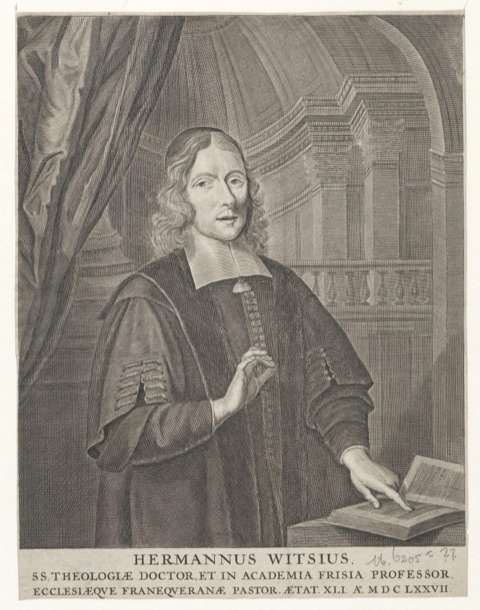
About the author
Herman Witsius
Herman Witsius (1636 to 1708 AD) was born in Enkhuizen in the Netherlands. He entered the University of Utrecht at fifteen, studied further at Groningen and Leiden, and served as a pastor in several Dutch congregations. In 1675 he became professor of theology at Franeker, and he published The Economy of the Covenants Between God and Man there in 1677; in this volume he names Christian Schotanus as his predecessor in that chair. He later held professorships at Utrecht from 1680 and at Leiden from 1698. He sharpened the work through later editions, and he refers here to his separate writings on the ten tribes of Israel and on infant baptism. He also wrote on the Apostles' Creed and the Lord's Prayer, and he died in Leiden in 1708.