Modernized edition · Full text · Free PDF/EPUB
Against the Arians in Modern English
Want the file? The PDF/EPUB is free with an account.
Summary
- Author
- Athanasius of Alexandria (296 to 373 AD), bishop of Alexandria and chief opponent of Arianism
- Written
- During the reign of the emperor Constantius, whose authority the Arian party claimed
- Type
- Doctrinal treatise in the form of discourses against a heresy
- Structure
- Four discourses: thirty chapters across the first three, thirty-six sections in the fourth
- Length
- 108,000 words · 7 hours
What is Against the Arians about?
Against the Arians is Athanasius of Alexandria's four-part defense of the eternal divinity of the Son of God. Answering Arius's claim that the Son was a creature who once did not exist, Athanasius argues from the names Son, Word, Wisdom and Image, explains the texts the Arians cited, and holds that only the true Son could deify humanity.
Read the full summary (9 points, key themes)Show less
How the argument unfolds
- 01
The Thalia exposed. Athanasius denies the Arians the Christian name, quotes Arius's song, and sets the faith of Scripture beside it.
- 02
The slogans answered. The Son did not begin in time, is no brother of the Father, is not one of two unoriginated beings, and cannot change.
- 03
Exaltation and anointing. Philippians 2, Psalm 45 and Hebrews 1 speak of what the Son received as man, for us, not of a reward for virtue.
- 04
Faithful, made, and Lord. Hebrews 3:2 and Acts 2:36 describe his priesthood and lordship in the flesh, and God needed no creature to stand between him and creation.
- 05
The Lord created me. Proverbs 8:22 is a veiled saying about the body Wisdom took for the works, and the next verse says he was begotten before all things.
- 06
One in the other. The Father and the Son are in one another and are one in essence, and believers are made one only by the Spirit.
- 07
The Gospels' human words. His questions, his not knowing the day and hour, his growth and his fear are read as belonging to the flesh.
- 08
By will or by nature. The Son is begotten by nature, not by the Father's choice, and is himself the Father's living Counsel.
- 09
The fourth discourse. Short sections defend one origin of the Godhead, deny that the Monad expanded, and show that Word and Son are one Christ.
Key themes
- Deification through the true Son. Salvation requires that the one who took flesh be God by nature: “Humanity would never have been deified by union with a creature, or unless the Son were true God.”
- One Christ in two ways. Divine works and human weakness belong to the same person: “He was true God in the flesh, and true flesh in the Word.”
- Nature before names. Once the Son is confessed, words such as made, created and servant must be read by what he is, as Scripture reads them of Solomon and Cain.
- One God, not two. The Son adds no second godhead to the Father's: “We have not proposed the image of three suns, but of sun and radiance.”
Reader questions (10)Hide the questions
Questions about Against the Arians
Is there a modern English version of Against the Arians?
Yes. This is Against the Arians by Athanasius of Alexandria in modern English. The language is modernized and the author's order and argument are kept. The full modernized text is free to read on this page.
Can I read Against the Arians online for free?
Yes. The complete text of this modern English edition is on this page, with no sign-up or paywall.
Is there a free PDF of Against the Arians?
Yes. The PDF and EPUB of this edition are free with an Updated Works account. Sign in with Google or an email link; no card is needed.
What is Against the Arians by Athanasius of Alexandria about?
It argues that the Son of God is eternal, uncreated and of the Father's own essence. Athanasius answers the slogans of Arius and his followers, explains every passage of Scripture they used to call the Son a creature, and shows why the Son's divinity matters for human salvation.
What did Arius teach, according to this book?
Athanasius quotes the Thalia as saying “God was not always a Father”, that the Word was made out of nothing, that he is God in name only, and that he is alien to the Father's essence and changeable like other creatures.
Why does Athanasius prefer to call God Father rather than Unoriginated?
Unoriginated is a word with several senses, borrowed from the Greeks, and names God only in relation to his works. Father is scriptural, points at once to the Son, and is the name Christ gave in teaching his disciples to pray and in the command to baptize.
How does Athanasius explain Christ saying he did not know the day or the hour?
He spoke as man, because ignorance belongs to the flesh he took. As the Word he made the times and described every sign before the end: “He did not know in the flesh, though he knew as the Word.” His silence also keeps believers watchful.
Does Athanasius think Christ feared death?
The trouble and the prayer that the cup might pass belonged to his flesh, while he willed the death he came for. By taking that weakness he removed our fear, and “He abolished death by death, and he healed all human evils by human means.”
What advice does Athanasius give about questions that cannot be answered?
He holds that no one should ask how God begets as though the answer could be put in words. “It is better in perplexity to be silent and believe than to disbelieve because of perplexity.”
Whom does the fourth discourse answer?
Beside the Arians, it answers Sabellius, those who say the Monad expanded into a Triad and the Word became Son only at the incarnation, and followers of Paul of Samosata who divide the Word from Christ.
Against the Arians in Modern English · Full text
Discourse 1: The Eternal Sonship and Divinity of the Word
Chapter 1: Why This Heresy Is Not Christian
1. Of all the other heresies that have departed from the truth, everyone agrees that they have merely invented a form of madness. Their ungodliness has long been notorious to all. Because their founders went out from us, it follows plainly, as the blessed John has written, that they never shared our mind and do not share it now. Therefore, as the Savior says, because they do not gather with us, they scatter with the devil. They keep watch for those who fall asleep so that, by a second sowing of their own deadly poison, they may gain companions in death.
Yet one heresy, the last of all, has now risen as the forerunner of Antichrist. This is the heresy called Arian. Seeing that the other heresies, her older sisters, have been openly condemned, she acts with craft and cunning. Like her father the devil, she tries to dress herself in the language of Scripture and force her way back into the paradise of the church. Under the pretense of Christianity, she uses smooth sophistry, for true reason she has none, to deceive people into wrong thoughts about Christ.
Even worse, she has already seduced some foolish people, not only corrupting their ears, but leading them to take and eat with Eve. In the ignorance that follows, they mistake bitter for sweet and admire this loathsome heresy. For this reason, at your request, I have thought it necessary to rip open “the folds of its breastplate” (Job 41:13) and expose the foul stench of its folly. In this way, those who are far from it may continue to avoid it, and those whom it has deceived may repent. Opening the eyes of their hearts, they will understand that darkness is not light, falsehood is not truth, and Arianism is not good. Indeed, those who call these people Christians are making a grave and terrible mistake. They have neither studied Scripture nor understood Christianity and the faith it contains.
2. What have such people found in this heresy that resembles the true faith, that they talk so casually as if its supporters say nothing evil? To speak that way is to call even Caiaphas a Christian, and to still count the traitor Judas among the apostles. It is to claim that those who asked for Barabbas instead of the Savior did nothing wrong, and to commend Hymenaeus and Alexander as right-minded men, as though the apostle Paul had slandered them. No Christian can bear to hear such things, nor consider anyone who dares to say them to be in his right mind.
For with these people, Arius stands in the place of Christ, just as Manichaeus does for the Manichaeans. In place of Moses and the other saints, they have discovered a man named Sotades, whom even pagans laugh at, along with the daughter of Herodias. From the first, Arius copied a loose and effeminate style, writing his Thalias on Sotades’s model. The second he rivaled in her dance, reeling and frolicking in his blasphemies against the Savior. Meanwhile, the victims of his heresy lose their wits and grow foolish. They exchange the name of the Lord of glory for the likeness of the “image of corruptible man” (Romans 1:23), and instead of Christians they come to be called Arians, wearing this badge of their ungodliness.
Let them not make excuses for themselves, nor try to turn their disgrace back on those who are not like them. They call Christians after the names of their teachers so that they themselves may appear to bear their own name in the same way. Nor should they joke about it when they feel ashamed of their disgraceful title. Rather, if they are ashamed, let them hide their faces or recoil from their own ungodliness. Never at any time have Christian people taken their title from the bishops among them, but from the Lord in whom we place our faith. Even though the blessed apostles became our teachers and ministered the Savior’s gospel, we do not take our title from them. From Christ we are, and are named, Christians. As for those who derive the faith they profess from other men, there is good reason for them to bear the name of those whose property they have become.
3. Yes, indeed. While all of us are and are called Christians after Christ, Marcion introduced a heresy long ago and was cast out. Those who stayed with the bishop who expelled him remained Christians, while those who followed Marcion were called Christians no longer, but Marcionites from then on. In the same way, Valentinus, Basilides, Manichaeus, and Simon Magus all passed their own names on to their followers. Some are called Valentinians, others Basilidians, others Manichaeans, and others Simonians. Still others are called Cataphrygians from Phrygia, and Novatians from Novatus. Likewise, when Meletius was expelled by Peter, the bishop and martyr, he called his party no longer Christians, but Meletians.
In the very same way, when Alexander of blessed memory cast out Arius, those who remained with Alexander remained Christians. Those who went out with Arius left the Savior’s name to us who stayed with Alexander, and from then on they were called Arians. Look, too, at what happened after Alexander’s death. Those who are in communion with his successor Athanasius, and those with whom Athanasius holds communion, follow the exact same rule. None of them bear his name, nor is he named after them; all alike, as always, are called Christians. Even though we have a succession of teachers and become their disciples, we are taught the things of Christ by them, so we both are and are called Christians all the same.
Those who follow heretics, however, even if they have countless successors in their heresy, still bear the name of the one who invented it. Thus, even though Arius is dead and many of his party have succeeded him, those who share his views are known by his name and called Arians. We have remarkable proof of this even today. When Greeks enter the church and give up the superstition of idols, they do not take the name of their instructors, but of the Savior, and begin to be called Christians instead of Greeks. By contrast, those among them who go over to the heretics, and everyone who leaves the church for this heresy, abandon Christ’s name. From that point on they are called Arians, because they no longer hold the faith of Christ, but have inherited the madness of Arius.
4. How then can they be Christians when, instead of Christians, they are Ariomaniacs? How can they belong to the catholic church when they have cast off the apostolic faith and become authors of fresh evils? They abandon the oracles of divine Scripture and call Arius’s Thalia a new wisdom. And with good reason, for they are proclaiming a new heresy.
Anyone may marvel at this. Many writers have produced countless treatises and abundant homilies on the Old Testament and the New, yet not a single Thalia is found among them. You will not even find one among the more respectable pagans, but only among those who sing such songs over their wine cups amid cheers and jokes, when people are drinking and laughing. Yet this marvelous Arius took no serious model and showed no regard even for basic decency. While stealing freely from other heresies, he wanted to be original in the absurd, with no rival except Sotades. When he set out to dance against the Savior, what could fit him better than casting his wretched, ungodly words into loose and dissolute meters? As Wisdom says, “a man is known from the utterance of his word” (Sirach 4:24). Just so, those very rhythms reveal the writer’s effeminate soul and corrupt mind.
In truth, that crafty man did not escape detection. For all his twisting and turning like a serpent, he simply fell into the error of the Pharisees. To break the law, they pretended to be zealous for the words of the law. To deny the expected Lord who stood right before them, they spoke hypocritically in God’s name. They were convicted of blasphemy when they asked, “Why dost thou, being a man, make thyself God?” (John 10:33) because he said, “I and the Father are one” (John 10:30). In the same way, this counterfeit, Sotadean Arius pretends to speak of God by borrowing the language of Scripture. Yet everywhere he is recognized as godless Arius, denying the Son and counting him among the creatures.
Chapter 2: Extracts from the Thalia of Arius
5. The opening of Arius’s Thalia and its flippancy, effeminate in both tune and character, runs as follows:
“According to faith of God’s elect, God’s prudent ones,
Holy children, rightly dividing, God’s Holy Spirit receiving,
Have I learned this from the partakers of wisdom,
Accomplished, divinely taught, and wise in all things.
Along their track, have I been walking, with like opinions.
I the very famous, the much suffering for God’s glory;
And taught of God, I have acquired wisdom and knowledge.”
And the repulsive, utterly ungodly mockeries he utters in it are things like these. “God was not always a Father,” he says, but “once God was alone and not yet a Father, and afterward he became a Father.” “The Son was not always,” for Arius argues that just as all things were made out of nothing and all existing creatures and works were made, so the Word of God himself was “made out of nothing.” “Once he was not,” and “he was not before he came into being.” Like everything else, he “had a beginning of creation.” “For God,” he says, “was alone, and the Word did not yet exist, nor did Wisdom. Then, wishing to form us, he made a certain being and named him Word and Wisdom and Son, so that he might form us through him.”
Accordingly, Arius says there are two wisdoms. First, there is the attribute that coexists with God. Second, in that wisdom the Son came into being, and he is called Wisdom and Word only because he shares in it. “For Wisdom,” he says, “by the will of the wise God, came into existence in Wisdom.” In the same way, he claims there is another Word in God besides the Son, and that the Son is named Word and Son only by grace, through sharing in that other Word.
Another idea characteristic of their heresy, as shown in their other writings, is that there are many powers. One of these, they say, is God’s own by nature and eternal, whereas Christ is not the true power of God, but, like the others, merely one of the so-called powers. Among these powers, the locust and the caterpillar are called in Scripture not just a power, but the “great power” (Joel 2:25). According to them, the other powers are many and are like the Son, and David speaks of them in the Psalms when he says, “The Lord of hosts,” or “powers” (Psalm 24:10).
Furthermore, Arius teaches that by nature, like all other beings, the Word himself is changeable. He remains good by his own free will as long as he chooses. Whenever he wills, however, he can change just as we can, because he has a changeable nature. “Therefore,” says Arius, “because God foreknew that he would be good, he bestowed this glory on him in advance, the glory he afterward attained as a man through virtue. Thus, on account of his foreknown works, God brought it about that he should come to be such as he is.”
6. Moreover, Arius has dared to say that “the Word is not true God.” “Though he is called God, he is not true God,” but “by sharing in grace, he, like others, is God in name only.” And just as all beings are foreign and different from God in essence, so too, he claims, “the Word is alien and unlike the Father’s essence and proper nature in every respect,” belonging instead to the things that were originated and created as one of them.
Afterward, as if he had inherited the devil’s own recklessness, Arius speaks even more boldly in his Thalia. He declares that “even to the Son the Father is invisible,” and that “the Word cannot perfectly and exactly see or know his own Father.” Even what he knows and sees, he knows and sees “in proportion to his own measure,” just as we know according to our own capacity. For the Son, he says, not only fails to know the Father exactly because he lacks full comprehension, but “he does not even know his own essence.”
He goes on to claim that “the essences of the Father, the Son, and the Holy Spirit are separate in nature, estranged, disconnected, alien, and without any share in one another.” In his own words, they are “utterly unlike one another in essence and glory, to infinity.” Thus, with regard to “likeness of glory and essence,” he says the Word is completely different from both the Father and the Holy Spirit. Such are the words this ungodly man has spoken, insisting that the Son exists apart by himself and does not share in the Father in any way. These are portions of Arius’s fables as they appear in that flippant composition.
7. Who can hear all this, or even the tune of the Thalia, without hating, and justly hating, this Arius who jokes about such sacred matters as if on a theater stage? When he pretends to name God and speak of God, who does not see him as the serpent counseling the woman? Who can read what follows in his work and fail to recognize in his ungodly doctrine the very error by which the serpent seduced Eve with his sophistries? Who is not filled with outrage at such blasphemies?
“The heaven,” as the prophet says, “was astonished, and the earth shuddered” (Jeremiah 2:12) at the breaking of the law. With even greater horror, the sun could not bear the bodily insults that the common Lord of all voluntarily endured for us. It turned away, pulled back its rays, and left that day sunless. Should not all humankind, then, be struck speechless at Arius’s blasphemies, stopping their ears and shutting their eyes to avoid hearing them or seeing their author? Surely the Lord himself has every reason to denounce people so ungodly and so ungrateful. He already spoke those words through the prophet Hosea: “Woe unto them, for they have fled from me; destruction upon them, for they have transgressed against me; though I have redeemed them, yet they have spoken lies against me” (Hosea 7:13). Right after that he says, “They imagine mischief against me; they turn away to nothing” (Hosea 7:15). To turn away from the Word of God who truly exists, and to invent for themselves one who does not exist, is to fall into nothingness.
That is why the Ecumenical Council, when Arius spoke this way, cast him out of the church and pronounced anathema on him, unable to tolerate such ungodliness. Ever since then, Arius’s error has been recognized as no ordinary heresy, but as Christ’s enemy and the forerunner of Antichrist. As I said earlier, so great a condemnation ought to carry special weight by itself and make people flee from this ungodly heresy. Yet certain people who are called Christians, either out of ignorance or pretense, think it differs very little from the truth and still call its adherents Christians. Let us therefore put some questions to them as best we can to expose the shamelessness of this heresy. Perhaps, once caught in this way, they will be silenced and flee from it as from the sight of a serpent.
Chapter 3: The Urgency of the Controversy
8. Some think that using a few phrases from divine Scripture turns the blasphemy of the Thalia into reverent speech. If so, they ought to deny Christ along with the Jews of our day, since they see how carefully the Jews study the Law and the Prophets. Perhaps they should also reject the Law and the Prophets like the Manichaeans, because the Manichaeans read certain parts of the Gospels. If such confusion and empty talk come from ignorance, Scripture itself will teach them better. Because evil carries a foul odor, the devil, the author of heresies, borrows the language of Scripture as a cloak. Under that cover he sows the ground with his own poison and seduces the simple. That is how he deceived Eve. That is how he constructed earlier heresies. And that is how he persuaded Arius today to make a show of opposing those earlier heresies so he could slip his own in unnoticed.
Even so, this crafty man did not escape exposure. By acting ungodly toward the Word of God, he lost everything at once and revealed to everyone his ignorance of other heresies as well. Having not a particle of truth in his belief, he only pretends to hold it. For how can a man speak the truth about the Father when he denies the Son who reveals him? How can he be orthodox about the Spirit when he speaks profanely of the Word who supplies the Spirit? Who will trust him about the resurrection when he denies Christ, who for us is the firstborn from the dead? And how can he avoid error about Christ’s incarnate presence when he is completely ignorant of the Son’s genuine and true generation from the Father?
In just this way, the Jews of earlier days denied the Word and said, “We have no king but Caesar” (John 19:15). Immediately they were stripped of everything they had. They forfeited the light of the lamp, the fragrance of the ointment, the knowledge of prophecy, and the truth itself, so that even now they understand nothing and walk as if in darkness.
Who has ever heard such a doctrine before? Where or from whom did the supporters and hirelings of this heresy obtain it? Who taught them this when they were at school? Who ever told them, “Abandon the worship of creation, and then draw near and worship a creature and a work”? If they themselves admit they have heard it now for the first time, how can they deny that this heresy is foreign and did not come from our fathers? Whatever did not come from our fathers, but has sprung up in our own day, can only be what the blessed Paul foretold. He warned that “in the latter times some shall depart from the sound faith, giving heed to seducing spirits and doctrines of devils, in the hypocrisy of liars; cauterized in their own conscience, and turning from the truth” (1 Timothy 4:1-2; Titus 1:14).
9. Look at what we do by contrast. We take divine Scripture, speak freely from it about the true faith, and set it up like a lamp on its stand. We confess that he is the true Son of the Father, natural and genuine, proper to his essence, only-begotten Wisdom, and the true and only Word of God. He is not a creature or a work, but an offspring proper to the Father’s essence. Therefore he is true God, existing as one in essence with the true Father. Other beings, to whom he said, “I said ye are gods” (Psalm 82:6), received that grace from the Father only by sharing in the Word through the Spirit. For the Son is the exact expression of the Father’s person, Light from Light, Power, and the true Image of the Father’s essence. This is why the Lord himself said, “He that hath seen me, hath seen the Father” (John 14:9). He always was and is, and never was not. Since the Father is everlasting, his Word and his Wisdom must be everlasting as well.
On the other hand, what do these people have to show us from their infamous Thalia? First of all, let them read it aloud themselves and copy its writer’s tone. At least the mockery they receive from others may teach them how low they have fallen. Then let them try to explain themselves. What can they say from it except this? “God was not always a Father, but became one afterward. The Son was not always, for he was not before his generation. He is not from the Father, but like other things he came into existence out of nothing. He is not proper to the Father’s essence, for he is a creature and a work.”
They must also say, “Christ is not true God, but like others he was made God by participation. The Son does not have exact knowledge of the Father, nor does the Word see the Father perfectly; he neither fully understands nor knows the Father. He is not the true and only Word of the Father, but is called Word and Wisdom in name only, and is called Son and Power only by grace. He is not unchangeable like the Father, but changeable in nature like the creatures, and he falls short of attaining perfect knowledge of the Father.”
What an astonishing heresy! It is not even plausible, yet it spins speculations against the One who is to claim that he was not. Everywhere it passes off blasphemy as reverent speech. Suppose someone investigated both sides and was asked which faith he would follow, or which side spoke fittingly of God. Better yet, let these supporters of ungodliness answer for themselves what is fitting to say when asked about God, for “the Word was God” (John 1:1).
From this single question, the whole dispute on both sides can be settled. What is fitting to say of him? That he was, or that he was not? That he existed always, or not before his birth? That he is eternal, or only from this time and that? That he is true Son, or only by adoption, by participation, and as a mere mental concept? Should we call him one of the originated things, or unite him to the Father? Should we consider him unlike the Father in essence, or like him and proper to him? Is he a creature, or the One through whom the creatures were brought into being? Is he the Father’s own Word, or is there another word beside him? Was he brought into being by that other word and by another wisdom, so that he is merely called Wisdom and Word as a partaker of that wisdom and second to it?
10. Which of these two theologies presents our Lord Jesus Christ as God and Son of the Father: this one you have vomited out, or the one we have proclaimed and upheld from the Scriptures? If the Savior is neither God, nor Word, nor Son, you are free to say whatever you please, and so are the pagans and the Jews of our day. Yet he is the Word of the Father, the true Son, God from God, and “over all, blessed forever” (Romans 9:5). Ought we not, then, to blot out and destroy those other phrases and that Arian Thalia? It is nothing but a model of evil and a storehouse of all ungodliness. Whoever falls into it “knoweth not that giants perish with her, and reacheth the depths of Hades” (Proverbs 9:18).
The Arians know this themselves, and in their cunning they hide it. They lack the courage to speak plainly and instead say something else. If they speak openly, condemnation follows. If they come under suspicion, proofs from Scripture fly at them from every side. So in their craftiness, like children of this world, they feed their so-called lamp from the wild olive. Afraid it will soon go out, since Scripture says “the light of the wicked shall be put out” (Job 18:5), they hide it under the bushel of their hypocrisy. They make a different outward profession and boast of the patronage of friends and the authority of Constantius. Through their hypocrisy and their claims, they try to keep newcomers from seeing how foul their heresy really is.
Is this heresy not detestable for this reason alone, that it does not dare speak out, but is kept hidden by its own friends and nourished like a nest of serpents? Where did they gather these claims? From whom did they receive what they venture to say? They cannot name a single person who supplied it to them. Who in all of humanity, Greek or barbarian, dares to rank among creatures the very One whom he confesses to be God, claiming that he did not exist until he was made? Who refuses to believe the God in whom he puts his trust when God declares, “This is my beloved Son” (Matthew 3:17), pretending that he is not a Son, but a creature? Such madness would provoke universal outrage. Nor does Scripture give them any excuse. It has often been shown, and will be shown again now, that their doctrine is completely alien to the divine oracles.
The only conclusion left, therefore, is that their madness comes from the devil, for he alone sows such ideas. Let us move forward to resist him, because our real battle is with him, and these people are only his instruments. With the Lord’s help, when the enemy is defeated by sound arguments as he always is, they may be put to shame when they see the sower of their heresy left without a defense. Then they may learn, even if late, that as Arians they are not Christians.
Chapter 4: The Son Is Eternal and Uncreated
11. At the devil’s prompting, then, you have asserted and believed that “there was once when the Son was not.” This is the first cloak of your doctrine that must be stripped away. Tell us, you slanderous and ungodly people: what was “once” when the Son was not?
If you say it was the Father, your blasphemy grows even worse. It is impious to say that the Father was “once,” or to describe him by the word “once.” He always is, and is now; as the Son is, so is he, being himself the One who is and the Father of the Son. On the other hand, if you say the Son was “once” when he himself was not, your answer is foolish and meaningless. How could he both exist and not exist? Caught in this dilemma, you can only answer that there was a time when the Word was not, for your very word “once” naturally signifies time. Your other phrase, “The Son was not before his generation,” means the exact same thing as “There was once when he was not.” Both phrases imply that there was a time before the Word.
Where did you get this invention? Why do you, like “the heathen, rage, and imagine vain phrases against the Lord and against his Christ” (Psalm 2:1-2)? No holy Scripture has ever spoken this way about the Savior. Instead, Scripture uses words like “always,” “eternal,” and “coexisting always with the Father.” John writes, “In the beginning was the Word, and the Word was with God, and the Word was God” (John 1:1). And in Revelation he speaks in this way: “Who is and who was and who is to come” (Revelation 1:4). Who can rob “who is” and “who was” of eternity?
To refute the Jews, Paul wrote the same truth in his Letter to the Romans: “Of whom as concerning the flesh is Christ, who is over all, God blessed forever” (Romans 9:5). And to silence the Greeks, he declared, “The invisible things of him from the creation of the world are clearly seen, being understood by the things that are made, even his eternal power and Godhead” (Romans 1:20). Elsewhere he teaches us himself what the Power of God is: “Christ the power of God and the wisdom of God” (1 Corinthians 1:24).
Surely Paul does not refer to the Father in these words, as you often whisper to one another when you claim that the Father is “his eternal power.” That cannot be right. Paul does not say, “God himself is the power,” but “his is the power.” It is obvious to everyone that “his” is not “he,” yet neither is it something alien to him, but rather what properly belongs to him. Study the context as well, and “turn to the Lord,” for “the Lord is that Spirit” (2 Corinthians 3:16-17). Then you will see clearly that it is the Son who is meant.
12. Right after mentioning creation, Paul naturally speaks of the Maker’s Power as seen in it. That Power, I say, is the Word of God, through whom all things have been made. If creation were sufficient all by itself, without the Son, to make God known, be careful not to fall into thinking that creation came into being without the Son. In fact, it came into being through the Son, and “in him all things consist” (Colossians 1:17). Anyone who contemplates creation rightly, therefore, is also contemplating the Word who framed it, and through him begins to know the Father.
Consider what the Savior himself says: “No one knoweth the Father, save the Son, and he to whom the Son shall reveal him” (Matthew 11:27). And when Philip asked, “Show us the Father,” Jesus did not say, “Look at creation,” but, “He that hath seen me, hath seen the Father” (John 14:8-9). Paul therefore spoke with good reason when he rebuked the Greeks for observing the harmony and order of creation without reflecting on the framing Word within it. Created things bear witness to their own Maker so that through creation people might know the true God and stop worshiping the creature. With good reason, then, Paul wrote, “his eternal power and Godhead” (Romans 1:20), pointing directly to the Son.
The sacred writers also say, “Who exists before the ages,” and “By whom he made the ages” (Hebrews 1:2). Even while referring to God himself, they proclaim the eternal, everlasting being of the Son just as clearly. Isaiah says, “The everlasting God, the Creator of the ends of the earth” (Isaiah 40:28). Susanna prayed, “O everlasting God” (Susanna 1:42). Baruch wrote, “I will cry unto the Everlasting in my days” (Baruch 4:20). Shortly afterward he added, “My hope is in the Everlasting, that he will save you, and joy is come unto me from the Holy One” (Baruch 4:22).
Now compare these statements with what the apostle writes to the Hebrews: “Who being the radiance of his glory and the expression of his person” (Hebrews 1:3). David likewise says in Psalm 90, “And the brightness of the Lord be upon us” (Psalm 90:17), and elsewhere, “In thy light shall we see light” (Psalm 36:9). Who has so little sense as to doubt the eternity of the Son? When has anyone ever seen light without the brightness of its radiance, so as to say of the Son, “There was once when he was not,” or “Before his generation he was not”?
Furthermore, the words addressed to the Son in Psalm 145, “Thy kingdom is a kingdom of all ages” (Psalm 145:13), forbid anyone to imagine any interval at all in which the Word did not exist. For every interval in the ages is measured, and of all the ages the Word is King and Maker; therefore, since no interval at all exists before him, it is sheer madness to say, “There was once when the Everlasting was not,” and “The Son came from nothing.” And notice how the Lord speaks of himself. He says, “I am the truth” (John 14:6), not “I became the truth.” Always it is “I am”: “I am the shepherd” (John 10:14), “I am the light” (John 8:12), and again, “Call ye me not, Lord and Master? and ye call me well, for so I am” (John 13:13). Who can hear such words from God, from the Wisdom and Word of the Father speaking of himself, and still hesitate about the truth? Who will not immediately believe that the phrase “I am” signifies that the Son is eternal and without beginning?
13. From all this it is plain that the Scriptures declare the Son’s eternity. It is equally plain from what follows that the Arian phrases “he was not,” “before,” and “when” are applied in the same Scriptures to creatures. Moses, for example, writes in his account of the creation of our world, “And every plant of the field, before it was in the earth, and every herb of the field before it grew; for the Lord God had not caused it to rain upon the earth, and there was not a man to till the ground” (Genesis 2:5). In Deuteronomy we read, “When the Most High divided to the nations” (Deuteronomy 32:8). The Lord himself said in his own person, “If ye loved me, ye would rejoice because I said, I go unto the Father, for my Father is greater than I. And now I have told you before it come to pass, that when it is come to pass, ye might believe” (John 14:28-29).
Concerning creation, he speaks through Solomon: “Or ever the earth was, when there were no depths, I was brought forth; when there were no fountains abounding with water. Before the mountains were settled, before the hills, was I brought forth” (Proverbs 8:23-25). He also said, “Before Abraham was, I am” (John 8:58). About Jeremiah he declared, “Before I formed thee in the womb, I knew thee” (Jeremiah 1:5). David says in the Psalm, “Before the mountains were brought forth, or ever the earth and the world were made, thou art, God from everlasting and world without end” (Psalm 90:2). And in Daniel, “Susanna cried out with a loud voice and said, O everlasting God, that knowest the secrets, and knowest all things before they be” (Susanna 1:42).
Clearly, then, phrases like “once was not,” “before it came to be,” and “when” belong to originated things and creatures that come out of nothing. They are completely foreign to the Word. Scripture uses such terms for originated things, while it uses “always” for the Word. It follows, you enemies of God, that the Son did not come out of nothing and does not belong to the number of originated things at all. He is the Father’s eternal Image and Word, never having not existed, but existing always as the eternal Radiance of an eternal Light.
Why then imagine times before the Son? Why blaspheme the Word as coming after time, when through him even the ages were made? How could time or any age exist at all when the Word, as you claim, had not yet appeared, “through” whom “all things have been made and without” whom “not one thing was made” (John 1:3)? When you mean time, why do you not say plainly, “There was a time when the Word was not”? Even though you drop the word “time” to deceive the simple, you do not conceal your real meaning at all, nor could you escape detection even if you did. You still simply mean time whenever you say, “There was when he was not,” and “He was not before his generation.”
Chapter 5: Eternal Sonship, Not Brotherhood
14. Once these points are proved, their profanity goes even further. “If there never was when the Son was not,” they say, “and if he is eternal and coexists with the Father, then you no longer call him the Father’s Son, but his brother.” How senseless and quarrelsome! If we said only that he existed eternally with the Father, and did not say he is his Son, their pretended objection would have some plausibility. Yet while we affirm that he is eternal, we also confess him to be Son from the Father. How can the one who is begotten be regarded as the brother of the one who begets him? If our faith is in Father and Son, what brotherhood is there between them? How can the Word be called the brother of the one whose Word he is?
This is not the objection of people who are truly ignorant, for they understand very well how the truth stands. It is a Jewish pretense from those who, in Solomon’s words, “through desire separate themselves” (Proverbs 18:1) from the truth. The Father and the Son were not generated from some pre-existing origin so that we might consider them brothers. Rather, the Father is the origin of the Son and begot him. The Father is Father, not born as the son of anyone, and the Son is Son, not brother.
Furthermore, if he is called the eternal offspring of the Father, he is rightly called so. The essence of the Father was never imperfect, as though something proper to it had to be added afterward. Nor has the Son been begotten like a human son from a human father, coming into existence later than his father. Instead, he is God’s offspring, and as the proper Son of God who always is, he exists eternally. Human beings beget in time because of the imperfection of their nature, whereas God’s offspring is eternal because his nature is always perfect.
If he is not a Son, then, but a work made out of nothing, let them prove it. Then they will be free to speak of him as a creature and cry out, “There was once when he was not,” because originated things did not exist before they came into being. Yet he is indeed Son, as the Father says and the Scriptures proclaim. “Son” means nothing other than what is generated from the Father, and what is generated from the Father is his Word, Wisdom, and Radiance. What else can be said, then? By claiming “Once the Son was not,” they rob God of his Word like plunderers.
They openly assert that God was once without his own Word and Wisdom, that the Light was once without radiance, and that the Fountain was once barren and dry. They pretend to be alarmed at the word “time” because of those who reproach them for it, and they say that he existed before time. Still, they assign intervals in which they imagine he did not exist. That leaves them just as ungodly as before, since they equally imply time and attribute to God an absence of Reason.
15. On the other hand, suppose they agree with us on the name “Son” simply to avoid public and universal condemnation. Yet they still deny that the Son is the proper offspring of the Father’s essence, claiming this would imply parts and divisions. What is that but denying he is truly Son, and calling him Son in name only? It is a serious error to think in material terms about what is immaterial. It is equally wrong for them to deny what naturally belongs to the Father because of the weakness of their own nature. All that remains is for them to deny God himself, since they do not understand how God exists or what the Father is. Foolish as they are, they measure the Father’s Offspring by themselves.
People in such a state of mind, who think God cannot have a Son, deserve our pity. Still, we must question and expose their views in hopes of bringing them to their senses. If, as you claim, “the Son is from nothing” and “was not before his generation,” then he too, like everyone else, must be called Son, God, and Wisdom only by participation. That is how all other creatures exist and are glorified through sanctification. Tell us, then, what he partakes of. All other things partake of the Spirit, so according to you, what does the Son partake of? The Spirit? No, rather the Spirit himself receives from the Son, as the Son himself says. It is unreasonable to claim that the Son is sanctified by the Spirit.
The only remaining answer is that he partakes of the Father. Yet what is this thing he participates in, and where does it come from? If it is something external provided by the Father, then the Son does not partake of the Father himself, but of something outside him. In that case, he would not even be second after the Father, since this other thing would come before him. Nor could he be called Son of the Father. Instead, he would be the son of whatever he partakes of to earn the names “Son” and “God.” That conclusion is absurd and irreligious, since the Father says, “This is my beloved Son” (Matthew 3:17), and the Son says that God is his own Father. It follows that what is partaken is not external, but comes from the Father’s essence. And if this gift is still distinct from the Son’s essence, an equal absurdity arises: something else would stand between what comes from the Father and the Son’s essence, whatever that might be.
16. Since such ideas are clearly unfitting and false, we must confess that what comes from the Father’s essence and belongs to him is wholly the Son. Saying that God is wholly participated in is the same as saying that he begets. And what does begetting signify if not a Son? Thus all things partake of the Son himself through the grace of the Spirit who comes from him. This proves that the Son himself partakes of nothing; instead, what is partaken from the Father is the Son. By partaking of the Son himself, we are said to partake of God. That is what Peter meant when he wrote, “that ye may be partakers in a divine nature” (2 Peter 1:4). The apostle Paul says the same: “Know ye not, that ye are a temple of God?” (1 Corinthians 3:16) and “We are the temple of a living God” (2 Corinthians 6:16).
When we behold the Son, we see the Father. Understanding and knowing the Son is knowledge of the Father, because he is the proper offspring of the Father’s essence. No one among us would ever call being participated in a passion or division of God’s essence. We have already shown and agreed that God is participated in, and that being participated in is the same as begetting. Therefore, the one who is begotten involves neither passion nor division in that blessed essence. So it is not unbelievable that God has a Son, the Offspring of his own essence. When we speak of “Son” and “Offspring,” we do not imply passion or division in God’s essence. Rather, we believe in this way because we acknowledge the genuine, true, and only-begotten Son of God.
Since the Offspring of the Father’s essence is the Son, as we have stated and are proving, we cannot hesitate. We must be certain that this same Son is the Wisdom and Word of the Father, in and through whom he creates and makes all things. He is also the Father’s Brightness, in whom the Father enlightens all things and reveals himself to whomever he wills. He is his Expression and Image as well, in whom the Father is contemplated and known. For this reason, “he and his Father are one” (John 10:30), and whoever looks on him looks on the Father.
He is also the Christ, in whom all things are redeemed and the new creation is formed anew. Conversely, since the Son is such an Offspring, it is not only unfitting but deeply perilous to say that he is a creature made out of nothing, or that he did not exist before his generation. Anyone who speaks that way about what belongs to the Father’s essence already blasphemes the Father himself. He really thinks of the Father what he falsely imagines about his Offspring.
Chapter 6: Proof of the Son’s Eternity from Divine Titles
17. What we have said so far is enough to refute the Arian heresy. Even so, its error becomes still clearer from the following argument. God is Maker and Creator, and he creates his works through the Son. We cannot even conceive of created things coming into being except through the Word. Given that God is Maker, is it not blasphemous to claim that his creating Word and his Wisdom once did not exist? That is the same as saying God is not Maker at all. It implies he lacked his own creating Word from himself, and that the means by which he creates came to him from outside, alien to him and unlike him in essence.
Next, let them answer this, or rather learn how irreligious they are in saying, “Once he was not” and “He was not before his generation.” If the Word is not with the Father from everlasting, then the Triad is not everlasting. Instead, there was a Monad first, which later became a Triad by addition. As time went on, it would seem, what we know about God grew and took shape. Worse still, if the Son is not the proper offspring of the Father’s essence, but came to be out of nothing, then the Triad itself consists of nothing. Once there would have been no Triad, only a Monad. The Triad would have been first deficient, before the Son came into being, and only later complete, once he existed. From that point on, a created thing would be counted with the Creator, and what once did not exist would receive divine worship and glory alongside him who always existed.
What is even more serious, the Triad turns out to be unlike itself, composed of strange and alien natures and essences. In other words, this claims that the Triad has a created existence. What kind of religion is this, which is not even consistent with itself, but is still being completed as time goes on, being one way now and another way later? By this logic, it will probably gain some new addition again, and keep doing so without limit, since it originally took its form through additions. And just as surely, it could decrease as well. Whatever can be added can plainly be subtracted.
18. Yet this is not so; perish the thought! The Triad is not created. Rather, there is one eternal Godhead in a Triad, and one glory of the Holy Triad. Yet you dare to divide it into different natures. You admit the Father is eternal, yet you say of the Word who sits beside him, “Once he was not.” Though the Son sits with the Father, you try to place him far away from him. The Triad is Creator and Maker, yet you are not afraid to lower it to the level of things made from nothing. You do not hesitate to equate servile creatures with the nobility of the Triad, and to rank the King, the Lord of hosts, among his subjects. Stop confusing things that cannot be joined together, or rather things that do not exist with him who is. Such claims do not glorify and honor the Lord. They do the exact opposite, for whoever dishonors the Son dishonors the Father as well.
If the true knowledge of God is now complete in a Triad, and this is the one true religion, the good, and the truth, then it must always have been so. Otherwise, the good and the truth would be something that arrived later, and the doctrine of God would be completed by additions. I say it must have been eternally so. If it was not eternal, then it is not true even now. Things would stand today just as you imagine they stood at the beginning, meaning there is no Triad now either.
No Christian could tolerate such heretics. It belongs to pagan Greeks to invent a created Triad and reduce it to the level of created things, which do admit of gaps and additions. Christian faith acknowledges the blessed Triad as unchangeable, perfect, and always what it was. It neither adds anything more to it nor attributes any loss to it, for both ideas are irreligious. Therefore, our faith separates the Triad from all created things and guards as indivisible and worships the unity of the Godhead itself. It shuns Arian blasphemies and confesses that the Son always existed. He is eternal, just as the Father is eternal, whose eternal Word he is. Let us now return to that subject.
19. God both is and is called the Fountain of wisdom and life. He says through Jeremiah, “They have forsaken me, the fountain of living waters” (Jeremiah 2:13). Again he says, “A glorious high throne from the beginning is the place of our sanctuary; O Lord, the hope of Israel, all that forsake thee shall be ashamed, and they that depart from me shall be written in the earth, because they have forsaken the Lord, the fountain of living waters” (Jeremiah 17:12-13). And in the book of Baruch it is written, “Thou hast forsaken the fountain of wisdom” (Baruch 3:12).
This implies that life and wisdom are not foreign to the Fountain’s essence, but belong to it. They were never nonexistent, but always existed. Now the Son is all of this, for he says, “I am the Life” (John 14:6), and “I, Wisdom, dwell with prudence” (Proverbs 8:12). Is it not irreligious, then, to say, “Once the Son was not”? That is the same as saying, “Once the Fountain was dry, destitute of life and wisdom.” Yet then it would cease to be a fountain, for whatever does not bring forth from itself is no fountain at all.
What an absurd claim! God promises that those who do his will shall be like a fountain whose water never fails. He says through the prophet Isaiah, “And the Lord shall satisfy thy soul in drought, and make thy bones fat; and thou shalt be like a watered garden, and like a spring of water, whose waters fail not” (Isaiah 58:11). Yet even though God is called and truly is a Fountain of wisdom, these men dare to insult him as barren and empty of his own Wisdom. Their teaching is false, for truth itself testifies that God is the eternal Fountain of his own Wisdom. If the Fountain is eternal, his Wisdom must also be eternal. In that Wisdom all things were made, as David says in the Psalm, “In Wisdom hast thou made them all” (Psalm 104:24). Solomon says the same: “The Lord by Wisdom hath formed the earth; by understanding hath he established the heavens” (Proverbs 3:19).
This Wisdom is the Word. Through him, as John says, “all things were made,” and “without him was made not one thing” (John 1:3). This Word is Christ, for “there is one God, the Father, from whom are all things and we for him, and one Lord Jesus Christ, through whom are all things and we through him” (1 Corinthians 8:6). If all things exist through him, he himself cannot be counted among that “all.” Anyone who dares to call him through whom all things exist one of that “all” will surely think the same way about God, from whom all things come. If he shrinks from that as unfitting and excludes God from that “all,” consistency requires him to exclude the only-begotten Son as well, since the Son belongs to the Father’s essence.
If he is not one of the “all,” it is a sin to say of him, “He was not” and “He was not before his generation.” Those words fit creatures. The Son, however, is such as the Father is, being the proper Offspring, Word, and Wisdom of his essence. This is proper to the Son in relation to the Father, and it shows that the Father is proper to the Son. Thus we can neither say that God was ever without his Word nor that the Son was ever nonexistent. Why call him Son if he is not from the Father? Why call him Word and Wisdom if he does not always belong to him?
20. When, then, was God ever without what belongs to him? How can anyone regard what is proper to God as foreign and alien to his essence? Other things, as created beings by nature, share no likeness of essence with their Maker. They are external to him, made by the Word through his grace and will. Thus they could cease to exist if it pleased the one who made them, for such is the nature of created things. But what belongs to the Father’s essence we have already shown to be the Son. What reckless impiety, then, to say, “This comes from nothing” and “It did not exist before generation,” as if it were added later and could one day cease to exist again! If a person merely reflects on this thought, he will see how this heresy impairs the perfection and fullness of the Father’s essence.
Yet he will see its absurdity even more clearly when he considers that the Son is the Father’s Image, Radiance, Expression, and Truth. Whenever light exists, its image, radiance, exists with it. Whenever a subsistence exists, its full expression exists as well. Whenever a Father exists, his Truth, who is the Son, exists with him. Let them consider what depths of irreligion they fall into when they make time the measure of the Image and Form of the Godhead. If the Son did not exist before his generation, then Truth was not always in God, which is a sin to say. Because the Father always existed, the Truth was always in him, and that Truth is the Son, who says, “I am the Truth” (John 14:6).
Because the Subsistence existed, its Expression and Image necessarily existed right away. God’s Image is not sketched from outside; God himself has begotten it. Seeing himself in this Image, he delights in it, as the Son himself says, “I was his delight” (Proverbs 8:30). When, then, did the Father not see himself in his own Image? When did he lack delight, that anyone should dare to say, “The Image is out of nothing” and “The Father had no delight before the Image was created”? And how could the Maker and Creator see himself in a created and originated essence? Such as the Father is, such the Image must be.
21. Let us examine the Father’s attributes, and we will know whether this Image is truly his. The Father is eternal, immortal, powerful, light, King, Sovereign, God, Lord, Creator, and Maker. All these attributes must be in the Image for it to be true that he “that hath seen” the Son “hath seen the Father” (John 14:9). If the Son is not all of these, but is instead created and not eternal as the Arians claim, then he is not a true Image of the Father. Their only escape is to abandon all shame and claim that the title “Image” given to the Son is not a mark of a like essence, but a mere name. Yet that, enemies of Christ, is neither an Image nor an Expression. What likeness can something made out of nothing bear to him who brought what was nothing into being? How can what is not be like him who is, falling short of him by once not existing and by holding its place among created things?
Because the Arians want him to be like that, they invented an argument of this sort. “If the Son is the Father’s offspring and Image, and is like the Father in all things,” they say, “then it necessarily follows that just as he is begotten, so he must also beget and become the father of a son. Then the one begotten from him must beget in turn, and so on without end. That is what it takes to make the Begotten like the one who begot him.” Truly, these enemies of God are authors of blasphemy! Rather than confess that the Son is the Father’s Image, they form material, earthly ideas about the Father himself, attributing to him divisions, outflows, and inflows. If God is like a human being, then let him become a parent like a human being. Then his Son can become father of another, and so on in succession until their imagined chain grows into a multitude of gods.
Yet God is not like a human being, and we must not project human traits onto him. After a Creator gives them their start, animals and human beings are begotten in succession. A human son is begotten by a father who was himself a son, and later becomes father to a son of his own, passing on what he inherited from his father. For that reason, among humans no one is strictly father alone or son alone, nor do father and son stay fixed in those roles. The son himself becomes a father, being son to his father and father to his son.
It is not like that in the Godhead, for God is not like man. The Father does not come from a father, so he does not beget one who will become a father. Neither is the Son an outflow from the Father, nor is he begotten by a father who was himself begotten. Therefore, he is not begotten in order to beget. To the Godhead alone does it belong that the Father is properly Father and the Son is properly Son. In them, and in them alone, it holds true that the Father is always Father and the Son is always Son.
22. Whoever asks why the Son does not beget a son must also ask why the Father did not have a father. Both questions are unfitting and full of impiety. Just as the Father is always Father and could never become Son, so the Son is always Son and could never become Father. In fact, this very truth proves him to be the Father’s Expression and Image. He remains what he is and does not change, having received from the Father to be always one and the same.
If the Father changes, then let the Image change, since that is how an Image and Radiance relate to the one who begot them. But if the Father is unchangeable and always remains what he is, then the Image must also remain what he is and never alter. Since he is Son from the Father, he will never become anything other than what belongs to the Father’s essence. In vain, then, have these foolish people devised this objection too, wanting to separate the Image from the Father so they can reduce the Son to the level of created things.
Chapter 7: Answering the Arian Dilemma on the Son’s Generation
22 (continued). Ranking him among created things, Arius and his companions followed the teaching of Eusebius and treated the Son as no different from the things brought into being through him. Thus they revolted from the truth. When they first launched this heresy, they used to go around spreading dishonest slogans they had pieced together. Even now, some of them stop boys in the marketplace and question them, not from divine Scripture, but as if bursting with “the abundance of their heart” (Matthew 12:34).
They ask, “Did the one who is make him who was not out of what was not, or did he make him who already was? Therefore, did he make the Son while he existed, or while he did not exist?” Again they ask, “Is the Unoriginated one or two?” And they ask, “Does he have free will, yet not change by his own choice, even though he has a changeable nature? For he is not like a stone, remaining immovable by himself.” Next they turn to gullible women and speak to them in this trivial way: “Did you have a son before giving birth? Just as you did not, neither did the Son of God exist before his generation.” With language like this, these shameless men mock and revel, comparing God to humans. They pretend to be Christians while exchanging God’s glory “into an image made like to corruptible man” (Romans 1:23).
23. Words so senseless and dull really deserve no answer at all. Still, so that their heresy does not appear to have any real foundation, it is right to step aside and refute them even here, especially for the sake of the gullible women who are so easily deceived by them. When they talk like this, they should ask an architect whether he can build without materials. If he cannot, does it follow that God could not make the universe without materials? Or they should ask any person whether he can exist without occupying a place. If he cannot, does it follow that God is confined to a place? If they asked that, their own audience would put them to shame.
Why do they deny that God has a Son by comparing him to themselves, yet raise no human objections when they hear that God creates and makes? By the same logic, they ought to apply human limits to creation as well. They should supply God with raw materials, deny that he is Creator, and end up groveling with the Manichaeans. Yet the very idea of God transcends such thoughts. On first hearing of him, a person believes and knows that God exists not as we exist, yet truly exists as God. He creates not as humans create, yet truly creates as God.
In the same way, it is plain that he begets not as humans beget, yet truly begets as God. God does not take man as his pattern. Rather, because God is properly and uniquely the true Father of his Son, we humans are also called fathers of our own children. For of him “is every fatherhood in heaven and earth named” (Ephesians 3:15). Unexamined, their arguments carry a superficial appearance of sense. Once anyone tests them with reason, however, they collapse into ridicule and mockery.
24. Look first at how dull and vague their opening question is. They do not even state whom they are asking about so that a clear answer can be given. Instead, they speak abstractly of “he who is” and “him who is not.” Who, then, “is,” and what things “are not,” Arians? Who “is,” and who “is not”? What is said “to be,” and what “not to be”? For one who exists can make things that do not exist, things that already exist, and things that existed before.
A carpenter, a goldsmith, and a potter each work according to their craft on materials that already exist, shaping whatever vessels they please. Even the God of all himself took the dust of the earth, which already existed and had been brought into being, and fashioned man. Yet that very earth, which once did not exist, he had earlier made through his own Word. If that is what their question means, then plainly a creature did not exist before it was created, while humans work on existing materials. Their argument falls apart, because both “what is” and “what is not” come to be, as these examples show.
If, however, they are speaking about God and his Word, let them state their question plainly. Let them ask, “Was God, who exists, ever without Reason? Though he is Light, was he ever without radiance? Or was he always Father of the Word?” Or let them put it this way: “Did the Father, who exists, make the Word, who did not exist, or does he always have his Word with him as the proper offspring of his substance?” Putting it that way exposes that they are merely indulging in reckless sophistry about God and the one who comes from him.
Who can bear to hear them claim that God was ever without Reason? That is the very trap they fall into a second time, even while trying in vain to escape it and disguise it with their word games. In fact, one would rather not hear them argue at all that God was not always Father and became Father only afterward. Their fantasy that his Word once did not exist forces them into that claim. We have already presented so many proofs against them. Besides, John says, “The Word was” (John 1:1), and Paul writes, “who, being the brightness of his glory” (Hebrews 1:3), and “who is over all, God blessed forever. Amen” (Romans 9:5).
25. They would have done best to stay silent. Since they refuse, we must meet their shameless question with a bold retort. Perhaps when they see the matching absurdities that trap their own position, they will stop fighting the truth. After many prayers that God would be gracious to us, we might ask them in return: “God who is, did he come to be when he was not? Or did he also exist before coming into being? While he existed, did he make himself, or does he come from nothing, suddenly appearing on his own after being nothing before?” Such a question is both unfitting and deeply blasphemous, yet it matches theirs, since the answer they give is full of irreligion. If it is blasphemous and completely irreligious to ask such things about God, it is equally blasphemous to ask the same things about his Word.
Still, to expose a question so senseless and dull, we must answer plainly. Because God is, he existed eternally. Since the Father always exists, his Radiance, who is his Word, also always exists. Again, God who is has from himself his Word who also is. Neither was the Word added when he did not exist before, nor was the Father ever without Reason. This attack on the Son makes the blasphemy recoil directly onto the Father, as though he had fabricated a Wisdom, Word, and Son for himself from outside. Whichever of those titles you use, as we have already said, you point to the offspring from the Father. Thus their objection collapses, and naturally so: by denying Reason, the Word, they consequently ask questions that are unreasonable.
Suppose someone looked at the sun and asked about its radiance, “Did what exists make what already existed, or what did not exist?” Anyone would judge him not to be reasoning sensibly, but to be completely out of his mind. He would be imagining what comes from the light to be external to it, asking when, where, and whether it was made. Speculating and questioning like this about the Son and the Father is far greater madness. It treats the Father’s Word as external to him and idly calls his natural offspring a created work by declaring, “He was not before his generation.” Even more, let them take this further answer to their question: the Father who existed made the Son who already existed, for “the Word was made flesh” (John 1:14). Though he was already Son of God, at the consummation of the ages the Father made him Son of Man as well. That holds unless, like Paul of Samosata, they claim he did not even exist at all until he became man.
26. That is enough from us in reply to their first question. Now it is your turn, Arians. Remembering your own words, tell us whether the one who existed needed someone who did not exist to frame the universe, or someone who already existed. You said he made his Son for himself out of nothing as an instrument for creating the universe. Which, then, is superior: the one who has a need, or the one who supplies the need? Or does not each supply what the other lacks? You actually prove the Maker to be weak if he could not make the universe on his own. You make him need an external instrument, like a carpenter or shipwright who cannot craft anything without an adze and a saw! Could anything be more irreligious? Yet why linger over how heinous this is, when everything we have already shown proves their teaching is pure fantasy?
Chapter 8: Why Human Fatherhood and Creation Cannot Measure the Son
26 (continued). Nor does their other simpleminded and foolish question, the one they put to gullible women, really need an answer beyond what we have already given: it is improper to measure divine generation by human nature. Still, so that they may once again condemn themselves, let us meet them on their own ground. Clearly, if they question parents about a son, let them consider where the begotten child comes from. Even granting that a human parent did not have a son before begetting him, once he has him, he has him not as something external or foreign. The child comes from the parent himself, belongs to the parent’s essence, and bears his exact image. Thus the parent is seen in the child, and the child is contemplated in the parent.
If they assume from human examples that generation implies time, why not infer from the same examples that it implies what is natural and proper? Why act like a serpent, drawing out from the earth only what turns to poison? Those who ask parents, “Did you have a son before you begot him?” ought to add another question. They should ask, “And when you had a son, did you buy him from outside like a house or any other possession?” Then the parent would answer, “He is not from outside, but from myself. Things acquired from outside are possessions and pass from one owner to another. My son, however, is from me, belonging to and like my own essence. He did not become mine from someone else, but was begotten by me. Therefore I too am wholly in him, while remaining myself what I am.”
That is how it truly works. A human parent is separated in time from his child because he is a human who himself came into existence in time. Even so, he would have had his child always coexisting with him if his nature had not restrained him and made that impossible. After all, Levi was already in the loins of his great-grandfather before his own birth or even his grandfather’s. As soon as a man reaches the age when nature grants him the power, with nature no longer restraining him, he immediately becomes father of a son from himself.
27. Therefore, when they ask parents about their children and hear that natural children do not come from outside, but from their parents, let them confess the same about the Word of God: that he is simply from the Father. And if they raise an objection about time, let them tell us what restrains God. We must expose their irreligion on the very ground where they mock us. Let them tell us what restrains God from always being Father of the Son, since it is undeniable that whatever is begotten must come from its father. Furthermore, they will condemn themselves for attributing such limits to God if, just as they questioned women about time, they also question the sun about its radiance and the fountain about its stream. They will discover that these, though offspring, always exist alongside what produces them.
If such parents share both nature and duration with their offspring, why do these men not state their irreligion openly, if they suppose God is inferior to created things? Suppose they do not dare say that openly. Suppose they admit that the Son is not from outside, but is a natural offspring from the Father, and that nothing restrains God, who is not like a human, but greater than the sun, or rather the God of the sun. Then it follows that the Word is from him and always coexists with him. Through this same Word, the Father caused all things that were not to come into being. Thus it is certain from the very nature of the case that the Son does not come from nothing, but is eternal and from the Father. The heretics’ own question to parents exposes their perversity: they concede the point of nature, and now they have been put to shame on the point of time.
28. As we said above, we repeat now: divine generation must never be compared to human nature. The Son must not be thought of as a part of God, nor does his generation involve any passion whatsoever. God is not like man. Humans beget with passion because they have a changing nature that waits for set seasons owing to its weakness. With God this is impossible. He is not composed of parts. Being impassible and simple, he is Father of the Son without passion and without division.
Divine Scripture strongly confirms and proves this. God’s Word is his Son, and the Son is the Father’s Word and Wisdom. Yet Word and Wisdom are neither a creature, nor a part of the one whose Word he is, nor an offspring begotten with passion. By joining these titles together, Scripture calls him “Son” to proclaim that he is the natural and true offspring of the Father’s essence. At the same time, so that no one thinks of that Offspring in human terms, Scripture signifies his essence by also calling him Word, Wisdom, and Radiance. This teaches us that his generation is impassible, eternal, and worthy of God.
What passion, then, or what part of the Father is the Word, the Wisdom, and the Radiance? Even these foolish men can grasp this much. Just as they questioned women about God’s Son, let them ask people about their own word. They will find that the word people speak is neither a passion in them nor a severed part of their mind. That holds true even for the word of humans, who are subject to passion and composed of parts. Why, then, do these men speculate about passions and parts in the immaterial and indivisible God? They do so only under a pretense of reverence, to deny the true and natural generation of the Son.
Enough was said earlier to prove that God’s offspring involves no passion, and now it has been shown specifically that the Word is not begotten through passion. The same holds true of Wisdom. God is not like man, and they must not think of him in human terms here either. Humans are capable of receiving wisdom, whereas God partakes of nothing. Instead, he is himself the Father of his own Wisdom, and those who partake of it are called wise. This Wisdom too is neither a passion nor a part, but an Offspring proper to the Father. Therefore, God is always Father, and fatherhood is not added to him later, which would make him appear changeable. For if it is good for him to be Father, yet he was not always Father, then what is good was not always in him.
29. “Wait,” they reply, “God was always a Maker, and the power to create was not added to him later. Does it follow, then, that because he is the Maker of all, his works must also be eternal? Is it wicked to say of them too that they did not exist before they were created?” How senseless these Arians are! What likeness is there between a Son and a created work, that they should equate a father’s role with a maker’s? After the distinction between an offspring and a work has already been demonstrated, how can they remain so poorly instructed?
Let us repeat it: a work is external to the maker’s nature, while a son is the proper offspring of the father’s essence. Therefore, a work does not need to have existed always, because a craftsman frames it whenever he wills. An offspring, however, is not a product of will, but belongs to the essence itself. A man can be and be called a maker even before his works exist. Yet he cannot be called a father, nor can he be one, unless a son exists.
They may pry further and ask why God, though always possessing the power to create, does not always create. That too is the presumption of madmen. After all, “who hath known the mind of the Lord, or who hath been his counselor?” (Romans 11:34), and how “shall the thing formed say to” the potter, “why didst thou make me thus?” (Romans 9:20)? Still, so that we leave not even a weak argument unanswered, they must be told this: although God always had the power to create, created things did not have the capacity to be eternal. Because they come out of nothing, they did not exist before they were created. How could things that did not exist before their creation coexist with the ever-existing God? Therefore, looking to what was good for them, God made them all at the time when he saw that, once created, they were able to endure.
In the same way, God was able from the beginning, in the days of Adam, Noah, or Moses, to send his own Word. Yet he did not send him until the consummation of the ages, because he saw that this was best for the whole creation. So too he made created things when he willed and as was good for them. The Son, however, is not a created work, but the proper offspring of the Father’s essence, and so he always exists. Because the Father always exists, whatever belongs to his essence must also always exist, and that is his Word and his Wisdom. The fact that creatures do not yet exist does not diminish the Maker, since he has the power to frame them whenever he wills. By contrast, if the Offspring were not always with the Father, that would diminish the perfection of the Father’s essence. Therefore, his works were framed whenever he willed through his Word, but the Son is always the proper offspring of the Father’s essence.
Chapter 9: Answering the Arian Question About the Unoriginated
30. These considerations encourage the faithful and distress the heretics, who see their heresy overthrown by them. Moreover, their next question, “whether the Unoriginated is one or two,” shows how false their views are, how treacherous and full of deceit. They do not ask this to honor the Father, but to dishonor the Word. Suppose someone unaware of their trickery answers, “The Unoriginated is one.” Immediately they spit out their own venom. They reply, “Therefore the Son belongs among originated things, and we were right to say, ‘He was not before his generation.’” Thus they stir up every kind of disturbance and confusion, so long as they can separate the Son from the Father and count the Framer of all among his works.
First of all, they can be convicted on this very point: they blame the Nicene bishops for using phrases not found in Scripture, even though those phrases cause no harm and overturn their irreligion. Yet they themselves commit the very same fault. They use words not found in Scripture, and they use them to insult the Lord, knowing “neither what they say nor whereof they affirm” (1 Timothy 1:7). For instance, let them ask the Greeks, who have been their instructors (since it is a word of their invention, not of Scripture), and once they have been instructed in its various meanings, they will discover that they cannot even ask a proper question on the subject they have taken up. They have led me to establish several meanings of “unoriginated.” First, it can mean what has not yet come into being, yet is capable of doing so, like wood that is not yet a vessel but can become one. Second, it can mean what neither has come into being nor ever can, like a square triangle or an odd even number. A triangle neither has become nor ever can become square. Likewise, an even number neither has become nor ever can become odd.
Moreover, “unoriginated” means what exists without having come into being from anyone and without having a father at all. Asterius, the unprincipled sophist and patron of this heresy, has added another definition in his own treatise. He claims that what is not made, but exists eternally, is “unoriginated.” When they ask their question, then, they should specify which sense of “unoriginated” they mean. Only then could those questioned give an answer to the point.
31. Suppose they are still satisfied with merely asking, “Is the Unoriginated one or two?” Then they must be told first, as poorly educated men, that many things are unoriginated and nothing is. Many things are such, namely, those capable of coming into being; and nothing is such, namely, what is incapable of coming into being, as has just been explained. Now suppose they ask according to Asterius’s rule, where “what is not a created work, but always existed” counts as unoriginated. In that sense, they must be told repeatedly that the Son as well as the Father must be called unoriginated. He is neither among originated things nor a created work, but has always been with the Father, as has already been shown. They have invented many shifting phrases solely to speak against the Lord, such as “he is from nothing” and “he did not exist before his generation.”
Eventually they fail at every turn and retreat to the other sense of the question: “existing without being generated from anyone and having no father.” We will tell them that in this sense the Unoriginated is only one, namely the Father. Even so, they gain nothing by their question. Calling God Unoriginated in this sense does not prove that the Son is an originated thing. Earlier proofs already show that the Word is like the one who begot him. If God is unoriginated, his Image is not originated. He is an Offspring, namely God’s Word and his Wisdom.
What likeness does the originated have to the Unoriginated? We must not grow tired of repeating this question. They may insist that the two resemble each other so closely that whoever sees the one sees the other. If so, they come close to saying that the Unoriginated is the image of creatures. That ends in utter confusion. It puts originated things on a level with the Unoriginated. It even denies the Unoriginated by measuring him against created works, all in order to force the Son into their ranks.
32. Yet I suppose even they will hesitate to go that far if they follow Asterius the sophist. Earnest as he is in defending the Arian heresy and maintaining that the Unoriginated is one, he contradicts them. He says that the Wisdom of God is also unoriginated and without beginning. Here is a passage from his work: “The blessed Paul did not say that he preached Christ as ‘the power of God’ or ‘the wisdom of God,’ but without the article, ‘God’s power and God’s wisdom’ (1 Corinthians 1:24). In this way he proclaimed that God’s own proper power, which is natural to him and coexists with him without origin, is something else besides.” Soon afterward he adds, “However, his eternal power and wisdom, which truth proves to be without beginning and unoriginated, must surely be one.”
Asterius misunderstood the Apostle’s words and imagined there were two wisdoms. Still, by speaking of a wisdom that coexists with God, he declares that the Unoriginated is not simply one. Another Unoriginated exists alongside him. After all, what coexists does not coexist with itself, but with another. If they agree with Asterius, let them never ask again, “Is the Unoriginated one or two?” Otherwise they will have to argue the point with him. If they disagree even with him, let them stop relying on his treatise, for fear that, “biting one another, they be consumed one of another” (Galatians 5:15).
So much for their ignorance. Yet who can say enough about their craftiness? Who would not rightly detest them while they remain in the grip of such madness? Once they were no longer allowed to say “out of nothing” and “he did not exist before his generation,” they seized upon this term “unoriginated.” They told simple people that the Son is “originated.” By doing so, they hoped to smuggle in the very same slogans, “out of nothing” and “there was once when he was not.” After all, originated things and creatures imply just those phrases.
33. If they have confidence in their own positions, they should stand by them instead of shifting constantly. They refuse to do so, imagining success will come easily if they shelter their heresy behind the word “unoriginated.” Yet no matter how loudly they clamor, this term is not used in contrast with the Son. It is used in contrast with originated things. The same is true of the titles “Almighty” and “Lord of the Powers.” We say that the Father holds power and mastery over all things through the Word, and that the Son rules the Father’s kingdom and holds authority over all as his Word and Image. Clearly, then, the Son is not counted among those “all things.” God is not called Almighty and Lord in relation to the Son. He is called so in relation to the things that come into being through the Son, over which he exercises power and mastery through the Word.
Therefore, “Unoriginated” is defined not in contrast to the Son, but in contrast to the things that come into being through the Son. Rightly so, because God is not like originated things. He is their Creator and Maker through the Son. Just as “Unoriginated” is spoken in relation to originated things, “Father” points directly to the Son. Whoever calls God Maker, Framer, and Unoriginated has created and made things in view. Whoever calls God Father immediately conceives and contemplates the Son.
One can only marvel at the stubbornness added to their impiety. The term “unoriginated” has that valid meaning and can be used reverently. Yet in their heresy they drag it out to dishonor the Son. They act as if they had never read that whoever honors the Son honors the Father, and whoever dishonors the Son dishonors the Father (John 5:23). If they cared at all for reverent speech and the honor due to the Father, it would be far better and higher for them to confess and call God “Father” than to give him this name.
When they call God “Unoriginated,” as I said before, they name him from his works alone, as Maker and Framer. They suppose this lets them imply that the Word is a created work whenever they please. Whoever calls God “Father” names him from the Son. Such a person knows well that if there is a Son, all originated things were necessarily created through that Son. When they call God “Unoriginated,” they name him only from his works and know the Son no more than the Greeks do. Whoever calls God “Father” names him from the Word. Knowing the Word, he recognizes him as Maker of all and understands that all things were made through him.
34. It is therefore more pious and more accurate to signify God from the Son and call him “Father” than to name him only from his works and call him “Unoriginated.” As I have said, the latter title signifies nothing more than all the works, individually and collectively, that have come into being at God’s will through the Word. The title “Father,” however, draws its meaning and bearing solely from the Son. By as much as the Word surpasses originated things, and even more, calling God “Father” surpasses calling him “Unoriginated.”
“Unoriginated” is unscriptural and suspect. Because it carries multiple meanings, a listener’s mind is pulled in many directions when asked about it. “Father” is simple, scriptural, and more accurate, and it points solely to the Son. “Unoriginated” is a word of the Greeks, who do not know the Son. “Father” has been acknowledged and granted to us by our Lord. Knowing whose Son he was, he said, “I am in the Father, and the Father is in me” (John 14:11). He also said, “He that hath seen me, hath seen the Father” (John 14:9), and “I and the Father are one” (John 10:30). Nowhere is he found calling the Father “Unoriginated.”
Moreover, when he teaches us to pray, he does not say, “When you pray, say, ‘O Unoriginated God.’” Rather, he says, “When ye pray, say, Our Father, which art in heaven” (Luke 11:2). He willed that the Summary of our faith carry the same meaning. He commanded us to be baptized not into the name of Unoriginated and originated, nor into the name of Creator and creature. Instead, he commanded baptism into the name of the Father, the Son, and the Holy Spirit. Through that initiation, we too, though numbered among created works, are made sons. Using the name of the Father, we recognize from that name the Word who is in the Father himself. Their argument about the term “Unoriginated” is therefore empty, as has now been proved. It is nothing more than a fantasy.
Chapter 10: Why the Word Is Unchangeable
35. As for their question whether the Word is changeable, it is almost needless to examine it. Simply writing down what they say exposes its reckless impiety. How trivially they argue appears in questions like these: “Does he have free will, or does he not? Is he good by choice according to free will? Can he change if he wishes, being of a changeable nature? Or, like wood or stone, does he lack a free choice that can move and incline one way or the other?” Speaking and thinking this way fits their heresy. Once they invent a God out of nothing and a created Son, they naturally adopt terms that fit a creature.
Yet consider what happens when they debate members of the church. They hear from them of the true and only Word of the Father, and still dare to speak of him like this. Does not their teaching then become the most loathsome imaginable? Is it not enough to stun a listener on first hearing, even someone unable to answer? It makes him stop his ears in horror at the novelty of claims that are blasphemy even to mention. If the Word is changeable and shifting, where will he stop? What will be the goal of his development? How can the changeable ever be like the Unchangeable? How could someone who has seen the changeable be considered to have seen the Unchangeable? What stage must he reach before we can behold the Father in him? Clearly we would not see the Father in the Son at all times, because the Son would be constantly altering and changeable in nature.
The Father is unchangeable and immutable. He always remains the same and in the same state. Now suppose, as they claim, that the Son is changeable, not always the same, and of an ever-shifting nature. How can such a one be the Father’s Image when he lacks the likeness of his unchangeableness? How can he truly be in the Father if his purpose is unsettled? Perhaps, being changeable and advancing daily, he is not even perfect yet!
Away with such Arian madness! Let the truth shine out and expose their folly. Must not the one who is equal to God be perfect? Must not the one who is one with the Father, and the Son proper to his essence, be unchangeable? Because the Father’s essence is unchangeable, the proper Offspring from that essence must also be unchangeable. If they slanderously ascribe change to the Word, let them learn how gravely their own reason is endangered. After all, a tree is known by its fruit. This is why whoever has seen the Son has seen the Father, and why knowledge of the Son is knowledge of the Father.
36. Therefore, the Image of the unchangeable God must be unchangeable, for “Jesus Christ is the same yesterday, today, and forever” (Hebrews 13:8). David also says of him in the Psalm, “Thou, Lord, in the beginning hast laid the foundation of the earth, and the heavens are the work of thine hands. They shall perish, but thou remainest; and they all shall wax old as doth a garment. And as a vesture shalt thou fold them up, and they shall be changed, but thou art the same, and thy years shall not fail” (Psalm 102:25-27). The Lord himself says of himself through the prophet, “See now that I, even I, am he” (Deuteronomy 32:39), and “I change not” (Malachi 3:6). Someone may say that these words refer to the Father. Yet it fits the Son to say them too. That is especially true when, made man, he reveals his own identity and unchangeableness to those who imagine that taking flesh changed him into something other than he was.
The saints, or rather the Lord himself, are far more trustworthy than the perversity of the impious. In the Psalm passage cited above, Scripture uses heaven and earth to signify that the nature of all originated and created things is changeable and shifting. Yet it sets the Son apart from them, showing he is in no way an originated thing. Indeed, it teaches that he changes everything else while remaining unchanged himself. As it says, “Thou art the same, and thy years shall not fail” (Hebrews 1:12).
There is good reason for this. Originated things come from nothing and did not exist before their origin. Because they come into being after not existing, their nature is changeable. The Son, however, is from the Father and proper to his essence. He is therefore as unchangeable and immutable as the Father himself. It would be a sin to say that a changeable word and a shifting wisdom were begotten from an unchangeable essence. How is he still the Word if he is changeable? Can anything changeable be Wisdom?
Perhaps they imagine this as an accidental quality in an essence. That is, they picture a grace or habit of virtue existing incidentally in some particular essence, called Word, Son, and Wisdom, which can be taken away from it or added to it. They have often expressed this idea, yet it is not the faith of Christians. It fails to confess that he is truly Word and Son of God, or that the wisdom meant here is true Wisdom. How can anything that alters, shifts, and never stays in one fixed condition be true? Yet the Lord says, “I am the Truth” (John 14:6). The Lord himself speaks this way about himself and declares his unchangeableness. The saints have learned and testified to this, and our own pious thoughts of God recognize it. Where, then, did these impious men get this novelty? They vomited it up from their own hearts as from a seat of corruption.
Chapter 11: Explaining Philippians 2:9-10 on Christ’s Exaltation
37. Because they appeal to the divine oracles and force a misinterpretation on them according to their own private sense, we must meet them briefly to vindicate these passages. We will show that they bear an orthodox meaning and that our opponents are in error. They point out what the Apostle writes: “Wherefore God also hath highly exalted him, and given him a name which is above every name; that in the name of Jesus every knee should bow, of things in heaven and things in earth and things under the earth” (Philippians 2:9-10). They also cite David: “Wherefore God, even thy God, hath anointed thee with the oil of gladness above thy fellows” (Psalm 45:7). Then they urge, as if it were a sharp point, “If he was exalted and received grace because of a ‘wherefore,’ and was anointed because of a ‘wherefore,’ he received a reward for his moral choice. And because he acted from choice, he is altogether of a changeable nature.”
Eusebius and Arius have dared to say and even write this. Their partisans do not hesitate to repeat it in the open marketplace, blind to how mad an argument they are using. Suppose he received what he has as a reward for his choice. Then he would not have possessed it unless he had needed it and had deeds to show for it. Having gained it through virtue and promotion, he would understandably have been called Son and God “therefore,” without being true Son.
What comes from another by nature is a true offspring, as Isaac was to Abraham, Joseph to Jacob, and radiance to the sun. Those who are called sons because of virtue and grace are different. They possess an acquired grace in place of nature, and they are something distinct from the gift itself. So it is with human beings who have received the Spirit by participation. Scripture says of them, “I begat and exalted children, and they rebelled against me” (Isaiah 1:2). Because they were not sons by nature, when they changed, the Spirit was taken away and they were disinherited. Yet when they repent, the God who first gave them grace receives them again, gives them light, and calls them sons once more.
38. If they say this of the Savior as well, it follows that he is neither true God nor true Son, nor like the Father. God is in no way the Father of his being according to essence, but only of the grace given to him. According to essence, God would merely be his Creator, just as he is for everyone else. If he is what they claim, it becomes even clearer that he did not have the name “Son” from the start. That follows if it was the prize for deeds done and for the advance he made when he became man and took the form of a servant. Instead, he only became Son later. Only after becoming “obedient unto death” (Philippians 2:8) was he “highly exalted,” receiving that “name” as a grace, “that in the name of Jesus every knee should bow” (Philippians 2:9-10).
What, then, was he before this? Suppose it was only when he became man that he was exalted, began to be worshiped, and was called Son. On their perverse view, he does not seem to have promoted human flesh at all. Rather, he seems to have been promoted himself through it, if he was only then exalted and called Son when he became man. What was he before this? We must press this question on them again so everyone sees where their impious teaching leads. Suppose the Lord is God, Son, and Word, yet was none of these before becoming man. Then either he was something else besides them and later came to share in them for his virtue’s sake, as we have said. Or they must accept the alternative (may it fall back on their own heads!) that he did not exist before that time, but is wholly human by nature and nothing more.
That is no teaching of the church. It belongs to the Samosatene and to present-day Jews. If they think like Jews, why are they not circumcised with them too, instead of pretending to be Christians while fighting against Christianity? If he did not exist, or existed yet was promoted only afterward, how were all things made through him? How did the Father delight in him if he was not perfect (Proverbs 8:30)? If he was only promoted now, how did he rejoice earlier in the Father’s presence? If he received worship only after dying, how is Abraham seen worshiping him in the tent, and Moses at the bush? How did Daniel see myriads of myriads and thousands of thousands ministering to him?
If, as they say, he received his promotion only now, how did the Son himself speak of his glory before and above the world? He said, “Glorify thou me, O Father, with the glory which I had with thee before the world was” (John 17:5). If he was exalted only then, how did he earlier “bow the heavens and come down” (Psalm 18:9), and again, “The Highest gave his thunder” (Psalm 18:13)? Even before the world was made, the Son had that glory. He was Lord of glory and the Most High. He descended from heaven and is always to be worshiped. It follows that he gained no promotion from his descent; rather, he himself promoted the things that needed promotion. Because he descended to accomplish their promotion, he did not receive the name of Son and God as a reward. Instead, he himself made us sons of the Father and deified human beings by becoming man himself.
39. He was not, therefore, a man who later became God. He was God who later became man, and he did so in order to deify us. Suppose he was called Son and God only when he became man. Yet long before he became man, God called the ancient people sons and made Moses a god to Pharaoh. Scripture also says of many, “God standeth in the congregation of gods” (Psalm 82:1). Clearly, then, he would be called Son and God later than they were. How then are all things through him, and he before all? How is he “firstborn of the whole creation” (Colossians 1:15) if others before him were already called sons and gods? And how could those first recipients fail to share in the Word?
This opinion is false. It is an invention of our present-day Judaizers. In that case, how could anyone know God as Father at all? There could be no adoption apart from the true Son, who says, “No one knoweth the Father, save the Son, and he to whomsoever the Son will reveal him” (Matthew 11:27). And how could there be deification apart from the Word and before him? Yet he said to their brothers the Jews, “If he called them gods, unto whom the word of God came” (John 10:35).
All who are called sons and gods, on earth or in heaven, were adopted and deified through the Word. Because the Son himself is the Word, it is clear that all of them exist through him and he himself is before all. Rather, he alone is true Son, and he alone is true God from true God. He does not receive these honors as a reward for virtue, nor is he something distinct from them. He possesses them all by nature and according to essence. He is the Offspring of the Father’s essence. No one can doubt, then, that in the likeness of the unchangeable Father, the Word is unchangeable too.
40. Up to now we have answered their irrational notions with the true concepts implied in the word “Son,” as the Lord himself has given them to us. Next it will be well to cite the divine oracles themselves. That will prove even more fully both their perversity and the unchangeableness of the Son, whose nature is the Father’s own.
Writing to the Philippians, the Apostle says, “Have this mind in you, which was also in Christ Jesus; who, being in the form of God, thought it not a prize to be equal with God; but emptied himself, taking the form of a servant, being made in the likeness of men. And, being found in fashion as a man, he humbled himself, becoming obedient to death, even the death of the cross. Wherefore God also highly exalted him, and gave him a name which is above every name; that in the name of Jesus every knee should bow, of things in heaven, and things in earth, and things under the earth, and that every tongue should confess that Jesus Christ is Lord, to the glory of God the Father” (Philippians 2:5-11).
Could anything be plainer or more explicit than this? He was not promoted from a lower state. Rather, existing as God, he took the form of a servant. In taking it, he was not promoted but humbled himself. Where is any reward of virtue here? What advancement and promotion can there be in humiliation? Being God, he became man; after descending from on high, he is still said to be exalted. To what height is he exalted as God? Clearly, since God is highest of all, his Word must necessarily be highest too. Where could he be exalted higher, who is in the Father and like the Father in everything?
He is therefore beyond any need of addition, and is not at all what the Arians think him to be. Even if the Word descended in order to be exalted, and it is written so, why would he need to humble himself as if to obtain what he already had? What grace did he receive who is the Giver of grace? How did he receive that name for worship who is always worshiped by his name? Long before he became man, the sacred writers invoked him: “Save me, O God, for thy name’s sake” (Psalm 54:1). Again they sang, “Some put their trust in chariots and some in horses, but we will remember the name of the Lord our God” (Psalm 20:7). While the patriarchs worshiped him, it is also written of the angels, “Let all the angels of God worship him” (Hebrews 1:6).
41. David also says in Psalm 72, “His name remaineth before the sun, and before the moon, from one generation to another” (Psalm 72:17; Psalm 72:5). How, then, did he receive what he always had, even before now receiving it? How is he exalted when he was already the Most High before his exaltation? How did he receive the right to be worshiped when he was always worshiped before now receiving it?
This is not a dark riddle, but a divine mystery. “In the beginning was the Word, and the Word was with God, and the Word was God” (John 1:1). Yet afterward, for our sake, “the Word was made flesh” (John 1:14). The phrase “highly exalted” does not mean that the essence of the Word was exalted, for he always was and is “equal to God” (Philippians 2:6). Rather, the exaltation belongs to his humanity. Accordingly, this is never said before the Word became flesh. That makes it plain that both “humbled” and “exalted” are spoken of his human nature. Where there is a lowly state, there can also be exaltation. If “humbled” is written because he took flesh, clearly “highly exalted” is also said because of it. Human nature stood in need of this because of the lowly state of flesh and death.
The Word is the Image of the Father and immortal. Yet he took the form of a servant and as man underwent death in his flesh for us, so that he might offer himself for us through death to the Father. Therefore, as man, he is also said to be highly exalted because of us and for us, so that, just as by his death we all died in Christ, in Christ himself we might again be highly exalted, raised from the dead, and lifted into heaven, “whither the forerunner Jesus is for us entered, not into the figures of the true, but into heaven itself, now to appear in the presence of God for us” (Hebrews 6:20; Hebrews 9:24). Christ has now entered heaven itself for us, even though he was already and always Lord and Maker of the heavens. This exaltation, then, is written for our sake.
Consider a parallel. He who sanctifies all says that he sanctifies himself to the Father for our sake. He does not say this so that the Word might become holy, but so that he might sanctify all of us in himself. We must understand “he highly exalted him” in the same way. It does not mean that he himself needed exaltation, for he is the highest. It means that he might become righteousness for us, and that we might be exalted in him. Thus we enter heaven’s gates, which he has opened for us as the forerunners cry, “Lift up your gates, O ye rulers, and be ye lift up, ye everlasting doors, and the King of Glory shall come in” (Psalm 24:7).
Here too, the gates were not shut against him, who is Lord and Maker of all. This is written because of us, against whom the door of paradise was closed. Speaking in human terms because of the flesh he bore, Scripture says of him, “Lift up your gates” and “shall come in,” as if a man were entering. Speaking in divine terms, since “the Word was God,” it calls him the “Lord” and the “King of Glory.” The Spirit foretold this exaltation of ours in Psalm 89: “And in thy righteousness shall they be exalted, for thou art the glory of their strength” (Psalm 89:16-17). If the Son is Righteousness (1 Corinthians 1:30), then he is not exalted as though he himself were in need. It is we who are exalted in that Righteousness, which is he.
42. In the same way, the words “gave him” are not written because of the Word himself. Even before he became man, as we have said, he was worshiped by the angels and all creation because he belongs properly to the Father. This too is written of him because of us and for us. Just as Christ died and was exalted as man, so as man he is said to receive what as God he always possessed. In this way that very grant of grace reaches us. The Word was not diminished in taking a body, as if he needed to receive a grace. Rather, he deified what he put on, and more than that, graciously “gave” it to the human race.
He was always worshiped as the Word existing in the form of God. Remaining what he always was, even after becoming man and being called Jesus, he still has all creation beneath his feet. Creation bends its knees to him in this name. It confesses that the Word’s becoming flesh and undergoing death in the flesh did not diminish the glory of his deity, but took place “to the glory of God the Father.” It is the Father’s glory that humanity, made and then lost, should be found again. It is his glory that the dead should be made alive and become God’s temple.
The heavenly powers, both angels and archangels, always worshiped the Lord just as they now worship him in the name of Jesus. Our grace and high exaltation lie in this: even after becoming man, the Son of God is worshiped. As a result, the heavenly powers will not be astonished to see all of us, who are of one body with him, brought into their realms. None of this would have happened unless he who existed in the form of God had taken on a servant’s form and humbled himself, yielding his body to death.
43. Look, then: what people judged to be the foolishness of God because of the cross has become the most honored thing of all. Our resurrection is stored up in it. No longer Israel alone, but from now on all the nations, as the prophet foretold, leave their idols and acknowledge the true God, the Father of the Christ. The deception of demons has come to nothing. Only he who is truly God is worshiped in the name of our Lord Jesus Christ. Even when the Lord came in a human body and was called Jesus, he was worshiped and believed to be God’s Son, and through him the Father was known. As we have said, that shows it was not the Word, considered as Word, who received this great grace, but we.
Because of our kinship with his body, we too have become God’s temple. Consequently we have been made God’s sons, so that even in us the Lord is now worshiped. Observers report, as the Apostle says, that God is truly in them (1 Corinthians 14:25). John says the same in his Gospel: “As many as received him, to them gave he power to become children of God” (John 1:12). In his Epistle he writes, “By this we know that he abideth in us by his Spirit which he hath given us” (1 John 3:24).
This too proves his goodness toward us. We were exalted because the Most High Lord is in us. On our account grace was given to him, because the Lord who supplies grace became a man like us. Meanwhile, the Savior himself humbled himself by taking “our body of humiliation” (Philippians 3:21) and a servant’s form, putting on that flesh which was enslaved to sin. He gained nothing from us for his own promotion, for the Word of God lacks nothing and is full. Rather, we were promoted by him. He is the “Light, which lighteneth every man, coming into the world” (John 1:9).
In vain, then, do the Arians lay stress on the conjunction “wherefore” because Paul wrote, “Wherefore, hath God highly exalted him.” In saying this, Paul did not imply a prize for virtue or promotion through advancement. He pointed to the reason why exaltation was bestowed on us. What is that reason? He who existed in the form of God, the Son of a noble Father, humbled himself and became a servant in our place and on our behalf. Had the Lord not become man, we would not have been redeemed from sin or raised from the dead. We would have remained dead under the earth, not exalted into heaven, but lying in Hades. Because of us and on our behalf, then, the words “highly exalted” and “given” were written.
44. This, then, I consider the meaning of the passage, and it is a thoroughly ecclesiastical sense. Yet there is another parallel way to look at it that yields the same meaning. It does not speak of an exaltation of the Word himself insofar as he is Word, for as was just said he is most high and like his Father. Rather, because he became man, it points to his resurrection from the dead. Immediately after saying, “He hath humbled himself even unto death,” Paul added, “Wherefore he hath highly exalted him.” He wished to show that although as man he is said to have died, yet as Life itself he was exalted at the resurrection. For “he who descended is the same also who rose again” (Ephesians 4:10).
He descended in a body, and he rose again because he was God himself in that body. On this reading too, Paul did not introduce the conjunction “wherefore” to indicate a reward for virtue or advancement. He used it to signify why the resurrection took place. It explains why, while all other people from Adam down to this day have died and remained dead, he alone rose intact from the dead. The reason is what he himself has already taught us: being God, he became man.
All other people, born simply of Adam, died, and death reigned over them. But he, the Second Man, is from heaven, for “the Word was made flesh” (John 1:14). This Man is called “from heaven” and “heavenly” because the Word descended from heaven. For that reason he could not be held under death. He humbled himself, yielding his own body to death because it was capable of death. Yet he was still highly exalted from the earth because he was God’s Son in a body.
Accordingly, the words “Wherefore God also hath highly exalted him” correspond to Peter’s words in Acts: “Whom God raised up, having loosed the bonds of death, because it was not possible that he should be holden of it” (Acts 2:24). Paul wrote, “Since, being in the form of God, he became man and humbled himself to death, therefore God also has highly exalted him.” In the same way Peter says, “Since, being God, he became man, and signs and wonders proved to onlookers that he was God, therefore it was not possible for him to be held by death.” No human being could succeed in this, for death belongs to humanity. Therefore the Word, being God, became flesh. Put to death in the flesh, he could thus give life to all people by his own power.
45. Because he himself is said to be “exalted” and God “gave” to him, the heretics treat this as a defect or passive change in the essence of the Word. We must therefore explain how these words are used. He is said to be exalted from the lower parts of the earth because death is also ascribed to him. Both events are reckoned as his, since it was his body, and no one else’s, that was raised from the dead and taken up into heaven. Because the body is his and the Word is not external to it, it is natural that when the body was exalted, he as man should be spoken of as exalted because of the body.
If he did not become man, let none of this be said of him. Yet if the Word became flesh, then resurrection and exaltation, as in the case of a human being, must necessarily be ascribed to him. In that way the death ascribed to him becomes a redemption of human sin and an abolition of death, and resurrection and exaltation remain secure for us for his sake. In both respects Paul said of him, “God hath highly exalted him” and “God hath given to him.” By this he also shows that it was not the Father who became flesh. Rather, it is his Word who became man, receiving from the Father in a human way and being exalted by him, as has been said.
It is also plain, and no one would dispute it, that whatever the Father gives, he gives through the Son. This is truly marvelous and overwhelming. The grace the Son gives from the Father is the very grace the Son himself is said to receive. The exaltation the Son bestows from the Father is the very exaltation with which the Son himself is exalted. He who is the Son of God became himself the Son of Man. As Word, he gives from the Father, for everything the Father does and gives, he does and supplies through him. As Son of Man, he is said in a human way to receive what proceeds from himself. His body is none other than his own and is by nature a recipient of grace, as has been said. He received it insofar as his human nature was exalted, an exaltation that was its being deified. Yet the Word himself always had such exaltation according to the Father’s deity and perfection, which were his own.
Chapter 12: Explaining Psalm 45 on Christ’s Anointing
46. This explanation of the Apostle’s words refutes those impious men. What the sacred poet says admits the very same orthodox sense. They misinterpret it, yet in the Psalmist its meaning is clearly reverent. He says, “Thy throne, O God, is forever and ever; a scepter of righteousness is the scepter of thy kingdom. Thou hast loved righteousness, and hated iniquity, therefore God, even thy God, hath anointed thee with the oil of gladness above thy fellows” (Psalm 45:6-7). Look, Arians, and acknowledge the truth even from this passage. The singer speaks of us all as “fellows” or “partakers” of the Lord. If he were one of the things that come out of nothing and belong to originated creation, he himself would have been one of those who partake.
Instead, the Psalmist hymns him as the eternal God, saying, “Thy throne, O God, is forever and ever.” He also declares that all other things partake of him. What conclusion must we draw? He is distinct from originated things. He alone is the Father’s true Word, Radiance, and Wisdom, in whom all originated things partake, being sanctified by him in the Spirit. He is “anointed” here, then, not so that he may become God, for he was God even before. Nor is it so that he may become King, for he possessed the kingdom eternally as God’s Image, as the sacred oracle shows. Rather, as before, this is written on our behalf.
Israelite kings became kings only when they were anointed, not having been kings beforehand, like David, Hezekiah, Josiah, and the rest. The Savior is completely different. He is God, always reigning in the Father’s kingdom, and himself the one who supplies the Holy Spirit. Yet here he is said to be anointed. As before, being spoken of as man anointed with the Spirit, he provides for us human beings not only exaltation and resurrection, but also the indwelling and intimacy of the Spirit.
Signifying this truth, the Lord himself said with his own mouth in the Gospel of John, “I have sent them into the world, and for their sakes do I sanctify myself, that they may be sanctified in the truth” (John 17:18-19). By saying this he showed that he is not the one needing sanctification, but the Sanctifier. He is not sanctified by another, but sanctifies himself so that we may be sanctified in the truth. The one who sanctifies himself is Lord of sanctification. How then does this happen? What does he mean except this: “I, being the Father’s Word, give the Spirit to myself when I become man. Having become man, I sanctify myself in him, so that from now on all may be sanctified in me, who am Truth (for ‘thy word is truth’)”?
47. If he sanctifies himself for our sake, and does this when he becomes man, one thing is completely clear. The Spirit’s descent on him in the Jordan was a descent upon us, because he bore our body. It did not take place to promote the Word, but once again for our sanctification. It happened so that we might share his anointing, and so that it might be said of us, “Know ye not that ye are God’s temple, and the Spirit of God dwelleth in you?” (1 Corinthians 3:16). When the Lord, as man, was washed in the Jordan, it was we who were washed in him and by him. When he received the Spirit, it was we who were made recipients of the Spirit through him.
For this reason too, he was not anointed with oil like Aaron, David, or the rest. He was anointed in another way, above all his companions, “with the oil of gladness.” He himself explains this oil to be the Spirit, saying through the prophet, “The Spirit of the Lord is upon me, because the Lord hath anointed me” (Isaiah 61:1). The Apostle also said, “How God anointed him with the Holy Ghost” (Acts 10:38). When were these things spoken of him except when he came in the flesh, was baptized in the Jordan, and the Spirit descended on him? Indeed, the Lord himself said, “The Spirit shall take of mine” (John 16:14), and “I will send him” (John 16:7), and to his disciples, “Receive ye the Holy Ghost” (John 20:22).
Even so, he who as the Word and Radiance of the Father gives to others is now said to be sanctified, because he has now become man and the body that is sanctified is his. From him, then, we have begun to receive the anointing and the seal. As John says, “And ye have an unction from the Holy One” (1 John 2:20). The Apostle also says, “And ye were sealed with the Holy Spirit of promise” (Ephesians 1:13). Therefore, these words were written because of us and for us. What advance, promotion, or reward for virtue or conduct in general is proved from this in our Lord’s case? If he had not been God and had then become God, or if without being King he had been elevated to the kingdom, your reasoning would have some faint plausibility. But if he is God and the throne of his kingdom is everlasting, in what way could God advance, or what could be lacking in him who was sitting on his Father’s throne? Besides, as the Lord himself has said, the Spirit is his, takes from what is his, and is sent by him. Therefore, it is not the Word, considered as Word and Wisdom, who is anointed with the Spirit he himself gives. Rather, the flesh he assumed is anointed in him and by him. In this way, the sanctification coming to the Lord as man passes from him to all humanity. As he says, the Spirit does not speak on his own. Instead, the Word is the one who gives the Spirit to the worthy.
This matches the passage we examined earlier. The Apostle wrote, “Who existing in form of God thought it not a prize to be equal with God, but emptied himself, and took a servant’s form” (Philippians 2:6-7). In the same way, David celebrates the Lord as the everlasting God and King who was sent to us and assumed our mortal body. That is his meaning in the Psalm: “All thy garments smell of myrrh, aloes, and cassia” (Psalm 45:8). The same truth is pictured by Nicodemus and by Mary’s companions. Nicodemus came bringing “a mixture of myrrh and aloes, about an hundred pounds weight” (John 19:39). The women brought “the spices which they had prepared” for the burial of the Lord’s body (Luke 24:1).
48. What advancement was it, then, for the Immortal to assume what is mortal? What promotion is it for the Everlasting to put on what is temporal? What reward can seem great to the everlasting God and King who dwells in the bosom of the Father? Do you not see that this too was done and written for our sake? The Lord became man so that he might make us, who are mortal and temporal, immortal. He came to bring us into the everlasting kingdom of heaven. Are you not ashamed to speak lies against the divine Scriptures?
When our Lord Jesus Christ lived among us, we were the ones promoted, because we were rescued from sin. He himself remains the same. As I have already said, he did not change when he became man. Instead, as Scripture says, “The Word of God abideth for ever” (Isaiah 40:8). Before he became man, he as the Word distributed the Spirit to the saints as his own. Once he became man, he sanctifies all people by the Spirit in the very same way, telling his disciples, “Receive ye the Holy Ghost” (John 20:22). He gave the Spirit to Moses and the seventy elders. Through him David prayed to the Father, “Take not thy Holy Spirit from me” (Psalm 51:11).
On the other hand, once he became man, he said, “I will send to you the Paraclete, the Spirit of truth” (John 15:26). Faithful as he is, he, the Word of God, sent him. Therefore, “Jesus Christ is the same yesterday, today, and forever” (Hebrews 13:8). Remaining completely unchangeable, he both gives and receives at the same time. He gives as God’s Word, and he receives as man. It is not the Word as Word who is promoted, for he had all things and has them always. Rather, human beings are promoted, because in him and through him they receive their starting point for obtaining these gifts.
When he is said to be anointed in his humanity, we are the ones anointed in him. Likewise, when he is baptized, we are the ones baptized in him. The Savior sheds clear light on all this when he says to the Father, “And the glory which thou gavest me, I have given to them, that they may be one, even as we are one” (John 17:22). For our sake, then, he asked for glory. For our sake, Scripture uses the words “took,” “gave,” and “highly exalted,” so that we might receive, be given grace, and be exalted in him. In the same way, for our sake he sanctifies himself, so that we may be sanctified in him.
49. The Arians try to twist the word “wherefore” in the Psalm, “Wherefore God, even thy God, hath anointed thee” (Psalm 45:7), to serve their own ends. Let these novices in Scripture and masters in impiety understand the truth. Here, as before, the word “wherefore” does not indicate a reward for virtue or conduct in the Word. Rather, it states the reason he came down to us and why the Spirit’s anointing took place in him for our sake. The Psalmist does not say, “Wherefore he anointed you so that you might become God, or King, or Son, or Word.” He was all of these before and is forever, as has already been shown.
Instead, the meaning is this: “Because you are God and King, therefore you were anointed. No one else could unite humanity to the Holy Spirit except you. You are the Image of the Father in whom we were made in the beginning, and even the Spirit belongs to you.” The nature of created things could offer no guarantee for such a work, since angels had transgressed and human beings had disobeyed. God himself was needed, and the Word is God, so that he himself might set free those who had fallen under a curse.
If the Word had come from nothing, he would not have been the Christ, the Anointed One. He would merely have been one among others, sharing the same fellowship as the rest. Because he is God as the Son of God, everlasting King, and the Radiance and exact Imprint of the Father (Hebrews 1:3), he is fittingly the expected Christ, whom the Father announces to humanity by revelation to his holy prophets, so that, just as we came into being through him, in him all people might be redeemed from their sins, and by him all things might be ruled.
This is the reason for the anointing that took place in him and for the incarnate presence of the Word. Foreseeing this, the Psalmist first celebrates his divinity and kingdom, which belong to the Father: “Thy throne, O God, is for ever and ever; a scepter of righteousness is the scepter of thy kingdom” (Psalm 45:6). Only then does he announce his descent to us: “Wherefore God, even thy God, hath anointed thee with the oil of gladness above thy fellows” (Psalm 45:7).
50. What is surprising or hard to believe about the Lord who gives the Spirit being said here to be anointed with the Spirit? When necessity called for it, he did not even refuse, with respect to his humanity, to speak of himself as lower than the Spirit. When the Jews claimed that he cast out demons by Beelzebub, he answered to expose their blasphemy: “But if I through the Spirit of God cast out demons” (Matthew 12:28). Look closely. The Giver of the Spirit says here that he casts out demons by the Spirit. He says this only because of his flesh. Human nature cannot cast out demons on its own, but only by the power of the Spirit. Therefore, as man he said, “But if I through the Spirit of God cast out demons.”
In the same way, he indicated that blasphemy against the Holy Spirit is greater than blasphemy against his humanity. He said, “Whosoever shall speak a word against the Son of man, it shall be forgiven him” (Matthew 12:32). He meant people like those who asked, “Is not this the carpenter’s son?” (Matthew 13:55). Those, however, who blaspheme against the Holy Spirit and attribute the works of the Word to the devil will face inescapable punishment.
That is how the Lord spoke to the Jews as man. To his disciples, however, he revealed his divinity and majesty, showing that he was not inferior but equal to the Spirit. He gave them the Spirit and said, “Receive ye the Holy Ghost” (John 20:22), “I send him,” “He shall glorify me” (John 16:14), and “Whatsoever he heareth, that he shall speak” (John 16:13). Just as the Lord himself, the Giver of the Spirit, did not hesitate to say as man that he cast out demons by the Spirit, so this same Giver of the Spirit did not hesitate to say, “The Spirit of the Lord is upon me, because he hath anointed me” (Isaiah 61:1). He spoke this because he had become flesh, as John wrote.
Both examples teach the same two lessons. First, we are the ones who need the Spirit’s grace for our sanctification. Second, we are the ones unable to cast out demons without the Spirit’s power. Through whom and from whom was it fitting for the Spirit to be given, if not through the Son to whom the Spirit belongs? When were we made able to receive the Spirit, except when the Word became man?
The Apostle’s words show that we would never have been redeemed and highly exalted unless the one who exists in the form of God had taken a servant’s form. In the same way, David shows that we could never have shared in the Spirit and been sanctified unless the Giver of the Spirit, the Word himself, had spoken of himself as anointed with the Spirit for us. Because he is said to be anointed in the flesh, we have received the Spirit securely. The flesh was first sanctified in him, and he as man is said to have received on its behalf. As a result, we receive the grace of the Spirit in turn, receiving “out of his fullness” (John 1:16).
51. Nor do the added words of the Psalm, “Thou hast loved righteousness and hated iniquity,” prove that the nature of the Word is changeable, as you suppose. On the contrary, by their very force they signify his unchangeableness. The nature of created things is changeable. As we saw, one portion transgressed and the other disobeyed. It is never certain how creatures will act. Often someone who is good today changes later and becomes different. Someone who was righteous a moment ago is soon found unrighteous. For that reason, someone unchangeable was needed here too. Humanity needed the steadfastness of the Word’s righteousness as an image and pattern for virtue.
This truth commends itself strongly to anyone of sound mind. Because the first man, Adam, changed, and through sin death entered the world, it was fitting for the second Adam to be unchangeable. Then, if the Serpent attacked again, even the Serpent’s deceit would be thwarted. Because the Lord is unchangeable and steadfast, the Serpent would become powerless in his assault against everyone. When Adam transgressed, his sin spread to all humanity. Likewise, when the Lord became man and overthrew the Serpent, that mighty strength of his extends to all people. Each of us can now say, “For we are not ignorant of his devices” (2 Corinthians 2:11).
With good reason, then, the Lord, who is always unchangeable by nature, loving righteousness and hating iniquity, was anointed and himself sent. Remaining always the same, he took this changeable flesh so that he “might condemn sin in it” (Romans 8:3). He came to secure its freedom and give it the power from then on “to fulfill the righteousness of the law” within itself (Romans 8:4). In this way we can say, “But we are not in the flesh, but in the Spirit, if so be that the Spirit of God dwelleth in us” (Romans 8:9).
52. Once again, Arians, your guesswork is empty, and you cite the words of Scripture in vain. God’s Word is unchangeable and remains forever in one state, not by chance, but just as the Father does. How could he be like the Father unless he were unchangeable? How could everything belonging to the Father also belong to the Son (John 17:10) if he lacked the Father’s unchangeableness and immutability? He does not love the one and hate the other because he is bound under laws or tilted to one side. If he chose righteousness merely out of fear of falling away, we would have to admit that he could change in the opposite direction too. Rather, because he is God and the Father’s Word, he is a just judge and lover of virtue, or rather its giver.
Being just and holy by nature, he is therefore said to love righteousness and hate iniquity. That simply means he loves and chooses the virtuous, while rejecting and hating the unrighteous. Divine Scripture says the exact same thing about the Father. It declares, “The righteous Lord loveth righteousness” (Psalm 11:7), and “Thou hatest all them that work iniquity” (Psalm 5:5). It says, “The Lord loveth the gates of Zion, more than all the dwellings of Jacob” (Psalm 87:2), and “Jacob have I loved, but Esau have I hated” (Malachi 1:2-3). In Isaiah, God’s voice speaks again: “I the Lord love righteousness, and hate robbery of unrighteousness” (Isaiah 61:8).
Let the Arians interpret those earlier words in the same way as these, since the earlier ones are also written about the Image of God. Otherwise, by misinterpreting these just as they do those, they will end up imagining that the Father is changeable as well. Even hearing others suggest such a thing is dangerous. We do right, then, to understand God’s love of righteousness and hatred of unjust robbery properly. He is not tilted to one side and capable of the opposite, as if he could select the latter and not choose the former. That belongs to created things. Instead, as a judge, he loves and welcomes the righteous and turns away from the wicked.
We must therefore think the very same way about the Image of God: he loves and hates in no other way than this. The nature of the Image must be like that of his Father. Yet the Arians in their blindness fail to see either that Image or any other truth of the divine Scriptures. Forced from the notions, or rather delusions, of their own hearts, they fall back on passages of Scripture. Here too, lacking understanding as usual, they miss the true meaning. Instead, they lay down their own impiety as a rule of interpretation and twist all the divine Scriptures to match it. The moment they mention such doctrine, they deserve no answer but this: “Ye do err, not knowing the Scriptures nor the power of God” (Matthew 22:29). And if they keep insisting on it, they must be silenced with the words, “Render to” man “the things that are” man’s, “and to God the things that are” God’s (Matthew 22:21).
Chapter 13: Explaining Hebrews 1:4 and the Son’s Superiority Over the Angels
53. But they object that Scripture says in Proverbs, “The Lord created me the beginning of his ways, for his works” (Proverbs 8:22). They point also to the Letter to the Hebrews, where the Apostle says, “Being made so much better than the angels, as he hath by inheritance obtained a more excellent name than they” (Hebrews 1:4). Soon afterward he writes, “Wherefore, holy brethren, partakers of the heavenly calling, consider the Apostle and High Priest of our profession, Christ Jesus, who was faithful to him that made him” (Hebrews 3:1-2). They also quote Acts: “Therefore let all the house of Israel know assuredly, that God hath made that same Jesus whom ye have crucified both Lord and Christ” (Acts 2:36).
They bring these passages up at every turn, mistaking their meaning. They imagine that these texts prove the Word of God is a creature, a work, and one of the things brought into being. In this way they deceive the careless. They use the language of Scripture as a disguise, while sowing the poison of their own heresy over it instead of its true meaning. Had they truly understood, they would never have acted impiously against “the Lord of glory” (1 Corinthians 2:8) or twisted the good words of Scripture.
If from now on they openly take Caiaphas’s side, choose to judaize, and remain ignorant of the truth that God will indeed dwell upon the earth (Zechariah 2:10; 1 Kings 8:27; Baruch 3:37), let them stop appealing to the apostolic writings. That is not what Jews do. On the other hand, if they align themselves with the godless Manichaeans and deny that “the Word was made flesh” (John 1:14) and his incarnate presence, let them stop citing Proverbs. Proverbs has no place among Manichaeans.
Yet perhaps they dare not deny “The Word was made flesh” (John 1:14) because it stands written, and because they care about promotion, the greedy profit that accompanies it, and a good reputation. If so, let them interpret Scripture’s words rightly as referring to the Savior’s bodily presence. Or, if they reject that meaning, let them openly deny that the Lord became man at all. It is disgraceful to confess that “the Word became flesh” and yet be ashamed of what is written about him, corrupting the meaning on that account.
54. Let us examine the text “So much better than the angels” (Hebrews 1:4) first. Here, as in all of divine Scripture, it is right and necessary to determine faithfully the time of which the Apostle writes, the person, and the subject. If a reader misses any of these points out of ignorance, he will stray far from the true meaning. The inquiring eunuch understood this when he asked Philip, “I pray thee, of whom doth the prophet speak this? of himself, or of some other man?” (Acts 8:34). He feared that by applying the passage to the wrong person he would wander away from its true sense.
Likewise, the disciples wanted to know the timing of what had been foretold. They asked the Lord, “Tell us, when shall these things be? and what is the sign of thy coming?” (Matthew 24:3). Again, when they heard the Savior speak about the events of the end, they wanted to learn its timing so they could avoid error themselves and teach others. Once they learned it, for example, they corrected the Thessalonians who were going astray (1 Thessalonians 4:13; 2 Thessalonians 2:1).
When someone grasps these points accurately, his understanding of the faith is sound and healthy. If he gets any of them wrong, he falls straight into heresy. Thus Hymenaeus, Alexander, and their companions missed the time when they claimed the resurrection had already happened (1 Timothy 1:20; 2 Timothy 2:17-18). The Galatians lagged behind the time when they still made much of circumcision. Missing the person was the failure of the Jews, and remains so today. They suppose that the words “Behold, the virgin shall conceive, and bear a son, and they shall call his name Emmanuel, which is being interpreted, God with us” (Isaiah 7:14; Matthew 1:23) refer to one of themselves. They think “A prophet shall the Lord your God raise up to you” (Deuteronomy 18:15) speaks of one of the prophets. Instead of learning from Philip, they guess that “He was led as a sheep to the slaughter” (Isaiah 53:7) was spoken of Isaiah or another of the earlier prophets.
55. This is the very mindset that led Christ’s enemies into their detestable heresy. Had they known the person, the subject, and the season of the Apostle’s words, they would never have applied to Christ’s divinity what belongs to his humanity, nor committed such grave impiety in their folly. This becomes clear at once if we examine the opening of the passage properly. The Apostle writes: “God who at sundry times and divers manners spake in times past unto the fathers by the prophets, hath in these last days spoken unto us by his Son” (Hebrews 1:1-2). Shortly afterward he adds: “When he had by himself purged our sins, he sat down on the right hand of the Majesty on high, having become so much better than the angels, as he hath by inheritance obtained a more excellent name than they” (Hebrews 1:3-4).
Clearly, the Apostle is speaking of the time when God spoke to us by his Son and when the purification of sins took place. Now when did God speak to us by his Son? When did the purification of sins happen? When did the Son become man? When else but after the prophets, in the last days? Continuing his account of the saving plan designed for us, the Apostle speaks of these last times. He naturally notes that God was not silent toward humanity in earlier times either, but spoke to them through the prophets. Yet while the prophets served and the Law was spoken through angels, the Son also came to earth to serve. Therefore, the Apostle needed to add, “Become so much better than the angels.” He wanted to show that as far as a son excels a servant, so far the ministry of the Son surpasses the ministry of servants.
Contrasting the old ministry with the new, the Apostle speaks plainly to the Jews when he writes, “Become so much better than the angels.” Notice why he avoids comparative terms like “become greater” or “more honorable.” He does not want us to think of the Son and the angels as belonging to the same kind. Instead, he chooses the word “better” to mark how different the Son’s nature is from created things.
We have clear proof of this usage in divine Scripture. David says in the Psalm, “One day in thy courts is better than a thousand” (Psalm 84:10). Solomon cries out, “Receive my instruction and not silver, and knowledge rather than choice gold. For wisdom is better than rubies; and all the things that may be desired are not to be compared to it” (Proverbs 8:10-11). Are wisdom and earthly stones not different in essence and separate in nature? Do heavenly courts have anything in common with earthly houses? Is there any likeness between what is eternal and spiritual and what is temporal and mortal?
Isaiah speaks in the same way: “Thus saith the Lord unto the eunuchs that keep my sabbaths, and choose the things that please me, and take hold of my covenant; even unto them will I give in mine house, and within my walls, a place and a name better than of sons and of daughters: I will give them an everlasting name that shall not be cut off” (Isaiah 56:4-5). In the same manner, there is nothing akin between the Son and the angels. The word “better” is used not to compare similar things, but to contrast them, because his nature differs from theirs. Accordingly, when the Apostle explains “better,” he rests its whole force on the Son’s superiority over created things. He calls the one Son and the others servants. The one sits as Son at the Father’s right hand. The others stand before him as servants, sent out to carry out tasks.
56. By speaking this way, Arians, Scripture implies not that the Son is created, but rather that he is wholly distinct from created things and proper to the Father, dwelling in his bosom.
Nor does the word “become” used here prove that the Son is created, as you imagine. If the text simply said “become” and nothing else, the Arians might have some case. Yet the word “Son” anticipates and refutes them throughout the passage, showing that he is distinct from created things. Moreover, the word “become” does not stand by itself. Instead, “better” is joined to it immediately. The writer considered the expression harmless. When speaking of someone confessed to be a genuine Son, saying he has “become” better simply means that he has come to be, and is, “better.”
Even if we speak of someone who is begotten as having “become” or been “made,” that causes no trouble. On the other hand, created things, being God’s handiwork, cannot be called begotten, except insofar as after their creation they partake of the begotten Son. Then they are said to have been begotten too, not at all by their own nature, but through their participation in the Son in the Spirit.
Divine Scripture recognizes this exact usage. Of created things it says, “All things came to be through him, and without him nothing came to be” (John 1:3), and “In wisdom hast thou made them all” (Psalm 104:24). Yet of begotten sons it says, “To Job there came to be seven sons and three daughters” (Job 1:2). It also says, “Abraham was an hundred years old when there came to be to him Isaac his son” (Genesis 21:5). And Moses says, “If to anyone there come to be sons” (Deuteronomy 21:15). Therefore, since the Son is distinct from created things and is alone the true offspring of the Father’s essence, this Arian argument over the word “become” is worthless.
What if, baffled on this point, they still stubbornly insist that the language is comparative? What if they claim that comparison implies sameness of kind, so that the Son shares the nature of angels? First, they will incur the disgrace of imitating and repeating Valentinus, Carpocrates, and other heretics like them. Valentinus claimed that the angels were of the same kind as Christ, and Carpocrates claimed that angels created the world. Perhaps it is under the tutoring of those masters that the Arians compare the Word of God with the angels.
57. Surely, in the midst of such speculations, the sacred poet ought to move them. He asks, “Who is he among the gods that shall be like unto the Lord?” (Psalm 89:6), and declares, “Among the gods there is none like unto thee, O Lord” (Psalm 86:8). Still, they must be answered, in the hope that they may profit from it. Admittedly, comparison belongs to things of the same kind, not to things that differ. No one compares God with man, or man with beasts, or wood with stone, because their natures are unlike. God is beyond all comparison. Man is compared with man, wood with wood, and stone with stone.
In such comparisons we do not use “better,” but “rather” and “more.” Thus Joseph was more handsome than his brothers, and Rachel more beautiful than Leah. One star is not “better” than another star, but rather surpasses it in glory. When we set side by side things that differ in kind, however, we use “better” to mark the difference, as we saw with wisdom and jewels. If the Apostle had said, “by so much the Son has precedence over the angels,” or “is so much greater,” you would have had an opening to claim that the Son is compared with the angels. As it stands, he calls him “better” and shows that he differs from them as a Son differs from servants. In doing so, the Apostle proves that he is different from the angels in nature.
Furthermore, by saying that the Son is the one who “laid the foundation of all things” (Hebrews 1:10), he shows that the Son is distinct from all created things. If he is distinct and different in essence from their nature, how can his essence be compared with theirs or likened to them? Even if they still harbor such thoughts, Paul himself refutes them directly: “For unto which of the angels said he at any time, ‘Thou art my Son, this day have I begotten thee’?” (Hebrews 1:5). And of the angels he says, “Who maketh his angels spirits, and his ministers a flame of fire” (Hebrews 1:7).
58. Notice this closely: the word “made” belongs to created things, and Paul calls them things made. To the Son, however, he speaks not of making or becoming, but of eternity, kingship, and the work of the Creator. He exclaims, “Thy throne, O God, is for ever and ever” (Hebrews 1:8). He adds, “Thou, Lord, in the beginning hast laid the foundation of the earth, and the heavens are the works of thine hands; they shall perish, but thou remainest” (Hebrews 1:10-11). Even the Arians, if they were only willing, could see from these words that the Creator is distinct from the things created. The Creator is God, while the things created are originated beings made out of nothing.
The phrase “they shall perish” does not mean that creation is destined for annihilation. Rather, it expresses the nature of created things by pointing to what they tend toward on their own. Things capable of perishing do not perish thanks to the grace of their Maker, yet they still came out of nothing and bear witness that they once did not exist. Because their nature is like that, Scripture says of the Son, “Thou remainest,” to show his eternity. He has no capacity to perish as created things do, but possesses eternal endurance. Therefore, it is completely foreign to him to say, “He was not before he was begotten.” Instead, it belongs to him to exist always and to endure together with the Father.
Even if the Apostle had never written this in the Letter to the Hebrews, his other letters and the whole of Scripture would still forbid them from holding such ideas about the Word. Yet since he has written it here so plainly, the conclusion is unmistakable. As has already been shown, the Son is the Offspring of the Father’s essence. He is the Creator, while all other things are created by him. He is the Radiance, Word, Image, and Wisdom of the Father, while created things stand and serve in their place below the Trinity.
Therefore, the Son is different in kind and different in essence from created things. On the contrary, he is proper to the Father’s essence and one in nature with it. That is also why the Son does not say, “My Father is better than I,” which would make us think him foreign to the Father’s nature. Instead, he says “greater” (John 14:28). He does not mean greater in size or in time, but because he is begotten from the Father himself. Indeed, by saying “greater,” he shows once again that he belongs to the Father’s essence.
59. Moreover, the Apostle’s own purpose in saying “so much better than the angels” was not to compare the Word’s essence with created things in the first place. He cannot be compared with them; they are altogether beyond common measure. Looking instead to the Word’s coming in the flesh and the saving mission he carried out, the Apostle wanted to show that Christ was not like those who came before him. As much as he excelled in nature those whom he had sent earlier, by that much the grace that came from him and through him was better than the ministry given through angels. Servants can only demand the produce and nothing more, whereas it belongs to the Son and Master to forgive debts and transfer the vineyard.
What the Apostle says next confirms the Son’s superiority over created things: “Therefore we ought to give the more earnest heed to the things which we have heard, lest at any time we should let them slip. For if the word spoken by angels was steadfast, and every transgression and disobedience received a just recompense of reward; how shall we escape, if we neglect so great salvation; which at the first began to be spoken by the Lord, and was confirmed unto us by them that heard him” (Hebrews 2:1-3). If the Son belonged among created things, he would not be better than them, nor would disobedience bring a heavier penalty because of him. Under the ministry of angels, transgressors did not incur greater or lesser guilt depending on which particular angel spoke. The Law was one, and its punishment for transgressors was one. Because the Word is not counted among created things, however, but is the Son of the Father, he himself is better and his works are better and transcendent. Therefore, the punishment for rejecting him is more severe.
Let the Arians consider the grace that comes through the Son. Let them acknowledge the testimony he gives even through his works that he is distinct from created things and alone the true Son, in the Father as the Father is in him. The Law was spoken through angels and perfected no one (Hebrews 7:19), needing the coming of the Word, as Paul said. That coming has perfected the Father’s work. Then, from Adam to Moses, death reigned (Romans 5:14). Now the presence of the Word has abolished death (2 Timothy 1:10). No longer are we all dying in Adam; in Christ we are all being made alive (1 Corinthians 15:22).
Then the Law was proclaimed only from Dan to Beersheba, and God was known only in Judea (Psalm 76:1). Now their voice has gone out to all the earth (Psalm 19:4), and the whole earth has been filled with the knowledge of God (Isaiah 11:9). The disciples have made disciples of all the nations (Matthew 28:19), and what is written has been fulfilled: “They shall be all taught of God” (Isaiah 54:13; John 6:45). Then what was revealed was only a shadow and pattern; now the truth has been manifested.
The Apostle himself describes this even more clearly later on: “By so much was Jesus made a surety of a better testament” (Hebrews 7:22). Again: “But now hath he obtained a more excellent ministry, by how much also he is the Mediator of a better covenant, which was established upon better promises” (Hebrews 8:6). Again: “For the Law made nothing perfect, but the bringing in of a better hope did” (Hebrews 7:19). And once more: “It was therefore necessary that the patterns of things in the heavens should be purified with these; but the heavenly things themselves with better sacrifices than these” (Hebrews 9:23). Both in our verse and throughout the letter, Paul applies the word “better” to the Lord, who is better than and distinct from created things. The sacrifice through him is better, the hope in him is better, and the promises through him are better. They differ not merely as something large differs from something small, but in their very nature, because the one who carries out this saving plan is “better” than created things.
60. Furthermore, the words “he is become surety” point to the pledge he has provided on our behalf. Being “the Word,” he “became flesh” (John 1:14). We apply the word “became” to the flesh because flesh is originated and created. In the same way, we apply the phrase “he has become” here in a secondary sense, namely, because he has become man. Let these quarrelsome people realize that their perverse attempt fails here too. Let them understand that Paul does not mean the Son’s essence came into being, since Paul knew well that he is Son, Wisdom, Radiance, and Image of the Father. Rather, here again he applies the word “become” to the ministry of that covenant in which death, which once reigned, is abolished.
Here too the ministry through him has become better, because “what the Law could not do in that it was weak through the flesh, God sending his own Son in the likeness of sinful flesh, and for sin condemned sin in the flesh” (Romans 8:3). He freed our flesh from the transgression that had held it captive and prevented it from receiving the divine mind. Having made the flesh capable of receiving the Word, he enabled us to walk no longer according to the flesh, but according to the Spirit. Now we can declare again and again, “But we are not in the flesh, but in the Spirit” (Romans 8:9), and, “For the Son of God came into the world, not to judge the world, but to redeem all men, and that the world might be saved through him” (John 3:17).
Formerly the world stood guilty and under judgment from the Law. Now the Word has taken the judgment upon himself, suffered in the body for all, and granted salvation to all. With this in view, John exclaimed, “The law was given by Moses, but grace and truth came by Jesus Christ” (John 1:17). Grace is better than the Law, and truth is better than the shadow.
61. As we have seen, nothing “better” could have been accomplished by anyone other than the Son, who sits at the right hand of the Father. What does that show except the Son’s genuineness, and that the Father’s divinity is the very same as the Son’s? The Son reigns in his Father’s kingdom, sits on the same throne as the Father, and is contemplated within the Father’s divinity. Therefore the Word is God. Whoever beholds the Son beholds the Father, and thus there is one God.
By sitting at the right hand, he does not put his Father on the left. Instead, whatever is right and precious in the Father belongs to the Son as well, which is why he says, “All things that the Father hath are mine” (John 16:15). Therefore, even though the Son sits at the right hand, he also sees the Father at his right hand. It is as man, however, that he says, “I saw the Lord always before my face, for he is on my right hand, therefore I shall not fall” (Psalm 16:8). This shows even further that the Son is in the Father and the Father is in the Son. Since the Father is at the right hand, the Son is at the right hand. And while the Son sits at the right hand of the Father, the Father dwells in the Son.
The angels serve by ascending and descending, but of the Son Scripture says, “And let all the angels of God worship him” (Hebrews 1:6). When angels carry out their service, they say, “I have been sent to you,” and “The Lord has commanded.” The Son, too, speaks in human fashion, saying, “I am sent” (John 17:3), and comes to finish the work and to serve (Mark 10:45). Yet as Word and Image he still declares, “I am in the Father, and the Father in me” (John 14:10). He says, “He that hath seen me, hath seen the Father” (John 14:9), and “The Father that abideth in me, he doeth the works” (John 14:10). For what we behold in that Image are the Father’s own works.
What has already been said ought to shame those who fight against the truth itself. Still, because Scripture says “having become better,” some refuse to understand “become” in relation to the Son as meaning “he has been and is,” or as referring to the arrival of the better covenant. If they still insist that this word calls the Word a created being, let them hear the argument once more in brief, since they have forgotten what was said.
62. If the Son belongs among the angels, then let the word “become” apply to him just as it applies to them, and let him not differ from them in nature at all. Either let all the angels be sons along with him, or let him be an angel along with them. Either let every one of them sit together with him at the Father’s right hand, or let the Son stand alongside all of them as a ministering spirit, sent out to serve just as they are.
On the other hand, Paul sharply distinguishes the Son from created things. He asks, “To which of the angels said he at any time, ‘Thou art my Son’?” (Hebrews 1:5). The Son creates heaven and earth, while the angels are made by him. He sits with the Father, while they stand by to serve. Who can fail to see, then, that Paul did not use the word “become” of the Word’s essence, but of the ministry that came through him? Being “the Word,” he “became flesh” (John 1:14). Once he became man, he became as much better in his ministry than the ministry brought by angels as a Son surpasses servants and a Creator surpasses things created. Let them stop applying the word “become” to the Son’s substance, for he is not one of the things brought into being. Let them acknowledge instead that it refers to his ministry and the saving plan that came to pass.
How he became better in his ministry, while already being better in nature than created things, is clear from what has been said above. That alone should be enough to put them to shame. Yet if they keep up the dispute, it will be right to confront their recklessness directly and meet them with similar expressions used about the Father himself. That may shame them into keeping their tongues from evil, or at least show them the depth of their folly.
Scripture says, “Become my strong rock and house of defense, that thou mayest save me” (Psalm 31:2). And again, “The Lord became a defense for the oppressed” (Psalm 9:9), along with many similar expressions in divine Scripture. If they apply these passages to the Son, which is perhaps closest to the truth, let them acknowledge that the sacred writers ask him, as one who is not created, to become “a strong rock and house of defense” for them. From now on, let them understand “become,” “he made,” and “he created” as referring to his incarnate presence. He truly became “a strong rock and house of defense” when he bore our sins in his own body on the tree and said, “Come unto me, all ye that labor and are heavy laden, and I will give you rest” (Matthew 11:28).
63. If, however, they refer these passages to the Father, will they dare to claim that God is created just because Scripture says “Become” and “he became” here too? Yes, they will dare it, since that is how they argue about his Word. The logic of their argument drives them to invent the very same claims about the Father that they devise about his Word. Far be such a thought from the minds of all the faithful! Neither is the Son counted among created things, nor do the scriptural words “Become” and “he became” denote a beginning of existence. They denote the help given to those in need.
God exists always, one and the same. Human beings came into existence afterward through the Word, when the Father himself willed it. Moreover, God is invisible and inaccessible to created things, and especially to people on earth. Yet people call on him in their weakness, ask for help in persecution, and pray under injury. Then the Invisible One, because he loves humanity, shines upon them with his goodness, which he exercises through and in his own Word. Immediately the divine manifestation meets each person according to his need. To the weak it becomes health, and to the persecuted a “refuge” and “house of defense.” To the injured he says, “While thou speakest I will say, Here I am” (Isaiah 58:9). Whatever protection reaches each person through the Son, that person says God has “become” to him, since help comes from God himself through the Word.
Everyday human speech recognizes this usage, and everyone will admit how fitting it is. People often come to one another’s aid. One man takes on hardship for someone who has been wronged, as Abraham did for Lot. Another opens his home to the persecuted, as Obadiah did for the sons of the prophets. Another welcomes a stranger, as Lot welcomed the angels. Another supplies the needy, as Job supplied those who begged from him. Later, the people who received such kindness may say, “That man became a help to me,” or “He became a refuge for me,” or “He became a provider for me.” Obviously, they are not talking about when their benefactors came into existence or about their essence. They are speaking of the kindness they received from them. In the exact same way, when the saints say of God, “He became” and “Become,” they do not mean any beginning of existence, for God is without beginning and uncreated. They mean the salvation that comes from him to humanity.
64. Once this is understood, the exact parallel holds for the Son. Whenever and however often Scripture says “he became” or “become” of him, it must carry the same sense. When we hear “having become better than the angels” and “he became,” we must not imagine any beginning of existence for the Word, nor suppose from such terms that he is created. Instead, we must understand Paul’s words as referring to his ministry and saving plan when he became man.
When “the Word became flesh and dwelt among us” (John 1:14), he came to serve and to grant salvation to all. Then he became salvation for us, became life, and became our atoning sacrifice. Then his saving work on our behalf became far better than the angels, and he became the Way and became the Resurrection. The words “Become my strong rock” do not mean that God’s own essence came into being; they point to his loving-kindness. In the very same way, “having become better than the angels,” “he became,” and “by so much is Jesus become a better surety” do not mean that the Word’s essence is created. Far from it! They signify the goodness that came to us when he became man, no matter how ungrateful the heretics remain and how stubbornly they cling to their impiety.
Discourse 2: The Word as Creator, Not a Creature
Chapter 14: Explaining Hebrews 3:2 on the Faithful High Priest
1. I really thought enough had already been said against the empty advocates of Arius’s madness. Whether to refute them or to defend the truth, it should have been enough to make them stop and repent of their wicked thoughts and words about the Savior. Yet for whatever reason, they still refuse to yield. Like pigs and dogs wallowing in their own vomit and mire, they keep inventing new schemes to support their impiety. They twist the verse in Proverbs, “The Lord hath created me a beginning of his ways for his works” (Proverbs 8:22), along with the apostle’s words, “who was faithful to him that made him” (Hebrews 3:2). From these they immediately argue that the Son of God is a work and a creature.
If they had not completely lost their power to understand, they could have learned from our earlier proof that the Son does not come from nothing. Nor does he belong to the class of created things at all. Truth itself testifies to this. Being God, he cannot be a work, and it is impious to call him a creature. Only of creatures and works do we say, “out of nothing,” and “it did not exist before it came to be.” Yet as though terrified of abandoning their own fiction, they keep appealing to these verses of divine Scripture. Those passages have a sound meaning, even though the Arians abuse them. Let us therefore examine their sense again, both to remind the faithful and to show from each text that the Arians know nothing about Christianity.
If they understood Christianity, they would not have shut themselves up in the unbelief of the Jews of today. Instead, they would have inquired and learned a basic truth. “In the beginning was the Word, and the Word was with God, and the Word was God” (John 1:1). Later, when the Word became a human being according to the Father’s good pleasure, Scripture spoke of him accordingly. John says, “The Word became flesh” (John 1:14), and Peter says, “He hath made him Lord and Christ” (Acts 2:36). Solomon speaks in the person of the Lord himself: “The Lord created me a beginning of his ways for his works” (Proverbs 8:22). Paul likewise writes, “Become so much better than the angels” (Hebrews 1:4), and “He emptied himself, and took upon him the form of a servant” (Philippians 2:7). Again he writes, “Wherefore, holy brethren, partakers of the heavenly calling, consider the Apostle and High Priest of our profession, Jesus, who was faithful to him that made him” (Hebrews 3:1-2).
All these passages share the same reverent force and meaning. They declare the divinity of the Word, even when they speak of him in human terms because he became the Son of Man. That distinction alone is enough to refute the Arians. Still, to mention the apostle’s words first, they misunderstand them and count the Word of God among created works because it is written, “who was faithful to him that made him” (Hebrews 3:2). I therefore think it necessary to silence this argument as well. As before, let us take up their own premise.
2. If he is not a Son, then call him a work, and say about him everything that is said about works. Stop calling him, and him alone, Son, Word, or Wisdom. Stop calling God Father as well. Call him only Maker and Creator of the things that come into being through him. Make the creature the Image and expression of his creative will. Strip God of a generative nature, just as they want, so that there is no Word, no Wisdom, and no Image of his own substance. For if he is not Son, neither is he Image.
Yet if there is no Son, how can you even call God a Creator? Everything that comes into being does so through the Word and in Wisdom, and without him nothing can exist. Yet you claim God lacks the very One in and through whom he makes all things. Look at what their doctrine implies. If the divine essence is not fruitful in itself, but barren like a light that gives no light and a dry spring, are they not ashamed to credit him with creative power? Since they deny what belongs to him by nature, do they not blush to put what belongs to his will ahead of it?
If God shapes things outside himself that did not exist before simply by willing them to be, and thus becomes their Maker, how much more must he first be Father of an Offspring from his own essence? They grant that God wills things that do not yet exist. Why, then, do they fail to recognize what in God stands higher than will? Something surpasses will: namely, that he exists by nature and is Father of his own Word. If what comes first by nature did not exist, as they foolishly claim, how could what comes second by will ever come to be? The Word comes first, and creation follows.
In reality, the Word exists, no matter what those impious people claim. Creation came into being through him. Therefore God, as Maker, clearly possesses his creative Word, not as something external, but as his own. This point bears repeating. God has the power of will, and his will is effective and sufficient to give existence to created things. Since his Word is effective and creative, that Word must surely be the living Will of the Father. He is a substantial power and a real Word, in whom all things hold together and are excellently governed.
No one can doubt that the one who orders things precedes the ordering and the things ordered. As I have said, God’s creating is secondary to his begetting. “Son” signifies what belongs properly to him and truly comes from that blessed and everlasting essence. By contrast, what comes from his will receives existence from outside and is fashioned through his own Offspring who comes from that essence.
3. As we have shown, those who say the Lord is not the Son of God but a work are guilty of wild absurdity. All of us must therefore confess him to be Son. He truly is Son, and everyone agrees that a son is not external to his father but comes from him. So let them stop quibbling over the wording the sacred writers use for the Word, saying “to him that made him” instead of “to him who begot him.” Once his nature is confessed, the particular verb used in such passages raises no problem. Words do not diminish his nature. Rather, his nature draws those words to itself and transforms their sense. Words do not come before essences. Essences come first, and words come second.
Therefore, when the essence in question is a work or a creature, verbs like “he made,” “he became,” and “he created” apply to it strictly and designate a work. But when the essence is an Offspring and a Son, those verbs no longer apply in that sense or denote a work. Instead, we freely use “he made” to mean “he begot.” Fathers often call their natural sons their servants without denying the genuineness of their birth. Conversely, they often call their own servants children out of affection without erasing the fact that they originally bought them. They use the first title out of paternal authority, and the second out of affection.
In the same way, Sarah called Abraham lord, even though she was his wife and not a slave. The apostle also commended the slave Onesimus to his master Philemon as a brother. Bathsheba, though she was his mother, called her son a servant when she spoke to his father, saying, “Thy servant Solomon” (1 Kings 1:19). Afterward, the prophet Nathan came in and repeated her words to David: “Solomon thy servant” (1 Kings 1:26). They had no hesitation in calling the son a servant. David heard it and recognized his nature, and they spoke it without forgetting his genuine sonship. They prayed that the very one they called “servant” would be made his father’s heir, because to David he was a son by nature.
4. When we read that story, we interpret it fairly. We do not think Solomon was a slave just because we hear him called a servant. We know he was a natural and genuine son. Apply the same principle to the Savior, who is confessed to be truly the Son and the Word by nature. The saints say of him, “who was faithful to him that made him” (Hebrews 3:2). He says of himself, “The Lord created me” (Proverbs 8:22), and “I am thy servant and the son of thine handmaid” (Psalm 116:16), along with similar words. No one should use these expressions to deny that he belongs properly to the Father and comes from him. Just as with Solomon and David, we must keep a right understanding of the Father and the Son.
They hear Solomon called a servant and still acknowledge him to be a son. Do they not deserve to die many times over for refusing the same explanation for the Lord? Whenever they hear “Offspring,” “Word,” and “Wisdom,” they twist the terms and deny the natural, genuine generation of the Son from the Father. Yet the moment they hear words linked to a work, they immediately sink to the notion that he is a work by nature and deny the Word. They do this even though every such term can be referred to his humanity because he became a man. Are they not proved to be “an abomination unto the Lord” for keeping “diverse weights” (Proverbs 20:23)? They use one scale to weigh those other passages and another to blaspheme the Lord.
Perhaps they will grant that the word “servant” is used with a specific understanding, while still leaning on “who made” as some great pillar of their heresy. That support is also a broken reed. If they know the style of Scripture, they must pass judgment on themselves at once. Just as Solomon is called a servant though he is a son, so too, to repeat my earlier point, parents call the children born to them “made,” “created,” and “brought into being” without denying their true nature.
Thus Hezekiah prayed, as written in Isaiah, “From this day I will make children, who shall declare thy righteousness, O God of my salvation” (Isaiah 38:19). He said, “I will make.” Yet the prophet in that same book and in 2 Kings writes, “And the sons who shall come forth of thee” (2 Kings 20:18; Isaiah 39:7). Hezekiah uses “make” for “beget” and calls his future children “made,” and no one doubts that the phrase refers to natural offspring. Again, when Eve gave birth to Cain, she said, “I have gotten a man from the Lord” (Genesis 4:1). She too used “gotten” for “brought forth.” First she saw the child, and then she said, “I have gotten.” Yet no one would think from those words that Cain was bought from outside rather than born of her.
Likewise, the patriarch Jacob said to Joseph, “And now thy two sons, Ephraim and Manasseh, which became thine in Egypt, before I came unto thee into Egypt, are mine” (Genesis 48:5). Scripture says of Job, “And there came to him seven sons and three daughters” (Job 1:2). Moses also wrote in the Law, “If sons become to anyone,” and “If he make a son.” Here again, those who are begotten are spoken of as “become” and “made.” Because everyone knows they are sons, no one disputes “they became,” “I have gotten,” or “I made.” Nature and truth draw the meaning to themselves.
5. Since this is true, whenever people ask whether the Lord is a creature or a work, we should ask them one question first: Is he Son, Word, and Wisdom? Once that is shown, every suspicion of work and creation collapses immediately. A work could never be Son and Word, nor could the Son be a work. Given this truth, it is obvious to everyone that the phrase “to him who made him” (Hebrews 3:2) does not help their heresy. Rather, it condemns it.
We have shown that divine Scripture applies the phrase “he made” even to genuine, natural children. The Lord is proved to be the Father’s natural and genuine Son, Word, and Wisdom. Therefore, when “he made” or “he became” is used of him, it does not mean he is a work. The saints use such expressions without hesitation, just as in the cases of Solomon and Hezekiah’s children. Even though those fathers begot them from themselves, Scripture still says, “I have made,” “I have gotten,” and “he became.”
Even at this late hour, after all that has been said, God’s enemies should stop repeating such isolated phrases. They should abandon their impious thoughts and regard the Lord as the true Son, Word, and Wisdom of the Father, not a work and not a creature. For if the Son were a creature, by what word and by what wisdom was he himself made? All works were made through the Word and Wisdom, as it is written: “In wisdom hast thou made them all” (Psalm 104:24), and “All things were made by him, and without him was not anything made” (John 1:3). He himself is the Word and Wisdom through whom all things come into being. It follows that he is not counted among works or created things at all, but is the Offspring of the Father.
6. Consider how grave an error it is to call God’s Word a work. Solomon says in Ecclesiastes, “God shall bring every work into judgment, with every secret thing, whether it be good or whether it be evil” (Ecclesiastes 12:14). If the Word were a work, do you mean that he too will be brought into judgment with everyone else? What room is there for judgment if the Judge himself is on trial? Who will give the righteous their reward, and who will punish the wicked, if the Lord stands on trial with the rest, as you must suppose?
By what law will the Lawgiver himself be judged? Standing on trial, receiving reward, and facing punishment from the Son belong to created works. Fear the Judge, then, and let Solomon’s words convince you. God will bring every single work into judgment, while the Son is not among those put on trial. Rather, he is himself the Judge of every work. Is it not clearer than the sun that the Son is no work? He is the Father’s Word, in whom all works both come into being and come into judgment.
Furthermore, the phrase “who was faithful” (Hebrews 3:2) may trouble them. They think “faithful” is applied to him just as to others, as though he exercised faith and earned a reward for believing. At that rate, they will have to criticize Moses for saying, “God faithful and true” (Deuteronomy 32:4; Exodus 34:6). They will also have to fault Paul for writing, “God is faithful, who will not suffer you to be tempted above that ye are able” (1 Corinthians 10:13). When the saints spoke this way, they were not thinking of God in human terms. They recognized two senses of the word “faithful” in Scripture: first, “believing,” and second, “trustworthy.” The first belongs to human beings; the second belongs to God.
Thus Abraham was faithful because he believed God’s word. God is faithful because, as David says in the Psalm, “The Lord is faithful in all his words” (Psalm 145:13). That means he is trustworthy and cannot lie. Again, “If any faithful woman have widows” (1 Timothy 5:16) calls her faithful for her right faith. By contrast, “It is a faithful saying” (Titus 3:8) means that what he has spoken deserves our trust, because it is true and cannot be otherwise. Accordingly, the words “who is faithful to him that made him” (Hebrews 3:2) do not put him on the same level as others or imply that he won favor by exercising faith. Rather, as the Son of the true God, he too is trustworthy and deserves to be believed in everything he says and does. He remains unalterable and unchanged throughout his incarnate mission and bodily presence.
7. Even from the single phrase “he made,” we can answer these shameless people and show they are wrong to call the Word of God a work. Beyond that, the entire flow of the context is orthodox. It reveals both the time and the relationship to which this phrase refers. I should therefore show from the context as well how unreasonable the heretics are. As we did earlier, we must examine when the words were used and for what purpose.
The apostle is not discussing events before creation when he writes this, but the time when “the Word became flesh” (John 1:14). He writes, “Wherefore, holy brethren, partakers of the heavenly calling, consider the Apostle and High Priest of our profession, Jesus, who was faithful to him that made him” (Hebrews 3:1-2). When did he become “Apostle,” except when he put on our flesh? And when did he become “High Priest of our profession”? Only when, after offering himself for us, he raised his body from the dead and now brings near and presents to the Father all who approach him in faith, redeeming everyone and making atonement to God for all.
The apostle did not say “who was faithful to him that made him” to describe the essence of the Word or his natural generation from the Father. Far from it! The Word is not made; he makes. Rather, Paul used the phrase to signify his coming down to humanity and his high priesthood, which did come into being. We can see this easily from the account of the Law and Aaron. Aaron was not born a high priest; he was born a man. Later, when God willed it, he became high priest. Even then he did not become high priest simply in his everyday clothes. He put over them the ephod, the breastplate, and the robe (Exodus 29:5), which the women had woven at God’s command. Wearing those garments, he entered the holy place, offered sacrifice for the people, and stood in them as a mediator between the vision of God and the offerings of men.
So it was with the Lord as well. “In the beginning was the Word, and the Word was with God, and the Word was God” (John 1:1). Yet when the Father willed that a ransom be paid for all and grace be given to all, the Word put on earthly flesh just as Aaron put on his robe. He took Mary as the mother of his body, like virgin earth. Thus, as a High Priest with an offering like other priests, he could offer himself to the Father, cleanse us all from sin in his own blood, and rise from the dead.
8. What happened long ago was a shadow of this, and Aaron foreshadowed under the Law what the Savior did at his coming. Aaron remained the same man and did not change his nature when he put on the high-priestly vestments. Staying the same, he was simply robed in them. Suppose someone had seen him offering sacrifice and said, “Look, Aaron has become high priest today.” That speaker would not have meant that Aaron was born a man on that day, since he was already a man before becoming high priest. The speaker would have meant only that he had been made high priest in his ministry by putting on the garments prepared for the high priesthood.
In the exact same way, we can understand the Lord rightly. He did not become someone other than himself when he took flesh. Remaining the same as before, he was robed in it. Therefore, “he became” and “he was made” must not be taken to mean that the Word, considered as the Word, was made. Rather, the Word, who is the Maker of all things, was afterward made High Priest. He became High Priest by putting on a body that was created and made, one he could offer for us. That is why Scripture says he was made.
If the Lord did not become a man, let the Arians argue that case. But if “the Word became flesh” (John 1:14), what else should be said of him once he became a man than “who was faithful to him that made him” (Hebrews 3:2)? It belongs properly to the Word to have it said of him, “In the beginning was the Word” (John 1:1). Just so, it belongs properly to a human being to “become” and to be “made.” Anyone who saw the Lord walking about as a man while revealing himself to be God by his works would naturally ask, “Who made him a man?” And anyone answering that question would say that the Father made him a man and sent him to us as High Priest.
The apostle himself, who wrote “who is faithful to him that made him,” makes this meaning, time, and role completely clear if we attend to what precedes it. There is one unbroken train of thought, and the whole passage speaks of one and the same person.
In the Letter to the Hebrews he writes: “Forasmuch then as the children are partakers of flesh and blood, he also himself likewise took part of the same; that through death he might destroy him that had the power of death, that is, the devil; and deliver them who through fear of death were all their lifetime subject to bondage. For verily he took not on him the nature of angels; but he took on him the seed of Abraham. Wherefore in all things it behooved him to be made like unto his brethren, that he might be a merciful and faithful High Priest in things pertaining to God, to make reconciliation for the sins of the people. For in that he himself hath suffered being tempted, he is able to succor them that are tempted. Wherefore, holy brethren, partakers of a heavenly calling, consider the Apostle and High Priest of our profession, Jesus; who was faithful to him that made him” (Hebrews 2:14-18; Hebrews 3:1-2).
9. Who can read this entire passage without condemning the Arians and admiring how well the blessed apostle has spoken? When was Christ “made,” and when did he become “Apostle,” except when, like us, he “took part in flesh and blood”? And when did he become “a merciful and faithful High Priest,” except when “in all things he was made like unto his brethren”? He was “made like” them when he became a man by putting on our flesh. Paul was therefore writing about the Word’s incarnate mission, not about his divine essence, when he said, “who was faithful to him that made him” (Hebrews 3:2).
Give up the madness of calling the Word of God a work. By nature he is the Only-begotten Son, and he gained “brethren” when he took on flesh like ours. Moreover, by offering himself, he became and was called “merciful and faithful.” He is merciful because in mercy toward us he offered himself for us. He is faithful, not because he shares faith with us or trusts someone else as we do. Rather, he deserves our trust in everything he says and does, and he offers a faithful sacrifice, one that endures and never fails.
The sacrifices offered under the Law lacked that faithfulness. They passed away with the day and required repeated cleansing. The Savior’s sacrifice, offered once, has perfected everything and become faithful because it abides forever. Likewise, Aaron had successors, and the priesthood under the Law continually changed ministers as time and death took their toll. The Lord, however, holds a high priesthood without transfer and without succession. He has become a “faithful High Priest” because he continues forever. He is faithful in his promise as well, so that he hears and never misleads those who come to him. We learn the same lesson from the letter of the great Peter, who says, “Let them that suffer according to the will of God, commit their souls to a faithful Creator” (1 Peter 4:19). He is faithful because he does not change, but abides forever and fulfills what he has promised.
10. The so-called gods of the Greeks, unworthy of the name, are faithful neither in their essence nor in their promises. They are not everywhere. Those local deities perish over time and undergo natural decay. That is why the Word cries out against them that “faith is not strong in them” (Jeremiah 9:3), that they are “waters that fail” (Jeremiah 15:18), and that “there is no faith in them” (Deuteronomy 32:20).
The God of all, by contrast, is truly and really one and true, and he is faithful. He is always the same and declares, “See now, that I, even I am he” (Deuteronomy 32:39), and I “change not” (Malachi 3:6). Therefore his Son is “faithful” as well, always the same and unchanging, deceiving neither in his essence nor in his promise. As the apostle writes to the Thessalonians, “Faithful is he who calleth you, who also will do it” (1 Thessalonians 5:24). By fulfilling what he promises, he is faithful to his words. And writing to the Hebrews, he shows that the word means “unchangeable”: “If we believe not, yet he abideth faithful; he cannot deny himself” (2 Timothy 2:13).
With good reason, then, when speaking of the bodily presence of the Word, the apostle calls him an “Apostle” who was “faithful to him that made him” (Hebrews 3:1-2). He shows us that even when made a man, “Jesus Christ” is “the same yesterday, and today, and for ever” (Hebrews 13:8), wholly unchangeable. Just as the apostle mentions his becoming a man when speaking of his high priesthood, he does not stay silent for long about his deity. He mentions it right away, giving us a safeguard on every side. He does this most of all when he speaks of Christ’s humility, so that we may immediately recognize his loftiness and majesty, which belong to the Father.
For example, he says, “Moses as a servant, but Christ as a Son,” calling the former “faithful in his house” and the latter “over the house” (Hebrews 3:5-6). Christ is over the house because he built it himself, is its Lord and Maker, and sanctifies it as God. Moses, a man by nature, became faithful by believing God who spoke to him through his Word. The Word, however, did not dwell in a body as one created thing inside another, or as a creature inside a creature. He dwelt as God in flesh, the Maker of all and Builder dwelling in what he himself had built. Human beings are clothed in flesh in order to exist and subsist. The Word of God became a man in order to sanctify the flesh. Though he was Lord, he took the form of a servant, for the entire creation, which came into being and was made through him, is the Word’s servant.
11. Thus the apostle’s phrase “he made” does not prove that the Word himself was made. It refers to the body like ours that he took, and because he became a man, he is called our brother. Yet as we have already proved, even if the word “made” were applied to the Word himself, it is used in the sense of “begot.” What other perverse scheme can they possibly fall back on now? This discussion has cleared up the phrase from every angle. It has shown that the Son is no work. In his essence he is truly the Father’s Offspring, while in the saving plan of the incarnation, according to the Father’s good pleasure, he was made and exists as a man on our behalf.
For this reason the apostle says, “who was faithful to him that made him” (Hebrews 3:2), and Proverbs even speaks of creation (Proverbs 8:22). As long as we confess that he became a man, there is no difficulty, as noted earlier, in Scripture saying “he became,” “he was made,” “created,” “formed,” “servant,” “son of a handmaid,” “son of man,” “was appointed,” “went on a journey,” “bridegroom,” “brother’s son,” or “brother.” All such terms belong naturally to human life. They do not describe the essence of the Word; they declare that he became a man.
Chapter 15: Explaining Acts 2:36 on Jesus Made Lord and Christ
11 (continued). The same holds true for the passage in Acts that they also cite, where Peter says that “he hath made both Lord and Christ that same Jesus whom ye have crucified” (Acts 2:36). Here too it is not written, “He made a Son for himself,” or “He made a Word for himself,” to give them any excuse for such ideas. Have they forgotten that they are speaking about the Son of God? Let them search Scripture to see if it is ever written, “God made himself a Son,” or “He created a Word for himself,” or in plain terms, “The Word is a work or a creature.” Only then should those senseless people try to make their case, and they will receive their answer on that too.
Since they can produce nothing of the kind and merely snatch at stray phrases like “he made” and “he has been made,” I fear what they might do next. Hearing “In the beginning God made the heaven and the earth,” “he made the sun and the moon,” and “he made the sea,” they may eventually call the Word the sky, the light created on the first day, the earth, and every individual created thing. They would end up just like the so-called Stoics, who stretch their god out into all things, while the Arians rank God’s Word alongside each individual work. Indeed, they have nearly done that already by calling him one of his works.
12. They must receive the same answer here as before. First, we remind them that the Word is a Son, as already proved, and not a work. Such terms must not be applied to his deity; we must investigate their reason and manner of use. To anyone who investigates honestly, the incarnate mission he undertook for our sake stands out plainly. Right after saying, “He hath made Lord and Christ,” Peter immediately added, “this Jesus whom ye crucified” (Acts 2:36). That makes it obvious to anyone who pays attention to the context, even to the Arians if they are willing to look. Scripture is not saying the essence of the Word was made; it is speaking of him according to his humanity. What was crucified except his body? And how else could Peter signify what was bodily in the Word than by saying “he made”?
Even more, that phrase “he made” carries a thoroughly orthodox meaning. As I noted before, Peter did not say, “He made him Word,” but “He made him Lord.” Nor did he say this in an absolute sense, but “toward” us and “in the midst of” us, meaning “he manifested him.” Peter himself expressed this carefully at the start of his sermon when he said to them, “Ye men of Israel, hear these words: Jesus of Nazareth, a man manifested of God toward you by miracles, and wonders, and signs, which God did by him in the midst of you, as ye yourselves know” (Acts 2:22).
Thus the word “made” that he uses at the end, he explained at the beginning by “manifested.” Through the signs and wonders the Lord performed, he was manifested to be not merely a man, but God in a body and Lord as well, the Christ. We find the exact same usage in the Gospel of John: “Therefore the more did the Jews persecute him, because he not only broke the Sabbath, but said also that God was his own Father, making himself equal with God” (John 5:16, 18).
The Lord was not then fabricating himself into God, for a made god is inconceivable. Rather, he manifested his equality by his works, saying, “Though ye believe not me, believe my works, that ye may know that I am in the Father, and the Father in me” (John 10:38). In this way the Father has “made” him Lord and King in our midst and toward us who were once disobedient. Clearly, the one who is now displayed as Lord and King did not begin to be King and Lord at that moment. He began to display his lordship and extend it even over the disobedient.
13. Suppose they think the Savior was not Lord and King even before he became a man and endured the cross, and that he only began to be Lord then. Let them know that they are openly reviving the claims of Paul of Samosata. On the other hand, as we have quoted and declared earlier, he is Lord and King forever. Abraham worshiped him as Lord. Moses says, “Then the Lord rained upon Sodom and upon Gomorrah brimstone and fire from the Lord out of heaven” (Genesis 19:24). David says in the Psalms, “The Lord said unto my Lord, Sit thou on my right hand” (Psalm 110:1), and “Thy throne, O God, is for ever and ever; a scepter of righteousness is the scepter of thy kingdom” (Psalm 45:6), and “Thy kingdom is an everlasting kingdom” (Psalm 145:13).
It is plain, then, that even before he became a man, he was eternal King and Lord, being the Image and Word of the Father. Since the Word is eternal Lord and King, it is equally plain that Peter did not say the essence of the Son was made. He spoke of his lordship over us, which came into being when he became a man, redeemed everyone by the cross, and became Lord and King of all.
Still, they may keep pressing the fact that Scripture says “he made,” refusing to take “he made” in the sense of “he manifested” either from dullness of mind or from hostility toward Christ. Let them listen, then, to another sound explanation of Peter’s words. Someone who becomes lord over others enters into possession of beings who already exist. Since the Lord is the Maker of all and eternal King, and took possession of us when he became a man, Peter’s words clearly do not mean that the essence of the Word is a work. They point to the later subjection of all things and the Savior’s lordship coming into effect over all. This matches what we said earlier. We cited the verses “Become my God and defense” (Psalm 71:3) and “The Lord became a refuge for the oppressed” (Psalm 9:9). Obviously those phrases do not mean that God is created; they mean that his kindness comes into effect toward each person. Peter’s words carry the very same sense.
14. The Son of God, being the Word himself, is indeed Lord of all. We, however, were once subject from the beginning to the slavery of corruption and the curse of the Law. Gradually crafting for ourselves things that did not exist, we served, as the blessed apostle says, “them which by nature are no gods” (Galatians 4:8). Ignorant of the true God, we preferred nonexistent things to the truth. Yet afterward, just as the ancient people groaned under oppression in Egypt, we too had the Law “engrafted” in us (James 1:21). Interceding with the unutterable groanings of the Spirit (Romans 8:26), we cried, “O Lord our God, take possession of us” (Isaiah 26:13). Then, just as “he became for a house of refuge” and a “God and defense,” so also he became our Lord. He did not begin to exist then; rather, we began to have him as our Lord.
At that point God, being good and the Father of the Lord, acted in pity and in his desire to be known by all. He caused his own Son to put on a human body, become a man, and be called Jesus, so that by offering himself for all in this body, the Son might rescue everyone from false worship and corruption and become Lord and King of all. That is what Peter means by “He hath made him Lord” and “hath sent Christ.” Since being made belongs to human nature, the Father did not simply make him a man. He made him a man in order that he would be Lord of all people and sanctify all through the anointing.
Although the Word, existing in the form of God, took the form of a servant, taking on flesh did not turn the Word, who was Lord by nature, into a slave. On the contrary, not only did it bring about the liberation of all humanity through the Word, but that very Word, who was Lord by nature and then became a man, was made Lord of all and Christ through the form of a servant, so that he might sanctify all by the Spirit.
Think of how God acts when he is said to be “becoming a God and defense” or when he says, “I will be a God to them.” He does not become God more than he was before, nor does he begin to be God for the first time. Rather, he becomes to those in need what he always is whenever it pleases him. So it is with Christ. Being eternal Lord and King by nature, he does not become more of a Lord when he is sent forth, nor does he begin to be Lord and King then. What he always is, he is made according to the flesh. Having redeemed everyone, he thereby becomes Lord of the living and the dead.
From that point on, all things serve him. That is David’s meaning in the Psalm: “The Lord said unto my Lord, Sit thou on my right hand, until I make thine enemies thy footstool” (Psalm 110:1). It was fitting that redemption should come through no one other than him who is Lord by nature. Otherwise, though created by the Son, we would have named another as Lord and fallen into the folly of the Arians and the Greeks, serving the creature rather than the all-creating God (Romans 1:25).
15. This, as far as my meager grasp allows, is the meaning of the passage. Moreover, Peter’s words carry a true and sound meaning specifically in relation to the Jews. Straying from the truth, the Jews expect the Christ to come, yet they do not think he will suffer. Speaking without understanding, they say, “We know that, when the Christ cometh, he abideth for ever, and how sayest thou, that he must be lifted up?” (John 12:34). In addition, they suppose him to be not the Word coming in flesh, but a mere man like all the kings. The Lord corrected both errors. Reproving Cleopas and his companion, he taught them that the Christ had to suffer first. Then he taught the rest of the Jews that God had come among them. He said, “If he called them gods to whom the word of God came, and the Scripture cannot be broken, say ye of him whom the Father hath sanctified and sent into the world, Thou blasphemest, because I said, I am the Son of God?” (John 10:35-36).
16. Having learned this from the Savior, Peter set the Jews right on both points. He said, “O Jews, the divine Scriptures announce that the Christ is coming, and you think of him as a mere man, one of David’s descendants. Yet what is written about him shows he is not what you claim. Instead, it proclaims him as Lord and God, immortal, and the giver of life. Moses said, ‘Ye shall see your Life hanging before your eyes’ (Deuteronomy 28:66). David says in Psalm 110, ‘The Lord said unto my Lord, Sit thou on my right hand, till I make thine enemies thy footstool’ (Psalm 110:1), and in Psalm 16, ‘Thou shalt not leave my soul in Hades, neither shalt thou suffer thy Holy One to see corruption’ (Psalm 16:10).
“David himself testifies that these passages are not about him, since he acknowledges that the coming One is his own Lord. Besides, you yourselves know that David is dead and his remains are with you. You must therefore admit that the Christ has to be just as the Scriptures describe him. Those announcements come from God, and there can be no falsehood in them. If you can name someone like this who has already come and prove him to be God from the signs and wonders he performed, then you have grounds to keep arguing. But if you cannot prove his coming and are still waiting for such a one, recognize the true season from Daniel, for his words point to this very time.
“If this present time is the one announced long ago, and you have seen what has happened among us, be certain that this Jesus whom you crucified is the expected Christ. David and all the prophets died, and the tombs of them all are still with you. Yet the resurrection that has now taken place proves that Jesus is the subject of these passages. The crucifixion is signified by ‘Ye shall see your Life hanging’ (Deuteronomy 28:66). The spear wound in his side answers to ‘He was led as a sheep to the slaughter’ (Isaiah 53:7). And the resurrection, indeed even the rising of the ancient dead from their tombs, which most of you witnessed, fulfills ‘Thou shalt not leave my soul in Hades’ (Psalm 16:10), ‘He swallowed up death in strength,’ and again, ‘God will wipe away’ (Isaiah 25:8).
“The signs that actually happened prove that the one who lived in a body was God, and also Life itself and the Lord of death. It was fitting that the Christ, who gives life to others, should not be held by death himself. That could never have happened if he had been a mere man, as you suppose. In truth he is the Son of God, for all mere men are subject to death. Let no one doubt, then. Let the whole house of Israel know with certainty that this Jesus, whom you saw in human form performing signs and works no one had ever done before, is himself the Christ and Lord of all. Though he became a man and was called Jesus, as we said before, he suffered no loss through his human passion. Rather, in becoming a man, he is revealed as Lord of the living and the dead.
“For since, as the apostle said, ‘in the wisdom of God the world by wisdom knew not God, it pleased God by the foolishness of preaching to save them that believe’ (1 Corinthians 1:21). Because we human beings refused to acknowledge God through his Word or to serve the Word of God, our natural Master, it pleased God to display his own lordship in a man and so draw all people to himself. Yet it would not have been fitting to do this through a mere man. Otherwise, with a man as our Lord, we would have become worshipers of a man. Therefore the Word himself became flesh, and the Father named him Jesus. Thus he ‘made’ him Lord and Christ, meaning ‘made him to rule and to reign.’ In this way, as every knee bows at the name of Jesus whom you crucified, we acknowledge as Lord and King both the Son and, through him, the Father.”
17. When they heard this, most of the Jews came to their senses and immediately acknowledged the Christ, as it is written in Acts. The Arian fanatics, by contrast, choose to remain like unbelieving Jews and argue against Peter. Let us therefore set some parallel expressions before them. Perhaps learning the normal usage of divine Scripture will have some effect on them.
That Christ is eternal Lord and King has been made clear by everything above, and no one can doubt it. Being the Son of God, he must be like him. Being like him, he is certainly both Lord and King. He says himself, “He that hath seen me, hath seen the Father” (John 14:9). On the other hand, Isaac’s blessing shows, faint though that illustration is for our subject, that Peter’s bare words “He hath made him both Lord and Christ” (Acts 2:36) do not make the Son a creature. Isaac said to Jacob, “Become thou lord over thy brother” (Genesis 27:29), and to Esau, “Behold, I have made him thy lord” (Genesis 27:37).
Even if the word “made” had referred to Jacob’s essence and origin, they would still have no right to imagine the same about the Word of God. The Son of God is no creature like Jacob, and by investigating they could free themselves from that absurdity. Yet they do not take Isaac’s words to mean Jacob’s essence or coming into being, even though Jacob was a creature and a work by nature. Is not their madness worse than the devil’s, then? They refuse to apply such a phrase in that sense to someone created by nature, yet they force it upon the Son of God to call him a creature. When Isaac said “Become” and “I have made,” he did not mean Jacob’s origin or essence, for he spoke those words more than thirty years after Jacob was born. He meant only the authority over his brother that came to Jacob later.
18. Much more, then, did Peter speak without meaning that the essence of the Word is a work. He knew him to be God’s Son, having confessed, “Thou art the Christ, the Son of the living God” (Matthew 16:16). Peter meant his kingdom and lordship, which took shape and came into being according to grace in relation to us. Even while saying this, Peter was not silent about the Son’s eternal deity, which is the Father’s. He had already declared that the Son had poured out the Spirit upon us.
To grant the Spirit with authority is not within the power of any creature or work, because the Spirit is God’s gift. Creatures are sanctified by the Holy Spirit. The Son, however, is not sanctified by the Spirit. On the contrary, he himself gives the Spirit to all. He is therefore no creature, but the true Son of the Father. Yet the very one who gives the Spirit is also said to be made. He is made Lord among us because of his humanity, while giving the Spirit because he is God’s Word. He always was and is Son, Lord, and Sovereign of all, like the Father in everything and possessing all that belongs to the Father, just as he himself declared (John 16:15).
Chapter 16: Introducing Proverbs 8:22 on Why the Son Is Not a Creature
18 (continued). Next, let us examine the passage in Proverbs: “The Lord created me a beginning of his ways for his works” (Proverbs 8:22). Strictly speaking, proving that the Word is not a work has already proved that he is not a creature. Saying “work” or “creature” amounts to the same thing. Thus the proof that he is no work is equally a proof that he is no creature.
One can only marvel at these people. They keep inventing excuses for impiety and are never deterred by the refutations that meet them at every turn. First they tried to deceive simple believers with their riddles. They asked, “Did the One who exists make from what did not exist one who did not exist, or one who existed?” and “Did you have a son before begetting him?” When those proved worthless, they invented another question: “Is the Unoriginated one or two?” Refuted on that point, they immediately came up with another: “Does he have free will and a changeable nature?” Forced to abandon that as well, they turned to quoting, “Being made so much better than the angels” (Hebrews 1:4). Now that truth has exposed that pretext too, they gather all their old arguments together and try to promote their heresy with “work” and “creature.”
They mean the exact same things all over again and stay loyal to their own perversity. They reshape and turn the same errors back and forth in hopes of deceiving someone with the variety. We have already given abundant refutation of this reckless tactic. Yet they make every place echo with this verse from Proverbs, and to many who do not know the Christian faith they appear to make a plausible case. We must therefore examine “he created” (Proverbs 8:22) separately, just as we examined “who was faithful to him that made him” (Hebrews 3:2). In this text as in every other, their argument will be exposed as mere fantasy.
19. First, let us look at the answers they sent to Alexander of blessed memory at the very beginning, while their heresy was still taking shape. They wrote: “He is a creature, but not as one of the creatures; a work, but not as one of the works; an offspring, but not as one of the offsprings.” Look at the deceit and cunning of this heresy. Knowing the bitterness of its own poison, it tries to dress itself up in fine words. It says what it really means, that he is a creature, while hoping to hide behind the qualification, “but not as one of the creatures.”
Yet by writing this, they only convict themselves of impiety. If you truly believe he is simply a creature, why add the pretext, “but not as one of the creatures”? And if he is simply a work, how is he “not as one of the works”? Here we see the true venom of their heresy. By saying “an offspring, but not as one of the offsprings,” they count many sons and rank the Lord as just one of them. On their view he is no longer the Only-begotten, but merely one among many brothers, called an offspring and a son in name only.
What is the point of this pretense that he is a creature and yet not a creature? Even if you say, “not as one of the creatures,” I will show that your sophism is foolish. You still pronounce him to be one of the creatures. Whatever anyone can say of other creatures, you hold about the Son, you truly “fools and blind” (Matthew 23:19). Is any creature identical to another creature, that you should treat this distinction as some special privilege of the Son?
The entire visible creation was made in six days. On the first day, God made the light, which he called day. On the second, he made the firmament. On the third, gathering the waters together, he uncovered the dry land and brought forth its varied fruits. On the fourth, he made the sun, the moon, and the whole host of stars. On the fifth, he created the living creatures of the sea and the birds of the air. On the sixth, he made the four-footed animals on the earth, and finally humanity. “The invisible things of him from the creation of the world are clearly seen, being understood by the things that are made” (Romans 1:20). Neither is light like night, nor the sun like the moon, nor irrational animals like rational human beings, nor angels like thrones, nor thrones like authorities. Yet every one of them is a creature. Each created thing exists and remains in its own essence according to its kind, just as it was made.
20. Either set the Word apart from created works, restore him to the Father as Creator, and confess him to be Son by nature. Or else, if he is simply a creature, assign him the same rank as all the rest. Then say of every creature what you say of him. Call each one “a creature, but not as one of the creatures; an offspring or work, but not as one of the works or offsprings.” After all, you treat “offspring” and “work” as the same thing when you write “generated or made.”
Even if the Son surpassed the rest by comparison, he would still be a creature just as they are. Among beings that are creatures by nature, some surpass others. Star differs from star in glory, and every other creature has its own differences when compared with the rest. Yet it does not follow from those differences that some creatures are lords and others servants to the higher ones. Nor does it follow that some are efficient causes while others are brought into being by them. All share a nature that comes into being and is created, and in themselves they confess their Maker. As David says in the Psalms, “The heavens declare the glory of God, and the firmament showeth his handiwork” (Psalm 19:1). And as Zerubbabel the wise says, “All the earth calleth upon the Truth, and the heaven blesseth it: all works shake and tremble at it” (1 Esdras 4:36).
The whole earth praises, blesses, and fears the Maker and the Truth. Its Maker is the Word, who himself says, “I am the Truth” (John 14:6). It follows that the Word is no creature. He alone belongs properly to the Father. In him all things are ordered, and by all things he is celebrated as Maker. As Scripture says, “I was by him disposing” (Proverbs 8:30), and “My Father worketh hitherto, and I work” (John 5:17). The word “hitherto” shows his eternal existence in the Father as the Word. For it belongs properly to the Word to work the Father’s works and not to be external to him.
21. Consider what follows if whatever the Father does, the Son does likewise (John 5:19), and whatever the Son creates is the Father’s creation, yet the Son himself is the Father’s work or creature. Either he will make himself and be his own creator, since whatever the Father makes is also the Son’s work, which is absurd and impossible. Or else, because he creates and works the Father’s works, he himself is neither a work nor a creature. Otherwise, being an efficient cause himself, he would have to bring about in the things he causes what he himself became, or else he would have no power to cause anything at all.
For if, as you claim, he came out of nothing, how could he fashion things that are nothing into existence? And if he, though a creature, can still fashion another creature, then the same creative power would be conceivable in every creature. If that satisfies you, what need is there for the Word, since lower things could simply be brought into being by higher ones? Or at any rate, every created thing could have heard God’s words “Become” and “Be made” in the beginning and been fashioned directly. Yet Scripture neither writes this nor could it be so. None of the things brought into being is an efficient cause. Rather, all things were made through the Word, who could not have made all things if he himself were in the number of the creatures. Neither could angels create, since they too are creatures, even though Valentinus, Marcion, and Basilides think so, and you are their imitators. Nor will the sun, being a creature, ever turn what does not exist into what exists. Nor will a human being fashion a human being, nor stone devise stone, nor wood make wood grow. Instead, God fashions a human being in the womb, fixes the mountains in place, and makes wood grow. Human beings have skill and knowledge, so they assemble and arrange existing material, working with things that already exist as they have learned. They are content if those things are simply brought into existence. Knowing their own nature, whenever they need anything, they know to ask God for it.
22. Suppose God did work and assemble things out of pre-existing material. That is actually a pagan idea, making God a craftsman rather than a Creator. Even in that case, let the Word work the materials at God’s command and in his service. If, however, God calls into existence things that did not exist through his own Word, then the Word does not belong among the things that once did not exist and were called into being. Otherwise we would have to look for another Word through whom he too was called into being. After all, it is through the Word that things which did not exist have come to be.
If God creates and makes through him, then he himself is not one of the things created and made. Rather, he is the Word of the Creator God. From the Father’s works that he himself performs, he is known to be “in the Father and the Father in him,” and “He that hath seen him hath seen the Father” (John 14:9-10). Why? Because the Son’s essence belongs properly to the Father, and he is like him in every respect. How then does God create through him, unless he is his Word and his Wisdom? And how can he be Word and Wisdom, unless he is the proper offspring of the Father’s essence, rather than coming out of nothing like everything else?
Again, all things come from nothing and are creatures. If the Son is also one of the creatures and one of the things that once did not exist, as they say, how does he alone reveal the Father? Why does no one else know the Father except him? If a created work could know the Father, then all creatures would also have to know the Father in proportion to each one’s capacity. They are all works, just as he is. Yet created things cannot either see or know him, because seeing and knowing him surpasses them all. As God himself says, “No one shall see my face and live” (Exodus 33:20).
Still, the Son has declared, “No one knoweth the Father, save the Son” (Matthew 11:27). Therefore the Word differs from all created things, because he alone knows and sees the Father. As he says, “Not that any one hath seen the Father, save he that is from the Father” (John 6:46), and “no one knoweth the Father save the Son” (Matthew 11:27), whatever Arius may think. How else could he alone know him, except that he alone belongs properly to him? And how could he belong properly to him if he were a creature and not a true Son from him? (We must not mind repeating the same point for the sake of true faith.)
Therefore, it is ungodly to think that the Son is one of all created things. It is blasphemous and meaningless to call him “a creature, yet not like one of the creatures; a work, yet not like one of the works; an offspring, yet not like one of the offsprings.” How could he not be like one of these if, as they say, he did not exist before he was generated? It belongs to creatures and works not to exist before their origin and to come out of nothing, even if they surpass other creatures in glory. That kind of difference between one creature and another runs through all creation, just as we see among visible things.
23. Suppose the Son were a creature or a work, as the heretics claim, yet not like other creatures because he surpasses them in glory. In that case, Scripture would naturally describe and present him by comparing him favorably with the other works. It would say, for example, that he is greater than archangels, more honorable than the thrones, brighter than the sun and moon, and greater than the heavens. In fact, Scripture never speaks of him that way. Instead, the Father reveals him as his own proper and only Son, saying, “Thou art my Son” (Psalm 2:7), and “This is my beloved Son, in whom I am well pleased” (Matthew 3:17).
Accordingly, the angels ministered to him as one above themselves. They worship him not because he is greater in glory, but because he is above all creatures and above themselves. He alone is the Father’s proper Son in essence. If he were worshiped merely for surpassing them in glory, then every lower being would have to worship whatever surpasses it. That is not the case. A creature does not worship a creature. Rather, a servant worships a lord, and a creature worships God.
Thus the apostle Peter stops Cornelius when Cornelius tries to worship him, saying, “I myself also am a man” (Acts 10:26). An angel likewise stops John when John tries to worship him in Revelation, saying, “See thou do it not; for I am thy fellow-servant, and of thy brethren the prophets, and of them that keep the sayings of this book: worship God” (Revelation 22:9). Worship therefore belongs to God alone. The angels themselves know this. Even though they surpass other beings in glory, they are all creatures, not to be worshiped, but made to worship the Lord. In the same way, when Manoah, the father of Samson, wanted to offer a sacrifice to the angel, the angel stopped him, saying, “Offer not to me, but to God” (Judges 13:16).
On the other hand, the Lord is worshiped even by the angels. It is written, “Let all the angels of God worship him” (Hebrews 1:6). He is also worshiped by all the Gentiles. Isaiah says, “The labor of Egypt and merchandise of Ethiopia and of the Sabeans, men of stature, shall come over unto thee, and they shall be thy servants.” Then he adds, “They shall fall down unto thee, and shall make supplication unto thee, saying, ‘Surely God is in thee, and there is none else, there is no God’” (Isaiah 45:14).
He also accepts his disciples’ worship and confirms to them who he is. He says, “Call ye me not Lord and Master? And ye say well, for so I am” (John 13:13). When Thomas said to him, “My Lord and my God” (John 20:28), he allowed his words, or rather accepted him instead of stopping him. For he is what the other prophets declare and what David calls him in the Psalm: “the Lord of hosts, the Lord of Sabaoth,” which is translated “the Lord of armies.” He is true and almighty God, even if the Arians burst with rage at the news.
24. He would never have been worshiped like this, nor spoken of like this, if he were merely a creature. He is not a creature, however. He is the proper offspring of the essence of the God who is worshiped, and his Son by nature. Therefore he is worshiped and believed to be God. He is Lord of armies, supreme in authority, and almighty, just as the Father is. He himself has said, “All things that the Father hath, are mine” (John 16:15). It belongs properly to the Son to possess what belongs to the Father, so that the Father is seen in him. Through him all things were made, and in him the salvation of all takes place and endures.
Chapter 17: Why the Son Was Not Created to Create the World
24 (continued). Here we should ask them another question, to refute their heresy even more clearly. All things are creatures brought into existence out of nothing. According to you, the Son himself is a creature and a work who once did not exist. Why then did God make “all things through him” alone, “and without him was made not one thing” (John 1:3)? Whenever “all things” are mentioned, why does no one assume the Son is included in that number, only created things? And when Scripture speaks of the Word, it does not place him among “all things.” Instead, it sets him beside the Father as the one in whom the Father works and accomplishes providence and salvation for “all things.”
Surely all things could have come into being by the very same command by which he was brought into being by God alone. God does not grow weary from commanding. Nor is his strength unequal to making everything, as if he had to create the Son alone and rely on his service and help to fashion the rest. He leaves nothing unfinished that he wills to be done. He merely willed, and all things came into being, for no one “hath resisted his will” (Romans 9:19).
Why then were all things not brought into being by God alone at that same command by which the Son came into being? Let them tell us why all things came into being through him, if he himself was merely an originated being. How devoid of reason! Yet here is what they say of him: “When God willed to create originated nature, he saw that it could not endure the untempered hand of the Father and being created directly by him. So he first makes and creates one being alone, and calls him Son and Word, so that through him as a medium, all things might then be brought into being.” They have not only spoken this aloud. They have dared to put it in writing, namely Eusebius, Arius, and Asterius, who offered pagan sacrifice.
25. Is this not complete proof of the ungodliness with which they have drugged themselves in great madness? They feel no shame at being intoxicated against the truth. Suppose they claim that the toil of making everything was the reason God made only the Son. The whole creation will cry out against them for saying things unworthy of God. Isaiah will cry out too. He wrote in Scripture, “The Everlasting God, the Lord, the Creator of the ends of the earth, fainteth not, neither is weary: there is no searching of his understanding” (Isaiah 40:28).
On the other hand, suppose God made the Son alone because he thought it beneath him to make the rest, handing them over to the Son as an assistant. That too is unworthy of God, because there is no pride in him. Indeed, the Lord rebukes that idea when he says, “Are not two sparrows sold for a farthing?” and “one of them shall not fall on the ground without your Father which is in heaven” (Matthew 10:29).
He says again: “Take no thought for your life, what ye shall eat, nor yet for your body, what ye shall put on. Is not the life more than meat, and the body than raiment? Behold the fowls of the air, for they sow not, neither do they reap, nor gather into barns; yet your heavenly Father feedeth them; are ye not much better than they? Which of you by taking thought, can add one cubit unto his stature? And why take ye thought for raiment? Consider the lilies of the field, how they grow; they toil not, neither do they spin: and yet I say unto you, that even Solomon in all his glory was not arrayed like one of these. Wherefore if God so clothe the grass of the field which today is, and tomorrow is cast into the oven, shall he not much more clothe you, O ye of little faith?” (Matthew 6:25-30).
God does not think it beneath him to exercise his providence down to things so small: a hair of the head, a sparrow, and the grass of the field. Then it was not beneath him to make them either. Whatever falls under his providence, he is its Maker through his own Word. In fact, an even worse absurdity confronts those who talk this way. They divide the creatures from the act of creating, treating the creating as the Father’s work and the creatures as the Son’s work. Yet either all things must be brought into being by the Father with the Son, or if everything created comes through the Son, we must not call him one of the created things.
26. Next, we can expose their folly like this. Suppose even the Word has a created nature. If that nature is too weak to be God’s own handiwork, how could he alone out of all beings endure being made by the unoriginated and unmitigated essence of God, as you claim? Two consequences follow. Either he could endure it, in which case all creatures could endure it; or none could endure it, in which case the Word could not endure it either, since you say he is one of the created things.
Again, suppose a mediator was needed because created nature could not endure being God’s own handiwork. Then if the Word is a created being and a creature, a medium must have been needed to create him as well, since on their view he too shares that created nature which cannot endure being made directly by God and needs a medium. If some being is found to serve as a medium for him, then another mediator is needed for that second one. Tracing this backward and following it out, we will invent a vast crowd of multiplying mediators.
As a result, creation could never exist at all. It would always lack a mediator. That medium could never come into being without yet another mediator, since every one of them would belong to that created nature which, as you say, cannot endure being made by God alone. How massive is the folly that forces them to conclude that what has already come into being cannot possibly come into being! Perhaps they imagine they themselves have not even come into existence yet, still waiting for their mediator. On their ungodly and futile theory, nothing that exists could have come into being for lack of that medium.
27. Yet they put forward another argument: “Look, through Moses too God led the people out of Egypt, and through him he gave the Law, even though he was a man. So it is possible for like to be brought into being by like.” They should cover their faces when they say this, to hide their great shame. Moses was not sent to create the world. He was not sent to call into existence things that did not exist, nor to fashion human beings like himself. He was sent only to be a minister of words to the people and to King Pharaoh.
That is a very different matter. To serve as a minister belongs to created beings as servants. To fashion and create belongs to God alone, and to his own Word and his Wisdom. Therefore, in the work of creation we find no one except God’s Word. For “all things are made in Wisdom” (Psalm 104:24), and “without the Word was made not one thing” (John 1:3).
In acts of service, however, there is not just one minister, but many from their whole number, whomever the Lord chooses to send. There are many archangels, many thrones, authorities, and dominions. Thousands upon thousands and ten thousands upon ten thousands stand before him, ministering and ready to be sent. There are many prophets, twelve apostles, and Paul. Moses himself was not alone, for Aaron was with him, and then seventy others were filled with the Holy Spirit. Moses was succeeded by Joshua the son of Nun, Joshua by the judges, and the judges not by one king, but by many kings.
If the Son were a creature and one of the originated things, there would have to be many such sons. God would need many such ministers, just as there is a multitude of those others. We see no such thing. While creatures are many, the Word is one. Anyone can conclude from this that the Son differs from all, is not on a level with the creatures, and belongs properly to the Father. Thus there are not many Words, but only one Word of the one Father, and one Image of the one God.
“But look,” they say, “there is only one sun, and one earth.” Senseless as they are, let them also argue that there is one water and one fire! Then they can be told that every created thing is indeed one in its own essence. Yet by itself it is neither adequate nor sufficient for the ministry and service entrusted to it. God said, “Let there be lights in the firmament of heaven, to give light upon the earth and to divide the day from the night; and let them be for signs and for seasons and for days and years.” Then Moses adds, “And God made two great lights, the greater light to rule the day, and the lesser light to rule the night: he made the stars also. And God set them in the firmament of the heaven, to give light upon the earth, and to rule over the day and over the night” (Genesis 1:14-18).
28. Notice that there are many lights, not the sun alone and not the moon alone. Each is one in its own essence, yet the service of all is one and shared in common. What each lacks is supplied by the others, and the task of giving light is carried out by them all. Thus the sun has authority to shine throughout the day and no more. The moon shines through the night. Together with them, the stars mark the seasons and years and serve as signs, each according to the need that calls for it.
In the same way, the earth does not exist for every purpose. It exists only to bear fruit and provide ground to walk on for the living creatures that inhabit it. The sky divides the waters from the waters and provides a place to set the stars. Fire and water, along with other elements, were likewise brought into being as the constituent parts of physical bodies. In short, no single thing stands alone. All things that are made fit together like members of one another to form, as it were, one body, namely, the world.
Do they think of the Son in that way? Do they view the Word as a mere part of this universe, insufficient without the rest for the service entrusted to him? If so, let everyone throw stones at them! If that is obviously ungodly, let them acknowledge that the Word does not belong among created things. He is the sole and proper Word of the Father, and their Creator.
“But,” they say, “even though he is a creature and one of the originated things, he learned to create as from a master and craftsman, and in that way served the God who taught him.” That is what the sophist Asterius dared to write, bold from having learned to deny the Lord. He failed to notice the absurdity that follows. If creating is something that must be taught, they had better watch out. They are in danger of making God himself a Creator not by nature, but by acquired skill, which would mean he could lose that power.
Besides, if the Wisdom of God attained the ability to create through teaching, how is he still Wisdom when he needs to learn? What was he before he learned? Surely he was not Wisdom if he needed teaching. He must have been some empty thing, not essential Wisdom. He would have received the name of Wisdom only through progress, and he will remain Wisdom only as long as he can hold on to what he learned. Whatever comes not by nature, but from learning, can one day be unlearned. Speaking like that about the Word of God belongs not to Christians, but to pagan Greeks.
29. If the power to create comes to someone from teaching, these senseless men ascribe both jealousy and weakness to God. They ascribe jealousy, because he did not teach many how to create. Otherwise he might have many creators around him, just as he has many archangels and angels. They ascribe weakness, because he could not create by himself, but needed a coworker or subordinate helper. Worse still, they have already admitted that created nature can be made by God alone, since they think the Son has such a nature and was made that way.
God is deficient in nothing. Far from it! He himself has said, “I am full” (Isaiah 1:11). Nor did the Word become Creator of all through being taught. Being the Image and Wisdom of the Father, he does the works of the Father. Nor did God make the Son for the sake of making created things. Look: even though the Son exists, the Father is still seen working. As the Lord himself says, “My Father worketh hitherto and I work” (John 5:17). You claim the Son came into being to make the things after him, yet the Father is still seen working even after the Son exists. Even on your own view, then, making such a Son was superfluous.
Besides, when God wants to create us, why would he look for a mediator at all? Is his will not enough to bring into being whatever seems good to him? The Scriptures say, “He hath done whatsoever pleased him” (Psalm 115:3), and “Who hath resisted his will?” (Romans 9:19). If his bare will is enough to create all things, you make the role of a mediator pointless. Your examples of Moses, the sun, and the moon have already been shown to fail. And here is another argument to silence you. You say that when God willed the creation of originated nature and deliberated about it, he designed and created the Son so that through him he might fashion us. If that is true, consider what monstrous ungodliness you have dared to utter.
30. First, it would mean that the Son was brought into being for our sake, rather than we for his. On their view, we were not created for him, but he was made for us. He would owe thanks to us, not we to him, just like the woman to the man. “For the man,” says Scripture, “was not created for the woman, but the woman for the man” (1 Corinthians 11:9). Scripture also says that “the man is the image and glory of God, and the woman the glory of the man” (1 Corinthians 11:7). On your view, then, we would be made God’s image and for his glory, while the Son would be our image and exist for our glory.
We were brought into being so that we might exist. On your view, however, God’s Word was made not so that he might exist, but as an instrument for our need. We would not derive our being from him; instead, he would derive his being from our need. Are people who even conceive such thoughts not worse than senseless? If the Word was made for us, he does not hold precedence over us with God. God did not take counsel about us with him already inside himself. Instead, having us in himself, he took counsel, as they say, about his own Word.
If so, perhaps the Father had no desire for the Son at all. He did not create him out of a will for him, but out of a will for us. He formed him for our sake, since he designed him only after designing us. According to these ungodly men, then, the Son was made merely as an instrument. Now that those for whom he was created have been made, he is superfluous.
Consider also this. You say the Son alone was made by God alone because he could endure it, while we were made by the Word because we could not. Then why did God not first take counsel about the Word, who could endure being made by him, instead of taking counsel about us? Why did he not value the strong one more than us who were weak? If he made him first, why did he not deliberate about him first? Or if he deliberated about us first, why did he not make us first, since his will is sufficient to bring all things into being?
Yet on their view, he creates the Son first while deliberating about us first. He wills us before the mediator. When he wills to create us and deliberates about us, he calls us creatures. Yet the one he fashions for our sake he calls Son and proper Heir. In that case, we for whose sake he made him ought rather to be called sons. Or surely the one who truly is his Son is rather the object of his prior thought and will, for whose sake he makes all of us. Such is the sickness, and such is the vomit, of the heretics.
Chapter 18: The Father’s Immediate Work in the Eternal Word
31. Yet the voice of truth on this matter must not be hidden. It must be proclaimed loudly and clearly. The Word of God was not made for us. Rather, we were made for him, and “in him all things were created” (Colossians 1:16). Nor was it because we were weak that he was strong and made by the Father alone, so that the Father might fashion us through him as an instrument. Far from it! That is not how it is. Even if it had pleased God not to make any created things, the Word would still have been no less with God, and the Father in him.
At the same time, created things could not come into being without the Word. They were made through him, and with good reason. The Word is the Son of God by nature, proper to his essence, and he is from him and in him, as he himself said. Therefore creatures could not have come into being except through him. Just as light illuminates all things by its radiance, and without its radiance nothing would be illuminated, so the Father, as if by a hand, made all things in the Word. Without him he makes nothing.
For instance, as Moses relates, God said, “Let there be light” (Genesis 1:3), “Let the waters be gathered together” and “let the dry land appear” (Genesis 1:9), and “Let us make man” (Genesis 1:26). Holy David likewise says in the Psalm, “He spake and they were made; he commanded and they were created” (Psalm 148:5). God did not speak so that some subordinate worker might hear, as happens among human beings, learn the speaker’s will, and go off to carry it out. That is how creatures operate. It is unseemly to think or speak of the Word in that way. The Word of God is Creator and Maker, and he is the Father’s Will.
That is why divine Scripture never says that someone heard and replied, asking about the manner or nature of what God wished made. God simply said, “Let it come to be,” and Moses adds, “And it came to be.” Whatever the Father saw fit to plan and decide, the Word immediately set to work and completed. By contrast, when God commands others, whether angels, or conversing with Moses, or commanding Abraham, the hearer replies. Abraham asks, “Whereby shall I know?” (Genesis 15:8). Moses says, “Send someone else” (Exodus 4:13), and again, “If they ask me, ‘What is his name?’ what shall I say to them?” (Exodus 3:13). And the angel said to Zechariah, “Thus saith the Lord” (Zechariah 1:3), and asked the Lord, “O Lord of hosts, how long wilt thou not have mercy on Jerusalem?” (Zechariah 1:12), waiting to hear gracious and comforting words.
Each of these has the Mediator Word and Wisdom of God, who makes known the Father’s will. When that Word himself works and creates, however, there is no questioning and answering. The Father is in him, and the Word is in the Father. It suffices to will, and the work is done. Thus the phrase “he said” is a sign of his will for our sake. And “it was so” indicates the work accomplished through the Word and Wisdom, in which Wisdom also resides the Father’s will. Indeed, “God said” is explained by “the Word.” Scripture says, “Thou hast made all things in Wisdom” (Psalm 104:24), and “By the Word of the Lord were the heavens made fast” (Psalm 33:6). It also says, “There is one Lord Jesus Christ, by whom are all things, and we by him” (1 Corinthians 8:6).
32. From this it is plain that the Arians are not fighting against us over their heresy. Even while they pretend we are their target, their real fight is against the Godhead itself. If it were merely our voice saying, “This is my Son” (Matthew 17:5), our complaint against them would be small. It is the Father’s voice, however, and the disciples heard it. The Son too says of himself, “Before all the mountains he begat me” (Proverbs 8:25). Are they not fighting against God like the giants in legend? They make their tongues, as the Psalmist says, a sharp sword (Psalm 57:4) for ungodliness.
They have neither feared the voice of the Father, nor reverenced the Savior’s words, nor trusted the saints. One saint writes, “who being the Brightness of his glory and the Expression of his subsistence” (Hebrews 1:3), and “Christ the power of God and the Wisdom of God” (1 Corinthians 1:24). Another says in the Psalms, “With thee is the well of life, and in thy light shall we see light” (Psalm 36:9), and “Thou madest all things in Wisdom” (Psalm 104:24). The prophets say, “And the Word of the Lord came to me” (Jeremiah 2:1). John writes, “In the beginning was the Word” (John 1:1). Luke writes, “as they delivered them unto us which from the beginning were eyewitnesses and ministers of the Word” (Luke 1:2). And David says again, “He sent his Word and healed them” (Psalm 107:20).
All these passages rule out the Arian heresy from every angle. They testify to the eternity of the Word and show that he is not foreign to the Father’s essence, but proper to it. When did anyone ever see light without radiance? Who dares to say that the exact expression can be different from the being it expresses? Has a person not lost his mind if he even entertains the thought that God was ever without Reason and without Wisdom?
Scripture has put forward such illustrations and images precisely because human nature cannot comprehend God. Even from these, we can form some idea of him, however poorly and dimly, as far as is attainable. Consider how creation itself holds abundant evidence for knowing that God exists and exercises providence. As Scripture says, “for by the greatness and beauty of the creatures proportionably the Maker of them is seen” (Wisdom 13:5). We learn from them without demanding audible voices. Hearing the Scriptures, we believe. Surveying the very order and harmony of all things, we acknowledge that he is Maker, Lord, and God of all, and we grasp his marvelous providence and governance over everything.
In the exact same way, regarding the Son’s divinity, what has already been said is enough. It becomes pointless, or rather sheer madness, to argue about it or to ask in a heretical spirit: “How can the Son exist from eternity? How can he be from the Father’s essence without being a part of it? After all, whatever comes from another is a part of it, and what is divided is not whole.”
33. These are the wicked sophistries of the heterodox. We have already shown how shallow they are. Now the exact sense of these passages and the force of these illustrations will further expose how baseless their loathsome teaching is. We see that reason exists always. It comes from and belongs properly to the essence of the one whose reason it is, admitting no “before” and “after.” So again we see that the radiance from the sun belongs properly to it. The sun’s essence is neither divided nor impaired. Its essence remains whole, and its radiance is complete and whole, not impairing the essence of light, yet existing as a true offspring from it.
We understand in the same way that the Son is begotten not from outside, but from the Father. While the Father remains whole, the Expression of his being exists forever. He preserves the Father’s likeness and unvarying Image, so that whoever sees him sees in him the very being of which he is the Expression. From the working of the Expression, we recognize the true divinity of that being. The Savior himself teaches this when he says, “The Father who dwelleth in me, he doeth the works” (John 14:10) that I do. He says also, “I and the Father are one” (John 10:30), and “I in the Father and the Father in me” (John 14:10).
Therefore, let this Christ-opposing heresy first try to divide the examples found among created things. Let it say, “Once the sun was without its radiance,” or “Radiance is not proper to the essence of light,” or “It is indeed proper, yet it is a part of light by division.” Then let it divide reason too. Let it pronounce that reason is foreign to the mind, or that once it did not exist, or that it is not proper to the mind’s essence, or that it is a part of the mind by division.
Let it do the same violence to his Expression, Light, and Power as it does to reason and radiance, and invent whatever it pleases in their place. Yet if such extravagance is impossible for them, are they not completely beside themselves? They presumptuously intrude into what is higher than created things and their own nature, attempting impossibilities.
34. Even among these created and non-rational things, we find offsprings that are not parts of the essences from which they come. They do not arise through passion, nor do they impair the essences of their sources. Are these men not mad once again, then, to search for and imagine parts and passions in the immaterial and true God? They ascribe divisions to the one who is beyond passion and change, seeking to confuse the ears of the simple and turn them away from the truth.
Who hears of a son without immediately thinking of what belongs properly to the father’s essence? Who heard, in his first instruction in the faith, that God has a Son and made all things through his own Word, and failed to understand it in the very sense we affirm now? When this hateful heresy of the Arians first arose, who was not immediately startled by what he heard? Everyone recognized it as strange, and as a second sowing alongside the Word that had been sown from the beginning.
What is sown in every soul from the beginning is that God has a Son: the Word, the Wisdom, the Power, that is, his Image and Radiance. From this it immediately follows that he exists always, that he is from the Father, that he is like him, and that he is the eternal offspring of his essence. None of these titles carries any idea of creature or made work. Yet when the enemy, while people slept, made a second sowing of “He is a creature,” “There was once when he was not,” and “How can it be?” then the wicked heresy of Christ’s enemies sprang up like weeds.
At once, stripped of every right thought, they meddle like robbers and dare to say, “How can the Son always exist with the Father?” Human beings come from human beings, they argue, and become sons only after a lapse of time. A father is thirty years old when his son is begotten and begins to exist. In short, of every human son it is true that he did not exist before he was begotten. And again they whisper, “How can the Son be Word, or the Word be God’s Image? A human word is made of syllables, merely signifies the speaker’s will, and then is over and lost.”
35. Once again, as if forgetting the proofs already pressed against them, they “pierce themselves through” (1 Timothy 6:10) with these chains of ungodliness and argue in this way. Yet the word of truth refutes them as follows. If they were arguing about some human being, then let them reason in this human way about both his word and his son. Since they are speaking of God, who created humanity, they must stop thinking human thoughts and adopt thoughts that rise above human nature.
Whatever the begetter is like, the offspring must necessarily be like him. Whatever the Word’s Father is like, his Word must be like him too. Now a human being, begotten in time, also begets a child in time. Because he came into being out of nothing, his spoken word also ends and does not last. God, however, is not like a human being, as Scripture has said. He exists, and he exists forever. Therefore his Word also exists, and exists everlastingly with the Father, like radiance from light.
A human word is composed of syllables and neither lives nor accomplishes anything. It only signals the speaker’s intention, goes out, and passes by, never to appear again, because it did not exist at all before it was spoken. That is why a human word neither lives, nor operates anything, nor in short is a human being. As I said before, this happens to it because the human being who produces it has a nature drawn out of nothing.
God’s Word, by contrast, is not merely pronounced speech, so to speak, nor a sound of syllables. Nor does calling him Son mean he is merely a command. Rather, like radiance from light, he is perfect offspring from the Perfect. Hence he is also God, being God’s Image, for “the Word was God” (John 1:1), says Scripture.
Human words have no power to accomplish works. That is why human beings work not by words, but by hands. Hands have real being, whereas a human word has no lasting subsistence. By contrast, the “Word of God,” as the apostle says, “is living and powerful and sharper than any two-edged sword, piercing even to the dividing asunder of soul and spirit, and of the joints and marrow, and is a discerner of the thoughts and intents of the heart. Neither is there any creature that is not manifest in his sight; but all things are naked and opened unto the eyes of him with whom we have to do” (Hebrews 4:12-13). He is therefore Creator of all, “and without him was made not one thing” (John 1:3), nor can anything be made without him.
36. Nor should we ask why the Word of God is not like our word, since God is not like us, as has already been said. Nor is it right to search out how the Word is from God, or how he is God’s radiance, or how God begets, and what the manner of his begetting is. A person must be beside himself to venture into such points. He demands to have explained in words something ineffable, proper to God’s nature, and known only to him and to the Son. It is just as if they were asking where God is, how God exists, and what kind of nature the Father has.
Asking such questions is ungodly and displays ignorance of God. In the same way, it is irreverent to venture such questions about the generation of the Son of God, or to measure God and his Wisdom by our own nature and weakness. Nor is anyone free on that account to swerve in his thoughts from the truth. If anyone feels perplexed by such inquiries, he must not disbelieve what is written. It is better in perplexity to be silent and believe than to disbelieve because of perplexity. Someone who is perplexed may still obtain mercy, because even though he questioned, he kept quiet. When a person is driven by perplexity to invent unseemly doctrines for himself and utter things unworthy of God, however, such audacity incurs a sentence without mercy.
In such perplexities, divine Scripture can give him some relief. It helps him take rightly what is written by reflecting on our own word as an illustration. Just as our word belongs properly to us, comes from us, and is not a work external to us, so too God’s Word belongs properly to him, comes from him, and is not a created work. Yet he is not like a human word, or else we would have to suppose that God is human.
Observe closely: many and varied are the human words that pass away day by day, because the earlier ones do not continue, but vanish. This happens because their speakers are human. They live through passing seasons and hold successive ideas, uttering whatever strikes them first and second. Thus they have many words, yet after them all nothing at all remains. The speaker stops, and his word is immediately spent. God’s Word, however, is one and the same. As it is written, “The Word of God endureth forever” (Psalm 119:89). He is unchanged, neither before nor after another, existing always the same. Since God is one, it was fitting that his Image also be one, his Word one, and his Wisdom one.
37. Therefore I am amazed at how, when God is one, these men follow their own private notions and introduce many images, wisdoms, and words. They say that the Father’s proper and natural Word is someone other than the Son, through whom he even made the Son. The one who is truly Son, they claim, is called Word only conceptually, just as he is called vine, way, door, and tree of life. They claim he is called Wisdom in name only as well. On their view, the Father’s proper and true Wisdom coexists with him without being generated and is something other than the Son. Through that Wisdom, they say, he even made the Son, naming him Wisdom because he participates in it.
They have not limited this to spoken remarks. Arius composed it in his Thalia, and the sophist Asterius wrote what we mentioned above, as follows:
“Blessed Paul did not say that he preached Christ as ‘the power of God’ or ‘the wisdom of God,’ but without the article, ‘God’s power’ and ‘God’s wisdom’ (1 Corinthians 1:24). He thus preached that the proper power of God himself, which is natural to him and coexists in him without being generated, is something else, generative of Christ and creative of the whole world. Concerning this he teaches in his Epistle to the Romans: ‘The invisible things of him from the creation of the world are clearly seen, being understood by the things that are made, even his eternal Power and Godhead’ (Romans 1:20). No one would say that the Godhead mentioned there was Christ, rather than the Father himself. So, I think, ‘his eternal Power and Godhead’ is also not the only-begotten Son, but the Father who begot him.”
Asterius then teaches that there is another power and wisdom of God, manifested through Christ. Shortly afterward, the same Asterius writes:
“However, his eternal power and wisdom, which truth shows to be without beginning and unoriginated, must surely be one. For there are many wisdoms created one by one by him, among whom Christ is the firstborn and only-begotten. All of them equally depend on their Possessor. And all the powers are rightly called his who created and uses them. Thus the prophet says that the locust, which came as a divine punishment for human sins, was called by God himself not only a power, but a great power. Likewise, blessed David in most of the Psalms invites not the angels alone, but the powers to praise God.”
38. Do they not deserve utter detestation merely for uttering this? Look at what they hold. He is Son, they say, not because he is begotten of the Father and proper to his essence. Rather, he is called Word only because of rational creatures, Wisdom only because of beings gifted with wisdom, and Power only because of beings gifted with power. Then surely he must be named Son only because of those who are made sons! Perhaps, simply because things exist, he even has his existence in our concepts alone!
After all, what is he then? He is none of these himself if they are merely his names. He has only a semblance of being, decorated with these titles borrowed from us. Surely this is recklessness from the devil, or worse. They are quite willing to truly exist themselves, yet they think that God’s Word exists only in name. Is it not monstrous to say that Wisdom coexists with the Father, yet deny that this Wisdom is the Christ? Instead, they claim there are many created powers and wisdoms, one of whom is the Lord, whom they go on to compare to the caterpillar and the locust!
And are they not shameless? When they hear us say that the Word coexists with the Father, they immediately grumble, “Are you not speaking of two unoriginated beings?” Yet when they themselves speak of “his unoriginated Wisdom,” they fail to see that they have already incurred the very charge they so rashly hurl against us.
Moreover, what folly lies in that notion of theirs that the unoriginated Wisdom coexisting with God is God himself! Whatever coexists does not coexist with itself, but with someone else. Just so, the Evangelists say of the Lord that he was together with his disciples. He was not together with himself, but with his disciples! The only alternative is for them to say that God has a composite nature, with wisdom as a constituent part or addition to his essence, unoriginated just as he is. They even pretend that this wisdom is the Creator of the world, just so they can deprive the Son of creating it. There is nothing they would not maintain rather than hold the truth concerning the Lord.
39. Where in divine Scripture have they ever found, or from whom have they ever heard, that there is another Word and another Wisdom besides this Son, that they should invent such a doctrine for themselves? True, it is written, “Are not my words like fire, and like a hammer that breaketh the rock in pieces?” (Jeremiah 23:29), and in Proverbs, “I will make known my words unto you” (Proverbs 1:23). Yet these are precepts and commands that God has spoken to the saints through his own only true Word. Concerning them, the Psalmist said, “I have refrained my feet from every evil way, that I may keep thy words” (Psalm 119:101).
Accordingly, the Savior shows that such words are distinct from himself when he says in his own person, “The words which I have spoken unto you” (John 6:63). Certainly such words are not offsprings or sons. Nor are there many words creating the world, nor many images of the one God, nor many who have become human for us. Nor was it as if one out of many such words became flesh, as John says. Rather, John preached him as the only Word of God: “The Word was made flesh” (John 1:14), and “all things were made by him” (John 1:3).
Therefore, all the testimonies are written and set forth concerning him alone, our Lord Jesus Christ, and his oneness with the Father. The Father testifies that the Son is one. The saints know this and testify that the Word is one and only-begotten. His works too are set forth, for all things, visible and invisible, have been brought into being through him, and “without him was made not one thing” (John 1:3).
Of any other Word or Wisdom, the saints have no thought at all. They do not invent words or wisdoms whose name and deeds appear nowhere in Scripture, named only by these heretics. That is their own invention and Christ-opposing guess. They exploit the titles of the Word and Wisdom, inventing others for themselves so as to deny the true Word of God and the real, only Wisdom of the Father. By doing so, miserable men, they rival the Manichaeans. The Manichaeans too look upon the works of God, deny him who is the only true God, and invent another god for themselves. Yet they can demonstrate that invented god neither by any work nor by any testimony drawn from the divine Scriptures.
40. No other wisdom besides this Son is found in the divine Scriptures, nor have we heard of any such from the fathers. Yet the Arians themselves have confessed and written of the Wisdom that coexists unoriginately with the Father, belongs properly to him, and is the Creator of the world. This must therefore be the Son, who even by their own admission coexists eternally with the Father. For he is Creator of all, as it is written, “In Wisdom hast thou made them all” (Psalm 104:24).
Indeed, Asterius himself, as if forgetting what he wrote earlier, later confessed involuntarily, in the manner of Caiaphas (John 11:50), while arguing against the Greeks. Instead of naming many wisdoms or the caterpillar, he confessed only one, in these words:
“God the Word is one, though rational things are many; and the essence and nature of Wisdom is one, though wise and beautiful things are many.”
Soon afterward he says again:
“Who are those whom they honor with the title of God’s children? They will not say that these too are words, nor maintain that there are many wisdoms. For since the Word is one and Wisdom has been set forth as one, it is impossible to dispense the essence of the Word to the multitude of children or bestow on them the title of Wisdom.”
It is not at all surprising, then, that the Arians battle against the truth when they collide with their own principles and conflict with one another. At one moment they say there are many wisdoms; at another they maintain there is one. At one moment they class Wisdom with the caterpillar; at another they say it coexists with the Father and belongs properly to him. Now they claim the Father alone is unoriginated; then again they say his Wisdom and his Power are unoriginated as well. They battle with us for saying that the Word of God exists always, yet they forget their own doctrines and say themselves that Wisdom coexists with God unoriginately. So dizzied are they in all these matters! They deny the true Wisdom and invent one that does not exist, just like the Manichaeans, who invent another god for themselves after denying the one who truly is.
41. Let the other heresies and the Manichaeans also know that the Father of Christ is one. He is Lord and Maker of creation through his own Word. And let the Arian madmen know in particular that the Word of God is one. He is the only proper and genuine Son from his essence, sharing with his Father an indivisible oneness of divinity. We have said this many times, taught by the Savior himself.
If it were not so, why does the Father create through him, reveal himself in him to whomever he wills, and illuminate them? Why too, in the consecration of baptism, is the Son named together with the Father? If they say the Father is not all-sufficient, their answer is ungodly. If he is all-sufficient, as it is right to say, what need is there for the Son in creating the worlds or in the sacred washing of baptism?
What fellowship is there between creature and Creator? Why is a thing made ranked with the Maker in the consecration of us all? Why, as you hold, is faith in one Creator and one creature delivered to us? If it was so that we might be joined to the Godhead, what need was there of a creature? If it was so that we might be united to the Son as a creature, then on your view this naming of the Son in baptism is superfluous. After all, God, who made him a son, is able to make us sons as well. Besides, if the Son is a creature, then since the nature of rational creatures is one, no help can come to creatures from a creature. All creatures need grace from God.
We said a few words just now on why it is fitting that all things should be made through him. Since our discussion has led us to mention holy baptism too, I must state what I think and believe. The Son is named with the Father not as though the Father were not all-sufficient, nor without meaning, nor by accident. Rather, he is God’s Word and own Wisdom, and as his Radiance he is always with the Father. Therefore, it is impossible for the Father to bestow grace without giving it in the Son, because the Son is in the Father as radiance is in light.
Not out of need, therefore, but as a Father in his own Wisdom, God founded the earth. He made all things in the Word who is from him, and in the Son he confirms the sacred washing of baptism. Wherever the Father is, there is the Son; wherever light is, there is radiance. Whatever the Father does, he does through the Son, and the Lord himself says, “What I see the Father do, that do I also” (John 5:19). In the same way, when baptism is given, whomever the Father baptizes, the Son baptizes; and whomever the Son baptizes is consecrated in the Holy Spirit. Again, when the sun shines, one might say that its radiance illuminates, because the light is one and indivisible and cannot be detached. Likewise, wherever the Father is or is named, there plainly is the Son also. Is the Father named in baptism? Then the Son must be named with him.
42. That is why, when he made his promise to the saints, he spoke like this: “I and the Father will come, and make our abode in him” (John 14:23). He said again, “that, as I and thou are one, so they may be one in us” (John 17:21). The grace given is one, given from the Father in the Son, as Paul writes in every epistle: “Grace unto you, and peace from God our Father and the Lord Jesus Christ” (Romans 1:7). For the light must be with the ray, and the radiance must be contemplated together with its own light. That is why the Jews, denying the Son just as the Arians do, do not have the Father either. Having abandoned the “fountain of wisdom” (Baruch 3:12), as Baruch reproaches them, they rejected the Wisdom springing from it, our Lord Jesus Christ, when they said, “We have no king but Caesar” (John 19:15). For “Christ,” says the apostle, is “God’s power and God’s wisdom” (1 Corinthians 1:24). The Jews then received the penalty of their denial. Both their city and their reasoning came to nothing.
These Arians also endanger the fullness of the mystery, namely Baptism. Our consecration is given in the name of Father and Son. Yet they do not confess a true Father, because they deny the one who is from him and like his essence. They also deny the true Son. Instead, they name another of their own invention as created out of nothing. Is not the rite they administer completely empty and useless? It puts on an outward show while offering no real help toward true religion. For the Arians do not baptize into Father and Son. They baptize into Creator and creature, and into Maker and work.
As a creature differs from the Son, so their supposed Baptism differs from the truth. They may pretend to speak the name of the Father and the Son because of the words of Scripture. Yet it is not the one who merely says “O Lord” who gives Baptism. It is the one who holds the right faith along with the name. For this reason our Savior did not simply command his disciples to baptize. First he says, “Teach.” Then he adds, “Baptize into the Name of Father, and Son, and Holy Ghost” (Matthew 28:19). In this way right faith follows instruction, and the consecration of Baptism accompanies faith.
43. Many other heresies also use the words alone, without the right meaning, as I have said, and without sound faith. As a result, the water they administer is useless because it lacks piety. Anyone sprinkled by them is polluted by impiety rather than redeemed. In the same way, Gentiles incur the charge of atheism even though the name of God is on their lips. They do not know the true and real God, the Father of our Lord Jesus Christ. So too the Manichaeans, the Phrygians, and the followers of the Samosatene remain heretics even though they use the divine names.
The Arians follow the very same path. Although they read the words of Scripture and use the names, they too mock those who receive the rite from them. Indeed, they are more impious than the other heresies. They push beyond them and make them look innocent by their own reckless speech. Those other heresies lie against the truth in some specific respect. Some err about the Lord’s body, claiming he did not take flesh from Mary. Others claim he never died or became human at all, but only appeared to do so without truly being man. They say he only seemed to have a body when he did not, appearing in human form like visions in a dream.
The Arians, however, openly attack the Father himself without any disguise. Hearing from Scripture that his Godhead is represented in the Son as in an image, they blaspheme and call that Image a creature. Everywhere they go, they carry around the phrase “He was not” concerning that Image, like mud in a traveler’s pouch. They spit it out as serpents spit their venom. Because their teaching disgusts everyone, they immediately prop up their heresy with human patronage to keep it from collapsing. They do this so that simple people, impressed by the display or driven by fear, may overlook the poison of their perversity.
We truly ought to pity their victims and weep over them. They trade away their own true good for the fleeting illusion that pleasures offer, and they forfeit their future hope. Thinking they are baptized into the name of one who does not exist, they will receive nothing. Ranking themselves with a creature, they will get no help from creation. Believing in one unlike the Father and foreign to him in essence, they will not be joined to the Father. They lack his own Son by nature, who is from him, who is in the Father, and in whom the Father is, as he himself has said.
Led astray by these men, those wretched people remain destitute and stripped of the Godhead. This fleeting show of earthly goods will not follow them after death. Soon they will see the Lord whom they denied sitting on his Father’s throne, judging the living and the dead. Then they will not be able to call for help from any of those who have now deceived them. Instead, they will see their deceivers standing at the judgment seat too, repenting of their own deeds of sin and impiety.
Chapter 19: Interpreting Proverbs 8:22 in Light of the Incarnation
44. We have worked through all of this before turning to the passage in Proverbs, resisting the senseless fables their hearts have invented. We did so that they might recognize that the Son of God must never be called a creature. We also wanted them to learn to read rightly a text that genuinely admits a sound explanation. For it is written, “The Lord created me a beginning of his ways, for his works” (Proverbs 8:22). Yet because these are proverbs, expressed in proverbial form, we must not interpret them flatly at face value. Instead, we must ask who is speaking and interpret the passage with reverence. What is spoken in proverbs is not stated plainly, but is expressed in hidden terms. The Lord himself taught us this in the Gospel according to John, saying, “These things have I spoken unto you in proverbs, but the time cometh when I shall no more speak unto you in proverbs, but openly” (John 16:25).
We must therefore unfold the meaning of what is said and search for it as something hidden. We must not explain it flatly as if it were spoken “plainly.” Otherwise a false interpretation will lead us away from the truth. If this verse referred to an angel, or to any other created thing, or to one of us who are God’s works, then “created me” could be taken simply as it stands. Yet it is the Wisdom of God, in whom all created things were framed, who speaks here of himself. What then must we understand, except that “he created” means nothing contrary to “he begat”?
Wisdom does not forget that he is Creator and Framer. Nor is he ignorant of the difference between the Creator and creatures, so as to count himself among them. Rather, he conveys a specific meaning in proverbial form, not “plainly” but in a veiled way. He inspired the saints to speak thus in prophecy. Soon afterward, he himself explains the meaning of “he created” through another parallel expression, saying, “Wisdom made herself a house” (Proverbs 9:1).
Now it is clear that our body is Wisdom’s house, which he took upon himself to become human. Consistently with this, John says, “The Word was made flesh” (John 1:14). Through Solomon, Wisdom speaks of himself with careful precision. He does not say, “I am a creature.” He says only, “The Lord created me a beginning of his ways for his works” (Proverbs 8:22). He does not say, “created me so that I might exist,” nor “because I have a creature’s beginning and origin.”
45. In this passage, the Word speaking through Solomon does not describe the essence of his Godhead. Neither does he speak of his own eternal and true generation from the Father. Instead, he speaks of his humanity and his saving work for us. As I said before, he has not said, “I am a creature,” or “I became a creature,” but only “he created.” Creatures have a created essence. They are brought into existence and called created, and of course a creature is created. Yet the bare phrase “he created” does not necessarily signify essence or origin. It can point to something else taking place in the one of whom it speaks. It does not imply that the one said to be created is thereby a creature in his own nature and essence.
Divine Scripture itself recognizes this distinction. Speaking of actual creatures, it says, “The earth is full of thy creation” (Psalm 104:24), and “the creation itself groaneth together and travaileth together” (Romans 8:22). In Revelation it says, “And the third part of the creatures in the sea died which had life” (Revelation 8:9). Paul also writes, “Every creature of God is good, and nothing is to be refused if it be received with thanksgiving” (1 Timothy 4:4). And in the book of Wisdom it is written, “Having ordained man through thy wisdom, that he should have dominion over the creatures which thou hast made” (Wisdom 9:2).
Because these are creatures, they are also said to be created. We hear this further from the Lord, who says, “He who created them made them male and female” (Matthew 19:4). Moses also writes in his Song, “Ask now of the days that are past, which were before thee since the day that God created man upon the earth, and from the one side of heaven unto the other” (Deuteronomy 4:32). And Paul writes in Colossians, “Who is the Image of the Invisible God, the Firstborn of every creature, for in him were all things created that are in heaven and that are on earth, visible and invisible, whether they are thrones, or dominions, or principalities, or powers. All things were created through him and for him, and he is before all” (Colossians 1:15-17).
46. These passages are enough to remind us, though Scripture is full of similar ones, that being called “creatures” and being “created” belong to things that have a created essence by nature. On the other hand, David shows in the Psalms that the single phrase “he created” does not simply denote essence or mode of origin. He writes, “This shall be written for another generation, and the people that is created shall praise the Lord” (Psalm 102:18). Again he prays, “Create in me a clean heart, O God” (Psalm 51:10). Paul likewise writes in Ephesians, “Having abolished the law of commandments contained in ordinances, for to create in himself of two one new man” (Ephesians 2:15). Again he urges, “Put ye on the new man, which after God is created in righteousness and true holiness” (Ephesians 4:24).
David did not speak of some people created in their essence. Nor did he pray to receive a different heart from the one he already had. He meant renewal and restoration according to God. Neither did Paul signify two persons created in essence in the Lord, nor did he urge us to put on some other human being. Instead, he called the life of virtue the “man after God.” By “created” in Christ he meant the two peoples renewed in him. The book of Jeremiah uses the same kind of language: “The Lord created a new salvation for a planting, in which salvation men shall walk to and fro” (Jeremiah 31:22). Here too he does not mean the essence of a creature. He prophesies the renewal of salvation among humanity, which has taken place for us in Christ.
Such is the difference between “the creatures” and the single phrase “he created.” If you can find anywhere in divine Scripture where the Lord is called a “creature,” bring it forward and argue your case. Yet it is nowhere written that he is a creature. Only he himself says in Proverbs, “The Lord created me.” Shame on you, then! Both the distinction I have shown and the proverbial style of the passage condemn you. Accordingly, “he created” must be understood not of his being a creature, but of the human nature that became his. Creation belongs to that nature.
Indeed, is it not blatantly unfair on your part to interpret “he created” in David and Paul not of essence and origin, but of renewal, yet when the Lord says “he created,” to count his essence among the creatures? Look at another verse: “Wisdom built her an house, she set it upon seven pillars” (Proverbs 9:1). There you interpret “house” allegorically, yet you take “he created” literally as it stands and force the idea of a creature onto it! Neither has his being Framer of all things carried any weight with you, nor have you feared his being the sole and proper Offspring of the Father. Instead, you fight recklessly as if you had enlisted in war against him, and you value him less than human beings.
47. The very passage proves that calling the Lord a creature is purely your own invention. The Lord knows his own essence to be the Only-begotten Wisdom and Offspring of the Father, distinct from beings brought into existence and natural creatures. Yet out of love for humanity he says, “The Lord created me a beginning of his ways.” It is as if he said, “My Father has prepared a body for me, and has created me for humanity on behalf of their salvation.”
Consider how we read other passages. When John says, “The Word was made flesh” (John 1:14), we do not suppose that the whole Word himself is flesh. We understand that he put on flesh and became human. Likewise, we hear that “Christ hath become a curse for us” (Galatians 3:13) and that “he hath made him sin for us who knew no sin” (2 Corinthians 5:21). Here too we do not imagine that the whole Christ turned into curse and sin. We understand that he took upon himself the curse that lay against us. As the apostle said, he “has redeemed us from the curse” (Galatians 3:13). He “has carried,” as Isaiah said, “our sins” (Isaiah 53:4). And as Peter wrote, he “has borne them in the body on the wood” (1 Peter 2:24).
In the very same way, when Proverbs says “he created,” we must not suppose that the whole Word is a creature by nature. Rather, he put on the created body. God created him for our sakes, preparing that created body for him, as it is written, for us, so that in him we might be renewed and deified.
What then deceived you, foolish people, into calling the Creator a creature? Where did you acquire this novel notion to put on parade? Proverbs says “he created,” yet it never calls the Son a creature, but an Offspring. Following Scripture’s distinction between “he created” and “creature,” Proverbs acknowledges what belongs to the Son by nature. He is the Only-begotten Wisdom and Framer of all creatures. When it says “he created,” it does not speak of his essence. It indicates that he was becoming a beginning of many ways. Thus “he created” stands in contrast to “Offspring,” and his being called the “Beginning of ways” stands in contrast to his being the Only-begotten Word.
48. If he is Offspring, how can you call him a creature? No one claims to beget what he creates, nor calls his own proper offspring creatures. Again, if he is Only-begotten, how does he become “beginning of the ways”? Necessarily, if he were created as a beginning of all things, he would no longer be alone, since others would come into being after him. When Reuben became the “beginning of the children” (Genesis 49:3), he was not only-begotten. He was first in time, yet in nature and kinship he was one among those who came after him.
Therefore, if the Word is also “a beginning of the ways,” he must be of the same kind as the ways. The ways too must be of the same kind as the Word, even if he were created first among them in time. The founding part of a city is of the same kind as the other parts of the city. The parts joined to it make the city whole and one, like the many members of one body. One part of it does not create while another comes into being and submits to the first. Rather, the entire city receives its government and structure equally from its maker.
If then the Lord were created in that sense as a “beginning” of all things, he and all other things together would form the unity of creation. Even if he were the “beginning” of all and older in time, he would neither differ from the rest nor be their Lord. He would share the same mode of formation and the same Lord as everything else. Indeed, if he were a creature, as you claim, how could he be created alone and first at all, so as to be the beginning of everything?
From what has already been shown, no creature has a permanent nature formed ahead of the rest. Every creature comes into existence alongside all the others, however much it may excel them in glory. Look at the individual stars or the great lights. One did not appear first and another second. In a single day and by the same command, they were all called into being. The same was true of the original formation of four-footed animals, birds, fish, livestock, and plants. So too the human race, made after God’s image, came into being. Although Adam alone was formed from the earth, the succession of the entire race was contained in him.
49. From the visible creation we also clearly discern that God’s invisible works, “being perceived by the things that are made” (Romans 1:20), do not exist independently of one another. It was not first one and then another. All were brought into being at once according to their kind. That is why the apostle did not count them individually, saying “whether Angel, or Throne, or Dominion, or Authority.” Instead, he lists them all together by kind: “whether Angels, or Archangels, or Principalities” (Colossians 1:16). That is how creatures come into existence.
If then, as I have said, the Word were a creature, he would not have been brought into being before the other Powers. He would have been made together with all of them, however greatly he might surpass them in glory. That is what we find in their case. They came into being all at once, with neither first nor second. They differ from one another in glory, some on the right of the throne, some all around, and some on the left. Yet one and all stand praising and serving before the Lord. Therefore, if the Word were a creature, he would not be the first or the beginning of the rest. Yet if he is before all things, as indeed he is, and is himself alone First and Son, he is still not the beginning of all things in his essence. Whatever is the beginning of all belongs to the number of all.
If he is not that kind of beginning, then neither is he a creature. It is completely clear that he differs in essence and nature from creatures and is other than they. He is the Likeness and Image of the one true God, being himself unique as well. For this reason Scripture never classes him with creatures. Instead, David rebukes anyone who dares even to think of him that way, saying, “Who among the gods is like unto the Lord?” and “Who is like unto the Lord among the sons of God?” (Psalm 89:6). And Baruch says, “This is our God, and another shall not be reckoned with him” (Baruch 3:35). For the One creates, and all the rest are created. The One is the proper Word and Wisdom of the Father’s essence. Through this Word all things that came into being, which previously did not exist, were made.
50. Your celebrated claim that the Son is a creature is therefore false. It is nothing but your own fantasy. Solomon himself convicts you of slandering him many times over. He has never called the Son a creature, but God’s Offspring and Wisdom, saying, “God in Wisdom established the earth” (Proverbs 3:19), and “Wisdom built her an house” (Proverbs 9:1). Even the very verse you cite exposes your impious spirit, for it is written, “The Lord created me a beginning of his ways for his works” (Proverbs 8:22). Now he exists before all things, yet says “he created me” not “so that I might make the works,” but “for the works.” Unless “he created” refers to something later than himself, he would appear to come after the works. Upon his creation, he would find the works already existing before him, the very works for whose sake he is brought into being!
If that were true, how could he still be before all things? How could all things have been made through him and hold together in him? Look closely! You are claiming that the works already existed before him, and that he was created and sent for them! Far from it! The heretics’ assumption is completely false. The Word of God is not a creature, but Creator. He speaks in the manner of proverbs, saying “he created me,” because he put on created flesh.
Something else can also be learned from the passage itself. Although he is Son and has God as his Father, being his proper Offspring, he nevertheless calls the Father “Lord” here. He does so not because he was a servant, but because he took a servant’s form. As the Word from the Father, it was fitting for him to call God “Father,” for that belongs to a son speaking to his father. Yet having come to complete the work and having taken a servant’s form, it was fitting to call the Father “Lord.”
He himself taught this difference through a clear distinction in the Gospels. He says, “I thank thee, O Father,” and then adds, “Lord of heaven and earth” (Matthew 11:25). He calls God his own Father, while naming him Lord of creatures. This shows plainly that when he put on created flesh, he called the Father “Lord.” In David’s prayer the Holy Spirit marks the very same distinction, saying in the Psalms, “Give thy strength unto thy Child, and help the Son of thine handmaid” (Psalm 86:16). The natural and true child of God is one thing. The sons of the handmaid, that is, those who belong to the nature of created things, are another. Therefore the One, as Son, possesses the Father’s might, while all the rest stand in need of salvation.
51. (If they chatter idly because he was called “child,” let them know that Isaac was named Abraham’s child, and the son of the Shunammite was called a young child.) Since we are servants, then, when he became like us, he reasonably calls the Father “Lord” just as we do. He did this out of love for humanity. Because of it, we who are servants by nature receive the Spirit of the Son and gain confidence to call him “Father” by grace who is our Lord by nature.
Yet when we call the Lord “Father,” we do not deny our natural servitude. We remain his works, for it is “he that hath made us, and not we ourselves” (Psalm 100:3). In the same way, when the Son takes a servant’s form and says, “The Lord created me a beginning of his ways,” let them not deny the eternity of his Godhead. Let them not deny that “in the beginning was the Word” (John 1:1), “all things were made by him” (John 1:3), and “in him all things were created” (Colossians 1:16).
Chapter 20: Why the Word Was Created for the Works
51 (continued). As I have said before, the passage in Proverbs signifies not the essence of the Word, but his humanity. When he says he was created “for the works,” he shows his intent to speak not of his essence, but of the saving plan carried out “for his works.” That plan comes second to his existence. Things that are formed and created are made first of all so that they may exist. Only afterward do they carry out whatever the Word commands them. We can see this in every case. Adam was not created in order to work. He was created first to be a human being, and only after that did he receive the command to work. Noah was not created because of the ark. First he had to exist and be a man, and afterward he received the command to build the ark.
You will find the same pattern wherever you look. Great Moses was first made a man, and afterward was entrusted with leading the people. We must understand the same thing here. You see that the Word is not created into existence. Rather, “In the beginning was the Word” (John 1:1), and afterward he is sent “for the works” and for his saving mission toward them. Before the works were made, the Son always existed, and there was not yet any need for him to be created. When the works had been created, however, the need afterward arose for a saving plan to restore them. Then the Word took upon himself this humble descent and likeness to his works. That is what he has indicated to us by the phrase “he created.” Wishing to convey the same truth through the prophet Isaiah, he says again, “And now thus saith the Lord, who formed me from the womb to be his servant, to gather together Jacob unto him and Israel, I shall be brought together and be glorified before the Lord” (Isaiah 49:5).
52. Notice that here too he is formed not into existence, but in order to gather the tribes, which already existed before he was formed. Just as the earlier passage says “he created,” this one says “he formed.” Just as the earlier one says “for the works,” this one says “to gather together.” From every angle, then, it is clear that “he created” and “he formed” are spoken after “the Word was.” Before he was formed, the tribes already existed for whose sake he was formed. In the same way, the works already existed for which he was created. When “in the beginning was the Word,” the works did not yet exist, as I said earlier. Only after the works were made and the need arose was “he created” spoken.
Imagine a son whose father’s servants had been lost through their own carelessness and fallen into the hands of an enemy. When the need became urgent, his father sent him to rescue and recover them. Setting out, the son put on clothing like theirs and made himself look like them. He did this so the captors would not recognize him as the master, flee, and prevent him from reaching those they had hidden underground. Suppose someone asked him why he did this, and he answered, “My father formed and prepared me like this for his works.” By speaking this way, he would not imply that he was a servant or one of the works. Nor would he be talking about the beginning of his own existence. He would simply be describing the later task given to him on behalf of the works.
In the exact same way, the Lord put on our flesh and, “being found in fashion as a man” (Philippians 2:8), might be questioned by those who saw him thus and marveled. He would reply, “The Lord created me the beginning of his ways for his works,” and “He formed me to gather together Israel.” The Spirit foretells this again in the Psalms, saying, “Thou didst set him over the works of thine hands” (Hebrews 2:7). Elsewhere the Lord said of himself, “I am set as King by him upon his holy hill of Zion” (Psalm 2:6).
When he shone in the body upon Zion, that was not the beginning of his existence or of his reign. Being God’s Word and everlasting King, he graciously chose to let his kingdom shine in a human way in Zion. By redeeming them and us from the sin that reigned in them, he aimed to bring them under his Father’s kingdom. So too, when he is set “for the works,” he is not set for things that did not yet exist. He is set for things that already existed and needed restoration.
53. Therefore “he created,” “he formed,” and “he set” all carry the same meaning. They do not denote the beginning of his existence or a created essence, but the gracious renewal he accomplished for us. Accordingly, even while speaking this way, he also taught that he existed beforehand. He said, “Before Abraham came to be, I am” (John 8:58), “When he prepared the heavens, I was present with him” (Proverbs 8:27), and “I was with him disposing things” (Proverbs 8:30).
He himself existed before Abraham came to be, and Israel came into being after Abraham. Plainly, then, he exists first and is formed afterward. His being formed signifies not the start of his existence, but his taking on humanity, in which he also gathers the tribes of Israel. In the same way, “being always with the Father,” he himself is the Framer of creation. His works are obviously later than he is. Therefore “he created” signifies not his beginning of existence, but the saving work he carried out in the flesh for the works.
It was fitting for him, as one other than the works and indeed their Framer, to take upon himself their renewal. Because he was created for us, all things may now be created anew in him. That is why, the moment he said “he created,” he immediately added the reason, naming “the works.” His creation for the works thus signifies his becoming human for their renewal.
This is the regular pattern of divine Scripture. Whenever it speaks of the Son’s bodily coming into the world, it adds the reason why he became human. Whenever he speaks of his Godhead, however, or his servants declare anything about it, everything is stated simply and absolutely, without adding any reason. For he is the Father’s Radiance. Just as the Father simply exists without any external reason, we must not look for an external reason for that Radiance either.
Thus it is written, “In the beginning was the Word, and the Word was with God, and the Word was God” (John 1:1). Scripture assigns no reason why. Yet when “the Word was made flesh” (John 1:14), it immediately adds the reason: “and dwelt among us.” Again, when the apostle says, “Who being in the form of God,” he introduces no reason until “he took on him the form of a servant.” Only then does he continue, “He humbled himself unto death, even the death of the cross” (Philippians 2:6-8). For this was the very reason he became flesh and took the form of a servant.
54. The Lord himself has spoken many things in proverbs, yet when making declarations about himself, he spoke absolutely. He said, “I in the Father and the Father in me” (John 14:10); “I and the Father are one” (John 10:30); “He that hath seen me, hath seen the Father” (John 14:9); “I am the Light of the world” (John 8:12); and “I am the Truth” (John 14:6). He does not attach a reason or purpose in each case. Otherwise he would seem secondary to the things for which he was made. Any such reason would necessarily take precedence over him, as something without which he himself would not even have come into being.
Paul, for example, was “separated an Apostle for the Gospel, which the Lord had promised afore by the Prophets” (Romans 1:1-2). He was thereby subordinate to the gospel whose minister he became. John likewise, chosen to prepare the Lord’s way, was subordinate to the Lord. The Lord himself, however, is not subordinate to any reason for being the Word, except that he is the Father’s Offspring and Only-begotten Wisdom. Only when he becomes human does he give the reason why he takes flesh. Humanity’s need preceded his becoming human. Apart from that need he would not have put on flesh.
He himself states clearly what that need was: “I came down from heaven, not to do mine own will, but the will of him that sent me. And this is the will of him which hath sent me, that of all which he hath given me, I should lose nothing, but should raise it up again at the last day. And this is the will of my Father, that every one which seeth the Son and believeth on him may have everlasting life, and I will raise him up at the last day” (John 6:38-40). Again he says, “I am come a light into the world, that whosoever believeth on me, should not abide in darkness” (John 12:46). And again, “To this end was I born, and for this cause came I into the world, that I should bear witness unto the truth” (John 18:37). John also wrote, “For this was manifested the Son of God, that he might destroy the works of the devil” (1 John 3:8).
55. The Savior came, then, to bear witness, to undergo death for our sakes, to raise humanity up, and to destroy the works of the devil. That is the reason for his incarnate presence. Otherwise there could have been no resurrection without death. And how could there have been death unless he had a mortal body? Learning this from him, the apostle explains it as follows: “Forasmuch then as the children are partakers of flesh and blood, he also himself likewise took part of the same; that through death he might bring to nought him that had the power of death, that is, the devil, and deliver them who through fear of death were all their lifetime subject to bondage” (Hebrews 2:14-15).
He also writes, “Since by man came death, by man came also the resurrection of the dead” (1 Corinthians 15:21). Again he says, “For what the Law could not do, in that it was weak through the flesh, God, sending his own Son in the likeness of sinful flesh, and for sin, condemned sin in the flesh; that the ordinance of the Law might be fulfilled in us, who walk not after the flesh but after the Spirit” (Romans 8:3-4). John writes, “For God sent not his Son into the world to condemn the world, but that the world through him might be saved” (John 3:17). And again, the Savior spoke in his own person: “For judgment am I come into this world, that they who see not might see, and that they which see might become blind” (John 9:39).
He came, then, not for himself, but for our salvation. He came to abolish death, to condemn sin, to give sight to the blind, and to raise everyone from the dead. If he came not for himself but for us, then by consequence he is created not for himself, but for us. And if he is created not for himself, but for us, then he is not a creature himself. Rather, having put on our flesh, he uses such language.
We can learn that this is the meaning of Scripture from the apostle, who writes in Ephesians, “Having broken down the middle wall of partition between us, having abolished in his flesh the enmity, even the law of commandments contained in ordinances, to create in himself of twain one new man, so making peace” (Ephesians 2:14-15). If the two are created in him, and they are in his body, then reasonably, bearing the two in himself, he is as if he himself were created. He made one those who were created in himself, and he was in them just as they were in him.
Thus, because the two are created in him, he can fittingly say, “The Lord created me.” Consider the parallel cases. By taking on our weaknesses he is said to be weak himself, though he is not weak in himself, since he is the Power of God. Likewise, he became sin and a curse for us though he never sinned himself, because he bore our sins and our curse. In the exact same way, by creating us in himself he can say, “He created me for the works,” even though he is not a creature himself.
56. Consider the alternative. Suppose, as they claim, the Word says “The Lord created me” because his essence has a created nature. Then as a creature he was not created for us. If he was not created for us, then we are not created in him. And if we are not created in him, we do not have him within ourselves, but only externally, as when we receive instruction from a teacher. Were that our condition, sin would never have lost its reign over the flesh. It would remain inside the flesh rather than being cast out of it.
The apostle refutes such a doctrine a little earlier, when he says, “For we are his workmanship, created in Christ Jesus” (Ephesians 2:10). If we are created in Christ, then it is not he who is created, but we in him. Thus the words “he created” are spoken for our sake. Because of our need, the Word, though he is the Creator, endured words used of creatures. Those words do not belong to him as the Word, but belong to us who are created in him. Since the Father always exists, his Word always exists too. Always existing, he always says, “I was daily his delight, rejoicing always before him” (Proverbs 8:30), and “I am in the Father, and the Father is in me” (John 14:10). Yet when he became human for our need, he consistently uses language like ours: “The Lord hath created me.” He did this so that by his dwelling in the flesh, sin might be completely driven out of the flesh and we might have a free mind.
After all, what ought he to say once he became human? “In the beginning I was a man”? That would have been neither fitting for him nor true. Just as it would not have been right to say that, it is completely natural and proper in the case of a human being to say, “he created” and “he made” him. For this reason, the cause of “he created” is added, namely, the need of the works. Whenever a reason is added, that reason rightly explains the passage.
Here, when he says “he created,” he sets down the cause: “the works.” By contrast, when he speaks absolutely of his generation from the Father, he immediately adds, “Before all the hills he begets me” (Proverbs 8:25). He does not add a purpose here, as he did with “he created” by saying “for the works.” Instead, he speaks absolutely: “he begets me,” just as in the text, “In the beginning was the Word” (John 1:1). Even if no works had ever been created, “the Word” of God still “was,” and “the Word was God.” His becoming human, however, would not have taken place had human need not provided the cause. The Son, therefore, is not a creature.
Chapter 21: Begotten by Nature, Created for Our Renewal
57. Had he been a creature, he would not have said, “He begets me.” Creatures are external to their Maker and are his works. An Offspring, however, is neither external nor a work, but comes from the Father and belongs to his essence. Therefore they are creatures, while he is God’s Word and Only-begotten Son. Notice how Scripture speaks. Moses did not say of creation, “In the beginning he begat,” nor “In the beginning was.” He wrote, “In the beginning God created the heaven and the earth” (Genesis 1:1). Nor did David say in the Psalm, “Thy hands have ‘begotten me.’” He said, “made me and fashioned me” (Psalm 119:73), everywhere applying the word “made” to creatures.
With the Son, Scripture does the exact opposite. It does not say “I made,” but “I begat” (Psalm 2:7), “He begets me,” and “My heart uttered a good Word” (Psalm 45:1). For creation, it says, “In the beginning he made.” For the Son, it says, “In the beginning was the Word” (John 1:1).
Here is the difference: creatures are made at the beginning, and their start of existence involves a temporal interval. Therefore, saying of them, “In the beginning he made,” means the same as “From the beginning he made.” The Lord himself, knowing what he had made, taught this when he silenced the Pharisees. He told them, “He which made them from the beginning, made them male and female” (Matthew 19:4). From a definite starting point, when they did not yet exist, created things were brought into being and made. The Holy Spirit conveys the same truth in the Psalms, saying, “Thou, Lord, at the beginning hast laid the foundation of the earth” (Psalm 102:25). Again he prays, “O think upon thy congregation which thou hast purchased from the beginning” (Psalm 74:2). Clearly, whatever happens at the beginning has a beginning of creation, and God purchased his congregation from a definite starting point.
Moses himself shows that “In the beginning he made” means “began to make,” because of the word “made.” After the completion of all things, he writes, “And God blessed the seventh day and sanctified it, because that in it he had rested from all his work which God began to make” (Genesis 2:3). Creatures, then, began to be made. The Word of God, however, has no beginning of existence. He certainly did not begin to be or begin to come into being, but always existed.
Works have their beginning in their making, and their beginning precedes their coming to be. The Word does not belong to things that come to be. Instead, he is himself the Framer of all things that have a beginning. The existence of created things is measured by their coming into being. God begins to make them through the Word from a definite starting point, so that it may be known they did not exist before their origin. The Word, by contrast, has his being in no other beginning than the Father, whom even our opponents admit to be without beginning. Thus the Word too exists without beginning in the Father, as his Offspring, not his creature.
58. In this way divine Scripture recognizes the difference between the Offspring and things made. It shows that the Offspring is a Son who did not begin from any starting point, but is eternal. A thing made, on the other hand, is an external work of the Maker that began to come into being. Knowing this difference in wording when delivering divine teaching about the Son, John did not say, “In the beginning came to be” or “was made.” He wrote, “In the beginning was the Word.” He did so that we would understand “Offspring” by the word “was.” We must never measure him by intervals of time, but believe that the Son exists always and eternally.
With these proofs before you, O Arians, how did you dare to commit a fresh act of impiety against the Lord by misunderstanding the passage in Deuteronomy? You claim that he is a “work” or “creature” or even “offspring,” treating “offspring” and “work” as if they meant the same thing! Here too you will be exposed as no less ignorant than impious.
Your first proof text is this: “Is not he thy Father that bought thee? Did he not make thee and create thee?” (Deuteronomy 32:6). Shortly afterward in the same Song Moses says, “God that begat thee thou didst desert, and forgattest God that nourished thee” (Deuteronomy 32:18). Now the meaning conveyed in these passages is truly remarkable. Moses does not say “he begat” first, so that the word would not be confused with “he made.” Otherwise these men would have an excuse to argue, “Moses tells us that God said from the beginning, ‘Let us make man’ (Genesis 1:26), yet soon afterward he himself says, ‘God that begat thee thou didst desert,’” as if the terms were interchangeable and offspring and work were the same.
Instead, after using the words “bought” and “made,” Moses adds “begat” last of all. In that way the passage carries its own interpretation. By the word “made” he accurately marks what human beings are by nature: works and things made. By the word “begat” he reveals God’s loving-kindness toward human beings after he had created them. Because they proved ungrateful for this grace, Moses rebukes them, saying first, “Do ye thus requite the Lord?” Then he adds, “Is not he thy Father that bought thee? Did he not make thee and create thee?” (Deuteronomy 32:6). Next he says, “They sacrificed unto devils, not to God, to gods whom they knew not. New gods and strange came up, whom your fathers knew not; the God that begat thee thou didst desert” (Deuteronomy 32:17-18).
59. God did not merely create them as human beings. He also called them to be sons, as having begotten them. Here, as everywhere else, the term “begat” expresses sonship, as God says through the prophet, “I begat sons and exalted them” (Isaiah 1:2). In general, whenever Scripture wishes to signify a son, it never uses the word “created.” It unmistakably uses “begat.” John makes the same point: “He gave to them power to become children of God, even to them that believe on his Name; which were begotten not of blood, nor of the will of the flesh, nor of the will of man, but of God” (John 1:12-13).
Here too the careful distinction is preserved. First he says “become,” because they are called sons not by nature, but by adoption. Then he says “were begotten,” because they too had received at least the title of son. Yet the people, as the prophet says, “despised” their Benefactor. Such is God’s kindness to humanity: after being their Maker, he later becomes their Father as well by grace. He becomes their Father when human beings, his creatures, receive into their hearts, as the apostle says, “the Spirit of his Son, crying, Abba, Father” (Galatians 4:6). These are the ones who received the Word and gained power from him to become sons of God. Being creatures by nature, they could never become sons except by receiving the Spirit of the natural and true Son. That is the very reason why “the Word became flesh,” so that he might make humanity capable of receiving the Godhead.
We can learn this same truth from the prophet Malachi, who asks, “Hath not one God created us? Have we not all one Father?” (Malachi 2:10). First he puts “created,” and next “Father.” Just like the other writers, he shows that from the beginning we were creatures by nature, with God as our Creator through the Word. Only afterward were we made sons, and from that point on God the Creator becomes our Father as well. Therefore “Father” belongs properly to the Son. Not “creature,” but “Son” belongs properly to the Father.
This passage also proves that we are not sons by nature. It is the Son within us who is Son by nature. Likewise, God is not our Father by nature, but Father of that Word within us, in whom and because of whom we “cry, Abba, Father” (Galatians 4:6). In the same way, the Father calls those people sons whenever he sees his own Son in them, and says, “I begat.” Begetting signifies a son, whereas making indicates works.
Thus we are not begotten first, but made, as it is written, “Let us make man” (Genesis 1:26). Only afterward, upon receiving the grace of the Spirit, are we said from then on to be begotten as well. In the exact same way, great Moses in his Song says first “he bought” and afterward “he begat” with fitting precision. He did this so that, hearing “he begat,” they would not forget their original nature. They must know that from the beginning they are creatures. Even when by grace they are said to be begotten as sons, human beings remain works by nature no less than before.
60. Even in Proverbs, the Lord himself shows that creature and offspring are not the same, but differ in nature and in the meaning of the words. After saying, “The Lord created me a beginning of his ways,” he adds, “But before all the hills he begat me.” If the Word were a creature by nature and in his essence, and there were no difference between offspring and creature, he would not have added “he begat me.” He would have been content with “he created,” as if that term already implied “he begat.” As it is, after saying, “He created me a beginning of his ways for his works,” he does not simply add “begat me.” He joins it with the conjunction “But,” guarding the term “created” by saying, “But before all the hills he begat me.”
Because “begat me” follows “created me” so closely, it unifies the meaning. It shows that “created” is said with a specific purpose, while “begat me” comes before “created me.” Suppose he had said the reverse: “The Lord begat me,” and continued, “But before the hills he created me.” Then “created” would certainly come before “begat.” Instead, he says “created” first and then adds, “But before all the hills he begat me.” By doing so, he necessarily proves that “begat” came before “created.”
In saying “Before all he begat me,” he indicates that he is other than all things. As we proved earlier in this book, no single creature was made before another. All created things came into existence together at one and the same command. For this reason, the words that follow “created” do not follow “begat me.” With “created” is added “beginning of ways.” With “begat me,” however, he does not say “he begat me as a beginning,” but “before all he begat me.” Now whoever is before all is not a beginning of all, but is other than all. Since the beginning of all is included within “all,” being other than all means he is other than creatures. It becomes crystal clear that the Word, being other than all things and before all, is afterward created as “a beginning of the ways for works” because he became human, so that, as the apostle says, he who is the “Beginning” and “Firstborn from the dead” might “in all things have the preeminence” (Colossians 1:18).
61. Such is the difference between “created” and “begat me,” and between “beginning of ways” and “before all.” With human beings, God is first Creator and then, as we have said, becomes their Father because of his Word dwelling in them. With the Word, the exact reverse is true. God is his Father by nature, and afterward becomes his Creator and Maker when the Word puts on created and made flesh and becomes human. Just as human beings receive the Spirit of the Son and become children through him, so the Word of God puts on human flesh and is then said to be created and made. If we are sons by nature, then he is a creature and a work by nature. Yet if we become sons by adoption and grace, then the Word likewise said, “The Lord created me,” when in grace toward us he became human.
Next, because he put on a created nature and became like us in body, he was reasonably called both our Brother and “Firstborn” (Romans 8:29). He became human for us after we already existed, and became our brother through sharing our bodily likeness. Still, he is rightly called and truly is the “Firstborn” among us. Because all humanity was lost through Adam’s transgression, his flesh was saved and liberated before all others, since it was the Word’s own body. From then on, we are united with his body and saved according to its pattern.
In his body the Lord becomes our guide to the kingdom of heaven and to his own Father. He says, “I am the way” (John 14:6) and “the door” (John 10:9), and “through me all must enter.” For the same reason he is called “Firstborn from the dead” (Revelation 1:5). That does not mean he died before us, for we had died first. Rather, having undergone death for us and abolished it, he was the first to rise as man, raising his own body for our sakes. Now that he has risen, we too rise from the dead in due course from him and because of him.
62. Even when he is called “Firstborn of the creation” (Colossians 1:15), this does not place him on the same level as creatures, as merely the first of them in time. How could that be, when he is “Only-begotten”? Rather, it is because of the Word’s humble descent to creation, through which he has become the “Brother” of “many” (Romans 8:29). The term “Only-begotten” is used where there are no brothers. “Firstborn,” on the other hand, is used precisely because there are brothers.
Accordingly, Scripture never calls him “the firstborn of God” or “the creature of God.” Instead, “Only-begotten,” “Son,” “Word,” and “Wisdom” refer to him as belonging properly to the Father. Thus Scripture says, “We have seen his glory, the glory as of the Only-begotten of the Father” (John 1:14). It says, “God sent his Only-begotten Son” (1 John 4:9), and “O Lord, thy Word endureth forever” (Psalm 119:89). It declares, “In the beginning was the Word, and the Word was with God” (John 1:1), and “Christ the Power of God and the Wisdom of God” (1 Corinthians 1:24). And again, “This is my beloved Son” (Matthew 3:17), and “Thou art the Christ, the Son of the Living God” (Matthew 16:16).
By contrast, “firstborn” implies his descent to creation, for it is of creation that he is called firstborn. Likewise, “he created” implies his grace toward the works, for it is for them that he is created. If he is Only-begotten, as indeed he is, then “Firstborn” requires explanation. Conversely, if he were strictly Firstborn, he could not be Only-begotten. The same person cannot be both Only-begotten and Firstborn except in different respects. He is Only-begotten because of his generation from the Father, as has been shown. He is Firstborn because of his humble descent to creation and his making the many his brothers.
Since those two terms conflict with each other, the title “Only-begotten” rightly holds primary place for the Word. There is no other Word and no other Wisdom. He alone is the true Son of the Father. Moreover, as I noted earlier, Scripture speaks of him absolutely, without attaching any external reason, when it says, “The Only-begotten Son which is in the bosom of the Father” (John 1:18). Yet the word “Firstborn” once again has creation attached to it as its reason. Paul immediately explains, “for in him all things were created” (Colossians 1:16). If all creatures were created in him, then he is other than creatures. He is not a creature, but the Creator of all creatures.
63. Therefore he was called “Firstborn” not because he came from the Father, but because creation came into being in him. Before creation existed, he was the Son through whom creation was made. In the same way, before he was called the Firstborn of all creation, the Word himself was nonetheless with God, and the Word was God. Failing to understand this as well, these impious men go around saying, “If he is Firstborn of all creation, it is plain that he too is part of creation.” Senseless men! If he is simply “Firstborn of the whole creation” (Colossians 1:15), then he is distinct from all creation. Scripture does not say, “He is Firstborn above the rest of the creatures.” That would count him as one of the creatures. Instead, it says “of the whole creation” to show that he is other than creation. Reuben, for instance, is not called the firstborn of all the children of Jacob. He is called the firstborn of Jacob himself and his brothers (Genesis 49:3), so no one would think he stood apart from Jacob’s children. Even concerning the Lord himself, the Apostle does not say, “that he might become Firstborn of all.” That might suggest he wore a body different from ours. Instead, Paul says, “among many brethren” (Romans 8:29), because of our shared flesh.
If the Word were one of the creatures, Scripture would have called him Firstborn of the other creatures. Instead, the saints call him “Firstborn of the whole creation” (Colossians 1:15). That shows plainly that the Son of God is distinct from all creation and not a creature. If he were a creature, he would be the Firstborn of himself. How is it possible, O Arians, for him to exist both before and after himself? Furthermore, suppose he is a creature, yet all creation came into being through him and holds together in him. How could he both create the universe and be one of the things that hold together in him?
Since that notion is absurd on its face, the truth refutes them. He is called “Firstborn among many brethren” because of our kinship in the flesh. He is called “Firstborn from the dead” because the resurrection of the dead comes from him and follows him. And he is called “Firstborn of the whole creation” because of the Father’s love for humanity. Through that love, not only do “all things consist” in his Word (Colossians 1:17), but creation itself, of which the Apostle speaks, “waiting for the manifestation of the sons of God, shall be delivered” one day “from the bondage of corruption into the glorious liberty of the children of God” (Romans 8:19, 21). Of this redeemed creation, the Lord will be Firstborn, both of creation itself and of all who become God’s children. Because he is called first, all who come after him can endure, resting on the Word as their beginning.
64. I think these ungodly men themselves should feel ashamed of such a thought. Suppose they reject our explanation and insist that he is “Firstborn of the whole creation” in essence, a creature among creatures. Let them consider the consequence. They make him the brother and fellow of things without reason or life. Those things are part of all creation, too. A “Firstborn” in that sense would be first only in time, sharing the very same kind and nature as everything else. How can they say this without going beyond every limit of impiety? Who could tolerate such language? Who could keep from detesting them for even imagining such things?
It is clear to everyone that he is not called “Firstborn” of creation because he is a creature himself. Nor is he called this because he shares an essence with creation. First, when the Word made the creatures at the beginning, he stooped down to created things so they could come into existence. They could never have endured his nature, which is the undimmed splendor of the Father. In the Father’s love for humanity, however, he stooped down, supported them, took hold of them, and brought them into being. Second, through this gracious stooping of the Word, creation itself is adopted as a son through him. In every way, then, he is its “Firstborn,” both in creating it and in being brought into this very world for the sake of all. As Scripture says, “When he bringeth the First-born into the world, he saith, Let all the angels of God worship him” (Hebrews 1:6).
Let Christ’s enemies hear this and tear themselves to pieces! It is his coming into the world that earns him the title “Firstborn” of all. Thus the Son is the Father’s “Only-begotten” because he alone is from the Father. He is the “Firstborn of creation” because of this adoption of all as sons. He is Firstborn among brothers, and he rose from the dead as “the first fruits of them that slept” (1 Corinthians 15:20). Since it was fitting for him “in all things to have the preeminence” (Colossians 1:18), he is created “a beginning of ways” (Proverbs 8:22). Now we can walk along that way and enter through him who says, “I am the Way” (John 14:6) and “the Door” (John 10:9). Sharing in the knowledge of the Father, we too may hear the words, “Blessed are the undefiled in the Way” (Psalm 119:1), and “Blessed are the pure in heart, for they shall see God” (Matthew 5:8).
65. Since the truth declares that the Word is not a creature by nature, we should now explain how he is a “beginning of ways.” The first way, which came through Adam, was lost. Instead of paradise, we turned aside toward death and heard the words, “Dust thou art, and unto dust shalt thou return” (Genesis 3:19). Therefore the Word of God, who loves humanity, put on created flesh at the Father’s will. The first man had made flesh dead through transgression. The Word came to bring it to life in the blood of his own body. He opened “for us a way new and living,” as the Apostle says, “through the veil, that is to say, his flesh” (Hebrews 10:20). Paul expresses this elsewhere: “Wherefore, if any man be in Christ, he is a new creation; old things are passed away, behold all things are become new” (2 Corinthians 5:17).
If a new creation has come into being, someone had to be the first of it. A mere human made of earth, such as we became through transgression, could not fill that place. In the first creation, human beings proved unfaithful, and through them that first creation was lost. Someone else was needed to renew the first creation and preserve the new one that had come into being. Therefore, out of love for humanity, none other than the Lord, the “beginning” of the new creation, is created as “the Way.” He rightly says, “The Lord created me a beginning of ways for his works” (Proverbs 8:22). Humanity no longer has to walk according to that first creation. With a new creation begun and Christ as “a beginning of its ways,” we can follow him who tells us, “I am the Way” (John 14:6). As the blessed Apostle teaches in Colossians, “He is the Head of the body, the Church, who is the Beginning, the First-born from the dead, that in all things he might have the preeminence” (Colossians 1:18).
66. As I have said, he is called a beginning because of the resurrection from the dead. That resurrection took place when he bore our flesh and gave himself to death for us. Clearly, then, his words “He created me a beginning of ways” point not to his essence, but to his bodily presence. Death belonged naturally to the body. In the same way, the words “The Lord created me a beginning of his ways” belong to his bodily presence.
The Savior was thus created according to the flesh. He became a beginning of newly created things, bearing our firstfruits, namely the human flesh he took to himself. After him, as is fitting, the people to come are created as well. David says, “Let this be written for another generation, and the people that shall be created shall praise the Lord” (Psalm 102:18). Again, in Psalm 22 he writes, “The generation to come shall declare unto the Lord, and they shall declare his righteousness, unto a people that shall be born whom the Lord made” (Psalm 22:30-31). We will no longer hear, “In the day that thou eatest thereof, thou shalt surely die” (Genesis 2:17). Instead we hear, “Where I am, there ye” shall “be also” (John 14:3). Thus we can say, “We are his workmanship, created unto good works” (Ephesians 2:10).
Moreover, God’s work, namely humanity, had been created perfect, yet became deficient through transgression and dead through sin. It was unfitting for God’s work to remain imperfect. That is why all the saints prayed about this, as in Psalm 138: “Lord, thou shalt requite for me; despise not then the works of thine hands” (Psalm 138:8). Therefore the perfect Word of God wrapped himself in an imperfect body and is said to be created “for the works.” Paying the debt in our place, he could by himself perfect what humanity lacked. What we lacked was immortality and the way back to paradise.
This is what the Savior means when he says, “I glorified thee on the earth, I perfected the work which thou hast given me to do” (John 17:4). Again he says, “The works which the Father hath given me to perfect, the same works that I do, bear witness of me” (John 5:36). The “works” the Father gave him to perfect are the very works for which he is created. As he says in Proverbs, “The Lord created me a beginning of his ways, for his works” (Proverbs 8:22). Saying “The Father has given me the works” means the very same thing as saying “The Lord created me for the works.”
67. When, then, did he receive the works to perfect, O enemies of God? Answering this will also explain “he created.” If you say, “At the beginning, when he brought them into being out of nothing,” that is false. They did not exist yet, whereas he speaks of receiving what already existed. Nor is it reverent to point to the time before the Word became flesh. That would make his coming seem unnecessary, since he came precisely for the sake of those works. We must conclude, then, that he received the works when he became human. That is when he perfected them, healing our wounds and granting us resurrection from the dead.
If the works were given to him when the Word became flesh, then clearly he was created for the works when he became human. Once again, as I have often said, “he created” points not to his essence, but to his bodily birth. Because the works had become imperfect and damaged through transgression, he is said to be created in respect to his body. By perfecting them and making them whole, he could present the church to the Father, as the Apostle says, “not having spot or wrinkle or any such thing, but holy and without blemish” (Ephesians 5:27). Humanity is thus perfected and restored in him, just as it was made at the beginning, and even with greater grace. When we rise from the dead, we will no longer fear death. Instead, we will reign forever in Christ in heaven.
All this happened because God’s own Word, who comes from the Father, put on flesh and became human. Had he been a creature who became human, humanity would have remained just as it was, still unjoined to God. How could one created work unite another work to the Creator? What help could come from one equal to another when both needed help? If the Word were a creature, how could he have power to undo God’s sentence and forgive sin? The Prophets declare that this is God’s doing alone: “Who is a God like unto thee, that pardoneth iniquity, and passeth by transgression?” (Micah 7:18).
Because God had said, “Dust thou art, and unto dust shalt thou return” (Genesis 3:19), human beings became mortal. How could created things undo sin? Yet the Lord is the one who undid it, as he himself says, “Unless the Son shall make you free” (John 8:36). The Son who set us free has proved in truth that he is no creature and no created thing. He is the Father’s own Word and the Image of his essence. He who pronounced the sentence at the beginning alone forgives sins. Because “Dust thou art, and unto dust shalt thou return” was spoken in the Word, it was fitting that freedom and the undoing of the curse should come through the Word himself and in him.
68. “Yet,” they say, “even if the Savior were a creature, God could have simply spoken the word and undone the curse.” By the same reasoning, someone else could tell them, “God could have simply spoken and undone the curse without his coming among us at all!” We must consider what was beneficial for humanity, not merely what is possible for God. He could have destroyed the transgressors before Noah’s ark, yet he did it after the ark. He could have brought his people out of Egypt by a bare word without Moses, yet it was beneficial to do it through Moses. God could have saved his people without the judges, yet it profited the people to have judges raised up for a season. The Savior too could have come among us at the very beginning, or when he came he might not have been handed over to Pilate. Instead, he came “at the fullness of the ages” (Galatians 4:4), and when they came searching for him, he said, “I am he” (John 18:5).
What God does is what benefits humanity and could not rightly happen any other way. Whatever is beneficial and fitting, he provides. Accordingly, Christ came not “that he might be ministered unto, but that he might minister” (Matthew 20:28), and to accomplish our salvation. He certainly could have spoken the Law from heaven, yet he saw that it benefited humanity for him to speak from Sinai. He did so that Moses could climb the mountain and the people, hearing the word close at hand, would more readily believe.
The wisdom of what he did can be seen even more clearly this way. Suppose God had simply spoken a word, as he had power to do, and undone the curse. That would have displayed the power of the one who spoke. Yet humanity would only have returned to Adam’s state before the transgression, receiving grace from outside rather than having it united to the body. That was Adam’s condition when he was placed in paradise. In fact, humanity might have been even worse off, having already learned how to sin. In that state, if the serpent deceived humanity again, God would have needed to issue a fresh command to undo the curse. The need would have become endless. People would have remained just as guilty as before, enslaved to sin, constantly sinning and constantly needing someone to pardon them. They would never have become truly free, remaining mere flesh and always defeated by the Law because of the weakness of the flesh.
69. Again, if the Son were a creature, humanity would have remained mortal as before, unjoined to God. A creature could never unite creatures to God, since it would need someone to unite it to God as well. Nor could a portion of creation be creation’s salvation, since it would need salvation itself. To guard against this too, God sent his own Son, who became Son of Man by taking created flesh. All stood under the sentence of death. Because he was distinct from all, he offered his own body to death on behalf of all. From then on, as though all had died through him, the word of that sentence was fulfilled, for “all died” in Christ (2 Corinthians 5:14). Through him all could be freed from sin and from the curse that followed it. Raised from the dead and clothed in immortality and incorruption, we could truly abide forever.
Once the Word was clothed in flesh, as I have explained many times, every bite of the serpent began to be completely healed from it. Every evil springing from the impulses of the flesh was cut away. With them death itself, sin’s companion, was abolished. As the Lord himself says, “The prince of this world cometh, and findeth nothing in me” (John 14:30). And “For this end was he manifested,” as John has written, “that he might destroy the works of the devil” (1 John 3:8).
With these works destroyed from our flesh, we were all set free through our kinship in the flesh and united to the Word from then on. Joined to God, we no longer remain bound to earth. As he himself promised, where he is, there we shall be also (John 14:3). From now on we will never fear the serpent again. He was brought to nothing when the Savior confronted him in the flesh and told him, “Get thee behind me, Satan” (Matthew 16:23), casting him out of paradise into eternal fire. Nor will we have to guard against a woman deceiving us, for “in the resurrection they neither marry nor are given in marriage, but are as the angels” (Mark 12:25). In Christ Jesus there will be “a new creation” (Galatians 6:15), and “neither male nor female” (Galatians 3:28), “but all and in all Christ” (Colossians 3:11). Where Christ is, what fear or danger can still happen?
70. None of this could have come to pass if the Word were a creature. With a mere creature, the devil, himself a creature, would have waged an endless battle. Caught between the two, humanity would have lived in constant peril of death. We would have had no one in whom and through whom to be joined to God and delivered from all fear. The truth therefore shows us that the Word is not one of the created things, but rather their Creator. He took a created human body so that, having renewed it as its Creator, he might deify it in himself and bring us all into the kingdom of heaven after his likeness.
Humanity would never have been deified by union with a creature, or unless the Son were true God. Nor would humanity have been brought into the Father’s presence unless the one who put on the body was his own natural and true Word. We could not have been delivered from sin and the curse unless the Word put on flesh that was human by nature, for we would have had nothing in common with something foreign. In the same way, humanity could not have been deified unless the Word who became flesh was by nature from the Father, true and belonging to him. That was the whole purpose of this union. He united what is human by nature to him who possesses the divine nature, so that humanity’s salvation and deification would be sure.
Therefore, let those who deny that the Son is from the Father by nature and belongs to his essence also deny that he took true human flesh from Mary Ever-Virgin. In neither case would it have profited humanity, whether the Word were not the true and natural Son of God, or the flesh he assumed were not real. Yet he surely took true flesh, even though Valentinus raves. And the Word is indeed true God by nature, even though the Arian maniacs rave. In that flesh has come the beginning of our new creation. He was created human for our sake and made that new way for us, as I have said.
71. The Word, then, is neither a creature nor a work. Creature, thing made, and work are all one. If he were a creature and a thing made, he would also be a work. Accordingly, he did not say, “He created me a work,” or “He made me with the works.” That would make him appear to be a creature in nature and essence. Nor did he say, “He created me to make works.” That would support the perverse claim of the ungodly that he was an instrument made for our sake.
Nor again did he declare, “He created me before the works.” Since he truly exists before all as an Offspring, that would make “Offspring” and “He created” mean the same thing. Instead, he spoke with exact precision: “for the works.” It is as much as to say, “The Father has made me into flesh so that I might be human.” This again proves he is not a work, but an Offspring. Just as someone who enters a house is not part of the house, but distinct from it, so the one created for the works must be by nature distinct from the works.
Suppose, on the other hand, as you hold, O Arians, that the Word of God were a work. By what Hand and Wisdom did he himself come into being? Everything that came into being came by the Hand and Wisdom of God, who says himself, “My hand hath made all these things” (Isaiah 66:2). David says in the Psalm, “And thou, Lord, in the beginning hast laid the foundations of the earth, and the heavens are the work of thy hands” (Psalm 102:25). Again, in Psalm 143 he says, “I do remember the time past, I muse upon all thy works, yea I exercise myself in the works of thy hands” (Psalm 143:5).
God’s works are made by his Hand. Scripture says that “all things were made through the Word,” and “without him was not made one thing” (John 1:3). Again it says, “One Lord Jesus, through whom are all things” (1 Corinthians 8:6), and “in him all things consist” (Colossians 1:17). It is completely plain, then, that the Son cannot be a work. He is the Hand of God and his Wisdom.
Knowing this, the martyrs in Babylon, Ananias, Azarias, and Misael, condemn the Arian impiety. When they sing, “O all ye works of the Lord, bless ye the Lord,” they list things in heaven, things on earth, and the whole creation as works, yet they do not name the Son. They do not say, “Bless him, O Word,” or “Praise him, O Wisdom.” They show that all other things are works that offer praise. The Word is neither a work nor among those who praise. Instead, he is praised with the Father, worshiped, and confessed as God, being his Word and Wisdom and the Creator of all works. The Spirit has also declared this in the Psalms with a striking distinction: “The Word of the Lord is true, and all his works are faithful” (Psalm 33:4). In another Psalm he says, “O Lord, how manifold are thy works! In Wisdom hast thou made them all” (Psalm 104:24).
72. If the Word were a work, he too would certainly have been made in Wisdom like everything else. Scripture would not distinguish him from the works, calling them works while proclaiming him as Word and God’s own Wisdom. Instead, by distinguishing him from the works, Scripture shows that Wisdom is the Creator of the works, not a work itself. Paul observes this same distinction when writing to the Hebrews: “The Word of God is quick and powerful, and sharper than any two-edged sword, reaching even to the dividing of soul and spirit, joints and marrow, and a discerner of the thoughts and intents of the heart, neither is there any creature hidden before him, but all things are naked and open unto the eyes of him with whom is our account” (Hebrews 4:12-13).
Notice how Paul calls created things “creature,” while recognizing the Son as the Word of God, distinct from all creatures. When he adds, “All things are naked and open to the eyes of him with whom is our account,” he shows that the Son stands apart from them all. For that reason he is the judge, while every created thing must give account to him.
Likewise, all creation groans together with us in order to be freed from its bondage to decay. That too shows the Son is distinct from creatures. If he were a creature, he too would be among those who groan. He would need someone to bring adoption and deliverance to himself as well as to others. Instead, all creation groans together for freedom from the bondage of decay, while the Son neither groans nor needs freedom. He is the one who gives sonship and freedom to all. As he told the Jews of his time, “The servant remains not in the house for ever, but the Son remaineth for ever; if then the Son shall make you free, ye shall be free indeed” (John 8:35-36).
From these considerations as well, it is clearer than daylight that the Word of God is not a creature. He is the true and genuine Son of the Father by nature. Regarding “The Lord hath created me a beginning of the ways,” this brief account is enough, I think, to give learned readers material for even fuller refutations of the Arian heresy.
Chapter 22: The Context of Proverbs 8:22-30
72 (continued). The heretics also twist the next verse, “He founded me before the world” (Proverbs 8:23), claiming it refers to the Word’s deity rather than his incarnate presence. I must therefore explain this verse too and expose their error.
73. Scripture says, “The Lord in wisdom founded the earth” (Proverbs 3:19). If the earth is founded by Wisdom, how can the one who lays the foundation be founded himself? This too is spoken in the manner of proverbs, and we must examine its sense in the same way. By Wisdom the Father shapes and founds the earth so that it stands firm and steadfast. Yet Wisdom itself is founded for us, so that it may become the beginning and foundation of our new creation and renewal. Here, just as before, he does not say, “Before the world he made me Word or Son,” which would imply a beginning to his making. That is the very first thing we must ask, whether he is the Son. On this point especially we must “search the Scriptures” (John 5:39). That is why, when the apostles were questioned, Peter answered, “Thou art the Christ, the Son of the Living God” (Matthew 16:16).
Even the father of the Arian heresy asked this as one of his first questions: “If thou be the Son of God” (Matthew 4:3). The devil knew that this is the truth and the supreme principle of our faith. If Christ were truly the Son, the devil’s tyranny would end. If he were merely a creature, he too would be one of those descended from the Adam whom Satan deceived, and the devil would have no cause for alarm.
For the same reason, the Jews of that day were angered when the Lord said he was the Son of God and called God his own Father. Had he called himself one of the creatures or said, “I am a work,” they would not have been startled by the news or thought such words blasphemy. They already knew that even angels had come among their ancestors. Because he called himself Son, they perceived that this title belonged not to a creature, but to deity and the Father’s own nature. The Arians ought at least to imitate their own father the devil and take special care on this point! If Scripture says, “He founded me to be Word or Son,” then let them think as they do. If it has not spoken that way, let them stop inventing what is not written.
74. He does not say, “Before the world he founded me as Word or Son,” but simply, “He founded me.” Once again, as I have said, he speaks in the manner of proverbs not for his own sake, but for the sake of those who are built upon him. Knowing this, the Apostle also writes, “Other foundation can no man lay than that is laid, which is Jesus Christ; but let every man take heed how he buildeth thereupon” (1 Corinthians 3:10-11).
A foundation must match what is built upon it so that the structure can fit solidly together. As the Word, he has no one like himself who could be joined to him, for he is Only-begotten. Having become human, however, he has fellows like himself, those whose flesh he put on. Therefore he is founded according to his humanity, so that we, as precious stones, can be built upon him and become a temple of the Holy Spirit who dwells in us. Just as he is a foundation and we are stones built on him, so too he is a vine and we are knit to him as branches. This is not according to the essence of his deity, which is surely impossible, but according to his humanity. Branches must resemble the vine, just as we resemble him according to the flesh.
Moreover, since the heretics hold such earthbound ideas, we can rightly refute them using ordinary comparisons drawn from the very case they press. He does not say, “He made me a foundation.” That might make him seem newly made with a beginning of existence and hand them a shameless excuse for impiety. Instead, he says, “He founded me.” Whatever is founded is laid for the sake of the stones raised upon it. This does not happen at random. A stone is first carried down from the mountain and set deep in the earth. While a stone rests in the mountain, it is not yet founded. Once need calls for it, and it is brought down and laid deep in the earth, if the stone could speak, it would immediately say, “The one who brought me here from the mountain has now founded me.”
In the same way, the Lord did not begin to exist when he was founded, for he was already the Word before that. When he put on our body, which he separated and took from Mary, then he says, “He hath founded me.” It is as much as to say, “Though I am the Word, he has enveloped me in a body of earth.” Thus he is founded for our sake, taking on what is ours. Incorporated, fitted, and bound together in him through our shared flesh, we may grow into a mature humanity and abide immortal and incorruptible.
75. Do not let the words “before the world,” “before he made the earth,” and “before the mountains were settled” disturb anyone (Proverbs 8:23-25). They fit completely with “founded” and “created,” for here again Scripture points to the saving plan carried out in the flesh. The grace that came to us from the Savior appeared, as the Apostle says, only recently, when he lived among us. Yet this grace had been prepared even before we came into being, indeed before the foundation of the world. The reason why is both gracious and wonderful. It was unfitting for God to take counsel about us only afterward, as though he had been ignorant of our fate.
Therefore the God of all, creating us through his own Word, knew our destiny better than we did. He foresaw that though we were made “good” (Genesis 1:31), we would eventually break the commandment and be driven out of paradise for disobedience. In his love and kindness, he prepared the plan of our salvation beforehand in his own Word, through whom he also created us. Even though we fell from him through the serpent’s deceit, we would not remain permanently dead. Redemption and salvation were already prepared for us in the Word. Through him we would rise again and abide immortal once he was created for us as “a beginning of the ways.” Then he who was “Firstborn of creation” would become “firstborn” of the “brethren,” and rise again as “firstfruits of the dead.”
Paul, the blessed Apostle, teaches this in his writings. Interpreting the Proverbs phrases “before the world” and “before the earth was,” he writes to Timothy: “Be partaker of the afflictions of the Gospel according to the power of God, who hath saved us and called us with a holy calling, not according to our works, but according to his own purpose and grace, which was given us in Christ Jesus before the world began, but is now made manifest by the appearing of our Savior Jesus Christ, who hath abolished death, and brought to light life” (2 Timothy 1:8-10). And to the Ephesians he writes: “Blessed be God even the Father of our Lord Jesus Christ, who hath blessed us with all spiritual blessing in heavenly places in Christ Jesus, according as he hath chosen us in him before the foundation of the world, that we should be holy and without blame before him in love, having predestinated us to the adoption of children by Jesus Christ to himself” (Ephesians 1:3-5).
76. How did God choose us before we came into existence, except that, as Paul himself says, we were represented beforehand in Christ? How could he predestine us for adoption before human beings were created, except that the Son himself was “founded before the world,” taking on himself that saving mission for our sake? As the Apostle goes on to say, we have “an inheritance being predestinated” (Ephesians 1:11). How could that be, except that the Lord himself was founded “before the world”? For our sake he purposed to take upon himself through the flesh the whole inheritance of judgment that lay against us, so that from then on we might be made sons in him. And how did we receive that grace “before the world was,” when we did not yet exist and came into being only later in time? Only because the grace that has now reached us was already stored up in Christ.
That is why at the Judgment, when everyone receives according to his conduct, he says, “Come, ye blessed of my Father, inherit the kingdom prepared for you from the foundation of the world” (Matthew 25:34). How or in whom was it prepared before we came to be? Only in the Lord who was founded “before the world” for this very purpose. Built upon him as well-fitted stones, we share in the life and grace that come from him. As any devout mind can readily see, this happened so that, rising after our brief death, we might be capable of eternal life. Formed from earth as we are, we could never have been capable of it unless the hope of life and salvation had been prepared for us in Christ “before the world.”
For good reason, then, the Word enters our flesh and is created in it as “a beginning of ways for his works.” He is laid as a foundation according to the Father’s will that rested in him before the world, before land existed, before the mountains were settled, and before the springs burst forth. Even when the earth, the mountains, and the shapes of visible nature pass away at the end of this present age, we will not grow old after their pattern. Instead, we will be able to outlive them. We possess the spiritual life and blessing prepared for us before all these things in the Word himself according to election. In this way we will be capable of a life that is not temporary, but will abide and live forever in Christ, since our life was founded and prepared in Christ Jesus even before creation.
77. Nor was it fitting for our life to be founded anywhere else than in the Lord who exists before the ages and through whom the ages came into being. Because it was in him, we too can inherit that everlasting life. God is good, and being always good, he willed this, knowing that our weak nature needed the help and salvation that come from him. Imagine a wise architect planning to build a house. He also plans how to repair it if it should ever fall into disrepair after being built. Thinking ahead, he prepares and hands the builders materials for repair, so the means of restoration are provided even before the house stands.
In the same way, the repair of our salvation was founded in Christ before we were made, so that in him we might even be created anew. The will and the purpose were made ready “before the world,” and they took effect when the need arose and the Savior came among us. For the Lord himself will take the place of all things for us in heaven when he receives us into everlasting life.
This much already proves that the Word of God is not a creature and that the passage has a sound meaning. Yet because this passage, when examined closely, carries a sound meaning from every point of view, I should state that meaning too. Perhaps a fuller explanation will finally bring these senseless men to shame. Here I must return to what I said earlier, since it concerns the same proverb and the same Wisdom.
The Word has not called himself a creature by nature, but has spoken in proverbs, saying, “The Lord created me” (Proverbs 8:22). He clearly points to a hidden meaning rather than one spoken plainly, a sense we can uncover by lifting the veil from the proverb. Who hears Creator Wisdom say, “The Lord created me a beginning of his ways,” without immediately questioning the meaning? Who does not wonder how creative Wisdom can be created? Who hears the Only-begotten Son of God say he was created “a beginning of ways” without probing the sense, wondering how the Only-begotten Son can become a beginning of many others? It is a riddle. Yet as Solomon says, “A man of understanding shall understand a proverb and the interpretation, the words of the wise and their dark sayings” (Proverbs 1:5-6).
78. The Only-begotten and true Wisdom of God is the Creator and Maker of all things. As the psalmist says, “In Wisdom hast thou made them all,” and “the earth is full of thy creation” (Psalm 104:24). Yet God wanted what came into being not merely to exist, but to be good. So it pleased him that his own Wisdom should stoop down to the creatures, stamping an imprint and likeness of its image on all things together and on each individually. In this way, everything made would manifestly be wise works worthy of God. Just as our human word is an image of the Son of God considered as the Word, so the wisdom implanted in us is an image of the same Son considered as Wisdom. Through that wisdom, having the power of knowledge and thought, we become able to receive the All-creating Wisdom and through it know its Father. As Scripture says, “For he who hath the Son hath the Father also” (1 John 2:23), and “he that receiveth me, receiveth him that sent me” (Matthew 10:40).
Because such an imprint of Wisdom is created in us and present in all the works, true and creating Wisdom rightly takes to itself what belongs to its own imprint. It says, “The Lord created me for his works.” What the wisdom in us says, the Lord speaks as though it were his own. Though he is not created himself, being the Creator, yet because his image is created in the works, he says this as if about himself. Look at how the Lord said, “He that receiveth you, receiveth me” (Matthew 10:40), because his imprint is in us. In the same way, though he is not among the creatures, his image and imprint are created in the works. Therefore he speaks as if in his own person: “The Lord created me a beginning of his ways for his works” (Proverbs 8:22).
This imprint of Wisdom was brought into being in the works so that, as I said before, the world might recognize in it its own Creator, the Word, and through him the Father. That is what Paul said: “Because that which may be known of God is manifest in them, for God has showed it unto them: for the invisible things of him from the creation of the world are clearly seen, being understood by the things that are made” (Romans 1:19-20). If that is so, the Word is not a creature in essence. Rather, this passage in Proverbs speaks of the wisdom within us that bears that name.
79. If even this fails to persuade them, let them tell us themselves: is there any wisdom in creatures or not? If not, why does the Apostle complain, “For after that in the Wisdom of God the world by wisdom knew not God” (1 Corinthians 1:21)? If there is no wisdom in creatures, how is a “multitude of wise men” found in Scripture (Wisdom 6:24)? After all, “a wise man feareth and departeth from evil” (Proverbs 14:16), and “through wisdom is a house builded” (Proverbs 24:3). The Preacher says, “A man’s wisdom maketh his face to shine” (Ecclesiastes 8:1). And he rebukes the headstrong with these words: “Say not thou, what is the cause that the former days were better than these? for thou dost not inquire in wisdom concerning this” (Ecclesiastes 7:10).
Look too at what the Son of Sirach says: “He poured her out upon all his works; she is with all flesh according to his gift, and he hath given her to them that love him” (Sirach 1:9-10). This outpouring describes not the essence of true, Only-begotten Wisdom, but the wisdom imaged in the world. Why then should it seem unbelievable that true, all-creating Wisdom itself should say, “The Lord created me for his works”? Its imprint is the very wisdom and knowledge poured out into the world, so it speaks as if of itself, as I have already explained. For the wisdom in the world is not creative. It is the wisdom created in the works, by which “the heavens declare the glory of God, and the firmament showeth his handiwork” (Psalm 19:1). When people possess this within themselves, they will recognize the true Wisdom of God and know that they are genuinely made after God’s image.
Consider a king’s son whose father wishes to build a city. The son might have his own name stamped upon each of the buildings going up. He would do this both to ensure the works endure through the mark of his name on everything and to make people remember him and his father whenever they see the name. Once the city is finished, suppose someone asks how it was made. He would answer, “It was built securely, for according to my father’s will I am imaged in each work, because my name was made in the works.” By saying this, he does not mean that his own essence was created, only the imprint of himself through his name. Applying the illustration in the same way, true Wisdom answers those who admire the wisdom in creation. It says, “The Lord created me for the works,” because my imprint is in them, and I have stooped down in this way to frame all things.
80. That the Son should speak of the imprint within us as if it were himself should not startle anyone. We must not shrink from repeating the point. When Saul was persecuting the church, which carried Christ’s imprint and image, the Lord spoke as if he himself were under persecution: “Saul, why persecutest thou me?” (Acts 9:4). As I have said, if the imprint of Wisdom in the works had itself said, “The Lord created me for the works,” no one would have been startled.
In the same way, the True and Creating Wisdom, the Only-begotten Word of God, uses what belongs to his image as if speaking of himself and says, “The Lord created me for the works.” Let no one overlook the wisdom created in the world and in the works. Let no one imagine that “he created” refers to the substance of true Wisdom. Otherwise, diluting the wine with water (Isaiah 1:22), he will be judged a defrauder of the truth. True Wisdom is Creator and Maker; its imprint is created in the works as a copy of the image.
He says “beginning of ways” because this wisdom becomes a kind of starting point and the basic elements of the knowledge of God. Entering upon this way first and keeping it in the fear of God, as Solomon says, “The fear of the Lord is the beginning of wisdom” (Proverbs 1:7), a person then rises upward in thought. Perceiving the Creating Wisdom present in creation, that person will perceive its Father in it as well. As the Lord himself has said, “He that hath seen me, hath seen the Father” (John 14:9), and as John writes, “He who acknowledgeth the Son, hath the Father also” (1 John 2:23).
He also says, “Before the world he founded me” (Proverbs 8:23), because through Wisdom’s imprint the works remain settled and enduring. Yet someone hearing about this wisdom created in the works might mistakenly think the true Wisdom, God’s Son, is a creature by nature. To prevent that, he found it necessary to add, “Before the mountains, and before the earth, and before the waters, and before all hills, he begets me” (Proverbs 8:24-26). By saying “before every creature” (for he gathers all creation under these headings), he shows that he was not created along with the works in his essence. If he was created “for the works,” yet exists before them, it follows that he already existed before he was created. He is not, therefore, a creature by nature and essence, but, as he himself added, an Offspring. How a creature differs from an offspring, and how they are distinct by nature, has already been shown in what went before.
81. When he goes on to say, “When he prepared the heaven, I was present with him” (Proverbs 8:27), we must understand his meaning rightly. He does not mean the Father prepared the heaven or the clouds above without Wisdom. There is no room to doubt that all things are created in Wisdom, and without it not even one thing was made (John 1:3). Rather, this is what he is saying: “All things came to pass in me and through me. When it was necessary for wisdom to be created in the works, in my essence I was with the Father. At the same time, by stooping down to created things, I arranged my own imprint over the works, so that the whole world, like one body, would not be at odds with itself but in harmony.”
All who contemplate creation with an upright mind, according to the wisdom given to them, can say for themselves, “By thy appointment all things continue” (Psalm 119:91). Those who make light of this must be told, “Professing themselves to be wise, they became fools” (Romans 1:22). For “that which may be known of God is manifest in them; for God has revealed it unto them; for the invisible things of him from the creation of the world are clearly seen, being perceived by the things that are made, even his eternal Power and Godhead, so that they are without excuse. Because that when they knew God, they glorified him not as God, but served the creature more than the Creator of all, who is blessed for ever. Amen” (Romans 1:19-25). Surely they will be shamed when they hear Paul’s words: “For, after that in the wisdom of God” (in the sense we have explained above), “the world by wisdom knew not God, it pleased God by the foolishness of the preaching to save them that believe” (1 Corinthians 1:21).
No longer, as in former times, has God chosen to be known through an image and shadow of wisdom, namely the wisdom in creatures. Instead, he has caused true Wisdom itself to take flesh, become human, and undergo the death of the cross. Now, through faith in him, all who believe may obtain salvation. Yet it is the very same Wisdom of God. First, through its own image in the creatures (which is why it is said to be created), it revealed itself and through itself its own Father. Afterward, being itself the Word, it has “become flesh” (John 1:14), as John says. After abolishing death and saving our race, he revealed himself even more clearly and through himself his own Father, saying, “Grant unto them that they may know thee the only true God, and Jesus Christ whom thou hast sent” (John 17:3).
82. Thus the whole earth is filled with the knowledge of him. For the knowledge of the Father through the Son and of the Son from the Father is one and the same. The Father delights in him, and in the same joy the Son rejoices in the Father, saying, “I was by him, daily his delight, rejoicing always before him” (Proverbs 8:30). This proves once again that the Son is not foreign to the Father’s essence, but belongs to it. Look closely: he did not come into being because of us, as these ungodly men say, nor is he out of nothing. God did not acquire a cause of rejoicing from outside himself. Rather, these words denote what is his own and like him. When was there ever a time when the Father did not rejoice? If he always rejoiced, then the one in whom he rejoiced always existed. And in whom does the Father rejoice, except in seeing himself in his own Image, who is his Word?
Even though he also delighted in the children of humanity upon finishing the world, as is written in these same Proverbs (Proverbs 8:31), this too has a consistent meaning. Even in that case he delighted not because joy was added to him, but again because he saw the works made after his own Image. So even this rejoicing of God is on account of his Image. And how does the Son himself have delight, except by seeing himself in the Father? This is the same as saying, “He that hath seen me, hath seen the Father,” and “I am in the Father and the Father in me” (John 14:9-10).
How empty, then, is your boast, O enemies of Christ, as has now been proved on every side! In vain did you parade and circulate everywhere your text, “The Lord created me a beginning of his ways” (Proverbs 8:22). You twisted its sense and published not Solomon’s meaning, but your own invention. Look: your interpretation is proved to be nothing but a fantasy. Meanwhile, this passage in Proverbs, together with everything said above, proves that the Son is not a creature in nature and essence. He is the Father’s own Offspring, true Wisdom and Word, through whom “all things were made,” and “without him was made not one thing” (John 1:3).
Discourse 3: The Unity of Father and Son and the Incarnation
Chapter 23: The Mutual Indwelling of the Father and the Son
1. Once the Arian fanatics decide to transgress and revolt from the truth, they eagerly embody the words of Scripture: “When the impious cometh into a depth of evils, he despiseth” (Proverbs 18:3). Refutation does not stop them. Perplexity does not embarrass them. Wearing “a whore’s forehead,” they “refuse to be ashamed” (Jeremiah 3:3) before everyone in their impiety. Earlier they appealed to texts such as “The Lord created me” (Proverbs 8:22), “made better than the angels” (Hebrews 1:4), “firstborn” (Colossians 1:15), and “faithful to him that made him” (Hebrews 3:2). All of these passages have a sound meaning and teach reverence toward Christ.
Yet these men remain steeped in the serpent’s poison. They neither see what they ought to see nor understand what they read. As if vomiting from the depths of their impious hearts, they next move to disparage our Lord’s words: “I in the Father and the Father in me” (John 14:10). “How can the one be contained in the other, and the other in the one?” they ask. “How at all can the Father, who is greater, be contained in the Son, who is lesser? And what wonder is it if the Son is in the Father? Scripture says even of us, ‘In him we live and move and have our being’ (Acts 17:28).”
This mindset fits their perversity. They imagine God to be material. They do not understand what “True Father” and “True Son” mean. Nor do they grasp “Invisible and Eternal Light” and its “Invisible Radiance,” or “Invisible Subsistence,” “Immaterial Expression,” and “Immaterial Image.” If they understood these realities, they would not dishonor and mock the Lord of glory. They would not twist good words by interpreting immaterial realities in a material way. Simply hearing the Lord’s words should be enough to believe at once, since simple faith is better than an elaborate effort at persuasion. Yet because they have tried to profane even this passage for their heresy, we must expose their perversity. We must show the mind of truth, at least for the safety of the faithful.
When Scripture says, “I in the Father and the Father in me,” they are not poured into each other like empty vessels filling one another. The Son does not fill the Father’s emptiness, nor does the Father fill the Son’s, as if neither were complete and perfect by himself. That belongs to physical bodies, and even suggesting it is full of impiety. On the contrary, the Father is full and perfect, and the Son is the fullness of Godhead.
Nor is God in the Son the way he enters the saints to strengthen them. The Son is himself the Father’s Power and Wisdom. Created things are sanctified in the Spirit by participating in him, whereas the Son himself is not Son by participation. He is the Father’s own Offspring. Nor again is the Son in the Father in the sense of “In him we live and move and have our being.” Coming from the fountain of the Father, he is the Life in whom all things are made alive and sustained. Life does not live in life, or else it would not be Life. Rather, he gives life to all things.
2. Now let us examine what Asterius the Sophist, the hired advocate for this heresy, has to say. Imitating the Jews to this extent, he writes: “It is very plain that he said he is in the Father, and the Father again in him, for this reason: neither is the word he was speaking his own, as he says, but the Father’s, nor do the works belong to him, but to the Father who gave him the power.” Spoken casually by a small child, this claim might be excused on account of age. Yet when someone who bears the title of Sophist and claims universal knowledge writes it, what serious condemnation he deserves! Does he not show himself a stranger to the Apostle? He is puffed up with persuasive words of wisdom (1 Corinthians 2:4) and hopes to succeed in deception. Yet he understands neither what he says nor the things he asserts (1 Timothy 1:7).
The Son spoke these words as belonging properly and uniquely to a Son alone, who is Word, Wisdom, and Image of the Father’s essence. Asterius flattens them down to all creatures and makes them common to the Son and them. Lawless man that he is, he says the Power of the Father receives power. From such impiety it would follow that the Son was made a son in a son, and that the Word received a word’s authority. Far from granting that Christ spoke these words as a Son, Asterius ranks him with all made things, as though he had learned them just as creatures do.
Suppose the Son said, “I am in the Father and the Father in me,” merely because his discourses were not his own words but the Father’s, and the same held for his works. Look at what follows. David says, “I will hear what the Lord God shall say in me” (Psalm 85:8). Solomon says, “My words are spoken by God.” Moses served as a minister of words that came from God. Each of the prophets spoke not his own message, but what came from God: “Thus saith the Lord.”
Likewise, the saints openly confessed that their works were not their own, but God’s who gave them the power. Elijah and Elisha called on God that he himself would raise the dead. Elisha told Naaman upon cleansing him from leprosy, “that thou mayest know that there is a God in Israel” (2 Kings 5:8, 15). Samuel prayed to God during the harvest to grant rain. The apostles declared that they worked miracles not by their own power, but by the Lord’s grace. Clearly, then, on Asterius’s view, that saying must be common to them all. Each of them could say, “I in the Father and the Father in me.” As a result, Christ would no longer be the one Son of God, Word, and Wisdom. Like everyone else, he would be merely one among many.
3. Had the Lord meant this, his words would not rightly have been, “I in the Father and the Father in me.” Instead, he would have said, “I too am in the Father, and the Father is in me too.” That would leave him nothing uniquely his own by prerogative as a Son, but only the same grace shared with everyone. It is not as they imagine. Failing to understand that he is the genuine Son from the Father, they misrepresent him. To him alone it belongs to say, “I in the Father and the Father in me.”
As far as we are permitted to know, the Son is in the Father because the entire being of the Son belongs properly to the Father’s essence. He is like radiance from light and a stream from a fountain. Whoever sees the Son sees what belongs properly to the Father. Such a person knows that because the Son’s being is from the Father, it is therefore in the Father. Conversely, the Father is in the Son because the Son is what comes from the Father and belongs properly to him. It is like the sun in its radiance, thought in the word, and the fountain in the stream. Whoever contemplates the Son in this way contemplates what belongs properly to the Father’s essence, and knows that the Father is in the Son. Because the Form and Godhead of the Father is the being of the Son, it follows that the Son is in the Father and the Father is in the Son.
4. On this account and with good reason, after first saying, “I and the Father are one” (John 10:30), he added, “I in the Father and the Father in me” (John 14:10). In doing so he showed the identity of Godhead and the unity of essence. They are not one like a single thing split into two parts that together are nothing more than one. Nor are they like one thing given two names, so that the same person becomes Father at one time and his own Son at another. Sabellius held that view and was condemned as a heretic. Instead, they are two because the Father is Father and is not also Son, and the Son is Son and is not also Father. Yet their nature is one. An offspring is not unlike its parent, for it is its parent’s image, and all that belongs to the Father belongs to the Son.
Therefore, the Son is not another God, for he was not brought in from outside. Otherwise there would be many gods, if a godhead foreign to the Father’s were introduced. Even though the Son is other as Offspring, he is still the same as God. He and the Father are one in what belongs properly and uniquely to their nature, and in the identity of the one Godhead, as has been said. Radiance is also light. It is not second to the sun, nor a different light, nor light by participation in the sun, but a complete and proper offspring of it. Such an offspring is necessarily one light. No one would call them two lights. Sun and radiance are two, yet the light from the sun illuminating all things through its radiance is one. In the same way, the Godhead of the Son is the Father’s, and therefore it is indivisible. Thus there is one God and no other besides him.
Because they are one and the Godhead itself is one, the same things are said of the Son that are said of the Father, except that he is called Father. For instance, he is called God: “And the Word was God” (John 1:1). He is called Almighty: “Thus saith he which was and is and is to come, the Almighty” (Revelation 1:8). He is called Lord: “One Lord Jesus Christ” (1 Corinthians 8:6). He is called Light: “I am the light” (John 8:12). He wipes out sins: “that ye may know,” he says, “that the Son of man hath power upon earth to forgive sins” (Luke 5:24). And so it is with other attributes. For “all things,” says the Son himself, “whatsoever the Father hath, are mine” (John 16:15), and again, “And mine are thine” (John 17:10).
5. When we hear the Father’s attributes spoken of a Son, we thereby see the Father in the Son. Likewise, we contemplate the Son in the Father when what is said of the Son is also said of the Father. Why are the Father’s attributes ascribed to the Son, except because the Son is an Offspring from him? And why do the Son’s attributes belong properly to the Father, except again because the Son is the proper Offspring of his essence? Since the Son is the proper Offspring of the Father’s essence, he reasonably declares that the Father’s attributes are his own as well. Suitably and consistently with saying, “I and the Father are one” (John 10:30), he adds, “that ye may know that I am in the Father and the Father in me” (John 10:38; John 14:10).
Moreover, he added once more, “He that hath seen me, hath seen the Father” (John 14:9). All three passages carry one and the same meaning. Anyone who understands in this sense that the Son and the Father are one knows that the Son is in the Father and the Father is in the Son. The Godhead of the Son is the Father’s, and it is in the Son. Whoever grasps this is convinced that “he that hath seen the Son, hath seen the Father,” since the Father’s Godhead is contemplated in the Son.
We can perceive this at once from the illustration of the emperor’s image. In the image are the shape and form of the emperor, and in the emperor is the very shape that appears in the image. The likeness of the emperor in the image is exact. Someone looking at the image sees the emperor in it, and someone seeing the emperor recognizes that it is he who is in the image. Because the likeness does not differ, suppose someone wanted to see the emperor after viewing the image. The image might say, “I and the emperor are one, for I am in him, and he is in me. What you see in me, you behold in him, and what you have seen in him, you behold in me.” Accordingly, whoever worships the image worships the emperor in it, because the image is his form and appearance. Since the Son too is the Father’s Image, we must necessarily understand that the Godhead and proper identity of the Father is the being of the Son.
6. This is what Scripture means by “who, being in the form of God” (Philippians 2:6), and “the Father in me.” Nor is this Form of the Godhead merely partial. The fullness of the Father’s Godhead is the being of the Son, and the Son is wholly God. Therefore, being equal to God, he “thought it not a prize to be equal to God” (Philippians 2:6). Again, the Godhead and Form of the Son belong to none other than the Father. That is why he says, “I in the Father.” Thus “God was in Christ reconciling the world unto himself” (2 Corinthians 5:19). For that Son in whom creation was then reconciled with God is what belongs properly to the Father’s essence. Thus the works the Son then performed are the Father’s works, because the Son is the Form of that Godhead of the Father which performed those works.
In this way, whoever looks at the Son sees the Father. The Son exists and is contemplated in the Father’s Godhead, and the Father’s Form within him reveals the Father in him. Thus the Father is in the Son. Conversely, that proper identity and Godhead from the Father in the Son reveals the Son in the Father and his inseparability from him. What is said of the Father is also said of the Son. It does not accrue to his essence by grace or participation. Instead, the Son’s very being is the proper Offspring of the Father’s essence. Whoever hears and sees this will rightly understand the words I cited earlier: “I in the Father, and the Father in me” (John 14:10), and “I and the Father are one” (John 10:30). For the Son is such as the Father is, because he has all that belongs to the Father.
Therefore, he is also implied together with the Father. If there is no son, one cannot speak of a father. When we call God a Maker, we do not necessarily imply the things that have come into being, since a maker exists before his works. When we call God Father, however, we immediately signify the Son’s existence along with the Father. Consequently, whoever believes in the Son believes also in the Father, because he believes in what belongs properly to the Father’s essence. Faith is therefore one, in one God. Whoever worships and honors the Son worships and honors the Father in the Son. The Godhead is one, so the honor is one and the worship offered to the Father in and through the Son is one. Whoever worships in this way worships one God, for there is one God and no other besides him.
Accordingly, we find a fitting sense whenever Scripture speaks of God’s oneness. The Father is called the only God, and we read that there is one God (Mark 12:29). God also says, “I am” (Exodus 3:14), “beside me there is no God” (Deuteronomy 32:39), and “I the first and I the last” (Isaiah 44:6). God is indeed One, Only, and First, yet this is not said to deny the Son. Far from it! He is in that One, First, and Only, as the sole Word, Wisdom, and Radiance of that One, Only, and First. He too is First, as the fullness of the Godhead of the First and Only, being whole and full God. This is not said against him, then, but to deny that there is any other like the Father and his Word.
Chapter 24: The One True God and the Word
7. That this is the prophet’s meaning is clear and plain to everyone. Yet these impious men appeal to such passages too, dishonoring the Lord and reproaching us. “Look,” they say, “God is called One, Only, and First. How can you say the Son is God? If he were God, he would not have said ‘I alone’ (Deuteronomy 32:39) or ‘God is one’ (Deuteronomy 6:4).” We must therefore explain these phrases as well, as far as we can. That way everyone may know from this too that the Arians are truly fighting against God.
If there were rivalry between the Son and the Father, then such words might be uttered against him. Suppose the Father regarded the Son the way David was warned about Adonijah and Absalom (2 Samuel 15:13; 1 Kings 1:11). Then let him utter and press such words against himself, so that the Son would not cause anyone to revolt from the Father by calling himself God.
Yet the exact opposite is true. Whoever knows the Son knows the Father, since the Son himself reveals him. In the Word one sees the Father, as already shown. When the Son came, he glorified not himself, but the Father. To the man who approached him, he said, “Why callest thou me good? None is good save one, that is, God” (Luke 18:19). To the one who asked what the greatest commandment in the Law was, he answered, “Hear, O Israel, the Lord our God is one Lord” (Mark 12:29). To the crowds, he declared, “I came down from heaven, not to do my own will, but the will of him that sent me” (John 6:38). And to his disciples he taught, “My Father is greater than I” (John 14:28), and “He that honoreth me, honoreth him that sent me” (John 5:23).
If the Son conducts himself like this toward his own Father, what problem could force anyone to interpret those texts against him? On the other hand, if the Son is the Father’s Word, who besides these opponents of Christ could be wild enough to think God spoke that way to slander and deny his own Word? That is not the mind of Christians. Far from it! Those words were not written with reference to the Son, but to reject the so-called gods invented by human beings.
8. This explanation of those passages is completely satisfactory. Because people devoted to so-called gods rebel against the true God, God in his goodness and care for humanity calls the wanderers back. He says, “I am God alone,” “I am,” “Besides me there is no God,” and similar words. He does this to expose things that do not exist and turn everyone back to himself.
Suppose in broad daylight, while the sun was shining, someone crudely painted a piece of wood that did not even resemble light and called that image the source of light. Suppose the sun then said regarding it, “I alone am the light of the day, and there is no other light of the day besides me.” The sun would say this not against its own radiance, but against the error arising from the wooden image and the unlikeness of that empty representation. In the same way, God says “I am,” “I am God alone,” and “There is none other besides me.” He speaks these words so that people may renounce false gods and recognize him as the true God instead.
Indeed, when God spoke these words, he spoke them through his own Word. Surely even these modern Jews will not add the further claim that he did not speak them through his Word. Yet he did speak them that way, rave as these followers of the devil may. The Word of the Lord came to the prophet, and that is what was heard. There is nothing God says or does except in the Word. Therefore, you enemies of Christ, this is not spoken with reference to him, but against things foreign to him and not from him.
Returning to the illustration we just used, if the sun had spoken those words, it would have been correcting error. It would not have spoken as though its radiance were outside itself, but would have displayed its own light in its radiance. Therefore, such passages are not meant to deny the Son or directed against him, but to overthrow falsehood. Accordingly, God did not speak such words to Adam at the beginning, even though his Word was with him, through whom all things came into being. There was no need before idols entered the world. Only when human beings rebelled against the truth and named for themselves whatever gods they pleased did the need arise for such words to reject gods that did not exist. I would even add that they were spoken in anticipation of the folly of these opponents of Christ. That way they might know that whatever god they devise outside the Father’s essence is neither true God nor Image and Son of the Only and First.
9. If the Father is called the only true God (John 17:3), this is not said to deny the one who declared, “I am the truth” (John 14:6). Rather, it excludes those who by nature are not true, as the Father and his Word are. That is why the Lord immediately added, “and Jesus Christ whom thou didst send” (John 17:3). Had he been a creature, he would not have added this and ranked himself alongside his Creator. What fellowship is there between what is true and what is not true? Instead, by joining himself to the Father, he showed that he shares the Father’s nature. He let us know that he is the True Offspring of the True Father. John too, having learned this, teaches it in his letter: “And we are in the True, even in his Son Jesus Christ; this is the true God and eternal life” (1 John 5:20).
Likewise, the prophet says of creation, “that stretcheth forth the heavens alone” (Isaiah 44:24), and God says, “I only stretch out the heavens.” It is plain to everyone that the word “Only” includes the Word of the Only One. In him “all things were made,” and without him “was made not one thing” (John 1:3). The heavens were made through the Word, and yet God says “I only.” Together with that “Only” is understood the Son, through whom the heavens were made. The same applies when Scripture says “one God,” “I only,” and “I the first.” Within that One, Only, and First is understood the coexisting Word, just as radiance is understood in light.
This can be understood of no one else except the Word alone. All other things came into being out of nothing through the Son and differ greatly in nature. The Son himself, however, is the natural and true Offspring from the Father. Thus the very passage these senseless people chose to cite in defense of their heresy, “I the first,” actually exposes their perverse spirit. God says, “I the first and I the last” (Isaiah 44:6). Suppose he is called first as though ranked alongside the things after him, so that they come next in line. Then you will have shown that God precedes created works in time alone. Without going any further, that is extreme impiety.
Suppose instead he said “I the first” to prove that he comes from no one and that no one existed before him. He said it to show that he is the Origin and Cause of all things, and to destroy Gentile myths. Then the consequence is plain. When the Son is called Firstborn, it is not to rank him with creation, but to prove the creating and adoption of all things through the Son. Just as the Father is First, so the Son is also First, as Image of the First and because the First is in him. At the same time, he is Offspring from the Father, in whom the whole creation is created and adopted into sonship.
Chapter 25: One in Essence and Operation, Not Mere Agreement
10. Here too, however, they introduce their private fictions. They contend that the Son and the Father are not “one” or “like” in the way the Church preaches, but in whatever way they themselves choose. They argue that the Son wills whatever the Father wills and never disagrees in what he thinks or judges. He stays in complete agreement with him in every respect, they say, proclaiming the same doctrines and a word consistent and united with the Father’s teaching. For that reason, they claim, he and the Father are one. Some of them have even dared to put this in writing as well as speech.
What could be more absurd or irrational than this? Suppose that is why the Son and the Father are one, and that is how the Word is like the Father. Then it follows immediately that the angels too must be sons just like the Son. So must the other beings above us, Powers, Authorities, Thrones, and Dominions, along with the visible sun, moon, and stars. We would have to say of them too that they and the Father are one, and that each of them is God’s Image and Word. After all, they will whatever God wills. Neither in judgment nor in doctrine are they out of harmony with him; in everything they obey their Maker. They would not have remained in their own glory unless they had willed what the Father willed. The one who did not remain, but went astray, heard the words, “How art thou fallen from heaven, O Lucifer, son of the morning?” (Isaiah 14:12).
If that were true, how could he alone be Only-begotten Son, Word, and Wisdom? When so many are like the Father, how could he alone be an Image? Even among human beings, many will be found who are like the Father. There are multitudes of martyrs, before them the apostles and prophets, and before them the patriarchs. Many today also keep the Savior’s command, being merciful “as their Father which is in heaven” (Luke 6:36). They observe the exhortation, “Be ye therefore followers of God as dear children, and walk in love, as Christ also hath loved us” (Ephesians 5:1-2). Many too have become followers of Paul, as he also was of Christ (1 Corinthians 11:1).
Yet not one of these is Word, Wisdom, Only-begotten Son, or Image. Not one of them ever dared to say, “I and the Father are one” (John 10:30), or “I in the Father, and the Father in me” (John 14:10). Instead, Scripture says of them all, “Who is like unto thee among the gods, O Lord?” (Psalm 86:8) and “Who shall be likened to the Lord among the sons of God?” (Psalm 89:6). Of him, by contrast, it declares that he alone is the true and natural Image of the Father. Although we have been made according to the Image and are called both the image and glory of God, we do not have this grace of our title on our own account. We receive it because the true Image and Glory of God dwells within us, namely his Word, who afterward became flesh for us.
11. Since this notion of theirs is clearly as absurd and irrational as all the rest, the likeness and the oneness must refer to the very essence of the Son. Unless we take it that way, he will not be shown to have anything beyond created things, as already stated. Nor will he be like the Father himself, but only like the Father’s doctrines. Yet the Father differs from his doctrines, because the Father is Father, whereas the doctrines and teaching belong to the Father. If the Son is like the Father only in respect to doctrines and teaching, then on their view the Father will be Father in name only. The Son will not be an exact Image. Rather, he will have nothing properly belonging to the Father and no likeness to him at all. What likeness or proper kinship can someone have who is so utterly different from the Father? Paul taught like the Savior, yet he was not “like him in essence.”
With notions like these they speak falsely. In reality, the Son and the Father are one in the way already described. The Son is like the Father himself and comes from him. We can see this just as we understand a son in relation to a father, and as we see radiance in relation to the sun. Because the Son is such, when the Son works, the Father is the Worker. When the Son comes to the saints, it is the Father who comes in the Son, just as he promised: “I and my Father will come, and will make our abode with him” (John 14:23). For in the Image the Father is contemplated, and in the Radiance is the Light.
Therefore also, as we said just now, when the Father gives grace and peace, the Son gives it too. Paul shows this in every letter when he writes, “Grace to you and peace from God our Father and the Lord Jesus Christ.” One and the same grace comes from the Father in the Son. Just so, the light of the sun and its radiance is one, and the sun’s illumination takes place through its radiance. Likewise, Paul safeguards the unity of the Father and the Son when he prays for the Thessalonians: “Now God himself, even our Father, and the Lord Jesus Christ, may he direct our way unto you” (1 Thessalonians 3:11). He did not say, “May they direct,” as if a double grace were given from two separate sources, this one and that one. He said, “May he direct,” showing that the Father gives it through the Son. At this these impious men will not blush, though they well might.
12. Suppose there were no unity, and the Word were not the proper Offspring of the Father’s essence as radiance is of light. If the Son were divided in nature from the Father, it would be enough for the Father alone to give. No created thing is a partner with its Maker in his gifts. As it stands, however, this manner of giving demonstrates the oneness of the Father and the Son. No one, for instance, would pray to receive from God and the angels, or from any other creature. No one would say, “May God and the angel give to you.” Instead, we pray to receive from the Father and the Son, because of their oneness and the oneness of their giving. Everything given is given through the Son, and the Father accomplishes nothing except through the Son. In this way grace is secure for the one who receives it.
When the patriarch Jacob blessed his grandchildren Ephraim and Manasseh, he said, “God which fed me all my life long unto this day, the Angel which delivered me from all evil, bless the lads” (Genesis 48:15-16). Yet he did not join any created, natural angel to God their Creator. Nor did he turn away from the God who fed him to ask a blessing for his grandsons from a created angel. By saying “who delivered me from all evil,” he showed that the one he joined to the Father in his prayer was no created angel. It was the Word of God, through whom God delivers whomever he wills.
Knowing that the Word is also called the Father’s “Angel of Great Counsel” (Isaiah 9:6), Jacob declared that none other than he was the giver of blessing and deliverer from evil. Nor did Jacob desire a blessing for himself from God while seeking one for his grandchildren from an angel. Rather, he had pleaded with that very one, saying, “I will not let thee go except thou bless me” (Genesis 32:26). That one was God, as Jacob himself testifies: “I have seen God face to face” (Genesis 32:30). To that same one he prayed to bless the sons of Joseph as well.
What belongs properly to an angel is to serve at God’s command. Often an angel goes out to drive out the Amorites or is sent to guard the people along the way. Yet those deeds are not the angel’s own. They belong to God, who commanded and sent him, and whose prerogative it is to deliver whomever he wills to deliver. Therefore, it was none other than the Lord God himself whom Jacob had seen, who told him, “And behold I am with thee, to guard thee in all the way whither thou goest” (Genesis 28:15). It was none other than God whom he had seen who kept Laban from his treachery, ordering him not to speak evil words to Jacob. It was none other than God whom Jacob himself entreated, saying, “Rescue me from the hand of my brother Esau, for I fear him” (Genesis 32:11). In conversation with his wives too, he said, “God hath not suffered Laban to injure me” (Genesis 31:7).
13. Therefore, it was none other than God himself whom David also called upon for his deliverance: “When I was in trouble, I called upon the Lord, and he heard me. Deliver my soul, O Lord, from lying lips and from a deceitful tongue” (Psalm 120:1-2). Giving thanks to him as well, David spoke the words of the song in Psalm 18 on the day the Lord delivered him from all his enemies and from the hand of Saul. He said, “I will love thee, O Lord my strength; the Lord is my strong rock and my defense and deliverer” (Psalm 18:1-2).
Paul too, after enduring many persecutions, gave thanks to none other than God: “Out of them all the Lord delivered me, and he will deliver, in whom we trust” (2 Timothy 3:11; 2 Corinthians 1:10). And none other than God blessed Abraham and Isaac. Praying for Jacob, Isaac said, “May God bless thee and increase thee and multiply thee, and thou shalt be for many companies of nations, and may he give thee the blessing of Abraham my father” (Genesis 28:3-4).
Now consider what follows. Blessing and delivering belong to none other than God. Jacob’s deliverer was none other than the Lord himself, and the patriarch entreated that very deliverer for his grandsons. Clearly, then, he joined none other than God’s Word to God in his prayer. He called him Angel because he alone reveals the Father. The Apostle did the same thing when he said, “Grace unto you and peace from God our Father and the Lord Jesus Christ” (Romans 1:7). The blessing was secure because the Son is indivisible from the Father, and because the grace they give is one and the same.
Though the Father gives it, the gift comes through the Son. And though the Son is said to grant it, it is the Father who supplies it through and in the Son. Writing to the Corinthians, the Apostle says, “I thank my God always on your behalf, for the grace of God which is given you in Christ Jesus” (1 Corinthians 1:4). We can see this in the example of light and radiance. What the light illuminates, the radiance shines upon, and what the radiance shines upon receives its illumination from the light. So too, when the Son is beheld, the Father is beheld, because he is the Father’s radiance. Thus the Father and the Son are one.
14. This is not so with created things and creatures. When the Father works, no angel or any other creature works alongside him. None of them is an efficient cause; they belong to the things that have come into being. Separated and divided from the only God, different in nature, and being themselves works, they cannot perform what God performs. Nor, as I said before, can they give grace with him when God gives grace. Nor would anyone who saw an angel say he had seen the Father. Angels, as Scripture writes, are “ministering spirits sent forth to minister” (Hebrews 1:14). They are heralds of gifts given by God through the Word to those who receive them. When an angel appears, he himself confesses that he has been sent by his Lord, as Gabriel confessed to Zechariah and also to Mary, Bearer of God.
Anyone who beholds a vision of angels knows he has seen an angel and not God. Zechariah saw an angel, whereas Isaiah saw the Lord. Manoah, the father of Samson, saw an angel, whereas Moses beheld God. Gideon saw an angel, whereas God appeared to Abraham. Neither did the one who saw God behold an angel, nor did the one who saw an angel suppose he had seen God. Things that are by nature created differ vastly, indeed altogether, from God the Creator.
What if at some time, when an angel appeared, the viewer heard God’s voice, as happened at the burning bush? Scripture says, “The angel of the Lord was seen in a flame of fire out of the bush, and the Lord called Moses out of the bush, saying, ‘I am the God of thy father, the God of Abraham and the God of Isaac and the God of Jacob’” (Exodus 3:2-6). Even then, the angel was not the God of Abraham; rather, God spoke in the angel. What was seen was an angel, but God spoke in him. Just as he spoke to Moses in the pillar of cloud in the tabernacle, so God appears and speaks in angels. In the same way, he spoke to the son of Nun through an angel.
Yet whatever God speaks, it is very plain that he speaks through the Word and not through another. The Word is neither separate from the Father nor unlike and foreign to the Father’s essence. Therefore, the works he performs are the Father’s works, his creation of all things is one with the Father’s, and what the Son gives is the Father’s gift. Whoever has seen the Son knows that in seeing him he has seen no angel, nor merely someone greater than the angels, nor in short any creature at all, but the Father himself. Whoever hears the Word knows that he hears the Father, just as someone bathed in radiance knows he is illuminated by the sun.
15. Wishing us to understand the matter in this way, divine Scripture has given us the illustrations mentioned above. With them we can both press the treacherous Jews and refute the charge of the Gentiles, who maintain and imagine that because of the Trinity we profess many gods. As the illustration shows, we do not introduce three Origins or three Fathers, like the followers of Marcion and Manichaeus. We have not proposed the image of three suns, but of sun and radiance. The light from the sun in its radiance is one. Thus we acknowledge only one Origin. We confess that the all-creating Word has no other kind of godhead than that of the Only God, because he is born from him.
Rather, the Arian fanatics are the ones who with good reason incur the charge of polytheism, or else of atheism. They foolishly speak of the Son as external and a creature, and likewise of the Spirit as coming from nothing. Either they will say the Word is not God, or else they will call him God because Scripture says so while denying that he belongs properly to the Father’s essence. In that case they introduce many gods because of their difference in kind. Perhaps they will dare to say he is called God by participation alone, like everything else. Even if that is their view, their impiety is the same, since they regard the Word as merely one among all things.
Let such a thought never even enter our minds. There is only one Form of Godhead, which is also in the Word. There is one God, the Father, existing by himself insofar as he is above all. He appears in the Son insofar as he pervades all things, and in the Spirit insofar as in him he acts in all things through the Word. In this way we confess God to be one through the Triad. We maintain that holding a belief in the one Godhead in a Triad is far more reverent than the heretics’ godhead with its many kinds and many parts.
16. Suppose it is not so, and the Word is a creature and a work made out of nothing. Then either he is not true God because he is himself one of the creatures, or else they name him God out of regard for the Scriptures. If they do that, they must necessarily say there are two gods, one Creator and the other a creature. They must serve two lords, one Unoriginate and the other originate and a creature. They must hold two faiths: one in the true God, and the other in one made and fashioned by themselves and called God. In such deep blindness it follows necessarily that when they worship the Unoriginate, they renounce the originate, and when they come to the creature, they turn away from the Creator. They cannot see the one in the other, because their natures and operations are foreign and distinct. With views like these, they will surely move on to even more gods, for that will be the venture of those who revolt from the one God.
Why, then, when the Arians hold these speculations and views, do they not rank themselves with the Gentiles? Like them, the Arians worship the creature rather than God, the Creator of all. Even though they shrink from the Gentile name to deceive the unsuspecting, they secretly hold the same outlook. Their clever saying that they are accustomed to urge, “We do not speak of two Unoriginates,” they plainly repeat to deceive the simple. By their very claim, “We do not speak of two Unoriginates,” they imply two gods with different natures, one originate and one Unoriginate.
Though the Greeks worship one Unoriginate and many originate gods, while these people worship one Unoriginate and one originate, this makes no real difference from the Greeks. The god they call originate is just one out of many. And the many gods of the Greeks have the same nature as this one, since both he and they are creatures. How miserable they are, and all the more because their ruin comes from setting their minds against Christ. They have fallen from the truth, proving themselves worse traitors than the Jews in denying the Christ, and they wallow with the Gentiles, hateful as they are to God, worshiping the creature and many deities. For there is one God, not many, and one is his Word, not many. The Word is God, and he alone has the Form of the Father. Being such, the Savior himself troubled the Jews with these words: “The Father himself which hath sent me, hath borne witness of me; ye have neither heard his voice at any time nor seen his Form; and ye have not his Word abiding in you; for whom he hath sent, him ye believe not” (John 5:37-38).
He fittingly joined “Word” to “Form.” In doing so, he showed that the Word of God is himself the Image, Expression, and Form of his Father. Therefore, the Jews who refused to receive the one speaking to them failed to receive the Word, who is the Form of God. This is the very Form that the patriarch Jacob saw when he received a blessing from him and the name Israel instead of Jacob. As divine Scripture testifies, “And as he passed by the Form of God, the Sun rose upon him” (Genesis 32:31).
This is also the one who said, “He that hath seen me hath seen the Father” (John 14:9), “I in the Father and the Father in me” (John 14:10), and “I and the Father are one” (John 10:30). In this way, God is one, and faith in the Father and the Son is one. Although the Word is God, the Lord our God is one Lord. The Son belongs properly to that One and is inseparable from him by the distinctive nature of his essence.
17. Even so, the Arians are not ashamed. They reply, “Not as you say, but as we choose.” “Since you have overthrown our earlier arguments,” they claim, “we have invented a new one.” They say the Son and the Father are one, and the Father is in the Son and the Son in the Father, only in the way we too can become one in him. After all, they argue, this is written in the Gospel of John. There Christ prayed for us: “Holy Father, keep through thine own Name, those whom thou hast given me, that they may be one, as we are” (John 17:11).
Shortly afterward, he added, “Neither pray I for these alone, but for them also which shall believe on me through their Word; that they all may be one, as thou, Father, art in me, and I in thee, that they also may be one in us, that the world may believe that thou hast sent me. And the glory which thou gavest me I have given them, that they may be one, even as we are one; I in them, and thou in me, that they may be made perfect in one, and that the world may know that thou didst send me” (John 17:20-23).
Thinking they have found an escape, these crafty men press their objection. “Suppose he and the Father are one just as we become one in the Father, and that is how he is in the Father. How, then, can you argue from ‘I and the Father are one’ and ‘I in the Father and the Father in me’ that he belongs to the Father’s essence and is like it? Either we also belong to the Father’s essence, or he is foreign to it just as we are.”
They babble idly. In this perversity, I see nothing but mindless audacity and devilish recklessness. They echo the devil’s own boast: “We will ascend to heaven; we will be like the Most High” (Isaiah 14:14). What is given to humanity by grace, they try to make equal to the Godhead of the Giver. Hearing that human beings are called sons, they imagined themselves equal to the true Son by nature. Now they hear the Savior say, “that they may be one, as we are” (John 17:11). In their arrogance, they deceive themselves into thinking they can be in the Father as the Son is, and the Father in them as in the Son. They never stop to consider the fall of their “father the devil” (John 8:44), which came from that very ambition.
18. Let us repeat what we have often said. Suppose the Word of God were the same as us and differed only in point of time. Then let him be like us and hold the same standing with the Father that we do. Let him no longer be called Only-begotten, or the Father’s only Word and Wisdom. Instead, let the same title apply equally to all of us who are like him. Those who share one nature rightly share one name, even if they live at different times. Adam was a man, Paul was a man, and a child born today is a man. Time does not change the nature of the human race.
If the Word differed from us only in time, we would have to be just like him. In truth, however, we are neither Word nor Wisdom, and he is neither creature nor handiwork. Otherwise, why do we all spring from one ancestor while he is the only Word? It may suit the Arians to speak this way, yet it does not suit us to entertain their blasphemies. These passages are already clear and reverent in meaning, and our orthodox faith needs no subtle defense. Still, to expose their impiety here too, let us briefly refute their heresy from this text, just as we received the truth from the fathers.
Divine Scripture often uses things in nature as images and illustrations for humanity. It does so to explain human moral impulses through physical examples, showing when human conduct is wicked or righteous. For the wicked, Scripture commands, “Be ye not like to horse and mule which have no understanding” (Psalm 32:9). Lamenting those who become like that, it says, “Man, being in honor, hath no understanding, but is compared unto the beasts that perish” (Psalm 49:20). Again, it says, “They were as wanton horses” (Jeremiah 5:8).
To expose Herod, the Savior said, “Tell that fox” (Luke 13:32). To his disciples, however, he gave this charge: “Behold I send you forth as sheep in the midst of wolves; be ye therefore wise as serpents and harmless as doves” (Matthew 10:16). He did not say this so that we would become beasts of burden by nature, or turn into serpents and doves. He did not create us that way, and our nature does not allow it. Rather, he wants us to reject the mindless impulses of beasts. He wants us to recognize the serpent’s cunning without being deceived by it, and to adopt the gentleness of the dove.
19. In the same way, drawing patterns for humanity from divine realities, the Savior says, “Be ye merciful, as your Father which is in heaven is merciful” (Luke 6:36). He also says, “Be ye perfect, as your heavenly Father is perfect” (Matthew 5:48). Here again, he did not speak so that we could become what the Father is. Becoming like the Father in nature is impossible for creatures brought into being out of nothing. He commanded, “Be ye not like to horse,” not because we might turn into draft animals, but so that we would not imitate their lack of reason. In the same way, he said, “Be ye merciful as your Father,” not so that we might become equal to God. Instead, looking at his acts of kindness, we should do good not for human applause, but for his sake. Then our reward will come from him and not from people.
There is only one Son by nature, true and Only-begotten. Yet we too become sons, not as he is in nature and truth, but by the grace of the one who calls us. Although we are mortals made from the earth, we are called gods. We are not gods like the true God or his Word, but only as God has been pleased to grant us that grace. In the same way, we become merciful as God is merciful. We are not made equal to God, nor do we become benefactors in nature and truth. The power to bless belongs to God, not to us. Instead, we share with others what has come to us from God by grace, without partiality, extending our kindness generously to all. Only in this way, and in no other, can we imitate God, by passing on to others what comes from him.
We give a fair and sound meaning to those texts, and we must read the passage in John the same way. He does not say that we must become what the Son is in the Father. How could that ever happen? He is God’s Word and Wisdom, while we were formed from the earth. He is by nature and essence the Word and true God. As John writes, “We know that the Son of God is come, and he hath given us an understanding to know him that is true, and we are in him that is true, even in his Son Jesus Christ; this is the true God and eternal life” (1 John 5:20).
We, by contrast, are made sons through him by adoption and grace, through sharing in his Spirit. “As many as received him,” he says, “to them gave he power to become children of God, even to them that believe on his Name” (John 1:12). Because he is true God by nature, he is also the Truth. He says, “I am the Truth” (John 14:6), and prays to his Father, “Sanctify them through thy Truth, thy Word is Truth” (John 17:17). We become virtuous and become sons by imitation. Therefore, he did not say, “that they may be one, as we are,” so that we might become equal to him. Just as he, the Word, is in his own Father, we are to look to him as our model and become one with each other in harmony and unity of spirit. We must not be divided like the Corinthians, but share one mind like the five thousand in Acts who were as one (Acts 4:4; Acts 4:32).
20. We are made “sons,” not the Son. We are called “gods,” not God himself. We are not the Father, but “merciful as the Father.” As I have said, when we become one like the Father and the Son, we do not exist in each other as the Father is by nature in the Son and the Son in the Father. Instead, we become one according to our own nature. We are shaped by that pattern and learn from it how to be united, just as we learned to be merciful.
Like things are naturally united with like, so all human flesh belongs to a single kind. The Word, however, is unlike us and like the Father. He is one with his own Father in nature and truth. We, on the other hand, share one kind with each other, because all humanity was made from one and shares one nature. We become one with each other in good will, taking the Son’s natural unity with the Father as our copy.
Christ taught us gentleness from himself, saying, “Learn of me for I am meek and lowly in heart” (Matthew 11:29). He did not mean that we could become equal to him, which is impossible. He meant that by looking to him we might remain steadily gentle. In the same way, he wanted our good will toward one another to be genuine, firm, and unbreakable. Taking the pattern from himself, he prayed, “that they may be one, as we are,” whose unity is indivisible. That is, learning from the Father and the Son about that indivisible nature, they may keep the same harmony with one another. Imitating natural realities is especially safe for humanity. Nature remains constant and never changes, while human conduct is highly changeable. A person can therefore look to what is unchanging by nature, avoid what is bad, and reshape himself after what is best.
21. For this reason, the words “that they may be one in us” also have a sound meaning. If we could become like the Son in the Father, the words would have run, “that they may be one in you,” just as the Son is in the Father. Yet he did not say that. By saying “in us,” he highlighted the distance and difference between us and him. He alone is in the Father alone as the only Word and Wisdom. We are in the Son, and through him in the Father.
When he spoke these words, he meant only this: “Through our unity, may they also be united with one another, just as we are one in nature and truth. Otherwise they could never be united, except by learning unity in us.” We see that “in us” carries this sense from Paul. He writes, “These things I have in a figure transferred to myself and to Apollos, that ye may learn in us not to be puffed up above that is written” (1 Corinthians 4:6). The words “in us,” then, do not mean “in the Father” the way the Son is in him. They point to an example and image, as if to say, “Let them learn from us.” Just as Paul was an example to the Corinthians, the oneness of the Son and the Father is a pattern and lesson for all. Looking to that natural unity of Father and Son, believers learn how they ought to be united in spirit with one another.
If we need another way to explain the phrase, “in us” can also mean by the power of the Father and the Son. In that power, believers become one and speak the same things (1 Corinthians 1:10), for without God this is impossible. We find this same way of speaking in the divine Scriptures. They say, “In God will we do great acts” (Psalm 60:12), “In God I shall leap over the wall” (Psalm 18:29), and “In thee will we tread down our enemies” (Psalm 44:5). Clearly, then, in the name of the Father and the Son we can become one and hold fast the bond of love. Dwelling on the same thought, the Lord says, “And the glory which thou gavest me, I have given to them, that they may be one as we are one.” Here too, he fittingly says not “that they may be in you as I am,” but “as we are.” Whoever says “as” points not to identity, but to an image and example of the matter at hand.
22. The Word, therefore, has a real and true identity of nature with the Father, while we are given grace to imitate it. Christ immediately adds, “I in them and thou in me; that they may be made perfect in one.” Here at last the Lord asks for something greater and more perfect for us. Clearly, the Word has come to be in us, because he has put on our body.
When he says, “And thou, Father, in me,” it is as though he explains: “I am your Word. You are in me because I am your Word, and I am in them because of the body. Because of you, human salvation is brought to perfection in me. Therefore, I ask that they also may become one through the body that is in me and through its perfection. May they too become complete, united with it and made one in it. As if all of them were carried by me, may all be one body and one spirit, growing up into a mature person” (Ephesians 4:13). Sharing in the same Lord, we all become one body, having the one Lord within us.
Since the passage has this meaning, the heresy of Christ’s enemies is refuted all the more clearly. I repeat: if he had said simply and unconditionally, “that they may be one in you,” or “that they and I may be one in you,” God’s enemies would have had some excuse, shameless though it would be. In fact, he did not speak unconditionally. He said, “As thou, Father, in me, and I in thee, that they may be all one.” Moreover, by using the word “as,” he points to those who become distantly like his own dwelling in the Father. They are distant not in space, but in nature. In space, nothing is far from God, yet in nature all created things are far from him. As I said before, whoever uses the word “as” indicates neither identity nor equality, but a parallel pattern viewed in a particular respect.
23. We can learn this from the Savior himself. He says, “For as Jonah was three days and three nights in the whale’s belly, so shall the Son of man be three days and three nights in the heart of the earth” (Matthew 12:40). Jonah was not equal to the Savior. Jonah did not descend into Hades, nor was the whale Hades. When Jonah was swallowed, he did not rescue others who had been swallowed before him. He came out alone when the whale was commanded. Therefore, the word “as” indicates neither identity nor equality, but one thing compared with another. In Jonah’s case, it shows a particular parallel because of the three days.
In the same way, when the Lord says “as,” we do not become like the Son in the Father, nor like the Father in the Son. We become one like the Father and the Son in mind and harmony of spirit, just as the Savior was like Jonah in the earth. Yet the Savior is not Jonah, nor did the Savior descend into Hades in the way Jonah was swallowed. It is simply a parallel. Likewise, even when we become one as the Son is in the Father, we do not become what the Son is, nor equal to him. He and we stand only in parallel. That is why the word “as” is applied to us. Things that differ in nature become like one another when viewed in a specific relation.
Consequently, the Son himself is in the Father simply and unconditionally, because he has this by nature. For us, however, to whom it is not natural, an image and example are needed, so that he can say of us, “As thou in me, and I in thee.” “And when they are perfected in this way,” he says in effect, “the world knows that you sent me. Unless I had come and worn their body, none of them would have been perfected. Every single one would have remained corruptible.”
He continues in prayer: “Work in them, then, O Father. Just as you gave me this body to wear, grant them your Spirit, so that in the Spirit they too may become one and be perfected in me. Their perfection proves that your Word has lived among them. Seeing them perfected and full of God, the world will firmly believe that you sent me and that I have lived here. How else are they perfected, except that I, your Word, took their body, became human, and completed the work you gave me, O Father? That work is complete because human beings, redeemed from sin, no longer remain dead. Instead, being deified, they look to me and hold the bond of love with one another.”
24. To give a rough overview of the wording in this passage, we have used many words. Yet blessed John will show its meaning from his letter far more briefly and completely than we can. He will refute the reading of these irreligious men and teach how we come to be in God and God in us. He will explain how we become one in him and show how far the Son differs from us in nature. He will also stop the Arians from imagining they can ever be like the Son. Otherwise they will hear the rebuke, “Thou art a man and not God” (Ezekiel 28:2), and “Stretch not thyself, being poor, beside a rich man” (Proverbs 23:4).
John writes, “Hereby know we that we dwell in him and he in us, because he hath given us of his Spirit” (1 John 4:13). It is because of the grace of the Spirit given to us that we come to be in him and he in us. Since this is the Spirit of God, when the Spirit comes to dwell in us, we who have the Spirit are rightly considered to be in God. Thus God is in us.
We do not, then, come to be in the Father in the way the Son is in the Father. The Son does not merely partake of the Spirit so that he might be in the Father. He does not receive the Spirit; rather, he himself supplies the Spirit to all. The Spirit does not unite the Word to the Father; rather, the Spirit receives from the Word. The Son is in the Father as his own Word and Radiance. Apart from the Spirit, we are strangers far from God, and only by sharing in the Spirit are we knitted into the Godhead. Our being in the Father is not our own; it belongs to the Spirit who lives and abides in us, while we guard that gift through true confession. As John says again, “Whosoever shall confess that Jesus is the Son of God, God dwelleth in him and he in God” (1 John 4:15).
Where, then, is our supposed likeness and equality to the Son? Are the Arians not refuted on every side, and especially by John? He proves that the Son is in the Father in one way, while we come to be in him in another. We will never be what he is, nor is the Word like us. The only way out for the Arians is to dare to claim, as they usually do, that the Son also came to be in the Father by sharing in the Spirit and improving his conduct. Yet even to entertain that thought is extreme impiety. As I have said, the Son gives to the Spirit, and whatever the Spirit has, he has from the Word.
25. When the Savior says of us, “As thou, Father, art in me, and I in thee, that they too may be one in us,” he does not mean that we share identity with him. The example of Jonah already proved that. Instead, as John wrote, it is a prayer to the Father that the Spirit may be granted through the Son to believers. Through the Spirit we are found in God and united in him. Because the Word is in the Father and the Spirit is given from the Word, Christ wants us to receive the Spirit. Having the Spirit of the Word who is in the Father, we too, because of the Spirit, become one in the Word and through him in the Father.
When he adds “as we,” this too is a prayer that the grace of the Spirit given to the disciples may never fail or be withdrawn. What the Word has by nature in the Father, he desires to be given to us irrevocably through the Spirit. Knowing this, the Apostle asked, “Who shall separate us from the love of Christ?” (Romans 8:35). For the gifts of God and the grace of his calling are irrevocable (Romans 11:29).
It is the Spirit, then, who is in God, not we considered by ourselves. We are sons and gods because of the Word dwelling in us. In the same way, we are in the Son and in the Father, and are counted as one in both, because the Spirit who is in the Word, who is in the Father, dwells in us. If someone falls away from the Spirit through any wickedness and repents after falling, grace remains irrevocable for those who are willing. Otherwise, the one who has fallen is no longer in God, because the Holy Spirit and Paraclete who is in God has left him. Instead, the sinner belongs to the one to whom he has submitted himself. That is what happened to Saul, when the Spirit of God departed from him and an evil spirit tormented him (1 Samuel 16:14).
Hearing this, God’s enemies should be ashamed from now on and stop pretending to be equal to God. Yet they neither understand, for as Scripture says, “The irreligious does not understand knowledge” (Proverbs 29:7), nor can they bear reverent words, finding them burdensome even to hear.
Chapter 26: Gospel Texts on the Incarnation
26. Look at them: never tiring of their irreligious talk, hardened like Pharaoh, they hear and see the Savior’s human traits in the Gospels. Yet, like Paul of Samosata, they completely forget the Son’s paternal Godhead. With arrogant and reckless tongues they ask, “How can the Son be from the Father by nature and be like him in essence? After all, he says, ‘All power is given unto me’ (Matthew 28:18), and ‘The Father judgeth no man, but hath committed all judgment unto the Son’ (John 5:22), and ‘The Father loveth the Son, and hath given all things into his hand; he that believeth in the Son hath everlasting life’ (John 3:35-36).”
They add still more texts: “Again, he says, ‘All things were delivered unto me of my Father, and no one knoweth the Father save the Son, and he to whomsoever the Son will reveal him’ (Matthew 11:27). And again, ‘All that the Father hath given unto me, shall come to me’ (John 6:37).” On this basis they object, “If he were Son by nature, as you claim, he would have had no need to receive anything. He would have possessed it by nature as a Son.”
They continue: “Or how can he be the natural and true Power of the Father? As the time of his passion approaches, he says, ‘Now is my soul troubled, and what shall I say? Father, save me from this hour; but for this came I unto this hour. Father, glorify thy Name. Then came there a voice from heaven, saying, I have both glorified it, and will glorify it again’ (John 12:27-28). Another time he prayed, ‘Father, if it be possible, let this cup pass from me’ (Matthew 26:39). Again, ‘When Jesus had thus said, he was troubled in spirit and testified and said, Verily, verily, I say unto you, that one of you shall betray me’ (John 13:21).” From this, these perverse men argue, “If he were Power itself, he would not have been afraid. Instead, he would have supplied power to others.”
They argue further: “If he were by nature the Father’s true and own Wisdom, how can it be written, ‘And Jesus increased in wisdom and stature, and in favor with God and man’ (Luke 2:52)? Likewise, when he came to the region of Caesarea Philippi, he asked his disciples who people said he was (Matthew 16:13). At Bethany he asked where Lazarus was laid (John 11:34), and he asked his disciples, ‘How many loaves have ye?’ (Mark 6:38). How then can he be Wisdom if he grew in wisdom and did not know what he asked others?”
They also press this objection: “How can he be the Father’s own Word, without whom the Father never existed and through whom he makes all things, as you think? On the cross he cried out, ‘My God, my God, why hast thou forsaken me?’ (Matthew 27:46). Before that he prayed, ‘Glorify thy Name’ (John 12:28), and ‘O Father, glorify thou me with the glory which I had with thee before the world was’ (John 17:5). He used to pray in lonely places and told his disciples to pray so that they would not enter into temptation, saying, ‘The spirit indeed is willing, but the flesh is weak’ (Matthew 26:41). He also said, ‘Of that day and that hour knoweth no man, no, nor the Angels, neither the Son’ (Mark 13:32).”
Upon this, these miserable men conclude: “If the Son existed eternally with God according to your view, he would not have been ignorant of that day. He would have known it as the Word. He would not have been forsaken if he were coexistent with God, nor would he have asked to receive glory if he already had it in the Father. In fact, he would not have prayed at all, for as the Word he would have needed nothing. Because he is a creature and one of the created things, he spoke this way and needed what he did not have. It belongs to creatures to ask for and need what they lack.”
27. That is what these irreligious men allege in their speeches. If they argue this way, they might as well speak even more boldly and ask, “Why did the Word become flesh at all?” They might add, “How could he, being God, become human?” or “How could the Immaterial bear a body?” Or they might speak even more like Caiaphas and the Jews: “Why did Christ, being a man, make himself God at all?” That is what the Jews muttered back then when they saw him. It is what these Arian madmen disbelieve today when they read, falling headlong into blasphemy.
If you carefully compare the words of both groups, you will find that they arrive at the same unbelief. They share the same reckless impiety and wage the same dispute against us. The Jews said, “How can he be God when he is a man?” The Arians say, “If he were truly God from God, how could he become a man?” The Jews took offense and mocked him, saying, “If he had been the Son of God, he would not have endured the cross.” Matching them as their counterpart, the Arians press us: “How dare you say that he is the Word proper to the Father’s essence, when he had a body capable of enduring all these things?”
Again, the Jews sought to kill the Lord because he called God his own Father and made himself equal to God by doing what the Father does. The Arians follow the same path. They have not only learned to deny that he is equal to God and that God is the Word’s own natural Father; they also seek to kill those who confess this truth. Once more, the Jews asked, “Is not this the Son of Joseph, whose father and mother we know? How then is it that he saith, ‘Before Abraham was, I am,’ and ‘I came down from heaven’?” (John 6:42; John 8:58). The Arians chime in with the same refrain: “How can he be the Word or God when he slept like a man, wept, and asked questions?” Thus both sides deny the eternity and Godhead of the Word because of the human traits that the Savior took on through the flesh he bore.
28. Since their error is Judaic, and Judaic in the spirit of Judas the traitor, let them openly declare themselves disciples of Caiaphas and Herod. Let them stop cloaking Judaism under the name of Christianity. Let them deny outright, as we have said before, the Savior’s coming in the flesh, for that teaching matches their heresy. Perhaps they are afraid to Judaize openly and be circumcised out of servility to Constantius and for the sake of those they have deceived. If so, let them stop repeating what the Jews say. If they disown the name, let them honestly renounce the doctrine.
For we are Christians, O Arians, we are Christians! It is our privilege to know the Gospels about the Savior well. We do not join the Jews in stoning him when we hear of his Godhead and eternity. Nor do we join you in stumbling over the humble words he spoke as a human being for our sakes. If you wish to become Christians, cast off the madness of Arius. Cleanse with words of true reverence those ears that blasphemy has defiled. Know that by ceasing to be Arians, you will also leave behind the malice of the Jews of today.
At once, truth will shine on you out of darkness. You will no longer accuse us of holding two Eternals. Instead, you will confess that the Lord is God’s true Son by nature, not merely called eternal, but revealed as coexisting in the Father’s own eternity. For there are created things called eternal of which he is the Maker. In Psalm 24 it is written, “Lift up your gates, O ye rulers, and be ye lift up, ye everlasting gates” (Psalm 24:7). Clearly, those things were made through him. If he is the Maker even of everlasting things, who among us can dispute that he exists before those eternal things? He is proved to be Lord not simply because he is called eternal, but because he is God’s Son. As the Son, he is inseparable from the Father. There was never a time when he did not exist; he existed always. As the Father’s Image and Radiance, he possesses the Father’s eternity.
What we have briefly said above should suffice to show how they misunderstood the passages they cited earlier. We can also easily see that their reading of the Gospel passages they now bring forward is unsound. We need only keep in mind the scope of the faith we Christians hold. Using that scope as our rule, we apply ourselves to reading inspired Scripture, just as the Apostle teaches. Because Christ’s enemies ignore this scope, they have wandered from the path of truth and stumbled over the stumbling stone (Romans 9:32), thinking far otherwise than they ought.
29. As we have often said, the scope and character of Holy Scripture is this: it gives a twofold account of the Savior. First, he was always God and is the Son, being the Father’s Word, Radiance, and Wisdom. Second, afterward, for our sake, he took flesh from a virgin, Mary, Bearer of God, and became human. This scope runs throughout inspired Scripture, as the Lord himself said: “Search the Scriptures, for they are they which testify of me” (John 5:39).
To avoid writing at excessive length by gathering every passage on this subject, let a few representative texts suffice. First, John says, “In the beginning was the Word, and the Word was with God, and the Word was God. The same was in the beginning with God. All things were made by him, and without him was made not one thing” (John 1:1-3). Next he writes, “And the Word was made flesh and dwelt among us, and we beheld his glory, the glory as of one Only-begotten from the Father” (John 1:14). Then Paul writes, “Who being in the form of God, thought it not a prize to be equal with God, but emptied himself, taking the form of a servant, being made in the likeness of men, and being found in fashion like a man, he humbled himself, becoming obedient unto death, even the death of the Cross” (Philippians 2:6-8).
Anyone who begins with these passages and reads through all of Scripture by the light they give will see the whole pattern. In the beginning, the Father said to him, “Let there be light,” “Let there be a firmament,” and “Let us make man” (Genesis 1:3; Genesis 1:6; Genesis 1:26). Yet in the fullness of the ages, the Father sent him into the world. He sent him not to judge the world, but so that the world might be saved through him. And so it is written, “Behold, the Virgin shall be with child, and shall bring forth a Son, and they shall call his Name Emmanuel, which, being interpreted, is God with us” (Matthew 1:23).
30. Anyone who reads divine Scripture can learn these truths from the ancient books, and from the Gospels he will see that the Lord became human. As John says, “The Word became flesh and dwelt among us” (John 1:14). He became a human being; he did not merely enter into a human being. We must be clear about this. Otherwise these irreligious men may fall into that error too and deceive people. They might claim that, just as the Word used to come to each of the saints in former times, he merely took up lodging in a man, sanctifying him and revealing himself through him as in the others.
If that were the case, and he had only appeared in a man, there would have been nothing remarkable about it. Those who saw him would not have been startled and asked, “Where is he from?” and “Why do you, being a man, make yourself God?” They were already familiar with the idea from the phrase, “And the word of the Lord came” to one or another of the prophets. Now, however, the Word of God, through whom all things came into being, consented to become the Son of Man as well. He humbled himself and took the form of a servant. That is why the cross of Christ is a scandal to the Jews, while to us Christ is “God’s power” and “God’s wisdom” (1 Corinthians 1:24).
As John says, “The Word became flesh.” Scripture regularly refers to humanity as “flesh.” It does so through the prophet Joel: “I will pour out my Spirit upon all flesh” (Joel 2:28). Daniel used the same language before Astyages: “I do not worship idols made with hands, but the Living God, who hath created the heaven and the earth, and hath sovereignty over all flesh” (Bel and the Dragon 1:5). Both Daniel and Joel call humankind “flesh.”
31. In ancient times, the Word used to come to the saints individually and sanctify those who received him rightly. Yet when they were born, it was never said that he had become human. Nor, when they suffered, was it said that he himself had suffered. Everything changed when he came among us from Mary once at the end of the ages to put away sin. It pleased the Father to send his own Son, “made of a woman, made under the Law” (Galatians 4:4). Then Scripture says that he took flesh, became human, and suffered for us in that flesh, as Peter says: “Christ therefore having suffered for us in the flesh” (1 Peter 4:1).
This happened to prove, so that all might believe, who he truly is. He was always God, sanctifying those to whom he came and ordering all things according to the Father’s will. Later, for our sakes, he became human. As the Apostle says, the Godhead dwelt in the flesh “bodily” (Colossians 2:9). That is to say, being God, he had his own body, and using it as an instrument, he became human for our sakes.
For this reason, the traits of the flesh are called his because he was in it: hungering, thirsting, suffering, growing weary, and everything else the flesh experiences. On the other hand, he performed the works proper to the Word himself through his own body. Through it he raised the dead, restored sight to the blind, and healed the woman with a flow of blood. The Word bore the weaknesses of the flesh as his own, because the flesh was his. And the flesh served the works of the Godhead because the Godhead was in it, for the body was God’s own body.
The prophet chose his word well when he said that Christ “carried” our infirmities (Isaiah 53:4), rather than saying he merely “remedied” them. If he had remained outside the body and merely healed it as he had always done, he would have left humanity still subject to death. Instead, he carries our weaknesses and bears our sins himself. This proves that he truly became human for us and that the body bearing them in him was his own body. While he himself suffered no harm by “bearing our sins in his body on the tree,” as Peter says (1 Peter 2:24), we human beings were redeemed from our own passions and filled with the righteousness of the Word.
32. Consequently, when the flesh suffered, the Word was not outside it, and therefore the suffering is called his. Likewise, when he performed his Father’s works divinely, the flesh was not outside him; the Lord performed them in the body itself. That is why, having become human, he said, “If I do not the works of the Father, believe me not; but if I do, though ye believe not me, believe the works, that ye may know that the Father is in me and I in him” (John 10:37-38).
When he healed Peter’s mother-in-law, who was sick with a fever, he stretched out his hand as a human being, yet stopped the illness divinely. With the man born blind, the saliva he gave from his flesh was human, yet through the mud he opened the man’s eyes divinely. At Lazarus’s tomb, he spoke with a human voice as a man, yet divinely, as God, he raised Lazarus from the dead.
These things happened and were revealed in this way because he had a body not merely in appearance, but in reality. When the Lord put on human flesh, it was fitting that he put it on whole, along with the weaknesses proper to it. Just as we call the body his own, we also say that the sufferings of the body belonged to him alone, even though they did not touch his Godhead. If the body had belonged to someone else, its sufferings would have been attributed to that person. Since, however, the flesh belongs to the Word, for “the Word became flesh,” the sufferings of the flesh are necessarily ascribed to the one whose flesh it is.
The triumph and the grace belong to the very one to whom those sufferings are ascribed: being condemned, being flogged, thirsting, the cross, death, and the other weaknesses of the body. For this reason, those sufferings are consistently and fittingly ascribed not to someone else, but to the Lord, so that the grace may also come from him. In this way we do not become worshipers of any creature, but truly devout worshipers of God. We call upon no created thing and no ordinary man, but the natural and true Son of God, who became human and yet remains no less Lord, God, and Savior.
33. Who will not marvel at this? Who will not agree that such a work is truly divine? If the divine works of the Word had not taken place through the body, humanity would not have been deified. Again, if the traits of the flesh had not been ascribed to the Word, humanity would not have been completely delivered from them. Even if they had paused for a short time, as I said before, sin and corruption would still have remained in us, just as they did in humanity before him.
Consider the reason. Many people were made holy and cleansed from all sin. Jeremiah was sanctified even from the womb (Jeremiah 1:5), and John, while still in the womb, leaped for joy at the voice of Mary, Bearer of God. Nevertheless, “death reigned from Adam to Moses, even over those that had not sinned after the similitude of Adam’s transgression” (Romans 5:14). Humanity remained mortal and corruptible as before, subject to the weaknesses of its nature.
Now, however, the Word has become human and made what belongs to the flesh his own. Because of the Word who has come into the body, those weaknesses no longer have power over it, for he has destroyed them. From now on, human beings no longer remain sinners and dead according to their natural passions. Raised by the power of the Word, they abide forever immortal and incorruptible.
For the same reason, although the flesh is born of Mary, Bearer of God, the one who gives others the origin of their being is himself said to have been born. He did this to transfer our origin into himself. No longer do we return to earth as mere earth; knitted into the Word from heaven, we are carried up to heaven by him. Not without reason, then, did he also transfer to himself the other sufferings of the body. He did so that we might share in eternal life, no longer as mere mortals, but as those who belong to the Word.
We no longer die according to our former origin in Adam. Now that our origin and every weakness of the flesh have been transferred to the Word, we rise from the earth. The curse of sin is removed because of the one who dwells in us and became a curse for us. And rightly so. Just as we are all from earth and die in Adam, so, being born again from above of water and the Spirit, we are all made alive in Christ. The flesh is no longer earthly, but from now on is made Word because of God’s Word, who for our sake “became flesh.”
34. To gain a more exact understanding of the impassibility of the Word’s nature and of the weaknesses ascribed to him because of the flesh, we should listen to blessed Peter. He is a trustworthy witness about the Savior. In his letter he writes, “Christ then having suffered for us in the flesh” (1 Peter 4:1). Christ is said to hunger and thirst, to grow weary and not to know, to sleep, to weep, to ask questions, to flee, to be born, and to pray that the cup might pass. Therefore, whenever such things are said of him, or in short whenever he is said to undergo all that belongs to the flesh, let us say fittingly in each case, “Christ then hungered and thirsted ‘for us in the flesh.’” Let us say likewise that he said he did not know, was struck, and toiled “for us in the flesh,” that he was exalted, born, and grew “in the flesh,” and that he feared and hid “in the flesh.” We also speak of him as saying, “If it be possible let this cup pass from me” (Matthew 26:39), and as being beaten and receiving “for us in the flesh.” In short, we speak of all such things as happening “for us in the flesh.” For this very reason the apostle himself said, “Christ then having suffered,” not in his Godhead, but “for us in the flesh.” He spoke this way so that these weaknesses would be recognized as belonging by nature to the flesh itself, not to the Word himself.
Let no one, then, stumble over what belongs to humanity. Instead, let everyone know that by nature the Word himself is impassible, incapable of suffering. Yet because of the flesh he put on, these experiences are attributed to him. They belong to the flesh, and the body itself belongs to the Savior. Being impassible by nature, he remains what he is. He is not harmed by these weaknesses; rather, he obliterates and destroys them. Meanwhile, human beings have their passions transformed and abolished in the Impassible One. From then on, they themselves become impassible and free from them forever. As John taught, “And ye know that he was manifested to take away our sins, and in him is no sin” (1 John 3:5).
Since this is so, no heretic can object, “Why does the flesh rise if it is mortal by nature? And if it rises, why does it not continue to hunger, thirst, suffer, and remain mortal? After all, it came from the earth, so how can its natural condition pass away from it?” The flesh itself can now answer this quarrelsome heretic. “I am from the earth, mortal by nature, yet afterward I became the flesh of the Word,” it replies. “He carried my weaknesses, though he is without them, and so I became free from them. I am no longer abandoned to serve them, because of the Lord who set me free. For if you object to my being rid of the corruption that belongs to me by nature, make sure you do not object to God’s Word having taken my form of a servant.”
For just as the Lord put on the body and became human, so we human beings are deified by the Word. Taken to him through his flesh, we from now on inherit eternal life.
35. We needed to examine these points first for a clear reason. Whenever we see him doing or saying anything divinely through the instrument of his own body, we will know that he acts this way because he is God. Likewise, whenever we see him speaking or suffering in a human way, we will recognize that he bore flesh and became human. That is why he acts and speaks as he does. If we distinguish what belongs to each nature, and understand that both the divine works and the human experiences belong to one and the same person, we remain sound in our faith. We will never go astray.
On the other hand, someone may look at what the Word does divinely and deny the body. Or he may look at what belongs to the body and deny the Word’s presence in the flesh. Or, starting from what is human, he may entertain low thoughts about the Word. Such a person is like a Jewish vintner mixing water with wine (Isaiah 1:22). He will consider the cross a stumbling block, or, like a Gentile, regard the preaching as foolishness. This is precisely what happens to God’s enemies, the Arians. Looking at what is human in the Savior, they have judged him to be a creature. To be consistent, they ought also to look at the divine works of the Word, deny the origin of his body, and rank themselves with the Manicheans. Let them learn at last, however late, that “the Word became flesh.” And let us hold fast to the overall scope of the faith, recognizing that the passages they misinterpret have a sound and true meaning.
Chapter 27: On the Son Receiving All Things from the Father
35 (continued). Consider such passages as, “The Father loveth the Son, and hath given all things into his hand” (John 3:35). Or consider, “All things were given unto me of my Father” (Matthew 11:27), and “I can do nothing of myself, but as I hear, I judge” (John 5:30). Statements like these do not show that the Son once lacked these prerogatives. How could he not have eternally what the Father has, since he is the Father’s only Word and Wisdom in essence? He himself says, “All that the Father hath are mine” (John 16:15), and what is mine is the Father’s (John 17:10). If the things of the Father belong to the Son, and the Father has them always, it is plain that what the Son has, being the Father’s, was always in the Son. He did not speak this way because he once lacked these things. Rather, while the Son has eternally everything he possesses, he has it from the Father.
36. Someone might see that the Son has everything the Father has. Because of the exact likeness and identity of what he possesses, that person might stray into the impiety of Sabellius and think the Son is the Father. To prevent that error, he said, “was given unto me” (Matthew 28:18), “I received” (John 10:18), and “were delivered to me.” He spoke this way solely to show that he is not the Father, but the Father’s Word and the eternal Son. Because of his likeness to the Father, he possesses eternally what he has from him. And because he is the Son, he has from the Father what he possesses eternally.
Moreover, we can learn from the passages themselves that expressions like “was given” and “were delivered” do not diminish the Son’s Godhead. Rather, they show him to be truly Son. If all things are delivered to him, then first, he is distinct from that totality he has received. Second, as heir of all things, he alone is the Son who belongs uniquely to the Father’s essence. If he were merely one among all things, he would not be “heir of all” (Hebrews 1:2). Instead, each creature would simply receive whatever the Father willed to give it. As it is, because he receives all things, he is distinct from them all and alone belongs to the Father by nature.
We can draw the same conclusion about all such passages from a similar statement. None of them imply that he once lacked what he received. The Savior himself says, “As the Father hath life in himself, so hath he given also to the Son to have life in himself” (John 5:26). With the words “hath given,” he indicates that he is not the Father. Yet by saying “so,” he reveals the Son’s natural likeness and intrinsic unity with the Father. If the Father once lacked life, then plainly the Son once lacked it too, for as the Father has life, “so” also the Son has it.
It is impious to say that of the Father, and pious on the contrary to affirm that the Father has always had life. How absurd is it, then, for them to twist the Son’s words? When the Son says that “as” the Father has life, “so” also the Son has it, they claim he does not have it “so,” but otherwise. Instead, the Word is trustworthy. Everything he says he has received, he has always possessed, yet he has it from the Father. The Father receives from no one, while the Son has all things from the Father.
Consider the analogy of radiance. Suppose radiance itself were to say, “The light has given me every place to illuminate, and I do not illuminate from myself, but as the light wills.” By saying this, the radiance would not imply that it once lacked the power to shine. It would simply mean, “I belong by nature to the light, and everything belonging to the light is mine.” We must understand this even more fully in the case of the Son. When the Father has given all things to the Son, the Father still possesses all things in the Son. And while the Son possesses them, the Father still possesses them too. For the Son’s Godhead is the Father’s Godhead, and in this way the Father exercises his providence over all things in the Son.
37. While such is the meaning of those expressions, the passages that speak of the Savior in human terms also have a pious and sound sense. That is why we examined them beforehand. We may hear him asking where Lazarus is laid (John 11:34), or asking upon entering the region of Caesarea, “Whom do men say that I am?” (Matthew 16:13). We may hear him ask, “How many loaves have ye?” (Mark 6:38), or “What will ye that I shall do unto you?” (Matthew 20:32). From what has already been said, we know the true sense of these texts. We will not stumble like Christ’s enemies, the Arians.
First, then, we must ask these impious men why they think he was ignorant. Someone who asks a question does not necessarily ask out of ignorance. A person who already knows can still ask about what he knows. John clearly understood that Christ was not ignorant when he asked, “How many loaves have ye?” He writes, “And this he said to prove him, for he himself knew what he would do” (John 6:6). If he knew what he was doing, then he asked not in ignorance, but with knowledge.
From this example we can understand all the others. When the Lord asks where Lazarus lies, or who people say he is, he does not ask in ignorance. He already knows what he is asking about and is fully aware of what he is about to do. That easily demolishes their clever objection. Yet if they still insist on arguing from his questions, we have a clear answer. There is no ignorance in the Godhead, while ignorance belongs by nature to the flesh, as we have already said.
To see that this is really true, notice what happened with Lazarus. The very Lord who asked where Lazarus lay had already declared from far away, “Lazarus is dead” (John 11:14), and told them where he had died. The very one they regard as ignorant knew the thoughts of the disciples in advance. He knew what was in each person’s heart, and knew “what was in man” (John 2:25). Greater still, he alone knows the Father and says, “I in the Father and the Father in me” (John 14:11).
38. It is clear to everyone, therefore, that the flesh is ignorant, while the Word himself, considered as the Word, knows all things even before they happen. When he became human, he did not cease to be God. Nor, being God, does he shrink from what belongs to humanity. Far from it! Rather, being God, he has taken flesh to himself, and being in the flesh, he deifies the flesh. Just as he asked questions in the flesh, so in the flesh he raised the dead. He showed everyone that the one who gives life to the dead and recalls the soul far more readily discerns the secrets of all. He knew where Lazarus lay, yet he still asked. The all-holy Word of God endured all things for our sakes. By bearing our ignorance, he granted us the knowledge of his own one and true Father, and of himself, sent on our account for the salvation of all. No greater grace than that could ever be given.
Our opponents cite in their defense the Savior’s words, “Power is given to me,” and “Glorify thy Son,” along with Peter’s words, “Power is given unto him.” We understand all these statements in the same way. He speaks all of them in a human manner because of the body. Although he had no need, he is still said to have received humanly what he received. Because the Lord has received it and the gift rests securely in him, the grace remains firm.
When a mere human being receives grace, he is liable to lose it again. That happened in the case of Adam, who received grace and lost it. So that grace might be irrevocable and kept secure for humanity, the Lord makes the gift his own. He says as a human being that he has received the power he always possessed as God. He who glorifies others says, “Glorify me,” to show that he has flesh that needs these things. Therefore, when his flesh receives, he himself is said to have received, because what receives is in him and he became human by taking it.
39. If, as we have said many times, the Word did not become human, then go ahead and attribute receiving, needing glory, and being ignorant to the Word, as you wish. But he did become human, and receiving, needing, and being ignorant belong to humanity. Why, then, do we treat the giver as a receiver? Why do we suspect the one who dispenses gifts to others of being in need? Why divide the Word from the Father as imperfect and needy while stripping human nature of grace? If the Word himself, as Word, received and was glorified for his own sake, and if he was sanctified and raised again in his Godhead, what hope is left for humanity? Human beings would remain just as they were: naked, wretched, and dead, with no share in the things given to the Son.
Why, too, did the Word come among us and become flesh? If he came in order to receive these things he says he received, then he lacked them beforehand. In that case, he would actually owe thanks to the body. Only after entering it would he receive from the Father what he did not have before descending into the flesh. By that reasoning, he would be promoted because of the body rather than the body being promoted because of him. That idea is Judaic.
On the other hand, the Word came among us to redeem humanity, and became flesh to sanctify and deify us. That is truly why he came, and the consequence is unmistakable. Whatever he says he received after becoming flesh, he mentions not for his own sake, but for the sake of the flesh. The gifts given through him from the Father belonged to the flesh in which he was speaking. Let us look closely at what he asked for and what he said he received, so that even our opponents might be brought to their senses.
He asked for glory, yet he had already said, “All things were delivered unto me” (Luke 10:22). After the resurrection, he says he has received all power. Yet even before he said, “All things were delivered unto me,” he was Lord of all. After all, “all things were made by him,” and “there is One Lord by whom are all things” (1 Corinthians 8:6). When he asked for glory, he was, as he always is, the Lord of glory. As Paul says, “If they had known it, they would not have crucified the Lord of glory” (1 Corinthians 2:8). He already possessed the glory he asked for when he spoke of “the glory which I had with thee before the world was” (John 17:5).
40. The same is true of the power he said he received after the resurrection. He already possessed it before receiving it and before the resurrection. On his own authority he rebuked Satan, saying, “Get thee behind me, Satan” (Luke 4:8). He gave his disciples power against him, and when they returned he said, “I beheld Satan, as lightning, fall from heaven” (Luke 10:18-19). Again, his driving out demons shows that he already possessed what he said he received. So does his setting free what Satan had bound, as he did for the daughter of Abraham (Luke 13:16). So does his forgiving sins, when he said to the paralytic (Matthew 9:5) and to the woman who washed his feet, “Thy sins be forgiven thee” (Luke 7:48). So do his raising the dead and restoring the original nature of the blind man, granting him sight.
He did all of this without waiting to receive power, because he was already “possessed of power” (Isaiah 9:6). From all this it is plain that what he always had as the Word, he says he received humanly after becoming human and rising again. He spoke this way so that for his sake human beings, having become partakers of a divine nature, might from now on have power over demons on earth, and, delivered from corruption, might reign forever in heaven.
We must therefore settle this once and for all. Nothing he says he received did he receive as though he lacked it before, for as God, the Word always possessed all of it. Rather, in these passages he is said to have received humanly, so that since the flesh received in him, the gift might from then on abide securely for us from it. What Peter says carries this exact meaning: “receiving from God honor and glory” (2 Peter 1:17), and “angels being made subject unto him” (1 Peter 3:22). Just as he asked humanly and raised Lazarus divinely, so “he received” is spoken of him humanly, while the subjection of the angels reveals the Word’s Godhead.
41. Stop, then, you who are abhorred by God! Do not degrade the Word, and do not detract from his Godhead, which is the Father’s, as if he were needy or ignorant. Otherwise you will be hurling your own arguments against Christ, just like the Jews who once stoned him. These limitations do not belong to the Word as Word; they belong to humanity. When he spat, stretched out his hand, and called Lazarus, those mighty works were performed through the body. Yet we did not call them human; we recognized them as God’s works. In the same way, when human experiences are attributed to the Savior in the Gospel, we should consider the nature of what is said. Recognizing that such things are foreign to God, we must ascribe them not to the Word’s Godhead, but to his humanity.
Although “the Word became flesh,” the weaknesses still belong to the flesh. And although the flesh is possessed by God in the Word, the grace and the power still belong to the Word. He performed the Father’s works through the flesh. Just as truly, on the other hand, the weaknesses of the flesh were displayed in him. For example, he asked where Lazarus was and then raised him. He rebuked his mother, saying, “My hour is not yet come” (John 2:4), and then immediately turned the water into wine. He was true God in the flesh, and true flesh in the Word. By his works, then, he revealed both himself as Son of God and his own Father. By the weaknesses of the flesh, he showed that he bore a true body and that it was truly his own.
Chapter 28: On the Son’s Knowledge of the Day and Growth in Wisdom
42. Since these things are so, let us now examine the text, “But of that day and that hour knoweth no man, neither the angels of God, nor the Son” (Mark 13:32). Deeply ignorant about these words and completely befuddled by them, our opponents think they have found a major argument for their heresy. Whenever the heretics cite this verse and arm themselves with it, I see in them the giants once again fighting against God. The Lord of heaven and earth, through whom all things were made, is put on trial before them over a day and an hour! The Word who knows all things is accused by them of ignorance about a day. The Son who knows the Father is said to be ignorant of an hour of a day! What could be more senseless than this? What madness can compare to it?
Through the Word all things were made: times, seasons, night, day, and the entire creation. Is the Maker of all really to be called ignorant of his own work? Even the immediate context of the passage proves that the Son of God knows that hour and that day, though the Arians plunge headlong into their own ignorance. Right after saying, “nor the Son,” he tells the disciples everything that comes before that day. “This and that will happen,” he says, “and then the end.” Surely the one who describes what precedes the day knows the day itself, which will appear immediately after the foretold events. If he had not known the hour, he could not have indicated the events leading up to it, since he would not know when it was coming.
Think of someone pointing out a house or a city to people who do not know where it is. He describes everything along the way before the house or city. After detailing all of it, he says, “Then immediately comes the city or the house.” Obviously he knows where the house or city is. If he did not know, he would not have described what comes before it. Out of ignorance, he might lead his hearers far off course or accidentally describe landmarks past the destination. In the same way, the Lord describes what precedes that day and that hour. He knows accurately, and is not ignorant of, when the hour and the day are at hand.
43. Why did he not tell his disciples plainly at that time, even though he knew? No one may pry into matters where he remained silent. For “Who hath known the mind of the Lord, or who hath been his counselor?” (Romans 11:34). Yet why he said, “no, not the Son knows,” even though he knew, is clear to all the faithful. Namely, he made this statement, just like the others, as a human being on account of the flesh. Just as before, this is not a deficiency in the Word. It belongs to that human nature whose property it is to be ignorant.
We will see this even more clearly if we honestly examine the occasion, asking when and to whom the Savior spoke these words. He did not say this when heaven was made by him. He did not say it when he was with the Father himself as the Word “disposing all things” (Proverbs 8:27), nor before he became human. He said it after “the Word became flesh” (John 1:14). For that reason, it is entirely fitting to ascribe to his humanity everything he speaks in a human way after becoming human.
It belongs by nature to the Word to know what has been made. He is ignorant neither of the beginning nor of the end of created things, since the works are his. He knows how many things he made and the exact limit of their existence. Knowing the beginning and end of each, he certainly knows the general and common end of all. Indeed, in the Gospel he speaks about himself in his human role, saying, “Father, the hour is come, glorify thy Son” (John 17:1). Plainly, then, as the Word he also knows the hour of the end of all things, even though as a human being he is ignorant of it. Ignorance belongs by nature to humanity, and especially ignorance of these things.
Moreover, this fits the Savior’s love for humanity. Having become human, he is not ashamed, on account of the flesh that is ignorant, to say, “I do not know.” By doing so, he shows that while he knows as God, he is ignorant according to the flesh. That is why he did not say, “no, not the Son of God knows,” which might make the Godhead seem ignorant. Instead, he said simply, “no, not the Son,” so that the ignorance would belong to the Son as born among human beings.
44. For this same reason, he mentions the angels, yet he did not go further and say, “nor the Holy Spirit.” He remained silent about the Spirit with a twofold implication. First, if the Spirit knows, then much more must the Word know, considered as the Word, from whom the Spirit receives. Second, by his silence concerning the Spirit, he made it clear that he spoke the words “no, not the Son” with reference to his human ministry.
Here is clear proof of this. Even while speaking humanly, “No, not the Son knows,” he still shows that divinely he knew all things. The very Son whom he declares not to know the day, he declares to know the Father. “No one,” he says, “knoweth the Father save the Son” (Matthew 11:27). Everyone except the Arians would agree that the one who knows the Father knows the entire creation even more easily, and within that creation, its end.
If the day and the hour have already been determined by the Father, then plainly they are determined through the Son. He himself knows what has been determined through him, because nothing has come to be or been determined except through the Son. As the Maker of the universe, he knows what nature, what size, and what limits the Father willed it to have. Its lifespan is included in its measure and limits.
Again, everything that belongs to the Father belongs to the Son, as he himself has said (John 16:15). Since knowing the day is an attribute of the Father, the Son plainly knows it too, possessing it inherently from the Father. Again, the Son is in the Father and the Father is in the Son, and the Father knows the day and the hour. Being in the Father and knowing the things of the Father, the Son clearly knows the day and the hour himself. And if the Son is the Father’s exact Image, and the Father knows the day and the hour, then the Son shares this likeness to the Father as well, knowing them both.
He is the one through whom all things were made, and in whom the universe holds together. It is not surprising that he knows what has been brought into being and when the end of each thing and of all things together will arrive. What is truly astonishing is that such audacity, fitting as it is for the madness of the Arian madmen, should have forced us to mount so long a defense. By ranking the Son of God, the eternal Word, among created things, they are not far from daring to claim that the Father himself is inferior to creation. If the one who knows the Father does not know the day or the hour, look where their madness leads. Knowledge of creation, or rather of its lower part, would turn out to be greater than knowledge of the Father!
45. As for them, when they blaspheme the Spirit in this way, they can expect no forgiveness ever for such impiety, as the Lord has said. Let us, however, who love Christ and bear Christ within us, understand the truth. The Word did not say “I do not know” out of ignorance as Word, for he knows. Rather, he spoke to show his humanity, since being ignorant belongs to human beings, and he had put on flesh that was ignorant. Being in that flesh, he said according to the flesh, “I do not know.”
Notice what follows right after he says, “No, not the Son knows,” and mentions the ignorance of the people in Noah’s day. He immediately adds, “Watch therefore, for ye know not in what hour your Lord doth come” (Matthew 24:42). And again, “In such an hour as ye think not, the Son of man cometh” (Matthew 24:44). It is as if he were saying, “Because I too became like you for your sake, I said, ‘no, not the Son.’” If he had been ignorant divinely, he would have had to say, “Watch therefore, for I know not,” and “In an hour when I think not.” In fact, he did not say that. By saying, “Ye know not” and “When ye think not,” he indicated that ignorance belongs to humanity. For their sake he too, having flesh like theirs and having become human, said, “No, not the Son knows.” He did not know in the flesh, though he knew as the Word.
The example of Noah also exposes the shamelessness of Christ’s enemies. There too he did not say, “I knew not,” but “They knew not until the flood came” (Matthew 24:39). Human beings did not know. Yet the one who brought the flood, and that was the Savior himself, knew the exact day and hour. He knew when he opened the floodgates of heaven, broke open the great deep, and said to Noah, “Come thou and all thy house into the ark” (Genesis 7:1). If he had been ignorant, he would not have foretold to Noah, “Yet seven days and I will bring a flood upon the earth.” Since he uses Noah’s time as a parallel in describing the day, and he knew the day of the flood, he therefore knows the day of his own coming as well.
46. Furthermore, after telling the parable of the virgins, he shows even more clearly who it is that does not know the day and the hour. He says, “Watch therefore, for ye know neither the day nor the hour” (Matthew 25:13). The one who had just said, “No one knoweth, no not the Son,” now says not “I know not,” but “ye know not.” In the same way, when his disciples asked about the end, he fittingly said, “no, nor the Son,” speaking according to the flesh because of the body. He did so to show that as a human being he does not know, since ignorance belongs to humanity.
Yet he is the Word. He is the one who is to come, the Judge, and the Bridegroom. He therefore knows when and at what hour he is coming, and when he will say, “Awake, thou that sleepest, and arise from the dead, and Christ shall give thee light” (Ephesians 5:14). Just as upon becoming human he hungers, thirsts, and suffers with human beings, so with human beings, as a human being, he does not know. Yet divinely, being in the Father as Word and Wisdom, he knows, and there is nothing he does not know.
In the same way, he asked humanly about Lazarus while already on his way to raise him. He already knew where to call Lazarus’s soul back from. Knowing where the soul was is a far greater thing than knowing where the body lay, yet he asked humanly so that he might raise him divinely.
So too he questioned the disciples when they entered the region of Caesarea, even though he already knew before Peter answered. If the Father revealed to Peter the answer to the Lord’s question, it is plain that the revelation came through the Son. For “No one knoweth the Son,” he says, “save the Father, neither the Father save the Son, and he to whomsoever the Son will reveal him” (Luke 10:22). If the knowledge of both the Father and the Son is revealed through the Son, there can be no doubt about what happened. The Lord who asked had first revealed the answer to Peter from the Father, and then asked humanly. He did this to show that while asking according to the flesh, he knew divinely what Peter was about to say. The Son knew, then, because he knows all things and knows his own Father. No knowledge can be greater or more perfect than that.
47. This is enough to refute them. Yet to show even more clearly that they are hostile to the truth and enemies of Christ, I would like to ask them a question. In his Second Epistle to the Corinthians, the apostle writes, “I knew a man in Christ, above fourteen years ago, whether in the body I do not know, or whether out of the body I do not know; God knoweth” (2 Corinthians 12:2). What do you say now? Did the apostle know what happened to him in the vision, even though he says “I do not know,” or did he not know? If you say he did not know, watch out! Being so familiar with error, you risk falling into the transgression of the Phrygians. They claim that the prophets and other ministers of the Word understand neither what they do nor what they proclaim.
On the other hand, suppose he did know when he said “I do not know,” because he had Christ within him revealing all things to him. Is not the heart of God’s enemies then truly perverted and “self-condemned”? When the apostle says “I do not know,” they say he knows. Yet when the Lord says “I do not know,” they say he does not know! If Paul, because Christ was within him, knew the very thing about which he said “I do not know,” does not Christ himself know far more, even though he says “I do not know”?
With the Lord revealing it to him, the apostle certainly knew what happened to him. That is why he says, “I knew a man in Christ.” Knowing the man, he also knew how the man was caught up. In the same way, Elisha, who watched Elijah, knew how he was taken up. Yet the sons of the prophets thought the Spirit had cast Elijah onto one of the mountains. Knowing from the start what he had seen, Elisha tried to persuade them. When they kept pressing him, he fell silent and allowed them to go look for him. Did he not know simply because he stayed silent? He certainly knew. Acting as if he did not know, he let them go so that, once convinced, they would no longer doubt that Elijah had been taken up.
How much more, then, did Paul, who was himself the one caught up, know how he was caught up! After all, Elijah knew, and if anyone had asked him, he would have said how. Yet Paul says “I do not know” for two reasons, at least as I see it. First, as he himself explains, he wanted to keep anyone from thinking more of him than what they saw because of the abundance of revelations. Second, our Savior had said “I do not know.” It was therefore fitting for Paul also to say “I do not know,” so that the servant would not appear above his Lord, nor the disciple above his master.
48. Therefore, the one who enabled Paul to know far more surely knew himself. Because he described the events leading up to the day, he also knew, as I said before, when the day and the hour would be. Still, though knowing, he says, “No, not the Son knoweth.” Why, then, did he say “I do not know” at that time about what he knew as Lord? As far as we can gather by careful inquiry, he did this for our benefit, at least as I think. May he grant that what we are now proposing hits upon the true meaning!
On both sides, the Savior secured our advantage. He revealed what comes before the end so that, as he himself said, we would not be startled or terrified when those things happen. Instead, we can look from them toward the end that follows. As for the day and the hour, he chose not to say “I know” according to his divine nature. He spoke according to the flesh, saying “I do not know,” for the sake of the flesh that was ignorant, as I said earlier. He did this so that they would not question him further. Otherwise, he would have had either to grieve the disciples by refusing to speak, or to harm them and all of us by speaking. Everything he does, he does entirely for our sake, just as for our sake “the Word became flesh.”
For us, then, he said, “No, not the Son knoweth.” In saying this, he was not untruthful, since he spoke humanly as a human being when he said “I do not know.” At the same time, he did not allow the disciples to press him into speaking. By saying “I do not know,” he put an end to their inquiries. Look at what is written in the Acts of the Apostles. He ascended upon the angels, rising as a human being and carrying up to heaven the flesh he bore. Seeing this, the disciples asked again, “When will the end be, and when will you be present?” He answered them more plainly, “It is not for you to know the times or the seasons which the Father hath put in his own power” (Acts 1:7).
Notice that he did not then say, “No, not the Son,” as he had said earlier in a human way, but “It is not for you to know.” By now his flesh had risen, put off mortality, and been deified. It was no longer fitting for him to answer according to the flesh as he was ascending into the heavens. From that point on, he taught in a divine manner: “It is not for you to know times or seasons which the Father hath put in his own power; but ye shall receive Power.” And what is that Power of the Father except the Son? For Christ is “God’s Power and God’s Wisdom.”
49. The Son did know, then, as the Word. He implied this in his very words: “I know, but it is not for you to know. It was for your sake that even while sitting on the mount I said according to the flesh, ‘No, not the Son knoweth,’ for the benefit of you and all people. It is beneficial for you to hear this much about both the angels and the Son because of the deceivers who will come later. Even if demons disguise themselves as angels and try to speak about the end, you will not believe them, since angels are ignorant of it. And if Antichrist too, disguising himself, should say, ‘I am Christ,’ and try in turn to speak of that day and the end to deceive his hearers, then because you have these words from me, ‘No, not the Son,’ you will disbelieve him as well.”
Furthermore, not knowing when the end is, or when the day of the end will arrive, is beneficial for human beings. If people knew, they might grow negligent during the time in between. They would wait for the days right before the end, reasoning that only then do they need to watch over themselves. For the same reason, he has also kept silent about the time of each person’s death. Otherwise people, puffed up by their knowledge, would immediately neglect themselves for most of their lives.
The Word has therefore concealed both the end of all things and the limit of each person’s life from us. The end of each is contained in the end of all, and the end of all is bound up with the end of each. Because it remains uncertain and always ahead of us, we can press forward day by day as if summoned. We strain toward what lies ahead and forget what lies behind (Philippians 3:13). Who, knowing the day of the end, would not procrastinate during the interval? And who, not knowing it, would not stay ready day by day?
That is why the Savior added, “Watch therefore, for ye know not what hour your Lord doth come” (Matthew 24:42), and “In such an hour as ye think not, the Son of man cometh” (Luke 12:40). He said this for the advantage that comes from our not knowing. By speaking this way, he wants us to be always prepared. “You,” he says, “do not know; yet I, the Lord, know when I am coming, even though the Arians do not wait for me, who am the Word of the Father.”
50. Knowing what is good for us better than we know ourselves, the Lord protected the disciples in this way. Having been taught this, they later corrected the believers in Thessalonica when they were in danger of falling into error on this very point (2 Thessalonians 2:1-2). Yet Christ’s enemies refuse to yield even to these considerations. Although I know their hearts are harder than Pharaoh’s, I want to ask them one more question about this.
In Paradise, God asks, “Adam, where art thou?” (Genesis 3:9), and he also asks Cain, “Where is Abel thy brother?” (Genesis 4:9). What do you say to that? If you think God was ignorant and asked for that reason, you already belong to the camp of the Manicheans, for that is their bold claim. On the other hand, you may fear that open label and force yourselves to admit that God asks while knowing. What, then, is so strange or absurd in our teaching? Why do you stumble when you find that the Son, in whom God asked those questions then, is the very same Son who, now clothed in flesh, questions the disciples as a human being? Unless, of course, having become Manicheans, you are willing to criticize even the question put to Adam, all so that you can give free rein to your perversity!
Exposed on every side, you still mutter over the words of Luke, which are rightly spoken yet badly misunderstood by you. We must now lay out that passage as well, so that their corrupt interpretation may also be exposed.
51. Luke says, “And Jesus advanced in wisdom and stature, and in grace with God and man” (Luke 2:52). This is the text, and because they stumble over it, we must ask them, as one might ask the Pharisees and Sadducees, about the person Luke is speaking of. The issue stands like this: is Jesus Christ an ordinary human being like everyone else, or is he God bearing flesh? If he is an ordinary human being like the rest, then let him advance as a human being. That, however, is the opinion of the Samosatene. You virtually hold it yourselves, even though you deny it in name out of regard for public opinion.
But if he is God bearing flesh, as he truly is, and “the Word became flesh,” and being God descended to earth, what advance could he make who existed equal to God? How could the Son increase when he is eternally in the Father? If he who was always in the Father advanced, tell me, what exists beyond the Father toward which his advance could move?
Next, it fits here to repeat what we said about his receiving and being glorified. If he advanced when he became human, then plainly before he became human he was imperfect. In that case, the flesh would be the cause of his perfection, rather than he being the cause of the flesh’s perfection. Again, if he advances as the Word, what more can he become than Word, Wisdom, Son, and God’s Power? The Word is all of these. If anyone can share even a single ray of them, that person becomes wholly perfect among human beings and equal to the angels. Indeed, angels, archangels, dominions, all the powers, and thrones behold the face of his Father continually precisely by partaking of the Word.
How, then, could the one who supplies perfection to others advance later than they do? Angels even ministered at his human birth, and Luke’s statement comes after that ministry of the angels. How can such a notion even enter a human mind? How did Wisdom advance in wisdom? How did the one who gives grace to others advance in grace? Paul writes in every epistle, knowing that grace is given through him, “The grace of our Lord Jesus Christ be with you all.” Let them either call the apostle a liar and dare to deny that the Son is Wisdom, or face the truth. If he is Wisdom as Solomon declared, and if Paul wrote “Christ, God’s Power and God’s Wisdom,” what further advance could Wisdom possibly admit?
52. Human beings, being creatures, are certainly capable of straining forward and advancing in virtue. Enoch, for example, was translated in this way. Moses grew and was perfected. Isaac “by advancing became great” (Genesis 26:13). And the apostle said that he “reached forth” day by day to what lay ahead of him (Philippians 3:13). Each of them had room to advance, looking toward the step ahead.
What room, however, did the Son of God, who is One and Only, have to strain forward? All things advance by looking to him. He himself, being One and Only, is in the Only Father. He does not reach forward away from the Father, but abides in him forever. Advance, therefore, belongs to human beings. The Son of God, unable to advance because he is already perfect in the Father, humbled himself for us so that through his humbling we, in turn, might be able to increase. Our increase is nothing other than turning away from things of the senses and coming to the Word himself, just as his humbling is nothing other than his taking our flesh.
It was not the Word, therefore, considered as the Word, who advanced. He is perfect from the perfect Father, needs nothing, and indeed leads others forward to advance. Rather, here too he is said humanly to advance, because advance belongs to humanity. That is why the evangelist, speaking with careful precision, mentioned stature in this advance. Being Word and God, he is not measured by stature, which belongs to bodies. The advance, therefore, belongs to the body. As the body advanced, the manifestation of the Godhead within it also advanced to those who witnessed it. And as the Godhead was revealed more and more, his grace as a human being increased all the more before everyone. As an infant he was carried to the temple, and when he became a boy he remained there and questioned the priests about the law. And as his body grew by degrees, and the Word manifested himself in it, he is confessed from then on by Peter first, and then by all: “Truly this is the Son of God” (Matthew 16:16; Matthew 27:54). Yet the Jews, both the ancient ones and these modern ones, willfully shut their eyes tight. They refuse to see that advancing in wisdom is not the advance of Wisdom himself. Rather, it is the advance of his humanity in him. Scripture says, “Jesus advanced in wisdom and grace” (Luke 2:52). To put the truth in clearer words, he advanced in himself. After all, “Wisdom builded herself an house” (Proverbs 9:1). And in herself she gave that house its growth.
53. What else, moreover, is this advance that Scripture speaks of? As I said before, it is the deification and grace imparted from Wisdom to human beings. Through their likeness and kinship to the flesh of the Word, sin and inward corruption are wiped out in them. As the body grew in stature, the manifestation of the Godhead also unfolded within it. Everyone saw clearly that the body was God’s temple and that God was in the body. They may object that “the Word become flesh” (John 1:14) is called Jesus, and try to apply the word “advanced” to him. Tell them that this does not diminish the Father’s Light, who is the Son. Instead, it still proves that the Word became a human being and bore true flesh.
We said earlier that he suffered in the flesh, hungered in the flesh, and grew weary in the flesh. In the same way, he may rightly be said to have advanced in the flesh. This advance did not take place with the Word outside the flesh. Rather, the flesh that advanced was in him and is called his own. As before, this ensured that humanity’s advance would endure and never fail, because of the Word united with it.
The advance, then, did not belong to the Word, nor was the flesh itself Wisdom. Instead, the flesh became the body of Wisdom. As we have already said, Wisdom did not advance as Wisdom in himself. Rather, his humanity advanced in Wisdom, gradually rising above human nature and being deified. It became and appeared to all as the instrument of Wisdom for the working and shining forth of the Godhead. That is why Luke did not say, “The Word advanced,” but “Jesus.” That was the name by which the Lord was called when he became a human being. Thus the advance belongs to human nature in the way we explained above.
Chapter 29: Christ’s Sorrow, Fear, and Suffering in the Flesh
54. He is said to have advanced when his flesh advanced, because the body was his own. We must understand what Scripture says at the time of his death in the same way. It tells us that he was troubled and that he wept. Our opponents go everywhere promoting their heresy as if it were something new. “Look,” they claim, “he wept” (John 11:35), “he said, ‘Now is my soul troubled’” (John 12:27), “and he prayed that the cup might pass away” (Matthew 26:39). “If he spoke like that, how can he be God and the Word of the Father?” Yes, you enemies of God, it is written that he wept and said, “I am troubled.” On the cross he cried out, “Eloi, Eloi, lama sabachthani,” which means, “My God, my God, why hast thou forsaken me?” (Mark 15:34). And he prayed for the cup to pass away.
That is certainly what is written. Yet once again I ask you, since every one of your objections requires the same reply. If the speaker is merely a human being, let him weep and fear death as a human being. But what if he is the Word in flesh? We must not hesitate to repeat this. Being God, whom did he have to fear? Why would he fear death when he himself was Life and was rescuing others from death? How could he fear after telling others, “Fear not him that kills the body” (Luke 12:4)? He told Abraham, “Fear not, for I am with thee” (Genesis 15:1; Genesis 26:24). He encouraged Moses against Pharaoh (Exodus 4:12). He told Joshua, the son of Nun, “Be strong, and of a good courage” (Joshua 1:6). How could that same one feel terror before Herod and Pilate?
Furthermore, he rescues others from fear. Scripture says, “The Lord is on my side; I will not fear what man shall do unto me” (Psalm 118:6). Did he really fear governors who were mortal men? Did the one who came specifically to confront death feel terrified of death? That claim is both absurd and irreverent. How could he be terrified of death or Hades, when the keepers of the gates of Hades saw him and shuddered (Job 38:17)? And if, as you claim, the Word was terrified, why did he not flee when he spoke long beforehand of the Jews’ plot? Instead, when they actually came searching for him, he said, “I am he” (John 18:5). He could have avoided death. As he said, “I have power to lay down my life, and I have power to take it again,” and, “No one taketh it from me” (John 10:18).
55. These experiences did not belong to the nature of the Word insofar as he was Word. Rather, the Word was in the flesh that experienced them, you enemies of Christ and ungrateful Jews! He said none of these things before taking flesh. Only when “the Word became flesh” (John 1:14) and became a human being did Scripture record these words. He spoke them as a human being. Surely this is the very one who raised Lazarus from the dead and turned water into wine. He granted sight to the man born blind and declared, “I and my Father are one” (John 10:30).
They use his human qualities as an excuse for low thoughts about the Son of God. They even treat him as merely an earthly man and not from heaven. Why, then, do they not recognize from his divine works the Word who is in the Father? Why do they not renounce their self-willed irreligion once and for all? They can clearly see that the one who performed those works is the very same one who showed his body could suffer. He permitted it to weep, hunger, and display the other properties of a body. Through those experiences he showed that, though God beyond suffering, he had taken flesh capable of suffering. Yet through his works he proved himself the Word of God who afterward became a human being. He said, “Even if you do not believe me, seeing me clothed in a human body, still believe the works. Then you may know that ‘I am in the Father, and the Father is in me’” (John 10:38; John 14:10).
These enemies of Christ show open shamelessness and blasphemy. When they hear, “I and the Father are one” (John 10:30), they twist the meaning by force. They tear apart the unity of the Father and the Son. Yet when they read of his tears, sweat, or sufferings, they ignore his body. Because of those things, they rank with creation the very one by whom creation was made. What difference remains, then, between them and the Jews? The Jews blasphemously attributed God’s works to Beelzebub. In the same way, these men rank with creatures the Lord who performed those works, and they will face the same merciless condemnation.
56. Instead, when they hear, “I and the Father are one” (John 10:30), they ought to recognize the oneness of the Godhead in him. They should see what belongs uniquely to the Father’s essence. And when they hear, “He wept” (John 11:35) and similar sayings, they ought to recognize that these belong to the body. Each side has a clear, reasonable ground. The one is written of him as God, and the other with reference to his humanity. Bodily properties would never have existed in the one who has no body unless he had taken a corruptible and mortal body. After all, holy Mary, from whom his body came, was mortal. When he was in a body suffering, weeping, and toiling, those traits of the flesh were necessarily attributed to him along with the body.
If he wept and was troubled, then, it was not the Word, considered as Word, who wept and was troubled. Those experiences belonged to the flesh. If he prayed that the cup might pass away, it was not the Godhead that felt terror. That experience also belonged to his humanity. Likewise, the words “Why hast thou forsaken me?” (Mark 15:34) are his according to the principles already explained. He suffered nothing in his divinity, since the Word cannot suffer. Even so, the Evangelists report those words as his because the Lord became a human being. These things were done and spoken as from a human being, so that he himself might lighten those very sufferings of the flesh and free it from them. Therefore the Lord cannot be forsaken by the Father. He is always in the Father, both before he spoke and at the very moment he uttered that cry.
Nor is it lawful to say that the Lord was terrified. At his presence the keepers of hell’s gates shuddered (Job 38:17) and threw hell open. The graves split wide, and many bodies of the saints rose and appeared to their own people (Matthew 27:52-53). Let every heretic fall silent, then! Let none dare ascribe terror to the Lord from whom death flees like a serpent. Before him demons tremble and the sea panics. For him the heavens tear open and all powers are shaken. Look at the very moment he says, “Why hast thou forsaken me?” The Father showed that he was always, even then, in him. Recognizing its Lord who spoke, the earth immediately shook. The veil was torn, the sun was hidden, and the rocks split apart. The graves, as I said, opened, and the dead within them rose. Most wonderful of all, those standing there who had previously denied him saw these signs. They confessed that “truly he was the Son of God” (Matthew 27:54).
57. Notice also his saying, “If it be possible, let the cup pass” (Matthew 26:39). Even though he spoke those words, he rebuked Peter, saying, “Thou savorest not the things that be of God, but those that be of men” (Matthew 16:23). He willed the very thing he prayed to avoid, since that was why he had come. The willing belonged to him, because he came for it, while the terror belonged to the flesh. That is why he spoke these words as a human being, yet both sayings came from the same person. He showed that he was God, willing within himself, yet having become a human being with flesh that felt terror. For the sake of this flesh he combined his own will with human weakness. By destroying this fear, he made humanity fearless in the face of death.
Behold something truly astonishing! Christ’s enemies attribute words of terror to him, yet through that supposed terror he makes human beings bold and fearless. From such words of his, the blessed apostles after him gained a deep contempt for death. They cared nothing for those who questioned them, answering, “We ought to obey God rather than men” (Acts 5:29). The rest of the holy martyrs were just as bold. They felt they were passing into life rather than undergoing death. How absurd it is to admire the courage of the Word’s servants while claiming that the Word himself was gripped by terror! He was the very one through whom they despised death.
Rather, the steadfast resolve and courage of the holy martyrs prove that the Godhead felt no terror. Instead, the Savior took away our terror. He abolished death by death, and he healed all human evils by human means. In the same way, by this supposed terror he removed our terror and ensured that people would never again fear death. His word and his deed go together. The sayings “Let the cup pass” (Matthew 26:39) and “Why hast thou forsaken me?” (Mark 15:34) were human. Yet the act by which the same Lord caused the sun to fail and the dead to rise was divine. Again, he spoke as a human being when he said, “Now is my soul troubled” (John 12:27). He spoke as God when he said, “I have power to lay down my life, and power to take it again” (John 10:18).
To be troubled belonged to the flesh. Having the power to lay down his life and take it up again whenever he chose belonged not to human nature, but to the power of the Word. A human being dies not by his own power, but by the necessity of nature and against his will. The Lord, however, was immortal himself while possessing mortal flesh. As God, he had the power to separate himself from the body and take it up again whenever he wished. David also speaks of this in the Psalm: “Thou shalt not leave my soul in hades, neither shalt thou suffer thy Holy One to see corruption” (Psalm 16:10). His flesh was corruptible by its own nature, yet it was fitting that it should no longer remain mortal. Because of the Word who had put it on, it endured incorruptible. He came in our body and was conformed to our condition. In return, by receiving him, we share in the immortality that comes from him.
58. How empty, then, is the excuse these Arian madmen use to stumble! How petty are their notions about the Word simply because Scripture says, “He was troubled” (John 12:27) and “He wept” (John 11:35)! They seem to lack even basic human feeling if they are this ignorant of human nature and its properties. Those very realities only deepen the wonder. The Word dwelt in such suffering flesh, yet he neither stopped those plotting against him nor took vengeance on those putting him to death. He had the power to do so, for he was the very one who kept some from dying and raised others from the dead.
He allowed his own body to suffer because, as I said before, that is why he came. He came to suffer in the flesh, so that from then on the flesh might be made free from suffering and immortal. In this way, as we have said many times, insults and other troubles would end in him and stop short of those who come after him. Completely annulled by him, they leave human beings free to remain incorruptible forever as a temple of the Word. If Christ’s enemies had reflected on these truths, they would have recognized the guiding scope of the Church’s teaching as an anchor for the faith. Then they would not have made shipwreck of the faith. Nor would they have been so shameless as to resist those who long to rescue them from their fall, treating as enemies those who urge them to live in true reverence.
Chapter 30: Whether the Son Is Begotten by the Father’s Will
58 (continued). Yet it seems that a heretic is truly a wicked thing, with a heart corrupt and irreverent in every way. Look at them: even after being refuted on every point and shown to be completely devoid of understanding, they feel no shame. In pagan fable, the hydra sprouted fresh serpents whenever its earlier ones were destroyed, fighting the slayer of the old heads by producing new ones. These men act just like hydras, hostile to God and hateful to him. Losing their footing in the objections they raise, they immediately invent other foolish, Judaizing questions and fresh tricks. They treat Truth as their enemy, proving all the more that they oppose Christ in everything.
59. So many proofs stand against them that even their father the devil would have blushed and retreated. Yet once again they mutter new tricks from their twisted hearts, sometimes in whispers and sometimes buzzing like a swarm of gnats. “Fine,” they say. “Interpret those passages your way and win the victory in arguments and proofs. Even so, you must still say that the Son received his being from the Father by his will and pleasure.” By putting forward God’s will and good pleasure, they deceive many people. Now, if someone who believes rightly were to say this in simple faith, there would be no reason to suspect the phrase. A sound intention outweighs a somewhat simple way of speaking.
Because this phrase comes from heretics, however, and the words of heretics are suspect, we must be on guard. As Scripture says, “The wicked are deceitful,” and “The words of the wicked are deceit” (Proverbs 12:5-6). That holds true even when they only make gestures, because their hearts are corrupt. Come, then, let us examine this phrase too. Even after being refuted on every side, they must not act like hydras and invent a fresh slogan. We cannot let them use clever wording and plausible evasions to sow their irreligion all over again in another form. Whoever says, “The Son came into being by the divine will,” means the exact same thing as someone who says, “Once he was not,” “The Son came out of nothing,” and “He is a creature.”
Now that they are ashamed of those earlier slogans, these schemers try to smuggle in their meaning another way. They throw out the word “will” the way cuttlefish release their dark ink. They hope to blind simple believers while keeping their distinctive heresy alive. Where did they get “by will and pleasure”? From what Scripture? Let them tell us, these people whose words are so suspect and who are so inventive in irreligion! When the Father revealed his own Word from heaven, he declared, “This is my beloved Son” (Matthew 3:17). Through David he said, “My heart uttered a good Word” (Psalm 45:1). He moved John to write, “In the beginning was the Word” (John 1:1). David sings in the Psalm, “With thee is the well of life, and in thy light shall we see light” (Psalm 36:9). And the Apostle writes, “who, being the radiance of glory” (Hebrews 1:3), again, “who, being in the form of God” (Philippians 2:6), and “who is the image of the invisible God” (Colossians 1:15).
60. Every passage tells us of the being of the Word. Not one speaks of his existing “by will,” nor mentions his being made at all. Where, I ask, did they find a will or pleasure preceding the Word of God? They could only have abandoned the Scriptures to imitate the perversity of Valentinus. Ptolemy the Valentinian claimed that the Unoriginated One possessed a pair of attributes, Thought and Will. First he thought, and then he willed. He could not bring forth what he thought until the power of Will was added. Taking their lesson from him, the Arians want will and pleasure to precede the Word.
Let them rival the teaching of Valentinus if they please. When we read the divine Scriptures, however, we find “he was” applied to the Son. Of him alone we hear that he is in the Father and is the Father’s image. Only in the case of created things do we find a preceding will and good pleasure, because by nature they once did not exist and afterward came into being. David says in Psalm 115, “As for our God, he is in heaven; he hath done whatsoever pleased him” (Psalm 115:3). In Psalm 111 he says, “The works of the Lord are great, sought out unto all his good pleasure” (Psalm 111:2). And again in Psalm 135 he says, “Whatsoever the Lord pleased, that did he in heaven, and in earth, and in the sea, and in all deep places” (Psalm 135:6).
If the Son were a work, a thing made, and merely one among others, then like the rest he could be said to have come into being “by will.” Scripture shows that created things are brought into being that way. Even Asterius, the advocate of this heresy, agrees when he writes: “If it is unworthy of the Maker of all to create according to his pleasure, let his being pleased be removed from all things alike. Then his majesty will remain unimpaired. Or if it is fitting for God to exercise his will, let this better way hold true for his first offspring. For it cannot be fitting for one and the same God to make things according to his pleasure and yet not according to his will as well.” This sophist packed abundant irreligion into his words. He treated “offspring” and “thing made” as identical and called the Son one offspring among all others. Even so, he ends with the conclusion that it is fitting to say God’s works exist by his will and pleasure.
61. Therefore, if the Son is distinct from all created things, as we have already shown, and the works instead came into being through him, do not apply “by will” to him. Otherwise he would have come into being in the same way as the things that exist through him. Paul, who had not been an apostle before, later became an apostle “by the will of God” (1 Corinthians 1:1). Our own calling once did not exist and later came to pass, so it too is preceded by will. As Paul says again, it happened “according to the good pleasure of his will” (Ephesians 1:5). Moses records the words, “Let there be light” (Genesis 1:3), “Let the earth appear” (Genesis 1:9), and “Let us make man” (Genesis 1:26). In line with what came earlier, these words point to the will of the Maker.
The Creator deliberates about making things that once did not exist and later came into being from outside himself. He did not, however, deliberate beforehand about his own Word, begotten from him by nature. Instead, in him the Father makes and fashions whatever else he chooses to create. As the apostle James teaches, “Of his own will begat he us with the word of truth” (James 1:18). Thus God’s will for all things, whether newly reborn or brought into being at first, rests in his Word. In him God both creates and makes anew whatever seems right to him. The Apostle confirms this when writing to the Thessalonians: “For this is the will of God in Christ Jesus concerning you” (1 Thessalonians 5:18).
Now, the Father’s will resides in the very one in whom he creates, and the Father’s good pleasure is in Christ. How, then, could Christ himself come into being by will and good pleasure like other things? If he too came into being by will, as you claim, then the will concerning him would have to reside in some other Word. He would in turn come into being through that Word. We have already shown that God’s will does not reside in the things he brings into being. It resides in the one through whom and in whom all created things are made.
Furthermore, saying “by will” amounts to the same thing as saying “Once he was not.” They might as well make up their minds to say, “Once he was not.” Seeing with shame that this phrase introduces intervals of time, they might then understand what “by will” implies. It also places time before the Son, since deliberation precedes things that once did not exist, as with all creatures. Yet the Word is the Maker of all creatures and coexists with the Father. How can deliberation precede the Eternal One as if he did not exist? If deliberation came first, how were all things made through him? On their view, he too would be begotten as a son by will, just one among others, like us who were made children by the Word of Truth. Then, as we said, we would still have to search for another Word. Through that Word he would have come into being and been brought forth alongside everything else that sprang from God’s good pleasure.
62. If there is another Word of God, then let the Son come into being through a word. If there is not, as is in fact the case, and all things the Father willed came into being through him, this exposes the many-headed cunning of these men. They feel ashamed to say “work,” “creature,” and “God’s Word did not exist before his begetting.” Yet they still assert that he is a creature in another way. Putting forward the word “will,” they argue, “Unless he came into being by will, God had a Son by necessity and against his good pleasure.” Who, then, imposes necessity on God, you wicked men who twist everything to serve your heresy? They see what is contrary to will, yet what is greater than will and transcends it has escaped their perception.
Just as what is involuntary is contrary to will, so what is by nature transcends and precedes deliberation. A man builds a house by deliberation, but he begets a son by nature. The house under construction began to exist by an act of will and stands outside its maker. A son, however, is the true offspring of his father’s essence and is not external to him. Therefore a father does not deliberate about his son, or he would appear to deliberate about himself. By as much as the Son transcends the creature, by that much does what is by nature transcend what is by will. When they hear of the Son, they ought not to measure what is by nature by the standard of will. Yet they forget they are hearing about God’s Son. They dare to apply human opposites like “necessity” and “against his will” to God, just so they can deny that there is a true Son of God.
Let them answer us themselves: does God’s being good and merciful belong to him by will or not? If it belongs to him by will, then we must suppose that he began to be good and could cease to be good. Deliberating and choosing imply an inclination in two directions, which belongs to a finite rational nature. Yet it is completely absurd to call God good and merciful by an act of will. If they admit that, their own argument turns right back on them: “Therefore he is good by necessity and not by his good pleasure,” and, “Who imposes this necessity on him?” It is absurd to speak of necessity in God, so he is good by nature. How much more, and how much more truly, is he Father of the Son by nature and not by will!
63. Moreover, let them answer us this as well. Against their shamelessness I want to press an even bolder question, though with reverent intent, and be gracious, Lord! Does the Father himself exist because he first deliberated and then was pleased to exist, or does he exist prior to all deliberation? Because they are so bold regarding the Word, they must receive the same kind of question in return. Then they can realize that their presumption reaches all the way to the Father himself. If they take counsel about will and say that even the Father exists from will, what was he before he deliberated? What, in your view, did he gain after deliberating?
Such a question is absurd, self-destructive, and shocking even to ask. Simply hearing God’s name is enough for us to know and understand that he is the One who is. Is it not equally against reason to entertain parallel thoughts about the Word of God and invent pretexts of will and pleasure? Simply hearing the name of the Word is enough for us as well. We know and understand at once that the one who is God not by will also has his own Word not by will, but by nature. Does it not surpass all conceivable madness even to imagine God deliberating, considering, choosing, and deciding in his good pleasure not to be without Word and Wisdom, but to possess both? Anyone who deliberates about what belongs to his own essence appears to be deliberating about himself.
There is deep blasphemy in such a thought. True reverence requires us to say that created things came into being “by favor and will.” The Son, however, is not a work of will and did not come into existence afterward like creation. He is by nature the true offspring of God’s essence. Because he is the Father’s very own Word, he does not allow us to imagine any will before him. He himself is the Father’s Living Counsel, Power, and Maker of everything that seemed good to the Father.
This is what he says of himself in Proverbs: “Counsel is mine and security; mine is understanding, and mine strength” (Proverbs 8:14). He himself is the Understanding by which he prepared the heavens, and he himself is Strength and Power, since Christ is “God’s power and God’s wisdom” (1 Corinthians 1:24). Yet here he shifts the wording and says, “Mine is understanding” and “Mine strength.” In the same way, when he says, “Counsel is mine,” he must himself be the Living Counsel of the Father. We have learned from the prophet as well that he becomes “the Angel of great Counsel” (Isaiah 9:6), and he is called the good pleasure of the Father. In this way we must refute them, using human illustrations to speak of God.
64. Created works exist “by will and favor,” and the whole creation was made “at God’s good pleasure.” Paul was called to be an apostle “by the will of God” (1 Corinthians 1:1), and our own calling came about “by his good pleasure and will” (Ephesians 1:5). Yet all things came into being through the Word. Therefore the Word stands outside the things brought into being by will. Rather, he himself is the Living Counsel of the Father, through whom all these things came to be. Through this Counsel David also gives thanks in Psalm 73: “Thou hast holden me by my right hand; thou shalt guide me with thy counsel” (Psalm 73:23-24).
How, then, can the Word, who is himself the Counsel and Good Pleasure of the Father, come into being “by good pleasure and will” like everyone else? To claim that, they would have to repeat in their madness, as I said before, that he came into being through himself or through someone else. Who, then, is the one through whom he came into being? Let them fashion another Word and name another Christ, rivaling the teaching of Valentinus, for it is certainly not Scripture! Even if they fashion another, that one too must surely come into being through someone else. As we count up and investigate this endless succession, the many-headed heresy of these atheists ends in polytheism and boundless madness. Wanting the Son to be a creature made out of nothing, they imply the exact same thing in different words. They simply hide behind the terms “will” and “pleasure,” which rightly belong only to created things.
Is it not irreverent, then, to attribute the traits of created things to the Maker of all? Is it not blasphemous to say that will existed in the Father before the Word? If will precedes the Word in the Father, then the Son’s words, “I am in the Father” (John 14:10), are not true. Even if he were in the Father, he would hold only second place. It would not have been fitting for him to say, “I am in the Father,” since will would have come before him. That will would be the realm in which all things were brought into being and in which he himself came to exist, as you claim.
Even if he excelled in glory, he would still be one of the things brought into being by will. As we said before, if that were true, how could he be Lord while they are servants? No, he is Lord of all because he is one with the Father’s lordship. All of creation is in bondage because it stands outside the oneness of the Father. Once it did not exist, and then it was brought into being.
65. Moreover, if they say the Son exists by will, they should also say he came into being by understanding. I consider understanding and will to be the same. What a person counsels, he also understands; and what he holds in his understanding, he also counsels. Certainly the Savior himself pairs them as kindred realities when he says, “Counsel is mine and security; mine is understanding, and mine strength” (Proverbs 8:14). Strength and security are the same, naming a single attribute. In the same way, we may say that Understanding and Counsel are the same, namely the Lord.
Yet these irreverent men refuse to let the Son be the Word and Living Counsel. Instead, they spin fables that God possesses understanding, counsel, and wisdom as a passing quality that comes and goes, as in human beings. They leave nothing undone and put forward the “Thought” and “Will” of Valentinus. Their whole aim is to separate the Son from the Father and call him a creature instead of the Father’s own Word. To them, then, we must say what was said to Simon Magus: “May the irreligion of Valentinus perish with you!” (Acts 8:20). Let everyone trust Solomon instead, who declares that the Word is Wisdom and Understanding. He writes, “The Lord by wisdom founded the earth; by understanding he established the heavens” (Proverbs 3:19).
Just as Proverbs says “by understanding,” the Psalms say, “By the word of the Lord were the heavens made” (Psalm 33:6). Just as the heavens were made by the Word, Scripture says, “He hath done whatsoever pleased him” (Psalm 115:3; Psalm 135:6). And as the Apostle writes to the Thessalonians, “The will of God is in Christ Jesus” (1 Thessalonians 5:18). The Son of God, then, is himself the Word and the Wisdom, the Understanding and the Living Counsel. In him is the Good Pleasure of the Father, and he is the Truth, Light, and Power of the Father. Now, God’s will is Wisdom and Understanding, and the Son is Wisdom. Anyone who says the Son exists “by will” is virtually saying that Wisdom came into being in wisdom, the Son was made in a son, and the Word was created through a word. That is completely incompatible with God and opposed to his Scriptures.
The Apostle proclaims the Son to be the true radiance and expression not of the Father’s will, but of his essence itself. He writes, “who, being the radiance of his glory and the expression of his subsistence” (Hebrews 1:3). As we have already said, the Father’s essence and being do not come from will. It is completely clear, then, that what belongs uniquely to the Father’s being does not come from will either. Whatever that blessed being is and however it exists, its true offspring must be the same. Accordingly, the Father himself did not say, “This is the Son who came into being at my will,” nor “the Son whom I have by my favor.” He said simply “my Son,” and even more, “in whom I am well pleased” (Matthew 3:17). By this he means: “This is my Son by nature, and in him rests my will concerning everything that pleases me.”
66. Since the Son exists by nature and not by will, does he exist without the Father’s pleasure and against the Father’s will? Not at all! Rather, the Son exists with the Father’s pleasure. As he himself says, “The Father loveth the Son, and showeth him all things” (John 3:35; John 5:20). God did not begin to be good “from will,” yet he is not good without will and pleasure, for what he is, that is also his pleasure. In the same way, the Son’s existence did not come “from will,” yet it is not without the Father’s pleasure or against his purpose. Just as the Father’s own being exists with his pleasure, so the Son, who belongs uniquely to his essence, is not without his pleasure.
Let the Son, then, be the object of the Father’s pleasure and love. Let everyone think with reverence of God’s pleasure and his freedom from all reluctance. By the very same good pleasure with which the Son is the object of the Father’s pleasure, the Father is the object of the Son’s love, pleasure, and honor. There is one good pleasure passing from the Father in the Son. Here too we may contemplate the Son in the Father and the Father in the Son. Let no one, then, imitate Valentinus by introducing a prior will. Let no one thrust this pretext of “counsel” between the one Father and the one Word. It is sheer madness to place will and deliberation between them.
It is one thing to say, “He came into being by will.” It is quite another to say that the Father has love and good pleasure toward his Son, who is his own by nature. Saying “He came into being by will” implies, first, that once he did not exist. Second, as we already noted, it implies an inclination in two directions, so that one could imagine the Father choosing not to will the Son. Yet to say of the Son, “He might not have existed,” is an irreverent presumption reaching all the way to the Father’s essence. It suggests that what belongs to his own being might not have existed. That is the same as saying, “The Father might not have been good.”
Just as the Father is always good by nature, so he always begets by nature. We may say, “The Father’s good pleasure is the Son,” and “The Word’s good pleasure is the Father.” Neither statement points to a prior will. Instead, both express genuineness of nature, what belongs uniquely to the divine essence, and likeness of essence. Consider the case of radiance and light. No act of will precedes radiance in the light. Instead, radiance is the light’s natural offspring, accompanied by the pleasure of the light that begot it, not through will and deliberation, but in nature and truth. In the same way, regarding the Father and the Son, we rightly say that the Father has love and good pleasure toward the Son, and the Son has love and good pleasure toward the Father.
67. Therefore, do not call the Son a work of good pleasure, and do not bring the teaching of Valentinus into the Church. Let him be the Living Counsel and the Father’s offspring in truth and nature, like radiance from light. This is how the Father has spoken: “My heart uttered a good Word” (Psalm 45:1). And the Son responds in harmony: “I am in the Father and the Father is in me” (John 14:10). If the Word is in the heart, where is there room for a preceding will? If the Son is in the Father, where does a prior good pleasure fit?
And if he is Will himself, how can deliberation take place inside Will? That is absurd. Otherwise, as we have repeatedly said, the Word would come into being in a word, the Son in a son, and Wisdom in a wisdom. For the Son is the Father’s all, and nothing existed in the Father before the Word. Instead, will itself is in the Word, and through him everything God wills is carried out, as the holy Scriptures have shown.
These irreverent men have sunk into such a lack of reason as to speculate about God’s will. I wish they would now stop interrogating mothers who have borne children, whom they used to ask, “Did you have a son before you conceived him?” Let them question fathers instead: “Do you become fathers by deliberation, or by the natural law of your will?” and “Are your children like your own nature and essence?” Then they might learn shame even from human fathers. After all, they borrowed their premise about birth from them and hoped to gain a telling argument from them. Fathers will answer, “The children we beget are not like our good pleasure, but like ourselves. Nor do we become parents by prior deliberation. Begetting belongs to our nature, since we too are images of our own fathers.”
Let them either condemn themselves and stop questioning women about the Son of God, or else learn from them that the Son is begotten not by will, but in nature and truth. A refutation drawn from human examples is entirely fitting for them, since these perverse-minded men argue about the Godhead in a purely human way. Why, then, are Christ’s enemies still raving? This pretext, like all their others, has been exposed and proved to be mere fantasy and fable. Late though it is, they ought to look at the cliff of folly down which they have fallen. They should climb back up from the depths and flee the devil’s snare, just as we admonish them.
For Truth loves humanity and continually cries out: “If because of my clothing of the body you do not believe me, still believe the works. Then you may know that ‘I am in the Father and the Father is in me,’ and ‘I and the Father are one,’ and ‘He that hath seen me hath seen the Father’” (John 10:38; John 10:30; John 14:9). As he always does, the Lord loves humanity and longs to “help them that are fallen,” as David’s psalm of praise says (Psalm 146:8). Yet these irreverent men refuse to hear the Lord’s voice and cannot bear seeing him acknowledged by all as God and God’s Son. Like miserable beetles, they scurry about with their father the devil, searching for pretexts for irreligion. What pretexts will they manage to find next, and from where, unless they borrow blasphemies from the Jews and Caiaphas and take atheism from the Gentiles? For the divine Scriptures are closed to them, and from every part of Scripture they stand refuted as senseless enemies of Christ.
Discourse 4: Refuting Sabellian and Arian Errors on the Word
Section 1: One Origin and One Substantial Word
The Word is God from God. Scripture declares, “the Word was God” (John 1:1), and again, “Of whom are the Fathers, and of whom Christ, who is God over all, blessed for ever. Amen” (Romans 9:5). Because Christ is God from God, and is God’s Word, Wisdom, Son, and Power, the divine Scriptures proclaim only one God. As Son of the one God, the Word is referred back to the one from whom he comes. Thus Father and Son are two, yet the Monad of the Godhead remains indivisible and inseparable.
In this way we preserve one origin of the Godhead rather than two origins. There is strictly a monarchy. Of this very origin, the Word is Son by nature. He is not another origin subsisting by himself. Nor did he come into being outside that origin, which would produce a dyarchy or polyarchy. Rather, of that one origin he is its own Son, its own Wisdom, and its own Word, existing from it. According to John, “in” that “beginning was the Word, and the Word was with God,” because the beginning was God. Since he comes from that beginning, “the Word was God” (John 1:1).
Just as there is one origin and therefore one God, so there is one essence and subsistence that truly and really exists. This is the one who said, “I am that I am” (Exodus 3:14). There are not two essences, or else there would be two origins. From that One comes a Son in nature and truth, its own Word, its Wisdom, and its Power, inseparable from it.
Just as there is no second essence to create two origins, so the Word who comes from that one essence does not dissolve away. He is not a merely meaningful spoken sound. He is an essential Word and essential Wisdom, who is the true Son. If he were not essential, God would be speaking into the air (1 Corinthians 14:9) and would possess a body, differing in nothing from human beings. Yet God is not a human being, and neither is his Word subject to human weakness. As the origin is one essence, so its Word is one, essential, and subsisting, and so is its Wisdom. He is God from God, Wisdom from the Wise, Word from the Rational, and Son from the Father. Likewise, he is Subsistent from Subsistence, Essential and Substantive from Essence, and Being from Being.
Section 2: Neither a Compound Quality nor a Mere Name
Suppose he were not essential Wisdom, substantive Word, and an existing Son, but simply Wisdom, Word, and Son inside the Father. Then the Father himself would have a nature compounded of Wisdom and Word. The absurdities already mentioned would immediately follow. He would be his own Father, and the Son would be both begetting and begotten by himself. Otherwise, Word, Wisdom, and Son would be mere names, and the one who owns, or rather who is, these titles would not subsist at all.
If he does not subsist, those names are idle and empty, unless we claim that God is Wisdom itself and Word itself. Yet then God would be his own Father and Son: Father when wise, and Son when Wisdom. These things are not in God as a mere quality. Away with that dishonorable thought! That would force us to say that God is compounded of essence and quality. Every quality exists within an essence. Consequently, the indivisible divine Monad would clearly become compound, split into essence and accident.
We must therefore press these reckless men with a question. The Son was proclaimed as God’s Wisdom and Word. How, then, is he such? If as a quality, the absurdity has already been shown. If God himself is that very Wisdom, that is the absurdity of Sabellius. Therefore, he is Wisdom and Word as a proper offspring from the Father himself, just as in the illustration of light. As light comes from fire, so a Word comes from God, Wisdom from the Wise, and a Son from the Father.
In this way the Monad remains undivided and whole. Its Son is a Word neither unessential nor non-subsistent, but truly essential. Otherwise, everything said of him would be spoken only conceptually and verbally. If we must reject that absurdity, then a true Word must be essential. Just as there is truly a Father, so there is truly Wisdom.
In this respect they are two. They are not the same person, as Sabellius claimed, because the Father is Father and the Son is Son. Yet they are one because he is Son of the Father’s essence by nature, existing as his own Word. That is what the Lord meant when he said, “I and the Father are one” (John 10:30). Neither is the Word separated from the Father, nor was or is the Father ever without his Word. For this reason he says, “I in the Father and the Father in me” (John 14:10).
Section 3: Begotten from God, Not External or Double-Natured
Again, Christ is the Word of God. Did he subsist by himself and then become joined to the Father? Or did God make him, or simply call him his Word? If he subsisted by himself and is God, then there are two origins. Moreover, he is plainly not the Father’s own, since he comes from himself rather than from the Father. On the other hand, if he was made externally, then he is a creature.
It remains, then, to say that he is from God himself. Now what comes from another is one thing, and the one from whom it comes is a second. By this reasoning, they are two. Yet if they are not two, and both names belong to the same subject, then cause and effect are the same, and begotten and begetting are the same. That has already been shown to be absurd in the case of Sabellius.
If he comes from God yet is not another, God will be both begetting and not begetting. He will be begetting because he produces from himself, and not begetting because the product is nothing other than himself. Then the same one is called Father and Son only in thought. Since that is unfitting to say, Father and Son must be two. And they are one because the Son does not come from outside, but is begotten of God.
Suppose someone shrinks from saying “offspring” and claims only that the Word exists with God. Let him beware. By shrinking from the language of Scripture, he risks falling into the absurdity of making God a being of double nature. Because he refuses to grant that the Word comes from the Monad, and treats him merely as joined to the Father, he introduces a twofold essence in which neither is Father of the other. The same holds for Power. We can see this even more clearly by considering the Father. There is one Father, not two, and from that One comes the Son. Just as there are not two Fathers, but one, so there are not two origins, but one, and from that One comes the essential Son.
Section 4: Questioning the Arians on God’s Wisdom and Word
Now we must question the Arians from the opposite side. Followers of Sabellius must be refuted from the concept of a Son, and the Arians from the concept of a Father. Let us ask them: is God wise and not without a word, or is he without wisdom and without a word? If the latter, the absurdity is immediate. If the former, we must ask how he is wise and not without a word. Does he possess the Word and Wisdom from outside himself, or from himself?
If he has them from outside, then someone else must first have given them to him. Before receiving them, he would have been without wisdom and without a word. If he has them from himself, then clearly the Word is not from nothing, nor was there ever a time when he did not exist. He has always existed, because the one whose image he is always exists.
Suppose they reply that God is indeed wise and not without a word, possessing in himself his own wisdom and his own word, yet this is not Christ, but the word by which he made Christ. We must answer that if Christ was brought into being in that word, plainly all other things were as well. Then that other word must be the one of whom John says, “All things were made by him” (John 1:3), and the psalmist says, “In wisdom hast thou made them all” (Psalm 104:24).
Then Christ would be caught speaking falsely when he says, “I in the Father,” since another would be in the Father. Moreover, “the Word became flesh” (John 1:14) would not be true on their view. Suppose the one in whom all things came to be became flesh himself, while Christ is not in the Father as the Word through whom all things came to be. Then Christ did not become flesh at all; perhaps he was merely given the name “Word.” If so, two consequences follow. First, there will be another Word besides the name. Second, all things were not brought into being by Christ, but in that other Word in whom Christ himself was made.
If they say that Wisdom exists in the Father as a quality, or that the Father is Wisdom itself, the same absurdities already mentioned will follow. God will be compound and will turn out to be his own Son and Father. We must also refute and silence them on this ground: the Word who is in God cannot be a creature or made out of nothing. Once it is granted that a Word is in God, he must be Christ, who says, “I am in the Father and the Father in me” (John 14:10). He is therefore the Only-Begotten, since no other was begotten from the Father.
This is the one Son, who is Word, Wisdom, and Power. God is not compounded of these, but begets them. Just as he fashions creatures by the Word, so according to the nature of his own essence he has the Word as an offspring. Through that offspring he fashions, creates, and governs all things. By the Word and Wisdom all things have come to be, and all things together endure according to his ordinance (Psalm 119:91). The same holds for the title “Son.” If God is without a Son, then he is without work, for the Son is his offspring through whom he works. If not, the same questions and absurdities will pursue their recklessness.
Section 5: Creatures Attach to God, but the Son Is in the Father
Consider the words of Deuteronomy: “But ye that did attach yourselves unto the Lord your God are alive every one of you this day” (Deuteronomy 4:4). From this we can see the difference and know that the Son of God is not a creature. The Son says, “I and the Father are one” (John 10:30), and, “I in the Father, and the Father in me” (John 14:10). Created beings, by contrast, are attached to the Lord when they make progress.
The Word is in the Father as his very own. Created beings stand outside him. They are attached to him because they are foreign by nature and are joined by free choice. A son by nature is one with the one who begot him, whereas someone from outside who is made a son is attached to the family. That is why Moses immediately adds, “What nation is there so great who hath God drawing nigh unto them?” (Deuteronomy 4:7). Scripture says elsewhere, “I a God drawing nigh” (Jeremiah 23:23). God draws near to created things because they are external to him. To the Son, however, as his very own, he does not draw near, because he is in him. The Son is not attached to the Father, but coexists with him. That is also why Moses says again in Deuteronomy, “Ye shall obey his voice, and apply yourselves unto him” (Deuteronomy 13:4). Whatever is applied is applied from outside.
Section 6: The Word as Mediator Receives Gifts for Us
We must now answer the weak, merely human notion of the Arians. They suppose the Lord is in need when he says, “is given unto me” (Matthew 28:18) and “I received” (John 10:18). They make the same mistake when Paul says, “Wherefore he highly exalted him” (Philippians 2:9) and “he set him at the right hand” (Ephesians 1:20), and the like. In reply, we must state the truth. Our Lord, being Word and Son of God, took on a body and became Son of Man. Having become Mediator between God and humanity, he ministers the things of God to us and our human needs to God.
When he is said to hunger, weep, grow weary, and cry out, “Eloi, Eloi” (Mark 15:34), these are our human weaknesses. He receives them from us and offers them to the Father, interceding for us so that in him they may be undone. Likewise, Scripture says, “All power is given unto me” (Matthew 28:18), “I received” (John 10:18), and “Wherefore God highly exalted him” (Philippians 2:9). These are gifts given from God to us through him. The Word was never in need, nor did he come into being. Yet human beings were not sufficient to secure these gifts for themselves. Instead, they are given to us through the Word, and so they are imparted to us as though given to him.
That was the very reason he became human: so that these gifts, being given to him, might pass on to us. Humanity alone had not become worthy of such gifts, while the Word by himself had no need of them. Therefore the Word united himself to us. Then he imparted power to us and highly exalted us. Because the Word was in humanity, he highly exalted humanity itself. When the Word was in humanity, humanity itself received.
Since humanity was exalted and received power because the Word was in the flesh, these things are referred to the Word because they were given on his account. It was on account of the Word in humanity that these gifts were given. Just as “the Word became flesh” (John 1:14), so humanity itself received the gifts that came through the Word. Everything humanity received, the Word is said to have received. This shows that humanity, though unworthy to receive by its own nature, has nevertheless received because of the Word made flesh. Whenever anything is said to be given to the Lord, or the like, we must recognize that it is given not to him as though he needed it, but to humanity through the Word. Anyone who intercedes for another receives the gift in his own person, not because he needs it, but for the sake of the one for whom he intercedes.
Section 7: Our Exaltation Referred to the Word
He takes our weaknesses without being weak, and he hungers without hungering, sending up what is ours so that it may be abolished. In the same way, he himself receives the gifts that come from God in place of our weaknesses, so that humanity, united to him, may be able to share in them. For this reason the Lord says, “All things whatsoever thou hast given me, I have given them,” and again, “I pray for them” (John 17:7-9). He prayed for us, taking on himself what is ours, and he kept giving what he received.
Because the Word was united to humanity, the Father looked upon him and graciously granted humanity to be exalted, to possess all power, and the like. Therefore everything we receive through him is ascribed to the Word himself as though given to him. Just as he became human for our sake, so we are exalted for his sake. There is no absurdity, then, if he is said to be highly exalted for our sake, just as he humbled himself for our sake. Thus “he gave to him” means “to us for his sake,” and “he highly exalted him” (Philippians 2:9) means “us in him.” When we are exalted, receive gifts, and are helped, the Word himself gives thanks to the Father as though he himself were exalted, received gifts, and were helped. He refers what is ours to himself and says, “All things, whatsoever thou hast given me, I have given unto them” (John 17:7-8).
Section 8: Mutual Contradictions of Arians and Those Who Deny the Son
Eusebius and his circle, the Arian fanatics, assign a beginning of existence to the Son, yet pretend they do not want him to have a beginning of kingship. That is ridiculous. Anyone who assigns the Son a beginning of existence plainly assigns him a beginning of reigning as well. So blind are they that they confess the very thing they deny.
Likewise, those who claim that the Son is only a name, and that the Son of God, the Word of the Father, is unessential and non-subsistent, pretend to be outraged at those who say, “Once he was not.” That too is ridiculous. Those who grant him no being at all are angry with those who at least allow him to exist in time. Thus they also confess what they deny in the very act of condemning the others. Moreover, Eusebius and his circle confess a Son yet deny that he is Word by nature, claiming the Son is called Word only conceptually. The other party confesses him to be Word yet denies him to be Son, claiming the Word is called Son only conceptually. Both sides are equally without footing.
Section 9: The Meaning of “I and the Father Are One”
Consider the words, “I and the Father are one” (John 10:30). You must mean either that two things are one, or that one thing has two names, or that one thing is divided into two. If one thing is divided into two, whatever is divided must be a body. Neither part will be complete, because each is a part and not a whole. If one thing merely has two names, that is the device of Sabellius. He claimed that Son and Father were the same, eliminating each in turn: no Father when there is a Son, and no Son when there is a Father.
If, however, the two are one, then they are necessarily two. Yet they are one in the Godhead, in the Son’s sharing the same essence with the Father, and in the Word’s coming from the Father himself. Thus they are two because there is Father and Son, namely the Word. They are one because there is one God. Otherwise he would have said, “I am the Father,” or, “I and the Father am.” Instead, in “I” he signifies the Son. In “and the Father” he signifies the one who begot him. In “one” he signifies the single Godhead and his coessentiality. He is not, as the Gentiles suppose, the same one as both Wise and Wisdom, or the same one as both Father and Word. It would be unfitting for him to be his own Father. Rather, divine teaching knows Father and Son, Wise and Wisdom, and God and Word, while always guarding him as indivisible, inseparable, and indissoluble in every respect.
Section 10: Why Confessing Father and Son Is Not Ditheism
Some people, on hearing that the Father and the Son are two, misrepresent us as preaching two Gods. They invent this charge for themselves and immediately mock us, saying, “You hold two Gods.” We must answer them plainly. If acknowledging Father and Son means holding two Gods, it immediately follows that to confess only one God we must deny the Son and become Sabellians. If speaking of two means falling into pagan polytheism, then speaking of one must mean falling into Sabellianism.
Far from it! Never! When we say that Father and Son are two, we still confess one God. Likewise, when we say that there is one God, we recognize Father and Son as two. They remain one in the Godhead, with the Father’s Word indissoluble, indivisible, and inseparable from him. Let fire and the radiance streaming from it serve as a human illustration. They are two in being and in appearance, yet one because the fire’s radiance comes from it indivisibly.
Section 11: The Folly of Saying the Word Came Forth Only to Create Us
These people fall into the same folly as the Arians. The Arians also say that he was created for us so that he might create us. Both groups act as though God waited until our creation to issue him, as one party says, or to create him, as the other says. The Arians are thus more generous to us than to the Son. They claim that he came into being for our sake rather than we for his, if he was created and brought into subsistence simply so that God might create us through him.
This other party, just as irreligious or even more so, grants God less than they grant us. Even when we are silent, we are often active in thought, shaping the results of our thinking into mental images. Yet they make God inactive when silent, exerting strength only when he speaks. On their view, while silent he could not make anything, and he only began to create when speaking.
It is only fair to ask them whether the Word, while in God, was already complete enough to create. If he was incomplete while in God and became complete by being begotten, then we are the cause of his perfection. That follows if he was begotten for us and received the power to create on our behalf. Yet if he was already complete in God and able to create, his begetting is superfluous, since he could fashion the world even while in the Father. Consequently, either he was not begotten at all, or he was begotten not for us, but because he is eternally from the Father. His generation proves not that we were created, but that he is from God, for he existed even before our creation.
Section 12: God Does Not Alternate Between Silence and Speech
The same arrogance can be proved against them regarding the Father. If he could not create while silent, he must have gained power by begetting, that is, by speaking. From where did he gain it, and why? Yet if he could create while holding the Word within him, he begets needlessly, being able to create even in silence.
Next, if the Word was inside God before being begotten, then once begotten he stands outside and external to him. If that is so, how does he now say, “I in the Father and the Father in me” (John 14:10)? If he is now in the Father, then he was always in the Father just as he is now. It is pointless to claim, “He was begotten for us, and he returns after we are formed so that he may be as he was.” He was never anything that he is not now, nor is he anything that he was not. He is as he always was, in the same state and in every respect. Otherwise he will appear imperfect and changeable.
If he is later to become what he once was, as though he is not that now, then plainly he is not now what he was and will be. I mean that if he was once in God and will later be in God again, it follows that right now the Word is not in God. The Lord refutes such people when he says, “I in the Father and the Father in me” (John 14:10), for he is now just as he has always been.
Since he is now as he always was, he was neither begotten at one time and not another, nor was God once silent before speaking. Rather, there is always a Father, and a Son who is his Word. He is not Word in name alone, nor is the Word a Son only in concept. He exists coessentially with the Father, not begotten for us, since we were brought into being for him.
Consider what follows if he were begotten for us, if we were created in his begetting, if creation holds together in his generation, and if he then returns to be what he was before. First, the one who was begotten will once again be unbegotten. If his going forth is generation, his return will be the end of that generation. Once he is back inside God, God will be silent again. If God is silent again, there will be what there was when he was silent: stillness and no creation, for creation will cease to exist. Just as creation came into being and endured upon the Word’s going forth, so upon the Word’s withdrawal creation will cease to exist.
What use was it for creation to come into being if it is doomed to vanish? Why did God speak only to fall silent again? Why did he issue one whom he recalls? Why did he beget one whose generation he willed to end? Furthermore, it remains uncertain what he will do next. Either he will remain silent forever, or he will beget again and devise a different creation. He would not make the same one, or the first would have endured. Then in due course he will bring that one to a close as well, devise another, and continue like this without end.
Section 13: The Stoic Error of an Expanding Monad
Perhaps he borrowed this notion from the Stoics, who claim that their god contracts and expands again with creation, and then rests without end. Whatever is expanded was first constricted, and whatever is broadened was first contracted. It remains what it was and merely undergoes a passive change.
Suppose, then, that the Monad expanded and became a Triad, that the Monad was the Father, and that the Triad is Father, Son, and Holy Spirit. First, by expanding, the Monad underwent a passive change and became what it was not, for it was expanded when previously it had not been expanded. Next, if the Monad itself expanded into a Triad, namely Father, Son, and Holy Spirit, then Father, Son, and Spirit turn out to be the same, just as Sabellius held. The only escape would be to claim that the Monad he speaks of is something other than the Father. Yet then he should not speak of expansion at all, since the Monad would produce three, leaving a Monad and then Father, Son, and Spirit.
If the Monad expanded and broadened itself, it must itself be the very thing that was expanded. A Triad, once expanded, is no longer a Monad. While a Monad, it is not yet a Triad. Thus the one who was Father was not yet Son and Spirit, and upon becoming them is no longer only Father. Anyone who utters such falsehood must attribute a body to God and depict him as subject to suffering and change. For what is expansion except a passive change in the thing expanded? And what is the expanded thing except what was previously not expanded, but constricted? It is the very same thing, differing from itself only in time.
Section 14: Scriptural Usage of Expansion and Absurdities of the Theory
The divine apostle understands this when he writes to the Corinthians, “Be ye not straitened in us, but be ye yourselves dilated, O Corinthians” (2 Corinthians 6:12-13). He urges the very same people to move from constriction to expansion. Even if the Corinthians, once constricted, were in turn expanded, they would not become other people. They would still be Corinthians. In the same way, if the Father expanded into a Triad, the Triad is still the Father alone. Paul says the same thing again: “Our heart is dilated” (2 Corinthians 6:11). And Noah says, “May God dilate for Japheth” (Genesis 9:27). The same heart and the same Japheth remain throughout the expansion. If the Monad expanded, it would expand for others. If it expanded for itself, then it itself would be what was expanded, and what is that except the Son and the Holy Spirit?
We should also ask him, when he speaks like this, what the activity of this expansion was, or why it happened at all. Anything that does not remain the same, but expands in the course of time, must have a cause for expanding. If it expanded so that Word and Spirit might be with him, it is beside the point to say, “First a Monad, and then expanded.” Word and Spirit did not come later, but existed always, or else God would be wordless, as the Arians claim. If Word and Spirit existed always, then it was always expanded and never first a Monad. If it expanded later, then the Word came into existence later.
If it expanded for the incarnation and only then became a Triad, then before the incarnation there was not yet a Triad. Moreover, it will even appear that the Father became flesh, if he is the Monad and expanded in the man. Then there will be only a Monad, flesh, and thirdly Spirit, if he himself expanded, leaving a Triad in name only. It is equally absurd to say it expanded in order to create. Remaining a Monad, it could have made all things. The Monad did not need expansion or lack power before expanding. It is surely absurd and impious to think or speak this way of God.
Another absurdity follows as well. Suppose it expanded for the sake of creation, so that creation did not exist while it was a Monad. If at the consummation of all things it reverts to a Monad after its expansion, then creation too will come to nothing. Just as it expanded for the sake of creating, so when the expansion ceases, creation will cease along with it.
Section 15: Refuting the Separation of Word and Son
Such absurdities follow from claiming that the Monad expands into a Triad. Yet those who teach this also dare to separate Word and Son. They claim that the Word is one and the Son another, and that first came the Word and then the Son. Let us examine this doctrine as well.
Their presumption takes three forms. Some say that the man whom the Savior assumed is the Son. Others claim that both the man and the Word became the Son when they were united. Still others say that the Word himself became the Son when he became human. From being Word, they say, he became Son, not having been Son before, but only Word.
Both claims, whether saying that God expanded or denying the Son, are Stoic doctrines. Yet it is especially absurd to name the Word and still deny that he is the Son. If the Word were not from God, they might reasonably deny that he is Son. Since he is from God, how do they fail to see that what exists from another is the son of the one from whom it comes? Next, if God is Father of the Word, why is the Word not Son of his own Father? A man is and is called a father because he has a son, and someone is and is called a son of another because he has a father.
If God is not Father of Christ, then neither is the Word Son. If God is Father, then reasonably the Word is Son. Claiming that he was first God and only later became Father is an Arian idea. Moreover, it is absurd for God to change, since change belongs to bodies. If they argue that in creation he later became a Maker, let them understand that the change is in the things that later came into being, not in God.
Section 16: The Eternal Son Must Be the Word
If the Son were a created work, God might indeed begin to be a Father toward him as toward other creatures. Since the Son is not a work, the Father was always Father and the Son was always Son. And if the Son always existed, he must be the Word. Anyone bold enough to claim that the Word is not the Son must hold either that the Word is the Father or that the Son is superior to the Word.
Consider that the Son is “in the bosom of the Father” (John 1:18). Either the Word is not prior to the Son, since nothing is prior to the one who is in the Father, or else, if the Word is distinct from the Son, the Word must be the Father in whom the Son dwells. If the Word is not Father but Word, then the Word must be outside the Father, since it is the Son who is “in the bosom of the Father” (John 1:18). Both the Word and the Son cannot separately be in the bosom. Only one can be, and he is the Son, the Only-Begotten.
For another reason too, if the Word is one and the Son another, the Son must be superior to the Word. Scripture says, “No one knoweth the Father save the Son” (Matthew 11:27), not the Word. Either the Word does not know the Father, or if he does, the statement “no one knows” is false. The same applies to “He that hath seen me, hath seen the Father” (John 14:9) and “I and the Father are one” (John 10:30). These words are spoken by the Son, not by the Word as they separate them. The Gospel plainly shows this.
According to John, when the Lord said, “I and the Father are one” (John 10:30), the Jews picked up stones to stone him. “Jesus answered them, ‘Many good works have I showed you from my Father, for which of those works do ye stone me?’ The Jews answered him, saying, ‘For a good work we stone thee not, but for blasphemy, and because that thou, being a man, makest thyself God.’
“Jesus answered them, ‘Is it not written in your law, “I said, Ye are gods”? If he called them gods unto whom the Word of God came, and the Scripture cannot be broken, say ye of him, whom the Father hath sanctified and sent into the world, “Thou blasphemest,” because I said, “I am the Son of God”? If I do not the works of my Father, believe me not. But if I do, though ye believe not me, believe the works, that ye may know and believe that the Father is in me, and I in the Father’” (John 10:32-38). Yet on the surface of his words, he had said neither “I am God” nor “I am the Son of God,” but only “I and the Father are one” (John 10:30).
Section 17: How Christ’s Words Refute Both Sabellius and Arius
When the Jews heard the word “one,” they assumed, like Sabellius, that he was claiming to be the Father. Our Savior exposes their sin with this argument: “Even if I had said ‘God,’ you should have remembered what is written, ‘I said, Ye are gods’” (John 10:34). Then, to clarify “I and the Father are one” (John 10:30), he explains the Son’s oneness with the Father by saying, “Because I said, ‘I am the Son of God’” (John 10:36). Even though he had not uttered those exact words before, he refers the meaning of “are one” directly to the Son. Nothing is one with the Father except what comes from him, and who comes from him except the Son?
Therefore he adds, “that ye may know that I am in the Father, and the Father in me” (John 10:38). Explaining the word “one,” he showed where their union and inseparability lie. They consist not in one being the very same person as the other with whom he is one, but in his being in the Father and the Father being in the Son. In this single stroke he overthrows both Sabellius, by saying “I am” (not “the Father,” but) “the Son of God” (John 10:36), and Arius, by saying “are one” (John 10:30).
If, then, the Son and the Word are not the same, it is not the Word who is one with the Father, but the Son. Nor is it the one who has seen the Word who “hath seen the Father” (John 14:9), but “he that hath seen” the Son. From this it follows either that the Son is greater than the Word, or that the Word has nothing beyond the Son. What could be greater or more perfect than “one,” “I in the Father and the Father in me,” and “He that hath seen me, hath seen the Father”? All these sayings belong to the Son.
Accordingly, the same John writes, “He that hath seen me, hath seen him that sent me” (John 12:45), and Scripture says, “He that receiveth me, receiveth him that sent me” (Matthew 10:40). He also writes: “I am come a light into the world, that whosoever believeth in me, should not abide in darkness. And, if any one hear my words and observe them not, I judge him not; for I came not to judge the world, but to save the world. The word which he shall hear, the same shall judge him in the last day, because I go unto the Father” (John 12:46-48). The preaching itself, he says, judges the one who has not observed the commandment. “For if I had not come and spoken unto them,” he says, “they had not had sin; but now they shall have no cloak” (John 15:22), having heard my words, through which those who observe them will reap salvation.
Section 18: The Son Is the Light Sent to Save the World
Perhaps they will be shameless enough to claim that this utterance belongs not to the Son, but to the Word. Yet what preceded makes it plain that the speaker was the Son. The one who says here, “I came not to judge the world but to save” (John 12:47), is none other than the Only-begotten Son of God. The same John proves this earlier in his Gospel: “For God so loved the world that he gave his Only-begotten Son, that whosoever believeth on him should not perish, but have everlasting life. For God sent not his Son into the world to condemn the world, but that the world through him might be saved. He that believeth on him is not condemned, but he that believeth not is condemned already, because he hath not believed in the name of the Only-begotten Son of God. And this is the condemnation, that light is come into the world, and men loved darkness rather than light, because their deeds are evil” (John 3:16-19).
Look at the connection. The one who says, “For I came not to judge the world, but that I might save it” (John 12:47), is the same one who says, “He that seeth me, seeth him that sent me” (John 12:45). And the one who came to save the world rather than judge it is the Only-Begotten Son of God. Clearly, then, the same Son says, “He that seeth me, seeth him that sent me.”
Similarly, the one who said, “He that believeth on me,” and, “If any one hear my words, I judge him not,” is the Son himself. Of him Scripture says, “He that believeth on him is not condemned, but he that believeth not is condemned already, because he hath not believed in the name of the Only-begotten Son of God” (John 3:18). And again, “And this is the condemnation” of the one who does not believe in the Son: “that light hath come into the world” (John 3:19), and they did not believe in him, that is, in the Son. He must therefore be “the Light which lighteth every man that cometh into the world” (John 1:9). While he walked on earth in the incarnation, he was Light in the world. As he himself declared, “While ye have light, believe in the light, that ye may be the children of light” (John 12:36), for “I am come a light into the world” (John 12:46).
Section 19: The World Was Made Through the Son Who Is the Word
Since this has been shown, it follows that the Word is the Son. If the Son is the Light that came into the world, then beyond all dispute the world was made through the Son. At the beginning of the Gospel, the evangelist says of John the Baptist, “He was not that Light, but that he might bear witness concerning that Light” (John 1:8). Christ himself was, as we said before, the True Light that enlightens everyone who comes into the world (John 1:9).
Now if “he was in the world, and the world was made by him” (John 1:10), he must necessarily be the Word of God, of whom the evangelist also testifies that all things were made through him (John 1:3). Our opponents face a dilemma. Either they must invent two worlds, one made through the Son and another through the Word, or else, if there is one world and one creation, Son and Word must be one and the same before all creation, since creation came into being through him. Because all things came to be through the Son just as through the Word, it is not contradictory, but identical, to say either “In the beginning was the Word” (John 1:1) or “In the beginning was the Son.”
Suppose they argue that because John did not write, “In the beginning was the Son,” the attributes of the Word do not belong to the Son. Then it immediately follows that the attributes of the Son do not belong to the Word. Yet we have already shown that to the Son belong “I and the Father are one” (John 10:30), “who is in the bosom of the Father” (John 1:18), and “He that seeth me, seeth him that sent me” (John 12:45). And “the world was brought into being by him” (John 1:10) belongs equally to the Word and the Son. From this the Son is proved to exist before the world, since the Maker must exist before the things brought into being.
On their view, what was spoken to Philip must also belong not to the Word, but to the Son. Scripture records: “Jesus said, ‘Have I been so long time with you, and yet thou hast not known me, Philip? He that hath seen me, hath seen the Father. And how sayest thou then, Show us the Father? Believest thou not, that I am in the Father and the Father in me? The words that I speak unto you, I speak not of myself, but the Father that dwelleth in me, he doeth the works.’”
He continues: “Believe me that I am in the Father and the Father in me, or else, believe me for the very works’ sake. Verily, verily, I say unto you, he that believeth on me, the works that I do shall he do also, and greater works than these shall he do, because I go unto the Father. And whatsoever ye shall ask in my name, that will I do, that the Father may be glorified in the Son” (John 14:9-13). If the Father is glorified in the Son, then the Son must be the one who said, “I in the Father and the Father in me,” and, “He that hath seen me, hath seen the Father.” The very same speaker identifies himself as the Son by adding, “that the Father may be glorified in the Son.”
Section 20: Refuting the Claim That the Man Alone Is the Son
Suppose they claim that the man whom the Word wore, rather than the Word himself, is the Only-Begotten Son of God. Look at what follows. That man must be the one who is in the Father and in whom the Father dwells. That man must be the one who is one with the Father, who is in the bosom of the Father, and who is the True Light. They will be forced to claim that the world came into being through that man himself. They must say that the man came not to judge the world but to save it, and that he existed before Abraham came into being. For Scripture says that Jesus told them, “Verily, verily, I say unto you, before Abraham was, I am” (John 8:58).
Is it not absurd to claim, as they do, that someone born of Abraham’s seed after forty-two generations (Matthew 1:17) existed before Abraham came to be? Is it not absurd, if the flesh the Word wore is itself the Son, to say that the flesh born of Mary is the agent by which the world was made? And how will they make sense of “He was in the world” (John 1:10)? The evangelist adds “He was in the world” specifically to signify the Son’s existence prior to his birth according to the flesh. Again, if the man rather than the Word is the Son, how can he save the world when he is himself part of the world?
If even this does not shame them, where will the Word be when the man is in the Father? Where will the Word stand in relation to the Father when the man and the Father are one? If the man is the Only-Begotten, what place is left for the Word? Either one must say that the Word comes second, or, if he is above the Only-Begotten, he must be the Father himself. Just as the Father is one, so the Only-Begotten from him is one. What advantage does the Word have over the man if the Word is not the Son?
Scripture states that the world was brought into being through both the Son and the Word, making the framing of the world common to both. Yet it places the vision of the Father not in the Word, but in the Son. Likewise, it attributes the saving of the world not to the Word, but to the Only-Begotten Son. For Scripture says that Jesus asked, “Have I been so long while with you, and yet hast thou not known me, Philip? He that hath seen me, hath seen the Father” (John 14:9). Nor does Scripture say that the Word knows the Father, but the Son. Nor does it say that the Word sees the Father, but the Only-Begotten Son who is in the bosom of the Father (John 1:18).
Section 21: Baptism and the Union of Word and Flesh
What more does the Word contribute to our salvation than the Son if, as they hold, the Son is one and the Word another? The command is to believe not in the Word, but in the Son. John says, “He that believeth on the Son, hath everlasting life; but he that believeth not the Son, shall not see life” (John 3:36). Holy baptism, in which the substance of our entire faith is lodged, is administered not in the Word, but in the Father, the Son, and the Holy Spirit.
If the Word is one and the Son another, and the Word is not the Son, then baptism has no connection with the Word. How can they maintain that the Word is with the Father when he is absent from the giving of baptism? Perhaps they will reply that the Word is included within the Father’s name. Why, then, is the Spirit not included as well? Is the Spirit external to the Father? If the Word is not the Son, is the man named after the Father while the Spirit is named after the man? Then the Monad, instead of expanding into a Triad, expands on their view into a Tetrad: Father, Word, Son, and Holy Spirit.
Put to shame on this point, they turn to another position. They say that not the man by himself whom the Lord wore, but both together, the Word and the man, are the Son. The two joined together are called Son. Which, then, is the cause of which? Which made the other a Son? To put it more clearly: is the Word a Son because of the flesh, or is the flesh called Son because of the Word, or is neither the cause, but rather the coming together of the two?
If the Word is a Son because of the flesh, then the flesh is necessarily the Son. All the absurdities already drawn from calling the man the Son follow once more. If, on the other hand, the flesh is called Son because of the Word, then even before the flesh the Word, being such, was certainly Son. How could someone make others sons without being a son himself, especially when there is already a Father? If he makes sons for himself, then he is himself Father. If he makes them for the Father, then he must be Son, indeed that very Son through whom all the rest are made sons.
Section 22: Our Adoption Proves the Son Existed Before the Incarnation
If we are sons while he is not a Son, then God is our Father and not his. How then does he claim the name as his own, saying, “My Father” (John 5:17) and “I from the Father” (John 16:28)? If God were merely the common Father of all, he would not be his Father uniquely, nor would he alone have come forth from the Father. Yet Scripture says that God is sometimes called our Father too because Christ himself shared in our flesh.
That is the very reason the Word became flesh. Because the Word is Son, God may also be called our Father on account of the Son dwelling in us. As Scripture says, “He sent forth the Spirit of his Son into our hearts, crying, ‘Abba, Father’” (Galatians 4:6). Thus the Son within us, calling upon his own Father, causes him to be called our Father as well. Surely God cannot be called the Father of those in whose hearts the Son does not dwell.
Moreover, if the man is called Son because of the Word, then because the ancients were called sons even before the incarnation, the Word must necessarily have been Son even before his coming among us. Scripture says, “I begat sons” (Isaiah 1:2). In the time of Noah it says, “When the sons of God saw” (Genesis 6:2). In the Song of Moses it asks, “Is not he thy Father?” (Deuteronomy 32:6). Therefore that true Son already existed, for whose sake they too were sons.
Suppose they fall back on their third option and say that neither of the two is Son, but sonship depends on the coming together of both. Then it follows that neither the Word nor the man is Son. Rather, some prior cause on account of which they were united makes the Son, and that cause will precede their union. In this way too, the Son existed before the flesh.
Pressed by this argument, they take refuge in yet another pretext. They deny that the man is Son, and deny that both together are Son. Instead, they claim that the Word was simply Word in the beginning, and when he became human he was then named Son. Before his appearing, they say, he was not Son, only Word. Just as “the Word became flesh” (John 1:14), not having been flesh before, so the Word became Son, not having been Son before. Such idle talk admits of an obvious refutation.
Section 23: Why the Word Could Not Have Become Son Only at the Incarnation
If he became Son simply upon becoming human, then becoming human is the cause of his sonship. And if the man, or both together, is the cause of his being Son, the very same absurdities follow. Next, if he was first Word and only later Son, then he must have come to know the Father afterward rather than before. He knows the Father not as Word, but as Son, for “No one knoweth the Father but the Son” (Matthew 11:27). It will follow too that he came only afterward to be “in the bosom of the Father” (John 1:18). He and the Father would have become one only afterward, and “He that hath seen me, hath seen the Father” (John 14:9) would have become true only afterward. All these things are said of the Son.
They will therefore be forced to say that the Word was nothing but a name. On their view, he would not be the one who is in us with the Father, whoever saw the Word would not have seen the Father, and the Father would have been known to no one at all. For the Father is known through the Son, as it is written, “And he to whomsoever the Son will reveal him” (Matthew 11:27). If the Word was not yet Son, then no one yet knew the Father. How, then, was God seen by Moses and by the patriarchs? He himself says in the Books of Kingdoms, “Was I not plainly revealed to the house of thy father?” (1 Samuel 2:27). If God was revealed, there must already have been a Son to reveal him, as he himself says, “And he to whomsoever the Son will reveal him” (Matthew 11:27).
It is both irreligious and foolish to claim that the Word is one and the Son another. We should ask where they ever got such an idea. They answer that the Old Testament makes no mention of the Son, only of the Word. On that basis they insist that the Son came later than the Word, since he is spoken of only in the New Testament and not in the Old.
What an irreligious claim! First, dividing the Testaments so that one does not agree with the other is the tactic of Manicheans and Jews. The former reject the Old Testament, and the latter reject the New. Second, consider their own reasoning. If what appears in the Old Testament is older and what appears in the New is later, so that existence depends on the date of writing, look at the consequence. Then “I and the Father are one” (John 10:30), “Only-Begotten” (John 1:18), and “He that hath seen me hath seen the Father” (John 14:9) would all be later realities, since these testimonies come from the New Testament rather than the Old.
Section 24: Old Testament Witnesses to the Eternal Son
Yet their premise is not even true. In fact, much is said in the Old Testament about the Son. In Psalm 2 we read, “Thou art my Son, this day have I begotten thee” (Psalm 2:7). In the title of Psalm 9 we read, “Unto the end, concerning the hidden things of the Son, a Psalm of David” (Psalm 9). In the title of Psalm 45 we read, “Unto the end, concerning the things that shall be changed to the sons of Korah for understanding, a song about the Well-Beloved” (Psalm 45). Isaiah says, “I will sing to my Well-Beloved a song of my Well-Beloved touching my vineyard. My Well-Beloved hath a vineyard” (Isaiah 5:1). Who is this “Well-Beloved” except the Only-Begotten Son?
So also Psalm 110 declares, “From the womb I begat thee before the morning star” (Psalm 110:3), a verse I shall discuss shortly. Proverbs says, “Before the hills he begat me” (Proverbs 8:25). Daniel says, “And the form of the fourth is like the Son of God” (Daniel 3:25), along with many other passages. If antiquity is measured by the Old Testament, then the Son must be ancient, since he is clearly described in the Old Testament in many places.
“Yes,” they reply, “that is true, but those passages must be taken prophetically.” Then the passages about the Word must also be taken prophetically. We cannot interpret one set of texts one way and the other another. If “Thou art my Son” (Psalm 2:7) points to the future, so does “By the Word of the Lord were the heavens established” (Psalm 33:6), since it does not say “were brought into being” or “he made.” That “established” can refer to the future is shown elsewhere: “The Lord reigned,” followed by “He so established the earth that it can never be moved” (Psalm 93:1). Likewise, if the words in Psalm 45 “for my Well-Beloved” refer to the future, so does what immediately follows: “My heart uttered a good Word” (Psalm 45:1).
Again, if “From the womb” (Psalm 110:3) refers to a human being, then so does “From the heart” (Psalm 45:1). If a womb is human, a heart is equally bodily. Yet if what comes from the heart is eternal, then what comes from the womb is eternal too. And if the “Only-Begotten” is “in the bosom” (John 1:18), then the “Well-Beloved” is “in the bosom.” For “Only-Begotten” and “Well-Beloved” mean the same thing, as in the words, “This is my Well-Beloved Son” (Matthew 3:17). God did not say “Well-Beloved” merely to express his love for him, as if he might seem to hate others. Rather, he made plain his being Only-Begotten, showing that he alone came from him. For the same reason, intending to convey the idea of “only-begotten” to Abraham, the Word said, “Offer thy son thy well-beloved” (Genesis 22:2), since everyone knows Isaac was the only son born of Sarah.
The Word, therefore, is Son. He has neither recently come into being nor been newly named Son, but is always Son. If he is not Son, neither is he Word. If he is not Word, neither is he Son. For what comes from a father is a son. And what comes from the Father except that Word who went forth from the heart and was born from the womb? The Father is not Word, nor is the Word Father. Rather, the one is Father and the other Son; the one begets and the other is begotten.
Section 25: Refuting the Appeal to Diverse Gifts of the Spirit
Arius raves when he claims that the Son comes from nothing and that once he was not. Sabellius raves as well when he claims that the Father is Son and the Son is Father, one in subsistence and two in name. And this opponent raves too when he appeals to the grace of the Spirit as an illustration. He argues, “Just as there are ‘diversities of gifts, but the same Spirit’ (1 Corinthians 12:4), so the Father is the same, yet expands into Son and Spirit.”
This reasoning is filled with absurdity. If it is the same with God as with the Spirit’s gifts, then the Father himself will be Word and Holy Spirit. He will become Father to one, Son to another, and Spirit to another, adapting himself to the need of each. He will be Son and Spirit in name, yet in reality only Father. He will have a beginning when he becomes Son, and then cease to be called Father. He will become human in name only, never truly coming among us. He will speak untruthfully in saying “I and the Father,” since in reality he is the Father himself. All the other absurdities of Sabellius follow as well.
Furthermore, the names of the Son and the Spirit will necessarily cease once the need has been met. Everything that took place will turn out to be mere pretense, displayed in name rather than in truth. If the name of the Son ceases, as they hold, then the grace of baptism will cease as well, since it was given in the Son. Even worse, what will follow except the annihilation of creation itself? If the Word came forth so that we might be created, and we existed once he had come forth, then plainly when he withdraws back into the Father, as they claim, we will exist no longer. He will be as he was before, and so we will not exist, just as we did not exist then. When he has no longer gone forth, there will no longer be a creation. This whole teaching is absurd.
Section 26: The Son as Eternal Life and the Hand of God
John makes it clear in his First Epistle that the Son has no beginning of existence, but was always with the Father before becoming human. He writes: “That which was from the beginning, which we have heard, which we have seen with our eyes, which we have looked upon, and our hands have handled of the Word of Life; and the Life was manifested, and we have seen it; and we bear witness and declare unto you that Eternal Life, which was with the Father, and was manifested unto us” (1 John 1:1-2). Here he says not that “the Life” came to be, but that it “was with the Father.” Then at the end of his Epistle he declares that the Son is the Life, writing: “And we are in him that is true, even in his Son, Jesus Christ; this is the true God and Eternal Life” (1 John 5:20).
Follow the steps of this proof. The Son is the Life, and the Life was with the Father, so the Son was with the Father. The same evangelist also writes, “And the Word was with God” (John 1:1). Therefore the Son must be the Word who is always with the Father. And just as “Son” means “Word,” so “God” means “the Father.” Moreover, according to John, the Son is not merely “God,” but “true God.” For the same evangelist says, “And the Word was God” (John 1:1), and the Son himself declared, “I am the Life” (John 14:6). Therefore the Son is the Word and Life who is with the Father.
Again, what the same John writes, “The Only-begotten Son which is in the bosom of the Father” (John 1:18), proves that the Son always existed. The one whom John calls Son, David refers to in the Psalm as God’s Hand, saying, “Why stretchest thou not forth thy right hand out of thy bosom?” (Psalm 74:11). If the Hand is in the bosom, and the Son is in the bosom, then the Son is the Hand and the Hand is the Son, through whom the Father made all things. For it is written, “Thy hand made all these things” (Isaiah 66:2), and, “He led out his people with his hand” (Deuteronomy 7:8), which means through the Son.
Consider two further passages. Scripture says, “This is the changing of the right hand of the Most Highest” (Psalm 77:10), and again, “Unto the end, concerning the things that shall be changed, a song for my Well-Beloved” (Psalm 45). The Well-Beloved, then, is the Hand that was changed. He is the very one of whom the divine voice also says, “This is my Beloved Son” (Matthew 3:17). Thus “My Hand” is equivalent to “My Son.”
Section 27: The Spiritual Meaning of “From the Womb”
Some poorly instructed men, while resisting the doctrine of a Son, dismiss the words, “From the womb before the morning star I begat thee” (Psalm 110:3). They claim this refers to his relation to Mary, alleging that he was born of Mary “before the morning star,” because the word “womb” cannot refer to his relation to God. We must address this briefly.
If the word “womb” is foreign to God simply because a womb is human, then plainly “heart” also has a human meaning. Whatever has a heart has a womb as well. Since both terms are human, we must either reject both or seek the true meaning of both. Just as a word comes from the heart, so an offspring comes from the womb. When Scripture speaks of God’s heart, we do not think of it as human. In the same way, when Scripture says “from the womb,” we must not take it in a bodily sense.
Divine Scripture regularly uses human language to signify what transcends humanity. Speaking of creation, it says, “Thy hands made me and fashioned me” (Psalm 119:73), “Thy hand made all these things” (Isaiah 66:2), and, “He commanded, and they were created” (Psalm 148:5). Its language suits each reality. It attributes to the Son what is proper to God’s nature and genuine, and to creation a beginning of existence. God makes and creates creation, whereas he begets the Son from himself as Word or Wisdom. The words “womb” and “heart” plainly express what is proper and genuine to a being. We too receive genuine offspring from the womb, whereas we make our works with our hands.
Section 28: What “Before the Morning Star” Signifies
“What, then,” they ask, “does ‘before the morning star’ mean?” I answer first: if “before the morning star” were meant to show that his birth from Mary was marvelous, many other people have also been born before that star rises. What would be so extraordinary in his case that Scripture would record it as a special distinction when it is common to many?
Next, to beget differs from bringing forth. Begetting involves the primary foundation of life, whereas bringing forth is simply the delivery of what already exists. If the verse applied to his body, notice that he did not begin to exist when his birth was announced to the shepherds at night, but when the angel spoke to the Virgin. Scripture does not say that happened at night. By contrast, it was night when he came forth from the womb. Scripture keeps this distinction clear. On one hand it says he was begotten before the morning star. On the other it speaks of his coming forth from the womb, as in Psalm 22: “Thou art he that drew me from the womb” (Psalm 22:9).
Besides, the psalmist did not say “before the rising of the morning star,” but simply “before the morning star.” If that phrase must refer to his body, then either his body existed before Adam, since the stars existed before Adam, or else we must examine the deeper meaning of the text.
John helps us do this in the book of Revelation: “I am Alpha and Omega, the first and the last, the beginning and the end. Blessed are they who make broad their robes, that they may have right to the tree of life, and may enter in through the gates into the city. For without are dogs, and sorcerers, and whoremongers, and murderers, and idolaters, and whosoever maketh and loveth a lie. I Jesus have sent my angel, to testify these things in the churches. I am the Root and the Offspring of David, the Bright and Morning Star. And the Spirit and the Bride say, ‘Come’; and let him that heareth say, ‘Come’; and let him that is athirst, ‘Come’; and whosoever will, let him take of the water of life freely” (Revelation 22:13-17).
If “the Offspring of David” is “the Bright and Morning Star,” then plainly the Savior’s flesh is called “the Morning Star,” and his divine begetting from God preceded it. Thus the meaning of the Psalm is this: “I have begotten you from myself before your appearance in the flesh.” For “before the morning star” means “before the incarnation of the Word.”
Section 29: Spirit and Paraclete, Word and Son, and Homer on “Well-Beloved”
Thus the Old Testament speaks plainly about the Son. Even so, it is almost unnecessary to argue the point. If whatever is not mentioned in the Old Testament came into existence later, let these contentious men show us where the Old Testament mentions the Spirit as the Paraclete. The Holy Spirit is mentioned there, yet nowhere is the Paraclete named. Is the Holy Spirit one being and the Paraclete another, with the Paraclete coming later because he is not named in the Old Testament? Far be it from us to say the Spirit came later, or to divide the Holy Spirit as one and the Paraclete as another!
The Spirit is one and the same, sanctifying and comforting those who receive him both then and now. In the same way, one and the same Word and Son led those who were worthy to adoption as sons even under the Old Testament. Sons under the Old Testament became sons through no one other than the Son. Unless there was already a Son of God even before Mary, how is he before all things when others were sons before him? And how is he “Firstborn” if he comes later, after many others? Yet neither did the Paraclete come second, for he existed before all things, nor did the Son come later, for “in the beginning was the Word” (John 1:1).
Just as Spirit and Paraclete are the same, so Son and Word are the same. Speaking of the Spirit, the Savior says, “But the Paraclete which is the Holy Ghost, whom the Father will send in my name” (John 14:26). He speaks of one and the same without distinguishing them. John describes the Word in the very same way: “And the Word became flesh, and dwelt among us, and we beheld his glory, glory as of one Only-begotten from the Father” (John 1:14). Here too he makes no separation, but testifies to their identity. Just as the Paraclete is not one and the Holy Spirit another, but one and the same, so the Word is not one and the Son another. The Word is the Only-Begotten. John does not speak of the glory of the flesh by itself, but of the Word.
Whoever dares to divide Word and Son should also divide Spirit and Paraclete. Since the Spirit cannot be divided, neither can the Word, who is also Son, Wisdom, and Power. Furthermore, even Greeks skilled in language know that the word “well-beloved” means the same as “only-begotten.” Homer uses it in this exact sense of Telemachus, the only son of Ulysses, in the second book of the Odyssey:
O’er the wide earth, dear youth, why seek to run,
An only child, a well-beloved son?
He whom you mourn, divine Ulysses, fell
Far from his country, where the strangers dwell.
Thus the only son of a father is called “well-beloved.”
Section 30: Answering the Followers of Paul of Samosata on Peter’s Preaching in Acts
Some followers of Paul of Samosata, dividing the Word from the Son, claim that Christ is the Son and the Word is someone else. They base this on Peter’s words in Acts, which Peter spoke well but they interpret badly: “The Word he sent to the children of Israel, preaching peace by Jesus Christ; this is Lord of all” (Acts 10:36). They argue that because the Word spoke through Christ, just as in the prophets’ phrase “Thus saith the Lord,” the prophet was one person and the Lord another.
To answer this, we can set beside it Paul’s parallel words in First Corinthians. He writes of believers “waiting for the revelation of our Lord Jesus Christ, who shall also confirm you unto the end unblamable in the day of our Lord Jesus Christ” (1 Corinthians 1:7-8). One Christ does not confirm the day of a different Christ. Rather, he himself confirms in his own day those who wait for him. In the same way, the Father sent the Word made flesh so that, having become human, he might preach through himself. That is why Peter immediately adds, “This is Lord of all” (Acts 10:36). And the Lord of all is the Word.
Section 31: Scriptural Idiom and the Undivided Union of Word and Flesh
Look also at Leviticus: “And Moses said unto Aaron, ‘Go unto the altar and offer thy sin-offering, and thy burnt-offering, and make an atonement for thyself and for the people; and offer the offering of the people, and make an atonement for them, as the Lord commanded Moses’” (Leviticus 9:7). Notice that even though Moses is one man, Moses speaks as if about another Moses: “as the Lord commanded Moses.” In the same way, blessed Peter speaks of the divine Word as sent to the children of Israel through Jesus Christ. We should not imagine that the Word is one and Christ another. Rather, they are one and the same because of the union accomplished in his divine, loving self-humbling and becoming human.
Even if he is considered in two aspects, there is still no division of the Word. The inspired John says the same: “And the Word became flesh and dwelt among us” (John 1:14). What blessed Peter said well and rightly, the followers of Paul of Samosata understand badly and wrongly, failing to stand in the truth. Divine Scripture views Christ in both ways, as when it calls Christ “God’s power and God’s wisdom” (1 Corinthians 1:24). When Peter says the Word was sent through Jesus Christ to the children of Israel, we should understand him to mean that the incarnate Word appeared to Israel, matching “And the Word became flesh.”
Some interpret this differently. They confess the Word to be divine as he is, yet separate from him the man he assumed and with whom we believe he became one, claiming he was merely sent through Jesus Christ. In doing so, they contradict themselves without realizing it. Those who separate the divine Word from the divine incarnation here hold a degraded view of his becoming flesh. They entertain pagan thoughts, imagining that the divine incarnation changes the Word. Far from it! Never!
Section 32: The Angel’s Announcement Proves the Oneness of Word and Man
John here proclaims that incomprehensible union, “the mortal being swallowed up of life” (2 Corinthians 5:4), indeed by the one who is Life itself, as the Lord told Martha, “I am the Life” (John 11:25). Blessed Peter implies the very same divine union when he says the Word was sent through Jesus Christ. When someone hears “the Word became flesh,” he would not suppose that the Word ceased to exist, which is absurd, as we have already shown. In the same way, when hearing of the Word united to the flesh, let him understand the divine mystery as one and simple.
Even more clearly and indisputably than any argument, the words spoken by the archangel to the Bearer of God herself prove the oneness of the divine Word and the man. He says, “The Holy Ghost shall come upon thee, and the power of the Highest shall overshadow thee: therefore also that Holy Thing which shall be born of thee, shall be called the Son of God” (Luke 1:35). How irrationally, then, do the followers of Paul of Samosata separate the Word who is so clearly declared to be united with the man born of Mary! He was not sent through that man. Rather, in that man he himself sent others, saying, “Go ye, teach all nations” (Matthew 28:19).
Section 33: Renewing Humanity Through Union with the Word
Scripture regularly expresses itself in plain and unadorned phrases. In Numbers, for instance, we find: “Moses said to Raguel the Midianite, the father-in-law of Moses” (Numbers 10:29). There was not one Moses who spoke and another whose father-in-law was Raguel. Moses was one man. Likewise, the Word of God is called Wisdom, Power, Right Hand, Arm, and the like. Because in his love for humanity he became one with us, putting on our firstfruits and blending himself with it, the other titles have naturally become the Word’s as well.
John writes that in the beginning was the Word, that he was with God and was himself God, and that all things were made through him and nothing without him (John 1:1-3). This shows clearly that humanity itself is the handiwork of God the Word. He took weakened humanity into himself and renews it through a sure renewal into endless permanence. He united himself with it in order to raise it to a higher, more divine state. How, then, can we possibly claim that the Word was sent through the man from Mary, ranking the Lord of the apostles alongside the other messengers, I mean the prophets, who were sent by him?
How can Christ be called a mere man? On the contrary, being united with the Word, he is rightly called Christ and Son of God. The prophet long ago clearly attributed the Father’s subsistence to him, saying, “And I will send my Son Christ.” And at the Jordan the voice declared, “This is my Well-Beloved Son” (Matthew 3:17). When the Father fulfilled his promise, he showed, as was fitting, that the Son was the very one whom he had promised to send.
Section 34: Wisdom’s House and the Two Aspects of Christ
Let us therefore consider Christ in both ways: the divine Word made one in Mary with the one born of Mary. In her womb the Word fashioned his house for himself, just as in the beginning he formed Adam from the earth, or rather in an even more divine way. Knowing that the Word was also called Wisdom, Solomon speaks openly of him: “Wisdom builded herself an house” (Proverbs 9:1). The apostle explains this when he writes, “Which house are we” (Hebrews 3:6), and elsewhere calls us a temple, insofar as it is fitting for God to dwell in a temple. Of this true temple he commanded the ancient people through Solomon to build an image made of stones. When the Truth appeared, the image passed away.
Ruthless men wanted to treat the image as the truth and to destroy that true dwelling, which we firmly believe is his union with us. Yet he did not threaten them. Knowing that their crime was against themselves, he told them, “Destroy this temple, and in three days I will raise it up” (John 2:19). Our Savior thus showed clearly that the things about which human beings busy themselves carry their own dissolution within them. Unless the Lord builds the house and guards the city, the builders toil and the watchmen keep watch in vain (Psalm 127:1).
So the works of the Jews have been undone because they were a shadow, whereas the Church stands firmly established. It is “founded on the rock” (Matthew 7:25), and “the gates of Hades shall not prevail against it” (Matthew 16:18). It was they who said, “Why dost thou, being a man, make thyself God?” (John 10:33). The Samosatene is their disciple; no wonder he teaches his heresy to his followers! Yet “we did not so learn Christ, if so be that we heard” him and were taught from him, “putting off the old man, which is corrupt according to the deceitful lusts,” and taking up “the new, which after God is created in righteousness and true holiness” (Ephesians 4:20-24). Let Christ, then, be reverently considered in both ways.
Section 35: The Risen Lord’s Body Confirms the Personal Union
Scripture often calls even the body by the name of Christ. Blessed Peter does so when instructing Cornelius about “Jesus of Nazareth, whom God anointed with the Holy Ghost” (Acts 10:38), and again when addressing the Jews about “Jesus of Nazareth, a man approved of God for you” (Acts 2:22). Blessed Paul speaks the same way to the Athenians: “By that man, whom he ordained, giving assurance to all men, in that he raised him from the dead” (Acts 17:31). We often find “appointment” and “mission” used as synonyms for “anointing.” From this anyone who wishes may learn that there is no contradiction among the sacred writers. They simply give different names to the union of God the Word with the man from Mary, calling it sometimes anointing, sometimes mission, and sometimes appointment.
It follows that blessed Peter speaks rightly. He proclaims in all purity the Godhead of the Only-Begotten without separating the subsistence of God the Word from the man born of Mary. Far from it! How could he do so when he had heard so many times, “I and the Father are one” (John 10:30) and “He that hath seen me, hath seen the Father” (John 14:9)?
We know too that after the resurrection, in this very man, he came to the whole company of the apostles while the doors were shut. He dispelled all their difficulty in believing by saying, “Handle me and see, for a spirit hath not flesh and bones, as ye see me have” (Luke 24:39). Notice that he did not say “this,” or “this man whom I have taken to myself,” but “me.” The Samosatene is left without a shred of defense. He is refuted by so many proofs of the union of God the Word, indeed by God the Word himself, who still brings the good news to all and gives assurance by eating and allowing them to touch him as they did then.
Certainly someone who hands food to others, and those who hand food to him, touch hands. Scripture says, “They gave him a piece of a broiled fish and of an honeycomb, and” when he had “eaten before them, he took the remains and gave to them” (Luke 24:42-43). See how, even though not in the exact way allowed to Thomas, he gave them full assurance in another way by letting them touch him. And if you also wish to see the scars, learn from Thomas: “Reach hither thy hand and thrust it into my side, and reach hither thy finger and behold my hands” (John 20:27). So speaks God the Word, referring to his own side and hands, and speaking of himself as whole man and God together. First he gave the saints perception of the Word through the body by entering when the doors were shut. Then he stood near them in the body to give them full assurance. So much may be fittingly said to confirm the faithful and correct the unbelieving.
Section 36: One Christ, God and Man, Forever Worshiped
Let Paul of Samosata also stand corrected upon hearing the divine voice of the one who said “My body” (Matthew 26:26). He did not say “Christ apart from me who am the Word,” but “him with me, and me with him. For I, the Word, am the anointing, and the one who receives the anointing from me is the man. Without me he could not be called Christ, but only by being with me and having me in him.”
Therefore, the mention of the Word’s mission demonstrates his union with Jesus, born of Mary, whose name means Savior not for any other reason, but because the man was united with God the Word. This passage has the same meaning as “the Father that sent me” (John 6:44) and “I came not of myself, but the Father sent me” (John 8:42). Peter applies the name “mission” to the union with the man, through whose visible nature the invisible nature could be made known to humanity. God does not change location like us, who are confined to places, when he displays himself in our humble human condition in the flesh. How could he move from place to place when he fills heaven and earth? Rather, the righteous spoke of his mission because of his presence in the flesh.
Therefore God the Word himself is Christ from Mary, God and man. He is not some other Christ, but one and the same: before the ages from the Father, and in the last times from the Virgin. Invisible before even to the holy powers of heaven, he is visible now through his union with the visible man. He is seen, I say, not in his invisible Godhead, but in the working of the Godhead through the human body and whole human nature that he has renewed by making it his own. To him be adoration and worship, who was before, and now is, and ever shall be, to all ages. Amen.
Finis
Keep this book
Free PDF/EPUB
It stays free to read here. Choose how you would like to take it with you.
One free account opens 500+ books and saves your place on every device. Google sign-in or an email link. No card.
Theme
Typeface
Size
Save your place
A free account remembers where you stopped, on your phone or at your desk, and adds the PDF/EPUB to your library.
Create a free accountAlready have one? Log in
Readers like you keep these books free
Every edition takes real work to modernize and record. One gift funds the next classic, with no subscription.
Supporters receive
All 153 audiobooks, now and future
The whole ebook library as one download
Support the work Copied words
Take the whole book with you
Your passage is on your clipboard. If you want the full text to quote, print or read offline, the PDF/EPUB is free with an account.
Get the free PDF/EPUBGoogle sign-in or an email link. No card.

You are reading Against the Arians, free
Readers like you keep these books free
Every edition takes real work to modernize and record. One gift funds the next classic. No subscription.
- All 153 audiobooks, now and future
- The whole ebook library as one download
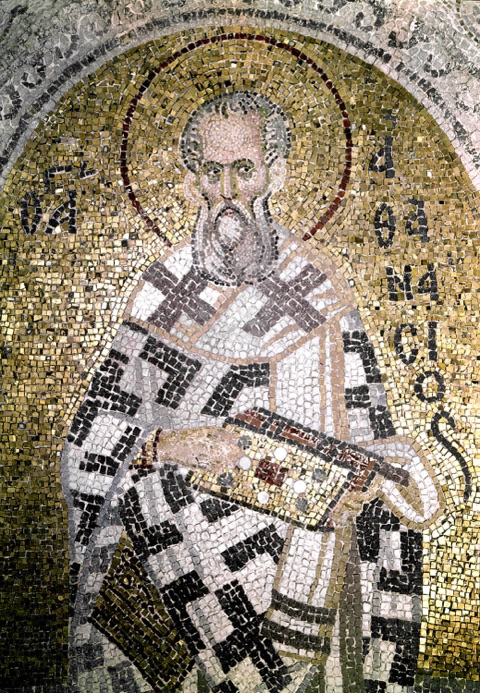
About the author
Athanasius of Alexandria
Athanasius of Alexandria (296 to 373 AD) was born in Alexandria and served as deacon and secretary to Bishop Alexander, with whom he attended the Council of Nicaea in 325. He succeeded Alexander as bishop in 328 and held the see for forty-five years, about seventeen of them in exile. A synod at Tyre deposed him in 335, and Constantine banished him to Trier in 336, the first of five exiles; in 356 he went into hiding among the monks of the Egyptian desert. His other writings include On the Incarnation, his letters to Serapion on the Holy Spirit and the Life of Anthony, and his 39th Festal Letter of 367 lists the twenty-seven books of the New Testament. He died at Alexandria in 373.