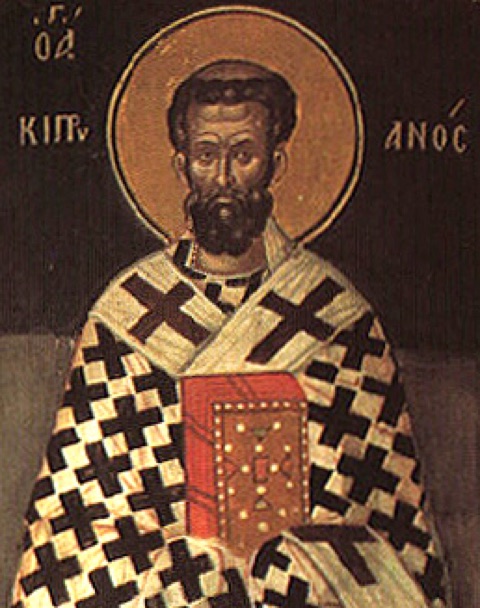
Tyconius
African lay theologian of the Donatist communion and author of the Book of Rules (Liber Regularum), the first Latin treatise devoted to the interpretation of Scripture. His seven rules for reading the Bible, and the ecclesiology behind them, passed into Augustine and through him into the medieval West. A large commentary on the Apocalypse, now lost, shaped the whole Latin tradition of reading Revelation and survives only in the writers who drew on it.
Biography
Almost nothing of Tyconius's life is recorded, and what little there is comes from other men's pages rather than his own. The chief notice is the short entry that Gennadius of Marseille added to his continuation of the catalogue of illustrious writers, supplemented by scattered remarks in Augustine, who read him closely a generation later. From these the outline is thin: an African, a layman rather than a cleric, and a member of the Donatist communion, active as a writer in the years around 370 to 390 AD. His given name, his standing, the place and manner of his life and death, none of it survives.
What does survive is the work, and one book above all. His Book of Rules (Liber Regularum), which we publish, is the first Latin treatise devoted to the interpretation of Scripture, a self-standing manual rather than a commentary on a single book. In it he set out seven rules by which the difficulties of the sacred text might be opened: Of the Lord and His Body; Of the Lord's Bipartite Body; Of the Promises and the Law; Of Species and Genus; Of Times; Of Recapitulation; and Of the Devil and His Body. The rules are less a mechanical key than a set of habits for reading, several of them turning on the relation between Christ and the church, or between the church and its adversary, as the text moves between the head and the body it speaks of.
He also wrote a large commentary on the Apocalypse, which has not come down to us as a whole. Its influence, however, was immense, and later Latin readers of Revelation drew on it so heavily that scholars have been able to reconstruct much of its substance from those who used it, among them Beatus of Liebana in Spain and Bede in England, along with earlier witnesses such as Primasius. The reconstruction is an inference from these later hands rather than a recovered original, but it is enough to show that Tyconius stands near the source of the medieval Latin way of reading the last book of the Bible, as a spiritual account of the church's whole course rather than a timetable of the end.
The deepest strain in his thought is an understanding of the church as a mixed body, containing within its one visible fellowship both true and false members, wheat and tares grown together until the harvest. This was an uneasy doctrine for a Donatist to hold. The Donatist church defined itself as the communion of the pure, separated from a wider church it regarded as defiled, and Tyconius's picture of a body inwardly divided cut against that separatist logic at its root. The Donatist party under its bishop Parmenian censured him for it. Yet he did not cross over to the Catholic side either, and he appears to have remained, awkwardly, within the communion whose founding premise his own theology unsettled.
Augustine, who was no Donatist, found much to admire in him. He praised the Book of Rules and set out a summary of the seven rules in his own On Christian Doctrine, though with reservations about how far such a method could carry a reader. More broadly, he took from Tyconius important elements of his own ecclesiology, the sense of the church in this age as a mixed body whose final sorting belongs to God, and this reading of the church forms part of the exegetical background against which Augustine's contrast of the two cities was later worked out. Scholars have long treated that connection as a commonplace; it is a matter of shared themes and inherited habits of reading rather than a passage Augustine signed as a borrowing, and it is best stated in those measured terms.
Beyond this, the record is silent. What can be said of Tyconius is drawn almost wholly from his surviving book, the fragments of his lost one, and the notices of the men who read him, and past that point there is nothing certain to add.
Why Tyconius Matters
Tyconius wrote the first Latin treatise on the interpretation of Scripture. Before him, Latin Christians had commentaries on particular books, but no freestanding attempt to state the principles by which the Bible as a whole should be read. The Book of Rules is that attempt, and it stands at the head of the Western tradition of biblical hermeneutics as a discipline in its own right. Whatever one makes of the individual rules, the ambition of the book, to give readers a method rather than a verse-by-verse gloss, was new in the Latin church and set a pattern others would follow.
He is also one of the more striking paradoxes in the history of the early church: a Donatist whose theology worked against Donatism. The Donatist cause rested on the claim to be the pure church, visibly separated from a corrupt majority. Tyconius's understanding of the church as a mixed body of true and false members, not to be sorted out by human hands before the end, dissolved the ground on which that separation stood. His own party sensed the danger and censured him, yet he neither recanted nor left. The result is a thinker whose most important idea belonged, by its logic, to the side he never joined.
That idea reached its future through Augustine. In taking up the Book of Rules, summarizing it, and absorbing its picture of the church into his own, Augustine became the channel by which Tyconius's ecclesiology and his manner of reading passed to the medieval West. Later readers who never knew the Donatist's name were formed by his thought at second hand, in the doctrine of the church as a mixed body and in the habit of reading prophecy as a spiritual account of the church's life. The exegetical background of Augustine's two cities belongs, in part, to this inheritance.
Even the lost commentary on the Apocalypse exerted its influence as a kind of ghost. It did not survive, but it was read and used so widely that it shaped the whole Latin tradition of interpreting Revelation, chiefly through later writers such as Beatus of Liebana and Bede who worked from it. The medieval West learned to read the last book of the Bible in a way that traces back, through those intermediaries, to a book no longer in existence, written by a man of whom almost nothing else is known.
Complete Works in English
Free to readEvery surviving work, translated in full and free to read, from our Patrologia Latina project.