Gregory the Great
Gregory the Great was bishop of Rome from 590 to 604, the author of the Book of Pastoral Rule, the Morals on Job and the Dialogues, and the pope who sent Augustine's mission to the English.
Biography
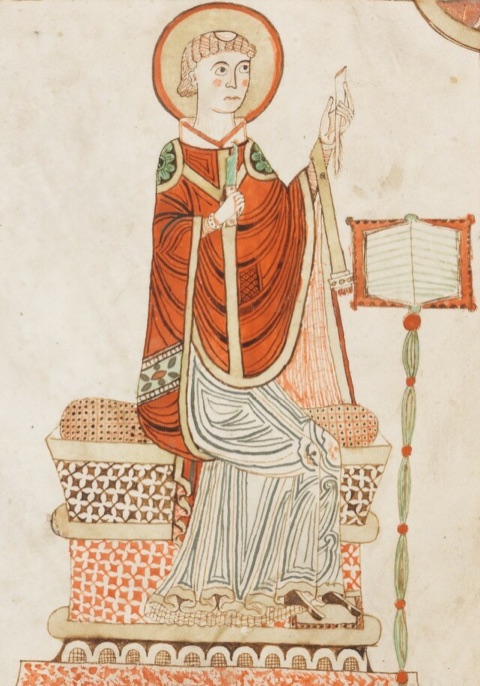
Gregory the Great (about 540 to 604 AD) was bishop of Rome from 590 until his death, and the first monk to hold that office. He was born in Rome to a wealthy and devout family and received the education of a young man headed for public service. By about 573 he was prefect of the city, the highest civil office in Rome.
Not long afterward he gave up public life. He turned his family home on the Caelian Hill into a monastery dedicated to Saint Andrew, founded further monasteries on the family estates in Sicily, and lived as a monk. The quiet did not last. He was ordained one of the deacons of Rome, and about 579 Pope Pelagius II sent him as envoy to the imperial court at Constantinople, where he spent several years and began his long commentary on Job, the Morals.
When Pelagius died of plague in 590, the clergy and people of Rome chose Gregory as his successor. He tried to avoid the office, and when John, bishop of Ravenna, reproved him for it, he answered with the Book of Pastoral Rule. As bishop he governed in a city weakened by plague, flood and the Lombard wars: he arranged food for the poor from the church's estates, negotiated with the Lombards, and managed the church's lands across Italy and Sicily. In 596 he sent Augustine, prior of his own monastery, with a party of monks to preach to the English.
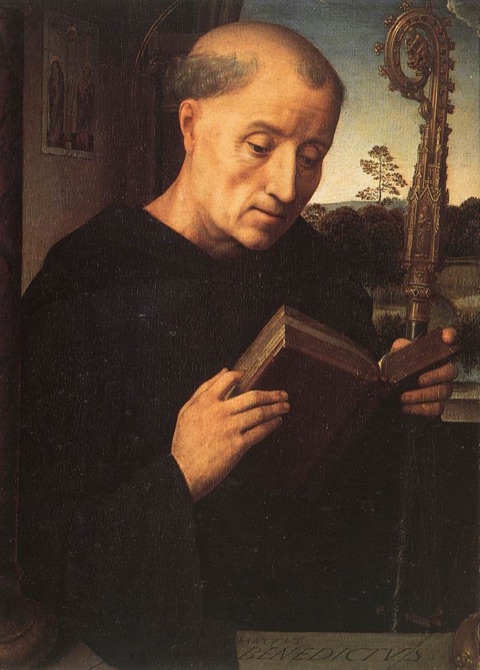
Gregory wrote constantly despite poor health. Besides the Morals and the Pastoral Rule, he left the Dialogues, whose second book is the main source for the life of Benedict of Nursia, sermons on Ezekiel and on the Gospels, and a large register of letters. He styled himself servant of the servants of God. He died in Rome on 12 March 604 and was buried in Saint Peter's.
Life & Career
Why Gregory Matters
Gregory is counted with Ambrose, Jerome and Augustine as one of the four Latin doctors of the church, and he is the one whose work was most directly practical. He was not a builder of new doctrine. He took the teaching of Augustine and the fathers before him and turned it toward the daily work of governing a church, preaching to ordinary people and caring for souls. His habit of reading Scripture for its moral meaning, seen throughout the Morals and the Pastoral Rule, shaped how the medieval West read the Bible.
The Book of Pastoral Rule became the standard handbook for bishops in the Latin West. Councils in the Carolingian era urged bishops to know it, and King Alfred translated it into Old English in the ninth century so that English clergy could read it. Its central claims, that no one should seek the care of souls for honor, that a pastor must live what he teaches, and that counsel must be fitted to the person who receives it, set the pattern for later writing on pastoral care.
Gregory also shaped the church through his acts as bishop. His mission to the English began the conversion of the Anglo-Saxon kingdoms, as Bede later recorded, and his Dialogues made Benedict of Nursia known across Europe and helped spread the monastic life that Benedict's Rule describes.