George Swinnock
George Swinnock was an English Puritan minister ejected from the Church of England in 1662, best known for The Christian Man's Calling and The Incomparableness of God. His treatises press the duties of holy living on ordinary readers through dense illustration drawn from trade, nature, and household life.
Biography
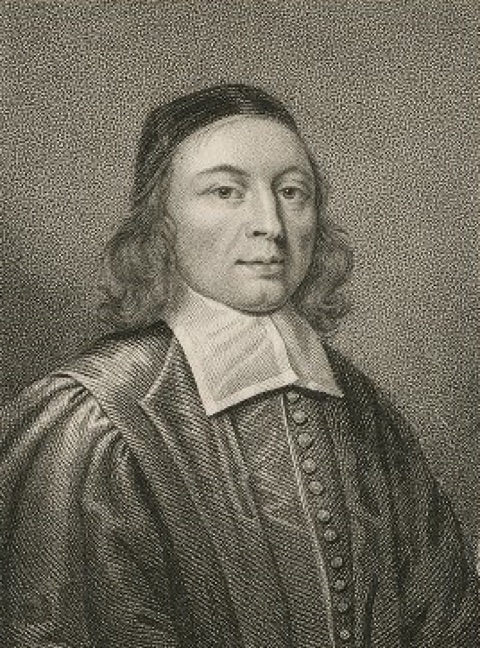
George Swinnock (1627 to 1673) was an English Puritan minister and devotional writer who was ejected from the Church of England in 1662 and is best remembered for The Christian Man's Calling, a long practical treatise on how faith should govern every relation and condition of daily life.
He was born at Maidstone in Kent around 1627. His father died while he was a child, and he was raised in the household of his uncle Robert Swinnock, a townsman of Maidstone. Swinnock studied at Emmanuel College, Cambridge, and afterward at Oxford, where he was connected with New Inn Hall and Balliol College and held a fellowship. His formation fell during the years of the English Civil War and the collapse of the old church settlement, and he entered the ministry as the Puritan cause was ascendant.
Swinnock served as minister at Rickmansworth in Hertfordshire and at Great Kimble in Buckinghamshire, and he acted as chaplain to Richard Hampden of Great Hampden, a member of the leading parliamentary family of the county. When the monarchy was restored in 1660 and Parliament passed the Act of Uniformity in 1662, Swinnock was among the roughly two thousand ministers who refused to conform and lost their livings. He gave up his public position rather than accept the terms of the restored Church.
After his ejection he continued to preach as a nonconformist. When Charles II issued the Declaration of Indulgence in 1672, easing the penalties on dissenting worship, Swinnock returned to his native Maidstone and gathered a congregation there. He died in 1673 and was buried in the town where he had been born.
Swinnock's reputation rests on his books rather than on any public office. The Christian Man's Calling, issued in parts, is a large manual of practical piety that treats how a believer should conduct himself in prosperity and affliction, in family and business, in youth and old age. The Incomparableness of God expounds the uniqueness of God against every rival, and shorter works such as Heaven and Hell Epitomised pressed the same experimental religion in briefer compass. His prose is crowded with similes drawn from trade, nature, and household life, a method aimed at fixing spiritual duties in the memory of unlearned readers.
Why Swinnock Matters
Swinnock belongs to the tradition of Puritan practical or experimental divinity, the branch of seventeenth-century English Protestantism concerned less with disputed doctrine than with the application of settled doctrine to conscience and conduct. His central work, The Christian Man's Calling, is a systematic attempt to map the whole of a believer's life, walking the reader through the ordinary business of family, work, adversity, and prosperity and prescribing how each is to be sanctified.
His distinctive contribution is method as much as matter. Where some contemporaries wrote in plain argument, Swinnock built his case out of accumulated illustration, converting commonplace scenes into emblems of spiritual truth. This made his writing accessible to lay readers and kept it in use as devotional reading long after the controversies of his own day had faded.
His ejection in 1662 placed him within the founding generation of English Nonconformity. The ministers who left the Church of England that year rather than accept the Act of Uniformity formed the Dissenting communities that would shape English religious life for the next two centuries, and their published writings, Swinnock's among them, became a substitute pulpit through which silenced preachers reached the public.
In the nineteenth century his collected writings were reprinted in five volumes as part of the Victorian revival of Puritan literature. That republication returned him to circulation among evangelical readers, and works such as The Incomparableness of God and The Christian Man's Calling have remained in print in that reforming stream since.