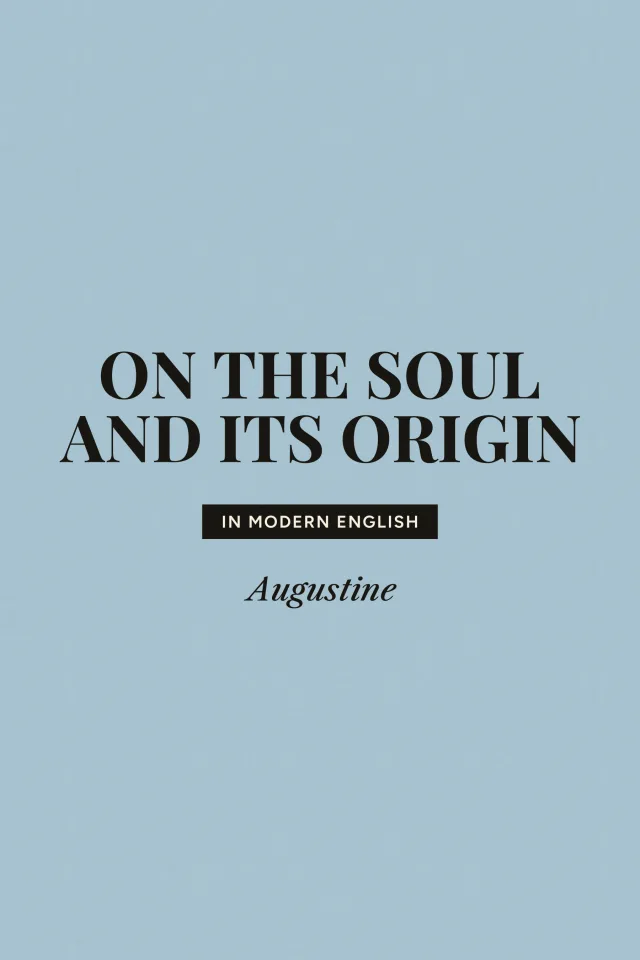
Written in 419 to 420 AD, On the Soul and Its Origin is Augustine's answer to Vincentius Victor, a young convert from the Rogatist schism who faulted him for not knowing whether souls come from the parents or are newly created by God. Book 1 goes to the monk Renatus, Book 2 is a letter to the presbyter Peter, and Books 3 and 4 address Victor himself. All four books and Augustine's own account of the work, in modern English.
The first 9 chapters are on this page, no sign-up. The full text and PDF/EPUB come with a free account, no card.
You’re on the list — we’ll email you if this goes to print.
Included with your free account
This book, and 300+ more, free to read
A free account opens the whole library to read online, on your phone or at your desk. Open a book on one device and it is waiting at the same page on the next. The PDF and EPUB of every book are yours to keep, and audiobooks play in the same app.
300+ modernized editionsNot samples. The whole work, free.
Your place, on every devicePhone, tablet or desktop, same page.
132 audiobooksOne at a time, or all of them with a supporter gift.
Nicene and Post-Nicene Fathers, vol. 5 (1887), Holmes and Warfield translation
Type
Controversial treatise on the soul
Structure
Retractions note, Book 1 (35 chapters), Book 2 (23), Book 3 (23), Book 4 (39)
Length
About 47,000 words
"On the Soul and Its Origin" is Augustine's four-book reply to Vincentius Victor, a young convert who claimed that God makes each soul out of himself. Written in 419 to 420 AD, it defends Augustine's uncertainty about where souls come from, names eleven errors, and argues that the soul is spirit, not body.
“when folly gains approval because of eloquence, and a poisonous drink is swallowed from a precious cup.”
From this edition
How the argument unfolds
01
Augustine on this treatise. Victor found a short work in which Augustine admitted he "did not know whether they are transmitted from the original soul of the first man through parental descent, or whether each person receives a soul separately." Augustine answered Victor's two books with four.
02
Made by God, not out of God (Book 1, Chapters 1 to 5). Writing to Renatus, Augustine rejects Victor's claim that God made the soul from his own self: "it was created by him out of nothing, not out of himself."
03
The soul's desert and unbaptized infants (Chapters 6 to 16). Victor said the soul deserved pollution by the flesh before any sin, and promised unbaptized infants the kingdom of heaven. Augustine presses him: "Let him tell us what the desert was." Neither the penitent thief nor Dinocrates sets aside Christ's command of baptism.
04
Victor's proof texts (Chapters 17 to 35). "I have created every breath" shows the soul is God's work, but not whether he makes it through propagation or by inbreathing. He points to the Maccabean mother: "I cannot tell, my sons, how ye came into my womb."
05
A letter to Peter (Book 2). Augustine asks the elderly presbyter, who had reportedly kissed the young layman's face in thanks, what Victor actually taught him.
06
Eleven errors (Book 3). To Victor himself: "I love you in order to correct you, not to follow you." Augustine lists eleven propositions "plainly and profoundly perverse and opposed to the catholic faith."
07
Knowledge and the soul's nature (Book 4). Augustine defends his uncertainty, argues from dreams and visions that the soul is not a body, and invites Victor to come and learn.
Key themes
Confessed ignorance over rash certainty. "It is better to acknowledge ignorance about something one does not know than either to fall into an already condemned heresy or to establish a new one."
Original sin and baptism. "all who are born of Adam pass into condemnation" unless born again in Christ, and the unbaptized are punished for original sin "even if, as in the case of infants, they add nothing to it."
The soul made, not begotten. Whatever comes from God's own being is unchangeable. The soul is changeable, so God made it out of nothing.
Correction in love. Augustine wants Victor "corrected rather than condemned."
Augustine on This Treatise
At that time, a man named Vincentius found a short work of mine in the possession of a presbyter named Peter in Mauritania Caesariensis. In one passage about the origin of souls in individual people, I had acknowledged that I did not know whether they are transmitted from the original soul of the first man through parental descent, or whether each person receives a soul separately, without such transmission, as Adam received the first soul. At the same time, I was quite sure that the soul was spirit, not body.
In opposition to these views of mine, Vincentius addressed two books to this Peter. The monk Renatus sent them to me from Caesarea. After reading them, I replied in four books: one addressed to the monk Renatus, another to the presbyter Peter, and two more to Victor himself. The one addressed to Peter, however, is only a letter, though it is as long as a book. I did not want it kept separate from the other three works.
In all four, while discussing many points that could not be avoided, I defended my uncertainty about the origin of the souls given to individual people. I also pointed out this man’s many errors and his presumptuous perversity. At the same time, I treated the young man as gently as I could, as someone who still needed instruction rather than someone who should be condemned outright. I accepted the account of his conduct that he sent me in reply.
In this work of mine, the book addressed to Renatus begins with these words: “Your sincerity towards us”. The one written to Peter begins: “To his Lordship, my dearly beloved brother and co-presbyter Peter.” Of the last two books, addressed to Vincentius Victor, the first opens: “As to that which I have thought it my duty to write to you.”
Chapter 1: Renatus’s Kindness
Dearest brother Renatus, we already had clear proof of your sincerity toward us, your brotherly kindness, and the affection of our mutual love. Now you have given us still clearer proof by sending me two books written by someone I knew nothing about, though that was no reason to despise him. His name is Vincentius Victor, for that is how I found his name written at the beginning of his work. You sent the books in the summer of last year, but because I was away from home, they did not reach me until the end of autumn.
With your great affection for me, how could you have lacked either the means or the desire to bring writings of this kind to my attention if they came into your hands, whoever wrote them, even if they were addressed to someone else? How much less could you have failed to do so when my own name appeared in them, especially in an argument against words I had published in some short treatises? In doing all this, you have acted just as I knew my sincere and beloved friend would act.
Chapter 2: Receiving Victor’s Criticism
I am somewhat saddened, however, that your Holiness has understood me less well than I would wish. You supposed that I would receive your message as though you had injured me by telling me what someone else had done. You can see how far that feeling is from my mind: I do not complain of having suffered any wrong even from him. When he held views different from mine, was he obliged to remain silent? Surely I should be pleased that he spoke in a way that allowed us to read what he had to say.
I certainly think he should have written directly to me rather than to someone else about me. But because he was unknown to me, he did not venture to approach me personally to refute my words. He thought there was no need to consult me on a matter about which, in his own judgment, he was especially unlikely to be doubted, holding an opinion he considered perfectly well known and certain. Moreover, he was obeying a friend who, he tells us, compelled him to write.
If he expressed anything insulting to me during the controversy, I would rather suppose that he did so because he had to disagree with me than because he wished to treat me rudely. Whenever someone’s attitude toward another person is uncertain and unknown, I think it better to suppose the kinder motive than to find fault with a motive that has not been established. Perhaps he even acted out of love for me. He may have known that what he wrote could reach me and been unwilling for me to remain mistaken on points about which he especially considers himself free from error.
I should therefore be grateful for his kindness, although I must disapprove of his opinion. Where his views are wrong, he seems to me to deserve gentle correction rather than harsh condemnation. This is especially so because, if I have been correctly informed, he has recently become a catholic, something for which he should be congratulated. He has freed himself from the schism and errors of the Donatists, or rather the Rogatists, in which he was previously involved. If he understands catholic truth as he should, we can indeed rejoice at his conversion.
Chapter 3: Eloquence and Its Dangers
He has the eloquence to explain what he thinks. We must deal with him accordingly and hope that he will hold sound views. We must hope that he will not make useless things seem desirable or make whatever he expresses eloquently appear to have been established as true.
Yet his very readiness to speak may leave him much to correct and much excessive wording to prune away. This characteristic has indeed offended you, a serious-minded person, as your own writings show. But this fault is either easily corrected or, if frivolous minds delight in it and serious minds put up with it, does no harm to their faith. We already have among us people whose speech is frothy but whose faith is sound.
We need not despair, then, that this quality in him may be moderated and purified, though it could be tolerated even if it remained. His expression may be expanded or restrained until it meets a thoroughly sound standard. This is especially possible because he is said to be young. Diligence may supply what his inexperience lacks, and maturity may digest what raw talkativeness cannot. The troublesome, dangerous, and destructive thing is when folly gains approval because of eloquence, and a poisonous drink is swallowed from a precious cup.
Chapter 4: Created by God, Not from God
I will now point out the chief things to avoid in his controversial argument. He says that the soul was indeed made by God, but that it is not a part of God or of God’s nature. This is entirely true. Yet he refuses to admit that it was made out of nothing and names no other created thing from which it was made. He makes God its author in such a sense that God must be understood to have made it neither from anything nonexistent, that is, from nothing, nor from anything existing apart from God, but from his very self.
He hardly realizes that his thoughts have circled back to the position he thinks he has avoided: that the soul is nothing other than God’s nature. By his reasoning, God himself would have made something from his own nature, using his own very self as the material from which he made it. God’s nature would thus be changeable, and through a change for the worse, God’s very nature would incur condemnation from God himself!
You can readily see how unworthy all this is of your intelligent faith, how foreign to a catholic heart, and how carefully it must be avoided. Whether the soul is made from the breath or God’s breath is made into the soul, it was created by him out of nothing, not out of himself.
This is unlike the case of a human being breathing. A person cannot produce a breath out of nothing, but returns to the air the breath inhaled from it. We might suppose something similar of God: that air surrounded him, that he drew some of it in by inhaling and sent it out again by exhaling when he breathed into the human face and so formed a soul. If that were the process, what he breathed out would have come from the surrounding air, not from his very self.
But far be it from us to say that the Almighty could not have made out of nothing the breath of life by which the human being might become a living soul. We must not force ourselves into such a difficulty that we must either think something already existed apart from God, from which he formed the breath, or suppose that he formed from himself something we see to be subject to change.
Whatever comes out of his own being must necessarily share his nature and therefore be unchangeable. But the soul, as everyone agrees, is changeable. It therefore does not come out of his being, because it is not unchangeable as he is. If, however, it was not made from anything else, it was undoubtedly made out of nothing, but by God himself.
Chapter 5: Is the Soul a Body?
As for his contention “that the soul is not spirit, but body,” what else can he mean to establish except that we consist, not of soul and body, but of two or even three bodies? He says that we consist of spirit, soul, and body, and asserts that all three are bodies. It follows that he thinks we are made up of three bodies.
I think the absurdity of this conclusion needs to be demonstrated to him rather than to you. Still, this is not an intolerable error in someone who has not yet discovered that something can exist which, though not bodily, can nevertheless bear some resemblance to a body.
Chapter 6: How Could the Soul Deserve Defilement?
But what he says in his second book is plainly intolerable. There he tries to solve a very difficult question about original sin: how it belongs to both body and soul if the soul is not transmitted from the parents but is breathed afresh by God into a human being. Struggling to explain this difficult and profound point, he expresses his view as follows: “Through the flesh the soul fitly recovers its primitive condition, which it seemed to have gradually lost through the flesh, in order that it may begin to be regenerated by the very flesh by which it had deserved to be polluted.”
You see how this man, daring to undertake something beyond his powers, has fallen over such a precipice that he says the soul deserved to be defiled by the body. Yet he could not explain how the soul had incurred this desert before it took on flesh. If it first acquired its desert of sin from the flesh, let him tell us, if he can, how, before sin, it deserved to be contaminated by the flesh.
This desert, which sent the soul into sinful flesh to be polluted by it, must have come either from the soul itself or, much more offensively to our minds, from God. Before being clothed in flesh, the soul certainly could not have received from that flesh the guilt for which it was sent into flesh to be defiled by it. If it acquired that guilt from itself, how did it do so, seeing that it committed no sin before taking on flesh? But if anyone alleges that the guilt came from God, who could listen to such blasphemy? Who could endure it? Who could allow it to be alleged without challenge?
Remember, the question here is not what guilt condemned the soul after it became embodied. The question is what guilt it had before entering the flesh, for which it was condemned to be clothed in flesh and thereby polluted. Let him explain this to us, if he can, since he has dared to say that the soul deserved to be defiled by the flesh.
Chapter 7: Foreknowledge Does Not Cause Sin
Elsewhere, when he brings forward for explanation the same question in which he has entangled himself, he speaks in the voice of certain objectors: “Why, they ask, did God inflict upon the soul so unjust a punishment as to be willing to relegate it into a body, when, by reason of its association with the flesh, that begins to be sinful which could not have been sinful?”
Surely, amid the reefs of such a question, he should have guarded against shipwreck. He should not have ventured into dangers he could not hope to pass through safely, where his only chance of safety lay in turning back, that is, in repentance. He tries to free himself by appealing to God’s foreknowledge, but without success. God’s foreknowledge only identifies beforehand the sinners he intends to heal. For if God frees from sin souls that he himself involved in sin when they were innocent and pure, he would be healing a wound he had inflicted on us, rather than one he found in us.
May God forbid it! Far be it from us to say that when God cleanses infants’ souls by the washing of regeneration, he corrects evils he himself produced in them by joining their previously sinless souls to sinful flesh, so that they would be contaminated by its original sin. As for the souls this accuser alleges deserved pollution by the flesh, he is quite unable to tell us how they deserved so great an evil before their union with the flesh.
Chapter 8: Deliverance Does Not Explain Guilt
Vainly supposing that he could solve this question through God’s foreknowledge, he continues to flounder and says: “If the soul deserved to be sinful which could not have been sinful, yet neither did it remain in sin, because, as prefigured in Christ, it was not bound to be in sin, even as it was unable to be.”
What can he mean by “which could not have been sinful” or “was unable to be in sin” except, I suppose, that it could not have been sinful if it had not entered the flesh? For if the soul is not transmitted from the parent, it could not have been sinful through original sin, or involved in original sin at all, except through the flesh.
We see, then, that it is freed from sin through grace, but we do not see how it deserved to become involved in sin. What does he mean by these words: “If the soul deserved to be sinful, yet neither did it remain in sin”? If I asked him why it did not remain in sin, he would quite properly answer, “Because the grace of Christ delivered it from sin.” Since he tells us how an infant’s soul came to be freed from its sinfulness, let him also tell us how it came to deserve to be sinful.
Questions
What is "On the Soul and Its Origin" about?+
Augustine's reply to Vincentius Victor, who criticized him for not deciding whether souls come from the parents or are created anew. Augustine defends that uncertainty and refutes Victor's errors on the soul, original sin and baptism.
Who was Vincentius Victor?+
A young layman lately come from the Rogatists to the catholic Church, who took the name Vincentius from Rogatus's successor.
Where does Augustine say the soul comes from?+
He leaves transmission and new creation undecided, but holds that every soul is made by God: "I have no certain knowledge of how it came into my body, for I did not give it to myself."
What does Augustine teach about infants who die unbaptized?+
That they bear original sin, that nothing frees from it "except Christ’s baptism in Christ’s Church," and that no middle place of rest between condemnation and the kingdom of heaven may be promised them.
Is the soul a body?+
No. Against Victor, Augustine holds that "although souls contain incorporeal likenesses of bodies, they are not themselves bodies."
Is there a free PDF or full text in English?+
Yes. The complete text in modern English is free on this page as a PDF and EPUB: all four books and 120 chapters.
Augustine of Hippo (354 to 430 AD) was bishop of Hippo Regius in Roman North Africa and one of the most influential theologians of the Latin church. Born at Thagaste in Numidia to a pagan father and a Christian mother, Monica, he was trained in rhetoric, spent years among the Manichaeans, and became professor of rhetoric at Milan in 384. Under the influence of Ambrose he was converted in 386 and baptized at Easter 387. Ordained priest at Hippo in 391, he became its bishop in 395 and wrote the Confessions, The City of God, and many works against the Manichaeans, the Donatists and the Pelagians. On the Soul and Its Origin comes from the years of his controversy with the Pelagians over grace and original sin. He died in 430 as the Vandals besieged Hippo.
“Updated Works has been an incredible blessing to my Christian life and ministry… remarkably faithful to the original authors while making these timeless treasures understandable for modern readers.”