One free account opens 250+ books and saves your place on every device. Google sign-in or an email link. No card.
You’re on the list — we’ll email you if this goes to print.
Included with your free account
This book, and 250+ more, free to read
A free account opens the whole library to read online, on your phone or at your desk. Open a book on one device and it is waiting at the same page on the next. The PDF and EPUB of every book are yours to keep, and audiobooks play in the same app.
250+ modernized editionsNot samples. The whole work, free.
Your place, on every devicePhone, tablet or desktop, same page.
131 audiobooksFrom $4.99 each, or all of them with a $50 gift.
Isaac Ambrose’s Looking Unto Jesus is one of the great devotional masterworks of the Puritan era. Born out of a period of serious illness in 1653, the book traces the entire work of Christ in salvation from eternity past to eternity future, calling believers to direct every spiritual affection toward Him. Ambrose structures the work around the successive acts of the soul—knowing, considering, desiring, hoping, believing, loving, rejoicing in, and conforming to Jesus—applied to each stage of Christ’s redemptive work, from His eternal counsels before creation through His birth, life, death, resurrection, ascension, intercession, and coming return.
What sets this book apart from other works on Christ is its deeply experiential character. Ambrose is not content with theological abstraction; he wants the reader to feel the weight of each truth and to practice a daily discipline of turning the heart toward Jesus. He offers a practical method: devoting time each day to one particular aspect of Christ’s work, engaging with it through a different spiritual affection, and cycling through the whole over time. The result, he promises, is a devotional life that never grows stale, because Christ Himself contains infinite variety—He is lion and lamb, servant and Son, man and God, Alpha and Omega.
This modern English edition preserves the warmth, urgency, and spiritual depth of Ambrose’s original while making it fully accessible to contemporary readers. For anyone seeking to deepen their personal devotion to Christ, to move beyond surface-level Christianity into a life of sustained meditation and heartfelt worship, Looking Unto Jesus remains as powerful and relevant today as when it was first written.
To the Reader
Among all the duties I mentioned previously, I left out one that I consider the most important of them all: the duty I call Looking unto Jesus. Since I should explain how I came to write on this subject, I will do so honestly and directly. In the spring of 1653, I fell seriously ill, and as the Lord began to restore my health, my thoughts turned to what Jesus had done for my soul, what He was doing even then, and what He would continue to do until He had saved it completely. As I reflected on these things, I could find no starting point for His work except in that eternity before the world was made, and no ending point except in that eternity after the world will have passed away. Between those two extremes, I began to perceive the many transactions of Jesus Christ: past, present, and still to come. As these thoughts multiplied within me, my soul found in them an extraordinary delight, and that delight stirred up other affections in me. I began to examine those passages of Scripture that seemed to call believers to direct their affections toward so blessed an object as a matter of gospel duty. I resolved then that if the Lord Jesus would restore my health and extend my life, I would work to understand this gospel duty more deeply than I ever had before.
And so that this project would not interfere with my other necessary work, I planned to take up the subject in my regular preaching, where I would have opportunity to search the Scriptures, consult various authors, and examine my own heart.
As time went on, I began this work, asking God to help me finish what He had inclined me to start, and praying that all of it would serve His glory and the good of the church. As my labors progressed, I found an abundance of spiritual comfort, both in the subject I was handling, Jesus Christ, and in the act itself, which defined my duty to Him: looking unto Jesus.
1. As for the subject, it was the very theme I was most obligated to preach. “Christ in you, the hope of glory,” Paul told the Colossians, and he immediately adds, “whom we preach” (Col 1:27-28). And again: “To me, who am less than the least of all the saints, this grace was given: what grace? That I should preach among the Gentiles the unsearchable riches of Christ” (Eph 3:8). Ministers are especially bound to preach Jesus Christ, and I can say from personal experience that He is the sweetest subject ever preached. Is He not “as an ointment poured forth, whose smell is so fragrant and whose savor is so sweet, that therefore all the virgins love him”? Does He not encompass all glory, beauty, and excellence, whether in heaven or on earth? Is He not a mystery both sweet and deep? Volumes have been written about Jesus Christ; there is line upon line, sermon upon sermon, book upon book, and yet such is the mystery that we are all still, in a sense, on the first page of learning about Him. Solomon was content to ask merely “What is his name?” and I fear many of us know neither the name nor the reality behind it. It is a worthy pursuit to press further and further into this blessed mystery, and one could wish that all the ministers of Christ would pour themselves into spelling it out, reading it carefully, and working to understand it. Just as some great question requires the combined abilities of many scholars, and even then barely yields its secrets, so too is this high and holy mystery worthy of the effort of every learned person. And if they were all to bring their notes together and pool their studies, they would still find that only a small portion of this mystery had been grasped, compared to what remains unknown.
2. The act of looking unto Jesus encompasses knowing, hoping, believing, and loving, but it also encompasses joy. How could I have been anything other than filled with unspeakable, glorious joy while I was studying, writing, and especially drawing my soul into the practice of this looking? If any duty on earth resembles the duty of the saints in heaven, I would say without hesitation that this is it. Mr. Rutherford writes: “An act of living in Christ, and on Christ, in the acts of seeing, enjoying, embracing, loving, resting on him, is that noon-day divinity, and theology of beatific vision. There is a general assembly of immediately illuminated divines round about the throne, who study, lecture, preach, praise, Christ night and day. Oh, what rays, what dartings of intellectual fruition, beholding, enjoying, and living in him, come from that face, that God-visage of the Lord God Almighty, and of the Lamb that is in the midst of them! And, oh, what reflections, and reachings forth of intellectual vision, embracing, loving, wondering, are returning back to him in a circle of glory!” Now if this is the duty of the saints who are perfected in glory, don’t we imitate them, and feel something of heaven in that imitation, when we too look unto Jesus? I write what I have felt, at least in part, and what I hope to feel far more deeply still. So whoever you are who reads this, I beg you: come, warm your heart at this blessed fire. Come, breathe in the precious fragrance of Jesus Christ. Come, sit down under His shadow with great delight. If only all people, especially those into whose hands this book comes, would immediately take up the practice of this gospel art of looking unto Jesus. If they find nothing of heaven in it, then my understanding has failed me entirely. Only let them pray that, as they look to Him, virtue may go out from Him and fill their souls.
Reader, one final thing I want to say to you. If you want to sustain this practice consistently, the way you do your morning and evening prayers, it would be worth setting aside time each day, either in the morning or the evening, to work through it in portions, taking some part at one time and some part at another, at least for a season. I know people who maintain a steady daily rhythm of two essential spiritual disciplines in private: meditation and prayer. What they choose to meditate on, I can’t say with certainty. But experience teaches us this much: whether the subject is heaven or hell, sin or grace, or anything else, if we return to the exact same theme either constantly or too frequently, we tend to grow sluggish, cold, or merely mechanical about it. The reason is simple: one thing grows tiresome quickly, unless that one thing contains everything. And that is precisely what Christ is, for “he is all” (Col 3:11).
So if just once a day you would make Jesus Christ your subject, engaging with Him through knowing, considering, desiring, hoping, believing, rejoicing, calling upon, and conforming yourself to Him, in each of His distinct roles in accomplishing your redemption, including His birth, life, death, resurrection, ascension, session at the right hand of the Father, intercession, and return, and if you devoted each day to one of these particulars, moving from first to last in this ongoing practice of looking to Jesus, I believe you would never grow weary of it. Why not? Because there is variety both in the subject itself and in the manner of approaching it. For instance: one day you might exercise your knowing of Jesus in a particular respect; the next day you might consider Jesus in that same respect; the day after, you might desire Jesus in that respect; and the day after that, you might hope in Jesus in that respect, and so on, until you reach the end of the whole work. Wouldn’t that kind of variety keep you engaged? Mr. Lockyer observes, on Col 1:16, that “a holy soul cannot tire itself in the contemplation of Jesus.” How much less, then, can it tire itself in looking to Jesus, which is a far richer and more comprehensive exercise than contemplation alone! Come, try this practice, and commit to it for at least one year, and then every year for the rest of your life. As for meditations on other subjects, I won’t pull you away from them entirely; I’ll leave the rest of the year to your own discretion. If you’re resolved to do this, I have nothing more to add except: may the Lord be with you. And if, sooner or later, you find any benefit in this work, give God the glory, and remember in your prayers the one who took these pains for Christ’s honor and your soul’s good. So rests your servant in Christ Jesus, I. A.
Chapter 1: The Meaning and Structure of “Looking unto Jesus”
The greatest subject anyone can speak or write about is Jesus Christ. Augustine had read Cicero’s works and praised them for their eloquence, but he passed this verdict on them: “They are not sweet, because the name of Jesus is not in them.” And truly, everything we say is tasteless unless it is seasoned with this salt. “I determined not to know anything among you,” Paul writes, “save Jesus Christ, and him crucified” (1 Cor 2:2). Before he preached among the Corinthians, Paul had resolved that this would be the one point of knowledge he would claim mastery of, and the one truth he would labor to bring them to throughout his ministry. He made it the breadth and length and depth and height of everything he knew. “Yes, doubtless,” he says, “and I count all things but loss, for the excellency of the knowledge of Christ Jesus my Lord” (Phil 3:8). In the knowledge of Christ there is an excellence that surpasses every other kind of knowledge in the world. Nothing is more pleasing and comforting, more energizing and life-giving. Christ is the sun and center of all divine and revealed truth: we can preach nothing else as the object of our faith that does not, in one way or another, either meet in Christ or point back to Christ. Christ alone is the whole of human happiness; the sun to enlighten us, the physician to heal us, the wall of fire to defend us, the friend to comfort us, the pearl to enrich us, the ark to carry us, the rock to sustain us under the heaviest burdens: “as a hiding-place from the wind, and a covert from the tempest, as rivers of water in a dry place, and as the shadow of a great rock in a weary land” (Isa 32:2). Christ alone is that ladder between earth and heaven, the Mediator between God and man; a mystery that the angels of heaven long to look into.
What a blessed subject this is. Who wouldn’t want to know it more deeply? “This is life eternal, to know God, and Jesus Christ whom he hath sent” (John 17:3). Come, then, let us look on this Sun of righteousness. Such a look can only do us good, never harm. It’s true that staring too long at the natural sun can dazzle our eyes and darken our faces; but looking unto Jesus will make our eyes clearer and our faces brighter. If the simple light of the eye gladdens the heart, how much more when we have such a blessed object to gaze upon! As Christ surpasses all the world in excellence, so this sight surpasses every other sight. Looking unto Jesus: the summary of a Christian’s happiness, the very essence of what the gospel calls us to do.
In this text, we have both the act and its object. The act itself, in the original language, is highly emphatic, and the English translation doesn’t fully capture it. It describes a deliberate movement of the eye from one object to another, and it actually contains two distinct ideas: turning the eye away from everything else, and then fixing it firmly on a single object. So it is both a looking away and a looking toward. Toward what? That is the object: looking unto Jesus, a title that speaks of His mercy, just as “Christ” speaks of His office. I don’t mean to insist on this particular name at the expense of His other names. He is frequently called Christ, Lord, Mediator, Son of God, and Emmanuel, and Jesus encompasses all of these. He is Jesus the Christ, as the Anointed of God; Jesus the Lord, as the one who holds dominion over all creation; Jesus the Mediator, as the one who reconciles God and humanity; Jesus the Son of God, as the one eternally begotten before all worlds; and Jesus Emmanuel, as the one who took on flesh and became God with us. But because “Jesus” means Savior, and because that name was given to Him for precisely that reason, “he shall save his people from their sins” (Matt 1:21), my purpose here is to look at Jesus specifically as the one who carries out the great work of our salvation from beginning to end. This, after all, is the good news, the gospel, the gospel’s privilege and its call to us: looking unto Jesus.
Chapter 2: The Duty of Looking Away from All Other Things
Before anything else, we must look away from everything else. We must draw our minds back from whatever might pull us off course in our Christian race and distract us from looking unto Jesus.
But what exactly are the things we must look away from? The answer is: 1. Good things. 2. Evil things.
1. Good things. The apostle speaks of a cloud of witnesses in the preceding verse, and there is certainly a time to look to them. But when this second object comes into view, he disperses that cloud entirely and sets up Jesus himself: now the apostle calls us to turn our eyes away from them and toward Jesus Christ, as if to say, “If you want to see something truly worth seeing, look to him.” The saints, though they serve as guides to us, are themselves only followers of him; he is the leader of them all, and of us as well. Look to him. There is a time when James may say, “Take, my brothers, the prophets who have spoken in the name of the Lord as your example” (Jas 5:10); but when Jesus steps forward and says, “I have given you an example” (John 13:15), an example above all others, then let all flesh fall silent before the Lord. Let every saint and seraphim cover their faces with their wings, so that we may look on Jesus and let every other sight go.
2. Evil things. We must look away from everything the world offers, which the apostle gathers under three headings: “the lusts of the eyes, the lusts of the flesh, the pride of life” (1 John 2:16), or in other words, pleasures, profits, and honors.
1. We must look away from this world’s sinful pleasures. Jude tells us that “those who are sensual do not have the Spirit” (Jude 19). We cannot fix our gaze on pleasures and on Jesus at the same time.
2. We must look away from this world’s sinful profits. A lingering look at worldly gain keeps us from looking to Jesus. “Whoever loves the world, the love of the Father is not in him” (1 John 2:15). The degree to which the world gains a hold on us is the degree to which God’s love is diminished both within us and toward us. “You adulterers and adulteresses,” says James, “do you not know that friendship with the world is enmity with God?” (Jas 4:4). When we already have God and Christ, and yet still reach for the creature to complete our happiness, that is nothing less than spiritual adultery.
3. We must look away from the world’s honors. What is this craving to be well thought of, or well spoken of? It’s like a man running back and forth trying to catch a feather drifting through the air. He may never catch it at all, and even if he does, it’s only a feather. Honor is much the same: it’s difficult to obtain, and once obtained, it amounts to nothing more than the breath of a few people’s mouths. But worst of all, it blocks our view of Christ. “Not many wise men after the flesh, not many mighty, not many noble, are called” (1 Cor 1:26). Worldly honor keeps many people from coming to Christ.
But why must we look away from everything that pulls our gaze from Jesus?
1. Because we cannot fix our eyes on Christ and on these other things at the same time. The eye cannot look up and down simultaneously; we cannot genuinely attend to heaven and earth in a single thought. “No man can serve two masters” (Matt 6:24), especially masters who are in conflict and demand opposing loyalties, as Christ and wealth do.
2. Because while we are looking at these things, we cannot see the beauty that is in Christ. When our longing gaze is fixed on other things, Christ becomes small and contemptible in our eyes.
3. Because all other things, compared to Christ, are not worth a single glance. They are poor, low, and base in comparison to Him. “I count all things but loss,” Paul writes, “for the excellency of the knowledge of Christ Jesus my Lord. I count them but dung, that I may win Christ” (Phil 3:8). Some translate the original word as chaff, others as scraps fit for dogs, others as excrement or dung. All agree it refers to something people typically throw away from themselves with disgust.
4. Because this is the very logic of marriage: “Therefore shall a man leave father and mother, and cleave unto his wife” (Gen 2:24). The Lord Christ joins Himself to the souls of His saints, and for this reason the soul must forsake all else and cleave to Christ alone.
5. Because Christ is a jealous God. Jealousy is a passion that refuses to share the object of its love with anything else. In the same way, Christ will not tolerate us fixing our eyes on other things and longing after them.
6. Because nothing else can ever truly satisfy the eye. “All things are full of labor,” Solomon says, “man cannot utter it; the eye is not satisfied with seeing” (Eccl 1:8). The eye grows weary from looking at one object after another, yet keeps craving something new. But once it is admitted to that glorious sight of Christ, it finds complete and lasting rest.
Chapter 3: Looking unto Jesus as an Experiential Gospel Ordinance
What my text calls for is an experiential looking at Jesus. This is not a surface-level knowledge of Christ, but a heartfelt awareness of His inward workings within us. It is not ideas about Christ, but genuine movements of the heart toward Christ, that this kind of inward looking truly means.
2. Consider the object of your gaze: you must look on Jesus. He is the most blessed object the mind’s eye can possibly fix upon. Among all things under heaven, Jesus holds the highest place in perfection, and He should hold the highest place in our meditation. He is the one who will make us most fully happy when we possess Him, and we cannot help but rejoice when we look upon Him, especially since looking is itself a form of possessing. The name “Jesus” means Savior. It is a Hebrew name that the Greeks borrowed from the Hebrews, the Latins from the Greeks, and all other languages from the Latins. It derives from the Hebrew Jehoshua, or Joshua, which in the books of Ezra and Nehemiah (written after the Babylonian captivity) appears as Jeshua; and this is also how our Savior’s name is always written in the Syriac translation of the New Testament. This name, Jesus, was given to Christ the Son of God by His Father and brought from heaven by an angel: first to Mary, and then to Joseph. On the day of His circumcision, as was the custom, His parents gave Him this name as the Lord had commanded through the angel Gabriel. The name encompasses both His office and His natures. He is the sole Savior of humanity, for there is no other name under heaven given among men by which we must be saved. And He is a complete and perfect Savior: “he is able to save them to the uttermost that come unto God by him; seeing he ever liveth to make intercession for them” (Heb 7:25).
I will not deny that the work of salvation belongs to all three persons of the Trinity. There is a well-established principle that all outward actions are equally common to the three persons. Since they are one in nature and will, they must also be one in operation: the Father saves, the Son saves, and the Holy Spirit saves. Yet we must distinguish among them in the manner of saving. The Father saves through the Son; the Son saves by paying the ransom and price of our salvation; the Holy Spirit saves by personally applying that ransom to individual men and women. Because it is the Son who pays the price of our redemption, and not the Father or the Holy Spirit, He is, in this specific and decisive sense, called our Savior, our Jesus.
Christ’s offices, His two natures, His qualities, His excellencies: all of these are set forth here. What an extraordinary wealth of substance there is in Jesus! He contains within Himself all the finest treasures of creation. A devout soul could never grow weary of contemplating Him. We know that a single thing grows tiresome quickly, unless that one thing contains everything. Christ is exactly that, and nothing else ever could be. He is all, and in all: everything that belongs to existence itself, and everything that belongs to flourishing within it. Among lesser things, some possess this excellence and others possess that one, but none possesses all. What variety there is in Jesus! Variety of time: He is the Alpha and Omega. Variety of beauty: He is white and ruddy. Variety of character: He is lion and lamb, servant and Son. Variety of nature: He is man and God. Where do we even begin when we turn our gaze to Jesus? Who shall declare His generation? All four evangelists present the Savior to us, yet each does so in his own distinctive way. Mark sets aside the genealogy entirely and opens his account at the baptism. Matthew traces the origin of Jesus back to Abraham. Luke follows the line further still, all the way back to Adam. John reaches further yet, ascending to the eternal generation of the Word who was made flesh. In this way, the four evangelists lead us to Jesus by four ascending steps: in the first, we see Him only among the people of His own time; in the second, He appears within the household of Abraham; in the third, He stands higher still, in Adam himself; and finally, having passed through all ages and all generations, we arrive at the contemplation of Him in the beginning, in the bosom of the Father, in that eternity before all worlds where He dwelt with God. There let us begin, still looking to Jesus, as He carries forward the great work of our salvation from first to last, from everlasting to everlasting.
BUT as the foundation of our entire discussion, take careful note of this: inward, experiential looking unto Jesus, the kind that stirs up genuine affection in the heart and produces visible effects in our daily lives, is an ordinance of Christ, a choice and exalted gospel ordinance. Put another way: inwardly and experientially knowing, considering, desiring, hoping, believing, loving, rejoicing in, calling upon, and conforming to Jesus is the most precious ordinance Jesus Christ has given us.
Looking unto Jesus is the great ordinance appointed by God for our deepest and most essential good. How many souls have found blessing through other spiritual means, and while Christ has certainly communicated some measure of grace through those means, they received comparatively little because they did not engage with them more fully? Someone who deals directly and immediately with Christ will accomplish more in a single day than another person will in an entire year. This is precisely why I call it a choice, a complete, and an exalted gospel ordinance.
1. Jesus is the object of this looking, Jesus as our Savior, who has accomplished or will yet accomplish the great work of our salvation. “Looking unto” is the act itself, but it is an act that encompasses all of the following: knowing, considering, desiring, hoping, believing, loving, rejoicing in, enjoying, and conforming to Jesus. It is the kind of look that stirs genuine affection in the heart and produces real effects in our lives. It is the kind of look that leaves a quickening vitality on the spirit. It is the kind of look that works within us a warm affection, a renewed resolution, and a holy and upright way of living. In short, it is an inward, experiential looking unto Jesus.
This was the Lord’s charge to the Gentiles of old: “Look unto me, and be saved, all the ends of the earth” (Isa 45:22) and “Behold me!” (Isa 65:1) spoken to a nation that had never been called by His name. And the practice of the faithful matched this command: “Mine eyes are ever towards the Lord” (Ps 25:15), says David. “They looked unto him, and were lightened, and their faces were not ashamed” (Ps 34:5). Gospel believers follow the same pattern: “We all, with open face beholding as in a glass the glory of the Lord, are changed into the same image, from glory to glory, even as by the Spirit of the Lord” (2 Cor 3:18). In place of the veil of Mosaic figures and shadows, God has now given His church the clear glass of the gospel. Because of this, all believers under the gospel behold Christ through contemplative faith, together with the glorious light of His mercy, His truth, and the rest of His divine attributes; and through that beholding, they are made like Him in the glory of holiness and in newness of life.
So then, is this inward, experiential looking unto Jesus a cherished and elevated gospel ordinance? If so, how much does it rebuke thousands? How many people give no thought to this duty at all? The truth is that just as the whole world lies in wickedness, so the eyes of the whole world are looking in the wrong direction. Few people take seriously this choice, this high gospel ordinance. I will therefore address a word of reproof to both the ungodly and the godly alike.
1. For the ungodly, Christ is not in their thoughts at all. Sadly, they have no idea what it means to look to Jesus. And I’m not speaking only of remote peoples who came into the world without knowing why, and leave it without knowing where they’re going. I’m also speaking of those who live within the Christian church, people who have nothing to distinguish them from those outside it except outward religious forms, the charitable assumptions of others, and their own shallow self-impressions. These are precisely the people the Lord complains of: “They have eyes and see not” (Jer 5:21). “My people have forgotten me days without number” (Jer 2:32).
You might ask: is there really anyone like that here? Can I honestly accuse any of you of failing to look to Jesus? Aren’t your eyes toward Christ in your prayers, your praise, your public and private duties? And aren’t you in the very act of worship right now, while I speak and you listen? My answer is this: however much you may think you are doing these things, God regards them as undone in the following respects:
(1.) When it is not done to any real effect: if looking to Christ doesn’t make us more like Christ, if there’s no genuine impression made on the heart, then Christ treats it as though we had never looked toward Him at all.
(2.) When it is done unwillingly. Let no one deceive himself. Though a man may lift his eyes toward heaven all day long, if he doesn’t love what he’s doing, he accomplishes nothing; he is not truly looking at Jesus.
(3.) When a man doesn’t make looking to Jesus his consistent practice. A man might walk into a carpenter’s shop, pick up the tools, and do a little work, but that doesn’t make him a carpenter, because it isn’t his trade. In the same way, ungodly men may occasionally look toward Christ and think about Him, but because this is not their regular practice or their life’s pursuit, they are rightly said not to look to Him at all.
Consider, if you claim to be a Christian and insist that you are thinking about Christ even now, even as I speak of this very duty, and yet you neither do it sincerely nor willingly: isn’t your situation exactly like those of whom Christ spoke? “Many will say to me at that day, Lord, have we not prophesied in thy name, and in thy name, have cast out devils? and in thy name have done many wonderful works?” They will make their case on the last day just as you make yours now. But you already know the answer: “I never knew you; depart from me ye workers of iniquity” (Matt 7:22-23).
2. But what about the godly? Are they not also neglecting this duty? Whether it is a lack of skill or a lack of will, I cannot say for certain, but I am sure that most of God’s people leave this duty largely unattended. Their failures show up in several ways. 1. They fail to direct their minds toward Jesus. The apostle writes, “I write unto you, to stir up your minds, by way of remembrance” (2 Pet 3:1), which in the original Greek means to awaken your pure minds, and the need for that awakening was real. The word “awakening” carries the sense of rousing, like a bird that stirs its young into flight so they will use their wings. Yet how few people actually call themselves to attention this way! The prophet lamented, “No man stirs up himself to take hold of God” (Isa 64:7), and what a shame that is. Is it right that our minds, which God has entrusted to us, should be so little used? Is it right that our minds, those golden cabinets God has given us to be filled with heavenly treasure, should sit empty or be stuffed with vanity, with nothing, with worse than nothing? That such glorious things as our immortal spirits, which if rightly directed could walk with angels and rest in the very heart of God, should instead chase after emptiness: this is a tragedy. Don’t we see that Christ is continually reaching out to us? The thoughts of His heart are love, eternal love. Should we not, then, send our thoughts back toward Him? Should we not let our minds run out to meet Him?
2. In failing to direct their minds fully toward this work. The mind may look upward, but it does so with such feebleness that, like an arrow loosed from a poorly drawn bow, it never reaches its target. The wise man’s counsel is clear: do it with all your might. How grievous it is that God’s people should be so lazy, dull, and sluggish in this spiritual work! As Jesus asked the crowds about John, “What did you go out into the wilderness to see?” (Matt 11:7), so I must ask believers the same question about their looking unto Jesus. What did you go out to see? When you crawl forward as though you have no heart or spirit within you, who exactly are you going to meet? The Lord of glory? The one who is “the brightness of his Father’s glory, and the express image of his person” (Heb 1:3)? Can such heavy, listless attention possibly take in a glory like this? You see how freely and abundantly your thoughts rush toward other things; why, then, are you so weak and faint when it comes to something of such immense importance? It is a sad thing that Christians should run cold in spiritual matters while burning hot in the pursuit of earthly ones.
3. In failing to fix their minds on this object, in not holding the eye steadily on Jesus Christ. Some may cast a glance at Christ, but they are quickly pulled away again. Why does the eye not remain there? Is Christ not worthy of our souls dwelling on Him? Surely, if we truly love our Jesus, that love will hold us fast, just as a magnet, having drawn iron to itself, keeps it firmly attached to the object it loves. Christ is so tender in His love toward us that He thinks of us constantly; should our minds then be so loose toward Him? Should we take so little care to bind ourselves with cords of love to the One who has bound Himself to us with such cords of love?
4. In not practicing this blessed duty every day. Perhaps they are stirred occasionally, and they rise up into heaven to see their Jesus; but it is not daily. Consider this honestly: is that occasional visit to heaven, beyond the veil, any way to live as a friend? Is that how children carry themselves toward a father? To be so rarely at home, so seldom in the very place where we should always be? Is Jesus Christ so insignificant that a visit now and then should be enough? When the queen of Sheba heard Solomon’s wisdom, she said, Blessed are those thy servants, that always stand before thee, and hear thy wisdom. If she was so moved by Solomon, remember that one greater than Solomon is here. Will we then deprive ourselves of that blessedness, which we could enjoy by standing always in the presence of Christ, hearing His wisdom and beholding His glory?
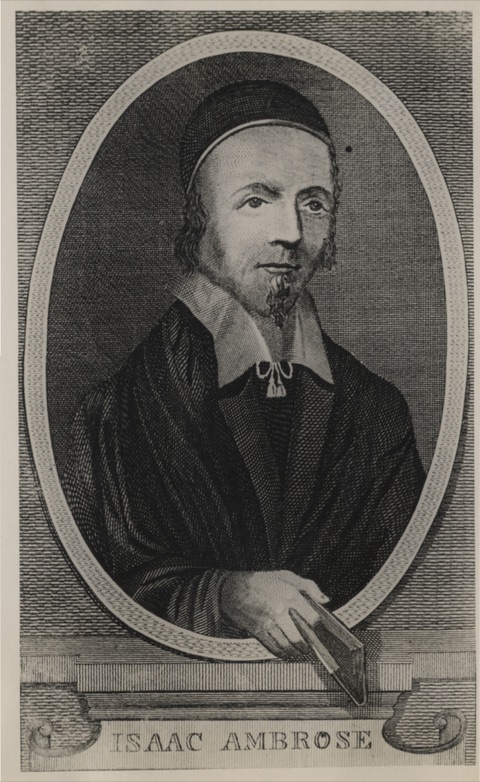
Isaac Ambrose (1604–1664) was an English Puritan minister known for his deeply devotional writings and his extraordinary personal piety. Educated at Brasenose College, Oxford, he served as a Presbyterian minister in Lancashire, England, for most of his career. Ambrose was remarkable among the Puritans for his annual practice of retreating into the woods for an entire month of solitary prayer, meditation, and communion with God—a discipline he maintained faithfully for years. His writings reflect this intense interior life, combining theological precision with a warmth and tenderness that set them apart from the more polemical works of his contemporaries. Looking Unto Jesus is considered his masterwork and the crowning achievement of his ministry, a book that grew directly out of his own experience of illness, recovery, and deepened devotion to Christ.
“Updated Works has been an incredible blessing to my Christian life and ministry… remarkably faithful to the original authors while making these timeless treasures understandable for modern readers.”