



131 audiobooks, 1,134 hours of narration. Give $50 and every one is yours.
Puritan books
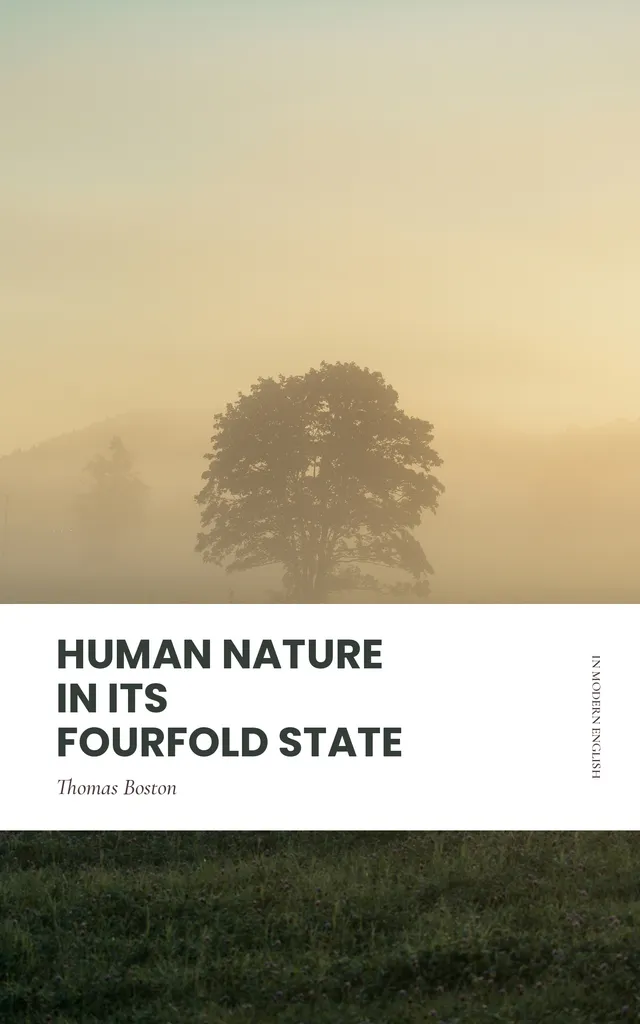
Cover of Human Nature in Its Fourfold State

Modern English edition · 1720 AD

Human Nature in Its Fourfold State

by Thomas Boston

Boston's account of human nature in four conditions: innocence as God created it, entire corruption after the fall, begun recovery in the state of grace, and the fixed eternal state of happiness or misery.

Start reading free

One free account opens 250+ books and saves your place on every device. Google sign-in or an email link. No card.

Included with your free account

This book, and 250+ more, free to read

A free account opens the whole library to read online, on your phone or at your desk. Open a book on one device and it is waiting at the same page on the next. The PDF and EPUB of every book are yours to keep, and audiobooks play in the same app.

  • 250+ modernized editions Not samples. The whole work, free.
  • Your place, on every device Phone, tablet or desktop, same page.
  • 131 audiobooks From $4.99 each, or all of them with a $50 gift.
  • PDF and EPUB included Download any book to keep.
Create your free account Google sign-in or an email link. No card.
The in-app reader on a phone, mid-chapter of The Mortification of Sin in modern English
My Library on a phone, with a book to continue reading and the cover grid

Summary

Tradition
Scottish Presbyterian
Structure
Four states across twelve discourses
Type
Practical divinity
Length
About 184,000 words · a 12-hour read

Human Nature in Its Fourfold State is Thomas Boston's account of human nature in four successive conditions: innocence as God created it, entire corruption after the fall, begun recovery in the state of grace, and the fixed eternal state of happiness or misery. Boston opens each state from a Scripture text and applies it directly to the reader.

How the argument unfolds

  1. 01

    The frame. "There are four things that everyone who would see heaven needs to know": what man was, what he is, what he must be, and what he shall be forever.

  2. 02

    Innocence. Man was made upright, straight with God's law in understanding, will, and affections. Boston keeps this state brief because it lasted no time at all, and uses it to measure the ruin: "By beholding man polished after the likeness of a palace, we may be more deeply moved by the ruins."

  3. 03

    Corrupt nature. The longest stretch of the book. From Genesis 6:5 Boston works through the corruption of the understanding, will, affections, conscience, memory, and body: "Where at first there was nothing evil, now there is nothing good."

  4. 04

    Wrath and inability. Corruption brings a standing as well as a condition: "The state of nature is a state of wrath." Boston then presses the point readers most resist, an "utter inability to recover himself" by law or by gospel.

  5. 05

    Begun recovery. Regeneration changes the nature, union with Christ changes the standing. Boston clears the counterfeits first, since baptism, upbringing, outward reform, strict religion, and pangs of conscience are each mistaken for the new birth.

  6. 06

    The eternal state. Death carries every reader to "the house appointed for all living." Boston follows the road out from there: dying, the resurrection, the general judgment, and the two sentences of Matthew 25 opened as heaven and hell.

Key themes

  • What was lost in the fall. Original righteousness was created with man, not added afterward: God "did not first make man and then make him righteous; in the very act of making him, he made him righteous." The fall is therefore a ruin of nature.
  • Corruption of the whole man. The second state is argued faculty by faculty rather than by cataloguing sins. The problem is a nature and not a habit, and it "will never be cured except by a miracle of grace."
  • Regeneration as a real change. Boston defines the new birth as something done to a person rather than by him: "regeneration is a real and thorough change, by which the man is made a new creature," universal in extent, incomplete in degree, permanent.
  • An eternal state that is fixed. The fourth state settles the other three. What a person is at death he remains, which is Boston's reason the earlier states matter now.

The State of Innocence: Man as God Made Him

“Lo! this only have I found, that God hath made man upright; but they have sought out many inventions.” (Eccl 7:29)

There are four things that everyone who would see heaven needs to know. First, what man was in the state of innocence, as God made him. Second, what he is in the state of corrupt nature, as he has unmade himself. Third, what he must be in the state of grace, as created in Christ Jesus for good works, if he is ever to share in the inheritance of the saints in light. And last, what he shall be in his eternal state, as determined by the Judge of all, either perfectly happy or completely miserable, and that forever. These are weighty matters that touch the heart of practical godliness, from which most people, and even many professing believers in this declining age, are entirely estranged. I intend, therefore, under divine guidance, to open up these things and apply them.

I begin with the first of them, namely, the State of Innocence. By beholding man polished after the likeness of a palace, we may be more deeply moved by the ruins; we may prize all the more that matchless Person whom the Father has appointed as the repairer of the breach; and we may with firm resolve set out on that way which leads to the city with unmovable foundations. In the text we have three things.

1. The state of innocence in which man was created: “God hath made man upright.” By “man” here we are to understand our first parents, the original pair, the root of mankind, the world in miniature, and the fountain from which all generations have streamed. This appears from comparing (Gen 5:1–2): “In the day that God created man, in the likeness of God made he him; male and female created he them, and blessed them, and called their name Adam.” The original word is the same as in our text. In this sense, man was made right, agreeable to the nature of God, whose work is perfect, without any imperfection, corruption, or principle of corruption in body or soul. He was made upright, that is, straight with the will and law of God, without any irregularity in his soul.

By the bearing it received in creation, his soul pointed directly toward God as its chief end. This straight inclination was represented, as in an emblem, by the erect posture of his body, a posture that no other living creature shares. What David was in a gospel sense, Adam was in a legal sense: one according to God’s own heart, altogether righteous, pure, and holy. God made him thus. He did not first make man and then make him righteous; in the very act of making him, he made him righteous. Original righteousness was created together with him, so that in the same moment he was a man, he was a righteous man, morally good. With the same breath by which God breathed a living soul into him, he breathed a righteous soul.

2. Here is man’s fallen state: “But they have sought out many inventions.” They fell away from their rest in God and fell to seeking inventions of their own to mend their condition, and they utterly ruined it. Their ruin came from their own free choice. They would not remain as God had made them, but sought out inventions to deform and undo themselves.

3. Observe here the certainty and importance of these things: “Lo! this only have I found.” Believe them, they are the result of a careful search and serious inquiry carried out by the wisest of men. In the two preceding verses Solomon represents himself as searching for goodness in the world, but the outcome was that he could find no satisfying conclusion, though not for lack of effort, for he counted one by one to work out the sum. “Behold, this I have found (saith the Preacher), to wit, that yet my soul seeketh, but I find not.” He could make no discovery of it that would settle his inquiry. He found good men very rare, one, as it were, among a thousand. Good women he found more rare still, not one good among his thousand wives and concubines (1 Kgs 11:3).

But could that satisfy the grand question, “Where shall Wisdom be found?” No, it could not. (And if others in this matter have had different experiences from Solomon’s, that is no reflection on his discernment, nor can it decide the question, which will remain undetermined until the last day.) Yet amid all this uncertainty, one point has been found and fixed: “This have I found.” You may depend on it as most certain truth and be fully satisfied in it. “Lo this!”, fix your eyes on it as something worthy of the deepest and most serious attention. Man’s nature is now depraved; but that depravation was not from God, for “He made man upright”, it came from themselves, for “they have sought out many inventions.”

Doctrine. God made man altogether righteous.

This is the state of innocence in which God placed man in the world. It is described in the Holy Scriptures only briefly in comparison with the states that follow, because it lasted no time at all, it passed like a fleeting shadow, through man’s abuse of the freedom of his own will. I shall first inquire into the righteousness of this state in which man was created; second, set before you some of the happy accompaniments and consequences of it; and last, apply the whole.

Regarding the righteousness of this state, consider that just as uncreated righteousness, the righteousness of God, is the supreme rule, so all created righteousness, whether of man or angels, has respect to a law as its rule and consists in conformity to it. A creature can no more be morally independent of God in its actions and powers than it can be naturally independent of him. A creature, as a creature, must acknowledge the Creator’s will as its supreme law; for as it cannot exist without him, so it must not act except for him, according to his will. Yet no law obliges until it is revealed. It follows, therefore, that there was a law to which man as a rational creature was subject at his creation, and that this law was revealed to him.

“God made man upright,” says the text. This presupposes a law to which man was conformed in his creation, just as when anything is made regular or according to rule, the rule itself is necessarily presupposed. From this we may gather that this law was none other than the eternal, indispensable law of righteousness, observed in all points by the second Adam, opposed by the carnal mind, and of which some traces remain even among the pagans, who, “having not the law, are a law unto themselves” (Rom 2:15).

In short, this law is the very same one that was afterward summed up in the Ten Commandments and proclaimed on Mount Sinai to the Israelites, what we call the moral law. Man’s righteousness consisted in conformity to this law. More particularly, there is a twofold conformity required of man: a conformity of the powers of his soul to the law, which may be called habitual righteousness; and a conformity of all his actions to it, which is actual righteousness. God made man habitually righteous; man was to make himself actually righteous. The former was the stock God placed in his hand; the latter was the improvement he should have made of it.

To sum up what I have said: the righteousness in which man was created was the conformity of all the faculties and powers of his soul to the moral law. This is what we call original righteousness, with which man was originally endowed. We may consider it under three things.

First, man’s understanding was a lamp of light. He had perfect knowledge of the law and of his duty accordingly. He was made after God’s image, and could not therefore lack knowledge, which is a part of that image (Col 3:10): “The new man is renewed in knowledge, after the image of him that created him.” This was indeed necessary to fit him for universal obedience, since no obedience can be according to the law unless it proceeds from an awareness of the commandment of God requiring it. Adam had no law written on tablets of stone, but it was written on his mind, the knowledge of it being created together with him. God impressed it on his soul and made him a law to himself, as the remnants of it among the heathens testify (Rom 2:14–15).

And since man was made to be the voice of creation in glorifying God in his works, we have reason to believe he had by nature an exact knowledge of the works of God. We see proof of this in his giving names to the beasts of the field and the birds of the air, names that express their very nature. “Whatsoever Adam called every living creature, that was the name thereof” (Gen 2:19). The dominion God gave him over the creatures, to use and dispose of them wisely according to his will, always in subordination to the will of God, seems to require no less than a knowledge of their natures. And beyond all this, his perfect knowledge of the law also proves his knowledge in the management of civil affairs, of which the law of God says, “a good man will guide with discretion” (Ps 112:5).

Second, his will aligned perfectly with God’s will (Eph 4:24). There was no corruption in his will, no bent or inclination toward evil, for that is what sin properly is. The apostle says in Romans 8:7, “I had not known sin, but by the law; for I had not known lust, except the law had said, Thou shalt not covet.” An inclination to evil is truly a fountain of sin, and therefore incompatible with the rectitude and uprightness that the text expressly says man was endowed with at creation. Man’s will was then directed and naturally inclined toward God and goodness, though mutably so. By its original constitution, it was disposed to follow the Creator’s will as a shadow follows a body. It was not left in equal balance between good and evil, for in that case man would not have been upright or habitually conformed to the law, which at no moment can allow a creature to be uninclined toward God as his chief end, any more than it can allow a man to be his own god.

The law was impressed upon Adam’s soul. Now, according to the new covenant, by which the image of God is repaired, this consists in two things: first, putting the law into the mind, which denotes knowledge of it; and second, writing it in the heart, which denotes inclinations in the will answering to the commands of the law (Heb 8:10). Just as the will, when renewed by grace, is by that grace natively inclined toward all the holiness the law requires, so the will of man as God first made him was endowed with natural inclinations toward everything the law commanded. If the regenerate are partakers of the divine nature, as they undoubtedly are according to Scripture (2 Pet 1:4), and if that divine nature includes nothing less than inclinations of the heart toward holiness, then surely Adam’s will could not have lacked this inclination, for in him the image of God was perfect.
The State of Grace: Regeneration

“Being born again, not of corruptible seed, but of incorruptible, by the word of God, which liveth and abideth for ever.” (1 Pet 1:23)

We proceed now to the state of grace, the state of begun recovery of human nature, into which all who will partake of eternal happiness are translated, sooner or later, while in this world. It is the result of a gracious change made upon those who shall inherit eternal life. This change may be understood under two particulars.

1. In opposition to their natural real state, the state of corruption, there is a change made upon them in regeneration, by which their nature is changed.

2. In opposition to their natural relative state, the state of wrath, there is a change made upon them in their union with the Lord Jesus Christ, by which they are placed beyond the reach of condemnation. I therefore intend to treat regeneration and union with Christ as the great and comprehensive changes on a sinner that bring him into the state of grace.

The first of these we have in the text, along with the outward and ordinary means by which it is brought about. The apostle here, to stir the saints to the study of holiness and particularly of brotherly love, reminds them of their spiritual origin. He tells them they were born again, and of incorruptible seed, the word of God. This shows them to be brothers, partakers of the same new nature, which is the root from which holiness and particularly brotherly love spring. We are born once as sinners; we must be born again to become saints. The simple word signifies “to be begotten,” as in Matthew 11:11; “to be conceived,” as in Matthew 1:20; and “to be born,” as in Matthew 2:1. The compound word used in the text may accordingly be taken in its full breadth, the last idea presupposing the two former.

So regeneration is a supernatural real change on the whole man, fittingly compared to natural or bodily generation, as will appear later. The ordinary means of regeneration, called the “seed” of which the new creature is formed, is not corruptible seed.

Our bodies are indeed generated from such seed, but the spiritual seed from which the new creature is generated is incorruptible, namely, “the word of God, which liveth and abideth for ever.” The sound of the word of God passes away as other sounds do, but the word itself lasts, lives, and abides in respect of its everlasting effects on all upon whom it operates. “This word, which by the gospel is preached unto you” (verse 25), impregnated by the Spirit of God, is the means of regeneration, and by it dead sinners are raised to life.

Doctrine All men in the state of grace are born again. All gracious persons, that is, those who are in a state of favor with God and endowed with gracious qualities and dispositions, are regenerate persons. In treating this subject I will show what regeneration is, then why it is so called, and then apply the doctrine.

For a better understanding of the nature of regeneration, note first that just as there are false conceptions in nature, so there are also in grace. By these, many are deluded, mistaking some partial change made upon them for this great and thorough change. To remove such mistakes, consider these few things.

1. Many call the Church their mother whom God will not own as his children. (Song 1:6) “My mother’s children,” that is, false brothers, “were angry with me.” Not all who are baptized are born again. Simon was baptized, yet remained “in the gall of bitterness, and in the bond of iniquity” (Acts 8:13–23). Where Christianity is the religion of the country, many bear the name of Christ who have no more of him than the name. No wonder, for the devil had his goats among Christ’s sheep even in places where only a few professed the Christian religion. (1 John 2:19) “They went out from us, but they were not of us.”

2. Good education is not regeneration. Education may chain up men’s lusts, but it cannot change their hearts. A wolf is still a ravenous beast even in chains. Joash was very devout during the life of his good tutor Jehoiada, but afterward he quickly showed what spirit he was of by his sudden apostasy (2 Chr 24:2–18). Good example has a powerful influence in changing the outward man, but that change often disappears when a man changes his company, and the world affords many sad examples of this.

3. A turning from open profanity to civility and sobriety falls short of this saving change. Some are, for a time, very loose, especially in their younger years, but at length they reform and leave their profane ways. There is a change here, yet only such a change as may be found in men utterly without the grace of God, and whose righteousness, far from exceeding, does not even come up to the righteousness of the scribes and Pharisees.

4. One may engage in all the outward duties of religion and yet not be born again. Though lead be cast into various shapes, it remains a base metal. Men may escape the pollutions of the world and yet be nothing but dogs and swine (2 Pet 2:20–22). All external acts of religion lie within the compass of natural abilities. Hypocrites may even possess counterfeits of all the graces of the Spirit. We read of “true holiness” (Eph 4:23) and “faith unfeigned” (1 Tim 1:5), which shows us that there is a counterfeit holiness and a feigned faith.

5. Men may advance to great strictness in their own way of religion and yet be strangers to the new birth. (Acts 26:5) “After the most straitest sect of our religion I lived a Pharisee.” Nature has its own unsanctified strictness in religion. The Pharisees had so much of it that they regarded Christ as little better than a libertine. What will a man not do, within the compass of natural abilities, when his conscience has been awakened and he lives under the felt influence of the covenant of works? It is a truth, though it came from a hellish mouth, that “skin for skin, all that a man hath will he give for his life” (Job 2:4).

6. A person may have sharp soul-exercises and pangs and yet die in the birth. Many “have been in pain” who have, as it were, “brought forth wind.” There may be severe pangs and throes of conscience that come to nothing in the end. Pharaoh and Simon Magus had such convictions as made them beg the prayers of others. Judas repented and, under terrors of conscience, gave back his ill-gotten pieces of silver. All is not gold that glitters. Trees may blossom fairly in the spring on which no fruit is found at harvest, and some have sharp soul-exercises that are nothing but foretastes of hell.

The new birth, however hopefully begun in appearance, may be ruined in two ways. First, some, like Zarah (Gen 38:28–29), are brought to the birth but draw back again. They have sharp convictions for a while, but these pass away and they become as careless about their salvation, and as profane, as ever, and usually worse than ever. “Their last state is worse than their first” (Matt 12:45). They receive awakening grace but not converting grace, and it fades by degrees, like the fading light of the declining day, until it ends in midnight darkness. Secondly, some, like Ishmael, come forth too soon; they are born before the time of the promise (Gen 16:2; compare Gal 4:22). They settle for a mere law-work and do not wait for the time of the promise of the gospel. They snatch at consolation without waiting for it to be given, and foolishly draw their comfort from the very law that wounded them.

They apply the healing plaster to themselves before their wound has been sufficiently searched. The law, that rigorous husband, beats them severely and pours curses and vengeance upon their souls; they then fall to reforming, praying, mourning, promising, and vowing until this ghost is laid, after which they fall asleep again in the arms of the law.

But they are never shaken out of themselves and their own righteousness, nor brought forward to Jesus Christ.

Questions

What are the four states in Human Nature in Its Fourfold State?
The four states are innocence, corrupt nature, grace, and the eternal state: what man was when God made him, what he is having unmade himself, what he must be to share the inheritance of the saints, and what he shall be forever once the Judge of all has determined it.
What is Human Nature in Its Fourfold State about?
Human Nature in Its Fourfold State traces what human nature is and how it changes, from creation through the fall, conversion, and eternity. Boston takes a Scripture text for each state, draws a doctrine from it, proves it, then applies it to saints and sinners.
Is Human Nature in Its Fourfold State difficult to read?
Human Nature in Its Fourfold State is closely argued but was written for ordinary hearers, so plain comparisons carry the reasoning: a goldsmith melting down a vessel of dishonor, a wolf still ravenous in chains. The older prose is the real obstacle, and this edition removes it.
Why does the second state take up so much of the book?
Corrupt nature fills the largest part of Human Nature in Its Fourfold State because Boston treats it as the point readers most resist. He gives separate discourses to the corruption, to the wrath resting on it, and to man's inability to escape it.
Who was Thomas Boston?
Thomas Boston (1676 to 1732) was a Scottish Presbyterian minister who served the Border parishes of Simprin and Ettrick. He is remembered for this book and for his part in the Marrow Controversy, the Church of Scotland's dispute over law and grace in the 1720s.
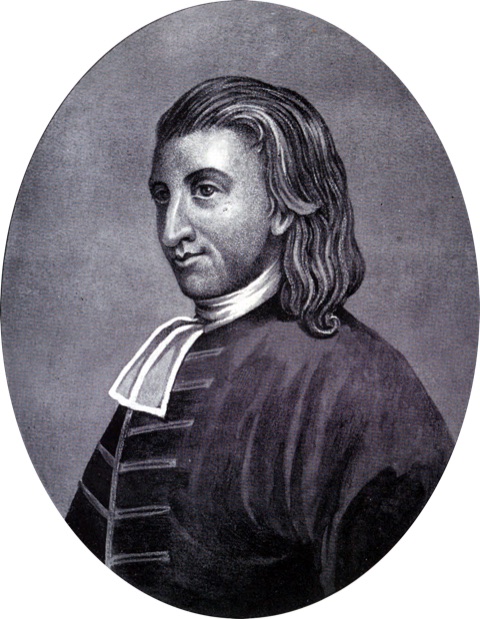
Portrait of Thomas Boston

About the author

Thomas Boston

Thomas Boston (1676 to 1732) was a Scottish Presbyterian minister who spent his whole ministry in two small Border parishes, first Simprin and then Ettrick. He became a central figure in the Marrow Controversy, the dispute over law and grace that divided the Church of Scotland in the 1720s, after recommending Edward Fisher's The Marrow of Modern Divinity to his fellow ministers. Human Nature in Its Fourfold State grew out of his parish preaching and became one of the most widely read books in Scotland.

“Updated Works has been an incredible blessing to my Christian life and ministry… remarkably faithful to the original authors while making these timeless treasures understandable for modern readers.”
— Pastor Mike Cleveland




