
New: 116 audiobooks, 998 hours of narration, many never recorded before.
Puritan books
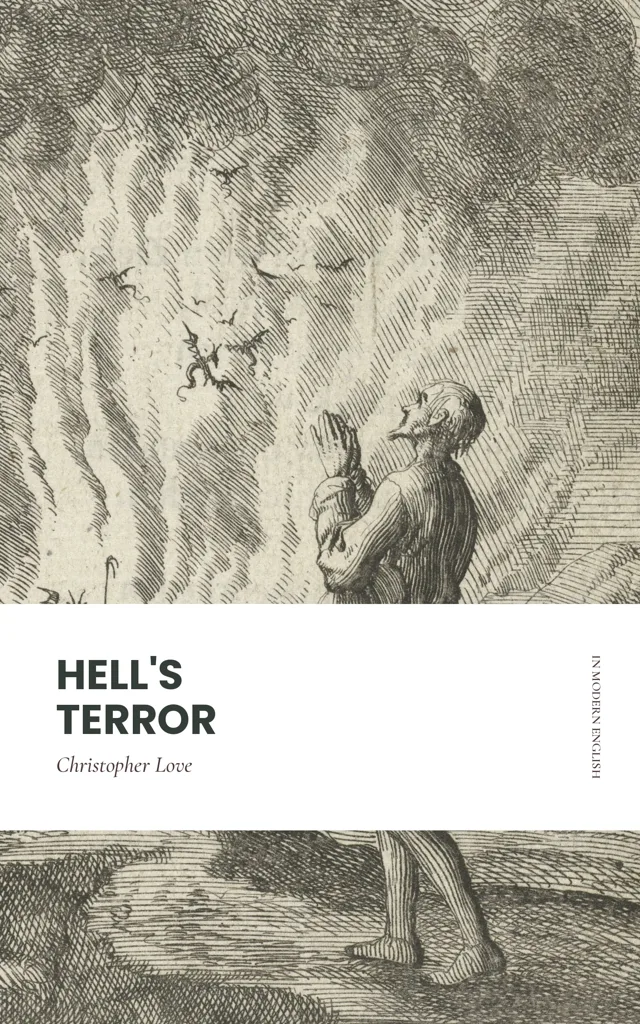
Cover of Hell's Terror

Modern English edition · 1653 AD

Hell's Terror

by Christopher Love

Seven sermons by Christopher Love on Matthew 10:28, preached in London as the deliberate companion to the ten sermons on heaven collected in Heaven's Glory. Love answers sixteen questions about hell in order, from whether such a place exists to what the worm of conscience and the gnashing of teeth mean.

Start reading free

One free account opens 250+ books and saves your place on every device. Google sign-in or an email link. No card.

Included with your free account

This book, and 250+ more, free to read

A free account opens the whole library to read online, on your phone or at your desk. Open a book on one device and it is waiting at the same page on the next. The PDF and EPUB of every book are yours to keep, and audiobooks, sold separately, play in the same app.

  • 250+ modernized editions Not samples. The whole work, free.
  • Your place, on every device Phone, tablet or desktop, same page.
  • 116 audiobooks, sold separately About 998 hours of narration, from $4.99.
  • PDF and EPUB included Download any book to keep.
Create your free account Google sign-in or an email link. No card.
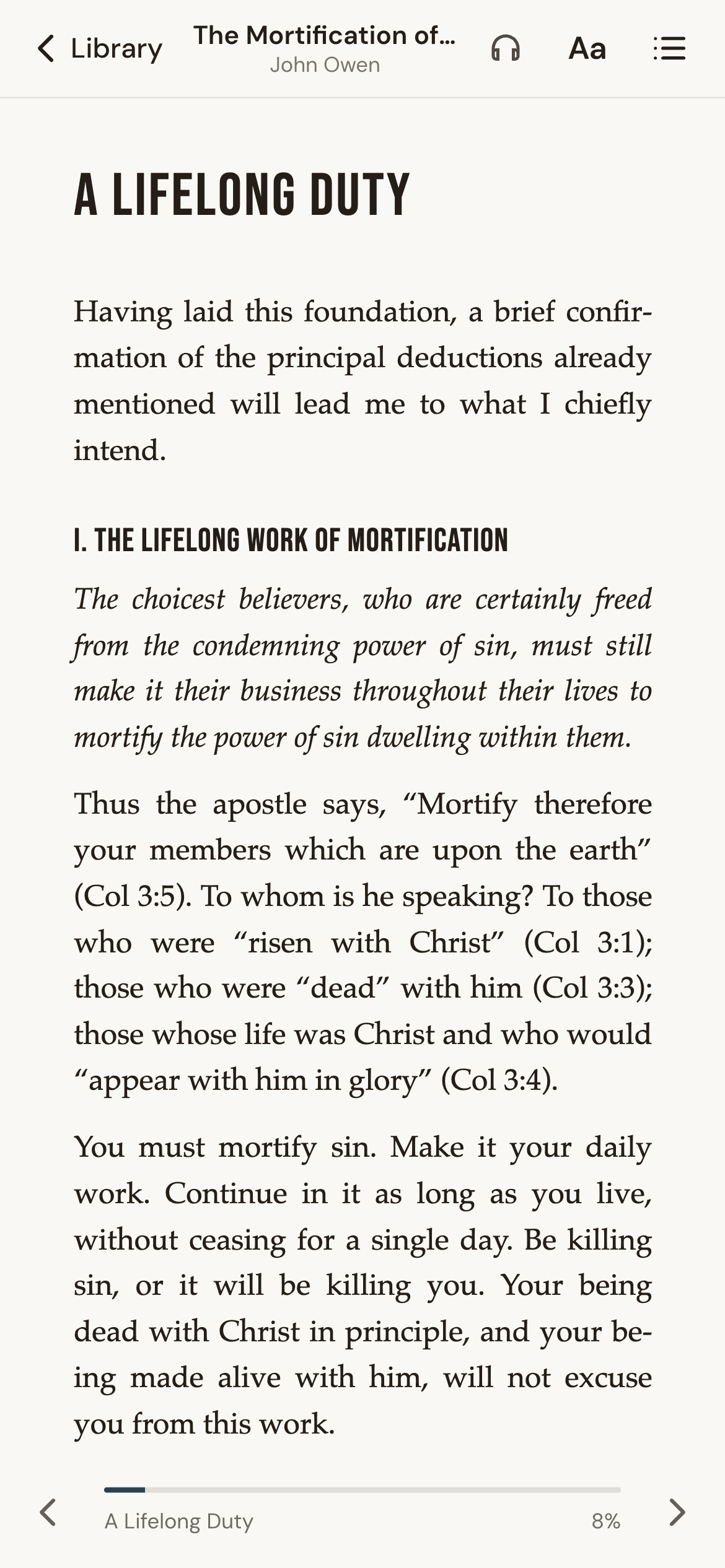
The in-app reader on a phone, mid-chapter of The Mortification of Sin in modern English
My Library on a phone, with a book to continue reading and the cover grid

Summary

Preached
St Lawrence Jewry, London
First printed
1653 AD
Type
Sermon series, seven sermons
Length
About 38,000 words, a 2.5 hour read

"Hell's Terror" is a series of seven sermons Christopher Love preached in London on one verse, Matthew 10:28, and it works through sixteen questions about hell in order: whether there is such a place, why there must be one, what it is, where it is, how long it lasts, and who will be sent there.

“a little bird, once every thousand years, took away one grain of sand from this mountain”
From this edition

How the argument unfolds

  1. 01

    Why preach this at all. Love has just finished ten sermons on heaven and turns to hell for the other half of his congregation: "Ministers, having a mixed congregation, must mix their doctrine, sometimes with comfort and sometimes with terror."

  2. 02

    The text opened. The word rendered rather is read as adversative, not comparative, so that men are not to be feared at all; kill is not annihilation; and of the four senses hell carries in Scripture, only the place of the damned is meant here.

  3. 03

    The doctrine. Everything that follows serves one sentence: that God's absolute power to cast body and soul into hell "should work an awful fear of God in the hearts of his own people."

  4. 04

    That there is a hell, and why. Argued first from what the heathen guessed at without Scripture, then from the texts; and grounded on the reasoning that an offense against an infinite God cannot be paid off in a short life.

  5. 05

    What hell is. Seventeen scriptural expressions are gathered and explained, from unquenchable fire and the lake of fire to Tophet, the bottomless pit, and the second death, before Love gives a single working description.

  6. 06

    Degrees and locations. Torments differ by person, and seven sorts are marked out for the deepest, including those who hinder others from holiness and those who hear preaching for years without amendment. Where hell is, Love refuses to settle, giving five reasons God conceals it.

  7. 07

    The torments themselves. Divided as the schoolmen divided them: five losses, chief of them the favorable presence of God, and eight things that make what the damned feel grievous, ending with eternity.

  8. 08

    The hard questions. Whether it is just to punish forever a man who sinned briefly; whether most of mankind perish, and how that squares with mercy; whether purgatory exists; whether Christ descended into hell; whether there is fire there now.

  9. 09

    The close. Six considerations meant to astonish a careless hearer, then four marks by which a hearer can test whether the series left any fear of God behind. Love states the aim plainly: “We preach sermons on hell to your ears now, so that you may never see it or feel it in your bodies later.”

Key themes

  • The fear of God against the fear of men. The series begins and ends on the same point, that the fear of God crowds out every lesser fear, and the first mark of it is that a hearer would rather displease men than God.
  • Eternity. Love's argument for endless punishment is that everything involved in it is endless: the God who condemns, the fire, the prison, the worm, the loss, the sin, the sentence, and the body and soul that bear it.
  • Sin as worse than the punishment. Having spent sermons on the torments, Love insists the hearer fear the cause rather than the effect: "sin is worse than hell, since sin is what made hell to be hell."
  • Conscience. The never-dying worm is read not as a physical creature but as the gnawing of an awakened conscience, which is why Love presses his hearers to keep a clean one now.
  • Sermons of terror. Love defends the whole enterprise against the charge of legal preaching, holding that some hearers are led and others must be pulled, and that God has used doctrines of terror to convert.

Fear Him Who Can Destroy the Soul

But rather fear him who is able to destroy both Body and Soul in Hell. (Matt 10:28)

Beloved, you may remember that I have preached ten sermons on the glorified condition of the saints in heaven. I now intend to speak of the tormented condition of the damned in hell, so that if those earlier sermons about glory did not gain your affections, this sermon on hell might startle your consciences. Ministers, having a mixed congregation, must mix their doctrine, sometimes with comfort and sometimes with terror. You have heard ten sermons on the former text; you may hear as many more on this one.

Before I give you the sense of the text, I must give you the scope of the chapter. Jesus Christ had called his twelve disciples together and commissioned them to preach the gospel throughout the regions of Judea, and, to confirm their doctrine, to work all manner of miracles, cure all manner of diseases, and cast out devils. Yet he knew, as he tells them in Matthew 10:16, that they must go as silly sheep among ravenous wolves, and that they would meet persecution and opposition in carrying on the great work of the gospel. So Christ labors in this chapter to prop up the hearts of his people with four arguments.

The first argument comes in Matthew 10:19–20: “They shall bring you before Governors for my name’s sake; but take no thought what you shall say, for it shall be given you in the same hour.” It is as if Christ said: you will be called before courts of judicature for my name’s sake, for preaching my gospel, but do not worry about what you will plead for yourselves, for my Spirit will tell you what to say. In Luke 21:15 you find the same idea: “They should have a mouth, and wisdom given them” to make their defense and vindicate the gospel in their hands.

2. The second argument he brings is this: though they will meet troubles in the flesh, Christ will save their souls (Matt 10:22). If they suffer in their bodies, their soul will be saved, “for he that endures to the end shall be saved.”

3. The third is that before they had preached in every city, Christ promised to come in the blessing of his Spirit and make their preaching effective for the conversion of souls (Matt 16:28). Some say this refers to the destruction of Jerusalem, but Calvin understands it as the giving of the Spirit (Matt 10:23).

4. The fourth argument comforts them with the fact that Jesus Christ was their partner in suffering. They must not expect to be above Christ, above their master (Matt 10:24): “The disciple is not above his master, nor the servant above his Lord, it is enough to be as he is.” As if he said: do not be discouraged. I, your Lord and master, suffered and must suffer more, even death. So do not be discouraged, for the disciple is not above his Lord.

5. And a fifth argument stands in my text: do not be afraid, because the power of your enemies is limited. All your enemies can do reaches only the body and can never hurt your souls. Fear not him who can kill the body but not the soul. Christ tells them here whom they should, and should not, fear: “But fear him who is able to cast both body and soul into hell.” Having brought you to the words, I will now give you their sense.

“But rather fear him.” The word translated “rather” is not to be taken comparatively, as though you may fear men but must fear God more. It is an adversative: you are not to fear men at all, but God alone.

“But rather fear him that can kill both body and soul.” “Kill” here does not mean the annihilation or destruction of the body, but the continual tormenting of body and soul under the wrath of God for all eternity. Luke explains it this way in Luke 12:5: “Who is able to cast both body and soul into hell,” that is, to destroy both soul and body. It would be well for the damned if soul and body were destroyed in the sense of being annihilated. Both body and soul are mentioned because the body has been partner with the soul in sin, and so will share with it in punishment.

“Fear him that can destroy both soul and body in hell.” Hell in Scripture carries four different meanings.

1. It is taken for the grave, as in Psalm 16:10: “Thou wilt not leave my soul in hell, nor suffer thy Holy One to see corruption”; that is, Christ would not lie and rot in the grave, but would rise again. The apostle Peter refers to this prophecy, that he would not see corruption nor be left in the grave (Acts 2:31–32), speaking of Christ’s resurrection from the dead.

2. Hell in Scripture is taken for the belly of the whale into which Jonah was cast. So Jonah 2:2 reads: “Out of the belly of hell I cried unto the Lord, and he heard me.” Jonah was never in hell itself, but the belly of the whale was called hell because it was a dark place, as hell is. But that is not the sense meant here either.

3. Hell in Scripture is taken for the devil himself, or his malignant spirits. So (Jas 3:6): “The tongue of man is set on fire by hell,” meaning not the place but the devil in hell. The devil in hell kindles the fire of an enraged and passionate spirit; the tongue is set on fire by the devil of hell.

4. Hell is taken in Scripture for the place of the damned, where God tortures and torments the souls and bodies of all the reprobate for all eternity. This sense is frequent in Scripture, as in Matthew 5:29, Luke 12:5, and Luke 16:23, and it is the sense meant here: “Fear him that can cast both body and soul into hell,” that is, into that place of torment which the Lord reserves eternally for the punishment of all ungodly men and women. That is the meaning of the phrase “into hell.”

The word rendered “hell” here comes from the Hebrew word gehinnom, meaning the valley of Hinnom. It was a valley near Jerusalem possessed by Hinnom or his son (Josh 15:8; Neh 11:30). Hell is named in Scripture after this place because the idolatrous Jews set up an idol there called Molech, made of brass in the form of a man, hollow within, in which they kindled a fire. Children were placed within the arms of the idol and burned. The Jews believed that a father who gave one of his children to the idol would receive a blessing on all his other children.

From this the Greek word for hell derives its meaning, carrying an allusion to that place: as there was a continual fire in that idol, along with continual shrieking and crying of children (so much so that bells were rung and instruments sounded to drown out the children’s cries), so it will be in the fiery torments of hell. The story is told at length in 2 Chronicles 33:6, 2 Kings 16:3, 2 Chronicles 28:3, Jeremiah 7:31, Jeremiah 32:35, and Leviticus 18:21. Good king Josiah destroyed this place (2 Kgs 23:10).

Having laid open the words, nothing remains but to give you the observations the text will bear. There are two observations I will draw from these words.

First, from the context, “but rather fear him,” observe this:

Doctrine 1: The fear of God fences the heart against the fear of man. The more you fear God, the less you will fear men. As Isaiah 8:13 says, “Fear not their fear but sanctify the Lord in your hearts; let him be your fear, and let him be your dread.” But I will pass over this point, since my only intention in handling this subject is to set before you the torments of the damned in hell.

That thought will awaken some drowsy consciences, and I trust it will deepen the joy of believers who have been delivered from these hellish torments. The observation that sums up the whole substance of this text is this:

Doctrine 2: That the consideration of this, that God has an absolute power over men and women, to cast their bodies and souls into hell, should work an awful fear of God in the hearts of his own people. This is the point, and it carries a great deal of dread and terror with it. Before I take up the doctrine directly, I must first lay down reasons why I preach on so terrible a subject, and then answer some objections that may be raised against preaching so dreadful a doctrine.

I confess this is a terrible doctrine, given the atrocity of the torments it describes.

First, the reasons why I take up this subject are four.

First, I handle it now because I have already spoken at length about the glory of the elect in heaven, for the comfort of the godly. Now I will speak of the torments of hell, for the punishment of the wicked, so that if the glory of the elect has not won your affections, hearing of the torment of the damned might startle your consciences and wake you from your security.

Second, I handle it so that none of you grow secure and presumptuous, nourishing ungrounded hopes of glory and expecting to be in glory with Jesus Christ on the strength of the previous sermons alone. To keep you from that vain hope, I thought it right to pair this subject with those sermons, so that you might be equally guarded against presumption on the one hand and despair on the other.

Third, because this is a doctrine so little preached and so little written about in our day. I know of only one English book written on this subject, by Mr. Bolton, and very few in Latin. It is a useful subject, useful for the wicked and useful for the godly, yet so little handled, and nowadays much cried down and argued against. This reason too moved me to take it up.

Fourth, I handle this doctrine because I am persuaded that if many people knew the torments of hell distinctly, they would never walk in the way of sin that leads there as they do. I believe that if this doctrine of hell were well studied and better known among the people, they would take far more care to avoid hell and gain glory than they do now.

If people knew that those who live and die unrepentant, burning in their lusts, will one day burn in fire; if they knew that those who drink bowls of wine to excess will one day drink draughts of brimstone in hell; if they knew that those who grind their teeth in hatred and indignation against the godly here will one day gnash their teeth in hell hereafter; if they knew that those who persecute and imprison God’s people now will one day be dragged into an everlasting prison and hauled by devils into hell, and that those who could not endure the company of saints on earth will be with devils and damned spirits in hell, then they would not be as profane and wicked as they now are. The lack of study of this point opens a wide gate to the world’s profaneness, and for these reasons I resolved to treat this subject.

There are two objections against preaching on a subject like this. First, some will say this is legal preaching, casting flashes of hellfire about the congregation, which is not preaching the Gospel but the law. To answer this, I will say four things.

1. Jesus Christ was surely no legal preacher, yet he preached this very doctrine, for these are Christ’s own words. Preaching of hell and its torments cannot rightly be called legal preaching, since Jesus Christ, the minister of the new covenant, preached about hell more than anyone. It is worth noting that neither the apostles nor the evangelists preached as much about hell as Jesus Christ did. Christ has seven specific texts on hell and the torments of the damned that the apostles never had. So this is not legal preaching, since it is the doctrine of Jesus Christ himself.

2. It is a great strategy of the devil to lull people into security in their sins by branding all soul-searching preaching, all sin-reproving preaching, all conscience-awakening and duty-pressing preaching as “legal preaching.” It is the devil’s great strategy to attach so bad a name to so good a work.

3. If preaching of terror is legal preaching, then the law was preached more in the New Testament than it ever was under the Old. I will show this. There are more terrible and dreadful doctrines scattered through the New Testament than the Old. Chrysostom notes that the word “damnation” is never used in the entire Old Testament, but appears thirteen times in the New. It is further worth noting that in the Old Testament, though the word “hell” is often used, it most commonly refers to the grave rather than the place of the damned. In the New Testament, except in two places, “hell” is taken entirely as the place of the damned (Acts 2:27, 31). So it is plain to every eye that the Gospel is backed with more terror, and more doctrine of hell and damnation, than the law ever was. The preaching of the law has only “anathema,” but the Gospel has “maranatha” too.

So all who hold the Antinomian error, crying down the pressing of duty as legal preaching, deceive themselves badly, for Christ himself, the apostles, and the evangelists all preached more of terror than any of the prophets ever did.

4. As for the claim that preaching of terror is legal preaching, I say this: sermons of terror have done more good on unconverted souls than sermons of comfort ever have. Sermons of hell have kept many people out of hell. I have read often of Mr. Throgmorton, who was converted by a sermon of terror on the text, “How shall you escape the damnation to come?” I have heard of another famous divine who tells us he was converted by the text on Christ preaching to the spirits in prison. I have heard of Mr. Greenham, a famous minister, whose conversion and first calling came from hearing a sermon on the last judgment and the torments of the damned. I have read of other ancient authors. Jerome tells us of himself, “Whether I eat or drink,” he says, “I hear a voice sounding in my ears: arise, arise, you dead, and come to judgment.” That very sound converted him, and many others besides.

Beloved, God has sanctified doctrines of terror for the conversion of souls more than any other doctrine in the world. It is worth noting that John the Baptist, the forerunner of Christ who prepared his way, preached as his very first sermon one of terror and coming wrath: “You generation of vipers, who has warned you to flee from the wrath to come?” And the second sermon Christ ever preached was likewise a terrible sermon about hell. As Gregory says in his Morals, we must not flee sermons about hell if we wish to flee hell itself.

Second, some may object that while preaching of hell is lawful, preaching of Christ’s love and free grace makes for more winning subjects, doctrines better suited to build upon, and better able to refresh and cheer God’s people, winning more of people’s hearts than such terrible doctrines do. To this objection I ask you to consider five things in answer.

1. It is true that if all our hearers were converted, doctrines of grace, love, and comfort might best serve their edification. But since we deal with a mixed congregation, our doctrines must be mixed as well, or we will never do them good.

2. It is true that if all people’s natures were alike, all of a soft and tender disposition, all troubled in mind and under a sense of God’s wrath, we should preach only love and only grace to lift up their hearts, for a person’s character is better guided than dragged. But Scripture tells us that people’s tempers differ: some are of a soft disposition, others of a knotty and rough spirit; some will be won by mercy, others only by judgment. Since Scripture tells us that people’s tempers vary, our doctrines must vary too, sometimes of mercy, sometimes of judgment, so that as sermons of love win over soft hearts, doctrines of terror serve for hardened spirits. “On some have compassion, making a difference; and others save with fear, pulling them out of the fire; hating the garment spotted with the flesh” (Jude 1:22–23).

Some, the apostle says, you must treat with compassion, preaching love and kindness to them; but others you must save with fire, that is, by showing them hellfire and terrifying them with the fear of God’s wrath. Some people are more yielding and tender, and these must be dealt with gently. Others, who are more stubborn and hardened sinners, must be saved with fear, pulled out of the fire of hell. That is my second answer: some people’s natures are better led than dragged, while others are so stubborn and hardened that nothing but flashes of hellfire will startle their consciences.

3. To those who argue so much for doctrines of free grace and comforting truths, insisting that such points of terror should not be preached to them, I answer that human nature is more prone to abuse doctrines of free grace, though these must be preached in their season, than to abuse doctrines of terror and coming wrath. Jude tells us this: “They turn the grace of God into wantonness” (Jude 1:4). And the apostle Paul raised the objection, “Shall we sin because grace abounds? God forbid,” implying that some men made it their practice to abound in sin precisely because grace abounds.

4. How can a minister discharge his conscience before God, claiming to have preached the whole counsel of God to his people, if he runs only on strains of free grace, Christ’s love, and doctrines of comfort throughout his ministry? Doctrines of terror are also the will of God, and must be preached as much as doctrines of comfort.

5. Those who have cried so loudly for preaching only on love and free grace have, as some manage the matter, hardened more souls than they have ever converted by such sermons. For my part, beloved, I know of no one converted by these new teachers who claim more light than their brethren and claim to present Christ more clearly than their brethren. I do not see holiness shining in their lives above others. Meanwhile, I am certain that those who preached mixed doctrines, sometimes fear and sometimes love, sometimes wrath and sometimes grace, worked most powerfully on the consciences of their hearers. I have read of Mr. Hildersham, a minister at Ashby-de-la-Zouch, a most forceful preacher; it is said God gave his ministry more success in converting souls than to all the other ministers in the region combined. And when Paul preached a sermon of judgment to come, it made the heart of Felix tremble, even that great man’s heart trembled to hear of judgment.

Scripture shows that just as God had his Barnabases, sons of consolation, so he had his Boanergeses, sons of thunder, to make the stout hearts of people tremble. So, lest any misled heart should be carried away thinking all this legalistic, I judged it right to offer this defense before entering the subject. Remember the doctrine: the consideration that God has absolute power over men and women, to cast both into hell, should work in God’s own children an awful fear of God. In handling this dismal subject, I have fifteen questions to work through: first, whether there is a hell or not; second, why there must be a hell to receive the souls and bodies of wicked men; third, what this hell is; fourth, whether there are degrees of torment in hell, and so on.

Question 1: Whether there is a hell or not. To answer this, I will show it first from the confession of heathens, who had only the glimmerings of nature and never saw the Bible, and second from the testimony of Scripture.

1.) From the confession of heathens: though they could not know clearly, never having been acquainted with the word, yet by the glimmering light of nature they had some notions and impressions of this place of the damned. Virgil tells us, “The descent to Avernus is easy” (Virgil, Aeneid 6).

So they had a figure called Pluto, the chief ruler of hell, who especially tormented the most wicked. They had their Charon’s boat, a fancy that a man with a boat ferried wicked persons into hell, and they had their Etna, their burning mountain, which they imagined to be hell. They pictured hell as a continual rolling of stones upon dead bodies, along with many other fancies. Pluto himself carried many footsteps of the idea of hell. As one said, if a man suffers no punishment after death, he will still carry some sense of guilt within him, enough to torture and torment him. All these were merely human impressions of hell. But I will pass over these.

2.) Just as you have testimony from the heathen, you have this truth clearly from Scripture as well. Let me name a few texts. “I will kindle a fire in mine anger, and it shall burn to the lowest hell” (Deut 32:22). “The wicked shall be turned into hell, and all the people that forget God” (Ps 9:17). “Upon the wicked he shall rain snares, fire and brimstone, and a horrible tempest” (Ps 11:6). “Ye serpents and generation of vipers, how can you escape the damnation of hell?” (Matt 23:33). “He cast them down to hell. They are locked up in chains of darkness to be reserved unto judgment” (2 Pet 2:4). “They are reserved in everlasting chains of darkness to the judgment of the great day” (Jude 6). All of this plainly proves that there is a hell.

Question 2: Why must there be a hell? This appears from the following demonstrations.

1.) Because of the filthy nature of sin. Sin is committed against an infinite God, and since the offense is infinite, the punishment must be infinite as well. But the punishment cannot be infinite on earth, because we remain here only a short while and our bodies rot in the grave. There must therefore necessarily be a hell to keep the bodies and souls of the wicked, so that they may receive punishment proportionate to the sins they committed on earth.

2.) Because otherwise the justice of God could never be satisfied for the sins wicked men committed on earth. The reasoning runs this way.

a) Christ would not satisfy and suffer God’s wrath on behalf of wicked men, so they must bear it themselves.

b) On earth they cannot satisfy God’s wrath, because sin, being an infinite offense, can only be punished finitely and temporarily here. So all their sufferings on earth cannot satisfy the wrath due for their sins. There must therefore necessarily be a hell to keep men through all eternity, so that by their everlasting torments God’s justice might be satisfied, which it could not otherwise be (2 Thess 1:5). As one has put it: divine justice requires that the wicked pay the penalties owed for their sins; and since this does not happen in this life, it will most certainly happen in the next.

3.) It appears there must be a hell from the horrors and terrors of conscience found in wicked men when they are dying. Many a man in good health will scoff at hell, scorn its fire, and mock its flames. Many a man in health never thinks of hell; he can drink one day, swear the next, commit adultery the third, and sin every day, and the thought of hell never troubles him. But bring this man to his sickbed, and what horrors and fears seize his soul! I would appeal from a healthy drunkard to that same man when dying, just as one appealed from King Philip drunk to King Philip sober, who then repealed his unjust act and gave the wronged man justice. You who by your sinning have spent your strength and wealth in drink, and never think of hell while drunk, I would appeal to you as a dying man and ask, what would you say then?

What would you then give for Christ? What would you then give for a pardon, that you might not be damned? The very horrors and wounds of conscience at your dying day demonstrate that a time of torment awaits you. How else could conscience become such a terrible torment to the souls of men at that hour, if no such thing as hell were prepared for them? What made the Roman emperors afraid of death, running under their beds in fear when it thundered? Only this: the very workings of conscience showed them that something awaited after this life. The very terrors of conscience declare there is a hell, a place of torment prepared for wicked men.

And thus, having finished these questions, the use I will make of them will be for condemnation and astonishment.

1. This is for condemnation, a condemnation of all who hold that there is no such thing as hell. The Photinians hold that there is no hell, and that what we call hell is merely the annihilation of the body, that man is reduced to nothing and no more. One author writes of fifteen sorts of heretics who deny a hell. Among them was one called Empecta, a view held by Barba, wife of the emperor Sigismund, who paid her followers money to hold this opinion, so that their consciences might be seared over in sensuality and lustful pleasure. As the saying goes, “Scarcely do children believe there are ghosts and underground kingdoms.” This truth condemns all who have seared their consciences so as to deny that there is a hell.

2. This is for astonishment. To whom? To all of you who add sin to sin, drunkenness to greed, and one provocation to another, as if there were neither a heaven for the godly nor a hell for you. You who are like Sardanapalus and say, “Eat, drink, play, for after death there is no pleasure,” meaning eat, drink, and be merry, for after death there is no pleasure and therefore no pain, and so while men live they should live as pleasurably and joyously as possible (Isa 28:19). O beloved, tremble, for if all these texts I have cited prove such a place exists, how should it astonish your soul that all the actions of your life have been but a race toward these chambers of death! All your life’s actions have been but a laying up of treasure in this place of torment. How should this astonish you, whose whole course leads only to this doleful dungeon of hell?

3. Though this is a terrible and dreadful doctrine, you who are the elect people of God may draw consolation from it. It is true there is a hell, and wicked men will unavoidably come to it, as John says: “You serpents and generation of vipers, how shall you escape the damnation of hell!” But all of you who are the elect of God are not only forewarned, you are also forearmed, and need not fear this place of hell. First, you need not fear the devil, that is, the torments of hell, because God shall bruise Satan under your feet shortly. Though he now goes about like a roaring lion seeking his prey to devour, he shall soon be in chains and go abroad no more. Second, you need not fear the torments the damned undergo in hell.

Though there is a worm that never dies, a fire that never goes out, though there is weeping, wailing, and gnashing of teeth, though the damned lie under the wrath of an incensed God, you may lift up your heads with joy, elect of God, for Jesus Christ is your redemption and your life. “He hath destroyed him that had the power of death, that is, the devil” (Heb 2:14). Because of this, you are delivered by Jesus Christ from the wrath to come (1 Thess 1:10). Here, then, is matter for joy: though there is a hell, and the wicked are tormented night and day, you are delivered by Jesus Christ from this wrath to come.

The Fearful Torments of Hell

But rather fear him who is able to destroy both Body and Soul in Hell. (Matt 10:28)

In beginning these words, I gave you both their scope and their sense. The main observation I drew from them was this.

Doctrine: The truth that God has absolute power over men and women to cast their souls and bodies into hell should work in the hearts of his own people an awful fear of him.

In pursuing this, I have already finished two questions. I now proceed to a third.

Question 3: What is this hell, in which the bodies and souls of wicked men will be tormented? Before I give you the description, I should first lay before you the various terms and expressions in Scripture that describe hell, this place of the damned. Among these there are sixteen or seventeen notable expressions, and knowing them will make plain what hell is.

1. Hell, where the bodies and souls of wicked men are tormented, is sometimes described in Scripture by the term unquenchable fire: “He will burn up the chaff with unquenchable fire” (Luke 3:17). It is unquenchable in both an active and a passive sense. That is, it will never be quenched itself, and the bodies within it will never be consumed away.

2. It is called a furnace of fire: “Then they were cast into a furnace of fire” (Matt 13:42), meaning hell. This alludes to the fiery furnace of Nebuchadnezzar (Dan 3:21–22), which was a type of hell. So Christ, in the New Testament, takes up the Old Testament image and calls hell a furnace of fire. The resemblance holds in two ways. First, just as that fire could not burn the three children, the fire of hell will not burn a single godly man. Second, just as that fire was so far from prevailing over those godly men that it burned the ones who threw them in, hell fire will be so far from prevailing over the godly that the wicked who wish the godly into hell will themselves be thrown in.

3. It is called a lake of fire: “They shall be cast into a lake of fire and brimstone” (Rev 19:20). It is called this to signal the abundance of torments in hell. Just as rivers and lakes hold plentiful water, hell will hold plentiful torments for those cast into that dreadful place. As Anselm says, it is called a lake because, just as a stone sinks in the sea, so souls are plunged there.

4. Eternal fire: so Jude writes that the ungodly “suffered the vengeance of eternal fire,” meaning the torments of hell (Jude 7).

5. Utter darkness. This is Christ’s word about the man without a wedding garment: “Bind him hand and foot, and cast him into utter darkness” (Matt 22:13), meaning hell. It is called this because the damned are deprived of the light of God’s face, which is true light, and the lack of it is what makes hell dark.

6. Hell in Scripture is called the blackness of darkness: “They are reserved unto the blackness of darkness for ever” (Jude 1:13). It is called this because darkness is terrifying, and people fear more readily in the dark than in the light. Hell is described in this fearsome way, not merely as darkness but as the blackness of darkness, to make the hearts of men tremble.

7. Chains of darkness: “They are reserved in chains of darkness to the judgment of the great day” (2 Pet 2:4). It is called this to show that once a man is in hell, he will be as unable to escape as a man bound in chains and living in darkness is unable to free himself or find his way out.

8. Damnation: “How shall you escape the damnation of hell?” (Matt 23:33).

9. It is called a place of torment. So Dives, in hell, says, “Send to my brethren upon earth that they may not come into this place of torment” (Luke 16:28), a terrible and dreadful expression describing this tormenting place (Rev 14:10).

10. Hell in Scripture is called wrath to come: “He hath delivered us from wrath to come” (1 Thess 1:10), meaning from hell. Hell is called wrath to come because it is the wrath of God that makes hell what it is. If it were possible for a man to have God’s favor in hell, hell would be a heaven to him. It is the lack of God’s favor that makes hell hell.

11. Hell is called a prison: “Christ went and preached to the spirits in prison” (1 Pet 3:19), that is, in hell. You may object that if this refers to hell, then Christ himself went into hell, and so you hold with the Papists. But mark the words closely, and the true sense is this: by his Spirit, Christ preached through the ministry of Noah for one hundred and twenty years to the people of the old world, those who, at the time this epistle was written, were now in hell, but who were living on earth when they were preached to. So this passage does not support the idea of Christ’s descent into hell. This is simply another expression for hell, and you may guess what a comfortable place a prison is.

12. Tophet: “Tophet is prepared of old, for the king it is prepared, the pile thereof is fire, and much wood. The breath of the Lord, like a river of brimstone shall kindle it” (Isa 30:33). By Tophet is meant hell. It is so called because idolatrous Jews once cast their children into fire there as an offering to the idol Molech, a place where nothing but shrieking and howling was heard night and day. The Holy Spirit, alluding to that, calls hell by this name, Tophet, and tells us it was prepared for kings, to show, as Mr. Greenham says, that the greatness of kings, if they are wicked, cannot keep them from hell. Just as fire burned continually in the valley called Tophet near Jerusalem, so there will be continual burning and torment in hell.

13. Hell is called a bottomless pit (Rev 9:1), out of which you will never come. If it were a pit with a bottom, you might hope to escape, but this pit is bottomless. Once you are cast in, you will never escape.

14. The second death: “He that overcometh shall not be hurt of the second death” (Rev 2:11).

15. Destruction: “Wide is the gate, and broad is the way that leadeth to destruction” (Matt 7:14), that is, to hell.

16. It is called everlasting punishment: “They shall go away into everlasting punishment” (Matt 25:46).

Lastly, hell is called corruption: “They that walk after the flesh, of the flesh shall reap corruption” (Gal 6:8), meaning hell. This is plain, since the same verse continues, “they that walk after the Spirit shall of the Spirit reap life,” which is glory. So, beloved, you have seventeen expressions by which Scripture represents hell. I mention these so that when you come across them scattered through Scripture, you will know what place is meant: that place of torment to which the reprobate will be condemned forever.

Having laid these expressions out, I will now give you the general description of hell. Hell is a place of torment, ordained by God for devils and reprobate sinners, in which by his justice he confines them to everlasting punishment, tormenting them both in body and soul. They are deprived of God’s favor, made objects of his wrath, and must lie under it for all eternity. This is hell, as Scripture warrants it.

Question 4: Having shown you that there is a hell, why there is a hell, and what this hell is, the fourth question is this: are there degrees of torment in hell, or not? The answer must be yes. Scripture teaches that just as there are degrees of glory in heaven for the godly, there are degrees of torment in hell for the damned and wicked. The Jerinianists and the Stoics held that all sins were alike, and so all punishments were alike. It is true that torments are alike in three respects. First, in respect of duration, the torments of all will be eternal. Second, in respect of what they are deprived of, all alike are deprived of God, Christ, and heaven. Third, in respect of expectation, none has more hope of escape than another.

Yet it is certain that one will endure more pain and torment than another, and I will show this from Scripture and reason. Some will suffer greater torments, some less, yet all enough to make them miserable.

To confirm this from Scripture, consider (Matt 10:15): “Whosoever shall not receive you, nor hear your words, when ye depart from that house and city, shake off the dust of your feet; for I say unto you, it shall be more tolerable for the land of Sodom and Gomorrah at the day of judgment than for that city.” Mark this: Scripture tells us that Sodom and Gomorrah suffered the vengeance of eternal fire, and though they are in hell, it will be more tolerable for them than for those who live in the days of the gospel unrepenting and leading profane lives.

So too (Matt 11:22): “I say unto you it shall be more tolerable for Tyre and Sidon at the day of judgment than for you.” Christ speaks here of Chorazin, a city that enjoyed the gospel and witnessed Christ’s miracles, yet did not become a repenting and reformed people despite all this. So Christ says it will be more tolerable for Tyre and Sidon, two heathen cities, at the day of judgment than for Chorazin.

So too (Luke 12:47–48): “He that knows his master’s will, and does it not, he shall be beaten with many stripes, but he that knows it not shall be beaten with few.”

So too (Matt 23:14–15), where Christ says that those who make long prayers under pretense “shall receive greater damnation.” This implies that although everyone who has lived wickedly and died unrepentant will receive damnation, hypocrites will receive greater damnation than others.

Now if you ask me the reasons why there are degrees of torment in hell, some greater and some lesser, though all are enough, I answer:

1. Some people commit greater sins on earth than others. It is only just for God to give each person what their deeds deserve, so those who have committed worse transgressions will be tormented more severely in damnation. Christ tells us, (John 19:11), “No man could have power to take my life from me, if it were not given him of my Father; therefore he that delivered me up to you, hath the greater sin.” God’s justice strikes so directly at sin that those with the most sins will suffer the greatest torments. (John 15:22), “If I had not come and spoken to them, they had not had sin; but now they have no cloke for their sins.” Some people’s sins are small as motes, others as great as beams (Matt 7:4); some sins are as small as gnats, others as great as camels (Matt 23:24).

2. There are also degrees of glory in heaven. Just as those most eminent in grace will have the greatest degrees of glory in heaven, so those most vile in sin will have the most torment and punishment in hell. Yet, as I said before, though there are degrees of glory in heaven, all will have enough. Perkins illustrates it this way: put two vessels into the sea, one larger and one smaller. Both will be full, though the small vessel will not hold as much as the great one. So it is with the glorified saints in heaven: some are capable of greater glory, some of less, yet all are full. And so it will be with the damned. Some, having been vile sinners, will have greater torments; others will have less; yet all will have enough, as much as creatures are able to bear.

I could cite the church fathers here too: the punishment of each will be greater in proportion to how greatly each one sinned (Augustine, on 2 Corinthians 5:10).

For application, then: tremble, all you who rush into the vilest sins and transgressions, who give yourselves over to lewdness to work uncleanness with greediness. You will endure the greatest torments in hell. “How much she hath glorified herself, and lived deliciously, so much torment and sorrow give unto her.” Though even the least measure of the torments of the damned is enough to make a soul miserable, woe to you who store up the greatest measure of God’s wrath.

But let me move on to a fifth question.

Question 5: It is good to hear a sermon on hell, so that you may never feel hell, and so that you may avoid the sin that leads there. So mark this fifth point: since there are degrees of torment for the damned in hell, how might we know which people Scripture points to as those who will suffer the greatest torments in hell? This is a dreadful subject, yet Scripture speaks fully of it. I must tell you, my very flesh trembles in speaking this doctrine to you, and I wish to God that your hearts and mine might tremble in hearing it, so that we might not be numbered among that black roll of the damned who will be plunged into the lowest hell. Everything I say on this I will gather under seven points. Scripture points to seven sorts of people who, if they live and die unrepentant of these seven sins, will have a greater portion of hell’s torments than other damned persons.

Who are they?

1. Those who will neither live a holy life themselves nor allow others, so far as it lies in their power, to live holily. Whoever they are, they will receive greater damnation than other people (Matt 23:14–15). “Woe unto you,” says Christ, “for you will neither go to heaven yourselves, nor suffer others to go thither; but what in you lies, you hinder them; verily,” says Christ, “you shall receive great condemnation.” So, beloved, let this word startle you. All you parents who will not be holy yourselves, and cannot bear that your children should be. All you heads of households who will not be holy yourselves, and cannot endure that your servants should pursue godliness. All you husbands who will not be holy yourselves, and cannot bear that your wives should profess godliness: take heed. If you live and die in this state, you will receive greater condemnation.

I wish to God this word might startle those who do all they can to act as blocks and bars in others’ way to heaven. You read in Romans 16:10–11 of two heathens, Aristobulus and Narcissus. Paul says of them that they had godly people in their household: “Salute the household of Narcissus.” I told you, in expounding that passage, that these heathens were honest enough, not so vilely wicked, that though they were not godly themselves, though they were heathens, they still allowed godly people to live in their houses. But such is the great height of wickedness people have grown to in our age that they are not only unholy themselves, they are worse than Aristobulus, a heathen, for they cannot bear to have a godly person under their roof. I beg you to take this to heart, for truly, if you do not repent, you will receive greater damnation than other people.

2. Those who live long under the enjoyment of glorious ordinances without any improvement or amendment of life. Whoever they are, they will have a deeper portion of hellfire than other people (Matt 11:22–23). “It shall be more tolerable for Tyre and Sidon at the day of judgment, than for you. And thou, Capernaum, that art exalted to heaven, shalt be cast down to hell.” Capernaum and Chorazin, the two cities Christ speaks of here, were places where Jesus and his disciples preached in person and worked many great and wonderful miracles. This is plain from verse 23: “Then he began to upbraid the cities wherein most of his mighty works were done, because they repented not.” Christ worked mighty miracles there. In fact, the very first time Christ spoke publicly in the world was in Capernaum. Christ and his apostles preached there, mighty miracles were done there, yet the people did not repent.

So what does Christ say to them? “It shall be more tolerable for Tyre and Sidon at the day of judgment than for you.” You will have the greater portion in hell’s torments than those poor heathens who lived in Tyre and Sidon (Luke 10:12–15).

Let me press this home. Though heathens will be damned for not believing in Jesus Christ, you who hear of Christ and yet do not believe will go to hell with a vengeance far worse. The Indians will be punished in hell for not receiving Christ, but England will be punished ten thousand times more than they. Sodom will fare better than London, and heathens will be less punished than Christians who live under the gospel unreformed. You who live under the enjoyment of ordinances, I say to you, it would have been better for you to have been in Sodom when fire fell from heaven and burned it to ashes, than to be in England if you do not profit by the gospel. In Sodom, though people were burned by fire, some perhaps saved their souls; but if you live under the enjoyment of glorious ordinances and do not profit by them, your soul will not be saved.

It would be better for you, beloved, who live under these ordinances, that you had never been born, that you had never come within London’s walls, that you had never heard so many powerful sermons as you have heard with your own ears, if none of it turns you to amend your lives. All the profession you make will only be an aggravation of your damnation.

Let me speak plainly here, to you who profess without practicing, who hear the word but do not do it, who write sermons in your notebooks but have not written one word of it on your hearts. Let me say this grim thing: the very pens you now write with will become spears to wound you. The very paper you now write on will become fuel to burn you. The very ink you now write with will only deepen the blackness of hell’s darkness around you. And every line you write now will stand as a line of indictment against your own soul at the last day.

So I urge you, take this to heart. If you live under the enjoyment of ordinances yet remain ignorant, profane, and loose, the Lord have mercy on you, for this is your doom: you will receive greater damnation than other people. There is a well-known passage that confirms this, (Rom 2:9), where you find this phrase: “Tribulation, anguish and wrath shall be to every soul that works evil, but to the Jew first, and then to the gentile,” that is, to the Jew chiefly, to the Jew especially, and then to the gentile. Why does Scripture say this?

Because the Jews had the ordinances of God (Rom 9:3–4). “I could wish myself accursed from Christ, for my brethren, my kinsmen, according to the flesh; who are Israelites to whom pertaineth the adoption, and the glory, and the covenant, and the giving of the law, and the service of God, and the promises.” The Jews enjoyed glorious ordinances, had the service of God, were God’s people by outward covenant, and Christ came from their lineage. So if a Jew is wicked, if a Jew rejects Christ and remains ignorant of the knowledge of Christ, tribulation and anguish will come to the Jew first, says Christ.

So I may say, and God will say, that tribulation, anguish, and wrath will come to the profane heathen, but to a professing believer first, to a Christian first, to a resident of London first, above all people in the world. So I urge you, all who live under the gospel without amendment of life, take this to heart: your doom is to receive greater condemnation from your God. Again,

3. Those who make the greatest profession of religion and have the most knowledge, yet practice least and sin most against knowledge and conscience, will receive greater damnation than other men. Christ speaks of two sorts of people in Luke 12:47–48. Some knew their master’s will and did not prepare themselves to do it. “That servant that knew his Lord’s will, and prepared not himself, nor did according to his will, he should be beaten with many stripes; but he that knew it not, shall be beaten with few stripes.” Ignorance does not excuse sin, though, as theologians say, it lessens the punishment without removing it entirely. Ignorance reduces the degree of torment but does not cancel it altogether. Those who do not know, Christ says, will receive few stripes; they will still be punished.

But the one who knew his Lord’s will and did not prepare himself, who did not act accordingly even though he knew, sinned against knowledge and against conscience, and that man will be beaten with many stripes. Let this be a sobering word to all of you who have long professed faith and attained great knowledge. For all your knowledge, you may still be like that heathen woman who said, “I see the best things, yet I follow the worst” (Video meliora proboque, deteriora sequor). If this describes you, you know what God is, you know sin is sin and hell is hell, you know how evil it is to sin against God, and yet you knowingly risk sin against your own conscience. Consider this: if the Lord does not bring you to timely repentance, you will receive more stripes than others. Ignorant men who never knew Christ will be punished, but you will be punished more than they.

4. Those that have by the evil of their lives given other people example or provocation to live wickedly, and to go to hell as well as themselves, will be tormented more dreadfully than other men, for they will be damned not only for their own sins but for the sins of others too. Read Luke 16:27–28. When the rich man was in hell, the text tells us, he begged Abraham to send someone from the dead to warn the people still living what kind of place hell was. Abraham answered, “they have Moses and the prophets, let them hear them.” God will not work miracles now; people must listen to the ministry and preaching of the Gospel. If they will not hear that, they will never be saved. But the rich man pressed further: “for I have five brethren upon earth, let him go to them, lest they come to this place of torment.” Why did the rich man want his five brothers kept from hell?

Not because he loved their souls, for there is no love of souls in hell; those who are there wish the whole world to join them. Rather, he knew that while alive he had led his brothers into sin by his own bad example, and he understood that their arrival in hell would only add to his own torment. Every commentator agrees this was self-love speaking, not love for his brothers. Let this word settle among you. Have many of you not given bad examples to others? Have your children not learned to stammer out oaths from hearing you, their fathers, swear in front of them? Have your children not learned indecent and vulgar talk from hearing it come from you? Have they not learned to be unclean from watching such uncleanness practiced by you? Have they not learned godlessness from watching you live godlessly?

If you live and die unrepentant of the sins of your bad example, and God brings you to hell, your torments will be greater than other men’s. Augustine, in one of his books, prays, “Lord deliver me from other men’s sins.” He prays this because at the judgment he must answer not only for his own sins but for the sins of others that his example caused; he would be punished for their sins as well as his own.

5. Those who live and die unrepentant in the sin of adultery will be tormented above other men. You who now burn in your lusts will one day burn in hotter flames than others will. 2 Peter 2:9–10 says, “The Lord knows how to deliver the godly out of temptation, and to reserve the unjust to the day of judgment to be punished,” but especially whom? “chiefly them that walk after the flesh in the lusts of uncleanness.” The Lord will reserve all unjust men for punishment, but especially those who walk in the lusts of uncleanness. And so Hebrews 13:4 tells us, “whoremongers and adulterers God will judge.” God will judge everyone, but these especially. If you are adulterers, he will judge you and give you a greater measure of torment than other men. So if any of you, man or woman, are guilty of this sin, repent now.

Believe this: if you do not repent, you will be punished more than others. Those who habitually give themselves to unclean lusts, if they live and die unrepentant of them, will have a deeper portion in hell than other men.

6. Those who are hypocrites, who take up the profession of religion merely as a cloak to cover grosser and more abominable sins in their lives, will receive the greatest damnation. (Mark 12:40) gives us a striking phrase: “Woe unto you Scribes and Pharisees, hypocrites, for under pretence you make long prayers” (making long prayers was not itself sinful, but doing so as a pretense toward an evil end made it sin) “that you might devour widow’s houses.” That was their sin: they committed acts of violence in their courts and their outward dealings, and to avoid suspicion of being so vile and wicked, they put on a mask of holiness, devoting themselves to prayer and profession so they would not be suspected of such cruelty. And what does Christ say? “They that under pretence make long prayers, they shall receive great condemnation.”

7. Those who continue in impenitence and hardness of heart against a patient, longsuffering God who has shown them abundant lovingkindness will suffer greater torments than other men. (Rom 2:5) asks, “Despisest thou the riches of God’s goodness and forbearance, not knowing that the goodness of God should lead thee to repentance? but after thy hardness, and heart that cannot repent, thou treasurest up to thyself wrath against the day of wrath.” Every man lives under God’s mercy, but every man who lives unrepentant under that mercy, precisely because God is longsuffering, stores up wrath against the day of wrath. The reason is this: the more God’s patience is abused, the more wrath will be poured out to punish that abuse. Laesa patientia fit furor, wronged patience turns into fury. That is why we see that no men grow so fiercely angry as meek men once provoked.

Scripture tells us that Moses, a man gifted with patience, the meekest man on earth, became so enraged when the Israelites worshiped the molten calf that in his anger he broke the two tables of stone he had received from God’s own hand. God’s patience, wronged and slighted, will provoke him so that he may justly multiply and increase your torments. This far I have gone in this grim subject. May the Lord use it to bring you to heaven and free you from that place of torment, which will be the portion of all who do not fear God and do not walk in his ways.

Questions

Who wrote "Hell's Terror"?
Christopher Love, an English Presbyterian minister who preached in London through the Civil War years. He was condemned for his part in a plot to restore the king and executed on Tower Hill in 1651 AD, and these sermons were printed after his death.
What is the main argument of the book?
That God has absolute power to cast both body and soul into hell, and that considering it should produce a reverent fear of God in his own people rather than despair. Love treats the subject as a preservative against a careless and secure conscience.
What does Love say the torments of hell are?
He follows the old division into the punishment of loss and the punishment of sense. The damned lose God, the company of saints and angels, heaven, all pity, and all hope of recovery; what they feel is described under variety, universality, extremity, continuance, company, place, tormentors, and endlessness.
Does Love teach that most people are damned?
Yes. The fifth sermon answers the question directly and affirmatively, gathering grounds from the proportion of the world that does not profess Christ, from the images Scripture uses for the wicked, and from texts on the narrow gate and the little flock.
Did Christopher Love believe Christ descended into hell?
No. He denies a personal descent into the place of the damned, works through the passages usually cited for it, and says the clause in the creed should be altered or removed, allowing only that Christ suffered on the cross something equivalent to hell's torments.
Is there a companion volume?
Yes. The ten sermons on heaven that Love preached before this series are published as Heaven's Glory, at /books/heavens-glory-modern-translation/. The two were preached and printed together as a pair.
Portrait of Christopher Love

About the author

Christopher Love

Christopher Love was an English Presbyterian minister who preached in London through the Civil War years, most often at St Lawrence Jewry. He was condemned for his part in a plot to restore the king and executed on Tower Hill in 1651 AD. His sermons were gathered and printed after his death, and this series was published with its companion set on heaven.

“Updated Works has been an incredible blessing to my Christian life and ministry… remarkably faithful to the original authors while making these timeless treasures understandable for modern readers.”
— Pastor Mike Cleveland