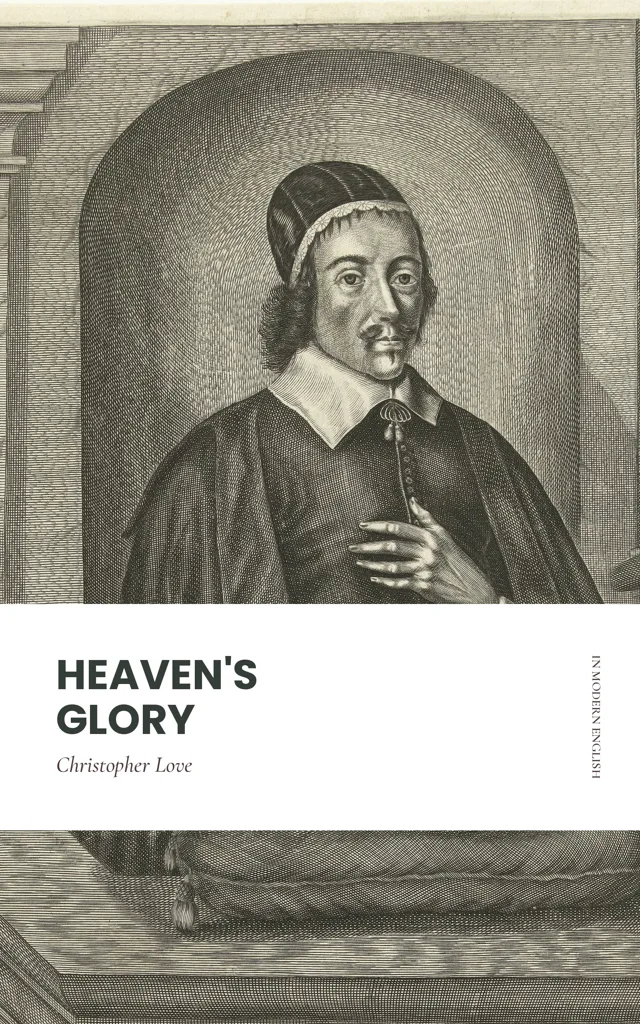
Ten sermons by Christopher Love on a single verse, Colossians 3:4, preached to his London congregation and published after his execution in 1651 AD. Love reads the verse in three parts: what it means that Christ is the Christian's life, what his appearing to judge the world will be, and what the saints' appearing with him in glory will involve.
One free account opens 250+ books and saves your place on every device. Google sign-in or an email link. No card.
You’re on the list — we’ll email you if this goes to print.
Included with your free account
This book, and 250+ more, free to read
A free account opens the whole library to read online, on your phone or at your desk. Open a book on one device and it is waiting at the same page on the next. The PDF and EPUB of every book are yours to keep, and audiobooks play in the same app.
250+ modernized editionsNot samples. The whole work, free.
Your place, on every devicePhone, tablet or desktop, same page.
131 audiobooksFrom $4.99 each, or all of them with a $50 gift.
Heaven's Glory is a series of ten sermons by the Puritan minister Christopher Love on one verse, Colossians 3:4. Love draws three doctrines from it: that Christ is the author of a Christian's life, that Christ will appear in glory to judge the world, and that the elect will be fully glorified when he does.
“Here you have the fullness of a bucket; there you shall have the fullness of an ocean.”
From this edition
How the argument unfolds
01
One verse, three doctrines. Love preaches the whole series from Colossians 3:4, splitting it into Christ our life, Christ's appearing, and our appearing with him. Every sermon after the first works one of those three.
02
Christ as the life of grace. Sermon one argues that no one else can produce this life, since we cannot, devils will not, and angels could not: “Making a man is easier work than making a Christian.” Four properties of natural life become four tests of the spiritual one.
03
Christ as the life of glory. Sermon two turns to glorification and draws eleven inferences for daily conduct, on the principle that “grace is the infancy of glory, and glory is the old age of grace.”
04
What makes the appearing glorious. Sermon three names eight things together make Christ’s appearing to judge the world so glorious, beginning with the excellence of Christ's person and ending with the speed of the judgment.
05
Terror, then duty. Love applies the point to eight sorts of hearers for whom the day will be dreadful, then draws seven duties from it, among them repentance, patience, moderation, and watchfulness against the heart, the devil, and lost opportunity.
06
The questions about the day. Sermons four through six take the doubts in order: whether the judgment is certain, when it comes, where it happens, and how long it lasts. Love lists the date-setting schemes of his day and rejects them all, since Christ forbade the inquiry.
07
Against a thousand-year reign. He answers the Millenarians at length, tracing the opinion's origin, weighing their texts, and setting out seven consequences he takes to be absurd. His own rule is that “Scripture speaks of only two appearings of Christ,” one in the flesh and one to judgment.
08
The glorified body and soul. Sermons six through eight describe the risen body under seven endowments, spiritual, immortal, impassible, beautiful, agile, pure, and glorious, then the soul by what it is freed from and what it gains: the sight of God, the enjoyment of God, and the perfecting of every grace.
09
Ten marks and five comforts. The last sermon gives ten scriptural tests by which a hearer may judge whether he is among the “vessels of glory, ordained by God the Father to partake of eternal glory through Jesus Christ,” and closes with comfort for ministers, the reproached, the obscure, the suffering, and the bold.
Key themes
Christ as the cause of both lives. Grace and glory are one gift in two stages, and Love treats them as a single argument: the Christ who begins the life of grace is the one who completes it in glory. “Christ brings life to you, though you brought death to him.”
The judgment as a court. Love describes the last day in the language of the assize, with Christ as chief justice riding circuit, and no defense left to the accused: “There will be no defending or proving of cases on judgment day, no lawyer to plead for you, no witness to testify for you.”
Nowhere to stand outside it. The practical use Love draws from the question of place is that there is “no place on earth that can hide you from the judgment of Jesus Christ.”
Restraint about what Scripture does not say. Where Scripture is silent, Love says so and stops. “Glory is something we have never seen, so it is hard to speak much about it unless we keep close to Scripture,” he says before describing glory, and he applies the same rule to the timing and the location of the judgment.
Assurance by examination. The series ends not in comfort but in self-testing, on the view that few will be saved: “Droves and herds of men will be damned for all eternity, but only a little flock will be saved.”
Christ a Christian’s Life (I)
(Col 3:4) “When Christ who is our Life shall appear, then shall we also appear with him in glory.”
Before I treat of these words in particular, I need to show three things about the epistle as a whole. First, who the people were to whom it was written. Second, when it was written. Third, the occasion for which it was written.
First. The people to whom this epistle was written were the Colossians, inhabitants of a city called Colosse, in Phrygia in lesser Asia. Colossians 4:16 shows they were to have this epistle read also in the church of Laodicea, which implies Laodicea was near this church of Colosse. Now Laodicea, in the first chapter of Revelation, is named one of the seven churches of Asia, so the inhabitants of Colosse dwelt in that same region. So much for the persons. Ancient historians (and I offer this only as human testimony, not Scripture) say that after Paul’s death this church at Colosse fell into grievous errors, and that by God’s just judgment, Colosse, along with Laodicea and Hierapolis, was soon after destroyed by an earthquake under the emperor Nero, houses and inhabitants alike. If this is true, I note only this: even the best churches stand on no such firm footing that, if they embrace error, they cannot come to ruin.
Second. As for when it was written, it is clear that Paul wrote this epistle while a prisoner at Rome. Here I observe that prison experiences are the clearest experiences, for read this epistle: no book of Scripture contains more practical matter for a Christian’s life than this one, and yet it was written from prison. I might also note that Paul, imprisoned under pagans, still had the freedom to write for the strengthening of God’s church. This shows that heathens once showed more mercy to Christians in prison than our own persecutors have shown to godly men in recent times, who were denied pen, ink, and paper, denied visits from friends, and shut up in dungeons stripped of all liberty. Those persecutors were crueler and more savage than the ancient heathen. Paul, though in prison, still had freedom to write to the churches.
Third. The occasion for this epistle was this. While Paul was in prison, Epaphras, the teacher of the Colossian church, came from Colosse to visit him in Rome. From this visit I note that when God’s people are imprisoned for a good cause, imprisonment should not make them strangers to one another. Epaphras, having come to Rome, told Paul the state of that church. Paul learned from him that the church was increasing in the gospel, and also, as recorded in Colossians 2, that false teachers were troubling the church. Though Paul had converted the Colossians to the faith, certain erroneous men were disturbing these saints with philosophical disputes and Mosaic rites, trying to turn their minds from the simplicity of the gospel. On learning this, Paul wrote this epistle to settle them in the faith they had received. The contents of the epistle bear this out fully, since it deals chiefly with the most practical points of religion.
I will not detain you with the book as a whole. It is enough, in choosing my first text, to show its scope and sense. I will go back no further than the chapter from which my text is taken, and lead you only a short way, over three verses, which will show the connection of these words.
The main aim of the earlier part of this third chapter is to draw the hearts of the Colossians away from the things of the world and turn their affections toward the matters of God and their own salvation. To press them toward obedience and practice, Paul urges three strong and compelling arguments.
First. Draw off your hearts, because Jesus Christ your head has risen and ascended on high, and now sits at the right hand of his Father. If the head is in heaven, where should the members be but where the head is? Shall Christ our head be in heaven while our hearts, his members, lie grovelling on the ground, panting after the dust of the earth, and set all our labor there? If Christ our head has risen, seek the things above, where Christ sits at God’s right hand.
Second. Seek the things above, for you are dead (Col 3:3); that is, dead to the world and dead to sin. You have a different kind of life than the world has: a life of grace. Just as a dead man neither notices the pleasant music sounding in the room nor the gaudy sights before him, because he is dead, so you should be like dead men, unmoved by anything here below, for you are dead, and your life is hidden with Christ in God. This life is hidden in Christ so that others cannot see it, and do not know its excellence and beauty.
Third. Paul tells them why they should not set their hearts on the things below, a fitting point to press even on good people. Why? Because they will one day live a glorious life with Christ. If they are to have a glorified life in another world, it is fitting that they seek the things belonging to that life and that world, rather than seeking only the things of this contemptible world. This is the argument in my text: “When Christ who is our Life shall appear, then shall you also appear with him in glory.” You have now seen the connection; now consider the sense.
Three things need to be explained in these words. First, what is meant by saying that Christ is our Life. Second, what is meant by Christ our Life appearing. Third, what is meant by our appearing with him in glory.
Question 1: What is meant by “Christ who is our Life”? I answer that Jesus Christ is called our Life not essentially, as though we shared in that very essential life which Christ himself enjoys, but causally: he is the author, cause, and procurer of a Christian’s life. There is a twofold life in a Christian, and Christ is the double cause of this double life.
1. There is a life of grace, which we call sanctification, and Christ is its cause.
2. There is a life of glory, which we call glorification, which we shall enjoy with Christ when the world ends. Christ is the cause of both these lives.
1.) He is the efficient cause, the author of this life.
2.) He is the procuring or meritorious cause. That is, by his death, Christ earned that we should live forever. So the meaning is plain: Christ is our Life, in that he is the author of this life, and by his death the meritorious cause of why we should live forever, since he died in order to destroy the one who held the power of death, the devil.
Question 2: What is meant by the phrase, “When Christ who is our Life shall appear”?
Answer: In Scripture there is mention of a threefold appearing of Jesus Christ, each in a distinct and notable way.
1. There is an appearing of Christ in the flesh, bodily, which you read of in 1 John 3:8: “For this cause the Son of God was manifested” (the same word as in my text), or appeared, “that he might destroy the works of the devil.” So too (1 Tim 3:16): “Great is the mystery of godliness, God manifest in the flesh, justified by the Spirit”; that is, the mystery of godliness is that Jesus Christ appeared, or was manifest, in the flesh as man, and was justified by a divine nature as God. This is called manifestation. But this is not the meaning intended here, because that appearing is past. The appearing in my text is still future: “When Christ our Life shall appear.”
2. There is a spiritual appearing of Jesus Christ in the preaching of the gospel: “O foolish Galatians, who hath bewitched you that you should not obey the truth? before whose eyes Jesus Christ hath been evidently set forth” (that is, appeared) “crucified among you” (Gal 3:1). The Galatians never actually saw Christ crucified, but they saw him openly displayed in the preaching of the gospel (1 John 1:2). But this is not the appearance meant here either, in the words “When Christ who is our Life shall appear.”
3. There is a glorious appearance of Jesus Christ, to judge both the living and the dead at the last day. He will execute the office to which God the Father has appointed him, passing judgment over the whole world, “Looking for that blessed hope,” etc. (Titus 2:14). This is the meaning of the phrase “When Christ who is our Life shall appear”: Jesus Christ, from whom we have the life of grace, and shall have the life of glory. Here is your comfort. This Christ will one day have a glorious appearing to judge the whole world.
Question 3: What is meant by the words “Then shall you also appear with him in glory”?
Answer: Before I explain this phrase, let me note something. Scripture says that when Christ appears, all the saints of God will appear with him in glory too. It seems to me this connection strongly overturns the doctrine of the Millenarians, who hold that Christ will personally reign a thousand years on earth before the judgment day comes. For this text says “We shall appear with Christ in glory,” which they will not grant, since they hold that Christ will appear on earth before this time of glorifying arrives. But set that aside.
“You shall appear,” that is, you yourselves particularly, both body and soul, shall be glorified by Jesus Christ at that time. When Jesus Christ appears to judge the world, then it will become clear what glorious creatures you are, though now you are looked upon as despised and unworthy. So the sum of the words comes to this, as if the apostle said: whatever life of grace you have, and whatever life of glory you shall have in heaven, you owe to Jesus Christ. He is your Life. You could not work life in yourselves, but he is its author and meritorious cause. By his death you have life, and this Christ will not remain hidden. He shall one day appear before the whole world in glory, and when he appears, he will not appear in glory while you remain in disgrace.
You shall appear in glory as well as he. “When Christ who is our Life shall appear, then shall you also appear with him in glory.” In these words I will note two main parts.
First. Here is a description of Jesus Christ.
Second. Here is a description of the elect.
First. Here is a description of Jesus Christ, in two respects.
First, what he is in relation to his people: “He is our Life.” Second, what he shall do: “Christ who is our Life shall appear.”
Second. A description of the elect, likewise in two respects.
First, what they shall be: they shall appear with Christ in glory. Second, the time when this shall happen: when Christ shall appear. “When Christ who is our Life shall appear, then shall we appear with him in glory.” From these parts, three points of doctrine can be drawn.
Doctrine 1: From what Christ is, “He is our Life,” I note this: Jesus Christ is the author and procuring cause of a Christian’s spiritual life.
Doctrine 2: From what Christ shall do, “Christ who is our Life shall appear,” note this lesson: Jesus Christ, by whom believers live the life of grace and glory, shall one day appear in glory, or have a glorious appearing.
Doctrine 3: From the description of the elect, both what they shall be and the time when they shall be so, note this: Jesus Christ has reserved the full glorification of the elect until he himself appears to judge the world. When he appears, then we also shall appear with him in glory. These are the doctrines from which I will preach many sermons, and they will bring much comfort and consolation to the elect. I begin with the first.
Doctrine 1: Jesus Christ is the cause of a Christian’s spiritual life. I will treat this in two parts, since there is a life of grace called sanctification and a life of glory called glorification, both of which Christ is the author of. I will now speak of the first.
1. That Jesus Christ is the author or cause of the life of grace that believers have in this world. If you ask why grace is called life, I answer that it is so called because the state of nature is called a death: “You are dead in trespasses and sins” (Eph 2:1). A man is dead in sin until he has a principle of grace. In contrast to the condition of death, the state of grace is called a state of life: “You are partakers together of the grace of life” (1 Pet 3:7).
2. Grace is called life, because wherever it is, it will never die. What never dies may well be called life, and wherever a principle of grace is present, it will never die. I need not prove this further, since the text itself is sufficient, but consider one more passage: “Whoever drinks of this water shall thirst again, but whoever drinks of the water that I shall give him, he shall not thirst, but the water I shall give him shall be a well of water springing up to everlasting life” (John 4:13–14). By this water is meant grace, and it is called living water to show that grace will never die in a person. If you have this water that I give, it will never run dry. Instead it will spring up as a well of water to eternal life.
That is, if I give you grace only as a drop of water, that drop will grow into a well, and that well will never be drawn dry. It will spring up in you to everlasting life, and I must give it to you, Christ says; I must be the author of this well of water. In handling this point, I will show only two things.
First. How it appears that Jesus Christ is the author of a Christian’s life.
Second. How you may discern whether Jesus Christ has worked this life of grace in you or not, so that you may say Jesus Christ is your Life, and so have this assurance, that when your Life appears, you shall appear with him in glory.
First. How does it appear that Jesus Christ is a Christian’s Life?
Answer: Because none but Christ can be the author of this life, Christ must be the one.
1. We ourselves cannot be its author. We who cannot breathe a natural life into our own nostrils are much less able to breathe this life of grace, this life of God. We who could not make ourselves human beings are even less able to make ourselves saints. Making a man is easier work than making a Christian. If we could not give ourselves natural life, we are far less able to give ourselves spiritual life, and this for three reasons.
1.) Because of our weakness. We are too weak to do this work. The work of grace is called a creation: “We are created by God in Christ Jesus to good works” (Eph 2:10). A man’s arm is too weak to carry out a work of creation.
2.) We are guilty not only of weakness but of stubbornness. We will not labor after grace. “Ye will not come unto me, saith Christ, that ye may have life” (John 5:40).
3.) You are at enmity with grace. By nature you love sin and hate grace, and a person will never labor to produce in himself what he hates both in himself and in others. That is the reason man cannot work this grace in himself. Therefore Christ must do it.
2. As man cannot produce this life, neither will devils produce it. Like the birds of the air that steal the seed the moment it is sown, they would take away grace from the heart if they could, and they will not give it to you (Matt 13). The devils oppose grace, laboring to weaken your grace and faith, but they will never work grace in you even if they could.
3. Angels cannot work grace in you either. Angels cannot give you this life, and surely if they cannot do it, man certainly cannot. They did not have the ability to keep grace when they had it, so they could not have had power to beget grace where it did not exist. It is easier to keep grace than to get it in the first place. To work grace in the heart is called, in the place mentioned earlier, a new creation, and that is far above the power of angels. They are only creatures; only the power of God can create. “The same power that raised Christ from the dead must work in men to make them believe.” Angels do not have the strength to put forth the power God did. They are not as strong as the Almighty; they cannot contend with him. So men cannot do it, devils will not do it, and angels have no power to do it.
The crown of honor must rest on Jesus Christ alone, and this text must still hold true: Jesus Christ is the person who is our Life.
Second. The question now is how you may discern whether Jesus Christ is your Life or not, whether you have this life of grace or not, whether you can say with the apostle that we are partakers together of the life of grace (1 Pet 3:7). Beloved, I urge you to look into your own hearts. I know you all have the life of nature, but only God knows whether you have the life of grace. You may live the life of men, yet not the life of Christians. It is a life of grace that makes you Christians. I will give you two ways to discern whether Christ has given you this life of grace.
1. You will know it by the properties of this spiritual life.
2. You will know it by what accompanies it.
1. By the properties of it. As there are four properties of natural life, there are four of spiritual life. If they are not found in you, I may say to you what God said to Abimelech (Gen 20:3): “you are a dead man,” and you will be a damned man too, if this life of grace is not in you.
1.) The first property of life is this: life always carries a nutritive appetite with it. Wherever there is life, there is a natural instinct to nourish that life God has given it. A child cries for the breast as soon as it is born, and though never taught to, will draw the milk as soon as it is given. It is natural for all creatures to nourish life. Every bird and every beast will nourish its life. This property holds wherever life exists. Beloved, so I may say to you: wherever there is a spiritual life, you have an earnest desire, through all sanctified ways and means, to nourish and increase that life of grace in your heart.
So the apostle writes, in 1 Peter 2:2, “As newborn babes desire the sincere milk of the word, that ye may grow thereby.” If you are newly born Christians, if you have life, you will desire the sincere milk of the word to grow up in that life. Every creature desires food suited to its own life. The dog will feed on garbage, the pig on swill, the dove (suited to its nature) will feed on the finest grain, the beasts on the grass of the ground. Everything seeks food suited to its own life. So it is with Christians: you will desire nourishment suited to your life. Now I urge you to consider what food you desire. What do your appetites run after most? Some men, if they can feed their bellies, clothe their backs, keep up their trade, and collect their debts, count themselves made men and fear nothing in the world.
If you live only a life of nature, this is how you live. So consider: you have lived ten, twenty, forty years, but what have you done to nourish this life of grace? What effort do you make in examining your spirit, so that sin does not break in and overrun it? What effort do you make to make use of the ordinances, so that by feeding at the gospel breasts your spiritual life may grow stronger? If you do none of this, you do not have this spiritual life in you, and you cannot say that Jesus Christ is your Life.
This I might lay as a heavy charge upon you today: that you do not look after this life of grace, that you use no means to obtain grace or to grow in grace. If you take no care to nourish and cherish this spiritual life, it is evidence that the life of Jesus Christ is not found in you.
2.) Again, life has this property: wherever it exists, it is generative, or communicative of itself. All living creatures have some means of reproduction for propagating their own kind. Plants, which have only a growing life, have a seed or sap in them by which the tree grows and increases, so that one tree may produce many trees (Gen 1:11). Every living tree loves to propagate its own kind. Beasts increase their kind, birds their kind, and men their kind. Whatever has life has something in it to communicate to its own kind. And by this you may discern whether you have the life of Christ or not. This life of grace will be communicative. It will make you eager that others should have grace as well as you. A married man naturally desires children of his own who may enjoy his property along with him. It is the same in the spiritual life.
So in 1 Peter 3:7 the apostle explains why husband and wife should live together according to the word: to promote each other’s salvation. The husband should have the knowledge to teach his wife, and the wife should do her duty, and both should pray together for each other’s souls, “considering,” says the apostle, “that you are partakers together of the grace of life.” The grace of life will make the husband do his duty and the wife do hers. So, beloved, you do not have the grace of life if you can live ten or twenty years in your family and never labor to bring your wife home to Christ, never labor to work grace in the children who sit at your table, never labor to convey this life to your servants who work under your roof, never care that they should do God’s work as well as yours.
If you had this grace of life in you, it would be natural to dispense this life and communicate it to others as well as to yourselves. The Spirit is a communicating Spirit. We read in Acts 2 that the Spirit of God came down upon the apostles and other Christians like fiery tongues. It came down like fire, and fire is the most spreading thing there is. If there is but a spark, leave it alone, or blow on it, and it will kindle into a flame. It will not only burn in your chimney, it will spread and burn down your house as well. Fire spreads by nature, and the tongue, we know, is the instrument by which a man communicates the good that is in him. If a man had ever so much good in him but no tongue to speak it to others, it would do them no good.
So the Spirit came down like fiery tongues, to show that their grace must spread like fire, and that they must have tongues to communicate and dispense it to others, so that others might have the life of grace in them as well.
3.) Where there is life, there is also sense enough to feel any injury or violence done to it. Follow me here, for I fear many will be found living ghosts in God’s presence today. Where there is natural life, there is sensitivity to anything that might harm it. The poor worm, if you tread on it, will writhe and try to escape into a corner, laboring to avoid what would harm it. The beasts will eat nothing harmful to their life. A small child will not swallow something that tastes harmful. There are five senses; three are useful, but two are necessary: taste and touch. Beloved, it is the same if you have the life of grace: you will be sensitive to anything that may harm or endanger that life. And what is that? Nothing threatens the life of grace except sin in your heart and life, and the temptations of the devil. These are grace’s great enemies.
Now if you have this life, you will be sensitive to the sins you commit. What harm do the thousands of lusts I harbor in my soul do to my graces! They keep my graces low, they keep my graces dying, they keep my graces from thriving. Have you ever been sensitive to this, to what damage the sin in your heart does to your grace? Have you ever grieved over it, ever lamented it? If you had the life of grace, you would fight against the sin that so wrongs your grace. And the same goes for temptation. Perhaps the devil has tempted you to horrible sins: to pride one day, to deceit the next, to uncleanness the third, to profaneness the fourth, sin after sin every day, and yet you were never sensitive to it, never took it to heart.
A living limb feels even the smallest prick, while a dead body feels nothing of the darkness of the grave, the weight of the earth, the gnawing of worms, the stench of decay. So perhaps you lie under the guilt of millions of sins, and though they weigh as heavy as mountains of lead, you never feel the weight of even the smallest sin, not even with one finger. It never makes your heart grieve or trouble you. Take this to heart: Jesus Christ is not your life! If Christ were your life, you would be deeply sensitive to anything that might injure or wrong that spiritual life. Now where are you, you insensible sinners whose hearts may testify that you are guilty of a thousand sins, yet your thoughts are never troubled, your hearts never grieved? Do not dare say, with a shameless face, that Jesus Christ is your Life.
4.) Wherever life is, its actions flow from an internal principle. There is a natural heart that is the fountain of life, and by it the body becomes active and vigorous. In living creatures the heart lives first, because it is the forge of spirits and fountain of heat. Consider a man who sings or lifts up his voice. He has an internal principle in him producing that motion. A man can make a thing screech or make noise by clapping two things together, but that comes from an outward cause. When a man speaks, though, he speaks from an inward principle, if he has life in him. So it is with spiritual life. A man with no spiritual life in him may do a great deal outwardly, moved by vainglory, by the example of his neighbors, by fear of hell, by hope of heaven, or by hope of reward.
These are all external principles that move action, and by them a man may go far in a godly course while having no spirit of life in him at all. But if the spirit of life is in you, all your actions flow from an internal principle. There is a principle of grace in the heart, and because of it you act, you cherish grace, and you make use of it. Even if there were no God to condemn, no devil to curse, no hell to torment, and no heaven to reward, there is still an innate principle in you that grace is lovely, sin abominable, God desirable, and his ways pleasant. Something within a man draws him to the ways of God, even if none of those outward motives should draw him at all.
Question: But you will ask, when does a man perform a gracious act from an internal principle of grace? I answer:
First. If a man does any gracious action from an inward principle of grace, there is a natural fitness in his heart for all grace alike. A man who acts grace only from external principles will practice some graces, but not all. The graces that call for more self-denial, more difficulty, and more danger, he can never bring himself to practice, because he does nothing out of love for grace but out of love for himself. But when a man acts from an inward principle, there is a fitness in his heart for every grace.
Second. He sees a lovely beauty in every grace. Many men may practice grace while never loving grace. They see no beauty in grace at all, only some profit in it, and that is why they practice it. But the man who acts from an internal principle sees the loveliness in grace, and so he loves it, and so he walks in it.
Third. He carries in his heart an ardent affection for grace, because of the native brightness and beauty he sees in it, and that love drives him to pursue and practice grace. Now I urge you all, before the Lord this day, to examine your own hearts and see whether you can stand or fall by this test, whether you can truly say Jesus Christ is your Life.
2. You may also know whether you have this life of grace by what accompanies it.
1.) Where the life of grace is, the power of sin is destroyed and mortified. “Ye are dead” (Col 3:3), that is, dead to sin; the power and dominance of sin was subdued in them. Likewise, “Likewise reckon ye yourselves dead unto sin, but alive unto God through Jesus Christ” (Rom 6:11). If sin reigns in you, you have no life of grace.
2.) Where the life of grace is, we are dead to the world. “I live, yet not I, but Christ liveth in me” (Gal 2:20). Such a person no longer minds the things of the world and is not taken up with them, just as a dead man takes no notice of pleasant music or attractive sights. If you are still alive to the world, with your affections set on earthly things, the life of grace does not dwell in you.
3.) Where the life of grace is, there is love for those who share the same grace of life with us. Every creature loves best the creature that lives the same life it lives, and so should Christians. “We know that we are passed from death unto life, because we love the brethren; he that loveth not his brother abideth in death” (1 John 3:14).
Now to bring all this to a practical use.
First. Is it so, that Jesus Christ is the author and cause of a Christian’s life? Then this stands as condemnation for all who are outside Christ, who have no real interest in him. If you are Christless, you are but dead people, and you will be damned people too, because there is no life apart from Jesus Christ.
Second. Is Christ the cause of your spiritual life? Then this condemns the Pelagians, who hold that they can produce grace in their own hearts by the power of nature. The text says Christ, and Christ alone, is able to do this. So this doctrine strikes at those who think nature’s own strength is enough to work this life of grace in the soul.
Third. Is Jesus Christ your Life? Then this brings great comfort to you who have this life of grace in your hearts, yet find your spiritual life decaying, who are in the languishing condition the church of God was in: “Strengthen that which remains, that is ready to die” (Rev 3:2). Many of you have this seed of life in you, yet may be in a languishing and decaying state. But though you wither in your branches, you will never wither in your root. Jesus Christ, the root of Jesse, is your root, and this root still has sap enough to supply all its branches. This head still has spirit enough to distribute to all its members, so do not be afraid. If Christ is the root and cause of your life, you will never die. You may come to periods of languishing and decay, but you will never die, because Jesus Christ is your Life.
Christ a Christian’s Life (II)
(Col 3:4) “When Christ who is our Life shall appear, then shall we also appear with him in glory.”
When I first opened these words, I gave you their scope and sense, along with the observable parts and the points they yield. I drew three observations from them. From the phrase “Christ who is our Life” came this doctrine: that Jesus Christ is the author and cause of a Christian’s life. I told you that a Christian’s life is twofold: the life of grace, which we call sanctification, and the life of glory, called glorification. Jesus Christ is the author of both. I have already finished the first part, the life of grace.
I now turn to the second branch of the doctrine: that Jesus Christ is not only our Life in the sense of begetting the life of grace in us, but is our Life in a second sense as well, bringing us to eternal life, the life of glory.
Before I can come to the application of this point, where its chief sweetness lies, I must first explain it. Glory is something we have never seen, so it is hard to speak much about it unless we keep close to Scripture, which speaks soberly and truly on the matter. If the sun dazzles the eyes of anyone who looks into it, how much more will the glory that is ten thousand times brighter than the sun. Many who venture to speak of glory are carried into such raptures that before they come back down, they are lost in a maze of error. Gregory says well in his Morals that when a mortal man discusses glory to come, it is as if a man born blind were to argue about light he has never seen. So difficult and dangerous is it to launch deeply into this ocean.
I will not dwell much on the doctrinal side of this point, but will treat it by way of explanation, by way of proof, and by way of application.
First, by way of explanation, two things need explaining:
1. What this life of glory is.
2. How Jesus Christ is the author of the glory believers will have in heaven.
First, what this life is. This life of glory is that happy and blessed state which God, through Christ, of his mere grace, has provided for all the elect after the day of judgment. In it their bodies will be raised from the grave, and both bodies and souls will be glorified in full communion with, and enjoyment of, God the Father, Son, and Holy Spirit, together with all the saints and angels in heaven forever. This is a general description of glory. Many questions remain about the glorifying of the body and soul and its degrees, which will fit more properly under the last point.
Second, how is Jesus Christ the cause of the glorified life the elect will have in heaven?
First. He is the author, or efficient cause, of this blessed condition: “He is the author of eternal life to all that obey him” (Heb 5:9). Eternal life and eternal salvation are one and the same, and the apostle says Christ is its author. So too: “I give unto them eternal life, and they shall never perish, nor shall any take them out of my hands” (John 10:28).
Second. Jesus Christ is the cause of this life meritoriously. That is, by dying a shameful death, Christ purchased, or merited, a glorious life for all the elect. So you read in Romans 5:21 that it is by Christ’s procurement that you have this life. “God hath given us eternal life, and this life is in the Son” (1 John 5:11), meaning it is given to us through the Son’s procurement, since he died a shameful death to secure for the elect a life of glory.
Third. Christ is called the cause not only efficiently and meritoriously but also preparatively. He is the one who prepares this glorified state for us, and who prepares us for that state.
1.) First, he prepares this glorified state for us. “I go before to prepare a place for you” (John 14:3), that is, to prepare this glorified state, heaven, for you, “that where I am you might be also.” So also, “Come ye blessed of my Father, inherit the kingdom prepared for you” (Matt 25:34). Christ is the author of this condition, preparing it for us.
2.) Second, he also prepares us for that glorified condition. “Giving thanks to the Father, and to Jesus Christ, who hath made us meet to be partakers of that inheritance with the saints in light” (Col 1:12). There Jesus Christ is the author, making you fit for this glorified condition. So too you read, You are made vessels of honor (2 Tim 2:21), meaning vessels ordained for heaven. But how? He has sanctified you, made you fit for the master’s use, and prepared you for every good work. If the Lord were to bring a wicked man to heaven, heaven would be a hell to him, for whoever does not love grace on earth will never love it in heaven. So God must not only prepare heaven for man, but must prepare man and make him fit for heaven. That is where the blessedness of this condition lies.
Fourth. Christ is the cause of this life promissorily, because he has promised it to all his elect. “And this is the promise which he hath promised us, even eternal life” (1 John 2:25).
Second, to prove the point, I will give you two or three passages of Scripture (in the mouth of two or three witnesses it is enough to establish every word). “The hour is come, O Father, glorify thy Son, that thy Son may glorify thee, as thou hast given him power over all flesh, that he should give eternal life to as many as thou hast given him” (John 17:2). As many as God the Father has given Jesus Christ by election, so many he gives heaven to by redemption. Likewise, “And this is the record, that God hath given to us eternal life, and this life is in his Son” (1 John 5:11–12), meaning this life comes from Jesus Christ, procured for us by him and no other. And so, “The God of all grace, who hath called us to eternal glory by Jesus Christ” (1 Pet 5:10).
God is pleased for grace to call every man to heaven, but this happens through Jesus Christ, so that Jesus Christ is the author of all our glory. But this point is better suited to practical application than to speculative discussion, so I will now bring it down to some practical uses.
If Jesus Christ is indeed the author and cause of a Christian’s life of glory, this yields a double use: for information, and for examination.
First, for information. From this doctrine I might draw eleven practical inferences for this use.
1. If Jesus Christ is the author and cause of the eternal, glorified life you will have in heaven, then you ought to labor to glorify Jesus Christ while you live here in this world. This is only fair. If Christ makes it the great work of his mediatorship, of his coming into the world, to bring you to glory and to be your Life, then it is only fair that you should use the little span of your life here to glorify Christ. This is the argument Scripture shows us, that Jesus Christ pleaded with his Father as to why his Father should receive him into glory. Read the argument: “I have glorified thee upon earth, I have finished the work thou gavest me to do. Now O Father glorify me with thy own-self, with the glory I had with thee before the world was” (John 17:4–5).
Here Jesus Christ grounds his argument for why he should be glorified with his Father, with the very glory he had before, on this: “O Father, I have glorified thee upon earth.” Beloved, can you make this argument to God when you come to die? Can you go to God as Jesus Christ did, and on the same grounds plead for glory from him? Can you say, Father, I have glorified you on earth, I have given you glory in my relationships, glorified you in my duties, glorified you in my profession of religion? Can you say that you have glorified him on earth? What glory have you brought to him, that he should bring glory to you? Jesus made this the foundation of his plea to his Father for glory in heaven.
That is the first inference: if Christ procures for you a life of glory, then you are obliged to order your lives so as to glorify Jesus Christ while you live in this world. And if you ask how, Christ himself answers it: “Herein is my Father glorified if you bring forth much fruit” (John 15:8). You glorify the Father and glorify Jesus Christ by being a fruitful people under the use of the ordinances.
2. Is Jesus Christ the cause and author of your glorified life in heaven? Then reflect on the unkindness of your conduct toward Jesus Christ since you have lived here in this world. Jesus Christ is the author of your life, but you have been the cause of his death. Jesus Christ is the author of your glory, but your sins have been the cause of his shame. You are ashamed of him here on earth, yet he is not ashamed to have you appear before his Father and all saints and angels in heaven. You put a crown of thorns on Christ’s head; Christ puts a crown of glory on yours. You thought earth too much for Christ and would not let him live here; Christ does not think heaven too much for you. If Christ procures a glorified life for you, then learn to reflect on your unkindness, and let it work in you a penitential sorrow and relenting of heart.
3. Is Christ the author of your glorified state? Then learn this: while you live your life here in this world, you are to make provision for eternal life. And how is that done? The Holy Spirit tells you to “lay hold on eternal life” (1 Tim 6:11–12). How? By following righteousness, meekness, faith, and godliness, and fighting the good fight of faith. That is the way to lay hold on eternal life. The multiplying of grace, opposing sin, resisting Satan, and combating temptation, whether from the world, the flesh, or the devil, all this is the way to provide for eternal life. Beloved, if Jesus Christ will provide you a life of glory, surely that life is worth seeking, worth laboring for, and worth praying for, else it deserves no thanks. Lay up provision for this eternal life.
I have read of a nation that used to choose its kings anew every year. While a man reigned, he might live splendidly and have all the abundance his heart could wish, but when the year ended, all his pomp was stripped away and he was banished to some obscure place for the rest of his life. One king, hearing this custom before he was called to reign, resolved that during his year as king he would not spend his revenues lavishly, but would gather all the treasure he could and send it ahead to the place of his coming banishment. In this way, he could live comfortably there for the rest of his life. Beloved, here is the point: the Lord has given you time to live in this world, but only a little time, perhaps not even a week or a day. While you live here you are on the way to salvation.
You feed at the breasts of the ordinances that can nourish you to eternal life, and you draw from what Scripture calls the wells of salvation. Remember, while you live here, to lay up for the life of your exile, for you will be banished from this world and will not reign here long. Lay up provision, then, for that future life you are to lead in glory. Work while it is day, for the night is coming when no one can work.
4. If Christ has provided believers eternal glory, then do not let the trivial concerns of this present life keep you from pursuing the great and important affairs of the life to come. Historians fault Artaxerxes for having a very low and sordid spirit, spending his time making knife handles, a beggarly and menial occupation, and neglecting the government of his kingdom because of it. Truly, many men are more foolish than he. Shall I say knife handles? No, pins, trifles, and points so occupy the hearts and hands of many people that these trivial pursuits make them neglect the great affairs of the kingdom of glory. We all fault Archimedes as a foolishly absorbed man, who, when his city was besieged and enemies were breaking in to cut his throat, sat drawing lines in the dust, careless of the enemies and weapons around him. Truly, you do not know whether messengers of death may come before morning.
Yet if the Lord should send death among us, we might justly fear that many of us, like Archimedes, are drawing lines in the dust, our hearts and hands absorbed in petty business while we never attend to the great affairs of this glorious state to come. Beloved, I urge you: if a glorious life has been procured by Jesus Christ, do not let the trivial concerns of this world keep you from pursuing that glorious condition.
5. If Christ is the author and cause of this glorious life, this should teach you to long and pant continually after that glorified condition. Your natural life, with all its refreshments and comforts, is nothing compared to the inestimable blessedness of the glorified state. Augustine said that whoever considers the happiness of eternal life, and the eternity of that happy life, will feel an earnest desire for that glorified condition kindled in his heart. Pliny speaks of a bird he calls Avis Paradisi, the bird of paradise, whose nature is such that it cannot bear to perch low on the ground. It always settles in the highest trees and seldom or never touches the ground, and so he calls it a bird of paradise. Once, this bird was caught and tied by the leg, and historians say it mourned night and day because it could not fly upward.
Beloved, you who are the children of paradise should remember and resemble this bird. Here you are so weighed down by daily business, by temptations, and by the variety of lusts, that when you would rise upward toward your God and Redeemer, these burdens hold you down and you cannot lift your spirits. Do as this bird did: mourn night and day, and let your soul long and pant after this glorious state, a state of glory procured by Jesus Christ.
6. Is Jesus Christ the author of this glorified life? Then take care to do nothing that would disgrace this glorified life you shall one day have through Jesus Christ, while you still live here in the world. When Alexander was invited to run a race among the common crowd, he answered, “It is fitting that a king’s son should compete only alongside the sons of princes.” He stood on his birth and would not disgrace his father, his lineage, and his princely nature by running among common people. Beloved, I would have you do as Alexander did. Each of you has a race to run (“let us run with patience the race that is set before us,” so the ways of Christianity are called), and in running your race the devil would have you mix with the lusts and sins he sets before you.
Speak out of a heroic and sanctified heart, as Alexander spoke from a noble mind, and declare that in running your race you will walk only with the sons of kings, as children of the great King of heaven, and will not mix or join yourselves with the base and common things below. Beloved, do nothing to disgrace this glorified state. And if you ask what would disgrace it, I answer that there are four particulars you must guard against.
1.) Falling into scandalous sins. How unsuited this is to that glorious condition! It turns your glory into shame. Scandalous sins in those who are heirs of glory are like foul stains on a clean cloth. Touch no unclean thing, you who expect God to receive you.
2.) Hanging your head dejectedly at every trouble you meet in this present life. We find in Scripture that the people of God were so inflamed and carried away by the thought of their coming glorified condition that they smiled at every sorrow, suffering, and torture they met here below: They endured scourgings and cruel mockings, and the women endured tortures, and would not accept deliverance, because they expected a better resurrection (Heb 11:35–36), to be happy with Jesus Christ when he comes to judgment. Beloved, you will greatly disparage your glorified state if every trouble you meet makes you hang your head. Remember that though this life is subject to shame, the life to come has no shame in it at all, only glory.
Consider a king’s son walking in disguise. Suppose one man does not give him the wall, and another shows him no respect, simply because they do not recognize him. Should this discourage him? No, he should tell himself, “Now I am in disguise and men do not know me, but the time will come when I will wear a crown and sit on my throne, and then all men will respect me.” So it is with the people of God: they are princes’ sons in disguise. People do not know your glory, and the world does not see your worth, but the time will come when you will sit on the throne. As the words before my text say, “your life is hid with Christ in God.”
If that is so, do not be discouraged by whatever misery you endure here, for your glorified life will make up for all of it: “For I reckon that the sufferings of this present time are not worthy to be compared with the glory which shall be revealed in us” (Rom 8:18).
3.) Divisions and quarrels among those who will share the same glorified life are a great blemish. Believers who are to share the same glory and the same happiness ought to live in love, yet while they remain in this world they too often cannot. A dying man once said to the friends around him, “I am going to a place where Luther and Zwingli are good friends. They could not agree in their lifetime, but when they died they became friends in heaven.” Heaven brings peace to everyone, and that peace is part of what makes it glorious. It is a shame, then, that division and dissension should exist among us, who are to share this same glorified condition with Christ in heaven.
4.) Your glory will also be marred if you live in close company with those who will never share this glorified condition, if while you live in this world you keep closest company with people who will never have fellowship with you in the life to come. What is this but like the man possessed in the Gospel, leaving the society of the living to walk among the dead? What is this but like Nebuchadnezzar, leaving the company of men to eat grass among the beasts? If you are to be glorified saints with a glorified life, what a blemish it will be to your glory if your companions are people who will never share that life. About ten years ago, I was present when a scholar of Oxford lay on his deathbed. Making a profession of his faith and grace for the comfort of his friends, he said this: “O Lord, I find by the decay of nature that I have not long to live.”
“I ask this of you before I die: let the company I most delighted in and had fellowship with while I lived on earth be the company I keep in heaven, and let me never be burdened, once I am dead, with those companions I could never delight in on earth.” That was his prayer, and I will draw only this lesson from it: it will be a great shame for you, if you are to be an heir of glory, to have spent your earthly life among drunkards, swearers, adulterers, and the profane, people who will never see glory with you. What could you say for yourself if you were guilty of this? Could you say on your deathbed, “Lord, bring me to the company of those I delighted in while I lived,” or, “Lord, do not bring me, once dead, to the company of those I could not bear while living”?
If some of you wished that, you would in fact be wishing yourselves into hell, since drunkards and swearers have been your only companions, and that would bring great reproach upon glory.
7. Is Jesus Christ the author of this glorified life? Then this should comfort you against all the sufferings you must face in this present life. Why? Because you shall have a glorified life that will make up for everything. If you suffer here, your sufferings will end, but in glory you will have an endless life. If you suffer shame here, it will be repaid with eternal glory hereafter: “I reckon that the sufferings of this present time are not worthy to be compared with the glory which shall be revealed in us” (Rom 8:18). The glory to be revealed is so far beyond compare that the sufferings of this life cannot be measured against it. Foxe’s Acts and Monuments reports that two martyrs were going to the stake, and as the fire was lit, one of them shrank back and fell away in fear.
The other, seeing him faint, told him to take heart, since one half hour in glory would make him forget all his pain. I might say the same to you. Even a lifetime of sickness, a lifetime of losses, a lifetime of hardships, take this to heart: a little time in that blessed state of glory will make you forget all your sorrows.
8. If Christ is the author of this life of glory, do not count your life, or any comfort attached to it, too dear to give up for Jesus Christ. A martyr, reflecting on Christ’s kindness to him, once said, “Had I as many lives as hairs on my head, and as much blood in my veins as water in the sea, I would think it all well spent for him who spent his life for me.” Take this to heart, beloved: if Christ has secured for you a glorified life, do not value your own life too highly to give it up for Jesus Christ. It is recorded of Barnabas and others that their lives were not too dear to them for the testimony of Jesus Christ. Nothing should be too dear to you for the testimony of the Christ who has secured this life of glory for you.
9. Is Jesus Christ the author of this life? Then learn from this that it is no shame for a person to walk in a way of religion. It is no shame to labor to save your soul by living a life of holiness, because “the fruit of holiness leads to eternal life” (Rom 6:22). Holiness is no shame, because it leads to this end, a life of glory. An action is shameful when it ends in shame. If holiness ended in shame, it would be shameful, but holiness is only the entrance to glory. So living a life of holiness is no shameful life, because it leads to that life of glory. In his letter to Philemon, Paul writes, “Receive him now not as a servant, but more than a servant” (Phlm 1:16).
Onesimus was only a poor servant before his conversion, but once he had turned from his sinful and loose life, Paul says, “Receive Onesimus not as a servant, but more.”
Beloved, conversion and sanctification take you who are poor servants and apprentices and make you servants, and more than servants. They take you who are gentlemen and make you gentlemen, and more than gentlemen. Holiness never lowers your standing; it raises your honor, for religion is no disgrace, because it leads to glory.
10. Is Christ the author of this glorified life? Then live to magnify the riches of the grace and mercy found in Jesus Christ. Here is grace beyond compare: Christ brings life to you, though you brought death to him. Christ gives glory to you, though you brought shame to him. Christ gives heaven to you, though you thought the earth too good for him. Christ pleads with his Father for you, though you contradicted him: “he endured such contradiction of sinners against himself” (Heb 12:3). Jesus Christ crowns you with a crown of glory, to your honor, though you put a crown of thorns on his head, to his disgrace. O magnify this grace, which shows you kindness for your unkindness, love for your hatred, good in return for the wrong you have done him. You have great cause to magnify the greatness of this mercy.
Any human patience would have been worn out long ago by the many deadly provocations you have offered Jesus Christ, had his patience not been infinite. O magnify Christ, that he should be the author of eternal life for such unworthy creatures as we are.
11. Cling to Jesus Christ in affection and love all your days. Why do children love their parents by instinct? Because they have their life from them. Let grace incline your hearts the same way. You have life from Christ, so love Christ. You have a glorified life from Christ, so glorify Christ. It is said of the elephant that, because it lacks one bone in its back, if it falls it can never rise again but must lie there and die. On one occasion, an elephant fell asleep, fell down, and could not rise, struggling in vain to get up. A traveler passing by saw this, took pity on the creature, and used his strength to help it up. The elephant, by natural instinct, repaid the man’s kindness by following him for the rest of his life, and historians say that when the man died, the elephant lay down on his master’s grave and died there too.
This elephant is like fallen Adam, and all of us fallen in Adam. Our fall broke all our bones, and we could never rise by our own strength. Then Jesus Christ, the good Samaritan, came by, and seeing us broken by our fall, reached out his helping hand and raised us from a state of death to a condition of life. If the elephant would repay the man’s kindness, how much more should you repay your Savior, who reached out his hand when you had fallen toward hell? Cling to Christ, and love the Christ who is the author and cause of so glorious a life.
Thus much for information.
Second, the next use is a use of examination. I know our hearts are so deceitful that we readily seize on doctrines of comfort, while we turn a deaf ear to threats and reproofs. So, lest you should be lulled asleep and think that you with iron hearts are vessels of glory, or that you who are ashamed of Jesus Christ on earth should appear before God the Father at the judgment day with the angels in glory, lest you should deceive yourselves into thinking you will share in this glorious life when you will not, I will lay down the marks Scripture gives, by which you may assure your hearts that you are among those who will have a glorified life through Jesus Christ.
1. If you are to share in this glorious life, the Lord will, before you die, make you repent of all the evils you have done during your sinful life on earth: “When they heard these things they held their peace, saying, then hath God also to the Gentiles granted repentance unto life” (Acts 11:18). Notice that God had granted life, that is, salvation, the very state spoken of here, and on this condition: “God had granted repentance unto life.” There is no life of glory without repentance for your sinful life here. So you stout-hearted sinners who walk with a brow of brass and a neck of iron, you whose hearts are like adamant, so that all the sins of your life can never pierce or wound them, do not lay hold of this glorified state, for “God hath granted to the Gentiles repentance unto life.” Repentance in this life is a condition, if you expect glory in the life to come.
2. You must believe. “As many as were ordained to eternal life believed” (Acts 13:48). So too John writes, “These are written that you might believe that Jesus is the Christ the Son of God, and that believing in him, you might have life through his name” (John 20:31). There is no life through Christ’s name except by believing. So you who lie under a state of unbelief cannot expect to have this life of glory through Jesus Christ.
3. Those who will share in this life bear an unfeigned love toward all others who will share in this life of glory with them. “By this we know we are translated from death to life, because we love the brethren.” Loving the brethren is not the cause of that translation, but a sign of it, that they were translated from death (that is, from a condition of sin) to obtain eternal life through Jesus Christ, for loving the brethren. So all you who bear a lasting grudge in your hearts against godly people, simply because they are godly, because they are religious, if you live and die in this state, you cannot expect to live a glorious life with Jesus Christ. For how can you expect to live with them in glory, when you quarrel here with those who are heirs of that glory?
4. A fourth condition to which this glory is attached is the saving knowledge of Jesus Christ: “This is life eternal to know thee the only true God and Jesus Christ whom thou hast sent” (John 17:3). This is life eternal in two senses.
1.) It is life eternal by initiation. It is the beginning of glory; grace is the infancy of glory, and glory is the old age of grace.
2.) It is life eternal by way of confirmation. If you know Jesus Christ savingly, this can be a seal confirming to you that you will have life eternal through Jesus Christ. For “this is life eternal to know” means that saving knowledge gives us assurance of eternal life.
5. If you keep a conscientious care to walk in obedience and conformity to Jesus Christ while you live here in this world, you have a seal on your heart that you will have a glorified life through Jesus Christ. “Behold now we are the sons of God, but it doth not appear what we shall be, but we know that when he shall appear, we shall be like him” (1 John 3:2) (the same thing my text says, that we shall appear with him in glory). What follows? “And every man that hath this hope in him, purifieth himself even as he is pure.” That is, whoever hopes to have this glorified life through Jesus Christ, whoever looks for this condition, will purify himself, even as Christ is pure, according to his own capacity and measure.
Wherever Jesus Christ is the author of your life, he will work in you a conscientious care to be conformed and obedient to him while you live here. The same excellent phrase appears in Hebrews 5:9: “He is become the author of eternal salvation to all them that obey him,” and to no one else. So, beloved, all you who take no care how you live, what sins you commit, what duties you neglect, what company you keep, what course you follow, take it from God: you can have no pledge to your souls that you will have a life of glory through Jesus Christ.
6. Those who by the power of mortification can kill the reigning and vigorous working of sin in their hearts have a seal of glory in the world to come. This is laid down in the words just before my text: “You are dead, and your life is hid with Christ in God; when Christ therefore who is our life shall appear, then shall we also appear with him in glory” (Col 3:3). Here the apostle makes it the mark of those who will have eternal life through Christ that they are persons who are dead. Dead, what does that mean? Not a death of nature, for those he spoke to were alive; but they were dead to sin, and sin had no power over them. “Dead to sin, but alive to God” (Rom 6).
By the power of mortifying grace, the power and dominance of sin was subdued in them, and being dead in this way was a seal to them that when Christ appeared, they too would appear with him in glory. I urge you to consider these conditions carefully, and now that I have named them, do not misunderstand me. I do not say these are causes for which you will be glorified, but they are conditions without which you will never be glorified.
Questions
Who wrote "Heaven's Glory"?+
Christopher Love, a Welsh-born Presbyterian minister who preached in London during the Civil War years. He was executed on Tower Hill for his part in a plot to restore the king, and these sermons were gathered from his own notes and published by his friends after his death.
What is "Heaven's Glory" about?+
It is about the second coming of Christ and what it will mean for believers. Love preaches ten sermons on Colossians 3:4, treating Christ as the source of the Christian's life, Christ's return to judge the world, and the full glorifying of body and soul that the elect receive when he returns.
What Bible verse is "Heaven's Glory" based on?+
Colossians 3:4, “When Christ who is our Life shall appear, then shall we also appear with him in glory.” Love preaches all ten sermons from that one verse, dividing it into three doctrines and taking each in turn.
What does Love say heaven will be like?+
He describes the risen body under seven endowments, spiritual, immortal, incapable of suffering, beautiful, swift, pure, and glorious, needing neither food nor clothing. The soul is freed from sin and its causes and given the sight of God, the enjoyment of God, and the perfecting of every grace. Love also holds that the saints will know one another there, and that there are degrees of glory.
Does Love believe Christ will reign on earth for a thousand years?+
No. He devotes much of the middle of the series to arguing against the Millenarians, examining the texts they cite and listing consequences he takes to be absurd, and holds that Scripture speaks of only two appearings of Christ, one in the flesh and one to judgment.
How does Love say a reader can tell whether he will share in that glory?+
By ten marks set out in the final sermon, among them being brought from nature to grace, conformity to Christ in holiness and suffering, the word coming with power on the conscience, a longing for Christ's appearing, love for Christ himself, mortifying grace over reigning sin, and constancy in doing good when it costs something.
Christopher Love was a Welsh-born Presbyterian minister who preached in London during the Civil War years, most of that time at St Lawrence Jewry. He was tried for his part in a plot to restore the king and executed on Tower Hill in his thirty-fourth year. His sermons were gathered from his own notes and published by his friends after his death.
“Updated Works has been an incredible blessing to my Christian life and ministry… remarkably faithful to the original authors while making these timeless treasures understandable for modern readers.”