William Perkins's 1590 map of Reformed theology, tracing the causes of salvation and damnation from God's decree to the last judgment, with his famous golden chain chart and a full exposition of the Ten Commandments.
A free account opens the whole library to read online, on your phone or at your desk. Open a book on one device and it is waiting at the same page on the next. The PDF and EPUB of every book are yours to keep, and audiobooks play in the same app.
250+ modernized editionsNot samples. The whole work, free.
Your place, on every devicePhone, tablet or desktop, same page.
131 audiobooksFrom $4.99 each, or all of them with a $50 gift.
Systematic theology with a diagram of the order of salvation
Structure
Preface, 58 chapters, the golden chain chart in six plates
Length
About 100,000 words · a 7-hour read
Based on
The 1623 text in Perkins's Works, volume 1 (London, 1626)
"A Golden Chain" is a summary of Reformed theology that William Perkins published in Latin in 1590 AD. It arranges Christian doctrine as a chain of causes running from God's eternal decree to final glory or condemnation, explains the Ten Commandments and the sacraments along the way, and answers rival views of predestination.
How the argument unfolds
01
Four views of predestination. The preface names Pelagian, Lutheran, and Roman Catholic accounts before the one Perkins defends, offered modestly as an effort to "cast my mite into the treasury of the Church of England."
02
A chart for every reader. Before chapter one comes the diagram, which Perkins says "can serve as a visual catechism for those who cannot read" by tracing its lines with a finger.
03
God and his decree. Chapters 1 to 14 cover God's existence and attributes, the Trinity, the decree, creation, angels, the fall of angels and of Adam, original and actual sin, and the common punishment of sin.
04
Christ the foundation. Election rests on Christ as mediator, so Perkins treats the union and distinction of his two natures and his office as prophet, priest, and king.
05
The law expounded. The covenant of works opens a commandment-by-commandment exposition governed by interpretive rules, beginning with the principle that "A prohibition also implies the corresponding duty, and a command also implies the corresponding prohibition."
06
Grace and its seals. The covenant of grace follows, with baptism and the Lord's Supper as its seals, then the four degrees of God's declared love: effectual calling, justification, sanctification, and glorification.
07
The Christian's warfare. Perkins arms believers against assaults on faith, where the devil whispers, "You are not elect. You are not justified. You have no faith," and teaches them to take up the cross "willingly, with both hands, whenever God lays it upon us."
08
Rome and reprobation. He summarizes Roman teaching on predestination and justification with answers, then treats reprobation, insisting that "all the fault and desert of condemnation nevertheless remain in the people themselves."
09
Using the doctrine. The last chapter teaches believers to discern their election from its effects, the Spirit's testimony and sanctification, rather than from God's secret counsel, and draws out comfort, humility, patience, and good works.
Key themes
One unbroken chain. Perkins builds on Romans 8:29 to 30: those God elects he also appoints to every subordinate means, so no link in salvation can be separated from the others.
Grace as the whole cause. Because election is free, so is everything it produces. In his words, "the cause of a cause is also the cause of what it produces."
Doctrine for living. Theology here is practical from the first page, which is why a book on the decrees spends so much space on the commandments, prayer, and patience.
The golden chain chart
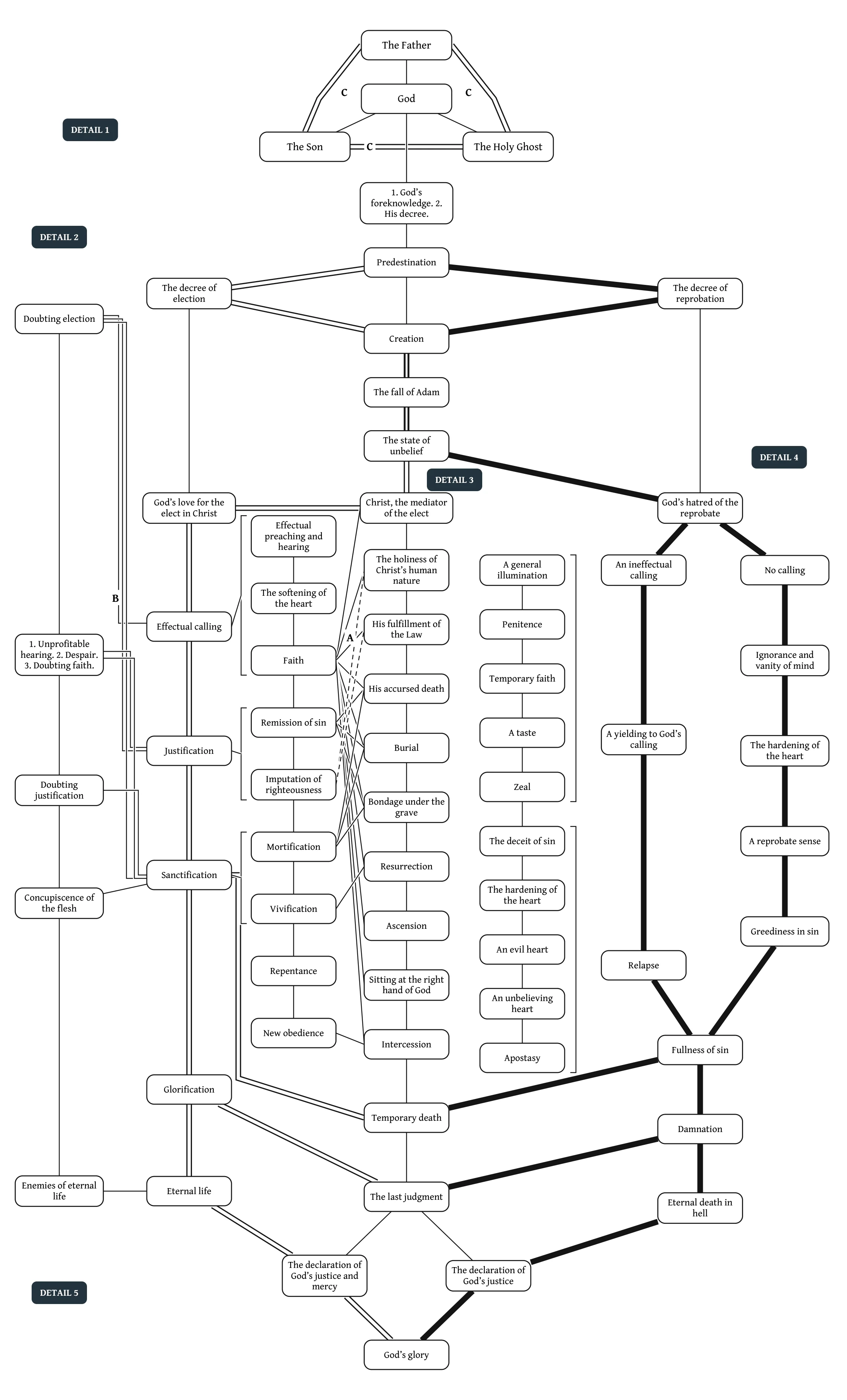
Enlarge ↗Perkins's chart of the causes of salvation and damnation, redrawn for this edition as one complete diagram. The white line traces the order of salvation and the black line the order of damnation. In the book it is followed by five enlarged details, marked here as Detail 1 to 5.
The paperback
Prefer it in print? The same book, done right
$18.99 · 6 × 9 inches · Cream paper · Matte cover
Built to last, not printed cheap
Printed at 6 × 9 inches on cream paper with a matte cover, made to survive years of rereading and underlining.
Type you can actually read
Typeset at a comfortable reading size with generous margins and line spacing, so a long chapter is a pleasure rather than an eye test.
Online reading included
Every paperback comes with the full text in your free account, plus the PDF and EPUB, so you can start reading tonight while the book ships.
Your purchase funds the work
Reading online is free. Buying the paperback direct is what pays for the next modernized classic.
Christian reader, four different views of the order of God’s predestination are held today. First, the old and new Pelagians locate its causes in human beings. They hold that God ordained people either to life or to death according to his foresight of whether, by their natural free will, they would reject or receive the grace offered to them.
Second are those whom some call Lutherans. They teach that God foresaw how all humanity, being shut up under unbelief, would reject the grace offered to them. He therefore purposed, from sheer mercy and without regard to their faith or good works, to choose some for salvation. He purposed to reject the rest because he eternally foresaw that they would reject the grace offered to them in the gospel.
Third are the semi-Pelagian Roman Catholics, who ascribe God’s predestination partly to mercy and partly to people’s foreseen preparations and meritorious works. Fourth are those who teach that the cause of the execution of God’s predestination is his mercy in Christ for those who are saved, and the fall and corruption of humanity for those who perish. Yet God’s decree and eternal counsel concerning both groups has no cause beyond his will and pleasure. I seek to oppose the first three views as erroneous and to uphold the fourth as the truth, which will bear weight in the balance of the sanctuary.
I offer this further discussion for your godly consideration. As you read, regard less the work itself, which is slenderly written, than my intent and affection. I wish, with others, to cast my mite into the treasury of the Church of England. Lacking gold, pearls, and precious stones, I bring a ram’s skin or two and a little goats’ hair for the building of the Lord’s tabernacle (Exod 35:23).
May the Father of our Lord Jesus Christ grant that, according to the riches of his glory, you may be strengthened by his Spirit in the inner person, and that Christ may dwell in your heart by faith. May you, rooted and grounded in love, be able with all the saints to comprehend its breadth, length, and height, and to know the love of Christ that surpasses knowledge, so that you may be filled with all the fullness of God. Amen.
Farewell. July 23, in the year of the last patience of the saints, 1592.
Yours in Christ Jesus, William Perkins.
The Disciplines of Holy Scripture
Holy Scripture contains one principal discipline, theology, and seven attendant disciplines.
A Guide to the Golden Chain
A survey, or table, showing the order of the causes of salvation and damnation according to God’s word. It can serve as a visual catechism for those who cannot read: by pointing with a finger, they can perceive the chief points of religion and their order.
The complete chart that follows shows the whole argument at once. Its numbered markers locate five overlapping details, enlarged on the following pages: 1, God’s decree and the Fall; 2, calling, justification, and sanctification; 3, Christ and his benefits; 4, reprobation; and 5, death, judgment, and God’s glory. Repeated labels identify the same points in this single chart. Lines that cross do not form a new junction. The letters A, B, and C retain the meanings explained below. White routes appear as hollow double lines, and black routes as solid heavy lines. Two faint connections from Imputation to Christ’s holiness and his fulfillment of the Law are dashed: they are reconstructed from their surviving course and his discussion of justification in Chapter 37.
To the reader
The white line shows the order of the causes of salvation, from the first to the last.
The black line shows the order of the causes of damnation.
The lines marked A show how faith apprehends Christ and all his benefits and applies them to each believer for that person’s justification and sanctification.
The descending lines marked B likewise show the temptations of the godly and their remedies.
The strokes marked C show the communication of the Godhead from the Father to the Son, and from them both to the Holy Ghost.
“God created all things for himselfe, and the wicked man for the euill day” (Prov 16:4).
“Hath not the potter power ouer the clay, to make of the same lumpe one vessell to honour, and another to dishonour?” (Rom 9:21).
“If any be in Christ, let him be a new creature” (2 Cor 5:17).
“O the altitude of the riches, both of the wisedome and knowledge of God! how vnsearchable are his iudgements, and his waies past finding out?” (Rom 11:33).
“I count all things but dung, that I may winne Christ” (Phil 3:8).
Ignatius said, “My love is crucified.”
The Golden Chain: Complete Overview
One complete chart, followed by five enlarged details. The numbered markers locate overlapping parts; they are reading aids, not additional steps in the argument. See the preceding guide for the lines, letters, and two dashed reconstructions.
God’s Decree and the Fall
Detail 1 of the complete chart: the Trinity, God’s decree, creation, and the Fall.
Calling, Justification, and Sanctification
Detail 2 of the complete chart: the order of salvation, with the temptations and remedies marked B.
Christ and His Benefits
Detail 3 of the complete chart: the connections marked A. The two dashed connections are reconstructed; see the guide to this chart.
The Course of Reprobation
Detail 4 of the complete chart: the order of damnation and the two unanchored groups beside it.
Death, Judgment, and God’s Glory
Detail 5 of the complete chart: the chart’s concluding connections. Repeated labels refer to the same points in the chart.
The Body of Scripture and Theology
The body of Scripture is a doctrine sufficient for living well. It contains many holy disciplines. One is principal, while the others serve it.
The principal discipline is theology, the knowledge of how to live blessedly forever. Blessed life arises from knowing God: “This is life eternall, that they know thee to be the only very God, and whom thou hast sent Christ Iesus” (John 17:3). Isaiah says, “By his knowledge shall my righteous servant justifie many” (Isa 53:11). The righteous servant is Christ. Blessed life also arises from knowing ourselves, because we know God by looking into ourselves.
Theology has two parts: the first concerns God, and the second concerns his works.
God and His Nature
That God exists is evident from eight things: 1. the course of nature; 2. the nature of the human soul; 3. the distinction between honest and dishonest things; 4. the terror of conscience; 5. the government of civil societies; 6. the order of causes, each referring back to a prior beginning; 7. the direction of all things toward their several ends; and 8. the agreement of all people of sound mind.
God is Jehovah Elohim. In Exodus he says, “And Elohim spake unto Moses, and said unto him, I am Iehouah: and I appeared unto Abraham, to Isaac, and to Iacob, by the name of God Almighty, but by my name Iehouah, was I not knowne unto them” (Exod 6:2-3). “If they say unto me, What is his name? What shall I say unto them? And God answered Moses, I am that I am: Also he said, thus shalt thou say unto the children of Israel, I am hath sent me unto you. And God spake further to Moses, Thus shalt thou say unto the children of Israel, Iehouah Elohim, &c. hath sent me unto you” (Exod 3:13). In these words the first title declares God’s nature and the second his persons.
The Perfection of God’s Nature
God’s nature is his most living and most perfect essence. Its perfection is its absolute completeness: it is wholly complete in itself. God says, “I am that I am” (Exod 3:13). He needs nothing from creatures: “God that made the world, and all things that are therein, seeing that he is the Lord of heaven and earth, dwelleth not in temples made with hands, neyther is worshipped with mens hands, as though hee needed any thing: seeing he giveth to all life and breath, and all things” (Acts 17:24).
The perfection of God’s nature consists in its simplicity and infinity.
God’s Simplicity
God’s nature is simple: the logical relations that distinguish a subject from its attributes do not divide him. He does not have a subject and an adjunct within himself. Jesus says, “As the Father hath life in himselfe, so hath he given to the Sonne to have life in himselfe” (John 5:26); he also says, “I am the way, the truth, and the life” (John 14:6). Likewise, “But if we walke in the light, as he is light” (1 John 1:7) is to be considered with “God is light, and in him is no darknes” (1 John 1:5). Thus in God, to have life and to be life, and to be in light and to be light, are one and the same.
God is not subject to distinctions of genus and species, whole and parts, or matter and what is made of matter. Such distinctions would make different things within God, one more perfect than another. Whatever is in God is therefore his essence, and all that he is, he is by essence. Augustine aptly says, “In God, to be and to be just or mighty are one and the same. In the human mind they are not: the mind may lack these virtues and still be a mind.”
It follows that God’s nature is immutable and spiritual. His immutability means that he has no composition, division, or change. “With God there is no variablenes nor shadow of changing” (Jas 1:17); and, “I am the Lord, and am not changed” (Mal 3:6). When Scripture says that God repents (Gen 6:6), it means that he changes his action, as people do when they repent. Repentance signifies no change in God, but a change in his actions and in things made and changed by him.
God’s nature is spiritual because it is without a body and therefore invisible. “God is a Spirit” (John 4:24); “The Lord is the spirit” (2 Cor 3:17); “To the King eternall, immortall, invisible only wise God, be glory & honor for ever & ever” (1 Tim 1:17); and Christ is described as “the image of the invisible God” (Col 1:15).
God’s Infinity
God’s infinity has two aspects: his eternity and his surpassing greatness. His eternity means that he has neither beginning nor end. “Before the mountaines were made, and before thou hadst formed the earth and the round world, even from everlasting to everlasting, thou art our God” (Ps 90:2). He says, “I am Alpha and Omega, that is, the beginning and ending, saith the Lord: Which is, Which was, and Which is to come” (Rev 1:8).
God’s surpassing greatness means that his incomprehensible nature is present everywhere, both within and beyond the world. “Great is the Lord & worthy to be praised and his greatnesse is incomprehensible” (Ps 145:3). Solomon asks, “Is it true indeede that God will dwell on the earth? Behold the heavens, and the heavens of heavens are not able to containe thee: how much lesse is this house that I have built?” (1 Kgs 8:27). God asks, “Doe not I fill the heaven and earth, saith the Lord?” (Jer 23:24).
Two things follow. First, God is one and indivisible, not many. Scripture speaks of “One Lord, one faith, one baptisme, one God and Father of all” (Eph 4:5). It says, “Unto thee it was shewed, that thou mightest know that the Lord he is God, and that there is none but he alone” (Deut 4:35), and, “We know that an idoll is nothing in the world, and that there is none other God but one” (1 Cor 8:4). There can be only one being infinite in nature.
Second, God knows the heart. Nothing is hidden from the nature that is within all things and beyond all things, contained by nothing and excluded from nothing. “The Lord searcheth all hearts, and understandeth every worke of the minde” (1 Kgs 8:39). “Thou knowest my sitting downe, and my rising up, thou understandest my cogitation afarre off” (Ps 139:1-2).
The Life of God
We have spoken of the perfection of God’s nature. Now we turn to his life, by which the divine nature is perpetually active, living and moving in itself. “My soule thirsteth for God, even for the living God, when shall I come and appeare before the presence of God?” (Ps 42:2). “See there be not at any time in any of you an evill heart to depart from the living God” (Heb 3:12).
The divine nature is perpetually at work especially through three attributes that reveal God’s action toward his creatures: wisdom, will, and omnipotence.
God’s Wisdom
God’s wisdom, or knowledge, is his distinct and perfect knowledge of himself and of all other things, however countless, whether they have existed or not. He knows them through his own essence, rather than through ideas abstracted from the things themselves. He does not learn successively or reason from one matter to another, but knows by one eternal and unchangeable act of understanding. “No man knoweth the Sonne but the Father, nor the Father but the Sonne, and he to whom the Sonne will reveale him” (Matt 11:27). “There is nothing created, which is not manifest in his sight: but all things are naked and open to his eyes, with whom we have to doe” (Heb 4:13). “His wisedome is infinite” (Ps 147:5).
God’s wisdom includes foreknowledge and counsel. By foreknowledge he most certainly foresees all that is to come. Scripture says, “Him have ye taken by the hands of the wicked, being delivered by the determinate counsell and foreknowledge of God, and have crucified and slaine” (Acts 2:23). It also says, “Those which he knew before, he also predestinated to be made like to the image of his Sonne” (Rom 8:29). Speaking of *fore*knowledge is not strictly proper to God; the term reflects the human perspective, from which things are past or future.
By his counsel God perceives with perfect rightness the best reason for everything that is done. “I have counsell and wisedome, I am understanding, and I have strength” (Prov 8:14).
God’s Will
God’s will is that by which he wills all things, most freely and justly, in one act. “He hath mercie on whom he will, and whom he will he hardeneth” (Rom 9:18). Scripture speaks of the one “Who hath predestinate us to be adopted through Iesus Christ unto himselfe, according to the good pleasure of his will” (Eph 1:5). It also says, “For that which you should say, If the Lord will, and we live, we will doe this or that” (Jas 4:15).
God wills what is good by approving it. He disapproves and forsakes what is evil insofar as it is evil. Yet he voluntarily permits evil, because it is good that evil should occur. Scripture says, “Who in time past suffered all the Gentiles to walke in their owne waies” (Acts 14:16). He says, “So I gave them up to the hardnes of their heart, and they have walked in their owne counsels” (Ps 81:12).
Because its objects differ, God’s will has different names. It is spoken of as love and hatred, and as grace and justice.
Love, Hatred, and Grace
God’s love is his approval, first of himself and then of all his creatures insofar as they are good. He delights in them without their deserving it. “God is love, and who so remaineth in love, remaineth in God, and God in him” (1 John 4:16). “So God loved the world, that he gave his onely begotten Sonne” (John 3:16), etc. “God setteth out his love towards us, seeing that while we were yet sinners, Christ died for us” (Rom 5:8).
God’s hatred is his dislike and detestation of a creature that offends, on account of that creature’s fault. “But many of the Lord misliked, for they perished in the wildernes” (1 Cor 10:5). “Thou hatest all the workers of iniquity” (Ps 5:5). “Thou hast loved justice & hated iniquity” (Ps 45:7).
God’s grace is his free declaration of favor to his creatures. “If it be of grace, it is no more of workes: otherwise grace is not grace; but if it be of works it is no more grace” (Rom 11:6). “The saving grace of God shineth to all men, teaching us to deny impietie” (Titus 2:11), etc.
Grace is either God’s goodness or his mercy. By his goodness, he who is absolutely good in himself freely exercises generosity toward his creatures. “Why callest thou me good? there is none good but one, even God” (Matt 19:17). “He maketh Sunne to shine upon the good and bad, and he raineth upon the just and unjust” (Matt 5:45). By his mercy, God freely helps all his creatures in their miseries. “Yet will the Lord waite, that he may have mercy upon you” (Isa 30:18). “It is the Lords mercy that we are not consumed, because his compassions faile not” (Lam 3:22). “I take pitie on whom I take pitie, and am mercifull to whom I am mercifull” (Exod 33:19).
Justice in Word and Deed
God’s justice is his willing what is just in all things. “The just Lord loveth justice” (Ps 11:7). “For thou art not a God that loveth wickednesse” (Ps 5:4). His justice appears in word and deed.
Justice in word is God’s truth: he constantly and truly wills what he has said. “Let God be true, and every man a lyar” (Rom 3:4). “Heaven and earth shall passe away, but my Word shall not passe away” (Matt 24:35). Thus God’s keeping his promises is an exercise of justice. “If we confesse our sinnes, God is faithfull and just to forgive our sinnes” (1 John 1:9). “Henceforth is laid up for mee the crowne of righteousnesse, which the Lord the righteous judge shall give me at that day” (2 Tim 4:8).
Justice in deed is either disposing or rewarding. By disposing justice, God, as the most free Lord, rightly orders everything in his actions. “The Lord is righteous in all his waies” (Ps 145:17). By rewarding justice, he renders to a creature according to its work. “It is justice with God, to render affliction to such as afflict you, but to you which are afflicted, releasing with us” (2 Thess 1:6). “Therefore if you call him Father, which without respect of person judgeth according to every mans worke, passe the time of your dwelling here in feare” (1 Pet 1:17). “The Lord that recompenseth, shall surely recompence” (Jer 51:56).
God’s justice is also described as gentleness or anger. By gentleness he freely rewards the righteousness of his creature. Suffering for God’s kingdom is “a token of the righteous judgement of God, that ye may be counted worthy the kingdome of God, for the which ye also suffer” (2 Thess 1:5). Jesus says, “He that receiveth a Prophet, in the name of a Prophet, shall have a Prophets reward: and he that receiveth a righteous man, in the name of a righteous man, shall have the reward of a righteous man. And whosoever shall give unto one of these little ones to drinke a cup of cold water onely in the name of a Disciple, verily I say unto you, he shall not lose his reward” (Matt 10:41-42). By anger God wills the punishment of the creature that offends. “For the wrath of God is revealed from heaven against all ungodlinesse, and unrighteousnesse of men, which withhold the truth in unrighteousnesse” (Rom 1:18). “He that obeyeth not the Sonne, shall not see life, but the wrath of God abideth on him” (John 3:36).
God’s Omnipotence
We now turn from God’s will to his omnipotence. By omnipotence he is fully able to perform every work. “With men this is impossible, but with God all things are possible” (Matt 19:26).
Three kinds of things must nevertheless be excepted. First are acts that would imply weakness, such as lying or denying his word. Scripture speaks of “God, that cannot lie” (Titus 1:2) and says, “He cannot denie himselfe” (2 Tim 2:13). Second are things contrary to his nature, such as destroying himself or ceasing to beget his Son from eternity. Third are contradictions. God cannot make a truth false or make something both be and not be at the same time.
God’s power may be distinguished as absolute and actual. His absolute power is his ability to do more than he does or wills to do. “I say unto you, God is able of these stones to raise up children to Abraham” (Matt 3:9). He works “According to the working, whereby he is able to subdue even all things to himselfe” (Phil 3:21). His actual power is that by which he causes to exist everything he freely wills. “All things which God will, those he doth in heaven, and in earth, and in all depths” (Ps 135:6).
God’s Glory and Blessedness
God’s glory and blessedness arise from the attributes already described, by which the true Jehovah is distinguished from an imagined god and from idols.
God’s glory, or majesty, is the infinite excellence of his utterly simple and holy divine nature. Scripture speaks of the Son as “the brightnes of his glorie, and the ingraved forme of his person” (Heb 1:3), etc. It says, “Let them praise thy glorious name, O God, which excellest above all thankesgiving and praise” (Neh 9:5).
From this we see that God alone can know himself perfectly. Jesus says, “Not that any man hath seene the Father, save he which is of God, he hath seene the Father” (John 6:46). God “only hath immortalitie, and dwelleth in the light that none can attaine unto, whom never man saw, neither can see” (1 Tim 6:16). He says, “Thou canst not see my face” (Exod 33:20).
Nevertheless, God’s glory is manifested in two ways: one less apparent and one more apparent. The less apparent manifestation is the vision of God’s majesty in this life, seen by the mind with the help of things perceived by the outward senses. Isaiah says, “I saw the Lord sitting upon an high throne, and lifted up, and the lower parts thereof filled the Temple” (Isa 6:1). God tells Moses, “And while my glory passeth by, I will put thee in a cleft of the Rocke, and will cover thee with my hand whiles I passe by: after I will take away mine hand, and then shalt see my backe parts, but my face shall not be seene” (Exod 33:22). “Now we see as through a glasse darkely” (1 Cor 13:12).
The more apparent manifestation is to contemplate God face to face in heaven. “But then shall we see face to face” (1 Cor 13:12). Daniel says, “I beheld till the thrones were set up, and the ancient of daies did sit, whose garment was white as snow” (Dan 7:9-10), etc.
God’s blessedness is his complete sufficiency in and from himself. He says, “I am God all-sufficient, walke before me, and be thou upright” (Gen 17:1). “For in him dwels all the fulnesse of the Godhead bodily” (Col 2:9). Scripture also speaks of the one “Which in due time he shall shew, that is blessed and Prince only” (1 Tim 6:15).
The Persons of the Godhead
The persons subsist in one Godhead and are distinguished by properties that cannot be shared. “There are three that beare record in heaven, the Father, the Word, and the holy Ghost, and these three are one” (1 John 5:7). “Then Iehouah rained upon Sodome, and upon Gomorah, brimstone, & fire from Iehouah in heaven” (Gen 19:24). “In the beginning was the Word, and the Word was with God, and that Word was God” (John 1:1). The persons are therefore equal. They differ in order, not in degree.
A person is constituted when a personal property, or a distinct manner of subsisting, belongs to the one divine nature. The distinction of persons means that, although each person is the one same perfect God, the Father is neither the Son nor the Holy Spirit, but the Father alone; the Son is neither the Father nor the Holy Spirit, but the Son alone; and the Holy Spirit is neither the Father nor the Son, but the Holy Spirit alone. They cannot be divided, because the one infinitely great and utterly simple essence is wholly in the Father, wholly in the Son, and wholly in the Holy Spirit. Thus there is diversity of persons and unity of essence.
The communion of the persons, or more precisely their union, means that each is in and with the others because the Godhead is one. Each therefore possesses, loves, and glorifies the others, and they perform the same work. Jesus asks, “Beleevest thou not that I am in the Father, and the Father is in me? the word that I speake unto you I speake not of my selfe, but the Father that dwelleth in me, he doth the workes” (John 14:10). Wisdom says, “The Lord hath possessed me in the beginning of his way: I was before the workes of old” (Prov 8:22), and, “Then was I with him as a nourisher, and I was daily his delight, rejoycing alway before him” (Prov 8:30). “In the beginning was the Word, and the Word was with God, and that Word was God” (John 1:1). Jesus also says, “The Sonne can doe nothing of himselfe, save that he seeth the Father doe: for whatsoever things he doth, the same doth the Sonne also” (John 5:19).
There are three persons: the Father, the Son, and the Holy Spirit. At Jesus’ baptism, “Iesus, when he was baptized, came straight out of the water, and loe, the heavens were opened unto him, and Iohn saw the Spirit of God descending like a dove, and lighting upon him: and loe, a voice came from heaven, saying, This is my beloved Sonne, in whom I am well pleased” (Matt 3:16-17).
The Father
The Father is a person without beginning who begets the Son from all eternity. The Son is “the brightnesse of the glory, and the ingraved forme of his person” (Heb 1:3). “Thou art my Sonne, this day have I begotten thee” (Ps 2:7).
Three things should be noted about the Son’s generation. 1. The one who begets and the one begotten exist together; neither precedes the other in time. 2. The one who begets communicates his whole essence to the one begotten, not merely a part. 3. The Father begets the Son within himself, not outside himself.
The Father’s incommunicable property is to be unbegotten, to be Father, and to beget. He is the beginning of actions because he begins every action of himself, bringing it about by the Son and the Holy Spirit. “Yet unto us, there is but one God, which is the Father, of whom are all things, and we in him, & one Lord Iesus Christ, by whom are all things, and we by him” (1 Cor 8:6). “For of him, and through him, and for him, are all things” (Rom 11:36).
The other two persons, the Son and the Holy Spirit, have the whole divine essence from the Father by communication.
The Son
The Son is the second person, begotten of the Father from all eternity. “For unto which of the Angels said hee at any time, Thou art my Sonne, this day begate I thee?” (Heb 1:5). He is “the image of the invisible God, the first borne of every creature” (Col 1:15). “And we saw the glory thereof, as the glory of the onely begotten Sonne of the Father” (John 1:14). God is the one “who spared not his owne Sonne” (Rom 8:32).
Although the Son is begotten of the Father, he is nevertheless true God of and by himself. We must distinguish his essence from his sonship. With regard to his essence, he is God of himself, for the deity common to the three persons is not begotten. As a person, however, he is the Son of the Father and is from another, not from himself. He is the Father’s eternal Son. In this sense he is truly said to be true God from true God.
For this reason the Son is said to be sent from the Father. “I proceeded forth, and came from God, neither came I of my selfe, but he sent me” (John 8:42). Being sent does not remove equality of essence and power; it declares the order of the persons. “Therefore the Iewes sought the more to kill him, not onely because he had broken the Sabbath; but said also that God was his Father, and made himselfe equall with God” (John 5:18). He is the one “Who being in the forme of God, thought it no robbery to be equall with God” (Phil 2:6).
He is also the Father’s Word, an essential Word that does not pass away. As a word is, in a manner of speaking, begotten by the mind, so the Son is begotten by the Father. He also brings glad tidings from the Father’s bosom. Gregory Nazianzen and Basil are cited in connection with this account.
The Son’s own property is to be begotten. His distinct manner of working is to execute actions from the Father by the Holy Spirit. Scripture speaks of “Our Lord Iesus Christ, by whom are all things, and we by him” (1 Cor 8:6). “Whatsoeuer things he doth, the same doth the Son also” (John 5:19).
The Holy Spirit
The Holy Spirit is the third person, proceeding from the Father and the Son. Jesus says, “But when the Comforter shall come, whom I will send vnto you from the Father, euen the spirit of truth, which proceedeth of the Father, hee shall testifie of me” (John 15:26). Paul writes, “But yee are not in the flesh but in the spirit, seeing the spirit of God dwelleth in you. But if there be any that hath not the spirit of Christ he is not his” (Rom 8:9). Jesus also says, “But when the Spirit of truth shall come: hee shall conduct you into all truth: for he shall not speake of himselfe, but whatsoeuer he heareth, hee shall speake, and shall declare vnto you such things as are to come. He shall glorifie me, for he shall receiue of mine, and shew it vnto you” (John 16:13-14).
Although the Father and Son are distinct persons, together they are one beginning of the Holy Spirit. Scripture does not determine, and the church does not know, precisely what distinguishes proceeding from begetting in their essence. The Holy Spirit’s incommunicable property is to proceed. His distinct manner of working is to finish an action, bringing it about as from the Father and the Son.
Questions
What is "A Golden Chain" by William Perkins about?+
It lays out the whole of Christian theology as an ordered sequence of causes: God's decree, creation and the fall, Christ, the covenants, and the stages by which the elect are saved and the reprobate condemned. Practical chapters on the law, the sacraments, and spiritual warfare are woven through that framework.
What is the golden chain in theology?+
The phrase refers to Romans 8:30, where those God predestined are called, justified, and glorified. Perkins made those links the backbone of his book and of the diagram printed before its first chapter.
Who wrote "A Golden Chain" and when?+
William Perkins wrote it in Latin in 1590 AD, while a fellow of Christ's College, Cambridge.
What is Perkins's view of predestination?+
He holds that God's decree of election and reprobation has no cause beyond his own will, while the execution of it runs through means: Christ's mercy for the saved and human sin for the lost. He rejects any view that grounds the decree in foreseen faith or works.
Is "A Golden Chain" hard to read?+
It is compact and heavily outlined, closer to a reference manual than a sermon. This modern English edition clarifies the prose and adds descriptive headings, though Scripture quotations keep their historical spelling.
William Perkins was born in 1558 at Marston Jabbett in Warwickshire and entered Christ's College, Cambridge, in 1577, where he studied under Laurence Chaderton. He took his BA in 1581 and his MA in 1584, the year he became a fellow of Christ's and began a lectureship at Great St Andrew's Church in Cambridge, a post he held for the rest of his life. His preaching drew students and townspeople alike, and he also ministered to prisoners in the Cambridge jail. He resigned his fellowship on marrying in 1595. Perkins wrote prolifically in both Latin and English: besides A Golden Chain, his works include The Art of Prophesying, A Reformed Catholic, and a series of treatises on cases of conscience, and his 1598 treatise on the order and mode of predestination drew a written reply from Jacobus Arminius. He died in Cambridge in 1602, aged about forty-four, and his collected Works were reprinted many times in the following decades.
“Updated Works has been an incredible blessing to my Christian life and ministry… remarkably faithful to the original authors while making these timeless treasures understandable for modern readers.”