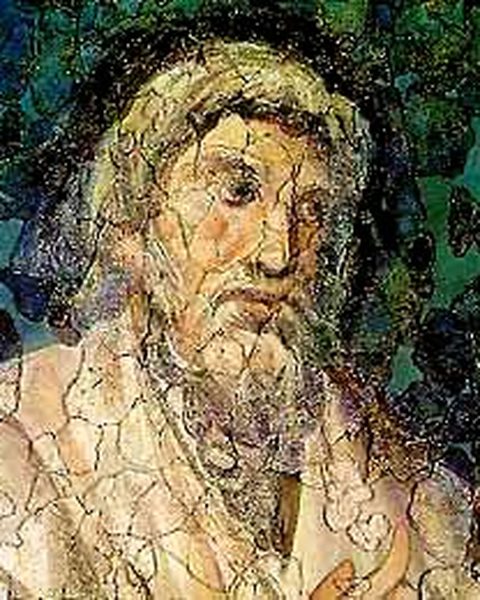
Juvencus
A Spanish presbyter who wrote the Evangeliorum libri quattuor, a paraphrase of the Gospels in Latin hexameter verse. It is the first sustained Christian epic in Latin and the founding work of the biblical-epic tradition.
Biography
Juvencus (active around 330 AD) was a Spanish presbyter and Latin poet who composed the Evangeliorum libri quattuor, a four-book paraphrase of the Gospels in classical hexameter verse and the earliest extended Christian epic written in Latin. His full name is given in the manuscript tradition as Gaius Vettius Aquilinus Iuvencus.
Almost everything recorded about his life comes from a single notice by Jerome, who devoted chapter 84 of his De viris illustribus, written around 393 AD, to him. Jerome describes Juvencus as a presbyter drawn from a noble Spanish family who set the four Gospels into hexameter verse under the emperor Constantine, who reigned until 337 AD. Jerome mentions no other biographical detail, and no independent source fills the gap, so the poet is known chiefly through the poem itself and its closing lines, which name Constantine's peace as the setting in which it was written.
The Evangeliorum libri quattuor runs to roughly 3,200 lines across four books. It follows the narrative of the Gospels closely, taking Matthew as its main thread and drawing supplementary episodes from Luke and John, and it renders that material in the diction and metrical formulas of Virgil's Aeneid. In a short preface Juvencus argues that if poems about the deeds of Homer's and Virgil's heroes have earned lasting fame despite being fictions, the true, life-giving acts of Christ deserve a greater and more durable song. The poem circulated widely in later centuries and became a standard text in medieval schools; it survives in numerous manuscripts.
Two other works have long been printed among Juvencus's writings but are not securely his. The Liber in Genesim, a verse treatment of Genesis, is assigned by modern scholarship to the anonymous poet of the Heptateuch rather than to Juvencus. The short Carmen de laudibus Domini is an anonymous Gallic poem that entered the tradition alongside his name. Only the Evangeliorum libri quattuor is confidently his.
Why Juvencus Matters
Juvencus created the form of the Latin biblical epic. Before him, Christian writing in Latin had taken the shape of treatises, letters, apologetics, and martyr accounts; he was the first to carry the Gospel narrative into the full apparatus of classical epic, with its hexameter line, its Virgilian vocabulary, and its epic conventions. This decision set a template that later poets followed for centuries.
The method matters as much as the subject. Juvencus did not summarize or moralize the Gospels so much as retell them scene by scene in the register of the Aeneid, letting the phrasing of Rome's national epic carry the acts and words of Christ. The result made the new material legible to an educated Roman readership on formal terms it already prized, and it argued, in its preface, that Christian narrative could claim the prestige and permanence that had belonged to pagan poetry.
His example was taken up directly. Sedulius produced the Carmen paschale in the fifth century, Arator versified the Acts of the Apostles in the sixth, and Avitus and others extended the same practice to the Old Testament, so that the versified paraphrase of scripture became a recognized genre with Juvencus at its head. Because his poem was copied, glossed, and taught in schools, generations of readers met the Gospels partly through his hexameters.
He also marks a moment in the fourth-century encounter between Christianity and the classical curriculum. Writing under Constantine, at the point when the faith was moving into open and imperially favored life, Juvencus showed that a Christian author could take up the highest secular literary form and turn it to Christian ends without abandoning its craft, a possibility that shaped Latin Christian literature well beyond his own generation.
Complete Works in English
Free to readEvery surviving work, translated in full and free to read, from our Patrologia Latina project.