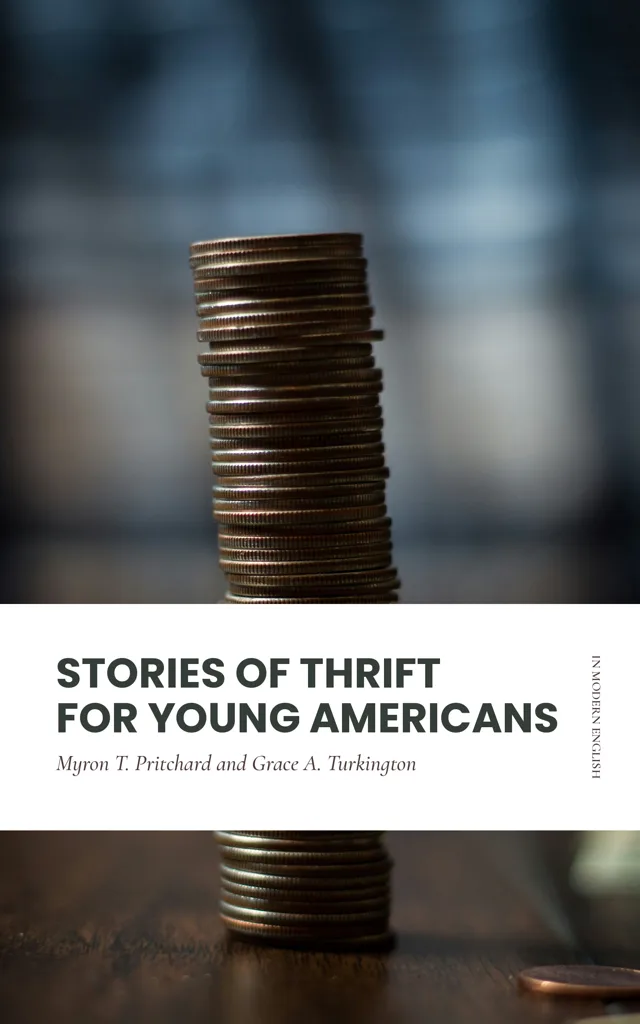
A school reader of twenty-one stories about thrift, written for American boys and girls and published in 1915. Thrift here means the care of health, time, money, and home, and each chapter carries the lesson in a story rather than a lecture.
One free account opens 250+ books and saves your place on every device. Google sign-in or an email link. No card.
You’re on the list — we’ll email you if this goes to print.
Included with your free account
This book, and 250+ more, free to read
A free account opens the whole library to read online, on your phone or at your desk. Open a book on one device and it is waiting at the same page on the next. The PDF and EPUB of every book are yours to keep, and audiobooks, sold separately, play in the same app.
250+ modernized editionsNot samples. The whole work, free.
Your place, on every devicePhone, tablet or desktop, same page.
108 audiobooks, sold separatelyAbout 937 hours of narration, from $4.99.
Stories of Thrift for Young Americans is a 1915 school reader by Myron T. Pritchard and Grace A. Turkington. Its twenty-one stories teach thrift to boys and girls as the care of health, time, money, and home, showing families who make over what they own, open bank accounts, keep accounts, and spend carefully.
“Do you think this is either pretty or useful?”
From this edition
How the argument unfolds
01
The definition. A schoolgirl calls a thrifty classmate stingy, is made to itemize a month of spending, and hears her teacher's definition: “It means being industrious in whatever you undertake, wasting nothing, whether time, money, or materials.”
02
Health first. Before money comes the body. A girl who is too anemic to keep up at school is put on a regimen of food, sleep, and open air, and treated as someone protecting an asset rather than following a doctor's orders.
03
The first account. A boy deposits six dollars, watches the office cleaning woman ahead of him hand over ten, and learns what the bank does with it. A classroom savings bank starts the same week with sixty pennies.
04
Making over. With her husband's shop on half-time, Mrs. Sanborn declares a making-over year and appoints the children a committee to search the attic and the cellar. The school takes up the idea as a Making-Over Club and a Home-Garden Club.
05
Earning where you stand. A visitor from the Department of Agriculture shows a failing farm family that its timber, its cooking, and its place on a motor road are already worth money; a crippled neighbor begins selling whittled toys to passing cars.
06
Spending, giving, and accounts. Chapters on wise spending, right giving, and keeping accounts argue that money is lost less by big mistakes than by cheap goods, useless presents, and never writing anything down.
07
Waste in a life. Carelessness costs a stenographer her raise and a store clerk his promotion; leaving school early costs a boy the trade he never learned. Both are treated as forms of waste like any other.
08
Waste in a nation. The last chapter turns from households to the country: a bird refuge bought to protect crops, worn-out soil that needs lime, and timber cut three times as fast as it grows.
Key themes
Thrift is wider than money. Health, time, materials, and attention are all treated as things a person can waste. Money is only the most obvious of them.
Poverty is not the obstacle. The savers in these stories are usually the poorest people in them: a wash-woman with three bank books, a tannery worker who becomes a fruit-seller, a widow with ninety-eight dollars put by.
Help people earn. Gifts of money and flowers are treated as the lazy form of help. The teacher, the visiting official, and the neighbors all look instead for work the person can do.
Know where you stand. A farm family stops being poor when they start writing down every hour and every cent: “one reason why we don’t get on is because we don’t know where we stand.”
The country as a household. The closing chapter applies the same logic to soil, forests, fisheries, and birds, ending on the motto “Waste not”.
What Thrift Is
“I think Emma Jones is just as stingy as she can be,” said Esther Madison to her mother, one night when the two were washing dishes.
“I should think twice before I said anything as unkind as that about one of my friends,” her mother replied. “Tell me what you mean.”
“Why, this afternoon five of us girls were going to buy some candy. We were each to give five cents, but Emma wouldn’t; she’s always that way. She never treats any of the girls to soda, or spends her money on having a good time.”
Mrs. Madison looked thoughtful as she said: “Emma has always impressed me as being a bright, sensible girl. She doesn’t look at all mean or selfish. Perhaps she had a good reason for not spending her money on candy.”
It was nearly a month after this conversation that, one Sunday, Esther asked her father for money to buy a pair of skates, saying: “Emma has just bought a lovely pair, and her brother is teaching her.”
“H’m, so you want a pair of skates? How much will they cost?” asked her father.
“Three dollars is what Emma paid.”
“Can’t you buy them out of your spending-money? That’s what I give you twenty cents a week for,” said Mr. Madison. “How much money have you, anyway?”
Esther’s face grew red, and she fidgeted a little as she said: “Why, I haven’t any. Twenty cents a week isn’t much. If I saved it I couldn’t have any fun.”
“Something’s wrong somewhere,” said her father. “Sit down and write out how you have spent your money for the last month, and let me see it.”
Mrs. Madison said nothing, but looked amused as Esther sat nibbling the end of her pencil and trying to remember how her money had been spent. Finally she handed her father a slip of paper, which read as follows:
Candy . . . $.30
Bracelet . . . .50
“Bracelet, fifty cents!” her father repeated. “What does that mean? What kind of bracelet can you buy for fifty cents? Go get it, please. I should like to see it.”
In a moment Esther was back and laid on the table a silver-colored bracelet, set with some small blue stones.
“Do you think this is either pretty or useful?” asked her father. “Of course, you know that there isn’t a bit of silver in it, and that these stones are nothing but glass.”
Esther tried to defend herself by saying: “All the girls have bracelets, and I think they are pretty.”
“Does Emma Jones wear a bracelet to school?” asked Mr. Madison.
“No, but she’s the only girl that doesn’t. She is stingy with her money.”
“Why, I thought you liked Emma; you are always asking your mother if you can’t go up to her house Saturdays. If she is stingy, she can’t be a nice girl to have good times with.”
“What I mean is, she won’t spend money to have a good time, as the other girls do. But I like to go up to her house because she can always plan interesting things to do.”
Her father smiled as he said: “I suppose what you mean is that she doesn’t spend her money for candy and bracelets. If that is so, she is a girl that her father might well be proud of, and I hope you’ll learn from her. There is nothing more vulgar than wearing cheap jewelry, so I want you to throw away the bracelet at once.”
“Don’t you suppose, Esther,” her mother asked, “that Emma bought the skates with the money she might have spent on candy?”
“Perhaps so,” admitted Esther reluctantly.
“One of the differences between a wise person and a foolish person, and between a rich man and a poor man,” said Mrs. Madison, “is that one spends his money carefully and wisely, and the other unwisely. Emma’s father is just as poor as that Mr. Lathrop whose children are always out at the elbows, and whose fences are always tumbled down, but Mr. Jones and his family are thrifty people, while Mr. Lathrop isn’t.”
“What is thrifty?” interrupted Esther.
“Well,” said her father, “Emma is thrifty and you are not. But don’t think that thrifty means stingy, for it doesn’t. I will let you think it over, and you can tell me later what the word means.”
Esther forgot all about the talk until Thursday night, when, on the way home from school, her cousin Robert and some of his boy friends joined her.
“Why don’t you learn to skate, Esther?” asked her cousin. “Emma Jones has been learning and we are having great fun. She’s going to be one of the finest girl skaters around here before long.”
Esther thought more of her cousin’s good opinion than she would have admitted and it hurt her pride to have to say that she could not afford any skates just then but hoped she could have a pair next winter. It was becoming plain to her that a person might get more pleasure out of money spent in one way than that spent in another. She could not even remember how the candy that she had bought last week tasted, and since her father said her bracelet had no silver in it she had not enjoyed wearing it.
“Father says that I haven’t been thrifty and have wasted my spending money,” said Esther to Robert. “What does thrifty mean, anyway?”
“Why, I always supposed it meant prosperous, but I’m not sure. I’ll ask Miss Martin tomorrow.” So the next day Robert asked his teacher what the word meant.
“It means being industrious in whatever you undertake, wasting nothing, whether time, money, or materials. The really thrifty persons are those who waste nothing and spend wisely.”
When Esther repeated this to her father, he said: “That’s my idea exactly. And I’m sure if you will be thrifty for the next year, at the end of it you will be happier and more useful to your mother and to your friends than you are now.”
Saving Health
“Take her out of school at once,” said the doctor to Mrs. Emery. “You can’t afford to run any risks. Mary is five pounds under her normal weight, and is decidedly anæmic.”
“What’s anæmic?” asked Mary.
“Your blood is too thin; perhaps you might call it watery. It takes good, rich red blood to study on, and until you improve at least fifty percent you must keep out of school and build up your health.”
Mary’s face was sober and the tears were near the surface. She had thought it was going to be great fun to consult the doctor and have to take little pink tablets with her meals, as her chum Etta Roberts did. But to leave school was something she hadn’t dreamed of. Why—she simply couldn’t! That was all there was to it. To stay out of school six months meant that she would fall so far behind in all her studies that she would have to go in with the next lower class. But Mary knew that it would be futile to argue with the doctor.
He had a stern face and was used to having his patients do exactly as he directed.
That night Mary wept a good many tears into her pillow.
The next day at school she stayed in at recess to tell her teacher what the doctor had said. “But I am not sick, Miss Elwood,” Mary added plaintively. “Won’t you please ask mother to let me stay?”
Miss Elwood replied that she would talk with her about it after school. Mary Emery was one of the best scholars in her grade, but she had for a long time been nervous and pale. That afternoon, with pleading eyes and nervous fingers, Mary waited to hear what her teacher would say.
“I am going to suggest an experiment for you to make, Mary,” said Miss Elwood. Mary looked a little perplexed but hopeful. “You won’t like it, but I think it is the only way that you can remain in school. If you are anæmic, then neither your muscles nor your nerves get the food they need. This is what makes you pale, gives you headaches, and makes you want to cry so often. In a few years you will either break down entirely or just be a fretful, uninteresting girl that everybody will be sorry for but that few will like.”
“I never knew that people stopped liking you just because you were sick,” said Mary.
“Suppose that every time your friends asked you to play a certain game you said your head ached too badly, how long would they keep asking you? Or, if every time a girl came to your house to see you, you were too tired to make her have a good time, would she keep coming? No, Mary, sickly people seldom have as many friends as those who are well.”
“I never thought of that before,” murmured Mary.
“I think I know better, even than the doctor, what has made you anæmic. How much spending-money do you have?”
Mary, astonished, answered: “Twenty-five cents a week.”
“And what do you do with it?”
“Why, I buy things, of course.”
“I believe that the secret of your trouble, Mary, lies in that twenty-five cents a week. The things that you buy with the money are harmful to you. I have noticed that you have more candy, cookies, and pickled limes than most of the other girls. At recess time, instead of going out into the yard to run about, you get in a corner with a bag of candy and read. Cookies and candy are all right in their place, but they are too sweet and rich to eat between meals. One reason why you are anæmic is because you spoil your appetite by eating too much sweet and sour stuff.”
“I never spend more than five cents a day for candy,” said Mary.
“Nevertheless, I am sure that what little candy you eat keeps you from being healthily hungry at meal-time, so that you fail to eat as much meat, potato, and other nourishing food as you need. Isn’t this true?”
“Perhaps so,” Mary admitted reluctantly.
“Now,” continued Miss Elwood, “my suggestion is this: I want you for three months to save all your spending-money, and to promise not to eat any candy, pickles, or cookies between meals.”
Mary’s face was disconsolate and a few tears trickled down her cheeks, but Miss Elwood continued:
“Then I want you to spend all your recesses out-of-doors. If you don’t care to play games, then have a walking race with some of your friends. Stir about enough to fill your lungs with fresh air and make your blood circulate more freely.
“In addition to these two parts of the experiment there is a third. You do not always wear the most sensible things, and perhaps this explains where some of your spending-money goes. Now that the weather is rainy and cold, you ought to protect yourself with high boots and rubbers. Instead of that, much of the time you wear thin stockings and pumps, which are fit only to wear in the house. It would be much better for you to save your money and buy warm stockings, sensible shoes, good rubbers, and overshoes.
“Now, if for three months you are willing to go without candy and pickles and eat only nourishing food, to keep out-of-doors all that you can, and to put your pumps and thin stockings away until next summer, I will try to persuade your mother and the doctor to let you stay in school for three months longer. At the end of that time, if you have followed my suggestions, I think the doctor will say you are almost well.”
“But the doctor didn’t tell me not to eat candy,” Mary said appealingly.
Miss Elwood looked a little stern as she answered: “He probably doesn’t know that you spend twenty-five cents each week on such things. Do you want me to explain this to him?”
Mary was earnest in her protests, and at once promised to make the experiment.
“You must not let this spoil your good times, Mary,” her teacher said kindly. “Remember that nobody can be happy without good health.”
The experiment was not an easy one. Mary at first accepted candy from her schoolmates, although her conscience told her that this was not fair. But after a little she held to the rule to eat cookies and all very sweet things only after regular meals. She was surprised to find that after a dinner of meat and potato or a supper of simple, nourishing food she could not eat more than two or three pieces of candy.
Mary and her brother Robert had always called milk babies’ food, and had refused to drink it with their meals. To Mrs. Emery’s surprise, soon after Mary’s talk with her teacher, she asked if she could have a glass of milk with her supper. Robert at once spoke up: “Babies’ food! I thought you had outgrown long dresses years ago.”
“Well, you’d better not talk. It’s a secret. I can’t tell you about it now, but for three months I’m going to drink milk every night,” answered Mary.
Robert was much impressed by the idea of a secret, and teased to be told what it was, but his sister refused to explain.
One day, a few weeks later, Miss Elwood telephoned to her principal and asked him to come to her room a moment. It was recess time, and when the principal appeared Miss Elwood called him to the window and pointed out a group of girls. Mary Emery was teaching several of her friends to vault a sawhorse that the carpenters had been using. No one could do it quite so well as Mary herself, but they were all trying.
“Who is the leader?” asked the principal.
“Mary Emery,” replied the teacher.
“Not the sickly girl that you were afraid wouldn’t be promoted?”
“The very same,” and Miss Elwood smiled at the astonished look on the principal’s face.
“How did you do it, Miss Elwood?”
“Mary is doing it herself. I will tell you about it later.”
The result of the experiment was that Mary gained six pounds, lost her headaches, saved two dollars, and did not lose a day at school. Not only this, but Mary’s mother was saved a large doctor’s bill, and Mary at least a half-year’s time at school.
The person who always takes the best possible care of his health, saves himself both time and money. Many girls and boys fail in their written tests just because they have been sitting up too late at night, or eating too much sweet food. Of course there is always the chance that a boy who has failed may make up for failures by studying extra hard. But this is a waste of time, for he needs all this energy for new work. The boy who is always trying to make up for time lost through sickness, when he gets out into the world will have to compete with the boy who is always well.
Men who are interested in the health of school-children have figured out that it takes the pupils who attend school in a building improperly heated, lighted, and ventilated nearly two years longer to complete the course of eight grades than it does those children whose school is sanitary in every way. That is why old school buildings are being torn down or made over. The health of the boys and girls of our nation is regarded as of the greatest value, and towns and cities are willing to spend large sums of money to provide clean, sanitary buildings for school purposes. No boy or girl wants to spend two years more than is necessary in preparing for the high school. But the school cannot do everything. If the pupils are given a warm, airy building, they must do their part to keep well.
A group of school boys was one day heard discussing Henry Fowler’s “bad luck.” They had just had a written test in arithmetic, and three of the questions were on factoring. Henry had been sick with a severe cold when the class had studied factoring.
“Oh, Henry,” suggested one of the boys, “I think Miss Elwood would excuse you on those questions if you asked her. You couldn’t help being sick.”
After a little urging Henry went to his teacher, and asked if she would please not mark him on the factoring examples. He explained that he had been sick, and promised to make up the work as soon as possible. Miss Elwood said she would consider the matter. But when she found that Henry was wasteful of his time, that he had caught cold by splashing in a shallow pond all one Saturday afternoon, and had not tried to make up the behindhand work, she went to the principal.
The next day the principal talked with Henry a long time.
“The boys who are going to be the important men in a few years,” he said, “are those who are the most saving of their health and their time now. You are much more likely to have another hard cold because your body has already been weakened by one. The city is paying for your schooling whether you are present or not. Therefore when you are sick you are not only spending money for medicine and a doctor, but you are wasting your mother’s time and your teacher’s. Do you think this is quite fair?
“Your teacher is here every day, and every day the lessons are on time. If Miss Elwood should happen to be too ill to come to school, the city would provide another teacher, so that not a single pupil should be cheated of help in his studies. Your teacher has to take the greatest care of her health in order to be here every day. If she were as careless about her eating and the way she spent her spare time as you are, all the pupils would be behind in their lessons.”
Henry said nothing further to the boys about getting excused from his examination. He had learned a lesson, and there were no more foolish Saturday afternoons.
Health is wasted not only by school boys and girls, but by those who have left school and gone to work. A New York business man who employs many boys and young men says that when he has to hire a new boy, he always looks for one brought up in the country. One of the reasons that he gives is that the country boy is apt to be healthier, and therefore more valuable for business purposes than a city boy. He has eaten hearty, nourishing food, and has had plenty of fresh air and exercise. He hasn’t formed the bad habit of spending money for sodas and cigarettes. The business man knows that the boy who smokes and has the soda habit is wasting both money and health. And no young person can hope to be successful without good health.
A large department store in New York City has had so many absences from work that the managers have been studying to see what the matter was. Since the store employs several hundred girls and young women, it was losing money by the frequent absences, and of course the girls were also losing money. The managers decided that many girls did not know how to keep well, and also did not realize the value of keeping well. They therefore fitted up in the store a splendid gymnasium, with spray baths and a lounging-room. Now each girl has to be examined by the gymnasium director, and to spend a certain amount of time each day doing gymnastic exercises. It costs this store several thousand dollars each year to help care for the health of its girl employees. But it is cheaper to do this than to have the girls absent every few days.
Sickness is always expensive for somebody—the school, the store, or the home. It pays to keep well.
The Savings-Bank
William Hayes had an aunt who every year sent him five dollars for Christmas. The year that William was twelve he was especially eager for Christmas to come, because he wanted an Indian blanket for his room, and a punching-bag for the little gymnasium that he had in the attic. The expected letter came and was kept unopened until Christmas morning. But it was with a very sober face that William handed the letter to his mother after he had read it.
“Dear William,” the letter began, “you are now old enough to start a bank account, and I am therefore sending you a check for five dollars for you to put into a savings-bank. It is not to be spent now. I hope that you will add to it as often as possible, so that when you are through the high school you will have a tidy little sum to help you to go to college, or to get a start in some business. Many a man owes his success to the few dollars that he had saved to help him when through school.”
“Well, I call that pretty mean!” said William. He almost wanted to cry, he was so disappointed.
“If Aunt Mary had ever been a boy she would have known better than that,” he grumbled.
“Come, come,” said his father. “You’re only showing how silly and ignorant you are by such remarks. Of course, you ought to start a bank account right away. How much money of your own have you?”
“Only a dollar, and I shall need that toward a punching-bag, so long as I can’t spend Aunt Mary’s money.”
Mr. Hayes seemed not to hear the last part of William’s remark, and said: “Since you don’t have to go to school tomorrow, you can bring the six dollars down to my office at eleven o’clock, and I will take you to lunch. Then we will go to the bank.”
William’s face lighted up, for of all the things that he liked best, lunching with his father stood at the head of the list.
Just then his sister Miriam, three years younger than he, interrupted with: “Let me see your money from Aunt Mary.”
“That!” she said in disgust, as William handed her the check. “Why, that’s only a piece of paper.”
“It stands for money, nevertheless,” said the boy. “Father can take this to the bank, and they will give him a five-dollar bill for it.”
“Isn’t that queer?” And Miriam carefully read aloud what was printed and written on the paper.
$5.00 New York, Dec. 21, 1914.
THE FIRST NATIONAL BANK
Pay to the order of William Hayes....................
Five..................................................................Dollars
No. 62 Mary H. Allen.
“We don’t live in New York,” said Miriam. “How can a bank in New York pay you the money unless you are there?”
William looked quite important as he explained what he had just learned about checks in school.
“You see, Aunt Mary keeps some of her money in this New York bank, and when she wants to pay a bill or give a present of money, she writes out this kind of order. Father can take this to any bank where they know him, and get it turned into money. The bank that pays the money to father will collect the same amount from the New York bank where Aunt Mary’s money is.”
Miriam looked as if she didn’t quite understand, but asked no further questions.
The next day William blacked his shoes and cleaned his finger-nails without being reminded to do so by his mother. He wanted to look his best, for the restaurant where his father always took him seemed pretty fine, and the men who talked with his father looked big and important.
As he ate he listened to the conversation of the men. It interested him, even if he couldn’t understand it all.
“If we can get the Merchants Bank to let us have five thousand dollars by Friday,” said one of the men, “we can put this deal through.”
“Money is so tight,” said another man, “that the banks are only making short-time loans, but I suppose you don’t need this for more than two months.”
It was the Merchants Bank in which William was going to deposit his money, and he was all attention; but just then his father said that if they expected to get to the bank before it closed they would have to be going.
“Father,” said William, “those must be very rich men to talk of borrowing five thousand dollars.”
“No, my son,” replied Mr. Hayes. “They are simply keen business men.”
“I guess I should like to be a business man. Do you suppose I can?”
“I hope so,” said the father. “That’s why I am having you start your bank account today. To become a good business man you must know how to save money, how to invest money, and how to spend money. Today I am showing you one way to invest your six dollars. The bank will pay you four cents a year for every dollar that you put into it. This means that your six dollars will earn twenty-four cents a year. This is investing your money. But, of course, you can’t invest money until you have saved or earned it.”
They entered a large granite building which had marble floors and rich furnishings.
William was awed by the grandeur of the place and by the sight of so many earnest-looking men. He began to feel quite important, for he had already made up his mind that he should be a business man just as soon as he was old enough.
They had to stand in line, for there were men, women, boys, and even girls, waiting their turn.
“What are we waiting for?” asked William impatiently.
“Why,” answered his father, “there are twenty people ahead of us who have brought money to leave here.”
“Whew!” exclaimed William under his breath.
Just then a plainly dressed woman who stood in front of William turned around, and he was surprised to hear his father say: “How do you do, Mrs. O’Brien.”
“I wonder who she is,” thought William. “She doesn’t look as if she had any money.” But when they reached the window he noticed that she gave the clerk ten dollars.
“Who was that woman, father?”
“She is the dust-woman at our office. She doesn’t earn much, but she is sensible and thrifty. Half the people who put money in the savings-banks are poor people. They are often wiser than the rich.”
When it came William’s turn to stand at the window, Mr. Hayes said: “This is my son William, Mr. Parker. He’s starting in today to be a business man. He has six dollars for you.”
When he left home William had intended to keep the dollar, and put in only the five that his aunt had sent, but he had now decided that every cent he could get should go into the bank. So he handed the teller the check and ten ten-cent pieces.
He had already written his name in ink on the back of the check to show that it had passed through his hands. No bank will give money for a check that does not have on it the signature of the person whose name appears after the words “Pay to the order of.”
“Mr. Parker, I wish you would tell William about how much money you handle in here.”
“It varies, of course,” said Mr. Parker. “Day before yesterday we took in about thirty thousand dollars.” At this William started.
“And what do you do with the money?”
“We always keep a large amount here so that we can pay back money to those who want to take it out again. The rest we lend to business men and others. Day before yesterday we lent about ten thousand dollars. The men who borrow from us pay at least six per cent interest.”
“So you see, William,” said his father, “the bank earns six cents for each of your dollars, so that it can pay you four cents. The other two cents go for expenses.”
“Perhaps those men at the restaurant will get my six dollars,” said William.
“Perhaps so, but the book that Mr. Parker has given you shows that you have opened a savings account with the bank, and at any time you can demand a part or all of your six dollars. This is your deposit, or pass-book. When you get older and have more money, you will want to start what they call a ‘commercial account,’ and have a check-book. Your commercial account would draw little or no interest, however, and would be useful only in paying bills by means of checks. But every business man must have such an account, for it would take too much of his time to pay everybody in money.”
That night William was telling his mother about Mrs. O’Brien, the dust-woman.
“What you say reminds me of my wash-woman,” said his mother. “One day she came here earlier than usual, and said she must leave by twelve o’clock. I asked her why, and she told me she wanted to reach the bank before it closed. I supposed, of course, she intended to draw out some of her hard-earned savings. But I was wrong.”
“I have three bank books,” she said proudly. “I own my house, though a poor enough thing it is, and it’s almost two thousand dollars that I have in the bank.”
“I told her,” said Mrs. Hayes, “that I was proud to have such a wash-woman, and I am.”
Mr. Hayes was right in making William start a savings account. Just to feel that he had a few dollars invested in a great bank made him much more thoughtful about how he spent his money. Often when he was tempted to spend ten cents for soda for himself and his chum, he would think: “No, it only takes ten tens to make a dollar, and I can put the dollar in the bank where it will earn four cents.”
One day as a business man entered his bank he passed a foreigner who looked so out of place there that he asked the teller who he was.
“Why, he’s one of our largest depositors,” replied the teller.
“What’s the joke?” asked the man.
“There’s no joke at all,” said the teller. “He works in the tannery, and earns three dollars a day. He evidently lives on ten dollars a week, for he puts an average of eight dollars a week in the bank. He has five of the brightest-eyed children you ever saw. They don’t look starved, either.”
The business man looked puzzled. “But what is he saving his money for? Why doesn’t he spend all that he earns and get some enjoyment out of life? I don’t believe in poor people scrimping along like that.”
“We bank men can’t agree with you. If it were not for the savings of people like this, we shouldn’t have money to lend to men with which to carry on their business. Then, too, these poor folks have the greatest enjoyment in saving. Wasn’t that man’s face beaming when he went out? It’s a real pleasure to me to have him come in. But,” he added as he turned back to his desk, “he won’t always be poor.”
It was perhaps six months after this that the same business man noticed a new fruit-stand at the corner near which he had his shoes shined. He stopped to buy an orange, and to his astonishment looked into the same beaming face that he had seen at the bank.
“Well, well, Tony!” he exclaimed. “What does this mean? I thought you worked in the tannery?”
“I work now for myself,” he said.
The man stepped into the bank and accosted the teller with: “Your smiling friend has just started out in the fruit business, I see.”
“Yes,” said the teller; “he has drawn out all his money except fifty dollars. He’ll be a rich man yet, perhaps. You know that valuable piece of land at the end of your street? The Italian who has had the fruit stand on Market Street for years has just bought that lot.”
“I wonder how they do it? I can’t seem to get money enough to buy any land.”
The teller looked very wise as he said: “You and I and many other people who are earning good salaries might learn a lesson from these foreigners who can’t speak good English yet.”
One day in a large city where many foreigners live, Esther Rubin went to her teacher with sixty cents in pennies, and asked if she would keep it for her.
“I earned it,” she said proudly. “But we keep many lodgers at my house, and perhaps they will steal it.”
Miss Emerson was puzzled at first to know what was best to do. Finally, she went to the principal, and asked if she could start a school savings-bank in her room. “A good many schools are doing this now,” she said.
“That’s a splendid idea,” agreed the principal, “and I think we should plan to have a school bank for all the rooms.”
The result was that a school savings-bank was started at once, and Esther Rubin’s sixty pennies was the first deposit made in it. On the first banking day almost ten dollars was paid in by Miss Emerson’s room. Each pupil received a deposit card, showing the date and the amount of money deposited. If a girl wanted to draw money out, she had to write on a slip of paper how much she wanted, and what it was to be spent for. She then handed this with her card to the teacher.
One day Miss Emerson found on her desk Ruth Clark’s deposit card, with this slip:
“I should please like to draw out twenty cents so that I can go to the movies.”
“Why, Ruth,” said Miss Emerson, “I thought it only cost ten cents for a seat at the moving-picture show.”
Ruth looked a little embarrassed as she explained: “But I want to go again tomorrow night.”
“Two nights running? I didn’t know that they had new pictures every night.”
“They don’t,” said Ruth, “but I think it’s fun to go even if I have seen the pictures before.”
Miss Emerson looked so astonished that Ruth began to feel queer.
“You may all give me your attention for a few minutes,” Miss Emerson said to the class. “I want to tell you about a woman that I know who has spoiled her home by what I call the moving-picture habit. She goes at least five nights every week. Sometimes she sees the same pictures two or three times, but she doesn’t seem to care. She used to be a bright little woman and had a cheerful home. But now you would hardly know her. She is fretful, pale, and discontented. She sees so many pictures of homes that are much more beautiful than hers, and of women who have fine clothes, that she is always complaining because she has so little. She doesn’t keep her house tidy, as she once did.
“Any person who goes to a moving-picture show as often as this woman does is spending money and time and health foolishly. To spend two hours every night in the hot, close air of a moving-picture theatre is bad for anybody.
“Now,” continued Miss Emerson, “how many of you are willing to promise me not to go to one of these entertainments oftener than once a week?”
Everybody promised, and perhaps this was the reason that on the next school banking day twenty dollars was added to the deposits already made.
Questions
Who wrote Stories of Thrift for Young Americans?+
Myron T. Pritchard, principal of the Everett School in Boston, and Grace A. Turkington, a teacher, wrote Stories of Thrift for Young Americans. Charles Scribner's Sons published it in 1915.
What is Stories of Thrift for Young Americans about?+
It is a school reader of twenty-one stories that teach thrift to boys and girls. Thrift is defined broadly as the care of health, time, money, and home, and each chapter carries its point through a story about a family, a class, or a farm rather than through direct instruction.
What does the book mean by thrift?+
A teacher in the first chapter gives the working definition: “It means being industrious in whatever you undertake, wasting nothing, whether time, money, or materials. The really thrifty persons are those who waste nothing and spend wisely.” Being stingy is treated as a different thing entirely.
What are the chapters in the book?+
The twenty-one chapters are What Thrift Is, Saving Health, The Savings-Bank, The “Making-Over” Club (in two parts), Wise Spending, Spare Time, One Way Out (in two parts), Being Poor, Wasted Old People, Being Rich, Right Giving, Saving Money, Keeping Accounts, The Cost of Carelessness and Neglect, Leaving School, If You Had a Hundred Dollars, Cleanliness and Thrift, Owning a Home, and How a Nation Helps to Save.
Who was the book written for?+
Grammar-school boys and girls, and the teachers and parents who taught them. The authors' preface argues that thrift is a habit that has to be taught early, and that a fifteen-year-old who makes his shoes last, wastes neither study-time nor play-time, and already has a small bank account is set up to succeed.
Is the book still useful for homeschool reading?+
It reads as a collection of short stories with a lesson each, at a grammar-school level, so it works as a reader. The prices, wages, and social details belong to 1915 and are printed as the authors wrote them, which also makes it a picture of American household life in that year.
Myron T. Pritchard was principal of the Everett School in Boston. Grace A. Turkington was a teacher. They wrote Stories of Thrift for Young Americans together for schoolchildren, and Charles Scribner's Sons published it in 1915, at a time when savings banks, postal savings, and school savings systems were being pressed on American children as a civic duty.