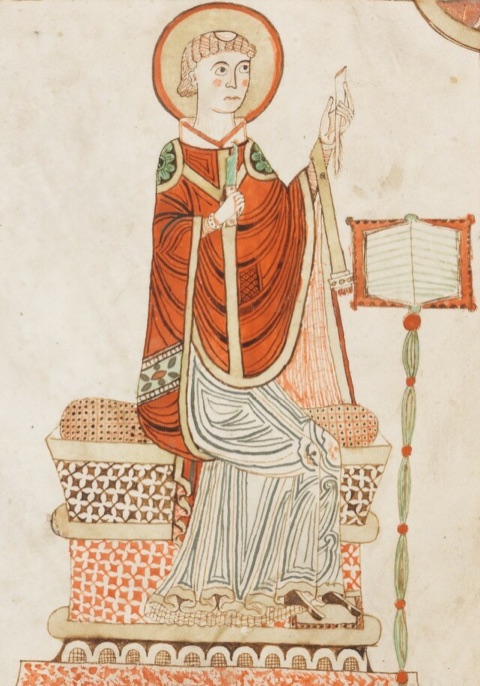
Asser
Writing the Life of King Alfred in 893 AD, the only biography of an Anglo-Saxon king composed by a member of his own court while he was still reigning.
Biography
Asser was a monk of Saint Davids in Dyfed, in west Wales, where he was raised, educated, tonsured, and ordained. His relative Nobis governed that church as archbishop and was at one point driven out of it by Hemeid, king of Dyfed, who plundered the monastery and its parish; Asser himself was expelled on one occasion. About 885 AD he traveled east through the intervening kingdoms and met Alfred, King of the Anglo-Saxons, at the royal estate of Dene in Sussex. Alfred asked him to give up everything he held north and west of the Severn and enter his service. Asser refused to promise that quickly, then fell ill with a fever at Caerwent for twelve months and a week, and finally agreed to spend six months of each year at the West Saxon court and six months in Wales, on the condition that Alfred help Saint Davids.
At court he read aloud to the king whatever books Alfred wished to hear, and he was present for the day Alfred asked him to copy a passage into the small book of psalms and prayers he carried against his chest. Asser wrote the quotation on a separate booklet of four leaves instead, and that booklet grew into the collection Alfred called his Enchiridion, or Handbook. Alfred rewarded him with the monasteries of Congresbury and Banwell, given on Christmas Eve with a silk cloak and as much incense as a strong man could carry, and later with Exeter and the diocese belonging to the king in Wessex and Cornwall.
In 893 AD, Alfred's forty-fifth year, Asser finished the Life of King Alfred, breaking off in the middle of an account of the king's judgments. He afterward held the see of Sherborne in Wessex, the church whose earlier bishop Ealhstan he records governing for fifty years. He died in 909 AD. The single medieval manuscript of his book, Cotton Otho A.xii, was destroyed in the Ashburnham House fire of 1731, and the text survives through Francis Wise's 1722 edition and earlier transcripts made from that copy.